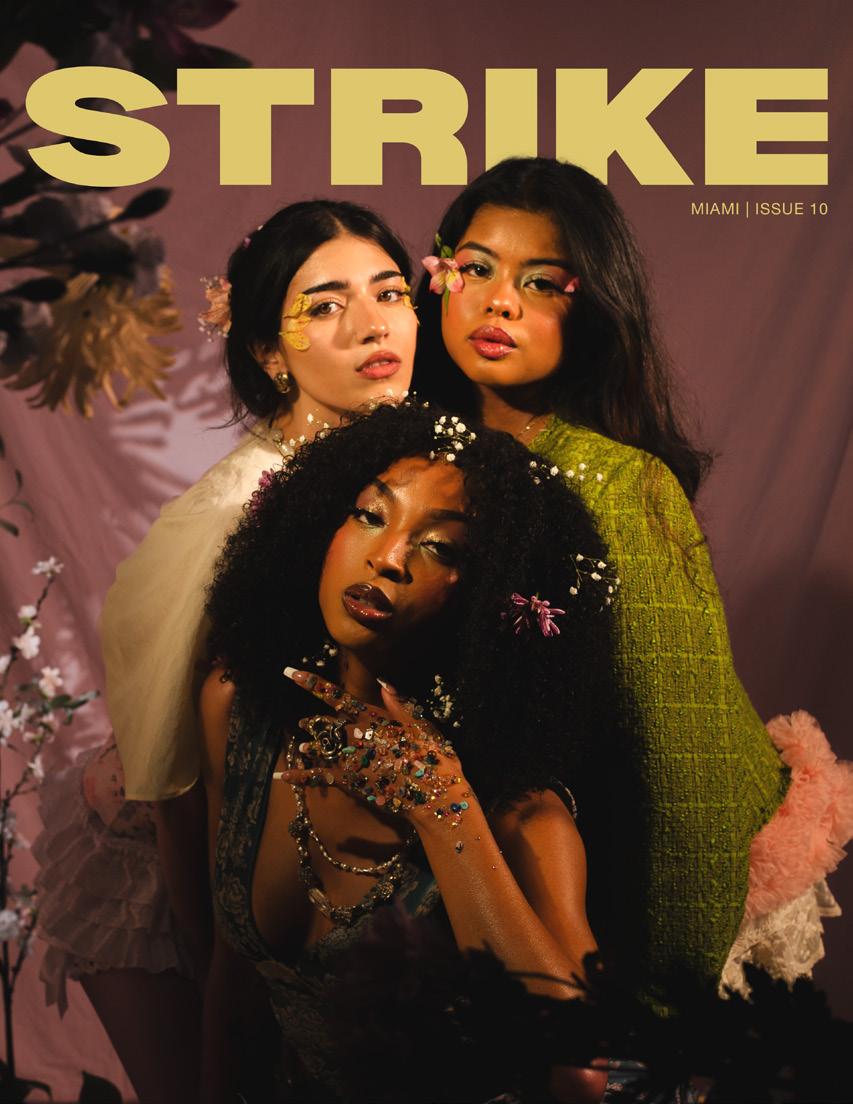
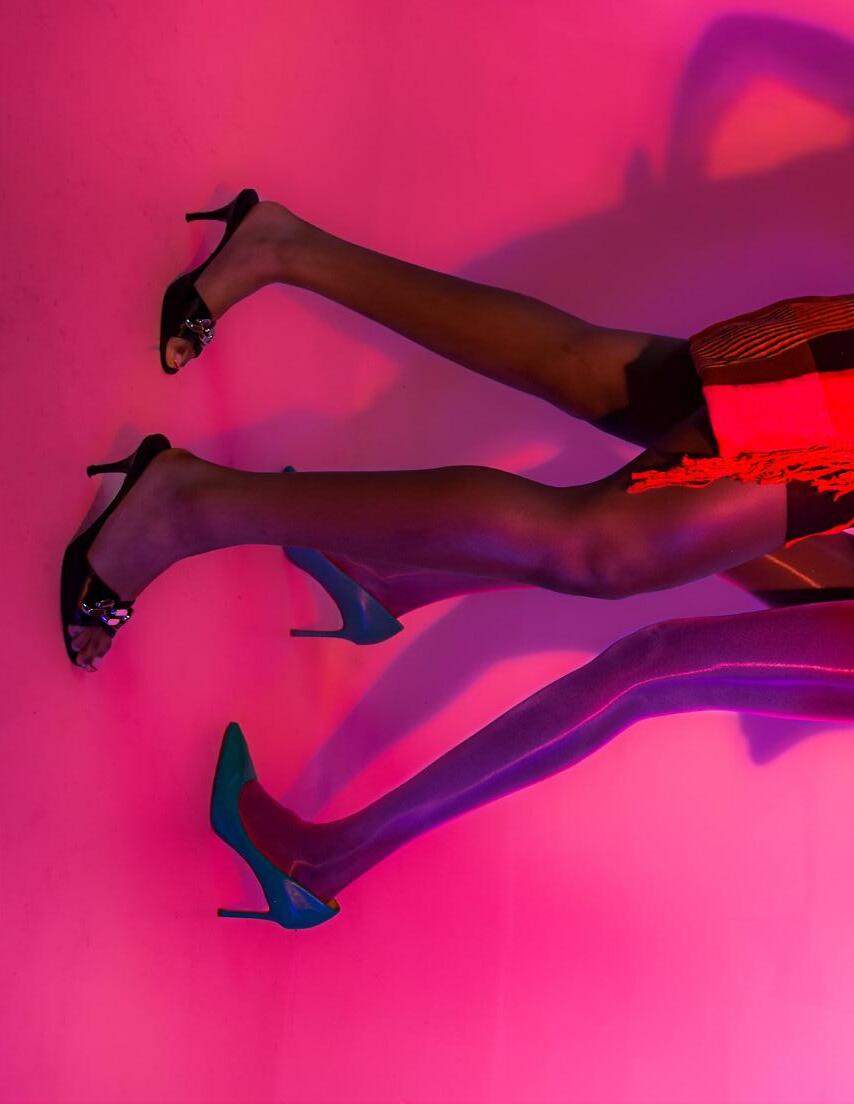
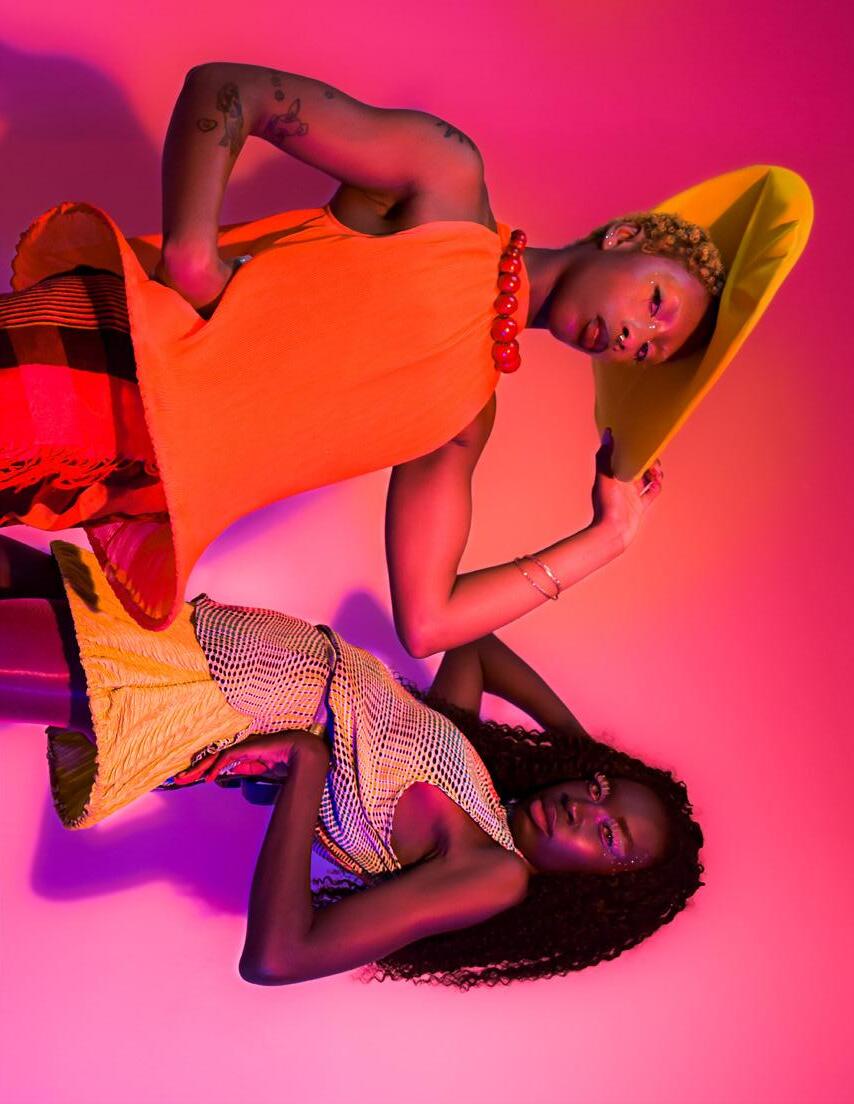
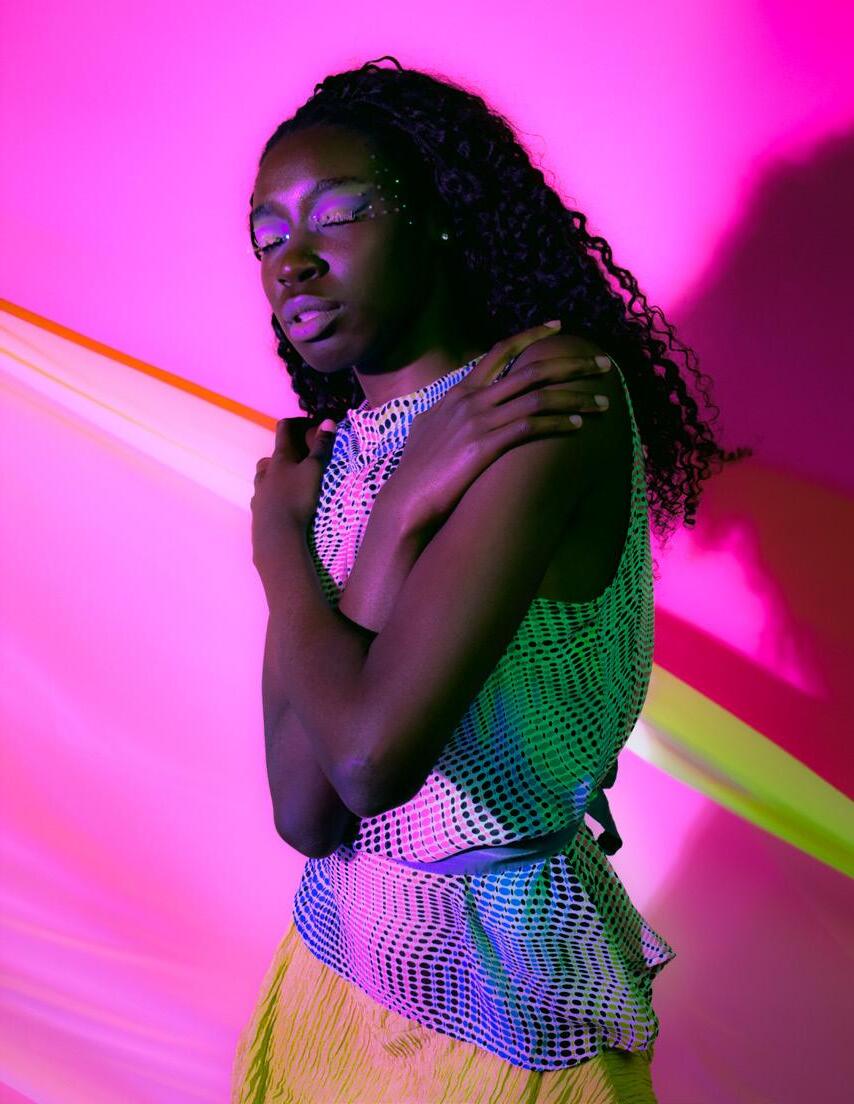
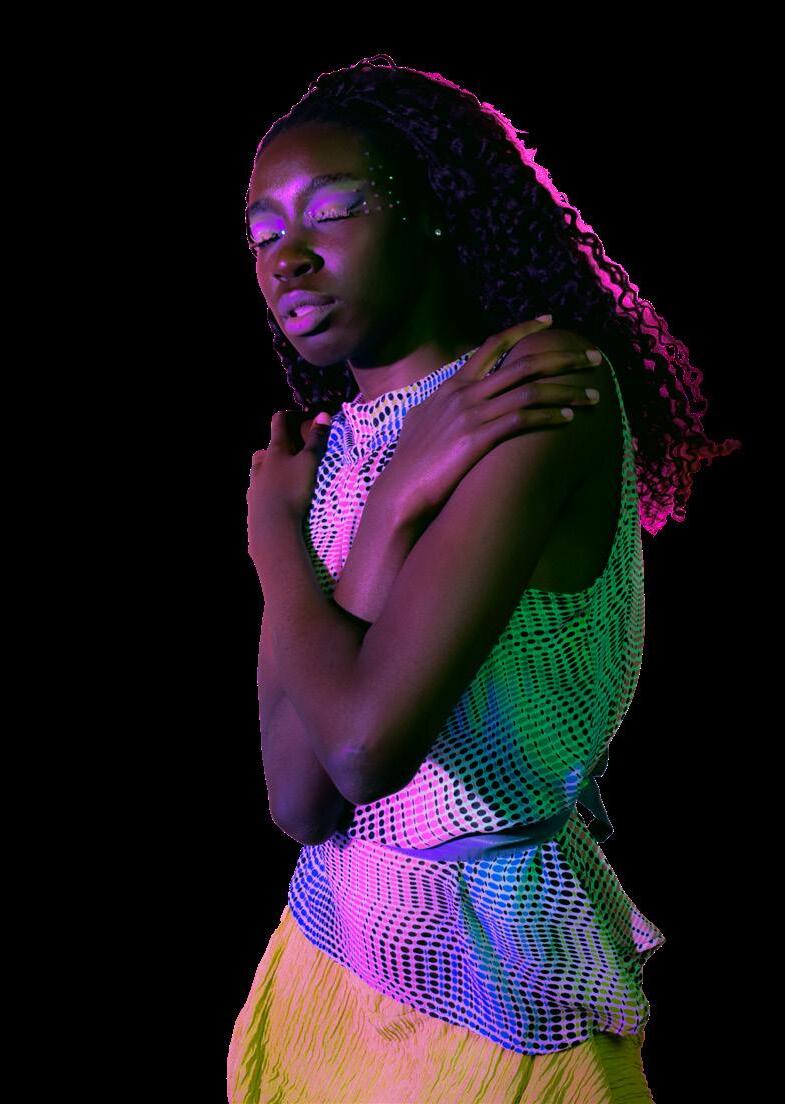
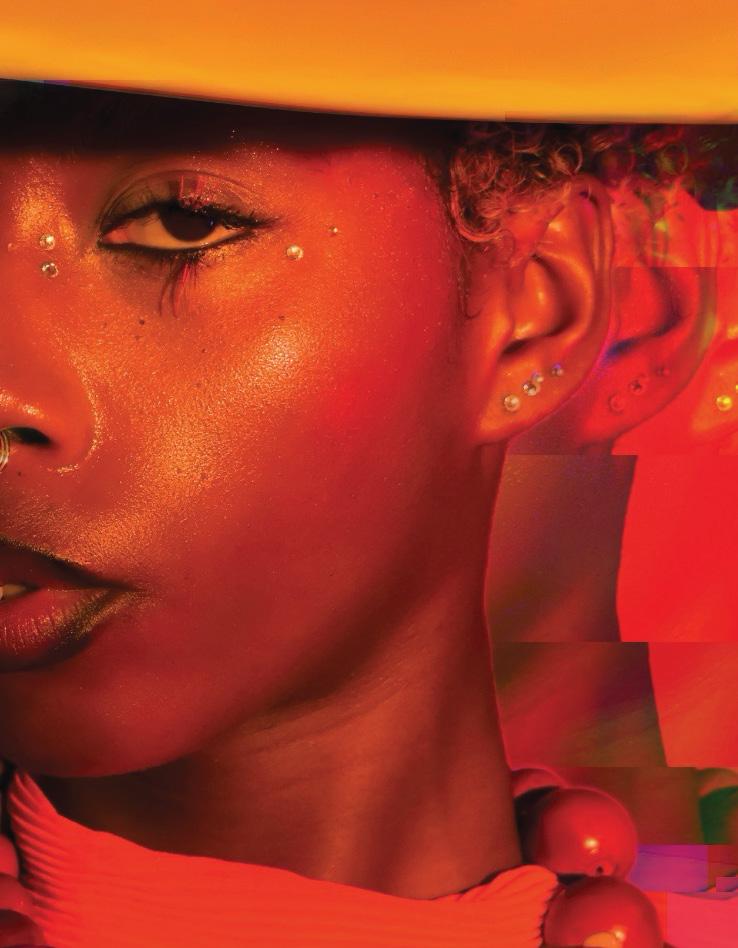
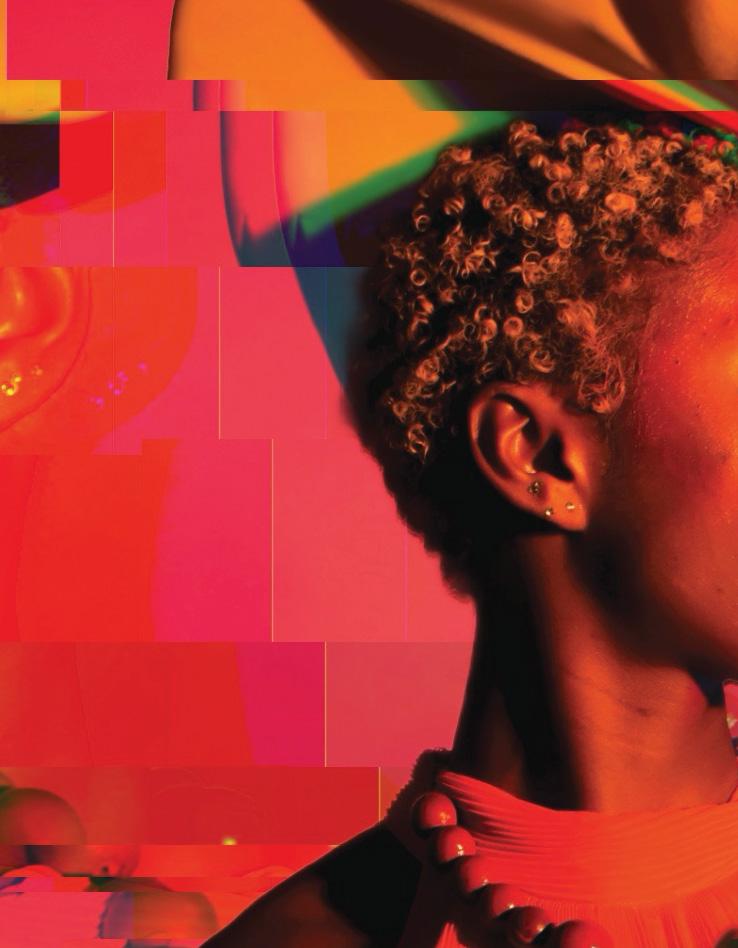
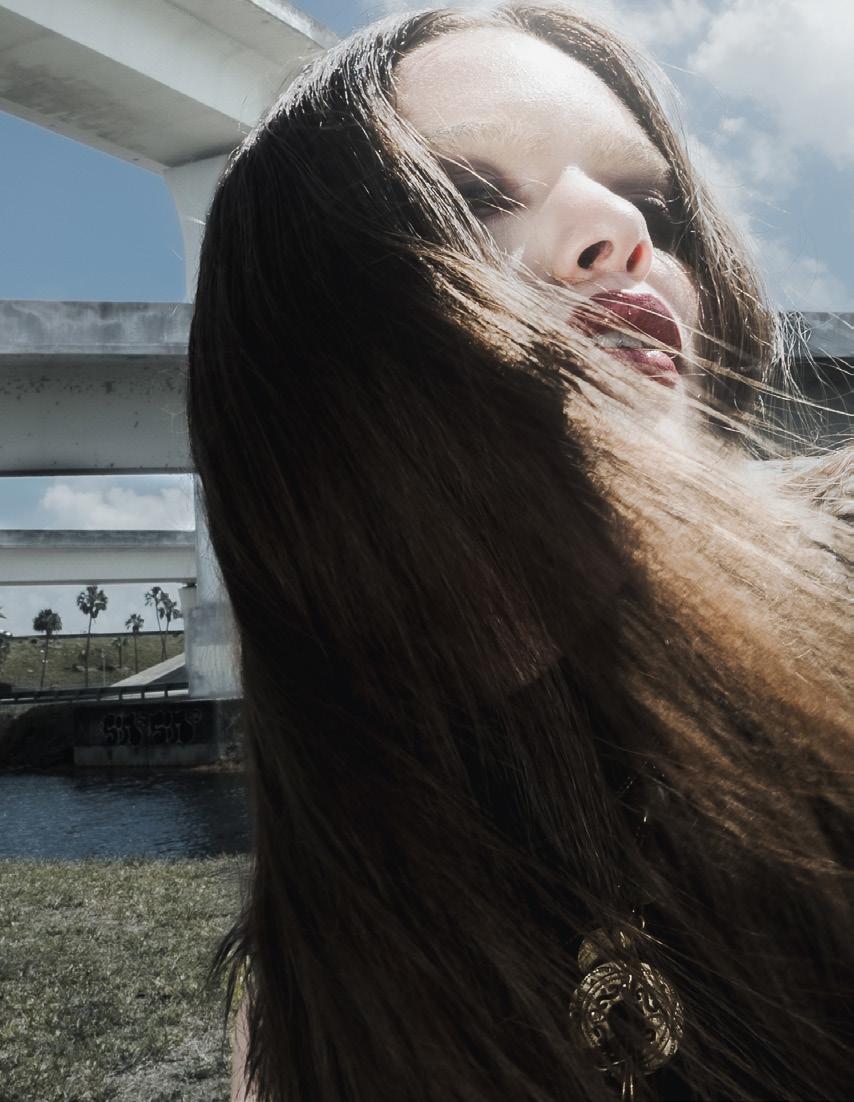
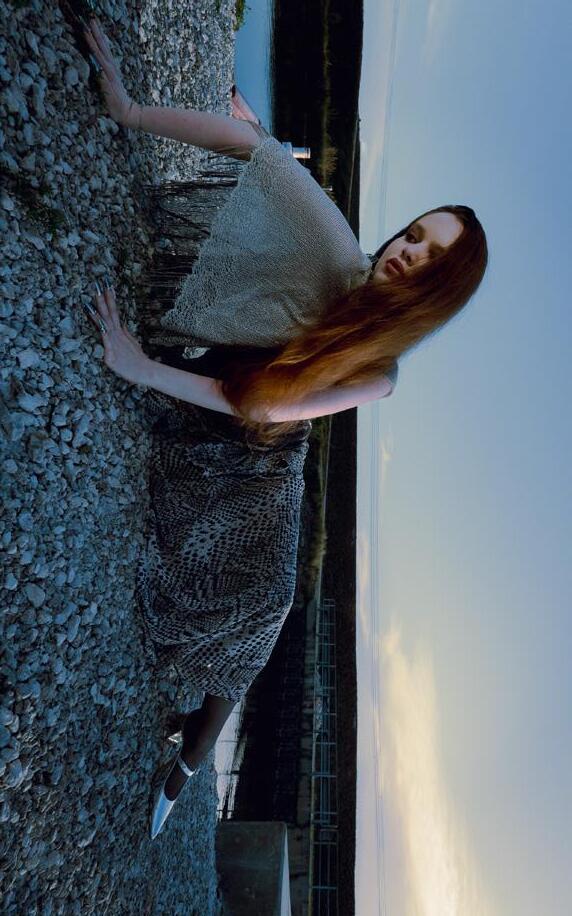
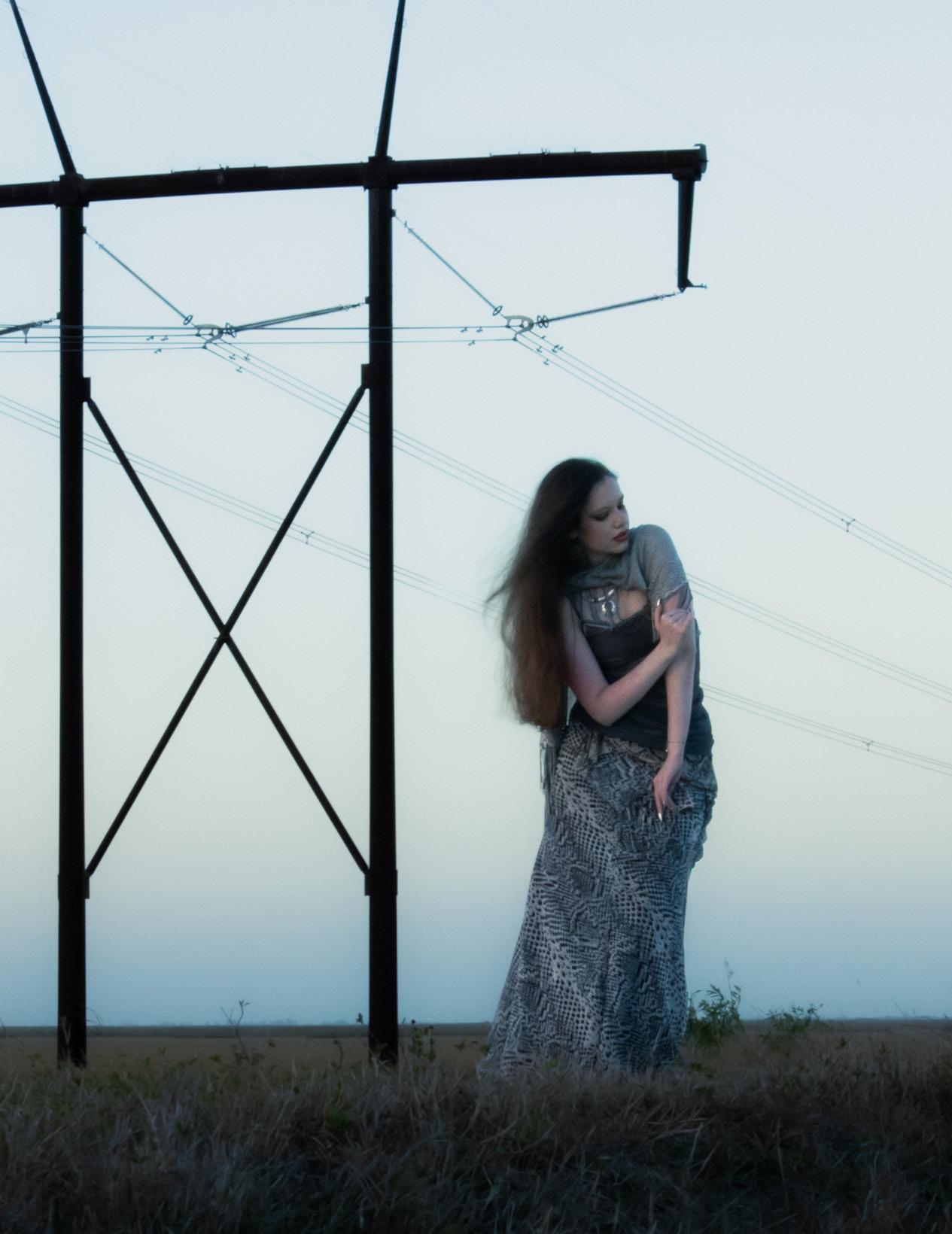
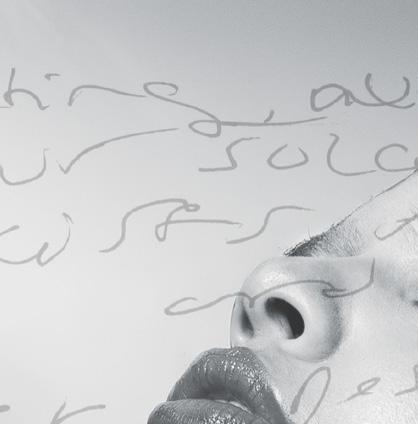
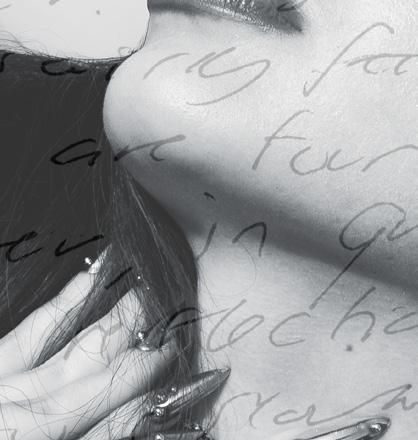
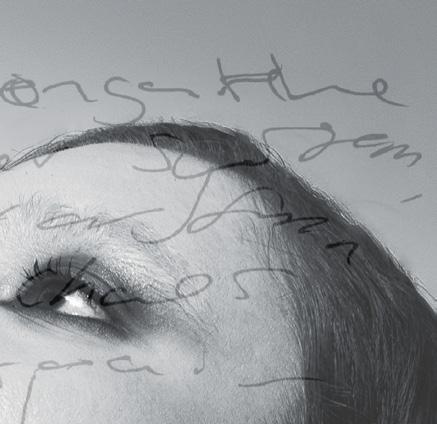
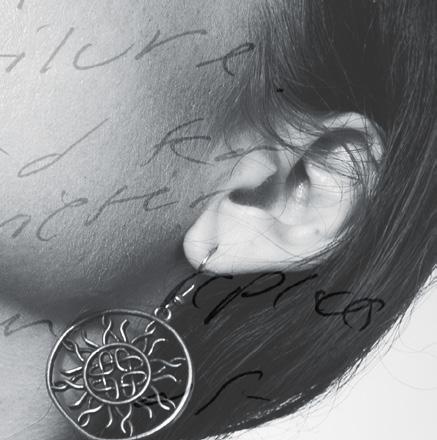
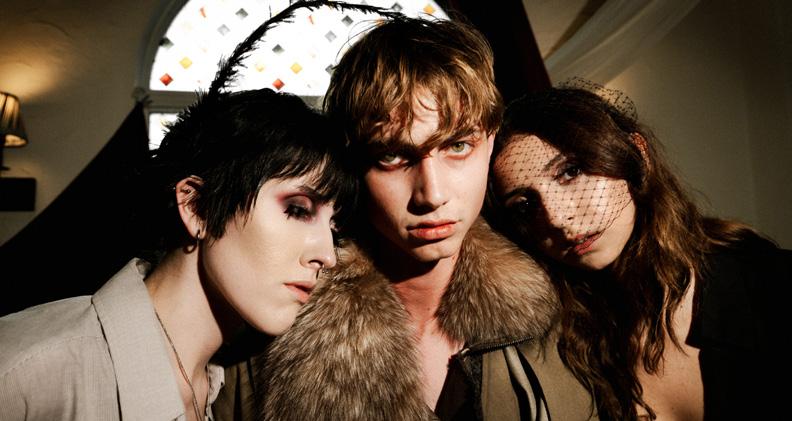
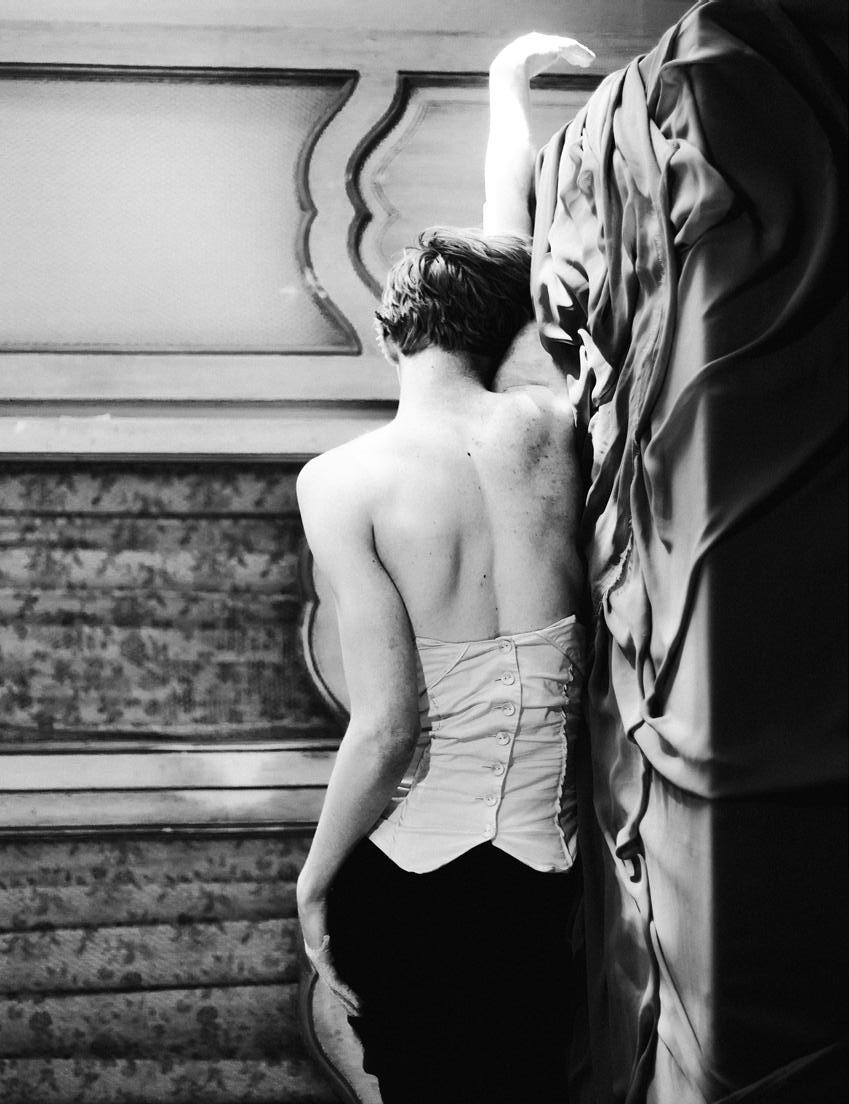
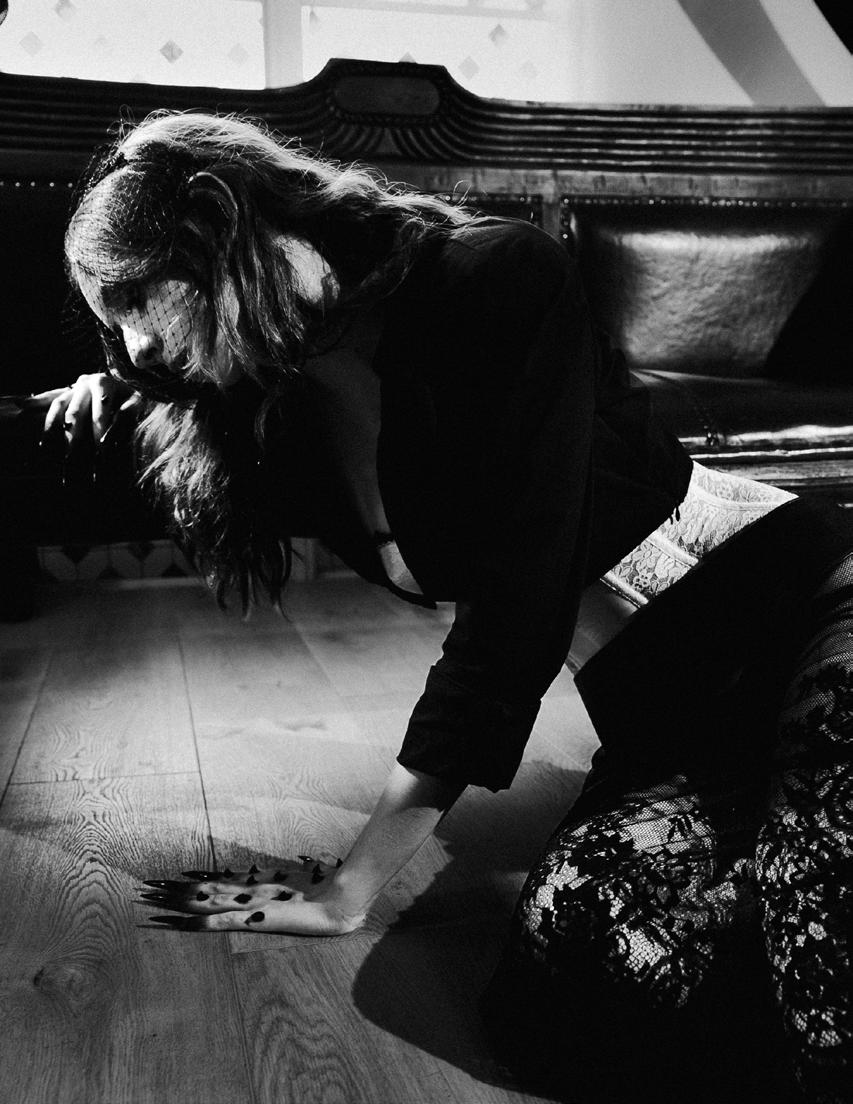
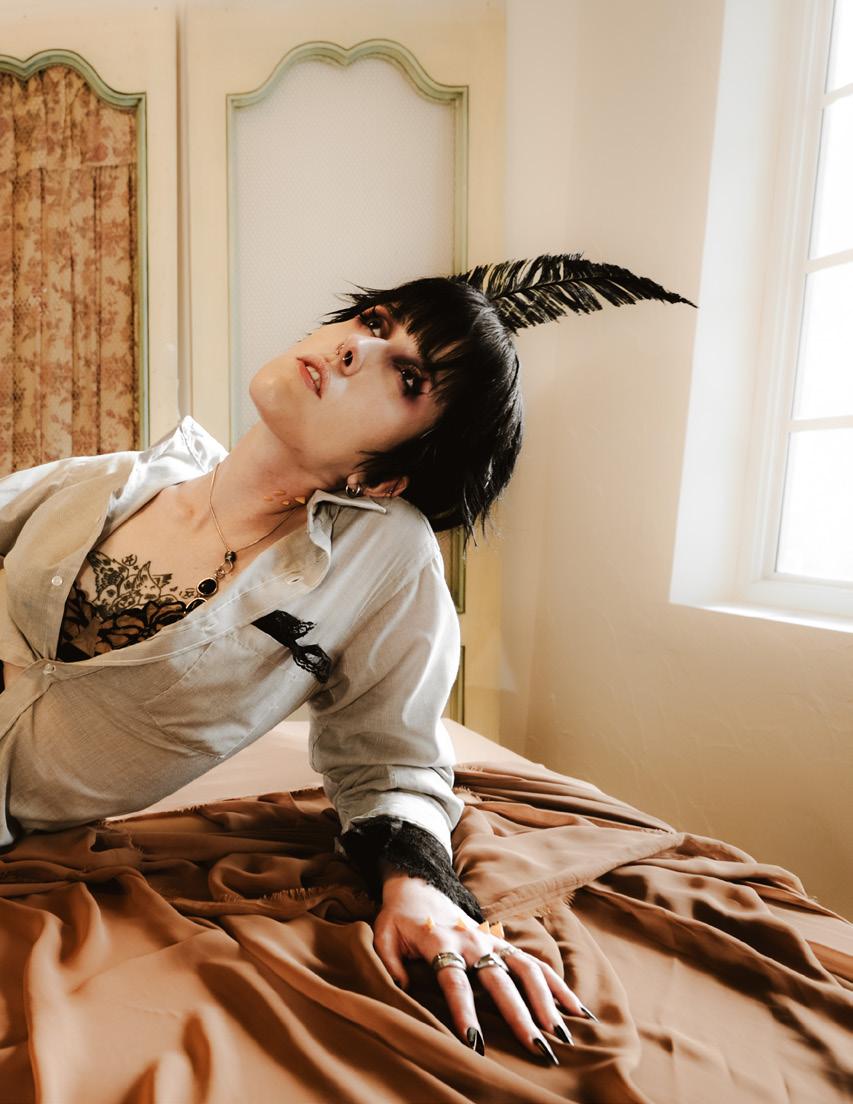
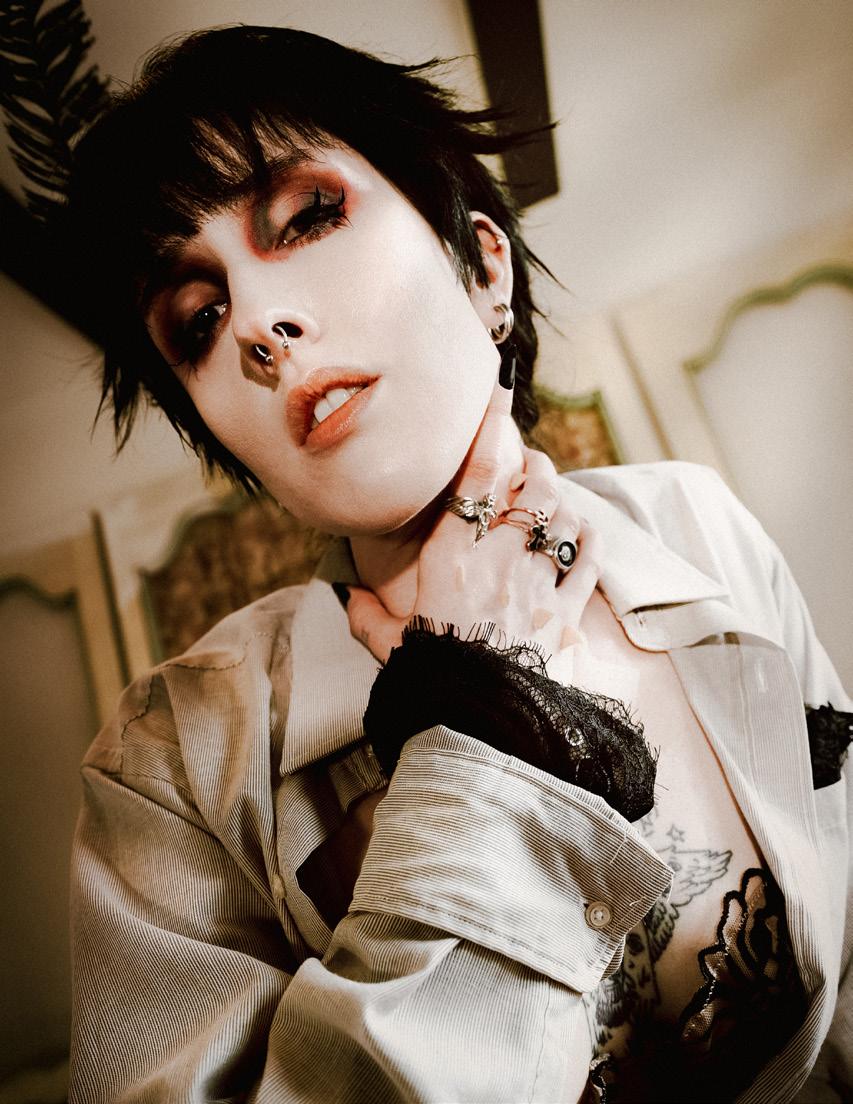
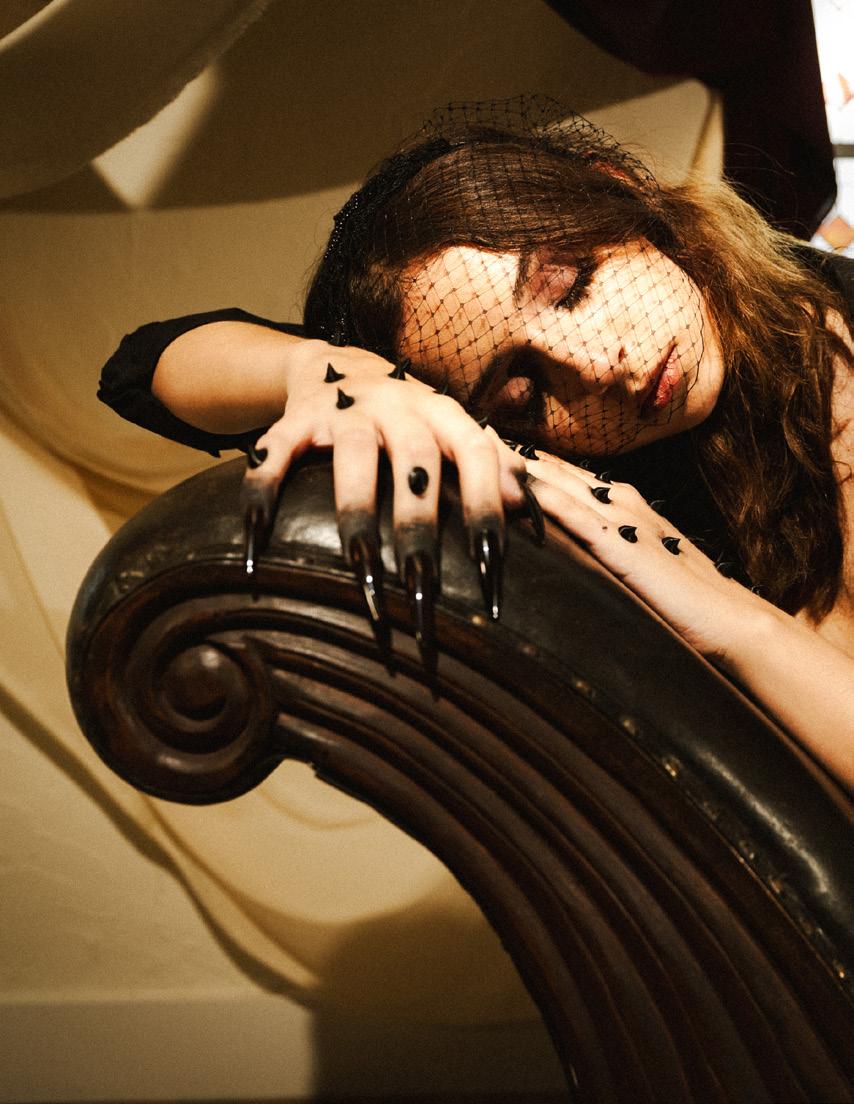
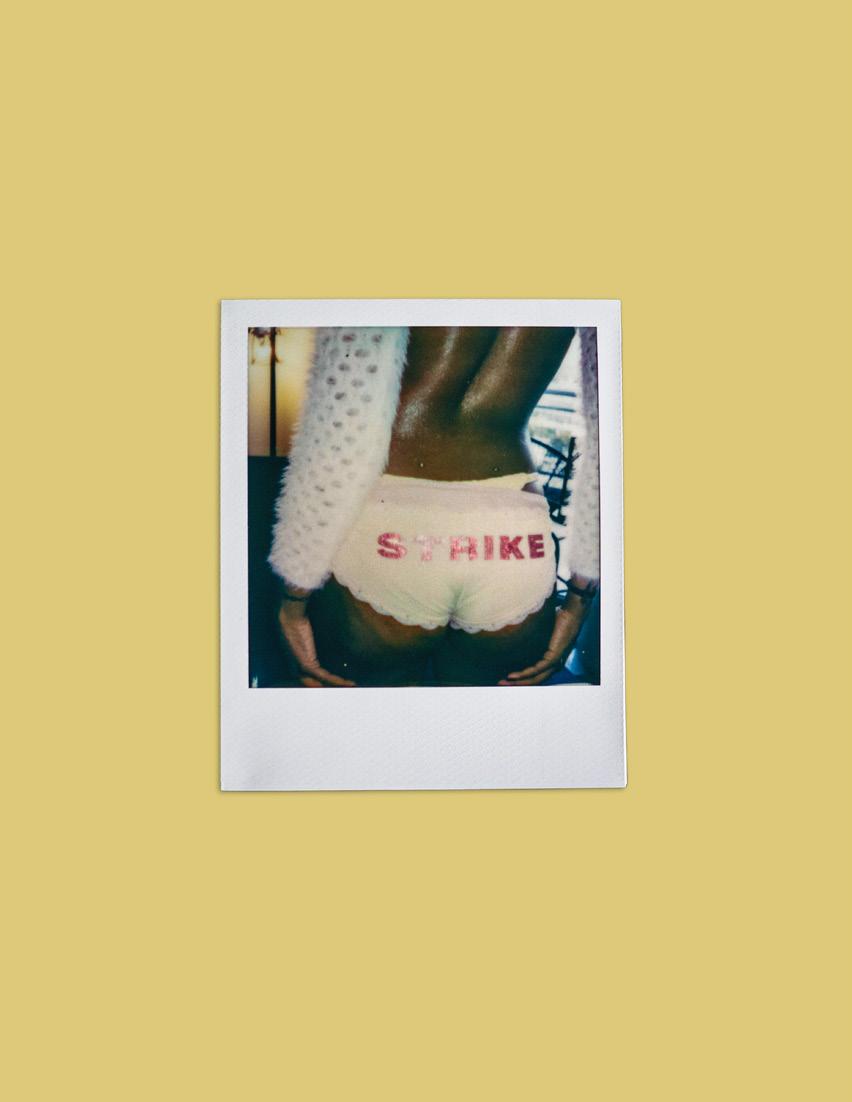
Issue 10, Frisson, explores its namesake: a sudden bodily shiver, or thrilling sensation, that drives a ripple of goosebumps, or tingling surge, from a profoundly moving catalyst. It comes as intuition, a pre-linguistic disturbance, an original yet innate force propelled into our consciousness. Its inherent authenticity sings deeply, caught between the forefingers of our minds. It is an abrupt chill with that telltale prickle of the skin, the rush of recognition without immediate explanation. Frisson lives in the body, in the breath, when something beautiful, strange, intimate, scary, or acutely familiar intrudes on the ordinary. Issue 10 aims to translate that physical reaction to expose a certain moment’s effect.
Tension lies at the core of frisson. That charged space between comfort and discomfort, and those dialectical states of contrast. It happens when a pattern breaks just enough for us to recognize the break through some visceral, emotional instinct. In that interruption, the world seems briefly sharpened. Frisson marks a rupture of the subject, exposing the gap between what we feel, what we wholly desire, and what we can name.
There is a distinctly human quality via interruption. We are creatures constantly compelled to describe. We build philosophies and rituals, identities and theories, around moments that evade interpretation. That instant of frisson discloses a larger instability to remind us that the self is not sovereign. We act, and are in turn acted upon, by nostalgia, beauty, sound, nature, and other people. This issue treats the body as evidence of a meeting point between private sensation and collective experience; an investigation of the outward through the inward.
When we think about the purpose of us as a creation, however incredibly vast and grand that may be, one of the central questions is what it means to feel something and be troubled by feeling. Across the concepts, frisson is explored through visual and emotional language built from the surreal pleasure of being moved without fully understanding why. The thrill of being interrupted by the strange natural order of the world, and our receiving, reacting, changing selves in it.
A LETTTER FROM THE
“Writing comes out of tension, tension between what’s inside and what’s outside,” Rachel Cusk writes in Outline. So much of the writing, editing, styling, photography, and overall creating in this issue comes from the aim to explore that exact pressure. The attempt to bring an interior feeling, that frisson, into the visible world while also exploring larger “outward” themes through it. We are always trying to understand what something feels like. What did it feel like to be there, to love that, to fear that…But whether we are looking within us, someone before us, or some future version of us, that curiosity is one of the most human things we have. And using it, we dived into our own attempt to show the most personal, yet universal, feeling of frisson. This issue exists because of everyone who gave into the urgency of creation. Gave their time, attention, and care to that process. You all have come together to make something lasting, and should be so proud of it.
To Hellen and Anna—I am very lucky to have been able to work alongside you. I’m happy we clicked so well and had fun. Anna: We couldn’t have had any success without your organization, ideas, planning, and everything you do to keep us moving along! Hellen: All of your hard work is seen beautifully through this issue, thank you for taking on the challenge so completely, and creating this magical, unique world in i10.
To Anett: Cheers to round two, thank you for once again helping me lead the editorial troops (Joan of Arcing it (new verb, just for you))! Seriously, I couldn’t do it without you. I’m so grateful for the way you show up and bring, besides competence and timely organization, such positive attitude and camaraderie. Not to mention your insight and talent—always looking forward to reading anything you write, and whatever is next for you.
To all my writers: It has been a total delight working alongside you guys. I am so proud to see these awesome final works, and know the effort that went into each one. Your pieces brought so much honesty and expanse to this theme, one where you really had to think outside the box and you all did wonderfully! Thanks for working with me + my hardcore editing, and trusting the process. I know this was a busy semester for a lot of you, thank you for taking the time and pushing through to create these pieces with such sincere voices, carrying the issue along (and the blog posts too! So fun to read!). *insert reaction sticker pinkie pie and bojack horseman celebrating*
Swinging for strikes,
Nico Gurdjian Editor-in-Chief, Strike Miami
A LETTTER FROM THE
“Frisson isn’t so much a flinch, but a quickening with no obvious evolutionary advantage. A primal ache at the shard of moon hanging above city lights. A reminder that our skin is still awake, our bodies alive. What a wild gift—how our bones howl. That even in a burning world, we still get the chills.” - Joy Sullivan
Nothing has ever come so close to describing what I had wanted this issue to embody – not so much in its substance, but rather in the fervor behind it. Everyone who played a part in this did it for nothing in return. We do it because we love it, no matter the countless times we’ve disagreed on something or stared at an outfit questioning whether it works, or how many hours we’ve spent with our eyes plastered to our computers, editing and designing endlessly.
To Nico and Anna: Working alongside you both has been such a pleasure. You girls are a breath of fresh air, and we mesh amazingly. The way we bounce off each other and work together comes so easily and I’m so lucky to have had the opportunity of directing this issue with the both of you. I knew ya’ll were cool when y’all let my unhealthy use of GIFs in the groupchat go rampant LOL.
To our models: You are the kindest souls. Thank you again for your willingness to take part in this, especially to those who let us borrow your clothing and to those who literally showed up TWICE for us to be able to do Jamais Vu. I’m forever grateful!
To my directors: I feel like of all people, you guys especially have seen all facets of my Creative Directordom, from the good to the bad LOL. Mia and Julia, you guys are so real. I loved working with you two and ALL of the opinions that came with it, our “aha” moments were the BEST. Ari and Ale, first off, thank you guys for taking on the production director role with such open arms. I know it was new territory but you both took it on and were exceptional at it. Lia, you never failed to show up without your radiant smile and amazing energy. You’re super outgoing and INCREDIBLE at casting random strangers for the magazine, might I add! Anubis, you are so thorough and intentional with your craft. I’m so happy to have worked with you. I love listening to your feedback, and to this day I’m still sorry about the many revisions I had your team go through with some of these pictures *crying emoji*. Sofi, you and your team are super talented, always up for the challenge, and I have no other words to say but that you are literally the embodiment of SWAG! Last but not least, Allie and Cydni, us three started our journey with the magazine around the same time as a part of the Graphics Team, and it’s bittersweet like UGH #throwback. You two are not only amazing at what you do, but you take every design hurdle head on, and this magazine literally wouldn’t be what it is without your hours of hard work.
Being your Creative Director for this issue has been one of the most fulfilling experiences I’ve ever had the chance to take part in. It has tested my patience, mental fortitude, leadership, and creative self-esteem in ways I least expected. I would do it ten times over in a heartbeat. With all my heart, thank you to every staff member, assistant, and director who made this issue possible. This magazine was a labor of love. To those who’ve always had a creative bone in their body, this is a testament to what’s possible when you cast your doubts aside and create!
with Love,
Hellen Rabelo Creative Director, Strike Miami
A LETTTER FROM THE
Whew, we’ve made it to Issue BIG 10!!
“Frisson” is a strong feeling I experience constantly working in a creative field. I feel it when an idea first sparks in my mind, while bringing it to life, and especially when I finally see it finalized on screen or in print. That feeling of thrill, goosebumps, emotion, and passion is exactly what our Issue 10 team worked to capture throughout these pages, and I can’t wait for everyone to experience it.
One of my favorite parts of being in Strike is being surrounded by such talented, creative, and hardworking students who continuously remind me why I started. To my incredible external team, thank you for always putting in the extra effort to help Strike grow into its fullest potential. To our creative and editorial teams, thank you for your dedication and the countless hours poured into this issue.
A special thank you to Nico for being such a kind and uplifting person to work alongside, and to Hellen for bringing our vision to life through unwavering hard work.
I’m endlessly grateful for the opportunity to serve as External Director. Through this role, I’ve learned lessons in management, organization, communication, and leadership skills that I know I’ll carry with me far beyond Strike and into my future career.
This is only the start of my journey with Strike, and I can’t wait to see where we go next.
Strike out,
Annasophia Alfonso External Director, Strike Miami
PHOTOGRAPHY DIRECTOR
Anubis Casares
PHOTOGRAPHERS
Anthony Martinez
Isabel Gonzalez
Adrian Valdes
Yairi Lorenzo
Elijah Canseco
Matthew Castano
Rayanna Hafez
Jeremy Lee Robinson
VIDEOGRAPHY DIRECTOR
Sofia Hoyos
VIDEOGRAPHERS
Joey DiMare
Valentina Torres
Jeremy Lee Robinson
Melanie Torres
Yairi Lorenzo
BEAUTY DIRECTOR
Lia Alongi
STYLING DIRECTOR
Mia Mazuelos
STYLING ASSISTANT
Julia Carcione
BEAUTY & STYLING
Joey DiMare
Anthony Urena
Vera Parra
Jheyli Alcerro
Sofia Lantigua
Isabella Vega
Melissa Leon
Aivery Jade Peña
Alexandra Morera
Jessica Retana
EVENTS/PR DIRECTOR
Grace Coto
EVENTS DIRECTOR ASSISTANT
Ariana Ming
EVENTS ASSISTANTS
Santiago Saez
Destiny Daniels
Coralys Melo
Linette Garcia
Andrea Fernandez
FINANCE DIRECTOR
Claudia Usabal
EDITOR IN CHIEF
Nico Gurdjian
EIC ASSISTANT
Melanie Torres
BLOG DIRECTOR
Anett Martin Sosa
WRITERS
Helen Capote
Linette Garcia
Moriah Higgs
Ariel Rivera
Kynda Kailea Green
Francesca Rico
Melanie Torres
Anett Martin Sosa
CREATIVE DIRECTOR
Hellen Rabelo
CD ASSISTANTS
Eva Slavin
Rayanna Hafez
GRAPHICS DIRECTOR
Allie Pedroso
GRAPHICS ASSISTANT
Cydni Ayon
GRAPHICS
Valerie Ingaroca
Andrea Ramirez
Samantha Garces
PRODUCTION DIRECTORS
Ariana Rosario
Alessandra Perez
PRODUCERS
Ashley Goehmann
Olivia Tomczuk
Kiara Ysabelle Marzan
Eva Slavin
Valentina Torres
EXTERNAL AFFAIRS DIRECTOR
Annasophia Alfonso
EXTERNAL ASSISTANT
Kiara Ysabelle Marzan
SOCIAL MEDIA DIRECTOR
Jennifer Silva
SOCIAL DIRECTOR ASSISTANT
Claudia Davilla
SOCIAL ASSISTANTS
Sophie Sullivan
Claudia Usabal
42 pluto 30 dB
78 neogenesis ode to becoming
116 jamais vu
CONCEPT Daniela Pombo, Destiny Daniels, Hellen Rabelo, Nico Gurdjian, Annasophia Alfonso PHOTO Anubis Casares, Isabel Gonzalez, Rayanna Hafez, Jeremy Lee Robinson, Elijah Canseco VIDEO Valentina Torres STYLING Melissa Leon, Anthony Urena, Aivery Jade Peña, Julia Carcione, Vera Parra, Mia Mazuelos BEAUTY Daniela Pombo, Lia Alongi, Alexandra Morrera, Jessica Retana PRODUCTION Kiara Ysabelle Marzan, Valentina Torres, Ariana Rosario, Alessandra Perez GRAPHICS Allie Pedroso, Cydni Ayon
TALENT Seoul Joseph, Samantha Vital, Storm Thomas, Elle Paige, Daniel Adam
the intimacy of undressing
Helen Capote
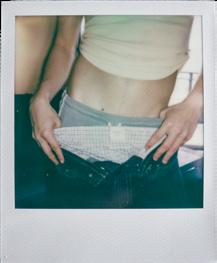
Unbuttoning a shirt, loosening a belt, unzipping pants, kicking off shoes—slipping off these layers reveals our most vulnerable self. Each button, each zipper carries effort, building the tension of intimacy. The surrender of oneself to another. The distance between two shortens, and draws them closer, initiating a bond that is impossible to ignore.
As time passes, intimacy can become lost between longtime lovers, losing the initial spark that was once present at the start of their newly formed relationship. Becoming accustomed to one another’s presence is natural, but intimacy remains vital to the core structure of a relationship.
Whether between longtime lovers or people just beginning to explore one another, intimacy is built on expectation. It is a strange tenderness that requires the full attention of another human being. It is an invitation that does not require words, one in which actions speak for themselves.
Intimacy isn’t neat; it’s messy, and the clothes that once held us together are tossed aside and tangled in knots. The once-still environment transforms into something deeper, something only those within
it can experience. Layers of clothing tell a story and serve as personalized social signals for public viewing. In private, our truer selves are revealed to those we trust.
In this setting, nothing else matters.
Leaving behind the traditional, lust-laced way of undressing to proceed as each step matters. Building that energy brick by brick heightens the arousal that is mutually shared. That feeling does not only remain in the moment; it becomes an energy that lingers in the bond between them.
Taking time to care for the small things in one another, to give undivided attention, makes it possible to notice things that may have been there from the beginning. Some parts are revealed effortlessly, while others unfold with time, exposing pieces that have yet to be discovered.
A spark buried beneath habit is still alive; it burns and flickers even after novelty has faded.
human sensation
Sexuality, one of the most taboo subjects we could talk about.
As time goes on, we’d like to think we are getting more progressive, but the conversations around sex and desire never seem to get any easier. The hesitation is strange, considering how these experiences shape so many of us. In its simplest form, sexuality is a means of human connection, something vulnerable and worth treasuring. One of the most intimate acts we as humans can partake in, and all we know how to do is create shame around the subject.
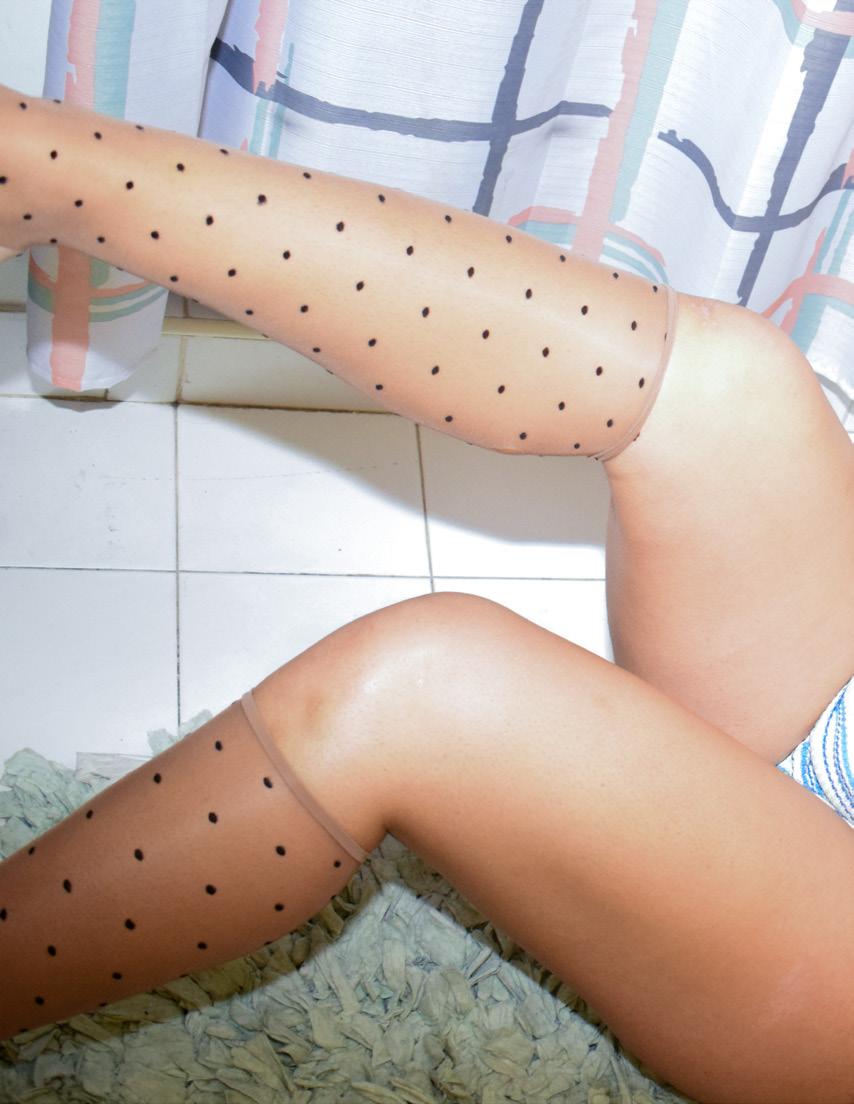
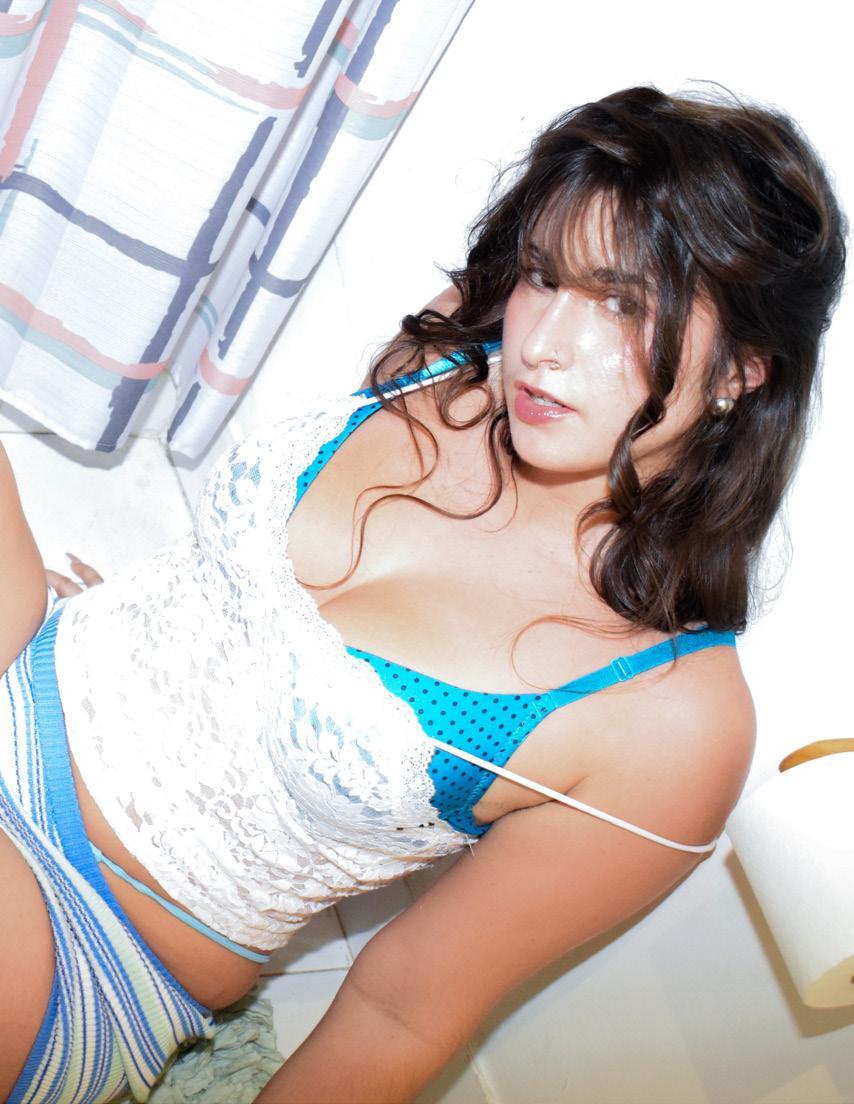
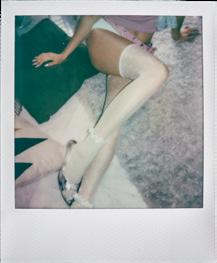
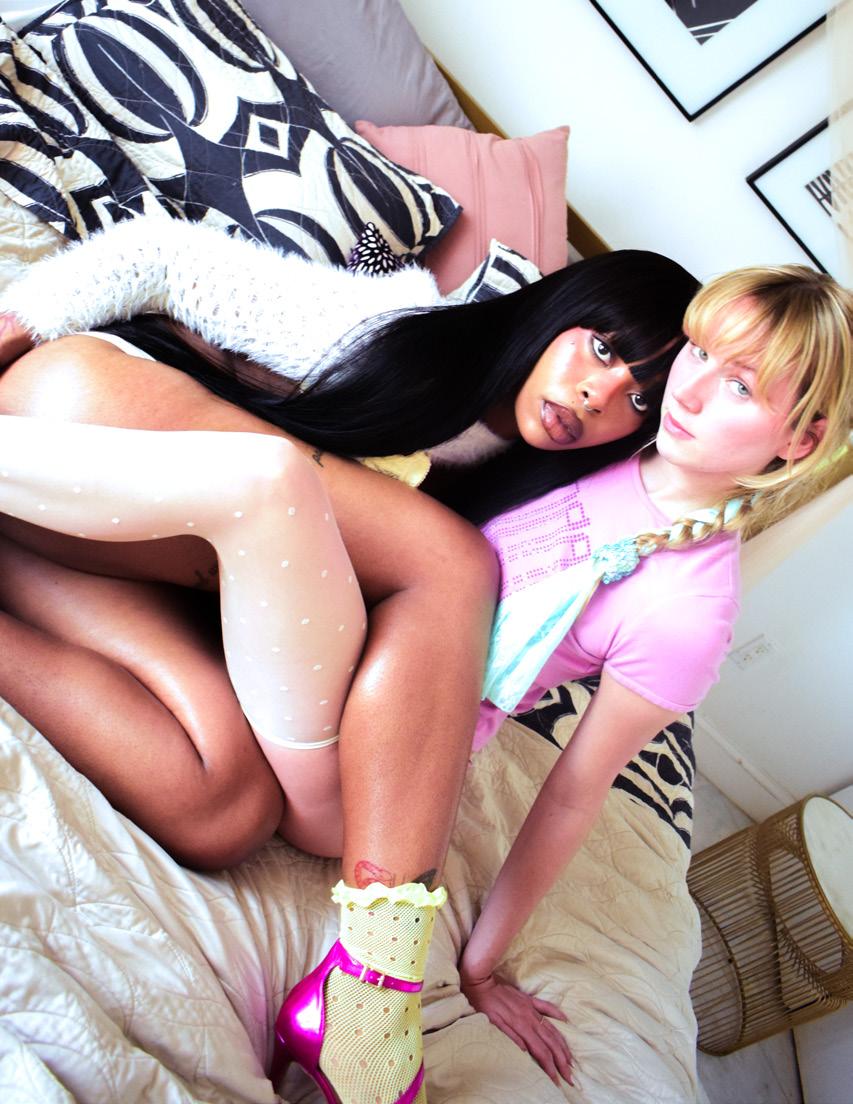
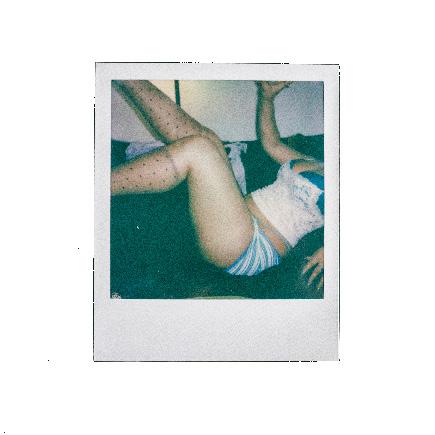
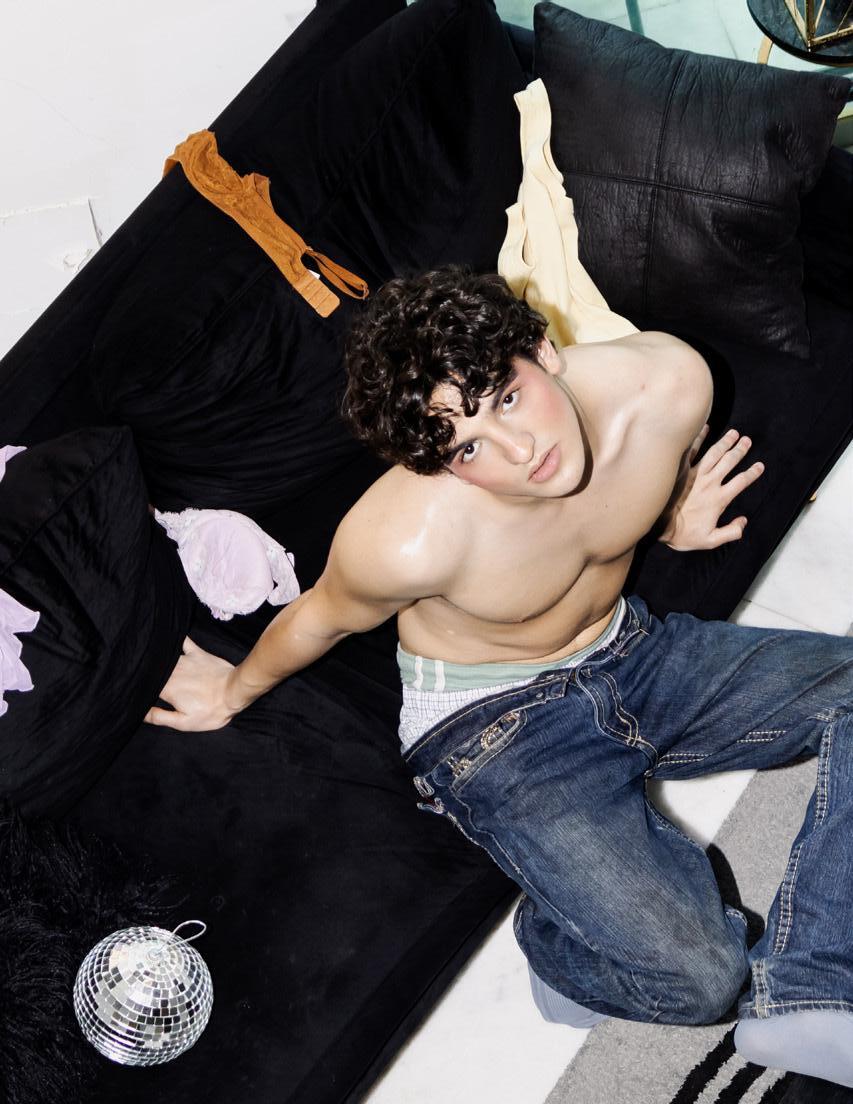
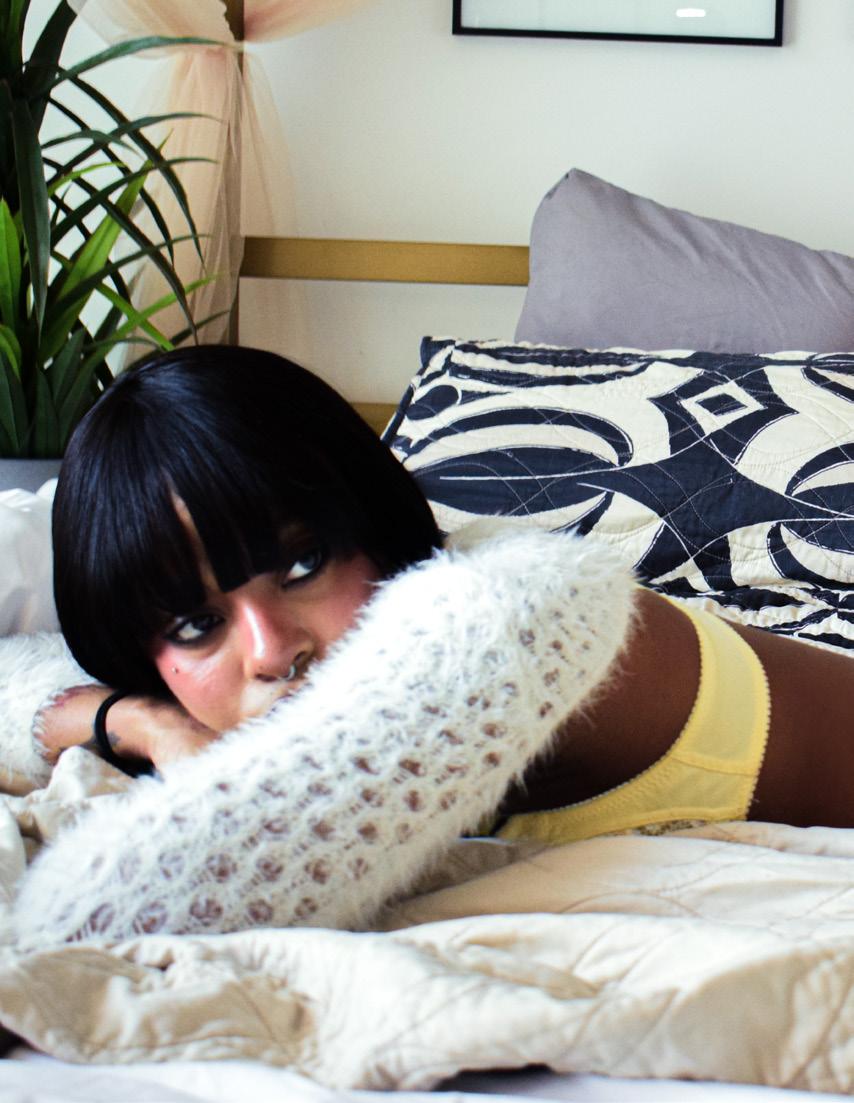
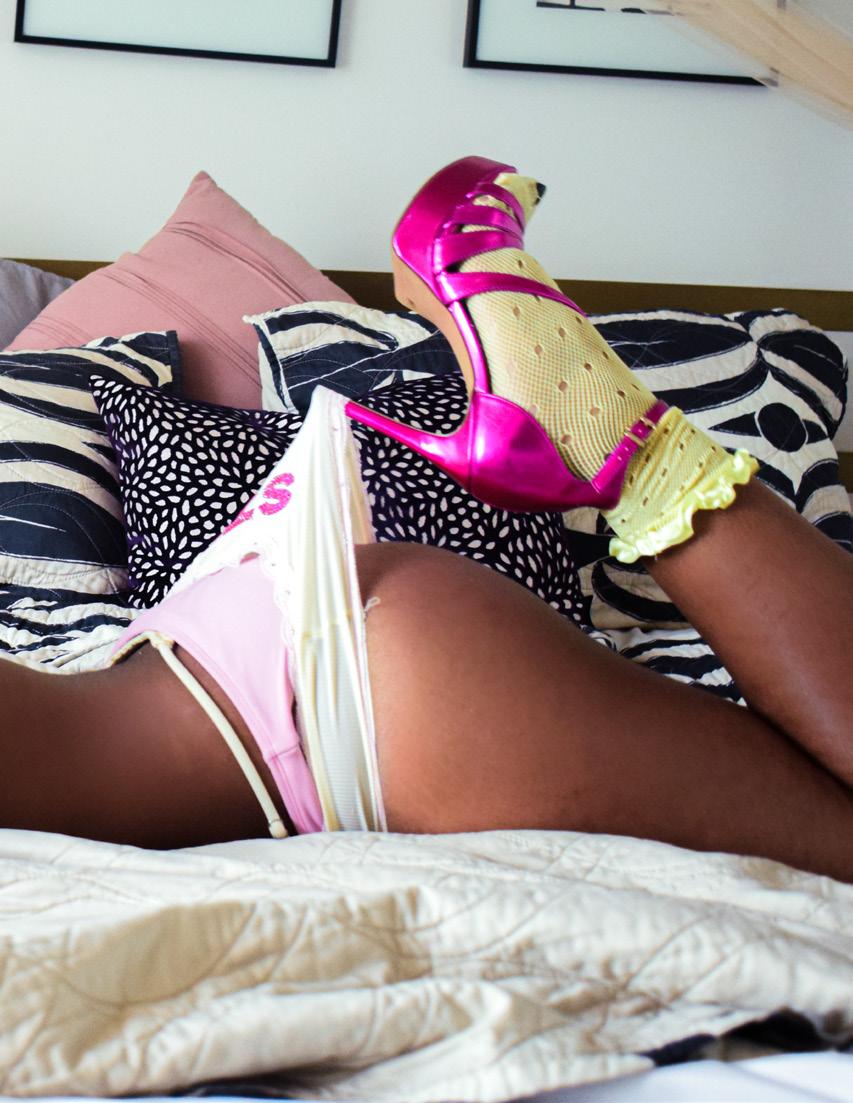
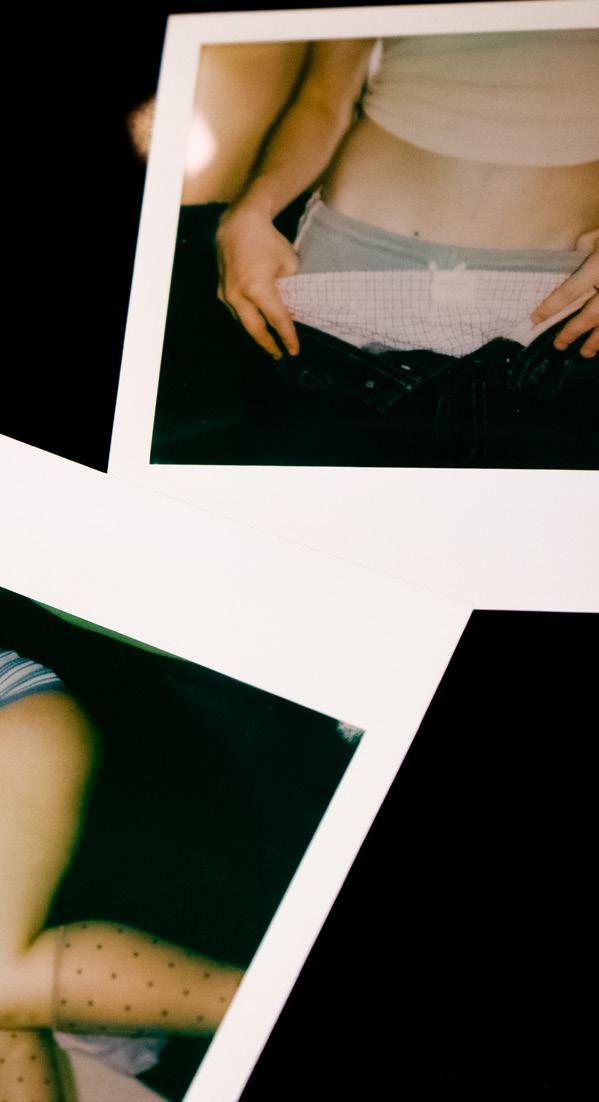
“In Heat” explores the charge of emotions that come with this universal experience. The tension, goosebump forming, as the anticipation between lovers grows. It is a feeling that just never seems to get old, yet still we remain hesitant. The shoot creates a space that is free from the judgment and stigma, where the playful nature of that tension is embraced. Without becoming explicit, it approaches sex and sexuality with neutrality. That neutrality does not diminish the passion, but frames desire as part of an ordinary universal experience. To better understand the concept, I spoke with my dear friend Seven Daniels, one of the minds behind its direction.
Melanie: How did ‘Frisson’ inspire this concept?
Seven: Frisson is used to describe ‘aesthetic chills’ or a thrill. This issue explores different concepts that can provoke these chills and it felt fitting to have a more sensual, almost sexual concept included. I think exploring your chemistry with someone else is one of the biggest thrills you can explore, and I wanted to depict that in this concept. I wanted Strike to essentially flirt with our readers. Specifically, I wanted a voyeuristic perspective for this concept. Our reader was meant to feel as though they were walking in on something they shouldn’t be. You feel that electric pulse drawing you in but you don’t wanna interrupt the moment.
Melanie: How did sexuality inspire you?
Seven: I believe that there is, inherently, a sexual nature to fashion. There’s beauty and tension in designing clothes for someone’s body and figure. I was inspired by the relationship between fashion designers and their models, essentially how your body becomes someone else’s muse and a way to dis-
play their art. I wanted to mix that with this cheeky, flirtatious vibe coming from the models and overall shoot. I wanted to focus on the sexy, burning kind of tension and allude to sexuality without crossing the line from risque to explicit. ‘In Heat’ tempts you to explore your own sexuality and desires
Melanie: What does sexuality mean for you? Why do you think it’s important to display?
Seven: To me, my sexuality is a way for me to feel good in my body and make my lover feel good in their body. It’s fun and exciting and makes me feel beautiful and worshipped. I think everyone deserves the chance to explore their sexuality without shame or judgement or prejudice. Sexuality is a beautiful experience of human connection and should be nurtured rather than repressed.
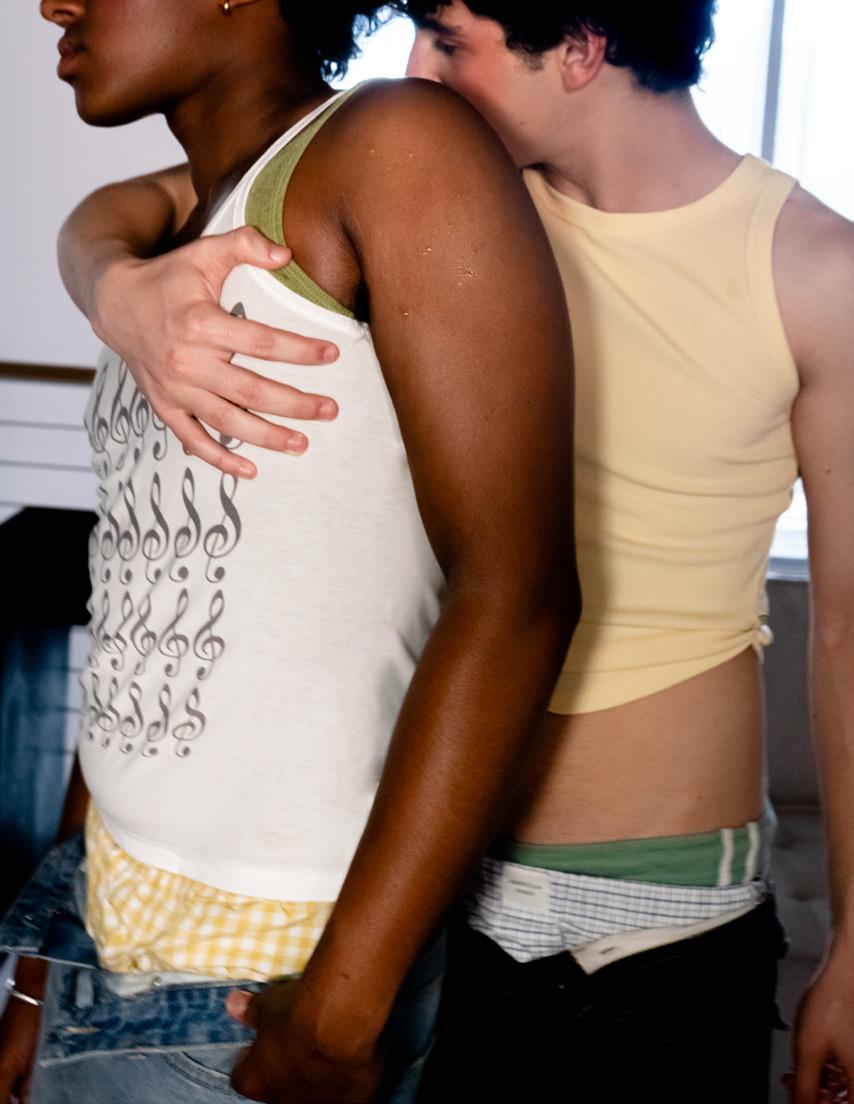
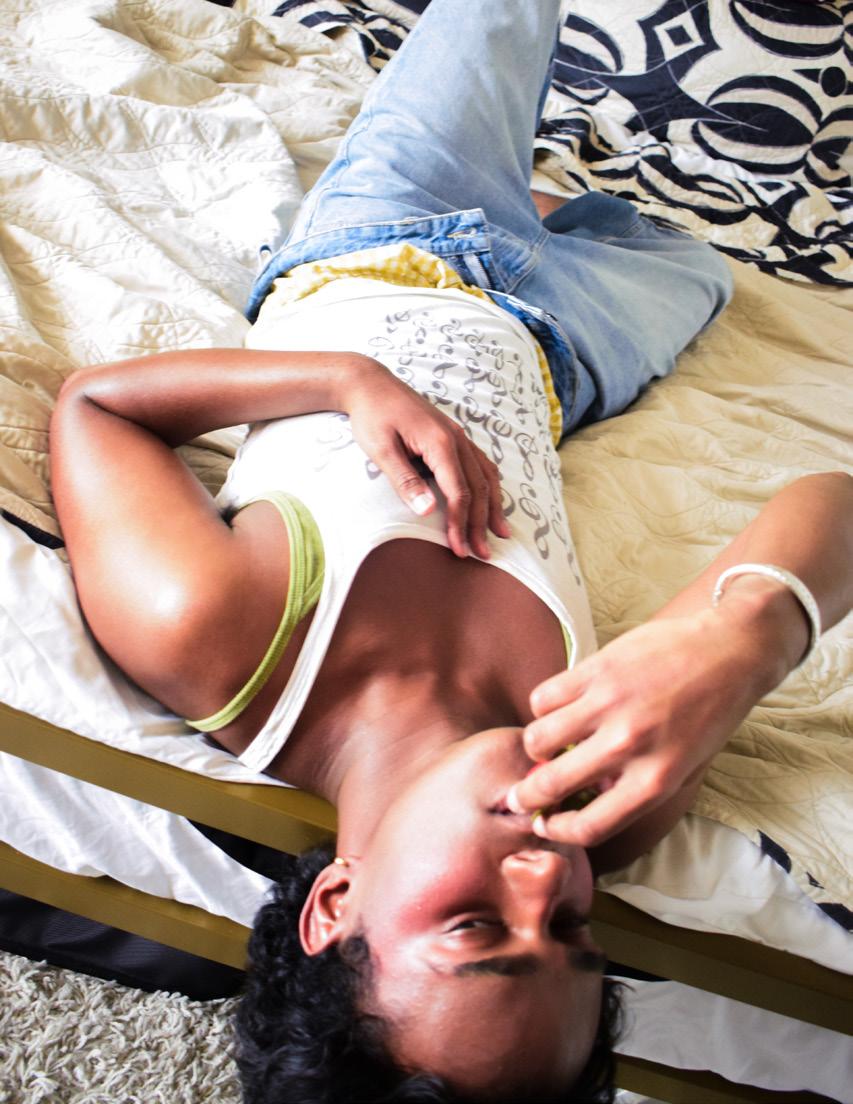
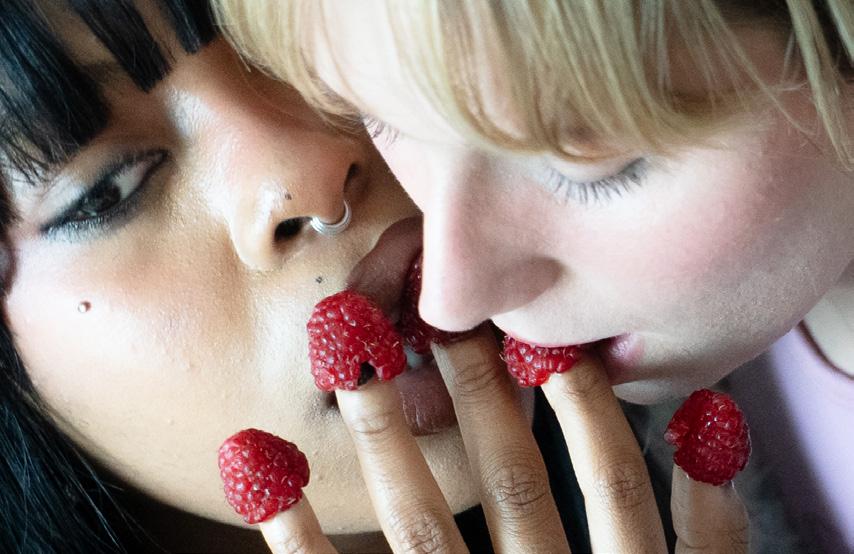
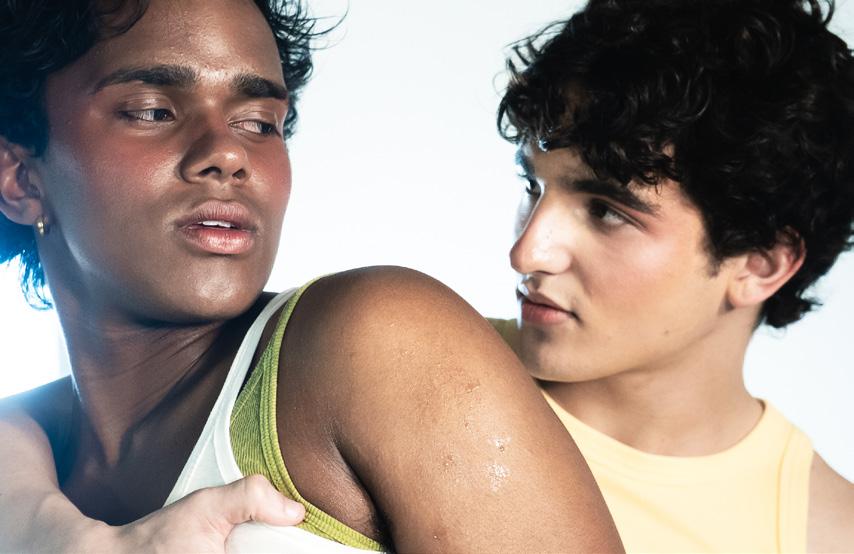
Daniels’ intentions are reflected in the photoshoot where the models carry a cheekiness that allude to something more. Bright, bold lighting adds to this illusion of being transported to a sacred space. In this space, the playful nature of sex is emphasized: models with fruits as props, clothing slipping off. Accompanied by the intensity of eye contact perpetuates that oh-so-familiar sense of flirtation. At times, it feels like we are accidentally walking into an intimate setting that flushes our cheeks. Yet, at the same time it is because of this thrill that the space of neutrality is embraced and created. Desire is present but it is not sensationalized.
The shoot explores the term sexuality in more than just one way. On one hand, it explores the capacity for sexual feelings. On the other, we can visually see how sexuality becomes a term that references sexual identity as the camera displays interactions between the same sex. Both uses of the word work hand in hand to create this flirtatious and freeing environment that refuses to shy away. Piece by piece, the photoshoot captures the lead-up and the aftermath of intimacy; not as something shameful, or shunned away, but something to look at honestly.
As lovers continue to embrace one another, this thrill shall remain alive, living on as humans keep on loving one another. Chasing this feeling, this connection makes us human, even in its most playful moments. Electric chemistry is the essence of this concept, where sensuality thrives and passion is nurtured as these sensations grow.
Melanie Torres
CONCEPT Aivery Jade Peña, Melissa Leon, Hellen Rabelo, Nico Gurdjian, Annasophia Alfonso PHOTO Adrian Valdes SUPPORT Anthony Martinez VIDEO Aaron Benavides STYLING Sofia Lantigua, Melissa Leon, Anthony Urena, Aivery Jade Peña, Vera Parra, Mia Mazuelos BEAUTY Sofia Lantigua, Lia Alongi, Alexandra Morrera, Jessica Retana PRODUCTION Eva Slavin, Ariana Rosario, Alessandra Perez GRAPHICS Valerie Ingaroca, Cydni Ayon, Allie Pedroso
Moriah Higgs
Our world is composed of sound.
Even our most mundane moments are accompanied by frequency. Emotions assign themselves to rich notes: heartbreak might sound like the sharp cries of a falsetto, anxiety like a pounding in the chest, love like something light and bright before deepening into something richer. Sound finds life through us. Music begins with a feeling. Someone feels something, makes noise, and suddenly there is a song. There’s a puppeteer behind our favorite songs and I was able to glean some insight into the other side.
A’vory Neutral is a local band that got its start when a group of childhood friends decided to make music together. They’ve since graduated from more juvenile days where they were known as “Xeyal” (pronounced “exile”) and shifted into a new group, with lead singer and guitarist Adrian Oliva, bassist Eduardo Alizo, keyboardist Fabio Gonzalez, and drummer Aidan Alfonso. The band has plans to keep experimenting with making music that reflects their collective vision.
I spoke with the lead singer and drummer about the band’s creative journey and the new album they’re recording. The two shared that Xeyal was an indie pop band with a dreamier sound and softer themes—a genre they leaned into because it seemed palatable. This is juxtaposed with the album they’re currently recording which is darker in both tone and lyricism, they cite Deftones as an inspiration. “Sometimes I like to say this album we’re recording right now captures the transition between our old sound and our new sound, it’s the perfect middle ground between the two,” says Alfonso.
The lead singer, Oliva, provided insight on what it’s like meshing different sounds. “When we started, the keyboardist would write really different chords than I would. They were beautiful.” Still, the two had dissenting opinions on what was right for the music. He continues, “But hanging out [practicing] with him so much, we both evolved. I took some chords that I’ve noticed he used to play and vice versa. My ear matured.”
Music For The Soul:
A GuidePlaylist
Rico
Are you more
Go-withthe-flow
Let go
Do you want to take charge
Lighting candles and journaling
START HERE
ENERGETIC or
Are you feeling more GROUNDED
When you’re facing a problem, are you more inclined to
Cozying up to watch your favorite tearjerker or or A pickme-up or Ruminate
Do you need To settle down
Hopeful Playlist
Heartbroken
Shameless Playlist
Reflective Playlist
What sounds better right now
Heartbroken Playlist
Restless Playlist
Heartbreak is one of the most popular topics in music. So much is felt through heartbreak, and these songs hit major points: from desperation, to questioning, to love.
• A House In Nebraska by Ethel Cain
• Missing by Everything but the Girl
• Love Is A Losing Game by Amy Winehouse
• Higher by Rihanna
Reflective
If you’re feeling introspective and looking for deeper understanding, this playlist is perfect. The songs aren’t afraid to sink into intense emotions, seeking clarity and peace, both through lyrics and production.
• White Dress by Lana Del Rey
• Hejira by Joni Mitchell
• Carnival by Natalie Merchant
• Everybody’s trying to figure me out by HAIM
Francesca
Do you feel you gain energy from Being alone Being around friends
Do you tend to act first and think later? or Take your time Make fast-paced decisions or Yes No
Do you feel best when you
Long conversations on a night in
Do you prefer bonding through Hours of fun out and about
Hopeful Playlist
Reflective Playlist
Shameless Playlist
Sometimes feeling shameless can be like catching lightning in a bottle. It’s not easy to feel free of your inhibitions, but these songs perfectly capture the feeling of embracing yourself and the natural risks that come with life.
• Treacherous by Taylor Swift
• This Is Love by PJ Harvey
• This Is the Day by The The
• DESPECHÁ by ROSALÍA
Restless Playlist
Restlessness can feel hard to understand and even harder to shake. These songs can help guide you through by leaning in rather than trying to ignore. In doing so, they help you release it.
• Shadow of a Doubt by Sonic Youth
• Mysterons by Portishead
• Enemy by Charli xcx
• The Night Last Night by Mark Ronson and The Business Intl
Feeling hopeful and open to the future is a beautiful part of life. These songs help amplify and carry different variations of hope, ranging from 60s rock to 20ths pop.
• Little Wing by Jimi Hendrix
• Let It Be Me by Bob Dylan
• I’ve Got A Feeling by Ivy
• What I Like by Charli xcx
TALENT Denise Wani, Sydney Knaak
I’ve got a secret that nobody knows. Lorde to Nabokov to I to God and back to Lorde, audio rules everything around me. Is it a disease or a divine blessing, the red tint writing on the walls. The tint that is both me and not me, both real and unreal. If one touches it, they won’t feel anything differently but gypsum, yet if they interrupt the flow, it is my walls that begin to crumble. Sound and I, me against the music, now the red turns pink. Pink circles around my bed, a bedframe made of blush. Pink and blush and corals, and then red again when the tunes ricochet back to high. Chest flared, ears out, get poised. This is how you hear color, this is how you reach synesthesia.
Synesthesia starts and ends with an act of love. An act of pure, unadulterated bliss, from the intangible to the semipermeable, the canal dictating what is translated from mere sound into color. Synesthesia is a complete meltdown of the senses. It is a nuclear reactor between sound, sight, and feeling. Some have even gone so far as to taste words. What would this sentence taste like, I wonder? Raspberries? Would the pink wall align with the pink words? A sentence so sumptuous it becomes physical.
It’s like staring at a wall for too long that it starts blending and flattening into one surface despite its contours and corners, or disappearing into space and seeing what feels like evaporation happening before your eyes. Associations are the main characteristics, synapses of experience leading one pleasurable moment to another, far off yet close enough to feel, touch, and see memory. 4D brain waves, Sniff-o-Ramas as sight and kaleidoscopes as taste. A distant bell throwing you back into a childhood moment, perhaps stamping a permanent blue-bell sticker every time you hear a tune with a similar ring.
Synesthetes are nature’s natural planewalkers, using sound as their guide. Let the tragus lead the way, follow its vibrations to new understandings. Praise be the helix and its sweeps, acting as interpreter. The conch as bouncer. What enters is selective, but once it slips inside, it becomes never-ending, rose-colored everythings.
Ariel Rivera
CONCEPT Sofia Hoyos, Cydni Ayon, Hellen Rabelo, Nico Gurdjian, Annasophia Alfonso PHOTO Anubis Casares
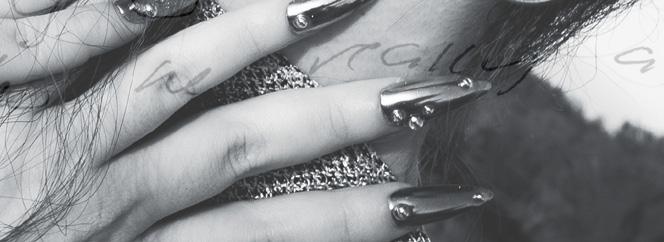
VIDEO Jeremy Lee Robinson STYLING Joey DiMare, Jheyli Alcerro, Sofia Lantigua, Anthony Urena, Aivery Jade Peña, Julia Carcione BEAUTY Daniela Pombo NAILS Aivery Jade Peña PRODUCTION Ariana Rosario, Alessandra Perez GRAPHICS Allie Pedroso, Samantha Garces
pluto
TALENT Melissa Leon
party for one
Francesca Rico
Being alone often carries a negative connotation. Solitude can lead to loneliness and the feeling of being misunderstood. Every day, we tread a fragile line, trying to avoid those feelings. But sometimes, doing everything we can to sidestep loneliness can ring hollow. I believe the only way to truly not feel alone is to confront it, armor down and arms wide open.
Embracing solitude and learning to be by yourself is essential to living. It can feel daunting to have nothing to do or no one to spend time with. Most of the time, we waste away and kill time with meaningless, mind-numbing activities. Later, we feel bad about it, but are too ashamed and too unsure of how to change it. So, I propose a solution: throw a party for yourself, without shame. Embrace all your senses. Explore the immediate world around you and your inner world as a way to return to yourself.
RECONNECT WITH YOUR SENSES
We can often feel on edge or jittery when there’s nothing to do. On the flip side, we might feel completely sedentary and unmotivated when we’re alone. So, the first step in a party for yourself is to return to your senses. Anything grounding, low-effort, and relaxing can work. I recommend lighting candles or incense and taking a bubble bath. No entertainment, just a comforting environment to center yourself in.
If baths and candles are not your thing, try something else like painting your nails. Choose a color that reflects your mood or how you want to feel. I always find painting my nails relaxing because there isn’t space for distracting thoughts; you have to be precise. But the task is not so meticulous that it creates additional stress. It’s a simple way to recenter yourself without pressure.
EXPLORE YOUR IMAGINATION
After reconnecting with your senses, the next step in a party for one is to explore your own imagination. Ask yourself: what creative thing are you drawn to right now? What images or words have been pulling at you?
One of my favorite things to do when I’m alone is collage. I grab a stack of magazines, flip through them, and rip out whatever images or colors call out to me, no questions asked. I often find that a theme develops on its own, without me consciously deciding on one. This is a great way to get to know yourself, to recognize what feelings or desires have been in your heart, and to figure out where you want to take them. This doesn’t have to happen only through collage. Origami is another creative way to open yourself up to imagination on your own time.
Fashion also serves as a vessel for our inner worlds. The great thing about being alone and having your own fashion show is that you are completely in charge: the designer, the model, and the audience. Invent new outfits and put together pieces you never would have tried before. You might even add a homemade flower crown. Gather flowers from your garden or buy some at a local market, choosing whatever catches your eye and appeals to your senses. It is just another way to express your imagination while connecting yourself to the world surrounding you.
ALL OUT FUN
Parties are all about having fun, and that doesn’t change even if it’s just you. Spend your party doing whatever feels most fun to you. Wear your best new outfit and let yourself have all-out fun, unashamed and unabashed. No one is around to judge, and you can’t have fun if you are judging yourself. It is your party; you can get away with anything. Dance in a way that borders on thrashing. Sing karaoke as loudly as you want, for as long as you want.
If you are not the dancing or singing type, I suggest something else that can be just as fun. Bake a new cookie recipe you have never tried before, or make the ice cream sundae you have been putting off. Choose your favorite flavors, then combine them with something new. Figure out what you like and what you don’t, have fun with it. Most importantly, let yourself enjoy it.
DISCOVER YOUSELF
The best way to end the party for one is to reflect on what you learned about yourself. Big or small, it all amounts to something. Write in a journal about your alone time; include your favorite and least favorite moments. Don’t forget, the main point is that this is just for you, so there is no need to hold back for anyone. Did you find a new favorite song to sing during karaoke? A new favorite outfit? A new favorite candle scent? Challenge yourself to discover a new favorite something.
Being alone can be scary. But ignoring those feelings of unfamiliarity with yourself doesn’t make them go away. The best thing you can do for yourself is face them and offer yourself some compassion, even when you are not sure where to start. Solitude is often framed as something to be escaped, when in reality it can become one of our deepest comfort zones. Throwing a party for yourself can be a step in learning how to enjoy your own company. There is a power in sitting in your own company; the stillness turns personal, and you realize no one knows you better than you know yourself. The one thing we have for sure is ourselves. Don’t shy away from that, learn to love it.
47
finding comfort in melancholy
Linette Garcia
Some emotions arrive with urgency. Anger flashes through the body like a spark, and joy appears with an unmistakable brightness. These feelings announce themselves loudly and often vanish just as quickly. Sadness behaves differently. Rather than erupting, it lingers. It settles beneath the skin and stays long enough for us to grow familiar with its presence.
In that way, sadness resembles a distant orbit: slow, quiet, and patient. Like Pluto drifting along the outer edge of our solar system, melancholy exists far from the brightness and chaos of the center. It does not command attention the way more explosive emotions do. Instead, it remains at the periphery, cold and distant, yet undeniably present.
And strangely, we don’t simply endure that sadness. We tend to it. We nurture it. We romanticize it in poetry, music, photographs, and late-night thoughts. Even when melancholy presses us inward, retreating beneath its weight, we still return to it. In solitude, within that quiet heaviness, we often rediscover parts of ourselves we might otherwise ignore.
Why do we find meaning in loneliness? Why does being alone with sadness sometimes feel comforting rather than unbearable?
Perhaps it is because sadness asks something different of us than other emotions do. Anger demands action, and joy rushes toward celebration. Sadness, by contrast, simply exists. It does not insist on being solved immediately. Instead, it invites stillness and attention. And in that stillness, we become more aware of ourselves and the world around us. Even in troubling circumstances, there can be a strange beauty in that kind of awareness.
To be melancholic is to feel the weight of things deeply. It is the ache of time passing, the distance between people, and the quiet longing for a life that never fully materializes. Often, melancholy isn’t about a single event or loss. It is about everything, all at once.
In that sense, melancholy is longing without a destination. It is the sense that something is missing, even when we cannot name it.
Paradoxically, that kind of sadness can become almost addictive. In a world that often feels overstimulated yet emotionally numb, sadness demands presence. It reminds us that we are still capable of feeling deeply.
Simone Weil once suggested that the soul must continue loving the void, or else it ceases to exist. Melancholy may be one way the soul keeps loving—holding onto meaning even when there is nothing tangible left to hold. It becomes a quiet form of devotion, a private ritual of caring for what once was, or for what might have been.
Søren Kierkegaard understood despair in a similarly revealing way. He describes despair not simply as feeling bad, a passing sadness, but as an internal fracture: the struggle to reconcile who one is with who one feels one should be. This tension, painful as it is, reveals something important about the self.
Sadness, then, becomes a mirror. We learn who we are not only through happiness and clarity, but also through what we long for when we feel empty. The things that keep us awake at night, the fears and hopes that surface in solitude, form the outline of what truly matters to us.
Despair is not necessarily failure. Through melancholy, we begin to understand the shape of our values, our desires, and our deepest attachments. Perhaps that is why sadness can sometimes feel strangely comforting. Like Pluto circling in the outer darkness, melancholy reminds us that not everything meaningful exists in the brightest places. Some truths are found far from the center, in quieter orbits, where reflection replaces noise and the slow gravity of feeling reveals who we really are.
CONCEPT Andrea Ramirez, Kiara Ysabelle Marzan, Hellen Rabelo, Nico Gurdjian, Annasophia Alfonso PHOTO Elijah Canseco, Anubis Casares VIDEO Joey DiMare STYLING Isabella Vega, Jheyli Alcerro, Sofia Lantigua, Melissa Leon, Aivery Jade Peña, Julia Carcione, Mia Mazuelos BEAUTY Lia Alongi, Sofia Lantigua, Taiyler Oden PRODUCTION Ashley Goehmann, Valentina Torres, Ariana Rosario, Alessandra Perez GRAPHICS Allie Pedroso, Andrea Ramirez
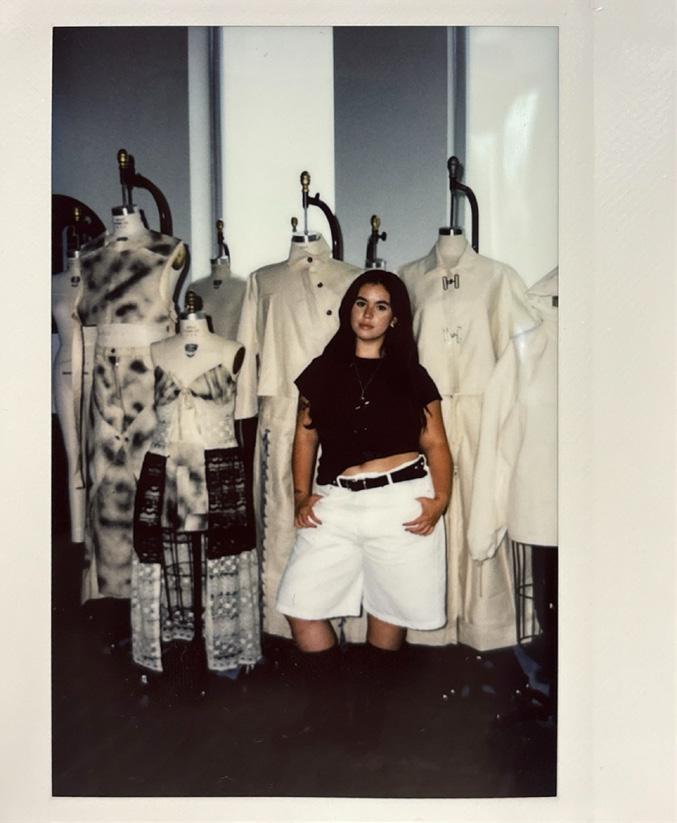
Sarah Lopez is a Colombian fashion designer based between Miami and Medellín. The founder of Unsaid, a brand made in Colombia, and OFFSIDE!, a project through which she expands into couture, runways, and creative direction.
Long before any of this had a name, Lopez was drawing clothes with colored pencils. Her relationship to fashion began early and intimately, learning to sew from her mother. She is the youngest sibling, raised between Colombia and the United States, giving her a layered identity.
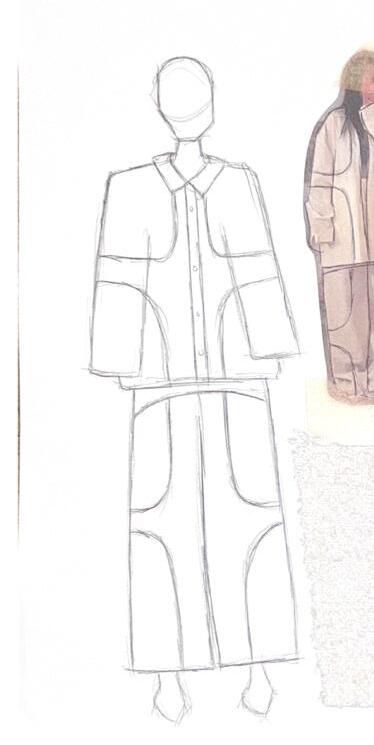
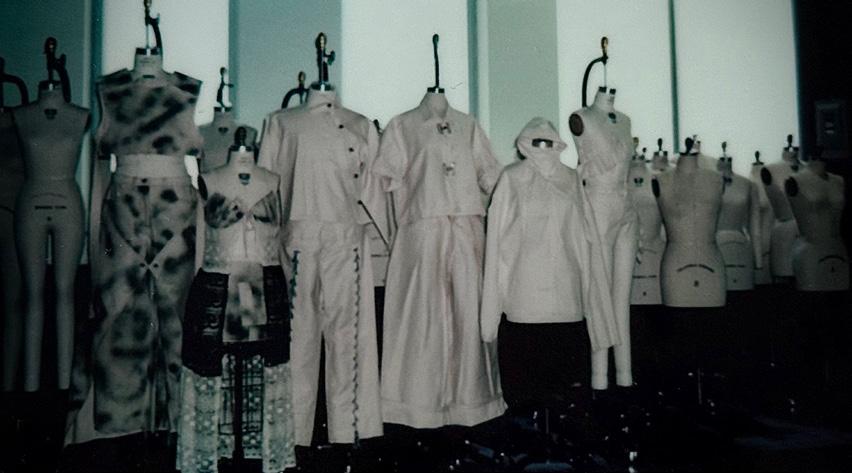
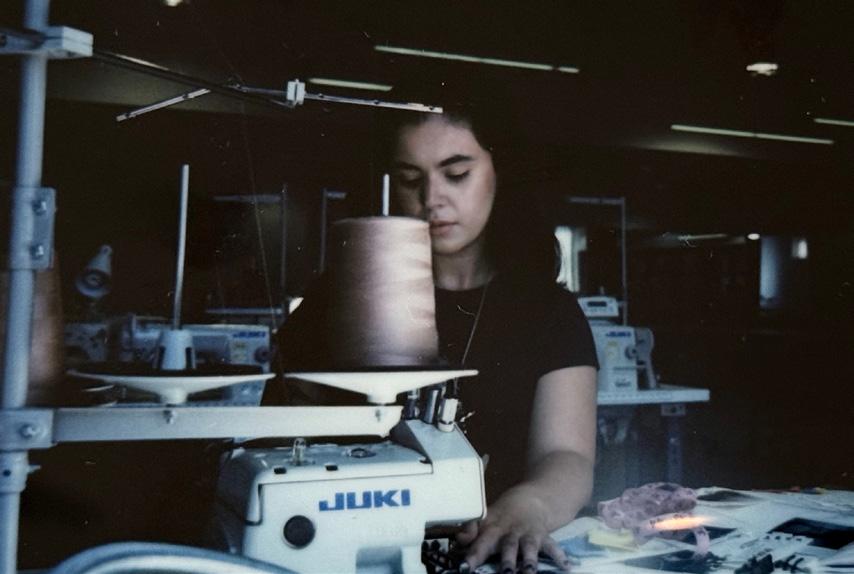
Lopez enrolled at the Miami Fashion Institute at Miami Dade College, and did not immediately love it. But there is no clean myth of destiny. She didn’t simply step into the classroom and find herself fully formed. Eventually, she leaned into the discipline to support that natural creative instinct. Over the semesters, she learned patternmaking, construction, and all of the necessary technical processes. That child who drew clothes on paper was now understanding how they had to live on a body.
When Unsaid began, it was, in part, from selflove. As the name suggests, it points to the emotional territory her work occupies, becoming an outlet that helped her through difficult moments. A psychological charge about agency and possibility. An origin where thoughts, desires, and fragments of identity can be present and combined for a public audience.
NG: What do you want people to feel or get from the pieces you create when they see or wear them?
SL: I feel like this is something I am still learning as a designer; I want my pieces to feel like stories, not just empty. I want people to feel something emotionally when they see or wear my work. A lot of my collections are rooted in feelings people don’t always know how to express: nostalgia, anxiety, ambition, identity, hope, growing pains; so I hope people can connect to that in their own way. But at the end of the day, more than anything, I want my work to feel human.
Her creative process begins with music. She will often repeat a single song, over and over, until she can capture the feeling it evokes into the physical. It can be something modern, a current radio hit. Or older Latin music, the rhythms that form the emotional background of childhood. For Lopez, music is the core of her work, “All art is connected, I am always looking for a way to go from one form to another.” Her future career goal: to dress artists for their music videos. Not merely by styling them in clothes that are functional on-camera, but by interpreting their music itself into the garments.
NG: What specifically is it about music that dictates your creative process?
SL: Music is honestly the starting point for almost everything I create. Before I sketch or even fully under-
stand what I want a collection to look like, I already know what it sounds like. I make playlists for every project because music helps me build the emotional world around the clothes. A lot of my process is very emotion-based, so music helps me turn feelings into colors, textures, silhouettes, styling, and even movement. Sometimes it’s lyrics, sometimes it’s the energy of an artist, or just the atmosphere a song creates. I think fashion and music naturally go hand in hand because they are both forms of storytelling.
There is that strange irony in trying to explain feeling. And there is something almost linguistic about her ambition. We spend so much of our lives searching for the right word. We learn new languages, study meanings and grammar, borrow from other cultures, and yet emotion still resists translation. For Lopez, this is an apt description of her approach: translation, where something changes form and survives. When language fails, she can turn to fashion.
NG: What’s an example of a specific song, album, or artist that you used for your graduation show versus your NYFW shows?
SL: For my MDC graduation collection, I was actually listening to a lot of trap and music that motivated me creatively. Songs like “S91” by Karol G and “Competencia” by Myke Towers were definitely part of that process. At the time, I was really driven by ambition and proving to myself that I could build something
serious out of fashion, so I connected a lot to music that felt confident, hungry, and emotionally intense. For the NYFW collections, the music became a little more cinematic and layered emotionally. I listened to a mix of Latin music, experimental sounds, and artists that create really immersive emotional worlds around their work. The energy behind those collections felt more nostalgic, vulnerable, and introspective.
Lopez won the Faith Connexion Award, a recognition championing emerging talent, which helped place her in a wider sphere. After her graduation show, opportunity arrived in a very modern way: a DM, offering a spot in New York Fashion Week. Lopez admits she can leave things until the last minute, but she also understands pressure as one of her driving creative materials. Her NYFW debut came together in less than a week. A timeline that sounds impossible, but impossibility appears to sharpen her rather than stop her.
NG: Describe the basic story or inspiration behind the NYFW collections.
SL: The first NYFW collection, Ode to the City, was inspired by the emotional experience of visiting a big
city while chasing creative dreams. I wanted to capture the mix of ambition, loneliness, overstimulation, and beauty that comes with that experience. The collection played a lot with oversized silhouettes, distressed details, spray-painted fabric, and pieces that felt both protective and vulnerable. The second collection, Childlike Idealization, was about the difference between how we imagine adulthood as kids versus what adulthood actually feels like. As children, we romanticize growing up, but nobody really talks about the pressure, uncertainty, or creative burnout that can come with it. A lot of the collection referenced unfinished projects and childhood imagination through hanging threads, half-finished details, and deconstructed garments.
Those two collections reveal the poles of Lopez’s work. One looks outward, to the larger atmosphere of life’s landscape: the city as a place of seduction and exhaustion and endeavor. The other, rather, turns inward toward the tenderness of growing up, and the disappointment that it is never as easy as you believe it to be. In a way, both deal with that gap between fantasy and reality. She works with opposing proportions, layering, corsetry, spray-paint—much of her work makes use of contrast, blending streetwear with
conceptual personal experience. For Ode to the City, she emphasized silhouettes made to feel confident, powerful, yet safe, while sitting outside the expected mold. That balance between strength and vulnerability is difficult to maintain; fashion often mistakes discomfort for spectacle. Lopez’s work wants that complicated boundary-pushing without sacrificing comfort.
There is a moment, as Louis Zukofsky suggested about a poem, when it arrives at “rested totality.” When it’s in a rare state of independent course, just sitting there like a rock. It becomes itself. Watching Lopez flip through her notebook, it is filled with sketches, mood boards, drafts of future designs, and a plastic bag of collected fabric swatches. A truly archival hodgepodge of fragments. As she moves through it, explaining, she becomes more animated and exact. Fashion design draws her inward, to the private logic of imagination, while simultaneously pulling her outward, into the world where she can mold her visions into physical shape. Truly, herself.
Her Colombian identity is part of this “herself-ness.”
NG: Are there specific cultural references or aspects from Colombia that show up in your work?
SL: Colombia influences my work constantly. I’ve been inspired by the everyday visual language of Colombia, not just the stereotypical or “tourist” imagery, but the small, ordinary things that feel deeply familiar to me. I’m really interested in turning those everyday moments into something emotional and elevated without losing their honesty. I think there’s something very beautiful about how vibrant, resourceful, nostalgic, and alive Colombia feels, and I want
the collection to reflect that energy. I want to show a version of Colombia that feels personal and human. Not just “inspiration,” but memories that shaped me growing up as a Colombian woman.
That distinction—not inspiration, but memory—is important. Lopez wants to bring Colombia into her work without turning it into a product designed solely for outside consumption. She is interested in exposing the visual details that form a cultural sense of self. In that way, her work is not simply an exhibit of heritage, but also a question of representation: how to enter new territory and not diminish the specificity of where she comes from.
She describes herself with the Colombian word berraca: a woman who is brave, hardworking, and determined. It suggests a woman who keeps going not because the path is necessarily easy, but because her tenacity refuses to let difficulty take the reins of her fate. In the rush of Lopez’s NYFW debut, backstage, a corset did not fit the model. The solution? To sew the model into it. This reveals something fundamental about Lopez. She has the hunger and the refusal to let the work stay flat. Her ingenuity allows her to live in these unpredictable moments. Her mother once told her, “The only thing with no solution is death.” This ethos lies at the center of who she is: unwilling to mistake difficulty for impossibility, and truly of the belief that limitation is a condition creativity must work through.
Here is the stubbornness in her story. Fashion is expensive, opportunity is uneven. It is an industry often inhospitable to young designers without abundant resources or nepotistic access. Talent does not erase the practical difficulty. Lopez does not have endless recourse, but she does have will. She wants to prove herself. There is something especially relevant about Lopez’s work in a generation so practiced at avoiding discomfort. We are so scared to feel things, obsessed with easy-living and “protecting our peace,” often at the expense of feeling anything deeply. There is value in seeking and exploring all the unknown vastness of the world we were born into. Lopez is what might happen if we let ourselves feel more, and if we treated the uncertainty of the future not as something to fear, but as something to work for and surrender to. She, with an admirable seriousness, approaches feeling and doubt not as disruptions to the creative process, but rather as where the work resides.
Lopez has a beautiful bird tattoo on her arm. It is a swallow, used by sailors to symbolize distance traveled and the promise of safe return. That if a sailor drowned at sea, the swallows would bring his soul home. Lopez seems aware that things are changing quickly, that her work is beginning to move far beyond the places where it started. But she also seems anchored by the same persistent instincts. Up next: Paris Fashion Week. The scale is shifting; this time thousands of miles away, in an entirely new corner of the industry. Yet the work will remain what it has always been, and like a brazen seafarer she will conquer it and return.
neogenesis
CONCEPT Ariel Rivera, Hellen Rabelo, Nico Gurdjian, Annasophia Alfonso PHOTO Anthony Martinez, Isabel Gonzalez SUPPORT Anubis Casares VIDEO Valentina Torres STYLING Isabella Vega, Melissa Leon, Mia Mazuelos, Jheyli Alcerro, Sofia Lantigua BEAUTY Sofia Lantigua, Lia Alongi NAILS Aivery Jade Peña PRODUCTION Eva Slavin, Anthony Martinez, Ariana Rosario, Alessandra Perez GRAPHICS Allie Pedroso, Cydni Ayon
the avatar
Kynda Kailea Green
Her, me, she behind the scenes: spotlighting the one in front of the screen. In this virtual reality, all versions intertwine. Blurring the distinction of who we are and who we can be. The identity produced for the public eye, and the one archived for our close circle. Through imagery we can customize ourselves online. Because how we are seen is how we are perceived— the very data society conditions to deceive. Interpretation commences at face value. Our blood blends with the wires of artificiality, while we propagate a robotic pulse of authenticity. Hearts beating in arrhythmia.
Boom, boom. Beep, beep.
It is the sound of a static, dystopian machine ventilating our humanity. Where cure and cause seep synonymously, the more we inject internet into our stream of consciousness. This will help, the corporation pinky-promises. But was there even a choice? As its influence drips with inevitability, disconnecting us all in collectivism. To which we are sold the “solution” of a world with endless possibilities.
Yet why are we all consumed by the fabrications of its realm? Maybe, due to the fabric itself. Here we can redesign a life that doesn’t flatline under imperfection, but rather receives a dose of imaginative resurrection. A new becoming. A new beginning. Where the narrative rewrites to our own manipulation. As the audience reads a one-sided story, founded on curation. One that may be falsified, but too far away to fact-check. Because through the phone, the distance protects. With no one close enough to challenge the persona you portray, social media starts to feel safe. Online disinhibitions liberate us from the weight of in-person interaction. Here, self-expression elevates the alter-ego. We step into a skin more social, courageous, successful, cool, and seductive. Sure, it’s still you, just a hyperfixation from the rest you omit— the more real, and more raw. When we detach from real life, communication is no longer restrained by the same judgement and peer pressure. With such, our behavior shifts into a dream-like state, engineered to the parts of ourselves we may otherwise refrain.
Without direct access, we can reside within an arm-length of anonymity. Because the internet arms us with invisibility. Contradictory, of course, as we simultaneously show up to be seen. Only, now, within our own ramifications of, you may know me, but here, not really. Consequences begin to feel just as evaporative as its whole operation. With no one around to call out the code we embody, accountability dissipates. Here, interactions are controlled and delayed, reducing social strain. A lack of authority ruminates the virtual space, while willpower runs on overdrive. Bound by nothing, besides our own distinction to share online.
The internet is a game, another dimension, and we are the sims of its dissociative gaze. Under that, solipsistic introjection alters our gauge for conversation. Leaving it to feel like a mental projection, more than a genuine exchange— in a world that is fake.
Life imitates art, and art imitates life. Even AI. As we reconstruct ourselves into some digital comprise. The internet is a mere mirror of our innate wiring, a biological foreshadowing. We have always been social creatures, seeking a sense of society. With content creators now attracting mass economies. Because here, we can connect. Here, we can convene— even in the mutual knowing that it is not really reality. But if this is where everyone is, it’s where everyone else will want to be. Residing within metal and lead.
Like.Follow.Post.Retweet.
As the aluminum illuminates the interactions we so desperately seek. It’s within our nature, our evolutionary state. Our need for acceptance, approval, and communal praise. Where belonging is amplified through the digital frame. Validation has always served as a mechanism for security and status, only now misconstrued for strength. We are not fully at fault for our instinctual adaptation. But it is our responsibility in modern times to redefine these traits; for they are no longer mutually exclusive to our worth.
The alter-ego models, while under the mask, she rusts. Her mechanics decompose, interfered by her flesh. Like a body remembering its breath: inhaling vitality, exhaling virtual death. Get me off this machine. Unplugging the marketed scheme, manufacturing her, me, she, behind the scenes; spotlighting the one in front of the screen. These versions, not only those polished, but also those personal, are the true homeostasis we need. Oxygenating us back into our humanity. Where the digital world serves as a drop of an experience, and no longer a drug, overdosing us in forgetfulness for the world we once loved. Boom. Boom. Beep. Beep. It is the sound of coexistence and the inescapable influence of technology. No longer in the coma of trying to be. I simply am who I am, posing as an extension of my reality. Maybe a little elevated, but inherently me. As the rhythm returns,
Doctor, she’s back, and no longer offbeat.
TALENT Julianna Nicholson
Fabianna Nicholson
fembot
Anett Martin Sosa
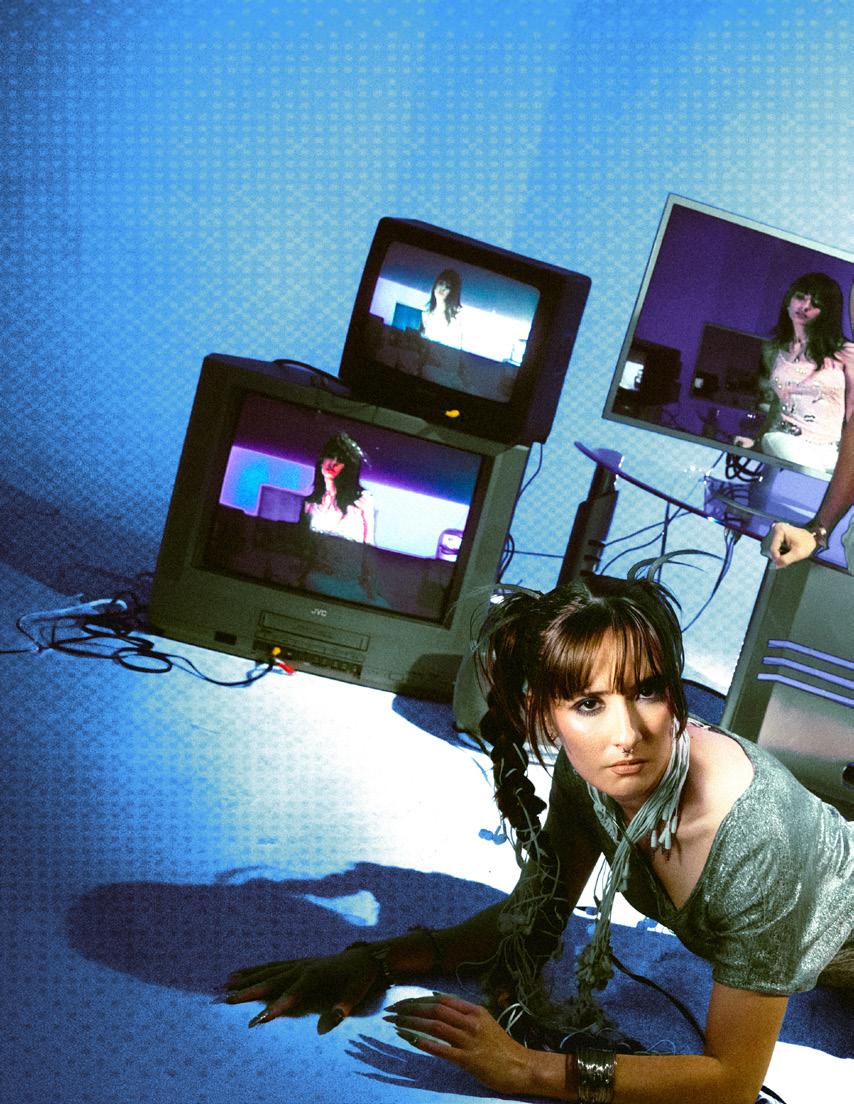
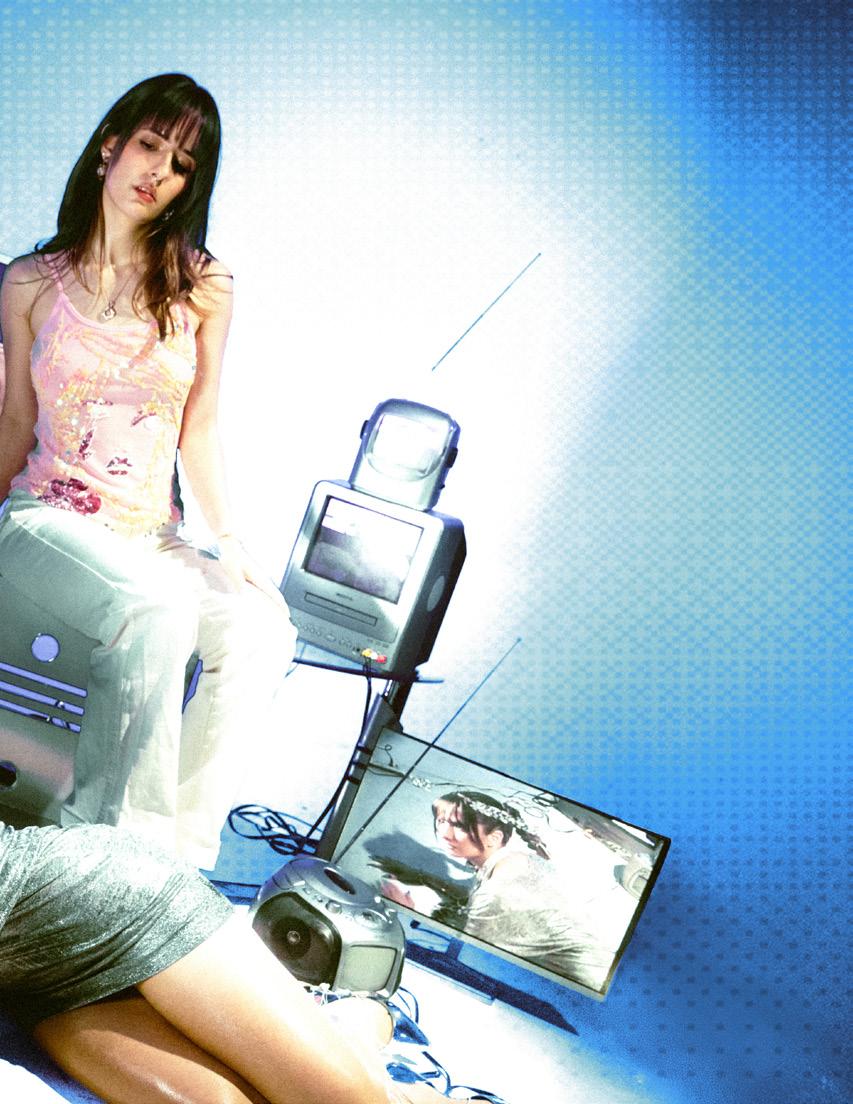
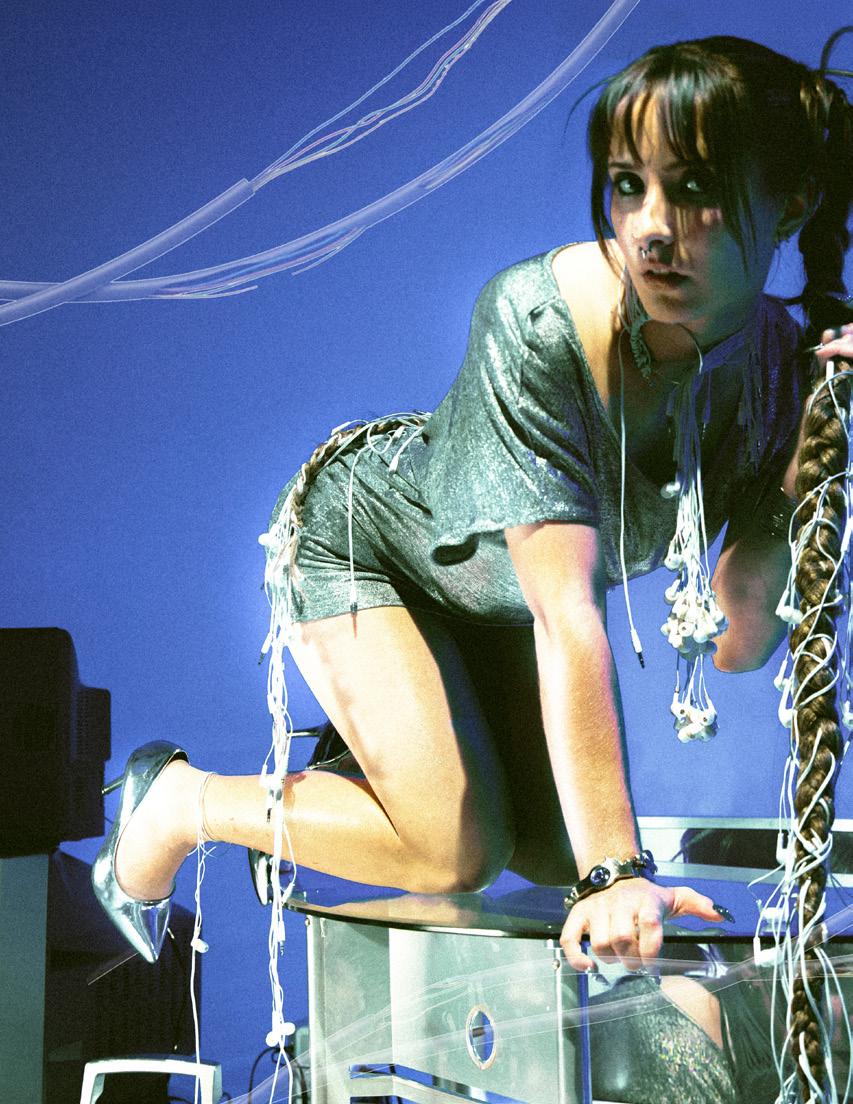
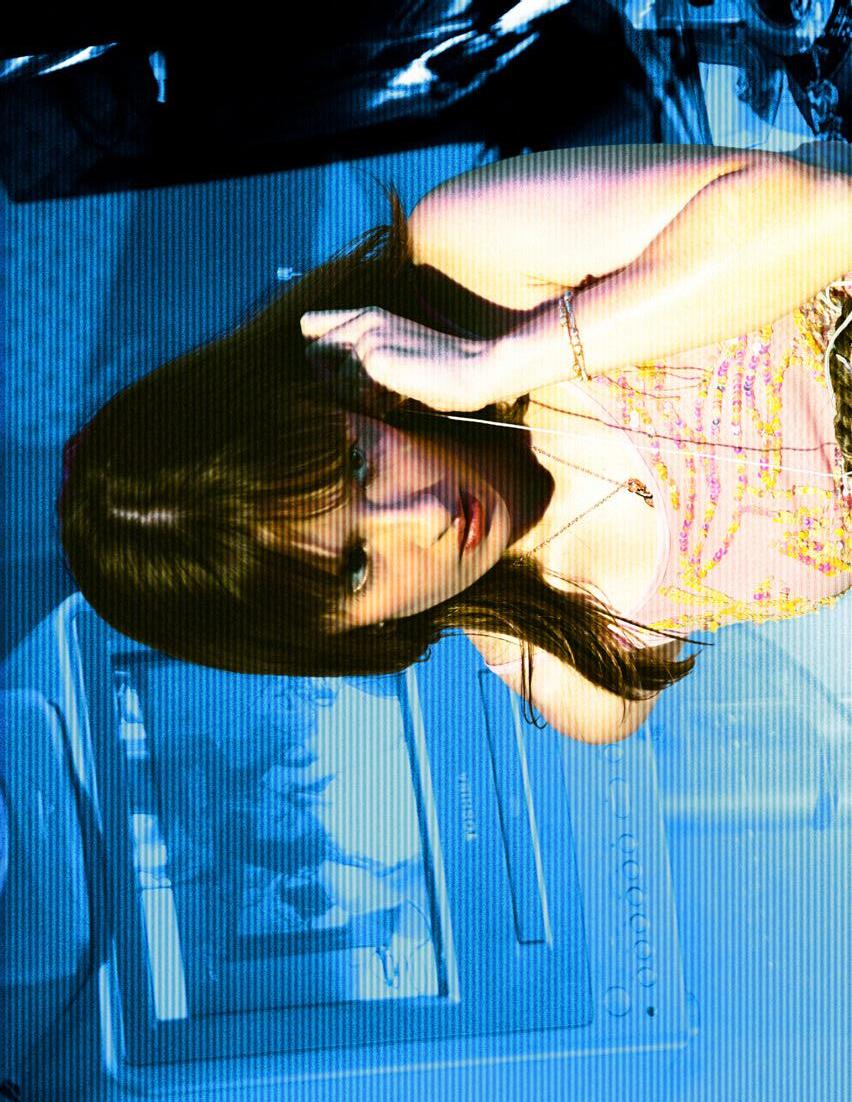
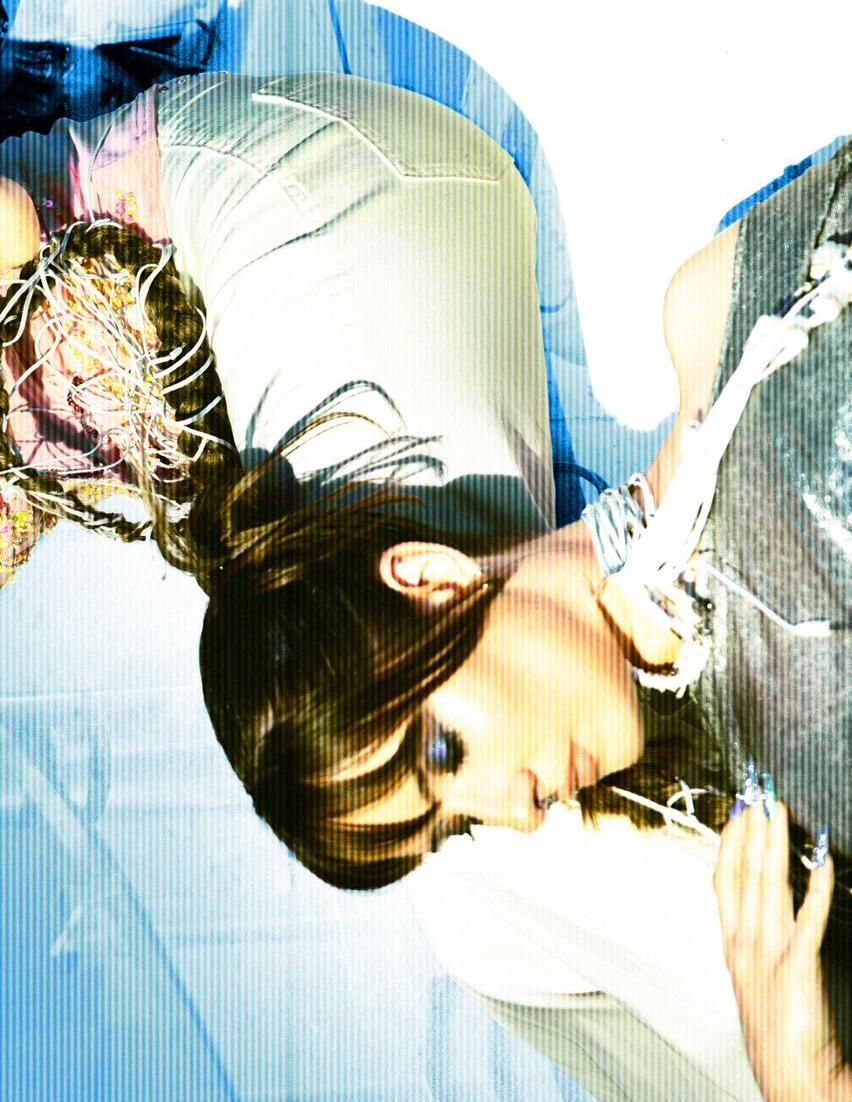
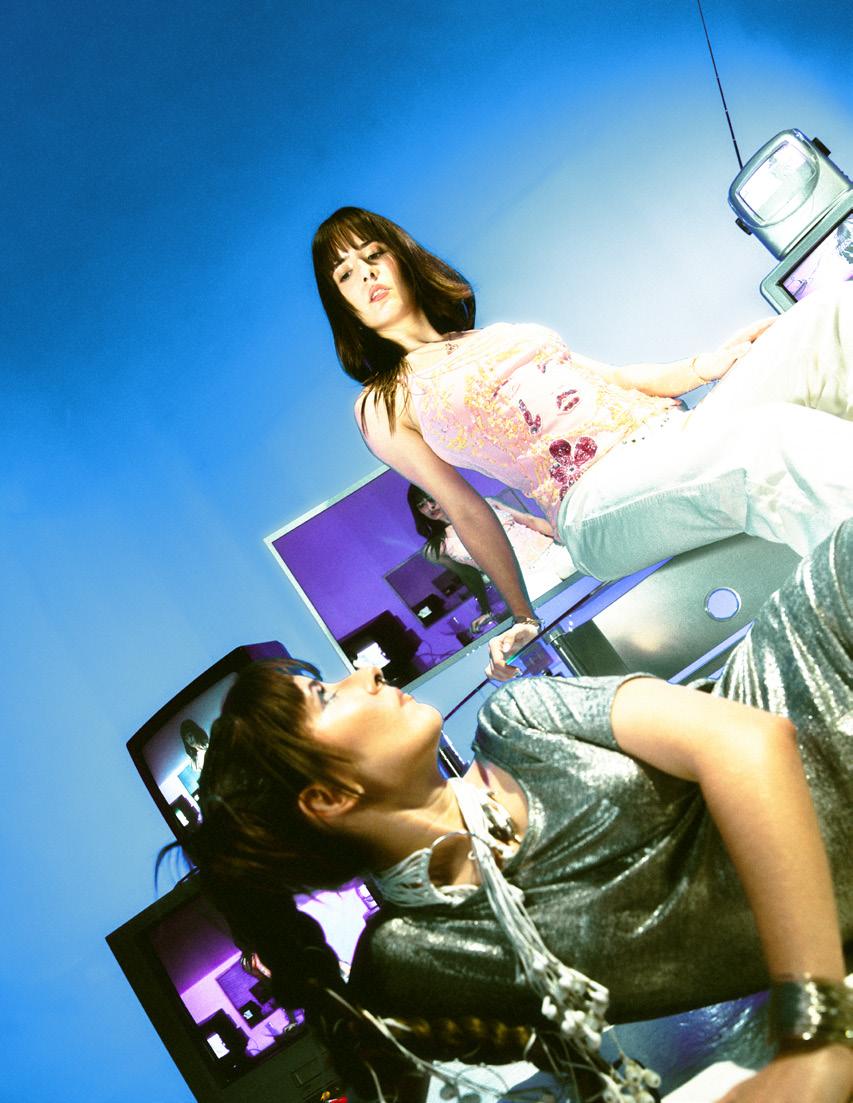
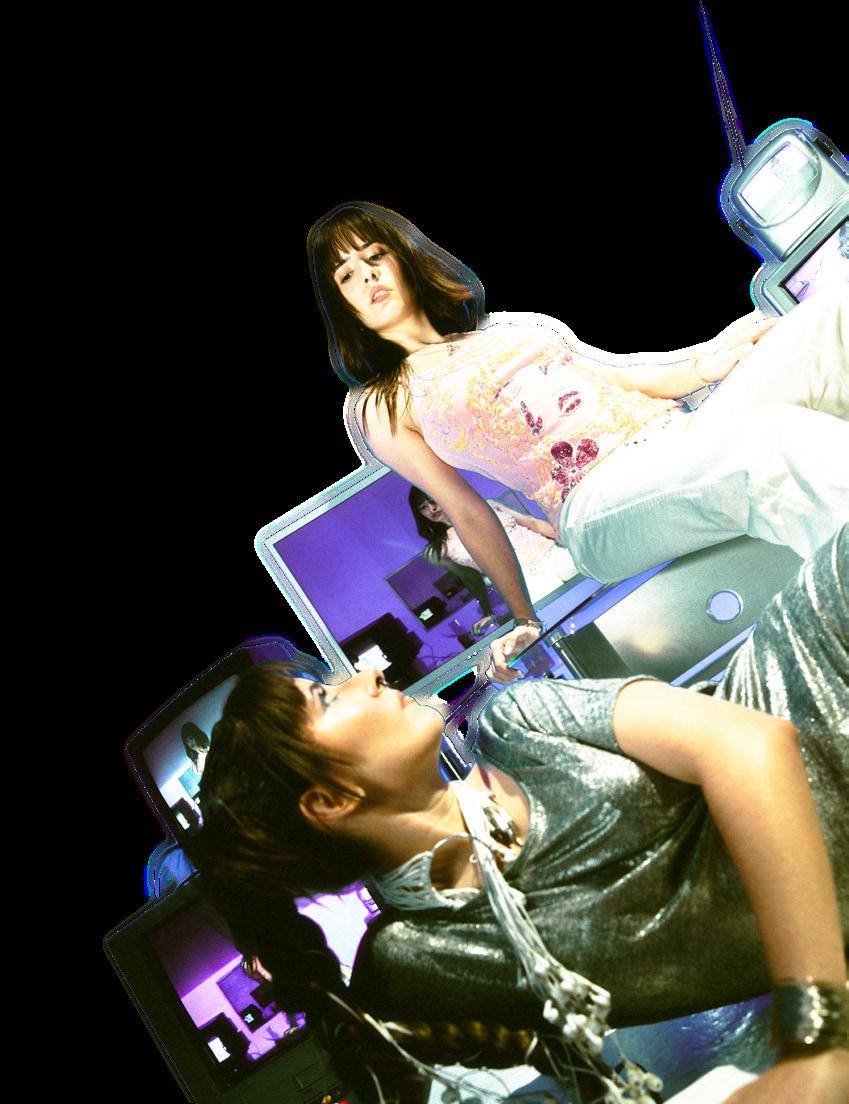
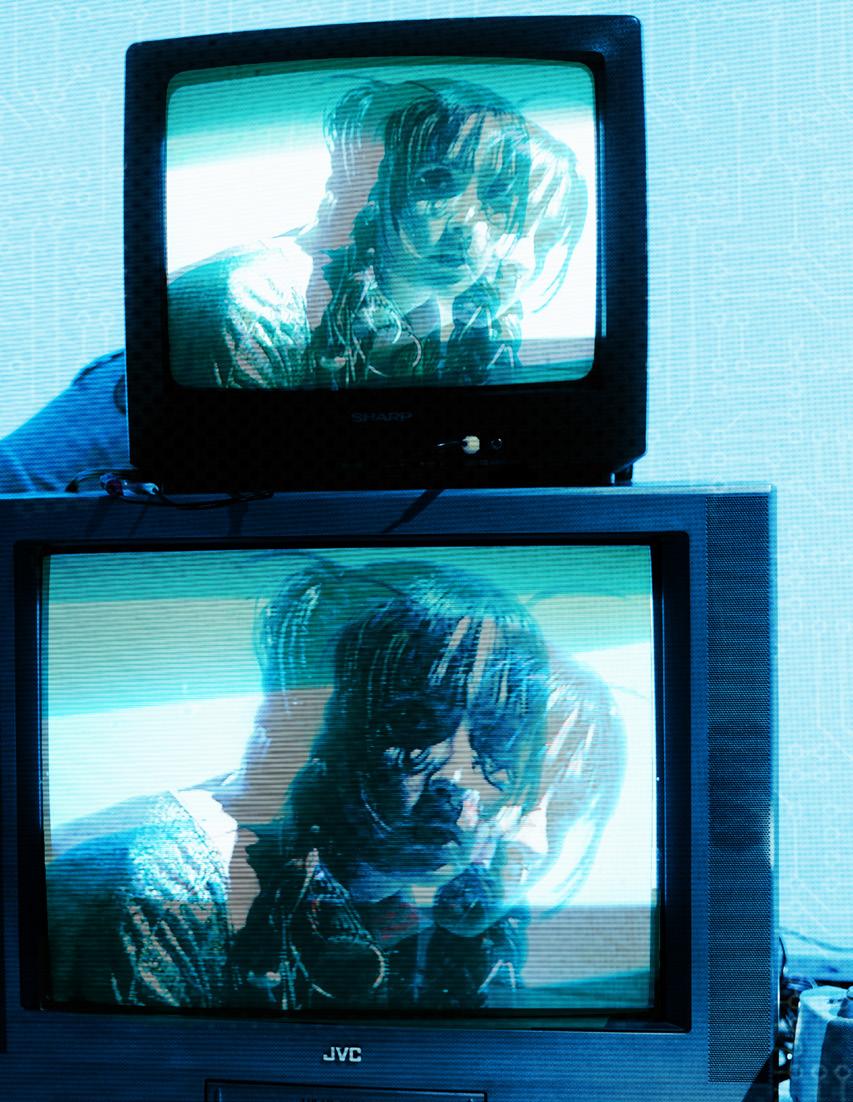
Put your headphones on and listen closely to the sounds of the new age... Can you hear the static crackle and machinery whir? Look closely into the box TV and catch the eye of the girl staring back at you; with braids to her knees and a cybersparkle in her eye, she is a visual simulation of the cyber-fashion paradigm.
The Y2K revival of the 2020s often pulls from pop divas like Britney Spears, Beyoncé, and Xtina—low-rise jeans and butterfly tops, the world of Y2K fashion sparkles with a playful air and a fierce attitude. Those Y2K roots have sprouted many differing branches of fashion. Notably, cyber-tech fashions have been a potent niche throughout culture. Iconic fashion houses have walked the robotic roads of cyber fashion, and we see it all today. When technology marries fashion, what do we get?
From Alexander McQueen’s Collection No.13 to Mugler’s vintage Cyborg suit, technology has seemingly taken over modern fashions. In recent years, our timelines have been inundated with Y2K cyber-futurist looks; from the runway to the city streets, we are in love with the fembots. The fluorescent glow of the fabrics, the low hum of motors powering the scene all give us something indescribable. Hair threaded with wired headphones, metallic accessories, computer-chip clips, all of which heighten the extravagance and drama of the looks. Remembering Mugler’s iconic runways, there are several telltale signs of the origins of cyber fashion. Take, for example, the iconic 1995 Cyborg suit designed by Thierry Mugler. This piece encapsulates the wearer in metal sheets, accentuating the body and even highlighting the breastplate with a clear, glass-like material. According to the MET Museum, Mugler’s piece was inspired by Metropolis (1927), a German Expressionist science-fiction film that emulates a futuristic, cyber-leaning world. This piece was pivotal in cyber fashion as we know it and is, to this day, regarded as some
of Mr. Thierry Mugler’s best work. However, that was not the first, or last, time that Mugler dipped a finger into cyber fashion—and that goes for many notable fashion houses. Jean Paul Gaultier, Alexander McQueen, and even Dior have all played with this aesthetic, and they have done so beautifully. Molding metallic fabrics, hard metals, and delicate wires into garments that have forever changed the landscape of the fashion world, these houses are renowned for the impact they have made. It is no shock that cybersigilism has come to rise either. This style of tattoo is extremely popular amongst Gen Z, only further highlighting the importance, impact, and prevalence of cyber fashion.
Cyber fashion does not stop on the runway—take popular K-pop girl groups like aespa and XG... these girls have liquid metal running through their veins. Many aespa concepts highlight the machinery and electricity of this day and age. Leaning deeply into cyber-tech fashion, they set the tone for 2020s fashion statements. Many die-hard K-pop fans have begun leaning into cyber fashion because of music videos, photoshoots, and the general appearances of these iconic groups. Even solo stars like LISA have taken up cyber-tech arms.
The rules of fashion have changed. Culture calls out for the future, and so do the people. Technology has taken over our lives and our closets. Through tech accessories, fabrics, and silhouettes, we are able to replicate our internal lives externally. So tuck those headphones in your ears, or in your hair, and allow technology to alter your fashion DNA.
in this virtual reality, all versions intertwine.
CONCEPT Allie Pedroso, Alessandra Perez, Hellen Rabelo, Nico Gurdjian, Annasophia Alfonso PHOTO Anubis Casares, Elijah Canseco VIDEO Melanie Torres STYLING Isabella Vega, Vera Parra, Anthony Urena, Melissa Leon, Aivery Jade Peña, Julia Carcione, Mia Mazuelos BEAUTY Alexandra Morera, Jessica Retana, Lia Alongi PRODUCTION Ashley Goehmann, Olivia Tomczuk, Ariana Rosario, Alessandra Perez GRAPHICS Allie Pedroso
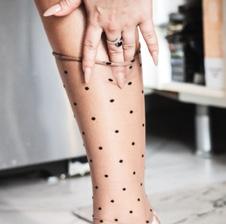
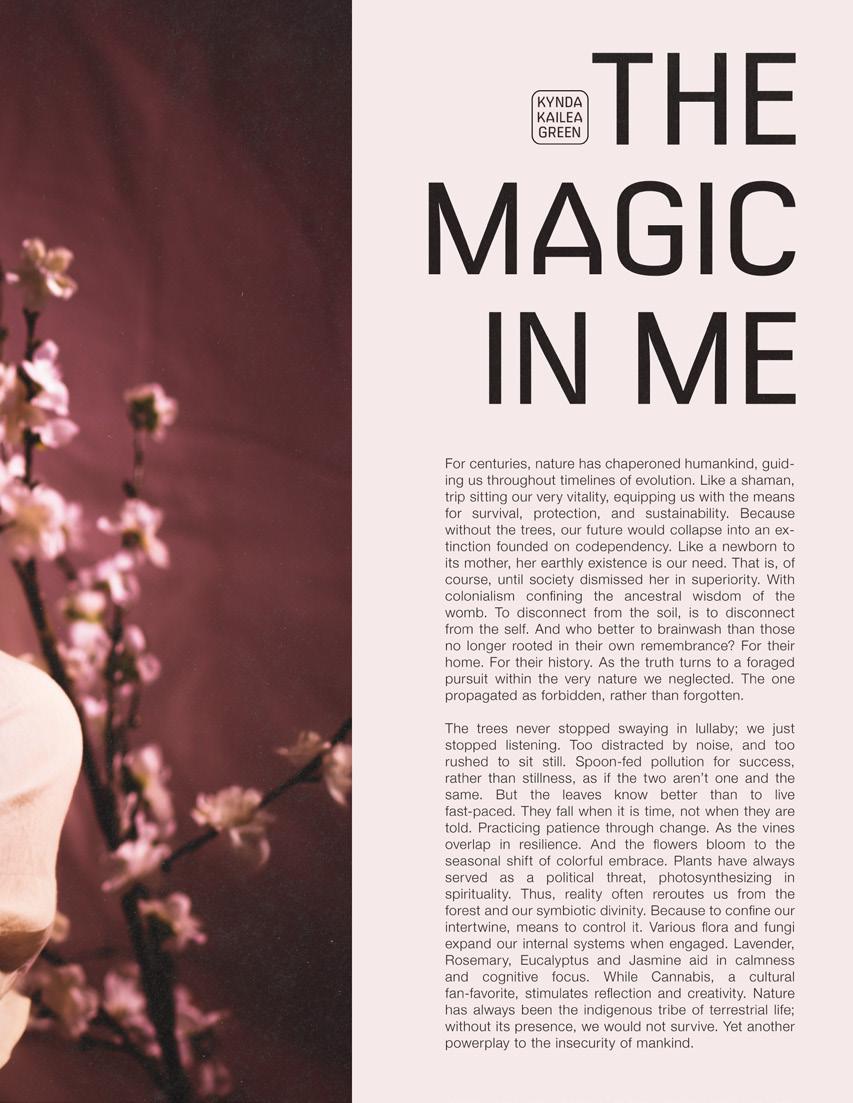
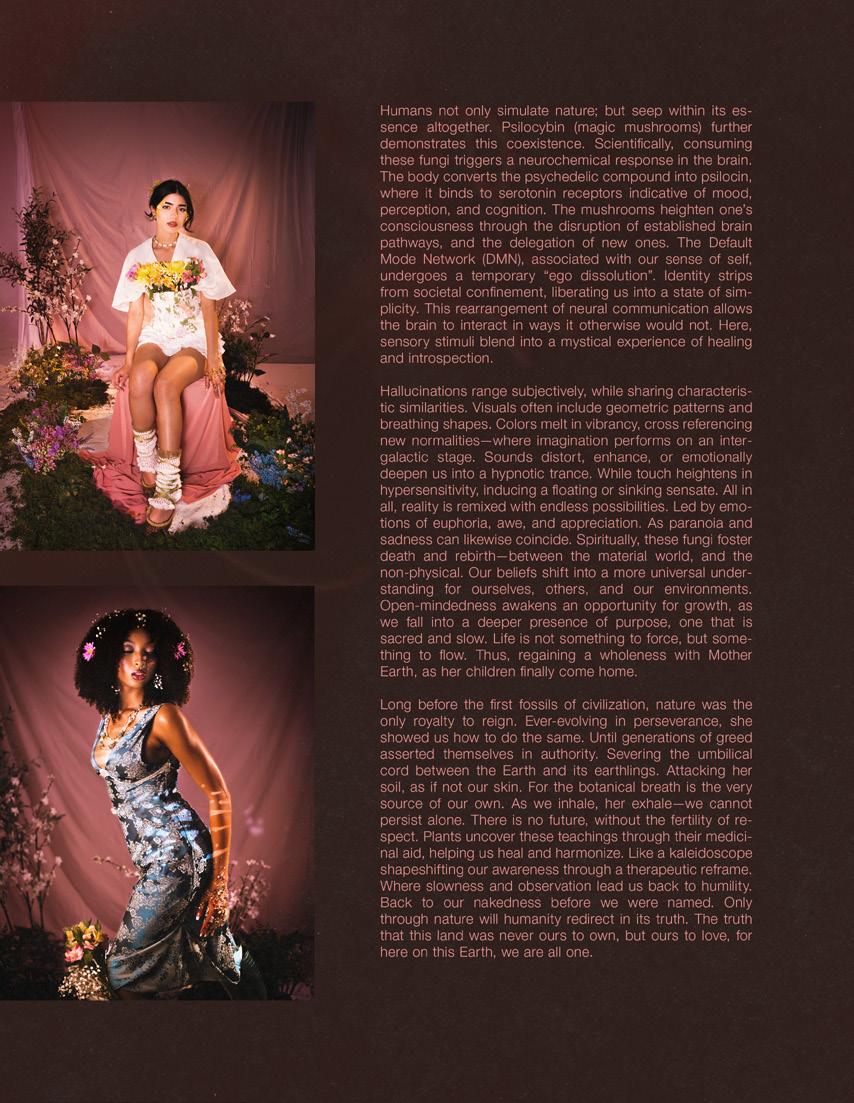
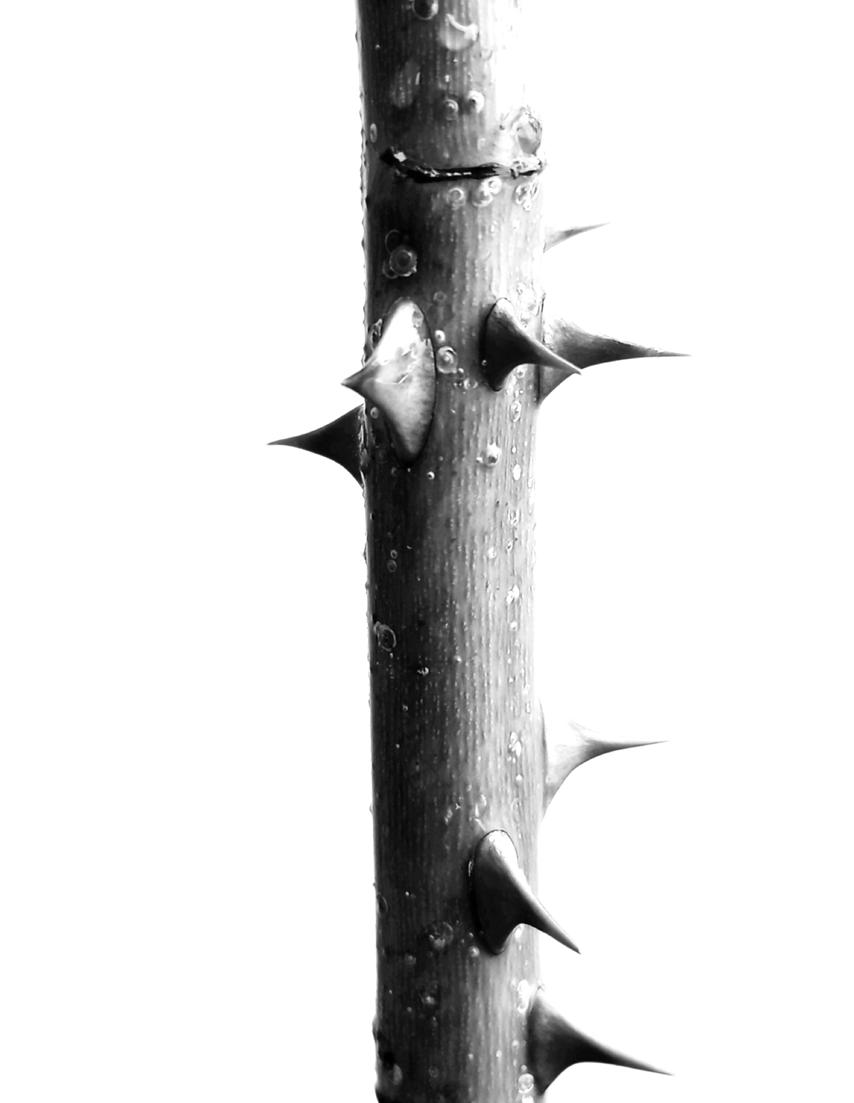
A blossoming flower is often seen as one of the most beautiful reflections of growth. Only from the rosebud do we end up with the rose. The shades of red, mixed with its tantalizing scent, have become symbols of beauty, passion, and love. Fascinated by its rich hues, we often forget to pay any mind to the thorns that only know how to prick.
Throughout my life, I have viewed myself much like a rosebud. Even now, I don’t believe I have fully blossomed into who it is I am meant to be. Perhaps it is more nonlinear than that, where there are days I know I bloom and days I would much rather keep myself shut behind my petals. However, with these on-and-off days comes the ever-present thorns that seem to reside along my skin.
Like a rose, we as humans have had to develop thorns. For roses, they serve to protect against animals. I believe it is much the same for humans. Our thorns are developed as we grow and learn, never thinking we will have to use them until the time comes. However, almost unknowingly, they root themselves after each lesson learned. Unlike roses, though, it feels as if we gain these thorns after our never-ending mistakes.
The most memorable thorns I, and I am sure many of us, have gained came through affairs of the heart. After every newfound lover, it seems there is a new cautionary tale to be told. Some are as obvious as “never go out with someone who is a little too dependent on drugs” while others are more painful such as “don’t wear your heart on your sleeve.” They all come from mistakes we wish we didn’t make, yet we continue to learn and are still here after the pain. With every thorn comes a loss of innocence, forcing us to protect ourselves in ways we never had imagined we would need.
Through the eyes of a woman, sometimes our thorns are all we have. At times we are the ones being pricked and in others, we are the ones doing the pricking. As a woman is a flower, blossoming to her fullest potential, she becomes more than beauty. Yes she is striking, but do the thorns growing from her spine wound her in the process? Without this armor she has developed, is she merely something beautiful to be observed and admired? A necessity for us all yet, growing doesn’t come easy. For so many, it is isolating, painful, anything but pleasurable. Still, this is our self-defense.
I wonder if these thorns serve as protection or, if they are walls we have built up to prevent ourselves from fully blooming?
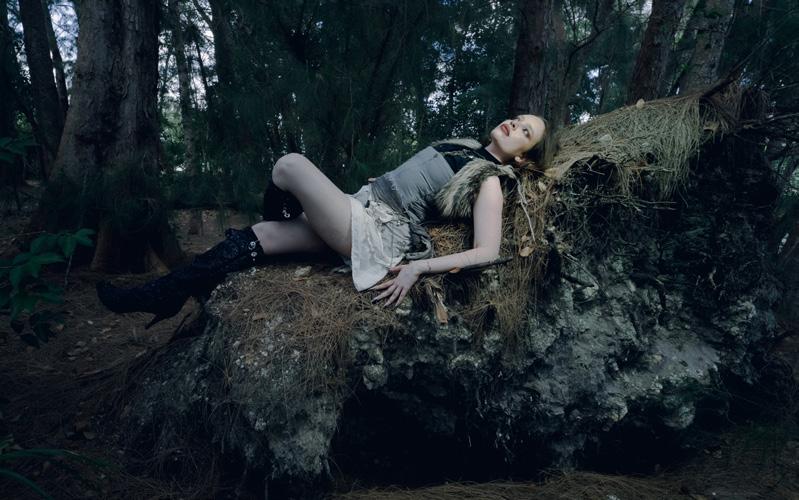
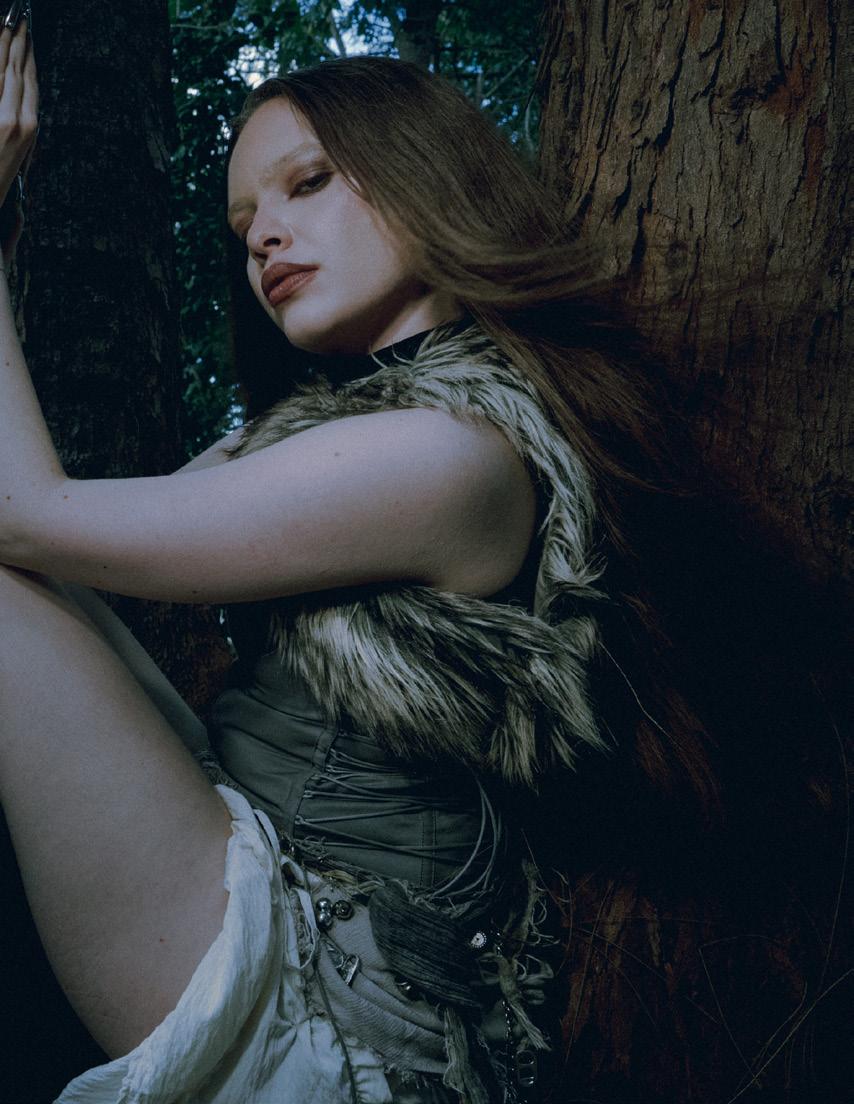
Through pain we grow resilient while embracing the vulnerability that comes with it. The photoshoot itself consists of three primary models who embrace vulnerability along with a sense of power. This is done with intimate shots and utilizing contrast lighting techniques. By focusing on their faces, we see that they hold not exactly sadness, but a certain melancholy. In welcoming this growth comes a loss, an all familiar feeling tied to the growing pains of evolving and developing a sense of resistance. In addition to their breathtaking expressions, thorns quite literally dance along their skin, materializing all the associations we have attached to them.
As the rosebuds begin to bloom, a new air of fresh beginnings comes with them. Through it all, we are always evolving into what is meant for us ahead. Even as thorns grace our skin, we must remember to handle ourselves with the same mercy we give to those budding roses.
Melanie Torres
TALENT Laura Restrepo Herrán
TALENT Aidan Thompson
FASHION DESIGNER Ryan Hamilton
petals and pressure
Fashion has always had a complex relationship with discomfort. For centuries, the industry has flirted with the idea that beauty is something to be endured, not simply admired. Pain has often been framed as part of the process of becoming beautiful, and we have built a cultural hierarchy around acceptable pain. The mantra “beauty is pain” has been repeated across generations to justify the physical suffering tied to unrealistic beauty standards. As many couturiers blend the fragility of the human body with brutal aesthetics on the runway, fashion becomes a powerful tool for torment, and enduring it is considered stylish.
Countless published materials that confront the most violent and traumatic elements of life are disillusioned to be perfect, masking the pain in a veneer of glitz and glamour. Violent and wounded aesthetics have long served as reference points across art forms: film, music, and literature are filled with the sentiments of war, crushing heartbreak, and metaphorical catastrophe. Now, the art of performing outside an acceptable moral framework has permeated the fashion landscape. Many contemporary designers, guided by the narratives of pressure, survival, and transformation, create sculptural and intricate pieces that feel unsettling. Sharp silhouettes, with exaggerated shoulders, restrictive bodices, and garments that seem to tear at the seams, create the impression of intentional mutilation: raw, unresolved expression.
It is no surprise that we voluntarily seek something that our mind registers as threatening or gory. The
allure of harm, and the human instinct to revel in the grotesque, can be explained by how the brain processes pain and pleasure. Within our morbid curiosity lies the imprint of an adrenaline rush, a high arousal state that allows the mind to move from fear of the rogue to the excitement of elegance, and back again. We often expect art to soothe or thrill in familiar ways, like surface-level fashion that focuses solely on the garments without deeper, profound interpretation. When fashion takes a detour to grittier themes—models in torn dresses and smeared makeup, mirroring trauma and discomfort—it is met with outrage. Not because the outfits are morally wrong, but because the reflection reveals a violent society that is not prepared to face. This is what potent fashion does: it forces confrontation; to unveil beauty is to provoke.
People are feeling vulnerable with the pacing of our current social and cultural events, as more violence and horror are persisting as an existential threat. Delving into the uncanny reassures, as adopting the dark relates to familiar narratives, despite not wanting to confront them. In this sense, fashion becomes more than a spectacle—it becomes a visual language for processing what feels otherwise unspeakable. It exposes a cultural willingness to endure, to aestheticize and to ignore pain. But it also opens the door for deeper conversations about vulnerability, resilience, and the realities we often try to conceal. In confronting discomfort on the runway, we are, in many ways, confronting it within ourselves.
Linette Garcia
“but he that dares not grasp the thorn should never crave the rose”
Anne Brontë
CONCEPT Daniela Pombo, Hellen Rabelo, Nico Gurdjian, Annasophia Alfonso PHOTO Matthew Castano, Rayanna Hafez, Yairi Lorenzo SUPPORT Anubis Casares VIDEO Sofia Hoyos
STYLING Melissa Leon, Aivery Jade Peña, Julia Carcione, Mia Mazuelos, Sofia Lantigua BEAUTY Alexandra Morera, Melissa Leon, Lia Alongi PRODUCTION Ariana
Rosario, Alessandra Perez GRAPHICS Allie Pedroso
TALENT Angelina Hujber, Livia Bolster, Metuschélah Similien, Felipe Riveiro
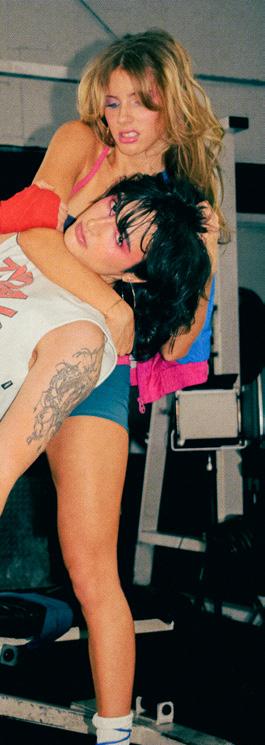
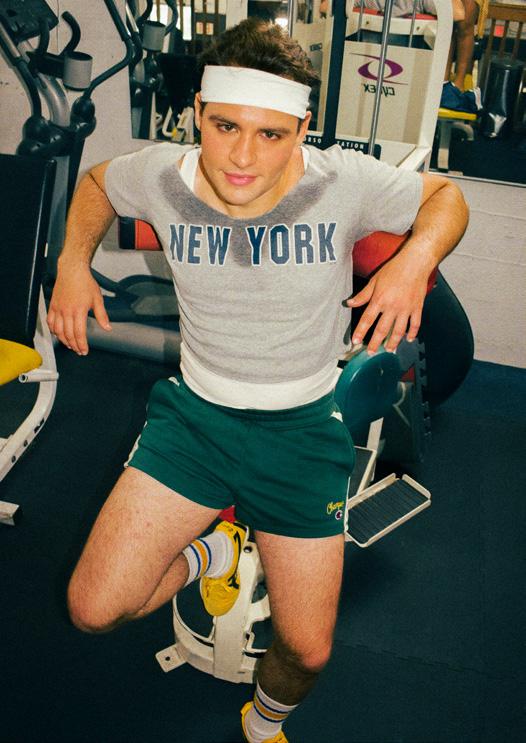
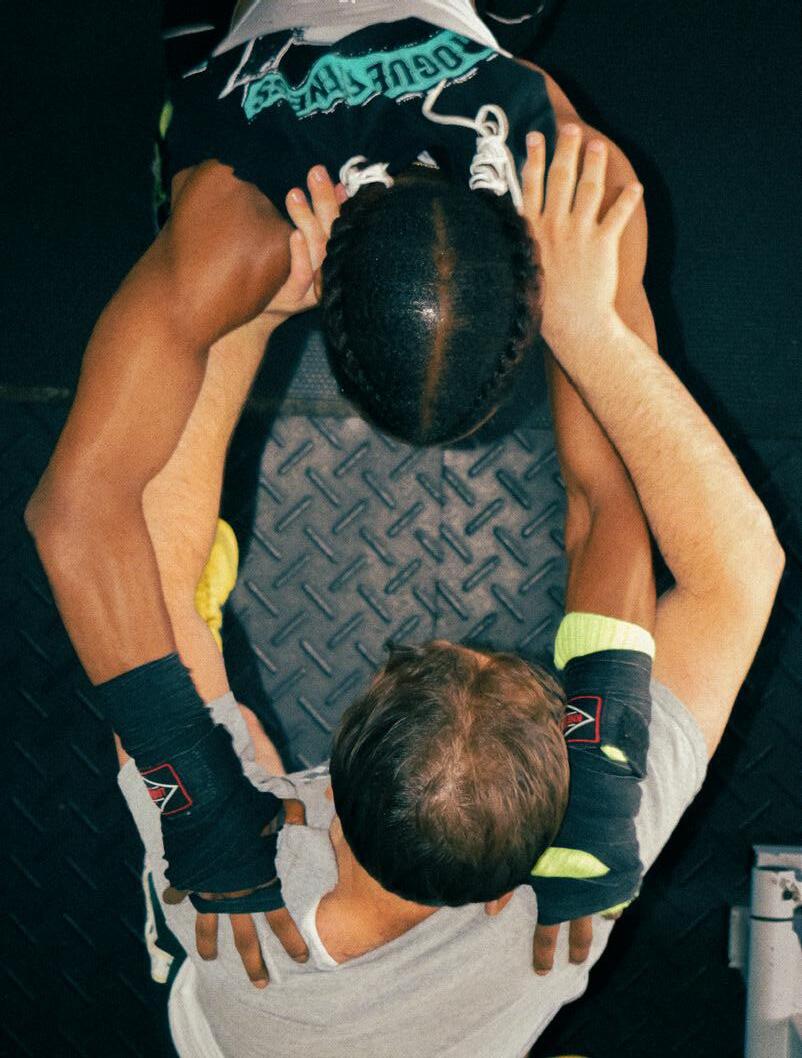
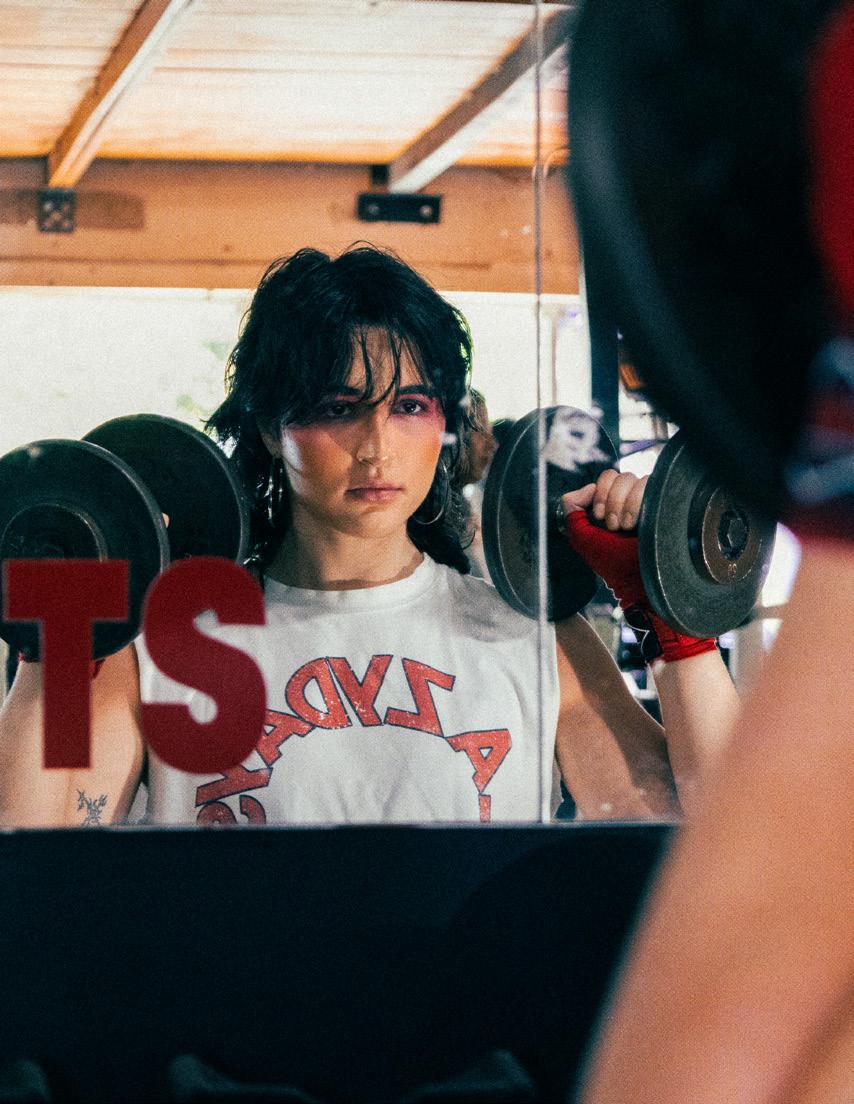
THE MOVERS “ ”
NICE MOVER
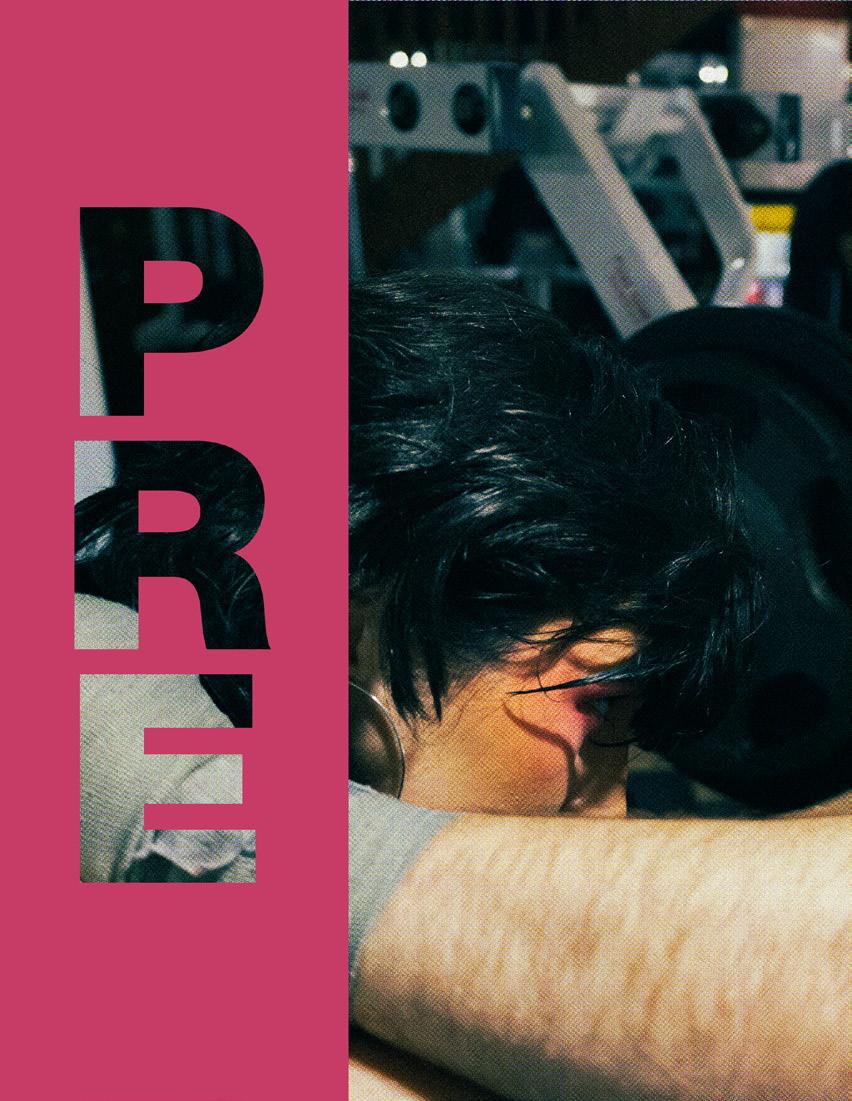
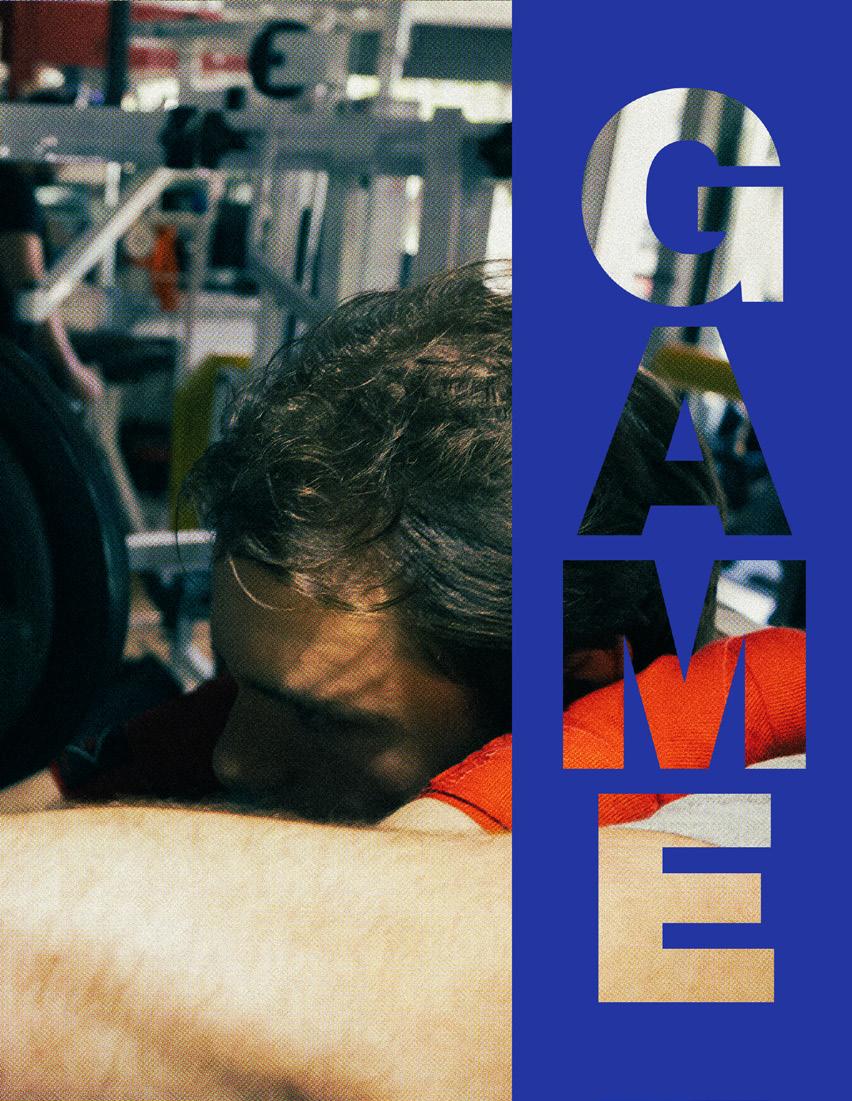
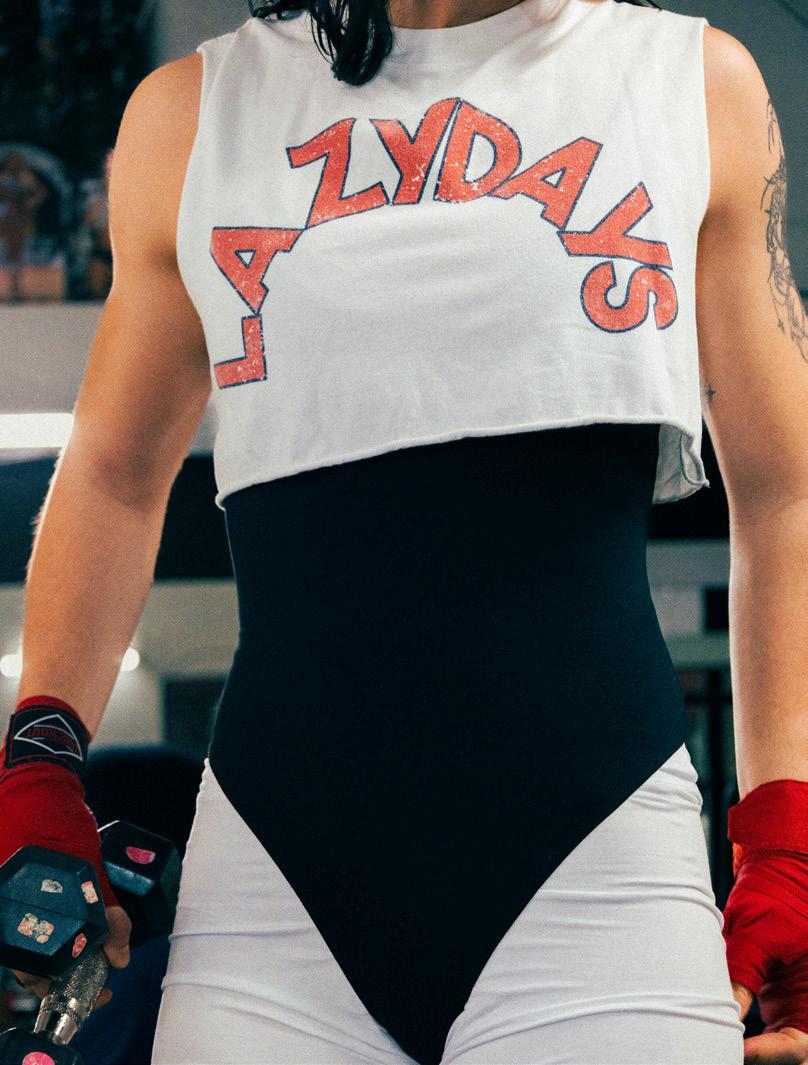
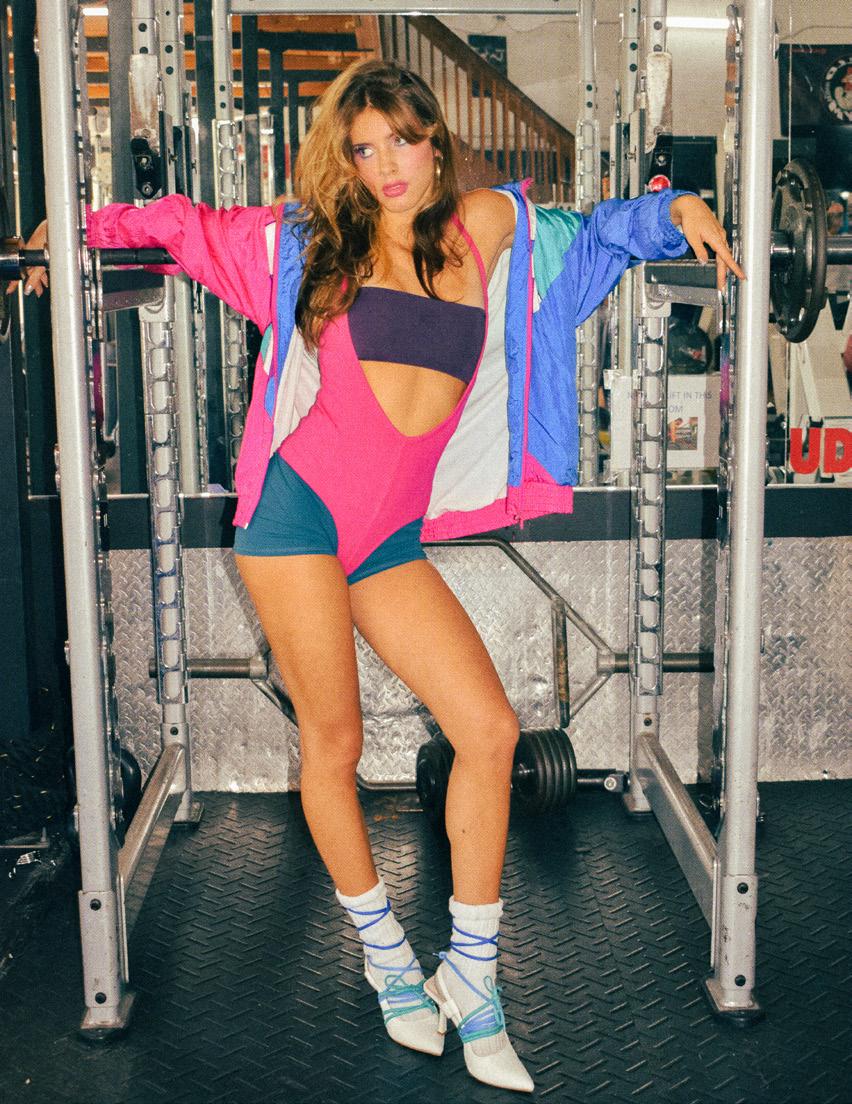
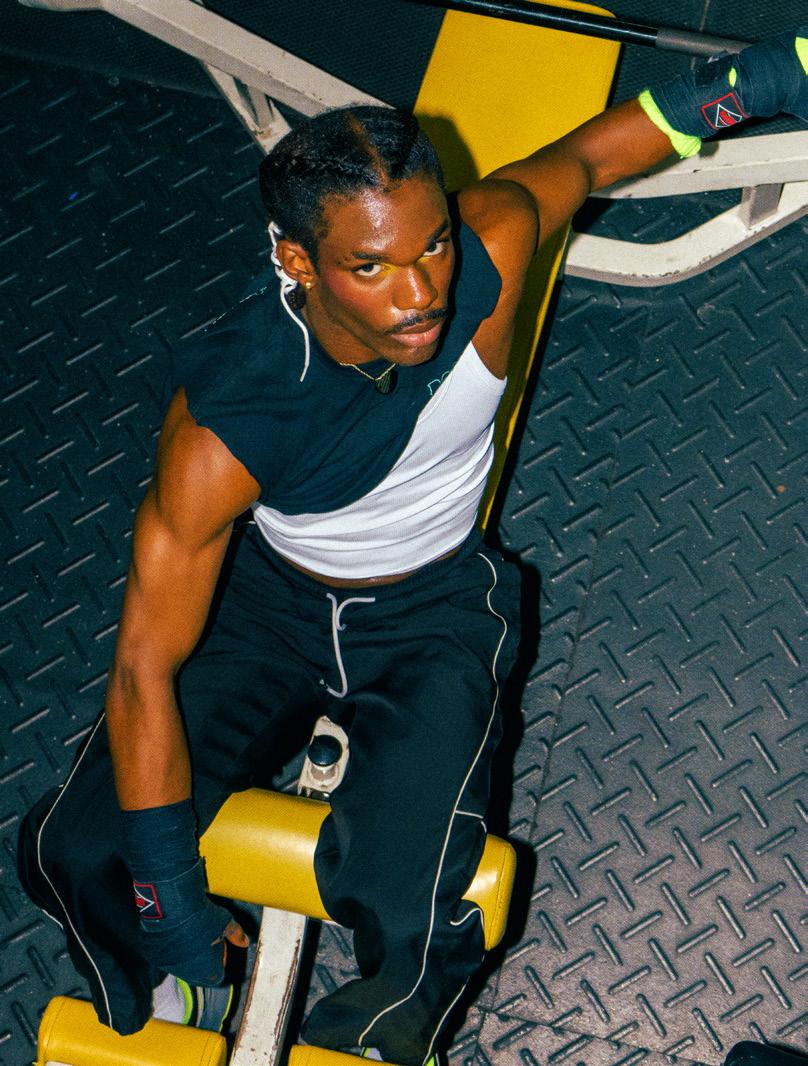
Is it sweat permeating the air, glistening every corner with a steely mist, four different tastes of brine on the attic of the lip, or is it just runoff from plastic bottles? The gymnasium becomes a pseudo-everglade when everyone reaches maximum potential. The practically kinetic humidity rained down, baptizing The Movers in a glory of gains.
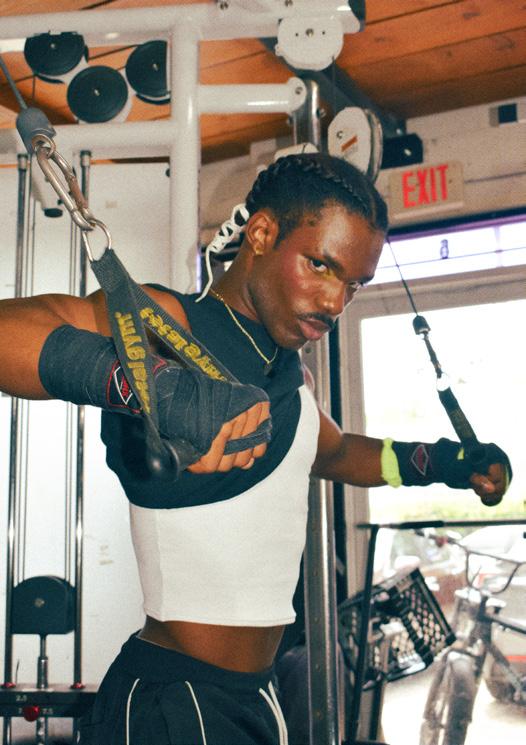
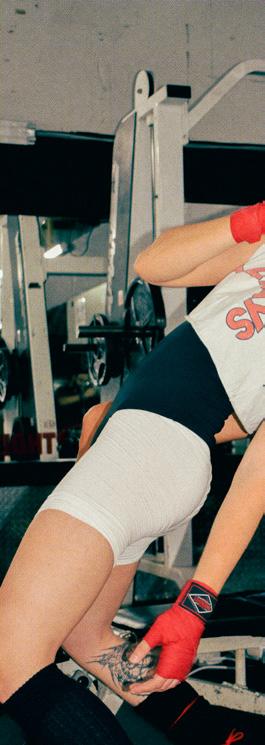
The Movers come for love. The Movers come for pain. It has become ritual for The Movers to leave with their heads held high and bodies soaked. Wearing their elastic best, The Movers are prepared to seep. Towels at the ready, cotton bands marking their wrists, foreheads, and knees, with dowels of sweat and strain— The Movers are troops in trenches protecting their bodies from the shell shock of the machine. They’re brothers-in-arms as they spot one another, heavy breaths colliding into a smoke screen of exhalation, ecstasy, and endorphins. Comrades of metal, The Movers push, pull, and grunt their way into each other’s routines. A fully stacked weight is a badge of honor, a higher weight class like a purple heart.
One more set. Another round. The glass of the gymnasium steams up to hide the Herculean necropolis waiting inside, podcasts as Plato, music as philosophy. The Movers’ bodies become a form of poly
ester, skin as nylon, fleshy spandex pulled, pushed, flexed, rubbed. Spot one, tag in; dual fighters in a game of elasticity. The Movers enlist themselves in a contest of dominance. Natty or not, juiced up and primed with red-hot passion, The Movers are up against the world. There’s nothing between them but steel plates, arched shoes, calluses, and hormones. How long can one last before breaking? Before the layers of protection they wear snap and reveal the brawn beneath, desperately waiting its time in the mirror?
For one simple moment, The Movers are at peace. Their work has been rewarded, their blood runs smoother, their limbs are perfection. Gawk at them, they are practically daring you to. One has to wonder: Will The Movers ever stop? How many sets are left? Can one work in? Is there one final push awaiting them at the end of the rope? An end to the strapped wrists and drenched legs, to the protein mixes and chaff burns. The Movers move and move and move, from one machine to the next, one partner then opponent then friend then foe, until one gets lost in the race of excellence. The healthiest duel of them all.
Ariel Rivera
PUMP, PUSH, PULL
“Feed your body, feed your soul”—you have probably heard some variation of this phrase in passing, and not without reason. These days, we move at such a fast pace true respite feels fleeting. You wake up greeted by the hustle and bustle of the day, the noise of modern life. In a society where the only thing guaranteed is work, work, and more work, the sweetness of getting your blood pumping tastes like gelato on a scorching summer day.
On a basic level, movement has always been the answer to humanity’s problems. Our ancestors hunted with their bare hands and fought in coliseums. When we were five, we hit the playground after a long day of kindergarten. Now that we have grown older, our stress relievers look a little different.
It goes beyond the gym; you can find it in anything that gets you moving. Some people find it on the field, bringing opponents to the ground in a cycle of tackle or be tackled. Others find it on the court, bouncing around with no objective but to keep the ball in the air. You can feel it—we all have, in some way or another. The subtle pounding in your chest that builds into something tangible. At first, it is an afterthought. A mild inconvenience that almost feels imagined. Then it becomes real. Like Icarus, your wings have been scorched by the sun, and you are descending back to Earth. Your feet hit the pavement, your muscles strain, the weights go down, and there is no way back up. But this is what we are here for.
Even Olympic champions aren’t immune to the pain. Gold medalist Alysa Liu said, “I love struggling, actually. It makes me feel alive.” Ancient religious texts often cite struggle as the necessary path to salvation. Maybe that’s why, in our most primal moments, we feel the most free. It is the closest we will get to the Neanderthal existence that no longer belongs to us— the panting, the grunting, the adrenaline.
The body is the only machine that yearns to be broken. Our parts weren’t designed to rust away in cubicles; in our DNA is top-tier engineering that demands its mechanical limits be tested in pursuit of growth. The delicious push, pull, pump. Always chasing the high of the fight.
There comes a point where there is nothing left but the fire in your veins. The ring is empty, no matter the man on the other side, even if that man is you. Truly, the only obstacle between you and the win is how far you are willing to go. This obsession is why we manufacture high stakes. Hordes of people crowd in to witness the apex of human design. We are Sisyphus pushing his boulder; we are hamsters on a wheel. Complicated creatures chasing our most animalistic needs. Perhaps that is the true reward of the thankless struggle. We are not after the victory, but the moments right before it. The rush of exhausting yourself in the name of what your body can do, and how far it can take you.
Moriah Higgs
CONCEPT Andrea Ramirez, Hellen Rabelo, Nico Gurdjian, Annasophia Alfonso PHOTO-VIDEO-STYLING-BEAUTY-PRODUCTION Entire i10 Staff GRAPHICS Allie Pedroso, Cydni Ayon
PHOTO Elijah Canseco
TALENT Elle Paige, Isabella Garcia, Taiylor Oden, Aivery Jade Peña
TALENT Melissa Leon
PHOTO Anubis Casares
Anett Martin Sosa
Have you ever been ghosted? Called a number you know by heart, and, on the other line, heard nothing but silence... Being ghosted is almost like being left in an eternal floatscape, imagining what could have been. An eternal haunt.
It seems being ghosted is not only a twenty-first century affair. Ghosting, or the haunt, feels like a human classic. Notably featured in William Shakespeare’s Hamlet, Emily Brontë’s classic novel Wuthering Heights, and modern television series Yellowjackets (2021), the haunt is ever-present. To all appearances, we’ve been leaving people wondering—and have been left wondering—since the beginning of time, and interestingly, we’ve been documenting it. What better way to emulate the feelings of yearning and emotional limbo than through the haunted house?
One of the oldest and most famous tales of the haunt has to be Shakespeare’s Hamlet. In the landmark play, Prince Hamlet is haunted by a Ghost, presumably that of his father, the murdered King Hamlet. This haunting drives the prince mad— though the honesty of this madness has been debated —and leads him to murder, treachery, and his death. This haunt, as a rhetorical and narrative tool, allows for the play to press onward, furthering the decay in Denmark, spreading the rot. Can the haunt be blamed for all of Hamlet’s actions? Or lack thereof? Maybe being left wondering what the intentions of the ghost are is truly what drives Hamlet mad, or maybe it is his sudden loss of standing. Either way, Hamlet’s revenge begins after the appearance of the ghost, who tells him that his father was slain, and his killer was among the court...
Even so, Hamlet is not the first haunt. The first recorded account of a haunted house was written by Pliny the Younger (61-112 AD). Pliny put pen to paper and wrote of the hauntings of Athens, most famously the house in Athens that locals dare not enter because of the ghosts within. Unmoved by such tales, a philosopher took up residence in the home. During his stay, the philosopher came face to face with a chained apparition who guided him through the courtyard. The philosopher then urged builders to dig up its center, and, lo and behold, there lay a skeleton chained at the ankles. Now this haunt can be used to relay the importance of proper burial, as after the chained skeleton was buried, he never appeared again.
On the tips of everybody’s tongues this season is Emily Brontë’s Wuthering Heights, which happens to be a quintessential haunt. After the death of leading lady Cathy Earnshaw, she appears in the dream of the Heights’ first guest in years, Mr. Lock-
wood. Cathy comes to Lockwood, young, freezing, and begging to be let back into the Heights. This haunt is symbolic of Cathy’s ties to Wuthering Heights: her childhood home, current home to Heathcliff, and, in many ways, an allegory for hell. It is also a nod to her tumultuous relationship with Heathcliff; yet another calculated move by Cathy to spite him... In Chapter XVI, Heathcliff delivers a poignant monologue wherein he beseeches Cathy Earnshaw to haunt him. One of the most memorable Wuthering Heights lines being, “[...] you said I killed you—haunt me, then! [...] Be with me always—take any form—drive me mad! only do not leave me in this abyss, where I cannot find you! [...] I cannot live without my life! I cannot live without my soul!” And yet Cathy never comes to him. In fact, Heathcliff begins to sleep (or exist, as he does not do much sleeping) in Cathy’s old room—where Lockwood saw Cathy—and still, she never appears before him.
We can be sure that the haunt lives on in modern times, as we see it showcased in 21st century television. Take Yellowjackets, for example. This hit series features one of the most biting modern haunts. Jackie Taylor, played by Ella Purnell, was the Yellowjackets’ team captain before the plane crash. Once this girls soccer team was stranded in the wilderness the tables completely turned and Jackie was no longer the respected leader she once was. Essentially usurped by her best friend Shauna—who had been hooking up with Jackie’s boyfriend before the crash—Jackie was pushed out of the cabin and made to sleep outside in the cold. In the Season 1 finale, as Jackie slept outside, a snowstorm hit the forest, and, unprotected, Jackie Taylor froze to death... In a sick turn of events, Shauna kept Jackie’s corpse intact, speaking with Jackie every day for hours on end. She told Jackie all of her secrets, her problems, and her worries, imagining what Jackie might say back to her. After two months of this, the starving Yellowjackets cooked and ate Jackie’s body. However, it does not end there. Jackie Taylor continues to haunt Shauna throughout the series, a ghostly reminder of the wilderness—of Shauna’s cruelty, fear, and thirst for power. Jackie’s ghost serves as a visual tool, reinforcing that the wilderness will never leave Shauna... the hunger for blood and leadership will never dissipate. She is a show of Shauna’s trauma.
People come, but do they ever really go? We carry pieces of people within us everywhere we go, haunted by their essence. The haunted house, visual hallucinations, and ghostly apparitions seen from silver screen to parchment are emblematic of experiences we all share. To haunt is to be haunted.
“Express yourself don’t repress yourself” ― Madonna
RAYANNA HAFEZ CD ASST.
This is your sign to always look at the hiring flyers in the library.
KIARA MARZAN EXT. ASST.
I loved all the effort that was put into the shoots, the communication and understanding!! Can’t wait to see how the mag turns out :))
ANETT MARTIN SOSA BLOG
“Everything I learned in my life, I learned because I decided to try something new.” ― David Lynch Strike Miami, I love you! Thank you to all the amazing writers, you are stars incarnate. Editorial team, you inspire me every day… To more issues, teamwork, and magic.
JENNIFER SILVA SOCIAL
My small love letter to Strike, this journey of creating and connecting with like-minded individuals has been more than I could have ever imagined.To my social media team: you are all such lovely, amazing people, and I’m so grateful to have worked alongside you in building Strike’s presence across our platforms. Working together has truly been an incredible experience. Issue 10, you’ve been the best one yet, and I’m so excited to see what’s next in store for Strike.
CLAUDIA DAVILA SOCIAL ASST.
At Strike, I found beauty in the in-between, I learned that creativity it’s felt, worn. and lived. Every post became a canvas for creativity, movement, and emotion. Thank you for letting me create with instinct and imagination.
CLAUDIA USABAL FINANCE
So proud to have been a part of Issue 10! Forever inspired by the creativity, talent, and chaos that made this issue possible.
CYDNI AYON GRAPHICS ASST.
Being a part of Strike has been nothing short of amazing. Having the opportunity to grow as a graphic designer while working alongside such talented and creative people has brought me so much joy.
To the graphics team: you all have been incredible, and I’m so grateful for every moment we shared creating together. And to Allie, you’ve been such an inspiration to me as a designer. I’m so thankful we got to work together on this issue and even graduate together! :D <3
ALLIE PEDROSO GRAPHICS
The big 10. Every time a new issue comes out I am filled with so much pride and joy!
To Andrea, Sam, and Val: it has been such an honor to be your director this issue, we were a small team but together we proved that strength comes in small numbers. To Cydni: you are INCREDIBLE and I would not have been able to do this without you by my side. I am forever grateful for you. xoxo
ANUBIS CASARES PHOTO
With this issue’s theme being Frisson, the goal of the photo team was to build images through tension, closeness, light, and atmosphere. There is something ever so special about working with intention, understanding each concept closely, and getting immersed in the world it creates. This issue was a team effort, shaped by strong creative direction and a photo team that met each idea with care. :)
LIA ALONGI BEAUTY
Serving as Beauty Director for Strike Magazine has been a quiet kind of rebellion against my crime science studies; an archive of color, texture, and expression. I’m deeply grateful to my team and every model who trusted the process and helped translate our visions into something tangible.
JULIA CARCIONE STYLING ASST.
MIA MAZUELOS STYLING
Huge shoutout to my styling team for bringing the looks to life with me! You guys made the experience so enjoyable. Could do it allll day with yall!
The creative process ironically flourishes with structure and collaboration. From stylists and photographers, to graphic designers and production directors, to everyone else in between, we all rely on each other for the magazine to turnout. I love all these amazing people.
ALESSANDRA PEREZ PRODUCTION
I loved having the opportunity to create this concept with such an amazing team. Working on this issue was such a rewarding experience, and I really appreciated getting to collaborate with everyone and bring ideas to life together.
ARIANA ROSARIO PRODUCTION
“My first semester with Strike has been filled with creativity, hard work, and some of the most inspiring people I’ve had the chance to meet. Serving as Production Director has been an unforgettable experience, and I’m so grateful to create alongside such a talented community. Through it all, Strike has served as a creative outlet, and a source of inspiration, with a side of organized chaos, and I wouldn’t have it any other way. Thank you Strike Miami <3”