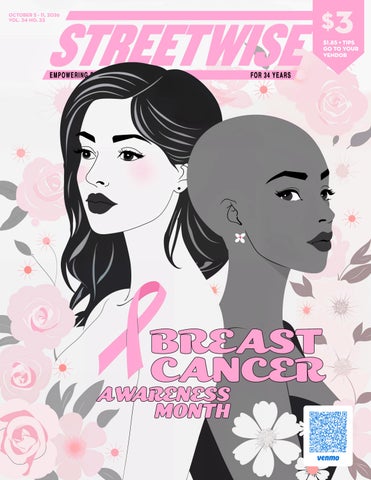
october 5 - 11, 2026 Vol. 34 No. 33
$3
$1.85 + Tips go to your Vendor
How StreetWise Works StreetWise exists to elevate marginalized voices and provide opportunities for individuals to earn an income and gain employment. Anyone who wants to work has the opportunity to move themselves out of crisis. StreetWise provides “a hand up, not a handout.”
Buy the Magazine, Take the Magazine When you buy the magazine, take the Vendors purchase the magazine, and read magazine for $1.15 and the magazine, you sell it for $3 plus tips. are supporting our The vendor keeps all of microentrepreneurs earning their earnings. an income with dignity. -or-
All vendors go through an orientation focusing on their rights and responsibilities as a StreetWise Magazine Vendor. Authorized vendors have badges with their name, picture and current year.
New vendor orientation is every Tuesday and Thursday at 10 a.m. at 2009 S. State St. Find your nearest vendor at www.streetwise.org
ADVERTISEMENT
4 Arts & Entertainment 6 SportsWise
Event highlights of the week!
The SportsWise Team discusses their favorites as October becomes a sports-lover's fever dream.
7 Cover Story: Breast Cancer Awareness Month
October is Breast Cancer Awareness Month, and as Medicaid requirements become more restrictive in January 2027, two local nonprofits and an Illinois Department of Public Health program will be there.
11 From the Streets
The Illinois Office to Prevent and End Homelessness issues a 3-year plan. Also, the Bellwether Residences, 79 W. Monroe St., is the first office-to-residential completion in the LaSalle Street Reimagined program, bringing affordable housing to the Loop.
14 Voice of the Streets – op-ed 15 The Playground
John Bartlett receives the Law Center for Better Housing Community Partner Award.
DISCLAIMER: StreetWise publishes perspectives from vendors and contributors to reflect a range of lived experiences and viewpoints. These opinions do not necessarily reflect the views of StreetWise. We are committed to fostering dialogue grounded in dignity and respect, and we do not endorse language or perspectives that harm or dehumanize others.
Dave Hamilton, Creative Director/Publisher
dhamilton@streetwise.org
StreetWiseChicago @StreetWise_CHI
Suzanne Hanney, Editor-In-Chief
suzannestreetwise@yahoo.com
Julie Youngquist, Executive director
jyoungquist@streetwise.org
LEARN MORE AT streetwise.org
DONATE
Ph: 773-334-6600 Office: 2009 S. State St., Chicago, IL, 60616
To make a donation to StreetWise, visit our website at www.streetwise.org/donate/ or cut out this form and mail it with your donation to StreetWise, Inc., 2009 S. State St., Chicago, IL 60616. We appreciate your support!
My donation is for the amount of $________________________________Billing Information: Check #_________________Credit Card Type:______________________Name:_________________________________________________________________________________ We accept: Visa, Mastercard, Discover or American Express
Address:_______________________________________________________________________________
Account#:_____________________________________________________City:___________________________________State:_________________Zip:_______________________ Expiration Date:________________________________________________Phone #:_________________________________Email:_________________________________________
ARTS & ENTERTAINMENT RECOMMENDATIONS Compiled by Dave Hamilton
Spooky Season Begins!
‘Der Vampyr’ First performed in 1828, “Der Vampyr” is a thrilling predecessor to the vampire stories that have become a staple of popular culture - pre-dating Bram Stoker’s “Dracula” by half a century. With mysterious characters, dramatic twists, and a richly atmospheric score, “Der Vampyr” captures the romance, suspense, and intrigue of the gothic tradition. “Der Vampyr” follows Lord Ruthven, a charming vampire who has until sunrise to claim three victims and escape eternal damnation. Along the way, seduction, betrayal, revenge, and supernatural forces collide. “Der Vampyr” is presented in three performances only Wednesday, October 7 at 7 p.m. at Colvin House 5940 North Sheridan Road, Friday, October 9 at 7 p.m. at Fulton St. Collective 1821 W Hubbard St. and Sunday, October 11 at 3 p.m. at the Skokie Theater 7924 Lincoln Ave. in Skokie. General admission tickets are $30 with preferred seating for $40 and select VIP tickets for $100. Tickets are on sale now at chicagocityopera.com.
The Universe is Yours!
‘Smithsonian Starstruck: An Immersive Experience’ The universe is within reach. Chicago will become a gateway to the cosmos with the arrival of “Smithsonian Starstruck: An Immersive Experience,” on view now at Germania Place, 108 W. Germania Place. This free-roam, interactive journey invites visitors to witness the birth and death of stars, explore distant galaxies, and come face-to-face with a black hole, all without leaving Earth. During the experience, guests travel alongside some of humanity’s most powerful observatories, including the Hubble Space Telescope, the James Webb Space Telescope, and the Chandra X-ray Observatory, journeying far beyond Earth and deep into the cosmos. Along the way, they encounter extreme exoplanets, witness the life cycle of stars and explore the immense scale of galaxies and black holes, gaining a deeper understanding of humanity’s place in the universe. Tickets start at $24.99 at feverup.com
ARTS & ENTERTAINMENT
Making Her Mark!
4
‘Emma Stebbins: Carving Out History’ “Emma Stebbins: Carving Out History” examines the full scope of Stebbins’s history‑making career as one of the most significant American sculptors of the 19th century. From 1857 to 1870, she created innovative marble and bronze sculptures while living in Rome with her wife, the renowned Shakespearean actress Charlotte Cushman. Her work models inventive and incisive interpretations of literary and biblical subjects, as well as unprecedented allegories of American industry. With the Bethesda Fountain in 1863, Emma Stebbins became the first woman to earn a commission for a public sculpture from the City of New York. As a professional sculptor in a female marriage, she reimagined what a woman’s life could be in the mid‑19th century. Her life and art speak to some of the most compelling issues of her time. On display October 9 - April 18, 2027 at the Driehaus Museum, 50 E. Erie St. driehausemuseum.org
A Classic Returns!
‘Don Giovanni’ In “Don Giovanni,” widely regarded as one of the greatest operas ever composed, Mozart weaves the tale of the infamous lothario Don Juan into a comically light-hearted yet deadly serious musical masterpiece. With more than 2,000 seductions behind him, the Don becomes increasingly reckless as he descends into excess and immorality. He murders the father of Donna Anna, one of his discarded conquests, eludes every trap set for him by her vengeful fiancé Don Ottavio, and seduces a bride on her wedding day, to the fury of her jealous groom. But when his antics turn fatal and unrepentant, the women he has wronged join forces to seek revenge, and the dead come calling. Playing October 10 - November 1 at Lyric Opera House, 20 N. Wacker Drive. Tickets start at $45 at lyricopera.org
Sashay, Shantay!
Chicago Fashion Week Chicago’s fashion and design scene takes center stage during the third annual Chicago Fashion Week, showcasing the city’s creativity, culture, and couture. This year celebrates groundbreaking artistic expression and follows the threads of Chicago’s fashion history through a week-long series of events. Chicago Fashion Week runs from Oct. 8 – 18, bringing shows, pop-up shops, and exhibits all across the Chicago area. From Highland Park to Hyde Park, designers, fashion schools, and world-class shopping unite to showcase Chicago’s evolving fashion scene. Discover emerging designers, watch a runway show, or shop a curated pop-up experience during this year’s lineup. Learn more and see a full schedule at chicagofashionweek.com
Visions of What is to Come!
‘Radical Futures’ In a failing dive bar, two estranged friends try to reconnect over hallucinogenic cocktails that trigger visions of tomorrow. As these sci-fi visions grow wilder and more intense, a question looms large: Does their friendship have a future? Playing October 9 - November 21, Fridays & Saturdays at 7:30 p.m., Sundays at 3 p.m. at The Factory Theater, 1623 W. Howard St. Tickets are $30 at thefactorytheater.com
Author Talk!
An evening with Pulitzer Prize winner Hernan Diaz Chicago’s Fine Arts Building and Exile in Bookville co-present an evening with Hernan Diaz, the Pulitzer Prize-winning and New York Times bestselling author of “Trust”—one of The New York Times’s 100 Best Books of the Century—Sunday, October 11 at 6:30 p.m. at the Studebaker Theater, 410 S. Michigan Ave. Tickets start at $25 at fineartsbuilding. com/hernan-diaz
Wastin' Away Again. . .
‘Escape to Margaritaville’ Music Theater Works presents the first professional production of Jimmy Buffett’s “Escape to Margaritaville” in Chicago since its pre-Broadway run. This lighthearted romantic comedy follows Tully and Rachel as their worlds collide at a beachfront resort. “Escape to Margaritaville” is the ultimate musical vacation for Parrot Heads and newcomers alike. Playing October 8 - November 1 at the North Shore Center for the Performing Arts, 9501 Skokie Blvd., Skokie. Tickets are $19.50 - $106 at MusicTheaterWorks.com
The Power of Voices!
‘Chicago A Cappella: Northern Lights’ Through music from Sweden, Norway, Finland, and Denmark, CAC brings the beauty, mystery, and wonder of the far north to life. Filled with luminous harmonies, landscapes, and timeless stories, “Northern Lights” invites audiences to experience a world shaped by nature, folklore, and light. There will be 4 performances around the city: October 11, 4 p.m. at Wentz Concert Hall, 171 E. Chicago Ave., Naperville; October 16 at 7:30 p.m. at Pilgrim Congregational Church, 460 Lake St., Oak Park; October 24 at 7:30 p.m. at Murphy Auditorium, 50 E. Erie St.; October 25 at 3 p.m. at Nichols Concert Hall, 1490 Chicago Ave., Evanston. Tickets are $40 at chicagoacappella.org
Brick by Brick!
Brick of Chicago Walking Tour The built environment of Chicago features a dozen varieties of bricks and even more brick designs. The Nickerson Mansion was built with two types of brick: Cream City, so-called because of the light color that results from the type of clay deposits used, and Chicago Common brick. There are many fine examples of brick buildings in the area around the Driehaus Museum, 50 E. Erie St., and architectural expert Will Quam will take participants on a tour through some of the highlights, including the Medinah Temple and the Allerton Hotel. Rain or shine; does not include museum admission. Tuesday, October 6, 5 p.m. Tickets are $35 at driehausmuseum.org
www.streetwise.org
5
Vendors (clockwise) John Hagan, Clinton Scott, A. Allen and Russell Adams chat about the world of sports.
October: A sports fan's dream
John: October is the sports equinox, with all kinds of activities, from the MLB playoffs, the NFL regular season, college football, to the start of the hockey season, the WNBA playoffs wrapping up and the NBA. What is on your mind the most?
SPORTSWISE
Russell: My first thing is the Major League Baseball playoffs. You also have college football, pro football, the NBA preseason, NHL hockey, WNBA. I am going to watch what I can, including the Bulls against the Phoenix Suns on October 7, to see how good they are.
6
Allen: I like the WNBA, women’s basketball, I do want to see the finals. Of course my eyes are on the Bears. They’ve made improvements and I always said, I want to give their quarterback a chance. Caleb Williams is improving every year, so I am looking for great things. We gotta play Green Bay. The Minnesota Vikings beat Green Bay 3922 on September 13. Clinton: The baseball playoffs start right now. The White Sox are on thin ice,
a half-game behind the Guardians. In basketball, I don’t know what’s going on. They got a new coach, some new players, maybe this year they can get to the playoffs. The Bears’ defense needs some help. You are not going to win in football if you get so many penalties. John: What piques my interest are the baseball playoffs. If the White Sox and Cubs both make the playoffs, that would be even more exciting, especially if the Cubs get to play the two-time champion LA Dodgers, although that would be in LA because the Cubs would be a wild card. If the White Sox play the Yankees, that would really pique interest in baseball in Chicago and nationwide because the White Sox are the only ones that have minimum national exposure.
If that would happen, even the Bears would take a backseat. Speaking of backseat, since the Illini got upset by Duke, their chances of playoffs have gone elsewhere. A lot of people don’t pay attention to the NBA until Christmas time. So my interests now are baseball, followed by the Chicago Bears, then college football, WNBA playoffs. The Indiana Fever are fun to watch, then the Bulls and the Blackhawks. Russell: I enjoy baseball, the Bears, WNBA, the Bulls and the Blackhawks. Watch the WNBA, they play pretty hard. Allen: I am really looking at this football season because I have been rooting for the Bears for the longest and it looks like they are finally get-
ting their chance to go to the playoffs. I am hoping they win more than one game. I don’t want to put myself out on a limb but I really believe Caleb Williams can take the Bears to the Super Bowl. Clinton: I am looking at the possibility of a World Series in Chicago. The Bulls, hopefully we get a playoff out of them. John: And don’t forget the Chicago Marathon October 11. That’s the day Chicago doesn’t sleep, so we have so much going on, I think we will be worn out by Columbus Day. Any comments, suggestions or topic ideas for the SportsWise team? Email StreetWise Editor Suzanne Hanney at suzannestreetwise@yahoo.com
Chicago’s Breast Cancer Gap by Judi Strauss-Lipkin
M
ost of us know at least one friend or family member who has or has had breast cancer. Who has had surgery, minor or major. Who has had chemotherapy and/or radiation. Who might have had reconstruction. Who has follow-up checkups and lives with the ongoing fear that it could return. And many of us continue to have mammograms: starting at age 40 for women with average risk, according to breastcancer.org. The American Society of Radiologists, meanwhile, recommends that Black women and women of Ashkenazi Jewish descent be evaluated by a doctor at age 25 to determine if they are at higher-than-average genetic risk. Women with dense breasts, in addition, may be more at risk of cancer, while the density simultaneously makes cancer more difficult to detect; for these women, breast MRIs and ultrasounds may also be recommended. www.breastcancer.org/screening-testing/ mammograms/recommendations
In the United Status for 2026, the American Cancer Society estimates about 321,910 new cases of breast cancer will be diagnosed in women, alongside 42,140 deaths. Roughly 1 in 8 women (13%) will develop breast cancer
Early detection is critical. The 5-year relative survival rate is over 99% when caught at a localized stage and more than 4 million breast cancer survivors live in the U. S. Mortality has dropped by 44% since 1989 due to better screening and treatments. These are national statistics. Now let’s bring it back home – to Chicago. Just 20 years ago, from 2005–2007, Chicago had one of the nation’s highest breast cancer mortality disparities. African American women were 62% more likely to die from breast cancer compared to White women in Chicago even though they were diagnosed less often. By 2017, Chicago was No. 1 in the nation for reducing breast cancer deaths in African American women. The Black/white “death gap” was lowered from 62% to 39% thanks to the formation of the Metropolitan Chicago Breast Cancer Task Force – now known as Equal Hope. The keys to this reduction were digital mammography equipment, dedicated imaging specialists reading the films and better patient navigation – ways to access needed care for both screening and treatment.
COVER STORY
October is Breast Cancer Awareness Month. It was founded in 1985 in partnership between the American Cancer Society and the pharmaceutical division of Imperial Chemicals (now a part of AstraZeneca, producer of several anti-breast cancer drugs). The aim from the start has been to promote mammography as the most effective weapon in the fight against breast cancer. Its symbol, the pink ribbon, was established by the Breast Cancer Research Foundation founded by Evelyn Lauder in 1993 and even before that, the Susan B. Komen Foundation handed out pink ribbons to NYC participants in the race for Breast cancer survivors.
in her lifetime. It is the most common cancer in U. S. for women after skin cancers. The median age at diagnosis is 63 years old.
7
There had been no death gap from the mid-1930s to the 1980s, when early detection began via screening mammograms. These improvements continued in the 1990s with technology, the emergence of specialists and advances in treatment such as chemotherapy, according to Task Force founder David A. Ansell, M.D. in his book, “The Death Gap,” (University of Chicago Press: 2017). The advances, however, were not shared geographically. Only one hospital in a high-mortality Black neighborhood had been certified by the American College of Surgeons’ Commission on Cancer, whereas there were 14 such accredited hospitals in white wards, Ansell wrote. The Task Force urged hospitals to share quality data, identified those with undertrained mammography technicians and radiologists and arranged free continuing education; and hired community health workers and nurses to “navigate” women to high-quality hospitals for screening and treatment. Equal Hope is making a difference by addressing barriers women of color face when it comes to screening and treating cancer: lack of transportation to medical centers, lack of insurance, scheduling conflicts with jobs, concerns being ignored by physicians and the lack of consistent quality care depending on where patients go for care. In 2023, Equal Hope’s outreach touched more than 475,844 individuals – nearly 1 in 5 (20%) of Chicago’s population. Initiatives included distributing more than 106,320 flyers throughout Cook and Lake counties; providing 513 rides to health screenings, scheduling 3,117 appointments and establishing primary care for 322 individuals through the community health team. equalhope.org/about-3/achievements/
8
Chicago offers many local mammogram clinics through hospital networks and specialized community groups. They include hospital-based breast centers such as the Lynn Sage Breast Center at Prentice in Northwestern Memorial Hospital, Rush MD Anderson Cancer Center that operates community mobile screen vans and the University of Illinois Cancer Center that offers community clinical care while integrating research with patient support. One major curve in the advancement of access to screening and treatment for underserved women is the change projected to become effective in January 2027 for Medicaid eligibility. The key changes are: • Adults in the ACA expansion group must prove 80 hours of work, school or training per month or qualify for an exemption (such as being medically frail). • Eligibility renewals will be reduced to every six months (from 12 months) starting at the first redetermination date. • New applicants face the new rules immediately in 2027; current enrollees face them at their first redetermination date. The 104th IL General Assembly proposed a bill to address the upcoming limited access to screening and care and expand Medicaid mammography coverage and create patient-navigation assistance for women diagnosed with breast cancer. It was first introduced in February 2026, written with the assistance of Equal Hope and championed by state Rep. Mary Beth Canty (D-Arlington Heights) and state Sen. Adriane Johnson (D-Waukegan). It currently is in the Rules Committee since it did not pass by May 31. The hope is that before the new working/limited access rules become effective, it will be re-introduced in the next General Assembly in January 2027 so our state can
be one of the first to find a solution to providing screening and care to all those who need it. At this time, there ARE several free and low-cost breast cancer programs, including Equal Hope, Illinois Breast and Cervical Cancer program and A Silver Lining Foundation, begun in 2002 by Dr. Sandy Goldberg. (see how to access each of them, who they serve and what they cover in the sidebar on page 9). Paris Thomas Ph.D. has been the CEO of Equal Hope since 2022 but has been with the organization since 2019. Her entire career focused on promoting health equity, beginning with the cancer diagnosis of her mother (now a two-time survivor) when Paris was just 18 and a college student. Paris became both a caregiver and a student and continued her formal education with a master’s degree in Community Health and Preventative Medicine and a Ph.D. in Health and Human Sciences. She is totally committed to providing quality care to marginalized communities – to the uninsured and underinsured. When asked what her mother might say about her, she was quick to answer: “that I am driven; that I am selfless; that I am community-focused.” At Equal Hope, the total focus is community outreach to primarily the West and South Sides of Chicago. They are “boots to the ground,” with nine employees walking around and asking people about their health and their needs or concerns. Once they are “clients” of Equal Hope, specialized employees called patient navigators provide all the help they need – from free transportation, to reviewing prior films and talking to primary care doctors, determining the best hospital and diagnosis/treatment to following up every step of the way. Dr. Thomas said we “hold their hand” and they know that “we got you.” Her passion for
promoting health equity and community wellness at Equal Hope and for our state through working on legislation to serve the under or uninsured is truly inspiring. Dr. Sandy Goldberg’s story with A Silver Lining and her and her husband Gregg’s commitment to helping others began in 2000. Newly remarried and five months after a prior biopsy that was considered “OK,” she listened to the voice in her head, pushed for another mammogram and biopsy – and received the words – “Come back right now.” She was given a diagnosis of breast cancer. In her words, “I felt like I was hit by a bus.” Two days later, she underwent surgery, and as of this writing, she has been cancer-free for over 26 years. During her recovery and subsequent treatment, Sandy, while she had the support, care and insurance on her journey, realized that this help was not available or accessible to so many others. In 2001, Sandy created a cable show with the American Cancer Society based upon her experience, with cancer specialists and an opportunity for people to call in and ask questions. She was overwhelmed by the questions and their need and how many people believed they were not worthy of access to the required testing and followup because they had no money and no insurance. The Foundation was started as an outreach program with a referral network to local, regional and national organizations. If anyone needs information about cancer, they could contact ASLF. Mayor Richard M. Daley heard about their work and connected the foundation with 311, a partnership unique to the Chicago metropolitan area which continues today. Since its start in 2002 at their kitchen table with $2500, ASLF has launched “Buy a MOM A Mammogram” in 2006, expanded to include cost free diagnostic testing
www.streetwise.org
9
Page 7: "The Death Gap: How Inequality Kills" by Dr. David A. Ansell (University of Chicago Press image). Page 8: Paris Thomas, PhD, CEO of Equal Hope (courtesy photo). Page 9: A mobile mammogram bus (Lake County Health photo). This page: Sandy Goldberg PhD, founder and chair of A Silver Lining Foundation (A Silver Lining Foundation photo).
– mammogram, ultrasound, MRI and biopsy-serving over 50,000 women to date based solely on need-underinsured and even undocumented. They partner with 16 area hospitals for totally free diagnosis and treatment (supported by donations plus grant funding) and, as Sandy said “proud that we take NO government funding, not one dime!” A $750 initial donation will fund 5.5 screening mammograms, Sandy said.
Contacts for Advice & Answers IBCCP: IL Breast and Cervical Cancer Program • Offers free mammograms and breast exams to eligible women • No Income requirements apply • Must live in IL • Be without insurance or insurance that does not cover breast cancer screenings • 35-64 years old • Treatments benefits may be available through the IL Department of Healthcare and Family Services. • Call the Women’s Health Line: 1-888-522-1282. Or 708-836-8625. www.illinois.gov/services/service.breast-cancer-screen.html Equal Hope • Navigation to free breast cancer screening • Navigation beyond screening to diagnostic follow up and treatment when needed • Healthcare and insurance navigation • Assistance with diagnostic follow up and breast cancer treatment/ Call 312-942-3368 (www.equalhope.org) A Silver Lining • Funds cost-free breast health testing • For the uninsured, the underinsured or those ineligible for other breast health testing programs. • Includes undocumented women • Tests funded include screening mammogram, diagnostic mammogram, breast ultrasound, MRI and biopsy. • The only requirement is need; they turn no one away. • Call 312-345-1322 (www.asilverliningfoundation.org)
10
Sandy is also proud of the foundation’s personalized outreach and care. “People find out about us through social media and other outreach; we answer every phone call or always call you back, listen and develop a treatment plan with you. Bills are sent by the partner hospitals to ASLF and paid by them so patients do not see or worry about a bill.” Inspired by her mother (both her parents were immigrants) there is an Evelyn Goldberg Mammography Center at UIC and Sandy says she always remembers her words, “we are all family and we have to help each other through the tough times.” So, what is the bottom line? A woman should not have to be lucky to survive breast cancer. In Chicago, where some of the finest medical care exists, there is still a breast cancer gap. And as Medicaid cuts threaten to leave more women uninsured or make it harder for them to get timely care, that gap could widen. The question is not whether Chicago has the doctors, hospitals and technology to save lives. It does. The question is whether every woman who needs that care will be able to reach it. For the women who are diagnosed, the mammogram is only the beginning. The real test is what happens next. Judi Strauss-Lipkin, PhD is a Chicago writer, poet, and longtime tax professional. She enjoys telling stories about the people, places and traditions that make Chicago home.
Preserving Chicago’s Heritage, one building at a time.
Illinois office to prevent and end homelessness issues 3-year plan Illinois leaders, people with lived expertise, elected officials, service providers, and philanthropists commemorated the fifth anniversary of the executive order that created the Illinois Office to Prevent and End Homelessness (OPEH) on September 3, when they also released the Home Illinois Plan to Prevent and End Homelessness FY27-29.
PRE C
HI
ON
PreservationChicago.org
RVATI SE
C AG
Love Your City Fiercely!®
O
Tiffany Mosaic Ceiling (1907) At Marshall Field’s / Macy’s on State Street Over 1.6 million pieces of iridescent favrile glass comprise the 6,000-square-foot barrel-vaulted mosaic ceiling designed by Tiffany Studios. Designated a Chicago Landmark on November 1, 2005 Ward Miller Richard H. Driehaus Executive Director of Preservation Chicago
(312) 443-1000 WMiller@PreservationChicago.org
Signed on Sept. 3, 2021, Executive Order 2021-21 created a statewide structure dedicated to preventing and ending homelessness through coordinated policy, shared accountability, and meaningful partnership across agencies and communities. Over the past five years, Illinois has built a statewide framework defined by collaboration, racial equity, data-driven decision making, and sustained investment in housing, health, and economic stability. As a roadmap for the next three years, the Home Illinois Plan acknowledges that the number of people living outdoors, in cars, or in abandoned buildings has increased by 22%. On a single night in January 2026, 13,772 people were “literally homeless” in Illinois. Another 99,902 www.streetwise.org
FROM THE STREETS
Eric Allix Rogers
“Every person deserves the dignity and stability that come with having a safe place to call home,” said Governor JB Pritzker. “Five years ago, I proudly launched a statewide effort to address homelessness. Since then, we’ve helped thousands of Illinoisans find greater stability and strengthened the systems that support our unhoused neighbors. With the next Home Illinois Plan, we’re building on that progress to continue our mission to end homelessness in our state.” Gov. Pritzker’s BUILD plan, unveiled last spring, delivered $250 million toward housing inventory and cutting construction red tape.
11
(including 41,976 in Chicago) were “doubled up homeless,” that is, living with friends or family. The latter included more than 63,872 K-12 students across the state in the 2024-25 school year, a 30% increase in three years. But there has also been a 6% decrease in literal homelessness between 2025 and 2026. “Five years ago, Illinois made a commitment not just to reduce homelessness, but to transform how we show up for our neighbors. The progress we celebrate today reflects a statewide community of service providers, public agencies, philanthropy partners, and people with lived expertise who refused to accept homelessness as inevitable,” said Illinois Chief Homelessness Officer Christine Haley. “With the release of the next Home Illinois Plan, we are building on that momentum and charting an even more honest, ambitious path toward a state where every person has a home.” The root cause of housing instability, according to the Home Illinois Plan, is “rising housing costs,” notwithstanding “harmful narratives” that seek to pin the problem on people themselves who are homeless. “These narratives are harmful because they misidentify personal failings as the underlying issue, making it harder to effectively address the actual origin of the crisis of housing instability.” Structural failings mean that Illinois has a housing shortage of 142,000 units – or 227,000 by 2030. The lack of supply means that home prices have shot up 54 percent and rents 27 percent in the U.S. between 2019 and 2024. The reason for the undersupply is both underproduction since the recession of 2008 and a postpandemic spike in demand that drove up costs and inflation. Sixty percent of Illinoisans -- people who make between 50% and 100% of the Area Median Income (AMI) or $42,550 and $85,100 respectively for a one-person household – are most vulnerable to homelessness from these rising housing costs. Because they spend more than 30% of their income on rent, they are “cost-burdened.” In addition, there are only 63 affordable rental units for every 100 households earning 50% of AMI. For them, housing is like a game of musical chairs: “when the music stops, someone is left without a home.”
12
Simultaneously, the megabill known as HR1 passed by Congress in July 2025 will cut Medicaid by an estimated $900 billion in the coming decade, the largest cut in the program’s history. According to the Center for Budget and Policy Priorities, fully 75% of households that receive rental assistance include a person with health care through Medicaid or a related program. As millions lose coverage in the next several years, they will also have difficulty accessing services like physical health care, mental health care, and substance use care, which in turn help them maintain housing and prevent institutional placements. Home Illinois outlines four goals to end homelessness: • SOLVE FOR FUNDING IN THE WRONG PLACE People experiencing homelessness frequently rely on emergency rooms, hospitals, crisis services, and other costly interventions. By investing more in housing stability, prevention, and supportive services, Illinois can reduce avoidable public costs while improving outcomes for individuals, families, and communities. • ENSURE EVERYONE ACCESSES BENEFITS THEY ARE ELIGIBLE FOR As eligibility requirements for programs such as SNAP and Medicaid become more complex, many people may struggle to access the support for which they qualify. State agencies will strengthen outreach, navigation, and coordination efforts to help people understand requirements, complete applications, maintain eligibility, and receive the benefits they need to remain healthy and housed. • END UNSHELTERED HOMELESSNESS Expand low-barrier shelter options, improve outreach, simplify access to services, and increase pathways to permanent housing. • BUILD A COORDINATED AND COMPREHENSIVE PREVENTION SYSTEM Stop homelessness before it starts by strengthening prevention programs so that people with short-term emergencies can resolve them before losing housing; improve discharge practices from hospitals and institutions, and support groups at higher risk, including youth, seniors, veterans, and people leaving incarceration or foster care. –Suzanne Hanney, from online sources
'Bellwether', first residential building in LaSalle Corridor, opens The Bellwether Residences at 79 W. Monroe St. opened September 9 as the first LaSalle Corridor office-to-residential conversion, an initiative of both the Lightfoot and Johnson administrations to transform the Loop into a 24hour live/work/play neighborhood by converting underutilized office space into housing. “When the pandemic and societal shifts changed the way people work, my administration refused to accept decline,” said Mayor Brandon Johnson. “Instead, we thought boldly and advanced the revitalization effort to bring new housing to our city while incubating the environment needed to drive further investment. With more than two-dozen active office-to-residential conversion projects across the downtown area, it’s clear that our investments are paying off.” Led by developer R2 with City funding, The Bellwether converted 11 floors of vacant office space at the 1905 highrise into 117 mixed-income residential units and lower-level retail space; 41 units are designated as affordable for households earning 60% of the Area Median Income ($51,060 for one person/$58,320 for a household of two). The Bellwether features studio, one- and two-bedroom residences, along with indoor and outdoor amenity spaces. City support includes $28 million in Tax Increment Financing and landmark designation approved in 2025 to facilitate $7.8 million in federal historic tax credits. Additional improvements include restoration of key architectural features, including the building’s iconic “weather bell” at the corner of Clark and Monroe streets. Exterior, unit interior, and common space at the Bellwether Residences, 79 W. Monroe St. (Courtesy photos).
“The Bellwether is about much more than the transformation of a single building,” said Gary Stoltz, R2 Partner. “It demonstrates what is possible when we look at Chicago’s historic downtown assets with fresh eyes and invest in their next chapter.” The project was one of six advanced through LaSalle Street Reimagined, a Department of Planning and Development-led initiative seeking adaptive reuse proposals to convert vacant and underutilized office space into mixedincome residences and other neighborhood amenities. Valued at more than $900 million, the projects will repurpose more than two million square feet of space into 1,765 homes. The projects are complemented by nearly two-dozen private conversion efforts underway downtown—more than the last 20 years combined, city officials said. Valued at $1.8 billion, the projects are creating 3,900 units while repurposing approximately 4 million square feet of underutilized commercial space. Built by restaurateur Charles E. Rector, the 14-story building is the oldest surviving commercial high-rise designed by Chicago architect Jarvis Hunt. Adorned with classical and modernist Prairie School design elements, the building housed several financial institutions in the 20th century, including Bell Savings & Loan Association, which added the “weather bell” sign to the corner in 1951. For more information on the City’s LaSalle revitalization initiative, visit Chicago.gov/LaSalleStreet –Suzanne Hanney, from online sources www.streetwise.org
13
Housing organizer honored for decades of service in Chicago op-ed by Mark Swartz
John Bartlett, former executive director of the Metropolitan Tenants Organization who is my friend, will receive the Law Center for Better Housing (LCBH) Community Partner Award at our 2026 Fall Benefit on October 15 at Buddy Guy’s Legends. Supporters of his work with tenants in Chicago can purchase tickets at www.lcbh.org/2026
VOICE OF THE STREETS OP-ED
The LCBH Community Partner Award honors people and organizations that support LCBH in advancing renters’ rights in Cook County through coalition building, policy advocacy, and renter outreach. We are proud to recognize Bartlett’s leadership in tenant organizing and his commitment to creating networks that uplift renters’ rights. By encouraging us to work together, more renters have access to critical housing services.
14
Beginning in the late ’90s, Bartlett held multiple roles at the Metropolitan Tenants Organization, including a twodecade-long stint as executive director, before retiring last year. He directed the implementation of several new programs, including MTO’s Healthy Homes Program, HUD Organizing program, and a citywide tenants’ hotline, which receives calls from more than 10,000 tenants annually. “John was MTO’s executive director for about 20 years and it's impossible for people to think of MTO without thinking of John. He is still committed to everything MTO stands for and isn't disappearing from the housing scene around Chicago,” Monica Foucher, current MTO executive director, said. Bartlett was vital in establishing a partnership between our organizations, helping connect renters in tenant associations formed by MTO with LCBH for legal aid. Together, we empowered tenant associations across the city to win millions of dollars in repairs, relocation assistance, and rent forgiveness. He also worked alongside LCBH staff and other housing advocates on multiple legislative campaigns to strengthen legal protections for renters, including the Chicago Fair Notice Ordinance, which requires landlords to give advanced notice of the non-renewal of a lease based on the amount of time a tenant has occupied the unit, and other reforms to the Residential Landlord Tenant Ordinance (RLTO). Rather than being constrained by legal precedent or accepted practice, Bartlett would identify where the law or
practice unfairly disadvantaged renters and seek creative ways to challenge an unjust system. He brought that same approach to advancing reforms to make housing policies fairer for everyone. Building on Bartlett’s work, MTO and LCBH are working with other coalition members to rally support for the Protecting Renters Ordinance (PRO), which was announced by Mayor Brandon Johnson, and the Department of Housing, and multiple community-based organizations earlier this summer. PRO makes necessary updates to the Chicago RLTO, which celebrated its 40th anniversary on Sept. 8. Key components to the ordinance include RLTO modernization, the creation of a city-wide rental registry and a Bureau of Rental Housing Services, and the codification of the Eviction Defense Counsel program. If passed, PRO will establish a unified policy framework that strengthens tenant protections, builds enforcement infrastructure, and closes critical gaps in data, enforcement, and legal access for the more than 620,000 Chicago renters. You can learn more about the Protecting Renters Ordinance and advocate for expanded renter protections by visiting unfairordinance.org. Mark Swartz is the Executive Director of the Law Center for Better Housing.
(left to right) LCBH Executive Director, Mark Swartz, 2026 LCBH Community Partner Award Winner, John Bartlett, and former LCBH staff member, Brendan Saunders, pose for photos at Bartlett's retirement party in early 2026 (Courtesy photo).
e the Sudoku puzzle, each row, column and box must contain the s 1 to 9. Streetwise
ox
es r
9/19/16 Crossword
Sudoku
To solve the Sudoku puzzle, each row, column and box must contain the numbers 1 to 9.
©2021 PuzzleJunction.com
53 Atomizer output 57 Turkish dough 58 ___ so often 60 Shevat follower 61 Stick-toitiveness 62 Stair part 63 “A Doll’s House” wife 64 Commotions 65 Petticoat junction 66 Meager
4 “All in the Family” 31 Flirtatious sort nickname 32 Razz 5 Blender button 34 Crosswise, on 6 Elevator inventor deck 7 Calendar abbr. 38 Wiener 8 Medium schnitzel meat 9 Embankments 39 Footstools 10 Wistful word 41 Furnace parts 11 Money maker 44 Depth charge 12 Bridge call targets 14 Chasm 45 Make lace 22 In the know 46 Nymph chaser 24 Savvy about 48 Sheik’s bevy 25 Capital of East 49 Pond organism Flanders 50 Wren or hen 26 Capital on the 51 Vivacity Down Bight of Benin 52 Arizona city 27 Sand bar 54 Object of 28 Tubular pasta 1 Under the worship 29 Fresh from the covers 55 Rani’s wear 2 Bunuel shower 56 Airport collaborator Port-au-Prince’s conveyance Copyright30©2021 PuzzleJunction.com m 3 Qualified land 59 Compete
Copyright ©2016 PuzzleJunction.com
©PuzzleJunction.com
answers last week's edition Sudoku Solution Solution
Sudoku Solution
Find your nearest StreetWise Vendor at www.streetwise.org
Crossword Across 1 Gush forth 5 Wharton grad 8 Burn with hot water 13 Come from behind 14 Neighbor of Mo. 15 Bud Grace comic strip 16 Bowie’s last stand 17 Fruitcake item 18 Bob’s companion 19 Henpeck 20 ___-Hill publishing 23 Part of a rose 24 Sound 26 Last ___ 28 Stands for 29 “Monty Python” airer 30 Flock member 33 Expression of disgust 34 Watchdog 36 Glance over 39 Coquettish 40 Sail support 41 Graz resident 44 Mortar porter 46 Network inits. 47 Pop-ups, e.g. 48 Neptune’s realm 51 Lacking vitality 54 Boot camp boss 55 Misplace 57 More ventilated 59 Galley need
©2016 PuzzleJunction.com
61 Tobacco kilns 63 Director Howard 64 Habituate 66 Young hog 67 Quirky 68 Illustrious 69 Bad-tempered 70 Prefix with classical 71 Insipid Down 1 Muslim salute 2 Infestation 3 Glade shade 4 Casper is there 5 Like some vases 6 Squib 7 Acolyte 8 Put in stitches
StreetWise exists to elevate marginalized voices and provide opportunities for individuals to earn an income and gain employment. Anyone who wants to work has the opportunity to move themselves out of crisis. StreetWise provides “a hand up, not a handout.”
Buy the Magazine, Take the Magazine When you buy the magazine, take the Vendors purchase the magazine, and read magazine for $1.15 and the magazine, you sell it for $3 plus tips. are supporting our The vendor keeps all of microentrepreneurs earning their earnings. an income with dignity. -or-
All vendors go through an orientation focusing on their rights and responsibilities as a StreetWise Magazine Vendor. Authorized vendors have badges with their name, picture and current year.
New vendor orientation is every Tuesday and Thursday at 10 a.m. at 2009 S. State St. Find your nearest vendor at www.streetwise.org
42 Battle of Britain grp. 43 Concept 44 Gardener’s need 45 Egg-shaped instrument 49 Rabbitlike rodent 50 Closed in on 52 Kind of position 53 Lose ground? 55 Red ink amount 56 Home to Honolulu 58 Prefix with China 60 Checkers color 62 Piggery 65 Negative joiner
THE PLAYGROUND
How StreetWise Works
9 High point 10 Curse 11 Not prerecorded 12 Consider 13 Jogged 21 Blackjack 22 Emily of “Our Town” 25 Intimidate 27 Big heart? 31 Kind of cabinet 32 Bankrupt 34 An Everly brother 35 Golf’s ___ Cup 36 Baglike structure 37 Pack animal 38 Tax man 39 Like some stomachs
15