Nov2mber 2 - 8, 2026 Vol. 34 No. 37
$3
$1.85 + Tips go to your Vendor
How StreetWise Works StreetWise exists to elevate marginalized voices and provide opportunities for individuals to earn an income and gain employment. Anyone who wants to work has the opportunity to move themselves out of crisis. StreetWise provides “a hand up, not a handout.”
Buy the Magazine, Take the Magazine When you buy the magazine, take the Vendors purchase the magazine, and read magazine for $1.15 and the magazine, you sell it for $3 plus tips. are supporting our The vendor keeps all of microentrepreneurs earning their earnings. an income with dignity. -or-
All vendors go through an orientation focusing on their rights and responsibilities as a StreetWise Magazine Vendor. Authorized vendors have badges with their name, picture and current year.
New vendor orientation is every Tuesday and Thursday at 10 a.m. at 2009 S. State St. Find your nearest vendor at www.streetwise.org
ADVERTISEMENT
4 Arts & Entertainment 6 SportsWise 7 Cover Story: Native American Heratige Month Event highlights of the week!
The SportsWise Team pays tribute to Mike Ditka.
November as Native American Heritage Month during USA250 is a good time to review the American Revolution, which a new book by University of Maryland Professor Richard Bell says was a world war. Eight years of battles between 1775 and 1783 were fought between the colonies, Britain, German mercenary soldiers, France, Spain -- and Native American nations, looking to the British to drive the Americans out because "the enemy of my enemy is my friend."
13 From the Streets
Empty space underneath the revitalized CTA Red Line are being transformed into parks and more, following ideas forged during community meetings. More than 450 City-owned lots are available for purchase for development as side yards, open space -- and housing.
15 The Playground
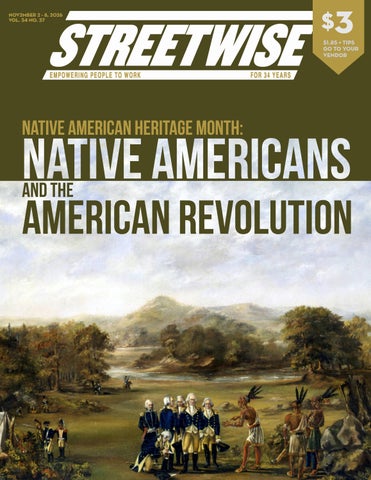
ON THE COVER: "Indian Treaty of Greenville," unidentified painter, oil on canvas, 1795. Learn more about this painting on page 11 (Public Domain / Chicago History Muesum collection). THIS PAGE: Daniel Paterson "Cantonment of His Majesty’s Forces in N. America, March 1766." Map, pen-and-ink and watercolor. (Library of Congress). The Proclamation Line established by the British in 1763 created a western boundary beyond which settlers were forbidden to acquire land. It was not only ineffectual, but it also angered George Washington and other colonists who wanted to maintain access to western land. DISCLAIMER: StreetWise publishes perspectives from vendors and contributors to reflect a range of lived experiences and viewpoints. These opinions do not necessarily reflect the views of StreetWise. We are committed to fostering dialogue grounded in dignity and respect, and we do not endorse language or perspectives that harm or dehumanize others.
Dave Hamilton, Creative Director/Publisher
dhamilton@streetwise.org
StreetWiseChicago @StreetWise_CHI
Suzanne Hanney, Editor-In-Chief
suzannestreetwise@yahoo.com
Julie Youngquist, Executive director
jyoungquist@streetwise.org
LEARN MORE AT streetwise.org
DONATE
Ph: 773-334-6600 Office: 2009 S. State St., Chicago, IL, 60616
To make a donation to StreetWise, visit our website at www.streetwise.org/donate/ or cut out this form and mail it with your donation to StreetWise, Inc., 2009 S. State St., Chicago, IL 60616. We appreciate your support!
My donation is for the amount of $________________________________Billing Information: Check #_________________Credit Card Type:______________________Name:_________________________________________________________________________________ We accept: Visa, Mastercard, Discover or American Express
Address:_______________________________________________________________________________
Account#:_____________________________________________________City:___________________________________State:_________________Zip:_______________________ Expiration Date:________________________________________________Phone #:_________________________________Email:_________________________________________
ARTS & ENTERTAINMENT RECOMMENDATIONS Compiled by Dave Hamilton
Coming of Age!
'Debut’ CIRCA Pintig presents the story of Jomar, a 29-year-old Filipino drag queen, who is at a crossroads, so he decides to throw himself a Filipino “debut,” a celebration traditionally for Filipina girls when they reach womanhood at 18, as a way to give himself a new start in his 30s. And while his family is supportive, they struggle to keep up with their diva’s demands. But as the venue falls through, and the lechon is nowhere to be found, ultimately Jomar finds that the love given to him by his family is all he needs in order to love himself. Get hyped as CIRCA Pintig brings the loud, fun and flamboyant energy of a Filipino party in this 90 minute production that will tour "Debut" across 3 different theaters November 5-December 4: Filament Theatre, 4041 N. Milwaukee Ave., Thursday, Nov. 5 at 7:30 p.m. (preview), Friday, Nov. 6 at 7:30 p.m., Saturday, Nov. 7 at 2 and 7:30 p.m. and Sunday, Nov. 8 at 2 p.m.; Bughouse Theater, 1910 W. Irving Park Road, Thursday, Nov. 12 - Friday, Nov. 13 at 7:30 p.m. and Saturday, Nov. 14 at 2 p.m.; Rizal Center, 1332 W. Irving Park Road, Thursday, Dec. 3 - Friday, Dec 4 at 7:30 p.m. Tickets start at $12 at circapintig.org/productions/debut
Way Too Early!
‘HERE: for the holidays - An Arguably Too Soon Holiday Show’ A fitting show the night before the Midterm Elections— “HERE: for the holidays” on Monday, November 2 at 7:30 p.m. at The Newport Theater, 956 W. Newport Ave., is an innocently lascivious performance, intent on sharing the true meaning of the holiday season — gifts, traditions, copious food and drink, and, of course, judging people. In between positively polarizing numbers, you’ll ask yourself those fundamental questions of life, like, “W hen DO ‘the holidays’ begin?”…“Is Election Day a Holiday?”…“Why not?”…“Who’s in charge here?” and “Does Mariah even have a song about voting?” Get a little naughty (or a lot!) — with a unique showcase of burlesque, acrobatics, clowning, drag and (optional) caroling. A show that skirts tradition and embraces trees, all while celebrating the magic of connection, expression, and darkness. Tickets start at $28.52 at Eventbrite.com
ARTS & ENTERTAINMENT
.
4
Building Bonds!
‘Mexodus’ Told through live looping, bold storytelling and sick beats, “Mexodus” reimagines the Underground Railroad heading south to Mexico—unearthing a powerful, untold chapter of American history. Called an “electrifying theatrical experience” by The New York Times, “thrilling” by The Washington Post and “genius in motion” by the San Francisco Chronicle, this is theater you feel in your body and your bones. This groundbreaking musical follows a freedom seeker and an unlikely ally as they forge a remarkable bond that transcends borders. Playing November 7-21 at the Studebaker Theater in the Fine Arts Building, 410 S. Michigan Ave. Tickets start at $36 at FineArtsBuilding.com/Mexodus
Appy -– polly-loggies!
‘A Clockwork Orange: A Play with Music’ “A Clockwork Orange” lures audiences into a glass-edged, testosterone-filled underworld of a dystopian future. The explosive story of little Alex and his rebellious gang of Droogs is a groundbreaking and twisted tale teeming with sexuality and “a bit of the old ultra-violence.” As relevant today as when Burgess's book first published in 1962 and when Stanley Kubrick's cult classic film caused a stir in 1971, “A Clockwork Orange” is an unapologetic celebration of the human condition - and Beethoven. Presented by Kokandy Productions at The Chopin Theatre, 1543 W. Division St., Nov. 5-Jan. 10, 2027. Tickets start at $28.52 at kokandyproductions.com
Hallelujah!
‘Dance Me: The Music of Leonard Cohen’ The Auditorium, 50 E. Ida B. Wells Drive, presents Ballets Jazz Montréal performing an evening length tribute to the artistry of fellow Montrealer, singer-songwriter Leonard Cohen on the 10-year anniversary of Cohen’s death (Nov. 7, 2016). This riveting homage evokes the grand cycles of existence, love, loss, hope, and renewal—inviting audiences to pause, reflect, and be deeply inspired. “Dance Me” combines scenic, visual, musical, dramaturgical, and choreographic writing crafted by a team of celebrated designers to pay tribute to Montréal’s greatest ambassador. One-night-only, November 7, 7:30 p.m. Tickets are $44-$154 at auditoriumtheatre.org
A Chicago Institution!
iO Theater 45th Anniversary Celebration iO’s 45th Anniversary will be celebrated from November 5-7 at iO Theater, 1501 N. Kingsbury St. This celebration brings together the world’s best comedians, iO’s talented roster of alumni, and a diverse array of today’s up-and-coming talents who continue to carry the torch for hilarious and artistic comedy! Join the party for three days of celebrating improv, sketch, music, stand-up and more along with specialty workshops in celebration. For a full schedule, ticket or day passes, visit ioimprov.com/io45
Trailblazing Women!
‘CSO: Carving Out History – Women in Harmony’ Members of the Chicago Symphony Orchestra perform an evening of chamber music celebrating Amy Beach and Fanny Mendelssohn, two pioneering composers whose extraordinary works deserve a place at the center of the Romantic repertoire. At the Driehaus Museum, 50 E. Erie St., on November 3, at 6:30 p.m. Tickets are $50 at driehausmuseum.org
A Classic, Reconceived!
‘The Capulets’ Following its world premiere in 2025, Chicago Repertory Ballet proudly brings back “The Capulets” November 5-8 at The Ruth Page Center for the Arts, 1016 N. Dearborn St. Conceived and choreographed by Wade Schaaf, this cinematic, full-length ballet shifts the spotlight from the star-crossed lovers to the heart of the Capulet household itself—where hidden passions, betrayals, and fractures simmer just beneath the surface of Verona’s most powerful family. Tickets are $40-$75 at www.crbdance.com
Bibbidi-bobbidi-boo!
‘Cinderella’ Step into a world of magic, romance, and timeless beauty with “Cinderella,” performed by the United European Ballet Company at the Harris Theater, 205 E. Randolph St. This beloved fairytale comes to life through elegant choreography, captivating storytelling, and a visually stunning theatrical experience. The story follows Cinderella’s journey from hardship to happiness, guided by a touch of magic and the power of true love. This vibrant, Broadway-style production features an international cast of dancers from across Europe, including leading artists from Ukraine. Suitable for ages 2 and up. Sunday, November 8 at 4 p.m. Tickets are $71+ at harristheaterchicago.org
Feed Me, Seymour!
‘Little Shop of Horrors’ For more than four decades, this Tony Award-winning musical has delighted millions of fans around the world with the funny and frightening story of the shy shop assistant, his coworker crush and a mysterious, and carnivorous, plant. Written by the powerhouse team of Howard Ashman and Alan Menken (Disney's "The Little Mermaid," " Beauty and The Beast" and "Aladdin"), "Little Shop" takes audiences on a wild trip where love and world domination meet at a Skid Row floral shop. Presented by Porchlight Music Theatre at The Biograph Theater, 2433 N. Lincoln Ave., November 4-December 13. Tickets start at $81 at PorchlightMusicTheatre.org/little-shop-of-horrors/
www.streetwise.org
5
Vendors (left to right) John Hagan, Russell Adams and A. Allen chat about the world of sports.
SPORTSWISE
Remembering Mike ditka
6
John: Mike Ditka died October 9 in Chicago after a colorful career playing, coaching and broadcasting in the NFL. He was drafted in 1961 by the Chicago Bears, named UPI Rookie of the Year, and caught 12 touchdown passes for 1,076 yards in just 14 games. He revolutionized the tight end position, not just for blocking, but for big plays down the field like with a wide receiver. Two years later, he also was part of the Bears NFL championship team. The highlight was a game when they were trailing the Pittsburgh Steelers 17-14. Bill Wade threw a pass to Ditka and the entire Steelers team had a chance to tackle him. He fought 63 yards to near the goal line. That set up the game-tying field goal; there was no overtime then. That put the Bears in the NFL championship game, where they beat the New York Giants. He also won Super Bowl VI with the Dallas Cowboys, catching a pass from Roger Staubach. As Chicago Bears head coach from 1982 to 1992, he had a 106-62 record, six NFC Central Division titles, seven playoff appearances, and one Super Bowl championship. Russell: Condolences to the Ditka family. He’s the best coach the Bears ever had besides George Halas.
Artwork courtesy of The Bears.
The only thing I didn't like was the 1986 Super Bowl, when he didn't let Walter Payton, greatest running back ever, score a touchdown. He had the players motivated. He got the job done, didn't take no petty stuff. Allen: Mike Ditka was a good coach, good television commentator and a good businessman, because his net worth when he died was $30 million. He had Ditka’s restaurant next door to Fourth Presbyterian Church until COVID. There’s still one in Oakbrook Terrace. He started his coaching career with Tom Landry, and he coached the Bears to Super Bowl XX victory in January 1986. John: He was known for his temper, but also how to get the best out of his players. That’s why he wrote a letter
to Halas saying let bygones be bygones after they traded him to Philadelphia. Halas thought he had to be “Iron Mike” to be tough, but Landry helped mold him into a better communicator and helped him relate to his players, which is why I give him more credit for Ditka becoming a successful head coach. The Bears needed him after Neil Armstrong, when they were 6-10. Ditka brought some toughness into that defense. Should they have been in a couple more Super Bowls? Yeah, but Ditka was the Bears’ best head coach. He was an excellent analyst, too, on ESPN, NBC and CBS and alongside his former teammate, Johnny Morris; then the radio show with Mike North and Dan Jiggetts, who played under Ditka, on WSCR. What made him unique was his overall talent.
Russell: They coulda won more than one Super Bowl, but injuries, defense, Buddy Ryan leaving for Philadelphia - that was a big loss. He did all right. Rest in peace. I might see you in Football Heaven one day. Allen: He didn’t play Vince Evans, the Black quarterback. But he did deliver a Super Bowl. John: There was also the Saturday Night Live skit, “Da Bears running 10,000-nothing.” Rest in peace, Mike. Hope to see you on the Other Side. Any comments, suggestions or topic ideas for the SportsWise team? Email StreetWise Editor Suzanne Hanney at suzannestreetwise@yahoo.com
Native American Heritage Month:
Native Americans and the revolutionary war by Suzanne Hanney
Conventional wisdom says the American Revolution was won by rugged rebel individuals, when the reality is that the eight-year struggle was “a world war in all but name.” “What began as a domestic dispute over taxes, trading rights and home rule soon metastasized into something much bigger and broader,” pulling in German mercenaries fighting for the British; licensed pirates; France and Spain aligning with the Americans against their old enemy, the British – and Native Americans fighting mostly for the British, hoping to drive swarms of settlers off their ancestral lands once and for all, says Richard Bell in his book “The American Revolution and the Fate of the World,” (Riverhead Books, New York: 2025). British-born and Harvard-educated, Bell is a professor of history at the University of Maryland. He spoke with StreetWise at the National Federation of Press Women conference in Maryland in September and later by Zoom. Bell allows that the British government was seeking to rebuild its finances after the French and Indian War (1754-63) by imposing unpopular taxes on the colonists such as the Stamp Act in 1765. However, he argues that it was the Tea Act of 1773 that set the scene for the Boston Tea Party and subsequent events. Americans – led by Boston merchants like John Hancock – were accustomed to drinking untaxed tea smuggled in from Dutch traders. Moreover, the Tea Act was intended as a bailout for the British East India Company (EIC), a global conglomerate akin to Amazon or Apple today. The EIC had been on the verge of bankruptcy in 1772 due to embezzlement and was the most hated corporate entity in the world at the time, Bell said. One reason was its role in the Bengal famine three years earlier that had killed upwards of 1.2 million people and been front-page news in Philadelphia, New York and Boston. When patriots on Dec. 16, 1773 dumped 46 tons of tea valued at 10,000 pounds into Boston harbor – enough to build 45 homes at the time – the British government saw it as treason. It responded the next year with the Coercive Acts. Boston Harbor was closed. The Crown dismissed the elected Massachusetts legislature, appointed its own
representatives and judiciary, and sent redcoats to impose martial law. But instead of isolating Boston, British retaliation produced sympathy for the city from other colonists who didn’t want to be treated the same way. South Carolina, Pennsylvania and New York even sent food. “So this is highly improvised and there’s no one date when 13 different sets of colonists start behaving and thinking as one united group,” no emergent “American” identity, Bell said. “And this is a deeply divided contest. There are lots of Americans who are not patriots. They're either loyalists or neutrals: swing voters, we'd call them today. So there's no unanimity at the time, at any point during the eight years of war, even when they win.” Rather, there were almost accidental, escalating events, what Bell calls “the highly contingent result of improbable choices and last-minute improvisations.” There was no order from King George III or his top general to fire on American colonists at Lexington, but that first skirmish occurred after British troops met the colonists on the road to Concord, where the British believed they had a cache of weapons. Paul Revere had given the alarm in his “midnight ride” of April 18, 1775, as immortalized by the poet Henry Wadsworth Longfellow. “I do think the death of American soldiers, patriot soldiers at Lexington and Concord, causes uproar in other places and causes young men to run up to Cambridge, Massachusetts and try and join the new army that's forming to resist British approaches.” Book jacket: Courtesy of Penguin/Random House.
Similarly, there was the news in May 1776 that King George III was beefing up the British Army with 30,000 hired soldiers from six German principalities, the largest being HessenKassel, hence the name “Hessians.” Two months later, the Declaration of Independence listed it as a grievance against the king: “He is at this time transporting large Armies of foreign Mercenaries to complete the works of death, desolation and tyranny…” “This is also one of these clarifying moments where many people say, ‘Well, I guess I’m a patriot because I want to resist these German soldiers coming.’” Bell said.
Fighting the Spanish and French on both sides of the Atlantic, the British Navy was spread too thin to blockade America’s east coast. French naval power, in fact, was behind the decisive victory at the Yorktown peninsula on southern Chesapeake Bay in October 1781. Gen. George Washington and the Comte de Rochambeau had marched there from New York – 200 miles in 15 days -- to surprise the British. Gen. Charles Cornwallis was resting his troops, deepening the harbor, and awaiting food and materiel from the British Navy. But the British Navy was unable to break through a larger fleet of 24 French ships, so that Cornwallis’s force of 9,000 was ultimately surrounded on three sides by 17,000 to 19,000 Americans and French.
Translated copies of the Declaration of Independence were bound for King Carlos III of Spain and King Louis XVI of France by July 8, 1776. After a colonial victory a year later at Saratoga, both Spain and France began to consider joining the war against their old enemy, the British.
Revolutionary War peace talks began the next year and concluded with the Treaty of Paris in 1783.
But in the meantime, the Continental Congress began to authorize “letters of marque” – for licensed pirate ships – against the British: 69 in 1777, 209 in 1779, 550 in 1781. The letters allowed the holders to intercept enemy vessels, seize their crews and auction the cargos. Half the proceeds went to the shipowner, half to captain and crew.
Native Americans’ relationship with Britain went back to the French and Indian War, so in 1763, King George established a Proclamation Line, with the Appalachians as the border beyond which Americans were not supposed to settle. But by 1771 and 1772, there had been growing encroachment.
Privateering yielded not only consumer products like sugar, rum and meat, but war materiel like coal, pistols, rigging and gunpowder headed for the battlefront or the British Navy. Simultaneously, as the colonists managed to capture 10 percent of the British merchant fleet, the British Navy was forced into commercial convoy duty – away from the havoc it could wreak against George Washington’s fledgling army.
“So Native Americans regard most white settlers as a threat to the sovereignty of Indian land,” Bell said. “And some of those white settlers are land speculators with names like
France ultimately did join the colonial cause in 1778 and Spain in 1779, for their own interests as much as American freedom. The French wanted Jamaica, Britain’s wealthiest colony anywhere, which produced 40 percent of British sugar and 90 percent of its rum. The Spanish wanted to expel the British from
8
the Gulf of Mexico, to invade southern England and to destroy dockyards at Portsmouth and Plymouth. They did lay an unsuccessful siege on Gibraltar – the British Empire’s most important military installation anywhere -- in hope of recovering it from the British.
The Metroparks of Toldeo Visitor Center for the Fallen Timbers Battlefield. site of a 1794 battle between the United States military and a confederacy of American Indians backed by the British. (Arrye Rosser / National Park Service photo) ABOVE: Richard Bell (Courtesy of the University of Maryland).
Native Americans had aligned 4 to 1 with the British, who largely abandoned them in the Treaty of Paris.
BUREAU O F AMERICAN ETHNOLOGY
EIGHTEENTH A N N U A L REPORT. PL. C X X V
174 187
a i i k e g a n
149
147
6 R 0 S 3 Í POINT ipOINT 10 M.N.OF MOUTH OF CHICAGI RIV. M.N.OF W.EN0 0 F PORTASE
LAP K ROPJO
Dixon.
CROSSIN
148
FORT D E A R B O R N
&W G R O V E
3A90 CK RI
(BLACK HAWKS
(CHICAGO
Genev;
Calumets Rh'.
ISSIONARY É S M 9 L 0NF0i:-RWEl \
SAC VILLAGE BIRTH PLACE)/
© A j o d o
VlLLi T o u l o n
IUÇKS VILLAGE . (POTAWATOMl)
77
110
O T Y Ü i f f i
Treaties related to Native land cessions in Illinois
®
ColwkUb
No. 77—Treaty with the Ottawa, Chippewa, and
Potawatomi, August 24, 1816 at St. Louis, Missouri Territory (Royce 680-83) No. 110—Treaty with the Kickapoo, July 30, 1819 at Edwardsville, Illinois (Royce 696-97); and Treaty with the Kickapoo (Vermillion Band), August 30, 1819 at Fort Harrison, Indiana (Royce 698-99) No. 147 & No. 148—Treaty with the Chippewa, Ottawa, and Potawatomi, July 29, 1829 at Prairie du Chien, Michigan Territory (Royce 722-23) No. 149—Treaty with the Winnebago, August 1, 1829 at Prairie du Chien, Michigan Territory (Royce 724-25) No. 174—Treaty with the Winnebago, September 15, 1832 at Fort Armstrong, Rock Island, Illinois (Royce 736-37) No. 187—Treaty with the Chippewa, Ottawa, and Potawatomi, September 26, 1833 at Chicago, Illinois (Royce 750-51)
* Carmel
® 13o n to n
Wilkinsons
eetown
Grand Tower
Sartfate<\K
\ \
Powers 14- v^> airp
ILLINOIS
2
S C A L E , 3 5 MILES T O I INCH
www.streetwise.org
9
George Washington, Patrick Henry and Thomas Jefferson. So when they see names like Washington and Henry at the head of the patriot movement, Natives assume that this patriot movement is a land grab operation, and they resist the patriots.” The Native Americans also see King George as the only entity strong enough to stop the patriots from pushing across the Proclamation Line and stealing their land. They take his side overwhelmingly, “not because they trust King George or think he’s a reliable, stand-up guy, but because he’s the enemy of their enemy and therefore, he is their friend. That's the deal, the gamble, the calculus they make. That is the only choice they have. Staying neutral is not super wise either.” The 1783 Treaty of Paris contained a provision that allowed the British to remain in the Northwest Territory until the United States resolved a land issue with its allies the Native Americans, according to the National Park Service. The Chippewa, Ottawa, Potawatomi, Shawnee, Delaware, Miami, and Wyandot tribes formed a federation to halt further U.S. incursions into their territory. This federation defeated Gen. Anthony St. Clair at the Battle of the Wabash in west central Ohio in 1791. President George Washington subsequently put the Revolutionary War hero Gen. Anthony Wayne in charge of the Legion of the United States. Wayne’s victory in 1794 at the Battle of Fallen Timbers near present-day Toledo led to the Treaty of Greenville the next year. Native Americans ceded about 25,000 square miles in the treaty for settlement, primarily south and east of the Cuyahoga River, and another 20,000 square miles in Ohio, Michigan, Indiana and Illinois as Native tribes were forced to relocate west. There were roughly 16 tracts in Ohio, Michigan, Indiana and Illinois. New strategic areas included Detroit and “six miles square at the mouth of the Chicago River, emptying into the southwest end of Lake Michigan.” This became Chicago, the transportation gateway to the Great Lakes, noted Dorene Wiese, who holds a doctorate in leadership and policy studies from Northern Illinois University and who is the founding president of the American
10
Indian Association of Illinois. She is an enrolled White Earth Ojibwe tribal citizen; the Ojibwe were the largest tribe of the Council of the Three Fires, which also included the Potawatomi and the Ottawa (Odawa) tribes. The Native Americans in the Chicago area as of 1775 were the Illinois Confederation: surviving members of the Kaskaskia, Peoria, Cahokia, Michigamea, and Tamaroa, she said. The University of Illinois in 2018 cited its own responsibility as a land-grant institution to recognize that when Illinois became a state in 1818, much of the land was held by Native American tribes: the Peoria, Kaskaskia, Piankashaw, Wea, Miami, Mascoutin, Odawa, Sauk, Mesquaki, Kickapoo, Potawatomi, Ojibwe, and Chickasaw Nations. These nations ceded their land to the United States government in more than two dozen treaties from 1795 to 1833. “Understand what is going on here,” Wiese said. “You can imagine people lived here for thousands of years and you have millions of non-Native people coming into the country. They are speaking different languages, looking different, having different customs, different religions. It was really a time of chaos. And then millions of people dying of things like measles and smallpox. That's why we don't have any records of some of the tribes that were in our area, because they were completely wiped out.” White historians had always played down the idea of any people living here in pre-colonial times, she said. “Really, they wanted to view America as a place that was just wild and uncultured and uncultivated, that there was nobody
here but savages, so that it would build the case for them that it was a good thing that they came here and they took over the land and they civilized the people. So that was the narrative.
Since the Council of Three Fires spoke similar languages and traveled together for so long, Wiese quotes the late historian Helen Tanner that the Ojibwe, Potawatomi and Odawa had likely intermarried.
“But now we know that that was not all that simple. Native people had incredibly complex cultures. And we're still discovering them because they were suppressed for so long.”
In the 1829 Treaty of Prairie du Chien, the Council of Three Fires ceded 3.5 million acres in northern Illinois and southwestern Wisconsin for non-Native settlement.
Simultaneously, she said, there were “chiefs” who were not the hereditary leaders of tribes, but who gained their positions because they could speak and read English. “They sold the tribes out because they were in it for just what they could get at the time -- for the land or the money that they could acquire. They really were not acting in the best interest of the tribes they were representing,” but were aligning opportunistically. Treaties used tribes as buffers between each other or played them against each other; many tribes aligned in self-defense.
The Treaty of Chicago in 1833 ceded five million more acres in Illinois and the Wisconsin and Michigan territories and called for the last Native Americans to move across the Mississippi River to reservations in Iowa/Kansas territory.
The Council of Three Fires was formed as the Potawatomi, Ojibwe and Odawa were pushed west from the East Coast to Illinois, Michigan and Wisconsin by foreign settlers. “As we started moving, we started having conflicts with the Iroquois because their land is also there,” Wiese said. The Iroquois also wanted in on trading with the French, who used the Ojibwe language.
Members of the Council of Three Fire nevertheless live in Chicago today. The Ojibwe are the largest, followed by the Potawatomi and then the Odawa. In 2025, the Potawatomi received a portion of land back in DeKalb County. THIS PAGE: "Indian Treaty of Greenville," unidentified painter, oil on canvas, 1795. The principal figures believed to be represented are Gen. Anthony Wayne, with epaulets on shoulders, standing near Chief Little Turtle; William Henry Harrison, Wayne's aide-de-camp, standing to the right of General Wayne. Capt. William Wells, the officer kneeling and acting as the interpreter and transcribing the Indian's speech. Little Turtle, the great Miami Chief, talking to General Wayne. Tarke the Crane, Wyandotte Chief, Priest and Keeper of the great Calumet, or Pipe of Peace. Harrison became the 9th U.S. president. Wells had been captured and raised by the Miami as a youth. He was killed in the Battle of Fort Dearborn in Chicago in 1812. Wells Street is named for him. (Public Domain / Chicago History Museum Collection). OPPOSITE PAGE: Top: Dr. Dorene Wiese (courtesy photo). Below: map provided by W.W. Norton.
www.streetwise.org
11
'The Under 'L' Experience' creates com based on the needs of the neighborho by Lourdes Tamayo
Chicago’s newest transit renovation is a true framework for urban experience: a project that not only consulted the community’s viewpoints, but actively built the idea from their requests. Stretching 10 blocks from Lawrence to Ardmore, “The Under ‘L’ Experience” transforms an inefficient use of space into a revitalizing development for urban community. Before the project, the area underneath the CTA Red Line tracks was empty space. While closely working with neighboring residents and local students, the CTA formulated a plan with extensive green space, fitness and game zones, dog parks, and a pedestrian trail stretching throughout. Disagreements over the necessity of parking arose during the three community meetings held for ideation, concept development, and framework planning, but officials settled on incorporating small parking lots throughout. At the three community meetings, held at Truman College and St. Ita Roman Catholic Church, locals were provided the project overview and space to share feedback. Popular themes were a desire for green space, a pedestrian trail, safety considerations, an opposition to parking, and market areas, according to the 80-page report.
FROM THE STREETS
Locals asked for multi-space spaces with flexibility for events, as well as “things that build community: dog parks, community gardens, markets, shops.” As a result of working so closely with the nearby community, each block includes unique facets: • Lawrence to Ainslie: dog park • Ainslie to Argyle: playground • Argyle to Winona: open space, potentially for a market • Winona to Foster: parking lot • Foster to Berwyn: small parking lot • Berwyn to Balmoral: market space • Balmoral to Catalpa: fitness area • Catalpa to Bryn Mawr: dog park • Bryn Mawr to Hollywood: pedestrian trail • Hollywood to Ardmore: open space
12
Thoughts on the issue of parking differed from the east to west end of the space. The west’s concentration of businesses favored parking for potential shoppers, while the
east’s residential side preferred more room for community-driven activities. The stakeholders achieved a balance, with parking lots lightly distributed throughout the project, alongside two dog parks, a playground and fitness area, planters and seating, a marketplace, and an extensive walking path. With such a wide variety of amenities, the final concept’s various uses of space provide much opportunity for urban interaction and fitness. Site constraints included avoiding interruptions of “L” train operations, protecting underground stormwater and utility systems, and working with the minimal sunlight to permit the growth of plants. Autumn Moor and Feather Reed Grasses, which were chosen, can survive year-long in fluctuating temperatures, shallow soil, and little sunlight. As for the ground surfaces, designers settled on high quality, weather-resistant materials such as crushed stone, concrete, and asphalt, with a raised concrete curb lining the pedestrian trail. Construction will run this year into 2027. The CTA began the Red and Purple Modernization (RPM) in 2019. The Phase One Project is the second-largest capital project in CTA history, consisting of new Red and
mmunity space ood
Purple Line “L” and a new bypass structure north of the Belmont station; a complete rebuild of the Lawrence, Argyle, Berwyn and Bryn Mawr stations and adjacent “L” track; and the installation of a new signal system between Howard and Belmont. The $2.1 billion RPM Phase One Project is being funded by three major sources: CTA funds ($428 million), federal grants ($1.082 billion), and Transit TIF Funds ($622 million), according to RPM’s 2025 Economic Impact Report.
Clockwise from left: Block 2 - Ainslie to Argyle; Block 4 - Winona to Foster; Block 1 - Lawrence to Ainsle; Block 8 - Catalpa to Bryn Mawr. All renderings provided by CTA and Site Design Group.
https://www.transitchicago.com/assets/1/6/ PR_20251105_FinalReport_Rev03.pdf Lourdes “Lulu” Tamayo is a junior at Regina Dominican High School in Wilmette, where she runs on the cross country and track teams, serves as Student Council Treasurer, and is an Allworth Scholar. A lifelong resident of Chicago, she loves to read and write, and intends to pursue journalism or the classics in college.
www.streetwise.org
13
450+ City-Owned lots available For Development
Preserving Chicago’s Heritage,
More than 450 City-owned lots are available for private purchase at the ChiBlockBuilder land sale portal for mixed-use projects, housing, side yards, open spaces and urban agriculture.
one building at a time.
There are lots available in half the city’s wards: 1, 3, 4, 5, 6, 8, 9, 10, 11, 15, 16, 17, 18, 20, 21, 22, 24, 25, 26, 27, 28, 29, 36, 37 and 38. They range from a high of 64 lots each in the 27th ward, East Garfield Park and Humboldt Park; and 4th ward Grand Boulevard; to 50 lots in 24th ward North Lawndale.
Applications are due November 16. https://www. chicago.gov/city/en/sites/missing-middle/home. html –Suzanne Hanney, from online sources
14
PreservationChicago.org
C
RVATI SE
HI
ON
The Missing Middle Housing Initiative is a neighborhood repopulation strategy that leverages City land and financing for contemporary home construction on behalf of market rate buyers. Four previous rounds have advanced 360 residential units in 136 buildings across West Englewood, South Chicago, East Garfield Park, West Garfield Park, McKinley Park, Chatham, Morgan Park and North Lawndale.
PRE
The inventory includes four clusters (16 lots total) in Humboldt Park through the Department of Planning and Development’s Missing Middle initiative, which is supporting construction of twoto six-unit residential buildings to be made available for owner-occupants at a variety of incomes. Each lot is priced at $1, with up to $150,000 in financial assistance per unit through Mayor Brandon Johnson’s Housing and Economic Development bond.
Eric Allix Rogers
There is also a 2,995 square-foot parcel in 1st ward Logan Square with a preferred use of 1-4 units of housing and one parcel with preferred use as open space in the 38th ward Dunning neighborhood.
C AG
Love Your City Fiercely!®
O
Tiffany Mosaic Ceiling (1907) At Marshall Field’s / Macy’s on State Street Over 1.6 million pieces of iridescent favrile glass comprise the 6,000-square-foot barrel-vaulted mosaic ceiling designed by Tiffany Studios. Designated a Chicago Landmark on November 1, 2005 Ward Miller Richard H. Driehaus Executive Director of Preservation Chicago
(312) 443-1000 WMiller@PreservationChicago.org
e the Sudoku puzzle, each row, column and box must contain the ss 1 to 9.
Streetwise 10/17/16 Crossword
To solve the Sudoku puzzle, each row, column and box must contain the numbers 1 to 9.
Sudoku
s
it
e
l
©2016 PuzzleJunction.com
57 Slippery 59 Itch reliever 61 Discombobulates 62 Greek god who served Poseidon 63 Aire or Aare, e.g. 64 Gums
8 List abbr. 36 Steamroll 9 City on San 37 Japanese paper Francisco Bay folding art 10 Animal pigment 38 Assist 11 Coffee shop 39 Far from ruddy order 41 Set one’s sights 12 Alaskan native 42 Atom ___ 13 Yellowstone 43 Flimsy roamer 44 V.I.P. 14 Taxonomic 46 Civil rights org. group 48 Prophets Down 19 “Not guilty,” 50 Old slot 1 Beaming e.g. machine part 2 Moderately 22 Sermon subject 51 “The slow tempo 24 Calendar abbr. Nutcracker” 3 Hack 26 Complex unit lead 4 “Holy cow!” 28 Fair sex 54 Angry reaction 30 Computer 5 Decrees 55 Urban haze 6 Dried coconut capacity 58 Ford Explorer, 32 Timid meat e.g. 7 Optimistic 34 Aborigines 60 Bake sale org. Copyright ©2016 PuzzleJunction.com
Copyright ©2016 PuzzleJunction.com
©PuzzleJunction.com
answers last week's edition Sudoku Solution Solution
Sudoku Solution
Find your nearest StreetWise Vendor at www.streetwise.org
Crossword Across 1 Resting place 5 Spiritual leader 10 Heidi’s home 14 Field of study 15 Synthetic fiber 16 Chick’s sound 17 Regan’s father 18 Creek 19 Israeli dance 20 Deli dish 22 Harts’ mates 23 E or G, e.g. 24 Rock concert venue 26 Swords 30 Pop singer Collins 31 Extend, in a way 32 Jack’s lookout? 37 Clearasil target 38 Lollygag 39 Astronaut Bean 40 Infielder 42 Dialogue writer 43 Thai currency 44 Good to go 45 Get ready 49 ___ maison (indoors): Fr. 50 Schoolbag item 51 Money lender 56 Cast-ofthousands film 57 Pageant crown 59 Timber wolf 60 ___ good example 61 Admixture 62 Biblical shepherd
©2016 PuzzleJunction.com
63 Perceived 64 Secluded valleys 65 Toy that does tricks Down 1 Barber’s supply 2 Lunchbox treat 3 Repast 4 Exposed 5 California white oaks 6 Impressive display 7 Squander 8 Bleacher bum’s shout 9 Calligrapher’s purchase 10 Garden pest
StreetWise exists to elevate marginalized voices and provide opportunities for individuals to earn an income and gain employment. Anyone who wants to work has the opportunity to move themselves out of crisis. StreetWise provides “a hand up, not a handout.”
Buy the Magazine, Take the Magazine When you buy the magazine, take the Vendors purchase the magazine, and read magazine for $1.15 and the magazine, you sell it for $3 plus tips. are supporting our The vendor keeps all of microentrepreneurs earning their earnings. an income with dignity. -or-
All vendors go through an orientation focusing on their rights and responsibilities as a StreetWise Magazine Vendor. Authorized vendors have badges with their name, picture and current year.
New vendor orientation is every Tuesday and Thursday at 10 a.m. at 2009 S. State St. Find your nearest vendor at www.streetwise.org
24 25 26 27 28 29 30 32 33 34 35 36
Actress Téa Concealed Paroxysm Distort “The Merry Drinker” painter Like some cheddar Very small Bikini parts Poland’s Walesa ___ mundi Antler wearer 1992 also-ran Wash oneself Type of order “What a pity!” Missing a deadline Shoelace problem
38 Abdicator of 1917 41 Skiers’ aid 42 Blueprint 44 Inevitably 45 Newspapers 46 Indian coin 47 Best of the best 48 Pie choice 49 Hammerin’ Hank 51 Not too bright 52 Put in stitches 53 King of the road 54 Do as directed 55 Game you can’t play lefthanded 57 Children’s game 58 Feverish
THE PLAYGROUND
How StreetWise Works
11 12 13 21 22
15