$3
VOL 23 ISSUE 26 NOV. 4 - NOV. 17, 2026
Real Stories
Real People
suggested contribution goes directly to your vendor
Real Change
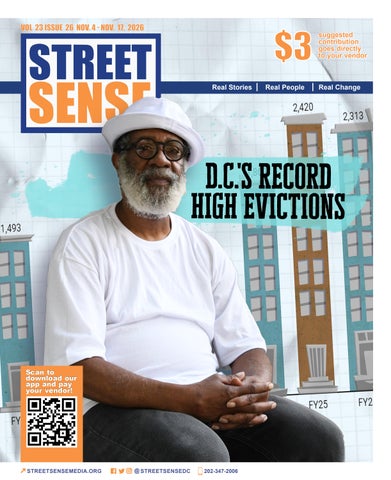
D.C.'s record high evictions
Scan to download our app and and pay pay app your vendor! your vendor!
STREETSENSEMEDIA.ORG
@ STREETSENSEDC
202-347-2006
2 / / S T R E E T S E N S E M ED IA // N O V. 4 - N O V. 17, 2026
OUR STORY NEWSROOM
S
treet Sense has produced thousands of articles on homelessness, housing, and povery, including some that led to change in the city. The paper has won awards from D.C.’s Society of Professional Journalism and regularly breaks news about homelessness and housing.
The Cover DESIGN BY KEILAH TUMAOB, PHOTO BY JAMES JARVIS
THE TEAM VENDORS Abel Putu, Abraham Aly, Aida Peery, Akindele Akerejah, Alia Haug, Amia Walker, Andre Brinson, Andre Baltimore, Andrew Anderson, Angie Whitehurst, Angela Morris, Anthony Carney, Apollos Robinson, AnToinette Richardson, Archie Thomas, Beverly Sutton, Brian Holsten, Brianna Butler, Cameé Lee, Carlos Carolina, Carlton Johnson, Charles Armstrong,
Chris Boone, Chris Cole, Chon Gotti, Conrad Cheek, Craig Thompson, Cynthia Herrion, Daniel Ball, Darlesha Joyner, David Snyder, Debora Brantley, Degnon Dovonou, Derian Hickman, Deonte Savoy, Dominique Anthony, Don Gardner, Drake Brensul, El-O-Him, Elizabeth Windsor, Elynora Houston, Eric Jamison, Eric Thompson-Bey, Evelyn Nnam, Faith Winkler, Five FiftyOne, Flegette Rippy, Frankey
Barrz, Frederic John, Frederick Walker, Gerald Anderson, Gloria Prinz, Greta Christian, Henry Johnson, Indashow Birmandie, Invisible Prophet, Ivory Wilson, Jacques Collier, Jacqueline Gale, Jacqueline Turner, James Davis, James Hughes, James Lyles III, Jay B. Williams, Jeanette Richardson, Jeffery McNeil, Jemel Fleming, Jenkins Dalton, Jennifer McLaughlin, Jewel Lewis, John Littlejohn, Josie Brown, Julienne
Kengnie, Kenneth Bynum, Kenneth Middleton, Katrina Anige, Kimberley Shattuck, Kym Parker, L.Q. Peterson, Lawrence Autry, Leo Hughes Jr, Levester Green, Lillie Thomas II, Marc Grier, Marcus McCall, Marquis Savant, Mars, Maurice Carter, Melody Byrd, Michele Helies, Milan Stevenson, Mkufu London, Monique Rivers, Nikila Campbell, Patricia Donaldson, Patty Smith, Paul Martin, Phillip Black, Qaadir El-Amin, Queenie
Featherstone, Rachelle Ellison, Randall Smith, Rashawn Bowser, Reginald Black, Reneece Brinkley, Ricardo Meriedy, Richard Mooney, Rita Sauls, Robert Reed, Robert Warren, Rochelle Walker, Ron Dudley, Ronnell Wilson, S. Smith, Sasha Williams, Sharon Brown, Shawn Fenwick, Sheila White, Shuhratjon Ahmadjonov, Starchild BLK, Susan Wilshasen, Sybil Taylor, Tasha Savoy, Tonya Williams, Vincent
Watts II, Warning Label, Warren Stevens, Wayne Hall, Wendell Williams, Wendy Brown, William Hargrove, William Shuford, Willie Futrelle, William Young, Zero BOARD OF DIRECTORS Clare Krupin, Chris Curry, Cole Ingraham, David Grant, Jonquilyn Hill, Mary Casale, Matt Perra, Michael Vaughan Cherubin, Nana-Sentuo Bonsu, Phil Telfeyan
S T RE E T S E NS E ME DI A . ORG
ANNOUNCEMENTS
Encampment Updates: Continued clearings at MLK Library, downtown CHIH-RONG KUO AND LUCY WONG RYNIEJSKI Editorial Interns
T
he District closed 19 homeless encampments in October. In 2026, the city has cleared about 160 encampments. On Oct. 20, the District cleared its largest encampment of the month, impacting at least five residents at the Martin Luther King Jr. (MLK) Memorial Library. The area outside the library has long been a popular spot for people experiencing homelessness looking to sleep in a covered space, but both the city and the library have targeted it in recent years through clearings and policies against sleeping in the area. In 2026 alone, the District has cleared the area at least seven times. In July, MLK Library began more strictly enforcing its sleeping ban, placing rope barriers in front of the library and stationing police beside the ropes overnight, blocking the dozens of people who often slept in the area. Many people who chose to stay moved to the public area of the sidewalk along the tree boxes, with some setting up tents but others taking their belongings with them when they left each morning. On the day of the clearing, most people were packed by 10 a.m. However, one resident resisted pressure from outreach workers and staff from the Office of the Deputy Mayor for Health and Human Services (DMHHS) to leave and pack up. The resident, who did not share their name to protect their privacy while living outside, expressed significant distress, saying they wanted to move to an overnight shelter, but didn’t know the intake hours. As staff from DMHHS cleared the encampment, another resident in a wheelchair came back to retrieve some of his things and get new blankets. Outreach workers from Pathways to Housing provided large plastic bags for him. An hour after the encampment clearing began, the resident who had initially resisted left with two bags of belongings, and DMHHS began clearing what they left behind. Later in the month, during another contentious encampment closure, one resident was involuntarily hospitalized. On Oct. 30, DMHHS cleared an encampment on 10th and K Street. The resident, who declined to give their name to protect their privacy while living outside, moved their tent up the street by dragging it on a tarp through the bike lane because they were worried parts of the tent would get caught on the sidewalk. Since they were in the street,
DMHHS staff warned them they were endangering themselves and impeding traffic. The resident refused to talk with the officers, saying they were focused on moving their tent before the 10 a.m. deadline. “I’ve not been violent, I’ve not been outlandish, I’ve not been disrespectful to anybody,” they said. At 10:04 a.m., the resident began moving their second tent, located a block away at 11th and K Street, which was also scheduled to be cleared. At 10:40, officers from the Metropolitan Police Department (MPD) told the resident the D.C. Department of Behavioral Health filed an FD-12, requiring them to be involuntarily admitted to a hospital for psychiatric evaluation. An outreach worker from Pathways to Housing said they could store some but not all of the resident’s belongings as they went through the evaluation process. According to a DMHHS spokesperson, “The onsite assessment of the resident and identified safety concerns by the [DBH] warranted their decision to issue an FD-12.” As in September, most encampments closed in October were small. The city closed several encampments downtown, near Dupont and Logan Circles, and in Brightwood. On Oct. 7, the District cleared three encampments, impacting three people. The first clearing displaced Jamal, a Marine Corps veteran who had been living there for a month after experiencing family problems that forced him to move out. He has had subsequent difficulty securing a job. He said he wanted to stay peaceful during the clearing to avoid legal issues he has seen others face. The second clearing took place at Franklin Park, where one woman had been living. The third clearing moved a tent on New Jersey Avenue, where a neighbor, Demalia Pitts, said an elderly man had been living. He was not present at the time of the clearing, but Pitts was concerned for him. She remembered seeing him frequently on her way to work, describing him as friendly and peaceful. “I seen the tent go into the back of the dumpster,” said Pitts. “And then when I seen them gathering his things and throwing it in the truck too. I wonder if he was there, and if he will come back around [to see] it is gone…But just to see it going in the back of the dumpster truck, you know, like it's really sad.”
Leo Hughes Jr. Nov. 8
CHIEF EXECUTIVE
ARTIST/VENDOR
EMPLOYMENT
VENDOR
Andre Brinson Nov. 9
AnToinette Richardson Nov. 13
ARTIST/VENDOR
ARTIST/VENDOR
EDITORIAL
DESIGN INTERN
(Theater), Molly
Keilah Tumaob
Pauker (Watercolor),
OFFICER
SPECIALIST
PROGRAM
INTERNS
Brian Carome
Esmat Amin
VOLUNTEERS
Chih-Rong Kuo, Jake
Ann Herzog, Beverly
Mittleman, Louisa
DIRECTOR OF
VENDOR PROGRAM
Brown, David Fucillo,
Hannoucene, Luci
RESIDENCE
PROGRAMS
ASSOCIATES
Mark Fehling, Roberta
Garza, Lucy Montalti,
Alexandra Silverthorne
VOLUNTEERS
Darick Brown
Aida Peery, Chon
Haber
Lucy Wong Ryniejski
(Photography),
Abby Shepherd, Anne
Bonnie Naradzay
Eigeman, Ashley
Gotti, Nikila Campbell DIRECTOR
Willie Schatz (Writing)
EDITOR-IN-CHIEF
SOCIAL MEDIA
(Poetry), David Serota
Hopko, Candace Y.A.
Annemarie Cuccia
INTERN
(Illustration), Debbie
Montague, Guilherme
Holly Salazar Ramirez
Menke (Watercolor),
Oliveira, Natalie
JM Ascienzo (Yoga),
Kinkead
OF VENDOR
PROGRAM AND
EMPLOYMENT
OPERATIONS
Thomas Ratliff
INTERN
DEPUTY EDITOR
Eli Robinson
Donte Kirby
Justin Lenderking
The Street Sense offices will be closed Nov. 11 for Veterans Day.
□
The audience survey runs two more weeks! Earn five papers every time your customer fills out the survey.
□
Vendor surveys run until Nov. 15. A 15-minute survey earns $10 and 10 newspapers! Ask to sign up at the admin desk.
George Gray Nov. 14
ARTIST/VENDOR
Archie Thomas Nov. 15 ARTIST/VENDOR
Degnon Dovonou Nov. 17 ARTIST/VENDOR
VENDOR CODE OF CONDUCT Read this democratically elected code of conduct, by vendors, for vendors! 1.
I will support Street Sense Media’s mission statement and in so doing will work to support the Street Sense Media community and uphold its values of honesty, respect, support, and opportunity.
2.
I will treat all others, including customers, staff, volunteers, and fellow vendors, respectfully at all times. I will refrain from threatening others, pressuring customers into making donations, or engaging in behavior that condones racism, sexism, classism, or other prejudices.
3.
I understand that I am not an employee of Street Sense Media but an independent contractor.
4.
While distributing the Street Sense newspaper, I will not ask for more than $3 per issue or solicit donations by any other means.
5.
I will only purchase the newspaper from Street Sense Media staff and volunteers and will not distribute newspapers to other vendors.
6.
I will not distribute copies of “Street Sense” on metro trains and buses or on private property.
7.
I will abide by the Street Sense Media Vendor Territory Policy at all times and will resolve any related disputes with other vendors in a professional manner.
8.
I will not sell additional goods or products while distributing “Street Sense.”
9.
I will not distribute “Street Sense” under the influence of drugs or alcohol.
10.
I understand that my badge and vest are property of Street Sense Media and will not deface them. I will present my badge when purchasing “Street Sense” and will always display my badge when distributing “Street Sense.”
ARTISTS-INEDITORIAL
□
BIRTHDAYS
Jake Mittleman contributed reporting.
BIRTHDAYS
ARTIST/VENDOR
3
EVENTS AT SSM
NEWS IN BRIEF
Milan Stevenson Nov. 5
//
4 / / S TR E E T S E N S E M ED IA // N O V. 4 - N O V. 17, 202 6
NEWS
Food pantries have seen increasing need in recent years between rising prices and benefit cuts. Photo by Jelina Liu
New SNAP work requirements leave more than 1,000 D.C. residents without benefits CATHERINE KEIGHTLEY Volunteer Freelance Reporter
M
ore than 1,000 D.C. residents have lost access to Supplemental Nutrition Assistance Program (SNAP) benefits since new federal work requirements took effect in June, according to data from the D.C. Department of Human Services (DHS). Another 1,000-plus residents could lose benefits in the coming month, per DHS. In July 2025, about 141,000 residents received benefits each month. That number was down to 131,000 by this July, according to federal data. The changes have especially impacted people experiencing homelessness, who are no longer exempt from work requirements. DHS estimates 29% of the 1,066 residents disqualified from SNAP benefits since June are experiencing housing instability. The city is reviewing eligibility as recipients renew their benefits, which most do every six or 12 months, so it is likely many more people will lose access over the coming year. Of those who applied for or renewed their benefits in July, DHS identified another 1,032 residents at risk of losing benefits on Nov. 1, with an estimated 24% experiencing housing instability. The agency can’t calculate an exact number because of restrictions on information sharing between departments, a spokesperson said. Decreased access to benefits comes as food insecurity in the greater Washington area has reached a five-year high. According to the Capital Area Food Bank's 2026 Hunger Report, 38% of households in the region experienced food insecurity in the past year, as The 51st reported. The report also found 51% of surveyed SNAP recipients had to choose between paying for housing and food. The new work requirements, which took effect in D.C. on June 1, stem from H.R. 1, a federal budget law passed in 2025. Under the changes, all SNAP recipients ages 18 to 64
must work, volunteer, or participate in an approved training program for at least 80 hours each month unless they qualify for an exemption. The law expanded work requirements to include adults ages 55 to 64 and parents and caregivers with children between 14 and 18. It also eliminated automatic exemptions for people experiencing homelessness and veterans. Now, unhoused residents must meet the requirements or qualify for another type of exemption, like for medical reasons. If they don’t, they can receive just three months of benefits within three years. Because the requirements took effect this summer, that three-month period is now expiring for many Washingtonians. Even for those who do still qualify, added paperwork requirements can put benefits at risk. LaMonika Jones, director of D.C. Hunger Solutions, a nonprofit initiative that works to reduce hunger and improve access to food assistance programs in the District, said the organization saw a 10% increase in calls for assistance over the summer from recipients struggling to understand the requirements and the steps they need to take to get their benefits. According to Jones, recipients now have to complete an additional five-page work requirement screening form alongside their SNAP application and have an interview to determine their eligibility. For people without stable housing or consistent internet access, these requirements can make getting benefits even more difficult. “We've seen a lot of households that are confused about all of the changes, because there’re so many that are happening so quickly,” she said. “It's a greater burden that they're experiencing.” D.C. Hunger Solutions has helped residents navigate these changes by walking people through the steps to get medical exemptions, like getting additional paperwork and doctors’ signatures. The organization has continued offering SNAP
training sessions and working with community partners to help recipients navigate the changes. The sessions are held virtually each quarter, with recordings of past sessions available. DHS, meanwhile, said it is working to identify recipients who may face barriers to meeting work requirements, including people facing chronic homelessness. Recipients can self-attest to experiencing chronic homelessness or facing other employment obstacles with DHS's SNAP Work Requirement Screening form, found on the agency's website. Filling out the form could help DHS determine whether recipients qualify for exemptions based on medical conditions, like disability, mental illness, or addiction, that would allow them to keep their benefits. Recipients who need help meeting the work requirements can also use DHS’s SNAP and Employment and Training (E&T) program, which connects recipients with employment and job training opportunities, or volunteer program, which offers sessions at more than 20 sites across D.C. Beyond the work requirements, other SNAP eligibility changes have added to the uncertainty D.C. residents are facing. On Oct. 1, new federal restrictions took effect in D.C., ending SNAP eligibility for refugees and some other previously eligible noncitizens. Jones said D.C. Hunger Solutions has received a steady stream of questions from immigrant and mixed-status households about their eligibility and whether receiving public assistance could affect their immigration status. The organization does not yet know how many D.C. residents have lost benefits specifically because of the new noncitizen restrictions. Editor's note: Street Sense is one of 17 providers of the E&T program, and receives District funding for the program. We maintain a firewall between our journalism and services, and no one who works on the program was involved in producing this article.
STREETSENSEMEDIA.ORG
//
5
“The system’s broken, and we all know it”: As D.C. care facilities close, residents fall through the cracks LUCY MONTALTI Editorial Intern
F
or months, one man in a D.C. mental health facility told his care team his treatment was not working. Then the facility closed down, with only seven days’ notice, according to the man’s attorney. The man ended up in the crisis system and cycled through temporary placements before becoming homeless. Now, the attorney doesn’t know where he is. The man’s case came up on Oct. 15 at a D.C. Council hearing on long-term care for residents with complex needs. Witnesses from D.C. government, health providers, housing services, and nonprofits testified before the Committee on Health — chaired by At-Large Councilmember Christina Henderson — on the state of health care for District residents experiencing dementia, substance abuse disorder, and serious mental illness. Through anecdotes and statistics, the testimonies suggested gaps in the health care system often leave these patients with nowhere to go but nursing homes, which have become a critical component of the psychiatric system but are ill-equipped to handle patient needs. “The system’s broken, and we all know it,” said Mark Miller, who until recently led the Office of the D.C. Long-Term Care Ombudsman at Legal Counsel for the Elderly, an AARP affiliate. Compared to just a few years ago, there are fewer options for long-term mental health care for residents with chronic illnesses or cognitive impairments who require daily assistance. Nicole Belanus, an ombudsman specialist with the long-term care office, told the committee that recent closures of mental health community residence facilities, MHCRFs, have outpaced openings. MHCRFs are public or privately owned facilities offering 24-hour care in a house or apartment for residents experiencing mental illness. The District lost 20 MHCRF beds in 2025. In 2026, 10 facilities closed, including all six homes from one provider — a total loss of 55 beds. For residents needing supportive rehabilitative care, a specialized level of MHCRF care, beds fell from 201 to 138 between 2022 and 2026, Belanus said. As facilities closed, residents were moved to lower levels of care when services that met their needs weren’t available, according to Kimberly Walker, also from the ombudsman’s office. When residents have to move, Walker said their clinical team sends a packet to the Department of Behavioral Health for review, but she does not know who makes the final call. DBH did not respond to a request for comment. In one example, a provider closed homes serving over 30 residents. Instead of moving the residents to facilities with an equal level of care, they were moved to a lower care level, according to Walker. At least two residents were moved directly into independent living, she said.
“That’s a jump, and it’s almost a setup for the resident for failure,” Walker said. With fewer resources, many residents who are hospitalized face difficulty finding where to go next when they are ready to be discharged. Elizabeth Davis of the D.C. Hospital Association said a review of March data from eight hospitals found 89 patients were hospitalized past medical clearance, accounting for 4,862 additional hospital days. For 32 patients awaiting long-term care, the average additional stay was 103 days. For many patients, nursing homes have become a default destination. But witnesses said D.C.’s nursing homes are not built to care for complex mental health needs and are often unable or unwilling to take these patients. Brian McGarry, a health economist who studies nursing home care, said nursing homes have become “part of our de facto psychiatric institutional system,” as the United States phased out state psychiatric hospitals over the 20th century. Today, nearly one in five nursing home residents experience serious mental illness. But McGarry said these facilities are often poorly equipped for the job, with many lacking specialized psychiatric staff. “The typical nursing home resident is an older adult with substantial physical and/or cognitive limitations requiring assistance with activities of daily living,” he said. “By contrast, residents with serious mental illness are younger and may be relatively independent physically. Their primary needs may involve things like psychiatric treatment, behavioral support, and medication management.” Many nursing home residents with severe mental illness also rely on Medicaid, which McGarry called a “historically low margin payer.” Reimbursement, he said, often fails to account for the cost of behavioral health care, doing little to incentivize facilities to provide it. The same pattern can be seen in how D.C. funds nursing homes to take on more specialized patients, witnesses said. Under D.C. regulations, a facility receives funding to care for a patient based on their symptoms. But when a facility’s treatment works and a resident’s symptoms drop, the payment stops. “The program rewards the crisis and withdraws support the moment care succeeds,” said Benjamin Adduru, vice president of compliance and strategy for Health Consulting Services. Addressing long-term health care, including reimbursement, workforce, assisted living, memory care, and behavioral care is a priority for Henderson, she said at the end of the hearing. Witnesses also called for a study on the issue. “Our overall goal is to provide a continuum that offers safe and sustainable and appropriate care in the least restrictive setting possible,” Henderson said. “And so, we have some work to do.”
Some D.C. patients wait several additional weeks at area hospitals for a spot in a long-term care facility. Photo by Nina Calves
6 / / S TR E E T S E N S E M ED IA // NJOANV.. 41 -- NJ OANV.. 17, 14, 202 2025 6
NEWS
D.C. renters face a shrinking safety net as evictions hit a record high
Evictions are at a twelve-year high as rental assistance dwindles and tenant protections narrow, compounding the high cost of living already making it difficult for renters to stay housed. JAMES JARVIS Freelance Reporter This reporting project is a collaboration between Street Sense Media, The 51st, and American University’s Investigative Reporting Workshop.
W
hen Dana Pleasant got the call that his daughter had been shot to death by her ex-boyfriend in 2022, he immediately rushed to be with her three youngest children, then ages 4 to 14. He found them waiting for their mother to return home from the grocery store. “The hardest thing I've ever had to do was sit them all down and let them know that their mother was no longer with us,” Pleasant, now 64, told The 51st and Street Sense. Determined to keep them safe and housed, Pleasant took legal custody of the children and moved them into a four-bedroom house in Bloomingdale with the help of a housing voucher. Without it, he would have been unable to cover the roughly $4,800 rent with his U.S. Department of Energy salary of $56,000. But after Pleasant’s home failed multiple inspections last year, the D.C. Housing Authority (DCHA) stopped paying its share of the rent, in accordance with federal housing rules. The agency gave him a transfer voucher and six months to find another home, but despite him working with a real estate agent and applying for several properties, the voucher expired before he could move. By then, the property manager had filed an eviction case seeking possession of the home and $12,000 in unpaid rent. “I can’t afford to live here in D.C. and be able to continue taking care of my family,” Pleasant said in August. “It’s scary right now … having to let the children know that we may be evicted.” Pleasant’s story is one of thousands playing out across the District as evictions hit a twelve-year high. Data from the D.C. Office of the Tenant Advocate (OTA) analyzed by The 51st, Street Sense, and American University’s Investigative Reporting Workshop show 2,420 households were evicted in fiscal year 2025 — up nearly 30% from the previous year, and well above the pre-pandemic average of about 1,600 evictions per year. And fiscal year 2026 (October 2025 through September 2026) is expected to come close, with OTA reporting 2,313 completed evictions. Data is still being finalized, however, and the number could rise. More than 80% of D.C. eviction cases filed between July 2025 and July 2026 were for nonpayment of rent, according to an analysis of D.C. Superior Court data collected by the data science consulting firm January Advisors. Housing attorneys and tenant advocates say the rising cost of living and high unemployment are leaving many District residents with a razor-thin margin of error — one missed paycheck or unexpected expense can push renters into debt and, eventually, out of their homes. At the same time, two major policy changes have left renters with fewer options when they experience a financial setback: steep cuts to the city’s Emergency Rental Assistance Program (ERAP) and the passage of the Rebalancing Expectations for Neighbors, Tenants, and Landlords Amendment Act (RENTAL Act), which was intended to speed up the eviction process, among other aims. “Once you take away those protections … you get where we're at now, which is record-high evictions,” Jen Jenkins, a senior policy attorney for Legal Aid DC, told The 51st and Street Sense. “It was just inevitable.”
A broader affordability crisis The rise in completed evictions is happening as many D.C. renters are already struggling to afford basic necessities. This year, prices across the D.C. region were 4.1% higher than last year and about 28% higher than this period in 2019, according to the Bureau of Labor Statistics’ Consumer Price Index, which tracks changes in the cost of goods and services. At the same time, the District’s unemployment rate rose to 5.9% in August, almost two percentage points higher than the national average, per the city’s latest economic and revenue trend report. For renters especially, those pressures come at a time when housing already consumes a large share of household budgets. According to an analysis by the D.C. Fiscal Policy Institute, nearly 45% of renters in the District — a third of whom work more than 40 hours a week — spend more than 30% of their income on rent, a burden that falls disproportionately on Black and Hispanic renters. Even for renters with a steady income, it’s harder than ever to make ends meet: According to the Economic Policy Institute’s family budget calculator, Pleasant would need about $203,000 a year to cover the basic expenses of raising three children in D.C. The combination of these forces can make paying back rental debt close to impossible. "People don't have enough money to keep up with the cost of living in the District — that's a fact," said Natasha Bennett, managing attorney with Bread for the City, a nonprofit providing low-income residents with social services, including legal aid. “One illness, you miss one month of work, and that's it — you're never catching up with these rents because people were already living paycheck to paycheck.” The resulting evictions are not felt equally. The Civil Legal Counsel Projects Program (CLCPP), a D.C.-funded program run by the DC Bar Foundation that supports legal aid organizations representing low-income tenants facing eviction, found that those seeking help were overwhelmingly low-income, with 82% identifying as Black and nearly two-thirds as women. Perhaps counterintuitively, the rise in completed evictions (when tenants are actually removed from their home) has not been accompanied by an increase in filings, which is the paperwork that kicks off the process but doesn’t always end in a removal. This pattern suggests that renters who do face eviction are having a harder time staying in their homes, in part because recent changes in D.C. have left them with fewer ways to catch up on rent or to work out a solution before they are forced to leave. According to D.C. Superior Court data, landlords filed 13,051 new eviction cases in calendar year 2025, less than half the number of cases filed in 2019. The vast majority of cases each year are residential. Adam Marshall, managing attorney of Neighborhood Legal Services Program’s housing law unit, said the decrease in filings was likely due to a 2022 law that required landlords to give tenants more notice and barred filings over small debts. Still, while that change may have kept some tenants from eviction court, it has not translated into fewer completed evictions.
Of the tenants facing eviction that CLCPP worked with, the percentage who stayed in their homes decreased from 77% in 2022 through 2024 to 63% in the first half of 2026 — a trend the report attributed to changes to ERAP. “Scraps” of rental assistance At its core, ERAP was created to help low-income residents avoid losing their housing when they fall behind on rent because of a financial emergency. Pleasant said he would have applied for assistance after his voucher was revoked. But by then, the fund had been exhausted, leaving him to fall further behind while he fought his eviction in court. “This is the heart of what ERAP envisions: you had this sort of bump in the road that set you off [course], and now you can't get back on track,” Brian Rohal, a senior staff attorney with Legal Aid DC’s Housing Law Unit, told The 51st and Street Sense. He says the changes to ERAP are the “most significant” factor leading to increased evictions. Since 2022, CLCPP data show that 73% of cases ended in dismissal because a tenant paid back their rent using ERAP. In the first half of 2026, it was 32%. Funding for ERAP swelled during the pandemic, reaching more than $60 million in 2024 before falling sharply to roughly $7 million in the most recent budget. But while funding for the program has fallen, demand has not. In fiscal year 2023, ERAP ran out of funding within five months. When the program reopened in November 2024, residents submitted more than $20 million in requests in less than six hours. In 2025, hundreds of residents who showed up to apply in person were turned away after the city ran out of appointment slots. “We're basically making people fight over scraps,” Sunny Desai, a managing attorney with Legal Counsel for the Elderly (LCE), told The 51st and Street Sense. And the shrinking pool of money is only part of what attorneys say has changed. In 2025, the D.C. Council also tightened the rules around who qualifies for the program, and ended the practice of automatically pausing a nonpayment eviction case while a tenant’s ERAP application was pending. Councilmembers argued the changes had to be made because a growing number of landlords were left with large amounts of unpaid rent. Ward 3 Councilmember Matthew Frumin said the automatic eviction pause contributed to a “period of historic delinquency” that created “perverse incentives for tenants to fall deeper and deeper behind.” According to data provided by the D.C. Housing Finance Agency, unpaid rent across more than 100 affordable housing properties ballooned from $21.5 million in 2024 to roughly $26.8 million in 2025 — a trend developers have warned is “a serious red flag” for potential housing investors. “When the eviction system does not work properly, it is bad for everyone, starving maintenance budgets and, in some cases, leading to foreclosures where affordability covenants are lost,” Frumin, who chairs the council’s human services committee, told The 51st and Street Sense.
S T RE E T S E NS E ME DI A . ORG
Meanwhile, Dean Hunter, CEO of the Small Multifamily Owners Association (SMOA), disputes the idea that reduced ERAP funding is primarily responsible for the increase in completed evictions. Instead, he argues many of the evictions being completed now are cases that remained unresolved for too long during the pandemic-era eviction moratorium, including because of pending ERAP applications. “Additional ERAP funding alone does not solve this crisis,” Hunter said. “When court delays allow arrears to grow to $25,000 or $50,000, emergency assistance is no longer a realistic substitute for resolving the case.” While protections narrow, evictions are still slow Landlords and lawmakers had hoped the RENTAL Act would help speed up eviction cases and ease court backlogs. But landlords say case delays remain, even as tenant attorneys say renters have fewer opportunities to avoid eviction court. Mayor Muriel Bowser initially proposed the RENTAL Act as she faced growing pressure from landlords, especially affordable housing providers concerned about mounting unpaid rent. Among other things, the law shortened the minimum period before an initial eviction hearing and gave judges more discretion to allow landlords to revise errors in eviction paperwork to move a case along, rather than dismiss it outright. Supporters, including SMOA, argued those changes were necessary to keep cases from dragging on. But tenant attorneys argue it leaves renters with less time in the crucial window between when they receive an eviction filing and when their case goes to court, when they might be able to apply for rental assistance, work out a deal with their landlord, find legal representation, or move out on their own. Once a case goes to court, a tenant’s chances of staying in their home drops considerably, in part because so few have legal representation. In the first half of 2026, landlords were represented by attorneys in 93% of the active eviction cases involving CLCPP clients who had been served with a complaint, compared to 12% of tenants. “We see this regularly: if you don't have a lawyer, you often end up with an outcome that is much worse than if you had a chance to at least speak with a lawyer, even if you could not be represented by someone,” Rohal said. Pleasant has been able to make significant headway in his case because he has an attorney who helped him challenge the unpaid rent and raised concerns about the home’s poor conditions, putting pressure on the housing authority to help resolve the issue. But even as the RENTAL Act speeds a tenant’s path to housing court, judicial vacancies and court backlogs continue to slow cases down. Data provided to The 51st and Street Sense by Neighborhood Legal Services Program (NLSP) show that for evictions scheduled during the first six months of 2026, the median case took about 250 days — more than eight months — from filing to the scheduled eviction date. “The RENTAL Act did little to resolve this crisis for housing providers, large or small,” Hunter told The 51st and Street Sense. “It established no deadline for an initial hearing and did virtually nothing to shorten the time required to resolve a nonpayment case.” Those continued delays are among the reasons Bowser has asked the council to look at the Housing Investment Protection Act — which some are calling “RENTAL Act 2.0” — that would require the court to hold an eviction hearing within 60 days of a filing, though judges are skeptical the courts could keep to that timeline. Frumin agreed more changes are needed to address lengthy eviction cases. “It may seem counterintuitive, but to bring evictions down and support tenants, we need an eviction system that works,” he said.
//
7
When the system breaks down But rising costs and policy changes are only part of what is driving this crisis. Experts say that D.C. has also failed to address long-standing systemic issues, from poor housing conditions and unaccountable landlords to dysfunctional government agencies and a lack of affordable housing stock. Former D.C. resident Shay Pasha, for instance, faced eviction twice after she stopped paying rent because of poor conditions in two separate apartments. She said the problems included severe water damage and mold and that withholding rent felt like her only option after making repeated complaints with no results. At one property, she said that despite city inspections and multiple fines against the landlord for housing violations, she still failed to get sufficient repairs. “[Landlords] are not being held accountable and they're still allowed to get their money, and like [if] they're not going to do [their] job — that's not fair,” Pasha said. Meanwhile, voucher holders like Pleasant have to navigate local and federal bureaucracy to keep their housing subsidy, including regularly verifying their income and household information to confirm they still qualify. But housing attorneys say tenants often see their assistance disrupted because of things outside of their control, such as leasing staff mishandling paperwork or landlords not making repairs. LCE attorney Desai, who primarily represents elderly tenants living on fixed incomes, estimated that roughly a quarter of the eviction cases he handles stem from these types of disruptions that cause a tenant to lose their subsidy. “If it's someone with no subsidy, very low income, and very high arrears, it's just a matter of time before they get evicted, especially because there is no ERAP right now,” Desai said. DCHA said it does not have data directly linking recertification problems to evictions and noted that, according to federal rules, landlords participating in the voucher program cannot evict a tenant solely because the agency did not pay its share of the rent. The agency also said it has taken steps to improve how quickly it processes recertifications and other paperwork, including changing customer service hours and dedicating staff time to work through backlogs.
time to find legal help or resolve the problems that caused them to fall behind in the first place. At-large Councilmember Robert White’s unexpectedly early resignation from the council on Nov. 2 due to a 1970 law that barred him from being elected as D.C. delegate to Congress while holding paid public office, has also thrown several pending housing bills into question. This includes a pilot program that would offer free mediation to tenants owing back rent in an attempt to avoid eviction court and changes to the city’s primary fund for building affordable housing. Meanwhile, D.C. is preparing to welcome a new mayor, almost certainly Councilmember Janeese Lewis George, who has made ambitious promises about housing affordability and building 72,000 new homes. But while all that plays out, people like Pleasant are still struggling to keep a roof over their heads. Considering the headwinds facing many D.C. tenants, Pleasant is comparatively lucky — he’s part of a tiny percentage of low-income D.C. residents who have a housing voucher and, once he received an eviction filing, he was able to obtain legal representation to help him navigate the process. On Sept. 17 — days after The 51st and Street Sense contacted DCHA for comment about eviction cases involving voucher holders like Pleasant — the agency issued him a new transfer voucher. Pleasant is now working with a real estate agent to find another home for himself and his three grandchildren. “Thank God for allowing us a restart,” Pleasant said. “Now I have an additional six months to look for housing. It’s a blessing.” Pleasant has since reached a settlement with his landlord that will waive the entire disputed rent balance. He can continue paying only his usual share of the rent until he moves out at the end of January. He has not yet found another home, and moving will still come with costs the voucher does not cover, including a security deposit and first month’s rent. Pleasant chafes at what tenant advocates say is a frequent misconception about those facing eviction: that they could have avoided losing their home if only they had tried harder. “God knows the last thing I would want to do is deliberately or intentionally put my family at risk of homelessness,” he said.
Will the rise continue? Advocates say the city doesn’t have to operate like this. Bennett has called for reviving a version of the Housing Stabilization Grant model the District used coming out of the pandemic, which allowed landlords to apply for city funding to cover unpaid rent. In the past, the program paid participating landlords 80% of debt if they agreed to forgive the rest, allowing the tenants to stay housed. Desai suggested the city also consider an eviction-diversion system that brings landlords and tenants together before a case is filed to work out a repayment plan, repairs, or other solutions. A bill now before the council would set up an early mediation program to do just that. “There's a lot of momentum behind those sorts of ideas right now,” he said. “The court is trying — to their credit — very hard with the [diversion] program that they have set up, but there's no money associated with it.” But tenant advocates worry the city is moving in the opposite direction, and fear Bowser’s proposed “RENTAL Act 2.0” will leave tenants with even less
Daranee Balachandar provided data analysis and graphics for this story. Aarushi Sahejpal, from American University’s Investigative Reporting Workshop, provided data editing.
8 / / S T R E E T S E N S E M ED IA //// NJ AN O V.. 14 -- JNAN O V. . 14, 17, 2025 2026
NEWS
Hundreds of District residents face a housing crisis leaving incarceration LUCY WONG RYNIEJSKI Editorial Intern
I
n 2019, Charles Hopkins was released following 48 years of incarceration. The D.C. native returned to a different city. The metro system was unfamiliar, neighborhoods had evolved, and housing was more expensive. After living with his family for nine days, Hopkins was forced into a period of housing instability with little savings, no credit, and no job — all essential parts of finding somewhere to live. “I was right where most people are when they get out,” Hopkins said. “Where am I going to go? What am I going to do? How am I doing?” Hopkins spent six months at a shelter, working and saving. He was determined to stay out of prison by making the most of the shelter’s resources. Today, Hopkins rents his own apartment and works as a peer advocate at Voices for Second Chance, helping others stabilize their lives. Hopkins’ experience of housing instability is familiar to many returning citizens. Approximately 2,500 D.C. residents returned home from incarceration in fiscal year 2025, according to the Mayor’s Office on Returning Citizen Affairs (MORCA). Of the 5,700 clients MORCA served that year, about one quarter, or 1,370 people, said they needed housing. With hundreds of returning citizens and only a handful of housing options dedicated to them, finding housing is a priority. It sits at the center of the reentry process by laying the groundwork for stable employment, improved mental health, and avoiding recidivism or returning to incarceration. “It’s very hard to focus on employment, on next steps, on creating all these goals if you don’t know where you’re going to sleep at night,” Logan Faircloth, reentry community outreach coordinator at Jubilee Housing, said. Jubilee Housing is one of several community-based organizations helping D.C. residents reintegrate by connecting people to housing and resources like financial literacy and workforce development. Jubilee has 17 beds allocated for returning citizens, who stay in the program for up to one year. But the demand is much greater; nearly 600 people have joined the program’s waitlist in 2026. The nonprofit is planning to add more beds by spring 2027, a Jubilee spokesperson said. The housing search can begin months before a scheduled release date. Inmates reach out to nonprofit organizations, connect with local agencies, and work with caseworkers inside facilities to create a reentry plan. This includes finding where to stay, acquiring governmentissued identification, and connecting to other services. Faircloth frequently receives letters and phone calls from residents worried about their reentry, including from people who experienced housing insecurity or homelessness before being incarcerated. “There's a gentleman on our waiting list who sent multiple letters just about his history of homelessness and how essentially he was terrified to come back," Faircloth said. "Understanding the compounding circumstances of individuals who are older, who have those medical conditions, who may not have the employability or the ability to work like younger individuals, there's definitely a sense of urgency." The planning process is often lengthy and difficult, leading some people to fall through the cracks, according to experts like Faircloth. Many D.C. residents serving long sentences are held in federal prisons across the country, since the District does not have a federal facility of its own; scheduling a conversation with someone inside is “almost impossible, depending on the institution,” said Faircloth. After release, the D.C. Department of Corrections’ (DOC) READY Center in Ward 8 is a one-stop shop for resources and referrals — returning citizens can access government IDs and records, public benefits, and referrals to support organizations. But, even with these services, “clients still have lots of issues accessing identification… whether that be they don't have their birth certificate or something else that plays into the mix,” said Faircloth. In the process of finding permanent housing and a job, some returning citizens will stay in homeless shelters, like Hopkins. Despite having a roof over his head, Hopkins described the shelter as a stressful environment that could mirror prison dorms, heightening anxiety and making it more difficult to focus on a reentry plan. “I had zero tolerance for anybody I perceived to be a threat. And that's the problem that you find in those environments: people don't have a sense of security,” Hopkins said. Some people live on the streets to avoid the controlled environment of shelters and regain a sense of freedom, Hopkins said. While he slept in the shelter, he spent limited time there, going outside to learn the Metro system, and treating the shelter simply as a place to rest his feet while he adapted to his new independence. MORCA, one of the mayor’s community affairs offices, also provides assistance to returning citizens through “services for employment, health, education, housing assistance, and family
Jubilee Housing is building a new facility to include more beds for returning citizens. Photo courtesy of Jubilee Housing
needs.” Similar to Jubilee, MORCA operates with a limited allotment of 26 vouchers, though it can refer people to other programs. Most of MORCA’s work involves coordinating with nonprofits and government partner agencies to refer citizens depending on individual needs and experiences. “Transitional housing can be six months, it could be nine months, it could be up to a year, and that depends on the circumstance and the need of the client,” MORCA Director Talib Shakir said. (Editor’s note: Street Sense spoke with Shakir before his death this October. As he was speaking for MORCA about long-standing policies based on his experience as a returning citizen himself, his perspective is included in this article, in addition to updated information from MORCA.) Shakir emphasized the importance of an intersectional approach to housing — successful reentry is only achieved through a combination of employment, health care, education, and housing, he said. Every returning citizen assessment is “individualized, so it’s not this universal [pathway] that a lot of people may think when it comes to housing,” Shakir said. Returning citizens frequently work with organizations to get a job, build savings, and establish a credit score. With limited amounts of affordable housing in D.C. and, often, the need to stay nearby for parole, it can be difficult to find a job and save for a permanent housing option. Hopkins relied on a steady savings method to find housing, despite not having any credit, he said. Even with a job, many returning citizens have no credit or rental history, which landlords often require. Criminal history also remains an uphill battle. In 2014, the Ban the Box initiative removed the criminal history checkbox from initial job and, later, housing applications through the Fair Criminal Record Screening for Housing Act. But some landlords and hiring managers still find ways to screen applicants, according to Hopkins and Faircloth. “Unfortunately, the enforcement behind [Ban the Box] is not doing it,” Faircloth said. “Even housing applicants who are qualified, who have the income, who have the credit, who have the background, are still denied and not even provided with a reason.” The barriers do not fall evenly. About 90% of D.C. residents in federal prison custody are Black, according to the DOC, and a majority of people experiencing homelessness in the city have been incarcerated, according to the DC Fiscal Policy Institute. Faircloth said the cycle often starts before anyone is sentenced. “The kind of pipeline from homelessness to incarceration is way too short,” she said. To address the housing need effectively, experts like Faircloth and Shakir suggested more than just building more beds — access to permanent housing requires investment in reintegration and a dismantling of barriers to avoid recidivism and close gaps that can lead to incarceration in the first place, they said. “We just need people to invest financially into more supportive housing, and also that workforce to employment pipeline to really get people into the… field working,” Shakir said. Last year, Ward 2 Councilmember Brooke Pinto introduced the Project Homecoming Amendment Act to create a housing program for returning citizens, but it has not moved forward since a hearing this January, Shakir said. Modeled on a California program, it would “provide direct rental stipends of $1,500 per month to…individuals willing to house a returning citizen” and “ensure returning citizens have access to wraparound reentry services.” At the same time, Hopkins emphasized the importance of mental health and peer support. He said providers should prioritize helping people process trauma alongside finding housing. Formerly incarcerated people Street Sense Vendor Andrew Anderson interviewed for a recent story also highlighted the importance of community support, with one saying, “Don’t let them judge you. And if you fall, don’t stay where you fall at. Get up and get and pick yourself up and keep going. And it’s worth the steps. It’s worth the fight.” For Hopkins, finally getting a place of his own meant something simple: security and stability. “If we don’t have a place, how do I make my place make me feel secure?” Hopkins said.
S T RE E T S E NS E ME DI A . ORG
//
9
D.C. college students camp out for more affordable housing LUCY WONG RYNIEJSKI AND CHIH-RONG KUO Editorial Interns
W
hen Lydia Lovering, a senior at George Washington University, transferred to college in D.C. from the University of Connecticut, she was surprised at the large jump in housing prices. “It should not be normal for undergraduate students to have to work one to three jobs just to maintain rent,” Lovering said. “From being at a school like UConn where housing was anywhere from $800 to $900 and then coming to [this] city is an incredible gap.” At GW, a bedroom in a shared house near the university runs from $1,200 to $2,000, and the university’s recommended rental options in D.C. start at an average of $1,800. Lovering is not the only student in D.C. concerned with the city’s high housing costs. On Oct. 18, the Young People’s Alliance, or YPA, a national youth-led organization focused on policy advocacy and grassroots organizing, brought together college and university students across the city to protest against student homelessness and a lack of housing. YPA called on the D.C. Council to allow the development of affordable, offcampus student housing by creating campus development zones. In McPherson Square, students from GW, American University, Georgetown University, Howard University, and Catholic University of America camped out with tents and posters to bring attention to student housing insecurity. Nationally, one in five students experience some form of housing-related hardship, which can significantly disrupt education, whether it means missing class or committing to other responsibilities like childcare or a job. Students with housing instability are 55% more likely to face academic challenges. “Students across the city are facing a housing crisis,” said Alexandre Dray, YPA’s national organizing director, who helped organize the event. “At Howard, for example, the median rent for off-campus housing is around $2,000 per month. That's just unaffordable for so many students, and it's decreasing our ability to afford a good education.” The cost of housing in college towns reflects trends in local rental markets. In 2024, commercial real estate data showed rent for student housing surged in comparison to multifamily rent. With limited housing options, students argue there is a need to build more and reduce competition in the housing market. “Like in many other cities across the United States, it's a supply issue. There's not enough housing being built,” said Dray.
In the District, several campuses sit in residential or historic neighborhoods where zoning and historic preservation rules may limit new housing. Students often have to compete with long-term residents for housing, some of whom have pushed universities to cap enrollment and house more students on campus, partly to keep them out of nearby rowhouses. Additionally, the neighborhoods around some D.C. campuses, such as AU and Catholic, are largely zoned for single-family homes, Dray said, even though thousands of students live nearby and “don’t necessarily need to be living in a 3,000-square-foot single-family home.” In response, YPA is advocating for a bill to make it easier to build housing near campus, according to Sparkle Rainey, YPA’s communications director. It’s based on California’s AB 893, which fast-tracks mixed-income housing near college campuses on land where offices, stores, or parking lots are allowed. Much of D.C.’s commercial land already allows housing under mixed-use, unlike California’s. What YPA’s bill would add, advocates said, is a faster approval process and a guarantee that “a patchwork of restrictions can’t quietly block new homes around colleges,” according to a press release. According to Mick Tobin, the cofounder and advocacy director at YPA, the bill would establish campus development zones within a one-mile radius of each campus to transform commercially used property into housing units. “There could be grocery stores or cafes on the first floor, and those businesses can work with developers to build residential units on top of their homes, or you can build some other unique mixes,” Tobin said. “But the idea here is we're just trying to find new ways to increase the supply of housing, which will lower the cost.” In a press release, YPA proposed three approaches to increase student housing supply near campuses by decreasing barriers to development. By allowing taller, denser buildings and eliminating local parking minimums, developers can build for students' condensed needs and reduce permitting that “quietly block[s] new homes around colleges”— compared to market renters, students have fewer criteria when looking for housing, like parking. To ease residents’ concerns, YPA also proposes building on commercially zoned parking lots and strip malls near campus rather than in residential neighborhoods. Housing built for students’ needs, the group says, would reduce their competition with other renters.
Students gathered to protest high housing costs on Oct. 18. Photo by Lucy Wong Ryniejski
Over the past several decades, long-time residents have seen changes to their neighborhoods driven by the influx of new residents coming to D.C. for work, according to Peter Tatian, a senior fellow and research director focused on housing at the Urban Institute. While new developments may benefit neighborhoods, they can also disproportionately displace longterm residents, something that has happened in neighborhoods like Brookland near Catholic and Shaw near Howard. “There’s been kind of a general concern with just development overall in D.C. … because people do see a lot of development that’s happened over the past 20 years and [long-time residents] ask themselves whether that development is actually benefiting them or benefiting other people,” said Tatian. Rainey acknowledged there is an inherent tension between native and long-time D.C. residents and students moving to the city. However, she said the student housing crisis also reflects a general crisis in affordability, which affects all residents. “Ultimately what we're fighting for is something that benefits everybody,” Rainey said. “When we think about only single-family homes, we have these massive homes that are too expensive for anyone to live in, whether it’s students or natives, and ultimately the natives get pushed out, the students have nowhere to live.” To Tobin, development is necessary. Policies like rent control address short-term issues but can disincentivize developers from building, because they reduce profits. “The key caveat is that supply-side recommendations typically take time,” Tobin said. “I’m not saying that we can't provide other methods of relief, but in terms of a sustainable solution, I think that we should focus more on supply-side policies and not just look at things like rent control and rent freezes.” Some universities have addressed neighborhood concerns by allowing collaborative decision making. For instance, the Georgetown Community Partnership forum facilitates discussion between community organizations and the university, allowing the school to develop its academic planning while accounting for concerns of nearby residents. When planning affordable housing, experts call for a similar collaborative approach. “I look at this as not trying to create a choice between student housing and affordable housing, but rather the challenge is that we need to find ways to increase housing supply that benefit both students and longtime residents,” Tatian said. Louisa Hannoucene contributed reporting.
10 / / S TR T R E E T S E NSE M ED IA //// MNAR O V.C H4 -27N O - APR V. 17, IL 2026 9, 2024
OPINION
Peculiar INVISIBLE PROPHET
"M
iss Peregrine’s Home for Peculiar Children” was a fascinating movie to watch. It made sense when, as a child, I was called peculiar. The home is a safe space for children who no one wants because they are different than what society accepts, hiding between time loops. As Miss Peregrine discusses the time loop with a new child who has arrived unexpectedly, she states the importance of staying within the bounds of their loop to be protected from the grotesque monsters in the world. The child did not understand what she meant until one day, an alarm went off. Miss Peregrine was the only one able to see the realm where the monsters hid who would hunt these children for sport. To her surprise, this new child could see the monsters too. He could not believe what his eyes saw climbing up the hillside from the ocean. Hollowgasts, creepy slender monsters with sharp legs, no face, and arms with sharp teeth. Eating enough eyeballs from the peculiar kids can turn these creepy monsters into human-like form (a wight) to hide among the living. It was not alone!! The lead hunter, Mr. Barron, with his group of wights, hunted innocent children with special gifts. It is a weird story that felt off-putting, relating to the world being realistic. Maybe the writer of this book series metaphorically spoke about the truth of this worldly hate against humanity, especially women. Such as the hate for Miss Peregrine’s abilities that she has herself and her hiding in between time loops with her school. Then there is the matter of hollowgasts being invisible, only seen by a select few, Jacob Portman and his grandfather Abe, who are without a doubt a secret weapon. I thought about the popular astrophysicist Neil deGrasse Tyson discussing time loops and the probability of traveling into the future. He said it’s not possible to go backwards; on the other hand, forward time travel is possible thanks to quantum mechanics, the concept of the multiverse, and even general relativity. On his YouTube channel, “StarTalk,” he and other experts discuss the importance of everything being visible to the naked eye as scientific proof. Tyson's knowledge and experience provide a supported thesis and hypothesis about whether we, as human beings, can rely on time loops. This means there’s a probability there is a diversion like Miss Peregrine’s time loop where she hides from monsters. There is so much more to Jacob and his grandfather Abe’s ability to see beyond the realm of magic. Maybe there is a probability of truth in the time loop that we, as human beings, can hide our spirits and kind souls from the atrocious hollowgasts in this reality, living freely as ourselves. I feel this movie makes a thought-provoking argument for someone’s ability to be powerful. The book series I hopefully will start soon. I’m curious to know whether they found safety in a place of their own magic and spirit. I had a thought: why would any author write books for young adults with atrocious monsters and long, sharp teeth? A metaphor, hopefully, to provide knowledge for a world unruly to humanity, especially in a community of weirdos and occult alike. There are many Mr. Barrons in the world who hunt for sport, creating harmful environments and conflicting enemies that are not there. Everyone’s spirit and soul is sacred. However, there is the matter of the invisible monsters creating harm for someone in their time loop. I wish there were a true way for the predators, enablers, traffickers, stalkers, and other abusers to be in a time loop, never to be seen again. It would prevent evil, and the antagonistic behavior by many unknown to me. I will no longer be told I'm an inconvenience. I care for myself. I choose the end of Illustration by Invisible Prophet intergenerational trauma. Invisible Prophet is an artist/vendor with Street Sense Media.
Financial security is survivor safety THE DC COALITION AGAINST DOMESTIC VIOLENCE, MY SISTER'S PLACE
O
ctober was recognized as Domestic Violence Awareness Month, a time to shed light on widespread abuse and let survivors know they are not alone. In D.C., abuse is an epidemic with higher-thannational rates of intimate partner violence. This can include economic abuse. One woman was carrying $30,000 in credit card debt her abuser built in her name. She was facing a burden she hadn't chosen and couldn't outrun, on top of violence. Another survivor, years later, put it this way: "I have $83, and it's all mine. It might not mean something to other people. But it means a lot to me because it is mine. No one can take my bank card anymore. No one can take anything now. It's all mine." Their stories are not unique. Forty-one percent of women and 21% of men in the District have experienced intimate partner violence (IPV), according to a 2026 Centers for Disease Control report. IPV includes a range of harmful behaviors, including physical violence, sexual violence, stalking, and psychological aggression perpetrated by an intimate partner. Almost all survivors nationally also experience economic abuse, FreeFrom, a national organization working on gender-based violence, found. This makes it clear we cannot address domestic violence without confronting economic injustice. Survivors need resources to build financial security, including cash assistance, debt relief, affordable housing, childcare, and legal remedies. In a city where rent is 38% higher than the national rate and one-bedroom rents average $2,300 per month, financial resources can be the difference between knowing you need to leave and being able to. A guaranteed income, along with housing and a full continuum of support, could give survivors the security to escape an unsafe environment. Financial abuse is a significant factor limiting a survivor's ability to escape abuse; it takes many forms, with abusers using money and finances to control and trap another person. Restricting access to bank accounts or credit cards, building debt in the survivor’s name or taking money against their will, interfering with a survivor’s ability to work, and taking a survivor’s public transit card are some of the many ways economic abuse manifests. Because economic instability can cause survivors to stay in or return to an abusive relationship, it is crucial to understand what can make the most impact for survivors seeking to attain safety and security. Guaranteed income has proven to support survivors. The concept is simple: provide no-stringsattached cash assistance to meet basic needs. In 2023, My Sister’s Place (MSP), one of D.C.’s oldest domestic violence shelters, launched RISE Trust — one of the first privately funded guaranteedincome programs in the U.S. designed for survivors. The project provided $500 a month to 45 families affected by domestic violence for two years.
Participants mainly used the money for food, utilities, transportation, childcare, and school expenses, with more families able to meet basic needs by the end of the program. One participant put it plainly: "Pretty much all my hardships that I had since I've been enrolled [in RISE Trust] have been alleviated. My children feel safe. I am in a position to save and go places with them. We feel loved and supported in every way. I don't have to look over my shoulder. "Another described what no budget line captures: "The monthly transaction allowed me to be a mom to my child, take the time I needed to care for him during a crucial time in our lives. It allowed me to worry less about dayto-day things and focus on my child — the person in front of me." Participants reported improvements in anxiety and depression, but some gains diminished by the program’s end, when payments stopped. Two years was long enough to stabilize families, but not long enough to make that stability durable. The payments ended while families were still building the economic security they were meant to achieve. Guaranteed income alone cannot build longterm economic stability. Survivors need advocacy, housing, legal services, financial coaching, access to education, and well-paying work. Healing and rebuilding take years; two years of payments cannot undo the effects of economic abuse. Domestic violence is becoming more severe just as funding rollbacks threaten resources survivors depend on. RISE Trust is ending because the Health Equity Fund that made it possible was designed to spend down over five years, leaving no more cash for payments. For three years, MSP has sought funders to carry RISE Trust forward, and yet the answer has been no. The program will end not because it failed, but because no one chose to invest in it. We know what works. RISE Trust showed us. The families built what they were told was out of reach — secure homes, savings, steady work, safe children. The question is not whether survivors can build futures when we invest. It is: will we keep investing? We recommend the following actions: ● Individual donors, foundations, and corporations should fund evidence-based survivor services. With reductions to government grants at all levels, we call on the philanthropy community to support nonprofit organizations with unrestricted donations. ● The government must increase support for survivor services and fund cash-assistance programs with flexibility, allowing survivors agency in determining what they need for safety and stability. ● Community members should learn about domestic violence, challenge abusive behavior, and prevent violence. Learn more at SpreadLoveDC.org. The DC Coalition Against Domestic Violence is the federally recognized domestic violence coalition in D.C. It works in support of people experiencing domestic violence, as well as the organizations that serve them. My Sister’s Place shelters, supports, and empowers survivors of domestic violence and their children while providing leadership and education to build a supportive community.
S T RE E T S E NS E ME DI A . ORG
//
11
ART
Illustration by Nikila Campbell
Mercy and goodbye NIKILA CAMPBELL Artist/Vendor
I have thoughts from my history before me My secret is I want love, but I’m afraid of anything that might lead me back I’m a mother and an unseen wife I’m raising a son who has seen and felt my heart, And lights it up like it's on a Christmas tree Please have mercy on me I miss crawling up in the bed with warm feelings My kids made me grow stronger, but I know they saw me cry so much We were always crawling up with each other Now when I crawl in bed, I turn on a heating pad to feel that warm feeling But when I roll over, it's just me Mercy is coming from a second chance, but where is my partner for life? Playing house with others I’m pissed off my life is changing; I’m going through menopause by myself My partner was supposed to go through this with me We joked about this all the time My first true love is untruthful, but we were foolish together I can’t even dance with a stranger; my vows are with you You stole my heart, and it's so bad I pray for mercy, just not to start crying I created a new playlist, but I’m still stuck; Everything brings me back to memories of our life And those who died in front of and behind me The one who gave birth to me is a soul I pray for She was one of God's kids I hope she didn’t suffer; I pray God had mercy It hurts me most days, because she was my mother And even though she treated me with no mercy, I hope mercy was given to the one who gave birth to me GOODBYE Annemarie
Notice to agent is notice to principal by El-O-Him
Keep me in your heart So when you leave, I'm your shadow I promised to keep up my defense But my time is running out I need happiness Will these be my last words? I opened a prize With a second chance But something is stealing my peace It hurts with goodbye Watching cheeks become red From a mood that's always cool My heart is warming But still so cold Friendship is part of my heating pad And goodbyes make me cry But I'm happy knowing I'm part of a positive memory
1 2 // S T R E E T S E N S E M E D I A // N O V. 4 - N O V. 17, 2026
ART
Change agent
Cancarius
LILLIE THOMAS II Artist/Vendor
RONNELL WILSON Artist/Vendor
This article discusses suicide.
When it was I loved you just because Even with distance between us Aquarius and Cancer, when it was just us
This article describes three bands I have worked with who have had a notable, positive impact on the community, including This Providence, Pillar, and MAE. None other than David Blaise of This Providence popped up beside me after class in the careers building of Anne Arundel Community College. On my birthday in 2009, I posed for photos with the indie rock band before their concert at Ottobar in Baltimore. I stood in the middle of the four-piece band with my hair in a bob, my black and red bead necklace, and white overshirt on the hot summer evening. With stylish hair on tall male bodies, I felt like a diva with really good friends. After pics, the band played “Sand in Your Shoes” for the adoring fans. This Providence was an opening act at the 9:30 Club in D.C. less than a year before my birthday photos, with Relient K as the headliner. My late sister and I were there for Relient K. I didn’t really like This Providence, even though their songs were oddly fast-paced, short, and catchy. After the unforgettable Relient K concert, my sister and I researched This Providence and started to follow them. This Providence is a Christian band whose tunes swung from dynamic guitar riffs to heavy bass lines and melodic croons that will have you singing along — if you can keep up. One of the coolest things about the band was their involvement in activism. To Write Love on Her Arms was a suicide prevention movement they participated in. Stickers and web art acknowledged and encouraged people struggling with depression, suicide, and its effects. Not only was this Christian band honest with their lyrics, but they also reached out to the public to comfort and heal those who were hurting. This Providence brought suicide awareness to the public, whereas Pillar made an online space for those in need of counseling. My younger sister discovered the Christian rock band Pillar before she passed away in 2009 from the flu. Having someone to talk to allows one to process feelings and find solutions. A safe, trusted, neutral party is best when it comes to sharing our most intimate secrets. Pillar gave young people a safe space to express themselves for free through an online portal on their official website. “In the multitude of counselors, there is safety,” says the Bible. I have found talking to others about what I think and how I feel informs and sometimes empowers them. I am still learning to quickly stand up for myself in conversation, but many times it does not come to that since I maintain mutual respect with others. After my sister died, there were times I needed someone to talk to. Pillar’s counseling platform would have been a great solution and supplement to the healing process from the grief I experienced. Suicide prevention and counseling are two of the three social issues these three bands addressed; the third was homelessness. Mae is another Christian rock band my younger sister discovered. We enjoyed their music so much that we attended their concert at the Black Cat Club in D.C. Black Cat’s checkered flooring, bright lights, and clear sound made the experience phenomenal. After their debut album, the band dedicated a song called “The House that Fire Built” to address homelessness and led a fundraising effort that would directly impact Habitat for Humanity. My family and I experienced homelessness twice while I was in school, once in middle school, once in high school. This was a crucial subject for me. Even though it’s hard to deal with the feelings of hopelessness and helplessness that come with poverty and homelessness, I believe that when people come together to help others, we all win in the end. I donated funds. I promoted the band’s ambitions on my social media. The goal was to raise $65,000 for Habitat for Humanity, specifically in Newport News, Virginia. Suicide awareness, counseling, and homelessness are issues that have impacted me personally. Before hearing of these three particular bands, I was unaware that musicians led humanitarian efforts and promoted accessible, inclusive ways to make a difference. Posing with and promoting This Providence was epic. I wish I could scan, upload, and share our photo for you to see. Promoting Pillar and their counseling platform helped me feel like an active part of the solution. Raising funds with the band MAE added to the already memorable concert experience. Now that you know that music changes lives directly and indirectly, you can support your favorite bands and their causes.
I hope our end isn't here forever And all those storms that we weathered We made it through together When we were, I thought that we'd be forever Our end won't ever appear Love that deep, God keeps near and dear Even with separation being so clear Your love, I miss you still Together we never lost a fight Especially when adversity was in clear sight I pray for you almost every single night When it was, maybe tomorrow, we just might
New mayor FREDERICK WALKER Artist/Vendor
I like Janeese Lewis George. She will be a good mayor who will help homeless people get housing. She will create more shelters in the District for the people who need them. She has proposed a subsidy for universal child care. And she supports D.C. statehood.
The world awoken misbegotten BRIAN HOLSTEN Artist/Vendor
Where is my phone? I awake to start the day at five o’clock in the morning and become involved with a work day misbegotten. Oh, I cannot go to work for I am without my cell phone. It was plugged into the wall on the cabinet, gone forever. Gone misbegotten! I must be speechless to speak to the nurse about the misbegotten cell phone. Questions arise as follows: did I get permission to set the misbegotten cell phone to charge overnight as I slept? Woe’s me, my mind misbegotten! I have made a mistake without any recovery, restitution, renewal, or way to think differently and not become a mind misbegotten by loss of an intellectual construct. Woe is me, misbegotten into punishment of loss of insight, communication, and understanding. What pathways I may have taken left only an exit route to learn from assumptions to not be misbegotten!
Spiritual mental warfare that feels fist-to-fist! LEVESTER GREEN Artist/Vendor
There's this woman who's sometimes outside of Street Sense; I once heard her proclaim she was CIA, and it made me reflect upon a life in such a subpar state and capacity. I also considered myself in comparison, as the very hardship and forbearance are why our Pathways (to Housing) have even crossed in the first place. I kept it under consideration in the back of my mind as an alternative lifestyle, microbrewing on the back burner of life. You know, like in the movies, say, “Mr. & Mrs. Smith,” in which they coexist peacefully and their spy life is pretty much non-existent as far as their perfect world. Or maybe perhaps in an emeritus position, say, like in "Catch Me if You Can..." for days such as now. Dealing with all of the backbiting and door-breaching, in addition to the wall. Can you imagine such a lifestyle!? Surely they would be able to afford much more than street living! That's quite the sacrifice! What about the ones who have had to go "deep cover" in jail! It just doesn't balance out. Chemically imbalanced would maybe sum it up! My version is this current situation, and I am not at all compensated properly, and I am a GOD-given talented fellow taken out of my craft by this insistence. Talking on every wall for over FIVE YEARS NOW! Especially the counters when I'm cooking or washing dishes, let alone using the lavatory at my leisure and relaxation! How can I properly unwind at all under all sorts of this duress! Where's my justice!? Thus presenting the opportunity to be tempted, tainted, taunted, troubled, and tortured good and plenty and in unusual ways and fashions unbeknownst unto the public eye or inclination. Could be troubled water stirred up and a brewing from within, albeit unfair to the "game" or "bait" who said no originally, like what's new in life. Now, who and how could I win a battle over who runs the city!? So in this scenario, my Second Story greeting card quote is correct as it stands: It's impossible to escape the corruption of D.C.
S T RE E T S E NS E ME DI A . ORG
Spending time in North Carolina CYNTHIA HERRION Artist/Vendor
I had wonderful summers with my grandmother in North Carolina. When I was young, she taught me how to do household tasks like laundry and sweeping the porch every day. I went with her to tend our garden and watched her cook. That’s how I learned to be such a great cook! My grandmother provided me with love and support. She created a safe space where I felt accepted and cherished. She and I were very close. My grandmother was born into slavery. She didn’t have an indoor bathroom, so she used an outhouse. She didn’t have a television. She made tea outside with a jug of water. She created blackberry dumplings that were out of this world. She died when I was 20. I still miss her every day.
O.p.p.o.r.t.u.n.i.t.y, MARQUIS SAVANT Artist/Vendor
Open your mind and your heart for a start Prepare for failures to come to a stop Place all your worries and fears to the side Others will see and believe in your grind Reach for your goals; the work will pay off Teach yourself growth, for you will stand tall Understand life can come with its problems Never give up; you’ll learn how to solve them Identify your moment; your time will come Take advantage of a challenge and rise above it You are the spark that lights the flame to see success, so stake your claim
A million dollars ANDRE BRINSON Artist/Vendor
If I was to come across a million dollars… I always said to myself, “if I had a million dollars, I would buy a building to house the homeless, really, with people that want to better themselves and structure to begin a new life for themselves.” No one ever thinks one day they will be homeless. Truly, I never thought in a million years that I would become homeless. I had plenty of money in my younger years but didn’t know how to manage the money. FYI, the first time I was ever fired from a job, it was because I gave a sandwich that was “mine” to a homeless guy, and the sandwich I gave him was one they were going to throw away. SMH. I say to some of my customers, that if I got a million dollars, I would share with them, for real. I had a lot of money before. I just enjoy having money. Having money almost got me 25 years or death.
The fight
//
13
MELODY BYRD
Artist/Vendor
JOSIE BROWN Artist/Vendor
This election in November is a tough but very important time for our nation and city in the United States of America. The time we are in is one for no more racial injustice, as civil rights leader Martin Luther King Jr. stated in his “I Have a Dream” speech! It seems the world is getting dark, and there’s so much tension in our world that we must fight for equality and justice for all. If we want to see a change, then it must start with the church leaders. They must biblically speak to the uncertainty in our nation and be a part of the solution and not the problem! This is a time to vote for a new president instead of Donald Trump because we don’t want cuts to our health care or food stamps. Though we are getting increases in our food stamps, I haven’t yet, and I wonder why, when others got theirs. For the underemployed like myself, who have been applying for work but haven’t gotten a position yet, it is unreal. Something needs to change for me this year, hopefully!
The world we are in
The greatest Thanksgiving!
MARCUS MCCALL Artist/Vendor
ANGELA MORRIS Artist/Vendor
One of the best Thanksgivings I’ve ever had Was not at a big table with turkey and ham, mac-n-cheese, collards, and yams It was a Thanksgiving of a lifetime, never to be forgotten In a distant land, on a small island, All businesses shuttered on Thanksgiving Day’s Eve Leaving us stranded in our hostel, missing family, home, and festivities But happy we were, content as chirping larks chatting it up When, to our surprise, she discovered in her bag a yellow box On the bed, where we sat face-to-face, she poured out its contents And like kids, our eyes widened, and with Cheshire Cat grins We offered a heartfelt Thanksgiving prayer, then jumped right in Partaking of one of the best Thanksgivings I’ve ever experienced — Sharing this small yellow box of Wheat-Thins
Elevation and growth RACHELLE ELLISON Artist/Vendor
In these times, it's sad That when you grow, it makes others so mad Life is full of transformation and change; How high is up to you; there is no range Take the ceilings off your sky and flow; Out of pain, You can definitely transform and grow
Reader, have you noticed? The world we live in seems increasingly unstable: abnormal weather, frequent storms, earthquakes, floods, and fires; society is filled with conflicts, greed, and injustice. People’s hearts are confused, and many are busy chasing temporary pleasures, overlooking true hope. All of this serves as a reminder that the end of all things is drawing near, and the kingdom of heaven is calling out to us. My question to you is: how do you feel about it? Thanks again for your support.
What if... JAY B. WILLIAMS Artist/Vendor
Inspired by a memoir told by Jacqueline Turner I knew a girl a good Christian girl she used to take good care of her mom and her sick child and... everybody It scared me when I saw her I asked, “baby, are you OK”?
Photo by Rachelle Ellison
Years ago I was unhoused, depressed, and sad, All I was able to see was all that was bad Today I wake up with so much gratitude, excitement, and joy, Not knowing what this day will bring, but I see God’s grace And the beauty in this life that’s not a race Now I try to feel every moment; life is so full of lessons Just be patient, because they are all a part of God’s promised blessings
“Yeah, I’m fine” And three months later... Dead!! I wonder many days what I could have said to make a difference!
Jacqueline Turner. Photo by Jay B. Williams
14 / / S TR E E T S E N SE M ED IA // N O V. 4 - N O V. 17 , 2026
FUN & GAMES Across 1. Chess, Checkers and Charades 6. Lodge letters for a fraternal grp. named for an antlered animal 10. People in charge (abbr.) 14. Pilotless plane or stingless bee 15. Landlord's due 16. Hungarian violinist Leopold who taught Heifetz 17. Singer Braxton is found in this versatile 5-note run that's essential for rock and roll (2 wds.) (10,5) (ELECTION CATNAPS anagram) 20. Pseudonym of writer H. H. Munro 21. Bed-and-breakfast 22. Places for ships to dock and computer cables to plug into 23. Songstress Turner is found in this small instrument with bellows primarily used in folk and Irish music 27. Horse operas, in old slang 30. Letters before I-O in a well-known kid's song about a farmer (1-1-1) 31. Catch red-handed 34. Old lingo for a female nightclub or tavern employee (1-4) 35. Alpine call 37. "OMG! Spare me!" (Textese) 38. Table scraps (ROTS anagram) 39. Brian of ambient music renown is found in this man's singing range above baritone 40. Nature's fly traps 41. Slithery swimmer 42. O.T. biblical figure who took two tablets 43. R&B singer Green who was a coach/judge on "The Voice" 44. "Get it?" 45. Lithium-___ battery 46. Onus 47. Sylvia Tyson's singing partner is found in this stringed keyboard instrument closely related to the harpsichord 51. ____ mode (phrase for intense physical power popularized by former Seahawks running back Marshawn Lynch) 53. Detergent brand 54. Back talk 58. All Grammy winners for sure - and a hint to the individuals referenced in the hints for 17-, 23-, 39- and 47-Across (4 wds.) (3,5,2,5) 62. Sweet treat 'dunked' into "... and moreover, they're delicious with milk!" 63. "I'm ___ your tricks!" (2 wds.) (2,2) 64. The "I" of IUD and IV 65. 24 hrs. ago (abbr.) 66. The "A" in the CMA Awards (abbr.) 67. A downhill racer like former Washington Olympians Steve or Phil Mahre
LAST EDITION’S PUZZLE SOLUTION
SOLUTION: D’ya Notice a POTUS? ____ Issue 1 13 17
21 28 31
43 47 53 56 63 65
F
2
A
N
3
O
E
W
U 45
I 40
L I
E
N
5
S
U
R
E
S
G
R
A
S
E
S
6 14
O
T
15 18
R
R
I
A
7
T
P
R
E
E R
L T
N
D
Y
9
S 26
U
E
10 16
20
30
I N 46
M
R E 67
L
O
A
11
O
A N
S N A
T
42
R
C
M P
C 61
T E N
D O
39
L A N R
12
O
R D O
60
U N
I 27
38
S H U
59
H A
T E M O
41
S P
E S S
S P
R
52
64
M P
E M
R
T U
N
A
D
E R
25 29
T E
51
U
E
I
E
58
8
G
35
T A 50
D
R
I
R
A
I E
R 49 55
S
N
34
F
T O
W
T 33
A
S H
D O
R 32
T U
48
57
66
G R
C A
37
C O
54
P A
S N
19
C R
M
J
M
G F
24
A
A
E
I
D 23
M 36
44
4
L
A 22
S
A
R I
B
C
P M
H 62
H
A
M
O
S
A
D
A
B
A
T
Down
9. "Yadda, yadda, yadda" as an abbr. Lat. phrase 10. City that's the home of the Georgia State Fair 11. Like something that is formally assured or legally pledged 12. Tuna ___ 13. French word before ____ bien or ____ chic 18. Cookie containers 19. Practiced sales pitch 24. Fla. NBA team (abbr.) 25. Mulligans 26. Wedding cake feature 27. Double-reed orchestral instruments 28. Be on the same page (with) 29. Book or report parts that inform readers as to the contents, author(s), publishers, copyright dates and etc. (2 wds.) (5,5) (EPISTLE TAG anagram) 32. Mosey 33. Answer to the dad joke: "What did the buffalo say when his boy left for college?" 35. Simple and direct reply option offered on classic Ouija spirit boards 36. The only 3-letter number with 2 vowels 39. Warner Bros. animated creation, briefly 40. Something the Titanic's captain may have said to the passengers and crew on its last voyage (2 wds.) (4,4) 42. Sporty Mazda model 43. Word with ____ the deck, or ____ the mustard 46. Stuff in a muffin or some cereal flakes 48. Playground retort to "It's true!", maybe (2 wds. (2,3) 49. Endings with song and gab. 50. Heavenly hunter 51. Break dancer, in old slang (1-3) 52. Emerald Isle 55. ___ Spumante (Italian wine area) 56. "Your majesty" 57. Evidence of healing 59. Extinct flightless bird 60. Nonsensical trio?
1. Nat'l. econ. barometers (abbr./init.) 2. Word before "Code" or "51" 3. Monastery member 4. Loreleis or sirens (IN SECRET anagram) 5. Word that appears twice in the concluding line of "America the Beautiful" 6. Rodeo bucker, for short 7. Tubular pasta 8. Clandestine maritime org. (abbr./init.)
This crossword puzzle is the original work of Patrick “Mac” McIntyre. It is provided to us courtesy of Real Change News, a street paper based in Seattle, Washington. Learn more about Real Change News and the International Network of Street Papers at realchangenews.org and insp.ngo.
PIECE OF THE WEEK
SHAWN FENWICK
Artist/Vendor
Illustration based on a photo of Shernell Thomas, a vendor who died in 2021.
S T RE E T S E NS E ME DI A . ORG
COMMUNITY SERVICES
SHELTER HOTLINE Línea directa de alojamiento
(202) 399-7093
YOUTH HOTLINE Línea de juventud
DOMESTIC VIOLENCE HOTLINE Línea directa de violencia doméstica
(202) 547-7777
1-800-799-7233
Housing/Shelter Vivienda/alojamiento
Education Educación
Health Care Seguro
Clothing Ropa
Legal Assistance Assistencia Legal
Case Management Coordinación de Servicios
Food Comida
Employment Assistance Assitencia con Empleo
Transportation Transportación
Showers Duchas
All services listed are referral-free Academy of Hope Public Charter School 202-269-6623 // 2315 18th Pl. NE 202-373-0246 // 421 Alabama Ave. SE aohdc.org
Bread for the City 1525 7th St., NW // 202-265-2400 1700 Marion Barry Ave., SE // 202-561-8587 breadforthecity.org
Calvary Women’s Services // 202-678-2341 1217 Marion Barry Ave., SE calvaryservices.org
Food and Friends // 202-269-2277 (home delivery for those suffering from HIV, cancer, etc) 219 Riggs Rd., NE foodandfriends.org
Foundry Methodist Church // 202-332-4010 1500 16th St., NW foundryumc.org/idministry Identification services Friendship Place // 202-364-1419 4713 Wisconsin Ave., NW friendshipplace.org
Catholic Charities // 202-772-4300 catholiccharitiesdc.org/gethelp
Georgetown Ministry Center // 202-338-8301 1041 Wisconsin Ave., NW georgetownministrycenter.org
Central Union Mission // 202-745-7118 65 Massachusetts Ave., NW missiondc.org
Jobs Have Priority // 202-544-9096 1526 Pennslyvania Ave., SE jobshavepriority.org
Charlie’s Place // 202-929-0100 1830 Connecticut Ave., NW charliesplacedc.org
Loaves & Fishes // 202-232-0900 1525 Newton St., NW loavesandfishesdc.org
Christ House // 202-328-1100 1717 Columbia Rd., NW christhouse.org
Martha’s Table // 202-328-6608 marthastable.org
Church of the Pilgrims // 202-387-6612 2201 P St., NW (1-1:30 on Sundays only) churchofthepilgrims.org/outreach
Community Family Life Services 202-347-0511 // 4860 Fort Totten Dr, NE cflsdc.org
2375 Elvans Rd, SE 2204 Martin Luther King Ave. SE
Miriam’s Kitchen // 202-452-8926 2401 Virginia Ave., NW miriamskitchen.org
My Sister’s Place // 202-529-5991 (24-hr hotline) mysistersplacedc.org Community of Hope // 202-232-7356 4 Atlantic St., NW communityofhopedc.org
Covenant House Washington 202-610-9600 // 2001 Mississippi Ave., SE covenanthousedc.org
N Street Village // 202-939-2076 1333 N St., NW nstreetvillage.org
New York Avenue Shelter // 202-832-2359 1355-57 New York Ave., NE
D.C. Coalition for the Homeless 202-347-8870 // 1234 Massachusetts Ave., NW dccfh.org
Patricia Handy Place for Women 202-733-5378 // 810 5th St., NW
Father McKenna Center // 202-842-1112 19 North Capitol St., NW fathermckennacenter.org
Samaritan Inns // 202-667-8831 2523 14th St., NW samaritaninns.org
Laundry Lavandería
Samaritan Ministry 202-722-2280 // 1516 Hamilton St., NW 202-889-7702 // 1345 U St., SE samaritanministry.org
Sasha Bruce Youthwork // 202-675-9340 741 8th St., SE sashabruce.org
So Others Might Eat (SOME) // 202-797-8806 71 O St., NW some.org
St. Luke’s Mission Center // 202-363-4900 3655 Calvert St., NW stlukesmissioncenter.org
Thrive DC // 202-737-9311 1525 Newton St., NW thrivedc.org
Unity Health Care unityhealthcare.org - Healthcare for the Homeless Health Center: 202-508-0500 - Community Health Centers: 202-469-4699 1500 Galen Street SE, 1251-B Saratoga Ave NE, 1660 Columbia Road NW, 4414 Benning Road NE, 3924 Minnesota Avenue NE, 765 Kenilworth Terrace NE, 850 Delaware Ave., SW, 3240 Stanton Road SE, 3020 14th Street NW, 425 2nd Street NW, 4713 Wisconsin Avenue NW, 2100 New York Avenue NE, 1333 N Street NW, 1355 New York Avenue NE, 1151 Bladensburg Rd., NE, 4515 Edson Pl., NE
Washington Legal Clinic for the Homeless 1200 U St., NW // 202-328-5500 legalclinic.org
The Welcome Table // 202-347-2635 1317 G St., NW. epiphanydc.org/thewelcometable
Whitman-Walker Health 1525 14th St., NW // 202-745-7000 1201 Sycamore Dr., SE whitman-walker.org
//
15
BEHAVIORAL HEALTH HOTLINE Línea de salud del comportamiento
1-888-793-4357
JOB BOARD Hotel Guest Service Agent/Front Desk/ Night Audit – Comfort Inn Downtown D.C. Full-time/Part-time Ensures guest satisfaction by providing courteous and efficient service. Responsible for the accurate registration, posting of charges, and check-out of guests. Handles guest questions and concerns. Previous hotel front desk experience is not required, however, ability gained through 1+ years related employment (customer service) or on-the-job training may substitute. Must possess excellent public relations skills and warm and friendly attitude Pay: $19–$20/hour Apply: shorturl.at/Vi0Om Taco Bell Team Member 1250 Half St. Washington, D.C. Pay: $11-$22/hour Responsible for recieving orders, processing sales, and managing customer issues as well as preparation of food products. Requirements: Excellent communication skills, management/leadership and organizational skills, basic math skills, and complete training certification. Apply: shorturl.at/cApRE United Server Assistant Aramark · Washington, D.C. Pay: $24.82/hr Responsible for keeping inventory of transporting, stocking, and cleaning/clearing products to ensure business and customer needs are met. Previous food service experience preferred, must be available to work flexible hours including evenings and weekends Apply: shorturl.at/BpJPC
Woodley House // 202-830-3508 2711 Connecticut Ave., NW
For further information and listings, gs, visit our online service guide at StreetSenseMedia.org/service-guide
Hiring? Send your job postings to esmat@StreetSenseMedia.org
STREET SENSE MEDIA AUDIENCE SURVEY Street Sense Media loves our readers! Our award-winning newspaper is the core of what we do. Our low-barrier vendor employment program is built upon it. Our journalists cover local issues affecting real people and feature our vendors’ voices, defying market trends in media. So thank you for taking this survey, because we’re on pins and needles to know what you think about our newspaper! How long have you supported SSM? Less than 1 year
If you turn down a copy of ‘Street Sense,’ why? Select all that apply.
1-3 years
I always buy it
3-5 years
The streetsensemedia.org website
I already bought it from someone else
Over 5 years
X/Twitter
Personal financial circumstances
Vendors’ sales pitch wasn’t convincing
Cover story didn’t grab my interest
I wanted to buy it but didn’t see a vendor
Subscribe to the podcast
Other:
Subscribe to the fundraiser emails
How often do you purchase ‘Street Sense?’ This is my first purchase!
Subscribe to the editor’s newsletter
Every two weeks Monthly A few times a year
Why do you purchase ‘Street Sense?’ Select all that apply. To support the vendor financially
Of course you love ‘Street Sense!’ But what can we improve? No idea is too small.
How do you interact with SSM online? Select all that apply.
I do not interact with SSM online
What’s a program, issue, individual, inequity, or other story in D.C. you want to see more reporting on? Think about an issue where reporting could have a big impact on people experiencing homelessness and homeless services.
If you’re not subscribed to the editor’s newsletter, why not?
What topics related to homelessness (i.e. shelters, encampments, homelessness among specific demographic groups, affordability, vouchers, public housing, the social safety net, homelessness policy) concern you the most?
Where would you like to be able to buy ‘Street Sense’ but can’t find a vendor? (Describe an intersection, neighborhood, landmark or cross-streets.)
Other (please specify):
If a vendor referred you to this survey, please enter their name and/or vendor number. Misspellings are okay!
To support SSM as an organization To read content by a specific vendor For art and opinions from the unhoused community generally For news on homelessness and poverty Other:
How often do you visit the SSM website (streetsensemedia.org)? Weekly
RESPOND Please mail your survey to: Street Sense, Inc. 1317 G Street NW Washington D.C. 20005
Monthly Several times a year
TAKE IT ONLINE
I’ve never visited the website
bit.ly/SSMSurvey2026
PERSONAL INFORMATION: (the following questions are all optional) What is your age?
What is your gender?
Have you ever donated to SSM? Select all that apply. (FYI, making a contribution to one of our vendors is great, but it doesn’t pay the SSM bills.)
Under 21
Female
Yes
21-30
Male
No
31-45
Transgender
I didn’t know SSM needs donations
46-60
Non-binary/non-conforming
61 or over
Prefer not to respond Prefer to self-describe:
What is your racial/ ethnic background?
What is/was your employment sector?
Hispanic/Latinx
Arts/entertainment
Black/African American
Education
Asian
Figuring things out
Native American
Finance/business
Native Hawaiian or Pacific Islander
Government
Middle Eastern/Northern African
Healthcare
White/Caucasian
Industrial/manufacturing
Other (please specify):
Law Media/communications
What is your household income?
Nonprofit
Thank you for reading Street Sense! From your vendor, N O V. 4 - N O V. 1 7 , 2 0 2 6 |
VOLUME 23 ISSUE 26
NO CASH? NO PROBLEM. WE HAVE AN APP! SEARCH “STREET SENSE MEDIA” IN THE APP STORE
Politics Retail/service
Under $20,000
Science/technology
$20,000 to $39,999
Security/policing
$40,000 to $59,999
Stay-at-home parent
$60,000 to $79,999
Student
$80,000 to $99,999
Other (please specify):
$100,000 to $200,000 Over $200,000
What is the highest level of education you have completed? No high school diploma or GED High school diploma or GED Associate’s degree Bachelor’s degree Advanced degree
WWW.INSP.NGO
3.2 million READERS
5,700 VENDORS
90+
STREET PAPERS
35
COUNTRIES
25
LANGUAGES