$3
VOL 23 ISSUE 25 OCT. 21 - NOV. 3, 2026
Real Stories
Real People
suggested contribution goes directly to your vendor
Real Change
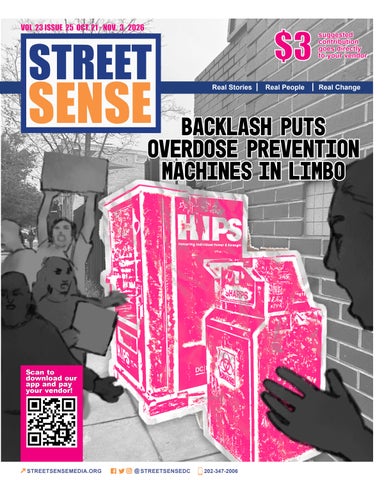
Backlash puts overdose prevention machines in limbo
Scan to download our app and and pay pay app your vendor! your vendor!
STREETSENSEMEDIA.ORG
@ STREETSENSEDC
202-347-2006
2 / / S T R E E T S E N S E M ED IA // O C T. 21 - N O V. 3, 2026
OUR STORY VENDOR PROGRAM
W
e provide people experiencing homelessness and poverty in D.C. with a low barrier economic opportunity to earn an income. Each one of our vendors functions as an independent contractor for Street Sense Media, managing their own business to earn an income and increase stability in their lives.
97,856 papers in 2025
You pay
$3
Vendors pay
per paper
Vendors keep all of your contribution! The Cover DESIGN BY KEILAH TUMAOB, PHOTO BY CHIH-RONG KUO
THETEAM TEAM THE VENDORS Abel Putu, Abraham Aly, Aida Peery, Akindele Akerejah, Alia Haug, Amia Walker, Andre Brinson, Andre Baltimore, Andrew Anderson, Angie Whitehurst, Angela Morris, Anthony Carney, Apollos Robinson, AnToinette Richardson, Archie Thomas, Beverly Sutton, Brian Holsten, Brianna Butler, Cameé Lee, Carlos Carolina, Carlton Johnson, Charles Armstrong,
Chris Boone, Chris Cole, Chon Gotti, Conrad Cheek, Craig Thompson, Cynthia Herrion, Daniel Ball, Darlesha Joyner, David Snyder, Debora Brantley, Degnon Dovonou, Deonte Savoy, Dominique Anthony, Don Gardner, Drake Brensul, El-O-Him, Elizabeth Windsor, Elynora Houston, Eric Jamison, Eric Thompson-Bey, Evelyn Nnam, Faith Winkler, Five FiftyOne, Flegette Rippy, Frankey Barrz, Frederic John, Frederick
Walker, Gerald Anderson, Gloria Prinz, Greta Christian, Henry Johnson, Indashow Birmandie, Invisible Prophet, Ivory Wilson, Jacques Collier, Jacqueline Gale, Jacqueline Turner, James Davis, James Hughes, James Lyles III, Jay B. Williams, Jeanette Richardson, Jeffery McNeil, Jemel Fleming, Jenkins Dalton, Jennifer McLaughlin, Jewel Lewis, John Littlejohn, Josie Brown, Julienne Kengnie, Kenneth Bynum,
Kenneth Middleton, Katrina Anige, Kimberley Shattuck, Kym Parker, L.Q. Peterson, Lawrence Autry, Leo Hughes Jr, Levester Green, Lillie Thomas II, Marc Grier, Marcus McCall, Marquis Savant, Mars, Maurice Carter, Melody Byrd, Michele Helies, Milan Stevenson, Mkufu London, Monique Rivers, Nikila Campbell, Patricia Donaldson, Patty Smith, Paul Martin, Phillip Black, Qaadir El-Amin, Queenie Featherstone, Rachelle Ellison,
Randall Smith, Rashawn Bowser, Reginald Black, Reginald Denny, Reneece Brinkley, Ricardo Meriedy, Richard Mooney, Rita Sauls, Robert Reed, Robert Warren, Rochelle Walker, Ron Dudley, Ronnell Wilson, S. Smith, Sasha Williams, Sharon Brown, Shawn Fenwick, Sheila White, Shuhratjon Ahmadjonov, Starchild BLK, Susan Wilshasen, Sybil Taylor, Tasha Savoy, Tonya Williams, Vincent
Watts II, Warning Label, Warren Stevens, Wayne Hall, Wendell Williams, Wendy Brown, William Hargrove, William Shuford, Willie Futrelle, William Young, Zero BOARD OF DIRECTORS Clare Krupin, Chris Curry, Cole Ingraham, David Grant, Jonquilyn Hill, Mary Casale, Matt Perra, Michael Vaughan Cherubin, Nana-Sentuo Bonsu, Phil Telfeyan
S T RE E T S E NS E ME DI A . ORG
3
EVENTS AT SSM
NEWS IN BRIEF
ANNOUNCEMENTS
DCHA faces scrutiny over financial management, cybersecurity during hearing LOUISA HANNOUCENE Editorial Intern
C
oncerns over the D.C. Housing Authority (DCHA)’s budget management have raised questions about the agency’s financial stability. The D.C. Council Committee on Housing, chaired by At-large Councilmember Robert White, held a public roundtable on Sept. 29 to discuss the agency’s financial status and recent audits. This past July, the Office of the D.C. Inspector General released its fiscal year 2025 audit report. The city’s largest housing provider left auditors without sufficient evidence to assess its financial statements, according to the most recent audit, raising questions about its financial oversight. In January, the committee also held an oversight roundtable following an internal audit report about millions in financial mismanagement, though the internal auditor has since been placed on leave and the agency denies her claims. At the most recent hearing, the city auditor said their office found a roughly $52 million budget error in one of DCHA’s budget documents, though lawmakers say questions remain. “The findings are serious. In fact, the auditing firm issued a disclaimer of opinion, which means they could not obtain enough evidence to form an opinion of the agency’s financial statements,” White said. Ward 3 Councilmember Matthew Frumin said the city auditor found math errors in the budget DCHA submitted to the U.S. Department of Housing and Urban Development (HUD), including a $52 million mistake that results in a budget shortfall of the same size. “And that’s not a math error. That’s a giant challenge for the agency,” Frumin said. DCHA’s financial challenges first came to light in June, as HUD funding fell short of the agency’s fiscal year 2026 budget request. HUD has made $337 million available to public housing agencies facing operating-fund shortfalls, and DCHA Executive Director Nicole Wickliffe said the agency is eligible to apply for funding. The fiscal year 2025 audit identified eight concerns, down from the 22 findings the previous year. The findings involved multiple areas of
the agency, including finance, legal development, capital construction, administrative services, and the Housing Choice Voucher Program. Wickliffe said DCHA was already aware of the issues identified in the audit. One was record discrepancies, caused by the agency’s delayed transition to a new software system and misplacement of supporting documentation from the legacy software system. The agency is committed to rectifying the records, Wickliffe said. Moving forward, White said the committee would hold monthly meetings with the Office of the D.C. Auditor and the DCHA’s set of external auditors as part of the agency’s oversight. “For many families, whether the Housing Authority is running smoothly or struggling can mean the difference between receiving timely assistance or becoming homeless. So yes, we’ve been here, but that’s what oversight is,” White said. At-large Councilmember Elissa Silverman attended the meeting, her first DCHA oversight since December 2022, after the HUD audit was released. “I know that everyone in this room wants this agency to be financially responsible. That is my belief, and we want DCHA to be sustainable and provide dignified housing for our residents,” Silverman said. “And that’s why I have to tell you all I am so puzzled why we are in this place four years later.” The committee also discussed the summer’s cybersecurity attack on DCHA. Wickliffe said the incident occurred June 28 and took DCHA’s network offline. From June 29 through July 17, the agency provided updates through its mass email and text platform as well as social media. DCHA’s Chief Information Officer Michael Buck said a “very small subset” of data on the agency’s shared drives was breached, and the agency’s main system and resident records were protected. Buck said the audit is still ongoing and is expected to conclude by the end of October. “The investigation found that a limited subset of DCHA data, including sensitive information, was compromised,” Wickliffe said. There is no evidence any sensitive information had been misused, she said.
Rita Sauls Oct. 24
BIRTHDAYS
ARTIST/VENDOR
Starchild Blk Oct. 27
ARTIST/VENDOR
CHIEF EXECUTIVE
//
EMPLOYMENT
VENDOR
Frankey Barrz Nov. 3
Jewel Lewis Oct. 31
ARTIST/VENDOR
ARTIST/VENDOR
EDITORIAL
DESIGN INTERN
(Theater), Molly
Keilah Tumaob
Pauker (Watercolor),
OFFICER
SPECIALIST
PROGRAM
INTERNS
Brian Carome
Esmat Amin
VOLUNTEERS
Chih-Rong Kuo, Jake
Ann Herzog, Beverly
Mittleman, Louisa
DIRECTOR OF
VENDOR PROGRAM
Brown, David Fucillo,
Hannoucene, Luci
RESIDENCE
PROGRAMS
ASSOCIATES
Mark Fehling, Roberta
Garza, Lucy Montalti,
Alexandra Silverthorne
VOLUNTEERS
Darick Brown
Aida Peery, Chon
Haber
Lucy Wong Ryniejski
(Photography),
Anne Eigeman, Sarah
Bonnie Naradzay
Eccleston, David
Gotti, Nikila Campbell DIRECTOR
Willie Schatz (Writing)
EDITOR-IN-CHIEF
SOCIAL MEDIA
(Poetry), David Serota
Fucillo, Maryann
Annemarie Cuccia
INTERN
(Illustration), Debbie
Wenning, Jillian
Holly Salazar Ramirez
Menke (Watercolor),
Pincus, Nora Scully,
JM Ascienzo (Yoga),
Patrick Hogan
OF VENDOR
PROGRAM AND
EMPLOYMENT
OPERATIONS
Thomas Ratliff
INTERN
DEPUTY EDITOR
Eli Robinson
Donte Kirby
Justin Lenderking
□
Street Sense audience survey is live! Earn five extra papers every time your customer fills out the survey.
□
Come take a vendor survey and earn $10 and 10 newspapers! Ask to sign up at the Admin Desk.
□
Find a list of vendor announcements and other useful information just for you at streetsensemedia. org/vendor-info.
Read this democratically elected code of conduct, by vendors, for vendors! 1.
I will support Street Sense Media’s mission statement and in so doing will work to support the Street Sense Media community and uphold its values of honesty, respect, support, and opportunity.
2.
I will treat all others, including customers, staff, volunteers, and fellow vendors, respectfully at all times. I will refrain from threatening others, pressuring customers into making donations, or engaging in behavior that condones racism, sexism, classism, or other prejudices.
3.
I understand that I am not an employee of Street Sense Media but an independent contractor.
4.
While distributing the Street Sense newspaper, I will not ask for more than $3 per issue or solicit donations by any other means.
5.
I will only purchase the newspaper from Street Sense Media staff and volunteers and will not distribute newspapers to other vendors.
6.
I will not distribute copies of “Street Sense” on metro trains and buses or on private property.
7.
I will abide by the Street Sense Media Vendor Territory Policy at all times and will resolve any related disputes with other vendors in a professional manner.
8.
I will not sell additional goods or products while distributing “Street Sense.”
9.
I will not distribute “Street Sense” under the influence of drugs or alcohol.
10.
I understand that my badge and vest are property of Street Sense Media and will not deface them. I will present my badge when purchasing “Street Sense” and will always display my badge when distributing “Street Sense.”
ARTISTS-INEDITORIAL
The October vendor meeting will be Friday, Oct. 30, from 2:00 p.m. - 3:00 p.m. Come for business, community, and pizza!
VENDOR CODE OF CONDUCT
Daniel Ball Oct. 25
ARTIST/VENDOR
□
4 / / S TR E E T S E N S E M ED IA // O C T. 21 - N O V. 3, 202 6
NEWS
D.C. residents’ housing at risk as homelessness funding fight continues LUCY MONTALTI Editorial Intern
The U.S. Department of Housing and Urban Development building. Photo courtesy of Ron Bennett / Flickr
N
onprofits and local governments are asking a district court to rule on the Trump administration’s approach to homelessness funding before December in a last attempt to stop the federal government from changing long-standing guidelines. The legal battle is over the U.S. Department of Housing and Urban Development’s (HUD) fiscal year 2026 Continuum of Care Notice of Funding Opportunity, which governs the largest federal grant program awarding money to homelessness services. This year’s notice reserves $1.3 billion, about a third of the total grant, for temporary and supportive housing programs, effectively shifting money away from programs like Permanent Supportive Housing (PSH) and continuing the Trump Administration’s history of rejecting housing first programs. The National Alliance to End Homelessness (NAEH), a homelessness advocacy organization, and other plaintiffs sued HUD this summer after the notice was released, arguing the policy risks putting tens of thousands of people currently in PSH out of housing. On Sept. 21, NAEH and a coalition of state and local governments successfully petitioned to wipe a previous decision on one claim in their suit that found in their favor but ultimately failed to stop the grant program from moving forward. They’re now asking the U.S. District Court for the District of Rhode Island to consider their other claims before HUD hands out funding on Dec. 1. After that, it would be much harder to reverse the policy changes, NAEH told the court. The stakes in this case are high, according to NAEH. The NAEH Homelessness Research Institute estimates the funding changes could put at least 97,000 formerly homeless people at risk of losing housing through the loss of existing programs. NAEH’s chief equity officer, Mary Kenion, said that number is “a very low end estimate.” In Washington, D.C., NAEH estimates about 847 people could lose housing; the District is estimated to lose around $12.6 million in PSH funding to other program types. The actual impact would depend on how HUD judges the District’s funding application. The case, which is the third in a series of disputes over HUD homelessness funding under President Donald Trump, has undergone a series of reversals already. On Aug. 7, U.S. District Judge Mary McElroy ruled in favor of NAEH, setting the funding guidelines aside on the basis HUD had skipped the required notice-and-comment process for public input. She did not rule on the plaintiffs’ other claims. But on Sept. 16 the First Circuit Court of Appeals granted a “stay pending appeal,” allowing HUD to reopen the application for funding two days later, with a Sept. 30 deadline. With the application back open, the plaintiffs asked the appeals court on Sept. 21 to vacate their initial win, allowing the district court to take up their other claims quickly. It agreed, sending the case back to the lower court to evaluate remaining claims, including arguments the HUD guidelines are unlawful and encroach upon Congress’s spending power. In the meantime, D.C. and other jurisdictions had to apply for funding under the guidelines, which set aside dedicated funding for temporary and support-only housing programs. A representative from the organization that applies for funding on behalf of the District — The Community Partnership for the Prevention of Homelessness, or TCP — said D.C. made “strategic decisions” to prioritize programs that rely heavily on HUD funding. “We’re hoping to avoid this situation where a program lost funding that had people in PSH because those can be the most difficult transfers to make happen,” the representative said. “But if we’re working from transitional or Rapid Rehousing, that could be a little bit more easy to manage.” D.C.’s request was for almost $42.9 million to support 28 renewing PSH programs, eight renewing transitional and Rapid Rehousing programs, and 10 requests for new funding to expand PSH and introduce new Rapid Rehousing, transitional, and supportive housing programs. TCP doesn’t necessarily see one kind of program as more in danger than another, and the guidelines do not explicitly cap funding jurisdictions can receive for any particular type of program. Still, D.C. prioritized PSH programs in its application to preserve resources already supporting the District’s most vulnerable residents. “It’s really going to be based on how they judge the strength of our overall application,” the representative said. ”And I think we put together a really good response this year.” Currently, HUD is set to distribute funding on Dec. 1. NAEH doesn’t want its litigation to push that date back. “As an organization, we’ve been advocating tirelessly over the last two years for funding to go into communities,” Kenion said. “Dec. 1 is the date by which they say they need to make awards, and that is the date that we are seeking relief without delaying the majority of funding.”
STREETSENSEMEDIA.ORG
//
5
District drafts hypothermia shelter plan, expecting a milder winter LUCI GARZA Editorial Intern
T
he D.C. Interagency Council on Homelessness (ICH) approved the District’s winter plan on Oct. 15 as the city gears up for hypothermia season. Hypothermia season, which runs from Nov. 1 through March 31, is the period when dangerously low temperatures can pose life-threatening risks to people experiencing homelessness, with the threat usually peaking in January. The District is required to provide a bed to anyone who wants one in hypothermia season, but hundreds of people still sleep outside each winter. This past January, a record-long cold snap kept temperatures below freezing for nine days, resulting in four suspected hypothermia-related deaths among people experiencing homelessness, though only one was confirmed in the winter plan. (The exact cause of death can be hard to determine, according to the Office of the Chief Medical Examiner, because it has to exclude all other causes, sometimes with little evidence.) But this season is expected to be milder, and officials are optimistic, especially after the challenges of last year. “We got tested last year with the longest extreme cold spell that we have ever seen, and we did an amazing job,” Theresa Silla, the executive director of the ICH, said at the meeting. “That was the feedback that we got from boots on the ground, so I think we are in a really good place, especially because we are out of rec centers, we have the infrastructure, and DHS has the experience.” During hypothermia season, D.C. opens additional shelter beds so more people can sleep inside. As winter approaches, the city uses a data-based prediction model to calculate how many beds it will need based on the length of the season, homeless population, and expected weather. This year, the model recommended allocating 1,632 beds to low-barrier single-person shelters across the city. This number is down from last winter by 38 beds due to this year’s warmer and wetter winter forecast from the El Niño pattern. When it is not hypothermia season, from March to November, low-barrier shelters normally offer 1,130 beds for individuals, according to DHS data. Encampment data, including the number of tents and individuals at encampments, were added to the model for the first time this year, a data scientist from the city said at an August ICH meeting. Several new weather metrics were also added to the model’s calculations, such as daily temperature, snow, depth of snow, and the number of cold weather and hypothermia alerts. As the District collects more data each year, the model continues to get more accurate, the scientist said at the meeting. Last winter, the model’s predictions came close to what shelters saw, overestimating the need for beds by 30 for men and seven for women during the peak of hypothermia season. In addition to offering shelter beds, D.C. also operates warming buses on particularly cold nights. At a September ICH meeting, officials from multiple agencies, including the Department of Human Services, the Homeland Security Emergency Management Agency (HSEMA), and the ICH, flagged affordability concerns with the buses, which cost $2,000 per bus for one 12-hour shift. Warming buses primarily serve individuals who do not wish to go into shelters due to strict bag limits, Kate Coventry, deputy director of legislative strategy at the D.C. Fiscal Policy Institute and a voting member of the ICH, said. Typically, to enter a low-barrier shelter, individuals may only bring two bags with them, which can deter people who do not want to part with their belongings. At the September meeting, some officials warned that since warming buses are not staffed, there are risks of crime, as well as danger if a bus’s diesel engine stalls out while individuals aboard are sleeping. However, by the end of the meeting, they agreed decreasing the number of buses made the program less valuable, and it should either be maintained as-is or removed altogether to save money. Each year, the number of buses depends on available resources. The current plan recommends the Washington Metropolitan Area Transit Authority provide four to five buses during exceptionally cold and dangerous weather, especially overnight.
For single women, 471 beds will be available at the start of the season, and 505 beds will be available in January. Nearly 350 of these beds will be available at year-round shelters Harriet Tubman, Patricia Handy, and Saint Josephine Bakhita. Additional beds will be offered at Eve’s Place, Naylor Road, and KBEC Family Life, which serve as hypothermia-specific sites. Hypothermia sites will become active once all low-barrier shelters reach 80% capacity, and they will remain open throughout the winter for as long as there is demand for them. As of Oct. 18, overflow sites at Emery and Eve’s Place had opened. That night, there were about 60 unused beds for men and 40 for women. The city’s LGBTQ+ Shelter, Living Life Alternatives, will continue to operate with 40 beds. Safe Haven and Shine, youth shelters for people between the ages of 18 and 24, will offer five overflow beds in addition to their year-round 74-bed capacity. While people of those ages can go to any low-barrier adult shelter, youth shelters give young adults their own dedicated spaces because they have fundamentally different needs than older adults, according to an ICH spokesperson. The ICH considered opening youth-specific dormitories in two adult shelters as well, though the proposal did not make it into the final plan. For families, the plan anticipates a 15% surge in demand throughout hypothermia season, which is consistent with trends from the past two years. About 350 family units will be available in November, with 398 units available by the end of the season in March, similar to last year. Hypothermia sites will operate from 7 p.m.-9 a.m. on a nightly basis. When extreme cold alerts are issued, the shelters will become accessible at all times. Low-barrier shelters will continue to operate 24/7. HSEMA issues extreme cold alerts when the temperature falls or is forecasted to fall to 15˚F or below, including wind chill, or 20˚F, including wind chill, with at least a 50% chance of precipitation. Cold alerts are issued when the temperature falls or is forecasted to fall below freezing, including wind chill, or below 40˚F when there is at least a 50% chance of precipitation. Last winter, HSEMA issued 93 alerts, 36 of which were extreme cold alerts, Justin Brown, the agency’s director, said at a Sept. 15 ICH meeting. The winter was harsh from start to finish, with a unique winter storm that kept snow and ice on the streets for two weeks. Frequently, temperatures dropped significantly overnight, which made it difficult to transport people outside to shelters as some vehicles stopped running, he said. This year, as a super El Niño is set to influence weather patterns, Brown predicts weather will be much milder, with less snow and ice, hopefully minimizing the issue. D.C. residents can call 311 or the shelter hotline at 202-399-7093 to request transportation or report someone in need. For minors, Sasha Bruce Youthwork operates a 24-hour youth hotline at 202-547-7777.
Where to find shelter this winter Up until last winter, the District opened temporary community sites during hypothermia season to offer beds at recreation centers or churches. Now, all beds are at pre-existing shelters or other D.C. facilities. For single adult men, 1,039 beds will be available at the start of the season in November, with an increase in January to 1,141. Year-round facilities for men include New York Avenue, Adam’s Place, 801 East, and Emery. Additional beds will be offered at Federal City 1 Shelter North, Blair, and La Casa, which serve as hypothermia-specific overflow sites.
A snowy park bench near the Martin Luther King, Jr. Memorial. Photo courtesy of cherryblossomwatch / Flickr
6 / / S TR E E T S E N S E M ED IA // OJCANT.. 211 -- JNANO V.. 14,3, 202 2025 6
NEWS
Overdose prevention machine sparks backlash, conversation in Shaw CHIH-RONG KUO Editorial Intern
D.
C.’s overdose prevention machines provide life-saving medication like Naloxone, which reverses overdoses, to anyone in need. But they’ve come under scrutiny this year, after community members shared concerns about the lack of public space permits and public safety impacts related to a machine located in Shaw. Honoring Individual Power and Strength (HIPS), a harm reduction organization that provides some of the machines, hosted its first community town hall on Oct. 2 in Shaw to discuss their impact. The town hall is part of HIPS’s mission to work with communities where the machines are located to combat pushback, including vandalism, which left the machine in Shaw inoperable. The District of Columbia Department of Health, or DC Health, rolled out the vending machines in 2023, with community partners Family and Medical Counseling Services, or FMCS, and HIPS. The machines offer free wellness supplies and life-saving tools, including Naloxone, or Narcan, condoms, and hygiene products, to anyone who enrolls with FMCS or HIPS via their respective hotlines. Three of the HIPS vending machines are the subject of a University of Maryland (UMD) study, led by Andrea Lopez, a professor at the university’s Center for Substance Use, Addiction & Health Research. Lopez joined Johnny Bailey, a project manager at HIPS, at the town hall to discuss initial findings, though a full report will not be available until 2027. According to the pair, 564 people are registered for the overdose prevention vending machines, with 447 users actually utilizing them. People who enroll in the program fill out a short survey and receive a unique code they can use at the machines. However, town hall attendees said participants can share their codes with others, so the actual number may be higher. There is also a universal emergency code, 9999#, to access Naloxone. While the machines have been operating for several years, they came under renewed scrutiny when DC Health filed permit applications with D.C.’s Public Space Committee, or PSC, in 2026 after determining the vending machines required approval. On Aug. 27, the PSC approved three public space permits for five overdose prevention machines, including the vending machine in Shaw. The most preferred site and most used site for enrolled participants was the Shaw machine at 1525 7th St. NW, according to Lopez’s research. The most commonly retrieved products were consumption supplies, which include clean syringes. In April, however, syringes were removed from the Shaw machine location. In June, DC Health asked HIPS to remove syringes from all machines in “efforts to align with current federal administration requirements,” according to DC Health at the initial PSC hearing. The Trump administration tightened funding guidelines this year, excluding syringes, drug test strips, and overdose hotlines from federal funding. Since April, the monthly retrieval of consumption supplies has dropped drastically, and monthly participation has decreased by 64.2% and continues to drop across all machines, Lopez said. A month later, the machine in Shaw was the subject of controversy at a May 14 Advisory Neighborhood Commission (ANC) 2G meeting, where community members voiced concerns that the machine caused an increased presence of intoxicated individuals in the neighborhood and led to public health concerns, citing discarded needles on sidewalks. More recently, the machine has not been operating since it was removed from the location on July 24 after it was vandalized. According to Bailey, the machine’s electrical plug was destroyed, and the machine was brought to a DC Health warehouse. The vandalism is not the first instance of tampering with the machine. Bailey recalled he would often find the machine unplugged after he left work. “Part of the problem is I can’t afford to pay someone to come and replug it all the time,” Bailey said. “So I kept waiting and going later at night on my way home from work. So by the end, I was staying up, going and leaving the office at 9 o’clock at night.” Bailey worried that simply reinstating the machine would not fix community tensions, leading him to start hosting town halls. Advocates for overdose prevention vending machines say they provide a layer of privacy and autonomy, serving individuals who would otherwise not use traditional syringe service programs, according to Lopez. “We know that those machines do serve the most high-risk groups, especially people who are looking for a kind of anonymous and confidential way to access prevention services,” Lopez said. “So there are these potential things to think about about where those people went, because it’s unlikely that if they stopped using the machine, that they started going somewhere else.” According to the UMD research, the majority of people who enroll in the program are housed and use the products in their own homes. Additionally, clean syringes are often used for medical
purposes, including for hormone replacement therapy, diabetes, and GLP-1 medication, Phoenix Starr, a HIPS hotspot coordinator, said at the town hall. At the town hall, ANC 2G Commissioner Sheena Berry shared the concerns raised at ANC meetings, including discarded needles and the machine’s proximity to the Kennedy Recreation Center. She said she hoped increasing communication and education would help resolve the tensions. “What would really help resolve this issue and possibly get the machines back into Shaw would be an education on the HIPS program because a lot of people were just completely against it,” Berry said. “A lot of times when people are against things, it’s because they don’t have an understanding of it.” Public opinion of harm reduction strategies isn’t the only recent barrier for HIPS. In September, the D.C. Department of Behavioral Health (DBH) notified HIPS it would discontinue the organization’s place-based funding at the end of the month. Place-based funds are grants allocated by DBH to support substance use disorder outreach and address behavioral health needs. Bailey said the notice led to HIPS laying off several employees. Other organizations were also affected by the end of the funding. District Bridges, a community development organization, faced a discontinuation of funding for its Community Navigators program, which connects behavioral health and social services to individuals experiencing substance use disorders and homelessness. However, when the fiscal year restarted on Oct. 1, DBH re-awarded HIPS’ funding. Bailey said it came as a shock to him. “Mid-September was when we finally were like, I guess we got to do this, and started sundowning programs and laying people off and such,” Bailey said on Oct. 2. “Yesterday, I woke up with my calendar scheduled to have exit interviews and lay off the last two employees under me. By about 2 o’clock, I was funded at 50% and at 8 p.m. I was fully funded.” A spokesperson from DBH confirmed the D.C. Council’s award of $1.7 million in one-time place-based grants expired on Sept. 30, but DBH awarded another $2.4 million on Oct. 1. Street Sense was not able to confirm whether all of the organizations affected by the discontinuation have now been funded. While the Shaw vending machine is still gone, HIPS is hoping to work with the community to find a solution to either reinstate the machine or find a new location in the neighborhood. The town hall concluded with HIPS and Lopez agreeing to increase education and community engagement surrounding the overdose prevention machines. “When people are scared of things, you can’t tell them, ‘your fears are wrong,’ right?” Lopez said. “You have to go in and say, ‘Okay, well, let’s work through it.”
The HIPS vending machine and Sharps container located on 1525 7th Street in July. Photo by Chih-Rong Kuo
S T RE E T S E NS E ME DI A . ORG
//
7
Years after reform recommendations, advocates say family homelessness intake hasn’t changed LUCY WONG RYNIEJSKI Editorial Intern
T
amika Kennedy and her three children were denied housing from Virginia Williams Family Resource Center three times before she sought legal assistance. Each time she walked out feeling worse. “The first time I was upset. Then the second time, devastated. The third time I was just heartbroken,” said Kennedy. Kennedy is a single mother who never navigated shelter services before. After her grandmother died in January, Kennedy lost her housing and looked to Virginia Williams, the central intake office for families seeking aid from the D.C. Department of Human Services (DHS), including those experiencing or at risk of homelessness and domestic violence, for assistance. On her fourth attempt, Kennedy was connected to the Homelessness Prevention Program (HPP), which helps people stay in their homes or find temporary places to stay, such as with family, but does not provide shelter. Kennedy said she “still needed an immediate safe place” for her family. It was not until the Washington Legal Clinic for the Homeless advocated on Kennedy’s behalf that she entered emergency shelter. Kennedy’s experience isn’t unique. In fiscal year 2026, 47% of those who applied for shelter at Virginia Williams — 1,372 families — were deemed ineligible for homeless services, according to DHS data. While many were connected to HPP, like Kennedy, just under a quarter received shelter. On Oct. 8, the D.C. Council hosted a public oversight roundtable where dozens of people raised concerns Virginia Williams is blocking services for families in crisis. This includes concerns of excessive or improper documentation requirements and staff conduct advocates say retraumatizes people seeking shelter. “DHS must commit to not only comprehensive training of their staff, but to also overhaul its policy and organizational culture to prioritize survivor-centered and trauma-informed practices, which in turn improves services for everyone in need,” Dawn Dalton, executive director for the DC Coalition Against Domestic Violence (DCCADV), said.
Roundtable shares concerns over shelter eligibility In order to receive services from Virginia Williams, families must meet three core documentation and eligibility requirements, according to testimony from DHS Director Rachel Pierre. They must be District residents, meet the statutory definition of a family, and be homeless or at imminent risk of homelessness. Case workers use formal and informal documentation, from government identification to statements, to confirm eligibility, according to DHS responses to prehearing questions. Of those denied shelter over the past year, a fifth could not prove D.C. residency, and a tenth could not confirm family status, according to DHS data. The most common reason was not being at immediate risk of homelessness, which accounted for 67% of denials. Several witnesses said families were steered to stay with friends or relatives instead of entering shelter. According to DHS responses, 88% of families were referred to HPP, which the agency said was not a denial of shelter.
At the roundtable, families said they were rejected from shelter for many reasons. Kennedy said because she was not a tenant on her grandmother’s lease, staff initially denied her services. Others said they were told they were ineligible due to language barriers, temporarily staying with friends and family, lacking documentation of familial relationship between parent and child, not producing individual or friends’ leases or the contact information of friends and family, and more. Some claimed they were turned away for a different reason each time they met with a new caseworker. Pierre said DHS relies on staff training and established procedures to ensure consistent eligibility determinations. However, DHS did not give the council internal eligibility scripts, citing concerns it could disrupt agency operations. Advocates said without those materials, it is difficult to determine if staff are applying eligibility standards consistently and in accordance with District law. Experts, like LaJuan Brooks, the director of community engagement at Washington Legal Clinic for the Homeless, claim the process is inconsistent with city policies, such as the Homeless Services Reform Act (HSRA). HSRA protects applicants from being deemed ineligible solely because a family cannot produce proof of D.C. residency or homelessness. An applicant is ineligible only with “clear and convincing evidence.” “Based on the conversations I and my team have had with families attempting to access shelter, a large majority of them are being asked to provide documentation that they are unable to access, or being tasked with providing information that should not factor into their need for a safe place to sleep,” Brooks said.
Survivors are falling through the cracks Another issue raised was identification requirements for survivors of domestic violence. Survivors often flee without documents, like birth certificates or lease agreements. While survivors can self-certify residency without documentation, according to D.C. city code, individuals at the roundtable said the process currently excludes survivors. As of Sept. 1, domestic violence survivors can fill out a proof of residency form to self-certify residency without ID. But to do that, they must be in the city’s homeless information system. Survivors are not supposed to be entered in that same system due to regulations on survivor privacy. Micaela Deming, the policy director for DCCADV, said this effectively excludes survivors from accessing Virginia Williams services, leaving the potential they return to unsafe places. “After months of sharing our concerns and reminding DHS of the long-standing federal and District code protections, they rolled out their new process that even they acknowledge excludes survivors and have still not developed a legally compliant solution,” Deming said during public testimony. During the roundtable, many survivors also spoke about staff behavior that they felt was “cold, dismissive, non-empathetic, and judgmental,” according to Theresa Puhr, policy and systems engagement coordinator at DCCADV. Domestic violence remains a leading cause of homelessness in families. Yet only 4% of Virginia Williams’s assessments led to victim services, known as DASH, in fiscal year 2026.
Advocates worried this gap could be partially caused by survivors not disclosing their experiences because of trauma and stigma around terminology, like “domestic violence,” making staff training at Virginia Williams essential. “When you dig behind that, it’s because [individuals] don’t identify what happened with the term domestic violence. Maybe there wasn’t a conviction or the police were never called, and they think that’s not a connection,” said Deming. “So the way that you ask is really important.”
Advocates and families call for reforms This is not the first time discussions surfaced on the center’s policies. In 2019, an oversight hearing surfaced similar complaints wherein women seeking emergency housing said they were disrespected and repeatedly turned away. Monique Jackson first visited the center in 2017 when she was seven months pregnant, and returned again this year. The first time, she refused to leave until she got services. “The process most times feels like it’s designed to break you down when you are at your lowest point,” said Jackson. “The mission of Virginia Williams is well-intentioned. However, the eligibility process can be as retraumatizing as the circumstances that bring clients to the service center.” In 2022, the Domestic Violence Action Research Collective released a study outlining recommendations for reforms, including updates to the intake process for survivors of domestic violence, data privacy protections, and traumainformed training. However, no significant updates have been made since the recommendations were released, according to testimonies from the roundtable. Many who suspected staff capacity and resource scarcity have posed a challenge. In order to improve Virginia Williams, advocates and experts suggested several structural changes, including communication improvements. For instance, District policy says families must receive reasons for shelter denial. Those who testified said families sometimes get denial notifications, and sometimes they don’t. Several testimonies called for same-day notices stating the reason for denial and how to appeal, including referral or interim shelter options. “When resources are limited, collaboration becomes even more important. We need stronger communication and partnership between housing providers so that [assessments] can connect clients to additional housing opportunities,” said Jasmine Ferguson, victim services program manager at Community Family Life Services, during her testimony. After the roundtable, DHS began reviewing the concerns, according to a spokesperson, and will reexamine policies and training curriculum for staff. “These women should not have to wait until they are standing at the door of homelessness with their children before we decide they qualify for help,” said Ferguson. “I am not here asking for more housing. I’m asking us to look at the entire process for seeking housing assistance.”
8 / / S T R E E T S E N S E M ED IA //// OJ ANC T.. 121- -J AN N O.V.14, 3, 2025 2026
NEWS
Community conversation series on homelessness fosters dialogue across the District LUCI GARZA Editorial Intern
Panelists at the Ward 3 community conversation on Sept. 28. Photo by Luci Garza
A
s the sun begins to set and many Washingtonians commute home from busy workdays, some are gathering to talk about homelessness in their neighborhoods. The Way Home Campaign, a local coalition of homeless services and advocacy groups, has begun hosting community conversations to discuss homelessness across the District. It aims to host events in every ward before the end of the series later this fall, according to steering committee leader of the Way Home Campaign and the director of advocacy for Miriam’s Kitchen, Dana White. The Way Home Campaign is a coalition of more than 7,000 people across D.C., as well as 110 organizations dedicated to ending chronic homelessness, and is convened by Miriam’s Kitchen. So far, the campaign has hosted events in Wards 2 and 3, though members of any ward are welcome to join as events pop up. The kickoff event took place on Sept. 28 at the Tenley-Friendship Library in Ward 3. It featured a panel discussion with members of staff at both Friendship Place and Miriam’s Kitchen, both of which offer services in the ward. Lara Pukatch, chief advocacy officer at Miriam’s Kitchen, who moderated the panel, said the series was beginning there given Ward 3 Councilmember Matt Frumin’s support for homelessness prevention programs and funding as the head of the D.C. Council Committee on Human Services. Ward 3 has the lowest poverty rate in the District, of just 7.9% in 2024, according to federal data, Patricia Burrage, a senior clinical outreach case manager with Miriam’s Kitchen, said at the Ward 3 event. Burrage pointed out that while those local to the ward may be known for their high incomes and choice to live in the area to avoid “city problems,” nearly all the seats at the event were full. “We’re heavy here in this area,” Alan Banks, a community engagement associate for Friendship Place, said. “We’re heavy in this area because of the heart of this area.” The second event took place at Foundry United Methodist Church in Ward 2 on Oct. 6. Attendees sat and spoke amongst themselves at tables scattered across the church’s room before a shorter panel. A relatively new crowd appeared, although there were some attendees coming for their second conversation, and some who travelled from Ward 7. Ward 2, which includes downtown D.C., is historically known to have one of the highest concentrations of homeless individuals, including individuals living outside. For example, the MLK Library, which is a common place for people experiencing homelessness to sleep outside, is located within the ward. President Donald Trump has also gone after larger encampment sites located in the ward near Washington Circle and the Kennedy Center in an effort to ban encampments across the city. Ward 2 has also been the site of recent debates over homeless services. In 2023, the city purchased what is now The Aston from George Washington University. It officially opened in 2024 following a lengthy lawsuit and zoning appeal from the West End Community Association. Both panels opened by asking the panelists what they were noticing about homelessness in their wards. The answer across the board was that, after Trump’s effort to remove encampments across the city, the landscape of homelessness response has drastically changed. “Individuals being displaced from central city to residential areas, being invisible, and having less access to resources is something I am seeing more and more in this ward,” Burrage said at the Ward 3 event. Panelists at both events agreed the surge in encampment sweeps has made it harder to earn the trust of individuals as their anxiety around city officials grows. Banks experienced homelessness for six years and was given housing by Friendship Place. He said that his experience taught him persistence in outreach is key to eventually being able to properly advocate for the people who need resources the most.
“You may have to say good morning to a person 10 times before they ever say good morning back to you,” Banks said. For Wesley Thomas, an advocacy speaker for Miriam’s Kitchen on the Ward 3 panel, the main barrier to people exiting homelessness is insufficient mental health support for those on the street. Forty-one percent of individuals experiencing homelessness in the District have at least one mental health condition, according to the 2026 Point-in-Time Count, though Thomas said both his experience being homeless and working with Miriam’s Kitchen lead him to believe this number is actually much higher. During the Ward 2 panel, Rachelle Ellison, a guest advisory board member for Miriam’s Kitchen, said the misconception that experiencing homelessness is a choice individuals actively make can also be a barrier for people trying to exit homelessness. Between 40-60% of unhoused people in the U.S. work a full- or part-time job, according to the United States Interagency Council on Homelessness. “Who wants to be homeless?” Ellison said. “They do work, and it is a troublesome journey to go through.” Full disclosure: Ellison is also a vendor with Street Sense. Panelists and attendees talked about solutions, too. They agreed bridge housing was one of the most notable resources available to those in the District experiencing homelessness. The bridge housing model provides individuals with a medium-term housing alternative between emergency shelter and permanent housing; the District has opened two sites at The Aston, located in Ward 2, and E Street. “Bridge housing is the future moving forward,” Thomas said at the Ward 3 event. “If we found spaces for several other bridge housing, we could practically eliminate homelessness.” During discussions at the Ward 2 event, attendees agreed there is a lack of affordable units across the District, especially in Ward 2. They suggested taxing wealth, a policy the D.C. Council also discussed at a recent hearing, as one potential solution to keep funding for housing programs afloat. Lynn Amano, a panelist at the Ward 3 event and the advocacy director for Friendship Place, told attendees one of the biggest challenges to ending homelessness is a lack of political will. Amano urged those in the crowd to speak with councilmembers and other city representatives to advocate for proper funding for homeless support and prevention services. “The easy answer is money, but the real problem is the prioritization and the sense from the community and decision makers that this is what we need to talk about,” Amano said. While a majority of the crowd at the kickoff event were members of either Miriam’s Kitchen or Friendship Place, others were concerned community members looking to learn more about how to support those currently experiencing homelessness in their neighborhood. Many took notes as panelists shared their experiences and advice on supporting the unhoused community. “The first thing you do is look this person in the eye and look at them like they are a human being,” Banks said. The community conversation series will continue with pop-ups in different wards, as well as a house party-type event in the future. White said growing solidarity is an important aspect of the events, as the campaign works to gain insight while drafting its transition guide for the new mayor of D.C., who will be elected this November. Editor’s note: Street Sense Media is a member of the Way Home Campaign, but the newsroom is not and does not engage in any advocacy. We maintain a strong firewall between our newsroom and other departments of Street Sense Media
S T RE E T S E NS E ME DI A . ORG
//
9
RANDOM ACTS OF KINDNESS
The postman always rings twice, part 3
Wendell several years later, when he was invited to speak at an Oxford House event. Photo by Wendell Williams
WENDELL WILLIAMS Artist/Vendor
This is the final installment in Wendell’s series on his recovery and journey out of homelessness. You can read previous ones on our website.
P
ulling up to Glen Carlin was a breath of fresh air after what seemed like forever at Belle Haven. I still have nothing but love for the house that gave me a sense of belonging. Even today, I’ll drive over and up the hill around the driveway, taking two minutes to reboot myself and be on my way. In that circuit, I’m grounded as I see myself in that little room and become grateful, because in difficult times I forget I came there with literally nothing. I forgot to mention, while at Belle Haven, my last criminal justice system involvement was called to court in D.C. My lawyer said, “Just say you’re guilty and get on with your life; you may get a little time.” Why was I listening to this crap? I was just ready to move on. On that day, the judge didn’t look up until my lawyer said the Northern Virginia Oxford House director was there supporting him. He sat up at the mention of Oxford House and said, “I saw that program on 60 Minutes. Great job you do.” I left with no jail time, with unsupervised probation. “The Postman Always Rings Twice.” The guy focused on in the video is a friend of mine. He is the national face of Oxford House. Don’t you wonder why more homeless men aren’t availing themselves of this proven vehicle? Yes, at times I miss Belle Haven, but I was ready for new experiences, and having a space the size of a studio was just what the doctor ordered. On move-in day, we all showed up to get our rooms. The one I wanted was in the front of the house, with this big, wide picture window giving me a sweeping view of the church and intersection. The large walk-in closet gave me something I didn’t have but sorely needed: storage space. But more importantly, a feeling of ownership in something moving me forward. The honeymoon was shorter than I hoped for, as the older residents who were a model of successful recovery living started to move out and get on with their lives. Some went back to lost relationships and careers; others to blaze new trails for themselves, leaving me behind with a rotating bunch of new arrivals unaccustomed to structured living. It’s hard for some to realize the life-or-death nature of the opportunity to recover in a supportive environment, and many give up when the fear of change competes with the fear of remaining the same. It seemed every new addition was getting younger and more educated, but more resistant to learning new living solutions. They were not interested in mentorship, which is the bedrock of 12-step recovery, and were determined to do it their way, reminding me of someone I knew well over 14 years ago, me! So much time passed no one could remember the old way things were done but me. Rules were being twisted to the point recovery was no longer the main function of the house. For instance, we were allowed three overnights out per week once we finished probation. First, they cut the period from 30 days to 20. Then, new people were staying out Thursday through Saturday and then right back out Sunday through Wednesday. The clowns were running the circus, and I was beginning to truly understand the meaning of powerlessness. Ultimately, envy on the part of the newbies about everything from the size and the position of my room to me having a car became an issue when they didn’t understand where I grew and the work I put in. The weekly meetings that were supposed to be about the health of the house eventually became about how we can get Wendell. As the only seasoned member with the understanding of Oxford and the willingness to stand on enforcement of rules and fines, I became the house policeman.
It was impossible to continue enjoying living in Oxford, and my feelings of finally finding a home again were severely threatened. It was taking a tremendous amount of energy to try to salvage what the original 12 of us had started; I owed it to my brothers, each of us made homeless by our addiction to alcohol and/or drugs, and it was just me left as the keeper of that flame. The six of us came together to do something special. I just couldn’t let it go downhill. But I learned a valuable lesson from the experience: my job is to simply carry a message to those who still suffer; I can’t carry them. My sponsor would talk to me about self-preservation and how it was not selfish to leave a sinking boat. But I thought my only option was to stay in Oxford for the rest of my life. I had screwed up my life so badly and accepted that not being able to live in peace would be my punishment. Then two unfortunate events happened that I’ll never forget. One day, driving up to the house, I noticed police cars in our driveway. One of my newest housemates left a young girl in his room. She had overdosed on heroin, and he ran out and left her. I was told he had been seen walking towards the strip mall, so I headed there, and his sorry ass was outside the Rite Aid. I took him back and held the emergency house meeting to process the day’s events. Alone after the meeting, I was shaken up thinking of how close we were to multiple deaths in our home. I knew someone knew about the using going on, and not only was the house sick, but it was not safe for anyone, including me. There’s a saying in recovery, “Sometimes God will do for you what you are not willing to do for yourself.” There were a lot of things that I could put up with or gamble on, but not the few years of sobriety I’d finally regained. Fear kept me making excuses for not leaving. Then I gave the mob the opening they’d been waiting for. I let my ego step into their trap by forgetting to practice any humility, with of all people, a Fairfax County Police Officer. After getting tired of the phone calls from the house over an old car still being parked out back, I tried to sell it to an old roommate. He came to pick it up one morning without calling first, while Val and I were out in the countryside. Now his story was that I refused to deliver the car and was committing a crime by not returning to clear things up. I was told to drive back immediately. At that point, I was frustrated with the whole thing, knowing that the mob was in his ear because I’m the only Black member of the house and have been for almost my entire stay. In a Malcolm X moment that felt good, I told the policeman, “Sir, do what you gotta do; I’m not turning around and driving all the way back there.” So he did. When I got home, his card was on my bed, and he had issued a warrant for my arrest. I was asked about it, and I stonewalled, but at the next house meeting all hell broke loose. The Oxford manager was sitting there; it was a trap. They had found a cause that called for my immediate dismissal. But she stepped in and proposed I be given time to move out equal to the advance rent I’d paid. So God indeed did for me what I wasn’t willing to do for myself. After getting over the shock and resentment of getting thrown out of a house I helped start, I had to face the nightmares of my past head-on. When it came to rental history, I was, on paper, the last person in the world I’d rent my property to. I was surely stuck but had no time for a pity party with just two weeks to get it done. The tremendous shame and guilt attached to the decisionmaking from the disease of addiction prevented me from being anything close responsible. Multiple evictions and judgments connected to my use over the years just couldn’t be dismissed by any sane person. So after wasting money on application fees, all the landlords said, “There’s no way we’ll approve you; you seem to be nice and have it together, but it’s done by computer now.”
I had to quickly settle on renting a room. I focused on close to Prince George’s County, and boy, did I experience sticker shock. Everything I looked at was way north of my planned budget. I was working at 801 East Men’s Shelter, and looking back, I’m embarrassed to say how little per hour the organization with the contract was paying. After a room rental at over $800, I was blessed with a job lead back in McLean, where an old Oxford House friend was working. It was $5/hour more than the shelter, but it was a luxury rehab, and after months there I felt like I was a servant. I found no one had positive thoughts about their time there, just the money. My certifications were completed so I could look at what other options were out there, but still it loomed, the specter of my rental past, as I learned your past can affect your future even if you do everything asked of you. I was getting rejected from one apartment after another, but I never could afford to feel victimized for too long because I knew I had to go right back out there. One day, a friend said, “Start getting copies of those free subway papers.” And there it was. Several apartment complexes were having open houses for those needing second chances. That was me. I called and RSVP’d. I woke on the morning of the open house and doubt tried to sink in, but I showed up, thinking that with no deposits or fees, even if it was a dump, I was taking it. I filled out the massive amount of paperwork, still not believing I’d have a chance. When the Saturday of move-in came, I had all my things laid out and packed as neatly as any family making a leap into a new life. I felt so grateful for Oxford House, and all the additions to my life they allowed me to keep over those years, instead of the constant losing and buying those same things over again in the devastating cycle of chronic homelessness. My goddaughter and her friend, plus myself and Valerie, with the dollies and the standard U-Haul truck rental, made up my moving crew. But if you’ve been along on this journey with me, you know it can’t be that easy. And just like my literary hero in the Odyssey, there’d be a final challenge. I was told to take a seat in the conference room because they had lots of paperwork to go over and sign the lease. As we went page by page through my application, she stopped; the look on her face was very serious. “Oh shit.” I thought about how so many times in my battles to overcome homelessness I’d gotten so close, but no cigar. She looked down at the page again and asked me, “Is this right?” She pointed to the question “have you ever been evicted?” then to my answer, which was the truth: yes, and five times. She turned to look away from me, and all the air left my body. All the negativity I’d been fighting my whole life seemed to be concentrating in this moment, so I just looked up at the ceiling and the lights. She asked me if I made a mistake, and I said no. And she said “Someone checking it must have missed this. I’ve got to call the manager; this approval shouldn’t have happened.” I just remember being numb, sorta out of body. And then, just like my late grandma said. The nervous lady walked back in after what seemed like an hour, announced, “My manager says since someone missed it, I’m to act like this didn’t happen.” Out came the White-Out, “You can move in.” Today I’m in that same apartment, and I was even invited to speak at the 50th anniversary of Oxford House. Grandma was right: the postman always rings twice. Editor’s Note: On Friday, Oct. 23, Wendell will celebrate 13 years of continuous sobriety!
10 / / S TR T R E E T S E NSE M ED IA //// MOAR C T.C H 2127 - N- OAPR V. 3, IL 2026 9, 2024
NEWS
New report finds violence against unhoused people is at a 25-year high JAKE MITTLEMAN Editorial Intern
T
he number of documented attacks targeting people experiencing homelessness nationally more than doubled in 2023 and 2024 compared with the previous two years, according to a new report by the National Coalition for the Homeless. The findings, released in August, mark the deadliest reporting period in the coalition’s 25-year tracking effort. The coalition identified 197 acts of violence and 127 deaths during the two-year period, compared with 97 incidents and 47 deaths from 2020 through 2022, a three-year period. While there’s a common belief people experiencing homelessness may be a threat, those who are sleeping on the street can actually often become “victims of opportunity.” Perpetrators may target them due to their vulnerable status and their perceived lack of value to society, according to Donald Whitehead, the coalition’s executive director. He attributes the rise in attacks to divisive political rhetoric around homelessness. “Words have consequences. And for the last few years we’ve heard a lot of elected officials talk about homelessness in a way that’s dehumanizing,” Whitehead said in an interview. D.C. is one of a handful of jurisdictions that explicitly recognize homelessness as a protected category under local hate-crime laws. Federal hate-crime law, however, does not include housing status as a protected category. While Whitehead highlights examples of housed people attacking people experiencing homelessness, some of the cases listed were violence between people living at an encampment, or violence from an unknown attacker, which would likely not qualify as hate crimes. None of the deaths included in the data occurred within the District. However, two deaths were reported in nearby Woodbridge, Virginia, and Hagerstown, Maryland. The Woodbridge incident occurred following a dispute between friends over fentanyl pills, according to Inside NOVA. The incident in Maryland occurred when a husband murdered his wife in the park she had been staying in, according to D.C. News Now. While not included in the most recent data, the District recently saw a high-profile criminal case involving allegations of targeted violence against unhoused individuals. Gerald Brevard III, 35, is on trial for allegedly shooting three unhoused men in Northeast D.C. over six days in March 2022, according to D.C. Witness. Prosecutors allege Brevard deliberately targeted the men because they
were homeless. He faces first-degree murder, assault, and weapons charges, with bias-related hatecrime aggravation attached to the violent charges. A lack of federal recognition makes it harder to measure the full scope of violence, according to Whitehead. The coalition assembled its report using court records, news reports and accounts from unhoused people, but said its figures likely undercount attacks. “We need the Department of Justice to do this. We need them to take a look at this with the enormous amount of resources that they have,” Whitehead said. According to the report, shootings were the most common form of violence against unhoused people in the U.S., accounting for 86 incidents, followed by 59 assaults and 28 stabbings. California recorded the most incidents, with 43, while the coalition identified law enforcement officers as perpetrators in 19 cases, resulting in 13 deaths. Deaths among people experiencing homelessness are an ongoing concern in D.C. At least 78 unhoused people died in the District in 2025, according to the People for Fairness Coalition, which holds an annual vigil to remember those who died without housing. In 2023, opioid overdoses accounted for more than half of deaths among unhoused residents, according to D.C. medical examiner data. Among those whose lives Street Sense has memorialized is Chandra Brown, known as Redbook Mango, a 44-year-old poet and Street Sense vendor whose body was discovered in Northeast D.C. in October 2024, more than a year after she was reported missing. Whitehead believes policies that criminalize sleeping outside and disperse encampments can leave people isolated and vulnerable. In the past two years, 350 cities have passed anti-homelessness laws, according to the American Civil Liberties Union. These bills target those sleeping on the street with arrest or fines without providing alternatives for long-term housing. “Once you disperse that encampment, people kind of go into isolation, and they hide away,” Whitehead said. “But when they hide away, and they’re in these remote locations, they become more vulnerable.” Whitehead also called for more standardized death records and urged D.C. to expand supportive services and homelessness prevention efforts. But for him, the most effective way to protect people from violence is to get them off the streets and into permanent housing. “Nobody should die alone on the streets of the richest country in the world,” Whitehead said
ART
Autumn leaves
Ending homelessness in D.C.
WARREN STEVENS Artist/Vendor
MONIQUE RIVERS Artist/Vendor
Summer ended last month! Now it’s time to enjoy beautiful fall weather. I enjoy selling papers and making my customers happy when they pass by and purchase the new issue with our Street Sense app. Some customers offer me something to eat, like McDonald’s, or give me gift cards, which shows love and kindness. Others will buy me something from a store, which also shows love and kindness. My sister and her man recently went out of town to enjoy life. They had a fabulous time and loved visiting places. They took many beautiful pictures on their phones and shared them with me when they returned. Halloween will be here soon! Back in the day, I dressed up as a scarecrow and wore a false face. I went to parties and clubs and had a blast. Families will be trick-or-treating on this magical night. Young couples will be celebrating at parties and eating at bars and restaurants with their costumes and masks. My son and his family will celebrate at their house with candies and goodies for their kids. And some people will watch Halloween movies, which is always fun. Remember, next month is time to vote for the Democrats so they can take back the House and maybe the Senate, reduce food prices, and lower our cost of living so we will spend less. That will be a blessing. Until then, enjoy October. Rake and bag leaves before colder weather comes. Remember your coats, scarves, and gloves. Have fun on that spooky night. And please, please stay safe.
The best way to accomplish this here, as well as in other places, is to convert hotel rooms into guaranteed subsidized housing. The single rooms are fully furnished and would make efficient permanent housing with a monthly 30% income subsidy for all unhoused and homeless D.C. residents. Those hotel rooms have needed amenities — microwave ovens, refrigerators, coffee makers, wifi, televisions, and laundry facilities. Using hotel rooms would eliminate the years-long wait for permanent housing endured by so many homeless, a situation that should not exist in a country with such vast resources. The immediate occupation of subsidized, decent, clean, and durable hotel and motel rooms is a great solution to the homelessness plaguing our nation’s capital and too many other locations in our country. Implementing this plan is a more efficient solution than building more housing, which takes too long. I believe this solution is also more practical and promising. The permanent hotel/ motel housing voucher can be advertised in public places, newspapers (like this one!), and the appropriate local government locations. It is long past time to treat homelessness as the crisis it is and to address it expeditiously, as opposed to the apathetic and nonchalant behaviors happening now with “service work.”
S T RE E T S E NS E ME DI A . ORG
//
11
ART
I am a Soulaan STARCHILD BLK Artist/Vendor
Tent and tiny home community
Before I learned the names of the world, my spirit already knew the rhythm of my people.
ELYNORA HOUSTON Artist/Vendor
I am a daughter of remembrance, walking with the heartbeat of those who refused to let their light be forgotten.
This is a continuation of my last piece, where I proposed creating a recycling plant and a tiny home community. The recycling plant will cost anywhere from $1,000,000 and up. The lot space should be at least five acres. The recycling plant tent area should have a huge wall to separate the noise and the warehouse. There should be a general common area that includes refridgerators, stoves, microwaves, charging stations, televisions, toaster ovens, George Foreman grills, water and ice machines. The general area should be a gazebo with drop curtains, clear vinyl panels, or tarp curtains. Side flaps or rain flies are great. In the common area, there should be a fish tank with at least 20 fish. I encourage all professors and students to engage in the community to understand, learn, and teach about healthy eating habits and weather elements. We have great people at the Street Sense Media headquarters, but they can not be in two places at the same time. The gazebo area should serve three meals a day. Many people are on special diets. Low salt, no pork, food allergy, vegan, no red meat, etc. Typically, the homeless are skeptical of different foods. I will purposely avoid overseas beef products. Supervision of the community should take place. All members of the community should check in weekly about their mental state. There will be a zero-drug and alcohol rule. If you come to the tent community unruly, you get two chances, then you are out. I got very loud one time inside a bar, and I got barred. Then I spoke to people who gave me great advice. Sometimes people need a second chance. I’m loud walking down the street; never in the bar again. Most Street Sense vendors are easy to communicate with. Some would like permanent housing. The community would be great to help those vendors waiting for housing also. A tent and tiny home community would be great, as most vendors go to various parts of the D.C. region, sell papers, and speak about Street Sense Media. They engage with their customers and the neighborhood they are in.
I do not create for applause. I create because creation is my language. The canvas knows my prayers. The drum knows my heartbeat. The thread knows my patience. The earth knows my footsteps. I am an artist of every medium because Spirit is not confined to one form. I build where others abandon. I gather where others divide. I pour beauty into forgotten places until they remember they were always sacred. My hands become whatever the moment requires — a painter’s hands, a poet’s hands, a healer’s hands, a teacher’s hands, a gardener’s hands, a builder’s hands. This is how I honor my village. This is how I honor those yet to come. I dream beyond myself. I dream of circles where every child is seen, where every elder is honored, where every artist knows their gift has value, and where community is measured by how fiercely we care for one another. If your spirit recognizes this path, then you already know — A village is never built by one pair of hands. It is woven by many hearts moving with one purpose. I am a Soulaan. I carry vision like fire. I carry compassion like water. I carry memory like earth. I carry breath like the wind that refuses to stop singing. And with every painting, every poem, every performance, every gathering, every act of service, I offer another thread until the village becomes whole again.
The future WILLIAM SHUFORD Artist/Vendor
Thinking back on the past, I was wild in the streets but well respected, and I always respect good men. I was out stealing or robbing innocent people, but I was into sports and school, even though I stayed in a fight or two. I grew up around drug dealers. So, growing up around that type of environment, I never had to ask for anything from anybody that wasn’t family. It also made me grow up too fast. The bad part about the past before I started off in the streets is that I didn’t listen to or want to see a lot of my family members were either dying or getting locked up for the rest of their lives. Even my peers’ families were dying or getting locked up. Almost every other day, someone close to one of us was either dying or going to jail. We’d have to travel to jail or prison to see them behind glass; then time passed, and I ended up in the same places they were telling me to stay away from. A hard lesson; the positive outcome of it all is that my kids made me slow down and think about whether I want to have a future with them or not. At this point in my life, we can have sit-downs and talks about plans for our future; we just had a conversation about how they broke that past cycle. I even explained it to other family members. The cycle is broken, and the future is near The street life is over
I know voting ROBERT WARREN Artist/Vendor
What can one say about the 22nd day of September, a day to remember, coming into November’s vote for American democracy In the 119th session, the hope is to continue the fight against countries’ aggression against humanity A man standing at the podium spreading doubt, spilling words without reason, when the press should be asking, “What is this man speaking of?” Let’s give hope a hug that to make America great again is starting to win, without the fake saviour in the people’s house; only he can fix it is now in doubt Some say the anti-Christ is being defeated, Texas is getting to elect a follower of Jesus, only in America, right? Truth has been in a hell of a fight with the help and might Voting propaganda can’t be as bad as it seems, just trying to remember to vote the American dream The young National Guard members patrolling the street, they’re mailing in their ballots, what do they think? Send them a link to AI new world order, robot teachers in public schools, no more golden rules Before the November vote, on that day in September at the United Nations, the people being told about a president’s desire to maybe not commit genocide, putting all pride aside, he doesn’t make me feel like an American whose vote counts anymore In September, November, December January the 6th I will never forget, those 14 days before the new Congress to say, show us the piles, let’s vote Say it out loud: being a Black man in America, you can still have pride after the lies; how many has he told? The story is getting old your vote counts, too; it’s true The devil is a liar; everybody knows they lie on Jesus to the leader who lies on the vote in September, and the whole year through, speaking to a nation about ending a civilization, the mindset for America’s biggest fool we voted for
1 2 // S T R E E T S E N S E M E D I A // O C T. 21 - N OV. 3, 2026
ART
Weathermen The National Building Museum -opause! JAMES LYLES III Artist/Vendor
JAMES DAVIS Artist/Vendor
Poetry and art CRAIG THOMPSON Artist/Vendor
Photograph by James Lyles III
The National Building Museum was built in 1887. It was built for three reasons: one, to be the headquarters of the U.S. Pension Bureau; two, to provide a nice, large space for Washington’s functions; and three, to remember those who fought for the Union during the Civil War. After the Civil War, pension funds were given to veterans disabled during military service, and to widows and orphans of officers who died in battle. By 1864, there were 52,135 pensioners on the rolls, most of whom served in the Civil War. By 1871, the U.S. Government increased the pensions and added 250,000 members, prompting Congress to create the Pension Building. Today, the National Building Museum is used by visitors and tourists from around the United States and around the world.
The snow came down that night Six fluffy, powdery inches and ice It was a pretty picture for sure But the aftermath wasn’t so nice Then came a record ten straight days The temperature stayed below freezing
Summer came fast, and we were fine We saw seven straight days Of rain and no sunshine
Never let go of the First Commandment No matter how much time and money’s spent To GOD, FAMILY, and COUNTRY be true There are lots of things you can do
Mother Nature’s fireworks It makes one wonder
Caused a heat wave in the North Pole It’s gonna be the end, God bless our souls The next frame showed a fat guy in red It looks like he was water skiing He sure looks like Santa Claus Here we go again, Must be weathermenopause!
Places I’d like to go
The FATHER, SON, and HOLY GHOST All three true friends, may I boast?
My childhood was in South Dakota Not Nebraska, Iowa, or Minnesota Syndicated television and driver And all around goody-two-shoes survivor
I saw a double rainbow, no rain and thunder Inside of the rainbow was lightning
I turned on the Weather Channel They were saying climate change
To leave creativity and beauty behind To share what is on my mind I live in NW Washington D.C. still Praying only for God’s will
Hollywood over 15 years A war zone of sorts, so many tears We die early if we don’t stay home But along the coasts and earth to roam
It was so damn cold The rats were sneezing
Was that apocalyptic or not Then a boom! Oh wow, finally thunder
Poetry and art to start Make the world better; play my part From Mormon to shining sea To keep FREE MEN free
Photograph by James Davis
Things I love
Illustration by Craig Thompson
ELIZABETH WINDSOR Artist/Vendor
I have always loved teddy bears. I used to have a collection years ago. I always loved going to the stores with my father and seeing all the ones they have and the ones in Russia. I used to have other collections besides bears, shoes, high heels, purses, and hand bags. Coco was my favorite, Chanel bags, I have like 30 in London. My sister who passed away in 2022 has them put up until I can get home. I will broadcast some of them for all of you when I get home. I have always loved nutcrackers, my father had a collection. My mum loved flowers and walking around the estate. I wish I could show you some of the flower gardens there at home at the palace. Now the teddy bear I have is old-looking. I got him here in Washington D.C., his name is Rudolph.
October brings a lot
MARC GRIER Artist/Vendor
SYBIL TAYLOR Artist/Vendor
A place where I’d love to go is Aruba. It’s very clean, and the people treat you nicely. There are many things to do in Aruba; you can easily go fishing. I had my best time fishing there and caught many fish, but the biggest fish I ever caught was a dolphinfish, or a mahi-mahi as it’s called. The food is great. The people there are Dutch and Caribbean. They’re very loving people. You can feel the love all around you. I also love to travel to the many sites we have. The blind bridge, the mini pool, which is in the ocean. When I went the last time, I felt very relieved, happy, and stress-free.
Many Street Sense vendors have birthdays this month. Happy birthday to all the vendors, especially my wonderful, good friend Daniel Ball, who has stuck by my side through the toughest times and battles. He is an angel. His birthday is on Oct. 25. I am Dec. 25. I am a Christmas baby. He is a Halloween baby. This is High Heel Race month; Halloween has lots of growls and howls, ghosts, goblins, monsters, witches, bats, black cats, trick-or-treaters, fancy costumes, haunted houses, boos from the grave, thriller diller night, just having fun. This is fall: beautiful leaves turning all colors, crisp, brisk fall air, squirrels, black, grey, and brown, enjoying eating their acorns and nuts, time for jackets, sweaters, cool air. It’s Breast Cancer Awareness Month; the yellow ribbon. I lost my mother to cancer. So many events this month. Enjoy the fall weather, everybody. Playlist songs: “House of the Rising Sun” by The Animals, “Thriller” by Michael Jackson, “Somebody’s Watching Me” by Rockwell, and “Monster Mash” by Bobbie “Boris” Pickett.
To better the planet and human condition Answer me, what is your mission? How to leave our world better than we found it Who’s your hero? His ideas surround it If you never aim for the stars, you’ll never land on the moon I hope we will be meeting soon
The journey FLEGETTE RIPPY Artist/Vendor
Not sleeping, wide awake, praying to the lord for my soul to take Knowing that’s not the agreement the Lord and I made I realize that I am the judge of my story I had such big plans before I came to earth I failed I am the judge; there is a God, but he is not to blame If I have to do this over again, everything I’m going through would be in vain I played it through, and I have to play my part, and that’s what I must do
S T RE E T S E NS E ME DI A . ORG
It’s Hallow’s SNAP benefits out Eve
L.Q. PETERSON Artist/Vendor
JENNIFER MCLAUGHLIN Artist/Vendor
Ghosts and curses, goblins and ghouls. The righteous, the wicked, the kind and the cruel.
The Supplemental Nutrition Assistance Program (SNAP) was created for the American people. The government wanted the people in communities to eat have a healthy diet. Now the federal government has put work requirements on the SNAP benefit, leading to many communities not having access to healthy food.
Jack-o’-lanterns, orange and black. Witching hours, when monsters attack. Identities hidden by many different masks. Sounds of gleeful children and haunted laughs. The growls and the howls. The egg-stained houses. The walking undead, and the bloodstained blouses. To trick or to treat, and toilet papered trees. These are some of the signs: It’s Hallow’s Eve.
Narcissist
Missing you TASHA SAVOY Artist/Vendor
I had a beautiful, wonderful, caring niece. Having her around provided some of the best moments I will cherish for the rest of my life. Some days and nights when I was with her, I would just break down with tears, laughter, and a smile. They always say you never know how much someone means to you until they are gone. My niece passed away about five years ago when she was only 19. I miss her dearly. Missing my niece is the hardest thing I have had to deal with. Knowing that our love for each other will always have me saying, “I miss you.”
QUEENIE FEATHERSTONE Artist/Vendor
Narcissist, are you? What a bad place to be in Let’s treat narcissism A real narcissist I know you have a problem Please get some help soon This illness is bad I’ll support you; take my help Narcissist please stop
Illustration by Frederic John
Birthday JEANETTE RICHARDSON Artist/Vendor
The woman had a beautiful birthday celebration; she had a lot of family and friends come over to help her celebrate her 66th birthday. Oh it was so nice and peaceful, they had good food and wonderful presents. They made crabs, shrimp, soul food, chicken, greens, macaroni and cheese, and cake with candles and she was very happy and enjoyed watching all the beautiful happy spirit, walking around hugging and smiling at one another, passing happiness with words of joy and love. It was the most wonderful gathering seen in years. Well, at the end, that woman had to drive home at 11:00 p.m. so she was still very happy to be able to make that long stretch in the dark but the Lord brought her home, amen.
//
13
Material things GLORIA PRINZ Artist/Vendor
Like Madonna, I’m a material girl who likes things that go bling bling. Just a thing that I like, or you may get for me. If given, always cherished. Being homeless, I am learning anything I really like will be stripped away from me over and over again. Any clothes I purchase or order. Anything nice that makes me look good is not something I can keep, or that stays looking good. When I lived in Florida or Texas, I had everything. I had too much of all the things I liked. I like being a material girl. Being a professional stylist is a job. I used to get boiling hot mad and get so upset when something got ruined. One time, when I lived in Florida, my ex threw all my nice clothes and accessories out all over the backyard while I was out of town. All of it got ruined! I was 38, red hot!! I mean, really mad and hurt and erratic. The lesson in all this is I now know I feel better in the things I like or choose for myself. But here in D.C., all my material things have been taken and ruined so many times that I realize who I am never changes. I am still a material girl. Things that are given to me are blessings. The quality of things may not be as good as what I would get for myself. I am blessed for anything I get myself or is given with good or any intention. In the past, I felt it was those material things that made me more respected. My mother taught me to never leave the house unless you were fully dressed to impress cause this is how you gain more respect. You also feel good when you look good. I learned no one cares here in D.C. They barely respect anybody here except themselves and what appears to be good for them to get what they want. Nothing material here will raise respect levels. Material things are what we have that come and go. Just like people.
Special customers on the North Potomac route FREDERIC JOHN Artist/Vendor
My “better half,” upon my blurting out cheugy answers in “JEOPARDY!” like Iocasta or Oedipus or “Gregor Mendel” (you know, the guy who figured out the lineage of sweet peas), well, she gasps in frustration, “You’re so crazy smart, WHY AREN’T YOU RICH??” Here’s the thing. Having worked two years as a correspondence clerk in Bill Clinton’s first White House (part of which was under First Lady Hillary — now the East Wing has been demolished, but not, I said, the little red rooster) and thanks to Oklahoma City anarchy, had our part-time press passes revoked, aha! The “rub” was I was 42 and needed a few simoleons to keep the rent paid. So, betwixt dancing backwards “On Broadway” for Bob Fosse, the director of “All That Jazz,” (and subsequently reveling in the volunteered “servitude” of six weeks on the Coppolaled Cotton Club set in the legendary Kaufman-Astoria studios, with my on-set tuxedo portraits snapped by the noted Adger Cowans) then riding up the express elevator in the fall of 1982 at SAG headquarters alongside Al Pacino, no less. Found myself back in D.C., delivering big bunches of glads, caras, and fat pink peonies (my grandmother Bertha Coolidge’s favorite posy). When my crusty old florist-boss (favorite saying, “My way or the highway”) learned that not only had I worked for Sly Stallone in “Staying Alive,” but I had collaborated with Sly’s father, Frank Senior, on a first draft screenplay about raising horses on Boswell Lane in Potomac! Lordy, I soon filled the driving delivery gap for the North Potomac route (guess the honcho figured I wouldn’t upset the “Alstros!”). Funny thing, that first outing, through some quite narrow one-lane fordings, through South Glen, found me patting a Stallone steed on the cheek, and leaving the blooms for the Stallone pair on the wooden stoop. Next foray, my friend Marguritte (whose florid, but impressive dad had been one of the Washington Football Team’s doctors for many moons) tipped me off that her loquacious brother’s next-door neighbor was someone I might recognize — twas WONDER WOMAN (Lynda Carter in all her glory; no tip, but a warm handshake, longer and fuller in duration than President Clinton’s had been.) Spoiler alert: Lynda Carter stood with the people for the Kennedy Center this September. The third time, I pulled the battered florist van up to a tidy, attractive ranch house down the road from Bullis School: rang the bell; the door was open. “Come on in,” came a baritone voice as sonorous as the bell of its owner’s tenor saxophone. I mean, Mr. Stanley Turrentine. The bouquet of gladioli was addressed to his gracious spouse, “Shirley,” the namesake of one of Mr T’s many hits. I stood and listened to some fine jazz on the home stereo, a treat indeed!
14 / / S TR E E T S E N SE M ED IA // O C T. 21 - N O V. 3 , 2026
FUN & GAMES Across 1. Came to attention in a chair (2 wds.) (3,2) 6. Chows down 10. Arp’s art or bit of baby talk 14. “I ____ can fix it...” (DJT, 7/21/2016) 15. Leave in, to an editor 16. “... a home where the buffalo ____ and the skies...” 17. Bart, Belle, Brenda, Kenneth or Ringo 18. Stag 19. White chip, often 20. “Ew! No thanks! That’s disgusting!” (2 wds.) (4,2) 22. Department store department 24. Hubbubs 26. One billion years 27. They fill bags on the last day of October (2 wds.) (9,6) 35. “____ be a pleasure” 36. Pageant crown 37. Bobs and weaves happen here 38. Advertising sign gas 40. Lat. word before ____ cotta, ____ firma or ____ incognito 42. ___-Rooter 43. The not-so-smart crew 45. Line from the heart 47. The “p” of m.p.h. 48. Most likely place to find tiny oval-shaped eggs typically heavily speckled and white-grey or greenish-white (4 wds.) (2,1,8,4) (A PRISONER’S WANTS anagram) 51. Playground game or luggage hanger 52. Boat trailer? 53. Any and all critical press coverage, to the current Administration... or an apt description of the. circled letters in this crossword (2 wds.) (4,4) 58. Do an electrician’s job 62. Awestruck 63. Three-syllable, three-vowel Greek letter 65. Carpentry grooves 66. Internal source of inspiration? 67. ___ row (dated term for the down-andouters’ area of town) 68. Home with a dome 69. Intermittent program streaming delay issues 70. Paltry 71. Has to have Down 1. 36-Across go-with 2. Utah ski resort whose name is the Spanish word for high 3. The best ways for things to fit (3 wds.) (2,1,1) 4. Beyond belief 5. Yellow-green August birthstone 6. Non-P.C. suffix 7. Physics class topic 8. Prefix with graph, phone, type or vision 9. You can skip the flat ones 10. Approach, in oldspeak (2 wds.) (4.4) (A NERD WAR anagram) 11. Top-of-the-line (alpha-numeric phrase) (1-3) 12. ____ dump (large information transfer) 13. Part of A.C.L.U.: Abbr. 21. Somewhat outworn legalistic phrase that basically means “Namely:” or “Specifically (2 wds.) (2,3)
LAST EDITION’S PUZZLE SOLUTION
SOLUTION: D’ya Notice a POTUS? ____ Issue 1 13 17
21 28 31
43 47 53 56 63 65
F
2
A
N
3
O
E
W
U 45
I 40
L I
E
N
5
S
U
R
E
S
G
R
A
S
E
S
6 14
O
T
15 18
R
R
I
A
7
T
P
R
E
E R
L T
N
D
Y
9
S 26
U
E
10 16
20
30
I N 46
M
R E 67
L
O
A
11
O
A N
S N A
T
42
R
C
M P
C 61
T E N
D O
39
L A N R
12
O
R D O
60
U N
I 27
38
S H U
59
H A
T E M O
41
S P
E S S
S P
R
52
64
M P
E M
R
T U
N
A
D
E R
25 29
T E
51
U
E
I
E
58
8
G
35
T A 50
D
R
I
R
A
I E
R 49 55
S
N
34
F
T O
W
T 33
A
S H
D O
R 32
T U
48
57
66
G R
C A
37
C O
54
P A
S N
19
C R
M
J
M
G F
24
A
A
E
I
D 23
M 36
44
4
L
A 22
S
A
R I
B
C
P M
H 62
H
A
M
O
S
A
D
A
B
A
T
23. Farm females 25. Abalone so-called due to its natural environment and resemblance to a human body part. (3-3) 27. Main language in India 28. Used as a dining surface (2 wds.) (3,2) (ATONE anagram 29. Drug to treat Parkinson’s disease (1-4) (OLD PA anagram) 30. Prompter of “Whoops! Blew it!” 31. Like some escapes 32. Run off to wed 33. Carryall bags, in modern lingo 34. Inhale, as snuff or cocaine 39. Funds for the future, or a hen’s broodto-be (2 wds.) (4,4) 41. Formally engaged in hostilities (2 wds.) (2,3) 44. Attention ___ 46. Welcomed at the front door (2 wds.) (5,2) 49. Systematic prejudice based on chronological markers as opposed to actual talents and abilities (IMAGES anagram) 50. Like magical crystals, music for meditation and so forth (2 wds.) (3,3) 53. Autumn 54. The rain in Spain? (Sp.) 55. Donkey ____, Hong ____ or King ____ 56. Word related to cessation of sleep that’s used as a compliment by liberals/ progressives, but makes MAGAs sneer 57. Use a spoon 59. Doing nothing 60. Cross above an altar tthat sounds like an apt description for a boor 61. “Those,” in Spanish 64. Gator tail?
This crossword puzzle is the original work of Patrick “Mac” McIntyre. It is provided to us courtesy of Real Change News, a street paper based in Seattle, Washington. Learn more about Real Change News and the International Network of Street Papers at realchangenews.org and insp.ngo.
PIECE OF THE WEEK
Temporal I version: 41.520.389
S. SMITH Artist/Vendor
Twilight soar, Daylight snore US. Born that night WE. Died that day Coolest Cat, a Queen bit Hottest Bat, a Vampire bite US. Born in autumn. WE. Died in spring. YOU. Took flight. I. Took a fall. YOU. Took a fall. I. Fell again. US. Here flies. WE. Lies here. Coffins, it was play Coffins, real that day YOU, awake at night I, asleep at day, WE, now sleep life away US, now awake death stays. OUR. Eyes love moonrise, loathe sunrise. THEY. Blinked, laughed at, by their light. Eulogy, Epitaph, Engrave. Grave, Grave. Grieve, Grave, Grief, gave. Eulogies, Epitaphs, Engraved. Graves, Grave. Grieves, Graves, Griefs, caves.
Illustration by S.Smith
Single? Double? One plot, for the hot. Plant fuel, from the cool. Temporal is forever, Forever and never, Flutter, fleeting, Fleeting, flutter. Forever is temporal. Temporal and ever. Born falling. Died leaping. Hottest, Queen Coolest, Vampire Brought... so much Sorrow. Ill-aimed, bad clock; Cross..... Bow, Death Arrow. No Ace, poisoned luck US. WE. YOU. I. Die… here lies... now cry.... US. WE. YOU. I. Die.. Here lies... now cry.... US. WE. YOU. I. Die. Here lies... now cry....
S T RE E T S E NS E ME DI A . ORG
COMMUNITY SERVICES
SHELTER HOTLINE Línea directa de alojamiento
(202) 399-7093
YOUTH HOTLINE Línea de juventud
DOMESTIC VIOLENCE HOTLINE Línea directa de violencia doméstica
(202) 547-7777
1-800-799-7233
Housing/Shelter Vivienda/alojamiento
Education Educación
Health Care Seguro
Clothing Ropa
Legal Assistance Assistencia Legal
Case Management Coordinación de Servicios
Food Comida
Employment Assistance Assitencia con Empleo
Transportation Transportación
Showers Duchas
All services listed are referral-free Academy of Hope Public Charter School 202-269-6623 // 2315 18th Pl. NE 202-373-0246 // 421 Alabama Ave. SE aohdc.org
Bread for the City 1525 7th St., NW // 202-265-2400 1700 Marion Barry Ave., SE // 202-561-8587 breadforthecity.org
Calvary Women’s Services // 202-678-2341 1217 Marion Barry Ave., SE calvaryservices.org
Food and Friends // 202-269-2277 (home delivery for those suffering from HIV, cancer, etc) 219 Riggs Rd., NE foodandfriends.org
Foundry Methodist Church // 202-332-4010 1500 16th St., NW foundryumc.org/idministry Identification services Friendship Place // 202-364-1419 4713 Wisconsin Ave., NW friendshipplace.org
Catholic Charities // 202-772-4300 catholiccharitiesdc.org/gethelp
Georgetown Ministry Center // 202-338-8301 1041 Wisconsin Ave., NW georgetownministrycenter.org
Central Union Mission // 202-745-7118 65 Massachusetts Ave., NW missiondc.org
Jobs Have Priority // 202-544-9096 1526 Pennslyvania Ave., SE jobshavepriority.org
Charlie’s Place // 202-929-0100 1830 Connecticut Ave., NW charliesplacedc.org
Loaves & Fishes // 202-232-0900 1525 Newton St., NW loavesandfishesdc.org
Christ House // 202-328-1100 1717 Columbia Rd., NW christhouse.org
Martha’s Table // 202-328-6608 marthastable.org
Church of the Pilgrims // 202-387-6612 2201 P St., NW (1-1:30 on Sundays only) churchofthepilgrims.org/outreach
Community Family Life Services 202-347-0511 // 4860 Fort Totten Dr, NE cflsdc.org
2375 Elvans Rd, SE 2204 Martin Luther King Ave. SE
Miriam’s Kitchen // 202-452-8926 2401 Virginia Ave., NW miriamskitchen.org
My Sister’s Place // 202-529-5991 (24-hr hotline) mysistersplacedc.org Community of Hope // 202-232-7356 4 Atlantic St., NW communityofhopedc.org
Covenant House Washington 202-610-9600 // 2001 Mississippi Ave., SE covenanthousedc.org
N Street Village // 202-939-2076 1333 N St., NW nstreetvillage.org
New York Avenue Shelter // 202-832-2359 1355-57 New York Ave., NE
D.C. Coalition for the Homeless 202-347-8870 // 1234 Massachusetts Ave., NW dccfh.org
Patricia Handy Place for Women 202-733-5378 // 810 5th St., NW
Father McKenna Center // 202-842-1112 19 North Capitol St., NW fathermckennacenter.org
Samaritan Inns // 202-667-8831 2523 14th St., NW samaritaninns.org
Laundry Lavandería
Samaritan Ministry 202-722-2280 // 1516 Hamilton St., NW 202-889-7702 // 1345 U St., SE samaritanministry.org
Sasha Bruce Youthwork // 202-675-9340 741 8th St., SE sashabruce.org
So Others Might Eat (SOME) // 202-797-8806 71 O St., NW some.org
St. Luke’s Mission Center // 202-363-4900 3655 Calvert St., NW stlukesmissioncenter.org
15
BEHAVIORAL HEALTH HOTLINE Línea de salud del comportamiento
1-888-793-4357
JOB BOARD Food Service Worker – The George Washington University Hospital Washington, D.C. Full-time/Part-time Prepare and serve meals, assist with food service for patients and customers, and maintain cleanliness and sanitation. Requirements: Food handling, following instructions, and maintaining food safety standards. Verify the current schedule and experience requirements on the posting. Pay: $18.40–$21.42/hour Apply: shorturl.at/1Di5I
Thrive DC // 202-737-9311 1525 Newton St., NW thrivedc.org
Housekeeper Room Care
Unity Health Care unityhealthcare.org - Healthcare for the Homeless Health Center: 202-508-0500 - Community Health Centers: 202-469-4699
Full-time/Part-time
1500 Galen Street SE, 1251-B Saratoga Ave NE, 1660 Columbia Road NW, 4414 Benning Road NE, 3924 Minnesota Avenue NE, 765 Kenilworth Terrace NE, 850 Delaware Ave., SW, 3240 Stanton Road SE, 3020 14th Street NW, 425 2nd Street NW, 4713 Wisconsin Avenue NW, 2100 New York Avenue NE, 1333 N Street NW, 1355 New York Avenue NE, 1151 Bladensburg Rd., NE, 4515 Edson Pl., NE
//
One Washington Circle, Tapestry Collection by Hilton · Washington, D.C.
Posted October 14, 2026 · Hotel housekeeping Duties: Clean guest rooms, change linens, replenish supplies, and maintain room cleanliness. Apply: shorturl.at/XgbjQ Breakfast Attendant / Busser Embassy Suites Georgetown · Washington, D.C. Full-time
Washington Legal Clinic for the Homeless 1200 U St., NW // 202-328-5500 legalclinic.org
Assist with breakfast service, clear tables, replenish food and supplies, and maintain a clean dining area. Apply: shorturl.at/sSEYj
The Welcome Table // 202-347-2635 1317 G St., NW. epiphanydc.org/thewelcometable
Whitman-Walker Health 1525 14th St., NW // 202-745-7000 1201 Sycamore Dr., SE whitman-walker.org
Woodley House // 202-830-3508 2711 Connecticut Ave., NW
For further information and listings, gs, visit our online service guide at StreetSenseMedia.org/service-guide
Hiring? Send your job postings to esmat@StreetSenseMedia.org
STREET SENSE MEDIA AUDIENCE SURVEY Street Sense Media loves our readers! Our award-winning newspaper is the core of what we do. Our low-barrier vendor employment program is built upon it. Our journalists cover local issues affecting real people and feature our vendors’ voices, defying market trends in media. So thank you for taking this survey, because we’re on pins and needles to know what you think about our newspaper! How long have you supported SSM? Less than 1 year
If you turn down a copy of ‘Street Sense,’ why? Select all that apply.
1-3 years
I always buy it
3-5 years
The streetsensemedia.org website
I already bought it from someone else
Over 5 years
X/Twitter
Personal financial circumstances
Vendors’ sales pitch wasn’t convincing
Cover story didn’t grab my interest
I wanted to buy it but didn’t see a vendor
Subscribe to the podcast
Other:
Subscribe to the fundraiser emails
How often do you purchase ‘Street Sense?’ This is my first purchase!
Subscribe to the editor’s newsletter
Every two weeks Monthly A few times a year
Why do you purchase ‘Street Sense?’ Select all that apply. To support the vendor financially
Of course you love ‘Street Sense!’ But what can we improve? No idea is too small.
How do you interact with SSM online? Select all that apply.
I do not interact with SSM online
What’s a program, issue, individual, inequity, or other story in D.C. you want to see more reporting on? Think about an issue where reporting could have a big impact on people experiencing homelessness and homeless services.
If you’re not subscribed to the editor’s newsletter, why not?
What topics related to homelessness (i.e. shelters, encampments, homelessness among specific demographic groups, affordability, vouchers, public housing, the social safety net, homelessness policy) concern you the most?
Where would you like to be able to buy ‘Street Sense’ but can’t find a vendor? (Describe an intersection, neighborhood, landmark or cross-streets.)
Other (please specify):
If a vendor referred you to this survey, please enter their name and/or vendor number. Misspellings are okay!
To support SSM as an organization To read content by a specific vendor For art and opinions from the unhoused community generally For news on homelessness and poverty Other:
How often do you visit the SSM website (streetsensemedia.org)? Weekly
RESPOND Please mail your survey to: Street Sense, Inc. 1317 G Street NW Washington D.C. 20005
Monthly Several times a year
TAKE IT ONLINE
I’ve never visited the website
bit.ly/SSMSurvey2026
PERSONAL INFORMATION: (the following questions are all optional) What is your age?
What is your gender?
Have you ever donated to SSM? Select all that apply. (FYI, making a contribution to one of our vendors is great, but it doesn’t pay the SSM bills.)
Under 21
Female
Yes
21-30
Male
No
31-45
Transgender
I didn’t know SSM needs donations
46-60
Non-binary/non-conforming
61 or over
Prefer not to respond Prefer to self-describe:
What is your racial/ ethnic background?
What is/was your employment sector?
Hispanic/Latinx
Arts/entertainment
Black/African American
Education
Asian
Figuring things out
Native American
Finance/business
Native Hawaiian or Pacific Islander
Government
Middle Eastern/Northern African
Healthcare
White/Caucasian
Industrial/manufacturing
Other (please specify):
Law Media/communications
What is your household income?
Nonprofit
Thank you for reading Street Sense! From your vendor, O C T. 2 1 - N O V. 3 , 2 0 2 6 |
VOLUME 23 ISSUE 25
NO CASH? NO PROBLEM. WE HAVE AN APP! SEARCH “STREET SENSE MEDIA” IN THE APP STORE
Politics Retail/service
Under $20,000
Science/technology
$20,000 to $39,999
Security/policing
$40,000 to $59,999
Stay-at-home parent
$60,000 to $79,999
Student
$80,000 to $99,999
Other (please specify):
$100,000 to $200,000 Over $200,000
What is the highest level of education you have completed? No high school diploma or GED High school diploma or GED Associate’s degree Bachelor’s degree Advanced degree
WWW.INSP.NGO
3.2 million READERS
5,700 VENDORS
90+
STREET PAPERS
35
COUNTRIES
25
LANGUAGES