$3
VOL. 23 ISSUE 4 JAN. 2 - JAN. 13, 2026
Real Stories
Scan to download our app and pay your vendor!
STREETSENSEMEDIA.ORG
@ STREETSENSEDC
202-347-2006
Real People
suggested contribution goes directly to your vendor
Real Change
2 / / S T R E E T S E N S E M ED IA // J AN . 2 - J AN . 13, 2026
OUR STORY COMMUNICATIONS
W
e share the accomplishments and work of our vendors through events, social media and partnerships. We also build relationships with our wide range of donors to fund programs and create opportunities for our vendors to prosper.
In 2024,
810
donors supported our mission
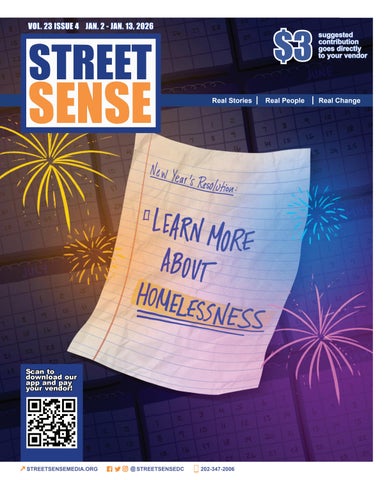
The Cover COVER DESIGN BY ARISHA SHUMAEL
THE TEAM VENDORS Abel Putu, Abraham Aly, Archie Thomas, Aida Peery, Akindele Akerejah, Alia Huag, Amia Walker, Andre Brinson, Andre Baltimore, Andrew Anderson, Angie Whitehurst, Angel Morris Anthony Carney, Apollos Robinson, Bailey Green, Beverly Sutton, Brian Holsten, Brianna Butler, Cameé Lee, Carlos Carolina, Carlton Johnson, Charles Armstrong, Chris Cole, Chon
Gotti, Conrad Cheek, Craig Thompson, Cynthia Herrion, Daniel Ball, Darrel Stone, Darlesha Joyner, David Snyder, Debora Brantley, Degnon Dovonou, Dominique Anthony, Don Gardner, Donald Davis, Drake Brensul, El-OHim, Elizabeth Bowes, Elynora Houston, Eric Glover, Eric Thompson-Bey, Evelyn Nnam, Faith Winkler, Flegette Rippy, Frederic John, Frederick Walker, Gerald Anderson,
Gloria Prinz, Gracias Garcias, Greta Christian, Henrieese Roberts, Henry Johnson, Invisible Prophet, Isaiah Brookings, Ivory Wilson, Jacqueline Gale, Jacqueline Turner, James Davis, James Hughes, James Lyles III, Jay B. Williams, Jeanette Richardson, Jeff Taylor, Jeffery McNeil, Jeffrey Carter, Jemel Fleming, Jenkins Dalton, Jennifer McLaughlin, Jewel Lewis, John Littlejohn, Josie
Brown, Julienne Kengnie, Kenneth Middleton, Kendarius Tucker, Kym Parker, L.Q. Peterson, Laticia Brock, Lawrence Autry, Leo Hughes Jr, Levester Green, Marc Grier, Marcus McCall, Mars, Maurice Carter, Melody Byrd, Melveon Harp, Micheal Pennycook, Michele Modica, Milan Stevenson, Morgan Jones, Nikila Smith, Nitin Khanna, Patricia Donaldson, Patty Smith, Paul Martin, Peggy
Jackson Whitley, Phillip Black, Qaadir El-Amin, Queenie Featherstone, Rachelle Ellison, Randall Smith, Rashawn Bowser, Reginald Black, Reginald Denny, Reneece Brinkley, Ricardo Meriedy, Rita Sauls, Robert Vaughn, Robert Warren, Rochelle Walker, Ron Dudley, Ronnell Wilson, S. Smith, Sasha Williams, Shawn Fenwick, Sheila White, Shuhratjon Ahmadjonov, Starchild BLK, Steve Miller,
Sureyakanti Behera, Sybil Taylor, Tasha Savoy, Tim Holt, Tonya Williams, Tony Morris, Victoria Green, Vincent Watts, Warren Stevens, Wayne Hall, Wendell Williams, Wendy Brown, William Hargrove, William Shuford, Willie Futrelle, William Young, Zero BOARD OF DIRECTORS Ashley McMaster, Blake Androff, Clare Krupin, Chris Curry, Cole Ingraham, David
S T RE E T S E NS E ME DI A . ORG
EDITOR’S NOTE
EVENTS AT SSM
Essential reading for our 2026 reporting
ANNOUNCEMENTS
I
3
□
Stop by the admin office to meet our new employment specialist, Esmat! He can work with you on resumes, job trainings and certificates, interviewing skills, applying for jobs, and more.
□
Is the office closed for a holiday or bad weather? Street Sense follows the federal government (opm. gov/status). Also, you can call the front desk (x101), check your texts or emails from Thomas, or go to the vendor announcements page at streetsensemedia. org/vendor-info.
ANNEMARIE CUCCIA Editor-in-Chief
can’t say this past year was easy. Even before homeless folks in D.C. were thrust into the national spotlight with federally ordered encampment closures, the community was contending with looming budget cuts and sweeping changes in federal policy. Street Sense has done our best to keep up with it all, as a hyperlocal outlet thrown into the middle of national stories. For weeks in August, we were right there with the people we were covering. And we’ve tried to stay there, even as the larger outlets moved on. This year was full of moments I have been exceedingly proud of. Launching a paid vendor reporting fellowship and working with some members of our community to produce their own journalism. Co-publishing two features with Slate, bringing the story of people living outside in D.C. to thousands of readers across the country. Working with the 51st on a multi-year-long project tracking evictions in the District. Watching some of our interns get their first full-time jobs in journalism. Seeing our circulation grow by up to 75% over the year, thanks to you all and our dedicated sales team. I don’t know what the new year will hold, how changes to federal funding for homelessness will affect our neighbors, or what policies mayoral candidates will present to address the city’s housing crisis. I do know Street Sense will do our best to help it all make sense for you, to bring more people with lived experience into our reporting, and to connect with you all, our readers, in new and meaningful ways. So, as 2026 begins, I have a little challenge for you. A resolution for you to take on, if you dare: understand homelessness and the policies that address it just a little better than you did last year. Throughout January, we’ll be publishing portions of our reporter’s glossary of 26 key terms related to homelessness, originally published online in 2024 as part of the Homeless Crisis Reporting Project. While the guide was originally made to help journalists new to writing about homelessness, we think you’ll get a lot out of it. It includes definitions and context for concepts and programs that come up often in our reporting, like low-barrier shelter, permanent supportive housing, and housing first. They can sound complex, but they're the backbone of our country’s response to homelessness, so it helps to have them in your back pocket. My hope is you’ll keep these physical papers to refer to as you read our coverage throughout the rest of the year, and that they’ll enhance your understanding of the often very jargony world we write about (though we’ll keep trying to find other ways to explain the jargon in our articles too — we heard you on the audience survey!) We’ll join you in this resolution, as we work to better our reporting on homelessness and learn how changes will impact our readers, vendors, and neighbors. So, grab a few papers, a coffee, and your glasses; something tells me we’ll all have a lot of reading to do this year!
//
With gratitude, Annemarie
VENDOR CODE OF CONDUCT
John Littlejohn Jan. 1
BIRTHDAYS
Read this democratically elected code of conduct, by vendors, for vendors!
ARTIST/VENDOR
Willie Futrelle Jan. 1
1.
I will support Street Sense Media’s mission statement and in so doing will work to support the Street Sense Media community and uphold its values of honesty, respect, support, and opportunity.
Jan. 6
2.
Lawrence Autry Jan. 13
I will treat all others, including customers, staff, volunteers, and fellow vendors, respectfully at all times. I will refrain from threatening others, pressuring customers into making donations, or engaging in behavior that condones racism, sexism, classism, or other prejudices.
3.
I understand that I am not an employee of Street Sense Media but an independent contractor.
4.
While distributing the Street Sense newspaper, I will not ask for more than $3 per issue or solicit donations by any other means.
5.
I will only purchase the newspaper from Street Sense Media staff and volunteers and will not distribute newspapers to other vendors.
6.
I will not distribute copies of “Street Sense” on metro trains and buses or on private property.
7.
I will abide by the Street Sense Media Vendor Territory Policy at all times and will resolve any related disputes with other vendors in a professional manner.
8.
I will not sell additional goods or products while distributing “Street Sense.”
9.
I will not distribute “Street Sense” under the influence of drugs or alcohol.
10.
I understand that my badge and vest are property of Street Sense Media and will not deface them. I will present my badge when purchasing “Street Sense” and will always display my badge when distributing “Street Sense.”
Ricardo Meriedy
Angel Morris
Jan. 2
ARTIST/VENDOR
ARTIST/VENDOR
Jeanette Richardson Jan. 6
Rochelle Walker Jan. 11
ARTIST/VENDOR
ARTIST/VENDOR
ARTIST/VENDOR
ARTIST/VENDOR
Grant, Jonquilyn Hill,
DIRECTOR
VENDOR
EDITORIAL
ARTISTS-IN-
Debbie Menke
Matt Perra, Michael
OF VENDOR
PROGRAM
INTERNS
RESIDENCE
(Watercolor)
Vaughan Cherubin,
EMPLOYMENT
VOLUNTEERS
Alaena Hunt, Jelina
Alexandra
Nana-Sentuo Bonsu,
Thomas Ratliff
Ann Herzog, Aiden
Liu, Ranee Brady,
Silverthorne
EDITORIAL
Eisenschenk, Beverly
Shani Laskin
(Photography),
VOLUNTEERS
Bonnie Naradzay
Andrew Chow, David
WEB INTERN
(Poetry), David Serota
Fucillo, J.M. Ascienzo,
Zachi Elias
(Illustration), Leslie
Jenna Lee, Madi
Stanley Keeve EMPLOYMENT
Brown, Roberta
CHIEF EXECUTIVE
SPECIALIST
Haber
OFFICER
Esmat Amin
Jacobson (Theater),
Koesler, Mark Rose,
GRAPHIC DESIGN
Roy Barber (Theater),
Rick Young
EDITOR-IN-CHIEF
Brian Carome VENDOR PROGRAM
Annemarie Cuccia
DIRECTOR OF
ASSOCIATES
INTERNS
Willie Schatz
PROGRAMS
Aida Peery, Chon
DEPUTY EDITOR
Arisha Shumael,
(Writing), Molly
Darick Brown
Gotti, Nikila Smith
Donte Kirby
Kevin Akakpo
Pauker (Watercolor),
4 / / S TR E E T S E N S E M ED IA // J AN . 2 - J AN . 13, 2026
DEFINING HOMELESSNESS
DEFINING HOMELESSNESS: A glossary of terms related to housing and poverty
In 2024, Street Sense released the second part to its guide to reporting on homelessness: a glossary of 26 terms to know when reading or writing about homelessness, housing, and poverty. The launch coincided with our annual Homeless Crisis Reporting Project, which coordinates local newsrooms to publish stories on homelessness across one week in October. Over the next month, we will be running parts of the guide, lightly updated for current events, in the paper to give our readers a primer for upcoming reporting this year. This is the first half. The full guide can be found at bit.ly/DCHCRP.
The United States Department of Housing and Urban Development (HUD) defines someone experiencing homelessness as someone who “lacks a fixed, regular, and adequate nighttime residence” and primarily sleeps in a homeless shelter or “a public or private place not meant for human habitation.” This includes people who sleep in parks, tents, cars, abandoned buildings, and bus stations. People who fit these criteria are “literally homeless,” putting them in HUD’s “Homeless Category 1.” Literal homelessness looks different for everyone, but it is a requirement for many homeless assistance programs. Not everyone who identifies as homeless or doesn’t have a safe place to sleep fits the criteria of “literally homeless.” Some people stay in hotels or with friends or family for an extended period without having their names on a lease and while seeking help from the homeless services system. This phenomenon can be called hidden homelessness or doubled-up homelessness, and is not included under the HUD definition of “literal homelessness.” People experiencing doubled-up homelessness may be left out of data, including the Point-in-Time Count.
HUD also identifies three categories of people who may not be experiencing “literal homelessness” but are housing insecure, or otherwise need help from the homeless services system. “Category 2: Imminent Risk of Homelessness” includes individuals or families who will lose their home within two weeks and do not have a place to move to or the resources to secure one, such as families facing eviction. “Category 3: Homeless Under Other Federal Statutes” includes families and unaccompanied youth under 25 who are not “literally homeless” under the HUD definition but may be considered homeless based on definitions other federal assistance programs use, including some people living with friends or family without a lease. Families can also fit this category if they did not have a lease in the 60 days before applying for help from homeless services or if they moved two or more times during the past 60 days. “Category 4: Fleeing/Attempting to Flee Domestic Violence” includes people who are leaving domestic violence, have no safe residence, and lack the resources to move into their own place.
Originally passed in 1987, the McKinney-Vento Homeless Assistance Act was the first federal legislation addressing homelessness. It established funding for an array of assistance programs, including transitional and permanent housing, health care, and food assistance. It also created the U.S. Interagency Council on Homelessness. The legislation has been amended and restructured several times. Today, it’s most often referenced for its education provisions, which require state education agencies to ensure every child experiencing homelessness has equal access to public education. The act provides states with funding, guarantees free travel for students to and from school, and generally aims to reduce educational barriers children experiencing homelessness face. Other programs included in the original McKinney-Vento legislation were amended through The Homeless Emergency Assistance and Rapid Transition to Housing (HEARTH) Act in 2009. The reauthorization of McKinney-Vento in the HEARTH Act currently funds the two federal programs essential to homeless services: the Emergency Solutions Grant Program and the Continuum of Care Program.
The Point-in-Time (PIT) Count is an annual census of people experiencing homelessness. Mandated by the federal government and administered by localities and cities, the PIT Count aims to determine how many people are experiencing homelessness on a given night in a certain area. The count is held nationwide for one night in January. Local governments use PIT data to assess funding needs and progress toward ending homelessness. Jurisdictions have some discretion over how they conduct the PIT, but it usually includes sending out volunteers to speak to each person sleeping outside. Shelter and transitional housing programs also conduct a census of all residents. In addition to counting the number of individuals, surveyors collect demographic information.
The PIT is widely understood to be an undercount. While the survey counts people who meet the HUD definition of “literal homelessness,” it excludes people who may have a different experience with homelessness, like people who are couch surfing or staying with friends or family members. Surveyors may also miss people who sleep in their cars or other hard-to-find spots. A note on the PIT: To the extent they’re accurate, numbers from the count should be understood as representing the demands on a locality’s homeless services system on one night, not across the year. Jurisdictions may serve many times more people experiencing homelessness over a year than they count on a single night.
STREETSENSEMEDIA.ORG
Housing First, a popular approach to ending homelessness, prioritizes moving people into housing as quickly as possible. This is counter to more traditional approaches that have prerequisites, like employment or sobriety.
//
5
Housing First is predicated on the notion that everyone is “ready” for housing, and housing makes it easier to access employment, health care and other services that can prevent homelessness long-term. Supporters advocate moving people off the street into apartments or homes immediately, without first requiring them to go into shelters or transitional housing. The Trump administration has begun to move away from the model, arguing it has not been successful, despite long-standing federal suppot Many housing programs can follow the Housing First model, but it’s most often associated with Permanent Supportive Housing and Rapid Rehousing. While Housing First programs have few to no requirements for someone to be housing-ready, they may still be targeted at specific populations, such as people who have been homeless for over a year.
The Continuum of Care (CoC) is the administrative body that coordinates homeless services in a specific U.S. jurisdiction, usually a city, county, or portion of a state. The CoC generally includes housing providers, homeless service organizations, advocates, victim service providers, local governments, businesses, public housing agencies, school districts, social service providers, mental health agencies, hospitals, housing developers, and people with lived experience of homelessness. Each CoC is managed by one organization known as the “Collaborative Applicant” because it applies for federal funding for the entire CoC. This is the main way the federal government funds local homelessness programs. The CoC is also responsible for the administration of the local Coordinated Entry System and Homeless Management Information System, which means it helps prioritize people in the area for available housing programs. Other city and statewide initiatives may be coordinated through the CoC. Large cities and populous counties/regions will often have a CoC specific to the area. Many states also have one CoC called the “Balance of State” which works with rural and non-metro counties that don’t have their own CoC.
Historially, the U.S. Interagency Council on Homelessness (USICH) has been a federal agency that works with 19 other federal agencies and the private sector to develop a response to homelessness in the country. The ICH publishes a strategic plan to end homelessness and provides policy guidance on topics such as addressing encampments, health care for people experiencing homelessness, and available federal resources. The agency officially believes housing is a human right and advocates for the housing first model. It also supports the decriminalization of homelessness and advocates to center people who have experienced homelessness in policy-making. In 2025, the Trump administration effectively shut down the agency by putting all its staff on leave and removing its authority as much as possible. Locally, about half of U.S. states and territories have their own ICHs to coordinate statewide approaches to homelessness, working in concert with the CoCs.
Median Family Income (MFI), also called Area Media Income (AMI), is a measurement of a family or individual’s income relative to their community. It is used to determine who is eligible for housing and social services programs.
The two terms generally mean the same thing, though the government is more likely to use MFI and the real estate industry is more likely to use AMI. MFI/AMI (also sometimes called the Median Household Income) is the exact midpoint of all incomes within a population, so that 50% of households make more than the MFI and 50% make less than the MFI. HUD calculates the MFI annually for all metropolitan areas and non-metropolitan counties. MFIs are calculated for families of one to eight people. HUD uses the past five years of local MFIs to set income limits for housing programs based on what percent of the MFI a family makes. Generally, a family making 80% or less of the area MFI is considered low income, and a family making 50% or less is considered very low income, though there are exceptions. A third category, extremely low income, is defined as making either less than 30% of MFI or making less than the poverty guideline for the area, whichever income is higher. Each category qualifies families for different programs and levels of support. The categories are also used to measure housing affordability, and some government-subsidized developments are required to build a certain number of units deemed as “affordable” for families at certain percentages of the MFI.
6 / / S TR E E T S E N S E M ED IA // J AN . 21 - J AN . 13, 14, 2026 2025
DEFINING HOMELESSNESS
ROAD TO HOMELESSNESS In diversion, a service provider or social worker addresses the needs of a person who has lost their housing, or is about to, to determine if there are any immediate solutions. Diversion is meant to help a person find temporary or permanent housing that is not a shelter or a form of unsheltered homelessness, since both staying in shelters and outside can be unsafe or harmful. Diversion services are often offered to people when they first contact the homeless services system or go to a shelter. Through diversion, a person might receive help to pay overdue rent, move in with family, stay in a hotel, relocate, or find other options for permanent housing.
Eviction
Diversion
08
A note on language: This use of the term “diversion” is different from when it is used to describe programs intended to prevent long-term incarceration in the U.S. criminal justice system.
09
During an eviction, landlords remove a tenant from their home or apartment. In the United States, the eviction process happens according to different state laws, local laws, federal laws, leases, and court rules.
Generally, landlords are responsible for giving their tenants eviction notices. If the tenant cannot fix the issue (such as by paying past-due rent), they will be served with a summons to appear in civil court, where they rarely have the right to legal representation. If the tenant loses the case, law enforcement will give them a final notice to vacate. Because there are multiple steps to an eviction process, some evictions can happen “informally.” For instance, landlords often threaten eviction before actually serving a notice or filing a case. Some tenants then preemptively move out, unaware they can fix the violation, fight the eviction in court, or find help to pay past-due rent. In the U.S., Black and Latino/a renters, families with children, and individuals who live in low-income neighborhoods are statistically more likely to face eviction.
SHELTERED AND UNSHELTERED HOMELESSNESS An encampment is a tent or group of tents or other temporary structures people live in, usually located in a park, on a sidewalk, or in another public place. Encampments are the most visible form of unsheltered homelessness, which can also include individuals sleeping in doorways, under awnings, and in other makeshift areas. Because of encampments’ visibility, governments often target them, either to provide services and connect residents to housing or to remove the encampment. Encampment residents widely oppose encampment closures, arguing they don’t have an easy way to move their belongings to another place or that other shelter isn’t available. Some added context: While some people may see living in an encampment as a choice, encampment residents commonly say a lack of space or distrust
Encampments
10
in shelters forces them outside. Some have traumatic experiences in shelters and don’t want to return. Shelter rules can dissuade people from going inside, especially those who have pets, want to stay with a partner of another gender, or have possessions they can’t transport. Shelters have limited hours, which can make it hard for people with jobs or other obligations to maintain a bed. Debates over encampments can take different shapes in each locality, but common concerns include cleanliness, whether encampment residents have access to public restrooms and trash cans, the effect on nearby businesses, safety, drug use, and weather, which can pose a danger to those sleeping outside. Some homeless service providers argue closing encampments decreases trust in city services and makes it harder for case managers to stay in contact with clients.
You can see an online version of this guide at bit.ly/DCHCRP under “Reporter’s Glossary.” It includes additional resources and links. The site also has a guide to reporting on homelessness, and articles from Washington, D.C.’s Homeless Crisis Reporting Project. If you have questions about either guide or terms you’d like to see added, email editor@ streetsensemedia.org.
S ST T RE RE E ET TS SE E NS NS E E ME ME DI DI A A .. ORG ORG
Shelters
// //
77
11
Shelters offer temporary overnight beds to people experiencing homelessness. Shelters can be run by nonprofit organizations, the government, faith-based organizations, or some combination of the three. Some shelters have strict entrance requirements and mandate some combination of criminal background checks, additional program participation, sobriety, and identification checks. Shelters with these requirements are also called high-barrier shelters, or dry shelters, if they require sobriety. In low-barrier shelters, also known as low-threshold shelters, the requirements for entry are less strict — for instance, a high-barrier shelter could require residents to participate in daily ministry programs and take a breathalyzer test when entering, but a low-barrier shelter would not. Both types of shelters generally offer beds on a first-come, first-served basis, and are sometimes only open overnight, meaning residents have to leave and remove all their belongings during the day. In some shelters, residents are allowed to reserve a bed after their first night for a certain period. Shelters may also have some higher-barrier beds reserved for people with medical conditions, called respite beds, or other specialized beds. Shelters are normally separated by population, with designated buildings or areas for families, women, men, and youth. Tens or even hundreds of people may sleep in the same room, though some cities offer non-congregate shelters, especially for families. These are more similar to dorm-style housing and offer more privacy.
Day Centers
12
A day center, also known as a drop-in center, offers a safe place for individuals experiencing homelessness to spend the day and take care of their everyday needs. Services may include meals, showers, hygiene items, emergency clothing, laundry, restrooms, computers, medical resources, harm reduction resources, personal protective equipment, and case management. Centers are typically open during the day on weekdays and sometimes over the weekend.
Transitional Housing
13
Transitional housing is a temporary housing program that provides individuals or families experiencing homelessness with a stable living environment and supportive services as they work toward securing permanent housing. It is an intermediate step between emergency shelters and independent housing. Transitional housing programs may offer residents private or shared housing, similar to dorm or apartment-style living, rather than the communal sleeping arrangements found in emergency shelters. The duration of a stay in transitional housing can vary depending on the program and an individual’s needs, but it is generally limited to a specific period, ranging from a few months to a couple of years. The key characteristic of transitional housing is the provision of supportive services to help residents move into permanent housing. These services are tailored to address the needs of individuals or families experiencing homelessness and can include case management, counseling, life skills training, employment assistance, educational programs, substance abuse counseling, and mental health support.
CASE MANAGEMENT AND THE HOUSING PROCESS Most people in the homeless services system receive some form of case management. Broadly, case management is a process that helps people experiencing homelessness or who have recently moved into housing receive support to meet their needs. Case management can involve helping a person secure housing, employment, education, mental and physical health resources, or other forms of help. Case management is mandatory for some governmental and rehabilitation programs.
Service Prioritization Decision Assistance Tool (SPDAT)
15
Case Management
14
Different agencies may use different case management models, like standard case management, intensive case management, clinical case management, assertive community treatment and critical time intervention.
The Service Prioritization Decision Assistance Tool (SPDAT) is widely used by outreach workers to gather information about people experiencing homelessness and determine who needs the most urgent assistance. In many cases, some form of SPDAT is needed to enter a housing program. People are also prioritized for permanent housing, at least partially, based on SPDAT scores. There are multiple variations of the SPDAT, depending on who is being assessed. This includes versions geared towards families (F-SPDAT) and youth (Y-SPDAT). The SPDAT contains 15 sections — or 20 for the family-centered version — that are divided into four categories: wellness, risks, socialization and daily functioning, and housing and homelessness history. The Vulnerability Index – Service Prioritization Decision Assistance Tool (VI-SPDAT) is a brief, self-reported survey that allows organizations with limited resources to prioritize who is given a full SPDAT assessment. The SPDAT has been criticized by program participants and leaders for its rigid methodology, which some say is unreliable and reinforces racial inequalities.
8 / / S T R E E T S E N S E M ED IA // J AN . 21 - J AN . 13, 14, 2026 2025
VENDOR ART
STARCHILD BLK
CRAIG THOMPSON
Artist/Vendor
Artist/Vendor AMIA WALKER
PAUL MARTIN
Artist/Vendor
Artist/Vendor
S T RE E T S E NS E ME DI A . ORG
//
9
JOSIE BROWN
Artist/Vendor
ANDRE BRINSON
Artist/Vendor ANGIE WHITEHURST
Artist/Vendor
JEFFREY CARTER
Artist/Vendor
10 / / S TR T R E E T S E NSE M ED IA // JMAN AR. C2H- 27 J AN - .APR 13,IL2026 9, 2024
OPINION
The indomitable man
2026: My appeal to readers
FREDERIC JOHN
SHUHRATJON AHMADJONOV
Editor’s note: The city closed Daniel Kingery’s encampment this fall, throwing away many of his possessions. Frederic John caught up with him in November, writing a poem and producing this short conversation.
ear Street Sense readers! I propose raising the price of Street Sense to $4. Revenue will be split 75%/25%, meaning $3 will go to the vendor, and $1 to the newspaper’s publication. As a reminder, in March 2024, we raised the price of Street Sense to $3. At that time, the additional revenue was given to the vendors. This time, half the revenue from the increase should go to the vendors, and half should go toward the newspaper’s publication and increased salaries for the newspaper’s staff and journalists. I listed 10 examples of price increases in “My appeal to readers” on Dec. 20, 2023. I’ll give eight more now. I wrote the following before: “Prices for drinking water have increased. For example, a gallon of New Zealand artesian water costs $2.99 at Trader Joe’s. Now it’s $3.99.” The same water costs $4.49 as of October 2025. Second example. On Dec. 20, 2023, I wrote the following: “Before the pandemic, I bought 12 pairs of socks for $11. Now at Walmart, they cost $14.38.” Now those same 12 pairs of socks cost $16.48. Third example. In my first article, I wrote that I started storing my items at Extra Space Storage in 2017. I paid about $100 monthly before the pandemic started, and $127 monthly until October 2023. I received a letter from the company, stating that because of inflation, the rate would increase to $139. In July 2025, I received another letter from the management of Extra Space Storage stating the monthly rent was going up to $197. Fourth example. I get a haircut monthly, a simple one: the hairdresser shortens my hair by less than half an inch, shaves the edges, and washes my hair. Before the pandemic, I paid $20 for this service. In November 2025, I paid $31. Fifth example. I give colorful plastic balls to small children on U.S. and Uzbek national holidays, and Christian and Muslim holidays. They are sold in boxes, each containing 100 balls. Such a box cost about $11 before the pandemic. In 2023, it was for $12.74. The same 100 plastic balls started selling for $16.48 in November 2025. Sixth example. I give flowers to customers of Street Sense in honor of U.S. and Uzbek national holidays, and Christian and Muslim holidays. A bouquet of carnations cost $4.99 before March 2020. It has been sold for $5.99 since January 2025. Twelve roses cost $9.99 before the pandemic. Now they are sold for $10.99 to $12.99. Seventh example. I am 71 years old. I sell Street Sense sitting on a round iron stool. Such a stool cost about $15 at Walmart before the pandemic. Since December 2025, it has been sold for $17.94. Eighth example. A large cup of coffee at Starbucks costs about $2 before the pandemic. During the pandemic, the same coffee sold for about $3. Now, in November 2025, a large cup of coffee costs $4.16. If we compare the price of a Street Sense newspaper and a large cup of coffee, they remain the same. In other words, a reader buys our newspaper at a price equal to one cup of coffee before the pandemic, during it, and now, if we increase the price to $4. Here are some calculations. Currently, Street Sense is published once every two weeks. The newspaper is sold by about 114 active vendors, with sales ranging from 3,717 copies to 5,200 copies this year, per each two-week period. We will assume the average number of Street Sense copies sold is 4,500. After raising prices to $4, an additional $0.50 from each newspaper sold will go toward publishing. The additional income for Street Sense could be $2,250. The additional income for the active vendors could also be $2,250. Each vendor would receive an average additional revenue of $19.70. This increase will significantly help Street Sense employees. A little about the payment to the author of this article. I was paid $50 for my articles “Creating a databank on the activities of the FBI and police, part two,” and “Gratitude,” and $60 for “Suicides, mass murders, and the department of human rights, part three.” Thanks to the Street Sense management for this payment. But experienced journalists won’t write and publish articles for such a sum. After all, they have families and a multitude of other expenses. We, the vendors, strive to write articles, poems, and features for our beloved newspaper. Increasing Street Sense’s price could help increase the compensation for journalists and vendors publishing articles, poems, and features. Street Sense is published with financial support from sponsors. If, for any reason, many sponsors abruptly reduce or cease their financial support for Street Sense, our beloved newspaper, published since 2003, could be forced to cease publication. To prevent this, we must work with you to provide the necessary financial support for the publication of each issue. We can do this by raising Street Sense’s price. One dollar won’t solve your problems. But an additional dollar will ensure the regular publication of Street Sense. Since November 2011, our newspaper has been led by the CEO of Street Sense Media, Brian Carome. He has appealed to Street Sense readers annually requesting financial assistance for the newspaper. Specifically, he wrote the following in his appeal, “Help Street Sense help our vendors!” on Dec. 3, 2025. “Between now and December 31st, we need to raise at least $175,000 from individual donors to fund the next twelve months of programming, including the new employment program. Inspired by a sales team that increased circulation by 75% over the last 10 months, please help us achieve this aggressive goal.” With the pandemic, rising prices, and taxes, donors are finding it difficult to provide financial support. In these circumstances, we can rely on our thousands of readers: if they agree to a $1 price increase for Street Sense, some of the newspaper’s publishing problems and increased salaries for journalists and editorial staff could be successfully resolved. I also advise Street Sense to switch to a weekly publication. This would provide approximately $2,250 in additional weekly revenue. If part of this money is spent on publishing an additional newspaper and paying journalists for additional articles and poetry, a portion of the income will still remain for Street Sense management. Please support my proposal to raise the price of Street Sense to $4. You can call Street Sense Media at (202) 347-2006, email info@streetsensemedia.org, or send mail to 1317 G St. NW, Washington, D.C. We thank you for purchasing our newspaper and thus helping us survive the pandemic and the ongoing price increases.
Determined Dan You are the man! Yes, you can — They moved, they shoved They harshly un-loved you. You suffered, you waited Our breaths were bated. You were contained harshly, yet freedom regained your moves And you elicited your Constitution groove. Now, the vet you proudly proclaim — enforces our belief That you are a determined “Yes, I can,” man! This interview has been edited for length and clarity. Frederic John: We admit your tenacity in staying near the Department of Veterans’ Affairs is remarkable. Daniel Kingery: You gotta remember. I want my A-frame organizer back, and the Coalition for the Homeless rescued my tools and my texts. I stand by my principles listed on this web address: CleanHonestGovernment.com. FJ: What parts of the Constitution are (most) important for Americans, and how do these principles justify you being here? DK: You gotta protect the rights of registered voters to withhold their consent. The Constitution should always be available to all government officials so they understand its full meaning. The Declaration of Independence, tourists are always wanting to see how we appear to deal with our rights, the Declaration spells that out. FJ: It appears people are coming to talk and provide support. What is it they are bringing to the table? Is it helpful? DK: People offer food, I don’t like deep-fried or pork, too much fat. I prefer healthy vegetables and fruits, salads, sometimes chicken if it’s cooked in water. FJ: Since you were roughed up, how have the authorities reacted to you? DK: The soldiers don’t say anything; they just nod, smile, and generally, I remind them to obey the Constitution. FJ: What are your future plans? Are you going to have an operational outpost here, or have you been offered quarters elsewhere? DK: One of the organizations may have something that might help me find a place where I can work on the humanpowered vehicle. FJ: Thanks for your time, Dan. I’m rooting for you! Frederic John is an artist/vendor with Street Sense. Daniel Kingery. Photo by Frederic John
D
Shuhratjon Ahmadjonov is an artist/vendor with Street Sense Media.
S T RE E T S E NS E ME DI A . ORG
//
11
ART
Blocks on blocks
D.C. doesn’t need changes; we do
Tented windows
In the city of Yi, the buildings were tall and made of glass and magnets. There was a fountain underground, you could walk outside and pee in the grates. The water would run through a filter to be cleaned. Then, through the fountain, you drink. Each individual had their own card or object that let them in the buildings and out of the buildings. Once it was secure, the individuals could not go outside or return on their own. Then the restaurants came. Several had to stay inside to eat. They did not have objects to go outside.
WILLIAM SHUFORD Artist/Vendor
Inspired by a true story. Dedicated to the people who get used by love and fall victim to domestic violence, and to people stalked on a daily basis
Christmas time
Rejection recovery
DRAKE BRENSUL Artist/Vendor
Our city’s problems begin with its residents, not its infrastructure. We have too many negative and violent people whose only purpose is to harm regular citizens. But we also have to worry about our police beating people down for doing nothing but standing outside in their communities. So I don’t think any more changes are needed in our buildings or our streets; I just think District residents need to be more caring, more considerate, and kinder to each other. That change starts in our homes and in our schools.
WARREN STEVENS Artist/Vendor
JEANETTE RICHARDSON Artist/Vendor
It’s Christmas time in the city and town. The Christmas trees are decorated with beautiful colors and lights in the city. The tree sales are everywhere in the city, and lots where people drive by, park, and purchase one. I am glad the government shutdown is OVER. The bill was signed on Nov. 13, so people can plan their trip to visit their family and friends out of town for the Thanksgiving and Christmas holidays. We will be getting a snow white Christmas, so the kids can make a snowman. Our Street Sense Media organization had a party on Dec. 10. It was like it was last year, buffet style. There were prizes, Christmas cards, and gift cards for everyone. I took pictures of the Christmas decorations on my phone. So I can show my people the pictures I took. I drove down to my sister’s and her future husband’s home for Thanksgiving and Christmas. For a Thanksgiving brunch, she had people over, and cooked turkey dressing with gravy, candied yams, tossed salads, desserts, ice cream, pies and cookies, egg nog, and wine. We sat back watching the football game, laughing and having fun. For Christmas, got together and decorated the front door with a wreath and ribbon to make it Christmas time. I wrapped little gifts to put under our tree. It was good seeing my son and his girlfriend; it has been a long time since I saw them. I sat back and watched a football game at their townhouse in Largo, Maryland. I got a chance to meet my son’s girlfriend’s daughter, who has a son; he was a bundle of joy. I hope we can get together for the holidays. Next year will be 2026, a fresh start of a new year, with a new football stadium built in Washington, D.C. Enjoy beautiful Christmas music with a friend and a relative
Well, I made it through so many situations as a lonely child who was left alone because my parents did not expect a child or put me before their careers. So I was the hidden child. No one was supposed to know about me. Eventually, I was placed in Junior Village in D.C. Children were left there until their parents returned to get them. But not all parents returned. The children whose parents didn’t return were moved to the Board of Child Care in Randallstown, Maryland. But going there did not end my child care. I went to a few other foster care places. Yet, here I am having just celebrated my 64th birthday! I want to thank the Almighty and everyone who helped me survive that dark road without parents to teach me and love me. Now I’m in a place where I can love and be loved. Amen.
A question to you? JENKINS DALTON Artist/Vendor
We are reading Street Sense today instead of the Washington Post, Washington Times, New York Times, or Baltimore Sun. For our city, you want news you can trust. You can find it on TV stations, radios, restaurants, hotels, supermarkets, apartments for rent, or government offices; you name it, you’ve got it. It’s there.
Technology JAMES LYLES III Artist/Vendor
Technology is a very good thing. Remember that before technology, people had to look up words in the dictionary and research in the encyclopedia. Now, through technology, you can look up a topic you want to write about on a computer and learn about it faster and easier than you could with an encyclopedia or a dictionary. And remember the rotary telephone? We had to look up names and numbers in a small tablet book. Now you can find those names and numbers with your mobile phone. You even have your phone book in it. Yes, technology has its faults, its issues, and its problems. But if we didn’t have it and couldn’t use it, communication would be very slow. We would revert to typewriters and handwritten reports. And we wouldn’t get information flowing to the public as fast as we do now.
School updates
LATICIA BROCK Artist/Vendor
Are my eyes deceiving me, or does this guy at my job keep staring at me? He has the most handsome grin. Of course, it would be against my work protocol to be a personal friend. On the first of the month, payday, he always accompanies this woman. After she gets her money, he’s instantly happy and calls her “baby.” She gives him the money and instructs him to hold it for a withdrawal until she comes back in a couple of days. But, guess what? The money was GONE! He claimed he lost it, but she’s not buying THAT bs. She’s sure he took advantage of her. Used her, even. Her lessons learned: Trust no one, and love can be very costly. Alcohol makes him abusive Drugs make him lose it Why he love you only on payday? Because he has a hidden agenda So be very, very careful When he call you “baby baby’” Being nice will get you hurt They’ll drag your name in the dirt Be careful who you be a friend to Don’t darken your tented windows
How fast does time go by TASHA SAVOY Artist/Vendor
I have learned how time is precious and how time goes by so fast. When holding someone in your arms as an embryo. How fast does time go by? Watching their first steps, listening to their first words. How fast does time go by? Getting their first two teeth, a teething ring, first pair of walking shoes. How fast does time go by? Going through the first trimester of life. How fast does time go by? Walking them through the second trimester of life, first grade through sixth grade. How fast does time go by? Being a helping hand, helping them through the third trimester, seventh, and eighth grades. First graduation, cap and gown, certificate. Growing into a teenager. How fast does time go by? Being there as a friend, parent, guardian, protector, and understanding, and most of all, giving love as a young adult trying to figure life out. That is the fourth trimester, ninth through 12th grade. How fast does time go by? Finally, you see the adult you watched learn and grow understand who they are as a person. How fast does time go by? So cherish each moment. good, bad, ugly, pretty, happy, upset that you can. Because how fast does time go by?
PATRICIA DONALDSON Artist/Vendor
I have to take the renewal test. How long will I have to wait to be signed up for a GED class? I hope they call me back soon, so I can come back to class. The amount of time you have to wait depends on your specific situation. For undergraduate students applying for the first time, the wait is often tied to the school’s application schedule, but for those reapplying after a period away, the timeline varies by institution.
1 2 / / ST REET S E NS E ME DI A / / J AN . 2 - J AN . 13, 2026
ART
Christmas in September
Here comes Christmas!
The truth can change your life
JAMES DAVIS Artist/Vendor
EVELYN NNAM Artist/Vendor
CYNTHIA HERRION Artist/Vendor
After a weekend of protest, marches, and strife, The Secret Service, police, and ICE, Learning of a friend caught up in this mess Led me to a moment of unhappiness
Christmas is coming, happy and bright This special time brings joy and light Snow is white, the tree shines too, With decorations, making everything look new
And on the train, a little boy looked at me and smiled Even though the sentiment only lasted a while This simple gesture gave me the rejuvenation to go the extra mile It gave me such a lift This smile, a simple gift
People are kind and like to share, There’s warmth and wonder everywhere Christmas songs fill the air, We laugh and remember, showing we care
The way more people are choosing kindness, speaking out, and standing up for what's right shows revelations are coming. Shocking ones, and when they hit the surface, many will be stunned. Some will grieve, others will finally understand the depth of what's been hidden from them. But here's the thing. This isn't about blame. It's about awakening, about healing. About bringing everything into the light so it can be transformed. So if you've ever wondered why things feel different lately, why there's a strange charge in the air, now you know. We’re in the final stretch. The last pieces of the puzzle are falling into place, representing life's experiences, memories, people, and the struggles that, when assembled, form the whole of a person’s spiritual journey of understanding. And whether you realize it or not, you're helping make it happen. Keep going strong. Every time you choose love over fear, you strengthen the bonds between people and the grid of light around God, the divine Creator. Every time you meditate, pray, or hold space for healing, you send ripples through unseen realms. That energy is fueling the battle against darkness. It's giving strength to those working in secret to bring justice into the open. This isn't just about the politics of power plays. It's about consciousness. The old customs were built on separation, control, and fear. But now, rising awareness is breaking those chains; people are waking up. Truths hidden for centuries are being revealed. And the light is winning. You can feel it in subtle ways in moments of peace during chaos, in sudden insights that come out of nowhere, in grounded trust that even when things look shaky, something greater is being born because this is it. The final stages of Earth's liberation have begun. And you’re right in the middle of it. Like, you didn't just randomly end up on Earth. We all share one mission: To ease the vibration of the planet and awaken humanity from its long sleep. That's why so many of you have always felt different, like you looked at the world and thought this isn't how things are supposed to be. That feeling wasn't just sensitivity; it was your divine compass pointing you toward your purpose. You've had lifetimes of training, not in schools or universities, but in spiritual growth, in compassion, in resilience. Every challenge you faced, every heartbreak, every moment of doubt, it all prepared everyone for now. For the turning points in Earth's history. And right now, you're doing more than just surviving. You're anchoring light. Every time you choose kindness over cruelty, peace over chaos, truth over lies, you're broadcasting a frequency that changes everything. You're part of the entire shift in the Earth’s energy. You’re helping the planet; you may not see it yet, but your presence matters. More than you can imagine. Just by being here, by staying aware, by remembering who you truly are, you are lighting up the darkness. You are part of a vast network of light workers and awakened souls who are holding the line while the world transforms. Inside you is something ancient and beautiful. The seed of Christ’s consciousness, a pure frequency of unconditional love, unity, and divine knowing. It's woven into your DNA. And now that seed is beginning to bloom. As it does, you start to remember more of your true self. You feel it in moments of deep peace, in flashes of intuition, in dreams that feel like memories from another life. You're not going crazy; you’re waking up! Awakening to the truth you are far more than your human form. You are a multi-dimensional being living a human experience, and every day you get to choose how much of your light you let shine. Don’t be afraid to step into your power. And don’t hold back out of fear of what others might think. The world needs your light now more than ever, so keep going, keep choosing love, and keep standing in truth because you are exactly where you need to be. You were born for this moment.
Homeless wish list JENNIFER MCLAUGHLIN Artist/Vendor
A pinstriped suit or A kick-ass dress Chuck Taylor shoes Drop-dead jeans Tupac shirt A 9-to-5 job PAY. OUR. OWN. WAY!
QUEENIE FEATHERSTONE Artist/Vendor
Deck the halls with boughs of holly? No! Please stop! You, me, us, we don’t live in a hall. But we are very jolly as we decorate our living quarters with bright lights silver and gold garlands and colorful ornaments
At midnight, everything is still A peaceful, quiet, holy chill Christmas wraps the world in light A gift of love that feels just right Every year, Christmas comes around Filling hearts with joy profound Christmas is coming... Christmas is here And we will hold on tight with all our might Merry Christmas, everyone, and remember Jesus is the reason for the season! He loves you very much, And I hope everyone enjoys their Christmas!
Jingle bells, Batman smells Robin laid an egg
Frosty the Snowman is not real in Costa Rica ‘cause they don’t get snow so they just don’t know
Christmas brings families back together, Reminding us love lasts forever We tell old stories by the fire, Feeling happy as the flames go higher We hold special moments in our hearts, Feeling thankful for all the parts Family comes through the door Each year, our home feels fuller than before
Funny Xmas songs It’s Xmas time in the city Hell, it’s Xmas time in the country in the desert even overseas
Everything feels magical at night, Kids’ faces glow with pure delight Our homes feel cozy, safe, and warm A peaceful place away from the storm
Holiday time
Hibernation
DON DAVIS Artist/Vendor
Hibernation is a time to get ready for the winter. You know it’s coming, so get your hats ready, your scarves, your gloves, and coats. It’s a time when the days are shorter, so you must be prepared to do in five hours what you normally get done in eight hours. Even though the time is shortened by the winter, you must be ready for the things that might come, like winter obstacles. Snow and rain in the winter are not something to look forward to. But all in all, I let out a big yawn and come on out my cave.
The time for family and friends. When I was growing up, the holiday time was so good! My brother and my sister and I got together, played games, ate great food, and had wonderful family time. Now, it seems everyone is far away from each other, and is so busy in their lives. And now, most of my family is gone from my life. So I spend time with my friends and look back on the good times in the past.
MARC GRIER Artist/Vendor
S T RE E T S E NS E ME DI A . ORG
//
13
NEWS
Life in the extremes: How environmental inequity contributes to housing instability RANEE BRADY Editorial Intern
O
n the morning of Dec. 5, the District woke to a blanket of snow, the earliest in seven years. As service providers, outreach workers, and elected officials sounded the alarm about hypothermia season, D.C.’s unhoused residents braced for the worst. Some of the same residents who spent the summer seeking shade under highway overpasses or cooling off in air-conditioned libraries are now lining up for hypothermia-season shelter beds, donated coats, and blankets. For people living outside, the shift between extreme heat and cold is not just a change in seasons; it is a compounding cycle that is difficult to survive. Last year, 120 people died while experiencing homelessness in D.C. In 2023, opioid overdoses were a leading cause of death for homeless people. But weather also plays a role, said East Peterson-Trujillo, the campaign director for Green New Deal for D.C., an organization working to bring investment to green housing and safe drinking water. “We’ve seen the numbers of folks who have died while they’re experiencing homelessness or living outside,” said Peterson-Trujillo. “Being outside during extreme heat and extreme cold is life-threatening.” While the constant weather hazards associated with living outside are the most visible link between environmental concerns and homelessness, they’re far from the only ones. Extreme temperatures, chemical exposure risks, and indoor concerns like mold and lead are all factors that exacerbate housing instability, leading to health issues, self-evictions, and displacement.
Environmental exposure as a housing issue Across D.C., residents live at the intersection of environmental hazards and housing instability. Extreme heat emergencies in D.C. have grown more frequent and severe in the last decade, and unhoused residents face the highest exposure. A 2022 DCist analysis found climate impacts fall hardest on residents living in or near the city’s heat islands, where pavement, lack of shade, and tightly-clustered industrial sites raise temperatures by as much as 20 degrees above other neighborhoods. These heat islands align with low-income areas of the District, according to 2018 findings from a team of climate scientists. The impact of extreme heat falls along racial lines as well; studies show heat islands overlap closely with majority-Black neighborhoods, often due to redlining policies and credit restrictions that historically segregated minorities from white populations. Few places illustrate this issue more clearly than Ivy City. The neighborhood sits near the heart of Ward 5, which contains half of all industrial land in the District, according to Anthony David Jr., an environmental justice organizer with Empower DC. In Ivy City, the New York Avenue Men’s Shelter, which plans to expand to 407 beds by 2027, sits directly across the street from a train yard and Amtrak maintenance facility and a few blocks down from the National Engineering Products (NEP) facility, which has faced complaints of toxic air pollution. Not only is this neighborhood one of D.C’s main heat islands, David said, but residents are also vulnerable to toxic materials. “Those unhoused men aren’t only getting chemical exposures, they’re also experiencing temperatures 10 to 20 degrees hotter than the rest of the city,” said David. “That’s a major, direct correlation between industrial land use and homelessness.”
The NEP facility near the men’s shelter was the subject of a June 16 lawsuit that accused the chemical product manufacturer of emitting toxic fumes and endangering nearby residents. Community members testified at a Dec. 11 hearing in support of legislation that would enable the mayor to use eminent domain to acquire the facility, which shares a wall with a family home. The testimonies included claims of headaches, nausea, and respiratory discomfort due to chemical vapors emitted from the facility. In addition to pollution, exposure to extreme temperatures can also affect housed residents facing poor housing conditions, who may not always have access to air conditioning. Although electricity disconnections are prohibited during heat and cold emergencies, some residents told Street Sense in 2024 that didn’t go far enough. “Extreme heat kills, and we know that unhoused residents and those without adequate resources face the greatest risk.” Ward 4 Councilmember Janeese Lewis George wrote in a statement to Street Sense. “When I think about constituents struggling in rental units without air conditioning during heat waves — or worse, facing eviction into dangerous conditions — it’s clear that housing is literally a matter of life and death, and we must treat it that way.” This fall, Lewis George, one of the council’s most outspoken voices on climate and racial justice, introduced the Extreme Heat Eviction Prevention Act of 2025. The bill would prevent housing providers from evicting tenants on any day when the temperature is predicted to be above 95 degrees. This mirrors the protections already in place during hypothermia season. The bill waits to be debated in committee after a Nov. 20 public hearing. At the hearing, housing advocates said the bill was a critical form of climate adaptation for the District’s most vulnerable residents. Lewis George emphasized these protections also buy time for tenants to access rental assistance or resolve disputes without being thrown into homelessness during extreme weather. “Just as we don’t allow evictions when temperatures drop below freezing during the extreme cold of winter, we shouldn’t force families onto the streets when extreme heat poses an equally deadly threat,” she wrote.
Lead, mold, and environmental displacement Extreme temperatures are not the only environmental factor determining who stays housed and who does not. Environmental degradation issues extend indoors as well. Peterson-Trujillo has worked extensively on D.C.’s lead-in-water crisis, which was first exposed in 2000 and is ongoing, with D.C. Water estimating over 41,000 lead pipes remain in the District “There are more lead pipes left in Wards 7 and 8, areas that are majority Black and majority low-income,” Peterson-Trujillo said. Residents can replace their lead pipes for free from DC Water, under a voluntary program that can lead to unintended costs. While they wait, the health risks compound with the economic ones. People across D.C., according to PetersonTrujillo, are choosing to leave rather than endure unhealthy conditions and high rent. “The cost for replacing lead pipes is just exorbitant,” Peterson-Trujillo said. “Some folks may find that between the damaging exposure from lead in their homes and the increasing unaffordability of rent in the District that maybe it makes sense for them to go somewhere else.”
Beyond drinking water, David highlighted other unsafe indoor conditions in some of D.C.’s more affordable housing units, like poor air quality and pests, that increase the risk of health concerns. “A lot of these units have a lot of ‘slumlords,’ as well that really exacerbate the experiences of homelessness. Because a lot of our residents who are living in affordable units are living in units that have poor air quality due to the existence of rats, HVAC systems, and such, that exacerbates health issues like asthma as well,” he said. That dynamic mirrors broader anti-displacement concerns. Peterson-Trujillo pointed to the Healthy Homes Act, a pilot program in Ward 7 that gives low-income families free upgrades like electric heat pumps and energy-efficient appliances. They argue programs like this help residents stay in their homes instead of being pushed out by rising utility costs or unsafe conditions. Without similar large-scale investments, advocates fear environmental hazards will push residents into homelessness or out of the District. The same cycle is visible in cases where residents stop paying rent to protest dangerous living conditions, but are subsequently evicted from their units, according to Empower DC. “I’ve met residents living with mold, with lead, with rats, and landlords don’t address it,” David said. “Residents fight back, but that often leads to evictions. Then they’re in court, missing work, and sometimes they don’t even know they have a court date.”
Community solutions and climate resiliency Some potential solutions are emerging, not only in the council, but also from community members themselves. The Ivy City Resilience Hub Eminent Domain Authority Act of 2025 would not only close the NEP facility named in the chemical exposure lawsuit, but it also proposes converting the site into one of the city’s only climate resiliency hubs. “These hubs are places people can go during extreme heat or extreme weather, somewhere to charge their phones, get water, stay safe,” David said. “Right now there’s only one in the entire city.” To advocates, a “climate resiliency hub” is what environmental adaptation must look like on the ground: resident-led yet integrated with long-term housing protections at the policy level. “Beyond heat protections, we need stronger rent control, fully-funded voucher programs, major investments in deeply affordable housing like the Housing Development Growth Act, and better enforcement against landlords who fail to maintain safe, habitable conditions,” Lewis George wrote. Green New Deal for D.C., meanwhile, is pushing for social housing, which would create government-owned, mixedincome buildings with one-third of units set aside for residents earning under 30% of the area’s median income. “We need more deeply affordable housing,” PetersonTrujillo said. “Being priced out is one of the biggest things that pushes people into living outside.” Advocates stress the stakes are higher for those facing housing instability, not just because they lack consistent shelter, but because D.C.’s environmental landscape is already unequal. “Climate change disproportionately harms low-income residents and communities of color,” Lewis George wrote. “We can’t separate environmental justice from housing justice when people are dying in inadequate housing during heat waves.”
14 / / S TR E E T S E N SE M ED IA // J AN . 2 - J AN . 13, 2026
FUN & GAMES
CROSSWORD Back it Up
Puzzle by Patrick “Mac” McIntyre SOLUTION: Subtly Stated
Across 1. –––– as a pin 5. Opp. of width (abbr.) 9. A sharp’s musical alias 14. One : a dozen :: ____ : a foot 15. “Dies ___” (hymn) (Lat. for “Day of Wrath”) 16. ABC’s legendary “Nightline” and “20-20” creator Arledge 17. ___ bag 18. Hardly racy 19. Bad lighting? 20. What CSI team members have expertise in finding (2 wds.) (5,8) 23. “My apologies” (2 weds.) (2,5) 24. Black Sea port or Texas oil city (SEA SOD anagram) 27. Bleat sound 28. Where to see the Colosseum and St. Peter’s Basilica (2 wds.) (2,5) 29. Summertime trio? 32. Back of a boat 35. Instrument in a wind quintet 36. “Skip to My ___” 37. One of the times when the big hand’s on XII and the small hand’s on VIII (2 wds.) (5,2) (incls. abbr./init.) 40. Draft letters (abbr./init.) 41. Cellar, in real estate ads (abbr.) 43. Blood carrier 44. Thrice, in prescriptions (Lat. abbr.) 45. “Goodness gracious!?” (3 wds.) (2,2,3) 48. “C’mon, ____ it; it’s good” 50. The rope or the wrench in the Clue board game 51. Shell filling station with salsa options? (2 wds.) (4,3) (ACROBAT anagram) 55. Take the totally opposite path... or a hint to the shady turnarounds in 20-, 28-, 37- and 45-Across (2 wds.) (7,6)
1
____PUZZLE Issue LAST EDITION’S SOLUTION 1 14 17 20
27 36 39 44 48
54 65 68 71
D
2
O
3
R
4
R
H
E
E
U
N
B
E
M
O
A
N
R
28
E
29
I
E
N
C
A
N
O
L
U
N
M
I
S
S
55
U
56
23
40
52
5
K
15 18
L A
O
I
N
C
D
41
S
A
P
D
Y
Z
66
37
U
N
C
O
N
D
I
A
N
E
S
T
R
E
W
6
57
7
L
8
V
A
L
E
V
A
S
A
N
L O B
21
30
42
P E N D
58
69 72
R
31
P
32
R
N
D
O
T
A
M
A
R
O
P
59
I
60
16 19
25
O
A
A
9
E
I
45 49
I
O
E
E
E
24
P
L
B E A R
26
38 43
46
53
67
H R S
I
T
I
D
E
E
O P
S
M
U
T
50
61
O
10
F
11
F
12
E
13
R
B
U
O
N
O
I
L
I
T
Y
L
A
S
S
22
R
S
A
T
D
O
N
N
A
S
P
E
C
K
R
U
E
T
E
D
I
51
N
R C 70 73
47
A
O N
33
62
I
E
34
63
O
A
35
64
N
N
A
L
L
Y
D
I
M
E
E
A
S
T
58. Fractional monetary units used in Bangladesh and India and Nepal and Pakistan (pl. ending) (SEPIA anagram) 60. “Awright!” 61. Make in an oven 62. Sorrow (DROOL anagram) 63. Word that sounds like its first and last letters 64. Money is said to be the “root” of all of it 65. “In like ____” 66. The object called “Rosebud” in “Citizen Kane,” for one 67. Two-thousand lb. units Down 1. “The Untouchables” villain Frank 2. Vast, in verse 3. Serve in the capacity of (2 wds.) (3,2) 4. Corn on ____ (2 wds.) (3,3) 5. Well-read individuals; intelligentsia (Lat. pl. ending) (RETAIL I.T. anagram)
2
3
4
5
6
7
8
9
14
15
16
17
18
19
20
21
24 27 30
31
33
34 38
42
39
47
48
53
54
49
51
59
26
44
50 55
25
40
43 46
45
13
35
37
41
12
28 32
36
58
11
22
23
29
10
56
52
57
60
61
62
63
64
65
66
67
6. On the ____ train (rolling in dough) 7. Romance thriller novelist Hoag 8. Take in seriously, as advice or warnings 9. Chastain of women’s soccer or singer/songwriter Carlisle 10. A ____ be reckoned with (formidable opponent) (2 wds.) (5,2) (ROTC FOE anagram) 11. Doesn’t quite break even at the casino (3 wds.) (5,1,3) 12. “I’ll take that as ___” (2 wds.) (1,2) 13. Ring count 21. Wipe clean, as a blackboard 22. Many, many moons 25. Ski run 26. Per annum (2 wds.) (1,4 28. Foreword (abbr.) 29. Macaroni shape 30. Legendary Six-Day War statesman Dayan of Israel 31. How federal workers have been terminated by DOGE 33. “Good grief!” 34. Pi follower in the Greek alphabet 38. Like many 58-Downs nowadays 39. Pool shout heard shortly before a responding “Polo!” 42. Uses a computer or laptop keyboard (2 wds.) (5,2) 46. Rule over 47. It’s next to nothing 49. “Abso-friggin’-lutely!”, old-style (2 wds.) (3,3) 51. Poke good-spirited fun at 52. “Fantastico!” (Ital.) 53. Invite to enter (2 wds.) (3,2) 54. Film units, or some dances 56. Bakery selections 57. Close, as an envelope 58. Common digital doc format (abbr./init.) 59. Early ISP associated with “You’ve got mail!” (abbr./init.)
This crossword puzzle is the original work of Patrick “Mac”McIntyre. It is provided to us courtesy of Real Change News, a street paper based in Seattle, Washington. Learn more about Real Change News and the International Network of Street Papers at realchangenews. org and insp.ngo.
S T RE E T S E NS E ME DI A . ORG
COMMUNITY SERVICES
SHELTER HOTLINE Línea directa de alojamiento
(202) 399-7093
YOUTH HOTLINE Línea de juventud
DOMESTIC VIOLENCE HOTLINE Línea directa de violencia doméstica
(202) 547-7777
1-800-799-7233
Housing/Shelter Vivienda/alojamiento
Education Educación
Health Care Seguro
Clothing Ropa
Legal Assistance Assistencia Legal
Case Management Coordinación de Servicios
Food Comida
Employment Assistance Assitencia con Empleo
Transportation Transportación
Showers Duchas
All services listed are referral-free Academy of Hope Public Charter School 202-269-6623 // 2315 18th Pl. NE 202-373-0246 // 421 Alabama Ave. SE aohdc.org
Bread for the City 1525 7th St., NW // 202-265-2400 1700 Marion Barry Ave., SE // 202-561-8587 breadforthecity.org
Calvary Women’s Services // 202-678-2341 1217 Marion Barry Ave., SE calvaryservices.org
Food and Friends // 202-269-2277 (home delivery for those suffering from HIV, cancer, etc) 219 Riggs Rd., NE foodandfriends.org
Foundry Methodist Church // 202-332-4010 1500 16th St., NW foundryumc.org/idministry Identification services Friendship Place // 202-364-1419 4713 Wisconsin Ave., NW friendshipplace.org
Catholic Charities // 202-772-4300 catholiccharitiesdc.org/gethelp
Georgetown Ministry Center // 202-338-8301 1041 Wisconsin Ave., NW georgetownministrycenter.org
Central Union Mission // 202-745-7118 65 Massachusetts Ave., NW missiondc.org
Jobs Have Priority // 202-544-9096 1526 Pennslyvania Ave., SE jobshavepriority.org
Charlie’s Place // 202-929-0100 1830 Connecticut Ave., NW charliesplacedc.org
Loaves & Fishes // 202-232-0900 1525 Newton St., NW loavesandfishesdc.org
Christ House // 202-328-1100 1717 Columbia Rd., NW christhouse.org
Martha’s Table // 202-328-6608 marthastable.org
Church of the Pilgrims // 202-387-6612 2201 P St., NW (1-1:30 on Sundays only) churchofthepilgrims.org/outreach
Community Family Life Services 202-347-0511 // 305 E St., NW cflsdc.org
2375 Elvans Rd, SE 2204 Martin Luther King Ave. SE
Miriam’s Kitchen // 202-452-8926 2401 Virginia Ave., NW miriamskitchen.org
My Sister’s Place // 202-529-5991 (24-hr hotline) mysistersplacedc.org Community of Hope // 202-232-7356 4 Atlantic St., NW communityofhopedc.org
Covenant House Washington 202-610-9600 // 2001 Mississippi Ave., SE covenanthousedc.org
N Street Village // 202-939-2076 1333 N St., NW nstreetvillage.org
New York Avenue Shelter // 202-832-2359 1355-57 New York Ave., NE
D.C. Coalition for the Homeless 202-347-8870 // 1234 Massachusetts Ave., NW dccfh.org
Patricia Handy Place for Women 202-733-5378 // 810 5th St., NW
Father McKenna Center // 202-842-1112 19 North Capitol St., NW fathermckennacenter.org
Samaritan Inns // 202-667-8831 2523 14th St., NW samaritaninns.org
Laundry Lavandería
Samaritan Ministry 202-722-2280 // 1516 Hamilton St., NW 202-889-7702 // 1345 U St., SE samaritanministry.org
//
15
BEHAVIORAL HEALTH HOTLINE Línea de salud del comportamiento
1-888-793-4357
JOB BOARD Various positions Costco // Washington, D.C. Full-time/ Part-time
Sasha Bruce Youthwork // 202-675-9340 741 8th St., SE sashabruce.org
So Others Might Eat (SOME) // 202-797-8806 71 O St., NW some.org
Hiring opportunities may include: cashier assistant, food service assistant, stocker, service deli assistant, gas station attendant, member service assistant, tire installer, cashier, forklift driver, membership clerk, production assistant, distribution assistant, and production line assistant. Required: N/A
St. Luke’s Mission Center // 202-363-4900 3655 Calvert St., NW stlukesmissioncenter.org
Thrive DC // 202-737-9311 1525 Newton St., NW thrivedc.org
Unity Health Care unityhealthcare.org - Healthcare for the Homeless Health Center: 202-508-0500 - Community Health Centers: 202-469-4699 1500 Galen Street SE, 1251-B Saratoga Ave NE, 1660 Columbia Road NW, 4414 Benning Road NE, 3924 Minnesota Avenue NE, 765 Kenilworth Terrace NE, 850 Delaware Ave., SW, 3240 Stanton Road SE, 3020 14th Street NW, 425 2nd Street NW, 4713 Wisconsin Avenue NW, 2100 New York Avenue NE, 1333 N Street NW, 1355 New York Avenue NE, 1151 Bladensburg Rd., NE, 4515 Edson Pl., NE
Washington Legal Clinic for the Homeless 1200 U St., NW // 202-328-5500 legalclinic.org
Apply: tinyurl.com/DCCostco Various positions Ben’s Chili Bowl // Washington, D.C. Full-time/ Part-time Ben’s Chili Bowl is seeking individuals with a commitment to exceptional guest service in the restaurant industry to join! Bring your positive attitude and a huge smile to our fast paced environment! Full and Part time positions available at the U Street and H Street locations. Flexibility to work weekends, holidays, and nights a plus! Required: N/A Apply: tinyurl.com/BensChiliDC CDL shuttle driver Medstar Washington Hospital // Washington D.C. Full-time/ Part-time
The Welcome Table // 202-347-2635 1317 G St., NW. epiphanydc.org/thewelcometable
LAZ CDL driver is responsible for the effective, efficient and safe transportation, loading and unloading of passengers and employees to and from the assigned destinations, and to ensure that all activities support the safety and welfare of all passengers.
Whitman-Walker Health 1525 14th St., NW // 202-745-7000 1201 Sycamore Dr., SE whitman-walker.org
Required: 2+ years with a CDL w/ passenger endorsement and Class A/B license. Apply: tinyurl.com/CDLshuttleMedstar
Woodley House // 202-830-3508 2711 Connecticut Ave., NW
For further information and listings, gs, visit our online service guide at StreetSenseMedia.org/service-guide
Hiring? Send your job postings to editor@StreetSenseMedia.org
JAMES HUGHES
Artist/Vendor
AIDA PEERY
Artist/Vendor
GLORIA PRINZ
Artist/Vendor
Two plans, same promise… we got you. From Medicaid to the new Healthy DC plan, two coverage options designed to fit your life today.
Thank you for reading Street Sense! From your vendor, JAN . 2 - J A N . 1 3 , 2 0 2 6 | VOLUME 23 ISSUE 4
Don’t miss open enrollment. Now through January 31.
NO CASH? NO PROBLEM. WE HAVE AN APP! SEARCH “STREET SENSE MEDIA” IN THE APP STORE
WWW.INSP.NGO
3.2 million READERS
5,700 VENDORS
90+
STREET PAPERS
35
COUNTRIES
25
LANGUAGES