$3
VOLUME 23 ISSUE 21 AUG. 26 - SEPT. 8, 2026
Real Stories
Real People
suggested contribution goes directly to your vendor
Real Change
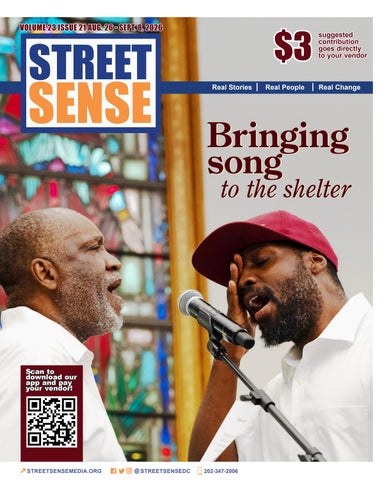
Bringing song
to the shelter
Scan to download our app and pay your vendor!
STREETSENSEMEDIA.ORG
@ STREETSENSEDC
202-347-2006
2 / / S T R E E T S E N S E M ED IA // AU G . 26 - SEPT. 8, 2026
I
OUR STORY ARTISTIC WORKSHOPS
n 2017, we began hosting a number of different workshops aimed at helping our vendors develop skills beyond writing for our newspaper. On any given day, our vendors are illustrating, painting, recording podcasts, taking photos, rehearsing plays, organizing advocacy groups, and coming together as a community.
We ran
8
Last year, artists/vendors performed a self-written show, sold their art,
workshops in 2025
THE THETEAM TEAM VENDORS Abel Putu, Abraham Aly, Aida Peery, Akindele Akerejah, Alia Haug, Amia Walker, Andre Brinson, Andre Baltimore, Andrew Anderson, Angie Whitehurst, Angela Morris, Anthony Carney, Apollos Robinson, AnToinette Richardson, Archie Thomas, Beverly Sutton, Brian Holsten, Brianna Butler, Cameé Lee, Carlos Carolina, Carlton Johnson, Charles Armstrong,
We publish vendor art and writing every week! Chris Boone, Chris Cole, Chon Gotti, Conrad Cheek, Craig Thompson, Cynthia Herrion, Daniel Ball, Darlesha Joyner, David Snyder, Debora Brantley, Degnon Dovonou, Deonte Savoy, Dominique Anthony, Don Gardner, Drake Brensul, El-O-Him, Elizabeth Windsor, Elynora Houston, Eric Jamison, Eric Thompson-Bey, Evelyn Nnam, Faith Winkler, Five FiftyOne, Flegette Rippy, Frankey Barrz, Frederic John, Frederick
Walker, Gerald Anderson, Gloria Prinz, Greta Christian, Henry Johnson, Indashow Birmandie, Invisible Prophet, Ivory Wilson, Jacques Collier, Jacqueline Gale, Jacqueline Turner, James Davis, James Hughes, James Lyles III, Jay B. Williams, Jeanette Richardson, Jeffery McNeil, Jemel Fleming, Jenkins Dalton, Jennifer McLaughlin, Jewel Lewis, John Littlejohn, Josie Brown, Julienne Kengnie, Kenneth
Bynum, Kenneth Middleton, Katrina Anige, Kimberley Shattuck, Kym Parker, L.Q. Peterson, Lawrence Autry, Leo Hughes Jr, Levester Green, Lillie Thomas II, Marc Grier, Marcus McCall, Marquis Savant, Mars, Maurice Carter, Melody Byrd, Michele Helies, Milan Stevenson, Monique Rivers, Nikila Campbell, Patricia Donaldson, Patty Smith, Paul Martin, Phillip Black, Qaadir El-Amin, Queenie Featherstone,
and joined a new watercolor workshop!
The Cover DESIGN BY ANNABEL FURTON, PHOTO BY JULIAN SCHNITTKER
Rachelle Ellison, Randall Smith, Rashawn Bowser, Reginald Black, Reginald Denny, Reneece Brinkley, Ricardo Meriedy, Richard Mooney, Rita Sauls, Robert Reed, Robert Warren, Rochelle Walker, Ron Dudley, Ronnell Wilson, S. Smith, Sasha Williams, Sharon Brown, Shawn Fenwick, Sheila White, Shuhratjon Ahmadjonov, Starchild BLK, Susan Wilshasen, Sybil Taylor, Tasha Savoy, Tonya Williams, Vincent
Watts, Warning Label, Warren Stevens, Wayne Hall, Wendell Williams, Wendy Brown, William Hargrove, William Shuford, Willie Futrelle, William Young, Zero BOARD OF DIRECTORS Clare Krupin, Chris Curry, Cole Ingraham, David Grant, Jonquilyn Hill, Mary Casale, Matt Perra, Michael Vaughan Cherubin, Nana-Sentuo Bonsu, Phil Telfeyan
S T RE E T S E NS E ME DI A . ORG
NEWS IN BRIEF
//
3
EVENTS AT SSM ANNOUNCEMENTS
D.C.’s Martin Luther King Jr. Memorial Library began preventing people from sleeping or sitting near the building in July. Photo by Chih-Rong Kuo
Three weeks in, no one has been arrested under MLK Library sleeping ban
Gerald Anderson Sept. 7 ARTIST/VENDOR
ARTIST/VENDOR
CHIEF EXECUTIVE
Angie Whitehurst Sept. 8
EMPLOYMENT
VENDOR
EDITORIAL
ARTIST/VENDOR
ARTISTS-IN-
EDITORIAL
OFFICER
SPECIALIST
PROGRAM
INTERNS
RESIDENCE
VOLUNTEERS
Brian Carome
Esmat Amin
VOLUNTEERS
Alexandra Lalli, Chih-
Alexandra Silverthorne
Anne Eigeman,
Ann Herzog, Beverly
Rong Kuo, Julian
(Photography),
Cari Shane, Chloe
DIRECTOR OF
VENDOR
Brown, David Fucillo,
Schnittker, Natalie
Bonnie Naradzay
DiStaso, David Fucillo,
PROGRAMS
PROGRAM
Mark Fehling, Roberta
Note, Raina Pawloski
(Poetry), David Serota
Guilherme Oliveira,
Darick Brown
ASSOCIATES
Haber
(Illustration), Debbie
Ingrid Gillies, Kathryn
DESIGN INTERNS
Menke (Watercolor),
Owens, Natalie
EDITOR-IN-CHIEF
Annabel Furton,
JM Ascienzo (Yoga),
Kinkead, Nora Scully,
Annemarie Cuccia
Keilah Tumaob
Molly Pauker
Madi Koesler, Sara
(Watercolor), Willie
Mangelsdorf
Aida Peery, Chon DIRECTOR OF VENDOR
Gotti, Nikila Campbell
EMPLOYMENT Thomas Ratliff
DEPUTY EDITOR Donte Kirby
Schatz (Writing)
□
Trying to stay cool? You can always pick up a bottle or two of cold water in the admin office!
□
Find a list of vendor announcements and other useful information just for you at streetsensemedia. org/vendor-info.
Faith Winkler Aug. 27
N
Queenie Featherstone Aug. 29
The August vendor meeting is Friday, Aug. 28, from 2:00 p.m. - 3:00 p.m. Come for business, community, and pizza!
BIRTHDAYS
CHIH-RONG KUO Editorial Intern
o arrests, warnings, or barring notices have been issued to people experiencing homelessness since Martin Luther King Jr. (MLK) Memorial Library began its 90-day pilot program to enforce a ban preventing people from sleeping outside the building on July 6. While sleeping under the library’s loggia, the covered outdoor area belonging to the MLK Library, has long been a violation of the D.C. Public Library (DCPL)’s code of conduct, around 60 people sought shelter and slept under the loggia regularly before the enforcement began this summer. It was one of the last places downtown where people experiencing homelessness regularly sought shelter outside. The library is a centralized location where people can meet caseworkers, connect with services, and receive additional resources. Since the ban, some people who formerly slept under the loggia have relocated, which caseworkers worry will disconnect them from available resources. The MLK Library began enforcing the sleeping ban to address poor conditions outside the library, according to a DCPL spokesperson. “The Library is enforcing rules related to the Loggia because conditions in that area have created a barrier to participation at the MLK Library. Enforcement removes that barrier,” the spokesperson wrote. “Complaints from community members about the conditions under the loggia include intimidation, urination, defecation, violence, theft, drug use and litter.” The enforcement was structured in three phases, beginning with a warning period from July 6 to July 19, when library police informed people being on library property after the building was closed could result in bars and arrests. Following this phase, from July 20 to Aug. 3, library police were authorized to serve bar notices to any person who slept under the loggia and refused to move, prohibiting them from being on DCPL property. After Aug. 3, library police could arrest any person who refused to leave the property after being warned or barred for trespassing. However, no arrests, warnings, or bar notices have been issued as of Aug. 24, according to DCPL. “From July 6 to July 19 Library police informed people that being on Library property after the building closes could subject them to being barred from the Library,” the DCPL spokesperson wrote. “Since that initial outreach, there has not been a violation of the regulations related to the loggia.” Police cars and police officers have been stationed under the loggia overnight during the pilot, and a rope barrier blocks off the loggia. In July, people sleeping outside the library told Street Sense few folks had attempted to cross the barrier, which would have resulted in warnings or arrests. Some people have moved closer to the road, outside of the zone the ban applies to and away from the protection of the loggia. It is unclear whether DCPL plans to continue enforcing the no-sleeping ban after the 90 days, but the results from the pilot are expected to inform DCPL’s decision-making. The pilot is slated to end Oct. 4.
□
ARTIST/VENDOR
Levester Green Aug. 27 ARTIST/VENDOR
VENDOR CODE OF CONDUCT Read this democratically elected code of conduct, by vendors, for vendors! 1.
I will support Street Sense Media’s mission statement and in so doing will work to support the Street Sense Media community and uphold its values of honesty, respect, support, and opportunity.
2.
I will treat all others, including customers, staff, volunteers, and fellow vendors, respectfully at all times. I will refrain from threatening others, pressuring customers into making donations, or engaging in behavior that condones racism, sexism, classism, or other prejudices.
3.
I understand that I am not an employee of Street Sense Media but an independent contractor.
4.
While distributing the Street Sense newspaper, I will not ask for more than $3 per issue or solicit donations by any other means.
5.
I will only purchase the newspaper from Street Sense Media staff and volunteers and will not distribute newspapers to other vendors.
6.
I will not distribute copies of “Street Sense” on metro trains and buses or on private property.
7.
I will abide by the Street Sense Media Vendor Territory Policy at all times and will resolve any related disputes with other vendors in a professional manner.
8.
I will not sell additional goods or products while distributing “Street Sense.”
9.
I will not distribute “Street Sense” under the influence of drugs or alcohol.
10.
I understand that my badge and vest are property of Street Sense Media and will not deface them. I will present my badge when purchasing “Street Sense” and will always display my badge when distributing “Street Sense.”
4 / / S TR E E T S E N S E M ED IA // AU G . 26 - SEPT. 8, 20 26
NEWS
UPO director and participant share their experiences with the program REGINALD BLACK Vendor Journalism Fellow
T
he United Planning Organization (UPO) is a nonprofit focused on providing economic security for D.C. residents. Now, the organization has expanded its responsibilities to include the District’s Permanent Supportive Housing program (PSH). UPO has, for a long time, been contracted by the D.C. Department of Human Services to run the shelter hotline, which provides transportation to shelter or comfort items to those not wishing to come inside. In addition, UPO is one of the District of Columbia’s Community Action Agencies. These organizations typically provide services through the Community Services Block Grant. UPO’s core programming includes Electronic Benefits Transfer training and card creation, early learning through the federal Head Start program, and workforce development. The PSH program boasts a familiar face to housing and homeless services in D.C.: Vanessa Austin, who has been serving homeless clients in various roles for more than a decade. Austin is currently the director for UPO’s PSH program. Austin and Norris Charles, a participant in the program, shared with Street Sense their experience and thoughts about the program and the role UPO can play in homeless services. These interviews have been edited for length and clarity.
Vanessa Austin, UPO PSH program director Reginald: Are you originally from D.C.? Vanessa: No, I’m originally from a little island. I migrated here when I was 7. I lived in New York, and then moved to D.C. in 2006. And have been here since. How long have you worked in homeless and housing services? Since 2006. I worked with, back then, it was called Transitional Housing Cooperation, now known as Housing Up. From there, I worked with D.C.’s Department of Human Services (DHS), left DHS, and came to UPO. What is your role in the UPO? I am the director of the housing program. How large is the UPO’s housing program, and who does the program serve? Our PSH housing program serves homeless clients within the District. We have 206 clients who we serve from Wards 1 through 8 in both our tenant-based portfolio and site-based portfolio. This property [Dix Street Residences] is unit-based. Why is it important for UPO to be involved in PSH? I think UPO is trying to end homelessness one person at a time. We are trying to make sure people have economic security and trying to give back to the community we’re part of. Are there things readers can do to support UPO’s housing program? Yes, we always welcome donations. We don’t have assistance to help clients with things like furniture and utensils, so we’re always willing to partner with anyone who will be willing, especially when leasing up new clients. It’s hard. A start-up kit, like cleaning supplies, bed linen, anything helps. Cause most of our clients are coming off the streets with nothing. Is there anything else you would like our readers to know? UPO is a wonderful program. We have a plethora of services, not only housing. You know, we’ve got our workforce development, we’ve got the early learning centers, we have our EBT program. We have different things; it’s a one-stop shop, and our biggest thing is our shelter hotline. Vans go around picking people up, and our staff is great; all of the case managers in our Permanent Supportive Housing program have a social work background and/or a human services background. There are about three of us who are social workers, including myself, who hold a graduate degree. So, you know, the program — we take pride in the clients that we serve. They are not just numbers. We provide them with intense case management, so whatever supports they need, we provide that for them.
Norris Charles is part of the new housing program at the United Planning Organization. Photo by Reginald Black
Norris Charles, UPO PSH participant Reginald: Are you from DC? Norris: Yes, I’m from D.C. Where about? Southeast. What jobs have you had in the city? I used to work CFC event staff. I used to do housekeeping and stuff. How long did you experience homelessness? I was homeless for like two years. How did you learn of the UPO? I was introduced to ‘em through housing, and my first case manager, Jeff, was cool. He worked with me, and he, you know, kept me motivated. Also, he was a good caseworker. How do you feel about being in the UPO’s housing program? Wonderful, wonderful. I mean, they really helped me, and they stuck with me. Good workers and everything. What do you like about the program? What would you like people to know about the program you are in? It was good, like I said. I did my own footwork, and I had a caseworker; he was always there, and it was a good program. UPO man, like sticking with me, contacting me. The caseworker was good; the supervisor was good, and I ain’t have no problems. Is there anything else you would like our readers to know? I would recommend UPO to somebody because they really work with you and they really help, but it’s up to you to do the footwork. Once you do the footwork, they’ll make their half; they’ll make the second, and they’ll stick with you.
STREETSENSEMEDIA.ORG
//
5
D.C. organizations prepare housing-insecure families to go back to school CHIH-RONG KUO AND RAINA PAWLOSKI Editorial Interns
F
or the 14th year in a row, the road along the Bellevue Library was brimming with hundreds of D.C. families, vendors, volunteers, and staff for the Bellevue Back to School Bash on Aug. 6. The bash, which lasted from 12 p.m. to 6 p.m., is always a highly anticipated community event. It was the result of six months of rigorous planning and collaboration between Community of Hope (COH), a nonprofit organization in D.C. supporting under-resourced and unhoused families, and the Bellevue/William O. Lockridge Neighborhood Library, according to Leah Garrett, COH’s vice president of development and communications. The bash is just one of the ways local organizations and schools are gearing up to support homeless and low-income students as the District goes back to school. Nearly 9% of D.C. public school students experience homelessness, and half are economically disadvantaged, according to District data. Under the McKinney-Vento Homeless Assistance Act, a federal law ensuring children and youth experiencing homelessness have equal access to education, homeless students are connected to liaisons who provide them with confidential support year-round. However, students experiencing housing insecurity are still disproportionately vulnerable to the “summer slide,” the phenomenon in which students experience a learning loss over the summer when school is not in session. They can also face challenges getting ready for the school year and graduate at far lower rates than other students. Bellevue Library works to prevent the summer slide by providing resources and events throughout the summer months to keep kids engaged with learning and their community outside the classroom. “We want to support families to combat the summer slide because we don’t want kids to lose what they learned throughout the school year,” Shauntee Burns-Simpson, director of youth and family services at the Bellevue Library, said. But getting ready for school isn’t just about learning. The bash also offers free haircare — braiding for girls and haircuts for boys. The idea was introduced by a local barber who wanted to contribute to the bash in an unconventional way, according to Garrett. Ward 8, of which Bellevue is a part, is 82.5% Black. Because haircare products for afro-textured hair tend to be more expensive, Black women can spend up to nine times more on hair products than non-Black consumers. The bash offers a place where students can access haircare services for free to gain confidence before school starts. “When you feel good, you’re more willing to learn, engage, and have confidence,” BurnsSimpson said. “[Our hair]’s our crown.” D.C. schools, like nearby Charles Hart Middle School in Congress Heights, are also working to help children and families facing housing and economic insecurity as the school year starts. Vana Vannerman is a school manager and school-based health coordinator at Hart. Her job includes partnering all students and families with the appropriate resources so each child can thrive and “feel like every other student.” Families can request school uniforms, Metro cards, or grocery store gift cards. Vannerman checks in on parents and students monthly to ensure their needs are met. In the summertime, Hart Middle provides a to-go food service for kids and families. The school also delivers drop-off boxes of frozen food like pizza, hot dogs, vegetables, and other easy-tomake meals to people’s houses. Vannerman said the biggest challenge for kids who are experiencing housing insecurity and coming to school is looking and feeling like their peers. She said Hart makes a conscious effort to create an environment that makes students who need help feel supported. “I think the beauty of Hart is that we really kind of lay the foundation of not judging people and not talking about people, especially when they don’t look like you or their shoes aren’t newer,” Vannerman said. “We’ve created a culture that is normalizing sharing resources and asking for help.” At the back to school bash, there was a similar environment. The drive was a family-friendly affair that included a DJ, a live band, a Batman impersonator, and snow cones. Garrett said creating a “fun” environment for the kids was just as important as providing them resources. “It is so fun to bring our strengths as a health care organization and as a resource connection place to the strengths that our D.C. government neighbors provide in terms of literacy and connection to resources at the library, and in terms of health and well-being of our community from Fire and EMS,” Garrett said. Similar organizations, like Friendship Place, a nonprofit in D.C., provide material support to students experiencing housing insecurity. The organization hosts an annual back-to-school drive that provides backpacks filled with school supplies. This year, it distributed more than 500 backpacks, according to Chris Rutledge, the vice president of external affairs at Friendship Place.
Community volunteers and staff distribute school supplies at the Bellevue Back to School Bash on Aug. 6. Photo by Chih-Rong Kuo
Friendship Place and the Bellevue Bash both determine what to put in their backpacks based on DCPS’s lists for each age group. Backpacks for elementary school students have crayons, while the ones for high school students include graphing calculators. In contrast to the back-to-school bash’s centralized drive, Friendship Place distributes backpacks through case managers. Rutledge said school supplies were just one part of the larger support network students experiencing housing insecurity might benefit from, including access to counselling and permanent housing. “The trauma of housing insecurity as a young person, you know that’s a pretty heavy burden for a child to bear, and so for us, it’s working with the schools to make sure they have access to adequate counseling, whatever they might need in that front,” Rutledge said. “It’s so hard as a young person, as a child, to find, you know, yourself in that situation where you don’t know where you’re going to be. And so, for us, it’s helping the kids get a sense of stability.” One place families can get this support are family success centers, which connect families to resources in their neighborhood. Timika Galloway Liverpool, a Community Advisory Council (CAC) member for the Bellevue Family Success Center, volunteered at the bash. The Bellevue Family Success Center is a subsidiary drop-in center within COH connecting community members to medical care, job support, educational support, and aid in their housing search. Liverpool said the center is a “special place” for families because of the safe environment it creates and the “unity, education, and empowerment” it promotes. Another CAC and volunteer, Darren Barnett, said it is rewarding to be helping others as someone who once utilized similar resources. She had been looking for a parent group to join after gaining custody of her grandchildren. “I just wanted some other adults to talk to,” Barnett said. “But that’s how it started. Then they asked about the CAC, and I volunteered for a chance to give back to the community.” For Monisa Waters, the community engagement specialist at the Bellevue Library, the impact of the annual bash stems from its commitment to access and is reflected in the overwhelmingly positive response from the community. Bellevue, along with all D.C Public Libraries, provides an Outreach + Inclusion Services department, or OUT, in which people can access resources outside the library walls. Programming includes reading activities, creative workshops, digital instruction, and community events like the back-to-school drive. The bash’s success story has rallied more supporters and donations, enabling the drive to hand out over 2,000 backpacks and even raffle off Chromebooks. “Every year, it grows bigger and bigger. And we have more donations. People are just willing to give so much,” Waters said. “Many people came out today. And whether it’s rain or shine, they will show up.”
6 / / S TR E E T S E N S E M ED IA // AUJ ANG .. 261 - -JSEPT. AN . 14,8,2025 20 26
NEWS
Chef Ablawa ‘Mimi’ Zounon (in gray) instructs DC Central Kitchen students. Photo courtesy of DC Central Kitchen
DC Central Kitchen takes one woman from student to teacher RAINA PAWLOSKI Editorial Intern
D
C Central Kitchen (DCCK)’s Culinary Job Training, a free 14-week course that teaches kitchen and professional skills to those facing housing insecurity and financial hardship, has been “transformative” for many students, including Chef Ablawa ‘Mimi’ Zounon. Chef Zounon joined the program in 2017, during a “dark” period of her life. Zounon had been fired from her job, was going through a divorce, and was grieving her mom’s death when she came across DCCK via a recruiter at Union Station. With only home-cooking experience, Zounon began the program, eventually becoming a wellrespected chef and instructor. DCCK was founded in 1989 by nightclub manager Robert Egger. It is a nonprofit organization that focuses on both producing food for underserved Washingtonians and providing culinary training for people facing high barriers to employment. Its enterprises include managing scratch kitchens for D.C. schools, delivering food to neighborhood grocery stores, and running cafes across the city. D.C. has a poverty rate of 17.3%, according to the 2024 U.S. Census Bureau, and as of June, D.C.’s unemployment rate is 6%. The city known for high-power government jobs has the highest overall unemployment in the country, according to the Washington Informer. These economic divides are highly racialized as well, with those living east and south of the Anacostia River earning a median income of $50,000, compared to upward of $120,000 in the wealthier parts of the city. DCCK works toward bridging this gap of economic insecurity by offering free classes for skilled laborers. On its website, DCCK states the organization believes hunger is part of the larger systemic issue of poverty. Chief Development Officer Alexander Moore came to DCCK after interning and reading Egger’s book on nonprofit management. Moore has been involved with the organization for 20 years, and even wrote his own book, “The Food Fighters,” about the history of DCCK. The organization is not just helping people pursue a culinary career, Moore said, but creating a system where people who receive resources can then return that effort and provide for others. “It was never sort of a one-way transaction of us helping others, but of creating this wider table, this wider circle where everybody could come together, volunteers, culinary job training students, local chefs, and everybody could contribute and try to do something that went beyond that traditional soup kitchen transaction,” Moore said. “And really got into the gap that people were facing that kept them hungry in the first place, which in many cases was the lack of stable employment.” As an immigrant from the Ivory Coast, Zounon said she had always been “hungry for success” and gladly took the opportunity to become a chef. Although she became the MVP of her class, Zounon said the program was still very challenging. Besides learning complex kitchen skills, the program taught her life lessons such as time management and how to become less defensive. “At some point, I asked myself, you know, what is it I’m getting myself into?” Zounon said. “The challenge was trying to deal with my personal issues at the time, and also trying to pay attention to what
was being given to me. You know, it’s very challenging to sit down somewhere for eight hours while you have things to do, you have bills to pay. But it really taught me to be who I am today.” The free program is 14 weeks, with around 32 students per class expected to commit to the program for 40 hours a week. The first nine weeks include “knife and life skills,” which train students for things like food safety and culinary practices and provide courses on self-empowerment, financial literacy, resume development, and interview skills. Students then do a few weeks at an internship with DCCK cafes, production kitchens, or schools. They finally work for two to three weeks with an outside hiring partner, including hotels, restaurants, and corporate cafes. Moore said this prepares students for a job search after graduation, but many are hired internally. Zounon has worked for DCCK for nine years. She was first hired in the kitchen as a cook right out of the program, and now she is a culinary instructor manager and teaches classes of her own. She has teaching in her blood from both her parents, and grew up educating her younger siblings. As a chef and instructor, Zounon said she is very patient. She understands the students are coming from situations that may be difficult, like hers when she was in the course. She has learned to appeal to different learning styles to ensure all her students learn efficiently. “The day that you spend with me, I will make sure that you get something out of here,” Zounon said. “If we try one way, if you don’t get it, I will try another way. The population that we teach are coming in with some trauma. Some people are so stressed. Some people are struggling with housing. So you have to be very patient.” Zounon utilizes her creativity to make meals from very little. During COVID, she was promoted to culinary arts instructor, and tasked with creating three mealsa day from donated food for 200 people. This taught her how to make the most of the food available. “Give me one food, and I’ll give you a meal,” Zounon said. “It’s just me being creative and also loving what I’m doing. When I told one student one day, just give me one apple and I’ll give you a meal, they were laughing at me. And guess what? I did it. One apple. So it’s just me being creative as well as having a passion for what I do.” She did not get to her skill level overnight, though. A common demonstration she gives her students to convey this point is cutting food blindfolded. When they say they want to do the same, she tells them she did “not just wake up one day and start cutting blindfolded.” It came from years of experience. “If you don’t practice, you can’t do it,” Zounon said. “There’s no way you can be a, you know, a great football player while you stay on the bench all the time.” Zounon said the culinary training program has “transformed” her life. She is proud to be a part of an organization that has made an impact on the city as well as her life. “I’m aware of where I was and where I am right now,” Zounon said. “I never had no health insurance, never had no vision, never had no 401(k), and I have all of them now. I have my own car. I have somewhere to live. And I’m still working.”
S T RE E T S E NS E ME DI A . ORG
//
7
Why has D.C. had more success ending homelessness for veterans? NATALIE NOTE Editorial Intern
O
n any given day over the last year, under 100 veterans in Washington, D.C. were experiencing chronic homelessness, marking progress for the veterans homeless system in the nation’s capital. In July, 91 veterans were living in chronic homelessness, according to the District’s Homeless Management Information System (HMIS), and the number of chronically homeless veterans has hovered under 100 since March 2025. The trend can be attributed to consistent collaboration between organizations working to help veterans and reliable funding from the federal government, according to some providers, and suggests the veterans system is more successful at ending homelessness than D.C. as a whole. The U.S. Department of Veterans Affairs (VA) defines chronic homelessness as when a person with a disabling condition has experienced homelessness for at least 12 months in a row or on four separate occasions over three years totalling at least 12 months. Generally, far more people are experiencing homelessness than chronic homelessness. When Chris Pitocchelli, division director of the veteran services division at Friendship Place, first started her job 10 years ago, she said the number of veterans experiencing homelessness was close to 600. Now, that number sits around 200, with under half chronically homeless. Pitocchelli said providers in D.C. are steadily driving toward “functional zero” within the homeless veterans system. Functional zero is achieved when the number of newly homeless individuals is lower than the number of people who are exiting homelessness into permanent housing in a given period of time, according to Project Home. “We’ve stayed very strong and community oriented, and I think that’s the strength of the effort,” she said. Some of the success of the veterans system could be attributed to the fact the system supports a much smaller population than the general D.C. homelessness services system, which works with over 5,000 people. Pitocchelli said the smaller population is the “simple answer,” but she pointed to the balance between the number of veterans and the number of resources instead. Not only are there places for veterans to go, but there also are enough providers and case managers to follow someone through the system. When it comes to resources, the veterans system has some advantages over general homeless services. Pitocchelli said veterans are not a divisive population, and supporting veterans experiencing homelessness is a largely bipartisan effort. This allows providers to have fairly consistent funding from the VA and makes the population ideal for piloting new homelessness reduction and prevention programs. “Rapid Rehousing was piloted with veterans before it went out to the general population. Shallow Subsidy was piloted with veterans before it went out to the general population,” Pitocchelli said. “It is sort of like a great triage space to see what is working and successful over time.” Within the veterans system, most individuals rely on two programs, Supportive Services for Veteran Families (SSVF) and Housing and Urban Development-VA Supportive Housing (HUD-VASH), both of which are well funded, according to Pitocchelli. SSVF is a VA-funded program similar to D.C.’s Rapid Rehousing (RRH) and provides grants to veteran families who are experiencing homelessness or at imminent risk and aims to quickly house them. “It’s about consistency and accountability, and acting fast is part of that,” Pitocchelli said. “And that’s not just Friendship Place’s SSVF program. All of D.C.’s local SSVFs, they’re all very responsive. Our response time is within 24 hours.” HUD-VASH, meanwhile, is similar to D.C.’s Permanent Supportive Housing vouchers (PSH). HUDVASH combines vouchers for eligible households to use for rent with case management and supportive services to help the recipient remain housed. D.C. has at least 1,200 HUD-VASH spots, according to a federal dashboard. Pitocchelli said a few years ago, providers and the VA noticed the “match to move-in” time period for veterans using HUD-VASH was much longer than for people using SSVF. Now, SSVF is often used as a launchpad in conjunction with HUD-VASH so veterans are connected with vital services quickly. “We’ve shortened that time and gotten them moved in faster, kind of minimizing the trauma of homelessness and making that time period shorter,” Pitocchelli said. While vouchers and rehousing programs within the veteran system have decreased the number of homeless veterans and veterans in chronic homelessness, the comparable programs in D.C.’s general homelessness services system have been repeatedly underfunded based on the need and sometimes accused of failing participants. Advocates told Street Sense in early August most RRH participants exit the program without earning enough to cover their housing when the program ends, and a recent D.C. auditor report found 79% of families exit RRH without increasing their income. Amid calls to revise the program, the D.C. Department of Human Services (DHS), which runs the program, has made adjustments, ensuring families who enter the program are equipped to succeed, but cut funding for the singles version of the program.
Pitocchelli said some people who go through the D.C. RRH program have reported being unable to answer all of the questions in the lengthy application, receiving accommodations that don’t meet their needs or wants, and losing contact with their case workers or service providers. PSH vouchers have also been a major topic of conversation, especially during this summer’s budget proposals and vote. In June, the D.C. Council reversed D.C. Mayor Muriel Bowser’s cuts to the voucher program, adding $28.2 million in funding for DHS and D.C. Housing Authority to support 469 existing housing vouchers, most of which are being used by D.C. residents, but did not add new vouchers for individuals experiencing homelessness, a move advocates said failed to meet the need in the District. Over 2,000 single adults were chronically homeless in June, according to HMIS data. In addition to the resources, Pitocchelli said the connection and collaboration within the D.C. veterans system contributes to the system’s success. “I think we all recognize that no one organization or person is going to end homelessness or veteran homelessness, for that matter. And so there is like a sense of humility and teamwork that we kind of all share this space, and we come with different ideas and different events that we might do in an effort to make those numbers continue to go down,” Pitocchelli said. Given D.C.’s proximity to Virginia and Maryland, Pitocchelli said the number of veterans experiencing homelessness could be a slight undercount, as veterans move throughout the DMV. However, Kim Callari, executive director of The Baltimore Station, said while the organization is experiencing an increase in chronically homeless veterans, most are Baltimore natives, not D.C. transplants. “Most of the men that we’re seeing now have been chronically homeless. We actually had a guy who lived in the woods for 10 years,” Callari said. “What we’re also noticing is that they’re coming to seek treatment at this point because they want to live out the rest of their lives sober.” With under 100 chronically homeless veterans in D.C., providers are working to house the remaining individuals. Pitocchelli said most veterans are already connected with providers who are working to address whatever doubts they might have about getting housed. Recently, Pitocchelli met a homeless veteran who was hesitant to move into an apartment because he loved creating art at a picnic bench in a local park. After finding this out, his case manager suggested they purchase a picnic bench to put inside his home. “[The case manager] found a picnic table on Amazon and went over, helped him put it together. And he had a picnic table inside his house, and he had art everywhere,” Pitocchelli said. This was an isolated case, but for Pitocchelli, it shows the importance of individualized support and connection between providers and unhoused individuals. Pitocchelli said taking the time to talk through someone’s hesitation helps place people in successful permanent housing. The VA provides flexible funds providers can use to address those barriers for the remaining 80 to 90 chronically homeless veterans, like purchasing a picnic table. “That 88 number. It could be 88 picnic tables. That’s not what it is. But I think that maybe that’s something I haven’t mentioned about the veteran space is that the VA has just acknowledged that we need flexible funds to solve homelessness,” Pitocchelli said. “We need to be able to buy the picnic table.”
The U.S. Department of Veterans Affairs provides housing programs targeted at homeless veterans. Photo by Natalie Note
8 / / S T R E E T S E N S E M ED IA // AUJ ANG .. 261 - -JSEPT. AN . 14,8,2025 20 26
FEATURE
From inside the shelter, the Men of Valor choir lift their voices JULIAN SCHNITTKER Editorial Intern
B
y day, the Central Union Mission men’s shelter is a quiet refuge for those seeking emergency resources. But by night, a choir of voices rings out in unison against its red brick walls. The Men of Valor choir is a small gospel ensemble operated through Central Union Mission. Under the direction of Chaplain Milton Matthews Jr., the choir is both a source of community and a musical outlet for men experiencing homelessness. Rehearsals take place almost every day, as long as there is a staff member available to take over Matthews’s other duties at the front desk. Central Union Mission is a Christian organization that cites the mission to “glorify God” as the foundation of its services. According to Central Union Mission’s president and CEO Joseph Mettimano, no one is required to identify as a Christian or attend religious programming to access the shelter’s resources. However, “we find that most people do because having that spiritual foundation oftentimes gives them the wherewithal to work on all the other hard things in their life.” The Men of Valor choir is part of the shelter’s optional Restoration and Transformation Program (RTP), though others can participate. The RTP is a roughly 16-month structured program that guides individuals through vocational training and spiritual programming, such as the choir. Miambo Kufena joined the choir to “figure out what I could do more to advance myself in the [RTP].” Men of Valor has helped him connect with men who have endured similar experiences in ways he didn’t anticipate. “They give me a sense of awe to realize who the guy is beside me. It’s good to sing, and it’s hard to sing, but most importantly, the corresponding thing is us being together to sing that one melody,” he says. Central Union Mission’s chapel, where the Men of Valor rehearse, is a large, open room adorned with posters of the shelter’s history and a sprawling, colorful mural of men rejoicing with Bibles in hand. Choir members sit on the ledge of a large stage at the front of the room, leaving the podium empty for the church service that will follow their rehearsal. At about 5:45 p.m., an audience begins to trickle into the dozens of seats laid out in front of the stage. As more filter in, staff members pull open two panels of a collapsible wall, revealing an even larger cafeteria room where dozens more can sit. When asked about rehearsing before such a large audience each evening, choir member David Burrell jokes, “They have to be there. They have to come in there for church.” He doesn’t feel nervous. Waiting for evening services to begin, attendees receive an energetic, 45-minute serenade with all the stops and starts of a typical choir practice. Some in the audience are attentive, while others scroll on their phones or have hushed conversations. Central Union Mission first opened in 1884 as a center for Civil War veterans left homeless after the war. Its services have since expanded to include five properties across the DMV. “I think a lot of people may not know this, but [Central Union Mission] is the oldest private social service agency in the District of Columbia. We’re 143 years old,” says Mettimano. Today, the men’s shelter in the NoMa neighborhood, where the Men of Valor rehearse, provides beds, meals, and showers. Mettimano says the shelter also seeks to “permanently” lift individuals out of poverty through social workers, medical services, Alcoholics Anonymous and Narcotics Anonymous groups, and legal aid. According to metrics on Central Union Mission’s website, up to 170 men stay at the shelter each night. Twenty men completed the RTP in 2025, according to the shelter’s annual report. The evening of July 23, almost 80 men are present in the chapel, but just six take part in the choir rehearsal. On a good day, all seven choir members participate in rehearsal, but member Vincent Powell, who is there that day, says work and other commitments can be an obstacle to their attendance. While he’s tried to encourage more men to join the group, “they just want to worship the Lord with us sitting down,” he says. Despite its limited membership, the openness — and the volume — of the choir’s rehearsals make the music a collective experience for all present. Before rehearsal begins, choir members shuffle through their sheet music as Matthews fires off riffs from the keyboard. Then, he pauses playing and leads the group in a prayer. “...that you bless our minds so we might change the world, that you bless our ears so we might hear the notes,” he finishes. The men launch into their first song, “Faithful is Our God” by Hezekiah Walker. They run through a set of three gospel songs throughout the rehearsal. Intermittently, Matthews stops the group to correct intonation or articulation. He prompts the group to repeat a verse of “Faithful is Our God” in hopes of accenting the “ee-sus” in Jesus. During “Praise is What I Do” by William Murphy III, he dissects the “oo” in “do.” “You can’t be handsome when you sing,” Matthews tells the men as they joke about the impossibly tall “o” shape he demonstrates for them to make with their mouths. They share bouts of laughter before, during, and after almost every song.
As director, Matthews brings decades of musical experience to the Men of Valor; he also brings his own lived experience with overcoming homelessness and substance abuse. Matthews started his first shelter-based choir, called Friends of the Fellowship, when he was living in a shelter on Rhode Island Ave 30 years ago. Raised in Washington, D.C., Matthews first started singing in church as a child. He soon found his confidence performing with a local theater company. When Matthews turned 18, he began singing on the nightclub circuit. He felt pride “standing in the footsteps” of his father, Milton Matthews Sr., a local R&B and gospel singer who had performed along the same circuit. “After my stint in the nightclub circuit, I unfortunately got involved in alcohol and drugs really bad and ended up in a homeless shelter back in ‘96,” Matthews said. “And of course, everywhere I went, music followed me, so by that time I think I had sold everything except for my keyboard.” While some in the Men of Valor have a musical background, ranging from Burrell’s time in church choirs to Kufena’s love for hip-hop and rap, it’s a “first experience” for others like choir member Preston Riddick. “He’s teaching us, he’s guiding us. And he’s just having fun,” Burrell says of Matthews’ leadership. “He know we’re not professionals, so he just let us do the best we can, and he’s happy with that.” On the other hand, Burrell says, “the brothers here ain’t gonna hold no cut calls; if you singing the wrong note, they gonna let you know about it. Maybe not at that time, but when they see you around the building, they’ll let you know.” The relationships nurtured through the choir instill more than musical accountability in its members. Powell cites “camaraderie with the brothers [from the choir]” as something that has kept him tethered to Central Union Mission. Two years ago, he left the shelter to move to Baltimore, but a conversation with Matthews about the choir was part of the reason he soon returned to D.C. Based in a shelter, the Men of Valor face this dilemma frequently. Central Union Mission seeks to move guests through its programs and out of its system, with the hope they will no longer require its services. Members of the already small group come and go. To return often means they still rely on the shelter, though they don’t have to live there to be in the choir. “They just recently started the choir back up [in 2024],” says Riddick. He remembers the difficulty of building up membership after the choir was re-established. “We had two guys. Once [one of them] graduated, he moved back home with his family. And another guy left and got his own place,” he says. Riddick took an extended absence from the group to attend an addiction treatment program. Chronic homelessness has led him back to Central Union Mission multiple times over the years, and he came back to the shelter after graduating the program. “While I was gone at treatment, [Andre Thomas] told me, ‘man we missed you in the choir! Cause we went to — we had a gig at Tyson’s Corner for Christmas.’ And I said, ‘oh, man.’” Riddick shakes his head, remembering his disbelief, then continues, “And he said, ‘we missed you because Matthews missed you doing your solo,’ and I said ‘oh, man!’”
Milton Matthews Jr. (left) guides choir members Robert Butler, Preston Riddick, and Vincent Powell through articulating the long “oo” sound as they rehearse a verse of “Praise is What I Do” by William Murphy III on July 28. Photo by Julian Schnittker
S T RE E T S E NS E ME DI A . ORG
Matthews is particularly touched to see choir members return to Central Union Mission after seeking treatment. “I’ve seen them struggle in the time that they left and came back,” Matthews says. “But to see them come back and find their footing again, you know what I’m saying? And… sharing music with them and helping that be a part of their recovery, be a part of rebuilding their life. It’s priceless, man. It’s priceless.” Mettimano is blunt when he says Central Union Mission is “not a so-called low barrier shelter.” Guests who are under the influence of drugs or alcohol will not be let in; they must be sober “when they arrive for the first time for an overnight bed.” Still, he clarifies, “most of the people who show up at our facility have some measure of addiction issues, and so that is not gonna prohibit them from coming in and joining the program.” Through Catholic Charities, Matthews spent 90 days in a substance abuse treatment center in West Virginia before securing transitional housing in D.C. in the 1990s. There, Matthews reunited with his wife, now of 33 years. He returned to school and church, graduating from the University of the District of Columbia and obtaining his ministry license while working four jobs. “I’m blessed to be able to serve men, help men get back on their feet,” he says. “I gave up on wanting to be a superstar a long time ago, but I realized that God could use my music to impact people… I often say if it weren’t for music, I would never have been born.” Matthews recently fulfilled his dream of releasing a single, a gospel song titled “It’s Christ.” “Chaplain Matthews, he’s a good director,” says Powell. “He motivates me, and he sings with joy. And he brings me out.” When the rehearsal ends, choir members gather their sheet music and move from the stage to the audience as a chaplain arrives to deliver the evening sermon. Burrell echoes Matthews on the importance of faith to his time in the choir. “I’ve always been a part of the church choir,” he says. For him, singing with the Men of Valor is “first and foremost [about] praising the Lord.” Beyond the religious themes of their gospel repertoire, many choir members find solace in the hopeful messages of the music they perform. In addition to their pre-sermon rehearsals, the choir sings at special services and at celebrations like RTP graduations. “Nobody Greater” by VaShawn Mitchell strikes a particular chord with Riddick. “That’s my favorite one, because see, I basically lost basically everybody. Basically, my partners, my family and everything. And I was all alone by myself,” he says. “Then I came here, and I start finding myself, and every time I hear that song, I get real emotional because it’s like it’s telling my story like ‘searched all over couldn’t find nobody.’”
//
9
Guests at the Central Union Mission men’s shelter watch as the Men of Valor rehearse in the chapel room on July 23, framed by a colorful mural. Photo by Julian Schnittker
“Be Encouraged” by William Becton resonates with Kufena. “It makes a difference in my life because I’ve been in and out of shelters and that gives me a type of awe to sing it out. And it makes me feel that I can actually release [my experiences] instead of just sitting,” he says. Audiences have been touched by the music, too. Following the Men of Valor’s performance at Martin Luther King Jr. Library on July 16, a library staff member relayed a message to Matthews from a man who attended the performance. The man had experienced suicidal thoughts that morning. When the choir performed “Clean Up” by the Canton Spirituals, Matthews says the man “knew it was gonna be alright, because his mom used to play that song… and he said he took that as a sign.” Matthews has high hopes for the future of the Men of Valor. “I’ve always envisioned a choir from this population, from this community, whether it be here or another organization, rising up and becoming a voice for the city,” he said. “And singing in platforms where people’s hearts are encouraged.”
10 / / S TR T R E E T S E NSE M ED IA // AU M AR G .C26 H 27 - SEPT. - APR 8, IL 9, 2026 2024
OPINION
Why capitalism created an arch-enemy in socialism
How I feel about the new policies at MLK Library
JEFFERY MCNEIL
DOMINIQUE ANTHONY
W
henever I get lectured about voting for Donald Trump, I no longer take the bait. I say, “Don’t blame me; blame the National Football League.” When Trump tried to buy the Buffalo Bills, NFL owners said they would never allow “a guy like that” to own a football team. But these are the same owners who spent nearly two decades in business with Dan Snyder — an owner who was eventually forced to sell the Washington franchise after investigations into sexual harassment and financial misconduct within the organization. To me, it’s like a den of skunks telling rats they’re not welcome. Instead of internalizing their rejection, Trump said, “I’ll show those bastards,” and almost a year later, he famously came down the escalator, announcing he would make America great again. While ego, smugness, and mass buffoonery created a movement the establishment tried to squelch, Trump’s rise isn’t unprecedented in the annals of history. In 1852, the New York Tribune was owned by Horace Greeley, who famously said, “The darkest hour in any man’s life is when he sits down to plan how to get money without earning it.” Then he met his match in Karl Marx, who was always broke, never had money, and said, “Capital is dead labor, which, vampire‑like, lives only by sucking living labor, and lives the more, the more labor it sucks.” This was the original clash between a cheap boss and the man who later created an ideology that has been a thorn in the side of wealthy people and free markets everywhere. There seems to be a historical pattern: Greeley was too stingy to give Marx a raise. The NFL wouldn’t give Trump a seat at the table. Two doors slammed. Two resentments created. Two movements that reshaped the world. Unfortunately, I see it today with conservatives and MAGA — with people like Zohran Mamdani, Alexandria Ocasio‑Cortez, and Bernie Sanders. The conservative crowd mocks and dismisses how anyone can support democratic socialists and not the “cool kids.” While they’re ridiculed, their ideology has spread like wildfire, winning mayorships in Seattle, New York, Chicago, and now Washington, D.C., with Janeese Lewis George. Being a bartender is no different than being a politician — something conservatives never understood. There’s politics and policy. If someone wants a lemon drop, it’s not my place to say I don’t like lemons or offer alternatives. If a party wants lemon drops and you bring out whiskey sours, chairs are going to be thrown, and they’re going to the bar that taps into their desires. I’m a devout anti‑socialist, but I understand why it appeals to young people and women. Since 1978, typical worker wages have risen only 26% after inflation, according to the Economic Policy Institute. CEO compensation has risen over 1,000% in the same period. We are told constantly we cannot raise taxes or give workers raises. Yet some in Congress vote to give themselves pay increases. CEOs collect larger bonuses from tax cuts. The people who benefit most from the system feel the least obligation to sustain it. Socialism operates like other “isms” — it needs a host of envy and resentment. Look at those luxury apartments, paid vacations, and billionaires while you’re living in a den eating oodles of noodles. When you’re emotionally invested, damn the details. The people who rail against billionaires are millionaires themselves. They rail against big oil while flying in private jets. They hate money but own assets and wealth. Nobody wants to hear it — they know they’re poor while someone else is getting that money. But that’s the genius of socialism. Despite failing everywhere it’s tried — and don’t push that nonsense about Denmark and Sweden, which are mixed economies, not pure socialist countries — when it collapses, it doesn’t go extinct. It regroups and rebrands. After the Soviet collapse, when capitalists declared communism dead, the ideology simply changed its packaging. It became environmentalism, climate politics, equity — things you can’t see or easily measure. New vehicles for the same redistribution, dressed in language nobody wants to argue against publicly. And yet their argument is genuinely hard to dismiss. Had Greeley given Marx a one‑dollar raise, he might have saved the world and protected the only system that has improved more lives. But free markets require enough buy‑in from enough people to survive politically. When you laugh Marx out of the newsroom, you don’t just lose a writer. When you laugh Trump out of the owners’ meeting, you don’t just keep your club clean. You build the opposition that will spend the next century trying to tear down everything you were trying to protect. Elites keep slamming doors and then acting surprised by what walks through the window. Jeffery McNeil is an artist/vendor at Street Sense.
T
his is an opinion piece on the Martin Luther King Jr. Library. People could be locked up for sleeping outside the library. I don’t understand how you can lock someone up for sleeping. Sleeping is a natural thing, and some people don’t have an address, ID, or place to live. People don’t feel safe in the shelter; they feel safer in the streets. I don’t understand why they can’t take some of these abandoned buildings and make them livable. I feel bad for the ones who don’t have a place to go or have someone to stay with to be safe. And I feel bad for the females outside who have no protection at all. I feel bad for people who are homeless and have a mental health diagnosis and other health issues. Some people who live in the shelter deal with a lot of issues; for example, the food is nasty and undercooked or overcooked, and the food smells very bad and is not safe to eat. You also have to deal with having a bed on the floor and dealing with the staff and other people. The shelter can be a horrible place to stay. It can be very unclean in the shelter, and people have gotten sick from the food and not being clean. People have talked to me about the issues at shelters as a peer support educator. People have told me this for a while, and I don’t understand why the city can’t help these people who are on the street instead of locking them up. Dominique Anthony is an artist/vendor at Street Sense.
ART
A Non Sense WILLIE FUTRELLE Artist/Vendor
It’s really hard to taste what color this song smells like! And if you think that’s nonsense, how can it be? All five senses are in one sentence. And what about Spirit? It doesn’t use any of the five we know, but we can all sense it. We sense it in Love. Love also doesn’t use any of the five named senses. And with Love we also find Joy, Peace, Patience, Kindness, Goodness, Faithfulness, Gentleness, and Self-control. We call these the fruits of the Spirit, but without a sense of the Spirit, we would not feel any of them. So how can we deny our sixth sense, our intuition, our need for answers? How can we deny the Spirit exists when we can really feel Love, hear Joy in a child’s laughter, see Peace on their sleeping face? Taste and smell Kindness and Goodness at the soup kitchen? So how do we make this sense stronger? Like with touch, when you feel different textures or taste, when you taste different spices, we have to use our senses to understand them better. We need to share Joy, feel Peace, practice Patience, show Kindness, do Good, remain Faithful, be Gentle, and Control what choices we allow ourselves to make. Most of all, we need to Love each other unconditionally. For compassion is unconditional and selfless Love. Selflessness is the only way to use any spiritual sense. If we are selfish, then we are too focused on our own suffering or are being greedy or don’t care to be Gentle or Kind or Patient. And like all fruits, they need the Light to grow. Too much darkness and we cannot sense the Peace within ourselves. Every one of us has a Light inside; all we need to do is let our Spirit shine. Be the Light your fruits need. Share the Light with others until they can find their own. Let community be a garden that fills the world with beautiful fruits. We need our Lights to shine bright enough that everyone can sense just how real their own is. We need each other to get through the dark times. We will all stand before the Light in the end, so we might as well get used to how it feels.
S T RE E T S E NS E ME DI A . ORG
//
11
ART
Support wheelchair basketball
My good friend
ABEL PUTU
“Daniel, how many friends do you have?” Three: Bobby Boyd, Sybil, and Jesus Christ. I, Daniel Ball, can depend on Jesus Christ always. To me, “friend” means to stay positive seven days a week. Yes, my best friend is Bobby Boyd, my minister at Mount Zion Church. What makes our connection so strong is that we love each other dearly.
Artist/Vendor
People should be willing to sign a petition to support NRH Punishers Basketball. People need to sign the petition so we can have wheelchair basketball at the Capital One Arena. Go to medstarnrh.org/ wheelchairbasketball to learn more.
The unseen to the seen
DANIEL BALL Artist/Vendor
Thank you for all my blessings
Summer slumber
ANTHONY CARNEY Artist/Vendor
A summer day I will always remember. In my early twenties, I had a room off Dupont Circle. I was working at a Jewish deli. Unfortunately, I was unaware of the names of some of the foods we sold, e.g., meats, cheeses, and hummus. I only knew the basics: beef, chicken, fish, and pork. Anyway, I met this guy who looked like me, but was from Africa. Long story short, he fascinated me. And he looked good! We became friends. One day we went picnicking in a quiet place with a small stream not far from Dupont Circle. It had trees on both sides! I didn’t even know there were places like this inside the city. My boss had packed some cheeses, fruit, and bread. My friend brought the wine. We lay on the blanket in the quiet and let the atmosphere take over. I remember being so relaxed and feeling as if I were in a dream place. For some reason, the comfort of that day made me feel safe and relaxed. Or was it the wine? Either way, I will always remember that feeling.
My life story has been a great ride all the way to heaven. I thank my Lord, Jesus, for blessing me with everything and more, even through the bumps and bruises. He supplies all my needs; what a mighty God I serve. He gave me food, housing, and clothes. He takes care of all my needs. Thank you, Jesus. Spread love.
The monitors APOLLOS ROBINSON Artist/Vendor
It may surprise you as to what they’re so curious to see Lurking in the background, angle themselves in rooms behind doors with windows Binoculars, microscopes, magnifying glasses grabbed yearning for a mere peek at the progress For they know the potential; it’s been studied and published
The help of the word “no” BRIANNA BUTLER Artist/Vendor
I’m working out by jogging, just going for it, and having a great time seeing sights and going up small hills. I’m traveling around blocks and blocks in my hood, and I see many people during that jog. Pretty soon, I decide to stop and stretch to loosen those tight muscles. (I hear them asking me to do that!). I do some relaxing breathing, inhaling through my nose and exhaling longer through my mouth. Now I’m getting the rumble and hearing the sounds of dolphins frolicking and small fish swimming upstream in my stomach. Or, maybe it’s a bull running its course. Suddenly I’m looking for something real good to eat. But it has to be really healthy, so I won’t ruin what I just accomplished with my body. Then a family friend comes by and says, “Let’s get some loaded steak sandwiches!” I’m like, “WHAT???” My eyes twist. My mouth drops. I say, “NO!! Are you crazy? I think you’ve lost your mind.”
JACQUELINE TURNER Artist/Vendor
CARLTON JOHNSON Artist/Vendor
Hidden behind the curtain in plain sight Wrapped within the illusion of the unseen With the family secrets unfolding To the surface, for all to behold With what appears to be imperfection The resolution for the new looking Forward, with the option of having No new problems, achieving the new Solution carefully, safely crossing The road of knowledge, of know-how For the care of family secrets To the unknown No more hypochondriac illusions Things are now ready for the minimum Movement to the unseen of being seen
Affirmations GRETA CHRISTIAN Artist/Vendor
Never give up on yourself Never say goodbye Always love yourself Always lend a helping hand Never ask no one for nothing Keep yourself happy Be real with other people and to yourself Control yourself I am completely under control When you need someone to help you out, always ask Work to strengthen yourself Don’t work too hard Say your name right Don’t get upset with yourself Always help others Take the time to understand yourself Fix yourself up Make yourself better Don’t let your emotions control you Don’t hurt yourself Don’t talk to yourself Summertime is here, so... Go on vacation!!
AKINDELE AKEREJAH
Artist/Vendor
1 2 // S T R E E T S E N S E M E D I A // AU G . 26 - SE P T. 8, 2026
ART
An open letter to AI Fall adopters
REGINALD BLACK Artist/Vendor
JACQUELINE GALE Artist/Vendor
Hello faithful readers, I wanted to share some thoughts on why AI may not live up to the current hype. Much like the challenges we face with global warming, this technology feels less like a divine creation and more like a human endeavor. Throughout history, humanity has often attempted to challenge the natural order. A clear example of this is the biblical story of the Tower of Babel, where humanity tried to build a tower to the heavens, leading the Lord to disrupt the project and confound their languages. We are not meant to return to the Creator until our time comes and our physical presence fades. As humans, we are among God’s greatest creations, and we cannot simply be integrated with machinery to extend our lives. We all have a natural lifespan, and connecting ourselves to android components cannot alter that, as human organs are designed to eventually expire. Ultimately, no one can replicate the human form, because life is uniquely created through a man, a woman, and the Lord’s blessing.
Illustration by Sharon Brown
The articles of freedom
Enjoy the treat
SHARON BROWN Artist/Vendor
Where did disco go? Right inside of a rap hip-hop diss, yo Did Diddy do the disco rap on a flow? He stood up like Samson in the Book of Judges; he ain’t taking it No Mo Like smooth B, sometimes he rhyme fast, sometimes he rhyme slow Sean Combs’ father was U.S. Air Force man Melvin Combs, and everybody know Like Black Rob said, he can face the horses and say, like Black Rob, “whoa” Hold your horses Got mad cause he had Porsches He became a billionaire; he never took no losses Like Snoop Dogg said, Diddy “paid the cost to be the boss” He has style with flavor and lots of sauces God will work it out for him as Diddy flosses
SASHA WILLIAMS Artist/Vendor
Went out to eat with the girls today after running some errands; thankful and blessed Things work out better when you are calm and relaxed; put on my Street Sense Media vest I want to start out with a bang… I’m feeling better in June, and I got my why(s) Went out to eat with my daughters; the universe made a way to receive a gift that I wanted to share… Enjoy the treat
The rappers already said in songs “we don’t love them hoes” Chris Brown said “these hoes ain’t loyal,” as the story goes Bell Biv DeVoe said hoes stalk them at shows Backstage, backseat are the sad highs and lows
a descent by force gravity one’s self dropped to a lower position comings and goings __ the fall as if to become lower in degree lower in level a low pitch drop in volume an issue __ the fall involuntarily to become lowered to leave a position suddenly unawares __ the fall to enter, as if dropped down wounded dead to lose office suffer ruin defeat faliure __ fall an immoral act chastity lost a downward direction __ falling decline in activity quality and quantity lost weight shame disappointment decline in value __ the fall dejection passed by devolve a proper position a certain station within limits within scope __ the fall a state of mind and body a new state of condition when leaves fall from trees the season of autumn __ the fall loss of greatness lapse from innocence the blame for a failure or misdeed the downward slope into a precipitous descent into deep drowning water __ falling a decrease in size, quantity degree or value __ the fall wrestling with force __ the fall the act the quantity trees cut down __ fall fell something relating to or suitable for the autumn __ the fall
ANDRE BALTIMORE
Artist/Vendor
Photo by Sasha Williams
Illustration by Reginald Black
S T RE E T S E NS E ME DI A . ORG
Change TONYA WILLIAMS Artist/Vendor
Let’s talk about change. Change is good for us in our lives. It might not feel like change is good, but sometimes we might have to feel uncomfortable for a minute. I don’t mind it as long as I realize change has to come from myself first. Sometimes it’s good to listen to people. You never know; something good may come out of it. It can help someone down the line. Sometimes we go through something to learn about ourselves and what we went through. I am so thankful for what I went through in my life because it really helps me think strongly and make wise decisions. I think before I act. Well, at least I try. I’m not all the way there yet. I’m working on it. I am still working on myself. I will always love everybody because we are God’s children and He is our Father. No matter what, always love yourself. Never give up.
JAMES HUGHES
Artist/Vendor
Kings and men What will we do? KYM PARKER Artist/Vendor
SYBIL TAYLOR Artist/Vendor
This poem is to all kings The men who are kings The men who are kings who love God They understand their place in the universe They respect, love, and are compassionate They can work with what they know They are honored to have a place in this world They understand women are powerful
What will the homeless do since summer will be ending soon? In two months, fall is around the corner; it’s time to make a plan for where to go. Check shelters, clothing closets, where to get hot meals, and where to seek help. The weather now is very nice. Temperatures are up in the 80s and 90s. They’re sleeping outdoors now and getting meals from local parks that feed the homeless, going to free places to shower and wash clothes; soon it will be too cold to really sleep outdoors. Some shelters are filled; they may have to get in line for a bed. Sometimes there are not enough beds; no choice but to go to the streets or call the shelter hotline. I was homeless; I slept outdoors in the freezing cold, crying for help, nowhere to go. So I decided to check in to a women’s shelter to seek warmth, shelter, food, showers, and get my clothes washed by the staff. The bed I slept in was very nice, nice and warm, and I got a nice breakfast, sometimes lunch, and dinner. Everybody there was very nice to me. It’s no fun being outdoors alone and wondering what to do. I’m hoping for the best for those dealing with homelessness. But I have gotten better. Sometimes staying in the shelter is not the best, but it’s better than being outdoors. Until things get better, I keep on believing and achieving my goal. Life will get better for me and everybody else experiencing homelessness. Winter and fall will be here before you know it. I am letting all my customers and everyone who reads Street Sense know I’ve been through a rough storm. I need of shoes and boots, size 8 1/2 or 9, to stay warm. I’ve been wearing Crocs for so long. Thank you.
Me, I understand my place in this world Is to love, have hope, and never give up my faith I love and respect all This is the way my soul is Women and men We are all God’s gifts
Cool blue JACQUES COLLIER Artist/Vendor
The color blue It is cool Not hot or sweltering Or like ice melting Cool, not too cold To stand out and be bold Cool enough, even in the sunshine Blue enough to blow your mind There can be blue like Ocean with waves Blue even on rainy days I like blue because it is cool in many ways
//
13
Scene 1, take 77 WAYNE HALL Artist/Vendor
2027 we seek; I prayed last week, Which feels like the other day, That we all develop the ability to see God working. By doing so, Know That we are Not alone. Strategic planning isn’t music to my ears, Or a poem, It can be when you have no socks, phone, home, or comb. At times like this, I wish this wasn’t What’s really going on. Look around, the issue isn’t the only thing wrong. Excuse me, soldier, Do you have another to spare? Sure. Thank you for not asking me to share... Can I use your lighter? No. I’m not at war.
Care WENDY BROWN Artist/Vendor
Care is proper due respect. It was thought there were homeless people in Czechoslovakia who needed help, and no response was given. People need help in the southwest. Let me help you catch them. See, we’ve already done that; it’s nice.
Playlist songs: Marvin Gaye - “Trouble Man” Diana Ross - “Theme From Mahogany (Do You Know Where You’re Going To)” Aretha Franklin - “Bridge Over Troubled Water”
MAURICE CARTER
Artist/Vendor
14 / / S TR E E T S E N SE M ED IA // AU G . 26 - SEPT. 8, 2026
FUN & GAMES
CROSSWORD
Blue State City’s Worst Fear Puzzle by Patrick “Mac” McIntyre
SOLUTION: Diet Surprises ____ Issue
1. Fridge ancestors 7. Common reason for a small or no gratuity (2 wds.) (4,7) 16. Scale starters (2-2-2) 17. Filled ____ (a drop more may cause a spillover) (3 wds.) (2,3,4) 18. Braid maker 19. Steady devotion, as to a set of rules or precepts 20. Home of the ancient philosopher Zeno 21. Online money transfer from a bank account, in brief (abbr./initialism) 23. Get on Amtrak, speaking formally (TRANNIE anagram) 24. Communication for the deaf (abbr./initialism) 25. Hung-jury result 27. Thus far (3 wds.) (2,2,3) 30. Old photo print tint 34. ____ zone (certain neutral area) 37. Commonly used initialism for drones and their supporting components, including controller and communication links 39. Paranormal ability (abbr./init.) 40. The recent scourge of Minneapolis... or a hint to this puzzle’s makeup (4 wds.) (3,2,5,6) 45. “Slippery” tree 46. Billy the ____ 47. “ The Dude ____” (classic closing line from “The Big Lebowski”) 48. Civil rights org. with Image Awards (abbr./init.) 51. Canopies over the altars in churches, standing on four pillars (Lat. pl. ending) 54. Very good, but not the most safe and reliable, as investments go (2 wds.) (2, 5) 56. Fleming who created 007 59. Hunting dog 62. Tally (up) 64. Brand seen on Canadian highway signs 65. Residents of Ottawa, Canada, Provincially speaking 67. Household pest that can bite or sting (2 wds.) (3,3) (A TREND anagram) 69. “Lunging for” or “Jumping toward” alternative (2 wds.) (7,2) 70. “We the People... do ____ and establish this Constitution for the United States of America” (from the Preamble) 71. Conversation/participation-facilitating activities at social events (CAKE BERRIES anagram) 72. It makes perfect, so they say Down 1. Summer cooler that’s initially brewed and steeped (2 wds.) (4,3) 2. Rolls in the alleys? 3. Bay window 4. TV’s Warrior Princess 5. Linguistic suffix with morph- and phon6. Father 7. New York’s ___ Island 8. Israeli airport city 9. Down, to up - and left, to right (2 wds.) (5,3) (HAY TOWER anagram) 10. “____ Fall in Love” (1961 Lettermen hit) (2 wds, (4,1)) 11. Some mattresses 12. Longtime singer Ray with the Glenn Miller Orchestra 13. Essential component of protein synthesis, for short (abbr./init.)
1
LAST EDITION’S PUZZLE SOLUTION
Across 1 14 17
22 28 32
39 47 51
58 63 66
P
2
A
3
L
4
A
S
I
A
K
A
N
G
B
E
N
N
O
M
A
E
V
E
D
E
N
H
20
40
A
I
R
C
R
41
36
S K
55
33
O
15 18
29
P
7
A
A
R
O
O
S
U
M
B
R O
M
A
30
C O
42
23
N
S T
37
24
T
C
O
D
I
L
E
D
B
E
E
N
E
C
E
S
A
R
60 64 67
56
N E
E R A
A
C
D
C
L
L
I
E
A
38
35
I
Y
S
L
E
M
K
S
53
B
54
31
E
44 50
O
26
N
27
S
L
I
T
D
L
E
A
45
N
46
S
L
O
U
L
I
E
O
U
N
D
S
L
B
A
T
R
O
S
B
A
I
T
O
N
U
P
A
G
E
S
N
E
E
D
A
61
W
57
13
N
R 49
N U
A I
12
E
T
O
I C
L
R
11
E
T 43
V R
P
O
R
A
10
A
E
I
I
21
O R
19
U
F
O
25
16
N
34
B
S
9
S O
R
48
8
G
H
59
6
R
P
A
G E
I P
52
5
M
65 68
62
2
3
6
7 17
18
19
20
21
24 27 34
35
28
38
42
60
13
14
31
32
33
57
58
39 43
46
54
12
30
41
50
11
26
37
49
10
23
36
45
65
9
29
40
59
8
22 25
48
This crossword puzzle is the original work of Patrick “Mac”McIntyre. It is provided to us courtesy of Real Change News, a street paper based in Seattle, Washington. Learn more about Real Change News and the International Network of Street Papers at realchangenews.org and insp.ngo.
5
16
S
14. “Veni, Vidi, ___” (Lat.) 15. Bygone deliverers who serviced 1-acrosses 22. To and ___ 26. Hit the road, as a musical or acting group 27. ET’s ride (abbr./initialism) 28. Signature piece? 29. Long hike 31. Remain unsettled, or continue unacted-upon 32. “...was blind, but now ____” (last words of “Amazing Grace”) (2 wds.) (1,3) 33. Auto loan figs. (abbrs./init.) 34. The good part of a mademoiselle’s “Very good” (Fr.) 35. Bruins of the W. Coast ranked 7th seed in the Men’s branch of the 2026 March Madness tournament (abbr./init.) 36. Homeland Security’s disaster relief arm (abbr./init.) 38. C-section ‘souvenir’ 41. Cleric’s residence that’s an older variant of parsonage, presbytery or rectory (GIVE A CAR anagram) 42. Make some alterations 43. Kimono sash 44. Coastline feature (Sp.) 49. Cocktail party appetizer (A PECAN anagram) 50. Fatherland, to Flavius (Lat.) 52. ____ of burden (elephants, burros and yaks, eg.) 53. Quirky 55. Freshen the stamp pad again, say 56. W=Sci-fi writer Asimov 57. Peeved (after “in”) (2 wds.) (1,4) (ANTIS anagram) 58. Like mean or nasty people (2 wds.) (3,4) 59. Part of S.P.D. in the Emerald City 60. It can ruin an otherwise perfect report card (2 wds.) (3,1) 61. Banj____ (6-string portmanteau bluegrass instr. also known as a guitjo) 63. Word after cough, ear or tear 64. Old Icelandic literary work 66. Monogram for VP under Pres. GRF (abbr./init.) 68. To ____ is human; to forgive is divine
4
44
47 51
52
53
55
56
61
62 66
63 67
69
70
71
72
64 68
PIECE OF THE WEEK
RENEECE BRINKLEY
Artist/Vendor
S T RE E T S E NS E ME DI A . ORG
COMMUNITY SERVICES
SHELTER HOTLINE Línea directa de alojamiento
(202) 399-7093
YOUTH HOTLINE Línea de juventud
DOMESTIC VIOLENCE HOTLINE Línea directa de violencia doméstica
(202) 547-7777
1-800-799-7233
Housing/Shelter Vivienda/alojamiento
Education Educación
Health Care Seguro
Clothing Ropa
Legal Assistance Assistencia Legal
Case Management Coordinación de Servicios
Food Comida
Employment Assistance Assitencia con Empleo
Transportation Transportación
Showers Duchas
All services listed are referral-free Academy of Hope Public Charter School 202-269-6623 // 2315 18th Pl. NE 202-373-0246 // 421 Alabama Ave. SE aohdc.org
Bread for the City 1525 7th St., NW // 202-265-2400 1700 Marion Barry Ave., SE // 202-561-8587 breadforthecity.org
Calvary Women’s Services // 202-678-2341 1217 Marion Barry Ave., SE calvaryservices.org
Food and Friends // 202-269-2277 (home delivery for those suffering from HIV, cancer, etc) 219 Riggs Rd., NE foodandfriends.org
Foundry Methodist Church // 202-332-4010 1500 16th St., NW foundryumc.org/idministry Identification services Friendship Place // 202-364-1419 4713 Wisconsin Ave., NW friendshipplace.org
Catholic Charities // 202-772-4300 catholiccharitiesdc.org/gethelp
Georgetown Ministry Center // 202-338-8301 1041 Wisconsin Ave., NW georgetownministrycenter.org
Central Union Mission // 202-745-7118 65 Massachusetts Ave., NW missiondc.org
Jobs Have Priority // 202-544-9096 1526 Pennslyvania Ave., SE jobshavepriority.org
Charlie’s Place // 202-929-0100 1830 Connecticut Ave., NW charliesplacedc.org
Loaves & Fishes // 202-232-0900 1525 Newton St., NW loavesandfishesdc.org
Christ House // 202-328-1100 1717 Columbia Rd., NW christhouse.org
Martha’s Table // 202-328-6608 marthastable.org
Church of the Pilgrims // 202-387-6612 2201 P St., NW (1-1:30 on Sundays only) churchofthepilgrims.org/outreach
Community Family Life Services 202-347-0511 // 4860 Fort Totten Dr, NE cflsdc.org
2375 Elvans Rd, SE 2204 Martin Luther King Ave. SE
Miriam’s Kitchen // 202-452-8926 2401 Virginia Ave., NW miriamskitchen.org
My Sister’s Place // 202-529-5991 (24-hr hotline) mysistersplacedc.org Community of Hope // 202-232-7356 4 Atlantic St., NW communityofhopedc.org
Covenant House Washington 202-610-9600 // 2001 Mississippi Ave., SE covenanthousedc.org
N Street Village // 202-939-2076 1333 N St., NW nstreetvillage.org
New York Avenue Shelter // 202-832-2359 1355-57 New York Ave., NE
D.C. Coalition for the Homeless 202-347-8870 // 1234 Massachusetts Ave., NW dccfh.org
Patricia Handy Place for Women 202-733-5378 // 810 5th St., NW
Father McKenna Center // 202-842-1112 19 North Capitol St., NW fathermckennacenter.org
Samaritan Inns // 202-667-8831 2523 14th St., NW samaritaninns.org
Laundry Lavandería
Samaritan Ministry 202-722-2280 // 1516 Hamilton St., NW 202-889-7702 // 1345 U St., SE samaritanministry.org
//
15
BEHAVIORAL HEALTH HOTLINE Línea de salud del comportamiento
1-888-793-4357
JOB BOARD Room Attendant – Housekeeper Capitol Hill Hotel — Washington, D.C. Full-Time | Onsite
Sasha Bruce Youthwork // 202-675-9340 741 8th St., SE sashabruce.org
Clean and maintain guest rooms, change linens and towels, report maintenance issues, handle lost-and-found items, and follow hotel safety standards.
So Others Might Eat (SOME) // 202-797-8806 71 O St., NW some.org
Requirements: Previous housekeeping experience is helpful. Pay: $19.50/hr
St. Luke’s Mission Center // 202-363-4900 3655 Calvert St., NW stlukesmissioncenter.org
Thrive DC // 202-737-9311 1525 Newton St., NW thrivedc.org
Unity Health Care unityhealthcare.org - Healthcare for the Homeless Health Center: 202-508-0500 - Community Health Centers: 202-469-4699 1500 Galen Street SE, 1251-B Saratoga Ave NE, 1660 Columbia Road NW, 4414 Benning Road NE, 3924 Minnesota Avenue NE, 765 Kenilworth Terrace NE, 850 Delaware Ave., SW, 3240 Stanton Road SE, 3020 14th Street NW, 425 2nd Street NW, 4713 Wisconsin Avenue NW, 2100 New York Avenue NE, 1333 N Street NW, 1355 New York Avenue NE, 1151 Bladensburg Rd., NE, 4515 Edson Pl., NE
Washington Legal Clinic for the Homeless 1200 U St., NW // 202-328-5500 legalclinic.org
The Welcome Table // 202-347-2635 1317 G St., NW. epiphanydc.org/thewelcometable
Whitman-Walker Health 1525 14th St., NW // 202-745-7000 1201 Sycamore Dr., SE whitman-walker.org
Apply: shorturl.at/cmObY Food Champion / Team Member Taco Bell — Washington, D.C. Full-Time/Part-Time | Onsite Prepare food, take customer orders, operate the register, stock supplies, maintain food quality and cleanliness, and provide customer service. Requirements: No extensive experience required; training is provided. Pay: $11–$22/hr depending on location Apply: shorturl.at/YRjZ6 Bistro Server Courtyard Washington Capitol Hill – Navy Yard — Washington, D.C. Part-Time | Onsite Serve food and beverages, take customer orders, process payments, maintain a stocked service area, assist with food preparation, and provide friendly customer service. This is a good hospitality/restaurant alternative to housekeeping and grocery work. Pay: $17.95/hr Apply: shorturl.at/a2v83
Woodley House // 202-830-3508 2711 Connecticut Ave., NW
For further information and listings, gs, visit our online service guide at StreetSenseMedia.org/service-guide
Hiring? Send your job postings to esmat@StreetSenseMedia.org
S O M E • S O O T H E R S M I G H T E AT
EXPANDING CARDIOVASCULAR CARE Building Healthier Futures in Washington, D.C. At SOME, we believe healthcare should be within reach for everyone. Thanks to support from the AstraZeneca Foundation, SOME is expanding its Medical Clinic to include specialized cardiovascular care for individuals facing poverty and homelessness in Washington, D.C. High blood pressure, heart disease, and stroke are leading threats to our community's health, especially among people of color and low income residents. Our new program bridges this gap with screenings, treatment, education, and ongoing support. Patients receive free blood pressure monitors, learn how to manage their health, and get the follow up care they need in a safe, supportive environment.
PERSONALIZED CARE
COMMUNITY PARTNERSHIPS
EDUCATION & PREVENTION
Our experienced providers offer comprehensive cardiovascular care tailored to each individual.
Through local partners and outreach events, we meet people where they are and help build healthier communities.
We provide education, resources, and regular follow up to empower patients to take control of their heart health.
STORIES OF TRANSFORMATION One patient entered the program struggling with high cholesterol and heart rhythm issues. Through coordinated care, nutrition support, and ongoing follow up, he stabilized his health and reduced smoking dramatically. Today, he is employed, working toward permanent housing, and making healthier choices every day.
Thank you for reading Street Sense! From your vendor, A U G . 2 6 - S E P T. 8 , 2 0 2 6 | VOLUME 23 ISSUE 21
NO CASH? NO PROBLEM. WE HAVE AN APP! SEARCH “STREET SENSE MEDIA” IN THE APP STORE
WWW.INSP.NGO
3.2 million READERS
C O NTACT
appointmentdesk@some.org 202-797-8806 SOME.org
Together, we can build a healthier Washington, D.C. 71 O Street NW, Washington, DC 20001 • 202.797.8806 • some@some.org
5,700 VENDORS
90+
STREET PAPERS
35
COUNTRIES
25
LANGUAGES