P R I VAT E S A L E S
Viewing by appointment
Enquiries: Kirsty Colledge kirsty@straussart.co.za +27 83 326 8283 (navigate)
Cecil Skotnes Chris Soal Dylan Lewis Gabrielle Kruger Guy du Toit Jacob Hendrik Pierneef Lisa Brice Musa N Nxumalo Peter Eastman David Goldblatt Robert Hodgins Walter Battiss William Kentridge
Cecil Skotnes
Cecil Skotnes South African 1926–2009 Figure Composition, 1978–1980
R 360 000
signed and dated 78- 80; the title inscribed on a National Gallery label adhered to the reverse carved, painted and incised wood panel, in the artist’s handmade frame 123 by 121 cm excluding frame; 142 by 140 by 5 cm including frame EXHIBITED South African National Gallery, Cape Town, Cecil Skotnes: Retrospective Exhibition, 1998. NOTE This work is located in Malaysia
Chris Soal
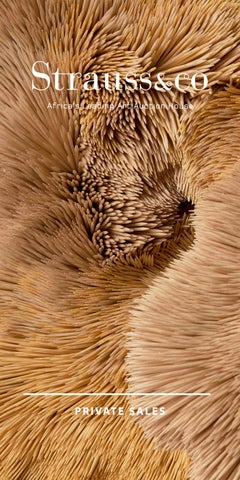
Chris Soal South African 1994 A Possiblity Present Through Proximity
R 340 000 ex VAT
bamboo and birch wood toothpicks, held in polyurethane sealant on industrial fabric on board
Dylan Lewis
Dylan Lewis South African 1964 – Sitting Cheetah Pair (S463)
R 70 000
signed, numbered 14/100, inscribed S463 and impressed with the Sculpture Casting Services foundry mark bronze with a brown patina height: 13,5cm; width: 12cm; depth: 8cm
Dylan Lewis South African 1964 – Elevated Leopard II Miniature (S389)
signed, numbered 45/100 and inscribed S389 bronze with a brown patina height: 16,5cm; width: 14cm; depth: 6,5cm
R 70 000
Dylan Lewis South African 1964 – Charging Black Rhino (S400)
R 75 000
signed, numbered 14/100, inscribed S463 and impressed with the Sculpture Casting Services foundry mark bronze with a brown patina height: 13,5cm; width: 12cm; depth: 8cm
Gabrielle Kruger
Gabrielle Kruger South African 1993 – Still in Bloom, Arrangement No. 2
R 70 000 ex VAT
2026 acrylic paint, 'paint cement, galvanised steel wire, resin, varnish
Gabrielle Kruger South African 1993 – Still in Bloom, Arrangement No. 1
R 50 000
2026 acrylic paint, paint bucket, galvanised steel wire, resin, varnish
Guy du Toit
Guy du Toit South African 1958 Boxing Hare I
2026 signed, dated 2026 and numbered 14/16 bronze with a black and brown patina on a steel base height: 178cm; width: 57cm; depth: 50cm
R 420 000
Guy du Toit South African 1958 Boxing Hare II
2026 signed, dated 2026 and numbered 15/16 bronze with a black and brown patina on a steel base height: 173cm; width: 56cm; depth: 53cm
R 420 000
Jacob Hendrik Pierneef
Jacob Hendrik Pierneef South African 1886–1957 Umbrella Thorn
signed and indistinctly dated oil on hessian 50 by 75 cm excluding frame; 72 by 98,5 by 8,5 cm including frame PROVENANCE Strauss & Co, Johannesburg, 23 May 2016, lot 259. Private collection.
R 1 100 000
Lisa Brice
Lisa Brice South African 1968 – Figure X
signed with the artist’s initials and dated 2010 oil on paper 41,5 by 29,5 cm excluding frame; 51 by 38,5 by 3,5 cm including frame
R 450 000
Musa N Nxumalo
Musa N Nxumalo South African 1986 – Wake up, kick ass and repeat!
s2017 Ed 2/5 +1AP Gicleé Print on Hahnemühle Photo Rag 56 by 84 cm excluding frame
R 38 000
Musa N Nxumalo South African 1986 – Untitled 10, Emdeni
2015 Ed 2/5 + 1AP Gicleé Print on Hahnemühle Photo Rag 56 by 84 cm excluding frame
R 38 000
Musa N Nxumalo
‘I equate my work to protesting.’ – Musa N Nxumalo Musa N Nxumalo offers a bold, narrative-driven approach to black-andwhite photography. With camera in hand, he immersed himself in Soweto’s niche punk and alternative music scenes, drawn by a deep connection to subculture and sound. From this lived experience emerged an intimate and unexpected archive of youth culture – work that brought him international recognition and affirmed his commitment to documenting identity, rebellion, and the pulse of a new generation. Nxumalo trained at the Market Photo Workshop in Johannesburg (2006–2008), a formative period during which he began to understand photography as both a language and a livelihood. His practice is grounded in long-form engagement, often building trust within communities over extended periods in order to produce work that feels lived rather than observed. Across his broader body of work, he consistently returns to themes of belonging, masculinity, and youth expression, using documentary strategies that balance intimacy with formal clarity. His images sit at the intersection of reportage and portraiture, marked by a sensitivity to gesture, atmosphere, and the social textures of everyday life.
Peter Eastman
Peter Eastman South African 1976 – Robberg Chrome Light
2026 oil on linen 175 by 135 cm
R 150 000 ex VAT
Peter Eastman South African 1976 – Ruby Ochre Blue Light
2024 oil on aluminium 20 by 25 cm
R 18 000 ex VAT
Peter Eastman South African 1976 – Small White Light
2025 oil on aluminium 20 by 25 cm
R 18 000 ex VAT
Peter Eastman South African 1976 – Spectral Light
2026 oil on linen 35 by 30 cm
R 24 000 ex VAT
Peter Eastman South African 1976 – Tangled Hierarchy
2019 oil on aluminium (framed) 185 by 150 cm
R 160 000 ex VAT
Peter Eastman
Strauss & Co Private Sales, in collaboration with Suburbia Contemporary, is pleased to present a selection of works from The Beira Paintings, a contemplative body of work by Peter Eastman that explores the shifting boundary between visibility and obscurity. Developed during the Scottish winter, these dark, layered paintings evoke the memory of South African light, emerging not as direct illumination, but as something distant, intermittent, and deeply felt. Rooted in both material experimentation and meditative observation, Eastman’s practice reflects an ongoing engagement with environment, memory, and the psychology of place. His paintings invite sustained looking, unfolding gradually as immersive, time-based experiences.
David Goldblatt
David Goldblatt USA 1937 Bushveld, Visgat
R 50 000
1986 signed, dated 1/1/86 and inscribed with the title in pencil in the margin vintage silver gelatin print on fibre-based paper adhered to board 44 by 56cm; 75 by 83 by 2,5cm including frame PROVENANCE The Engen Collection
Robert Hodgins
Robert Hodgins South African 1920–2010 A Bad Day on the Dow: An Apoplectic Painting
R 800 000
signed twice, dated 1994/5 and inscribed with the title on the reverse oil on canvas 92 by 121,5 cm excluding frame; 94 by 124 by 5 cm including frame LITERATURE Sean Fraser (ed) (2002) Robert Hodgins, Cape Town: Tafelberg Publishers, illustrated in colour on page 127.
Robert Hodgins South African 1920–2010 Female Nude I
2007 oil on canvas 70 by 70cm PROVENANCE Simon Mee Fine Art, London 2010 Private Collection NOTE The present work is located in Massachusetts, USA.
R 325 000
Walter Battiss
Walter Battiss South African 1906-1982 The Gathering
R 350 000
signed oil on canvas 40 by 75cm excluding frame; 60 by 95,5 by 3cm including frame PROVENANCE Strauss & Co, Johannesburg, 7 November 2016, lot 230. Private Collection.
Walter Battiss South African 1906-1982 African Figures in a Moving White Light
signed; printed title on a label adhered to the reverse oil on canvas 34,5 by 90cm excluding frame
PROVENANCE Professor FCL Bosman Strauss & Co, Johannesburg, 4 June 2018, lot 302
R 560 000
William Kentridge
William Kentridge South African 1955 The Old Gods Have Retired
R 1 300 000
signed, numbered 8/20 and embossed with the Jillian Ross Print and the David Krut Workshop chopmark in the margin photogravure, sugarlift aquatint, direct gravure, drypoint and handpainted chine collé and collage papers on 12 overlapping sheets of Hahnemühle image size: 161 by 201cm; 193 by 231,5 by 8cm including frame
William Kentridge The Old Gods Have Retired
Kentridge standing in front of the large scale mixed media artwork that was used as a backdrop for the film Self-Portrait As A Coffee Pot .
NOTES Trees have played an important role in the development of Kentridge’s artistic lexicon and have been present in his work in a variety of forms, the power of the trope ringing out in different ways through a number of Kentridge’s bodies of work. Kentridge has spoken frequently about the influence that images and ideas of trees have had in his life, and the ways in which these have become integrated into his work. In a lecture given at Berlin Mosse in 2014, Kentridge talks of the “tree as lehrstück” or the “lesson play” associated with Bertolt Brecht’s epic genre of theatre that explored acting as a route to learning; of the reluctance of a Swedish boat builder who worked on Kentridge’s Black Box project to use German oak, because of the shrapnel contained in the wood, and of the strange sense of “trees still living holding the history in them.” In the same lecture, Kentridge ruminates on our ability to “meet the tree halfway” in our construction of meaning around it, and on the porousness of knowledge.
William Kentridge The Old Gods Have Retired (cont)
In another lecture, delivered as part of his Humanitas Visiting Professorship in Contemporary Art at Oxford University in May 2013, Kentridge remembers mishearing a word – tree-search, instead of t-shirt – and suddenly “in half a second, a whole etymology and history and examples of tree-searches unfolded.” In another instance of mis-heard words, Kentridge’s memory of his father working on the Treason Trial, or the “trees and tile” to his boyhood ears, has yielded innumerable metaphors for understanding the relationship between what we know and how we experience the world, piecing together fragments and fitting them together as we wend our way through the complex forest of history. In a conversation with Jane Taylor, Kentridge also recalls his frustration as a child that two white stinkwood trees at his family home in Houghton seemed to refuse to grow big enough to suspend a hammock between them, and his grief at the death of one of these trees during a lightning storm, many years later when he returned to occupy the same home in which he grew up. Over the course of decades, Kentridge has drawn out the metaphorical richness that trees offer to sense-making within his multidisciplinary practice: “a tree you could disassemble into its pages and hide in a library, like hiding a book in a forest.” The fact that Kentridge’s hometown and the locus of much of his work is Johannesburg, often called the largest human-made forest, cannot be overlooked. The Old Gods Have Retired is quite literally pieced together from fragments on a monumental scale. These feature pieces of maps, segments of hand painted chine-collé and collage papers and dislocated text in addition to the twelve overlapping sheets printed from direct gravure plates that make up the image in totality. The origin of this large-scale, multi-plate work stems from an even larger drawing of a tree – much larger than life-size – that Kentridge created as part of his process of developing the Self-Portrait As A Coffee Pot series of nine films, in which the drawing features many times.The films and series of photogravures have their origins in the COVID-19 pandemic, which was a time of global fragmentation, with great distances between people suddenly becoming very apparent and often problematic in a world in which travel was severely restricted.
William Kentridge The Old Gods Have Retired (cont)
This monumental work speaks to that time, not least through scraps and splinters of text that appear almost as branches and leaves of the tree, and can be reconstructed in multiple ways, with various lyrical results and implications. The map fragments, which feature greens and blues that depart in a gentle way from Kentridge’s habitual Constructivist red, speak most directly to the distances between people, to the overcoming of distance that was required by multiple collaborators in order to realise this work, and to the reconfiguration of relationships that necessarily occurs in such times of disruption. As part of the tree, these figments of map, fragments of text and colour, also introduce a concept of time that reaches beyond the linear. As Stephen Clingman has so aptly put it, in writing of Kentridge’s tree drawings: “The tree is rooted in the earth and reaches towards the sky. It presides in time over our lives, yet also encodes the mystery of seasonal cycles and metamorphosis. Its wood becomes the paper on which drawings of trees appear.” The creation of The Old Gods Have Retired speaks to Kentridge’s deep understanding and appreciation of the concept of collaboration and his uninterrupted engagement of multiple collaborators to realise largescale projects, regardless of sudden and unforeseen changes in circumstance. In the context of trees, The Old Gods Have Retired touches on the groundbreaking research by Suzanne Simard and her own collaborators, that reimagines the forest as more than just a collection of trees. Rather, the forest is understood as an interconnected and relational community, in which the traditional dominance of the concept of competition playing the biggest role in evolution gives way to coevolution and symbiosis as essential components of the progress and success of all the role-players contained within the picture. Text by Jacqueline Flint, 2022 Published by David Krut Projects & Jillian Ross Print
STRAUSS & CO PRIVATE SALES
At Strauss & Co, our private sales division offers a discreet and highly tailored service for clients looking to buy or sell outside of the traditional auction calendar. We work closely with collectors, estates, institutions, and advisors to match exceptional works of art and design with the right buyers. PRIVATE SALES SERVICES Bespoke sourcing: we offer collectors a personalised approach to sourcing specific artworks that reflect their unique tastes, budget, and collecting goals. Brokerage of works: we facilitate the sale of important artworks, design pieces, and collectibles through direct, confidential negotiation. Valuations & advisory: we provide market-informed valuations and strategic guidance tailored to each piece or collection. Client matching: with an extensive and engaged collector base, we are well-positioned to place significant works with the right buyers, both locally and internationally. Exhibitions & promotion: when appropriate, we offer exposure through curated private sales exhibitions, digital catalogues, and targeted marketing to our network. For private sale enquiries, please contact: Kirsty Colledge, Head of Private Sales | Senior Art Specialist kirsty@straussart.co.za | +27 83 326 8283