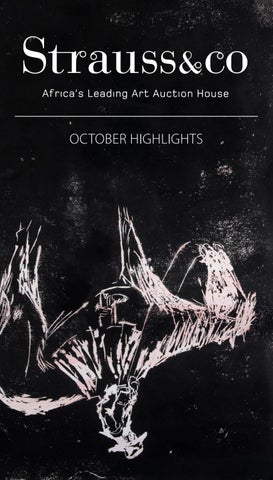
OCTOBER HIGHLIGHTS
THE INTERNATIONAL SALE Tuesday 20 October 7pm Live Virtual Auction
www.straussart.co.za
Cover: Lot 72 Georg Baselitz , Das Pferd, Im Wald und auf der Heide Series Top: Lot 48 Erik Laubscher, Construction (verso)
2 Juvenal Sansó Filipino 1929-2025 The Changing Tides 1973 signed; dated, inscribed with the artist's name, the title and medium on a Luz Gallery label adhered to the reverse acrylic on canvas laid down on board 62 by 78cm
R 200 000 - 300 000 VIEW LOT
2 Juvenal Sansó (cont)
PROVENANCE Luz Gallery, Philippines. Private Collection. EXHIBITED Luz Gallery, Makati City, 1973, possibly exhibited. The present lot, Changing Tides, painted in 1973, belongs to a significant period in Sansó's artistic career. Marked by a longstanding engagement with the landscapes and seascapes of Brittany which became increasingly atmospheric and imaginative. Brittany paintings were informed by sustained observation of the French coastline, particularly its changing tides, rocks, water and shifting light. Rather than simply reproducing observed landscapes, however, Sansó transformed these studies through memory, imagination and instinct, creating works that occupy a space between observation and abstraction. The year 1973 was an important moment in Sansó's Philippine exhibition history. He held a one-man exhibition at the Luz Gallery in Makati, placing this work within a period of active exhibition and recognition in the Philippines. His practice at this time demonstrates his increasing interest in translating natural phenomena into highly personal compositions of colour, atmosphere and movement. Juvenal Sansó was born in Reus, Catalonia, Spain, in 1929, but moved with his family to Manila, Philippines, five years later. His early years in the Philippines played an important role in shaping his artistic development. He studied at the University of the Philippines School of Fine Arts and later at the University of Santo Tomas. In 1951, Sansó gained early recognition when he was awarded first prize in both the oil and watercolor competitions of the Art Association of the Philippines for his respective works, Sorcerer and Incubus. In the same year, he also won third place in the Shell Art Competition. These achievements marked an important turning point in his career and encouraged him to pursue further artistic studies abroad. Sansó subsequently traveled to Europe, where he established residence in Paris and continued his studies at the Academia di Belle Arti in Rome. He also enrolled at the École Nationale Supérieure des Beaux-Arts in Paris. His exposure to the European art world broadened his artistic perspective and contributed to the development of the distinctive style for which he would later become known. Throughout his long career, Sansó exhibited extensively both in the Philippines and internationally. His works were presented in numerous solo and group exhibitions, including several retrospectives celebrating the breadth and evolution of his artistic practice. His paintings, characterised by their atmospheric qualities, rich textures, and often haunting imagery, reflect his sustained engagement with themes of nature, memory, isolation, and transformation. VIEW LOT
7 Joseph Oppenheimer German 1876-1966 Kensington Gardens 1904 inscribed with the artist's name, the date and title on the reverse of the board oil on board 24,5 by 33cm R 80 000 - 120 000 A celebrated portrait, landscape, and still-life painter, Joseph Oppenheimer was born in Germany but spent much of his career in England and Canada. Demonstrating early precocity, he enrolled at the Munich Academy at age fifteen. Oppenheimer traveled extensively across Rome, Naples, New York, and Egypt, where he painted a portrait of Cecil Rhodes. Oppenheimer established an international reputation for high-society portraiture, capturing figures such as Albert Einstein, Richard Canfield, and Generals MacDonald Moody and Grenville M Dodge in a style that combined precise realism with impressionistic brushwork. In 1910, Oppenheimer received a Gold Medal at the 10th Munich International Exhibition. He was a dedicated educator and a member of the International Society of Sculptors, Painters and Gravers, the Chelsea Arts Club, and the Royal Society of Portrait Painters. Following his daughter’s move to Canada in 1949, Oppenheimer divided his final years between London, Montreal, and New York, painting until his death in Montreal in 1966. VIEW LOT
31 † Irma Stern South African 1894-1966 Two Women 1935
signed and dated 1935; inscribed with the number 2 on the reverse oil on canvas 57 by 47cm R 6 000 000 - 8 000 000 PROVENANCE Private Collection, Berlin.
VIEW LOT
31 † Irma Stern (cont)
EXHIBITED The Cooling Galleries, London, Oil Paintings, Watercolours and Drawings from South Africa by Irma Stern, 7 May to 24th May 1937, probably exhibited with the title Zulu Sisters, cat. no. 2. NOTES Special thanks to Sandra Klopper for assistance with the research of this painting. In 1935, following an extended journey across South Africa that included visits to Zululand (northern KwaZulu- Natal) and the Transkei (Eastern Cape) in pursuit of subjects, Irma Stern told the Cape Times that she intended to exhibit in London.1 In January 1937, she announced plans to show at The Cooling Galleries, a prominent London art dealership located at 92 New Bond Street. The printed catalogue listed 27 oils, 19 watercolours and 14 charcoal drawings.
(fig 2) Based on archival research, the present lot was probably exhibited at The Cooling Galleries in London in May 1937. A historical photograph from that exhibition shows Irma Stern surrounded by artworks from her Natal travels, 1932 still life with tiger lilies, and The Hunchback (1931).
Chief’s Daughter, Group of Zulu Women and a double portrait, Zulu Sisters (catalogue number 2) (fig 1 and 2). The present lot, inscribed ‘2’ on the reverse, was probably exhibited under the title Zulu Sisters. In 1932, Stern had produced a striking portrait of two Madeira sex workers that revealed her increasingly assured use of colour. She would continue to produce powerful double portraits inspired by her travels across South Africa, the Belgian Congo and Zanzibar.
(fig 1) Zulu Sisters (Catalogue Number 2), featured in The Cooling Galleries exhibition catalogue
Among the oils were four works with Zulu subjects in their titles: Zulu Woman, Zulu
Recently repatriated from Europe, where it had been held in a private collection for decades, Two Women is redolent of Stern’s earlier high-Expressionist style of the 1920s, particularly in its tonalities and use of black to graphically delineate the two sitters, as well as its evocation of youth and innocence. In a short introduction to the London catalogue, Marjorie Juta
31 † Irma Stern (cont)
described this aspect of Stern’s output as follows: “Powerful, vivid, full of colour and movement, her modern treatment depicts admirably the vigour and beauty of the native races”.2 Juta, author of the first full-length biography of Paul Kruger, published in 1937, was emphatic in describing Stern as “one of South Africa’s greatest painters”. She emphasised Stern’s international pedigree for London audiences, noting her frequent exhibitions across Europe and her refusal, since 1929, to show in Nazi Germany in protest against the persecution of Jews. Her early struggles in South Africa were contrasted with her "instantaneous" reception in Europe.
Town exhibition.3 He singled out her Madeira Harlots (1932) (fig 3) as a “remarkable picture”, while still reserving his old animosity for her “native studies”. The tide of opinion was increasingly turning against critics such as Roworth. That year, Roza van Gelderen, a close friend and champion of Stern’s work, gifted the group portrait Swazi Girls (1931) (fig 4) to
(fig 4) Swazi Girls (1931) (detail) presented by Roza van Gelderen to the South African National Gallery, Iziko South African National Gallery permanent collection, illustrated in Iziko Museums of South Africa (2015) Brushing up on Stern, Cape Town: Iziko Museums of South Africa, page 35
(fig 3) Straatvroue, Madeira (Street Women, Madeira) (1932), Courtesy of the Rupert Art Foundation Collection, Rupert Museum, Stellenbosch.
The 1930s witnessed a sea change in attitudes to Stern and European modernism across South Africa. In 1935, Edward Roworth, an early antagonist, described Stern as “an outstanding personality of the South African art world” in a favourable review of her new Cape
the National Gallery. Richard Feldman, a friend and patron, published a lengthy appreciation in which he described Stern’s paintings as “ecstatic poems” derived from her travels “to see the natives in their natural surroundings, living their own lives”.4 The changing reception of Stern’s portraits of African subjects is particularly relevant to Two Women. In 1935, the Cape Times reported that Stern was impressed by “the Eastern influence on the personal decoration of the native women” she encountered in Zululand and the Transkei.5 Stern’s attentiveness to this is visible in the detailing of the
31 † Irma Stern (cont)
women’s beadwork and decorative, almost Art Deco-like treatment of their evasive eyes. The anonymous author speculated on the melancholy attributes of Stern’s sitters in her portraits of African women. “F.P.R.”, reviewing Stern’s 1937 Cape Town exhibition shortly before her departure for London, also addressed this quality, contrasting her recent “more objective” portraits of African sitters with earlier works in which she had sentimentalised her subjects.6 Zulu Sisters (probably the present lot) was offered for sale in London in 1937 for 25 guineas (£26.25), equivalent to approximately £2 320 in 2026 British purchasing power, or roughly R50 800 at current exchange rates. The sum was
substantial: for a middle-class household earning between £250 and £350 a year, a range documented in contemporary expenditure surveys, the purchase price represented approximately 7.5–10.5% of annual income. The most expensive works in the catalogue were two oils, Intoxication and Orange Pickers, each offered at 80 guineas. Stern’s London exhibition was reported as “very successful” by the Cape Times, and was followed by exhibitions and travels across Europe, including The Hague, Amsterdam, Paris, Salzburg and Vienna, as well as a four-month working stay in Italy.7 She returned to South Africa by boat via Dakar in 1938.
1. (1935) Cape Times Supplement, 26 October; and (1935) Irma Stern’s Native Studies’, Cape Times, 6 November. 2. Marjorie Juta (1937) Paintings, Water-Colours and Drawings from South Africa by Irma Stern, London, The Cooling Galleries Ltd, pp. 4–5. 3. Edward Roworth (1935) ‘Triumph of Irma Stern’, Cape Times, 6 February. 4. Richard Feldman (1935) ‘Idylls of the Black: An Appreciation of the Work of Irma Stern’, South African Opinion, 17 May, p. 10. 5. (1935) ‘Irma Stern’s Native Studies’, Cape Times, 6 November. 6. F.P.R. (1937) ‘The Art of Irma Stern’, Cape Argus, 10 February. 7. (1938) ‘Irma Stern Returns’, Cape Times, 28 February.
VIEW LOT
45 Jeff Koons American 1955Balloon Dog (Blue) 2002
signed and numbered 2208/2300 on a Jeff Koons label adhered to the reverse chrome-glazed porcelain height: 26,5cm; width: 26,5cm; depth: 11cm
R 100 000 - 150 000 VIEW LOT
45 Jeff Koons (cont) PROVENANCE Jim Kempner Fine Art, New York. Private Collection. Jeff Koons is an American artist who gained fame in the mid-1980s for his iconic works such as Rabbit (1986), Michael Jackson and Bubbles (1988), Puppy (1992), and his polished and coloured stainless steel Balloon Dog sculptures from his Celebration series begun in 1994. Koons was born in York, Pennsylvania in 1955. He enrolled at the Maryland Institute College of Art in Baltimore in 1972 and received his Bachelor of Fine Arts in 1976. During his studies, he spent a year at the School of the Art Institute of Chicago in Illinois, where he was mentored by the artist Ed Paschke. Koons moved to New York City in 1977 and worked at the membership desk of the Museum of Modern Art (MoMA) while establishing himself as an artist. However, to fund his artistic pursuits, he switched careers and became a Wall Street commodities broker in 1980. The same year, he held his first solo show at the New Museum of Contemporary Art in New York City: a window installation of vacuum cleaners displayed under illuminated Perspex from The New series (1980-83). Koons is associated with the Neo-Pop (or Post-Pop) movement that emerged in the 1980s as a response to the Minimalism and Conceptualism of the 1970s. The movement is interested in banality, creating intentional kitsch, and commenting on commercialism by elevating everyday items to high art. His work is highly sought after and several have set auction records. In 2019, the sale of his Rabbit (1986) sold for $91.1 million at Christie's, which made it the most expensive work by a living artist sold at auction. Koons' work continues to be exhibited and represented in prestigious collections around the world, including the Metropolitan Museum of Art in New York, the Tate Modern in London, the Museum of Contemporary Art in Chicago, and the Stedelijk Museum of Modern Art in Amsterdam.
VIEW LOT
47 Joan Miró Spanish 1893-1983 Le Lézard aux Plumes d'Or: Plate I (The Lizard with Golden Feathers: Plate I) (Mourlot 792) 1971
signed and numbered 19/50 in pencil in the margin; embossed with the Miró chopmark in the margin lithograph on Kochi Japan paper image size: 33 by 48cm
R 60 000 - 80 000 VIEW LOT
47 Joan Miró (cont)
PROVENANCE Private Collection, Johannesburg. 5th Avenue Auctioneers, Craighall Park, 30 November 2008, lot 202. Private Collection, Cape Town. LITERATURE Fernand Mourlot (1975) Joan Miró Lithographs, Volume IV: 1969–1972, New York: Leon Amiel Publisher, cat. no. 792. NOTES Printed by Mourlot, Paris, published by Broder, Paris. Joan Miró i Ferrà, a pioneering Spanish artist hailing from Barcelona, is celebrated for his mastery in painting, printmaking, sculpture, and ceramics, leaving a permanent impact on 20th century art. In 1975, a testament to his influence, the Fundació Joan Miró was established in his birthplace, Barcelona, followed by the Fundació Pilar i Joan Miró in Palma de Mallorca in 1981. Miró’s artistic journey was a fusion of reality and imagination; abstraction and figuration; and image and text. His iconic work, The Hunter (Catalan Landscape) (1923-1924), unveiled the poetry within everyday life, incorporating personal symbols from his family farm. Miró, like Surrealism, aimed to free the inner workings of the mind through pure psychic automatism, blending spontaneity with calculation in his quest for a new pictorial language. He challenged reality with vibrant colours and surreal proportions. The late 1920s marked a period of experimentation for Miró, where he pushed the boundaries of painting with various mediums, techniques, collages, and constructions. Miró opted for the universal language of the subconscious over intellectualism. Miró's art work, especially from this later period, drew extensively from primordial forms and images, reflecting the influence of African culture on the development of modernism. A significant exhibition of selected works showcasing Africa’s impact on the artist The Magical Universe of Joan Miró was held in 2002 at the Standard Bank Gallery in Johannesburg.
VIEW LOT
48 Erik Laubscher South African 1927-2013 Young Family (recto); Construction (verso) 1954-1959
signed and dated 54 on the recto; signed and dated '59 on the verso oil on canvas recto: 105 by 120,5cm verso: 127 by 106cm R 3 000 000 - 5 000 000
VIEW LOT
48 Erik Laubscher (cont) PROVENANCE Collection of the Artist, thence gifted to his oldest child, Michéle. EXHIBITED Contemporary School of Art, Cape Town, 24 September to 1 October 1955, cat. no. 5, with the title Study for Stained Glass Window. Sasol Art Gallery, University of Stellenbosch, Retrospective Exhibition of Work by Erik Laubscher, 25 June to 31 July 1994, cat. no. 26. SMAC Gallery, Stellenbosch, Erik Laubscher: A Major Retrospective Exhibition, 5 December 2009 to 25 February 2010. LITERATURE Hans Fransen (2009) Erik Laubscher: A Life in Art, Stellenbosch: SMAC Art Gallery, the recto illustrated in colour on page 44 with the title Young Family and the verso illustrated in colour on page 259. NOTES When the verso of the work was first exhibited in 1955, the reported title was Study for Stained Glass Window. The 2009 publication gives the title as Young Family. When Laubscher gifted the work to his daughter he told her that the title was simply Family.
Recto Erik Laubscher’s time in Paris had a profound impact on his studio output for nearly two decades. He not only experienced firsthand the art that had drawn him to Paris after completing his studies in London but also encountered fellow South Africans drawn to the city seeking their own inspiration. This cohort included the writer Jan Rabie, the painters Eugene Labuschagne and Leo Théron and others. The serendipity of this move was cemented when he met another student enrolled at the Académie Montmarte, the
(fig 1) Erik Laubscher (1950) Solitaire Portrait of Claude Bouscharain. Claude Bouscharain was both muse to Erik, mother to their children, and well respected artist in her own right. While this drawing draws on the influence of Cézanne, Erik’s other portraits of Claude from the 1950s are more stylised in rendering.
French-born Claude Bouscharain (fig 1), who had returned from the Art Student League in New York.
48 Erik Laubscher (cont) In September 1951, Erik held his first major exhibition in Cape Town. Sales were modest but he received favourable press reviews and was invited to exhibit with New Group artists and the International Club. Claude arrived in Cape Town on 14 October and the couple married the following day. Becoming a father in February 1952 with the arrival of Michéle, added responsibilities to the young artist’s time that made full-time studio practice unten-
part of the larger studio conversation. In September 1955, Erik held a solo exhibition from his studio at the school premises. Included was a work numbered 5 titled Study for a Stained Glass Window. This painting is described in a review as a couple with a child rendered in a transitional style. Matthys Bokhurst characterised it as a work that ‘transitions from reality to abstraction’. The painting subsequently became known as Family Group (1954) and depicts Erik, Claude and Michéle. The strong black lines mimic the lead lines of a stained glass window. This writer suggests that among the many
(fig 2) An article in Laubscher’s clipping book (Volume 1946 to 1979) shares the experiences of students at the school. Included in this news clipping is a quote by Claude where she remarked: "Erik’s painting. It is half realist, semi-abstract. Once I thought him a bad painter. I’ve changed my mind. As a husband? He is very realistic , thank goodness."
(fig 3) Fernand Léger’s stained-glass window on the apse wall of the Église du Sacré-Cœur at Audincourt, France.
able. Imbued with creative enthusiasm and a desire to share his knowledge, Laubscher undertook periods of teaching. In 1953 he acquired the Continental School of Art, where he had been a student of Maurice van Essche in the period leading up to his studies in London. Having taken over the space, he hoped to provide students with an alternative to the traditional teachings at the Michaelis School of Art. Erik relaunched the school as the Contemporary School of Art and its curriculum did not focus on a rigorous academic structure. An article in Laubscher’s clipping book (Volume 1946 to 1979) shares the experiences of students at the school (fig 2). He promoted an open door policy that allowed students from all walks of life to attend classes and become
exhibitions Erik would have experienced in Paris, this would have included seeing Fernand Léger’s studies for the commission of the stained-glass window for the apse wall of the Église du Sacré-Cœur at Audincourt (fig 3). Léger exhibited the preparatory works at the Museum of Modern Art in Paris at the end of 1950. Léger and his contemporaries were credited with revolutionising stained glass by treating windows as monumental elements receptive to bold design a significant departure from traditional religious illustrations. Léger achieved this by departing from lead lines as a mere physical support and instead utilising the material to create bold black outlines that exaggerated geometric fragmentation.
48 Erik Laubscher (cont)
(fig 4) Bruce Arnott was a colleague and friend of the Laubscher’s. The sculpture here, titled Heroic Head is a visual tribute to Erik Laubscher, the profile clearly marrying with Laubscher’s own likeness of himself
(fig 5) Claude Bouscharain (c. 1950s) Mother and Children. This 1957 painting by Claude Bouscharain, shows Claude with Michéle and Pierre. This author recognises the creative riff between the artist couple and Claude’s painting can be seen as a witty counterpoint to Erik’s 1954 painting. Perhaps even more pointedly given his repurposing of the original canvas for the 1959 painting.
Laubscher’s palette draws on Léger’s work in this familial composition. Claude’s arm encircles Michéle in a display of maternal protection while Erik, shown in profile (fig 4), holds a mahlstick. A mahlstick is a tool used to provide support and steadiness to an artist when working on a large artwork. It also keeps their hand from making contact with wet medium thus mitigating smudging and pigment transfer. The intense alizarine crimson of Claude’s blouse is offset by the radiant layers of cerulean blue which create a shimmering effect. Decades later Leo Théron spoke of the magic of coloured glass in its ability to create a prism through which the observer could see into eternity. This draws on the principles applied by Antoni Gaudí in the design of La Sagrada Família in Barcelona. Gaudí eschewed traditional biblical illustrations and replaced them with sweeping abstract gradients of deep blues and greens (the cool dawn) contrasted with fiery reds and yellows (the setting sun). If these influences are considered in the creation of this painting, the artist was articulating his own future surrounded by
(Fig 6) This untitled sketch is in the Estate Collection of Erik Laubscher and Claude Bouscharain.
48 Erik Laubscher (cont) family (Claude was likely pregnant with their second child when Erik made this work) continuing to paint while also being aware of his increasing obligations to his growing family (fig 5). In an interview in 1955, Claude remarked when asked about her husband that as a painter his work was half realist, semi-abstract but that as a husband he was very realistic.
(fig 7) Shown here is a work by Leo Théron. The title ‘Listening to Debussy’ plays with the relationship between artists and music notably in their studio practice. Debussy is credited as the first composer whose music focused on mood, colour and atmosphere, a stark departure from previous traditional forms of classical music. Laubscher’s children recall the family home being filled with music, especially over the weekend when Erik would devote the time he had to painting.
conscious that a painting mustn’t date, in the sense that the subject matter illustrates a certain event. I’ve tried to avoid that throughout. The paintings are the
Verso The Contemporary Art School closed in 1955 due to funding exhaustion. Erik then became a paint advisor and salesperson with Sam Newman, the company now known as Plascon. “When I was working at Sam Newman’s, selling paint, I became deeply involved in various art organisations, and I didn’t have a chance to get out and see things, so the paintings got more abstract. Edoardo Villa (fig 6) was making big ripples and our work became more aggressive and spiky, which could be related to the whole political atmosphere…So you find that, in some of my paintings, the use of free forms expresses human emotions. I was very
(fig 8) In this archival photograph from the 5th Bienal de São Paulo, Laubscher’s art can be seen on the right hand edge of the image.
important thing and I hope that they can be seen in a timeless context (fig 7). That is why, when I had to spend five-and-a-half days behind a counter selling paint, but I
48 Erik Laubscher (cont) still wanted to paint, my work started to shift to pure abstraction, towards an expression of one’s angst at the time. And it was only when, in the 1960s, I worked for Plascon and travelled the Western Cape, that I suddenly became aware of the shapes of the wheat-fields in an abstract sense and of new colour combinations.”
series while 1959 included works titled Composition and Construction (fig 9). While both of these large abstract paintings feature a marriage between landscape and substantial abstract forms, Laubscher’s time on the road as a paint salesman was providing him with new views of the land through which he travelled.
This professional shift can be seen as the cause of the significant change within Laubscher’s painting, a deliberate manifestation of the intersection between
The moniker ‘angry young man of the art world’ had already been applied to him when he publicly boycotted a 1956 touring exhibition organised by the South African government. Laubscher went on record stating that the expectation of requiring artists to pay for transport and entry fees in order to be considered, and then to separate from their work for a year while it travelled, was untenable to most artists in his circle. Contemporaries such as Albert Newall supported his stance. Critics remained divided when in 1958 he withdrew his work from the list of chosen artworks for the Venice Biennale. His decision to withdraw was based on selectors dismissing large canvases for significantly smaller works to avoid competition with Irma Stern, the featured artist of the presentation. He said that the selectors should have been transparent with the selection criteria before submissions were made. Construction (1959) was likely exhibited with Gallery 101 in Laubscher’s 1961 exhibition with the gallery. This was the first time he exhibited in Johannesburg.
(fig 9) Claude Bouscharain, Erik Laubscher and a South African Association of Arts custodian packing the selected artworks for the 5th Bienal de São Paulo of 1959.
abstraction and landscape. In May 1958, Deane Anderson a writer and arts critic, credited Laubscher with deftly avoiding the ‘bogy’ that lurked behind the easel of every artist working in the abstract tradition ‘the unforgivable threat of boring his public’. Construction (1959), painted verso to Young Family, is firmly abstract with deliberate shapes and planes of colour interwoven across the canvas. Erik was one of the artist’s chosen to represent South Africa at the 5th Bienal de São Paulo in 1959 (fig 8), having previously exhibited there in 1957. Comparing his work from the 4th Bienal de São Paulo (1957) with that from 1959 reveals a clear direction in which his work was developing. The 1957 works feature pieces from his Harbour and Euphorbia
Despite inclusion in the Venice Biennale, Bienal Sao Paulo, touring exhibitions as a member of International Art Club, inclusion in major exhibitions throughout South Africa, Laubscher’s international profile has remained unfairly under recognised. The Cultural boycotts levied against South Africa resulted in artist’s working during that period remaining rooted in a South African art history. Laubscher once re-
48 Erik Laubscher (cont) marked in his 80s that he regretted his decision not to produce art that positioned him in a visual frontline against the Apartheid government and its policies. Not that his work from the 1960s and 1970s lacks references to these. He created a series of works in the 1960s that referenced the forced removals and later demolition of District Six. His hard-edge paintings (made after a three month 1966 visit to America) include allusion to issues that were topic of the many conversations entered into by the
Sestigers. The living room at 6 Cheviot Place in Green Point became a meeting space for like minded writers, artists and their contemporaries. These gatherings were regularly punctuated by inspections by the South African security police. But it is this authors hope, that with South Africa addressing its place within the Global South, and the inclusion of modernist works by South African artists at prominent international art fairs that this changes in time.
Text researched and compiled by Phillippa Duncan, independent researcher and Erik Laubscher Heritage Trustee managing the collection and archive of Erik Laubscher and Claude Bouscharain. Hans Fransen (2009) Erik Laubscher: A Life in Art, Stellenbosch: SMAC Art Gallery. Mari Lecanides-Arnott and S Christian(2023) Bruce Murray Arnott, Into the Megatext, sculptor, scholar, designer, curator, educator, Cape Town: Print Matters Heritage. Erik Laubscher. The artist’s own unpublished press clipping books (Vol I 1946-1979).
VIEW LOT
50 Roy Lichtenstein American 1923-1997 Portrait, from the Brushstroke Figures series (Corlett 229) (RLCR 3800) 1989
signed, dated '89, numbered 58/60 in pencil and embossed with the Waddington Graphics chopmark in the margin; stamped with the artist's name, the date and the print studio on the reverse colour lithograph, waxtype, woodcut and screenprint on cold-pressed Saunders Waterford paper image size: 127 by 81,5cm R 350 000 - 450 000 VIEW LOT
50 Roy Lichtenstein (cont) EXHIBITED Wetterling Gallery, Gothenburg, Roy Lichtenstein: New Prints and Sculptures from Graphicstudio, 13 May to 15 June 1989, another example from the edition exhibited. Waddington Graphics, London, Roy Lichtenstein: Brushstroke Figures, 1987–1989, 22 May to 17 June 1989, another example from the edition exhibited. Glenn-Dash Gallery, Los Angeles, Roy Lichtenstein: Brushstroke Figures, 10 June to 15 July 1989, another example from the edition exhibited. Castelli Graphics (578 Broadway), New York, Brushstroke Figures, 17 June to 21 July 1989, another example from the edition exhibited. John Berggruen Gallery, San Francisco, Selected Acquisitions, 24 June to 22 July 1989, another example from the edition exhibited. Palais de Luppé, Arles, Roy Lichtenstein, Robert Rauschenberg: 38 œuvres gravées de 1965 à 1989, 7 July to 31 October 1990, another example from the edition exhibited. Erika Meyerovich Gallery, San Francisco, Roy Lichtenstein, 8 November 1990 to 6 January 1991, another example from the edition exhibited. Grand Palais des Champs-Elysées, Paris, Taittinger Collection Presents: Roy Lichtenstein panorama de l'œuvre gravé, 30 January to 4 February 1991, another example from the edition exhibited. Henie-Onstad Kunstsenter, Høvikodden, Norway, Pop Art from the Lilja Collection: Dine, Rosenquist, Lichtenstein, Rauschenberg, 9 February to 1 April 1991, another example from the edition exhibited. Isetan Museum of Art, Tokyo, Pop Muses: Images of Women by Roy Lichtenstein and Andy Warhol, 29 August to 24 September 1991, another example from the edition exhibited. National Gallery of Art, Washington, D.C., Graphicstudio: Contemporary Art from the Collaborative Workshop at the University of South Florida, 15 September 1991 to 5 January 1992, another example from the edition exhibited. Nagoya City Art Museum, Nagoya, Japan, The World of Roy Lichtenstein's Prints, 18 September to 7 November 2004, another example from the edition exhibited. Kunstmuseum Basel, Basel, Sweet Dreams, Baby!, 22 August 2026 to 14 March 2027, another example from the edition exhibited.
50 Roy Lichtenstein (cont) LITERATURE Andrea Theil (ed) (2023 -) Roy Lichtenstein: A Catalogue Raisonné, online, cat. no. 3800, another example from the edition illustrated in color. Mary Lee Corlett (ed) (2002) The Prints of Roy Lichtenstein: A Catalogue Raisonné, New York: Hudson Hills Press in association with the National Gallery of Art, Washington, D.C, another example illustrated in colour on page 210, cat. no. 229. "Prints and Portfolios Published" Print Collector's Newsletter 20, no. 3 (July–August 1989), page 103, another example illustrated. NOTES Printed by Graphicstudio, University of South Florida, Tampa, published by Waddington Graphics. From an edition of 60; plus 1 BAT, 2 PP, 2 Presentation Proofs, 1 NGA archive proof, 1 Graphicstudio Proof, 1 USFP, 2 SP and 8 AP. Roy Lichtenstein, born 1923, was an American artist and a leading figure of the Pop Art movement. Born in New York, he studied at Ohio State University, where he later returned to teach. His early work was influenced by Cubism and Abstract Expressionism before he developed the distinctive visual language for which he became renowned in the early 1960s. Lichtenstein drew inspiration from commercial printing, comic strips, advertisements and popular culture, translating their bold outlines, limited colour palettes and Ben-Day dots into paintings, prints and sculptures. His practice challenged traditional distinctions between fine art and mass culture, while engaging with the history of modern painting. Throughout his career, Lichtenstein exhibited extensively in the United States and internationally, with major exhibitions at institutions including the Museum of Modern Art in New York and the Solomon R. Guggenheim Museum. His work is held in prominent public and private collections worldwide and remains highly influential in the history of post-war American art.
R 0000 - 0000 VIEW LOT
71 Malick Sidibé Malian 1935-2016 Nuit de Noël (Christmas Eve, Happy Club), 1963 2008
signed twice and inscribed with the title in felt tip pen in the margin; printed in 2008 silver gelatin print on paper image size: 21 by 21cm R 150 000 - 200 000
VIEW LOT
71 Malick Sidibé (cont) EXHIBITED Magnin-A, Paris, Malick Sidibé Une Jeunesse Moderne (A Modern Youth), 12 February to 4 April 2026, another example exhibited. NOTES Printed in Paris. Other examples can be found in the Museums of Fine Arts, Houston; Museum of Modern Art, New York; The Walther and Guggenheim Collections. Other examples of the present lot are included in Sidibé’s celebrated portfolio, Mali Twist. Consisting of 21 photogravures, the portfolio captures the identity of a reborn Mali shortly after it gained independence from France in 1960. The title of the portfolio derives from a song of the same name by Malian singer Boubacar Traoré. Malick Sidibé is an artist best known for photographing the youth culture of newly independent Bamako: social gatherings where young Malians embraced Western fashion and dances imported from Europe and Cuba. His informal and spontaneous portraits captured the optimism of the period. He first studied jewellery design at the School of Sudanese Craftsmen in Bamako, graduating in 1955. Following his studies, he found work decorating the photo service shop of Gérard Guillat, also known as Gégé la Pellicule. Guillat soon offered him a photography apprenticeship in 1956, leading to Sidibé opening Studio Malick in the centre of Bamako in Bagadadji. Sidibé's work gained international recognition in the mid-1990s, following the inaugural Rencontres de Bamako in 1994 and a solo exhibition at the Fondation Cartier pour l'art contemporain in Paris the following year. He received the Hasselblad Award in 2003 and, in 2007, the Golden Lion for Lifetime Achievement at the Venice Biennale, the first photographer and first African artist to achieve the award. He received the International Center of Photography's Infinity Award in 2008. Sidibé died in Bamako in 2016. His work is held in the collections of the Museum of Modern Art and the Metropolitan Museum of Art, New York; the Art Institute of Chicago; the San Francisco Museum of Modern Art; and the High Museum of Art, Atlanta, among others.
VIEW LOT
72 Georg Baselitz German 1938-2026 Das Pferd, Im Wald und auf der Heide Series (The Horse, in the Forest and on the Heath Series) 2006
signed, dated 06 and numbered 2 in pencil in the margin hand-coloured linocut on paper image size:199 by 152,5cm R 900 000 - 1200 000
VIEW LOT
72 Georg Baselitz (cont) PROVENANCE Phillips, London, 30 June 2008, lot 391. Private Collection. NOTES Published by the Paragon Press, London. The series consists of six large-scale hand-coloured linocuts. Each image was produced in an edition of only six, and every example was individually hand-coloured by Georg Baselitz. The present lot belongs to the series Im Wald und auf der Heide (In the Woods and on the Heath), six hand-coloured linocuts produced in collaboration with Paragon Press, London. The series takes its title from the opening line of a Romantic Jagdlied (hunting song) by Wilhelm Bornemann (1766–1851), which later became widely known as a German folk song. The works continue Baselitz’s recurring image of the ‘lonesome cowboy’, depicting figures and horses with a distinctly melancholic atmosphere. Charles Booth-Clibborn, founder of Paragon Press, had long admired Baselitz’s printmaking. Following a studio visit in 2005, he expressed an interest in developing a collaborative project with the artist. During this visit, Baselitz showed Booth-Clibborn a group of large linocuts he had been working on and proposed that they form the basis of a publication with Paragon Press. The exceptional scale of the linoleum blocks required an unusual production process. Printing was undertaken jointly by Niels Borch Jensen and Mette Ulstrup of the Værksted for Kobbertryk in Copenhagen and Baselitz at Baselitz studio. The works were printed onto sheets of paper that the artist had previously coated with thin layers of oil paint, ensuring that every impression possessed subtle variations and an individual character. Each linocut was then hand-rubbed on the studio floor, with a plastic squeegee used to apply the precise pressure required to transfer the image.1 Printmaker, painter, and sculptor Georg Baselitz, born in 1938 in Deutschbaselitz, Germany, was one of the most influential German artists of the post-war period and known as a leader of the Neo-expressionist movement. Born Hans-Georg Kern, he adopted the name Baselitz in 1961, taking it from his birthplace. He studied at the Hochschule für Bildende Künste in East Berlin before moving to West Berlin in 1957, where he continued his studies at the Hochschule für Bildende Künste.
72 Georg Baselitz (cont) Baselitz emerged as an artist in the early 1960s with a deliberately confrontational approach to painting, challenging the dominant abstraction of the period through raw, expressive figuration. His early work was marked by provocative imagery and an interest in the psychological and physical dimensions of the human figure. Alongside painting, Baselitz developed an important printmaking practice, working extensively in woodcut, linocut and etching. In 1969, Baselitz began painting figures upside down, a radical compositional strategy that became his signature. By separating subject from conventional orientation, he encouraged viewers to focus on gesture, texture and the materiality of paint rather than narrative or representation. His practice subsequently expanded to include sculpture, drawing and monumental printmaking, while recurring subjects have included the figure, landscape, birds and personal and cultural memory. Baselitz represented Germany at the Venice Biennale in 1980 and has since been the subject of major international exhibitions and retrospectives. His works are held in leading public collections worldwide, including the Museum of Modern Art, New York; Tate, London; Centre Pompidou, Paris; and the Museum Ludwig, Cologne. The artist passed away in April of this year, at the age of 88.
1. No author (2005) Paragon Press, Im Wald und auf der Heide (In the Woods and on the Heath), online, accessed 25 September 2026.
VIEW LOT
79 Joan Miró Spanish 1893-1983 Plate I, from the Barcelona Series (Dupin 592) (Cramer 173) c.1973
signed and numbered 49/50 in pencil colour etching, aquatint, carborundum and screenprint on paper 69,5 by 104,5cm R 120 000 - 150 000
VIEW LOT
79 Joan Miró (cont) PROVENANCE The Natalie Knight Collection. Private Collection. LITERATURE Jacques Dupin (1962) Joan Miró: Life and Work, New York: Harry N Abrams, cat. no. 592, another example from the edition illustrated. Patrick Cramer (1992) Joan Miró Lithographs: V 1972-1975, Paris: Maeght Éditeur, cat. no 173, another example from the edition illustrated. Natalie Knight (2017) The Big Picture: An Art-O-Biography, Johannesburg: Batya Bricker, illustrated in a photograph in black and white on page 93. Joan Miró i Ferrà, a pioneering Spanish artist hailing from Barcelona, is celebrated for his mastery in painting, printmaking, sculpture, and ceramics, leaving a permanent impact on 20th century art. In 1975, a testament to his influence, the Fundació Joan Miró was established in his birthplace, Barcelona, followed by the Fundació Pilar i Joan Miró in Palma de Mallorca in 1981. Miró’s artistic journey was a fusion of reality and imagination; abstraction and figuration; and image and text. His iconic work, The Hunter (Catalan Landscape) (1923-1924), unveiled the poetry within everyday life, incorporating personal symbols from his family farm. Miró, like Surrealism, aimed to free the inner workings of the mind through pure psychic automatism, blending spontaneity with calculation in his quest for a new pictorial language. He challenged reality with vibrant colours and surreal proportions. The late 1920s marked a period of experimentation for Miró, where he pushed the boundaries of painting with various mediums, techniques, collages, and constructions. Miró opted for the universal language of the subconscious over intellectualism. Miró's art work, especially from this later period, drew extensively from primordial forms and images, reflecting the influence of African culture on the development of modernism. A significant exhibition of selected works showcasing Africa’s impact on the artist The Magical Universe of Joan Miró was held in 2002 at the Standard Bank Gallery in Johannesburg.
VIEW LOT
87 Frank Stella American 1936-2024 Shards III, from Shards series (Axsom 146) 1982
signed, dated '82 and numbered 24/27 in pencil offset lithograph and screenprint on paper 115 by 101cm R 100 000 - 150 000
VIEW LOT
87 Frank Stella (cont) EXHIBITED University of Michigan Museum of Art, Michigan, Frank Stella: Prints 1967-1982, 25 September to 21 November 1982, another example exhibited. LITERATURE Richard Axsom (1983) The Prints of Frank Stella: A Catalogue Raisonné, 1967–1982, New York: Hudson Hills Press, in association with the University of Michigan Museum of Art, Ann Arbor, cat. no. 146. NOTES Published and printed by Petersburg Press. Frank Stella was a post-war American artist born in Malden, Massachusetts, in 1936. He is recognised for his innovative use of shape, composition, and colour in his art. Stella studied art at the Phillips Academy in Andover before pursuing a history degree from Princeton University. He graduated in 1958 and moved to New York City. Stella’s early works were abstract expressionist, but he turned towards minimalism in the late 1950s and early 1960s after being inspired by Jasper Johns. He garnered early acclaim with his Black Paintings series, where he painted straight, thin white stripes on a black background. These works led him to become known as a hard-edge painter. In 1959, at twenty-three, he was the youngest person included in the Sixteen Americans exhibition at the Museum of Modern Art in New York City (MoMA). In 1970, he became the youngest artist to ever hold a retrospective exhibition at MoMA; he was thirty-four. As his career progressed, Stella experimented with new canvas shapes, which evolved into works that protruded from the wall, transforming two-dimensional artworks into three-dimensional ones. He also brightened his colour palette, including using fluorescent paints. In the late 1970s, Stella abandoned minimalism for maximalism and started incorporating curves and arabesques into his mixed-media reliefs. His use of media expanded from house and car paint (which reflected his early career as a house and boat painter) to aluminium and fibreglass. In the 1990s he began creating large-scale freestanding sculptures. Stella was one of the most influential living American artists. He held numerous honours and awards, including the 2009 National Medal of Arts from President Barack Obama. Stella’s works are in countless private and public collections around the world, like the Tate in London, the Metropolitan Museum of Art in New York City, the Centre Georges Pompidou in Paris, and the Nationalgalerie in Berlin, among others.
VIEW LOT
104 John Piper British 1903-1992 Langley, Shropshire
signed watercolour, gouache and pastel on paper 77 by 57,5cm R 100 000 - 150 000
VIEW LOT
104 John Piper PROVENANCE Everard Read. Ferguson Brothers. Private Collection. ITEM NOTES John Egerton Christmas Piper was an English painter, printmaker, designer, and writer, and one of the most influential British artists of the 20th century. He studied at the Richmond School of Art and then at the Royal College of Art, London. Piper was an art critic for The Listener and The Spectator, a member of The London Group and the Seven and Five Society, and was considered one of the leading abstract artists in England in the 1930s. Throughout his career he worked in different styles, including abstraction, surrealism and neo-Romanticism, but towards the end of the 1930s he returned to naturalism with a focus on architecture and the landscape. As an official war artist, Piper portrayed bomb-damaged buildings during WWII. Later in his career, Piper turned to printmaking and designing stage sets. He also designed over sixty stained-glass windows in partnership with Patrick Reyntiens for the Chapel at Eton College. Piper was also commissioned to design tapestries for a number of English cathedrals. Piper was made an Honorary Member of the Printmakers Council, served as a trustee of the Tate, and was elected to the Royal Academy of Arts. In addition, he was made a Commander of the Order of the British Empire. He was awarded a knighthood in 1972 for his contribution to British art and in 1984 he was awarded the Order of the Companions of Honour. Major retrospective exhibitions showcasing Piper’s works have been held at Tate Britain, the Imperial War Museum, London, the River and Rowing Museum, Oxfordshire, the Museum of Reading, Berkshire and Dorchester Abbey, Oxfordshire and several exhibitions focusing on different elements of his artistic career have been shown throughout Britain. John Piper’s works can be found in the Tate and many prestigious public collections throughout Britain, the United States of America, and Canada.
VIEW LOT
112 After Paolo Veronese The Circumcision oil on canvas 122,5 by 155cm R 80 000 - 120 000
VIEW LOT
BUYING AT STRAUSS & CO CONTACT US
www.straussart.co.za