STONEWALL N E W S
N O R T H W E S T
SERVING THE LGBTQIA+ COMMUNITIES OF THE PACIFIC NORTHWEST
JULY 2026
VOLUME 18
ISSUE 7
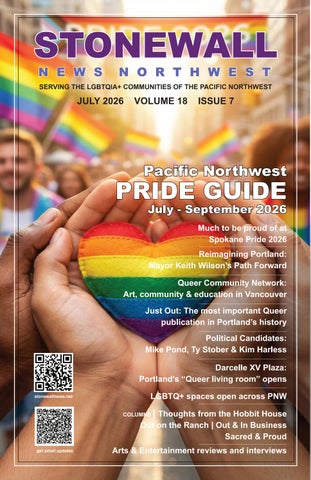
Pacific Northwest
PRIDE GUIDE
July - September 2026 Much to be proud of at Spokane Pride 2026 Reimagining Portland: Mayor Keith Wilson’s Path Forward
Queer Community Network: Art, community & education in Vancouver Just Out: The most important Queer publication in Portland’s history Political Candidates: Mike Pond, Ty Stober & Kim Harless Darcelle XV Plaza: Portland’s “Queer living room” opens stonewallnews.net
LGBTQ+ spaces open across PNW COLUMNS
| Thoughts from the Hobbit House
Out on the Ranch | Out & In Business Sacred & Proud get email updates
Arts & Entertainment reviews and interviews www.stonewallnews.net | Stonewall News Northwest | July 2026 |
STONEWALL NEWS NORTHWEST
SPOKANE, WA
Much to be proud of at
Serving the LGBTQIA+ Communities of the Pacific Northwest
Spokane Pride 2026
Founded 1992 Relaunched 2025
July 2026 Volume 18 Issue 7
www.stonewallnews.net PO Box 871112 Vancouver, WA 98687 PUBLISHER Mike Schultz publisher@stonewallnews.org John Deen 1995-2005 Lawrence Stone 1992-1995 OREGON MANAGING EDITOR Rhonda Brown oregon-editor@stonewallnews.org
Pride flag group in the Spokane Pride Parade in downtown Spokane, Saturday June 13, 2026. | Photo by Mike Schultz
And much to look forward to with Garland Pride on the horizon
ADVERTISING April Gilbreath advertising@stonewallnews.org 509-541-5615
CONTENTS 2 Spokane Pride 2026 3 Portland Mayor Keith Wilson 3 Queer Community Network 4 Just Out Publication 5 New LGBTQ+ spaces up up 6 Mike Pond | Ty Stober
By Erin Sellers
I
t’s been a full week since Spokane’s annual Pride celebration, and Matt Danielson is tired. The executive director of Spokane Pride, Danielson said he’s still waiting for the full emotion of the day to sink in — and for cellphone data that will indicate truly how large the gathering was this year to come back — but he’s proud of how the event went.
While they don’t have a headcount on attendees, and won’t for a few weeks, there were slightly more parade entrants than usual, Danielson said, and “incrementally more” vendor registrations. Around 130 groups marched in the parade, and 250 registered for booths in Spokane’s Riverfront Park. Whatever the exact numbers are, it was a huge event, sprawling across most of the park. Five different stages hosted performances ranging from drag to local bands to open karaoke for anyone to
participate in. Spokane Indigi-Q held their fourth annual celebration in the park, too, with a queer, Indigenous fashion show, an Indigi-Q drag show, traditional dances and drum contests. The night capped off with a huge block party hosted by Nyne, which got to shut down a city block for the first time, bringing celebrations out into the street. With the sheer volume of entertainment and community events taking place not just on Saturday — the Friday before featured a Trans Rights Rally hosted by Trans Spokane and Spokane Pride, community yoga by Coil Studio and a kick-off show under the pavilion — one SPOKANE PRIDE - To Page 8
9 What Star Trek teaches us 11 Faith communities join Pride | Kim Harless 12 Columnists 14 Portland’s Darcelle XV Plaza 15 Pride Guide 2026 - Jul-Sept 18 Arts & Entertainment
Thank You,
Spokane
21 Oregon Queer History 27 Screamers: Pride 2026 29 July 2026 Queer Pride Puzzle
CONTRIBUTORS ERIN SELLERS RYAN OELRICH DAVID CAPOCCI FRANK GAIMARI FABRICE HOUDART
A love letter, and thank you, to a community coming together for Pride and those who made it happen.
RHONDA BROWN
Photo collage of some of the many volunteers who make Spokane Pride happen.
PERCY LAIRD LUCILLE STUTESMAN FAVS NEWS JULIE A. FERRARO EMMA MAPLE DANA CLARK TRACY SIMMONS MATTHEW DANIELSON KACEY MONTGOMERY TERI SCHLICHENMEYER KERRY SHATZER All contents © 2026, Stratus Group LLC. No portion of this publication may be reproduced without written consent from the publisher. Neither Stratus Group LLC nor Stonewall News Northwest publication assume responsibility for errors in content, photos, or advertisements. The views expressed herein do not necessarily represent the views of the publisher or advertisers.
Matthew Danielson, Spokane Pride’s executive director, has a job that is much more involved than yelling “Happy Pride!” every chance he’s got. Matthew juggles sponsors, negotiating and encouraging everyone to stay involved and give as much as they can. He is swamped with emails and social media comments leading up to Pride, and somehow, he’s always got time to chat. He’s the bridge between the Pride Parade and the City/ Parks/PD, always looking out for Pride participants and making sure they are as safe as possible. On Pride Day, he triages a million questions and suggestions from morning to evening, and amazingly he never snaps at anyone. Below is Matthew’s love letter and thank you to the folks behind the scenes.
By Matthew Danielson
S
pokane Pride grew from just a small corner of Riverfront Park ten years ago when I first started helping with the event to the most joyous weekend of love and connection that Spokane has to offer, as well as being
| July 2026 | Stonewall News Northwest | www.stonewallnews.net
one of Spokane’s largest events. It is a fusion/blend/combination of community connection and group adulation like nothing I’ve ever seen. So much has gone into making this event what it is today, and I’d like to shine a light on those that make this event happen. It is so much more than just me, and I think that needs
to have a spotlight, and I’d like to name names and show all the different aspects of coordinating this event. Jake Schwartz is our Board President, always good for an inspirational speech and many other skills to help the organization in a wide range of ways. He sits on most of the committees with me and helps hold the thing together emotionally and logistically. I deeply appreciate his partnership in leading this organization. Kassandra Forsman is our Board Vice President, and when she is not handling large logistics like backing trailers, she is doing nails for free in a corner of our community room at the THANK YOU - To Page 8
PORTLAND, OR & VANCOUVER, WA
Reimagining Portland: Mayor Keith Wilson’s path forward As Portland undergoes significant change, Keith Wilson’s leadership reflects a focus on collaboration, practical solutions, and a deep connection to the community. The months ahead will be an opportunity to see how his approach addresses the city’s challenges and helps shape its future. By Frank Gaimari
P
ortland is navigating one of the most challenging chapters in its history, and Keith Wilson is stepping up to the plate. As the city’s 54th mayor, Wilson brings a distinct local perspective and a bold vision for change as Portland transitions to a new structure of city governance. Unlike many who enter politics, he has deep roots in the very neighborhoods he now leads. He grew up in a busy North Portland community alongside four siblings, where his parents instilled in him the value of hard work and perseverance. He graduated from Roosevelt High and stayed local for his college years, keeping close ties to the
community throughout his early life. His path to the mayor’s office was not without severe hurdles. A stint in New York City left him briefly homeless, an experience that reshaped his perspective. Returning to the Pacific Northwest with a renewed sense of purpose, Wilson joined his family’s small trucking business. He later merged two companies to create Titan Freight Systems, building a brand recognized for its strong commitment to clean energy, diversity, and inclusion. Now, he hopes to bring those values through the doors of City Hall. Because of his past, homelessness is far more than a standard campaign talking point for Wilson. It is a deeply personal issue that drives his hands-on leadership. Over the years, he has studied successful
Portland Mayor Keith Wilson
“Equity is a core value for the City of Portland, and we work every day to live up to that commitment. We have one of the most diverse and LGBTQ+-represented councils in our city’s history, and our executive branch is focused year-round on supporting LGBTQ+ employees and residents..” intervention strategies from across the country and launched Shelter Portland, a nonprofit dedicated to providing tangible support for those living on the streets. He brings a bold promise to his new role, which is visible and significant progress on unsheltered homelessness during his
first year in office. While he knows the scale of this crisis is massive, he points to practical and immediate solutions. These include converting unused churches MAYOR - To Page 7
Queer Community Network: Creating art, community and education in Vancouver
QCN Board left to right; Mike Pond (Board Director), Terah Ebie (Founder & President), Mackenzie Dunham (Board Director), Bren Baker (Secretary), Sean Miller (Treasurer) | Flag art by @transpainter © Queer Community Network
T
By Rhonda Brown
he LGBTQ community has always functioned largely as a volunteer-based, wildly creative, and often politically active minority. The organizations that have grown up within us are an even smaller minority within this population that sometimes are not as inclusive or fully engaging the entire diaspora. Representation and active
participation continue to be an issue, partly due to so many wondering where they belong and how best they can be active. Trying a new engagement model is always hard, however. Queer Community Network had previously hosted the Vancouver Pride Block Party. While incredibly proud of the effect the event had on the area as a whole, and how well it has been received over the years, the board decided to shift focus elsewhere. They are
Local non-profit created “Made with Pride” series of open market days throughout the calendar year at Fourth Plain Commons for Queer and LGBTQ+ friendly creative makers. keeping their main efforts set largely on a “consent-based, sociocracy-inspired governance model” approach centered on connection, advocacy and information access that involves everyone at all levels of engagement. As stated on their website, “continuing our involvement would require compromises that do not align with QCN’s values or our responsibility to those we serve.” The five person board is set up to effectively manage day-to-day operations, but insists on a style that is not
a “top-down” model, and while they are a functional 501c3 non-profit and divide responsibilities, they are able to ensure their goals are based on local needs and engagement. Made with Pride Series One of the specific groups within their greater representation are the artists and QCN - To Page 10
www.stonewallnews.net | Stonewall News Northwest | July 2026 |
PORTLAND, OR
Just Out:
Three people behind the most important Queer publication in Portland history Stonewall News Northwest interviewed three key members of Just Out who share their history with the publication and what they’re doing now. Just Out co-founder and publisher (1983-1999) Renee LaChance, art director Rupert Kinnard and second publisher (1999-2011) Marty Davis talked with Stonewall News Northwest. Jonathan Kipp, third and final publisher (2012-2013), declined interview requests.
B
By Percy Laird
efore smartphones and social media feeds, LGBTQ+ people often found others like them through something far more fragile: a newspaper on a rack in a café, bookstore, or community center. For thirty years, Just Out served Oregon’s LGBTQ community as more than a publication. It functioned as infrastructure by connecting people to news, resources, political movements, businesses, events, and each other. Published from 1983 to 2013, it became one of the longest-running LGBTQ newspapers in the United States — covering the AIDS crisis, major political battles over LGBTQ rights, and the collapse of print journalism now seen in the digital age. What stands the test of time is not just that the paper existed, but the work that it did. Across three decades and changing leadership, Just Out consistently operated as a space for community-building at a time when those systems, now online, did not yet exist. This story is about Just Out, but not just the words — it is about the people behind the scenes, building this infrastructure and community on the printed page.
Building Something Different (1983) Just Out began in 1983 out of frustration and necessity. Founder Renee LaChance, co-founder Jay Brown, and art director Rupert Kinnard were part of Portland’s LGBTQ media landscape when representation was limited, controversial, and often contested. All three had been connected to a predecessor publication, Cascade Voice, that became a flashpoint for disagreements over racism, inclusion, and community accountability. Kinnard recalls tensions around how the publication responded to a racist incident at a Pride event, and broader dissatisfaction with how LGBTQ communities were being represented in print. Rather than continue within that structure, the trio chose to build something new. “We wanted to start a paper that more embraced the diversity of the community,” Kinnard said. In August 1983, LaChance and Brown sat at Portland’s waterfront with a thesaurus and chose a name: Just Out.
Within weeks, the first issue was printed. From the beginning, the paper was designed to do more than report news. It was meant to reflect a community still forming itself publicly—one that needed visibility, information, and connection in equal measure.
More Than a Newspaper Across every interview, one idea repeats with unusual consistency: Just Out was a resource for finding people. Every issue included community calendars, organizational listings, advertisements, and resource guides. Readers could learn where events were happening, which businesses were safe, what political groups existed, and how to connect with services and support networks. “You could look at the paper and see where you were safe in the community as an LGBTQ person,” LaChance said. For readers outside Portland, those pages often meant something much larger. LaChance recalls hearing from people who discovered Just Out in small-town libraries or community spaces and realized, sometimes for the first time, that they were not alone. “They would say, ‘I didn’t know there were other people like me,’” she said. Kinnard described LGBTQ+ newspapers of the era as “the community’s lifeblood.” “We would get together for Pride,” he said, “and then throughout the year, the newspaper is where we got all of our information.” Before the internet, this reliable, tangible communication mattered in concrete ways. It told people where to go, who to call, and which spaces offered safety or belonging.
Crisis, Visibility, and Political Survival The paper’s earliest years coincided with the emergence of the AIDS crisis, which reshaped LGBTQ+ life across the country. Just Out became a source of information, advocacy, and visibility at a time when mainstream coverage was often limited or harmful. At the same time, Oregon’s LGBTQ community faced escalating political attacks, culminating in Ballot Measure 9 in 1992, which sought to embed
| July 2026 | Stonewall News Northwest | www.stonewallnews.net
Cover of the first issue of Just Out, October 28, 1983
anti-LGBTQ language into the state constitution. LaChance describes this period as one that required deep coalition-building across communities. “We had to do real community organizing,” she said. Just Out helped connect organizations, amplify messaging, and distribute information during the campaign. The fight against Measure 9 became one of the defining political moments in Oregon LGBTQ history. LaChance also argues that earlier work in the 1980s—particularly around inclusion, racism, and coalitionbuilding—helped make later political organizing more effective.
Just Out Co-Founder and Publisher Renee LaChance at The Portland Gay Press video presentation by History of Social Justice Organizing, January 23, 2014.
Art, Identity, and Visual Language For nearly two decades, Rupert Kinnard served as Just Out’s art director, shaping how the newspaper looked, felt, and communicated visually. Early production was limited by technology and budget. Color was scarce. Layout was manual. “I was always interested in seeing what I could do with that color and black,” Kinnard said. Despite constraints, the paper quickly developed a recognizable visual identity and earned early recognition for its design work. For Kinnard, the paper represented both artistic experimentation and community purpose. Kinnard’s “Cathartic Comics,” featuring Brown Bomber and Diva Touché Flambé, ran in the paper and became a landmark in alternative queer media— centering race, sexuality, and politics through humor and critique. “It challenged the community to not be one-dimensional,” he said.
Just Out Art Director Rupert Kinnard at Rose City Comic Con in 2025. | Wikipedia
Growth, Professionalization, and Peak Influence (1999–2011) In 1999, ownership of Just Out JUST OUT - To Page 10
Just Out’s second publisher, Marty Davis, | Courtesy photo
REGIONAL
A place of our own: New LGBTQ+ spaces open up across the Pacific Northwest With such a great start to 2026, one cannot help but feel excitement and pride all around. Big cities, small towns, young, old, cis, trans, NB, and everyone within our big, beautiful diaspora deserve safe spaces to come together for support and enjoyment. By Rhonda Brown
Rogue Trans (Ashland, OR)
he LGBTQ+ community has been known to be versatile in creating safe spaces for events, support networks, and live engagement throughout the years. In recent history the internet has invited methods for us to find each other, socialize independently, and even organize live events on the fly. The one thing that cannot be manufactured by social media is real life interaction and genuinely safe spaces that are meeting local functions. So many of our events and gatherings have relied on community centers, library meeting rooms, churches, or public parks… and some of those are done only via word-of-mouth due to concerns they might be targeted. A wave of organizations in the Pacific Northwest are working to create active brick-and-mortar spaces for a variety of resources and safe engagement, and several have succeeded in spades.
Maeve Wolfe has been a powerful advocate of one, but even greater at creating alliances and funding in what would otherwise be an island between queer support communities. What originally started from her frustration trying to find local affirming care, Wolfe started building a resource list that slowly morphed into a Facebook group and, “that’s how Rogue Trans Outreach was born.” Over the last couple of years she has worked on a mobile trans clothing bank, organizing hikes and other gatherings, and spent countless hours submitting grant proposals. With the combination of dedication and support from the Teresa McCormick Center and United Way, the Rogue Trans location at 611 Siskiyou Blvd, Ashland, OR is now open! She has worked tirelessly to create a place for a stable clothing exchange, movie nights, dances, games, support groups, etc in an area that is so far removed in all directions from the big city resources. They will be holding a grand opening event for all to attend May 2nd from 5 to 8 pm. For additional information, open hours and calendar of events see roguetransoutreach. org.
T
Our 3rd Space (Vancouver, WA) Southwest Washington Pride Alliance recently held a Queer Resource Center Grand Opening & Celebration event on March 21st, welcoming the community into the shared space they hold functions in along with Our Third Space at 609 Main St, Vancouver, WA. For over 30 years they have continued to work in outreach, visibility, and community engagement in the area and are happy to have a local space and create a location where they can base their operations to support Clark, Colwitz, Skamania, Wahkiakum, and Pacific counties. Currently they have a 9 person board, but are expanding to include those who would like to be involved in greater trans, youth, fundraising, or cultural outreach as they support the region. Board President, James Tolson, told me that while they are very proud with how well their annual Saturday in the Park is attended each year, that “[we] can always get better, and we’re always going to strive to get better, but Pride is only one day out of the year.” SWWPA organizes the Saturday in the Park event each year as their annual Vancouver Pride gathering, and this year’s All Ages Event promises to be as amazing as years past, with up to 5,000 attendees at times. It is free to all, July 11th at Esther Short Park from 10am to 5pm. To speak with them and see their upcoming events, you can reach them directly through their website at swwapa.org or see space information at our-3rd-space.com.
James Tolson, Southwest Washington Pride Alliance Board President, stands at the podium of Vancouver’s Our 3rd Space Queer Resource Center | Photo by Mike Schultz
first of several events to raise funds and gather information to help with planning what their new space should be. Dani Davalos, one of their 9 board members, is actively working on also gathering data to determine more accurately who would make use of the space and where respondents feel the greatest needs would be. Currently they have regular bi-weekly community youth group meetings and “Try-it Tuesdays” for people of all ages to share skills/knowledge with each other at Stormie’s Place, 333 High St NE, Salem, OR. Their event calendar also has many other activities throughout the year but as they stated: “we are consistently reliant on one-time availability in churches, libraries or other spaces that we can’t make our own.” Along with Capital Pride, PFLAG, Black Joy, Crafty Coyotes, Radness Ensues, Dragonwolf Collective, and Punx with a Purpose, they are working on establishing a location that supports
drop-in hours, health services, a full-time events and a makerspace. Their next big fundraising event is planned at the Reed Opera House on August 9th, details forthcoming soon. To donate online to their fundraiser you can go to tinyurl.com/ salemqcenter, and to help name the new center you can vote on their Google form here (link only available online). You can find more information about all of their activities and where they’ll be anytime at rainbowyouth.org. With such a great start to 2026, one cannot help but feel excitement and pride all around. Big cities, small towns, young, old, cis, trans, NB, and everyone within our big, beautiful diaspora deserve safe spaces to come together for support and enjoyment. I hope to see many more, and that these communities continue to get the support from us that they need to thrive for many years to come.
The Lavender Network Queer Resource Center (Eugene, OR) On February 10th Lane County celebrated an expansion to a larger space at 1590 Willamette St, Eugene, OR. Through a $2.5 million donation made by local resident, Helen Shepard, they were able to move into the much larger space and expand their resources to better provide clothing exchange, health care, and additional community services. The Lavender Network consists of 5 cooperative organizations: Queer Eugene, Eugene Pride, TransPonder, HIV Alliance, and Authentic Movement Project. We were unable to reach anyone at the Lavender Network for a direct comment on how the new space is or what plans they may have in the future, but you can see more about their space and events at lavendernetwork. org.
Vancouver City Council Member Ty Stober speaks at Vancouver’s Our 3rd Place Grand Opening March 21st. | Photo by Mike Schultz
Salem’s Rainbow Youth Center (Name TBD, Salem, OR) In Oregon’s capital, Salem, Rainbow Youth has been working since 1995 to create local engagement and safe spaces for LGBTQ+ youth and adults to meet for support and fun activities and learning opportunities that cover a wide spectrum. On December 13th they held what was the
Rogue Trans, Ashland, Oregon | Courtesy photo
www.stonewallnews.net | Stonewall News Northwest | July 2026 |
VANCOUVER, WA
Local organizer Mike Pond seeks 49th legislative district seat “Representation matters. Growing up, many LGBTQ+ people rarely saw themselves reflected in positions of leadership. Today, we know that our communities belong everywhere, including in elected offices. My message is simple: you deserve leaders who will fight for your rights, your safety, and your future. I am proud to be an openly gay candidate, and I will bring my lived experience, my commitment to public service, and my belief in equality for all people to the Legislature every day. Together, we can continue building a Washington where every LGBTQ+ person is respected, valued, and able to thrive.”
Mike Pond / Courtesy of www.VotePond.com
By Frank Gaimari
M
ike Pond, a Democrat from Clark County, is running for Washington House District 49, Position 1. He brings to the race a wealth of experience as a union organizer and longtime community advocate.
As a fifth-generation Washingtonian and lifelong resident of Clark County, Pond’s deep local roots are central to his campaign message. He’s proud to have attended Prairie High School, Clark College, and Western Washington University — experiences that fuel his strong commitment to public education
and shape his policy priorities today. Over the years, Pond’s public profile has grown through previous campaigns for Vancouver City Council and Clark County Council. These experiences have sharpened his focus on practical, everyday concerns facing local families. In his career as a union organizer, Pond forged close relationships with workers, advocated for better workplace conditions, and championed collective action — perspectives he believes are urgently needed in Olympia.
His campaign focuses on the key issues facing Southwest Washington: affordability, housing, transportation, living-wage jobs, education funding, and government accountability. Pond has been especially outspoken about the need for a new Interstate Bridge, emphasizing its importance for transportation, job growth, and regional investment. Now, with the 2026 primary approaching, Pond is seeking another POND - To Next Page
Ty Stober: A leader with vision and heart running for Clark County auditor “When you spend years hiding something fundamental about who you are, you develop a deep understanding of what it feels like to be unseen. You become acutely aware of what it’s like to navigate systems that weren’t designed with you in mind, and to wonder whether you’ll be accepted if people really know your story. That feeling never truly leaves you. For me, it’s become the lens through which I approach leadership.” By Frank Gaimari
promoting transparency and accountability in local government.
y Stober, a respected leader in Vancouver’s public service community, is now seeking to serve as Clark County Auditor. Currently serving as Vancouver City Council member, Position 5, he has earned a reputation as a thoughtful and effective leader, recognized for his commitment to equity, sustainability, and meaningful community engagement. His campaign for Auditor underscores a dedication to
Since his first election to the City Council in 2015, Stober has worked tirelessly to address the needs of his community. Whether advocating for economic development, championing inclusivity, or tackling sustainability challenges, his leadership has left a lasting impact. His involvement extends beyond the council chambers — he has served on numerous boards and committees, including the National League of Cities,
T
| July 2026 | Stonewall News Northwest | www.stonewallnews.net
Photo courtesy of VoteTy.com
where he has held leadership roles advancing racial equity and LGBTQ+ representation in local government. Before entering public service, Stober spent over two decades in sales, marketing, and operations, gaining valuable experience in both entrepreneurial ventures and established organizations. His professional background includes managing energy efficiency programs that benefited communities across the Northwest. This blend of private-sector expertise and public service experience uniquely positions him to bring innovation
and efficiency to the role of Clark County Auditor. Stober’s campaign is rooted in the belief that the Auditor’s Office should be a model of transparency and fairness. He envisions modernizing systems to improve accessibility and efficiency while fostering trust between the government and the people it serves. For him, the role is about more than managing numbers — it’s about ensuring that every resident feels represented and valued. STOBER - To Page 25
Continued - VANCOUVER, WA & PORTLAND, OR POND - From Previous Page opportunity to serve his community — promising to bring his labor experience and a pragmatic, hands-on approach to state government. To help voters better understand Mike Pond’s priorities and vision, I reached out to him with a series of questions on LGBTQ+ rights, housing, affordability, and more. Here are his responses, offering insight into how he would represent District 49 if elected: Frank Gaimari: If elected, what specific steps would you take to protect transgender and nonbinary people? Mike Pond: Washington has long led on LGBTQ+ rights, yet challenges remain. As transgender and gender-diverse individuals relocate to Washington State to seek safety and opportunities, we must ensure these protections remain robust and effective. I strongly oppose efforts to roll back protections for transgender and nonbinary people of all ages, and I support policies that strengthen access to healthcare, housing, education, and employment. That includes protecting access to genderaffirming care, reducing barriers to legal name and gender marker changes, and ensuring anti-discrimination laws are effectively enforced. Most importantly, policy should be informed by the people most impacted. We should listen to transgender and gender-diverse community members, as well as advocacy organizations like Gender Justice League, when developing solutions. Every person deserves to live safely, authentically, and with dignity. FG: What would you do to expand mental health support for LGBTQ+ youth?
We need to expand access to culturally competent mental health services in both schools and communities. That includes increasing the number of trained providers, supporting school-based mental health programs, and ensuring young people can access care regardless of their family’s income or geographic location. Research consistently shows that a strong sense of belonging and community connection is one of the most powerful protective factors for LGBTQ+ youth. In addition to clinical care, we should support community organizations that provide affirming spaces, mentorship, peer support, leadership opportunities, and opportunities for connection. We should also ensure that all young people can participate in sports and other extracurricular activities in safe, inclusive, and welcoming environments. Every young person deserves to feel safe, valued, supported, and hopeful about their future. FG: How would you protect LGBTQ+ students while balancing concerns about privacy, safety, and parental involvement? MP: Every student deserves to feel safe, respected, and supported not just at school, but also at home and in their community. Schools have a responsibility to protect students’ privacy and wellbeing, especially when disclosure could place a young person at risk. I believe parents play an important role in their children’s lives, but policies must prioritize student safety and follow guidance from educators, counselors, and mental health professionals. We can support parental engagement while ensuring LGBTQ+ students have access to affirming environments where they can learn and thrive without fear. I oppose any effort to dismantle the existing legislation that offers these protections to students, including IL26-001.
MP: LGBTQ+ youth face higher rates of anxiety, depression, and suicide, often because of bullying, rejection, or isolation.
FG: What would you do to improve LGBTQ+ health care access?
MAYOR - From Page 3
Keith Wilson: The biggest barrier is that every part of the shelter-to-housing continuum must function together — outreach, services, shelter, and ultimately permanent housing. When any one of those pieces is missing or under-resourced, people fall through the cracks. At the city level, our responsibility is public safety, clear rights-of-way, and livability. When I took office, the most urgent need was shelter. Portlanders were dying on our streets at an alarming rate, and we couldn’t wait for long-term housing solutions to come online. We opened more than 1,500 shelter beds, providing thousands of nights of safe sleep. Now, we are fully focused on housing. I’ve established a housing strike team that meets daily and works closely with regional partners and service providers to accelerate housing production and fill existing vacancies. We are committed to ensuring no one is left without a path forward.
and community centers into temporary shelters and expanding daily access to crucial support services. His ambitions for the city extend well beyond the housing crisis. Wilson wants families and business owners to feel secure and supported in their neighborhoods. Early in his term, he pushed for close collaboration with police and emergency responders to speed response times and increase public transparency. Drawing on his private-sector background, he has also championed small-business tax relief. He is working with city officials to spark economic recovery and give local entrepreneurs the breathing room they need to thrive. All of this unfolds against the backdrop of Portland’s new city structure, which delegates day-to-day operations to professional managers. This shift frees Wilson to focus entirely on long-term vision and policy. He relies on a collaborative, solutions-oriented leadership style, prioritizing active listening and consensusbuilding with community members. He believes that Portland’s true strength lies in its compassion and creativity, and he intends to use that spirit as a foundation for overcoming the city’s current obstacles. To better understand his vision for Portland’s future — particularly its LGBTQ+ community — I reached out to Mayor Wilson with six pressing questions. Frank Gaimari: What is the biggest barrier to ending unsheltered homelessness in Portland, and how do you plan to overcome it?
FG: How will you ensure the city government is welcoming and empowering for LGBTQ+ employees and residents? KW: Equity is a core value for the City of Portland, and we work every day to live up to that commitment. We have one of the most diverse and LGBTQ+represented councils in our city’s history, and our executive branch is focused yearround on supporting LGBTQ+ employees and residents. Just this week, we hired the City of Portland’s first Chief Equity Officer, who will lead the Office of Equity and Human Rights and direct the City’s work to make equity and inclusion a fundamental part
MP: Access to healthcare should never depend on who you are, where you live, or whom you love. I would support efforts to expand access to LGBTQ+competent providers, protect access to gender-affirming care, strengthen mental health services, and address disparities that affect LGBTQ+ communities. We also need to ensure insurance coverage is comprehensive and that healthcare providers receive training to deliver culturally competent care. Access is about more than coverage alone. Too many people with statesponsored insurance struggle to find providers who accept their plans, creating significant barriers to care. We should evaluate Medicaid reimbursement rates and advocate for reforms that encourage greater provider participation, expand service availability, and reduce patients’ wait times. Everyone deserves healthcare that is respectful, affirming, affordable, and accessible. FG: What specific steps would you take to lower everyday costs for working families, beyond broad promises about affordability? MP: Working families need more than slogans. They need relief they can feel in their monthly budgets. I would focus on expanding access to affordable childcare, increasing the housing supply for people at all income levels, and strengthening public transportation to reduce commuting costs. I would also support targeted tax relief for low and middle income households and efforts to lower healthcare costs, including prescription drug costs. At the same time, we must ensure wages keep pace with the cost of living so that people who work hard can afford to live, raise a family, and retire in the communities they call home. FG: How would you address the housing shortage while ensuring new development remains affordable and does not displace longtime residents?
of decisions, operations, policies, and service to the community. FG: What specific steps will you take to protect and support LGBTQ+ youth in Portland schools and the broader community? KW: While Portland Public Schools is an independent entity, it’s important to me that every young person in our community feels safe, supported, and able to be their authentic self. The City plays a role in creating that environment through our investments in community centers, parks, and youth programs. FG: Are there new initiatives for health, housing, or violence prevention that you plan to introduce for the LGBTQ+ community? KW: Housing and violence prevention have been top priorities since I took office. We’re seeing promising reductions in gun violence and crime across all four corners of the city, and we’re continuing to invest in strategies that keep people safe. On housing, the City participates in the federal HOPWA program, which funds the Cascade AIDS Project to provide housing assistance and supportive services for lowincome individuals and families affected by HIV/AIDS. We’ve also continued funding alternative shelter options that offer affirming, identity-specific support for LGBTQ+ community members. We’re also investing in communitybased safety programs that serve the entire city, with specialized options for people who may face unique risks. The Rose City Self-Defense program is open to all Portlanders and includes
MP: We need an all-of-the-above approach to housing. That means increasing the housing supply through smart growth policies, streamlining permitting, and supporting a range of housing types, from apartments to missing-middle housing. But building alone is not enough. We must invest in affordable housing, strengthen tenant protections, and provide tools to help prevent the displacement of longtime residents, particularly seniors, low-income families, and communities that have historically been pushed out by rising costs. Growth should create opportunity, not force people out of the neighborhoods they helped build. FG: As an openly gay candidate, what message would you like to share directly with the LGBTQ+ community? MP: Representation matters. Growing up, many LGBTQ+ people rarely saw themselves reflected in positions of leadership. Today, we know that our communities belong everywhere, including in elected offices. My message is simple: you deserve leaders who will fight for your rights, your safety, and your future. I am proud to be an openly gay candidate, and I will bring my lived experience, my commitment to public service, and my belief in equality for all people to the Legislature every day. Together, we can continue building a Washington where every LGBTQ+ person is respected, valued, and able to thrive. As the 2026 primary approaches, Mike Pond’s campaign offers Clark County voters a closer look at how he would approach critical state-level decisions — from housing and education to transportation, labor, and government transparency. His answers to these questions will help voters decide if his blend of local experience and labor advocacy is the right fit for District 49. For more information on Mike Pond, visit his official website at http://www. votepond.com.
classes specifically designed for LGBTQIA2S+ participants. Projects like the new Darcelle’s Plaza will also provide additional community support and safe places for people to connect. All these efforts are part of our broader commitment to ensuring LGBTQ+ Portlanders have access to safe housing, safe neighborhoods, and services that meet their needs. FG: If you could send one message to every Portlander, what would it be? KW: Every day, I hear from Portlanders who take that extra moment to pick up a piece of trash, check in on their neighbors, or call in help and resources for vulnerable people who need it. A healthy, activated, welcoming community doesn’t start or stop with the Mayor’s office — it’s about all of us chipping in. FG: What do you hope your legacy as mayor will be? How do you want your time in office to be remembered? KW: I’m focused on the work in front of me, not on defining my legacy. There will be plenty of time for reflection when my time in office is over. For now, my attention is on delivering results for Portland and staying focused on the road ahead. As Portland undergoes significant change, Keith Wilson’s leadership reflects a focus on collaboration, practical solutions, and a deep connection to the community. The months ahead will be an opportunity to see how his approach addresses the city’s challenges and helps shape its future.
www.stonewallnews.net | Stonewall News Northwest | July 2026 |
SPOKANE - Continued THANK YOU - From Page 2 SAN Pride Center. As a former combat marine, she brings a cool head and a laidback charm to our org. Jacob Beye is our Board Treasurer and is just so good at simplifying interpersonal issues into easy to digest plans of action that both parties can move forward with, in addition to bringing us to a whole new level of budgeting prowess as an organization. Anna Brougher is our neurospicy teacher/secretary/parade coordinator extraordinaire. She has implemented new policies and structures that have made our parade a model of organization, even flexing those skills and volunteers to help with the road closure for the Nyne Block Party. Shelby Ramey is our creative butterfly and is responsible for much of the better graphics (not the ones slapped together by me) that Spokane Pride produces, in addition to helping coordinate small events, and producing all of our custom merchandise for Spokane Pride and our smaller events. Conar Durglo is our board member who looks over the Indigi’Q programming formerly the Two Spirit Powwow. He runs a crafting circle every week where they craft and plan their parts of the Pride festival. I am personally so proud of helping steward this programming in his partnership. I see this as Spokane Pride’s land acknowledgment in our commitment to right the wrongs of history and push forward to a more equal and loving world. Dave Walton, board member, has been helping me with tech at gay events ever since I was hosting karaoke behind the bar at Irv’s longer ago than I like to admit, so naturally he had to follow me to Pride. He floats and fixes whatever tech issues we are having, and with an event with 8 locations doing sales, this is a hugely consequential role. Val Walton, Dave’s mom and Board mom is Shelby’s assistant and partner in crime. Come to almost any pride event and you will be greeted by val. She is the queen of sales and has been a part of prides merch production for the last three prides.
SPOKANE PRIDE - From Page 2 of the high points for Danielson was simply the organizational smoothness. This year, they divided volunteers and board members into teams of committees that focused on specific aspects of Pride, like accessibility, entertainment and Trans Pride. “ Honestly, I was so proud of my people. We really built out these committees this year, and they functioned at such a high level,” Danielson said. “ I was also really proud of the fact that we got four hundred volunteers, I think … Our community comes together so much for this, and I’m so appreciative of all the help.” Drag artist TS Loveless, who programmed the stage in the beer garden under the pavilion alongside longtime drag queen Crystal Marche and DJ Derrick, also pointed to the smoothness of the operation as a high point. “ From the standpoint of somebody who really put a lot of time into planning it, everybody showing up on time and being ready to go was a huge highlight,” Loveless said. Because of this new operational efficiency, they were in and out of the park quickly, and Danielson was able to actually enjoy at least some moments of Pride. He said he was able to personally visit each booth in the park, and to wish all the parade entries “Happy Pride!” by biking up and down the line before it
Marieah De La Vega is Pride’s second employee ever I’ve recently hired and has taken swiftly to vendor management and sitting at the center of the storm as Pride approached learning a ton and using her experience working events at Riverfront Park to make the many tasks of a looming event seem lighter and more manageable. I’ve been able to maintain a much healthier lifestyle as pride season came on because of many people here, but especially her. Michael Stubor is our command center lead and has revolutionized our command and control systems for Pride. Since he started with us in 2023 the command center has provided a space for vendors, attendees, PD, Fire, Safety, etc.… to call one number to get centralized up to date info on the functioning of the event. This project is complimented by our logistics committee that oversees all the inner workings of the event. Christina Thomas (Tommi) has become a lead for our entertainment committee and also a crucial task master for the logistics committee and sort of keeps all the meetings functioning smoothly while cataloging and capturing all the decisions and data gathered. She also sits in the command center at Pride aiding to the command and control structure especially from the entertainment perspective. Justine Blair is a lead for the accessibility committee and is utterly focused on making Spokane Pride as widely accessible as it can be. She oversees the sensory zones, accessibility mats, ASL interpreters, accessibility stops, etc.… and has really helped make Spokane Pride a place for all! Kimber and Marcia Ryburn, Sloan Poe, Maggie Maguire and the Trans Pride Committee in partnership with Trans Spokane planned the Rally for Trans Rights at Pride and also contribute to many other aspects of Pride and our community in various ways. Derrick Leggott, Dixon Burkett and all the rest of the tech crew set up, tear down, and run 5 stages at Spokane Pride with mostly our own or borrowed equipment. They also sit on the entertainment committee and help plan lineups and organize backing tracks and band info.
Dave Lenz sits on the logistics committee, entertainment committee, and is the events director for the Spectrum singers. He took the whole week of Pride off to help take care of a range of things leading into the event, then hosted the karaoke/open drag stage at Pride. Kris Neuharth is the lead for the Peace Angels of Spokane and organizes the angels so they can safely and effectively block out the haters at Spokane Pride. She diligently takes care of the angels and peacekeepers keeping Pride a joyful and fun place and keeping the protestors in their place. April Gascon/striker head of the brand new safety committee worked closely with logistics committee, park rangers, private security, PD, Pjals Peacekeepers, angels, AMR, etc.… to provide a more unified security plan and added high level contingency planning plus facilitating first aid training for our safety volunteers. Joe Stussi and the Peacekeepers had their largest contingent of peacekeepers ever! They are especially trained for deescalation and first aid and are the people with the orange vests around keeping an eye on things during the events. Thank you to Princess Dallas for getting all vendor documents and insurance info in order for vendors and parade entries in a kind, loving, but firm way. Pia Hallenberg is a constant companion of Spokane Pride and sits in the command center to handle media relations and is always there for me to ask questions and get info with her deep knowledge of our community. There are so many more committee members and past board members and volunteers, and I’d like to thank all of them for helping us get the event and this organization where it is now. Big thank you to Stephanie Allen our new volunteer coordinator, she rocked this position and pulled some very very long days at Pride this year. Thank you to Purgatory for always taking such great pics and organizing photographers. The lovely people from Black Bee Tattoo put together and organized the submissions for our art gallery in the pavilion and it was AWESOME, thank
you! Thank you to our 80 plus drag performers, especially TS Loveless , Crystal Marche, Mylar Black, and Ducky Loveless to just name a few. Thank you to our 8 hosts, and 12 comedians keeping things light and fun in a family friendly. Thank you to all of our sponsors that help pay for this growing event, especially the Episcopal Diocese of Spokane, and Gonzaga University because I think the union of Pride and affirming churches are the best way to fight Christian nationalism and heal our society. Thank you to our nearly 250 vendors, you made the park so beautiful with your wide-ranging offerings. Everyone was so happy about the offerings in the park. Thank you to our 100 plus Parade entries, biking through the parade and yelling happy pride as everyone was lining up and leading the parade into the finish was truly one of the most beautiful moments I’ve ever had at a Pride and you all are a part of that! Thank you to Odyssey and all of the GSA’s that marched under their banner and attended the Teen Zone! I also cannot thank Lori from Riverfront Park enough; we are so trauma bonded after everything we’ve been through running this event together. We started the same year and we are always so good at rolling with the punches and chaos. Shout out to Megan and Sarah, the event specialists helping us too. There are literally hundreds of volunteers that are going unnamed here, this event would not be possible without you. You bring organization, joy, and love to this event and make it possible. Thank you for being a part of this amazing weekend. Thank you to EVERYONE who attended this event. You are a part of something larger than all of us. You are a part of the building love and equality that this movement and event represent. You are a part of connecting our community and collective healing that comes with the adulation of communal healing that comes from events like these.
began. ”It was really cool being able to, like, actually interact with the parade, because my joke used to be, ‘What parade?’ But I’m like, you know, running the festival and everything,” he said. The Parade was led this year by Indigenous Peoples Grand Marshal and founder of the Montana Two-Spirit Society Steven Barrios, Community Grand Marshal Dr. Kristine Coons, Youth Grand Marshal Veronica Garcia, Over the Rainbow Grand Marshal Robbin Wood, Organizational Grand Marshal Jewels Helping Hands — who just opened a homeless shelter for LGBTQ+ Spokanites — and Ally Grand Marshal Dr. Pam Kohlmeier. Jonathan Shuffield was also honored en memoriam as the Legacy Grand Marshal, marked by a cardboard cut-out of a smiling Shuffield. Justine Lee, the lead of the accessibility committee, was most proud of the way that Spokane Pride made accessibility a priority this year. Lee led much of that effort, setting up an indoor sensory zone for people and creating maps that listed the services available. Booths were intentionally placed on accessible paths, Danielson said. There were ASL interpreters announcing the Pride Parade and two of the stages, accessibility shuttles that made drop-offs at locations around the park, free ADA parking and an accessibility parking lot shuttle. Lee, who got involved after attending
the 2025 Pride Festival and seeing a need for more accessibility, said one of their highlights was the indoor sensory zone, which gave people a chance to get out of the heat and away from the crowds and loud noises. It was a safe space for people to continue their Pride festivities, Lee said, including for a woman who was able to finish out the day inside at the sensory zone with her grandchildren after she fainted. Since Saturday, the accessibility committee has grown even larger, and has a checklist of things they want to improve for 2027 celebrations. “I truly hope we can continue to improve inclusion for our community,” Lee wrote in a text to Stonewall News Northwest. Loveless said inclusivity was a focus of the programming for the beer garden stage, which featured musicians like the lesbian-couple-fronted band Angela Marie Project, Wild Alchemy belly dancers and multiple groups of drag performers, including Loveless’s own alternative drag group Queerdos, and burlesque performances by the Vaude Villains. “We wanted it to be a really good variety of entertainment,” they said. “We wanted really, really solid and reliable performers that we felt actually represented the diversity and differences in our community.” Though Spokane Pride is over, Danielson, Lee and Loveless are all looking forward to Garland Pride in
late August. It’s two months out, but preparations are well underway. Lee is working to find a business with storefront space in the Garland district to set-up an accessibility zone in, while Loveless is coordinating the main drag show for the event (and also hoping to be able to carve out some time to celebrate). For Danielson, Garland Pride, which recently received a $10,000 grant from the city of Spokane, isn’t even the next big thing. Spokane Pride provides support to other rural Prides in the Inland Northwest: they’re sending volunteers to Missoula Pride soon, and Danielson will be taking sound equipment up to Creston, BC in Canada to help support their very first Pride. He also plans to go to Sandpoint Pride, Lewiston Pride and Palouse Pride — and somewhere along the way, maybe he’ll get to celebrate himself. “There’s lots of Pride, and it needs to all happen,” Danielson said. “And I think Spokane Pride showing support to the smaller Prides is just so important, and just like building our overarching community of the Inland Northwest — and if shit gets real bad, coordinating pushback and mutual support. I think that’s the direction we need to go as a community.”
| July 2026 | Stonewall News Northwest | www.stonewallnews.net
OP-ED
What a ‘Star Trek’ episode still teaches us about fear, gender and human evolution Even more than 35 years since its original airing, this storyline retains a deep meaning as the rights of the LGBTQ+ community continue to be debated. A major objection to permitting those whose gender identity does not fit in the standardized “box” of male and female, who love differently, is rooted in fear of change. This story is republished through a content partnership with FāVS News, the only digital newsroom in America devoted entirely to local religion journalism.
by Julie A. Ferraro / FaVS News
O
ver the decades, I’ve been a Star Trek fan on a limited basis, preferring The Original Series (TOS) and The Next Generation (TNG) iterations, along with the first six movies. I feel much the same about the Star Wars franchise, enjoying the original three movies George Lucas produced – even writing a “fan fiction” novel in 1980, and a book on Jedi Spirituality that’s posted on Amazon Kindle. One episode of TNG that really stays with me is from Season 3, titled “Transfigurations.” The story tells how the crew of the U.S.S. Enterprise discovers a wrecked ship on a planet, with one life form barely alive. That being is taken to the ship and placed in the care of Dr. Beverly Crusher, whose treatment assists in its survival, while she also notices phenomenal healing abilities when running her tests on the body. As it turns out – as they say, “Spoiler Alert!” – this being is one of a race that is approaching an evolutionary change. Traveling with companions already experiencing that transformation, they
hoped to escape persecution and execution by those on their home world who feared what was happening, intending to stop the trend. Even the first time I saw this episode, the timeliness of the subject matter struck me. But, then, Star Trek always seemed to reflect the state of Earth through adventures in the furthest reaches of the galaxy. Even more than 35 years since its original airing, this storyline retains a deep meaning as the rights of the LGBTQ+ community continue to be debated. A major objection to permitting those whose gender identity does not fit in the standardized “box” of male and female, who love differently, is rooted in fear of change. Yet, does this tension involving a failure to accept others not align with the continued evolution of humanity? What if, in the broader scheme, we are not meant to be more fluid about the concept of gender? Questioning the gender of God — and angels For that matter, the very idea about
Scene from “Transfigurations”, season 3, episode 25
God as male has been discussed for many years, with the original language of the Genesis creation story indicating both male and female, or genderless, attributes to deity (albeit denied in many circles). Angels supposedly have no gender, either – the need for such entities to procreate eliminates this need. The fact that fear motivates so many actions, reactions – even legislation – in regard to gender identity is a sad commentary on the supposed “enlightenment” of humanity. Rather than being open to the mysterious variations of creation, too many try to wrap themselves in a security blanket of “traditional values” and rail against what should be viewed as opportunities for growth. The same can be said for those who are neurodivergent – a relatively new term that encompasses many conditions. Vast numbers of people fear those who are unable to think along commonly accepted lines, preferring to label them and prescribe medication that will force them to act “normally.” What history’s ‘different’ minds gave us
Pausing to consider how these recent advances in medical diagnostics truly are, what about those of generations past who exhibited the same traits or symptoms as those with ADHD, for instance, bi-polar disorder, or autism? Did not some of the greatest poetry, music, fiction, inventions – even comedy – come from those minds? What if those singular individuals had been drugged into compliance with society’s expectations? What contributions to art and science would have been lost? Indeed, some were locked away in primitive psychiatric facilities, but still managed to express themselves. Others were ostracized, living in the slums or homeless, yet finding beauty and knowledge as they endured each day. What those who proclaim their faith – every faith – must remember: faith is not stagnant. It must grow and evolve, discovering new, deeper facets to belief in order to thrive, just as humanity must grow, and evolve, to thrive. We cannot stop that evolution, as the fearful culture in that Star Trek episode tried – and failed – to do. So, rather than make claims that such evolution and those embracing it are dangerous, may we come to see in it the hope for future generations.
Join the online LGBTQ+ directory, for free.
www.stonewalldirectory.net
www.stonewallnews.net | Stonewall News Northwest | July 2026 |
VANCOUVER, WA & PORTLAND, OR - Continued QCN - From Page 3 creatives. Where do we exhibit our work, market to each other, or find spaces to share and display? In general there are few spaces outside of the annual Pride festivals locally that might allow most to sell or even display pieces. And what do we do for the other eleven months? Local art markets often regard anything “political” as banned items, or will even ban a creator of any medium that might show queer pride or familiarity. Where do I even begin with displaying my items, and what materials are needed? QCN is working not only to address and facilitate a space to explore these questions, but bringing mentorship and safe spaces throughout the year to help bring the community together while sharing what others create and wish to share. Queer Community Network in Vancouver, WA has made a concerted effort to create a “Made with Pride” series of open market days throughout the calendar year at Fourth Plain Commons a regular occurrence for Queer and LGBTQ+ friendly creative makers to share their work and connect with the greater community at large. The series is a wonderful example of how the egalitarian model of engagement and advocacy
JUST OUT - From Page 4 transitioned to Marty Davis. Davis arrived at the paper after leaving a corporate career and initially taking a sales role with Just Out. While originally as a temporary job, it became long-term stewardship. “With Renee’s knowledge and agreement, I incrementally took over running the paper,” she said. Under her leadership, Just Out expanded significantly. At its peak, the publication employed a staff of roughly a dozen people, including editors, designers, columnists, and sales staff. Distribution widened, production modernized, and the paper became a recognized voice in Portland’s LGBTQ+ and broader progressive media. This era also reflected broader cultural shifts. National brands began targeting LGBTQ+ consumers. Advertising expanded beyond queer-owned businesses into mainstream companies seeking “lavender dollar” markets. Davis describes the period as both influential and unstable. It was defined by growth, but also by dependence on shifting advertising ecosystems. “We were respected,” she said. “We were a voice in the community.”
When the Model Broke As the internet expanded, the functions the newspaper once served migrated online. Classifieds disappeared. Personals moved to digital platforms. Community calendars shifted to websites and social media. Then came the 2008 recession, which sharply reduced local advertising revenue. “I tried to keep it going for three years,” Davis said. “It wasn’t sustainable.” The financial pressure reflected broader changes across the publishing industry, but smaller community newspapers were especially vulnerable. The economic foundation that had sustained Just Out for decades effectively dissolved. “It was miserable,” Davis said. “I should have shut it down sooner than I did.” Jonathan Kipp bought the publication and from 2012 to 2013 the newspaper published its final editions. By 2013, the paper had ceased publishing.
is working in practice. Torrey Hair of Torrey’s Trinket Trove connected with Terah Ebie (President/Founder QCN) regarding how little exposure and access local queer artists had in our local areas. Torrey is a disabled queer artist that was looking for ways to show their wares and finding few locally, so they proposed a queer market. From that the Made with Pride market series started to take shape. During my time speaking with them both, one item was repeated by Ebie with great focus: “HOW we work and collaborate is important.” The space itself is an open area with meeting spaces and low-income housing integrated. The first market, titled: “Spring Fling”, was a great success, with an estimated 400 attendees and 25 vendors. The local neighbors and vendors were overwhelmingly happy with the initial launch, and the next market is scheduled for August 8th, and will be from 4:00pm8:00pm to beat the heat at the same location. As they plan the next event, they are looking for more volunteers, more vendors, and more attendees. Julia Cameron (author of The Artist’s Way) wrote; “Art opens the closets, airs out the cellars and attics. It brings healing.” QCN appears to be doing this through opening greater avenues to artists, makers,
and all of us who look to find ways to better reach each other every day.
What Remains
and persistently—by people willing to create the spaces where others can belong.
Today, the racks are mostly gone. The personals are gone. The classifieds are gone. But the people remain. After Just Out closed, Marty Davis shifted from print to digital media, continuing her long-standing work connecting and informing the Portland area LGBTQ+ community. She created Shout Out, a Facebook page that promotes news, stories, events, and celebrations across the region and has grown to over 11,000 followers. The page functions as a digital continuation of what Just Out once provided in print—amplifying community information, highlighting local voices, and keeping people connected across cities and towns. In many ways, it reflects a direct adaptation of the same mission, translated into the speed and reach of social media. Rupert Kinnard continues his artistic work, including a major retrospective of his decades-long comic practice. His work featuring Brown Bomber and Diva Touché Flambé remains a foundational contribution to LGBTQ representation in comics. In 2025, a retrospective collection of his work was nominated for a Will Eisner Comic Industry Award, one of the highest honors in the field of comics. Renee LaChance continues writing and working on community-focused projects rooted in storytelling and collective memory. After Just Out, she operated a motel in Yachats that became a gathering place for retreats and community events, extending the same impulse to create spaces for connection beyond print. The tangible memory of Just Out for these people is not nostalgia for the printed page, but recognition of the doors it opened. Just Out was never only a newspaper. It was a system for connections. It helped people find the spaces they needed when they had no alternative. It created shared community across cities in a time when such spaces were often scarce, contested, or hidden. In the media age, information is abundant. Connection is constant. As a byproduct, intentional community infrastructure is harder to see—and harder to sustain. The memories of Just Out remind us that communities do not emerge automatically. They are built—carefully, imperfectly,
10 | July 2026 | Stonewall News Northwest | www.stonewallnews.net
Political Engagement In addition to social events and the arts, they are actively helping with educational projects related to “No Hate in Washington State” and fighting initiatives such as IL26-638 that would require youth athletes to submit to invasive physical examinations to participate in sports, and IL26-001 that would functionally out youth to their families (regardless of safety of the child) which greatly affects queer youth in Washington state. Leadership sessions teaching current and future politically active Washingtonians are being held regularly to help facilitate better discussion on the main points of the current issues affecting us all, as well as providing tools to help us all be more engaged and identify ways to communicate to others how initiatives and laws impact our region. Community Engagement/Support Currently QCN is operating with over 95% of funds going directly to programming. They have sponsored 10 scholarships for youth to attend Camp
Just Out was more than a newspaper, it was a lifeline. In February, 2026, Stonewall News Northwest publisher Mike Schultz acquired the Just Out hard copy archive with printed issues from its inception in October 1983 through Dec 2002. He is seeking Just Out printed issues from January 2003 through February 2013. He can be reached at publisher@stonewallnews.org. The Just Out archive is currently being scanned in high-resolution color for public access and can be found at: https://www. stonewallnews.net/articles-preview/justout-archive/24687/
Wild Heart, as well as supporting Camas Pride and Battle Ground Pride. Living Legacy Circle is a monthly meetup for trans people of experience to share, connect and support one another. Wild Heart Book Club (through Wild Heart Society) has four sessions throughout the year for queer, trans and ally affirming literature discussion, and QCN is partnering to assist when the purchase of a book is difficult for any who need - to ensure all are welcome and financial need is not a barrier. All of this also involves partnerships with Gender Justice League, Evoke Cascadia, and grants for the markets from City of Vancouver and WellPoint to open up learning and feedback events to sponsor other forms of engagement and activism. Future projects and experiences are encouraged, as any in the area are welcome to connect, participate and suggest projects that fulfill possibilities not yet thought of. To volunteer, support or inquire about future events you can see their information and calendar at queerpnw.org , or email them directly at hello@queerpnw.org. Hope to see you all at the next market!
Other online issues of Just Out: • University of Oregon, Historic Oregon Newspapers: https://oregonnews. uoregon.edu/lccn/2013202554/ • Just Out issues from June 16, 2011 through February 1, 2013: https://issuu. com/justout More information about Just Out: • Wikipedia: https://en.wikipedia.org/wiki/ Just_Out • Portland Design History, Just Out: https://www.portlanddesignhistory.com/ post/just-out More information about Rupert Kinnard: • Wikipedia: https://en.wikipedia.org/wiki/ Rupert_Kinnard • Portland Design History, Rupert Kinard: A Superhero in His Own Right by Melissa Delzio: https://www.portlanddesignhistory. com/post/rupert-kinnard-1
Photo of Rupert Kinnard and some of his work over the decades.| Courtesy of Portland Design History
Shout Out Facebook page created by Marty Davis connects Portland area people, news and events, with over 11,000 followers. It can be found online at https://www. facebook.com/ShoutOUTpdx
RELIGION & VANCOUVER, WA
Affirming faith communities join Pride Month celebrations across Washington to heal wounds From Spokane to Seattle, religious groups are showing up for LGBTQ+ communities this Pride season — and for some, it’s deeply personal.
Spokane Pride Celebration (Contributed) This story is republished through a content partnership with FāVS News, the only digital newsroom in America devoted entirely to local religion journalism.
By Emma Maple / FaVS News
M
any affirming religious communities across Washington will be celebrating the existence of LGBTQ+ people this June, a move that, in some cases, aims to heal historic wounds caused by people of faith. Matthew Danielson, executive director of Spokane Pride, said the best way to “combat Christian nationalism” is to bring “the open and affirming Christians under the fold of Pride.” For Spokane Pride, that is done
intentionally by outreaching to and including organizations of faith in events during Pride Month. ‘A big portion of healing for me’ The interweaving of faith and clear support for LGBTQ+ people is personally important for Danielson, a gay Christian, and Spokane Pride’s President Jacob Schwartz. Growing up gay in a conservative area with a non-affirming church, Schwartz said he struggled to align his faith with his LGBTQ+ identity. Learning to live with his faith and
identity in coexistence was “a big portion of healing for me,” he said. “Getting to provide that opportunity for others, however it ends up shaking out, has become very important to me,” he added. Spokane Pride is supported financially by religious institutions, and its largest single donor in 2025 was the Episcopal Diocese of Spokane, according to Schwartz. This year Spokane Pride will host a celebration that includes a Pride Parade and vendor booths. Faith groups that will be officially represented in the events include Episcopalians, Catholics, Unitarians, Presbyterians, Protestants, Jews and Buddhists according to Danielson. The Faith Action Network, a multifaith
statewide advocacy organization that fights for social justice, will participate in Pride events across the state according to Executive Director Joyce del Rosario. Pride politics in Wenatchee It will table at the Spokane Pride parade and will be present for Wenatchee Pride’s parade and events, del Rosario said. Pride Month in Wenatchee has recently made headlines after the city planned to fly “family month” flags backed by the conservative organization Turning Point USA, rather than the traditional Pride banners noting a celebration of diversity. The city did later declare June 2026 as FAITH - To Page 25
Kim Harless announces candidacy for state representative “Washington made real progress this past session by protecting LGBTQ+ students in schools, strengthening accountability when schools violate nondiscrimination protections, and safeguarding students’ private information, including their gender identity. I’ll defend those gains and urge voters to reject IL26001 and IL26-638 — two November ballot initiatives that would roll back these protections for LGBTQ+ students. I’ll fight to protect transgender and nonbinary people in healthcare, housing, and public life. When the federal government targets our community, I want Washington State to stand as a firewall and a haven.” By Frank Gaimari
K
im Harless, a dedicated public servant and community advocate, has announced her candidacy for the 49th Legislative District Position 1 seat in Washington State. With a proven track record of leadership and a deep commitment to equity, Harless is ready to bring her “people-first approach” to Olympia. Kim’s story is one of perseverance and determination. Raised in Vancouver, she is
multi-racial, Indigenous, and Latina. Her journey as a single mother at 21, navigating food stamps and federal student aid while earning a degree in environmental science, shaped her understanding of the systemic barriers many families face. These experiences have fueled her passion for creating policies that address the root causes of poverty and inequality. As a Vancouver City Councilor since 2021, Harless has championed affordable housing, environmental stewardship, and equitable governance. Her work with the Native American Youth and Family
Kim Harless / Courtesy of www.VoteKimHarless.com
Center and her advocacy for marginalized communities have solidified her reputation as a leader who listens and delivers. Harless’s campaign is centered on addressing the pressing issues facing Washingtonians today. From tackling housing affordability and wage stagnation to investing in behavioral health and climate-smart transportation, her platform reflects a commitment to building a more inclusive and sustainable future. For the LGBTQ+ community, Harless has been a steadfast ally. She has consistently shown up for Pride events,
spoken out against discrimination, and advocated for policies that protect and uplift LGBTQ+ individuals. Her dedication to equity extends to ensuring that every voice is heard and represented in the legislative process. Kim’s campaign slogan, “For the People, With the People,” encapsulates her approach to leadership. When she speaks of “her people,” she refers to the diverse communities she has served and stood alongside — working families, HARLESS - To Page 24
www.stonewallnews.net | Stonewall News Northwest | July 2026 | 11
COLUMNISTS
Thoughts from the Hobbit House Ryan’s guide to a truly terrific Pride Finding community one garden party, movie night, and bowl of cereal at a time.
Pride, for me, has become a celebration of resilience, friendship, and queer culture. It is a reminder that none of us were ever meant to walk through this life alone. That who we are is not something to apologize for. And that sometimes the smallest spark of selfacceptance can illuminate a path toward a life filled with love, belonging, and joy. Every Pride says: We’re here. We belong. And we’re not alone. by Ryan Oelrich
M
y last two articles have both been “Guides,” which is ironic because I once guided an entire holiday parade down a dark alley and right into a dead end (true story for another time). As such my husband says he only trusts me to guide him to the best breakfast cereals (Lucky Charms is
objectively the gayest cereal), to build tiny Hobbit holes, or to host an elite-tier Halloween celebration. Yet here I am again with another guide. After some reflection, though, I do feel somewhat semi-qualified on this topic. And if that isn’t the highest form of confidence available to a Midwesterner, I don’t know what is. This is my guide to Pride- or, more
specifically, to building and celebrating community, because after years of organizing parades, galas, garden parties, and movie nights, I’ve come to believe that community is Pride’s greatest gift. Let me start by sharing that, as a gay man, I struggled for years with the concept of Pride. And this was even after serving on the organizing committee for our local Pride celebration for two years. One year, I even led the effort to create a familyfriendly area complete with dozens of carnival games and prizes. I was basically a slightly anxious gay camp counselor with a clipboard and a vision. I think part of my discomfort came from my religious upbringing, which instilled in me a healthy suspicion of the word pride. Pride goes before the fall,
they say. Before coming out, I struggled to answer the question: What exactly am I proud of? And somewhere in wrestling with that question, I found an answer that changed… and perhaps even saved… my life. During some very dark moments in my early closeted years, finding my first tiny molecule of pride in myself as a gay man helped me keep going. It wasn’t loud or dramatic. It wasn’t a parade or a rainbow flag. It was simply the quiet realization that maybe there wasn’t something fundamentally wrong with me. That perhaps I was worthy of love, HOBBIT HOUSE - To Page 22
Out on the Ranch The ecology of connection People sometimes ask why I spend so much time sharing content online about the ranch, the animals, the systems. It is because awareness builds connection, and connection builds community. We created this place not around the question, “What can we extract?” but around the question, “What can we help grow?” by David Capocci
S
David Capocci is one of the owners of the homestead campground, Paca Pride Guest Ranch, along with his husband, Glenn Budlow, and business partner, Tim Leingang. Having purchased land to build a legacy project in the mountains, they went from city boys to rural ranchers, turning their yurt camping experience into a business plan to reinvent the family farm and bring “glamping” to the public. This column shares their ongoing experience in working and living as out and proud members of their community in their guest ranch setting.
12 | July 2026 | Stonewall News Northwest | www.stonewallnews.net
pring on the mountain is when connections become visible. And if you spend enough years paying attention to Nature, you begin noticing something else. Healthy systems are built through relationships; not through dominance, control, or uniformity. They are built through connection. Lately, I’ve been thinking about that old phrase: The blood of the covenant is thicker than the water of the womb. As estrangements grow across this country— political, religious, cultural, even familial—I’m seeing new kinds of chosen
connection forming in response. People are building intentional community again. They are seeking spaces rooted in pluralism, hospitality, mutual aid, and presence. They are finding each other outside the structures that once demanded loyalty through fear, shame, or conformity. Permaculture teaches something similar. People often ask me: “How do you garden with chickens?” “How do you deal with bugs?” “How do you keep predators away?” The assumption behind those questions is usually the same: identify the problem OUT ON THE RANCH - To Page 30
COLUMNISTS
Sacred & Proud We baptized our son into the world — not a church Queer families know something about finding the sacred outside the walls that once shut us out. We’ve had to. We’ve built ceremonies out of necessity and out of love, in backyards and on hilltops, with pastors who said yes when institutions said no. Rev. Andy CastroLang with Traci Gillig and Tracy Simmons holding Stanley at Kamiak Butte | courtesy photo
by Tracy Simmons
W
e wanted our son to understand, from the beginning, that he is not the center of the world — he is part of it. That he is a steward, not an owner. We took him to Kamiak Butte to say so out loud. My wife and I have hiked Kamiak often over the years. It’s our place. But we hadn’t made it up there much since Stanley arrived. So last month we brought him, along with the people who love him most, and we baptized him into all of
creation. There was no traditional creed or liturgical call and response — but there was a pastor. The Rev. Andy CastroLang married my wife and me. She officiated at the wedding of two women who couldn’t have legally married in Washington just a decade before that. Now, a couple of years later, she stood with us on a butte that rises out of the Palouse — a reminder that this land has its own memory — and she baptized our son. Queer families know something about finding the sacred outside the walls that once shut us out. We’ve had to. We’ve
built ceremonies out of necessity and out of love, in backyards and on hilltops, with pastors who said yes when institutions said no. Kamiak felt like that kind of place. The ponderosa pines have stood on that butte long enough to have witnessed everything — including the people who had to seek their holy ground elsewhere. Beneath the surface, they’re still talking to each other about it. It seemed like the right place to welcome a baby into the world. Raising a child has a way of forcing the question: What do you actually believe? Not what you were taught, not what you’ve defended — what do you hold onto when you’re holding him? For two queer women who have both found
and lost faith communities, the answer is something woven from long walks in the Palouse and a faith that’s still finding its shape. It doesn’t fit neatly into any one vessel. But it holds. And I wanted Stanley held by it, too. Not bound by it. Held by it. The ceremony was simple. We spoke words of him — beloved, curious, tender, rooted, free — and we meant every one. We asked the people present to witness his arrival into this community and this place: the ponderosa pines, the basalt canyons, the wheat fields, the rolling hills just outside our door. We poured water,
understood this. We know how to create networks of care where everyone contributes something, and everyone receives something. We know that abundance grows when it’s shared. Imagine approaching your business with that same mindset. Instead of asking, How do I outperform everyone else? ask, Who could I build alongside? Instead of guarding every opportunity, ask, Who else belongs in this room? Instead of believing you have to know everything, ask, Who has walked this path before me? Mutual aid isn’t just a social movement. It can be a business strategy.
Recommending another coach when your calendar is full. Hiring another queer entrepreneur instead of doing it all yourself. Sharing resources, introductions, knowledge, and encouragement without keeping score. Try this month: ● Reach out to another queer business owner for coffee or a virtual chat. ● Find an accountability partner who can help you stay connected to your goals, values, and boundaries. ● Refer a client to someone you trust and notice what happens when abundance circulates.
SACRED & PROUD - To Page 24
Out & In Business You weren’t meant to build a business alone The truth is that sustainable businesses are rarely built in isolation. They grow through referrals from trusted colleagues, conversations where ideas are exchanged rather than guarded, accountability partners who celebrate our wins and gently call us back to our intentions when we lose our way, and communities that remind us we don’t have to reinvent the wheel. by Dana Clark
T
here’s a story that entrepreneurship loves to tell. The successful business owner is self-made. Independent. Tireless. They bootstrap their way to success, solve every problem on their own, and never need to ask for help. It’s a compelling story; it’s also one of capitalism’s biggest lies. For many queer people, survival has never been an individual sport. We’ve built chosen families, shared resources, traded skills, and leaned on one another long before “community care” became a popular phrase. We know that belonging isn’t a luxury; it’s a lifeline. So why do so many of us believe we have to build our businesses alone? Somewhere along the way, many entrepreneurs absorb the message that asking for help is a
weakness, that collaboration is risky, and that other business owners are competitors rather than companions. We scroll through polished social media feeds, comparing our beginning to someone else’s middle, wondering why success seems easier for everyone else. Comparison is isolating. Collaboration is liberating. The truth is that sustainable businesses are rarely built in isolation. They grow through referrals from trusted colleagues, conversations where ideas are exchanged rather than guarded, accountability partners who celebrate our wins and gently call us back to our intentions when we lose our way, and communities that remind us we don’t have to reinvent the wheel. Queer communities have always
OUT & IN BUSINESS - To Page 26
www.stonewallnews.net | Stonewall News Northwest | July 2026 | 13
PORTLAND, OR
Darcelle XV Plaza: Portland’s “Queer living room” schedules June opening “Darcelle XV Plaza is a new gem in the heart of our magnificent city. Its design embodies Portland’s long-standing dedication to inclusive, vibrant public spaces and provides a welcoming destination for the LGBTQ2SIA+ community and all Portlanders.”
The new Darcelle Plaza will have a stage, a dog park and a large pink triangle shade. | Courtesy Portland Parks
--Portland Mayor Keith Wilson
By Lucille Stutesman
A
dog park, a stage and arty lighting will glamify the new Darcelle XV Plaza in Portland which is set to open later this month. “People talk about Pioneer Courthouse Square as the city’s living room, and so folks were talking about this being the Queer living room,” said Maija Spencer, a Community Engagement Coordinator for the city of Portland. The park lies on Harvey Milk Street, a happy coincidence, according to Spencer. “Could you make that any better? It was the most poetic thing I could think of when I finally realized it,” she said. “That wasn’t necessarily intentional, it was just where these two things converged.” In addition to a dog park, there is a stage for events, a walk of fame and a giant pink shade in the shape of a triangle. The plaza will also have fencing for safety that will be locked when the park closes as well as “artful” lighting. “It’s pretty open, wide sightlines, good lighting,” Spencer said. Spencer added the plaza is surrounded by businesses and offices that add to the sense of security and bring people into the area. “Different businesses and offices around are looking down on the site, so it’s largely surrounded by tall buildings, with ground level businesses,” she said. “I was excited to see there’s a new vintage clothing shop. It literally just opened a week or two ago across the street, that will also provide good daytime activities.” The plaza is having a soft launch June 18 and a Grand Opening June 25, 5-10 pm. at 800 SW Harvey Mile Street. The soft opening will have a choir, speeches from local leaders including the mayor, and a ribbon cutting ceremony. Drag Queen Poison Waters will emcee. The park will then close for further construction until June 25, where there will be a grand opening celebration. “That’s more of a glitz and glam, less speakers, more party,” said Spencer. Other events are already scheduled at the plaza including a mass wedding and vow renewal during Portland Pride in July. “It’s an opportunity for folks to either renew their vows or get married in the park in one big day, and they’re going to be hanging out at Voodoo Doughnuts,” she said. “It’ll be very Portland.”
The plaza is replacing the O’Bryant Square, a park and underground parking lot, which was found to be structurally unstable. The park was renamed in July 2023 and has been undergoing renovation since. “Darcelle XV Plaza is a new gem in the heart of our magnificent city,” said Portland Mayor Keith Wilson in a press release. “Its design embodies Portland’s long-standing dedication to inclusive, vibrant public spaces and provides a welcoming destination for the LGBTQ2SIA+ community and all Portlanders.” The site was reportedly where W.C. Overton and Asa Lovejoy agreed to found Portland in 1843. “By renaming O’Bryant Square to Darcelle XV Plaza, we are embracing and celebrating the indelible contributions of Darcelle XV to our city’s LGBTQ+ community,” said Portland Commissioner Dan Ryan when the park was officially renamed. Darcelle XV was the first Drag Queen on the west coast. Darcelle also founded Darcelle XV Showplace, which is recognized as the longest running Drag show on the west coast. Darcelle, born Walter Cole, purchased the Showplace in 1967, after coming out as gay and separating from his wife. Darcelle helped push for civil rights for gay and lesbian Portlanders, helping raise money for LGBT advocacy group Portland Town Council. Later, in the 1990s, Darcelle again helped raise money to support people fighting AIDS. Often dressing in sequins and diamonds, Darcelle became an icon in Portland. “What Darcelle did was use art and performance to make changes in our community to bring people together,” Spencer said. “That’s kind of the same thing that we wanted to do in Portland Parks and Recreation.” Darcelle published her memoir “Just Call Me Darcelle” in 2010 and served as Portland Pride Grand Marshal that same year. In 2020, Darcelle’s became the first LGBTQ+ site in Oregon to be added to the National Register of Historic Places. “It’s just really an honor for the city of Portland and Portland Parks and Recreation to honor Darcelle and that history and legacy,” she said. “It’s just an honor to be able to celebrate that legacy with the community.” Darcelle passed away in March 2023.
14 | July 2026 | Stonewall News Northwest | www.stonewallnews.net
Darcelle XV Plaza ribbon-cutting ceremony on June 18, 2026. The plaza then closed until the 5pm Grand Opening on June 25. | Photo by Marty Davis
Darcelle at Portland’s Keller Fountain Park for the city’s 2012 “Pedalpalooza” bike ride. Darcelle passed away March 2023 | Wikipedia
PNW PRIDE GUIDE 2026
STONEWALL 2026 PRIDE GUIDE Pride events across Washington, Oregon, Idaho and Montana
Pride events coming up in July, August and September across the Pacific Northwest -->Please visit Stonewall’s online Pride Guide for updated events and online links.<--
www.stonewallnews.net/articles-preview/pnw-pride-guide-2026/24889/
By Erin Sellers
National corporations might be backing off of supporting Pride, but communities across the Pacific Northwest are staying strong and showing up to throw celebrations all over the region this summer! We’ve collated a list of the regional celebrations across the Pacific Northwest, so whether you’re looking for the one closest to you or hoping to road trip to a new Pride every single weekend, we’ve got you covered. Read on for more information on how you can have a summer full of Pride.
fundraiser in support of SAFE called “Toast to Pride.” 71. July 11, Saturday in the Park,
Vancouver [WA] Above: QR code for online Pride Guide. Below: Events listed in chronological order beginning in July. Their preceding numbers correspond to their locations on the map on pages 16 &17. For Pride events last month in June, please see the June issue of Stonewall News Northwest or visit the online link above.
JULY 70. July 9 - 12, Sandpoint Pride [ID]
Sandpoint Pride, hosted by the Sandpoint Alliance for Equality (SAFE) is one of the more rural Pride celebrations on the list. This year, the event is scheduled for July 9 through the 12. Despite the rural location, SAFE’s website estimated attendance for the event at over 2,600. Photos from previous Sandpoint Pride celebrations show a family-friendly event with live performances of music, dance and drag, activities like face painting and tabling from a variety of community nonprofits. If you want to celebrate with Sandpoint earlier than July, you can join them on May 31 for a brunch
The Southwest Washington Pride Alliance is hosting Saturday in the Park on July 11 from 10 am to 5 pm. Saturday in the Park is a little different than your traditional Pride celebrations, with a focus on providing educational workshops for LGBTQ+ families, and fundraising for local charities. Of course, there will also be fun and entertainment to be had as well! You can learn more info, or sign up to vend, volunteer or sponsor the event online. 72. July 11 - 12, Bellingham Pride [WA]
Every year, thousands of people attend Pride festivities in Bellingham, Washington. There’s a whole weekend of celebration planned this year, with the Pride Fairhaven Family Fun Day kicking things off with an all-ages picnic at the Fairhaven Village Green from noon to 3 pm, food and drinks available for purchase. Then, head to the annual all-ages dance party at HUT- for live DJs and drag performers from 4 to 7pm, using the alley entrance next to Former Boundary Bay Beer Garden. On Sunday, the Pride Parade runs from 11 am to 1 pm, with the route
starting at Bellingham High School parking lot and ending at the Pride Festival in Depot Market Square & the 1100 Block of Railroad Ave. The festival runs until 4 pm, with artisans, community groups, nonprofits and businesses tabling at the event. And for those over 21, you can end the night at the Rumors After Party with dancing at Rumors Cabaret & Side Piece, open noon to 2 am. 73. July 12, Tacoma Pride [WA]
The Tacoma Pride Festival will be hosted by the Rainbow Center on July 12 at Wright Park, beginning at noon. More information on the event online when available.
July 13, Belfair Pride & Diversity [WA] 74.
On Monday, July 13 from 5:30 to 7:30 pm, the Mason County Democrats will host Belfair Pride & Diversity at the Belfair House Apartments in Belfair, WA. No additional details are available, but more online when they are. 75. July 18, Lincoln County Pride [MT]
Save the date for Lincoln County Pride in Libby, Montana on July 18, hosted by the Northwest Montana Queer Alliance. If you want to volunteer, PRIDE GUIDE - To Page 23
www.stonewallnews.net | Stonewall News Northwest | July 2026 | 15
PNW PRIDE GUIDE MAP 2026 72 40 58 43 17 29 44 14 21 62 90 7 5 16 45 9 6 64 2 54 86 22 63 74 76 52
13
79
100
92
94
12
42 41
46
3
10
55 73 20 25 51 81 61
80
99
66
56 19 84 67 82 49 78 35 1 71 27 32 88 65 26 4
39
34 31 77
57
83 47
18
16 | July 2026 | Stonewall News Northwest | www.stonewallnews.net
23 50
69
15
98
68
101
PNW PRIDE GUIDE MAP 2026
70
75
85 60 53 30 11 28
PRIDE FESTIVITIES around the
24
PACIFIC NORTHWEST May - September, 2026 Map of 102 Pride Events - use with Stonewall’s Comprehensive Guide located online at: https://www.stonewallnews.net/articles-preview/pnwpride-guide-2026/24889/
87
48
96 89 38
102
91 93 33
95
59
97
37
36
8
www.stonewallnews.net | Stonewall News Northwest | July 2026 | 17
ARTS & ENTERTAINMENT
Celebrating 25 years of Hedwig and the Angry Inch
Don’t miss this extraordinary celebration of art, music, and storytelling. While the July 15 show at the Neptune Theatre is sold out, overwhelming demand has led to the addition of an extra show on Tuesday, July 14, 2026. Fans are encouraged to dress as their favorite Hedwig look, adding even more excitement to the festivities.
by Frank Gaimari www.FranksFilmReview.com
I
n 2001, Hedwig and the Angry Inch made a striking debut on the silver screen as a brave, unapologetic adaptation of the 1998 offBroadway musical. Created by, directed by, and starring John Cameron Mitchell, the film has become a cultural icon, known for its intense emotion, punkrock style, and themes of identity, love, and self-acceptance. Now, 25 years later, Mitchell is celebrating the film with a tour across North America, featuring a 4K restoration, live Q&A sessions, and acoustic performances. Hedwig and the Angry Inch centers on Hedwig Schmidt, a Genderqueer rock singer from East Germany. Originally named Hansel Schmidt, Hedwig undergoes a failed sex reassignment surgery to marry an American soldier and flee communist East Berlin. The surgery results in an “angry inch” of flesh, serving
as both a physical and symbolic symbol of her broken identity. After her husband abandons her in Kansas, Hedwig forms a rock band called The Angry Inch and begins a journey of self-discovery. Her life intertwines with that of Tommy Gnosis, a former lover and protégé who steals her music and rises to stardom. Through a series of intimate performances at dive bars and seafood restaurants, Hedwig shares her story, blending humor, heartbreak, and rock anthems. The title Hedwig and the Angry Inch is a direct reference to Hedwig’s botched surgery, but it also symbolizes the emotional and physical scars that define her journey. The “angry inch” becomes a metaphor for the pain of transformation, the struggle for wholeness, and the resilience required to embrace one’s true self. When Hedwig premiered at the Sundance Film Festival in 2001, it was met with critical acclaim, winning the Audience Award and the Directing Award.
However, like many cult classics, its initial reception was modest. Over time, word of mouth and home video brought the film to a wider audience, and it resonated deeply with those who saw themselves in Hedwig’s story. The film’s themes of love, identity, and self-acceptance remain as relevant today as they were 25 years ago. As Mitchell himself noted, “Hedwig speaks to anyone who has ever felt like an outsider, anyone who has ever searched for their other half.” I had the chance to speak with Mitchell, who had just finished his Broadway run with Oh, Mary. Gracious and thoughtful, he shared his reflections on Hedwig and the Angry Inch. Frank Gaimari: What inspired you to create Hedwig and the Angry Inch? John Cameron Mitchell: I was feeling disillusioned with theater at the time because it just didn’t seem to be evolving, either in form or content. I wanted to
break new ground by creating a musical that would channel the energy of all the stage forms I loved — punk, drag, stand-up, performance art — all woven together with the structure of Broadway. That’s how Hedwig was born, first as a stage production. As its popularity grew, Stephen Trask, who wrote the music and lyrics, and I realized it had the potential to become a film. With the backing of New Line Cinema, I was able to bring my vision to the screen. Although it didn’t initially perform well in theaters, the rise of home video allowed it to find its audience and gradually build a devoted following. FG: What was the most challenging part of bringing Hedwig’s story to life on screen? JCM: As a first-time filmmaker, I had so much to learn. Although I felt confident in my acting, stepping behind the camera was an entirely new world, HEDWIG - To Page 26
Pride Month Starts with Madonna and Grindr Extravaganza Madonna’s highly anticipated new album, Confessions II, will be available on July 3rd. Fans can pre-order the album now through her official store, major retail chains, and popular music hubs. Don’t miss your chance to be among the first to experience this exciting new chapter in Madonna’s legendary career. by Frank Gaimari www.FranksFilmReview.com
M
adonna launched Pride Month with a dazzling Times Square performance, livestreamed on Grindr for fans worldwide. The June 4th event transformed the heart of New York City into a giant dance floor, uniting the community in celebration and offering everyone an exclusive sneak peek at her highly anticipated album, Confessions II. Few stars have earned the kind of trust Madonna enjoys from queer audiences. For decades, she has been a fixture in gay nightlife and dance culture, using her platform to advocate for LGBTQ+ rights
and visibility long before it was safe or fashionable to do so. That history is part of why the event felt less like a celebrity dropping in for Pride and more like someone coming home. Madonna knew exactly where her audience would be, and she came straight to them. Perhaps the smartest aspect of the concert was how Madonna let everyone in. Streaming on Grindr meant viewers didn’t need to be standing in the crowd to feel like they were right there. Whether they were in Times Square or somewhere far away, the app put the performance in front of them, making the distance disappear. The performance itself was loud, fun, and unmistakably hers. Madonna tore through some of her biggest songs,
18 | July 2026 | Stonewall News Northwest | www.stonewallnews.net
Confessions II / Courtesy of www.madonna.com
reworked into pure dance floor anthems, moving from “I Feel So Free” and “Bring Your Love” into “Love Sensation,” “Get Together,” “I Love New York,” and a closing “Hung Up” that sent the whole square into a frenzy. She moved with the kind of ease that only comes from years of experience — playful one minute and commanding the next.
Many stars perform at Pride festivities, but few leave a lasting impression. Madonna did just that — she seamlessly transformed a livestream and a street concert into a unified celebration that was vibrant, fun, and truly unforgettable. Pride is here, and thanks to Madonna, the celebration has kicked off with a bang.
ARTS & ENTERTAINMENT
The Sheep Detectives: An Endearing Mystery That Will Steal Your Heart In a time when many family movies feel rushed or forgettable, The Sheep Detectives stands out as a carefully crafted gem. It’s funny, visually stunning, beautifully acted, and brimming with heart. This is the kind of film that brings families together while offering enough wit and depth to captivate adult viewers. This is a modern classic in the making. Don’t miss out — see it on the big screen. by Frank Gaimari www.FranksFilmReview.com
I
had the chance to catch an early screening of The Sheep Detectives and went in unsure of what to expect. I thought it might not be my kind of film, but it turned out to be a delightful surprise — one that moved me to tears. This warm, endearing family movie is a treasure for audiences of all ages. Its British roots add an extra layer of charm, with the picturesque village, talented cast, lilting accents, and stunning countryside weaving together a story full of heart and authenticity. At its core, The Sheep Detectives, directed by Kyle Balda, is a mystery
infused with wit and tenderness. The story follows George (Hugh Jackman), a shepherd who spends his evenings reading detective novels aloud to his flock, blissfully unaware that his sheep might understand him. When George is found dead under mysterious circumstances, the sheep take it upon themselves to solve the crime. The premise is as clever as it is heartfelt, leaning fully into the sheep’s perspective with sincerity and warmth. As the flock observes human behavior, pieces together clues, and builds theories, the film strikes a perfect balance between humor and thoughtfulness. The mystery unfolds SHEEP - To Page 28
Maspalomas: A Story of Courage and Consequences I saw this film at the Seattle International Film Festival, and it was an unforgettable experience. The theater was packed, and when the credits rolled, the audience erupted into heartfelt applause. It’s been a long time since I’ve seen a film that made me think this deeply. If you’re looking for a movie that lingers in your mind and heart, this one’s for you. by Frank Gaimari www.FranksFilmReview.com
M
aspalomas is a heartfelt and thought-provoking film that explores the consequences of life choices and the fragility of identity. Directed by Jose Mari Goenaga and Aitor Arregi, it tells the story of Vicente, a 76year-old man who, at 50, made the lifechanging decision to leave his wife and daughter to live openly as a Gay man. For 25 years, he built a life of freedom and joy in the sunny paradise of Maspalomas, Gran Canaria — one he had long denied himself. But when he suffers a stroke, everything changes. Soon, he finds himself in a nursing home in San Sebastián, placed there by his estranged daughter Nerea.
The film doesn’t shy away from the complexities of Vicente’s past. Through his strained relationship with Nerea, we witness the emotional fallout of his decision to leave his family. Her perspective adds a powerful layer to the story, as the plot delves into themes of regret, forgiveness, and the lasting impact of choices made decades earlier. It’s a raw and honest portrayal of how one person’s pursuit of authenticity can ripple through the lives of those around them. The nursing home, with its rigid routines and conservative atmosphere, stands in stark contrast to the vibrant freedom Vicente once enjoyed in Maspalomas. Stripped of his independence MASPALOMAS - To Page 24
www.stonewallnews.net | Stonewall News Northwest | July 2026 | 19
ARTS & ENTERTAINMENT
Glamazonian Express: Hold on to Your Wigs One arched eyebrow from these queens can derail an entire scene, and the film is smart enough to let them werk. No one’s chasing an Oscar here — they’re here to have fun, and it’s infectious. The chemistry crackles, the shade is plentiful, and the love of camp is unmistakable. by Frank Gaimari www.FranksFilmReview.com
I entered Stop! That! Train! fully aware of what to expect: unfiltered chaos, rhinestones, and an abundance of glitter. This film not only embraces its over-thetop nature — it fully commits to it. It’s a cinematic parade racing down the tracks at full speed, inviting you to join the laughter and fun. The plot? Gloriously ridiculous: a runaway train rockets across the country, with only the most mismatched, over-thetop crew imaginable to save the day. There are double-crosses, mistaken identities, and more twists than a ballroom voguing competition. Just when you think you’ve got it figured out, the train jumps tracks, and you’re off again. This movie commits to the bit like a drag queen commits to a death drop, and it’s impossible not to be swept along for the ride. The cast knows exactly what kind of movie they’re in, and they’re having the time of their lives. The guest stars are the cherry on top — blink and you’ll miss Sarah Michelle Gellar hamming it up as a self-important celebrity, Joel McHale and Paul Scheer bare-chested and in leather, Jerry O’Connell and Nicole Sullivan as a bickering married couple, Nicole Richie buzzing through as a workaholic, and even Charo. Each cameo is a glitter bomb — here for a good time, then vanishing back into the sparkly chaos.
Ginger Minj, Jujubee, Symone, Marcia Marcia Marcia, Brooke Lynn Hytes, and Latrice Royale each sashay in with their own distinct flair, razor-sharp punchlines, and a knack for stealing the spotlight. One arched eyebrow from these queens can derail an entire scene, and the film is smart enough to let them werk. No one’s chasing an Oscar here — they’re here to have fun, and it’s infectious. The chemistry crackles, the shade is plentiful, and the love of camp is unmistakable. And RuPaul? Every frame Ru’s in is a masterclass in campy, razor-sharp comedy. Equal parts ringmaster and chaos agent, RuPaul makes every entrance a moment, with the whole movie orbiting that star power, disco-ball lighting and all. Director Adam Shankman deserves a bouquet of roses for keeping this train on the rails. The pacing never drags, the gags land, and nothing overstays its welcome. This movie was never meant for Oscar night — unless there’s a new category for “Most Glitter Per Square Inch.” It’s here to have a blast, and it delivers. Stick around for the gag reel, which is possibly even funnier than the movie itself — packed with flubbed lines and laughter. I can’t remember the last time I sat through the entire credits, but this time I did, grinning as if I’d just caught the bouquet at a drag wedding. Stop! That! Train! is loud, proud, and ridiculous — and it knows it. Grab your glitter, hop aboard, and enjoy the ride.
RuPaul and Matt Rogers / IMDb
Marcia Marcia Marcia, Brooke Lynn Hytes, and Symone / IMDb
20 | July 2026 | Stonewall News Northwest | www.stonewallnews.net
Spokane, WA | https://1899house.com
OREGON
Out in Print: A glimpse at Oregon’s Queer and feminist publications Even more than 35 years since its original airing, this storyline retains a deep meaning as the rights of the LGBTQ+ community continue to be debated. A major objection to permitting those whose gender identity does not fit in the standardized “box” of male and female, who love di erently, is rooted in fear of change. This article by Kacey Montgomery is part of a monthly series published by the Oregon Queer History Collective and shared with Stonewall News Northwest.
The Lavendar Beacon We’re super excited to welcome Portland State University student Kacey Montgomery as a research intern for the Collective! She’ll be researching and writing about a historical queer topic monthly. Welcome to another installment of the Lavender Beacon! The last installment of the Lavender Beacon introduced the Lesbian Tide, a publication produced by the Los Angeles faction Daughters of Bilitis in the 1970s and 80s. With novice eyes, one may look back on issues of the Lesbian Tides today and feel like the publication was a unique accomplishment. In reality, the Lesbian Tides was actually one magazine in a sea of many LGBTQ+ and feminist independent regional print publications of the era. Featuring thoughtful journalism, opinion, and advice columns, city guides, book reviews, and classifieds, the regional publications played a crucial role in spreading culturally specific news and shaping readers’ perspectives. By Kacey Montgomery
W
hen I began my investigation up and down the park blocks for the scoop on the evolution of the LGBTQ+ written word, it was a blustery gray day in late February. Wading into the archives, thumbing through decades of print publications, I was up to my eyebrows in stacks upon stacks of independent publishers’ magazines, community organizations’ monthly newsletters, artful advocacy zines, and regional newspapers. Some in full color, with attentive design and gracefully bound; others featuring scratchy handdrawn illustrations, xeroxed and stapled in the corner. Independent publishing allowed queer and feminist writers to safely publish meaningful content while opting out of the heteronormativity upheld in mainstream print culture. From the Mattachine Society’s Mattachine Review to a crisp issue of The Ladder, the sheen of newsprint was a beacon to like-minded individuals. Regional queer and feminist publications were threads holding the fabric of alternative communities together. Through out queer history zines, pamphlets, magazines, and newspapers aided in facilitating a sense of shared experience and fostered feelings of community amongst the readers.[1] There was something tangible about the experience of taking yourself to the neighborhood bookstore or consorting with a local bartender to pick up the
new issue of your favorite queer rag and running into other readers, or the familiar face of the shopkeeper behind the counter, that viewing a viral TikTok just can not recreate. Queer and feminist publications are more than cultural artifacts of communications from a seemingly bygone era; they are agents of change.[4] Sus Magazine is one example of how writing as activism can create lasting effects. Ruth Vernotico, the visionary publisher of the defunct Sus, leveraged the influential publication to change language at the government level in Sus’s home of Bend, Oregon, in 2025. “I think that getting the acronym ‘2SLGBTQIA+’ adopted into the governmental language in Bend was Sus’s greatest accomplishment,” said Vernitico in a phone interview. Additionally, Sus’s advocacy led to the reaffirmation of the proclamation by the local government in Bend supporting the 2SLGBTQI community through public safety engagement for events like Pride. According to Vernitico, the anticapitalist queer publication was hosted by around 150 distributors in Oregon by the end of Sus’s two-year run in 2025. Despite the growing popularity of Sus, the publication found itself with a rapid decline in revenue, which led to Vernitico’s decision to discontinue production of the quarterly magazine. The decline in print advertising is an issue that has affected the periodical industry at large but disproportionately affected niche and community-driven
publications, including Portland’s nationally acclaimed Bitch Media and beloved locals like Alternative Living and Just Out. In addition to unsustainable operating costs, print publications also faced a drastically changing media landscape where funders became more focused on producing clickbait and social media nuggets and less concerned with supporting real journalism and creating space for community activism.[2] Additionally, there is industry speculation on the negative influence of ‘anti-woke’ and conservative politics on advertisers and sustaining funders for organizations that serve marginalized communities.[3] Local queer and feminist publications offered content that cuts closest to the hearts of their readership, things that mainstream and national publications could not and would not pull off. Portland’s Just Out offered decades of community reflection through profile pieces, bringing a keen eye to the intersectional identities of our neighbors. Topics like same sex marriage were handled with care and reporters kept readers informed about LGBTQ+ world news. These were credible sources that amplified information about communityspecific information like queer-friendly events in the Out About Town section, and tried and true queer-welcoming vacation destinations.[6] Just Out, like its contemporaries, catered to a community it believed in, a population that it wanted to help flourish. They were invaluable for those trying to navigate a formidable and
often hostile world that when they left us the community couldn’t help but mourn the loss. “[...] independent media in general has been a casualty of a landscape in which media is less about information and more about profit at whatever cost,” said Bitch Media’s editor, Andi Zeisler, in a 2022 Oregon Public Broadcast interview. After the second and what would end up being the permanent closure of Just Out, in 2013 one might have sworn they heard the death rattle of local print publication for good, though it is not lights out for Portland-based queer publications just yet. Enter Olivia DelGandio’s Inverted Press with the queer newspaper Invert. With a motto of ‘queer past, queer present, and queer life,’ Invert seeks to highlight and archive queer joy and share queer experience. DelGandio publishes pieces reflective of LGBTQ+ and feminist publishing elders, including an advice column with their father, interviews with community elders, and announcements. DelGandio points out the budding renewed demand for interactive physical objects. Other scholars echo this observation[1], and it is underpinned by the resurgence of interest in analog goods like film photography and the evergreen underground culture of zines. Stay tuned for next month’s edition of Lavender Beacon; we’ll be diving deeper into the world of zines and independent publishing in Oregon’s queer communities.
References 1. 2. 3. 4. 5. 6.
Carpenter, Adria. “The long legacy of LGBTQ print culture.” University of Minnesota Library | News and Events, 2023, https://libnews.umn.edu/2023/12/the-long-legacy-oflgbtq-print-culture/. Accessed 1 April 2026. Frost, Allison, and Dave Miller. “Feminist nonprofit Bitch Media folds after 25 years.” Oregon Public Broadcasting, 2022, https://www.opb.org/article/2022/04/14/feministnonprofit-bitch-media-folds-after-25-years/. Accessed 24 March 2026. Kumari Upadhyaya, Kayla, and Riese. “You’ve Gotta Get Your Hands on the Second Issue of Our Queer Print Magazine.” autostraddle, 2025, https://www.autostraddle.com/ autostraddle-indie-queer-print-media-magazine/. Accessed 24 March 2026. Markham, Jamie. “The Zine and Queer Self Expression.” Grains of Knowledge, University of Lincoln, 2023, https://library.blogs.lincoln.ac.uk/2023/02/15/the-zine-and-queer-selfexpression/. Accessed 30 March 2026. The Umbrella Project. “Newspapers.” The Umbrella Project, 2022, https://www. umbrellaprojectoregon.com/newspapers-history. Accessed 2 April 2026. University of Oregon Libraries. “Just Out. Portland (1983-2013).” Historic Oregon Newspapers, Unknown, https://oregonnews.uoregon.edu/lccn/2013202554/, Accessed 15 April 2026. Special thanks for lending their time to support the research of this article... Oregon Historical Society Archives Portland State University Archives and Special Collections Ruth Vernotico Olivia DelGandio Cayla McGrail and Casey Chaffin for editing support
www.stonewallnews.net | Stonewall News Northwest | July 2026 | 21
COLUMNISTS - Continued
Spokane Frontrunners on a weekend trip to Walla Walla. Spokane Frontrunners also tabled at June’s Spokane Pride Festival | Courtesy Ryan Oelrich
HOBBIT HOUSE - From Page 12 friendship, joy, and a future. That tiny molecule grew. Over time, I became proud of my resilience and determination. Proud of the countless LGBTQ+ people who came before me and made my life possible
through their courage and sacrifice. Proud of our community’s remarkable ability to survive, to thrive, and to continue contributing beauty, compassion, creativity, and hope to the world- even when the world hasn’t always returned the favor. Today, I’m proud of my community.
Firefly Market in Vancouver, WA 22 | July 2026 | Stonewall News Northwest | www.stonewallnews.net
I’m proud of my queer friends. I’m proud of the life my husband and I have built together. And I can hold that pride while still humbly acknowledging that I have so much more to learn, so much room to grow, and more than enough opportunities to accidentally say something awkward at a dinner party. Pride, for me, has become a celebration of resilience, friendship, and queer culture. It is a reminder that none of us were ever meant to walk through this life alone. That who we are is not something to apologize for. And that sometimes the smallest spark of self-acceptance can illuminate a path toward a life filled with love, belonging, and joy. Over the last decade, my husband and I have found our own ways to celebrate those things. My husband and a friend founded an annual Rainbow Run to bring people together to run or walk along Spokane’s beautiful Centennial Trail. We host an annual Pride Garden Party for friends and colleagues from wildly different walks of life. We organize Pride movie nights featuring queer classics like Priscilla, Queen of the Desert and Love, Simon. Pride has become less about a single parade and more about creating spaces over the course of this month where people can show up fully as themselves and be reminded that they belong. So, in the spirit of someone who has made plenty of mistakes and learned a few things along the way, here’s my guide to a stellar Pride. 1. Do remember where and who we’ve come from. Just as a strong house needs a solid foundation, communities need stories. Recognizing those who came before us matters. The activists, artists, musicians, writers, and everyday people who made life a little safer, freer, and more joyful for the rest of us deserve to be remembered. During Pride Month, I intentionally dive into queer books, movies, and music—and invite friends, gay and straight, along for the journey. This month, I’m reading Homosexuality in History by Colin Spencer. This book traces the diverse roles of homosexuality in society from a historical perspective demonstrating that we’ve always been here and have contributed significantly to society through music, theater, art, science, leadership, service, and more. My playlists include Brandi Carlile, Frank Ocean, Sister Rosetta Tharpe, Elton John, and the Indigo Girls. In fact, I’m listening to “Closer to Fine” by the Indigo Girls as I write this article, which feels appropriate because, if Pride teaches us anything, it’s that none of
Ryan (right) with husband Robert (left)
us have it all figured out—and we’re all just trying to get a little closer to fine. 2. Do host gay movie nights. There are some truly terrific queer films worthy of gathering a few friends together, creating the perfect cuddle puddle (see my previous article for detailed cuddle puddle specifications), and celebrating love, resilience, and fabulous outfit choices. Some films haven’t aged quite as gracefully as we’d like, but here’s my list of excellent group-viewing options: Moonlight; Fire Island, But I’m a Cheerleader, Bottoms, Aristotle and Dante Discover the Secrets of the Universe, To Wong Foo, and Latter Days to add to those I mentioned earlier. Bonus points if someone dramatically quotes the movie afterward. Double bonus points if snacks are themed. We had strawberry pie and fruity cocktails while watching To Wong Foo, and honestly, Patrick Swayze would have expected nothing less. 3. Do attend multiple Pride celebrations if possible and don’t stay home. For me, this is partly about celebration and partly about survival. It’s much harder to ignore, dismiss, oppress, or harm people you’ve actually met. Visibility matters. My husband and I visit multiple Pride celebrations every year- both in our hometown of Spokane and in smaller communities throughout Idaho, Montana, and Canada. Each one has its own flavor. Some are giant festivals. Others are held in small parks with folding chairs and volunteers who look mildly overwhelmed by the sudden appearance of 300 people wearing rainbow suspenders. All of them matter. Every Pride says: We’re here. We belong. And we’re not alone. 4. Do put out a Pride flag. For all the same reasons one should attend Pride: be visible. A Pride flag is a small thing, but small things matter. To some people, it says, “I’m proudly queer.” To others, it says, “You’re safe here.” And for a teenager quietly wondering if they’ll ever be accepted, it can say, “Your future might be brighter than you think.” Also, if your HOA sends strongly HOBBIT HOUSE - To Next Page
Continued - COLUMNISTS & PRIDE GUIDE HOBBIT HOUSE - From Previous Page worded letters about your seasonal inflatable dragon but says nothing about your Pride flag, I consider that progress. 5. Don’t hold grudges. During Pride Month, call a truce.
During Pride Month, call a truce. If you run into that ex, former friend, or that one-night stand who got on one too many of your nerves, let it go and just show them kindness. The LGBTQ+ community has always been strongest when we’ve chosen compassion over division.
Pride Month is an excellent time to release old resentments. Forgive the ex. Forgive the ex’s ex. Forgive the friend who forgot to Venmo you for brunch in 2019. I’m not suggesting we tolerate harmful behavior or abandon healthy boundaries. I am suggesting that community requires grace. There are only so many of us, and life is too short to spend it maintaining spreadsheets of interpersonal grievances. Especially right now.
6. Do actively connect with other queer people.
PRIDE GUIDE - From Page 15
On July 18, Kitsap Pride will hold their annual Pride Festival. No additional details are available yet, but you can find them online when they’re posted.
be back at it, this time in Raymond, WA. There, celebrations will start at 10 am with a Mimosa Bar & Brunch at Alder + Co / WildPines Coffee Co. The festival will run from noon to 4 pm at Riverfront Park, with vendors, a DJ and a beer garden. There will be a celebration walk at 4 pm from a yetto-be-announced location to Raymond Theatre, where a drag show begins at 5 pm. More information online when available.
July 18, Goldendale Pride
81. July 26, Puyallup Tribal Pride
perform or vend, you can sign up by contacting them on Facebook here. More information on the event will be posted online when available. 76. July 18, Kitsap Pride [WA]
77.
[WA]
Take a walk with the lesbian in your life. Grab coffee with a bisexual friend. Invite your trans neighbor to join your game night. Golf with a gay… just not me. I only enjoy driving the golf cart. The point is this: don’t just text people. Don’t just “like” their vacation photos or quietly Facebook stalk them. Reach out.
[WA]
Save the date for Goldendale Pride, an annual celebration of love, inclusion and community hosted at the Klickitat County Courthouse. More information online when available.
Save the date for the Puyallup Tribal Pride on July 25, from 2 pm to 6 pm at 3001 Puyalupabsh St in Tacoma, WA. More information on the event will be posted online when available.
78. July 18 - 19, Portland Pride
82. July 26, Milwaukie Pride [OR]
[OR]
Hosted by Pride Northwest, Portland Pride’s Waterfront Festival is one of the West Coast’s biggest Prides, and this year it’s scheduled for July 18 and 19th at the Tom McCall Waterfront Park. The celebration begins at noon on the 18th, and runs until 8 pm that night. Afterwards, join Radiance, the 14th annual Gaylabration dance party at the Crystal Ballroom. On Sunday, Pride is back. The parade begins at 11 am, festivities will continue at the park from 11:30 am to 6 pm. While it’s free to attend, there is a suggested $10 donation with all proceeds going to both keeping the annual event running and supporting Pride Northwest’s year-round programming. 79. July 25, Pacific County Pride,
Long Beach [WA]
While a lot of the details — like evening festivities — are still up in the air, Pacific County Pride has announced a celebration in Long Beach, WA on July 25 from 9 am to 8 pm. The day will begin with kite-flying on the beach, followed by the festival downtown from noon to 7 pm at Downtown Longbeach and the Veterans Field and Stage. Evening festivities will commence at 8 pm. More information online when available. 80. July 26, Pacific County Pride,
Raymond [WA]
The next day, Pacific County Pride will
From 10:30 am to 2:30 pm, you can join a community-led gathering at Scott Park in Milwaukie, Oregon to celebrate Pride month. This is an allages event with live entertainment, food, games and more. Additional details available online.
Schedule in-person interactions. The truth is that queer people have always survived by finding one another, caring for one another, and building community where none existed before. Sometimes the bravest thing we can do is simply show up for each other. 7. Do work on yourself. Boy, do I have a lot of work to do. Just ask my husband. In fact, don’t ask him. He has enough material for an entire sequel to this article. I’m impatient. I can be quick to judge. I don’t trust easily. I sometimes assume I know the ending of a story before I’ve taken the time to hear the whole thing. These are all things I need to keep working on. Pride isn’t just about celebrating who we are. It’s also about becoming who we want to be. That’s hard work. That’s also
August 22, Garland Pride, Spokane [WA] 85.
The third annual Garland Pride, hosted in the Garland District of Spokane, WA by neighborhood queer and allied businesses with support from Spokane Pride, is scheduled for August 22 from 4 to 9 pm. This year’s theme is Alice in Wonderland, with a free showing of the movie at the neighborhood’s Garland Theater. There will also be a vendor faire, which businesses and nonprofits can sign up for here. More details on the event online when available. 86. August 22, Poulsbo Pride [WA]
Save the date for Poulsbo Pride’s annual celebration, this year at RAAB Park. More information and volunteer + performance opportunities posted online when available: 87. August 28 - 30, Palouse Pride,
Moscow [ID]
AUGUST
Inland Oasis will be hosting their Palouse Pride festivities the last weekend of August. We know there will be Drag Bingo on Friday, Pride in the Park and a drag show on Saturday and a brunch on Sunday. More information online when available.
83. August 1, Coos County, Pride
88. August 29, Oregon City Pride
in the Park [OR]
Southern Oregon Coast Pride is hosting a Pride festival in Mingus Park in Coos Bay, Oregon on August 1. The event will feature free lunch, face-painting, a live DJ, a silent auction, vendors and various arts and crafts. They’re still seeking vendors and volunteers, signups and more information available online. 84. August 1, Battle Ground Pride [WA]
Mark your calendars for the 6th annual Battle Ground Pride, hosted by Evoke Cascadia at the Battle Ground Event Center on Saturday, August 1 from 11 am to 4 pm. This is a free, familyfriendly event. KN95 masks will be required inside, and masks will be provided at the door while supplies last. There will be vendors, resources, a lip-sync battle, a clothing closet, a sensory room and a silent auction. More information and applications to become a vendor available online.
[OR]
Save the date for Oregon City Pride on August 29th, with vendor, volunteer and sponsorship opportunities coming soon online. 89. August 31, Community Pride,
Wallowa [WA]
There’s not much information available yet, but save the date for the Community Pride Celebration in Wallowa, WA, hosted 2SLGBTQIA+ nonprofit People Like Us
SEPTEMBER 90. September 5, Pride Across the
Bridge, Kirkland [WA]
Pride Across the Bridge will be held on September 5th in Kirkland, WA from noon to 5 pm. This marks a move from the original location, hosted in Redmond, Washington. Organizers attributed the move to incredible growth over the last four years, with
holy work. Now more than ever, I need to show up as my best self for my husband, my family, my friends, and my community. Not my perfect self—because that person doesn’t exist—but my most thoughtful, compassionate, courageous self. During Pride Month, take some time to work on you. Read the book. Go to therapy. Take the walk. Apologize when you need to. Learn something new. Practice patience. Extend grace. Become a little more curious and a little less certain. Growth is an act of hope. The beautiful thing about Pride is that it celebrates authenticity, not perfection. We don’t honor the polished versions of ourselves. We honor the brave ones—the people willing to learn, evolve, heal, and keep showing up. HOBBIT HOUSE - To Page 26
over 1,000 attendees in 2025. While the official Kirkland location has yet to be announced, event details state that it will be in a park with ADA accessible parking spaces nearby, allowing for heightened accessibility and overall capacity. Some things aren’t changing though — the event is staying free and police-free. More information on the event can be found online. 91. September 18 - 20, Boise Pride
Festival [ID]
Boise Pride is back and bigger than ever for their 37th Boise Pride Festival. This year, attendees can expect a three-day celebration, with a ticketed opening night on Friday and free festivities on Saturday and Sunday. More online when available. 92. September 18 - 20, Newport
Pride [OR] Newport Oregon Pride will be hosting their fifth annual Pride Festival on September 18, 19 and 20. They are still seeking sponsors and volunteers. More information and sign-ups online. Grays Harbor Pride [WA]
For 12 years, Out & Proud has hosted the annual Grays Harbor Pride festival, but in the past year, their board of directors has changed significantly, “largely due to burnout.” Both the president and the Pride Committee chair recently stepped down, leaving the board with just four active board members, according to a statement posted on Facebook. No one has stepped up to replace them. Because of lack of board volunteers, the Grays Harbor Pride festival is canceled this year. Still, they’re not giving up. They’re still planning on hosting the annual Pride drag show at the Historical Seaport on September 19, and the annual Pride Prom the night before at Events on Emerson. They’re hoping to be back with the annual festival in 2027.
www.stonewallnews.net | Stonewall News Northwest | July 2026 | 23
COLUMNISTS & VANCOUVER, WA - Continued SACRED & PROUD - From Page 13 because water means life, and because even outside doctrine, some symbols need no explanation. After the ceremony, we caravanned back to our house — the one with the chickens and the bees and the dogs and not nearly enough chairs. Then we ate, and the people who had just made a vow to Stanley got to actually be together — which felt like the point. There’s something queer families understand viscerally about chosen community: it isn’t a consolation prize for the biological or religious ties that frayed. It’s a different kind of covenant, made intentionally, by people who chose one another. The guests who climbed that butte weren’t there out of obligation. They were there because they meant it. I didn’t want to give Stanley a checklist or a creed. I wanted to give him a disposition — toward the world, toward other people, toward the kind of faith that makes room for mystery. And I wanted him to grow up knowing that his family is
HARLESS - From Page 11 marginalized groups, and everyday individuals striving for a better future. She believes in building coalitions and working collaboratively to create meaningful change. As she takes her campaign to the state level, Harless invites the community to join her in shaping a brighter future for all. I reached out to Harless to learn more about her vision, her journey, and her plans. She graciously agreed to answer my questions, and here are her responses: Frank Gaimari: What inspired you to run for state representative, and how do you plan to bring your city council experience to Olympia? Kim Harless: On City Council, I’ve worked on housing, climate, immigrant protections, and equity, gaining valuable experience in navigating a political process that often resists change. I’m bringing that experience to Olympia because this district deserves someone who already knows how to get things done. I grew up here, raised my family here, and have seen firsthand how working people are being squeezed from every direction while the systems meant to support them are being hollowed out. I want to take my lived and elected experiences to the next level to represent this community in the best way I can.
proof that love takes many forms, and that the sacred can be found in all of them. We want Stanley to grow up knowing that wonder is a form of faithfulness. That paying attention to a wheat field or a bee or a stranger’s story is a spiritual act. That the sacred isn’t somewhere else, waiting to be accessed through the right ritual — or the right family structure. It’s here. It’s the Pacific Northwest. It’s the people who drove hours to stand in our backyard and say, yes, we’ll be part of this child’s life. That’s a key part of a baptism, isn’t it? A community saying: we see you, we claim you, we’ll show up. For LGBTQ+ families, that claiming has rarely come from institutions. It has almost always come from people. The theology can vary. The commitment is the same. As we said at the ceremony, “We want Stanley to inherit our questions without inheriting our fears. We want the people gathered on that butte to be around long enough to embarrass him at graduation and cry at his wedding.” Whatever that wedding looks like. Whoever he is.
We want him to know he is loved — not for what he becomes, but for what he already is. That felt worth gathering people for. That felt worth calling a sacrament.
with you, not just acting on their behalf, because every person carries their own expertise through their lived experiences.
stand as a firewall and a haven.
state?
FG: How do you plan to ensure that marginalized voices, including those of the LGBTQ+ community, are represented in the legislative process?
KH: In schools, I’ll protect DEI programs, advocate for culturally responsive curriculums, and defend LGBTQ+ students from federal attacks. I’ll push for mental health resources instead of punitive discipline, which disproportionately impacts students of color, students with disabilities, and LGBTQ+ youth. I’ll also work to pass legislation like the SAFE Act (SB 5906), which didn’t pass last session but would have protected immigrant students from federal immigration enforcement in schools. In workplaces, I’ll fight to strengthen anti-discrimination protections and ensure they are effectively enforced. I’ll also fight to protect the right to organize and form unions, because collective power is one of the most effective tools workers have to combat discrimination and exploitation — issues that disproportionately affect workers of color and LGBTQ+ individuals.
FG: Housing affordability is a major issue in Washington. What specific policies do you propose to address this crisis? KH: We’re in this crisis because we’ve treated housing as a financial asset instead of a human need. That must change because housing is, and should be treated as, a human right. I’ll fight for eviction protection, rent stabilization, and the right of first purchase for tenants when a building goes up for sale, as well as for social housing and housing trusts. I also want to expand the Covenant Homeownership Program, so it truly reaches the people it was designed for — those who were historically prevented from purchasing homes because of racial covenants. In Vancouver alone, there were over 1,300 parcels with such covenants. Additionally, I want to direct anti-displacement resources specifically to BIPOC communities being pushed out of neighborhoods their families have been part of for generations. I’ve worked on this at the city level by supporting the anti-displacement section of the update to our comprehensive plan, and I’m ready to take this work to the state level, where even more can be done to address housing needs.
FG: As someone who has faced systemic barriers firsthand, how will your lived experiences shape your policy priorities?
FG: You’ve been a vocal advocate for the LGBTQ+ community. What legislative measures would you champion to protect and support LGBTQ+ rights?
KH: I’m multi-racial (Indigenous Ópata, Mexican American, and white), and I identify as Two-Spirit. I also identify as pan and demiwoman, using she/they pronouns. I was a young mother living in poverty, going to college, and trying to figure out how to hold everything together — balancing immediate needs like food and housing while keeping an eye on the future. I’ve been told before to wait my turn or to support others who were seen as leaders. To me, that always felt like coded language for not being wealthy enough, straight enough, cisgender enough, or white enough. Instead, I’ve chosen to show how these experiences are “real” expertise — not just for me, but so others can recognize that kind of expertise in the people around them. All this shapes how I legislate and how I lead. I know firsthand what has helped, what hasn’t, and what dignity looks like when you’re just trying to survive. I believe good policy means bringing people
KH: This is personal for me because I’m Two-Spirit and a member of the LGBTQIA2S+ community. It’s also personal because of my immediate family, friends, and the many people in the 49th Legislative District who are part of this community. It is both my duty and my honor to represent the LGBTQ+ community. Washington made real progress this past session by protecting LGBTQ+ students in schools, strengthening accountability when schools violate nondiscrimination protections, and safeguarding students’ private information, including their gender identity. I’ll defend those gains and urge voters to reject IL26-001 and IL26638 — two November ballot initiatives that would roll back these protections for LGBTQ+ students. I’ll fight to protect transgender and nonbinary people in healthcare, housing, and public life. When the federal government targets our community, I want Washington State to
24 | July 2026 | Stonewall News Northwest | www.stonewallnews.net
Tracy Simmons is an award-winning journalist specializing in religion reporting and digital entrepreneurship. She is a Professor of Journalism at WSU and executive director of FāVS.News, a digital journalism start-up covering religion news and commentary in Spokane, Washington.
KH: I approach community engagement the way I always have — not as a box to check, but as a crucial step in policymaking. Too often, people are asked to show up, share their pain, and then watch decisions get made without them. At the city level, I’ve been a strong advocate for ensuring that our diverse communities are part of the process from the very beginning, especially those most impacted or for whom the policy is intended. I’ll continue building real relationships with LGBTQ+ organizations, Indigenous communities, immigrant advocacy groups, and others most affected by state policy. I’ll advocate for removing barriers to participation, such as language access and childcare. And I’ll use my own identity to show that people who’ve been told they don’t belong in leadership spaces absolutely do. I bring people with me — I don’t just break through and pull the ladder up behind me. I’ve experienced firsthand the pain caused by those who pull the ladder up, and I never want anyone else to go through that. FG: As a single mother who juggled multiple responsibilities, what advice do you have for young parents facing similar challenges? KH: The first thing I’d say is that the struggle you’re in is not your fault — it’s a policy failure. You deserve support, and our systems are failing families. I know firsthand how smart and resourceful someone must be to keep their family safe and well-fed when bills are piling up, and wages aren’t keeping pace. Remember to still make time for joy — it’s what you’ll end up cherishing the most. Find your community and build a support system around you. And while it’s hard to stay politically engaged when you’re focused on meeting basic needs, it’s essential to prioritize it. The decisions made in Olympia, D.C., and at the local level directly impact your access to childcare, paid leave, and affordable housing. These fights are yours, and we need your voice. Our community can’t afford to lose your involvement, because if you’re not voting, others will make decisions for you. FG: How will you work to combat discrimination and promote inclusivity in schools and workplaces across the
MASPALOMAS - From Page 19 and surrounded by unfamiliar faces, he begins to withdraw, ultimately making the heartbreaking decision to hide his sexuality. This return to the closet is more than just a personal tragedy — it’s a poignant reflection of the societal pressures that can force even the most self-assured people to conform. José Ramón Soroiz delivers a deeply moving performance as Vicente, capturing his vulnerability and quiet strength with incredible nuance. His portrayal earned him the Goya Award for Best Actor, Spain’s equivalent of the Academy Award. Nagore Aranburu is equally compelling as Nerea, portraying a daughter grappling with the emotional weight of her father’s choices. The supporting cast, including Kandido Uranga and Zorion Eguileor, adds warmth and depth to the story, making every character feel fully realized.
FG: What message do you have for young LGBTQ+ individuals who may feel disheartened by the current political climate? KH: I know what it’s like to be told you don’t belong or that you aren’t enough. As a Two-Spirit person, I’ve lived the balancing act of holding multiple identities in race, gender, and sexuality. But what I also know is that the rights we’re defending today exist because those who came before us refused to give up. You are part of that history, that legacy, and even though times feel uncertain right now, I’m seeing more people in our community fighting and raising their voices. Find your people, rest when you need to, and always remember that joy is a form of resistance. There’s no version of the future worth building that doesn’t include you. Kim Harless’s responses reflect her unwavering commitment to equity, inclusion, and progress. Her vision for a better Washington is rooted in her belief that leadership is about listening, showing up, and delivering for the people. As her campaign unfolds, it’s clear that Harless is not just running for office — she’s running for her people, with her people, and for a future where everyone can thrive. For more information on Kim Harless, visit her official website at https:// votekimharless.com.
Continued - VANCOUVER, WA & RELIGION STOBER - From Page 6 Beyond his professional achievements, Stober’s personal story adds depth to his candidacy. A longtime resident of Clark County, he lives in Vancouver with his husband, and together they are active members of the community. His experiences as a member of the LGBTQ+ community have shaped his perspective and strengthened his resolve to create a more inclusive and equitable society. His ability to connect with people on a personal level makes him not just a leader, but a neighbor who truly understands the community he serves. As he embarks on this campaign, Stober invites voters to join him in envisioning a brighter future for Clark County. His candidacy is a call to action for those who believe in the power of transparency, accountability, and community-driven leadership. In a recent conversation, Stober shared more about his vision and personal journey. The following are questions posed to him, along with his responses. Frank Gaimari: What inspired you to leave the private sector and dedicate yourself to public service? Ty Stober: I have always been dedicated to public service — it’s been a constant throughout my life, even before I found my path to elected office. As an Eagle Scout and through serving in student government as early as sixth grade, I developed a strong instinct for leadership and community involvement. Those values have stayed with me ever since. Early in my career, a mentor advised me to first gain experience in the private sector, saying it would provide a solid foundation for a future in policymaking. I took that advice to heart, and the years I spent building my private-sector career have deeply informed my perspective as a public servant. Looking back, there was another reason I waited before pursuing elected office: I wasn’t yet comfortable being open about my sexuality. Accepting myself was an essential first step toward building the life and career I had always envisioned. Once I embraced my authentic self, I moved forward with purpose. In 2005, I attended Victory Institute training, joined the board of Equal Rights Washington, and worked on the Measure 71 domestic partnership campaign. Later, as chair of the organization, I led efforts during the Measure 74 marriage-equality campaign. By the time I ran for Vancouver City Council in 2013, seeking elected office felt like a natural next step — a culmination of the journey I’d been preparing for all along. FG: Can you share a moment during your time with the Vancouver City Council that you’re particularly proud of?
FAITH - From Page 11 Pride Month, which it had done at least twice in previous years. Del Rosario said being involved in Pride is “the common good.” “We care about all of those of us who are marginalized and oppressed in various ways,” she said. “We want to see all people thrive.” The Northwest Washington Synod, a regional governing body of the Evangelical Lutheran Church in America, will also participate in Pride events by bringing up to 200 people to march in the Seattle Pride parade. “We are proud to be a ‘Reconciling
TS: The moment I’m proudest of in my public service came during the pandemic, when our Council formally adopted equity, safety, and climate action as our core governing principles. While that decision might seem like a small policy detail to some, for me, it was the result of years of dedication and advocacy. From my very first day on Council, I believed that these three areas should be at the heart of everything we do. For quite some time, however, I struggled to build a majority consensus around that vision. Then, in 2020, the world changed. The George Floyd protests, catastrophic wildfires that left Vancouver with some of the worst air quality in the world, and a spike in dangerous driving all converged at once. Suddenly, these crises underscored the urgency of the issues I had been raising, and my colleagues became open in ways that years of conversation hadn’t achieved. What makes me just as proud as that initial breakthrough is what came afterward: we’ve remained committed to these principles, even as the national conversation has grown more polarized and hostile toward equity. Standing firm in our values — especially when it isn’t easy — is, in my view, what truly matters in leadership. FG: How has your personal journey as a member of the LGBTQ+ community influenced your leadership style? TS: When you spend years hiding something fundamental about who you are, you develop a deep understanding of what it feels like to be unseen. You become acutely aware of what it’s like to navigate systems that weren’t designed with you in mind, and to wonder whether you’ll be accepted if people really know your story. That feeling never truly leaves you. For me, it’s become the lens through which I approach leadership. I think about constituents who walk into a government office, uncertain whether they’ll be treated with dignity. I think about the employee who isn’t sure if their workplace is a safe place to be themselves. I think about the voter who’s made to feel like their participation is an obstacle rather than a right. That attentiveness — the instinct to ask who is not being seen, whose experience isn’t being considered — comes directly from my own journey. Chairing Equal Rights Washington during the marriage equality campaign deepened this perspective even further. We were asking the public to vote on whether love like mine deserved legal recognition. You gain a particular understanding of what’s at stake when your own life is on the ballot. That experience made me a more careful listener, and I hope, a more thoughtful leader.
you address it? TS: The Auditor’s Office is responsible for administering voter registration and elections in Clark County. This is not just an abstract civic duty — it is the foundation of our democracy, the process through which every individual exercises rights that generations have fought, marched, and even sacrificed their lives to secure. Safeguarding that process and ensuring that every eligible voter can participate with confidence is a responsibility I hold with the utmost seriousness. In October 2024, one of our county’s ballot drop boxes was targeted for tampering. Thanks to the professionalism and swift action of our election staff, nearly all affected ballots were recovered. That outcome was no accident — it was the result of highly trained, dedicated people doing their job under immense pressure. As Auditor, my role would be to support and strengthen that team, ensure our systems are secure and resilient, and serve as a steady, trustworthy voice for the integrity of our elections — especially at a time when others are working to undermine public confidence. Who serves in the offices that administer our elections matters. It sends a powerful message about who our democracy is for, and I believe representation in these roles is vital to the health of our community and our democratic process. FG: What hobbies or activities do you enjoy that help you unwind and stay grounded? TS: First, my husband and I love to travel whenever we have the chance. Stepping outside of the familiar always broadens my perspective and helps me see things in new ways. I also spend time mentoring others — which some might not consider a way to unwind, but I find it deeply rewarding and grounding. It reminds me of the people who invested in my journey, and I feel a real sense of purpose in supporting someone else’s path. And honestly, time with close friends is essential for me — the kind of time where you don’t have to be “on” or perform, but can simply be yourself and enjoy each other’s company. What connects all these activities is that they require me to be present and fully engaged. In that way, they’re not so different from what good public service demands: showing up, paying attention, and being genuinely invested in the moment. FG: How do you and your husband stay connected to the community, and what role does your personal life play in shaping your public service?
FG: What do you see as the most pressing challenge facing the Clark County Auditor’s office, and how would
TS: On June 20th, Lamar and I will celebrate 23 years together and 13 years of marriage. Our relationship has grown alongside the evolving legal recognition of relationships like ours. For the first
in Christ’ synod,” the organization wrote in a statement, referring to the Lutheran term for a regional group that has publicly declared itself affirming. Religious institutions have marched in the Seattle Pride parade, and the First United Methodist Church of Seattle traditionally provides Communion at the end of the Pride parade for anyone who wants it. Some religious institutions are hosting their own Pride events, including the community Pride Shabbat hosted by Temple Beth Am in Seattle and the interfaith pride service held at St. John’s Cathedral in Spokane. Seattle-based Beloved Arise, a national organization dedicated to mentoring
LGBTQ+ youth of faith, has also declared June 30 to be the annual “Queer Youth of Faith Day.” “It honors and uplifts LGBTQ+ youth who hold faith as a meaningful part of their identity,” the organization wrote in a statement. Although some religious institutions have transitioned to affirming policies, not all have, especially among conservative communities. Anti-LGBTQ+ demonstrators preaching about the sin of a LGBTQ+ lifestyle, and declaring that lifestyle destined to send people to hell, are a common fixture at Pride Month events. Danielson, the executive director of Spokane Pride, said religious institutions
five years we were together, we had no legal status at all. Then, Washington voters stood up to defend the Domestic Partnership law at the ballot box. Five years later, they defended the right to marry. We’ve now been legally married for thirteen of our twenty-three years together — and it was elections that made that possible. That isn’t an abstract concept for me; it’s my lived experience. It’s a big part of why I care so deeply about protecting the integrity of elections and ensuring every eligible voter has the chance to participate. The Auditor’s Office oversees that process in Clark County, and I take that responsibility very seriously. Lamar is a private person — he’s not one to knock on doors or give speeches — but he’s always there for the moments that matter most. His steady support is something I depend on, even if I don’t always say it out loud. More than anything, my personal life has given me a real understanding of what it means to need your government to truly see you — and how powerful it is when that finally happens. That perspective guides my public service every day. FG: What message would you like to share with voters about why this election matters and what you hope to achieve as Auditor? TS: The Auditor’s Office handles work that most people never think about — and that’s exactly how it should be. When elections run smoothly, county employees are paid accurately and on time, public records are preserved, licenses are issued, and funds are tracked and reconciled; these systems become almost invisible. But when something goes wrong, people notice immediately. I’m running because I believe this office deserves a leader with a track record of building and managing the kinds of systems, teams, and financial operations that keep everything running seamlessly behind the scenes. I also believe that representation matters — in every office, at every level, including those that don’t often make the headlines. For LGBTQ+ voters especially, representation in government is significant. We have fought hard for the right to be counted, and I want to be the person who ensures that counting is done right. Ty Stober’s campaign is more than just a run for office — it’s a reflection of his deep belief in the impact that effective, ethical governance can have on people’s lives. As election day approaches, voters have a chance to explore Ty’s vision for Clark County and the core values that guide his leadership. With a strong combination of professional experience, community involvement, and a genuine commitment to public service, Ty Stober is prepared to lead Clark County toward a future defined by transparency, accountability, and trust. To learn more about Ty and his campaign, visit https://votety.com/
can in some ways make “reparations” for the history of conflict between LGBTQ+ people and religious institutions by participating in Pride events. The goal of including religious institutions in Pride is not to convert anyone, Danielson said. “A lot of folks within the queer community have gone through a lot of trauma because of religious institutions,” he said. “Hopefully, seeing religious institutions involved in Pride can “give people that moment of pause, and hopefully a moment of safety.”
www.stonewallnews.net | Stonewall News Northwest | July 2026 | 25
COLUMNISTS & ARTS & ENTERTAINMENT- Continued HOBBIT HOUSE - From Page 23 So celebrate who you are. And don’t be afraid to become even better. 8. Do support and appreciate your LGBTQ+ leaders. Being a leader is hard. Being an LGBTQ+ leader can be especially so. Leadership often means stepping into the spotlight knowing that criticism will inevitably follow. It means showing up to difficult conversations, carrying other people’s hopes and frustrations, and continuing to move forward even when you’re exhausted. Most leaders I know are fueled by equal parts passion, stubbornness, and caffeine. During Pride Month, take a moment not just to say thank you, but to do something tangible to support an LGBTQ+ leader in your life. Write the note. Buy the coffee. Volunteer for the event. Show up. Actions speak louder than words. In that spirit, I’d like to recognize a few LGBTQ+ leaders and role models I greatly appreciate:
arrived where they are alone. Behind every visible leader is a community of people who encouraged them, supported them, challenged them, and occasionally reminded them to eat lunch. If we want courageous leaders tomorrow, we have to support courageous leaders today. And perhaps that’s one more thing Pride teaches us: none of us thrive on our own. We rise by showing up for one another 9.Don’t judge Pride or your queer community.
• Matthew Danielson, Executive Director of Spokane Pride, has been a source of inspiration in my life and for many others as he has compassionately and determinedly brought our community together. • Jac Archer, longtime advocate, Co-Executive Director at SCAR, and law student, has shown me and so many others what courage looks like during challenging times through their unwavering commitment to justice. • Councilman Zack Zappone has been a thoughtful leader and a fierce champion for the City of Spokane. • Judge Mary Yu, Washington State’s first openly gay Supreme Court justice, has been a trailblazer whose example has helped illuminate the path for generations of LGBTQ+ people who followed. The truth is that none of these leaders
Before I came out in college, I was one of the harshest critics of Pride and my fellow gay men. It embarrasses me to admit that now, but I think it’s important to say out loud. For me, criticism became a way of creating distance. If I convinced myself that those people were “too much,” “too loud,” or “not like me,” then maybe I wouldn’t have to confront the truth about myself. It was a way of hiding—both from others and from who I really was. It was also harmful. To my community. And to me. Here’s what I’ve learned: communities are messy. Pride events are messy. Human beings are messy. No Pride celebration will perfectly reflect every queer person’s preferences, politics, personality, or taste in music. Thank goodness for that. The beautiful thing about Pride isn’t that everyone shows up in the same way. It’s that we show up at all. There are already too many people eager to criticize, diminish, or tear down LGBTQ+ people right now. They don’t need our help. So if you’re tempted to criticize your local Pride celebration, pause and ask yourself a different question: How can I help make it even better? Volunteer. Donate. Join the planning committee. Start the event you wish existed. Offer encouragement to the exhausted organizers who are probably running on
OUT & IN BUSINESS - From Page 13
HEDWIG - From Page 18
● Ask for help with something you’ve been trying to carry alone. Community isn’t a distraction from your business. It may be one of your greatest business assets. Success doesn’t have to be lonely. In fact, maybe the strongest businesses are those rooted in reciprocity rather than rivalry. Your business doesn’t have to survive because you can do everything yourself. It can thrive because you let yourself be supported.
and I quickly realized how much guidance I needed. Fortunately, I was surrounded by an incredible team that supported me every step of the way. Frank DeMarco, Andrew Marcus, Thérèse DePrez, Arianne Phillips, Mike Potter, and Michelle Satter were instrumental in helping me find my footing and grow as a director. I was also deeply grateful for a piece of advice from Robert Redford, who said, “Don’t forget the boy that Hedwig once was.”
Dana Clark (she/her) is a certified life coach who works with purpose-driven, self-employed humans to realign their work with their values—especially under capitalism. Queer and deeply relational, Dana creates coaching spaces rooted in clarity, care, and quiet resistance. She’s been coaching since 2008 and is especially drawn to those navigating shifts in personal direction, business, or both. Learn more at loveyourlife.co.
FG: Can you share a memorable moment from the original off-Broadway run? JCM: Oh, there were plenty of wild moments. We were performing in an SRO flophouse hotel with bulletproof glass at the front desk. One night, as the audience arrived, an OD’d body was wheeled out on a gurney. Another time, I came off stage, and a hot Israeli male hooker opened his door and pulled me inside like a trapdoor spider looking for some fun. I was flattered, but I had to dash off to meet Lou Reed — or someone like that — in the dressing room. And by the way, the dressing room was in the cupola tower at the top of the hotel, where RuPaul once lived. FG: How do you feel about Hedwig’s impact on the LGBTQIA+ community? JCM: I’m still deeply moved when people tell me that Hedwig “changed their
26 | July 2026 | Stonewall News Northwest | www.stonewallnews.net
iced coffee, adrenaline, and approximately four hours of sleep. Courage doesn’t always look like marching in a parade. Sometimes it looks like choosing curiosity over judgment. Sometimes it looks like extending grace. And sometimes it means recognizing that the very things that once made us uncomfortable are the same things that helped someone else finally feel brave enough to show up exactly as they are. 10. Have fun. Yes, I’m ending on something so simple and obvious. But sometimes the most brilliant advice is also the most straightforward. Have fun. This is a month to celebrate. To remember why this long, complicated, difficult, painful, occasionally ridiculous trek through life is worth it in the first place. Fun is how we win. Years ago, I had an intensely homophobic man begrudgingly admit to me that, while he didn’t agree with me or understand anything about my life, he was jealous of how much fun I was having. I’ve had this experience multiple times in my life. And in that moment, I realized something. I had already won. Not because I had changed his mind. Not because I had convinced him of anything. But because I had built a life filled with friendship, purpose, authenticity, and joy. A life he could recognize as beautiful, even if he couldn’t yet understand it. Pride has never just been about surviving. It has always been about living. About refusing to let fear have the final word. About insisting that joy belongs to us, too. So, this Pride Month, have some fun. Be gloriously, unapologetically alive. Eat the Lucky Charms (marshmallows first is a plus!). Whatever joy looks like for you, embrace it.
life.” I sometimes joke, “In a good way?” Our audience has always been incredibly diverse — spanning sexuality, gender, age, and nationality. In fact, we recently opened in mainland China. The translator DM’d me, and together we worked on the translation in secret so it could get past the censors while preserving what was most important. It ended up becoming a hit there, too. FG: What does the “angry inch” mean to you personally?
Because joy is contagious. And sometimes the most revolutionary thing we can do is create lives so full of love, laughter, and meaning that others can’t help but wonder how they, too, might find their way there. HAVE. SOME. FUN. So there you have it: eight “do’s” and two “don’ts.” An even 10! Not because I have Pride all figured out, but because these are the things that have helped me find joy, friendship, and belonging along the way. Pride isn’t about perfection. It’s about resilience. It’s about joy in spite of hardship. It’s about friendship, laughter, dancing terribly to songs everyone somehow knows the choreography to, and creating spaces where people can exhale and say, “I think I can be myself here.” And if all else fails, start with cereal. Invite someone over for a bowl of Lucky Charms, put on the Indigo Girls, have them help you hang your Pride flag, and remind each other that none of us are meant to do this life alone. Happy Pride.
Ryan Oelrich is a highly regarded mental health trainer and facilitator, having trained thousands of professionals since 2008. He’s developed mental health curriculum used by Washington State. He is a Robert Wood Johnson Foundation Culture of Health Fellow and has an MBA and an MA in Leadership. Oelrich was awarded the Peirone Prize for service in 2016 and has received congressional recognition for his work on poverty and homelessness issues. Oelrich has founded 3 nonprofits focused on youth issues, and he’s an advocate for increased collaboration and coordination.
their favorite Hedwig look, adding even more excitement to the festivities. With John Cameron Mitchell leading the 25th Anniversary Movie Tour, this is your chance to experience the magic all over again — or for the very first time. Don’t wait — grab your tickets for this newly added show and be part of this once-in-alifetime event! Tickets are available at https://www. stgpresents.org/events/hedwig-and-theangry-inch/.
JCM: Life gives us just a little to work with, and it’s up to us to make something of it. Take being queer, for example — it doesn’t automatically mean “good” or even “interesting.” What really matters is what you do with your queerness or otherness. I’ve come to see my otherness as a great privilege. It’s shaped me into a happier, more complex, and empathetic person. FG: If you could give Hedwig one piece of advice, what would it be? JCM: Defining yourself as a victim always ends in tears. And ease up on the identity politics — we are, each of us, an identity of one. Don’t miss this extraordinary celebration of art, music, and storytelling. While the July 15 show at the Neptune Theatre ins Seattle is sold out, overwhelming demand has led to the addition of an extra show on Tuesday, July 14, 2026 at the same venue. Fans are encouraged to dress as
John Cameron Mitchell / IMDb
OP-ED
Screamers: Pride 2026, some thoughts on crickets, butterflies, discretion, and respectability Pride—marching in the streets—is inherently humble. LGBTQ+ people know what it means to be rejected, misunderstood, and pushed to the margins, yet many respond not with bitterness but with forgiveness, solidarity, and a radical openness to others. Pride dissolves hierarchies: people connect across class, race, gender, religion, and status in ways the wider world struggles to achieve. It asks people to leave their private ivory towers and meet one another in the streets—vulnerable, joyful, imperfect, and human together. In that sense, Pride is less about selfexaltation than about the humble insistence that every person deserves dignity, belonging, and love. This article published by Fabrice Houdart | A weekly newsletter on LGBTQ+ Equality.
I
was born into a world that prizes discretion — a defining virtue of the French bourgeoisie. We did not even have our name on the buzzer. Growing up, my father would repeat, d’un air entendu, “Pour vivre heureux, vivons cachés” (“To live happily, live hidden”). The line comes from an adorable 1793 fable by Jean-Pierre Claris de Florian, Le Grillon (The Cricket). A humble cricket envies a flamboyant butterfly until he sees it destroyed by the very attention it attracts — and concludes that happiness and safety lie in staying out of the spotlight. Over time, the meaning of this fable evolved as a warning against turning oneself into a spectacle for public consumption — a perfect message for the age of social media. My coming out around 2000, and even more my writing about being gay later on, was perceived as vulgar, attentionseeking, and improper. It would be less so today, though not by everyone. When Gabriel Attal, now officially a presidential candidate, wrote about his relationship in his book “En homme libre, j’ai décidé de tout dire” a few weeks ago, a conservative political commentator complained: “We need a form of transparency. But here we are slipping from transparency to exhibitionism. It’s a striptease.” This comment reminded me of the shame I felt in 2017 when a French conservative magazine — one read by the French bourgeoisie — published an unpleasant article about my family. It felt like the cricket lesson was being enforced in real time. It also reminded me of speaking for Pride at the conservative Swiss company Richemont in June 2020. Afterward, a contact told me that a manager had said, “Why does he need to talk in such depth about his private life? It’s just weird.” My transparency was framed as a character flaw, an ulterior motive: narcissism.
Another moment I think about often — and perhaps this lies at the heart of the queer experience: being told casually cruel things by people who forget them almost immediately, while you remember them forever — was during my visit to the World Bank’s Kathmandu office in 2012. After I presented to GLOBE, the employee resource group. An older Western consultant claimed during the Q&A section, “I don’t have anything against gay people. What I dislike are screamers,” slang for men who are obviously homosexual. If only we would learn to be discreet. Les stéréotypes ont la peau dure. The accusation of narcissism against gay people is rooted in Freud’s early psychoanalytic theory, which framed homosexuality as “narcissistic object choice”. Gay men, the argument went, desired men because they identified with themselves rather than with the opposite sex. The idea that queer people turn themselves into narcissistic spectacle has always been central to the critique of Pride: the topless dykes on motorcycles, the puppy-play hoods, the drag queens, the bare-skinned bears, the glitter and neon. Pride is often condemned as vulgar. The vulgar, the narcissistic, the exhibitionistic — set against the supposed discretion, demureness, humility, and decorum of straight people. Even the British royal family’s public relations doctrine is: “Never complain, never explain.” And if French fables and royal mottos are not enough, Christians are quick to remind us that Pride is a sin: “God opposes the proud but gives grace to the humble”. The word alone carries centuries of moral suspicion. The underlying message is often: Fine, we know you’re gay — but when are you going to stop talking about it? How many more years of Pride must we endure? What this view obviously fails to grasp is that the damage society inflicts on LGBTQ+ people — an unfashionable idea at a moment when we are increasingly told to simply get over it — does not disappear once legal equality is achieved,
or once someone comes out. Some wounds - particularly wounds coming from childhood - become structural. As I have written before, not everything broken can fully be repaired. And so, in many queer people, Pride and self-loathing end up coexisting in what becomes a lifelong internal battle. In that sense, Pride is the antidote to shame. I wrote in 2023 that Pride is a maintenance medication for a chronic condition. For LGBTQ+ people to live happily, we have to live visibly and proudly. For us, Pride is also an antidote to death. “Silence = Death”, coined in the mid-1980s, captured the idea that secrecy was not merely oppressive, but literally fatal. Today, LGBTQ+ people still feel compelled to lie about desire, relationships, sex, loneliness, or mental health. I just wrote this week about the silent devastation of chemsex; before that, about the disproportionate and hidden mental-health burden carried by LGBTQ+ people. Again and again, the pattern is the same: what cannot be spoken about openly metastasizes in isolation and kills us. But I also suspect a little more honesty might be good for non-LGBTQ+ people, too — including the British Royal Family, actually. From the outside, that silence can look less like cricket wisdom and more like a system in which unhappiness, repression, and even cruelty are quietly allowed to persist. It is not just queer people, then, who would benefit from being more honest. Vivre caché means keeping a low profile, curtailing one’s instincts, and accepting the parameters of one’s existence as drawn by others. And there is a dimension to the fable that goes unspoken: maybe the butterfly feels like a threat to the cricket’s life choices. What the fable doesn’t name is the rage the cricket may feel at having to hide, and the shameful satisfaction he takes in watching the butterfly punished for having the courage to try and be himself. “I have no talent, and even less good looks; no one notices me,” the cricket says at some point in the fable. In choosing to live in hiding, he never learns to see his own worth beyond the standards society imposes on him. What he needs is not a better hiding place, but the message of Pride: that dignity and belonging are not reserved for the beautiful, the visible, or the socially approved. I remember someone telling me once that he couldn’t understand why a person would transition if they weren’t going to become some glamorous fantasy figure. I have heard similar comments from gay men who seemed puzzled by attraction that falls outside conventional ideals of masculinity or beauty. Both remarks reveal the same misunderstanding: the idea that being queer is about aspiring to some idealized image, when it is really about being oneself. That is precisely what makes Pride
dangerous to so many and a target today. The idea that, beneath the veneer of polite society, people harbor aspirations that do not align with expectations is a threat to the established order — and to the cosplay of the powerful men of this world. In 2026, Pride is under coordinated attack. In the U.S., symbols built to honor LGBTQ+ lives have been quietly dismantled: the USNS Harvey Milk was renamed after a straight military figure, Admiral Rachel Levine’s name and image were scrubbed from federal materials, Pride flags were lowered at the Stonewall monument, and LGBTQ+ references were stripped out of World AIDS Day programming. Abroad, the instruction is the same, only blunter. In Russia, courts have designated the Russian LGBT Network and at least six other organizations as “extremist” in the span of weeks. In Senegal, Prime Minister Ousmane Sonko defended his abhorrent law as a stand against the West’s “homosexual tyranny.” Across these very different contexts, the underlying instruction is identical, and it is exactly the cricket’s: quiet down, disappear, return to living hidden. Unfortunately, the idea that we should tone it down has appeal even in our community. I have written about the rising appeal of the “normal gay”: a renewed trend toward being quietly and selectively “out” enough to protect one’s comfort and benefit. This explains the strange phenomenon of gay men supporting Florida’s “Don’t Say Gay,” for example. What is deeply annoying about all of this is that, as with many other ills LGBTQ+ people are blamed for, we did not start this. Our deep need to tell our stories, to be transparent, to show Pride, is rooted in society’s original injunction to lie. Pride—marching in the streets—is inherently humble. LGBTQ+ people know what it means to be rejected, misunderstood, and pushed to the margins, yet many respond not with bitterness but with forgiveness, solidarity, and a radical openness to others. Pride dissolves hierarchies: people connect across class, race, gender, religion, and status in ways the wider world struggles to achieve. It asks people to leave their private ivory towers and meet one another in the streets—vulnerable, joyful, imperfect, and human together. In that sense, Pride is less about self-exaltation than about the humble insistence that every person deserves dignity, belonging, and love. Pride will continue to unsettle some and offend others. We should expect renewed efforts to shame, restrict, or push it out of public life in the years ahead. And yet it remains worth marching. Pride is not merely a celebration; for many LGBTQ+ people, it is survival, solidarity, and a way to push back against shame. The message it carries — that every human being deserves dignity, visibility, and belonging — is universal, even, and perhaps especially, for the crickets of this world.
www.stonewallnews.net | Stonewall News Northwest | July 2026 | 27
ARTS & ENTERTAINMENT
Books for Pride By Terri Schlichenmeyer
H
ow many times have you marched so far this month?
Seems like there’s always a reason to gather and walk during Pride, but save some time for yourself, too. You’ll want to reflect, rest, and read these great books about living your best Pride month… No doubt, you’ve thought once or twice about stepping away from society as it is and moving somewhere more accepting. So read “Qtopia: A Memoir of Love, Land, and Liberation” by Juda Bennett (University of Wisconsin Press, $18.95), the story of doing exactly that, and how it turned out. Back in the ‘70s, Bennett fled the suburbs and all it represented, and went “back to the land,” to a commune named Lavender Hill. Some of the places he’d lived before then had promised way more than they delivered, but Lavender Hill was different – more rural, more open, more queer, much better. But you know all good things must end, and that includes “queer utopia.” The only thing left was to re-enter the mainstream, a journey unto itself, and one worth reading. Speaking of memoirs, in “Gay Mormon Dad” by Chad Anderson, art by Remy Burke (Graphic Mundi, $21.99), you’ll read about Anderson’s life as a husband (to a woman), a father, and a man who seemingly had it all but it wasn’t right, and he wasn’t happy. He was gay, but admitting it, telling his family and his church family, could mean the loss of everything he loved. It’s a story that may be familiar to you, in some way, and it’s a quick read. For most of his life, Joseph Osmundson dreamed about getting pregnant and having a family. The former didn’t happen and, as for the latter, as he writes in his memoir, “Spawning Season: An Experiment in Queer Parenthood” (Bloomsbury, $27.99) the journey for a gay man to become a father can have plenty of roadblocks. When two women approach Osmundson to be a sperm donor, it appears that his ultimate dreams are about to come true. Things go swimmingly – until race enters the conversation. Are the words “donor” and “dad” the same? Read this powerful book, and think about it…
If parenthood as a gay person is something that’s a case of maybe-later, then “Good Morning Moon: A Snapshot of an American Family” by Brad Gooch (Harper, $29.00) is a book to find. It’s the story of late-life love, surrogacy, and identity as Gooch learns about himself as he learns to be a good Dad. This is a great book for older fathers, and anyone who’s on the parental fence, later in life. After the parade, where will you end up? A place to talk your experience over, to re-hash things for the next parade? Then you may need “The Lesbian Bar Chronicles: The Living History and Hopeful Future of America’s Dyke Dives and Sapphic Spaces” by Rachel Karp (Beacon Press, $29.95). Lesbian bars, says Karp, are more than just places to drink. They’re also places to find community, and to organize. For many, she says, they are “sanctuaries,” as they have been for at least a century, and this book introduces you to some of the people who run the establishments, the things they do to support their patrons, and the hundred-year-plus bravery that it took to own, run, and enter a lesbian bar. If you had to name a gay icon, there are probably quite a few who come to mind. So read “Without Prejudice: My Life as a Gay Judge” by Harvey Brownstone (ECW Press, $21.95) and add another name to your list. This memoir, written by Canada’s first openly gay judge, takes readers from Brownstone’s childhood to his life as a lawyer, then to his work within the justice system in Ontario, and beyond, to his current career. This is a surprising, informative book that gives you an idea what gay life is like, north of our uppermost borders, then and now. Pride is a celebration, an event, but it also demands a peek backwards, and in “The LGBTQ Almanac: 500 Years of Queer Culture in American History” by Deborah G. Felder (Visible Ink Press, $39.95), you’ll get a wide look at the pioneers, allies, policy, and gay life over the course of the last five centuries. Want to know more about religion in the gay community? It’s in here, along with celebrities, presidents, science, business, and more. This is the kind of book that settles bets. It’s one you want to have in any room of your home because it’s comprehensive and perfectly browse-able for all of its 600-plus pages.
28 | July 2026 | Stonewall News Northwest | www.stonewallnews.net
Books for Pride by various authors | c.2026, various publishers | $18.95 - $29.00 | various page counts
c.2026, various publishers $19.99 - $39.95 various page counts
And finally, here’s a book to read and think about: “No Fats No Fems: A Guide to Queer Empathy and Unpacking Prejudice” by Max Hovey (HarperOne, $19.99). How do you eliminate hateful, hurtful words, aimed at gay people – by gay people? What kind of stereotypes do we carry, unintentionally? This book takes those things out into the daylight by talking honestly and thoughtfully about them, as well as other issues. It’s a book to have when doubts creep in, when
you need a new way of thinking or a different direction, or when you just want something different to read. If these great books aren’t enough for you, or if you’re looking for something different for Pride, then head to your favorite bookstore or library and ask the staff there to help you find your next best read. They’ve got a lot of books to put in your hands, a lot of sunny afternoons full of relaxation and promise, so march on out, get a new book, and Happy Pride!
SHEEP - From Page 19 at a steady, engaging pace, maintaining suspense while preserving the film’s inviting, family-friendly tone. Hugh Jackman is exceptional as George, bringing a natural warmth and tenderness to the role that anchors the entire story. His performance is so genuine, it’s easy to see why the sheep adore him. The voice cast is equally remarkable, with Chris O’Dowd’s impeccable comic timing as Mopple and Julia Louis-Dreyfus’s sharp, poised portrayal of Lily standing out. Bella Ramsey, Regina Hall, and Rhys Darby add depth and personality to the flock, while Bryan Cranston, Patrick Stewart, Hong Chau, Nicholas Galitzine, and Nicholas Braun deliver intrigue, humor, and unpredictability. The film’s CGI animation is nothing short of extraordinary. The sheep are textured, expressive, and seamlessly
integrated into the live-action countryside. Their faces strike a delicate balance between realism and charm, making them feel like a natural part of the world rather than a visual effect. The screenplay is another triumph, treating its unique premise with intelligence and care. Rather than relying on the novelty of sheep solving a murder, the script builds rich characters, genuine tension, and sincere emotion. It’s a rare family film that feels as thoughtful as it is entertaining. In a time when many family movies feel rushed or forgettable, The Sheep Detectives stands out as a carefully crafted gem. It’s funny, visually stunning, beautifully acted, and brimming with heart. This is the kind of film that brings families together while offering enough wit and depth to captivate adult viewers. This is a modern classic in the making. Don’t miss out — see it on the big screen.
PRIDE PUZZLE & OUR SUPPORTERS Diversions Word Search - WorldPride 2026 (July 25th - August 8th)
For the first time in history Find the underlined words in the paragraph hiding across, backwards, up, down and diagonally in the A m s t e r d a m w i l l h o s t grid. The unused letters starting at top left and going down by row will reveal a quote about the event! WorldPride, a global event that raises visibility & awareness of K L A W F S Y T I V I T A E R C U Y N I LGBTQIA issues. Amsterdam’s M A C H I N E D I R P D L R O W T E H Y strong & v ibrant queer L A B O L G Y S C O M M U N I T Y N U G community gives the city a unique atmosphere of freedom, G A I H M C I T I P S S F R E E D O M N creativity & tolerance. The first B T V V E B O E R A A E H V E K I H A I same-sex marriage was held there in 2001. The theme is T H E I I L D N M A R R I A G E S T N D Unity. Events include a pride Q Y I L T A D E C E P B K M A R C H T D march, open air film festival, I O I L R S S E N E R A W A C R O E M E street parties, canal parade, human rights conference, A T O A T E E C N A R E L O T E M M A W Wedding Party XXL, Pride Walk & Y B P G X O E F N S A T H T L V H E D E Park, WorldPride Village & more. Several concerts are planned I N G E V E N T I N C T S P O I L R R U including the WorldPride Music E I R I S L N I E Q Festival on July 31st through August 1st and features Bebe A U S T R O N G T I Rexha, Paris Hilton, Honey P H O U J A M H S N Dijon, Oliver Heldens, Purple R R X I M A P T M U Disco Machine, & MNEK! (https://pride.amsterdam/en/)
Y N D E B E B S A C Q U E E R M N E K E
Visit DiversionsPuzzles.net for more free puzzles & book info!
“T
he history of LGBTQ+ people can be hard to find, usually never taught or even mentioned in schools. Even with the increase of queer characters on TV shows and movies in the last decade, our representation isn’t equal to our actual population. Many kids growing up don’t even know of the wide variety and rich history of the LGBTQ+ community. I certainly didn’t while growing up! “We are award-winning actors and actresses, athletes in every sport imaginable, politicians, business leaders, news and media journalists and personalities, musicians and authors of every genre, scientists, astronauts, and more. I decided I wanted to make a puzzle book about them and therefore about all of us. “So when you’re solving these puzzles, feel free to hop on the internet, look up and discover these amazing LGBTQ+ people that you may not have heard of before! Have fun and a sense of humor when going through these pages. And especially have a sense of pride: in yourself along with all the people mentioned in this book..” - Kerry Shatzer, creator of Queer Pride Puzzle
Answer Key on page 30
GALILEAN
LUTHERAN CHURCH
ALL are welcome. Come as you are. 824 Ocean Shores Blvd NW Ocean Shores, WA 98569 360-289-3313 churchofficeglc1419@gmail.com www.galileanlutheranchurch.com
Angela Renecker
Pastor
www.stonewallnews.net | Stonewall News Northwest | July 2026 | 29
COLUMNISTS - Continued OUT ON THE RANCH - From Page 12 and eliminate it. But ecology doesn’t work that way. One of the first lessons in permaculture is to avoid disrupting cycles unnecessarily. The more violently we disturb an ecology, the more we create conditions for opportunists and imbalance. Rototill a field and you wake dormant weed seeds. Destroy predator habitat and prey populations explode. Overcorrect for one imbalance and another emerges immediately behind it. The human instinct is to grab a sledgehammer, when oftentimes we need a scalpel. So instead of declaring war on aphids, we divert them. Early spring mustard greens and bolting radishes become sacrificial attractors that protect summer crops. Instead of fencing and dominating every inch of space from predators, we establish balance points. Around young seedling starts we use what I call “The Three C’s”: cloches, covers, and collars. Plastic jugs become miniature greenhouses. AG fabric protects seedlings from frost, bugs, and opportunistic chickens. Black plastic collars suppress weeds and preserve moisture around vulnerable transplants. With poultry, we don’t endlessly punish scratching behavior. Chickens scratch because chickens are supposed to scratch. So we work with the behavior instead of against it. Freshly seeded areas are temporarily covered. New plants are protected with logs, limbs, and stones until roots establish themselves strongly enough to withstand disruption. Resilience emerges not from domination, but from thoughtful relationship. People are often surprised to learn how few outside inputs we actually require to run this ranch. We don’t operate from a livestock-centric mindset where animals exist primarily as production units. We operate from a land-centric ecology-building mindset where the animals contribute to the health of the meadow. The alpacas are here because they keep us in a meadow architecture and prevent succession back to secondary growth forest. Their fiber is a bonus. Chickens and turkeys renovate pasture and interrupt bug cycles; eggs and meat are a bonus. Even animals considered predators or a nuisance have purpose. Instead of trying to eradicate coyotes, bobcats, rabbits, or
pigeons, we design around them. Bramble corridors, rotational fencing, buffer zones, and habitat stacking help move wildlife around the ranch rather than through it. We manage microbes the same way. Healthy soil-food-web systems reduce disease pressure naturally. Standing water is interrupted before mosquito cycles explode. A rainwater micro-pond develop algae, snails, fish, and beneficial bacteria that support the larger ecology, and even serves probiotic good bacteria to alpacas that drink it. Nature solves most problems long before human intervention becomes necessary, if we learn to stop interrupting every process. That lesson feels increasingly relevant beyond the ranch. Right now, America is experiencing enormous disturbance. Institutions are being dismantled. Communities are fragmenting. Religious extremism is attempting to consolidate power through fear and exclusion. The loudest voices insist that uniformity equals unity. But, healthy systems do not thrive through forced sameness. Monocultures collapse easily. It is Diversity that creates resilience. Permaculture understands this instinctively. Meadows are stronger than sterile lawns. Ecologies survive because many species occupy many niches simultaneously. Balance emerges from interdependence. Human communities are no different. What I see happening right now beneath all the national noise is not simply division. I see reorganization. I see people quietly finding one another. Chosen families are forming and mutual support systems are emerging. New community networks are replacing brittle old hierarchies where we assumed neighbors shared common values. The estrangements are real. Some relationships cannot survive authoritarianism, cruelty, or ideological radicalization intact. History shows us this repeatedly. But nature also teaches that pruning is not always destruction, sometimes it is preparation for healthier growth. People sometimes ask why I spend so much time sharing content online about the ranch, the animals, the systems. It is because awareness builds connection, and connection builds community. We created this place not around the question, “What can we extract?” but around the question, “What can we help grow?”
Paca Pride Guest Ranch is nestled on 17 acres in the rural mountains outside Granite Falls, Washington.
David Capocci, Glenn Budlow and Tim Leingang founded Paca Pride Guest Ranch in 2004.
Answer Key for puzzlee on page 29
Diversions Word Search - WorldPride 2026 (July 25th - August 8th)
“Unity is the key to combating intolerance.”
30 | July 2026 | Stonewall News Northwest | www.stonewallnews.net
GET NOTICED!
VEHICLE GRAPHICS VEHICLE WRAPS BANNERS ALL TYPES OF SIGNS PROMOTIONAL ITEMS INSTANTSIGNFACTORY.COM • SALES@INSTANTSIGNFACTORY.COM 509-456-3333 • 877-778-7446 • 721 W 2nd Ave, Spokane, WA
David Capocci, Glenn Budlow and Tim Leingang founded Paca Pride Guest Ranch in 2004.
www.stonewallnews.net | Stonewall News Northwest | July 2026 | 31
32 | July 2026 | Stonewall News Northwest | www.stonewallnews.net