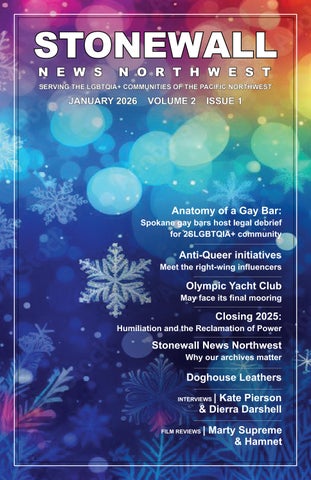
STONEWALL N E W S
N O R T H W E S T
SERVING THE LGBTQIA+ COMMUNITIES OF THE PACIFIC NORTHWEST
JANUARY 2026
VOLUME 2
ISSUE 1
Anatomy of a Gay Bar:
Spokane gay bars host legal debrief for 2SLGBTQIA+ community
Anti-Queer initiatives
Meet the right-wing influencers
Olympic Yacht Club
May face its final mooring
Closing 2025:
Humiliation and the Reclamation of Power
Stonewall News Northwest Why our archives matter
Doghouse Leathers | Kate Pierson & Dierra Darshell
INTERVIEWS
FILM REVIEWS
| Marty Supreme & Hamnet
www.stonewallnews.net | Stonewall News Northwest | January 2026 |
STONEWALL
CONTENTS
NEWS NORTHWEST
CONTRIBUTORS
3
Anatomy of a Gay Bar
4
Right-Wing Influencers
Serving the LGBTQ+ Communities of the Pacific Northwest
RYAN OELRICH
5
Olympic Yacht Club
PERCY LAIRD
6
Closing 2025
January 2026
DAVID CAPOCCI
Volume 2 Issue 1
10
Stonewall News Northwest Archives
FRANK GAIMARI
www.stonewallnews.net
FABRICE HOUDART
12
From the Hobbit House
12
Out on the Ranch
MADISON APRIL JONES / SGN
13
LGBTQ+ Weekly National Headlines
SUE FERGUSON
14
Doghouse Leathers
15
Marty Supreme
16
Kate Pierson
17
Dogs of Venice
18
Hamnet
19
Kierra Darshell
Publisher & Publication Layout Mike Schultz publisher@coastalpride.net
MATT CYPHERT
All contents © 2026, Stratus Group LLC. No portion of this publication may be reproduced without written consent from the publisher. Neither Stratus Group LLC nor Stonewall News Northwest publication assume responsibility for errors in content, photos, or advertisements. The views expressed herein do not necessarily represent the views of the publisher or advertisers.
When you succeed, we succeed. Partner with us on your finances so you can focus on the rest.
Ask us about:
Business checking, loans, lines of credit and more Great 1.00% credit rate on our business analysis checking account
FSBWA.COM | January 2026 | Stonewall News Northwest | www.stonewallnews.net
Learn More
REGIONAL nYne Bar and Bistro, December 10, 2026 | Photos by Percy Laird
Anatomy of a
G B ay
ar:
Spokane gay bars host legal debrief for 2SLGBTQIA+ community Spokane bars host gathering for 2SLGBTQIA+ legal debrief by Gonzaga Law’s Lincoln LGBTQ+ Rights Clinic and the Spectrum Center
by Percy Laird
T
o understand a gay bar is to understand far more than what’s on the food and drink menu. A gay bar is not defined by alcohol, lighting, or music, but by infrastructure—by the way a community learns to organize itself when formal systems fail it, exclude it, or move too slowly to keep it safe. Historically, gay bars have functioned as many things at once: classrooms and town halls, stages and sanctuaries, places where information moved quickly and care moved quietly, long before any institution was willing to do either. In Spokane—where queer life has often existed without institutional protection—that anatomy has been built and rebuilt over decades. Allen’s Tin Pan Alley, Irv’s, and Dempsey’s were among the
city’s historic gay bars, serving as gathering places long before visibility came with any promise of safety. Often queer-owned and queer-operated, these spaces existed not as a branding choice, but as a necessity, shaped by the understanding that survival required proximity. That lineage was fully visible on December 10, on a Wednesday night, inside nYne Bar & Bistro and Q Lounge on historic Sprague Avenue. At nYne, the bar had been reconfigured not for spectacle, but for care. A complementary taco bar welcomed people in. Ample seating filled the room. A whiteboard stood ready at the front, and community leaders greeted attendees as they arrived, not to screen or police, but to welcome. The invitation had been
circulated intentionally—shared directly with individuals and organizations and also posted publicly on social media— signaling that this was a space meant to be accessed. The gathering was a 2SLGBTQIA+ legal debrief hosted by Gonzaga Law’s Lincoln LGBTQ+ Rights Clinic and the Spectrum Center. The conversation moved through healthcare access, education, and the legislative forecast before settling into a careful, accessible overview of the current state of transgender rights. State and federal litigation were discussed with enough grounding to understand not only what is happening, but why it matters, and how those decisions ripple outward into ordinary lives. The room itself reflected the
Historically, gay bars have functioned as many things at once: classrooms and town halls, stages and sanctuaries, places where information moved quickly and care moved quietly, long before any institution was willing to do either
breadth of the community: teachers, nonprofit leaders, legal and medical professionals, veterans, and business owners, sitting together, taking notes together. Some of the most urgent guidance was also the most practical. Attendees were encouraged—plainly and without alarmism—to put estate planning documents in place, particularly given the legal vulnerabilities queer and trans people continue to face. Different avenues for filing complaints when rights are violated were also shared, demystifying systems that too often feel intentionally opaque. This is one of the quieter, enduring functions of gay bars: knowledge circulation. Long before institutional support existed, bars were where queer people learned how to survive, how to prepare, how to warn one another. That role has not disappeared—it has simply adapted. Later that same evening, the anatomy shifted, but remained intact. At Q Lounge, a Pivot Open Mic unfolded under soft lights and open expectation. Hosted by Ani—who spoke easily and openly about her girlfriend being in the audience—the event was not explicitly labeled as queer, and that, too, mattered. The room drew people from across backgrounds and walks of life, GAY BAR - To Page 20
www.stonewallnews.net | Stonewall News Northwest | January 2026 |
NATIONAL
Whether these initiatives succeed or fail in 2026, it seems that US politics has entered a new era of not questioning the emperor’s new clothes and risking being labeled a “domestic terrorist.
Anti-Queer initiatives inch closer to signature goals Meet the right-wing influencers helping make it happen By Madison April Jones, the SGN Managing Editor | Published by the SGN on Dec 23, 2025
S
ince the 2015 Obergefell v. Hodges ruling for marriage equality, the conservative right has struggled to weaponize hatred toward Gay and Lesbian communities for political gain, like it did in previous eras. Although favorable Republican views on the morality of Gay and Lesbian people have dropped significantly these past few years, going from a peak of 56% in 2022 down to 38% in 2025, according to Gallup, overall US public support (both morally and legally) for LGB people has remained high. And with the recent November refusal by the US Supreme Court to review Kim Davis’s bid challenging same-sex marriage, good ol’ fashioned homophobia alone seems less and less effective at scaring voters. In fact, prominent Gay operatives have been lauded for joining the MAGA movement (more on that later). But proponents of antiLGBTQIA+ legislation have found much more success with another political scapegoat to rally
people against: the Transgender community.
people but also women and Queer people more broadly.
And under Trump 2.0, there has been a resurgence of transphobia in the right-wing populist media ecosystem. What was once Rush Limbaugh warning against Lesbian farmer invasions has metastasized into a slew of MAGA influencers on Facebook and X claiming that “biological male” students are trying to infiltrate girls’ sports teams and locker rooms. To them, transness and gender-nonconformity are not simply natural aspects of human experience reflected in the many cultures around the world and throughout history but rather a mental illness. Sound familiar?
The winds of change have shifted, and the presence of a MAGAstyle McCarthyism has already begun making inroads into our state.
And despite estimates of the number of Trans girl athletes in Washington being underwhelmingly low compared to the 250,000 total who participate (not to mention Trans boy and Nonbinary athletes), selfproclaimed “protectors of women and girls” have been leading the charge for three different initiatives that would negatively impact not only Transgender
| January 2026 | Stonewall News Northwest | www.stonewallnews.net
Let’s Go Washington ’25 Let’s Go Washington (LGW) is a political nonprofit organization funded by millionaire hedge fund manager and conservative megadonor Brian Heywood. This year, Heywood and LGW have been collecting signatures across the state for two new initiatives: IL26-001 “Strengthen Communication Between Parents and Schools,” also called “the Parents’ Bill of Rights,” and IL26638, “Protecting Fairness in Girls’ Sports.” According to LGW’s website, IL26-001 seeks to allow parents access to their K-12 student’s full medical and mental health counseling records, including any information regarding sexual experiences or attractions; it also includes giving parents written notice and the option to
opt students out of instruction on topics of sexuality. IL26638 would “require policies prohibiting students it defines as ‘biologically male’ from competing with or against female students in certain interschool athletic activities that are intended for female students only,” which would be enforced by “verifying the student’s biological sex, based on reproductive anatomy, genetic makeup, or normal endogenously produced testosterone levels.” These initiatives, if enacted, could pose several problems for the privacy and safety of Queer youth. If a parent or guardian has regressive and/or hostile views on LGBTQIA+ people, allowing them full unfettered access to their child’s records, if they are Queer or Trans, could pose a potential risk. In regard to instituting strict biological-sex verification guidelines for girls’ sports, it does not address the nuance of Intersex students or provide any safe alternatives for Transgender athletes at large. The potential negative implications of these guidelines can be seen in how Algerian boxer Imane Khelif was treated at the 2024 Paris Olympics. Khelif faced several unverified allegations that she tested high for testosterone and INITIATIVES - To Page 24
REGIONAL
“Back in the eighties and nineties the purpose of the OYC was to offer a place for Gay boaters to meet when other doors were closed to us. During the 2000s, that began to change, when more yacht clubs became welcoming.” -- Mike Marguand, former commodore
After decades at sea, LGBTQ+ Olympic Yacht Club may face its final mooring Courtesy Olympic Yacht Club
by Sue Ferguson
T
Founded in 1979, Olympic Yacht Club is the oldest Queer yacht club in the Pacific Northwest. But the past ten years brought headwinds to the club’s future. With mainstream yacht clubs now extending membership to LGBTQ+ sailors, many once-loyal OYC members set course for harbors offering collective slip arrangements, livelier weekend gatherings, and the fellowship that comes with more hands on deck.
On a summer afternoon in 1979, a friend of sailing enthusiast Andy Johnson said, “Don’t you think Seattle needs a Gay boating club? You’re good at organizing. You do it! “ Johnson placed a small advertisement in a community newsletter, never expecting the wave of enthusiasm that followed. Within a few weeks, his living room overflowed with nearly 20 seafaring enthusiasts eager to establish bylaws, elect officers, and make the Olympic Yacht Club official.
adorned vessel as other members walked alongside in what soon became a Seattle Pride Parade fixture, drawing cheers as it glided through the celebrations.
more women began joining the once male-dominated boating world, and the OYC grew in its membership with these additional boaters.
Besides these activities, fellow boaters offered classes such as navigation, docking, engine repair and maintenance, first aid, and boating in difficult areas of Puget Sound. Sue Ferguson, a former rear commodore, recalls taking a boating safety class from OYC that helped her appreciate her wife’s interest in the activity. Sue was more confident in her responsibilities of safely tying off lines, retrieving a lost “fender,” and understanding how to maneuver the boat in an emergency.
Headwinds
he burgee flag has been proudly flown on Olympic Yacht Club vessels for decades. New members looked forward to receiving their flag and the pride that came with being a part of such a unique boating group. But there is the strong possibility that the club will be disbanded, leaving members to seek harbor elsewhere.
Under Johnson’s leadership as founding commodore, the OYC quickly became a sanctuary on the waters of Puget Sound. In an era when safe spaces for the LGBTQ+ community were limited, members found camaraderie navigating the San Juan Islands, sharing potluck dinners, and attending the Seattle Boat Show together. A volunteer offered to tow their rainbow-
In August of 2009, the OYC celebrated 30 years of being the oldest Queer yacht club in the Pacific Northwest. Eventually,
Mike Marguand, a former commodore, explained more of the OYC’s history in a recent interview. “Back in the eighties and nineties,” he said, “the purpose of the OYC was to offer a place for Gay boaters to meet when other doors were closed to us. During the 2000s, that began to change, when more yacht clubs became welcoming.” Looking at current challenges through a longer lens, he surmised that three major factors have impacted the OYC: increased acceptance at traditional yacht clubs, the pandemic’s disruption, and some members’ growing
preference for extended voyages longer than weekends only. The past ten years brought headwinds to the club’s future. With mainstream yacht clubs now extending membership to LGBTQ+ sailors, many onceloyal OYC members set course for harbors offering collective slip arrangements, livelier weekend gatherings, and the fellowship that comes with more hands on deck. Then the pandemic struck like a rogue wave, washing away planned gatherings. Some sailors stowed their sea legs, leaving their boating days behind permanently. Others navigated to distant shores for employment or traded their vessels for land yachts (RVs and campers). Though the club still anchors occasional meetups, its roster has ebbed to just 73 souls, OYC - To Page 22
www.stonewallnews.net | Stonewall News Northwest | January 2026 |
OP-ED
Closing 2025: Humiliation and the Reclamation of Power This article first published on Fabrice Houdart. Please consider becoming a subscriber of his work at https://fabricehoudart.substack.com
The year queer progress stalled. Humiliation returned to our politics and lives. A reflection on how we reclaim power amidst our crisis of unity, leadership and imagination. by Fabrice Houdart
Y
early retrospectives can feel dull. Years are an artificial way to measure time—especially when it comes to queer liberation. Change for us happened gradually, through conversations at family dinners and in the office. Sometimes, though, progress felt like it leaped: when a law, a TV show, or a dramatic event captures the public’s attention and seems to change hearts and minds. I learned this protesting California’s Proposition 8 in 2008, celebrating marriage equality in 2015, and seeing India recriminalize homosexuality in 2009 before repealing Section 377 in a 2018 Supreme Court decision. Progress is uneven. Perspective matters. You have to look at the overall trend. But many of us seem to agree that 2025 was a turning point. As I reread my writing this year, especially my every other Sunday reflections, I was struck by how erratic it sometimes felt. In March, I argued for a global LGBTQ+ virtual nation; by September, I suggested queer Americans might
We are a people. Or at least we can decide to be a people that transcends geography, class, identities, and borders. And we must make it attractive to be a people. We are intelligent, talented, and capable. Technology is on our side; it bridges our physical dispersion. Pride has curdled into shame once again, but reclaiming it will require discipline, consistency, and courage. need to arm themselves. Today, writing from the calm of a muchneeded break in the mountains, I feel less isolationist and more pacifist. Still, I remain convinced that this moment demands a gigantic shift in our approach to queer liberation. Much of my reflections this year stems from a feeling of humiliation. Larry Kramer once wrote, “Humiliation is so essential to Catholics. And to faggots!” I happen to be both, so this year felt grimly familiar and enraging. The U.S. Government’s abrupt disengagement, our erasure from the public eye in Russia and China, the corporate retreat, calls
| January 2026 | Stonewall News Northwest | www.stonewallnews.net
for a global ban on surrogacy, and the relentless denunciation of trans youth and their parents all reignited feelings of shame. Our fight for dignity, joy, and the chance to contribute has been labeled as “woke,” weak, and selfindulgent. Labels that reflect the way the majority still perceives us: as undeserving. Society’s renewed obsession with masculinity and “warrior mentality” felt like being sent back to middle school, where being queer was the worst thing one could be - a trend that might be coming back, the resurgence of vintage homophobia (see my post titled “A Queer Life”). Our symbols and heroes in the U.S.—
Harvey Milk, Admiral Rachel Levine, the Pride flag, World AIDS Day, the Orlando memorial, rainbow crosswalks —were trampled. And we did nothing about it. Being gay has always meant confronting powerlessness. In Angels in America, Roy Cohn defines “homosexuals” not by desire but by their lack of power- those with “zero clout.” This year reminded us how little that dynamic has changed. Even friends and family members hinted that we had flown the rainbow flag too high and were now being “right-sized.” Our modest gains—2 percent representation in the U.S. Congress, 1 percent in the Fortune 500 Boardroom, the HRC Corporate Equality Index, the comfort of Will & Grace reruns, or the success of “Heated Rivalry” —proved to be very little power compared to our opponents’ dominance of media, political and judicial institutions and the alliance of billionaires and evangelicals. The tools that once gave us power—rage, visibility, cultural relevance—are suddenly yielding diminishing returns. What we built was not enough. I also wrote about a crisis of unity. Faced with an unflattering reflection of our community, too many of us instinctively said, “That’s not me,” and quietly checked out. 2025 - To Next Page 7
Continued - OP-ED 2025 - From Previous Page 6
Our champions also unraveled. We had outsourced our liberation to Democrats, corporations, and the human rights framework-none of which have figured out their role in the new world order. Democrats struggle to articulate a clear vision for citizens; corporations are retreating to a narrow view of shareholder primacy; and Americans have driven the final nail into the coffin of the human rights framework. I also addressed our crisis of leadership. Acknowledging that we played a part in this: lack of direction, vested leadership interests, and a scarcity mindset that holds us back. I questioned our relationship with elites and donors, and our tendency to shame the very gays who led our movement (see my recent piece on the A-Gays). I also wrote about queer loneliness as a symptom of our inability to take care of each other. l I argued that purpose, community, and honesty—not guilt or orthodoxy—must guide us forward. I also wrote about biology and consciousness, arguing that LGBTQ+ people are not just a coalition but a people, capable of uniting across geography, class, and identity.
Diversions LGBTQ+ Mini-Crossword #004 1
6
7
8
9
2
3
4
5
ACROSS
1. _____ Yang from SNL and Wicked 6. In _____ (not yet born) 7. People from Bangkok 8. The optic _____ that transmits visual info from the retina to the brain 9. Sandwich cookie by Nabisco DOWN 1. “Close ___ __ cigar” 2. Truman Capote’s first published novel, _____ Voices, _____ Rooms (same word for both blanks) 3. 1979 hit & gay anthem by Sister Sledge, “__ ___ Family” 4. Cynthia _____ from Harriet and Wicked 5. Front tips of airplanes
Visit DiversionsPuzzles.net for more free puzzles & book info! Queer Pride Puzzles Volume One out now!
Answer Key to puzzle on page
To me, that is the fundamental truth emerging from 2025. We are a people. Or at least we can decide to be a people that transcends geography, class, identities, and borders. And we must make it attractive to be a people. We are intelligent, talented, and capable. Technology is on our side; it bridges our physical dispersion. Pride has curdled into shame once again, but reclaiming it will require discipline, consistency, and courage. Not seeing this potential is our third crisis: the crisis of imagination. To me, the LGBTQ+ journey, both collective and personal, is still just beginning. At 47, I am still figuring out what a queer life is. I think we collectively are a very young People, and we are still figuring out our purpose. 2025 marked the end of borrowed progress and the beginning of authentic self-determination. The next frontier demands that we act as one, invest in our leaders, and imagine new forms of power for our global community. I opened the year by writing, “Knowing our North Star will be key to staying optimistic and effective”. That remains my wish. www.stonewallnews.net | Stonewall News Northwest | January 2026 |
| January 2026 | Stonewall News Northwest | www.stonewallnews.net
Illustration by Ken Min
www.stonewallnews.net | Stonewall News Northwest | January 2026 |
REGIONAL
Stonewall News Northwest digitizes, uploads its initial 16-year print run for public access From the first issue in April 1992 to May 2007 now available online at: https://www.stonewallnews.net/articles/stonewall-newsnorthwest-archive-1992/24304/
Why our archives matter by Percy Laird
T
his Information Belongs to Us
Queer history is not background. It is infrastructure. It is how communities survive erasure, recognize themselves, and pass forward the knowledge required to live openly and fully. When queer media disappears, it is not just stories that are lost—it is strategy, memory, and proof of possibility. The newly digitized release of Stonewall’s first 16 years is not a commemorative gesture. It is a reclamation, and it belongs to us. Stonewall began in 1992 as Stonewall News Spokane, founded by Lawrence Stone under Stonewall Publishing, Inc.
at a time when visibility itself carried consequence. In Spokane, printing the words “gay” and “lesbian” was considered risky. Printers refused bids. Advertisers hesitated. The expectation was silence or shame. Stonewall rejected that expectation outright. It was built deliberately—as a fully licensed, professionally produced newspaper that asserted queer lives were not marginal, and that documenting them was a political act. The archive does not soften that reality. Its pages show how rights were contested locally, how nondiscrimination protections were fought for inch by inch, and how the AIDS crisis shaped both urgency and grief. They also show STONEWALL - To Page 29
Above: Screen shot of Stonewall News Northwest archive webpage
“Making this archive accessible is not about nostalgia. It is about continuity. This information belongs to us. Reading it is not passive. It is how we honor those who took risks to be visible, and how we give future generations something essential: evidence. Evidence that queer lives were lived fully here. Evidence that authenticity is not new. Evidence that they inherit not just struggle, but lineage.”
Covers of some of the digitized issues now online
First issue, April 1992
10 | January 2026 | Stonewall News Northwest | www.stonewallnews.net
REGIONAL Covers of some of the digitized issues now online
www.stonewallnews.net | Stonewall News Northwest | January 2026 | 11
COLUMNISTS
Thoughts from the Hobbit House This Christmas, embrace the gift of radical acceptance A Journey from Magic to Mindfulness
“Radical Acceptance doesn’t mean approval. It doesn’t mean liking what happened. It means acknowledging reality as it is, so we can respond effectively instead of remaining stuck. Where many of us struggle most is when reality feels unjust.” by Ryan Oelrich
A
s a child, I was absolutely certain I would grow up to be a world-renowned magician. Not a hobbyist. Not a guy who does card tricks at parties. A world-renowned magician. I rehearsed relentlessly, fundraised
to buy expensive props, and devoured every magic special I could find as a teenager growing up in rural Montana. I started performing at 14, adding elaborate balloon sculptures to my act for extra flair. I traveled, performed shows, and even received accolades—like the Rising Star Award from the International
Ryan and his husband built a Hobbit House that’s become a regional attraction.
Brotherhood of Magicians. I once met Siegfried and Roy and David Copperfield. Hope was high. Confidence was… perhaps misplaced.
Reality, it turns out, had other plans. Looking back at old videos of my teenage performances, it’s HOBBIT HOUSE - To Page 30
Out on the Ranch Reclaiming the holiday spirit: from tradition to spellcraft Happy Reclamation Season!
“This season, reclaiming extends beyond politics or media. It manifests in how we reclaim holidays, traditions, and personal celebrations — away from consumer pressures, religious expectations, or manufactured experiences. ” by David Capocci
“R
Image from winter solstice fires at Paca Pride Guest Ranch
eclaiming my time!” — a phrase popularized by Rep. Maxine Waters in 2017 — has been around for far longer than the meme. But this year, I’ve noticed the profound influence “reclaiming” has had across the nation. It signals a deep, positive shift: people taking back ownership of their time, their space, their traditions, and their celebrations. December carries the same theme. The Big Dark leading up to the
12 | January 2026 | Stonewall News Northwest | www.stonewallnews.net
Winter Solstice symbolically invites reflection, reassessment, and reclaiming what is ours. This impulse is becoming visible in many arenas of life: voters reclaiming the nation’s narrative at the polls, independent media reclaiming the role of journalism over mainstream partisan spectacle, and social discourse reclaiming space from extreme voices by quietly moving past the noise. This season, reclaiming extends beyond politics or media. It OUT ON THE RANCH - To Page 31
NATIONAL
LGBTQ+ Equality Weekly National Headlines
The Gay Business TikTok, Grindr, and Queer Data
December 24, 2025
by Fabrice Houdart
Congress Moves to Criminalize Gender-Affirming Care for Minors HR 3492 would make it a federal crime for medical professionals to prescribe puberty blockers, hormone therapy, and other gender-affirming healthcare to trans youth, with violations carrying up to 10 years imprisonment. Read more in Pink News. Rep. Sarah McBride condemns GOP healthcare priorities Congresswoman Sarah McBride framed the House’s votes on criminalizing transgender healthcare as elevating ideology over science, while millions face expiring ACA tax credits. See in The Advocate. RFK Jr. announces sweeping federal bans on youth gender care Before making his way to Aspen, RFK Jr. still found time to unveil new actions aimed at eliminating transition-related medical care for minors, referring to such treatments as “sex-rejecting procedures”, including Medicare/ Medicaid restrictions. Read more on the surrealist press conference at HHS on NPR. So-called gender affirming care has inflicted lasting physical and psychological damage on vulnerable young people, Kennedy said. This is not medicine. It is malpractice. States Sue HHS Over This Clampdown A coalition of 19 states and the District of Columbia has sued the Department of Health and Human Services over RFK Jr’s declaration. The lawsuit argues that the declaration—labeling puberty blockers and hormone therapy as unsafe and warning providers they could lose Medicare and Medicaid funding— amounts to an unlawful attempt to change medical standards without proper rulemaking. State attorneys general say the move is designed
Photo courtesy of Fabrice Houdart This article first published on Fabrice Houdart | A weekly newsletter on LGBTQ+ Equality. Please consider becoming a subscriber of his work at https://fabricehoudart.substack.com
to intimidate doctors and interfere with care that major U.S. medical associations continue to support as evidence-based and necessary. Massachusetts eliminates foster care protections for LGBTQ+ youth The state Department of Children and Families removed policies requiring foster parents to support LGBTQ+ youth after lawsuits from families and threats from the Trump administration. Read more in The Advocate. HRC’s Kelley Robinson Sees The Upside In a year-end message here, Human Rights Campaign President Kelley Robinson framed 2025 as a moment of sustained attack on LGBTQ+ people—but also one of political resolve and tangible wins. Pointing to targeted efforts to erase queer families and stories, Robinson emphasized community organizing, storytelling, and coalitionbuilding as the movement’s counterweight. She highlighted election victories as proof that equality remains a winning issue, citing Abigail Spanberger’s election as Virginia’s first woman governor, Mikie Sherrill’s win in New Jersey, and California’s passage of Proposition 50 to curb partisan gerrymandering. ___________________________
Queering the Boardroom Geoffroy van Raemdonck Bets on “Practical AI” in Retail Former Neiman Marcus Group CEO Geoffroy van Raemdonck has joined Verneek as a strategic investor and advisor. Van Raemdonck joins an advisory bench that includes former
Walmart CTO Karenann Terrell and ex–Coca-Cola CFO Kathy Wallen. Sue Nabi’s Exit from Coty Sue Nabi, who also happens to be on the Board of Moncler, the Algerian-born beauty visionary and only trans CEO in the Fortune 1000, will step down as Coty Inc.’s CEO and director at year’s end after a five-year tenure that helped revive the company’s image and finances. Her exit comes amid a wider boardroom shake-up and a pending leadership handover to an interim successor as Coty navigates the loss of key licenses and fiercer competition in global beauty. Leadership Moves This Week Dr. Anthony J. Japour was appointed Chair of BioFlorida’s Southeast Chapter. Sylvia Acevedo, former NASA engineer and education leader, joined NStarX as an advisor. How to Land Your First Board Seat Webinar For many LGBTQ+ professionals, board service can feel opaque, gatekept, or simply out of reach. Check out this recent webinar hosted by the Association of LGBTQ+ Corporate Directors. In Securing Your First Board Seat, Jennifer Knight (Point Strategic Advisors) and Brian Ellner (APCO) share how they navigated the journey from executive leadership to the boardroom, in a conversation expertly moderated by Ozzie Gromada Meza of LCDA (both Jennifer and Ozzie are Board Members of the Association). If you missed it live, this is well worth your time: ___________________________
TikTok is facing a GDPR complaint in Europe over allegations that it monitored users’ activity on Grindr, raising fresh concerns about how queer data is tracked, shared, and monetized. Digital rights group NOYB claims TikTok, Grindr, and marketing firm AppsFlyer engaged in unlawful inter-app data tracking that may have exposed highly sensitive information, including users’ sexuality. If substantiated, the case could trigger significant fines under EU law and reignite scrutiny of how platforms handle “special category” data— especially for LGBTQ+ users, for whom privacy breaches can carry real-world risks. UK: Major corporations have slashed Pride support by 92% An analysis of social media posts by the UK’s biggest companies found that mentions of Pride had plummeted by 92% since 2023, mirroring a trend seen among large American firms. The Guardian’s investigation reveals companies are quietly retreating from public LGBTQ+ support amid political pressure. The UK’s biggest businesses are rolling back their public support for Pride celebrations, Guardian analysis suggests, prompting warnings that “clear signals” are needed in the face of growing global LGBTQ+ hostility. Who Pays for AI “Productivity”? Minority Workers at Risk One of the stark lessons of the pandemic was that LGBTQ+ workers held more precarious jobs—and were often the first to be cut. It’s part of a wider “being at the margin of the economy” situation that we need to tackle. As AI-driven “productivity gains” accelerate, it’s worth asking who will pay the real price. In the first eleven months of 2025 alone, 1.17 million jobs were eliminated, a 54% increase over 2024. Women are already 1.4 times more likely to be displaced, and Black women face unemployment rates of 7.1%. If history is any guide, LGBTQ+ workers—especially those who are women, Black, or otherwise NATIONAL - To Page 28
www.stonewallnews.net | Stonewall News Northwest | January 2026 | 13
REGIONAL
Doghouse Leathers: The beating heart of Capitol Hill’s leather and fetish community
“Ultimately, we aim to cultivate a space where people feel informed, empowered, and supported during their exploration.” -- Dan Daniels, Owner
Doghouse Leathers | 715 E Pike St, Seattle, WA | https://www.doghouseleathers.com by Frank Gaimari www.FranksFilmReview.com
W
hen you step into Doghouse Leathers on Capitol Hill, it’s clear this isn’t your average shop. The air is rich with the unmistakable scent of leather, but what truly sets this place apart is the immediate sense of belonging — a warm welcome, a feeling of safety, and a vibrant network of people that wraps around you like an old friend. At the heart of it all is Dan Daniels. With a genuine smile and an easygoing charm, he’s the kind of person who makes you feel seen and valued the moment you meet him. His dedication to creating a space where everyone feels at home has turned Doghouse Leathers into more than just a store — it has become a cornerstone of Seattle’s leather and fetish community. The store was established with the mission to provide highquality leather gear in a safe and welcoming environment. Founders Dan Daniels and Jeff Henness envisioned a space where all customers, from seasoned leather enthusiasts to newcomers, could feel comfortable expressing themselves without fear of judgment. Although Jeff Henness has sadly passed away, his vision remains a guiding force. His influence is deeply rooted in the store’s core values, including its welcoming environment and commitment to the community. From the start, this guiding spirit has influenced
every part of the store and continues to drive its mission today. Leather is the foundation of the store, showcasing racks filled with classic jackets, vests, and rugged chaps. The shop also features accessories such as harnesses, cuffs, collars, and puppy gear, selected for their style and durability. T-shirts are available as well. Additionally, the store sells lubricants, condoms, and highquality toys. Seeking to understand what truly sets Doghouse Leathers apart, I sat down with Dan for a conversation. Through thoughtful questions and candid answers, it quickly became evident just how much heart and dedication go into the store every day — and why it means so much to the community it serves. Frank Gaimari: What inspired the creation of Doghouse Leathers? Dan Daniels: The idea for our shop came to us during a trip to Chicago for the “International Mr. Leather” event. While exploring, we visited the Chicago Eagle, which had a small shop on-site. As we browsed, I turned to Jeff and said, “We could do something like this in Seattle.” That casual comment planted the seed for what would eventually become Doghouse Leathers. After returning home and discussing it thoroughly, we decided to test the idea by opening a small weekend shop inside
14 | January 2026 | Stonewall News Northwest | www.stonewallnews.net
The Cuff, where we were both working at the time. The space was very modest — just a 5x7 closet — but it was enough to get started. In those first days, we sold small items like cock rings, belts, and other accessories. It wasn’t a big operation, but it allowed us to run our shop and observe
how the community responded. The feedback was very positive, encouraging us to keep going. FG: What major milestones or changes have stood out in the store’s evolution over the years? LEATHER - To Page 23
FILM
Marty Supreme: A chaotic tale of ambition, ego, and redemption Wth powerhouse performances, stunning visuals, and unrelenting energy, Marty Supreme is sure to dominate awards season. If you’re looking to make this holiday one to remember, grab your friends or family and experience it together. by Frank Gaimari www.FranksFilmReview.com
E
very so often, I find myself in the theater watching a movie that reminds me why I love cinema. As someone who craves the rare, electric thrill only the best films deliver, I’m always searching for something that feels bold, immersive, and unforgettable. Marty Supreme is exactly that kind of film — a wild, feverish ride that left me exhilarated, exhausted, and desperate to talk about. From the very first scene, Josh Safdie — known for his frantic, high-stakes storytelling in Uncut Gems and Good Time — had me hooked. This wasn’t just a film; it was an experience. A neon-soaked plunge into the chaotic world of Marty Mauser, a man whose boundless ambition threatens to consume everything and everyone around him. While the story is loosely based on table tennis legend Marty Reisman, Marty Supreme is far from a biographical film. Safdie and his co-writer, Ronald Bronstein, take the myth and blow it wide open, crafting a tale that’s as much about the cost of ambition as it is about the man at its center. Timothée Chalamet delivers what I can only describe as a career-defining performance as Marty Mauser. He’s magnetic, monstrous, and impossible to look away from. Marty is the living embodiment of narcissism — every move, every word, every glance calculated for his own gain. He’s a man who believes the world exists solely to orbit his greatness, whether it’s his next hustle, his next victory, or his next moment in the spotlight. Chalamet leans into Marty’s darkness with fearless intensity,
making him both electrifying and infuriating. Watching him is like watching a storm — unpredictable, destructive, and utterly captivating. Marty manipulates, cajoles, and performs for the crowd, but beneath all the bravado is a man utterly alone, consumed by his own myth. To him, relationships are nothing more than transactions. Friends, lovers, even rivals — they’re all just stepping stones on his relentless climb toward fleeting glory. Amid the chaos, Gwyneth Paltrow’s Kay Stone stood out as a striking counterpoint to Marty’s mania. Paltrow, channeling old Hollywood glamour, delivered a luminous, deeply layered performance. Kay isn’t just a love interest; she’s a woman with her own scars, ambitions, and a quiet strength that makes her impossible to ignore. The chemistry between Paltrow and Chalamet is electric — playful one moment, tense the next, but always crackling with energy. The camera adores her, not just for her beauty but for the vulnerability and defiance that flicker across her face. The supporting cast added so much depth and texture to Marty’s world. Tyler, the Creator, brought humor and heart as Wally, Marty’s loyal but exasperated friend. Odessa A’zion’s Rachel was sharp and unflinching, a critic of Marty’s self-serving ways, while Kevin O’Leary’s Milton Rockwell provided a cerebral foil to Marty’s impulsive chaos. And the cameos! Abel Ferrara, Fran Drescher, Sandra Bernhard, and Penn Jillette kept the film unpredictable and added to its frenetic energy. Visually, Marty Supreme is a feast for the senses. Darius Khondji’s cinematography
Gwyneth Paltrow - IMDb
drenched 1950s New York in shadows and neon, capturing the city’s grit and glamour with a dreamlike intensity. The editing was relentless, mirroring Marty’s manic energy, while Daniel Lopatin’s score — punctuated by unexpected ‘80s tracks — kept the tension high and the atmosphere electric. Marty Supreme is a searing exploration of ambition and its cost. Marty’s selfishness is his weapon and his curse, propelling him to greatness while isolating him from everyone who might have cared. Safdie and Bronstein don’t offer easy answers or tidy
resolutions. Instead, they leave us with a portrait of a man who burns bright, crashes hard, and forces us to question whether the price of his ambition was ever worth it. This is a film that demands to be seen on the big screen. It’s loud, vivid, and unforgettable — a cinematic rollercoaster that left me breathless. With powerhouse performances, stunning visuals, and unrelenting energy, Marty Supreme is sure to dominate awards season. If you’re looking to make this holiday one to remember, grab your friends or family and experience it together.
www.stonewallnews.net | Stonewall News Northwest | January 2026 | 15
MUSIC PROFILES
In the early days of The B-52s, we didn’t feel the need to declare our identities — we just were. The very essence of the band, our vibe, our sensibility, was inherently queer. It was in the music, the energy, and the way we presented ourselves. --Kate Pierson
Kate Pierson
Kate Pierson: The Unmistakable Voice by Frank Gaimari www.FranksFilmReview.com
S
ome voices define a generation, while others create entire universes. Kate Pierson unquestionably belongs to the latter group. Her voice, shifting effortlessly from a deep, inviting growl to a soaring high note, brings a vivid, melodic energy to one of music’s most iconic party bands. As a founding member of The B-52s, Pierson — with her signature fiery hair and retro-glam fashion — has been a beacon of joyful nonconformity for more than forty years. Her energy remains as vibrant and infectious as the music she helped create.
in 1977 — marked the humble beginning of what would become a global phenomenon.
Long before the world heard “Rock Lobster,” Catherine Elizabeth Pierson was a creative child growing up in Rutherford, New Jersey, after being born in nearby Weehawken. Her journey eventually led her to Athens, Georgia, where a spontaneous October night in 1976 changed everything. Sharing a Flaming Volcano cocktail at a Chinese restaurant, Pierson, along with Fred Schneider, Cindy Wilson, Ricky Wilson, and Keith Strickland, decided to form a band. Their very first performance — a loose and spirited jam at a friend’s Valentine’s Day party
The band’s groundbreaking sound and style quickly earned them a devoted following, and over the decades, The B-52s became one of the most beloved and influential bands in history. In 2022, their legacy was cemented with induction into the Music Hall of Fame, an honor recognizing not only their innovative contributions to music, but also their cultural impact as champions of individuality, inclusivity, and joyful rebellion. From their quirky beginnings in Athens to their status as global icons, The B-52s have left an indelible mark on the world of music and beyond.
From the very start, The B-52s presented a complete aesthetic package. Their look was as integral to their identity as their sound, blending thrift-store finds, exaggerated beehive hairstyles, and B-movie sci-fi glamour. This distinctive style wasn’t a calculated branding strategy but an authentic expression of who they were — a visual extension of their eccentric music. In a town buzzing with creative energy, they carved out a niche all their own.
16 | January 2026 | Stonewall News Northwest | www.stonewallnews.net
While The B-52s cultivated a chosen family on stage, Pierson built a life of profound partnership and authenticity away from the spotlight. As a proud Queer artist, she has long been a quiet but powerful icon for visibility and living truthfully. Her relationship with artist and designer Monica Coleman, whom she married in 2015, has been a central force in her life — a collaboration built on mutual inspiration and shared dreams. Together, Pierson and Coleman extended their creative vision into hospitality, creating the whimsically decorated Kate’s Lazy Meadow, Kate’s Lazy Cabin, and Kate’s Lazy Desert motel. These spaces are tangible
The B-52s
expressions of Pierson’s distinctive style, offering havens of colorful, kitschy comfort. The partnership with Coleman has been a grounding influence, providing a foundation of love and support that fuels Pierson’s artistic bravery. It is a testament to a life lived fully, both in the public eye and in the quiet moments between shows. As The B-52s have wound down their recent touring schedule, a new chapter is unfolding for Pierson. The band remains a family, a bond that will never fade, but her creative spirit is already exploring new horizons. One of the most exciting PIERSON - To Page 21
PROFILES BOOKS
“The Dogs of Venice” by Steven Crowley Pick up “The Dogs of Venice,” and you might think to yourself that it won’t take long to read. At under 100 pages, you’d be right – which just gives you time to turn around and read it again. Because you’ll want to. by Frank Gaimari www.FranksFilmReview.com
O
ne person.
Two, twelve, twenty, you can still feel alone in a crowded room if it’s a place you don’t want to be. People say, though, that that’s no way to do the holidays; you’re supposed to Make Merry, even when your heart’s not in it. You’re supposed to feel happy, no matter what – even when, as in “The Dogs of Venice” by Steven Rowley, the Christmas tinsel seems tarnished. Right up until the plane door closed, Paul held hope that Darren would decide to come on the vacation they’d planned for and saved for, for months. Alas, Darren was a no-show, which was not really a surprise. Three weeks before the departure, he’d announced that their marriage wasn’t working for him anymore, and that he wanted a divorce. Paul had said he was going on the vacation anyhow. Why waste a perfectly good flight, or an already-booked B&B? He was going to Venice. Darren just rolled his eyes. Was that a metaphor for their entire marriage? Darren had always accused Paul of wanting too much. He indicated now that he felt stifled. Still, Darren’s unhappiness hit Paul broadside and so there was Paul, alone in a romantic Italian city, fighting with an espresso machine in a loft owned by someone who looked like a frozen-food spokeswoman. He couldn’t speak or understand Italian very well. He didn’t know his way around, and he got lost really often. But he felt anchored by a dog.
The dog – he liked to call it his dog – was a random stray, like so many others wandering around Venice unleashed, but this dog’s confidence and insouciant manner inspired Paul. If a dog could be like that, well, why couldn’t he? He knew he wasn’t unlovable but solo holidays stunk and he hated his situation. Maybe the dog had a lesson to teach him: could you live a wonderful life without someone to watch out for, pet, and care for you? Pick up “The Dogs of Venice,” and you might think to yourself that it won’t take long to read. At under 100 pages, you’d be right – which just gives you time to turn around and read it again. Because you’ll want to.
“The Dogs of Venice” by Steven Crowley | c.2025, G.P. Putnam & Sons $20.00 65 pages
In the same way that you poke your tongue at a sore tooth, author Steven Rowley makes you want to remember what it’s like to be the victim of a dead romance. You can do it here safely because you simply know that Paul is too nice for it to last too long. No spoilers, though, except to say that this novel is about love – gone, resurrected, misdirected – and it unfolds in exactly the way you hope it will. All in a neat evenings’ worth of reading. Perfect. One thing to note: the Christmas setting is incidental and could just as well be any season, which means that this book is timely, no matter when you want it. So grab “The Dogs of Venice,” enjoy it twice with your book group, with your love, or read it alone.
Author Steven Crowley by Alfonso Salcedo
www.stonewallnews.net | Stonewall News Northwest | January 2026 | 17
FILM
Hamnet: A portrait of love and loss Visually, Hamnet is a feast for the eyes. Chloé Zhao’s direction is nothing short of masterful, elegantly capturing the rugged beauty of the English countryside and the raw intimacy of family life. Every frame is rich in texture and emotion. Zhao’s ability to balance the epic and the personal elevates the film. The supporting cast adds further depth to the film. Emily Watson, as Mary Shakespeare, and Joe Alwyn, as Bartholomew Hathaway, give remarkable supporting performances, while Jacobi Jupe and Olivia Lynes, portraying Hamnet and Judith, offer some of the most genuine child performances in recent cinema. The siblings’ bond feels so authentic. Their scenes together move even the most stoic audience member.
by Frank Gaimari www.FranksFilmReview.com
A
udiences entering the theater to watch Hamnet may not know exactly what to expect. With the acclaimed talents of Paul Mescal and Jessie Buckley anchoring the cast and the film’s deep connection to Shakespearean legacy, anticipation runs high. Yet, the emotional depth and profound humanity that unfold on screen surpass even the loftiest expectations. Directed by Chloé Zhao and adapted from Maggie O’Farrell’s celebrated novel, Hamnet is a breathtaking meditation on love, grief, and the transformative power of creativity. At its heart, the film recounts the story of Agnes Hathaway (Jessie Buckley) and her husband, William Shakespeare (Paul Mescal), as they navigate the joys and tragedies of family life in 16th-century England. The narrative revolves around the devastating loss of their son, Hamnet, whose death becomes the emotional wellspring for Shakespeare’s iconic play, Hamlet.
Jessie Buckley delivers a phenomenal performance as Agnes. Her portrayal of a woman attuned to the natural world and fiercely devoted to her family is layered and deeply moving. Buckley captures every nuance of Agnes’s experience, from the quiet joys of motherhood to the crushing weight of grief. Her raw, unfiltered reaction to Hamnet’s death is a moment of cinematic brilliance — so visceral and authentic, it is breathtaking. It is the kind of performance that not only earns accolades but also redefines a career. Paul Mescal, as William Shakespeare, brings a performance that is understated and profoundly affecting. Renowned for his subtlety in conveying complex emotions, Mescal introduces a simmering intensity to the role. He portrays Shakespeare as a man caught between the demands of his family and the lure of artistic creation, deftly capturing this tension with nuance. Mescal’s depiction of a father channeling grief into art is inspiring and heartbreaking.
18 | January 2026 | Stonewall News Northwest | www.stonewallnews.net
One of the film’s most perplexing moments occurs when Agnes attends the debut of Hamlet at the Globe Theatre. For viewers unfamiliar with the play, the rapid dialogue and stage action may feel disorienting, echoing Agnes’s own confusion and emotional turmoil. Initially, Agnes is outraged by her husband’s decision to use their son’s name for the play, a choice that intensifies her grief and clouds her understanding. As the performance unfolds, however, she becomes captivated by the actors’ raw emotion and the depth of the story. Her anger
Jessie Buckley
and sorrow gradually give way to comprehension as she realizes how art can transform personal pain into something universal and meaningful. Visually, Hamnet is a feast for the eyes. Chloé Zhao’s direction is nothing short of masterful, elegantly capturing the rugged beauty of the English countryside and the raw intimacy of family life. Every frame is rich in texture and emotion. Zhao’s ability to balance the epic and the personal elevates the film. In the end, Hamnet transcends the label of a simple film — it is an experience. It is a story that breaks the viewer’s heart and then pieces it back together, offering a renewed appreciation for the fragility and beauty of life. With career-defining performances from Jessie Buckley and Paul Mescal, and Chloé Zhao’s visionary direction, Hamnet stands as a triumph. For those seeking powerful storytelling and masterful acting, seeing Hamnet on the big screen is essential.
PROFILES
A life in drag: The legacy of Kierra Darshell “You can balance a successful corporate career and a thriving drag career — I’ve done it for over 35 years, and I’m proud to show that both dreams can coexist. It takes hard work and careful planning, but it’s possible to pursue your passion for drag while excelling in other areas of your life.” - Kierra Darshell by Frank Gaimari www.FranksFilmReview.com
I
f you ask anyone in Pittsburgh’s drag scene about Kierra Darshell, you’ll hear words like “icon,” “leader,” and “inspiration.” For decades, Kierra has been much more than just a performer — she’s a mentor, an activist, and a shining example of resilience. Her magnetic presence on stage and her unwavering dedication to the local queer community have helped shape a legacy that reaches far beyond the spotlight. Kierra’s story started long before drag was celebrated as it is today. Back then, the art form was on the fringes, and the journey to acceptance was anything but easy. But through her talent and determination, Kierra broke new ground in Pittsburgh, becoming a trailblazer for herself and others who would follow. Her love for her hometown runs deep, and it shows in everything she does — from her performances to her outreach. Known for her polished, glamorous style, Kierra is always the picture of sophistication. Audiences recognize her for her elegant gowns, flawless makeup, and that unmistakable presence — warm, confident, and always commanding attention. Her performances, whether set to soulful ballads or powerful anthems, are emotional and theatrical, leaving audiences moved and inspired. But Kierra’s impact goes far beyond the stage. She’s leveraged her platform to advocate for LGBTQ+ rights and champion important causes. Whether she’s at Pride events, hosting community
gatherings, or performing at charity shows, her commitment has helped raise awareness and inspire real change — showing just how powerful drag can be as a force for good. Perhaps one of Kierra’s most lasting contributions is the way she lifts others. She’s mentored countless new queens, offering advice, encouragement, and a helping hand as they find their own voices. Her charity work has raised vital funds for local organizations, making an impact felt throughout the community. Kierra Darshell’s legacy is built on a perfect balance of dazzling glamour and heartfelt activism. She’s a symbol of grace and resilience, and her commitment to community continues to motivate and uplift everyone she encounters. Frank Gaimari: You are a key figure in the drag scene. Looking back, what’s the most important change you’ve seen in the local community since you started? Kierra Darshell: Since I started my drag journey in the late 80s, the art form has changed a lot. Back then, drag mainly thrived in underground spaces — small, intimate venues where the community could express itself freely but stayed out of the public eye. It was a subculture that existed quietly, celebrated within close-knit circles. Over time, drag has become much more mainstream, gaining visibility and recognition on a larger scale. This shift has opened countless opportunities for performers, from larger audiences
Kierra Darshell / Photo by Molly Cummings
to new platforms for showcasing their art. It’s also brought a sense of pride and validation to the community, as drag is now celebrated as a legitimate and influential art form. It’s been amazing to witness this growth and to see how the local scene has flourished alongside it. The opportunities available today are a testament to how far we’ve come, and I’m proud to have been part of that journey. FG: Your drag persona radiates timeless sophistication. Which artists have influenced your signature style the most? KD: My aesthetic has been deeply influenced by a combination of iconic figures and personal mentors who shaped my understanding of beauty, style, and performance. Growing up, I was captivated by the glamour of Diana Ross and the bold, dynamic presence of Patti LaBelle. Their ability to command a stage with grace and power left a lasting impression on me. I also fell in love with the artistry of Bob Mackie, whose gowns embodied sophistication and drama, inspiring me to bring that same level of elegance to my drag.
On a more personal level, my drag mother, Denise Darshell, was instrumental in teaching me the true art of drag. She showed me how to embrace my individuality while honoring the traditions of the craft. I also had the privilege of learning from the legendary Misty Knight, who provided invaluable guidance on the art of entertainment and stage presence. Both Denise and Misty were not only mentors but also sources of unwavering love and support throughout my career. Though they have both passed on, their lessons and belief in me continue to guide everything I do. Their influence is woven into every performance, every look, and every moment I spend on stage. I carry their wisdom and spirit with me always, honoring their legacy in everything I create. FG: Mentorship plays a significant role in your legacy. What’s the most important advice you give to a new queen just beginning her journey? KD: The most important advice I give is to learn the business KIERRA - To Page 26
www.stonewallnews.net | Stonewall News Northwest | January 2026 | 19
REGIONAL - Continued GAY BAR - From Page 3
creating a space where queerness was present, visible, and unremarkable in the best possible way. The theme was the holidays, but the stories traveled far beyond any single tradition. Rose spoke of Christmas in Haiti. Jacob spoke of Christmas in Texas. Between them and others, the bar moved through geography, memory, warmth, loss, and longing, carried by vivid imagery—sounds, smells, rituals, absences. An intermission divided the evening not as a pause in momentum, but as a breath. Time to refill drinks. Time to exchange quiet recognition. When the storytellers returned, the room felt ready. Solidarity moved through the space without needing to be named. There was laughter— sometimes sudden and loud—and grief—sometimes held in silence. And there was recognition, the subtle understanding that our experiences differ wildly, and we still gather to hear them. This, too, is part of the anatomy of a gay bar: the ability to hold multitudes without flattening them. Kitty Kane, the owner of both nYne Bar & Bistro and Q
Lounge, understands this anatomy intimately. When I spoke with her, she was candid about the reality these spaces are facing. “The pandemic changed how people acted,” she observed, a statement that carried more weight than it first appears. Crowds are smaller now, people linger less, and spending looks different—not from disinterest or disengagement, but because economic realities have narrowed what feels possible, even in spaces people care deeply about. nYne Bar & Bistro opened its doors in June of 2010. Thirteen years later, in the space formerly known as the Bartlett, Kitty opened Q Lounge as a deliberate counterpoint—an alternative to the bright, loud energy next door. Q Lounge offers food and drinks, with an emphasis on craft cocktails made by a small group of experienced bartenders who treat the work as, fittingly, a craft. When you walk in, the bar sits to the left, the stage anchors the back of the room, and beyond it, darts and a pool table invite people to stay. Though Kitty is the technical owner, queer spaces have never functioned on ownership alone. There is a palpable sense of shared stewardship here, carried by staff, regulars, event hosts,
Storyteller, Olie G at the Q Lounge, Dec 10, 2026 | Photo by Percy Laird
20 | January 2026 | Stonewall News Northwest | www.stonewallnews.net
and the people who keep showing up. This is not consumption. It is participation. Gay bars are fragile ecosystems. Rising rents, economic strain, political hostility, and cultural shifts all threaten their survival. When a gay bar closes, a community loses more than nightlife—it loses institutional memory, informal care networks, and a place where survival knowledge lives. Keeping these spaces open and accessible requires more than nostalgia. It requires showing up on quiet nights, supporting queer-
owned spaces not only when they are crowded or celebratory, but when they are doing the slower, less visible work of care. A gay bar is not where queer people go to disappear. It is where they gather to prepare, to learn, to grieve, to celebrate, and to make sure they are not facing the world alone. On December 10, on Sprague Avenue, the anatomy of a gay bar was fully visible—and it remained alive because the community chose, on an ordinary Wednesday, to hold it together.
nYne Bar and Bistro, December 10, 2026 | Photo by Percy Laird
Photo by Percy Laird
Continued - MUSIC PIERSON - From Page 16
developments in this new phase is her latest solo album, Radios and Rainbows. The album, a kaleidoscopic blend of genres, showcases Pierson’s unmistakable voice in a fresh and deeply personal way. Radios and Rainbows has already garnered critical acclaim for its vibrant melodies, heartfelt lyrics, and bold experimentation. Tracks like “Evil Love” and “Take Me Back to the Party” have become fan favorites thanks to their infectious energy and emotional depth. The album is a celebration of individuality, love, and resilience. Adding to her creative renaissance, Pierson has also released a vibrant new cover of Patti Smith’s anthem “People Have the Power,” featuring the teen choir from Uniting Voices Chicago. With an uplifting dance arrangement by producer Ned Douglas, the track reimagines the iconic song while honoring its message of hope and empowerment. Pierson describes the project as a call to action for a new generation, reminding listeners that “people do have the power — and we need to use it now!” Having seen Kate perform live at numerous concerts, I was excited for the chance to speak with her. Even though our conversation took place over Zoom rather than face-to-face, her warmth and positivity shone through. Kate’s authenticity is unmistakable. Here are the questions I asked, along with her responses. Frank Gaimari: The B-52s’ unique visual style has always played a major role in the band’s identity. How did the look of the band influence your songwriting, and how did the music shape the visuals in return? Kate Pierson: The B-52s’ visual style was a natural extension of who we were — playful, spontaneous, and unapologetically different. Long before the music, we were already dressing up and creating our own fun in Athens. We’d raid thrift stores like The Potter’s House, hunting for the most outrageous wigs and outfits — not to look glamorous, but to embrace the absurd. I remember Fred once fiercely claiming a ratty
25-cent wig, saying, “No, this is my wig!” That kind of energy defined us. Our first show, on Valentine’s Day 1976, captured that spirit perfectly. Cindy and I wore upside-down fur pocketbooks that looked like white aprons. Nothing was planned or coordinated; we just wore whatever felt fun and expressive. When the band started, it was a continuation of that same creative chaos. There was no strategy, no assigned roles — it all came together spontaneously, born out of jam sessions and a shared sense of adventure. Our look wasn’t calculated; it was simply an extension of how we lived. The thrift-store treasures and wild outfits we wore to parties became our stage costumes. Inspirations came from everywhere: Fellini films, 1960s Vogue, gay culture, drag, and a love for the eccentric. It all blended into a visual identity that reflected our music — bold, quirky, and full of joy. Dressing up wasn’t just about style; it was about freedom, creativity, and letting our freak flags fly. That spirit shaped everything we did, from how we looked to how we sounded. FG: You consistently bring incredible energy and vibrant positivity to every performance. What inspires and sustains that enthusiasm show after show?
We’ve tried choreographing routines a few times, but it always ends up being hilariously awkward. So instead, we just let the rhythm guide us, each doing our own thing. That spontaneity keeps it fresh and fun for both us and the audience. The driving guitar, the pounding drums — it’s all so infectious. Even after all these years, the music still moves me, and that’s what keeps the enthusiasm alive, show after show. FG: Your views on solo albums have evolved. Can you explain why? KP: My views on solo albums have changed a lot over the years. Early on, I saw the idea of going solo as almost a betrayal — like leaving the mothership. I think we all felt that way to some extent, and even our manager discouraged it, worried it might pull the band apart. But now, I see it differently. Working on solo projects has actually enhanced my creativity and energy. It allows me to explore different aspects of myself, tap into new emotions, and approach music in ways that are unique to me. That, in turn, keeps me inspired and fresh when performing with The B-52s. One creative outlet feeds the other, and I’ve realized that doing solo work doesn’t take away from the band — it adds to it.
KP: The energy and joy we bring to every performance come from the audience as much as from within. There’s something magical about looking out and seeing people having the time of their lives — dancing, smiling, and letting go. It’s not something we set out to achieve intentionally, but knowing that our music gives people that kind of joy and freedom inspires me every time. It’s a beautiful cycle: their energy fuels mine, and it never gets old.
I’ve also let go of worrying about how my solo work might be judged. Now, I focus on writing songs that feel authentic, no matter the style. It’s been a freeing experience, and it’s helped me grow as an artist while staying connected to the joy of making music.
Our music is primarily dance music, with an irresistible rhythm. When we play, I can’t help but move — it’s like the music propels me. Sometimes I think, “Maybe I should stand still and be more dramatic for a moment,” but the beat always pulls me back in. Movement is such a natural part of what we do; it’s in the DNA of the band. We’ve always been about creating music that makes people want to dance, and you can’t stand still when you’re part of that.
KP: It’s so hard to pick a favorite because my connection to songs constantly evolves. When it comes to my solo work, my favorite is usually whatever I’ve written most recently. Right now, it’s a Christmas song I’ve been working on. There’s something exciting about the freshness of a new song — it feels alive and full of possibility.
FG: Among all the songs, The B-52s albums, and solo projects, which one do you like the most and why?
As for B-52s songs, my favorites tend to shift depending on what
I’m listening to at the moment. Lately, I’ve been revisiting some of our deep cuts while working on a lyric book, and it’s been such a joy to rediscover songs like “Detour Through Your Mind,” “Junebug,” “Communicate,” and “Cake.” These are tracks we don’t often perform live, but hearing them again has brought back so many memories. One week, I’ll be obsessed with one song, and the next week, it’ll be something else. If I had to name a current favorite, I’d say “Trism.” But honestly, my favorites are constantly changing — it’s like each song has its moment to shine, depending on where I am and what I’m feeling. FG: How has your marriage to Monica, a talented artist herself, influenced your personal creative process outside of the band? KP: My marriage to Monica has been a profound and transformative influence on my creative process. From the moment I met her, I was captivated by her energy, talent, and creativity. She’s an incredible artist in her own right, working in pottery, sculpture, jewelry, and so much more. Right now, she’s creating stunning sculptural clay pieces that are truly inspiring. Her artistry and passion constantly push me to explore new ideas and deepen my own creativity. Monica was the driving force behind my first solo album. She recognized how much I wanted to pursue it, even before I fully embraced the idea myself. She even connected me with Sia, who helped me realize that I could write songs with anyone. Those early writing sessions were transformative, and Monica was there every step of the way. She directed the music video, designed the album cover, and even served as tour manager for my solo shows, handling everything from logistics to the business side. Her ability to juggle so many roles with such grace and talent is nothing short of remarkable. What makes our relationship so special is the mutual respect and support we share for each other’s creativity. I trust her opinion completely — she’s always the first person I turn to for advice or feedback. Monica’s encouragement and creative spirit have been a gift, not just to my PIERSON - To Page 25
www.stonewallnews.net | Stonewall News Northwest | January 2026 | 21
REGIONAL - Continued OYC - From Page 5
with no one willing to take the wheel as commodore. Sensing these changing currents, the 2025 yeoman, Richard Brown, cast a line to former and current members, sending out a comprehensive email and questionnaire to gauge interest. The response revealed additional concerns about the club’s continued existence. The message returned by members was clear: without hands to steer events or chart a course, the OYC may be destined for the maritime boneyard. Every vessel eventually completes its final voyage. When ships retire, their timbers and fittings find new purpose, just as OYC members will carry their passions to different waters. Marguand sees the silver lining in these clouds: perhaps the OYC’s obsolescence signals victory in the greater journey toward LGBTQ acceptance. Brown explained that the process to shut down the nonprofit has
started, but added that it may not be too late to salvage the Olympic Yacht Club. The question remains; will the club make it to its 50th anniversary? At the time of writing, the current OYC board has not yet determined its continued existence. Members who may not have responded to the recent yeoman’s email, or boaters who would like to respond, may wish to contact the club at olympicyachtclub@gmail. com. The club’s ensign may soon be lowered, but the wake left behind by its vessels and crews will ripple outward as a lasting testament to inclusion. With the wind at its back, the Olympic Yacht Club may be preparing to slip into its moorings one last time, leaving behind waters where all could drop anchor together, regardless of whom they loved. Fair winds and following seas, Olympic Yacht Club, as you navigate your next voyage. The Olympic Yacht Club website is at https://www.oycnw.org.
Unless noted, photos courtesy of Olympic Yacht Club
Olympic Yacht Club in the Seattle Pride Parade, June 2011 Photo by Mike Schultz
22 | January 2026 | Stonewall News Northwest | www.stonewallnews.net
Continued - REGIONAL LEATHER - From Page 14
DD: As I mentioned, we started in 2006 with a small shop inside The Cuff. It was a modest beginning, but it gave us the foundation we needed. As word spread and our customer base grew, we moved into our own standalone location at 1312 E Pike Street, just around the corner from the bar. That move was a real turning point for us. Suddenly, we had the space to expand our product line and create the kind of immersive, welcoming shopping experience we’d always envisioned. Eventually, the property was scheduled for redevelopment, and we found ourselves searching for a new home again. In spring 2019, we took another big step — this time to our current location at 715 E Pike Street. This space was larger, ideally suited to store our growing inventory and better serve our community. Looking back, each move has felt like a step forward — each new location has allowed us to grow, offer more to our customers, and really evolve into the store we are today. FG: How do you view Doghouse Leathers’ role within the Capitol Hill and greater LGBTQ+/fetish communities? DD: When we started Doghouse Leathers, our focus was primarily on serving the fetish and leather community. This was the heart of our clientele. However, as the years passed and we moved into larger spaces, our role began to grow and evolve in meaningful ways. With each new location, our client base expanded to include people from across the entire queer community. While we have consistently remained connected to our roots in the gay fetish and leather scene, we have also welcomed the remarkable diversity within the surrounding community. Today, Doghouse Leathers proudly serves a wide range of people — individuals of all genders, orientations, and identities. This evolution has been both natural and intentional, as we have worked to create a space that is not only inclusive but also reflective of the vibrant diversity of Capitol Hill and the greater LGBTQ+ community. FG: Can you tell us about your online store?
DD: Our website is an extension of our physical store, meaning that most of the products you’ll find in-store are also available online. This allows our customers to browse and shop our collection from anywhere, at any time. By visiting https://www. doghouseleathers.com, you can explore our wide variety of items. FG: How do you educate customers about safety, consent, and product care? DD: Educating our customers is something we take seriously — it’s at the heart of what we do. We want everyone to have a safe and positive experience, so we make sure to offer clear, practical advice on best practices. Our customers range from beginners to experts. For newcomers, we focus on safety and injury prevention. For example, in impact play such as flogging, we specify which body areas to avoid to prevent injury. This approach allows everyone to enjoy themselves safely. When it comes to insertable toys, we walk people through things like which lubricants are safe to use with different materials, and how to clean and care for toys to keep everything hygienic. Our team is essential to this process. We hire experienced individuals who care about the community, and we provide them with continuous training to ensure they are always prepared to assist and answer questions. Ultimately, we aim to cultivate a space where people feel informed, empowered, and supported during their exploration. FG: What do you value most when building your staff, and how do you create a welcoming and knowledgeable environment for customers? DD: When we bring new staff members on board, we prioritize hiring community members who are passionate about our products. By hiring people who are already familiar with and enthusiastic about what we sell, we bring authenticity and expertise that enhance the customer experience. This allows them not only to provide knowledgeable recommendations but also to share their own positive experiences. We also place a strong emphasis on creating a welcoming and
inclusive environment for our customers. We encourage our staff to engage with customers in meaningful ways, making them feel at home. This approach applies to everyone, whether they’re local or visiting from out of town. FG: What are your hopes for Doghouse Leathers in the next 5 to 10 years? DD: Looking ahead, it’s honestly exciting — and a little emotional — to think about what the next five or ten years could hold for Doghouse Leathers. This place has already come so far, and I know my late partner would be proud of how much we’ve grown and evolved over the years. People are always asking why I haven’t opened another location in places like Portland or Vancouver. It’s a flattering idea, but it’s also a huge responsibility. Running even one store, especially after losing my partner, has been a big undertaking. I’ve always wanted to make sure that Doghouse Leathers keeps the quality, care, and personal touch that we built together. I’m proud of how our online store has allowed us to reach people far beyond Capitol Hill. It’s been a lifeline for connecting with the broader community — folks who can’t come into the shop but still want that sense of connection and support that we try to offer. As I look to the future, I want to keep growing in a way that feels true to what we started. Whether that means expanding our online presence, trying new things, or just deepening our relationship with the community, I want to do it in a way that honors our roots. I’m committed to making sure Doghouse Leathers stays a welcoming, supportive place for everyone — just like we always intended.
people’s lives. He was heavily engaged in establishing and supporting community organizations. A key achievement was his role in founding “Seattle Men in Leather.” However, his influence extended beyond Seattle, as he was involved across the national leather community. Much of our collective success was fueled by his passion and vision. Jeff’s legacy is at the heart of Doghouse Leathers. His kindness, passion, and dedication to the community still inspire everything we do. Jeff was truly one of a kind, and his spirit is still very much alive in the work we do and the community he loved so much. Doghouse Leathers stands as a testament to what happens when passion, purpose, and community converge. This is a shop where high-quality products meet heart, where newcomers and veterans alike find a place to belong. If you’re looking for more than just leather goods — if you want connection, education, and a feeling of home — Doghouse Leathers is waiting on Capitol Hill. Drop in, and you’ll see why this store is a valued part of Seattle’s queer community. Doghouse Leathers website: https:// www.doghouseleathers.com
Dan Daniels
FG: Jeff played a significant role in Doghouse Leathers. Could you tell us about your life together, his contributions, and the legacy he left behind? DD: Jeff and I started this business in 2006. We weren’t just business partners — we were life partners for almost 30 years until his passing. Jeff was an amazing person. He wasn’t just part of the leather community. He was a mentor, a teacher, and a leader who made a real difference in
Jeff Henness
www.stonewallnews.net | Stonewall News Northwest | January 2026 | 23
NATIONAL - Continued INITIATIVES - From Page 4
was Intersex. Despite being backed by the International Olympic Committee, Khelif still became the target of a smear campaign led by Elon Musk and JK Rowling, who accused her of being secretly a “biological male.” As of December 16, IL26-638 sits at 315,979 signatures, while IL26-001 has 289,571. LWG will have until January 2, 2026, to collect enough signatures to take its initiatives to the Washington legislature, where they will either be passed or put on to the November 2026 ballot (each will need to reach around 400,000 to account for any errors or duplicate signatures). Both initiatives have received endorsements from several conservative groups, such as Gays Against Groomers, the Washington State Young Republicans, and XX-XY Athletics, an athleisure brand that advocates the immutable reality of only two chromosomal sexes (Intersex people be damned). IL26-126 Voter ID Led by the Washington State Republican Party, IL26-126 looks to align Washington with Trump’s executive orders and also recent federal court rulings mandating that all eligible voters, in order to register to vote, must supply a US passport, birth certificate, or naturalization paperwork. Those who do not submit a registration 30 days before an election must verify in person at the county auditor’s office, and those who do not comply within 14 days of the election will have their registration canceled. According to the Brennan Center for Justice, more than 21 million American citizens do not have these documents currently available to them. And those who have changed their names or have differences between documents (like married women and Transgender people) are at greater risk of being affected. In response to a video made by the SGN critiquing the initiative, the Washington State GOP said, “If WA Democrats had nothing to hide, they wouldn’t fret about requiring proof of citizenship to vote.” (Note: The SGN does not affiliate itself with any political party.)
But the ones who’ve undisputedly touted these initiatives most have been the Trump-aligned political pundits, stumping across the state for both LWG and the local GOP in rural areas to get people out to collect signatures and attend rallies at school gymnasiums. Here’s the rundown on how they’ve each been contributing to these campaigns.
Ari Hoffman “1 B-list ninja cosplayer” is how Ari Hoffman described SGN contributing writer Arin Waller when he filmed her as she took photos on assignment during the Charlie Kirk vigil at Westlake Center on September 10. The post received thousands of likes on Hoffman’s Instagram page, and elicited many negative comments. Hoffman is most known for being a conservative radio talk show host on 570 KVI, broadcasting weekdays from 3 to 6 p.m. He is also West Coast editor for the right-wing publication the Post Millennial. Firmly supporting LGW and its initiatives in a recent article, Hoffman wrote about “threats from Antifa” against the 250-person LGW event in Tumwater on Dec. 12. He wrote that LGW “was notified Friday [Dec. 12] by the FBI that ‘Antifaaffiliated’ individuals and groups were calling for acts of violence and intimidation,” and that Heywood made the statement that “Antifa’s goal is to threaten and intimidate Washington citizens into silence.” In September, Trump signed an executive order to designate “Antifa” as a “domestic terrorist organization,” despite it being only a dispersed political movement with no formal organization behind it. The LGW claim of a FBI tipoff, if true, would line up with the leaked Dec. 4 memo from US Attorney General Pam Bondi that instructs the FBI to crack down on what it deems “domestic terrorists,” including those that adhere to “radical gender ideology.” According to the Brennan Center for Justice, experts fear that these new attempted classifications, which have no legal footing, will only help Trump and his allies to “violate free speech rights, potentially threatening any
24 | January 2026 | Stonewall News Northwest | www.stonewallnews.net
person or group holding anyone of a broad array of disfavored views with investigation and prosecution.”
Brandi Kruse In that same article, Brandi Kruse — a former reporter with FOX13, now a political commentator and podcaster — is also cited as sharing photos of a police presence at the LGW event. She in the past has been no stranger to criticizing LGBTQIA+ rights, as well as aligning herself politically with Trump. She is also featured prominently in a video on Let’s Go Washington’s homepage discussing IL26-638 with two high school cisgender girl athletes on her political podcast UnDivided. Together, they accused Gov. Bob Ferguson, Attorney General Nick Brown, and Superintendent Chris Reykdal of putting them in danger by potentially being made to share a locker room with somebody of the “opposite sex.”
Scott Presler Despite not being local to the region, Presler, a national conservative figure, was recently part of the Washington GOP strategy to help mobilize constituents around the IL26126 Voter ID initiative and its signature-gathering efforts. In response to the SGN video critiquing IL26-126, Presler responded with: “WA Democrats are VERY angry that we’re collecting signatures to require proof of citizenship in order to register to vote.” (Note: The SGN does not affiliate itself with any political party.) A November Lynnwood Times profile on Presler’s tour around the state, in which he attended rallies and spoke to event-goers, described him as a “conservative firebrand who was the unstoppable force behind Donald J. Trump’s 2024 landslide victories in battleground states.”
The current Office of Superintendent of Public Instruction code requirements state: “Use of locker rooms by transgender or gender-expansive students will be assessed on a case-by-case basis, with the goal of maximizing transgender or gender-expansive student social integration.” Participation of Transgender athletes is governed by the Washington Interscholastic Activities Association, including guidelines for inclusion of genderdiverse youth in sports.
The article shared how, during his speech in Marysville, Presler gave vocal support for the LWG initiatives, and reaffirmed to the crowd a conservative belief in traditional gender roles, despite himself being a Gay man. “And although I am pretty, I know that I’m a biological man,” he said, adding, “A man is a provider and a protector. And the ‘men’ of this state of Washington have failed women. And they’ve failed our girls. And they have failed our daughters.”
In another video taken by influencer and independent journalist Jonathan Choe at the Dec. 12 LGW Tumwater event, Kruse gave a speech about the perceived “threats” of “Antifa.” Addressing the crowd, she said, “The FBI had told the Tumwater Police Department we don’t have a specific actionable threat, but [there is] some very concerning online chatter from ‘Antifaaffiliated’ groups.”
His justifications against Trans rights — ironic in that similar reasoning has continued to be used against Gay and Lesbian rights — are in line with other MAGA-aligned Gay men operatives. A New York Times article about the Gay staff of the Trump administration said there is a widely held perception that “the MAGA establishment has a lot more openly gay men than the Republican establishment that came before it,” and also that “no one can say with a straight face that MAGA is homophobic.”
Kruse made headlines in October after encouraging Trump in a meeting at the White House to target “Antifa groups” in the Pacific Northwest. “I’m not here to convince any of you [the press] that Antifa is a real thing,” she said. “Because if you have not come to that conclusion by now, you are never going to come to that conclusion, because you don’t want to see it.”
These sentiments raise questions as to whether the Trump administration’s attack on DEI programs (which includes LGBTQIA+ inclusion), as well as its HIV/AIDS funding cuts, are being taken in consideration.
Continued - NATIONAL & MUSIC INITIATIVES - To Page 17
New McCarthyism Stoking deep-seated fears and fostering paranoia are essential to mobilizing voters away from the very real issues that are impacting their everyday lives — whether that’s the affordability crisis, a broken healthcare system, anemic job growth, or the now
frequent federal undermining of due process, civil rights, and the US Constitution by the executive branch. A handful of Transgender teenagers wanting to play soccer is not the moral crisis some have made it out to be; in fact, the very same arguments were rolled out in the decades before about Gay and Lesbian inclusion. “Save our Children” has been dusted off, and retrofitted to become “Protect Women and Girls.”
But the ultimate irony is that the past behavior of the movement’s leader, President Trump, could not be further from that sentiment. And in his second term, there has arisen an infrastructure of rightwing pundits and millionaires ready to advocate on behalf of his agenda in both red and blue states like Washington. Whether these initiatives succeed or fail in 2026, it seems that US politics
PIERSON - From Page 21
So, don’t aim to imitate others — focus on what makes you different. Be unapologetically yourself, and let your unique perspective and talents set you apart. When you lead with authenticity, people can sense it, and that’s what leaves a lasting impression.
work, but to my life. FG: What does the concept of “home” mean to you now, after a life spent roaming the globe? KP: The concept of “home” has taken on a much deeper meaning for me after spending so much of my life traveling the world. Home is my sanctuary — a place where I can truly relax, recharge, and feel grounded. I love the comforts of home, whether it’s curling up in my own space or simply enjoying the quiet familiarity of it all. It’s where I can catch my breath, reflect, and reconnect with myself. Of course, after some time at home, the travel bug always kicks in, and I’m ready to hit the road again. I still love the thrill of traveling, especially when it’s tied to performing. There’s something so exhilarating about connecting with people in different places and sharing music with them. For me, “home” is both a place of comfort and the foundation that gives me the energy to explore the world. It’s that balance between staying grounded and chasing adventure that makes life so fulfilling. FG: How has your understanding of your role as a queer icon evolved from the early days of the band to now? KP: In the early days of The B52s, we didn’t feel the need to declare our identities — we just were. The very essence of the band, our vibe, our sensibility, was inherently queer. It was in the music, the energy, and the way we presented ourselves. Back then, there was still a sense of fear around being openly gay, but we expressed ourselves authentically without necessarily labeling it. Our existence and creativity were a statement in themselves.
has entered a new era of not questioning the emperor’s new clothes and risking being labeled a “domestic terrorist.”
The magic of The B-52s has always gone beyond the music itself. It’s about the sense of freedom their songs inspire — about friendship, love, and the boldness to create something new when the world feels upside down. At the center of it all is Pierson’s unmistakable voice, still inviting listeners to “dance this mess around” and reminding us that the best parties are those where everyone belongs.
Radios & Rainbows / Kate Pierson
Over time, my understanding of what it means to be a queer icon has evolved into something more conscious. Today, it’s not just about visibility — it’s about actively fighting for rights and standing up against the injustices that threaten our community. While we’ve made incredible progress, like the legalization of gay marriage — which was such a powerful moment of affirmation and acceptance — there’s still so much at risk. The targeting of the trans community is heartbreaking. Trans people are among the most vulnerable within the LGBTQ+ spectrum, and they’re just beginning to gain the voice, power, and recognition they deserve. It’s devastating to see them being attacked and marginalized. The political climate has also reignited fears, with threats to LGBTQ+ rights, women’s rights, and even democracy itself. It feels like we’re in another fight for our lives, and it’s more important than ever to rise, stand together,
and push back against these injustices. My role as a queer icon now feels deeply tied to this fight — not just for visibility, but for equality, safety, and the right to exist freely. It’s about using my voice and platform to support the community and ensure we don’t lose the progress we’ve fought so hard to achieve. FG: You’ve been a powerful voice for visibility. What advice would you give to young Queer artists today who are trying to find their authentic voice in the industry?
Kate’s official website: https://www. katepierson.com
Kate Pierson
KP: My biggest advice is to be your authentic self. Don’t try to be something you’re not just to get attention. Sure, some people might take an extreme approach to stand out — like when Lady Gaga first started, she made bold moves to grab people’s attention — but even then, it was rooted in who she truly was as an artist. The key is to stay true to your voice and your identity. Kate Pierson
www.stonewallnews.net | Stonewall News Northwest | January 2026 | 25
PROFILES - Continued KIERRA - From Page 19
of drag. It’s so much more than just what happens on stage. Understand your worth, set clear boundaries, and don’t be afraid to say “no” when something doesn’t align with your values or goals. Drag is an art form, but it’s also a profession, and treating it as such will help you build a sustainable and fulfilling career. I also emphasize the importance of staying grounded and focused. Avoid the pitfalls of drugs and other distractions that can derail your progress. Success in drag requires discipline, dedication, and a clear vision of what you want to achieve. One thing I always stress is that you don’t have to choose between drag and other aspirations. You can balance a successful corporate career and a thriving drag career — I’ve done it for over 35 years, and I’m proud to show that both dreams can coexist. It takes hard work and careful planning, but it’s possible to pursue your passion for drag while excelling in other areas of your life. Ultimately, I encourage new performers to stay true to themselves, respect their craft, and never lose sight of their goals. With the right mindset and determination, they can achieve incredible things. FG: You have combined artistic talent with activism for many years. How do you choose which causes or charities to support, and why does that work matter so much to you? KD: My journey as an artist and an activist began in the 1980s, with my very first drag performance taking place at an AIDS benefit show. That experience not only shaped my career but also solidified my commitment to using my platform for community advocacy. It taught me the power of drag to bring people together, raise awareness, and make a tangible difference in others’ lives. Over the years, I’ve been fortunate to work with organizations that align with my values and passions. I proudly served on the GLENS Pittsburgh Chapter Board, where I contributed to initiatives supporting LGBTQ+ rights and visibility. Currently, I sit on the Advisory Board of the Pitt
Men’s Study, a groundbreaking HIV research program that has been instrumental in advancing understanding and treatment of the virus. These roles allow me to give back to the community that has supported me throughout my career.
in character, ready to give the audience my best performance.
In addition to advocacy, I’ve always been dedicated to championing the art of drag pageantry. In 1992, I founded the Tri-State All-Star Pageantry system, which includes Miss, Mr., and Newcomer divisions. This system was created to provide a platform for performers to showcase their talent, build confidence, and grow as entertainers. It’s a way for me to give back to the drag community by creating opportunities for others to shine.
KD: It’s funny you mention RuPaul’s Drag Race — I’ve never watched a full season of the show. That said, I have enormous respect for its role in bringing the art of drag and female impersonation to a worldwide audience. It has opened doors for many performers and raised drag to a level of visibility hard to imagine when I first started.
For me, giving back is at the heart of everything I do. Whether it’s through supporting essential causes, mentoring new performers, or creating spaces for artistic expression, my goal has always been to build a stronger, more inclusive future. I believe that by lifting others, we can make a legacy of empowerment and progress for the next generation of entertainers and leaders. FG: What does a typical day of preparation look like for you before a major show? Can you walk us through your transformation process? KD: Preparing for a major show is a mix of planning, self-care, and creativity. I start by selecting my performance songs, making sure each one fits the mood I want to create for the audience. Once my setlist is ready, I gather the outfits, accessories, and wigs I’ll need for each number, ensuring everything is organized and ready to go. Before I begin my transformation, I take some time for myself with a skin-care routine and shaving process. It’s a moment to relax and focus before the excitement of the show. Then I move on to my makeup, where the transformation really begins. I love playing music while I work — what I listen to depends on my mood, but it always helps me get into the right mindset. Once I finish my makeup, I style my wig and do a final check to make sure everything looks perfect. By the time I step on stage, I feel confident and entirely
26 | January 2026 | Stonewall News Northwest | www.stonewallnews.net
FG: Drag’s mainstream success has exploded worldwide. If RuPaul called and invited you to be on Drag Race, would you accept?
For me, though, competing on Drag Race was never part of my journey. My focus has always been on creating balance in my life — developing a professional career while growing my drag on my own terms. I’ve spent decades climbing the corporate ladder and producing drag shows right here at home, and that’s where my passion lies.
rewarding parts of my journey. Seeing new talent develop, gain confidence, and find their voice in drag is an incredible experience. Creating a platform that nurtures and celebrates new performers has been one of my proudest accomplishments. It’s a reminder that drag is not just about individual performances — it’s about building a community and paving the way for the next generation of entertainers. FG: As a community leader, you’ve shouldered many responsibilities. What has been the biggest challenge you’ve faced in your role as a performer and advocate? KD: Sometimes, the gay community can take drag queens for granted. They often focus on the entertainment we provide without fully recognizing our role as advocates and leaders. Juggling being a performer with the responsibility to promote change and create safe spaces for others can be difficult.
I’ve always believed in carving out my own path and staying true to what fulfills me. While Drag Race is an incredible platform for many, my goals have always been rooted in building a legacy through my work in the local community and creating opportunities for others through the shows I produce. That’s where my heart is, and I wouldn’t trade it for anything.
What I’ve learned is that knowing your self-worth is crucial. When you lead with love and respect for yourself, you’re better prepared to face challenges directly. Not everyone will support your choices, but it’s up to you to take charge and forge your own path. By staying true to yourself and your values, every challenge becomes an opportunity to grow and make a difference.
FG: Among the thousands of performances you’ve done, is there one that you consider your absolute favorite or most meaningful?
FG: How do you rejuvenate your creativity and discover fresh inspiration?
KD: My first performance song was “Home” by Stephanie Mills, and it holds a very special place in my heart. To this day, it remains one of my favorite songs to perform because it always takes me back to the moment I fell in love with drag. That song marks the beginning of my journey, and every time I perform it, I’m reminded of how far I’ve come and why I continue doing what I do. Another deeply meaningful moment in my career happened in 2000 when I started hosting a monthly drag search contest. Watching many of Pittsburgh’s now-famous drag stars rise from that stage has been one of the most
KD: Traveling the world has been one of the greatest ways to recharge and find inspiration. Meeting incredible people from all walks of life, hearing their stories, and experiencing different cultures always reminds me of the power of connection and creativity. The drag community itself is a constant source of inspiration — there are so many unique platforms and spaces where drag thrives, each with its own energy and perspective. Every performance, every interaction, and every new environment offers an opportunity to grow, evolve, and reignite my passion for what I do. It’s about staying curious, open, and willing to embrace the ever-changing KIERRA - To Next Page 27
Continued - PROFILES KIERRA - From Previous Page 26
landscape of drag, which keeps me motivated to remain in the arena and continue pushing boundaries. FG: When you decide to hang up your heels, what do you hope your legacy will be? KD: I hope to be remembered as someone who conquered the drag scene with grace, class, and elegance, while always lifting others along the way. My goal has always been to pave the way for others to live boldly and embrace their authentic selves, showing that drag is not just an art form but a powerful platform for self-expression and community building.
Above all, I want young queens to see that longevity in this industry is possible. With focus, dedication, and a true belief in their craft, they can build a career that not only sustains them but also inspires others. If my journey has shown anything, I hope it’s that success comes from staying true to yourself, working hard, and never losing sight of the joy and purpose that brought you to the stage in the first place. Kierra Darshell’s career exemplifies longevity and relevance. She has gracefully navigated the changing drag scene, staying a beloved and respected figure. Her influence is evident in the vibrant local community she helped develop
and in the many performers she has inspired. As she continues to perform and advocate, Kierra Darshell remains committed to her community. Even as drag evolves, her work highlights its roots in grassroots activism and local performance. Her legacy isn’t just in the shows she’s done, but in the community she’s built, the funds she’s raised, and the lives she’s
impacted. Kierra Darshell isn’t just Pittsburgh’s queen; she is its heart.
GALILEAN
ALL are welcome. Come as you are.
LUTHERAN CHURCH
Facebook: https://www.facebook. com/kierra.darshell Instagram: https://www.instagram. com/kierradarshell
824 Ocean Shores Blvd NW Ocean Shores, WA 98569 360-289-3313 churchofficeglc1419@gmail.com www.galileanlutheranchurch.com
Angela Renecker
Pastor
www.stonewallnews.net | Stonewall News Northwest | January 2026 | 27
NATIONAL - Continued NATIONAL - To Page 13
marginalized—will once again be disproportionately exposed unless equity is designed into the transition, not promised after the fact. Read more in Fortune. Throughout 2025, corporate America has engaged in a frantic restructuring of the labor market, cutting more than 1.17 million jobs in the first 11 months of the year, a 54% increase from 2024. ___________________________
Semi-Cultural Desk What to Watch? After the Hunt I finally watched Luca Guadagnino’s After the Hunt last night, and beneath the loud debates about “cancel culture” lies a colder, more revealing story about power, survival, and academia. The film’s most telling arc belongs to Ayo Edebiri’s Maggie, a Black lesbian graduate student in a relationship with a non-binary partner—one openly mocked by Julia Roberts’s formidable philosophy professor. What the film gets right is its refusal to sort characters into heroes and villains: everyone is compromised, and elite institutions reward those most capable of absorbing harm without protest. Watch it on Amazon Prime. What to read? Queer Books of 2025 An end-of-year survey by Danika Ellis rounds up readers’ favorite queer books of 2025. Topping the list are titles that range from trans literary fiction (Woodworking by Emily St. James) to queer women at NASA (Atmosphere by Taylor Jenkins Reid), lesbian vampires, historical trans survival stories, and lyrical queer nature writing. Is Cruising Sacred—or Just Inconsiderate? A recent Slate essay pushes back against the reflexive defense of cruising after Amtrak’s muchcriticized sting in Penn Station bathrooms a few months ago, arguing that while arrests were heavy-handed, treating public-sex cruising as a “sacred” pillar of gay culture may be overstated. The piece acknowledges cruising’s historical roots in an era of criminalization, but questions its place today—suggesting that,
in crowded public spaces, it can slide from subculture to simple discourtesy. I let you decide. Queer Fight Clubs Hit the Bay Area A San Francisco Chronicle piece reports that queer fight clubs are emerging as one of the Bay Area’s most unexpected nightlife trends, blending wrestling, dance parties, and performance art into spaces designed for release, visibility, and community. Events like Lez Wrestle, hosted at a Castro bar, combine campy theatrics with real physicality, offering queer and trans participants—especially BIPOC attendees—a rare space to feel powerful in their bodies. Equal parts spectacle and solidarity, these nights tap into wrestling’s long-standing ties to camp and gender play while responding to a darker political moment with something deliberately joyful, loud, and defiant. TransLash Takes On “Identity Politics” With James Carville A new episode of the TransLash Podcast dives into one of the most charged debates in U.S. politics, as host Imara Jones speaks with Democratic strategist James Carville about calls to move away from “identity politics” amid rising authoritarianism. Reddit reveals hidden LGBTQ+ history gems. Users share lesser-known facts, including that Chicago hosted the first Pride march a day before NYC and that the Gay Kingdom of the Coral Sea Islands staged a protest. ___________________________
Coming and Going Lillian Bonsignore appointed as 1st gay NYC Fire Commissioner Bonsignore becomes the first openly gay person and first woman to lead the Fire Department of New York, bringing her cybersecurity expertise and Marine Corps background to the historic appointment. Read more in The Advocate. Adult star Lane V Rogers dies in a motorcycle accident at 31 The OnlyFans performer posted a poignant “I’d do it all again“
28 | January 2026 | Stonewall News Northwest | www.stonewallnews.net
message days before his tragic death, sending shockwaves through the adult film community. From (Pink News) A Wider Bridge announces closure after 15 years The organization mobilizing LGBTQ+ communities to support Israel will shut down on December 31 due to financial challenges. Read more in the Washington Blade. Cherry Vann - A Historic First—and the Backlash That Follows Cherry Vann, newly installed Archbishop of Wales, has made history as both the UK’s first female Archbishop and the world’s first openly gay Archbishop. Speaking to the BBC ahead of her first Christmas message, Vann acknowledged that some parishioners have left the Church in Wales in protest over her sexuality and gender, and that hostility—sometimes deeply personal—has followed her appointment. Still, she has struck a tone of resolve and reconciliation, insisting on space for disagreement while reaffirming the Church’s commitment to welcoming LGBTQ+ people. Rachel Maddow and a Return to Catholicism I learnt this week that Rachel Maddow has spoken publicly about returning to her Catholic faith after nearly three decades away from the Church. According to the piece in New Ways Ministry, Maddow credits the papacies of Francis and Leo, particularly their moral leadership on immigration and human dignity, with drawing her back to the Catholicism of her upbringing. Long open about her secular life and queer identity, Maddow frames the shift less as a conversion than a renewed identification with a tradition that “stuck” with her. Jared Polis, the Unclassifiable Democrat In a recent podcast billed as an antidote to American gloom, out Colorado Governor Jared Polis leans into his reputation as “the weirdest Democrat in America”—and wears it lightly. The openly gay, pro-liberty governor defies easy labels: pro-business and pro-weed,
supportive of abortion rights yet skeptical of overregulation, wary of tech crackdowns and culture-war absolutism alike. In conversation about tariffs, immigration, transgender care, and the rising costs of housing and healthcare, Polis sketches a version of Democratic politics that prioritizes pragmatism over purity and freedom over faction. ___________________________
Job Opening Lambda Legal Seeks a General Counsel Lambda Legal is hiring a General Counsel to serve as its chief legal advisor, partnering closely with the CEO and Board to guide governance, compliance, employment law, risk management, and organizational strategy. Based in one of Lambda Legal’s hub cities—including New York, Los Angeles, Chicago, Atlanta, Dallas, or Washington, DC—this hybrid, senior-level role offers a salary range of $215,000–$240,000 and the opportunity to help lead one of the most influential LGBTQ+ legal advocacy organizations in the U.S. and while you are at it check out Kevin Jennings’ Xmas message. ___________________________
The Gay Agenda January 10: Heated Rivalry premieres in the UK and Ireland The acclaimed gay hockey romance series finally arrives on Sky and NOW TV after viral success in North America. The viral gay hockey romance series finally arrives on Sky and NOW TV after becoming a global phenomenon. Details in Gay Times. IDAHOBIT 2026 theme announced I missed this as it was announced a few weeks back. ILGA World revealed next year’s International Day Against Homophobia, Transphobia, and Biphobia will center on defending democratic values amid global rollbacks with its “At the Heart of Democracy” theme.
Continued - REGIONAL STONEWALL - From Page 10
something just as important: how dignity was practiced. Through editorial standards, cartoons, arts coverage, and cultural criticism, Stonewall insisted that queer people were entitled to complexity, humor, and self-definition. It did not simply report on a community—it helped teach one how to see itself clearly. In 1995, publishing leadership passed to John Deen, and the paper became Stonewall News Northwest, reflecting a broader regional scope. In 2005, Mike Schultz purchased all shares of Stonewall Publishing, Inc., retaining stewardship of its archives, intellectual property, and copyrights across three publishers and 16 years.
Archives like this are not neutral repositories; they are tools. They show how communities organize under pressure, how visibility is claimed before it is safe, and how futures are imagined when none are promised. Making this archive accessible is not about nostalgia. It is about continuity.
Articles from the April 2002 special insert Stonewall: a look back
This information belongs to us. Reading it is not passive. It is how we honor those who took risks to be visible, and how we give future generations something essential: evidence. Evidence that queer lives were lived fully here. Evidence that authenticity is not new. Evidence that they inherit not just struggle, but lineage. The archive is open. Read it. Use it. Learn from it. Our future depends on remembering how we got here.
Stonewall’s 10-year anniversary in 2002 was commemmorated with a 12-page special section in the April 2002 issue, Stonewall: a look back.
“In Spokane in the early 1990s, many closet doors were either sealed shut or not easily opened. “Gay” and “lesbian” were such shocking words, all but one company refused to bid on printing the paper. But homophobia was an internalized problem as well.” --Excerpt from page 2, Stonewall: a look back
www.stonewallnews.net | Stonewall News Northwest | January 2026 | 29
COLUMNISTS - Continued HOBBIT HOUSE - From Page 12
now clear that “world-renowned magician” was not my destiny. There were signs. Many signs. There was the time I took a sword to the ribs during a “torture basket” routine. The time I landed in the hospital after attempting fire breathing. The balloon sculpture incident involving a woman with a latex allergy who was evacuated by ambulance. The moment I sliced myself open while juggling kitchen knives in front of a room full of children. Balloon sculptures, inconveniently, began getting banned due to rising latex allergies. And finally—my personal magnum opus—I performed a magic show in college that ended with the theater being evacuated and the fire department being called. At that point, even I had to admit it. I quit magic and balloons for good. I just wasn’t that good at magic tricks. Letting go of that dream was painful. I had to release it piece by piece. But something unexpected happened along the way: the skills I developed as a young magician—confidence, improvisation, reading a room, staying calm under pressure— didn’t disappear. They transferred. Years later, while working for the AIDS Network, I was asked to give a speech in a highpressure situation. A colleague nervously warned me beforehand. I realized I should have been nervous—but I’d stood in front of tough audiences before. This was different, yes, but not unfamiliar. Magic didn’t become my career. But it still shaped me. That pattern—letting go of what wasn’t meant to be while discovering what was—has repeated itself many times. When I was diagnosed with epilepsy. When I came out as a gay man. When my first love broke my heart.
Each moment forced me to confront a hard truth: fighting reality only deepens suffering. Accepting it—however unfair— creates space to move forward.
politics and in pain every day from that rage. People suffering not only from what happened— but from the inability to accept that it did.
This is what psychologists call Radical Acceptance, a core skill in Dialectical Behavior Therapy (DBT), developed by Marsha Linehan. At the Center for Trauma and Stress Education, where I teach and train alongside Harvardtrained physicians, we emphasize this skill often—because it works.
A failure to accept reality— however painful—keeps us stuck.
Radical Acceptance doesn’t mean approval. It doesn’t mean liking what happened. It means acknowledging reality as it is, so we can respond effectively instead of remaining stuck. Where many of us struggle most is when reality feels unjust. I once applied for a leadership position in an organization I had volunteered for extensively. I was told I was a “shoo-in.” The job went to someone else. A board member later explained it was about “optics”—they didn’t want a gay man in charge.
Radical Acceptance asks us to do four things: • Fully acknowledge reality—mentally, emotionally, physically—without denial. • Release resistance, recognizing that fighting reality often hurts more than the reality itself. • Redirect energy toward what can be changed. • Remember acceptance is not approval—it’s clarity. This Christmas, I’m reminded that Radical Acceptance may be one of the most generous gifts we can give ourselves. I’ve never returned to magic or balloon shows. But every time I step onto a stage to teach, train, or speak, I use the skills I learned back then—minus the swords, fire, and latex.
Sometimes life doesn’t work out the way we imagined. Sometimes the trick fails. Sometimes the fire department shows up. And sometimes, acceptance is what allows us to stop fighting the illusion—and start building a life that actually works. That, I’ve learned, is real magic.
Ryan Oelrich is a highly regarded mental health trainer and facilitator, having trained thousands of professionals since 2008. He’s developed mental health curriculum used by Washington State. He is a Robert Wood Johnson Foundation Culture of Health Fellow and has an MBA and an MA in Leadership. Oelrich was awarded the Peirone Prize for service in 2016 and has received congressional recognition for his work on poverty and homelessness issues. Oelrich has founded 3 nonprofits focused on youth issues, and he’s an advocate for increased collaboration and coordination.
I spent a camping trip with my husband simmering in rage, replaying the injustice, ruining what should have been a beautiful escape. My refusal to accept reality cost me far more than the job ever did. Another time, I served on a board and discovered serious financial mismanagement from before my tenure. When original members left, the remaining few— including me—were left holding the bill. I couldn’t afford it. I paid anyway. Then I retreated to our dark basement for a week, crying to Disney movies. It was my husband who finally turned on the lights—literally— and coaxed me back upstairs. Acceptance didn’t erase the bill. But it allowed me to breathe, regroup, and figure out what came next. Across the country, I see the same pattern. I’ve listened to flood victims unable to move forward because they’re consumed by blame. I’ve worked with teachers frozen by escalating challenges and shrinking resources. I’ve listened to individuals across the country rage over our current
30 | January 2026 | Stonewall News Northwest | www.stonewallnews.net
https://1899house.com Answer Key to puzzle on page
Continued - COLUMNISTS OUT ON THE RANCH - From Page 12
manifests in how we reclaim holidays, traditions, and personal celebrations — away from consumer pressures, religious expectations, or manufactured experiences. Pagan and solstice observances, once fringe, now share the stage with conventional festivities. “Happy Solstice!” is heard as frequently as “Merry Christmas,” alongside greetings for Beltane or Samhain. There’s a quiet but powerful groundswell: people are reclaiming the sacred, the personal, and the celebratory. One example of this reclamation is our annual winter solstice bonfire ritual, which began as a modest gathering in 2007. It answered a call for a spiritual, communal ritual without religious framing — a space to mark the turning of the year, acknowledge the darkness, and invite light and intention back into our lives. What started with a handful of friends has grown steadily; in 2024, over 125 firewalkers gathered, sharing the warmth of fire, ritual, and community. The bonfire ritual is simple but potent. A circle is drawn, infused with intentions, inviting all to enter. Participants write down negativity to release, along with hopes and dreams to ignite, on slips of paper, folded or rolled as vessels for intention. Other offerings — herbs, wood, personal tokens — can also carry intentions, marked with ink. These are tossed into the fire, negative first, positive after, walking the circle three times in meditation for the release of the negative and three times around for blessings in the coming year. Fire, malleable and transformative, carries intention. Each offering, each walk, becoming a conduit
for change, healing, and manifestation. The ritual is brief but its impact resonates far longer. Afterward, participants celebrate with a communal meal, honoring the season and the work done. Through rituals like this, we reclaim what is ours: a holiday that is personal, intentional, and magical. We reclaim tradition, infusing it with meaning, agency, and connection rather than obligation. We reclaim community, gathering without judgment or expectation. We reclaim the narrative of our celebrations, letting them be shaped by intention rather than prescription. Our Holiday Magick is upon us. Some may see a tradition, some see enchantment… Our working wards life brightly through the darkest days toward Solstice. With every bauble, bulb, and bow, we invoke tranquility in the land, a bettering of the general welfare. With silver and gold, we work prosperity forward into the new year. With wreath, garland, and tree, we infuse welcome: Hail Guest! We ask not what thou art. If friend, I greet thee hand and heart. If stranger, such no longer be. If foe, my love shall conquer thee. Securing the seasonal blessings for all who may call. This December, in a world that has long demanded our attention and compliance, take a moment to reclaim your time, your traditions, and your joy. Gather around the fire, write your intentions, release what no longer serves, and invite what you wish to cultivate. There is power in reclaiming, and in the simplest of rituals, magic quietly unfolds.
Image from winter solstice fires at Paca Pride Guest Ranch
Photo courtesy of David Capocci
David Capocci is one of the owners of the homestead campground, Paca Pride Guest Ranch, along with his husband, Glenn Budlow, and business partner, Tim Leingang. Having purchased land to build a legacy project in the mountains, they went from city boys to rural ranchers, turning their yurt camping experience into a business plan to reinvent the family farm and bring “glamping” to the public. This column shares their ongoing experience in working and living as out and proud members of their community in their guest ranch setting.
David Capocci, Glenn Budlow and Tim Leingang founded Paca Pride Guest Ranch in 2004.
www.stonewallnews.net | Stonewall News Northwest | January 2026 | 31
GET NOTICED!
VEHICLE GRAPHICS VEHICLE WRAPS BANNERS ALL TYPES OF SIGNS PROMOTIONAL ITEMS INSTANTSIGNFACTORY.COM • SALES@INSTANTSIGNFACTORY.COM 509-456-3333 • 877-778-7446 • 721 W 2nd Ave, Spokane, WA 32 | January 2026 | Stonewall News Northwest | www.stonewallnews.net