ISSUE 37
C E L E B R AT I N G
VOLUME 50
48 YEARS
F R I D AY
IN
SEP T EMBER 16, 2 0 2 2
PRINT S E AT T L E ’ S L G B T Q I A + N E W S & E N T E R TA I N M E N T W E E K LY S I N C E 19 74
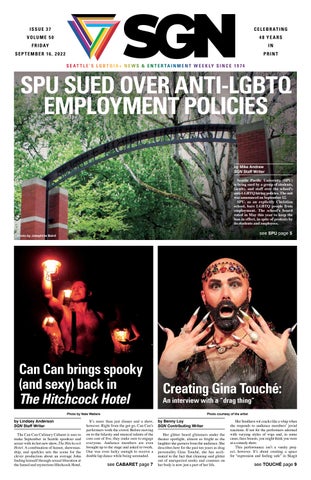
SPU SUED OVER ANTI-LGBTQ EMPLOYMENT POLICIES by Mike Andrew SGN Staff Writer Seattle Pacific University (SPU) is being sued by a group of students, faculty, and staff over the school’s anti-LGBTQ hiring policies. The suit was announced on September 12. SPU, as an explicitly Christian school, bars LGBTQ people from employment. The school’s board voted in May this year to keep the ban in effect, in spite of protests by its students and employees.
see SPU page 5
Photo by Josephine Baird
Can Can brings spooky (and sexy) back in The Hitchcock Hotel
Creating Gina Touché:
An interview with a “drag thing”
Photo by Nate Watters
by Lindsey Anderson SGN Staff Writer The Can Can Culinary Cabaret is sure to make September in Seattle spookier and sexier with its hot new show, The Hitchcock Hotel. A combination of humor, showmanship, and sparkles sets the scene for the clever production about an average John finding himself through sexual liberation at the famed and mysterious Hitchcock Hotel.
Photo courtesy of the artist
It’s more than just dinner and a show, however. Right from the get-go, Can Can’s performers work the crowd. Before moving on to the hilarity and musical talents of the core cast of five, they make sure to engage everyone. Audience members are even brought up to the stage and asked to twerk. One was even lucky enough to receive a double lap dance while being serenaded.
see CABARET page 7
by Benny Loy SGN Contributing Writer Her glitter beard glimmers under the theater spotlight, almost as bright as the laughter she garners from the audience. She describes how for the past ten years as drag personality Gina Touché, she has acclimated to the fact that cleaning said glitter out of unexpected nooks and crannies on her body is now just a part of her life.
Her Southern wit cracks like a whip when she responds to audience members’ jovial reactions. If not for the performers adorned with varying styles of wigs and, in some cases, faux breasts, you might think you were at a comedy show. This performance isn’t a vanity project, however. It’s about creating a space for “expression and feeling safe” in Skagit
see TOUCHÉ page 9
2
SGN
SEP T EMBER 16, 2 0 2 2
C E L E B R AT I N G 4 8 Y E A R S!
ORIGINALLY SEATTLE GAY NEWS FOUNDED 1974 MEMBER 509 10th Ave E Seattle, WA 98102 (206) 324-4297 info@sgn.org sgn.org
SUPPORT INDEPENDENT JOURNALISM
DONATE TO SGN TODAY!
Publisher Angela Cragin Managing Editor / Acting Editor-in-Chief A.V. Eichenbaum Copy Editor SGN Staff • Richard Isaac Advertising Maggie Bloodstone, Advertising Manager National Advertising Rep. Rivendell Media (212) 242-6863 Staff Writers Lindsey Anderson • Mike Andrew Sara Michelle Fetters • Daniel Lindsley Contributing Writers Alice Bloch • Maggie Bloodstone Kylin Brown • Sharon Cumberland Carter Hemion • Eve Kucharski Benny Loy • Isabel Mata Paige McGlauflin • Gaysha Starr Social Media Manager SGN Staff Photographers Juliana Adams • Nate Gowdy • SGN Staff Production Mike Pham SGN is published by Angela Cragin. © 2022. All Rights Reserved. Reprints by permission. Publication of names, photographs, or likeness of any person, organization, event or business in this publication cannot be taken as any indication of the sexual orientation of the person, organization, event or business. Opinions expressed in bylined articles, columns, and letters are those of the authors only and do not necessarily reflect the views of the staff or management of this paper. SGN welcomes unsolicited material, including letters to the editor, but reserves the right to edit or reject material. All rights revert to authors upon publication. We assume no liability for loss or damage of materials, solicited or not. We invite feedback, please write. And please play safe. It is our policy that no money shall be refunded if you choose to cancel your ad. Credit will be given for the balance owed. No exceptions.
In Loving Memory Of George Bakan
Scott Roger Alpert Cookie Andrews-Hunt James Arnold Ken Campbell Steve Foiles Shaun Knittel James Leland Moore Don Paulson Randy Peters Lee Richeson Shaun Shelton Jim Tully
Follow SGN
VISIT US ONLINE SGN.ORG
In this Issue
LOCAL NEWS 4 A&E 7 FILM 13 BOOKS 15 OP-ED 17 NATIONAL / INTERNATIONAL NEWS 18 SEP T EMBER 16, 2 0 2 2
SGN
3
Local News
Starbucks workers turn company’s “Investors Day” into Union Day
by Mike Andrew SGN Staff Writer Starbucks workers turned the company’s annual Investors Day into a show of strength and community support for their union with a rally and picket at Starbucks corporate headquarters on September 13. Every year, Starbucks invites stockholders, vendors, contractors, and local businesspeople — but, significantly, never employees — to Investors Day to hear the company’s plans for the coming year. This year, the company was touting its “Reinvention Plan,” CEO Howard Schultz’s response to the wave of unionization that has swept the company in the last year. Starbucks Workers United (SBWU), the union that represents the company’s workers, responded with a rally and picket line of hundreds of Starbucks workers, members of other unions, and community supporters. SBWU challenged Schultz’s plan with a plan of its own. “Today at Investors Day, Starbucks is unveiling [its] ‘Reinvention Plan’ for the company. Since workers aren’t invited to Investors Day, we wanted to share our own vision for the future of Starbucks,” the union tweeted. The union’s agenda for the company includes: • providing adequate staffing and a living wage, • coming to the bargaining table in good faith, • stopping cutting workers’ hours, • living up to the company’s mission and principles, and • signing the Fair Election Principles (to guarantee a fair process for union elections).
After an hour of picketing, the crowd gathered on the front steps of Starbucks headquarters for a rally. Speakers included local union leaders and Seattle City Councilmember Teresa Mosqueda. Workers from Homegrown Sandwiches — in the midst of their own unionization campaign with UNITE HERE Local 8 — led the crowd in chants of “No justice, no sandwich, no justice, no coffee!” Starbucks workers who spoke at the rally were particularly scathing in their comments about company executives.
4
SEP T EMBER 16, 2 0 2 2
SGN
(above) Photo courtesy of Jonathan Rosenblum, (below) Photos courtesy of MLK Labor
“Inside, investors are deciding what to do with the money that we make for them. Tell Howard Schultz to stop union-busting and give us a contract!” one said. “She has the power to stop union busting but chooses not to,” another said, referring to Starbucks board chair and Denver Broncos co-owner Melody Hopkins. “She claims to be self-made, but she made her way in and then closed the door behind her. If she is from the poor, she is engaged in class betrayal. She is leading the attack on low-wage workers. She should be eager
to end wage inequality. The top 1% don’t want to share. They are on the wrong side of history!” “Starbucks divests from the community and workers,” a third worker said. “They have abandoned their principles. They claim to support LGBTQIA rights but shut down the store in the center of the Gay community. They claim to oppose racism but shut down a store in the Central [District], the traditional Black area of Seattle. It was a center of community activity.”
C E L E B R AT I N G 4 8 Y E A R S!
SPU
The new lawsuit involves 16 plaintiffs This decision sparked even more student protests, with dozens of graduating seniors who say that the handing rainbow flags to SPU President Pete Menjares at the June graduation cer- school’s employment emony, rather than shaking his hand. Washington Attorney General Bob Fer- policies constitute a guson also launched an investigation to determine if the SPU policy violates state breach of its fiduciary civil rights or employment rights laws. In responsibility and response, SPU sued Ferguson, charging him with violating its religious liberties. that they will harm The new lawsuit involves 16 plaintiffs who say that the school’s employment policies SPU’s reputation, constitute a breach of its fiduciary responsibility and that they will harm SPU’s reputa- worsen existing tion, worsen existing enrollment problems, enrollment problems, and possibly jeopardize the school’s future. One of the plaintiffs is Chloe Guillot, who and possibly jeopardize graduated from SPU earlier this year and now attends the university’s seminary. She the school’s future. said she loves the university and its faculty,
continued from cover
Photos by Josephine Baird
VISIT US ONLINE SGN.ORG
and feels that the school’s board of directors is betraying the school community. “One thing that’s been hard to communicate to the public is how the actions of the board are so different from the rest of the university,” Guillot said. “The lawsuit goes through the ways these board members have orchestrated a coup that contradicts everything the university stands for.” One of the faculty plaintiffs is Lynette Bikos, a professor of clinical psychology. She described the board’s behavior as “nefarious” — jeopardizing SPU’s future and undermining its long-standing commitment to diversity. There has been a 25% reduction in faculty positions, she noted, and consultants have warned professors that SPU might have only a few more years of financial viability unless circumstances change.
SEP T EMBER 16, 2 0 2 2
The school’s total enrollment last fall was 3,443, down from 4,175 in 2015. Defendants in the suit are President Menjares; board chair Dean Kato; trustees Matthew Whitehead, Mark Mason, and Mike Quinn; and former trustee Michael McKee. Whitehead and Mason are leaders of the Free Methodist Church, the founding denomination of SPU, which does not recognize same-sex marriage. The latest lawsuit is not the first to challenge SPU’s hiring policies. In January 2021, Jeaux Rinedahl, an adjunct professor at SPU, filed suit, saying he had been denied a full-time tenured position because he is Gay. That lawsuit eventually was settled out of court.
SGN
5
Local News
Creating a safe space for creative expression Queer Art Club fosters LGBTQ+ friendship and collaboration in the art community by Makayla Baker-Curtis SGN Intern Seattle’s Queer Art Club first started meeting in Cal Anderson Park in late July; from there, the founders’ vision has only continued to expand. Within three meetings — largely promoted over social media and through friends — the turnout has already grown more than expected, said Olive Baxley, a Genderfluid Seattle-based abstract artist and co-founder of the club. Baxley uses he/him and she/her pronouns. During the first meeting, there were nine in attendance, and by the next, it had nearly doubled. Some had heard from their friends in person or from online artist acquaintances, and others dropped in after walking by in the park. An art space “by Queers, for Queers” In partnership with August Jasper, Baxley founded QAC as an art space “by Queers, for Queers” to create, collaborate, and build community. Leo Harris, an attendee who also helped organize the August 30 meeting, described the club as “very open, very welcoming — a lot of different backgrounds, a lot of people with very different art styles and skill levels. There was absolutely no judgment, no comparison.” Harris attributes this openness to QAC being a Queer-dedicated venue, rather than just “LGBTQ+ friendly.” He said he sees it as a “better space for self-expression,” one where “there’s just more freedom to engage at that level that is comfortable for you to not mask quite as much. …You can create alongside people who are like you and who relate to you.” “I think in cis-het-dominated spaces, there are certain expectations of performing gender a certain way,” he added. “Where[as] in Queer spaces, there’s just a lot less of it — and there’s more freedom that comes with that.” Baxley further emphasized the importance of having Queer-dedicated venues, even in creative forums, which she says are “in general very open.” “It’s important to me because I want to feel safe,” she said. “I want to offer a safe space [for Queer people]… to know that their identity in their art is important and valid and valued and can be seen.” And for Bamber Southorn, an attendee and artist who moved to Seattle in 2021, being at QAC “means being with likeminded people. Of course, there was talk about people’s Queer identity [and] experience. But there is a sense of comfort in knowing you won’t have to explain your choice in pronouns.” Building community through shared experiences and interests This sense of safety and comfort promotes a desire for community building, said Baxley. “The first [collaborative art piece] wasn’t really planned. I was just like: ‘I don’t want to do any more of this, do you want to add something?’ and just pass[ed] it around.” After the first meeting, collaborative pieces became a tradition in addition to the personal art pieces attendees make. “There’s never a rule or not really a guide; it’s just whatever you want, mixed mediums… painting … word art. We’ve had people do crochet… All styles [are] welcome,” Baxley said. And QAC features not only a diverse range of art styles but also experience levels. “I’ve found myself telling a lot of people about Queer Art Club, including people who normally don’t see themselves as artists,” said Harris. “I feel like it’s been a really great space for people to explore artistic expression, no matter where they are with it.”
Expressing Queer identities through art For many, part of exploring their artistic expression is through various styles and compositions. For others, it’s through the evolution of the experiences and stories they tell, or even a combination of the two. “[My art], it’s always been an outward reflection of my internal process,” Harris explained. And over the last summer, he said, he has been more actively incorporating his Trans identity into his art, “just really putting that forward, really putting that intention into art, bringing pieces of my identity and how I relate to it.” Baxley, too, aims to share her Genderfluid identity through art: “I don’t want people to look at my art and think that I’m cis or straight. I want my Transness and my Queerness to show.” One of the ways she does this is through abstract art, which she says has helped get her out of creativity ruts. “I mostly make pieces fueled by emotion,” she said. “And you need those little bursts of color and bright things and funky shapes and glitter — the silver lining of it. Instead of erasing the bad things, use that [abstract methods] to add more good things. That’s kind of how I take my art style and life.” For her, it’s important to showcase and celebrate her identity through art, especially for members of the community who “feel a little lost” or aren’t comfortable with their Queerness in a society where their voices “might be a little more muted.”
6
SEP T EMBER 16, 2 0 2 2
SGN
(top row) Queer Art Club, (second row, l) Artwork by Leo Harris / @leoharrisart, (second row, r) Collaborative artwork from the club's third meeting, (third row, l-r) Olive and August – Photos by Makayla Baker-Curtis
“I want people to be able to relate to [my art] because it’s okay to be Trans and Queer and for it to be proud and loud about it,” Baxley said. “[And to tell others that] it’s okay to be yourself. And it’s okay to put yourself in your art. And to have that reflected back at you.”
The next Queer Art Club meeting is on Tuesday, September 27, at the Pipsqueak Gallery on 173 16th Ave., with future dates on every fourth Tuesday of the month. These are open to all genders, sexualities, art styles, and skill levels. Meeting times are still to be determined. For up-to-date information, visit @queerartclubseattle on Instagram.
C E L E B R AT I N G 4 8 Y E A R S!
Arts & Entertainment
CABARET
continued from cover While the main show is flashy, it is all in good taste. Fog machines and colored lights bring mystery to the seductively haunting performances. Contortionist dancers “Shadow” and “Silhouette” twist around tabletops but make sure not to spill drinks. While Shadow and Silhouette bring the sexy, their co-stars, Frankly, John, and Madame Maybelle, bring the wit. Their quick and playful banter and use of props make the small stage seem much larger than it is. The performers serenade the room with classic show tunes like “Sweet Transvestite,” “Anything You Can Do,” and “You Don’t Own Me,” incorporating them expertly into the show’s story. Perhaps just as impressive as the songs and dance are the breathtaking costumes. With each song, the players appear in new arrangements that look straight out of the Met Gala. Of course, these outfits do not stay on their bodies for long. With each layer of clothes shed, the performers appear more beautiful, sharing a sense of vulnerability with the audience. By the end of the night, a connection had formed between the crowd and the artists. Those who had walked into the show timid left with their heads held a little higher. The Hitchcock Hotel was a great reminder to everyone to take life a little less seriously, embrace the power of sexuality, and not be afraid to “light your lantern.” A second home “I’ve done a lot of theater and dance my whole life, and what’s nice about the Can Can is it’s never more personal than it is here,” performer Shadou Mintrone said. “All the one-on-one attention, we get to know people, we get to celebrate their thing with them, and that’s kind of my favorite part about it: you get to be a part of the audience as much as they get to be a part of the show.” The Can Can has provided the players with a space to practice authenticity and celebrate all aspects of themselves. “I have been able to just express myself in a way
VISIT US ONLINE SGN.ORG
Photos by Nate Watters
that is unapologetically honest, and I feel empowered to do that,” Richard Peacock, another performer, added. The vulnerability the entertainers share with the audience is nowhere near as impressive as the trust they have in each other. Not only do they carry out dangerous stunts, relying on the strength of their co-stars, but they do so nearly naked, expressing a rare sense of intimacy most cannot handle. After just two weeks with the Can Can, the newest dancer, Sasha Voyt, says she already feels close to everyone in the show. “It’s my second home,” she said. “It’s only my second week here, but they’ve already become like family.”
Using voices to take back power The Hitchcock Hotel shows power and beauty in the art form of the human body, but the show also encourages people to use their voices. “We have a lot of really beautiful numbers in the show that also reflect our climate of the world right now, and just how important it is to be yourself and take back your power, especially as a female or female-presenting person. We’re excited to be doing this show and hope everyone stays safe,” said Tori Gresham, referencing her “You Don’t Own Me” number, in which she nods to recent attacks on women’s reproductive rights. “As a performer, after two or three years
SEP T EMBER 16, 2 0 2 2
of the pandemic, getting to do this on stage with no masks and just feeling like we’re back to somewhat normal has meant so much,” she added. For anyone looking to break away from the ordinary for a few hours, The Hitchcock Hotel is definitely the show to experience. The Hitchcock Hotel is at the Can Can Culinary Cabaret, 95 Pine St., Seattle until November 27. Tickets are available at https://www.thecancan.com/shows/thehitchcock-hotel-2022.
SGN
7
Arts & Entertainment
“Queer 201”
Blue Delliquanti crafts sci-fi comics with rich context by Daniel Lindsley SGN Staff Writer With their new title Adversary soon to debut on an exciting platform, graphic novel artist and author Blue Delliquanti spoke with me over Zoom about Queer comics, the scene’s history, and their own influences and inspirations. Delliquanti is best known for their science fiction webcomiseries O Human Star, which follows the Queer inventor of the modern robot as he is resurrected in a synthetic body and must learn to reintegrate himself in a world where robots and humans live side by side. Delliquanti started O Human in early 2012, right when webcomics were “getting really big,” they said. At that time, a lot of other Queer comics were emerging online and flourishing from circulation on blogs during the “peak Tumblr era.” O Human concluded in 2020, after eight years of various awards and nominations. Since the comic’s debut, Delliquanti said, the graphic novel industry has evolved even further; it often seeks talent in the realm of web comics, but with the rise of crowdfunding sites like Patreon, creators might not even need a publisher to make a living or make it to print. Big publishers have also recognized that there’s a market for Queer comics, said Delliquanti, with somewhat of a catch. While publishers are no longer “hostile” to such ventures in their experience, they have different expectations of readers than creators do. Delliquanti argued that many publishers expect readers, especially young ones, to want fiction with “Queer 101” topics —
simple, feel-good narratives with “all the edges sanded off,” with characters conflicted about, say, being attracted to the people of the same gender. Many creators, however, expect readers to want the messier “Queer 201” concepts, like
how to be yourself while holding down a job. Delliquanti’s work has been praised for its sophisticated treatment of LGBTQ narratives for a reason: “I consider myself first and foremost a science fiction person,” Delliquanti said, “but it’s through a Queer
lens.” Their influences include the stories of Ursula K. LeGuin, Neil Gaiman’s graphic novel series The Sandman, and Mike Mignola’s Hellboy — hardly sources most would consider soft or “sanded down.”
Delliquanti’s work has been praised for its sophisticated treatment of LGBTQ narratives.
Images courtesy of the artist
8
SGN
SEP T EMBER 16, 2 0 2 2
Upcoming novella is a departure Delliquanti’s upcoming graphic novella is a departure from their sci-fi roots. Titled Adversary, it takes place in their hometown of Minneapolis in 2021, during the very real pandemic of that year. Though its genre is realistic fiction, Delliquanti implied that it would have the same richness of context as their previous works, given that the local politics of the Minnesota city have been under a national spotlight since the George Floyd protests that began in 2020. Like O Human, Adversary will be published online, but not in a traditional webcomic fashion. Instead, in October, it will debut at the annual ShortBox Comics Fair, alongside pieces from creators around the world. ShortBox has emphasized indie cartoonists bringing “where they come from” to their work, Delliquanti said, and the event sure to feature a number of Queer creators. The fair will be open to all, via an internet connection that month, with exclusive debuts. Afterward, exhibitors will be free to publish their works as they please. As for other recommendations, Delliquanti steered me toward Iron Circus Comics, which is known for the “ladycentric porn” comic anthology series Smut Peddler and its wide diversity of stories and artists. They also mentioned Diskette Press, a Detroit-based micropress that prints and sells everything from antifascist T-shirts to graphic novels about Trans girls. You can find out more about Blue Delliquanti’s work at their website, https:// www.bluedelliquanti.com. To be one of the first to read Adversary and other indie comics, check out https://www. shortboxcomicsfair.com in October.
C E L E B R AT I N G 4 8 Y E A R S!
TOUCHÉ
continued from cover County, where Christopher Sadler, as Gina, has succeeded in spreading the love as an event organizer and, in his own words, as a “drag thing.” “I don’t really fit the mold of drag as what society believes it to be. So me and my family, we’re ‘drag things.’” When Sadler speaks about his family, he means the collection of performers he has united under the Touché umbrella. He calls them the Touché family and organizes drag events to create a stage for what he affectionately calls Gina’s “children” or “spawn.” So who is Gina Touché? Sadler is originally from Louisiana. “I’m from a rural area,” he said in our recent interview. “I grew up on a dirt road, which is still a dirt road, and I was flamboyant from the get-go.” “[Being from Louisiana] just made me a stronger individual, because moving that far away from everything and coming to a place where you only know a couple of people here…took me on the path to becoming Gina. “I’ve always been a singer, since I was two. I’ve always been in choir, and I’ve always had stage fright. Then Gina came along. And it [gave me] the confidence that I didn’t have as me, as Christopher.” “Gina Touché is obviously my alter ego,” Sadler said. “My Southern sass with a glitter beard slapped on, and the hope to inspire joy. That’s what Gina is. Gina’s inspiration is to create joy.” Sadler has been practicing drag since age 16 and officially began his journey organizing performances when he was a member of the Rainbow Alliance at Skagit Valley College. At the time, he was watching Ru Paul’s Drag Race when inspiration struck. “I was like, I don’t know why we don’t do something like that. Here we have money. We have the space, we obviously have a want for something around here. ’Cuz nothing ever happens in Skagit. So I asked the advisor if I could put on a drag show, and the rest is history.” As for the glitter beard, Sadler said, “I tried the female aesthetic the first year we did The Skagit Drag Show, and it just wasn’t really my vibe. One year Langley had Pride, and they did a Saturday night soiree. That’s the first time I ever wore a glitter beard, my
VISIT US ONLINE SGN.ORG
Photos courtesy of the artist
pantsuit, and a headpiece. It made me feel a certain kind of way. I just felt so liberated as an individual. And I was like, this is it!” Personally, as someone who identifies as Nonbinary, I felt immediately drawn to Gina’s ambiguous and androgynous style. And she showcases performers of all kinds, including drag kings. Her shows are not a queens’ club; it’s a space where people can explore sides of themselves that may fall outside of the gender spectrum. Gina and her family contain multitudes, and seeing that so proudly exhibited on stage can be an affirming experience. “Yeah,” Sadler agreed. “And that’s really the whole energy of The Skagit Drag Show. The energy is to break down that barrier of what everybody believes drag is. Because they believe it’s men being women, and they believe it’s in a bar with a bunch of drunk people. We’ve completely destroyed that whole idea… with our show.” Loyal to his roots By performing at Monroe Pride or in theaters, and even hosting a bingo night at a retirement home, Sadler isn’t afraid to get truly involved in these rural areas. When asked whether he’s ever been nervous about performing in more conservative-leaning communities, he said, “I come from a place where I had three Gay bars that I could
[Touché’s] shows are not a queens’ club; it’s a space where people can explore sides of themselves that may fall outside of the gender spectrum. Gina and her family contain multitudes, and seeing that so proudly exhibited on stage can be an affirming experience. easily go to at any time. So when I worked here, and there were no Gay bars, I was like, “Ooh, I don’t know what’s gonna happen here in these cornfields.’” But he has no intention of stopping. Sadler comes from a rural area, so he’s adamant that he’ll remain loyal to his roots. He plans to eventually create a permanent venue, an LGBTQ+ sanctuary for those who want to be entertained or need a place to feel safe and accepted in Skagit County. “I’ll keep doing this show, which has opened up so many opportunities, as long as my mind and body allow me to do it. And if [I can] expand that elsewhere, the goal is to get a facility here in the Skagit area, so that we can have a permanent loca-
SEP T EMBER 16, 2 0 2 2
tion and do more things in the community without having to worry about finding a venue. Then we’ll have a permanent safe space for people as well.” Sadler’s love for the community is outstanding. And Gina’s the hero that LGBTQ+ people in Skagit County need. If you find yourself wanting to help “manifest” Gina’s vision, instead of only offering up Thots and Prayers (the title of one of her shows), consider getting tickets to her October 1 show at 6 p.m. at the Lincoln Theater in Mt. Vernon. Tickets are on sale now at https://lincolntheatre. org/live-virtual-performance-skagit-dragshow.
SGN
9
Episode 33: Maggie Bloodstone Ash & Lindsey talk about the Queen of England, the banality of evil, and other trivialities in this episode. We're basically horrible goblins the whole time and we should probably apologize. Maggie Bloodstone is our special guest this week!
BI-WEEKLY! FIND US WHEREVER YOU LISTEN TO PODCASTS! SHOW YOUR PRIDE! seattlegaynews.redbubble.com
Merch Store!
10
SGN
SEP T EMBER 16, 2 0 2 2
C E L E B R AT I N G 4 8 Y E A R S!
BECOMING: At Home in the World
Produced in partnership with Bill T. Jones and New York Live Arts
September 30–October 1 And so you see ... our honourable blue sky and ever enduring sun ... can only be consumed slice by slice ...
VISIT US ONLINE SGN.ORG
SEP T EMBER 16, 2 0 2 2
SGN
11
12
SGN
SEP T EMBER 16, 2 0 2 2
C E L E B R AT I N G 4 8 Y E A R S!
Film
Billy Eichner hopes for box office smash with gaymance Bros by Tim Nasson Special to the SGN Billy Eichner, the openly Gay comedian, is usually the one asking the questions. He came to fame with his award-winning, 2011–17 truTV show Billy on the Street, in which he would accost strangers on the streets of Manhattan, often with an A-list celebrity at his side, interrupting someone in the middle of a jog, errand, or commute, only to ask a groan-inducing question or play a silly game. Most New Yorkers did not recognize either Eichner or celebrity sidekicks like Chris Evans, Will Ferrell, Mariah Carey, or Sarah Jessica Parker. The tides have turned. Eichner, in a few short years, has gone from video class clown to a polished (dare I say very good) actor, writer, and all-around mensch — and ascended to celebrity A-list status himself. In 2019, he starred as the voice of Timon in the Disney live-action remake of The Lion King; he also voices the character in the upcoming live-action sequel Mufasa: The Lion King. But that’s not all. Currently, Eichner is writer, producer, and co-star of Bros, a new romantic comedy about two commitmentphobic Gay guys in a relationship: himself and co-star Luke Macfarlane. Macfarlane, who came to fame in schmaltzy Hallmark Channel movies, is another openly Gay (not to mention very good-looking) actor; indeed, all of Bros’ writers, producers, and all of the lead and supporting actors (including Amanda Bearse) identify as LGBTQ, with the exceptions of director Nicolas Stoller and producer Judd Apatow. Bros is therefore the first “almost” all-Gay, Lesbian, or Trans major motion picture. Times have changed “My day hasn’t even begun,” says Eichner, who has just arrived in San Francisco, and where it’s the ungodly hour of 7:45 a.m. He’s just back from the Toronto International Film Festival, where Bros debuted to great acclaim. At 44, he is old enough to remember growing up during a time when Gaythemed movies had limited releases and smallish audiences. “I went to see a lot of them: All Over the Guy, Jeffrey, Trick, Edge of Seventeen, Go,” Eichner recalled. “But it felt like it was something I did in private. It felt like it did when I was hiding a magazine [at home].”
Luke Macfarlane and Billy Eichner in Bros – Photo courtesy of Universal Pictures
Bros, on the other hand, is written for contemporary audiences — straight, Gay, and everything in between (my words) — who are unfazed by scenes and situations that would have seemed controversial even ten years ago. And, given the talent behind the project and the early buzz, Bros could be the first Gay rom-com to become a mainstream box office smash. Particularly with Stoller and Apatow on board. “The 40-Year-Old Virgin, Bridesmaids, Forgetting Sarah Marshall, Neighbors… Judd and/or Nick are responsible for some of the funniest movies during the past two decades,” Eichner enthused. “The goal was to make the funniest, [most] laugh-out-loud movie as possible, that just happens to be about a Gay couple,” he added. When I asked him for a funny story about a first date he himself had, he laughed and said, “I’m still waiting to go on one. But seriously, I met a guy that worked for a cannabis company. He showed up as high
as could be. And of course he was hungry. I should have just called it a night then. But we went out and all he could do was eat. There wasn’t any conversation. But I don’t know if that is funny, or just weird.” Charm and surprise One of the most charming aspects of Bros is a pivotal scene filmed in Provincetown, Mass., a community with deep Gay roots. “Provincetown is maybe my favorite place on earth,” said Eichner. “It’s as far out on Cape Cod as you can get. Being able to film in Provincetown added so much style to the [classic] romantic story. The town has a rich Gay history but is beautiful, sexy, and fun. It is so welcoming to everyone that Nick [Stoller], who is straight and married with three kids, takes his family there every summer. It is also the first place that we began filming.” (The production was shut down in between filming for over a year and a half due to the pandemic.)
There’s a musical moment in Bros that may surprise some Eichner fans but shouldn’t; he’s a great singer and studied musical theater in college. His love of music predates his bar mitzvah, which he describes as “Broadway meets pop music… I had a lifesized, airbrushed Madonna standee from her Blonde Ambition tour. And a standee from [the Broadway musical] The Phantom of the Opera. I even sang ‘Lean On Me.’” Eichner’s singing talents are displayed in Bros, but very briefly. “I don’t want people to think Bros is a musical, though,” Eichner wants readers to know. And let me add my two cents: Bros is not a musical at all. It is a comedy that is going to go down in history, in a great way. Bros is in theaters starting on September 30, 2022. Tim Nasson is a contributing editor at the Boston Globe and publisher of http:// wildaboutmovies.com.
Hall preaches hard truths in eye-opening Honk for Jesus by Sara Michelle Fetters SGN Staff Writer HONK FOR JESUS. SAVE YOUR SOUL. Theaters / Peacock
Regina Hall in Honk for Jesus. Save Your Soul. – Photo courtesy of Focus Features
VISIT US ONLINE SGN.ORG
I’m not sure I’m the right one to review the sly, uncomfortably subversive satirical comedy Honk for Jesus. Save Your Soul. Raised Lutheran, I stopped going to church pretty much the moment I finished confirmation. The insincerity of it all was too much for me, and even as a teenager questioning who I was and where I was headed, I could tell that organized religion was going to do me far more harm than good — and the place we went to was considered one of the more accepting and progressive venues in all of good old Spokane! But filmmaker Adamma Ebo’s disquietly hysterical mockumentary takes dead aim at the Southern Baptist church and, more specifically, its long-standing position of authority in the African American community. I’ve been to a Black church all of one time, when a good friend was sing-
SEP T EMBER 16, 2 0 2 2
ing their first solo in the choir, and while it was a raucous and energizing experience I shall never forget, that does not make me feel like I can or should speak to all of the layers subtly — and not so subtly — lurking within Ebo’s film. It’s not my place, and that’s how it should be. Here is what I do know: Regina Hall is magnificent, giving a tour de force performance that may rival her career-best work in 2018’s Support the Girls. It’s easily going to be one of the finest, most memorable pieces of acting I’ll have watched in all of 2022. She brings levels of introspective, soul-searching intensity that are earth-shattering. Hall captivates from first frame to last, tickling my funny bone, tugging on my heartstrings, and leaving me profoundly dumbstruck by her brilliance on multiple occasions. I also have no hesitation singing the praises of Sterling K. Brown. While it’s hardly a surprise that he’s excellent, that he nearly matches Hall beat for beat somewhat is, especially as his character has a far less interesting arc. But that does not mean that Brown
see JESUS page 14
SGN
13
Film
Hitchcockian teen comedy Do Revenge brazenly shows off all its cruel intentions by Sara Michelle Fetters SGN Staff Writer DO REVENGE Netflix As if born out of obsessive rewatches of Cruel Intentions and Mean Girls, Do Revenge is a subversive, foul-mouthed teen comedy that goes to some pretty vile and depraved places. It is a rambunctious, firebreathing demon of immorality, going so far over the top that it’s not possible to take its frothing-at-the-mouth satire seriously. It’s a mixed bag, but director Jennifer Kaytin Robinson (Someone Great) and co-writer Celeste Ballard (Space Jam: A New Legacy) do offer up enough moments of smarmy insight to make their high school aria of the absurd far more consistently entertaining than it should be. A third act twist does threaten to derail the proceedings and send all of this exploitive nonsense into a realm that’s more offensively disagreeable than it is offensively endearing (or truthful), and it is only the strength of the two lead performances by Camila Mendes and Maya Hawke — not to mention a last-second bit of narrative sleight of hand — that this train stays on the track until it reaches the station. Drea (Mendes) is the alpha it-girl at her exclusive Florida prep school. However, unlike the majority of her very wealthy, extremely connected classmates, she’s there on scholarship and has had to work overtime to get in with the other queen bees. But Drea discovers how fast those without six- or seven-figure resources can fall when a sexting video she sent her boyfriend Max (Austin Abrams) is mysteriously leaked and goes viral. Cut to three months later. Summer break is over, and Drea has been stewing over the incident the entire time, dreading going back to school for her senior year. While she’s become a pariah, the video has only increased Max’s class standing, making him even more untouchable than he already was. The thing is, all his claims to the contrary notwithstanding, Drea is 98% certain he was the one who leaked the video, and if it wouldn’t put her Ivy League plans in jeopardy, she’d do anything to get her revenge. Enter Hawke. She plays awkward transfer student Eleanor, and through a coincidental series of events makes Drea’s acquaintance without anyone else at school noticing. She has her own sordid past and would love to get even with another girl, who egregiously wronged and outed her when they were both questioning 13-year-olds. In a Hitchcockian bargain for the ages, the two agree to do one another’s revenge, becoming vir-
Maya Hawke and Camila Mendes in Do Revenge – Photo courtesy of Netflix
tually inseparable in their conniving sisterhood as their plans take shape. There are dueling voiceovers from Drea and Eleanor. Sometimes they are insightful. Eleanor’s can be especially fruitful, notably during the film’s second half, when the bottle spins in a reverse direction and her character drifts more toward the center. But there are almost as many instances where the narration restates what didn’t need any embellishment, and I kind of wish Robinson and Ballard hadn’t utilized the device at all. Another issue is that, as broad and as purposefully cartoonish as Robinson makes things, there is still no avoiding the fact that Drea and Eleanor’s actions are heinous — and not incrementally but right away. The brazen way the pair connive and destroy and the lengths they go to in a single-minded pursuit to achieve their goals come perilously close to being disgusting. Drea is particularly unlikeable, which is impressive considering she’s the one who was slut-shamed and deserves justice for what was done to her. But the character’s actions are so beyond the pale, it’s as if the filmmakers are daring the audience to try and sympathize with her — and it turns out that’s a tough ask. But Mendes makes the most out of the situation. She’s obviously having a blast, and I like that the actor embraces Drea’s dark side and doesn’t soften her rougher edges.
The scene where the video is released to the entire student body, with the teenager standing in the center of the school’s courtyard as if she were onstage is outstanding, and Mendes plays the moment beautifully. Pain, shock, terror, anger: they all flash across Drea’s face, and the volcanic rage she finally releases is pointedly authentic in its sound and fury. Hawke is even better. From the first second Eleanor enters the story, it is clear she is a force of nature. The teen utilizes her timidity as a shield, a clever façade that belies a fierce intellect and a ferocious will that will devour anyone silly enough to underestimate its power. It’s a quietly cagey performance, with Hawke layering in hints as to who Eleanor is and why she’s so willing to go along with Drea’s schemes with delectably loathsome ingenuity. Think of Do Revenge as Strangers on a Train but with two characters who would make Pierre Choderlos de Laclos smile with Machiavellian glee. If the Cruel Intentions connections were not blatantly clear, Robinson lifts a song from that 1999 cult favorite’s soundtrack and even brings in one of its biggest stars for a clever extended cameo. The humor is too broad and the situations too animatedly extreme for the film to have the same sort of lasting resonance, but the intent is still clear, and I like that the director isn’t
afraid to make her audience uncomfortable. The third act twist is problematic, not because Robinson and Ballard shouldn’t be allowed to take things in the direction they do, but more in how they configure their characters in the aftermath of its unveiling. There is a sociopathic nastiness that doesn’t quite work, and in trying to bust stereotypes and heteronormative gender conventions, the filmmakers inadvertently come perilously close to reinforcing them. But things spiral back in a positive way nicely during the climax. Hawke and Mendes match wits beautifully, cementing their relationship in conspiratorial frenemyship with such ghoulishness that it brought a gigantic smile to my face. They’re both terrific, elevating the material right at the exact moment when it needed that the most. Do Revenge may not say anything new (go watch Bodies Bodies Bodies if you want to see a Gen Z satire with teeth), but it does live up to the gleeful viciousness of its aforementioned predecessors that Robinson and Ballard are blatantly referencing. Hawke is a born star, and Mendes shows she’s worth keeping an eye on. I’m glad I gave this one a look, and I have a sneaky suspicion the target audience is going to not just enjoy themselves but possibly love it to the point of obsession.
plays a less complex character; it’s only that his journey is more familiar and holds fewer surprises. But Brown brings a noteworthy, internalized complexity to his performance, elevating the material in the process, and the writing is far more straightforward for Brown’s character than it is for Hall’s. Lee-Curtis Childs (Brown) is the pastor of the Atlanta Southern Baptist megachurch Wander to Greater Paths; Trinitie (Hall) is his supportive first lady. The loving husband and wife make it their mission to be there for one another through thick and thin, no matter what the obstacles confronting them. Good thing, too, as the latest mountain they’re attempting to climb is positively Sisyphean. With a documentary film crew following their every move, Lee-Curtis and Trinitie are attempting to resurrect Wander to
Greater Paths on Easter Sunday. Their church has been closed for almost a year after a scandal involving the pastor scored local and national headlines. Lee-Curtis maintained his innocence, and after counseling, prayer, and personal introspection, Trinitie made the difficult decision to stand alongside him in support. What follows is an examination of faith, marriage, fidelity, and community, and Ebo isn’t inclined to pull her punches. There is a razor-sharp specificity to this world’s dynamics that is confidently realized, and it’s clear the filmmaker is drawing from personal observational experience. This satire has teeth and isn’t afraid to draw blood, earning its R rating with grit, resilience, and an uncouth determination to paint a stark picture that takes zero prisoners and doesn’t give two shakes if anyone gets offended. But as universal as many of the themes Ebo is exploring are, there are enough culturally specific aspects of this world and its
depiction that a few elements of the underlying narrative flew over my head. This may be the point. By keeping things so focused, Ebo can make big, broad swings, allowing the filmmaker the freedom to eviscerate the inherent hypocrisies of religious fundamentalism while in the same breath showcasing how true faith and a selfless belief in a higher power can change lives for the better. It doesn’t take a lot of guessing to figure out the particulars of Lee-Curtis’ alleged indiscretions. Yet Brown does a good job of magnifying what happened in ways that do not feel forced or sensationalistic. If anything, he does a terrifyingly good job of showcasing how many predators in positions of power fail to see how vile or egregious their wrongdoing is. There’s a nearly wordless roadside interaction with one of Lee-Curtis’ accusers as he and Trinitie attempt to drum up excitement for the church’s reopening that chilled me to the bone, in which Brown’s hushed, almost tearful indignation is shockingly powerful.
Still, this is Hall’s film. A gifted actor, she can do more with her eyes or the slow, almost imperceptible movements of her shoulders and hands than many performers can with a whole catalog of verbal histrionics or broad physical shenanigans. But she has those overtly theatrical skills at her disposal, too, which create a symphony of movement and dialogue that’s extraordinary. There’s a reason Ebo focuses the camera directly on Hall to start and end her film. As much as this is a story of organized religion, Black churches, and marriage, Honk for Jesus. Save Your Soul. is a chronicle of a woman at a crossroads, analyzing life, love, and God in excruciating detail — and not necessarily in that order. Hall bares her soul for everyone to see, the naked, making the unvarnished truths she delivers an eyeopening sermon of personal responsibility worth paying attention to.
14
SEP T EMBER 16, 2 0 2 2
JESUS
continued from page 13
SGN
C E L E B R AT I N G 4 8 Y E A R S!
Books
Getting Along effective for anyone by Terri Schlichenmeyer Special to the SGN GETTING ALONG: HOW TO WORK WITH ANYONE (EVEN DIFFICULT PEOPLE) AMY GALLO © 2022 Harvard Business Review Press $30.00 304 pages
Image courtesy of Harvard Business Review
It’s an almost-universal thing: in one recent study, 94% of workers polled said that they worked with someone who was difficult to get along with. If someone ever offered a “Dealing with Jerks” class, in other words, it would be crowded. And yet, many workers strive to get along because they like the job and everybody else there, or they’re (sometimes) patient enough to give the toxic person the benefit of the doubt. They might also realize that they themselves are not totally innocent in every situation. They under-
stand that, bottom line, work is mostly about relationships. Brain science explains a lot, says author Amy Gallo, which offers a first step to peace. Your brain isn’t perfect, neither is your adversary’s, and it helps to remember that. It also helps to know the various types of difficult people you might deal with at work. First up: try to imagine the stressors an insecure boss faces, and cut them some slack. Try to see a pessimist’s dire words as warning, not as whining. Ask yourself if a victim is really being persecuted. Enlist the help of your team when dealing with a passive-aggressive co-worker. Learn how to stop a know-it-all in his tracks. Remember that generational issues may be why you’re having problems with a tormentor. Know the risks of speaking up and not speaking up about a biased coworker. Learn how to showcase your work, get credit for it, and thwart the political operator. Know the basic principles for simply just getting along. And finally, know when to throw in the towel. Take care of yourself, but know that
quitting is okay, and there’s absolutely no shame in it. So, with “help wanted” signs everywhere and jobs plentiful, is there even a need for a book like Getting Along anymore? Yes, suggests Gallo, because there’s more to every picture, and the jerk in this situation could be you. But let’s say you’re a flawless human being or you work from home — which warrants several paragraphs in this book — or you don’t have to work. Getting Along is still a valid read, because Gallo’s advice will work for family, frenemies, neighbors — nearly anybody you can’t avoid and who rankles you mightily. The lessons you’ll learn are useful as a compassionate, intelligent, Zen way of looking at conflict and humanity, while also protecting yourself and honing your flexibility. While this book is specifically about getting along with bosses and co-workers, it’s not a bad idea as a gift for a teen or new college student. For mindful conflict resolution, Getting Along is a book they’ll consult often.
Suzette Mayr mixes unsettling horror and thoughtprovoking satire in remarkable Dr. Edith Vane moments of feeling ‘other.’ “It just struck me that having a Queer character was appropriate for writing about an uncanny building because, as Queer people, we are often outside looking in. Or… we have a perspective that is different from the dominant culture, from mainstream heterosexual culture,” she continued. Portraying Dr. Vane’s sexuality positively was very important for Dr. Mayr. “I wanted her to have sex, too. I wanted her to have joyous sex. Because the main character has
by Lindsey Anderson SGN Staff Writer Horror can be anywhere, but usually in a haunted house, an abandoned building, or a graveyard. However, for author and professor Suzette Mayr, nothing seemed more unsettling than a university. Sick buildings “I wanted to write a horror. I wanted to write about a haunted building,” she said, recalling the early inspiration for her novel Dr. Edith Vane and the Hares of Crawley Hall. “I started noticing that there’s a particular kind of haunted house, and that’s the sentient house. “Like in The Haunting of Hill House by Shirley Jackson, where it’s not just a building with a bunch of ghosts in it, but the building itself is kind of contaminated and evil. And corresponding to that was the whole idea of sick buildings. You have these buildings where it’s just clusters of illnesses “…On my university campus, the University of Calgary, there’s a building called Craggy Hall, where a lot of people were getting breast cancer, and nobody could explain it.” The occurrences at Craggy Hall were not uncommon. Old buildings often have materials, like lead paint, that can cause illnesses, like cancer, in people who spend a lot of time in them. This topic fascinated Dr. Mayr. “In Australia, there’s the Australian Broadcasting Corporation Building,” she continued. “It was a building that had 16 [women got breast cancer] in a span of a short time… They tried to do tests on the building, but they could not figure it out. By the end, when the 17th woman got breast cancer, they evacuated the building. It was an odd and scary phenomenon.” With the idea of the “sick building” stewing in the back of her mind, Dr. Mayr also decided to explore her surroundings. “I’ve been interested in campus satire, so I thought, ‘I’m just going to write from my own experience as an academic.’” Eventually, she ended up with the character of Dr. Edith Vane, who is not necessarily Dr. Mayr but does share some similarities. “Edith Vane, the main character, is not me,.” she said. “She’s sort of, like, if in my career I turned right where she turned left. If I went down these stairs, she went up the stairs. So, she’s sort of like an id, kind of a very Dorian Gray reflection of my career and my own experiences.”
VISIT US ONLINE SGN.ORG
“[The] main character has such a miserable life, I wanted, at the very least, for her to have a good sex life.”
Photo courtesy of the author
Writing her identity into the character Writing Dr. Edith Vane was therapeutic, in a way, for Dr. Mayr. The character allowed her to explore her feelings about her career and relationship with the institution of higher education. “I wanted to investigate the notion of failure and imposter syndrome and the mechanics of postsecondary institutions that systemically favor certain groups over others. It was an institution made for white, straight men with wives. The rest of us who don’t fit into that, we’ve got different challenges.
It was my kind of investigating that.” To use the story of Dr. Vane to investigate the complexities of the institution, Dr. Mayr felt that incorporating her identities into the story was a must. “I knew that Edith Vane was going to be a Queer person. That was non-negotiable,” she said. “I couldn’t imagine it any other way, partly because of my own experience. Also, because I think for Queer people, postsecondary institutions, on one hand, can be incredibly welcoming, but at the same time, you can have those
SEP T EMBER 16, 2 0 2 2
such a miserable life, I wanted, at the very least, for her to have a good sex life.” Reexamining the campus Reexamining the institutions she was a part of through her novel also helped Dr. Mayr understand how certain subtleties in her environment impacted her mental health. “There was a bad point in my career where I was just really hating my job,” she said. “It was sort of like I was getting all these microaggressions, just little racist moments where I was like, ‘I don’t even know what was happening.’ It was just registering that they were so often and small and frequent. “There was this one day when I was at the photocopy machine... and all of a sudden, [it] breaks down, and my first thought was, ‘This machine’s racist,’ and I was like, ‘Okay, there’s something wrong with me, something is happening to me.’” “So, that’s where the book came from,” she continued. “It was me taking my experience as an academic, and making it uncanny. Making it horrific. I know that the book is not a horror in the conventional sense, but there have been academics who have read the book and felt bad after reading it, because it emphasizes just all the nonsense that can happen when you work as a professor. So that makes me happy, because that was what I wanted to do.”
see MAYR page 16
SGN
15
Books
Image courtesy of Coach House Books
MAYR
Although the horror of Dr. Edith Vane is less gory and more subtle, like a microaggression, it still The outside coming in The book rests in the uncanny valley, packs a punch. hovering between reality and a slightly continued from page 15
twisted version. “When I think of the uncanny, I’m thinking of Freud’s sense of the uncanny, which is taking something, whether it’s an experience or an object, or a place where you live or you work, and skewing it a little bit off. It’s not a big jumpscare,” Dr. Mayr said. Although the horror of Dr. Edith Vane is less gory and more subtle, like a microaggression, it still packs a punch. Aside from the inspiration Dr. Mayr found in her real life, she also took tips from some of her favorite scary movies. “I love that movie The Ring. I love the main villain, the problematic ghost. She’s got her hair in front of her face, but what I love about that is it’s as though you’re looking at somebody from the front, but their head is on backward. It’s something as subtle as that. “… In the academic context, there are numerous moments that are just absurd that I kind of pushed,” she explained. “I work in the humanities. We tend to have buildings that are falling apart, because they’re not as important as science, technology, medicine, business, etc. So, there was this one day when a pipe burst. There was a waterfall in the middle of the hallway, so we kind of [had] this exterior become interior.” She decided to run with the idea of the exterior becoming interior. After looking around, she discovered there were other outside elements that, once placed inside, became quite uncanny. “On my campus…, we have a lot of jackrabbits. When people read the book, and they’re not from here,
they think of rabbits as domestic bunnies. But the jackrabbits are the size of small dogs, maybe bigger? …And when you drive past them at the night, their eyes glow red. So, part of my strategy for creating the uncanny was to set the book in a …university building called Crawly Hall, and to have the outside gradually insinuate itself inside.” Writing her truth Dr. Mayr says she will “absolutely” continue to write LGBTQ+ characters in her future projects. “I can’t think of doing it any other way, and when I start a project, and I think, ‘I need to write something different’ and write a straight character, it just doesn’t do it for me. I can’t get into the character. I can’t. It doesn’t resonate for me. So that’s what I’ll always write about from now on, for sure, and I have for the last few books. “Venus Hum, my third book, was sort of my coming-out book when I was figuring out, ‘Okay, who am I? What am I doing? Who do I love?’ And that book was me being like, ‘I’m a Queer person, I love women.’ I’m now in my fifties, and I can’t even remember what it’s like to sleep with men anymore. I would have to do a lot of research, which I don’t feel like doing,” she said laughing. Writing Queer characters is second nature to her now. “For me, it’s just about telling the truth,” she said. “Be authentic, but also be aware that there are certain narratives out there that have been around, that have pre-
ceded us, that you maybe don’t want to be playing into, like the whole ‘kill your Gays’ narrative, the ‘dead Queer’ somehow being romantic or interesting, or having Queer people as your built-in villain, and the villainy comes from them being read as deviant somehow. I think that’s problematic. …It’s been done. It’s boring. Stop it. What I try to do is write my truth.” Writing her truth also means writing about Black characters. “Black people are part of my reality, and so they will always feature in my books,” Dr. Mayr said. While her next book is a celebration of Black Queer joy, Dr. Mayr says Dr. Edith Vane has a different takeaway. “I hope people come away from the book thinking about themselves and thinking about self-care and what they need to do to stay healthy, mentally. I think that’s probably part of it.” What’s next Dr. Mayr’s next book will be coming out this fall, with a pending US release date of late September or early October. “It’s called The Sleeping Car Porter,” she said. “It’s a historical fiction set in 1929, and it’s about a sleeping car porter on a luxury passenger train that travels across the country. The… porter is a closeted Queer man. The best way to think of it would be that it’s the story of this… porter taking a trip for three days and encountering all the characters on that train, but also confronting his sexuality, con-
Poetry writing workshop for Queer women Private room; space to write; time to think; great food; well-stocked library; great live performance of our writing on Friday night; chapbook of our week’s work.
fronting his history, in terms of his intimate partners. There’s a little bit of supernatural in there as well, because I love that so much.” “It’s got a happy ending,” she added reassuringly. “I find often that with, you know, stories with Black people, often there’s this kind of fetish for pain and trauma and tragedy, and I don’t want to contribute to Black pain. I want to write about Black joy, so this is a very joyous book, as far as the ending goes.” Fall frights When it comes to Dr. Mayr’s recipe for mental health, she says she finds joy in the autumn season and can’t wait for temperatures to get crisp. “I love Halloween, so much,” she said. “I buy a pumpkin and put it on our front step, and then it freezes overnight, and I need to go out and buy another. I love pumpkins. I love them. I love the smell of them. I love carving them. I love getting ready for Halloween. I love all the decorations that have to do with Halloween and then preparing… in any way possible. And then on Halloween night, staying home and watching a scary movie.” For those wondering what scary movies a horror writer watches — not the scariest! “I have movies that are scary that I’ll never watch again, because I can’t handle it. That would be, like, The Ring. It’s a classic, and I cannot watch that movie ever again. Same with The Shining. But I do love the old version of The Haunting of Hill House, the movie that came out in the ’60s. ....I think it’s pretty cool. I do like some Hitchcock now and again, too.” If you’re looking for an uncanny fall read that will make you think, pick up a copy of Dr. Edith Vane and the Hares of Crawley Hall at your local bookstore, and be on the lookout for The Sleeping Car Porter, coming soon.
October 10 - 15, 2022
ROSLYN, WA 98941 $100.00 FOR THE WEEK SPACE LIMITED TO SIX WOMEN
Send a short bio of 200 or less words and two (2) poems to: karenheiken@gmail.com Karen Heiken has taught for 45+ years in a variety of capacities. Until 2020, the last ten years were at IAIA (Institute of American Indian Arts, Santa Fe NM) and at Santa Fe Community College.”
16
SGN
SEP T EMBER 16, 2 0 2 2
C E L E B R AT I N G 4 8 Y E A R S!
Op-Ed America goes back to school amid right-wing wave of homophobia by Georgia Skerritt SGN Intern Six months after Florida passed the Parental Rights in Education Act, parents, students, and educators across the country are entering the new school year with a new sense of uncertainty. To recap: In March, Florida Gov. Ron DeSantis (R) signed what quickly came to be known as the “Don’t Say Gay” bill into law, banning classrooms across the state from offering instruction on gender identity or sexual orientation in grades K-3. The law, however, only provided ambiguous terms and parameters for classroom instruction, leaving educators to wonder what is and isn’t allowed in their lessons. A key section of the legislation reads: “Classroom instruction by school personnel or third parties on sexual orientation or gender identity may not occur in kindergarten through grade 3 or in a manner that is not age-appropriate or developmentally appropriate for students in accordance with state standards.” As schools have been opening up over the last few weeks for the 2022-23 school year, teachers are returning to a work environment marked by uncertainty and speculation, regardless of what state they live in. While the abovementioned bill was exclusive to Florida, many other states have been seen following suit in passing conservative legislation, leaving people across the country wondering what the future holds. National concerns Just three months into the new year, Florida’s new law signified what we know now is one of the most anti-Queer and antiTrans years in American politics. Since then, and in light of Texas’s targeting of gender-reaffirming surgeries as “child abuse” earlier in February, both of which attracted national attention, several other states have followed suit in passing increasingly discriminatory legislation against Queer, specifically Trans, people. The Idaho House also passed legislation (HB 675) that would ban medical practitioners from giving gender-reaffirming care to
Photo by Stephane Mahe / Reuters
youth throughout the state. Luckily, this bill was rejected by the Senate. Louisiana Rep. Gabe Firment sponsored rather similar legislation, the “Save Adolescents from Experimentation” Act (HB 570), which would prohibit healthcare professionals from providing gender-related treatment to Trans youth. The bill has not been passed as of now. Elsewhere, Kentucky, Iowa, and Missouri (to name just a few) all proposed and/ or passed legislation that would prohibit Trans athletes from participating in sports according to their gender identity, instead pushing Trans boys and men into female sports and vice versa. Effects on Washington state Thankfully, as we all know, Washington is on the safer and more liberal end of the
spectrum in terms of sexuality and gender expression. That being said, it is nowhere near perfect. According to the legislative tracking feature on the Freedom for All Americans website, the Washington legislature has acted upon five separate anti-LGBTQIA+ bills in the past decade, including two that targeted the Trans community, another two concerning education policy, and one that addressed youth sports. On the bright side, all of these bills died before they could be passed into law. On the municipal level, Seattle Public Schools (SPS) does not currently acknowledge or adhere to any policies that are discriminatory, homophobic, or transphobic by nature. On March 5, 2020, about two years before Gov. DeSantis essentially spearheaded what now feels like America’s
Effect on Queer and Trans youth There are, however, concerns that go beyond the legislative realm. The Human Rights Campaign reported last month that “the average number of tweets per day using slurs such as ‘groomer’ and ‘pedophile’ in relation to LGBTQ+ people surged by 406% in the month after the Florida bill was passed,” illustrating the increasing normalization of homophobia and transphobia in the wake of the “Don’t Say Gay” bill. Now not only are Queer and Trans people experiencing significantly higher rates of violence and targeting, but youth in these communities also have one less place to turn to for support now that schools are censoring their identities. In 2020, The HRC reported that LGBTQIA+ youth are over two times more likely to face bullying at school and struggle with depression and suicidal thoughts than their cis-het counterparts. Furthermore, the Trevor Project reported that “LGBTQ youth who had access to spaces that affirmed their sexual orientation and gender identity reported lower rates of attempting suicide than those who did not.” While the trend of anti-LGBTQIA+ legislation that is being proposed and at times passed into law throughout the country is a concern in and of itself, it is also contributing to a growing foundation for violence and aggression that festers digitally, socially, and intellectually. As long as national and state policies are informed by narratives of intolerance, our collective well-being is threatened on both psychical and psychological levels, reminding us that the Florida law is only the tip of the iceberg and leaving us to wonder what might come next. If you or anyone you know is struggling with suicidality or thoughts of self-harm, please call the Suicide and Crisis Lifeline at 988 for support.
Photo by Octavio Jones / Reuters
VISIT US ONLINE SGN.ORG
anti-Queer policy year, SPS Superintendent Denise Juneau signed the “Nondiscrimination and Affirmative Action: Transgender and Gender-Expansive Student Rights and Supports” document, which establishes rights and accessibility for students — regardless of their sexual orientation or gender identity. While this is a huge step in the right direction — when I was still in high school in Seattle, we had what felt like very little acknowledgment or inclusivity of gender diversity — SPS still has a lot of work to do to create a safe and healing space for all of its students. Policy is a great first start, but concrete action and advocacy are needed in order to keep moving forward.
SEP T EMBER 16, 2 0 2 2
SGN
17
National & International News
A marcher in Montana – Photo by Thom Bridge / AP
National news highlights by Daniel Lindsley SGN Staff Writer Senate makes play to protect Gay marriage Following the overturning of Roe v. Wade, and anticipating threats to court decisions protecting same-sex marriage, Democrats and a handful of
International news highlights by Daniel Lindsley SGN Staff Writer Indian company launches new matchmaking site A dating site and app catering to the LGBTQ+ community in India has launched under the name RainbowLuv, said parent company Matrimony.com Ltd., which includes 45 gender identities, 122 orientation tags, and 48 pronouns. “When it comes to serious matchmaking,” said Chief Marketing Officer Arjun Bhatia in a statement, “the LGBTQIA+ community has been largely underserved, and we want to provide a safe and trusted platform for them.” As part of the goal of safety, the app requires users to register using government-issued identity cards. It faces some competition with Grindr, which is better known for hookups and casual sex than dating; and with As You Are, which presents itself as a more general LGBTQ social platform with dating elements.
18
SGN
Republicans in the Senate are gearing up to vote on legislation that would safeguard the right. Part of their prep has involved negotiations to get more Republicans on board. That effort is led by Democratic Sen. Tammy Baldwin of Wisconsin, who said after a meeting, “I think the momentum is going in the right direction.” The carrots for Republicans include amendments meant to address concerns about the “religious liberties” of religious institutions and business owners to oppose same-sex marriage, among other things. Supporters of the bill say such things are already enshrined in law but could use some extra clarification. Majority Leader Chuck Schumer promised a vote would happen “in the coming
weeks.” “We all want this to pass quickly,” he said. “I hope there will be 10 Republicans to support it.” Compared to 2015, when the Supreme Court passed the historic Obergefell v. Hodges decision to legalize marriage equality, support has only grown. Seventy percent of US adults say same-sex unions should be valid under the law, according to a 2021 Gallup poll. Montana “emergency order” locks changes on birth certificates Under Republican Gov. Greg Gianforte’s administration, Montana health officials on Friday last week made a permanent rule that blocks Trans people from changing their listed sex on their birth certificates, regardless of whether they have
gone through gender-affirmation surgery. A Montana court ruled in 2021 that a Trans person could only change their listed sex after providing an affidavit to the state health deparment, and the legality of that rule is still being challenged; plaintiffs represented by the ACLU of Montana have argued that a having birth certificate that doesn’t match their gender identity puts them at risk of discrimination, harassment, and violence. ACLU attorney Akilah Lane said the new rule, which asserts that sex is “immutable,” was even “further evidence of the state’s noncompliance” with the 2021 order. The judge overseeing the case, Michael Moses, has called the 2021 order unconstitutionally vague, since it didn’t specify which surgical procedures were required.
As Italy polls leans right, fate of left falls on feminist Italy’s 37-year-old Elly Schlein is squaring up to face far-right Giorgia Meloni in a race to become Italy’s first female premier, running on a platform of feminist politics by contrast. Schlein’s political career so far includes organizing two campaigns for former President Barack Obama, and blocking right-wingers from taking power in the left-leaning Emilia-Romagna region. She is also a former deputy of the European Parliament. Still, she faces stiff competition, with Meloni’s Brothers of Italy Party leading in recent polls. “Not all female leadership helps women,” Schlein said of Meloni to an audience at a campaign rally in Modena. “It helps nothing to have a female premier if all the rights for other women are overturned, including control over their own bodies.” Schlein has compared Meloni to former President Donald Trump and Hungarian President Viktor Orban, who have both passed anti-LGBTQ laws and policies. Left-wing voter and bank employee Alessandro Corradi left one of Schlein’s rallies saying, “She has proposals, unlike politicians who only listen to polls and try to win votes, saying trite and coy things that are dull and repetitive.” Ellie Schlien – Photo by Marco Vassini / AP
SEP T EMBER 16, 2 0 2 2
C E L E B R AT I N G 4 8 Y E A R S!
VISIT US ONLINE SGN.ORG
SEP T EMBER 16, 2 0 2 2
SGN
19