STONEWALL N E W S
N O R T H W E S T
SERVING THE LGBTQ+ COMMUNITIES OF THE PACIFIC NORTHWEST
October 2026
VOLUME 18
Pacific Northwest
POLITICS SIX QUESTIONS
| Washington State
Legislative Candidates INTERVIEW
| OR Rep Cyrus Javadi
WA Voter Intiatives I-001 & I-638 A Christain Case Against WA I-001 & I638
ISSUE 9
H
Spokane’s
obbit House
Tacoma’s Safety Net Clinic
Queer PNW October History Arts & Entertainment COLUMNISTS | Ryan Oelrich,
David Capocci, Tracy Simmons
www.stonewallnews.net | Stonewall News Northwest | October 2026 |
STONEWALL NEWS NORTHWEST
FRONT COVER
Serving the LGBTQ+ Communities of the Pacific Northwest Founded 1992 Relaunched 2025
October 2026 Volume 18 Issue 9
www.stonewallnews.net PO Box 871112 Vancouver, WA 98687 PUBLISHER Mike Schultz publisher@stonewallnews.org John Deen 1995-2005 Lawrence Stone 1992-1995 OREGON MANAGING EDITOR Rhonda Brown oregon-editor@stonewallnews.org ADVERTISING April Gilbreath advertising@stonewallnews.org COPY EDITOR Rich Isaac
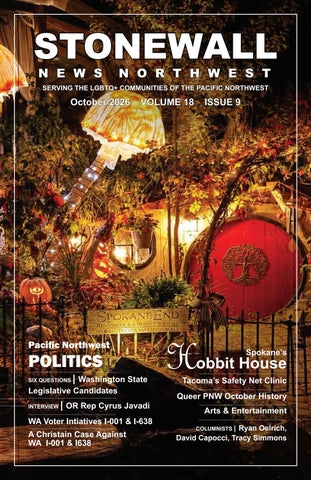
Front cover photo: Spokane’s Hobbit House
DESIGN / LAYOUT Mike Schultz
The Hobbit House is a year-round project, with seasonal decorations layered over a permanent landscape. There’s a dragon, a geocache, and an ever-changing collection of handmade details, as well as a little free library and scavenger hunts. The couple has also used the space as Ryan’s office and, occasionally, as a quiet retreat.
October 2026 | Photo by Ryan Oelrich
CONTENTS 2 Hobbit House 3 Four Elections in WA & OR
Spokane creators
3 OR Rep Cyrus Jivadi
Ryan Oelrich & Robert Thompson
4 WA I-001 & I-638 5 Tacoma’s Safety Net Clinic
Hobbit House
6 WA State Candidates 14 Thoughts from the Hobbit House
The Magic of Spokane’s
14 Out on the Ranch 15 Sacred & Proud 15 Christan Case against I-001 & I-638 17 Queer PNW October History 18 Arts & Entertainment 27 October 2026 Queer Pride Puzzle
CONTRIBUTORS PERCY LAIRD LUCILLE STUTESMAN RYAN OELRICH DAVID CAPOCCI FRANK GAIMARI TRACY SIMMONS FAVS NEWS KATY MCCALLUM SACHSE All contents © 2026, Stratus Group LLC. No portion of this publication may be reproduced without written consent from the publisher. Neither Stratus Group LLC nor Stonewall News Northwest publication assume responsibility for errors in content, photos, or advertisements. The views expressed herein do not necessarily represent the views of the publisher or advertisers.
by Percy Laird
S
omewhere in Spokane, there’s a Hobbit House.
Tucked inside a residential neighborhood, it’s anything but ordinary. A tiny round door, whimsical landscaping, and layers of handmade details have transformed an otherwise unassuming front yard into something that feels pulled from another world. For Ryan Oelrich and Robert Thompson, that sense of wonder is part of the point.
Origins The Hobbit House began after the couple’s 2017 honeymoon in New Zealand, where they visited Hobbiton, the movie set created for The Lord of the Rings and The Hobbit films. They walked among the tiny houses, took in the elaborate details, and found themselves immersed in a world that felt almost impossibly magical. When they returned to Spokane, Ryan’s long-time love of The Hobbit
| October 2026 | Stonewall News Northwest | www.stonewallnews.net
collided with a backyard project he had been imagining for years. There was a dugout area beside their house. Ryan saw an opportunity. An old industrial door became the entrance, though turning it into a round door presented its own engineering challenges, particularly when it came to making sure the hinges could support it. Landscaping followed, with Ryan doing much of the work despite describing himself as more of an “indoor cat” than a gardener. By the end of that first summer, they had their Hobbit hole.
Response Begun as a personal art project, the Hobbit House took on a life of its own in 2019, when the couple decided to decorate for Halloween. They announced that they would host trick-or-treating and collect books for a local foster-care nonprofit. They expected a couple of dozen people. Instead, over a thousand people showed up. “There was a line down the street,” Ryan recalled. The response was exciting, but it also made something clear: the Hobbit
Hobbit House creators Ryan Oelrich and husband Robert Thompson | Courtesy photo
House had suddenly become part of the neighborhood. The couple began looking for ways to preserve the magic without overwhelming the people who lived around them. Rather than one enormous Halloween event, they started spreading visits throughout October. The crowds are smaller now, but the tradition remains. The Hobbit House is a year-round project, with seasonal decorations layered over a permanent landscape. There’s a dragon, a geocache, and an ever-changing collection of handmade details, as well as a little free library and scavenger hunts. The couple has also used the space as Ryan’s office and, occasionally, as a quiet retreat. The Hobbit House is no longer entirely Ryan and Robert’s creation. That may be what makes it most interesting. People don’t just visit it. They participate in it. During the pandemic, people began leaving Christmas ornaments at the Hobbit House, though nobody had organized such an exchange. Eventually, it became an annual tradition, with hundreds of ornaments circulating through the décor HOBBIT - To Page 29
OREGON & WASHINGTON
Four Elections to Follow in Washington and Oregon By Lucille Stutesman
With the leaves starting to yellow, it means election season is upon us once again. Democrats are vying to retake the US House after losing it in 2022 and the presidency and Senate in 2024. Here are four races near you to follow this cycle:
Washington’s 3rd Congressional District: Marie Gluesenkamp Perez (D, Incumbent) and John Braun (R)
Marie Gluesenkamp Perez (D, Incumbent) and John Braun (R)
P
erhaps one of the more controversial races in Washington state this election season sees sophomore Democrat Marie Gluesenkamp Perez facing Washington state Senate Minority Leader John Braun, a Republican. Gluesenkamp Perez is a moderate Democrat, frequently breaking party lines to vote with Republicans. In May she (and seven other Democrats) voted with Republicans to pass a bill requiring schools to out Transgender students to their parents, dubbed the “Don’t Say Trans Bill” by critics. Gluesenkamp Perez said
Eight candidates in four elections to follow in Washington and Oregon
in a statement to the press that did so to give families a say in conversations about gender identity. The Congressional Equality Caucus, of which Gluesenkamp Perez is a member, blasted the passage of the bill, saying it unnecessarily outs Transgender children. “Republicans claim to be the party of small government, but they have no problem bringing the full force of the federal government down against children,” said Rep. Mark Takano, chair of the caucus. “The GOP thinks they can legislate Transgender people out of existence with this inhumane ‘Don’t Say Trans Bill,’ but all they’re doing is making life worse for a small minority of already vulnerable children.” Braun, who was a staunch critic of Washington’s newly passed highearner income tax, is seeking to unseat Gluesenkamp Perez. He spoke in favor of the Let’s Go Washington voter initiative banning Transgender students
from participating in sports divisions that affirm their gender. The initiative requires students seeking to participate in athletic activities designated for female students to submit documentation from their healthcare provider verifying the student’s sex. Despite the district being light red, and the fact Gluesenkamp Perez probably has not made any friends to the left of her, PolitiFact Chief Correspondent Louis Jacobson predicts she will hold the seat. “I think that it’s probably still going to be considered a competitive race until the end,” he said. “I would say it’s a little bit less competitive, even sort of less on the top tier, than national rankings of the competitive seats.” The 3rd District extends from the edge of Thurston County, west to the coast and south to the Oregon state line. FOUR ELECTIONS - To Page 26
Oregon Rep. Cyrus Javadi on Health Care, Affordability, LGBTQ+ Rights, and Life After the GOP “On social issues, my basic rule is pretty simple: government should be very careful about inserting itself into deeply personal decisions between people, their families and their medical providers.” --Cyrus Javadi on LGBTQ+ healthcare for Oregonians
Oregon State Representative Cyrus Javadi
By Percy Laird
W
hen we profiled Oregon Rep. Cyrus Javadi last October, he had recently left the Republican Party and joined the Democrats. A year later, he is running for reelection as a Democrat. Javadi won the Democratic nomination for House District 32 in May without an opponent. He will face Republican Max Sherman in the Nov. 3 general election. For Javadi, the party change has been
less dramatic in practice than it might look from the outside. “The biggest surprise is how little my day-to-day work has changed. I still approach the job the same way,” he said. “I listen to people. I try to solve problems. And I am still willing to disagree with my own party when I think it is wrong. I changed parties, but I didn’t suddenly become a different person or adopt a whole new set of beliefs.” He said what has in fact changed is that he has found more room to work on issues that matter to him, particularly health care
and personal freedom. During the 2026 legislative session, Javadi sponsored House Bill 4088, which strengthened Oregon’s protections for reproductive and gender-affirming health care. The law also includes privacy protections and limits Oregon’s cooperation with certain investigations or legal actions from other states. “HB 4088 was probably the most significant. I was proud to sponsor it,” Javadi said. “To me, there is an important principle behind that bill. Oregon gets to make Oregon’s laws. Other states get to make theirs. But another state should not be able to reach into Oregon and punish someone for receiving or providing health care that is lawful here.” Javadi also worked on maintaining
access to reproductive health care after cuts in federal funding affected Planned Parenthood, sponsoring legislation to use state funds to replace the losses. For LGBTQ+ Oregonians, health care is one piece of a broader approach Javadi says he has carried into his first year as a Democrat. “On social issues, my basic rule is pretty simple: government should be very careful about inserting itself into deeply personal decisions between people, their families and their medical providers,” Javadi said. That approach is not limited to social issues. Since starting his reelection campaign, Javadi said he has been JAVADI - To Page 24
www.stonewallnews.net | Stonewall News Northwest | October 2026 |
WASHINGTON
Washington’s I-001 & I-638: Voter initiatives concerning trans people in sports, parental rights head to November ballot
Supporters of a voter initiative banning transgender girls from playing girls sports rally in front of the Washington state capitol in Olympia on Feb. 5, 2026 | Photo by Lucy Stutesman
By Lucille Stutesman
T
wo voter initiatives on November’s ballot could restrict trans people in K-12 sports and out Queer kids in public schools to their parents. The initiatives, pushed by political action committee Let’s Go Washington. Let’s Go Washington is funded by Redmond hedge-fund manager Brian Heywood. Heywood has spent millions to promote the initiatives.
I-001
Initiative 001 concerns parental rights. If passed, it would require schools to tell parents about medical services their child receives outside of emergencies, notification of medications or treatments given to students and when a medical follow-up made by the school outside of
school hours. The initiative will also let parents opt students out of surveys about, among other things, political party affiliation, mental health and sex. Critics argue the initiative would not only forcibly out students but also harm students who are suffering abuse at the hands of parents. “What it’s really about is outing young LGBTQ kids and taking away the rights of young people to make their own decisions about their mental health care and reproductive healthcare,” said Senate Majority Leader Jamie Pederson, D-Seattle, in a campaign video. Supporters of the bill argue the initiative puts the power back into the parent’s hands, arguing the opposition does not care about parents. The initiative is endorsed by conservative groups including Moms
for Liberty Washington, anti-trans group Gays Against Groomers and anti-trans clothing company founder Jennifer Sey. It is opposed by the Washington State Nurses Association, the Washington Education Association and the American Civil Liberties Union of Washington. The issue of parental rights is nothing new – there was another initiative in 2023 proposed by the same PAC. It established a “parental bill of rights” which would have allowed parents to inspect classroom materials including textbooks. It would have also allowed parents to view their student’s medical records withing 10 days of a request. The state legislature took a liking to the idea, but dropped the timeline, opting for a 45-day window and removed access to certain medical records. It was passed into law in 2025. This initiative hopes to repeal the law passed by the legislature.
I-638
Initiative 638 would ban transgender girls from playing in girls K-12 sports. In order for girls to play in sports, a letter from their pediatrician must be provided
proving they are not transgender. The letter would include a genital exam, genetic testing or checking testosterone levels. Proponents of the initiative argue it prevents “biological males” from playing in sports and protects woman’s sports as a whole. “To me really is a litmus test of whether you have good plain common sense or you don’t,” said conservative podcaster Brandi Kruse – whose advocacy for the initiative was citing by the state legislature when they withheld press credentials for her. Opponents argue the initiative would subject students to unnecessary exams and test from their doctor and takes power away from parents and schools to discriminate on a marginal group of students. Studies show transgender woman do not have any advantage in sports after taking gender-affirming medications. The initiatives will appear on ballots as Initiative Measure No. IL26-001 and Initiative Measure No. IL26-638, respectively. Election day is Nov. 3 and polls close in Washington at 8 p.m.
Illustration by Ken Min
| October 2026 | Stonewall News Northwest | www.stonewallnews.net
WASHINGTON
Tacoma’s Safety Net Clinic: A Place to Turn When GenderAffirming Care Is Hard to Find Recognizing the need to support these youth seeking care, a group of health professionals—pediatricians, physicians, and mental health therapists—met earlier in the year to determine how they might offer it. What they created became the Safety Net Clinic in Tacoma, WA, whose goal is to provide ethical, evidence-based, and compassionate support to young people during this period of disruption and uncertainty.
T
By Sue Ferguson
he description of genderaffirming care is “an individualized spectrum of social, psychological, and medical services that support people in aligning their physical expression of identity with their internal sense of gender.” Washington state law protects access to gender-affirming care for both youth and adults.
However, where do parents or youth turn to for it? Generally, major hospitals and children’s hospitals have supported these needs. Now, given federal funding restrictions and legal pressures, over forty major hospitals nationwide are being forced to end medical interventions for minors. While some may still offer mental health support, access to medications, hormone therapy, or other services is often being discontinued. With the federal government recently
https://www.diversionspuzzles.net
blocking funding to Medicaid and the Children’s Health Insurance Program (CHIP) for gender-affirming medical care for minors — set to take effect on October 13, 2026 — the situation leaves youth vulnerable. States may opt to still pay for these treatments, but only by using their own money, and they would no longer receive federal matching funds. The new regulations have thus greatly impacted numerous programs that have either scaled back significantly or ultimately closed.
Safety Net Clinic Recognizing the need to support these youth seeking care, a group of health professionals—pediatricians, physicians, and mental health therapists—met earlier in the year to determine how they might offer it. What they created became the Safety Net Clinic in Tacoma, WA, whose goal is to provide ethical, evidence-based, CLINIC - To Page 26
https://www.queerpnw.org/markets Vancouver, WA www.stonewallnews.net | Stonewall News Northwest | October 2026 |
WASHINGTON
In their own words
Candidate messages to their
LGBTQ
communities
Stonewall News Northwest reached out to 68 candidates in five Washington counties with six questions. Ten candidates from three counties responded. Some quotes below are abreviated for space. For their full quotes and answers to the six questions we posed, please see their page number noted.
Randi Knott Candidate for Clark County Legislative District 18, State Representative Position 1 Page 10
“I see you. I value you. And I will fight alongside you. I know what it feels like to hear someone you love discussed as a political “issue” when you know them as the whole, incredible human being that they are. LGBTQIA+ people do not need elected officials speaking for them. You need elected officials who will listen to you, invite you into the rooms where decisions are being made, take your experiences seriously, and act.”
| October 2026 | Stonewall News Northwest | www.stonewallnews.net
Julia Payne Candidate for Spokane County Legislative District 6, State Representative Position 2 Page 9
“We need to make sure that those of us that are comfortable being on the front lines of this war are standing there because we have so many behind us who are suffering from incredible wounds and they need the time and space to heal. I want to be on the front lines, in Olympia, in the room with the law makers so that I can make sure the voices of this community are heard loud and clear.”
WASHINGTON
Ben Christly Candidate for Clark County Legislative District 17, State Representative Position 1 Page 10
Stacy Willoughbye Candidate for Chelan County Legislative District 12, State Representative Position 1 Page 11
Karina Wallace Candidate for Spokane County Legislative District 9, State Representative Position 2 Page 9
“You deserve a representative who sees you, values you, and will fight for your equal place in this community, not just during election season, but always. I’m running because I believe in a Washington where everyone, regardless of who they are or who they love, can build a stable life, raise a family, and be treated with dignity and respect. I’m grateful for this community, and I’m committed to earning your trust and standing with you.”
“You don’t have to wonder where I stand or guess at what I mean when I say I’ll fight for you. I mean your healthcare, your housing, your ability to walk through Chelan, Wenatchee, or Monroe without bracing for how someone might treat you. You have a seat at my dining room table, not just my ballot line. I’ll show up.”
“You don’t have to justify your existence to me, and you won’t have to in my office either. I’m not running to manage a “constituency” — I’m running because I believe government should reduce harm and protect dignity, full stop. I see you, I’ve stood beside you in the work I’ve done, and I’ll keep doing that in Olympia.”
“ I see you and you matter. My door is always open and my phone is on to take your call. I want you make sure you have a seat at the table on matters of our county. You must have your voice heard, and I want to ensure that the council is being proactive in our engagement with you. “ John Zingale Candidate for ClarkCounty Councilor District 2, Position 2 Page 10
Luc Jasmin III Candidate for Spokane County Legislative District 3, State Representative Position 2 Page 9
“To my fellow Battle Ground citizens especially considering current events I would simply say: I see you, I love you and you are welcome here.”
Troy McCoy Candidate for Clark County Councilor District 5 Page 10
“I understand the community and have many friends that are gay. One of my children is gay and is getting married on July 10. I have met his fiance many times and his family. We all support his next step in life.”
Tony Kiepe Candidate for Spokane County Legislative District 3, State Representative Position 1 Page 13
“To the LGBTIA+ community, I see you and I can understand you. I am a first-generation Haitian American raising two daughters in Spokane. I know something about a room going quiet when you walk into it, and about people who have never met you having opinions about whether you belong here. Central Spokane is full of people Olympia has learned to forget. I would like the job of making sure you’re not on that list.”
Michaela Kelso Candidate for Spokane County Legislative District 6, State Representative Position 1 Page 9
“I want to be a resource and an ally. I may not understand all the nuances in gender expression, gender identity, or sexual orientation, but I don’t need to. I have no problems accepting that people are who they say they are. I have a fairly “happy go lucky” personality and don’t put a lot of thought into if people are not who they appear to be. I will never knowingly do anything to harm anyone in this community.”
www.stonewallnews.net | Stonewall News Northwest | October 2026 |
WASHINGTON
STONEWALL
NEWS NORTHWEST asked 6 questions about inclusivity & civility of 68 candidates vying for your vote in 5 Washington State counties 10 responded 58 declined
Stonewall News Northwest reached out to 68 candidates in 30 state legislative district races in 5 Washington State counties. We posed six questions gauging their positions on equality, inclusivity, instilling civility in discourse and bridging community divides. Many candidates shied away from these questions, but others stepped up. The questions and their responses follow.
Six questions asked of each candidate: 1. In one paragraph, please share your professional qualifications for the position you are seeking. 2. Please provide your previous experience, if any, in working with LGBTQIA+ people, LGBTQIA+ youth, LGBTQIA+ families and LGBTQIA+ communities.
COUNTY ELECTIONS COVERED Spokane County 20 candidates | 5 responded | Page 13
Walla Walla County
3. How would you bridge divides to bring people together for important common causes under the larger umbrella of good governance?
6 candidates | 0 responded | Page 12
4. How would you address the rise in antiLGBTQ rhetoric and violence?
22 candidates | 4 responded | Page 10
5. What specific policies or protections would you advocate for to ensure LGBTQIA+ people in your community have equal access to healthcare, housing, and employment opportunities? If you would not support protections, please state which ones and why, and detail what concrete alternatives you would implement to guarantee fair and equal treatment for all residents in these areas. 6. What would you say directly to your own LGBTQA+ community?
| October 2026 | Stonewall News Northwest | www.stonewallnews.net
Clark County
Chelan County 10 candidates | 1 responded | Page 11
Grays Harbor County 10 candidates | 0 responded | Page 12
WASHINGTON Julia Payne website: www.juliaforoffice.com Candidate for Spokane County Legislative District 6, State Representative Position 2
County: Spokane
1. In one paragraph, please share your professional qualifications for the position you are seeking. I am a mom and a foster mom; I am proud to say that I am work-force educated. I have worked in various fields throughout my work life but I feel the most important experience that qualifies me for the position of your State House Representative for District 6 is that I have lived in Spokane and the surrounding area since 1989. I graduated from Medical Lake High school. I have raised children here, and struggled to pay bills here, and bought a home here. I have also spent about 15 years volunteering with community organizations such as Spokane Pride. I am not a professional politician, I am a Spokanite who wants to see our voices heard in Olympia, and I want to be the voice for you. PAYNE Continued On Page 20
Population (2020): 539,339 Area: 1,781 Square Miles
Luc Jasmin III
County Website: https://www.spokanecounty.gov/ Income: The county has a median household income of $86,205. Approximately 12.5% of the county’s population lives at or below the poverty line. Racial Makeup: The racial makeup of the county was 82.1% White, 2.0% Black or African American, 1.5% American Indian and Alaska Native, 2.3% Asian, 0.8% Native Hawaiian and Pacific Islander, 2.2% from some other race, and 9.0% from two or more races. Hispanic or Latino residents of any race comprised 6.6% of the population.
Website: https://electluc.org Candidate for Spokane County Legislative District 3, State Representative Position 2
Age Distribution: Of the residents, 21.8% were under the age of 18 and 17.3% were 65 years of age or older; the median age was 38.0 years. 85.4% of residents lived in urban areas and 14.6% lived in rural areas. Politics: Spokane County is rather conservative for an urban county, voting Republican for president all but three times since 1948. Democratic strength is concentrated in Spokane itself and in Cheney, which is home to Eastern Washington University, while the suburban areas are heavily Republican. The Republican edge has narrowed somewhat since the turn of the century. In the last five elections, the margin has been under 9% each time.
Michaela Kelso Website: Kelso4WA.com Bluesky: https://bsky.app/ profile/kelso4wa.bsky.social Facebook: https://www. facebook.com/profile. php?id=100082634871974 Candidate for Spokane County Legislative District 6, State Representative Position 1
1. In one paragraph, please share your professional qualifications for the position you are seeking. I am a retired US Army Veteran. During 23.5 years on active duty I worked in all levels of responsibility and in the fields of food service, personnel services, and military intelligence. A “well-rounded Non-Commissioned Officer”, if there ever was one. I have an analytical mind, am a quick learner, and know how to work with people regardless of their background. Additionally, I am very detail-oriented and skilled in research. I am not afraid to admit when I don’t know something. 2. Please provide your previous experience, if any, in working with LGBTQIA+ people, LGBTQIA+ youth, LGBTQIA+ families and LGBTQIA+ communities. I joined the US Army under “Don’t ask, don’t tell”, so the majority of my time I was not aware if I worked with anyone in these communities. Once that changed,
1. In one paragraph, please share your professional qualifications for the position you are seeking. I have spent four years as the governor’s representative in Eastern Washington, first under Jay Inslee and now under Bob Ferguson. I take what people in Eastern Washington experience: food costs, utility shutoffs, housing, health care, and I make sure it lands in front of the people writing state policy, then I come back and tell people the truth about what Olympia did with it. Before that, I built small businesses and invested in my community. I cofounded the Jasmin Group and Parkview Early Learning Center, and I have worked with Northeast Youth and Family Services and the Washington Childcare Centers Association on the childcare shortage that keeps parents in this district out of the workforce. I chaired the Spokane City JASMIN Continued On Page 20
Karina Wallace Website: https://karinajustfiguringitout. com TikTok and Instagram @ Karina_JustFiguringItOut. Candidate for Spokane County Legislative District 9, State Representative Position 2
1. In one paragraph, please share your professional qualifications for the position you are seeking. I put myself through college, earning an Associate’s Degree from Lower Columbia College in 2017. I worked as a CNA while pursuing nursing school, until my lupus became seriously active and that path had to end. Since then, I’ve become a Washington State certified Peer Support Specialist and worked as a betrayal trauma recovery coach. I’ve volunteered extensively at domestic violence shelters, homeless shelters, and WorkSource in the Vancouver, Longview, and Kelso area — and I’ve also relied on those same services myself at different points in my life. I know these systems from both sides of the desk, which is exactly the perspective I bring to representing LD-9. I’m running a true grassroots campaign — no corporate PAC money, no lobbyist donations — because I believe representation should answer to constituents, not donors. 2. Please provide your previous experience, if any, in working with LGBTQIA+ people, LGBTQIA+ youth, LGBTQIA+ families and LGBTQIA+ communities. WALLACE Continued On Page 21
KELSO Continued On Page 21 SPOKANE COUNTY Continued To Page 13
www.stonewallnews.net | Stonewall News Northwest | October 2026 |
WASHINGTON Randi Knott Website: https://www. electrandi.com/ Candidate for Clark County Legislative District 18, State Representative Position 1
County: Clark Population (2020): 503,311
1. In one paragraph, please share your professional qualifications for the position you are seeking. First, thank you, Mike, and Stonewall News for the opportunity to introduce myself to your readers and share a little about the incredible momentum behind our campaign. I have spent more than 25 years working in and around government, helping communities turn public policy into real results for everyday people. My career has taken me across the public, private, and nonprofit sectors, working on issues including housing, land use, public safety, disaster response, budgets, and community services. I retired as Government Affairs Director for the City of Sacramento and have my Masters in public policy and public administration. I have also owned small businesses, served for more than a decade on the CA State Council Developmental Disabilities, and currently serve on the Clark County Developmental Disabilities Advisory KNOTT Continued On Page 22
Area: 656 Square Miles County Website: https://www.spokanecounty.gov/ Income: The median income for a household in the county was $58,262 and the median income for a family was $67,352. Males had a median income of $52,160 versus $38,167 for females. The per capita income for the county was $27,828. About 7.8% of families and 10.9% of the population were below the poverty line, including 14.9% of those under age 18 and 7.2% of those age 65 or over. Racial Makeup: The racial makeup (including Hispanics in the racial counts) of the county was 75.5% White, 2.3% Black or African American, 1.0% American Indian and Alaska Native, 4.8% Asian, 5.0% from some other race, and 10.4% from two or more races. Hispanic or Latino residents of any race comprised 11.7% of the population.
John Zingale Website: https://www. zingaleforclarkcounty.com/ Candidate for Clark County Councilor District 2, Position 2
Age Distribution: Of the residents, 23.3% were under the age of 18, 5.6% were under 5, and 16.4% were 65 years of age or older; the median age was 38.8 years. For every 100 females there were 97.6 males, and for every 100 females age 18 and over there were 95.6 males. 86.5% of residents lived in urban areas and 13.5% lived in rural areas. Politics: In presidential elections, Clark County leans Democratic having voted for the party in every presidential election since 2008. This is in contrast to the rest of Southwest Washington, which leans Republican. In 2024, the county swung leftward by 2%, despite Washington and the country swinging rightward. In Congress, the county lies in Washington’s 3rd congressional district.
Troy McCoy Website: https://www.votetroymccoy.com/ Candidate for Clark County Councilor District 5
1. In one paragraph, please share your professional qualifications for the position you are seeking. I have 9 years of public service, starting with the Battle Ground School Board and the last 5 years on the Battle Ground city council. I served as mayor 2023-2025. I have run my small businesses in Battle Ground for over 20 years and have strong connections to my local community 2. Please provide your previous experience, if any, in working with LGBTQIA+ people, LGBTQIA+ youth, LGBTQIA+ families and LGBTQIA+ communities. As a school board member, I unsuccessfully fought the removal of the sex ed curriculum from Battle Ground schools. During that community discussion I learned a lot about the struggles of our LGBTQIA+ youth in MCCOY Continued On Page 23
1. In one paragraph, please share your professional qualifications for the position you are seeking. I’ve been a middle school History teacher for over 13 years. Over the years, I have won state & national awards for my innovation and dedication to teaching, including being the current 2026 Southwest Washington Teacher of the year, the Washington State History TOY (Teacher of the Year), the SAR National Middle School History TOY, and the Vancouver PTSA TOY. I’ve presented at local and national educational conferences, led student civics field trips, and served on several educational boards. I am also currently serving on the Clark County Historic Preservation Commission. I have a Master’s in Teaching from the University of Portland and a Bachelor’s in History from Northern Illinois University. Before teaching, I began my work, and union career, in the grocery retail business. I started a 16+ year career at age 15 bagging groceries in Illinois for Jewel-Osco. During that time, I worked my way up the ZINGALE Continued On Page 22
Ben Christly Email: electbenchristly@gmail.com Candidate for Clark County Legislative District 17, State Representative Position 1
1. In one paragraph, please share your professional qualifications for the position you are seeking. I bring 24 years of experience working in healthcare, including my career as a registered nurse in emergency and critical care settings, VA care management, and currently as a flight nurse providing critical-care transport. My professional experience has taught me how to make sound decisions under pressure, work collaboratively with people from diverse backgrounds, and advocate for individuals and families navigating complex systems. I am also a U.S. Navy veteran, former small-business owner, endurance coach, youth football coach, and Clark County Charter Review Commissioner. Together, these experiences have given me a practical understanding of leadership, public service, organizational accountability, and the challenges facing working families and our communities. CHRISTLY Continued On Page 23
CLARK COUNTY Continued To Page 13
10 | October 2026 | Stonewall News Northwest | www.stonewallnews.net
WASHINGTON Stacy Willoughbye Website: https://www.stacyforhouse.com/ Candidate for Chelan County Legislative District 12, State Representative Position 1
County: Chelan Population (2020): 79,074
County Website: https://www.co.chelan.wa.us/
Age Distribution: Of the residents, 22.3% were under the age of 18 and 20.6% were 65 years of age or older; the median age was 41.0 years. For every 100 females there were 99.9 males, and for every 100 females age 18 and over there were 97.6 males. 66.4% of residents lived in urban areas and 33.6% lived in rural areas. Politics: A Republican Party stronghold, it has become more competitive in recent years; though he carried the county in all three of his runs, Donald Trump won it by single-digit margins in 2020 and 2024.
I bring more than twenty-five years in financial services, including work as an independent financial advisor, an author, and a bank branch manager and VP in Chelan, and two decades sitting across the table from working families navigating housing costs, medical debt, and the everyday budget decisions state policy actually touches. I’ve served as Board President of Chelan Valley Hope through a two-year capital project that added 2,200 square feet of space in partnership with the Lake Chelan Food Bank, which meant managing budgets, building coalitions, and getting something real built in a small rural community with limited resources. That combination, financial literacy and nonprofit execution, is what I want to bring to the 12th District’s seat in Olympia. 2. Please provide your previous experience, if any, in working with LGBTQIA+ people, LGBTQIA+ youth, LGBTQIA+ families and LGBTQIA+ communities.
Area: 2,994 Square Miles
Racial Makeup: The racial makeup of the county was 69.9% White, 0.4% Black or African American, 1.0% American Indian and Alaska Native, 1.0% Asian, 16.8% from some other race, and 10.7% from two or more races. Hispanic or Latino residents of any race comprised 28.0% of the population.
1. In one paragraph, please share your professional qualifications for the position you are seeking.
WILLOUGHBYE Continued On Page 23
Chelan County Candidates who did not respond:
Shon D. Smith Clint Strand Brian Burnett Mike Steele Maggie Adams Andrew Engell Hunter Abell Shelly Short Ronald L McCoy.
Fresh, independent, Pacific Northwest, queer journalism. Join 10,000 other local subscribers and get Stonewall delivered to your inbox.
Scan the QR code to stay connected with news and information updates. Or, use URL: https://tinyurl.com/4m75sh9x
www.stonewallnews.net | Stonewall News Northwest | October 2026 | 11
WASHINGTON
County: Walla Walla
County: Grays Harbor
Population (2020): 62,580
Population (2020): 75,636
Area: 1,299 Square Miles
Area: 2,224 Square Miles
County Website: https://www.wwcowa.gov/
County Website: https://www.graysharbor.us/
Income: The median income for a household in the county was $35,900, and the median income for a family was $44,962. Males had a median income of $34,691 versus $24,736 for females. The per capita income for the county was $16,509. About 10.20% of families and 15.10% of the population were below the poverty line, including 18.80% of those under age 18 and 8.20% of those age 65 or over.
Income: The median income for a household in the county was $41,899 and the median income for a family was $49,745. Males had a median income of $42,998 versus $34,183 for females. The per capita income for the county was $21,656. About 11.7% of families and 16.1% of the population were below the poverty line, including 23.1% of those under age 18 and 7.9% of those age 65 or over.
Racial Makeup: The racial makeup of the county was 84.5% white, 1.8% black or African American, 1.3% Asian, 1.0% American Indian, 0.3% Pacific islander, 8.0% from other races, and 3.1% from two or more races. Those of Hispanic or Latino origin made up 19.7% of the population. In terms of ancestry, 23.5% were German, 13.3% were English and 12.7% were Irish.
Racial Makeup: The racial makeup of the county was 78.1% White, 1.4% Black or African American, 5.1% American Indian and Alaska Native, 1.4% Asian, 4.8% from some other race, and 9.0% from two or more races. Hispanic or Latino residents of any race comprised 10.4% of the population.
Age Distribution: Of the 21,719 households, 30.8% had children under the age of 18 living with them, 50.1% were married couples living together, 10.5% had a female householder with no husband present, 34.9% were non-families, and 28.2% of all households were made up of individuals. The average household size was 2.50 and the average family size was 3.05. The median age was 36.7 years.
Age Distribution: Of the residents, 20.0% were under the age of 18 and 22.5% were 65 years of age or older; the median age was 44.8 years. For every 100 females there were 104.9 males, and for every 100 females age 18 and over there were 104.8 males. 60.9% of residents lived in urban areas and 39.1% lived in rural areas.
Politics: Walla Walla County is generally Republican; it has voted for that party in all but one presidential election since 1940, and has voted Democratic just five times since Washington’s statehood in 1889. Like the state as a whole, third-party candidates often receive a larger share of the vote than they do nationally..
Politics: Grays Harbor County used to be one of the most consistently Democratic counties in the nation, due to its unionized logging industry. Until 2016, the last Republican presidential candidate to carry the county was Herbert Hoover in 1928; the last Republican gubernatorial candidate to win the county until 2016 was Roland H. Hartley in 1924. Donald Trump carried the county by a plurality in 2016, and went on to win a majority of its votes in both 2020 and 2024.
No Walla Walla County candidates responded.
No Grays Harbor County candidates responded.
Candidates who did not respond:
Candidates who did not respond:
Gunner Fulmer Troy Woody Mark Klicker Kyle Palmer Skyler Rude Derek Sarley.
Stan Sturgeon JR Streifel Jim Walsh Kevin Moynihan Terry Carlson Joel McEntire Adam Bernbaum Eric W. Pratt Marcia Kelbon Kaylee Kuehn.
12 | October 2026 | Stonewall News Northwest | www.stonewallnews.net
WASHINGTON SPOKANE COUNTY Continued From Page 9
Tony Kiepe Website: www.tonykiepe.com Candidate for Spokane County Legislative District 3, State Representative Position 1
1. In one paragraph, please share your professional qualifications for the position you are seeking. I worked for the Spokane Valley Chamber of Commerce and was involved in the Government affairs committee where I first got my taste of politics. I want to discuss issues that we agree on and not fight over the few issues we disagree on. I want to bring good paying jobs to Spokane where people feel they are being represented and have a good job that pays enough to put a roof over their head and provide for their family and put their kids through college. I am really interested in bringing resources for the Trades to Spokane. Not every student wants to go to college so let’s give them opportunities in the trades. I hate to see young people go so far in debt to go to college and then
Spokane County candidates who did not respond:
Natasha Hill Natalie Poulson Hillary Q. Pham Trent Maier Rob Chase Rob Tupper Alan Nolan Jonathan Bingle Jeff Holy Andrew Engell Hunter Abell Shelly Short Ronald L McCoy Mary Dye Joe Schmick.
KIEPE Continued On Page 21
CLARK COUNTY Continued From Page 10 Clark County candidates who did not respond:
Kim Harless Website: https://votekimharless.com/ Candidate for Clark County Legislative District 49, State Representative Position 1
Kim Harless did not respond to this questionnaire, but she did respond to the 2025 questionnaire that can be found at: https://issuu.com/stratusmedia/docs/ stonewall_october_2025
She also provided a May 2026 interview with Stonewall News Northwest that can be found here: https://www.stonewallnews.net/kimharless-announces-candidacy-for-staterepresentative/
https://1899house.com Spokane, WA
Glen Yung Bryan Shull Michelle Belkot Peter Silliman Kevin Waters Diana H. Perez David Stuebe Stephanie McClintock Deken Letinich John Ley Peter Abbarno Andy Zahn Ed Orcutt Evan Jones Sarah Mittelman Monica Jurado Stonier Derek Thompson
https://www.frontdoornw.com/ Vancouver, WA & Portland, OR www.stonewallnews.net | Stonewall News Northwest | October 2026 | 13
COLUMNISTS
Thoughts from the Hobbit House How Do You Break Up with a Friend? Apparently, there’s no “Friendship Divorce Court”and I have questions.
I wish someone had told me earlier that not every friendship is supposed to last forever. Some people come into our lives for decades. Some for a few years. Some for a season. Some, apparently, for exactly long enough to teach us never to secretly date our friend’s ex. All of them can matter. The ending doesn’t erase what was good. by Ryan Oelrich
A
fter my recent article about how to make a new friendspoiler alert: invite them over to play Legos - almost a dozen people asked me to write about the opposite: How do you break up with a friend?
Frankly, I’m not sure I’m the best person to ask. In fact, I have made enough mistakes in this area to qualify for some sort of continuing education. So I asked other people. Twenty-seven generous individuals shared their thoughts, advice, heartbreak, and experiences with me via text, comment, over coffee, and while waiting in line to ride a waterslide. Several shared some of the worst friend breakup horror stories that will probably forever haunt me.
Ryan with friends he hopes never break up with him. | courtesy photo
I’ll share those at the end of this article in the hopes no one ever repeats them. I’m grateful to every person who shared their wisdom, tears, and hopes for others. This is also a tender subject for me because, like most people, I have been on both sides of a friendship breakup. I have been the person walking away, and I have been the person standing there wondering what the hell just happened. The latter was one of the most painfuland ultimately helpful- experiences of my life.
My Friendship Divorce After college, I started dating a fellow and, as often happens in gay life, I eventually became part of his friend group. He and I didn’t last. The friendship group did… for a time. Much to his probable frustration and stress, I remained firmly embedded in the group. We traveled together. We had sleep
overs. We drank too much. We went to parties. We did pretty much everything together. I’ve found gay friend groups can be particularly complicated because the guardrails between friendship and romance aren’t always there. It can be remarkably easy for friendship feelings to wander into romantic territory. And wander they did. One of my friends started dating my roommate and then my roommate became part of the group. Then they broke up. Then, in what can only be described as a spectacularly bad decision, I tried to secretly date my friend’s ex- the fellow who also happened to be my roommate. This did not go well. There were hurt feelings. There was drama. There was probably enough poor decision-making to qualify for its own limited television series. I asked my friend if we could talk about what had happened. They said HOBBIT HOUSE - To Page 28
Out on the Ranch The Magic in the Rock Bowl A piece of land becomes more than land when people arrive and make memories there. A trail becomes more than a path when people walk it. A meadow becomes more than grass when people gather there. A bowl of rocks becomes more than a bowl of rocks when every stone represents a moment of wonder. by David Capocci
L
ook what I found!”
It is a common experience at the ranch for a young child to arrive at our reception desk with a rock in their hand, proudly presenting their discovery as though they have uncovered something of extraordinary importance. Sometimes it is a smooth jade, sometimes it’s sparkly, sometimes marked with an interesting vein of quartz, and sometimes it is a perfectly ordinary gravel rock that, to my adult eyes, looks remarkably similar to the thousands of other rocks scattered around ranch. But that is not the point. There is absolutely a thing with rocks here. We even have a special rock bowl
beside our front door. Most people see a decorative bowl filled with stones and give it little more than a passing glance. But we know that every rock in that bowl came here because a child stopped, noticed something fascinating, picked it up, carried it around, and eventually decided that someone at the reception desk needed to see it. Most adults would respond with a platitude: “Oh, that’s nice,” or “That’s a pretty rock,” before moving on. Not here. Every mineral specimen that has come under a child’s enchantment becomes a little more than a rock. It becomes a magical totem. Because what is magic, really, if not intention and attention infused with meaning? There is something powerful about the
14 | October 2026 | Stonewall News Northwest | www.stonewallnews.net
moment when a child becomes fascinated by an object the rest of us have overlooked. A rock that may have been sitting in the dirt for years suddenly becomes important because someone has truly seen it. That kind of seeing changes things. We adults tend to remember the big things: vacations, birthdays, photographs, the events we carefully planned. Children often remember something else entirely: the chicken that followed them around the barnyard, the first egg they saw in a nest box, the noble curiosity of an alpaca, the sound of rain on a yurt roof, or perhaps a particular rock they found on the ground. These are the moments that become core memories, not because anyone announced their importance, but because a child encountered something that sparked wonder and was given the freedom to stop and experience it.
Over the years, our child-blessed rocks have accumulated, and I think of them now as something like the concrete lions that stand guard outside famous libraries. Most people pass those lions without a second thought, but they have become symbols of the places they protect, silent guardians that have watched generations arrive and depart. Our rocks have their own stories. They are guardians of small discoveries and reminders of all those moments when a child looked closely enough to find something that everyone else had missed. As the collection grows, I like to imagine that the wonder remains attached. OUT ON THE RANCH - To Page 30
COLUMNISTS
Sacred & Proud Rejection Cuts Deep. Here’s Why I’m Learning It’s Not About My Worth
R
by Tracy Simmons
ejection cuts straight to my bones. Perhaps because it’s a demon I’ve been fighting for decades. So when a letter arrived in the mail a few days ago discouraging me from submitting a full grant proposal to a major funder in the religion news space — the reason being that we fall into “a very competitive funding environment” — it landed harder than it should have. That reaction isn’t really about a foundation, or even about my nonprofit religion newsroom: FāVS News. It’s older than both. I’ve spent most of my life fighting to be seen by people who made it clear, in their own ways, that I wasn’t worth staying for.
My father left before I turned 2. I don’t have memories of him leaving, only the void it left behind. Somewhere along the way, without fully realizing it, I started building a life aimed at him — not toward reconciliation, but toward proof. I wanted to become someone he would regret not knowing. My mother stayed longer, but she left too, eventually. She’s a devout believer whose faith teaches that being gay is not just a sin, but something akin to murder in God’s eyes. When I came out to her, that theology didn’t bend. In her view, I had refused to obey God’s law, and that refusal was reason enough to walk away from her own child. She never supported my work as a religion journalist, either — the same
I think this feeling is familiar to many people in the LGBTQ community. So many of us spend years chasing approval from someone who left, or withheld it, or who made love and acceptance conditional on becoming someone we’re not. We build careers, build chosen families, chase achievements — while quietly hoping it will finally be enough for the person who decided we weren’t worth the trouble of understanding. faith that couldn’t hold space for who I am couldn’t make room for how I chose to write about faith. So there’s a second version of the same want tangled up in the first: I want her to see what this work has become, how it’s made a difference to others, and regret not being part of it. I want her to look at the life I’ve built — as
a journalist, and as a gay woman who didn’t disappear when she asked me to — and regret walking away from both. Funders declining FāVS shouldn’t feel like either of those things. But some SACRED & PROUD - To Page 28
OP-ED
A Christian Case Against Washington’s I-001 and I-638 The truth is that these initiatives aren’t about protecting girls, or parental rights. They masquerade under this language because who would object to such things? The truth is that these initiatives dehumanize our fellow human beings, who are equally made in the image of God. This story is republished through a content partnership with FāVS News, the only digital newsroom in America devoted entirely to local religion journalism.
By Katy McCallum Sachse
I
n 2026, 813 bills that would block transgender persons from receiving healthcare, education, legal recognition and the right to publicly exist, were proposed across the United States. Sixty-three of those passed; 281 remain active; 470 failed. Two such initiatives will be on the ballot in Washington State this November: I-001 and I-638. I-638, in particular, is one of the most extreme measures of its kind. No Hate in WA State stands against both of these initiatives. Its campaign is supported by teachers, medical experts, survivors of domestic violence and sexual assault, the ACLU and numerous others, but voices of faith also matter deeply in this conversation.
As a Christian, I believe God calls us to love our neighbors as ourselves in real, practical and meaningful ways: through our daily choices, our words and our treatment of one another. Another very practical, very significant something is our vote. And in reaching toward the world I desire — a world I believe God desires — for all of us and our children, I will be supporting the work of No Hate in WA State on my ballot this fall. There is a disproportionately loud version of Christianity among us proclaiming that God ordained a strict gender binary and anyone who defies that binary is outside the will and love of God. That kind of language doesn’t stay in church buildings (nor is it meant to). It seeps into public rhetoric, political rhetoric and in the absence of other faith voices, it becomes the presumed norm.
“That’s what the Bible says,” people hear, and so they believe it’s true. It’s not. It’s profoundly untrue, and silences the broad biblical witness to the radical love of God and our call to love one another. There are plenty of places to find this in the Bible, and many scholars who can guide you along the way but for now, and for me, these are the two core convictions that will decide my vote. Every person bears the image of God The creation stories in Genesis aren’t intended as a scientific explanation of the universe; they are fundamental claims about the character of God and the place of humanity. God creates by word, not violence. God creates with joy and gladness, not drudgery or obligation. God even creates a day of rest so that all the Earth and its creatures remember they are not made for unending labor. When God creates humans, they are
not just good, but “very good,” the first time this phrase appears. And in creating those humans, God says, “let us create humans in our image, according to our likeness.” “So God created humans in God’s image; in the image of God they were created; male and female God created them.” (Genesis 1:26-27) Yes, it says, “male and female.” But if both men and women are created in the image of God, then God must be gender diverse. God is not male; God is not female. Jamie Bruesehoff, author of Raising Kids Beyond the Binary, writes, “if God is gender diverse, there are parts of God we are missing out on if there are not gender-diverse people in our midst… transgender and gender-diverse people allow us to see and know parts of God we wouldn’t otherwise see or know.” CHRISTIAN - To Page 26
www.stonewallnews.net | Stonewall News Northwest | October 2026 | 15
16 | October 2026 | Stonewall News Northwest | www.stonewallnews.net
PACIFIC NORTHWEST LGBTQ+ HISTORY
Looking back at Queer Pacific Northwest history in October
Spokane
Portland
Seattle
33 Years Ago
42 Years Ago
Just Out
47 Years Ago
Seattle Gay News
October 1993 | Vol II, No 10
October 1984 | Vol I, No 1
October 1979 | Vol 6, No 18
Stonewall News Spokane
See the full issue online at: https://tinyurl.com/566kcfpj See the full issue online at: https://tinyurl.com/yc8js5bh See the full issue online at: https://tinyurl.com/4pdumrua
The LGBTQ+ Pacific Northwest Online Publication Archive is for you
W
ith over 35,000 pages across thousands of issues from Seattle to Portland and Spokane going back to 1971, welcome to the Pacific Northwest’s largest online high-resolution color LGBTQ+ publication archive. This archive is comprised of newer issues published in PDF and older paper issues scanned to PDF in 300dpi full color. The scanning process is ongoing. The online archive includes: • • • • • •
Spokane - Stonewall News Spokane/Stonewall News Northwest Seattle - Gay Community Center/Seattle Gay News/SGN Portland - Just Out Ocean Shores - Coastal Pride Spokane - Q View Northwest Portland - Willamette Bridge
Publications are sorted by title and year. Visit the online archive at: https://www.stonewallnews.net/pdf-issues
www.stonewallnews.net | Stonewall News Northwest | October 2026 | 17
ARTS & ENTERTAINMENT
“The Terrible, Horrible, No Good, Very Bad Gay: Essays” by Eliot Glazer Throughout his life, Eliot Glazer has made mistakes. And it’s okay, everybody trips and falls now and then. In his case, though, he’s perfectly willing to document his failures, foibles, and whoopsies in this book. Readers who want a quick, mostly-lite book to finish will find something appealing in this collection of essays. If you don’t mind a bit of non-linearity and you need a laugh, “The Terrible, Horrible, No Good, Very Bad Gay.” is worth a try.
by Terri Schlichenmeyer
Y
ou try, and you try.
Once, twice, you go back at that thorny issue, the dream you have, the punchline that’s not hitting quite right. Sometimes, time is all you need to make it better, or a new approach, or a second look. And then there are days when you actually get things right, as in The Terrible, Horrible, No Good, Very Bad Gay by Eliot Glazer, and it’s all good.
Throughout his life, Eliot Glazer has made mistakes. And it’s okay, everybody trips and falls now and then. In his case, though, he’s perfectly willing to document his failures, foibles, and whoopsies in this book. He writes of his mother, Sandi, “a Queens-born balabosta” who wouldn’t tolerate laziness in herself or Glazer. He found work as soon as he was legally able to do so, and he had many jobs throughout high school. He was a gardener, ice cream scooper, camp counselor, golf caddy, chocolatier, telemarketer, and video store
clerk. The one that fit him best, however, was working at Talbots, a department store for older women, where he found his people. Even with all those jobs, he was a theater kid in his time off, little though it was. Back then, he was just a boy growing up on Long Island but swagger was important, so swagger he did. He still appreciates a good Broadway show, even the silliest ones. Glazer says that he had just recently come out when gayness exploded on TV with Will and Grace and Queer Eye for the Straight Guy, with which he was obsessed. It helped him feel not othered, he says. Producers of the reboot asked him to be a second-generation Eye, but Glazer turned them down, though he thinks he’d have been good at it. The show helped him with love of décor. His unexpected advisory skills came naturally, through age and wisdom and learning that wild partying isn’t really so much fun. As for finding love, well, that’s a long, boy-meets-boy-meets-boy story... So you’re looking for something to easily pick up and put down, something that speaks to your inner impatience? You’ll find that in “The Terrible, Horrible, No Good, Very Bad Gay,” a book that’s practically meant for you to skip around and you don’t have to read everything. Essays can be like that, which is nice, even refreshing. Author Eliot Glazer is entertaining enough to make things work,
engaging enough to keep it moving, and funny enough to make you want more of what he has to say. He’s open with his life and, despite his fame, his writing isn’t lofty; you can expect stories that’ll make you snort and ones with spice, but also some surprisingly tender moments that soften this book in a way that’s just right. Readers who want a quick, mostlylite book to finish will find something appealing in this collection of essays. If you don’t mind a bit of non-linearity and you need a laugh, “The Terrible, Horrible, No Good, Very Bad Gay.” is worth a try.
Author Eliot Glazer | Photo by Sela
Josh Silver’s “Fruit Fly” Hits Hard by Frank Gaimari www.FranksFilmReview.com
F
ruit Fly is Josh Silver’s debut adult novel, and it’s one of the most gripping and unsettling books I have read in years. This is not a cozy read. It is bold, dark, and unafraid to explore difficult themes. The book centers on Mallory Maddox, a writer who was once a celebrated literary sensation. Seven years ago, her debut made her a star. Now, she is blocked, bitter, and watching her career quietly fade while her personal life unravels. Desperate for a comeback — and running out of time — she meets Leo, and everything changes. Leo is a young, homeless addict — sleeping under bridges, trading sex for
drugs, surviving day by day. When Mallory crosses paths with him, something clicks. Not just compassion, but inspiration. Unbeknownst to him, he has just become the key to her resurgence. She cares about him, in her own way, but what she truly needs is his story. The moment he enters her life, the writing begins. However, using someone else’s pain as raw material has consequences — and that is where the novel becomes truly uncomfortable. Silver’s writing is sharp and fastpaced, pulling you through the pages whether you’re ready or not. Mallory is a fascinating character — her obsession is rendered with unsettling authenticity. Leo, by contrast, is heartbreaking. His story carries genuine emotional weight. Fruit Fly is not an easy read, but it is essential. Silver’s fearless writing,
18 | October 2026 | Stonewall News Northwest | www.stonewallnews.net
Author Josh Silver | “Fruit Fly” ©2026 Crooked Lane Books | 384 PAGES
unforgettable characters, and relentless pacing make it almost impossible to put down. If you want a book that entertains, disturbs, and lingers long after the last page, this best-seller is the one.
Available wherever books are sold, including on Amazon.
ARTS & ENTERTAINMENT
Practical Magic 2: A Return to the Owens Family For fans of the first film, returning to the Owens family feels less like revisiting old territory and more like continuing the journey. Watching Practical Magic 2 in theaters on the big screen is highly recommended. by Frank Gaimari www.FranksFilmReview.com
P
ractical Magic 2 returns viewers to the Owens family, where being a witch is less about superpowers and more about an inheritance they cannot escape. Sally and Gillian are back in the old house, older now, carrying forward everything that the first film set in motion. The story begins when the quiet rhythm of their lives is disrupted — a new threat surfaces, tangled in the family’s long history of love, loss, and the curse that has always shadowed the Owens women. Without giving too much away, the central conflict pulls the sisters back into the kind of trouble they thought they had left behind. Old bonds are tested, and
new questions arise about what the family is willing to sacrifice. The tone is exactly what fans will hope for — cozy and a little spooky, wrapped in autumn light and the scent of candle smoke. Think herb-lined kitchens, whispered spells at midnight, and the comforting ache of sisters who know each other too well. The film sits comfortably between charm and unease. The plot unfolds at its own pace, earning its emotional beats rather than rushing through them. That patience is reflected in every performance. Sandra Bullock and Nicole Kidman are the reasons this film works so well, slipping back into their roles with the ease of people who never truly left them. MAGIC 2 - To Page 26
Heart of the Beast: A Tale of Survival and Loyalty I saw this film at the Seattle International Film Festival, and it was an unforgettable experience. The theater was packed, and when the credits rolled, the audience erupted into heartfelt applause. It’s been a long time since I’ve seen a film that made me think this deeply. If you’re looking for a movie that lingers in your mind and heart, this one’s for you. by Frank Gaimari www.FranksFilmReview.com
H
eart of the Beast centers on James Belmont, played by Brad Pitt, a retired Special Forces operative who has sought solitude in the Alaskan wilderness after decades of service. The film’s opening is deliberately slow, depicting Belmont’s quiet life — fishing, setting up camp, sharing moments with a passing stranger — before tragedy strikes. The story takes a sharp turn when Belmont suffers a heart attack mid-flight, causing his plane to crash and leaving him and his loyal dog Odin stranded fifty-eight miles from civilization amidst a brutal natural landscape. The second half shifts into a tense survival drama. Pitt’s restrained performance, characterized by minimal dialogue and expressive facial cues, effectively conveys Belmont’s internal struggle and resilience. The true star, however, is Odin, a German Shepherd. The animal’s portrayal is remarkable —
evoking exhaustion, loyalty, stubbornness, and haunted awareness — making every glance and movement emotionally impactful. The film’s visual aesthetic, crafted by Mauro Fiore, captures the breathtaking yet merciless Alaskan scenery, emphasizing both its beauty and danger. The film’s pacing is uneven at first, with a slow setup that tests viewers’ patience, but the intensity ramps up after the crash and delivers a gripping survival tale. The emotional core, which emphasizes the bond between a broken man and his steadfast dog, resonates deeply and culminates in an honest, tearjerking conclusion. While not without flaws — particularly its sluggish opening and occasionally repetitive survival sequences — Heart of the Beast delivers a genuine, heartfelt story. The film’s quiet power, combined with impressive cinematography and a compelling animal performance, leaves a lasting impression, demonstrating that sometimes, silence and subtlety speak louder than words.
www.stonewallnews.net | Stonewall News Northwest | October 2026 | 19
WASHINGTON - Continued PAYNE Continued From Page 9 2. Please provide your previous experience, if any, in working with LGBTQIA+ people, LGBTQIA+ youth, LGBTQIA+ families and LGBTQIA+ communities. I have members of my family that identify as LBTQIA+, I have spent 15 years volunteering with and supporting the community. I served as the Vice President of the board of Spokane Pride for one year and have been an active volunteer with SAN - Spokane AIDS Network for a few years as well. I have worked with and provided resources for homeless youth and young adults in Spokane who identify as community members, and some of them were homeless because of that identification. The community is close to my heart, and my family. 3. How would you bridge divides to bring people together for important common causes under the larger umbrella of good governance.
JASMIN Continued From Page 9 Police Ombudsman Commission and served as second vice president of the Spokane branch of the NAACP. I am a first-generation Haitian American and the father of two daughters in Spokane public schools. I ran for city council in 2021 and lost by two votes, which taught me more about this district than winning would have. I know how Olympia works, I know how a payroll works, and I know what it costs to raise a family here. 2. Please provide your previous experience, if any, in working with LGBTQIA+ people, LGBTQIA+ youth, LGBTQIA+ families and LGBTQIA+ communities. I do not identify as LGBTQIA+, but I am an ally. I have shown up for LGBTQIA+ community in this city consistently. I have proud working relationships with Spectrum and Spokane Pride, and have worked closely on policy under both Governors Inslee and Ferguson to protect the rights of our LGBTQ+ population. SB 5599 (2023) is an example of this: legislation advocated for and passed that give youth and young adults expanded rights when seeking gender affirming healthcare.
My website says it, I want to have conversations, not arguments. I have friends and family members that have issues with the LGBTQIA+ community, so I have navigated the fine line of conversation with an eye to safety for my community. I am willing, and even eager, to have the conversations with people that disagree with me so that I can help educate and hopefully clear up misinformation. I want to be the shield for those that are persecuted and be the voice of reason for those that need to hear.
ways to victimize them.
4. How would you address the rise in anti-LGBTQ rhetoric and violence? I want to see stronger protections for our vulnerable community members with more defined and actionable consequences. In this world of keyboard anonymity we need to remind everyone that we are all human beings and that we need to approach every interaction with the understanding that we are talking to someone’s loved one, someone’s family member. We need to make sure that we are protecting the vulnerable, not finding
In Olympia I would carefully review all policies and legislation that came across my desk. I have created a network of individuals that include Trans community members, BIPOC community members, and any other marginalized group that I can connect with; I do not have their life experience, so the next best thing that I can do is to give them space to tell me their experience so that I can learn from it. I will continue to improve on my knowledge and connection so that I can consider as many viewpoints as possible. When it comes to specific policies; I cannot say
We need to make sure that those of us that are comfortable being on the front lines of this war are standing there because we have so many behind us who are suffering from incredible wounds and they need the time and space to heal. Action and advocacy is such a personal thing, but we all need to do what we feel we can. I want to be on the front lines, in Olympia, in the room with the law makers so that I can make sure the voices of this community are heard loud and clear. We are not going away, we are PROUD of who we are, and we deserve to be heard.
3. How would you bridge divides to bring people together for important common causes under the larger umbrella of good governance.
whether a group of people gets to live here safely. I will work with almost anyone on the first kind of question. I will not trade away the second kind to win the first.
Bridging divides has been a large part of my job as Eastern WA. Rep., and a prevalent task across business endeavors and community building. The governor’s Eastern Washington representative sits between a state government a lot of people here feel no connection to and a region with real reasons to feel overlooked. I have been in rooms with people who did not vote for my boss and did not particularly want me there. What I have learned is you show up more than once. You bring something concrete instead of a slogan. You do not pretend to agree when you do not. Most of what holds a district together is not partisan until someone decides to make it partisan. Childcare. A hospital that stays open. Rent a working family can actually cover. Roads and water. I have worked those issues with Republicans, business groups, unions, and school boards, and this campaign has been endorsed by both the Washington State Labor Council and the Association of Washington Business, two groups that do not agree about much. Good governance also means naming the limit out loud. You can compromise on how to fund a program or how fast to phase it in. You cannot compromise on
4. How would you address the rise in anti-LGBTQ rhetoric and violence?
notice of these rights at the point people need them, which is a lease signing and a hiring packet, not a website. Housing: Two concrete things. Enforce the anti-discrimination law in rentals, which means the commission funding above plus testing, because discrimination in a rental market this tight is easy to hide behind “already rented.” Second, fund shelter and transitional housing that LGBTQIA+ young people will actually use, because a bed a kid will not sleep in is not a bed. I already support tenant protections and down-payment assistance, and this is where those meet. Health care: Washington’s 2023 shield law, HB 1469, protects patients and providers of gender-affirming and reproductive care from out-of-state prosecution and civil action. I would defend it without qualification, and I would keep going: insurance parity so gender-affirming care is covered like any other medically necessary care, and enough providers on this side of the state that people are not driving to Seattle for an appointment. Access on paper is not access when the nearest provider is a fivehour drive. That is the Eastern Washington version of this problem, and it is the one I would be sent to Olympia to fix. I would not trade any of these away. If a larger bill needs one of these protections carved out to pass, then it does not pass with my vote.
5. What specific policies or protections would you advocate for to ensure LGBTQIA+ people in your community have equal access to healthcare, housing, and employment opportunities? If you would not support protections, please state which ones and why, and detail what concrete alternatives you would implement to guarantee fair and equal treatment for all residents in these areas.
Start by naming it accurately. Harassment is not a difference of opinion, and a threat is not speech. Governments that blur that line on purpose are not being neutral. Three things a state legislator can actually do to address hateful rhetoric: Enforcement: Washington has hate crime law on the books. The gap is usually reporting and follow-through, not the statute. That means funding biascrime training for local agencies, funding the state’s reporting and victim-support infrastructure, and holding agencies to actually reporting, so we are working from real numbers instead of guesses. Schools: Most of the harm in this district lands on kids, and it lands before anyone files a report. Behavioral health funding tied to K-12 is already one of my priorities and this is part of why. Counselors who are trained and staffed, not carrying 400 students. Anti-bullying policy that districts are actually held to. And no state money going to push kids back into a closet. Public officials: A lot of this rhetoric is coming from people holding a microphone and a public salary. I am not going to treat that as weather. When it happens in Olympia I will say so, on the record, by name, and I will expect the same of my caucus. 5. What specific policies or protections would you advocate for to ensure LGBTQIA+ people in your community have equal access to healthcare, housing, and employment opportunities? If you would not support protections, please state which ones and why, and detail what concrete alternatives you would implement to guarantee fair and equal treatment for all residents in these areas. Employment: Sexual orientation and gender identity have been protected classes under the Washington Law Against Discrimination since 2006, when HB 2661 amended Chapter 49.60 RCW. The law is good; enforcement is where it thins out. A person fired for who they are, or turned away from an apartment, files with the Human Rights Commission and then waits. I would fund that agency to the size of the job we have actually given it, and I would push for plain-language
20 | October 2026 | Stonewall News Northwest | www.stonewallnews.net
there is any policy I won’t support until it is presented to me. I will do my best to approach with a viewpoint of preventing harm and restricting those who wish to cause harm. Space restrictions prevent me from giving specifics on policies as this is a moving target, but I do update my website on a regular basis with the issues in present consideration and how I feel about them. 6. What would you say directly to your own LGBTQA+ community?
6. What would you say directly to your own LGBTQA+ community? To the LGBTIA+ community, I see you and I can understand you. I am a firstgeneration Haitian American raising two daughters in Spokane. I know something about a room going quiet when you walk into it, and about people who have never met you having opinions about whether you belong here. That may not be your exact experience, but it does mean I am not confused about what is happening right now, and nobody needs to explain it to me twice. I would rather be judged on what I do than on what I write in a questionnaire, so hold me to it. Ask me about specific bills. Ask me who I stood with when it cost me something. Call my office when something goes wrong and expect an answer that week. And if I ever go quiet while this community is under attack, say so publicly, and say it loudly. That is what an ally is for. An ally who cannot be criticized is just another politician. Central Spokane is full of people Olympia has learned to forget. I would like the job of making sure you are not on that list.
Continued - WASHINGTON KELSO Continued From Page 9 though, I always tried to signal that I am an ally and also spoke up if I encountered individuals who were not willing to accept this change. I continue this practice to this day. One of my children is a member of the LGBTQIA+ community, so I see protecting the community as a way to protect them. 3. How would you bridge divides to bring people together for important common causes under the larger umbrella of good governance.
I use things like nuclear power and photovoltaics as examples. When people start spouting off about people “choosing” the “LGBTQ-lifestyle”, I usually ask at what point they chose to be straight, or why anyone would choose to be treated so horribly by bigots and homophobes. Ultimately though, I believe that more “exposure” in safe situations may be the best way to get people to realize that they have been bamboozled into fearing the gentlest and most peaceful people I know. 4. How would you address the rise in anti-LGBTQ rhetoric and violence?
People fear what they don’t know or understand. I tend to try and use logic to explain why it shouldn’t matter what anyone’s sexual orientation or gender identity is, or that none of this is a choice, but simply who someone is. That doesn’t always work, but most of the time it does. One of the arguments I use is that I don’t have to understand how something works, but I can always accept that it does, and
We are fortunate in Washington that we already have many anti-discriminatory protections signed into law, but we don’t have equal application of those laws. Either through lack of knowledge, lack of support, lack of empathy, or lack of training, victims who are members of marginalized communities are not finding the justice they deserve. We can address knowledge, support, and training. But especially when
WALLACE Continued From Page 9
politics — actually agree on the basics: they want honesty, they want government that works, and they want to be left alone to live their lives. I try to find that common ground first, and I stay calm on purpose, because I’ve seen what chaos-politics does to already-vulnerable people. Good policy lowers the temperature; it doesn’t force people into survival mode.
Through my volunteer work at domestic violence and homeless shelters, I’ve supported LGBTQIA+ individuals and families navigating housing instability and safety concerns — sometimes as an advocate, and at other points in my own life, as someone who has needed those same services myself. That’s shaped my belief that government’s job is to protect people’s ability to live as themselves, not to police or gatekeep who they are. 3. How would you bridge divides to bring people together for important common causes under the larger umbrella of good governance. I lead with facts over party and accountability over ideology. In my experience, most people — regardless of KIEPE Continued From Page 13 can’t get a job in their field. The trades pay extremely well and with the recent fires in Spokane we are going to need more trades people. I want to make sure that people can retire in dignity and have money left over to enjoy life. 2. Please provide your previous experience, if any, in working with LGBTQIA+ people, LGBTQIA+ youth, LGBTQIA+ families and LGBTQIA+ communities. I was involved with the INBA for years and was on the policy committee. It was refreshing to offer input in the committee and seeing different ideas that I had never been exposed to. 3. How would you bridge divides to bring people together for important common causes under the larger umbrella of good governance. Right now, we have a lot of hate in the community. People don’t care who you love today but don’t want your lifestyle thrown in our faces. Parents do not want their children exposed at such young ages. 4. How would you address the rise in anti-LGBTQ rhetoric and violence? I don’t think men should be walking in a parade naked. To me that is common sense. Let’s enjoy the parade and not make the parade all about sex. 5. What specific policies or protections would you advocate for to ensure LGBTQIA+ people in your community have equal access to healthcare, housing, and employment
4. How would you address the rise in anti-LGBTQ rhetoric and violence? I support religious freedom, and that requires keeping religion out of lawmaking — no belief system should have special power over people who don’t share it. When rhetoric turns into targeting a specific group, silence from elected officials is its own kind of harm. I’ll use my voice in office to name that directly, not dance around it, and to support policies
the cause is a lack of empathy, we need to start applying consequences. 5. What specific policies or protections would you advocate for to ensure LGBTQIA+ people in your community have equal access to healthcare, housing, and employment opportunities? If you would not support protections, please state which ones and why, and detail what concrete alternatives you would implement to guarantee fair and equal treatment for all residents in these areas. I do not believe in religious or personal exemptions when it comes to things like discrimination in healthcare, housing, or employment. Community providers in these areas should only be able to consider the individual’s ability to pay, their payment history, the ability and experience required to perform the work, or the individual’s medical need and if the provider is qualified to treat them. However, as a legislator I would work and enforcement that treat anti-LGBTQ violence and harassment as the serious threat it is. 5. What specific policies or protections would you advocate for to ensure LGBTQIA+ people in your community have equal access to healthcare, housing, and employment opportunities? If you would not support protections, please state which ones and why, and detail what concrete alternatives you would implement to guarantee fair and equal treatment for all residents in these areas. I support full nondiscrimination protections in healthcare, housing, and employment for LGBTQIA+ people, with real enforcement behind them, not just language on paper. I also believe
to enact the protections that the affected communities ask for. As a relatively privileged individual I probably don’t even know half of what protections are needed. 6. What would you say directly to your own LGBTQA+ community? I want to be a resource and an ally. I may not understand all the nuances in gender expression, gender identity, or sexual orientation, but I don’t need to. I have no problems accepting that people are who they say they are. I have a fairly “happy go lucky” personality and don’t put a lot of thought into if people are not who they appear to be. I will never knowingly do anything to harm anyone in this community. I have made, and probably will continue to make mistakes and only ask that I am informed when that happens so that I can apologize and adjust my behavior.
rural LGBTQIA+ residents are too often an afterthought — healthcare access in particular is a core issue of mine, and that has to include providers and care that don’t force LGBTQIA+ patients to choose between honesty and safety. 6. What would you say directly to your own LGBTQA+ community? You don’t have to justify your existence to me, and you won’t have to in my office either. I’m not running to manage a “constituency” — I’m running because I believe government should reduce harm and protect dignity, full stop. I see you, I’ve stood beside you in the work I’ve done, and I’ll keep doing that in Olympia.
opportunities? If you would not support protections, please state which ones and why, and detail what concrete alternatives you would implement to guarantee fair and equal treatment for all residents in these areas. I do not believe biological boys should play in girl sports. Biological men are stronger and bigger, and it is not fair for the young ladies that have trained all their lives for their sport. I have a hard time thinking we are talking about this. Why not have sports for those that are trans and compete against each other. Healthcare has become very expensive and don’t believe everyone should pay for trans surgeries. I believe that should be paid for by the individual and not the government. If you are under 18, I don’t believe you should transition until you are an adult at 18. Let children be children and let families talk to their own children and not the government. 6. What would you say directly to your own LGBTQA+ community? I understand the community and have many friends that are gay. One of my children is gay and is getting married on July 10. I have met his fiancé many times and his family. We all support his next step in life. I recently had a boys trip and while in the Dallas airport I approached our table and a lady was talking about those queer boys. I had to respond to that comment and took up for my boy. That meant so much to him that I would support him in such a manner. He called his friends to let them know what I did for him. I believe we have a different relationship because of this incident. We talked about how he tolerates public ridicule like this. I’m proud of my boy.
www.stonewallnews.net | Stonewall News Northwest | October 2026 | 21
WASHINGTON - Continued KNOTT Continued From Page 10 Board. I know how government works, but more importantly, I understand who it is supposed to work for. I am running to bring that experience to Olympia and make sure the decisions we make actually improve people’s lives here at home. 2. Please provide your previous experience, if any, in working with LGBTQIA+ people, LGBTQIA+ youth, LGBTQIA+ families and LGBTQIA+ communities. Being an ally to the LGBTQIA+ community is personal for me. I am the proud mother of a transgender daughter who is an activist in the queer community. Through her, I have had the privilege of getting to know and love LGBTQIA+ young people and families and seeing the joy that comes when someone has the freedom and support to simply be themselves. I have also seen how painful it is when someone you love is treated as a political issue instead of a whole person. Through my public policy and campaign work, I have built relationships with LGBTQIA+ advocates and organizations, and I am honored to have earned the endorsement of the Washington Stonewall Democrats and proud to endorse the No Hate in Washington State campaign. Loving a transgender child does not give me the lived experience of being an LGBTQIA+ person, and I would never pretend that it does. What it has taught me is the importance of listening to people about their own lives and believing them when they tell us how the systems we create affect them. That is something I will carry with me to Olympia. 3. How would you bridge divides to bring people together for important common causes under the larger umbrella of good governance. This is especially important in a district like the 18th, where our neighbors hold a wide range of political beliefs. I have spent my career bringing people with very different priorities to the same table, and I have learned that most of us have far more in common than our national politics would have us believe. We want our families to be safe, our kids to have opportunities, our communities to thrive, and our
ZINGALE Continued From Page 10 company ladder from bagger, to cashier, to grocery manager, etc., to become one of the youngest Assistant Store Directors in the chain before transferring and moving to the Pacific Northwest. I grew up working class and believe that these experiences will help make me a better county councelor. 2. Please provide your previous experience, if any, in working with LGBTQIA+ people, LGBTQIA+ youth, LGBTQIA+ families and LGBTQIA+ communities.
government to use our money responsibly and actually work. Finding those shared values is where bridge-building begins. It requires listening to understand, not simply waiting for your turn to speak. It also means being intentional about who is at the table. Policies can look perfectly reasonable on paper and still fail to serve people as intended when legislators don’t take the time to understand the perspectives of people from different backgrounds. LGBTQIA+ people, people with disabilities, immigrants, low-income families, and other communities are still navigating systems that were not designed with them in mind. Part of the solution is ensuring they are part of the conversation when those systems are being created and implemented. I will work with Republicans, Democrats, independents, businesses, labor, advocates, and community organizations wherever there is a good-faith opportunity to solve a problem. We can disagree about budgets, taxes, land use, or how best to deliver a service and still find a way to bring people together without negotiating anyone’s dignity or rights. As State Representative, I promise to listen broadly, bring the people most affected to the table, and measure success by the real impact on people’s lives. 4. How would you address the rise in anti-LGBTQ rhetoric and violence? Violence is not permissible for anyone, anytime. Full stop. We are all human beings, and even when we disagree, every person has the right to live safely and free from threats, harassment, and violence. Elected leaders have a particular responsibility to model that. Words matter, and we cannot pretend rhetoric and violence exist in completely separate worlds. When people with power repeatedly portray LGBTQIA+ people, and particularly transgender people, as something to fear, it makes it easier for others to treat them as less deserving of dignity and safety. I will always speak out against that kind of rhetoric while supporting strong protections against discrimination, harassment, threats, and violence. At the same time, public safety has not always felt equally safe or accessible to every community. LGBTQIA+ people and other marginalized communities have experienced very real historical
As a teacher, I’ve been that trusted adult for many young people without support from their families, I have supported many students as a staunch LGBTQ+ ally and advocate. Many times I have been the first person that a young person has come out to because they feel safe in my classroom. I help instill a sense of pride in and acceptance of themselves as they are, without shame. I help them navigate systems of support and always safeguard their trust in me. It’s been my career mission to increase civic engagement in our youth, and I will continue to amplify their concerns, especially when it comes to LGBTQIA dignity and rights, bodily
When you succeed, we succeed. Partner with us on your finances so you can focus on the rest.
Learn More
Ask us about:
Business checking, loans, lines of credit and more Great 1.00% credit rate on our business analysis checking account
FSBWA.COM
22 | October 2026 | Stonewall News Northwest | www.stonewallnews.net
harm and distrust involving institutions, including law enforcement. Washington has made great strides, and there is still much restorative work to be done so that every person can build the trust needed to ask for help. That means listening to the communities most affected, understanding where systems are failing them, and building public safety policies that protect everyone. I also support protections for patients, providers, and staff at reproductive and gender-affirming healthcare facilities from threats, harassment, intimidation, and violence. 5. What specific policies or protections would you advocate for to ensure LGBTQIA+ people in your community have equal access to healthcare, housing, and employment opportunities? If you would not support protections, please state which ones and why, and detail what concrete alternatives you would implement to guarantee fair and equal treatment for all residents in these areas. The State is responsible for building and maintaining systems that allow all people to live healthy, stable, and safe lives. Legislators have a responsibility to pay attention when those systems are not working equally for everyone. LGBTQIA+ people are one of many marginalized communities that face additional barriers in healthcare, housing, and employment, and other areas and their experiences need to be part of how we design and evaluate policy. I am grateful to live here in Washington where, compared to other states, protections are strong. The strength of those protections has also made Washington a destination for people moving from less supportive states. We need to plan ahead for that growth and ensure our systems are scalable, adequately resourced, and prepared to meet the needs of people who come here seeking safety and stability. In the current political climate, where queer and transgender people are being used as political bargaining chips, we must also hold the line and protect what we have already fought for. This November, voters have the opportunity to do exactly that by voting NO on Initiatives 001 and 638. I will defend Washington’s civil rights protections based on sexual orientation, gender identity, and gender expression. In healthcare, I support safe,
confidential, affordable care without discrimination, including access to ageappropriate, evidence-based genderaffirming healthcare. Healthcare decisions belong with patients, families when appropriate, and qualified medical providers, not politicians. In housing, I will defend fair housing protections while addressing the affordability and supply crisis that is hurting families throughout the 18th District and can be particularly destabilizing for people already vulnerable to discrimination. In employment, I support strong protections against discrimination and retaliation alongside fair wages, safe workplaces, collective bargaining rights, and meaningful enforcement. Ultimately, these are connected issues. Healthcare should be accessible. Housing should be attainable. Work should provide dignity and opportunity. And nobody should have to hide who they are to get a job, rent a home, see a doctor, or participate fully in their community. I have taken the Patients over Profits Pledge and support Whole Washington to move towards universal healthcare. 6. What would you say directly to your own LGBTQA+ community? I see you. I value you. And I will fight alongside you. I know what it feels like to hear someone you love discussed as a political “issue” when you know them as the whole, incredible human being that they are. But this is not my story to center. One of the most important lessons I have learned throughout my career is that good policy starts by listening to the people who actually have to live with it. LGBTQIA+ people do not need elected officials speaking for them. You need elected officials who will listen to you, invite you into the rooms where decisions are being made, take your experiences seriously, and act. That is the kind of representative I intend to be. If a system isn’t working for you, I want to understand why. If a policy will affect your family, I want your voice at the table before the decision is made, not afterward. I will stand against efforts to scapegoat transgender people, queer youth, or LGBTQIA+ families, and I will defend your ability to access healthcare, find housing, work, learn, love, raise a family, and participate fully in your community.
autonomy.
record and out in our community.
3. How would you bridge divides to bring people together for important common causes under the larger umbrella of good governance.
5. What specific policies or protections would you advocate for to ensure LGBTQIA+ people in your community have equal access to healthcare, housing, and employment opportunities? If you would not support protections, please state which ones and why, and detail what concrete alternatives you would implement to guarantee fair and equal treatment for all residents in these areas.
In my many years of working in the grocery retail business and as a teacher I had to work with every single person that walked through my door. That means making sure everyone feels heard and that they have a place to voice their concerns. I strive to teach civil civic engagement everyday in my classroom and I will bring that same work ethic, passion, and commitment to my work on the council. Making sure that our essential services are taken care of, that our parks are care for, and that our infrastructure is maintained and built out shouldn’t be partisan and I will work to bring our community together on those issues. 4. How would you address the rise in anti-LGBTQ rhetoric and violence? Anti-LGBTQ rhetoric can not be tolerated. Hate has no place in our community and society, unfortunately many people have been emboldened by the rhetoric that they see and hear on TV and social media. We must be steadfast in standing up for our LGBTQ community. I will make sure that I am doing that on the
I want to help advocate for the policies and protections people in the LGBTQA+ community need. I need to hear what the needs are from organizations like yours. I don’t want to make a assumptions on the needs of a community without hearing directly from that community and what policies you need and support. I look to you to help me learn and be a better councelor. 6. What would you say directly to your own LGBTQA+ community? I see you and you matter. My door is always open and my phone is on to take your call. I want you make sure you have a seat at the table on matters of our county. You must have your voice heard, and I want to ensure that the council is being proactive in our engagement with you.
Continued - WASHINGTON MCCOY Continued From Page 10 schools and I continue to support them however I can. 3. How would you bridge divides to bring people together for important common causes under the larger umbrella of good governance. My track record, especially as mayor speaks to this. Staying away from partisan politics and simply serving the people
CHRISTLY Continued From Page 10 I believe this combination of healthcare, leadership, military, business, and community experience prepares me to serve effectively. 2. Please provide your previous experience, if any, in working with LGBTQIA+ people, LGBTQIA+ youth, LGBTQIA+ families and LGBTQIA+ communities.
generally breaks through the noise that infests current politics. Treating everyone with the respect they deserve, especially those you disagree with is key to building the trust and respect needed to be an effective leader. 4. How would you address the rise in anti-LGBTQ rhetoric and violence? We cannot be shy about this worrying trend. Call out injustice when we see it. We cannot allow citizens to dehumanize or trample the rights afforded to all citizens.
As a healthcare professional, veteran, coach, and community leader, I have seen firsthand how important it is to meet people where they are and ensure that they are treated fairly and with respect. 3. How would you bridge divides to bring people together for important common causes under the larger umbrella of good governance.
My experience working with LGBTQIA+ people and families has primarily come through my 24 years in healthcare, community involvement, and working with people from a wide range of backgrounds and life experiences. As a registered nurse and flight nurse, I have cared for patients and families from diverse communities, including LGBTQIA+ individuals, with an emphasis on providing respectful, compassionate, and nonjudgmental care. I have also worked with youth and families through coaching and community service, including youth athletics and Meals on Wheels. These experiences have reinforced for me the importance of creating environments where young people and families feel safe, respected, and included. I do not claim to have a specialized professional background specifically focused on LGBTQIA+ services. However, I believe every person deserves to be treated with dignity, have their identity respected, and have equitable access to healthcare, education, and community resources.
I believe good governance starts with recognizing that people can disagree strongly on policy while still sharing many of the same goals: safe communities, good schools, a strong economy, affordable healthcare, and a government that is accountable and works for the people it serves. My approach would be to focus on those shared priorities, listen to people who disagree with me, and work to separate political differences from areas where practical solutions are possible. My experience in healthcare, the military, small business, coaching, and local government has taught me that effective teams do not require everyone to think alike; they require people to listen, communicate honestly, and remain focused on the mission. I would bring that same approach to public office by building relationships across political and community lines, relying on evidence rather than ideology. I believe we can disagree without being disagreeable, and that restoring trust in government requires demonstrating that progress is possible when we put good governance and the public interest ahead of partisan politics.
WILLOUGHBYE Continued From Page 11
umbrella of good governance.
I want to answer this honestly rather than reaching for an experience I don’t have. My own experience with my youngest brother coming out and being in community with LGBTQIA+ friends and families have been challenging and rewarding. I’ve been the “Matron of Honor” for my friends Rachel and Tammy, but other than doing the flowers, I wasn’t very involved in organizing that either. I love a Pride event, but have only attended. I would hope to someday have the honor of being in a Pride parade. My direct professional work hasn’t been LGBTQIA+-specific programming, and I won’t claim it was. What I bring instead: Chelan Valley Hope, where I served as Board President, doesn’t turn anyone away based on who they are, and during my time there I watched firsthand how often LGBTQIA+ youth show up disproportionately among people facing housing instability, often after being rejected by their own families. In twenty-five years of financial advising, I worked with LGBTQIA+ clients navigating the specific financial obstacles their community faces, from the cost of family-building to the paperwork burden of a legal name change. That’s real, but it isn’t the same as organizing work, and I’d rather tell you that directly than inflate it.
The 12th District is genuinely competitive, rural and suburban, agricultural and tech-adjacent, and it has voters who disagree on plenty. What I’ve found, going door to door, is that most people aren’t actually divided on the specifics once you get past the label. I bridge that by leading with the concrete thing, the water bill or the lease renewal, instead of the ideology attached to it, and by being honest when I disagree with someone instead of changing the subject. Good governance means the same rules for everyone: transparent budgets, agencies that answer their phones, and representatives who show up in the rooms where people actually live their lives, not just the rooms where donors gather. That’s the umbrella. Specific problems, honestly named, solved for everyone under it.
3. How would you bridge divides to bring people together for important common causes under the larger
4. How would you address the rise in anti-LGBTQ rhetoric and violence? I won’t pretend rhetoric doesn’t matter or that it stays contained to words. When elected officials or candidates traffic in antiLGBTQ rhetoric, it gives permission to people who were already looking for one, and the violence follows the permission. As a legislator, I’ll say so publicly and by name rather than staying vague about “divisive politics,” because vagueness is part of how this gets normalized. On policy, I support strengthening hate crime reporting and prosecution, funding for the legal aid and victim advocacy
5. What specific policies or protections would you advocate for to ensure LGBTQIA+ people in your community have equal access to healthcare, housing, and employment opportunities? If you would not support protections, please state which ones and why, and detail what concrete alternatives you would implement to guarantee fair and equal treatment for all residents in these areas. As a protected class, this is mandated
4. How would you address the rise in anti-LGBTQ rhetoric and violence? I would address the rise in antiLGBTQ rhetoric and violence by being clear that disagreement over policy or personal beliefs never justifies harassment, intimidation, or violence. As a public servant, I would speak out against dehumanizing rhetoric, support strong enforcement of laws against threats and violence, and work to ensure that LGBTQIA+ people can live, work, attend school, and participate in their communities safely and without discrimination. I also believe leadership matters in setting the tone of public discourse. We can have legitimate disagreements about policy while still treating one another with dignity and respect. Strong communities are built when people look out for one another rather than target those who are different. I would work to build inclusive communities, support resources for those experiencing harassment or violence, and use the office I hold to lower the temperature of public discourse rather than contribute to division. 5. What specific policies or protections would you advocate for to ensure LGBTQIA+ people in your community have equal access to healthcare, housing, and employment opportunities? If you would not support protections, please state which ones and why, and detail what concrete alternatives you would implement to guarantee fair and equal treatment for organizations that LGBTQIA+ people actually turn to after an incident, and requiring that schools have real protocols, not just a poster on the wall, for protecting queer and trans students from harassment. I also think showing up matters in a plain way: at vigils, at Pride, in the district office, so that being visible on this isn’t limited to a floor speech in Olympia that most of my constituents will never see. 5. What specific policies or protections would you advocate for to ensure LGBTQIA+ people in your community have equal access to healthcare, housing, and employment opportunities? If you would not support protections, please state which ones and why, and detail what concrete alternatives you would implement to guarantee fair and equal treatment for all residents in these areas. On healthcare, I support state law ensuring Medicaid and other state health programs cover gender-affirming care the same as any other medically necessary treatment, and I’ll defend that coverage against federal pressure to strip it. On housing, LGBTQIA+ youth are overrepresented among people experiencing homelessness, often after being rejected by their own families, and I support dedicated funding for housing programs and shelters equipped to serve them safely, alongside the state’s existing non-discrimination protections in housing. On employment, I support enforcing Washington’s existing
by state law. I take my oaths seriously and do not endorse any weakening of the laws protecting our marginalized communities. 6. What would you say directly to your own LGBTQA+ community? To my fellow Battle Ground citizens especially considering current events I would simply say: I see you, I love you and you are welcome here.
all residents in these areas. Washington already has strong nondiscrimination protections in employment, housing, and healthcare, and I support those protections fully and would defend them against any effort to weaken them. I would also support continuing to ensure that healthcare coverage, including gender-affirming care when medically appropriate, is not unfairly denied or treated differently from other medically necessary care. Equal access is not special treatment; it is simply ensuring that the law applies to everyone equally. My goal would be to protect those existing rights, ensure they are consistently enforced, and make sure every Washington resident has the same opportunity to work, find housing, access healthcare, and participate fully in their community. 6. What would you say directly to your own LGBTQA+ community? You deserve a representative who sees you, values you, and will fight for your equal place in this community, not just during election season, but always. I’m running because I believe in a Washington where everyone, regardless of who they are or who they love, can build a stable life, raise a family, and be treated with dignity and respect. I’m grateful for this community, and I’m committed to earning your trust and standing with you.
protections against discrimination based on sexual orientation, gender identity, and gender expression, and closing gaps in how those protections reach small employers and rural workplaces where enforcement is thinnest. I also support the ability to update gender markers on state documents to match a person’s identity, because a driver’s license that doesn’t match who you are creates real friction in getting a job, renting an apartment, or seeing a doctor. I don’t have a protection on this list I’d decline to support. 6. What would you say directly to your own LGBTQA+ community? You don’t have to wonder where I stand or guess at what I mean when I say I’ll fight for you. I mean your healthcare, your housing, your ability to walk through Chelan, Wenatchee, or Monroe without bracing for how someone might treat you. With my little brother, I was the first one he talked to after he found out that he couldn’t donate blood in high school. Friends and acquaintances know that I am scrappy and I stand up for injustices when I see them. I grew up as a mixedrace military kid who moved constantly and spent a lot of years being the person people made assumptions about before they knew anything about me. I don’t claim that’s the same as your experience, but it’s part of why I take it personally when someone else’s identity gets treated as a debate topic instead of a life. You have a seat at my dining room table, not just my ballot line. I’ll show up.
www.stonewallnews.net | Stonewall News Northwest | October 2026 | 23
OREGON - Continued JAVADI - From Page 3 hearing from constituents about the rising cost of everyday life. “I’ve been knocking on a lot of doors,” he said. “And I’ve been reading a lot of emails. Affordability is probably the biggest issue I hear about. Housing, food, health care, utilities… all cost more than they did a couple of years ago, and people are feeling squeezed. Especially the working poor up through the middle class. And it doesn’t matter which community they live in either. People from every background and zip code are feeling stretched.” He said he is also focused on keeping people connected to their doctors, particularly in rural communities, along with infrastructure, education, public safety, and making state government work better. His work in Salem has continued to center partly on health care. During the 2026 session, Javadi served as vice chair of the House Behavioral Health Committee and as a member of the House Health
Care Committee and Joint Subcommittee on Human Services. When asked what he hopes people take away from his time in office, Javadi returned to something that has been part of his political identity from the beginning: listening. “I hope people know that I’m willing to listen, including when we disagree. Maybe especially when we disagree! I represent a district with wide political mix of folks, and I don’t think my job is to force everyone into the same ideological box.” If he gets another term, Javadi said he wants to keep working on practical issues while protecting the ability of people to make decisions about their own lives. “If I’m fortunate enough to serve another term,” he said, “I want to keep working on the practical things that affect people’s lives while also standing up for a fairly simple idea: people deserve equal treatment under the law, dignity from their government, and room to live their lives without politicians needlessly making their private decisions for them.”
Oregon State Legislative Chamber | Courtesy photo
The 32nd House District runs along the north coast, from Astoria south to the northern edge of Lincoln City. Rep. Cyrus Javadi, R-Tillamook, represented it since 2023. He succeeded another Republican, Sen. Suzanne Weber of Tillamook, but the north coast had been represented by Democrats for much of the past 20 years. The roughly 16,500 Democrats in the district outnumber the nearly 13,800 Republicans, but nonaffiliated voters are the largest group with more than 20,400 voters. (Oregon Legislature) Rep. Cyrus Javadi Oregon State Legislature page: https://www.oregonlegislature.gov/javadi Dr. Javadi State Representative Campaign page: https://www.cyrusfororegon.com
Oregon State Representative Cyrus Javadi
Rising Star in Journalism: Lucy Stutesman Earns Her Place in The New York Times Corps Talent-Mentorship Program
J
ournalist Lucy Stutesman of Washington State University has earned her place in The New York Times Corps talent-mentorship program. Twenty-one college students are selected from across the country to participate. The program began in 2022 and is designed for undergraduates who are pursuing journalism. Stutesman will be paired with Sharon Chan, deputy editor, Culture and Careers. Stutesman is Editor-In-Chief of The Daily Evergreen and third-year student
at Washington State University majoring in multimedia journalism and broadcast news. She is also a contributing writer for the Spokesman-Review, FaVS News, and Stonewall News Northwest. From Stonewall News Northwest: Our hats are off to you, Lucy. We couldn’t be prouder. More on the New Times Corps Members can be found here: https://www.nytco.com/press/ introducing-new-times-corps-members-3/
24 | October 2026 | Stonewall News Northwest | www.stonewallnews.net
Lucy Stutesman
Independent, queer, Pacific Northwest journalism. Join 10,000 other local subscribers and get Stonewall delivered to your inbox.
Scan the QR code to stay connected with news and information updates. Or, use URL: https://tinyurl.com/4m75sh9x
www.stonewallnews.net | Stonewall News Northwest | October 2026 | 25
WASHINGTON, OREGON, OP-ED, ARTS & ENTERTAINMENT - Continued CHRISTIAN - From Page 15
The truth will set us free
As Bruesehoff and others also remind us, the God who made light and dark also made sunsets and dusk; the God who made land and sea also formed marshes and beaches. And there are no exceptions made regarding the image of God, no footnote that reads, “except for the following,” or, “this translation is unclear.” All people are made in the image of God.
The truth is that these initiatives aren’t about protecting girls, or parental rights. They masquerade under this language because who would object to such things? The truth is that these initiatives dehumanize our fellow human beings, who are equally made in the image of God. The truth is that these initiatives remove protections from kids who need
trusted adults at school when the adults at home aren’t safe. The truth is that these initiatives punish any girl who wants to participate in school sports by demanding invasive and expensive exams from which boys are fully exempt. There are other truths, too. That transgender persons are far more likely to be the victims of crime than the perpetrators. That there are 5-10 transgender athletes among the more than 200,000 school sports participants
MAGIC 2 - From Page 19
Kidman, on the other hand, gives Gillian a live-wire energy that crackles every time she’s on screen — reckless, warm, and impossible to look away from. Where Sally turns inward, Gillian pushes forward, and that friction between caution and chaos becomes the film’s quiet heartbeat. What truly stands out is the chemistry between Bullock and Kidman. It feels effortless, convincing viewers that they are truly sisters. When they share the screen, the performances fade into the background, replaced by a genuine
belief in their bond. The supporting cast deepens this world — Stockard Channing and Dianne Wiest return, bringing a knowing, weathered warmth, while Joey King and Maisie Williams inject the next generation with fresh energy. Lee Pace, quietly magnetic, leaves an impression that lingers long after his scenes. Looking back, what strikes most is that Practical Magic 2 isn’t about chasing reinvention — and that’s a real strength. It knows its charm, trusts its cast, and tells a story that feels both familiar and new. This installment leans more serious than
its predecessor, and for the most part, that works in its favor. The few moments when the characters reach for humor don’t quite land, briefly pulling the viewer out of the film’s mood. A few scenes linger a bit too long, suggesting that a tighter edit might have helped. But none of these diminish the overall enjoyment. For fans of the first film, returning to the Owens family feels less like revisiting old territory and more like continuing the journey. Watching Practical Magic 2 in theaters on the big screen is highly recommended.
safe to access [services]. Youth may have privacy concerns and fears [about reaching] out.” Luckily, community organizations such as the Oasis Youth Center and the Rainbow Center in Tacoma, provide logistical support, as does the Tacoma Needle Exchange. Oasis, founded in 1985, provides a safe place for Queer and questioning youth aged 11-24 to connect, learn, and grow. The Rainbow Center, now 29 years old, supports, educates, and celebrates the local Queer community. The Tacoma Needle Exchange, founded in 1988, offers crucial services, education, and an outreach team committed to harm reduction for all, community collaborations, and inclusion. These organizations assist youth in navigating the process and connecting them to the Safety Net Clinic when the time comes.
FOUR ELECTIONS - From Page 3
the governor’s mansion is neck and neck between Gov. Tina Kotek and state Sen. Christine Drazan (R-Canby). Kotek, the second openly Queer governor in the state’s history, has been in office since 2007. She helped ban the Queer panic defense, a legal move allowing defendants to claim they were so shocked by someone’s Queer identity that it excused a violent crime. She also helped pass legislation that outlawed gender identity discrimination. Drazan, who previously served as state House Minority Leader and ran for governor in 2022, focuses on affordability in her campaign. She introduced legislation to the state House in 2025 banning Transgender students from participating in girls’ sports in Oregon schools after President Trump signed a similar executive order. “I want to thank President Trump for taking executive action to protect women’s rights and fair competition in women’s sports,” she said in a statement. “I urge our state to take similar action to protect women and comply with Title IX.” Polls show the candidates neck and neck, despite former Vice President Kamala Harris carrying the state by 14 points in 2024.
Bullock plays Sally as the careful one, the sister who measures every word before she lets it out, carrying years of grief in the smallest gestures — a pause, a tightened jaw, a look that does more work than dialogue ever could. At times, she seems more caught in her own hesitation, but Bullock makes that restraint feel earned rather than passive. By the film’s emotional peak, viewers understand precisely why Sally moves the way she does.
CLINIC - From Page 5 and compassionate support to young people during this period of disruption and uncertainty. A letter addressed to community organizations states, “The Safety Net Clinic is an LGBTQ-led collective of volunteer healthcare professionals who have come together in response to the growing crisis in access to medically assisted gender-congruence care for youth in our region.” During my recent interview with Dr. Ezekiel “Zeke” Melquist, MD, FAAP, he shared that many questions arose initially from parents and others, such as “How does it work with insurance?” His answer: “We don’t use insurance. It’s free.” Yes, you read that correctly: FREE! Likewise, the clinic addresses the fact that gender-affirming care is always individualized. Its services will look different for everyone. It may be aligning one person’s physicality with their internal gender identity. For another , it may be medications, or even something as simple yet important as affirming their name in their perceived gender.
The process You may ask, “At what age does gender-affirming care begin?” Generally speaking, it begins at puberty, usually around the age of 13. It is important to note, though, that if youth haven’t reached puberty, they wouldn’t receive medication, according to Dr. Melquist. Puberty varies and is assessed individually, with the clinic following national guidelines to help people get the care they need. Clients first receive a physical and, after identifying their affirming goals, then meet with a mental health therapist, who drafts a letter of support that is then sent to the medical team. Parents are included in this process, and a client may begin medication, with regular blood tests, if agreed upon. Additional referrals are provided as needed. Dr. Melquist stated that “thus far, there’s a fine line between getting the word out and encouraging youth to feel
Information To ensure privacy, the clinic uses a secure email address to connect to the team: allcare4allpeople@protonmail. com. Currently, it operates as a drop-in pop-up clinic on Fridays from 3:00 to 5:00 p.m. in downtown Tacoma. Dr. Melquist stated that flyers are distributed to areas where Queer events are held and at Pride, and letters have been sent to various organizations. Now that school is back in session, the clinic plans to send letters and flyers to school counselors, as well as put up more posters throughout the community. The clinic welcomes volunteers (both clinical and administrative) who are committed to supporting gender-diverse youth. Dr. Melquist is also a wonderful resource and pleased to answer any questions you may have. If you know someone who needs assistance, please don’t hesitate to contact the clinic. Despite the federal guidelines limiting access to gender-affirming health care, youth and parents can rest assured that a dedicated healthcare team in Tacoma is mindful of the needs of gender-diverse youth. Their commitment created the Safety Net Clinic.
Washington’s 6th Congressional District: Emily Randall (D, Incumbent) and Teressa Fox (R)
Emily Randall (D, Incumbent) and Teressa Fox (R)
W
ashington’s 6th Congressional District sees first-term Rep. Emily Randall (D-Bremerton) facing Republican challenger Teressa Fox. The district encompasses the most northwestern part of the state, including Mason and Kitsap Counties. Fox, a safety professional, hopes to rein in government spending, hire more police, enact term limits for members of Congress, and expand healthcare access for people in rural areas. Fox does not support Transgender people playing in sports, saying it violates Title IX. Randall is the first openly Queer US representative from Washington and the first Queer Latina elected to Congress. She is also a cochair of the Congressional Equality Caucus. In 2025, she helped reintroduce the Equality Act, which would solidify federal protections for LGBTQ people.
Oregon’s 25th Legislative District: Ben Bowman (D, Incumbent) and Bob Niemeyer (R)
Oregon Governor: Tina Kotek (D, Incumbent) and Christine Drazan (R) Ben Bowman (D, Incumbent) and Bob Niemeyer (R)
R
Tina Kotek (D, Incumbent) and Christine Drazan (R)
D 26 | October 2026 | Stonewall News Northwest | www.stonewallnews.net
in Washington State — hardly the threat they are portrayed to be. But it’s also true that our relentless human tendency is to find those who are already marginalized, already at risk, already hurting, and cast them in the role of villain. History is full of these stories, and the damage we have done to one another. We can’t change the past, but we can learn from it. And we can choose a different way.
espite being a blue stronghold, recent polls show the race for
epublican Bob Niemeyer is hoping to unseat current House Majority Leader Ben Bowman (D-Tigard). The selfemployed mechanical engineer is hoping to stop “out of control” state government. Bowman is the youngest openly Queer person to serve in the Oregon legislature. He aims to focus on standing up for LGBTQ rights and the community in general.
PRIDE PUZZLE (The) Cowgays / Queer Country/Supergroup Find the words in the list on the right hiding across, backwards, up, down & diagonally in the grid. Words separated by a slash “/” are found individually in the puzzle. Words in parentheses “( )” are not in the (Launched Feb 2026) puzzle. The unused letters starting at top left & going down by row will reveal a song lyric from them! “Wish I/Wasn’t Gay” “Good/Hoedown” C H R I S Y A G W O C I Q “Kids/Like Us” H M D Y R T N U O C E W U Adam Mac W D O B R O O K E U N A O E V O L S A E (From) Russellville/Kentucky Disco/Cowboy (2023 Album) I I N C B U T S W I B L C O W M A N L E Southern/Spectacle (2025) S S S A S L R U S S E L L V I L L E T R “Dust Off/Your/Boots” H C H M R D U P P O I O A F F O T S U D “All Dollars,/No Sense” Brooke/Eden I O A M R G E E P W Y D A Y X S T O O B (From) Loxahatchee (FL) S N E A N C R R N T T L A A S A S N A K Four EPs (2014-2023) Married/Wife (in 2022) Y G G D T U Y G N E I L H G Trisha/Yearwood (Officiated) D K E A O A D R I K C A S T “Giddy Up!”/“Outlaw/Love” Chris/Housman E E C F Y W E O E D T K I N (From) Western/Kansas D L I U I H N U D C D N R S Blueneck/Album (2024) E O G R T W S P H G M Y T A Dodge/City (Out 8/28/26) “Cowman”/“Drag/Queen” N Y O U R N R E T S E W U W Grand/Ole Opry (Debut) Diversions Word Search - The Cowgays
D O O W R A E Y O B W O C P O S D I K R M K Q U E E N E
Answer Key on page 31
Visit DiversionsPuzzles.net for more free puzzles & book info!
“T
he history of LGBTQ+ people can be hard to find, usually never taught or even mentioned in schools. Even with the increase of queer characters on TV shows and movies in the last decade, our representation isn’t equal to our actual population. Many kids growing up don’t even know of the wide variety and rich history of the LGBTQ+ community. I certainly didn’t while growing up! “We are award-winning actors and actresses, athletes in every sport imaginable, politicians, business leaders, news and media journalists and personalities, musicians and authors of every genre, scientists, astronauts, and more. I decided I wanted to make a puzzle book about them and therefore about all of us. “So when you’re solving these puzzles, feel free to hop on the internet, look up and discover these amazing LGBTQ+ people that you may not have heard of before! Have fun and a sense of humor when going through these pages. And especially have a sense of pride: in yourself along with all the people mentioned in this book..” - Kerry Shatzer, creator of Queer Pride Puzzle
www.stonewallnews.net | Stonewall News Northwest | October 2026 | 27
COLUMNISTS - Continued HOBBIT HOUSE - From Page 14 no. We never talked again. And, rather quickly, I was excommunicated from the friend group. I had to start over. It hurt. But it was also one of the best things that could have happened to me although I certainly didn’t think so at the time. Eventually, I realized that while these were all decent people, the group simply wasn’t a particularly good fit for me. Our interests, personalities, and lives had diverged. Losing that group made room for me to meet new people- friends I continue to love and appreciate to this day. So I am grateful that those friendships ended. I just wish I had handled the breakup better.
Who Gets the Trivia Night? In hindsight, what I really wanted was a friendship divorce. I wanted someone to sit us down and explain the custody arrangement. Who gets the favorite trivia night? Who gets to keep the favorite café? Who gets to attend Clare’s annual holiday party? And what about the friends who are friends with both of you? Do they have to choose sides? Are there visitation schedules? Apparently, there is no Friendship Divorce Court. There should be. I remember showing up at my favorite trivia night and seeing my former friends there together- without me. That hurt. I hosted an annual Halloween partycomplete with a ridiculous backyard haunted maze- and invited everyone and their mom. But I didn’t invite them. That probably hurt, too. A mutual friend later told me she didn’t want to pick sides, but she felt like both of us were expecting her to. So she backed away from both of us. Honestly, I can’t blame her. Nobody wants to be Switzerland in someone else’s friendship war.
Why Do Friendships End? According to sociologist Gerald Mollenhorst’s research, friendships are surprisingly fluid, with many lasting only several years. That means friendship endings are a normal part of life. So why are we so bad at them? There are plenty of reasons friendships end: 1. Natural drift Sometimes nobody does anything wrong. People simply grow in different directions. 2. Unequal effort One person is always calling, planning, checking in, apologizing, or trying to keep the friendship alive. 3. Value clashes Sometimes you discover that you fundamentally disagree about things that matter deeply to you. 4. Unresolved conflict Small hurts accumulate until the friendship becomes more painful than rewarding. 5. Different priorities Jobs, partners, children, family, health, geography, or simply changing interests can pull people apart. And sometimes, unfortunately, the friendship just becomes unhealthy.
So How Do You Do It? The 27 people I heard from had different opinions, but there were some common themes. The most frequently offered advice was simple:
Sometimes losing a friendship creates the space we need to find people who fit the person we are becoming. We spend so much time learning how to make friends, but almost nobody teaches us how to let them go or say goodbye when we need to. Be direct when possible. Don’t ghost people. Sometimes friendships naturally fade. You stop initiating. They stop initiating. Eventually, you realize you haven’t spoken in six months and neither of you seems particularly bothered by it. Another piece of advice I heard was almost the opposite: “Don’t break up with friends. Life’s too short. You may need to separate for a while, but keep the door open.” I think there is wisdom in that, too. Here are some sample scripts for friendships that have run their course. “I’ve really valued our friendship, but I think we’ve grown in different directions.” “I care about you, but I don’t have the capacity for this friendship right now.” “This relationship isn’t working for me anymore, and I need to step away.” And here are a few even more courageous statements: “I don’t like who we are together anymore.” “I don’t like who I am around you.” Not every difficult season requires a permanent ending. Sometimes you need distance rather than divorce. And sometimes you really do need to walk away.
There Is No Perfect Friendship Breakup Perhaps the biggest lesson I took from all these conversations is that there is no universal formula. Friendships are relationships, and relationships are messy. You can be honest and still hurt someone. You can be kind and still disappoint them. You can make the right decision for yourself and still grieve it. And sometimes you can handle everything as thoughtfully as possible and the other person will still be angry and still get hurt. That doesn’t necessarily mean you did the wrong thing. What we can do is try to leave people with dignity. Don’t weaponize their vulnerabilities. Don’t recruit mutual friends into the conflict. Don’t create a 47-slide PowerPoint presentation documenting every grievance dating back to 2014. And, whenever possible, don’t make someone discover that the friendship is over because they happened to see you having coffee with everyone else on Instagram. People deserve better than that.
The Worst Friendship Breakup Stories Shared With Me Okay. Brace yourselves. I asked 27 people to share their experiences with friendship breakups, and while most offered thoughtful advice, a few stories made me stare at my computer and think, “Well, at least I’m not the worst friend in the world.” Some of these stories are funny in retrospect. Some are heartbreaking. I appreciate the courage of all who shared. And some are so spectacularly awful that they deserve their own category. Here are a few of the worst friendship breakups shared with me, shared with permission, but without names to protect all involved.
28 | October 2026 | Stonewall News Northwest | www.stonewallnews.net
The Group Trip One person told me about a friendship that had become increasingly tense. She eventually decided not to invite her friend on an annual group trip- a tradition they had shared for more than a decade. The problem was that the friend didn’t know she had been uninvited. Another person in the group apparently shared the trip details with her, and she showed up with her luggage, ready to board the van. Only to discover there wasn’t room for her. Because she hadn’t been invited. She left in tears. The person who told me the story said she expects to be haunted by that moment for the rest of her life. She deeply regrets how she handled it. There are ways to end a friendship. Surprising someone with a suitcase in hand at the departure point of a decadelong tradition is probably not one of them. The Bar Night Another person told me he was at a gay bar with a group of friends he’d been close with for about five years. He noticed they were quieter than usual, but otherwise didn’t think much of it. Then one of his friends got up to sing karaoke. Before starting the song, and in front of the entire bar, the friend announced that they no longer wanted to be friends with him because he was too poor and didn’t dress like them. Then they sang karaoke. I have so many questions. What song did they choose? Was it “Money, Money, Money”? “Rich Girl”? We may never know. He walked out of the bar and never spoke to them again. As painful as the experience was, he told me that, in the long run, he was grateful to be rid of people who valued him according to his bank account and clothes. Which, frankly, is probably the healthiest thing anyone could have taken away from being publicly fired from a friendship during karaoke night. Extreme Ghosting And then there is the story that wins the award for Most Aggressive Application of the Block Button. One person told me he had been best friends with someone for over two years. They talked every day. They had traveled together, lived together at one point, and even co-parented a puppy. Yes. A puppy. They were planning a trip to Italy together when, at the last minute, his friend texted that they would just meet him at the airport. His friend’s phone battery was almost dead, and apparently their seat had been changed, so they wouldn’t be sitting together on the flight. This seemed odd, but he boarded the plane. He kept looking for his friend. The flight was large, after all. Maybe they were simply separated. He landed in Italy. His friend was nowhere to be found. No calls were answered. No texts were returned. He never saw his friend again. His friend changed their phone number and blocked him on social media. They never spoke again. The only thing he retained from
the friendship was sole custody of their puppy. To this day, he says he has no idea what changed, what he might have done, or why someone he had been so close to suddenly disappeared from his life without explanation. And then, because apparently this story needed one more plot twist, he later met someone else who told him they had experienced essentially the same thing with this person. I must admit, the puppy custody arrangement may be the most stable part of this entire story. But underneath the absurdity of it, there is something deeply painful about being left without an explanation. We don’t always get closure. Sometimes we don’t even get a goodbye. And that may be one of the hardest things about friendship endings: we can survive losing someone, but our brains desperately want to know why.
Maybe Friendship Breakups Are Part of Growing Up I wish someone had told me earlier that not every friendship is supposed to last forever. Some people come into our lives for decades. Some for a few years. Some for a season. Some, apparently, for exactly long enough to teach us never to secretly date our friend’s ex. All of them can matter. The ending doesn’t erase what was good. The friendship ending doesn’t mean either of us is a bad person. Sometimes losing a friendship creates the space we need to find people who fit the person we are becoming. I think about that old friend group occasionally. There are memories I treasure. There are things I would do differently. There are apologies I wish had been made- and conversations I wish we had been brave enough to have. But I am also grateful for what came next. New friends. New adventures. New people who somehow tolerate me inviting them over to play Legos. Maybe that’s the strange thing about friendship. We spend so much time learning how to make friends, but almost nobody teaches us how to let them go or say goodbye when we need to. Maybe we should. Because sometimes the healthiest thing we can do for ourselves- and for another person- is to acknowledge that the friendship has changed. And then, as gracefully as we can, either let it go or change with it. Preferably without fighting over custody of the trivia night or involving a puppy.
Ryan Oelrich is a highly regarded mental health trainer and facilitator, having trained thousands of professionals since 2008. He’s developed mental health curriculum used by Washington State. He is a Robert Wood Johnson Foundation Culture of Health Fellow and has an MBA and an MA in Leadership. Oelrich was awarded the Peirone Prize for service in 2016 and has received congressional recognition for his work on poverty and homelessness issues. Oelrich has founded 3 nonprofits focused on youth issues, and he’s an advocate for increased collaboration and coordination.
COLUMNISTS & FRONT COVER - Continued SACRED & PROUD - From Page 15 weeks, it does. When a letter says we’re not worth the investment, some old, familiar part of me hears it as a personal rejection. That part of me responds the only way it knows how: by trying harder to prove them wrong.
Chasing approval This isn’t the first time. Over the years, FāVS has also been turned down by Innovia, Press Forward, Report for America, the Smith-Barbieri Progressive Fund and countless others. Different funders, different stated reasons — but landing in the same old place. Closer to home, it’s been much the same. Local institutions we’ve covered fairly and generously haven’t always returned that support when we’ve come asking. Buddhist teaching holds that attachment is often the root of suffering — and attachment to approval may be one of the most persistent forms it takes.
HOBBIT - From Page 2 and landscape. For years, another local artist has been leaving three-dimensional, painted dragon eyes around the property. Ryan and Robert hide them, visitors hunt for them, and the artist brings new ones periodically. The couple knows the artist through Facebook but has never actually met them in person. The little free library has similarly become a place for people to leave art and handmade objects. Some visitors make a deliberate trip. People have traveled from Seattle, and even from Canada, specifically to see the Hobbit House. Others encounter it accidentally, which may be even closer to the experience Ryan and Robert originally imagined. One woman told them she had gone for a hike on a particularly difficult day, hoping to find a waterfall. She got lost, eventually emerged onto a dead-end street and stumbled across the Hobbit House. She later told them that finding it had changed the experience of what had otherwise been a miserable day. Another time, two older women wandered through the garden while Ryan and Robert were sitting outside with neighbors and having wine. They saw the door to the Hobbit House standing open, walked in, and joined the group as though they were friends of the people already there. Afterward, Ryan and Robert discovered that the women weren’t friends with their neighbors either. They had simply seen an open door and walked through it. That kind of unexpected interaction is central to the couple’s larger approach to art. Ryan and Robert have created interactive pieces that ask strangers to communicate with one another through a curtain, draw pictures of people they cannot see, or simply sit together in silence. Their work is less about creating an object for people to observe and more about creating an experience people become part of. The Hobbit House may be their most elaborate version of that idea. People sometimes ask why the couple
It hands our sense of peace to people who may never choose to give it. I recognize that pattern in myself: handing my sense of worth to my father, to my mother — twice over, once for who I love and once for the work I do — and now to whichever funder holds the next envelope. I think this feeling is familiar to many people in the LGBTQ community. So many of us spend years chasing approval from someone who left, or withheld it, or who made love and acceptance conditional on becoming someone we’re not. We build careers, build chosen families, chase achievements — while quietly hoping it will finally be enough for the person who decided we weren’t worth the trouble of understanding. In Buddhist teaching, there’s an image that has stuck with me: The moon remains whole whether or not clouds are covering it. On overcast nights, we might not be able to see it, but its wholeness was never actually in question — only our ability to see it clearly. I think that’s the truer thing about worth in general: It doesn’t wax and
wane based on who’s paying attention, or whose theology has room for you. My worth was never actually contingent on my father staying, or my mother approving of my faith reporting — or my marriage, or my life — or a funder saying yes. It just felt that way, because the people whose validation I wanted most happened to be the ones who won’t give it. I don’t have this fully sorted out. I still want the “yes.” I want my mom — and now these funders — to look at who I am and what FāVS has become and regret walking away from both. But I’m starting to understand that wanting proof and needing it are two different things. One is ambition. The other is an old wound, still asking to be healed. Maybe that’s the real work in front of me — not proving anything to anyone, but learning to separate the two. To keep chasing grants and telling the stories that matter, and to keep living openly as who I am, because I believe in both, not because I’m still trying to win over people who already made their choice. The moon
doesn’t argue with the clouds. It just keeps being whole, waiting for the sky to clear on its own time.
doesn’t publish the address, establish regular hours, or find a way to monetize the project. The answer is that they don’t want to.
“There’s joy beyond making money,” Ryan said. “Not everything needs to be a hustle.”
Something special
Ryan and Robert’s home this Halloween season. The Hobbit House is on the right. | Courtesy photo
Helpful requests at the Hobbit House.
Join 10,000 email subscribers. Get Stonewall in your inbox.
Tracy Simmons is an award-winning journalist specializing in religion reporting and digital entrepreneurship. She is a Professor of Journalism at WSU and executive director of FāVS.News, a digital journalism start-up covering religion news and commentary in Spokane, Washington.
Robert described the Hobbit House as having something of a speakeasy quality. There is something special about hearing about a place from a friend, following a few clues, and eventually finding it for yourself. For Ryan, the project also offers a kind of escape. He first read The Hobbit as a child during difficult times, and he has returned to the book throughout his life. The story’s sense of adventure and possibility has stayed with him. That spirit shows up in the way he approaches each new addition. One year, it might be giant mushrooms. Another year, an elaborate Halloween character. This year, he originally imagined creating a giant, terrifying Sauron. Instead, he made Sauron tiny. The final version is a ridiculous little figure with an enormous sword, an imposing helmet, and tiny baby hands. Ryan said there was something healing about taking a traditionally frightening villain and making him vulnerable and almost silly. After sharing the idea online, he heard from people who connected with the image in ways he hadn’t anticipated. It is a fitting evolution for the Hobbit House. The couple still creates and curates the space, but the community has begun leaving fingerprints of its own. Perhaps that’s the real magic of the Hobbit House: not that it perfectly recreates a fictional world but that it creates an opportunity for people to briefly enter one together. Some people will seek it out intentionally, sometimes traveling a considerable distance just to see it. Others will stumble upon it on an ordinary day and wonder how they ended up somewhere so strange and delightful. Either way, the experience begins with curiosity. What is that? Who made this? What else is hiding around the corner? Those who want to find the Hobbit House will have to ask around, follow the clues, and keep an eye out for the round door. After all, a little mystery is fitting for a Hobbit House.
Scan the QR code to stay connected with news and information updates. www.stonewallnews.net | Stonewall News Northwest | October 2026 | 29
COLUMNISTS - Continued OUT ON THE RANCH - From Page 14 Like rocks that become a child’s charm, places develop their own energy through repetition, intention, stories, and attention, and the ranch itself has been built, in part, upon that principle. A piece of land becomes more than land when people arrive and make memories there. A trail becomes more than a path when people walk it. A meadow becomes more than grass when people gather there. A bowl of rocks becomes more than a bowl of rocks when every stone represents a moment of wonder. I consider it a talisman bowl; a little bit of magic sitting quietly beside the front door. Every visitor walks past a collection of enchanted reminders that somewhere in the lifetime of this ranch, a child found something wonderful here.
The children eventually go home and grow up. They may forget the details of their visit, but in their library of memory, I hope there remains a small shelf reserved for the ranch; a place with animals, trees, rain, mountains, and the memory of finding a stone on the ground that nobody else had noticed. Something that was, for one perfect moment, the most fascinating thing in the world. Here at the ranch, we still have that rock, waiting quietly in the bowl by the front door, helping guard the magic.
Paca Pride Guest Ranch is nestled on 17 acres in the rural mountains outside Granite Falls, Washington.
Rocks collected by children saved in a bowl by the front door at Paca Pride Guest Ranch. | Courtesy photo
David Capocci is one of the owners of the homestead campground, Paca Pride Guest Ranch, along with his husband, Glenn Budlow, and business partner, Tim Leingang. Having purchased land to build a legacy project in the mountains, they went from city boys to rural ranchers, turning their yurt camping experience into a business plan to reinvent the family farm and bring “glamping” to the public. This column shares their ongoing experience in working and living as out and proud members of their community in their guest ranch setting.
David Capocci, Glenn Budlow and Tim Leingang founded Paca Pride Guest Ranch in 2004.
Answer Key for puzzlee on page 27
Diversions Word Search - The Cowgays
“I don’t wish I wasn’t gay no more.”
30 | October 2026 | Stonewall News Northwest | www.stonewallnews.net
www.stonewallnews.net | Stonewall News Northwest | October 2026 | 31
advertise in the
Reach a very sought after demographic and support independent LGBTQ+ journalism. Download the Media Kit at: www.stonewallnews.net, click the Advertising tab
32 | October 2026 | Stonewall News Northwest | www.stonewallnews.net