
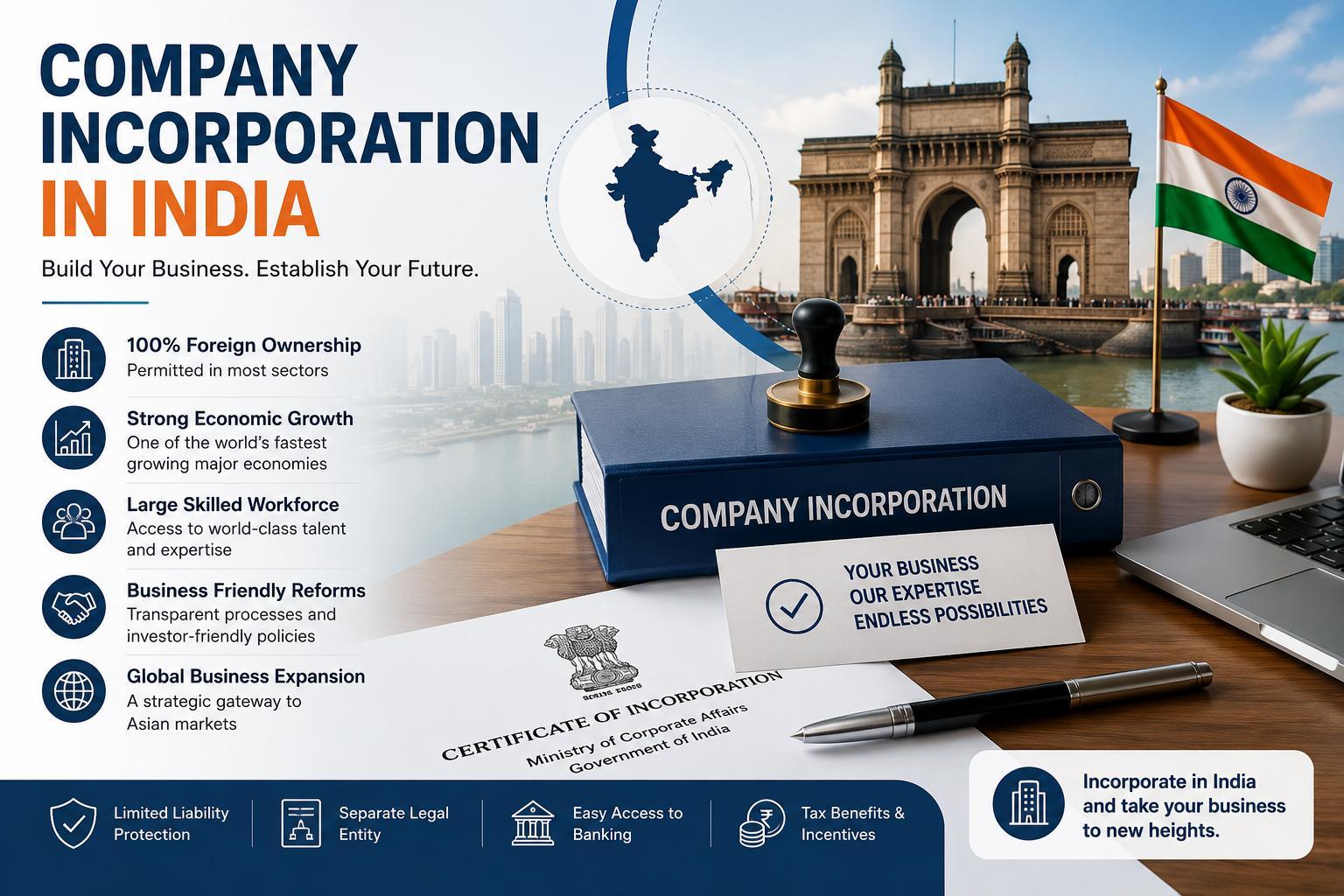
Company Incorporation in India: Building a Strong Foundation for Business Success
Expanding into a new country is one of the most important decisions a business can make. While market demand and investment opportunities often receive the most attention, the legal structure behind an expansion can determine whether a business grows efficiently or struggles with compliance and operational challenges.
For companies across the UK and Europe, company incorporation in India has become an increasingly popular strategy for establishing a long-term presence in one of the world's fastest-growing economies. Rather than relying solely on distributors or cross-border transactions, many businesses are choosing to create an Indian legal entity that provides greater operational flexibility, stronger customer confidence, and easier access to local talent.
India's business environment has changed significantly over the past decade. Digital transformation, infrastructure development, manufacturing growth, and policy reforms have encouraged international businesses to look beyond traditional markets. According to the Department for Promotion of Industry and Internal Trade (DPIIT), India has attracted more than US$1 trillion in cumulative Foreign Direct Investment (FDI) inflows since April 2000, demonstrating sustained confidence from global
investors. Likewise, the World Bank consistently highlights India as one of the world's largest and fastest-growing major economies.
If your organisation is considering international expansion, understanding company incorporation in India is not simply about completing registration it is about creating the right business foundation for sustainable growth.
Why India Continues to Attract Foreign Businesses
Every expansion decision should begin with understanding the market opportunity.
India offers advantages that are difficult to replicate elsewhere.
Business Indicator
Population exceeding 1.4 billion
One of the world's fastest-growing major economies
English widely used in business
Large skilled workforce
Expanding digital economy
Why It Matters to Foreign Companies
Access to one of the world's largest consumer markets
Long-term growth opportunities
Easier communication with international companies
Access to engineers, accountants, consultants, and IT professionals
Opportunities for technology-enabled businesses
These factors have encouraged thousands of international businesses to establish operations across sectors including technology, consulting, healthcare, renewable energy, logistics, and manufacturing.
Why Company Incorporation in India Is More Than a Legal Requirement
Many businesses assume incorporation is simply a registration process. In reality, it is a strategic business decision.
A locally incorporated company allows businesses to:
• Build stronger credibility with Indian customers
• Recruit employees directly
• Open corporate bank accounts
• Enter commercial agreements under Indian law
• Expand operations across multiple states
• Participate in government and enterprise contracts
• Establish long-term market presence
Instead of depending entirely on overseas operations, incorporation creates a scalable framework for growth.
Is Your Business Ready for Company Incorporation in India?
Not every business should incorporate immediately. However, certain signs indicate that the timing may be right.
Business Situation
Growing customer base in India
Plans to hire Indian employees
Why Incorporation Becomes Important
Supports better customer service and local operations
Simplifies employment and payroll compliance
Increasing annual revenue from India Creates operational efficiency
Expansion beyond a single project
Interest in local partnerships
Supports long-term business planning
Builds greater trust with stakeholders
Businesses that incorporate proactively often avoid operational bottlenecks as they grow.
Choosing the Right Business Structure
Selecting the appropriate legal structure is one of the most important decisions during company incorporation in India.
Private Limited Company
This is the preferred option for most foreign businesses because it offers:
• Limited liability
• Separate legal identity
• Strong business credibility
• Scalability for future investment
Wholly Owned Subsidiary
Many sectors allow 100% foreign ownership.
This structure provides:
• Complete operational control
• Independent decision-making
• Consistent global branding
• Greater flexibility for expansion
Limited Liability Partnership (LLP)
Professional service businesses may consider an LLP where permitted under foreign investment regulations.
Branch Office
Suitable for multinational corporations seeking a limited operational presence while remaining connected to their overseas headquarters.
The Company Incorporation Journey
Although every business has unique requirements, the incorporation process generally follows a structured path.
Stage
Business Planning
Structure Selection
Name Reservation
Documentation
Government Registration
Tax Registrations
Operational Setup
Objective
Evaluate expansion goals
Choose the most appropriate legal entity
Obtain approval for the proposed company name
Prepare incorporation documents
Receive incorporation certificate
Complete PAN, TAN, GST, and other registrations
Banking, accounting, payroll, and compliance
Working with experienced advisors often reduces delays caused by documentation or regulatory issues.
Original Business Example
A software consulting company based in Scotland had been delivering cloud migration services to Indian clients remotely for nearly three years.
Although demand continued to increase, the management team faced recurring operational challenges.
Large clients requested local invoicing, recruitment of dedicated engineers became difficult, and project delivery slowed because contracts were managed across jurisdictions.
Instead of expanding through intermediaries, the company completed company incorporation in India
Within eighteen months, the business had:
• Established a local technical support team
• Reduced average project delivery times
• Improved customer retention
• Expanded into three additional Indian cities
The company realised that incorporation was not simply about compliance—it created new commercial opportunities that were previously unavailable.
Common Challenges During Company Incorporation in India
Every international expansion involves challenges.
The most common include:
Regulatory Understanding
Foreign businesses must understand company law, taxation, employment regulations, and reporting obligations.
Documentation
Incomplete documentation remains one of the leading causes of registration delays.
Compliance Management
Annual filings, accounting, audits, and statutory reporting require ongoing attention after incorporation.
Strategic Planning
Businesses that incorporate without a clear expansion strategy often struggle to maximise the value of their investment.
Why Professional Guidance Creates Long-Term Value
International expansion involves legal, financial, and operational considerations.
Professional advisors help businesses:
• Select the most appropriate legal structure
• Prepare documentation accurately
• Develop compliance systems
• Plan tax-efficient operations
• Support long-term business expansion
This allows management teams to focus on customers and business growth rather than administrative complexity.
How Stratrich Helps Foreign Businesses
Stratrich partners with UK and European businesses throughout their expansion journey.
Its services include:
• Company incorporation in India
• Wholly owned subsidiary setup
• Market entry consulting
• Corporate compliance
• Accounting and bookkeeping
• Tax advisory
• Payroll management
• Corporate secretarial services
Rather than offering only registration support, Stratrich helps businesses establish a scalable operational foundation for long-term success.
Conclusion
Company incorporation in India is far more than a legal milestone it is a strategic investment in future growth. A well-planned incorporation enables businesses to strengthen customer relationships, recruit skilled professionals, improve operational efficiency, and confidently expand into one of the world's most dynamic markets.
For UK and European businesses, success depends not only on entering India but on entering with the right structure, the right strategy, and the right local expertise. By combining careful planning with professional guidance from Stratrich, businesses can build a compliant, resilient, and growth-oriented presence that supports long-term success. Our website Issuu provides additional information and helpful resources for businesses and entrepreneurs.
Frequently Asked Questions
1. Can a UK company own 100% of an Indian company?
Yes. In many sectors, foreign investors can establish a wholly owned subsidiary, subject to India's foreign investment regulations.
2. How long does company incorporation in India usually take?
If documents are prepared correctly, incorporation is commonly completed within two to four weeks, although timelines may vary depending on approvals.
3. What is the most common business structure for foreign investors?
A Private Limited Company or Wholly Owned Subsidiary is generally the preferred choice for UK and European businesses.
4. Is professional assistance necessary?
While not legally mandatory, experienced advisors can simplify incorporation, reduce delays, and help maintain ongoing compliance.