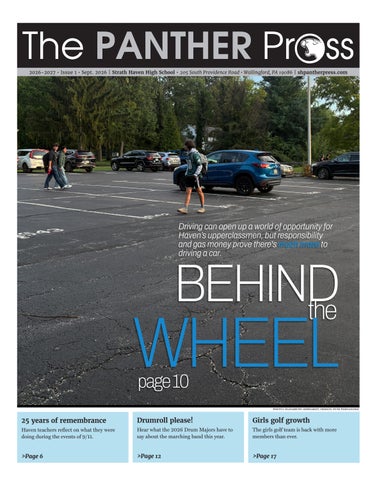
2026-2027 • Issue 1 • Sept. 2026 | Strath Haven High School • 205 South Providence Road • Wallingford, PA 19086 | shpantherpress.com
PHOTO: ELIZABETH GEBHARDT, DESIGN: EVIE FERNANDEZ
25 years of remembrance
Drumroll please!
Girls golf growth
Haven teachers reflect on what they were doing during the events of 9/11.
Hear what the 2026 Drum Majors have to say about the marching band this year.
The girls golf team is back with more members than ever.
>Page 6
>Page 12
>Page 17
2
EDITORIAL Letter from the Editors As the school year begins, we want to reintroduce ourselves. Clark Kerkstra Evie Fernandez Fiona Seale Morgan Matthews 2026-2027 Editors-in-Chief, Managing Editors
D
ear Haven, Goals shape our intentions, so in taking the documentation of Haven life seriously, we want to hold ourselves accountable as student journalists. Journalism is a big part of our lives, however, an even bigger part is being Haven students. Our leadership team is diverse in interests and activities, and having an inside view on life in this community will help us ensure your stories are authentically told. Our stories and lives are always changing. To keep up with these natural shifts, we prioritize weekly online coverage along with our bimonthly print issues. Students lead our process from coming up with story ideas to interviewing sources to editing and designing our paper. We start by brainstorming stories and sharing them among the team. We keep an eye out for stories we think hold news value and matter to students. Then, reporters sign up for
The Panther Press is not a school advertisement, but rather a voice and news source for the students — here to capture the full story and not just the perfect one. stories and plan interviews. We try to have a minimum of three sources for each news story, and we aim to interview a wide variety of students when possible. When reporters write stories, we strive to be objective and factual. We also want to ensure the most important facts are prioritized so students have easy access to the information that matters. As part of our design process, we seek to make stories accessible to students and attractive to read by adding visuals and putting thought into how each story will look on a page. We want to consistently update our social media accounts to share the newest stories with students on platforms where they can see them with little effort. We also try to share breaking news and event
Take Five:
What are you looking forward to? As school starts up, students from every grade share their excitement for the upcoming year. Efthalia Reo ’28 Contributor
shpantherpress.com • September 2026
coverage through exclusive social media reporting. After each issue comes out, we do a coverage audit where we track sourcing of each student and teacher. This allows us to avoid over-sourcing or undersourcing of specific students or groups. That means whether you play on the volleyball team or competed in the cup-stacking challenge at the beginning of the year assembly, we want your experience to be accurately portrayed. We have a few objectives this year that will help us achieve these goals. We hope to carry out the three Es:
Explore
A
s active as we are in Haven life, it’s hard to know everything about our complex community. Throughout this school year, we hope our reporting always remains curious. We don’t want to be stuck reporting on the same familiar topics — in addition to those things, we hope to uncover unique aspects of Haven’s community. This sort of reporting is what led to our coverage of underrepresented clubs like Cat Rescue.
Engage
I
t’s important to us that we cover the issues that actually matter to
Report Card D TECHNOLOGY « We have “I’m looking forward to doing different sports and classes, and getting to see what the year has [to offer].”
Ben Shaughnessy ’29 “I’m probably looking forward to school in general, and hopefully having my friends in some of my classes next semester. Also hopefully getting in a league in Esports, which is a fun club where we play games.”
Julia Godo ’27 “I think the biggest thing I’m looking forward to is the second semester because school is going to be winding down. I have my easier classes, the weather’s gonna get good again, and all the grad parties happen and whatnot, and all the senior activities are at that time.”
Elizabeth Whitehead ’28 “I’m so excited for my field hockey night games because I know we’re going to be winning. I’m also really excited for night games with field hockey because I know we put in a lot of work, and I think we’re really going to do well this year. I’m also really happy to be back after my injury.”’
Embrace
L
astly we want to fully embrace every part of Haven, without leaving anything out in pursuit of a more positive or polished image. Whether we’re talking about a state champion team or senior parking inconveniences, The Panther Press is not a school advertisement, but rather a voice and news source for the students — here to capture the full story and not just the perfect one. In the end, we want to represent who you really are. Along the way, when you have feedback, please share it — via comments on our posts, emails to strathhavenpantherpress@ gmail.com, or talking with any member of our team. We look forward to working with you this year, Haven!’
A+
Chromebooks! #grateful — Chromebooks are sooo slow — PDFs now blurred
Zarah Bach ’29
B Kyden Coleman ’30 “I’m really mostly looking forward to talking to people. I like meeting new people and talking to friends, so that’s mostly what I’m excited for this year.”
our readers. Not only do we look forward to covering the news that affects you, like phone policy discussions and renovation plans, we also want readers to engage with creative representations of Haven’s unique personality — like Students in Science or Artist Spotlight beats. To improve reader engagement, we’re making an effort to increase our social presence. Our team has been working on coverage of sports events and school activities that you can access quickly from your phone.
A
B+
BACK TO SCHOOL « Seeing friends « New classes — Homework — Early mornings again
F
PRIDE NIGHT « GSA extends influence to sports « Creates a welcoming environment « Encourages inclusivity PANTHER PLAGUE — Headaches — Coughs — Runny noses
About The Panther Press is the student-run publication of Strath Haven High School in Wallingford, PA. The Panther Press publishes 500 copies bimonthly in print and is distributed to classrooms and students at Haven. The publication is also online at www.shpantherpress.com. The goals of The Panther Press are to inform, educate, and entertain the student body, faculty and staff, and community readers. We strive to report and analyze issues that concern students in a manner that is fair, objective, responsible, and accurate. Through the use of journalism, technology, and workplace skills, the students who lead and create the newspaper develop as critical thinkers and communicators. All content published in the newspaper and on the Panther Press website is created by Haven students for a primary audience of students, with the understanding that our publication also reaches a broader audience that includes teachers and staff, families, and community members. The views represented in The Panther Press, as well as the selection and curation of content by the editors, do not represent the views of the entire Panther Press staff, the adviser, the school, or the administration. Submissions All Haven students are welcome to learn the basics of journalism and become contributors to The Panther Press. Interested students should speak to editors listed below to learn about upcoming training sessions. Any reader may submit a letter to the editor via email to strathhavenpantherpress@gmail.com. Anonymous letters will not be published. Editors reserve the right to contact letter writers or edit submissions for reasons of space or clarity. Our staff also welcomes feedback in the comments section of The Panther Press online or via our social media. Online commenters on our website must have a verified email address. Comments are reviewed for defamation, profanity, obscenity, libel, and invasion of privacy. Not all comments are published. Bylines All contributors are listed in the bylines of stories that appear in print and online. Photography, graphics, art, illustrations, and other creative work will be given attribution. Unsigned editorials, when published, feature the byline of the Editorial Board. Social Media The Panther Press maintains social media on Facebook and Instagram at @shpantherpress. The editors-in-chief and social media editors manage the social media accounts in consultation with the adviser. Replies and comments are screened and not all responses are published. 2026-2027 Editorial Board
FALL IS HERE! « Fall sports!! « Pumpkin treats and drinks return « Chilly weather — No more summer
GAME C- HOMECOMING « District coming up
PEP RALLY/ASSEMBLY « Yearbooks! « Fun games — Felt scripted — Didn’t like the split-up pep rally
A
with ideas! — No football game...? ✓ Read coverage online at shpantherpress.com SPORTS « Senior nights are coming up « Teams are doing well — Some are at the end of their season’
Editors develop the report card collaboratively during print design.
-Editors
Editors-in-Chief Evie Fernandez ’27 Clark Kerkstra ’27 Managing Editor, Print Morgan Matthews ’28 Managing Editor, Web Fiona Seale ’28 Haven Happenings Claire Salera ’27 Sports Elizabeth Gebhardt ’29 Haven Arts Joya Nath ’28 Darcey Strachan ’28
Assistant Editors
Assistant Editors have leadership responsibilities but do not have a seat on the Editorial Board.
Cayla Gaffney ’29 Lexi Glass ’29 Izzy Boland ’29 Siya Goindi ’29 Damini Mydur ’29
Health & Sciences Lavanya Dixit ’27 Detours Rowan Brown ’29 Opinions Josselyn Dixon ’29 Social Media Gisele Detweiler ’28 Jane Yau ’29
Adviser
Kate Plows
3 September 2026
HAVEN HAPPENINGS
Administration creates Technology Advisory Council The council will be meeting throughout the year to discuss technology’s role in the classroom and inform administration decisions. Michael Conallen ’27 Clark Kerkstra ’27 Reporter, Editor-in-Chief
T
he WallingfordSwarthmore School District is taking a hard look at instructional technology. Superintendent Dr. Russell Johnston recently announced plans for a Technology Advisory Council for the coming school year. The council is intended to evaluate the effectiveness and the need for the different types of technology that the district uses, including Chromebooks, Schoology, and software used in classes at the high school, like Adobe and Edpuzzle. Johnston emphasized the need to use technology intentionally. “Across the board we’re looking for the use of technology to be authentic, purposeful, and aligned to the state learning standards that we have for all of our students,” Johnston said. According to its webpage, the council will be comprised of eight teachers across different schools, as well as two school board members and four parent
representatives. While students are not on the council, Johnston said students may be represented when the council discusses the high school through the superintendent’s advisory council. The superintendent’s advisory council is selected rather than elected, and is made up of four students from each grade level, according to an announcement shared on class Schoology pages. “I have my student advisory council at the high school, and hearing directly from students about technology issues that we can bring to our discussions here was really the best way for me to hear from students,” Johnston said. The council will discuss topics like the district AI policy and the role of technology in the elementary and middle schools. The district has restricted access to YouTube for elementary students alongside removing technology from indoor recess at the elementary school. Additionally, the district has removed access to Gemini and is attempting to find a way to disable the AI Overview. The district has historically restricted access to technology like AI and YouTube and will continue to do so in the future. Johnston believes that students should focus on developing their critical thinking and fine motor
skills before being immersed in technology. “Open-ended access to generative AI through Gemini is something that right now I don’t want for our students, because I don’t think that it can be used as a teaching tool to help students develop those critical thinking skills that I want for their future,” Johnston said. The council will also discuss issues surrounding digital health and wellbeing. Johnston thinks that the district should take an affirmative stance on social media in particular. “I think that the school actually teaching about the use of social media is important, as opposed to just expecting that students experience it and maybe in some ways social media detracts from their well-being,” Johnston said. Librarian Mrs. Beth Cohen emphasized the importance of being intentional about technology use. “I like the discussion of screen time versus screen value,” Cohen said. “What are we doing with it? Is it adding something to the lesson, or are we just taking the same bubble test and making it a Google form and just answering the same questions, except it’s on a computer now?” Cohen appreciates the use of technology at the school because it allows teachers to take less time to get their work done and
have more time for students. “You could even say that the fact that the Google Form automatically grades students, even if it’s just a digital version of the paper test, if you’re saving the teacher half an hour in grading time, is that a half an hour that she could use to conference with students instead of grading papers?” Cohen said. Some teachers, though, see technology as a detractor from their teaching. Social studies teacher Mr. TJ Adams dislikes technology he is required to use. “The more time that I have to spend by some kind of mandate with something like a learning management system, like Schoology, then the less time I have to read the next book that I need to be a better teacher,” Adams said. Adams believes that technology has hurt some aspects of teaching. “I do believe that at times getting the Chromebook out and working on something becomes a replacement for what I think is more authentic and meaningful engagement between teachers and students,” Adams said. Johnston asked for parent applicants to the council as part of his superintendent’s newsletter. No members of the council have been named publicly as of the publication of this article.’
2026-27 Instructional Technology Focus at all grade levels SOURCE: wssd.org Reinforce consistent expectations for instructional technology use
• All technology use must be used in ways that are purposeful, authentic, and aligned to district curriculum and state learning standards. • Technology should not be used as a reward for non-curriculum or nonstandards-aligned activities, unless indicated in a student’s Individualized Education Program (IEP) or accommodation plan.
Strengthen Classroom Expectations for Technology Use
• Teachers will be recommended to use GoGuardian to monitor and restrict student access on school-issued Chromebooks. • Teachers will be offered GoGuardian training to support consistent implementation and to improve effectiveness of use of this tool so that they can better monitor student Chromebook use. • Technology should support instruction rather than distract from it.
Strengthen Internet and AI Filtering
• The district has implemented enhanced filtering policies that include real-time detection and blocking of proxy sites, including game aggregators such as Google Sites and similar webpages containing embedded games. These updates replace the previous manual process for blocking Google Sites. • The district continues to restrict direct access to generative artificial intelligence for students and is actively investigating solutions to AI summaries included in internet searches on Chromebooks. • Additional community and staff input will be sought if the district considers providing access to AI tools to students.
Streamline Access to YouTube
• Based on feedback from the technology survey, the district will continue to evaluate YouTube access through the formation of a Technology Advisory Council. The council will receive a demonstration of current student access and controls when considering any future recommendations.
School Chromebooks damage easily, disrupting schoolwork For many students, school Chromebooks are crucial for getting through the day, but that can become difficult when their devices break. Audrey Kerkstra ’30 Jane Yau ’29
Contributor, Social Media Editor
W
ith the amount of online work assigned to students every day, Chromebooks have become a necessity in any school bag. According to instructional support staff member Ms. Alisar Baroody, who assists students with Chromebooks in the library, there are around five students per day that come to her due to Chromebook issues. For some students, these problems have become a constant part of the school day. Most freshmen received a new Chromebook at the start of the school year. Freshman Norah Carrigan was one of those students, and said her old one from middle school had broken. “The whole thing around the keys popped out, and the plastic
around the screen was kind of chipping off,” Carrigan said. “Some of my keys would start to not work. I’m not sure if that’s the Chromebook or just me having it for three years.” Carrigan isn’t alone. Multiple students have reported experiencing similar problems. “All of my keys stopped working,” junior Hillary Glasson said. “Some of them were stuck, and then others just typed the wrong letters. None of them worked, so I couldn’t do anything, which was obviously an issue.” After students bring in their broken Chromebooks to Baroody, she submits an incident report and puts it into a spreadsheet that connects to the help desk and the technicians, who then have to assess the damage. “If there’s a possibility for [Haven’s tech department] to fix it in house, they will do so,” Baroody said. “But if it’s something that is beyond their ability, they have to send it up to Dell, and Dell will repair it. And when it comes back, I have to communicate with the students to come and exchange
Chromebooks with me.” Director of Information Technology Mr. AJ Cetroni explains why Haven uses these specific Chromebooks. “The Chromebooks have met [our] needs, so that’s why we’ve stuck with that,” Cetroni said. “If we were going to do something more, as far as a laptop or a MacBook, they are going to come with more financial restrictions. So far, the Chromebook has met what we’ve been told is needed to meet the curriculum and the online assessments.” According to Cetroni, when the Chromebook can be fixed in the school by the technology department, it’s generally done within a day or two. However, if it’s serious enough damage for the Chromebook to be sent to Dell, it could take much longer. “It could be anywhere from two to four weeks, depending on shipping and Dell,” Cetroni said. For some students, a single repair isn’t enough. Glasson’s Chromebook eventually had to be replaced after an attempted repair failed. For others, repairs can mean spending weeks with a loaner Chromebook, creating
further inconveniences during the school day. According to Baroody, the problem isn’t actually the Chromebooks themselves, it’s how the students treat their Chromebooks. “We see a lot of damage with Chromebooks that are being carried in backpacks because the backpacks are not being handled gently enough,” Baroody said. “It doesn’t take much for the Chromebooks to be damaged if you put enough pressure on them. We see a lot of people come back and say, ‘Well, it was in my backpack, but it’s damaged,’ and that’s because they’re not being careful with their bags.” Just like how cell phones have cases, Baroody recommends that students get Chromebook cases to prevent damage from happening. “I’ve had [my Chromebook] for six years, and it’s not broken,” Baroody said. “[The Chromebook] is an expensive device. It’s something that we need on a daily basis, so we have to take extra care of it.”
Additionally, Cetroni suggests that students should not put stickers or writing on their Chromebook. “Part of having the device is making sure that you’re taking care of it,” Cetroni said. “Make sure you treat [the Chromebook] as your own. It is district property, so it should be treated as such.” He also advises that students take responsibility for being prepared for school each day. “Coming prepared every day with a charged Chromebook would also really help go a long way,” Cetroni said.’ A damaged Chromebook shows a screen that’s cracked and glitching. PHOTO: JANE YAU
4
shpantherpress.com • September 2026
HAVEN HAPPENINGS
Get hype for new hires! Haven welcomes two new staff members for the upcoming school year. Nathalie Basilevsky ’28 Reporter
“
I want all the students to succeed. I want them to feel welcome in my classroom. I also want them to enjoy environmental science. Ms. Christina Gaffney Science teacher
“
Right off the bat I felt welcomed and supported, and like I was entering a really, really great school culture and environment. Ms. Anna Tucker School counselor
Ms. Christina Gaffney, Science
New staff member Ms. Christina Gaffney poses for a photo in the environmental science classroom. Gaffney is looking forward to teaching her students about science and how it can be applied to everyday life. “I love planning and I love seeing what the students can do with lessons,” Gaffney said. PHOTO: NATHALIE BASILEVSKY
T
hough this year holds several firsts for her, Ms. Christina Gaffney is no stranger to teaching. Before becoming a school teacher, Gaffney was involved in Teach For America, an organization that works to expand learning opportunities for students nation-wide. “I believe that everyone should have the right education,” Gaffney said. “I still believe that right now.” Gaffney joins Haven for one semester this fall, replacing Mrs. Sheryl Ursillo who retired in spring 2026. This semester will be the first year Gaffney teaches environmental science, and she is looking forward to applying her past experience to a new subject. “I’m excited to see what kind of paths we go on to cover the curriculum,” Gaffney said. Gaffney is also eager to see how her lessons will adapt as she
learns more about her students’ interests. “All the ideas that pop up during class, I’m excited to implement into my lessons,” Gaffney said. According to Gaffney, teaching at Haven has been an exciting opportunity because she has felt connected to it from the beginning. She lives in Wallingford with her family and her children attend district schools. “I like that I’m putting this energy forth, and it’s directly affecting me as a person because it’s my community,” Gaffney said. According to Gaffney, adjusting to a new school environment was made easier through her growing connections with the staff around her. “The teachers have been so welcoming and helpful and inviting,” Gaffney said. Science department chair Ms. Katie Shepard was one of the staff members involved in helping Gaffney adjust. “[Gaffney is] very knowledgeable, very engaged, very student focused, and very excited about science,” Shepard said. Gaffney has several goals for the semester. One of them is to get her students to use the skills they learned in class and apply them to the real world. “I want them to pick up the newspaper and be interested in the environmental science issues they hear in the news,” Gaffney said. Another one of Gaffney’s goals for the semester is to create a safe learning environment for her students. “I want all the students to succeed. I want them to feel welcome in my classroom. I also want them to enjoy environmental science,” Gaffney said.
Ms. Anna Tucker, Counseling
New staff member Ms. Anna Tucker poses for a photo in the counseling office. Tucker is looking forward to learning more about Haven, its staff, and its students. “I’m most excited just for building those relationships and getting to know everybody,” Tucker said. PHOTO: NATHALIE BASILEVSKY
M
s. Anna Tucker was first introduced to student counseling through substitute teaching during her undergraduate years. “I could tell that a lot of them felt safer talking to an adult when it was in a one on one setting,” Tucker said. ”So that’s kind of what got me interested in the school counseling role.” Though Tucker enjoys many aspects of her job, she said that her favorite part of being a school counselor is hearing about the relationship between the student’s social-emotional wellbeing and their academic success. “I like hearing the student perspective,” Tucker said. “And using that and what I know about them… to help them do the best that they can in school.” One of her goals is to start getting to know everyone so she can have a better understanding of how she can best help them. “Establishing that safety and establishing the trust in [student
to counselor] relationships [is] my biggest priority,” Tucker said. Tucker felt that her initial impression of Haven during the interviewing process stood out from other schools that she considered. “Right off the bat I felt welcomed and supported, and like I was entering a really, really great school culture and environment,” she said. Since being hired, Tucker believes that her intuition regarding Haven has been proven correct. “Everyone has been so supportive and so patient with me,” Tucker said. “I feel like we’re all on the same wavelength.” Tucker said that while she hasn’t learned everything there is to know about Haven, she has been asking a lot of questions to broaden her understanding. “At this point, I’m just trying to be a sponge,” Tucker said. “I’m just trying to learn as much as I can about the staff, the students, and the culture, and what makes you guys tick.” Assistant principal Ms. Tabatha Duffy, one of the staff who was involved in helping Tucker acclimate, said that Tucker’s curiosity and enthusiasm are a great addition to the counseling department. “She’s kind of put herself out there to volunteer to try new things,” Duffy said. Tucker is grateful for the experience she has had in Haven so far and looks forward to what the new year will bring. “I haven’t met every student yet, and I haven’t met every teacher yet, but everyone that I have met has just been really positive,” Tucker said. “That’s an environment that I am really excited to come into every day.”p
Featured Class: Financial Literacy teaches students life long skills The new course requirement set by the state of Pennsylvania teaches freshmen about managing money through different projects. Jane Yau ’29
Social Media Editor
S
tudents sometimes complain that their high school classes do not have an apparent connection to their future plans. However, the new financial literacy course requirement, which went into effect on July 1, may have relevance for any students who will manage money in the future. Because of the timing of the new Pennsylvania standards, the only students that have to take Financial Literacy as a graduation requirement are the current freshmen and classes following them. For sophomores,
juniors, and seniors, it’s still an elective. “Since it’s only one grade that absolutely has to take it at this time, it’s fitting in their schedules the same way it has previously [as an elective],” Financial Literacy teacher Mrs. Gianna Harris said. Financial Literacy focuses on personal finance, where students learn all the basics of what it’s like to manage their money. Students start off with learning different kinds of careers, then mock interviews. They also learn how to file taxes, get a credit card, buy a house or a car, and even how to lease the car. Students are also involved in various projects the course offers. For example, the class includes a budget project in which students explore jobs then have to manage their money for an entire month. They experience what it’s like to pay for everyday expenses, such as rent, bills, and food. “I think that this course brings
“
I think that this course brings a lot of skills, whether you are interested in it or not. Ms. Gianna Harris
Financial Literacy teacher a lot of skills, whether you are interested in it or not,” Harris said. “No matter what career path every student is taking, they’re going to need all of these skills.” Students echoed this sentiment as well, sharing how they believe these skills are necessary for the future. “I’m really liking [Financial Literacy],” sophomore Ruby
Hezlep said. “I think it’s really important to learn about managing your money, especially saving up for retirement and stuff like that.” Now that the Class of 2030 and on is required to take financial literacy, the school is working to adjust class scheduling s o that enough courses are available. Computer science teacher Mr. Patrick M a l o n e y will now be teaching two sections of Financial Literacy. “We got to expand the business program and have some more sections to allow more students to enter the classroom,” Harris said. “In terms of the future, we’re not really sure what it’s going to look like yet, as we’re still working out some schedule changes and how financial literacy will fit for every single
student.” One change Haven is exploring to accommodate the new state requirement, according to principal Mr. Andrew Benzing, is half credit elective classes. Freshman Ellie An looks forward to taking Financial Literacy. “I plan on taking Financial Literacy in my junior year,” An said. “I’m excited to have a class that simulates what the real world will be like.”b
A bank displays savings. Financial literacy teaches students how to spend money responsibly.
PHOTO: JANE YAU
HAVEN HAPPENINGS
September 2026
5
Annual Activities Fair promotes clubs, offers opportunities Dozens of student leaders set up displays outside of the cafeteria to encourage students to join new clubs.
Visit shpantherpress.com for descriptions of some of the new clubs in 2026-2027.
Izzy Boland ’29
Assistant Health and Sciences Editor
C
andy, posters, and signup sheets were scattered across tables outside the cafeteria as clubs invited, bribed, and begged students to sign up. The annual Activities Fair was held on Friday, Sept. 11, as a way for new and returning students to join clubs at Haven. Originally, the Activities Fair was just for freshmen and new students, but over time it was made more accessible and moved outside. Co-activities director and French teacher Mme. Suzanne Stadnicki appreciates its ability to introduce the abundance of activities at Haven. “It’s a nice, really big start to the school year,” Stadnicki said. “New students and freshmen
HEAR ALL ABOUT IT! • Tristan Elcock (12) tells superintendent Dr. Russell Johnston
about Spanish Club during the Activities Fair on Sept. 11. The event gave clubs the chance to showcase themselves by convincing students to join. PHOTO: KATHRYN BARRETT
can learn about all the activities, and it’s a good reminder to the upperclassmen about what we offer here.” Planning for the Activities Fair began in spring. “We have an ongoing list of all the activities. But we do ask the current faculty advisers to assign student leaders because this is student-run; the clubs we want to be student-run,” Stadnicki said. Through their advisers, clubs
were able to sign up for a table, which they could run throughout all lunches. The Activities Fair also helps new clubs gain their footing by getting new members and awareness. New club Reading Rewards’ co-president senior Emily Zhang observed the benefits of being part of the event. “[It’s] a good point of exposure that tells a lot of students who didn’t know about the club before
about the club and about the mission of the club, so that’s really important,” Zhang said. “It also gives us a gauge of the interest from the school community.” Board Game Club vice president junior Eunice Liu has noticed that the Activities Fair introduces a diverse range of students to the club. “Promoting at [the] Activities Fair allows [for] more people that we usually wouldn’t talk to to have a chance to see the Board Game Club and join it,” Liu said. Gender and Sexuality Alliance (GSA) leader and senior Weiler Graham handed out pride flag stickers during the Activities
New third floor furniture provides space to eat, work, socialize The furniture in the Wall of Honor hallway is new this school year, thoughtfully designed by dedicated students, teachers, and the principal. Chanel Courtman ’29 Cayla Gaffney ’29
Contributor, Assistant Haven Happenings Editor
C
hatter and laughter fill the air as students eat lunch, socialize, and work at the new booths, tables, and chairs in the third-floor Wall of Honor hallway. The furniture pieces, first introduced at the start of the 2026-2027 school year, serve as a comfortable meeting place for students and members of the community. The idea to redo the furniture took off in January 2024, when principal Mr. Andrew Benzing connected with FCS teacher Ms. Francis Schoonover. A goal for Haven was to update furniture to create a more open campus atmosphere. “It was a long process that started several principals ago to try to get some furniture to use [the Wall of Honor hallway] as an alternate eating space,” Benzing said. “I think the cafeteria can be tight and loud for a lot of students, so we wanted to find something in the middle.” When Benzing heard about student interest from Schoonover’s interior architecture class to redo the space, he was especially
FURNITURE FUN • Nadine Detsi (10) and Bianca Morris (10) socialize while sitting
in one of the new booths in the third floor Wall of Honor hallway during B lunch on Sept. 9. PHOTO: CAYLA GAFFNEY
motivated. “We knew it all along, but like the trailers, [the furniture] temporarily stayed a little bit longer until we had some energy,” Benzing said. “Ms. Schoonover’s group gave us a nice solid shot in the arm where they said we’d be willing to cut a design and come up with. That was really important to me, to have the students behind it.” The interior architecture class covers the basics about drawing floor plans and elevations. Schoonover jumped on the opportunity for her interior architecture class students to experience real-life application of these skills. “[The students] saw samples and chose the actual pieces of furniture [and] how much given amount of space there is, so that we still had room for people sliding out their chairs
and a nice wide walkway for the fire marshal to be happy,” Schoonover said. A group of students who took the class in the fall semester of 2024 were involved in the planning. Junior Jaya Schwartz was one of the students who came after school to meet with the group about once a month. “We had this little group of students that would come after school and take measurements of the hallway, pick out patterns and designs, like what kind of chairs we wanted, if we wanted booths or just regular chairs,” Schwartz said. Sophomore Virginia Reitmeyer noticed the effort that went into planning the new furniture. Reitmeyer appreciates the upgrade in the new booths and tables, in comparison to the previous foldable plastic tables. “I think it looks really nice with the building, and I think
it’s comfortable for students,” Reitmeyer said. In addition to the area being used during lunches and fifth block, the Wall of Honor hallway is also used for more public events — like the Varsity Arts Awards ceremony and Back to School Night. “It’s a showcase space. We house a lot of events there,” Benzing said. “We wanted to be versatile and mobile. That way we can move things around and change it.” Even with the major advancements in furniture in the hallway, there is still more to come. According to Schoonover, high-top tables with stools and a new booth will be arriving on Sept. 25. The Home and School Association’s (HSA) remaining funds from the Class of 2026 contributed to the purchase of the new booth. Schwartz is happy to see the changes so soon, as she expected the process would be longer. She believes the work from the group of students and a couple of teachers has made a lasting impact on the school community. “I love how it came out,” Schwartz said. “I’m so happy I got to see it too because we had originally no idea how long it was going to take, but I think it works amazingly. I think everyone loves it way more than the old setup with all the folding chairs and everything.”p
Fair, encouraging students to join GSA. Graham enjoyed the event and is looking forward to welcoming new members to GSA. “We’ve got a lot of new sign-ups for GSA, and I’m so excited for what’s to come this year,” Graham said. Co-activities director and social studies teacher Ms. Amanda Lawson has noticed the social benefits of the Activities Fair. “If you look around, I always say there’s not a lot of phones out. Everyone’s really interacting with each other, and it’s just got a great energy,” Lawson said. Graham sees the Activities Fair as a good way to connect with other students and discover different communities at Haven. “I think it’s just a really fun way for everyone to get to talk to new people, and it’s just a good way to show what your club can do and get a bunch of people to sign up,” she said.p
What do you think of the new furniture? Chanel Courtman ’29 Contributor
Abhay Singh ’29
“Personally, I love this new furniture. I use it for lunch every single day. It’s always clean too.”
Bianca Morris ’29
“I think it’s nice to have real furniture instead of just folding tables and chairs. I think it’s a good addition to the school.”
Ishani Goswami ’29
“It’s a really good place to eat lunch with your friends if you want to go somewhere quiet.”
Riley Moore ’30
“I think it’s really cool. It’s just nice to sit and chill. This is my first year here, so it’s nice.”p
6 VI
shpantherpress.com • September 2026
HAVEN HAPPENINGS
25 years later, Haven remembers 9/11 On the 25th anniversary of the 9/11 attacks, teachers who were here for the attacks reflect on their experiences. Clark Kerkstra ’27 Joya Nath ’28
Editor-in-Chief, Arts Editor
I
t was second block on September 11, 2001 when a student came into Mr. Richard Foulk’s history class and told him to turn on the TV. What Foulk witnessed was a tragedy that would go on to define and change American identity. As Foulk turned on the TV, the second plane crashed into the World Trade Center. Haven’s history teachers were witnessing an event they would be teaching about for decades to come. Foulk estimates that almost 100 students poured into his classroom to huddle around the 21-inch tube television as second block went on. “It was dead. Dead silent,” Foulk said. English teacher Mr. Matthew Wood was driving to school that day when he got rear-ended by a truck. He was sent to the hospital before his girlfriend and future wife came to pick him up. “I’ll never forget walking out,” Wood said. “As we were walking out of the emergency room, they had a TV up on the corner of the wall, and we just happened to walk past as the first plane hit
“
I sat there and watched the whole thing unfold from probably nine in the morning until well into the night. I just sat there on the couch, just taking it all in, and it was one of the strangest days of my life. Mr. Matthew Wood English teacher
the first building, and they were reporting on it and showing the plumes of smoke, and there was all this sort of confusion and mystery.” Wood went home after that. He spent the rest of the day in a painkiller-induced haze, but he remembers the developments clearly. “I sat there and watched the whole thing unfold from probably nine in the morning until well into the night,” he said. “I just sat there on the couch, just taking it all in, and it was one of the strangest days of my life.” Social studies teacher Mrs.
Ellen Yarborough recounted watching the second plane hit the towers and the shocking moment of realization that this was no accident. “We were just kind of like, ‘Wait a minute!’ We were already watching a video of a plane in a building, and now you have a second,” Yarborough said. “It takes a while for your brain to figure it out. We just looked at one another like, ‘Oh my God, what is going on?’” The teachers agreed that once the attacks happened there was no return to regular instruction. “Some schools turned off the TVs and told people to go back to business as normal, but our principal said social studies teachers are equipped to discuss this,” Yarborough said. “Some parents were coming to pick up their kids, but for the kids that were here, if people were comfortable, we had the TVs going and we were talking to the students.” Students crowded around the TVs that were mounted in the corners of some classrooms (the marks are still on the wall today if you look around). For science teacher Mr. Timothy Styer, witnessing the events together with students and staff helped. “There was comfort in groups because we all felt the same crazy, wild emotions that nobody could ever define or explain,” Styer said. “We all felt it together, and somehow that was comforting.” One thing that Styer remembers distinctly is the shock. “It felt like such a weight, like
“
It felt like such a weight, like an unbelievable black cloud. The feelings that we all felt were every feeling you could possibly imagine. The problem was trying to process. Mr. Timothy Styer Science teacher
an unbelievable black cloud,” Styer said. “The feelings that we all felt were every feeling you could possibly imagine. The problem was trying to process.” In the aftermath of the attacks, teachers remembered an eerie quiet. The Federal Aviation Administration shut down the national airspace at 9:45 a.m. on Sept. 11. Airports and commercial flights began to reopen on Sept. 13 with stricter security checks. “It was really ominous because there were no planes in the sky,” Wood said. “I just remember it was silent in the skies.” The enormity of the situation was not lost on the students and staff of Haven that day. “It’s one of those kinds of events where, like, ‘This is going
to change things. I’m not sure how exactly yet, but there’s going to be fallout from this that will probably change a lot in the years to come,’” Wood said. Besides the immediate effects, the attacks also led to a definite societal shift. Wood remembers how new airport security screenings were implemented. “[Young people today] are in a post-9/11 world where the first time you went to the airport, you just thought it was normal to go through all these security parameters and so forth, right? Those fears have been somewhat normalized,” Wood said. Foulk remembers security measures like Haven’s emergency drills first happening soon after the attacks and the Columbine school shooting in 1999. “I know it felt very, very strange when we first started doing it,” Foulk said. Foulk finds it surreal to teach students about a day that for him was not quite so distant. “What I find so strange is that I remember those details so vividly, but to you guys it’s so far away,” he said. For Styer, the events of 9/11 will not be easily forgotten. “You didn’t know what to feel because you were feeling everything,” Styer said. “It was such an overwhelming feeling, and I hope I never feel that again, because that’s the apex of horror and just realization of how dark humankind can get.”*
Senior sunrise, jeans take over Haven On Friday, Sept. 4, seniors gathered at King Field to watch the sunrise and take pictures in their jeans. Evie Fernandez ’27 Editor-in-Chief
T
he sun lit up yellow and orange behind the trees at exactly 6:32 a.m. Seniors clumped together in groups, passing cameras and phones back and forth as they rushed to take their photos. Senior jeans are a recent tradition at the high school in which seniors will paint or otherwise customize a pair of jeans to wear throughout their senior year on milestone moments. Some paint theirs to fit a theme, while others stay more classic in school colors. Senior Daija Bradwell used her jeans to pay homage to a childhood favorite show. “I grew up loving Monster High, so I wanted to incorporate that into my jeans,” she said. “So I did a little logo as the ‘0’ in ‘2027.’” Senior Roxanna Shelton had a similar idea, choosing a ‘Shopkins’ theme while
“
I’ve waited to be a senior for four years. It’s finally here. Maggie Peterson ’27 simultaneously making a nod to her various extracurricular activities. “[I included] a paint palette for AP art and my passion for art, a microphone for being in Silvertones and singing, nail polish because I paint my own nails, and I find that [as] an outlet for me,” Shelton said. Shelton also included a camera for her role as yearbook editor and assistant to the director for the marching band. She added a cookie to represent Foodie Friends, the club she’s a co-president of, as well as Girl Scouts. Senior Shelby Seidman painted a denim vest, rather than pants. Seidman made patches to say
SENIOR MOMENTS • Hailey Barras (12) and Daija Bradwell (12) take a selfie in their jeans at the annual senior sunrise on Sept. 4, the first Friday of the seniors’ final year at Haven. PHOTO: EVIE FERNANDEZ
‘Haven’ and ‘2027’ and placed them on the shoulders, as well as a big patch for the back that says ‘senior star.’ “I have a lot of experience with patch making from the punk community,” Seidman said. “I wanted the jacket to feel not just like my senior pants, but also represent things I really like and
feel connected to.” The morning brought up feelings for a lot of seniors, making them consider their new role in the school. “It’s kind of cool to be the oldest in the school,” senior Kat Kudrick said. “Also, being in band, I know a lot of freshmen, and I think it’s really cute because on the first
day of school they all came up to me to say ‘hi.’” Others were excited because it felt like the real start of senior year. “I’m so excited, actually. Oh my god! I’ve waited to be a senior for four years. It’s finally here,” senior Maggie Peterson said.*
HAVEN HAPPENINGS
September 2026
7 VII
Scaled-down renovation plan envisions courtyard, bridge, universal gender bathrooms The $76 million project replaces a previous $99 million plan that would have built science rooms by Providence Road and added a staircase from the Green Mile to the Wall of Honor hallway. Clark Kerkstra ’27 Editor-in-Chief
O
n Tuesday, Sept. 16, architects revealed the latest in a long line of designs for the high school renovation project. The plans, presented by Kelly Clough Baker and Associates architect Mike Kelly at the Sept. 16 school board Facilities and Finance Committee meeting, would cost around $76 million, a figure significantly lower than previous designs but still higher than the $70 million allocated to the project by the district. The new design is set to add a three-story science wing near the bus loop on the Brookhaven side of the building. The addition would connect to the main stairway and to the rest of the building by a bridge on the second floor connecting the Green Mile to the new science wing. The current balcony just outside the library remains in the new plan, looking out over a courtyard space formed by the new addition and connecting hallways to the right and left. The courtyard would be surrounded by walls on three sides, with one leading up to the library’s balcony, and a locked gate on the other with a bridge above it. Kelly referenced previous plans to expand the cafeteria to support administrative goals of narrowing down to two lunches, suggesting that students eat outdoor lunch in the courtyard instead of in the parking lot and bus loop as they do now. This would permit students to still eat lunch outdoors but in a smaller and enclosed space. “Students can’t get out and non-invited guests certainly can’t get in,” Kelly said. “It’s a nice secured space [and] we still get that outdoor space.” With the science classrooms located in a completely new building wing, the previous science classrooms are planned to be converted into regular classrooms, and the prep rooms are intended to become office space. “The old prep rooms of the science labs were basically closets, they were barely prep rooms,” Kelly said. “But that’s a great size for a speech therapist’s office or a reading therapist’s office. Some of those areas could be converted.” The plan also includes a
complete reconstruction of the building’s bathrooms. In place of the current gendered bathrooms, the plan proposes to create a new and larger universal gender-neutral bathroom on each floor. The model also includes a separate faculty toilet only accessible from the hallway. Kelly said the new model of the bathrooms would allow for cameras to be placed inside them with each stall being fully walled off and hidden from the cameras. According to Kelly, this could help the administration to control the bathrooms and crack down on lingering in the bathroom. “We’ve seen this in a lot of schools really cutting down on behavior issues that happen in restrooms,” Kelly said. Architects also included an alternate plan for the renovation and reconfiguration of the locker rooms, team rooms, weight and fitness rooms, and wrestling room. There is no price estimate for this add-on option yet. For school board member Mary Jo Witkowski-Smith, the locker rooms remain a priority. “I’ve been through those locker rooms and the sight lines are not good,” Witkowski-Smith said at the Sept. 16 meeting. “I think they are a safety issue and a problem waiting to happen. Maybe it’s just a reconfiguration of those lockers, the way they are aligned and set up. It doesn’t have to be a total remodel. I don’t know that we can let that go entirely because it’s not a safe situation.” Many elements of the plan presented last April have stayed the same. The trailers are still set to be removed, and the plan still proposes to create a new and larger special education classroom with access from the general academic hallways. Just like earlier renditions of the plans, the new designs still promise to completely overhaul numerous building and mechanical systems in an attempt to make the building “Warm, Safe, and Dry.” District administration requested that architects come back with a lower-cost option after a $99 million plan presented in April that featured science rooms by the Providence Road entrance and a staircase from the green mile to the Wall of Honor hallway. This idea proved to be too costly amid a spiraling budget shortfall. The school board officially voted to cut the capital plan, the district’s fund for renovations and construction which includes the high school renovation project, from $164 million to $132 million at the Aug. 24 school board meeting. Henry Guarriello from CHA Solutions, the district’s construction management firm, said the updated plan is still
TOP: A view of the courtyard where
students would eat lunch from the bridge connecting the Green Mile to the science wing. TOP MIDDLE: A rendering of the
planned new entrance on the Brookhaven side of the building. BOTTOM MIDDLE: The floor plan of the
new courtyard and science wing area. BOTTOM: The new universal gender
bathroom proposed in the plan.
ARCHITECTURAL RENDERINGS PRESENTED AT THE SEPT. 16 SCHOOL BOARD FACILITIES AND FINANCE COMMITTEE MEETING. VISIT SHPANTHERPRESS.COM FOR MORE.
projected to cost around $76 million, $6 million more than the district has allocated for the project. “As far as budget, I’ll just come right out and say it: we’re not meeting $70 million right now,” Guarriello said at the Sept. 16 meeting. “We’re not there yet. We have work to do.” According to Guarriello, the trailers will likely be the last to be dismantled in the plans because they will be needed as classrooms while other renovations happen. As a result, the trailers may not leave before 2031, which is when the project is scheduled to finish. This means that no students currently in the school will see the conclusion of the project if they graduate in four years and the project does not run ahead of schedule. Superintendent Dr. Russell Johnston shared a draft motion for the Sept. 28 school board meeting that authorizes architects to begin design development, where they will begin working on actual blueprints and construction phasing plans. School board member and Facilities and Finance Committee chair Robert Miller emphasized the importance of beginning to work on the project soon. “Costs don’t go down. They go up,” Miller said at the meeting. “If we don’t approve this design and start moving forward with design phases we’re never going to get this done.” According to the schedule shared at the meeting, construction is scheduled to start during the second semester of next school year.*
8
shpantherpress.com • September 2026
HAVEN HAPPENINGS
Haven’s approach to AI use evolves through AP classes In AP Classes specifically, AI use has become a hot topic viewed differently within the staff and student body. Cayla Gaffney ’29
Assistant Haven Happenings Editor
H
eadlines in the news today seem to scream AI. From stories about the biggest companies in disputes, to the latest trial on ethical implications, it’s hard to escape the constant developments and setbacks that artificial intelligence makes every day. For students and staff at Haven, this global phenomenon is reality. AI is an easily accessible tool, just a few taps away on the nearest screen. With AI, the research study you had to read for homework could be summarized in under a second. The difficult problem from your math study guide can quickly be broken down into a few simple steps. These tools seem appealing to students, but as AI continues to advance, schools are navigating how to balance efficiency and learning. At Haven, some Advanced Placement (AP) classes set policies around AI use based on guidelines from the College Board. For the 2026-2027 school year, the College Board has published specific updated guidelines for AI use in five areas: AP African American Studies, AP Capstone, AP Art and Design, AP Computer Science, and AP
“
Some of the most important things that we work on are coming up with your own ideas and arguments about text. Mr. Matthew Morris English teacher
World Languages and Cultures. For English teacher Mrs. Miriam Drew, these guidelines set the standards for how she controls AI in her AP Capstone Seminar class. While students can brainstorm with AI, they aren’t allowed to use it for essay outlines or use sentences that AI generates directly. Although she uses Turnitin.com and frequent student conferences in class to catch AI use, she finds the stance the College Board has taken on this topic helpful. “It’s possible they could get flagged by the College Board even if I didn’t flag them, and there’s not really a lot I can do about that. I think that that really keeps kids on their honor because they don’t want their scores to be invalidated,” Drew said. English teacher Mr. Matthew Morris believes that AI completely defeats the purpose of his AP
Language and Composition class, providing no benefits at all to students in his course. “Some of the most important things that we work on are coming up with your own ideas and arguments about text,” Morris said. “Using AI to do your brainstorming for you is very detrimental to that process because it makes you lazy about coming up with your own arguments and [takes you] out of the habit of coming up with your own ideas of things, in favor of just getting things done.” While the use of AI and its tools is very prominent in AP English classes, it has also impacted other courses in different subjects and levels at the school. Science teacher Mrs. Kari Reese isn’t teaching any AP classes this year, but she has created her own policies to discourage and stop students from using AI for assignments. “On my syllabus, it basically says if you use AI instead of your own brain, your own textbook and notes, you’ll get a zero on the assignment,” Reese said. “The first time you’re allowed to redo it for reduced credit. But after, if it happens again, it’s a zero.” She further combats this issue by referring to the “old school” teaching methods of pencil and paper. Once she learns the students’ writing styles, she can easily identify whether or not they used AI to get the answer. “Usually, it’s pretty obvious to me and a lot of other teachers when it’s not in the student’s voice,” Reese said. “I do a lot
“
I think a good way that schools can help students use AI in the right way, [is] becoming educated on ways to prevent unethical AI use. Franklin Griffin ’27 of in-class writing with my students, so they’ll write in front of me with pencil and paper, and then I read a lot of that super early on, so I get to know their voice.” Senior Franklin Griffin has used AI in the past as a supplemental educational tool, mainly for his own studying purposes. While Griffin thinks that it is necessary for schools to educate students on how to use AI as it becomes more widespread in businesses, he also notices the ethical challenges it presents as it evolves. “I think that AI, as of right now, is moving very quickly and can be considered dangerous for society as a whole… I think a good way that schools can help students use AI in the right way, [is] becoming educated on ways to prevent unethical AI use,” Griffin said. Drew agrees with these ethical
concerns, as she has experienced human work being taken advantage of by AI companies. In fact, Drew thinks that these ethical issues may be a reason as to why students personally choose not to use AI. “My husband’s a novelist,” Drew said. “His novels were used to train ChatGPT, and there was a legal settlement about it. He’s going to get a payout, but it’s not very much compared to the intellectual time and energy that went into writing his novels. Ten years of his life went into creating this thing...That’s his intellectual property.” In addition to the guidelines from College Board, Haven has its own AI policy specific to the district. The administrative regulations of the policy state: “The use of generative AI by students is only allowed to the extent stated by the teacher for an assignment.” The policy also has a mandate to build lessons to further AI literacy for teachers, students, and community members. As AI tools continue to develop, it is likely that the ways that policies are implemented in the classroom will continue to change. “I think it’ll continue to be like a nuclear arms race, where they’re developing new AI tools and then new tools for and new methods for dealing with inappropriate uses of AI. It’s going to be like that for some time, so we’ll just keep trying to adjust,” Drew said.’
Back to school night brings new opportunities for parents Haven’s halls were filled with eager parents as back to school night remodels to better connect with families. Emelia Kerr ’27 Reporter
O
n Wednesday, Sept. 9, Haven held its annual back to school night. New for this fall, parents had the opportunity to attend an information session with their child’s counselor before meeting their teachers. Ninth grade parents were located in the library, and 10-12th grade parents were in the auditorium. School counselor Mr. Travis Edwards was one of many speakers during the 10-12th grade session. “Originally we focused just on senior parents, but they’re not the only parents who need information,” Edwards said. “We always had a senior postsecondary night, so we ramped up that info session and back to school night in the spring.” Meanwhile, principal Mr. Andrew Benzing assisted
parents as the ninth grade administrator in the library, along with ninth grade counselor Mr. Gavin Stewart. “I think our school counselors have a ton of energy and resources that they’d like to share and let our students [and] families know about,” Benzing said. “It made sense to split into two groups since ninth graders aren’t really focused on postsecondary [plans yet].” Throughout the night, Student Council members assisted parents by giving them directions to classrooms and being a helpful resource for information. “We [were telling] parents where their children’s classes were and were welcoming them into the school,” senior and Student Council officer Milena Verdi said. Back to school night allows both parents and staff to come together as one community. “I love back to school night, and I think it’s a great way for teachers and parents to interact,” senior and Student Council president Noah White said. “At the end of the day, everyone’s happy to see new
faces, and that’s a great thing that we have.” Teachers waited outside their classrooms with slideshows and papers ready for the parents, greeting them as they went from class to class. “We get 10 minutes as teachers to talk to [parents], which sounds like a long time,” math teacher Mr. Michael DeAngelo said. “But once you’re up there talking, it actually goes very quickly. The main goal is for the parents to put a face to the name, and it is kind of fun, as a teacher, seeing the parents walk in [and seeing] if you can identify who their student is even before they tell you.” Back to school night is an opportunity for teachers to make an impact on parents and build connections. “I would say that it’s pretty well attended, and a lot of parents show up, which makes you feel better as a teacher, [and] a little more empowered or important,” DeAngelo said. Tables on the third floor showcased fundraisers, merchandise, and information about upcoming events and
STEP INTO OUR SHOES • Student Council president Noah White (12) leads a group
of parents around the school during back-to-school night on Sept. 9. PHOTO: EMELIA KERR
activities. Senior Scott Snyder ran his own table selling donuts and blankets. “We want to keep our community warm in the winter, so we thought a really good thing to do would be to sell blankets and donuts. This is also actually helping students; it’s going to do good stuff for [the Class of 2027],” Snyder said. Edwards pointed to other
resources for parents who were unable to attend the info session or back to school night at all. “We have a ton of resources online,” Edwards said. “Our website is robust, but also you can get in touch with us at any moment. We’re not just servicing students; we’re servicing families as a unit.”’
9
OPINIONS
September 2026
For real-world skills, take Family and Consumer Science Classes The Family and Consumer Science classes at Haven include Childhood, Global Foods, and more classes that prepare students for life beyond high school. Josselyn Dixon ’29, Lucia Lam ’29
Opinions Editor, Contributor
A
group of preschoolers follows a junior through the hallway. A student sews a pair of pajama pants for her friend. Another masters a chocolate cake recipe. These students are putting the classes in Family and Consumer Sciences that Haven offers to good use. While taking one of the Family and Consumer Sciences classes isn’t necessarily a graduation requirement, many students find true value in it. “If you want to make healthy food for yourself and just be healthy in general, then it’s good to find or learn about cooking,” sophomore Seraphina StitelerCampell said. Stiteler-Campbell, who is taking a cooking class next semester, explained that she views cooking and baking as an important life skill. Junior Kenzie MacCallum echoed this sentiment about sewing, as she uses things she learned in her clothing construction and design class in her everyday life.
“People will ask me, ‘Can you mend my clothes? I have this pair of jeans that’s too long, can you hem them?’, and I’m like yeah, totally,” MacCallum said. “And people will pay you for that, so it’s very useful [to know].” These skills can also be used in more unexpected ways. Middle school family and consumer science teacher Ms. Joyce Theuer mentioned how having experience with sewing strengthens fine motor skills, which can often help future doctors when learning how to suture a stitch or perform surgery. “If somebody decides to go into the military, they’re required to repair their uniforms themselves,” Theuer said. “If you don’t have a basic understanding of sewing or mechanics, you don’t have those skills to be able to apply to something like that. A lot of skills that are learned in family consumer sciences are transferable over to other areas of your life that you might not really understand or recognize.” Despite these skills being useful across a wide range of future careers, more than twothirds of young adults lack basic cooking skills, according to an article from the New York Post. Although sewing has recently regained popularity with the younger generation, being able to sew is not as common of a skill as it once was. As for the question of whether teens are prepared to step out
SEW FAR, SEW GOOD! • Cierra Horetsky (12) sews her fabric together during Clothing Construction and Design on June 8. PHOTO: SANDY HUANG
into the ‘real world,’ family and consumer science teacher Ms. Frances Schoonover says it’s a bit of a mixed bag. “Some students are well prepared because they have chores at home to do, and some students could use some better preparation,” Schoonover said. MacCallum shared how sewing classes have been inspiring to her, despite the fact that there were only a handful of students in her advanced clothing class last year. She hopes to help
design her classes senior flag after seeing designs from past years. “We walk up and down the hallway, and we see the people who designed the flags and sewed them, and we’re like, oh my god, we could do that,” MacCallum said. Whether it’s taking a sewing class or learning how to bake an old family recipe, students should learn more Family Consumer Sciences to feel connected to their past, to aid
with their careers, and to bring some fun into a stressful day. “I would strongly advise a student to take a family consumer sciences course because you can do anything with it,” Theuer said. “You can apply it to your life. You can apply to your other courses. I just think that when you take courses outside of your comfort zone too, it can make you a more well-rounded person, and a better problem solver.”’
We’ve lost the authenticity of individualism by trying to fit in Recognize that there is a difference between working towards an identity and feeling pressured to not only live up to it, but maintain it. Amber Fan ’29 Contributor
I
used to be extremely selfconscious. From the way my hair fell to how much slang I used to the grade I got on a test, it all seemed to come down to one thing: fitting in with the people around me. Beyond education, school is a battleground for social status, or at the very least, an expedition towards finding where we “fit in.” We often pay close attention to what clothes are trending, which words make us seem cool, and how the other person
in a conversation sees us. In doing so, it feels like the way we present ourselves correlates with our sense of belonging. This eagerness to fit in is common amongst teenagers. Psychologists explain that mirroring the people around us is our way of answering the question, “Who am I?” This stage is often referred to as adolescent identity development: the phase in our lives when we try out new things and search for pieces to add to our identity. This could mean buying that pair of Hollister jeans, or listening to Drake for the first time, or trying out curse words in everyday conversation. And there’s nothing wrong with that. Except, at some point, it feels
like exploring our identities turned into trapping ourselves in the cliques we wandered into. All of a sudden, there are standards for what to like and dislike. There’s a silent pressure to watch the same shows as all your friends and to wear the trendy clothes that everyone else — including influencers online — are buying. The idea is that if we stand out, we won’t be accepted back inside. Stereotypes have set a standard for what our identities should be, and self-expression gets shoved into a box. Soon, we lose the beauty of authenticity. Conversations become repetitive. School outfits start to look the same. People stay in the same circles and never venture out to learn more about the uniqueness that others have to offer.
At this point, what should have been exploration has become confinement. Even though the barriers of these groups become less prevalent as we grow, and cognitive development helps us become more resistant to peer pressure, the judgments we make about others and our own fears of being different can stay with us even after we leave school and enter the adult world. By conforming to the expectations of a group and limiting ourselves to a preset identity, we repress our opinions and lose our sense of self. So, how can we rekindle the parts of ourselves we’ve forgotten about? Begin with talking to that
upperclassman who transferred into your math class. Wear those jorts that you think are kind of cool, even if your classmates might think otherwise. Admit when you don’t like a show that your friends constantly talk about. And don’t hide parts of who you are just because they don’t fit in with other people’s interests. If we allow ourselves to add a bit of our identities into the world, whether that’s through fashion, speech, music taste, or more, we might have a better chance of creating a place where everyone feels seen for who they are.’
ILLUSTRATIONS: AMBER FAN
10
shpantherpress.com • September 2026
FEATURE
M
any elementary schoolers watch movies like “Clueless,” “Mean Girls,” and “Ferris Bueller’s Day Off.” In the movies, driving is portrayed as the epitome of teenage freedom. Watching the wind blow through the hair of the protagonist, driving with the windows down, looks so cool. Going shopping, getting food, or simply hanging out with friends without needing a parent to drive you sounds incredible. But even better: it’s practical. All of those sports practices and games that happen late at night? You can drive to and from them now. Late club meetings? No worries, I can get myself home. Driving is one of the biggest stepping stones towards adulthood.
Worth the Money?
P
aying for your car’s needs also builds financial literacy skills. According to a study from Brigham-Young University, giving your children the responsibility and independence to make their own financial choices from a young age helps them develop skills they need later in life. However, financial independence comes with a price tag. For junior Emery Sanfillippo, driving means learning to think twice before spending money, especially when it comes to filling up on gas. “[Getting] gas is annoying because it’s really expensive right now,” Sanfillippo
said. “I don’t have to get gas too often, but it’s definitely annoying to spend $50 on it.” Still, the expense has become part of the responsibilities that come with owning a car. “I think [driving] is managing my money because it is a lot of money to pay for gas,” Sanfillippo said. “I think about, ‘I need to pay for gas, so stop spending so much on unnecessary things.’” For Sanfillippo, the cost of driving is an inconvenience she’s learned to manage. But for some teens, these costs can determine whether or not driving is even an option. According to a study conducted by The Zebra, only 57% of teens whose parents make less than $50,000 dollars a year are licensed drivers, with 1 in 3 of those parents attributing this to not being able to afford the associated expenses. Research conducted by CHOP on teen drivers in Ohio found that teens who live in low-income areas are less likely to attend driving school, which has been shown to reduce the risk of accidents. Many students at Haven have had the opportunity to work with local driving schools like I Love to Drive and Defensive Driving, which give more professional advice on safe driving, offer practice lessons, and administer driving tests. Though these services are not cheap, students find them to be helpful in the learning process. “I would [recommend Defensive Driving] because it’s just two hours of straight driving and they give you these little hacks that I found my parents don’t know,” senior Ella Brook said. “It helps with a lot of rules and getting more comfortable with driving.” Brook also found that learning from someone she wasn’t familiar with eased her nerves. “I mostly liked how I wasn’t in the car with one of my parents, especially my mom, because they get really anxious when you’re driving, especially when you’re new,” Brook said. “So having a stranger who was trained to drive with people who are clearly learning how
to drive was a lot more relieving and calming.” Senior Juliette Loyd also valued how her driving school, I Love to Drive, prepared her for the license test. “I got to do the 30 minute pre-test, so you basically go on the [test] course right before, and they tell you if you do anything wrong, and then you take the test, so it was really helpful,” Loyd said.
Rules of the Road
allowed only one non-family member under 18 in the car with them for the first six months they are licensed and driving without a parent or guardian. After those six months, the allowance rises to three passengers. There are especially severe consequences for new drivers who break the law. According to PennDOT, “A young driver’s junior license will be suspended for 90 days if he or she accumulates six or more points or is convicted of a single high-speed violation (driving 26 miles per hour or more over the posted speed limit).”
Panther Parking
T
here’s a lot that teens need to know about driving before they even get into the car. According to the Pennsylvania Department of Motor Vehicles, “If you are under the age of 18, you are required to complete at least 65 hours of behindthe-wheel skill-building, including no less than 10 hours of nighttime driving and five hours of bad weather driving before taking your Road Test.” A licensed driver who is at least 21 must be in the front seat with you at all times while you use your learner’s permit to practice. Also, according to the PA DMV, “Even with a junior license, a young driver may not be behind the wheel between the hours of 11 p.m. and 5 a.m. Exceptions for employment and volunteer or charitable service will apply, but young drivers must carry proper documentation regarding their need to travel.” Even once a teen has passed the test and earned their license, there are limits on what they can do in the car. Drivers are
H
aven has some lots for seniors to park in, though only a limited number of students are selected for spots. This selection process has been widely discussed over the past few weeks as seniors rush to fill out the application during the summer to get a parking spot. While parking spots at Haven are reserved for seniors, some juniors who drive to school find themselves wishing they had a place to park. For students with jobs and extracurriculars, and for those whose parents cannot offer rides, getting home from school after extracurriculars and sports is not as simple as hopping on the bus. For Sanfillippo, the need for a parking spot doesn’t end when the school day does. Between work and cheerleading, she often has to be somewhere else
STATISTICS: NATIONAL HIGHWAY TRAFFIC SAFETY ASSOCIATION
FEATURE
September 2026
11
Driving can open up a world of opportunity for Haven’s upperclassmen, but responsibility and gas money prove there’s much more to driving a car. Evie Fernandez ’27, Claire Salera ’27, Gigi Detweiler ’28 Editor in Chief, Haven Happenings Editor, Social Media Editor
immediately after school, making it difficult to rely on her family for transportation. “I have work that starts right after school, so if my mom’s working, it’s really hard to get there if she can’t pick me up and take me,” Sanfillippo said. “I also do cheer, so a lot of the time we have to get to the school shortly after school ends. It would be helpful to have my car there before and after the football games.” For junior Jack Dalton, his issue starts before the bell even rings. With his family busy, driving himself would allow him to avoid relying on the earlymorning bus. “My parents both work, so I can’t get rides from them, and the bus is really early, which just makes it a lot harder for me to get up,” Dalton said. “Getting a spot and being able to get here later would make a huge difference.” Neither Sanfillippo nor Dalton expect juniors to take spots away from seniors who need them. But when considering their own transportation needs, they question whether juniors who already drive should have some way to use the Haven parking spots. “If I was a senior and a junior had a spot over me, I’d be annoyed,” Sanfillippo said. “But I think [juniors] should be given the option to get spots that are already open if seniors already have them.” Assistant Principal Tom McLaughlin, who has the task of organizing parking, says more seniors are applying every year, making it harder and harder for students to get spots — and juniors certainly are not getting an opportunity. “Before COVID, I would have 70 or 80 seniors apply for spots, and I’d have 40 or 50 spots left over, and then I would open them up to juniors,” McLaughlin said. “[This year] the application was open for five days. I had all the spots filled and a list of about 30 kids on the wait list, and I turned it off… I’m getting way more applicants than I have spots, and every year it’s gotten worse.” McLaughlin runs the process from start to finish, from checking in on spots at the beginning of the year to revising the application to checking in on drivers
as the year goes on to ensure spots are being used. Senior Anna Connell did not receive a spot, which she would like for the spring. She will be taking Fundamentals of Education, a class in which students practice teaching off campus at WES. Connell thinks that the parking application process could be improved for future years. “I am unsure why I didn’t get a spot, even having [Fundamentals of Education]. If the system is first come first serve, they should let us know that and not ask for our reasons,” Connell said. McLaughlin recently reconsidered this part of the application because it was becoming too subjective. “It’s really first come first serve because some years I would do it by need, and then I would get these elaborate stories, and then because I have a limited amount of spots, I’ve assigned them, and then I became judge and jury,” McLaughlin said.
A Step to Freedom
D
riving as a whole can be an liberating experience for teenagers, with the day you get your license feeling fantastic. “The first day I got my license, I picked up two of my friends, and we drove around with the sunroof open and the windows down,” Sanfillippo said. “It was so much fun to be
in a car with just us and do whatever we wanted to do. It lives up to the expectations because there is so much more that you can do. You’re free to go wherever you want. ” Not only is being able to drive freeing for a teen, but it’s also a new experience for their parents. “[Driving] is an important step for teenagers, but also their parents, because a lot of parents drive their kids to school, and I don’t think any parent ever wants to do that, so I think it helps a lot of families,” senior Laila Roe said.’
EARLY ARRIVAL • Madeline Garson (12) grabs
her backpack as she exits her car on the morning of Sept. 18. Garson was assigned a parking spot in the senior lot, and drives to school daily. PHOTO: EVIE FERNANDEZ
12
HAVEN Arts
shpantherpress.com • September 2026
Meet the 2026 Drum Majors Catch up with the 2026 Panther Marching Band Drum Majors to hear about this year’s band season. Joya Nath ’28 Arts Editor
Juliette Loyd ’27
Elsie Staley-Bischoff ’27
Hannah Kille ’27
Q: What, in your opinion, is your most important job as drum major?
Q: What, in your opinion, is your most important job as drum major?
Q: What, in your opinion, is your most important job as drum major?
A: One of the jobs that everyone would think is important is obviously conducting and leading the band and keeping the tempo, but honestly, I feel like the leadership is more important than the actual conducting itself. I feel like organizing and the behindthe-scenes work is probably the most important job.
A: Being able to be a voice that people can listen to, and to be an authority figure that’s not necessarily Mr. Pignataro or one of the adults, but someone who people still can go to.
Q: What is your favorite part of game day?
Q: What is your favorite part of game day?
A: During game day, whenever you’re on center ladder, everyone’s eyes are literally on you so you can kind of feel it. During the halftime show, you get to hear all the parents and the students behind you. I think it’s really awesome, and you get this adrenaline rush, and it’s just super fun.
Q: Tell me a little bit about your experience putting together the halftime show.
A: The first music rehearsal where everyone was together, Mr. Pignataro said that was the best first music rehearsal he’s ever had, and I couldn’t agree more. This group of people is so talented, and everyone works really hard. Adding it on the field is a big challenge because you’re very far apart and you can’t listen to everyone since there’s delays. It’s very complicated, so I think that was the hardest part.
A: Honestly, I really like when we’re starting the halftime show and we all run up and do our little salute together, and then I have to run back, and then also do some more running. I do a lot of running. I kind of signed myself up for that, and I really enjoy it.
Q: Tell me a little bit about your experience putting together the halftime show.
A: Right now we’re just doing “Welcome to the Black Parade,” which is a really long song. I didn’t really expect us to be able to run the full show with drill and everything the first week, but we got there. It was really interesting seeing that get put together, especially during band camp when it was really hot out. Shout out to all the people on the field.
A: To be respected, because if no one respects you, then no one’s going to listen to you. I think that to get respect, you have to get to know the people because if they don’t know you as a person they’re not going to listen to you. My big thing is to have a relationship with them so they like me, but also so that they’re not like “oh that’s my best friend I can do whatever I want.”
Q: What is your favorite part of game day?
A: I get really stressed out when I’m on the ladder and I’m trying to keep everyone in time, but when everyone turns around and Elsie starts sprinting, it makes me laugh, and so that’s like the one moment in the show where I’m like, “okay, yeah, this is pretty funny.”
Q: Tell me a little bit about your experience putting together the halftime show.
A: I was a little bit nervous at first because it was like seven minutes for one song, that’s really long, but I feel like it worked out really well. We got to make some creative decisions because it was like, “oh, we’re gonna start facing the back, we might need a conductor in the back, how’s that going to work?” So I thought that was fun to figure out and put together.’ PHOTOS: Roxanna Shelton ’27
Marching band music picked for energy, complexity Music choices can challenge the band to grow and learn together. Izzy Boland ’29
Assistant Health and Sciences Editor
I
t’s a Friday night. The sky grows dark as the Panther Marching Band rushes on to the field to perform their halftime show, their music driving the show. The music in marching band is broken into two categories: the halftime show songs and the stand songs. This year’s halftime show songs are “Welcome to the Black Parade” by My Chemical Romance and “The Sweet Escape” by Gwen Stefani. The stand songs are a variety of upbeat pieces that are played in the stands during the game. Marching band director Mr. Nicholas Pignataro chooses the songs in the halftime shows. When selecting songs, he considers what he can teach students with them. He also keeps in mind the likability of the songs. “[I consider choosing] songs that I enjoy hearing a little bit,
so that way, if I hear it 100 times in a week, I know none of us get bored with it,” Pignataro said. Pignataro picked “Welcome to the Black Parade” for its musical depth. “‘[Welcome to the] Black Parade’ is a song I’ve known for a really long time because it was popular when I was in high school,” Pignataro said. “It’s something that’s been in my brain, and I wanted to pick it for years because of its length, its depth, and its darkness, but also its moments of light. It’s more programmatic than anything we’ve ever done.” Music arranger Mr. Tom Lombard helped put the music together for the halftime show this year. Lombard noted the challenges of translating “Welcome to the Black Parade” into a band performance. “[‘Welcome to the Black Parade’ is] iconic, and if you don’t hit the [notes] right, people will notice right away,” Lombard stated in an email. “Remaining true to the original, which was done by a rock band, was a challenge.” Drum major Elsie StaleyBischoff appreciates the complexity of the song.
“With a song like Black Parade, where it’s super long and complicated, [it] means that we’re going to dedicate a lot more time to one thing, [and] really zone in on that. Which, honestly, I feel like makes it better,” Staley-Bischoff said. Pignataro picked “The Sweet Escape” for its popularity and upbeat vibe. “‘[The] Sweet Escape’ was one that I heard on the bass drum bus over and over again for the past few years… and it just grooves really well for marching band,” Pignataro said. For the stand songs, Pignataro takes recommendations from the executive council, which consists of the drum majors and student directors. StaleyBischoff explains the process they went through to pick suggestions. “[The executive council was] just texting tons of [song ideas]...and once that was done, we just sent one email on behalf [of all of us],” Staley-Bischoff said. “He mostly had new stand songs that he came up with, but we did bring ‘Trophies’ back.” Staley-Bischoff highlights the importance of performing
BAND BUSINESS • Marching band director and music teacher Mr. Nicholas
Pignataro refers to his music while running a marching band rehearsal in the auditorium. PHOTO: ROXANNA SHELTON
energetic, recognizable songs. “[A song] that can get everyone excited and hyped up [is good] because it’s really important for the audience to hear the song and be like, ‘Oh my gosh, I know this!’” Staley-Bischoff said. “But also, [it’s important] for the people playing it to want to be there and play it.” Pignataro notices the benefits of playing songs that the band members enjoy. “When there’s a song they really enjoy, it’s easier for them to get excited about it, so we get
into rehearsal mode faster than we would with a song we didn’t like,” Pignataro said. Whether or not the students like the music, Pignataro notices that the experience brings them together. “It’s like [we’re] in a book club, and we just read a book that a lot of us didn’t like and we bonded over that,” Pignataro said. “We became a closer book club. Same thing with the band.”’
HAVEN ARTS
September 2026
13
Student attends immersive summer filmmaking course Over the summer, junior Kai Czaplicki, alongside fellow high schoolers, participated in a program hosted on the UCLA campus. Efthalia Reo ’28 Morgan Matthews ’28
Contributor, Managing Editor of Print
A
fter three grueling weeks at UCLA’s Emerging Filmmakers Digital Filmmaking Camp, junior Kai Czaplicki returned to Haven not just with an elaborate toolbelt of technical skills, but with a clear vision: a bright future behind the camera as a professional cinematographer and editor. UCLA’s Emerging Filmmakers Digital Filmmaking Camp is a rigorous program for dedicated students interested in screenwriting, filming, cinematography, and editing. The collaborative camp is selective, accepting only a fraction of global applicants if they meet the eligibility criteria. Czaplicki applied in February 2026 after his father suggested
SHOWCASE • Kai Czaplicki and his
peers at camp proudly show off their film posters. The team reached their deadline on time and produced two films. PROVIDED BY KAI CZAPLICKI
exploring film programs. “My dad brought it up to me,” Czaplicki said. “He suggested that I do some kind of film initiative camp because film school is really hard to get into. I started looking, and that’s when I found this three-week-long summer program at UCLA.” Czaplicki later admitted that he initially had second thoughts and anxiety regarding the camp,
especially as a new applicant. “I was a little bit nervous at first, but once I realized that everybody loved film and had a passion for it as much as I do, I kind of relaxed,” Czaplicki said. “Everybody there was super nice, so it wasn’t nerve-wracking.” During his time at camp, Czaplicki contributed to the production of two original short films, “My Collar Bones Have Bruises” and “Give Up”. He and his peers worked hard to meet scheduled deadlines. ”When we started our shoot day for My Collar Bones Have Bruises, we were ahead of schedule by a lot of time, and we were doing really well,” Czaplicki said. “By the end of it, we were starting to get behind, and people were getting stressed out. It was definitely very stressful because we had to be back by a certain time. If we weren’t, then we would get in trouble, or we weren’t able to get all the shots we wanted.” Junior Madeline Lawson described her friend’s camp experience as long-awaited and a valuable opportunity connected to his college and
career interests. “I think it was a really good experience for him, especially because he’s been wanting to do this for a really long time,” Lawson said. “It just sounded like such a great opportunity for him because it’s what he wants to do in his life and in college. It was really awesome just to hear about it.” Junior and friend Kyubi Suico also heard about Czaplicki’s experience in California and shared positive impressions of the camp and its potential to inspire other students. “I think there’s a lot of connections that you get from camps,” Suico said. “You make a lot of friends and meet a lot of new people from wherever they come from. I think camps overall develop students really well, and I think even if it’s just for a short period of time, there’s a lot of memories and experiences you gain from it.” Czaplicki has been dedicated to producing and writing short films for a while, and now wants to utilize his experiences. He hopes to bring his skills into school projects, clubs, and the
local community, especially the Media Arts Council, which is a group that schedules creative events for filmmakers, artists, and musicians. “I know there is a Media Arts Council, and they have a program that I think I’m going to try and do in the spring,” Czaplicki said. “I also am in the middle of making films, creating stuff, and posting it. I am additionally in a digital photography class, and I hope to bring my ideas into that.” With new skills, new collaborators, and a clearer sense of direction, Kai offers his peers advice. “If you’re ever thinking about doing a summer program, do it, especially the UCLA one,” Czaplicki said. “It was probably the best three weeks of my summer, and it was definitely something I will always think about.”’
Music students, teachers adjust to new rotating schedule Adaptations were made to the fifth block music schedule in hopes of increasing overall attendance. Darcey Strachan ’28 Arts Editor
M
usic classes are a fundamental part of Haven, with a large portion of the student body participating in either band, choir, orchestra, or a mixture of the three. These ensembles meet during fifth block, and this year there is a change to this schedule. The music classes used to operate on set days, such as how marching band would meet every Monday, Thursday, and Friday. The classes now rotate days, with each ensemble practicing on different days depending on the week. With the freedom to adjust the fifth block music schedules in any way they want, Instrumental music teacher Mr. Nicholas Pignataro and choral music teacher Mrs. Lindsey Reinhard Silva decided on this change together. “If you look on PowerSchool, all of our fifth block music ensemble classes meet every single day during fifth block, so we kind of have autonomy with how to organize that so that it benefits the most amount of students possible,” Reinhard Silva said.
Reinhard Silva and Pignataro realized there are certain days of the week where students struggle to attend class, so they shifted to a rotating schedule so that students would not miss the same day every week. “[We made this decision based on] anecdotal evidence of students telling us stories how certain days of the week are difficult for them to attend class, and then also the hard data of seeing certain days of the week have significantly lower attendance rates than other days of the week, and having frequent days off on Mondays and with in-services on Fridays,” Pignataro said. “So, we spread out the chances that students might miss classes.” They also hope to minimize music students missing the same ensemble each week for their other music ensembles. “Both the choral ensembles and the instrumental ensembles have high demands for attendance,” Pignataro said. “The students are needing to go to both at the same time, and obviously can’t. The rigid schedule we had required students to miss the same ensembles over and over and over again.” As music students often participate in multiple ensembles, overlapping music classes can be a struggle for Reinhard Silva and Pignataro. ”We had a joke for years where we called [Tuesday’s Cantata] ‘Cantot’ which is like the baby version of Cantata, because
when it would be against marching band on Tuesdays, I had between eight and 12 students in a 70-person choir, which is hilarious. But, you can’t make a ton of progress with that few people,” Reinhard Silva said. Before this school year, Reinhard Silva and Pignataro sat down and planned the fifth block music classes for the whole year. “We used Gemini School District to help us create the initial schedule. Then we fixed it,” Pignarato said. “So, it’s not like every Monday or every three days it’s band. It is very, very random.” They not only scheduled the days each ensemble would meet, but also decided which ensemble would be the “priority ensemble” each day for students who are in multiple music classes. ”It’s not [students] keeping track of ‘when did I last go to this ensemble?’ It’s just determined for them,” Reinhard Silva said. Last year, Camerata would meet every Monday, Wednesday, and Friday; Cantata would meet every Tuesday and Thursday; and Silvertones would meet in the morning before school. Now, Camerata and Cantata both meet two times a week. “I like it because it gives us more free days for choir. Last year we had choir every fifth block, but now we only have it like four days a week,” junior and Camerata and Cantata student Coco Sauve said. Silvertones now meet once a
MOOOOOSIC • A music student studies the bulletin board outside the band room,
trying to figure out which ensemble to attend that day. The board alerts students of which ensemble they should prioritize that day if they have overlapping classes, and is marked with a drawing of a cow. “The priority ensemble is the cow ensemble, because it is ‘udderly’ important that you attend that class,” music teacher Mr. Nicholas Pignataro said. PHOTO: DARCEY STRACHN
week during fifth block, and have an evening rehearsal every Monday. “Silvertones was exclusively in the mornings, before they were really awake and ready to go and had to rely on various modes of transportation to get here. Now, the hours are the same in terms of rehearsal time or class time, but now it’s at healthy human hours,” Reinhard Silva said. Some music students find the lack of routine difficult to plan around. “I understand why it exists, but I feel like it’s kind of hard
because you never know when you’re going to have it, and you can’t plan other clubs and activities around your schedule because it changes every week,” marching band student and junior Maddie DiBona said. Pignataro hopes that students will get used to the schedule, and that any confusion surrounding it will be cleared up. “Once you explain it, it requires no future explanation. Don’t think, just do what the schedule says. We’ve already thought for you,” Pignataro said.’
14
HEALTH & Sciences
shpantherpress.com • September 2026
Meta settlement changes teen accounts on Instagram, Facebook Restrictions could affect students’ phone usage, mental health, and social life. Kay Liberi ’27 Reporter
O
n Aug. 26, 2026, a firstof-its kind 17 billion dollar settlement was reached between the tech company Meta and 47 U.S. states, including Pennsylvania, as well as the District of Columbia and multiple U.S. territories. The settlement culminated nearly three years of lawsuits against the company. Following repeated claims that Meta CEO Mark Zuckerberg knowingly allowed his apps Instagram and Facebook to become dangerously addictive to children, he and his company agreed to pay an initial $12 billion dollars and implement child and teen safety measures. They also agreed to pay an additional $5 billion if other social media companies, like TikTok and Youtube, implement similar restrictions. The settlement money will go to state governments and attorney general offices, and is expected to fund things like digital literacy counselors, summer youth programs, and expansions to the 998 Suicide & Crisis hotline. However, the money is not strictly limited to focusing on child mental health and wellness. In addition to the monetary payouts, Instagram and Facebook users aged 13-18 can expect a series of restrictions over the next four to six months to combat the addictive nature of these apps. Currently at Haven, students
have different experiences with how addictive they find these apps to be. Some students may feel like they have control over their screen time, while others find that it’s hard to stop scrolling once they begin. Senior Roxanna Shelton uses Instagram among other social media platforms, and finds that while she can have positive experiences on the app in her downtime or during brain breaks, it can take up more time than she’d like. “The break turns into procrastination, and then I’m doing it for an hour when I just wanted it to be 20 minutes,” Shelton said. “You just want to keep going, or there’s nothing stopping you. There’s no endpoint.” Ninth grade school counselor Mr. Gavin Stewart is experienced in supporting student wellness. He believes that an overuse of social media apps like Instagram and Facebook can lead to mental health issues and social struggles. Stewart described that using social media apps can lead to misinformation about mental health and the development of unhealthy eating habits. “People interacting negatively on social media with each other, making group chats and bullying people, can become quite toxic,” Stewart said. Currently, time restrictions for people under 18 on apps such as Instagram and Facebook are largely optional and generally easy to bypass. However, screen time reminders still may prove useful for some users such as sophomore Nadia Blum. “It’s definitely a super helpful reminder in telling me how much time I’ve spent because
Instagram and Facebook users aged 13-18 can expect a series of restrictions over the next four to six months to combat the addictive nature of these apps. sometimes I don’t notice, but when it gives me that notification…I’ll just put my phone down because I’m more aware of it,” Blum said. But for many students, like Shelton, the reminders on apps like Tiktok and Instagram to take a break or drink some water can be ineffective at helping her with time management. “It’s like, ‘Oh, you’ve been scrolling for quite a while. How about you take a mindfulness break, or how about you take a water break?’” Shelton said. “And then it’s piano music over this AI-generated cartoon and it’s like, ‘skip!’” Unlike the current optional reminders, the proposed changes to Instagram and Facebook will mean that students won’t have the option to ‘skip’ notifications about screen time. Instead, for users aged 13-18, there will be a strict shared limit of 2 hours across both apps. “I definitely think in certain circumstances [the restrictions will be] helpful, especially to younger people. I feel like sometimes they almost abuse their privileges on the app and spend too much time on it, or just don’t use it how they’re supposed to,” Blum said.
The time limit is only one proposed update. In addition, notifications for the apps would also be silenced during school hours, the apps would be unavailable from 12 a.m. to 6 a.m, and certain features, such as beauty filters, could be hidden. “I think [these apps] have been largely unrestricted for a lot of the youth unless it’s by their parents. So this will be interesting to see other larger systems than parents mitigate phone usage and social media use, and we’ll see how effective it is at doing that,” Stewart said. Some students have concerns over these changes. One potential concern is that students who use social media apps to run accounts for school activities may not get to use them on their own time. Shelton, who manages three separate accounts for school activities, shares this concern. “If I’m putting together or curating a post for so long for one of the things that I’m doing, then I’m working on something for school,” Shelton said. “That would be restricting for me because then I’m not actually using it on my own time.” Even before these social media restrictions arrive from the apps themselves, some students are taking accountability for the time they spend on these apps. “I just recently set up something like the time limit for myself, so then I’m more aware of how much time I’m spending on [apps],” Shelton said. Other personal ways to combat an addiction to social media are getting involved in activities and reaching out to one’s community. Blum recommends getting involved in extracurriculars and
Stewart encourages students to have face-to-face interactions with their peers. “I think if you have a genuine curiosity about getting to know the actual people in the school that you go to school with, instead of looking them up on Instagram, I think that’s really important, and asking people questions,” Stewart said. In terms of how students will adapt to the upcoming changes, much is uncertain. While these restrictions could help teenagers with their time management skills and support their well being in certain ways, nobody really knows the effectiveness of these never-before-seen restrictions, or how teenagers will react. “I think students will definitely resist any changes that limit their phone or social media screen time. However, maybe not as much as people might think. I think kids are very resilient and adapt to change much better than adults do,” Stewart said.’
PHOTO: KAY LIBERI
Mythbusters: Exploring science behind cracking your knuckles It is commonly thought that cracking your knuckles can lead to arthritis, yet basic anatomy shows a different story. Izzy Boland ’29
Assistant Health and Sciences Editor
A
class might be working on a test, or maybe doing a worksheet quietly, when that annoying little “pop” rings throughout the room. Someone is cracking their knuckles. Many students crack their knuckles throughout the day. For sophomore Ava Wachtman, cracking her knuckles is a good way to relieve the pent-up pressure
CRRAAACCKK! • A student cracks their
knuckles during school. Contrary to the common myth, cracking your knuckles does not lead to arthritis. PHOTO: IZZY BOLAND
from using her knuckles. “[My knuckles] get stiff and they make me uncomfortable,” Wachtman said. While some students crack their knuckles to relieve discomfort, others, such as freshman Mikayla Dzara, crack their knuckles for different reasons. “When I’m bored, I need to fidget with my hands. So cracking my knuckles is the easiest way to do that,” Dzara said. When someone cracks their knuckles, they are often scolded, “That will give you arthritis when you’re older!” However, that statement does not have much truth to it. Dzara has heard this ideology before, but does not believe it.
“The reason your knuckles make that sound when you crack them is because there’s air in between your joints, which is what I was taught in school,” Dzara said. According to Harvard Health, when someone cracks their knuckles, little bubbles in the synovial fluid surrounding the joints break, causing that classic “pop” sound. Several studies have shown that this does not hurt the joints or lead to arthritis. “You could think about [cracking your knuckles] like when you open up a bottle of seltzer; those gasses that are in there are dissolving out… That’s essentially what’s happening there,” science teacher Mr.
Andrew Perella said. While cracking knuckles does not cause arthritis, other factors can lead to arthritis over time “Things that commonly lead to arthritis are overuse, injuries, and then just generally, the older you get, the more likely you are to develop it,” school nurse Ms. Sarah Fleming said. Despite the harmlessness of cracking knuckles, Perella warns against moving your knuckles in weird ways in order to avoid injury. “Pulling your knuckles in any direction, much further than [normal use], does damage to your joints, but that’s not cracking your knuckles,” Perella said.’
HEALTH & SCIENCES
September 2026
15
Students in Science: Senior explores passion of science through lab work This summer, senior Amelie Gregory gained experience in hematology research through a CHOP internship. Anabella Larin ’27 Reporter
W
hile many students spent their summers at the beach or going to camp, senior Amelie Gregory spent six weeks gaining hands-on experience inside a hematology research lab at the Children’s Hospital of Philadelphia (CHOP). Working alongside postdoctoral and PhD students, she explored her passion for science and medicine while working in a professional research setting. During her internship, Gregory worked in a lab focused on hematology, the study of blood and blood-related diseases. The lab’s research included sickle cell disease and beta thalassemia, two blood disorders that affect red blood cells. Her own research focused on sickle cell anemia and the use of CRISPR gene-editing technology, which scientists can use to make targeted changes to DNA. “I got to use some different biology, molecular techniques, in the lab, such as using PCR [polymerase chain reaction] and stuff like that, to help one of the PhD students,” Gregory said. Rather than being responsible
for creating a formal research paper or independent project, Gregory’s internship was centered around gaining experience in a real laboratory. Gregory was able to learn about research procedures and assist researchers in their own studies. “It was more so getting more hands-on experience,” Gregory said. “I worked with one of the post-docs who taught me the basics that you wouldn’t learn in a typical school lab.” Much of Gregory’s work involved practicing lab techniques. She worked with processes such as gel electrophoresis, PCR, and quantitative PCR (qPCR). These techniques are commonly used to study DNA and analyze biological samples. As she spent more and more time in the lab, she was able to observe how professional scientists conduct and discuss their research. Gregory’s experience in the lab gave her the chance to observe the scientific community from a perspective that high school students do not often get. Rather than learning about experiments in a textbook, Gregory was able to conduct them herself and collaborate with professionals. “I moved on to following a PhD student. And I was able to follow along and see some of their projects and lab meetings,” Gregory said. “ I even got to see someone that was in another PhD lab get their PhD doctorate.” This summer was not Gregory’s
AMELIE GREGORY (12) PHOTO: BARKSDALE / 2026 YEARBOOK
first experience working in a lab. She first became involved with the opportunity two years ago, when she first reached out to ask about an internship. At the time, however, her work was more limited due to her age and the materials she was allowed to handle. “It was a lot more basic, because I was only 16 at the time,” Gregory said, “So I couldn’t handle as many dangerous chemicals that I could this year. And there are still some limitations for me until I become 18.” Returning to the same lab allowed Gregory to build on the experience she gained during her first year. It also helped her better understand what a future career in science and medicine could look like. Gregory’s interest in science began long before this summer internship, however. With her
LAB LOCK-IN • Amelie Gregory (12) gains experience in the medical science field
by performing a bronchoscopy on donated non-smokers lungs at the HOSA State Leadership Conference. Gregory’s interest in medical sciences has led her to internships and learning opportunities throughout high school. PHOTO PROVIDED BY AMELIE GREGORY
parents’ support, her curiosity for science and medicine began at a young age. “Both my parents introduced [science] to me when I was younger. I remember my parents getting me a proper microscope for my ninth birthday,” she said. In addition to working in research labs, Gregory has also had opportunities to shadow healthcare professionals as they work to assist patients. Gregory’s experiences in both research labs and healthcare environments have helped her begin thinking about what she wants to pursue after high school. “I hope to go to university first for biology or neuroscience. And I hope to be a lab tech and then eventually go on to [become] a
pediatric doctor,” Gregory said. Her interest in medicine is also connected to the relationship between doctors and their patients. Through her experiences shadowing healthcare professionals, Gregory has seen the importance of how patients are treated in addition to the science behind their care. “I really found it interesting being able to see all the patients and how they interacted,” Gregory
said. “I know some people have had bad experiences with doctors, and I really want to be able to change that and have people have a better experience.”’
Science teacher embraces love for nature through birdwatching Ms. Katie Shepard encourages students to explore the outdoors, as she does herself by birding. Lavanya Dixit ’27
Health and Sciences Editor
W
hen science teacher Ms. Katie Shepard isn’t in Room 305, you might be able to find her on the coast of Maine, binoculars in hand, waiting and watching for puffins. Or, maybe, overseas, crossing her fingers to see a white-throated dipper in Wales. Regardless, for the past forty years, Shepard has been intrigued by nature, and birdwatching is one of the means by which she engages with nature. Shepard’s love for birding started while she was in college, tagging along with her best friend at the time and her friend’s father, a professor at the University of Connecticut. “Her father would talk about birds, and we’d go for a walk,” Shepard said. “He was also a bird [wood]carver, and I was fascinated because he could tell all the birds simply from bird calls.” Shepard’s favorite part of birding is
“
I just saw this bird fly down the middle of the stream and land on a rock and dive underwater, and it was a dipper, and it was magical. Ms. Katie Shepard Science Teacher
the interesting people she has met along the way. Because Shepard has been engaged in the activity for so long, she’s encountered many new experiences. “[Birdwatching] has changed as my life changes, and [as] my friends change,” Shepard said. “In my late 20s, my best friend, Jeffrey, and I would go down to Delaware and see how many birds we could see in a day. We’d be [going] 50 miles an hour down the road, slamming on the brakes here and there to see cool birds.”
BIRDING BONUS • Ms. Katie Shepard looks for birds during a trip to Wales. PHOTO PROVIDED BY KATIE SHEPARD
Around 10 years ago, Shepard, who had never traveled outside of the U.S. and Canada, had the opportunity to accompany a disabled woman in seeing all nine species of woodpeckers residing in Europe. “The last thing she wanted to do with her life was to go to Hungary, because in Hungary, you can see all nine woodpeckers,” Shepard said. “It’s the only country where you can see all of them in one trip… It was incredible. We saw eight of the nine.” More recently, Shepard witnessed a white-throated dipper dive into the bottom of a stream after anticipating seeing one for the
length of her entire trip to Wales. “Locals would see them every day… but I was there three times, and I didn’t see any dippers,” Shepard said. “Then the last time through, before I was moving on, I decided to go back up that path alone, and all of a sudden I just saw this bird fly down the middle of the stream and land on a rock and dive underwater, and it was a dipper, and it was magical.” To Shepard, the beauty of getting out into nature and using all five senses to experience birdwatching is the most rewarding part. Encouraging students to do the same,
Shepard offers her advice. “Get a pair of good binoculars,” Shepard said. “They don’t have to be expensive binoculars, but get yourself good binoculars and just start listening and opening your eyes; you’ll see them.” To get her students thinking about nature and life outside of the classroom, Shepard tries to incorporate birdwatching in class by using unique birds to explain AP Biology topics and leading students to have the option of birdwatching during the class’s final project. “I remember many seniors last year reported on their birdwatching for their final presentations,” senior and past AP Biology student Amelie Gregory said. “Many of them used Cornell’s bird call app, which allowed them to identify different birds on our school’s campus.” Shepard reminds everyone of the irreplaceable feeling of embracing nature. “All the combined senses come into play, the peace, the solitude, and just the fascination and wonder,” Shepard said. “Videos these days are super cool, but being able to go out there yourself and find it and see it, there’s nothing like it.”’
16
shpantherpress.com • September 2026
HEALTH & SCIENCES
As protein powder rises in popularity, users consider benefits Protein powder can be both helpful and dangerous for high schoolers, so it’s important to use it in a healthy balance. Cayla Gaffney ’29
Assistant Haven Happenings Editor
I
f you’re choosing an energy bar at Wawa after a long workout at the gym, do you go for the one with 40 grams of protein or 30? The one with 200 calories or 50? The one with 15 grams of sugar or seven? Everyone’s nutritional values are different, and the decisions we make based on them are different too. In this day and age, many dietary supplements are available to the public, including protein powder. In a study by the National Library of Health, almost 60% of high school football players shared that they used a protein supplement. For athletes, protein is one of the most important parts of a diet, as it promotes muscle growth and repair through speeding up the rate at which amino acids are produced. At the same time, protein is essential for boosting the immune system and healing cuts.
PROTEIN POWER • A student works out on a machine to build muscle. Protein
powders can be especially beneficial to student-athletes as they stimulate amino acid production while additionally aiding in muscle repair. PHOTO: CAYLA GAFFNEY
Physical education teacher and freshman boys football coach Mr. Rene Duffault explains that he encourages his players to use protein powder. “I actually recommend most players drink whey isolate, which is a kind of protein that just helps recover muscles faster and helps build muscle mass early on,” Duffault said. Whey isolate, one of the most common protein powders, contains large amounts of protein and very little fat and lactose. The powder is made using the remaining liquid from milk that is broken down by enzymes to create cheese. This
liquid is pasteurized to reduce the spread of disease, then left to dry until its texture is like powder. “I would put [the protein powder] in smoothies, random desserts, or recipes that [I found] on Pinterest,” sophomore runner Eleanor Roberts said. For students who can not consume enough protein daily in their normal diet, protein powder is a fast and effective way to ensure that their body is reaching its protein needs. However, head athletic trainer Mr. Daniel Walsh notices that high school athletes will sometimes go overboard with
their protein intake. This is especially dangerous because high school students’ bodies are still developing, and their short-term goals to build muscle mass can hide the true consequences of using too much protein. “Your body only needs so much protein,” Walsh said. “The rest it gets rid of. It can be very taxing on your liver and your kidneys if you take too much of it. That would be my big red flag if they’re using it too much or thinking that two scoops is better than one. Not always the case.” Protein powder can also lead students to consume more calories and sugar than normal. Because the average person can only consume 20-40 grams of protein at most in one sitting, it can be a healthier option for students to stick with real foods like dairy, beans, lean meats, and legumes. “If you’re looking to build muscle… lifting weights the proper way, a healthy diet, and a good balance of healthy fats, proteins, chickens, eggs, and carbohydrates build those energy stores,” Walsh said. Roberts recognizes that protein powders sometimes aren’t always the most appealing, but their simplicity is what can draw her in.
“I think that you have to get a good one because sometimes they taste really artificial and not great… It’s probably better to eat like actual protein than use protein powder, but I think that for putting in smoothies and stuff it’s convenient,” Roberts said. For some protein powder can be useful, while others may take more caution before consuming it. It all depends on the lifestyle of the person using it, how much they’re consuming, and what else is in their diet. Because protein powders aren’t always verified to be safe, organizations like the National Science Foundation (NSF) double check the products. The NSF labels quality protein powders as “Certified for Sport.” It can also be helpful to check the ingredients separately. If the only ingredient is whey protein, then the powder should be fine. The Cleveland Clinic recommends talking to a medical professional about your specific needs, but remember that finding a balance between too much or too little for you is what matters the most. “Everything in moderation,” Walsh said. “With all the different fat diets and muscle builders, as long as you’re doing it in moderation, things will go okay. Just don’t overdo it.”’
Behind the scenes: School nurses prepare for upcoming school year From mounds of paperwork to hands-on training, Haven’s nurses spend the summer making sure students are ready to return back to school safely. Damini Mydur ’29 Assistant Opinions Editor
A
headache. A cough. A stomachache. A few minutes in the nurse’s office and a student is back in class, their symptoms addressed. But while students return to their day, the nurses’ work is far from over. Behind every seemingly simple visit lies charting, documentation and other work that most students never see. For school nurses Ms. Sarah Fleming and Ms. Jennifer O’Berg, the first day of school starts as soon as the last one ends. In June, they begin finishing up work from the previous school year and preparing for the next. “June is usually closing out business of the year before, whether that’s getting documentation all in a line, sending documentation somewhere, or getting medications back to parents or students who require them,” Fleming said.
Much of their preparation involves collecting and reviewing medical forms and medications. According to Fleming, students who need medication at school must complete three separate forms, while students with allergies who carry an EpiPen need four. “It involves a lot of reminding parents that the forms are due [since there are so many], receiving them, looking them over, making sure they’re filled out correctly, and receiving the medications,” Fleming said. The nurses also track students with chronic illnesses and immunizations, coordinating with families and doctors to ensure students receive the appropriate care. Sophomore Evelyn Smith, who has Type 1 diabetes, is familiar with this process. “For the first week, I have to go every day just to check in, and they see what I’m having for lunch. And on the first day, I bring in a box of all the supplies I need, like some insulin, and the glucose monitor,” Smith said. Although Smith doesn’t handle all of the forms, she shared how the nurses do an excellent job at communicating to her parents on what is needed from them. “They’re very good at what they do,” Smith said.
Though most students only visit the nurse when they are not feeling well, the nurses don’t have much free time. They are constantly observing, collecting, and compiling data of the school which they are required to send to the state at the end of each year. “We basically put a big report together that we have to send to the state at the end of the year, where we track how many visits we’ve had, how many illnesses versus injuries we’ve had, and if we’ve had any special outbreaks of illnesses that maybe are not that common or that we were particularly hard hit with,” Fleming said. They also prepare Haven staff to respond to medical emergencies. English teacher Robert Zakrzewski said teachers receive training on how to handle these types of situations. “We do a lot of online training, whether it’s EpiPen kind of things for anaphylaxis and seizures, or even last year, when we had CPR training at the end of the year,” Zakrzewski said. “There’s reminders of what we’ve already done, and reminders of what we need to be doing online… but for the beginning of the year, it’s usually one session to get us on the same page.”
HARD AT WORK • School nurse Ms. Sarah Fleming writes up student data onto the
computer for documentation purposes. This is a major part of her job that is not often noticed by students. PHOTO: DAMINI MYDUR
The nurses also inform staff about students with allergies or chronic illnesses and how to respond to related emergencies. “They do a nice job keeping us [informed]. Although we’re not medical professionals, they give us enough to know [what to do in emergencies],” Zakrzewski said. “There is a pretty good system in place, and I do feel supported as a teacher for these things.” Despite the paperwork and preparation, Fleming said one of the biggest challenges is finding time to build relationships with students. “We want to build relationships with you guys and get to know
you, and it’s important to us that we recognize your face and know your name, and that can be challenging with all of the paperwork that we have to do on the back end,” Fleming said. For Fleming, however, those relationships are also the most rewarding part of the job. “I would say that the best part is getting to know you guys and being able to be like, ‘oh, have you gone to this concert yet?’” Fleming said. “I like this group, and those kinds of [bonds] are definitely important to have.”’
17
SPORTS
September 2026
Girls golf talks growth, fun on the fairway Haven’s girls golf team saw a significant rise in participation this fall. Fiona Seale ’28
Managing Editor of Web
H
aven has never been known for its girls golf team, mostly because it didn’t really exist, or because nobody knew it did. The last significantly sized squad debuted in 2023 with four members. Seniors Caroline Vail, Ella Henzel, and Milena Verdi, as well as junior Willow Huellemeier, sophomore Emily Simonsen and freshman Luciana DiSantis comprise this year’s girl’s golf team. The team of six has been charting the course for a season of connection and community. Girls golf ’s preseason looked a little bit different from other Haven sports. It was unclear whether or not a team was even possible, and Vail took initiative by assembling a team and reaching out to head coach Sam Longacre personally. “There hasn’t really been an official girls team, [and] a lot of people may not have known that you could,” Vail said. “It’s also scary, the idea of having to reach out to the coach, whereas usually you just go to the tryout, you hear things on Instagram, you know this is happening.”
“
We’re just doing it to get better at the sport, to have fun together, and to be a part of something. Ella Henzel ’27 The four upperclassmen who piloted the idea all have some experience with golf, whether it was days at the club with grandparents, or, for Vail and Henzel, practicing with their younger brothers who are already on the team. Huellemeier appreciated when the seniors reached out, especially since she hasn’t had the opportunity to play golf for Haven in the past. “I wanted to do it last year, but there wasn’t a girls team, [and] I didn’t end up going to tryouts because I didn’t want to be the only girl,” Huellemeier said. The four upperclassmen planned to create the team with the minimum requirement of players, but were pleasantly surprised by the additions of underclassmen Simonsen and DiSantis. “I didn’t know that they were
coming, and then they were both there, and we were all really excited to be our own separate thing. Obviously we’re with JV a lot, but I think it’s nice to be like, ‘we are the girls golf team,’” Vail said. The team has a generally loose practice schedule, sometimes practicing by themselves or with boys teams. Henzel says they typically go to the driving range on Mondays and try to get tee times at the Springhaven Country Club throughout the rest of the week. This gives the girls an opportunity to take their improvement into their own hands. “A lot of us, whenever we don’t have practice, we go to the range on our own because we do want to get better,” Huellemeier said. Huellemeier describes practices as fun, yet constructive. They laugh and catch up while playing nine holes together at Springhaven, but also take turns trying out each other’s clubs and watching each other putt, in order to make suggestions. The team has built connections through long practices and team dinners. “There’s six of us, so we’ve all gotten pretty close,” Vail said. “You’re spending a lot of time together when you’re playing nine [holes], you’re walking nine [holes], it’s just fun getting to know each other.” Though they will have limited
IT’S ABOUT DRIVE • The girls golf team poses for their 2026 yearbook photo on Wednesday, Sept. 16. PHOTO: KATE PLOWS
matches due to low participation in surrounding schools, the girls look forward to any type of competition. “I’m actually really excited because I feel like I’ ll go out and play with my brother, and I’m just starting to get more competitive about it and care more about my score,” Henzel said. “I’m starting to care about the sport in a way of not just having fun. I’ve never experienced a high school golf match before, so I’m excited.” The team has three matches slated so far: Penncrest, which was supposed to be on Sept. 15, but has been postponed for weeks, Bishop Shanahan on Sept. 23, and Conestoga on Sept. 24. DiSantis will be joining the JV boys team against Penncrest.
While the team is working hard to prepare for their upcoming matches, they want to continue emphasizing the easygoing and open community they have created. They look forward to improvement and opportunities, while still maintaining the fun and friendship they signed up for. “There’s just not a ton of pressure because no one’s counting on each other to be the best team there is,” Henzel said. “We’re just doing it to get better at the sport, to have fun together, and to be a part of something.”’
Panther Pack develops as vessel for energy, school spirit Since its creation in 2017, the student section has become a community for students at school games. Izzy Boland ’29 Cara McGowan ’30
Assistant Health and Sciences Editor, Contributor
C
hants and cheers ring throughout the student section at sporting events as the Panther Pack brings the home stands to life. However, the vibrant energy coursing through the crowds was not always there. Originally, the student section started off as just a group of students going to the football games. According to assistant principal Mr. Thomas McLaughlin, the marching band would block the students in the stands, making it harder for them to see. To fix this issue, the school roped off a section on the other side of the stands for students. “We said ‘This [is] for students only’… Then the students had the whole section where they could cheer from,” McLaughlin
THE SIXTH MAN • Students in the Panther Pack cheer on the Haven football team in
their first game of the season. The team lost against Chester High School 22-10 on Aug. 28. PHOTO: XANDER CIFELLI
said. “That’s sort of the birth of the full-blown Panther Pack.” From there, the students were able to forge an identity for the student section. “The kids themselves were the ones that started the idea of the Panther Pack… Now it’s blown up to the whole left-hand side of the stands, and it’s pretty full,” McLaughlin said. Freshman James Steinmetz says the Panther Pack can make games more fun. “[The Panther Pack] really
hypes [the players] up and just [builds] a good atmosphere around football games. [It] makes people want to go to them,” Steinmetz said. Athletic director Ms. Lynelle Mosley agrees, noting the positive impact for the team. “[The Panther Pack shows] up to some of the sporting events and they cheer loudly,” Mosley said. “It’s almost like having the sixth man, like they say, that extra player on the field when they’re really engaged
and cheering and there for their teams.” Along with cheering loudly, Mosley encourages the student section to cheer respectfully for Haven during games. “Before games we talk about [my rules]: ‘No names, [and] no numbers. We cheer for Strath Haven’ and that kind of embodies what the PIAA does,” Mosley said. “I always say to them, ‘Hey, I want you to be loud. I want you to cheer, but I want you to cheer for Haven positively.’ And I think that’s something that they do pretty well.” Before games, Panther Pack leaders send out notices through social media to coordinate a theme for the game. “They say, ‘If you’re coming to the game, we have our own section [so] make sure everybody [dresses] the theme,’” McLaughlin said. Initially, the Panther Pack mainly focused on cheering at football games. However, over time the Panther Pack has started supporting Haven teams in other sports. “The other day there was a good little crowd out for the girls soccer game, and they’ll come
“
It’s almost like having the sixth man, like they say, that extra player on the field when they’re really engaged and cheering and there for their teams. Ms. Lynelle Mosely Athletic Director
out for the boys’ soccer game and basketball,” Mosley said. “They’re starting to come out for all the different sports, which is really nice.” The Panther Pack has evolved into a Friday night legacy for many Haven students. “They have an identity now,” McLaughlin said. “Before, it was just where the kids stood, but now they have their own name: the Panther Pack.”’
18
DETOURS
shpantherpress.com • September 2026
An epic interpretation: Haven reflects on Christopher Nolan’s ‘The Odyssey’ The blockbuster film made over $123 million dollars at the box office during its opening weekend alone. Let’s see what Haven teachers and students thought of the adaptation. Charlie Grueser ’28 Philomena Duffield ’28 Reporter, Contributor
I
t is no secret that many Haven teachers are, as they put it themselves, diehard nerds when it comes to Homer’s ancient Greek poem, “The Odyssey.” As the epic is part of the curriculum in ninth grade English and some other classes, they were some of the first to see renowned filmmaker Christopher Nolan’s new adaptation of the tale. The movie was released to the public on July 17. Many viewers opted to see the 172 minute film in IMAX theaters, which feature large, curved screens, and advanced sound systems, giving the audience a more immersive experience. English teacher Ms. Reagan Lattari, a longtime Odyssey enthusiast, had mixed feelings while getting ready to see the epic on screen. However, she left the theater with a renewed sense of enthusiasm for the tale. “I was really nervous because
CAPTURING CREATIVITY • A collage features Matt Damon as Odysseus, surrounded by elements of Christopher Nolan’s new film. ILLUSTRATION: CHARLIE GRUESER
no one knows ‘The Odyssey’ like I do. I go so hard into it every year, and I know the multiple translations, and it’s so important in my life and my heart, and it’s such an epic, huge work,” Lattari said. “I thought Christopher Nolan did a phenomenal job.” While Lattari lamented some aspects of the story that did not make it into Nolan’s final cut, such as Odysseus’s encounter with the Phaeacian princess Nausicaa, she found his visual storytelling impactful and impressive. “The fact that he didn’t use any CGI, I was just mesmerized,”
Lattari said. Junior Starling Yue, a fellow fan of the story, found that the masterful special effects brought a more realistic and personal feeling to the ancient subject material of “The Odyssey.” “The cyclops scene was quite something,” Yue said. “It was very tense, and I think they did a good job of creating a very suspenseful atmosphere where I actually cared for the characters.” However, many critiques have been made against Nolan’s adaptation. English teacher Mrs. Kate Evans thought that the director chose to ignore
many crucial elements of the story. “I don’t like that the gods weren’t in it. They kept saying Zeus’s law, and they just kept repeating what that was, and that bothered me,” Evans said. Discussions on inaccuracy and loyalty to the original material are often fraught when a beloved tale is transformed for a visual audience, particularly one as vast and complicated as “The Odyssey.” Social studies teacher Mr. David Waldman takes a slightly different perspective on this controversy. He believes that the different versions and retellings of Homer’s epic make the narrative more interesting and each iteration unique. “The storyteller has permission,” Waldman said. “Any version of ‘The Odyssey,’ or the great epics that were sung in the ancient world, each and every person that sung it is going to spice it up.” Waldman referenced the fact that, for as long as “The Odyssey” has been famous, it has been told and retold in different ways by different people. “[Nolan’s] the bard this time,” Waldman said. “He is the storyteller, and I can have opinions, both good and bad. I can approve of or really admire some of his choices, and also miss things that he didn’t do.” Beyond the technical decisions that went into the $250 million
dollar movie production, Lattari, who reads a translation of the epic with her freshman English classes, believes that the most interesting and important thing about the film has been its hand in bringing ancient stories back into the modern spotlight. “I think it’s great that it’s getting people so excited about mythology,” Lattari said. Lattari was excited to see modern literary adaptations of Greek mythology such as “Circe,” and, “The Song of Achilles,” by Madeline Miller fly off the shelves in her classroom library. Nolan’s film also sparked some Haven alumni to reach out to her and share their thoughts. “I would say no less than 80 former students have reached out to me,” Lattari said. “Students that are like 30 years old with babies and jobs and spouses. They are DMing me like, ‘I saw the Odyssey movie and I thought of you.’” Lattari believes that the new adaptation will make the story more accessible, especially to her students, and that Nolan’s film will continue to enrich the epic’s legacy in years to come. “I still think I need to watch this a couple more times because there’s so much that’s happening, and so much that I know that I missed,” Lattari said. f
Review: ‘Sterling Point’ shoots for the moon, lands among stars Despite excelling in story, “Sterling Point” falls short in execution and characterization. Rowan Brown ’29 Detours Editor
A
fter the show was recommended to me twice, I read the summary of “Sterling Point” and assumed I was diving into the show of the summer, only to be underwhelmed. The show opens on Annie, a 17-year-old from New York City who just received the news that her maternal grandfather passed away. Although neither Annie or her twin brother Connor had ever met him, they are left a parcel of Canadian land in his will, called Sterling Point. Annie’s father reacts poorly to the news, telling the twins that they will be unable to acquire the property until their 18th birthday and shuts down the idea of them visiting. Despite his
opposition, Annie travels to the cottage and marina that occupy the island which will soon be hers under the alibi that she will be in Thailand. When she arrives, she meets Ellis, a pilot whose father runs the Sterling Point Marina, Oona, an English girl who lives at the Marina with her sister, and Sully, whose moms own a cafe on the mainland. After Annie discovers another girl at her cottage who claims the cottage was her grandfather’s, Annie must work to uncover what secrets Sterling Point entails and what has been kept from her about her deceased mother. The show was created by Megan Park, who directed, wrote, and produced various episodes. The show’s other directors were Andrew Ahn and Aurora Guerrero. Raffi Donatich, Warren Hsu Leonard, Katie Boland, Jared Frieder, Erica Lipez, Jared Lopez worked in the writer’s room. American actress Ella Rubin
It was extremely clear that this show was written by adults for teens. stars as Annie, alongside Amélie Hoeferle, Jacob WhiteduckLavoie, Daniel Quinn Toye, Bo Bragason, and Keen Ruffalo. The official budget for the eight episode limited series has not been released, although a popular soundtrack and on-site filming locations suggest a large portion of it went to funding those aspects of the show. One of my main issues with the show is that for a long period of time, I was confused. It took me until about the third episode to figure out who was supposed to be whose love interest. I’d estimate that 95% of the show’s characters are introduced in the
first two episodes, making it feel like a major info dump that I should have been taking notes on. It was also extremely clear that this show was written by adults for teens. On estimate, they used the word “vibe” at least once per episode. The characters that I was supposed to be rooting for weren’t relatable, and with no reletable traits tying my character to theirs, they became unlikeable. Annie is a rich, privileged girl from New York City who tries her very best to control everyone and everything around her. Ramona, the girl who claims the cottage to be hers, is rude and pushes away her closest friends when they try to give her support. Both are played by actresses in their mid 20s who are grasping at the memories of their own teenhood even though it was a decade ago. Despite these flaws, I really enjoyed the overall story and concept of the show. It is a fresh, unique idea with a few
comforting cliches sprinkled throughout. Cinematographers Kristen Correll and Ante Cheng did a spectacular job creating a visually captivating world and executed great technique and poise. Even though I spent the first half of my watch dragging on the show and complaining about the characters and their choices, I kept coming back. “Sterling Point” is a genuinely enthralling story that somehow captured my interest without me even liking it. Season two of the show has already been approved by Prime Video and has fans eager to return. And although “Sterling Point” didn’t reach its full potential this time around, I look forward to tuning into season two to see where the story takes us next.n
DETOURS
September 2026
September Crossword
Reading Review
Marking the beginning of the school year, students share thought-provoking novels.
Rowan Brown ’29 Detours Editor
Mat Mataac ’28
Across
Reporter
6. Official name of the student section 7. Phoebe Bridgers’ new album name 8. FIFA World Cup winner 9. Theme of Haven’s 2026 yearbook 11. Iconic country singer who died on August 25
Oliver Schultz (11) recommends “Foundation” by Isaac Asimov [Gnome Press].
“It takes place over the first 100 years after the collapse of the Galactic Empire, and it details the beginning of the rise of the Second Empire. It focuses on the usage of a fictional science called psychohistory, which analyzes how people behave in large groups.”
Down 1. What the United States celebrated on July 4 2. Poster flavor of Starbucks’ fall menu 3. SNL cast member and Emmy award presenter who invited Tom Holland and Zendaya to dinner 4. Another word for fall 5. Most common birthday in the world (month and date spelled out) 10. Sadie Sink’s character in “SpiderMan: Brand New Day”
Mars Hoffman (10) recommends “Flowers for Algernon” by Daniel Keyes [Harcourt, Brace & World].
Answers at shpantherpress.com
Cheese Corner:
The Third Place:
This is the cheesiest column you’ll see in this issue!
Lucia Lam ’29
No strings attached — except for chechil cheese
Students find safe space at Dunkin’ Contributor
“A man who is not very smart enrolls in an experiment where they try and raise his IQ, which is not really possible, but they manage to do it. He gets really smart along with his mouse companion Algernon. But then, he finds out that the experiment doesn’t last forever, and so he spends the rest of the book trying to find a way to make it last.” Evan Vaidya (11) recommends “House of Leaves” by Mark Z. Danielewski [Pantheon Books].
Roland Rennick-Zuefle ’27 Reporter
W
elcome back to the Cheese Corner where we begin a new school year with a completely new cheese for our publication: Chechil, also known as Armenian String Cheese or simply Armenian Cheese. Chechil is similar to mozzarella cheese and can be used in a variety of meals, although I was unable to try its most recommended pairing: beer, for obvious reasons. As recommended by the packaging on the cheese, which I found at the Swarthmore Co-Op, I tried Chechil melted in pita pockets as well as in its normal stringy form and thoroughly enjoyed it both ways. It has a delicious salty flavor and is not too filling so you could have it on its own or on a tray with other options and still want more after finishing all of it. What really made this particular Chechil great was the delicious nigella seeds mixed in. Chechil’s ability to be easily pulled apart also means it is a very easy cheese to share socially. Chechil originated in 19th century Caucasus in a part of the Armenian highlands that was then ruled by the Russian empire. Because the cheese and similar types were widespread across the region, it is also connected to Georgia and Turkey. Chechil is known as Chechili in Georgian and both terms roughly translate to something that is “separated” on account of how the stringy cheese is taken apart when eaten. It is also known as Turkish string cheese. As Armenia and Georgia were incorporated in the Soviet Union, chechil spread more to Russia and Central Asia,
19
CHEESY SPREAD • When melted, the chechil cheese
DIGGIN DUNKIN’ • Siya Goindi (10), Amber Fan (10) and
where its production was increased, while it ended up in the West through a very different and more tragic path. After the Armenian genocide in 1915, many Armenians fled to Syria where they would introduce chechil to the Syrians and it would catch on across the Middle East and come to be known by westerners as “Syrian Cheese.” Chechil’s creation process involves using milk, typically from cows although sheep milk may also be used, which gets coagulated with rennets to form curds. Once the curds are formed, they are twisted and stretched to form braids that create chechil’s signature stringy texture. These braids are subsequently soaked in brine. After a few days of soaking, the cheese is ready to be removed from the brine and shared as a tasty meal. Although it comes with many names and is connected to many cultures, chechil inspires one clear consensus: it is a delicious cheese that anyone can simply pull apart and enjoy.*
he concept of a third place was first introduced in “The Great Good Place” by Ray Oldenberg, where Oldenberg explains the importance of people having a third social space away from home and work. Having a third space is especially important for students, as it helps to relieve stress and lets students gain confidence. “It establishes a safe place to go back to,” junior Abbey Minton said. “Even though it is Dunkin’ Donuts I feel like I am home in a weird sense.” Minton and a group of her friends have been going to Dunkin’ Donuts for years, finding it to be helpful for strengthening friendships and connections especially after isolating events such as the pandemic. “We missed out on so much of that connection and fun that kids usually get to have in school and on the playground,” junior Scarlett Rein said. Third places allow students to have a support system even when school can feel overwhelming. “I think third spaces are so important to cultivating a happy and healthy environment and a happy and healthy kid,“ Rein said Rein and Minton believe that having a third space is important for students because they allow them to have solid social connections, which helps them gain confidence and their sense of self. “I think having physical connection and having a visible support system is also so important. And third spaces really cultivate that,” Rein said.*
combined with the bread for a perfect small sandwich. PHOTO: ROLAND RENNICK-ZUEFLE
Ishani Goswami (10) work on homework together at a Dunkin’ in Swarthmore after school. PHOTO: LUCIA LAM
T
“The best [way] I can describe it is– it’s a book within a book. The general plot is about this family who buys a new house on [Ash Tree Lane]. What they find out is that the house is bigger on the inside than it is on the outside, but it devolves into this mess that is very difficult to understand. Once you figure it out, it becomes a really interesting story.” Mikolaj Paciorek (11) recommends “1984” by George Orwell [Harcourt, Brace and Company].
“It’s about this guy who’s living in a communist world, but he doesn’t like communism. So, he hooks up with this one lady, and it turns out she’s also against communism.”*
20
GREEN MILE
shpantherpress.com • September 2026
The Scenes Scenes fromfrom just aafew few more more stories...
4.
5.
1.
1: With music playing and cheers filling the entrance, StuCo
member Milena Verdi (12) helped set an energetic tone as students arrived for the first day of school on Aug. 31. “Playing music, embarrassing our friends as they walked through, and cheering for everyone coming into school really set the tone for the day,” Verdi said. PHOTO: KATHRYN BARRETT
2: Nick Leggio (11) and Michael Mapps (12) smile as they look
at the 2025-2026 yearbook. The book was distributed at the annual First Friday pep rally on Sept. 4. PHOTO: KATHRYN BARRETT
3: Connor Kelly (11) and Cole Haly (12) celebrate after Haly
secured a fumble on Sept. 3 during the yearly Media Bowl vs. Penncrest. Haven put on a dominant performance, allowing zero points through all four quarters. “I think it was a really great defensive effort, and that’s the kind of night we knew it was going to be,” Haly said. “Everyone’s got to do their job, and we’ve got this saying, ‘just be one eleventh.’ There’s 11 guys out there, if you’re one eleventh, you’re doing your job.” PHOTO: ALEX TEJADA
4: Tessa Dignazio (11) battles a defender for possession of the
ball on Sept. 10. The varsity women’s soccer team played Upper Dublin in a home game, losing 1-3. “We stand up for one another, and I think that if we just push one another, it’s going to come out for success,” Dignazio said. PHOTO: XANDER CIFELLI
5: Leah Reece (12), Sennen Motsch (12), and Sophie Browne
2.
3.
(12) lead Bandfront in stand dance “Crazy in Love” at the first football game of the season on Aug. 28. The football team lost to the Chester Clippers 10-22, but the Panther Marching Band had what director Mr. Nicholas Pignataro described as the best first halftime show the band has had in years. PHOTO: ROXANNA SHELTON
SEASON
www.shpantherpress.com Rowan Brown ’29 Detours Editor
“Scenes From An Italian Restaurant” by Billy Joel “American Teenager” by Ethel Cain “Walk Like An Egyptian” by The Bangles and more...
We are always seeking new contributors. Some training required. Meetings are Tuesdays at 3:05 p.m. in 223. Schoology Code: 8Q63-4KHS-7T9BV
4
Patrick Tolson ’27 Kenji Melby-Griffin ’28 Hosts