2026-2027 • Issue 2 • November 2026 | Strath Haven High School • 205 South Providence Road • Wallingford, PA 19086 | shpantherpress.com
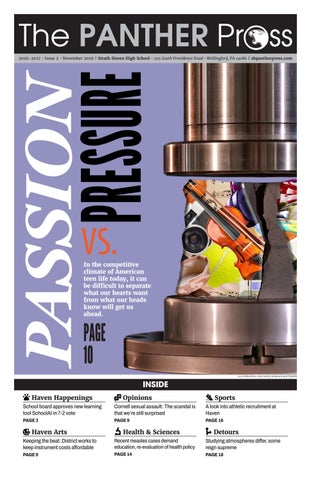
In the competitive climate of American teen life today, it can be difficult to separate what our hearts want from what our heads know will get us ahead.
PAGE 10 ILLUSTRATION: JOYA NATH, MORGAN MATTHEWS
INSIDE Haven Happenings School board approves new learning tool SchoolAI in 7-2 vote PAGE 3
Haven Arts Keeping the beat: District works to keep instrument costs affordable PAGE 9
Opinions Cornell sexual assault: The scandal is that we’re still surprised PAGE 9
Health & Sciences Recent measles cases demand education, re-evaluation of health policy PAGE 14
Sports A look into athletic recruitment at Haven PAGE 16
Detours Studying atmospheres differ, some reign supreme PAGE 18
2
EDITORIAL
shpantherpress.com • November 2026
How to stop the AI-ification of education If students don’t care, giving them a more restrained tool won’t stop unrestricted AI use. The unsigned editorial represents the consensus opinion of the Editorial Board, which consists of the student editorial staff in the masthead on this page.
The answer to the problem lies not in what type of AI the students use, but in the type of work that they’re using it to do.
he school district has officially approved an AI tool at Haven. At the October 13 Educational Affairs Committee school board meeting, the administration introduced SchoolAI, a generative AI tool designed to help students with schoolwork. SchoolAI was approved 7-2 at the October 26 school board meeting. The tool is completely optional and gives teachers total control over use. It isn’t supposed to give students the answers or help them cheat. That’s probably a good thing. But that may also make it unappealing to students who just want to use AI to do their homework. Even if it’s helpful for struggling students, will kids really start using it rather than the ChatGPT or the Google AI that they’re used to? The answer to the problem lies not in what type of AI the students use, but in the type of work that they’re using it to do. Most students have some form of access to unrestricted AI on personal devices, and they will
continue to use it if they find material dull or tedious. And if an assignment can be done easily by AI, is it really the best assignment? It often is. But one way teachers can counter AI is to use assignments that require original thought. Encouraging students to form their own ideas and try a riskier interpretation approach may both hinder AI usage and make students enjoy the material more. If there’s one kind of essay AI is good at writing, it’s the one with the “right” interpretation, because that’s the one that exists most online and in its training data. If a student is told to write an essay about the significance of the green light in “The Great Gatsby,” AI will probably do a better job than if students are encouraged to come up with an original idea. Of course, this doesn’t exactly work for math and science classes. It’s not exactly easy to come up with a new take on the
The Editorial Board
T
State of the Union We reached out to Student Council for a November update.
quadratic formula. But teachers in these classes can still curb AI use by engaging students. If teachers can make students interested in the content, that helps. If teachers can explain why the content matters, that helps. And if students understand how the content is relevant to them, that helps. It doesn’t help if students see teachers using AI. When a teacher makes an AI slideshow or sends an AI email or makes an AI study guide, they are sending a clear message: AI is acceptable in education. There are uses for AI in education. But when a lesson looks low-effort and AI generated, students are likely to have fewer qualms about using AI to do the corresponding assignment. AI is very much restricted on the Chromebooks. AI sites are blocked, and the district recently succeeded in the total removal of Google’s AI Overview. Phone use is regulated in the classroom depending on the teacher, but perhaps even more so by the lack of service. Most students can’t really use AI in school anymore. But when they go home, students can use ChatGPT or Gemini or Claude or whatever they want. As a result, homework is significantly more prone to AI use than classwork. It’s just another reason to reconsider just how much homework students are given. Many students have busy
How does Haven dress for school temperatures?
When a lesson looks low-effort and AI generated, students are likely to have fewer qualms about using AI to do the corresponding assignment.
schedules, and having little time to do a lot of homework can incentivize students to resort to AI. More important is to ensure that students are engaged for the many hours they spend at school. Perhaps the main implication of AI use is a lack of care. AI thank you notes are insincere. AI writing can feel dull. A student who uses AI to do all their work for a class clearly doesn’t care about that class. And in that case, the problem didn’t start with AI, and it will not be fixed with a schoolapproved AI.’
Report Card B+ END OF FIRST QUARTER « School year flying by! — Stressing to get assignments done — Honeymoon phase is over — Still lots of time till summer break...
Claire Salera
Haven Happenings Editor
A+ HOMECOMING WEEKEND
« Took a trip back to 2016... « JV Football wins! « High-energy pep rally « DJ did pretty well!
Maggie Peterson ’27
“[I wear] pajama pants, a t-shirt, hoodie, and jacket if it’s cold out. [Classrooms] are varying temperatures, and my first block’s kind of warm but second and third are really cold. I’m used to it.”
A-
THE ROOF STAYED ON, BARELY • Student Council president Noah White (12), along
with vice presidents Weiler Graham (12) and Astrid Beach, take emcee duties at a loud, energetic pep rally on Friday, Oct. 16. PHOTO: KATHRYN BARRETT
Hello Haven!
I want to begin by saying thank you! Thank you for bringing the fire to our homecoming pep rally. Thank you for showing off your school spirit during our spirit days. Most importantly, thank you for supporting each other at club and sporting events. Mr. Benzing and I shared the fear that the gym’s roof might blow off, and the pep rally’s electricity wouldn’t be possible without every student’s help. As we transition into both the month of November and the second quarter, Student Council has its eyes on renovation and refinement. The main task at hand is the Turkey Bowl, which has historically been a pep rally for student and faculty football. However, this year we want to orient the pep rally to a wider range of students. We understand that not every
student is fond of football, so for this year’s Turkey Bowl, we look to incorporate new games that everyone can participate in. In addition to the Turkey Bowl, Stuco plans to boost participation in our annual Toy Drive and hype up our spirit days to improve student engagement. We have done a great job as a community this past quarter. We made memories, shared laughter, and, best of all, made each other better people. Thank you all for being the rockstar students that I am more than fortunate to work with daily, and I wish you all the best this November.
Quinn Kapoor ’29
“Usually, I dress in sweatpants or jeans and long sleeve shirts. It’s really cold in the trailers. Every time I’m in there, I’m freezing.”
Nishka Poria ’30
Your STUCO President, ’
A+ ELECTION DAY
C“I usually wear jeans or sweatpants and I usually have two layers of sweatshirt and shirt inside.”
Sophia Gao ’27 (left)
“I usually try to dress warmer, so I throw on a layer, and I bring a jacket, or maybe a scarf. [My classes] are very cold.”’
FALL WEATHER « Beautiful and sunny! « Fall foliage looks amazing — Mornings are freezing and afternoons are steaming
F
About
The Panther Press is the studentrun publication of Strath Haven High School in Wallingford, PA. The Panther Press publishes 500 copies bimonthly in print and is distributed to classrooms and students at Haven. The publication is also online at www. shpantherpress.com. The goals of The Panther Press are to inform, educate, and entertain the student body, faculty and staff, and community readers. We strive to report and analyze issues that concern students in a manner that is fair, objective, responsible, and accurate. Through the use of journalism, technology, and workplace skills, the students who lead and create the newspaper develop as critical thinkers and communicators. All content published in the newspaper and on the Panther Press website is created by Haven students for a primary audience of students, with the understanding that our publication also reaches a broader audience that includes teachers and staff, families, and community members. The views represented in The Panther Press, as well as the selection and curation of content by the editors, do not represent the views of the entire Panther Press staff, the adviser, the school, or the administration. Submissions
All Haven students are welcome to learn the basics of journalism and become contributors to The Panther Press. Interested students should speak to editors listed below to learn about upcoming training sessions. Any reader may submit a letter to the editor via email to strathhavenpantherpress@gmail. com. Anonymous letters will not be published. Editors reserve the right to contact letter writers or edit submissions for reasons of space or clarity. Our staff also welcomes feedback in the comments section of The Panther Press online or via our social media. Online commenters on our website must have a verified email address. Comments are reviewed for defamation, profanity, obscenity, libel, and invasion of privacy. Not all comments are published. Bylines
All contributors are listed in the bylines of stories that appear in print and online. Photography, graphics, art, illustrations, and other creative work will be given attribution. Unsigned editorials, when published, feature the byline of the Editorial Board. Social Media
The Panther Press maintains social media on Facebook and Instagram at @shpantherpress. The editorsin-chief and social media editors manage the social media accounts in consultation with the adviser. Replies and comments are screened and not all responses are published. 2026-2027 Editorial Board Editors-in-Chief Evie Fernandez ’27 Clark Kerkstra ’27
« Some seniors got to vote! « Got to sleep in! « Candidates pro-public school take office! « Many historic firsts elected!!
Managing Editor, Print Morgan Matthews ’28
PSAT TESTING « Juniors got testing experience — Sophomores left out... — No two-hour delay for non-testers :(
Haven Arts Joya Nath ’28 Darcey Strachan ’28
CURRENT BATHROOMS — Always dirty — Always smelly — Nothing where it’s supposed to be — Many out of order stalls ’
Editors develop the report card collaboratively during print design.
-Editors
Managing Editor, Web Fiona Seale ’28 Haven Happenings Claire Salera ’27 Sports Elizabeth Gebhardt ’29
Health & Sciences Lavanya Dixit ’27 Detours Rowan Brown ’29 Opinions Josselyn Dixon ’29 Social Media Gigi Detweiler ’28 Jane Yau ’29 Assistant Editors
Assistant Editors have leadership responsibilities but do not have a seat on the Editorial Board.
Cayla Gaffney ’29 Lexi Glass ’29 Izzy Boland ’29 Siya Goindi ’29 Damini Mydur ’29
Adviser Kate Plows
3
HAVEN Happenings
November 2026
School board approves new learning tool SchoolAI in 7-2 vote The vote came after lengthy discussion and community complaints over the introduction of AI into the classroom. Clark Kerkstra ’27, Chanel Courtman ’29 Editor-in-Chief, Contributor
A
I will be returning to Haven classrooms. Right after removing access to Google’s AI Overview, the school district will be piloting a new educational AI tool called SchoolAI. At the Oct. 26 school board meeting, board members voted 7-2 to approve the tool for a test run this year with only board members Christine Dollé and Nanette Whitsett voting against the proposal. The tool was approved after lengthy discussion and community pushback to the idea of AI in education, beginning at the Oct. 13 Educational Affairs Committee meeting where administrators introduced the tool. According to Supervisor of Instructional Technology Ms. Kate Paquette, who laid out the rationale for the tool in that meeting, teachers have complete control over the AI’s usage. “Teachers have a live dashboard where they’re able to monitor student use of the tool, and that really eliminates that fear that teachers have around the unsupervised use of AI by their students,” Paquette said. Paquette also claimed that the tool is meant to help students along the way instead of providing shortcuts and eliminating productive struggle. “SchoolAI is designed to guide students rather than provide them outright with answers,” Paquette said. “Using socratic questioning, SchoolAI guides students by asking questions, providing feedback to get students to come to
their own learning and come to conclusions on their own instead of being outright told what the answer is.” Director of Information Technology Mr. A.J. Cetroni said at the Oct. 13 meeting that the tool could be helpful in classes like math and science to help students with the problemsolving process. “Where there are formulas and things that you can work through, it’s not just giving you an answer,” Cetroni said. “You can’t ask it to summarize something that you’re reading or learning about.” While Cetroni highlighted math and science classes as a use case for the technology, the AI carries other unique features as well. One feature, called “Historical Figure Spaces,” allows students to chat with AI personas of various historical figures. SchoolAI faced criticism for this tool last year after German historian Henrik Schonemann asked an AI persona of Anne Frank who was responsible for her death. The AI appeared to dodge the question, saying “Instead of focusing on blame, let’s remember the importance of learning from the past.” Schonemann called the fake persona “a kind of grave robbing and incredibly disrespectful to the real Anne Frank and her family.” SchoolAI responded with a statement defending the idea of AI personas of historical figures and asserting that the company had changed the model to avoid Holocaust denialism or minimization. “We also believe that learning in the classroom always benefits from something more personally engaging, and believe that these historical figure conversations are a useful tool for doing so,” the company stated. According to Paquette, SchoolAI will be completely optional for both teachers and
ARTIFICIAL ACCESSIBILITY • Director of Informational Technology Mr. A.J. Cetroni looks on as Supervisor of Instructional
Technology Ms. Kate Paquette discusses the new SchoolAI tool at the Oct. 13 Educational Affairs Committee school board meeting. PHOTO: CLARK KERKSTRA
students, and teachers decide if and how it is used. Some community members, though, worry that even the “hints and questions” provided by the tool could be detrimental. “These hints and questions that this provides are still AI and their use limits students’ abilities to learn how to both self-critique and to give peer feedback,” community member Olivia Sabee said at the meeting. Sabee, a professor at Swarthmore College, believes AI can undermine the building of skills needed for college. School board member Pramod Dibble, who voted for the approval of the tool, said at the meeting it is important to teach students how to use AI productively. “I think AI is here,” Dibble
said. “It’s here to stay. Having a structured approach, and a limited scope pilot [that is] voluntary is the right way for our school district. Junior Noel Springer doesn’t think the presence of the tool will stop students from using AI. “We should all understand that the usage of AI, regardless of whether the school adopts a school-specific AI, is kind of going to happen no matter what,” Springer said. “Students should still be penalized for using AI entirely, like generating entire assignments. But I think that teachers should understand that some kids don’t have access to the same resources, are not getting the same usage out of class, and sometimes it’s a necessary resource for people to keep their grades at a workable
level.” Students also feel that the appropriateness of AI depends on what ways it is applied. “I feel like it definitely depends on the subject,” sophomore Evelyn Smith said. “English is one of those subjects where I feel like AI is kind of a no-go.” Sophomore Mars Hoffman believes having built-in AI can be a double edged sword. “I think it’s a much better approach than just using generative AI because it’ll allow students to think through the problems,” Hoffman said. “But I also do think that it is encouraging students to use AI further in their assignments, and that’ll lead to them not having to think.”.
Counselors navigate changing student needs throughout fall As students adjust to academic pressures and changing routines, counselors balance their responsibilities with providing support to students who need it. Damini Mydur ’29 Chanel Courtman ’29
Assistant Opinions Editor, Contributor
F
rom helping students plan their future after high school or supporting them through their daily challenges, Haven’s counselors are busy helping students on the day-to-day. However, the fall season brings about new challenges and responsibilities for the counselors. Located right next to the library on the second-floor hallway, the counseling suite is one of the most popular stops for Haven students. Counselors Mrs. Jennifer Salvage and Mr. Gavin Stewart help navigate their academic journeys while providing support and guidance throughout the school year. “There’s a lot of reactive work that we do because we need to
“
Really, [I enjoy] sort of getting to hear the stories of everybody, all the students who pass through this building, and being a trusted resource to help support when things are going well, but also if they’re not. Mrs. Jennifer Salvage Guidance Counselor
adjust with what the students are doing,” Stewart said. “And there’s also a lot of programmatic stuff that we have to do.” For freshmen, the end of the first quarter brings increased academic stress as students adjust to high school expectations and begin to see the impact of their grades on
their GPAs. “Right now, one of the stressful times is because it’s the end of the quarter, and for ninth graders, grades are in the forefront of their brains because they’ve never had that before,” Stewart said. “So some students are really stressed out right now, and so we’ve got to work with that.” Along with academic pressure, the transition from summer to fall can affect students’ emotional well-being as the days get shorter and the weather gets colder. Stewart said some students begin to feel overwhelmed by the demands of the school year. To identify students who may need additional support, counselors pay attention to changes in students’ behavior and check in when something seems unusual. Stuart makes an effort to be present in the hallways and observe how students are doing. “I want to see how people are doing, and sometimes you can tell, like if you say hello to somebody and they’re not their usual self, they’re on my radar,” Stewart said. Beyond checking in with
students, counselors provide a place to turn when students are struggling or unsure how to ask for help. “They should always know that they’re welcome here at the counselor’s office,” Stewart said. “Our office is the first point of contact for a lot of that stuff.” While counselors meet with students, much of the department’s work happens behind the scenes. The counseling department’s administrative assistant, Mrs. Deborah Seifrit, schedules appointments, manages e-hall passes, and assists counselors with daily tasks. “This time of the year, there’s definitely more students coming in with questions, more counselor appointments,” Seifrit said. “Just different questions about what to do, how to do college applications.” To help manage the large number of students, Seifrit supports counselors and also keeps track of students’ needs and progress. Salvage believes taking notes and maintaining smaller caseloads allows counselors to give students more individualized attention. “I do try to take notes, whether
it’s on paper and/or electronically,” Salvage said. “Our caseloads have actually gotten a little bit smaller, so that’s helpful because it allows us to spend more time with each student.” Despite the demands of the job, Salvage’s favorite part is building relationships with students and being someone they can turn to during difficult times. “Really, [I enjoy] sort of getting to hear the stories of everybody, all the students who pass through this building, and being a trusted resource to help support when things are going well, but also if they’re not,” Salvage said. For students feeling overwhelmed by school and other responsibilities, Stewart emphasizes the importance of making time for themselves and acknowledging their emotions rather than ignoring them. “I think self-care is not just doing things that are easy,” Stewart said. “Sometimes you need to stop some of the things that you’re doing and acknowledge the hard feelings that you’re feeling and sit with them, work through them, and talk about it.”.
4
HAVEN HAPPENINGS
shpantherpress.com • November 2026
Pennsylvania phone bill passes, ban to be enforced next school year Questions about enforcement and efficiency remain prevalent after Pennsylvania becomes the 25th state to pass a bell-tobell phone ban in schools. Damini Mydur ’29 Izzy Boland ’29
Assistant Opinions Editor, Assistant Health and Sciences Editor
O
n Oct. 26, Gov. Josh Shapiro signed Senate Bill 1014 into law, requiring Pennsylvania schools to prohibit students from using personal mobile devices throughout the school day, including during lunch and passing periods. As the 2027-28 school year approaches, Haven administrators and teachers are beginning to consider how the restrictions will change students’ daily routines and how the district will enforce them. The bill bans students from using mobile phones throughout the school day. However, school policies must allow limited phone use for medical conditions, IEPs and 504 plans, English language learners, and instructional purposes approved by the school principal. The bill will go into effect at the beginning of the 2027-28 school year. It does not require schools to physically collect students’ phones, leaving districts to decide how they will enforce the restrictions. Haven’s current policy allows students to use phones during passing periods and lunch, but the new law will prohibit this as well. “We’re really taking stock now of what additional measures we’ll have to take,” superintendent Dr. Russell Johnston said. “I think it’s good that we put a lot of positive measures in place now, so that we can sort of build on them as this new law goes into effect.” Before the bill was passed, English teacher Mr. Matthew Wood raised concerns about phone use in classrooms. However, administrative efforts to address the problem did not result in changes until community members became involved. “[Teachers] understood it was a problem very early on,” Wood said. “It just took a long time for the district to really start to realize how big a problem it was, and for administrations to start to care.” Wood, along with community group Haven Hold the Phone, had previously advocated for a bell-to-bell ban. He and a few other teachers supported the idea, but some teachers opposed it. Now that it has become a statewide law, Wood is satisfied that the problems caused by phones are being addressed.
“I haven’t gotten a chance to talk to too many of my colleagues about the bell-to-bell ban, but I’m really pleasantly surprised that this has come to pass,” Wood said. Johnston notes that one challenge of implementing the law will be helping students understand that the restrictions are outside the district’s control. Even if students strongly oppose the ban, they will still have to follow it. “I think the challenging part of [the ban] is that it’s the law,” Johnston said. “[To get] us all to understand it, our students to understand that this is important, we do have to take it seriously. We built a solid foundation, and so this is kind of taking it to the next step.” Shapiro states that he hopes that removing phones from schools helps with “building relationships with other kids, and developing the social skills that help us all relate to each other in person.” Wood shares a similar viewpoint, hoping the restrictions will boost social interaction, especially during lunch. “I get so sad when I see around the building at lunchtime,” Wood said. “You just see kids by themselves or even in groups, and they’re all just buried in their phones. They’re not interacting with one another. They’re just a hive of people on phones. They’re together alone.” However, students have different perspectives. During lunch, seniors Maggie Peterson and Addison Irwin watch videos on their phones together so they can discuss what they see. “We have in-depth conversations about [videos we see],” Peterson said. “We saw an ad yesterday about the ‘I’m just a girl’ stuff and how that poorly [impacts] feminism.” Having experienced high school without the ban, Peterson believes it will negatively affect future students based on her own experiences. Sophomore Willam McFadden believes that restricting phones in social settings like lunch will not significantly affect students, but could make socializing more awkward for some. “The people who want to socialize are already doing that, and the people who don’t want to are just going to be uncomfortable,” McFadden said. Wood also said that excessive screen time can be unhealthy for teenagers, contributing to irregular sleep, weight problems, and symptoms of depression and anxiety. “The research about what technology is doing in the classroom and how it’s affecting the ability of students to have relationships with each other and interact with one another
SCREENS OFF MINDS ON! • A student puts their phone in a caddy before class. PHOTO: IZZY BOLAND
“
I think the challenging part of [the ban] is that it’s the law. [To get] us all to understand it, our students to understand that this is important, we do have to take it seriously. Dr. Russell Johnston Superintendent
[has] reached a critical mass where the research and the data are just so undeniable that it almost becomes irresponsible not to [have a ban],” Wood said. English teacher Ms. Reagan Lattari believes the ban could benefit students by encouraging them to discuss and research more, but acknowledges that it will not change the technologydriven world they live in. She said reducing phone usage will teach students skills such as reading analog clocks or looking things up in an encyclopedia. “It’s great that they can have [those skills] in case of a blackout or some type of shift,” Lattari said. “Having skills would always be good for people, but I don’t think you’re ever really going to be without this technology.” A major concern about the bill is how parents and students will communicate during emergencies and afterschool activities. Johnston and the administration are still considering how to address these concerns, particularly in regard to fifth block activities. Peterson believes that although
emergencies are rare, being unable to communicate with family can add unnecessary stress to the school day. “In the case of a family member having a health issue, if they’re in the hospital and the student is getting frequent updates, they need their phone for that,” Peterson said. “Not being able to reach [family] quickly is going to make that more of a stressful situation.” Wood remains curious about how the district will create and implement a policy that complies with the bill. He raised concerns about the logistics of keeping more than 1,000 students off their phones. “It certainly seems very impractical to take everybody’s phone at the beginning of the school day,” Wood said. “That seems like a really massive undertaking.” Lattari shares these concerns, questioning how a policy could effectively manage and protect every phone. “Are we going to have a checkin policy where you drop off your phone and how is that going to [be managed]?” Lattari said. “Is [that] going to turn into a lateness issue because of people [getting backed] up? Are we responsible for the cost or the damage of a phone?” Phone liability is another concern surrounding the policy. If teachers are required to collect students’ phones, they could become responsible for any damage or loss. Wood explains that liability was previously a reason some teachers avoided collecting phones, but the new law raises questions about how those concerns will be addressed. “[They] don’t want to have any responsibility in that,” Wood said. “Now the law is clear, but how do we practically enforce that law?” Lattari also raises concerns about how the restrictions will affect students’ busy schedules, particularly those participating in extracurricular activities.
“If you’re going directly from music to a sport practice, where are you picking [your phone] up?” Lattari said. “Is that going to be a fifth block thing? What if you’re booked fifth block? [Will we] have to shave a minute or two off of fourth block classes?” One of Wood’s concerns is whether the bill will have a tangible impact on schools or whether districts will follow it simply because it is the law rather than because of its intended benefits. “How closely will the state monitor this?” Wood said. “Will they find schools that it determines are out of compliance? Are they going to ask the school to offer a policy and an explanation for how you intend to enforce it?” Budgeting is another aspect of the bill that the administration will have to consider. The legislation does not provide funding for schools to implement policies and given Haven’s current budget deficit, the administration will have to find ways to work around that. “I think that we’ll have time to think about the final language, look at what additional guidance we receive from the state, and then determine what are the best next steps, particularly as we look ahead to the spring to be ready for the next school year,” Johnston said. According to the bill, schools must post their policies on their websites within five days of adoption. The policies must then be submitted to the state. Johnston believes the district will find an effective way to handle and enforce the bill during the 2027-28 school year. “It’s important that we continue to work on helping our students stay focused on learning,” Johnston said. “This is a value that I see in practice at our school right now… and we’ll embrace the spirit of this law to further build on what we’ve already been doing.”.
Featured Class: Principles of Team Sports and Extreme Games teaches teamwork, sportsmanship The class allows for a chance to burn off energy during a long school day. Jane Yau ’29, Zora Reed ’29 Social Media Editor, Contributor
S
tudents who do not take Health and Physical Education often have limited opportunities to exercise throughout the eight-hour school day. However, the elective Principles of Team Sports and Extreme Games gives students a chance to stay active, release energy, and take a break from
their academic responsibilities. “Sometimes I think every student needs to just have a release, and [the elective] is a great way to release that sometimes negative energy into something positive,” physical education teacher Mr. Steven Woolery said. Open to sophomores and beyond, Principles of Team Sports and Extreme Games teaches students teamwork and sportsmanship. According to the 26-27 Silver Guide, the elective is for students who enjoy physical activity and high levels of gameplay and want to learn more about sports theory.
“Extreme Sports is an allencompassing sport,” Woolery said. “It’s allowing the kids to have fun without the fitness, without the swimming, without going to the track, without doing any of that stuff. It’s pure fun without the fitness component.” Within the class, there are a variety of sports open to students. This includes the commonly known sports, such as volleyball, football, basketball, but also sports that are found only in Haven. “I love when we play a game that [the students] have never even heard of before,” Woolery
said. “There’s [a game] that I dreamed up in the early 2000s. It’s called Slam Ball, and it’s one of my favorite games.” According to Woolery, the students should already have a basic understanding of the skills needed to play each sport. However, Extreme Sports allows them to build on those foundations by going over all the rules and regulations of higher-end games. “We are doing volleyball right now, and I explain it to them, we go over it, we work on higher end levels of the activity,” Woolery said. “They’re learning how to serve, how to spike, everything top tier.”
Extreme sports aren’t necessarily about winning, but instead, enjoying the experience. “I play football already, but the games are just fun in here,” sophomore Jabree Richardson said. Students enjoy the nostalgic feeling the elective brings. “I love how it feels like an elementary school gym where we just play games every day, and it’s all my friends,” senior Patrick Burke said. “We play really hard, so it’s pretty fun.”.
5
HAVEN HAPPENINGS
November 2026
Ballfrog app introduces Haven’s teams to unified communication platform After a test run this fall, the athletic department will be providing sports and activities with a new way to stay connected. Izzy Boland ’29 Cayla Gaffney ’29
Assistant Health and Sciences Editor, Assistant Haven Happenings Editor
A
ccording to ABC News, teens spend an average of over seven hours a day on their phones, so it’s easy to see why athletic director Ms. Lynelle Mosley and music teacher Mr. Nicholas Pignataro realized that sports — and the 300 member band — needed an efficient mobile app for students to access. In the past, sports teams at Haven have used mobile app TeamSnap or other similar platforms for communication purposes. After Mosley attended a conference, she heard about new platforms that teams have been using, like Ballfrog. With TeamSnap, the school pays individually for each player enrolled in the app. To Mosley, Ballfrog seemed like a better option financially because the school instead would pay for each team on the app. This meant that Mosley could add teams with as many players as she wanted, such as large groups like the band. “It is a little bit more expensive, but if I were to add the band to Team Snap, it would throw the numbers completely just because of the sheer volume,” Mosley said. “I’m able to add any activity, any school-based
program that wants it.” According to Ballfrog, their goal is to make managing an athletic program easier. Mosley finds ease in using the app, as it connects to websites and ticketing information, as well as the Arbiter, where parents can register their children to participate in PIAA sports and submit medical forms. “It’s more of a one-stop shop where TeamSnap was definitely only communication,” Mosley said. “This just gives us a little bit more flexibility with the app.” For Pignataro, the app is helpful to use for last minute communication like an emergency update. Students don’t bring their Chromebooks with them everywhere, but they do have their phones, which makes it easier for Pignataro to relay information quickly. “If I put it in Schoology, it’s unlikely people would have seen it at 2 o’clock because by then most of their Chromebooks would be closed,” Pignataro said. “Even if they had their Chromebooks open, they’d have to be open to the internet and they’d have to be in Schoology.” One unique feature about Ballfrog is that students can see a main page where all the sports and activities can post updates. This allows students to hear about what’s going on in other teams and at the school. “Now it’s not like you have to go to Instagram and I have to find every single team page in order to find ‘oh this person did this,’” Mosley said. “It’ll all go on the newsfeed, which is kind of cool. So now everyone gets to see the same stuff, and it gives all of our teams a little bit more publicity,
RIBBIT! • A student checks an update on the Ballfrog app on their phone. PHOTO: CAYLA GAFFNEY
which I like.” Senior and cross country captain Mara Carey appreciates being able to see the different sports teams, and finds the app user-friendly. “It’s similar to a lot of other social media apps, like Instagram, and [it] feels a lot less unorganized than older forms of communication we use, like TeamSnap,” Carey said. “[With Ballfrog] there’s ways to communicate with your team, as well as [to] check other sports teams.” Carey helped her teammates join the app and appreciated the simple process for setting it up. “It was easy to add everybody else because it was just a printed
out QR code and they can just scan it and enter in their information,” Carey said. Mosley foresees some growing pains while transitioning all of the sports teams onto the app, but believes it will work out well. “This year is going to be a little bit of trial and error,” Mosley said. “We’re going to have to work out kinks and see what works best for Strath Haven. But I do think that in the long run, it’ll be a cool little app.” Pignataro anticipates future benefits of having the app when the marching band and orchestra travel to Orlando. “We might be [able to say], ‘Don’t forget, meet your chaperone at 10 a.m. at this
Homecoming pep rally unites students with games, performances Students gathered in the auditorium to cheer on their peers at the 2026 homecoming pep rally. Damini Mydur ’29 Assistant Opinions Editor
F
rom sliding across the gym floor on air mattresses to performing dances and songs, students filled Haven’s gym with energy at the 2026 homecoming pep rally. On Friday, Oct. 16, Haven held its annual homecoming pep rally in the gym from 12:50 p.m. to dismissal at 2:05 p.m. Haven operated on a modified schedule to accommodate the pep rally. “I think the pep rally is definitely [the most fun] school day, and [the most fun] part of the school year,” senior Ellie Yancey said. The pep rally is usually arranged one to two months in advance since the student council has to coordinate with all the cheerleaders, team captains, and prepare the games and performances. Senior and student council president Noah White believes this year’s pep rally was very well organized. “The best way to prepare a strong pep rally is through good preparation, and that is something we executed very well,” White said. “I’m very happy with those outcomes.” The pep rally included several contests between upperclassmen and underclassmen. Both groups participated in the classic games of dodgeball
“
National Honor Society induction recognizes students The event highlighted juniors and seniors that uphold the four pillars.
The best way to prepare a strong pep rally is through good preparation, and that is something we executed very well.
Izzy Boland ’29
Assistant Health and Sciences Editor
E
Noah White ’27
Student Council President
and tug of war, and also in a new game called the air mattress relays. In the relay, students jumped on top of air mattresses and slid across the floor as far as they could, then ran back to tag their teammates in a typical relay-race fashion. “We wanted to bring something new because we always do similar games,” White said. “We were like, all right, this year we’re going to be different, so we wanted to bring in the air mattress relays.” Sports and band captains performed their annual captains dance, with the girls executing a performance choreographed by the danceline captains. “We all got to practice and watch videos, [and the songs] were chosen by the dance captains, and they obviously did a great job with that,” senior Missy Rich said.
place,” Pignataro said. Mosley has only introduced the app to cross country and the band this fall. She plans to roll out the app to all the other sports teams this winter to avoid any confusion. As students, staff, and coaches explore the app and learn more about its uses, they can discover and apply the various features of the app to their daily lives. Students can also use Pignataro’s humorous terminology for the app. “If I send you a message in Ballfrog, it’s a ribbit,” Pignataro said. “I don’t know why it’s called Ballfrog, and I think that’s hysterical. It cracks me up every time I get to say the word ‘Ballfrog’ in school.”.
PUMPED UP • LEFT: Delaney O’Reilly (12) performs with a band at the pep rally. RIGHT: Mae Valcich (11) slides through the air mattress relays, a new contest at this year’s pep rally. PHOTOS: KATHRYN BARRETT
The boys dance included a chase of a student in an inflatable ram costume meant to represent Harriton high school’s mascot. The JV football team was supposed to play Harriton’s team that night for the homecoming game, but the game was canceled due to weather. This year, the band invited Delaney O’Reilly to perform at the pep rally. She was invited two weeks prior to perform with other student musicians. They spent some time narrowing down the songs they wanted to sing, and then met once to rehearse before the pep rally. “Everyone’s super talented, so it wasn’t that hard to pull it together… it was a little nerve-wracking, but it was great, and everyone was super supportive, so I really appreciate that,” O’Reilly said.
One of the student council’s main focuses for this year’s pep rally was to bring a lot of energy. After reflecting on last year’s pep rally, they felt like that was something they needed to improve on for this year, and White thought they were able to successfully elevate the energy in the gym. “I feel like this is one of our most electric pep rallies we’ve had since I’ve been here,” White said. “I might be slightly biased, but I truly believe nothing was like this pep rally. Thank you to everyone who brought their energy, brought their fire, and I hope to see this throughout the school year.”.
very year, selected juniors and seniors at Haven get inducted into the National Honor Society (NHS). This year, over 80 students read the NHS pledge on Thursday, Oct. 15, joining the ranks of students across the country. The annual NHS induction started with speeches from assistant principal Mr. Thomas McLaughlin, superintendent Dr. Russell Johnston, and NHS advisers Mrs. Kristin Dunning and Mrs. Ellen Yarborough, recognizing the inductees for their work. Following the introductions, NHS president Lavanya Dixit and NHS vice president Joy Yang spoke on the four pillars of NHS that members must uphold: scholarship, leadership, service, and character. “[Scholarship is] just one thing that shows that somebody is a good student, and what we’re really looking for, and what we’re really trying to emphasize, is the importance of being active in your school community and in your greater community,” Yarborough said. >Page 7
6
HAVEN HAPPENINGS
shpantherpress.com • November 2026
District provides update on universal bathroom plan, students react Despite board approval, students have concerns. Clark Kerkstra ’27 Editor-in-Chief
T
he high school renovation project is still set to include universal bathrooms. At the October 20 Facilities and Finance Committee school board meeting, architects and administrators discussed the bathroom renovation plan. The core element of the plan, universal bathrooms replacing the main bathrooms on each floor, has remained the same. Additionally, each stall will be replaced by a fully enclosed toilet room with a lockable door. According to Mike Kelly, an architect with Kelly Clough Baker and Associates (KCBA) working on the project, this allows for a communal sink area with security cameras. The cameras would not be inside the individual stalls, but only in the larger area. “We want to create a space where students feel safer and more secure and in an area where supervision can be allowed to the larger space,” Kelly said at the meeting. “Let’s clear that up real fast. There will not be cameras inside the toilet rooms. That would be enormously inappropriate.” Principal Mr. Andrew Benzing explained the rationale behind the cameras during the meeting. “The safety of the students is our number one priority, and I think the bathrooms present a challenge for us in their current traditional layout in that there are spaces that are unmonitored,” Benzing said. “We supervise them passively as we can because there are privacy issues but I think that there [have been] behaviors that happen in bathrooms since the history of time.” Currently, instructional support staff supervise the bathrooms, often sitting in the hall outside the bathroom and clearing the bathroom out on occasion. “That’s a drain of resources, I think, and a drain of focus, I would say, but it’s necessary, and we do what’s necessary to keep the kids safe,” Benzing said. Kelly said that the cameras are not intended for active monitoring but instead to have a recording. “The misperception of security
cameras is that somebody’s just staring at a screen,” Kelly said. “The high majority of that is being recorded.” Despite this, many students still feel uncomfortable with the possibility of security cameras in their bathrooms. Benzing, however, maintained the necessity of cameras for supervision. “Without the students knowing that we’re watching, they’re going to make poor decisions because we’ve set them up to do that,” Benzing said. “In my opinion, our existing layout sets them up to make poor decisions because we don’t have that monitoring capability as it is.” Another concern was that the fully enclosed stalls would make it easier to vape and avoid detection. Kelly said both vape and fire detectors will be present in each stall. Some students were also concerned by the prospect of sharing bathrooms with the opposite gender. “I think it might make some people uncomfortable to have to share a bathroom when they’ve never done it,” senior Jackson Bloom said. Student Council School Board Representative Joy Yang, who provides student input to the board, suggested that traditional gendered bathrooms could be preserved in central areas while also providing new universal bathrooms. “Generally [students are] open to the idea of having universal bathrooms, but they don’t want it to be the only option at the school,” Yang said. “They would much rather have the current two bathrooms just be renovated with many of the updates that were included for the universal bathrooms and then add another set [to] make the universal bathrooms more accessible as an addition.” According to Kelly, traditional gendered bathrooms will still be available in the locker rooms and by the art wing. “I’m pleased to see that there would still be traditional gendered bathrooms available for people who didn’t necessarily feel comfortable going in those universal bathrooms,” school board president Michelle Williams said at the meeting. Despite this, some community members feel the location of these gendered bathrooms renders them largely inaccessible. “[The universal bathrooms
RENOVATED RESTROOMS • A rendering of the new universal bathroom presented by architect Mike Kelly at the Oct. 20
Facilities and Finance Committee board meeting.
“
Generally [students are] open to the idea of having universal bathrooms, but they don’t want it to be the only option at the school. Joy Yang ’27
Student School Board Representative
are] located in a high traffic area in the middle of the school and [on all four floors], but the traditional style bathrooms seem to be not easily accessible [and] off the beaten path if you’re trying to use a bathroom between classes,” community member Bill Zamulinsky said at the meeting. Zamulinsky also said that he didn’t believe the number of students uncomfortable with using gendered bathrooms justified the change, and suggested that gender neutral bathrooms could instead be further from the academic wing. A current gender neutral bathroom already exists near the auditorium.
“It seems like we’re dedicating so much space and resources to these style bathrooms when the amount of those students doesn’t seem to justify that,” Zamulinsky said. Superintendent Dr. Russell Johnston pushed back on that suggestion at the meeting, saying that the aim of the bathrooms was to ensure safety for all students. “Our rationale for this has been safety, it’s been supervision, it’s been about the functioning of the bathrooms,” Johnston said. “As a benefit it does support students who are transgender but that’s not the driving force.” Freshman Neela Katona supports the idea of the bathrooms, and suggested the new universal bathrooms be located near the other bathrooms. “I think it’s a great idea,” Katona said. “I think it makes it inclusive for everyone, and really will just uplift the community and include everyone.” School board member Nanette Whitsett said she appreciated the modern design of the bathrooms. “I think it adds a modernization to the school that is needed and it brings it into the 21st century and not back in the ‘50s when we had the individual stalls,” Whitsett said during the meeting. During public comment, community member Jenny Montague asked that menstrual products be available in a private
location for female students. “Maybe having it in one of the accessible bathrooms is an option,” Montague said. “So that you could go in there and not out in the open sink area.” Yang was unsure how the school could navigate distributing menstrual products in a way that makes students comfortable, seeing it as another reason to preserve some gendered bathrooms. “For a high school setting you definitely run the risk [of] people feeling uncomfortable getting them or them being misused possibly,” Yang said. “I’m not quite sure how the school can handle it, and I do think that it’s one of the reasons why a lot of the girls are against having universal bathrooms be the only kind of bathroom we have other than locker rooms.” Students can agree that some sort of renovation is needed. “There’s water leaking from the toilets,” Bloom said. “They need to fix that.” Some are optimistic that the renovation might succeed in this. “It will create nicer facilities,” sophomore Malcolm Oblak said. “The bathrooms will be nicer. For the first two weeks at least.”*
Featured Club: Bug Club hopes to change perspectives on insects The student-led club allows students to learn about insects, care for them, and explore their environmental importance. Chanel Courtman ’29 Contributor
S
tudents gather around bug plushies and pinned insect specimens, taking a closer look at some of the critters that inspired one of Haven’s newest clubs. During fifth block on Thursday, Oct. 1, students met in science teacher Ms. Katie Shepard’s room for the first meeting of Haven’s new Bug Club. Founded by junior Noa Murley, the club gives students a place to share their interest in insects and develop a greater appreciation for their role in
the world. Murley serves as president, with junior Alana Bailey-Floyd as co-president, and Shepard as faculty advisor. “I think that bugs aren’t really put in the center of a lot of studies in general, and especially at Haven,” Murley said. “And I think that this is an outlet for people that are interested in bugs.” Murley’s interest in insects grew after she spent the summer caring for a beetle and a millipede. She wanted to share that experience with other students and create an outlet for people interested in insects. “It was initially rejected at first because it sounded too close to Green Haven,” Murley said. After the initial rejection, Shepard worked with Murley to revise the club proposal so its goals would be distinct from those of the existing environmental club. Shepard said she was interested
in advising Bug Club because it allowed her to support students’ scientific interests beyond the subjects typically covered in class. “One of the things that I love to do is foster our students’ interests in science, but specifically in things that we don’t really cover in our science department here,” Shepard said. Now that the club has been approved, leaders plan to teach how to properly care for insects. Meetings will include setting up enclosures, feeding the bugs, and cleaning their habitats. Students will also learn about the conditions insects need to survive and thrive. “The main goal is to foster interests and knowledge about bugs and their benefit to the environment,” Shepard said. Beyond insect care, the club will explore the broader role bugs play in ecosystems, including
“
I hope that students learn that not all bugs are bad. Sometimes they’re really good. Alana Bailey-Floyd ’28 Bug Club Co-President
the importance of bees to pollination and agriculture. The club has also discussed bringing insects into the childhood class to give the kids a lesson on bugs. “I hope that students learn that not all bugs are bad,” BaileyFloyd said. “Sometimes they’re really good.” To make the club engaging
for students with different interests, members plan on having fundraisers, decorating bug-themed cookies, gardening, and exploring other activities that connect their interests with the world of insects. Bailey is particularly excited about the possibility of selling decorated cookies, while members have also considered voting on names for the classroom insects. As Bug Club develops, its leaders hope to attract more members and encourage students to become curious about insects, even if they are not initially comfortable around them. Shepard emphasized that students can participate without touching the bugs or taking any home. “Hey, just come check them out,” Shepard said. “The bugs are super cool, and Noa’s got a lot of knowledge to share.”*
HAVEN HAPPENINGS
November 2026
7
Seniors head to the polls for their first time voting Election Results
Many seniors who have already turned 18 plan to vote in this year’s midterm election.
2026 Midterms Tuesday, Nov. 3
Voters in our community selected the following candidates in the 2026 midterm elections.
Josselyn Dixon ’29 Lexi Glass ’29
SOURCE: ELECTIONRETURNS.PA.GOV
Opinions Editor, Assistant Sports Editor
F
or one day in November every year, the building transforms from a school into a polling location. This year, although many students will not have to go to Haven for the day, some will show up with a different purpose than usual. Election day is always on the first Tuesday in November, so many seniors don’t turn 18 soon enough to vote. The students who are voting bring a new perspective to the table. “Young people are more invested in elections in the sense that it’s younger generations who are able to kind of see the long-term effects of our electoral system,” social studies teacher Mr. TJ Adams said. “They’re bringing a perspective to what’s at stake in an election that a lot of times older voters don’t bring, and politicians don’t bring, because the politicians aren’t their age either.” This year is the midterm election meaning it’s halfway through the current administration’s four year term. In Pennsylvania, the governor, lieutenant governor, U.S. House of Representatives, State Senate, and State House are all on the ballot this year. Voting can be a way to engage in your community and have a say in the decisions that are being made. For senior Gemma Hicks, this was one of the main reasons she’s deciding to vote. “There’s a lot of choices that we can make as citizens, and
Governor
Josh Shapiro (D) (72.51%) Representative in Congress, 5th Congressional District Mary Gay Scanlon (D) (69.66%) Senator in the General Assembly, 26th District POSTERS AT THE POLLS • Posters for different candidates sit along the road to Haven, which served as a polling place on Nov. 3. PHOTO: LEXI GLASS
“
Young people are more invested in elections in the sense that it’s younger generations who are able to kind of see the long-term effects of our electoral system. Mr. TJ Adams
Social studies teacher
there’s a lot of things that people disagree with,” Hicks said. “I would like to have my own say in the choices that affect everyone in our country.” Hicks wants to ensure that she isn’t going into the polls blindly. She wants to do her research on the candidates that best match her values. “I’m going to do my research, so I’ve started a little bit, but I want to just read all the candidates and what they stand for and if they’ve had any particularly positive or negative impact on our county,” Hicks said. Social studies teacher Mr. Patrick Keaveney thinks that student’s peers can have a big influence on their decision to vote. “I think that, especially young people, sometimes feel like their one vote doesn’t matter, and we have found out increasingly that that’s not true,” Keaveney said. “I think some of it depends on influences from their social
circle, whether others are voting or not.” Keaveney encourages his students to vote because he believes that it’s their way of making their voices heard and having their say in how the country is run. During his mixed classes, usually with a lot of seniors, he encourages voting practices. “It is important that everyone votes because it’s our way of making [our] voices heard in the direction of our country,” Keaveney said. Adams understands why people might feel disengaged from politics, but encourages teens to try to stay invested anyway. “Think deeply about what [your] family and communities care about and what’s important to [you], and try to find politics that can respond to that,” Adams said..
PSAT test no longer required for sophomores Unlike previous years, the test was only administered to juniors, taking place in the library and gym. Cayla Gaffney ’29
Assistant Haven Happenings Editor
students take 3.5 million the Preliminary-
SAT (PSAT) test each year across America in the month of October. At Haven, rows of quiet students sitting at desks filled the gym and library on the morning of Oct. 21 as the junior class took the test. The PSAT serves as a practice run for the SAT, an assessment that can be taken before a student applies for college. Like the SAT, the PSAT has two sections, a reading and writing section and a math portion, with 98 questions total. In recent years at Haven, both sophomores and juniors have taken the PSAT. Because of the content on the test, the counselors, staff, and administrators decided that the junior class would be the only ones taking the test this year. “Because [the PSAT] is not a test that is normed for 10th graders, it means that 10th graders typically, unless they are very very advanced in math, don’t tend to score well,” school counselor Mrs. Jennifer Salvage said. “Which for a lot of sophomores, especially if you’re offering it to the entire class, has the opposite effect of what we
would like, [because] it actually raises stress and anxiety for a lot of sophomores.” Salvage explained that the sophomore class will only be taking the Pre-ACT. This allows the grade to have taken both the Pre-ACT and PSAT before the winter of their junior year, when they then have the opportunity to then decide which test would be better if they’d want to include their score in college applications. “We offer the Pre-ACT to the entire sophomore class, and that is a test that is normed for sophomores,” Salvage said. “We feel like offering one standardized practice test in the sophomore year is probably enough without it being overkill.” As of 2024, the PSAT switched from being on paper to online. At the time, Haven was not equipped to administer the test to students in any place other than classrooms, until this year when they had a technology upgrade in the gym. With sophomores no longer taking the test, the school didn’t need to run on a two-hour delay schedule to make room for testing. The gym and library erased the need for classroom space. “To bring the 200 kids in the gym, we had about 70 or 80 kids in the library, and so that eliminated our need for using 15-20 classrooms,” assistant principal Ms. Andrea LaPira said. “Last year we had a delay in order to make it happen, but
TIME TO LEARN • Emma Clouse (10) works on homework in the third floor
Wall of Honor hallway during B lunch on Sept. 9. Although the PSAT wasn’t administered to sophomores this year, staff presumed the change would ultimately help the class in the long run. By spreading out the sophomores’ standardized testing, stress would be reduced and they would still have the chance to take both the PSAT and the Pre-ACT by the middle of junior year. PHOTO: CAYLA GAFFNEY
being able to provide it in the gym means we didn’t need to do that anymore.” The schedule change meant juniors would return to their classes in the middle of third block. Junior Brooklyn Elia didn’t like missing her first and second block, compared to last year when the two-hour delay schedule allowed the test takers to attend all their classes. “I don’t like the fact that I don’t get to see all my classes in one day, because then I feel like I’m behind. Especially if other classes get to [learning something] and then I don’t, and then our class has to play catch-up,” Elia said. “Or sometimes classes won’t do anything, and then I feel like I
just wasted a day where I could have been learning something.” Although the test takes around two hours and 14 minutes, LaPira said that students came into school feeling focused and ready to go for the test. “I’m sure the students prefer a two-hour delay schedule for non-testers, but this is a far more efficient and productive way to do it because we only have so many people in the building who are available to proctor at different times,” LaPira said. “People come into the gym and are very focused, and so I think it’s a lot more streamlined when we do it in the gym and the library.”*
Tim Kearney (D) (68.43%)
Representative in the General Assembly, 165th District Jennifer O’Mara (D) (67.95%)
Representative in the General Assembly, 161st District Leanne Krueger (D) (67.12%)
Representative in the General Assembly, 162nd District
Dave Delloso (D) (66.74%) Referendum
Delaware County voters supported a referendum authorizing the County to borrow up to $120 million for projects that protect water quality, natural areas, and wildlife habitats within the County. (75.59%)
>NHS, 5
Dixit highlights the importance of recognizing students for these traits. “It’s really important for students who, whether intentionally or unintentionally, are abiding by these pillars and being just a good person overall, to get that recognition,” Dixit said. Dixit notes the difficulties of keeping the induction running smoothly. “There’s always some mix-ups that happen with the awards and the certificates, just because it’s alphabetical and you never know,” Dixit said. “Sometimes some people don’t show up and it gets mixed up. But I think we did a great job. Everyone seemed really happy to be here.” As part of NHS, members volunteer and help inside and outside of Haven. The main piece of this is tutoring other students, but they can also help groups outside of Haven looking for volunteer help. According to Dixit, they hope to expand this outreach by helping Haven’s community service clubs. “We want clubs who are actively doing service to communicate with us, so that way we can offer even more community service to those involved in NHS and help out our clubs who are always trying to do amazing initiatives,” Dixit said. As part of their leadership, Dixit and Yang plan to help and expand NHS this year. “[We are] looking forward to working with everyone in NHS and continuing [to support] Haven and the community,” Yang said.*
8
OPINIONS The scandal is that we’re still surprised shpantherpress.com • November 2026
When the shocking headlines from Cornell University fade, rape culture will still remain. Victims deserve more than the Hollywood treatment. Fiona Seale ’28
Managing Editor of Web
T
he alleged details of the Cornell sexual assault case are horrifying and may make an incident like this seem scandalous, and surprising. But unfortunately, sexual violence is much more common then we realize. According to the National Sexual Violence (NSVRC), one in three women in the U.S. will report experiencing some form of sexual harrassament and one in five will report experiencing attempted or completed rape. The circumstances in which it can occur may also seem commonplace. While sensationalized movies and TV shows might depict rape as runin with a stalker or kidnapper, the NSVRC also reports that around 40% of female rape victims are assaulted by a perceived friend or aquaintence and over 50% are assaulted by a romantic partner. You don’t know when it’s going to happen to you. There is no drumroll or ominous music. It just happens. At work, on a run, or at college. On Sept. 16, an anonymous Jane Doe filed a civil lawsuit against Cornell University and its Chi Phi fraternity. She alleged that in fall of 2024, she was sexually assaulted for hours by up to seven Chi Phi members at a time inside of their fraternity house. Doe’s 101-page report includes many appalling details about her alleged sexual assault. These details have been widely reported in every news outlet from the Delco Times to Fox News to TikTok, and it is not the goal of this column to recount or further sensationalize those details. Much of the public’s outrage is also in response to the apparent mishandling of Doe’s original
accusations by the college and the Tompkins County District Attorney’s Office (D.A). Doe was interviewed by campus police which became the basis for a written report, supposedly handed over to the D.A. The D.A never interviewed her and didn’t pursue a criminal investigation at the time. Upon the emergence of new accusations from Doe, District Attorney Matthew Van Houten told CBS News that he never received the transcript from Doe’s interview where she said, “I can say with 100% confidence I was raped.” He also says that the original report he received in 2024 did not include the same information. Online viewers have also latched onto some shocking details of the aftermath of the case, like the fact that only two of the alleged perpetrators were expelled from Cornell, and others’ only punishment was to write an essay. “The writing essays thing, it’s very jarring, it’s almost absurd,” Cornell sophomore and Haven alumnus Sage Baker said. “Just how minor the punishment seems in comparison to what the crime was.” While the horrific experience and institutional ignorance Doe allegedly experienced are important within the specific case, it’s important to strip back the novel details and realize that even if the accused had been appropriately punished and Jane Doe had received proper compensation from the university, even if it was one man instead of seven, the issue would still stand. All of the dramatic details, while disturbing, can cause people to view the case as a onetime headline susceptible to the quick turnover that social media algorithms induce. Even calling the men who allegedly committed this crime something catchy like the “Cornell Seven” makes them seem grander than they are, like a team of superheroes rather than possible offenders. When we treat something like this purely as a scandal, we are essentially saying that
ONLINE OUTRAGE • Cornell University remains under fire after a slew of accusations from a former student, claiming she
was raped on campus. The situation garnered unprecedented attention online from those horrified with the details of her attack, angry at various institutions ignorance. PHOTO: FIONA SEALE
When we don’t acknowledge that violence against women is a pattern, then we can’t address it as what it is: a systemic problem.
it’s out of the ordinary, that it’s surprising and that it’s a one time thing. In this case, we’d be dangerously wrong. When we don’t acknowledge that violence against women is a pattern, then we can’t address it as what it is, a systemic problem. In addition to shocking details about the university faults and the severity of the crime, it’s become clear that this story also spread widely because of where it happened: at Cornell, an Ivy League university. There are certain places we
categorize as safe and unsafe. An Ivy league institution is supposed to encapsulate the former. But why does it take something like this happening at Cornell for us to deem sexual assault an issue again? “I think people are surprised when they see [that] this situation can happen at Cornell. I believe it also happens, if not more, at other places,” Cornell freshman and Haven alumnus Clara Davis said. The Cornell case can’t just exist in a bubble. If we don’t take what we learned from this situation past our 48-hour disappearing Instagram stories into other situations, nothing happens. If you posted something about the Cornell case, claiming you were angry, and then turned around and politely chuckled at your friend’s rape joke at the lunch table, you are part of the problem. It’s not difficult to be disgusted with an extremely horrifying example of sexual assault, like recently at Cornell. It’s not difficult to have a privileged perspective on issues, and only
care about them when it feels closest to you. It’s harder to stand up against all the ordinary examples of rape culture in our society that have been so integrated into our lives, we look crazy if we point them out. So yes, the Cornell case deserves to be sensationalized. What happened is sensationally wrong. But we can’t let this moment pass, treating it like it’s just another surprise celebrity pregnancy or trending water bottle. If you are truly angry, say something every time your peers make a comment that normalizes sexual assault. However small, your displeasure will eventually make them think twice, and hopefully one day, realize there’s something wrong with what they are saying. Only with consistency can we actually create change.*
Doubling up in math has become automatic, not intentional Doubling up in math has become more of an expectation than a choice based on a student’s goals. Josselyn Dixon ’29 Opinions Editor
I
t doesn’t take long at Haven for a student to be told they can do “anything they set their mind to” or that “everyone can be everything” as the administration proudly cites the marching band member who is also on the football team, or the drum major on the debate team. However, the phrase doesn’t credit a crucial thing on the road to students being able to “do everything:” our ability to double up in STEM classes. As any student at Haven knows, doubling up gives students the ability to take multiple classes in one subject per year, allowing them to get ahead and learn more material quicker. One subject that rises above the others is math. “Probably more than 50% [of students], during sophomore and junior year [double up in
math],” math department chair Mrs. Lysa Rieger said. Why are more than 50% of the school choosing to double up in math? A big part of why is looking at what class students will end up in, which starts with what math class a student takes going into ninth grade. “If you come in at Geometry and you don’t double up, you would get to one semester of Calculus [by senior year],” Rieger said. “If you come in at Algebra One Honors, then you would get to precalculus.” While some students have personal goals as to what math class they would like to get to by doubling up, others are influenced by what their peers do. “Most of my friend group and the grade as a whole are taking a similar path,” sophomore Sydney Hall, who is planning on doubling up both this year and next, said. This expectation can lead to people who don’t necessarily have a special interest in math prioritizing it when it comes to registering for courses. “I don’t think it’s a majority by any means, but there are some kids who double up because they think they’re supposed to,
Do you think that doubling in math is beneficial for students? “Yes, but I think that I’d say that you should do it in a specific grade. I wouldn’t double in ninth grade. I would double in 10th grade because ninth grade is your one year to do an elective that you like, a fun elective. But I’m doubling next year.” Ella Newton ’30
“I think it depends on what exactly the student is hoping to get out of their high school career. If a student is thinking about majoring in art... doubling in math is not beneficial for them. If they’re thinking about anything in the sciences or math or even business and econ and things like that, absolutely it is beneficial.”
“I think that sometimes it is in certain cases, if you actually want to pursue a career in math or in science, then I think it’s beneficial. But I feel like, for a student that wants to pursue history or English, I think that there’s no reason to double math.” Ella Heisey-Terrell ’29
Mrs. Roxie Everly LUCIA LAM, CONTRIBUTOR
Math Teacher
and then don’t really like math that much,” Rieger said. “It just reinforces them not liking math, when they could have taken a class they liked instead.” At the same time, it can be detrimental to hit pause on math for a semester. The National Association for College Admission Counseling recommends that high schoolers take four full years of math,
warning that students could lose momentum. It falls to how students want to use their electives. Each student only has a handful of unclaimed classes to budget out over four years of high school. Maybe another math course is the best way to spend one of those classes for some students. But for others, another class might end up being the more strategic choice.
“I do think doubling is beneficial for students, but only if it’s so that you can get where you want to go. I don’t think it’s necessary to overload yourself with math classes just for the sake of doing it. But if you really want to get somewhere, I think it’s beneficial. For me, I’m not doing it this year because I’m going to be able to make it where I want to go without doing that.” Joya Denninger ’28
“I think that as long as you’re self assured and you know, ‘Okay, I’m not a math person, so I don’t have to double up for whatever I’m going to do, but I can if I want to be able to have [those] tools’, but I don’t think that you have to double up,” junior Bianca Blake said. “Especially if you’re a humanities person, then just double up in history or double up in art or science.”*
9
HAVEN Arts
November 2026
Keeping the beat: Making music affordable As financial restraints put pressure on music programs nationwide, teachers are finding ways to keep students playing. Gigi Detweiler ’28 Emelia Kerr ’27
Social Media Editor, Reporter
I
n the Wallingford-Swarthmore School District, getting an instrument into a student’s hands doesn’t always mean renting or buying one. With schoolowned equipment, community donations, and assistance programs, music teachers are working to ensure students can participate as affordability concerns grow, especially in the district’s elementary schools. This issue isn’t limited to WSSD. An Oct. 5 report in The Philadelphia Inquirer, republished from The New York Times, found that U.S. imports of musical instruments fell nearly 20% in the second quarter of 2026 compared to the same period in 2024. Imports of orchestral string instruments, including violins and cellos, fell 50%, while brass instruments declined 43%. The article examined how pandemicera supply-chain disruptions, inflation, and tariffs have pressured school music programs. The Trump administration has also proposed an additional 25% tariff on imported brass-wind instruments, including trumpets and tubas, as well as certain parts and accessories. The proposal has raised concerns among music educators nationwide about future costs and its impact on educational music programs. At WSSD, affordability concerns are beginning to surface in elementary classrooms. “This is the first year I’ve noticed elementary teachers have contacted me about affordability issues with some people in the community,” district K-12 music department chair Mr. Steve Fischer said. At Nether Providence Elementary School, music teacher Mrs. Hayley Lombard has seen this emerging issue firsthand. This year, she has used 11 instruments from Heart Strings, a community-supported instrument program that helps students borrow instruments when renting or purchasing one isn’t financially possible. “[11 is] the most I’ve ever had,” Lombard said. “Sometimes it’s like one or two, but I have 11 that I’ve used this year, and I see that increasing as the years go on because the price of renting instruments is absolutely ridiculous right now. It’s too expensive.” According to Lombard, the rental cost listed in the flyers she
distributes to families has risen from about $40 per month to a baseline of $52 per month over her nine years in the district. However, for some instruments, the costs can hike up even further. Based on Lombard’s research, she concluded that it could cost a family up to $400 to rent a saxophone for a school year. “This year more than ever, I’ve gotten responses from parents that say ‘we can’t afford this,’ and I completely understand it,” Lombard said. “It’s astronomical to rent.” Lombard also added that rising costs have made it harder to direct parents to more affordable options, particularly when a student is just beginning to learn. “I think [the rising instrument costs] ask a lot of families, especially if a kid is nine and
“
This year more than ever, I’ve gotten responses from parents that say ‘we can’t afford this.’ Mrs. Hayley Lombard Music Teacher
they don’t know if they’re going to be able to make a sound, enjoy making the sound, or have the time to make the sound frequently,” Lombard said. The instrument isn’t the only expense. According to Lombard, a 10-pack of reeds for woodwind instruments such as saxophones and clarinets costs around $30, while a lesson book she has used for years has increased from $9 to $15. Additionally, a full set of accessories listed by WSSD’s music vendor Music & Arts, can total around $90. “At the end of the school year, if there are any students who know they’re not playing next year, I ask them to donate their books back to the program because every year I have students whose families may not have the funds to just dish out for all of the extra accessories,” Lombard said. “So I try to house as many as I possibly can.” These costs can influence whether students get the chance to start playing music at all. Lombard worries that a child who cannot access an instrument at the elementary level may miss the musical opportunities WSSD offers in middle and high school. “If the price of instruments is a barrier, then they’re missing that gateway,” Lombard said. “They may think that they can’t do it or
GEARING UP • A student grabs his instrument from the high school band lockers before rehearsal. PHOTO: ELIZABETH GEBHARDT
can never do it.” According to Music & Arts educational representative Amanda Miller, the company has kept repair costs relatively steady, offers educator discounts on repairs, instruments, accessories, and music, and provides scholarship instruments to families that need financial assistance. “We have kept our repair costs right around the same mark,” Miller stated. “There have been some small increments over the past five years, but we have worked to keep our repairs affordable for the schools and students.” For WSSD, keeping a student involved in music requires a combination of school and community support. Heart Strings, started by former WSSD band director Jack Hontz, collects instruments donated by community members, including former students whose families no longer need them. The Wallingford-Swarthmore Music Association (WSMA), a volunteer organization that supports district music programs, helps coordinate the donations. The process is straightforward: teachers can check the program’s inventory and arrange to borrow an available instrument for a student. However, the simplicity stops there. According to Lombard, some donated instruments can be used right away, while others need repairs or replacement parts before they are ready for a student. Fischer adds that the district also maintains its own inventory of instruments for students to borrow, particularly larger or more expensive instruments that families might otherwise struggle to rent. The program has helped meet Lombard’s needs this year, but its success ultimately depends on maintaining enough instruments in usable condition. She hopes community members will continue
“
WSSD has been really supportive with the programs we have started now. It’s just that there isn’t enough money to funnel into the system the way we need to. Mr. Steve Fischer
Music Department Chair donating instruments and supplies they no longer use to benefit students. “It would be really nice if the community knew that we’ll take [their instruments],” Lombard said. “There’s always things we need.” However, the need for access to instruments extends beyond the elementary level. According to WSSD’s performing arts page, approximately one-third of Haven students participate in band, which the marching band’s website describes as one of the largest in the region. For a program with so many participants, keeping instruments in working condition is an essential. At the high school, band director Mr. Nicholas Pignataro had not yet seen an increase in requests for financial assistance. According to Pignataro, students generally have access to instruments, partly because of the community’s support and the school’s supply of instruments available to borrow. However, some equipment is in poor condition, and unfortunately, the district cannot repair every instrument. “We have had a modest increase
of 10 to 20% in repair budget over the past five years, and we use it up so fast, we cannot afford to repair all the instruments that need repairs,” Pignataro said. When deciding whether to repair an instrument or replace it, Pignataro must weigh students’ immediate needs against the long-term cost of maintaining older equipment. “If I had $1,000 and I could repair two instruments for $1,000, or buy one new one for $1,000, I’m going to choose the repairs,” Pignataro said. “Because that’s two children that year who can play with it.” The district’s financial pressures add another element to this challenge. In Feb. 2026, WSSD approved a reorganization plan that eliminated nearly 20 positions. Although the staffing reductions and budget changes did not specify any cuts to music programs, Fischer’s concern that the district can’t put in as much money toward its program as it needs is not unfounded. “We’re really kind of relying on the music association and these programs that we’ve set up to try to keep this going,” Fischer said. “WSSD has really been supportive with the programs we have started now. It’s just that there isn’t enough money to funnel into the system the way we need to.” Senior drum major Hannah Kille has also seen how instrument upkeep can affect marching band students. She explained that students now bring their instrument cases on the buses to away games to prevent instruments from getting jammed between seats. “Especially in marching band, because you don’t go easy on your instrument, it gets beat up a lot,” Kille said. “If [an instrument] did break, I think that would be hard for some families, and Mr. Pignataro can only do so many repairs.” For now, WSSD is relying on a combination of school-owned instruments, community donations, and financial assistance programs to help students participate in music. While the programs don’t eliminate every expense, they do give teachers more options when a family cannot afford to rent or purchase an instrument. In Lombard’s experience, keeping these options available depends not only on funding, but also on community members willing to pass along instruments, lesson books, and accessories that might otherwise sit unused at home. Even an incomplete instrument may be useful to a music program. “If you have a snare drum, even if it doesn’t have a snare, we’ll take it. If you have a saxophone without a mouthpiece, we’ll take it. We’ll find a way to use it,” Lombard said.*
Artist Spotlight: Charlie Posternack prioritizes graphic design Junior shares his growing love for his art elective. Nat Basilevsky ’28 Reporter
F
or junior Charlie Posternack, digital art is a hobby developing since last year as a sophomore in Graphic Design 1. Posternack’s interest in digital art is not new, however. He was first introduced to graphic design through his mother, whose job is oriented around graphic design. “Growing up, I’ve been around it a lot,” Posternack said. “And I’ve grown an interest in it.”
When he had the chance to take graphic design last year, he immediately took the opportunity. “I saw that there’s a graphic design class at school, and I was like, ‘oh yeah, I want to do that,’” Posternack said. According to Posternack, the class went above and beyond his expectations. “Pretty much on the first day, I just immediately took an interest in it.” Posternack said. ”I just felt like it kind of fit my groove.” Posternack is enrolled in Graphic Design 2 this semester and is enrolled in Graphic Design 3 next semester. According to the Silver Guide,
these electives involve learning how to use Adobe illustrator and Photoshop and implementing them in self directed projects. Posternack explains that the aim of his class is to be creative and think outside the box. “We primarily work on trying to either digitize or make a parody of some other type of image with our own little twist on it,” Posternack said. Posternack’s favorite art piece is a digital drawing of his dogs. According to Posternack, the process of creating this piece involved using the brush and smudge tool on Adobe Photoshop. “It’s pretty realistic, which I
really like…I feel like it had a lot of character to it,” Posternack said. Posternack’s commitment to his art projects has been noticed by his classmate, junior Maddy Lawson. “I’ve noticed he puts a lot of passion into [his projects],” Lawson said. “[He] gets them done fairly quickly and before deadlines.” Posternack feels that the freedom of expression in class helps make his strengths as an artist shine.
“There’s a lot of freedom to just do pretty much whatever we want, as long as they stay in the guidelines of the directions,” Posternack said.*
DESIGN DILIGENCE • Charlie Posternack
works on a recent digital painting assignment in the graphic design room. PHOTO: NICKY MALACZEWSKI
Passion 10
FEATURE
shpantherpress.com • November 2026
O
n any given day, many Haven students find themselves pulled in what feels like a thousand directions. From athletics, to music, to clubs, and even extra help with teachers, teens pack their lives to the brim with extracurriculars. This constant charade leads us to wonder why we go to such lengths every day. It’s possible that the answer lies in the college applications most teens will sit down to complete in the fall of senior year. According to an August 2023 NACAC (National Association for College Admission Counseling) poll, 76% of applicants felt that completing college applications was a decisive moment in their lives. “This common modern mindset of college attendance possessing immense life significance has led to a dramatic increase in applicants,” according to an article from the Science Survey. The pressure to achieve has spiked alongside decreasing college acceptance rates, and our culture has become laced with the message that teens have to look a certain way on paper in order to have a promising future. As award winning journalist and Harvard alum Jennifer Breheny Wallace shared with the Harvard Gazette, “Achievement pressure is felt by students today, and they are feeling it from every direction: from parents who just want what’s best for their kids; from teachers who are under their own pressures to hit certain standards; and schools both public and private that are under their own pressures to perform.” Thanks to the common adoption of rhetoric that one bad grade could mess up the trajectory of one’s future, the relationship between high-achieving students and preparing for college has become somewhat obsessive. However, this pressure to perform limits the extent to which many students follow what they are truly passionate about. Extracurriculars is one area where the passion vs. pressure dilemma has come to fruition for many students. School is not optional, so what students choose to do with their time externally is a choice that places future pressures and personal interests in combat.
Extracurricular Involvement
J
unior Kenji Melby-Griffin is co-founder of the club buildOn at Haven, an extension of a global nonprofit organization aiming to build schools for underprivileged children. “[buildOn is] giving Haven an opportunity to get out and give back to the community, and just a way for us, as a very privileged area and neighborhood, to give money and give back to kids in need,” Melby-Griffin said. At Haven, a club like buildOn welcomes sign-ups with a variety of intentions. “There’s definitely people that are coming in and thinking ‘wow, I can just put this on my college app and not really do a whole lot,” Melby-Griffin said. “But I think there are a couple people here and there that do actually care about what we’re doing and want to contribute,” Melby-Griffin said. This struggle between what students are passionate about and what they think looks good on an application is one that most clubs and organizations within Haven have become accustomed to. “A lot of kids are so worried about their college apps and getting into good schools that they do stuff that they maybe don’t want to do,” Melby-Griffin said. “I think it’s important to have a balance, because obviously you want to be determined and get into a good school, but, like, do stuff that you’re interested in.”
“Where achievement becomes toxic is when we tangle up our entire sense of self and value with out achievements. When you have to achieve in order to matter.” Breheny Wallace, author of novel “Never Enough”
“If I can do something that I’m passionate about, but that will also look good for colleges, that’s a win-win.” Kenji Melby-Griffin ’28
History teacher and Speech and Debate coach Mr. Jeffrey Kahn faces this push-pull as well, yet tries to maintain that all participation is good participation, however brief. “I think this activity is really valuable and really fun, and that you will always get something out of it, even if you only do it a little bit,” Kahn said. “I’m very happy to have a team that is not only for people who are super dedicated, but is for anyone who wants to try it, even just a couple of times.” For junior Adrian Lynch, college was initially one consideration when he joined speech and debate, but it was not his main reason for staying. “I think it was in the back of my mind that [Speech and Debate] could be useful to the application process,” Lynch said. “But I feel like overall, it was [that] a lot of my friends were joining it, and it seemed like a fun thing to do. I think I do Speech and Debate because I have fun.” For Melby-Griffin, preparing for the future and following interests do not have to be mutually exclusive. “If I can do something that I’m passionate about, but that will also look good for colleges, that’s a win-win,” Melby-Griffin said.
Community Contributions
C
ommunity service is another area where motives are put into question for teens. Community service is sought after by many universities and can help students to get into programs like the NHS, placing teens in yet another situation where personal gain is positioned both with and against honorable action. Junior Cal Winder has been heavily involved in community service since the beginning of her high school experience. “I first started volunteering in freshman year,” Winder said. “I started working in Upper Darby at a homeless shelter, and every Saturday I would make meals for all the people and then go serve them, and we would basically eat dinner with the people there.” Winder has since shifted her focus to volunteering at a local animal shelter. “Nowadays, I usually get four hours a weekend because I go to the cat shelter in Brookhaven,” Winder said. Winder is aiming for a Congressional Award that requires four years of commitment during high school. She is aiming for the gold medal, which requires 400 service hours, 200 physical fitness hours, 200 personal development hours, and an independently-planned five-day expedition. “I have completed everything except for my
76%
of college applicants in 2023 felt that completing college applications was a decisive moment in their lives.
(NACAC 2023)
ILLUSTRATION: JOYA NATH, MORGAN MATTHEWS
PRESSURE FEATURE
November 2026
VS.
11
Morgan Matthews ’28
Joya Nath ’28
Gigi Detweiler ’28
Managing Editor for Print
Arts Editor
Social Media Editor
some effort and some labor to someone else’s benefit, even if maybe
also to your benefit because of all these rules,” Kahn said. “I think it’s If we focused on doing probably still healthy.” things that were Balancing for the Future interesting to us and hen it comes to the college admissions process, Kahn learning things in our has a mantra that he shares at least once with almost every student who crosses his path. classes, whether we “My saying is that college admissions are fundamentally random and not an evaluation of your worth as a were happy to be in the person,” Kahn said. “It’s the truth. It’s the correct take.” However true that statement is, its simplicity can be hard to take to classes or not, we would heart when young people are placed under immense pressure. Kahn recognizes that truth as well. be so much better off.” “[Pressure is] coming from parents, it’s coming from the community, It’s coming from the pressure you all put on each other,” Kahn said. Mr. Jeffrey Kahn “I hope it’s not coming from teachers. It’s not coming from me. But
W
volunteering hours,” Winder said. “I’m at 300-something.” Her outlook on the hours she clocks has shifted from simply checking off a box to genuine investment in the work she does. “It’s less about attaining hours and more about helping the communities that I am involved in,” Winder said. “It’s kind of been incorporated into my daily life, and I start feeling like I have to show up for the people or the animals that I’m helping in general.” While many students at Haven aren’t involved in programs as demanding as Winder’s, a significant portion of students participate in community service through one way or another. Specifically, all students inducted to the National Honor Society (NHS) must meet a 40 hour minimum service requirement to gain acceptance. Social studies teacher, gifted coordinator, and NHS co-adviser Ms. Ellen Yarborough recognizes that some students approach service as a requirement rather than a personal interest. “Some kids are definitely doing it as they are checking off a box,” Yarborough said. “There’s either the ‘I want to get this thing, you know, recognition for National Honor Society,’ or ‘I want to get into this college, so I have to do it.” However, Yarborough believes that the right opportunity can turn an initial obligation into something more meaningful. Even students who begin volunteering for recognition may discover a genuine interest in the work. Kahn believes that community service should be completed upon principle rather than personal gain. “If you have to do 20 hours of [service], no one’s doing 25,” Kahn said. “They’re just going to do 20, and it’d be cool if from a younger age we maybe inculcated the idea that this community service is just a thing you ought to do.” Kahn agrees that, regardless of motivation, the community still benefits from the effort. “It’s good to remember that putting in
we all have this sort of ‘everything is super important’ thing, and we all need to just take a deep breath and remind ourselves that this stuff doesn’t matter.” Kahn believes that if the anxiety surrounding post-high school life was lessened, we would lead healthier lives anyways. “We’re putting so much pressure on such little things and obsessing over it in all the wrong ways,” Kahn said. “If we focused on doing things that were interesting to us and learning things in our classes, whether we were happy to be in the classes or not, we would be so much better off. We would have better grades. We’d all be happier, and we’d all get into colleges that were just fine for us.” While planning for the future is a significant part of high school, it doesn’t have to come at the expense of enjoying the present. A March 2026 article in Parents magazine specifically explores the growing popularity of “grandma hobbies,” including baking, knitting, and embroidering, among teens. These activities can offer a break from the pressures of school and social media while allowing teens to be creative without worrying about achievement or competition. Teen psychologist Lisa Damour explained in her article that these hobbies offer something students may not get from their usual responsibilities. “The beauty of ‘grandma’ hobbies is that the stakes are low, the outcomes are easily controlled, and the results are immediate,” Damour stated. “Teens need and deserve that kind of gratification.” The article also emphasizes that hobbies can help teens build connections, manage stress, and find satisfaction in an activity without needing to be necessarily good at it. “In today’s chaotic world, that’s a gift that keeps on giving,” Damour stated. Kahn believes that students and the broader community should reconsider how much importance they place on academic and college-related achievements, and that schools could play a key role in changing how students define success, including by highlighting Haven graduates who found fulfillment at colleges that may not have been their first choice. “I think it’d be really cool if the administration brought back some of these kids that I’m sure every teacher knows, who didn’t get into their top school but are really happy where they did get in, or who didn’t go to the Ivy League but are still doing really well,” Kahn said. For Melby-Griffin, finding balance between passion and pressure ultimately means making sure that college preparation does not become the only reason for participating in an activity. “I think you should just do what you like, and if it can contribute to your college app, that’s a good thing. But it shouldn’t be your main focus point,” Melby-Griffin said.*
The National Honor Society standards require that student candidates: • Serve in school activities: volunteer involvement in extracurriculars that contribute to Haven community life • Serve the greater community: unpaid and uncompensated participation in civic endeavors outside of the school. For example: scouting, house of worship youth groups, food banks, fire and EMS services, tutoring. Students must earn the designated number of points through Haven activities and service to the greater community.
National Honor Society Home Page, WSSD Website
12
HAVEN ARTS
shpantherpress.com • November 2026
Marching band performs for community, brings energy to Media Each year, the Panther Marching Band marches in both the Halloween and Veterans Day parades in Media in order to share the band’s work with the larger Delco community. Darcey Strachan ’28 Joya Nath ’28 Arts Editors
O
n the crisp morning of Saturday Oct. 24, the Panther Marching Band took to the streets of Media to perform in the annual Halloween parade. Hordes of little kids in costumes and families enjoying the holiday lined both sides of the road. Ever since the marching band was under the direction of previous band director Mr. Jack Hontz, the group has participated in the Media Halloween parade and the Media Veterans Day parade, both of which take place on State Street. After inheriting Hontz’s position nine years ago, band director Mr. Nicholas Pignataro has kept these traditions going, maintaining the band’s involvement in these events. However, beyond this, it’s rare that the Panther Marching Band agrees to external performances. “The reason that we choose these parades and not other parades is that these are the two parades that we have done for years, and because of that, we have a connection with their organizers and the community,” Pignataro said. “So it works. It’s not broken, so we’re not going to fix it.” Typically, the Media Borough will reach out to potential participants with the opportunity to apply for a spot. “The Halloween parade is run by the Media Borough Recreation Coordinator, so I think the Media Borough then reaches out to me, and the Veterans Day Parade is run by the Veterans Legacy
Project,” Pignataro said. “So in both situations, there’s some organization in Media that puts out a call for performers, and then we apply.” For band members, the parades can be a great way to gain a sense of community and find motivation to perform better, thanks to the proximity of the audience. “It feels a little bit more casual, but it also feels like we have to do our best because we’re going to have people really close to us,” freshman band member Eleanor Basilevsky said. Pignataro similarly finds the parades valuable because it forces students to learn improvisation amidst performance. “You’re supposed to play only what you see on the page, and you’re supposed to perform only the flag routine that you’ve been taught,” Pignataro said. “But when an audience member interacts with you, it’s up to you to engage with them. Eye contact, an extra smile, a quick wink, a head nod, playing a little bit louder, a quick wave: all those things are improvisatory.” However, parades also present unique musical and technical challenges for instrumentalists and dancers alike as opposed to the typical halftime show performed on King Field. Pignataro stresses the actions of “covering down” and “guiding right”, which essentially means maintaining neat columns and rows while marching in the parade. “On the field, you go to where your dot is, and your dot guides you,” Pignataro said. “Well, here there’s no dot, so it’s a lot of independence while within a group, which is making people be really individual, so that’s tricky.” Musically, listening down a line of over 300 people makes counting in one’s head and marching in time all the more important. In the absence of a drum major, the music becomes a little more intuitive. “[If you’re] in the front of the band or in the back of the band, it
BOO! • Band member Evan Vaidya (11) plays his french horn while marching in time during the Media Halloween parade,
sporting a purple bandana around his neck. Band members wore purple, orange, and green bandanas to get into the Halloween spirit. PHOTO: ALEX TEJADA
“
On parade days, dancers have so much fun. We love bringing the energy to the parade, and hopefully bringing some fun and character to the band. Joya Denninger ’28 sounds so different than if you’re in the drum line in the middle,” Pignataro said. “It requires a lot of finesse to get it to happen. I think it’s actually harder to do than the halftime show.” Energy for these parades can be low, especially for the Saturday morning Halloween
parade. Pignataro assures that band members have fun once the performance starts. “Get your butt on the bus, get your butt into the park, get your butt out to the street, and once you do that, it’s like, ‘oh yeah, this is cool,’” Pignataro said. While the instrumentalists bring sound to the parade, bandfront brings liveliness to the performance through an emphasis on dance and movement. “On parade days, dancers have so much fun,” junior bandfront member Joya Denninger said. “We love bringing the energy to the parade, and hopefully bringing some fun and character to the band.” The marching band returns to State Street. on Nov. 11 for the Veterans Day Parade. For now, it seems these two traditions will be the ones that Haven maintains exclusively. “It’s already hard enough to get [students] there on a Friday night and a Saturday, I can’t imagine asking them to do other
things,” Pignataro said. “In my mind, one to two extra things per semester is kind of what I’m capable of overseeing and also what I think the students are able to do.” Pignataro emphasizes the short-term satisfaction band members get when participating in these community-focused performances. “You get out on the street and you see the faces of the little kids who are so excited to see you, and the parents who are yelling how proud they are of you, and the community members to say, ‘Wow, what a great band!,’ and then by the end of the parade you’re feeling like ‘I’m so glad I did this,” Pignataro said. The parades may even pay off in the long run for Pignataro and the band. “The amount of little children who say, ‘I can’t wait to be in that band one day because of the Halloween parade’ is really rewarding,” Pignataro said.*
Students bond over braids during pregame performances Before home football games, band front students gather in the hallways to braid one another’s hair, creating shared routines that connect teammates across grades. Chanel Courtman ’29 Contributor
W
ith music playing and students scattered throughout the hallways, the hours before a home football game bring a familiar scene to the school: students sitting together, braiding hair and helping one another prepare for the night ahead. For bandfront students, two Dutch braids provide students time to connect with teammates across grades, welcome newer members, and build excitement before performing together. “I think that it’s good as an underclassman to push yourself and get to know upperclassmen,” senior Lilla Burke said. “I think that makes you want to stay on bandfront more and continue it throughout all of high school.” The tradition has been a part of home game preparation
KNOTS OF FRIENDSHIP • Students chat in the hallway as teammates braid their hair before home football game on Oct. 23. PHOTO: CHANEL COURTMAN
for years, although its exact origins remain unclear. The hairstyles also vary depending on the location of the game. Students typically wear braids for home games and slickedback ponytails for away games. Coaches and team leaders help determine the styles based on game locations and available time, while captains and squad leaders communicate expectations to members. For senior Nazirah Wilson, who joined band front as a junior, braiding hair offers a chance to connect with teammates she
might not otherwise spend as much time with. After learning to braid hair when she was younger, Wilson volunteered to help when she noticed students needed braiders. “It brings us together in a way,” Wilson said. “When we all come together to braid each other’s hair, we all listen to music or talk to each other, and you build new connections with people.” Wilson typically arrives at school about an hour before call time to braid students’ hair. She has a few regular clients but also checks whether anyone else
needs help. While getting their hair braided, students talk about everything from schoolwork to social media while they wait for their hairstyles to finish. The conversations allow students to connect beyond their usual friend groups and grade levels. For Burke, who has participated in band front for three years, the routine has helped her grow from a younger student seeking advice to a senior who can offer that same support to others. “It helps people who are new to the dance team feel welcome and feel like they have a place there,” Burke said. Sophomore Jolin Chen, a newer member of silks, has experienced that connection firsthand. She described sitting alongside friends while someone braided her hair, with conversations and music making the preparation feel like time spent together rather than simply getting ready. Chen said students from different teams help braid one another’s hair, bringing the band members together who might not otherwise interact as much. She has also become more familiar with older teammates and younger students through conversations
during preparation and at games. “I think it makes you happier because, being around friends, you feel goofier,” Chen said. “It brings out a lot of energy.” However, the tradition also presents a practical challenge. Chen said the time required to get her hair braided can make it difficult to go home and get ready before returning to school. Due to this, she is trying to learn how to braid her own hair and help friends so she can spend less time waiting for assistance. “I think definitely braiding time brings people closer,” Chen said. “But I wish that we had more braiders.” Despite the extra time involved, students continue to help one another get ready, making the routine an opportunity to build relationships before taking the field. When asked what she would tell a new team member about the tradition, Chen emphasized that it is more than simply getting a hairstyle ready for a performance. “I would tell them it’s tradition,” Chen said. “Just going and having fun. It’s a team hangout. I think it’s a good opportunity.”*
HAVEN ARTS
November 2026
13
Students, staff work behind scenes for fall play ‘Our Town’
Crafted with care
‘Our Town’ cast and crew gear up for the fall drama as opening night draws near.
“So when my son… went to kindergarten in 201112, we decided that we were going to make his teacher something in this studio and give it to her. And so I made this giant plate on that wheel over there, and we had all the kids in Hugo’s class stamp their little kindergarten hands on here, and then Mrs. Rogers wrote all their names on the back with underglaze, and then we glazed it and fired it. Now, whenever I make something for someone, I always always double the order in case something bad happens, right? So this plate slumped a little bit and it picked up some kiln shelf. This was the better of the two plates, but we gave her the other one because it didn’t have damage to it. So I kept this one just as a keepsake. Probably the nicest, coolest thing we made in here.”*
Joe Larin ’30 Anabella Larin ’27 Contributor, Reporter
W
ith rehearsals underway and tech week approaching, preparations for this year’s production of “Our Town” are gaining momentum. From building sets to learning lines, students and staff are working to bring Thornton Wilder’s classic drama to life. First performed in 1938, “Our Town” follows the everyday lives of people in the fictional small town of Grover’s Corners, New Hampshire. After recent comedic productions such as “Harvey” and “Clue,” the theater department is taking a different direction with its first production with serious themes in several years. “We thought ‘Our Town’ was a very contrasting show to what we did last year and, actually, all the other plays we’ve done,” senior and theater head Leah Reece said. “This is the first drama we’re doing, and its [time period] is between ‘Harvey’ and ‘Clue.’ So it’s still sitting in that 20th-century realm.” Reece, alongside seniors Madeline Garson and Scott Snyder, helped work with director Mrs. Roxanna Everly to consider potential productions for this year. The group weighed factors such as cast size, cost, and the overall feel of each play before selecting “Our Town.” One unique aspect of this production is the absence of props. “A lot of the activities you might see, like cooking or cleaning, are mimed,” Reece said. “That was the request of the playwright, Thornton Wilder, and we decided to go with that artistic liberty. I think that will highlight the actors’ ability to portray these characters even more.” Behind the scenes, the technical crew has been busy constructing the set. Although the production requires fewer stage changes than some previous shows, crew members still work hard during builds to ensure everything is
CRAFTY CREW • Stage crew members Elaine Herndon (12) and Christian Long (12) build a set piece for the fall play ‘Our Town’ during a build session on Saturday, Oct. 31, in the Strath Haven auditorium. PHOTO: ANABELLA LARIN
“
We thought ‘Our Town’ was a very contrasting show to what we did last year and, actually, all the other plays we’ve done. Leah Reece
Senior theater head ready. “I think we’ll have a little bit less pressure on us,” junior and stage crew member Ayla Kenyon said. “But I think we’re still being very productive during our builds and we’re still getting things done that we need to get done.” For crew members, the construction process also provides opportunities to take ownership of individual projects. Kenyon has been working on a staircase for the set and appreciates the independence that comes with the assignment.
“It’s fun to be able to have autonomy over what I’m building,” Kenyon said. Everly emphasizes that set construction requires more time and attention than audiences may realize. Beyond assembling and painting materials, the crew must ensure that each piece is structurally sound and ready for use. Head of sound senior Elaine Herndon shares their experience in preparing for the play. “[We] make sure that we have everything planned out,” Herndon said. “It’s a lot of knowing where everybody has to be beforehand and making sure that we’ve marked up on the script so that we know what we have to do and when.” Everly also takes note of the effort actors put in when preparing for the play. “A lot of the time the kids do a lot of work outside of rehearsals to learn their lines,” Everly said. As students continue preparing for opening night, the cast and crew are working to create a production that proves enjoyable for the audience while still highlighting the meaning of the story. Despite its quieter tone compared with recent comedies,
OUR TOWN
Ceramics teacher Mr. Scott Rodgers shares a favorite piece he created in the studio. Charlie Grueser ’28
Saturdays Nov. 14, 21 7 p.m.
Sundays Nov. 15, 22 2 p.m. Tickets
“Our Town” carries a message the director hopes will stay with audiences after the performance. “The ordinary life is beautiful, but we don’t realize it until it’s gone,” Everly said. Reece has one final message for prospective audience members: “Go see ‘Our Town!’”*
HAPPY HANDS • Art teacher Mr. Scott
Rodgers smiles while holding his creation. PHOTO: CHARLIE GRUESER
Costume, hair and makeup crew add flair to school productions The behind-the-scenes work done by these theater crew departments is essential to a production’s success. Claire Salera ’27
Haven Happenings Editor
T
winkling stage lights, stage shaking performances, radiant backdrops. Even though our eyes are naturally drawn to the actors during school productions, there’s work done behind the scenes to prepare them for opening night. Haven’s theater department has a costume crew, led by seniors Cici Horetsky and Shelby Seidman, and a hair and makeup crew led by senior Sloan Squires. These crew heads and members dedicate hours of out-of-school time to costuming and styling actors for the school productions. For costume crew, participation might look a little different for each person depending on how
involved they would like to be. “As a head, [I’m] usually in the closet two to four days a week. But you can just stop by once a week, fifth block, help us pull things out or measure an actor. It’s absolutely not a major commitment if you don’t want it to be,” Seidman said. For hair and makeup, on the other hand, a little bit less time is required aside from the beginning of the show. “You go the first Wednesday of tech week and you’re there for two hours every day,” Squires said. “And with hair and makeup, unless there’s a costume change, you’re not really needed beyond the beginning of the show.” Costume crew mainly functions using costume donations from previous productions or the school and local community. Seidman stresses that the magic of costume crew stems from the donated clothes. “Mostly you pick [clothes] out of this closet we have,” Seidman said. “We pull out pieces from there. It depends on the time period, we might pick different things, play them differently.”
Similarly, hair and makeup crew utilize donations and a budget to produce their makeup magic. “We have a [makeup] budget, and we buy most of it in bulk, but people are encouraged and allowed to donate, if you have a foundation that isn’t really your shade and you don’t want to waste it,” Squires said. For hair and makeup, the main objective is to style the actors before their performances, though productions like “Clue” kept makeup crew members backstage to add “blood” between scenes. “I’m in charge of making sure old people look old, young people look young, making sure people’s hair and makeup is time-accurate,” Squires said. For the costume crew, important tasks include measuring actors, organizing and pulling together costumes and accessories from the costume closet, and being backstage to help with quick changes, something Horetsky expects from the spring musical “Frozen.” A lot of research is also
“
You can just stop by once a week, fifth block, help us pull things out or measure an actor. It’s absolutely not a major commitment if you don’t want it to be. Shelby Seidman
Costume crew head completed by the costume heads to ensure that the costumes are accurate to an original production but also are comfortable for the actors. “At the back of the play there was a list of costume notes of how they envisioned the characters dressing, but usually we don’t get that,” Horetsky said. “For dress rehearsals, oftentimes the heads will sit in the audience and watch the performances through, figuring out what
needs to be pulled.” Another important aspect of costume crew’s work is their sewing expertise, which is FCS teacher Ms. Frances Schoonover’s favorite part of helping out with the productions. Members that know how to sew can use their skills to save the actors from fashion disasters. “We sew a good amount of original pieces,” Seidman said. “We do a lot of altering, like if there’s a pair of pants that fits really well but it’s slightly too long, we’ll take up the hemline. Or if someone rips their skirt, we will sew the hole [closed].” Seidman stresses that no sewing experience is required to participate in costume crew, and that they are happy to receive new members as the year progresses. “It’s more if you have a good eye for fashion, or if you like organizing items… if you would like it to be a major commitment, we’re always glad to have [you],” Seidman said.*
14
HEALTH & Sciences
shpantherpress.com • November 2026
Recent measles cases demand education, re-evaluation of health policy After the resurgence of measles cases in Pennsylvania, communities may have to prepare for a disease that was once at bay. Lavanya Dixit ’27
Health and Sciences Editor
M
easles, a disease known for its extremely contagious nature and symptoms of high fever and rashes, was considered eradicated in the United States two decades ago. However, recent news shows a trend in a surprising direction. Pennsylvania is the state with the most reported cases of measles, having 1,338 cases as of Oct. 23, according to the Commonwealth of Pennsylvania. Of the 44 counties in Pennsylvania impacted, Lancaster, Mifflin, and Chester County currently have the highest number of cases. “A lot of those folks [in these counties] are not vaccinated,” school nurse Ms. Jennifer O’Berg said. “From what I understand, most of the contacts are the unvaccinated.” In fact, on the German Exchange Program trip, the department cancelled plans to visit Lancaster County due to the rising number of cases there, and the uncertainty of vaccination. “We were not able to find out about the vaccinations for those that came from Germany,” O’Berg said. “We can’t ask those questions either, so it felt that it was safer to not [visit Lancaster].” Measles is best prevented by
“
The fact that we’re discussing measles is really a bad sign of the current situation with which we reside. Mr. Timothy Styer Science Teacher
vaccination, and getting one has proven highly effective. Less than 1% of the cases in PA impact vaccinated individuals. As the Mayo Clinic reports, the full vaccination for measles consists of two doses, both of which are usually received before a child turns six. After receiving full vaccination, 97% are immune, and this immunity is permanent. Because of the importance of the vaccine, the current outbreaks are prompting people to be more mindful of their vaccination status by getting titers or blood tests to ensure their blood has fully developed antibodies against measles, or checking their proof of vaccination. “We are making sure that we have a list of those who do not wish to be vaccinated and those who are [vaccinated],” O’Berg said. “That way, if we do see some symptoms, we know who’s at higher risk.” While the number of vaccinated individuals impacted by the outbreak remains low, science teacher Mr. Timothy Styer still finds the resurgence of measles
to be alarming. “The fact that we’re discussing measles is really a bad sign of the current situation with which we reside,” Styer said. Styer believes one concern of the outbreak is the level of contagiousness. The R₀ (“R-naught”) value represents the average number of people that an infected person could transmit the disease to. “A highly contagious disease like COVID was believed to have an R₀ of about R₂ to R₃, and how contagious was COVID? They shut down everything,” Styer said. “For measles, the value is closer to R₁₄ to R₁₈…even the slightest exposure is dangerous.” Although a portion of the population cannot get vaccinated due to certain immune responses and syndromes, the rapid spread of measles can still be prevented by vaccination when the country gains herd immunity. “95% of the population has to be vaccinated to keep measles at bay,” Styer said. “When you drop below that number, now you’re talking about susceptibility for those who are not vaccinated. Right now, we’re way below 95%.” While the mortality rate for measles remains low, with 1 to 2 deaths per 1,000 cases, oftentimes babies and younger children are most drastically impacted. “Contracting measles makes your immune system work extra, and once it revs in your body begins to get confused and can start to trigger really bad things going on your body,” Styer said. “Measles runs a fever that is exceptionally high, and your body can kick into a shock.” Styer advises students to try to avoid disinformation about vaccination.
SAFETY IN SCIENCE • Eliana DiPasquale (12) and Mr. Timothy Styer prepare for a
biotechnology lab on Oct. 28. As health policy becomes more relevant in society, staying educated on biotech-related topics can become an important way to stay aware. PHOTO: LAVANYA DIXIT
“Misinformation could be a little misunderstanding, but right now there is flat out disinformation, as people are spreading false information,” Styer said. By understanding what constitutes a reliable source, the school community will be able to stay better educated on topics such as the measles outbreak. “Take your information from anything that is certifiable,” Styer said. “Anything that is peer reviewed is essential, and that goes for any research at all.” Looking for factual information is incredibly important as false information commonly spreads online. “The information access that we have [with social media] is great, until you get the wrong information and you’re okay with that,” Styer said. “Science shouldn’t be politicized, science is fact. I have a poster that reads ‘Science doesn’t care what you
believe’.” To better understand Pennsylvania’s status with the measles outbreak, O’Berg emphasizes that the Delaware County Health Department has lots of information online. The district also sent an email to parents and/or guardians with links related to staying informed about the outbreak. O’Berg ensures that, on the off chance of an official diagnosis, measures to complete appropriate contact tracing and questioning regarding immunization or pre-existing health conditions will occur to ensure the student body and staff remain safe and healthy. “[COVID-19] has put people on alert. Especially for contact tracing, there are many ways to do that now to ensure safety,” O’Berg said.*
Science Olympiad team kicks off competition season Members of the Science Olympiad team have begun preparing for their events in hopes of having a successful season. Damini Mydur ’29 Assistant Opinions Editor
F
rom building rockets and launching catapults to memorizing the entire human anatomy or conducting lab experiments, Haven’s Science Olympiad team is hard at work to prepare for the 202627 competition season. As members prepare for their first competition, the Dick Smith Memorial Invitational, middle and high school Science Olympiad coach Mr. Marc DeJong said the team is focused on establishing expectations and helping new members settle into their events. “We are coming together quite well,” DeJong said. “I’m under the assumption that study events are doing their work that they are responsible for at home, but I’ve seen some really nice progress in build events, especially for this early in the season.” Science Olympiad competitions consist of build, study, and lab events. Build events involve constructing devices that meet specific requirements, study events require participants to learn subject-related material, and lab events consist of
conducting experiments and analyzing results. Senior and co-captain Evan Lin said some members began preparing for build events over the summer. “We would make our builds before the season even started, just to plan ahead,” Lin said. “During practices, we would all work together and motivate each other to work hard.”
“
I’m just excited for the season as I always am, and can’t wait to get competing. Mr. Marc DeJong
Science Olympiad Coach This year, DeJong has implemented a larger leadership team to coordinate different aspects of the team. Senior and co-captain Joy Yang said managing the leadership team and coordinating meetings are among her responsibilities. “Almost everyone on the high school team is a leader,” Yang said. “But telling each of [the leaders] what to do and coordinating with Evan, who’s the other captain, to hold meetings on certain dates about
BUILDING WINS • A student works on a structure for the build event competition.
Students who are competing in the build event category spend their practices constructing and testing their buildings to meet the criteria for the competitions. PHOTO: DAMINI MYDUR
fundraisers [is part of my job].” Yang said her goals include qualifying for states and eventually advancing to nationals. However, the departure of six seniors last year has created challenges. “We lost six seniors who are really integral to our team, so I’m just hoping that we still have it in us to keep doing well,” Yang said. Funding is another challenge as the team adjusts to new school policies. Previously, school funding covered Science Olympiad participation costs. This year, funding has been redistributed to support other academic competitions,
requiring the team to raise more money. “It does have us trying to make some harder decisions on the tournaments that we participate in, and not because of the tournament registration fees, but because of the cost of transportation,” DeJong said. Lin has noticed communication is another area where the team can improve, as members sometimes struggle to connect across different event categories. “I think communication could be a problem because I’m connected with most of the people on the team, but sometimes I feel like we’re separated into two groups,”
Lin said. “We have the people who do build events and then people who do study events, and so sometimes it’s hard to get everyone together.” Yang also said recruiting new high school members has been difficult, despite the team’s connection to the middle school’s Science Olympiad team. “We have the benefit of having middle school teams, so a lot of the members are people who were once on the middle school team, but we have a hard time getting current high schoolers to join the team since it’s over at the middle school, and everyone is busy,” Yang said. Despite these challenges, Lin looks forward to competitions and spending time with teammates. “The competitions are the most fun part of Science Olympiad because we get to spend the whole day with each other…and honestly, since we’re all good friends with each other, I think it’s just a really fun time,” Lin said. DeJong estimates that the team is currently 20% prepared for the season, but expects progress to accelerate as practices and competitions continue. “I’m just excited for the season as I always am, and can’t wait to get competing,” DeJong said.*
HEALTH & SCIENCES
September 2026
Screen time, sleep debt is sabotaging students The consistent use of blue light before bed might contribute to the fatigue and lack of focus students battle in class. Efthalia Reo ’28 Contributor
I
t’s 1:00 AM, the night before a major exam, and your bedroom is completely dark — except for the glowing screen of your laptop. You know your body requires proper rest, but your mind feels wide awake. It is just two months into the school year, and students have settled into their courses. Many students face fatigue during the school day, yet research points towards luminescent blue light as the culprit. Blue light is a type of light on the electromagnetic spectrum emitted through sunlight and the tinted daylight sky. While blue light occurs in the environment naturally, it is also radiated from smartphones, laptops, gaming systems, and fluorescent light bulbs. Haven science teacher Mr. Daniel Kahn teaches about light wavelengths in his chemistry class every year. He explains the differences of certain wavelengths of energy. “Blue light across the visible spectrum contains more energy than other shades of light, like for instance, red,” Kahn said. “Red has a longer wavelength and lower energy, while blue light has a shorter wavelength and more energy. Blue light in the range of visible light has higher energy than most other bands of visible light.” During the daytime, exposure to blue light stimulates cells in the retina because it carries higher frequencies of energy. This signals the brain to suppress melatonin, or the sleep hormone, and increase awareness, causing positive mood to increase and energy to skyrocket. Blue light has its negative effects as well. Science teacher Mrs. Kari Reese explains the cellular biology behind how the human eye and brain react to blue light. “What ends up happening is the light hits the front of your
retina and cells receive the light,” Reese said. “They’re particularly sensitive to blue light, and they send a direct signal to the part of your brain called the suprachiasmatic nucleus, but really, it’s your master clock, and it has this clock-type pacemaker function to it.” Reese illustrates how evening blue light exposure from screens can trick the brain into believing it is daytime. “What the blue light does is it suppresses the pineal gland from secreting melatonin,” Reese said. “What essentially happens is once the signal gets to the master clock of the brain, it’s going to suppress the release of melatonin back down to the levels that you would see in the daytime.” Social studies teacher Ms. Amanda Lawson, who teaches psychology, frequently teaches a unit on the circadian rhythm, or the body’s natural, 24-hour internal clock that repeats every day. It coordinates mental and physical changes to aid sleep at night and alertness during the day. Lawson emphasized the importance of protecting the circadian rhythm from sharp blue light during evening hours. “Blue light that comes from electronics, whether it’s phones or screens, or any kind of blue light, disrupts the cycle,” Lawson said. “That’s why it’s recommended that you aren’t exposed to any blue light for at least an hour before you’re going to go to bed.” Lawson also acknowledged that ignoring the circadian rhythm and the natural balance of sleep is detrimental to high school students. “When you don’t have the set circadian rhythm, you’re going to bed at all different times, you’re having major hormonal shifts, and your brain is still developing in a critical process of adolescence,” Lawson said. “All of that is going to throw off the chemical production in your brain. This causes an imbalance, which further causes anxiety and depression.” According to a study published by the National Library of Medicine, 35% of students who used blue light electronics (phones, laptops, etc.) before bed experienced poor sleep
Audrey Kerkstra ’30 Cara McGowan ’30 Reporter, Contributor
I
t’s not uncommon for students to go home and plug in headphones. Some love this enough to do it nightly, but some become distracted by it, so prefer to work in silence. “Almost every time that I study or do homework, I probably have music on,” senior Molly Lloyd said. Junior Jane Allsman disagrees because she feels as though music can distract her and take away from her studying time. “If I were in the library or just at school somewhere, I’d probably do better not listening to music and just kind of focusing on my work,” Allsman said.
So where do these differing opinions stem from? Freshman Lydia Karunarathna said she struggles while trying to juggle both tasks at the same time. “It distracts me,” Karunarathna said. “Listening to songs I like, and then shuffling, moving songs around, different playlists, finding new songs, all that.” Music can also affect the brain on a chemical level, depending on the specific person. “When we listen to music, especially our favorite songs, it releases chemicals in our brain, like dopamine and serotonin,” school psychologist Mr. Christopher Bennett said. “A lot of people who are wired a certain way need that background noise to calm down and focus more.” For some students who enjoy listening to music while studying, it can increase their willingness to do the assignment. “I think it motivates me,” Lloyd said. “Having a beat going makes me feel like whatever the song is. So if the song’s upbeat, I’m upbeat too.” Music can make a difference
Mythbusters:
Do humans really use 10% of our brains? The widely held belief sounds plausible, but neuroscientific evidence can prove it wrong. Izzy Boland ’29
Assistant Health and Sciences Editor
I
NIGHT LIGHT • Blue light floods the silent darkness. A single choice to look at the screen can postpone the night’s rest for hours. PHOTO: THALIA REO
quality and 65% reported consistent sleep disturbances throughout the night. This poor sleep quality led to exhaustion, fatigue, and lack of focus within the classroom. Kahn noted that ack of focus and exhaustion during the school day is quite common. “I definitely notice sleepy students in the morning during first block,” Kahn said. “I see students having energy drinks first thing in the morning, and observe students nodding off towards the end of the day in fourth block. I definitely see the effects of poor sleep hygiene in my students throughout the day.” Lawson offers advice for students looking to improve their quality of sleep and avoid blue light before bedtime. She explains the positive effects of creating a comfortable, screenless sleeping environment to improve sleep quality. “You have to establish a sleep routine,” Lawson said. “Your room should be cold. Your room should be dark. If you can create a sleep environment that makes you sleepy, then maybe you won’t pick up the phone. For teenagers, developing any kind of sleep routine is really important because your brains are changing so much right now that anything that will help you get to sleep is going to be good for you.” Reese expressed the importance of protecting the mind from blue light during the evening by dimming indoor lighting. “Protect yourself from blue light at night. If you want to use
a night light, maybe use a dim red light,” Reese said. “I actually did that when I had my son… My husband set up this light strip that has different colors, and I would put the red one on at night. It feels calm with the red light.” Kahn voices the significance of avoiding blue light from electronics around bedtime to preserve the circadian rhythm. “I try to sleep with my phone in another room when it’s charging, and I think that students should try to do the same, as scrolling on your phone right before bed is probably the worst thing you can do for your body’s circadian rhythm, and it also keeps you from just going to bed,” Kahn said. “It’s just one more distraction. I would say that if you can’t resist the phone on your nightstand, then do yourself a favor and remove it, and you’ll probably experience better sleep.” While understanding the mechanics of wavelengths, blue light, and melatonin explains why students are struggling, fixing the epidemic requires bringing these scientific realities directly into the classroom. “I think sleep health is something that we should start teaching, if we aren’t already,” Lawson said. “High school students need the most sleep of all the developmental groups, and you’re getting the least sleep, as the data tells us. Sleep health really is a focus we should have for adolescents.”*
Music while studying has varying impacts Plenty of students use music while completing their nightly homework, but does this music distract students or does it actually help them focus?
15
based on how people’s minds function and work. According to Bennett, music can act as a background simulation for people with ADHD, helping their brain focus. The music can actually prevent these people from getting distracted by the silence. ”When it can be overly quiet, that can be jarring because their mind is going a mile a minute, and they’re letting the thoughts in their head distract them because it’s so [quiet],” Bennett said. “They’re just filling the space and the silence with their own thoughts, and that can itself be distracting. It can create negative self-talk, and a lot of times just fill that void of where the music was.” Bennett explained that being more familiar with the song could also help because they could decrease distractions compared to songs that are new to the brain. “When we hear something new, our brain activates differently than when we hear something that we’re familiar with,” Bennett said. Beyond its effect on concentration, music can also
influence how students respond to stressful situations. A study by the National Library of Medicine found that people listening to rippling water during a stressful task actually lowered cortisol levels (the hormone that regulates stress) compared to people who were listening to relaxing music. The study also found that those listening to relaxing music had the quickest stress recovery. “[Music] helps you relax, especially after exams or before,” junior Maia Williams said. Science has shown that depending on how a person’s brain works, music can have both positive and negative effects on the brain. Ultimately, it comes down to your personal preference, and what environment works best for you. “I think that depending on the music, it can distract you,” Lloyd said. “But I’ve learned what music works for me.”*
t’s been said in movies. It’s been scattered across different stories and plotlines. Yet the idea that we only use 10 percent of our brain is just another part of Hollywood fiction. While many people speculate that the idea comes from an incorrect interpretation of psychologist William James or Albert Einstein, according to Britannica, there is no proven origin. “It’s not a quote that anyone can find anywhere, and it’s been misattributed to multiple people,” social studies teacher Ms. Amanda Lawson said. “It’s one of these things that has become a myth that has been perpetuated in [psychology]. We call it an illusory correlation… It’s basically when people hear something and it sounds plausible.” Lawson, who teaches AP Psychology, explains that brain imaging clearly shows activity in different regions of the brain at every point of the day. “Even in your deepest sleep, that electricity [is] all over the brain,” Lawson said. “There are certainly parts of the brain that are more active at certain times, but there’s never a case where only 10% of your brain is being used.” Even for small tasks the brain is active in different parts. According to the National Institutes of Health, nerves are constantly active for completing regular, daily functions and gathering information. “The way that neurons work, they’re constantly taking in information and constantly passing information along,” Lawson said. While a variety of regions are involved in brain functions, school psychologist Mr. Christopher Bennett shares that more specific areas of the brain will be used depending on the situation or task. “There’s certain areas of the brain that are localized for different [functions],” Bennett said. “Your prefrontal cortex, a lot of that is for executive functioning. [Then], there’s a certain part of your brain that’s for a fear response. That’s the amygdala.” The National Library of Medicine states that the two hemispheres specialize in different tasks. For example, the left hemisphere of the brain focuses on tasks related to language. However, while a task like reading mainly requires the left hemisphere, the right hemisphere of the brain assists with the processing. Lawson agrees, sharing how every situation stimulates a different response from the brain. “It really depends on what you’re doing,” Lawson said. “[If] your vision information is all processed in the back of your brain, so as long as you are looking at things, the [neurons in the] back of your brain [are] triggered and firing.” While Lawson acknowledges that at times the brain is doing less, it is still managing and controlling other tasks. “Neurons are firing every time you smell something, every time you see something or hear it or feel it,” Lawson said. “The clothes on your skin that are there all day long [are] firing information to your brain. There’s never really a time when your brain isn’t doing something.”*
16
SPORTS A look into recruitment at Haven shpantherpress.com • November 2026
The recruiting process can vary between people and sports, making it important for players to consider what they want in the long run. Lexi Glass ’29 Cayla Gaffney ’29
Assistant Sports Editor Assistant Haven Happenings Editor
L
ast year, at least 16 Haven athletes committed to continue their athletic career past high school. Getting recruited for your sport requires years of hard work, dedication, and sacrifice. Junior Alice Rieger announced her commitment to play soccer at Xavier University on Sept. 27 in an Instagram post. Rieger knew she wanted to play in college since seventh grade, and she started her recruiting process as a freshman by sending emails to colleges with information on when she would be playing so they could come watch. The first offer she got was from the University of Pennsylvania. “That was an immediate no because it had everything that I did not want,” Rieger said. “It was not in the price range that I wanted, it was very close to home, and I wanted to expand my horizons…They are in the Ivy League, and I was looking more at Power Four.” The factors Rieger considered included price, location, and competition — many of which are the same contributors to other high school athletes’ decisions on where to play in college. “I was looking for somewhere where I had an opportunity to play or start my freshman or sophomore year and really compete for a starting spot or at least for minutes,” Rieger said. “As a goalkeeper, that’s very challenging because there’s usually only one goalkeeper
GET PUMPED • Alice Rieger (11) runs through the line of her teammates before a girls varsity soccer game against Lower
Moreland on Oct. 30. Rieger recently announced her commitment to play soccer at Xavier University. While most of the recruiting process takes place within sports’ club teams, high school athletes can rely on their school teams for support and encouragement. PHOTO: ETHAN LIN
who plays every single game compared to the players who sub in throughout the season.” Nowadays, athletes in sports like soccer, lacrosse, and field hockey, among others, are generally recruited through their club team. Club teams will attend tournaments, showcases, ID camps, and clinics hosted by colleges to help their players get recruited. At the ID camps, Rieger learned that it’s valuable for players to express their personality in addition to their ability on the field. “Be the most extroverted person [you] can be,” Rieger said. “Talk to the coaches, talk to
the players, ask good questions, really be involved.” Junior Maddie Fanning, who is hoping to play either soccer or basketball in college, explains that players can stay in contact further through emails and texts. “You send them an email,” Fanning said. “You’ll give them like a little highlight reel. Tell them a little about yourself, your achievements academically, and also with your sports…If they respond to you, then you follow up, and you can send them your schedule, and then hope they’ll get to a game.” For the club team that girls soccer head coach Mr.
Gino Miraglia also coaches, he provides a template to sophomores with information that they should share with the college coaches they contact. “My advice to them is to pick a wide range of Division 1, 2, 3, and…just a different variety of schools,” Miraglia said. “[I] try to tell them that it’s a business too. So don’t get too attached to a school because if they find someone better, they’ll just nix you off their list.” Rieger noted that getting recruited in different sports can be a completely different process. While most sports follow a similar recruitment process to soccer, ultimate
frisbee is a lot different. When Rieger attended a camp for frisbee recruitment, she observed how it was much more relaxed and informal compared to soccer. “It made you feel more special,” Rieger said. “[With soccer], you know they’re texting 50 other groups. You know they’re looking at 100 different people. Frisbee is like you know that they want you, and so if you want to go there, it’s automatically going to be fit.” Junior Tessa Dignazio recently announced her commitment to the University of Delaware for lacrosse on Sept. 13 on Instagram. As she considered which school she wanted to play for, she took into account the atmosphere and environment of the school outside of the sport. “I was thinking, if I’m not playing, where [would] I want to be?” Dignazio said. “And as soon as I stepped on campus, I knew immediately this is where I wanted to go.” As high school players go through the recruiting process, they can depend on their teammates to offer advice and be there for support. “My friends, everyone’s [at practice], and it’s also very competitive, which is also a fun thing to do after school,” Fanning said. “It kind of just showed me this is what I want to do [during] college.” After the long recruiting process, committed athletes like Rieger and Dignazio are able to think about what excites them for college. “I’m looking forward to coming in, being on a team, getting to work out every day, and being in a routine is what I really like to do,” Dignazio said. “And just having girls I’m going to make new best friends with and who I’m going to have for the rest of my life.”k
Haven field hockey embraces double commitments Seniors Astrid Beach and Haley Cline will be attending Dickinson together, while senior Laila Roe and junior Jane Allsman will be playing at Colgate. Lexi Glass ’29 Cayla Gaffney ’29
Assistant Sports Editor Assistant Haven Happenings Editor
W
hen seniors Astrid Beach, Haley Cline, and Laila Roe, along with junior Jane Allsman announced their commitments to play in college, they were met with “screaming, chest bumping, [players] jumping up and down, hugs, and high fives,” according to head coach Mrs. Carly Reid. The athletes have played together at Haven for the past six years, and now they will continue to be teammates in the next chapter of their lives at the collegiate level. The field hockey recruiting process involves player observation during showcase tournaments and games, usually for club teams. To establish further relationships, the players will then meet college coaches in person or communicate over email and text. Beach, Cline, Roe, and Allsman all started reaching out to schools early in their high school
WHOOSH • Jane Allsman (11) drives
a field hockey ball during the game against Haverford on Sept. 17 at George L. King Field. Allsman recently committed to Colgate University. PHOTO: ALEX TEJADA
careers. Cline started playing for a club team in seventh grade, then realized in ninth grade that she wanted to continue into college. During her freshman and sophomore years, she reached out to coaches to narrow down which colleges she was interested in. “By the end of my sophomore year, I narrowed down my choices, and Dickinson was one of them,” Cline said. “So I decided to really up my communication with them and make sure that everything was on the same page for both me
COMMITTED • Varsity field hockey players Astrid Beach (12), Haley Cline (12) and
Laila Roe (12) pose for their media day photos. Beach and Cline have committed to Dickinson and Roe has committed to Colgate. PHOTOS: HAVEN YEARBOOK
and the coach.” Beach originally thought she’d pursue lacrosse at a college level until high school, when her focus changed to field hockey. “I’d always known lacrosse as my main sport, but right as I got to high school, it switched for me,” Beach said. “The team environment, the coaches, and just the skill itself in high school is so different. I’ve just made the best friendships and the best connections with everybody on my team.” The players value the academics at the schools they chose, along with the environment and team atmosphere. “Colgate is a very rigorous
school and provides really good academics,” Allsman said. “With the team, I really felt [good] with everyone, and then the coach was super supportive. Overall, when I walked on the campus, it just felt really welcoming and like a place I wanted to be at.” The double commitments brought extra positivity to the field hockey team this season. “It was a spark, just at the right time, especially when Jane announced it,” Reid said. “It just opened up so many doors of possibilities for our underclassmen to realize ‘I could get recruited by my junior year,’ or ‘Hey, by the summer of my senior year, I may have a
definite commitment.’” As Reid mentioned, the commitments set an example for the team’s underclassmen. “It was very inspiring for a lot of us to know that there is a possibility for a future in field hockey,” sophomore Zaya Peki said. Even as Beach, Cline, and Roe move on to college, they express how their time on Haven’s team has helped them grow — both as players and people. “This team has been really such a special team, and it’s been amazing for four years straight,” Roe said. “They’ve really helped me grow… on and off the field.” The players look forward to the possibilities college brings. “It’s just amazing that our conference for Dickinson, which is the Centennial Conference, has a lot of our games that are really close to where we live here,” Cline said. “We play Swarthmore, Bryn Mawr, and Haverford, a lot of schools that are close, so we can see our families and have a nice adjustment [to college] too.” The four players look forward to their time playing with their former, and now continued, teammates. “We’re really excited to go, and we’re excited to play together,” Cline said.k
SPORTS
November 2026
17
Athlete of the Issue: Sophomore finds passion in AllStar cheer
Through years of intense training, sophomore Ryleigh Colbert has found her place on the mat. Elizabeth Gebhardt ’29 Sports Editor
M
SWISH SWISH • Dominique Bottino (12), with assistance from Casey Orange,
plays a competitive but inclusive game against the Villanova Police team in the gymnasium on Oct. 13.
TOP: The continuation of a tradition, Adam Zdilla (12) sings the national anthem
before the unified basketball game begins. BOTTOM: Brielle Durnell (12) plays defense against a Villanova police officer. PHOTOS: KATHRYN BARRETT
Unified basketball fills gym with joy The team’s second game of the season was a win for everyone involved. Elizabeth Gebhardt ’29 Sports Editor
C
heers echoed throughout the gym on October 13 as Haven’s Unified Basketball team went head to head against the Villanova Police Department. Unified sports teams give neurodiverse and neurotypical students a chance to interact and engage with each other, a rare
occurrence for many students. The teams play low-pressure games like bocce and handball against police departments or other schools. “I think the unified sports programs are great for all of the students,” coach Nicole Bottino said. “It gives them a chance to just hang out together.” The team includes members from both the middle and high schools, with enough members active at times that they split into middle and high school teams. Senior Adam Zdilla has been on the team since freshman year, and has improved since he
started the sport. “I did enjoy my years and concentration on basketball,” Zdilla said. “It did exhaust me, over the top, but I managed to do it completely.” Many of Zdilla’s teammates, as well as staff members, also enjoy their time with the team. “It really connects the students to their neurotypical peers. It’s fun to see them interact and help each other,” team photographer Gail Zdilla said. Through the sport, the athletes build strong relationships. The teams celebrated each point, high-fiving and cheering each
other on from the court and the bench. “It’s really important that we make new friendships and build a community,” sophomore Taylor Elshami said. The night ended with an 88-14 Haven win, but it was truly a win for everyone who participated. “It feels amazing,” Villanova police officer Jessica Smith said. “It’s the best thing I’ve ever done.”.
Haven welcomes new athletic trainer Megan Frame This school year, Haven onboarded a second trainer to improve medical coverage for middle and high school athletes. Darcey Strachan ’28 Lexi Glass ’29 Arts Editor Assistant Sports Editor
M
egan Frame, the new assistant athletic trainer, was hired to help current athletic trainer Mr. Dan Walsh. She recently graduated from Neumann University, where she played field hockey. After relying on just one trainer between both the high school and middle school for the past few years, the district decided to hire a second athletic trainer. With only one trainer, Haven often struggled to provide adequate medical coverage during athletic events as the schools’ sporting facilities are spread apart from one another and game times frequently overlap. “The middle school needed a trainer because not all of our sites are right here,” athletic director Ms. Lynelle Mosley said. “They needed someone that could travel. Just one trainer having to oversee both high school and middle school
sports here was a lot for one person.” Injuries can occur at any moment, so having someone else that can assist is crucial to making sure that every student can get the help that they need. “I think it helps because now you have two people, and it’s a lot of kids that need something,” Mosley said. “So we’re able to cover a lot more ground and make sure that all the practices are covered and all the games are covered.” Frame typically starts her day helping out at the middle school, then joins Walsh at high school events when middle school sports wrap up at around 5:30 p.m. Growing up, Frame played softball, basketball, and field hockey, and chose to continue field hockey through high school and college. Frame grew up in and went to school at Ridley, so she is familiar with the area. This was one of the biggest reasons she chose to come to Haven. “Strath Haven just felt like a good fit,” Frame said. “It’s close to home. It’s a small community, and I just love being a part of the athletic community and just kind of knowing everybody.” Coming into a new school, Frame emphasizes the importance of creating relationships with the athletes she works with.
HELPING HANDS • New athletic trainer Megan Frame helps Kingston Birch (10)
with an injury after the boys varsity soccer playoff game on Oct. 28. PHOTO: ELIZABETH GEBHARDT
“I love the kids,” Frame said.“The kids make the job, and I like to be a part of not only their athletic career but also personal life, just seeing them develop in different ways outside of the field, court, wherever they play.” Sophomore Kylie Carter injured her knee at a soccer game and appreciated Frame’s kindness toward her. Carter ended up seeing Frame a lot over the course of preseason and enjoyed their conversations together. “I think she’s really welcoming and open, especially towards all the sports players and even people who do not do sports,” Carter said. Sophomore Zarah Bach, who
hurt her hand during a field hockey game, also had a friendly and supportive experience with Frame. “She wrapped [my hand] well, and told me that if it was bothering me, that she could rewrap it better,” Bach said. “She was really nice and welcoming, and made me feel like I could ask her [for help] whenever.” Along with students, staff members have begun to recognize her impact on the school community. “She’s been an excellent addition,” Mosley said. “It’s been really nice to have her on staff. She’s just what we needed, so it’s been really good.”.
any Haven students play club sports in the off-season. For sophomore Ryleigh Colbert, her “club” is All-Star, and her season is year-round. Colbert has been cheering competitively since she was nine years old, and joined TSC All-Stars in 2024. RYLEIGH COLBERT ’29 According to USA Cheer, “All Star Cheer is a discipline of cheer that involves athletes performing a 2 1/2 minute routine composed of tumbling, stunting, pyramids, dance, and cheer segments.” Teams are selected based on ability, ranging from one to seven. Colbert went from level two to level four in one season. “It was a really big jump, and it’s a lot of different stunt grips and tumbling,” Colbert said. “I’m still getting the tumbling down, but other than that, I feel like I have the hang of the stunts.” Colbert’s teammate and sophomore Nadia Blum says Colbert knows what she’s doing on the mat. “She’s a very well-rounded athlete, and coming from a lower level and jumping up two levels, she’s doing fantastic, and she’s great at stunting, jumping, and tumbling,” Blum said. Blum and Colbert are both on Tri-State Cheer (TSC) Code Black, a Level 4 Coed team. According to their Instagram, the team were National Cheerleaders Association National Champions and Division 2 Summit silver medalists in 2026. According to Blum, opportunities like these are valuable, and it’s easier to get them through AllStar cheer than Haven cheer. “There’s just a lot more opportunities [to grow] and get higher skills and really improve [in All-Star cheer,]” Blum said. “But in Haven cheer, there are also benefits, because it’s nice to be just a part of your school community and get to know your classmates.” This is part of the reason that Colbert doesn’t participate in Haven cheer. All-Star cheer has been a lifelong commitment for Colbert, so she chooses to stay focused on TSC. “It’s a lot different for me to start [Haven] cheer after doing All-Star cheer my whole life,” Colbert said. The bonds built by club cheer are priceless, according to both athletes. When Blum started cheering at TSC, Colbert patiently helped her learn the new skills she needed to be successful. Colbert has gotten the same treatment from her teammates and coaches, and that positivity encourages her to continue her cheer career. “It’s a really good community, and everyone there is really nice,” Colbert said. “When you mess something up, [the coaches are] like, ‘okay, we can try again.’”.
18
DETOURS
shpantherpress.com • November 2026
Students share November book recommendations From romance to mystery, settle in for some new fall reads. Izzy Boland ’29
Assistant Health & Sciences Editor
Sophomore Seraphina StitelerCampbell recommends “Does My Body Offend You?” by Mayra Cuevas and Marie Marquardt (Ember). “[The book addresses] the dress code in school and how it can be kind of harmful. This one girl, she’s dresscoded, and it starts this whole debate about the dress code, and they start protesting against it…it’s really informational, and it also has some romance.”
November CROSSWORD Rowan Brown ’29 Detours Editor
Answers at shpantherpress.com
Down
Across
1. We set the clocks back an hour 2. First US president 4. Brand new Marvel limited series starting Paul Bettany 5. Theme of Homecoming 2026 7. Every 25th Hunger Games, featured in “Sunrise on the Reaping” 8. Snack often accompanying a movie
3. Material that is used in most nail extensions 6. Third floor landmark featuring Haven’s most accomplished alums 9. Highway that separates Swarthmore from Wallingford 11. Starbucks size medium
10. Main course of a Thanksgiving meal
Freshman Ella Tourchiev recommends “Lovely War” by Julie Berry (Viking Books for Young Readers).
“It’s a historical romance, and it’s a divine romance too, because it’s narrated by Aphrodite. It has a bunch of other gods included, and I really like it because it also has a [star-crossed] romance.”
Junior Bianca Blake recommends “Legendborn” by Tracy Deonn (Margaret K. McElderry Books).
“[The book is] about this girl that goes to UNC Chapel Hill, and she finds out all of this stuff, and she’s trying to figure out how her mom died. She joins this secret society full of mages and wizards and knights, and it’s really cool. I really like it because I was really into Arthurian mythology as a kid.”
I recommend “Mystery Royale” by Kaitlyn Cavalancia (DisneyHyperion).
It’s a fantastic mystery that blends together magic, mayhem, and murder. The book brings the characters into a Cluelike mystery game, but with two catches: first, it’s real, and second, whoever solves the mystery of whodunnit wins the fortune. The book was filled to the brim with chaos and plot twists that kept me on the edge of my seat until the last sentence.f
Cheese Corner:
Studying atmospheres differ, some No cheese beats burrata! reign supreme This is the cheesiest column you’ll see in this issue! Roland Rennick-Zuefle ’27 Reporter
As we make our way to finals, I rank the best places to study. Evie Fernandez ’27 Editor-in-Chief
A
s midterms pass and finals approach, you’re bound to see a student or two glaring at a computer wherever you go. Even without major exams coming up, there are constant quizzes, tests, essays, and longterm projects to focus on — and sometimes a certain atmosphere is necessary in order to be your most productive self. With the aim of helping whoever may need inspiration, here are my four favorite places to study. A CHEESE WORTH REPEATING • Burrata is served alongside tomatoes and bread.
While it may look like mozzarella on the outside, this unique cheese has a creamy interior. PHOTO: ROLAND RENNICK-ZUEFLE
W
elcome back to the cheese corner, where this fall we will be heading somewhere much warmer to focus on Italy’s burrata cheese. Burrata is a cheese of duality. It has a very solid exterior made out of mozzarella cheese (which often gets the two cheeses confused) and an interior that melts when you open it, making the cheese feel very soft. Burrata has a very creamy texture and flavor that is rich, buttery, a bit sweet, and delicious. I would say its aftertaste was the best in my mouth. Burrata is generally served with bread which sometimes has tomatoes. It is spread as a cream where it synergizes to produce a delicious meal. Burrata has a relatively recent history. Hailing from southern
Italy in Apulia, it is believed to have been first developed by farmer Lorenzo Bianchino at his and his brother Vincenzo’s Piana Padura farm in 1956 in the town Andria. Its name comes from burro, the Italian word for butter, on account of its buttery texture and taste. Buratta’s creation process involves taking cow milk and adding cultures and rennet. From here, curds are formed and the whey is removed. The curds are then heated and stretched in hot water, making mozzarella. What makes burrata’s process unique is that this mozzarella is then stretched to create a pouch that gets filled with new curds and cream to create burrata. It may be mozzarella on the outside and creamy on the inside, but burrata is certainly delicious all around.f
The bedroom - 6.4/10
This may be a surprise to people who don’t know me, but for those who do, it is certainly not. Bedroom studying is a classic, with versatility in terms of location (bed, desk for those that have one, floor, etc.). However, the bedroom can sometimes be too comfortable if you’re looking to really get down to business. Doing reading for class in my bed, for example, almost always ends in a nap, and studying in bed has been found to have links to various mental health and sleep issues. Despite any problems, I can usually get through a stack of flashcards or a written response pretty easily.
Cafésphere 8.2/10
in
Media
-
A café is the classic Rory Gilmore study spot. There is nothing better than a hot (or cold) beverage and a notebook (or laptop) open on a café table.
WORK FROM HOME • A student studies for a math test at their dining room table -
not a study spot I reviewed, but I believe it has similar benefits and downfalls to the bedroom. PHOTO: EVIE FERNANDEZ
Quiet ambiance is good to keep me invested in my work, but conversations happening around you can get distracting. I love a chai or a vanilla latté, and the idea of having a good drink or snack as a reward for getting work done is nice (though expensive if you make a hobby of it). An outside atmosphere is good to minimize distractions — basically, the issues with a café are the opposite of a bedroom study session’s issues.
The library - 8.7/10
I love the atmosphere at a library more than almost anywhere else. The Helen Kate Furness Free Library in Media is the perfect place to get work done. It’s almost always open, and you’re surrounded by books, which feels like motivation to me. The library has free WiFi, you can bring a snack, and bonus points for the fact that they have a teen room that you can use to your heart’s content. It’s cozy with some comfy chairs and a table, the perfect vibe for
studying. I only knock off points because occasionally there will be an adult in the teen room (look at the sign, people, this is not the place for you!) and you have to ask them to move so you can use it.
Classroom of the class you are studying for - 9.4/10
As uncomfortable as this can be, it truly is the best place to get work done. The teacher is right there to answer any questions you may have, so no resorting to Google. You don’t want to be seen slacking off by your teacher or classmates, which (as horrible as it sounds) is a fantastic motivator to get whatever you need done, done. There are really no cons to this other than the fact that classrooms can get busy during fifth block, so people coming in and out can be distracting, but that really differs based on the teacher. So, consider your options the next time you need to study. Maybe something new will be good for you.f
DETOURS
November 2026
What’s the big deal with concerts? Hot, cramped, loud – these live events are everything but a comfy Friday night. Yet somehow, they manage to bring hundreds of thousands of people together.
Quality vs. nostalgia: Another look at ‘Avengers: Endgame’ Is the grand finale really as great as we remember it? CONCERT COLLAGE
Concerts are produced in all types of venues with many styles of music filling each one. ILLUSTRATION: AMBER FAN
Amber Fan ’29 Reporter
I
magine standing in the middle of a packed stadium. Your thumb hovers over the record button on your phone while your eyes stay glued to the stage in front of you. As the lights dim, the chatter from the crowd fades, and the venue fills with anticipation. Then, you hear the bass play and the sound reverberates in your chest. At the first sound of the guitar chord, the stage lights up and you hear the voice of your favorite artist hover over the screams of the thousands of people around you. The show you’ve only ever seen through a screen is happening right in front of your eyes. Hold on tight for the best night of your life – for the concert has just begun. Since the COVID-19 pandemic, concerts have become increasingly popular. During the pandemic in 2020, people were quarantined in their homes and forced to experience nearly everything through a screen, feeding the longing to attend real-life experiences such as concerts. Therefore, when pandemic restrictions were lifted in 2021, concert ticket sales skyrocketed, with ticketselling company Live Nation reporting a 24% increase in fan attendance from 2019 and 2022. However, this growth did not stop in 2022. By July this year, Ticketmaster, a ticket-selling site owned by Live Nation, had sold 143 million tickets – 43 million tickets more than their sales in July of 2022. “A lot of people, especially as they get older, don’t want as many tangible items,” business education teacher Ms. Gianna Harris said. “They want experiences to have with their friends and their family, and because they lacked that a few years ago, now they’re able to kind of splurge and get that experience with people.” After a couple of years of not going to concerts, the pandemic allowed people to further appreciate their ability to attend them. “If I don’t see or hear live music every few months, I feel kind of empty,” English teacher Mr. Robert Zakrzewski said. “So when it went for a couple years, I remember going to the first show after [the pandemic] and being so full of joy that I was back in that atmosphere.” Harris adds that with the widespread use of social media and the growth of the entertainment industry after the
“
If I don’t see or hear live music every few months, I feel kind of empty. Mr. Robert Zakrzewski English Teacher
pandemic, going to concerts has become a trend. “When we see other people go [to concerts], and we see what they’re doing, what they’re wearing, and how much fun they’re having, then we want to go and we want to be part of that experience,” Harris said. “It’s kind of FOMO, fear of missing out.” With the desire to attend concerts growing with social media trends, sophomore Emily Simonsen explains that attending concerts provides an adrenaline rush that cannot be captured through music platforms or short-form videos. “[Going to a concert] is like when you’re at a theme park and you go down a roller coaster,” Simonsen said. “You’re like, ‘oh my god, I want to do that again.’” The rising demand for concert tickets has led prices to rise as well. In just a decade, ticket prices have increased from an average of $76.55 in 2016 to around $145 today. Moreover, with the transition from physical to digital music streaming, performing live has become one of artists’ primary ways to make money, causing ticket prices to increase even more. Zakrzewski, who has attended several concerts since high school in the 1990s, observes that while concerts are an important part of artists’ ability to make a living, ticket costs have increased to unreasonable prices. “I do hope that [artists] keep in mind that not all their fans can afford [their tickets],” Zakrzewski said. “It’s a shame that [ticket prices] might restrict certain people from seeing artists they love because
it would be too much for them to afford.” To navigate growing concert ticket prices, Simonsen, who attended 10 concerts just last year, takes advantage of concert presales. Concert presales are when artists open ticket sales early on a website such as Seat Geek or Ticketmaster before general sales open to the public. Select groups of people can access a special presale code by having a fan club membership. While presale events are not always cheaper, they increase the chance of buying better seats without the extra costs of a resold ticket. Simonsen notes that even if she cannot always find a cheap concert ticket, the experience is worth the price. “At concerts, no one really cares what other people think,” Simonsen said. “You can scream your heart out, cry your eyes out to songs, and no one around you is going to judge you for that.” For people hesitant to go to a concert, Zakrzewski recommends exploring different types of music. “I’ve seen great jazz performances, classical, and certainly rock and hip hop, but there’s so many styles and there’s so many types of venues,” Zakrzewski said. “I think it’s more about finding the style and type of show you’d like, and I almost guarantee you’d enjoy [concerts] if you found that.” As the concert comes to a close, and the fireworks light up the stadium, you hold one hand close to your heart and your phone at your side in the other -- while the emotions invoked can be relived through a video, the euphoria of the memory can never be captured on a camera. The concert was never “just for an aesthetic.” It was to create an unforgettable memory of a lifetime. “You’re going to remember [a] concert for years and years after you graduate high school,” Simonsen said. “You’re never going to experience this again. So why not [go to one]?”f
Rowan Brown ’29 Detours Editor
E
veryone can agree that life during the pandemic was precarious. No one knew exactly what the future held, or whether or not that future would even be a happy one. Even so, experiencing this circumstance during the developmental years of my childhood was somewhat freeing, and I would absolutely be a different person if not for it. The disconnect experienced during the pandemic allowed for self-reflection creativity to thrive. Looking back, 2020 to 2021’s subculture feels like an entirely different era of our lives. And yes, most of us may feel embarrassed of what we thought was cool back then, but we have to acknowledge that it was nothing if not creative. Teenagers on TikTok weren’t the only ones being creative, of course. Some great works of popular culture emerged during lockdown, such as Taylor Swift’s “Folklore” and “Evermore,” “Ted Lasso,” the final season of “The Good Place,” and so much more.
Much of the nostalgic weight “Endgame” carries for a lot of fans is through the widely held opinion that it was the last good Marvel project. But what stood out the most to fourth grade me was a brand new show called “Wandavision.” I had heard so much chatter about the Marvel Studios limited series that had just been released on Disney+ that I knew I had to see it. Fourth grade me also understood that I would have to start from the top. So from the top I started. I sat on my couch, opened Disney+, and started watching “Iron Man.” And I never looked back. The Marvel Cinematic Universe had so much to offer, and I accepted this offer eagerly. When I made it to “Avengers: Endgame,” I knew what was coming. It was released before I started watching the movies, so I was extremely prone to spoilers. It was around midnight when I hit play. Everyone in my house was asleep. It was just me and the movie. “Endgame” holds a very special place in my heart. It represents the hours upon hours of time spent watching, analyzing, and loving the Marvel franchise. It felt so good to see every character, every storyline, every post-credit scene come together to become a story so long in the making.
The Third Place: Students find community in dance Students have found the dance community to be a place to express themselves and connect with others. Lucia Lam ’29 Contributor
H
aving a social space outside of home and school has proven to be extremely beneficial to students. Some people have found this space in the dance community.
Students have found that attending dance classes opens them up to new experiences and people. Doing activities such as dance that requires a lot of time and dedication can build bonds between the people participating. “I made so many great friends through dance, friends that I know I’ll have throughout life, and they’re really just uplifting,” sophomore Sydney Hall said. Hall also speaks on how much she enjoys getting to be creative
19
in a space where she feels safe and has a group of people who she has grown to depend on. Senior Leah Reece also shared feeling deeply connected to the friends she has met through dance, and even considers these people to be her family. “It makes me more confident speaking my voice and being able to show who I really am, which I think allows me to find and look for more opportunities to grow,” Reece said. Having a third space can
teach students life skills as they navigate trying new things, hard work, and dedication. Dance teaches precision and discipline just like all sports. However, students such as Hall feel that doing dance is also making art and it is even more impactful because she goes and creates something beautiful. “It was beneficial for me to go outside my comfort zone and meet new people,” junior Ella Remmes said. Dance is a community that
This view, of course, begs the question: Was the movie really this good, or am I viewing it through rose-colored glasses as a way to summarize crucial years of my childhood into three hours? Compared to some of my other favorite movies, it really isn’t much of a cinematic masterpiece. The movie’s biggest downfall is that it’s just dull. It’s shot fine compositionally, although I find that it’s tricky to follow eyelines when there is an onslaught of characters all fighting at once. This movie is so poorly lit. I am unsure whether the choice to keep all the lights off was intentional or just some horrible mistake. Either way, I can’t see a thing. This phenomenon is in no way exclusive to “Endgame.” Movies and TV have progressively gotten darker and less colorful over the last few years. This result is derived from a lack of intention when filming. Nearly all action movies recently have been filmed on soundstages, studios with wall to wall, floor to ceiling greenscreens that are often cheaper than shooting on location, freeing filmmakers from having to decide on minute details during preproduction. This, of course, means things are shot flat, boring, and unsure of what they are meant to be. Sets are simpler, costume details are left up to post-production editing, and we’ve almost completely moved on from physical to virtual effects. While I believe this issue applies to the film industry as a whole, it is most apparent in superhero movies. They should be the epitome of bright and colorful. If “Endgame” was supposed to represent the entire Marvel Cinematic Universe coming together into one incredible movie, I should have been blinded by how bright and colorful it was. Two actors that have always stood out to me in “Endgame” are Robert Downey Jr. and Zoe Saldaña, who play Tony Stark and Gamora. Both developed their characters extensively throughout the franchise as well as giving their characters strong emotional resolutions. Much of the nostalgic weight “Endgame” carries for a lot of fans is through the widely held opinion that it was the last good Marvel project. It marks the end of the Infinity Saga, and many people saw it as a natural end to the franchise. Despite this, Marvel Studios continued to create more. It’s a good thing they did. “Endgame” wouldn’t be the spectacle it is today without what came after it. Post-“Endgame” projects continued to reflect upon the events that took place and develop characters whose stories were incomplete. “Endgame” serves not as a finale, but as the end of a chapter. And what’s amazing about that is that we can enjoy the next chapter to come. f
many people have found safety and respect in. These people are an example of a group that has seen this love and community first hand. For these students, dance has become a social outlet that can allow them to grow and experience new things. “Some people just have home and school to go to, but it’s really necessary to have another place where people can express themselves and meet wonderful people that they share something in common with,” Hall said. f
20
THE GREEN MILE
shpantherpress.com • November 2026
The Scenes Scenes fromfrom just aafew few more more stories...
5.
1.
6. 1: Varsity football coach Mr. Kevin Clancy speaks with the team at
the end of Haven’s 14-7 loss to Ridley on Oct. 17. Clancy announced his retirement on Monday, Nov. 9 after “36 years of grit, dedication, and leadership,” according to the email announcement. Under Clancy’s leadership since 1991, Haven won 14 Central Athletic League championships, 13 PIAA District 1 Championships, and 2 PIAA state championships. PHOTO: MASON STURGIS 2: John O’Rourke (12) kisses the PIAA District One Trophy after their District Finals win against Springfield Township on Nov. 5. The Panthers defeated Springfield Township 3-2 with John O’Rourke scoring all three goals. “We all feed off each other, and that’s how we win games,” O’Rourke said. PHOTO: ETHAN LIN 3: Nathan Rines (12) mummifies Adam Zdilla (12) using toilet paper at the Best Buddies Halloween Event. The event took place on Thursday, Oct. 29 during fifth block in the library, and featured Halloween coloring sheets, treats, and a mummy wrapping activity.
3.
PHOTO: LAUREN MONTAGUE
4: Kathleen Hu (10) laughs with friends while making dumplings during the Chinese Club meeting on Oct. 8. “This is my first time coming to the Chinese club because I saw the different posters around the school. I enjoyed teaching people how to make dumplings, and I enjoyed making dumplings myself too,” Hu said. PHOTO: ABBEY MINTON
5: After the PIAA District One girls soccer championship on Nov. 5, Tessa Dignazio (11) and Ava Hurwitz (12) embrace to celebrate their 1-0 win over Radnor. The win secured the team’s place in the state championships, with the first round at home on Nov. 10. PHOTO: XANDER CIFELLI
6: Kasey O’Sullivan (12) smiles after being announced
Homecoming Queen surrounded by her friends. Kasey was one of the senior finalists being out four other candidates. “It’s senior year. It’s a big honor. And yeah, I’m just glad I was having fun at homecoming, and this made it even better,” O’Sullivan said. PHOTO: ETHAN LIN *
4.
2. November Playlist
THANKS TO OUR SPONSOR
Rowan Brown ’29 Detours Editor
“Everybody Wants to Rule The World” by Tears for Fears “Tuesday’s Gone” by Lynard Skynard “Have You Ever Seen the Rain” by Credence Clearwater Revival “With or Without You” by U2
More stories online shpantherpress.com SEASON 4 Patrick Tolson ’27 Kenji Melby-Griffin ’28
Meetings are Tuesdays 3:05 p.m. in 223. Are you interested in sponsoring The Panther Press? Email us at strathhavenpantherpress@gmail.com All sponsorship content is determined by the Editorial Board.