2025-2026 • Issue 3 • December 2025 | Strath Haven High School • 205 South Providence Road • Wallingford, PA 19086 | shpantherpress.com
PHOTO ILLUSTRATION: ISAAC LOTHROP
A SURPLUS OF SPENDING
A BETTER CHANCE
WSSD navigates a $2.6 million budget shortfall. What should students know?
Fiftieth anniversary gala highlights opportunities for all.
>PAGE 4
>PAGE 6
BREAKING GENDER BARRIERS We profile four Haven girls who are defying norms to follow their passions.
>PAGE 12
2
EDITORIAL
Choose interest over pressure Students should not fall to social norms or peer pressure against those subjects they have a passion for.
About
up classes, not students who feel pressured into classes because of conformity. A 2024 study of physics classes The unsigned editorial represents the consensus opinion of the showed that gender-diverse classrooms improved Editorial Board, which consists of the student editorial staff in the Students deserve outcomes for all learners regardless of gender. masthead on this page. more than social When falling into conformity, people can fall victim igh school students learn to make choices to peer pressure, which impacts mental health and can norms placed independent of what other people expect lead to risky behaviors, making it harder for students of them. Despite this, Haven students are on them. We to voice their own opinions. Conformity can also limiting themselves because of social norms. all benefit from harm students by stifling creativity, individuality, and We’ve written before about how national trends critical thinking — all traits for maintaining engaging classrooms and manifest at Haven. And when left unchecked, classrooms. these at times unsavory manifestations of national spaces of passion Engaged classrooms are necessary for quality trends can creep into our school. education. Engaged classes lead to improved academic and curiosity Yet too often, boys are dissuaded from participating performance, motivation, and student retention, in “feminine” classes, and social pressure prevents rather than resulting in better learning for all students. them from doing something they would have congruence. When students step out of their comfort zone, it enjoyed. Likewise, girls far too frequently face benefits all. barriers to entering male-dominated fields like Haven students deserve more than social norms robotics or firefighting. placed on them. We all benefit from classrooms and The restrictive bane of gender roles has slithered much too far into spaces of passion and curiosity rather than congruence. our student culture at Haven. Students should not feel pressured to With dozens of classes represented through the Silver Guide and take certain classes and avoid others purely due to something that over 60 clubs and organizations, Haven students are not short of has little to do with their interest in the field. opportunities and activities that they can find real interest in. All it Classes like Computer Science, AP Physics, AP Macro/ takes is the extra step to cut through the noise. Microeconomics, Childhood Development, Clothing Construction All it takes is showing up to an interest meeting or clicking “sign up” and Design, Psychology, and others face high gender disparity for a class come course selection. because of gender norms and viewing these subjects as “masculine” It can be difficult to take the first step, but as more and more or “feminine.” students step out of their comfort zone, that will in turn make it This can lead students to undercut their own active interest and easier for others to do the same. engagement by involving themselves in classes and activities they As a new semester approaches and course selection is pending, have little to do with. This will lead overall to less vibrant and step beyond the stereotype, outside of your comfort zone, and seek engaged classes. out what actually interests you; fill an environment with genuine When students self-segregate not based on their own interests and interest and passion. not on arbitrary characteristics, disinterest is stoked. Classes can’t Take the class that excites you. Join the club that you’ve always effectively educate interested (and therefore engaged) students if wanted to be part of. Ignore the pressure.* interested students aren’t even taking the class. Breaking gender barriers > P. 12 Education is simply more effective when interested students make
Editorial Board
H
Take Five:
Report Card
We asked Haven students how they plan to celebrate holidays over the winter break.
A
Lavanya Dixit ’27, Claire Salera ’27, Mat Mataac ’28 Health & Sciences Editor, Haven Happenings Editor, Reporter
Eme Choi ’26 “For the holidays, most often my family hosts a dinner party with some of my family friends...they have some younger kids that I have to look over. I get to spend time with them, which is nice.” *
Lindsey Micklin ’27 “Every year, we have a Hanukkah party with my dad’s side of the family, and we eat food and stuff. But the main event of the party is the Hanukkah pickle, which is a pickle ornament that my dad hides somewhere in the house, and me and all of my cousins go looking for, and whoever can find it gets to open their presents first.”
Maddie DiBona ’28 “We set up a Christmas tree, and normally we play Christmas music, and we have hats that we wear. We always do [this tradition] the day after Thanksgiving.”
C
Alexis Qualtieri ’28 “I’m going to be staying home with my family. My grandpa is coming over, and we’re going to have a chill time. It’s going to be really fun.”*
« Fun to share with friends « New categories this year — Listening age was uncalled for — Measured weirdly ADVISORY LESSON « Was interactive « Got us out of classwork for a bit — Was a little pointless — Only lasted 15 minutes
A- HACKY SACK
« Fun to play at lunch « Community builder — Too cold to play outside — A little disruptive in hallways
AEvan Vaidya ’28 “Usually, we celebrate with a big family get-together, and we exchange presents. A lot of my family members like to cook different foods, usually a bunch of random desserts. It’s a pretty fun time overall.”
SPOTIFY WRAPPED
DANCE HAVEN « Fun mix of genres « Beautifully executed choreography — Wanted more routines — Wish there was a larger crowd
A
HOLIDAY HALLWAY DECORATIONS « So pretty « Gets us in the holiday spirit — Decor fell down over Nov. break — So much work!
CLASSROOM D+ ERRATIC TEMPERATURES « You get to break out your coat! « Excuse to wear sweats everyday — Really annoying — Whiplash all day WEEKS BETWEEN C+ TWO THANKSGIVING AND WINTER BREAK
« Builds excitement « Finals and keystones are after break — So many tests — Super cold weather
B+ FIRST SNOW
« We got a two-hour delay « Haven Hill fun — We’re over it already — Scary to drive
-Editors
The editorial board develops the report card collaboratively during newspaper design.
The Panther Press is the student-run publication of Strath Haven High School in Wallingford, PA. The Panther Press publishes 500 copies bimonthly in print and is distributed to classrooms and students at Strath Haven High School. The publication is also online at www. shpantherpress.com. The goals of The Panther Press are to inform, educate, and entertain the student body, faculty and staff, and community readers. We strive to report and analyze issues that concern students in a manner that is fair, objective, responsible, and accurate. Through the use of journalism, technology, and workplace skills, the students who lead and create the newspaper develop as critical thinkers and communicators. All content published in the newspaper and on the Panther Press website is created by Strath Haven students for a primary audience of students, with the understanding that our publication also reaches a broader audience that includes teachers and staff, families, and community members. The views represented in The Panther Press, as well as the selection and curation of content by the editors, do not represent the views of the entire Panther Press staff, the adviser, the school, or the administration. Submissions All Strath Haven students are welcome to learn the basics of journalism and become contributors to The Panther Press. Interested students should speak to editors listed below to learn about upcoming meetings and training sessions. Any reader may submit a letter to the editor via email to strathhavenpantherpress@gmail.com. Anonymous letters will not be published. Editors reserve the right to contact letter writers or edit submissions for reasons of space or clarity. Our staff also welcomes feedback in the comments section of The Panther Press online or via our social media. Online commenters on our website must have a verified email address. Comments are reviewed for defamation, profanity, obscenity, libel, and invasion of privacy. Not all comments are published. Bylines All contributors are listed in the bylines of stories that appear in print and online. Photography, graphics, art, illustrations, and other creative work will be given attribution. Unsigned editorials, when published, feature the byline of the Editorial Board Social Media The Panther Press maintains social media on Facebook (@shpantherpress) and Instagram (@shpantherpress). The editors-in-chief and social media editor manage the social media accounts in consultation with the adviser. Replies and comments are screened and not all responses are published. 2025-2026 Editorial Board Editors in Chief Kaitlyn Ho ’26 Matthew Ramirez ’26 Managing Editor, Print Evie Fernandez ’27 Managing Editor, Web Clark Kerkstra ’27 Haven Happenings Claire Salera ’27 Darcey Strachan ’28 Sports Savvas Zeibekis ’26 Haven Arts Josie Wieland ’26 Health & Sciences Lavanya Dixit ’27 Detours Morgan Matthews ’28 Opinions Fiona Seale ’28 Design & Social Media Isaac Lothrop ’26
Adviser
Kate Plows
3
HAVEN HAPPENINGS
December 2025
“
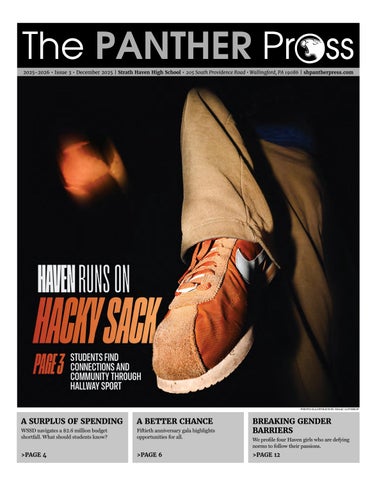
HACKY SACK is back The retro-style pastime makes a comeback and maintains popularity at Haven, encouraging community building and inclusion. Fiona Seale ’28 Izzy Boland ’29 Opinions Editor, Reporter
A
s we continue into the icy depths of December, the once vibrantly packed Brookhaven side parking lot is desolate as students have moved inside the toasty cafeteria for lunch. The ever-growing hacky sack fad was sure to die out with the nice weather, right? That couldn’t be more wrong. On one October day when the abysmal temperature managed to rear its head over the 40 degree mark, it’s like every Haven student received the same robotic telepathic message: “Me must sack.” Sure enough, 10 different circles quickly formed in the lot. Brows creased as students balanced the knitted ball on their heels, laughter and playful teasing erupting from each circle. Haven students will take any chance they get to play the immensely popular game. Hacky sack was officially invented in 1972 in Oregon by John Stalberger and Mike Marshall. The pair came up with the basis for the game as a way to recover from a knee injury. However, the concept also has roots in ancient Asian pastimes such as the Chinese military training tactic called Cuju and Japanese game called Kemari. The rules are simple and flexible. The only equipment
required is the small knitted bean bag. Players stand in a circle and pass the hacky sack to each other using their legs, though hands and arms are not allowed. The goal is to keep the sack off the ground for as long as possible. Some special tricks include “the stall,” where you balance the sack on the top of your foot for a second, and “the scorpion” is when you kick the sack backwards over your head. As the vintage-style pastime makes a comeback, English teacher Mr. Christopher McMahon, who graduated from high school in 1983, reflects on his memories of hacky sack. “When I was in high school, hacky sack was actually a pretty popular thing to do. We would hang out in the smoking area — we had a smoking area at the time — and hacky sacks on the field,” McMahon said. So why has it surged into the lives of teens at such a thunderous pace? At its core, hacky sack is a vessel for social interaction and connection. The uncompetitive and laid back atmosphere it creates is why it has taken so many schools by storm. “It doesn’t take too much brain power, and you can kind of just talk with the guys while doing it. It’s like having a football catch,” sophomore hacky sacker Asa D’Ancona said. If you’re hearing that hacky sack is ‘easy’ to be good at, but you’re still struggling to play, don’t worry. The reason hacky sack is so popular is not necessarily because it’s easy, but because it’s accessible. With practice, most people can develop the skills it takes to hold their own in a circle. Most importantly, hacky sack is naturally structured as an
“ When you’re a kid and you’re in middle school, you get recess and you run around like maniacs all day. And now you come to high school and you’re expected to not have that kind of fun during the day.” Mr. David Kopp Security Officer HALLWAY PASTIME • Sophomore Leo Dollé participates in a game of hacky sack on Thursday, December 11. PHOTO: MATTHEW RAMIREZ
uncompetitive game. Students are working together to reach a goal, not pitted against one another. It’s okay if you’re not the most coordinated or athletic; if you make a mistake the most you’ll receive is a few lighthearted “you suck bros.” “I am not an athletic person, and I feel like I’m getting a little bit better at it every time I practice,” beginner hacky sacker and sophomore Philomena Duffield said. “You can still have a fun time doing it even if you’re not coordinated. Because at the end of it, it’s not about how good you are. It’s just about the experience.” The physical aspect of the sport is not too daunting, but the benefits it gives teenagers can be impactful. Hacky sack may seem like just another silly fad, but it can play a very important role in a high schooler’s life. Students are cooped up at their desks all day with little allowance for physical movement or fun. Studies show it’s important for kids to have something exciting and active to look forward to in their busy days.
Security officer Mr. David Kopp closely monitors the hallways during school hours. He recognizes the impact of having something to keep students engaged throughout the day. “When you’re a kid and you’re in middle school, you get recess and you run around like maniacs all day. And now you come to high school and you’re expected to not have that kind of fun during the day,” Kopp said. Hacky sack can also affect teens’ mental health by getting them away from their phones. Growing up in a generation dominated by social media means that when you look around at the lunch tables in the cafeteria, you’ll see many students with their noses buried in their screens. “It’s a good way to pass the time. It’s just something simple you could do to get off your phone,” Duffield said. Hacky sack can be a great way to bring kids together who are in desperate need of social connection. Because of colder weather, hacky sack games have moved
inside, some trademark indoor sacking spots have emerged. Kopp cites the Wall of Honor area and art wing on the third floor at lunch time, and the stairwell landings of multiple floors as popular spots. “Groups have moved inside, and it’s been a little tough walking the halls,” Kopp said. “It’s been a very easy, redirectable solution. ‘Hey guys, can you move over 20 feet so you’re not blocking, or you’re not disturbing [others]?’ Everybody has been really accepting of that.” Even though it’s December, hacky sack is still incredibly relevant to students. From its inclusive circle-shaped format, laid back attitude and mental health benefits, don’t expect to see hacky sack leaving Haven any time soon. “Normally at lunch, I would just be sitting there, not moving,” sophomore hacky sacker Ezra Peltzman said “I definitely look forward to getting some action or movement in, just like physical activity, and I think it’s a great way to do it, it’s an easy way to do it.”*
Haven’s guide to finding the perfect practice spot Trying to get a license, but don’t have a good place to start? Find out where students practice driving skills. Kay Liberi ’27 Reporter
F
rom sharp braking to impossible merging, getting your 60 hours of driving practice doesn’t come without its challenges. Sometimes, even finding a good place to drive for beginners seems impossible. Luckily, these Haven students share their favorite areas to drive around that help them improve their road competence and technique.
Elsie Staley-Bischoff ’27
“I like to drive locally to whatever school activity I have; so near the school and around Aston. Sometimes, I can even drive to my brother’s college because he’s in state.”
Cali Fries ’27
“Usually, I’ll practice driving around my house by the Swarthmore College campus. But I live right off Swarthmore Avenue, which is currently closed off, so there’s a lot more traffic on my block than there usually is. Usually I’ll just drive around my house and drive around the campus a little.”
Adeline Barton ’26
“I like to practice at the cemetery by the Springfield Mall. Nobody is ever there.”
Mateo Laurent ’27
“When I first started out, I practiced with my dad, just in parking lots. I kind of transitioned into driving slowly throughout my neighborhood in Swarthmore. Over time, you just get used to driving like everyone else, on the big roads, and then you go to highways, and then you drive for longer.”*
4
shpantherpress.com • December 2025
HAVEN HAPPENINGS
WSSD grapples with budget shortfall The district plans to control spending more tightly and make cuts in areas “furthest from the classroom” in an effort to address the fiscal challenges. Clark Kerkstra ’27 Managing Editor of Web
T
he WallingfordSwarthmore School District has a spending problem. District administration first broached the subject of the $2.6 million budget shortfall at the November 18 meeting of the school board’s Facilities and Finance Committee, the second-to-last meeting before the new school board members were inducted at the board’s December 1 reorganization meeting. From the beginning, administrators have framed the issue as one of excess spending, emphasizing the need for a shift in the district’s culture. “The district has a spending problem,” business administrator Ms. DeJuana Mosley said at the November 18 meeting. “There must be a cultural shift prioritizing our needs beyond wants and living within reasonable means.” Since 2021, the district has seen a budget increase of more than $15 million, according to the administration’s presentation at the meeting. The spending increases were largely encompassed during the tenure of former superintendent Dr. Wagner Marseille, who left the district in August 2024. Now, the district is looking for ways to cut $2.5 million dollars in spending between now and June, when the budget is due to be finalized, the administration says. “Spending is about habits,” superintendent Dr. Russell Johnston said at the meeting. “So we have to change our habits, and that’s challenging.” The conversation comes at
a time when the district is currently planning a renovation project to the high school more than two years in the making, costing up to $80 million depending on the breadth of the project. According to Mosley, the district has also seen increases in fixed costs, including the need to address construction repairs that have grown more expensive as they remain unaddressed, and an insufficient number of cleaners to keep the school clean. Other fixed costs include bus leases, as well as special education services mandated by
“
We can leave no stone unturned. Dr. Russell Johnston Superintendent
state and federal law. That is not to mention the teacher contract approved last year in the wake of community backlash. The contract guarantees budget increases for salaries and benefits for teachers, bringing another fixed cost. According to Johnston, the district intends to cut funding that is “furthest from the classroom,” suggesting bus transportation for kindergarteners as a potential cut in the November 18 meeting. Johnston later would retract the suggestion after public furor over the idea, including at a December 8 community forum where multiple community members indicated they would rather cut late buses for student sports and activities. According to Johnston, the cuts could potentially apply not only to the 5:05 activity buses, but instead all of the buses after school, including buses at 2:05
and 3:05. “We’re looking at everything, so we’re leaving no stone unturned and really wanting to get feedback on every option that we have,” Johnston said. “We did put them all on the table at the community forums, every option for how we are doing the later buses that include anything that’s happening after school that gets into the options that we have right now. The question is, should we continue them across the board?” Such a change would have the potential to cripple the ability of some students to get home after school, or participate in after-school activities during 5th block like getting help from teachers and participating in music classes or clubs. At the December 8 forum, transportation director Allison Sload emphasized the need to use buses to the highest capacity possible — which according to her would have three students to a seat. The forum explored multiple potential areas to cut spending, including staffing, transportation, capital improvements, special education, and curriculum. A popular idea among students is the removal of Schoology, which was instituted in place of Google Classroom two years ago. “I think going [back] to Google Classroom would be a good start maybe,” senior Mason Barrar said. Johnston declined to comment on Schoology specifically, instead emphasizing instead the need to cut “redundant” instructional technologies and pointing to the administration’s ongoing review of instructional technologies. Other methods of reducing spending set forth by the administration include a higher reliance on in-house instruction during professional development for teachers, a reduction in the size of the high school renovation project, or changes to administrative
structures and positions. Some students more explicitly identified administrative positions as a needed cut. “I think it’s kind of ridiculous that a superintendent or an assistant superintendent makes hundreds of thousands of dollars, whereas teachers don’t make nearly that much,” junior Zeb Smithey said. “And I think that if any salaries are going to be focused on, it should be teacher salaries, because I think they’re the ones who are out here every day doing the really hard work.” Though Johnston emphasized
“
There must be a cultural shift prioritizing our needs beyond wants and living within reasonable means. Ms. DeJuana Mosley
Business Administrator the importance of cutting items farthest from the classroom, he identified the analysis of class sizes and potential reduction of program offerings with low enrollment as a last resort for cutting spending. “We can leave no stone unturned,” Johnston said. The $2.6 million shortage does not simply represent a spending increase, however. The shortage represents the amount that the district is short even after enacting the maximum legal tax increase. According to Johnston, though, the district would prefer to avoid such an outcome. Anger over excessive spending was one of the major drivers of community discontent during school board meetings last year.
The Act 1 Index under the Pennsylvania Department of Education establishes the maximum tax increase without voter approval for each tax the district levies. This creates a problem for the largely residential district, being highly reliant on property taxes. For WSSD, the Act 1 index mandates that the district raise taxes no more than 3.5%, and such an increase would come when the district already has one of the highest tax rates in Delaware County. Though the problem stems largely from spending increases by the district, the district also faces a decreasing tax base, according to Mosley. This means that when homeowners reassess the value of their property or apply for tax exempt status, the district is unable to make up for that loss of revenue. Such a situation is made worse by the significant amount of land owned by Swarthmore College in the district, which is tax exempt as an education institution. The lack of tax revenue from the college has led to suggestions that the district seek compensation from the college for its tax exempt status. Numerous community members put forward the idea at the December 8 forum, even suggesting that the district tap funds from the college’s endowment, which has been stated to be more than $2.8 billion. At the forum, Johnston clarified that no attempt at such an arrangement had been made by the district. Johnston believes that the district already collects significant sums of revenue and would be better off to control its own spending. “The $105 million that we have to provide quality educational services for our district should be adequate for us to do so,” Johnston said.*
Seniors victorious at annual Turkey Bowl Haven’s gymnasium was filled with lively students and cheers could be heard from outside. Emelia Kerr ’27 Contributor
H
aven held its annual Turkey Bowl assembly in the gymnasium on Tuesday, November 25. Each grade had the opportunity to compete, along with staff members. Classes were shortened as students eagerly waited for the fun to begin. A great deal of school spirit was displayed as the bleachers were filled with different colors assigned by grade (brown-
freshman; red-sophomore; orange-junior; green-senior). Students could grab refreshments as the 2027 Class Cabinet was raising money selling soft pretzels and other treats. All games were announced by the new club, Sports Media at Strath Haven (SMASH), providing commentary and boosting engagement. “I thought it was really fun. It’s always cool and exciting to see the whole school come together in one environment and show our spirit,” sophomore Tessa Dignazio said. There was never a dull moment. Between games, student council members asked Jeopardy-style questions and threw candy at classes.
OFFSEASON OFFENSE • Luke Mulhern (12) bursts through the freshman team defense during the Turkey Bowl on Nov. 25. PHOTO: ETHAN LIN
Teachers and staff also had the opportunity to join the fun. The last game of the afternoon was the undefeated seniors v.
teachers. Principal Mr. Andrew Benzing and music teacher Mr. Nicholas Pignataro were the biggest cheerleaders of the
game, while physical eduation teacher Mr. Steve Woolery ran the team offense. Unfortunately for staff, the competitive match ended with a senior victory. However, the MVP award would go to athletic director Ms. Lynelle Mosley, as she not only scored, but had the best touchdown celebration of the afternoon. “I did have a touchdown [and] I had great teammates. We played really well,” Mosley said. “We didn’t end up with the win, but I think we really handled ourselves, and we gave those seniors a run for their money, exactly down to the last minute.”*
HAVEN HAPPENINGS
December 2025
5
The Wall: Police Chief discusses career Have you ever stopped to catch a glimpse at the Wall of Honor? We continue a series of interviews of noted alumni with the Nether Providence Police Chief and former president of the Delaware County Police Chiefs’ Association. Mark Ball ’26 Reporter
N
ether Providence Police Chief and 1981 graduate of Nether Providence High School David Splain knows he chose the right profession because he still enjoys coming to work after 41 years of public service as a law enforcement officer. Since he was 12, Splain has lived in Delaware County, where his father worked at Drexel University and his mother raised three Strath Haven graduates. In high school, he played baseball starting on the varsity baseball team in 1979, 1980, and 1981. Following high school, Splain went to a police academy while attending Widener University and was immediately hired after graduation by the North Wildwood Police Department. There, he worked from Memorial Day to Labor Day in 1985 and 1986. Since then, he has worked for the Darby Police Department for two years and the Yeadon police department for 26 years, with 13 years in charge of the detective
PROVIDED BY DAVID SPLAIN
“
The skills I learned at Nether Providence taught me about community, responsibility, integrity, teamwork, and leadership, and that’s what ultimately built the foundation and directed me in the direction of becoming a police officer. Mr. David Splain
Nether Providence Police Chief
division. He has been the Nether Providence Police Chief for the last 13 years. There, he is in charge of all public safety within the township as well as all the operations involving the police department such as administration, patrol, traffic, safety, and criminal investigations. According to Splain, it is really special to come back to the community he grew up in and serve as the police chief. “The skills I learned at Nether Providence [High School] taught me about community, responsibility, integrity, teamwork, and leadership, and that’s what kind of ultimately built the foundation and directed me in the direction of becoming a police officer,” Splain said. Splain was a coach for Media Little League and NPAA basketball for his three kids as well as a PIAA football referee for local games, including Strath Haven’s playoff game against Upper Moreland. Splain highlights watching kids that he coached grow up into productive members of society as the most rewarding part of coaching. “Twenty-plus years later, [I’m] walking down the streets in Media and one of the kids comes up to me. ‘Hey, Coach, how are you?’ And talking about the great experiences they had when I coached them,” Splain said. As the supervisor of the detective division in Yeadon,
Splain was in charge of all criminal investigations and homicides, two of which became national stories. Splain received the Liberty Award from the Liberty Museum for investigative excellence during the Deanna Wright homicide, which involved an FBI agent’s daughter that was kidnapped and murdered. “The second one was the Veno Leigertwood homicide, which [was] featured on NBC Dateline in June of 2011 and that was a Philadelphia school teacher that was murdered,” Splain said. Rose Quinn, the Office Manager/Public Information Officer at Nether Providence Township Police Department, has known Splain for most of her professional life and has been working for Splain for three years since November. Quinn describes Splain as wellrespected and respectful to other people. “I’ve never heard anyone say anything even remotely negative about Chief Splain and I’ve known him for a long time,” Quinn said. “He has friends everywhere from law enforcement, here, and probably around the world since he was president of the Police Chiefs’ Association.” Quinn also describes Splain as the calmest person she’s ever known and someone who never loses his cool. “More than once, I’ve said to myself, I have to take a page out of Dave’s playbook and just let something go, because it’ll all
work out,” Quinn said. “And guess what: it usually does.” Splain was the president of the Delaware County Police Chiefs’ Association, which contains 42 police departments in Delaware County. According to Delaware County Crime Watch, Splain has also served on the Executive Board of the Police Chiefs’ Association of Southeastern Pennsylvania since 2016, currently serves as the association’s secretary, and served as the association’s president in 2020. “It was very humbling and a lot of work, because at the time, the law enforcement world was undergoing changes, and we had to adapt to the changes that society wanted,” Splain said. As Quinn noted, Splain introduced an internship teaming criminal justice students with officers to get them experienced with police work. Splain also introduced a partnership with the Delaware County Victim Assistance Center, which is a pilot program that offers victims of violent crime care and advocacy in the township to help them navigate the complex legal system. “I really enjoy helping people, and police officers are called on to help people and can make a difference in people’s lives,” Splain said.*
New school board members take office, Williams elected president Multiple veteran board members chose not to run for reelection this year, leading to a complete reorganization of the board. Clark Kerkstra ’27 Managing Editor of Web
C
hange is coming to the WallingfordSwarthmore School District School Board. At the board’s December 1 reorganization meeting, three newly elected board members took seats on the board, replacing three veteran board members who chose to not run for reelection in 2025. The meeting also saw the restructuring of the board’s leadership, with the board electing Michelle Williams as the new Board President. The board also saw other changes as the vice presidential office of the board was filled by Mary Jo Witkowski-Smith, formerly the Assistant Board Secretary. Witkowski-Smith’s previous position was filled by board member Nannette Whitsett,
while board member Robert Miller filled the office of Treasurer. New board members and Democrats Pramod Dibble and Marleen Livingstone both beat out the Republican candidate Michael Craig for the seats in Region 1, which includes large portions of Wallingford and South Media. The seats were vacated by Board President Kevin Henry and former Board President Kelly Wachtman. New board member and Democrat Dr. Melissa Crawford beat out Republican candidate Rhoda O’Donnell for the open seat in Region 3 containing Swarthmore and Rutledge. The seat was left vacant by Treasurer Dr. David Grande. The new board members were sworn in by Media Court of Common Pleas judge Stephanie Klein at the December 1 meeting, joined by their respective family members. Crawford was joined for her oath by sophomore Colin Kennedy. The meeting also accompanied changes in the board’s committees, including the formation of a new Workload Committee featuring Dibble and Livingstone.
“
To say it’s tough to fill your shoes is such an understatement to the depth of your leadership. Michelle Williams
New Board President Henry, Grande, and Wachtman were the three board members whose terms expired. Between the three of them, they served for 21 years on the board and had all served as the president of the board at various points. Henry served as the most recent president of the board, leading the district through such tumultuous times as the public outrage over the summer and fall of 2024. He also served on the Facilities and Finance Committee and the Educational Affairs Committee during his tenure. Grande was the president of the board prior to Henry,
and has most recently served as the board’s treasurer as well as chairing the Facilities and Finance Committee and serving on the board’s Wellness Advisory, a particularly fraught role during the Covid-19 pandemic. Wachtman, another former president, was the vice president of the board during the chaotic times of 2024 amid former superintendent Dr. Wagner Marseille’s departure. Following that summer, Wachtman would pass the mantle of vice president to Williams, who has now become president of the board a year later. “All three have served with grace, dedication, and a laser focus as to what was best for our students. To say it’s tough to fill your shoes is such an understatement to the depth of your leadership,” Williams said of the three departing board members. Williams’s remarks came at the November 20 board meeting, two days after the administration announced a $2.6 million budget shortfall at the November 18 meeting of the board’s Facilities and Finance Committee meeting.
WSSD School Board Region One Mr. Pramod Dibble Ms. Marleen Livingstone Ms. Nannette Whitsett Region Two Mrs. Rachel Holbert Mr. Robert Miller Vice President: Ms. Mary-Jo Witkowski-Smith Region Three Ms. Melissa Crawford Ms. Christine Dollé President: Mrs. Michelle Williams
Marking the end of an era, the November 20 meeting was the last time the departing trio would preside over the board. “I just want to thank the board members for trusting me with that gavel,” Henry said at the meeting. “I like to hit it hard because it just sounds great. … I’m really excited to see what the board does next and what the district does next. And with
6 VI
shpantherpress.com • December 2025
HAVEN HAPPENINGS
ABC program celebrates 50th anniversary With fifty years of service under its belt, A Better Chance Strath Haven celebrated and reflected on decades of opportunity. Joya Nath ’28, Darcey Strachan ’28, Morgan Matthews ’28
Reporter, Haven Happenings Editor, Detours Editor
S
trath Haven’s A Better Chance program gathered at Springhaven Country Club on Saturday, Nov. 8 for a gala to celebrate the 50th anniversary in style. A Better Chance has operated nationally for 60 years, offering those in underserved communities the chance to attend some of America’s best schools. ABC Strath Haven has existed for two generations, helping to provide talented young people of color with leadership and education opportunities within the greater east coast area. According to their website, their mission is to “increase substantially the number of welleducated young people of color who are capable of assuming positions of responsibility and leadership in American society.” Students reside at the ABC House in Swarthmore, and the program functions with a primarily alumni-led board that helps make the operational decisions. Students are granted a scholar family, who watches over the scholars’ academics, and host family. “The point of the host families is to have a family away from your family, and to make ABC
feel more like a home,” junior Amar Wade, who has been an ABC student since his freshman year, said. Junior Juliette Loyd is a part of Amar’s host family, entailing weekly meals and quality time. “It’s kind of cool, because we’ve gotten to know Amar very well,” Loyd said. “He’s like a part of our family now.” At the recent gala, ABC students and families gathered, including Wade, who provided some much appreciated entertainment. “I have been picking up musicmaking a lot, so they wanted me to perform a little piece,” Wade said. “It was a great opportunity to show what I’m about.” In addition, several notable speakers delivered remarks, including ambassador Carmen Cantor, journalist Bill Whitaker, sportscaster John Clarke, and Francisco Tezén, president of ABC national. “We had the President of ABC national, which doesn’t happen. That’s like the President of the United States coming to visit a mayor,” Haven ABC program alumna and current secretary Desiree Bell said. “That’s the equivalent, because the program has been around for 60 years nationally, and they represent a much greater portion of the country.” The gala emphasized community support and recognized the many people who made the program possible. “We honored everyone who had any touch points to the program: host families, academic advisors, drivers, chefs, shoppers, and, of course, our scholars,” Bell said. The ABC program relies on community fundraising and grant based funding. In the
past, these methods have led to close-calls in terms of continued operation. Math teacher Ms. Lysa Rieger spent many years serving on the ABC board, experiencing the highs and lows of financial burdens. “We were at a place with very few scholars because of Covid and a couple of other things, so I think the board felt like if they were going to shut down, this would be a time to do it, because it wouldn’t be hurting that many people,” Rieger said. After reaching out to community members and alumni for donations, ABC was able to keep the program up and running. Recently, ABC reached a milestone that leaves the future for students looking bright. The Phillies Charities, Inc. awarded Strath Haven ABC, along with 33 other Philadelphia area nonprofits, a $40,000 grant which will be supporting the operations of the program and house upgrades. The board members worked with one of their partners, The Swarthmore Presbyterian Church, to apply for this grant. “When we got it, it was huge, and we are very grateful for it, and even more grateful for our partner,” Bell said. On December 3, ABC President and chairman Andy Johnson, along with Wade, went to the Phillies Charities Holiday Reception at Citizens Bank Park to represent ABC Strath Haven. “It was just eye-opening,” Johnson said. “It was 34 of the nicest people in the world, because they were all heads, or amongst the heads, of their nonprofit.” The event was lively, and
A BETTER CHANCE • Amar Wade (11) gives remarks at the gala. PROVIDED BY MYESIA KING
featured appearances from the president of the Phillies and other notable figures. “I got to take a picture with The Phanatic, which was really cool,” Wade said. “It was cool to not only see me there, but also other people that the Phillies are supporting.” With the grant paving the way for new opportunities, ABC continues to look to the future
and emphasize the importance of alumni in building a program. “Being a Strath Haven grad means something,” Johnson said. “You don’t know it now, but you are creating lifelong connections that you will use in the future. Everybody was willing to give back to their Strath Haven family, and I think that’s important to share.”*
Featured Class: AP Psychology supports dialogue, career discussions This engaging class offers an opportunity for students to learn applicable content. Gigi Detweiler ’28, Mia Taub ’28 Reporters
A
P Psychology is a trending class at Haven, filling with students who are curious about how the human mind works and the study of our behaviors. The course draws a wide range of students. Although it is a social studies class, it is also a melting pot of many departments. “There’s something for everybody,” AP Psychology curriculum creator and social studies teacher Mrs. Amanda Lawson said. “There’s science, there’s a little bit of math. There’s psychology, there’s a social science, anatomy, and physiology piece to it.” This approach makes AP Psychology unique, adding a style of learning that improves students’ understanding and
engagement with the material, setting a solid foundation for future classes. “It’s definitely a good beginning [AP class], because it’s very interactive,” junior Ben Burnheter said. “Mrs. Lawson makes the class teach itself almost.” AP Psychology is a common footing for students as they start thinking about enrollment in AP classes. “I love teaching it, because it’s often the first AP course for a lot of kids, or it’s sometimes the only AP course that kids will ever take,” Lawson said. “It’s a very big mix of kids.” The course intersects with current conversations about mental health. Lawson noted that greater transparency around mental wellness has encouraged students to explore psychology. “Because our discussions around mental health are much more open than they ever were before, more kids are thinking about, ‘Hey, what is my mental health? What is good mental health, what’s bad mental
“
“I love teaching it, because it’s often the first AP course for a lot of kids, or it’s sometimes the only AP course that kids will ever take.” Mrs. Amanda Lawson Social Studies Teacher
health, how do I get this way?’” Lawson said. A perk of taking the class is being able to apply the material in real-life scenarios. “We learned about the neurotransmitters in the brain,” current AP Psych student and sophomore Mae Valcich said. “So if I’m getting tired, I’ll be like, ‘Oh, my body’s releasing norepinephrine so that I can stay awake.’”
Hands-on learning is also part of the class, helping students visualize and remember material. “One time, we put together a little plastic brain,” Valcich said. “We got to see the actual parts, and had to try and fit them all in.” Lawson aims to prepare students for college-level expectations by creating a more independent, rigorous environment. “I think some kids don’t love that part of the course, and don’t love me for that,” Lawson said. “But I think I’m building a work ethic, and some skills for the future.” The pace can be brisk: students cover extensive material before the AP exam, although many still find it attainable. “I think that it’s a good combination where you’re being challenged a little bit, but it’s very manageable,” Valcich said. “You just have to put in the effort and put in the time.” Lawson’s teaching wellprepares the vast majority of her students for the AP test, as
Haven annually scores above the national average in the various test categories. “[Lawson] taught everything and probably more than what we actually needed for the exam,” Burnheter said. “We had everything we needed for the AP test.” Psychology also opens doors to many career paths. Lawson adds that psychology is a fastgrowing profession. “One of the things I like to do in class is talk about the different kinds of career paths that you can take with psychology, that’s not just sitting with a client as a therapist,” Lawson said. “That’s a great career, but there are other things you can do with psychology in lots of different ways.” Ultimately, AP Psychology offers both challenge and insight, helping students understand themselves and the world around them. “I really enjoy being in class, even the days when we are just doing lectures,” Valcich said. “It’s really fun, and it’s interesting to learn about everything.”*
HAVEN HAPPENINGS
December 2025
7 VII
Haven Helps organizes schoolwide food drive The club runs this drive every year, benefiting the Delco Food Bank. Lexi Glass ’29 Contributor
F
rom November 1020, students and teachers were invited to participate in the annual Haven Helps canned food drive. Haven Helps members got the word out by making flyers to place in each of the classrooms. All proceeds benefited the Delco Food Bank and in total, over 3,300 cans were donated. Haven Helps had an extra motivation this year with the government shutdown. Many people lost Supplemental Nutrition Assistance Program (SNAP) benefits during the shutdown. SNAP provides money to low-income families to pay for food. “I hope to help people in need, especially with the government shutdown, and just help people who need it,” Cielo said. Over 100 students joined the club, according to Haven Helps advisor Mrs. Beth Benzing.
Senior Daniel Melvin wanted to give back to the community that helped him as a kid. “I mean, honestly, I had problems like this since I was a kid, I used to need the help from all the churches and all that. So I said, Why not help out? Help other people. Help collect all the cans,” Melvin said.
“
“I like having the relief and knowing yourself that you did something good.” Kelliann Corey ’28 Sophomore Kelliann Corey thinks that Haven Helps is a great way to give back to your community. She enjoys volunteering and being able to make a difference in people’s lives. “I like seeing the impact that it can make, you know, benefiting
families who may need the extra support,” Corey said. Sophomore Jaya Schwartz also enjoys helping families in need. She finds that it’s always important to help someone, even if they don’t show it. “I like having the relief and knowing yourself that you did something good,” Schwartz said. Benzing saw a really positive reaction from the people involved. She thinks that everyone was truly interested in helping and really wanted to help make a difference. “I’ve never seen a kid donate a can without a smile on their face. Ever in all my years doing
this. In fact, people who even watch someone be gracious and give and give gratitude also are happy around that person, so they smile around them as well,” Benzing said.* MAKING A DIFFERENCE • TOP: Jonah Rodriguez (11) passes cans to Daniel Melvin (12) and Katie Trout (12) while helping in the Haven Helps can drive collection on Nov. 20. TOP RIGHT: Brendan Godo (11) carries cands toward the pickup point. “It was cool to see everyone coming together to collectively support our community,” he said. RIGHT: Haven Helps adviser Mrs. Beth Benzing smiles as she carries donated items to the delivery truck. PHOTOS: XANDER CIFELLI, ANNIKA SLOOTMAKER
Mayoral elect makes history, details goals For the first time in 30 years, ‘everybody’s hometown’ elects a new leader. Fiona Seale ’28 Opinions Editor
J
oi Washington, a born and raised Philly native, will soon be sworn in to replace fellow Democrat Bob McMahon after his three-decade career as mayor of Media. Washington has been a member of the Media Borough Council since 2022, and this election season she ran uncontested in the Democratic primaries and defeated Republican Kevin Kellogg in a landslide (77%-33%). Washington is simultaneously the first woman and first person of color to ever be elected as Media’s mayor. In a town where Black representation is low — only 3% of residents are African American — this milestone is even more impactful. “I feel an extreme responsibility,” Washington said. “As a woman and a woman of color, sometimes I just talk myself out of things. I think having that support really helped me step into that power, because anyone is qualified for these positions, all you have to do is raise your hand, show some interest.” As a child, Washington was a self proclaimed art kid, and doesn’t recall being overly interested in politics. She credits programs like PBS, Nickelodeon Kids, and Carmen Sandiego for sparking her curiosity for change. Washington’s passion for public safety and improving
her home was what got her into local politics. “I was tired of going on Facebook and fighting people and then looking like a jerk,” Washington said. “You get to voice your opinions on things that matter in a more tangible way with the government, it’s definitely more helpful because you’re actually doing the work to change things.” Washington’s campaign was very transit oriented. Media’s public transportation system and walkability is what drew her to the town in the first place. “I couldn’t afford a car for the longest time, so I really appreciated not needing a car to get to most of the things that I needed in Media,” Washington said. “I just don’t want to forget the people who use public transportation. Even though we can’t fund public transportation, we can still be a voice for people who use it. I want to make sure that it’s safe for them to take it.” Media’s walkable layout also lends itself to a sizable conversation about pedestrian safety. Washington mentions her time in the borough, where upon hearing and understanding citizen complaints about speeding, a traffic circle was installed on Jefferson street, which reduced the issue. “I first got into local politics by having an interest in improving pedestrian safety, so I wanted to make sure that we put in some more work towards making people feel safe outside of the car,” Washington said. Washington has adopted a
program called Vision Zero, an initiative created and proposed by the Delco planning department to increase pedestrian safety. The Vision Zero website reports there have been 883 cases of serious injury and 130 fatalities due to various crashes in Delaware County from 20182022. There have been 68 concerns reported so far. Aside from local politics, Washington works as a freelance artist and graphic designer, she attended Moore College of Art for her primary schooling. She designed pins, buttons and banners for her own campaign, and some of her recent work includes branding for a new bubble tea shop and the cover for a young adult book, “Becoming Amani.” “I like that I have that creative side because everything is just so by the book on the government side, I just feel like I have a better balance when I have creative projects to work on,” Washington said. Washington’s artisanal background helps her connect with Media’s thriving network of small businesses. “I love the community. All of the business owners down there all know each other. A lot of the business owners are my clients and vice versa, my family and I are constantly eating and shopping down in the Media borough,” Christine Kirnos, Haven parent and owner of The Cat Hospital of Media, said. “We all support and look out for each other and try to elevate each other’s businesses.”
Joi Washington.
PROVIDED BY JOI WASHINGTON
“
“I feel an extreme responsibility. As a woman and a woman of color, sometimes I just talk myself out of things.” Joi Washington
Media Mayoral Elect
Media’s government has certainly made strides to transform the town into what it is today, but there is still work to be done. With Media’s growing popularity, rent and housing affordability is an issue for optimistic homeowners and entrepreneurs. Washington mentioned her plans to rectify this in a WHYY Q&A. “When I was growing up in Delaware County, Media was not a destination,” Kirnos said. There might have been a bar or two, it would be really dead. But now there’s people all the time. There’s so many shops and restaurants. I think what the leadership in Media has done for businesses over the last 20-25 years has really made it better for businesses to operate in Media. I think the downside to Media for a lot of businesses is the rent. Throughout her upcoming term, Washington hopes to continue working with Visit Media, enhancing all the tourist offerings the picturesque town has to offer. She looks forward to administrating events like Dining Under the Stars, and Media’s 250th anniversary next year. Washington both completes her tenure as part of the borough council and is officially inaugurated as Media’s mayor on Jan. 5. “I feel honored that the residents chose me at 77% of the vote, they really did trust me,” Washington said. “I’m looking forward to delivering on issues that matter to them and bringing Media forward into the future.”*
8
shpantherpress.com • December 2025
HAVEN HAPPENINGS
NYT health reporter Teddy Rosenbluth ’16 returns to Haven Alum spoke with students about her path to becoming a national health journalist and the value of finding focus in high school. Matthew Ramirez ’26 Editor-in-Chief
A
lumnus Teddy Rosenbluth ’16 walked up to the podium in the library with nothing more than just a few written thoughts in her notebook. Rosenbluth returned to her alma mater to share her passion and career in journalism and science to a room full of students. A University of California, Los Angeles Psychobiology graduate, Rosenbluth currently works as a health reporter for the New York Times. She has always been interested in science, but her interest in journalism began outside of high school when it became an attractive career choice while studying at UCLA. Rosenbluth’s later introduction to the journalism industry has made her journey somewhat unconventional. “I think it was hard to get my footing in the industry,” Rosenbluth said. “I wasn’t a journalism major. I didn’t really have any connections, and it’s sometimes a connection-based industry.” She worked her way up the journalism ladder, securing various internships at City & State, Los Angeles Magazine, and reporting for the Santa Monica Daily Press, The News & Observer, and other publications. In May 2024, she was the recipient of a Times Fellowship, where she then became a part of the NYT staff
in June 2025. Her reporting has shown her how strongly people respond to coverage of health systems and policy through stories about the measles outbreak and AI chatbots in healthcare. “People care so much about this,” Rosenbluth said. “When I would write about the hospital systems, or increases in insurance premiums, people could not get enough of that because that has such a tangible impact on your life.” Rosenbluth was an AP student, a member of Speech & Debate, Silvertones, and a competitive fencer. But in a school culture at Haven that encourages doing everything, she now sees her own high school experience as something that should have been more focused. “I feel like the emphasis is outsized. I think it’s way more important to focus on activities that you like and want to do long term,” Rosenbluth said. “When you’re in high school, it’s like you’re just sprinting to the end, but once you’re an adult, you have to live for a long time.” Social studies teacher and speech and debate adviser Mr. Jeffery Kahn was Rosenbluth’s history teacher and coach. He has seen how Rosenbluth has grown throughout her high school career, especially through her work in oratory events. “She found her voice and wrote things that she cared about,” Kahn said. “She practiced [the oratories] so much, and we all saw her do it; everybody could basically do the speech with her.” Oratory, a speech and debate event where students deliver a ten-minute speech on a topic of their choosing that includes an argument using evidence, logic, and emotional appeals,
according to the National Speech & Debate Association. Oratories require plenty of research and synthesis, skills that Rosenbluth uses in her career. “I feel like with her journalistic work, it makes a lot of sense that it transitions really easily from [Haven] to [her career],” Khan said. “I feel like she does that really well. It makes sense to me that she’s gone down this road.” Rosenbluth agrees that skills learned in Speech & Debate are useful outside of Strath Haven. “I underestimated how important it was in the real world to communicate your ideas clearly,” she said. College and Career Counselor Mrs. Kristin Dunning reached out to Rosenbluth after she saw her byline in a New York Times article and recognized her name. Dunning reached out, inquiring about whether she would be interested in coming back to Haven for a visit and presentation. “Bringing back alumni can be a great reminder that people just like them go on to do really interesting things and their futures are wide open,” Dunning stated in an email. “Teddy is such a great example of that. She is so relatable and also inspirational.” Alumni visits are an opportunity for students to connect with grads who have similar interests and experiences, and for alumni to talk to interested students about their career paths after high school. “A Strath Haven education is a really valuable thing, and I’d love for our students to see where it can take them,” Dunning stated. “Who better to show them this than people who have come from the same place?” Rosenbluth’s visit is one of several alumni engagements this
AMAZING ALUMS • Teddy Rosenbluth ‘16 speaks in the library to an audience of
students on Friday, Dec. 5. The NYT reporter returned to her alma mater to share how her interest in science influenced her career in journalism.
PHOTO: MATTHEW RAMIREZ
school year. According to Ms. Dunning, Casey Fox ’17 visited the Engineering Essentials class to discuss her career as a welder at the Navy Shipyard, and Marin Lent ’22 came to the Sports Media at Strath Haven club (SMASH) and The Panther Press to talk about her work as a sports broadcaster at Ithaca College. More alumni are scheduled to attend a healthcare career fair on Dec. 16. “There will certainly be more alumni visits when I can make them happen,” Dunning stated. Students from AP Biology, AP Environmental Science, other science classes, Panther Press, and Haven Yearbook were invited during second block on Friday, Dec. 5 to learn more about science, medicine, and journalism fields from Rosenbluth’s presentation. Senior Ellie Cole, who is
interested in political science and health policy, enjoyed the presentation as it related to her intended field of study and interests. “The way that she talks to people and how she gets her sources, and her kind of writing process was super interesting to me,” Cole said. For senior Tess Kelly, who is also interested in science, Rosenbluth’s presentation was both helpful and encouraging. “I thought it was very interesting, her advice on making sure you reach out and like try to do the job you’re gonna do for your life before getting there,” Kelly said. “Her visit piqued my interest, and [health journalism] is definitely something I would want to look at, like a possibility.”*
Teachers, students decorate second floor hallway The community came together to prepare for winter, garnishing the hallway with Northern Lights. Jane Yau ’29, Rowan Brown ’29 Reporters
T
he cutting of paper, the sharpening of pencils, and students’ excited voices can be heard down the second floor hallway, where students and staff join together and decorate for the 2025 theme: Northern Lights. While decorating the hallway may sound like a simple task, the entire process takes multiple weeks to complete. Participating students and teachers faced challenges with the assembly of the decorations. “We came back after
Thanksgiving break and everything had fallen down, so we had to put it right back up and tape it better,” English teacher Mrs. Miriam Drew said. “This year we even had to get a glue gun involved.” Sophomore Kavya Bhola is excited to get involved with the Haven community in any way she can. Bhola immediately volunteered when asked to contribute. “I love being a part of the school spirit and getting involved with my friends to decorate the hallways,” Bhola said. There is a new theme every year, as Drew recalls the Polar Express theme from last year. When deciding on a theme, students are encouraged to share their ideas and collaborate with their peers. The group makes sure all voices are heard. “Everyone had unique ideas
HOME-Y FEELS • Entryways to the second floor classrooms are festive. The teachers in these rooms had a “family photo shoot” to frame above their fireplace. PHOTO: ROWAN BROWN
and their own opinions, so we all contributed, and we came up with one theme,” Bhola said. Once the students and staff leaders work together to decide a theme, the other second floor
teachers are notified. They are provided with inspiration from a Pinterest board put together by the staff leaders, then they are able to start planning their design. While the project is coordinated mostly by the second floor teachers, the decorating is studentpowered. The collaborative spirit is shared across the group as students motivate each other to push themselves to be the best that they can. “The students take ownership of it and decide that they want to build something that’s really nice and beautiful,” Drew said. Students passing by are amazed at the amount of detail and festiveness the hallway contains. Freshman Effie Hionis enjoys walking through the hallway, feeling the holiday cheer. “My favorite part of the hallway was the stars on the ceiling,
it’s just really cute,” Hionis said. “I really like the hallway decorations because it really shows a lot of school spirit.” The most impressive part of the process is how often students take initiative, such as stepping up when something needs to get done and pushing the project forward. “I just love how everyone participates and gives their best — teamwork definitely makes the dreamwork,” Bhola said. The annual hallway decorating is a great way for students and teachers to bond and form long-lasting friendships, while also making the school a more enjoyable and comfortable place for everyone. “I’m so lucky to have this space. I love watching people come around the corner into the hallway and seeing their reactions,” Drew said.*
HAVEN HAPPENINGS
December 2025
9
Students donate sneakers, fundraise for Girls on the Run Haven families donated sneakers and students designed posters, all benefiting an after school outreach organization. Cayla Gaffney ’29 Reporter
S
tudents gathered in the cafeteria to write colorful and encouraging posters for Girls on the Run participants who will be running a 5k in December at a Wellness Wednesday on November 19. Wellness Wednesday marked the end of Haven’s sneaker drive, where around 100 pairs of sneakers were collected. Girls on the Run is a nonprofit organization that offers running programs for people regardless of their financial standing. Girls on the Run was first able to work with Haven to organize the sneaker drive when MultiTiered System of Supports (MTSS) Secondary Coach Ms. Morgan Segal connected with a neighbor who has a position at Girls on the Run. “I have a neighbor who actually sits on the board, so that’s how I got in contact with them,” Segal said. “My daughter doesn’t participate, but we have it at my local school, so I am familiar with the organization.”
The sneakers were collected at Wellness Wednesday by Ms. Glynis Visco, the development director at Girls on the Run. Visco collected the sneakers for recycling when she visited Haven on that same Wednesday. “We partner with a company called Got Sneakers, and they recycle them for us,” Visco said. “They evaluate the condition, so if they’re in excellent shape, like if they’re brand new, or if they’re in good shape, like a little beaten up, and then they send us a check for $1 to $7 per pair based on the condition of the shoe.” Over the span of about two months, the sneakers are processed, and the money is used to pay for specific running related items that Girls on the Run participants can use. Since Haven collected around 100 pairs of sneakers, it is likely Haven raised between $100 and $700 for Girls on the Run. “We can use it to purchase new sneakers for girls in our program,” Visco said. “We can use it to purchase sports bras for girls in our program. So any kind of running accessories that girls need, we can use it for that.” Additionally, the money that is raised for Girls on the Run can be used to pay for girls to participate, without charge, in Girls on the Run. Segal explains that in addition to providing physical running
“
I know a lot of people don’t know what to do with old sneakers, so they just sit in the back of closets. So it’s great that your students and faculty were able to make good use of old, smelly sneakers. Ms. Glynis Visco Girls on the Run Development Director
WHO RUN THE WORLD? • Students stand together holding the encouraging posters
necessities and programs, Girls on the Run’s outreach assists the participants to another level — through boosting their selfesteem and teaching the girls valuable lessons. “They have after school programs in different schools in the area, and they specifically work on helping girls build their self confidence and becoming strong leaders,” Segal said. Visco is grateful for the donations that Haven families made for Girls on the Run, along
with the decorated posters that students contributed. “I just want to thank you so much for doing the sneaker drive,” Visco said. “I know a lot of people don’t know what to do with old sneakers, so they just sit in the back of closets. So it’s great that your students and faculty were able to make good use of old, smelly sneakers.” Segal looks forward to possibly collaborating with Girls on the Run next year with hopes of another successful sneaker drive.
they created at a Wellness Wednesday on November 19. The posters will go to girls who particpate in Girls on the Run, and will be running at an upcoming 5k in December. PHOTO PROVIDED BY MS. MORGAN SEGAL
“I think it was wonderful to pair with this organization. We’ve never worked with them before, and it would be awesome if we could pair out with them again next year. I think that would be really great,” Segal said.*
Snow days in safe hands: Superintendent prepares for frosty future Superintendent Dr. Russell Johnston outlines his student-focused approach to making the call for snow days. Charlie Grueser ’28 Reporter
allingford - Swarthmore W School District welcomed superintendent Dr. Russell D.
Johnston to the office on May 1, along with a warm breeze and the promise of summer break. But as Haven pushes further into the winter months, most students have something quite the opposite on their minds. Johnston is no stranger to snow. Born in Montana and growing up in Colorado, the well-seasoned superintendent also has experience making the snow day call for West Springfield Public Schools in Massachusetts. “Every day of learning really matters to me,” Johnston said. “So I just want to make sure that we maintain a safe learning environment that allows students to do their best at Strath Haven and all across the district.” Although Johnston is new
to the district, he has already acquainted himself with Wallingford Swarthmore’s policies. “I feel very comfortable with the protocol that’s in place,” Johnston said. While he plans to stay in touch with other districts in the area, Johnston remains adamant that the best decisions are those that are personalized for Wallingford Swarthmore and its students. The district maintains a close relationship with Nether Providence and Swarthmore Police Departments, ensuring that calls are unique and appropriate for the roads that students utilize. “I’ll work closely with area superintendents, because we want to sort of see what else is happening across the county and what decisions we are collectively making,” Johnston said. “But we’ll make the decision that’s right for WallingfordSwarthmore. It will ultimately come down to what we believe is the safest for our students to get to school every day.” Johnston understands the need to get an announcement out early, to allow the district’s families, students, and teachers to make alternate plans or
“
It will ultimately come down to what we believe is the safest for our students to get to school every day. Dr. Russell Johnston Superintendent
decisions for the day ahead. However, he hopes WallingfordSwarthmore’s families will understand that sometimes the most accurate call cannot be made until the day of. “You don’t want to make the decision and then be surprised that we don’t get a storm,” Johnston said. “But you might hear from me at night if there’s a decision that we can make. I think that helps families with planning the best, especially with young kids. To know where they can go the next day is really important.” For families who worry about the “maximum allowed snow days per year,” Johnston
SUPER SELFIE • Superintendent
Russell D. Johnston snaps a selfie in Waterville Valley Ski Resort, New Hampshire. PHOTO PROVIDED BY DR.
RUSSELL JOHNSTON
maintains that he does not start with a quota of days-off in mind. “I don’t start with sort of a goal in mind. I just know that we’ve certainly seen some challenging weather patterns, particularly a combination of both ice and wind at times, maybe snow,” Johnston said. Ultimately, Johnston knows what’s on every kid’s mind: in a post-Covid world, do they have to worry about getting stuck on their computers with Zoom instead of sledding down hills?
“Pennsylvania does allow for what’s called a FID day, flexible instruction day,” Johnston said. “A school district has to apply for that, and we have not previously applied to allow for a flexible online learning day, as opposed to being in school. So our snow days will be snow days. No Zoom this year.” Flexible-instruction days, according to the Pennsylvania Department of Education, allow school districts to provide alternative digital instruction in times of pandemics or hazardous weather conditions that still counts towards a district’s 180 required days of instruction. Johnston looks to a future where kids can enjoy the winter season safely, happily, and in a way that benefits Wallingford Swarthmore—from the students to the community as a whole. “It’s about day to day decisions, about making sure our students can get to school safely,” Johnston said.*
10
HAVEN Arts
shpantherpress.com • December 2025
Teacher Creations: Mr. Thomas McLaughlin finds magic through creating connections With a passion for people, Mr. Thomas McLaughlin builds a safe space for connecting with others. Josie Wieland ’26 Arts Editor
W
ith interests stretching from fitness to the holiday season, there is one common thread that ties them all together: a love for fostering human connections. Assistant principal Mr. Thomas McLaughlin finds fulfillment in deepening the interactions he has with people in everything he does. At Haven, it is important to him to be the person that students and teachers alike can talk to, creating an environment for open communication. “I don’t want to be their boss. I am their boss, they know that and I know that, but I just want to be someone they can turn to,” McLaughlin said. Upon leaving Upper Darby High School and starting at Haven, English teacher Mr. Robert Zakrzewski recounts being guided and welcomed into his role by McLaughlin. “Things that I did in my old job didn’t really work here, and I felt kind of out of place,” Zakrzewski said. “Mr. McLaughlin was one of the first people to help me feel comfortable and at home, helping me get situated.”
In McLaughlin’s previous role as a special education teacher in Philadelphia, he saw the impact of getting to connect with students outside of teaching the required curriculum. “When they came back [from lunch] with food in their bellies, I would put the Christmas lights on and just read to them for half an hour because some of them never had anybody read to them,” McLaughlin said. “We would eventually get back to our schoolwork, and I saw scores go up just from reading to them.” Looking back on his experience helping students in need, McLaughlin realized that one of his own high school teachers helped him discover the importance of connections and lending a helping hand to others. “I called him to thank him,” McLaughlin said. “He said, ‘What do you call me for?’ And I said, we were able to help a kid because of what you taught me. There’s all different teaching strategies and buzzwords that educators use for this stuff, but really it just comes down to making connections first.” Through working out alongside others, McLaughlin finds it meaningful to be free of distractions and converse with others when their guards are down. “That time allows you to just focus on breathing, working out the energy of the people around
“
It’s a long year together and we spend a lot of time together, but he brings a lot of comfort to that in very unique ways. Mr. Robert Zakrzewski English Teacher
you,” McLaughlin said. “I feel like as I’ve gotten older, with cell phones and on-demand TV shows, that connection is something that people are missing.” These interactions encourage vulnerability, and with a simple conversation, McLaughlin can quickly turn a fellow gym member into a friend. “You have that connection so that when you’re not working out, you see that person in the hallway and feel like you can talk to somebody,” McLaughlin said. “You can turn to that person and say, ‘Hey, I trust you enough, because we do this together in the morning or we work out after school.’” McLaughlin’s love of the holidays and family trips to Disney stem from the magic
BAND-ING TOGETHER • Assistant principal Mr. Thomas McLaughlin speaks at the WSSD Jazz and Modern Band Night on Wednesday, Apr. 30. PHOTO: EVELYNN LIN
of seeing people live in the moment and go out of their way to be kind. “When you’re [at Disney], the outside world doesn’t matter,” McLaughlin said. “It’s literally about the magic of the place, so that’s a little bit of magic left in the world.” To bring connections like this to Haven, McLaughlin organizes luncheons and grilled cheese days for the faculty in the winter, bringing about a sense of community. “He does a lot of things that bring comfort. It’s a long year together and we spend a lot of time together, but he brings a lot
of comfort to that in very unique ways,” Zakrzewski said. Each small action that McLaughlin takes to create connections has given him long-lasting relationships with colleagues and students alike, ones that could not have been built without reaching out. “I just got invited to one of their weddings and they’re sending me birth announcements, and it’s things like that that you just can’t quantify; that’s what it’s all about,” McLaughlin said.*
Featured Club: Knitting and Crochet Club fosters creativity The yarn-centered club welcomes both beginners and experienced knitters and crocheters. Claire Salera ’27
Haven Happenings Editor
I
f you stop by Ms. Beth Winkowski’s room during fifth block, you’d expect to be greeted by a bustling group of pre-calc students. But on certain Wednesdays, you’d be surprised to be greeted by both math students and a group of knitters and crocheters. Knitting and Crochet Club, known by some as Haven Yarnheads, is a yarn-based club that meets about once a month on Wednesdays during fifth block in Room 406. Experienced knitters and crocheters have the ability to work on their own projects, while those who are just learning the skill can be taught by club leaders and other members. The club is rebuilding this year, with many new members and new leaders. This year’s president
is junior Ella Brook, who first offered to help reconstruct the club last school year. “Ms. Winkowski was my math teacher last year, and she would talk about Knitting Club and how she was really sad it wasn’t still a big thing,” Brook said. “And I said ‘oh, I crochet, I could start it up for you.’” Brook is no stranger to the world of crochet: her family connections to the hobby is what first interested her in the concept of a yarn club. “My mom and dad are really good at crochet, and my mom teaches it to fourth graders at [Swarthmore-Rutlege School],” Brook said. “A lot of [club members] were taught by my mom, so it’s kind of just a connection and people think it’s really nostalgic, and so do I.” Junior Maisie Sentivan also serves in leadership for the club, and she was similarly inspired to participate due to her background in the skill. “I’ve been crocheting since fifth grade, and wanted to continue doing that, as well as learn new
things, like knitting, and how to make more advanced projects with different designs,” Sentivan said. At a typical meeting, club members have the option to bring in and work on their own projects, or use some of Ms. Winkowski’s yarn and tools. Then, members can either work individually, or receive help from an experienced knitter or crocheter, learning how to make certain projects or even how to just start a chain. A rewarding aspect of the club for Sentivan is teaching others about different knitting and crochet techniques. “My favorite part is teaching new people, and them having fun and learning how to make new things that you can use every day,” Sentivan said. Taking place during fifth block, the club also offers a chance to reset and take a mental health break after a long school day, as maintained by junior member Joanna Lin. “I like how it’s really relaxing, how we’re able to take our time off of work from school, and then also
TIGHT-KNIT • Maisie Sentivan, (11) Abby Bachar, (12) and Eryn Broome (12) pose
with knitting and crocheting projects in Ms. Winkowski’s room during fifth block. PHOTO: CLAIRE SALERA
bond with our friends,” Lin said. Brook has many ideas planned for the club as it gains new members and traction during the coming months. “We kind of just work on making chains and we’re going to work on making scarves or blankets for [those in need], but that’s still in the works,” Brook said. Anyone who is interested in joining the club can reach
out to Brook to be added to the Schoology, and she hopes that the club will pick up new members as the year goes on. “It’s not a very big club, and we don’t meet super often, but I want to try to get it to be more popular and more frequent. So anyone who’s reading this, join the club!” Brook said.*
HAVEN ARTS
December 2025
11
Band creates new end-of-season tradition End-of-season awards night highlighted the humor, highlights, and memories of the marching season. Giana Gliko ’26 Reporter
T
he first annual BILB (Boy I Love Band) awards recognized groups and individuals for feats ranging from “Dance Team side that’s most likely to perform without equipment” to “Section whose shiny bells scared the most amount of police dogs at the Eagles game.” On Friday, November 21 from 7-8 p.m., members of the Panther Marching Band gathered in Haven’s auditorium for a “lighthearted celebration honoring Band members with playful, unserious awards as we reflect on the season together,” according to band director Mr. Nicholas Pignataro’s November 19 email. The ceremony began with remarks and jokes from Pignataro. Then, student leadership presented paper plate awards, with winners taking the stage for 30-second acceptance speeches. “There were some serious awards. There were some silly awards. The people who got the silly awards accepted them very graciously. We all made jokes about it, and it was like: ‘we’re in on something together now,’” Coyle said.
Freshman tuba player John Turbiville believes the awards are unique because anyone can be nominated for anything. “It connects all the people of the band together in a fun way,” Turbiville said. The second half of the evening allowed seniors to take the mic, relating fond memories, notso-fond memories, confessions, and lessons learned throughout their time in band. “It was really special that each senior could share their personal experience. And maybe something funny that you didn’t know about them that has to do with band, so you can see them in a new light before they leave,” Coyle said. The senior speeches are memorable and touching to Pignataro because of their focus on the community and connection that band fosters. “I hope [band members] become more connected with their friends and create a sort of band family when we’re not here, and that seniors make a memory out of it,” Jemwa said. Named for a marching band staple — the routine calland-response of “Boy I love band” — Pignataro and Coyle collaborated over email for about two weeks to make the award show a reality. “I was thinking of awards throughout the season. I was trying to think of people’s inside jokes and keep track,” Coyle said. The awards simultaneously provided closure for the season
“
“It’s really important — especially at the end of the season — to highlight peoples’ strengths and talents. To give people that validation they need to come back next year.” Elizabeth Coyle ’26 Assistant to the Director
BAND BUZZ • Melody Hunter (9) holds her section’s BILB award as she reminisces and chats with other band members. PHOTO: GIANA GLIKO
and allowed band staff to collect equipment in a more efficient and timely manner than in the past. “It came from a desire to put some sort of button on the season, like in a musical where the show ends on a song,” Pignataro said. From the hugs, tears, and handshakes to the rap battle and final “detail to the ready” command, Turbiville and Coyle both see the awards as an extension of the band’s positive, exciting, and energetic atmosphere. “I think it brings up the spirit of the band and gets people
excited for the end of the year,” Turbiville said. Coyle hopes the awards grow each year, becoming an event people look forward to and set goals for. “It’s really important — especially at the end of the season — to highlight peoples’ strengths and talents. To give people that validation they need to come back next year,” senior and assistant to the director Elizabeth Coyle said. The awards are a unique chance to gain new perspectives, meet new people, and enjoy each other’s company without the pressure of performing for a
graded class. “The most special thing is how sad everyone gets. It sounds weird, but you can see that this has meant so much to people from the emotion that they show and how expressive they are at the end of the season,” senior dance team captain Thandiwe Jemwa said “I felt emotional — which I didn’t think I would be — but it makes me feel like I made a difference in the lives of people in the band.”* DISCLAIMER: Reporter is a member of the marching band.
“Clue” draws record numbers for fall play, students reap rewards of hard work The many faces behind the scenes of the annual drama production reflect on bringing a popular board game to Haven’s stage. Charlie Grueser ’28 Reporter
H
aven’s auditorium was transformed from a simple stage into the setting of candle-lit comedy. The fall drama production of “Clue,” which ran on the weekends of November 15 and 22, produced laughs, gasps, and unprecedented crowds. Senior Katie Snyder, who was featured as the mysterious Mrs. White, was delighted to see the crowds of classmates, teachers, family members, and fresh faces alike pour through the doors for each performance. “We had an awesome turnout. We had close to 500 people each weekend, and that’s really surprising for the drama,” Snyder said. “Definitely, in the four years I’ve been here, it’s been the most like the crowds that we have for the musical.”
But the audience only witnessed a small fraction of the effort required to bring “Clue” from boardgame box to blackcurtained stage. The small cast invested hours of after-school and weekend free time to bring the macabre comedy to life. “We start rehearsals in September for the November show. We rehearsed two hours after school, three days a week. Over tech weekend, we rehearsed 12 hours. And then tech week, we rehearsed four hours every night,” Snyder said. Even with well-rehearsed scenes and perfected lines, these dinner party guests needed a setting to play out their deadly drama — in fact, they needed a kitchen, conservatory, dining room, billiard room, library, lounge, hall, and study. This tall order meant all hands on deck for Haven Tech Crew. Co-head of stage crew and junior Nate Mitchell credits long hours of hard work for the production’s success and popularity. “We have techies come every weekend and spend multiple hours every Saturday, for multiple months. And during
tech week, we volunteer almost all of our after school hours,” he said. “That doesn’t include any times that I as a head would have spent after school reviewing the script, or designing moves.” Complete with mobile walls, secret doors, and a dropping chandelier, the dynamic set of “Clue” reflected hours of planning, preparation, and hands-on work. “When your group is composed of busy high school students who are volunteering their free time, organizing and getting everyone’s full attention and cooperation can sometimes be difficult,” Mitchell said. “But in the end, we did definitely make it work, and we were able to pull together a really great show.” Director Roxie Everly, despite spending a staggering 12 to 14 hours per day on campus during the tech week craze, felt a weight lifted off of her shoulders through the responsibility and commitment of the students who participated in “Clue” — on stage, and behind the curtains. “The kids were so awesome this year. I really didn’t feel like I was really running around like a chicken with my head cut off,
MAKEUP MAGIC • Madeline Beck (10) and Alice Rieger (10) work to transform Leah Reece (11) from formidable cook into gory murder-victim backstage on Nov. 22. The performance of “Clue” included seven deaths, complete with fake blood and prop weapons. PHOTO: CHARLIE GRUESER
because the kids were just so on top of it,” Everly said. “I cried at the last show. I’m going to miss these kids.” Co-head of stage junior Sara Farrington enjoys working on tech crew for the satisfaction of seeing productions like “Clue” come together. But more importantly, for the kind and hard-working people she meets along the way. “The effort and the determination and the work that
all the high schoolers put in is what makes the shows so great,” Farrington said. “Ultimately, none of it would even be possible without the kids.”* Listen to Season 1, Episode 2 of “The Heart of Haven” Podcast at shpantherpress.com to hear more from “Clue” directors.
DISCLAIMER: Reporter is a member of SHHS Theater and Tech Crew.
12
shpantherpress.com • December 2025
FEATURE
HAVEN GIRLS
BREAKING S
Women are weaker and less capable than men. That stereotype has crippled the self-esteem of every woman who has faced sexism in the workplace, especially at jobs that require physical labor or engineering expertise.
GENDER
BARRIERS
EVERY DAY, THESE DILIGENT STUDENTS ARE MAKING STRIDES TOWARDS EQUALITY. KAITLYN HO ‘26 and EVIE FERNANDEZ ‘27 EDITOR-IN-CHIEF and MANAGING EDITOR OF PRINT
tudents at Haven are working to start breaking glass ceilings as early as possible.
According to an analysis from the Center of American Progress, male-dominated fields continue to struggle when it comes to attracting women workers. To combat that mindset that women aren’t capable of “men’s work,” students are exploring a diverse set of career paths. From girls in trades, to wrestlers, to robotics engineers — and so many more — here’s how Haven girls are working to close those gaps and inspire future generations of girls to follow in their footsteps.
hile most students are battling algebra in the classroom, senior Liliana Fletcher is learning how to save a life. Fletcher is in the Emergency and Protective services track in the School of Health and Biosciences at Delaware County Technical School, where she also partakes in field training that allows students to get real-world experience. “You are going to show up on probably the worst day of someone’s life in some situations. You have to be compassionate,” Fletcher said. “There’s going to be a sick kid who you can’t help, and then you’re going to have to go and pick someone’s grandma off the floor because she fell and she couldn’t get up.”
Fletcher notes that there’s been a not see it that way, but society sees more even split between the girls and it that way. So I have to realize that boys in her class this year, while last everybody else is going to see me in year, there were only four girls out a different light, and I have to just of 20+ students. Many of the boys learn to live with that, but also keep had years of experience in the trades fighting it.” already due to family Fletcher urges girls teaching them, and to look beyond gender developed a sort of “bro stereotypes, particularly code” as a result. that women are weaker. “I would say something She has worked to to the entire class, You are going build her self-esteem and no one would say to show up on by refining her anything. No one would probably the physical strength and move. And then [a male worst day of emphasizing her mental student] would repeat someone’s life in strengths, like her skill exactly, word for word, some situations, with teaching. what I said, louder, and and you have to be “The equipment everyone would respond compassionate. is built for a certain to him,” Fletcher said. kind of person, but as - LILIANA Her parents encouraged FLETCHER long as you have good her to ignore gender technique, that’s all stereotypes when that matters,” Fletcher considering her future career path. said. “There’s also gonna be great Because of that environment and people who will walk you through mindset, the divide between the girls everything and help you get good and boys in the trades class surprised technique in practice so that you can her. do anything.” “I hadn’t really experienced things like that before. I’ve learned, even if I don’t think it’s a male dominated field, it really is,” she said. “I may
FINDING STRENGTH
boys, which led to more difficult matchups for Harrington even if she was in the same weight bracket as her opponents.
PROTECTING COMMUNITY
WITH COMPASSION SENIOR LILIANA FLETCHER, EMERGENCY PROTECTIVE SERVICES TRACK AT DCTS.
W
IN DIFFERENCE JUNIOR LANE HARRINGTON, GIRLS WRESTLING TEAM
er brothers and her dad all wrestled in high school, and she grew up going to practices with her family. It was only natural that she wanted to be a part of it too.
H
“ We were all little, so no one really knew how to wrestle and the difference between men’s and women’s strength wasn’t a ‘thing,’” Harrington said. “It was fun. I was definitely always a little on the outside, just because I was the only girl, but it was still a lot of fun, and I made a lot of good friends.” The major struggle as she grew up was the natural difference in strength between girls and
the sport.
“It was mainly just my dad and I really advocating to our coaches and to Ms. [Lynelle] Mosley, the “As I got older and kept doing it, athletic director: ‘hey, we want this, it definitely became a lot harder we need this, we have the numbers for me to wrestle at to do it, can we do this?’ the same level as all And it was just kind the guys, because even of the repetition with if my technique was bringing it up that we equivalent, my strength needed, and everyone was always deficient I’ve loved it [since was really supportive compared to them,” the beginning]. It of it,” Harrington said. Harrington said. “That’s sparked a joy in me. Wrestling stuck with why it’s nice to now have And even when it Harrington through was hard, it just felt a girls team — especially highs and lows, and in my freshman year, it like something I she’s grown a lot as was impossible for me could never give up. an athlete since she to hang with the guys started. LANE compared to when I HARRINGTON “I’ve loved it [since wrestled with girls.” the beginning]. It Her struggle on the sparked a joy in me. boys team led to Harrington And even when it was hard, it just working to found the new girls felt like something I could never team, which started last year at give up. Even on the days where Haven and grew as she started I was dead in practice, it was just recruiting. PIAA voted to begin something I never could see my life sponsoring girls wrestling as an without,” Harrington said. official sport in May 2023. There are now 277 schools competing in
FEATURE
December 2025
he Positronic Panthers’ competition robot is made up of multiple complex electronics, protected by plexiglass walls. Those essential walls were built by junior Maisie Sentivan.
T
of the robotics team that’s a girl who regularly comes to meetings, and the environment is definitely different. Sometimes you really have to push to get to do work and get to participate,” Sentivan said.
Sentivan was interested in the robotics club when she was Though she loves it, it can introduced to it during her be hard to break into a malefreshman year, but dominated field with didn’t join until after no prior knowledge. she took the class “It’s kind of harder as a sophomore and if you want to ask became interested in to learn,” Sentivan As a woman, when engineering. said. “There’s a lot you’re asking “I’ve always been more pressure. As a for help, it’s very interested in technology woman, when you’re different, and there and building things… asking for help, it’s are sometimes I’d already wanted very different, and assumptions to do more with the there are sometimes you can’t do as club, and I ended assumptions you can’t much when we’re up joining, which do as much when building the robot. gave me even more we’re building the Sometimes you have opportunity, going to robot. Sometimes you to push to be able to competitions, meeting have to push to be able help build and work people who are to help build and work on it. interested in robotics, on it.” even people who go - MAISIE SENTIVAN Even if she faced to our school who are issues establishing on other teams. I just herself in the club, it really enjoyed it,” Sentivan said. was worth it for what she got out However, Sentivan has faced of it. limitations when it comes to how “If something stops working, we robotics functions as opposed to get to try to solve the problem. her other extracurriculars. [We] look at all the different “There’s about one other member
13
PUSHING FOR PARTICIPATION
JUNIOR MAISIE SENTIVAN, ROBOTICS TEAM MEMBER
and it’s so fun to think of ideas for solutions, looking at old robots. Look at how they did it, how you could fix it, and just try to make new things great. I think that’s so fun,” Sentivan said. Sentivan wants to encourage more girls to join robotics, because she finds it to be an incredibly fulfilling extracurricular. “I think it’s just such a fun and creative way to use your ideas,” Sentivan said. “Each year we get a challenge that we have to complete, and it’s just a lot of fun.”
parts, which I think is fascinating,
BUILDING THE
FUTURE ONE STEP AT A TIME JUNIOR CAROLINE BOERTH, BUILDING TRADES TRACK AT DCTS
oerth chose the Building Trades track at Delaware County Technical School for its versatility — the track focuses on mastering all the skills required to build a house. Although construction is one of the most male dominated fields, Boerth has found many positive role models to encourage her. She joined as a sophomore and was the youngest in her cohort, but the senior girls helped to guide her in learning the skills. Boerth
B
also feels inspired by one of her planning on doing DCTS to still friends, who pushes to overcome take classes like Wood Tech to her medical disadvantages every become more comfortable with day so she can become stronger. working their hands and building “Skills-wise, she’s taught me self-esteem. a lot of what I know, and also “I’ve definitely learned to not she’s taught me a lot doubt myself as about attitude and much, because there how to handle certain have been instances situations that could get where I was really me down,” Boerth said. questioning if I Even if you don’t actually knew what Boerth says that end up going into I was doing, and my there are teachers the trades or going product turned out that encourage equal into construction, great when I trusted opportunities for they’re still really my gut,” Boerth said. everyone in the class. valuable skills to This is because the Initially Boerth have. You shouldn’t teachers understand was uncertain if let something that’s the students’ strengths she would enjoy male dominated just and assign projects construction, deter you from that. accordingly. She hopes even though she that more girls will join considers herself a - CAROLINE the construction trade, hands-on person. BOERTH even if they don’t plan “Even if you don’t on pursuing it for a end up going into career. the trades or going “Historically, the trades have into construction, they’re still been very male dominated, and really valuable skills to have. You so I think even with the growing shouldn’t let something that’s female percentage in actual trade male dominated just deter you careers, it’s still a very small from that,” Boerth said. “You’ll minority just because of historic never know what friends you’ll expectations,” Boerth said. make or who’s going to be there, Boerth says that girls tend to and honestly, the way you interact try to shrink away, which causes with people really depends on you them to be more hesitant to how you put yourself out there.”* put themselves out there. She encourages people who are not
PHOTOGRAPHY: MATTHEW RAMIREZ
DESIGN: ISAAC LOTHROP
14
OPINIONS
shpantherpress.com • December 2025
Students become more apathetic, nihilistic Teachers have noticed purposelessness in students, bordering on nihilism. Josselyn Dixon ’29 Reporter
I
n America right now, it can feel like we’re teetering on the brink of chaos. Some people would say that we already are in that chaos. This perceived lack of order is starting to be felt by teens, not only politically, but also in how they live their lives. Nihilism is a 19th century term which boils down to the belief that life is without meaning, pointless. In practice, this often leads to a purposeless, passionless person. If life has no point, why should they? English teacher Matthew Wood has seen an increase in passionless students in recent years, observing that more and more students don’t seem to have purpose, or even an interest in their life. “You have to be interested in your own life, no one can make your life interesting for you,” Wood said. “No one’s going to save you…You have to have purpose in your own life. It may be a struggle to find it, but that’s a purpose in and of itself.” But why is this happening now? Most teachers agreed that it was a result of many different things, one of which was the COVID lockdown. “I think the trend began around 10 years ago, the major [factors had started], and then the disruption to school that was the COVID lockdown became an accelerant to that,” social studies teacher TJ Adams said. Social studies teacher Richard
Foulk agreed with the idea that students are different now than they were in the past, such as the time they take to do tasks. He chalks it up to screens. “It’s electronic distraction and shortened attention span,” Foulk said. “I wouldn’t say just phones, I’d say the things that are out there in the world allow you to not focus. It’s the instant
“
You have to find purpose in your own life. It may be a struggle to find it, but that’s a purpose in and of itself. Mr. Matthew Wood English Teacher
gratification of the internet.” Wood sees the internet as a cause of the nihilism not because of the shortened attention spans, but because of the content that the students are viewing on social media. “There’s a perceived lack of possibility,” Wood said. “‘Well, AI is going to take all the jobs.’ ‘I can’t afford to go to college and take on that debt.’ I could go on and on with things we hear about in culture through the media about doom and gloom. “ The internet is a vehicle for information, and he fears that it will, ironically enough, close people off from other viewpoints. “We get bombarded with
these messages that the world is falling apart, particularly if we seek them out,” Wood said. “If kids today are looking for confirmation that the world sucks, they can find it very easily. You can find that echo chamber of the world’s not fair, the world sucks. What’s the point? Why try?” This isn’t only being seen at Haven. According to one study, over 50 percent of young people think that humanity is doomed, which leads to feelings of nihilism. If there’s nothing that can be done, then what’s the point in trying? If this societal trend is allowed to continue, it could have major consequences for our society, but more importantly for individuals. Adams worries that the rise in nihilism could diminish the ability to connect and have relationships with others. “It feels like, in some ways, an unwinding of what we were building for the last 100 years, which was a way of life that acknowledges individuals and tries to develop and cultivate what is unique about people in ways that make their lives meaningful,” Adams said. To help turn the tides on this mentality shift, Wood believes that one path could be through SEL (social emotional learning), which is a topic that administration has introduced in recent years. He thinks that it is important to talk about mental health with the students, to help them believe in their future. However, Wood acknowledges challenges for schools in developing systems to implement SEL successfully, especially since it’s taught by
REFLECT ON IT • A person stares into a mirror, reflecting the words “What is the point.” Many students grapple with these thoughts. ILLUSTRATION: EVELYN SMITH
general education teachers. “I wasn’t trained to do that stuff,” Wood said. “I wasn’t trained in psychology. I wasn’t trained in social emotional learning. I’m a Gen Xer. I’m 55 years old. I can teach you English and how to write literature and the value of it, but there’s a big chasm between me and my 10th grade students currently, and even my seniors.” As for Adams, he sees the trend towards nihilism more as a mindset. He thinks that it can be fixed by re-prioritizing our school’s values, placing emphasis on humanities and art — especially considering Haven has a reputation of academic pressure. “I’d like to see us place less emphasis on high school as a path to some career goal,” Adams said. “I’d like to see us turn down the intense focus on what colleges we’re getting
into and having school being directed towards that. I’d like to see us place a greater emphasis on the humanities and the arts, because I think that’s where young people can do the work of self building.” Maybe the answer lies in the humanities, where teachers can help students find meaning through literature. “Math and science are wonderful things important for human progress and societal technological development,” Adams said. “I don’t mean to diminish them, but we don’t learn about ourselves, and we don’t develop our inner lives, and we don’t develop our passions by finding ‘x’. We do it through reading literature, through making art, and experiencing art, through reading about history and how others have gotten on with their lives and found meaning.”*
Medical shows prioritize drama over accuracy Realistic? Not so much . . . Josselyn Dixon ’29 Reporter
G
rey’s Anatomy is arguably the most famous medical drama of all time. But is it any good? This sounds like an easy question. A show with 22 seasons and 47.85 billion streams last year alone has to be great, right? However, Grey’s Anatomy has been criticized for prioritizing drama and romance over realistic depictions of a doctor’s life. Melissa Burkhart Zesorson M.D., emergency medicine physician at Phoenixtown and Pottsville hospital, agrees that it’s unrealistic. Specifically, she thinks the show glamorizes the ER. “No one is hooking up in the ER like everybody does on
[Grey’s Anatomy],” Zesoson said. “And also they save the day every time. Most cases that they present have very seriously injured patients. Unfortunately, in real life those patients would typically die despite doctors doing their best. They don’t always miraculously get better like in the show.” Even viewers who aren’t medical professionals notice the inaccuracies of the show. Freshman Lucia Lam said she watches it more as a soap opera, excited to see what happens to the characters. “There’s a lot of drama between the doctors, and there are people dating, which wouldn’t really happen, because [the ER] is a workplace,” Lam said. Meanwhile, freshman Charlotte Garson watches Grey’s Anatomy almost as a whodunnit show, with the diseases, injuries, or disorders as suspects.
MEDICIAL REALITIES • An exhausted
hospital worker watches a medicial drama. ILLUSTRATION: JOYA NATH
“I love trying to guess what the patients are diagnosed with,” Garson said. “There’s these really complex cases, and you, along with the doctors, are all kind of trying to find out what happened to the patient.” However, there are plenty of medical TV shows out there that prioritize accuracy. Garson
also mentioned that she was interested in watching “The Pitt” in the future, a medical drama that has received praise for staying true to how real life ERs are run. “I think Pitt is really relevant and realistic,” Burkhart said. “I think it’s a little bit busier than most ERs, but I think that the problems they have are all like what’s happening in the ER right now.” Burkhart shared that for her, watching The Pitt is an almost cathartic experience. The patients featured in the show are similar to the ones she sees in real life. For example, Burkhart saw a teenage girl overdose on fentanyl, and the show had featured a similar case. “You don’t have time to dwell on it,” Burkhart said. “In the end, you have to go see the next patient, so it was therapeutic to see that enacted in the TV show.
It’s good to see them taking on these issues and showing them to the public.“ It’s important to remember that Grey’s Anatomy is designed to be an entertaining TV show, not a full representation of a functioning hospital. This explains why it seems so glamorous, If it didn’t, it could lose its appeal to its audience. “If [Grey’s Anatomy] does inspire some young, smart people to go to medicine, it’s all good with me, because we need more good, smart doctors,” Burkhart said. “Sometimes, the best thing I do all day is just give somebody a blanket. I’m not really doing anything in a medical sense. So, yeah, it’s not that glamorous.”*
OPINION
December 2025
15
How social media changed music Music has become discernibly intertwined with visual art and media — for better or worse. Fiona Seale ’28 Opinions Editor
M
usic exists almost exclusively online now, from streaming services like Spotify which bring us all the sonic escape we could hope for, from Chappell Roan to brown noise (what even is that)? Most people under the age of 65 only buy records to hang the cover on their wall. Social media interaction has filled us with a need to classify everything. For instance, the reason Taylor Swift is so popular is because her albums can be easily sorted into eras; they have been defined by specific colors, aesthetics, images and motifs, and the actual music cannot be separated from their visual representation. People love to put things into boxes, because it makes everything simpler and more digestible. This is part of the reason pop music has become so repetitive. If each song does not fit the perfectly curated vibe or aesthetic of a record, the Tiktokified brains of fans cannot understand its place in the project and will be quick to call it messy or non-cohesive. This often takes away from the complexity and nuance music can portray. Pop music is now curated to go viral on social media, prioritizing shorter, catchier moments and simpler lyrics, with viral potential. Social media has even fundamentally changed the way music is produced. “It’s changed the structure of a lot of pop songs. What’s going to catch people on TikTok is a really hooky chorus or an amazing bridge. You’re seeing artists rejiggering songs so that people
can pick out those little snippets and create that viral moment,” former Philadelphia Inquirer entertainment and music writer, current Philadelphia Inquirer Deputy Managing Editor of Live coverage and breaking news Molly Eichel said. Before social media really took off, the loudest voices in music were journalists, writing researched and educated longform reviews. Now most music content the average person will consume is short and scrollable. It wants to catch your attention by focusing on shocking visuals and eye-catching motifs rather than the actual music. “There’s more of a motivation to get clicks and have sensational articles that drive profit instead of being motivated to have true journalistic standards,” history teacher, music enthusiast, and former recording artist Mr. Jonathan Pitts said. “I think the pressure to generate clicks profit means that people that are writing about music are now writing about it in a very superficial way. It’s easier to write about someone’s looks and appearance than it is to write about the sonic qualities behind music.” This shift from journalistic documentation to online media has contributed to the idea of artists being brands and actual music being a product rather than an experience. Now that we are on our phones all the time, artists have become uber accessible, allowing them to profit off of the fact that we can watch their every move online. They build their brand using those tools. Think of stars like Sabrina Carpenter. Her career only began to take off when she fully committed to her coquetish look, juxtaposed by raunchy double-entendres. She now profits off of that idea through social media audits. Sophomore modern band vocalist Luke Hanna points
out this phenomenon in other popular artists. “An artist that kind of reminds me of Benson Boone. [Junior Thandiwe Jemwa sings Benson Boone’s “Mystical Magical”] See, it’s stuck in her head. He’s in multiple ads that I keep seeing constantly. He is just this brand, this product, that everybody can use,” Hanna said. While this focus on branding has been amplified through social media use, Eichel argues that it has always been around. The Beatles trademarked the London boy look and The Ramones were classified by their Converse and leather jackets. This issue is really that social media music marketing is done more intentionally. The internet can make finding new music easier and accessible, allowing people to develop identity through music that may not be playing on the radio all the time. This diversification can have downsides, especially when one of the main draws of music is to bring people together. “When I was a kid, we had nothing to do on Saturday nights, so we would get in our friend’s car, drive around and change the radio station until we heard Missy Elliot’s ‘Work It,’ which, at the time, was a very big song,” Eichel said. “We were obsessed with it. We would just change the radio station until we heard it.” At the time, Eichel loved the fact that so many of her friends all knew the words to the same songs. “Now it’s a little bit more separated than that, which is good, because it means that there’s more diversity in what people are listening to,” she said. “But I’m sad about the lack of monoculture that we have now.” Another worry with the internet’s effect on how we listen to music is that the total accessibility we have through
DANCE THE NIGHT AWAY • The Happy Fits perform at the Fillimore in Philadelphia on December 11 to promote their new album, Lovesick. PHOTO: KAITLYN HO
“
You’re seeing artists re-jiggering songs so that people can pick out those little snippets and create that viral moment. Molly Eichel
Deputy Editor, Inquirer streaming services makes it feel almost disposable. “The thing that made it so special back then, people actually using record players not just for display, is that you’ve got to digest the music,” senior modern band vocalist Thandiwe Jemwa said. “You’re not over stimulating your brain with so much at once. I think that helps a lot to really understand what’s going on because when I’m just sitting there and I’m digesting what’s what I’m listening to and not watching a music video, it’s more impactful.” It’s nearly impossible to extract music from its visual counterpart entirely, those artforms tend to go hand in hand. The influence
of MTV, music videos, live concert performance and dress are critical to how music is perceived. However, it’s important to separate your enjoyment of music from its corresponding digital content. Don’t base your opinions on musical releases on some 30-second TikTok critique. Before stanning a new artist just because of a cool outfit they wore on Instagram, take your time in deciding your opinion of that artist, listen to their work and then determine if you’re truly a fan. Just because you like an artist doesn’t mean you have to buy their makeup brand, their skin care, or their Crumbl Cookie. It not only harms the environment, but also minimizes what music is truly about. Sometimes it’s okay to just sit back and listen, and I mean really listen. Not while doing something else, not while you’re scrolling. Go out, buy a record and actually use it. “I think holding a record and paying money for it makes it a little bit more special,” Eichel said.*
Stop second screen viewing There’s a reason why TV scripts feel like they’ve been dumbed down. Kaitlyn Ho ’26 Editor-in-Chief
“
Oh no! It’s the bad guy with a mask! I’m scared! Wow, the bad guy is my mom who has been missing for two episodes!” I consider this to be objectively terrible script writing; it violates that age-old adage to “show, don’t tell.” Yet, “telling” over “showing” is what Netflix has been telling its writers to produce — just to appeal to an audience that is increasingly unfocused on what they’re watching. Some people are doing laundry, homework, or just scrolling on
their phone while watching. This is second screen viewing. “Because Netflix knows a certain target audience will be ‘second-screening’ these series, the streamer wants the show’s writing to facilitate this practice,” an article published by The Conversation states. “Concretely, this means overly expository dialogue, repeating plot points and adding lots of voice-overs to narrate the action and help the distracted viewer follow along.” That’s why you might be noticing your favorite characters starting to state what they’re doing while they’re doing it, so you don’t even have to look to understand what is going on. The show is meant to work in tandem to your distraction of choice, instead of pulling your attention away fully.
My favorite movies and TV shows are my favorites because they’re complex; that complexity is a result of writers who are given full creative freedom, not instructions to pander with redundant information. The media we consume can bridge cultural divides. It’s how connections are made and how we discover more about each other. Good media challenges our current perceptions of the world. It makes us stop and think and never forget. If media is being written under the assumption that we won’t bother doing any of those things, of course it won’t be good. It won’t challenge a thing, because that would violate the need to be simple; it would be a waste of time to watch. While dumbing down scripts is a decision made by Netflix’s
While dumbing down scripts is a decision made by Netflix’s executives, it is a decision we’ve made as a society as well. executives, it is a decision we’ve made as a society as well. Netflix wouldn’t have done this if the data didn’t reflect the truth: we really don’t give our undivided attention to anything. Numerous studies have shown that multitasking doesn’t work. We keep doing it anyway, and we’re losing quality media as a result. In the future, what will stop everything being written by
AI? What will stop movies from becoming diluted imitations of true humanity? We need to stop second screen viewing, and recognize that this type of writing is churning out tasteless, forgettable media. That is the only way we can escape this slippery slope. Even what we write for The Panther Press is done with your attention span in mind. Each paragraph is two or three sentences for a reason. Many newspapers write articles with an inverted pyramid model: most important information at the top, because most people don’t read past the headline. And if you didn’t read through this whole article, here’s your TL;DR: respect the work that was put into the media you consume, and pursue complexity.*
16
HEALTH & SCIENCES
shpantherpress.com • December 2025
Fluoride in public water sparks discussion Controversially, fluoride in water has had a significant impact on dental health. Roland Rennick-Zuefle ’27 Reporter
F
or over sixty years, mass fluoridation has provided Americans with fluoride in public water. In local tap water and the fountains at Haven, this mineral has been used to provide the public with important dental benefits, such as a reduction of tooth decay by 25%. As a result, the Center for Disease Control has called fluoridation “one of the 10 great public health interventions of the 20th century.” However, these benefits may now be in jeopardy. Fluoride has faced significant controversy over the years, culminating in Health and Human Services Secretary Robert F. Kennedy Jr. advising that mass fluoridation of public water be halted, calling fluoride “industrial waste.” Fluoride is a mineral derived from the element fluorine. “Fluorine is the ninth element on the periodic table, and it has seven valence electrons,” chemistry teacher Daniel Kahn said. “Most elements want to get eight valence electrons [to reach stability], so they gain or lose electrons in order to get there. So fluoride is what happens when fluorine gains that one more electron to get from seven to eight.” Fluoride provides key dental benefits, such as helping to fight off cavities and preventing general tooth decay. “The fluoride can disrupt the bacteria that are in our mouth. It’s called Streptococcus mutans… So the fluoride slows down how they work,” Kahn said. “Basically, the bacteria in
your mouth are producing less [lactic] acid, which means that your teeth aren’t getting decayed by as much acid.” Fluoride has been shown to repair previous damage to teeth through a process called remineralization. “Fluoride can actually help attract some of the ions back into your teeth,” Kahn said. “That [remineralization] helps your teeth get the solid coating that they need to be sturdy and healthy.” One of the main places fluoride can be found is toothpaste, but public water is also a major source of fluoride. Depending on the distribution of minerals, some water may come with natural amounts of fluoride, although these amounts can often be too small to actually attain benefits. Following an implementation in Grand Rapids that saw improvements, all public water was fluoridated. Currently, 70% of all public water contains fluoride. While the process can vary, fluoridation for Philadelphia’s water involves dissolving hexafluorosilicic acid (H₂SiF₆) into water. “At the Philadelphia water department, they put some of this [fluorosilicic] acid into the water, and it breaks down in the water,” Kahn said. “It reacts with the water, and you get fluoride ions in the water, which are meant to protect your teeth. And you get a sort of stable, non reactive silicon compound that is also just hanging out in the water.” Since its inception, fluoridation has been the subject of many controversies and conspiracy theories. One of the most prominent was a Cold War belief that it was a communist plot to chemically control the people. Recently, Kennedy, as part
SECOND FLOOR SIPS • A student leans over the second floor water fountain to get
a drink. Haven’s water has a fluoridation level ranging from 0.12-0.38 mg/L, below the CDC limit of 0.7/mg/L. PHOTO: MATTHEW RAMIREZ
of his “Make America Healthy Again” initiative has announced his intention to have the CDC no longer recommend mass public fluoridation, praising states like Utah, who he called for having banned it. “I’m kind of confused about why he [Kennedy] is doing that and where his head’s at with that,” junior Jibrael Lakhoo said. Scientists have disputed Kennedy’s claims, saying that they contradict the advice the CDC has given for years and accusing Kennedy’s claims of coming from misinformation. The key misconception that has led to significant debate about fluoride comes from the effects of using excessive amounts of fluoride rather than the amounts recommended by the government. Some locations across the world may have excessive amounts of naturally occurring fluoride, even above 1.5 milligrams per liter, due to geological phenomena such as fluoride rich rocks. The CDC recommends a fluoridation level limit of around 0.7 mg/L, and Wallingford, Media, and Haven’s water ranges from 0.12-0.38 mg/L,
according to Aqua Water. Kennedy has admitted that a ban on fluoride would likely result in “more cavities” but has asserted that the adverse dental effects would be worth it to balance out fluoride’s purported harms, such as a correlation of excessive fluoride to lower IQs among children. While this link has some scientific backing, it isn’t the full story. Adverse effects to IQ have only been found in areas where the natural fluoride minerals in the water go well beyond the government’s recommended limits for public fluoridation. When water fluoridation is at or below the recommended limits, there has been no conclusive evidence to suggest damage to IQ. Dental fluorosis, a condition where too much fluoride causes white streaks on the teeth, potentially harming them, has likewise been reported to occur only with fluoride beyond the amount the CDC advises in public water, as has the severely harmful bone disease skeletal fluorosis, which develops with prolonged excess fluoride and is rare in America. Pennsylvania has a unique
and less centralized approach to fluoridation, allowing individual municipalities to choose whether or not they use fluoride, as long as they stay within the advised range of 2.0 m/L or under. Swarthmore’s water, and that of other parts of Delaware County that comes from Crum Creek, does not contain fluoride. “It depends on where you are within our school district,” school nurse Sarah Fleming said. Fluoride doesn’t need to come through only water or toothpaste, though. Some countries in Europe take a different approach by putting fluoride into salt instead of water. “So at the end of the day, it’s all fluoride. It’s just that F- ion,” Kahn said. “When it’s in the water, you drink it, and that’s how it enters your body. When it’s in salt, you eat it, and it enters the water that’s in your body.” Both approaches are aimed at better distributing fluoride to the given population, be it the more rural Switzerland or more urban America. “I think just overall it’s more effective to have it in water because I feel like it’s more universal,” Lakhoo said. The effectiveness of fluoridation depends on whether or not students are drinking the fluoridated water. “I think a lot of kids now drink bottled water anyway versus tap water,” Fleming said. The water fountains at Haven may be one of the most direct and important ways for students to get fluoride. “I think right now, in light of recent events, [it is important] to know that fluoride in your drinking water is perfectly safe,” Fleming said.*
Students in Science: Senior explores engineering through real-world impact Senior Dheer Parikh has spent his past two summers engaging in engineering to both learn and create. Lavanya Dixit ’27 Health & Sciences Editor
C
licking through a video game with a hand-crafted device, senior Dheer Parikh launched a research career that has led to a variety of opportunities, from publishing a paper, presenting at a conference, and also gaining real experience in the field of engineering. While attending a summer program at the University of Pennsylvania, Parikh’s invention, a wearable mouse controlled through subtle hand movements, was noticed by a
professor in his program. “At the program, I made a mouse… a ring that you wear, and depending on how you moved your hand, it would click or move the cursor,” Parikh said. “One day, I was clicking video games with it, and my professor saw me. He really liked it, so he offered to help me write a paper on it.” His work with the professor, revolving around his creation, is what brought him back to Penn the next summer. “I went back to UPenn on an internship basis under the same professor,” Parikh said. “He got rid of one of the [program’s] labs and redid it so it was based around my invention. I got to present that lab to the summer program students and help them do it.” Parikh was able to work at the
PROGRAMMING THE FUTURE • Dheer Parikh (12) presents code behind his device during a presentation at a conference in Nashville, Tenn. on Nov. 5. PROVIDED BY DHEER PARIKH
Inglis House, focusing on handson assistive-technology work, allowing him to explore how his early curiosity can snowball into real-world impact. The Inglis House is a specialized long-term care community in
Philadelphia for adults with severe physical disabilities. They offer a variety of services to promote independence and quality of life. “Residents would come with a problem, saying, ‘I can’t undo this buckle,’ ‘I can’t hold a pencil,’ or ‘I want a cooler joystick for my wheelchair,’” Parikh said. “You would get a case and you’re on your own: design a solution, 3D-print it, test it.” Through these opportunities, Parikh has explored his passion for engineering. Although, aside from being an educational pursuit, his work also holds value for real world application. “The mouse device is definitely something I would continue to pursue,” Parikh said. “I was in talks with UPenn about a patent, and, even though it didn’t go through, I appreciate getting the
chance to learn how to apply for one and what to be careful of so I don’t get swindled.” Parikh’s experiences outside of school have helped him better understand what he wants to pursue in the future. However, he has known of his interest in engineering for a long time. “When I was younger, I watched a lot of ‘How It’s Made’ and ‘Mythbusters.’ That definitely helped,” Parikh said. Now, Parikh takes advantage of physics classes at Swarthmore College to further pursue his interest in engineering. “I want to go into quantum engineering, so that’s a really nice basis,” Parikh said.*
HEALTH & SCIENCES
December 2025
17
Seasonal affective disorder has varying impacts Seasonal affective disorder, a form of depression, can pose serious risks and impacts on the lives of students. Izzy Boland ’29, Cayla Gaffney ’29 Reporter, Contributor
W
hen seasons change, so does temperature, sunlight, and even mood. These changes throughout different parts of the year can lead to seasonal affective disorder (or SAD). Seasonal affective disorder (commonly known as seasonal depression) is a diagnostic form of depression. It’s ‘seasonal’ due to the fact that when people experience it, it’s only for a portion of the year. Behavioral counselor Ms. Kate Sargent explains that SAD can be present at any time in the year. “It is a type of depression that comes up in people when the seasons change, and it’s more typically around the fall and winter time, due to the lack of sunlight and due to the colder weather, a lot of people experience it, but also can happen any other season,” Sargent said. Seasonal affective disorder can be traced back to the chemicals serotonin and melatonin, which are extremely different to the human body. Serotonin is a hormone that makes people feel energetic and happy. On the other hand, melatonin is produced to help the body calm down and sleep, in addition to playing a major role in regulating the body’s circadian rhythms, which is an internal
clock that functions telling people when to feel awake and when to be sleepy. According to the National Institute of Mental Health, seasonal affective disorder happens because the levels of these chemicals change due to changes in sunlight as seasons shift. When people get less sunlight in the winter, their body’s produce less chemical serotonin and produce an increased amount of chemical melatonin. This can make people feel more negative emotions, as well as making them feel more tired and sleepy. In contrast, an increase in sunlight near the summertime results in lower melatonin levels, which could cause sleep disruption although no official testing has been done on this. Simply put, the change in levels of serotonin and melatonin during different seasons can impact people differently. Seasonal affective disorder can come with many different symptoms that vary from person to person. Ninth grade counselor Mr. Gavin Stewart lists some of the possible symptoms that can be present in people with seasonal affective disorder. “Symptoms that you might see can look like fatigue, overly tired, a change in appetite, a loss of energy, a difficulty in just doing day to day things, and it comes with negative thoughts,” Stewart said. During different seasons, people with SAD can encounter different symptoms. Symptoms of SAD that people experience in the summer/spring can include trouble sleeping, having a poor appetite, anxiety, or displaying violent or aggressive behavior.
SEASONAL AFFECTIVE DISORDER SYMPTOMS • SAD is a medical condition that is clinically diagnosed. People who think they might have SAD can be diagnosed officially by a professional clinician. SOURCES: NATIONAL INSTITUTE OF MENTAL HEALTH, NEWPORT ACADEMY. INFOGRAPHIC: IZZY BOLAND
“
Symptoms that you might see can look like fatigue, overly tired, a change in appetite, a loss of energy, a difficulty in just doing day to day things, and it comes with negative thoughts. Mr. Gavin Stewart
Ninth Grade Counselor In the winter/fall, symptoms of SAD include overeating, oversleeping, social withdrawal, and a loss of interest in activities that people usually enjoy. As people cope with SAD, they can experience the challenges and effects of the disorder firsthand. Stewart explains the
impact that SAD can make on students’ school lives. “There’s a lot of different context for people’s lives, and people struggle with different things…It might be harder to do the executive functioning tasks of keeping track of your homework, harder to do projects, but it could affect anybody in a different way,” Stewart said. In addition to influencing students at school, school psychologist Mr. Christopher Bennett offers a further insight, describing how SAD can impact a person’s social interactions and mood overall. “It can affect your mood. It can affect your concentration, your focus. You can be a lot more sleepy during the same time. So that affects a lot of things, and it can affect your relationships with other people, if you are a lot more irritable and short with people,” Bennett said. SAD is a medical condition that is clinically diagnosed. People who think they might have SAD
Featured Club: Students build community through GSA club From organizing events to teaching peers, GSA members are making an impact. Anabella Larin ’27 Reporter
H
aven’s GSA (Gender and Sexuality Alliance) continues to play a powerful role in shaping Haven’s school culture by providing a welcoming environment for LGBTQ+ students and allies while also engaging in activism and education throughout the community. As a student-led club, the group focuses on advocacy, education, and communitybuilding. Meeting every other Monday during fifth block, the club offers a place for students to relax, connect, and support one another. Students lead the club’s advocacy work throughout the year, including policy efforts and charitable fundraisers.
One of the group’s longestrunning traditions is its annual donation to the Ali Forney Center, an organization that provides housing and resources for homeless LGBTQ+ youth in New York City. Occasionally, members also participate in writing campaigns. “[The writing campaigns] might be things like writing to a local state representative about a law or a bill that’s before the legislature that could affect people in the club or things that we care about,” club adviser and English teacher Mr. Matthew Morris said. GSA has also been involved in school-wide equity efforts. “We’re trying to have a more inclusive school… We’ve helped revise the equity statements, and we’re currently trying to help reopen the unisex bathrooms,” senior co-president Gordon Morris said. Education is another major part of the club’s mission. GSA leadership partners with
PARTNERS IN ADVOCACY • Gordon Morris (12) and Pearl Tweedy (12) stand side by side by their Activities Fair booth during lunch on Sept. 5. PHOTO: ABBEY MINTON
sophomore health teachers to teach lessons on gender identity, sexuality, and respectful language. “We go into the tenth grade health classrooms and talk a little bit about what it means to be queer and some of the issues that go along with it. Because there can be some misinformation and lack of understanding,” co-president and senior Pearl Tweedy said.
“Just defining some simple things and letting people know that there’s more than what they might have originally thought as far as gender and sexuality.” GSA also works to unite the school community. This spring, student leaders hope to revive Haven Heartthrob, a pageantstyle fundraiser. According to Gordon, it was last held four years ago. The event is intended
can be diagnosed officially by a professional clinician who refers to the DSM-5, which is a book that contains the specific requirements for mental health diagnoses. “In order to be diagnosed, you would have to go to a professional clinician, which is typically a therapist or a primary care physician, but you’re able to be diagnosed through a mental health professional,” Sargent said. Even though SAD can be challenging for patients, there are strategies that people who are diagnosed with SAD use, and that anyone can use who feels downcast at times. “There’s a lot of little things that can be really helpful to make you feel better, like trying to get sun. There’s barely any sun outside, and I know that’s can be very difficult…Try to move your body, exercising. Moving our body provides a lot of serotonin in our brains, and dopamine as well. So that can kind of help you increase happiness [and] feeling comfortable talking to friends,” Sargent said. Sargent emphasizes the importance of asking for help, because no one should struggle alone. SAD is a medical condition that should be met with proper care. “If you are having some serious concerns regarding your mood and just behaviors and seasonal affective disorder in general, reach out to a trusted clinician,” Sargent said. “Maybe if you have a therapist or doctor or trusted adult, like a parent, guardian, teacher, and kind of express those concerns, and then other school staff or family members or things like that can help you kind of figure it out.”*
to replace the Rainbow Dance that was held in past years. Student leaders are still in the early planning stages, but they hope Haven Heartthrob will be an engaging way for the community to come together. “We just think it would be a very fun activity and fundraiser for us to run,” Gordon said. For members, GSA is most defined by the sense of community that it creates. Throughout the school year, GSA provides a welcoming environment to relax and connect with others. “It’s just a good way to be yourself… it creates a sense of community. It’s how I met a lot of people,” Tweedy said. While initiatives change each year, GSA remains committed to building community and supporting students. “My biggest wish in the world is for members of GSA to be able to make the friendships that I was able to make through that club, because it has lasted me all of high school,” Tweedy said.*
18
SPORTS
shpantherpress.com • December 2025
Cheer team competes, builds lasting bonds The athletes are now in their competition season, which requires a lot of effort, but together they persevere. Elizabeth Gebhardt ’29 Contributor
T
he Strath Haven Cheerleaders can be seen performing routines at football and basketball games, encouraging the crowd and supporting the Panthers. However, the athletes also have their own competition season and goal: getting bids to nationals. A bid is an invitation to compete at an exclusive competition. In order to get a bid, the team has to go to a regional competition with a creative, well-choreographed routine and get as close to a perfect score as possible, which means making very few mistakes. The routines are written by outside choreographers, who are chosen by the coaches. Cheerleaders learn the choreography during a three day camp held in the summer, and practice the routines in the fall before their competition season starts. “You really have to put in a lot of effort and work,” sophomore Brielle Keaveney said. “I don’t think people understand how much time goes into cheer.” The cheer team has practice three times a week, in addition to competitions on the weekends. The competitions are often a long bus ride away and often last over seven hours. “We have to be up at five in the morning, take a thirty minute bus ride to the schools, and be there all day, but it’s a really fun environment,” freshman Aubrey Mapps said. Most of the competitions that the cheerleaders participate in give the team feedback about how to improve their performance. The regional competition, however, decides whether or not the team goes to nationals. This year, the cheerleaders competed in the Northeast Regional on Nov. 16. The varsity team got two Division II bids to nationals: a bid for Small Varsity Coed and a bid for Small Varsity Coed Game Day. “It’s always really nerve racking in the beginning of a routine when you get all of the stunts that you have to do and all of the choreography,” senior Eryn Broome said. “It was definitely overwhelming, and we were really excited and really proud of ourselves [when we got the bid].” The JV team also went to the Keystone Regional on Dec. 7. At the awards ceremony, they did not get a bid for Nationals, despite getting first place in their category.
“
You really have to put in a lot of effort and work. I don’t think people understand how much time goes into cheer. Brielle Keaveney ’28 Cheerleader
However, at practice on December 8, the team’s coaches read the athletes an email from competition officials which explained that there were scoring issues that had now been resolved, and the JV team did get a Division II bid for Junior Varsity Non Tumbling. The team was excited to receive the bid. “I’m really glad they ended up giving us a bid, but it should’ve happened at regionals, instead of at practice,” freshman Reagan Dunkerson, a member of the JV team, said. “But I’m so happy that we’re here and getting a bid.” Game Day routines replicate cheering on the sidelines at a football game. They include dancing, stunting and footballrelated chants. Traditional or “performance” routines are more dance focused, but they also include some chants and stunts. Teams can get bids for any combination of these categories. “One year we only made it for Game Day, so we were focusing a lot on Game Day,” Broome said. “This year we made it for both, so we’ll be putting in a lot of work for both routines.” Nationals are a time for the cheerleaders to win awards and show off their hard work, but the experience also brings the team together. The competition is held at Disney World, so when the athletes are not competing, they can explore the resort. “We get to go [to nationals] as a team, and there’s a lot of team bonding during that. It’s fun no matter what we do, because we get to go to the parks together,” sophomore Maren Coschignano said. The athletes’ relationships with each other is a staple of the team’s culture. Several members of the team find their connection with the other cheerleaders to be the most valuable part of their experience. “The most important parts are communication and bonding, because if you don’t like each other, what are you going to do?”
“
We get to go [to nationals] as a team, and there’s a lot of team bonding during that. It’s fun no matter what we do, because we get to go to the parks together. Maren Coschignano ’28 Cheerleader
freshman Imani Cox said. Nationals is also appealing because the cheerleaders get to see other team’s routines. “You see the same teams at the local competitions, so it’s fun to see all of the different teams from all over,” Broome said. The cheer team works hard from April from the previous school year through February, before Nationals. They build connections within the team the entire time. “I cheer because it’s a great bonding experience,” Dunkerson said. “You’re a part of something that makes you feel happy.” The JV and Varsity cheer teams will be in Orlando, Florida from Jan. 30 to Feb. 1 for Nationals. The team announced on their social media channel that varsity cheerleading qualified for states at the District 1 competition Saturday, Dec. 13 at Central Bucks South.*
DANCING DIVAS • TOP: The varsity cheer team chants “One Heartbeat, One Team” just before they perform their exhibition at the Haven Cheer Challenge on Nov. 23. MIDDLE: Emery Sanfillippo (10) high-fives Brielle Durnell (11) after the Haven Sparkle cheer team’s exhibition at the Haven Cheer Challenge on November 23. BOTTOM: The varsity cheer team performs to close out the morning session of the Haven Cheer Challenge. Six different middle and high school teams from around the area performed in the gym on Nov. 23. PHOTOS: ELIZABETH GEBHARDT, STELLA RICH
SPORTS
December 2025
19
Featured Athlete: Senior showcases fencing skill Jason Zhang’s fencing journey has taught him valuable lessons that he’ll carry through the rest of his life. Savvas Zeibekis ’26 Sports Editor
S
enior Jason Zhang began fencing when he was around 10 years old, quickly finding enjoyment in the sport. Zhang was introduced at a young age by a family friend who fenced. He would attend practices, being exposed to it often. “Imagine [telling] a 10-yearold kid, ‘You get to stab people with swords,’” he said. “That’s like, oh my goodness, that’s awesome. And I was like, ‘Okay, I need to try this.’” From there, Zhang was signed up for fencing classes, and would join the WallingfordSwarthmore Panthers Fencing Club (WSPFC) when he began middle school in 6th grade. During that time, he was coached by Pixie Roane, the head coach and founder of the WSPFC. Roane also teaches middle school fencing in the physical education courses. “[His] work ethic and attention to detail in all of the movements, both offensive and defensive actions [stood out],” Roane said. “His work ethic showed because he paid special attention to each
demonstration of each skill that I shared with the club members.” Zhang’s love for the sport continued through middle school, as shown in his work ethic and mental approach when practicing and competing at high levels. When he reached high school, he carried the same mentality over and wanted to compete seriously at a higher level. He switched to the Revolution Fencing Center club in June 2024. “I realized, ‘You’ve been in the sport for three or four years at this point,’” Zhang said. “I wanted to try and get more competitive… factoring in the amount of training time and adding in more time for cardio and private lessons, it definitely was a rough adjustment. I have got to give my thanks to Ms. Roane, obviously. She started me, and she guided me through the beginnings of it.” In the years following freshman year, Zhang would compete at the Junior Olympics, along with various other local and regional competitions for fencing. “I’ve medaled multiple times at the local level, especially in this area,” he said. “I’ve gotten third in high school championships two times.” Zhang is ranked 27th regionally for men’s epee with USA Fencing. Junior Olympics, however, is a “step up” from the rest of the tournaments Zhang
has competed in. “If you really think about it, everyone’s working, working, and working, just to get that one moment,” Zhang said. “And when you get there, it definitely kind of hits you in the face like, holy cow, I’m here. It was like a mindset shift, because everyone’s out there giving 150%, and getting hit with that intensity, especially as sort of a newer competitive fencer, has definitely been a hard adjustment.” One of his current coaches, coach Doug Tableman of the Revolution Fencing Center, sees how Zhang applies important lessons within the sport in order to succeed. “Rather than chalking things up to, ‘This person’s too fast, or they’re too strong,’ he’s focused on what he can adjust… He’ll come up with a plan,” Tableman said. “I think he’s a great example of what you can accomplish when you are open to feedback, and okay with losing in practice… Jason loses, if we’re talking about it, he asks, ‘What can I do better? What can I do differently?’” The lessons that Zhang has taken from the sport throughout his career have also proven to be valuable outside of fencing. “Putting more thought into preparing yourself for what’s going to happen, I think, has been the biggest lesson that I’ve
learned,” he said. “Whether it be last year where I can compete through academics or speech at this high level has definitely stuck with me,” he and debate and whatnot. Just said. “I definitely falling in love with the process do want to of working towards that bigger go out with a goal has definitely been a big bang.”* thing that fencing has given back to me.” Now, he faces the final year of his high school career, and acts as an example for other young fencers to follow through his work ethic both in and out of practices. Tableman believes that there are two main parts of work ethic in fencing — and that Zhang is good at both. “First, is just putting in the time,” Tableman said. “The second part of good training is deliberate practice… He’s done a really good job with that, and I often try to hold him up as an inspiration to my younger fencers.” Zhang looks forward to the rest of his high school career, despite it potentially being his last year in highlevel fencing. “I think I’m most excited for high school championships if we do end up hosting them, because they got canceled last year, and knowing that it’s like my JASON ZHANG ‘26 • PHOTO: SAVVAS ZEIBEKIS
Rex Storch Swim-A-Thon puts “fun” in fundraising The fundraiser brought together swimmers of all ages, and through relays, games, and food, brought attention and support to people battling cancer. Cayla Gaffney ’29 Reporter
T
wo kids in colorful “Swim Across America” caps race down the pool, swimming in blue inner tubes as teammates cheer from the end. At the same time, parent volunteers chat as they stand behind the snack table that is loaded with goodies—from soft pretzels, to donuts, to bananas. On November 22 at the Haven pool, students on the swim and dive team, along with kids and families from the area, participated in a swim-a-thon to raise money for cancer patients. All funds from the event went to Swim Across America, a nonprofit organization that raises money for people fighting cancer through swimming events. The Rex Storch Swim-A-Thon was in honor of Rex Storch, a former swimmer at Haven that passed away from cancer while at West Point. “We have a lot of philanthropies that we’ve done on the team, and
“
I think it’s important to raise awareness for cancer research... raising the awareness to the community, and just getting everyboy involved as a way to just help fight cancer. Ms. Tina Zamulinsky Event Organizer
we’d like to help our community. That’s a really important part of being on the Haven swim dive team,” boys swim team head coach Mr. Brian Ward said. “And I personally knew Rex Storch when I swam here many, many years ago, and I felt like the time was right to also bring this back.” The event was filled with fun relays, giveaways, and rubber ducky prizes. Swimmers of all ages competitively raced throughout the variety of games. “I really think the kids had a hoot with the relays. So we had three different relays we did. We
did one in an inner tube. We had one where they were pushing a duck down the pole, and then another kind of smaller one that we had where [there was a] wet t-shirt you had to take off one person, put it on the other, and swim with it,” the girls swim team head coach Mr. Zach Anderson said. The relays were organized by the high school swim team, who directed the eager younger swimmers. “It was definitely led by the swimmers. And I think it was just great to be with friends and doing it, which made it really fun,” sophomore Natalie Jensen said. The food, camaraderie, and support for those fighting cancer, brought together a large group of participants including many kids who enjoy swimming, and live in the area. Sixth grader Claire Keefe, among many other kids, expressed enjoyment about the fundraiser. “I just like hanging out with my friends,” Keefe said. As more people came out this year to participate, Ward acknowledges the fun he noticed from the swimmers to volunteers, all as they raised money for Swim Across America. “I feel like it’s been fun since we started it, but I feel like fewer people knew about it [the Rex
SPLASHIN’ FOR CANCER • Aidan Taggart (12) and Andrew Waltman (12) play in
the pool during the Rex-a-Thon swimming fundraiser on November 22. After the main activities were all finished, the student athletes who participated in the fundraiser were allowed to play in the pool and chat with friends until the pool closed for the day. PHOTO: ALEX TEJADA
Storch Swim-A-Thon], and more people know about it now,” Ward said. “I think all the kids had a great time, all ages, adults had a great time watching.” In addition to the high spirited attitudes from participants, Ms. Tina Zamulinsky, one of the event organizers, explained a valuable point—as the community comes together to have fun and to fundraise, people can bring attention to an important cause. “I think it’s important to raise awareness for cancer research…raising the
awareness to the community, and just getting everybody involved as a way to just help fight cancer,” Zamulinsky said. The annual event will take place next year, and Zamulinsky is excited to see the event grow, so that the fun and fundraising will increase to another level. “I hope everybody has fun, and I hope next year is even greater and better,” Zamulinsky said.*
20
DETOURS
shpantherpress.com • December 2025
La Catrina hosts laid-back atmosphere, flavor Media venue offers a modern twist to classic Mexican dishes and a lively atmosphere. Mia Taub ’28, Gigi Detweiler ’28, Jonah Livingstone ’28 Reporters
L
ocated in Media, PA, La Catrina is a modern Mexican restaurant, with a wide variety of delicious meals and appetizers. The casual and vibrant atmosphere of the restaurant welcomed us to try new dishes on a Sunday afternoon. We began our meal with the chips and guacamole ($17). The guacamole was smooth and rich and complimented the chips
perfectly. It tasted fresh and was a classic way to start our dining experience. Our only complaint was the price— $17 seems excessive, but we were still happy with it. The Diet Coke ($4) was refreshing and surprisingly crisp. We wish we would have ordered the Mexican Coke as it fit the scene, but we were pleased with our drinks. The Tacos de Carne Asada ($22) were better than anticipated. The corn tortillas were very delicious (and homemade), and the cheese was seared to add a slightly crunchy profile, something we really enjoyed. The grilled skirt steak itself was good, but we weren’t blown away, as the grilled pineapple avocado salsa
verde added a unique spicy yet refreshing flavor to the tacos. These tacos definitely get you the bang for your buck. The Spicy Chicken Quesadillas ($19) were surprisingly mild, but this didn’t take away from our enjoyment! They were topped with oaxaca cheese (a mild, soft Mexican cheese), which set it apart from other quesadillas. They had a subtle warmth and tangy flavor that was undeniably delicious. If you like a little touch of spice, this meal is definitely for you. The Tacos de Pollo al Carbón ($19) were amazing. The chicken carried the seasoning well, though it was not the standout element. The pico de gallo added a fresh bite, while the avocado brought a creamy balance that
AUTHENTIC FLAVOR • Chips & guacamole at La Catrina. PHOTO: GIGI DETWEILER
made each taco feel fuller. The queso fresco contributed a light saltiness, which pulled all the flavors together. This is a great pick if you prefer a taco that feels balanced and satisfying.
Overall, La Catrina is definitely a favorite for us. It is the perfect spot for welcoming, laid back eats. It’s safe to say that we will be coming back here.*
Volume 1: Recipe of the Issue: Strong start to Apple pie is ideal holiday treat new season This classic recipe is an WARNING: Spoilers for the first four seasons ahead! Evie Fernandez ’27 Managing Editor of Print
A
fter nearly 10 years of Dungeons and Dragons, demogorgons, and government experiments, the fifth and final season of Stranger Things is out. The first four episodes of the fifth season of Stranger Things were released on Wednesday, November 26 at 8 p.m.. Season five takes place over a year after the end of season four, when Hawkins finally fell victim to the Upside Down. The season opens with Max still in a coma, with all of the gates closed over and the military quarantining Hawkins citizens in town while trying to investigate what truly happened with the Upside Down. Robin is running her own radio station, with Steve helping, and the kids are still going to school. I thought the strongest thing about the newest season was the characterization. Watching the characters — especially the kids — grow over time is wild, and Will and Mike especially have really come into their own this season. Mike is becoming more like Nancy every season, and it was really nice seeing him step up as a leader. I loved seeing Will happy overall. His relationship with Robin this season was also great to see. I would be remiss to talk about good characters without mentioning the two new main characters we see: Derek and Holly. Derek is a great comedic character — he really does embody a nine-year-old boy:
immature, rude, obnoxious? Yes, but he’s also hilarious. Holly isn’t new this season, but the focus on her increased a lot and I loved seeing her character. Her bond with Mike was great, but I also thought as a whole her character was very realistic as a 9-year-old girl. She has her head up in the clouds, but she got down to business when she needed to. The plot was also quality this season. The show jumped straight into the action, and the overall plot was very easy to follow, and interesting — I was always ready to click ‘watch next episode.’ I also appreciate that all of the characters are all in the same place, working towards a common goal. Last season became difficult keeping everything straight between the different plotlines in Russia, California, Utah, and Hawkins. Another highlight for me was the soundtrack this season. As the show grew in popularity, it was able to get more popular music, like Kate Bush’s “Running Up That Hill” last season, but I really loved the picks this season. Diana Ross’s “Upside Down” made a big cameo, which was a great choice for the show, and Tiffany’s “I Think We’re Alone Now” made it in, which was also a good pick for a typical young girl’s favorite song in that era. Overall, these four episodes kept me on the edge of my seat, and I’m excited to see how the rest of the season pans out. I will be in the theater for a midnight premiere of the finale!*
easy, delectable option for anyone seeking to bake a dessert for their family during the holiday season. Tara McMonagle ’28 Contributor
T
he holiday season is a time for making memories with friends and family. When these memories involve a dessert that everyone can share, people are brought together and these moments become even more significant. Apple pie is a famous dessert that is popular in the United States during the fall and winter holidays. Its ingredients are easily accessible and it is easy to slice and share, but one may feel daunted by the task of baking an entire pie. However, the process is not as difficult as one may assume. According to the Smithsonian Magazine, the first apple pie recipe was written in England, but it was much different from the modern American apple pie that is now so popular during the holidays. There are even more modern variations of apple pie, such as the Salted Caramel Apple Pie from Sally’s Baking Addiction. The food blog Little Spoon Farm has an Easy Apple Pie recipe that calls for Granny Smith apples, stating that they are “super tart and very firm” and that firm apples are ideal for baking. Another major ingredient in the recipe is the pie crust, and the recipe recommends using the All Butter Pie Crust recipe from Little Spoon Farm, which produces a flaky, buttery crust.
DELICIOUS TRADIITON • Finished apple pie sits on the table, sliced to reveal the inside of the ready-to-share dish. This pie was served on Thanksgiving. PHOTO: TARA MCMONAGLE
The pie crust recipe simply involves combining the ingredients — mainly flour and butter — in a bowl and forming them into dough, which was an easy process. The dough was then formed into two disks that were placed in the refrigerator to chill overnight, although the recipe only calls for a minimum of one hour of chilling time. Once the pie crust is ready, one disk must be rolled out and placed into the bottom of a pie tin, and after the apple filling is added, the other half of the crust must be added on top, and the edges should be pressed together. The apple filling is simply made by slicing the apples and mixing them with the ingredients specified in the recipe. Once the pie is put together, all that must be done is cut slits on top for venting, brush it with egg wash, and, optionally, sprinkle sanding sugar before placing it
in the oven. For this pie, brown sugar was added on top instead of sanding sugar, and it seemed to add additional flavor to the finished pie. The pie must be baked with foil on the edges for the first half of the baking time to prevent over-browning; the edges may crumble slightly when the foil is removed, but this will not impact the end result. Once the pie is finished, it can be served with homemade whipped cream (which can be whipped by hand if one does not have an electric mixer) for a refreshing touch. Overall, apple pie is a recipe that anyone can make without major difficulties. Although it takes multiple hours, including the dough chilling time and the total baking time, it is not as challenging as it may seem and is worth making for the cherished family memories it can create during the holidays.*
DETOURS
December 2025
Four holiday must-sees
How “Wicked: For Good” changed me for the better It’s certainly changed me for good! Josselyn Dixon ’29 Reporter
S
ome movies take a few rewatches to grow on you, to help you appreciate the characters, to become “one of the best.” “Wicked: For Good” was not one of those movies. Watching the first scene, I instantly got swept back into the land of Oz, and I knew that this movie was destined to be one of my favorites. The movie follows the journey and friendship of Elphaba Thropp (Cynthia Erivo) and Glinda Upland (Ariana GrandeButera) as society tries to pit them against each other. Those who watched the first movie (if you haven’t, you really should) might know that this isn’t the first time we’ve heard their story. The Wicked Witch we all know and love originally comes from L. Frank Baum’s “The Wizard of Oz,” a 1900s novel focusing on a girl from Kansas. In the book, Elphaba is known as the Wicked Witch of the West. In “Wicked,” the 1995 novel by Gregory Maguire, he humanized the Witch by giving her a backstory, friends, and perhaps
most importantly, a first name. The book was adapted into the second highest grossing Broadway musical of all time, and the rest, as they say, is history. Because the story was split into two movies, it makes it easy to see how the characters develop. Every part of their transformations are fleshed out, including their style of singing. Comparing the singing, you will see that the first Wicked movie has mostly high, pure, and fun singing, which reflects the outlooks of the characters. Of course everything’s going to work out perfectly in the end, didn’t you hear that high note? In contrast, the second movie’s singing is far more rich in tone, more powerful, almost. It shows how the characters have realized that the world isn’t going to change itself, they have to step up and change it themselves. The songs also take a darker turn, perfectly aligning with the main character’s journey once again. The switch in style shows how much thought was put into “Wicked: For Good.” This thoughtfulness shines though in the costumes, which were fantastic, and, to no one’s surprise, the acting. With two co-
Classic, but often forgotten movies to add to your watchlist this holiday season. Rowan Brown ’29 Reporter
“Love Actually”
T
BACK TO OZ • Wicked For Good came
to theaters on Nov. 21, 2025, grossing $150 million in America the first weekend. PHOTO: JOSSELYN DIXON
stars as accomplished as these, it might have been a concern that one would outshine the other, but I feel that they both got the chance to steal the show, Erivo in the first movie, GrandeButera in the second. From the opening lines on, the movie is jam-packed with emotional moments, be they happy or heart breaking. You will see things that you’ll love, hate and everything in between. If you get a little lost while watching, just remember, it’s just the one road the whole time!*
Stay cheerful with nearby winter activities Winter is here, and students are searching for ways to stay busy (and cheerful) through the colder months. Gigi Detweiler ’28 Reporter
D
o you want to build a snowman? Trees are now bare, classes have just become notably harder, and the wind has finally forced students to bring the coats out of the closets, meaning one thing: winter is here. Winter can be a tough time for students; heavier workloads, early sunsets, and worst of all, the inevitable wave of sicknesses. Luckily, Delco offers plenty of festive activities to brighten the season, many just minutes from Haven. A classic starting point is sledding on our very own Haven Hill. Students know the iconic hill behind the high school is the go-to spot for reliable slopes and a fun, social atmosphere. Build jumps, enjoy the snow, and take in the scene — just watch out for middle schoolers speeding by. For a Hallmark-movie moment, Linvilla Orchards in Media is the place to go. The farm transforms with poinsettias, wreaths, holly, and twinkling decorations. Visitors can watch an ice sculptor carve characters in real time, browse their festive displays, pick up
apple cider donuts or pumpkin pie, and even cut down their own Christmas tree. For something a little farther but completely worth the drive, Longwood Gardens’ Light Show dazzles with their massive displays. It’s impossible to resist admiring the beautiful fountains and holiday blooms, placed along their outside garden stroll. That being said, it gets chilly, but indoor conservatories are open to warm up if needed. In the mood to stay active? Head to the Springfield Ice Rink. Festive music, community energy, and a classic winter vibe make it a great hangout spot for friends and family. For those who like simplicity, grab a hot chocolate from Hobbs in Swarthmore and stroll the cozy streets for small-town holiday charm. Who knows, maybe it will snow this year! For people who are up for a short drive or train ride, Philly never disappoints with their decorations. The Christmas Village at LOVE Park is a perfect place for a winter day trip. Vendors fill the street with charming Germaninspired holiday decorations, accompanied by thousands of holiday lights and delicious food. Consider taking the time to shop and enjoy the atmosphere of this “village” in the heart of Philly. Despite Macy’s closing, the Wanamaker Light Show tradition continues for 2025.
21
For over 50 years, this Philly staple has lit up the holiday season. After the show, head upstairs to Dickens Village, where animatronics bring A Christmas Carol to life. The light show is free, but Dickens Village requires trinkets. This is the last year to see it until 2028 due to renovations, so check it out! If you’re not a fan of the cold, there are still plenty of ways to get festive at home. A gift exchange with friends is easy and fun: write your names on slips, draw one, and put together a thoughtful surprise. A small gesture like this can light up someone’s holidays. Keep it simple by baking cookies. Sugar, gingerbread, thumbprint, whatever feels most merry. Sprinkle with color and share extras with neighbors if you’re feeling generous. No matter how you choose to spend the season, bundled up outside or cozy indoors, winter in and around Haven offers something for everyone. With some exploring, the coldest months can feel a bit brighter.*
ILLUSTRATION: ELI GRAVES
his was one of the most charming movies I have ever seen. Its witty humor and the electric chemistry of the actors, easily made it one of my top holiday movies. The film takes us to London, the month before Christmas, where eight unexpected couples are brought together in ways that are sure to warm any viewer’s heart. Directed by Richard Curtis and starring Bill Nighy, Colin Firth, Liam Neeson, Rowan Atkinson and more, the movie had a budget of $40 million and made over $250 million dollars total. “Love Actually” was able to take age old cliches and spin them to appeal to a modern audience. Notably, Thomas Brodie-Sangster performed beautifully, perfectly encapsulating the experience of young love. Colin Firth and Lúcia Moniz’s chemistry was awe inducing, proving that love will persevere. The film captures the spirit of the holidays as well as viewers’ hearts.
“Christmas in Connecticut”
I
f you are looking for a lighthearted holiday classic, “Christmas in Connecticut” (1945) is a must see. When a young columnist is asked to host a Navy veteran over Christmas, she has to hide the fact that she is single and lives in NYC from her boss, who believes she is married with kids on a farm in Connecticut. She agrees to marry her friend, but continues to put off the wedding as she falls in love with the war hero. It stars Barbra Stanwyck, Dennis Morgan, and Sydney Greenstreet, had a budget of $864 thousand dollars and made over three million dollars at the box office. This movie is the perfect length. Its light humor and captivating plot hold viewers’ attention all the way to the end. It is a unique and enchanting holiday story that is a perfect, easy watch.
“The Holiday”
M
aking a movie that is humorous, charming, and emotional is no easy task, but “The Holiday” (2006) is unlike anything I’ve ever seen. Trying to escape their complicated love lives, Iris, from England, and Amanda, from LA, swap houses for the holidays. Little do they know they are going to run right into the men of their dreams. The movie made 205 million dollars with a budget of $85 million. It stars Cameron Diaz, Kate Winslet, Jude Law, and Jack Black. The friendship between the characters Iris and Arthur was endearing, paying homage to Old Hollywood. Set partly in picturesque England, my jaw was on the floor at the amazing scenery and cinematography. Not only was the film visually stunning, but emotionally beautiful as well.
“Miracle on 34th Street”
T
here is a reason that there have been two remakes of “Miracle on 34th Street” (1947), but none have surpassed the original. After getting hired for the Macy’s Thanksgiving parade, Kris Kringle has to prove to a skeptical girl that along with the rest of the world that he is Santa Claus. Starring Edmund Gwenn, Natalie Wood, and Maureen O’Hara, the movie’s budget was only 630 thousand dollars and made a shocking $2.7 million worldwide. This movie included some of the best child acting I have seen from this time period by Natalie Wood, who had great chemistry with Edmund Gwenn. It is a delightful and timeless film that will forever be a holiday classic.*
22
shpantherpress.com • December 2025
DETOURS
Reading Review: Students offer December book recommendations Hear about books that members of the school community have read and enjoyed. Izzy Boland ’29 Reporter
Sophomore Kenzie Maccallum recommends “Divine Rivals” by Rebecca Ross (St. Martin’s Publishing Group).
“It’s in a fantasy world, and there’s a war going on. It’s from two different perspectives, and one perspective [is] a girl that is a journalist, and the other perspective is her rival, another journalist,” Maccallum said. “It’s just about how they go into the war themselves, and what they write about it. Lots of world building, and there is a side plot of romance, and it’s just an amazing book.I’d recommend this for literally anybody who’s into fantasy romance or just likes to read.”
Junior Emily Zhang recommends “The Ballad of Songbirds and Snakes” by Suzanne Collins (Scholastic Press).
“[It’s] basically a prequel to The Hunger Games trilogy, and it’s explaining the backstory of the villain. I really like it, because I just like the Hunger Games in general, and it gave me that insight into the world to build it,” Zhang said. “In the book, there’s a student, and he’s navigating creating the [Hunger] Games. But, in the actual series, he’s the main villain.”
Sophomore Jocelyn Kurchan recommends “A Good Girl’s Guide to Murder” by Holly Jackson (Delacorte Press).
“It’s about this girl who decides to investigate a closed murder case for a school project, and along the way, she discovers a lot of secrets and things that she didn’t think were true,” Kurchan said. “It’s just a really captivating story. I think people should read it if they like murder mystery novels. The plot twists kept going all the way throughout the series, and it never got boring. I just couldn’t put it down.”
I recommend “A Study In Drowning” by Ava Reid (HarperCollins).
This book takes place in a fantasy world and follows Effy, a girl who wants to study literature, but can only take architecture because of sexism in her society. So, when the chance arises to design the house that belonged to her recently passed favorite author, she jumps at the opportunity. The book shows Effy’s journey as she learns more about who her favorite author truly was, and it describes how her path is affected by the dark fantasy elements of her world and her own mental obstacles. The book deals with topics like sexism and racism while creating a world reminiscent of modern times.*
Car Talk: Teacher shares traditions, fun in Mini Cooper French teacher Madame Suzanne Stadnicki continues a history of Mini ownership with newest car Alice. Mia Fagone ’26 Reporter
E
very morning, Alice Cooper rolls into the teacher lot and parks outside the second floor doors. This Alice, however, is not the famous singer with hit songs from the 70s, but none other than French teacher Madame Suzanne Stadnicki’s black and white Mini Cooper Countryman. The car’s coloring mirrors the artist Alice Cooper’s shock rock style. Alice follows the tradition among Mini owners to name their cars after celebrities named “Cooper,” just like Stadnicki’s three previous Minis. “I had a silver one. That was Gary, because it’s like an old-timey Hollywood actor,” Stadnicki said. “Prior to that, I had a red one, which was Winnie Cooper, like from ‘The Wonder Years,’ because she was young and cute. My first one was white with black stripes, and that was Anderson Cooper.” Owners of the iconic small car have agreed upon many “Mini rules” throughout the years, including the naming pattern but also friendly gestures towards other owners of the car model. “When I first got one, I used to wave and it was really fun, but it’s kind of fallen away,”
Stadnicki said. Besides community traditions, the unique features of the car itself have also created fond memories for Stadnicki. “When my nieces and nephew were younger, they used to love to play with the lights,” she said. “You can change the color scheme on the inside, and it’ll cycle through the rainbow.”
“
I think it’s fun, both to look at and to drive. It’s like an adult gocart. Mme. Suzanne Stadnicki World Languages Teacher
The Mini Countryman’s model, larger than the standard Mini Cooper model, is known to still carry the classic features and agile driving that appeals to owners. “I think it’s fun, both to look at and to drive,” Stadnicki said. “It’s like an adult go-cart.” Years of driving the iconic car has not only been fun, but has also had an effect on Stadnicki’s identity. “I’m a Mini person, and a lot of people tell me that I look like a Mini Cooper driver, which I take as a compliment,” Stadnicki said.*
ALICE, MY HEART • French teacher
Madame Suzanne Stadnicki poses with her car, Alice. Though the Mini Cooper Countryman is Stadnicki’s fourth car of the MINI brand, she aimed to switch it up a bit. “If I’m getting the same car, it’s kind of fun to mix it up with a different color,” Stadnicki said.
PHOTO: MIA FAGONE
DETOURS
December 2025
23
December Crossword Morgan Matthews ’28 Detours Editor
Across 2. This company releases an annual “wrapped” 3. Stranger Things villain 5. Name of Tom Hank’s’ volleyball 9. Country where the yule log originated 11. Essential winter drink 12. She just defrosted
Down 1. Spreading joy door to door 2. Cold mountain sport 3. The Green Mountain State 4. Red holiday flower 5. Snoopy’s bestie 6. He carries the ring in Tolkien’s novel 7. They can be homemade and hung up 8. Goofy snowman 10. Harry, Ron, and Hermione’s school *
Cheese Corner: Critter Corner: Athena & Apollo named after Greek Raclette is ultimate winter indulgence Dogs gods display a wild spirit. This is the cheesiest column you’ll see in this issue!
Mat Mataac ’28 Reporter
S
ophomore Conrad Nuschke talks about his two dogs in this edition of Critter Corner.
Roland Rennick-Zuefle ’27 Reporter
Welcome back to the Cheese Corner, where to go along with the December festivities, we’ll be taking a look at Switzerland’s holiday cheese and dish: the raclette. To be more specific, there’s two raclettes: Raclette du Valais is the cheese itself, while raclettes are the meal created by heating and melting the cheese and scraping onto a dish with either potatoes or bread. Raclette is often a communal dish, where the scraped cheese is served on a plate to be shared alongside the aforementioned potatoes and bread as well as other foods like pickled cucumbers and onions. In a way, raclette is a sort of cousin to fondue, another melted communal cheese from Switzerland that we covered in a previous issue. The two can even be combined into a single recipe. The raclette’s history traces back all the way to 13th century Switzerland and the surrounding alpine parts of France. For centuries, melted cheese would be cooked over campfires, leading to the first written mention of raclette in 1575. As its full name —Raclette du Valais — implies, it originates
Q. What are the names of your dogs? A. Athena and Apollo.
Q. Why did you name them this?
A. Not really sure. They kind of fit the dog’s personalities. And they’re just cool names.
Q. How do they fit the dog’s personalities?
GOOEY • The Philadelphia Christmas Market displays raclette cheese. The cheese
is melted and sandwiched between bread in this dish. PHOTO: ROLAND RENNICK-ZUEFLE
in the Swiss canton of Valais, gaining its French name in the 1800s and becoming a globally popular cheese through the 1900s. Raclette’s creation process begins with making the cheese itself by adding cultures and rennet to raw cow milk, so that it can coagulate and form curds. The curds are molded and pressed before getting soaked in wine and aged for around two to six months. Depending on how long raclette ages for, its texture and taste can firmer in texture with a stronger flavor, although
shorter times are generally better for making it creamy and easier to be scraped into the larger raclette dish. The raclette I tried was from Philadelphia’s Christmas Market, coming sandwiched between slices of bread with a hot and distinctly savory and creamy taste and a pale yellowish white look. Because it was melted, the only texture I was experiencing was the bread. Together, the bread and cheese made for a delicious meal.*
A. Athena, she’s the smart one. I’ll say that she’s always finding clever ways to trick Apollo, my parents as well. And then Apollo, he’s a ray of sunshine.
Q. When and how did you get them?
A. [We] got Athena back in June of 2019, she was at this animal shelter called the LaMancha. She was the last of her litter, and she just kind of called to us. And then Apollo, he came up from Arkansas somewhere, from a dog breeder. We pre-ordered him.
Q. What do you like to do with your dogs?
A. I play with them and take them on walks. I also pet them, because that’s kind of half of the dog experience.
TOP • Apollo BOTTOM • Athena PHOTOS: CONRAD NUSCHKE
Q. How would you describe your relationship with your dogs?
A. Good, happy, healthy, they’re great.
Q. Can you tell me an interesting story about your dogs?
A. One time, for roughly 12 hours, the two of them just went on a little bear hunt, and they just ran away. [We] had no idea where they were, and we ended up finding them around Swarthmore College, which is like a few miles away from our house. How did they get that far? I don’t know. They’re just adventurers, naturally.*
24
GREEN MILE
shpantherpress.com • December 2025
Scenes from just a few more stories...
4.
1.
5. 1: Eli Graves (12) passes an envelope to Jacob Sturgis (11), as Scott Snyder (11), Jack Davies (11), Scarlett Rein (10), Pearl Tweedy (12), and Katie Snyder (12) inspect evidence against them thats been used for blackmail as characters in the play Clue on Nov. 23. ABBEY MINTON
2: Evan Centonzo (12) sings and plays the guitar alongside
piano accompanist Juliette Loyd (11) at Coffee House in the library on Wednesday, Nov. 5. MATTHEW RAMIREZ
3: Luca Fantozzi (10) sprints to the finish line at the annual Delco Turkey Trot on Thursday, Nov. 27. Hosted by the NPE PTO, the turkey trot is Thanksgiving’s Day biggest 5K in Delaware County, attracting community members from all over WSSD. EVIE FERNANDEZ
4: Jalen Starr (11) drives the football down the basketball court as Patrick Tolson (11) follows in offense at the Turkey Bowl game on Tuesday, Nov. 25 in the Haven gymnasium. The Turkey Bowl is a school-wide gathering of students and teachers where grade levels compete against each other in a gridiron tag football game. CHARLOTTE ROSSER
2.
5: Thandiwe Jemwa (12) performs her choreographed hiphop piece to “4 Minutes” during the winter Dance Haven showcase on Dec. 12 in the auditorium. The senior has participated in Dance Haven for two years and served as a choreographer for the second time. KATHRYN BARRETT *
3.
www.shpantherpress.com Morgan Matthews ’28
Manny Pickup ’26, Jasper Hals ’26 Hosts
Detours Editor
At Seventteen by Janis Ian Oh! Darling by The Beatles White Winter Hymnal by Fleet Foxes The Boy by Smashing Pumpkins and more...
We are always seeking new contributors. Some training required. Meetings are Tuesdays at 3:05 p.m. in 223. Schoology Code: 8Q63-4KHS-7T9BV
Eli Graves ’26, Pearl Tweedy ’26 Hosts