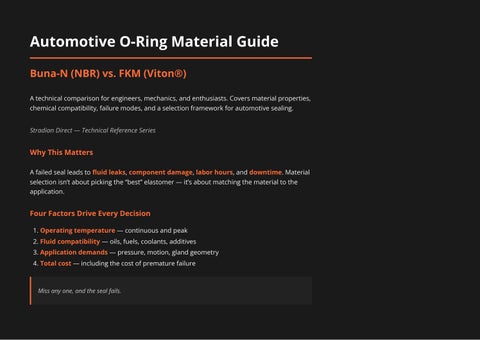
Automotive O-Ring Material Guide Buna-N (NBR) vs. FKM (Viton®) A technical comparison for engineers, mechanics, and enthusiasts. Covers material properties, chemical compatibility, failure modes, and a selection framework for automotive sealing. Stradian Direct — Technical Reference Series
Why This Matters A failed seal leads to fluid leaks, component damage, labor hours, and downtime. Material selection isn’t about picking the “best” elastomer — it’s about matching the material to the application.
Four Factors Drive Every Decision 1. Operating temperature — continuous and peak 2. Fluid compatibility — oils, fuels, coolants, additives 3. Application demands — pressure, motion, gland geometry 4. Total cost — including the cost of premature failure
Miss any one, and the seal fails.
Buna-N (NBR): The Everyday Workhorse Buna-N (Nitrile Rubber / NBR) is the most widely used elastomer for general-purpose automotive sealing. Cost-effective, reliable, proven.
Properties Excellent resistance to petroleum oils, greases, hydraulic fluids, and standard gasoline Good low-temperature flexibility Superior compression set resistance Low cost, high availability
Typical Applications Engine oil seals and valve cover gaskets Transmission seals and pan gaskets Standard fuel lines and fuel pump seals Power steering and hydraulic brake seals
Buna-N (NBR): By the Numbers Property
Value
Temperature range
-40°C to +100°C (-40°F to +212°F)
High-temp NBR
up to +120°C (+250°F), short duration
Petroleum oil resistance
Excellent
Standard gasoline resistance
Excellent
Ozone / weather resistance
Poor
Broad chemical resistance
Moderate
Where It Fails Poor ozone and UV resistance — cracks over time Limited resistance to ketones, esters, strong acids Not suitable for continuous service above 100°C Poor performance with alcohol-blended fuels (E10, E85)
Know the limits. Choose accordingly.
FKM (Viton®): The High-Performance Specialist FKM is a fluoroelastomer family known for exceptional performance in extreme environments.
Note: FKM is a family of materials, not a single compound. Viton™ is a trademarked brand owned by Chemours — not a generic synonym for all FKM.
Properties Exceptional high-temperature resistance Superior resistance to modern fuel blends (ethanol, methanol), aromatic hydrocarbons, and many acids Excellent ozone, UV, and weathering resistance Low compression set under sustained load
Typical Applications High-temp fuel injection systems Oxygen sensors and exhaust seals Turbocharger and supercharger seals High-performance transmission seals
FKM (Viton®): By the Numbers Property
Value
Temperature range
-20°C to +200°C (-4°F to +392°F)
Specialty FKM
-40°C to +230°C (-40°F to +446°F)
Petroleum oil resistance
Excellent
Alcohol-blended fuel resistance
Excellent
Ozone / weather resistance
Excellent
Broad chemical resistance
Excellent
Where It Fails Significantly higher cost than NBR Some grades have poor resistance to ketones and esters Standard FKM has poor low-temperature flexibility Not a universal replacement for NBR
Premium performance, but not for every job.
Head-to-Head Comparison Property
Buna-N (NBR)
FKM (Viton®)
Temperature range
-40°C to +100°C
-20°C to +200°C
Petroleum oil resistance
Excellent
Excellent
Alcohol fuel resistance
Poor–Fair
Excellent
Ozone / weather
Poor
Excellent
Compression set
Very good
Excellent
Broad chemical resistance
Moderate
Excellent
Low-temp flexibility
Good
Fair
Relative cost
Low
High
Typical use case
Engine/trans seals, standard fuel
High-temp fuel, sensors, turbo
How to Choose: A Simple Framework 1. Temperature ≤ 100°C? Buna-N is a candidate 2. Temperature > 100°C? FKM is the primary consideration 3. Aggressive fluids or ozone exposure? FKM required 4. Standard petroleum oils and gasoline? Buna-N handles it 5. Always verify the specific compound datasheet.
FKM is not automatically better. Buna-N isn’t always cheaper if it fails early.
Real-World Failure Modes Material
Failure Mode
Root Cause
NBR
Hardening, cracking
High-temperature degradation
NBR
Swelling, dissolution
Aggressive chemicals, ozone
FKM
Swelling, softening
Ketones, esters
FKM
Cracking, embrittlement
Extreme cold below rated limit
Wrong material = predictable failure.
Match the Material to the Mission Buna-N is the workhorse. FKM is the specialist. The right choice depends on your application — not on which material sounds “better.” Buna-N handles standard under-hood conditions at low cost. FKM handles extreme heat, aggressive fluids, and demanding environments at premium cost. Both are correct. Both are necessary. Choose based on your application’s actual demands.
Full Technical Guide Read the complete guide with selection flowcharts and compound-level data: https://stradiandirect.com/buna-n-or-fkm-picking-the-right-automotive-o-ring
Published by Stradian Direct Technical Reference Series Related Resources: GitHub technical reference: github.com/stradiandirect/automotive-o-ring-material-guide Machine-readable material data: data/oring-material-properties.csv