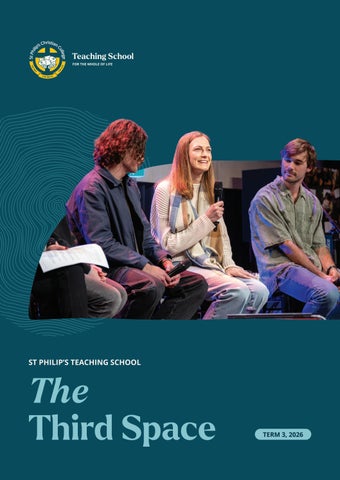
ST PHILIP’S TEACHING SCHOOL
The Third Space
TERM 3, 2026
The first five years shape a lifetime. Be part of that story. NEW DEGREE AT THE TEACHING SCHOOL ENROL IN A CHRIST-CENTRED BACHELOR OF EARLY CHILDHOOD EDUCATION (BIRTH TO 5 YEARS). Become from Day One. Discover a program that nurtures curiosity and wonder in young children, and forms educators who know how to captivate a love of learning and Jesus. Delivered in partnership with a Christian tertiary provider, this degree brings accredited academic rigour together with formation grounded in faith.
APPLY NOW TO BEGIN YOUR JOURNEY IN CHRISTIAN EARLY CHILDHOOD EDUCATION
THE THIRD SPACE | TERM 3, 2026
Table of Contents 04
14
28
A Message from our Director: Welcome to our Term 3 Edition of The Third Space
Formation, Discipleship and the Growth of a National Movement
Starting with One Plan... Discovering a Different Path
SAMANTHA VAN DE MORTEL
NICKEY BRIGHT
17
31
Why it Works: Principals on Employing our Graduates
Degrees of Impact: The Importance of the Tertiary Partnership
JAMIE FAHEY & MATT CONNETT
TRACEY DEAL
CARLIE BOYLE
06 Reorientating Ourselves to God’s Story: Reflections on the 2026 Mid-Year Conference MATT STACKHOUSE
08 Pedagogy for Inclusion: Learning to Teach Every Child DARLENE ERIEAU
11 Introducing the St Philip’s Teaching School, South Australia SAMANTHA VAN DE MORTEL
12 From Alumni Voices to National Conversation LIZ HUTCHISON
20 Stepping out in Faith: From Nursing to Teaching STEPHANIE OASTLER
32 The Village Behind the Village: Thank You to Our Teaching School Coordinators CARLIE BOYLE
22 Why We Say Yes: The Heart of Mentoring at the Teaching School CARLIE BOYLE
34 Camp Experience: Beyond the Classroom CALEB MILLS
26 Tranformation by Design: Growing Together in Christian Education MATT STACKHOUSE
3
THE THIRD SPACE | TERM 3, 2026
A Message from our Director
Welcome to our Term 3 Edition of The Third Space
The Author CARLIE BOYLE St Philip’s Teaching School, Director
This edition carries the theme Formation in Action, and it lands at a good point in our year of Providence. Romans 8:28 tells us that God works in all things for the good of those who love Him and are called according to His purpose. We have held that verse closely through 2026, and it shapes how we think about the work we do here at the Teaching School, because forming a teacher rarely happens in a straight line. It is full of small moments, setbacks, breakthroughs and relationships and we trust that God is weaving every one of them into something good.
At the start of term I sat at our SPCC conference centred on formation, and it gave me a chance to return to a question we consider often. Will this form or train a teacher? You can hand someone a syllabus, a set of competencies and a checklist, and measure whether they can perform a task by the end of it. That is training. Formation is harder to put on a checklist, because it is concerned with who a person is becoming, not only what they can do. It asks about character as much as competence, about the heart behind the practice as much as the practice itself. You can train someone to run a good lesson. Forming them is what leaves them still teaching with conviction, resilience and purpose long after that particular skill has been refined or replaced.
The Teaching School village standing at SPCC Staff Conference
4
Samantha Van de Mortel has led this thinking since the very beginning. Every decision made in the Teaching School comes back to the same question, whether it will help our trainees be formed rather than merely trained. In her article this edition, our Executive Principal writes about the growing movement of Teaching Schools across our nation and the trust God has placed
in Christian schools to carry this formational work forward. We see Him moving in this space, building partnerships, opening doors we did not ask Him to open, and raising up new communities committed to formation over training. None of this rests on one program or one person. It takes the whole village, mentors, teaching school coordinators, stage and faculty leads, principals, spouses and partners, standing together to form the next generation of Christian teachers for the mission ahead of them. We are grateful for every hand and heart in our village, and confident that God’s providence is at work through each one.
5
Thank you for being part of it. We hope this edition encourages you as much as it has encouraged us to put together.
THE THIRD SPACE | TERM 3, 2026
“Forming them is what leaves them still teaching with conviction, resilience and purpose long after that particular skill has been refined or replaced.”
THE THIRD SPACE | TERM 3, 2026
Reorienting Ourselves to God’s Story
Reflections on the 2026 Mid-Year Conference
The Author MATT STACKHOUSE St Philip’s Christian Education Foundation, Lead Specialist Spiritual Formation
One of the quiet privileges of working at St Philip’s Christian College is serving beside people whose faithfulness is expressed through ordinary things: careful preparation, generous service, thoughtful leadership and work done quietly for the good of others. The 2026 Mid-Year Conference brought these qualities into view. More than an event in the calendar, it became a reminder of who we are and of the story to which we belong. From the earliest planning through to the final session, the conference
reflected the values that shape our community. Christ was kept at the centre. Staff served one another willingly. Excellence was pursued not for recognition, but as an offering. Community was strengthened through worship, conversation, shared learning and the simple grace of being together.
more than forty years of service as he prepares to retire. His contribution carried the weight of experience. It reminded us that vocation is formed slowly, through faithfulness practised over time, through successes and disappointments, change and perseverance. Wisdom is rarely acquired quickly. It is usually received through a life that has learned to pay attention.
The theme of spiritual formation arose from a conviction that Christian organisations must attend not only to what they accomplish, but also to the kind of people they are becoming. We may become efficient without becoming wise, busy without becoming fruitful, or successful without becoming more like Christ.
Mark Ryan from Compass then reminded us that we are always being shaped by stories. Our culture offers many accounts of the good life: comfort, achievement, recognition, personal freedom or the endless reinvention of ourselves. These stories are powerful because they rarely announce themselves as stories. They simply become the air we breathe. The Christian life begins, in part, when we learn to breathe different air.
Spiritual formation concerns this deeper work. It is the gradual shaping of the whole person into the likeness of Jesus. It reaches beneath behaviour into our habits, desires, imaginations and loves. It asks not only, “What should I do?” but also, “Who am I becoming as I do it?” The first day began with Graeme Irwin’s reflection on the masterpiece of Providence and our identity in Christ. His words provided the theological frame for all that followed. Our lives and work do not rest finally upon our own effort, insight or control, but within the faithful purposes of God. Before we are defined by our roles, achievements or responsibilities, we are people whose lives are held in Christ. Graeme Evans then reflected on the lessons and wisdom gained across
6
Mark invited us to consider how our culture defines happiness, freedom and human flourishing, and whether these definitions can bear the weight placed upon them. His challenge was not to withdraw from the
It was fitting that Mark’s presentation was followed by the interactive Bible story, which invited us to enter that larger narrative together. With several fiddly bags of grapes, charcoal and craisins, along with stickers, chocolates and a generous measure of patience, staff were immersed in the biblical story for nearly an hour. People followed along graciously, even when the materials required some careful handling. The feedback afterwards was striking. Many staff expressed gratitude for the opportunity not merely to hear about God’s story, but to slow down and enter it together. The experience reminded us that Scripture is not simply information to be mastered. It is the world in which Christians learn to live. Scripture gives us the true account of reality. It tells the story of creation, fall, redemption and renewal. The world is made by God and filled with meaning. Sin has distorted human life and creation. In Jesus Christ, God has acted to reconcile and restore. History is moving not towards abandonment, but towards the renewal of all things. The second day turned towards transition, shared vocation and community. Jeff Nagle addressed the reality of change,
something familiar to individuals and organisations alike. Change unsettles us because it reveals how much security we place in familiar roles, routines and expectations. Yet transition is often one of the great classrooms of spiritual formation.
Before we are teachers, leaders, administrators or support staff, we are people gathered by Christ, nourished by his grace and made one in him.
Jeff reminded us that God teaches through the “curriculum of life”. Endings, uncertainties and new beginnings are not interruptions to discipleship. They are often the places where discipleship becomes real. Through them, the Spirit exposes our fears, deepens our trust and loosens our grip on the illusion that we are in control.
The 2026 Mid-Year Conference reminded us that spiritual formation is not a program to complete. It is the lifelong work of becoming people who live more fully within God’s story. Our calling is not merely to keep a Christian organisation running, but to become a community whose life together makes the reality of Christ more visible.
Time spent with PAOS staff further strengthened the sense that the mission of Christian education belongs to the whole community, not only to those working in classrooms. Formation occurs through administration, support, leadership, systems, hospitality and countless daily interactions. The conference concluded with communion, and it was difficult to imagine a more fitting ending. After two days concerned with formation, identity, vocation and change, communion returned us to the centre.
7
For that calling, for those who share it, and for the God who remains faithfully at work among us, I remain immeasurably thankful.
THE THIRD SPACE | TERM 3, 2026
world, but to become so deeply rooted in God’s story that we can recognise both what is good within our culture and what is false.
THE THIRD SPACE | TERM 3, 2026
Pedagogy for Inclusion:
Learning to Teach Every Child Across the term, trainees have explored how learning occurs, examined pedagogical approaches, unpacked the structure of Explicit Direct Instruction (EDI), and considered the classroom practices that help all learners experience success.
The Author DARLENE ERIEAU St Philip’s Teaching School, Lead Specialist Professional Learning Development What happens when diversity is treated as a strength rather than a barrier? At Insight, we continually return to a deceptively simple question: What does teaching that works for every student actually look like? In Term 3, our first-year trainees have been exploring that question through a nine-week learning sequence focused on pedagogy and inclusion. Rather than viewing inclusion as something added to a lesson after planning is complete, we have challenged trainees to consider a different idea: that inclusive classrooms are built through deliberate teaching practices that help every learner succeed.
WHY AUBURN NORTH? A significant turning point in the learning journey came during a visit to Auburn North Public School. Auburn North serves one of the most culturally and linguistically diverse communities in Australia, ranking among the nation’s top ten most diverse school communities. With large numbers of students from migrant and refugee backgrounds, and the overwhelming majority of students learning English as an Additional Language or Dialect (EAL/D), the school provides a compelling example of what inclusion can look like in practice. Yet the story of Auburn North is not defined by demographics. It is defined by what is possible when high expectations, explicit teaching, and strong partnerships with families come together. Through a sustained commitment to these approaches, the school has demonstrated that student background need not determine student outcomes. For our trainees, the visit provided an opportunity to see the ideas they had been discussing throughout the term enacted in real classrooms rather than discussed in theory. Perhaps the most powerful summary came from a trainee who wrote:
8
“Auburn North showed me what can happen when diversity is treated as a strength rather than a barrier.” That idea became a recurring thread throughout the reflections that followed. WHAT TRAINEES SAW Many of the trainees arrived expecting to see a school facing significant challenges because of its diversity. Instead, they encountered classrooms where students were deeply engaged, expectations were clear, and learning was the central focus. Several reflections revealed how strongly the visit challenged existing assumptions. “I used to think that students from diverse or disadvantaged contexts would not be as good at learning. It is clear that students with only a year’s worth of experience living in Australia can show excelling signs of learning.” Another trainee shared: “My visit to Auburn North challenged my assumption that students in highly diverse or disadvantaged contexts were not very well behaved. [What ] I saw [was] streamlined, effective and engaging lessons taught with very minimal behaviour management.” What stood out was not a lowering of expectations in response to diversity. Rather, trainees saw classrooms where students knew what they were learning, understood what success looked like, and were supported to achieve it. They saw teachers carefully guiding learning, addressing misconceptions, and creating an environment where participation and success were expected of every student. Again and again, trainee reflections returned to the same message: diversity was not limiting student success.
“Having a teaching model that is universal within a school is key for students to continue to progress in learning in a structured environment.” This observation surfaced repeatedly throughout trainee reflections. Across classrooms, students encountered familiar routines, common language, and shared expectations. While each teacher brought their own personality and style, the underlying approach remained consistent. Another trainee explained the shift in their own thinking: “I used to think that EDI was really different for each teacher, but now I think that it is important for all teachers in a school to have similar guidance and terms when teaching.” What many trainees began to recognise was that consistency is not about making every teacher the same. It is about creating certainty for learners. When students know what is expected, how lessons will unfold, and how success will be measured, more of their attention can be devoted to learning. THE DIFFERENCE CHECKING FOR UNDERSTANDING MAKES Checking for understanding generated some of the strongest trainee responses. At Auburn North, they saw this happening constantly.
Teachers circulated during independent practice. They stopped lessons to clarify vocabulary. They adjusted explanations when students appeared uncertain. Learning was continually checked rather than assumed. A reflection that captured this shift particularly well noted: “I used to think that checking for understanding happens only at the end of the ‘We do’ phase, but now I know that it happens deliberately, frequently and constantly throughout the whole process.” Another trainee described watching this happen in real time: “During independent practice, the teacher circled the room, checking every single student’s work and checking for understanding. They were very intentional in ensuring each child understood, and if there was a group of students which didn’t understand she would work with them together, she would give guided practice and go through another worked example.”
HIGH STRUCTURE, HIGH RELATIONSHIPS The visit also challenged the idea that explicit teaching and strong relationships sit at opposite ends of a spectrum. Classrooms were orderly, expectations were clear, and learning moved purposefully from one phase to the next. At the same time, there was an obvious sense of connection between teachers and students. A comment that stayed with us was: “I used to think EDI was scripted and robotic, but now I think EDI can be effective whilst still building strong teacherstudent relationships.”
For many, this highlighted how effective teachers continually use evidence of learning to shape what happens next.
TEACHING SCHOOL TRAINEES, STAFF FROM AUBURN NORTH PUBLIC SCHOOL, STAFF FROM SPCC GOSFORD AND DARLENE
9
THE THIRD SPACE | TERM 3, 2026
CONSISTENCY CREATES CONFIDENCE
THE THIRD SPACE | TERM 3, 2026
One trainee described watching a teacher make every contribution visible: “Demonstrating how the teacher listens to all contributions from each student by writing on the board. This validates and encourages collective participation.” Another highlighted the simple but powerful practice of consistently using students’ names: “Always using a child’s name before talking to them. This demonstrates that they value the child and care for what they have to say.” Structure did not diminish relationships. In many ways, it appeared to strengthen them. Clear expectations, predictable routines, and successful learning experiences created classrooms where students felt safe to participate and contribute.
INCLUSION BEYOND THE SCHOOL GATE The reflections did not stop at what was happening inside classrooms. Again and again, trainees returned to the school’s commitment to families and the wider community. Parents were not positioned as observers of learning. They were participants in it. One trainee wrote: “Parents are not expected to simply know how schooling works; instead, they are welcomed into the learning process.” Another reflected: “When educators support a child, we are often also supporting the family surrounding that child.” Many trainees were particularly struck by the programs designed to support families from migrant and refugee backgrounds and by the school’s efforts to build a genuine sense of belonging. These initiatives reinforced the idea that student success is strengthened when schools, families, and communities work together.
10
“...student success is strengthened when schools, families, and communities work together.“ LOOKING AHEAD As trainees begin designing lessons of their own, they do so having seen these ideas come to life. The visit to Auburn North provided more than an example of effective teaching. It demonstrated what becomes possible when strong teaching and genuine inclusion work hand in hand. Throughout the trainee reflections, a consistent message emerged: student diversity was not viewed as a barrier to overcome, but as a strength to be embraced. The practices they observed, from explicit teaching and continual checking for understanding to purposeful family engagement, showed what can happen when schools intentionally create the conditions for every learner to succeed. Inclusion is not something we add to good teaching. It is what becomes possible when every learner is seen, valued, and supported to succeed.
The Author SAMANTHA VAN DE MORTEL St Philip’s Executive Principal Tertiary Education
BECOME FROM DAY ONE In partnership with Tyndale Group of Christian Schools, the St Philip’s Teaching School is expanding to South Australia, welcoming trainees and schools into a community of Christ-centred teacher formation. It is a place where calling meets purpose, and where faith and craft grow together from day one. Trainees learn alongside experienced mentors, in real classrooms, forming as teachers who are equipped to teach Christianly. Spiritual growth and professional skill develop side by side, shaping graduates who bring a Christian worldview into every lesson, every relationship, and every classroom decision. FOR FUTURE TEACHERS Are you called to teach? South Australia now offers a direct path into the profession through St Philip’s Teaching School, delivered in partnership with Christian Heritage College. Mentored by experienced educators from day one, you will grow in faith and craft together, earning a salary as you train and stepping into your first classroom confident, equipped, and ready.
Applications for our South Australian intake are now open. Enquire today and begin your formation as a confident, Christ-centred teacher. DISCOVER MORE INFO ABOUT TRAINING IN SOUTH AUSTRALIA
Affiliate schools gain well-formed teachers, discipled on site and aligned with your values, an investment in the future of Christian education across our nation. CONTACT US
FOR SCHOOLS We are inviting Christian schools across South Australia to join us as affiliate schools. Alongside our partnership with Tyndale, we are committed to supporting and strengthening the wider Christian schooling community. Affiliation places your school at the heart of teacher formation, built on nine years of our proven school-embedded model, shaping confident, classroomready graduates who reflect your context and culture.
11
WE INVITE YOU TO BE INVOLVED IN THIS KINGDOM WORK Whether you are called to teach or called to walk alongside those who do, St Philip’s Teaching School South Australia has a place for you.
THE THIRD SPACE | TERM 3, 2026
Introducing the St Philip’s Teaching School, South Australia
THE THIRD SPACE | TERM 3, 2026
From Alumni Voices to National Conversation helps Teaching School graduates flourish in the profession, and what role does wellbeing, belonging, and educational identity play in that story?
The Author LIZ HUTCHISON St Philip’s Christian Education Foundation, Lead Specialist - Higher Education Development and Research
When the Australian Teacher Education Association (ATEA) released a call for paper presentations exploring initial teacher education through the lenses of teacher wellbeing, belonging, and educational identity, it felt like an invitation to attend a conference and more like an opportunity to learn from our alumni. These themes are not new to the Teaching School. Questions of belonging, identity, mentoring, wellbeing, and retention have been woven throughout our work for years. Yet the ATEA call prompted a deeper question: What
Rather than relying on assumptions or anecdotes, we undertook an alumni research study focused on these three concepts. The aim was not simply to evaluate the Teaching School model, but to better understand how graduates experienced their formational journey before entering the Teaching School, during their time as trainees, and after transitioning into early career teaching. The first step was designing and releasing a mixed-methods survey to alumni from the 2021-2024 cohorts. Twenty-one graduates responded, representing almost half of all eligible alumni. What began as survey responses became something richer: stories of mentoring relationships, school communities, personal growth, faith, challenge, and vocational calling. As the responses accumulated, alumni voices began to converge around several recurring themes. Although each journey was unique, clear patterns emerged across cohorts and career stages. Graduates consistently highlighted the importance of relational mentorship, describing mentors who invested in them professionally, personally, and spiritually. They also pointed to the significance of belonging within a community through peers, school placements, and Teaching School connections. Experiences of being welcomed, known, and journeying alongside others contributed powerfully to wellbeing and resilience.
12
A third theme centred on educational identity formation. Graduates frequently reflected on the importance of being treated as teachers from the outset rather than waiting until graduation to assume a professional identity. Authentic responsibility, immersion in school life, and opportunities to contribute meaningfully strengthened graduates’ confidence, purpose, and professional identity. Alongside this sat the role of faith, with many participants describing teaching not simply as a profession but as a calling through which belief, identity, and practice were connected. One further theme emerged consistently across the data: the importance of ongoing support beyond graduation. Alumni valued continued mentoring, relational connections, induction support, and opportunities to remain connected to the Teaching School community as they navigated the demands of early career teaching.
ANALYSIS
CONFERENCE
Call
& Interpretation
Develop & Present
1
3
5
2
4
THE THIRD SPACE | TERM 3, 2026
ATEA
6
SURVEY
REPORT
TRAINEE DEVELOPMENT
Alumni Voices
Research Findings
Trainee & Early Career Teacher Support
While analysis was still underway, we submitted an abstract to ATEA. The following months involved further data analysis, thematic coding, report writing, and mapping findings against teacher retention and formation literature. One of the most rewarding aspects of the process was watching alumni voices transform into a coherent story. Individual comments contributed to themes. Themes became findings. Findings became interpretations and the story we shared at ATEA. Once the study was completed, attention turned to preparing for the conference. Together, Sam and I refined the presentation multiple times, working to communicate months of research within a tightly structured conference format. Presenting at ATEA provided an opportunity to share what we are learning from graduates and to engage with researchers and teacher educators from across Australia. Conversations following the presentation explored the contribution of third-space approaches to teacher formation and research methods.
support beyond graduation. As a result, the study is informing discussions about future program development, alumni engagement, and the design of more intentional support pathways for Early Career Educators as they transition into the profession.
“Alumni feedback is being used as part of the Teaching School’s ongoing cycle of reflection and continuous improvement.” Looking back, this six-month journey was a reminder that research is not separate from practice. It begins with meaningful questions, grows through attentive listening, and develops through disciplined analysis. Most importantly, it creates opportunities for practitioner knowledge to contribute to wider educational conversations.
Importantly, the study is not simply informing conference conversations; it is also shaping our own practice. Alumni feedback is being used as part of the Teaching School’s ongoing cycle of reflection and continuous improvement. The findings affirmed many strengths within the trainee experience, particularly mentoring, belonging, identity formation, and faith immersion, while also highlighting opportunities to strengthen
13
What began as a conference call for papers ultimately became something more: an opportunity to hear alumni voices, learn from their experiences, and contribute to a national conversation about how teachers are formed, supported, and sustained in the profession. And now, that conversation continues here in The Third Space.
THE THIRD SPACE | TERM 3, 2026
Formation, Discipleship and the Growth of a National Movement 2018
2020
ST PHILIP’S TEACHING SCHOOL
CALVARY EDUCATION GROUP
2020
TEACHING SCHOOLS ALLIANCE SYDNEY
The Author SAMANTHA VAN DE MORTEL St Philip’s Executive Principal Tertiary Education
The St Philip’s Teaching School was founded on a conviction that remains central to everything we do. Teaching is not simply a profession to be learned but a vocation to be formed. While traditional approaches to Initial Teacher Education often focus on knowledge and classroom competencies, the Teaching School model seeks something deeper. Its purpose is the formation of Christian educators whose identity, character and practice are shaped through authentic participation in Christian school communities.
14
Importantly, the vision of the Teaching School has never been driven primarily by workforce shortages or the need to increase teacher supply. The goal has always been to cultivate educators who are exemplary practitioners and faithful contributors to the mission of Christian education. At the heart of this vision is a commitment to Christian formation and discipleship. We are not simply preparing excellent teachers to work in Christian schools. We are helping form educators who can think, teach, lead and serve from a distinctly Christian worldview. Through mentoring relationships, professional learning communities and
2022 CEM TEACHER TRAINING SCHOOL
THE THIRD SPACE | TERM 3, 2026
2024
2026
SOUTHLAND COLLEGE TRAINEE TEACHER PROGRAM
REHOBOTH TEACHER HUB
CHRISTIAN EDUCATION NATIONAL NORTHERN TERRITORY CITE ALLIANCE VICTORIA
2023
KING’S COMMUNITY OF TEACHING Formerly known as King’s College of Teaching
2027
SYDNEY CHRISTIAN SCHOOLS TEACHING HUB
CHARIS TEACHER TRAINING SCHOOL
CHRISTIAN EDUCATION NATIONAL TASMANIA
intentional formation, trainees experience Christian education as a lived reality rather than merely a theoretical concept. Partnerships with Christian tertiary providers strengthen this vision. Together, Teaching Schools and Christian universities provide an
integrated formation journey where faith, learning and practice are woven together. Rather than learning about Christian education in one context and applying it in another, trainees are immersed in environments where biblical thinking shapes both
15
academic study and professional practice. As a result, Christian education is not viewed as an additional framework or specialist skill. It becomes the
THE THIRD SPACE | TERM 3, 2026
native tongue of the developing educator, the first language through which they understand learners, curriculum, relationships and the purpose of education. Through intentional discipleship, future teachers develop the wisdom and professional judgement to faithfully integrate biblical truth and lived faith throughout their practice.
Central to this work is the role of Teaching Schools as the Third Space. They function as an educational entity that enables intentional partnership between schools and tertiary providers, where theory, practice and formation intersect. Within this space, trainee teachers are supported through a workshopbased curriculum, cohort community, monitoring of progress and intentional placements with equipped mentors. This combination is critical to the high retention rates and strong leadership pipeline seen in graduates over the past five years.
At a time when teacher attrition, workforce shortages and concerns regarding classroom readiness continue to challenge schools across Australia, Teaching Schools offer an alternative vision. They recognise that schools themselves have a critical role in forming educators through authentic practice, mentoring and participation in professional communities.
A GROWING NATIONAL NETWORK What began as a local initiative has become part of a growing national movement. Across Australia there are now 12 Teaching School hubs supporting 288 trainee teachers across more than 80 schools, united by a shared commitment to Christcentred, school-embedded teacher education. This growth reflects more than the expansion of a successful model. It represents growing confidence in the role schools play in developing educators through mentoring, discipleship and authentic participation in Christian learning communities. Teaching Schools do not simply support trainees. They strengthen the mission of Christian education, develop mentoring capacity, create pathways for leadership and build professional learning communities that benefit entire school communities. This emerging movement is supported by the work of the Australian
16
Association of Teaching Schools (AATS), which brings Teaching Schools together around a shared vision for high-quality, school-embedded teacher formation. Through collaboration, professional learning, advocacy and research, the Association seeks to strengthen and connect a growing network committed to the future of Christian education. STEWARDING AND BUILDING ON CHRISTIAN EDUCATION Ultimately, Teaching Schools exist because Christian education cannot be sustained by curriculum documents, mission statements or strategic plans alone. It is sustained through people. The future of Christian education depends on educators who can faithfully embody and communicate a biblical informed vision of learning, teaching and discipleship, teachers who are called and equipped to teach Christianly Every trainee within the Teaching School communities represents an opportunity to raise up a teacher for whom Christian education is woven into their very being, not layered on top, an educator whose professional identity, teaching practice and vocational purpose are shaped by a deeply Christian understanding of learning and discipleship. In this sense, Teaching Schools are doing more than preparing teachers. They are helping reproduce and renew Christian education itself. By forming educators whose hearts, minds and practice are shaped by a biblical vision of learning, Teaching Schools are helping ensure that Christian education remains vibrant, faithful and transformative for generations to come. As we celebrate the growth of this movement, we give thanks to God for His faithfulness and provision. We also recognise and honour the Teaching School directors, school leaders, coordinators, mentors, school communities and tertiary partners across Australia whose faithful commitment to the formation of Christian educators is shaping and protecting the future of Christian education. Together, we are raising a generation of classroom ready teachers who will serve Christ, strengthen schools and influence countless young lives with the good news of the Gospel for years to come.
THE THIRD SPACE | TERM 3, 2026
Why it Works:
Principals on Employing our Graduates We started the Teaching School because we cared about something we did not want to leave to chance, the mission of Christian schooling. It is not enough for a Christian school to simply exist or for a teacher to hold their faith privately while teaching much like anyone else. Teacher and author David I. Smith argues that faith should shape not only what a teacher believes about their subject, but the actual practice of teaching, right down to how a
lesson is framed and how students are treated inside it (Smith, 2018). That distinction sits at the centre of everything we do. Our graduates are formed to be professionally excellent and contextually ready, teachers who understand what it means to teach Christianly and who can explain why their classroom should look and feel different from the class down the road.
That conviction only matters if it holds up where it counts, in the schools who employ our graduates and live with the results. So, we asked a couple of our principals to reflect on why the model works for them.
“Faith should shape not only what a teacher believes about their subject, but the actual practice of teaching, right down to how a lesson is framed and how students are treated inside it.”
17
THE THIRD SPACE | TERM 3, 2026
the complexities of teaching. Through their extended immersion in schools, they have already developed the habits and professional skills that help them transition successfully into the classroom.”
The Author JAMIE FAHEY Principal, St Philip’s Christian College Newcastle “We choose to employ Teaching School graduates because they arrive with more than just qualifications. They bring confidence, practical experience and a real understanding of
“What I notice in Teaching School graduates is often a readiness to contribute from day one. They have spent significant time learning alongside experienced teachers, engaging in authentic school life and building strong instructional practices. As a result, they often demonstrate greater confidence in classroom management, stronger relationships with students and a clearer understanding of how to translate theory into effective teaching. Because Teaching School graduates have often already been in our school, or schools similar to ours, they are active contributors to our faith and culture from day one.”
“If I had to describe what the Teaching School partnership has given our school, I would say it has strengthened our ability to invest in the future of the profession. The partnership has created a valuable pipeline of talented, well-prepared teachers who understand our context and culture. It has also enriched our existing staff, providing opportunities for mentoring, collaboration and professional growth. Most importantly, it has helped us build a sustainable culture of excellence where experienced educators and emerging teachers learn from one another for the benefit of every student.” “In a time when attracting and retaining high-quality teachers is one of the greatest challenges facing schools, the Teaching School partnership provides a real solution. It is helping to develop capable, committed and mission-minded educators who are ready to make a meaningful difference in the lives of young people and our school community.”
“It is helping to develop capable, committed and mission-minded educators who are ready to make a meaningful difference in the lives of young people and our school community.”
13
Graduated or current trainees employed at SPCC Newcastle L-R: Nicole Bilson, Georgia Craig, Michael Kalokerinos, Jackson Steele, Jamie Fahey, Jack Roberts, Ange Wilson, Nathan Cathcart, Alex Krosher. Not pictured: Holly McCredie, Sam Hodson, Peter Rose, Bethan Knaus, Jarrad Clayton
18
“What I notice in a Teaching School graduate is their confidence in connecting theory to practice. They demonstrate an ability to reflect on their practice and development, seek and respond to feedback effectively, and are equipped with practical strategies
THE THIRD SPACE | TERM 3, 2026
“We choose to employ Teaching School graduates because they arrive with a strong foundation in excellent practice, a commitment to ongoing growth, and a clear understanding of the realities of the classroom. They are well prepared to facilitate excellent student learning and school culture from the very beginning of their journey.”
that enable them to build strong learning relationships and deliver quality teaching from day one.” “If I had to describe what the Teaching School partnership has given our school, I would say it has created a valuable pipeline of talented, well-prepared educators who enrich our professional learning culture. It represents a strong connection between teacher preparation and classroom practice, benefiting both our staff and, most importantly, our students.”
The Author MATT CONNETT Principal, St Philip’s Christian College Cessnock
“It has created a valuable pipeline of talented, well-prepared educators who enrich our professional learning culture.”
11
Graduated or current trainees employed at SPCC Cessnock
L-R: Anna Deng, Chris Teasdale, Zachary Pond, Callum Doust, Lauren Potter, Matt Connett, Gabby Connett, Bri Doust, Grace Turner Not Pictured: Shania Bekker, Matt Smith, Josiah Perrim
Two different schools, and yet the same picture emerges. Graduates arrive ready, they already understand the culture they are stepping into, and they strengthen the schools around them rather than simply filling a vacancy. Jamie and Matt lead different schools, but they are describing the same outcome. Our graduates are ready before they walk in the door.
REFERENCE Smith, D. I. (2018). On Christian teaching: Practicing faith in the classroom. Eerdmans.
19
THE THIRD SPACE | TERM 3, 2026
Stepping out in Faith
From Nursing to Teaching
The Author STEPHANIE OASTLER St Philip’s Teaching School Graduate
I had been a Registered Nurse for just two weeks when Australia went into lockdown. Within days, I found myself caring for patients in an emergency department in the middle of a global pandemic. Teaching was the furthest thing from my mind. Looking back now, I can see that God was using nursing to prepare me for the classroom. Nursing taught me resilience, adaptability and how to remain calm when things are unpredictable and do not go to plan. It taught me how to care for people in moments of crisis. Now, I care for students through seasons of growth and change.
I pursued nursing wanting to make a difference in people’s lives, support them when they were vulnerable and, where possible, reflect the love of Jesus through my work. It was exciting, fast-paced and demanding all at once. While I enjoyed the practical side of nursing, I gradually realised that the moments I found most rewarding were the relational ones. My favourite shifts were the rare quiet night shifts where I could sit with a patient, make them a cup of tea and simply listen. I discovered that I cared for people best when I understood their experiences, hopes and fears. These opportunities were rare in a busy emergency department, and I began to feel frustrated and disheartened that I couldn’t connect the way that I felt called to.
the idea of learning in a close-knit community while being immersed in real classrooms from the beginning. I struggled with the infrequent block placements in nursing and loved the idea of on-the-job training.
As time went on, I realised how much I loved working with student nurses. I loved helping them develop skills and confidence, sharing knowledge and becoming a safe person they could turn to for support. Looking back, I think that was one of the first signs that God may have been leading me towards teaching.
The setting changed, but the calling to serve and love people remained.
God started revealing teachers in my life and stirring my heart towards a change. My sister had recently graduated as a teacher and started working at St Philip’s. I had friends who started studying through the Teaching School. As I listened to them talk about their experiences it became clear that they genuinely loved what they were doing. Although I was unsure about returning to study after already completing one degree, the Teaching School model immediately appealed to me. I loved
20
With a growing sense that teaching was where God was calling me, I applied and joined the Teaching School. What surprised me most was just how much nursing had already prepared me for teaching. Although they seem like very different professions, both are built around serving people. Both require quick thinking, problem solving, communication and the ability to balance competing priorities. As a nurse, I constantly assessed situations, identified needs and worked closely with families and colleagues. In the classroom, I find myself doing many of the same things as I support students academically, emotionally and socially.
I still remember talking with my first mentor and grade team as I wrestled with whether I was better suited to Primary or Secondary teaching. They genuinely cared about helping me uncover where God was calling me, and their support gave me confidence to pursue that calling. Today, I am in my third year of teaching Year One, and it is hard to believe how quickly the time has gone. For me, thriving in teaching is not about having everything figured out. It is finding joy and purpose in the everyday moments; seeing a student grasp a new concept, watching confidence grow, supporting families through challenges and celebrating milestones together. The genuine joy I find in my work gives me peace, knowing that I am in the right place. The relationships with colleagues, the opportunity to journey alongside students and families, and the strong Christian community all remind me that this is where God has called me.
pray with students, support families and help children understand that they are deeply known and loved by God. I’ve seen firsthand how Christian education can have a lasting impact, not only on students but on entire families. Being part of that is something I will never take for granted. Perhaps what I appreciate most now is seeing how all the pieces fit together. Nursing was not a mistake or wasted time. It was part of God’s preparation. The skills, experiences and lessons I gained as a nurse have shaped the teacher and person that I am today. I once thought that leaving nursing behind meant that I had failed and was losing everything I had worked towards. But God has been reminding me that He works all things together for good. Returning to study was not a step backwards. It was a step of faith. The years of study, the double shifts, working through a pandemic, difficult conversations with patients and families, and the uncertainty that came with changing careers were all part of God’s preparation. Looking
One of the greatest blessings of working at St Philip’s has been being able to openly live out my faith every day. Faith is woven into everything we do. It is a privilege to
READY TO STEP OUT IN FAITH? APPLY NOW TO JOIN THE ST PHILIP’S TEACHING SCHOOL 21
back, I can see His faithfulness and direction through every step, and I am grateful for every part of this journey. For anyone considering a career change into teaching, my encouragement is simple; no season is wasted. The skills you develop, the challenges you face and the lessons you learn all shape what comes next. Pray and consider the ways that God may be preparing you for something new. His plans are always better than ours and it is so worth stepping out in faith.
THE THIRD SPACE | TERM 3, 2026
What stands out most when I think about my teacher training is not just what I was learning, but who I became. Being in classrooms every week allowed me to build confidence gradually, receive regular feedback and learn from experienced teachers. My mentors invested so much into my growth, and their encouragement continues to impact me today. I developed a deeper understanding of what it means to teach with purpose.
THE THIRD SPACE | TERM 3, 2026
Why We Say Yes:
The Heart of Mentoring at the Teaching School Ask a trainee what shaped them most in their first year and mentoring always comes up in the answer. Alongside the coursework, it is the mentor, showing up in the classroom week after week, who turns study into practice and helps a trainee find who they are as a teacher. Talk to any of our mentors and you hear the same thing, a willingness to walk alongside another person through the early formative years of teaching.
The research supports this and so does our own. A longitudinal study of student teachers found that support from mentors was a significant predictor of both their engagement and their sense of psychological safety in the classroom (Dreer-Goethe, 2025). International research following early career teachers has similarly found that participation in a mentoring program shapes how long new teachers expect to remain in the profession, largely through the sense of organisational commitment it builds (Park & Choi, 2025). Closer to home, our own Liz Hutchison recently surveyed our alumni and found that 18 of 21 graduates named their mentor relationship as the strongest protective factor for their wellbeing, belonging and identity in those first critical years
college first began exploring what it would look like to train Christian teachers on the job rather than only through a short practicum. That early willingness to try something new, before the model was proven and before there was a clear path to follow, laid the foundation for the mentoring culture Cedars now carries.
STEVEN SEYMOUR, CEDARS CHRISTIAN COLLEGE Mentor to Tom Oyston 2023 & 2024, Anna Quillfeldt 2025 & 2026
Steven has been part of this story from the very beginning. He is one of the mentors who helped pioneer the Teaching School model at Cedars, back when the
We asked why Steven said yes to mentoring, his answer looks past the trainee in front of him entirely. “I said yes to mentoring because it gives me the opportunity to impact not only one trainee teacher, but every student they will teach throughout their career. Potentially thousands of young
22
of teaching. Three separate sources and the same answer each time, mentoring is not a support function sitting alongside teacher formation. It is one of the primary places formation happens. This is the rainforest at work, not a uniform program applied the same way to every trainee, but an experienced teacher creating the conditions for someone else’s growth and adjusting to who that person is becoming. We recently asked six of our mentors the same five questions, why they said yes to mentoring, what keeps them saying yes, what has surprised them, what mentoring has given back to them and whether a particular moment with a trainee has stayed with them. Their answers, honest and moving, get to the heart of why this work matters.
people will become more confident and capable learners because of the wisdom, skills and encouragement I can pass on to the next generation of educators.” It is a striking way to frame mentoring, not as an investment in one person for a season, but as something that multiplies quietly for decades, reaching classrooms and students he will never see. As one of the pioneers of the model at Cedars, that long view has shaped mentoring there from the outset and it remains at the heart of why the program continues to grow.
What keeps her saying yes is her belief that mentoring reaches far beyond her own classroom. Watching a trainee build confidence, discover strategies that work and find their own teaching style is deeply rewarding and she sees it as part of her calling as a Christian educator. Someone once invested in her and mentoring is her way of paying that forward. ALLISON MURRAY, ST PHILIP’S CHRISTIAN COLLEGE, CESSNOCK Mentor to 2021 Amy Johnston , 2022 Noah Roberts and Maddi Oppelaar, 2023 Bailey Muendel, 2024, Emily Dobos, 2025 Jessica Johnson , 2026 Shania Bekker
Allison said yes to mentoring because of her own start in the profession. Early in her career she experienced what it felt like to learn in an environment that was not always supportive and she wanted to offer trainees something different, a space where they felt encouraged, valued and equipped to grow as Christian educators. Teaching, she says, is a profession built on relationships with God, staff and
She has been surprised by how much growth happens in the ordinary moments, not in formal feedback sessions but in conversation, observation and coaching in the middle of a lesson. Over the years she has developed what she calls an in-the-moment coaching style, modelling strategies
“Someone once invested in her, and mentoring is her way of paying that forward.”
and how much difference a supportive mentor made to him. Saying yes was his chance to return that investment, to help someone else find confidence and their own teaching style in those uncertain early years.
SAMUEL CHISHOLM, DYNAMIC LEARNING COLLEGE, GOSFORD Mentor to Rebecca Robinson 2022, Ebony Noland 2026
Samuel remembers what it felt like to be the one starting out
He is candid about the cost. Teaching is busy, and mentoring adds to that load. But he keeps saying yes because mentoring reminds him that he is helping shape the future of the profession and watching a trainee grow in confidence makes the extra time worthwhile. What has surprised him most is how much he learns himself. Explaining the reasoning behind his own teaching decisions has
23
and offering support as situations arise, and she is continually struck by how quickly trainees grow when they are supported in real time rather than left to work it out alone. Mentoring has made Allison a more reflective teacher. Having a trainee in the room pushes her to examine her own practice and articulate the thinking behind her decisions, while trainees bring fresh perspectives and current research that keep her learning too. One moment has stayed with her, a trainee who, after receiving coaching on a lesson, was encouraged by Allison to ask her own students for two glows and a grow. The students responded thoughtfully, and watching that trainee’s confidence grow through her own students’ feedback reminded Allison that growth can come from many sources, and that mentoring is ultimately about helping someone recognise their own potential.
pushed him to reflect more intentionally on his own practice, and to keep refining it rather than letting it settle. For Samuel, the highlight of this season has been watching his trainee, Ebony, build genuine relationships with her students. Her energy, her willingness to look for ways to help and her eagerness to learn while staying reflective and student focused, have made mentoring her, in his words, a real highlight.
THE THIRD SPACE | TERM 3, 2026
community and mentoring felt like a natural extension of that.
THE THIRD SPACE | TERM 3, 2026
engaging students in ways that feel relevant to a new generation, and whose enthusiasm she describes as contagious.
DEBORAH DIEDRICKS, ST PHILIP’S CHRISTIAN COLLEGE, GOSFORD Mentor to Jasmyn Collyer 2022, Maegan Cameron 2023, Laura Farrelly 2024, Vienna Chalmers 2025, Caleb Mills 2026
What has surprised Deborah most about mentoring is how quickly it becomes a genuine partnership. What can begin as welcoming someone into an established classroom soon becomes something else entirely, a shared space where they plan, teach, reflect and celebrate their students’ progress together. She has been equally surprised by how much she learns from her trainees, who bring fresh ideas and current strategies for
“What has surprised Deborah most about mentoring is how quickly it becomes a genuine partnership.” Mentoring has reminded her that professional learning does not only happen in formal courses or development days. Some of the most valuable learning, she says, happens in the everyday, a conversation about a lesson, a discussion about how to support a particular student, an honest reflection on what worked and what did not.
Mentor to Chloe Cathcart 2023, Lorraine Burger 2026
Taylor brings a distinct voice to this group, shaped by a deep passion for early childhood education and a hope that his
For Deborah, mentoring in SPCC is also a chance to model teaching as service, demonstrating care, patience and humility and helping her trainees see teaching as both a profession and a ministry. It has renewed her own enthusiasm for the classroom and reminded her of the value of walking that journey alongside someone just beginning theirs.
What mentoring has given Deborah back is connection, the joy of walking alongside
trainees will fall in love with the sector the way he has. For Taylor, mentoring is an extension of what his role already is, a spirit of serving children, families and colleagues and that same spirit is what keeps him saying yes. Mentoring, he says, is not a burden. It is an opportunity.
TAYLOR ROSS, NARNIA EARLY LEARNING, CESSNOCK
someone who shares the same sense of calling for teaching and watching them grow in confidence and find their own style. It has made her more reflective in her own practice and she values the trainees she has asked for feedback after her own lessons, conversations she has found genuinely rewarding, hearing her teaching through fresh eyes. That openness, she believes, models something important for students too, that none of us are expected to know everything, only to keep listening, learning and improving.
What has surprised him most is how much he learns from his trainees. Their conversations often bring moments of revelation, prompting Taylor to reflect on his own practice and his own unconscious bias in ways he did not expect. Mentoring has given him back the excitement of learning something for the first time and he points to the joy of watching a trainee unlock a critical skill or push through
24
a barrier as what keeps him coming back. The moments that stay with Taylor most are the conversations themselves, particularly around the early childhood environment. Learning, he reflects, is often assumed to be something taught, delivered or imparted, but in early childhood especially, it is something shared, discovered and tested through play. Every moment matters and holds value, and it is in noticing that alongside a trainee that he finds the deepest meaning in this work.
JULIE STOWE, BELMONT CHRISTIAN COLLEGE Mentor to Esther Shen 2025, Joseph Alexander 2026
Julie has been imagining this model for longer than most. She said yes because she has always believed in investing in the next generation of teachers, and long before the Teaching School existed, she dreamed of something like an apprenticeship pathway into the profession. Watching that vision become real
What keeps her saying yes, even inside the busyness of a teaching week, is what mentoring does to her own practice. It keeps her reflecting, refining and growing, she says, while giving her the privilege of encouraging someone else at the start of their journey. She has been surprised by how much growth is possible once a trainee feels genuinely supported, challenged and believed in, and how often it is the small moments, an honest piece of feedback, a word of encouragement, that carry more weight than we realise. The moment that has stayed with her is not a single lesson or breakthrough, but the relationships themselves. Julie has been invited into her trainees’ lives well beyond the classroom, into their faith, their engagements and weddings, their holidays and milestones.
Six voices, six schools, six very different classrooms, and yet the same thread runs through all of them. This is what formation over training looks like in practice, not a program delivered to a trainee, but a relationship that shapes both people inside it.
“She has been surprised by how much growth is possible once a trainee feels genuinely supported, challenged and believed in.” She calls it a trust she never takes for granted. And when her own daughter went through the Teaching School apprenticeship model, Julie watched everything she had hoped the program could be play out in real time. If we want great teachers for the future, she says, we need to be willing to invest in them today.
REFERENCES Dreer-Goethe, B. (2025). The impact of mentor support and high-quality connections on student teachers’ psychological safety and engagement during practicum. Frontiers in Education, 10, Article 1499749. https://www.frontiersin. org/journals/education/articles/10.3389/ feduc.2025.1499749/full
Interested in Becoming a Mentor? Teachers at our SPCC Colleges and partner schools can express interest via the QR code.
25
Park, S., & Choi, S. (2025). Boosting novice teachers’ retention intention: International evidence on the role of mentoring via job satisfaction and organizational commitment. Journal of Educational Administration, 63(6), 489–504. https:// www.emerald.com/jea/ article/63/6/489/1277125/ Boosting-novice-teachersretention-intention
THE THIRD SPACE | TERM 3, 2026
has, in her words, been exciting to witness from the inside.
THE THIRD SPACE | TERM 3, 2026
Transformation by Design:
Growing Together in Christian Education
The Author MATT STACKHOUSE St Philip’s Christian Education Foundation, Lead Specialist Spiritual Formation
There are days in education that remind us why this work matters. They lift our eyes beyond deadlines, programs and daily responsibilities, and help us see again the privilege of serving within Christian education. Our recent Transformation by Design professional learning day, involving staff from Dynamic Learning and SPCC Snowy Mountains, was one of those days.
Developed in collaboration with Carlie Boyle and Darlene Erieau, the workshop brought together teaching staff and PAOS staff for a day of learning, reflection and shared work. Its purpose was not simply to introduce another curriculum framework. It invited us to think more deeply about the calling of Christian education: what we teach, how we teach, and who our students are becoming. Education is never merely the transfer of information. Every school forms its students through its relationships, routines and expectations. Students are continually learning what matters and what kind of world they inhabit. Transformation by Design helps us approach this task more thoughtfully. The day began with the Main Idea, the central understanding that gives direction and purpose to a unit of learning. Curriculum can easily become a collection of outcomes, activities and assessments. The Main Idea encourages teachers to look beneath the content and ask deeper questions. What enduring understanding lies at the heart of this unit? What should remain with students after the details have faded? How might this learning help them see the world differently? Knowledge does not simply sit in the mind. It becomes part of how a person understands and responds to the world.
26
Attention then turned to the Biblical Perspective. Scripture gives us more than a collection of verses or moral lessons to attach to a unit. It gives us the great story within which all learning finds its place: creation, fall, redemption and renewal. This story tells us that the world was created by God and is worthy of careful attention. It tells us that the world is broken, and that human beings often misuse knowledge, freedom and power. It tells us that God has acted in Jesus Christ to reconcile and restore. It also gives us hope that history is moving towards renewal. When learning is viewed through this story, faith is not an extra component added to the curriculum. Every subject becomes an opportunity to understand God’s world more truthfully. The task is not to make every lesson sound overtly religious, but to help students see that all truth belongs to God, and that every area of learning can deepen wisdom, wonder and responsibility. The final focus was on Threads, biblical themes that can be woven intentionally through programs of learning. These Threads help students connect particular topics with larger questions of justice, stewardship, creativity, service, community, brokenness and hope. The aim is not to force a Christian connection into every topic. Students quickly recognise what feels contrived. The better task is to uncover the meaning already present within the subject and help students notice it.
The day also strengthened relationships between campuses. Staff from SPCC Snowy Mountains and Dynamic Learning were able to learn alongside one another and recognise that they are part of a wider community pursuing the same mission. Christian education can be demanding work, and there is real encouragement in knowing that we do not carry the responsibility alone.
Transformation by Design is ultimately about more than curriculum planning. It is about participating faithfully in God’s work of formation. We are not simply helping students gain knowledge or prepare for employment. We are helping them learn to live in God’s world with wisdom, humility, courage and hope.
That calling is usually carried out through small and ordinary acts: a carefully chosen question, a thoughtfully designed unit, a generous conversation between colleagues, or a moment when a student begins to see something in a new way. The day was a warm reminder that when Christian educators learn, reflect and work together, meaningful transformation happens.
“We are not simply helping students gain knowledge or prepare for employment. We are helping them learn to live in God’s world with wisdom, humility, courage and hope.”
27
THE THIRD SPACE | TERM 3, 2026
The conversations were thoughtful, practical and encouraging. Staff shared ideas, asked questions and found new ways of approaching familiar content.
Pete Muddle, Principal of SPCC Snowy Mountains, worked with PAOS staff to consider how Transformation by Design might shape their areas of responsibility. This reinforced a central truth: the mission of Christian education belongs to the whole school community. Formation does not happen only in classrooms. It also occurs through administration, student support, operations, policies and everyday conversations.
One of the strongest parts of the day was the opportunity for genuine collaboration. Staff worked in teams to examine existing programs and units. Together they identified Main Ideas, discussed Biblical Perspectives and selected Threads that aligned naturally with the learning.
THE THIRD SPACE | TERM 3, 2026
Starting with One Plan... Discovering a Different Path
The Author NICKEY BRIGHT St Philip’s Teaching School, Lead Specialist Operations and Strategy
For many aspiring Christian educators, the decision to become a teacher begins not simply as a career choice, but as a sense of calling. For those considering a teaching journey the question ‘do I feel called to teach?’ is quickly followed by ‘what am I called to teach?’.
Over the past ten years of the Teaching School, we have seen many trainees begin their studies certain of the speciality they are called to: convicted they belong in Kindergarten, Stage 2, or Senior English. For others they can know teaching is for them, but the decision on primary or secondary, or the particular speciality is not as clear. At St Philip’s Teaching School, Bachelor trainee teachers spend more than 350 days immersed in real classrooms, learning alongside mentors and becoming part of authentic school communities. In addition to their assessed professional experiences, most trainee teachers experience multiple classrooms, campuses and contexts. Through prayer, mentoring, observation and hands-on experience, they confirm both their calling to teaching and question where their gifts are best used in service of young people. For both second-year trainee Vienna Chalmers and Teaching School Alumni (class of 2023) Angelique (Ange) Wilson, the answer was not what they first expected.
28
Q&A: DISCOVERING THE RIGHT CLASSROOM Did you always know which stage of teaching you wanted to pursue? Vienna: “I thought so. I always knew I wanted to be a teacher. From as early as I can remember, I was setting up classrooms and teaching my younger siblings. And then throughout school, church and dance teaching experiences, people kept affirming that teaching was on my life. When I started at the Teaching School, I enrolled in secondary education because I loved English and some of my HSC subjects. But once I was regularly in classrooms, I started to question whether I had made the right decision.” Ange: “As I approached the end of Year 12, I wasn’t sure what was next for me. I had a wide range of interests and was excited for lots of different possible pathways. As I was praying and discerning what to do, many people spoke into my life. I remember a particular moment when a school leader, Mr Graeme Evans, encouraged me after noticing how naturally I connected with children. He asked if I had considered teaching. When a chaplain at the school later shared with me about the Teaching School, it felt like an opportunity to continue growing within
How did classroom experience shape your decision? Vienna: “Being in schools from day one made all the difference. In my first year I was working in a Year 6 classroom while studying secondary education. The more time I spent there, the more I realised I was drawn to primary-aged students. My mentor encouraged me, and made it possible for me to observe classrooms of different ages while I was working out what to do. I had been so sure I was called to secondary English, but spending time watching a passionate educator in the role I thought I wanted, I realised my heart now was elsewhere. When I returned to the primary classrooms, I felt peace. Without that chance to explore, I would not have had this realisation so early in my teaching journey.” Today, Vienna is finding particular joy in the middle primary years.
How did you know you needed to change direction? Ange: “I was towards the end of my studies and actually starting to question my passion for teaching altogether. I remember calling Samatha Van de Mortel, who had journeyed so closely with us trainees, and sharing my concerns. Through prayer and conversations with Sam, and other mentors, I realised I hadn’t lost my passion, it was just that the direction I was heading wasn’t where I felt God leading me. Then the opportunity came to move into teaching Drama for Years 9-10, and Secondary English, and as soon as it was offered, I knew it was right. That said, it wasn’t without its challenges, including self-doubt. But one phrase God put on my heart stayed with me during that season: ‘You are becoming.’ Teaching is a journey of becoming. God is continually shaping us into the educators He wants us to be.”
“It turns out I love teaching Year 3 and Year 4 students! They’re growing in independence but are still so eager to learn. I can genuinely picture myself there. I cannot wait to have my own class, and I am excited for what will happen between now and graduation.” Ange: “My journey took almost the opposite direction. I began studying a Bachelor of Primary Education and spent years working across primary classrooms. There were moments along the way where mentors gave me opportunities to lead dance, drama and creative programs, and these experiences brought me a lot of joy. Looking back, they were little footprints showing God’s direction. The turning point came during my third year. I had the chance to be involved in school productions, choreographing musicals. For the first time, I felt completely alive in the classroom.”
29
Today Ange teaches English and Drama at SPCC Waratah and helps lead the school productions she was once part of alongside colleagues who had been her teachers. “When you’re right in the pocket of where God wants you to be, it brings such joy. I love my job.” How did community influence your discernment? Both Vienna and Ange point to relationships and the Teaching School village as being critical in shaping educators.
THE THIRD SPACE | TERM 3, 2026
a community that had already invested so much in me, and quickly became a compelling next step.”
THE THIRD SPACE | TERM 3, 2026
Vienna: “My mentors listened, asked questions and helped me test what I was feeling. One mentor shared a similar experience from her own teaching journey and encouraged me to observe different classrooms. That advice
completely changed my direction. Being part of the Teaching School and a school community meant I wasn’t making those decisions alone.” Ange: “Every mentor along the way saw strengths in me before I fully saw them myself. They kept creating opportunities for me to try things, grow and discover where my gifts were. That’s one of the greatest strengths of the Teaching School model. You’re surrounded by people who know you, pray for you and walk alongside you.” What have you learned about teaching through the process? Vienna: “Before I started, I thought teaching was mostly curriculum, marking and paperwork. Now I see that teaching is really about people. Now I know that at its heart, teaching is love. It’s seeing students as God sees them and doing what’s best for them each day.” Ange: “My primary training significantly impacts the way I teach secondary students. I have learnt from the amazing team around me that a great middle school teacher doesn’t just teach content, they teach the student in front of them. The Teaching School experience gave me opportunities to be shaped by so many different classrooms, mentors and contexts. I don’t think I would have discovered my passion for secondary drama without that experience.”
30
BECOMING THE TEACHER GOD CALLS YOU TO BE Both Ange and Vienna began with one plan and discovered something different through experience. Their stories remind us that discerning God’s call is rarely a straight line. It is often shaped through prayer, community, mentoring relationships and the willingness to step into real situations and learn. St Philip’s Teaching School trainees are not only preparing for a profession. They are becoming Christ-centred, classroom-ready educators through robust Christian Tertiary worldview content, immersion in a school community and the weekly opportunity to hear from practitioners as they outwork the theory into practice. The classrooms God is calling them to may not be the one they first imagined, but they step in with a deep sense of calling and passion.
“Their stories remind us that discerning God’s call is rarely a straight line. It is often shaped through prayer, community, mentoring relationships and the willingness to step into real situations and learn.”
THE THIRD SPACE | TERM 3, 2026
Degrees of Impact
The Importance of the Tertiary Partnership Nearly 40 years ago (don’t judge me!), I was completing my teaching degree in Music education. I had attended the Uni lectures, had a variety of ‘pracs’ in both primary and secondary schools over the four years and handwritten all of my assignments and lesson plans. How times have changed! What hasn’t changed though, is the importance of studying for, and gaining, a tertiary degree that gives you the qualification to be a teacher. Though often hard, we all know that we sometimes don’t appreciate the value of something if we don’t have to work hard for it. But let’s go back a minute! The partnership between Alphacrucis with St Philip’s that led to the magnificent St Philip’s Teaching School that you see today, began nearly nine years ago. The possibilities that were birthed in those early conversations to redesign the formation of teachers – specifically Christian teachers – has been a story often told and now experienced by many trainees. Since those beginnings, there have been reviews, reflections and redesigns that have benefited all those involved – tertiary, teaching school, schools and colleges that are a vital part of the model and ultimately the trainees. These continue and the posture of improvement is vital for the refining of this wonderful and highly successful embedded model of initial teacher education. Having only moved fairly recently into this role, my main experience of tertiary had been a combination of my own (one degree through a secular university and one through a Christian one) and also my observations of graduates I had employed or prac students at the schools I was at. It wasn’t really until I saw the value and importance of the degree being studied from the tertiary side
that I truly appreciated its place. Each subject studied, each pathway navigated and each qualification awarded is a vital part of the teacher training. In combination with what is experienced by each student (aka teacher trainee) at the teaching schools they are part of, and the immersive experience they are privileged to have at the schools and colleges that employ them, the degree awarded underpins it and qualifies them for the worthy profession they have elected to pursue. My position as Regional Director of Teaching School Partnerships gives me the privilege of being present and active within many Teaching School Hubs and I see firsthand the benefits of the embedded model in so many ways. The imagery of two pieces of furniture come to mind when I think of the partnerships forged and vital when considering this model of initial teacher education. One is a round table and one is a three legged stool. The round table is one where those involved sit to think deeply, dream, plan, reflect, design and plan. It has no head, no one place setting more important than another but instead is a place where worth is shared and important, regardless of the title held or the lens we are coming to the table with. All are necessary for this model to succeed and I have been so thankful for the opportunity to see the value of each one seated around that table as we contribute purposefully to the next generations of Christian teachers. I see the three legged stool as this: one leg representing the tertiary provider,
31
The Author TRACEY DEAL Alphacrusis University College, Regional Director, Teaching School Partnerships
one leg representing the teaching school and one leg representing the schools and colleges that generously employ and mentor the trainees. One top of that stool sits the teacher trainee. They want stability and trust that each leg will hold them up equally and will support them on their journey. As we continue to see the embedded teaching school model flourish, I know I speak on behalf of all tertiary providers that we are privileged to be part of the formation of Christian teachers and give thanks to our wonderful God for the young lives that will be nurtured by and through them in our schools.
THE THIRD SPACE | TERM 3, 2026
The Village Behind the Village
Thank You to Our Teaching School Coordinators formation through Insight, but in every one of our partner schools there is also a Teaching School Coordinator (TSC), working quietly to hold the whole thing together.
The Author CARLIE BOYLE St Philip’s Teaching School, Director
Every teacher trainee who walks into a classroom at St Philip’s Teaching School is held by a village. Mentors sit beside them week by week, and expert practitioners across our schools shape their
The TSC role is impossible to do without. Coordinators meet with trainees, observe lessons, watch over wellbeing, track progress through Mosaic and walk mentors through completing the review point. They identify and encourage mentors, and they carry the voice of their school back into the wider Teaching School community. They translate our shared model into the daily rhythms of a real staffroom, with trainees who are still learning what teaching asks of them. Last term, we paused to look closely at this role, and we did not only ask what needed to change. We asked what needed to stay. Nine coordinators gave a full day to that conversation, and what came through clearly was how strongly they wanted to protect
32
the parts of the role that sit closest to trainees. Watching over wellbeing and staying close to a trainee’s progress through Mosaic came through as work every coordinator wanted kept exactly as it is, and the regular meetings with trainees were named again and again as the first thing worth holding onto if time ever ran short. The heart of the role was never in question. What coordinators wanted was room to keep doing it well. That conversation shaped a redrafted role statement, grounded in the evidence of what embedded teacher education asks of a coordinator and in the honest experience of coordinators themselves who have been in this model, for some, almost ten years. It was a process built on trust, and we are grateful for the openness with which our TSCs gave their time and their reflections. The work of making this role sustainable for years to come continues and it began with them. To every Teaching School Coordinator across our network, thank you for the early meetings, the encouragement offered quietly and the observations fitted in around everything else you carry.
Andrew Kable Belmont Christian College
Kerrie Smithers Wyong Christian Community School
Tamara Wilkinson Emmaus Christian School
Angelike DeFraine Gosford SPCC
Lisa Palmer MidCoast Christian College
Taminee Taylor Cedars Christian College
Brittany Lambert Charlton Christian College
Naomi Doherty Cessnock SPCC
Teresa Cheney The King’s College, WA
Catriona Thompson Nowra Christian School
Nicki Johnston Orange Christian School
Winston Wilson Maitland Christian School
Cheryl Brennan Southern Highlands Christian College
Sharon Massey Port Stephens SPCC
Cheryl Flight Tyndale Christian School Jo-anne Birchill Waratah SPCC Joanne Burn Dynamic Learning College SPCC
Trainees do not form themselves, and they are not formed by us alone. They are formed because coordinators like ours show up in schools every single week and stay close to the work. We are thankful for each one of you.
Karen Garred Narnia SPCC Karina Luke Trinity Christian School
33
THE THIRD SPACE | TERM 3, 2026
Our Teaching School Coordinators
THE THIRD SPACE | TERM 3, 2026
Camp Experience
Beyond the Classroom
The Author CALEB MILLS St Philip’s Teaching School Trainee
Hi! I’m Caleb, a secondyear trainee teacher, a part of the St Philip’s Teaching School. I would love to share with you one of the greatest gifts of my teacher training so far: the opportunity to journey alongside students beyond the classroom through school camps. So far, I have attended Year 4 Camp with my mentor, Mr David Dalgleish, in 2025, and Year 6 Canberra Trip with my mentor, Mrs Deborah Diedricks, in 2026. These experiences have created lifelong memories and contributed significantly to my ongoing growth and formation as a teacher. The Year 4 Camp was particularly meaningful because it gave me the opportunity to build deeper relationships with students. One of the highlights was spending the day at Treetops and encouraging students
who were convinced they could not complete the high ropes course. Watching them move from saying, “I can’t do it,” to achieving something they thought was impossible reminded me of the powerful influence teachers can have on a student’s confidence and growth.
schedule. Her example reminded me that strong teaching involves both leadership and genuine care.
The camp also gave me valuable insight into the planning, organisation and care required to create a successful experience for both students and staff. Watching Mr Dalgleish manage schedules, activities and student wellbeing with patience, excellence and genuine care taught me a great deal about what it means to be a servant-hearted educator and leader.
As I continue my training, experiences like these remind me of God’s faithfulness. Proverbs 3:5–6 says, “Trust in the Lord with all your heart and lean not on your own understanding; in all your ways submit to Him, and He will make your paths straight.” Whether supporting a nervous student on a high ropes course, helping children navigate time away from home or taking on new responsibilities myself, I have seen God at work. He uses these experiences to shape both students and teachers.
In 2026, I was privileged to attend the Year 6 Canberra Trip. This experience was especially meaningful because I had taught some of the content leading up to the excursion and then had the opportunity to see that learning come to life. Visiting Parliament House, Questacon and the Australian War Memorial helped connect classroom learning with realworld experiences. Having not visited Canberra since I was a Year 6 student myself, I found it special to return and see these places through a new lens. The trip also gave me the opportunity to strengthen my relationships with students. Travelling, sharing meals and exploring together helped me understand them more deeply and see how they learn outside the classroom. It was a practical reminder of AITSL Standard 1: “Know students and how they learn.” I also learned a great deal from Mrs Diedricks throughout the trip. One moment that stood out to me was watching the way she balanced clear expectations with warmth and encouragement. She consistently cared for students, helped them make the most of each experience and calmly guided them through the busy
34
Some of my favourite memories were the simple ones, like racing students down snowy slopes on toboggans (and winning) and sharing in their excitement and laughter.
If there is one lesson I have learned through my St Philip’s Teaching School experience so far, it is this: say yes. Say yes to camps, excursions and opportunities to serve alongside experienced teachers. These experiences may involve long days, early mornings and plenty of coffee, but their impact on students and teachers is immeasurable. They have been a joyful and formative part of my training so far, and I am grateful to God for every opportunity to learn, serve and continue growing beyond the classroom.
Caleb with Mrs Diedricks on the Year 6 Canberra Trip
Trainee Positions Available in Regional NSW & the ACT APPLY NOW TO BEGIN YOUR TEACHING JOURNEY IN TAREE, WYONG, ORANGE, NOWRA, BOWRAL, WOLLONGONG OR CANBERRA
APPLY TODAY
St Philip’s Teaching School | 30 Bridge Street Waratah, NSW, 2298 @StPhilips_TeachingSchool | (02) 4062 8000