A lumni Horae ST. PAUL’S SCHOOL | ISSUE I 2025-26
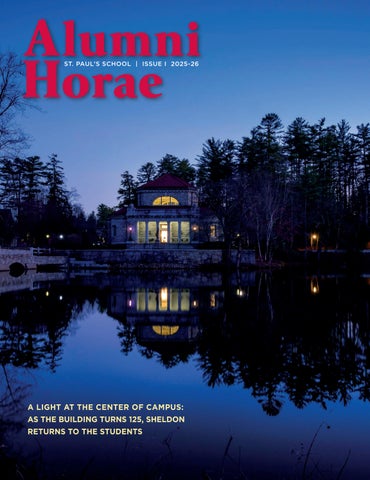
A LIGHT AT THE CENTER OF CAMPUS: AS THE BUILDING TURNS 125, SHELDON RETURNS TO THE STUDENTS
EVERY STUDENT. EVERY DAY. YOUR SPS FUND GIFT MATTERS For more than a century, St. Paul’s School alumni have known that there’s no greater gift than to support the students who follow in their footsteps. Established in 1921 to provide funding for “the pressing needs of the School,” today’s SPS Fund helps shape the School experience of every student, providing flexible, immediate-use dollars for academic opportunities, arts, athletics, community-building activities, vital campus projects and more. It brings speakers to campus who offer new perspectives. It supports service opportunities that broaden students’ worldview. It helps students hone new skills; test their limits; share their talents. It sustains the pressing need of preparing young people for a complex and ever-changing world. Continue a School tradition more than a century in the making and support those who follow in your footsteps. Your SPS Fund gift of any size really does make a difference to every student, every day.
ADVANCEMENT OFFICE | 603-229-4875 | SPS.EDU/GIVE
FEATURES
OPENING LETTER 2
FROM THE RECTOR
THE SCHOOL TODAY
Alumni Horae VOL. 105 | ISSUE I 2025-26
RECTOR
4
THE VIEW FROM HERE
6
BOARD OF TRUSTEES WELCOMES NEW MEMBERS
7
OF LEADERSHIP, YOUTH AND THE FUTURE
9
PODCAST LAUNCH: INSIDE SPS
10
WHEN GREEN IS GOLD
SHELDON’S RENEWAL
11
AROUND THE GROUNDS
As Sheldon turns 125, the iconic building will once again be a studentcentered space to engage with faculty during office hours, gather for group work, meetings and events, and more. It also will be home to the School’s academic support team and the Advanced Studies Program.
13
A RIVER RUNS THROUGH IT
13
ALCHEMY ON STAGE
14
WELCOME TO CHAPEL
16
HEARD IN CHAPEL
PHOTOGRAPHY
18
FINDING BALANCE BETWEEN PRESENCE AND AMBITION
Michael Seamans
19
A SUMMER OF CONNECTION AND COMMUNITY
ALUMNI ADVISORY BOARD
20
BACK ON THE FIRE LINE
22
FALL ATHLETICS HIGHLIGHTS
24
Kathleen C. Giles EXECUTIVE EDITOR Karen Ingraham MANAGING EDITOR Kristin Duisberg EDITOR Kate Dunlop DESIGNER Cindy L. Foote
Ben Flanders
Elise Loehnen Fissmer ’98 David M. Foxley ’02 Dana R. Goodyear ’94 Jonathan D. Jackson ’09
ALUMNI UPDATES 35
PORTFOLIO
The latest book and media projects from alumni. 36
ALUMNI CONNECTIONS
38
Profile: DAVID ATKINSON ’59
40
Profile: BRIAN OH ’02
SERVICE MINDED
41
Profile: ANNA HYMANSON ’12
With support from Kiril Sokoloff ’65, students learn that living generously is a development of the heart.
44
IN MEMORIAM
30
SHARE YOUR EXPERTISE
ON THE COVER
Join the nearly 3,000 members of the Alumni of St. Paul’s School private LinkedIn group, a platform where you’ll find information about upcoming events and networking opportunities, alumni spotlights, career and internship openings and more.
As darkness falls, Sheldon glows and beckons across Library Pond. Inside the rejuvenated rotunda, a variety of comfortable seating arrangements provide space for students to study or work on group projects, and for faculty members to meet with advisees or offer extra help during office hours. Once more, Sheldon is a hub for students and community. PHOTO: MICHAEL SEAMANS
Malcolm Mackay ’59 Diego H. Nuñez ’08 Published by St. Paul’s School
ALUMNI HORAE DEADLINE Formnotes from alumni about their personal and professional lives as well as positive interactions with other members of the SPS community are welcome (200 words maximum). Notes for the next issues are due Jan. 9 and May 15, 2026, and may be submitted to alumni@sps.edu. A high-resolution photo of at least 1 MB may be submitted for publication consideration with an accompanying caption that identifiies people in left-to-right order and provides context. Alumni Horae editors reserve the right to edit and condense formnotes; notes and photos will be included as space allows.
FROM THE RECTOR
Making the Good Greater for Everyone KATHLEEN C. GILES
F
ollowing our annual Family Weekend in October, I spent two weeks in early November visiting our alumni and families in Asia. Often these gatherings transition into conversations rich in the memories and nostalgia of being young students growing up with friends and experiencing growth and transformation in a beautiful place. This transformation included and still includes becoming a thinker and a scholar and finding one’s voice; learning to communicate, listen, and learn from others, and to collaborate with them to create. It is about learning to build friendships and how to care about others; how to work through challenges and become resilient; how to find one’s voice in a classroom, in a cast, on a team; how to dare to put one’s self “out there,” on a court, on the stage, in a debate; and how to take one’s citizenship seriously, ethically, and responsibly. Last spring I traveled to Tokyo and Singapore, and one of our young alums in Tokyo told an audience that when she came to St. Paul’s, she was amazed that she was expected to care about not only her friends, but also the School community — its well-being, its standards, and its culture. This expectation is so important to us, and most of the critical elements of character and citizenship in our community can be traced directly to our School Prayer. At many SPS gatherings, our alumni invoke the prayer not only as a blessing but almost as a call to order. The School Prayer makes its appearance in our history in the 1920s — a creation of Bishop Charles Slattery of Massachusetts, a dear friend of Fourth Rector Dr. Drury. The prayer appears in the Bishop’s 1922 published collection of personal prayers, and its voice is first-person — “Grant O Lord that in all the joys of life, I may never forget to be kind … .” By 1937, Dr. Drury had embraced that prayer for our community but changed the voice from first person singular to plural, from “I” to “we.” This act changed the School and has given us our spiritual framework for nearly a century. My stump speech this year is that at St. Paul’s, the “WE” is bigger than the “me.” Student life at our thriving school reflects the importance of
2
Alumni Horae | Issue I 25/26
that sense of belonging to and responsibility for the culture of a place that, as we say in the mission statement, is dedicated to the pursuit of excellence in character and scholarship. A place where we educate, we build, and we serve — we educate to build and serve; we educate builders who serve. On this important point, one of our alumni chapel speakers shared with us last fall the most important lesson she learned at St. Paul’s: “The more we engage, the more we can make a difference. I didn’t think I could, but I was bold enough to dare, and I did.” When we serve the greater good, we make the good greater for everyone. Our School family believes in leadership and stewardship that makes the good greater. For nearly two centuries, we have believed in the pursuit of excellence in character and scholarship and in extending this transformative opportunity to tens of thousands of children into the future — children who are not our own and whom we will never meet, but children who will grow up to be the citizen leaders of their societies. It is our proud tradition to be responsible, ambitious stewards of and for St. Paul’s School. The experience of a student — the learning, the teaching, the venues from courts to dinner tables to classrooms — requires constant reinvestment, whether it is the buildings that need repurposing or replacement, the academic program that needs constant nurturing, or the community life education and opportunity that this generation needs. Even if one’s personal time stands still in memory and nostalgia, the world’s time continues to turn. For St. Paul’s to be strong, to be respected as a leader in educating students to build purposeful lives in service to the greater good and therefore make the good greater for everyone, we the School’s current stewards need to contribute our energy, inspiration and resources to reinvest in the excellence of St. Paul’s and our students’ experience. In his 1929 report on the state of the School, Dr. Drury wrote: Who doubts the existence of this school two centuries hence? Who at any rate would venture to plan or to build on a lesser scheme? The layout of the grounds, the planting of trees, the determining of roads and paths, all deserve that patient corporate study, aided and checked by experts, that will be worthy of the centuries. It is invigorating to initiate what we personally shall never see fulfilled. ‘Few men,’ says Jeremy Taylor, ‘are sufficiently thoughtful to plant apple trees for their grandchildren,’ but the corporate will of an institution counts not the years with an eye to quick
The Living in Community (LinC) Day on Nov. 6 was a crash course in adulthood, with stations on banking and investing that offered opportunities for financial boosts, while others, like changing a car tire and writing a love poem, were designed to offer insights into survival, patience and self-expression.
return. This avenue, that vista, will in half a century be lovelier [by] far than in our time. We should spend on the grounds as liberally as we can. Over the past four years, our Board of Trustees and School administration has done the hard work of studying the needs of our students, our faculty and our institution; we have completed both a Strategic Plan and a Comprehensive Campus Plan; and we have entered the leadership phase of a capital campaign. The Fleischner Family Admissions Center is our starting point, and our work plan is ambitious and imperative. We need to rebuild our performing arts buildings and Memorial Hall; we need to build a new dining hall and health center and renovate the Upper; we need to address the increasingly serious structural needs of our beloved Chapel of St. Peter and St. Paul; and we need to invest in student financial aid and faculty support. We need to be the stewards who heed the call to plant apple trees for our grandchildren, just as the stewards a century ago reinvested in the School to create the experience our living alumni know and love — a transformative experience in a place built to inspire. There will be great opportunities for everyone in our extended St. Paul’s family to do their share of the work that we need to do in this, our time, when the School is in our care and keeping, to assure that St. Paul’s stands strong for its next century.
RECTOR DELIVERS STATE OF THE SCHOOL ADDRESS On Sept. 30, Fourteenth Rector Kathy Giles spoke to an online audience of alumni about the School today and addressed fundamental questions about students’ ability to thrive “in a world we don’t know and can’t yet imagine” — from how we help them develop “mentor mindsets” to how we define the value proposition of a St. Paul’s education. Rector Giles was joined by Board of Trustees President David Scully ’79, P’21 and Alumni Association President Caroline La Voie ’88, P’20, P’21. WATCH THE WEBINAR
Alumni Horae | Issue I 25/26
3
THE SCHOOL TODAY
4
Alumni Horae | Issue I 25/26
THE VIEW FROM HERE It was a beautiful October day for Eco-Fest, an annual event focused on the environment and sustainability made complete by the opportunity to paddle around Lower School Pond. PHOTO: BEN FLANDERS
Alumni Horae | Issue I 25/26
5
THE SCHOOL TODAY MISSION-FOCUSED SERVICE
SPS Welcomes New Trustees
A
t the end of September, the St. Paul’s School Board of Trustees held their fall meeting on the grounds and welcomed two new members. The former form directors bring to their new volunteer roles decades of familiarity with and dedication to St. Paul’s School. Their personal perspectives and professional expertise will contribute to the board’s work of, as Board President David Scully ’79, P’21 has described it, focusing its time at the top of the generative curve, helping to frame important issues that further and fulfill the mission of St. Paul’s School for decades to come.
SAMANTHA EKSTRAND Samantha Ekstrand ’92, P’21,’24,’24,’24,’29 co-found-
ed the Durham, North Carolina, law firm Ekstrand & Ekstrand with her husband in 2002. She specializes in sports law, advising college coaches on contract negotiations, investigations, crisis management, separation agreements and gender equity matters. Her work also includes supporting coaches associations through board advising, legislative drafting and NCAA lobbying efforts. She earned her B.A. in history and government from Dartmouth College, where she played lacrosse, and her J.D. and an M.A. in history from Duke University. A teacher and a coach at heart, Ekstrand has taught high school history and in the SPS Advanced Studies Program. She has coached teams at all levels, including seven years as a volunteer assistant coach for the Duke women’s lacrosse team.
6
Alumni Horae | Issue I 25/26
WILLIAM “MAX” LAMONT III William “Max” Lamont III ’96 is the co-founder and managing partner of Montgomery Street Partners, a real estate investment firm established in 2013. Prior to forming MSP, he worked for five years at RSF Partners and Robertson Stephens, a middle-market investment bank. Lamont earned an MBA from the Anderson School of Management at UCLA in 2008 and a B.A. in history from Yale University in 2000. He currently serves on the Board of Trustees of the Dallas Museum of Art. He and his wife, Hallie, live in Dallas with their three sons and daughter.
Of Leadership, Youth and the Future The Rector interviews an education expert about helping young people thrive KATE DUNLOP
Could you share your reflections about what constitutes leadership in 2025? Many of the young people we meet in the selection process have a conception of leadership that is very different from the one I would have had 30 years ago. Their models of leadership behave in very different ways. This is something I think a lot about in the context of what’s being modeled on social media — how are the leaders in different fields behaving? How are they engaging with each other? Because of their need to build a perfect LinkedIn profile and an amazing story in high school, today’s students experience leadership as a collection of positions and titles to be held, rather than as reflected in a set of behaviors, because the system has told them that this is what they need to do. But leadership is not the titles we hold. It’s in the behaviors that we exhibit. At Morehead-Cain, we’ve thought a lot about how we help people recognize the power and value of public service. So that’s one sort of leadership question. A second is about how they engage with difference and recognize the wisdom that exists around any given
problem. We have built a programmatic response that’s designed to nurture intellectual charity in our students, who have been trained by social media to have very strong opinions about things, even things that they know very little about. The era of AI is going to reward students with range, who read broadly. The ability to analogize, the ability to draw connections between different fields of knowledge, is going to be really important. So how do we encourage students to take joy in reading and explore different things? How do we prepare students to make difficult moral or ethical choices? This is the magic of a place like this — St. Paul’s can develop a moral or ethical way of thinking that is sorely needed for the future. How would you advise St. Paul’s to grow, or encourage us to help our kids think differently about how they approach opportunities? We have had four selection criteria since our founding: leadership potential, moral force of character, intellectual ability and physical vigor. When I joined the foundation, many people took the opportunity to say, “You have to kill physical vigor.” I read a bunch of applications and started meeting American high school seniors, and it became evident that we actually needed to double down on physical vigor. I called someone I had done a bit of work with when I was in South Africa, Angela Duckworth, the psychologist at Penn who wrote the book “Grit.” And I said, ‘Angela, I'd just like to walk through this problem.’ And she said, ‘Where is grit cultivated? When you look at all this, the places where grit is cultivated are the sports field and the stage.’
“
St. Paul's can develop a moral or ethical way of
“
D
uring the fall meeting of the Board of Trustees, Rector Kathy Giles sat down with Chris Bradford, president of the Morehead-Cain Foundation at the University of North Carolina at Chapel Hill, to find out what he sees in the secondary school landscape regarding leadership development among students. America’s first merit scholarship program at America’s first public university, Morehead-Cain is an 80-year-old independent foundation that runs its own admissions process and recommends a slate of candidates for admission to the university. Ultimately, it is a community that challenges emerging leaders to reach their potential and shape societies. In addition to receiving full funding for all four years at the university, Morehead-Cain scholars have access to a range of foundation programming that begins the summer before their first year of college. Since 2012, St. Paul’s School has annually nominated up to two students at the end of their Fifth Form year in a merit-based process. The School’s seven scholarship recipients include current Morehead-Cain Scholars Matt Grady ’23 and Colter Sienkiewicz ’24. This interview has been condensed and edited.
thinking that is sorely
needed for the future.
Alumni Horae | Issue I 25/26
7
THE SCHOOL TODAY No one starts their freshman year of high school expecting to be the starting quarterback. No one starts their freshman year expecting to get the lead role in the school play. There was a historical reason for having physical vigor as a criterion for selection: our founder believed that a whole lot of life is about showing up, and you need a lot of energy every single day. You have to cultivate that. We have to find people who have that energy, and I believe that energy is cultivated through things like sports and keeping your body healthy, et cetera. But we also need physical vigor because it reflects one of the few places in modern schooling in which the expectation that you learn through discomfort and failure still exists. The students who we meet believe that they should get an A on everything. Right? Their academic work is all As; they don’t have the same type of experience in their intellectual life that they have in their sports field or stage life, in which they grow through discomfort. What are the keys to successful transitions, so we can help our kids not just hit the ground running and check all the boxes but take advantage of this next step in their educational opportunity? If I could wave a magic wand for the world’s 18-yearolds, it would be to help all of them embrace discomfort. When they ask, “What’s Morehead-Cain like?”
I tell them we all learn through stretching and discomfort, and our objective each summer and each term is to escalate complexity and keep you equally uncomfortable for four full years. And there has been a language of self-care that has undermined our ability to embrace discomfort that I think we need to be cautious about in schools and with our children. Yes, it is important to get a lot of sleep, and it’s important to create time to look after yourself and to reflect. This is all true. But discomfort is essential to learning. We only learn through discomfort. Students now are living through the next great technological change. Computing caused a whole bunch of people like me, who might have been working outside, to be working in front of computers. We now need to go to the gym, and the next challenge is going to be to create the equivalent of a gym for the mind. I think if they spend their rest of their life immersed in technology, using it everywhere they go, then that will be great, but they have to train their mind so that they can develop the type of judgment to make the most of the artificial intelligence tools around them. I wonder if schools and universities are being aggressive enough about helping young people build the practice of creating the gym membership for their mind. The schools that do this well will end up having a really significant impact.
MEET THE BOARD OF TRUSTEES Members of the Board of Trustees gathered on the Chapel Terrace with Rector Giles before a full day of sessions on Friday, Sept. 26. FIRST ROW: Lauren McKenna Surzyn ’03;
Board President David Scully ’79, P’21; Max Lamont ’96; and Samantha Ekstrand ’92, P’21,’24,’24,’24,’29.
SECOND ROW: Lisa Hughes ’78, P’17,’19; Liz Robbins ’79, P’17; Alex Krongard ’81; and Amy Singer ’97, P’27. THIRD ROW: Caroline La Voie ’88, P’20,’21; Nancy Dorn Walker ’94; Candice Bednar P’18,’19,’22; Chase Robinson ’81; Ray Joseph ’90; Tim Steinert ’78, P’21; and Henry Ho ’90, P’21,’22. FOURTH ROW: Rector Kathy Giles;
BEN FLANDERS
8
Alumni Horae | Issue I 25/26
Eddie Park ’94, P’21; Ben A. Loehnen ’96; Amachie Ackah ’90, P’28; Page Sargisson ’93; William Doyle P’25; and Arthur Zeckendorf ’77, P’05,’07.
NOT PICTURED: Susan Fales-Hill P’21;
David Fleischner ’91, P’20,’23; and Tully Friedman P’17,’17.
Happy New (School) Year
Rector Kathy Giles is joined by Dean of College Advising Greg Buckles and Vice Rector for Academics and Faculty Lori Bohan for a podcast episode discussing the simplified grading system that was implemented this fall — and the importance of embracing a growth mindset over perfectionism in every dimension of School life.
Podcast Launch: Inside SPS
Hosted by Rector Kathy Giles, the series focuses on living and learning together in our community KATE DUNLOP
T
his fall, as new students and their families began their St. Paul’s School journeys with excitement and curiosity about what the year would bring, the School launched the podcast “Inside SPS,” hosted by Rector Kathy GIles. Featuring School experts on topics that explore all aspects of the student experience, each episode is an organic conversation about student well-being and how St. Paul’s approaches its residential school philosophy. In the first episode, Rector Giles sits down with Dr. Theresa Ferns ’84, P’19, vice rector for school life and adolescent counseling psychologist, to discuss the special role of boarding school in the growth and development of children. Their conversation continues in the second episode,
with the focus shifting to helping students develop healthy mindsets and learn “to do hard things well” — and how a 100% boarding school environment provides the necessary space for this work and opportunities for parents to partner with the School. Subsequent episodes are devoted to the philosophy of athletics at SPS; the ways in which the School supports the more than 500 students from across the country and globe who call Millville home every school year; the structure of the St. Paul’s academic calendar with tips for students to make the most of their time; the importance of embracing a growth mindset and more. LISTEN IN
The grounds were buzzing again with energetic teenagers as the 2025-26 academic year got underway. Sixth Formers and student leaders returned two days early for leadership training and to prepare to welcome new students on Friday, Sept. 5; by the time classes started on Monday, Sept. 8, the newest members of the SPS community had already experienced First Night Service, Seated Meal, house meetings and chapel — not to mention getting to know their roommates, housemates and the 2,000 acres that are home to 536 students from 37 states and 30 countries this year. In her Fall Convocation remarks, Rector Kathy Giles gave the School community its first homework assignment: “Being a person of good character is harder than being a good student,” Rector Giles said. “This year, we are going to be working a lot on ... how to treat others, how to hold ourselves accountable, how to respond when others hold us accountable ... The goal of our work together is excellence in SEE OPENING character and scholarship.” DAYS RECAP
Alumni Horae | Issue I 25/26 Alumni Horae | Issue I 25/26
9 9
THE SCHOOL TODAY
When Green is Gold Fleischner Family Admissions Center awarded LEED Gold certification KATE DUNLOP
T
• All-electric, fossil-fuel-free HVAC systems that use 40% less energy than a typical new building. • A rooftop solar photovoltaic array, projected to generate enough energy to power the building’s lights and hot water. • An EV charging station for campus and visitor use. • Low-flow fixtures that limit the unnecessary use of potable water and contribute to a 58% reduction in water use versus a new project of similar size. • A rain garden with native plantings that reduce pollution and replenish groundwater while also supporting pollinators and wildlife. • Low volatile organic compound finishes applied throughout the building. • HVAC smart controls designed for thermal comfort optimize energy consumption when the building is occupied. • Mass timber framing in the Jiang-Peng Great Room, chosen for its superior strength and lower carbon footprint compared to equivalent steel framing. • A total of 20 products that disclose their supply chain footprint, helping to improve transparency in building material embodied carbon, were used in construction.
Designed by Boston-based CBT Architects and built by New Hampshire-based Harvey Construction, the 16,000square-foot FFAC opened on time and on budget. The building joins the Lindsay Center for Mathematics and Science and the Athletic and Fitness Center as the School’s third LEED certified building. © ROBERT BENSON PHOTOGRAPHY
he Fleischner Family Admissions Center (FFAC), completed in February 2025, was awarded LEED Gold certification this summer by the U.S. Green Building Council (USGBC). This recognition reflects the building’s excellence in sustainable design across nine categories used by the Leadership in Energy and Environmental Design rating system to evaluate the design and construction of green building projects (integrative process; location and transportation; sustainable sites; water efficiency; energy and atmosphere; materials and resources; indoor environmental quality; innovation; and regional priority credits). The Fleischner Center received the most possible points for at least one measure in all nine categories — and achieved perfect scores in two. LEED is the most widely recognized green building rating system in the world, and LEED certification is an official recognition that a project complies with the requirements prescribed within the LEED rating systems as created and maintained by the USGBC. From the early phases of design, the School aspired to achieve LEED Silver certification for the FFAC — a lofty goal for any building project given the stringent requirements set by the USGBC, according to Senior Director of Facilities and Planning Bill Massey P’28. “The project team — the architect, engineers, construction manager and SPS team — sought to optimize all aspects of the building through an intense and ongoing evaluation of major factors, including building systems, site orientation, material applications, energy use, water use and construction waste. As a result of this effort, the project exceeded expectations to achieve LEED Gold,” Massey says. “The School
couldn’t be prouder of this achievement as it recognizes our collective commitment to building responsibly, reducing our carbon footprint and minimizing our overall impact on the environment.” Supporting the exceptional form and function of the FFAC are thoughtfully designed features that make it a sustainability standout. In addition to being sited to withstand a 95th percentile rainfall event to mitigate erosion and flooding, the FFAC features:
The native plantings that surround the FFAC help reduce pollution and replenish groundwater.
AROUND THE GROUNDS
THE LAY OF THE LAND There’s nothing quite like Move-in Day at SPS! Sixth Formers guided families across the grounds, offering their insights on life at SPS and helping new students settle into their houses after their final farewell hugs.
ALL CREATURES GREAT AND SMALL Cows, a cat, some dogs and a few dozen stuffed animals made for quite the congregation on the Chapel Terrace on Oct. 6 for the Blessing of the Animals in celebration of the feast of St. Francis of Assisi.
IN THE GALLERY Vermont artist Jen Violette brought the outside in this fall in the first exhibition of the academic year, “From Garden to Glass.” Nationally recognized for her inventive use of color and form, Violette creates lively glass sculptures of common garden finds and rural landscapes, as well as expressive acrylic paintings inspired by the Vermont countryside.
FULL OF FIZZ Students in Science Teacher Gary Garber’s Engineering Design class launched their first project of the year: soda bottle rockets. Following trial drops from the Lindsay Center atrium stairwell, students put their CAD-modeled and parachute-equipped projectiles to a 100psi test on Hunt Field, using altimeters and a few trigonometric calculations to measure their altitude.
Alumni Horae | Issue I 25/26
11
PASS THE PRETZELS There was live music, traditional dress and plenty of Bavarian fare as students and faculty celebrated Oktoberfest in the Upper Dining Room. An SPS fall favorite, the festive evening of food and fun was led by German Teacher Dr. Justin Mohler and students in the German language program.
THE POWER OF WORDS The New York Times bestselling author Renée Watson, whose award-winning novel “Piecing Me Together” is a required Humanities reading for Third Form students, offered inspiration and insights about the power of storytelling in an October visit. After a session with the Third Formers, Watson signed books and chatted with curious students.
TOGETHER AGAIN On Oct. 10 and 11, families returned to the St. Paul’s School grounds for Family Weekend and a peek into their students’ lives in Millville. Some 850 guests traveled from as nearby as Concord and as far away as New Zealand.
DINNER IS SERVED At 6 p.m. sharp on special Tuesdays, the tradition of Seated Meal continues. Spread throughout the Coit dining rooms, the SPS community gathers after a busy day to build community, meet new people and enjoy an elevated dining experience.
DELPHIAN FOR THE WIN On Nov. 10, the 53rd Annual Charles B. Morgan Club/ House Run had racers competing on a two-mile course through the woods for Club Cup points, pizza prizes and bragging rights. With individual boys and girls first-place runners, Delphian earned the most points toward the Club Cup Challenge.
12
Alumni Horae | Issue I 25/26
A River Runs Through It Trustee William F. Doyle and Stephanie Nam P’25 make gift with an environmental message KATE DUNLOP
T
he School’s Turkey Pond flows into the Merrimack River and on to the Atlantic Ocean; now, as art, the Merrimack has a glittering presence in the Fleischner Family Admissions Center, thanks to Trustee William F. Doyle and Stephanie Nam P’25. The couple’s gift of the interactive sculpture “Merrimack River” by the data and kinetic artist known as Breakfast was installed just before the busy fall admissions season. Visitors in the Jiang-Peng Great Room are mesmerized by the red-tinted mirrored piece that moves in response to real-time river flow data from the U.S. Geological Survey’s
sensor network. When viewers approach, their silhouettes ripple across the surface, transposing a human presence on nature. The piece, the artist statement says, “explores our connection to water and the living systems that sustain us.” Merrimack derives from the Algonquin word for “place of strong current.” During the Industrial Revolution and throughout much of the twentieth century, the Merrimack River generated energy for the mills of Manchester and Nashua in New Hampshire and Lowell, Lawrence and Haverhill in Massachusetts. “The wealth created by early entrepreneurs
harnessing the power of the Merrimack helped establish and sustain St. Paul’s School,” Doyle says. “Stephanie and I hope that Breakfast’s exciting, dynamic sculpture will remind generations of students of our debt to our environment and inspire them to contribute to a world in which humanity can flourish in balance SEE THE ART IN ACTION with nature.”
Alchemy on Stage The SPS Theater Company fills every seat for “Frankenstein” KATE DUNLOP
W
ith an original script by Theater Director Meg O’Connor, spearheading her first production at St. Paul’s School, the SPS Theater Company brought to life the tale first told in Mary Shelley’s 1818 novel “Frankenstein” in a compelling, 75-minute performance that filled every seat in the New Space Theater on Nov. 7 and 8. In the beginning, Dr. Victor Frankenstein, played by Fourth Former Jai Soon, creates his Monster, and it is of hideous form. From darkness, it emerges into light, with an infant’s unawareness of its appearance and an openness to the world and its wonders. But it learns, quickly. After Frankenstein beholds his creation with horror and flees, a conflicted, complicated darkness of another sort compels the abandoned Monster to set in motion tragedy after tragedy: the deaths of Frankenstein’s young brother, William, played by Ella Davis ’28; his servant, Justine, played by Madeline Dhindsa-Bonin ’27; his friend, Henry, played by Mason Robins ’26; and his
wife, Elizabeth, played by Jacqueline Pan ’26. Of course, Frankenstein is nothing without his Monster, and here, far from the squared-headed, green-skinned zombie figure familiar from the 1931 movie and subsequent retellings, it has a dark, oversized head with eyes that sometimes glow with emotion. The eight-foot-tall puppet, designed by Art Teacher Brian Schroyer P’22, takes three actors to operate and voice: Dagny Bischoff ’26 is its ambulatory core, while Alexandra Cao ’28 and Molly Smith ’28 operate its arms. In an impressive display of coordination and timing, the Monster is expressive, fearsome and relatable as its sadness turns to rage. “Frankenstein” both frightens and makes a strong argument for empathy and human connection, says O’Connor, who explains that her non-linear storytelling approach required actors willing to listen carefully and work collaboratively, with many actors playing multiple roles and sometimes representing Frankenstein’s thoughts, imagined characters,
or idealized versions of his family and friends. In her telling, “Frankenstein” is a story without end. “Victor finally takes responsibility and the creature’s misery and isolation are cemented, but the eternal drive onward … does not end,” she explains. Alumni Horae | Issue I 25/26
13
Wardens Lily Campbell ’26 and Olivia Shergalis ’26 offer a warm welcome to chapel on a chilly November morning.
Welcome to Chapel Student roles in chapel are varied and vital in helping to create community KATE DUNLOP
O
Also on the roster of those who help the School comrgan music drifts into the crisp fall air as students munity begin its day together are dozens of students who approach the Chapel of St. Peter and St. Paul. play essential roles. In addition to the wardens, who are Flanking each entrance is a pair of wardens, Sixth organized by Science Teacher Rick Pacelli in his chapel Form students who serve as greeters, sometimes ushers, role of verger, there is the Chapel Council, acolytes, lecand always ambassadors of the chapel. tors and the Chapel Choir. These student groups serve “Good morning, welcome to chapel,” they say time with a School-wide visibility that provides opportunities and again, making eye contact, smiling and exuding posifor leadership, growth and comtive energy. munity building. As the doors close behind the “I LET GO OF MY STRESS The Chapel Council, overseen last entrant and the organ falls by Rev. Wynder, is a leadership silent, a student steps to the cenSINGING IN COMPLINE position for the 18 students seter lectern to read the opening BECAUSE I’M IN A SPACE lected for the role, and the cosentences, and chapel begins. hort represents all forms, faiths WHERE I AM CONSCIOUS Four mornings a week, the and backgrounds. They help the students and faculty of St. Paul’s OF BEING THERE WITH Chaplaincy organize and faciliSchool gather face-to-face across THE GROUP AND BEING tate services and events as well as the aisle, to start their day. Each gather student feedback. Council 25-minute program is carefully PRESENT. IT’S ALMOST LIKE members help welcome and introcrafted by the Office of the ChapA MEDITATIVE PRACTICE.” duce guest speakers and take turns laincy, led by the Rev. Charles reading the opening sentences, Wynder Jr., dean of chapel and standing before the gathered School community to begin spiritual life, and includes The Rev. Richmond Jones, the day’s program. chaplain and humanities teacher; Caroline Blosser, When Jacqueline Pan ’26 arrived as a Third Former, chaplain and humanities teacher; Robin Nafshi, rabbi she thought chapel was just a mandatory meeting and and associate chaplain; and Nicholas White, director assumed it would be uninteresting. To her surprise, she of chapel music and School organist.
14
Alumni Horae | Issue I 25/26
started to “fall in love” with the diversity of speakers and performances during chapel and found herself looking forward to them. That appreciation led to her desire to join the Council as a Fifth Former, even though she found public speaking intimidating. “The first few times I did the reading, it was scary. I practiced a lot, and people were encouraging, and I am thankful for that,” she says. “As I got to do it more, I became more confident.” The council’s most important role, according to member Ian Jang ’26, is to create an open, welcome and inclusive space for everyone at St. Paul’s, regardless of faith or religious background. “We will be active this year in developing innovations in the spiritual life of campus to enhance our inclusiveness and student agency as we work hard to build Beloved Community,” he said in chapel early this fall. In the Episcopal tradition, acolytes are baptized lay assistants who, as Rev. Wynder describes it, “elevate the service” on special occasions such as Holy Week by processing and recessing with the cross, candles and banners, and serving at the altar. The students who comprise the Lectors Guild under Rev. Jones’ guidance share each morning’s reading, which may be poetry, scripture or literature that reinforces the opening sentences and further prepares listeners for the message shared from the pulpit. They also take part in Sunday services and special programs such as the Festival of Lessons and Carols. Choral music has been an integral part of School life since its founding, and the Chapel Choir offers the opportunity to develop as musicians and as people. Any student is welcome to join the choir, directed by White. Its members rehearse three times a week and sit together for each morning chapel service as well as more formal occasions such as Choral Mattins, the Festival of Lessons and Carols, and other special events.
As part of his ministry, the Rev. Chuck Wynder Jr., dean of chapel and spiritual life, works with the Chapel Council and acolytes — but he always has time and a smile for everyone in chapel.
The Oct. 30 chapel program was Choral Mattins, a special service of morning prayer sung by the choir and led by Director of Chapel Music and School Organist Nick White.
Wrenn Ragsdale ’26 joined the choir as a Third Former and found an inclusive and encouraging environment. Now the tenor section head (and a lector), he treasures the unity and energy of singing with his fellow choir members, and he often chooses to stay after rehearsals on Thursday evenings to take part in Compline in the Old Chapel. “I let go of my stress singing in Compline because I’m in a space where I am conscious of being there with the group and being present,” he says. “It’s almost like a meditative practice.” Beyond his specific roles, Ragsdale believes the morning chapel experience reinforces his purpose for being at the School. “I’m here to learn from other people, and a key part of chapel is hearing the talks and watching the performances,” he says. “Also, chapel reinforces the fact that everyone here has a place; there’s something very important about everyone having a specific seat that they sit in. It helps curate this idea that we all belong here and are part of this community.” No matter which role they hold, students who work with the Chaplaincy help set the rhythm of the day for the community as they participate in, and are changed by, their encounters in a space where all are welcome. In his five years at St. Paul’s, Rev. Wynder has witnessed the holistic growth of students taking part in the life of chapel. “Engaging in the work of inviting others into our services through hospitality, singing and reading expands the spiritual imagination of students,” he says. “They grow in confidence as they experience the fruits of the spirit: joy, love, peace and faithfulness. They experience the powerful effect of extending themselves in service to something greater than themselves. In the context of chapel, that greater good is supporting the building up of community and the shared experience of spiritual formation and exploration of our big questions.”
Alumni Horae | Issue I 25/26
15
HEARD IN CHAPEL The St. Paul’s School community heard from students, alumni and faculty during Fall Term chapels. Here’s what a few of them had to say. CAROLINE BLOSSER / Sept. 12, 2025
St. Paul’s School Chaplain “Singing together and eating together — I can’t think of better ways to build belonging. … I hope when you are called upon to sit down together with people you may not know yet and break bread together with people you don’t particularly love or like, I hope you will practice the courage to take that risk. … It takes courage to widen a circle. It also takes courage to join in. Courage to let someone know they belong. And courage to let yourself belong. And we are about both things at the School: Widening the circle and joining the circle, which is part of what it means to be human.”
AMACHIE ACKAH ’90, P’28 / Sept. 26, 2025
St. Paul’s School Trustee and chair of The SPS Fund; Co-founder, Chief Investment Officer and Managing Partner, Clay Cove Capital “When my brother died at age 53, I took on organizing his celebration of life. When the day came …there were dozens of my friends from St. Paul’s, most of whom had never met my brother. They came to support my family and lift our burden. This was no accident. This was a statement in the unspoken language of ‘Paulie,’ in that wonderful language of love. It was a declaration that once you embrace this St. Paul’s community, you will never walk alone. The language we speak as a community is rooted in principles that we’ve learned here. Together, we learn in our houses, while dining, around the Harkness table and on the playing field. We learn from gathering here in this very chapel. And while the vernacular and dialect changes through the years, the underlying meaning remains constant. And that is the language of love. … So as you go forth and you take this language that you’ve learned here with you, share it with the world.”
CARTER DOHERTY ’26 / Sept. 29, 2025
“Over time, we find the things that make us feel at home. It can be the big things or the small. One of mine is a chapel plaque that reads, ‘Send out Thy light and Thy truth; let them lead me.’ .... This is a prayer. I’m sure more than one person in this chapel today needs help and needs a light. … I’ve witnessed firsthand the lights of this School transform people and our community for the better. These are the people who live not for themselves, but to serve others first. I’m often asked on tours what my favorite part of St. Paul’s is, and my response is the people … the lights — those who, even at the busiest times, remind you to call your mom and tell her you love her. Lights are people who explain a math problem to you at midnight and don’t make you feel dumb about it. … When we look back upon our time at St. Paul’s and all that comes after it 10, 20, 50, maybe even 70 years down the line, we will not remember the test grades, the awards we’ve won or the goals we scored. We are going to remember the people. We will remember the lights.”
16
Alumni Horae | Issue I 25/26
DAVID WALTERS ’07 / Oct. 17, 2025
SPS Alumni Association Executive Committee member; Founder/CEO Streamr “What do your back and your face have in common? … You’ve never looked directly at either of them. … There is a key piece of your identity, how you present in the world, that you can’t even see. … How we see ourselves, how you see yourselves, especially at your age, determines so much about what you will attempt and achieve in this life. But that’s also impacted by how you see each other. … You’re all in a phase of figuring yourselves out, and … as I did, you’re going to fundamentally change the way you see yourselves, and the world, many times. What will help you feel better about some of those seismic shifts is minimizing the harm, the disrespect to people who you saw as on the wrong side of things, a side you yourself might be on soon enough. That gentleness, the humility in disagreement to see {that} it may be you who has the learning and growing to do, the critical distance from your own convictions that others may or may not share or, patiently understanding something about yourself that someone hasn’t accepted about herself, to see someone’s face more clearly than they ever could — that kindness is how we will disagree respectfully and still grow and build together.”
VIOLET EATON ’26 / Oct. 27, 2025
“The truth is, every one of us is more or less like the Grinch than they think. We all carry pieces of past anger, hurt and resentment, things that harden our hearts without us even realizing. However, the beauty of the Grinch’s story is the promise that having a heart of stone is not a permanent condition. Our hearts can change, and often that change begins in small ways, whether it’s going out of your way to do something kind for someone or simply trying to see the good in others, instead of assuming the worst. The challenge is that we must choose to actively fill the space in our hearts with love, patience and kindness. … I’ll admit, I don’t always do it perfectly. There are still moments when I act more like the Grinch than the person I strive to be, but I’ve learned that what truly matters is the effort. None of us will ever love everyone or everything perfectly, but we can all try.”
LT. COL. DAVID BATES ’04 / Nov. 11, 2025
Chief of Staff, Vanguard; Battalion Commander, Marine Corps Forces Reserve “This community helped me uncover a personal drive to contribute, to do something greater than myself, to do something greater with myself, along with a desire to do something that would challenge me. And I credit many of the teachers and coaches here with nurturing that drive and pushing me out of my comfort zone. … And the Naval Academy for college, followed by the Marine Corps, answered that call. … Before my first deployment [to Afghanistan], I turned to Chapel Services and Prayers, the book you will all be given at Graduation. Chief among those words that stood out for me was our School Prayer: Help us to be unselfish in friendship, thoughtful of those less happy than ourselves and eager to bear the burden of others. To me, that is what it means to serve and what it means to be a veteran. But veterans do not own that ideal. Service can take many forms and by virtue of being here at St. Paul’s, you have a special opportunity to live out that challenge. No matter if you wear a uniform or not, you can find your own way to serve others. It doesn’t have to be dramatic, it just has to be meaningful to the person or people that you’re helping. So I challenge you to find your way to serve, whether it’s here at St. Paul’s, whether it’s back home in your community or someday in your profession. That’s how we live out the words of our School Prayer.”
Alumni Horae | Issue I 25/26
17
SIXTH FORM OFFICERS SHARE THE YEAR’S THEME
Finding Balance Between Presence and Ambition KRISTIN DUISBERG
S
tudent Council President Henry Wilson ’26 may have spent the first few days of his Sixth Form year on something of a wild goose chase, but what came out of it was eminently worth his time: the Sixth Form Officers’ theme for the academic year. Speaking in Chapel in mid-October, Wilson described his Opening Days search to identify a substance that Chemistry Teacher Christopher Morse had warned him was omnipresent on campus, composed of two potentially dangerous elements. One was a highly reactive solid that would explode if it came into contact with water. The other was a corrosive gas that was toxic if inhaled. When Wilson discovered that the elements in question were sodium and chlorine, and that the substance Morse had warned him about was table salt, he chuckled. Then he realized that the chemical formula and the phenomenon it embodied — dangerous apart, useful together — also offered a compelling metaphor for the School’s ambitious student body. “It is in this context, thinking about our life here and identifying the same dynamic between two prevalent approaches to St. Paul’s, that we chose this year’s theme [of presence],” Wilson said. “Our version of sodium and chlorine … is the daily decision between presence, or making the most of today, and
ambition — preparing for tomorrow.” Drawing examples from his own School experience and that of peers, Wilson made the case for the importance of finding a balance between presence and ambition, articulating the cost of presence associated with staying up late with friends instead of getting a good night’s sleep before a big test or game; the downside of ambition that makes it impossible to enjoy being in the moment.
“WE ARE A SCHOOL OF BIG DREAMERS WHO STILL HAVE A LOT TO LEARN.” “We cannot just say, in the abstract, that we should live balanced lives,” Wilson continued. “We must hold ourselves accountable and we must be there to help others live presently. We must remind them that often an early night is the best way to prepare for the day ahead and we must make an active, cultural push for a mindset shift that it is [necessary to find balance] because we are a school of big dreamers who still have a lot to learn.” Each year, the Sixth Form Officers, in collaboration with their formmates, choose a
The 2025-26 Sixth Form Officers — Secretary Mackenzie Barrette, Vice President Asher Gupta, President Henry Wilson and Treasurer Allyson Duardo — bring a wide range of interests and experiences to their term leading the student body. 18
Alumni Horae | Issue I 25/26
theme that exemplifies them as a group and provides a unifying thread for their final year at St. Paul’s. Wilson and his Student Council peers have plenty of experience balancing presence and ambition. In addition to his role as president, Wilson sings in the Chapel Choir, is a co-captain of the boys varsity soccer team, plays varsity baseball and also serves as a captain of the Debate Team. Vice President Asher Gupta is the Sixth Form head of the Friends Youth Mentoring program, which matches local elementary students with Fifth and Sixth Formers for academic and social support; Wilson’s co-captain on the Debate Team; rows crew; and serves as a student leader for the SPS South Asian Society. In addition to serving as the Student Council secretary, Mackenzie Barrette is a three-season varsity athlete in cross country, alpine skiing, and track and field; heads up the Minecraft Club; and is an artist who spends much of her time in the School’s ceramics studio. Treasurer Allyson Duardo is a member of the Applied Science and Engineering Program, a student head of the Latinx Mosaic Group, a rower, and a competitor on the School’s all-gender wrestling team. The SFOs serve as an official link between the student body and the administration, voicing the needs and interests of students to Fourteenth Rector Kathy Giles, Vice Rector for School Life Theresa Ferns ’84, P’19, Dean of Students Suzanne Ellinwood P’18,’20 and others, and sharing the work they do with those administrators with the student body. Wilson, Gupta, Barrette and Duardo meet weekly with the Rector and regularly with form representatives as well as with student representatives from every house. As the School year continues, the foursome looks forward to modeling the balance between presence and ambition for their fellow students — and to providing some inspiration in the pursuit of that goal. Or, as Wilson put it in his Chapel Talk: “[W]hen we’re stuck between presence and ambition, let’s remember that being fulfilled doesn’t mean giving up on goals. It means finding joy as we chase them.”
The ASP Honors Inaugural Impact Award Recipient
A
lumni, faculty and friends of the ASP gathered at the Currier Museum of Art in Manchester, New Hampshire, on Oct. 23 to celebrate the meaningful impact that the program has had on the state for nearly seven decades and to honor one of its most distinguished graduates, retired New Hampshire Supreme Court Justice the Hon. Gary Hicks ASP’70, with its inaugural Alumni Impact Award.
Mysteries of the Ancient World students performed the Roman comedy “Curculio,” or “The Weevil,” in the Tracy Memorial Theater overlooking Library Pond.
A Summer of Connection and Community The SPS Advanced Studies Program welcomed 177 Granite State high schoolers for its 2025 session KRISTIN DUISBERG
T
hey lived in the dorms and ate in the dining hall, gathered for morning Chapel, and did their learning in the Lindsay Center for Math and Science, at the Tracy Memorial Theater and on the School’s waterways. For five weeks this summer, 177 rising juniors and seniors from public and parochial high schools across New Hampshire got a taste of life at St. Paul’s School during the 68th session of the summer Advanced Studies Program (ASP). In addition to taking a college-level class, these highly motivated Granite Staters also had the opportunity to work with the program’s dedicated college advisers on the college application process, hear from state leaders who visited as part of the ASP’s New Hampshire Leadership institute — and forge friendships with students from 61 high schools who share their academic interests and ambitions. As one 2025 program graduate put it, the ASP is “about connections. Connections to academic material, connections to the college application process, but most of all, it’s about connections to people.” Under the leadership of Director Michelle Taffe ASP’85, the 2025 program saw a significant increase in applications and acceptances, welcoming 23 more students than the two previous sessions. The School also was able to lower the cost of tuition by $250, to $4,950, bringing the price tag for the program below $5,000 for the first time since 2022. Financial aid made ASP possible for 55% of the students.
The evening included remarks by Rector Kathy Giles; Michelle Taffe ASP’85, director of the ASP; and John Bouton, an ASP writing teacher, all of whom reflected on the vital role the program has played in shaping the college-and-beyond trajectories of thousands of the Granite State’s most talented public and parochial high school students. It also featured brief remarks from Hicks, a Colebrook native and Manchester-born lawyer who was sworn in as the 104th justice of the New Hampshire Supreme Court in 2006. “St. Paul’s School and the ASP obviously changed my life,” Hicks said in accepting the award. “My heart is full of gratitude. What St. Paul’s really does through the Advanced Studies Program is it enhances humanity — not just humanity for New Hampshire, but humanity everywhere. My classmates, the alums of the ASP, are astronauts, investment bankers … teachers, scholars, scientists, nurses, doctors — and all of that is the intentional product of St. Paul’s search for improvements in humanity. I am so blessed to have been part of that.”
Alumni Horae | Issue I 25/26
19
THE SCHOOL TODAY
Back on the Fire Line For Spanish Teacher Meredith Finch, fighting fires is part of living in community JANA F. BROWN
H
ome for the summer after completing her first year at Tufts University, Meredith Finch was mobilized to her first wildfire in Minnesota’s Boundary Waters. It was the summer of 2006, and Finch had recently finished basic wildland firefighter training. To reach the remote destination, Finch and her firefighting crew had to paddle canoes to the site along the Canadian border. When they arrived, however, there was a problem — their camp was on fire. Fast forward nearly two decades to this summer, when the St. Paul’s Spanish teacher spent two weeks in Alaska confronting the 12,000-acre Bonanza Creek Fire. This most
20
Alumni Horae | Issue I 25/26
recent mobilization represented a return to a familiar pursuit after a 12-year hiatus to earn her master’s at Boston College, build a career teaching Spanish at Tabor Academy and SPS, and raise her daughter. Finch inherited an affinity for firefighting from her father, who joined the Meriden Volunteer Fire Department after the family relocated from Massachusetts to New Hampshire when Meredith was five. From a young age, Finch’s routine included accompanying her father to the station to wash the red fire engines. Soon, the ping of his beeper and the wails of the siren became the soundtrack to her childhood. Tagging along created a
“You take off your glove and stick the back of your natural familiarity with firefighting, and as a student at Kimball Union Academy, right in her hometown, she hand in there to make sure there’s no heat extending into started her formal training as a member of KUA’s student the green,” Finch says, describing the critical boundary Fire Brigade. When she was 16, Finch joined the Mer- between scorched areas and unburned vegetation. The 2025 mission in Alaska was strategic, Finch iden department as a full-time member. Each time the pager pinged, she was dismissed from class to respond to adds, mostly working the edges closest to Fairbanks to calls. Sometimes she would catch rides with teachers eliminate smoldering areas that could potentially creep who knew to pick her up on their way to the station, toward the city. “In wildland firefighting, the fires are so big that where emergencies ranged from chimney fires and gas we’re not putting them out, we’re leaks to saving neighbors’ homes. stopping the spread,” Finch says, “For me, it turned into, ‘Of “THIS IS PART OF LIVING noting that the approach varies course, this is what you do,’” she dramatically depending on terrain, says. “This is part of living in a IN A SMALL TOWN. fuel type and access to water and small town. This is part of living THIS IS PART OF LIVING equipment. For example, creating in a community and being an traditional fire lines by eliminaactive participant.” IN A COMMUNITY ting trees and digging trenches It was the lieutenant in Meriden AND BEING AN down to mineral soil doesn’t work who suggested Finch might enjoy in Alaska, where the soil is more wildland firefighting and arranged ACTIVE PARTICIPANT.” elusive, the way it would in a for her to complete three certifiWestern state. cation courses. Within weeks of The firefighting community is also varied, drawing finishing that training (and completing a fitness test that required her to walk three miles carrying a 45-pound from many walks of life — teachers, construction workpack), Finch and the lieutenant were rolled out to assist ers, forest rangers, college students. “It’s a strange bond fire crews battling the Cavity Lake blaze at Boundary you build with folks on the fire line,” Finch notes. “We scatter to the winds but run into each other somewhere Waters. Finch’s firefighting and academic interests stayed in- along the way.” As a teacher at St. Paul’s School, Finch appreciates tertwined. While completing her degree at Tufts, where she studied Spanish and dance, Finch moonlighted as an how her summer work offers valuable perspective for “administratively determined” firefighter for the State her students and herself. When the worst outcome in of New Hampshire, deploying with 20-person crews firefighting is the threat to life, everything else gets put called up on as little as eight hours’ notice to combat into context. In a 2023 chapel talk, Finch shared with the SPS comfires throughout the country. In 2009, she was a member of the first New Hampshire crew ever sent to Alaska, munity the firefighting guideline of LCES (Lookouts, where she helped to battle the Rex Creek Fire, part of the Communications, Escape Routes and Safety Zones) as a much larger Railbelt Complex that burned more than framework for approaching life challenges. “Do you have 630,000 acres before it was extinguished. The following people looking out for you?” she asked. “How do you year, Finch worked as a seasonal employee for a federal communicate effectively with people above you, people Hotshot crew based out of Illinois, accumulating 1,000 next to you and below you in the hierarchy? Do you have hours of overtime in six months. While also working as a place where you can go if you need to disengage?” Despite the inherent danger of stepping into the una substitute teacher, she spent three years (2010-13) as a wildland firefighter with the Michigan Department of known, Finch isn’t typically afraid of the fire itself. What’s more unnerving are the times when she finds herself on Natural Resources before enrolling in graduate school. After more than a decade of focusing on her child a ridge at 8,000 feet or paddling across a lake in a metal and teaching career, Finch began to feel it was the right canoe during a lightning storm. Instead, she maintains a time to return to the fire line. She passed her fitness healthy respect for the dangers posed by the unpredicttraining on Mother’s Day 2025 and by July 16 was in able whims of nature. Genuine fear, she asserts, would be Ester, Alaska, 20 miles west of Fairbanks, to fight the incompatible with doing the work. “If you were to go to sea and you were terrified of Bonanza Creek Fire. Alaska’s terrain presents distinct challenges for firefighters, Finch explains, as crews water,” she analogizes, “would you be able to do the job encounter thick undergrowth and highly flammable effectively? I’ve been doing this so long that firefighting is spruce pockets; they must pull back moss with hand a part of my identity, of who I am at my core.” And, for that reason, Finch already knows where she tools to expose root networks and eliminate heat that wants to be next summer. threatens to travel and reignite.
Alumni Horae | Issue I 25/26
21
THE SCHOOL TODAY
Fall Athletics Highlights It was a beautiful fall for the Big Red’s 15 athletic teams to practice and compete. The cross country teams had an especially strong season, culminating in a trip to the New England Championships on Nov. 8. Both the girls varsity and JV teams earned their best team finishes in 12 years and took home third place in each race. The boys placed second out of 14 teams in the varsity race and fifth out of 12 teams in the JV race. The varsity team’s second-place finish is their best mark since winning back-toback championships in 2007 and 2008. PLAYING POSITIVE Last spring, SPS began a partnership with Positive Coaching Alliance (PCA) to provide resources for students, coaches and parents about fostering a positive sports culture. SPS and PCA continued this work over the summer with workshops to support students’ life-skill development and mental wellness. The PCA partnership is an extension of the philosophy that informs how SPS approaches working with students in all areas of life in Millville. Rector Kathy Giles and Athletic Director Chris Smith P’28 explore this work — not just in sports, but also in the classroom, on the stage and more — in episode four of the LEARN MORE podcast “Inside SPS.”
RESULTS BOYS Varsity Cross Country * Football Soccer
WON LOST TIED 2 2 0 3 5 0 4 10 4
9
17
4
GIRLS Varsity Cross Country * Field Hockey Soccer Volleyball
3 12 7 7 29
2 7 11 10 30
0 1 0 0 1
BOYS JV Cross Country Football Soccer A Soccer B
1 3 11 1 16
2 2 6 1 11
0 0 0 1 1
GIRLS JV Cross Country Field Hockey Soccer Volleyball
0 13 3 7 23
2 1 11 8 22
0 1 2 0 3
* Lakes Region League Champions PHOTOS: Michael Seamans
SHELDON’S
24
Alumni Horae | Issue I 25/26
RENEWAL AS IT TURNS 125, the iconic building is returned to students KAREN INGRAHAM
Alumni Horae | Issue I 25/26
25
I
t is a cold winter night, the air bracing and still. Frost forms on frozen surfaces — fallen leaves, dormant branches — as water vapor turns crystalline. Lit pathways pierce the darkness as students move toward a greater source of light, its reflection unbroken on the surface of Library Pond. Up the steps they go, into the warmth of a building built for them, as well as for the generations of students who had come before and will follow afterward. Off come the jackets, as these students seek out the comfort of well-cushioned chairs or settle themselves at tables, cracking open books to return to the business of learning, and of being in community. The scene unfolds on any given night this term, yet it easily could have come from the pages of a Horae Scholasticae from 1901, the year Sheldon opened as the School’s first library building. There were comfortable and practical furnishings then, too, and plenty of books — room enough for 70,000 volumes. Sheldon became a center of student life in Millville as soon as it opened, and it remained that way for the next 90 years — until it came time for a new library that could better support a larger student body and the increasingly complex demands of a modern school. When Ohrstrom Library opened in 1991 on the shore of Lower School Pond, Sheldon became another kind of beacon during the daylight hours: one for prospective families. It would serve as the Admissions headquarters for the next 35 years, with Sheldon’s rotunda transformed into an inviting place for the future Paulies who visited and would later enroll the following spring. The life of the building continued in this way until last spring — at the culmination of an idea introduced several years prior: What if there were a way to turn the lights back on in Sheldon? How could the School return an iconic space to students, providing another much-needed destination in the evenings for community time and academic study? That idea ultimately would herald a multiyear phase of building and renewal at St. Paul’s School that is designed to bring the School into its next century of life.
SHELDON’S ORIGINS When Rev. Dr. Joseph Coit became the Second Rector of St. Paul’s School in the spring of 1895, he was immediately faced with more than one challenge carried over from the tenure of his brother, First Rector Rev. Dr. Henry A. Coit. The elder Coit had died only months earlier after leading the School through its humble beginnings and into a period of rapid growth and expansion for its first 40 years. In that time, the student population grew from three pupils to more than 200; the School became recognized nationally as a preeminent destination for education; and the infrastructure evolved from a single-dwelling school house (founder Dr. George Shattuck’s summer cottage) into a proper campus, with the addition of both the Old and New Chapels, as well as the old Upper School, the Old Middle, the Rectory, an infirmary, and a gymnasium. The School was an undeniable success, and demand already was outpacing the number of beds available for the boys who sought to enroll. As he began his tenure, having already served as vice rector for many years, Second Rector Coit sought to honor and uphold his brother’s work as he got down to the business of the rectorship. The School’s 50th anniversary was approaching, and its next phase of growth needed attending to. Historian August Heckscher ’32 wrote in his book “St. Paul’s: The Life of a New England School,” that First Rector Coit had “kept tuition unreasonably low … while relying on appeals to wealthy benefactors among his friends,” indicating the School had no other source of reliable or stable income to fund its operations and had little savings. With the immediate need to support existing programming, address deferred maintenance, and plan for new and renewed spaces, Second Rector Coit wasted little time. Heckscher writes that Coit “set before the alumni in 1896 a strongly reasoned case for the raising of endowment funds. An appeal was launched, not very successful in its results but setting the precedent for more effective drives in the future.” As he sought to raise funds, Coit also launched a period of building renewal and growth that included Alumni House, the new Upper School (Coit) and Sheldon. In the book “Memorials of St. Paul’s School,” published during Coit’s time as vice rector in 1891, he wrote of the School in his introduction, “At the present moment it possesses those valuable traditions, customs, and agencies which are chief factors in the education which our age demands. The School has a fair equipment of the necessary
LEFT: In an undated photo, students study in Sheldon’s East Room during its days as a library. Sheldon’s rotunda remains ringed with smaller spaces for tackling academic endeavors.
26
Alumni Horae | Issue I 25/26
Sheldon’s reflection in Library Pond this fall, captured by architectural photographer Chuck Choi ’77.
buildings, a domain sufficiently ample for its purposes, A FAMILY’S GIFT and the beginning of an endowment. But for permanent In the June 6, 1895, edition of Horae Scholasticae, an prosperity and usefulness it needs additional buildings article outlined the School administration’s plans for a new and appliances, and an endowment fund at least five building “for general purposes of the educational work of times as large as that it has now.” the School.” It would be a building His written record of the School’s by architect Henry Vaughan, who early history continues from there “SUCH A BUILDING … had designed the New Chapel and and includes a lengthy section about MUST BE AT THE CENTRE would later design the new Upper the evolution of libraries on the School (Coit), and include a new OF THE SCHOOL LIFE ... grounds, with the first being a modlibrary, as well as other spaces such est Sunday Library of “350 volumes AND IT MUST BE as a museum and large auditorium. under the management of the boys Its proposed site was perpendicular SUBSTANTIAL ENOUGH themselves” in the Miller’s Cottage, to New Chapel on its east side, and the — the location where Sheldon TO GO DOWN WITH two buildings would be connected Library now sits. In 1873, the School by a cloister. DIGNITY INTO THE finally had “a proper place” for a “Such a building … must be at library with the opening of the New COMING GENERATIONS.” the centre of the School life; it must Schoolhouse, later known as the Big be handsome and in harmony with Study. In 1888, when the Big Study the other large buildings, which it is to be joined with was enlarged to include an annex, the library was reloand to supplement; and it must be substantial enough to cated to a space with room for 12,000 volumes and double go down with dignity into the coming generations,” the the seating capacity for students. Yet, Coit mused in his editor, Reginal Wright Kauffman, Form of 1896, declared, Memorials, “perhaps before long it will come into the along with this reality: “Up to the present time no money heart of some alumnus or other friend to build an ample has been given for this building, nor is the School in a fire-proof house, with rooms for all the collections financial position to think of erecting it for itself.” belonging to the School.”
Alumni Horae | Issue I 25/26
27
FEATURE
This undated photo shows the portico enclosed with a glass front that was removed after Sheldon became the admissions building. Now, enclosed once more, students will be able to study while taking in the views over Library Pond.
The article was published during the spring when the buildings on grounds. When Sheldon opened in 1901, Joseph Coit became Rector, so it is perhaps unsurprising Hecksher reported that students referred to it affectionthat this plan never materialized. Coit’s desire for a ately as “the Taj Mahal of the Western Hemisphere.” It library space ample enough “for all the collections quickly became a beloved place of study and community belonging to the School” would wait as other School pri- for nearly a century. orities took hold. Until four years later, when one family stepped forward ANOTHER FAMILY STEPS FORWARD and made an unexpected offer to Rector Coit and the Board of Trustees. In a handwritten letter dated Oct. 25, A few years ago, when Hans and Leslie Fleischner P’89,’91 1899, George Sheldon wrote — on behalf of his brother, asked Fourteenth Rector Kathy Giles if anything was William, Form of 1878, and their two sisters — that his needed to further elevate student life at St. Paul’s School, Sheldon was on their minds. Their family would “give to St. Paul’s sons, Chris Fleischner ’89, P’22 and School a Library Building to be “THEY EMBRACED THE David Fleischner ’91, P’20,’23, were known as the ‘Sheldon Library’ in memory of our father William C. IDEA OF THINKING ABOUT among the four generations of students who had spent many hours Sheldon. … We shall pursue a OUR CAMPUS AS A in Sheldon, and their experience building large enough to meet all VILLAGE — TRUE TO had been memorable. How could the requirements of the School, and the lights switch back on, the family OUR HERITAGE AS of a character fully up to the standard of the school buildings.” The MILLVILLE — AND THEIR mused — on every floor of the building — to provide students and senior Sheldon memorialized by his teachers today with the same opporDESIRE TO INSPIRE family had served as a trustee of the tunities to connect and learn from School from 1877 to 1896. OUR STUDENTS’ each other in such an exceptional With a decision to locate the new COMMUNITY LIFE space? library on the site of Miller’s CotPart of that question had been tage, rather than adjacent to the answered in 2022 when the School Chapel, the School also chose to work with a different modified Sheldon’s garden level to provide office and architect rather than Vaughan. Influenced by Paris archimeeting-event spaces for the offices of the Chaplaintectural trends that had reached America’s shores, Ernest cy and Building Beloved Community Initiatives. Yet, Flagg designed Sheldon in the Beaux-Arts style. The neomost of the building remained dedicated to the work of classical building — with its columned staircase at the Admissions. The Rector told the Fleischners that what entrance and central chamber with domed ceiling — was was needed was a new home for Admissions: a building a distinct departure in form and function from many of
28
Alumni Horae | Issue I 25/26
positioned in a place of welcome at the entrance to the School — a “lantern by the gate,” the embodiment of an old New England gesture of greeting and friendship — so that, in turn, Sheldon could once again serve as a lantern in the center of campus. Three generations of Fleischners got behind the idea, as did other alumni and SPS families. In May 2025, the Fleischner Family Admissions Center opened to the St. Paul’s community, and to prospective families who now begin their SPS journeys there, rather than at Sheldon. “The vision for this wonderful new building came from the Fleischners’ desire to make a positive impact on our students’ experience in community life,” Rector Giles says. “They embraced the idea of thinking about our campus as a village — true to our heritage as Millville — and their desire to inspire our students’ community life quickly evolved into the idea of returning Sheldon Library to the students and thus providing three separate places — Ohrstrom Library, Freidman Community Center and Sheldon Library — with lights on every evening for studying and connection.”
THE STUDENTS RETURN Work began last summer to renovate Sheldon for its renewed purpose. As it turns 125 years old in 2026, the building will become home to the School’s Advanced Studies Program, a fiveweek summer program offered to New Hampshire high school students. It also will be home to the School’s academic support team, as well as a new venue for faculty office hours, student group study and group work during the afternoon and evening hours. It will be host to student club meetings, activities and events, and provide a respite for those seeking a quiet corner to study and reflect. Many students may choose to do so in the central rotunda or the newly glassed-in portico, which will offer comfortable seating and views of Library Pond and campus life in all seasons. Through the inspired leadership of two families, along with the generous SPS alumni and families who joined them, Sheldon’s place in the center of School life is secure, and its return to students is just the beginning of a wider effort by Rector Giles and the Board of Trustees to ensure the School today — its program, its people, and its place —remains worthy of the centuries. Sheldon’s next chapter as a space returned to students means its lights will be on well into the evening as a hub for living and learning in Millville. Alumni Horae | Issue I 25/26
29
PHOTO: GRAINNE QUINLAN
Dedicated to Service Through Kiril Sokoloff ’65 and the Sokoloff Prize, students learn that living generously is a development of the heart and a love you can count on IAN ALDRICH
I
n mid-September, Kate Daniels, the School’s dean of student support and director of community engagement, posted a signup sheet for students to set up and stock a community food pantry at Christ the King Parish, a Catholic church in downtown Concord. Even though the volunteer opportunity fell on a surprise Saturday off from classes, response to the call was overwhelming and Daniels closed the filled-up sheet after just 10 minutes. Three days later, 50 students and a small group of St. Paul’s School adults that included Daniels, Rector Kathy Giles, Vice Rector for School Life Theresa Ferns ’84, P’19,
30
Alumni Horae | Issue I 25/26
Associate Director of Admissions Michelle Hung P’29 and Math Teacher Sean Ryan teamed up at a local warehouse to load donations from the New Hampshire Food Bank onto U-Haul trucks, before moving to the pantry's new location behind the parish’s church on South Main Street. There, the volunteers worked bucket brigade-style alongside parishioners to move and shelve canned and boxed goods, toiletries and other items. The collaboration between Christ the King Parish and St. Paul’s is longstanding — for years, students and staff have volunteered at the food pantry, which served 8,165
SPS students, with Rector Kathy Giles and faculty members, helped load trucks to stock the food pantry’s new location in Concord. The School also offered financial support for the project. “The real mover for me was the number of families that need support,” said Rector Giles. “We look for ways to make a difference in the lives of children in our community.”
“
We’ve got a real epidemic of people feeling disconnected, and so empathy and
“
individuals in 2024, and over the summer, the School joined nearly three dozen other local nonprofits and civic and religious organizations to support the parish’s $2.55 million fundraising goal to build the new pantry. But even Daniels, who spearheads SPS’s work with local nonprofits and public schools, was impressed by the eagerness of students to help. “Not only was the turnout incredible, but the excitement everyone brought to the work was palpable,” Daniels says. “For a lot of [the church members], it was quite emotional to see these students. To have all these young, strong bodies come out to help them was really amazing.” Guillermo Plata ’28 was one of the volunteers. Originally from Colombia, Plata chose to attend SPS in part because of how the School builds service work into its education. So far, he has volunteered as a peer-to-peer tutor, donated his time to the local Red Cross, and last holiday season organized a “Toys for Tots” campaign on campus for nearby children. “My values align strongly with the School’s motto of serving for the greater good and always being eager to support others during a time of adversity,” he says. Through the pantry project, Plata found the chance to make a tangible difference in the Concord community. “I thought I was going to be helping a local and small project, but I was proven wrong as I saw that the food pantry project provided massive amounts of food for thousands of less fortunate people,” he says. “Seeing how the simple act of loading a truck and other actions made such a big change in other people’s lives filled me with immense fulfillment. That sense of accomplishment — I wouldn’t change it for anything, and it just motivates me to volunteer for even more opportunities.”
compassion have never been more important than they are now.
Plata isn’t alone. From the Knitting Club’s handmade hats and scarves for the Coalition to End Homelessness to the Friends Youth Mentoring Program and organizing STEM projects at the local middle school, students and student groups across the School have made service activities a central part of their SPS experience. “Our kids are really busy,” Daniels says. “There are a lot of demands on their time. But what we’ve found is that even with everything going on, many of them want to be part of something bigger than themselves. They want to be of service to a community and they want that service to be meaningful.”
THE POWER OF SERVING OTHERS In his 2007 book, “Why Good Things Happen to Good People,” Dr. Stephen Post ’69 argues that the act of giving yourself to others naturally elevates one’s own health and happiness. Scientific research, much of which Post has shepherded, reveals that wellness rates increase and depression rates reduce for people who center selflessness and empathy in their lives. If you want to live longer, he contends, live more generously. “I have one simple message to offer and it’s this,” writes Post, director of the Center for Medical Humanities, Compassionate Care and Bioethics at New York’s Stony Brook University. “Giving is the most potent force on the planet. Giving is the one kind of love you can count on, because you can always choose it: It’s always within your power to give. Giving will protect you your whole life long.” Kiril Sokoloff ’65 needs no education on the power of serving others. A renowned global investment strategist and founder and chairman of the independent institutional global research firm 13D Research and Strategy, Inc., Sokoloff made a name for himself as a pioneer in the world of finance. As he did, however, Sokoloff also firmly planted both feet in the world of philanthropy. Alumni Horae | Issue I 25/26
31
FEATURE
Daniels loves working with teenagers — their enthusiasm and energy, their ability to wrestle with big questions, their care and concern for others, and their optimism. Her hope is that they take what they learn at SPS and come up with innovative and exciting solutions to the world’s problems.
32
Alumni Horae | Issue I 25/26
“
The idea was to identify the most compassionate students and give them
“
“To have a compassionate view is to know the other person’s story,” says Sokoloff, who lives with his family in London. “To know where they came from. We’ve got a real epidemic of people feeling disconnected, and so empathy and compassion have never been more important than they are now.” Sokoloff ’s commitment to building deeper connections is born from the struggles he faced as a young man. The son of a prominent cancer research scientist, Sokoloff had a family connection to St. Paul’s School — his uncle, James Ramsey Hunt, was a member of the Form of 1923 — and he arrived on campus in the fall of 1962 as a Fourth Former, the start of a three-year journey that continues to impact him. “St. Paul’s had a phenomenal education,” he says. “I don’t think you could have had a better education anywhere in the world. We worked incredibly hard. We had a paper due every week in every subject and we had a test every week in every subject. My first year, I got up at three o’clock in the morning to study. We studied the classics, we studied history, English, literature — we really got a fantastic education.” Though unaware of it at the time, Sokoloff had already started to lose his hearing while a student at St. Paul’s. By his mid-twenties, he suffered from major hearing loss. And as his condition worsened, he was forced to contend with a world that seemed ill-equipped, or worse, uninterested, in dealing with him. “You see a blind person crossing the street and your first instinct is to want to help them,” he says. “But with deafness, people think you’re deaf and dumb. But I resolved to never give up.”
a stipend to go out and
do something, and that’s what they’ve done.
In 1996, Sokoloff received a cochlear implant and began the hard work of learning to process speech all over again. “Deafness made me who I am,” Sokoloff told SPS students at a chapel talk in May 2025. “Deafness molded me. Deafness toughened me and softened me, shaped my character and the way I look at life. Switching your mind from the negative to the positive is really a development of the heart. A personal transformation. It is only adversity that makes you question who you are, how you must change and what you need to learn.” Sokoloff brings that same determined spirit to his philanthropy, and his partnership with St. Paul’s has greatly elevated the School’s service work. In 2008, he endowed the Kiril Sokoloff Prize, which funds a Winter Term community service project proposed by a student in any form year and a more in-depth summer project proposed by one or more Fifth Formers who demonstrate a vision to make the world a better place through service for the good of humankind and who acts as an inspirational leader to their peers, classmates and the School. Over the years, Sokoloff Prizes have funded a diverse range of projects: An in-house library and resource center at an addiction center in Idaho; a ballet program for underprivileged youth at a Harlem YMCA; material and volunteer support for a New Hampshire women’s shelter, and more. Sokoloff is proud of what the prize has accomplished, and the bold plans it has helped bring to fruition. “The idea was to identify the most compassionate students and give them a stipend to go out and do something, and that’s what they’ve done,” says Sokoloff, who would like one day to expand the SPS program to more students.
Sokoloff ’s vision is reflected in other parts of Millville life, too. In 2021, he endowed the Kiril Sokoloff ’65 Chair. Established to support a faculty member who is an inspirational leader in the School community, demonstrating compassion, kindness and engagement, the title is more than just an honor for past work. A new chair is named every four years and at its core is a mission to shape how compassion, and by extension community service, is nurtured at the School. “It’s really important for our young people who are all burning inside with hormones and wondering what they’re going to do [with their lives] that they have somebody to talk to and know that they’re going to be received with compassion,” Sokoloff explains. Daniels was the School’s inaugural Sokoloff Chair, which she held until this fall, when Humanities Teacher Beth Little was named to the position. Among the many things Daniels did during her tenure was to launch a “kindness curriculum” in 2023. The program, a mix of short lessons and group discussions delivered throughout the School’s biweekly dorm meetings, delves into the importance of positively connecting with others and the reverberations those acts, no matter how small, can have on a relationship and a community. The work is very much a byproduct of the research of Dr. Stephen Post, whose book, says Daniels, has been influential. “When we do something kind for someone, it makes us feel good, happier, more optimistic,” says Daniels, who, in addition to her roles in community engagement and student support, advises the Yin Yoga Club and Knitting Club, oversees the Mindfulness program and serves as head of Manville House. “When people experience positive feelings like this, they are more apt to continue to be kind. And, when others are the recipients of kindness, they are more inclined to be kind to others.” Sokoloff is not surprised by these findings. His deep interest in spirituality has grown into leading major workshops with the Dalai Lama, where’s he’s seen firsthand the power of positive connections. His own charitable work, too, has proven personally transformative, and that’s what he wants for others — that desire is what drives his continued support of SPS. “I hope [out of the work they do], students will look at the world differently and not judge people without getting to know them,” he says. “All around us, people are being judged, countries are being judged, without understanding where they came from. [But] if you have an energy that is compassionate and kind, people immediately pick up on that. They may not consciously understand it, but they will gravitate toward you. They will trust you, and then they will confide in you and you’ll be happier.”
In his chapel remarks, Sokoloff shared that deafness gave him many precious gifts. “I grew as a human being and found compassion on a large scale, conquering the challenge of deafness,” he said. Now, one-on-one conversations mean more to him than anything.
COMMUNITY PARTNERS
One of the major strengths of the School’s community service work is that it’s born out of longstanding partnerships. Locally, the School has deep ties with several Concord-based organizations, including not just Christ the King Parish, but also the Friendly Kitchen, which serves free meals to unhoused residents, as well as the Coalition to End Homelessness. “We really think about how we want to support these organizations,” says Daniels, who has served as the secretary of the board of the Friendly Kitchen for more than 20 years. “It’s not a thing where we say, ‘We’re coming to do this for you.’ We have relationships with these organizations and learn what their needs are and how we can be helpful.” Separately, a wide range of students and student groups have also lent their support to local organizations. The athletics teams alone maintain a robust schedule outside of practices and games. For several years, the girls cross country team has mentored local middle school runners, while members of the hockey team help coach the Junior Pelicans, a youth hockey program. The track and lacrosse teams also host sports clinics for local children, and the softball team hosts a wiffle ball tournament to benefit Thrive Survivor Support Center.
Alumni Horae | Issue I 25/26
33
Planting Seeds of Belonging KATE DUNLOP
Bela Friedman ’26 was born in a country she doesn’t remember to parents who seized the opportunities presented to them. She spent her first three years in Bangladesh, then traveled with her family for a year and lived in Denmark for three years before moving to Missoula, Montana, where her father was the director of a small private school and her mother is still a practicing therapist. What Friedman does remember is the disorientation of being young and trying to put down roots in a new community and not knowing exactly where she fit. That experience created within Friedman a passion for trying to help people find belonging. As a young teenager, she put her empathy into action by volunteering to tutor and help with summer programming at Soft Landing Missoula, a nonprofit devoted to providing a “long welcome” for refugee and immigrant families eager to build a new life. Even as Friedman made Missoula home for herself and others, she felt the same pull to try new things that had inspired her parents to travel the world, and when she heard about St. Paul’s School, she was intrigued. Arriving as a new student, she settled into making Millville one of her homes in the world while sustaining her dedication to serving others. Last year, Friedman learned about the Kiril Sokoloff Prize and with support from Soft Landing, she developed a project that the prize brought to fruition over the summer: Roots of Belonging, a weekly session working with two dozen children from Africa and the Middle East to create a garden. “I had to figure out how to say things in an effective way, but it was also cool to see how the language barrier was not actually a barrier,” she says. “It didn’t stop any of the connection or the learning, especially in this setting that was very hands-on. It was really rewarding, and I truly enjoyed the time I got to spend with the kids. It was an incredible experience.” READ MORE 34
Alumni Horae | Issue I 25/26
Elsewhere, the Farm Team gardens alongside community members on St. Paul’s land; SPS students work with younger students from Rundlett Middle School to solve STEM-related challenges; and SPS-led mindfulness practices have been introduced to local elementary school students. The diversity of projects speaks to the fact that how SPS thinks about and encourages the work has evolved. The School used to require all students to clock a certain number of service hours in order to graduate. In the wake of COVID, SPS dropped the requirement and in the years since, service learning has become more naturally integrated into the curriculum. “What we found was that while some students were able to take a more meaningful approach to the service requirement, there were others for whom it was more of a check-the-box activity,” Daniels explains. “Ultimately, what we really wanted was for service to be meaningful. We wanted there to be deeper connections with organizations and we wanted to make sure they were educated about what it was they were about to do.” The result has been a flurry of not just new service projects, but ones that align with student interests that often address important, sometimes overlooked, needs. Take, for example, the unconventional project spearheaded by twin brothers William Su ’26 and Ryan Su ’26. The pair turned a deep interest in knitting into Loops of Love, a Sokoloff Prize initiative through which the two spent three weeks last summer teaching residents in a senior home in Washington, D.C., how to knit hats and scarves that were donated to the unhoused. “When we told people about our project, the most frequently asked question was, ‘You’re going to teach a bunch of grandmas to knit?’ The short answer is, yes,” William said in the brothers’ chapel talk in early October. “Fun fact: Not a single person at that home knew how to knit before we arrived.” Besides, says Ryan, their time at the center wasn’t just about knitting. “There was this whole other part of it that was about being in the community and talking to the residents, learning their stories and them learning from us about what our life is on the other side of the world,” he says. “We went in thinking the way we serve this community is by teaching them to knit. But it was more about being present and making connections and not what skill we brought.” The Su brothers, who hail from Hong Kong, come from a family who instilled the importance of service work and compassion into their early childhood. Loops of Love, say the brothers, was a natural extension of how they approach life. But it took a school like SPS, where service culture is all around them, to get it off the ground. “The idea of doing things for the greater good, that’s emphasized everywhere,” William says. “It’s emphasized by the Rector and it’s emphasized by all of the community service opportunities available to students every year. I think that culture and the idea of service to the greater good motivates more people to serve people around them.” Kiril Sokoloff couldn’t have put it any better.
PORTFOLIO
NUREMBERG Jamie Vanderbilt ’94, writer/director/producer Sony Pictures Classic, Nov. 2025 Based on the 2013 nonfiction book “The Nazi and the Psychiatrist” by Jack El-Hai, “Nuremberg” is a World War II drama that shines a light on the work of U.S. psychiatrist Douglas Kelley (Rami Malek), who spent more than 80 hours interviewing and assessing Hitler’s second-in-command, Hermann Göring (Russell Crowe), and other Nazi officials to see if they were fit to stand trial in Nuremberg. The Guardian writes, “Vanderbilt recognised in this material a kind of real-life ‘Silence of the Lambs’ quality, with Kelley drawn into a seductive dance with a psychopath. ‘One of the fascinating things about Göring was that he was funny, gregarious, charming,’ says the filmmaker. ‘He loved his wife and kids — which to me makes him even more terrifying. He wasn’t Darth Vader, you know? But he craved power and was comfortable with other people suffering so long as he could maintain that power.’” Nuremberg had its world premiere during the Toronto International Film Festival in September prior to its U.S. release in November.
THE SELF-FED FARM AND GARDEN Eliot Coleman ’57 Chelsea Green, Nov. 2025 In his fourth book, “The Self-Fed Farm and Garden: A Return to the Roots of the Organic Method,” renowned organic grower and bestselling author Eliot Coleman ’57 presents the organic method as the self-sustaining system it was meant to be, rooted in soil health care. The New York Times calls his advice the “essential rules from a champion of organic growing.”
With an introduction by renowned chef Dan Barber, Coleman’s latest book shares his simple and dependable low-cost system for creating and maintaining guaranteed pure organic soil fertility that will carry crop yields to perfection. Implementing a self-fed system, Coleman says, saves money and energy, avoids the hassles of acquiring outside organic matter (which can also introduce undesirable incidental pollutants into the soil), and covers everything that needs to be done to maintain soil fertility. Using classic techniques like green manures as a living soil improvement system ultimately allows the grower — not the farm and garden products industry — to maintain control. Coleman’s previous titles include “The New Organic Grower: A Master’s Manual of Tools and Techniques for the Home and Market Gardener,” which was updated in a 30th-anniversary edition in 2018.
SK+TE’KMUJUE’KATIK (At the Place of Ghosts) Cotty Chubb ’67, executive producer VVS Films, Oct. 2025 “Sk+te’kmujue’katik” is a genre-bending otherworldly drama that follows two Mi’kmaw brothers’ who have drifted apart after a traumatic upbringing as they reunite to avenge the spirits that haunt them from their childhood. Filmed in Halifax, Nova Scotia, with Cotty Chubb ’67 as executive producer, “Sk+te’kmujue’katik” premiered at the Toronto International Film Festival and is distributed in Canada by VVS Films. It won awards for Best Atlantic Canadian Feature, Best Atlantic Cinematographer and Best Atlantic Score at the 2025 Atlantic International Film Festival.
[Book summaries adapted from publishers’ descriptions.]
DESI ARNAZ Todd Purdum ’78 Simon & Schuster, June 2025 The latest from veteran journalist and author Todd Purdum ’78 is an illuminating biography of Desi Arnaz, the visionary, trailblazing Cuban American who revolutionized television and brought laughter to millions as Ricky Ricardo on “I Love Lucy,” leaving a legacy that continues to influence American culture. In “Desi Arnaz,” Purdum dives into the life of the groundbreaking Latino artist and businessman who transformed the television landscape. Through unpublished materials and interviews, he reveals the man behind the legend and highlights Arnaz’s enduring contributions to pop culture and television. The Washington Post calls the book “deeply researched and clear-eyed about Arnaz’s talents as well as his struggles.”
PLATONIC Nicholas Stoller ’94, creator/director/writer Apple TV, Aug. 2025 The critically acclaimed comedy from the director of “Neighbors,” Nicholas Stoller ’94, Platonic is about a pair of former best friends (Seth Rogen and Rose Byrne) approaching midlife who reconnect after a long rift. Its second season premiered in August and brought the media spotlight onto Stoller’s work spouse on the project — his actual spouse, Francesca Delbanco, who matches him title for title on the project, from co-creator to co-producer. In a New York Times interview, they discuss what it’s like to work together. “We’ll be writing and Francesca will say, ‘A woman would never say that.’ I’ll do the same thing. We’re very respectful of each other,” Stoller says. “My joke is that we both are very, very passionate and also don’t care. If one of us really doesn’t like something, it doesn’t go in. People are always like, ‘How do you work with your spouse?’ I’m like, ‘I don’t know, it’s pretty easy.’” Alumni Horae | Issue I 25/26
35
ALUMNI CONNECTIONS
COLLEGE DINNERS
BIPOC Alumni Weekend
Starting in mid-September, St. Paul’s School hosted dinners for college-age alumni to reconnect, bringing the Big Red spirit to Charlottesville, VA; Washington, D.C.: Waterville, ME; NYC; Cambridge, MA (pictured here); New Haven and Hartford, CT; Providence, RI; and Clinton, NY.
St. Paul’s School and the SPS BIPOC Alumni Advisory Council hosted alumni who identify as people of color in Millville Oct. 17-19. The weekend featured time and space for discussion, memory sharing and making, networking and more. On Friday evening, attendees were invited to a welcome dinner in downtown Concord. Among Saturday’s highlights were a chapel talk from Danny Freeman ’09; a keynote address by Dr. Laurel Daniels Abbruzzese ’86, P’19,’22; a conversation led by Paul Spivey ’79 and Jorge Silva ’08 about volunteering and serving on nonprofit boards; a meeting of the BIPOC Alumni Advisory Support Circles; time with the Student Mosaic Groups; and two sessions with Rector Kathy Giles that included dinner with her in the Rectory. Educator Emily Abbruzzese ’19 found personal and professional benefits to attending the program that reconnected her with the School. “It always feels like coming home,” she says, adding that the weekend “served as a reminder of the kind of educator and mentor I strive to be, especially for my students of color, who deserve to see themselves reflected in spaces of leadership and belonging.” On Sunday, the Rev. Charles Wynder Jr., dean of chapel and spiritual life, led a commemoration of the centennial celebration of the birth of Bishop John Walker, the first Black faculty member at St. Paul’s School.
Community Receptions The summer and fall were packed with events for alumni and families in Boston (hosted by Laura and Bruce Monrad ’80), Seattle (hosted by Andrew Bleiman ’98), Manhattan (hosted by Begum and Will Taft ’96), Martha’s Vineyard (hosted by Meredith and John Meeks ’91, P’22), Fishers Island (hosted by Beth and Mark Andrews ’68), Nantucket, Aspen (hosted by Tami Lippitt and Carl Huttenlocher P’26), Park City (hosted by Anne and Don Keyser ’76, P’12,’13), Bar Harbor, Prouts Neck (hosted by Lisa and David Scully ’79, P’21, board president) and Greenwich. Ada and Julian Chen ’92, P’27,’28 hosted receptions in Shanghai and Beijing, and co-hosted with Noelle Kwok ’98, P’27,’28 in Hong Kong, while HyunJoon Cho ’87 hosted a reception in Seoul. A tremendous thanks to our wonderful hosts as well as to all our alumni and friends who gave their time to help arrange these opportunities to spend time together.
Fisher’s Island event on July 27 at the home of Beth and Mark Andrews ’68.
The BIPOC Alumni Rooftop Soiree held in New York City on Aug. 26. 36
Alumni Horae | Issue I 25/26
Wood Island Life Saving Station event on Sept. 13 hosted by Sam Reid ’81, president of the WISS Association.
Shattuck Society Event Rector Kathy Giles, Chief Advancement Officer Scott Bohan ’94, P’24,’25, and Director of Admissions and Financial Aid Dana Chapin Anselmi ’98 welcomed more than two dozen friends of St. Paul’s School who gathered on Nov. 4 for the first Shattuck Society and 1856 Society: Coits Circle dinner in Asia. Among the attendees were three generations of alumni as well as parents and other School supporters. Graciously hosted at The Hong Kong Club by two SPS families, Kevin Lam and Sabrina Fung ’89 P’25,’25, and Hao Jiang and Zhien Peng P’23,’24, the evening honored leadership donors whose generous lifetime giving and recent annual support levels enable St. Paul’s to bring forth the best in young people now and as the School prepares for its next century of inspired teaching and learning. The event featured remarks from Rector Giles and Sabrina Fung.
IN MILLVILLE AND BEYOND JANUARY 27 Eight Schools Association Networking Reception, Seattle 28 Senior Forms Luncheon, Harvard Club of NYC FEBRUARY 4 BIPOC Alumni Advisory Support Circles, virtual 11-12 Giving Days 17 XIX Society Global Seated Meal MARCH 15 XIX Society Event at the Metropolitan Museum of Art, NYC MAY 1-2 Anniversary Weekend St. Paul’s School
Former Trustee Henry Fan and Tammy Fan P’95,’97,’03,’08; former Trustee Victor Fung P’89,’91,’94; Lincoln Yung P’92; Rector Kathy Giles; Yvonne K. Boey P’97,’00; and Rosanna Y. Wong P’99,’04.
Visit sps.edu/events often as more opportunities to connect are added.
Follow us on social media StPaulsSchoolNH StPaulsSchoolAlumni
Rector Kathy Giles with event co-hosts and Asia Council Executive Committee members Sabrina Fung ’89, P’25,’25, former trustee, and Sharon Jiang P’23,’24.
SEE MORE ALUMNI EVENT PHOTOS
@StPaulsSchoolNH StPaulsSchool
FRESH AIR
VOICES OF EXPERIENCE
An Oct. 25 hike in Cold Spring, NY, organized by Peter Harrison '07 with Angus Beavers '78, Betsy Richards '77, George Braden ’93 and Jamal Johnson '94. An admissions event in Seoul with a panel featuring Director of Admissions and Financial Aid Dana Chapin Anselmi ’98; Rector Kathy Giles; Yoon Cho-Hong ’97, P’23,’26; and Myung Ro ’01, P’28 was well attended by prospective families.
Alumni Horae | Issue I 25/26
37
Atkinson on the Meseta, the plains between Burgos and Leon, Spain, in 2014.
at home on the camino de santiago David Atkinson ’59 takes his pilgrimages one step at a time all along The Way KATE DUNLOP
For more than a thousand years, since Alfonso II, King of Asturias, first traveled to see for himself if the bones in a tomb rediscovered by a hermit and identified as those of St. James the Greater were indeed the remains of Jesus’ apostle, pilgrims have made the journey to Santiago de Compostela from any number of starting points. The city, in Spain’s northwest region of Galicia, is the hub of a network of routes that all lead to its cathedral, where the saint’s remains are said to rest beneath the main altar. Santiago, along with Rome and Jerusalem, is the third major Christian pilgrimage destination; in 2025, more than half a 38
Alumni Horae | Issue I 25/26
million people will earn the Compostela, the official certificate awarded to those who complete the pilgrimage of walking the Camino de Santiago — the Way of St. James. David Atkinson ’59 has been following the yellow arrows that point the way to Santiago since 2011, a year after “The Way,” starring Martin Sheen, touched off a resurgence of interest in the ancient tradition. For that first journey, he walked half of the 500-mile-long French route with his wife, Martha Luz. But the Camino kept calling: he did the full French Way in 2013 with the man he considers a brother, Ricardo Blanco, and repeated it in 2014. Six more
pilgrimages on some of the main recognized routes of the Camino de Santiago followed, as did five books about his journeys. Now, with a sixth book in the works, Atkinson is planning his next Caminos. The son of a diplomat, Atkinson grew up in Brazil and Burma and arrived at St. Paul’s School fluent in Portuguese. Under the formative tutelage of the late Spanish teacher Angel Rubio, he quickly became trilingual; after graduating from Princeton and Tufts’ Fletcher School of Law and Diplomacy, he built a career in development finance in Latin America. For him, the Camino is both communal and personal. “It’s not a hike, it’s a pilgrimage. There’s a mission, which is to reach Santiago, but it’s a shared mission with your fellow pilgrims. It involves exhilaration and pain — ordeal is considered an aspect of a pilgrimage — and it involves both companionship and solitude, sometimes loneliness. It really is a time to go inside yourself,” he says. “And in my case, it brings me home. For Latin America, the mother countries are Portugal and Spain. The Camino puts me in touch with the roots of a region that I worked with and lived in. My wife is Latin. Angel Rubio gave me not only another language but a love of the culture of Spain.” At St. Paul’s School, in addition to the beginning of a lifelong love of Spanish culture, Atkinson found support and community, and discipline with a mission — not unlike what the Camino offers and requires. “To an extent, St. Paul’s provided a spark for my interest in long walks,” Atkinson says. “In our Fourth Form year, my roommate, Alston Boyd, convinced me to try out for crew and thus began the walks out to Turkey Pond. At the time they felt long, and I think that had something do with my love of walks in beautiful country. That and just walking around Millville; it has all stayed with me.” Walking turned into running marathons and climbing mountains, but now, the Camino is Atkinson’s marathon and there are plenty of mountains — literal and metaphorical — along the way. No matter which route he takes, though, his arrival in Santiago is always emotional. “The first time I arrived, I was moved to tears by the fact that I had actually done it,” he says. “And then there was 2022, when I did the English Way and formed a bond with fellow pilgrims that made the experience exceptional. In Santiago, I was greeted by a member of our group who recorded my arrival through the tunnel that takes you down to the enormous plaza in front of the cathedral. There is always someone playing the gaita, the Galician version of a bagpipe, and its sound always moves me. As I walked into the plaza and was embraced by all my friends, I couldn’t stop the tears.” If there’s one thing Atkinson has learned on his pilgrimages, it’s patience. “It doesn’t sound very profound, but believe me, when I realized that I could walk 25 kilometers a day — slowly, but just keep it up, one step after another — that has taught me that if there’s something I have to do in life, just
take one step and then another and just do it. Don’t feel discouraged by the length or distance of whatever it is you are trying to achieve,” Atkinson says. “It’s important to just keep going. You’ve got to keep going.”
THE CAMINO PROVIDES
There’s a saying among pilgrims: “The Camino provides.” Whether it’s trying to find your way, securing a bed for the night or recovering a lost hat, most find just what they need right when they need it. Atkinson shares this example: “There are moments on the Camino de Santiago when you hurt or are lost — you’re in trouble. And every single time, I have found help. I was on the Camino in Portugal, and it had to be 110 degrees. It was terrible. I was entirely alone on a stretch that had very few services, and I had run out of water. It was about 2 p.m., and I was scared. My mouth was so dry that my lips stuck together. I knew I still had at least two hours before I would get to my albergue. Presently, I came into a small town but there was no café, no one around. I walked up to the first door I could find and knocked. The woman who came was so kind; she kept bringing me glass after glass of water. She even invited me into her home. I declined, but I was saved. The Camino provides. I don’t know whether I could have made it without that water.”
Atkinson crossing the Alto del Perdón on the Camino Frances two years ago. Reflecting on why people do the Camino, he says, “Some say that the French Way, the most popular route, has three stretches: the first for the body, the physical challenge of beginning a long walk over some major climbs and descents; the second for the mind, the mental test of extended expanses on the wide, open fields of the Meseta; and the final stretch for the soul, the spiritual emotion of growing closer to one’s destination in Santiago.”
Alumni Horae | Issue I 25/26
39
more than skin deep In an audacious career change, Brian Oh ’02 left law and bet everything on a dream at the intersection of science, nature and modern life IAN ALDRICH
More than a decade on, Brian Oh ’02 still remembers the impossibly long workdays as he worked to get his startup, VENN Skincare, off the ground. Marketing director, accountant, sales rep, legal head, chief executive — there was no role he didn’t assume. The only time Oh found sustained rest was on the flights between his home in Los Angeles and Seoul, South Korea, where VENN’s research lab is based. “It was difficult,” Oh says. “But the advice that successful entrepreneurs kept telling me was to never quit. There will be hardships, you’ll hit what feels like the bottom, but don’t stop. So I didn’t. I couldn’t.” Oh had certainly mortgaged much to launch 40
Alumni Horae | Issue I 25/26
his vision. For six years, the Duke University School of Law alum had worked as a successful attorney, first in New York’s financial industry at White & Case and Akin Gump, and then in Silicon Valley for the tech-oriented firm Fenwick & West. It was in this mix of booming startups and daring founders that Oh’s own entrepreneurial spirit took hold. In 2015, Oh met Dr. Kevin Mun, a nuclear physicist-turned-chemist and one of South Korea’s leading skincare specialists, who had spent more than a decade researching technologies, ingredients and formulations for the skincare industry. At the core of Mun’s work was the idea that skincare could be both simpler and more effective through advances in ingredient optimization and delivery science. Mun’s research led to a streamlined approach that resonated with Oh, whose commitment to a daily skincare routine began in childhood, when his mother introduced him to his first set of products. “In Korean culture, skincare routine is very important,” Oh says. “But I was on the extreme side. When I moved to California, I had 90 products. My friends couldn’t believe it.” In Mun’s work, Oh saw something bigger than just a solution for himself. At the core of VENN is what Oh calls its “supercharged engine” — patented delivery systems designed to optimize and effectively transport active ingredients into the skin with greater efficiency than conventional formulations. Oh understood the potential of Mun’s work. In 2016, he quit his law practice, sold his apartment and poured every cent he had into launching VENN with his co-founder. It was audacious and bold — even those closest to Oh couldn’t come to terms with his career change. “They didn’t really understand what I was trying to do,” Oh says. “They thought I was just trying to create a skincare company, but really what I was trying to do was to build this valuable IP and create innovative products. But I knew it was going to take time.” Armed with its own in-house research and development lab — a rarity in the skincare industry — the company debuted its first product in late 2017. Over the next several years, VENN inched forward, making hay at specialty trade shows and through individual boutique shops. The company’s first major break came in 2019, when Oh inked a deal with Neiman Marcus to sell VENN’s growing line of products
at the retailer’s new store in Manhattan. A year later, VENN signed on with the British retailers Net-A-Porter and Harvey Nichols, followed by an even larger deal with Canyon Ranch Wellness Resorts. Today, VENN offers more than 25 retail and professional products, and its treatment lineup can be found at boutique stores, medical clinics and luxury destination spas around the United States and in 27 other countries. VENN has never aimed for the mass market (a 1.7 fluid-ounce bottle of one product retails for $210), but to read the reviews of VENN’s products is to see the validation of Oh’s vision.
“EACH MORNING AND AT EVERY EVENING CHOIR PRACTICE [AT ST. PAUL’S], I FOUND MYSELF PRAYING, AND THOSE MOMENTS SHAPED ME.” Not that Oh has time to bask in his success. He continues to shuttle between Los Angeles, where VENN is based, and Seoul, home to the company’s research wing and where Oh resides. He also still wears many hats as he pushes the limits of what the future may hold, both for VENN and himself — and others. Influenced by his Christian faith, Oh sees the success of what he’s built as something to share and is especially drawn to working with children. Someday, he hopes to build a grant foundation that can aid programs that work with youth across Asia. He traces that desire to serve the greater good to his time in chapel at St. Paul’s. “Each morning and at every evening choir practice [at St. Paul’s], I found myself praying, and those moments shaped me,” he says. “That practice of prayer and reliance on faith has continued to guide me and remains central to who I am. It also influences my ultimate vision for what I hope to build beyond my company — a foundation that supports disadvantaged children in discovering the same kind of vision and hope I was fortunate to find, and to contribute to missionary work around the world, especially those serving in the most difficult and dangerous places.” More long work days are ahead for Oh but that, it seems, is just how he likes it.
COURTESY ANNA HYMANSON
creating community through food Anna Hymanson ’12 finds pleasure in the “regular” LARRY CLOW
For Anna Hymanson ’12, there are few things better than being a regular. It’s a simple pleasure, dropping into a café or bar where you know the folks behind the counter and they know you (and your favorite drink). “I love ‘regular culture,’” she says. “I love being a regular, and I loved having regulars when I worked in restaurants all through my 20s. It feels really good.” One of those places, where Hymanson was both a regular and had regular customers, was Martha, a Philadelphia bar. When she was off work and needed to get out of her tiny studio apartment, she’d walk across the street to Martha to grab her usual spot on a comfy couch, knowing a good meal and chance encounters with friends awaited. It’s a feeling she looks forward to creating for others in Waldoboro, Maine, where Hymanson and a business partner are on track to open the Dayboat Café in spring 2026. The business is a “daily store,” she says, a place where residents can get a cup of coffee or a bottle of wine, pick up the local newspaper and a dozen eggs, and see friends and catch up on the latest town gossip. “There are a lot of ways to create community,” Hymanson says. “And I think food is such an easy way to do that — everyone loves a bacon, egg and cheese sandwich.” She sees the café as the next logical step in her career. In 2023, Hymanson began a consulting business and advised restaurants on the hard and soft skills behind hospitality. Creating an atmosphere where customers 41
Alumni Horae | Issue I 25/26
feel welcome and cared for is complex and involves everything from designing a space and choosing the right staff to knowing how to budget and set prices that are affordable and keep the restaurant in business. “My career has been about gathering as many superpowers as I could,” Hymanson says. Whenever she encountered an aspect of the industry that she didn’t fully understand, she found a way to develop those skills with direct experience.
“THERE ARE A LOT OF WAYS TO CREATE COMMUNITY, AND I THINK FOOD IS SUCH AN EASY WAY TO DO THAT.” Hymanson grew up in York, Maine, and knew that she wanted to return to her home state after college. She studied neuroscience and public health at Tufts University, focusing on the connection between access to food and public health. It’s a topic with an almost endless number of threads to follow, according to Hymanson, and rather than pursuing just one thread, Hymanson wanted to explore the idea of food systems broadly and deeply. To do so, she worked at nonprofits and community health centers, farmed vegetables and apprenticed at a butcher shop. “I wanted to learn what a sustainable meat industry looks like, and I accidentally fell in love with the subject,” she says. That path brought her back to Maine, where
she managed the butcher shop and local foods market at The Rooting Pig at Broad Arrow Farm in Bristol. There, she built the skills she would eventually apply to her consulting business: determining goals to drive profitability and efficiency, sourcing products, creating marketing strategies, and hosting private dinners and large-scale gatherings. At Broad Arrow she saw up close how food systems are intimately intertwined with — and deeply influence — communities. “If every person in a supply chain is someone local, it can be a beautiful thing. When I know who grew my food, or know the truck driver who brought it from the farm to the co-op, if I know the person who packaged it or who cooked it and put it on a plate for me, it strengthens the community both economically and socially,” she says. Hymanson credits her time at SPS with fostering her sense of community — a direct influence on her vision for her café. “St. Paul’s really taught me about the importance of leaning on people in your community for support,” she says. “Everything from borrowing a dress for Seated Meal or asking teachers for help with homework, it was all an important part of my time there and has carried on through my life.” Hymanson is looking forward to using the superpowers that she’s honed and shared with others in her own space. “I’m excited to get my friends and the whole community involved, and I’m excited to welcome people.” Alumni Horae | Issue I 25/26
41
42
Alumni Horae | Issue I 25/26
’26 5
JOIN US MAY 1–2 We look forward to welcoming form years ending in 1 and 6 for a lively weekend of reconnection and celebration in Millville. Visit our website for hotel information for your form and book as soon as possible — reserved room blocks will likely sell out.
We’re excited to welcome you back to St. Paul's School!
sps.edu/anniversary ADVANCEMENT OFFICE | 603-229-4786
IN MEMORIAM This section was updated Sept. 18, 2025. Please note that deaths are reported as we receive notice of them. Therefore, alumni dates of death are not always reported chronologically. 1945 – Anthony M. G. Townsend Aug. 23, 2025 1949 – C. Christian Beels June 2025 1950 – Peter Hopkinson Aug. 31, 2024 1953 – Kenneth D. Mann Jr. March 29, 2025 1954 – John R. McGinley Jr. June 21, 2024 1955 – Robert S. Grosvenor Sept. 3, 2025 1956 – John C. Graham Jr. June 1, 2025 1957 – Alden H. Irons Sept. 10, 2025 1957 – Robert G. Knott Jr. Aug. 8, 2025 1957 – Robert T. Riker June 3, 2025 1958 – Samuel Bailey Jr. Aug. 23, 2025 1959 – A. Tracy Johnson Jr. Sept. 14, 2025 1964 – M. Andrew Johnston Nov. 27, 2024 1965 – Stephen J. Easter May 3, 2025 1967 – David T. Small July 19, 2025 1968 – Louis O. Coxe Jr. May 27, 2025 1970 – Guy K. Nouri May 30, 2025 1972 – John Henry Low April 11, 2025 1972 – Michael J. Nelson July 7, 2025 1972 – Louis G. Werner May 28, 2025 1973 – David L. White May 20, 2025 1991 – John R. Wagley Jr. June 22, 2025 1996 – Maximilian H. Kastka May 21, 2023 2015 – Waverly Jones-Pouliot Wentworth Aug. 5, 2025 44
2025 – Thaddeus W. Lucentini Oct. 13, 2025
Alumni Horae | Issue I 25/26
1950 James L. “Jim” Harrison Jr.
died peacefully on March 29, 2025, at 93 following a lengthy illness. He was surrounded by his loving family at home in Edgartown, Massachusetts. Born in New York City on Oct. 8, 1931, to James L. and Pauline C. Harrison, Jim was a man of many talents and interests. He lived a life dedicated to his family and community service, and he loved nature. He attended The Buckley School before St. Paul’s School, where he was active with the Library Association and Science Society, the Glee Club and choral groups, served as a prefect, and competed in crew, football and ice hockey. He attended Princeton University. Following Officer Candidate School, Jim served in the U.S. Army from 1951 to 1954, where he was stationed in Korea as an antiaircraft artillery battery commander. After his military service, Jim embarked on a distinguished career as an airline transport pilot. For more than 30 years, he flew for corporations such as StarFlite International, Inc.; FMC Corp.; and Stauffer Chemical Co., where he served as senior line captain at Westchester County Airport in New York. His logbook records flights in more than 50 different aircraft. In 1966, Jim married Ulrike A. “Ricky” Harrison, with whom he raised two daughters, Anna and Pauline, in Ridgefield, Connecticut. Jim was involved in the community, serving many years on the vestry and as a lay eucharistic minister at St. Stephen’s Episcopal Church. After 20 years in Ridgefield, Jim and his family retired to their favorite vacation spot, Martha’s Vineyard, where Jim continued his community service. He served as honorary deacon at the Federated Church of Martha’s Vineyard and volunteered for more than 30 years as a driver for Meals on Wheels, which recognized him as Volunteer of the Year in 2012. Jim also served on local boards,
including Martha’s Vineyard Hospice and Palliative Care and Martha’s Vineyard Hospital, and he served as treasurer of the First and Third Club. His greatest love beyond family was the time he spent with friends at Katama Airfield, where he served as a commissioner. Jim had a deep appreciation for the outdoors, with a particular fondness for astronomy, bird watching and gardening. He could identify every bird song, was an enthusiast of steam locomotives and antique cars, and was an avid fisherman. Jim enjoyed many years of fishing at Wasque Beach, shell fishing and cultivating bountiful vegetable gardens. He was also an avid skier and golfer and enjoyed traveling with Ricky. On one of their adventures, they visited the Smithsonian National Air and Space Museum, where he came across an airplane he had owned, a Ryan ST-3KR/ PT-22 with his “N” number (N6501) hanging among the many artifacts. It was a thrilling discovery that filled him with pride. Jim was predeceased by his parents and his sisters, Mildred C. Dent and Pauline H. Winans. He is survived by his devoted wife of 59 wonderful years, Ricky; daughters Anna Walker and Pauline Toomey; sons-in-law Glen Walker and Patrick Toomey; grandchildren Ellie Walker, Harrison Walker, Emma Toomey and Chase Toomey; many nieces, nephews and cousins; and his beloved cat, Felix.
1950 Peter Hopkinson died at home in San Francisco, surrounded by family members, on Aug. 31, 2024. He was 91. Born in New York City on Oct. 21, 1932, Peter attended The Buckley School, where he was a cadet and drilled with the Knickerbocker Greys. At St. Paul’s School, he rowed with Halcyon, wrote for various publications, sang with the Glee Club and was a member
of the Rifle Club, the Missionary Society and the Scientific Association. He went on to Princeton, earning his B.A. in 1954 and an MFA in 1960. He continued to row in college and was a member of the Key and Seal Club. Between undergraduate and graduate studies at Princeton, Peter was commissioned as a first lieutenant in the U.S. Marine Corps, where he received flight training and then flew missions in Japan. He later became an instructor in the Marine Corps Reserve. Peter was elected to the College of the American Institute of Architects and served as president of its Boston chapter. He had a long and exciting career in architecture and city planning with major projects in San Francisco, Boston, Baltimore, Cleveland and New York. Many of these projects were for community-based institutional and largescale transportation clients, including urban planning in Boston; master planning for Cleveland Clinic, JFK and Logan Airports; and design of the Harvard Square subway station, Wang Ambulatory Care Center at Massachusetts General Hospital and East Side Access in New York City (Grand Central Madison). When Peter was a general partner at Skidmore, Owings and Merrill, he was instrumental in the Boston Transportation Planning Review, a project famous for studying the reconfiguration of the expressway and rail transportation systems planned for the city’s metropolitan area. Peter’s interests included art, sailing, sketching and antique cars. He had a 1927 Bentley 3-Litre Open Tourer with a Vanden Plas body and an 85-year-old Model T Ford. He was known for his hand-drawn birthday cards, whimsical presents (such as the whale he decorated for his sister), a painting of his jet flying in front of Mt. Fuji, and his architectural and artistic contributions to his son’s brewpub design and décor. Peter and his wife, Natasha, traveled the world, including in the U.K., where they blasted around the narrow roads in their restored 1927 Bentley, which Peter owned since 1953. They also enjoyed life at their house in Little Compton, Rhode Island, where they summered and raised their two sons. Peter owned and restored two wooden sailboats and was a member of the Sakonnet
Yacht Club, ultimately becoming commodore. After retiring to East Hampton, where he summered as a child, Peter and Natasha moved to San Francisco in 2013. There, Peter was active in the St. George’s Society and was made an officer. Peter was predeceased by his parents, Mary and Russell Hopkinson, and his sisters, Patricia Dunham, Joan Harder and Barbara Scheerer. He is survived by his loving wife, Natasha; his sons, Peter Russell Hopkinson and Ernest Ivan Hopkinson; and his grandchildren, Millicent Hopkinson, Elizabeth Hopkinson, Ozzie Dean Hopkinson and Tess Hopkinson.
1951 William V. P. “Bill” Newlin died peacefully in his sleep at his home in Washington, D.C., on Dec. 11, 2024. He was 91. Beloved for his warmth, humor, optimism, hospitality and kindness, he never lost his zest for life. Born in Philadelphia on Feb. 9, 1933, Bill grew up in Wayne, Pennsylvania. At St. Paul’s School, he rowed with Halcyon and competed with Delphian. He earned a B.A. from Harvard in 1955 and then served as an officer in the U.S. Army. Bill later earned degrees from Harvard Business School and the Fletcher School of Law and Diplomacy at Tufts University. In 1961, he launched a 25-year career in the Foreign Service. During that time, Bill served overseas in Paris, Guatemala, Brussels and Nice. He also worked in the Office of German Affairs, in the State Department’s Operations Center, in the Office of Benelux Affairs and on the Canadian desk. His final post was as consul general in Nice. After retiring, Bill taught writing at the University of the District of Columbia, Bard College and College of the Atlantic, where he served more than two decades on the board.
Additionally, he was a founding trustee and longtime executive trustee at the Newlin Grist Mill in Glenn Mills, Pennsylvania. He also wrote a popular guidebook to the freshwater gems of Mount Desert Island, Maine, “The Lakes and Ponds of Mount Desert,” and published a memoir, “Drunk at the State Department,” that chronicled his longtime struggle with drinking and the epiphany that gave him the gift of sobriety. An outdoorsman and naturalist, Bill loved fishing, gardening and boating. His sailing adventures included a five-month solo cruise in the Caribbean and two cruises on the Norwegian tall ship, Christian Radich. He also loved hosting relatives and friends both in Washington, D.C., and at his summer residence on Mount Desert Island. Survivors include his beloved wife of 69 years, Louisa Foulke Newlin; and his three children and their spouses, Bill Newlin Jr. ’75 and Maureen Newlin; Nick Newlin ’77 and Joanne Flynn; and Eliza and Dan Carney. He is also survived by his sister, Lucy Bell Sellers; his granddaughters, Louise, Nicole and Elizabeth; and numerous relatives and friends, who adored him for his generosity, compassion, laughter and spirit of adventure.
1952 Albert Francke III a retired corporate lawyer, former Navy SEAL, avid sportsman and former St. Paul’s School trustee, died of natural causes on March 2, 2025, at Peconic Landing, an assisted living facility in Greenport, Long Island. He was 90. The son of Eleanor Fitzgerald Francke and Albert Francke Jr. of the Form of 1920, Albert grew up in Manhattan. His mother ran the household and volunteered at several charitable institutions; his father was an executive at Ernst & Ernst (now Ernst & Young), certified public accountants.
Alumni Horae | Issue I 25/26
45
IN MEMORIAM Albert attended the Allen-Stevenson School before arriving at St. Paul’s School, where he was active with the Library Association and Student Council and was a prefect. A member of Shattuck Boat Club and the Old Hundred Athletic Club, he competed in crew, football and ice hockey. Later, Albert served his alma mater as a form agent and form director, as president of the Alumni Association, and as a member of the Board of Trustees (19862001). He was a member of the School’s Hargate Society. At Yale, he was a member of the Fence Club. A lieutenant in the Naval Reserve, Albert spent two years in the U.S. Navy, during which he became a member of an Underwater Demolition Team (UDT), the forerunner of the Navy SEALs. Albert’s UDT worked with the first astronauts to mimic weightlessness underwater and, at one point, he was tasked with blowing up a coral reef off the Officer’s Beach Club, which was cutting the feet of Navy wives and their children. Overestimating the amount of explosives necessary, the team blew up the Beach Club as well. During the Vietnam War, Albert volunteered his services as a Navy SEAL. His application was turned down by his maternal uncle, CIA Deputy Director Desmond Fitzgerald, who later said, “I could not bear telling my sister that her son had died when I could have prevented it.” Albert continued his education after the Navy at Stanford Law School, graduating in 1961. He joined the law firm of Curtis, Mallet, Prevost, Colt & Mosle in New York and served as managing partner from 1987 to 1990; he opened a branch in London between 1992 and 1994. He was on the board of directors of Fidelity European Values and the Property Letting Centre in London and served as a member of county overseers of Tweedy Browne International N.V. Along with formmate and dear friend Truman Bidwell, Albert frequently participated in bird shoots at Schellinger’s Spring Farm in Sag Harbor and at another club on Shelter Island. Albert continued his love of hunting and the outdoors after he retired and moved to Millerton, New York, with his wife, Rose Marie. He was generous to the community, donating 100 acres of wetlands to the Nature Conservancy as well as many trees to the streets of the town.
46
Alumni Horae | Issue I 25/26
Albert leaves his wife of 15 years, Rose Marie Morse; his children from his first marriage to Linda Bird Francke, Caitlin Francke Boyle and Tapp Francke Ingolia; and his stepson, Andrew Mackenzie. His second marriage to Renee Vollen ended in divorce and his third to Katherine Bailey with her death. He was also predeceased by his sister, Nora Francke Cammann.
1957 Robert G. “Bob” Knott Jr.
1954 John Rainey McGinley died peacefully at home in his sleep on June 21, 2024. He was born in New York City and grew up in New Canaan, Connecticut. While at St. Paul’s School, he sang with the Choir and Glee Club; was a member of the Acolyte Guild, Scientific Association and La Junta; and competed in soccer and tennis. A 1958 Harvard graduate, John often laughed at settling in New Haven, home to rival Yale, upon meeting his longtime partner, Stephanie Rank. John adored beach volleyball and was so good at tennis that the general at Fort Knox asked him to play regularly when he was drafted. A great market analyst, John participated weekly on Louis Rukeyser’s PBS show and published a widely read market trend letter. Through it all, John was a ray of light. Every day, everywhere he went, he was sure to bring a smile or a laugh. John leaves behind his son, Todd; daughters Johanna and Paige; and four grandchildren.
died peacefully on Aug. 8, 2025, after a lengthy illness. He was 85 and a resident of Falmouth, Maine. Born on Sept. 30, 1939, at Columbia Presbyterian Hospital to Dorothy Aylesworth and Robert Gibson Knott, Bob grew up in New York City and Bronxville, New York, with his father and stepmother, Meriam Dowling. He attended St. Bernard’s School before arriving at St. Paul’s School, where he sang in the Choir. He attended Kenyon College, where he enjoyed his membership in Alpha Delta Phi, and graduated in 1961 with a degree in history before attending Officer Candidate School and joining the U.S. Navy as an operations officer aboard the USS Ranger. He fondly remembered the time spent in his home port of Alameda, California; on the South China Sea; and in Japan, where he developed a lifelong love of the country’s cuisine. Bob joined the Bank of New York in 1966, beginning in trusts and estates and eventually managing the BNY Hamilton Equity Income Fund. He retired as a vice president in 2003. In 1972, Bob married Caroline Small Campbell and together they had two sons, Gibson and Colin. Bob kept busy with many civic and volunteer activities, including serving as the president of the board of the Children’s Health Service in New York before its merger with Leake Watts. After moving to Chatham, New Jersey, in 1983, Bob served on the finance committee of the Chatham Township Presbyterian Church, as cubmaster for Pack 24, as treasurer of the Chatham Athletic Association, and as treasurer and longtime council member of the Society of Colonial Wars in the State of New Jersey.
Bob and Caroline began summering in Maine in 1976 and moved there full-time after his retirement. A lifelong movie and music enthusiast, Bob remained fond of the church and organ music he learned at St. Paul’s. He often said, no matter where he was, he always heard music in his head. He also possessed a dark sense of humor that was appreciated by his family, to whom he was deeply devoted. Bob is survived by his wife, Caroline, and sons Gibson and Colin; his sister, Agnes Knott, and her husband, Kenneth Schnaper; and his cousin, Marjorie Gerli.
1957 Robert T. Riker died peacefully on June 3, 2025, in Alpharetta, Georgia. He was 85. Raised in Middletown, New Jersey, Robert was the son and grandson of St. Paul’s School alumni and the brother of the late Samuel Riker III ’54. He graduated from Kenyon College in 1961 and served as an officer in the U.S. Navy for more than 21 years, rising to the rank of commander. While in the Navy, he served on many ships, including attack submarines and aircraft carriers, and received numerous awards. He served in Japan, Germany and Greece in addition to domestic locations. After retiring from the Navy in 1983, Robert moved to Sarasota, Florida, where he had a second career working for the supervisor of elections. In 2003, he moved to Vilas, North Carolina, with his wife, Lucretia. Robert gave his time generously and was always ready to lend a hand to neighbors, his church and community organizations. He loved nature and had a special affection for all animals. A skilled craftsman and woodworker, he thoughtfully designed and cared for his home projects, especially during his treasured years in the mountains of North Carolina, which he fondly called “God’s
country.” He also held a deep love for the sea, frequently setting sail on cruises and adventures around the world and traveling to more than 70 countries and all seven continents. Robert is survived by his daughters, Annie Riker and Sara Piper, and their spouses; and three beloved grandchildren. He is also remembered fondly by his sister, Susie Buttrick, and the family of his late wife, Lucretia Hill Riker, including Christopher Burt, Jonathan Burt and Russell Burt and their spouses, as well as four step-grandchildren.
1958 Samuel “Sam” Bailey Jr. a man of intellect, curiosity and philanthropic spirit, died peacefully at 85 on Aug. 23, 2025. Born in Cincinnati, Ohio, Sam lived a life marked by service, dedication and commitment to his family, community and country. He enrolled at St. Paul’s School as a Third Former and competed with Delphian and Shattuck. He was a member of the baseball team, ski team, Glee Club, La Junta, Dramatic Club and Library Association. He remained connected to the School and served as a form director from 1998 to 2003. After graduating from Trinity College in 1962, Sam embarked on a distinguished career in public service, law and business. He maintained a lifelong connection to Trinity, which awarded him the Alumni Medal for Excellence for his extensive contributions. Along with his wife, Janet, he mentored inner-city students and provided scholarship opportunities through the Warrington Foundation. Sam’s service to his country was marked by valor. As a first lieutenant in the Air Force, he was awarded the Airman’s Medal for his heroic actions in saving the life of a fellow serviceman during a dangerous rescue at Wallace Air Station in the Philippines. As a private pilot, he maintained a love of flying.
Sam earned his J.D. from the University of Connecticut School of Law, where he was editor-in-chief of the Law Review. He became a partner in 1975 at Robinson & Cole in Hartford, where he remained for 20 years, and continued his career as president and CEO at T.O. Richardson Company, Inc., specializing in investment advisory and mutual fund management. Sam served on the town council of Farmington, Connecticut, from 1971 to 1979 and was chair for four years. He held leadership roles with Farmington Land Trust, Renbrook School and the New Britain Museum of American Art. He and Janet spent summers at their home on Nantucket, continuing their support for local art, education and nonprofit organizations. Outside of work and family, Sam enjoyed skiing, golfing, fishing, sailing and travel. He was also a lifelong learner and storyteller. At 81, he wrote “The Buckeye Boys,” which chronicled his great-grandfather’s life during the Civil War. Sam is survived by his loving wife of 50 years, Janet; sons David and John ’00; grandchildren Carter, Susannah, Caroline, Jack and Miles; brothers John and Dan; sister Leslie; and many nieces and nephews.
1959 Louis H. “Nick” Orr III died in Las Cruces, New Mexico, on Jan. 13, 2025. Born on Nov. 13, 1940, he was the son of Elizabeth K. Orr and Louis H. Orr Jr. of the Form of 1932. Nick grew up on the south shore of Long Island with his brother, Stephen ’63, and sister, Molly.
OBITUARY SUBMISSIONS Alumni Horae will reprint obituaries of alumni that have been previously published elsewhere or written in traditional obituary format and submitted directly to us. Obituaries may be edited for length and style and will appear in the next possible issue of Alumni Horae. You may reach out to alumni@sps.edu to submit an obituary.
Alumni Horae | Issue I 25/26
47
IN MEMORIAM At St. Paul’s School, Nick played ice hockey and football and was captain of the First Boat; he was a member of the Shattuck Boat Club and active with the Acolyte Guild and Missionary Society. At Middlebury College, Nick played hockey and met his first wife, Nina Engel. The couple lived on Long Island and raised Kristin ’80, Tim and Kate. He eventually had the joy of being a grandfather to Dylan, Mattie, Lily, Alastair and Daisy. A passionate adventurer, Nick loved sailing and fishing. His travels and jobs took him to many corners of the world, but Machu Picchu was his favorite. Nick also had a deep appreciation for good food, both as a connoisseur and talented cook. He arrived in Las Cruces in 2010 seeking relief from the cold and humid weather for health reasons and quickly fell in love with the breathtaking Organ Mountains, which became a cherished part of his life. When the COVID pandemic limited his ability to travel, Nick turned his focus to collecting art and transformed his home into a personal museum. In keeping with his generous spirit, he wished for his collection to be donated, with proceeds supporting scholarships for students pursuing higher education.
1964 Malcolm Andrew “Andy” Johnston who spent 40 years as a beloved teacher of history at independent schools, including the Pingree School in Hamilton, Massachusetts, and the Katherine Delmar Burke School in San Francisco, died on Nov. 27, 2024. While a student at St. Paul’s School, Andy sang in the Choir, was a member of the Carillonneur’s Guild, and competed with Delphian and Halcyon. He met his wife of 54 years, Christine, while the two taught over the summer in the School’s Advanced Studies Program.
48
Alumni Horae | Issue I 25/26
Andy also was an accomplished organist and pianist for 66 years in such varied settings as the First Church in Wenham, Massachusetts, and Bohemian Grove in the Redwoods near San Francisco. He delighted listeners with his piano playing right up until the final weeks of his life. He will be remembered for his intelligence, sense of humor, enthusiastic teaching, musical talent and loving heart. Andy is survived by his wife, Christine; his son, Alex, and his wife, Juliette; his daughter, Emily, and her husband, George; and his brothers, Robert ’66 and Gerald.
1968 Louis Osborne “Lou” Coxe Jr. died May 27, 2025, at home in South Boston, Massachusetts, after a short illness. He was 75. Born in Minneapolis on Jan. 4, 1950, to Edith Winsor and Louis Osborne Coxe ’36, Lou grew up in Brunswick, Maine, an area to which he returned for annual vacations. After graduating from St. Paul’s School, he attended Princeton University, where he majored in English. A beloved brother, uncle and great-uncle, Lou was hilarious and brilliant; kind and generous; uncensored; a true connoisseur with impeccable taste across a wide range of fine foods, wines, beers and liquors; a trivia and board game master; a bottomless well of literature, sports, and pop culture knowledge; and completely unique. He was the definition of a character.
Lou hated eggs, lobster, almost all modern entertainment and hikes in the woods (“Too much nature!”) with a burning fire exceeded in intensity only by his love for family, obscure snack foods, stinky cheeses, rare whiskeys, awful music, football and hockey (especially the New England Patriots and Boston Bruins). He was known for giving thoughtful (and often strange) gifts and creating laughter. He gleefully planted whoopee cushions in his own chair, made ridiculous faces in every photo, stuck a finger up his nose if he saw someone looking at him and purposely wore clothes long past their sofrayed-it-can’t-even-be-used-as-a-rag date. He amassed a vast collection of the worst albums ever recorded. He didn’t drive a car after he turned 18, refused to leave New England from 1972 to 2000, never owned a cell phone, and was a lobsterman, a clam digger and a bartender at Boston’s famed Union Oyster House before settling into a decadeslong career as a copyeditor for some of Boston’s top ad agencies. Lou is survived by his brother, Robert Winsor Coxe ’65, and his wife, Gro; his sister, Helen Eyre Coxe, and her husband, David Lay; nieces and nephews Charles Olav Coxe, Inger Winsor Wood, Ben Cheney and Hilary Cheney; and four great-nieces and nephews. He was predeceased by his brother, Charles Shearman Coxe.
1969 Graham Gardiner Wisner died on Jan. 8, 2025. An irreverent rogue with a wicked sense of humor, he had a love of diplomacy and a fascination with politics. Those qualities helped make him a highly effective international lawyer and lobbyist. Born on June 15, 1950, in Washington, D.C., Graham was the son of Frank Wisner, a founding member of the CIA, and Mary
Knowles, a force in Washington social circles. He entered St. Paul’s School in the Second Form. He was a member of the Art Association, wrote for The Pelican, competed with Delphian and Shattuck, and spent a year studying in France. When he returned to SPS in the fall of 1968, he worked afternoons at the New Hampshire State Hospital. For a spring Independent Study Project, Graham taught sixth grade at an inner-city public school in Washington, D.C. After St. Paul’s, Graham graduated from Antioch College and Georgetown Law School. Working with the Mississippi Nature Conservancy, Graham was instrumental in preserving the Pascagoula, the largest undammed river in the contiguous 48 states. In 1974, 35,000 acres of the river’s watershed were brought under public protection. Graham worked in the nation’s capital for a series of prominent law firms, notably Squire Patton Boggs. The Lockerbie plane crash, Indian nuclear policy, Palau’s constitution, the Bin Laden family construction firm’s dispute in Mecca, consular affairs in the Balkans, oil spills and pollution in the Ecuadorian Amazon, and compensation for families of 9/11 victims were just a few of the issues to which he contributed his legal expertise. In addition, he somehow found time to own a coffee farm in Nicaragua. There was also sadness in Graham’s life. In 1965, his father committed suicide. It was a loss that haunted Graham for his entire life but also gave him empathy that extended outward. That meant giving money to some who needed it; a cello to a music student who later went to Curtis Institute of Music; support for an orphanage in Sri Lanka; and medication for an AIDS patient in Cuba. He was always generous to those he could help. Late in life, Graham struggled with Alzheimer’s but was a staff favorite at the assisted living facility where he was cared for with love and kindness. Graham is survived by his wife, Rania Hanano; his stepdaughter, Tayma Alassar; and his brother, Ellis Wisner ’58. He was preceded in death by his sister, Elizabeth (Wendy) Wisner Hazard, and his brother, Frank G. Wisner.
1972 Louis G. Werner a New York-based travel writer and documentary producer whose work explored the depth and diversity of global cultures, died on May 28, 2025, at the age of 70. A native of St. Louis, Missouri, he attended St. Louis Country Day School before enrolling at St. Paul’s School. He went on to Princeton University and found his compass early through a fellowship at the American University in Cairo, which sparked a lifelong interest in the Arab world. Louis later earned graduate degrees from Johns Hopkins and Columbia. Louis loved Arabic, camels, basset hounds, Baroque opera, Elizabeth Bishop’s poetry, paddleboarding and the Catskills. He visited more than 70 countries, bringing overlooked stories into vivid focus. His travels brought him to Mount Ararat, the Pamir Mountains, Mauritania, Khartoum and many other farflung places. He wrote for AramcoWorld, Scientific American, Smithsonian Magazine and Americas Magazine. Distinguished by its humanism and historical depth, his writing highlighted communities in Latin America, the Middle East and Africa. Louis also produced documentaries. Twice, he joined Sudanese herders on a 40-day camel drive across the Sahara, a journey of shared endurance captured in “Voice of the Whip,” his documentary for the BBC. He stayed in touch with the men in that film, and later their children, for the rest of his life. He also produced “A Sheepherder’s Homecoming,” which captured the life of a Mexican migrant worker in the Nevada desert and is now in the permanent collection of the Museum of Modern Art in Manhattan. Louis is survived by his wife, Elena; his children, Genevieve and Kennett; his siblings, Elise, Anne and Peter ’75; his aunt; and many cousins, nieces and nephews.
Former Faculty Charles Joseph “Charlie” Lemay of Manchester, New Hampshire, passed away in his sleep on May 22, 2025, from health complications stemming from Lyme disease. He was 75. Charlie was born in Manchester to Gerard Lemay and Priscilla (Leblanc) Lemay. He was a brother to Claudia Michael and Sylvia Fontaine, and a father to Stephen Lemay ’93 and his wife Kristine Kaneko ’93, and to Kathryn (Lemay) Lee and her husband, Brian Lee. Charlie attended the School’s Advanced Studies Program in 1967, graduated from Manchester West, and majored in fine arts at Bowdoin College, where he married Donna Allen (Olivier/Lemay). After a stint with an architectural firm in Massachusetts, the couple returned to New Hampshire to start their family and founded Lemay Design & Photography. Charlie was passionate about sharing his skills and life experience. He discovered “teaching was the best way to remain a student” and started teaching part-time at Notre Dame College. For the last 20 years of his career, Charlie was a faculty member at SPS. As an artist, Charlie embraced technology and pioneered using digital collage to create narratives using elements from his own photographs as “characters” that won national and international awards. One of Charlie’s greatest passions was photographing ancient ruins; memorable expeditions include a trip to the Yucatan with his son, Stephen, and to Egypt with his daughter, Kathryn. These and many other trips were challenging, enlightening, and full of unexpected twists and turns, which is how Charlie liked to live. He will be remembered as always having a camera in his hand and a camera bag over his shoulder. Charlie also was an avid reader and writer. He self-published a novella and left two unfinished novels. He loved recounting to his grandchildren and friends the stories of his youth and his later adventures, sprinkled with nuggets of wisdom. He will be deeply missed. Alumni Horae | Issue I 25/26
49
2025 Thaddeus William Lucentini died unexpectedly on Oct. 13, 2025, in Shelburne Falls, Massachusetts. He was 19. The beloved and only child of Eric J. and Sandra E. (Jones) Lucentini, Thad was born on Aug. 10, 2006, in New York City. His loving parents cherished every moment of his existence, from his first to his last. They will carry him in their hearts every day, every hour and every minute until they, too, depart this earth. Thad was raised in Shelburne Falls. He was a precocious child: by the time he was two, he was trilingual in French, Italian and English, and his home rang with his bright voice in all three languages. He attended and graduated from elementary school at the Smith College Campus School in Northampton, and then middle school at Eaglebrook School in Deerfield before St. Paul’s School, from which he graduated with distinction. As a Sixth Former, Thad received an appointment to the United States Military Academy at West Point,
50
Alumni Horae | Issue I 25/26
but he decided to attend Cornell University’s College of Arts & Sciences, where he was accepted with a four-year national Army ROTC scholarship. He was loving his life at Cornell as a college student and officer cadet. Growing up, Thad’s interests flourished. He began studying the violin at the age of six and became an accomplished musician. His parents’ hearts filled with joy when he practiced, as his beautiful music carried through their home. Thad developed wonderful relationships with each of his violin teachers. Over the years, he played in the Springfield Symphony Orchestra’s youth programs: the Youth Sinfonia (where he finished his time as concertmaster) and the Youth Orchestra. Throughout his education, he also played in his school orchestras — at St. Paul’s, he played first violin in the School’s accomplished orchestral ensemble. While at St. Paul’s, he also auditioned for and was accepted into the New Hampshire All-State Orchestra for each of the three years that he auditioned. Thad grew into a fine young man at St. Paul’s, nurturing deep friendships along the way. An excellent writer with a deep love of learning, he routinely took challenging classes across the curriculum. Unusually well read, he cultivated a deep and increasingly sophisticated love of history, nurtured by some excellent teachers whom he admired. A gifted athlete, he ran cross country every fall, was on the ski team every winter and rowed for three of his four years. He wrote for The Pelican and,
during his Sixth Form year, co-chaired the School’s Formula 1 club. That year, he was also honored to serve as a prefect in Manville. Thad was a hard worker. While home on breaks, he held down a regular job at the local supermarket, where he always showed up on time and served customers with a smile. During two recent summers, Thad also volunteered at the Shelburne Falls Senior Center. In 2024, he attended and tremendously enjoyed the Massachusetts Boys’ State Program, where he made more friends. Thad’s life was far too short, and he had so much more to do and give — he was brimming with plans and dreams that will never come true, but the brief time he had was full of experiences, achievements, friendships and love. Days after graduating from St. Paul’s, he took a trip to Montreal with most of his form; right after that, he traveled with two of his closest friends to Kyrgyzstan. They envisioned more adventurous trips together. Thad leaves behind many people who loved him, including his adoring parents, Eric and Sandra; his uncles, Kevin (Zoila) Jones and Jack Lucentini; and his aunts, Stephanie (Bill) Jones and Laura (Jeremy) McGeorge. He also leaves his cousins, Marianna and Cora Jones, Davis (Dania Takrity) and Lily (Steele Worsham) Jones, and Livia and Hollis McGeorge. He was predeceased by his loving grandparents, Mauro and Paola Lucentini, and William and Mary Ann Jones.
PHOTO: KATE DUNLOP
Alumni Horae St. Paul’s School 325 Pleasant Street Concord, NH 03301-2591
The fish weren’t biting during a fishing lesson on Library Pond this fall, but hope springs eternal. PHOTO: MICHAEL SEAMANS