G O O D TASTE TR AV E L S W E L L .
Issue 002
Good taste travels well.
“Return to Form,” page 54.
2
O N E F I N E S TAY
Table of Contents
Guestbook
The Design 10 Pg 8 Art Crush Pg 18 Slow Down and Savor Pg 24 The London Look Pg 30 Second Draft Pg 34 At Home in Europe
Under the Plane Tree Pg 42 Return to Form Pg 54 It Takes a Village Pg 64 Features
The Call of the Rockies Pg 72 Illustrations: Rob Wilson; Opposite: Samanta Katz
Paradise, Plated Pg 84 Top Tables Pg 94 Room with a View Pg 104
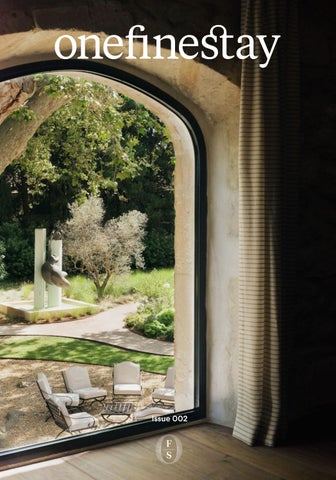
On the cover: Bastide Saint-Rémy in Provence, France. Photography by Pauline Chardin Styling by Juliette Lambert
O N E F I N E S TAY
3
Contributors
LILA ALLEN “Return to Form,” page 54; “It Takes a Village,” page 64
PAULINE CHARDIN “Under the Plane Tree,” page 42 “The upstairs living room, with its plush, dusty-blue sofas, made the biggest impression; in the midday Provence summer heat, it felt like the perfect refuge,” says the photographer and creative director working between Paris and Provence. “Bastide Saint-Rémy feels like a great balance between bold art pieces, modern furniture, and historical elements—definitely a singular place to spend time. The old, tall trees surrounding the property make it feel like a sanctuary, putting the world at a distance, and they come with a very lively army of cicadas.”
The Hudson Valley–based founder and editor of the design magazine Wrong House interviewed two onefinestay homeowners for this issue. “Loisse and Fernando, the owners of Olive Villa Firenze, went absolutely electric talking about their home in Tuscany,” she says. “The homeowner of Umbria’s Poggio Posillipo took great care to ensure the new guest pavilion felt integrated with its context. It also has my current favorite amenity: an outdoor sauna!”
FRED NICOLAUS “Under the Plane Tree,” page 42 “When people fall in love with a house, it’s usually some aspect of the architecture,” says the executive editor of Business of Home, who calls New York City home. “In the case of Bastide Saint-Rémy, it was a tree. The owner, Liliana Meylan, was rapturous in her descriptions of the centuries-old plane tree that anchors the property. At one point in the conversation, she told me it took eight people to hug the trunk—I think she meant it as a unit of measurement, but I had to wonder whether, every now and then, she gathered together seven friends to let the tree know just how much it was loved.”
4
O N E F I N E S TAY
The New York City–based illustrator and graphic designer brings his signature wit and characteristic style to onefinestay as its resident illustrator. Drawing in pen and ink on paper, his work is rooted in the same observational approach he uses while traveling. His wide-ranging body of work includes commissions for Design Within Reach, Valentino, The New York Times, and The Wall Street Journal. For this issue, he turns his eye to the ski resorts that define the Rockies. “I’ve been skiing once,” he says, “and after being rescued, found that après-ski is more my style.”
Top right: Lizzie Soufleris; Bottom left: Eric Schwortz Photography
ROB WILSON, “The Call of the Rockies,” page 72
Experience travels well. A Sentient Jet Card gives you guaranteed access and set pricing for private jet travel. More than 25 years of experience goes into every hour, every flight, and every detail. It’s why more than half of our Card Owners come to us through a client referral. Discover the Sentient Jet Card Visit sentient.com/one-fine-stay The Sentient Jet 25-Hour Card and Sentient Jet 25-Hour Plus Card are programs of Sentient Jet, LLC (Sentient®), an “Air Charter Broker” under DOT regulations. Sentient acts as authorized agent for the Cardholder, which is the “Charterer” under DOT regulations, to contract for transportation services with FAR Part 135 Direct Air Carriers that operate and exercise full operational control over those flights at all times. Flights will be sourced through the proprietary Sentient Certified™ Network of Direct Air Carriers that meet all FAA or comparable foreign safety standards and additional safety standards established by Sentient.
Jackie Caradonio Editorial Director jackie@storynyc.co Brian Struble Creative Director Scott Bay Editor Erin Agostinelli Managing Editor Michele Snow Art Director EDITORIAL & CREATIVE Writers Lila Allen, Oset Babür-Winter, Jen Murphy, Fred Nicolaus, John Wogan Photographers Andrew Beasley, Anthony Bogdan, Pauline Chardin, Samanta Katz
PUBLISHED BY:
Illustrators Rob Wilson Stylists Juliette Lambert Copy Editor Dora Dalton ADVERTISING Diane Ciaglia Publisher diane@storynyc.co
© 2026 StoryNYC, LLC. All rights reserved. No part of this publication may be reprinted without the written consent of the publisher.
ONEFINESTAY Chief Executive Officer James Henderson President Ashlee Collins Chief Marketing Officer Caitlin Austin Senior Director, Brand Strategy & Innovation Jackie Rigney Director, Brand Strategy Samantha Birnbach Director, Creative & Design Hannah MacDonald Senior Manager, Content & Communications Elena Metzner Manager, Content Georgia Sayer Specialist, Marketing Kate Winter
Narrative content is owned by StoryNYC, LLC. The Exclusive Collective, LLC owns all onefinestay-provided content, including onefinestay’s marks. Opinions expressed are solely those of the contributors and are not necessarily endorsed by StoryNYC, The Exclusive Collective, or onefinestay.
Onefinestay is part of The Exclusive Collective, alongside Exclusive Resorts and Inspirato—bringing together three distinct approaches to luxury travel, all in pursuit of a life well lived. To learn more, visit www.theexclusivecollective.com.
6
O N E F I N E S TAY
Volume 2 / November 2026
SNOW SEASON SORTED
Credit
A new chapter at altitude. Discover onefinestay’s growing collection of exceptional homes across the U.S. mountains.
+1 855-553-4954 | advisors@onefinestay.com
O N E F I N E S TAY
7
Culture. Design. Style.
GUESTBOOK
Credit
8
O N E F I N E S TAY
The Design 10 By JOHN WOGAN
1
Beautiful Decay During Milan Design Week 2026, Marcin Rusak Studio introduced new works ranging from domestic furniture to botanical panels standing over eight feet tall. Individual plants remain fully visible inside layers of glass, while a shelving unit, coffee table (shown here), and mirror adapt the studio’s preservation techniques to functional forms. Veins, curled petals, and fading color become part of each object’s surface, recording the plant at a particular stage of its decay. marcinrusak.com
O N E F I N E S TAY
9
2
Making Waves Brazilian artist Filipe Jardim brings the relaxed energy of his native country to 3 Surfs, a graphic Hermès beach towel populated by surfers, palms, surfboards, and rolling waves. Its 13-color design is screen-printed in France onto substantial cotton terry woven in Germany, with a solid orange reverse. At nearly five feet long, it offers enough space for Jardim’s sun-drenched scenes to come to vibrant life. hermes.com
10
O N E F I N E S TAY
3
Fractured View
Credit
For their Woven Mirrors, Bower Studios founders Danny Giannella and Tammer Hijazi work reflective bands of stainless steel and leather into geometric grids supported by walnut frames. Rather than a single coherent image, the segmented surfaces fracture and rearrange their surroundings as the viewer moves. Produced in several compositions, the series occupies an ambiguous space between functional mirror and collectible wall piece. bower-studios.com
O N E F I N E S TAY
11
4 Woven in Light Gino Sarfatti’s Model 600, designed for Arteluce in 1966 and now produced by Flos, uses a pliable leather base that allows the lamp to rest at different angles. For this special edition, Bottega Veneta reworks the spherical base in calfskin with the house’s Intrecciato weave, shown here in vivid parakeet green. The update preserves Sarfatti’s ingenious adjustability while recasting a modernist lighting classic through the language of Italian leatherwork. bottegaveneta.com
12
O N E F I N E S TAY
5
Name Game
JVA Studios – Stojan
Rolex revives its Jubilee dial, introduced in the late 1970s, for the new Oyster Perpetual 36. The Rolex name repeats across the lacquered face in 10 contrasting colors, each applied individually in a technically demanding process requiring exact alignment. Housed in a 36mm Oystersteel case and paired with the familiar Oyster bracelet, the piece brings an exuberant graphic treatment to one of the watchmaker’s most elemental designs. rolex.com
O N E F I N E S TAY
13
6
Metal with Mettle After nearly three years of experimentation, Ana Khouri developed her own 18-karat brown gold, a proprietary alloy intended to evoke the colors and textures of nature. The material gives this new sculptural ear cuff a subtle earthen cast, while its form reflects Khouri’s bodyconscious approach to jewelry. By developing the metal itself, working with responsibly sourced gold and shaping each design by hand, Khouri extends the jeweler’s role into something closer to that of a material inventor rather than simply a designer. anakhouri.com
7
In the Balance Mexico City designer Ernesto Azcárate has a way of making furniture feel more like sculpture. His Low Table EM01, like all of his objects, is handmade, and pairs black marble with dark wood in a low-slung composition that plays with weight. It’s the interruption of materials that softens the overall geometry and creates an unexpected balance. ernestoazcarate.com
14
O N E F I N E S TAY
8
Above: John Daniel Powers
La Divina The second chapter of Montblanc’s tribute to iconic opera singer Maria Callas takes its cues from the soprano’s famously dramatic personal style. The fountain pen’s ruby-red resin recalls the jewelry she wore throughout the 1950s and ’60s, while a petal-shaped gem on the clip nods to her love of flowers. The solid-gold, rhodium-coated nib is engraved with her nickname—“La Divina”—and the unmistakable cat-eye makeup that always adorned her lids. montblanc.com
O N E F I N E S TAY
15
9
Shape of the West Working from rural Heber City, Utah, David Burbidge’s latest custom furniture is informed by the landscape and material character of the American West. His practice favors natural materials, aged surfaces, and visible handwork, with designs that range from sculptural timber seating to angular upholstered forms and robust wood tables. The pieces feel less like a coordinated furniture line than an evolving collection of singular, characterful objects. davidburbidge.com
16
O N E F I N E S TAY
10
Recorded in Clay Kobina Adusah’s first exhibition with London’s Gallery FUMI brings together three new bodies of ceramic work, ranging from tabletop vessels to large-scale sculptures. Handdrawn lines, incisions, and improvised patterns animate their surfaces, connecting contemporary forms with older modes of recording and transmitting knowledge. Through clay, Adusah considers how personal and collective histories persist, even when they cannot be reduced to a single written account. galleryfumi.com
O N E F I N E S TAY
17
A MATTER OF TASTE
Art Crush The Cultivist—a global membership club and cultural agency offering unparalleled access to the world’s leading museums, galleries, and art fairs—shares the bluechip exhibitions and can’t-miss shows worth traveling to London for this season. 18
O N E F I N E S TAY
Vasily Kandinsky, Dominant Curve (1936). Oil on canvas, 129.2 x 194.3 cm. Solomon R. Guggenheim Museum, New York, Solomon R. Guggenheim Founding Collection. Photo: Kristopher McKay © 2025 The Solomon R. Guggenheim Foundation, New York.
Peggy Guggenheim in London: The Making of a Collector Royal Academy of Arts Before she built one of the world’s greatest collections in Venice, Peggy Guggenheim briefly operated Guggenheim Jeune, an influential London gallery. This exhibition revisits those formative years and the vision that helped shape 20th-century art history. “It’s a fascinating look at the short-lived Cork Street gallery that gave Kandinsky his first UK solo exhibition,” says Clare Reid, The Cultivist’s deputy director of European programming. “Afterward, take a walk down Cork Street itself—it’s still one of London’s great gallery neighborhoods.” November 21, 2026– March 14, 2027
O N E F I N E S TAY
19
Van Eyck: The Portraits National Gallery
20
O N E F I N E S TAY
The Courtauld Pakistani-born, New York–based painter Salman Toor has become one of contemporary art’s most compelling voices, creating intimate, emotionally charged scenes that explore friendship, desire, identity, and belonging. His first European museum exhibition brings together 19 paintings alongside a special display of drawings, offering fresh insight into Toor’s creative process. “This has us genuinely excited,” says Georgina Morley, The Cultivist’s managing director of product. “The show feels so overdue, and I can’t wait to finally stand in front of 19 of his paintings together—and see that acid-green, dreamlike quality I fell for a few years ago at the Venice Biennale. The drawings reveal how he builds those unforgettable scenes.” Through January 10, 2027
Jan van Eyck The Arnolfini Portrait (1434). Courtesy of the National Gallery.
Six hundred years after they were painted, all nine of Jan van Eyck’s surviving portraits will hang together for the first—and likely only—time. Alongside the famed Arnolfini Portrait, the exhibition reveals how the Early Netherlandish master transformed portraiture through astonishing realism, luminous oil paints, and an unprecedented attention to everyday people rather than royalty alone. “Seeing all nine surviving portraits together is something most art historians never expected would happen,” says Reid. “Given the rarity of the loans, expect this to be one of the harder timed tickets to secure on a weekend.” Through April 11, 2027
Salman Toor: Someone Like You
Renoir and Love National Gallery
Pierre-Auguste Renoir, Dance at the Moulin de la Galette, 1876; Oil on canvas, 131.5 cm x 176.5 cm. © photo Grand Palais RMN (Musée d’Orsay) / Mathieu Rabeau; Salman Toor The Bar on East 13th (2019), Oil on panel, 36 x 48 inches (91.4 x 121.9 cm) © Salman Toor; courtesy of the artist, Luhring Augustine, New York, and Thomas Dane Gallery. Photo: Genevieve Hanson.
Rather than tracing Renoir’s career chronologically, this exhibition examines love as the defining thread running through his work—from romance and friendship to family life and modern Paris. At its center is the celebrated Bal au Moulin de la Galette, returning to Britain after more than four decades. “Bal au Moulin de la Galette is back on British soil for the first time since 1985, anchoring the biggest UK Renoir exhibition in 20 years,” Reid says. Through January 31, 2027
O N E F I N E S TAY
21
Hayward Gallery
The Bayeux Tapestry British Museum One of the most significant museum loans in recent memory brings the Bayeux Tapestry to England for the first time since it was created nearly 1,000 years ago. Stretching almost 230 feet, the embroidered masterpiece chronicles the Norman Conquest of 1066 while offering an extraordinary window into medieval life—from ships and castles to clothing, feasts, and warfare. “It’s hard to overstate just how extraordinary this is,” Morley says. “The tapestry has left France for the first time in nearly a millennium, arriving in London after a secretive overnight operation.” Tickets through December have already sold out, so keep an eye out for the next ticket release. Through July 11, 2027
22
O N E F I N E S TAY
Few photographers have reshaped contemporary image-making like Nan Goldin. This landmark exhibition—her first major UK institutional presentation in more than two decades—brings together the deeply personal photographs that challenged conventions around intimacy, identity, and documentary storytelling. “This is Goldin’s first UK institutional exhibition since 2002,” Morley says. “It runs into March, so there’s no need to rush during the opening weeks if you’d rather take it in with a little more breathing room.” November 24, 2026–March 7, 2027
Nan Goldin, Joey with Hermaphroditus (2024). Archival pigment print, in frame 34 x 49 7⁄8 x 2 1⁄4 inches (86.2 x 126.5 x 5.7 cm), edition of 3 + 2 AP. © Nan Goldin, courtesy the artist and Gagosian; The Bayeux Tapestry (11th century). © La Fabrique de patrimoines en Normandie, Antoine Cazin.
Nan Goldin: You Never Did Anything Wrong
Claude Monet, Nymphéas (1914-17). © Musée Marmottan Monet / Studio Christian Baraja SLB.
Monet: Painting Time Tate Modern Tate Modern’s first-ever exhibition devoted to Claude Monet explores the artist’s lifelong fascination with the changing effects of light, atmosphere, and time. Organized with Paris’s Musée de l’Orangerie, the show follows the canonical Impressionist’s increasingly radical approach to painting the fleeting experience of the modern world. “This is one I’d save for after the post-holiday rush,” Morley says. “It promises to be one of the season’s biggest draws, but you’ll have plenty of time to enjoy it once the crowds begin to thin.” February 25–June 27, 2027
As part of onefinestay’s partnership with The Cultivist, eligible London guests staying five nights or more receive a $500 credit toward a Cultivist Curated experience, unlocking exclusive access to the city’s museums, galleries, and cultural institutions. For more information, visit onefinestay.com/lp/cultivist-offer.
O N E F I N E S TAY
23
24
O N E F I N E S TAY
LENS ON
Slow Down and Savor Photography by ANTHONY BOGDAN
F
or photographer Anthony Bogdan and his family, a stay at La Maccinaia in Tuscany was an opportunity to trade busy schedules and packed itineraries for simplicity, nature, and uninterrupted time together. Set on a historic wine estate in the heart of Chianti, the 17th-century villa pairs original details like terracotta floors and barrel-vaulted ceilings with contemporary comforts—all surrounded by rolling vineyards and olive groves, which provided a picturesque backdrop for quiet moments together. Gathering around the table for meals, soaking up the sun during picnics and on leisurely walks, and discovering new talents (and fresh local ingredients) in a pizza-making class transformed the villa into more than a place to stay—it became the setting for cherished memories.
O N E F I N E S TAY
25
A pizza-making class brought the Bogdan family together with fresh local ingredients. La Maccinaia’s interiors pair original details like vaulted ceilings and fireplaces with contemporary decor.
26
O N E F I N E S TAY
O N E F I N E S TAY
27
28
O N E F I N E S TAY
La Maccinaia provided the Bogdan family with an idyllic setting to enjoy Tuscany’s simple pleasures.
O N E F I N E S TAY
29
COVETED
The London Look A historic townhouse in the heart of South Kensington combines classic London style with a fresh new aesthetic. Photography by ANDREW BEASLEY
30
O N E F I N E S TAY
B
efore the walls of Brompton Cross were painted, or its vibrant patterned fabrics chosen, the London townhouse’s owners had already established its guiding principle: “We wanted there to be absolutely no doubt that this home is in London,” they say. Thus, a strong sense of place—and a rather cheeky appreciation for history—was vital to every design decision in the reinvention of the Victorian terrace residence. The South Kensington home dates to the mid-1850s, but by the time the homeowners purchased it in 2023, decades of additions and renovations had stripped away much of its original character. Functional repairs were needed first—a new roof and rebuilt terrace included—before a complete interior overhaul could commence. Details that referenced original features were first introduced: traditional moldings and crowns, a marble entrance hall, and, in the reception room, a new fireplace where a decommissioned one had once stood. From there, layers upon layers of British heritage were added, with each richly textured room telling its own story. The entrance is
Brompton Cross’s kitchen is finished in powder blue and features a dramatic mural of an English garden scene. Opposite: In the living room, American and British antiques come together in a transcontinental palette of red and blue.
O N E F I N E S TAY
31
finished in classic black-and-white marble from Wales to celebrate the craftsmanship of the British Isles, while the stair hall is painted in Eau de Nil—a soft green famously associated with Victorian England and inspired by the hues of Fortnum & Mason and Mayfair’s beloved Claridge’s hotel. In the kitchen, a dramatic mural from Liberty transforms an entire wall into a verdant English garden scene, creating a conservatory atmosphere for intimate meals and afternoon tea. Elsewhere, tartan runners line the staircase, delicate Scottish lace cascades along the banister, and antiques sourced from a favorite dealer in Bath mingle with treasured family heirlooms. Perhaps nowhere is the home’s playful take on British heritage more apparent than in the reception room. Conceived as “America meets Britain,” it juxtaposes references to both nations. A red, white, and blue palette dominates the myriad mix of fabrics, rugs, and wallcoverings, and bespoke curtains are trimmed with vintage military buttons. (The homeowners are still searching for a pair of portraits: one of George Washington and another of George III.) Brompton Cross’s geographical connection to London was just as important to the homeowners. “Its location is ultimately what made us fall in love with it,” they say, adding that longtime institutions such as Daphne’s restaurant and the boutiques along Walton Street are just steps away. “It feels like a little village within the city.”
32
O N E F I N E S TAY
Adding further British pedigree to the address is the statue of Queen Victoria at the Victoria & Albert Museum: The house’s top-floor bedroom window peers directly at it from just across Thurloe Square.
O N E F I N E S TAY
33
Credit
Architect Hugo Tugman says revisiting Elgin Corner was an opportunity to update his original design for a new homeowner—and a new era.
THE INTERVIEW
Second Draft
When architect HUGO TUGMAN first designed Elgin Corner in 1990, he transformed a constrained London site into a surprisingly lightfilled home. More than three decades later, the architect returned to reinvent the residence for a new owner, revisiting one of his earliest projects with fresh ideas, new technologies, and a lifetime of experience. onefinestay asked him to reflect on being immersed in this unique site once again. Photography by ANDREW BEASLEY
Few architects get the opportunity to revisit one of their earliest projects decades later. What was it like returning to Elgin Corner? It was incredibly unusual. When I finished the house in 1990, I assumed I’d never see it again. It was one of my first published projects, so it has always been important to me professionally, but I thought that chapter was closed. Then the new owner bought the house, found my name on the original planning drawings, and eventually asked me to redesign it. What made it so interesting was that I wasn’t simply finishing something left undone—I was designing for a completely different client. The original owner was a young actor with a limited budget who wanted an exciting place to entertain. Thirty years later, I was working with a family
who wanted a home that could evolve with the way they lived. Revisiting the project wasn’t about correcting the past; it was about responding to a new brief with three decades more experience. Elgin Corner occupies an unusual footprint. How did the site’s constraints shape the architecture? They shaped everything. The plot is almost funnel-shaped, with an entrance only about as wide as a car before it widens toward the back. The two longest boundaries sit directly alongside neighboring gardens, so there was almost nowhere we could introduce windows. People often imagine architecture that begins with a vision for the building and then you find a site to suit it. I’ve always believed the opposite: The site tells you what the building wants to become.
O N E F I N E S TAY
35
Did the site’s limitations nurture creative solutions? Absolutely. In cities like London, every millimeter counts. You’re constantly asking how to bring in more light, how to make a staircase work better, how to borrow space without making a room feel smaller. Those limitations are where the interesting ideas emerge, and Elgin Corner is memorable because almost every feature people respond to today—the dramatic volume, the daylight, the unusual geometry—exists because the site demanded it. For instance, because we couldn’t bring light in from the sides, we brought it in from above. The tripleheight void, the skylight, and the internal bridges were all practical responses to a difficult site, and they ultimately became the defining character of the house. The constraints didn’t limit the architecture; they created it. Adding a third floor to the home for this recent renovation could have compromised the flow of natural light from the skylight. How did you solve that problem? That was the biggest challenge. The whole concept of the original house depended on daylight filtering from the ceiling all the way down to the ground floor. Once you introduce another level, you risk blocking
36
O N E F I N E S TAY
Glass flooring allows daylight to continue passing downward between levels while preserving usable space.
O N EOFNI N E FEI SNTEASYT A3Y7 3 7
On the newly added third floor, a retractable roof brings natural light—and the elements—into the bedroom.
38
O N E F I N E S TAY
that entirely. We had to rethink how light moved throughout the building. Glass flooring allowed daylight to continue passing downward while preserving usable space on the new floor. At the same time, we had to think about privacy, because you don’t necessarily want to look straight into a bedroom from below. Every decision became a balancing act between light, privacy, circulation, and making the new spaces feel completely natural rather than added on. How did the renovation change the way the house functions? The biggest shift was designing for family life. The kitchen became much larger, circulation improved, and we created a roof terrace that hadn’t existed before. We also relocated the entrance to make the plan work more efficiently and allow us to use more of that space for the kitchen. Those weren’t cosmetic decisions; they were architectural ones. I often say that aesthetics follow function. If you solve the planning well, if the spaces work beautifully, the architecture almost takes care of itself. You can spend a fortune on finishes, but if the rooms don’t function properly, they’ll never feel right.
Technology has also changed dramatically since the original project was completed. Absolutely. In the original kitchen we had a large extractor hood rising through the double-height space because that’s what the technology required at the time. Thirty years later, appliances had evolved, which meant we could free up space and allow even more daylight to move through the house. Those kinds of advances let us simplify the architecture rather than complicate it. The goal was never to make the house feel more technical; it was to make it feel lighter and more effortless. What did you find yourself approaching differently after 30 years? I never thought of it as improving the original design. The first house was absolutely right for its owner and for that moment in time. What changed was the brief—and, inevitably, me. As architects, we learn from every project. You accumulate experience, you become more confident, and you discover better ways of solving problems. Returning to Elgin Corner gave me the opportunity to apply everything I’d learned over the intervening decades while still respecting the original idea that made the house special.
O N E F I N E S TAY
39
At Home in
EUROPE Across Umbria, Tuscany, and Provence, three storied houses stage elegant homecomings— lovingly restored, thoughtfully layered, and ready to make travelers feel, however briefly, entirely at home.
40
O N E F I N E S TAY
Photograph by Mark Elst; Illustration by Rob Wilson
Bastide Saint-Rémy in Provence, France.
O N E F I N E S TAY
41
Under the Plane Tree How a husband-and-wife design team brought a home in the South of France back to life, one salvaged beam at a time. By FRED NICOLAUS Photography by PAULINE CHARDIN Styling by JULIETTE LAMBERT
42
O N E F I N E S TAY
Credit
O N E F I N E S TAY
43
Bastide Saint-Rémy is a home rich in classic Provençal details—sunbaked wood, riversmoothed stone, chalky terracotta— but with the scale and comfort of a modern residence.
44
O N E F I N E S TAY
T
he living room had tractors in it. That was the state of things when Liliana and Alain Meylan first discovered the Provençal country home that would one day become Bastide SaintRémy. The property was grand, with a majestic plane tree standing watch like a colossus. The tree is centuries old, having outlasted kings, queens, wars, and revolutions—an ancient giant swaying in the southern breeze. According to Liliana, the circumference of its trunk is so great, it takes eight people linking arms to give it a proper hug. “We were dreaming about spending an evening under that tree and feeling the peace it gives you,” she says. The house itself, however, had fallen into considerable disrepair. Luckily, the Meylans knew what to do. The pair had met years earlier in Switzerland and immediately began working together—he’s an architect and she’s an interior designer—on private residences, restaurants, and hospitality projects.
O N E F I N E S TAY
45
46
O N E F I N E S TAY
Mark Elst
The original beams were removed, painstakingly cleaned, then laid back into place. Opposite: The house contains contemporary references without breaking the spell of the French countryside.
A love of horses had drawn Alain to Provence, where he purchased a home in the shadow of the Alpilles, a limestone mountain range that cradles a clutch of medieval villages and dense olive groves. To give themselves what Liliana laughingly calls a “weekend project,” the pair bought a nearby country home in rough shape and began fixing it up and polishing it into a jewel. Then another, and another. Over a few years, the Meylans restored nine homes in all. By the time they happened upon Bastide Saint-Rémy, their tools were well-sharpened—still, every home has its own challenges. “It’s very often the case that the property guides you,” Liliana says. And plenty of guidance was needed: The previous owner had been living in a small part of the home, the rest of it boarded up, windowless, and used for agricultural storage. Liliana’s instinct was to save what could be saved. “As much as we can, we preserve what is
existing,” she says. “We always avoid creating the ‘false old.’” In this case, she and Alain restored the stone-and-plaster walls wherever possible, and kept the stately country fireplaces intact. Though the ceilings had to be raised, the original beams were removed, painstakingly cleaned, then laid back into place. The result is a home rich in classic Provençal details—sunbaked wood, river-smoothed stone, chalky terracotta—but with the scale and comfort of a modern residence. The tractors in the living room have been replaced by a Marcel Breuer chair and a sofa from Italian brand Henge. One of Liliana’s gifts is to spark a room with contemporary references without breaking the spell of the French countryside—not a simple feat. Bastide Saint-Rémy is full of moments that evoke a clever union between the history of the region and the present day. Take, for example, the dining room
O N E F I N E S TAY
47
The house is peppered with works the homeowners, Liliana and Alain Meylan, have found on their travels, alongside art and objects by friends and other discoveries sourced from small studios.
48
O N E F I N E S TAY
Credit
50
O N E F I N E S TAY
Mark Elst
The Meylans were attracted to the home primarily due to the colossal plane tree watching over the property.
table. At first glance, it’s an exquisite contemporary piece, weighty and bold, with the heft of minimalist sculpture. But the table was not airlifted in from a Milan showroom; it was crafted by a local family of carpenters who work with poplar from the region. It’s the spiritual descendant of a classic country farm table, made new (and it seats 12). In the living room is another testament to that weaving of past and present: In view of a grand stone fireplace, Liliana placed two arresting abstract portraits by the young painter Jules Milhau, artwork that seems at home here but wasn’t chosen just for wall power. One is the Madonna, the other Sara-la-Kâli, the patron saint of the Roma people and a religious figure intertwined with the folklore of Provence. Her shrine lies in a seaside town 30 miles to the south. If the downstairs living room is the showstopper, upstairs is crafted as a relaxed second living room—
a space, Liliana says, for “taking time for yourself”— with plush blue-gray sofas by French atelier Ralph M and a rug that the Meylans picked up while they were designing sailing yachts in Turkey. The house is peppered with other pieces the couple discovered on their travels, alongside art and objects by friends and other discoveries sourced from small studios. On the side table in a bedroom is a striking lamp by a French artisan, its plaster base made up of two figures kissing in profile. A wall holds an expressive painting by an Argentine friend of Alain’s. Fabrics from Italy, lamps from Marseille—the range gives the home its depth. It’s unquestionably a Provençal country house, but a worldly one. “When you create a project and put your heart in every corner and piece you choose, people will feel it,” Liliana says. “The home is full of moments that guests will talk and wonder about.”
O N E F I N E S TAY
51
52
O N E F I N E S TAY
Each room is full of moments that evoke a clever union between the history of the region and the present day.
O N E F I N E S TAY
53
Return to Form After an incongruous 1980s renovation, a former olive mill near Florence embraces its original Tuscan character. By LILA ALLEN Photography by SAMANTA KATZ
Olive Villa Firenze, an 8,000-square-foot Tuscan manse, has a dramatic piazza and painterly views of Florence.
54
O N E F I N E S TAY
O N E F I N E S TAY
55
56
O N E F I N E S TAY
The homeowners desired to embrace all the hallmarks of Mediterranean architecture, but they also kept some details from the circa-1980s renovation—namely, the soaring atrium in the living room.
L
oisse Herger and Fernando Dávila had spent two years trawling online real-estate listings in search of their future European getaway—but it only took an instant in person for them to realize they’d found “the one.” The couple had married in Sorrento years earlier and always imagined owning a home in Italy. But as Puerto Ricans with an affinity for coastal living, they’d assumed that the Campania, with its sun-soaked beaches and crystalline waters, would be a natural fit. That changed as they drove up the long road to what is now Olive Villa Firenze, their 8,000-square-foot Tuscan manse, and saw its dramatic piazza and painterly views of Florence. (Look closely, and you can spot the Duomo in the distance.) “We said, ‘I think this is it,’ without even having seen the villa,” Dávila recalls. Sitting on the edge of the countryside in the municipality of Lastra a Signa, the villa dates back to the late 18th or early 19th century. It was once the
O N E F I N E S TAY
57
Celebrating the home’s history led to some of its most distinctive spaces: A former stable now holds one of the house’s three kitchens, with groinvaulted ceilings.
local frantoio, or place where olives were crushed and processed into oil. From the outside, it bears all the hallmarks of Mediterranean architecture: stucco walls, a scalloped terracotta roof, and a rustic stone-lined piazza. Groves of olive trees enclose the property; its last harvest yielded the couple more than 1,200 liters of olive oil. But there was one incongruous element: The home had undergone a renovation 30 years prior that froze the interior in a late-1980s vernacular of white and stainless steel. “It almost felt like we were walking into a Miami Beach type of property,” Dávila says. “For us, it was clashing.” He and Herger set out to reintroduce warmth and texture throughout the home, leaning into natural materials and finishes—linens, roughhewn woods, plaster walls—to return the home to its roots as a Tuscan countryside villa. That included embracing many of the home’s original details, like exposed wooden ceiling beams that bear the patina of age. They left a select few elements of
58
O N E F I N E S TAY
the ’80s facelift intact—namely, the soaring atrium in the living room. Celebrating the home’s history led to some of its most distinctive spaces: A former stable, for instance, now holds one of the house’s three kitchens, with groin-vaulted ceilings that lend a sense of old-world grandeur. Now equipped with seven bedrooms, including a two-bedroom guest apartment that can be closed off from the primary residence as needed, the house accommodates contemporary living without severing its past. A wellness area in the basement— including an indoor “cave bath,” where guests can take a quick dip, and a gym where a garage once stood—was among the lifestyle upgrades that Herger and Dávila prioritized. Their renovations also made that groin-vaulted kitchen a nucleus for social activity. “We thought, why not make the centerpiece of this beautiful space the kitchen?” Herger says. Today, they often use it for pasta- and pizza-making classes.
Credit
O N E F I N E S TAY
59
The homeowners filled the villa with antiquities from Parma and Florence, including centuries-old ceramics in the billiards room and aged pergolas filled with greenery and more historic pieces on the piazza.
Across rooms, the homeowners introduced a constellation of antiquities sourced from Parma and Florence: weathered wooden tables, Venetian paintings, and tapestries that intermingle with more modern fixtures. In a billiards room, rows of centuries-old ceramic vessels have taken up residence along a wall near a custom pool table made by the local shop Rogai Biliardi. Antiques even appear outside on the piazza, with aged pergolas holding lush greenery. An elevator services all four levels of the home, making the residence a boon for multigenerational groups where mobility may be a challenge. “When you coordinate a trip with 16 family members, it’s always nice to bring grandma,” Herger says from experience. “We wanted to make it feel like it’s a place that everybody could stay.” With plenty of space to commune or seek privacy, the only problem might be deciding who gets to come. As Herger puts it: “Nobody says no to Italy.”
60
O N E F I N E S TAY
O N E F I N E S TAY
61
Credit
62
O N E F I N E S TAY
Olive trees, which are the property’s namesake, can be seen everywhere, from the pool to the terrace to paintings within the home.
O N E F I N E S TAY
63
It Takes a Village A centuries-old Umbrian villa evolves into a modern-day borgo, complete with a new guest pavilion and sweeping views across the Tiber Valley. By LILA ALLEN Photography by SAMANTA KATZ
64
O N E F I N E S TAY
Credit
O N E F I N E S TAY
65
A
t Poggio Posillipo, an Umbrian aerie near medieval Todi, you might feel like you’re on top of the world. Surrounded by uninterrupted valley views, the estate—which its homeowners lovingly call a borgo, the local term for a historic hillside hamlet—sits at nearly 2,000 feet above sea level. To get there, you follow a long dirt road that, in late spring, winds through an ocean of canary-yellow broom flowers. Its name derives from Pausilypon, an ancient Greek word meaning “the place that pain ceases.” For guests, a stay may just deliver on that promise. Now comprising a main house and pavilion—linked by a piazzetta— and a suite of outdoor amenities, Poggio Posillipo has undergone a subtle transformation in recent years. Looking for a fresh start, its husband-and-wife owners felt called to Umbria, Tuscany’s more low-key regional neighbor. “It’s less crowded, and being less
66
O N E F I N E S TAY
The Poggio Posillipo homeowners enclosed a ground-floor loggia with an architectural glass door.
O N E F I N E S TAY
67
Left to right: The furnishings are meant to be lived in, not put on a pedestal; a wood-burning hearth anchors the living room; the property has a full outdoor setup, including two grills, for al fresco entertaining.
68
O N E F I N E S TAY
crowded, people are nicer, and it has just as spectacular views,” they note, pointing out that artwork from the area helped define the Renaissance and the centuries preceding it; Giotto famously painted Umbrian landscapes in his Assisi frescoes. When the homeowners purchased the property in 2015, only the upper level of the rustic villa was occupiable, as the ground floor still hosted stables. They immediately went to work converting it into an inviting space for guests, completing the interiors and furnishing it with finds from Restoration Hardware: deep leather sofas and armchairs, a generous farmhouse table, rugged antler chandeliers. A wood-burning hearth anchors the living room, which now feels even more expansive since the homeowners enclosed a ground-floor loggia with an architectural glass door. Guest quarters on the ground level open up to the garden, as does the loggia, which frames sprays of rosemary, lavender, and roses. Throughout the house, nothing is
too precious; furnishings are meant to be lived in and loved, not put on a pedestal. The painterly views of the Tiber Valley get their due in an impressive array of outdoor features added by the homeowners. An infinity pool, discreetly concealed behind a stone wall, overlooks staggered hillsides beyond a sweep of white Knock Out roses. Nearby, a tennis court provides another diversion. For the culinary-minded, an east-facing portico shelters a woodfired Argentinian Nuke grill, as well as a more traditional Weber grill. The husband, who has a penchant for hosting “serious barbecues,” prefers the former. “With the Weber, you’re always on the clock, because the ember only lasts so long,” he says. The guest pavilion is the newest addition to the compound, completed this past spring and built with the same rough-cut San Venanzo stone as the primary villa. Yet its architecture distinguishes it from the historic building, whose records date to
O N E F I N E S TAY
69
The guest pavilion is the newest addition to the compound, completed this past spring and built with the same rough-cut San Venanzo stone as the primary villa.
70
O N E F I N E S TAY
the 1700s—clean-lined and spare, the pavilion nevertheless feels as though it has always been there. Inside, it’s equipped with modern, vista-framing glazing, a sculptural suspended fireplace, and Navajo textiles sourced from the American Southwest. Another decidedly American touch is a 77-inch television—a popular spot when kids come over. An al fresco fitness center and sauna—seemingly now de rigueur—occupy a discreet corner of the yard. Together, the additions allow Poggio Posillipo to live up to its borgo designation: Settle in here, and there is little need— or desire—to leave. But if you do, you’ll find plenty to occupy your time. Those Giotto frescoes, for one, can still be found at the Basilica of San Francesco, just an hour’s drive away. Study them closely and you’ll recognize landscapes not unlike those surrounding the borgo—a reminder that, for all the property’s modern comforts, its history is never far from view.
O N E F I N E S TAY
71
The Call of the
Rockies Breckenridge/JP Douvalakis
72
O N E F I N E S TAY
Colorado’s ski towns are as distinctive as the mountains that surround them: Aspen has glitz and glamour, while Vail feels European and Breckenridge proudly boasts old-West spirit. Here, three winter-loving insiders share tips for feeling like a local, both on and off the slopes, at these completely unique destinations.
Credit
By JEN MURPHY Illustrations by ROB WILSON
O N E F I N E S TAY
73
ASPEN
Alpine Elite Where else can you lap powder runs all morning and then take in world-class art, music, and film at night? Aspen’s backdrop of big nature is complemented by renowned institutions including the Aspen Institute and Aspen Music Festival and School. That unique duality is what drew CHRISTY MAHON here in 1998. She has since held positions at two of the town’s most important institutions—the Aspen Art Museum and the Aspen Center for Environmental Studies—and in 2015, she became the first woman to ski and climb all of Colorado’s 14,000-plus-foot peaks. “There is no other ski town like Aspen,” she says. “Not only does it have four incredibly distinct mountains, but it has a community that was built on the ethos of mind, body, and spirit.” Here’s how she takes advantage of all that her adopted hometown has to offer. 74
O N E F I N E S TAY
←
POWDER DAY STRATEGY “One of the things I love most about Aspen is that every mountain has its own personality. Highland Bowl is for those who want to earn their powder turns. Tiehack is a favorite local secret on storm days, while Snowmass has enough terrain for everyone. And with the new lift on Aspen Mountain this year, Bell Mountain is going to be the place to chase first tracks.”
↑
BREAKFAST ROUTINE “If I’m loading up for a ski adventure—or just got back from one—I get the avocado toast and an Americano at St. Ambroeus. It has the cozy charm of a European cafe.”
Tamara Susa
OFF-MOUNTAIN ACTIVITY “I’d recommend a snowshoe tour with ACES. You’ll learn about our local ecology or head up Castle Creek Valley and snowshoe to Pine Creek Cookhouse for lunch.”
O N E F I N E S TAY
75
↑
↑
BEST FEST “Wintersköl has been an Aspen tradition since 1951; it’s one of the longest-running winter festivals in Colorado. Held every December, Aspen’s annual toast to winter brings the community together for a festive weekend featuring the torchlight descent and fireworks on Aspen Mountain, SoupSköl, a bonfire in Wagner Park, snow sculptures, and live music.” RECOVERY RITUAL “The 4 p.m. après-ski yoga class at Shakti Shala is the perfect place to stretch tired muscles and unwind after a day on the mountain. Owner Jayne Gottlieb has created a beautiful sanctuary where you can recharge, reconnect, and head into the evening feeling completely restored.” THE COVETED RESERVATION
76
O N E F I N E S TAY
Left: MaggShots Photography
“520 Grill is my favorite local spot. Owned by the Selby family, its new location overlooking Rio Grande Park is the perfect place to gather after a day playing outside, any time of year. The menu has something for everyone—from fresh salads and grain bowls to fish tacos and burgers—and the atmosphere is warm, welcoming, and unmistakably local.”
O N E F I N E S TAY
77
Above: Chris Council and Emily Chaplin
VAIL
Terrain Titan
78
O N E F I N E S TAY
↑ POWDER DAY GAME PLAN “Get yourself to the Back Bowls. Ride Gondola One to Mid-Vail then take the Mountain Top Express lift to the top of the mountain and follow signs over the ridge into the Bowls. I head straight to Blue Sky Basin. It’s the most remote of the seven Back Bowls, and at 645 acres, it’s larger than many ski resorts. I like to warm up on Cloud 9. It’s a cruisey blue—a mix of groomed rollers and glades—that stretches around 3.5 miles and has really pretty views of the Rockies.”
Above: Eric Dunn; Top right: Aleks Danielle
One of the largest ski resorts in North America, Vail is a lot to take in. The mountain has more than 5,000 acres of skiable terrain and 3,000 of those acres span the resort’s legendary Back Bowls. Its Bavarian-style village, tucked just off the beaten path, is a well of unique shops, including Alpine Kind, a mountainthemed boutique in the Sitzmark Lodge along Gore Creek. There, founder SALLY JANUARY curates a mix of locally inspired gifts like topographic candles poured in the shape of the Back Bowls and bespoke Western hats. A passionate snowboarder, January gets out on the mountain a few days a week, even if it’s just for a few runs. Her perfect Vail winter is a mix of remote pistes, secret cocktail spots, and the richest hot chocolate you can imagine.
ON-MOUNTAIN DINING “On a bluebird day, nothing beats a mountaintop barbecue at Blue Sky Basin. Belle’s Camp, located at the summit of the Skyline Express and Earl’s Express lifts, has gas grills that are free to the public. My friends and I pack hot dogs, burgers, and buns to grill and enjoy on the sundecks.” GO-TO APRÈS SKI “Root + Flower is a local, female-owned wine and cocktail bar. It’s one of those blink-and-you’ll-missit spots, tucked into a nook a few feet off bustling Bridge Street in the village. More than 20 different wines are poured by the glass and they make really fun cocktails like the Dirty Mary, an olive oil vodka and clarified tomato water martini. Snacks, such as truffle popcorn and deviled eggs topped with Maine lobster and caviar, are to die for.”
↑
WINTER WARMER “The Four Seasons Resort Vail is known worldwide for its creative ‘haute’ chocolate. Made with Valrhona chocolate and steamed milk, it’s churned tableside in a traditional French hot chocolate pot. Mugs are filled with a house-made marshmallow and topped with a chocolate lattice and then the server pours the hot chocolate over, melting it all together. If you’re over 21, you can spike your drink with peppermint schnapps or whiskey. It’s a must-try experience and can definitely be shared because it is so rich.”
O N E F I N E S TAY
79
BRECKENRIDGE
Big Breck Nothing builds up an appetite quite like skiing bell-to-bell at Breckenridge. For a town that’s barely six square miles, the Colorado town punches way above its gastronomic weight, with James Beard Award– winning chefs, bar-raising tasting menus, and beloved holes-in-the-wall that surprise and delight. Even the après-ski bits around here are worthy of culinary accolades, especially at Breckenridge Distillery, where chef DIEGO ROTEA turns out tiny morsels with a big impact. (His smoked ribs and tater tots are a must.) When it comes to curating the perfect winter itinerary on his home turf, Rotea makes sure his days are filled with epic powder— and equally epic flavors. 80
O N E F I N E S TAY
↑
PERFECT PEAK
Top right: Breckenridge/JP Douvalakis
Credit
“I snowboard, and on a powder day, I go out to the gate-accessed backcountry terrain on Peak 10. This is experts-only terrain, and you should have the right safety gear. You can find powder stashes back there all day long.”
←
ESSENTIAL EVENT “Every December, for more than 60 years, the town has hosted a multi-day festival in honor of Ullr, the Norse god of snow. There’s always a parade along Main Street. People dress like Vikings, ride on floats, and line up to take shots off what we think is the world’s longest shotski. Last year more than 1,400 people participated.”
O N E F I N E S TAY
81
↑
APRÈS LIKE A LOCAL “Happy-hour tables at Blue River Bistro on Main Street are in high demand. They have a backyard beer garden and host indie and bluegrass bands most days. My go-to drink is an espresso martini.” MOUNTAIN FUEL “Semplice Cafe is right on Main Street, a short walk to the gondola. I stop in for a coffee on my way to the mountain and order a breakfast panini to-go. Everyone sells breakfast burritos, but I’m a fan of the breakfast panini loaded with eggs, cheese, bacon, and sweet potato. The staff wrap it up for me so I can stick it in my pocket and eat it on the gondola ride.” OFF-PISTE ADVENTURE
82
O N E F I N E S TAY
Top left: Morgan Moutrie
“When friends who don’t downhill ski visit, I tell them to go snowshoeing. You can rent equipment at any of the sports shops in town, like Mountain Outfitters or Carvers. For groomed trails, go to the Golden Nordic Center or Breckenridge Nordic Center on Peak 8. For more of a wilderness experience, I like to go on the area hiking trails, like the aspen-lined Reiling Dredge Trail or the French Gulch Trail. Both are short and mellow.”
From left: Go big at the Bear’s Den in Breckenridge; the tranquil Roaring Fork River in Aspen.
Where to Stay Top left: Morgan Moutrie; Top right: JP Douvalakis
Base Camp
A
fter the lifts close, skip the ski lodge for your own personal chalet. In Breckenridge, The Bear’s Den goes big: eight bedrooms spread across five levels, with sprawling mountain views and ski-in/ski-out access that makes it easy to be the first on the mountain—and equally easy to call it a day. Aspen’s Roaring Fork River is smaller and quieter, trading the grand views for a tranquil riverside setting. The two-bedroom retreat—while a stone’s throw from Aspen Mountain—is an appealing counterpoint to the town’s see-and-be-seen energy. And in Vail, Cabin Circle is classic Colorado: river stone, a huge fireplace, and a spacious hot tub that makes the last run of the day feel negotiable. With five bedrooms and room for 12, it’s also particularly well-suited for a crew.
O N E F I N E S TAY
83
Paradise, Plated
The booming restaurant scene in Turks and Caicos has pushed local chefs to tell a deeper story about their Caribbean home. By OSET BABÜR-WINTER Courtesy Ámbra Credit
Overlay: Courtesy Experience Turks and Caicos Credit
Turks and Caicos chefs are turning to local ingredients to craft a fresh culinary identity for their island nation. Opposite: The Mussels & Clams dish at Ámbra.
O N E F I N E S TAY
85
T
urks and Caicos has never suffered from a lack of beauty: Its beaches are pristine. Its water impossibly clear. There’s hardly a reason in the world to leave your sun lounger. But lately there’s a new (and, some may say, longawaited) reason to stray from the sand: a culinary awakening, propelled by local chefs who are turning to their postcard-perfect land and sea to craft a fresh foodway identity for their island nation. “I think what makes this moment particularly exciting is that Turks and Caicos is not simply importing culinary trends; there is an opportunity to take the ingredients, flavors, culture, and hospitality that are already ours and reinterpret them in ways that feel contemporary, elevated, and still connected to the islands,” says local private chef Donvonno Cox. Philippe Legagneur, a lifelong resident of the islands who, along with his wife and partner, owns Mr. Grouper’s, a local mainstay for more than a decade, says that the scene has evolved “tremendously” over the years. He credits the uptick in tourism and travel to the islands as an inspiration to chefs everywhere to meet guests where they are. “Our dining scene is a beautiful blend of influences from around the world,” he says. “You’ll find touches of Italian, Canadian, Caribbean, and many other international flavors, all coming together to create something uniquely Turks and Caicos.”
86
O N E F I N E S TAY
Left to right: Ámbra’s tomato-andburrata dish; the open-air bar at Ámbra.
Ámbra Beach Club
Á
mbra gives the steady, trade-wind-swept beaches of the eastern side of Providenciales a dining destination of its own. Inspired by founder Vasco Borges’s summers at Portuguese beach clubs, the restaurant combines that leisurely, day-to-night lingering with a menu dedicated to open-fire cooking. While it’s certainly a fashionable place to drink near the water, Ámbra expands the island’s culinary map with its arroz de marisco (Portuguese seafood rice) and grilled picanha—and shows that a beach club can pair music and atmosphere with food that has a distinct point of view.
O N E F I N E S TAY
87
Indigo
I 88
O N E F I N E S TAY
Top left: Gary James
t’s no surprise that chef Andrew Mirosch—an avid fisherman, environmentalist, and self-described green thumb—considers sustainable harvesting one of his chief duties as a culinary creative. Thus, at Indigo, his restaurant at the Wymara Resort on the western edge of serene Grace Bay, he serves only the freshest catches and produce, sourced responsibly from island farmers and fishermen. In the kitchen, those ingredients come to life by blending long-held Caribbean techniques and flavor combinations with a few mainstays from his native Australia. Dishes such as Jamaican jerk shrimp and red Caribbean coconut curry with mahi-mahi capture that exchange beautifully, while the Australian lamb rack with potato mash and rosemary au jus is a delightful departure straight from Down Under.
From top: Marine Room is the island’s first restaurant that is entirely solar powered; the restaurant’s inventive and creative plating. Opposite: Indigo only uses the freshest seafood.
Marine Room
T
he first entirely solar-powered restaurant in Turks and Caicos, Marine Room sources ingredients from its own permaculture farm as well as from local fishermen. The environment is considered at every step of the culinary process, with the kitchen team composting organic waste and recycling all glass. The food itself is known for creativity with the island’s prized ingredient: conch. It is found in everything from a coconut cream chowder to carpaccio served with star fruit and oregano.
O N E F I N E S TAY
89
Lua Beach House
90
O N E F I N E S TAY
Left: Courtesy South Bank
B
y day, Lua Beach House is the place to be for wood-fired pizza and comfortable loungers on the beach; at night, it turns into more of a DJ-driven club scene, with food even better than it needs to be. Executive chef Neerul Tomar elevates the typical Turks and Caicos ingredients: Local conch becomes peri-peri croquettes, whole snapper arrives with Asian chimichurri, and Turks lobster gets a Szechuan treatment.
Si Si
N
owhere on the islands is it clearer that Mexican flavors and Caicos seafood belong together than at Si Si. Helmed by executive chef Rajasekar Ravindran and developed in collaboration with acclaimed Mexican chef Elia Herrera, the Grace Bay restaurant proves that international fusion cuisine works best when supported by local ingredients. Start with a refreshing platter of shrimp coconut ceviche topped with jicama and pomegranate seeds, and order the poblano corn cake to sop up any leftover coconut cream or mango. The showstopping Mexicanstyle paella is a seafood-lover’s feast, with clams, mussels, shrimp, and calamari.
From far left: Lua Beach House serves elevated bites to tables and loungers placed directly on the sand; the statement bar at Si Si.
Omar’s
Credit
A
low-key beach spot beloved by locals, Omar’s serves hearty Jamaicaninfluenced dishes, with fish sourced straight from the dock next door. At a moment when much of the dining boom is resort-led, Omar’s is preserving the working-waterfront independent restaurant—and it’s one of the best places on the island to enjoy Caribbean classics. Jerk chicken and pork served with sweet plantains and peas and rice, as well as oxtail and curried goat, are among the must-try dishes.
O N E F I N E S TAY
91
Where to Stay
Place Settings
I
f you want to try your own hand at cooking with the fresh ingredients Turks and Caicos has to offer, let a onefinestay kitchen become part of the itinerary. The Reserve Villa I on Grace Bay makes a particularly handsome setting for a relaxed meal. Designed by Brazilian firm Jacobsen Arquitetura, the seven-bedroom house feels neverending with its open-plan spaces and glass walls—including a full chef’s kitchen at its center, not to mention a 41-foot infinity pool stretching to the sea. On Long Bay beach, Dune House takes its cues from the landscape, layering native stone and locally milled wood with Scandinavian design influences. Most of the walls include sliding glass doors that dissolve the boundary between inside and out, leading to a dining courtyard, fire pits, and a cocktail lounge. The only challenge here is deciding where to set the table.
92
O N E F I N E S TAY
Reserve Villa I offers a pared-back beach escape. Opposite: Dune House’s perfect plunge pool.
O N E F I N E S TAY
93
TOP
94
O N E F I N E S TAY
Credit
The Matisse collection by East Fork.
TABLES Vacation may be fleeting, but its transportive rituals need not be left behind. This year’s tableware collections bring home the pleasures of a Portofino aperitivo, a night out in New York City, and a leisurely afternoon at the museum café. By SCOTT BAY
O N E F I N E S TAY
95
Christofle The Malmaison Riviera collection takes one of Christofle’s signature motifs and softens it for the endless sunny days of the French Riviera. The familiar palmette pattern is redrawn in luminous yellow on white porcelain, bringing a tactile presence of the Med to any table. Available in a complete set—from dinner, bread, and dessert plates to bowls, platters, a cake stand, pie dish, mugs, and teacups—it pairs seamlessly with the house’s silver-plated flatware, creating a setting that remains unmistakably Christofle. christofle.com
96
O N E F I N E S TAY
Alicia Dubuis
Maison Balzac French-born Elise Pioch Balzac established her namesake brand in Australia with just five scented candles. Twelve years later, Maison Balzac has expanded into a global mainstay for hand-blown glass, linen, fragrance, and other tabletop objects—what Balzac calls “jewelry for the table.” The latest collection enters the surreal, inspired by Italian designer Elsa Schiaparelli and a spectrum of green hues. This looks like mint Nick & Nora glasses, fig-leaf napkins, graphic placemats, and the showstopper geometric Le Triple Cube candleholder, alongside the brand’s first fine-china dinnerware with star-centered plates and serving dishes that elevate any meal. maisonbalzac.com
O N E F I N E S TAY
97
Sophie Lou Jacobsen
98
O N E F I N E S TAY
East Fork The Matisse collection is both an artistic collaboration and a family story: East Fork founder and CEO Alex Matisse is the great-grandson of the celebrated French painter and sculptor Henri Matisse. Developed over more than two years with Les Héritiers Matisse, the series borrows the color and linework of the master’s original works and places them on the brand’s Blue Ridge Mountain–made pottery. The latest expansion of the line uses aquatint portraits on side plates, the four Nu Bleu figures on dinner plates, and Femmes et Singes encircling its weighty signature mug. eastfork.com
Photography: Andrea Gentl and Martin Hyers. Food styling: Jen Monroe.
French-American designer Sophie Lou Jacobsen established her New York studio in 2019 around the belief that practical objects can shape atmosphere and mood. The hosting edit takes that ethos to the rituals of aperitifs, martini lunches, and latenight hedonism. Each sculptural glass and piece of serviceware is designed to be mixed and matched rather than bought in a formal set. The glasses vary in shape but matching stems bring fluidity to the table, while a curving glass pitcher and stainless-steel Squiggle Tray take care of fruit, snacks, and chilled bottles. sophieloujacobsen.com
Credit
O N E F I N E S TAY
99
Credit
100
O N E F I N E S TAY
La DoubleJ In collaboration with British artist Tabby Booth, La DoubleJ’s latest tableware collection is a meeting of two distinct decorative languages— perhaps with more in common than it first appears. Booth, an illustrator and painter based in Cornwall, works between traditional folk art and contemporary illustration, filling her works with mythology, mysticism, and beasts. La DoubleJ brings a command of pattern, bold colors, and production capabilities. Together, the partnership displays Booth’s darkly playful imagery with the Milan brand’s refinement in a collection that exudes narrative and personality, just like the two collaborators. ladoublej.com
O N E F I N E S TAY
1 01
Credit
102
O N E F I N E S TAY
Il Buco Vita Virginia Sin Virginia Sin first designed the Porcelain Paper Plate in 2007 as a tribute to family potlucks, Cantonese dishes served from disposable trays, and the crowded lazy Susan of her childhood. Nearly a decade later, the Brooklyn-made collection has been refined with broader impressions and more playful proportions. The joke is immediate, but the creation process gives it weight: An early version, which used shredded paper plates and porcelain slip, won a Design Within Reach sustainability award and later entered the New-York Historical Society’s permanent collection. The enduring design has a place in any china collection. virginiasin.com
Before hitting the shelves in New York City and Amagansett, Il Buco Vita’s Pienza collection begins its life in a family workshop in rural Tuscany. Run by a brother and sister carrying four generations of glassmaking knowledge, the studio hand-blows tumblers, goblets, martini glasses, and decanters in clear, smoke, amber, and olive tones. Rice and honeycomb textures give a slightly irregular surface, while some expressions are formed with molds dating back to the Renaissance. The collection feels considered but not overly precious— equally suited for an Italian sparkling water at lunch, a Negroni at dusk, or a generous scoop of gelato as a midnight snack. ilbucovita.com
O N E F I N E S TAY
103
Room with a View
La Dolce Pausa Who needs a painting when the dining room doors frame Lake Como like this? Set directly on the lakeshore, Villa Dada turns the water and surrounding mountains into the main event. French doors open onto a sunlit terrace, while manicured lawns roll toward a private dock. Clouds drift across the peaks and sunlight plays over the lake, giving the scene a different mood from one hour to the next. It is the kind of view that turns a long lunch into an all-afternoon affair.
104
O N E F I N E S TAY