STORY COUNTY CONSERVATION • NATURE PROGRAMS AND NEWS
IN THIS ISSUE. . . Nature’s Resiliency..................... 2 Programs & Events..................... 3 Calendar of Events..................... 5 Updates & Stories...................... 6
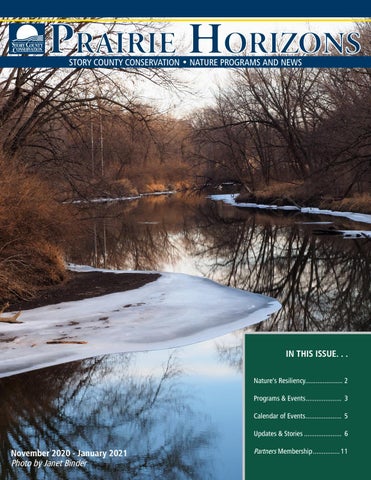
November 2020 - January 2021 Photo by Janet Binder
Partners Membership................ 11
What Nature Can Teach Us About Resiliency Paige Henggeler, Outreach Assistant
In my front yard stands a 100-year old oak. It’s close to the end of its
lifespan, and over the last year, it has lost two big branches during storms that required a chainsaw to cut up. After the derecho, my first phone call was to my fiancé, Josh, asking him to check on that big old tree. I visualized the whole thing torn from the ground, lying through the middle of my house. To our great fortune and shock, it lost minimal branches during the storm. If that tree could talk, it would have said something like, “Little girl, I have seen a lot of life, and at this moment, I’m not going to let a little wind knock me out. I have endured hard winters and droughts. I have seen men go away for two world wars and come back. I have watched as this whole neighborhood was built and little children were born and grew up. I’m not going to let a little wind knock me out. Not today. Not today.” I have always been in awe of the surprising resiliency of the natural world. It’s time to start taking notes because nature has many lessons to teach us on how to respond in moments of crisis. It’s hard to wrap our minds around how things can return to normal after a bad storm or a pandemic. Yet when we look outside, the birds are still singing in half broken trees. Nature has learned a valuable lesson that humans are still trying to figure out: “In ecology, resilience is defined as the capacity of an ecosystem to respond to a disturbance by resisting damage and recovering One of the best visual examples of quickly” (Folke, et. all 2004). Through flood, fire, drought, human resilience in nature is my favorite tree, disturbance, or windstorm, wildlife must adapt or die. Some systems the Utah Juniper (Juniperus osteosperma). are particularly designed in a way to thrive after a disaster. Look at the It’s a gnarly looking conifer native to the prairie: as a fire races across the plain, small mammals flee to their safe southwestern United States. It’s baked underground burrows. In the aftermath, the prairie flourishes. Invasive by the desert sun, its crown is a mixture species and trees are burned to a crisp and the native grasses, which have of dead and live branches due to selfroots that reach deep and are specially adapted for fire, once again have pruning when resources are limited, dominion. and it takes root in stone, drawing What can we learn about resilience from the natural word? To have psychological resilience means to cope with mental and emotional stressors or to return to pre-crisis status quickly. Nature teaches us that in order to survive, we must adapt. Mentally, we must cope with our everchanging world in order to protect ourselves from negative stressors. Like the big oak, we have a choice to stand tall through the storms of life. Like the prairie grasses, our roots (family, friends, belief systems, communities) help us to weather the fires of life and flourish in the aftermath. Many of us saw this year how easily the unneeded excess of our lives can be cut out. Those “invasive species” that bog us down and drain the life out of us aren’t truly needed for a happy life. Finally, like the juniper we can wear the scars of a hard life proudly; our experiences mark us as survivors. That grit that has always been part of the shared American identity is still there. We can have self-compassion because, when we have been through something like the past year, it’s going to leave a mark, but it doesn’t mean we have been beaten. While we don’t know what 2021 is going to bring, we know we made it through this past year, and we humans have that unshakable resilience too. 2
water from a deep internal spring. It wears the scars given to it by the harsh desert environment proudly. There is something profoundly mystical about the appearance of this tree: worn and weathered yet still reaching further into rock searching for new sources of lifegiving water. Beaten yet still growing, still surviving.
Drawing water from stone: this juniper grew out of just a few fractures in the surface rock. Photo by Jim Witkowski
— PROGRAMS & EVENTS — Providing people opportunities and inspiration to develop an appreciation and understanding of nature and humans as a part of it
Brrrrds
Explore Your Outdoors: Animal Tracks
Explore nature as it gets ready for winter with a special focus on birds. A naturalist will provide an introduction and activities to inspire discovery and investigation in the park; activities are geared toward lower elementary grades. Dress to be outdoors for the entire program. Free but registration is required by 4:00 p.m. on Friday, October 30. Group registrations are limited to 4 people, and at least one adult must be present with each group. Canceled in the event of inclement weather.
Join naturalist Jess Lancial as we learn about common animal tracks and scat. We will look for clues around McFarland Park trails to help us discover animal inhabitants. This program is designed for children ages 5 and up, plus their adult. Please dress to explore outdoors. This program is free, but registration is required by 4:00 p.m. on Sunday, January 24.
Friday, November 6 2:00 - 3:00 p.m. McFarland Park
Tuesday, January 26 10:00 - 11:00 a.m. or 4:30 - 5:30 p.m. McFarland Park
Environmental Literature Club Tentatively over Zoom
Explore nature cozied up with a good book. Join naturalist Rebekah Beall at 7 p.m. each month to discuss a different book focused on the human relationship with the environment. This club is free (book purchase or checkout from library is on your own), but registration is required by 4 p.m. on January 15.
Winter Survival
Wednesday, December 16 1:00 - 3:00 p.m. McFarland Park Do you have the skills it takes to be a successful winter survivalist? Participants will be challenged to build shelters, light fires, and more. Wear proper winter attire (dress in layers) as we will be outside the entire time. Fee is $10 per group (groups are limited to 5 people with at least one adult present), and registration is required by 4:00 p.m. on Wednesday, December 9.
January 26 Crow Planet by Lyanda Lynn Haupt February 23 Are We Smart Enough to Know How Smart Animals Are? by Frans de Waal March 23 Rising by Elizabeth Rush
STORY COUNTY CONSERVATION 515.232.2516 56461 180th Street • Ames, Iowa 50010 Monday - Friday • 8:30 a.m. - 4:30 p.m. conservation@storycountyiowa.gov • www.storycountyconservation.org
3
!
in
lw l a s
ie
vit i t c A
ng o l r te
SCC Winter Marathon January 1 - March 1
Challenge yourself to complete a full marathon — 26 miles! — between January 1 and March 1. Walk, run, ski, snowshoe, or bike 26 miles outdoors at your own pace, when it works for you and your family. Or play outside for 30 minutes to equal one mile. Record your mileage on the Mileage Log, available at McFarland Park or download at http://bit.ly/SCCWinterMarathon2021. Turn in your completed log to win a discount on Story County Conservation online registrations or rentals.
Winter Hikes
Get out of the house with other outdoor enthusiasts and explore local public areas this winter. Hikes begin at 1:30 p.m. and are expected to last no more than two hours. The hikes may vary from good exercise to a social stroll and will end with snacks and beverages (bring your own). Cold, wind, snow, rain, and ice are all possible! Hikes will go on as long as the roads are safe to drive. These hikes are free but registration is required by 4:00 p.m. on the Tuesday prior to each hike. Contact the Outdoor Alliance of Story County with questions at info@oasco.org. Jan. 7 - Ronald “Dick” Jordan Family Wildlife Area Jan. 14 - E-18 Greenbelt Trail Jan. 21 - Soper’s Mill Jan. 28 - McFarland Park
Snowshoe Hikes
Come and experience the beauty of winter on our snowy trails using snowshoes! We will discuss snowshoe sizing and learn techniques to enjoy this ancient method of winter travel. Join a naturalist for some fun exercise and peace in nature. Locations and timing will be dependent on snow levels, so we aren’t scheduling these hikes just yet. Watch our website and social media for opportunities. Hikes will typically last one hour. Dress for the cold Iowa winter. Need to locate one of our parks or areas? You can view individual maps and 911 addresses online.
www.storycountyconservation.org One positive effect of the COVID-19 pandemic has been an increase in people getting outdoors. Whether walking on a paved trail or wading through waist-high prairie, many people have reconnected or made new connections with outdoor activities and are discovering “new” parks close to home to enjoy. When this pandemic is over, our hope is that people will not abandon these new connections. One way to strengthen your connection is through financial support. Story County Conservation has several land projects in the works. A Partners membership will help us add 35 acres of native tallgrass prairie, wetlands, and floodplain timber along the Skunk River to your list of new areas to enjoy. In the first two months of this fiscal year you have contributed $1,835 towards our goal of $24,000. Thank you and please help spread the word about Partners so we can reach our goal. 4
— CALENDAR OF EVENTS — Date Time Event Location NOVEMBER
Friday, Nov. 6 2:00 p.m. Brrrrds McFarland Park Monday, Nov. 9 5:30 p.m. Story County Conservation Board Meeting Conference Call Wednesday, Nov. 11 SCC Offices Closed Nov. 26-27 SCC Offices Closed
DECEMBER
Monday, Dec. 14 5:30 p.m. Story County Conservation Board Meeting Conference Call Wednesday, Dec. 16 1:00 p.m. Winter Survival McFarland Park Dec. 24-25 SCC Offices Closed Thursday, Dec. 31 SCC Offices Close 2 Hours Early
JANUARY
Friday, Jan. 1 SCC Offices Closed -- Winter Marathon begins! Thursday, Jan. 7 1:30 p.m. Winter Hike Ronald “Dick” Jordan Family Wildlife Area Monday, Jan. 11 5:30 p.m. Story County Conservation Board Meeting Conference Call Thursday, Jan. 14 1:30 p.m. Winter Hike E-18 Greenbelt Trail Thursday, Jan. 21 1:30 p.m. Winter Hike Soper’s Mill Tuesday, Jan. 26 10:00 a.m. Explore Your Outdoors: Animal Tracks McFarland Park Tuesday, Jan. 26 4:30 p.m. Explore Your Outdoors: Animal Tracks McFarland Park Tuesday, Jan. 26 7:00 p.m. Environmental Literature Club (1st book) via Zoom Thursday, Jan. 28 1:30 p.m. Winter Hike McFarland Park Tuesday, Feb. 23 7:00 p.m. Environmental Literature Club (2nd book) via Zoom Tuesday, March 23 7:00 p.m. Environmental Literature Club (3rd book) via Zoom
Watch our website for additions or changes to our public program offerings DID YOU KNOW that squirrels bury red oak acorns for the winter but eat white oak acorns right away? White oak acorns germinate in the fall while red oak acorns hold off through winter and germinate in the spring. They stay fresh due to their high tannin content, which acts as a preservative. The squirrels know these acorns will store better! Check out our YouTube channel for more info about what YOU can forage in the parks.
5
— THE LATEST —
Timely and brief updates on ongoing projects
Tedesco Environmental Learning Corridor Connector Trail
Travel is again possible on the former Ames to Kelly railroad line. The new off-road trail links the Tedesco Environmental Learning Corridor on the south side of Ames to the R38 roadside trail to Slater. Slater is a hub of paved, off-road trails: The Heart of Iowa Nature Trail, the High Trestle Trail, and the Ankeny Trail. A private fundraising effort is helping to further enhance the newly opened Tedesco Environmental Learning Corridor Connector Trail. This public/private partnership will boost the corridor’s value for people and wildlife alike. The corridor will be enhanced over time as native plants take root, habitat becomes established, and wildlife flourishes. Benches, bird houses, and interpretive signs will also be added. The trail enhancements are expected to cost about $32,000. Find out more about this effort on our website or search for Tedesco Connector Trail Enhancements on GoFundMe.
McFarland Park
The park saw some changes this last fall! New trail markers make it easier to navigate through the park, goats did some great work at knocking back invasive species and thick understory along the Touch-A-Life Trail, park users can enjoy a new water fountain/water bottle filling station. We began the process of creating a watershed management plan for McFarland Lake, which is the first step in working towards lake restoration efforts. Visit our website for more information about how we plan to tackle the challenges the lake faces. While the conservation center has been closed to the public, environmental education displays have been revamped and new LED lights were installed in the lobby Grew up and multi-purpose hunting with room. his dad
Hunter Simmons
Savors time with his family
Retired from the US Air Force Likes to do woodworking
6
Jake Smith
Served in the Marine Corps Reserves
Enjoys cooking and rock wall climbing
Welcome our two new Conservation Technicians! They will be based at Hickory Grove Park.
SPOTLIGHT on INHF Properties INHF has helped provide for Story County: • • • • • • The Iowa Natural Heritage Foundation (INHF) is a vital partner to Story County Conservation. INHF is a statewide nonprofit conservation organization that strives to protect and restore Iowa’s land, water and wildlife. Over 180,000 acres of land have been protected statewide since 1979. INHF assists with and performs land protection and restoration efforts on both public and private properties. They spend a great deal of effort equipping citizens to advocate for the natural resources and outdoor recreation opportunities they love. INHF is invaluable to our land protection projects in particular, as they’ve assisted with the permanent protection of many SCC properties. As a nonprofit, INHF is also able to accept donations of land and facilitate bargain sales, as well as help landowners receive tax benefits for these gifts. If a donor wishes for their land to become a park or wildlife area, INHF can transfer ownership to the County, making it easier for public agencies to afford new public land. INHF also partners with private landowners on conservation easements, a legal agreement that permanently protects natural and agricultural land from development and other threats. Land protected by conservation easements exists in Story County and in many counties across the state. This land can buffer parks and provide permanent wildlife habitat on private land.
Story County Conservation is very thankful for our partnership with INHF. Most of our land acquisition projects would not be possible without them. We are also pleased to announce that INHF is currently working to fundraise for the acquisition of a new public property in Story County -- 120 acres adjacent to McFarland Park, previously owned by Robert and Carol Deppe. Stay tuned for more information as a site plan develops!
• • • • • • • •
Carroll Prairie Colo Bogs Dakins Lake Doolittle Prairie State Preserve Addition Heart of Iowa Nature Trail Hertz Family Woods and Nature Preserve Jennett Heritage Area Jim Ketelsen Greenwing Marsh Leopold Woods Ronald “Dick” Jordan Family Wildlife Area Robison Wildlife Acres Sleepy Hollow Access Addition Story County Conservation Center Wicks Wildlife Area
Over 1,500 acres of wildlife area protected, creating more space for wild exploration and recreation More than 277 native species protected on one property alone 45 miles of trails which promote physical and mental wellbeing 7
Unlikely from novices to hunters in three months Many people think Iowa and hunting go hand in hand. Certainly, in many places across the state this is the case. However, since the late 1980s, there has been a steady decline in hunting participation both in Iowa and across the nation. Hunting, trapping, and fishing license sales provide valuable funding each year for conservation and habitat restoration. Additionally, hunter, trapper, angler, and recreational shooter expenditures generate billions of dollars annually for the national economy and support hundreds of thousands of jobs. Iowa has 253,000 hunters who generate $405 million annually. While hunters, trappers, and anglers paved the way for conservation and have provided core funding for many years, declining participation means funding from these individuals alone is no longer sufficient to fund wildlife conservation. The customer base and conservation revenue sources have to be diversified. With this in mind many state agencies like Iowa DNR are creating programs that break the mold of traditional white, middle-aged male hunters. They’re working to engage young adults who live and work in more urbanized centers that come from various cultures, ethnicities, and backgrounds. These programs are able to draw more diverse audiences because of the emphasis they place on sustenance, the original and pre-historic purpose of hunting. The stars aligned just right this passed summer for two female staff in SCC’s Environmental Education unit to sign up for one of those programs. With each other’s support, they registered for “Field to Fork,” a program designed to provide a hands-on learning experience to adults interested in bowhunting, butchering, and cooking venison (deer). For a New
8 reading
mater
ial
fraction of the cost of diving headfirst into bowhunting on their own, participants receive course supplies and a loaner The Hoyt Kla sh arr ives in compound bow. They early July! get paired with an experienced mentor who guides them through all the intricacies of their first bowhunting season. The big picture goal? To provide a safe learning space that builds community and crafts lifelong hunters. If Beth and Erica were ever going to step way out of their comfort zones and make the leap into hunting, this was their chance.
You work in the conservation field... shouldn’t you be hunters already?
Erica: I grew up in urban areas and had relatively little exposure to hunting until high school. My classmates were driven mainly by large antlers and bragging rights with seemingly little regard for the actual lives they were taking, which put a bad enough taste in my mouth to write off hunting altogether. Many years later when I started feeling compelled to harvest my own food, I felt too much like an outsider to know how to get started. Having no experience and not knowing where to start felt like a pretty big barrier. Beth: I did not grow up in a hunting family; neither my parents nor my grandparents hunted, so it wasn’t ingrained in my family’s culture. It had never crossed my mind as something I could do, until Erica brought the Field to Fork program to my attention.
Chickens n ot include d with fre e target
Why now? What are your motivators?
Erica: Several years ago, I was invited to an outdoor recreation workshop called the R3 Summit. R3 refers to the national movement of recruitment, retention, and reactivation of hunters, anglers, and recreational shooters. At the time, I wasn’t receptive to becoming a more consumptive user of natural resources. I was already moving towards a mostly vegetarian lifestyle, and repeatedly insisted at the workshop that “I would never consider becoming a hunter.” But, a friend I made there kept the conversation going, kept inviting me to learn more, kept being a kind and patient listener… and here we are! I guess all it takes is planting a seed? I’m choosing to do this now because while I can absolutely get adequate nutrition with my current vegetarian diet, sometimes it means sourcing my food from far away. That jar of chickpeas took resources to grow, process, ship, and sell. If I instead shift my focus to eating more locally, I can reduce my impact on the earth, have a connection with my food, and feel good about the life it lived and (hopefully) about the at JAX in d e t h way it died. I already tting sig Erica ge make personal contributions to the protection of natural resources through donations of money and time, but this is another way I can be an active participant in protecting the wild things and places I love. Beth: My main motivation was that it is something new to learn and focus on and take my mind off of all of the changes in every other part of my life. I have two children, and due to the pandemic, we haven’t had any activities taking up our evenings. The fact that I would actually have the time to put into this program was also a big motivator. My final motivation is to provide meat for my family. I am not out for a trophy buck, I just want to provide an ethical, local source of meat for my family.
What has been exciting? Any fears or uncertainties?
Erica: It has been amazing to get connected with mentors and learn alongside other beginners. I highly recommend recruiting someone to take this journey with you so you can share all your little victories, epiphanies, and confusions. Attempting new, scary things takes vulnerability, and watching my progress has helped me gain confidence. But I’m still left wondering, after I get situated in a tree with all my gear and an opportunity presents itself, can I actually follow through with this and take an animal’s life? Or worse, can I handle it if I make a bad shot and cause a September 2, 20 yds lot of suffering? I’m pretty worried about that. But, I also know that I don’t have to take any shots I’m not comfortable with or if it just doesn’t feel right in that moment. Beth: Learning something new! I have shot a bow in the past but never with the intent of killing an animal and never with a bow as technical as the one I am using. The progress in my ability to hit a target where I want to has also been exciting and confidence-building. I also enjoy seeing my son get excited about shooting a bow and potentially being able to hunt with him and pass down my land ethic. But tree stands! I am scared to death of using one. I am also excited but at this point more scared. In this program we will be “trained” in using them and all of the safety procedures, but right now it is my big hang-up. I am also unsure of how I will react if I do harvest a deer and have to clean it. I am not an overly squeamish person, but this takes things to the next level. And, until I have a ds r 5, 20 y
Septembe
9
deer in my sight, I don’t know if I will actually be able to shoot one. I think I will be able to, but it isn’t something I can “practice.” Shooting at a target that is not a living, breathing animal is a lot different than shooting at an actual deer.
Do you see yourself becoming a lifelong hunter?
Erica: Whether I pick this up as a lifelong practice rests entirely on what happens in the next couple of months. I’m keeping my fingers crossed for either clean kills or clean misses because I think this first hunting experience will make or break this. I really appreciate that this program has allowed me to experiment with bowhunting with minimal upfront costs. If it’s not for me, I won’t be out much. Beth: I honestly don’t know. This year has been unlike any other in the aspect of having time, as well as many other things. In subsequent years, time to practice and actually hunt might be at a minimum. If I don’t have the time to put into practicing, I most definitely will not hunt. You can’t ensure a quick, ethical kill even when you have become proficient in your practice, so the odds must go down greatly the less you practice. My goal will always be to have the animal suffer the least amount possible, and if I am not confident that I can make this happen, I will not hunt.
What do you hope to take away from this experience?
Erica: I’ve already learned so much. Obviously I hope to harvest a deer, but I know I’ll at least be a more confident and capable human being for having tried. And I’ll have gained an even greater respect for all the ethical hunters out there. Beth: My end goal is hopefully meat in the freezer but also the confidence in knowing that I made it through this program and have the knowledge and ability to hunt and provide meat for my family. Other hunters have talked about sitting in the tree stand as the forest wakes up, and it sounds amazing! I hope to have a few of those moments as well throughout the hunting season. 10
Bowhunting season will have begun by the time this newsletter reaches you. We know our perspective might be different than your own, but we wanted to share our stories in case it helps recruit, retain, or reactivate someone else as a hunter. Sometimes it’s hard to feel welcome if we don’t see others who look like us already participating. While there’s a lot of work left to do when it comes to making hunting and other types of outdoor recreation feel accessible and welcoming to everyone, there are pockets of hope! Though about only 5% of Iowa bowhunters are female, that number is on the rise. We’re pretty excited to be part of that trend.
Proportion of Iowa bowhunters who are female Figure from Iowa DNR
We have been compiling photos and videos chronicling our experience and plan to put together a compilation for SCC’s YouTube channel. Maybe one of us will harvest our first deer, but this fall and winter will be memorable regardless. Follow us to see how the season ends, and wish us luck!
BOARD & STAFF Conservation Board
Dr. Jim Pease, Chair Christine Laumer, Vice Chair Dr. Nancy Franz, Secretary Craig Meyers, Member Ted Tedesco, Member Linda Murken, Ex Officio Member
Conservation Staff Conservation Center, Ames
Michael Cox, Director Ryan Wiemold, Parks Superintendent Pat Shehan, Special Projects Ranger Marianne Harrelson, Financial Data Manager Elizabeth Jackson, Administrative Assistant II Jerry Keys, Environmental Education Coordinator Heather Hucka, Naturalist Jess Lancial, Naturalist Rebekah Beall, Naturalist Beth Waage, Naturalist Erica Place, Outreach Coordinator
McFarland Park Shop, Ames
Danny Simcox, Park Ranger Russ DeWall, Conservation Technician II Derek Seward, Trails/Natural Resources Technician Joe Hill, Conservation Technician Dillon Schmidt, Conservation Technician
Hickory Grove Shop, Colo
Luke Feilmeier, Park Ranger Jake Smith, Conservation Technician Hunter Simmons, Conservation Technician Brandon Clough, Natural Resource Specialist
IRVM Office & Shop, Nevada
Joe Kooiker, Vegetation Management Biologist Tyler Kelley, Vegetation Management Specialist
The Story County Conservation Board typically meets the the second Monday of each month at the Story County Conservation Center at McFarland Park (56461 180th St.), northeast of Ames. Meetings are open to the public.
HELP PURCHASE A NEW PROPERTY! Help us reach our goal of $24,000 Your Story County Conservation Partners membership will help purchase a new property along the South Skunk River south of Story City. You will receive a nature-themed magnet and a 10% discount on all programs, facility rentals, and merchandise. The Red Fox membership level and above will be recognized in the conservation center for their support. Eagle Business Level - $1,000 or more Red-tailed Hawk - $1,000 or more Great Blue Heron - $275 to $999 Red Fox - $125 to $274
Monarch Business Level - $250 to $999 Goldfinch - $70 to $124 Otter (Family) - $35 to $69 Great Horned Owl (Individual) - $30
Name Address City State
Zip
Phone E-mail Enclosed is my check for $ My membership level is Make checks payable to: Story County Conservation Partners 56461 180th Street, Ames, IA 50010-9451; Phone (515) 232-2516 Or join online! www.mycountyparks.com/ County/Story.aspx
Thank you to all those who support Story County Conservation with donations of time, funding, and materials.
THANK YOU TO THE FOLLOWING FOR THEIR GENEROSITY
Memorial Benches Karen & Jeffrey Jutting in memory of Chris Jutting Kirk Russell, Galen Willke, Great Ames Adventure Race in memory of Dennis Jones
Cash Donations Tari Gulbrandsen Outdoor Alliance of Story County Office supplies RJ Gardner
11
STORY COUNTY CONSERVATION 56461 180th Street Ames, Iowa 50010-9451
Nonprofit Org. U.S. POSTAGE PAID Ames, Iowa Permit 301
Where does your food come from? How far does your food travel to get to your fridge? It’s winter in North America and some familiar foods like bananas and pineapples certainly are not currently being grown on U.S. soil. That orange or salad you had for lunch today may have traveled more than 1,000 miles to get to your belly. While it’s difficult to always know where your food was grown, it’s a worthy goal to try to buy locally whenever possible. Buying food that was harvested nearby helps reduce climate change and supports the local economy. Think about how much energy it takes for one avocado to travel from central Mexico to Iowa during the winter. People who eat food that was produced locally say it helps them feel more connected to their community, and it tastes fresher.