STORY COUNTY CONSERVATION • NATURE PROGRAMS AND NEWS
February - April 2021
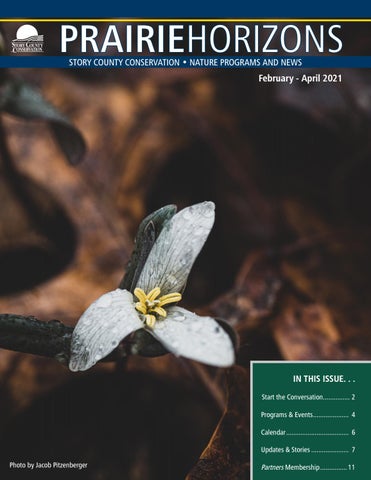
IN THIS ISSUE. . . Start the Conversation............... 2 Programs & Events..................... 4 Calendar.................................... 6 Updates & Stories...................... 7 Photo by Jacob Pitzenberger
Partners Membership................ 11
Start the Conversation: Rhythms of the Land Bekah Beall, Naturalist As the climate changes and we experience a warmer, wetter, and wilder Midwest—more prone to extremes of drought, heat, and floods—I’m searching for the meaningful rhythms of nature I want to protect, examples of resiliency from my family’s past, and hopeful solutions for the future. Our garden in Iowa hooked me before I even started pulling shallow rows through the beds and sprinkling in radish, lettuce, and carrot seeds. My husband, Seth, and I started beets, swiss chard, cauliflower, cilantro, and dill. I walked down each row to stare at the soil. I waited for the first curled sign of a sprout. When the shoots appeared, I sat back on my heels and watched, convinced I could see them reaching upward, unfurling ever so slowly. We’d moved to Iowa the year before and jumped at our first chance to grow a garden. My garden lust started when my mother sent me a food-spattered, second-hand copy of Stocking Up from Rodale Press. Stocking Up details everything the neophyte needs to know about canning, drying, and freezing fruits and vegetables. It provides illustrated plans for root cellars, instructions for making butter, cheese, and yogurt, and step-by-step how-tos on turning an animal into any number of products, all the way down to headcheese and scrapple. The book is genuinely glorious.
2
But first I had to grow the vegetables. Seth and I were almost entirely inexperienced. I’d been around gardens off and on most of my life but as a teenager and young adult felt I had better things to do than get my hands dirty. Still, once in a while I picked a few glowing red tomatoes and tender, finger-length yellow squash, blossoms just fading off the ends. But I’d never been responsible for a garden from beginning to end. I didn’t learn the practical skills--the craft or magic or whatever it took to make things grow. I didn’t know that even as I pored over tomato varieties (mortgage-lifters, giant oxhearts, Mr. Stripeys!) that the rhythms of gardening were changing. I had deciphered the tiny colorful map of “hardiness zones” on the back of the seed packets to determine what grew best and when to plant to avoid frost. I didn’t know that in 2012 this map was redrawn, reflecting warmer temperatures. Nights are staying warmer; thaws are starting earlier. The kind of soil-drumming downpours with two inches or more of rain from a single event are becoming more frequent. Planting—in both gardens and farm fields—is delayed by wetter springs. Floods are expected more often and so is drought. The common thread is a tendency to extremes. I tend to forget that my family has connections to the rhythms of soil and plants. I know my grandparents farmed. My grandmother taught my grandfather after their marriage. They farmed land that she had worked with her father when World War II took the boys from the farm. She became, as my great-aunt put it, “a very good ‘son.’” My great-great grandfather also farmed (and before that, I don’t know, but I wouldn’t be surprised if they were farmers). To me, one generation removed, the farm had already become an abstraction, something I can’t visualize beyond corn and beans, brief memories of the truck and machine shed, riding high in the combine,
and the neatly hung row of my grandfather’s seed caps. Today, these farmers would recognize shifts in the patterns of climate that I don’t see. I tend to forget. In my childhood, my grandparents lived with Mountain Dews in hand and got twitchy if the supply ran low. After a dinner of canned peas and hash, my grandfather slipped a Little Debbie Nutty Bar from the cardboard box by the refrigerator to eat during Wheel of Fortune. But my grandparents’ children had learned the heated weight of a tomato, eaten out of hand from the garden, and they knew the hollowthumped, chin-dripping taste of Indiana cantaloupe. When they were young, the family grew a half-acre garden on the farmstead that provided nearly all their food. I tend to forget. My mother picked pints of strawberries from her own garden, buckets of blueberries from the nearby U-Pick patch. In the summer she belted a bucket to her waist and waded into the black raspberry canes. The soil had long provided my family with abundance. This abundance of farm, garden, and woods is part of a legacy that connects me to nature, and part of what I work to protect. In our own garden, Seth and I bumbled along, carrying the Guide to Iowa Vegetable Gardening and a secondhand copy of Rodale’s Basic Book of Organic Gardening next to our seeds and gloves. One bed we dug while still too wet, turning over solid bites of soil. I thwacked and hammered with the hoe, but the soil dried into golf-ball sized, stone-hard clumps. Here is what I thought I needed to do: dig and till. Later, as grass consumed our sprouts and lamb’s quarter sprang up everywhere, Seth and I realized we should have started with mulch, any kind of mulch--newspaper, grass clippings, straw. In our new garden plot, the weeds grew better than the vegetables.
Practices that rebuild the soil—for example, mulching instead of tilling along with using cover crops—can increase productivity and resilience to erosion and drought. These practices also help soil store carbon with huge potential to help slow climate change. Plants draw carbon from the atmosphere and pass it to microbes that stabilize it in soil. Iowa’s prairies did this naturally. Degraded and eroded soil doesn’t store carbon, so now gardeners and farmers need to care for soil to restore it. I saw these ideas reflected where cover crops began to pop up on farm fields. I learned the definition of the word “friable” as I rubbed our garden soil between my fingers and palms. I’ve always loved soil, the smell of it, the feel of it under bare feet. Like my home dirt in Indiana, our garden soil in Iowa looked so black and rich as to be nearly edible. Restoring soil helps it produce abundance. In our garden, we hoed up hills and pressed the big, pointed seeds of watermelon, cantaloupe, and squash (summer and winter, six kinds total, including two types of pumpkins) into the warm soil. We planted scarlet runner beans and too many tomatoes and peppers (both sweet and hot). I put in a row of zinnias, marigold borders, and a couple of sunflowers. For a few weeks it rained and rained. Black spots appeared on our perpetually green tomatoes. The rabbits munched down our cauliflower. We found our green beans devoured all the way to the ground every time they sprouted a tentative leaf. Plants jungled through the garden but not as we’d imagined. By the Fourth of July, I expected our main crops to be foxtail, zucchini the size of baseball bats, and green tomatoes, in that order. But plants grew and kept growing until we had thickstemmed, bristly squash plants, a jungle of tomato vines, and feathery, medicinal-smelling carrot tops.
3
Some of the tomatoes in our garden ripened eventually. I consulted Stocking Up. I quartered them and simmered them in a stock pot, working them down with a potato masher. Our Giant Oxhearts and Mr. Stripeys turned into a beautiful orangey-pink sauce. This process sounds easy, and it is, but I stood in the kitchen all day. I filled the enameled canner and muscled it onto the stove. I set in the rack and the jars and turned on the heat. The kitchen filled with steam when the water hit a full rolling boil, clattering the canner’s lid. Gardening bring us close to that abundance of the earth, puts our hands in the soil, and forces our attention to rhythms of rain, sun, and temperature. Here’s the thing: this practice of growing has potential to help us notice change, connect to the resiliency of past generations, and look forward to newfound solutions. We don’t have to have all the answers, but we do need to have the conversation. You may not take up gardening, but I hope you find your own stories to tell others about
what you love and hope we can protect through our common efforts to slow climate change. Right now, I’m in love with not only the tomato ripening on the vine but opening a rich red sauce in dead white winter and washing the blue jar to use again.
— PROGRAMS & EVENTS — Providing people opportunities and inspiration to develop an appreciation and understanding of nature and humans as a part of it
FEBRUARY
MARCH
Backyard Bird Identification
Diversify Your Landscape and Eat Your Yard
Learn to identify birds you might find in your backyard or local park in preparation for the Great Backyard Bird Count! The GBBC is February 12-15 and only requires 15 minutes of bird watching before sharing your bird count online. This is a great way to get involved with a citizen science project from the comfort of your home. These programs are free, but registration is required by 4:30 p.m. on Monday, February 8. Registrants will be emailed the zoom link prior to the program date.
We have been working for our yards for years; now is the time to make our yards work for us! Learn how to put in place a more edible landscape with an emphasis on plants that are suited to our climate. This is a two-part series, so we can go into a little more depth on certain topics. Fee of $10 is required with registration by 4:30 p.m. on Monday, March 1. Registrants will be emailed the zoom link prior to the program dates.
Wednesday, February 10 2:00 - 3:00 p.m. or 7:00 - 8:00 p.m. Zoom program
Wednesdays, March 3 and 10 (two-part series) 7:00 - 8:30 p.m. Zoom program
STORY COUNTY CONSERVATION 515.232.2516 4
56461 180th Street • Ames, Iowa 50010 Monday - Friday • 8:30 a.m. - 4:30 p.m. conservation@storycountyiowa.gov • www.storycountyconservation.org
The Fungus Among Us Thursday, March 4 10:00 - 11:00 a.m. Zoom program
Join Naturalist Jess Lancial to learn about the basic ecology surrounding the Kingdom Fungi! We will explore the basics of how fungus grows, the role they play in our lives, the different types of fungi, and what crazy mushrooms you can find near you this spring! This program is free, but registration is required by 4:30 p.m. on Tuesday, March 2. Registrants will be emailed the zoom link prior to the program date.
Luminary Hike
Saturday, March 20 7:30, 8:00, or 8:30 p.m. start times McFarland Park Let luminaries light your way around McFarland Lake on a special walk to welcome spring. The walk is selfguided; complete luminary loop is about one mile on a paved path. Register for a 7:30 p.m., 8:00 p.m., or 8:30 p.m. arrival slot. Event ends at 9:00 p.m. Fee of $5 with registration is required by 4:30 p.m. on Friday, March 12.
APRIL Geocache Egg Hunt
Saturday, April 3 10:00 a.m. - 12:00 p.m. McFarland Park Your family will love this new-age way of hunting eggs! Join Naturalist Jess Lancial to learn how to use a GPS, then go search the woods to find the Conservation Bunny’s nests of hidden treasures. Collect prizes and candy and discover some of nature’s wonders along the way. Be sure to keep a watchful eye as you may come across a “golden egg” worth a special prize! Spots are limited; register early. Fee of $5 per collector (any child 3-14 years old) is required with registration by 4:30 p.m. on Monday, March 29. Each family group will share one GPS; if your group is 8 people or more, you may want to register as two groups.
O.W.L.S. Programs
We’re offering O.W.L.S. (Older, Wiser, Livelier Souls) programs in a virtual format. These are designed for “boomers” or older -- but anyone can attend. Registrants will be emailed the zoom link prior to the program date.
From Beans to Brew Tuesday, February 2 10:00 - 11:00 a.m. Zoom program
Explore one of the world’s favorite beverages, COFFEE! Dive into its mysterious origins and natural history, and discover just how great an impact it has on our planet. Join fellow coffee lover, Naturalist Heather Hucka, with your favorite cup of joe and explore how we can change the world for the better one cup at a time. This program is free, but registration is required by 4:30 p.m. on Sunday, January 31. Registrants will be emailed the zoom link prior to the program date.
Exploring Madagascar Tuesday, April 6 10:00 - 11:00 a.m. Zoom program
Located off the east coast of Africa, Madagascar is the world’s fifth largest island and known as a hotspot for biodiversity with animals like lemurs, fosses, chameleons, and flying fox bats. With 80% of its natural forests now gone, Madagascar is one of the fastest disappearing ecosystems on our planet. Join Naturalist Jess Lancial as she shares stories and photography chronicling her month-long excursion through Madagascar’s unique landscapes, cultures, and wildlife. This program is free, but registration is required by 4:30 p.m. on Sunday, April 4. Registrants will be emailed the zoom link prior to the program date.
5
— CALENDAR OF EVENTS —
Date Time Event Location FEBRUARY
February 2 10:00 a.m. O.W.L.S.: From Beans to Brew February 8 5:30 p.m. Story County Conservation Board Meeting February 10 2:00 p.m. Backyard Bird Identification February 10 7:00 p.m. Backyard Bird Identification February 15 Story County Conservation Offices Closed February 23 7:00 p.m. Environmental Literature Club (2nd book)
MARCH
March 1 - 19 March 3 7:00 p.m. March 4 10:00 a.m. March 8 5:30 p.m. March 10 7:00 p.m. March 20 7:30, 8, or 8:30 p.m. March 23 7:00 p.m.
Zoom Zoom Zoom Zoom Zoom
Annual Photo Contest Submission Period Diversify Your Landscape and Eat Your Yard Zoom The Fungus Among Us Zoom Story County Conservation Board Meeting Zoom Diversify Your Landscape and Eat Your Yard Zoom Luminary Hike McFarland Park Environmental Literature Club (3rd book) Zoom
APRIL
April 3 10:00 a.m. Geocache Egg Hunt McFarland Park April 6 10:00 a.m. O.W.L.S.: Exploring Madagascar Zoom April 12 5:30 p.m. Story County Conservation Board Meeting Zoom Need to locate one of our parks or areas? You can view individual maps and 911 addresses online.
www.storycountyconservation.org
Partners is now 192 members strong!
Only twice since its beginning in 1996 have we exceeded a yearly average of 180 members. Along with celebrating new membership, several of you have increased your level of giving. As of the end of the year, you have contributed $11,755 (49% of our goal) towards the purchase of the 35-acre Osheim Wildlife Area along the South Skunk River. Obviously, you understand the importance of preserving and protecting land not only for the benefit of our water and other natural resources but for the quality of life of future generations. Let’s keep the momentum going. If you know someone who enjoys the public lands in this county, please share with them why you are a member and encourage them to show their support. 6
Unlikely HUNTERS Newbies Beth and Erica shared their motivations, uncertainties, and excitement about learning how to bowhunt in our last edition. We immediately received comments from others saying they shared the same backgrounds, were curious about the newbies’ perspectives, agreed that there were barriers to getting involved, but most often we were just asked, “WELL, DID THEY GET DEER?!”. Beth and Erica sat down in front of the camera twice— once before the season started and again a couple months later—to capture all the feelings and discoveries that come with a new adventure. Visit our YouTube channel to watch Parts 1 and 2 of Unlikely Hunters to find out how their seasons ended. Sometimes seeing other people try new things helps you picture yourself trying it too! Are there more outdoor activities we could shed light on with an “Unlikely” series? Backpacking? Fishing? Birding? Let us know!
DARK SK Y WEEK
Beth Waage, Naturalist
On a recent trip to Arches National Park, I read that it is certified as an official International Dark Sky Park. While we stayed in Moab, we made sure to go out at night to view the stars. It was beautiful; I have always been intrigued by the night sky. But it was not so unlike the night sky I normally see in rural Story County. It made me feel very lucky to live where I do, as not many Americans, possibly one in ten, live in a place where they can see the roughly 2,500 stars that should be visible. A dark night sky holds so much value. It’s a history lesson: The International Astronomers Union was formed after the first world war to finally settle the debate of which would be the “official” constellations. They listed a total of 88. Before the IAU, there were 60120 constellations on various star charts, so there are many lost constellations in the sky. It is also a bridge to our past. It connects us to our ancestors. We can go out at night, look up, and see what our great, great, great, greats saw. The lighting of the night wastes energy, exposes humans to excessive artificial light which can lead to myriad problems, and can have disastrous effects on nocturnal animals who are dependent upon the darkness for their livelihood. Fearing the loss of our shared human heritage from an ever-brighter night, a high school student started International Dark Sky Week in 2003. It is a weeklong event put on by the International Dark Sky Association to help draw attention to and educate people about the importance of allowing the darkness. Luckily, light pollution is reversable! And you, as a homeowner or renter, have a voice in the lighting that surrounds your dwelling. Check around where you live to see what you can do about the night lighting, and participate in Dark Sky Week to learn more.
April 4-10, 2021 https://idsw.darksky.org/ 7
— THE LATEST —
Timely and brief updates on ongoing projects
Tedesco Connector Trail
A private fundraising effort to further enhance the new Tedesco Connector Trail is a little over halfway to its goal! Invasive plants have been removed, over 100 native trees and shrubs have been planted, and future donations will fund bat and bird houses, a bike repair station, benches, a dog walker’s station, and interpretive panels. Consider joining the effort to beautify this new trail!
Rick Dietz wins INHF’s Hagie Heritage Award
This longtime outdoor ally has a tremendous passion for Iowa’s natural heritage and is one of our go-to supporters for volunteer and advocacy needs. His personal commitment to protecting and improving natural resources, and encouraging others to do the same, is clearly demonstrated by his nearly 20-year relationship with SCC. This award honors his dedication to protecting and improving wild spaces and ensuring others can enjoy outdoor recreation. Way to go, Rick!
Nature Connect SCC’s Service Assistance Program
Increasing access to youth and adult programs, recreation, camping, and more for Story County residents experiencing financial need.
Want to support Story County residents experiencing financial need? Call 515-232-2516 8 to donate
$20 supports a weekend camping $40 sponsors a child at overnight camp $100 sponsors five children at day camp
Hickory Grove Park
Park goers can now travel a complete loop around the lake (just under 3 miles) on a limestone trail. A new footbridge will soon traverse the “tubes” on the southeast corner of the lake. Patch work on the park road and improvements to boat ramp parking were recently completed as well. All paved park roads will be overlaid with a 3” lift this spring.
Call Mid-Iowa Community Action 515-956-3333 to verify need and receive your discount code.
Qualifying households can now receive 50% OFF: • Nature camps at McFarland Park • Environmental education programs • Camping at Hickory Grove Park, Dakins Lake, and Robison Wildlife Acres • Shelter reservations
A CHANGING HABITAT at Christiansen Forest Preserve
Brandon Clough, Natural Resource Specialist What is a savanna? A savanna is a plant community with scattered oak and hickory trees. This sparse tree canopy allows the sun to reach the ground, giving native grasses and forbs (flowers) a chance to flourish amongst the trees. Oaks and hickories are fire-tolerant but shade-intolerant, enabling these species to grow back when wildfires shaped Iowa’s ecosystems. Humans have suppressed fires in recent history, which allowed fire-intolerant/shade-tolerant tree and shrub species to quickly out-compete the slow-growing oaks and hickories. Very few oak or hickory seedlings could take root and replace the older trees as they died off. A savanna’s unique composition of mature trees, grasses, and forbs make it critical habitat for a number of Iowa’s wildlife species, including endangered and threatened ones. The prairie understory makes excellent habitat for pollinators, the acorns and hickory nuts are a great source of nutrients for wildlife, and the bark of the mature trees provide an excellent place for bats to roost.
1930s imagery
How do we know that this area is supposed to be a savanna? If you look at an aerial view in the 1930s you see very few trees dotting a grassland (particularly towards the front of the property). Many of these 100+ year old trees are still standing at Christiansen today. If you fast forward through the decades, you notice the open space becomes filled with undesirable tree and shrub species. There are also multiple savanna clues visible in the park today. You can still find the old open-grown oak trees. An open-grown tree branches out wide as opposed to just growing tall, but only if it has the available sun to do so. As these trees have gotten choked in a crowded understory, they have begun to shed their lower branches in an effort to conserve energy and keep the rest of the tree alive. The park’s grass and forb species are clues as well. Some savanna species that have persisted at Christiansen are bottlebrush grass, hyssop, and Virginia wild rye. Seeds of other savanna species are waiting in the soil for the right growing conditions—more sun. In time and with a variety of management techniques, we’re confident this savanna will flourish again. Take a walk on the trails this spring to check out the progress.
2019 imagery
MANAGEMENT TOOLS USED IN THIS PARK • Removing trees, shrubs, or vines • Girdling trees (kills the tree but leaves it standing - good habitat for bats, birds, insects, etc.
• • • •
Prescribed burning Goat grazing Brush mowing Herbicide
99
Earth Day Every Day I think back to the start of the pandemic last March. I watched from my window at the Story County Conservation Center at McFarland Park as people flocked outdoors. The parking lot was full every day: people exited their vehicles looking for calm and comfort. A Yale study from 2017 showed a widening disconnect with nature: the average adult spent five hours or fewer outdoors each week. Get this: that counted driving time. Big yikes. But I can’t wait to see the studies about how those hours soared off the charts last year, verifying what we who work in conservation witnessed in real time. Mother Earth grounded us in 2020. She wrapped us in a beautiful reassuring hug and whispered comforting words to us through green leaves and brilliant flowers. We spent so much time outdoors last year that I can’t help but think we owe her a big thank you. How do we pay that appreciation forward in 2021?
As the Earth continues to be stripped of its natural resources and carbon is released into the atmosphere at an exponential rate, we need a fundamental shift in how we treat our planet. In my lifetime, I will watch as the last glaciers melt. Earth Day can’t be just one day a year. 2020 was a return to the wild; this year let’s fight for the planet that is crying out for our help. We can celebrate Earth Day every day simply by spending time outside. Just five minutes in nature has been shown to have incredible benefits to your mental and physical wellbeing. People who spend time outdoors frequently have faster healing times, stronger immune systems, longer lifespans, and are at a lower risk for stroke and heart attack. Nature can lessen stress, anxiety, and depression, while boosting creativity, concentration, and productivity. As we increase our time in nature and find ourselves healing and reconnecting, we will begin to
Earth Day originated in the 1970s in order to bring focus to the need for a clean air and clean water act. Factories in the United States were pumping toxic smoke into the air, dumping toxic waste into our waterways, and Americans were fed up. Across the country, 20 million Americans came out to demonstrate that this was not how we wanted to treat the land. The outcry was heard and later that year Congress authorized the creation of a new federal agency to tackle environmental issues: the Environmental Protection Agency. Now every April 22, Earth Day is celebrated around the 10 world to demonstrate support for environmental protection.
wonder how we ever let our planet get so sick. The root of Mother Earth’s sickness is that our culture loves to consume. We drink out of one-use bottles, wear “fast” (poorly made) fashion, order lots of unnecessary products online, and eat food that was produced across the globe. We can easily celebrate Earth Day every day this year by monitoring our consumption and buying fewer one-time use products. The answer to this giant problem rests with us, the citizens of Earth. We are eager consumers. But is that the role we want? We get to choose the role we play in the drama that is unfolding: what we in the field of environmental sciences call “The Tragedy on the Horizon.” Will we be caretakers or destroyers? Will we heal or harm?
Paige Kappelman is an Environmental Sciences student at ISU and our Outreach Assistant.
Photo by Corah Booth
BOARD & STAFF Conservation Board
Dr. Jim Pease, Chair Christine Laumer, Vice Chair Dr. Nancy Franz, Secretary Craig Meyers, Member Ted Tedesco, Member Linda Murken, Ex Officio Member
Conservation Staff Conservation Center, Ames
Michael Cox, Director Ryan Wiemold, Parks Superintendent Pat Shehan, Special Projects Ranger Marianne Harrelson, Financial Data Manager Elizabeth Jackson, Administrative Assistant II Jerry Keys, Environmental Education Coordinator Heather Hucka, Naturalist Jess Lancial, Naturalist Rebekah Beall, Naturalist Beth Waage, Naturalist Erica Place, Outreach Coordinator
McFarland Park Shop, Ames
Danny Simcox, Park Ranger Russ DeWall, Conservation Technician II Derek Seward, Trails/Natural Resources Technician Joe Hill, Conservation Technician Dillon Schmidt, Conservation Technician
Hickory Grove Shop, Colo
Luke Feilmeier, Park Ranger Jake Smith, Conservation Technician Hunter Simmons, Conservation Technician Brandon Clough, Natural Resource Specialist
HELP PURCHASE A NEW PROPERTY! Help us reach our goal of $24,000 Your Story County Conservation Partners membership will help purchase a new property along the South Skunk River south of Story City. You will receive a nature-themed magnet and a 10% discount on all programs, facility rentals, and merchandise. The Red Fox membership level and above will be recognized in the conservation center for their support. Eagle Business Level - $1,000 or more Red-tailed Hawk - $1,000 or more Great Blue Heron - $275 to $999 Red Fox - $125 to $274
Monarch Business Level - $250 to $999 Goldfinch - $70 to $124 Otter (Family) - $35 to $69 Great Horned Owl (Individual) - $30
Name Address City State
Zip
Phone E-mail Enclosed is my check for $ My membership level is Make checks payable to: Story County Conservation Partners 56461 180th Street, Ames, IA 50010-9451; Phone (515) 232-2516 Or join online! www.mycountyparks.com/ County/Story.aspx
Thank you to all those who support Story County Conservation with donations of time, funding, and materials.
IRVM Office & Shop, Nevada
Joe Kooiker, Vegetation Management Biologist Tyler Kelley, Vegetation Management Specialist
The Story County Conservation Board typically meets the the second Monday of each month at the Story County Conservation Center at McFarland Park (56461 180th St.), northeast of Ames. Meetings are open to the public.
THANK YOU TO THE FOLLOWING FOR THEIR GENEROSITY Big Bluestem Audubon Society Tadd & Jill Griffith Outdoor Alliance of Story County REG Bran & Laura Taylor
Jennifer Drinkwater Daniel Ketelsen Dermot J. Hayes Andy Swanson John & Tanya Sorem
11
STORY COUNTY CONSERVATION 56461 180th Street Ames, Iowa 50010-9451
Nonprofit Org. U.S. POSTAGE PAID Ames, Iowa Permit 301
HOW SMARTPHONES ARE HURTING GORILLAS A critical component in smartphones and other devices is a substance called coltan. 80% of the world’s supply of coltan is found directly in the center of gorilla habitat in the Congo. Mineral mining for smartphones has fueled bloody conflicts and gorilla habitat loss. The best way you can reduce this impact is recycling old smartphones and limiting unnecessary upgrades to a new device. We have partnered with the Blank Park Zoo and ECO-CELL so when the Conservation Center reopens you can bring your old smartphones (and ipads, tablets, mp3 players, handheld gaming systems, chargers, and device accessories) to the Story County Conservation Center for recycling. ECO-CELL is a nonprofit which reclaims the precious minerals found inside these devices. Recycling these items helps save endangered gorillas by reducing the demand for coltan while 100% of the proceeds from this project go directly towards reforestation in the Congo and care for rescued gorillas.