Stories From the Road
An Untold Story
When Life Was Simple
I remember the tray before I remember the reason I was there. It had a sound not loud, but sharp enough to carry across the room, metal against metal. You didn’t need to see it to know what it meant. I was a boy, no more than four, maybe five. I didn’t understand hospitals. I didn’t understand illness. But I understood that tray. It came on certain days, not every day, and that almost made it worse. You had time to forget, time to feel normal again, and then the sound would come back down the hallway, and everything in you tightened.
The days had a rhythm. And some of those days had needles in them.
Before the hospital, there was home. I was born near Alton, Virginia, a quiet place where life moved at its own pace farm country, tobacco fields, long stretches of road that didn’t feel like they needed to go anywhere fast. People knew each other, or knew of each other. Families stayed put. Life didn’t change quickly.
As a boy, the world was simple. You didn’t think about it you just lived in it. Outside was where things happened. You walked, you ran, you explored. There wasn’t much else to do, and you didn’t need anything else. The sunset was your reminder to go home, while that little streetlight was your deadline.
That was normal life. That was before something changed.
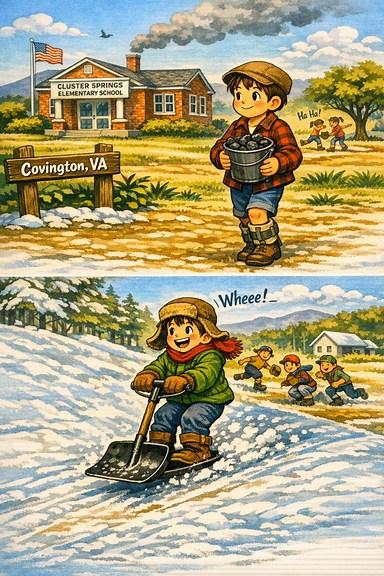
School was Cluster Springs Elementary. It wasn’t big, and it didn’t need to be. Everyone had a place, and you learned what you were supposed to learn reading, writing, arithmetic, discipline. You showed up, sat down, listened, did your work. There was a structure to it, a rhythm like everything else back then. You didn’t question it. It just was. In the winter, part of that rhythm meant taking a coal bucket outside to the coal pile, the cold air hitting you as soon as you stepped out, snow sometimes covering the ground. There was a short hill there, just enough for a quick ride if you stood on the coal shovel and let it slide. Then you’d fill the bucket, carry it back inside, and feed the pot-bellied stove that kept the room warm. It was just another thing that needed to be done, and you did it.
School, home, outside, repeat. That was the pattern until the pattern broke.
The Day the Pattern Broke
I remember the day something happened. My father was out in the field, plowing with his tractor, the sound carrying steady and familiar across the land. It was a warm midmorning under a spring sky, the kind of day that didn’t seem like it could hold anything out of place. The trees were beginning to bud, not yet in full leaf, but on their way just short of their final glory. I had been taking him some water. That was a simple thing, something you did without thinking.
I set out across the field, passing a wood-burning tobacco barn that always carried the smell of smoke and heat. Beyond it was a small patch of woods. I walked through there with the water in my hands.
On the other side, I knew he was out in the field somewhere, but we couldn’t see each other. The trees and distance separated us. He was there, and I was there, but not in sight of one another.
I kept going.
What I didn’t see was the wire.
An old fence, down and hidden under the leaves. I caught it and went down hard, my face buried in dry winter leaves, the smell of them and the dirt rising up around me. I coughed and spit them from my mouth as I tried to get myself off the ground. The wire wrapped around my legs, and I couldn’t get free. The more I moved, the more it seemed to tighten and hold.
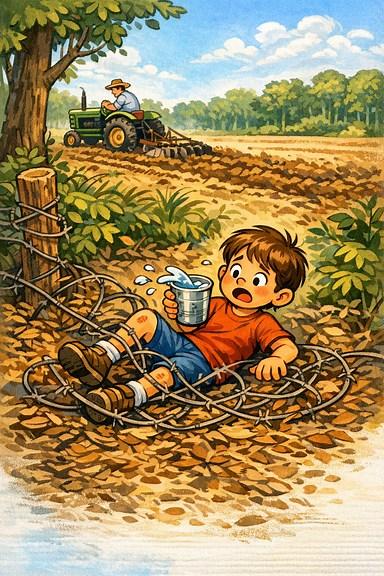
I called out.
I don’t know how long I was there. Time doesn’t move the same way when you’re stuck and alone.
Eventually, they heard me my mother, my father. They came and got me loose. I remember being carried, not walking. Carried.
I never made it to him with the water.
A World I Didn’t Choose
And then came the hospital.
I don’t remember the beginning clearly. There isn’t a single moment I can point to and say, that’s where it started. What I have instead are fragments rooms, voices, movement pieces that never quite settle into a complete picture. Even early on, my life included places I didn’t choose and time I didn’t fully understand, and looking back it feels less like a beginning and more like an absence of one.
Watts Hospital was where things first began to take shape, even if I didn’t understand what was happening. The rooms were quiet in a careful way not peaceful, but controlled voices kept low as if sound itself might disturb something unseen. I remember looking upward more than anything else: ceilings, lights, stillness. There were procedures, though I didn’t understand them as such at the time, only shifts in the room before anything happened, changes in tone and movement that signaled something unspoken had already begun. I learned early how to wait inside that kind of uncertainty without knowing what I was waiting for.
The hallways felt endless, not because of their size but because time inside them didn’t behave normally. I had a wheelchair and quickly learned how to move faster than I was supposed to. There was another boy with a small metal ride-on car, and whenever we could we raced, the sound of wheels against the floor becoming its own kind of freedom. In those moments the hospital stopped being a place of waiting and became movement instead.
There were also days when we were allowed outside, and those are the ones that stayed with me most clearly. A fountain turned in steady circles, splashing water in a soft rhythm that caught the light in a way nothing inside ever did, and the air felt different uncontrolled, unassigned, alive in a way the rooms were not. I remember birds more than anything else, moving without hesitation, singing as they moved, and one taking refuge in the fountain’s spray from the warmth of the spring sun, without awareness that anything could be wrong anywhere. For a short time I wasn’t inside a room or a routine; I was simply outside.
One day we raced again, me in the wheelchair and the other boy in his car, going faster than we should have, until we crashed. The shift was instant movement to stillness, freedom to consequence. What stayed with me wasn’t the fall but the laughter, because I was still laughing when the nurses arrived, their expressions already changing the moment before they reached us, turning it into something serious, something to be corrected. To them it was an incident; to me it had been something else entirely. That was the first time I understood how differently the same moment can be lived.
Returning to a Life That Wasn’t the Same
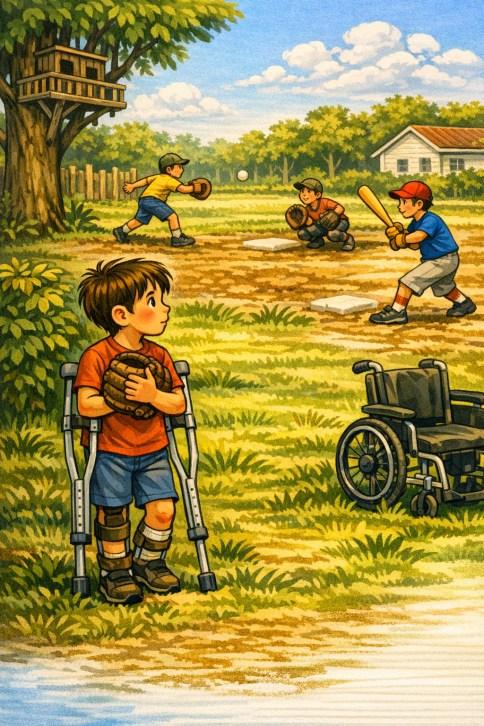
I don’t remember leaving Watts Hospital, only being home afterward. Life didn’t return to normal so much as shift in stages crutches, then a wheelchair, then walking again each phase blending into the next without ceremony. Even as things changed, I knew I was different, but I also knew how to adapt. Backyard baseball didn’t require explanation; the other kids accepted what was there and kept playing, so I played too.
Danville had a different rhythm than Watts, less intense and more structured, life measured in appointments doctor visits, X-rays, checkups less like days and more like intervals. There was a Sundrop delivery man who came by sometimes, always smiling, always carrying the same easy energy. He brought small toys and stayed long enough for me to smile. I remember his hat most of all, the stiff cardboard brim like part of a uniform that meant kindness rather than work. Some people stay in memory not because of what they did, but because of how they made time feel when they were there.
By six I was walking again, but something else had already begun my speech. At first it was awareness, then attention, then adjustment. I started listening to myself while speaking, not just what I said but how it might land, how it might be received. Without realizing it, I had begun managing my voice before it left me.
When Speech Began to Shape Me
By sixth grade it was fully formed. Before speaking, I checked not consciously at first, but consistently words filtered in the space between thought and sound. People called it shyness, but inside it wasn’t shyness; it was control. Standing up in class was the hardest part, not because I didn’t know the answer, but because I couldn’t predict what would happen after I gave it. So I spoke less, and silence slowly became its own normal.
I learned to live in pauses, not the comfortable kind but the ones that arrive before speech, when a sentence is still forming and I can feel its edges taking shape. In those moments I often chose not to speak at all. It wasn’t fear in the way people assume fear works, but calculation a quiet weighing of outcomes I couldn’t yet name. So I became someone who could answer questions but rarely initiate them, someone who could participate but always from a slight distance. People didn’t seem to notice that distance, or maybe they did and simply called it something else quiet, polite, reserved. None of those words felt accurate, but I didn’t correct them, because correcting them would have required more words than I was willing to spend.
What I Later Learned Was True
The elephant in the room, though I didn’t have the words for it then, was speech. It would shape relationships, limit opportunities, and steal peace of mind long before I understood why. Years later, when I finally looked back, I realized I had always believed the hospital experience came at the worst possible time right when speech is supposed to be learning how to exist in the world. I remembered crying when I tried to talk, the frustration of wanting to say something and feeling it catch before it ever reached the air. It made sense to me that something learned in those moments might have stayed with me. A learned problem, not a broken one.
And the science eventually agreed with me. Most lifelong stuttering isn’t psychological at all it’s neurological, a timing issue in the brain’s speech‑motor system. Speech depends on a rhythm between planning, timing, movement, and feedback. When that rhythm slips, even slightly, speech can stall or repeat. Childhood is when all of that wiring is being built, and during that exact window I was in a hospital bed, in pain, under stress, surrounded by interruptions and long stretches without normal conversation. Stress doesn’t cause stuttering, but it can shape how the developing brain wires its timing systems. It can teach the brain to speak under load instead of at rest. That’s not damage. It’s development. My hip illness didn’t injure the parts of the brain that handle speech, but the experience around it the fear, the silence, the breaks in normal life could have nudged the timing circuits just enough to set a lifelong pattern. Once that pattern forms, the brain learns it like anything else: through repetition. For the first time, the science didn’t contradict my theory. It confirmed it.
The Weight Speech Carries Across a Lifetime
Speech has a way of reaching into places people don’t think about dreams, careers, even relationships. It can open doors or close them before you ever touch the handle. People say they’re understanding, and maybe they are, but understanding doesn’t stop them from talking over you. I’ve lived long enough to know that most interruptions aren’t impatience; they’re discomfort. People rush past what unsettles them, and my voice has unsettled more than a few.
That has always been the hardest part not the stutter itself, but the way others try to outrun it for me. They fill the space I’m still shaping, finish the sentence I haven’t finished, rescue me from a struggle I never asked to be rescued from. They think they’re helping. They don’t realize they’re erasing me in the process.
And that’s where the real weight settles: when people talk over you long enough, you start to feel invisible. Not unseen in the physical sense, but unheard like your presence registers, but your voice doesn’t. Conversations move around you instead of with you, and you learn to step back because stepping forward feels like asking for permission you’re not sure you’ll be given.
For most of my life, I let it happen. I stayed quiet, stayed small, stayed on the edges of my own voice. Not because I wanted to, but because it seemed easier than fighting for space others didn’t think I needed.
Claiming My Own Voice at Last
But something changes when you reach your seventies. You stop apologizing for the space you take up. You stop hiding the things that make you different. Now, when I’m on the phone or speaking face to face, I name it before anyone else can. I tell them I have a speech difference. I tell them what they might hear. I tell them not to interrupt.
And something remarkable happens when you do that people listen. Not just to the words, but to the person saying them. They slow down. They wait. They let you arrive in your own time.
It took me a lifetime to claim that space. But I claim it now. And in its own way, that feels like finally arriving.