

By Jeffrey Heng, Emily Wang, Fryashti Mishra and Nishta
Subramanian, Co-Managing Editor,
Co-Design Editor and Staff Reporters
For years, senior Maggie Neary has played lacrosse competitively. Training with the
Conestoga girls’ lacrosse team and a club team called NXT Lacrosse, she spent hours balancing schoolwork and athletics. On top of all her activities in high school, she started sending emails in hopes of having a university recruit her as a student-athlete.
She received her acceptance and recruitment offer earlier in December 2025 after applying early action to MIT. In March, Neary formally committed to the university, an NCAA Division III school.
“I had always been very (drawn) to (MIT’s) academ -
ics,” Neary said. “I wanted to play a sport in college, and the Division III level I thought would fit me best because I would best be able to balance my life, my academics and my sports. I very well could have been passing up on opportunities from other coaches for MIT and then not having gotten to MIT. I had to put a lot of trust in myself that I knew what I wanted, and I’m super grateful that I was accepted.”
Like Neary, student-athletes across the country continue to train in their sports while pursuing the college recruitment
process every year. During recruitment, universities seek out specific student-athletes to play for their sports teams and accept them as official undergraduate applicants. Having to face the challenges of academic work, personal life and competitive sports, student-athletes within Conestoga have had to adapt to changes in the recruiting process over the past decade and deal with its effects on their mental well-being. Neary personally felt pressure during the recruitment process when seeing other fellow athletes commit.
“It (recruitment) is not as glorified as it is on Instagram,” Neary said. “It seems demoralizing when you’re comparing your perspective to kids that commit, but it is so rarely as awesome as it sounds. I was one of the only girls on my team to not be committed, and I almost wanted to settle for a school just to say I could commit. I really had to focus on not comparing myself to others, because if you stick with what you want or what you know that you love, it will end up working out one way or another.”
Similar to Neary, during
reached out to coaches for months before formally committing to play squash for Georgetown Uni
versity. Josh Simon, her pri
vate coach, helped Lin navigate the recruitment process. Working with student-athletes frequently, he feels that the system is difficult due to pressure, but also offers opportunities for student-athletes to prove themselves.
“When you start seeing your peers get offers and maybe you haven’t got a single offer yet,
I think it’s hard to teach that person just to have patience and your time will come and continue doing what you’re doing: Don’t fall off. Don’t get panicked. The opportunity will be there, and don’t just get discouraged,” Simon said. “You have to stay true to the course and (have the student) understand that they’re okay. You have opportunities.”
On March 28, community members took to the streets of Wayne and Philadelphia with hand-painted signs and chants as part of the nationwide “No Kings” rally. According to State Rep. Lisa Borowski, a speaker at the Wayne rally, more than 600 residents from Chester and Delaware County participated in the march. Borowski said that the rally served as an outlet to express discontent over current political policies, including the community presence of U.S. Immigration and Customs Enforcement (ICE) officers, in a productive and peaceful way. These rallies, along with other community efforts, have allowed the public to express concerns in response to local ICE presence.
ing. So I think for many people, (the rally) is just such a great opportunity,” Borowski said. “I’ve definitely heard from residents who are concerned and want to know what they can do to be helpful. We’ve had a lot of residents go through training where people can (become) monitors and alerting when situations are happening around ICE.”
the presence of ICE across the nation and in Tredyffrin/Easttown has grown in recent years.
“People are frustrated because there’s really not a lot you can do. This (the rally) was a way to demonstrate in a very public way and register the concern and the displeasure over what’s happen-
According to the ICE website, the Department of Homeland Security established ICE in 2003 as part of the Homeland Security Act of 2002. State Rep. Melissa Shusterman feels that
“Over the last several months, across the U.S., especially in Minnesota, and across our own state, we have seen an increase in illegal and inhumane actions by the U.S. Department of Homeland Security (DHS) officers, including ICE officers,” Shusterman wrote in an email. “I will continue to insist on law and order in our communities, while standing with our local and state police.”

A Feb. 5 joint statement by Chester County District Attorney Christopher L. de Barrena-Sarobe and president of the Chester County Police Chiefs Association Michael P. Carroll disclosed that Chester County law enforcement does not enforce civil immigration orders. The statement explained that none of the police departments in Chester County have signed a Section 287(g) Agreement, or a formal partnership between ICE and local law enforcement agencies to carry out immigration actions. Additionally, the statement asserts that Chester County law enforcement will investigate force events in relation to ICE, such as a police shooting.
“We will take as long as we need to gather a complete understanding of what happened, and it does not matter whether the incident under investigation involves local, state or federal law enforcement,” the statement said. “There will be a complete and independent review by an experienced team of detectives and prosecutors. That has been the practice in Chester County for decades, and it will continue to be the practice in the future.”
For information on what to do in an ICE-related situation, Borowski said that residents can call their state representatives’ offices. In addition, other local organizations have also become involved in sharing this information.

Kings” rally. Participants expressed discontent over the current political landscape.
“A lot of churches are involved, a lot of synagogues, people that are trying to provide as much information as possible and give people the best opportunity to protect their neighbors and themselves to deal with these situations if they arise,” Borowski said. “The main thing is for people to know not to physically insert themselves into the process, but to be a witness for those who are being detained by ICE so that you can be supportive if needed.”
In addition, Borowski and other state representatives are working on introducing legislation to address the increase in ICE activity, including placing restraints on locations where ICE activity can occur.
“As a state legislature, we have introduced a lot of legislation to try to put guardrails around what ICE is doing. Legislation that wouldn’t permit them to go to courthouses and
wait for people in courthouses, because they are doing that,” Borowski said. “I think some of this (need for legislation) is because there is such a gray space between what they are allowed to do and what they’re doing.” Amid the uncertainty and opinions various residents have expressed regarding ICE activity in the area, Shusterman feels that it is important for community members to remain united.
“I believe the best thing our community members can do right now is to stay engaged with our friends, neighbors, and community service non-profits within our local communities — creating new connections and strengthening existing ones,” Shusterman wrote in an email.
“Additionally, I recommend advocating to your elected officials — federal, state, county and township — to express your opinions and concerns on topics that are important to you.”
THE LATEST DEVELOPMENTS
IN T/E AND NATIONAL NEWS
Student CounCil leadS organization for annual ‘lip dub’
On April 16, senior and member of Student Council
Steven Wiechecki posted an update to the Schoology activities page regarding sign ups for the annual “Lip Dub.” The tradition often features senior members of Conestoga student organizations and extracurriculars lip-syncing to lyrics of a popular song. Contrary to previous years during which the main organizers were members of StogaFilm, members of Student Council are leading the filming of the “Lip Dub.” diStriCt ColleCtS appliCationS for rediStriCting Steering Committee
As part of the elementary school redistricting process in preparation of the opening of Bear Hill Elementary School, the Tredyffrin/Easttown School District opened an application window for residents to apply to the Redistricting Steering Committee. The period ended on April 24, with potential applicants submitting a form on the district website. The committee will help develop a redistricting plan for the area and will consist of one administrative liaison, 10 guardians and one external facilitator.
pennSylvania Court
On April 27, a Pennsylvania court ruled that the state constitution guarantees the right to abortion, allowing the usage of state Medicaid funds to cover abortion costs. According to a U.S. News article, the case serves as the first time that the right to an abortion is protected by the Pennsylvania constitution. The case may still be appealed to Pennsylvania’s Supreme Court.
trump adminiStration extendS CeaSe-fire in iran
On April 21, President Donald Trump extended the two week cease-fire with Iran, which the Trump administration initially announced on April 8. The U.S. extended the ceasefire following Vice President JD Vance’s failed negotiations for a peace deal with Iran in Pakistan.
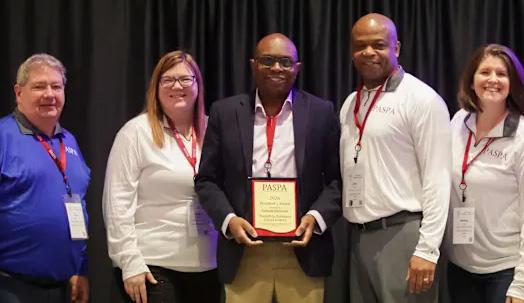
On Feb. 26, the Pennsylvania Association of School Personnel Administrators (PASPA) honored Dr. Anthony C. Stevenson with the President’s Award. Stevenson is serving his fourth year as the TESD Director of Human Resources and received the award during the 40th Annual PASPA Conference, themed “Honoring HR Impact — 40 Years of PASPA Excellence.”
The President’s Award honors an individual working in human resources (HR) who has demonstrated exceptional leadership. PASPA looks for an individual who continually works to make an impact in the organization and the field of HR. Stevenson’s current HR work focuses on collaboration with school leaders across the district on staffing needs.
“This award reflects not only my work in education but also my contributions to the broader community,” Stevenson said. “Beyond my professional responsibilities, I am actively involved in initiatives that address issues such as food insecurity, housing
challenges and supporting vulnerable populations. I believe strongly in service, and I strive to make a positive im-
pact both within schools and in the community.”
Stevenson grew up in South Carolina, attended South Car-
olina State University, and later studied educational leadership at Temple University and the University of Pennsylvania.
Stevenson’s career in education includes teaching at William Penn Charter School and Cheltenham High School. He
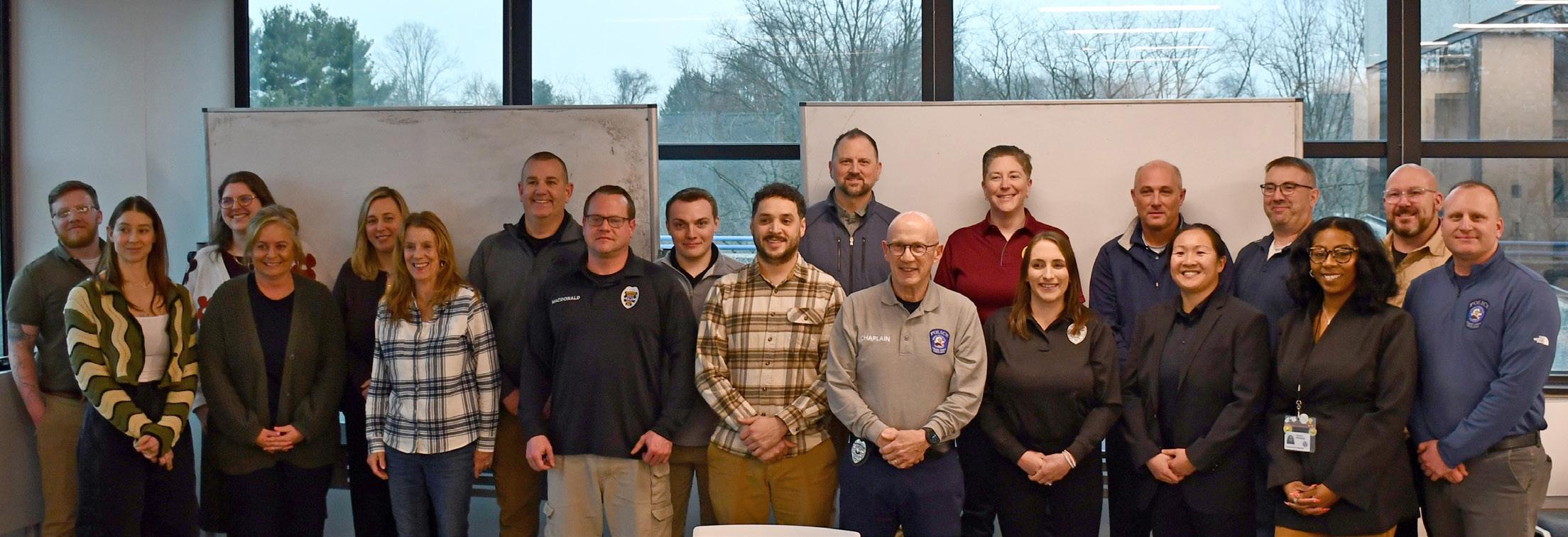
As one of six counties nationwide that the National Alliance on Mental Illness (NAMI) Keystone selected to host a Crisis Intervention Team – Youth (CIT-Y) program, the Chester County Department of Mental Health/Intellectual and Developmental Disabilities held its first training. From March 4-8, law enforcement officials, first responders and community providers gathered at the Chester County Government Services Center in West Chester to participate. CIT-Y expands on a preexisting, adult-oriented Crisis Intervention Team (CIT) the county had been running for nine years, and is open to anyone interested.
Similar to CIT, the new youth training teaches the fundamentals of approaching individuals with mental health issues, specifically people in the juvenile justice system, to ensure support during mental health crisis situations and recovery. Each session runs for 20 to 24 hours as intensive training addressing subjects including intellectual and developmental disability awareness, suicide prevention, substance abuse, alcohol consumption and LGBTQ+ sensitivity.
“Students in the area, both now and in the future, will have law enforcement professionals that will interact with them when they are in a crisis in a way that understands the issue,” said Pat Bokovitz, the director of the Chester County Department of Human Services. “It helps them to successfully go
through that crisis and connect to the necessary resources in a safe and helpful way.”
Teyanna Brunson, the Children’s Mental Health Service Coordinator within the Chester County Department of Human Services, feels the NAMI likely chose Chester County due to its success with the adult program and her connections within NAMI Keystone. Her CIT certification also contributed to her leadership role for the CIT-Y training.
“The main focus for both adult and children (programs) is to recognize signs that that person is having a mental health challenge, opposed to being aggressive and committing a crime,” Brunson said.
Looking forward, Brunson hopes the program will contain biannual training
sessions in the spring and fall, with engagement from community members such as teachers, who will be able to ensure safety for students.
Krtin Ashokkumar, senior and vice president of student-run mental health club Hope and Beyond, believes the program shows the initiative Chester County is taking to embark on mental health improvements.
“I’m personally really excited for this program,” Ashokkumar said. “Mental health didn’t gain much interest when we started Hope and Beyond years ago. It’s great to see a lot more programs locally like this that are working to make Chester County better and that are building more traction. I’m happy that our community is getting more educated as mental health awareness sets its foot down.”


later served as an administrator in the Radnor Township School District.
PASPA president John Council informed Stevenson of his accomplishment a month before the conference. Council cited Stevenson’s accomplishments, such as serving as Elected Commissioner in Lower Merion Township, as part of what made him stand out as a candidate.
“What makes Dr. Stevenson especially deserving of this award is not just the breadth of his resume, but the consistency of his character,” Council said.
“He leads with intellect, integrity, humility and purpose. He understands the impact of school HR leaders and exemplifies what it means to lead with both excellence and heart.”
In the future, Stevenson hopes to continue his work in TESD. His goals include recruiting committed personnel to best support all students within the district.
“TESD is a wonderful place to work, and I feel fortunate to be part of such a strong school community,” Stevenson said.
“I do not take this opportunity lightly and remain committed to supporting both our staff and students in meaningful ways.”
Nishta Subramanian Staff Reporter
On March 13, Upper Merion Township received a $1 million federal grant from the Eastern Federal Lands Access Program (EFLAP) to begin the Valley Forge Gateway Trail. In 2018, the Valley Forge Park Alliance conducted a feasibility study which first proposed the trail which will connect six municipalities, including King of Prussia Town Center and the Village at Valley Forge. The Valley Forge Gateway Trail Partnership, a multi-jurisdictional coalition such as Chester County, Montgomery County and other townships, has facilitated the construction and design. Active funding has been occurring for the past few years with plans for the construction to begin in November.
Nicole Ganzekaufer frequently uses local trails, such as Mount Misery in Valley Forge National Historic Park, and participates in half marathons. As a runner, she feels that the project is a benefit to the area.
“I heard about (the trail) from my daughter, and I was really excited about it because it sounds like a really great opportunity to expand the trail from Valley Forge to Chesterbrook and past (route) 202 and beyond,” Ganzekaufer said. “It sounds
like a really great opportunity for the community in terms of both bikers and runners. It’s really exciting.” In addition to the federal grant, the project received $326,900 from a William Penn Foundation grant and $500,000 from the Upper Merion Transportation Authority. Christopher Basler, the Director of Capital Projects and Planning for King of Prussia District, emphasizes the role that contributions such as the William Penn Foundation have to support the project.
“King of Prussia District received a grant from the William Penn Foundation that allows us to advocate for this project (and) promote it. So we’ll be coming up with special events that promote the idea,” Basler said. “It also helps us fundraise and apply for grants to design and construct.”
In addition to benefits for the frequent trail users, Ganzekaufer feels that the project serves as a step to promote walkers in the area.
“I think that, unfortunately, our suburbs are often situated for and there’s a long history of support for car traffic. But, we really need to work on expanding roadways for pedestrians and bikers that are protected,” Ganzekaufer said. “So that’s a really exciting project going forward to hear that there’s an expansion effort on the way.”
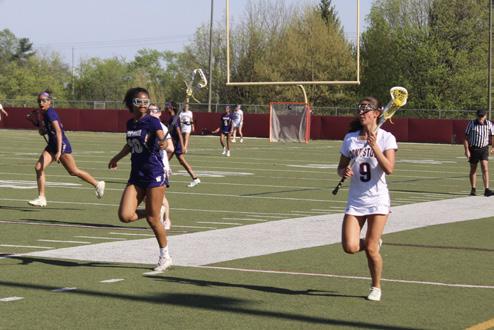
On March 16, Chester County Court Judge Anthony Verwey ordered the demolition of the property at 905 Westtown Road in West Chester, known as Forsythe Farm. Verwey ordered the demolition because the home became a public safety risk, following 23 years of deterioration under developer Joseph Kravitz’s ownership. Stephen Lyons, leader of the Save Forsythe Farm preservation group, is currently going through the legal process to take conservatorship of the property and save it from demolition, but also mentions safety concerns.
“We (the Save Forsythe Farm group) have been trying to find recourse to intervene as a party of interest because the history is enormously significant,” Lyons said. “But, there’s also a public safety and environmental concern which is not being addressed.”
The property deteriorated for years under Kravitz, a developer who planned to build several draftsman style houses on the land. According to Lyons, Kravitz faced many financial issues over the years, with the property going under foreclosure four separate times in the past two decades, along with facing litigation in several neighboring counties. An engineer sent to inspect the prop-
erty found serious damage to the ceiling and floors, determining that renovation could cost upwards of $1.2 million versus the $300,000 required for demolition.
According to Lyons, in November, Verwey authorized BDP Impact Real Estate to take conservatorship over the property under the Blight Act, giving the company access to the land. BDP Impact Real Estate currently plans to build 10 houses on the land following the demolition. Lyons feels that local government decisions have not properly considered the historic significance of the property.
“The problem is (the Blight Act) doesn’t address historic preservation. It merely looks at a public safety concern, so this property fell into what is known as demolition by neglect,” Lyons said.
Lyons stated that the home on the property, built about 100 years ago, has significant ties to the underground railroad and Quaker history. The home functioned as a stop on the underground railroad, helping slaves escape the south.
According to Lyons, a demolition could harm endangered species as well as erase local history. BDP Impact’s goal of building 10 houses on the eight-acre property could harm protected species such as the red-bellied turtle and the bog turtle. The Save Forsythe Farm
group is currently pursuing legal action against the demolition, hoping to renovate the property to preserve its history and mitigate safety risks.
“What we want is a pause on a demolition action and to give our organization two years to implement our proposal using a combination of
private donors and grants,” Lyons said. “Specifically, we want the township to be involved because stewardship of historic resources is a fundamental component and responsibility of townships and counties that are as old as ours.” However, Carl Ewald, an attorney affiliated with BDP
Impact Real Estate, commented on the poor state of the property.
“He (the engineer) wasn’t even willing to go past the front door because water has been penetrating the roof for 20 years and all the interior components of the property are rotted out,” Ewald said.
Ewald feels that a renovation would not be financially feasible as much of the property is beyond repair.
“If we were to spend millions of dollars on it, the only part that could be preserved potentially would be the masonry walls,” Ewald said. “The damage has already been done.”
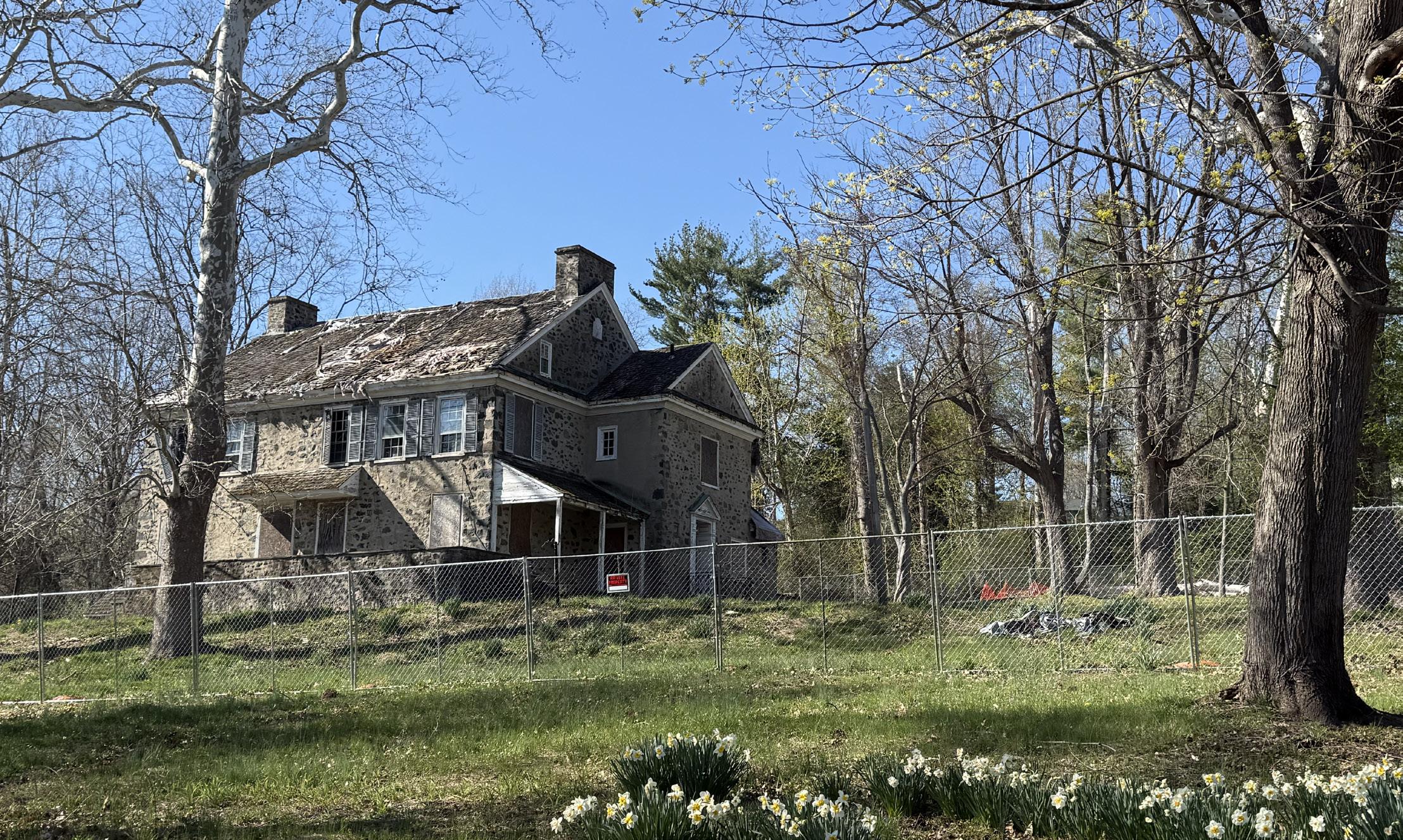
Students participate in athlete recruitment
Continued from page 1. academics is a precursor before they start looking at your athletics. They want to make sure that before they continue the conversation, you even have a probability of being accepted into their school.”
When accepting students, Conestoga school counselor Daniel McDermott said that colleges take a holistic approach and evaluate students first in terms of academic performance, financial eligibility and individual traits such as leadership. Helping various Conestoga students in the recruitment process for more than 10 years, he emphasizes that student-athletes have another aspect to consider: athletic capability.
“When we talk about the college process, we talk about three fits: academic fit, personal social fit and financial fitness,” McDermott said. “Then when you throw in athletics, you throw in a fourth fit, which is called athletic fit — what are the things that are important to you and how do you find a balanced approach for all of that?”
According to the National Institutes of Health, during the 202324 school year, more than 538,000 student-athletes competed across nearly 20,000 sports programs in the NCAA. The nonprofit organization oversees college athletics in the U.S., requiring students to meet university specific requirements to participate in NCAA sports, such as GPA, standardized test scores and core class credits.
For various student-athletes, recruitment starts near the beginning of their junior year when they reach out to schools or schools contact them through email. According to the NCAA Scholarship Guide, college coaches and admissions officers often conduct an academic pre-read early in the recruitment process, or an initial assessment of a student’s qualifications.
Senior Fure Abhulimen has been involved in track and field for over six years and has committed to continuing her athletic career at Tufts University. After initial conversations, the college checked that she had met its academic standards.
“For me, it was first like, ‘Okay, before we even continue our communication, let’s see your transcript, let’s see your grades,’” Abhulimen said. “So I would say
After evaluation, the college may invite students for official campus visits. While observing the campus, students can meet with coaches and teams to understand expectations and learn more. The recruitment process ends when the student makes a verbal commitment, or an agreement to play for a college’s sports team, and since Oct. 9, 2024, confirms a written offer of athletic aid with the specific school. The written offers replace the previous National Letter of Intent (NLI), or an official document of the NCAA lasting one academic year that allows the student to receive financial aid from the school during the period according to NCSA College Recruiting.
McDermott said that the details of the recruitment process can vary for each sport and student despite the standardized structure.
“It’s not linear, kind of messy. And it really does depend on the sports and depends on the type of recruit you are,” McDermott said. “The process is very, very different compared to students who are playing maybe DI or DIII or DII at different schools.”
Conestoga adapts to process, transfer portal shifts
With changes over the last decade, student-athletes and coaches involved in athletic recruitment have adapted to navigating the collegiate sports process. In 2018, the NCAA created a transfer portal in aims of better streamlining the process. The portal displays student-athletes’ information and allows coaches from other schools to actively search for as well as contact players. On April 3, President Donald Trump signed Executive Order 14400 changing various NCAA eligibility and transfer rules. It established that athletes could play for no more than five years without sitting out and have one transfer limit during the five-year period.
Pechin feels that the implementation of the portal and changes to
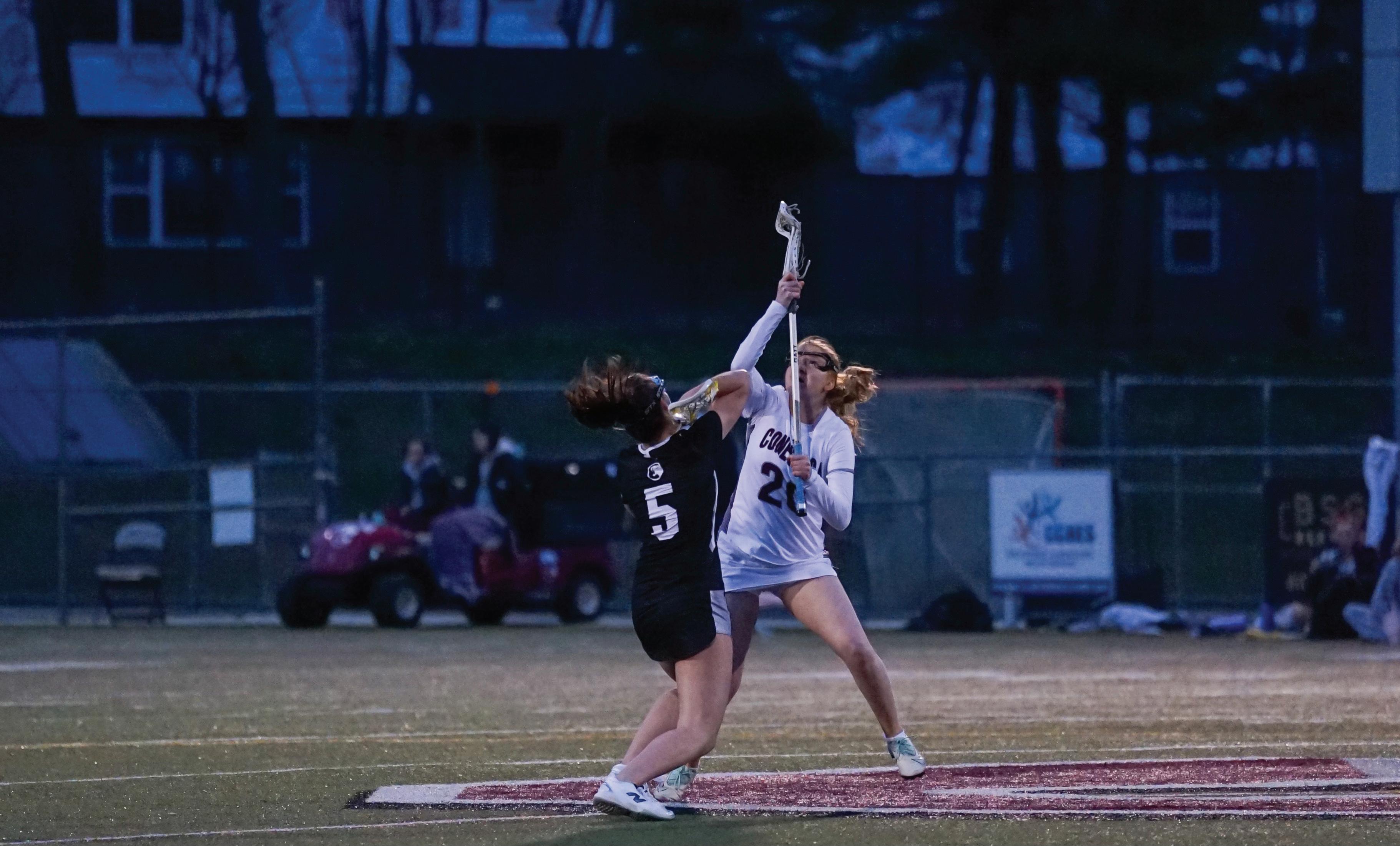
recruitment in general have caused an increase in students already enrolled in universities transferring to different schools, leading high-level colleges to be less likely to recruit high school athletes.
“It (high-level colleges reaching out to students with offers) happens every now and then, but it’s not as prevalent because the NCAA portal,” Pechin said. “Colleges aren’t looking so much at high schools as they did before. They’re looking more at small colleges, kids who are entering the portal and who could be a best match from the portal and not the high school.”
In addition to the transfer portal creation, students and their families have continued to address financial concerns while in the recruitment process. As a stu-
dent-athlete parent, TJ Neary said that financial support is a critical factor in several student athletes’ decision to enroll at a college.
“I’m sure it’s the case for some students here that they’re not going to be able to go to a certain school unless they get financial support from a school,” TJ Neary said. “A scholarship of some sort is going to be the vehicle for them to go to that school. Otherwise, they wouldn’t be able to.”
In recent years, the July 2025 House v. NCAA antitrust settlement started allowing athletics programs to directly compensate collegiate student-athletes for their name, image and likeness, according to the National Conference of State Legislatures. Under the settlement, NCAA schools can now
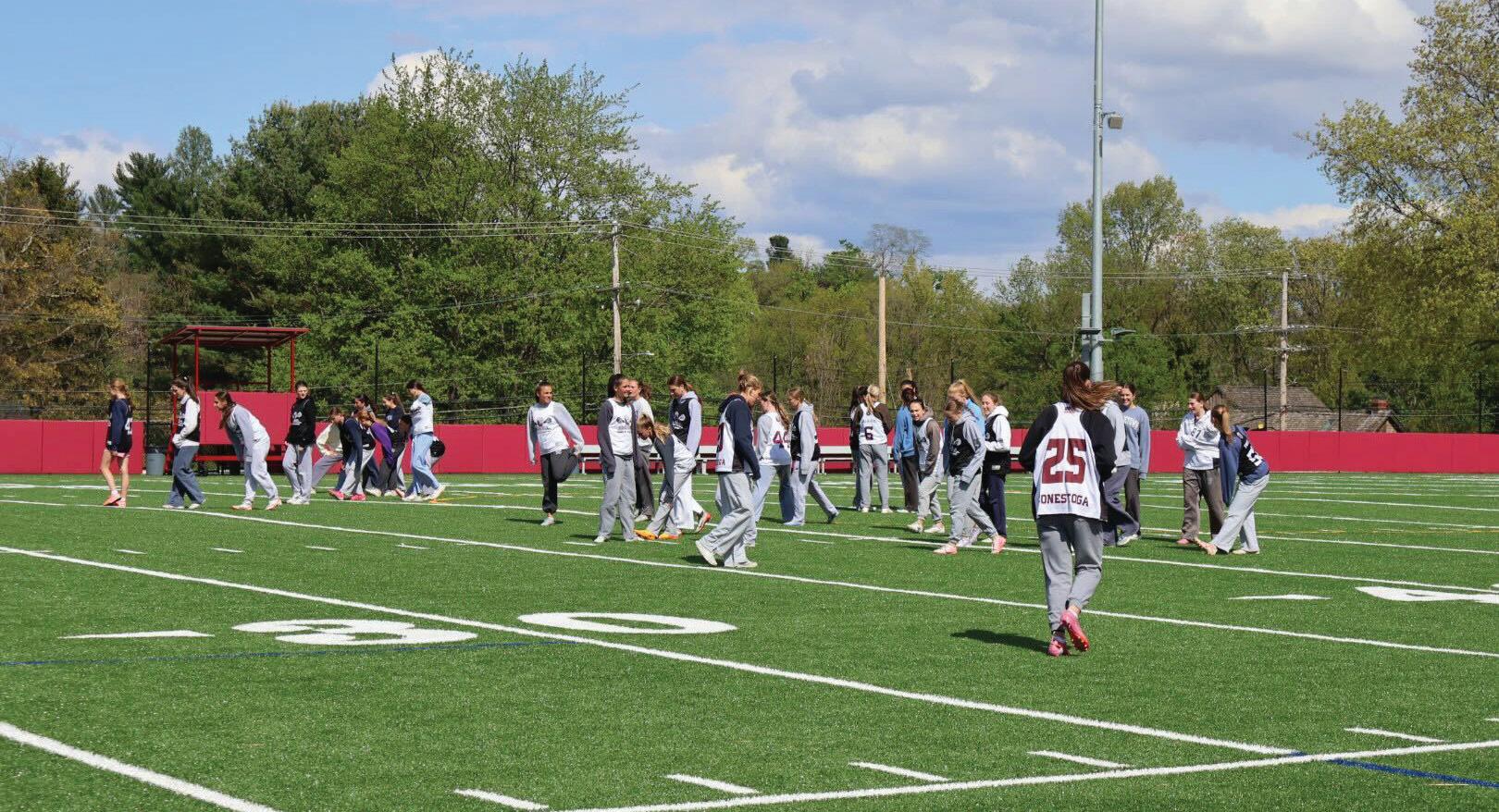
share revenue from student performance and media exposure directly with collegiate athletes at a yearly cap of $20.5 million.
Kristi Phipps, mother of junior and Conestoga field hockey player Elsie Phipps, feels that the additional revenue streams help student-athletes, as a number of them face financial pressures with college related costs. According to the NCAA, Division I and II schools grant almost $4 billion in athletics scholarships every year while Division III schools do not offer athletic scholarships. It reports that around 2% of high school athletes are awarded scholarships to compete.
“Many of the offers for student-athletes to play in college are not full scholarships,” Kristi Phipps said. “There is no financial commitment, incentive or scholarship from the athletic department to go there. Many others are partial scholarships. It is not very common to have a full scholarship.”
With the rise in digitalization, Pechin said that social media and digital monetization of player performance has also significantly influenced the aspects of what
universities consider when recruiting student-athletes.
“It’s pretty much a new world now with the portal and social media. As a result of COVID, we livestream all the varsity games.
So there’s so much film out there on kids that they’re able to create a pretty good highlight reel of what they’ve done,” Pechin said. “They want to see how you react, not just you dunking the ball. They want to see how you react when you’re going through some adversity that carries as much weight as you dunking (the ball). The colleges look at the entire aspect of an athlete, not just their skill set.”
Student-athletes maintain mental health amid recruitment
Combining a lengthy recruitment process with steps such as early signing periods, coach communications, academic requirements and non-student-athlete specific college applications, several high schoolers have felt increased levels of stress. School psychologist Jess Taraborrelli played field hockey for Rider University and feels

that recruitment has a significant impact on mental well-being.
“Mental health as it relates to sports recruitment is really important to work on because getting recruited is a lot of pressure,” Taraborrelli said. “There can be a lot of anxiety behind it. Am I good enough? Am I going to beat this other person out for this specific spot? Does the coach want me?”
Especially with a waiting period before hearing back from colleges, McDermott said that many students worry about coaches’ delayed responses and compare themselves to other student-athletes.
“You can’t take it too personally. A lot of coaches, just like teenagers, they’ll ghost you sometimes, and they don’t respond,” McDermott said. “They also get hundreds of emails from students who are interested, so they may not be able to respond back to you.”
Senior Gunnar Flesher committed to playing lacrosse at Rochester Institute of Technology in January of his junior year. Beyond direct impacts on mental well-being, Flesher also feels that the recruitment process can lead students to focus less on college academics or plans after college.
“For a lot of kids, the prominence (of a college’s athletic program) is the biggest thing to go after,” Flesher said. “They don’t really think a lot about the future. They don’t think about what they’re doing after college.”
Despite the stress, Taraborrelli emphasizes the importance of student-athletes maintaining motivation throughout the college recruitment process.
“The internal pressures or that pressure of being perfect is sometimes inevitable, but it’s really important to set what your goals are,” Taraborrelli said. “That is the biggest thing: setting realistic expectations for yourself with your goals in mind and staying true to yourself.”
Berwyn residents line up at gas stations as they now pay more than $4 per gallon of standard gas. Due to the conflict in Iran, rising fuel prices have impacted communities in the local area. Th e conflict in Iran has prompted additional responses within the community, such as concerns regarding family members in Iran. Freshman and Iranian American Farbod Bazyar has family in Iran. When the conflict b egan, he became worried about their safety.
“I learned (of the conflict) in late January or early February, and my reaction was like, ‘My family in Iran, what would happen to them if something went wrong?’” Bazyar said. On Feb. 28, the U.S. and Israeli governments launched Operation Epic Fury, a series of airstrikes targeting hig h-ranking Iranian officials, killing the regime’s supreme leader, Ali Khamenei. In response, the Iranian regime sent retaliatory strikes at Israel and multiple U.S.
military bases in the Middle East in countries such as Kuwait, Saudi Arabia and Qatar. According to Reuters, there have been almost 6,000 casualties of civilians, military p ersonnel and government officials combined since the start of the conflict.
According to the U.S. Energy Information Administration, Iran is the sixth-largest world producer of oil. In retaliation of the strikes, Iran closed the Strait of Hormuz on March 2.As a key global shipping route that carries roughly 20% of the world’s oil, the action restricted oil supply and raised gas prices worldwide. On April
7, President Donald Trump, in an attempt to stabilize gas prices, announced a two-week cease-fire to pause the attacks while Iran opened the Strait of Hormuz. According to the American Automobile Association, as of April 8, average gasoline prices in Pennsylvania rose to around $4.19

if they call us, which is like once every month. So we never really know what’s going on.” Similarly to Ghahremani, junior and Iranian American Arvin Tanha has family members in Iran and said t hat the conflict has impacted his contact with them.
“I do have a good amount of family currently there and they are in the parts that are being hit kind of heavily,” Tanha said. “Contact has b een crazy difficult recently because obviously the internet keeps cutting out — the g overnment’s cutting it — but WhatsApp has been able to stay up and some underground and secret apps devoted for communication.”
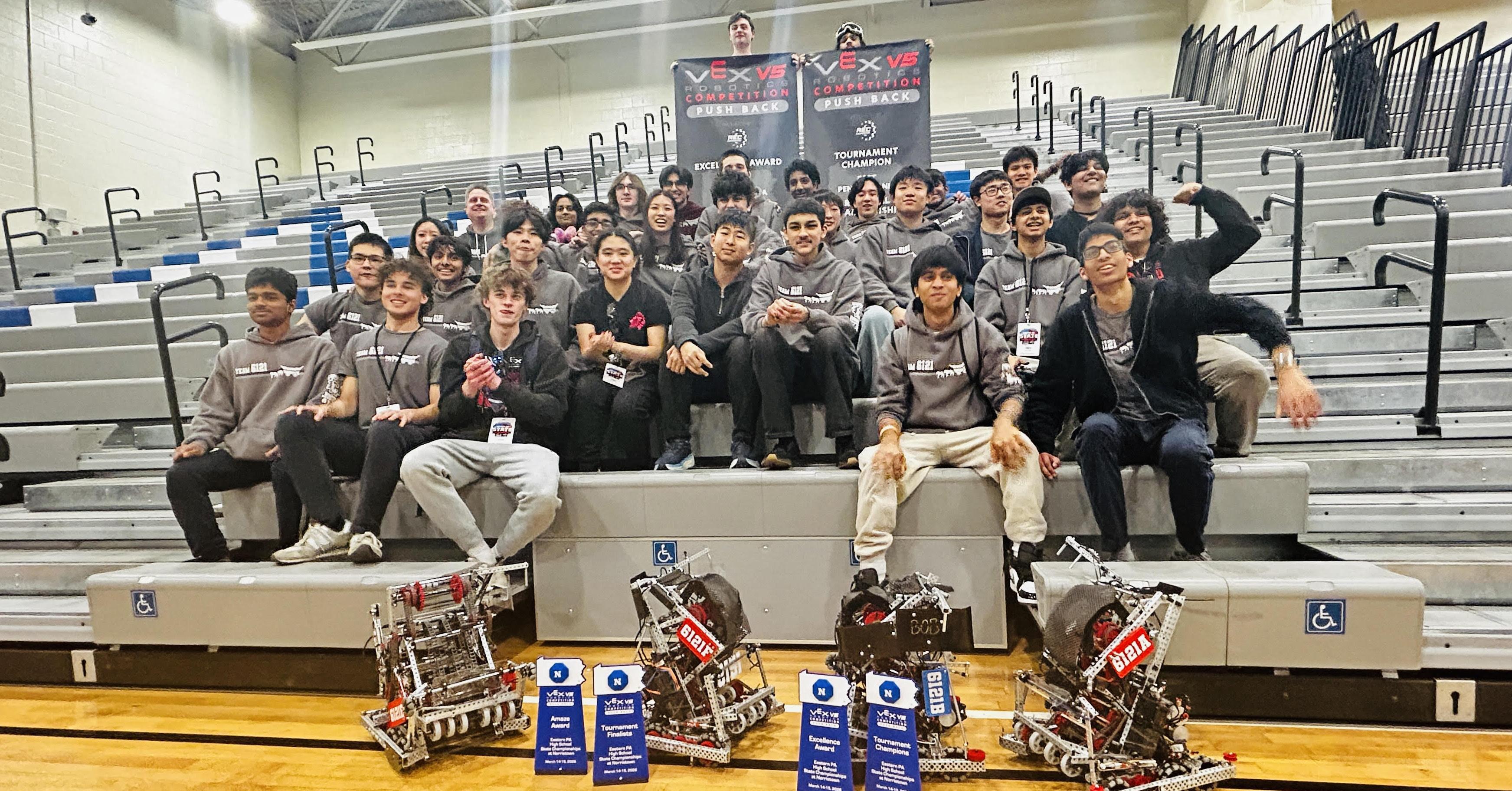
Cheers erupted as robots clashed at the 2026 Pennsylvania VEX V5RC State Championships for Eastern Pennsylvania at Norristown Area High School on March 15. Conestoga’s robotics teams broke a school record with four teams, 6121A, 6121B, 6121E and 6121F, qualifying for the VEX Robotics World Championship (worlds) in St. Louis, Missouri, which occurred on April 20-25. Conestoga has six robotics teams, 6121A, 6121B, 6121C, 6121D, 6121E and 6121F, that frequently attend competitions year-round to prepare for the state competition. Each team has multiple positions including programmers and builders who work to train, build, design and practice with their own respective robots. Junior and co-captain of team 6121A Advay Agrawal worked with his team to design the robot that helped the team qualify for worlds.
“We (teams) start building over the summer even though we don’t start school then. We generally know what we want to build for our first robot, so we’ll spend a couple months designing it online using CAD and building it, that’s what takes the most time,” Agrawal said. “After that, we have to program and also save a week before competitions for coding a 15-second autonomous period at the competition.”
The robotics season includes three parts: the early season, mid-season and late season, with the state competition taking place during the late season. Teams can qualify for the world championship through tournament performance at the state competition. Team 6121B won the Excellence Award and Tournament Champion, while team 6121F won Tournament Finalist and also earned the Amaze Award. Teams 6121A and 6121E qualified for worlds through their skills scores. To qualify for worlds, teams must pass two qualification rounds. The first round is a set of 10 qualification matches with random movements, opponents and teammates. According to junior Miranda Li, who is co-captain of team 6121F, teams get a ranking based on their individual performances after winning and losing matches. “Using the ranking, there is an alliance selection period and the teams can pick their teammates,” Li said. “This is for the

This year, the Conestoga robotics program reached a milestone at the state competition, breaking a school record for the number of teams to qualify for worlds.
The program consistently only had two teams qualify. But this year, four teams advanced to the selective VEX worlds competition in April. Freshman and programmer
Thanish Malineni is a member of team 6121B. “It feels great to qualify because high school is harder than middle school, and I’m really happy to be able to be supported by the
seniors who taught me a lot this year,” Malineni said. “It’s also different from middle school because I have three more years of this and it’s a really good start to begin my career.”
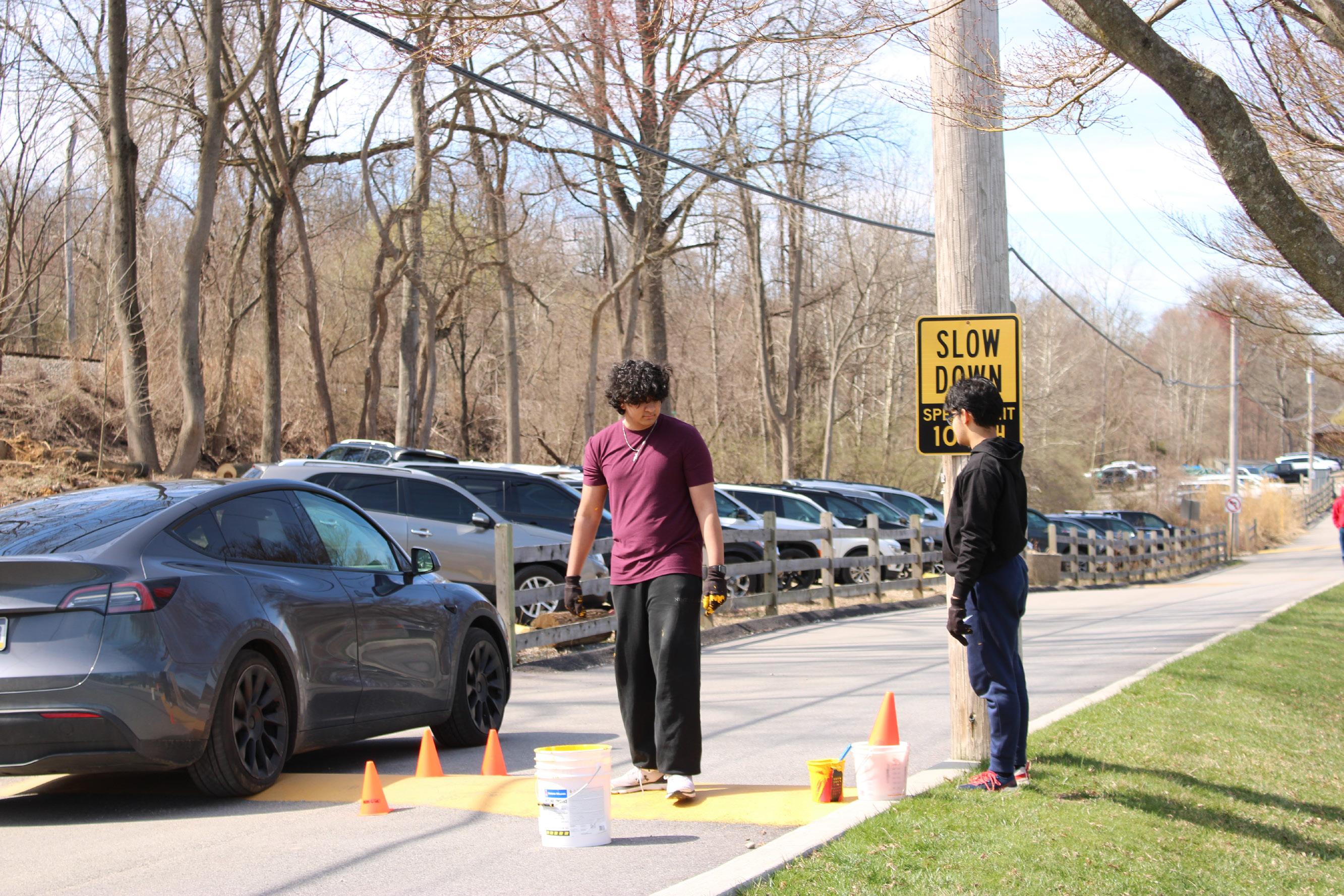
On March 29, members of Conestoga’s New Grounds club hauled buckets of yellow paint for its club-wide speed bump project. Volunteers layered paint onto the speed bumps, transforming the blank humps into brighter reminders for drivers. The speed bump project took place from 11 a.m. to
3
to paint speed bumps as an introductory project for the club.
“I didn’t want to go really hard and make (New Grounds members) do a whole stand or a whole building,” Maddi said. “I wanted them to try and do nor-
mal, easier stuff. And painting is probably easier and it’s more fun to do.”
Howellville Road leads into the Field of Dreams in Berwyn, where the Berwyn-Paoli Area Little League plays its baseball games. Both Maddi and sophomore Nikhil Pothula, vice president of New Grounds, participate in Eagle Scouts. Sophomore and New Grounds outreach leader Faiz Murtaza sent an email to Tom Toscani, owner of the Field of Dreams, asking about potential projects New Grounds could host, and Toscani recommended the speed bump project. According to Pothula, the speed bump project idea originated from Eagle Scout projects.
“Our inspiration was, ‘What if we try to run Eagle Scoutlike projects and make that into a club?’ And (Tom Toscani), who owns the Field of Dreams, has connected us with different projects and such,” Pothula said. “So we thought he’d be a good connection to have (for) our first project (on Howellville Road).”
According to Pothula, New Grounds’s goal is to strengthen
Constructed by Will Scheidt, Contributing Game Designer Answers at spoke.news/games

Vaishnavi Sriadibhatla Co-Staff Development Director cheese. The sauce and garnishes enhanced the flavor of the spices, and made the fries all the more delicious.
On a brisk Wednesday evening during spring break, my parents and I stepped into Vibe Haus - Indian Plates & Taps, a modern Indian restaurant in Berwyn. Although it’s only been open for a couple of months, it has quickly built a reputation for blending traditional Indian flavors with multicultural twists. From the moment I walked in, there was a very relaxed yet vibrant energy that filled the air. The space was modern and minimalistic, with subtle neon decor throughout. Since we visited on a weekday, the restaurant wasn’t very crowded, which added to the calm atmosphere. After looking through the menu, we decided to start off with the truffle masala fries for an appetizer. The fries arrived golden and crispy, coated in a masala — a fragrant Indian spice blend — and finished with a light drizzle of truffle oil. The earthiness of the truffle oil paired well with the savory flavors of the masala. The restaurant served the fries with a side of ketchup and garnished them with arugula and parmesan
For my main course, I decided to order the vegetable dum biryani and the classic paneer makhani. The biryani — a mixed rice dish made using rice, yogurt, mixed vegetables and spices — came garnished with fried onions, coriander leaves and a lime wedge. The longgrain rice was fluffy and tinted orange-yellow from the saffron. The mixed vegetables at the bottom of the dish added more color and depth. The spice blend used within the biryani was very flavorful and aromatic, though I found myself wishing for extra pinches of salt. This was a very quick fix, however, thanks to the salt and pepper shakers at the center of each table. The classic paneer makhani stood out as the highlight of the meal for me. The paneer — an Indian cottage cheese — was very soft and soaked up the flavors of the rich, tomato-based sauce it was in. The makhani sauce itself was smooth and creamy and had a hint of sweetness that balanced its mild spice.
the community through clubwide projects. In preparation for the project, New Grounds held group meetings throughout November and leading into March. New Grounds provided the yellow paint, traffic cones and other materials. The speed bump project is the club’s first project since New Grounds got together for its first meeting on Oct. 22 last year. According to Maddi, the club is planning several more projects near Howellville Road.
“One of them is about windows, replacing the windows in a couple places. And then another one is, we’re trying to revamp a zone of grass patch,” Maddi said. “There’s a lot more that we’re trying to do after this (speed bump project).”
Around 20 members of New Grounds helped repaint the speed bumps. Sophomore and treasurer Sarang Neogy assisted with the project. Neogy believes that the speed bump project contributes to improved safety in the nearby Toscani field.
“The speed bumps are necessary because, especially in this area, there’s a lot of kids playing (baseball),” Neogy said.
“It’s very important for us to ensure the safety of the kids and also help the community.”
Board members of New Grounds planned the timeline, food for volunteers to eat and advertisements of the event to bring in club members. According to Maddi, the most rewarding aspect of the speed bump project was knowing that the project benefitted the community.
“My favorite part of the project is actually coming out on a nice, beautiful day and doing helpful stuff for the community,” Maddi said. “The planning part is kind of cool because we did everything from start to finish. We actually set it up, and we actually made the project happen. That’s the biggest part of this club.”


The curry paired well with the complimentary side of white rice, making for a hearty combination. To finish off the meal, I tried the chai tiramisu. The dessert offered a creative fusion approach to the classic Italian dessert. The notes of cardamom, cinnamon and ginger in the chai — an Indian milk-based tea — gave the sweet a distinct taste. The texture of the dish reminded me of a more traditional tiramisu, with a chai-infused mascarpone cream that melted in my mouth and espresso-soaked ladyfingers that topped each layer. The chai added richness to the dish, creating a harmo-
nious balance with the familiar flavors of espresso. By the end of our meal, we felt very satisfied and full. The portion sizes were generous, leaving us with a couple containers of leftovers. Our meal,
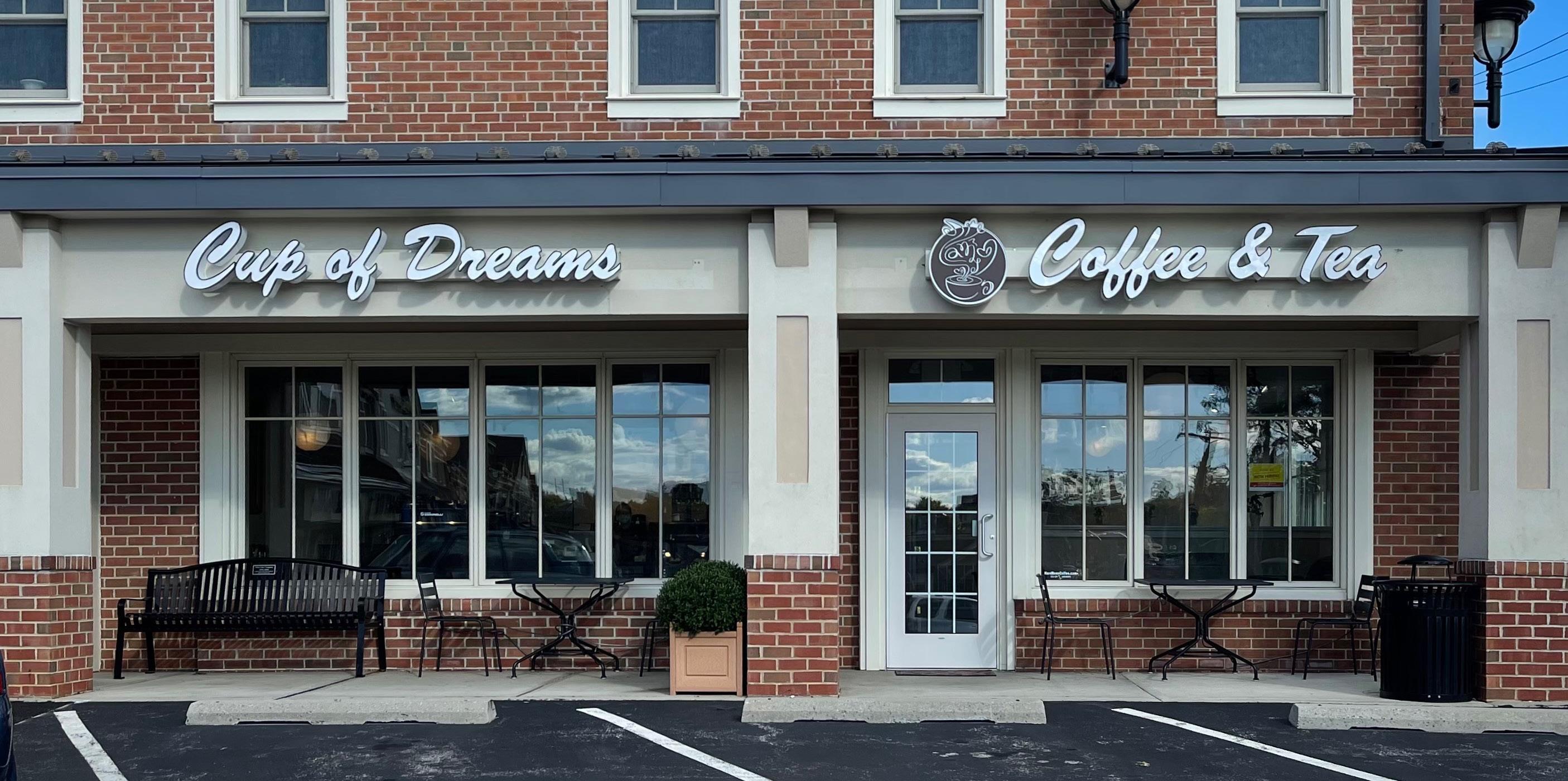
On Feb. 28, coffee shop Cup of Dreams, previously located in Paoli, closed after its lease expired. Owner Jian Zhou missed the deadline to renew the lease while on medical leave. The shop, which opened in October 2021, served boba, coffee, tea, pastries and ice cream. Zhou is now searching for a new permanent location, most likely a single shop on a business street. She hopes to have the new location within 30 to 40 minutes of the old one, noting the strong student community.
“We will keep most of (the shop) the same. In the current moment before the new shop starts, I am working on refining some products and then inventing new stuff,” Zhou said. “We will add some more lines of product into our new shop.”
Zhou said her goal is to finalize a new location before the summer so she can move on to renovations earlier. There is no definitive reopening date yet, as she is still considering potential locations for her coffee shop.
“The stuff that I definitely will keep and extend will be the combination of the coffee and the bubble tea. That is our strength,” Zhou said.
Sophomore Rachel Ma first visited Cup of Dreams with her mom shortly after it opened and was drawn to its welcoming atmosphere and private event space. She appreciated how Zhou made it easy to organize gatherings like her birthday party.
“I was disappointed (to know the shop closed) because it was a really nice place to hang out,” Ma said.
Ma had her birthday party at Cup of Dreams twice. The first time she had it there, she was
able to set up a build-your-own boba bar, where she and her friends could pick their toppings, tea and flavor of boba.
“She (Zhou) was really nice and accommodating,” Ma said. “Every time we came, she was there. She was very into what she was doing, and I could tell she enjoyed it.”
Looking ahead, Zhou is focused on preserving the welcoming, inclusive atmosphere that made Cup of Dreams a local favorite. She hopes the new location will continue to serve as a community space for students and families alike.
“We want to stay with the current fiber, like a dream shop for every age. So we will continue to have the spot for people to work at, the spot for kids to play at and the spot for cozy conversations,” Zhou said. “We want to continue the same vibe that everyone likes.”
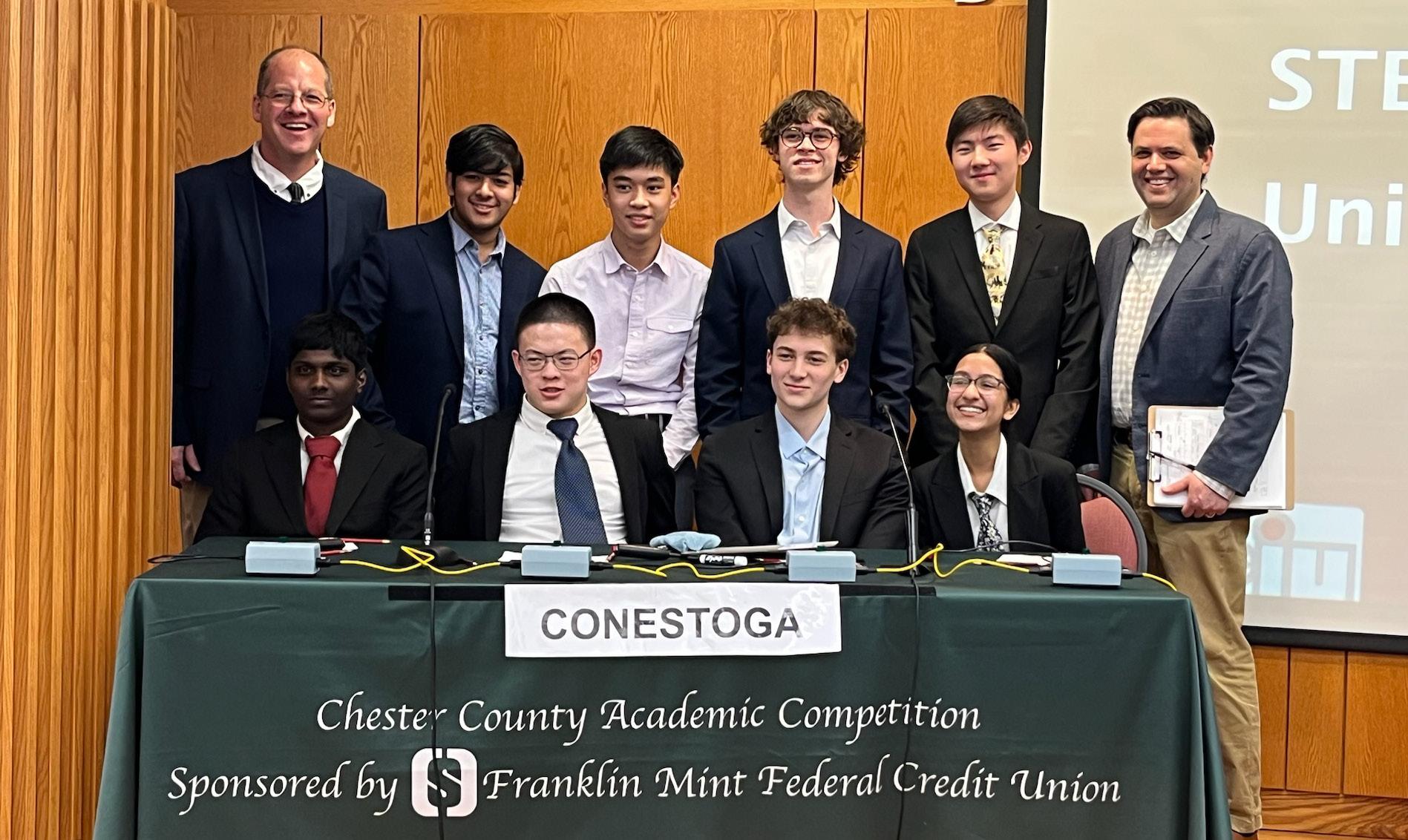
On March 24 at the Chester County Intermediate Unit (CCIU) building, the JV Academic Competition (Adcomp) Team won Chester County’s Adcomp for the first time since 2018 with a score of 120 points. Adcomp is a college-bowl-type competition where players take turns buzzing in to answer questions for points under a constricted amount of time.
Matches have three rounds and three participating teams who cycle through their rosters each round. The winner is the team with the most points awarded at the end of the match. The JV Adcomp team competed against Downingtown STEM and Unionville for first place.
“Conestoga Adcomp is a decorated team, but lately we haven’t been able to collect any hardware, at least in the last five years,” said Seth Kramer, a junior and Adcomp club president. “Knowing that history is weighing on (the team members’) backs is a significant mental burden, and I speak from experience when I say that mentality is a huge part of performance on the buzzer.”
The JV team last advanced to Adcomp finals in 2022 and won Adcomp in 2018. The last time the varsity team made finals was in 2019. Considering the team’s history and the intrinsic pressure of fast-paced competition, the JV team felt that finals was an especially difficult trial. Despite this additional anxiety
in an already-challenging battle, Kramer believed in the JV team’s talent and skill before participating in finals.
“I’ve watched these players grow throughout this and last season and seen all of them try out for the team,” Kramer said. “Watching them improve over time has been special.”
Other members had less confidence than Kramer. In particular, juniors and JV captains Karina Shah and Ari Shpilman entered the CCIU building satisfied that they even got to compete.
“If I’m being honest, I wasn’t expecting to win because the two teams we were up against were really difficult (to beat),” Shah said. “I was hoping for a second place finish, but I knew I’d be happy with anything. We played against Downingtown STEM and Unionville, who are two powerhouse Adcomp schools.”
Only eight players per school can compete in the Adcomp’s final match. When choosing players to represent the JV team, social studies teachers and coaches Michael Palmatier and Michael Cruz looked for commitment and a calm head under pressure. Despite uncertainty, the team performed well, maintaining a close lead as they gained confidence.
“We had a really good first round, which left us ahead by five points,” Shpilman said. “Then, (in the) second round, I think our morale was higher, so we pulled ahead by 25 points. (In) the third round we
knew we had to stay sharp and the pressure wasn’t as high.” The varisty team supported the JV team by cheering them
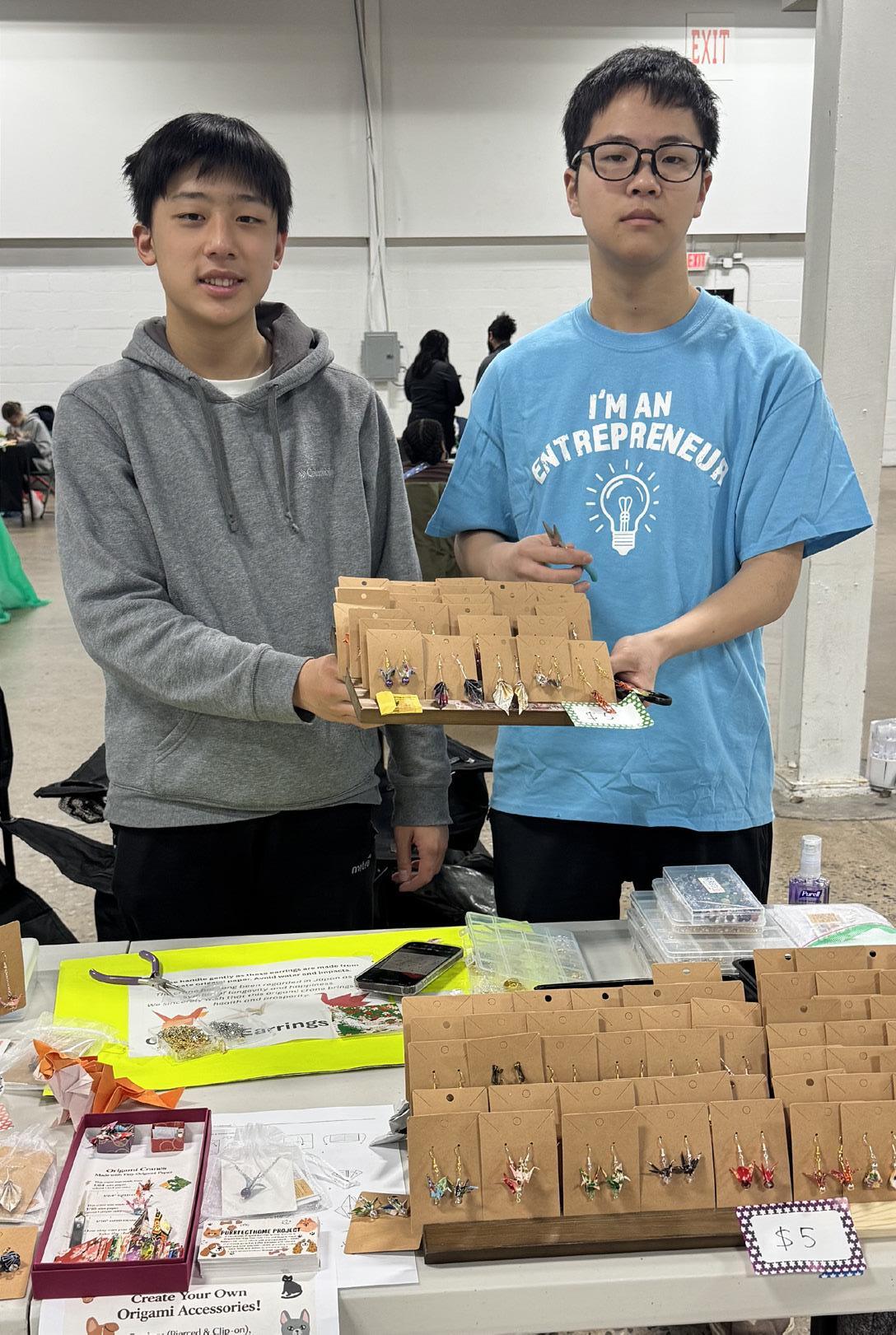
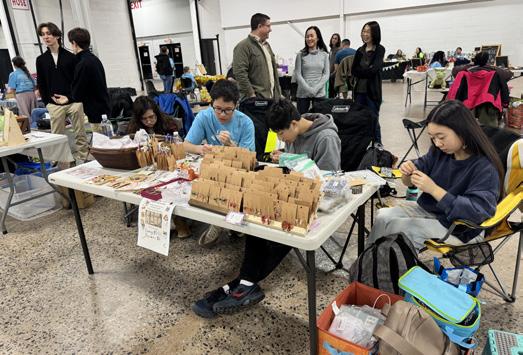
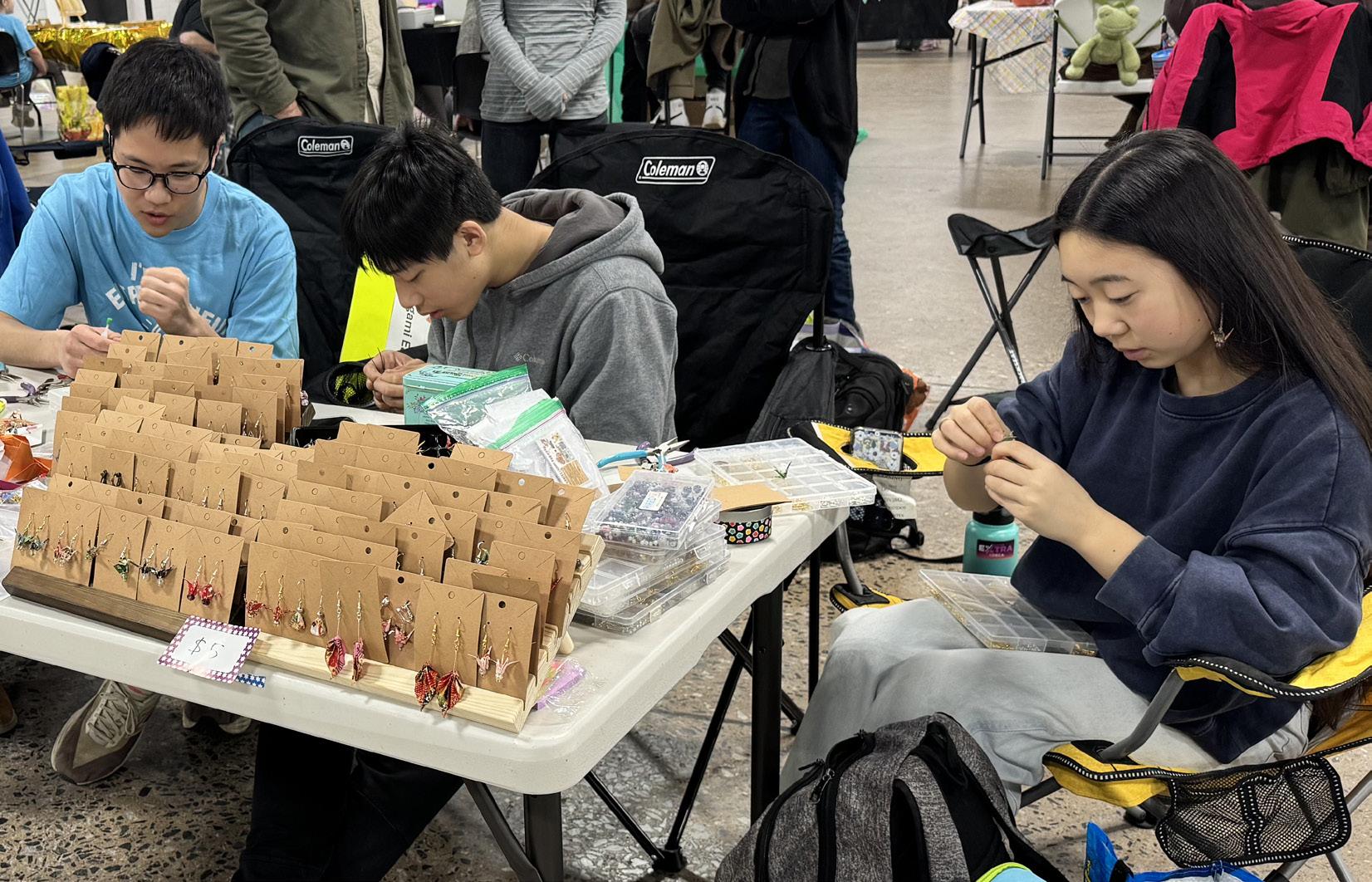
On a weekend afternoon at a Kids Market event, sophomore Yosuke Imamura sits at a small table and sells colorful origami earrings and keychains. The proceeds go to his nonprofit, the PurrfectHome Project, which raises money for cats and dogs in need.
Imamura started the project last summer with sophomore Yubo Jin from Conestoga and Suzu Noda, a student at the Japanese Language School of Philadelphia. They sell various pieces of origami earrings, necklaces and keychains for $5 to $10 at places like the Easttown Library, Etsy and community events across the area, and donate the proceeds to the Pet Adoption and Lifecare Society and the Main Line Veterinary Hospital. So far, they have raised over $6,000.
“My grandfather had cancer for almost 10 years now. In Japan, there’s a custom where you have to make 1,000 origami paper cranes to heal somebody,” Imamura said. “We were making a bunch of cranes, but eventually we realized we could use these cranes for something other than for (my) grandfather, and we started raising money to help local cats and dogs in need.”
They first started selling at the Easttown Library, where Imamura volunteers. Since then, they have attended a Kids Market event in February, sold origami at local shops and participated in the Philadelphia Cherry Blossom Festival in March.
The group also sells origami through the Japanese Language School of Philadelphia, where Imamura and Noda run an origami club for the PurrfectHome Project. They host hands-on origami crafting events and sell origami at the school’s sponsored events.
“There were just so many people who would donate, but not even take any of the accessories,” Noda said. “They were just happy to (donate) to the cats and the dogs, and it was nice interacting with the people, regardless of whether it be at the festivals or at the events that we host, (and) making these items for their family or for whoever they’re trying to make it for.”
Imamura’s family members, Jin and Noda create the origami pieces. Imamura leads the overall project and any events, Jin helps make and sell the accessories and Noda helps with event planning and managing activities at events. They use origami paper bought from Japan and
the origami with lacquer or nail polish to make them more durable before turning them into earrings, necklaces and keychains.
“I think (the PurrfectHome Project) is important because I feel like a lot of animals aren’t getting the life they deserve because people abandon them and then (they’re left) on the streets,” Jin said. “It’s just a
huge problem. I feel like (the PurrfectHome Project) has a great impact on these animals’ lives and helps improve their lives drastically.”
In the future, Imamura plans to establish an origami club at Conestoga with Jin and plan more fundraisers. They also hope to attend bigger events where they can raise more money.
“I think I’ve seen the community in a much more positive way through the interactions that we’ve had,” Noda said. “People are very supportive, especially when it comes to helping animals. It’s great to see that they like our products, and now that I’ve done this, it’s crazy to realize how you can impact the community without putting yourself massively out there.”


Delicious smells and excited cha er fill the air of the food court above Hung Vuong Food Market Two years a er Hung Vuong announced its new location in Berwyn, it unveiled a food court on the building’s second level, above its grocery store. The food court offers a variety of Asian restaurants, including Lanzhou Beef Noodles, Ramen Umai, Super Fried Chicken, Chan Mao Suan Cai Yu, Mama’s Vietnamese Street Food, Kung Fu Tang, Asian Plate, Chums Poke and Skewer, All About Coconut and O-Cha.
Yi Cheng is the owner of Asian Plate, a restaurant specializing in buns, dumplings and rou jia mo, a Chinese street food. Cheng’s friends initially told her about renting space in the food court and she decided to contact the real estate agent.
“It’s (opening the food court) a long process, because this construction part takes two years to finish,” Cheng said. “That is why we were supposed to open in 2024 in September, but the construction pushed us back.”

Cuby Lin is a co-founder of O-Cha, a tea shop. According to Lin, Hung Vuong bought its Berwyn building in 2024 with plans to open a food market and food court. Hung Vuong finished renovations for the first-floor food market in 2025 while it continued to renovate the second floor and advertise to potential restaurants.
Freshman Alex Vu goes to Hung Vuong on a biweekly basis and has visited the food court four times. He appreciates the food mart because it offers several types of Asian food in one space.
“It (the food mart) showcases a lot of Asian cuisine because we have a pre y big demographic of Asian people in the area,” Vu said. “That's unique compared to just a standalone restaurant here. You're able to try all the different cuisines in one single place.”



Written by Alivia Woo and Erin Zhang, Staff Reporter and Co-Copy Editor
Designed by Alivia Woo
The scent of bagels wa s through the air as curious customers gather outside PopUp Bagels, waiting for the clock to hit seven a.m.
On March 20, PopUp Bagels opened at Suburban Square in Ardmore. Founded by Adam Goldberg in 2020, the brand is known for pioneering Grip, Rip and Dip bagels, and serves them fresh every eight to 10 minutes.
Freshman Gianna Huang visited the store with a few friends and ordered an Everything Bagel with scallion schmear, a thick cream cheese spread that is o en blended with herbs, vegetables or fruits. “I think the bagels were really good, but what made PopUp Bagels interesting is their spread because you dip the bagel in it instead of pu ing cream cheese on top of it,” Huang said.
PopUp Bagels has amassed a large following on TikTok, with around 1.9 million likes and 60,000 followers. Huang stated that the company’s presence on TikTok influenced her interest in visiting the store.
“I think TikTok has helped with their social media.” Huang said. “Because prior to going, we saw a lot of TikToks about PopUp Bagels opening in Ardmore, and that’s what made the news spread.”
On March 13, Sephora held a grand opening for its Gateway location. The store replaced SPENGA, a fitness studio, and now serves as the third Sephora location in the Main Line. Founded in 1969, the brand is a well-known global beauty retailer, with a selection of over 500 brands.
Freshman Ashmitha Nallana noted that the store was relatively similar to other locations in the area and believes that it will bring more traffic to Gateway Shopping Center, particularly from students at Valley Forge Middle School.
“It (the store) was very neat, and there were a lot of (products),” Nallana said.“The workers were also very nice.”

Math teacher Alexander
Development Director math. I figured, well, maybe that’s something I can pursue. So I called Penn State and said, ‘Can I switch to education?’ They said, ‘sure, no problem.’ The rest is history for me.
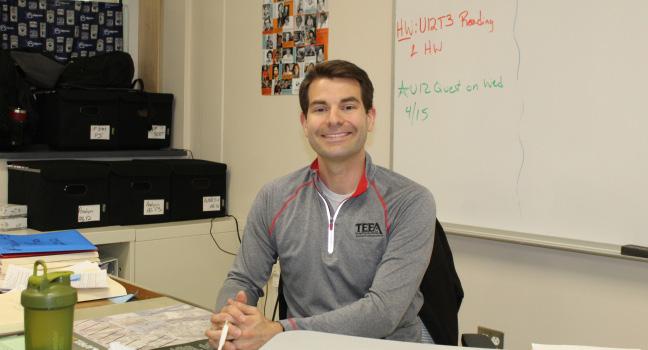
Rives attended Penn State from 2009 to 2013, where he earned his bachelor’s degree in secondary education with a mathematics focus. After beginning his teaching career in 2013 at Conestoga, he completed his masters in mathematics education at West Chester University in 2016. Rives currently teaches Advanced Placement Statistics and Math Analysis AB. He also serves as an assistant coach for the cross-country team.
Q: What made you want to become a teacher?
A: When I first applied to Penn State, I applied and was accepted in their engineering program, and then my school offered an engineering-focused pathway, similar to Allied Health. But you went through and you did the job of different types of engineering, like civil mechanical, electrical and chemical. And while doing that, I realized I didn’t like any of that. And so ‘Why was I pursuing engineering?’ I had a really great AP Calculus teacher, and I was also a coach for soccer. I also was an assistant manager at a job I had, and I enjoyed teaching people things, and I felt I was very confident in Lexi Lin
Q: Why do you think the subjects you teach, statistics and Math Analysis, are important?
A: For statistics, it helps people understand some of those traps that people will present you in life with statistics. Because with statistics, you can make the numbers say what you want. So, I think it helps provide people just a fundamental baseline of being able to interpret the numbers that are going to be thrown at you as an adult. But you are, as an adult, going to hear people talk about numbers, and having that slightly critical lens of how they got that information is what statistics says. And then for (Math) Analysis, you’re really learning to think through problems and critically solve things. While not everybody’s going to need to know all the trigonometric identities, the job of the course is to prepare anybody who needs to have that for the future. But also for those who know they’re not gonna do it, it gives them a way to start thinking about problems in a procedural way or a critical lens.
Q: If you could teach another class or subject, what would it be and why?
A: Maybe history, because history is my favorite subject, where math is just ever-so-slightly second. I think of the importance of all the different historical contexts and looking at all other aspects and elements of it. I am, though, thankful at times that I don’t teach history or a subject that is less concrete or that has more subjectivity to it.
Q: What advice would you give to someone who wants to become a teacher?
A: I would recommend talking to a teacher you trust, especially in a subject you’re interested in teaching. Ask them honestly about their experiences and the things they’ve learned along the way. It’s also important to research what colleges offer. Some schools offer direct degrees in education, while others require you to major in a subject first and then complete a separate teaching certification program. Understanding those pathways is important when deciding where to apply.
Q: Why did you choose to coach cross-country?
A: About nine years ago, the head coach, Mr. Hawkins, who also teaches math here, asked if I would be interested in helping as an assistant coach. I had run before but had never coached
cross-country specifically, and I wasn’t a cross-country athlete in high school. But I enjoy coaching, so I said yes. It’s been a fantastic experience. I really like getting to know students outside of the classroom. It also helps when the school year
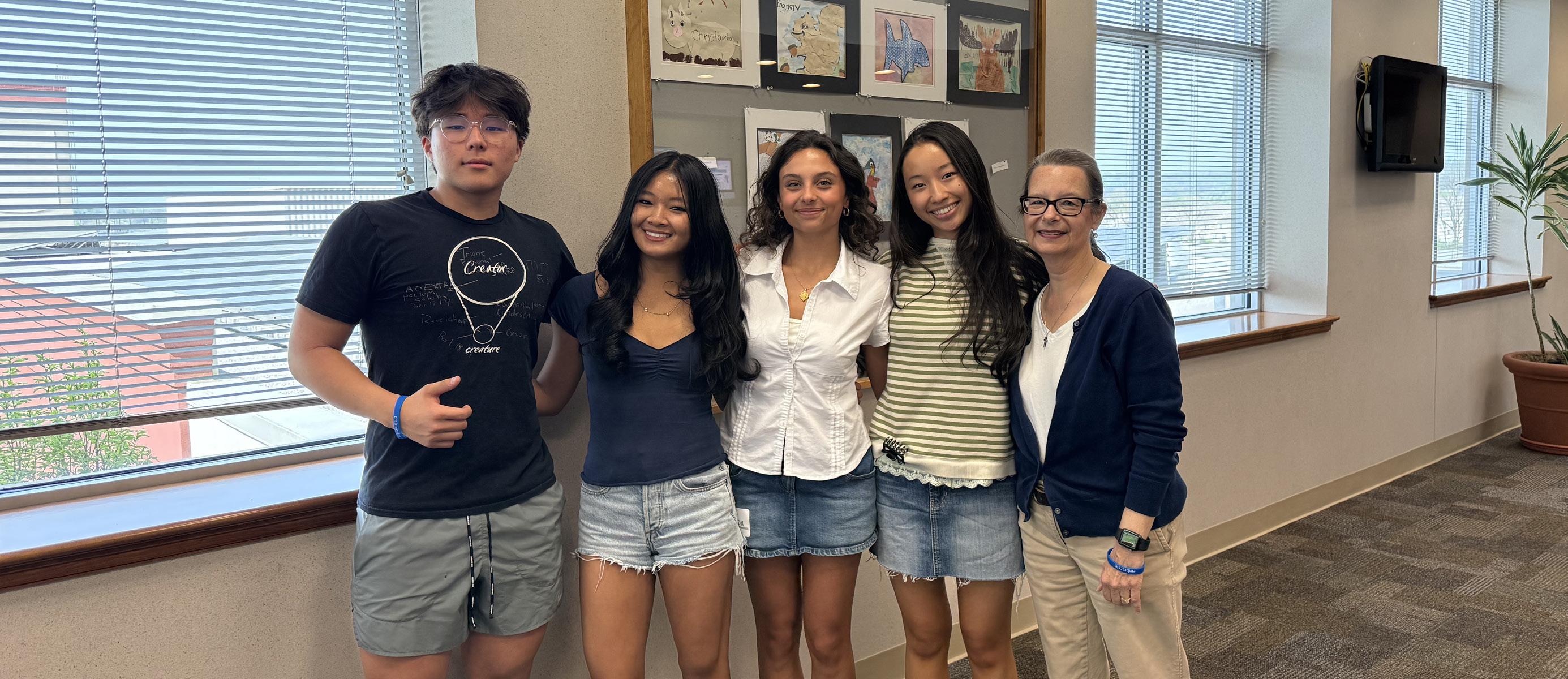
In Dec. 2025, junior Joel Kwon launched Embracelet, an initiative that aims to raise awareness about mental health. By distributing special bracelets to schools across Chester County, Kwon hopes to provide support and comfort to students struggling with mental health.
Kwon serves as the president of the Chester County Student Forum, an organization sponsored by the Chester County Intermediate Unit that consists of student leaders across Chester County’s high schools. During a student forum meeting in Dec. 2025, he suggested the idea of a mental health project aimed at raising awareness and promoting discussion through passing out blue rubber bracelets with the word “Embracelet.” Wearing the bracelet signifies that you are someone who anyone feeling alone or down can talk to and let out their feelings.
“It could be a simple conversation, like ‘How was your day?’ Or it could be someone who’s going through something that they want to rant to somebody (about),” Kwon
said. “If you think that you’re a person that is approachable to talk to, then you can have the bracelet.”
The Chester County Student Forum holds monthly meetings discussing community issues, sharing opinions and working on service projects. The student forum held discussions with school administrations across Chester County throughout February and March, and the administrators granted approval to distribute the bracelets to all Chester County schools through the end of April. Kwon ordered the bracelets and distributed them during the Student Forum meeting on April 16, from which the student leaders passed them out to their respective schools.
“It’s (mental health’s) an important issue to address, especially in this generation where lots of people struggle with different types of mental health (issues),” Kwon said. “It’s just something that (people) should be more aware (of) and take more seriously.”
According to Kwon, the inspiration for creating Embracelet was due to his own history with mental health.
This led him to realize the importance of mental well being and the need to increase awareness and support for those dealing with mental health issues.
“Personally, I have been through sports depression and just mental health (struggles) in general,” Kwon said. “I think that no one should go through what I’ve been
through. So if (there’s) someone that (one) can talk to, that would just make (them) feel better.”
The student forum organizes frequent initiatives to raise
money for the project. Kwon aims to receive more donations to allow them to hand out more bracelets to a wider range of schools. He hopes that the mission of Embracelet can spread
to be willing to reach out and talk about their problems,” Kwon said. “For them to not have to go through it alone.”
Alynn Kang and Talia Roth Staff Reporters
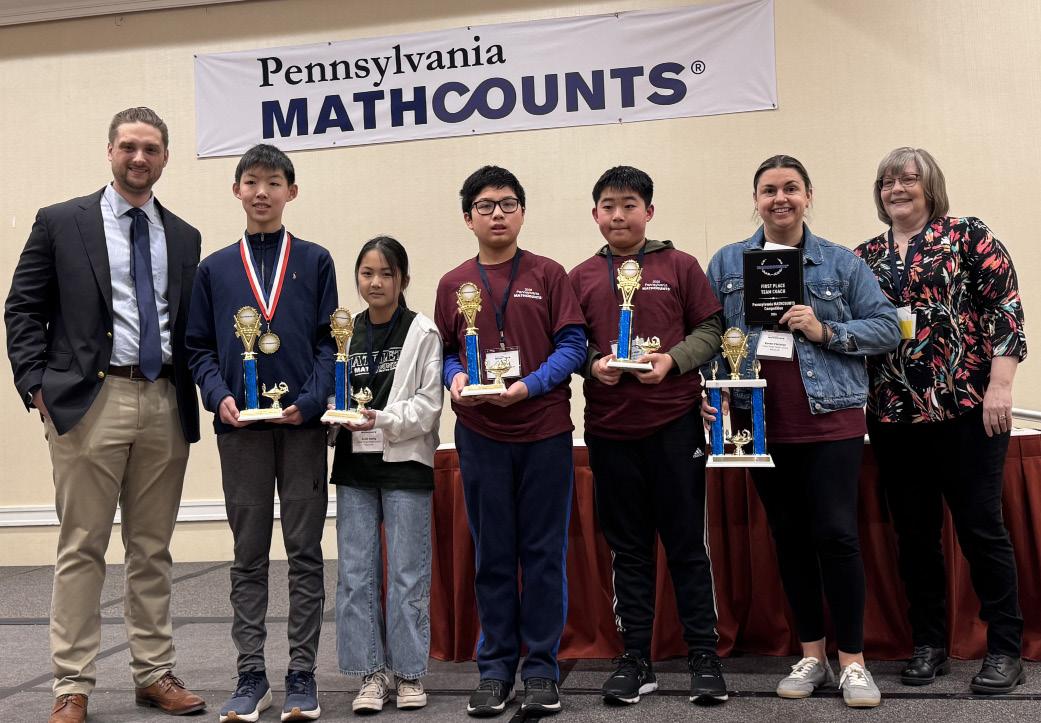
When students at Valley Forge Middle School began this year’s MATHCOUNTS season, they were pursuing a milestone the program had not reached in more than a decade. After months of preparation and steady progress through multiple levels of competition, the team earned first place at the Pennsylvania MATHCOUNTS State Competition on March 21, marking the school’s first top spot finish since 2013. The A team, the best scorers of the school round that earned first place at states, included eighth graders Julie Hang, George Zhang and Lewis Zhu, and seventh grader Alex Hao. VFMS eighth graders Arnesh Bose and Amay Rajan also qualified from the chapter competition through their individual scores and advanced to states.
MATHCOUNTS is a national middle school mathematics competition that advances students through school, chapter, state and national rounds, with each level increasing in difficulty and intensity. At VFMS, students first competed at the school level before advancing to the Chester County Chapter Competition, where 12 students represent-
ed the school. From there, the A team earned first place at the chapter level and advanced to the state competition alongside roughly 30 of Pennsylvania’s strongest teams.
“I believe the competition was quite strong because many of the participants I know are highly skilled,” Zhang said. “Competing at the state level is especially challenging.”
Preparation for the competition began under adviser Michelle Hardy and continued under math teacher Karen Fletcher, who stepped in starting in February after Hardy went on maternity leave. Fletcher structured the team’s weekly practices around different competition rounds, helping students build both accuracy and speed ahead of states.
“Each week, I had a specific round planned, and we would go through prompts and tips,” Fletcher said. “Basically, I would meet with the kids once a week, and each week I would have it set up with what particular type of round we were going to work on.”
Students also met to practice outside of official practices. Parents organized meetings to work through past competitions and additional problem sets, strengthening the team’s skill and collaboration as the season went on.
“You can’t really study math the way you do other subjects (since) it requires consistent problem-solving practice,” Zhang said. “Every member of the team is individually very strong.” At the state competition in Harrisburg, students had to adjust quickly between different rounds and question styles as the difficulty shifted throughout the event. Zhang also placed sixth individually, adding to the team’s overall success at states.
“You never know how it’s going to turn out until the end,” Zhang said. “I was surprised by how well I performed, especially since I felt additional pressure knowing it was my final year competing.”
The team relied on months of preparation and steady improvement across the season to perform at its best when it mattered most. The first place finish meant more than just the result, as the experience brought the team together in a way that stood out beyond the competition itself.
“The fact that these kids are here and that they love to do math, it was just a cool thing,” Fletcher said. “They’re in their element. They see friends from other schools and they’re excited to go over the answers that they got.”
Teachers peer through school bus windows as they stop at local historical sites. On March 17, T/E administrators, librarians and social studies teachers from every elementary school, VFMS, TEMS and Conestoga went on a bus tour throughout Tredyffrin to gain exposure to the area’s local history.
Matthew Sterenczak, Curriculum Supervisor for social studies, helped plan the trip. After organizing a walking tour in the fall focused on the Berwyn School Fight, Sterenczak felt it would be beneficial for teachers to go on a tour centered on local history in general.
“We had done a tour in the fall for the Berwyn School Fight. After, we integrated (the Berwyn School Fight) into the third, eighth and tenth grade curriculums. Having the teachers be out in the community seeing important historical sites, seeing things that matter to people connected to our community, was really powerful,” Sterenczak said. “So, we have been partnering with the Tredyf-
frin (Township) Historical Commission around America 250 for the last year. And when they talked through this idea of potentially doing a tour, it lined up really nicely with our objectives and our goals to (make) local history a little bit more alive.”
Tredyffrin Township Historical Commission is a municipal advisory board that is a part of
more than 30 locations, including notable sites like the quarters of four generals during the Revolutionary War, a Nike missile base created during the Cold War and the Wharton Esherick Museum, the studio and home of Wharton Esherick, a prominent artist during the early 1900s.
After the tour concluded, some of the tour attendees
on introducing local history primarily to the elementary and middle schools.
Rob Williams Chair of Tredyffrin Township Historical Commission
the Tredyffrin government. As part of its responsibilities, the commission offers Tredyffrin officials with ideas to promote local heritage. Rob Williams is the Chair of Tredyffrin Township Historical Commission, and he led the tour and shared stories about each site. The group visited
met in the T/E Administrative Office to discuss ideas for incorporating local history into school curriculum. Ryan Howard, a social studies teacher at Conestoga, attended the tour and the curriculum meeting afterward. According to Howard, T/E administrators plan
“We talked about doing things with the younger (students,) because that’s where they will have (more information about local history taught). Meaning when you’re in younger grades, and you’re studying earlier parts of American history,” Howard said. “With just the way that our (high school) curriculum lines up with what we study, it’s harder to kind of naturally blend (local history) in. But (for the high school) we talked about how for (America’s 250th Anniversary) next year, we could try and implement some of the sites and some of the things that we might do and offer it to students as extra resources.”
Williams believes that Tredyffrin Township is fortunate to have a lot of local history available for people to explore. The Wharton Esherick Museum, for example, is an untouched, legally protected property with the same interior as when Esherick lived there. It is one of only around 2,600

National Historic Landmarks, historic properties that the U.S. Secretary of the Interior designates, that demonstrates American culture, along with places like Mount Vernon, the Statue of Liberty and Monticello.
Howard believes that by learning about local history sites, students have a present-day example of history that can help them connect the past and present, and witness the importance of each event and battle in history.
“It was pretty cool to have such a wealth of really historical things that happened during the Revolutionary War literally in our backyard,” Howard said. “I think everybody knows about Valley Forge (National Historical) Park, and it’s there, but we didn’t even go into Valley Forge Park. There were so many places on regular main roads that I thought were really cool.”
“I think (local history has) been lacking in curriculum. It’s an opportunity to collaborate between the local organizations who know the history and the school district. And what I have always found is teachers are incredibly creative,” Williams said. “Learning about our 300 years of how we got here is so important right now as we continue to struggle with questions about what America stands for and where we’re going.”

I’ve been assigned countless nicknames: Jeff-Jeff, Jefferson, Cheffrey, Mr. Frog, Blue Shirt Guy and even Unc. But, one that sticks with me in particular is “Dude that is definitely getting robbed on the street.”
Okay, no one has actually called me that, but I imagine that’s what goes through many of my friends’ heads as they painstakingly stop me in my tracks to do a simple, yet ever so meaningful gesture: zip up my backpack.
On the final day of school last year, I realized how much I took those moments for granted. I woke up in a sweat that morning to headspin harder than I ever did in Mr. Dewees’ class, and my
clock stared right back at me: 7:46 a.m. As if I was in a reimagining of “1984,” I bolted downstairs — without having brushed my teeth or made my breakfast — for yet another clock to stare at me. But, this one read 7:26 a.m., reminding me again that I forgot to set this alarm to the right time for weeks. Wind in my hair, winded in my soul, I J-walked through the street past all the cars headed to school — until my legs finally gave out. With my Canon R50 camera, for some reason, ricocheting around my neck, I superman-dived onto the red ant-infested pavement to protect it, splitting both my hands and skinning both my
knees. And, as you could guess, my backpack was wide open: My everything spilled out of it.
was about to enter, I doubled back. ‘I should probably go to the nurse,’ I told myself.

Sheepishly, I hobbled and bled all the way down to my first period class, CCT. Just when I
Simply put, this happened because I was so sleep deprived. After all, I was on

Miya
Cao Co-Sports Editor
Adapted from a bestselling novel of the same name by Andy Weir, “Project Hail Mary” wittily tells a tale of bravery and scientific achievement. The film follows middle school science teacher Dr. Ryland Grace, played by Ryan Gosling, as he wakes up from a coma on a spaceship and slowly regains his memory. He discovers he is the sole surviving astronaut on a “Hail Mary” mission to help save the sun from decaying at the hands of astrophage, a mysterious organism.
However, Grace won’t have to face the future alone, as he meets Rocky, a fittinglynamed and lovable alien that is on the same mission for its planet, Erid. During film -
ing, a team of six puppeteers brought Rocky to life, so that Gosling could have a scene partner while filming. Their efforts are apparent in Gosling’s authentic, little-brother-like chemistry with Rocky.
The film features breathtaking and dramatic silent spacewalk scenes. The visuals are stunning throughout, as expected from its roughly $200 million production budget. Released on March 20, the movie marks Amazon MGM Studios’ first major box office success.
Gosling’s performance is exactly what was expected of the acclaimed actor. His talent shines especially in moments of self-doubt and vulnerability, particularly when he admits to Rocky that he wants to go home. Rocky, in turn, grounds Dr. Grace, pulling him out of his isolation and making the film far more engaging.
While not particularly subtle or nuanced, the film’s message about how bravery is not about being born brave,
but rather rising to the occasion, is a classic moral that contributes to the feel-good mood. Seeing the character of project director Eva Stratt’s dedication and international scientists working together paints an optimistic picture of the future.
Compared to the novel, the movie is less rich in scientific depth and humor, instead relying more on Gosling’s personality and Rocky’s silliness. Perhaps more internal dialogue from Gosling could give viewers a glimpse into the mind of a scientist.
Understandably so, critics point out the lack of true tension and conflict in the plot, as there is a constant sense that Grace will prevail against the odds. But “Project Hail Mary” seems uninterested in making audiences feel a lonely astronaut’s despair. Instead, the persistent optimism and sometimes cheesy humor (“Fist my bump?”) create a timeless, uplifting film in a genre normally defined by dystopia and disaster.


maybe two hours of sleep from having attempted to make all my teachers thankyou cards the night before, most of which never ended up making it into my backpack.
But really, I wasn’t taking care of myself enough. Oftentimes, I feel that many people, like myself, get so entangled in the belief that if we don’t attain something immediately, that opportunity becomes gone like the wind. In an effort to cling to this mindset of resilience and perseverance and to ease the pressure of many adults in my life, I convince myself that everything will be okay if I work as hard as I can. Needless to say, my backpack, overflowing with enough granola bars, hand sanitizers and Owala bottles to ward off any zombie apocalypse, speaks for itself on my fear of being unprepared and useless. So, that’s why
I transitioned to fanny packs. On a serious note, though, grit is a great motto to live by. However, it needs balance. If you strive to carry too much than your backpack can handle, how can you possibly make room for yourself? Slowly but surely, I’ve begun taking a step back and assuring myself it’s okay to relax. If I didn’t take the steps to support my own life, I wouldn’t be here today. So, don’t push yourself to the point of having to save yourself by superman-diving onto the sidewalk. Be there for yourself, and know your limits and boundaries. Believe me: You have nothing to prove to anyone. Just have faith in yourself, and you will find that you are more successful than you thought you were. So, when you walk back into Conestoga next fall — or whatever destination you may be approaching — always remember to invest in yourself: the underdog staple you’ve always underestimated. Because sometimes, overcoming life’s curveballs is just a matter of learning how and when to zip up your backpack. It’s the most “pioneer” thing you can do.

‘Why you gotta be so rude?’: People are getting meaner

“Kindness is a virtue” is a lesson we all learn in childhood. However, in recent years, many Americans have expressed the sentiment that people are getting ruder. A 2024 Pew Research study reports that 34% of U.S. adults regularly witness rude behavior in their daily lives. Rude behavior includes filming someone without permission, bringing pets into indoor spaces, wearing headphones while speaking to someone and more. There are various factors contributing to this perceived increase in rudeness, one being the COVID-19 pandemic. The study previously
mentioned states 47% of U.S. adults believe people behave ruder in public today than before the COVID-19 pandemic. The social isolation everyone faced possibly reduced understandings of social norms and consciousness for others.
Escalating political polarization also plays a role. People are very quick to judge someone’s appearance and treat that person according to their perceived political leanings. A study done by researchers Peter Törnberg and Juliana Chueri states toxicity and incivility are more prevalent in politics, increasing party divide. Political division breeds hostility and mistrust towards strangers. More relevantly to teenagers, social media allows people to act rudely without facing tangible consequences. You can comment or post horrible things without a second thought. The belief that people are getting meaner can also come with aging. As life goes on, you might look back on your younger days with rose-colored glasses.
Psychologist Adam Mastroianni has studied this phenomenon in which people believe everyone is getting ruder, publishing a paper titled “The illusion of moral decline” in the journal Nature. In an interview with UChicago sponsored podcast “Big Brain,” Mastroianni goes on to explain that globally, people have felt that others are losing their morals for several decades. This suggests that it is a psychological trend rather than an actual concern. It is not fair to say this is all in our heads. People are more comfortable being rude, whether that be behind a screen or face to face. Sometimes it’s even encouraged — standoffishness is seen as a sign of coolness in attractive women. It’s impressive to say something mean and not back down from it. There’s an overemphasis on self-preservation in America that teens probably take advantage of. They think it’s okay to be rude because they are supposed to care about their well-being first and foremost. Empathy is no lon-
ger important. The idea that others have to earn your respect is damaging and encourages unnecessary rudeness. Obviously, there are instances in which rude behavior is needed for protection, but I think we all need to revisit the value of kindness and community. People should be able to ask their neighbors for favors and not worry about owing them. They should be able to live with the knowledge that someone has their back. Although the word kindness feels elementary, I think that’s part of the problem. You don’t outgrow the lessons you learned in your childhood about treating others the way you want to be treated when you turn 15. In a world where division and hatred are exploited for power, it’s important that we all recognize the strength that comes from relying on one another. Doing good deeds will encourage others to follow suit, making the world a better, more reliable place. Take the first step and be kind today.

It’s 12:08 a.m., and you’re still studying for the Advanced Placement (AP) U.S. History test tomorrow. As you go over the effects of the Progressive Era, you realize that you’re finding this mind-numbingly boring. You love science and math. You hated AP World History last year. Why are you even taking AP U.S. History? To make your college application more impressive, of course.
Conestoga undeniably has a very competitive culture, with many students feeling the need to go through high school with the sole goal of having the best college application possible. But this shouldn’t be the case. High schoolers shouldn’t be thinking about what their college app will look like when making
decisions — they need to do things because they want to. First of all, working too hard on things you dislike is not healthy. In addition to short-term unhappiness, there are long-term negative effects of not enjoying the work you do.
A 2016 study by Ohio State researchers found that low job satisfaction among adults in their late 20s and 30s harmed their physical and especially mental health after they turned 40. The same principles apply to high schoolers. Also, a 2008 study published in the National Library of Medicine found that “sleep deprivation was significantly associated with enrollment in AP/college courses.” There is no reason to worsen your sleep by taking an AP course you don’t even like.
Additionally, the great effort it takes to slightly improve your college app (like by taking an-
that students interested in highly selective colleges take 5 to 8 AP classes total in high school.

other AP) will not help you get into a substantially better school.
According to college admissions counseling company Prepory, college counselors recommend
There are students at Conestoga who do that in one year. The same Prepory article states that “you should take advanced courses in subjects that genuine-
ly interest you.” Even when cynically only thinking about college, there is no need for Conestoga students to take as many AP course as they do.
Many Conestoga students also choose their extracurricular activities by thinking about how they would look on a college application. Because of this, students often get involved in an excessive number of extracurriculars, believing that to colleges, the more, the better. This is incorrect.
College planning platform
that you’re not very committed to the process.” In other words, quality is more impressive to colleges than quantity. By only being involved in extracurriculars you’re passionate about, you’ll both be happier and have a stronger college app.
“Taking everything in stride is easier said than done, but it’s a skill worth learning. Be adaptable, especially in how you carry your strengths into new situations. And don’t underestimate the value of stepping away and coming back with fresh eyes and perspectives.
— Lily Chen
Co-Editor-in-Chief
“Embrace the chalant. The grind will always be there, but by focusing on finding excitement and staying spontaneous even during the mundane, you’ll not just reach milestones but also create lifelong memories.”
— Rowan Chetty
Co-Editor-in-Chief
“Attendance is important … in theory.
— Abby Chong
Co-Managing Editor
“Don’t get into too much hot water with the people on your ‘opp list.’ Or, if you do in fact like the hot water, just don’t get pruned.”
— Jeffrey Heng
Co-Managing Editor
“Step outside your comfort zone AS MUCH AS POSSIBLE, stay lit, trust the process, focus on what matters, time heals all!”
— Lauren Pinheiro
Web Managing Editor
“Never be afraid to prioritize yourself and the people you love.”
— Faith Zantua
Co-News Editor
“Be kind. As your four years of high school come to an end, what matters most are the true friendships you will take with you to college and beyond.”
— Mary Wolters
Co-T/E Life Editor

College Raptor recommends, “Don’t just join a bunch of clubs or sports to impress admissions. You’ll end up burning yourself out and giving off the perception
College aside, you may think that taking a lot of difficult classes and participating in many extracurricular activities will help you grow. But challenging yourself is only a good thing to a certain extent. Studying well past midnight for a class you hate will only hurt your sleep and burn you out. At the end of the day, high school is something to be enjoyed and looked back upon fondly. Students should not significantly worsen their high school experience for the sake of their college app. Personally, there were several times in my high school career when I decided not to take an AP course I wasn’t interested in, and I still got into most of my top college choices. I’m so glad I decided to focus on making new friends, getting involved in extracurriculars I was genuinely passionate about and taking classes I was genuinely interested in. If you do the same, you will be too.


“Everything passes, so let things go a little easier.”
— Audrey Kim
Co-Opinion Editor
Don’t forget to live in the moment! Control what you can control, and don’t spend too much time worrying about the past or fretting about the future. High school should be fun. Do things you want to do, and don’t feel pressured to do anything you’d rather not, including pressure from yourself! Make good memories, and remember that you’ll only go through high school once, so make the most of it!”
— Eshan Singh
Co-Opinion Editor
“Don’t let anyone limit your ambition. Put your all into the activities, causes and friendships that you care about. Eat more ice cream!”
— Miya Cao
Co-Sports Editor
“Talk to everyone, each person has a story and a perspective, whether it’s similar or different to yours. There’s something to learn from every conversation.”
— Sosi Sengal
Co-Sports Editor
“Don’t sell yourself short, ask for help, love your friends and, most importantly, breathe!”
— Saktisri Gowrishankar
Multimedia Editor
“You don’t need to know what you want to do in high school! My career path has changed at least four to five times in the past four years, and it will always work out in the end ;).”
— Lexi Lin
Co-Staff Development Director
“Life isn’t a sprint; it’s a marathon. Your journey may be completely different from everyone around you, and that’s the ENTIRE point! Each of us is on our own path, is going at our own pace and will have our own definition of a ‘finish line’. So, take the chance and do the things that scare you, and be kind to yourself if things take longer than expected. Because the beautiful thing about a marathon is that each step, no matter how small, moves you forward where you’re meant to be.”
— Vaishnavi Sriadibhatla
Co-Staff Development Director
Talk to everyone, and try new things even if you don’t like them. Most of all, enjoy the process!”
— Ryan Ding
Social Media Editor
“High school can be chaotic, but I think the best way to go about it is to just embrace the chaos. Don’t procrastinate and make time to hang out with your friends. Try new things and don’t be scared to fail because you’ll regret not trying way more. ”
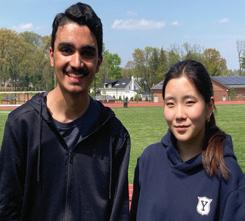



Lily Chen and Rowan Chetty Co-Editors-in-Chief
— Riddima
Pandey Media Editor
“Take every opportunity you get, even when it feels like a risk, because you’ll always find yourself where you least expect it. And whenever you feel lost, hold on to the people who love you! Don’t forget to love them back.”
— Vanessa Chen
Business Manager
“Find something you love and do it!”
— Isabelle Emmanuel
Staff Reporter
Dear readers, As the weather warms and our final days of high school come into view, so does the end of our time as editors-in-chief. It feels surreal to be writing our final message to you as part of The Spoke, and only now has it fully set in how quickly time has passed and how difficult it will be to step away from this community we have built and come to cherish. For years, we watched previous graduating seniors reflect on their time at The Spoke. Now that this moment
is ours, we realize there is a spectrum of emotions that comes with what lies ahead. We feel excitement for our plans after high school, including some long-anticipated traveling before packing our lives into boxes and IKEA bags for college move-in day. But nostalgia has sneakily begun to settle in, too. We vividly remember walking into Room 268 for our first Spoke class, a little starry-eyed and very determined to prove ourselves. When we joined the editorial board as design editor and multimedia editor, we channeled that enthusiasm into hours spent drawing graphics and creating video packages to improve The Spoke’s reporting. As section editors and throughout our tenure as editors-in-chief, we have expanded on our initial goals to push the paper forward. To this day, we feel a great sense of purpose in leading the paper of record for T/E.
However, while we love the work we do, what has made this experience truly meaningful are the people we have met and the community we have served through our reporting. To our editorial board, staff and advisers, thank you. From sharing pizza on production nights to gathering over hot pot in Philadelphia during journalism conventions, we couldn’t be more thankful that you have been by our side. It has been a privilege to lead alongside you, learn from you and watch this paper grow through your work. Saying goodbye feels bittersweet, but we hope we have supported you and shaped your lives as much as you have changed us for the better.
To our readers, advertisers and supporters, The Spoke has always been — and will continue to be — a reflection of the people behind it. We hope you will continue to sup -
port its mission of delivering thoughtful, accurate and impactful news to T/E and beyond. Responsible and local reporting matters now more than ever, and The Spoke is truly a beacon of community-centered journalism. As our time on the paper comes to a close, we eagerly look to the future and leave the paper in the hands of incoming Editors-in-Chief Ashley Du and Rajan Saha, who we are confident will lead with their own care and dedication.
To The Spoke’s 2026-27 Editorial Board, we are constantly in awe of your passion for journalism and what you are capable of. We can’t imagine our high school years without the thrill of chasing down breaking news stories or the taste of Oreos on production night, and we hope you will make your own memories to reminisce on in the years to come. Until next time, Lily and Rowan

For the first time in two decades, the sounds of a tennis match could be heard on Conestoga’s campus. The boys’ tennis team hosted its first home match on March 18, a change from its previous home courts at the Upper Main Line YMCA (UMLY).
The team began its season in early March and held tryouts at UMLY before moving to the on-campus courts for practices and competitions. In the past, the players took a shuttle or drove themselves to UMLY after school.
The transition comes after the completion of five new courts, which was a part of a larger project started by TESD to expand athletic facilities. The new facilities also include two turf fields, a practice field, a softball diamond, batting cages, portable bleachers, a field house and parking spaces. The project planning began in April 2020, with construction starting in April 2024. It concluded in the fall of 2025, with the courts officially opening on Sept. 29, following a ceremony.
“I really like the new courts, and we played really well,” junior and first singles player Ethan Sun said. “I really like playing at ’Stoga because it’s a better environment than playing at the Y.”
The team played its first home match against Haverford High School on March 18, where Conestoga opened its season with a 7–0 victory. Senior and captain Jake Tsang foud that the new courts brought the team together.
“With the new courts at ‘Stoga, we have a closer team bond
since we don’t have to drive all the way to the Y in separate cars,” Tsang said. “We can walk together straight to the tennis courts, and we have our own space to interact with each other now that we’re not relying on the courts at the Y.”
However, there are only five courts available on campus, meaning that the team must split its matches. The 11 varsity players compete at Conestoga, while the 20 JV players continue to play its matches at UMLY.
“We’re kind of losing out on some of the team spirit that we have all together, but at practices we still all hang out,” Tsang said. With the completion of the new athletic fields, the teams expect to travel much less for practice or competitions. For the tennis program, the team expects this change to be a factor helping them advance into the state tournament, as the team hopes to win states for the fourth time in a row.
“We’re already a really good team but playing at these courts can give us more support,” Sun said. “For districts and our regular matches, (the courts) will definitely help.”

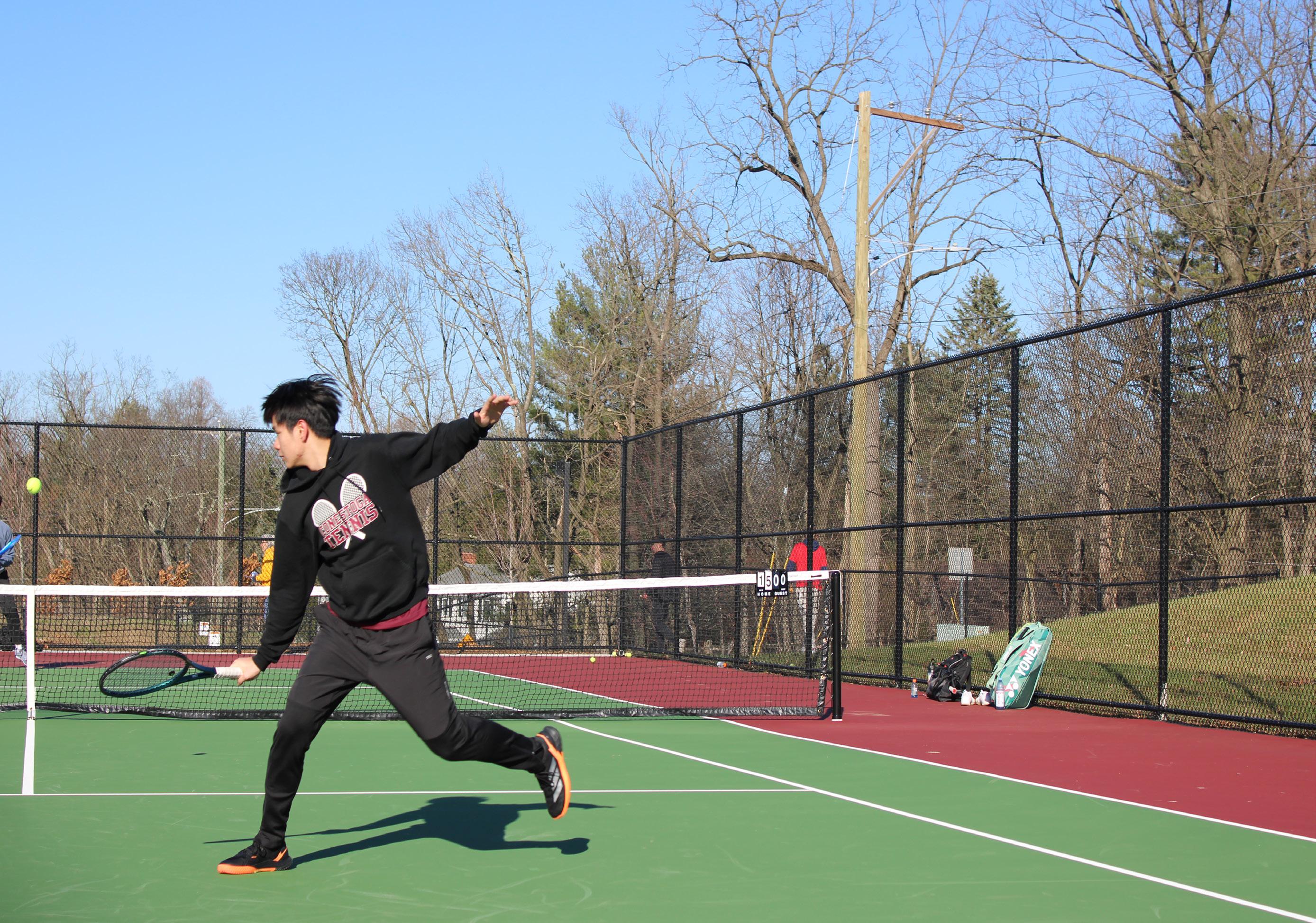
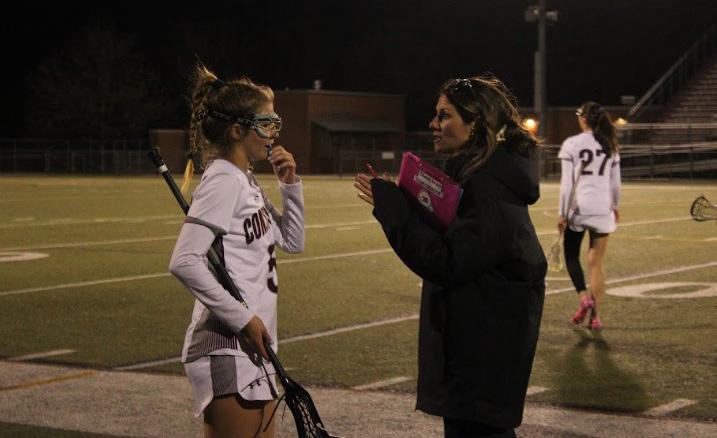
With a new season comes new leadership for the girls’ lacrosse team. This year, Jacklyn Collins is taking over as the new head coach for the varsity team, replacing former head coach Amy Orcutt. Collins is a 2007 Conestoga alumna, and she played lacrosse all throughout high school, helping lead her team to win two PIAA State Championships. Afterwards, she played Division I lacrosse at Drexel University and led the team in its first Colonial Athletic Association (CAA — now the Coastal Athletic Association) Championship Tournament.
“I love coaching, just like how I love teaching. When I was in college, I started coaching for a local club team my sophomore year and I realized
how much fun it was,” Collins said. “I don’t know if I went into (lacrosse as a) player knowing I wanted to coach in the future, but it definitely kind of led to that because I just didn’t want to leave the sport.”
Collins has been on the lacrosse coaching staff for thirteen years in TESD, serving as the JV coach and assistant varsity coach before obtaining her current position. She replaced Orcutt, who resigned to spend more time with her family.
“I was assistant varsity (coach) under Amy (Orcutt), so our practices look very similar. I think a structured practice usually starts with a big warmup, then we move into stick drills,” Collins said. “That’s where we focus on a full set of offense, and then full sets of defense.”
This year, the lacrosse team started off strong, remaining
undefeated so far, and ranking third in the nation for public school girls’ lacrosse teams. Collins recognizes the talent of her team and the potential that it holds for this season. However, she doesn’t just want her team to be known as accomplished players.
“We expect respect. We want to be known as a team that respects other teams, respects other officials, other coaches. We do a lot of giving back,” Collins said. “We do a lot of fundraising for things in the community, because we want to be well-rounded individuals, not just known for being good lacrosse player(s), but actually good (people).”
Senior Carolyn Jones, a team captain and four-year member, appreciates Collins’ approach to coaching. During the pre-season, Collins encouraged a mindset that allows
the familiar fun of past pre-seasons, but is more focused on winning larger games, such as state championships.
“Coach Jacklyn’s approach (maintains) the Stoga lacrosse culture of winning,” Jones said. “But it also includes supporting each other and becoming the best players we can.”
The team has strengthened its bond through several activities, including a preseason trip to Florida. Jones feels that Collins’ mission to create a comfortable environment, where the team can create goals and openly support each other, has paid off.
“Coach Jacklyn has created a team environment where every player loves showing up to practice each day,” Jones said. “She has been such a great coach and will definitely continue to create great things in the future.”
Anvita Mohile Staff Reporter teams: one which would compete in London, and the other which Brynn Wozniak would compete for in the Netherlands.
Over the summer, freshman
Brynn Wozniak qualified to compete at the Junior 1 Nexus Championship in Virginia Beach after applying to play for the Junior USA National Field Hockey Team. Following the championship, Wozniak received news that she was selected to play with the USA Under-16 (U-16) team in the Netherlands from March 30 to April 7.
Wozniak began playing field hockey when she was five years old. In second grade, she joined the Main Line Field Hockey Club and has continued competing and training ever since. Earning a spot on the varsity lineup as a midfielder and attacker for the Conestoga team, Wozniak has dedicated 10 years of her life to field hockey. Her older sister Shae Wozniak also played field hockey for Conestoga and continues to play at Duke University as a freshman. During regular season games, Brynn Wozniak has contributed significantly from making goals to winning matches.
“Middle school (competition) is definitely more relaxed,” Brynn Wozniak said. “Working together in high school is so much fun. The upperclassmen really help you out and it’s just like a family.”
Before she started playing for the Conestoga team, Brynn Wozniak applied for the Junior Nexus Championship in early 2025 for a spot on the Junior USA National Field Hockey Team. Following a regional competition, applicants were selected to compete in July at the Virginia Beach Championship where the coaches and board members finalized the members of the youth national team. This year, Nexus created two
In Valkenswaard, Netherlands, the U-16 division mostly practiced drills for attacking and defensive strategies over the course of one week. Along with this, the team analyzed its individual and collaborative skills throughout the Championship. Then, Brynn Wozniak’s team played several games with the English, Belgian, Moroccan and the Dutch teams.
Brynn Wozniak explains that although she learned a lot from the experience, it was nerve-racking to play at such a high level.
“It’s really hard, but everyone’s supporting you throughout the way,” Brynn Wozniak said. “It was a really great experience and I would definitely do it again if I make the team.”
English teacher Karen Gately has been coaching the field hockey team periodi -
cally for the past 25 years. As a former field hockey player herself, she feels proud watching a freshman play at a higher level, both in and outside of the school team.
“She’s (Brynn Wozniak’s) obviously contributing a lot to us statistically, but just having her on the team sets a very high standard,” Gately said. “She’s very intense and that elevates everyone’s play.”
Watching the current team’s growth and Brynn Wozniak’s contribution, Gately feels proud of all of the effort Brynn Wozniak put in the past year into playing field hockey. She hopes to continue to see her contributions and growth to the Conestoga team in the coming years.
“It takes an incredible amount of hard work and sacrifice to make one of these teams,” Gately said. “So, I’m immensely proud of her.”



SPORT: Baseball GRADE:


Riddima Pandey
I used to watch climbers in pure awe, amazed that they could scale a wall using their hands and feet, but nothing could have prepared me for how much my respect for the sport would grow the moment I tried it myself.
Sophomore and rock climber Mallory Wollick, who has been climbing for four years, taught me the basics of gear and climbing.
Wollick helped me put on the harness and explained that the climbing shoes are designed to allow you to curl your toes slightly to grip the rocks with your feet. We started with top rope climbing, where one person climbs while a partner on the ground controls the rope. This type of climbing is centered on trust, as you have to believe that the person holding your rope will catch you if you fall. As I made my way up the wall, I could feel every muscle in my body working while my mind raced trying to figure out where to place my
hands and feet. At one point, I slipped and lost the wall completely. I dangled in the air and struggled to get back on, but Wollick talked me through it and I found my footing again. The higher I climbed, the heavier my body felt, but seeing the top so close was all the motivation I needed to keep going. By the time I came back down, I was drenched in sweat and completely out of breath. I needed to rest before moving on.
Next we tried auto belay, which is similar to top rope but instead of a partner, a machine at the top lowers you down slowly when you let go. It is great for solo practice but if you slip, you would have to start over. The tricky part for me came at the very top. The leash felt loose and I was too scared to let go of the wall. It took a moment to remind myself to just trust the machine. When I finally let go, it caught me, just like it was supposed to. Finally, we tried bouldering, and it was a whole different experience. There is no harness, no partner and no machine to catch you.
The walls are shorter, but the routes are more technical and require more problem solving. Since nothing will catch you if you fall, it is important to know how to fall safely by keeping your arms close to your chest and making sure no one is below you.
Bouldering was the most intimidating type of climbing for me. With nothing but a mat below, every move I made felt nerve-racking. It also made me aware of the different types of rocks on the wall. The easiest ones and my favorite were the jugs, which were easy to grab and hold onto. The hardest ones were the crimps, which were the tiny rocks that required finger strength to keep me from slipping.
For all the climbs, I stuck to the easiest paths to lower my chance of falling. When I pushed myself to try a harder path on the auto belay, I lost my strength before I could make it to the top. Rock climbing requires a lot of practice and method. The whole experience felt like solving a giant puzzle that just happened to be vertical.

Boys tennis hosts first home match in over two decades Page 10
Students weigh in on March Madness Page 11
Tryoneer Pioneer: Scaling new heights Page 11
Whether it is football, basketball or any other sport, district athletic director Kevin Pechin can be seen cheering on Conestoga athletes as they practice and compete. However, this summer will mark the end of his 33 year long career as he retires on June 30.
In February 1993, Pechin joined TESD as a physical education teacher at Hillside Elementary School. During his time at Hillside, he also coached the high school football, baseball and golf teams. In 2016, Pechin became the district athletic director. He manages various tasks for Conestoga athletics from handling logistics, such as busing and scheduling games, to working with coaches and students.
“When I came on as athletic director, I wanted this athletic program to be viewed in the greatest light possible,” Pechin said. “My role is to make sure that, not only did (the athletes) succeed, but they had fun. I wanted athletics to be a stress reliever, not a stressor, and I think we did that. I think (the student athletes) perform better when they’re relaxed, when they’re having fun, and that’s something I emphasize with all the teams.”
During his time as athletic director, Pechin brought several changes to the athletic programs. He helped establish new teams, such as the girls’ golf team in 2021 and the boys’ volleyball team this spring season. Additionally, Pechin established a captain’s council to meet with the captains of
Conestoga sports teams every season to review expectations and accomplishments.
“I’m very proud of that captain’s council because it lets the captains know that they are valued,” Pechin said. “It’s a better connection to me, and (the captains) put a face to the name. I think the most rewarding part of the (athletic program) is the dynamic I have with the kids. Having them coming into our office and just sitting down and getting to know them has been really rewarding.”
Pechin has deep familial connections to Conestoga, as he spent a lot of time with his family during his time in the district. He met his wife while teaching at Hillside, and his two daughters studied and graduated from Conestoga. Additionally,
family worked together to help him organize various sports events.
“This job (as athletic director) sometimes was all family,” Pechin said. “(During) the football game, I would have my daughter, my mom and my wife working the game, working the tickets. A lot of the times when my kids were here, I would see my kids more at school than at home. They would come in and they would eat (in the athletics office) with their friends. Especially during COVID, it was a little piece of normalcy for them. When my youngest graduated two years ago, I’m like, ‘Man, I miss having a kid here.’”
Pechin wrote his retirement letter to the Board of School Directors last summer. June 30 will be his last day in the district, with
the next athletic director officially starting on June 22. Pechin reflects on his time in the district and the value he was able to bring. He hopes to spend more time with his family after retirement.
“I’m proud of all the accomplishments,” Pechin said. “But with the demands of this role and the personal responsibility I have –I’m still a dad, I’m still a husband –it led me to conclude that retirement’s the right step. I still love this place. I still have that energy level that’s second to none, but I can tell there are moments like I’m getting a little bit older. It gets tiring, and I would never want this job if I can’t give it 100%. I have given it 100% from day one to the last day, and I would never want to short change this district or these kids.”
TEMS social studies teacher and JV baseball coach Richard
“I’m very excited for this role, and I’m very much looking forward to guiding the program and continuing what’s been built, and seeing where we can take it,” Mattison said. “I look forward to working with everybody, from administrators to coaches to the students, to parents, to the teachers in the building. There’s been such great success at Conestoga, with the sports and the athletes, and there is some great culture already embedded there. I’m just going to try and continue what (Pechin) has done while being myself and providing my own sense of positive energy.”
Pechin looks forward to the continued success of Conestoga
athletics. During the next few months, he will help Mattison switch to his new position. After retiring, he hopes to continue visiting Conestoga and watching its athletic games.
“This athletic program is in great hands, and it will continue to thrive,” Pechin said. “I think we’re trending in a great direction. I marvel at the amount of talent that runs through the school athletically. Titles here are commonplace and that is not the norm: it’s something to be super proud of because it’s not luck. This is all from hard work and I have no reason to believe that work ethic is going to change because I’m not here. That’s the kids, and we just have to make sure we keep them on the right track.”
From May 14-17, Aronimink Golf Club will host the 2026 108th Professional Golfers’ Association (PGA) Championship. 47 of the top 50 golfers in the Official World Golf Ranking will travel to Newtown Square to play at Aronimink and overall, the club will host 123 players from 24 countries.
“There’s the Masters, PGA, Open, and U.S. Open, and those are the four biggest tournaments of the year,” said junior and boys’ golf player Finn Buckley, who plans to volunteer at the tournament. “It’s one of the best tournaments to watch out there.”
Founded in 1901, the PGA Championship membership is composed of 8,500 professionals in 80 countries. Previously, Aronimink hosted the 1962 PGA Championship, 2003 Senior PGA Championship and 2020 Women’s PGA Championship, among other major tournaments. In order to prepare for the upcoming championship, the club has been closed since early Nov. 2025.
“To prepare, (the championship organizers are) putting a lot of huge, bleacher sized but nicer stands all around the concourse,” Buckley said. “They closed the course down for like six months and kept the greens really nice, manicuring it to perfection.”
According to CNN, PGA organizers expect about $125 million in economic impact in the Philadelphia area. CNN also reports that tickets are currently sold out for the championship rounds and that organizers expect 200,000 people to attend. Buckley feels that the championship’s wide scope and popularity will be financially beneficial for the community.
“One of the big things is the money (the championship) is going to bring. A lot of economic push is going to go into this. Once you get to the PGA Championship, it’s going to be insane,” Buckley said. “There’s going to be thousands upon thousands of people there. It’s really good for the community, especially (with) a lot of people traveling in.”