By Tvisha Jani, Grace Hu and Paige Vachris, Co-Copy Editor and Sta Reporters
In preparation for the 202526 Delaware Valley Regional High School Ethics Bowl, junior Bayla Kaskey reads a case discussing a stressed teenager who was looking for mental health
support. Rather than seeing a traditional therapist, the teenager used an arti cial intelligence (AI)-powered app that o ers cognitive-behavioral techniques and mindful exercises 24/7.
Kaskey was one of ve students from Conestoga who presented a stance on the case at the annual competition. Over recent years, various community members have seen a rise in technology usage and felt the impact on
their daily lives. For Kaskey, the increasing presence of AI specifically for teenagers and the advancement of conversational AI chatbots has concerning e ects for the community.
“Because of the expansive potential of AI that we haven’t fully explored, there are going to continue to be new, di erent problems that we haven’t thought about,” Kaskey said.
“You hear a lot about people
Post-test re ections: Senior Josh Jacob looks at his AP Literature and Composition Schoology page. On Feb. 4, administration sent an email to district parents, informing them of the investigation regarding the course’s cumulative midterm test.
School administration looks into compromised exam
On Feb. 4, district parents and guardians received an email from school administration and Advanced Placement Literature and Composition teachers notifying them of an investigation into the academic integrity of the AP Literature cumulative midterm and the consequential cancellation of student grades. Teachers plan to administer an alternative assessment before spring break, although they have not nalized an exact date. Scores for the exam will now factor into students’ second semester grades.
“As you may have heard, we received information about potential cheating across multiple sections of
the AP Literature classes. As a result, our administrative team conducted an extensive investigation into concerns regarding the integrity of the assessment. Our investigation has now concluded,” school administration and AP Literature teachers wrote in the email. “The findings confirmed that the integrity of the exam was compromised, and as a result, the midterm cannot be considered a valid measure of student learning.” Senior Avi Gairola feels that teachers took the most appropriate measure by invalidating all students’ scoresx.
“I think (the cancellation of all scores) is a fair action to take because there’s no way to discern who is using the leaks (of the previous
AP Literature exam) to their benefit versus who is taking (the exam) regularly,” Gairola said. “Unless there’s a way for the administrations to tell exactly everybody who’s cheating, there’s no way to give a fair and objective punishment that doesn’t impact other people.”
Senior Josh Jacob has conicting emotions about the rescheduling and feels that the consequences have an impact on those that do maintain academic honesty.
“I feel like it’s not fair, but (the cancellation of all scores) is probably the closest thing (the administration and teachers) could get,” Jacob said. “It was probably the best decision they could make out of what they had available.”
turning to AI over talking to actual people. Because the thing about AI is if you dislike something that you said to it or it reacts negatively to you at all, you can completely erase your conversation and start over again.”
The addition of AI in the digital landscape has also expanded previously-existing risks in social media for senior Zaina Sohail. She noticed an increased number of AI-al-
tered images on her Instagram feed and feels that the addition of fabricated media makes it more challenging to recognize accurate digital content.
“You’ll see that a lot of people and celebrities, they’ll ask AI to change these people to look a certain way or to be something, and it’s such a huge thing to be aware of because sometimes they don’t even have a caption,” Sohail said.
According to a 2026 Pew Research Center study, 90% of U.S. teens use YouTube — the most popular social media platform — with seven in 10 visiting it daily.
Mental health specialist Dr. Christine Dunleavy believes that the extensive in uence of social media has been negative on students.
“I think the impact (of social media) at Conestoga is no di erent than the impact we’re seeing nationally. We’re just a
you can replace it. If you’re overrelying on it, then you are not developing the skills you need in order to have healthy relationships.”
Continued on
DHS leases ICE administrative usage o ce
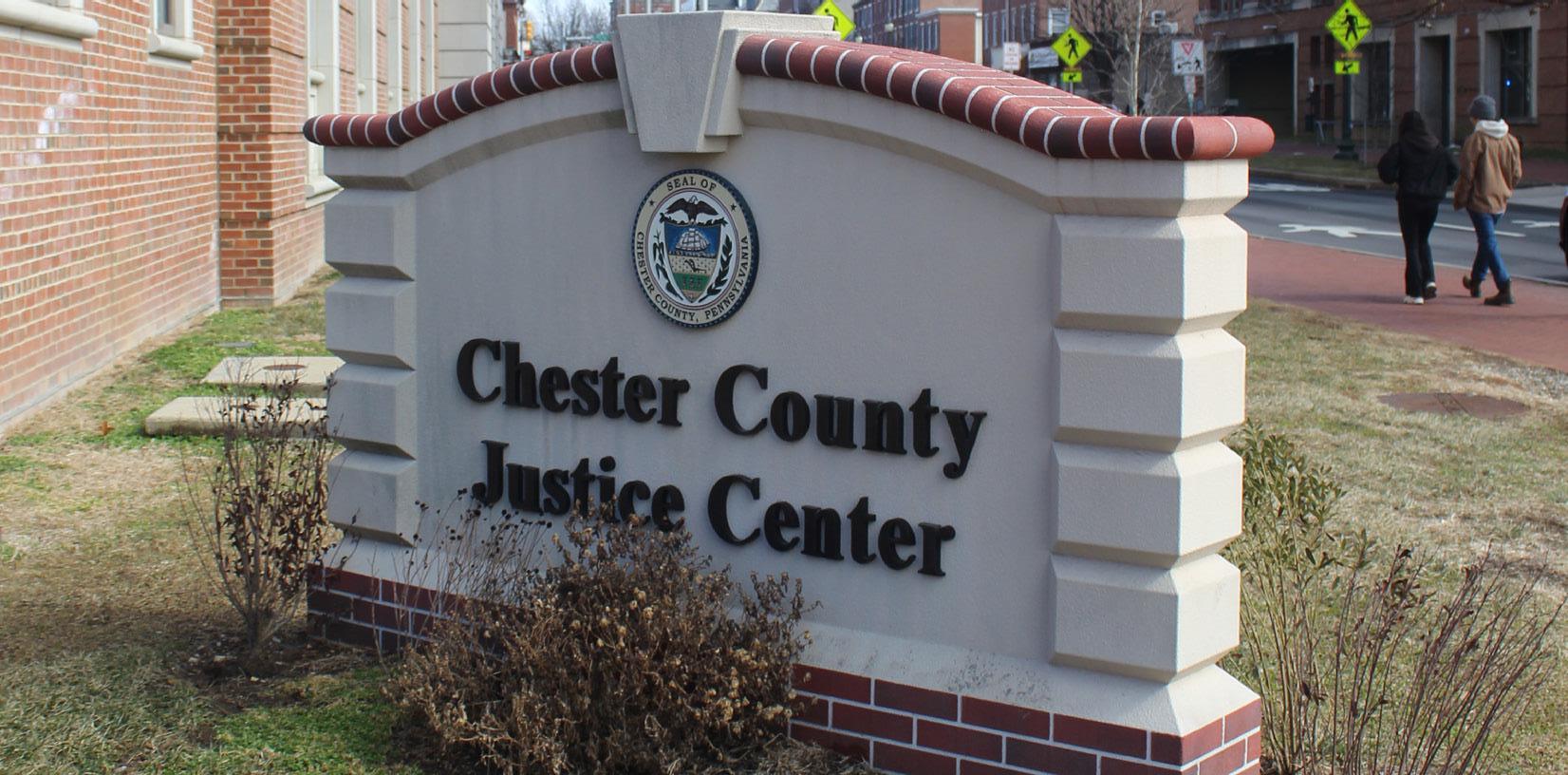
On Feb. 10, WIRED magazine released undisclosed federal records of dozens of buildings leased across the country for use by ICE attorneys and street-level agents. Among the list of properties leased was an o ce at 1000 Westlakes Drive in Berwyn. According to a spokesperson for the property, the o ce will be used for ICE administrative purposes by back-o ce o cials such as lawyers and analysts, and not for ICE agent operations. e building is located 1.1 miles from Hillside Elementary School and across the road from Bear Hill Elementary School, which TESD administration anticipates will open for the 2027-28 school year based on the current project schedule.
In July 2025, the One Big Beautiful Bill Act (OBBBA) issued $30 billion to ICE speci cally for immigration enforcement and removal e orts, including the hiring of ICE agents, until Fiscal Year 2029. According to the Council on Foreign Relations, the Trump Administration provided this funding in part to support its goal of hiring 10,000 new U.S. Department of Homeland Security (DHS) o cers and agents by the end of 2025. e DHS, which comprises ICE and other agencies, surpassed its goal and gained 12,000 o cers last year, more than doubling its workforce.
According to WHYY, Westlakes O ce Park is a 40-acre property that consists of four ofce buildings and various amenities. Patch reports that the new
Berwyn ICE o ce building will occupy approximately 10,000 square feet of one of the buildings. Currently, there is no information available on when o cials will be moving in and how long they will be staying. Dr. Chris Groppe, Director of Safety and Student Services, explains that the information TESD knows is limited.
“We (TESD) are aware that a lease has been obtained by the Department of Homeland Security for o ce space in Berwyn,” Groppe wrote in an email. “We have had no contact with that agency, so what we know about the function of that o ce space is limited to news reports.”
According to WIRED, the surge in ICE employees requires the DHS to nd more o ce space to operate from. To meet this demand, the DHS collaborated with the Public Buildings Service (PBS), a department under the General Services Administration (GSA) that manages
the lease of federal properties, to support ICE expansion. According to WIRED, the urgency of the situation led the DHS to instruct the GSA to disregard usual government lease policies and instead conceal lease information to prevent security concerns. As a result, the PBS has leased and expanded ICE o ces at more than 150 locations in almost every U.S. state and major city. Similar to the building in Berwyn, WIRED reports that many of these new properties are located near sensitive locations such as elementary schools and medical o ces.
According to the American Immigration Council, the Trump administration is making many changes that are reshaping immigration policy and enforcement. ese changes give o cials expanded and new powers to enforce immigration laws. Combined with a $170 billion budget under the OBBBA for operations, the American Immigration Council
reports a nationwide increase in immigrant raids, detentions and deportations. Dr. Groppe believes TESD has policies in place to address possible safety concerns of community members.
“TESD has longstanding protocols in place in the event any o cers visit our schools,” Groppe wrote. “We prioritize the safety of our students and sta while following the requirements of the law.”
In addition, the Chester County District Attorney and Chester County Police Chiefs Association published a joint statement in early February to address recent ICE changes and concerns from Chester County members. e statement stressed that Chester County law enforcement does not enforce civil immigration orders and in the case of a force event, local enforcement will immediately respond by negating safety threats and independently reviewing the situation. Lastly, the statement communicated that Chester County law enforcement is dedicated to protecting the public regardless of their immigration status. Michael Carroll is the President of the Chester County Police Chiefs Association and signed the joint statement.
“ is (statement) was given to all of the chiefs (of police) before we signed it and put it out, so everyone was given the opportunity to object to anything in there, and there were no objections,” Carroll said. “I think we have a pretty good perspective here in Chester County and that the more people know about (the ICE situation), the better.”
Sophia Seyedian/The SPOKE
Conestoga High School, Berwyn PA, 19312
76 No. 5 March 10, 2026
Sophia Seyedian Sta Reporter
Photo illustration by Tvisha Jani/The SPOKE
Sophia Cui Co-Design Editor
Future facility: A sign for 1000 Westlakes Drive sits on one side of Swedesford Road. On Feb. 10, WIRED magazine announced the lease
Cui/The SPOKE
THE LATEST DEVELOPMENTS IN
T/E AND NATIONAL NEWS
LocaL office compLex to be converted into residentiaL Living
An eight-building office complex in Tredyffrin is currently undergoing a conversion into residential living. Love Communities, E. Khan Development Corp. and Triple Crown Corp. are developing the project, which is located at 435 Devon Park Dr. The 162-unit building will be largely composed of studio and one-bedroom apartments.
pennsyLvania awards
$15 miLLion to support smaLL businesses
The PA Department of Community and Economic Development announced on Feb. 24 that small businesses across the state received $15 million in grants that the state awarded through the Historically Disadvantaged Business Assistance Program. The funds will help create 10 micro-grant programs that will assist small businesses with startup and expansion costs.
trump administration
Limits government ai use
On Feb. 27, President Donald Trump ordered federal agencies to stop using AI technology developed by Anthropic after the company and the Department of Defense failed to agree over ethical guidelines. The Pentagon designated Anthropic a national security supply-chain risk. Hours later, OpenAI announced a separate Pentagon deal.
u s., israeL Launch joint attack on iran
On Feb. 28, joint U.S. and Israeli airstrikes targeted locations in Iran, killing Supreme Leader Ali Khamenei, who had led the country since 1989. After Iranian state media confirmed his death, the Iranian government announced a 40-day period of national mourning.
Chester County addresses municipal election poll book error
Thousands of Chester County voters navigated extra steps during the Nov. 4 municipal election after an employee printed poll books that were missing information for third-party voters. Independent, libertarian, “no affiliation” and “non-partisan” voters had to use provisional ballots until county workers delivered corrected poll books. The issue created longer wait times at some precincts and required poll workers to explain the provisional ballot process to third-party voters.
Chester County hired the law firm Fleck Eckert Klein McGarry to review the poll book issues, according to an article by media organization WHYY. The firm released its report on Jan. 22, finding that issues with staff training and lack of oversight caused the problem, not intentional errors.
Josh Maxwell, chair of the Chester County Commissioners, oversees county operations and helped coordinate the response to the poll book issue. Maxwell said the problem occurred when an employee printing the poll books mistakenly included only major-party vot-
ers. The employee printed the poll books using a less-intuitive voter record system and lacked full training for the task.
“The lack of clicking a box would have meant all voters were
included,” Maxwell said. “Voting is fundamental, and mistakes affect people’s trust. We’re learning from this so it won’t happen again.” Maxwell noted that at many polling places, the pro -
visional ballot process added several minutes to each voter’s experience. Lines grew longer, and voters sometimes found the steps needed to submit ballots confusing.
“It (the situation) was frustrating because I wasn’t sure my vote would count. It made me feel like my voice didn’t matter as much. I know the process works in the end, but having to
Conestoga alumnus named Fire Chief at Berwyn Fire Company
On Jan. 8, 2008 Conestoga alumnus Joshua Lichman officially began his term as Fire Chief of the Berwyn Fire Company. Nominations began in October 2025, and firefighters voted in December to select Lichman as chief. Lichman succeeded Justin Brundage, who served as Fire Chief for four years and recently concluded his 36th year of service to the T/E community. After graduating from Conestoga, Lichman attended Saint Joseph’s University, earning a Bachelor of Science in business administration with a concentration in finance. He credits his high school experience at Conestoga with helping shape the mindset and values needed for leadership.
“Conestoga prepared me for college,” Lichman said. “I went on to St. Joe’s. The teamwork that I learned from that, the dedication, all these aspects you learn along the way, they help you with different things down the road.” Before becoming Fire Chief for the Berwyn Fire Company,
Lichman served as Battalion Chief. He began volunteering with the fire company in 2009 after encouragement from family members in the fire service. He said his first year was the most difficult, as he worked to build relationships within the tight-knit department.
“After gaining those friendships and the trust of those people, you really become a part of something bigger. Not only were we hanging out here on Friday, Saturday nights, we’re spending a lot of time outside of the firehouse together. Two of my assistant chiefs, my assistant chief and my deputy chief, were both in my wedding. Everybody here becomes very close,” Lichman said.
One of the defining moments of his career came during Hurricane Ida in 2021, when historic flooding struck the region. Lichman and his crew responded to Valley Forge National Historical Park, where a car was trapped in rising water. Both Lichman and Phoenixville Fire Chief Eamon Brazunas attempted dives to secure a rope. After
two unsuccessful attempts, the group sent Deputy Chief Evan Brazunas, who successfully established a rope system for the rescue. For their efforts, Lichman and other personnel received international recognition from the Higgins and Langley Memorial Awards for excellence in swiftwater rescue.
“That (the Hurricane Ida rescue) was one of the more intensive incidents that I’ve had to deal with in my time (at the Berwyn Fire Company),” Lichman said. “Certainly one of the most stressful and in my opinion, frightening. Water is a very unpredictable hazard.”
For Lichman, serving the T/E community is deeply personal. Having grown up in Chesterbrook and Glen Hardy, he now leads the department that protects his hometown.
“It’s just nice being a ‘pillar’ in the community or somebody in a position to hopefully do some change or do some good for the community. It’s gratifying,” Lichman said. “We’re doing what we can to help out, and it’s my way of paying it back.”
use a provisional ballot added extra stress and time,” independent voter Marissa Rivera said in an interview with WHYY.
The county introduced new measures to prevent similar problems in future elections. Maxwell explained that the plan includes reviewing internal procedures and strengthening staff support so that ballots are accurate and voters can cast them without confusion.
“We are implementing a checklist for poll book printing, upgrading employee training and adding multiple levels of oversight,” Maxwell said. “These steps will help us prevent similar mistakes in future elections and restore confidence in the voting process.”
The improvements aim to make the voting process smoother and more reliable for all voters in Chester County. The changes support a larger effort to ensure that every voter can cast their ballot confidently and that election officials count it accurately.
“With
Curiosity-Driven Pathways to be offered next school year
Starting in the 2026-27 school year, students will be able to participate in the new Curiosity-Driven Pathways program. It will allow students to explore their curiosities and passions through taking a personalized “pathway” of courses. Upon completion of the pathway, students will receive an opportunity to reflect upon their learning.
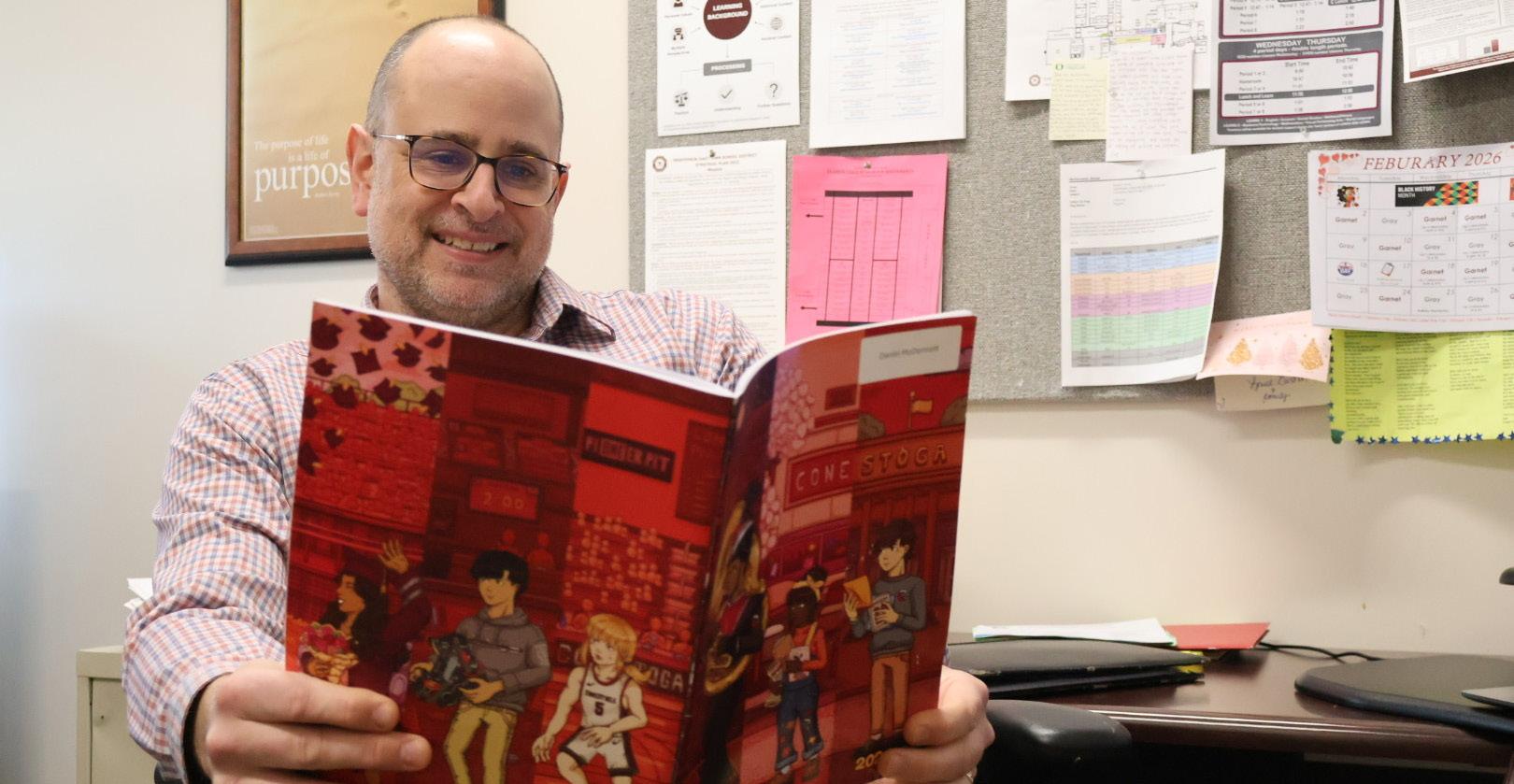
Students with a particular interest can create a pathway by selecting a handful of courses related to their interest, allowing them to foster their curiosity by exploring connections between disciplines. If a student is interested in one field, they can choose classes that align with that field, as well as take classes from other departments that may help deepen their curiosity. School counselor Daniel McDermott describes how students could utilize this pathway.
“Some students love to bake,” McDermott said. “So, we have courses here that can help you understand not just
taking a pastry class or culinary arts class, but you could take an organic chemistry class to understand how that is connected to their passion. If you’re really good at making cookies, how could you possibly take a marketing or business class to be able to eventually create a business?”
An interest meeting on Feb. 5 provided students with information about the pathway. Participating students fill out a form that details their combination of courses that they would like to take to obtain approval by an assistant principal. Pathways must consist of a minimum of four courses from at least two subject departments. Upon completion of the pathway, students will receive a culminating pathway card that they can share and display, as well as a chance to reflect on their learning and growth.
Dr. Wendy Towle, Director of Curriculum, Instruction and Professional Learning, came up with the idea for the program.
“Down the road, we anticipate providing opportunities during Lunch and Learn
for everybody who’s doing a pathway to come together and talk,” Towle said. “Or maybe meet with a teacher who could be a mentor for your pathway, or maybe even bringing in a guest speaker — somebody who kind of built their own pathway and is now following it as an adult.”
Participating in this opportunity does not provide any additional credits beyond the courses themselves, nor does it appear on a college transcript. Additionally, credit requirements for graduation still apply to students participating in the program.
“There is an opportunity for you as students to really bring some of your interests that you have outside of school into school, and do something that gets you recognized for that kind of exploration,” Towle said. “This opportunity gives students a vision to see how these things that maybe on the surface look like they’re very different, how they actually fit together and complement each other, and connections can be made.”
Democratic campaign manager charged in petition scheme
On Feb. 2, the Chester County District Attorney’s (DA) office charged Democratic Campaign manager Mariel Kornblith-Martin with filing false signatures on nominating petitions. Kornlith-Martin allegedly gathered the false signatures for Mark Pinsley’s campaign to win the 2024 auditor general Democratic primary. According to the Pennsylvania Department of State’s Instructions for Circulating Nomination Petitions, candidates for auditor general — the position that ensures taxpayer dollars are spent legally and correctly — must collect a minimum of 1,000 signatures to appear on their party’s primary ballot. Pinsley lost the primary to State Rep. Malcolm Kenyatta, who lost the general election to incumbent Republican Tim DeFoor. Locally, Conestoga’s Young Democrats club campaigned on behalf of the Democrats in 2024. The charges against Kornblith-Martin evoked mixed feelings for the club’s issue coordinator, senior Max Kolev.
“Any kind of fraud when it comes to elections is not good. My first political instincts are telling me that this is even worse because at this moment, the Democrats, especially at the local level, should be presenting themselves as the anti-corruption party,” Kolev said. “This is the opposite of that. This is breaking the rules. This is being corrupt.”
In total, the DA’s office accused Kornblith-Martin of writing 10 false signatures on the nominating petitions for Pinsley, including the signature of local Democratic Court of Common Pleas judge, Honorable Alita Rovito. On Feb. 5, the Chester County DA’s office published its weekly news release stating that Rovito reported her false signature to the Chester County DA’s office because she claimed she never signed it. Additionally, Pennsylvania forbids judges from signing nominating petitions because they hold non-partisan positions. Freshman Adhirajgupta Parimal recently joined Conestoga’s Young Republicans club and when he learned about the charges against Korn-
blith-Martin, he believed that Kornblith-Martin’s case was not representative of the entire Democratic party.
“Those actions of one person does not completely define the party,” Parimal said. “It (Kornblith-Martin’s alleged corruption) happened, but (her criminal charges) show that American democracy is able to self-correct itself and allow accountability to be taken.”
The Chester County District Attorney’s Office charged Kornblith-Martin with five categories of offenses totaling 50 counts, including Criminal Solicitation – Unsworn Falsification to Authorities, Criminal Solicitation –False Swearing – Mislead Public Servant, Criminal Solicitation – False Signatures/Statements, Criminal Solicitation – Statement Under Penalty and Nomination Petitions.
The Chester County DA’s office’s weekly update news release claimed that Kornblith-Martin worked with three others to falsely file the fake signatures. Allegedly, Kornblith-Martin coordinat-
ed with three circulators, of
ficials who collect signatures for nominating petitions, signed off and gave authority to the false petitions. The Magisterial Court held the preliminary hearing for Kornblith-Martin’s case, and Honorable Anthony diFrancesca set Kornblith-Martin’s bail at $50,000. Kornblith-Martin
the amount herself on Feb. 4. The court scheduled Kornblith-Martin’s next pre
liminary hearing for March 3.
Kolev believes that the alleged actions of Kornblith-Martin high-
flaw in American democracy across the country.
by state,” Kolev said. “I think we do need a lot of scrutiny, especially at these lower level electoral positions to make sure that things are being done correctly, to make sure that the democratic process is being upheld, especially when it’s under threat.”
“On a national level, it speaks more to the way that our election system can be kind of convoluted and strange: all of these signatures, the way that primaries are done, the way that it
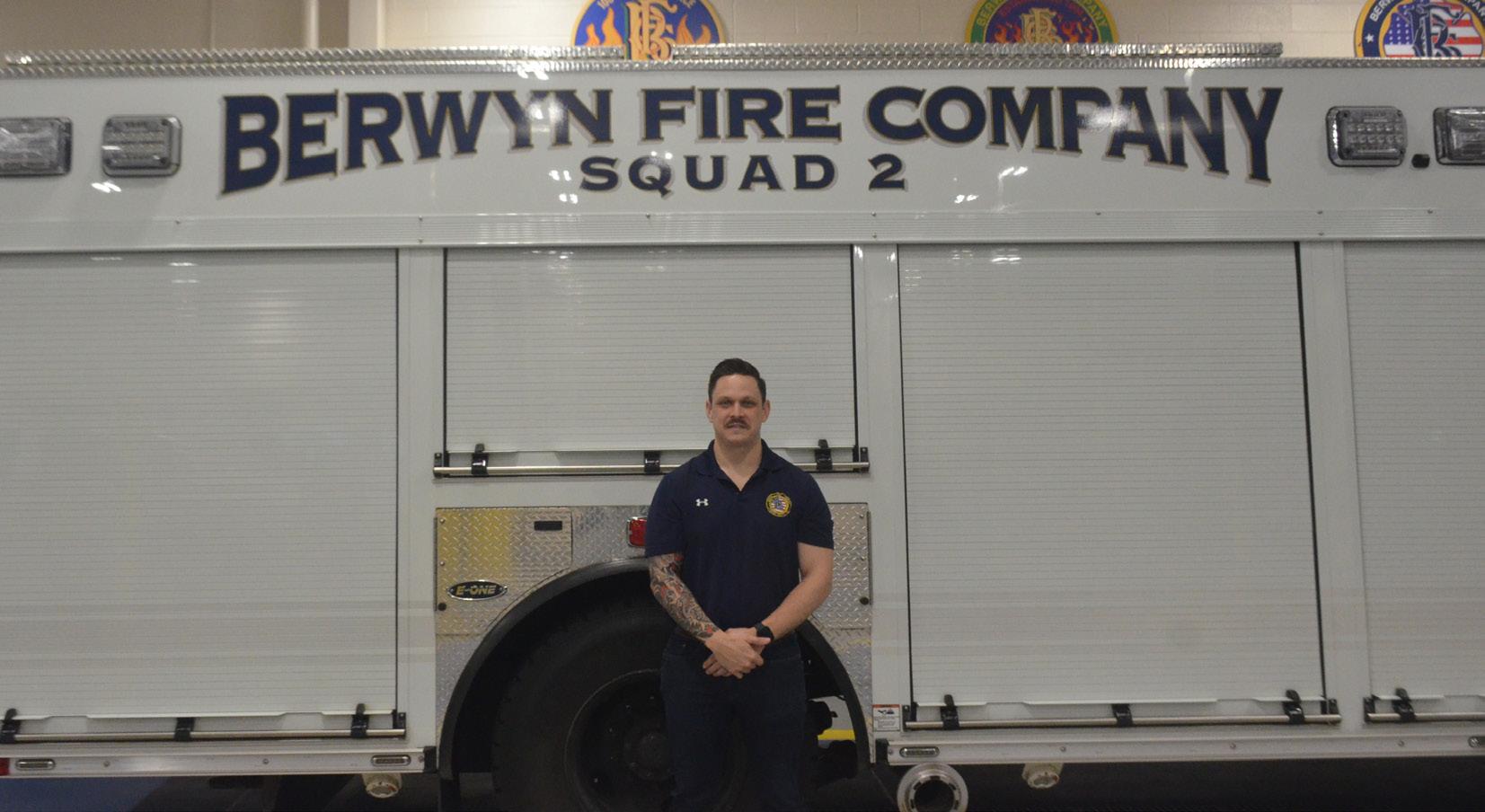
New leadership: 2008 Conestoga alumnus Joshua Lichman poses in front of one of the fire department’s fire vehicles. He officially began his new term as Fire Chief of the Berwyn Fire Company on Jan. 8.
Han/The SPOKE
Preventing future issues: Chair of the Chester County Commissioners Josh Maxwell attends a meeting of the Chester County Board of Elections. On Feb. 3, county leaders discussed steps to prevent poll book
Alynn Kang Staff Reporter
Corey Han Staff Reporter
Raymond Wu Staff Reporter
Anderson Staff Reporter
Media culture sparks addiction, isolation
As screens have become more accessible, teenagers across the U.S. such as Conestoga students have increasingly consumed social media posts, with potential impacts on their mental wellbeing. According to Datareportal’s Digital 2026 Report, teenagers spend an average of 7 hours and 22 minutes on screens every day.
In addition, according to a 2023 U.S. General Surgeon study, adolescents who use social media for more than three hours a day face double the risk of experiencing poor mental health outcomes, such as depression and anxiety. Psychology teacher Michael Palmatier feels that social media use can exacerbate loneliness among teenagers who already feel isolated.
“It (social media) could be a place where kids who feel lonely might feel some validation by nding out whether they are not alone online. But I also think that what it probably reveals is that it’s a poor substitute for actually being in-person,” Palmatier said. “So if you already feel lonely and you go online, you temporarily feel, ‘Oh, I’m connected with all these people.’ But if you’re not seeing people in real-life, in-person context, it’s not the same experience.”
To address screen usage in Chester County, the nonprofit Area, Residence, Caring and Helping (ARCH) provides general information to support local parents and their children, including on promoting safety in technology use and preventing social media’s negative impact on emotional wellness. Mary Hashemi, a Chester County parent and the chair of ARCH, believes that technology use in moderation is necessary.
“ e screens that we all live with day-to-day are actively trying to get us to spend all our time on it as opposed to some time on
Use of screen, AI distorts digital landscape
it,” Hashemi said. “I think as a parent, balance is important with everything, including technology. I think about how important it is for people to be one-on-one and have in-person conversations.”
With the increased amount of time teenagers are spending online, Dunleavy also feels that overreliance on technology for human interaction reduces communication skills.
“I think the catchphrase of this generation is, ‘We’re the most connected we’ve ever been but the most lonely we’ve ever felt.’ We’re all connected, but we’re not actually engaging with each other,” Dunleavy said. “We’ve lost that so skill of how to communicate. It’s not comfortable. It’s more comfortable to text our emotions than to look someone in the eye and share our emotions because that feels too vulnerable. Having the screen provides some distance in
space and doesn’t feel as vulnerable for people.”
In addition, AI has expanded into social media and other digital spaces, including AI-powered chatbot companions. Zoha Khawaja is a researcher at the National Health Institute’s Voice Bridge2AI Consortium, a research organization focused on the ethical use of AI in behavioral and biomedical research. She feels that the COVID-19 pandemic had a signi cant contribution in popularizing AI for companionship.
“ e catalyst was COVID. We got extremely digital, and healthcare became chronically online,” Khawaja said. “We as human beings are very social, and we love human connection. I think we started being online and started looking for that human connection in AI.”
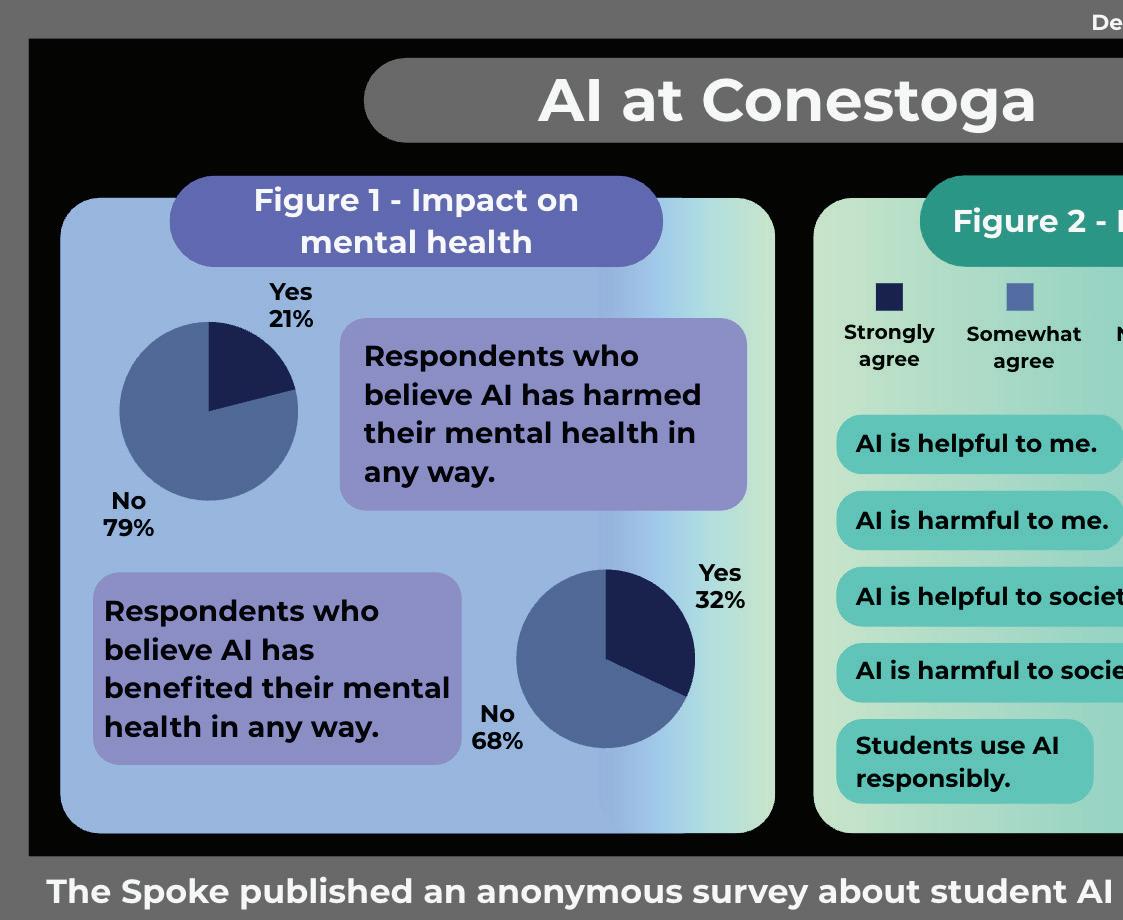
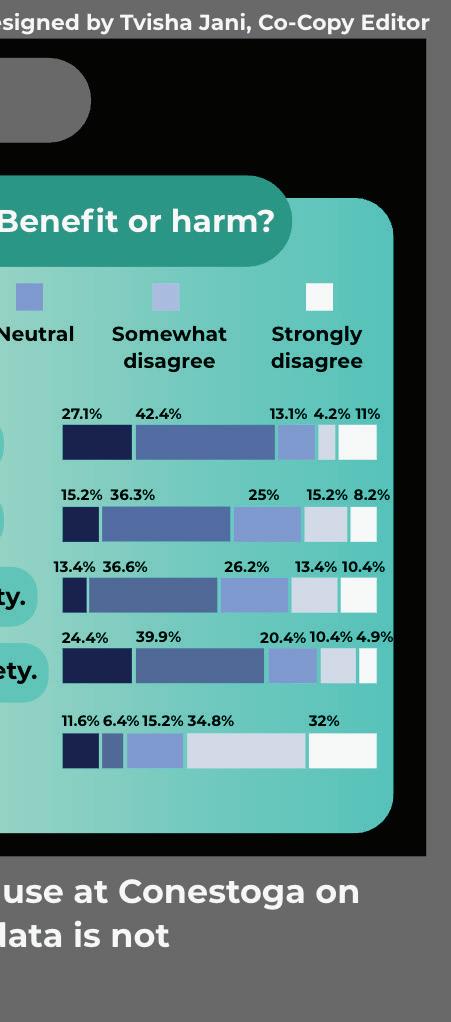
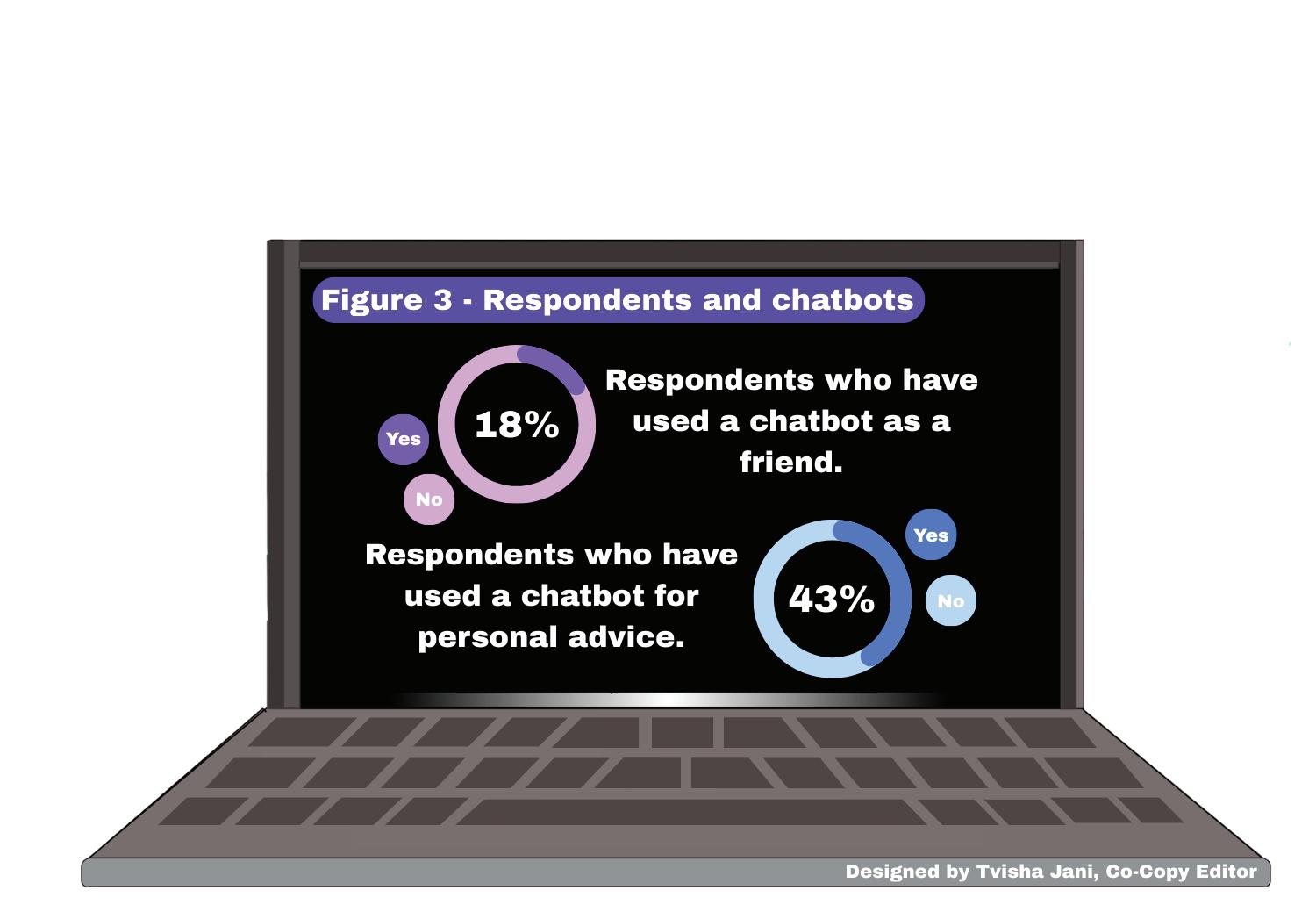
Khawaja also feels that AI companionship leads to irrational beliefs about relationships and worse mental health. In a survey e Spoke published on Feb. 23, 18% of student respondents stated that they had used a chatbot as a friend and 21% of respondents felt that AI has harmed their mental health (see Fig. 3).
“ e problem is (AI therapy is) not real, it’s not human connection, and it’s creating this unrealistic ideal on how human connection should look like or would look like,” Khawaja said. “ at’s what leads to signi cantly more depression because then we start actually going out in the world and we realize, ‘Oh, this is not the
same. is is not what I was promised. is is not how I interact.’”
AI in media increases spread of misinformation, deepfakes
With increased access to technology such as AI, various community members surrounding the district and individuals across the country have experienced inappropriate usage. In early February, police charged a Radnor High School student for creating AI-generated, sexualized deepfakes of other students, according to CBS News.
e Department of Education’s website states that Act 125 currently regulates the creation of student deepfakes by prohibiting the use of AI technology to create sexually abusive images of children under 18. Kaskey feels that existing regulations have not been able to control the extent of AI deepfake creation.
should need to be censored, they aren’t doing it fast enough.”
According to Forbes, AI generates 34 million images every day, and 71% of social media images are now AI-generated.
where someone does something embarrassing,” Kaskey said. “With AI now, people don’t even have to make a decision that would lead to them getting posted like this. Now people can fabricate scenarios that would be embarrassing for people and post them everywhere. So I think it’s exacerbating an existent problem in social media where you can, without someone’s consent, put them on blast for millions of people to see.”
With the potential impacts of AI and technology misuse, Community and Student Services Supervisor for Tredy rin/ Easttown School District Dr. Jacquelyn Rothera feels that teaching appropriate approaches when viewing digital information is essential.
“Media literacy is important for students so that they can analyze the origin of the content and its possible biases when considering using it as a reference or perspective,” Rothera said. “In our school district, we have a digital citizenship curriculum for students to receive direct instruction on topics including media balance, privacy, digital footprint and cyberbullying. We have had this in place for many years, and we continue to revise it based on how technologies change.”
vey found that 31% of student respondents actively seek out AI once a day or more, with 23.5% using it as a search engine o en and 13.7% very o en. Dunleavy believes that digital spaces pose various risks for users such as misinformation, emphasizing the importance of verifying information presented online.
“Bottom line, it’s not safe out there,” Dunleavy said. “Take it from what is a true source versus what’s an act — from that standpoint, with this whole ooding of AI and fake news and videos, all of that falls into (necessity of) media literacy. Now, you do have to look further into whether or not that is actual information or real sources.”
In addition, The Spoke survey found that 43% of surveyed students have used an AI chatbot for personal advice (see Fig. 3). According to a Stanford Report article, inputting personal information into language-learning models such as ChatGPT can pose a threat to private data. With such increasing usage and the intensification of online deception online, Dunleavy feels that maintaining cybersecurity can be difficult but is essential.
“Now that this problem has been revealed, now that everyone knows that this is an issue that comes up, I think that it does become the responsibility of the companies to start actively making sure that this sort of thing can’t happen,” Kaskey said. “While these companies should be doing things about the capabilities of AI and what
School board proposes raising taxes to cover expected $14.9
At the Jan. 28 regular school board meeting, members discussed raising property taxes in the Tredy rin/Easttown School District by 4.66% to cover an expected $14.9 million de cit for the 2026-27 scal year. If the board passes the new budget proposal, the average increase will be $350 due to a raise in millage rate from 29.6567 mills to 31.1143 mills. According to the nance committee, the increase comes a er special education costs and capital expenses surpass expected revenues in the district. Todd Kantorczyk, chair of the nance committee, said the budget remains preliminary and may change.
“You’re really looking at trying to predict what’s going to happen 18 months from now. And so that’s an information
gathering process on both the expense side and the revenue side that says, ‘Okay well, what do we predict are going to be our revenues and our expenses?’” Kantorczyk said.
e 2006 Act 1 Index functions as the maximum amount the school board can increase taxes without a referendum, or an o cial vote by T/E residents. e Act 1 index changes based on personal income ratios within the school district, with lower Act 1 index rates for wealthier districts. Less wealthy districts have higher Act 1 index rates due to lower property values, which make it di cult to acquire enough funding through taxes to support their public schools. T/E currently has an Act 1 index of 3.5%, which the school board expects will raise $5.1 million for the district, but will not be enough to cover the $14.9 million de cit.
million de cit
“In years past, the district has been, or at least the board has been, comfortable with a gap of anywhere between one- to twoand-a-half or so million dollars,” Kantorczyk said. “Understanding that when the actual expenses happen, folks try to trim costs where they can.”
According to the nance committee, the district plans to apply for special tax exceptions, such as for special education expenditures that are increasing faster than the Act 1 index.
At the Feb. 9 nance committee meeting, members stated that more placements into the special education program recently could potentially account for the higher special education costs.
Capital costs, including the new athletic elds, Bear Hill Elementary and upkeep and maintenance of existing school properties, will cost around $6 million for the 2026-27 school year. e
proposed $350 increase would a ect local residents, and sophomore Sophia Kogay feels the impact could cause more harm than good.
“ ree hundred dollars is the di erence between making rent and not. ere’s no reason for the government to tax middle class families 300 extra dollars. Like, that is two weeks worth of groceries,” Kogay said.
Kantorczyk said that the school board considers the impact of tax increases on the local community when deciding whether to raise the budget.
“We certainly take that (community impact) into account as a board personally, as a board director,” Kantorczyk said. “When we’re considering whether or not to implement the tax increase, you have to balance what it is that you need for the district and the e ect that it’s going to have on the community potentially.”
e National Library of Medicine states that the inability to distinguish AI-generated from real images makes the threat of AI deepfakes, misinformation and online manipulation larger. Kaskey feels that the potential of AI in image and video fabrication could increase cyberbullying in schools.
“Before AI really hit with all these abilities, schools would discuss things about cyberbullying where it would be a scenario
Beyond negative effects of social media on mental health and inappropriate AI use, various students and staff feel that such technology has the opportunity to further impact their lives.
According to e Spoke’s survey, 64% of surveyed Conestoga students believe AI is “harmful to society” (see Fig. 2). e sur-
“It gets back to your personal safety and just being able to protect your information so that it isn’t used in a nefarious way,” Dunleavy said. “So protecting your passwords and your data and your identification, because you don’t want to be manipulated, you don’t want it to be used in a nefarious way, it’s just getting harder and harder.”
Shawn Go serves as the IT Support Supervisor for the school district. With potential negative impacts on community members, Go feels that learning about the dangers of AI and technology is helpful for teenagers in order to face the future of technology.
“Awareness and education are powerful tools. When students understand how to navigate online environments safely, they build resilience, critical thinking skills, and con dence,” Go said. “Having knowledge of these threats shouldn’t create fear around technology, but it should empower teenagers to use it responsibly and recognize when something doesn’t feel right.”
Senior citizens apply for SEPTA discount cards
Communications Director for Sen. Comitta.
On Jan. 28, Sen. Comitta’s o ce hosted an event to help senior citizens apply for SEPTA discount cards. e event took place at the Chester County Library. Two hundred eighty four senior citizens came to sign up for a card or renew a card currently in use. e Senior Fare Program has been o ering cards to seniors since 2018. e Pennsylvania Lottery funds the program and other transit agencies across the Commonwealth of Pennsylvania. Seniors using the card can travel for free on Regional Rail if their departure and arrival station is located in the Commonwealth of Pennsylvania. Departures and arrival stations in New Jersey and Delaware are charged half the weekday fare. “ ey (seniors) can ride the SEPTA system for anything within Pennsylvania for free. So that’s the buses, the regional rail lines like the Paoli orndale Line, trolleys, the subways in Philadelphia, all of that for free,” said Kevin Burk, Assistant
To sign up for the card, an applicant must be 65 years old or older, and they are required to show valid proof of their age to apply.
“It (the o ce) needs a proof of age of the applicant. So, whether it’s a driver’s license, social security, a passport or anything that has their age, we will take it to get the application going for them,” Burk said. The Jan. 28 event was the first time Sen. Comitta’s office held an application opportunity for seniors at Chester County Library. The office has held various similar events in the past. The office tries to host two discount card events a year since Sen. Comitta has elected to office in 2020, and they have hosted the events in locations like the Easttown Library and in Downingtown.
“Senator Comitta’s district is pretty big, so we like to spread these events across the district, and we also process the applications at both our district office and at our satellite office locations across the county,” Burk said.
e o ce mainly hosts these events to spread the word about the Senior Fare Program and to bring the program’s services out to the community.
“Having a dedicated event to a dedicated service is important to get the word out. All these programs are available, but having an event dedicated to them really puts the attention on that service,” Burk said.
“People will see (the event) on Facebook or Patch, and they’ll be like, ‘Oh, well I’m eligible for that, I’m going to that event.’ So it’s just a good way for people to know what’s available to them.” Buck emphasizes the importance of seniors uing these cards to travel throughout Pennsylvania for free, allowing them to achieve daily tasks with decreased concerns regarding money.
“Cutting any costs, whether it’s on transportation or really anything, is such a huge lifesaver for seniors,” Burk said. “Making sure that they are using this service, if they are within the SEPTA system and using it regularly is really important to make sure that they have more money in their pockets every day.”
Berwyn SEPTA station: A SEPTA train travels along the Paoli/Thorndale line. Senior citizens have traveled for free through this train station since the SEPTA Senior Fare Program started in 2018.
Aanya Gandi/The SPOKE
Digital age: Senior Emily Scheer sits in the atrium, looking at her phone. Various students have seen increased usage of technology, including social media and AI.
Je rey Heng/The SPOKE
Sonja Dziegielewska Sta Reporter
Aanya Gandi Sta Reporter
Sonja Dziegielewska/The
Local residents discuss possible renovations to the Easttown Library. These conversations are part of a Facility Needs Assessment that the Easttown Library is hosting to gather input from the library’s diverse community about optimizing potential expansions of the library’s utilities.
In February, the library launched a Facility Needs Assessment consisting of two interactive workshops, three community conversations and an online survey. Held on Feb. 10, the workshops aimed to gather feedback from local business owners, education leaders, library stakeholders and Easttown Library’s trifecta of boards: the Easttown Library Board of Trustees, the Friends of Easttown Library and the Easttown Library Foundation Board. While attending the workshops required advance registration, the community conversations served as drop-in sessions for daily library-goers and passersby. These conversations took place on Feb. 11 at the library and the Upper Main Line YMCA.
“The primary goal is to gain feedback from our library community and stakeholders of what they would like to see in a renovated or
Easttown Library gathers input for future renovations
expanded facility,” Easttown Library Executive Director Amber Osborne said. To address growing demand for space, library leadership created a team to work on brainstorming. In late January, the Board of Trustees, which oversees the library’s operations, formed a needs assessment to hire a consulting firm that could help guide the data-collecting process. A separate facilities committee composed of the library’s most active members, including members of each board, librarians and locals, formed soon after. Along with Osborne, both committees worked in conjunction with the newly hired consulting firm, MSR Design, to plan and execute these assessments.
“At the community sessions, people were given an opportunity to look at 20 or so pictures of potential enhancements of the physical space,” said Margaret Mackenzie, a longtime member of the Easttown Library Board of Trustees and Friends of Easttown Library. “There were photographs of an art gallery or a music room or a self-service coffee station. People received two little stickers each where they could vote for what proposed additions appeal to them the most.”
Sophomore Josie Louineus and her friends attended the
afternoon community conversation, hoping to unwind after a long day at school. As a consistent library-goer, she heard about the event from a librarian and decided to attend.
“The Easttown Library is a great place. They took our opinions very seriously and they seemed very receptive to what we were saying to them,” Louineus said.
According to Mackenzie, over 4,000 people visit the Easttown Library every day, and more than 20,000 people attended programs last year. Attendance continues to rise, according to Mackenzie, as more residents utilize the library’s space for activities ranging from passport services to tax filing to reading.
“The library is experiencing a great increase in the amount of foot traffic we see coming in. The programs we provide, especially to children, are almost oversubscribed,” Mackenzie said. “They are really popular and we are at maximum capacity with our space. Because of that, we’re looking at ways that we can address these issues and serve more people adequately, so that if we change the physical space or pursue an expansion, it will draw people in.”
In the following weeks, MSR Design will create a report displaying the results of
the assessment. The consulting group plans to come back in mid-March to talk with several groups they met with during the assessments and further refine and iterate on ideas. From there,
with the library and Easttown Township, MSR Design will determine which changes to prioritize, how much money is feasible for renovations and methods to raise money.
“I think it’s really important for people to place their ideas and add their opinions, because we can really make a change,” Louineus said. “When we give a voice to the commu-
nity like this, even with the smallest ideas, it can do so much. Just a few people showing up can land some great points and ideas that could benefit everyone.”
Chester County puppies star in XXII Puppy Bowl, raise awareness
many animal shelters currently face, including rising medical costs and hundreds of dogs in need of adoption. The Puppy Bowl is an annual televised event featuring puppies Emily
from animal shelters all over the country. The event splits the dogs into two teams, Team Fluff and Team Ruff, and the dogs score touchdowns when they cross a goal line with a toy.
Every year, the television channel Animal Planet, under parent company Warner Bros. Discovery, selects and gathers puppies from shelters and rescues. The bowl occurs on Super
Lily
Chen Co-Editor-in-Chief
one of the firstcome, first-served high tables. Despite the long lines at the entrance, the dining space felt comfortable and inviting. With soft lighting around us and Frank Sinatra playing in the background, we quickly relaxed and fell into easy conversation. Our meal began with Maggiano’s complimentary bread service. Served warm and soft, the bread had a light, airy texture. The butter paired well with the slightly sweet bread, offering a comforting start to the meal. For an appetizer, we ordered the Calamari Fritte, which was flavorful on its own. The lightly fried exterior was crisp and crunchy, while the calamari remained tender. The accompanying tomato dipping sauce was tangy and acidic, cutting
through the flavor of the squid and balancing the dish nicely. While slightly salty, the calamari was well cooked.
For my entree, I ordered Maggiano’s “Famous Rigatoni ‘D,’” made with herb-roasted chicken, roasted mushrooms and caramelized onions in a Marsala cream sauce. Our entrees arrived in about 20 minutes, which was quicker than expected, given that we visited on a busy weekend evening.
The rigatoni was very springy and well cooked. The mushrooms tasted fresh, complementing the tender chicken and the sweetness from the caramelized onions without overwhelming the dish with their earthy flavor. The Marsala sauce was creamy, rich and coated the pasta well. While the sauce leaned slightly sweet for my personal taste, the seasoning was balanced. The dish arrived steaming hot and in a very large portion, easily more than enough for one person.
We also ordered the fettuccine bolognese, made with beef and Italian sausage in a tomato ragu. The fettuccine and tomato ragu were well prepared, with each noodle covered in a
Bowl Sunday, the same day as the NFL championship game. Bruno Lombardo owns the Phoenix Animal Rescue in Chester Springs, PA. The Puppy Bowl has 400,000 applications annually that pass through an evaluation process.
“So they do a casting call in October,” Lombardo said. “You send pictures to the Puppy Bowl, and then they pick from there.”
This is the third year that the Phoenix Animal Rescue has participated in Puppy Bowl. This year, Puppy Bowl picked two puppies named Jill and Oscar from the Phoenix Animal Rescue. There were 21 adoptions in the two weeks following the airing, consisting mostly of the featured puppies in the event.
While its Puppy Bowl participants found homes quickly, the Phoenix Animal Rescue still faces growing challenges with funding and space. According to Lombardo, the Phoenix Animal Rescue saw more dogs enter their care in 2025 than ever before.
“When COVID came, there was a demand for puppies because everybody was home, so (animal shelters and rescues) built their supply up,” Lombardo said. “Well, the supply’s still here, but the demand’s gone, so there’s a lot more puppies out there and not enough people to take them in.”
The absence of sufficient space and money in many shelters and rescues across the U.S. leads to a widespread inability to provide adequate care to the rising number of animals coming in. The shortage in shelters and resources results in staff euthanizing dogs, especially if they are suffering from injuries or illness.
The Puppy Bowl aims to bring these issues under public awareness. The event aims to show every dog in their truest states and tell the audience that there are animals just like the ones featured on the show still in rescues and shelters waiting to be adopted.
Puppy Bowl has been a success this year. According to Warner Bros. Discovery, Puppy Bowl reached 15.3 million views across the platforms that it streamed on and ranked as the No. 1 nonsports cable telecast of the day, marking its strongest performance since 2018. Junior Marjaan Wardak watched clips of Puppy Bowl on Instagram, enjoying the playful chaos but at first unaware that the dogs came from shelters and rescues.
“I wouldn’t have thought (the dogs) were so active,” Wardaak said. “I would stay on the reel for the entire time because (the Puppy Bowl) was entertaining. My algorithm just started recommending (the clips) to me.”
generous amount of sauce. The beef and sausage were both nicely cooked and added depth to the dish’s flavor without making it feel heavy. The seasoning was light yet flavorful, making the fettuccine easy to enjoy and not overwhelming. By the end of our meal, we were very full and left with two containers of pasta to enjoy later.
Stickers in hand: Residents glance over images of possible renovations to be implemented at the Easttown Library. The community conversations, a component of the Facility Needs Assessment, occurred in three sessions with Easttown residents at the library and the Upper
Lily Chen/The SPOKE
for a home: A dog stands in a kennel at the Phoenix Animal Rescue. While events like the Puppy Bowl helped spotlight adoption, many dogs continued to wait as the rescue faced rising costs.
Emily S. Wang/The
S. Wang Co-Design Editor
Black Cat Cafe gives back to community
proceeds go to helping a cat,” Alderfer said. “Every time you eat here, you’re saving a cat.”
Just as the community supports the cafe, the Black Cat Cafe supports it back by giving all profits to the needs of homeless or abandoned cats.
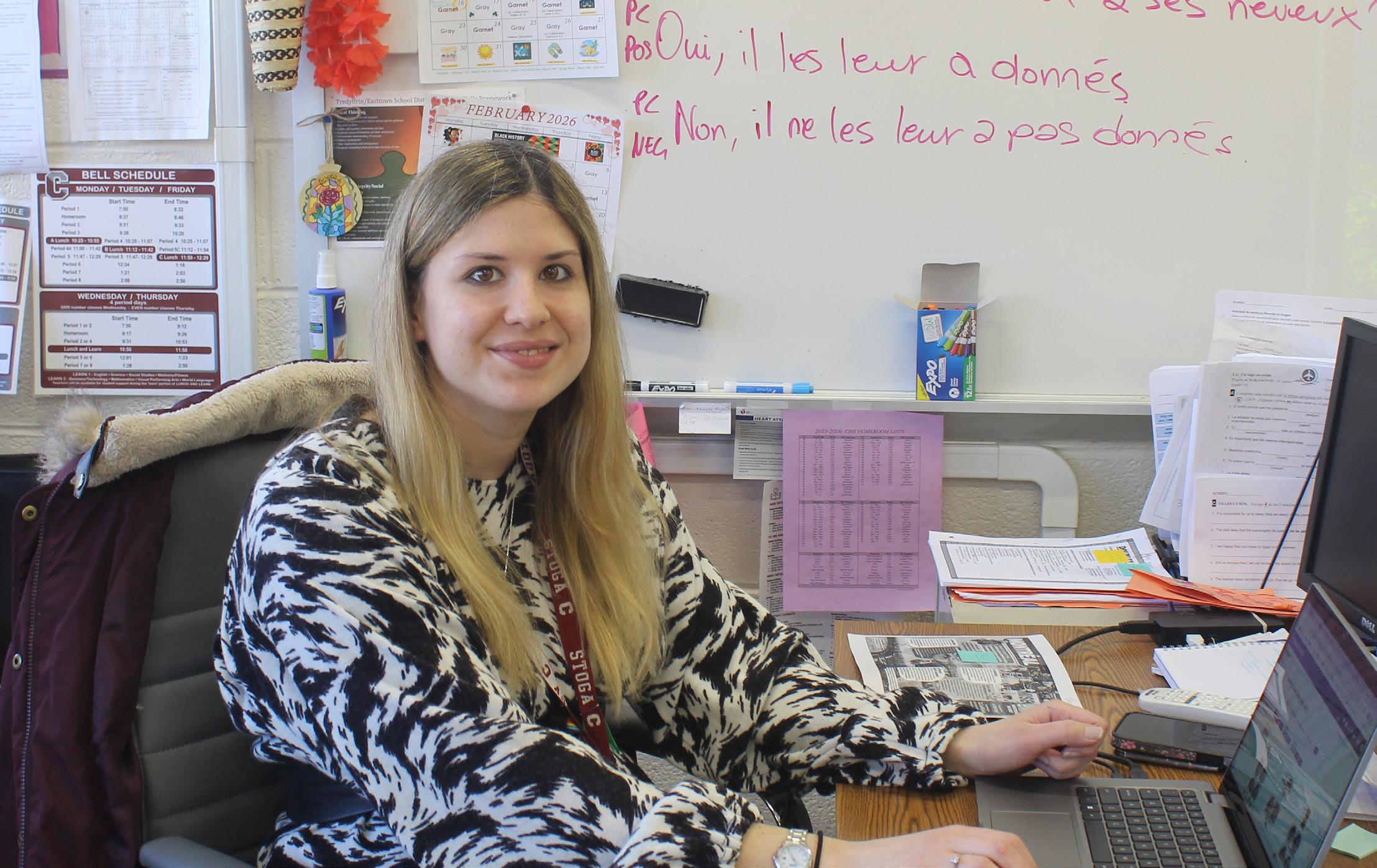
Foreign language teacher Alice Havrilla attended the University of Utah, where she earned her bachelor’s degree in French and Spanish in 2018. In 2020, she completed her master’s degree in foreign language education at Temple University. Currently, she is finishing a second master’s degree in Spanish through Idaho State University’s online program. Havrilla has worked at Conestoga for four years, and teaches Spanish 3 and French 4.
Q: What do you enjoy the most about teaching languages?
A: I really enjoy the opportunities that it gives you to also explore different cultures. It’s not just a language. I think outside of teaching language there are a lot of different aspects. You get to learn a new language, which is amazing for your memory and has so many benefits for other disciplines. One thing that I really like is exploring different cultures and getting the students to know something that’s not just their backyard. There’s other things out there, and they’re all cool in their own way.
Q: What do you like to do in your free time?
A: My sport of preference is climbing (and) also skiing and hiking. I guess anything involving a mountain is something I like. Unfortunately, here in Pennsylvania, there’s not a lot of big mountains.
Q: What is your favorite TV show?
A: I watch so many TV shows. I’ve just finished the last season of Bridgerton. I really like The Pitt. People are saying it’s a fairly accurate medical show, so I think that’s pretty cool. Those are the two I’m watching at this moment.
Q: What is one place that you would like to travel to in the future?
A: I definitely want to go to more of South America, like Argentina or Brazil. I definitely want to explore more countries in South America. I want to be exploring more of the continent, and there’s so much to see out there.
Q: If you were not a teacher, what career do you think you might have pursued?
A: I always liked languages, so I think if I were not a teacher,
I would have tried to be a translator of sorts. One thing that I thought would be cool (was), being a translator for the European Parliament or the U.N. But I realized that in the end, I prefer teaching to just translating somebody else’s words.
Q: What advice would you give to a student who wants to learn a new language?
A: I would say go for it — start in any way you can. If you want to start with an app and then go take a class. Apps are great, but they’re not everything. You cannot learn a language just by using Duolingo or Babbel. They’re a good starting point if you’re curious about a language. Go out there, find a class. If you’re about to go to college, try finding a college that offers that language. Just go for it with whatever language it is. It’s a great opportunity. You won’t regret it.
Q: What is one thing that a student might not know about you that would surprise them?
Teacher Feature: Alice Havrilla
A: Usually people are surprised that I speak four languages, but now that’s known. Another thing is right now I’m pregnant for the first time, and I’m really excited. Language
Alumnus selected for SCOTUS clerkship
Erin Zhang
Co-Copy Editor
Hunched in front of a computer screen, reading long digital files and documents, 2014 Conestoga alumnus and former member of The Spoke Lavi Ben Dor conducts research during his clerkship for a federal judge. After graduating with a Juris Doctor degree from Penn Carey Law School, Ben Dor began clerkships in addition to working at a law firm, assisting federal judges by doing legal research and writing. Next summer, he will begin clerking for Supreme Court (SCOTUS) Justice Clarence Thomas, a highly selective and competitive opportunity.
During his time on The Spoke, Ben Dor served as the Convergence Editor, News Editor and Co-Editor-in-Chief.
Cyndi Hyatt, a former adviser
of The Spoke, appreciated his commitment to the newspaper.
“I had no doubt that (Ben Dor) would eventually become EIC (Editor-in-Chief) of (The) Spoke,” Hyatt said. “He was so enthusiastic. He worked nonstop. He really went in 100% to (The) Spoke and it became very important to him.”
An avid writer and journalist, Ben Dor became passionate about First Amendment rights through the Student Press Law Center’s 45 Words program, where he advocated for freedom of speech for high school student journalists. This experience inspired his later interest in law.
“I wasn’t really set on (law) necessarily,” Ben Dor said. “When I went into college, I thought I would major in something like math or economics, but I knew I liked
writing, I knew I liked the work I did on The Spoke and law and legal writing. Law was at least somewhat on my radar even in high school.”
In 2014, Ben Dor graduated from Conestoga and attended the University of Pennsylvania for his undergraduate degree. While his focus was in math, economics and finance, Ben Dor also took legal studies courses that pivotally inspired him to pursue law. He also served as an editor of the Penn Undergraduate Law Journal.
“One of the reasons that I was drawn to the law was I felt like it intuitively clicked. I liked the way lawyers think about issues, where you have a series of rules,” Ben Dor said. “It’s kind of like in math where you have a bunch of theorems, principles in the world, and then you have a set of facts, and you have to figure out how those rules of the world apply to those specific facts.”
Journal of Law and Public Policy and law reviews at Brooklyn, Penn and Wisconsin Law.
“I think through a lot of hard work, I was able to get in that mindset and pick it up, and then of course, luck is always a big part of it,” Ben Dor said. “I feel lucky Penn had a great faculty in the law school. I had some really great professors that taught me. I had op-
“I knew I wanted to pursue a career that would let me write a lot, and also let me work on interesting legal issues,” Ben Dor said. “As part of that, one thing that many lawyers do early in their careers is clerk for a federal judge, and so I applied to a judge.”
Getting the chance to learn from a Justice was really exciting, and particularly (from) someone like Justice Thomas who has been on the court for a while and has repeatedly over the years shown that he is really committed to having a coherent view of the law. Lavi Ben Dor Selected to clerk for Supreme Court Justice Clarence Thomas
portunities to do a lot of writing as part of my classes. I took classes focused on teaching you how to write like a lawyer that I enjoyed.”
At Carey Law School, Ben Dor served as an Executive Editor of the University of Pennsylvania Law Review, graduated magna cum laude and earned induction into the Order of the Coif, an honorary scholastic society for law graduate students. Ben Dor also received the Lipman Redman Prize for the best first-year brief, and has written works that appeared in the Harvard
After graduating from law school in 2020, Ben Dor clerked for Judge Kent A. Jordan of the U.S. Court of Appeals for the Third Circuit and Judge A. Raymond Randolph of the U.S. Court of Appeals for the District of Columbia. Among many duties, law clerks conduct research, analyze legal documents and prepare bench memorandums on behalf of a judge.
Currently, Ben Dor works as a litigation associate at the law company Gibson, Dunn & Crutcher in Washington, D.C., practicing in the firm’s Appellate and Constitutional Law and Administrative Law and Regulatory Practice Groups. In early 2025, Ben Dor applied for SCOTUS Justice clerkship and received selection later that year. He will clerk for Justice Thomas in the summer of 2027. “Getting the chance to learn from a Justice was really exciting, and particularly someone like Justice Thomas who has been on the court for a while and has repeatedly over the years shown that he is really committed to having a coherent view of the law,” Ben Dor said. “The chance to learn from someone like that who’s had that much of an impact on American law in the past 30 years, and who’s such an original and genuine and brilliant thinker, was just a really exciting opportunity, so I was very, very thrilled that I was hired and that I’ll have the opportunity to clerk for him.”
Isabelle Emmanuel Staff Reporter
luminary: French and Spanish teacher Alice Havrilla grades work on her laptop. Havrilla has taught at Conestoga for four years.
Isabelle Emmanuel/The SPOKE
Acclaimed accomplishment : Conestoga alumnus Lavi Ben Dor smiles for a picture. Last year, Ben Dor applied and earned selection to clerk for Supreme Court Justice Clarence Thomas.
Courtesy Lavi Ben Dor
aspects of the production. According to Abramowitz, the musical's comedic timing was more difficult to master compared to previous shows due to exaggerated expressions used to emphasize punchlines. .
Cast Crew
The crowd explodes with laughter after Princess Winifred climbs over the railing, covered in swamp mud and leaves, much to Queen Aggravain’s disapproval. This year, Stoga Theatre introduced Once Upon a Mattress, a retelling of the classic tale of the Princess and the Pea, but with a twist: rather than a conventional princess, Winifred the Woebegone is a loudmouthed swamp-dwelling heroine.
Senior Izzy Abramowitz brought to life Princess Winifred, and junior Declan MacDonald played Prince Dauntless. Challenging the stereotypical fairytale storyline, the characters are boisterous and dramatic, playing to the comedic
“In past shows, especially the musicals like the Little Mermaid and Chicago, there wasn't much we had to worry about in terms of the physical comedy. And now I'm up 20 feet on a mattress, and I'm getting swung on a board,” Abramowitz said. “It takes a lot more stamina than the past (musicals).”
Behind the scenes, stage crew worked to bring together the medieval time period through sets, costumes and hairstyles that reflect the musical’s setting. In addition to the character designs, stage crew constructed multiple set pieces, including an intricate confetti cannon, a towering stack of mattresses for the princess and an elaborate set of banners.
“I really love that the musical takes place during the medieval time period, so there are lots of braids and hairstyles that I’ve (seen) in movies. My favorite character to work with is Lady Larken, who has two French braids pulled back in a half-up, half-down,” said senior Molly Macveigh, co-lead of hair and makeup.
The musical also features the proscenium, a rectangular setup of lights that adds more dramatic emphasis during songs and comedic moments. Moreover, the production introduced new sound equipment, including soundboards and microphones, which improved sound quality and efficiency. Unlike the fall play, the pit orchestra also collaborated with the sound team, adding in background music to accompany the actors and transitions between scenes. Sophomore and pit orchestra member Triona Tsai believes the group is significant in bringing the musical to life.
“It (the pit orchestra) gives the performance depth, and I feel like it’d be different than playing with the recording — it all makes it feel more real,” Tsai said.
Written by Ella Peng and Alivia Woo, Staff Reporters Designed by Emily S. Wang, Co-Design Editor
Rowan Chetty/The SPOKE
Plan foiled: Sir Harry, played by senior Zac Costas, carries junior Liz Wright, who plays the Minstrel, a er Queen Aggravain, played by senior Lilly Duska, discovers Lady Larken’s plan to escape. The musical challenged actors to use dramatic expressions to better convey the fairytale aspects of the story.
Rowan Chetty/The SPOKE
F-R-E-D: Senior Izzy Abramowitz (center le ), who plays Princess Winifred, and junior Declan MacDonald (center right), who plays Prince Dauntless, stand underneath fallen confetti. While performing The Song of Love, stage crew members triggered confetti cannons to go o to create this e ect.
Rowan Chetty/The SPOKE
Secret escape: Lady Larken, played by senior Aries Serinsky (center), prepares to leave the castle aided by the Jester, played by sophomore Andrew Rogner-Cook (le ), King Aggravain, played by senior Daniel Bletsch (bottom) and the Minstrel, played by junior Liz Wright (right). During the characters’ escape, the actors sang the song Normandy.
On a weeknight after school, two microphones, a laptop and an outline of celebrity news transform a bedroom into a recording studio. Juniors Shirin Patel and Chloe Proud discuss the talking points for the next episode of their newly created podcast “The Mic Drop.” Patel and Proud created the podcast in January to inform others about various trends in pop culture and release 20-minute episodes biweekly. Currently, they have released two episodes on Spotify: one about “Heated Rivalry,” a popular TV series, at the end of January, and one about the 2026 Super Bowl and Grammys in the middle of February.
“We wanted (the podcast) to be an area where it’s just like you’re in a conversation with us,” Patel said. “So (it’s) kind of casual, but we’re also here to inform you on things that are happening in the pop culture world, (whether it be) with current events, celebrities, movies, shows, really anything.” For their episode on “Heated Rivalry,” they discussed the HBO show’s premise, main characters, favorite scenes and
Students launch pop culture podcast ‘The Mic Drop’
episodes and why the show is taking off online. They also featured juniors from Conestoga as special guests to get their opinions on the show. For their second episode, they discussed the Bad Bunny Super Bowl halftime show and its underlying themes. They also recapped of the Grammys, sharing their opinions on it.
“We decided (to choose “Heated Rivalry” for the first episode) because we had just watched it, and we heard so many people buzzing about it,” Patel said. “So we were like, ‘Oh, our first episode should come out with a bang,’ like something that people are talking about so much already.”
To produce an episode, Patel and Proud outline talking points, record in GarageBand at Proud’s house using two microphones and then edit in CapCut. They typically record midweek and release the episode by the end of the week. Patel sets up the recording gear, touches up on the audio quality after Proud edits the clips and publishes the episodes. Afterwards, Proud creates Instagram posts that promote a new episode using Procreate, Canva and Adobe Illustrator.
As of February, they have 22 followers on Spotify and 56
streams across both episodes. Proud has received positive feedback from friends and family about their podcast.
“I have a lot of people come up to me at school and say that they like it (and) a
lot of my friends really like it, especially the (first) episode with the special guests,” Proud said. “Our families are very supportive of it. I’ve (also) had a
to
In the future, the
their
continue producing fun, timely pop culture episodes and invite more guests. Proud aims to keep the podcast light and engaging while still giving listeners some-
thing they can take away from each episode. “I hope we can keep doing fun episodes about current events and pop culture, and also that we can hopefully entertain people and make a positive im-
Chemistry Club leads school STEM trip
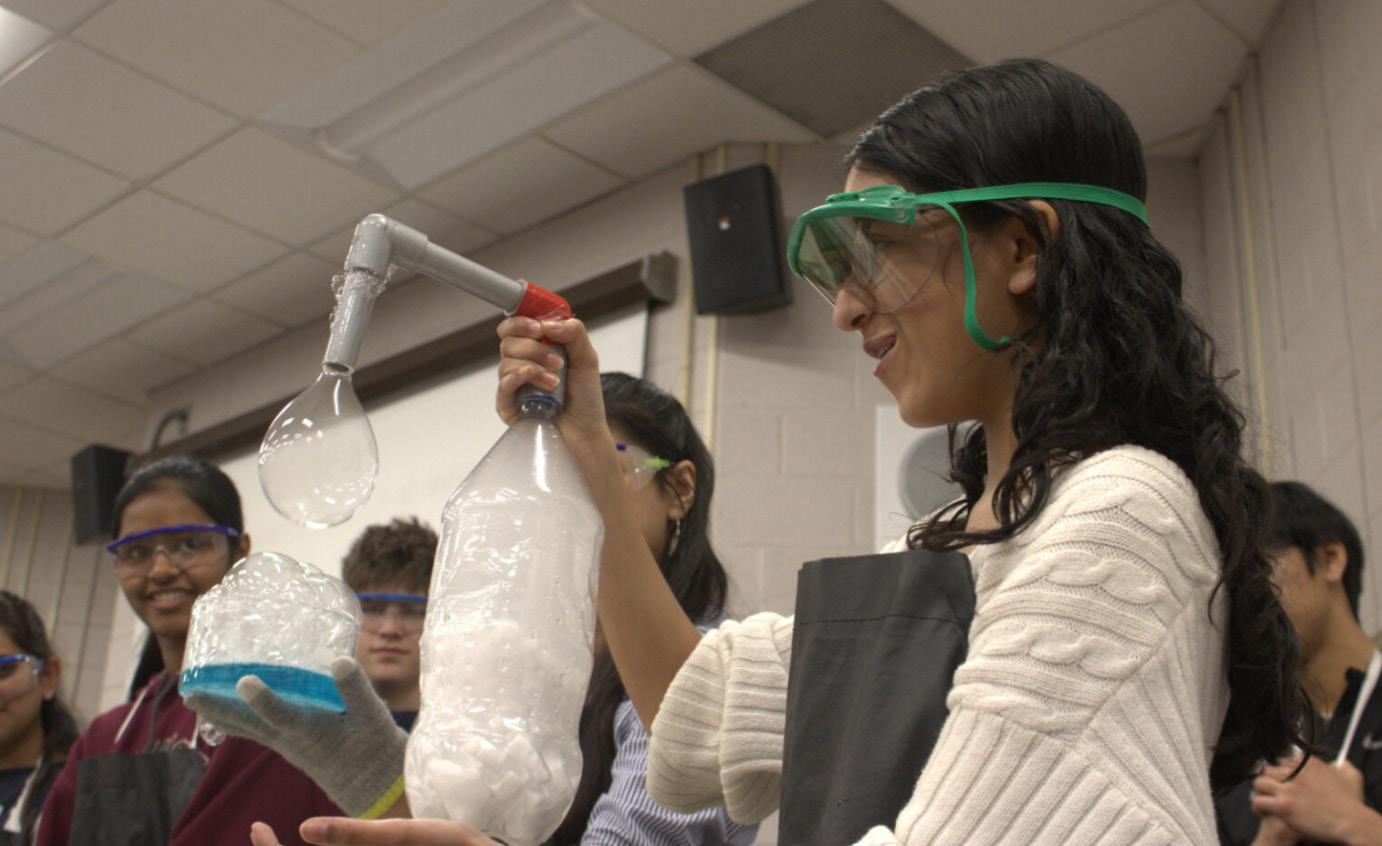
On Feb. 13, 20 student volunteers from the Chemistry Club visited Devon Elementary School to demonstrate a variety of STEM experiments, including elephant toothpaste, flame tests, carbon dioxide bubbles and acid-base indicators.
The Chemistry Club allows students interested in science topics to learn more about chemistry’s applications, regardless of their prior knowledge. This year, club continued its outreach to elementary schools while bringing new improvements to the meetings.
The club views its field trips as important because they allow students to become interested in science early. Senior and co-president Lily Zou feels that the demonstrations have helped elementary school students engage with STEM topics in a more interactive way.
“I feel like when you’re sitting in science class, you may not necessarily understand what’s happening, but (the demos) are sort of like a lab where you’re actually seeing the experiment versus just being taught a concept,” Zou said.
At the beginning of the school year, the club held monthly meetings where members would decide on a theme for the month and create a lesson around it. In addition, senior and co-presi-
dent Chris Song and his fellow club leaders designed an online Padlet presentation to provide resources for students interested in summer programs, research or science related opportunities.
“In January we had a sourdough starter meeting and we presented on the chemistry and biology with how the starter works,” Zou said. “Then we brought in materials to let (the students) make them, bring it home, feed it and eventually bake with it.”
Last year, the club had its acid-base indicator demonstration with the full scale of pH molarities and a universal indicator to show the colors. This year, the students doing the acid-base demonstration wanted to change things up.
“They (Song and senior Ritchie Zhang) decided to show how the indicator works and started with the base and then slowly added acid, so (the color) changed from a purple to a red,” Zou said. By organizing these demonstrations and monthly themes, the
club employs creative methods to enhance understanding of chemistry. Zou hopes more underclassmen will participate in field trips to expand community interest and involvement with STEM.
“Typically, we have juniors and seniors who have already taken chemistry join, so we really want to get underclassmen involved,” Zou said. “And I think we’ve been really successful in that we’ve had a lot of freshmen come to our meetings and join our elementary school field trips.”
Junior runs public speaking nonprofit
Rishika Bhattacharya Staff Reporter
Words and wisdom fly through the air when junior Lola Huang instructs students on how to improve their public speaking and face their fears. Huang teaches elementary school students through her organization Speak Up Youth.
Last November, Huang and juniors Avani Dugar and Mohneesh Valasa hosted their first session at the Easttown Library. Huang has prior experience with public speaking, such as Capitol Debate, where she attended a summer workshop and participated in a club league.
“A few summers ago I attended an in-person camp at Villanova. I felt that I had learned a lot and I had performed pretty well. So, they invited me back to be a counselor-in-training at their camp up
in New Jersey,” Huang said. “It is what inspired Speak Up Youth because I had the opportunity to work with a lot of elementary school-aged kids and I saw the role of debate in their development. I just thought this was a mission that I should definitely continue.”
The workshop’s key demographic is children from first through fourth grade. Attendees of sessions engage in different activities such as playing “Would You Rather” and researching topics for their arguments. While Huang conducts the main teaching within the class, Dugar and Valasa help keep the students on track.
“I wanted to join because I honestly had a problem of public speaking since I was a kid. When I took (AP) Seminar as a course last year, it really helped me just get up on stage and talk in front of a
lot of people that I don’t necessarily know. Stage fear is common for many students from a very young age and I just wanted to make sure that it’s not something that downplays them, and they can achieve success,” Valasa said.
To culminate the six sessions, Speak Up Youth hosted a final showcase for parents and guardians. Students presented their arguments to the class and demonstrated what they had learned. Parent Hannah Liao enjoyed seeing her daughter’s accomplishments.
“As a parent, it was a really special experience to see my daughter do something that used to scare her,” Liao said. “The workshop helped her realize that she is capable of speaking up and expressing her ideas. I believe this experience gave her confidence that will stay with her for a long time.”
Top Trumps USA to create Philadelphia-themed custom Monopoly edition
When families in the area gather around the table this November, they will be able to enjoy a classic board game in a new light. A Philadelphia-themed edition of Monopoly is set to hit stores, swapping traditional properties for local landmarks. Top Trumps USA, a card and board game company, has a global license with Monopoly owner Hasbro to create official editions of its games. The Monopoly: Philadelphia Edition will feature a box, lid, board montage and collection of cards unique to the city. From late fall 2025 to the end of February, Top Trumps USA accepted nominations from the community for Philadelphia’s most beloved landmarks and businesses to be included in the game. As the company makes the final selections, its regional game manager Tim Barney establishes partnerships with different organizations, businesses and institutions in the area to highlight them in the edition.
“We want to feature the best of the best. We rely largely on the nominations from the public to give us the direction the game needs to go and (tell) us which of those organizations and institutions we should be speaking to,” Barney said.
“Philadelphia quickly checked all the boxes for us, and we know it’s going to be maybe one of the best additions we’ve ever made in the United States, if not the best.” Not every nomination makes the cut. According to Barney, Top Trumps USA considered four main criteria when choosing locations: legacy, credibility, community engagement and excitement. Barney also stated the goal was not to select establishments with the most nominations, but to create a collection that effectively represented Philadelphia.
“It’s not strictly a voting process. I know sometimes people think it might be since we’ve got (these) nominations set up,” Barney said. “We have these other boxes to check. So truly,
everybody included needs to be authentic. They need to really feel like Philly, because I think one of my primary goals with each edition is that a local picks up that box and they say, ‘That feels like home.’”
According to Barney, Popular nominations included prominent museums, sports teams, schools, cheesesteak spots and parks. Top Trumps USA will go into the design and production stage of the custom edition in the upcoming months before launching the final product this fall. The company plans to reproduce the edition for at least three years. A digital retail guide will inform the public of where to find the custom edition when it releases, including local stores, the Top Trumps website, Amazon and Barnes and Noble.
“I want (the edition) to bring attention to all the great places in the area, to the people that really have impact on the community and are quintessentially Philly,” Barney said. “This is the kind of thing (where) people, when
You,
Studio setup: Juniors Shirin Patel (right) and Chloe Proud (left) sit where they recorded the first
Mic Drop.”
and Patel started the podcast in January. Courtesy Renata Guirao-Cortes
Rajan Saha Co-T/E Life Editor
Beautiful bubbles: Junior Karina Shah demonstrates a bubbles experiment using carbon dioxide and dish soap. Chemistry Club members visited Devon Elementary School on Feb. 13 to conduct demonstrations for the students.
Erin Zhang/The SPOKE
Talia Roth Staff Reporter
Learning together: Students in Speak Up Youth collaborate in class. Junior Lola Huang started the organization in November.
Courtesy Michael Huang
Jeff’s Gist: Why ICE threatens our moral ‘cost of living’
The murders of U.S. citizens
Renee Good and Alex Pretti in January by Immigration and Customs Enforcement (ICE) officers sparked colossal protests in Minneapolis and around the country that lasted for days. Last month, students from both Phoenixville Area High School and North Penn High School held individual walkouts against the actions of immigration enforcement — a reflection of the many protests and demonstrations happening throughout Philadelphia in response to the inhumane detainments and killings of many residents in the country.
So, where is Conestoga?
In the time between having written my piece one year ago
titled “Jeff’s Gist: ICE terrorizes undocumented immigrants,” ICE has arrested approximately 400,000 immigrants, even though less than 14% of those arrested had “violent criminal records” according to a Department of Homeland Security (DHS) document that CBS News obtained. For many of us here in Tredyffrin/ Easttown, we’re fortunate to live in relatively safe neighborhoods that don’t have to deal with as much violence as other parts of Pennsylvania, or the country for that matter. Elsewhere, the “cost of living” ultimately revolves around the fear and trauma of family members being torn away from loved ones to advance the administra-
urbs, and according to a SAVVY Main Line article, Berwyn is expecting a potential DHS
of the soon to be opened Bear Hill Elementary School. People’s lives are on the line, yet it
office, at the epicenter be -
tween Conestoga, Hillside Elementary School and the site
feels as though it is rarely being talked about, at least here in our district.
Review: ‘GOAT’ doesn’t live up to its name
Directed by Tyree Dillihay,
“GOAT” tells the story of a goat who hopes to become the greatest of all time at a basketball-inspired sport called roarball. Unfortunately, the movie isn’t as ambitious as its protagonist. Fresh off the heels of the impressively bold “Spider-Man: Across the Spider-Verse” and “KPop Demon Hunters,” “GOAT” is a disappointingly safe release for Sony Pictures Animation, though it certainly has heart.
“GOAT” follows the anthropomorphic goat Will Harris, voiced by “Stranger Things” star Caleb McLaughlin, after the Vineland Thorns sign him when a video of him playing against and humiliating a star roarball player goes viral. The Thorns’ best player is Will’s idol, black panther Jett Fillmore, who has yet to
Rating:
win a championship despite being the league’s all-time leading scorer. When Jett learns that the greedy owner of the Thorns signed Will, she is furious at the apparent publicity stunt, deriding Will’s short stature. What follows is a charming but predictable underdog story. Where the movie shines is the spectacular animation, with Sony Pictures Animation using the 2D/3D hybrid style it pioneered with its “Spider-Verse” films to great effect. The fastpaced and energetic roarball games are a joy to watch, and the movie as a whole is colorful and pleasing to the eye. Additionally, the voice acting is excellent, especially Gabrielle Union’s performance as Jett. NBA star Steph Curry, who also serves as a co-producer, holds his own as Lenny, a giraffe and member of the Thorns. However, the movie is lackluster in the story department. Overall, the plot has few surprises and takes no risks, content to be nothing more than a cookie-cutter sports film. The idea of an aging legend learning to pass the mantle to a young underdog isn’t even unique to ani -
mated films: Pixar’s “Cars 3” does the same, except much more effectively, since it gets the viewer to root for the stubborn veteran and gives the underdog an arc of their own. In “GOAT,” on the other hand, Jett is clearly in the wrong, and Will’s character lacks development. The latter issue is especially significant, given that Will is the main character. Will doesn’t even have to learn how to use his height to his advantage over time — instead, he’s an excellent player from the get-go. It’s true that “GOAT” is undeniably made with passion, and it absolutely is not a bland cash grab like “Smurfs: The Lost Village” and “The Emoji Movie.” A particularly tender scene is when Will takes Jett to a local diner so that she can meet some diehard fans, showing her that she still has support despite her failure to win a championship. But “GOAT” needs more than charm and impressive animation to be called anything more than decent. It’s worth a watch when it hits Netflix, but it’s not enough of a slam dunk to be worth seeing in theaters.
The “cost of living” begs for a social contract between citizens, administrations and institutions, or else threats become real consequences. But in this scenario, we can’t compromise. In a federal memo issued last month, the administration gave broader powers to ICE officers to detain refugees in the U.S. regardless of documentation status, specifically stating this is an effort to “heavily scrutinize immigrants, illegal and legal alike,” and even pausing applications for green cards. It is clear that this is not just a problem of citizenship, but a way of preventing the residency of all immigrants and those not deemed “American” enough.
There is justifiable fear of speaking out during these times especially at public demonstrations knowing anything can happen to you or your family. I’ve attended a number of rallies, yet I’ve realized that the most impact comes not from the megaphones at demonstrations, but from the repeated efforts in communicating what is right even in the smallest moments. Taking action doesn’t mean you have to attend public demonstrations. It can simply be educating family, friends or children on their constitutional rights and ensuring they understand what our future holds if we continue to let the administration influence hatred towards so many groups. Of course, everyone should do so knowing the risks, but if we don’t act now, that only leaves more space for ICE to infiltrate our communities. We need ICE out. This organization has shown and been vocal that it will deport or even murder regardless of whether people are documented, U.S.-born or crimefree. We must spark discussions at home, at school and anywhere possible before we fall victim to detention centers ourselves.
Mary Wolters Co-T/E Life Editor
Four hundred and twenty-six. That’s the number of unread messages that just populated my phone last night — all waiting to be opened, processed and resolved. Consider this: If I spent around 10 seconds on each, that would be over an hour spent responding to little bubbles on my phone. Now, while I deeply appreciate each Instagram Reel my sister sends, she can wait a few more days, right?
With the increasing digitalization of modern life, com-
munication has never been more accessible to anyone with a device. According to a 2024 Pew Research study, 95% of American teenagers have access to a smartphone, bringing various forms of connection along with it. Among them, texting is one of the most popular, encompassing platforms like iMessage, WhatsApp and social media. Despite its many benefits, I have taken a firm dislike to texting, due to its time-inefficiency, susceptibility to misunderstandings and impersonal nature compared to in-person conversation. First, even the most experienced typers must admit that writing each word out can take significantly longer than simply speaking it. In a world of digital distractions, from social media to streaming services, our time is a precious commodity that must be spent wisely. Practically speaking, it is much more productive to engage in a
20-minute chat than a 2-hour texting session. Moreover, because of online messaging’s ability to stretch over multiple days or weeks, dialogue never seems to end. How am I supposed to put down the phone if my conversations have no stopping points?
Additionally, without the important context from vocal intonation or inflection, the meaning of these short snippets is easily misinterpreted. Was that message sent playfully, sarcastically or neither? From my own experience, spending energy deciphering the true intentions behind blank text can be quite frustrating. All of this needless overthinking could be easily avoided by talking and expressing emotion through speech. Ultimately, the personal and dynamic qualities of conversation are significantly stripped away during texting. Facial reactions, laughter, unique vocal patterns
— there are so many pleasant dimensions that are lost when speaking is flattened into black and white letters. Sure, talking in-person can lead to awkward pauses or uncomfortable eye contact, but it is an essential component of life that is necessary for everyone to master.
Of course, there are clear advantages to texting as well: preserving specific details, sending information when the receiver is offline and even just communicating in a crowded space. Obviously, I also text every day, as it is simply one of the easiest forms of correspondence. From setting up plans with friends to sharing YouTube links with my sister, there are so many convenient applications I partake in. However, if anyone ever urgently needs something from me, my answer is always the same: Just call me.
Jeffrey Heng Co-Managing Editor and Columnist
Delancey Zhao/The SPOKE
Eshan Singh Co-Opinion Editor
Lila Hitz/The SPOKE
Turn off texting
After months of anticipation, the most wondrous time of year is upon us: college decision season. Who doesn’t love the thought of waiting for that one acceptance or rejection to change the course of your life? In honor of this occasion — and for that extra push of motivation — here is the routine of Ivy L. Worthy down to the millisecond, so you can be just as successful. Our star student’s day begins with a leisurely and hearty breakfast, the perfect start to the morning. Next, she arrives at school promptly for the student council meeting like the model stu -
A day in the life of a perfect student
dent she is. After all, she is the school president! Are you taking notes? This is where the true Ivy League-worthy material comes into play. Following her meeting, she takes her AP Physics C and AP Chemistry exams back to back. Is she stressed? Pfft, what in the world is that? Do not listen to those phony websites that are cited in the National Institutes of Health, like The American Institute of Stress. This nonprofit states that “75% of high school students and 50% of middle schoolers consistently feel stressed due to
schoolwork.” They are just out to get students like you.
At long last, it is Lunch and Learn, another opportu-
You’re not stressed — you’re just successful!
nity to better the world. Time to finish her groundbreaking
lab research on a multidisciplinary approach to virtual reality tumor mapping with nanotechnology, which she discovered after months of cold-calling universities and researchers. After school, she leads the varsity field hockey team to victory as captain. And finally, she does community outreach for her strategically formed club, The Future Burned Out Valedictorians Society. According to dietitian Emma Simpson, “Students categorized as ‘high stress’ had the highest aver-
age caffeine consumption of 7-8 svgs/wk (42-64 ounces).”
High caffeine consumption can negatively impact development as well as the quality of sleep, especially for adolescents. Furthermore, psychologist Bipin Thapa said that poorer quality of sleep leads to higher mental and academic stress. But do not worry about that: All you need is fuel from exhilarating all-nighters, the satisfaction of optimizing every extra credit opportunity possible and the tears of your sleep-deprived opponents.
Now that you have witnessed the daily routine of our perfect student, all you have to do is follow it down to the last detail. Easy! Use academic pressure as motivation and your peers as benchmarks. And remember, if they can do it, obviously, you must do it better.
In the brilliant words of the great Ivy L. Worthy: “Burnouts are just a mindset, and limits are only meant for AP Calculus.”
“I think (texting’s) good sometimes because it helps you plan things and hang out with your friends, but it’s also bad sometimes because you can say bad stu about other people.”
STUDENTS SPEAK OUT
Q: Do you think texting causes more harm than good?
Rowan’s Oscar countdown
Editor’s note: An extended version of this story is available on spoke.news. As the 2026 awards season draws to a close, the 98th Academy Awards is shaping up to be a competitive year across many major categories. As a self-proclaimed film connoisseur, I took up the challenge of watching this year’s nominated films to see which deserve to take home the golden statuettes on March 15.
ing to define key relationships that make the events of the action-packed second half more emotional. Coogler’s style kept me on the edge of my seat throughout the climax. Yet, what really cemented this film for me was the emotional weight of the ending that wrapped up an intense climax in a beautiful and satisfying way — a testament to Coogler’s skill.
Best Lead Actor: Two strong performances came from veteran actors — Leonardo DiCaprio in “One Battle After Another” and Timothée Chalamet in “Marty Supreme.”
jor character flaws, swayed me to choose him for the award.
Best Lead Actress: Going into “Hamnet,” I expected a story about how the loss of William Shakespeare’s son Hamnet inspired his creation of one of his most famous plays, “Hamlet.” But I was pleasantly surprised to see that the movie instead chose to focus on Shakespeare’s wife’s grief. Jessie Buckley’s breathtaking performance as a grieving mother perfectly conveys her character’s unimaginable loss across moments of sadness, desperation, anger and finally at the film’s climax, acceptance. The raw emotions Buckley brought to the screen made her the clear winner for Best Lead Actress.
Best Directing:
There were many films that stood out to me across the category, but I chose “Sinners” director Ryan Coogler for the win. “Sinners,” which broke the record for most-ever Oscar nominations, showcased Coogler’s talent to pair fast-paced action with compelling characters. The film starts slower but does necessary world-build-
While I loved DiCaprio’s portrayal of a father determined to save his daughter despite his own mental health challenges, I chose Chalamet for the win. As opposed to a traditional sports movie, Chalamet’s character isn’t an ethical person, as seen by the selfish decisions he makes throughout the film. While I’d be happy to see DiCaprio win, Chalamet’s talent to make his character someone the audience roots for, despite ma-
Rowan Chetty/The SPOKE
Best Picture: Finally, the biggest category of the night — the coveted Best Picture. Across the 10 films nominated in the category, I was sitting between “Sinners” and “One Battle After Another.” Both films had thrilling and intense action alongside a heartfelt story about family. While I loved the intensity of “Sinners,” I found the deeper meaning to be a little overshadowed by it. “One Battle After Another” brought together a stacked cast, a well-written story, great visuals and standout performances that make it my pick for this year’s Best Picture winner.
“I
“I feel like there’s more good that overwhelms the bad in texting, as in communicating rather than being distracted.”
High schools are breeding grounds for disordered eating
Walking through the cafeteria, the sounds of students talking, clicking on keyboards and rushing through homework before class fill the air. And yet, for a period dedicated to consuming food, I personally find myself surrounded by a sparse number of people actually eating anything — let alone a full, healthy meal.
As a girl growing up with family, friends, strangers and social media comments emphasizing the importance of being “skinny,” I am no stranger to unhealthy eating habits in favor of gaining the “perfect” body. High schools, including
Conestoga with its competitive academic environment and features such as Lunch and Learn, can unintentionally influence the development of these harmful behaviors among some students.
Adolescents in general have high rates of eating disorder symptoms, with reasons varying from childhood characteristics to biological factors like puberty. According to a 2018 National Library of Medicine article, these symptoms can develop into clinical eating disorders in adulthood.
The prevalence of social media usage among teenagers can also worsen eating habits.
Within Conestoga, as an example, a significant number of students utilize platforms such as Instagram and TikTok for personal as well as academic reasons. Various clubs and organizations post on social media to attract attention, which can lead to pressures to be active on these platforms and, as a result, be exposed to popular trends that promote
unhealthy eating habits. According to the National Eating Disorders Association, social media use, especially posts with body image emphasis, can lead to disordered eating among adolescents, with higher rates for females.
In my personal experience, I have also found that the heavily academic-focused culture within high schools such as Conestoga has led some students to choose working over eating during their allocated lunch period or the school day entirely. With the existence of Lunch and Learn, there are opportunities for students to continue attending meetings or doing work for an hour, as school organizations often try to meet during the period — sometimes featuring meetings back-to-back. Additionally, I have heard of a few instances in which teachers chose to eat outside of regular times due to meetings or work during the allocated lunch periods. Although
the decision not to eat during the period may not be directly negative for the student or teacher, it can unintentionally affect other students who observe these practices and already struggle with negative body images or eating habits. Developing a singular, schoolwide solution to this problem is definitely not simple and should not be the focus: Eating habits are one’s personal choices, including whether they want to eat during their allocated lunch period or not. In addition, identifying whether someone has disordered eating habits is often a private matter outside of school grounds. However, staff such as guidance counselors speaking more about disordered eating
its, symptoms and warning signs may be an important first step to help discourage these patterns. Disordered eating habits develop through their environments. By start
ing
them before they start.
Rishith Byri, senior -
Marissa Rhoden, junior -
Ryan Marshall, sophomore -
Claudia Miller, freshman -
Rowan Chetty
Co-Editor-in-Chief
Faith Zantua Co-News Editor
Nishta Subramanian Staff Reporter
Jessica Li/The SPOKE
Girls, boys basketball win Central League for first time since 2008
Charlotte Liao and Nolan Talley Staff Reporter and Webmaster
On Feb. 10, both the girls’ and boys’ basketball teams won their respective Central League championships. The girls’ team defeated Haverford 59-43, while the boys’ team won 48-43 against Garnet Valley, marking both teams’ first Central League titles since 2008.
“It (winning) was crazy at first. Just a big adrenaline rush. It was awesome. Getting to celebrate with the teams holding up the trophies. Obviously, the girls winning was awesome too. Getting back to back (victories), it didn’t
really set in, honestly, until the next week,” senior and boys basketball captain Cory Hogan said.
“It was cool thinking we’re one of the only teams that have done that in Conestoga history, and that’s a great thing to think about.”
In the girls’ game, Haverford led 16-10 during the first quarter. By halftime, the Pioneers had caught up to a 26-26 tie. During the third quarter, Conestoga built a strong lead from the team’s 3-point shots, turning the tide in its favor. The girls continued strong in the last quarter and won the game 59-43.
“We came out at halftime tied, and we took a 10-point lead going
into the fourth quarter, and that was largely because of our 3-point shooting,” senior and girls’ basketball captain Maggie Neary said. “Our shooting really was turned on that quarter and that gave us the momentum we needed.”
Senior and shooting guard
Ryann Jennings scored 27 points in the championship game, earning her league tournament MVP honors. In the league semifinals game against Radnor, Jennings scored a career-high 47 points to secure the girls’ team’s spot in the finals. She has been working towards the victory since her freshman year.
“It (winning) means so much,” Jennings said. “Coming into season, that was our main goal. And honestly, it’s been my main goal since I started freshman year. We’ve lost three years, in freshman, sophomore, junior year, so winning senior year was definitely our main priority, it feels just amazing that we won.”
In contrast, the boys’ championship game against Garnet Valley, which began at 7:45 p.m., was a close-fought battle from start to end. Conestoga started off hot, with seniors Tygee Clark, Hogan, Rowan Miller and Shane O’Brien all scoring baskets. However, Garnet Valley eventually pulled ahead, leading 19-16 by the end of the first quarter. Conestoga rallied back in the second quarter, gaining a marginal lead.
The Pioneers continued to battle as senior Adhvik Mani made a layup and O’Brien hit a three-pointer to extend Conestoga’s lead to 29-23 going into halftime. Clark, assisted by Hogan, scored the team’s first points in the second half. Junior Sunny Tummala, who had been sidelined for most of the season due to an ACL injury, scored a layup in the third quarter. The fourth quarter moved back and forth, with the lead changing multiple times. Conestoga eventually pulled through with Clark scoring two foul shots to secure the championship title 48-43.
“We were kind of slacking in the end, and I picked us up there, and I ended up hitting two big free throws,” Clark said.
“I practice free throws every day at practice, so it’s just blocking out the noise, focusing on just you in the rim, and know-
ing that you practice this shot a million times and just trusting the work you put in.”
Beyond their championship titles, each team has persevered in its own way. Neary, who missed games due to an ankle injury, feels the girls’ team struggled with consistency due to frequent injuries.
“I think we played with six varsity players, which is not enough. You can only have five varsity players out on the court, so only one sub is kind of crazy. We pulled up some JV players, and they made some impacts too, so that was awesome to see them come out of their shell and step up when we needed them to,” Neary said. “It (the injuries) kind of also affected us because we could never have a set game plan. We never had a steady five players play for over a month.”
Similarly, the boys’ team struggled with injuries, with starters Miller and O’Brien both suffering injuries throughout the season. However, Hogan believes that these obstacles have
helped the team build resilience and come back stronger.
play at Downingtown
“This year specifically, we had a lot of big injuries for important players early in the season. We started off 7-7. It’s disappointing because last year we had five losses total in the season, so it’s definitely not something we were used to,” Hogan said. “It’s obviously tough when you’re not out there with some of your best friends (that) I’ve been playing with for the last 10 years of my life. Getting them all healthy was really great, but we also learned a lot about ourselves. We learn about what it looks like and how we’re acting when we’re losing, and so then cleaning up those little gaps in our game now that we’re fully healthy and playing together, it’s really hard to beat us.” Both teams are continuing their PIAA state championship runs as of March 2. On Feb. 27, the boys overcame Chester 51-47 to secure their ticket to the state playoffs. In addition, the girls
On Feb. 16 at the University of Pennsylvania’s Ott Center for Track and Field, senior and relay anchor Jake Foster surged past the finish line for the boys’ 4x800-meter relay, clutching a golden baton in his right hand. The other members of the team, seniors Howard Shui and Parker Warkentine and sophomore Casmir Przybylowski, looked on as the group’s total time of 8:00.95 minutes displayed on the screens around them, placing the team in first at the Meet of Champions and securing the team’s spot at the Pennsylvania Track and Field Coaches Association (PTFCA) indoor state championships on March 1 at Penn State and the New Balance National Indoor meet on March 12 in Boston.
“This year is our first year doing (the 4x800-meter relay),” Przybylowski said. “We started two months ago on a regular weekend and we got an 8:12 (minute time). We were super happy and we (thought we) could do well.”
During the indoor track season, the team competed in the 4x800-meter relay multiple times, improving its performance at each competition. At the PTFCA state meet, the team placed ninth with a 7:59.20 minute time. Currently, the team holds the second best Conestoga indoor track record
behind a 7:56.20 minute time from 1974. The team hopes to break the school record at the nationals meet in Boston.
“We’re all really excited for nationals, mostly just to compete with the highest level of athletes in the country. I think that we’ll all perform better being with them,” Foster said. “Especially coming off of states, we’ve all PR’d there or ran faster before, so I think we can drop a pretty significant time in Boston.”
The team entered a taper phase in the postseason, scaling back their overall training volume to recover their strength. However, the runners continue to do intense workouts, work on their speed and practice baton handoffs to ensure that they will perform well at upcoming competitions. The team maintains a balance between training individually and working together as a group.
“Out of all the teams that we’ve ever raced, we have the
Perfect parry: Junior fences in Junior Olympics
out the year also qualify for the event, which is how Kim gained a spot in the Cadet Men’s Foil division of the Junior Olympics.
a training regimen. He runs laps, stretches, performs conditioning exercises and works on his game.
Three years ago, junior Aiden Kim picked up his first fencing sword. This year, Kim sparred against the best fencers in the nation at the Junior Olympics.
Kim fences at V Fencing Club in New Jersey and has been competing in tournaments since 2023. He recently competed at the 2026 Junior Olympics in Kansas City, Missouri from Jan. 9-12, placing 155th out of 272 competitors with three wins and four losses.
“I started fencing pretty late compared to others. I started around the end of eighth grade going into my freshman year,” Kim said. “I started because I (had) recently stopped playing baseball and I wanted to try an individual sport.”
There are two ways to qualify for the annual Junior Olympics in fencing divisions. Certain tournaments offer guaranteed placements in the Junior Olympics for competitors who perform well. Players who stack points from consistent tournaments through-
“I think (the Junior Olympics) was really fun. It was a cool experience meeting a bunch of different fencers from a bunch of different regions,” Kim said.
“I got to see my old coach who moved to Washington near Seattle, and I think just overall competing with better people was a cool experience because it was a lot more difficult.”
Kim went into the tournament seeded 223th out of 272 competitors, so he fenced against many higher-ranked opponents.
According to Kim, staying calm while facing difficult opponents was important in that process.
“I think I was nervous, but in order to show my best performance, I had to be confident and I had to believe that I could beat them,” Kim said. “I tried to calm myself down and just fence the best I could.”
In preparation for major tournaments like the Junior Olympics, Kim follows
“We would probably run laps maybe for five to 10 minutes, and then we would stretch. On certain days, we would do conditioning, so we would do more running, more strengthening, more weightlifting, stuff like that,” Aiden said. “But then some other days, we would get more steps, and then usually we would end with an hour of just free fencing or drills just to get more blade work done.” After competing in more than 30 different foil fencing tournaments over the last three years, Kim plans to wind down his fencing to focus on his academics. He encourages others to try fencing if they have the opportunity.
“I think fencing isn’t the easiest sport to get into, but if you get the opportunity, you should definitely try it,” Kim said. “If I could fence in college, that would be my goal, but I don’t think fencing in college is my priority.”
Flashy finish: Senior Jake Foster crosses the finish line for the boys’ 4x800-meter
spot for the team in the state and national competitions. During the season, the team competed in the 4x800-meter relay event several times.
Rowan Chetty/The SPOKE
Viktor Wang Staff Reporter
En garde: Junior Aiden Kim (right) faces off against an opponent in the Cadet Men’s Foil division at the 2026 Junior Olympics. Kim has participated in over 30 foil fencing tournaments over the last three years.
Courtesy Aiden Kim
Sophia Wu Staff Reporter
Victory at last: The girls’ basketball team celebrates its first Central League championship since 2008. The girls beat Haverford 59-43 to bring home the team’s first championship in over a decade.
Charlotte Liao/The SPOKE
Dribbling to success: Senior Tygee Clark dribbles the ball against Garnet Valley in the Central League championship game on Feb. 10. Clark scored 14 points in the game and contributed to the Pioneers’ first Central League title since 2008.
Rishika Bhattacharya/The SPOKE
First-place finish: The boys’ 4x800-meter team of (left to right) senior Parker Warkentine, sophomore Casmir Przybylowski and seniors Howard Shui and Jake Foster receive medals for their first place finish at the Meet of Champions. Previously, at the La Salle Winter Series, the team won second place for the same event with a time of 8:02:90 minutes.
Rowan Chetty/The SPOKE
Students react: The 2026 Winter Olympics
Recognized as one of the greatest of all time in alpine skiing, winning 82 World Cup victories and four World Cup titles, Vonn is a three-time Olympic medalist with a gold from the 2010 Olympics. In the leadup to the 2026 Winter Olympics, Vonn sustained a knee injury, damaging her meniscus and tearing her left ACL. Vonn pushed through and with physical therapy, she was able to return to the slopes just in time for the games. During a run in the downhill category at the Olympics, Vonn su ered a second crash, more severe than the rst, giving her a fractured tibia, tibial plateau and bula head.
Q: What do you think about Lindsey Vonn’s crash? A: I thought her crash was pretty bad. I know she broke something in her leg, and I think it was not smart for her to return to the Olympics because (her prior injury) hadn’t healed.
At 13, Alysa Liu became the youngest woman ever to win the U.S. national gure skating championship. Liu competed at the 2022 Winter Olympics in Beijing, placing sixth and retiring shortly afterward. She returned to skating after a hiatus in March 2024, going on to win gold at the 2025 World Championships and now two gold medals at the 2026 Milan Cortina Winter Olympics. Securing a U.S. victory in women’s gure skating ended a 20 year medal drought in that event.
Men’s and women’s hockey beat Canada
Team USA defeated Canada 2-1 in overtime to win Olympic gold.
This is the men’s rst Olympic victory in 46 years, with the last time being at the 1980
The American
keeps its ranking of number 1 in the world, beating Canada, a country known for its dominance in the sport.
Q: What do you think about Alysa Liu?
A: I love her style and I love her hair. I've seen clips of her, and I just like her personality. Also, she's an excellent gure skater, especially with the performance to the Laufey song.
Q: What did you think about the hockey teams’ victory?
A: I thought it was really interesting how the US beat Canada, since Canada is kind of known for their hockey. It makes me proud, because Canada is known for being good at hockey, and people are expecting them to win.
Crew rows 8 million meters to fundraise
Wang Staff Reporter
Since January, the Conestoga Crew Club has been hard at work fundraising by accumulating combined rowing distances on ergs, indoor rowing machines, until March 7, when it met its goal of 8 million meters at an ergathon event at T/E Middle School.
Since crew is a club sport, it relies on family, friends, community members and corporate sponsors for funding. So far, the team has exceeded its original goal of $27,000 through an online platform called Givebutter. On the website, rowers can personalize their page and see other donations and the total money raised by the team. According to senior and captain Hudson Dunkle, the fundraiser creates common ground for the team.
“When you’re joining the team, you have your erg scores and your times, and it’s hard data, and it really separates the team.
But because it’s just raising money, there’s really no edge that anyone can have based physically,” Dunkle said. “All the money comes together for the crew team.”
Led by vice president Bart Murray, the board members planned a day where the culmination of the crew team’s effort and unity can come to light: an ergathon event, where team members alternated rowing to reach their 8 million meter goal. When they were not on the ergs, there was fun activities for rowers and families who attended the celebration. Businesses like Whole Foods and Wawa supplied refreshments for free. The event was also open to any eighth graders interested in trying out rowing.
The board began the fundraiser from scratch this year, switching from previous mulch sales, which struggled with declining profits, to a fresh start. Although 8 million meters is new, the team has not
: Learning the slopes
Wind rushed past my hair as I stumbled off the ski lift, immediately fighting for balance. I heard panicked shouts of my name behind me as I flailed my arm, searching for something to grab on to and narrowly avoiding taking out everyone else trying to dismount. Somehow, I managed to stay upright.
Standing at the top of the green slope, I was frozen in both fear and anticipation. From here, it did not look so green. It looked terrifyingly steep. My chest felt heavy and my stomach churned as I stared down the hill, trying to remember the lessons that Bernholdt and Khugaeva had just taught us: pizza to slow down, turn to control speed, fall in style. It seemed easy enough in theory, but I quickly began to doubt my abilities. I pushed off and instantly regretted it. Within seconds, I was flying. The wind roared in my
ears as I repeated my mantra: pizza, pizza, pizza. Clearly, it did not work. My skis wobbled, my legs shook and before I realized it, I was airborne — flipping, rolling, staring up at the sky before landing hard on my back. My helmet shot off my head, and I stared in horror and disbelief as it slid down the slope.
“Get up,” I told myself, determined to redeem what little dignity I had left. I pushed off again, and this time I made it farther, though not by much. Just as I began to feel a flicker of confidence, I spotted a mother and her son standing directly in my path in front of me, completely unaware of the human missile barreling toward them. I forced my skis into the strongest pizza of my life as I closed my eyes and whispered a silent prayer. Somehow, miraculously, I stopped mere inches away from death. The rest of the way down was slow and shaky, but I made it without further disaster. Maybe skiing isn’t my sport, but at least I can say I tried — and survived.
run into any major issues other than uncertainty, according to Murray.
“It’s been having the courage to try something new and being clear on what the events (are) going to look like when no one’s done it before. There’s a lot of honestly great life lessons wrapped around that,” Murray said. For a tight-knit community-based team like the Conestoga Crew Club, the fundraiser has fueled its upcoming season beyond money.
“Based on the success this year we’ve had in fundraising and what we’re expecting from the event, we think we’ll be doing this into the future,” Murray said. “This is an event that is all about hard work and rowing, and so you’ve got all the novice freshmen kids that have just started on the team this month and their parents and families, (and) they’re immediately connected through this with the whole community.”
Audrey’s experience
heard Bernholdt shouting to
The green looked much steeper than I expected from where we were standing at the top. From below, it had seemed manageable. From the top? Not so much. My enthusiasm dropped, but I pushed off with my sticks before I could second-guess myself. Within seconds, I quickly realized I couldn’t stop. My speed kept building as I launched myself downhill, and my brain followed suit — straight into panic mode. Fifteen minutes ago, I had very confidently learned to turn and stop, yet I couldn’t seem to remember either. When I tried to recall what Bernholdt and Khugaeva said about slowing down, I heard the wind screaming in my ears. My only priority was not falling — especially after watching Abby wipe out just seconds earlier. Somewhere behind me, I
“Pick one leg to lean on!”, but the cold wind and the sound of my skis wildly scraping against the snow swallowed her instructions. I will admit, the rush was thrilling. When I finally managed to slow down by some divine intervention, my lungs burned and my limbs trembled from the adrenaline. Thankfully, my years of ice skating came to save the day. Staying low, bending my knees and focusing on balance came almost instinctively. This muscle memory got me safely through the first green, even if my mind buffered from the speed. I brought this into our second green, where the same cycle repeated itself. I started cautiously. Panic crept back in as I rapidly picked up speed again. But this time, I reminded myself to trust my balance. I stumbled to the bottom of both greens completely spent, but still upright. To me, it was Olympic gold.
Lindsey Vonn
Finlay MacVeigh, junior
Alysa Liu
Niki Karthik, sophomore
Tristan Lubiniecki, sophomore
Written by William Simon, Sta Reporter
“Miracle on Ice.”
women’s team
When we watched Breezy Johnson win the Alpine skiing downhill gold medal in the 2026 Winter Olympics, our past desire to ski resurfaced. On President’s Day, we decided to make our dreams a reality. We asked seniors and avid skiers
Sarah Bernholdt and Kate Khugaeva to take us to Bear Creek Mountain Resort and teach us diligently. After gearing up, it was time to attempt the bunny hill. We felt confident in our abilities with Bernholdt and Khugaeva cheering us on. We pushed off, cold air rushing past us as we picked up speed and looped down the hill, carefully remembering to “pizza” to slow down. By the time we reached the bottom intact, we knew we were ready to go down our first green.
Abby Chong Co-Managing Editor
Audrey Kim Co-Opinion Editor
Boys’ 4x800-meter relay qualifies for nationals Page 10
trying out
Miya Cao Co-Sports Editor
Siblings Andrew, Joshua and Julia Rick each began playing soccer before they began kindergarten. While they also tried multiple sports like basketball, baseball and lacrosse, soccer stuck for all three of them. Growing up, the siblings often played soccer outside together, with Andrew and Julia against Joshua Rick.
“It’s always been super competitive, especially when me and my siblings were younger because we were always pretty close in skill level,” Joshua Rick said. “Me and my brother and my sister would always fight and go at it with soccer and who we thought (was) better.”
Julia Rick, the youngest, is a junior at Conestoga and has played for Conestoga’s girls soccer team since her freshman year, contributing to a state final run during her
On Feb. 1, 730,000 viewers tuned in to ESPN to watch the men’s Australian Open Final between Carlos Alcaraz and Novak Djokovic. However, only 430,000 watched the women’s final between Aryna Sabalenka and Elena Rybakina. Why was there such a discrepancy in viewership? One of the reasons was because the world awaited a possible five-set showdown from the men, while the women could only offer three sets. Currently, the tennis Grand Slams feature five-set matches for the men’s tournament and threeset matches for the women’s. Between 1891 and 1901, women played five sets in the finals of the US National Championships, which was unusual compared to other tournaments where women played only three sets. However, after the 1901 finals, the all-male board of the United States National Lawn Tennis Association (USNLTA) determined that women were physically unfit to play matches of this format. Many female players
SPORTS
Perfect parry: Junior fences in Junior Olympics Page 10
Crew rows 8 million meters for fundraiser Page 11
Tryoneer pioneer: Learning the slopes
Page 11
Dynamic trio: Siblings excel in soccer
sophomore year. In September 2025, she committed to play Division I soccer for the University at Buffalo.
Julia Rick plays as a midfielder and serves as a captain of her club team at Penn Fusion Soccer Academy. She usually trains daily, ranging from team practices, games to solo practices. While she was born in 2009, she played up on the 2008 team, but moved to the 2009 team during her junior year for recruiting purposes.
“It was a really hard time because I was mentally not in the right state,” Julia Rick said. “I feel like that was something that I had to overcome. Most people (think) committing is my biggest (achievement), but it was more overcoming my mindset after that.”
Julia Rick feels pressure from her older brothers to perform well in soccer, but that same pressure encourages her to be better.
“My oldest brother (Andrew
Rick), he’s my role model. I don’t know how he couldn’t be, but I feel like (my brothers) push me to make sure that I’m doing the right thing,” Julia Rick said. “If I don’t perform (or) I’m in a bad place, I have to remember that I have to live up to my brothers, which is what I want. It’s not a bad thing. I feel like it’s good for me.”
When brothers Joshua Rick and Andrew Rick were about 8 and 10 years old respectively, they played club soccer for FC Europa and attending TESD schools, the Philadelphia Union scouted them for their Union Juniors program. While Joshua Rick chose to leave the Union program before entering high school, Andrew Rick continued his education at the Union’s YSC Academy, graduating high school a year early and debuting professionally at 15 years old.
Joshua Rick is a senior at Devon Preparatory School, and plays
spoke against the decision, such as Elisabeth Moore, a member of the International Tennis Hall of Fame. In 1984, the Women’s Tennis Association (WTA) adopted a five-set format again for its finals to help prove that women deserved the same amount of prize money as men because they could play the same length. In 1998, the WTA changed the format back to threeset. However, it’s not 1901 or 1995 anymore. 2026 should bring back the five-set format permanently. Both male and female players are now paid equally at the Grand Slams, with Wimbledon being the last to equalize pay in 2007. Changing the format to best-of-five-sets for women’s tennis to be the same as men’s would justify equal pay for both men and women against the long-standing argument that women play shorter matches. Professional coach Patrick Mouratoglou said, “Women can play five sets, and that would end the prize money equality debate.”
Changing the format for women’s tennis would also increase viewership. In the 2023 and 2024 Roland Garros, not a single wom-
en’s match was scheduled for the prime night-time session. French Open tournament director Amelie Mauresmo stated that the women’s shorter matches don’t match the value of the tickets the audience pays for. Coco Gauff and other players spoke out against this unfair scheduling at Roland Garros as women did not get the same prime-time slots as men. Switching to a five-set format would provide justification for prime-time showing, addressing both the directors’ and the players’ viewership concerns. Finally, this new format would allow women to further showcase their skills. In 2023, 12-time Grand Slam champion Billie Jean King suggested that switching the format of women’s tennis would allow the audience to see the talent, intensity, and endurance women’s players could provide. According to Australian Open tournament director Craig Tiley, “There’s some matches in those last rounds (of the 2026 Australian Open tournament) which would have been fascinating had they been three out of five sets.”
for their varisty, n the Philadelphia Catholic League. He also plays club soccer for Penn Fusion Soccer Academy on its 2007 team. Joshua Rick plays winger, and according to him, his strength is his speed, but he says has also causedthree successive collarbone injuries in the past year.
“I’m a shifty player, and I play fast. The way (my collarbone injury) happened all three times is I would kick the ball down the line, a kid would be late to tackle me, and I would fall right on it,” Joshua Rick said. “If I fall that way, I’m gonna break it every time because I run so fast that once I fall, there’s nothing I can do to stop myself. It’s either a broken wrist or broken collarbone.” Joshua Rick suffered his first collarbone injury at the end of a training and evaluation with the New York Red Bulls at the end of summer 2024 before his junior year,
but he still considers the trial with the Red Bulls one of the highlights of his soccer career.
“Even though it was negative at the end, it was a big achievement for me because I was pretty devastated when I left the (Union) because it was one of the best programs in the country,” Joshua Rick said. “Getting invited to go on trial with the Red Bulls, which is a pretty big rival of the Union, and being able to play with them was a big achievement for me because I showed myself I wasn’t complete trash.”
Andrew Rick is 20 years old and the oldest of the three siblings. He is currently a goalkeeper for the Philadelphia Union in Major League Soccer (MLS). He debuted professionally with the Philadelphia Union II in the MLS Next Pro league in 2022, and signed his first professional contract when he was 17 in 2023. During his time in the
MLS Next Pro league, he contributed to MLS Next Cup and Generation Adidas Cup wins.
In May 2024, Andrew Rick signed with the senior Philadelphia Union team as a Homegrown player, a player that trained with the development academy, until 2028.
According to him, the 2025 season was his best year so far, with 21 MLS appearances, winning the Supporter Shield, which is awarded to the MLS team with the most points, and an assist that made him the youngest goalkeeper to record an assist in MLS play at 19 years and 100 days old.
“Some of the experience I had last year of getting thrown into (play) was a sink-or-swim moment for me,” Andrew Rick said. “I was in competition (with) another guy for the number two spot on our team.”
Despite their differing paths through the sport, as Andrew Rick plays goalkeeper
and grew up in the Philadelphia Union Academy, while Joshua and Julia Rick are field players and have attended public and private schools, the siblings try to support each other. Their childhood soccer matches in the backyard and constant competition have contributed to their unique sibling bond.
“Julia and Josh, other than my girlfriend, they’re my two best friends. They shaped me to the competitor that I am today because we would sit outside playing in the backyard. It was always a competition. Those sort of things shape who you are as a human being. I think my desire to win and my desire to get better is because I don’t want to let Josh beat me from a young age,” Andrew Rick said. “They’re (Julia and Josh) both very supportive of me. I hope that I’m the best older brother that I can be for them because I love them a lot, and they’ve done so much for me.”
Some may share the same concerns as the 1901 USNLTA about women’s physical ability to play five sets, questioning their capability for such a switch. However, female athletes can compete at the same extent as males, as seen in
thons, where Ruth Chepngetich holds the women’s world record time of just nine minutes more than the men’s world record. If women get the opportunity to consistently train for and play longer matches, they will prove that they are capable of providing the same physically demanding matches that men do.
Gradually switching to a fiveset format for women’s tennis is necessary as seen through the debates and demands of the play-
ers and officials. Instead of questioning their capabilities, female players should be allowed to showcase their ability. Equality through pay won’t be enough until women achieve equality through play.
Soccer sensations: From left to right, siblings Joshua Rick Andrew Rick and Julia Rick play for Devon Preparatory School, the Philadelphia Union and Conestoga respectively. The siblings each began playing soccer before kindergarten, after
different sports. In the future, the siblings hope to stay close through soccer and continue to support each other.