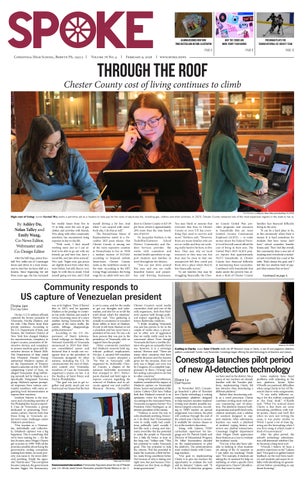

Through the roof




Webmaster and Co-Design Editor
After the bell rings, junior Kendall Wry walks out of Conestoga’s doors and drives to a local restaurant to start her six-hour shift as a hostess. Since beginning the job three years ago, she has increased
working more just so I can afford to be able to go out with my friends, go and have fun, have a social life, and also drive around,” Wry said. “Right now, gas prices are slightly down from what they were before, but still, they’re very high. So with this in mind, I find myself going out less, and I find
of the most expensive counties in Pennsylvania to live in. With a median income of $123,041 according to financial website SmartAsset, Chester County ranks as the wealthiest county in the state. According to the MIT Living Wage calculator, the living wage for an adult with zero chil-

families face financial difficulty
dent Services provider. She works with counselors and mental health specialists to support students and families in need throughout the district.
“You can just drive around this area and you see really beautiful homes and properties and thriving businesses.
Community responds to US capture of Venezuelan president
On Jan. 3, U.S. military officials captured the former president of Venezuela, Nicolás Maduro, and his wife, Cilia Flores, from their private residence. According to the U.S. Department of State and Reuters, the Southern District of New York first charged Maduro for narcoterrorism, conspiracy to import cocaine, possession of destructive devices, and conspiracy to possess machine guns and destructive devices in March 2020. The Department of State stated that President Donald Trump authorized Maduro’s capture after the Department of Treasury issued a sanction on July 25, 2025 categorizing Cartel of Suns, an alleged Venezuelan drug trafficking network led by Maduro, as a Specifically Designated Terrorist group. Maduro’s capture prompted responses from various community members, with some organizing local demonstrations to express their reactions.
Liselotte Harrity is the treasurer and a founding member of the Philadelphia-based nonprofit Casa de Venezuela, a group dedicated to promoting Venezuelan culture. Harrity feels that those living in Venezuela underwent many challenges under Maduro’s presidency.
“Our reaction as a Venezuelan, individually and collectively, (Maduro’s capture) was a big happiness. This is something that we’ve been waiting for — for the last 26 years, since (Hugo) Chavez got in power in 1999. With all the promises possible about fixing the government, ending corruption, making lives better, no more poverty, you name it. He never delivered anything. Totally the opposite,” Harrity said. “The corruption became rampant, the government became bigger, the bureaucracy
was at its highest. Then (Chavez) dies in 2013, and he appoints Maduro as his prodigy to continue his work. Maduro just made it worse, becoming more of a narco enabler, having Venezuela be the gateway of the narco traffic, the cartels, killings, disappearings, political prisoners.”
According to the U.S. Department of State’s informational webpage on Maduro, the National Assembly of Venezuela announced in 2019 that Maduro consolidated power and declared that it would not recognize him as the president of Venezuela alongside 50 other nations, including the U.S. To commemorate the end of Maduro’s control over Venezuela, members of Casa de Venezuela organized a prayer on Jan. 4 at the Basilica of Saint Peters and Paul in Philadelphia.
“The goal was just to get together and pretty much put our hearts and our hopes that the best
is yet to come, and for the media to get our thoughts and information, and also for us to tell the truth about what’s the situation,” Harrity said. “Our gathering is actually to counteract or (counter) those rallies in favor of Maduro.
It’s just to tell them Maduro is not a president and has never been a president of his own. He was a de facto person that was put in the presidency of Venezuela with no support from the people.”
Other community members feel Maduro’s removal held significant political implications.
On Jan. 4, around 500 residents in Chester County attended a “No War in Venezuela” rally organized by Indivisible Chester County, a chapter of the national Indivisible movement that emerged in 2017. Participants chanted and held signs to express concern regarding the removal of Maduro and to advocate against war and conflict. Shannon Browne, Indivisible

Chester County’s social media committee chair and one of the rally organizers, feels that Maduro’s capture held foreign political impact regarding the U.S.’s future diplomatic relations.
“I think invading Venezuela was and has proven to be in the couple of weeks since, a precursor to other acts of aggression that we really, really need to be concerned about. Even though Venezuela did have a terrible dictator who gets no sympathy from me, however, it is a sovereign nation,” Browne said. “There are many other countries that have terrible dictators and the reasons given for the invasion, (but) not only was it illegal, not even run by Congress, it’s a complete (suppression) to them. (Trump) said he’s setting a precedent to do that to other countries.”
Along with political reflection, students considered the impact of Maduro’s capture on Venezuela’s future. Senior and president of the Latino Culture Club Sara Vallejo feels that Maduro’s removal is an optimistic event for the nation.
According to the Associated Press, Venezuela recognizes former Vice President Delcy Rodríguez as an interim president of the nation.
“Violence is never the way to solve absolutely anything. However, I do think that (Venezuelans) were in really, really bad conditions politically (and) socially. I feel like such a strong and traumatic event like this has potential to make the people in Venezuela live a little bit better, at least in the long run,” Vallejo said. “This has potential to make Venezuela great. This has potential to help the citizens. This has potential to make the economy a little bit better, make living conditions better. Not because of who is taking over right now, but just because (Venezuelans) are free from an illegitimate government.”
ing really hard to be here, to live here. They may rely on local resources or they may not, but they may be close to that one unexpected bill that could put them into a place where they’re less financially secure.”
To aid families that may be struggling financially, the Ches-
cost of living in their area. The United Way’s 2025 ALICE project reports that approximately 59,573 households in Chester County face financial difficulty in maintaining basic necessities. Combined with households that make under the poverty line, almost a third of Chester County
“It can be a hard place to be, in this community where there is money. It is hard sometimes for students that have versus don’t have,” school counselor Jennifer Kratsa said. “But I feel like overall, this community does a nice job of (making sure) everybody is included and everybody has a seat at the table. That’s always the goal, and I feel like our students kind of support that mission that we have.”

Conestoga launches pilot period of new AI-detection technology
In November 2025, Conestoga launched a pilot of Turnitin’s new Clarity technology, a writing composition platform designed to help teachers monitor students’ writing and identify possible academic integrity concerns. According to TESD teacher on special assignment Lisa Lukens, the pilot will continue through the end of the school year. Clarity is currently available for various classes to try at the teacher’s discretion.
Along with Lukens, TESD curriculum supervisor for language arts Dr. Patrick Gately and Director of Educational Program Dr. Mike Szymendera decided on the implementation to pilot the platform. The administration team worked closely with Conestoga teachers.
“Our goal in implementing Clarity is to give our teachers the opportunity to evaluate the tool and its features,” Lukens said. “It is the first AI-detection program
we have used in the district. Since many of our teachers are already familiar with the Turnitin platform, implementing Clarity felt less intrusive than introducing a different platform.”
Rather than functioning solely as a word processor, Clarity combines writing tools with process monitoring and AI-detection. The platform features builtin grammar and spell check tools, citation assistants, and a sidebar AI assistant designed to support students. After submission, teachers can watch a playback of students’ typing history and review any chatbot interactions.
Conestoga English department chair Megan Doyle appreciates these features as a way to evaluate her students’ needs.
“For me, it has also been valuable in looking at what students are asking of the AI assistant so I can tailor my teaching,” Doyle said. “For example, if students are asking the AI assistant for help on outlining, or what a specific form of grammar is, I know I should review that more in class.”
Some students have faced problems with adjusting to the new platform. Junior Kylee O’Keeffe encountered difficulties when using Clarity in her AP Research class to write assignments.
“It was really different using it for the outline compared to the final draft,” O’Keeffe said. “What I’ve noticed about Clarity is that there are some formatting problems with bullet points, charts and stuff. But when we were just writing the essay, it was pretty similar to Word. I spent a lot of time figuring out the formatting when I was first using it which made it kind of inconvenient.”
After the pilot period, the school’s technology administration will determine whether Clarity becomes a long-term tool.
“Overall, I believe it’s been a positive experience so far,” Lukens said. “Our goal is to gather honest feedback on the tool from teachers and students and assess its validity with identifying AI-generated text before committing to any future licensing.”
Conestoga High School, Berwyn
Tvisha Jani Co-Copy Editor
Alumna becomes New York Times bestselling author, illustrator
Grace Lu Staff Reporter
Crafting in Clarity: Junior Kylee O’Keeffe drafts her AP Research essay in Clarity, a new AI and plagiarism detection platform underneath Turnitin. Last November, Conestoga began offering the pilot technology to all teachers and classes.
Grace Lu/The SPOKE
THE LATEST DEVELOPMENTS
IN T/E AND NATIONAL NEWS
SCHOOL MINI-THON
RAISES MORE THAN $23K
From Jan. 12 to 23, Conestoga’s Mini-THON committee participated in the annual DonorDrive Fundraising Challenge. e club has raised more than $23,000 for the Penn State Four Diamond Foundation, an organization that supports pediatric cancer patients and research. rough the fundraiser, schools who reached fundraising goals received additional donations from outside organizations or individuals.
TESD SCHOOL MEMBER RESIGNS
Former Region ll school di-
rector Dr. Robert Singh resigned due to relocation on Dec. 19. At the Jan. 15 school board meeting, members voted on who will ll the vacant seat. Henry Zink will serve as the newly elected member of the school board and will begin his term in the rst week of December 2027.
PLANET FITNESS LOCA-
TION OPENS IN BERWYN
On Dec. 31, 2025, Planet Fitness hosted the grand opening of its newest Berwyn location. Located on Swedesford Road, the gym o ers memberships, advertising a ordability and an appeal to teenagers. In celebration of the opening, Planet Fitness donated $1,000 to Philabundance, Philadelphia’s largest food bank.
2026 PENNSYLVANIA
TOLL SCHEDULE SEES LOWEST INCREASE SINCE 2014
Starting on Jan. 4, the Pennsylvania Turnpike’s approved schedule is implementing a 4% increase in tolls. The rise in price will be used to repay the Act 44 debt service. The act has provided more than $8 billion to the Commonwealth of Pennsylvania.

Chesco Connect introduces propane buses into service
By the end of February, community transport program
Chesco Connect plans to nish replacing 18 gas-powered buses with propane buses to take advantage of the economic and environmental bene ts of propane. Currently, Chesco Connect specializes in door-todoor shared ride transportation for county residents.
Chester County commissioners promoted the transition from gas to propane buses with Chester County’s Climate Action Plan of 2021. e plan’s goal is an 80% decrease of greenhouse gas emissions in the entire county. e commissioners promoted the transition from gas to propane for propane’s environmental bene ts, but Chester County’s Community Transit department independently wanted propane buses for cost-savings in comparison to their existing gas buses. Director of transportation for Chesco Connect Gene Suski oversaw the introduction of 13 propane powered buses.
“Emissions on a propane bus are about 60% less than a gasoline bus, so they’re a much leaner alternative,” Suski said, “Obviously,
as a county department, we want to comply with the plan. But in all honesty, (Chester County’s Community Transit Department) probably would have went with these (new) buses regardless just because the signi cant cost savings in fuel.”
Suski noticed that propane has become cheaper than gasoline, and its environmental benets are an added bonus. In a press release posted to the Chester County NewsFlash section, the county estimated that propane buses will cost the county almost 50% less than gas buses in maintenance and fuel costs.
“During the course of the year, the amount of miles that we run our buses, you can save anywhere between $15,000 (to) $20,000 a year per bus just on gasoline and other maintenance costs that you would incur using a gasoline vehicle,” Suski said. “So basically, in a year, it kind of pays for itself.”
Currently, a propane provider wet elds, or directly fuels, Chesco Connect’s propane buses. Because of delievery fees, utilizing wetelds can counteract some of the cost-saving bene ts of propane.
e county’s facilities department has a bid out for a propane temporary fueling station to be built
by this spring at the Public Safety Training Campus in Coatesville. For the future, Chesco Connect o cials plan to work with the Pennsylvania Department of Transportation to make a permanent fueling station.
Junior Danyan Yang is the co-president of Conestoga’s Greening ’Stoga Task Force club, a group focusing on environmental e ects and sustainbility. She appreciates additional environmental support
that Chesco Connect is implementing at the local level. However, Yang also feels that more can be done to promote a cleaner earth.
“It (implementation of propane buses) is a good step for-
ward because again, it’s local as you said,” Yang said. “I’m

Easttown Township receives Growing Greener grant
On Dec. 11, the Pennsylvania Department of Environmental Protection (DEP) awarded Easttown Township a Growing Greener grant. It provides the township $41,217 to build rain gardens and ow-through downspout planters on residential or commercial property over the next three years.
e DEP gives the grant to projects related to watershed restoration and protection, abandoned mine reclamation, and abandoned oil and gas well plugging.
e Environmental Advisory Council (EAC), which is a section of the Easttown Board that identies environmental concerns, promotes conservation and undertakes environmental projects. It has built four residential rain gardens and ve downspout planters with the funds from the grant.
ing waste, to help build the around a few hundred dollar downspout planters. e EAC have also used funding to donate 30 rain barrels which help collect and store rain water from roof gutters. Members have also hosted several workshops detailing how to build rain gardens individually, explaining how to set up rain barrels and touring existing rain gardens in the township.
According to Cara Rash, the EAC chair, rain gardens are a type of green infrastructure that most people could implement in their own yards in some capacity. Rain gardens are shallow holes with native plants that capture and slow water ow, while ow-through downspout planters capture gutter water before storing it in layers of gravel, soil and plants to reduce stormwater runo .
“A lot of the EAC’s mission is to provide environmental education and advocacy to the public,” Rash said. “We try to do that through ways that are easy to understand, maintain and replicate at personal residences.”
“For stormwater management, sometimes people want us to be managing their stormwater with a rain garden, and that’s not always possible,” Rash said.
Residents interested in obtaining a rain garden or planter can ll out the application form on the EAC website without cost for the labor or plants. However, residents are to care for and maintain the rain garden or planter by watering, weeding and mulching.
Sophomore Mayon Saha is a member of the Greening ’Stoga Task Force, a club at Conestoga that promotes sustainability, environmental awareness and eco-friendly practices within the school and local community. Saha feels that the rain gardens and the grant will not solve environmental concerns single-handedly but serve as signi cant steps forward.
“I don’t think one grant is just gonna take care of almost decades of over development, but it can certainly make a huge impact,” Saha said. “I think it focuses on the basics of green infrastructure, and I feel like once the public residents start seeing these gardens work, people might start trying by themselves.” 2
e council allocates funding to pay for a landscaper to dig out the rain gardens. e money is also used to pay the Darby Creek Association, which is a nonpro t dedicated to protecting the Darby Creek watershed, and Penn Resources Council, a statewide environmental organization committed to conservation and reduc-
However, Rash clari ed that the gardens and planters were not meant to be complete stormwater solutions and that it was o en a common misconception.


County department earns international recognition
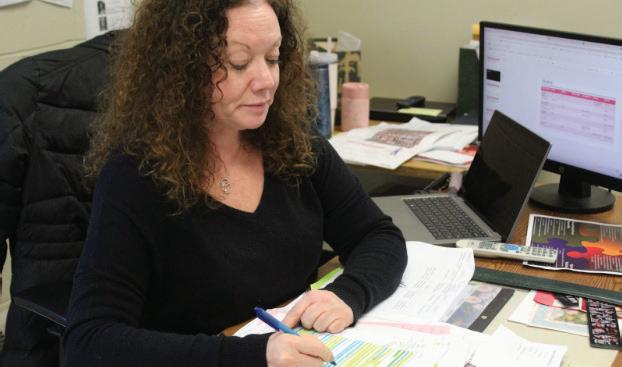
Chester County Department of Community Development (DCD) received international recognition at a three-day conference from Nov. 5-7 in Denver, Colorado. is is due to their work relating to the nonpro t organization Community Solutions. Chester County works closely with the Community Solutions movement Built for Zero. Community Solutions spread its nationwide initiative of ending homelessness to Chester County with the Chester County DCD, housing a subsection within its department known as the Chester County Partnership to End Homelessness. e partnership is a small team made up of two people: Rob Henry, the Chester County Partnership to End Homelessness Administrator, and Kasey Schlack, the Chester County Partnership to End Homelessness Coordinator. Schlack and Henry work closely with Built for Zero to decrease homelessness in Chester County.
“I believe we o cially joined Built for Zero around 2020 or 2021,” Henry said. “Working with them and the data quality means that we’ve got a system in place where we are able to identify people who are experiencing homelessness and get them linked to resources.” e Chester County DCD received recognition for its partnerships’ work with achieving Quality Data for the Chronic Population. e award signies that a county has a strong infrastructure for addressing homelessness. To achieve Quality Data for the Chronic Population there are 29 requirements to meet in a total of three categories: data infrastructure, policies and procedures, and community participation and coverage.
“Built for Zero was a huge accomplishment for the county,” Schlack said. “Chester County is so fortunate to work with the sta at the Department of Community development and Built for Zero.”
The Chester County Partnership to End Homelessness is constantly benefiting the community with programs


like the Emergency Rental Assistance Program during the pandemic and its Coordinated Entry, which helps people find the correct resources for their situation based on their needs.
“We’ve done multiple trainings over the last several years on what we would call homeless diversion, trying to keep people from being in a situation where they need to go to shelter. We’re also working right now on having better coordination of the data around those kinds of outcomes, which doesn’t currently exist,” Henry said.
e team at Chester County’s Partnership to End Homelessness hopes to continue its goal of helping those facing homelessness with the help of Built for Zero and community members.
“It’s nice to be appreciated, but I always feel like we still have a lot of work left to do and on continuing that work that we’ve been doing, while continuing to improve,” Henry said. “I think we owe that to the people we serve to do our best job here, to get everybody housed.”
State senator signs grant expanding career program
Main Line Mentoring, a nonprofit organization based in the Mount Pleasant community of Tredyffrin Township, is preparing to expand its youth program after receiving a $50,000 state grant on Jan. 7. Sen. Carolyn Comitta secured the funding through the Pennsylvania Department of Education. The nonprofit aimts to use the grant to support new job and career readiness initiatives for students and young adults.
“The sooner we can help young people explore career options and get thinking about how they can contribute to our economy and our society, the better positioned they will be for long-term success in school, work and life,” Comitta said in an article by NewsBreak.
Kevin Stroman is the president and founder of Main Line Mentoring. In September, he learned that the organization received the grant after plan-
ning to apply and filing paperwork for the aid.
“When I found out we received the grant, it was tears of joy, tears of just knowing that they believed in what we do,” Stroman said. “It was elation, joy, happiness.”
Stroman founded the program in 1994 under the name “Kids First Now!,” initially focused on basketball games and tutoring. The nonprofit has since expanded to include cultural trips, social activities and community events. With the new funding, Stroman said the organization plans to add workshops, job skills support, resume and interview help, and offer access to certification programs, internships, and job shadowing. He also hopes to purchase computers, printers and presentation tools for career coaching.
“A lot of young adults want to get a job, but they may not know where to start or what skills they need,” Stroman said. “ e goal is to nd out exactly what they need to achieve and help them move forward.”
The program expects to serve about 35 to 50 students and families each year. One active participant, Rehobi Teshome, a 2025 Conestoga alumnus and current freshman at West Chester University, has been involved in the program since elementary school and credits the mentoring with strengthening his confidence and communication skills.
“I think the number one thing, which I keep reiterating, is people skills,” Teshome said. “Being able to work with people, being able to listen and learn, it helped me be more confident.”
As Main Line Mentoring prepares to expand its services, Stroman nds that the mission remains the same as when it began more than 30 years ago.
“It is not about numbers, it is about quality,” Stroman said. “It is about who is really being helped by it and are they truly being helped. We want them to know that life can be good, and that they can succeed.”

Housing costs rise, inflation rates stable, district responds
Continued from page 1. parent, feels that low housing inventory is a product of the district’s above-average housing prices.
Local housing prices see steady increases
Since the COVID-19 pandemic, Chester County has experienced a surge in housing costs as a driving factor in the region’s rising cost of living. According to data from the Chester County Planning Commission and MyChesCo, median housing prices in Chester County have increased more than 47% within the last five years. In 2020, the median house sale price was $375,064; by 2025, it had risen to $552,083, which was $276,083 more than the Pennsylvania median sale price listed on Zillow.
Kratsa feels that the educational quality of TESD schools affects the competitiveness of T/E’s housing market and the rise in housing costs. U.S. News & World Report ranked Conestoga High School as the 10th-best public or private high school in the state, and Niche. com ranked Conestoga as the second-best public school in Pennsylvania in its 2026 rankings.
“We do all the registrations, and a lot of times the parents say that they were waiting for something to come up in this school district or they move specifically from other parts of the country or internationally to get into this district,” Kratsa said. “I think the schools have a very large part of the fact that the sale sign goes up, and the next day the sale sign goes down, and that drives prices up. There are bidding wars, and it gets very competitive around here to get property or a house.” Another factor contributing to the rising housing costs in the region is a lower inventory of housing, which pushes home and rental prices higher as demand outpaces availability. Marketing firm Sundance Associates’ 2025 TESD demographic report highlighted how the next four-year average of new residential units being built is 108, while the previous six-year average was 125. The demographers also found a general decrease in ordinary housing sales, which coincides with the district’s decrease in total enrollment since 2019.
“The inventory is very low because people don’t really want to move out. The interest rates are higher than they used to be,” Bonelli said. “At this point there’s still very few houses out there available, and in neighborhoods, the prices for a single-family home are very expensive.”
Students such as junior Karina Shah have also noticed how Chester County’s housing market has remained competitive. Shah feels that the houses in the local area continue to sell quickly with little vacancy time.
“There are no empty houses in my neighborhood. Recently, there was one that was purchased and then completely got torn down, and they built a really nice house there,” Shah said. “It’s really interesting hearing people talk about how the global housing market is kind of stagnating when it’s just exactly the opposite of what I see. Houses in this area just get snatched up.”
In its 2024 housing report, the Chester County Planning Commission stated that a household earning the Area Median Income (AMI) of $123,041 could afford an approximately $433,130 house, but only 34% of homes sold in 2024 were less than the price.
To help combat housing insecurity and rising costs, the Conestoga Habitat for Humanity (HFH) club works under an international
cause without a house, it’s really difficult to fulfill other things such as education, your health, taking care of yourself, your well-being.”
Residents continue to feel increased, now stabilized inflation
The prices in the last three or four years have gone up faster than they have in any other year. I mean, even a pack of crayons or a pack of markers, the price of those things has gone up dramatically.
Tom
Colman
Founder
of The Foundation for Learning in Tredyffrin/Easttown
organization that builds affordable housing for those in need. Wry is the secretary of HFH and helps keep track of members’ hours and contributions to the club. She feels that a rising demand in housing has increased the number of build sites that the club members attend.
Along with housing in the district, inflation has contributed to the cost of living. The U.S. annual core inflation rate measures inflation excluding food and energy. It remained unchanged at 2.7% in December 2025, according to the U.S. Bureau of Labor Statistics, the lowest level since 2021 when inflation surged due to the COVID-19 pandemic.
Justin Davey teaches economics and notes that national inflation rates have largely stabilized after the pandemic.
results of previously heightened inflation rates. In recent years, the founder of The Foundation for Learning in Tredyffrin/Easttown (FLITE), Tom Colman, has noticed an increase in the funds needed to operate some of the nonprofit’s services. The organization provides programs for students ranging from preschool to high school. According to FLITE’s 2025 annual report, its programs in 2023 cost $295,000 and increased to a total of $485,000 in 2025.
“The prices in the last three or four years have gone up faster than they have in any other year. I mean, even a pack of crayons or a pack of markers, the price of those things has gone up dramatically. It used to be they’d go up 3% in a year, maybe 2%,” Colman said. “But you see price increases of 15%, 20% on some of those items. That adds up.”
Similarly, Rothera feels that inflation still has a major impact on families despite Chester County’s status as a wealthy area.
initiatives to help people who may be struggling financially. Some local organizations, such as Tredyffrin and Easttown Care (T&E Care), work closely with the school district to help aid students and families in need.
Founded in 2005 as a response to Hurricane Katrina, T&E Care identifies people in need throughout the community and organizes programs that assist in housing, medical needs and general necessities. District school board president Sue Tiede feels that both FLITE and T&E Care provide important opportunities to students.
“We have a community that supports our buildings, and that comes in the form of, most importantly, our two community supporters are the T&E Care group and FLITE. They get us access to so much, from school supplies to calculators to scholarships for college,”
Tiede said. “It (the support) can be something just very fundamental, or it can be something that really goes above and beyond, like summer camps, learning opportunities that go beyond the classroom.”
To support students in need, organizations and individuals have used resources from federal programs as a source of financial aid.
TESD schools participate in the United States Department of Agriculture’s National School Lunch program, which supplies free or reduced meals to students who are unable to afford the full price.
Families that earn less than 130% of the federal poverty level qualify for free meals, and those that earn between 130-185% of the poverty level qualify for reduced-price meals. Families who do not meet these requirements but may still need help covering the cost of meals can apply for the T&E Care
Ashley Bonelli, a real estate agent for Compass and a TESD
“I can definitely say from the Habitat for Humanity perspective, there’s more demand for houses, and we’ve definitely attended more build sites to kind of combat that,” Wry said. “It’s definitely beneficial to address housing insecurity, be-
“The United States has pretty much been right around its targeted (inflation) rate of 2%, and then the pandemic obviously shook things up a great deal,” Davey said. “Recently, we’ve normalized inflation and are back close to our targeted range of 2 to 3%.”
Despite the stabilization, residents have continued to feel the
“From my experience, there are a number of families that are struggling and maybe struggling more than they did before the COVID-19 pandemic,” Rothera said. “I just would want people to know that there’s folks that are from all different economic backgrounds that live here and we are, we are just happy to have them here. And we want to do everything we can to help their children thrive in our schools.”
Community addresses financial pressures, cost of living
In response to the cost of living, local community members have created and maintained various
Tredyffrin Township Historical Commission reviews ordinance
ous interest in the ordinance.

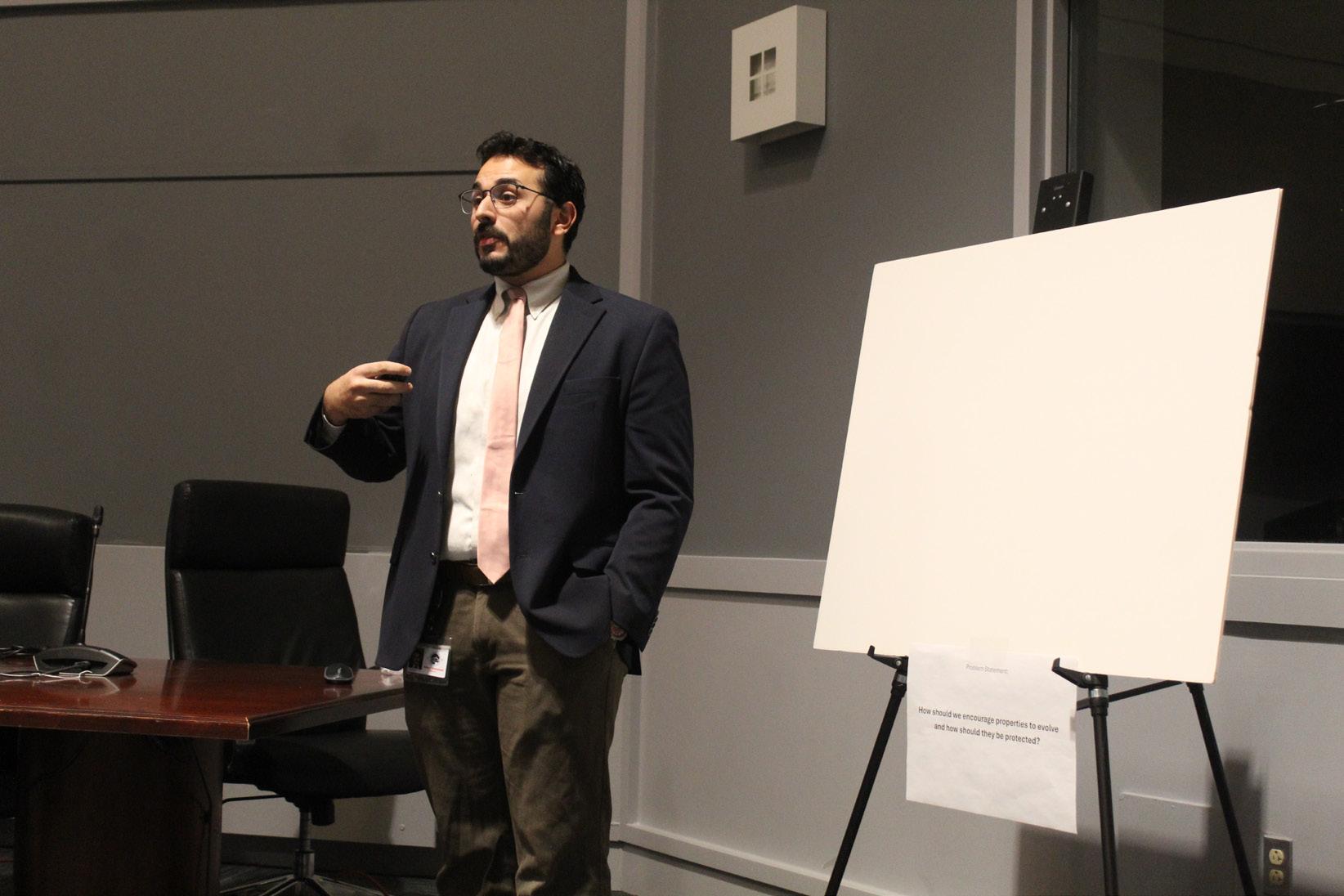
On Jan. 20, the Tredyffrin Township Historical Commission held its first open house public meeting to reexamine the Historic Resource Overlay District Ordinance. The ordinance addresses the township’s overlay on historic structures, an extension of zoning laws that can be applied to properties that may have different zoning regulations. The update aims to increase public engagement in reviewing the overlay. Robert Williams, chair of the Tredyffrin Township Historical Commission, feels that amending the ordinance now is important given the historical celebrations coming up this year.
“It’s the 250th anniversary of the Declaration of Independence,” Williams said. “We have layers of history. Any one of those (historical) eras has properties in Tredyffrin, where buildings remain from those historic moments. This is a time when the 30,000 people who live in Tredyffrin can decide how we want Tredyffrin to look in 50, 100 years, 250 years from now.”
Currently, Tredyffrin Township is a Certified Local Government (CLG) through the State Historic Preservation Office, which gives access to various grant opportunities and benefits to the township’s historic properties. However, in early 2021, the State Historic Preservation informed the township’s Historical Commission that the Historic Resource Overlay District ordinance opt-in clause, which gives properties the choice to participate in the overlay, made the township noncompliant with its CLG status.
According to staff liaison of the Historical Commission, Robert Emmanuel, funding for the review of the ordinance will come from a CLG grant. By Sept. 26, the Historical Commission must finish the new ordinance’s final draft, and Tredyffrin Township must adopt it by the end of 2026. To guide the revision process, the Historical Commission is holding open house public meetings on the third Tuesday of every month from January to April, focusing on specific problem statements. Problem statements are assertions that will be discussed and debated by the public to identify compromises regarding the zoning regulations of historical properties. Emmanuel will help direct the stages of reviewing the overlay ordinance.
“We’re using a pretty tried and true public meeting strategy called ‘nominal group technique,’” Emmanuel said.
“Everyone is going to have an opportunity to speak, and everyone’s going to have an opportunity to debate why they think their ideas are valid. It’s going to be structured in such a way that everyone there is going to have an equal chance to give us equal input.”
Emmanuel created several stages to ensure public engagement in reviewing the ordinance. The first stage included individual stakeholders meetings, which began in September and are continuing throughout the spring and summer, to gather input from residents who expressed previ-
Next, Emmanuel launched a community survey on Jan. 5, allowing residents to provide feedback on the problem statements. Later that day public meetings began and will continue on the third Tuesday of every month until April.
Emmanuel feels that it is especially important that the overlay protects the historical resources in Tredyffrin Township because they make the area remarkable, and residents identify those historical structures with a feeling of home.
“This is a special, unique place that’s important to us, and historical assets and part of that vision that we have of the township,” Emmanuel said. “That gives people a sense of place.

“This includes while a vehicle is temporarily stopped for traffic or a traffic control device. A vehicle that is parked would not fall under the definition of driving.”
Highway Safety teacher James Moran feels that Pennsylvania was late in enacting the law.
The Traffic Safety Unit enforces the law by observing infractions while patrolling. However, Isleib said that he has not seen a substantial decrease in the amount of law violations since June 5, 2025.
The
“This is a law that I don’t see changing,” Isleib said. “So motorists should put their phones down and focus on the most important task when they are behind the wheel, (which is) driving.” In 2023, the Pennsylvania Department of Transportation documented 1,367 distracted driving accidents in Bucks, Chester, Delaware, Montgomery and Philadelphia counties. 14 years after Paul Miller’s accident, Pennsylvania officially joined 29 other states in signing the Paul Miller’s Law in 2025.
“If you speak to people who have lost someone or been injured because of texting while driving, they would definitely agree with that statement,” Moran said. “We’re way behind.” In the 2021 Summary of Motor Vehicle Traffic Crashes data, the National Highway Traffic Safety Administration reported that teens aged 16 to 20 caused 12.1% of crashes in 2020. Moran feels that students should
Scrolling while parked: Sophomore Sami Middaugh uses her phone while
Grace Hu Staff Reporter
Teagan Penny Staff Reporter
Grace Hu/The SPOKE
Design by Emily Wang, Co-Design Editor
From Dec. 12 to 14, Mason Li, a seventh grader at TEMS, was not in the classroom. Instead, he was across the country in Spokane, Washington, where he competed in the 2025 National K-12 Grade Chess Championships.
Initially inspired by his older brother, Li began playing chess at the age of four. His grandfather also contributed to Li’s developing interest, as Li would play with him leisurely at a young age.
“He started really early,” Li’s father Robin Li said. “I think since he was five or six (years old), we started to take him to tournaments. And I said, ‘Maybe he’s really into this thing’ and most importantly, he really likes it.”
After Mason Li started to take chess more seriously, his parents decided to hire professional coaches to advance his skills. At first, Mason Li took weekly lessons with one coach, but as his talents pro-
Middle schooler wins national chess championship
gressed, his parents found him another coach. Today, the seventh grader takes lessons once a week with each coach to learn new chess strategies and openings.
“Sometimes (I practice) by myself online like chess.com,” Mason Li said. “I think (I practice) at least 30 minutes to an hour a day.”
Recently, Li won first place at the 2025 National K-12 Grade Championships after three consecutive days of competing in tournaments. He also received the same title in first grade. Having attended the same competition almost every year since kindergarten, Li is a consistent competitor at this event and appreciates the friencds he made across the country along the way.
“Most of the time the event is held on the East Coast, like Florida or Baltimore,” Robin Li said. “This is the first time it’s on the west coast as we know about it. So it’s kind of a long trip, but he wanted to go and it was good bonding time between the two of us.”
Both Mason Li and his father feel that his accomplishment was a combination of skill and luck due to his disadvantageous ranking when entering the competition. Furthermore, each round of chess could last up to three hours, with 90 minutes for each player to play.
“Well, I definitely think I was the underdog in the situation since I was seated fifth coming into the tournament,” Mason Li said. “But after the seventh round, I didn’t think I won because there were ten other people that tied with me. But I was really lucky to win the tie break situation and I was able to snatch first place.”
Mason Li enjoys chess as a serious hobby and hopes to continue playing in high school and in future competitions. His advice to other aspiring chess players is to never give up.
“If your kids really love something, like an interest and passion, how high of level we can get is really not that important,” Robin Li said.“It’s the journey, really.”


Devon Parent Teacher Organization hosts annual Main Line Camp Fair
Families immersed themselves in an interactive and educational fair on Jan. 21 to discover ways to enrich their children’s summer. The Devon Parent-Teacher Organization (PTO) hosts the Main Line Camp Fair at Conestoga annually to boost engagement among local camps and raise funds for the PTO and its events.
Thirty-nine years ago, parent volunteers suggested a camp fair where families could find enrichment opportunities fit for their children during the summer. The fair has since become a popular showcase at Conestoga, encompassing over 60 camps. The event also includes a door prize: as parents enter, they can scan a QR code for a chance to win a $350 voucher toward any camp at the fair. Camps from all around the

Main Line participate, including some out-of-state.
“It’s really hard to navigate where to send your kids to camp from summer to summer. Especially when you have working parents who are trying to find both child-care as well as engaging, educational or athletic activities for their kids,” said Jess Podgajny, co-chair of the Main Line Camp Fair. “We need a way to meet all these camps in one place at one time and then make the decision-making process faster and easier. I think that’s why the camp fair continues to become such a success now 39 years later.”
The PTO runs the fair with co-chairs, who are responsible for organizational tasks. This year, three new co-chairs joined: Brigid DiSciullo, Jess Podgajny and Julia Tiede. Usually, either the PTO reaches out or the camps reach out to par-
ticipate in the fair. Camps set up tables and booths throughout Conestoga’s lobby and the cafeteria. Many camps provide prizes and games to attract potential campers.
“The Main Line Camp Fair is phenomenal. We have been coming here for quite a few years, and it’s always an incredible turnout. We see a lot of families who choose to sign up for our programs because we are here this evening. This evening, we always make sure to bring our robots with us so kids have an opportunity to test them out,” said Mary Katherine Montgomery, director of summer programs at Benchmark School in Media.
The fair serves as an environment where parents can ask questions and explore different options. The event offers families a variety of program formats including day, sleep away,
artistic, musical and sports camps. Scott Strickler, a district parent, has attended and served as a volunteer at the camp for the past few years.
“It opens up in (my children’s) brain what the possibilities are for them to learn and have a really cool experience during the summer,” Strickler said. “When you’re just looking at a pamphlet or website or something like that you don’t really get the same sense that you can get from

Lauren Pinheiro

On a chilly Friday evening, I stepped into Eshkol Ethiopian Cuisine & Cafe in bustling Ardmore. As someone who had never had Ethiopian food before, I wasn’t quite sure what to expect, but the cozy and colorful atmosphere immediately put me at ease. The restaurant was well decorated with cultural pieces, and despite the tight space, the tables were nicely spread out, so it did not feel crowded.
One feature that caught my eye was the traditional Ethiopian seating: small stools arranged around a low, covered woven basket table designed for communal dining. Although guests already filled the section, it added an authentic touch to the space.
After flipping through the menu, I decided on sharing the meat combo with The Spoke’s Co-Sports Editor, Sosi Sengal, who, with more experience with Ethiopian food than I, guided us to order the Single Meat Combo with a side of Shiro. The dish included Doro Wat,
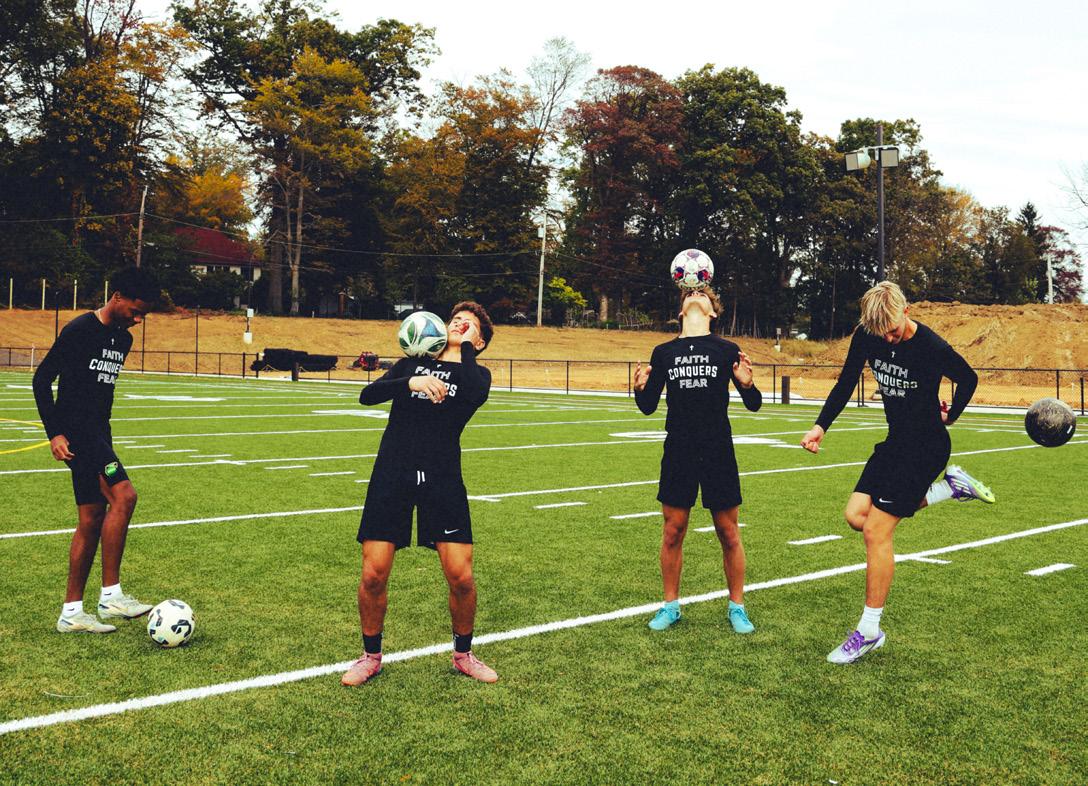
Working tirelessly from prototype to product, junior Ian Choi created his Christian-lifestyle clothing business Faith Conquers Fear Apparel with the goal of spreading Christian ideals. On his online store, Choi sells modern apparel targeted toward teenagers and young adults, including hoodies, T-shirts and shorts.
Choi started the business when he was a freshman and has released around four to five merchandise drops since then. For him, making a profit is not the main goal, as he enjoys the process of creating the clothes.
“I have friends who ask me, ‘Are you in the green yet?’” Choi said. “Or, ‘How much profit are you making?’ But it’s not about that, it’s about glorifying God, and
hopefully these clothes can spark Christ-centered conversations within people who buy them.”
His products feature a short Bible verse or the brand name. Faith Conquers Fear Apparel is named for the Bible verse Isaiah 41:10.
“He (God) is acknowledging that you’re gonna go through hard situations and difficult circumstances, but God’s there, and his presence is there whether you feel it or not,” Choi said.
Choi releases a new merchandise drop once he accumulates enough profit from previous sales, as the process is time-consuming and costly. He creates designs online on platforms such as Canva, then receives sample fabrics from his supplier, Tapstitch. Once Choi confirms how the final product will look and feel, he
begins selling both online and in-person.
In order to publicize his business, Choi posts promotional content on his brand accounts on TikTok and Instagram. Although Choi mostly works alone, his photographer, sophomore Tim Chen, takes pictures for Choi’s advertisements for free.
“It (the experience) definitely helped me learn how to work with other people,” Chen said. “You have to appeal to your client, and meet their standards and meet their expectations.”
To promote new designs, Choi also asks fellow classmates to model for his business. Senior Alyssa Chung tried on the Faith Conquers Fear apparel and posed for photos in the spring of 2025.
“I’m very strong in my faith, and I love that he is so bold in it, and he is bringing it to the school and just having the confidence to make this brand. So, I just felt really honored and proud to try on this clothing,” Chung said. “I think that just inspires me overall as a person to continue to not only just chase after my dreams, but also be bold in my faith.”
Choi plans to continue Faith Conquers Fear Apparel into the future. After he turns 18, he plan to set up a TikTok shop and invest more energy into his business, hopefully reaching a wider audience.
“God’s given me all these things and blessed me with so many things that I don’t deserve,” Choi said. “This is one of those ways I can use those blessings to glorify him.”

a chicken stew, beets, chard, Ayib cheese, a boiled egg and a few Teff Injeras – the fermented bread used to pick up the food. The Shiro consisted of chickpeas seasoned with spicy Ethiopian herbs and tomato. The wait for the food was about 15 minutes, which was pleasantly quick. Shortly after diving into the main dish, I had the chance to speak with the chef and owner, Chef Chaltu Merga. She shared that all the meat used in her dishes is marinated overnight, allowing the flavors to fully seep into the meat, and that turmeric plays an important role in her cooking. She even checked in with me during the meal to make sure I was enjoying everything. The waitstaff was also attentive and helpful throughout the night. When the food arrived, I was immediately impressed by the

especially when paired with Injera. Its savory, tomato flavor reminded me of an elevated hummus with a thin texture. The Injera itself was delightfully soft, spongy and slightly sour. The taste reminded me of South Indian Dosa, another fermented bread used to
Web Managing Editor
Lauren Pinheiro/The SPOKE
Creating connections: Schuylkill Camp for Environmental Education representative Khaliah Pitts discusses with a family about the camp programs. The Main Line Camp Fair’s ability to attract new attendees contributed to its success over the past several years.
Rishika Bhattacharya/The SPOKE
Rishika Bhattacharya Staff Reporter
Kimberly Wang Staff Reporter
The Conestoga atrium echoed with traditional Indian music as hundreds gathered to sing and listen at the 2026 Philadelphia Tyagaraja Aradhana. Tyagaraja Aradhana is an annual Carnatic music festival that celebrates the works of Tyagaraja, a composer of Carnatic music, or Indian classical music. This year, the Philadelphia Tyagaraja Aradhana occured on Jan. 7 from 5:30-8:30 p.m. in the Conestoga atrium. Senior Bhavika Marabathula founded the Philadelphia Tyagaraja Aradhana. Marabathula and Carnatic music teacher Priya Balaj led this year’s festival. The attendees comprised roughly 200 people, many of whom were Carnatic singing students who sang during the festival.
“A lot of people are listeners of (Carnatic music), so it was just an event for the music lovers and also just to honor culture and bring people together,” sophomore and attendee Tejal Jayamurugan said.
Celebrating tradition: Students, adults gather for 2026 Philadelphia Tyagaraja Aradhana
India holds the Tyagaraja Aradhana every year on Bahula Panchami, the fifth day of the waning moon in the Hindu month of Pushya. Indian communities all over the world celebrate the tradition, including those living in the Philadelphia area. Sophomore Dhruti Gaddameedi attended the event with her music teacher.
“There’s more than 1,000 singers who go and sing at his (Tyagaraja’s) resting place, but having it (his work) spread here means that a lot more people can enjoy it,” Gaddameedi said. “I just think it is really important for people to be a part of how amazing the performance and everything is.”
The festival began with a short introduction, followed by the opening song “Maha Ganapatim.” After that, the group sang six introductory songs called the Utsava Sampradaya Kritis. Five longer songs followed, collectively called the Tyagaraja Pancharatna Kritis, which included songs such as the Jagadananda Karata, Kanaka -
na Ruchira and Endaro Mahanubhavulu. Finally, the festival ended with Ramachandraya Janakarajaja as the closing song, as well as a boxed dinner provided by the Telangana Spice Kitchen, a restaurant that serves traditional recipes from Telangana in India.
“We’re just trying to promote and help spread Tyagaraja and his compositions so that kids here can also learn about how important he was in India,” Gaddameedi said. “A lot of kids here don’t really go to India that much, so it’s just like preserving the culture.”
According to Gaddameedi, approximately 50 to 60 of the participants attend Conestoga. People of all ages, ranging from younger children to older adults, all gathered to commemorate and perform group renditions of the works of Tyagaraja.
“Celebrating brings people together,” Jayamurugan said. “It just creates an impact within the circle and values our personal beliefs.”

American Voices students see ‘The Great Gatsby’ on Broadway

As the curtains close at the Broadway Theater, students came home from the field trip to see “The Great Gatsby” Broadway production live.
On Jan. 29, students in Brian Scannell’s American Voices classes traveled to New York City to see “The Great Gatsby” on Broadway. The day trip included both a Broadway performance and a visit to the Plaza Hotel, offering students a new way to engage with a book they recently studied in class.
“For me, (the purpose of the trip) was not necessarily about the themes of the book,” Scannell said. “While that’s super important, I want (my students) to see how different people emphasize certain parts of the book. We’re watching the film version, reading it and watching the play.”
The novel
“The Great Gatsby,” written by F. Scott Fitzgerald, is considered a classic piece of American literature and is often taught for
its depiction of the American Dream during the 1920s. For Scannell, the highlight of the trip was not just the performance itself, but watching many of his students experience a Broadway musical for the first time.
“Many of my students had not been to a Broadway show, so they were kind of overwhelmed by everything,” Scannell said. “But they were really engaged in the play.”
In addition to attending the musical, students planned to visit the Plaza Hotel, a significant setting of two scenes in the novel.
“I really wanted (my students) to see (how) even today, that (the Plaza Hotel) still represents opulence in our society,” Scannell said.
Students who attended the trip expressed interest in seeing how the book comes to life on stage. Sophomore Luisa Noll attended the trip. She felt the musical adaptation differed from the original plot of the novel.
“The musical changed some viewpoints of the book, (where) you cannot read (the) tone of voice or see expressions on (the character’s) faces, which I thought the play did exceptionally well,” Noll said.
Sophomore Brandon Jang felt that the musical’s song and plot offered a different perspective on the characters.
“I thought it (the interpretation of Tom Buchanan’s traits) was really interesting, and I feel like the songs portrayed the characters’ feelings very well,” Jang said. Scannell found that the trip provided an opportunity for students to view literature in a new light. Positive reactions from students about the experience have brought up the idea about bringing similar opportunities to all American Voices classes in the future.
“I would highly suggest that (the trip) becomes part of the curriculum if The Great Gatsby stays on Broadway,” Scannell said. “Everything (in the show) is infinitely interpretable, which is extremely important.”
Alumna becomes New York Times bestselling author, illustrator
During high school, 2011 Conestoga alumna Gabriela Epstein spent much of her time serving as a cartoonist for The Spoke and a goalie for the girls’ varsity ice hockey team. Now, 15 years later, Epstein is the bestselling author and illustrator of five graphic novels.
“I always liked art and my dad was heavily into politics, so I would work with him under a pseudonym and make editorial cartoons to submit to local papers,” Epstein said. “I did that throughout middle and high school, and it was pretty fun because I felt like I had a voice, (especially) because there wasn’t social media.”
Epstein joined The Spoke in her sophomore year after encouragement from English teacher Susan Gregory. In her senior year, Epstein won the 2011 National Student Press Association first place award for Editorial Cartoon. After graduating, Epstein studied oil painting at the Pennsylvania Academy of Fine Arts before transferring to the Rhode Island School of Design to pursue a BFA in illustration. She later worked as a character designer for Nickelodeon. In 2018, Epstein received an offer from Scholastic to illustrate “Invisible: A Graphic Novel” by Christina Diaz Gonzalez, now a USA Today and American Booksellers Association Indie best-seller. Shortly after,
an agent connected Epstein to The Baby-Sitters Club project, where she adapted “Claudia and the New Girl” in 2021 and “Good-bye Stacey, Good-bye” in 2022 by Ann M. Martin. Though The Baby-Sitters Club turned Epstein into a New York Times best-selling creator, she was most proud of her work on “Invisible: A Graphic Novel.”
“‘Invisible’ is a bilingual book. I’m really proud of the translation design that I created for it, (which) has also been used in other books,” Epstein said. “That makes me happy because if it’s selling, that means that there’s more impetus for publishers to buy works like that. I think comics is a uniquely suited medium (for) teaching other languages and representing ESL (English Second Language) kids, so that’s really important.” Following her success, Epstein obtained an opportunity to write and illustrate the graphic novel continuation of the Danny Phantom television series for Abrams Books and Nickelodeon. She has since published “Danny Phantom: A Glitch in Time” in 2023 and “Danny Phantom: Fair Game” in 2025.
“My job was to reintroduce the show to a new generation of fans, so I wanted to re-examine questions the finale kind of answered and leave it open so we could potentially do a lot more books. My assumption was always that I would only get one book, and then (we) sold enough to get a second one (but) again, my assump-
You, yes you, are going to have to take
tion is always, you never know if you’re gonna get another chance,” Epstein said. Outside of her work, Epstein enjoys physical art mediums such as oil painting or sewing, and playing ice hockey recreationally. Epstein cited the lack of interest in girls’ sports she saw while at Conestoga as another source of artistic inspiration.
“I was drawing hockey all the time (in high school). You would get these girls who were otherwise really prim and proper and put them on the ice, (and) they turned into completely different people. Monsters, heroes, gladiators, villains. It was awesome,” Epstein said. “I wanted to draw that and potentially write about that, (but) no one else seemed to. So that’s something that I hope I get to make in the future as an adult.”
Currently, Epstein is based in Austin, Texas. She was most recently working on another The Baby-Sitters Club graphic novel for a fall 2026 release, along with other Non Disclosure Agreement works. In the future, she hopes for a chance to publish an original story.
“I’d just like to put myself out there. I’ve never really considered myself a real cartoonist, because none of my stuff is 100% me,” Epstein said. “And I have friends who publish on a much smaller scale, but they actually put their whole selves out there for everyone to see. I just find that so valiant, and I figure I’ve got nothing else to lose.”


Music in motion: Participants fill the atrium during the 2026 Philadelphia Tyagaraja Aradhana to listen to and sing in the group renditions of
Tyagaraja’s music. The festival celebrated participants’ shared culture and Indian Carnatic music.
Musical ready: Students smile for a photo before watching The Great Gatsby musical on Broadway. On Jan. 29, English teacher Brian Scannell’s American Voices classes traveled to New York City to watch the musical version of a book in the class’s curriculum.
Courtesy Brian Scannell
Raymond Wu Staff Reporter
Ella Peng Staff Reporter
Budding bestseller : Gabriela Epstein’s published works lay on a desk in Conestoga English teacher Susan Gregory’s classroom. When Epstein was in high school, Gregory encouraged her to join The Spoke as a cartoonist.
Vanessa Chen/The SPOKE
Vanessa Chen Business Manager
Clocking in: ’Stoga students at work
The Briiiing of the bell at the end of eighth period marks the end of the school day, but for some students, it means the beginning of a new responsibility part time jobs. Many Conestoga students work part time jobs in addition to attending school. These diverse jobs range from common retail and food service jobs, such as a barista, to more unique jobs, such as a firefighter. Read about students with different jobs below!
Maddie Rakes, senior Employee at Color Me Mine
Issaam Mussani, junior Assistant Teacher at Golden Key Enrichment Q:
Q: What responsibilities do you have as part of your job?


A: I am an assistant teacher, so I'll obviously help kids learn their lessons, but also sometimes I help with more technical stuff like making sure the lessons are prepared and all that. And I also help any kids in the class who are struggling a little bit. I'll try to step in and help them so they don't get too far behind.
Q: Do you have a favorite memory from working?
A: There was this one time we were making an assignment. And (the children) had to work on symmetry with squares and shapes and stuff. And all the kids work together and they're able to solve this really difficult puzzle that I couldn't even do at first. And I was like, ‘I should think about it as well.’ So just seeing how all the little kids can work together and do some good things.
Q: What lessons or skills have you learned from your job?
A: I think I learned how to be a lot more patient because obviously, teaching kids takes time and you have to be patient and let them understand it. And I also learned how to manage my time a lot better since (working) takes up a significant portion of your time. And it also helps you (with) money management, I guess, because I get paid and I have to manage my money now. So just stuff like that.
Sana Bhattacharyya, sophomore Nursery Worker at Trinity Presbyterian Church
Q: What responsibilities do you have as part of your job?
A: So essentially when the parents go to church, I'm responsible for their kids who they drop off kids under the age of preschool years I hang out with them in the nursery and we play games and I make sure that they're safe while their parents are at church
Q: What lessons or skills have you learned from your job?
A: I think the main thing is just being adaptable to meeting new people because kids are always kind of nervous to leave their parents behind So just being open to trying new things with them, meeting new parents and just having a good time


Aiden Lin, senior Employee at Panera
Bread
out on the line, help out in the dining room when I'm
thing. And it's not really predictable day by day. Just whatever needs to get done, I
Q: Do you have a favorite memory from working?

A: One that comes to mind that's funny is there's this guy that works at Rally House. He raves on and on about these things called dirty Dr. Peppers which is milk and Dr. Pepper. So he'll come in, he'll order food and he'll get himself a dirty Dr. Pepper. So he made a bunch of the people behind the counter try it. I had to do a double take before I tried it, but it was lowkey pretty good
William Simon Staff Reporter
French teacher Jamie Cappelletti has taught at Conestoga since 2005. A Penn State graduate, Cappelleti explored several academic paths before ultimately pursuing a career in French education. She began as a student teacher in T/E and has since taught French at all levels, excluding AP, in the Central Bucks School and North Penn school districts. After taking a sabbatical leave, Cappelletti now teaches French 2 and 3 at Conestoga and French 2 at TEMS.
Q: Can you talk about your educational background and how you ended up at Conestoga?
A: I went to Penn State for my undergrad, and I didn’t really know what I wanted to major in, so there was this thing called Division of Undergraduate Studies,
and so I did that for a while. And then, I thought about what I liked most about my high school experience. I originally thought I was going to be a math teacher, and then I realized I wasn’t that great at math in college, so I went the French route.
Q: How did your sabbatical leave affect you?
A: It changed the kind of teacher I am because I took a lot of classes on applied mindfulness and I thought everything kind of slowed down and I try to bring that into my teaching.
Q: What led you to pursue a career in French education?
A: My mother’s first language was Polish, and she would speak that at the house and try to teach me, but I was very resistant to it. I regretted not taking advantage of being able to speak another language. So, when I started learning French in high school, I thought it
was a superpower: You could have conversations with friends and other people wouldn’t know.
Q: If you could teach another class, what would it be?
A: I would want to be able to teach yoga. I know that’s not going to happen in a public school, but I would love to teach it.
Q: What do you like most about teaching?
A: I like getting to know people and their different personalities and how I react to different personalities. I’m always trying to take a different perspective, and I have to come from a place of non-judgment. You can’t judge a student for things because you don’t know the whole story and I think it’s important to model that behavior.
Q: How do you help students with setbacks?
A: I’m a big advocate of second-chance learning, meeting with them one-on-one,
Written and designed by Sophia Cui Co-Design Editor
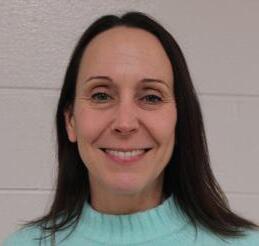
French fanatic: French teacher Jamie Cappelleti smiles for a photo. After her sabbatical leave, Cappelleti returned to teaching at Conestoga and TEMS.
William Simon/The SPOKE
On a Wednesday evening at the library, young students sit together in the storytime room, ready to learn about botany. This session is part of Sprouts, a student-led botany program bringing hands-on science to local kids.
Started in January, Sprouts is a botany program led by junior Yashvi Jain, sophomore Rachel Ma and freshman Keerti Jain. The program aims to teach children ages 7 to 11 the scientific method through short lessons and hands-on activities that build toward self-directed experiments. The program takes place on Mondays and Wednesdays from 6-7 p.m. at either the Easttown Library or Radnor Library. Sessions are free and all the materials students use, including a projector, iPads, colored pencils and notebooks, are provided by the library. So far, 15 kids have consistently attended the program.
“I think this is a topic that is becoming more and more relevant as we’re going on with the environmental concerns, but also, it’s a topic that is pretty easy for kids to understand,” Yashvi Jain said.
Green Thumbs: Students lead botany program
Each session begins with a short lesson on basics of the scientific method along with the structure of the plants, how they create energy and why they are important. Then, students complete activities such as drawing and labeling plant diagrams as a way to reinforce their understanding of the lesson. At the end, they play a Blooket to review what they learned during the session.
“The kids really enjoyed it,” Ma said. “They had very good questions. That made me realize that they were really learning things, and they continued to clarify what we were teaching.”
In January, the program took place weekly, introducing the students to botany with activities and lectures. For February and March, the program will occur biweekly, and the participants will design their own experiments and tests, such as studying how plants grow under different amounts of light and water. They will then present their findings in March in front of their peers.
“We started growing a class plant, so the kids were really excited about that. We also had one of the students come up while we were talking. She was asking us about how she
was going to start growing their own plants in a couple of weeks as part of the experiments, and she really enjoys science and was excited for that,” Yashvi Jain said.
In the future, Yashvi Jain hopes to expand this program to more areas, such as working with libraries in Philadelphia to reach kids who may
not have a strong foundation in STEM.
“My goal is to educate these kids more,” Yashvi Jain said. “I make sure they’re able to foster
an interest in STEM with more hands-on experience, as opposed to just listening to lectures in school. They have an opportunity to come out to the
library, look for experiments, put on more hands-on experience, and get an idea of what scientific experiments would look like.”
Days for Girls hosts first donation drive

Vaishnavi Sriadibhatla Co-Staff Development Director
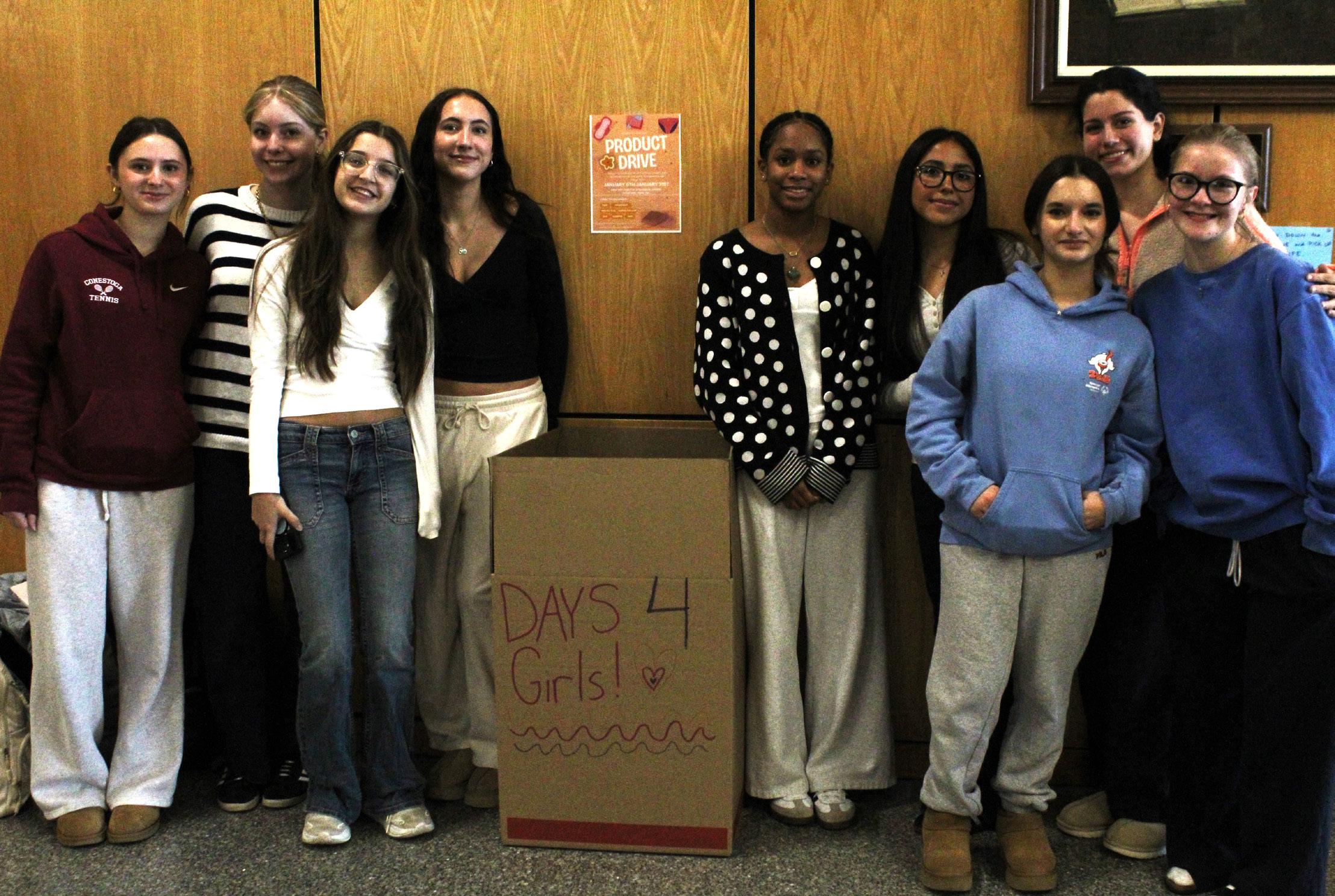
As students walked through the main lobby, many came across a set of brightly decorated pink bins. These boxes belonged to Conestoga’s newly founded Days for Girls club. The club hosted its first donation drive for menstrual products from Jan. 7- 31.
Sophomores Anna Rosa Calia and Carolina Pollack founded the club at the beginning of the school year, and it has since grown to more than 70 members. The club’s monthly meetings alternate between group planning for fundraisers and holding discussions on period health and menstrual inequity. Hoping to make an impact beyond the classroom, Calia and Pollack spent the summer researching various organizations they could support. Their search ultimately led them to Days for Girls, an international organization dedicated to expanding global access to menstrual care and education.
“Over the summer, I talked to Anna Rosa. I was like
‘Hey, do you want to start a club this year?’ And then we talked about a few options, and we decided that this one would be the most interesting,” Pollack said.
The sophomores then completed an application process with Days for Girls International. After receiving clearance, they asked science teacher Janet Wolfe to serve as their faculty adviser and went through Conestoga’s club registration process. After reaching out to the nearest Days for Girls Collection Point, the Conestoga chapter worked to understand its specific needs. The Collection Point gave Calia and Pollack a list of requested items, which ultimately inspired the club to organize a donation drive. The donation drive marks the club’s first major initiative since Calia and Pollack established it in October.
“I think from our perspective, we seem like we’re only doing a small part,” said sophomore and club social media manager Peyton Vaughan. “But when we’re contributing alongside the other branches in all the col -
leges, high schools and the ones globally in other countries, when we bring together all these donations, it really adds up to something that is very big for these places that need these things.”
The club collected menstrual products including pads, tampons, washcloths and underwear. When the drive ended, club members met after school to prepare and organize the donations by folding the underwear and washcloths into boxes. They plan to ship all of the donated products to the Days for Girls Pennsylvania Collection Point in Grove City. The products will be used to assemble hygiene kits that will be distributed worldwide to countries such as Grenada, Haiti, Liberia, Niger and Peru.
“Even in our school bathroom, there’s free menstrual products, but that’s not even a thing everywhere else,” said freshman and club secretary Violet Koster. “There’s parts of countries where people just use pieces of cloth and fabric, and that’s not okay. We need to help get rid of that in impoverished areas.”



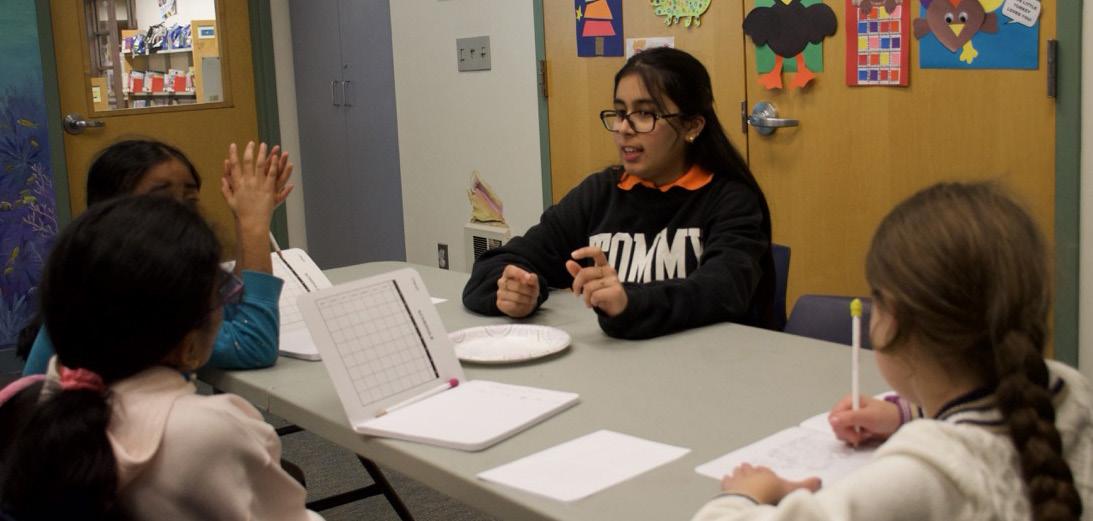
Learning together: Junior Yashvi Jain helps participants understand lecture material about the structure of plants. Jain, alongside sophomore Rachel Ma and freshman Keerti
Jain, started the Sprouts program at the beginning of January to teach children ages 7 to 11 the basics of botany and the scientific method.
Rajan Saha/The SPOKE
Rajan Saha Co-T/E
Vaishnavi Sriadibhatla/The SPOKE

On April 11, 2024, Harvard College announced that applicants to the school would once again be required to submit standardized test scores, becoming part of a growing trend that, while at first glance appears concerning, is in reality a positive development. Because the COVID-19 pandemic kept most students at home, many universities switched to test-optional policies, meaning that applicants were not required to submit a score from the SAT or ACT. But even though the COVID-19 threat has faded, most of these schools have remained test-optional. Now that the pandemic is over, col-
Make standardized testing mandatory again
leges should move away from test-optional policies and once again require that applicants submit standardized test scores. First of all, standardized test scores are quite simply a good predictor of college and career success. In fact, according to a 2024 New York Times article, studies have shown that they are actually a more reliable predictor than GPA. Brown University president Christina Paxson wrote in a 2023 article that high school grades “carry the complication of being increasingly subject to grade in-
to determine whether a student earned their high GPA. On the
body and graded specifically to make scores comparable.

to
Take the road less traveled
Travel is the pinnacle of excitement, an escape from everyday monotony that allows us to feel completely and gloriously out of our depth. But most of travel’s extraordinary benefits come from exposure to unfamiliar environments, which many tourists neglect by gravitating toward destinations aptly named “tourist traps” (who would’ve thought?). Although places like London, Paris and Greece are beautiful and great for multislide Instagram posts, too many travelers automatically default to these hotspots as the ideal vacations without giving a second thought. According to Fodor’s No List, an annual report of the destinations with overtourism, fragile ecosystems and struggling communities, five locations “the locals don’t want you to go” were in Western Europe in 2025, and three new Western European countries made the list in 2026. The UN World Tourism Barometer reports
Europe remained the world’s largest destination, with 625 million international tourists from January to September 2025, a 4% increase from 2024. It’s not just Europe; Dubai and Tokyo top the spending and overtourism charts. Sure, these destinations are synonymous with the stereotypical “luxury” vacation — high-end shopping, luxury hotels, Michelin-star restaurants — but ask yourself: Are these experiences so unique they’re worth the high costs and overcrowding? To me, traveling should be an exciting and energizing adventure that improves adaptability and resilience. Everyone knows what to expect when touring the Louvre, and the interior is available on YouTube, so why not go off the beaten path?
Traveling can physically supercharge our brains: We form new neurological connections exploring the unexpected. Additionally, by engaging with foreign perspectives and cultures, we learn from diverse thought processes and improve our creative problem solving. According to professors at Central South University and Durham University, the only requirement for such benefits to our cognitive flexibility, creativity and interests is a novel environment. Travel can result in fun, stress release and success if we’re brave enough to leave our comfort zones.
Places like Tajikistan and Borneo are rarely discussed and highly underrated. These remote landscapes far outshine London’s traffic and decaying nightlife with their amazing wildlife and beautiful alpine lakes. The cost is much lower, too, with large meals costing less than $10 and decent rooms available for as little as $20 a night. Some may argue that the convenience and safety guarantees of trips to popular destinations partially justify the exorbitant prices. It’s reasonable to believe that countries with small tourist markets are less safe for tourists. However, scientific polling company Gallup ranked Tajikistan as the country with the highest Law and Order index of 2022, and Uzbekistan was ranked ninth. With careful research and smart planning, we can make trips that are affordable, culturally diverse and safe. As we inch closer to college and independence, we gain the power to make some bigger decisions, which often involve spontaneous trips and travel. Traveling to unique places in one’s youth will create the best moments and experiences to look back on, even more so for a group trip with friends. So before you leave the “Japan 2026” group chat claiming you have no money, consider suggesting an idea: Anyone down to go backpacking in Tajikistan?


dence that test-optional policies decrease diversity. A 2025 study by researchers from Dartmouth College found that the ability to apply test-optional dissuades some high-achieving disadvantaged students from submitting test scores, hurting their chances of admission because to admissions officers, a strong test score is better than no test score. This is another reason why submitting scores should be mandatory: Since students who apply test-optional are at a disadvantage anyway, all test-optional policies do is hide the size of that disadvantage, as it’s much easier to
gauge the difference between two test scores than between a test score and no test score.
Many supporters of making testing optional point out that students from wealthier families have an advantage when it comes to standardized tests, as they have access to tutors, test prep companies and other resources. However, these privileged students have an advantage in all fronts, not just testing. The solution to this problem is to consider the financial background of a student when evaluating their application, not eliminate an important indicator. This would make the application process more fair and increase diversity, though it is critical that admissions officers don’t penalize students for potentially needing financial aid. So, even though it might be nice not being forced to take the SAT or ACT, making the submission of standardized test scores mandatory is both the best option for colleges and the fairest option for applicants.

Why the 2000s are more Furby than Barbie

Nishta Subramanian Staff Reporter
If you scroll through social media, you may notice that trends and pop culture from the 2000s are making a comeback. This might include vinyls, low-rise jeans, wired earphones and Polaroid cameras that produce photos with grainy filters. People, especially teenagers, are embracing the colorful and eye-catching trend dubbed the Y2K aesthetic.
According to the article “Inventing Y2K” from BRICKS Magazine, “No one expected the ‘cultural void’ of the 2000s to become so beloved — yet, after the Y2K
aesthetic’s emergence in 2014, it has firmly cemented itself in the cultural zeitgeist.” Despite being from a different era, Generation Z feels nostalgic for the 2000s. Many shows and media have become popular again, like “Gossip Girl,” “27 Dresses” and “Gilmore Girls.” This begs the question: Are the 2000s actually romcom worthy?
Many teenagers feel pressure to be a hyperpolished and a filtered version of themselves, mainly because of social media and peer pressure. Additionally, author Aditya Gaikwad said that “For Gen Z, the early 2000s are a glimpse into a world they just missed. A curiosity for a pre-social media world, where people connected differently.” These Y2K trends offer people escapism and a feeling of individuality, which causes them to overromanticize the 2000s.
In spite of the glitz and glamour, many young people forget that the 2000s had their
SORRY, WE MISSPOKE
own problems and disasters, such as the 9/11 terrorist attacks, the Iraq War and Hurricane Katrina, which caused a catastrophe in New Orleans. During the 2000s, the media distracted people from the instability and corruption that was happening in the world. Another problem of the 2000s that can be compared to the Gilded Age was wealth disparity. As reported by Federal Reserve data, “For the top 0.01 percent of tax filing (American) households — that’s the top 1 in 10,000 — incomes rose an average of 29 percent between 2001 and 2010.” The incomes of the remaining households decreased or stagnated, leaving behind high income inequality. Throughout the 2000s, numerous celebrities inspired Y2K pop culture. However, this era was filled with misogyny and was incredibly toxic toward women. Former New York Daily News gossip columnist Ben Widdicombe said that “In the 2000s, it was
open season on young women. It was blatant, horrifying misogyny.” Paparazzi hounded and tabloids harshly reported on female stars such as Lindsay Lohan, Paris Hilton and Britney Spears. While the 2000s were an exciting time filled with new pop culture as well as Y2K trends, it is important to remember that each time period has its own problems. Many of the messier issues are edited and filtered out, which leaves the overglamorized, rom-com version that many people imagine. Young people in particular like the idea of a simpler identity, especially in this fast-paced world where social media is omnipresent, and they want to carry a piece of that simplicity into their current lives. However, we should remember our generation has many unique things to offer, such as better technology and increased cultural representation. We cannot take the present for granted.
In the third issue, on page 11, the article "Freshman competes, teaches traditional Chinese dance" incorrectly referred to Vivian Lim as Vivian Lin and Vivian's Dance Arts Center as Vivian's Dance Studio. Additionally, Vivian's Dance Arts Center is in Cherry Hill, New Jersey, not Schuylkill Haven.
hand, standardized tests are designed by a centralized
popular belief, there is evi-
Eshan Singh Co-Opinion Editor
Ryan Ding Social Media Editor
Ishana Popuru/The SPOKE
Stop calling everything art

A piece of cloth draped across the floor. A printed questionnaire with riveting answers including “ooo” and “ooooo.” A crumpled soda can upside down on a table. If these objects sound like something you would find collecting dust in the closet, congratulations: You haven’t been subjected to the horrors of modern art yet. Forget classic masterpieces like “Dante and Virgil” by Bouguereau, the new trend is after-school kindergarten projects made from household items. Why advance from elementary school paintings if you can earn over $21 million for a 13-by-7-foot rectangle of solid blue?
Although written in jest, the question is serious: What incentives do artists have to invest time and discipline when pieces resembling the innards of a trash can are rewarded? In our accelerated media landscape, art is no longer a means of expression, but a way to provocatively grab attention and fame. As a dedicated artist, I firmly believe that our overly expansive view of art hinders its advancement compared to other fields and blinding us to fairly assessing the quality of a piece. While art degrades in aesthetic and visual quality,
other fields make rapid advancements. Athletics, cine -

“To a certain extent, yeah. I feel like art should have meaning or symbolize something, but it depends on how you interpret it and how you look at it. To me, modern art is not art, but to other people it can be.”
STUDENTS SPEAK OUT


DNA, our constant need for it threatens our individuality.
boundaries and show the best of human potential. Every year, stunning breakthroughs are


but where is the same innovation for art? With sophisticated technology, mediums, tools, we have no reason to expect anything less than meaningful strides toward innovation. Ultimately, this rot will not resolve itself if the art community does not acknowledge the difference between “good” and “bad” art. Due to the subjective nature of interpreting and critiquing art, many feel hesitant to judge pieces on an objective scale. However, it is the honest truth that some art is fundamentally better than others. Just by looking at the technique, color and composition, it is undeniable that traditional paintings like Rembrandt’s “A Night Watch” from 1642 are miles better than a banana taped to the wall in 2019. To me, it’s truly shameful that four centuries later, the public and art elite are more absorbed in spotlighting absurd provocations than valuing the hours that real artists toil through to make one piece. Of course, many people find deep personal or emotional meaning in modern art, and I applaud them for it. Conveying messages and ideas through any medium is difficult, and I am not saying all or even most artists today are lazy. However, I implore people to be honest with themselves and hold art to a higher standard. To find another van Gogh or Monet in our era, we need to revitalize the technical skill and drive that produced global masterpieces like the “Mona Lisa.” After all, if everything is art, then nothing is.
“I think if someone’s calling it art and it has some meaning behind it, yes. I think anything can be art if you interpret it the right way.”


In an age where comfort and convenience are prioritized, it’s easier than ever to passively consume content without ever having to engage critically with it. You can choose a side in a debate without leaving your Instagram feed. Why would you need to do more when every opinion is already out there? It’s uncomfortable, after all, to go against the grain, to do your own research, to say, ‘actually, I disagree.’ So, you don’t. The desire for belonging is human. If you see countless posts online arguing side A, chances are that you will gravitate toward side A as well. It’s important to consider your motivation – are you picking side A because you agree with it, or because someone else has already thought it through for you? Are you able to assess the situation and make an informed decision, or are you picking the safe option? While conformity is wired in our
A survey from Reboot, a foundation dedicated to elevating thinking skills, found that while 95% of respondents felt critical thinking skills are important in today’s world, 85% said that these skills are lacking in the general public. Respondents cited “changing societal norms” as the reason for their decline. The online world is rapidly evolving along with the way we share our opinions. Posters constantly present their opinions as facts and often attack those with opposing views. Increased polarization due to social media has led to sentiments along the lines of, ‘my opinion is the only correct one — if you disagree, you’re wrong.’

The average human has an attention span of 8.25 seconds, according to Time magazine. To earn a place in this minuscule window, statements online must appeal to quick, emotional processing over rational, thoughtful reasoning. Likes and shares are
social currency; sharing a hot take is sure to garner online attention. Opinions have become a commodity. Now easily given, they hold less value. Emotionally driven, biased or uniformed opinions are abundant and create a polarizing atmosphere. Due to this, the gray area of nuance is shrinking. Complicated topics or stances are often watered down for comfort of public consumption. Because of the black-and-white culture online, people are often forced into extreme sides of a complex issue without a full understanding of it. According to Pew Research, 79% of surveyed Americans believe access to social media and the internet has led to a more divided political culture. It’s not just politics — anything you can have an opinion about, people have already made a case for or against. Being forced into a simple “yes” or “no” category for complicated issues not only erases the valuable gray area but also discourages further thought. If there’s no space to re-evaluate and form a nuanced opinion, then original and thoughtful takes cease to exist. It’s hard to hear yourself think over the noise of the internet. Original opinions seem hard to find, and the rise of “rage bait” and misinformation has led to a critical thinking crisis. Your views are valid, even if they’re nuanced or don’t match your peers. Your opinion matters.


“Everything is Embarrassing” is not only the title of the hit song by Sky Ferreira, but also the deep-rooted mantra in a lot of high schoolers’ minds. Embarrassment is a deeply human emotion that shapes our experiences and behaviors. In adolescence especially, it feels as though every word that comes out of your mouth and every movement you make has the potential to be mortifying.
In a study on adolescent self-consciousness, lead researcher Leah Somerville of Harvard University found that “teens’ sensitivity to social
evaluation might be explained by shifts in physiological and brain function during adolescence, in addition to the numerous sociocultural changes that take place during the teen years.” Teens are psychologically predisposed to be more self-aware during their transition to adulthood. This can explain why so many high schoolers experience heightened insecurity. The result of this seemingly inescapable self-consciousness is a desperation to avoid embarrassment. The concept of cringe is the greatest indicator of teens’ phobia of humiliation. People are so afraid of being perceived as weird or cringey that they often stifle their own interests, sense of humor and personality to maintain social approval. Traits that are seen as stereotypically nerdy or geeky are shunned in favor of a blase attitude. Most teens would much rather blend into the crowd than be noticed for something unconventional. The worst thing you can do in high school is look like you care.
Although I can understand the fear of judgment and ostracization by peers, I don’t think embarrassment should be so dreaded. The benefits of embracing embarrassment far outweigh the negatives. I can attest to that. In eighth grade, I dressed up as Draco Malfoy for a Harry Potter Spirit Day. Although I had not participated in any spirit days prior and had to purchase a blond wig from Party City, I walked into school in my costume with inspiring self-confidence. It was definitely awkward, and also very itchy, but the real lesson I took away from that day was that being embarrassed isn’t that scary after all. The more and more you do “embarrassing” things, the less humiliating they will feel. Savannah Ford, a reporter for Baylor Lariat TV News, recounts her own foray into embracing embarrassment, saying she sang Taylor Swift karaoke on a cruise even though she wasn’t confident
in her singing skills. Her imperfect performance was met with resounding support for her stage presence. Ultimately, Ford learned that “practicing embarrassment trains you to stop running from awkwardness and instead realize you can survive it.” Doing embarrassing things is an important avenue for growth and self-discovery. By getting so caught up in the persona we put on for others, we lose a bit of our real selves. Don’t let embarrassment stop you from laughing loudly, expressing affection and enjoying your hobbies. Overcoming this irrational fear can start with small things, like raising your hand in class even if you’re not sure about the right answer. Welcome the way you stumble over words sometimes and the resulting heat in your face. Try

Tabitha Hawkins, juniorJonah Neeb, sophomoreStella Sau, freshman -
Paige Vachris Staff Reporter
Saktisri Gowrishankar Multimedia Editor
Mary Wolters Co-T/E Life Editor
Hitz/The SPOKE
US number 1 ranked women’s squash player visits girls’ squash team
After school on Dec. 17, the Conestoga girls’ squash team warmed up and began practicing at the Berwyn Squash and Fitness Club like every other practice. Some of the girls then drilled through different stations, while others grabbed smoothies before getting back to playing. Chatter was everywhere, all anticipating a promised surprise.
Soon, the U.S.’s No. 1 women’s squash player Olivia Weaver walked in on Court 6. Weaver grew up in Philadelphia, attending Germantown Friends School and then played at Princeton University. Weaver began playing squash at the Philadelphia Cricket Club when she was 5 years old, and won many awards and titles during her junior and college years, including multiple All-American and All-Ivy honors. Now, as the No. 1 in the U.S. and No. 4 in the world, she plays for Team USA, and was part of the team that earned silver medals at the 2022 and 2024 Women’s World Team Championship and gold at the 2023 Pan American Games.
Sunil Desai, the coach of the Conestoga’s girls’ squash team, has known Weaver for about 10 years through junior and school competitions in the Philadelphia area. Desai
coordinated her visit to the Conestoga team through the National Squash League.
“Olivia’s visit was originally scheduled as part of the National Squash League competitions in which professional players participate in clinics at various locations,” Desai wrote in an email. “Olivia was not able to make the original date due to her schedule, but, reflecting the kind of exemplary person she is, she made time at a later date.”
Introducing Weaver as a special guest, Desai surprised the team with her visit. Sophomore Luisa Noll and her teammates were practicing when Weaver walked in.
“We all idolized Olivia so much that when we all saw her, we were all fangirling,” Noll said. “We were like, ‘Oh my god, she’s right there — what do I say to her?’ I feel we were all the same person in that moment, which I thought was crazy.”
During the visit, Weaver played for about 15 minutes with every player in small groups on both the varsity and JV teams. While the rest of the team worked on fitness, one player would rotate and practice with Weaver. Weaver rallied with each player, teaching and giving advice. After individually hitting with the team, she played an exhibition match with assistant coach Rachel Masek and ended the
practice with a Q&A session.
“You look at her play online, and you’re like, ‘Oh wow, that’s super cool,’” Noll said. “But if you see her play in person, you really see a more in-depth version of that, because you can’t communicate between a screen. We were asking her random questions, like ‘What’s your favorite shot? How do you mentally prepare to get into matches?’ I even asked her where she got her shoes from. You can see her through your own eyes, and you can see little details. It’s so different, in such a great way.”
According to Desai, he and the team hopes for more visits from professional players in the future. Weaver’s visit to the team served as a positive and fun learning experience for the team.
“I think (the players) were inspired to work harder themselves and hopefully each had at least one personal breakthrough in some way with some aspect of their squash skills or even outlook on life,” Desai wrote. “I think (Weaver) is a living example that hard work produces results and that with great success comes great responsibility to effectively represent not only herself, her family and her school, but also girls and young women generally, her country, as well as the very sport of squash.”
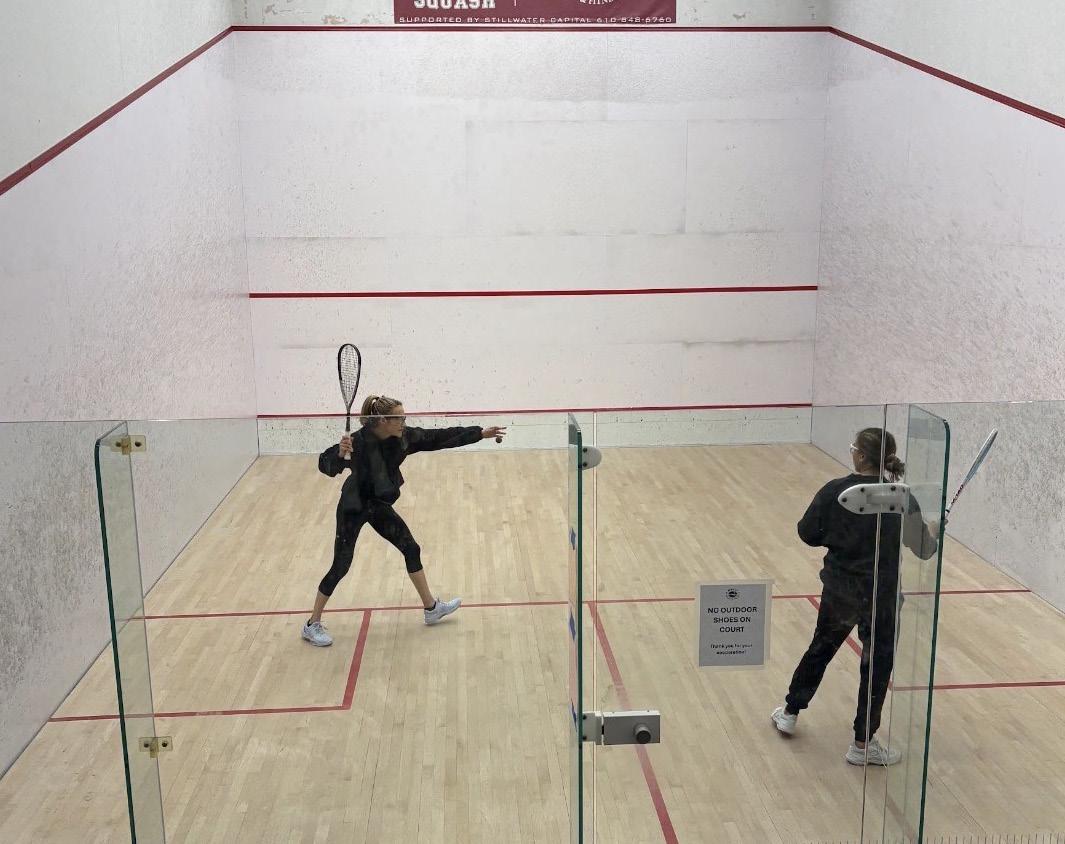

latest golf season. Previously, the Daily Local News named Moran Coach of the Year in 2023
Charlotte Liao Staff Reporter









and club leaders give announcements on club news. When the club was first formed in the 2021-2022 school year, it consisted of only six members. The club’s population has tripled since it was founded, with the largest increase in members being this year. Due to the increased number of members and leftover funds from previous years, the club fee was lowered from $325

last year to $275 this year. This is also the first year that the club has club-owned equipment. From Jan. 24 to 25, members of the club competed at the Easton Youth Trophy Tournament at Lancaster.
The club leaders believe that the Club Fair this year was a big factor in helping the club gain more members. The club attended the Club Fair for two or three periods last year, but was there for an entire day this year.
“Something I think really helped a lot is that we brought an actual bow over here,” junior and club president Christina Li said.
“I’m trying to let people actually try on our archery equipment so that they can have a feel of how cool that is.”
The leaders noticed that many of the new members, who are mostly freshmen, arrived with no archery experience, which made teaching them rewarding. Zhao said that watching beginners improve over the weeks is one of his favorite parts of running the club.
“We see all the new members that we’re constantly teaching. They came in here with virtually no knowledge of how to do archery,” Zhao said. “I think my favorite part is how we’re able to teach people to just have a shoot and get them really into archery.”

when the girls’ golf team won third place at states, central leagues and districts that same year. “I think it’s a result of having really good players,” Moran said. “We won the District (1 tournament) both years that I was named Coach of the Year, so it’s an outcome thing in my opinion.”
Moran began coaching the girls’ golf team when Conestoga created the team in 2021. He first developed an interest in golf during high school and began playing recreationally during college. As a coach, Moran encourages the importance of teamwork, as golf is typically regarded as an individual sport.
“I’ve coached so many team sports here (and) I find it really interesting to see how you can turn an individual sport into a team sport,” Moran said. “What I’ve tried to push the last several years is,
‘You’re playing for your teammates and I know you want to score well yourself, but also look at what you’re going to do for others now and down the line.’”
Many players on the team also received honors from the Daily Local News for their performance the past golf season. Notably, the Daily Local News named junior Jillian Burks the high school Girls’ Golfer of the Year.
“Now that my accomplishments were being followed, it was really a pleasant surprise,” Burks said.
Burks began playing golf when she was 4 years old with her father. Since then, she has become more involved in the sport, competing in various tournaments on the East Coast including the Colonial Classic, the Commonwealth Girls Classic and the Mid-Atlantic Girls Championship. To prepare for the competi -
tions, she practices her technique with her swing coach and works on her mental strength with her mental performance coach.
“Golf is a physical and mental game,” Burks said. “It’s all about staying focused and not letting fatigue get to your head or allowing one bad shot or bad hole ruin your entire round. It’s all about staying positive and really taking it one shot at a time.”
Several other members of the girls’ golf team also earned recognition from the Daily Local News, with junior Corinne McReynolds on the Daily Local News’ First Team, sophomore Nicolette Bottos on the Second Team, and seniors Suri Ahn and Alex Myers receiving Honorable Mentions.
“We have a group of very impressive female golfers,” Moran said. “No one came close to us really this year.”

Although archery is an individual sport, Li and Xu say they want the club to feel unified at competitions, by wearing matching jerseys and support each other.
“It’s

is more established than previous years.
“We
Steady aim: Junior Warren Shi draws his bow and carefully aims at his target. He built his techniques off of past practices and will keep refining them. The archery club hopes to continue to improving its club.
Acing archery: In the setup, the beginner targets sit at the front while the advanced ones are further back.
Following the girls’ golf team’s dominant state cham -
Sophia Wu Staff Reporter pionship win, the Daily Local News honored several players on the team, as well as their coach, Jim Moran, for the team’s successful season.
Moran received the Coach of the Year award from the Daily Local News after the team won the District 1, Central League and PIAA State
Championships tournaments during the team’s
the
Hitting the slopes: ’Stoga skis, snowboards
Written by Miya Cao, Co-Sports Editor
Designed by Emily S. Wang, Co-Design Editor



Co-Editor-in-Chief
For a sport I’ve never played, lacrosse has always been a large part of my life. After watching my sister compete in tournaments across the country and capturing the game through my camera lens for so long, the nagging urge to try lacrosse for myself finally won. On a snowy Saturday afternoon, I met senior Sofia Calvitti in her backyard for my first lacrosse lesson. Calvitti, an experienced member of the varsity girls’ lacrosse team and a Division I commit to Duquesne University, started me off with the basics. On my right side, throwing and catching came together surprisingly quickly. After a few minutes, I could pass the ball confidently. Then we switched to my left side, and my technique was shaky and inconsistent. Calvitti pointed out that
I held my stick too far out to the side. Once I adjusted and kept it upright, passing on both sides felt much smoother. We moved on to cradling, which proved more difficult. My wrists weren’t used to the rocking motion, and the ball fell out more than I expected. Calvitti reminded me to rely mostly on my top hand for motion and let my bottom hand guide the stick. By focusing on my arms, the movement began to click. As we casually passed the ball back and forth, I realized how much fun lacrosse could be, even with just the bare basics. However, my true test was shooting. As Calvitti demonstrated, I was struck by how fast and powerful a shot could be. My first shot sailed well over Calvitti’s head and landed nearly twenty feet behind the net. After several adjustments — aiming for the center of the net and repositioning my
: Finding new aim
arms — I finally sent the ball into the goal with a satisfying swish.
With growing confidence, we moved on to ground balls and dodges. I surprised myself by quickly picking up two-handed ground balls and was even brave enough to attempt a one-handed pickup. Encouraged by Calvitti, I learned a few dodges, including the roll dodge. For Calvitti, each move seemed like second nature.
For me, every step felt clumsy, demanding far more full-body awareness and coordination than I expected.
We finished with stick tricks, where I attempted a spinning pass called a Twizzler — easily the hardest skill of the day. While I could do each part individually, combining them fluidly was a challenge and helped me appreciate the time and creativity players invest in mastering their individual twists on skills.
By the end of the session, I was proud of how much I’d learned.
More importantly, I gained a newfound appreciation for a sport I’d long watched from the sidelines. Lacrosse looks quick and fluid when played well, but it takes coordination and practice to make it appear effortless. Learning the game in a snowy backyard, capped off with the best hot chocolate, felt like the perfect introduction. More than ever, I’m determined to pick up a stick again soon.


and
for three and two


Late games impact girls hockey
Corey Han Staff Reporter
On some school nights, while many students are getting ready for bed, varsity girls ice hockey players lace up their skates for games starting as late as 9:45 p.m. In the Inter County Scholastic Ice Hockey League (ICSHL), six of the 15 girls varsity games this season were scheduled past 9:00 p.m., while only two of the 17 boys varsity games started at that time. According to Conestoga Girls Ice Hockey board president and parent of two former players Shannon Choe, the disparity is not intentional but results from the ICSHL’s scheduling process.
“Even if there isn’t any intent to disadvantage the girls when the boys varsity schedules are built first every year, the outcome is kind of predictable that the girls end up with what’s left,” Choe said. “Essentially, the equity of it is in the outcome, not in the intent.”
For later games, travel and preparation extend the time commitment well beyond the game duration itself. Sophomore Roxy Marscher feels that she struggles to finish all her schoolwork and has little to no free time due to the scheduling.
“It (the late game times) makes it harder to get homework done and the next day I’m pretty tired,” Marscher said. “I know some of the other players won’t go to school the next day because they’re so tired.”
While Conestoga and other girls’ teams in the league continue to play late games this season, frequent late start times were a consistent issue in the past. Choe pointed out that last season’s schedule was more balanced, with girls’ teams receiving earlier game times more often. She believed this was due to the league reserving certain ice slots ahead of time to ensure more equitable scheduling. Although the ICSHL could not move many games this season because the schedule was already set in
early fall, Choe said the league acknowledged concerns about the number of late start times for girls teams and plans to return to reserving certain ice slots in advance to promote more equitable scheduling next year.
“We were trying to open up that (scheduling) conversation and have it be a preconsideration as they’re planning in the future, as opposed to after the fact,” Choe said. “We were really hoping for some change to the schedule this year, but the point is that it just needs to be an ongoing conversation to ensure that it’s on everybody’s mind.” Until the ICSHL implements changes, girls ice hockey players must navigate late nights during the school year. Choe and the board continue to advocate for earlier game times, shaped by their own experiences as parents of former and current players.
“At the end of the day it’s about supporting all the athletes,” Choe said. “Girls hockey deserves the same opportunity to thrive as the other programs.”
Lily Chen
Aiming for the shot: Senior Lily Chen (left) aims her stick towards the net to shoot a goal after quickly learning to pass and cradle. Senior Sofia Calvitti (right), a member of the varsity girls’ lacrosse team, taught Chen to twist her body and swing through the shot.
Riddima Pandey/The SPOKE
Arezo Amin (10)
Blue Mountain, PA
Killington, VT
This year,
Ski Club will take two overnight trips to Killington Resort in Vermont on Feb. 19
Feb. 27
days, respectively. Currently, the trips have 94 and 45 students signed up, with about 30 students on each waitlist. In the past, the club has taken trips to Okemo Mountain Resort in Vermont and Gore Mountain and Whiteface Mountain in New York. The club decided to visit Killington this year for its variety of terrain, medical facilities and overall level of infrastructure in the town.
Michael Kane is a science teacher and the advisor of the Ski Club. He became interested in skiing after watching the sport on TV when he was younger, but did not start until he joined the ski club at his high school. Since then, he has skied in Vermont and California, but he mostly skis at Blue Mountain now.
Sophia Burke (12)
Andrew Galka (12)
Michael Kane
Scan the QR code to watch an accompanying package
US No. 1 women’s squash player visits girls’ squash team Page 10
Students take a shot at archery, club grows Page 10
Hitting the slopes: Conestoga skis, snowboards Page 11
Tryoneer Pioneer: Finding new aim Page 11

Lining up the puck: Freshman Audris Tsai weaves past defenders in a game against West Chester East on Jan. 14. She started playing ice hockey four years ago and has joined clubs like the Philadelphia Little Flyers, and she traveled to South Africa to play for the Chinese Taipei Under-18 women’s national ice hockey team at the end of January. She
Freshman plays for Taiwan national ice hockey team
Over the summer, freshman Audris Tsai sent a highlights video to the Chinese Taipei Under-18 women’s national ice hockey team. In early October, her mother received the news: Tsai had qualified for the national team.
Tsai started playing ice hockey around four years ago. She practices three times a week and currently plays for the Conestoga girls’ varsity ice hockey team as a center. Tsai also plays for the Philadelphia Little Flyers 19U AA Black team. Tsai’s father encouraged her to try out for the Chinese Taipei national team, which competes in the International Ice Hockey Federation,
after learning about the team on a visit to Taiwan.
“I think he searched it up online because usually every country has a national team, so he just wanted me to try,” Tsai said.
Tsai has dual American and Taiwanese citizenship, allowing her to try out for the Chinese Taipei national team. Since Tsai could not attend the in-person tryouts, she submitted a video of her ice hockey skills to the coach.
“Basically, we sent in the videos, and then they had evaluations for two months,” Tsai said. “I didn’t know if I would make it, but I was obviously surprised, and I was really happy because I can represent a national team.”
The Chinese Taipei Ice Hockey Federation, the governing body of Taiwan’s national ice hockey
teams, announced the tryout results in early October, when the team’s coach emailed Tsai’s mother that she had qualified. Tsai’s sister, sophomore Triona Tsai, is a goalie on the Conestoga team.
“We were really proud of her,” Triona Tsai said. “Just the fact that she gets to represent Taiwan was really special to us. We had initial shock and then a lot of joy.”
As part of the team’s requirements, Audris Tsai traveled to Cape Town, South Africa on Jan. 22 to train and play matches with other teams in Division 2B. On Jan. 26, they played their first match against the Belgium national team. According to Audris Tsai, her aggressiveness on the rink contributes to the team’s play.
“They’re (Chinese Taipei national team) really fast,
which is really good. But they’re less aggressive than American teams. I think that’s one of its weaknesses, but hopefully I can help them,” Audris Tsai said.
The season ended for the team on Feb. 3 after five matches, each against different countries.
The Chinese Taipei team played against Belgium on Jan. 26, Mexico on Jan. 27, South Africa on Jan. 29, Romania on Jan. 30 and Iceland on Feb. 1, finishing third overall. Conestoga girls’ ice hockey head coach Christopher Hellmann believes that Audris Tsai’s commitment to helping her team in her playing style was a major factor in her success.
“She (Audris Tsai) absolutely, when it’s an appropriate time, tries to help others have success on the
ice, off the ice, whatever it is to make sure she helps them, if it’s figuring out where they’re supposed to be positioned, or trying to help them score a goal and assist, giving them the puck, things like that,” Hellmann said.
The Chinese Taipei national team reevaluates every year, so Audris Tsai hopes she can requalify each year she meets the requirements. According to Triona Tsai, the skills needed in ice hockey to perform at the national level require consistent dedication.
“She (Audris Tsai) was definitely working a lot over time to improve her skill,” Triona Tsai said. “That’s definitely how she got to where she is now, because I feel like hockey, it’s a very skill-based work. There’s not a lot of luck to it or chance.”

more in adolescence, teenagers will be better equipped to face academic and personal adversities. Following a weekly training plan teaches discipline and goal setting — a crucial skill for high schoolers balancing busy academic and social
member of Conestoga’s
and
and field teams, running has connected me to teammates and friends that turn the sport into a close community. Alongside social connection, the mental health benefits of running hold true on a biological level. The endorphins released during runs helps runners feel “runner’s
Sonja Dziegielewska/The SPOKE
Viktor Wang Staff Reporter
Photo illustration by Jeffrey Heng/The SPOKE