Budding Business: Junior creates, sells flower arrangements
Page 6 Conestoga High School, Berwyn PA, 19312
Volume 77 No. 2
November 6, 2026
What high school has become: a stepping stone for the future
Girls volleyball wins Central League championship
PagE 9
Page 12
www.spoke.news
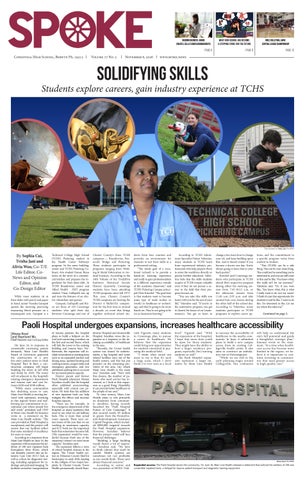
Solidifying skills
Students explore careers, gain industry experience at TCHS
Photo illustration by Tvisha Jani/The SPOKE
By Sophia Cui, Tvisha Jani and Alivia Woo, Co-T/E Life Editor, CoNews and Opinion Editor, and Co-Design Editor While most students sit at their desks with pencil and paper in hand, junior Vansika Garapati spends the morning practicing measuring blood pressure on a mannequin’s arm. Garapati is a
Technical College High School (TCHS) Pickering student in the Health Career Pathways program. In the same building, senior and TCHS Pickering Culinary Arts student Danny Rizzo turns on the stove of a commercial kitchen and prepares the ingredients for their latest dish. At TCHS Brandywine, senior and Allied Health - EMT program student Vinay Gullapalli sets up and tests the features of an electric wheelchair and gurney. Garapati, Gullapalli and Rizzo are three of 103 Conestoga students who split their day between Conestoga and one of
Chester County’s three TCHS campuses — Brandywine, Pennock’s Bridge and Pickering. These students participate in programs ranging from Welding & Metal Fabrication to Animal Sciences. According to the 34th Volume of the Tredyffrin Easttown Historical Society History Quarterly, Conestoga students have been attending TCHS programs since fall 1973. This year, Chester County’s TCHS campuses are hosting the District 4 SkillsUSA competition for the first time in around a decade, an event that brings together technical school stu-
dents from four counties and provides an environment for students to test their skills in a professional setting. “The whole goal of a vocational (school) is to provide a hands-on learning experience and really to gain professionalism in a different experience outside of the academic classroom,” said TCHS Pickering Campus principal Chris Knechel. “The goal here is that students want to become some type of trade worker or (work) in healthcare or technology, and they’re going to be more hands-on. They’re not going to be (in a) classroom learning.”
According to TCHS Admissions Specialist Dalton Valentine, many students at TCHS learn from experienced industry professionals who help prepare them to enter the workforce directly or pursue further education. Valentine feels that the skills students acquire at TCHS remain valuable even if they do not pursue a career in the field that their program focuses on. “You can take (the skills you learn) with you for the rest of your life,” Valentine said. “If you’re in the automotive program, you get to (learn) the basics of car (maintenance). You get to learn to
change a tire, learn how to change your oil, and keep building upon that. And it doesn’t matter if you become a doctor one day. You’re always going to have that in your back pocket.” Knechel said Conestoga students who participate in TCHS attend their respective program during either the morning session from 7:45-10:12 a.m. or the afternoon session from 11:40 a.m.-2:05 p.m. and take around four core classes during the other half of the school day. According to Valentine, many students participate in TCHS programs to explore career op-
tions, and the commitment to a specific program varies from student to student. “This (TCHS) can be a side thing. This can be your main thing. This could just be something you’re interested in, and you can still come to this and be like, ‘You know what, this really isn’t for me anymore,’” Valentine said. “Or, if you were like, ‘You know what, this is what I really want to do (as) my career.’ I think it’s just that opportunity for students to just be like, ‘I want to do this. I’m interested in this. Let me see where this takes me.’” Continued on page 3.
Paoli Hospital undergoes expansions, increases healthcare accessibility Ahana Aryal and Raymond Wu
Staff Reporter and Co-Copy Editor On June 16, in response to consistently increasing patient demands, Main Line Health’s Board of Governors approved the construction of a new five-story patient tower in Paoli Hospital. Barr & Barr, a construction company, will begin building the tower in fall 2026 and finish by 2029. The tower will sit adjacent to the hospital’s existing emergency department and trauma unit and cost between $220 and $240 million. “While many communities face declining access to care, Main Line Health is moving forward with optimism, investing in this region’s future and reaffirming our commitment to exceptional care where people live and work,” president and CEO of Main Line Health Ed Jimenez wrote in a statement on the Main Line Health website. “The care provided at Paoli Hospital is exceptional, and this project will ensure that our facilities reflect that same standard of excellence for years to come.” According to a statement from Main Line Health on June 16, the expansion will incorporate the addition of 108 new inpatient beds throughout three floors, which can instantly convert into an Intensive Care Unit (ICU) bed, as well as a floor for diagnostic testing, including equipment for radiology and perinatal imaging. To facilitate smoother transportation
of trauma patients, the hospital plans to build a heliport on the roof and connecting corridors on the first and second floors, which will link the tower to the existing building and trauma bays. Furthermore, the expansion will include renovations to existing areas such as an expanded kitchen and dining areas, updated heating and cooling systems, oxygen tanks and emergency generators, and two additional parking lots to account for increased patient capacity. District parent and former Paoli Hospital physician Maziar Seyedian recalls that the hospital often exhibited overcrowding, especially with critical care patients. He feels that the addition of new inpatient beds can help mitigate the effects and increase hospital capacity. “There are, for example, in the emergency department of the hospital, so many (patients) that need to use what we call hallway beds. This is more than actual room capacity. There (are) certain times of the year that we are working in maximum capacity, and ICU beds are the important beds that sometimes become full. (The expansion) would be wonderful because that’s one of the situations (where) we need more capacity,” Seyedian said. The expansion follows a wave of critical hospital closures in the region. The Crozer health system in Delaware County filed for bankruptcy in early 2026, leading to the collapse of two major hospitals. In Chester County, Tower Health permanently closed Bran-
dywine Hospital and Jennersville Hospital. Seyedian views the expansion as a response to the declining accessibility of healthcare in the area. “Recently, the Crozer health system was closed. So unfortunately, a big hospital and some related facilities (are) out of the health system, and this has put pressure on the remaining providers of the area, (in) which Main Line Health is the main one,” Seyedian said. “Now with this closure, the number of patients who need service has increased, so I look at this expansion as a good thing. Hopefully, it can provide better healthcare to the people of our area.” To raise money, Main Line Health plans to rely primarily on donations from community members, having recently launched the “Paoli Hospital Future of Care Campaign.” It also secured nearly $5 million in grants from the Pennsylvania’s Redevelopment Assistance Capital Program, which included $890,000 targeted towards the Paoli Hospital expansion. However, Seyedian believes that the project could still face financial challenges. “Building a large building would (have) a lot of expenses,” Seyedian said. “We have to think (about) that (and) be careful. Health systems are sometimes not (as) profitable as you would think. There (are) always financial concerns.” According to senior and vice president of HOSA Vish-
ruth Vignesh, many students in Conestoga plan to pursue a career in healthcare. He believes that the expansion could bring new opportunities for students interested in pursuing the medical field. “I think what stood out most to me is that it’s such a large scale, which I don’t think I’ve ever seen at a local
level,” Vignesh said. “With the expansion of the hospital, I hope that more slots could be open for those students. They might have the ability to host a larger residency program, especially (for) nursing students as well.” The Paoli Hospital expansion represents a larger initiative by Main Line Health
to increase the accessibility of healthcare to the nearby community. In June, it submitted plans to build a new campus across from its existing Collegeville health center. It also aims to construct an ambulatory site in Downingtown. “While we are still in the early planning stages around Collegeville, this evaluation
will help us understand the site’s full potential and guide a thoughtful, strategic plan,” Jimenez wrote in the statement. “At a time when healthcare access has become more limited in the region, we believe it is important to continue investing in communities that need greater access to high-quality care.”
Ahana Aryal/The SPOKE
Expanded access: The Paoli Hospital serves the community. On June 16, Main Line Health released a statement that outlined the addition of 108 new convertible inpatient beds, a helipad for trauma patient transport and diagnostic training equipment.
News
2 The SPOKE A BRIEF LOOK THE LATEST DEVELOPMENTS IN T/E AND NATIONAL NEWS
Student Council prepares for Fall Blood Drive On Nov. 13, the student council will host its annual Fall Blood Drive. The American Red Cross sponsored the event and is open to accepting blood from staff or students aged 16 or older. The drive will be held from 8 a.m. to 1 p.m. in the small gym.
Bell-to-bell cell phone
ban to take place next school year
On Oct. 26, Gov. Josh Shapiro signed Senate Bill 1014 into law. This law prohibits student cell phone and mobile device use from the first bell through final dismissal — including during classes, lunch, recess and passing periods. It took effect immediately upon signing. All schools — public, private, charter and online — are required to implement policies no later than the start of the 2027-2028 school year.
Midterm Elections held Nationwide On Nov. 3, Midterm Elections took place, the country’s first nationwide election since the 2024 presidential race. Midterm elections happen midway through every four-year presidential election to give voters a chance to decide which party controls Congress. In 20 of the last 22 midterm elections, the president’s party has lost ground.
U.S. public execution proposed and retracted
On Oct. 7, Defense Secretary Pete Hegseth announced the public and live-streamed execution of Fort Hood shooter Nidal Malik Hasan — what would’ve been the first public execution in the U.S. since 1936. Although President Donald Trump originally defended the idea in public statements, after facing public backlash, the president canceled the livestream on Oct. 15. Read more at
SPORTS
Field hockey loses 4-0 to Notre Dame at whiteout game
On Thursday, Oct. 22, the girls’ field hockey team lost 4-0 to Notre Dame. In the first quarter, Notre Dame maintained possession and scored a goal late in the quarter.
Chester County Department of Emergency Services receives $400K for 911 phone system upgrade Dilan Jiang and Lea-Karen Ukpere
Staff Reporter and Broadcast Editor On Sept. 15, state Sen. Carolyn Comitta announced that Pennsylvania’s Commonwealth Financing Authority awarded $1.35 million in Local Share Account (LSA) grants to Chester County. The grants are aimed at bettering the community through a series of four projects, with $400,000 of the money being allocated towards Chester County Department of Emergency Services (CCDES). CCDES received the grant to fund various software and hardware upgrades across various 911 call centers within Chester County. Chester County Deputy Director for Emergency Communications, BJ Meadowcroft, oversees the 911 call centers for Chester County. Meadowcroft states that the centers utilize many forms of technology to maintain their efficient and responsive assistance. Therefore, the 911 call centers must have up-to-date technology to offer the best service.
“In our industry, typically the computers, the monitors and the software have about a five-year life cycle. Chester County is currently in year six. The grant funds will help us buy new hardware and new
software for our emergency communication center and also refresh the backup center so that everything is upto-date,” Meadowcroft said. Other than new software equipment, CCDES will use
Gianna Huang and Grace Lu Staff Reporter and Photography Editor
On Sept. 9, College Board released a statement on its website announcing the addition of a “Science Practices and Foundations” cross-test score to the SAT, set to take effect in spring of 2027. According to the statement, the new science score — calculated on a 65 to 95 scale — will measure students’ scientific abilities using existing reading, writing and math questions. Additionally, on the “Data Layout for SAT Electronic Score Reports”, College Board disclosed that the score will report on students’ science-related skills without changing the exam’s wellknown, established format. “To provide students a meaningful signal of their readiness for further learning and work in science, starting in spring 2027, the SAT will report a science cross-test score drawn from the reading, writing and math sections already on the test,” the College Board wrote in its statement. “This score measures students’ demonstrated achievement of key science
practices and the mathematical skills that science demands.” Taken by over 2 million high school students annually, the SAT is a digital standardized assessment used in college admissions. It covers two main sections: Reading and Writing, and Math. Overall, the exam measures for a total 1600 composite score and lasts for two hours and 14 minutes. Junior Amogh Purohit said that this update feels natural given the exam’s current content. “On the October SAT, there was this one question in the math section that had scientific graphs,” Purohit said. “I think it makes sense for them (College Board) to add this score since so much of the test already has science integrated into it. I’m not that good at these types of questions though, so I’m not sure if I like it.” As students like Purohit prepare to take the SAT and consider how this update might be considered in admissions processes, College Board affirms that the score will not be sent to colleges and universities. If present, the science score will only be shared with a student’s school, district and, in some instances, their state. School Counselor and SAT Coordinator
Brian Samson does not foresee any changes in students’ preparation or stress levels for the SAT. “To me it seems as though the volume of these questions isn’t going to change, so I don’t think students need to devote too much extra attention to it,” Samson said. “But I feel that if analyzing data, (or) reading charts is a particular weakness for a student, they could devote more time to these science-based questions.” As for a path forward to appropriately study for the SAT and this new score, Samson feels students should trust the science teachers and curriculum provided at Conestoga. “I don’t think anything should change in terms of preparation for this test because what I’ve heard is that they’re not adding a new subset of questions,” Samson said. “I would still encourage students to take biology and chemistry because I think those would be good courses to prepare for the SAT. But I don’t think students need to go into greater depth of studying for only science-based questions.”
Gianna Huang/The SPOKE
New science score: Junior Amogh Purohit views College Board’s website’s statement about the coming addition of a science cross-test score to the SAT in the spring of 2027. College Board released the statement in early September.
A haunted homecoming: Student Council organizes yearly homecoming dance
A cloud of fog from a machine crept into the school’s main entrance, immediately setting the atmosphere for the night. Clusters of orange and black balloons surrounded dimly-lit corners, while plastic bats, skeletons and spiders adorned round tables where students gathered.
Teagan Penny/The SPOKE
Community care: The Devon Veterinary Hospital helps address local animal-related emergencies. Larger veterinary labs assisted with rapid diagnosis for other local veterinary centers like the Devon Veterinary Hospital.
Consolidating care: New $94 million veterinary lab to open
Seongyun Lee and Teagan Penny Staff Reporter and Social Media Manager
On Oct. 2, construction of the new $94 million University of Pennsylvania Veterinary Diagnostic Lab, sponsored by the Pennsylvania Department of Agriculture began. The 63,000-squarefoot lab will bring together the New Bolton Center laboratory of the Pennsylvania Animal Diagnostic Laboratory System (PADLS) and the Pennsylvania Equine Toxicology Research Laboratory (PETRL). The lab is expected to be completed in 2028, and PADLS and PETRL will move in by 2029. One of the four PADLS labs, the New Bolton Center laboratory performs 279,000 diagnostic tests annually including bacteriology and necropsy on wildlife, food, and fiber animals to protect animal and human health, according to the University of Pennsylvania. PETRL works closely with PADLS, analyzing 30,000 post-race samples of horses annually to screen for illegal substances.
However, both of these labs have outgrown their current facilities, leading to the consolidation of the departments under a single laboratory. Lisa Murphy is a veterinary professor of toxicology and serves as the director of PADLS. She said that the unification of the two laboratories will allow for greater efficiency and collaboration. “The PADLS laboratories are currently situated in multiple buildings on the New Bolton Center campus. In addition to bringing them together in a single building adjacent to our large animal hospital, it will also move the Pennsylvania Equine Toxicology and Research Laboratory from its current West Chester location,” Murphy said. “The new lab will provide expanded, modern laboratory space for existing testing to accommodate future growth.” According to Murphy, the new lab will serve as the research, testing and surveillance hub behind animal safety in Pennsylvania. This new expansion increases the screening capacities of both PADLS and PETRL, and it
will allow for greater collaboration between the laboratories. The PADLS sector will continue to focus on rapid disease diagnosis to benefit veterinarians whereas PETRL will continue managing the post-race drug testing of equestrian samples. “We (PADLS) test animal samples, and animal food and water sources, to diagnose diseases and contaminants that may pose a risk to animal and human health,” Murphy said. Murphy feels that the new facility will fulfill the University of Pennsylvania’s mission to provide satisfactory and timely diagnostic results for various types of animals. She also emphasized the importance of the University of Pennsylvania Vet lab to the local community and feels the lab will allow for increased efficiency. “Being in a single building closer to Penn Vet’s large animal hospital at New Bolton Center will make it easier for all of us — diagnosticians, clinicians, students and other stakeholders — to work together to protect animal health and ensure food safety in a modern, collaborative environment,” Murphy said.
Chester County battles swarm of phorid flies Alynn Kang and Bella Lin Webmaster and Staff Reporter
T/E LIFE
vice and better call-handling solutions to the residents of Chester County,” Meadowcroft said. “Along with allowing new technology to carry us forward in a way that we haven’t had the capability to do before.” According to Meadowcroft, CCDES expects the upgrades to be completed by 2027 as it needs time to obtain the new hardware and install the new software that will allow for call improvements. Meadowcroft acknowledges the fact that updates to 911 calling could cause uncertainty amongst community residents, but ensures that the upgrades will feel seamless for residents. “There’ll never be a time that 911 is not functioning. So, as we do upgrades, we do those smartly, the hardware is deployed, the software is modified — and it is all done in the safest manner possible. So there’s no concern,” Meadowcroft said. “This is an exciting project that I’m excited to look at implementing next year and I really think that it offers a better solution for Chester County residents.”
SAT to introduce Science Practices and Foundations
T/E LIFE
On Friday, Oct. 16, students gathered at Teamer Field for the annual pep rally before homecoming weekend. This year, homecoming weekend took place in October compared with previous years when it took place in September.
proved translation services, allowing for faster communication with the caller. “I think this (grant) is going to really leverage the latest and greatest technology to offer better customer ser-
Dilan Jiang/The SPOKE
Boys soccer ties with Radnor 0-0
Taking the field: Conestoga celebrates pep rally, homecoming weekend
the grant money to adopt new technologies to improve overall call efficiency. Meadowcroft notes that this includes a call summary feature that would transcribe calls live as they occur and im-
Call upgrades: A 911 operator completes tasks on his computer screen at the Chester County Department of Emergency Services in West Chester. On Sept. 15, Sen. Carolyn Comitta announced $1.35 million in grants. A portion of the grants will help improve services within the Chester County Department of Emergency Services.
SPORTS
On Tuesday, Oct. 20, the boys’ soccer team played its last game of the season, tying with Radnor 0-0. Heading into the first half, the boys started off with strong offense, with several close calls and attempted goals. Sophomore Leo Strippoli weaved through defensive players and kept good ball control.
Friday, November 6, 2026
Phorid flies, small insects that often breed in moist areas, swarm homes and neighborhoods near Chester County mushroom farms each fall. This year, state officials are strengthening measures to control their spread. Eric Toedter is the founder and president of MYCOguard, a company that helps mushroom farms control pests. He said the flies feed on mushroom mycelium and can spread into nearby residential areas. They pose a challenge for farmers during the fall holiday season because fly populations peak when demand for mushrooms rises. On March 25, in an effort to address the seasonal surge, the Pennsylvania Department of Agriculture announced expanded requirements for mushroom growers. These requirements include improved sanitation, pest monitoring and fly-control measures designed to reduce infestations and limit their spread into neighboring communities.
“They (the phorid flies) present a significant problem for approximately six months, peaking around October (and) November, which is the most important time of the year for mushroom farmers because of the big eating holidays,” Toedter said. “That’s the biggest sales opportunity for mushroom growers and it overlaps with the peak (of the) infestation.” Penn State Extension reported that phorid fly infestations are concentrated in southern Chester County, particularly in the New Garden and Kennett townships, and date back to the early 2010s. Toedter explained that to combat the increased number of flies during the fall months, the counties introduced a new combined approach. He said these methods include agricultural dust, insecticide treatments, predatory mites that feed on fly eggs and larvae, and treated screens that help keep flies from moving in and out of mushroom houses. Toedter feels that the approach has shown promising results
this year, although no single method works for every farm. “We just keep adding layers (of protection). Whether it’s hygiene, exclusion, biological control, traditional insecticides (or) steam. Every year we keep making progress and get better,” Toedter said. New Garden Township manager Christopher Himes said phorid flies can interfere with residents’ daily routines, especially in homes where they gather in large numbers. The severity varies by household, depending partly on a house’s proximity to mushroom farms. Therefore, some residents are required to spend time and money removing flies from their homes. Himes said the insects are not known to carry human disease, but the infestation remains a heavy concern on quality of life. “If you’re trying to get to sleep, or you’re trying to enjoy your day after a long day of work, and you’re spending your time and money, getting fly traps and picking up bugs, it’s just not something you want to do,” Himes said. According to Himes, as winter approaches, the phor-
id fly population will likely start diminishing due to unfavorable temperatures. He expressed that the localities and state legislature are all working on the infestations, and media exposure is help-
ing to bring attention to this problem in the meantime. However, despite these ongoing prevention efforts, Toedter emphasized that the issue may never be fully resolved. He believes continued, col-
laborative efforts are essential to mitigating the infestation. “There will always be phorid flies,” Toedter said. “It’s just the methods to reduce their numbers is what you have to change.”
Courtesy Eric Toedter
Battling the swarm: MYCOguard founder and president Eric Toedter (right) stands alongside a crew member outside a mushroom facility. The pest management team introduced advanced layers of defense against phorid flies for the fall.
News
Friday, November 6, 2026
The SPOKE
3
Students discover career options, gain skills for the workforce Continued from page 1. TCHS programs to expand, student logistics stay the same TCHS Pickering offers a variety of programs, with HVAC & Refrigeration Technology (HVAC/R), Electrical Occupations, Welding & Metal Fabrication, Health Career Pathways and Cosmetology being the most popular according to Knechel. For the 2027-28 school year, TCHS Pickering is developing a Construction Trades program because of the popular demand and limited spots in HVAC/R and Electrical Occupations programs. The Construction Trades program will allow students to learn the basics of plumbing, HVAC and electrical systems while they wait for openings in the more competitive programs. In the future, TCHS Pickering looks to create more offerings for underclassmen and add courses from the other campuses, such as the Barbering program. “We want to hear what (programs our students) want and see if it’s possible for us to put it in here. That’s really what drives our programs and our growth here at TCHS,” Knechel said. “It’s what the students out there (who) we can serve want, and we’ll go ahead and try our best to put something in here for (them).” To apply for TCHS programs, students need to fill out an application consisting of student and parent information, school records, program selection, teacher recommendations and short responses to essay questions. For the 2026-27 school year, students can still apply to TCHS during rolling admissions rounds that close in December. The 202728 school year regular applications take place from this winter through summer 2027, though senior-only program applications are due by Jan. 31, 2027. TCHS offers shadowing and tour opportunities for prospective applicants. According to Valentine, after committing to a program, students can switch programs or withdraw from TCHS at any time.
2026 Conestoga alumna and current University of Pittsburgh student Archana Nair took part in the Allied Health - Hospital program at Chester County Hospital. She shares her advice for someone considering applying for Allied Health. “I definitely recommend (Allied Health) so that you can see if (the medical field) is for you and you like it, (and) this is what you want to do with the rest of your life. Or if you see (Allied Health) and you experience it and you don’t like it, then at least you’ll know before having gone through probably all of undergrad and maybe all of med school and then realizing,” Nair said. “There’s no harm in applying.” Students participate in hands-on learning, explore different programs The Allied Health - Hospital program is for seniors only and is popular among Conestoga students. These students spend their week either learning medical terminology inside the classroom or doing clinical rotations at a hospital. During clinicals, students shadow nurses of up to 24 different specialties, including the neonatal intensive care unit, post-surgical recovery suite, operating room and more. Additionally, the program offers many training certifications, such as handwashing and sterile gloving. Senior Vishruth Vignesh believes the program provides valuable of medical experience. “I think (taking Allied Health) was the best decision I made this year so far. Before, I was kind of scared because Allied Health takes up the space of three classes, but now that I’m in the program and actually got to do the clinical rotations, the amount of support and experience we get from the program is truly valuable,” Vignesh said. For students interested in shadowing EMTs rather than professionals in a hospital setting, the TCHS Brandywine Campus offers the Allied Health - EMT program, a senior-only course which partners with the Good Fellowship Club of Chester County Inc.
Alivia Woo/The SPOKE
Measuring up: A student measures the height of a donkey in a barn at the Technical College High School (TCHS) Pickering campus. TCHS added the animal science program this year to teach students how to care for and handle animals.
During the program, students gain experience as part of an ambulance crew, learn medical terminology, record vital signs, assist with baby deliveries and demonstrate bleeding control. Gullapalli recommends the program for any students interested in the medical field. “I’ve talked to (TCHS students) that go to the hospital, and they talk about getting actual hands-on, talking to the patients and even (experience) sitting in (and) watching from the gallery (the) surgeries, which seems interesting,” Gullapalli said. “And then (Allied Health - EMT) has its own benefits where we get to actually talk to patients, treat them and such.” TCHS also offers Health Career Pathways, another health-related program separate from Allied Health. The three-year course aims to prepare students for employment after high school. According to Garapati, while Allied Health offers more hospital exposure, Health Career Pathways covers skills that take longer to learn, with about 40% of the class spent on skills, 30% on content and 30% on professionalism and ethics. Garapati outlines the pros and cons of the program. “I think you get many things out of it if you’re willing to go the extra mile. You get skills, a portfolio, internships and certifications, and that’s my favorite part, because it has so much value,” Garapati said. “The worst part is the schedule conflict. You miss out on a lot of the core AP classes, such as AP Capstone, multivariable calculus, AP Psychology and sociology.” The Animal Sciences program at TCHS provides an opportunity to learn about creatures from dogs and cats to snakes and insects. Students learn basic animal science and correct handling procedures. In addition, students interested in manipulating metal can join the Welding & Metal Fabrication program to learn how to create and repair metal items, using tools such as grinders, saws and drills. For those interested in cooking or baking, TCHS offers a Culinary Arts program, where students spend half their time learning theory and the other half cooking in an industrial kitchen. Students learn different skills such as food safety, kitchen operations and how to prepare a wide variety of foods. Advanced students participate in catering events and create custom recipes. Rizzo said there is a lot more to cooking than what meets the eye, and TCHS provides an environment for students to perfect their skills at a professional level. “There’s a lot that goes into it. Aside from the safety and the cleanliness, baking and cooking is an actual science,” Rizzo said. “You have to know what tastes good with what. We
TCHS
65% OF TCHS STUDENTS GO TO POST-SECONDARY EDUCATION
103 CONESTOGA STUDENTS ARE ENROLLED AT TCHS
STUDENTS FROM 26 SCHOOL DISTRICTS
14 UNIQUE CAREER AND TECHNICAL EDUCATION PROGRAMS
905 COLLEGE CREDITS EARNED BY TCHS STUDENTS IN 2025-2026
Designed by Alivia Woo, Co-Design Editor have to learn pairings. We have to learn how to distinguish different herbs. It’s hard to make food that’s original and good, and that’s what we’re learning.” TCHS to host SkillsUSA competition, students take part According to Heather Mulford, the SkillsUSA advisor at TCHS Pickering, Chester County TCHS locations will host the District 4 SkillsUSA competition this December, inviting schools in Chester, Berks, Lancaster and Montgomer y Counties. SkillsUSA is a national competition for vocational schools that provides students an opportunity to showcase their program-specific skills outside of the classroom and in front of industry professionals. First-place winners in each event from the district competition advance to the state level, and first-place state winners will then move on to the national competition in Atlanta, Georgia, in June 2027. Mulford said many SkillsUSA competitors are aiming to earn college scholarships by placing in their events or leaving strong impressions on judges. In addition, certain companies have offered jobs directly to select competitors based on their performance in the competition. “We’ve had kids get college scholarships offered to them or at least discounts for tuition because the judges tend to be what would be considered professors and instructors from those schools that are then like, ‘Hey, you want to
come to our school?’” Mulford said. “We had a student a long time ago get an offer from Mercedes.” Rizzo competed in the Culinary Arts event of the 2025 competition where competitors are evaluated on presentation, cooking techniques and their final dish. TCHS Pickering Culinary Arts teachers selected Rizzo to represent their class at SkillsUSA following a classroom competition.
(responses from) everything from, ‘This school changed my life and offered me these great opportunities,’” Samson said. “Students who have decided to go to four-year college, they too look back fondly on their experience at TCHS because it gave them a variety in their day.” TCHS aligns its programs with Pennsylvania standards using a state-administered task list
opportunity, but they have to go out there and seek it. So it’s another skill: networking and becoming a young adult.” 2026 Conestoga alumnus and current Johns Hopkins student Venu Dhanabal reflects on his experiences in the Allied Health - Hospital program. Dhanabal said the skills he learned were helpful in opening doors to new opportunities post-high school. “It was especially beneficial because right after this program, this past summer, I decided to get my EMT license, and then I realized that a lot of the skills you learn in Allied Health are the same skills that are tested as an EMT; stuff like getting blood pressure, getting respiration rate, heart rate (and) pulse,” Dhanabal said. “You’re not finding this anywhere else, and I’m truly grateful for that.” Valentine said that many alumni have found their career trajectory through TCHS programs and exploring various classes. According to Valentine, some alumni have even returned to TCHS Pickering as teachers, including a chef from the culinary arts program, an auto collision teacher and an HVAC teacher. “It’s about finding your niche,” Valentine said. “That’s another part of TCHS I love, because I know how difficult it is as a high schooler to really find what you want to do. You never know when you walk into school one day, you’re inspired all of a sudden (and you realize) that this is the career path (you) want to go down.”
“Students who have decided to go to four-year college, they, too, look back fondly on their experience at TCHS because it gave them a variety in their day.” Brian Samson TCHS coordinator and Conestoga guidance counselor
“They (SkillsUSA judges) are very strict about following procedures and uniform and cleanliness and everything,” Rizzo said. “It’s really important that you do everything on time and you follow the recipe to a T.” TCHS students gain lasting experience, reflect on experiences TCHS coordinator and Conestoga guidance counselor Brian Samson said that several alumni have expressed positive feedback regarding their time at TCHS. According to Samson, the expertise and certifications many students receive through their respective programs position them for success. “Well (we have received) some overwhelming positive
that describes the skills students need to learn and the competency levels they must reach for each of the skills. In most cases, attending TCHS programs allows students to receive college credits and national industry certifications that apply in the workplace. Experienced upperclassmen also have opportunities to shadow professionals at partnering businesses or work for an income while continuing to learn skills and concepts at TCHS. “As (students) get older and they get into their junior and senior year, they get more opportunities for apprenticeships, pre-apprenticeships and even a co-op opportunity,” Knechel said. “A lot of those (opportunities) lead to actual jobs after college. So if that’s a route a student wants to take, (their program) builds up that
Berwyn School Fight inspires new community mural Emily S. Wang
Co-Managing Editor A blank wall along a building on 19 Waterloo Ave. in Berwyn will soon depict a pivotal moment in the T/E community’s history. Main Line Mural Arts (MLMA), in collaboration with the Easttown Township Board of Supervisors, is planning its largest mural yet on the building’s south wall. The mural will commemorate Berwyn’s historic fight to desegregate local schools, with artists Nila Devaney, Justin Keller and Kate Welbes overseeing its design and painting. Stacey Ballard, MLMA’s president and treasurer and CEO of Eadeh Enterprises, which helped spearhead the local mural initiative, said she expects work on the painting to begin in November and finish around August or September of 2027. According to Ballard, MLMA and the Board of Su-
pervisors decided on the topic after multiple discussions. “We discussed (the topic for the mural) in different meetings and we wanted it to be something that was reflective of the community and that was of significance in celebration of America 250,” Ballard said. “So the decision was the Berwyn School Fight, and the reason why is because it is a really important part of our local history.” The current planned imagery includes a scene depicting a Black father reacting with shock as he reads a newspaper article about school segregation, while his children look on. The artists are continuing to develop the mural’s specifics, with further details expected to take shape over the next three months. “There’s going to be a lot of symbolism that we’re really hoping will create awareness and conversation in our community about what happened, and which will remind people that
we can’t go back to something like that,” Ballard said. According to the Tredyffrin Easttown Historical Society, the Berwyn School Fight began in 1932 when the Tredyffrin Township and Easttown Township school districts still operated separately. The two districts’ school boards sought to segregate Black elementary students by assigning them to separate schools. In response, Black families organized protests and boycotts, and many parents faced fines or jail time for refusing to send their children to the segregated schools. The fight ended in 1934, when the families’ efforts led both districts to abandon the segregated system. Beyond commemorating local history, MLMA plans to invite community members to help create the artwork through three planned painting days in 2027. According to Ballard, one day will be dedicated to families whose ancestors were affected by the
Berwyn School Fight, while another will invite interested students from Conestoga High School’s art department to paint portions of the mural. An additional day would be open to other community members to contribute to the mural’s development. Along with Dan Scott Forreal’s postcard-inspired mural and Laura Stockdale’s mural inspired by the 1993 film, “The Secret Garden,” the planned mural will be one of many that MLMA has already completed in Berwyn. For Ballard, the project represents an opportunity not only to preserve a significant chapter of local history, but also to encourage residents to reflect on how that history continues to shape their lives today. “My hope is that it brings people together for collaboration and compassion and kindness towards one another,” Ballard said. “I think it could create some love and healing in our community that is very beautiful.”
Emily S. Wang/The SPOKE
Mural in the making: The south wall of 19 Waterloo Ave. in Berwyn stands as the proposed site for Main Line Mural Arts’ (MLMA) largest mural to date. MLMA and the Easttown Township Board of Supervisors selected the Berwyn School Fight earlier this year as the mural’s subject.
“Test Optional” doesn’t *really* mean that... Like a super-secret handshake to get in the door, competitive colleges really do want to see test scores, they just won’t tell you that. Grades alone aren’t going to get you there, so it’s time to think about doing your best on the SAT or ACT. Find out more at CrimsonReview.com.
T/E LIFE 4 The SPOKE
Friday, November 6, 2026
N ew s pa p e r s c a v e n g e h u n t
Directions: Look through the newspaper to find the answers to the following questions. Then, fill in the answers in the corresponding blanks to reveal a fall-themed quote!
1
On page two, what is the plural form
2 of the 13th word in the sentence in
Fill in the blank. On page one of the paper, Dalton Valentine says that “You can take (the skills you learn) with you for the rest of your _____.”
5
which Christopher Himes explains what will happen to the phorid fly population as winter approaches?
On page six, Rachel Ma says that she enjoyed making her homecoming bouquet last year. What is the third-to-last word in that paragraph?
1
3 On page four, Melody Mission
teaches its classes on a _____ ____. What are the last three letters of the second blank?
Find Merri Gardner’s quote on page
6 nine. Look at the last word in the paragraph. What adjective can be formed by rearranging letters five to eight of that word?
2
3
when it gets 6
5
page six, the ReefRoad 4 On smoothie with an additional
scoop of protein has ____ __ grams of protein. What word is the first blank?
page 10, the intramural sports 7 On club previously primarily hosted
outdoor ultimate frisbee in the ____ ___ ______. What word is the first blank?
4
in the 7
.
-F. Scott Fitzgerald, “The Great Gatsby”
Designed by Sophia Cui, Co-T/E Life Editor
Melodic mentorship: Junior launches music nonprofit Ashley Du and Zisi Zhu
Co-Editor-in-Chief and Staff Reporter From over 200 miles away, a young student joins a video call every Saturday. She is ready to learn a new song through Melody Mission, a music education nonprofit that junior Annica Sugalski founded in mid-June. The organization provides free musical education to underserved youth ages 5 to 13. It currently has five team members and focuses on vocal instruction. Melody Mission held its first lesson on Sept. 26. “I started (Melody Mission) this past summer, and I mainly did it because I was recognizing the lack of free music education. I take voice lessons, but they’re really expensive,” Sugalski said. “They’re also really not accessible to everyone, depending on location, (and) depending on price. So I thought to (start) a small
little thing where you could have online, free music lessons taught by high schoolers.” As the nonprofit’s president, Sugalski spent the summer working with her dad to create the website, which includes free learning resources such as videos going over singing techniques. Before gathering students, Sugalski focused on assembling a group of volunteers. Her team includes junior Sophie Aguilar as vice president, junior Sophia Kogay as a teacher, and juniors Maddie Schmaus and Chloe Zeng as social media managers. Melody Mission currently has one student, Zendaya Booker-Hubert, who lives in New York. “They’re (the lessons) really good for (Booker-Hubert) because she’s very active. She likes to move around. She likes to sing a lot, so she’s doing something she really wants to do and likes to do,”
Booker-Hubert’s mom Latisha Booker said. “For someone to take their free time to volunteer and help kids, a lot of kids (who) probably are underprivileged kids, and (give) them free lessons — that’s a big thing for these kids, to take (the lessons), doing something they may not be able to do because their parents can’t afford it.” Each vocal lesson is about half an hour, beginning with a 5-10 minute long warm-up, which includes going over technique. After the warm-up, the student selects a song and applies the vocal techniques practiced during the warmup. The lessons often involve fun activities with the student. “She (Booker-Hubert) came up with this game where she sings a part of the song,” Kogay said. “Then she points to me and I sing a part of the song, and it’s so cute. So we do that at the end, and
then we talk about what we learned and I remind her to choose a song for next week.” Sugalski said Melody Mission hopes to initiate local, in-person music events for the community at shared spaces such as libraries in the future. The nonprofit aims to create a collaborative musical space for teachers and students alike as part of this goal. Sugalski is also contacting organizations that serve underprivileged youth to set up partnerships and help Melody Mission reach more students. “Music has many benefits,” Sugalski said. “It definitely, developmentally, is really good for your brain and it also can foster confidence as you’re growing up, make you feel like you’re good at something. It definitely did for me. It can even improve your academic performance, so I think it’s really important for everyone to have access to it.”
Ashley Du/The SPOKE
Lesson preparation: Junior Sophia Kogay practices a song before teaching her weekly vocal lesson for Melody Mission, a nonprofit that provides free music education to children ages 5 to 13. Kogay taught the organization’s first lesson on Sept. 26.
Seniors start heavy metal band Rishika Bhattacharya and Leah Zwierzchowski Co-Copy Editor and Staff Reporter
Intense rhythms and melodies flood a basement as a heavy metal band plays. A group of childhood friends formed the band Procession to the Morgue in May, bringing together student musicians through a shared interest in heavy metal. Seniors Noah Holbrook, Jack Lutz, Will Pilko and Regan Stigall started Procession to the Morgue because they wanted to hold jam sessions with each other as they became more advanced in their areas of music. Holbrook plays guitar, Lutz plays the drums, Pilko plays the
bass and Stigall serves as the lead vocalist. The famous music piece “Procession to the Cathedral” by Richard Wagner inspired Lutz when he came up with the band’s name. The group decided to put a heavy metal spin on the name, choosing the name “Procession to the Morgue” to reflect the ensemble’s sound. “Me and Noah have been hanging out for a couple of years and we jammed a lot, so he’d bring his guitar over to my house every once in a while and we’d play music together. Regan started learning how to scream, singing in that way,” Lutz said. “Eventually, the three of us got together and we played music together and it was really cool. We
started to do that every week and eventually we got Will to join and start playing bass, and that’s how we started.” The band has performed two shows together, one at the Kelly Center on Sept. 12 and another at the Let There Be Rock School on June 26. The members practice every Monday to refine their sound and prepare for future performances. Although they have written several original songs, they primarily perform covers of other heavy metal bands. Their originals include “Butterflies in my skin” and “Sound Warning,” while their covers include “Thirteen” by Recon, “Homicidal” by Bad Luck 13 Riot Extravaganza and “Wait-
ing for the Turning Point” by Superjoint Ritual. The band draws inspiration from real-world events by incorporating political messages into its originals and exploring topics that affect the community and wider world. “We have political messages within our songs. We wrote a song about data centers being built and how we’re against that,” Holbrook said. “We want to write more songs about that and we have a couple that we’re working on. We get inspiration from real life politics that (are) happening or things happening around the world.” The group also writes about topics that many people could relate to, such as mental health.
Rishika Bhattacharya/The SPOKE
Passionate practice: Seniors Regan Stigall, Will Pilko, Jack Lutz and Noah Holbrook (left to right) practice songs for their band Procession to the Morgue, which they formed in May. Procession to the Morgue played two shows at the Kelly Center and Let There Be Rock School.
The members perform music that is meaningful to them, and will often take inspiration from their own lives along with events that are happening in the community. “Our first song is like a mental health kind of song, talking about our feelings and whatnot through isolation,” Stigall said. “But also something that we’re very (outspoken about) is our beliefs, what we stand for. We’re a political band.” Because the members are graduating this year, the band’s future remains uncertain. Lutz and Stigall hope to attend Temple University, while Holbrook and Pilko do not plan to attend college. Despite their different plans, the members aspire to continue performing together and play occasional shows after high school. “If Jack and I go to Temple, then we can definitely continue the band, which would be really cool. But we’ll see what happens,” Stigall said. “We’ve talked about coming (together during) breaks. We could maybe just jam together, and if we (are) able to, possibly get a show with some of our friends’ bands.” Senior Eloise Arnault is a friend of the band members. She believes the band distinguishes itself from other local bands because of the members’ camaraderie and chemistry. “They (the band members) have a really easy dynamic because they’ve known each other for so long,” Arnault said. “They all really enjoy playing with each other and you can tell. Whenever (their friends and I) hear about their show, if they tell any one of us about their show, we’re gonna go, because it’s so fun to watch them.”
T/E Life
Friday, November 6, 2026
The SPOKE
5
Senior creates nonprofit, donates flowers to community Sohun Devisetty and Grace Hu
Staff Reporter and Co-Sports Editor Three days a week, senior Reya Mishra walks into local senior homes and hospitals with a box filled with blooming flowers. In January, Mishra formed Petals with Promise, a nonprofit that donates flowers from her personal garden to uplift spirits. The nonprofit combines two of her passions: gardening and caring for the community. “I’ve always loved giving back and I knew that I had interest in helping people from a young age,” Mishra said. “This was something I always really loved doing and it just made me happy.” In 2020, Mishra began working with her mother, Varuni Mishra, on their garden, planting various flowers and plants. Varuni Mishra explains that planting flowers and watching them grow became a hobby during the pandemic. “It (gardening) gave us something to do, a sense of purpose when there was nothing much going on,” Varuni Mishra said. “We saw seeds come up and seedlings come up and it was just exciting to see them turn into flowers. We just kind of picked up from there.” Eventually, as their garden grew, the Mishras began giving blossoms to family and neighbors. After that, the flower donations expanded to local hospitals and senior homes. “First, we started (giving flowers to) friends and family, our neighbors, and people that would come to our house,” Reya
Mishra said. “Slowly, we realized as we saw their faces and saw how happy it made them to receive these flowers that we wanted to do it more.” In summer 2025, Reya Mishra started volunteering at Paoli Hospital. While working there, she thought of
expanding flower donations to nearby hospitals and senior homes. Now, Petals with Promise works with several community areas such as Bryn Mawr Hospital, Daylesford Crossing, Green Meadows Rehabilitation and Nursing Center, and Paoli Hospital.
“When you walk into a hospital room, it’s just so mundane and boring. It was just so nice to see that a spark of joy can really brighten up your day and brighten up the mood. I actually got to give flowers to patients directly when I worked there,” Reya Mishra said. “It was a whole
new experience, getting to see their eyes brighten up and everybody’s mood flipping when they see me walking through the door with flowers. It’s just really special. It’s such a basic thing, but it means so much to people.” Since Petals with Promise is limited to a growing season
from spring to fall, the Mishras spend winter preparing plants, garden beds and seeds. On Aug. 1, the nonprofit reached out and secured a partnership with Whole Foods, in which Whole Foods donates flowers twice a week to help the Mishras distribute blooms over the course
of the year. Reya Mishra credits her mother’s gardening knowledge for the nonprofit’s success. “From logistics to reaching out to companies to organizing events, even just spending time in the garden, watering and planting and fertilizing, (my mom) really helps me with the planting season, especially now with school and college apps and homework and everything,” Reya Mishra said. “She’s really helpful in the garden and she’s the mastermind behind everything.” Reya Mishra hopes to attend college nearby so that she can frequently return home and continue to manage Petals with Promise even after graduating high school. She feels that although the donated flowers are vibrant in color, it is the sentiment behind them that brightens people’s moods. “It’s more than just, ‘Here are some flowers that are beautiful and so great to look at,’” Reya Mishra said. “They’re nice and they’re pretty, but the flowers are more of a means to an end, and that end is that people are thought of and cared for and supported.” Scan the QR code to watch an accompanying package
Elizabeth Lu/The SPOKE
Giving with gardening: Senior Reya Mishra picks and cuts a flower from her homegrown garden to put in an arrangement. In January, Mishra started Petals with Promise, a nonprofit dedicated to donating flowers to local hospitals and senior centers, with her mother’s help. As Whole Foods helps to supply the nonprofit throughout the winter, Mishra looks forward to distributing bouquets around the community.
Parents’ organization hosts ‘Voices of Autumn’ concert Eva Chang and Erin Zhang Staff Reporter and Co-T/E Life Editor
Families come together at a park to enjoy an afternoon of music, food and community bonding. On Oct. 10, the nonprofit Chinese American Parent Association of Tredyffrin/ Easttown School District (CAPA-TE) brought its first concert, “Voices of Autumn,” to the community. According to Tracy Sun, board member of CAPA-TE, over 200 people came to the concert at Wilson Farm Park. While the organization had been planning a similar event last year, the organizers canceled it due to inclement weather. This year, CAPA-TE successfully hosted the event with the combined efforts of sophomores Corey Han and Grace Yu, whose parents are members of CAPA-TE, providing a unifying experience of Chinese culture to the community as people came together to enjoy food and music. Sophomore Jeevesh Ramasamy saw CAPA-TE flyers for Voices of Autumn in a restaurant, prompting him to go to the concert. He liked how he could immerse himself in a culture he was not familiar with at the event. “I think (Voices of Autumn) interested me because I really haven’t been in that type of setting before, especially with East Asian culture rather than South Asian,” Ramasamy said. “I felt that was super in-
teresting, and all the food also tasted really good.” Students and their families led the concert opening ceremony, showcasing talent and family bonds as students and parents performed together. Afterward, the Philadelphia Old Boys Choir, a suburban Chinese music group, sang a cappella songs with blended Chinese and English lyrics. Yu feels that incorporating elements of Chinese culture into the performances was a necessary part of the event. “We wanted to bring mostly the Asian community together,” Yu said. “Because (the concert featured) mostly Asian performers, it’s highlighted towards the Asian American crowd to just enjoy, have fun and talk with their friends on a beautiful weekend day.” Besides the performances, students and adults ran different stands for sponsored businesses and activities. The stalls featured businesses such as law firms and financial service companies, as well as booths selling refreshments like teas and food like Asian-style tacos. Stands also included activities such as Rubik’s Cube solving, a raffle, a chopstick skills competition and robotics building. Ramasamy believes that the event allowed the community to develop a better understanding of East Asian culture. “I know in Wilson (Farm Park), there’s a bunch of movies that they play, and there’s a bunch of more ‘American’
concerts. But there’s not really representation for East Asian culture,” Ramasamy said. “I really felt (Voices of Autumn) really expanded a lot of people’s viewpoints on what East Asian culture can be and the type of food that they have and this type of music.” Han and Yu organized the games and activity stands, invited instrumental performers, created a website and flyers, and talked to local Asian busi-
nesses for sponsorship. For each business, Han and Yu pitched sponsorships in return for an advertisement on the nonprofit’s website. According to Yu, through business visits, CAPA-TE met its goal of raising over $2,500 in sponsorships to support the organization’s future initiatives and allow people to attend the event for free. Sun believes that attention to detail allowed for the event’s success and high attendance.
“The idea (for this year’s concert) started in summer and I’m the one to purchase a lot of insurance, for example, event insurance. We also need to contact our local police to make sure (of) the security as well. And then we also do a lot of detail checkpoints on a weekly basis, making sure that everything is all set. So it’s been like a month and a half planning for this event. But then you have to have a good relationship with your community,
making sure that they’re able to play (in) the performance,” Sun said. “So (there’s) a lot of details, but it all comes with a good, successful event.” According to CAPA-TE, the 501(c)(3) organization’s founders created the nonprofit to empower members of the Chinese community in TESD and influence policymaking to better serve the interests of the Chinese community. Sophomore Ximeng Ge, who ran a tea stall
at the event, appreciated how CAPA-TE helped her family feel connected to the district. “When we just moved here, our parents (felt it was) very difficult to learn a new language,” Ge said. “But they also need to be social, they also need to talk with other people. So maybe at this time, it’s a good chance to meet (others) and talk with each other. My mom’s English is not very good, but (through) CAPA-TE, she made some new friends.”
Courtesy Yan Xiao
Community choir: The Philadelphia Old School Boys Choir sings a cappella on stage at Wilson Farm Park. On Oct. 10, the group, alongside other instrumental performers, participated in the Chinese American Parent Association of Tredyffrin/Easttown School District’s “Voices of Autumn” concert, which also featured food and games, fostering unity among the Chinese community.
Priyanka Paxula Staff Reporter
Teacher Feature: Alice Debu Priyanka Paxula/The SPOKE
Passionate teacher: Alice Debu teaches French 3 Honors and French 5 Honors. In 2006, she moved to the U.S. from Romania with an interest in becoming a teacher.
Originally from Romania, Alice Debu moved to the U.S. in 2006 to pursue a career in French literature. She graduated from the University of Transylvania with a Bachelor’s degree in English and French language and literature. Debu taught in Montgomery County for eight years before coming to Conestoga in 2014. This year, she teaches French 3 Honors and French 5 Honors. Q: What childhood experiences impacted your choice of career? A: My mom is an elementary school teacher. She has been for 35 years, so I was quite accustomed to life after school and what it means for her. I was always jealous of the time that she would give to her students, and then all the time she would spend at home preparing for that. My dad was a school teacher for some time as well. Q: What is your background in French? A: I am originally from Romania, specifically the region of Transylvania. And there, we speak Romanian, which is a Latin-based language. We start French or English, or both, very early in elementary school. And then I married my husband and
his father is from France, the southern part. Q: When did you know you wanted to be a teacher? A: When you go to school in Europe, the system is quite different. You already know when you go to college what you want to do. You don’t have two years and then you choose a major, you choose a major from the very beginning. So knowing that, I went there with three main options: becoming a teacher, working at a translation agency or continuing to work at the university as an assistant. My plan was to open a translation office because those are very popular in Europe. You can translate documents. But moving here, that is not really a thing. So education was the way to go. And my mom also pushed me to do that. Q: What was your career journey like? A: I started teaching while I was in college — after the second year, you can teach — so I started teaching students very young. I tutored a little bit and then I moved here. I started in Montgomery County and then I moved to T/E. I have (taught) quite a (range of students), from five year olds to 60 year olds. I was also a dental assistant for about three years here in the U.S. and I knew I didn’t want
to do that for the rest of my life, so I pushed really hard to get my certification (for French). And I was a tour guide, back in Transylvania, at Dracula’s Castle. Q: Do you have any hobbies? A: I love mountain biking. I hike. My family and I do hiking together, and also make jewelry out of oysters. It’s called “decoupage.” That’s a French term. “Decoup” means “to cut.” So I take very pretty napkins, and there’s a process to glue that on top of a seashell or an oyster, and then you veneer that, and you give it layers and make it shiny. Q: Do you have any classroom traditions? A: In French 5, we read “The Little Prince,” and the Little Prince lives on a planet where there’s one rose that he has to take care of, and the plant actually talks back. So here, we grow our own little plants in class. We have a whole windowsill where we grow them and we learn how to take care of that plant. So I guess we put ourselves in (the Little Prince’s) shoes and see how it is to care for that rose. And believe it or not, there are a lot of people who don’t know how to plant a seed. I teach juniors how to plant a seed, how to water it and take care of it, and how to create that environment.
T/E Life
6 The SPOKE
Friday, November 6, 2026
’Stoga welcomes exchange students from Europe Nayonika Ray and Sophia Wu
Staff Reporter and Co-Staff Development Director As the doors open on the first day of school, Conestoga greets seniors and exchange students Marco Francalanci and Jacobo Diaz Quiroga from Italy and Spain, respectively. After being at Conestoga for over two months, they have been eager to take part in the school community by getting involved in electives, like Architectural Design, and the school’s various clubs and sports. Jacquelyn Rothera has coordinated the exchange student program for the past
Courtesy Megan Close
Spanish senior: Senior Jacobo Diaz Quiroga grins for a photo. He came from Spain via the exchange program.
two years as part of her role as the TESD Community and Student Services Supervisor. She works with agencies to review exchange student applications, which principal Amy Meisinger and the district office review and approve as well. Once approved, students register at Conestoga as new students. “I love this program because we get to learn so much about different cultures and schools all around the world. We get to learn from (exchange students) about what school is like in their hometown and home country,” Rothera said. “I also enjoy getting to know them as people. The ones that I have worked with over the past two years have been wonderful additions to the Conestoga community. They contribute so much to us, and we gain so much from them.” Francalanci comes from Parma, Italy, where he lived with his parents and two sisters. He attended Liceo Attilio Bertolucci High School in Parma and is staying with the Balsan family while attending Conestoga this year. Francalanci has visited many countries, including Croatia, the Czech Republic, France, Germany, the Netherlands, Spain, Switzerland and the United Kingdom. In his free time, Francalanci enjoys
Courtesy Megan Close
From Italy: Senior Marco Francalanci smiles for a photo. He came as an exchange student from Italy. cooking and playing soccer, a sport he has played for the past 10 years. At Conestoga, he played soccer for the school team. “I knew that high school in the United States has a lot of opportunities, like sports,” Francalanci said. “In Italy, we don’t do sports with the school. It’s totally separate. But playing for the school, I think it’s better.” Diaz Quiroga comes from A Coruña, Spain, where he lived with his parents, his older brother, his twin sister and a dog named Marlon. While in the U.S., he is staying with the Bair family. Diaz Quiro-
Courtesy Marco Francalanci
Soccer star: Senior Marco Francalanci (center) warms up during halftime at a school soccer game. Previously, he played soccer in Italy for 10 years and decided to come to the U.S. to explore the opportunities in sports and academics. ga enjoys playing basketball, golf, futsal, soccer and tennis. In Spain, he played futsal as a midfielder for Club Polideportivo Esclavas. At Conesto-
ga, he hopes to participate in the basketball team. “Everyone in Spain (and) all of Europe, if they do an exchange year, they would
like to come to America because it’s the dream for us,” Diaz Quiroga said. “Going to a big school gives you a lot of opportunities, like clubs and
classes, so I think it’s really cool. I’m looking forward to having good grades in school, continuing to make more friends and having fun.”
Budding business: Junior creates, sells flower arrangements Nicole Lu and Rajan Saha
Staff Reporter and Co-Editor-in-Chief On a Saturday afternoon, junior Rachel Ma designs a bouquet filled with roses, lilies and sprigs of tiny filler flowers. Hours before homecoming, Ma ties the stems with a ribbon, then hands the finished arrangement at her front door to the student who ordered it. “I find myself as a person (who) really likes to have new hobbies and have a lot of skills. And this (making flower arrangements) was one of my newer hobbies that I started this year,” Ma said. “I really enjoyed doing my homecoming bouquet last year, so I was like, ‘Let me try it again this year.’” Ma started her business, Consider the Lilies, in September to create and sell flower arrangements to high school students for events such as homecoming and prom. She hopes to provide a cheaper alternative to storebought flowers, as bouquets from flower shops can cost $100 to $200, according to Ma. Ma provides high-quality and customized arrangements at relatively affordable prices, such as a bouquet for $35 and a boutonniere for $10. The business’s name comes from a Bible verse, Luke 12:27, that tells readers to “consider the lilies” instead of feeling worried. Ten percent of her earnings go to the Cancer Center at the Children’s Hospital of Philadel-
phia, where she volunteered over the past summer. To promote the business, Ma markets on Instagram and TikTok, taking photos of example arrangements and making weekly posts to at-
tract new customers. Ma designs all the flower arrangements herself, spending 5 to 15 minutes on each bouquet, assembling them the day of the customer’s deadline and buying flowers from Trad-
er Joe’s. Her mom, Chi-Wei Huang, drives Ma to buy flowers and advises her on pricing and marketing. “My role is to try to support her. Whatever she wants me to do, I will do. Most of the
time, I would just drive her to the store to purchase flowers,” Huang said. “She’s very good with making flower bouquets, and she’s very good with marketing, so she basically does everything by herself.”
To manage orders, Ma has a Google Form on the business’s Instagram account, asking customers what flower types and colors they would prefer or want to avoid, their dress or suit color, preferred
Rajan Saha/The SPOKE
Personal touch: Junior Rachel Ma assembles a bouquet as part of her business, Consider the Lilies. A student bought the bouquet for homecoming as a cheaper alternative to store-bought flowers.
payment method of Venmo or cash, and the time and location of delivery. So far, she has had four high school students as customers. “Every flower bouquet is very unique. It’s all by her creativity and based on what the person who purchased the flower (likes) or what (high school students) like,” Huang said. “She will communicate with you and she will look at the color of your dress and then make something.” Damia Je, a student at The Baldwin School, is a friend of Ma’s and bought a bouquet from Consider the Lilies for the Baldwin homecoming dance. She believes Ma’s business is well timed and targets a fitting demographic. “I think (Ma starting her business) is really smart. The time that she started it (is smart) because it was before homecoming was starting,” Je said. “I think it’s good because the (choice of the) target audience is really wise (since) everyone needs flowers for homecoming and prom, and it’s (also) good for all seasons.” Looking forward, Ma will prepare for events such as prom in the spring by continuing to post on her business’s social media account to gain more customers. She also looks to donate to other charities or hospitals. “I hope (Consider the Lilies) provides students with an affordable option for bouquets,” Ma said. “I want them to feel happy and to have something nice for not that big (of a) price.”
: Goodness Bowls Ella Peng
Business Manager Appearing on my social media feeds constantly, the new Goodness Bowls in Paoli caught my attention with its selection of healthy and protein-rich lunch items. Around noon on a Wednesday, three friends and I finally tried the dining location, which opened recently in July. When we entered, the
beach-like atmosphere of the cafe greeted us warmly: there was a large navy-blue wooden surfboard positioned diagonally to the entrance and sunlight streaming through the cafe’s large windows, illuminating a wall mural displaying a ray of sunshine and bright blue waves. My friends and I ordered digitally while the employees tidied up from the lunch rush. The menu consisted of
Grace Lu/The SPOKE
Tropical setting: Bright windows and beach-like decor create a coastal atmosphere at Goodness Bowls Paoli, which serves nutritious lunch items. The cafe was empty since the employees were still cleaning up from the lunch rush.
four main sections: smoothies, signature bowls with an acai base and toppings, warm protein bowls, and salads and wraps. Customers can also customize their smoothies, salads and acai bowls to suit their preferences. After looking through the extensive options, I decided to try a mixture of sweet and savory items. I ordered the Chicken Burrito Bowl, ReefRoad smoothie with the addition of whey protein powder and Nutty Nutella Acai Bowl. Just eight minutes after ordering, the waitress handed me the ReefRoad smoothie. The smoothie consisted of fresh pitaya, mango, pineapple and coconut milk. The additional scoop of protein powder turned the smoothie into a sweet treat with over 20 grams of protein. The bright pink and white smoothie was rich and creamy due to the coconut milk base, but not overbearingly sweet. The hints of the mango, pitaya and vanilla whey protein paired exceptionally well together.
Not long after, the Nutty Nutella Acai and the Chicken Burrito Bowl arrived. The Nutty Nutella Bowl, the bestselling item, consisted of an acai base with an abundance of toppings. It included a generous amount of strawberries, bananas, coconut flakes and granola, drizzled with peanut butter and chocolate. The first bite was refreshing, with the crunch of the granola and coconut flakes pairing perfectly with the creamy acai base. Although the item was fresh and delectable, the acai base melted extremely quickly, which could make takeout orders difficult. Additionally, a friend who ordered the same bowl noticed less Nutella and peanut butter in hers, suggesting inconsistency in portioning. Finally, the Chicken Burrito Bowl with cilantro lime vinaigrette and pepper had a savory blend of flavor, reminding me of CAVA or Chipotle. The portion size was ample, with a generous amount of cauliflower rice, beans, onion, chicken and tomatoes. The bowl was filling
Ella Peng/The SPOKE
Balanced brunch: Goodness Bowls Paoli offers sweet and savory lunch options, like the Nutty Nutella Acai Bowl (left) and Chicken Burrito Bowl (right). The staff served the bowls within 15 minutes, making them convenient options for those in a rush. and served as a well-rounded meal, with greens, protein and grains. Unfortunately, the bowl and the chicken arrived cold, even though the bowl was under the “warm protein bowl” section on the menu. Overall, Goodness Bowls provided an immaculate presentation of both food and
atmosphere. The service was friendly and speedy, making the spot perfect for those in a rush. In total, I spent around $44 for the three items excluding tip, a reasonable price for the quality and portions of each item. With a variety of fresh brunch items and quick service, Goodness Bowls is a
spot that I would recommend to anyone looking for a filling and nutrient-dense meal. Goodness Bowls 5 Paoli Plaza, Paoli, PA 19301 Price: $$ Ella’s Rating: Information from Google
T/E Life
Friday, November 6, 2026
Written by Corey Han, Staff Reporter Designed by Talia Roth, Co-Design Editor
The SPOKE
Students behind the wheel
For many students, getting behind the wheel grants a new sense of freedom and independence. While some students are still learning the rules of the road, others use their licenses to drive to school, go shopping, eat out more often or hang out with friends. At Conestoga, seniors can purchase a parking permit for $180, allowing them to park in the school’s parking lot during school hours. Despite added responsibilities, such as driving siblings to activities, and expenses, like gas, students enjoy the freedom. Read about their experiences navigating the roads below!
Allie DeForest, junior with license Q: Who taught you how to drive? A: My dad, uncle and cousin taught me, but mostly my dad. Q: What is the best part about being able to drive? A: I think the best part is the freedom, because I can go whenever I want, and I usually like to go to Starbucks after I have my extracurriculars. So it’s been really fun. Q: Are there any downsides to driving? A: The downside is there are a lot of stupid drivers and it’s really hard to navigate around them. I have a student driver sticker but they don’t care about that.
Andrew Rongner-Cook, junior with learner’s permit Q: What is the hardest part about driving so far? A: Parallel parking. Q: How will getting your license impact your life? A: l’ll have more freedom. Q: Why do you want to get your license? A: So I can drive on my own without my parents and I can go where I want.
STOP
Rishit Varshney, senior with license Q: What is your favorite part about having a license? A: Honestly my favorite part is just being able to drive. Nothing with the license itself, it's just having the privilege to be able to take a car (and) zoom down on the highway. Of course, freedom (too). Q: What is a con to having your license? A: With great power comes great responsibility. Of course, I would definitely say part of it is prices. Gas prices are obviously rising, and you might have responsibilities outside. So now you have more things to take care of. I know a friend of mine who is constantly dropping off his mom and his sisters because he has a license now.
Adrianna Snell, junior with learner’s permit Q: What has the process been like learning to drive? A: It’s been easier than I expected in some areas, you know, just driving on the middle of the road. I didn’t think speed would be an issue, but it's hard to control your speed. Q: Why did you decide to learn to drive? A: I can drive to my friend’s house. There’s one who lives 15 minutes away, and my parents can’t do it on the weekdays so then I could go to their house on the weekdays and I just have more independence. Q: Are you expecting any cons with getting your license? A: Helping drop off my brother at some events when my parents can’t do it.
Hyrum Urbina, senior with license
Olivia Ji, senior with license Q: What was the process like learning to drive? A: At first my dad taught me the basics in a parking lot, and then I did Defensive Driving (Academy), and then I took the test through them as well. Q: How was your first time driving? A: I drove to Gateway, and it was pretty short, but it was really exciting and I put on some music. I was still a bit nervous, but it felt really free to be able to drive alone for the first time. Q: What is a con to having your license? A: The cost of gas was surprising. And I feel like sometimes I underestimate, like ‘Oh, it's just a 15-minute car ride,’ but then when I'm actually driving myself, it feels longer.
PLEASE BE PATIENT STUDENT DRIVER Q: What was the process like learning to drive? A: For my family, we started very, very young. I was around 12, and my dad would let me sit on his lap and always take the steering wheel. He would control the pedals, of course, but after that, it was just small practice with parking the car. Q: What is a con to having your license? A: I feel like it puts more responsibility on you to do some errands that your parents might want you to do. And it's also the danger of it, because (driving) never comes without risk. (But) especially in the United States, where public transportation isn't as readily available, the positives outweigh the risks, and it's almost a necessity to get your license, especially at 16 or 17.
7
OPINION 8 The SPOKE
Friday, November 6, 2026
The impossibility of separating the art from the artist
Kimberly Wang Staff Reporter
Imagine this: you wake up, open social media and discover that your favorite singer just committed a crime that violates your most closely held morals. What do you do? You swipe away, head to Spotify and play a song. Of course, it’s by your favorite singer. You don’t exactly forget about the issue, you just hide it underneath familiar melodies that soothe your brain. Which is fine, right? After all, their music is amazing and just because you listen to an artist doesn’t mean you agree with what they’ve done. Well, not exactly. Art has always been an immensely personal process for the creator. From
the earliest drafts to the final product, the artist must be intentional with every step, and these decisions are reflected in the end result regardless of how conscious they are. According to a journal published by the Atlantic Press in 2024, “artworks convey the emotional intentions of creators through form and content,” which evoke “emotional experiences and psychological responses in viewers.” Beliefs and purposes, closely correlated with emotion, are therefore impossible to dismiss when discussing artistic pieces. Similarly, another foundation of art is politics. Though a widely debated topic, political influences are present in every part
of our lives and will undoubtedly appear in artwork. The act of creation is political. Without
in your basement, the fact that your household has a basement and the financial means to afford
governments that allow creative freedom, could anyone do art at all? Even if you’re making music
electronics says much about your political environment. Whether these ideas are obvious or not in
the final piece, the creator’s political standing directly impacts their creations.
People who are still alive can benefit from our continued support of their work, not only through reinforcing and spreading their ideas but also monetarily. For instance, readers have accused the “Powerless” series by Lauren Roberts of plagiarism since late 2024, yet it has sold 5.5 million copies globally. Whether the books actually plagiarized Victoria Aveyard’s “Red Queen” series is up for debate. What isn’t debatable, though, is how the success of “Powerless” doesn’t solely support Roberts, but also shows other authors and publishers that plagiaKimberly Wang/The SPOKE rism is profitable. However, politics aren’t the If that isn’t the message you want only reason we can’t and shouldn’t to send, perhaps consider that separate the art from the artist. before purchasing another copy
or recommending the books to anyone else. To free their conscience, some argue that not separating the art from the artist discredits masterpieces. And I agree, but only to an extent. While that may be true, the creator’s actions and thoughts must be taken into account when evaluating the objective merit of their work, even if their viewpoints have changed drastically since making it. Gray areas exist, of course, but ultimately, what we should and shouldn’t do comes down to a question of morals and priorities. Collectively, we need to start setting our sentiments and comforts aside to acknowledge truths, and critique the ones at fault. The only way we improve as a society is when we hold artists accountable for their actions, and if we are too caught up in our “but their art is good” mindsets, these punishments never fall upon the deserving people. You wouldn’t want a biased judge hesitating to condemn an actor for a genuine crime because they used to be a fan; let’s start holding ourselves to the same standards.
Why democratic socialism is gaining ground
Sonja Dziegielewska Staff Reporter
Editor’s note: An extended version of this story is available on spoke.news. Socialism. What comes to your mind when you hear that dreaded word? Does it conjure visions of Soviet-era Russia or a governmental surveillance state like in “1984”? Or does it instead paint a picture of equality and workers’ rights, protecting the interests of people instead of corporations? Most people fall into the first camp, fearing the idea as a whole, or at the very least believing its policies are unlikely to work. I can’t blame them. History has not been kind to socialism, and many view it through an authoritarian lens. Despite historically negative stereotypes of socialists, a new political faction has emerged throughout the U.S. called democratic socialism, defined as a combination of workers’ rights
and equality along with democratic values, according to the Democratic Socialists of America (DSA) website. The main driver of the movement is the DSA, which has gained 95,000 members since its inception in 1982. Considering the current economic conditions, more people should reflect on the DSA’s policies and whether they could positively impact their lives. According to the DSA website, some of its main initiatives are universal healthcare, the Green New Deal, workers’ rights and labor reform. Democratic socialism takes these fairly mainstream democratic ideas and backs them up with regulations on the capitalist systems that prevent them from being enacted. For example, universal healthcare, a popular policy, currently faces a lot of pushback by insurance companies because it could potentially dissolve them. According to the Commonwealth Fund, the U.S. is the only developed nation that does not have universal healthcare, and it begs the question of why the country with the highest GDP in the world does not provide basic medical care for all its citizens. Additionally, according to a Yale School of Public Health study, universal healthcare would save over 114,000 lives. How does the DSA advocate differently from traditional democrats? The DSA focuses on reg-
ulations that control capitalism, which is the main inhibitor to enacting universal healthcare. When a corporation’s power is limited by keeping its money out of political campaigns, making fair regulations and transferring much of its power over to the public, these common-sense systems can finally be enacted. Right now, it’s not just healthcare prices that are straining people’s wallets, but gas, groceries, student loan debt and perhaps most of all, housing. In contrast, the top 1% in the U.S. owns roughly a third of the country’s total household wealth, totaling $55 trillion, according to the Federal Reserve Board. The Bank of America Institute reports that roughly a quarter of all American households live paycheck to paycheck. While the everyday American just tries to survive, billionaires such as Elon Musk amass wealth at a terrifying scale. According to the DSA website, democratic socialism offers a classless society with equal opportunity for all, focusing on strengthening the working class while putting limits on billionaires. With economic burdens piling up, people are turning to the DSA as a new solution to their woes, one that offers more safety nets and government intervention. People are tired, and they want change.
Zahra Hassan/The SPOKE
Social apocalypse: attack of the evil kids
Talia Roth
Co-Design Editor Picture this: It’s a Friday afternoon, and your friends suggest to hang out at Kung Fu Tea. As you walk in, you see a group of middle schoolers screaming and throwing tantrums after leaving trash and spilling their drinks everywhere without cleaning up. This is the reality for those who unsuspectingly walk in during the after-school rush, but what is behind this surge in rowdy behavior among elementary to middle schoolers? The COVID-19 pandemic’s impact on children and social media’s amplification of peer pressure is linked to the decrease in social etiquette, such as
being polite. The circumstances contributing to many kids’ recent behavior illustrate that it is not their fault, but rather a result of society’s inability to control trends and provide spaces for genuine social interactions. During the COVID-19 pandemic, children had fewer opportunities to socialize. The pandemic delayed many children’s critical socialization years as they spent more time communicating online rather than in person. According to 2024 research by the Society for Personality and Social Psychology, more time spent online can exacerbate emotional numbness, making connecting with others harder and contributing to loneliness. Increased technology use can affect children’s social development because they can’t yet distinguish what’s appropriate in person versus online. Senior and Kung Fu Tea employee Jackson Ma has observed the impacts of pandemic-era isolation on young children. “They (the kids) don’t know how to talk to people or have man-
ners,” Ma said. “Usually they just come up and get what they want (when they order); they don’t say hello before asking for something and just make commands.” The increase in technology use since the pandemic has led to children being exposed to trends that aren’t explicitly for them, like Drunk Elephant skincare products. According to the American Psychological Association, children’s brains between the ages of 10 to 12 become sensitive to social approval. This desire for peer approval can lead children to adopt behaviors and trends from older siblings or social media that don’t align with them developmentally, which can force children to abandon age-appropriate interests for social acceptance. In short-form content, creators exaggerate their mannerisms and speech to garner attention from their audience. Younger children might internalize these dramatic behaviors, which contributes to their unruly behavior in public.
However, some kids’ recent rowdy behavior could simply be due to individual parenting styles and kids being naturally more energetic. Typically, parents instill values in their kids, such as being quiet in public spaces or respecting elders, but some might enforce these values more leisurely than others. Furthermore, elementary or middle schoolers may not understand what is socially appropriate yet or know any better because they lost crucial socialization opportunities during COVID-19. Children’s behavior is a result of conditions out of their control and society’s failure to address social trends. So, next time you see a rowdy kid, pause and consider the backstory behind their actions rather than making judgments. Furthermore, society needs to mitigate the increased effects of peer pressure due to social media’s prevalence and promote spaces for children to be themselves by instilling self-confidence and self-esteem early in childhood.
SORRY, WE MISSPOKE
Kyleen Zhang/The SPOKE
In the first issue, on page 2, the article “Dual Enrollment expands to AP Language and Composition” incorrectly referred to District Curriculum Supervisor Matthew Sterenczak as Conestoga’s assistant principal and Dual Enrollment coordinator. On page 11, the “Watching the World Cup” graphic incorrectly referred to sophomore Lilly-Anne Fotzeu as Lily Fotezu. On page 12, the photo caption of the article “Alumna represents U18 USWNT at Bulgarian Nations Cup” said alumna Kate Kemmerley’s sister plays soccer in Europe, even though she plays in the U.S.
The Spoke is published seven times a year by School Paper Express. It consistently receives a Gold rating from the Pennsylvania School Press Association and is a National Scholastic Press Association Pacemaker award-winning publication. The Spoke serves as a public forum for student expression.
The
Staff
Staff Development Directors: Anvita Mohile, Sophia Wu Editors-in-Chief: Ashley Du, Rajan Saha Managing Editors: Eden Anderson, Emily S. Wang Business Manager: Ella Peng News and Opinion Editors: Tvisha Jani, Nolan Talley Cartoonists: Rey Bandyopadhyay, Vivienne Chen, Sophia Cui, Ara Flores, Nathan Haase, Zahra Hassan, Jessica Li, Charlotte Liao, Joely Lin, Grace T/E Life Editors: Sophia Cui, Erin Zhang Lu, Nadya Sakr, Sneha Singh, Eva Stopper, Emily S. Wang, Kimberly Sports Editors: Grace Hu, Fryashti Mishra Copy Editors: Rishika Bhattacharya, Raymond Wu Wang, Kyleen Zhang, Delancey Zhao Staff Reporters: Ruoming Ai, Nikhisha Arjun, Ahana Aryal, Eva Chang, Design Editors: Talia Roth, Alivia Woo Sohun Devisetty, Sonja Dziegielewska, Carol Fang, Aanya Gandi, Corey Webmaster: Alynn Kang Han, Gianna Huang, Dilan Jiang, Seongyun Lee, Charlotte Liao, Bella Lin, Photography Editor: Grace Lu Elizabeth Lu, Nicole Lu, Darsh Mishra, Priyanka Paxula, Nayonika Ray, Social Media Editor: Teagan Penny Sophia Seyedian, Kimberly Wang, Viktor Wang, Zisi Zhu, Leah Broadcast Editor: Lea-Karen Ukpere Zwierzchowski Media Editor: August Zangrilli Faculty Advisers: Laura Howard, Miriam Terman, Trisha Young
Non-staff contributions: Non-staff contributions from students, the community, graduates or other interested parties are welcome. Editors will decide which contributions are published based on space and relevance to the community. All contributions must conform to journalistic practices, including accuracy, timeliness, purpose and writing conventions. The Spoke reserves the right to work with the contributor to meet these standards. All outside contributions are bylined. Letters to the editor: Letters to the editor may be submitted to Co-Editors-in-Chief Ashley Du and Rajan Saha at adu@spoke.news and rsaha@spoke.news, respectively, or advisers Laura Howard, Miriam Terman and Trisha Young. Editorials: Unsigned editorials represent the views of The Spoke Editorial Board, not those of the school administration, student body, community or advertisers. The opinions expressed in signed columns are those of the writer and not necessarily the opinion of The Spoke.
www.spoke.news @thespoke the_spoke /thespoke @thespoke hello@spoke.news
Opinion
Friday, November 6, 2026
9
What high school has become: A stepping stone for the future
Aanya Gandi Staff Reporter
Editor’s Note: An extended version of this story is avalible on spoke.news. An inexperienced high schooler, who takes Advanced Placement Courses (AP) for the title and grinds extracurriculars, sits in French class. Suddenly, seniors give out advice for high school. What does every senior say? “Live in the moment and remember these are the last four years of your childhood.” Reflecting on the whole school year though, you remember that one week when you stayed up inhumanly late, or the day you decided not to participate in Baking Club. Giving up on your deepest passion, you decided to only focus
on qualifying for DECA internationals to impress colleges. This is the world many high school students live in: under constant pressure to mold these years for colleges’ eyes. In doing so, we treat grades — not the benefits of actually learning — as the main concern, severely reducing the time spent on our interests. Students, teachers, administrators and parents must stop viewing high school as nothing more than a ticket to college, and instead, take these four years to grow and make memories. During the Club Fair, where clubs introduce their purposes, you can visibly see the crowd’s drastic difference between the academic day versus the special interest day. Some clubs’ tri-folds, in big letters, display “leadership roles.” Club members know the word “leadership” attracts more people because they know what opportunities appeal to their college-maxxing peers. Additionally, many high schoolers feel the pressure to take an AP just for the GPA boost, even if they despise the subject. For example, during an informal poll in my AP United States History (APUSH) class, my teacher want-
ed to get an idea of why the class chose to take the course. Turns out, only two students raised their hand because they love history. The rest? For the GPA boost. With this mindset of going to school just for grades, students don’t learn out of true curiosity. “For students who are primarily concerned with their GPAs, it is disheartening to grapple with the idea that they miss the joy of learning,” APUSH teacher Merri Gardner said. Even though schools have events to reduce stress like dances, the Pep Rally, Unity Fair, and Feel Good Fridays, students cannot truly take a break just from a couple days. Even after these supposed breaks, many students have tests afterwards, resulting in them studying instead of sleeping or going out. The next time you have three AP tests on the same day, I beg you to remember those seniors’ parting words. Join Baking Club, take the class because you want to and engage in the work to genuinely learn. At the end of the day, when you grow up drenched with responsibility, you do not want to associate regret with your last childhood years.
Report Card New season of Abbot Elementary + Philadelphia-based show
A-
- repetitive jokes with a lack of new angles
Harry Kane wins Men’s Ballon d’Or
B+
+ well-deserved through hard work - some critics believe Mbappe should have won the Men’s Ballon d’Or
Jay-Z will perform at Halftime Show + has lots of classics like “Empire State of Mind”
c+
- picked himself to perform
Jessica Li/The SPOKE
Tesla unveils flying car “Roadster”
c-
+ cool invention and attention grabber
“I would probably say no. If you look at ‘Avatar: The Last Airbender,’ I’d probably say no. It’s cool to see the live action versions, but to the same level, no.”
“It depends on whether the adaptation is correct and is very close to the original. Otherwise, I don’t think they’re as enjoyable.” Kata Sikirica,
-
- Shaunak Guduru, freshman
sophomore
- unconventional and probably never going to be used
Editor Recs
STUDENTS SPEAK OUT Q: Are live action adaptations as enjoyable as the animated originals? “I personally feel like they don't capture the same essence. Moana, for example, I always loved the colors in it, the animation, just how much heart and soul went into making it. I feel like that same process and heart wasn't communicated as well in the live-action.” Amna Usmani,
-
junior
Editors: Grace Hu and Alivia Woo, Co-Sports Editor and Co-Design Editor
“No, I don’t think they are as enjoyable. I think there’s a specific art style with animated things, and it’s usually better and more fitting for whatever you’re watching. I think a lot of animated things take on the cartoony nature of it and let you do things that real people can’t do.” Noah Amjed,
-
Book: “Sunrise on the Reaping” “‘Sunrise on the Reaping’ is a long awaited prequel to the already beloved ‘Hunger Games’ series by Suzanne Collins. Its dynamic plot, vivid setting, and heartfelt characters immerse both new readers and diehard fans.”
senior
Shofuso: A Review
Eden Anderson
Co-Managing Editor After absorbing the ever-changing history of Shofuso Japanese Cultural Center, also known as the Pine Tree Villa, it was only fitting that Shofuso’s little cat friend Maomao would bid me farewell by weaving through my legs. On Oct. 15, I took a trip alongside my Asian American Studies Class to the Shofuso Japanese Cultural Center in West Fairmount Park, Philadelphia, where I toured through Shofuso’s grounds, participated in a traditional Japanese tea ceremony and fed koi fish. During my tour, Shofuso proved itself as a 1.2 acre work of art, preserving a piece of Japan’s history on American soil. For $10, any person under 18 can walk through centuries of history from the actual building’s origins of Japan’s entrance in the 1958 World Fair to its historical inspirations in Japan’s seven-
teenth-century feudal era. Adults get the same opportunity for $15. These prices only get a visitor through Shofuso’s door. The modernist architect Junzō Yoshimura’s vision is well preserved even after several organizations took it apart and moved it three times; once built in Nagoya, The American-Japan Society took Shofuso apart and rebuilt it like a puzzle in New York, the Museum of Art moved it a second time to be a part of “The House of the Garden” series, and Fairmount Park rebuilt Shofuso for a third and final time in its current Philadelphia location in 1957. The average visitor can’t understand nor appreciate any of this history by simply walking through Shofuso. The building is a gorgeous blend of three different traditional Japanese architecture styles, but to the untrained eye, Shofuso is only a pretty house. For this reason, I highly recommend spending $25 dollars (plus $7 per person) to experience an hour-long group tour. Add-ons to the tour include koi fish feeding and a tea ceremony held above the garden. Feeding koi fish is an additional dollar per person and tea is another $15 dollar per person. Aptly priced, koi fish feeding takes a few minutes, and allows you to interact with the work of art that is Shofuso’s garden. In the
garden, hidden statues and resting spots further immerse you into the tapestry of the garden below Shofuso’s main house. The tea ceremony is a more casual recreation of a traditional feudal era Japanese practice. Participants sit in rows of two across from their partner while they listen to a deluge of information regarding the ceremony’s historic origins and watch a demonstration of tea customs. This introductory period before the ceremony begins can be a drag for those who came to solely try tea. For those looking to connect with the physical artistic manifestation of many different Japanese traditions or those who want a tranquil experience that immerses them into an environment joining Japanese art to nature, simply walking through the Shofuso Japanese Cultural Center is a worthwhile investment. Others who want an introduction to the Japanese feudal era’s traditions and culture would benefit more from a guided tour through this environment. Regardless, Shofuso will impress on its visitors the feeling of walking through a living painting. Next time you find yourself with free time and an urge for historic connection, I highly recommend exploring the Pine Tree Villa.
Eden Anderson/The SPOKE
Coy Koi: Koi fish swarm the surface to eat food delivered by inquisitive visitors. Fairmount Park rebuilt Shofuso in 1957 for the final time in its current Philadelphia location.
Nathan Haase/The SPOKE
Animated franchises don’t need live actions
Charlotte Liao Staff Reporter
You’re at the theater, excited to watch the new live-action adaptation of your favorite animated series. Two minutes in, you hate it and wish you never bought the ticket. The main character acts completely different, the plot is nothing like the original and the CGI is more unsettling than realistic. This is a typical experience of eager fans who hope to relive the magic of the original by watching a live-action adaptation. When an animated series goes mainstream, filmmakers rush to create live-action adaptations in hopes of making easy money off of popular franchises. However, many of these live actions receive criticism from fans and critics dub them as “flops.” Let’s be honest:
animated shows don’t need live actions. Animation and live action are very different mediums of media, and it’s difficult to adapt one into the other. The main issue with live actions is their tendency to have plot inaccuracies, which strip away the nuances of the original story. Many films don’t faithfully follow the original plot and drastically change the characters to a point where they become unrecognizable. A 2021 survey with 300 respondents done by “ciatr,” a Japanese entertainment service, showed that 51% of anime fans feel that faithfulness to the original work should be the biggest priority for live actions. Survey takers said “story changes just look like fan fictions” and “since there’s such a wonderful original work, I wish they wouldn’t deliberately modify it.” In many live actions, stories get compressed. When a show is adapted into a movie, hundreds of episodes get compacted into a few hours. As a result, fundamental world building and character development that are crucial to the story are erased. The Dragon Ball
live action is 1 hour and 25 minutes long, while the actual franchise has over 907 episodes. This live action received a low rating of 2.5/10. It’s difficult to stick to the original plot if the adaptation is much shorter. Animation also has greater visual freedom than live action. Exaggerated facial expressions made by animated characters are impossible to recreate by actors. Animated characters have designs and hairstyles that are difficult to replicate. Animated special effects don’t translate well to live action CGI, and many fans criticize live actions for CGI that does not fully encompass the essence of the character. From the “ciatr” survey, 46.3% of respondents voted that character visuals are the most important thing that should done well in an adaptation. Another issue is that many directors prioritize mainstream actors over plot accuracy and quality so they can earn views from fans of the actors. The “Omniscient Reader” live action is based on a popular South Korean manhwa and novel. The directors hired some of Korea’s
most famous actors, including Jisoo from Blackpink. The casting was praised, but the core concept of the story got completely changed, receiving backlash from original fans. It got an overall rating of 6/10, with most fans of the original novel rating it 1/10 while fans of the actors rated it 10/10. However, not all live actions are terrible. A notable example is the “One Piece” live action, which did receive some criticism, but was loved by most fans of the original series and has a 8.3/10 rating. Despite the fact that the original show has over 1,000 episodes whereas the adaptation only has eight, the producers were able to create a faithful adaptation that the fans enjoyed. Animated shows don’t need live action adaptations. Animation and live action are two very different mediums, and many adaptations are done poorly. So, the next time a big company makes an adaptation of your favorite animated show, save your time and money, and protect yourself from disappointment.
Ara Flores/The SPOKE
Sports
10 The SPOKE
Friday, November 6, 2026
Straight to the point: Freshman fences at local club Darsh Mishra and August Zangrilli
Staff Reporter and Media Editor Freshman Michael Li lunges forward, landing a decisive touch with his sword on his opponent. As the match comes to an end, Li lowers his sword and salutes. After a hard-fought series of bouts, he earned third place for the U-17 age group in the FAoP-North 3-Weapon Unclassified fencing tournament at the Fencing Academy of Philadelphia-North in January. Li first started taking fencing lessons at his local Chinese school and then joined the Revolution Fencing Center. He practices épée, one of the three styles of fencing along with foil and saber. Épée uses the heaviest of the three fencing weapons and allows fencers to score by hitting any part of their opponent’s body. “I like épée mainly because of the accessibility of the clubs,” Li said. “It is also a lot easier to understand, and more people do épée compared to other styles.” When Li first began fencing, he liked that he did not need equipment to train. However, finding competitions was challenging. “What makes it accessible is that you don’t need equipment to
start out, you only need footwork,” Li said. “It’s honestly hard to find competitions that are right for you. There are big skill gaps and varying age groups, so sometimes you have to fence someone who is beyond your skill range or with a bunch of older people.” New York University’s men’s and women’s fencing head coach Ben Bratton has coached Li at Revolution Fencing Center for three years. His coaching incorporates group work and individual technique training. “Michael comes to Revolution (Fencing Center) three or four days a week. Sometimes he’ll train and warm up with a group,” Bratton said. “There is a lot of fencing-specific training like mobility, agility and dexterity in your hands. Sword technique and footwork are also very important. All of these skills are used in sparring.” According to Bratton, Li has medaled in previous fencing competitions, such as earning the bronze at the FAoP-North 3-Weapon Unclassified. Li’s most recent tournament was at Zeljkovic Fencing Academy. Bratton is helping Li train for future tournaments. “Michael competes in the club competitions at Revolution (Fencing Center). He medaled in
a few last season,” Bratton said. “He hasn’t started competitions yet this season, but he has some events starting soon, and he is a hard-working guy so we have been preparing for those.” Li feels that starting a new fencing program at Conestoga could bring new people to the sport. After high school, Li plans to go to college for academics, rather than fencing. However, he is open to fencing in college if the school he is going to has a club that he likes. “It would obviously cost a bit to provide the equipment, but there are clubs at ’Stoga like archery where people partially provide for themselves, so it could work,” Li said. “If the college I go to has a fencing program, I plan on doing that. I know Harvard and Yale have good teams.” Li appreciates the amount of hard work that is required to succeed in fencing. He also likes how the sport rewards skill, rather than strength. Even though the initial skill gap can be a challenge to newcomers, Li still encourages people to try the sport. “I like it because it does not rely on talent. It’s more than that. You have to learn how to succeed,” Li said. “It might be tough to start, but once you get going, it can be really fun.”
Courtesy Michael Li
Guard up: Freshman Michael Li (center) trains at the Revolution Fencing Center to prepare for his tournament. He began fencing competitively last year, medaling in several competitions, such as the FAoP-North 3-Weapon Unclassified.
Lane leaders: UMLY swim team wins national championship Viktor Wang Staff Reporter
Courtesy Andrew Muldowney
Packed podium: The Upper Main Line YMCA (UMLY) swim team holds the Combined Team Champions banner and trophy at the 2026 YMCA Long Course National Championships in Ocala, Florida. On Aug. 1, UMLY became the first Pennsylvania team in the meet’s 40-year history to win the combined men’s and women’s title.
The atmosphere on the pool deck is electric as sophomore Ethan Lane dives into the water to begin the 1,500-meter freestyle. Lane swims for Upper Main Line YMCA (UMLY) and Conestoga. From July 28 to Aug. 1, UMLY competed in the YMCA Long Course National Championships at Florida Aquatics Swimming & Training in Ocala, Florida, beating 94 YMCA teams from 20 states to win the combined boys’ and girls’ long course national title. Lane feels that the competition was unforgettable. “I saw everyone cheering,” Lane said. “It’s really a once in a lifetime experience. I don’t think that’s ever really going to happen as a team again.” The combined title adds together the boys’ and girls’ team scores, and each swimmer had to meet a qualifying time in each of their events at prior meets to compete at nationals. Longcourse swimming uses a 50-meter pool instead of the 25-yard shortcourse pools used in high school
swimming. UMLY’s boys’ team won its first national title since 2009, while the girls’ team placed second, with its 4x200 freestyle relay winning its second straight national title. UMLY swimmers, including junior Kaden Liu, prepared all summer for nationals. “All the preparation is really in the months prior,” Liu said. “As soon as school ends, we have 6:308:30 practices in the morning, six days a week. And specifically leading up to nationals and preparing for it, we laid back a little bit on the practices to kind of rest up and spent more time focusing on strategies we could use during our races.” Each day of the meet has a morning preliminary round and a night session for finals. Every swimmer races in the morning, and the 30 fastest return that night for finals. The fastest 10 swim in the A final, the next 10 in the B and the next 10 in the C. Swimmers in the A and B finals earn points for their team based on their placement. Sophomore and UMLY swimmer Andrew Muldowney competed at his first nationals this year and qualified for the finals in the 200 butterfly.
“At finals, I feel like the team was a lot more together, and everybody was cheering,” Muldowney said. “Nobody sat at all the entire time.” UMLY entered the five-day meet projected to finish third in combined points based on seed times. Lane feels the team didn’t realize winning was possible until the last day of the meet. “We only really realized (winning) was possible until the last day, as we were three or four points behind, ahead, depending on each race. The first place in each (final) is 20 points, so there were very swayed point ranges, and then finals really sealed it,” Lane said. After the finals on Aug. 1, UMLY received the national banner and trophy as the combined champion. UMLY head coach Todd Conrad also earned the 2026 YMCA National Coach of the Year award and was named Coach of the Meet for the second year in a row. According to junior and UMLY swimmer Lauren Goelz, the team celebrated winning the combined title together. “We were all just standing around, and when they an-
nounced our name, everyone just started screaming and was ecstatic,” Goelz said. “Even our coach was jumping around, just really celebrating with us, holding up the banner and trophy.” State Sen. Carolyn Comitta recognized the UMLY team in the Pennsylvania State Capitol on Sept. 30. The swimmers also toured the Capitol and the Pennsylvania House of Representatives. Muldowney remembers watching the Senate in session before it recognized the team. “They told us to stand up, and then the entire Senate room just applauded us,” Muldowney said. “They gave us these really cool diplomas and papers of recognition.” This winter, several of UMLY’s swimmers will swim for Conestoga. UMLY and Conestoga boys’ swim coach Jared Messics looks forward to this season. “I think winning the national title was a realization that anything can happen, especially when you put forth the work and the effort,” Messics said. “We try to look further. We try to build off of what we’ve already accomplished, and look higher and shoot higher.”
Intramural sports club expands, features new sports Ruoming Ai and Fryashti Mishra Staff Reporter and Co-Sports Editor
Over 40 students gather under the bright lights in the large gym with rackets and paddles, ready to play. Teachers set up nets across the gym and every student finds a court to start hitting on. Some players set up small tournaments while others casually rally with friends. On Oct. 8, physical education teacher John Jones and physics and Advanced Placement Research teacher Cole Bowman hosted the intramural sports club’s first meeting of the 202627 school year, featuring pickleball and badminton. “Talking to the group at the very beginning and seeing the excitement in their faces and seeing how many students showed up for this made me realize this was a good choice of activity and that a lot of students were going to benefit from this and enjoy their afternoon,” Jones said. “Together (with Bowman), we hope to continue to grow this, to meet as many students of Conestoga as we can.” Previously, the intramural sports club primarily hosted outdoor ultimate frisbee in
the fall and spring. In 2025, Jones took on the adviser role for the club, introducing field hockey while still focusing on ultimate frisbee. This year, Jones added racket sports with Bowman after seeing high student interest. “It’s (the intramural sports club) different this year, with racket sports, badminton and pickleball, and offering something that more students have interest in,” Jones said. “When we had Cornucopia (and) Unity Fair, and we offered badminton in a small gym, it seemed like it was a really popular activity. I also see that there’s been a pickleball club started two years ago, and students this year (wanted) to start a badminton club. Those are the different areas that I saw this increase in popularity in badminton and pickleball. What we wanted to do (was) provide an environment for kids to be able to let loose and have fun.” The meeting first started with open play, where students split into playing either badminton or pickleball. Jones and Bowman then set up a badminton tournament with 12 teams of two players. The 90-minute meeting
610-688-1150 440 Morris Road, Wayne PA, 19087 PICKUP | DELIVERY | DINE-IN We offer pizza, sandwiches, salads, calzones, fries, pasta, and more!
Menu available at carlaspizzeria.com Instagram: @carlaspizzeria OPEN: Mon - Thur: 11AM - 8PM | Fri: 11AM - 9PM | Sat: 11 AM - 8:30 PM | CLOSED: Sunday
ended with another round of open play. Students who attended the intramural sports club’s first meeting had various levels of experience in these sports. Freshman Nihal Pachpande started playing pickleball a few years ago with inspiration from his father and rallied with his friends at the club’s first meeting. He bonded well with the community he found in the club while playing. “I (felt) connected because we share the same hobby, play the same sports and also share (the) same cultures,” Pachpande said. “We’ve been friends, so it was comforting to be (at the meeting). With people (our age), it’s fun because they have that energy and you can play longer.” Jones and Bowman believe that gym scheduling will be one of their biggest challenges as other PIAA sports will use the gyms throughout the year. This conflict prevents the club from having meetings on a set schedule, but the advisers hope to host meetings a few times a month after school. They plan to have students lead these meetings, where the players will decide what sports to rotate through after racket sports and continue engaging in self-directed playing. Additionally, Jones and Bowman hope to foster stronger relationships with students and maintain a stress-free, enjoyable environment for students to hang out with friends. “I think it’s good for teachers and students to interact outside of a classroom environment and not just teach, learn, teach, learn,” Bowman said. “If you coach a sport, you get to see the kids a lot
Fryashti Mishra/The SPOKE
Ready to rally: Pickleball and badminton equipment sits in the gym for students to use after school. Conestoga’s intramural sports club held its first meeting this year on Oct. 8 with over 40 attendees, featuring racket sports. As club advisers, physical education teacher John Jones and physics and Advanced Placement Research teacher Cole Bowman hope to foster a fun, relaxing environment for students to play and try out various sports with friends a few times a month after school. differently. If you’re just out of the classroom, walking around, talking to kids, you see them in a different way. I think it’s fun to do that and not just be a teach-learn type of relationship. Our goal is (to provide) a space for kids to go to play and have fun, socialize (and) compete.” Scan the QR code to watch an accompanying package
Commitment Corner Sarah Crill Saint Joseph’s University SPORT: Track and Field GRADE: 12 “I picked Saint Joseph’s for their academic and athletic opportunities. They have a 3+2.5-year PT program which I’m interested in pursuing. Athletically, I’m hoping to improve my times and become a better athlete overall.”
Sports
Friday, November 6, 2026
The SPOKE
HIGHLIGHT REEL
Greatness on on the the green green Greatness ipsum
11
The latest developments in sports.
Undefeated streaks, invitational winners and an all-’Stoga finalist round took the girls’ golf team to states Undefeated streaks, invitational winnersand and an all-’Stoga finalist round theMcReynolds girls’ golf team to once again. From Oct. 19-21, seniors co-captains Jillian Burks and took Corinne competed states once again. From Oct. seniors and girls’Additionally, team co-captains Jillian and Corinne at the state tournament in 19-21, Hershey, Pennsylvania. on Sept. 30, Burks sophomore Matthew Riuli from the boys’ team tied forstate first at the CentralinLeague Championship. McReynolds competed at the tournament Hershey, Pennsylvania. Sophomore Matthew Riuli from the boys’ team tied for first at the Central League Championship. Seniorand andco-captain co-captainCorinne CorinneMcReynolds McReynolds Senior The girls ended the regular season with a final record of 6-0. All seven players qualified liketotoremind remindthem (the team) that the they're feeling “I“Ilike (the team) thatpressure the pressure they're districts theseason Centralwith League Qualifiers round. winning districts at Thefor girls endedfollowing the regular a final record of 6-0.After All seven players qualiis not as big it may seem at that moment. I look back at feeling is not as big as it may seem at that moment. I look par and defending title as District 1 champions, theAfter teamwinning went ondistricts to fied28 forover districts following theits Central League Qualifiers round. my past four years I remember feeling so stressed, back at my past fourand years and I remember feeling so thepar state Burks and also competed against withcompete only 28 at over andtournament. defending their title asMcReynolds District 1 champions, the team went but I look back on it and even if I didn't play well that stressed, but I look back on it and even if I didn't playday well each other for placetournament. at the Hershey Highand School Invitational, high school on to compete at first the state Burks McReynolds alsoacompeted and I disappointed people, it really didn't impact me or the that day and I disappointed people, it really didn't impact competition outside of PIAA tournaments. against each other for first place at the team or my relationships.” or the team or my relationships.” On Oct. 21, they came in second aathigh states me Hershey High School Invitational, with competition a score of +17outside to par. of PIAA school tournaments. They came in second at The boys’ an21. undestates with ateam scoresimilarly of +17 tomaintained par on Oct. “Stepping as captain, I really “Stepping intointo my my rolerole as captain, I really feated streak of 11-0 in the Central League. During wanted to abe a good team player be wanted to be good team player andand be motitheir runteam at qualifiers, and juniors Carter and Will The boys’ similarlyRiuli maintained an undefeated motivational. took a lot of organization vational. It took aItlot of organization but it’s but Johnson placed districts, whereDuring Will Johnson for 14th streak of 11-0 in theatCentral League. their runtied at qualifiit’sgreat reallyto great to see how thishas team has up grown really see how this team grown in Riuli the individual round. Inand August, the boys placed played at a tournaers, and juniors Carter Will Johnson that it’s accomplished incouple just a of andup alland thatall it’s accomplished in just a ment called the Llanerch Invitational, in which Will Johnson districts, where Will Johnson tied for 14th in the individual couple of years.” years.” placed in the round while the team placed round. Insixth August, theindividual boys played a tournament called the fourth overall. Llanerch Invitational, in which Will Johnson placed sixth in the individual round while the team placed fourth overall. Junior Will Johnson “In senior year, if we could get the state (trophy) that’d be awesome, so that’s probably the goal. It’ll be bittersweet as a last year, but it’s a lot of fun in high school golf. But I’m looking forward to leading the team and hopefully make a run and play well.”
Kills On Oct. 15, senior and girls volleyball co-captain Emory Owens scored her 500th career kill and her 500th career dig in a game against Methacton, becoming the first to do so in Conestoga history. Her performance put her in fourth place for the most kills in the Central League this season. In addition, senior and co-captain Clare O’Donnell placed fourth and junior Avery Lara placed sixth for the highest hitting percentage in the Central League this season. Meanwhile, senior Julia Iwachiw is fourth for most assists, and sophomore Julia Long is fifth for most digs.
Lifts On Oct. 15, the girls' field hockey team defended its Central League champion title for the seventh year in a row in a game against Strath Haven. The girls won 3-0. Sophomore Ellie Dwyer scored in the last few seconds of the fourth quarter.
Paces On Oct. 17, the girls' varsity cross country team won first place at the Central League championship at Rose Tree Park. Senior Sarah Crill placed ninth, and juniors Reagan Herrell and Ava Wong placed 11th and 12th, respectively. On Oct. 30, the girls competed at the PIAA District 1 Championship at Lehigh University and placed third.
Senior co-captain Jillian Burks Senior andand co-captain Jillian Burks
Dribbles On Oct. 20, the boys' soccer team ended the fall season second in the PIAA District 1 4A district rankings with a 140-3 record. Lower Merion took first place. The boys ended their last Central League game against Radnor in a 0-0 tie.
Touchdowns On Oct. 17, the boys' football team won 38-20 against Lower Merion at its homecoming and Pink Out game. Junior Christian Crump scored four touchdowns throughout the entire game.
Written by Carol Fang and Mohile, Written by Anvita Mohile andAnvita Carol Fang, Staff Reporter and Co-Staff Director Co-Staff Development DirectorDevelopment and Staff Reporter Designed by Alivia Woo, Co-Design Editor Designed by Alivia Woo, Co-Design Editor
: Rallying to the challenge Nolan Talley
Co-News and Opinion Editor
Rajan Saha/The SPOKE
Backhand battles: Junior Nolan Talley practices his tennis backhand on the court. Juniors, girls’ tennis team members and Spoke editors Fryashti Mishra and Erin Zhang taught Talley how to play tennis, showing him how to use his forehand and backhand through footwork and racket angling.
676 Lancaster Ave, Berwyn
610-722-9464 DINE IN·TAKEOUT·DELIVERY
ORDER ONLINE: PHILLYSTEAKBERWYN.COM
Since I was young, I’ve been an avid viewer of professional tennis. I saw American players Ben Shelton and Taylor Fritz at the U.S. Open in person, though until recently, I never questioned why I hadn’t picked up a racket. When I had the opportunity to do Tryoneer Pioneer, I knew instantly that I wanted to try tennis. Knowing that juniors and Spoke editors Fryashti Mishra and Erin Zhang are both members of the girls’ tennis team, I asked them if they’d be up to the challenge of teaching me how to play tennis. On a sunny Friday evening, I met up with Mishra and Zhang at Friendship Park in Berwyn. We started off with a light jog around the court followed by dynamic warm-ups consisting of monster kicks, lunges and knee hugs. Once we stretched, the first order of business was learning the forehand, a type of stroke where a player hits the ball when it lands on the same side as their dominant hand. First, Zhang recommended that, for the forehand grip, I align my knuckle up with the bevel on the racket. Next, to use my forehand, Mishra and Zhang taught me an essential piece of tennis footwork: the split step, which is doing a small hop
when the other player makes contact with the ball. Once I got the split step down, Mishra and Zhang demonstrated the more challenging part of doing a forehand: turning the upper body so the non-dominant shoulder faces the ball. Once I felt comfortable turning my upper body, they showed me how to step forward and rotate my body to hit the ball properly. When I first tried to coordinate these steps, I felt like I kept mixing up the order every time. Sometimes I would forget to turn, messing up my entire step and putting me off balance when I tried to hit the ball. After more practice, I got better with the footwork, but my racket was contacting the ball at an upward angle, so I kept hitting it into other courts. Mishra and Zhang suggested that once I turn, I should face my racket down like I was “petting a dog,” so when I swing, I would be on the same plane as the ball. It was hard to override the muscle memory of swinging up on the ball I learned from years of playing baseball, but imagining that I was petting my dog helped me hit the ball parallel and straight on. Eventually, I felt comfortable enough with my forehand and was ready to tackle the backhand.
The backhand involves the same split step as the forehand, but instead I needed to step away from my dominant side. Unlike the forehand, Mishra described the backhand grip as holding the racket like a hammer. I began hitting the ball at a more direct angle than my forehand, which helped me place it more accurately on the opposite side of the court. The biggest struggle I had when learning my backhand was getting to balls that landed closer to the net. However, after mirroring how Mishra and Zhang moved toward the ball, I was able to get to the ball and make contact. We started rallying to practice the transition between forehand and backhand. While rallying, I started to get a better handle on the different swings, moving to hit the ball and, most importantly, finally hitting shots that landed in the lines. After playing for the first time, I gained so much more respect for tennis players and learned how much work it takes to hit the ball over the net. Although it might be too late to pursue a professional tennis career as the next Jannik Sinner, I still feel confident in my improvement and hope I can hit the court again.
Serving the best authentic Philly cheesesteak and New York style pizza to the Main Line!
CLOSED: Monday | OPEN: Tuesday – Saturday: 11am – 9pm | Sunday: 12pm – 8pm
SPORTS
The SPOKE
Lane leaders: UMLY swim team wins national championship Page 10
Intramural sports club expands, features new sports Page 10
Friday, November 6, 2026
Greatness on the green Page 11
Tryoneer Pioneer: Rallying to the challenge Page 11
Eva Chang/The SPOKE
Strong spikes: Senior and co-captain Emory Owens jumps and spikes the ball in a game against Harriton. On Oct. 12, the girls’ volleyball team beat Harriton 3-0, ending the regular season with a 10-1 record and earning the Central League championship title for the first time since 1979. The girls will compete in the PIAA State Championship Tournament from Nov. 10 to 21 after winning against Neshaminy and Methacton during the PIAA District 1 tournament.
Grace Hu and Fryashti Mishra
Girls volleyball wins Central League championshiP
Co-Sports Editors
With two sets under their belt, the girls volleyball players stand ready for match point. In a high-pressure play, senior Julia Iwachiw sets the ball to senior and co-captain Emory Owens. Owens spikes the ball, helping the team defeat Harriton 3-0 in its final game of the regular season. The crowd erupts and the rest of the girls run on the court to celebrate, knowing they have just earned the Central League title. On Oct. 12, the girls’ volleyball team secured the league
championship for the first time since 1979. “I watched (Iwachiw) set (the ball) to me, and it was a little bit inside. But I was like, ‘I really want to hit it, so I’m just going to hit it.’ It touched the tape and hit the ground, and everybody just rushed onto the floor,” Owens said. “Once the last point hit, we were all just super, super happy, super proud of everybody, because everyone put a tremendous amount of work into it. It wasn’t just the six people that always start. It was everybody. It was amazing.” In girls volleyball, the teams’ standings in the regular season
determine the Central League champion. In the Central League, Conestoga had 10 wins and one loss in comparison to Garnet Valley, Lower Merion and Radnor, all of whom tied for second place in the league with nine wins and two losses. Alex Weaver, Conestoga volleyball program director and head varsity coach, believes the team’s mentality, teamwork and perseverance allowed it to secure the win. “The biggest deal is just them starting to believe in themselves because it’s the same team as last year. Some of this is natural growth and development from
er had the team gather around and create a list of goals across six categories: match statistics, team spirit, mental toughness, balance between school and volleyball, community and charity, and being tough to play against. According to junior and co-captain Harper Mayes, their practices helped the girls develop confidence and drive, strengthening their team dynamic. “The team has developed by learning how to work with each other and believe in ourselves,” Mayes said. “We’ve all just wanted this (win) so much that we’ve really pushed each other and made sure ev-
being a year older. Some is just the belief (that) when you go into a match that you can win, instead of hoping,” Weaver said. “Winning the Central League was (not) on anyone’s bingo card this year for Conestoga volleyball, and getting it done was just one of the things that really made it special. Having the fans and the parents and the girls be all excited — that’s why I come here every day.” To prepare for matches, the players worked on conditioning during preseason and practiced gameplay against each other throughout the season. During one of their practices, Weav-
eryone’s pushing themselves so that we can all improve together as a team and make sure that we get to our goals. We all just learned to trust each other more and gained more confidence, and that helped us play better as a team.” On Oct. 29, the team competed in the second round of the PIAA District 1 tournament after receiving a bye in the first round. The girls won against Neshaminy with a score of 3-1, marking the first time the girls’ volleyball team has ever won the second round of the PIAA District 1 tournament. On Oct. 31, during the district quarter-
finals, the girls won 3-1 again against Methacton, qualifying for the PIAA State Championship Tournament. Senior and co-captain Clare O’Donnell feels that the team’s fellowship and bonding helped to improve the girls’ collaboration. “I think the great part about our programs is that we’re all best friends. There is such a strong friendship bond between all of us,” O’Donnell said. “We’re together all the time. We’re practically living with each other during the fall, it feels like. I think that is probably the biggest aspect of why our play is so strong now.”
Sports opinion: Manchester City must finally face the music Sophia Seyedian Staff Reporter
An overcast sky loomed over the City of Manchester Stadium, now known as Etihad Stadium, in Manchester, England; the grim darkness contrasted with the skyblue color of Manchester City’s jerseys. It was an uphill battle for the soccer club, and loyal fans were running out of patience. Yet the clouds scattered, and rays of sunlight pierced through with the arrival of the Abu Dhabi United Group in August 2008, an investment firm based in the United Arab Emirates that permanently altered the legacy of the blues and led to the club’s transformation into one of the biggest Premier League and European soccer clubs. However, Manchester City’s financial scandal has revealed something larger than the success of one team — it highlights how powerful organizations may evade scrutiny as a result of their influence. To preserve fairness in soccer, the Premier League must hold Manchester City accountable for its proven violations and find them guilty despite the club’s financial power in its home city.
According to a report from The Guardian, Sheikh Mansour bin Zayed Al Nahyan poured over 1.3 billion pounds into the club upon purchasing it from former owner Thaksin Shinawatra for 150 million pounds. Surely enough, this significant amount of money attracted world-class talent, including elite coaches such as Roberto Mancini, who won three back-to-back Serie A titles with Inter Milan in 2009 and eventually Pep Guardiola, who in 2016 had already won a whopping 21 major trophies in various leagues with Barcelona and Bayern Munich. The club also managed to recruit top-tier players such as Sergio Agüero in 2011, the club’s all-time leading goal scorer; Kevin De Bruyne in 2015, the club’s leading assist provider; and Erling Haaland in 2022, an integral part of the club’s first Champions League title and a consecutive Premier League Golden Boot winner. The club’s dominance quickly began to overshadow others’ in the league. Manchester City’s success converted the club into an international superpower; yet, the club did not achieve success fairly, violating financial rules. Recognized for its unprecedent-
ed shift in competitiveness and status as a club, Manchester City won six major trophies, notably the FA Cup, Premier League and EFL Cup titles up through the 2017-18 season. Initial praise
mier League and the Union of European Football Associations (UEFA)’s financial rules according to the Financial Fair Play (FFP) regulations. Der Spiegel’s four-part investigative analysis of
come to purchase its talent. The FFP regulations state that teams have a limit on the money they can spend on player salaries and transfers depending on the club’s commercial revenue; the UEFA
gave way to controversy in November 2018 when German newspaper Der Spiegel published leaked documents showing that the club owners and managers had allegedly violated the Pre-
Manchester City’s cheating scandals, “Bending the Rules to the Tune of Millions,” cited leaked emails and financial documents, demonstrating how the club had been artificially inflating its in-
implemented such rules to prevent wealthy clubs from buying their pathway to success and dominating the league. In September, an independent panel found Manchester City guilty on
Joely Lin/The SPOKE
114 out of 115 charges of financial fraud and noncooperation brought against them following the Premier League’s investigation into the club that started in December 2018. Naturally, the club has appealed this guilty verdict, and an appeals court will most likely release a decision regarding the charges in January 2027. While this appeal is in process, critics continue to debate the appropriate retrospective and future punishments for the club. Some may argue that while making an example of Manchester City and having them serve as a cautionary tale to other soccer clubs is a valiant effort, the city of Manchester relies too heavily on the investments of the Abu Dhabi United Group and citizens would suffer if the appeals court found the club to be guilty. This stance is dangerous in practice, though: if Manchester City can bypass financial regulations mandated of every other soccer club in its vicinity because of its economic success, what is to stop other clubs from believing they are above the rules and citing financial prosperity in their own cities? When institutions receive special treatment due to status, public trust in the system
and its regulations withers. To truly maintain a sense of integrity within the Premier League and English soccer, Manchester City must receive a punishment for each offense committed comparable to punishments against smaller clubs. A variation in the enforcement of the rules at such a critical point in soccer history would indubitably damage the structure of righteousness in soccer that governing boards worked so hard to establish. Upon evaluation of Manchester City’s impending punishments and uncertain future, it is valuable to keep in mind that the verdict of the appeals court will ripple throughout every soccer league, including Major League Soccer (MLS). No matter how the court decides to penalize the club, the decision goes beyond Manchester City. Soccer clubs around the globe will take note of the outcome and choose how to interpret financial rules for themselves, so the Premier League must enforce its regulations without regard for reputation or financial influence. Fans also maintain a responsibility to put aside their player biases, holding clubs accountable in the name of equity and fairness.
SCORELINE
scores as of 10/29
Football
B Soccer
G Soccer
G Tennis
B XC
G XC
B Golf
G Golf
Volleyball
Field Hockey
W
4
15
5
10
8
11
11
6
13
7
L
5
0
7
1
5
2
0
0
5
1
T
0
4
5
0
0
0
0
0
0
0