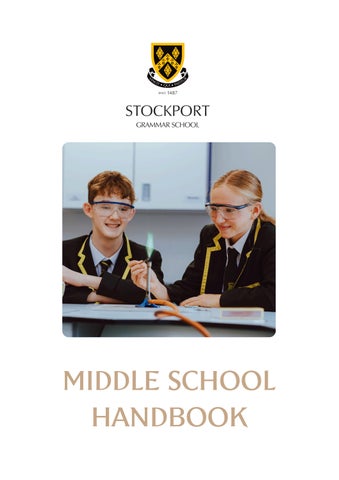
MIDDLE SCHOOL HANDBOOK
CONTENTS
INTRODUCTION
3
CHOICES
4
ASSESSMENT
5
CO-CURRICULAR ACTIVITIES/ CAREERS
6
ART & DESIGN
7
BIOLOGY
8
BUSINESS
9
CHEMISTRY
10
CLASSICAL CIVILISATION
11
COMPUTER SCIENCE
12
DRAMA
13
ENGLISH
14
FOOD PREPARATION & NUTRITION
15
FRENCH
16
GEOGRAPHY
17
GERMAN
18
HISTORY
19
LATIN
20
LIFE STUDIES
21
MATHS
22
MUSIC
23
PHYSICAL EDUCATION
24
PHYSICS
26
PRODUCT DESIGN
27
RELIGIOUS STUDIES
28
SPANISH
29
TEXTILES
30
SPECIFICATION
31
Middle School marks an exciting and important chapter in your educational journey. This handbook is designed to equip you with the essential information needed to plan for the next two years with confidence and enthusiasm. Our aim is to ensure every pupil feels supported, encouraged, and inspired to achieve their full potential—both in the classroom and beyond. To support pupils and parents, we host a number of key events throughout the year: Fourth Year Information Evening at the start of the Autumn Term introduces families to Middle School life and key staff. GCSE Preparation Evening helps Fifth Year pupils begin their final year with clarity and purpose, with real life experiences shared by our Sixth Form. Sixth Form Open Evening in October offers insights into A Level options and future pathways, led by Heads of Department and senior staff.
INTRODUCTION
Welcome to Middle School
We provide a clear reporting schedule at the start of each academic year and keep families informed through regular grade updates, reports, and parents’ evenings. We understand that pupils may need additional support at times. Whether for academic guidance or personal matters, our dedicated team is always available. Key contacts include: Mrs J Fitzgerald, Head of Middle School Mr Clarke and Mr Talbot, Middle School Heads of Year Mrs Matty, Mrs Creswell, Early Help & Pupil Wellbeing Lead Mrs White, Deputy Head (Safeguarding & Wellbeing) Our School Nurses also offer valuable support Our Life Studies programme includes a focus on managing transition to Middle School and careers and future study, helping pupils prepare for life beyond Middle School. Experienced subject teachers and Form Tutors provide ongoing guidance, while Mrs Tadman, Head of Careers, offers personalised advice and access to a well-resourced Careers Room. All Fifth Year pupils are offered a careers interview with our specialist team, and those with specific aspirations are connected early with our Sixth Form team for tailored support. Our goal is simple: to ensure every Middle School pupil progresses to Sixth Form happy, confident, and ready to succeed. CONTENTS
Mrs Jude Fitzgerald Head of Middle School
3
CHOICES
GCSE Courses
Nearly all pupils will be expected to take nine subjects at GCSE. The general desire for a balanced academic timetable means that there are rules to be followed when subjects are being chosen. Pupils must study Maths, English Language and Literature and at least one science. The study of two sciences is strongly recommended. The full list of subject options appears below, and this handbook provides departmental information on each of the subjects listed. All the specifications are chosen to meet all conceivable university and national matriculation requirements. Art & Design Biology Business Studies Chemistry Classical Civilisation Computer Science Drama English
Food Preparation & Nutrition French Geography German History Latin Life Studies
Maths Music Physical Education Physics Product Design Religious Education Spanish Textiles
Read the course details carefully before choosing your subjects.
When picking options to create the right curriculum, keep these points in mind: A broad and balanced education at this stage is important whatever career is eventually chosen. It is wise to choose subjects which will suit and extend each pupil's interests and abilities. Subject choices greatly affect future careers, with omissions being equally impactful. For instance, Chemistry is essential for science and medical fields. A subject should be chosen for its own sake and not because of the staff who teach it or because of a few extra marks gained in a recent examination. Since each course is a direct preparation for a public examination it should not be undertaken lightly. Each choice should be positive and should reflect true enthusiasm. CONTENTS
The grade achieved at GCSE is often considered more significant than the specific subject. Pupils tend to perform better in subjects they enjoy, as this fosters greater motivation and engagement. Pupils are strongly advised to opt for at least one modern foreign language and a second science subject.
4
Internal Examinations
There will be internal examinations in the Middle School prior to the GCSE examinations in the summer of 2029. Internal examinations during the Summer Term of the Fourth Year Mock GCSE examinations in November/December of the Fifth Year
ASSESSMENT
Subject choices should be made thoughtfully, as changes will be difficult once the Autumn Term begins. While the school makes every effort to accommodate the preferences of pupils and parents, final decisions are influenced by subject demand and the need to create a practical timetable. Including a reserve option helps the school better understand pupils' interests while allowing for flexibility if needed.
This means, not only will the pupils be very familiar with the mode of questioning used by a particular GCSE subject examination board, but they will also have revised the factual material required by subjects a number of times and will find the task of final revision much easier. Coursework and Non-Examination Assessments
Coursework and Non-Examination Assessments (NEA) are vital in Middle School, with some tasks graded for GCSEs, often under exam conditions. Pupils should complete tasks conscientiously, use time responsibly, meet deadlines, and discuss challenges promptly. Regular attendance is crucial, as absences can harm progress and grades. Reporting
Throughout the Fourth and Fifth Year, parents are kept informed about their child's academic progress through a variety of methods, including parents' evenings, detailed written reports, and specific approaches to learning reports. Additionally, marks and grades are provided after relevant exams, giving a clear picture of the pupil's performance. The school uses a proactive approach to monitor academic achievement, aiming to ensure that any necessary interventions can be implemented in a timely manner to support each pupil's success. Grades awarded by examination boards follow the 9-to-1 scale, providing a standardised measure of achievement. In the Summer Term of the Third Year, all pupils sit the CAT4 tests, which are similar to the MidYIS test, and offers valuable insights into the minimum expected grades. These minimum expected grades are subsequently communicated to parents and included in the pupils' written reports to help guide their academic journey. Pupils will also have the opportunity to reflect and set themselves a personal grade. CONTENTS
5
CO-CURRICULAR ACTIVITIES/CAREERS CONTENTS
6
Co-Curricular Activities
We encourage Middle School pupils to stay involved in our wide range of co-curricular activities and take on leadership roles, such as Model United Nations. These activities are both fun and enriching. Clubs include Statistics, Silver Arts Award, and Latin Scrabble Competition. Exciting trips have included a Music tour to Germany, Geography trip to the Azores, History trip to Berlin or Munich, Classics trip to Rome and Naples, and Modern Languages to Paris. Outdoor activities like kayaking, climbing, mountain biking, skiing, and hiking are also available, with trips to the French Alps, Spain, and Wales. Duke of Edinburgh’s Award
As a Licensed Organisation for the Award, we offer all pupils the chance to participate at every level. Enrolment for the Bronze Level begins in the Third Year and includes four sections: volunteering, physical, skill, and expedition. Programmes are tailored to suit each pupil's interests and abilities, with flexible timescales and targets. Pupils have plenty of activity options, such as volunteering in charity shops, coaching younger sports teams, playing team or individual sports like rugby, hockey, tennis, or yoga for the physical section, and learning music, a language, or cookery for the skill section. The Bronze Level requires two sections to be completed over three months, one for six months, and an expedition lasting two days with six hours of activity each day, plus an overnight camp. Expedition training takes place after school and on weekends. For more details, visit the school website or the official DofE website. The Next Step Careers
In the Fourth and Fifth Year, pupils explore careers in more depth through a Careers Education program taught in Life Studies lessons. They will access up-to-date resources, visit the Careers Room, and can request individual careers interviews. Pupils are encouraged to attend the Careers Convention held every two years in the Autumn Term and listen to talks by guest speakers. We strongly encourage all pupils to complete at least one week of work experience, either in the weeks after their GCSEs or at another suitable time. This hands-on experience helps them explore potential careers and is often required for some university courses. Past pupils have found work experience both rewarding and enjoyable.
The GCSE course in Art & Design aims to produce a body of work that explores key areas of the subject through a variety of media and techniques, culminating in a final exhibition at the beginning of the Summer Term in the Fifth Year. Drawing is at the core of study, but painting, graphics, print, textiles, and three dimensional work provide for development of initial ideas and skills. Practical work is supported through an appreciation of art history and critical thinking with pupils undertaking gallery visits to gather source material. In addition, the opportunity to visit galleries abroad as part of a residential trip may be offered. The subject offers considerable scope for those who are enthusiastic and show potential in the Third Year and who wish to continue their study to a higher level. There is no written examination, but a significant commitment in terms of time is required throughout the two years. Pupils should be prepared to explore ideas and show a strong personal response.
ART & DESIGN
Studying Art & Design
The Course Content
Pupils must demonstrate their ability to: Develop their ideas through investigations, demonstrating critical understanding of sources Refine work by exploring ideas, selecting and experimenting with appropriate media, materials, techniques and processes Record ideas, observations and insights relevant to intentions as work progresses Present a personal and meaningful response that realises intentions and demonstrates understanding of visual language Assessment of the Course Written Examination
No
NEA/Coursework
60% Portfolio 40% Assignment
The department follows the AQA GCSE specification. The portfolio comprises 60% of the total marks awarded while the remaining 40% of the assessment is an externally set assignment undertaken towards the end of the Fifth Year. The final piece is produced in ten hours and comes at the end of a period of preparatory study that takes a starting point of the pupil’s choice. Further information
CONTENTS
For further information please speak to Mr Davies, or visit the AQA website. In 2023, SGS received the highest possible rating from the Arts Council England, with a Platinum Artsmark Award.
7
BIOLOGY
Studying Biology
GCSE AQA Biology covers the study of living organisms, how they function, and how they interact with their environment. Students learn key scientific concepts, develop practical skills, and apply biology to real-world contexts such as health, disease, genetics, and ecology. Studying GCSE and A Level Biology is essential for pupils considering the study of medicine at university (including veterinary medicine). It is also required for applying for courses in dentistry, physiotherapy and pharmacy. The AQA GCSE Biology required practicals form an essential part of the course, giving students valuable hands-on experience that supports their understanding of key biological ideas. Throughout the two-year programme, students complete investigations such as microscopy, enzyme activity, osmosis, photosynthesis, microbiology techniques, and ecological fieldwork. These practicals help students develop confidence in using scientific equipment, collecting and analysing data, and evaluating the reliability of their results. Although there is no separate practical exam, the skills and knowledge gained are assessed in the written papers, making these activities an important foundation for success in GCSE Biology. The Course Content
Cell biology Organisation Infection and Response Bioenergetics
Homeostasis and Response Inheritance, Variation and Evolution Ecology
Assessment of the Course Written Examination
100%
NEA/Coursework
No
Pupils sit two exams, both count towards 50% of the qualification. Biology Paper 1 - 1 hour 45 minutes Biology Paper 2 - 1 hour 45 minutes Further Information
For more information, please speak to Mrs Bowden, or visit the AQA website. CONTENTS
8
Business Studies provides pupils with the opportunity to learn about how businesses are run and what makes them successful. We apply a range of concepts to real life businesses and aim to answer questions such as: Which pricing strategy should a business use? How has technology changed the way businesses operate? What is the best way for a business to motivate its staff? Why are some businesses experiencing an increase in profit, whilst others are failing? The Course Content
Business Studies develops pupils’ understanding of business activity in the public and private sectors, and the importance of innovation and change. Pupils find out how the major types of business organisation are established, financed and run, and how their activities are regulated. Factors influencing business decision-making are also considered, as are the essential values of cooperation and interdependence.
BUSINESS STUDIES
Studying Business Studies
Pupils not only study business concepts and techniques, but also enhance related skills such as numeracy and enquiry. The course is divided into two themes: Investigating small businesses Building a business Assessment of the Course Written Examination
100%
NEA/Coursework
No
The department follows the Pearson GCSE Business Studies specification. Pupils sit two examinations at the end of the Fifth Year: Paper 1 - 1 hour 45 minutes Paper 2 - 1 hour 45 minutes Further Information
For further information, please speak to Mrs Burslem-Curl or visit the Pearson website. CONTENTS
9
CHEMISTRY
Studying Chemistry
Our aim is to use a variety of teaching and learning experiences to enthuse pupils and stimulate their interest in Chemistry. It is hoped that through the acquisition of skills and knowledge, pupils will develop an understanding of the role Chemistry has had in developing scientific ideas and its importance in the shape of the society in which we live. By the end of the course, pupils will have developed a critical approach to scientific evidence and the methods used to acquire it. This will enable them to be scientifically literate members of society which is vital for preparing them for life in a technological world. As well as providing an essential basis for those pupils who wish to follow a future in science or medicine, Chemistry also provides a good grounding for those with more artistic leanings. The qualification is essential for pupils considering medical (including veterinary medicine), dental, paramedical, biochemical, pharmaceutical, materials and physical science and chemistry, and is of particular value in its own right in assisting pupils’ understanding of the fundamental make-up of the world in which they live. The Course Content
The course has nine topics: Paper 1: Key concepts in Chemistry States of matter and mixtures Chemical changes Extracting metals and equilibria Separate Chemistry 1
Paper 2: Key concepts in Chemistry Groups in the periodic table Rates of reaction and energy changes Fuels and Earth science Separate Chemistry 2
Assessment of the Course Written Examination
100%
NEA/Coursework
No
We follow the Edexcel GCSE Chemistry specification, which both challenges and stimulates pupils of all abilities. Assessment of Chemistry is by means of two written papers at the end of the Fifth Year. The exams consist of a mixture of different question styles, including multiple-choice questions, short answer questions, calculations and extended open-response questions. CONTENTS
Chemistry Paper - 1 hour 45minutes (110 marks) Chemistry Paper 2 - 1 hour 45 minutes (110 marks) Further Information
For further information, please speak to Mrs Britton or visit the Edexcel website.
10
The course offers pupils the opportunity to study the history, mythology and literature of ancient Greece and Rome. Pupils will develop their ability to use primary sources to gain an understanding of the lives and priorities of the Greeks and Romans. The syllabus offers considerable variety and interest. The topics chosen will give pupils a well-rounded perspective of the civilisations of Greece and Rome. Each pupil is encouraged to express their individual response to the sources studied and indeed it is difficult not to when considering the engaging stories of Heracles, Romulus and Odysseus. The Course Content The Odyssey
We read Homer's wonderful poem about the journey home of the hero, Odysseus, and all his encounters with gods, monsters and men. Reading one of the first and greatest epic poems helps pupils to set all subsequent literature in context. The Odyssey really invented the role of the suffering hero and introduced the theme of the quest to literature. Myth and Religion in Athens and Rome
Myth and religion were closely intertwined in the ancient world. Greek and Roman mythology has an enduring appeal and offers a fascinating insight into these most creative and dramatic ancient societies.
CLASSICAL CIVILISATION
Studying Classical Civilisation
This topic includes:
Foundation Myths Ancient Temples Heracles
Underworld Festivals Gods
Assessment of Course Written Examination
100%
NEA/Coursework
No
The department follows the OCR specification. Pupils' knowledge and understanding of the topics are assessed in two 90 minute examinations (Myth and Religion, and The Homeric World) at the end of Fifth Year. Further Information
For further information, please speak to Miss Jones or visit the OCR Website.
CONTENTS
11
COMPUTER SCIENCE
Studying Computer Science
Computer Science plays a key role in modern society, from GPS and smart TVs to driverless cars. This course explores how to program technology to perform tasks precisely and consistently. Pupils learn to think logically, break down problems, and create effective solutions. GCSE Computer Science provides insight into computer system design and hands-on experience in writing structured code. The Course Content
The course is divided into the following sections: Fundamentals of algorithms Programming Fundamentals of data representation Computer systems Fundamentals of computer networks Cyber security Relational databases and Structured Query Language (SQL) Ethical, legal and environmental impact of digital technology on wider society, including issues of privacy Pupils will learn problem analysis, software development, and the basics of computer systems and networks, including how binary and hexadecimal store is used to store images on storage media. They will study data types, programming structures, and topics like privacy, security, ethics, and environmental issues. Strong mathematics skills are essential, as programming involves logic and equations. Pupils should already be keen programmers with a solid grasp of basic coding. Assessment of the Course Written Examination
100%
NEA/Coursework
No
There are two exam papers worth 50% each. The first is the ‘Computational Thinking’ paper and this covers sections 1 – 2. The second is the ‘Theoretical Content’ paper and this covers sections 3 – 8. Further Information
For further information, please speak to Mrs O’Brien or visit the AQA Website.
CONTENTS
12
Drama students should expect to develop a high standard of performance skills through work on both devised and scripted projects. They will study the theatrical possibilities of play texts and examine how they can be taken from script to stage. The Course Content
Pupils need to have an enthusiasm for performing and for interpreting and responding to a play script, which will be DNA by Dennis Kelly, as well as an ability to devise their own project in response to a topic or stimuli. Pupils will undertake several theatre visits to enable them to critically analyse and evaluate live theatre. Pupils will also realise two extracts from a play text before a visiting examiner.
DRAMA
Studying Drama
There will be a written examination in the Summer Term of the Fourth Year and a Trial examination in January of the Fifth Year, before the final written examination takes place in the Summer Term. A significant amount of time throughout the course will be spent on the NEA components and there will be performance dates towards the end of the course. Assessment of the Course
The department follows the Pearson GCSE Drama course, which comprises of three components: Component 1: Devising – this is an NEA component and comprises 40% of the total marks. Pupils develop and perform a piece in response to a series of stimuli. Alongside this, they produce a 2,000-word portfolio analysing and evaluating their creative process. Component 2: Performance from Text – this comprises 20% of the total marks and is marked by a visiting examiner. Pupils interpret two key extracts from a performance text. They may work as either a performer or designer. Component 3: Theatre Makers in Practice – this is a 105-minute terminal written exam and comprises 40% of the overall grade. Pupils respond to an unseen extract from DNA from the perspectives of a performer, director and designer. Pupils also analyse and evaluate a live performance they have seen. Pupils are allowed to take live theatre performance notes into the examination to help them. Written Examination
40%
NEA/Coursework
40% Devised performance/Portfolio 20% Performance (visiting examiner)
CONTENTS
Further Information
For further information, please speak to Mr King-Sayce, or visit the Pearson Website.
13
ENGLISH
Studying English and English Literature
All pupils study IGCSE English and English Literature, developing skills in analysing how writers use language and structure, and applying these techniques in their own writing. The Literature course, including theatre visits and drama experience, broadens pupils' literary knowledge and encourages engagement with controversial themes through discussion and debate. The Course Content
Pupils will read and discuss a variety of fiction and non-fiction texts in order to develop their skills in analysing, connecting and creating texts. The English Literature specification involves the detailed study of literature from Shakespeare to the present day. Pupils study four complete texts: Of Mice and Men, a selection of poetry, Macbeth and An Inspector Calls.
Written Examination
100%
NEA/Coursework
No
The department follows the Pearson IGCSE English and English Literature courses. In English, there are two examinations. The first is 2 hours and 15 minutes long, testing pupils’ ability to answer a mixture of short and long answer questions relating to one prepared non-fiction text and one previously unseen extract. Additionally, pupils must complete one 45 minute writing task, from a choice of two involving a given audience, form or purpose. This paper comprises 60% of the total marks. The second paper, worth 40% of the total marks, is 1 hour and 30 minutes in duration. Pupils must first answer one literary essay question on a prepared poem or short story; the second task is an imaginative writing piece. In English Literature there are two examinations. Paper 1 (60%) is a two hour paper in which pupils explore an unseen poem, then compare two of the poems from the anthology they have prepared. In the final section, knowledge and understanding of the prose set text, Of Mice and Men, is tested with an emphasis on social and historical context. Paper 2 (40%) enables pupils to demonstrate their knowledge of dramatic form and structure whilst answering one essay question on the modern play they have studied, An Inspector Calls, and one question about Macbeth. Pupils are provided with a clean copy of the anthology for Paper 1 and clean copies of the two plays they have studied for Paper 2. Further Information CONTENTS
14
For further information please speak to Mrs Cope, or visit the Pearson Website for English Language, or English Literature.
This GCSE course engages pupils with practical and research-based learning about food preparation, nutrition, and special dietary needs. It is ideal for those considering careers in the food industry, teaching, retail, health, dietetics, sports nutrition, or business and marketing. The Course Content
Using practical work, research and written tasks, pupils will study: Food preparation skills - pupils will regularly practice a range of technical skills, from basic knife techniques to using complex equipment, through weekly practical sessions Nutrition and health - making informed choices about balanced diets, analysing nutrition, and addressing health issues Food science - functional and chemical properties of food Food safety - food spoilage and poisoning Food choice - factors affecting food choice, British and international cuisine, food labelling and marketing Food provenance - the environmental impact and sustainability of food, food processing and production Food preparation and cooking techniques - this will be assessed through Controlled Assessment tasks, focusing on recipe modification, costing, sensory and nutritional analysis, and tailoring dishes to diverse lifestyles and nutritional needs Pupils will have the opportunity to complete the CIEH Food Hygiene Certificate in the Fourth Year. Assessment of the Course Written Examination
50%
NEA/Coursework
15% food investigation 35% food preparation
FOOD PREPARATION & NUTRITION
Studying Food Preparation & Nutrition
The department follows the OCR GCSE specification. The course is assessed by a 1 hour 30 minute written paper examined at the end of the Fifth Year. Two NEA tasks, set by the exam board and internally assessed, are completed in the Fifth Year. Food Investigation task (recommended time 10 hours) worth 15% of the total GCSE. Food Preparation task (recommended time 20 hours including a 3 hour practical) worth 35% of the total GCSE. Both tasks have a practical element and pupils select them from a wide range set by the examination board.
CONTENTS
Further Information
For further information, please speak to Miss Hodkinson, or visit the OCR Website.
15
FRENCH
Studying French
We aim to provide pupils with the skills needed to communicate confidently in French in a range of situations. In the Fourth and Fifth Year, pupils follow a course that combines a strong grammatical foundation with practical language development, preparing them for further study, work, or travel in French-speaking countries. Pupils are fully prepared for the AQA GCSE examination. There are three main themes:
People and Lifestyle Popular Culture Communication and the world around us
The examination is taken at the end of Fifth Year and there are four papers. There is no coursework. Paper 1 – Listening (25%) Candidates will hear recordings of native speakers and answer either with a nonverbal response or a short phrase/sentence in English. There is also a short dictation exercise. Paper 2 – Reading (25%) Candidates respond to questions relating to French passages of varying lengths. Questions are answered in English or non-verbally. There is also a short translation from French into English. Paper 3 - Speaking (25%) This lasts for 12 minutes and takes place in the April of Fifth Year. It is conducted, recorded and marked by the pupil’s teacher. There are 3 sections: role-play, reading aloud and discussion of two photographs. Paper 4 – Writing (25%) There are two short essays (90 words and 150 words), as well as a short translation into French. The course focuses on practical language tasks reflecting real-life situations a young person may encounter with native speakers. Fourth Year pupils have the opportunity to participate in a French exchange, staying with a family in Paris, attending school, and visiting major landmarks. CONTENTS
The course book is AQA GCSE French (Higher), which provides a lively balanced approach to language learning, including pair and group work, plus varied listening, reading and written tasks. Further Information
For further information, please speak to Miss Gibson, or visit the AQA Website.
16
Geography is a multi-disciplinary subject that provides a unique and holistic understanding of our world. The study of geography includes: The study of local and international physical and human environments Understanding the physical and human processes which affect their development Understanding people’s interactions with the environment and the related challenges and opportunities Equipping pupils to evaluate material critically, draw reasoned conclusions and provide solutions in response to the numerous challenges currently facing humanity Two compulsory field trips to Manchester and Kinder Scout, Edale, plus the opportunity to go on non-compulsory field trips within the UK and abroad.
GEOGRAPHY
Studying Geography
The Course Content
Pupils will be taught the Pearson A GCSE course, which will provide the opportunity to study: Physical Geography: An overview of the UK’s landscapes, weather hazards and ecosystems Human Geography: Focusing on global urban challenges, global development and resource management Geographical Skills: Comprising of a fieldwork study and a synoptic study in which pupils draw on their geographical skills to investigate a contemporary challenge facing the UK Assessment of the Course Written Examination
100%
NEA/Coursework
No
Pupils are assessed at the end of the Fifth Year. Pupils will sit three different exam papers that will examine the different topics studied above: Paper 1 - The Physical Environment - 1 hour 30 minutes (37.5%) Paper 2 - The Human Environment - 1 hour 30 minutes (37.5%) Paper 3 - Geographical Investigations - 1 hour 30 minutes (25%) CONTENTS Further Information
For further information, please speak to Mr Cooke or visit the Pearson Website.
17
GERMAN
Studying German
German is one of the most important and prestigious languages in Europe and its mastery opens doors to many different spheres of work. At SGS, we prepare pupils for the AQA GCSE German examination. By the end of the course pupils will be able to communicate effectively in most situations - as a tourist in a German speaking country or when acting as host to German speakers here in England. The course provides a sound basis for further study of German at A Level and beyond. There are three main themes:
People and Lifestyle Popular Culture Communication and the world around us
The examination is taken at the end of Fifth Year and there are four papers. There is no coursework. Paper 1 – Listening (25%) Candidates will hear recordings of native speakers and answer either with a nonverbal response or a short phrase/sentence in English. There is also a short dictation exercise. Paper 2 – Reading (25%) Candidates respond to questions relating to German passages of varying lengths. Questions are answered in English or non-verbally. There is also a short translation from German into English. Paper 3 - Speaking (25%) This lasts for 12 minutes and takes place in the April of Fifth Year. It is conducted, recorded and marked by the pupil’s teacher. There are three sections: role-play, reading aloud and discussion of two photographs. Paper 4 – Writing (25%) There are two short essays (90 words and 150 words), as well as a short translation into German. The course followed is AQA GCSE German (Higher) and it is supplemented by other materials e.g. Mach Mit and Echo. CONTENTS
Pupils also have the opportunity to take part in the School German trip to Munich in February half-term. Further Information
For further information, please speak to Miss Gibson, or visit the AQA Website.
18
Just as history has made our world what it is, history can also be a key part of your future. Learn how studying history informs the present and gives you the skills you need to prepare for the future. History is very practical and teaches you vital skills that employers want, because it involves: Learning about people Learning to understand and evaluate facts Handling evidence to make informed decisions Communicating your ideas and thoughts effectively Learning about different countries, societies and cultures
HISTORY
Studying History
The Course Content
The course is divided into three main areas. Each area covers arguably the most significant events to occur in the Twentieth Century. Depth Study Weimar and Nazi Germany (1933 - 1945) US Civil Rights (1945 - 1974) Breadth Study Changes in Medicine (1848 - 1948) Investigation Study Causes and course of the First World War (1900 - 1918) Assessment of the Course Written Examination
100%
NEA/Coursework
No
The department follows the Pearson Edexcel IGCSE (9-1) History course. Pupils sit two examinations at the end of the Fifth Year. Further Information
For further information, please speak to Mr Leng, or visit the Pearson website.
CONTENTS
19
LATIN
Studying Latin
Latin is a subject which offers a challenge to the brightest pupils and retains its currency with universities and employers as a subject of intellectual rigour. The course helps pupils to develop their knowledge and thus appreciation of the logic and beauty of the language. The course builds and expands on the pupils’ knowledge of grammar and vocabulary from the Second and Third Year, leading up to the opportunity to read and analyse the works of Latin authors in the Fifth Year. Studying Latin at GCSE enables pupils to develop transferrable skills which are of benefit to a range of subjects across the curriculum. Pupils learn to apply logic, to analyse in detail and to engage with a text in a critical way. The Course Content
The pupils will be helped to read and then analyse 2000-year-old literature. This literature may include poetry by authors such as Virgil, Ovid and Catullus and prose by Pliny, Cicero and others. The nature of the Latin language is such that it is able to express complex ideas and emotions succinctly and yet with power. To be able to access directly written material produced by one of the most fascinating and lively cultures ever to have inhabited the planet is a genuine privilege. Assessment of the Course
The department follows the Eduqas Latin specification. The examinations are taken at the end of the Fifth Year. There is no Non Examination Assessment. Paper 1 - 1 hour 30 minutes (50%) Comprehension and translation (from Latin to English). There will also be some short sentences to be translated from English into Latin. Paper 2 - 1 hour 15 minutes (30%) Translation and analysis of prepared passages of Latin prose and verse. Paper 3 - 1 hour (20%) Translation and analysis of prepared passages of Latin poetry and verse. Written Examination
100%
NEA/Coursework
No
Further Information CONTENTS
20
For further information, please speak to Ms Jones, or visit the Eduqas website.
All pupils attend one Life Studies lesson per week. It is a combination of PSHE (Personal, Social and Health Education) and Citizenship education. In the Middle School we examine the pressures of being a teenager and give the pupils an opportunity to explore sensitive topics through class discussions. We also use this opportunity to research potential careers, learn about work experience, introduce basic driving education, introduce basic first aid, examine how to be a ‘good’ citizen and investigate everyday life. There is no assigned homework in this subject, yet we do encourage the pupils to complete ‘Life Skills Tasks’. These tasks may include bringing in an article that is relevant to the current topic, participating in community projects, researching a career and finding a work experience placement.
LIFE STUDIES
Studying Life Studies
Aims of the Department
To create a relaxed environment for the pupils to learn from each other To allow the pupils to think critically about their lives and the pressures they will endure To give them the opportunity to learn through practical experience inside and outside of the classroom To provide them with the information that will enable active and productive participation in society
Lesson Format
The department utilises a variety of media software and resources to make lessons interesting and contemporary. All teaching rooms are equipped with Interactive Flat Panels (IFP) and we have a departmental computer suite. Invariably, teachers encourage a good deal of pupil input, with discussion, formal debate and group presentation forming a significant proportion of lesson time. Pupils are encouraged to develop their rhetorical skills and think in a manner that involves empathy and reflection. The sensitive nature of some of the work is recognised by members of staff and great care is taken to discuss issues sympathetically. Further Information
For further information, see Mr Ehegartner. CONTENTS
21
MATHEMATICS
Studying Mathematics
The compulsory two-year GCSE Mathematics course is taught in sets based on each pupil's ability to achieve their best grade. Sets differ in pace and teaching methods, with the aim of placing pupils in the group that allows them to reach their full potential. Pupils must have a calculator in every lesson and are encouraged to seek help from their teacher if needed. The Course Content
The specification builds on topics covered in the first three years of Mathematics. Pupils aiming to study Mathematics in the Sixth Form should achieve a 9, 8, or high 7, with a strong grasp of algebraic GCSE topics. Those interested in A Level Further Mathematics should aim for a 9 or 8 at IGCSE. Assessment of the Course
The department prepares pupils for the Pearson International GCSE, which includes two 2-hour written exams, with calculators allowed. There is no coursework or controlled assessment. The majority of pupils are entered for the Higher Tier, which covers a broad syllabus, including topics common to A Level Mathematics, and is aimed at pupils expected to achieve grades 9 to 4. A small group of pupils are entered for the Foundation Tier as appropriate. Written Examination
100%
NEA/Coursework
No
Pupils in the highest set will also be prepared for an additional qualification. While not required for studying Mathematics in the Sixth Form, it provides useful knowledge and confidence for those pursuing A Level Further Mathematics. This extension qualification is only available to pupils expected to achieve the highest grade in IGCSE Maths. For those interested in GCSE Statistics (offered by Pearson), weekly lunchtime sessions start after the Fourth Year exams and run throughout Fifth Year, with further details given at the start of the year. Further Information
For further information, please speak to Mrs Collard or visit the Pearson website.
CONTENTS
22
GCSE Music is extremely well suited to pupils who simply like music and have made a promising start on a particular instrument or voice. The breadth of the course is such that pupils will inevitably encounter plenty of styles that they already know and like as well as introducing them to a number of less familiar styles from different musical traditions. Pupils should ideally be able to play to approximately Grade 4 standard by the Fifth Year. Much emphasis is placed on composition with either notation-based software such as MuseScore, Noteflight or Sibelius or audio software such as Soundtrap, but prior experience is not essential. The ability to read and write in standard musical notation is extremely useful. The Pearson specification is followed, which comprises the following units:
MUSIC
Studying Music
Component 1: Performing (30%) (NEA) Candidates must do at least two performances with a minimum total performance duration of four minutes. This should include at least one solo and one ensemble. Component 2: Composing (30%) (NEA) Candidates must produce two compositions. One of these is a free composition and the other is based on a set brief. These should have a total duration of at least three minutes. Component 3: Appraising (40%) One hour and 45 minutes listening exam based on the study of the following four areas of study and set works: Instrumental Music 1700-1820 Bach – Brandenburg Concerto No. 5 in D Major (3rd movement); Beethoven Piano Sonata No. 8 in C Minor Pathetique (1st movement) Vocal Music Purcell – Music for a while; Queen – Killer Queen (from the album Sheer Heart Attack) Music for Stage and Screen Schwartz – Defying Gravity (from Wicked); Williams – Star Wars Episode IV A New Hope Fusions Afro Celt Sound System – Release (from the album Volume 2: Release); Esperanza Spalding – Samba Em Preludio (from the album Esperanza) Assessment of the Course Written Examination
40%
Further Information
NEA/Coursework
30% Performing 30% Composing
CONTENTS
For further information speak to Mr Dow, or visit the Pearson Website. In 2023, SGS received the highest possible rating from the Arts Council England, with a Platinum Artsmark Award.
23
PHYSICAL EDUCATION
Studying Physical Education
Studying GCSE Physical Education helps pupils develop a detailed understanding of how the body works and how physical activity impacts health and performance. Students explore key topics such as anatomy and physiology, sports psychology, biomechanics, and socio-cultural influences, building analytical and evaluative skills. The course encourages critical thinking and scientific reasoning, enabling pupils to apply theory to real-life sporting contexts. This prepares pupils for further study and future careers in sport, health, and science-related fields. The course also assesses pupils in three practical sports and encourages them to engage in developing their playing level throughout the course. Pupils will also learn to analyse and evaluate their own performance in sport as part of their NEA. Please note, GCSE PE is only suited to those who are already competing regularly in sport, preferably to a strong level. The Course Content
Applied anatomy and physiology Movement analysis Physical training Socio-cultural influences Sport Psychology Health, fitness & wellbeing
Assessment of the Course Written Examination
60%
NEA/Coursework
40%
Exams
Paper 1 - The human body and movement - 30% Paper 2 - Socio-cultural influences - 30% NEA
Analysis and Evaluation of Performance - 10% Practical performance in three different physical activities (see list) - 30% One from the ‘individual’ list One from the ‘team’ list One from either list CONTENTS Further Information
For further information speak to Mr Stone, or visit the AQA website.
24
Individual List
Cannot be assessed with doubles
Amateur boxing Boccia Canoeing
Gymnastics
Floor routines and apparatus only
Cannot be assessed with doubles
Cannot be assessed with sculling, canoeing or rowing
Cannot be synchronised, personal survival or lifesaving
Kayaking
Polybat Rock climbing
Cannot be assessed with kyaking, rowing, or sculling
Indoor or outdoor
Cannot be assessed with athletics
This can only be one activity
Cross country running Cycling Track/Road or BMX
Racing, not tricks
Dance
Cannot be used as both a team and individual activity
Platform Diving Equestrian Figure skating
This can only be used for one activity and cannot be assessed with dance
Golf
Team List
Acrobatic gymnastics
Cannot be assessed with gymnastics
Association football
Sailing*
Sculling
Cannot be street basketball
Blind cricket Camogie
Cannot be assessed with hurling
Cricket Dance
Hurling
Inline roller hockey
Cannot be assessed with ice hockey
Lacrosse Netball Powerchair football Rowing
Cannot be assessed with sculling, canoeing or kayaking
This can only be used for one activity and cannot be assessed with dance
Cannot be assessed with sevens or union. Cannot be tag rugby
Futsal
Cannot be assessed with football
Gaelic football Goalball
Table tennis
Cannot be assessed with doubles
Tennis
Cannot be assessed with doubles
Trampolining Windsurfing
Hockey
Field hockey only
Cannot be used as both a team and individual activity
Figure skating
Swimming
Cannot be assessed with kayaking, Candidates must be assessed in full canoeing, rowing or team sculling competitive situations in either of the following Royal Yachting Skiing Association Windsurfing Cannot be assessed with snowboarding. Can take place on classifications: Bic Techno 2930D real or artificial snow, either indoors or iQ foil or outdoors *Sailing: Candidates must be Snowboarding assessed within full Cannot be assessed with skiing. competitive situations as the Can take place on real or artificial helmsperson in one of the snow, either indoors or outdoors following Royal Yachting Association (RYA) sailing boat classifications: Optimist Topper RS terra sport Handball ILCA 4 (laser 4.7)
Cannot be five-a-side or assessed Cannot be assessed with camogie with futsal Ice hockey Badminton Cannot be assessed with inline Cannot be assessed with singles roller hockey
Basketball
Squash
PHYSICAL EDUCATION
Athletics Badminton
Rugby league Rugby union
Cannot be tag rugby and cannot be assessed with rugby league. Can be assessed as sevens or fifteen-a-side
Squash
Cannot be assessed with singles
Table cricket Table tennis
Cannot be assessed with singles
Volleyball Sculling
Cannot be assessed with rowing, canoeing, kayaking or individual sculling
Water polo Wheelchair basketball Wheelchair rugby Sailing
Candidates must be assessed within full competitive situations as the helmsperson in one of the following Royal Yachting Association (RYA) sailing boat classifications: RS Feva XL Cadet This can only be used for one activity
CONTENTS
25
PHYSICS
Studying Physics
Physics is the area of science that investigates and describes natural, non-living phenomena, from the smallest building blocks of matter to the universe as a whole and everything in between. In Physics, pupils develop a sense of wonder about how things work and the subject supplies the theories proposed by past and present physicists. It also cultivates a method of systematic thinking, allowing pupils to gain an understanding of the world around them and beyond, hopefully inspiring those who will go on to develop those theories in the future. The specification includes plenty of practical work and the opportunity to use modern equipment such as oscilloscopes and electronic timers. The course leads to an understanding of how scientific ideas contribute to technological change which impacts on the environment, medicine and our quality of life. The Course Content
The course covers the topics of: Forces and their effects Energy resources and energy transfer Waves Electricity Properties of solids, liquids and gases Radioactivity and particles Magnetism and electromagnetism Astronomy Assessment of the Course Written Examination
100%
NEA/Coursework
No*
*Pupils must have completed the core practicals We follow the Pearson GCSE Physics specification, which both challenges and stimulates pupils of all abilities. Assessment is by means of two written papers at the end of the Fifth Year. Physics Paper 1 - 1 hour 45 minutes (100 marks) Physics Paper 2 - 1 hour 45 minutes (100 marks)
CONTENTS
Experimental and investigative work is integrated into our teaching but the final assessment of these skills is through the two written papers. Further Information
For further information, please speak to Mrs Fenton or visit the Pearson Website.
26
Design & Technology is an inspiring and challenging subject. It gives students the skills and abilities to engage positively with the designed and made world and to harness the benefits of technology. You will experience a lively dynamic environment where you will gain the confidence to create innovative ideas and the capability to bring your ideas to life. You will learn to problem solve and encounter real-life design briefs where you will create a solution in the form of a fully-functional product. The course at GCSE builds on the work done through Design & Technology lessons in Lower School. However, in Fourth Year you will learn many more new processes and practical techniques to assist you when you complete your Fifth Year NEA project. The Course Content
Combine your practical skills with knowledge and understanding to design and manufacture quality products in a workshop environment Analyse and evaluate industrially manufactured products and production processes to develop an understanding of commercial practice Develop and demonstrate a wide range of practical techniques using the wide range of tools, machines and equipment in the department Devise strategies for developing creative and innovative ideas Consider planning and deadlines Explore how past and present designers and movements can influence your design ideas Recognise moral, cultural and environmental issues in Design & Technology
PRODUCT DESIGN
Studying Product Design
Assessment of the Course Written Examination
50%
NEA/Coursework
50%
The examination lasts two hours and tests the pupils on a range of broad and general questions on different aspects of Design & Technology. It also allows candidates to display specific material knowledge, understanding and skills. The Non-Examination Assessment is internally assessed and externally moderated. The students will produce a functional product, prototypes, a design sketchbook and an NEA folder containing research and evaluation work. The students will need to follow strict deadlines and guidance from their teacher to allow them to achieve as highly as possible on the NEA. Further Information
CONTENTS
For further information, please speak to Mrs Crosby, or visit the Eduqas Website.
27
RELIGIOUS STUDIES
Studying Religious Studies (Religion, Philosophy and Ethics)
Religious Studies at GCSE is primarily concerned with the study of religions, philosophy and contemporary moral issues. Pupils are expected to engage with subjects ranging from terrorism and war through to medical ethics, approaching these issues from a range of religious and non-religious perspectives. Critical thinking skills, empathy and an interest in current affairs are important, as is the ability to construct convincing arguments. This emphasis makes the subject an important one for those who wish to pursue careers in areas such as law, medicine and education. The Course Content
The course will enable pupils to examine fundamental questions regarding the nature and existence of God, the value of human life and the impact of religion in the 21st century. It will provide an opportunity to apply religious and philosophical teachings to a variety of ethical problems, all of which have relevance to our everyday lives. Pupils will gain an in-depth knowledge and understanding of two major world religions (Christianity and Islam) through a study of the various beliefs, teachings and practices that are central to those traditions. Pupils will then be required to apply their knowledge of these beliefs and teachings to a range of moral and political issues such as abortion, euthanasia, war, human rights and social justice. The Philosophy of Religion component will involve pupils engaging with topics such as the traditional arguments for the existence of God, good and evil, and religion and science. Pupils will be expected to develop their own ideas and defend them within the context of class debate and their written responses. Discussion forms a large part of most lessons and enables pupils to appreciate the broad spectrum of belief that is evident even within the confines of SGS. In their research, pupils are encouraged to draw from as many different sources as possible when forming a position on issues of moral and religious contention. Assessment of the Course Written Examination
100%
NEA/Coursework
No
The department follows the AQA Religious Studies Specification A (Study of Religions and Thematic Studies) GCSE. This course requires pupils to sit two examination papers at the end of their Fifth Year, each lasting one hour and 45 minutes. Further Information
For further information, please speak to Mr Linnegar or visit the AQA Website. CONTENTS
28
Proficiency in Spanish enables pupils to communicate successfully on a world stage. It affords access to the vibrant and lively culture of Spain and is becoming increasingly useful for communicating with businesses in North and South America. The GCSE course builds on the foundation knowledge gained during study in Lower School. Spanish at GCSE builds on the knowledge gained from Second and Third Year. Pupils follow a course that combines a strong grammatical foundation with practical language development, preparing them for further study, work, or travel in Spanish-speaking countries. Throughout the course, the language used and tasks required of pupils reflect real situations which a young person might experience when in contact with native speakers.
SPANISH
Studying Spanish
Pupils are prepared for the AQA GCSE examination. There are three main themes: People and Lifestyle Popular Culture Communication and the world around us Assessment of the course Written Examination
100%
NEA/Coursework
50%
Paper 1 – Listening (25%) In section A, candidates answer in English or non-verbally. In section B, there is a dictation in which they transcribe some short sentences. Paper 2 – Speaking (25%) This lasts for 10-12 mins and takes place in Fifth Year. It is conducted and recorded by the pupil’s teacher. There are three sections: role-play, reading aloud and short conversation and photo card discussion. Paper 3 - Reading (25%) Candidates respond to questions relating to Spanish passages of varying lengths. Questions are answered in English or non-verbally. There is also a short translation from Spanish into English. Paper 4 – Writing (25%) This paper consists of three sections: translation, a 90-word task, and a 150-word task, with a choice of two questions for each writing task.
CONTENTS
Pupils choosing to study Spanish may take part in the Middle School trip to Madrid, during which they have the opportunity to experience typical Spanish culture along with visits to some of the city’s main tourist spots. Further Information
For Further information, please speak to Mrs Psaila or visit the AQA Website.
29
TEXTILES
Studying Textiles
Design & Technology is an inspiring and challenging subject. It gives students the skills and abilities to engage positively with the designed and made world and to harness the benefits of technology. You will experience a lively dynamic environment where you will gain the confidence to create innovative ideas and the capability to bring your ideas to life. You will learn to problem solve and encounter real-life design briefs where you will create a solution in the form of a fully-functional product. The course at GCSE builds on the work done through Design & Technology lessons in Lower School. However, in Fourth Year you will learn many more new processes and practical techniques to assist you when you complete your Fifth Year NEA project. The Course Content
Pupils will undertake research relating to different design briefs set throughout the year They will carry out product analysis and product disassembly by studying existing textile designs and products as inspiration They will also look at the work of relevant designers, as a starting point for the creation of new fashion designs Through their studies of different textiles, pupils will develop a working knowledge of natural and synthetic fibres, and an awareness of technological advances in textiles materials and their applications in a wide range of industries Pupils will be encouraged to experiment with a wide range of surface decoration techniques Pupils will learn a range of manufacturing skills and techniques including the use of CAD (Computer Aided Design) and CAM (Computer Aided Manufacture) with an emphasis on professional finishes and quality control
Assessment of the Course Written Examination
50%
NEA/Coursework
50%
The examination lasts two hours and tests the pupils on a range of broad and general questions on different aspects of Design & Technology. It also allows candidates to display specific material knowledge, understanding and skills.
CONTENTS
The Non-Examination Assessment is internally assessed and externally moderated. The students will produce a functional product, prototypes, a design sketchbook and an NEA folder containing research and evaluation work. The students will need to follow strict deadlines and guidance from their teacher to allow them to achieve as highly as possible on the NEA. Further Information
For further information, please speak to Mrs Gate or visit the Eduqas website.
30
Subject
GCSE/IGCSE
Exam Board
Amount of Additional Assessment**
Final Exams
60% NEA (portfolio) 40% NEA (assignment) None None None None None 40% NEA (devised performance/portfolio) 20% NEA (performance – visiting examiner) None None 15% NEA (food investigation) 35% NEA (food preparation)
Assignment includes 10hrs supervised time 2 papers 2 papers 2 papers 2 papers 2 papers
AQA
None
GCSE
Pearson
None
German
GCSE
AQA
None
History Latin Mathematics
IGCSE GCSE IGCSE
Pearson Eduqas Pearson
Music
GCSE
Pearson
PE Physics Product Design Religious Studies
GCSE GCSE GCSE GCSE
AQA Pearson Eduqas AQA
None None None 30% NEA (performing) 30% NEA (composing) 40% NEA/Coursework None 50% NEA None
3 papers and the speaking test 3 papers 3 papers and the speaking test 2 papers 3 papers 2 papers
Spanish
GCSE
AQA
None
Textiles
GCSE
Eduqas
50% NEA
Art & Design
GCSE
AQA
Biology Business Studies Chemistry Classics Computer Science
GCSE IGCSE GCSE GCSE GCSE
AQA Pearson Edexcel OCR AQA
Drama
GCSE
Pearson
English Language English Literature
IGCSE IGCSE
Pearson Pearson
Food Preparation & Nutrition
GCSE
OCR
French
GCSE
Geography
Further Maths Statistics
Level 2 Certificate (IGCSE equivalent) GCSE
1 paper
SPECIFICATION
GCSE/IGCSE CURRICULUM - SPECIFICATION INFORMATION*
2 papers 2 papers 1 paper
1 paper 2 papers 2 papers 1 paper 2 papers 3 papers and the speaking test 1 paper CONTENTS
AQA
None
2 papers
Pearson
None
2 papers
*Specification subject to change **Additional assessment refers to coursework, NEA (non-examination assessment) or speaking tests. Further information about the co-curricular GCSE courses listed here can be obtained from the Head of Maths (Further Maths and Statistics).
31
www.stockportgrammar.co.uk