Q U A R T E R LY R E P O R T
Q2 2026
Procurement
Market Update MEASURED MARKET CONFIDENCE
AUTHORS David Hamilton
Senior Vice President, Construction Procurement Solutions
Doug Allen
Manager, Strategic Growth & Corporate Development STO Building Group
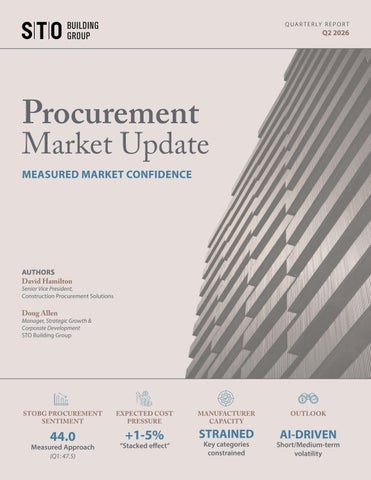
STOBG PROCUREMENT SENTIMENT
EXPECTED COST PRESSURE
MANUFACTURER CAPACITY
Measured Approach
“Stacked effect”
Key categories constrained
44.0 (Q1: 47.5)
+1-5%
STRAINED
OUTLOOK
AI-DRIVEN
Short/Medium-term volatility
ECONOMIC OUTLOOK
The US economy continues to demonstrate moderate growth despite elevated interest rates, tariff uncertainty, and geopolitical risks affecting global trade and energy markets. Inflation remains sensitive to commodity pricing, particularly energy and industrial metals, while labor markets remain relatively tight, especially for skilled construction and electrical trades. Investment in AI infrastructure, data centers, grid modernization, healthcare, and advanced manufacturing continues to support demand for labor, electrical equipment, and key commodities such as copper. The convergence of these factors is increasing pressure on project costs, supply chains, and procurement decision-making. Many of these same dynamics are also being experienced across Canada, the UK, Ireland, and broader Europe.
INDICATORS TO WATCH
Geographical Pinch Points: Red Sea and 01 Strait of Hormuz disruptions continue to drive vessel rerouting around the Cape of Good Hope, increasing transit times by 10–20 days.
02 Copper Demand: AI infrastructure,
grid modernization, and electrification investment continue to drive upward pressure on copper pricing and lead times.
03 Oil Pricing: Sustained pricing above
KEY TAKEAWAYS 01 Tariff uncertainty and geopolitical pinch
points continue to create pricing and sourcing challenges across key material and equipment categories.
02 Demand from AI infrastructure, data
centers, and electrification projects continues to pressure copper, electrical equipment, and skilled labor availability.
03 Early procurement and supply chain
visibility remain the most effective tools for reducing cost and schedule risk.
STOBG PROCUREMENT SENTIMENT INDEX*
The STOBG Procurement Sentiment Index declined from 47.5 in Q1 to 44.0 in Q2, reflecting a measured approach among respondents. Markets remain active, though concerns around procurement challenges, labor availability, and cost pressures continue to influence decision-making.
44.0
MEASURED APPROACH
Index Benchmark: 50.0 Q1: 47.5
$85–90/bbl begins to materially impact energy-intensive materials.
04
Skilled Labor: Shortages remain particularly with electricians and specialty trades.
*The STOBG Procurement Sentiment Index is an internal survey across all commercial sectors and regions—including the UK, Canada, and Ireland— measuring market conditions across pipeline activity, cost trends, supply chain, subcontractor health, and forward outlook. Responses are indexed to a baseline of 50, where scores above 50 indicate potentially improving conditions and below 50 indicate potentially softening conditions. Note: Specific local sentiment may vary.
P R O C U R E M E N T M A R K E T U P D AT E Q2 2026
MANUFACTURER VIEWPOINTS • Electrical gear is now a significant developing constraint for mission critical projects: Transformer, switchgear, and utility equipment lead times are a clear procurement bottleneck. • Building Products and Services M&A activity continues: Activity increased 11.5% Y-o-Y (Dinan). This may result in greater supplier concentration risk, necessitating strategic supplier relationships. • Building products distribution is evolving through scale and technology: QXO acquiring Beacon in 2025 and proposing $17B TopBuild deal in April highlights this industry shift. • Air conditioning—regulatory landscape: EPA HFC rule updates provide additional flexibility in portions of the refrigerant
transition; however, several states have adopted more aggressive phase-out requirements. With installation restrictions on certain non-A2L equipment already in effect in some areas during 2026, project teams should validate state and local regulations early to avoid procurement, inventory, and schedule impacts. • Federal deadlines may not dictate project compliance: Certain higher-GWP HVAC equipment manufactured or imported before January 1, 2026 remains eligible for installation through January 1, 2027 under EPA provisions; however, state and local regulations may impose earlier restrictions. Existing inventory and equipment already in the procurement pipeline should be reviewed against project-specific requirements prior to release or installation.
TRADE PARTNER REALITIES
LABOR IMPACTS
• Price pressure is less about one material and more about a “stacked effect”: Steel, aluminium, copper, diesel, freight, labor, insurance, and financing costs are each moving differently, but combined, they all land on the same project budgets, creating a layer-cost environment.
• Electrical and other specialty trades remain the primary labor constraint. • Data center and AI infrastructure growth continue to concentrate demand for electrical, HVAC, controls, generator, and specialty trade labor.
• Trade Partners face risks from fixed-price exposure, • META is taking a new approach and starting a “workforce thinning margins, financing costs, tariff clauses, and material academy” to train potential workers to build its data centers. escalation. Removing major procurement exposure from their In partnership with CBRE and the Associated Builders and balance sheets can help stabilize these risks. Contractors, the five-week training program is free of charge • Larger-sized trade contractors continue to report stronger and guarantees graduates a job at a META data center backlog growth than many medium-sized peers, reflecting construction site (WSJ). current project mix and market demand. • Vertiv’s CEO noted in their most recent Earnings Call that • Purchasing key material packages can help insulate a shortage of skilled trade labor is contributing to increased projects from the consequences of a mid-project default. adoption of prefabricated infrastructure solutions, which help alleviate onsite construction challenges while improving • Subcontractor Default Insurance (SDI) is an important manufacturing productivity and deployment speed. backstop, regardless of other risk mitigation measures, offering broader protection than surety bonds more costeffectively. Reach out to Christina Cahill at (917) 534 8782 or Christina.Cahill@STOBG.com to learn how to enroll your project.
P R O C U R E M E N T M A R K E T U P D AT E Q2 2026
MATERIALS IMPACTS / STRATEGIES
STEEL MARKET
COPPER MARKET
• US Hot-Rolled Coil steel prices are approximately $1,200/t, up 35% Y-o-Y but showing signs of stabilization in recent weeks.
• Copper prices remain elevated around $13,000/t over recent weeks.
• Freight costs, geopolitical disruptions, and trade policy changes remain sources of volatility. • Continue monitoring imported material exposure, particularly for projects with significant structural steel requirements.
ALUMINIUM MARKET
• Demand from AI infrastructure, data centers, grid modernization, and electrification continue to support elevated pricing.
• Aluminum prices have retreated from recent highs to approximately $3,150/t. • Pricing remains supported by supply constraints and tariffrelated pressures.
• Copper remains one of the most important indicators for future electrical system costs, making early procurement and budget monitoring increasingly important.
• Projects with significant façade, curtainwall, and specialty metal scopes may continue to experience pricing pressure through 2026.
While steel pricing has eased, copper and aluminum remain key watch items due to ongoing demand, supply, and trade-related pressures. Reach out to Doug Allen for the most up to date trends.
MITIGATION STRATEGIES • Maintain early procurement discipline. Electrical equipment, generators, transformers, and certain HVAC equipment continue to carry extended lead times. Work with Construction Procurement Services (CPS) to establish a procurement strategy as early as possible. • Diversify sourcing strategies. Ongoing tariff uncertainty and geopolitical risks reinforce the value of utilizing multiple qualified suppliers and evaluating domestic alternatives when possible.
• Monitor trade partner health. Strengthen trade partner prequalification and utilize SDI to reduce default risk.
QUESTIONS FOR OWNERS TO ASK
• Increase supply chain visibility. Track manufacturing status, production slots, logistics, and delivery milestones throughout procurement. • Strengthen contractual protections. Clearly define escalation, substitution, schedule, and force majeure provisions.
• Leverage purchasing scale. Utilize CPS to access preferred pricing, manufacturer relationships, and buying power.
• Explore prefabrication and modular solutions. Shift certain work offsite when possible to improve schedule certainty, labor availability, and quality control.
• Evaluate alternate material opportunities. Assess equivalent manufacturers, specifications, and materials.
Contact David Hamilton to learn how to implement these strategies on your next project.
01 Are any equipment packages carrying lead times that could impact our project critical path schedule?
02 What market trends could impact project cost or delivery?
03 Can we engage CPS to
improve procurement outcomes through early purchasing, strategic sourcing, or alternative suppliers?
P R O C U R E M E N T M A R K E T U P D AT E Q2 2026
CONSTRUCTION
PROCUREMENT SOLUTIONS
Questions about your project’s procurement exposure and strategies to mitigate?
GET IN TOUCH WITH US DAVID HAMILTON Senior Vice President Construction Procurement Solutions David.Hamilton@ConstructionProcurement.com 212.251.9389
DOUG ALLEN Manager, Strategic Growth & Corporate Development STO Building Group Douglas.Allen@stobg.com 929.243.2185
P R O C U R E M E N T M A R K E T U P D AT E Q2 2026