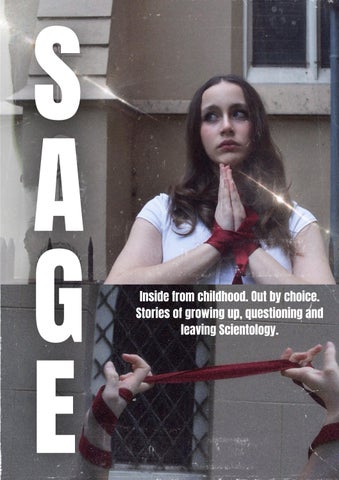
S A G E
Inside from childhood. Out by choice. Stories of growing up, questioning and leaving Scientology.
This is not my story.
The narrative in this zine is drawn from the real experiences of an anonymous source who grew up in, lived within, and ultimately left the Church of Scientology. Their account has been shared with me in confidence and shaped into this narrative form with their knowledge and consent. Names, identifying details, and specific locations have been altered/ withheld to protect their privacy. What follows is their story, told as faithfully as I can and is not mine to claim, only mine to help tell.
Before this story of an ex member of Scientology is told I believe it's imperative you understand exactly what Scientology is. Scientology has run rampant through media coverage for decades with books, documentaries, exposés and now social media testimonies. But before the headlines and the horror stories, it helps to understand the basics: what it claims to be, and what it actually does.
Scientology was founded by L. Ron Hubbard in the 1950s. At its core it’s the belief that humans are immortal spiritual beings, known as Thetans, who have lived through many past lives. Followers are taught that painful experiences can leave lasting effects on the mind, and through practices such as auditing and completing courses, they can work towards becoming “clear” and reaching higher spiritual states.
Be under no illusion, Scientology did not begin as a religion. It began as ‘Dianetics’, a self help system L. Ron Hubbard marketed as a scientific discovery in the early 1950s. When Dianetics collapsed into bankruptcy and Hubbard lost the rights to it, he created Scientology in its place and once he saw he could make even more money without tax he restructured it as a religion. A strategic man, he knew religious organisations in the United States are eligible for tax exemption, and the Church of Scientology fought for that status for decades, facing repeated rejection from the IRS before finally winning full tax exemption in 1993.
As for Hubbard's own motivations, they're difficult to separate from the money. Hubbard is widely quoted as telling a room of fellow science fiction writers, "I'd like to start a religion. That's where the money is" a line the Church has since disputed. Former members have described financial exploitation, forced labour, intimidation, separation from family, punishment for dissent and intense pressure to remain within the Church. Those who speak out or leave face disconnection, being pressured or instructed to cut contact with friends and family who remain inside.
For the purpose of anonymity interview subject (1) will be referred to under the pseudonym ‘Declan’
Declan was born into scientology. He was not given a choice, the freedom to explore or find his own way with religion. He was not converted, not persuaded, simply born. Born the same way you're born into a language or a culture, it’s something you have no control over. His parents were first generation Scientologists. By Declan's account, they were sharp, educated people, and the lives they'd built before the Church were, in his words, impressive.
Joining the church shifted that. Whatever they had been before, however sharp, however intelligent and accomplished, the church didn't pay for that. Declan's parents worked for an organisation that reduced them to less than what they were, their pay a fraction of the worth of their skills. Their treatment as workers closer to servitude than any form of legitimate employment. The achievements they'd built a life around before Scientology the things that had once made them impressive were diminished. And yet they stayed and were happy and chose to build a life and family within the church. Truly a testament to the brainwashing and indoctrination this pseudo religion puts its followers through.
School, which could hardly be called school, he admitted, was an appalling experience . He described a large building with no classrooms, just one large space holding children of every age, in lousy conditions. There wasn’t a curriculum, at least not one a school outside the Church would recognise. Instead, the Church's teachings were simply everywhere. Woven into lessons, routines, and conversations. To understand what Declan was describing, I turned to something I'd been gifted by him early on in this project, a large set of Scientology's own children's books, written for children exactly like Declan once was. Reading them while he spoke, I could see the Eight Dynamics laid out in bright, simplified language. The same framework, softened into something that looked harmless, nothing in these books looked sinister, they looked like any other children's book: colourful, and calmly instructive what made it disturbing was the context of everything Declan had told me that everything these children were taught primed and indoctrinated them into the church so they would never leave,
Out of everything I read, researched and heard from Declan, the confront drills were the most disturbing. Scientology calls them Training Routines (TRs) and pushes them as ‘communication exercises’, really though they are something closer to an endurance test in emotional suppression. It starts simple: sit across from another person, a few feet apart, and hold their gaze without reacting. No blinking, no fidgeting, no laughing, for hours at a time if necessary. You fail if you flinch, smile or look away and if you fail you start again. However there’s escalation, ‘bullbaiting’ if you will. Now your partner isn't just sitting there, they're trying to break you. Partners are instructed to mock, insult you and use secrets and failings against you. They say whatever they can find to provoke a reaction. The goal is to become completely desensitised so you dont react at all.
like many ‘pseudo’ religious institutions, Scientology asks for an insane amount from its members in the name of faith and ‘saving the soul’. Money, certainly, but more than that, it asks for a persons time and free labour. The church calls for a level of devotion that consumes every corner of a person's life until there’s little left that belonged entirely to them. Scientology teaches that people are immortal spiritual beings, known as Thetans, who have lived through many past lives. Followers believe that painful experiences from these lives can affect them in the present. They believe through ‘auditing’ and completing courses, they can work towards becoming spiritually “clear”. For those fully devoted to the cause, there is the Sea Org, Scientology's most senior order. To join, you sign a contract pledging yourself to the organisation for the next billion years, It binds you to the organisation in every life the Church believes is still to come. Both of Declans parents were members, and at just 15 he was made to sign the same billion year contract.
Sea Org members describe their fight to save humanity as a war against insanity, criminality, addiction, and mental illness. And yet, in the same breath, the Church preaches that Scientology offers the way out of everything the world struggles with, no conflict, no drugs, no suffering. Hypocritical no?
Declan recalled to me his parents were often absent during his childhood. Their lives were the church, their work was the Church. Because Scientologists believe their entire immortal existence hinges on what they do in this very lifetime, that belief was the source of their devotion. There was always something else to do, another course, another OT (operating Thetan) level to complete to get closer to a state of clear. So instead, most of the time it was his sister who was around. She was older but still a child herself, she became the person who filled the spaces their parents weren't filling. He told me he doesn't remember those years clearly. Not really. There is no neat timeline he can walk me through, no collection of vivid memories preserved exactly as they happened. Just fragments. Snippets of rooms. Faces. But he told me these were happy times, he doesn't look back on that period of his life with distain, it was important to him that I knew that and therefore important to me that you do too.
One person becomes a template. Then another. And another. And another.
Stamp. Copy. Repeat. Theresult is a community of people shaped to fit the same mould: loyal to the organisation, committed to its work and taught that leaving it means turning your back on everything you know.
I believe theres a narrative out there, partially in situations of cults and religions with people asking, “Why can’t the people just leave? or ”Why can’t they see what’s really happening to them?”, “Oh, if it was me id just run away”. Would you? I simply ask you how an earth would you question the only life you've ever known? Being sheltered and shielded from all other thoughts and opinions. Your family, friends, your entire life system is built into one organisation. How do you leave that? Or even start to question how?
By the time Declan was an adult, there was no real question of leaving, not yet. This was the only world he'd ever known, and now he was living inside it fully as a participant in his own right.
Declan was 25 when he left, but figuring out he wanted to leave and finally being able to do it took 5 years .His sister had gone first, out into the world alone, leaving their parents devastated in a way that would colour everything that came after. He watched what that cost her, what it cost his family, and still knew he would eventually have to do the same thing.
The moment he told the Church he was considering leaving, everything changed. He was pulled from his ordinary life and placed into a kind of holding group, a collection of other members who had also expressed the same unthinkable thought, all of them now isolated together, watched, managed. It was meant, presumably, to contain them. Instead, something else happened: thrown together by the very system trying to control them, they found each other. Years spent in that isolated group became, strangely, the place where he felt least alone a shared, quiet, dangerous longing for a world none of them had ever really lived in.
Auditing is presented, officially, as spiritual counselling: a one-on-one process meant to locate and clear "engrams" (the Church's term for the recorded imprint of past pain, trauma, and negative experience) some of it, they claim, from lifetimes lived long before this one. The tool used is the E-meter, a device with two metal cylinders "cans" that the subject holds while the auditor asks a series of questions. The Church says the meter reads the mental and spiritual state of the person holding it, revealing exactly where the trauma sits, exactly what needs to be cleared next. What the E-meter actually measures is galvanic skin response. The same basic principle behind a lie detector, sensitive to minute changes in the skin's electrical resistance. It reacts to sweat, to grip, to pressure. Squeeze the cans slightly harder, and the needle moves. Relax your hand, and it moves again. Don't’ be fooled, It isn't reading a soul. It's reading a hand.
But the auditing that came when he wanted to leave was different. Because of the nature of his work, the laptops of the Church's most senior members had passed through his hands, their files, their systems, whatever had sat unguarded on a screen while he set things up or fixed what had broken, the Church wasn't willing to simply let him walk away. He described that. he could leave, he was audited intensely, repeatedly for hours upon hours , more than he had ever been audited before until the Church's was certain that whatever he'd seen, whatever he knew, would stay contained inside him. But of course it's a sham so and Declan has free will to talk about and share whatever he wants.
Telling his parents was, in his own words, a nightmare, his sister's departure was still an open wound in the family so his leaving was like poking the wound. There was no clean, easy goodbye. There rarely is, in stories like this. When he finally went, he didn't just leave the Church, he left the country. Australia, he has said, was the first nation to formally deny Scientology recognition (a status that no longer holds), and to him that made it feel like the furthest, safest place he could go, a country that had, at some point, said no when so much of his life had only ever said yes.
Even now, the Church hasn't fully let go. Though these days, it isn't really him it's reaching for. He has two children of his own now, and his father still sends the same kind of book that shaped his own childhood: Scientology's carefully made stories for young readers, sent for grandchildren his father barely gets to know any other way. Everything his father says and sends is monitored, filtered through what the Church allows, so even a gift for a grandchild carries the fingerprints of an organization that still controls what a man in his eighties is permitted to say to his own family. He feels the sadness of that plainly: his father, still inside, still watched, at an age where leaving would mean losing everything he has left. There is no anger in how he talks about it. Just grief, and the quiet understanding that some people never get the years back that leaving would cost them.
Written by Liberty Chamberlain Photography by Sebastian Chamberlain Photoshoot subject: Liberty Chamberlain Designed by: Liberty Chamberlain All external photographs were provided by subject with explicit permission to use for this project