

CONTENTS
SECTION1:Introduction
● WelcomeMessagefromtheAcademicSecretaryGeneral
● WelcomeMessagefromOurExecutiveHead
● WelcomeMessagefromOurAdvisor
● UnderstandingtheModelsoftheUnitedNations
SECTION2:GeneralInformation
● SMMUNPolicies
● DirectiveBoardMembers’
● DressCode
● BehavioralExpectations
● On-lineCommittees
SECTION3:TheUnited Organizations
● OverviewoftheUnited
● IntroductoryNote
● PreambleandChapters Charter
● StructureoftheUnited
● UniversalDeclaration
● TheWorldBank
● TheGroupofFive
● TheGroupofEight
● TheGroupofTwenty
● BRICSNations
● CIVETSEconomies
● InternationalMonetary
● UnitedNationsPeacekeepingForces(BlueHelmets)
● AmnestyInternational
SECTION4:GettingStartedforSMMUN
● DelegatePreparation
● ResearchProcess
● DelegatePortfolio
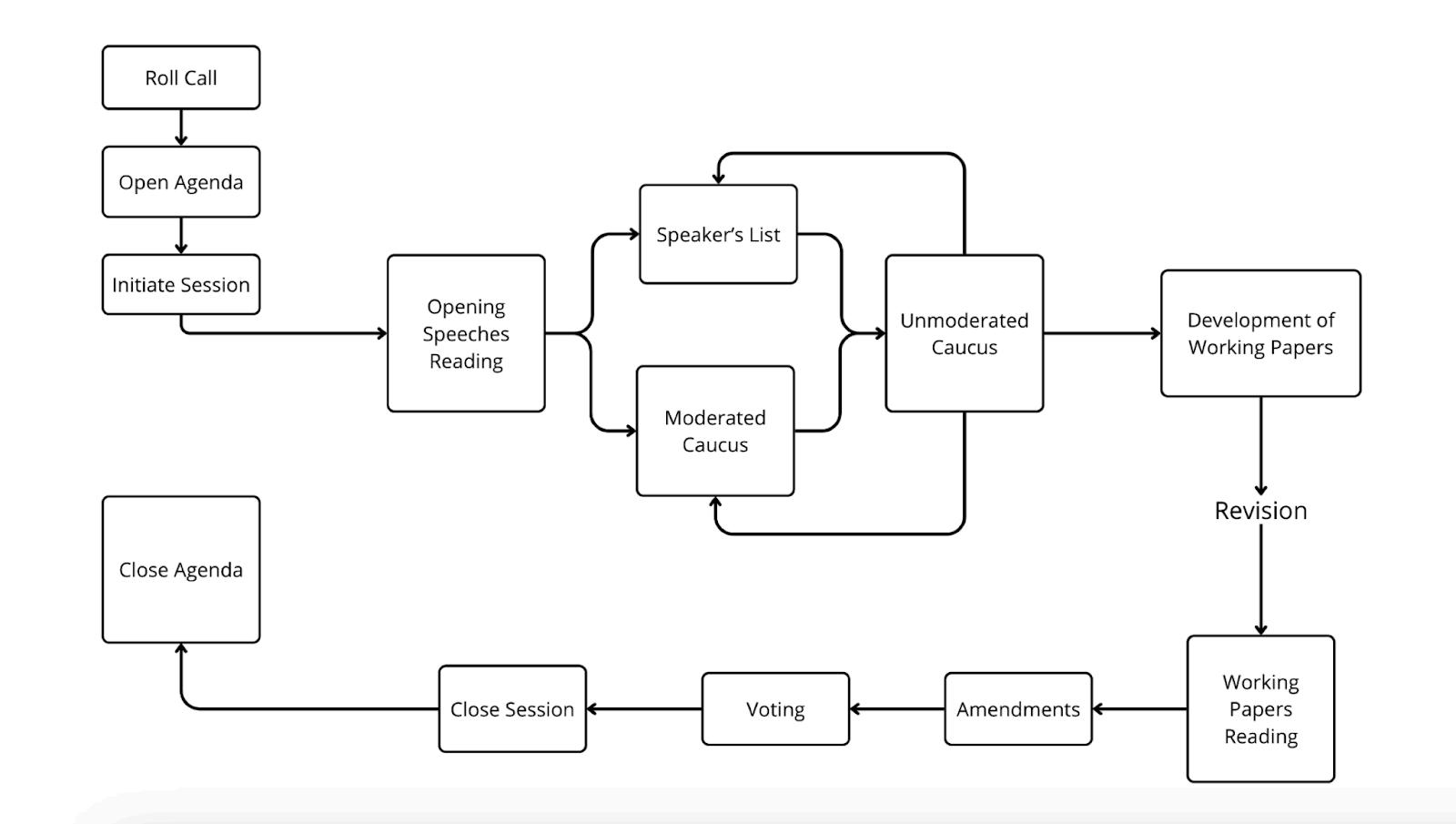
● ParliamentaryLanguageandProcedure
● OpeningSpeechGuidelines
● PositionPaperGuidelines
● WorkingPaperGuidelines
● PressReleases
SECTION5:Awards
● AwardandPerformanceCriteria
SECTION6:Signatures
SECTION1:Introduction
WelcomeMessagefromtheAcademicSecretaryGeneral
EsteemedDelegates,
It is an honor for me to address the Academic Secretary-General. Words fall short to express my gratitude to each this model but also of my dream. To me, being part resilience, commitment, and dedication.Sincemyfirst thathaveprovenimmensely helpful and will continue such as confidence, public speaking, and argumentation, me as a student. However, Model United Nations holds life: it is a transformative activity that inspires me to simply wait for others to solvepressingissues.
In the same vein, together worked tirelesslytoselect topics aligned with our central Rights and Dignity in Times of Crisis," with the goal of raising youleavethismodel,you takewithyoumeaningful
Additionally, I encourage academictool,designedtoprovide you with the necessary information not only in SMMUN XV but also in any future models SMMUN to be a space for lasting learning, where you developempathyandgaina deeper understanding of the challenges surrounding Similarly,Iamveryproudtosaythat within our SMMUN edition, we will entertain 3 different modalities: In person, On-line and ourmostrecentinnovation:aVRcommittee.
Finally, I truly hope you enjoythesethreedays,createunforgettablememories,andmakethe most of this experience.Incaseyouneedanyadditionalassistance,Iwillalwaysbeavailable toresolveyourquestions!
AnaSophiaRodriguezOtero Academic Secretary General SMMUN
WelcomeMessagefromOurExecutiveHead
WelcomeMessagefromOurAdvisor
DearDelegates,
As the proud Advisor of the St. Matthew Model United Nations (SMMUN) for thepastfive years, it is my honor to welcome you to the fifteenth edition of ourconference.Forover15 years, SMMUN has been an inspiration of academic excellence, bringing together outstanding students from the best local schools and, as part of the Inspired Schools Global SchoolCommunity,exceptionalyoungmindsfromaroundtheworld.
This year, under the skilled leadership of our talented 11th-grade students, SMMUN will address the theme: “Strengthening in Times of Crisis.” This timely and significant topic complex global challenges with empathy,innovation,anda
One of the defining features provides to connect and collaborate with peers from perspectives. This gathering of international and local students mutual understanding, and the development of solutions of this global dialogue is a testamenttothepowerofcollective mostpressingissues.
The purpose of this handbook for all participants, whether you are a first-time delegate, advisor Inside, youwillfind essential information about guidelines, and tools to help youmakethemostofyour
I would like to extend my has contributed to this year’s conference, from the dedicated participating schools who make SMMUN a vibrant and enriching learning. Together, we continueto uphold a tradition of excellence, shape a more just, peaceful andinclusiveworld.
WelcometoSMMUNXV!
VanessaLiévanoGutiérrez ADVISOR SMMUN
HOD Humanities St. Matthew School
SECTION2:GeneralInformation
SMMUNPOLICIES
As we celebrate the 15th edition of St. Matthew’s Model United Nations (SMMUN), we proudly reaffirm our commitment to fostering global citizenship, critical thinking, and diplomacy Set intheprinciplesofhumandignity,respect,andthecorevaluesofSt.Matthew School, our policies reflect our dedication to creating an environment where delegates can thrive academically and personally As members of Inspired, a leading global group of premium schools, St. Matthew upholds the highest standards of excellence, inclusivity, innovationandcollaboration.
1.GuidingPrinciples
1.1HumanDignity:
All participants are expected empathy, recognizing the inherent worth of every harassment, or any behavior that underminesthedignityof
1.2Respect:
SMMUN promotes an environment Delegates, advisors, and staff must engageinconstructivedialogue, diverseperspectives.
1.3AcademicIntegrity:
Honesty and integrity are falsification of information, oranyformofacademicmisconduct
1.4AlignmentwithSt.Matthew
All SMMUNactivitiesalignwithInspiredandSt.MatthewSchool’spolicies,includingthose relatedtobehavior,inclusivity,andacademicperformance.
2.DelegateExpectations
2.1Preparation:
Delegates mustthoroughlyresearchtheirassignedcountries,topics,andcommittees.Position papersshouldbesubmittedontimeandreflectawell-roundedunderstandingoftheissues.
2.2ProfessionalConduct:
Delegates should follow professional standards of dress, speech,andbehaviorthroughoutthe conference.Thisincludespunctuality,decorum,andadherencetoproceduralrules.
2.3Collaboration:
Effective teamwork is essential. Delegates should actively participate in committee discussions,formallianceswhereappropriate,andcontributetothedraftingofresolutions.
3.InclusivityandAccessibility
3.1DiverseRepresentation:
SMMUN is committed to celebrates diversity, global citizenship and interconnectivity backgrounds are encouraged to share theiruniqueperspectives.
3.2Accessibility:
We are committed to ensuring their location or physical and learning needs—have and opportunities. This is achievedthroughfollow-up in-person,orVRparticipation.
3.3LanguageSupport:
While English and Spanish conference, additional support willbeprovidedtootherlanguage participation.
4.AdvisorandStaffRoles
4.1Advisors:
Advisors play a vital role expected to guide research and preparationwhilerespecting autonomy decision-makingduringtheconference.
4.2SMMUNStaff:
The Secretariat and organizing team are responsible for maintaining the professionalism and integrity of the conference. This includes resolving disputes, enforcingpolicies,andensuring apositiveexperienceforallparticipants.
5.CommitmenttotheInspiredSchoolsGlobalNetwork
5.1GlobalStandards:
As part of the Inspired Schools network, SMMUN adheres to global educational standards, fosteringacultureofexcellence,inclusivityandinnovation.
5.2CollaborationAcrossBorders:
SMMUN encourages inter-school collaboration with local schools and within the Inspired network,offeringdelegatesopportunitiestoengagewithpeersfromaroundtheworld.
6.CodeofConduct
6.1RespectfortheRules: DelegatesandparticipantsmustadheretoallSMMUNandSt.MatthewSchoolpolicies.
6.2ConflictResolution:
Any disputes or issues arising during the conference will be addressed by the Secretariat in consultationwithadvisors,
6.3ZeroTolerancePolicy:
Behavior that violates the or academic integrity will resultinimmediateaction, conference.
7.SustainabilityandResponsibility
7.1Eco-FriendlyPractices: SMMUN is committed impact by minimizing waste, encouragingdigitaldocumentation, practices.
7.2SocialResponsibility:
Participants are encouraged resolutions that address pressing globalchallenges,reflecting makingapositiveimpact.
The 15th edition of SMMUN ofdiplomacy,learning,and collaboration that defines these policies, we ensure that SMMUN remains a platform young grow, inspire, and contribute meaningfullytotheglobalcommunity.
DRESSCODE
1. Allmodelparticipantsmustattendinformalattire.
2. Menmustwearasuitandtie;jeans,shortsortrousersarenotpermitted.
3. Shoesmustbesober,sportsshoesareprohibited.
4. For women, business-style skirts and skirts up to the knee or no higher than 5cmare permitted.
5. High heels are not mandatory, however, if worn, they must notexceed10centimeters inheightandmustbehandledproperly
6. Extravagantordistractingaccessoriesareprohibited.
7. Makeupisallowed,butmustbesoberandappropriatefortheevent.
BehavioralExpectationsandGuidelines
1. MessagingGuidelines
Allmessagessentthroughthefloorsecretaryofeachcommitteemustdirectly referenceorpertaintothetopicsunderdiscussioninthedebate.Underno circumstancesmaythismediumbeusedtodiscussunrelatedmatterswithother delegates.Non-compliancewiththisrulewillresultinthemessagesbeingforwarded tothecommitteepresidents,whowilldecideontheappropriatesanctionforthe delegateinvolved.
2. ParliamentaryProcedures
Delegatesarerequired proceduresanduseappropriate parliamentarylanguage followtheseguidelineswill resultinareprimand
3. UseofTechnological Technologicaldevices chairsorothersenior officialsareprohibited violatethisrulewillface disciplinaryaction. approveddevices—suchas viewingunrelatedcontent communication—willalsoresultin reprimands.
4. MaintainingOrder
Disciplineandorder session.Anydelegatewho disruptsthedebate willbereprimanded.
5. MutualRespect
Delegateshavethe equalitybyallparticipants, whiletakingintoaccount theymustshowrespectto thechairs,staffmembers, presentintheroom.
6. Adherencetothe
Theconductmanual event.Anyviolation outlinedinthemanualwillbesanctionedbytheinstitution’scoexistencecoordinator
1. Punctuality
Punctualityismandatoryforalldelegates.Failuretoarriveontimeorreturnpromptly afterbreakswillresultinawarning.
2. WarningsandSanctions
Accumulatedwarningswillleadtodisciplinaryaction.Threewarnings,orasingle severeoffense,willresultinthedelegate’sexpulsionfromthemodel.Regular procedureswillbefollowedbeforeanyactionistaken.
3. Plagiarism
Plagiarismisaseriousoffenseandwillresultinimmediateexpulsionfromthemodel.
4. FacilityAttendance
Allparticipantsmustremainwithinthemodel’sdesignatedfacilitiesduringtheevent hours.Leavingthepremisesispermittedonlywithexplicitpermissionfromthe organizers,institutionaldirectors,oreventboardofdirectors.
5. RosetteUse
Theuseofrosettesismandatoryandmustbevisiblywornthroughouttheeventfor participantsafety Ifarosetteislost,alogisticsdelegatewillissueareplacementatan additionalcost.
Otherguidelinesandparticipationrequirements
Faculty Advisor Responsibility Upon at-conference registration, faculty advisors will have to submit a Delegate Location another country or city outside Bogota,Colombia.
Faculty advisors are to assist withconferencerulesand policies throughout the conference. responsible for the conduct of theirownDelegates.
Valuables If Delegates must encouraged to leave them in a safe place, security box or not SMMUN is not responsible for belongingsleftinmeeting property.
Alcohol Policy Consumption the conference will not be tolerated under any circumstances. possess,consumeand/ortohave possessed or to have consumed participant’s school will be immediatelyexpelledfrom
ControlledSubstancesPolicy illegalandintolerable.The school of any participant found haveunlawfullypossessed orusedanycontrolledsubstance fromtheconference.
Smoking and Vaping Policy Cigarette smoking and Vaping is NOT permitted on school grounds.
Expulsion From the Conference the Secretariat reserves the right to expel any Delegate, delegation, school, orgroupthereoffromtheconferenceatanytimeforviolatingorfailingto comply with conference regulations, or for any other reason. SMMUN has a zero-tolerance policy concerning racism, disrespectful language, or any other form ofdiscriminationandor violenceagainstanyotherparticipant.
Dress Code and Conference Badges The safety of conference participants is of paramount importance to SMMUN. To maintain and enhance Delegate security, SMMUN requires all
conference participants to visibly always wear conference badges during the conference; all Delegates are required to adhere to the conference dress code as outlined in the Guide to Delegate Preparation and other conference publications. Participants who fail to adhere to these rulesmaybeexcludedfromconferenceproceedingsandevents.SMMUNstaffreserves the right to check conference badges of any participant at any time, for any reason whatsoever.
Photography and Video Throughout the conference,SMMUNstaffandrepresentativesof the conference from St. Matthew School may take photographs, videos, and interviews that show conference participantsbothduringandinbetweencommitteesessions,andwhichmay be used for promotional, educational, or other purposes by SMMUN. By attending the conference and signing the liability release form, participants consent to be photographed, videotaped and/or interviewed those photographs, videos, and/orinterviewsinanymanner
Other Rules These rules by the National law of the Republic of Colombia, St. schools’ policies, and common sense. Serious infractions conference of those involved. The SMMUNSecretary-General additionalrulesortoalterexisting rulesatanytimeatthediscretion
Interpretation of Rules fact and interpretations of conferencerulesandpolicies Secretary-General.
IreadandagreewiththeSMMUN
NameofDelegate:
Signature:
On-linecommitteeguidelines(on-lineandVR)
1. Themicrophonemustremainmutedunlessrequestedifyouaregiventhefloor
2. You mustbelocatedinaplacewithgoodlightingandwithoutdistractingnoises.
3. The use of parliamentary language must be maintained, including the use of thethird personwhenspeaking.
4. Thedresscodealsoappliestovirtualparticipants.
5. When connecting to the platform, they must be wearing the names of the delegation theyrepresent.
6. The camera must remain on at all times during the sessions. It isonlyallowedtoturn itoffduringbreaks,lunchesorspacesindicatedbythepresidents.
7. Disrespectanddiscriminationarenottoleratedorpermitted.
8. Respect the times activities.Itisrecommendedto connect5to10minutes setbacks.
9. Each delegate must email they sent through the registrationgrid.
These are the guidelines
SMMUN VR Committee, in additiontotheon-linecommittee
1.PersonalSpace
WhenyouenteraVRclassroom, inspiringexperience. However,itcanbeeasyto practiceinourday-to-day lives. One of these is personal in VR as it is in the “real world”. When participating try to keep ~1m of distance from others where possible help to ensure that everyone feelscomfortableandable
2.MicrophoneEtiquette
A lot of repeating noises we are trying to learn and participate in the committee. you encouraged use your microphone to communicate in VR when it is necessary, please make sure youdosoappropriately.Normal classroom rules such as listening to theteacher’sorcommitteepresident instructions,putting your handuptospeakandpolitelylisteningtopeersworkperfectlyinaVRenvironment,too. Justremembertomuteyourmicinbetween.
3.NoPhotosPlease
VR SUMMUN committeesareanextensionoftheclassroom.Thismeansthatyoushouldnot take videos, photos or screenshots in these sessions using your headset unless you are given permission.
1 7 Simple Etiquette Guidelines for Learning in VR Inspired Metaverse School https://view.genially.com/64f33c156027fe00188e3474
This is for thesafetyandcomfortofothers.Ifyouarenotsure,alwaysasktheteacheradvisor orcommitteepresidentfirst.
4.BeProfessional.
Proper behaviour is important. You should continue to follow the school and SMMUN code of conduct in your VR committee as you would in the normal classroom, making sure you speak,actandlearnappropriately.
5.Bepoliteandkind.
Helpotherswhenappropriateandengagewiththelearningopportunityyouhavein VR. YouareveryfortunatetobeamongstthefirstintheworldtouseVRinaMUN.Working together with your teacher, advisor, committee president, and everyone in thecommitteewill benefit.
6.BeSensible
In a VR environment we around the world, and travel throughtimeandspace.However responsibility Sensible behaviour is important to the committee is useful and enjoyableforeveryoneinvolved.
SECTION3:TheUnited Organizations
SECTION3:The InternationalOrganizations Understanding Nations
Model United Nations, MUN, Nations Organization, an international organization andsustainabledevelopment worldwide. These educational carried out with school and university students, where they representdelegates countriesandparticipatein thecommitteesofthisorganizationunderdebateswithrelevanttopicswithintheinternational agenda.
These Models seek to educate andtrainparticipantsonglobalissues,emphasizingtheroleof foreign policy and diplomatic relations in the peacefulresolutionofconflicts.Theyalsoseek topromotetheworkoftheUnitedNationsthroughcooperationanddiplomacy Thesedebates motivate delegates to find solutions rooted in their critical and reflective thinking, which is the product of deep research and a desire to investigate beyond the literal. As a result, delegates will understand the magnitude, repercussions and impact of these conflicts on our society, andthusraiseawarenessaboutthescopeandpowerofdecisions.Similarly,theyseek to highlight the hard work carried out by members of the United Nations in their role of seeking lasting solutions for a society vulnerable to conflict, and at the same time, demonstratetheimportanceofformingglobalcitizenswithethicalandmoralprinciples.
Likewise, through these activities, participants acquire multiple soft skills essential for their personal and academic growth, future occasions. Model United Nations motivates its participants their leadership, teamwork, negotiation, public speaking, Likewise, for the effective resolution of conflicts presented of critical and analytical thinking is encouraged, diversity and intercultural differences. And even more participants to use dialogue and negotiationasthemaininstrument conflicts.
However, within the Model with hundreds of people with similar interests, with whom establish social connections and shareunforgettableexperiences, happinessandpride.
OVER
TIONS
Taken from United Nations. Nations. https://www.un.org/
The UnitedNations(UN) in1945withtheobjectives of preserving world peace among States, fostering internationalcollaborationandactingasacenterforcoordinatingStatepolicies.
Currently, the UN has 193 member states. The UN has offices in Geneva, Nairobi, Vienna and The Hague, in addition to its headquarters in New York. The group is committed to addressing global problems and promoting human rights, peace, security and sustainable development.
The General Assembly, the Security Council,theEconomicandSocialCouncilandotherUN bodies and committees provide a platform for their members to express their views. The Organization has become a means for countries to identify common ground and resolve problems, facilitating communication among its members and serving as a forum for negotiations. To solve global problems and foster global cooperation, the UN also works closely with other international institutions such as the World Bank and the International Monetary Fund. The World Health Organization (WHO), theUnitedNationsChildren'sFund (UNICEF) and the United Nations Development Programme (UNDP) are some of the specialized UN organizations that focus on specific issues, such as sustainable development, health and education. To support the preservation of peace and security in conflictzones,the organizationalsoconductspeacekeepingmissions.
INTRODUCTORY UNITEDNATIONS
Taken from United Nations. Nations. https://www.un.org/
A major turning point in adoption of the United Nations Charter, signed in San Francisco cornerstone of the United Nations Conference on International promulgated on 24 October of that year The framework for global fundamental treaty, which also setsouttheprinciplesthat
The Statute of the International linked to the Charter and its content. The Charter has been changing demands ofglobal society. Amendments to Articles the General Assembly in December 1963 and entered On 20 December 1971, the General Assembly approved 61, which brought about a substantial change. The dynamic was reflectedinthedateof entryintoforceoftheamendment,
The Security Council underwent changes December 1965, an amendment to Article 109 was ratified on 12 June 1968. In particular, the membership of the Security Council was expanded from 11 to 15 by the amendment of Article 23,andtheprocedurefor decision-makingonproceduralmatterswasreinterpretedbytheamendmentofArticle27.
The Economic andSocialCouncilalsounderwentchanges,asitsmembershipincreasedfrom eighteen to twenty-seven following the revision of Article 61 on 31 August 1965. The membership of the Council increased fromtwenty-seventofifty-fouron24September1973, as a result of another adjustment made to the same Article to reflect the expansion of the Council'sresponsibilities.
Given the flexibility of the Charter, Article 109 allows for a GeneralConferenceofMember States to amend the document, provided that two-thirds of the General Assembly and nine members of the Security Council vote in favor of the revision. Interestingly, the number of affirmative votes required by the Security Council was raised from seven to nine with the 1968 revision of Article 109. Although the fundamental principles of the Charter have not changed, these revisions demonstrate the international community's dedication to strengthening and improving the systems that underpin international cooperation and diplomacy
PREAMBLEANDCHAPTERSIANDIIOFTHEUNITEDNATIONSCHARTER
Taken from United Nations. (n.d.-a). UN Charter | United Nations. https://www.un.org/en/about-us/un-charter
WE,THEPEOPLESOFTHE
● to save succeeding which twice in our lifetime hasinflicteduntold
● to reaffirm faith in dignity and worth of thehuman person,intheequal nationslargeandsmall,
● to create conditions obligations arising from treatiesandothersources maintained,
● topromotesocialprogress gerfreedom,
● ANDFORTHESEENDS,
● to practice tolerance another asgoodneighbours, and
● touniteourstrength security,and
● to ensure, by the acceptance institution of methods, that armed forceshallnotbeused,saveinthecommoninterest,and
● to employ international machinery for the promotion of the economic and social advancementofallpeoples,
HAVERESOLVEDTOCOMBINEOUREFFORTSTOACCOMPLISHTHESEAIMS
Accordingly, our respective Governments, through representatives assembled in the city of San Francisco, who have exhibited their full powers found to be ingoodanddueform,have agreed to the present Charter of the United Nations and do hereby establish an international organizationtobeknownastheUnitedNations.
CHAPTERI:PURPOSESANDPRINCIPLES
Article1:
ThepurposesoftheUnitedNationsare:
1. To maintain international peace and security, and to that end: to take effective collective measures for the preventionandremovalofthreatstothepeace,andforthe suppression ofactsofaggressionorotherbreachesofthepeace,andtobringaboutby peaceful means, and inconformitywiththeprinciplesofjusticeandinternationallaw, adjustment or settlement of international disputes or situations which might lead to a breachofthepeace;
2. To develop friendly relations among nations based on respect for the principle of equal rights and self-determination otherappropriatemeasures tostrengthenuniversal
3. To achieve international international problems of an economic, social, and in promoting and encouraging respect fundamental freedoms for all without distinctionastorace,
4. To be a centre for in the attainment of these commonends.
Article2:
The Organization and its Members, stated inArticle1,shallactin accordancewiththefollowing
1. The Organization sovereign equality of all its Members.
2. All Members, in order and benefits resulting from membership, shall assumedbytheminaccordance withthepresentCharter
3. All Members shall peaceful means in such a mannerthatinternationalpeaceandsecurity,andjustice,arenotendangered.
4. All Members shall refrain in their international relations from the threat or use of force against the territorial integrity or political independence of any state, or in any othermannerinconsistentwiththePurposesoftheUnitedNations.
5. All Members shall give the United Nations every assistance in any action it takes in accordance with the present Charter, and shall refrain from giving assistance to any stateagainstwhichtheUnitedNationsistakingpreventiveorenforcementaction.
6. The Organization shall ensure that states which are not Members of the United Nations act in accordance with these Principles so far as may be necessary for the maintenanceofinternationalpeaceandsecurity
7. Nothing contained in the present Charter shall authorize the United Nations to intervene in matters whichareessentiallywithinthedomesticjurisdictionofanystate
or shall require the Members to submit such matters to settlement under the present Charter; but this principleshallnotprejudicetheapplicationofenforcementmeasures underChapterVll.
CHAPTERII:MEMBERSHIP
Article3:
The original Members of the United Nations shall be thestateswhich,havingparticipatedin the United Nations Conference on International Organization at San Francisco, or having previously signed the Declaration by United Nations of 1 January 1942, sign the present CharterandratifyitinaccordancewithArticle110.
Article4:
1. Membership in the peace-loving states which accept the obligations and, in the judgment of the Organization,areable obligations.
2. The admission of any UnitedNationswillbeeffected by a decision of the recommendation of the Security Council.
Article5:
A Member of the United enforcement action has been taken by the Security Council exercise of the rights and privileges of membership recommendationoftheSecurity Council.Theexerciseofthese restoredbytheSecurityCouncil.
Article6:
A Member of the United Nations the Principles contained in the present Charter may be the General Assembly upon therecommendationofthe
STRUCTUREOFTHEUNITEDNATIONS.
Taken from United Nations. (n.d.). Welcome to the United Nations. https://www.un.org/
THEGENERALASSEMBLY
The General Assembly istheprincipaldeliberative,policy-makingandrepresentativebodyof the United Nations. It is composed of the 193 Member States, each entitled to one vote. It provides a single forum for international deliberations, including those relating to peace and security. The General Assembly is also responsible for appointing the Secretary-General, electing the non-permanent members of the Security Council and approving budgetary matters, which must be approved byatleast⅔ofthosevoting.Decisionsonothermattersare madebyasimplemajority
TheGeneralAssemblymay:
● Examine and approve the budget oftheOrganizationandestablishtheassessmentsof Member States; Elect Security Council and the members of other United Nations, and, on the recommendationof Secretary-General;
● Consider and make principlesofcooperationin themaintenanceof includingdisarmament;
● Discuss any question international peace and security and, except when consideration by the Security Council,makerecommendations
● Discuss, with the the scope of the Charter or relating to the powers of the United Nations, and makerecommendations
● To commission studies to promote international cooperation in the international law and its codification, the implementation fundamental freedoms, and international collaboration humanitarian, cultural, educational andhealthmatters;
● To recommend measures any situation that may be detrimentaltofriendly
● Toexaminereports UnitedNationsbodies.
The General Assembly is the body responsible for making preliminarydecisions,however,it has six different non-specialized bodies that have the power to address issues and establish policiesinaccordancewiththeCharteroftheUnitedNations.Thebodiesare:
● TheFirstCommitteeonDisarmamentandInternationalSecurity(DISEC).
● TheSecondCommitteeonEconomicandFinancialAffairs(ECOFIN).
● TheThirdCommitteeonSocial,HumanitarianandCulturalAffairs(SOCHUM).
● TheFourthCommitteeonSpecialPoliticalAffairsandDecolonization(SPECPOL).
● TheFifthAdministrativeandBudgetaryCommittee.
● TheSixthLegalCommittee.
THESECURITYCOUNCIL
According to the UN Charter, the Security Council is the principal organ responsible for maintaining international peace and security It is made up of 15 members, including 5 permanent members (the United States, the United Kingdom, France,ChinaandRussia),the remaining10non-permanentmembersareelectedbytheGeneralAssembly.
The UN Security Council is the onlyorganauthorizedtoimposesanctionsanddeterminethe applicationofanymargin,suchasthe"PeaceHelmets"(BlueHelmets).
THEECONOMICANDSOCIALCOUNCIL
The Economic and Social Council is the principal organization for the implementation of international development goals, as well as for policy assessment, political discourse and recommendations on economic, Foundedin1946andoneof the UN bodies mentioned platform where these issues are debated,analyzedandrecommendations
The Council is responsible and financial resources of the United Nations, including functional commissions and 5 regionalcommissions.
TheGeneralAssemblyelects three-yearterms,onthebasisof geographical representation. reflection, debate and creative thinkingonsustainabledevelopment
THEINTERNATIONAL
Taken from Home | INTERNA (2024, December 11). https://www.icj-cij.org/home
The International Court of of the United Nations. The Court is charged with hearing types legal disputes between United Nations member states and requests for advisory opinions on legal questions submitted by United Nations organs and specialized agencies. It is based in the Peace Palace in The Hague, Netherlands, unlike the otherfiveprincipalorgansoftheUnitedNations,whicharelocatedin NewYork.
The Courthas15judgeswhoserve9-yeartermsandareelectedbytheGeneralAssemblyand the Security Council. The Court is only competent to decideadisputeiftheStatesconcerned haveaccepteditsjurisdictioninoneormoreofthefollowingways: ● bytheconclusionofaspecialagreementtosubmitthedisputetotheCourt;
● byvirtueofajurisdictionalclause,thatistosay,typically,whentheyarepartiestoa treatycontainingaprovisionwhereby,intheeventofadisputeofaparticularkindor ofdisagreementastotheinterpretationorapplicationofthetreaty,oneofthemmay submitthedisputetotheCourt;
● bythereciprocaleffectofdeclarationsmadebythemundertheStatute,bywhicheach ofthemhasacceptedthejurisdictionoftheCourtasbindingintheeventofadispute withanotherStatewhichhasmadeasimilardeclaration.Severalofthesedeclarations, whichmustbedepositedwiththeSecretary-GeneraloftheUnitedNations,contain reservationsexcludingcertaincategoriesofdisputes.
Article33oftheCharteroftheUnitedNationsdeterminesthefollowingmethodsforthe peacefulsettlementofdisputesbetweenmemberstates:
● Negotiation,
● Investigation,
● Mediation,
● Conciliation,
● Arbitration,
● Judicialsettlement,
● Recoursetoregional
DECLARA RIGHTS
Taken from United Nations. Nations. https://www.un.org/
Preamble
Whereas recognition of the and inalienable rights of all membersofthehumanfamily andpeaceintheworld,
Whereas disregard andcontempt barbarousactswhichhave outraged the conscience of mankind, and the advent of a world in whichhumanbeingsshall enjoy freedom of speech and belief and freedom from fear and want has beenproclaimedas thehighestaspirationofthecommonpeople,
Whereas it is essential, if man is not to be compelled to have recourse, as a last resort, to rebellion against tyranny andoppression,thathumanrightsshouldbeprotectedbytheruleof law,
Whereasitisessentialtopromotethedevelopmentoffriendlyrelationsbetweennations,
Whereas the peoples of the United Nations have in the Charter reaffirmed their faith in fundamental human rights, in the dignity and worth of the human person and in the equal rights of men and women and have determined to promote social progress and better standardsoflifeinlargerfreedom,
Whereas Member States havepledgedthemselvestoachieve,inco-operationwiththeUnited Nations, the promotion of universal respect for and observance of human rights and fundamentalfreedoms,
Whereas a common understanding of these rights and freedoms isofthegreatestimportance forthefullrealizationofthispledge,
Now,therefore,
TheGeneralAssembly,
Proclaims this UniversalDeclaration commonstandardofachievement for all peoples and all nations, and every organ of society, keeping this Declaration teaching and education to promote respect for these progressive measures, national and international, to secure their andobservance,bothamong the peoples of Member States peoples of territories under their jurisdiction.
Article1
All human beings are born rights. They are endowed with reasonandconscienceand spiritofbrotherhood.
Article2
Everyone is entitled to all this Declaration, without distinction of any kind, religion, political or other opinion, national or social origin, property, birth or other status. Furthermore, no distinction shall be made on the basis of the political,jurisdictionalorinternationalstatusofthecountry or territory towhichapersonbelongs,whetheritbeindependent,trust,non-self-governingor underanyotherlimitationofsovereignty.
Article3
Everyonehastherighttolife,libertyandsecurityofperson.
Article4
No one shall be held inslaveryorservitude;slaveryandtheslavetradeshallbeprohibitedin alltheirforms.
Article5
No one shall be subjected to torture or to cruel, inhuman or degrading treatment or punishment.
Article6
Everyonehastherighttorecognitioneverywhereasapersonbeforethelaw.
Article7
All are equal beforethelaw discriminationtoequalprotectionof the law. All are entitled discrimination in violation of this Declarationandagainstany
Article8
Everyone has the right to national tribunals for acts violatingthefundamental bylaw.
Article9
Nooneshallbesubjected
Article10
Everyone is entitled in full hearing by an independent and impartial tribunal, in the obligations and of any criminal chargeagainsthim.
Article11
1. Everyone charged with a penal offence has the right to be presumed innocent until proved guilty according to law in a public trial atwhichhehashadalltheguarantees necessaryforhisdefence.
2. No one shall be held guilty of any penal offence on account of any act or omission which did not constitute a penal offence, under national or international law, at the time when it was committed.Norshallaheavierpenaltybeimposedthantheonethat wasapplicableatthetimethepenaloffencewascommitted.
Article12
No one shall be subjected to arbitrary interference with his privacy, family, home or correspondence, nor to attacks upon his honour and reputation. Everyone hastherighttothe protectionofthelawagainstsuchinterferenceorattacks.
Article13
1. Everyone has the right to freedom of movement and residence within the borders of eachstate.
2. Everyone has the right to leave any country, including his own, and to return to his country
Article14
1. Everyone has the other countries asylum from persecution.
2. This right may not prosecutions genuinely arising from non-political crimes andprinciplesoftheUnited Nations.
Article15
1. Everyonehastheright
2. No one shall be arbitrarily denied the right to change hisnationality.
Article16
1. Menandwomenof race,nationalityorreligion, have the right to marry entitled to equal rights as to marriage,duringmarriageandatitsdissolution.
2. Marriage shall be entered into only with the free and full consent of the intending spouses.
3. The family is the natural and fundamental group unit of society and is entitled to protectionbysocietyandtheState.
Article17
1. Everyonehastherighttoownpropertyaloneaswellasinassociationwithothers.
2. Nooneshallbearbitrarilydeprivedofhisproperty
Article18
Everyone has the right to freedom of thought, conscience and religion; this right includes freedom to change his religion or belief, and freedom, either alone or in community with others and inpublicorprivate,tomanifesthisreligionorbeliefinteaching,practice,worship andobservance.
Article19
Everyone has the right to freedom of opinion and expression; this right includes freedom to hold opinions without interference and to seek, receive and impart information and ideas throughanymediaandregardlessoffrontiers.
Article20
1. Everyonehastheright association.
2. Noonemaybecompelled
Article21
1. Everyone has the of his country, directly or throughfreelychosen
2. Everyonehastheright hiscountry
3. The will of the people government;thiswillshall be expressed in periodic be by universalandequal suffrageandshallbe freevotingprocedures.
Article22
Everyone,asamemberof andisentitledtorealization, through nationaleffortand accordancewiththeorganization and resources of each State, of the economic, social and cultural rights indispensable for his dignityandthefreedevelopmentofhispersonality.
Article23
1. Everyone has the right to work, to free choice of employment, to justandfavourable conditionsofworkandtoprotectionagainstunemployment.
2. Everyone,withoutanydiscrimination,hastherighttoequalpayforequalwork.
3. Everyone who works has the right to just and favourable remuneration ensuring for himself and his family an existence worthy of human dignity, and supplemented, if necessary,byothermeansofsocialprotection.
4. Everyone has the right to form and to join trade unions for the protection of his interests.
Article24
Everyone has the right to rest and leisure, including reasonable limitation of working hours andperiodicholidayswithpay
Article25
1. Everyone has the right to a standard of living adequate for the health and well-being of himself and of his family, including food, clothing, housing and medical care and necessary social services, the event of unemployment, sickness, disability livelihood in circumstances beyondhiscontrol.
2. Motherhood and childhood and assistance. All children, whetherborninor socialprotection.
Article26
1. Everyone has the right free,atleastintheelementary and fundamental stages. compulsory. Technical and professionaleducation andhighereducationshallbe equallyaccessible
2. Education shall be human personality and to the strengthening fundamental freedoms. It shall promote understanding, nations,racialorreligious groups, and shall further Nations for the maintenance of peace.
3. Parents have a prior that shall be given to their children.
Article27
1. Everyone has the right freely to participate in the cultural life of the community, to enjoytheartsandtoshareinscientificadvancementanditsbenefits.
2. Everyone has the right to the protection of the moral and material interests resulting fromanyscientific,literaryorartisticproductionofwhichheistheauthor
Article28
Everyone is entitled to a social and international order in which the rights and freedoms set forthinthisDeclarationcanbefullyrealized.
Article29
1. Everyonehasdutiestothecommunityinwhichalonethefreeandfulldevelopmentof hispersonalityispossible.
2. In the exercise of his rights and freedoms, everyone shall be subject only to such limitations as are determined by law solely for the purpose of securing due recognition and respect for the rights and freedoms of others and of meeting the just requirementsofmorality,publicorderandthegeneralwelfareinademocraticsociety.
3. These rights and freedoms may in no case be exercised contrary to the purposes and principlesoftheUnitedNations.
Article30
Nothing inthisDeclaration State,grouporpersonany right to engage in any activity the destruction of any of the rightsandfreedomssetforth
Proclaimed by the United December 10, 1948 in its Resolution 217 A (III).
Taken from Mohit. (n.d.). resiliencia y crecimiento económico. g/ext/es/home
TheWorldBankisaninternational countries.Thecountriesor shareholdersarerepresented principalpolicy-makingbody withintheWorldBank.These FinanceorDevelopmentof themembercountriesand oftheBoardsof GovernorsoftheWorldBank MonetaryFund.TheBankhas25 ExecutiveDirectorswhoworkattheBank'sheadquarters.
ThefivelargestshareholdersareFrance,Germany,Japan,theUnitedKingdomandtheUnited States,eachofwhichappointsoneExecutiveDirectortorepresentitself,whiletheremaining 20electedExecutiveDirectorsrepresenttheothermembercountries.
TheWorldBankGroupwasestablishedin1945tohelprebuildEuropeeconomicallyafter WorldWarII.Itworkswithcountries,especiallydevelopingcountries,toreduceextreme poverty,promotesharedprosperity,andsupporttheglobalsustainabledevelopmentagenda.
THEGROUPOFFIVE
Taken from Groupoffive.org. (n.d.). http://www.groupoffive.org/
The emerging powers at the internationalmeetingsbetweenBrazil,China,India,Mexicoand South Africa are known as the Group of Five, or G-5, and their goal is to foster communication between the developing and developednationsthatmakeuptheG8,withthe intention of establishing positions and programs on issues of global relevance, such as the globaleconomy,sustainabledevelopmentandclimatechange,amongothers.
THEGROUPOFEIGHT
Taken from Laub,Z.(2014,March3).Thegroupofeight(G8)industrializednations. Council on Foreign Relations.https://www g/backgrounder/group-eight-g8-industrialized-nations
The Group of Eight (G8) industrializednations:France, Germany, Italy, the United Canada and Russia. These countries hold an annual global issues such as financial developmentandcrisismanagement, terrorism.
The meeting allows presidents their finance and foreign ministers, to speak frankly However, their low and inactive participation prevents emer important conversations about the global economy and security have little power over other individuals to ensure compliance comes at a cost to their reputations.
https://www.exteriores.gob.es/es/PoliticaExterior/Paginas/G20OCDE.aspx
The Group of Twenty(G20),formedin1999bytwentyoftheworld'slargesteconomies,was conceived as a coalition that would bring together the world's major industrialized and developing economies to discuss global financial and monetary stability It consists ofseven of the world's major industrialized nations: Canada, France, Germany, Italy, Japan, Russia, the United Kingdom and the United States (G8). In addition, eleven newly industrialized nations from all regions of the world (Argentina, Australia, Brazil, China, India, Indonesia, Mexico, Saudi Arabia, South Africa, South Korea, Turkey and Spain) and the European Unionasafinancialcoalition.
Taken from: Homepage. (n.d.). PRB. http://www.prb.org/
The term BRIC is an acronym for four nations: Brazil, Russia, India and China, whose economies have similarities to each other. Due to their rapid growth, these economies are expected to have more economic resources than most current economic powers by 2050. BRICisnotapoliticaloreconomicalliance,butratheragroupofnationsthathavetheability to form powerful economic blocs in the future. Within the BRICs,nationshelpeachotherin theeconomicenvironment,takingintoaccounttheinterestsofeachnation.
CIVETS
Taken from Blessing, E. (2023, September 13). Civets (Colombia, Indonesia, Vietnam, Egypt, Turkey Investopedia.
https://www.investopedia.com/terms/c/civets.asp
The term CIVETS is an Indonesia, Vietnam, Egypt, Turkey andSouthAfrica. marketsareassociatedwithrapid advancement and development. 2000s as the next stars of developing markets. CIVETS IntelligenceUnit(EIU)in London. It is inspired by Russia, India, China and South Africa), created by a Goldman describe these developing countriesthatwereconsidered
INTERNA FUND
Taken from International January 3). IMF.
The International Monetary 190 countries that works to foster global financial participation, stability, stimulate world trade, promotehighemployment growth, reducepovertyworldwide.
THEBLUEHELMETS
Taken from Personal militar (n.d.). Naciones Unidas Mantenimiento De La Paz. https://peacekeeping.un.org/es/military
The United Nations military personnel in the field are the Blue Helmets. Blue Helmets, as part of their national army, serve on secondment to the United Nations for periods typically up to one year if they are in the field, or two or three if they are at headquarters. Any application for a military position with the United Nations must first be submitted to the applicant'shomecountry
Military personnel come from more than 120 countries, and comprise more than 100,000 uniformed UN personnel. Military personnel bring different cultures and experiences to the work they do, but are united in their determination to promotepeace.Currently,themajority of troops come from African and Asian countries, while the contribution from Western countriesisincreasing.
UNmilitarypersonnelmayhave,amongtheirtasks:
● ProtectingciviliansandUNpersonnel.
● Monitoringadisputedborder
● Monitoringandobservingpeaceprocessesafteraconflict.
● Providingsecurityinaconflictzone.
● Providingsecurityduringelectoralprocesses.
● Providing assistance in the form of training and support.
● Assisting ex-combatants agreements they may have signed. Taken from Amnesty Amnesty International.
Amnesty International is million people committed to creating a future in which andexposeseveryeventthat threatens the integrity of the shining a spotlight on any case of abuse that occurs between governments and other influential factors, in internationallaw.Themovement isindependentofallpolitical religion.
Delegate preparation is an undertakenbyeachdelegateinorder togainknowledgeaboutthe
In order to carry out an enriching participation during the model, research requires a broad search about the delegation, organization or character they represent, such as the country's profile, its economic, political and social status, its internal and external policy, its relations withtheothercountriesinthecommitteeanditspositionsregardingthetopicofdebate.
For adequate preparation, thedelegatemustusecriticalandanalyticalthinkingtoidentifykey aspects within the information found. It should be noted that in the United Nations Models, delegates seek to go beyond the literal, that is, they seek to identify in detail the roots of the topicinordertoproposeandexecuteviableresolutions.
SECTION4:GettingStartedforSMMUN
RESEARCHPROCESS
In order to actively participate in the Model, conducting a detailed research process is essential to have a beneficial development. In the ModelUnitedNations,eachcommitteehas an Academic Guide written by the presidents of the committee, which has information on each topic to be discussed. However, the Academic Guide does not cover all the details necessary to resolvetheconflict,sinceitfocusesonprovidingageneralcontext.Therefore,to have an outstanding performance within the model, it is recommended to do additional researchthatseekstocollectawidespectrumofinformation.
It is recommended that delegatesusereliablesourcesofinformation,suchaspagesbelonging to governments, organizations, embassies, among other official pages. It should be remembered that in the Model represent (in most committees) the position of a country, very important to takeinto accountthefollowingaspects
● TheUnitedNations
Considering that simulation of the committees belonging to the United understand how the organization works and especially whatfunctionsandpowers ithas,itsfieldofaction
In the event that the committee which is not part of the United Nations, he research process but with its respectiveorganization.
● Informationabout
In order to participate seek to align his or her interventions with whether it be a country, organization, representative it is essential that he or she knows relevant information history, politics, geography, economy, society andinternationalrelationsofthedelegation.
In case of representing a country, it is recommended that delegates seek information relatedto:
● Thecountry'sroleintheUnitedNations,
● Speechesgivenbyitsleadersregardingtheissue,
● Thecountry'sforeignpolicyregardingtheissue,
● Diplomaticrelationswithothercountries,
● Alliancesorcoalitionsofwhichthecountryisapart,
● Actionspreviouslytakenbythecountryregardingtheissue(orsimilar),
● Treaties/conventionssignedbythecountryregardingtheissue,
● Updatedinformationonthecountry'spositionregardingtheissue.
In case of representing an organization, it is recommended that delegates seek informationrelatedto:
● History/origin,
● Structure,
● Functions,
● Powers,scopeandlimitations,
● Missionandvision,
● Relationwiththetopic.
Incaseofrepresentingacharacter,itisrecommendedthatdelegatesseekinformation relatedto:
● Positionsand
● Politicalposition,
● Negotiation
● Personaland
● Culturalcontext
● Positionregarding
● Informationabout
The Academic Committee
explain the topics of each committee, along with “Qarmas,” which helpthedelegate tounderstandthecommittee’
However, it is recommended additional research in addition to reading the Academic understandingofthetopictobe discussed.Somesuggestions
● Checkthecurrent reports,articles,news,etc.
● Check the perspectives Look for the positions of the differentworldpowers.
● Find out if the issue has been attempted to be resolved in the past. Identify possibleflawsintheresolutions.
● Findoutifthedelegationyoubelongtohasparticipatedintheseresolutions.
● Visit the pages of NGOs related to the issue and read about the research and informationtheyprovide.
The Delegate Portfolio is a compilation of all the information previously mentioned in the research process, along with the documentsnecessaryforthecommittee,suchastheOpening Speech and the Position Paper The information in the Portfolio must be properly cited and supportedinordertohavetruthfulandusefulinformation.
To ensure that the information collected is useful, the following questions can help confirm theabove:
● RegardingtheOrganizationoftheUnitedNations
○ WhataretheUnitedNations?
○ Whatisitsfunction?
○ Howdoestheorganizationparticipateinconflictresolution?
○ Whatarethe ganization?
○ Whatarethe NationsCharter? Ifyouparticipatein
○ Whatisthe
○ Howdoesthis
● Regardingthedelegation
Incaseofrepresenting
○ Whattypeof
○ Isthegovernment religiousideology?
○ Whatisthe dotheyrelatetotheissue?
○ Whatisits
○ Is it an ethnically government ensure its protection andintegrity?
○ What is its implications of this for its politicalrelations
○ Whichcountries
○ Whichcountries
○ Whatisthecountry's
○ Does the country belong to any intergovernmental organization? (NATO, BRICS,OPEC,G20)
○ Does the country belong to any regionalorganization?(EuropeanUnion,IDB, SELA)
○ Doesthecountrybelongtoanytradeagreement,allianceorcoalition?
○ Whatisthecountry'spositionontheissue?Hasitdoneanythingtoresolveit?
Incaseofrepresentinganorganization;
○ Whatisthefunctionoftheorganization?
○ Howdoestheorganizationraisefunds?
○ Howistheorganizationstructured?
○ Whywastheorganizationfounded?
○ Whataretheorganization'sscopeandlimitations?
○ Whatistheorganization'smissionandvision?
○ Howdoestheorganizationrelatetotheissue?
○ Whatistheorganization'spositionontheissue?
○ Whatcantheorganizationcontributetopossibleresolutions?
○ Whichcountriesareconsideredalliesoropponents?
Incaseofrepresentingacharacter;
○ Whatismycharacter'smission?
○ Whatismycharacter'spoliticalposition?
○ Whathavebeenmycharacter'smostnotableactions?
○ Howhasmy occasions?
○ Whatcould problem?
○ Howdoesmy
○ Whathasbeen career?
○ Hasmycharacter
● Regardingthetopic
○ Whatisthe delegation?
○ Whatismy
○ Whatactions issue?
○ Whatarethe
○ Whathave
○ What other the issue other than my delegation's?
○ Whataspects delegationtodiscuss?
○ If the country issue,whatcanitdotoget involvedin
○ Howcanmy guments?
PARLIAMENTARYLANGUAGEANDPROCEDURE
In the following link, you can find the Guide for Parliamentary Language and Protocolary ProcedureofSMMUNXV
The Opening Speech is the first document read in the committee, and therefore, it isthefirst impression that the delegate makesontherestofthecommittee.Takingthisintoaccount,itis of utmost importance to construct an Opening Speech capable of attracting attention, where clear and concise positions are presented. In addition to the quality of the Opening Speech, theuseofremarkableoratoryisindispensableforitsreading.
For all SMMUNXV committees, it is necessary to have an opening speech, which must bea maximumof1MINUTEAND30SECONDS
AnOpeningSpeechcontainsthefollowinginformation:
● Greeting
● Briefintroduction(mayincludequotesordata)
● Positionofthedelegation
● Possiblesolutionsand
● Conclusion.
OpeningSpeech’sExample
Honorable chair, fellow room,allowthedelegation ofFrancetoprovide
“There can be no impunity prevails,” - Antonio Guterres
Today, we convene andcomplexdisputesofour time, a conflict that and numerous devastating humanitariancrises.
The ongoing conflict and grievous crimes of war, which leads to dreadful incessant vulnerabilities of the International Humanitarian , subjugations, repressions, and oppressions constitutiveofcrimesofwar.
Nonetheless, the delegation, deeply concerned by aspects mentioned before, undeniably addresses these atrocities committed and condemns all acts of violence, belligerency,andeveryfosteringthatunderminestheenhancementofpeace.
Furthermore and guided by the equilibrium between the French’s political interests and the respect forprinciplesandlaws,thedelegationcallsforanimmediatecessation of hostilities in order to strengthen the protection of civilians and considers that in order for achieving a long lasting peace, the process must entail international cooperation, integrity, based in the UN Charter principles, but most importantly solidarityandcomprehension.
Thankyou.
POSITIONPAPER
The Position Paper is a document with an informative purpose, since although it is not read within the committee, it serves as a greathelptohavegreaterclarityaboutthedelegationand its position. The Paper includes economic informationabout thedelegation,alongwith
Itisrecommendedthatthe
PositionPaper
Committee:
Topic:
Country/Organization/Character:
Model:
Backgroundoftheissue
● Whatisthedefinition
● Whereistheissue
● Howmanypeople
● Whyisthisissueimportant?
Previousinternationalactions
● Have there been any interesting statementsbyUNofficialsonthisissue?Trytofinda quote.
● WhatarethemostimportantUNresolutionsandtreatiesonthisissue?
● Areanymajornon-governmentalorganizations(NGOs)workingonthisissue?
Country/organization/personalitypolicy
● Howhasthisissueaffectedyourcountry/organization/personality?
● Whathasyourcountry/organization/personalitytriedtodoaboutit?
● What kinds of policies would your country/organization/personality like the UN to adopt(ornotadopt)onthisissue?
Possiblesolutions
● What specific plans would your country like the UN to undertake to address this issue?
● What specific plans would your country like MemberStatestoundertakeintheirown countries?
● Whywouldyourideaswork?Givespecificplans.
WORKINGPAPER
El Papel de Trabajo es el documento final del comité, donde se presentan las resoluciones propuestasporlosbloques.LaestructuradelPapeldeTrabajoeslasiguiente:
Working Number)
Date:(Committees’Date)
Model:(Nameandedition Committee:(Committees’ Topic:(Committees’Topic)
HeadsofBloc(2):
SponsoringCountries(5):
Signatory Countries (All mustbelistedattheendof thedocumentorgivendirectly
The Commission, (Commission’
PreambulatoryClauses
Clauses that state the reasons for writing the Working Paper, i.e. that express the problems that concern the bloc and its desire to resolve them. Preambulatory clauses should both describetheproblemtoberesolvedandthereasonsfordoingso.
Preambulatoryclausesshouldhavethefollowingcharacteristics:
● Atleast7.
● Mustbein italics.
● Endincomma.
Resolves, (Itisaddedbeforeputtingtheoperativeclauses)
OperativeClauses
Clauses detailing the solutions proposed by the bloc in order to resolve the issue under discussion. It is expected that the solutions will be the product of consensus mediated by diplomacywiththeotherdelegationsofthecommittee.
The proposed solutions must be concrete and detailed, following the realistic and legal framework ofInternationalLawandthescopeofthecommittee.Itisrecommendedthatwhen draftingeachoperativeclausethefollowingbetakenintoaccount:
1. How?
2. Where?
3. Why?
4. Who?
5. Withwhatresources?
6. Onwhatlegalbasis?
It should be noted that resolutions principles and the Charter of the UnitedNations.Likewise, followingcharacteristics:
● Atleast9ortheremust preambulatoryclauses.
● Numbered.
● Underlinedandinbold.
● Theyendinasemicolon.
● Thelastoneendsin
Annex1:(Theannexisattached).
PreambulatoryClauses
Acknowledging, Affirming, Alarmed, Fully aware, Approving, Fully believing, Aware of, Further deploring,
Bearing in mind, Guided by, Believing, Having adopted, Concerned, Having considered, Contemplating, Having examined,
Convinced, Having heard, Conscious, Having received, Considering, Keeping in mind, Declaring, Nothing further, Deeply concerned, Noting with regret, Deeply convinced, Observing, Deeply disturbed, Reaffirming, Deeply regretting, Desiring, Emphasizing, Expecting, Expressing its appreciation, account, Firmly convinced, OperativeClauses Accepts; concerns; Affirms; hopes; Appreciates; Approves; Furtherinvites; Asks; Furtherrecommends; Authorizes; Furtherreminds; Calls; Insists; Callsfor; Invites; Callsupon; Notes; Condemns; Proclaims;
Autoriza; Reaffirms; Condena; Recommends; Confirms; Recallsitssupport; Congratulates; Refers; Considers; Regrets Declares; Reminds; Deplores; Requests; Designates; Directs; Drawsattention; Emphasizes; condemns; Encourages; Endorses; account;
PRESSRELEASES
Press Releasesareformaldocumentsusedwhen,forvariousreasons,itisnotpossibletoform a block with the necessaryquorumtodraftaWorkingPaper Likewise,theycanbedraftedby thecommitteeasdirectives.
As an alternative to the Working Paper, Press Releases must be draftedasnewspaperarticles wherethefollowingareevident:
● Contextofthetopic(History,Causes,Consequences,CurrentSituation)
● Summaryofwhatwasdiscussedbythecommittee(Positions,Blocs)
● Positionofthereactingdelegations
● Solutions proposed by the reacting delegations (Measures to be taken, alliances to be established,agreements)
SECTION5:Awards AW
CRITERIA
TheAcademicAwardsthat model:
1. Bycommittee:
● BestDelegate
● FirstOutstanding
● SecondOutstanding
● SMMUN Spirit: should seektoawardthis prize to a model complies with the principles interventions involve the importance service. Likewise, they should focusongenerating andleadingchange.
● HonorableMention
2. Model:
● Best Delegate of the Model: For the Best Delegate of the Model, each Best Delegate from all committees will be asked two questions by the Academic General Secretary in a room accompanied by the Sponsors of each school present. The first question will be about their knowledge of their committee and the secondwillbeabouttheirknowledgeoftheUNModels.TheBoardof Directors will set the questions for the model and they will be asked individually. The decision of the Best Delegate of the Model will bemadeby theBoardofDirectors,theSponsorspresentandtheAcademicCouncil.
3. On-lineandVRModel:
● BestDelegateoftheon-line/VR Model.
TheAcademicAwardsthatwillbegrantedtothestaffwillbe:
4. Chairs
● BestChairSeminaryandBeginner
● BestChairIntermediate
● BestChairSeniorandExpert
● BestChairoftheModel
5. Crisis
● BestCrisisCenter
6. Logistics
● BestdelegateofLogistics
7. Press
● Bestdelegate
TheAcademicAwardsthat be:
● BestSmallDelegation delegatesorpresidents)
● BestBigDelegation orpresidents). FortheseAwards,theaverage willbetaken.
anarodriguez@csma.edu.co
References
Welcome to the United Nations,https://www.un.org/.Accessed17January2025. Home | INTERNATIONAL COURT OF JUSTICE,https://www.icj-cij.org/home.Accessed 17January2025.
Banco Mundial – Desarrollo sostenible, resiliencia y crecimiento económico, https://www.bancomundial.org/ext/es/home.Accessed17January2025. PRB.org,http://www.prb.org.Accessed17January2025.
International Monetary Fund (IMF),https://www.imf.org.Accessed17January2025. Amnesty International,http://www.amnesty.org.Accessed17January2025.
G20.“G20.” G20,17,https://www.g20.org/es. GroupofFive.“Groupoffive.” Group of five,http://www.groupoffive.org/.Accessed17 January2025. Investopedia.“Civets.” Investopedia .investopedia.com/terms/c/civets.asp. Accessed17January
Maizland,Lindsay,andZachary IndustrializedNations.” Council on Foreign https://www.cfr.org/backgrounder/group-eight-g8-industrialized-nations.Accessed 17January2025.
“Personalmilitar|Naciones
United Nations Peacekeeping,https://peacekeeping.un.or Accessed17January2025