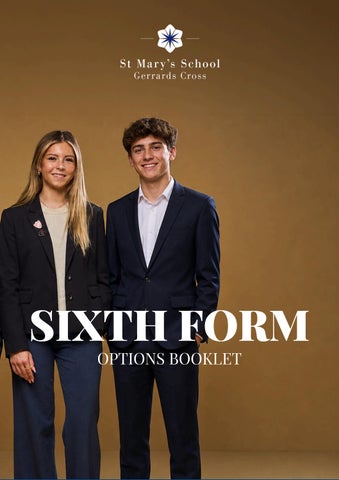
SIXTH FORM OPTIONS BOOKLET
SIXTH FORM
2027-29
WELCOME TO THE SIXTH FORM AT ST MARY'S As part of our first co-educational cohort, you will join a community that is ambitious, supportive and full of possibility. You will choose subjects you are excited about studying in depth, and be encouraged to explore new ideas and areas of personal interest. Our small classes, specialist teachers and strong record of academic success mean lessons that challenge, stretch and inspire you. Alongside this, the enrichment pathways and our pastoral care ensure that you will be known as an individual, supported and encouraged to be yourself. When you join the Sixth Form at St Mary's, you become part of a vibrant, welcoming community that is here to help you achieve your best and enjoy every step of the journey. Your two years in the Sixth Form at St Mary's will be the most exciting and rewarding years of your school life.
CHOOSING YOUR PATHWAY Choosing your courses can feel daunting, but a good place to start is with what you enjoy. Post-16 study includes greater independent work, and you are far more likely to stay motivated and study effectively if you love the subject. Think about your combinations too: if you are not yet sure what you want to do in the future - which is completely normal while you are focused on your GCSEs - a broad and varied choice keeps your options open. If you have a particular university course or career in mind, check the entry requirements early. Medicine, for example, requires science A Levels, whilst Law degrees often prefer students to have studied English Literature at A Level. Students at St Mary's can study three A Levels or two A Levels and a BTEC', plus either Further Maths, the Extended Project Qualification ( EPQ) or the Cambridge OCR Level 3 award in Oracy.
MR FOX
MRS JOBSON
SIXTH FORM
2027-29
SUBJECTS IGNITE
PAGE 03
EXTENDED PROJECT QUALIFICATION
PAGE 06
CAMBRIDGE / OCR LEVEL 3 AWARD IN ORACY
PAGE 06
DUKE OF EDINBURGH'S AWARD
PAGE 07
FINE ART
PAGE 09
BIOLOGY
PAGE 10
BUSINESS
PAGE 11
CHEMISTRY
PAGE 12
DRAMA AND THEATRE
PAGE 13
ECONOMICS
PAGE 14
ENGLISH LITERATURE
PAGE 15
FRENCH
PAGE 17
FURTHER MATHEMATICS
PAGE 18
GEOGRAPHY
PAGE 19
HISTORY
PAGE 20
MATHEMATICS
PAGE 21
MEDIA STUDIES
PAGE 22
PHYSICS
PAGE 23
POLITICS
PAGE 25
PSYCHOLOGY
PAGE 26
RELIGION, ETHICS AND PHILOSOPHY
PAGE 27
SOCIOLOGY
PAGE 28
SPANISH
PAGE 29
BTEC LEVEL 3 EXTENDED CERTIFICATE IN SPORT
PAGE 30
SIXTH FORM
2027-29
IGNITE A Sixth Form education is about far more than exam results. Our SMS Ignite Programme is woven through your two years with us and is built around six strands: Achieve, Lead, Enhance, Engage, Explore and Extend. Through Ignite you will - in addition to academic success - take on leadership roles, deepen your skills, contribute to school and the wider community, and try things that stretch you well beyond your subjects. Ignite is how you develop the confidence, character and experiences that will set you apart, whatever comes next. Ignite provides the flexibility for you to make your Sixth Form your own, shaping your experience and making choices to ensure your journey supports your future aspirations. Our experienced and passionate Sixth Form Team is on hand to offer advice, guidance and support every step of the way.
ACHIEVE
Strong Academic Results Choose three A Levels from a wide range of subjects. For a more vocational or applied route, you may also choose from our BTEC options as part of your study programme. Our smaller class sizes mean that everyone in each lesson benefits from being able to express their opinions, ask and answer questions, and receive the support they need to achieve their personal best. Our learning environment will prepare you to achieve your goals in your assessments and examinations, and also for the university tutorials or team meetings you will attend once you leave school.
03
SIXTH FORM
2027-29
EXTEND
Your Academic Range We offer three additional qualifications alongside the A Level subjects, and students choose one of these, depending on their strengths and interests. Extended Project Qualification ( EPQ) is worth half an A Level, it requires students to research and produce either a 5,000-word report or an artefact and present their work to a live audience. The Cambridge OCR Oracy Level 3 course also provides UCAS points, but more than this it supports you in developing confident spoken communication, analytical thinking and academic independence. The third option is Further Maths, for students taking Maths A Level, to take as an AS Level or an A Level.
LEAD
With Confidence
All students are expected to take on leadership roles through their time in the sixth form. Opportunities in Year 12 include acting as mentors for younger students, including those in the Prep School, and taking on Vice House Captain roles to support the prefects in Year 13. Halfway through Year 12, you are encouraged to apply for the Student Leadership Team, comprising Head Student, Deputy Heads and Games Captain as well as for one of the prefect positions leading a particular aspect of school life, such as Charities Prefect, Year 7 Transition Prefect or Eco Prefect. There is a leadership role to suit everyone’s interests. We know the benefits that holding a student leadership position brings for all students. You will develop confidence and improve your ability to articulate your thoughts through leading and collaborating with your peers, with teachers and the Senior Leadership Team, as you work together to achieve a common goal.
ENGAGE With Personal Development The jump from GCSEs to A Levels can be daunting, and so our SMART programme, grounded in cognitive science and psychological principles from sport and education, equips students with the mindset, habits and learning strategies needed to succeed as proactive, independent Sixth Formers. This is followed by the Luminary Series: lectures and workshops from experts and professionals who share insights into a wide range of careers, personal development themes and current issues, building social and cultural capital.
04
SIXTH FORM
2027-29
EXPLORE
Your Future Choices Helping students plan for life beyond Sixth Form is one of our greatest strengths. Whether you are considering university, an apprenticeship, or entering the workplace, you will receive personalised guidance from our Director of Futures – not just once, but throughout your Sixth Form journey, in as many sessions as it takes. We will take the time to really help you explore your options, whether your future lies in university, an apprenticeship or another route into a career and the work place. Together with the Director of Sixth Form and our dedicated tutor team, we will get to know your ambitions, support your decision-making, and help you choose the pathway that is right for you. You will use Unifrog's tools to research courses, careers and pathways, and to see how your interests and strengths might shape your choices.
ENHANCE
Your Skills and Experiences We know how important skills and knowledge are for your future. In an increasingly competitive and technology-driven world, young people who have the ability to connect with others and their work will be successful in the world of work. In Year 12, all students take part in the Young Enterprise Company Programme which provides an exceptional opportunity to develop the skills and experience that universities and employers value most. As part of a team, you will create, manage and grow your own business, taking on real responsibilities and making meaningful decisions. From developing a product or service and managing finances to marketing, sales, and customer engagement, this programme is built into our curriculum, with a role for everyone to take part. Later in Year 12, our Digital Human course connects students with an appreciation of the wider world and how artificial intelligence is shaping how we live and work. In Year 13, our Life Skills programme support you as you prepare to live more independently. Practical cooking skills, financial education and ‘life matters’ such as changing a tyre are all covered in this programme.
05
SIXTH FORM
2027-29
EXTENDED PROJECT QUALIFICATION The EPQ is a stand-alone qualification that students can undertake alongside A Levels. Worth half an A Level, it is an opportunity for you to produce an extended piece of work on a topic of your own choice, with guidance from expert teaching staff. The EPQ extends students’ planning, research and critical thinking skills, as well as their analytical, evaluative and presentation skills: all of which are highly valued by universities. The EPQ therefore gives students excellent preparation for university-level study and will enhance your UCAS application. To demonstrate the qualities and knowledge that universities look for, students can refer to the EPQ in the UCAS personal statement and at interview. The EPQ is made up of three components. The production log allows students to record their research and detail how their project develops over time. All EPQ candidates have to present their work to an audience sharing what they found in reflecting on their project. The main bulk of the EPQ is the production of a central piece of work: for most students this is a dissertation. However, some may choose to present a field study based on new research; a performance of something they have created supported by critical commentary and others produce something known as an ‘artefact’: this could include art projects or architectural plans.
CAMBRIDGE / OCR LEVEL 3 AWARD IN ORACY The Level 3 Award in Oracy is a unique qualification that develops one of the most valuable skills for success in education, employment and everyday life: the ability to communicate effectively. Through discussion, active listening and presentation, you will learn how to express ideas clearly, build convincing arguments, respond thoughtfully to different viewpoints and present with confidence. Whatever future career you aspire to, strong oracy skills will help you stand out. The qualification is assessed through a group discussion and an individual presentation, allowing you to demonstrate your ability to think critically, communicate persuasively and engage confidently with an audience. It is internally assessed, graded Pass, Merit or Distinction, and attracts UCAS Tariff points.
06
SIXTH FORM
2027-29
DUKE OF EDINBURGH'S AWARD The DofE Award takes you into a place where you’ll push yourself and have amazing new experiences. The Gold programme, offered at Sixth Form at St Mary's, is a demanding, noncompetitive personal challenge, which takes a minimum of 12 months to complete. Young people build their own programmes with activities in five sections – Physical, Skills, Volunteering, a five-day Residential and a four-day Expedition. You will build confidence, resilience, and skills and strengthen or make new friendship groups - and have a brilliant time doing it! Working towards the Gold Duke of Edinburgh Award gives you the added benefit of gaining a competitive edge as employers regard a DofE Award highly so it will help open the right doors for you. Many of the skills you gain can be applied to your studies as well as your personal and social development.
07
SIXTH FORM
2027-29
08
SIXTH FORM
2027-29
FINE ART Exam Board: AQA (7201) A Level Fine Art encourages students to explore a wide range of artistic media, processes and techniques, drawing on both traditional and contemporary approaches. Students develop practical work through investigation, experimentation and critical analysis, using sketchbooks, journals and preparatory studies to record and refine their ideas. They are expected to engage with the work of artists from different periods, cultures and traditions, using this research to inform their own creative practice. Students may specialise in one or more areas of Fine Art, including drawing and painting, printmaking, mixed media, moving image and photography. Throughout the course, they develop technical skills alongside an understanding of visual language, composition, colour, form and meaning. The emphasis is placed on both the creative process and the final outcome, with students demonstrating their achievement through the AQA assessment objectives. Year 12 includes an introductory skills course, as a series of mini studies and a Personal Investigation. This runs until term two of Year 13 when the externally-set assignment begins. We aim to provide a rich environment in which we encourage and value creativity through the experience of a wide range of activities and processes. How is the course assessed? All work is assessed at the end of Year 13. Component 1 which runs from Year 12 to Year 13 is worth 60% and the externally set assignment, set in the February of Year 13, is worth 40% of final marks. The final exam is 15 hours (over three days), after which an external moderator comes in to verify the marks awarded. Opportunities as part of this course Those who take this option will have the chance to experience the annual trip to Kew Gardens and many other gallery visits throughout their study. What type of student should study this course? The course particularly suits those who enjoy combining practical creativity with critical thinking and who are interested in exploring how art connects with historical, cultural, social and contemporary issues. You do not need to have studied Art at GCSE, although it is beneficial. Where might Fine Art take you? The creative industries generate over £109bn to the UK economy each year and the industry is growing at four times the rate of the UK workforce. Fine Art opens up a wide variety of careers, for example, Advertising, Film and TV, Architecture, Publishing, Music, Design, Games, Museums and Galleries, Fashion, Crafts, and the creative use of technology.
09
SIXTH FORM
2027-29
BIOLOGY
Exam Board: AQA (7402) A Level Biology develops students’ understanding of living organisms from the molecular level through to entire ecosystems. The course covers eight core areas: biological molecules, cells, exchange and transport systems, genetics and variation, energy transfers, responses to environmental change, evolution and ecosystems, and the control of gene expression. Practical work is integrated throughout the course, enabling students to develop the investigative and analytical skills that underpin modern biological science. How is the course assessed? There are three exams at the end of the two years for A Level, all of which are two hours long. At least 15% of the marks for A Level Biology are based on what you learned in your practicals.There is no coursework on this course. However, your performanc during practicals will be assessed. Opportunities as part of this course Entry into national competitions such as the Royal Society of Biology Olympiad. Students may attend lectures in London given by eminent biologists, and take part in the Brain Day run by a neuroscientist, along with Psychology students. There are also opportunities to lead clubs for younger students. Students often successfully complete Biology related EPQ projects. What type of student should study this course? This course would suit you if your curiosity about human physiology and the wider natural world have been piqued, but you are frustrated by the superficial explanations offered at GCSE. It particularly suits students who enjoy investigating scientific questions, analysing evidence and applying knowledge to unfamiliar situations. A successful Biology student will be interested in both theoretical concepts and practical investigation, and will be prepared to develop strong analytical, mathematical and problem-solving skills. You must achieve a minimum of a grade 6 in Biology or 6-6 in Combined Science, and a grade 6 in Mathematics, at GCSE, to study Biology at A Level. Where might Biology take you? Life sciences are a major component of the current economic base of the UK with the sector generating £64 billion of turnover, and employing more than 233,000 scientists and staff. This includes the application of biology and technology to health improvement, including biopharmaceuticals, medical technology, genomics, diagnostics and digital health. Studying a Biology related degree at university gives you all sorts of exciting career options, including: Medicine and Dentistry, Biomedical scientist, Pharmacist, Pharmacologist, Epidemiologist, Physiotherapist, Geneticist, Research scientist, Vet Medicine, Teacher, and Marine biologist. Additionally, when applying for many academically rigorous courses such as Law, Finance or Economics, a science A-level is considered advantageous.
10
SIXTH FORM
2027-29
BUSINESS Exam Board: Edexcel (9BS0) A Level Business explores how organisations operate, make decisions and respond to opportunities and challenges in an increasingly competitive and global marketplace. Students develop an understanding of key business functions including marketing, finance, operations, human resources and strategy, while examining how internal and external factors influence business success. The course builds progressively from fundamental business concepts to more complex strategic decision-making, encouraging students to apply their knowledge to real businesses and contemporary business issues. Business Studies is deeply rooted in the world around us and we will explore a large number of examples from the real world. How is the course assessed? Assessment is through three written examinations at the end of the two-year course that test quantitative skills, data analysis, extended writing and strategic decisionmaking in a range of business contexts, all at the end of the two-year course. The papers are mostly essay based, although they also contain calculation and short answer questions. The questions will be based on real life business case studies. Opportunities as part of this course A variety of trips are organised, such as a trip to Cadbury World, an Amazon Fulfillment Centre and the Mini Factory in Oxford. Studies are supported through student involvement in the Young Enterprise Programme. What type of student should study this course? Students with a curiosity about the business environment or who are eager to understand corporate life. You do not need to have studied Business at GCSE and we have no specific requirements about your GCSE results. However, the course does include some numerical work and you should feel comfortable with your mathematical ability. The large number of essays will also require you to write extended pieces of work. Where might Business take you? It could be argued that every single job in the world requires some business knowledge and understanding. It may be as simple as needing to budget, it may be leading and managing people or it could be helping to promote and sell. Business opens the door to a variety of careers: it leads naturally on to university study or an apprenticeship scheme. Those who have aspirations of careers in Advertising, Public Relations, Accounting, Consultancy, HR and Logistics, would be at an advantage if they had studied Business. Business and its related subjects are consistently some of the most popular choices at undergraduate level due to their excellent employability skills.
11
SIXTH FORM
2027-29
CHEMISTRY
Exam Board: AQA (7405) A Level Chemistry provides students with a detailed understanding of the substances that make up our world and the reactions that transform them. The course is divided into three major areas: Physical Chemistry, Inorganic Chemistry and Organic Chemistry. Students study topics such as atomic structure, bonding, energetics, kinetics, equilibrium, acids and bases, organic synthesis, spectroscopy, transition metals and the chemistry of biological molecules including proteins and DNA. Practical work is an integral part of the course, helping students develop the experimental and analytical skills used by professional scientists. How is the course assessed? Assessment takes place through three written examinations at the end of the course. Paper 1 focuses primarily on Physical and Inorganic Chemistry, Paper 2 focuses on Physical and Organic Chemistry, and Paper 3 assesses knowledge and understanding from across the entire specification, including practical techniques, data analysis and multiple-choice questions. Practical skills are embedded throughout the course and assessed within the examinations. Opportunities as part of this course? Students will be able to participate in the Cambridge Chemistry Challenge, Royal Society of Chemistry Olympiad and there may be the opportunity to attend ‘Chemistry Live!’ lectures in London. What type of students should take this course? Chemistry is an excellent choice for students who enjoy problem-solving, logical thinking and understanding how the world works at a molecular level. It suits students who are curious about scientific explanations, enjoy analysing data and are willing to apply mathematical skills to solve complex problems. Successful Chemistry students are typically resilient learners who enjoy tackling challenging concepts and developing precise scientific reasoning. You need to have achieved at least a 6 in GCSE Chemistry and a 6 in GCSE Mathematics. Where might Chemistry take you? The course is particularly valuable for students considering careers in medicine, dentistry, veterinary science, pharmacy, biochemistry, engineering, environmental science and many other STEM-related fields. It complements subjects such as Biology, Physics and Mathematics and is highly regarded by universities because of the analytical, quantitative and practical skills it develops. Students should be prepared for a demanding but highly rewarding course that develops critical thinking, scientific literacy and intellectual independence. Chemistry graduates are a highly sought-after commodity with no shortage of opportunities available to them across a wide range of sectors including those which do not directly relate to chemistry.
12
SIXTH FORM
2027-29
DRAMA AND THEATRE Exam Board: AQA (7262) A Level Drama and Theatre combines practical performance work with the study and analysis of theatre. Students learn through experience, exploring a range of theatrical practitioners and apply these to three different scripts for performance. Students will develop an understanding of how theatre is created, interpreted and evaluated. Throughout the course, students engage in devising, performing and analysing theatre, applying both practical creativity and critical thinking to their work. Students may choose to develop as performers, directors, designers or a combination of these roles. The course places equal emphasis on making theatre and understanding theatre. Students study two set texts, create original devised work, participate in performances and evaluate live theatre productions. Alongside practical skills, they develop their ability to research, analyse and communicate ideas about dramatic performance and theatrical interpretation. How is this course assessed? One fantastic aspect of Drama is the range of assessment styles. Two components are practical assessments, one devised and one scripted; both are complemented by coursework. The final component is a three-hour written exam taken at the end of the two year course. Opportunities as part of this course A Level Drama students will attend a range of trips to experience various different styles of theatre. They will also have the opportunity to audition and take part in the school productions and competitions, run Drama Club for lower school students, and direct their own productions. Students can also take part in LAMDA examinations which can add to your UCAS points. What type of student should study this course? This subject would suit those who have a genuine interest in theatre and performance either as a performer, designer or director. Successful Drama students are willing to take creative risks, reflect on their work and engage thoughtfully with both practical and theoretical aspects of theatre. It is preferable that you have a minimum of a grade 6 in Drama GCSE. However, depending on their experience in performance, a Drama GCSE qualification may not be necessary. A minimum of Grade 4 in English Language and Literature is required to take this A Level. Where might Drama and Theatre take you? Students emerge with strong transferable skills that are highly valued in both higher education and the workplace. Careers in acting, directing, theatre production, film and television, writing, presenting, or arts management, are all related to the study of Drama and Theatre. As the course develops confidence, communication, teamwork, research and analytical skills, it provides valuable preparation for a wide range of university courses and careers including the arts, media, law, teaching, business, marketing and public relations.
13
SIXTH FORM
2027-29
ECONOMICS xam Board: Edexcel (9EC0) E Economics provides a fascinating insight into some of the most important forces that are transforming our ever-changing world. It cultivates a wide range of skills and prepares you for a large selection of careers and courses, exploring a range of questions and concepts. In Microeconomics, students start with simple analyses of markets, before advancing to externalities and public goods, and then on to studying the organisation of firms and the structure of markets. Students will also study the key subjects in contemporary Macroeconomics, starting with aggregate supply and demand, and moving on from this to explore monetary and fiscal policy in the context of the UK today. In Year 13, students will also study globalisation, international trade, and the difficulties faced by developing economies. How is the course assessed? Assessment is based around three exam papers, which include a microeconomics paper, macroeconomics paper and a synoptic paper: all at the end of the two year course. The papers are mostly essay based, although they also contain multiple choice and short answer questions, including some maths based questions. Opportunities as part of this course A Level Economics provides many opportunities. Students can get involved in competitions such as GAIN and the John Locke Institute Global Essay Competition. Trips led by the department include Tutor 2 U grade booster workshops, The Bank of England and Institute of Economics Affairs conferences. What type of student should study this course? This subject is recommended to inquisitive students who want to gain a strong understanding of how the world around them operates. As this is an essay based subject, we do require you to have a minimum of a Grade 6 for GCSE English Language and due to the logical nature of the course, at least a Grade 5 for GCSE Mathematics. Where might Economics take you? Careers in Economics are as diverse as they come, with job roles covering everything from Food and Agriculture to Business and Banking. Depending on your area of interest, Economics will help you develop specialised analytical skills, enabling you to successfully enter multiple industries as a professional economist, or as another type of professional with an eye for Economics. Typical careers for A Level economics students include economist, chartered accountant, investment analyst, management consultant or civil servant to name a few.
14
SIXTH FORM
2027-29
ENGLISH LITERATURE Exam Board: Edexcel (9E20) Studying A Level English Literature develops advanced skills in critical thinking, close analysis, and persuasive writing, which open doors to a wide range of academic and career pathways. The course invites students to explore a wide range of literary texts across different genres, periods and contexts. Students study eight literary texts in total, including drama, prose and poetry, with works ranging from Shakespeare and pre-1900 literature to contemporary writing. The course develops students' ability to analyse language, form and structure, explore different interpretations and understand the social, historical and cultural contexts that shape literary works. How is the course assessed? The course is assessed through a combination of three open‑book examinations and one piece of non‑examined coursework. Students explore Drama (30%), Prose (20%), and Poetry (30%). The final component is a comparative coursework essay, worth 20% of the qualification, in which students independently select and compare two texts of their choice. Opportunities as part of this course Students get many opportunities to explore Literature beyond the classroom. We often visit the theatre as well as the cinema to enjoy productions of key texts. In addition, we give the students opportunities to attend academic conferences, held by respected English professors and speakers, which are applicable to their respective units. What type of student should study this course? A successful English Literature student is someone who genuinely enjoys reading, thinks critically about ideas, and likes exploring how writers shape meaning. It suits students who are curious, analytical, and willing to engage deeply with texts — noticing not just what happens, but how language, context, and interpretation work. Those who thrive are typically independent readers with strong written communication skills and an interest in discussion, debate, and understanding different perspectives. Where might English take you? Universities view A Level English Literature very positively because it is one of the Russell Group’s traditionally ‘facilitating subjects,’ meaning it keeps a wide range of degree options open and signals strong academic ability. It can lead to degrees and careers in fields such as publishing, journalism, law, content creation, marketing, public relations, and the wider arts and culture sector, all of which value critical thinking, strong communication, and interpretive abilities.
15
SIXTH FORM
2027-29
16
SIXTH FORM
2027-29
FRENCH
Exam Board: AQA (7652) A Level French develops students’ linguistic skills of Listening, Speaking, Reading and Writing, alongside their understanding of the culture, society and history of France and the wider French-speaking world. Through the study of contemporary issues, social trends, political and artistic culture, students develop their ability to communicate confidently and accurately in spoken and written French. The course includes the study of a French literary text - L'étranger, and a film - La Haine, helping students gain deeper insight into French language and culture. You will also develop a greater understanding of how, in our multicultural and multilingual society, we can build bridges between communities. A wealth of current issues will be explored throughout the course to develop your critical thinking. How is the course assessed? Assessment covers listening, reading, writing, translation and speaking skills. Students complete translations between French and English, write analytical essays on their studied film and literary text, and undertake a speaking examination that includes a discussion based on an independently researched project. The course places a strong emphasis on spontaneous communication, cultural understanding and independent learning. The French A Level course is divided as follows: Paper 1 - Listening, Reading & Writing – 50% Paper 2 – Writing –20% Paper 3 – Speaking (discussion on a theme and independent research) – 30% Opportunities as part of this course Those who take a language will be encouraged to take part in the annual study abroad - trips. You will also have the opportunity to complete a work experience placement abroad through Halsbury Travel, where you can put your language skills into practice in an authentic working environment. What type of student should study this course? French is an excellent choice for students who enjoy languages, communication and learning about other cultures. It suits students who are curious about the wider world and who enjoy developing their ability to express ideas, opinions and arguments with increasing sophistication. Successful students are willing to practise speaking regularly, develop their vocabulary and grammar, and engage with authentic French materials such as films, literature, podcasts and news articles. Where might French take you? As UK employers and business leaders report a growing concern with graduates’ international cultural awareness, the language deficit is an important barrier to overcome. The ‘Born Global’ study, which asked the views of more than 600 employers, found that UK nationals without language skills often lose out because they are limited in their ability to communicate.Having a language at A Level puts students in good stead to pursue careers in global workplaces - whether that's in business, charity/NGO, travel and tourism, and the list goes on. The wide range of transferable skills developed, as well as the topics covered, makes it highly regarded by universities.
17
SIXTH FORM
2027-29
FURTHER MATHEMATICS Exam Board: Edexcel (9MF0) A Level Further Mathematics is designed for students who have a strong aptitude for mathematics and wish to study the subject in greater depth beyond A Level Mathematics. Students explore advanced mathematical concepts, including Further Pure Mathematics, Complex Numbers, Matrices, Calculus, Mechanics and Statistics. The course develops logical reasoning, analytical thinking and problem-solving skills through mathematical investigation, challenging exercises, independent study and the application of advanced techniques to complex problems. How is the course assessed? This course is assessed through four written examinations, covering Further Pure Mathematics and optional applied mathematics modules. Questions range from short calculations to extended problem-solving tasks, requiring students to demonstrate mathematical reasoning, accuracy and the application of advanced techniques. There is no coursework component. pportunities as part of this course O We encourage students to participate in a range of mathematical competitions, including the UKMT Senior Mathematical Challenge and the Mathematical Olympiad. Students have opportunities to attend university enrichment events, mathematics lectures and problem-solving workshops. We also encourage independent exploration of advanced mathematical topics to develop skills beyond the A Level specification. What type of student should study this course? A Level Further Mathematics is ideal for students who enjoy Mathematics and are keen to explore the subject in greater depth. It suits those with strong problem-solving skills, logical thinking and a willingness to tackle challenging concepts. Students should be enthusiastic, resilient and confident in their mathematical ability. The course is particularly valuable for those considering degrees in Mathematics, Engineering, Physics, Computer Science or related fields. Where might Further Mathematics take you? Further Mathematics is often studied alongside A Level Mathematics and is highly regarded by universities, particularly for courses in mathematics, engineering, physics, computer science and economics. A Level Further Mathematics provides an excellent foundation for university study and careers including Mathematics, Engineering, Physics, Computer Science, Economics, Finance, Data Science, Actuarial Science and Technology.
18
SIXTH FORM
2027-29
GEOGRAPHY Exam Board: AQA (7037) Geography helps students make sense of an increasingly complex and rapidly changing world. The subject explores how people, places and natural processes interact across space and over time. Students develop an understanding of the world's key challenges and consider how their own actions can influence future change. The course is divided into two main areas. Physical Geography includes topics such as water and carbon cycles, natural hazards, and desert or coastal systems and landscapes. Human Geography explores global systems and governance, changing places, and population and the environment. Learning is supported through fieldwork, case studies, discussion, data analysis and independent investigation. How is the course assessed? Two written examinations and an independent geographical investigation (NEA). Students sit a Physical Geography paper and a Human Geography paper, each worth 40% of the final grade. A further 20% comes from the Non-Exam Assessment, where students design and carry out their own fieldwork investigation. Opportunities as part of this course Through fieldwork, students collect and analyse real-world data, while building expertise in research, data interpretation, critical thinking and problem-solving. The course also strengthens extended writing and independent investigation skills, preparing students for university study and a broad range of careers. Geography helps students become informed, adaptable and analytical thinkers, ready to engage with the complex challenges of an ever-changing world. Students benefit from a range of enrichment opportunities throughout the course. These include online lectures, guest speakers and participation in national competitions such as the Young Geographer of the Year and essay competitions organised by the Royal Geographical Society and the Geographical Association. What type of student should study this course? A Level Geography is ideal for students who are curious about how world and want to understand the challenges facing people and environments in the 21st century. As a subject that combines elements of both the sciences and the humanities, it suits students who enjoy a variety of skills and approaches to learning. Geography is particularly relevant for those interested in topics such as climate change, sustainability, migration, global development and natural hazards. The course encourages students to think critically, analyse evidence and make informed judgements about complex real-world issues. Where might Geography take you? A Level Geography is highly valued by universities and employers as it develops a broad range of skills, including research, data analysis, critical thinking and problemsolving. Geography can lead to degree courses and careers in environmental management, sustainability, town planning, surveying, teaching, international development, business, GIS and the Civil Service. It opens up a range of pathways while helping students understand and respond to the challenges of a changing world.
19
SIXTH FORM
2027-29
HISTORY Exam Board: Edexcel (9HT0) A Level History provides students with the opportunity to investigate a diverse range of historical periods, countries and themes while developing a deeper understanding of how historians construct interpretations of the past. Students explore Britain Transformed, 1918–97, The USA, 1955–92: Conformity and Challenge, and Industrialisation and Social Change in Britain, 1759–1928. The breadth and depth of the course enables students to explore significant political, social, economic and cultural developments alongside the individuals and events that shaped them. Students learn to analyse historical evidence, evaluate competing interpretations and construct well-supported arguments. Independent research and essay writing skills are developed through this course. How is the course assessed? This course is assessed on three examinations and one piece of coursework. All questions are essay based and may require students to use primary sources and historical interpretations in your answer. The coursework component allows students to investigate a historical question of their own choosing using a variety of primary and secondary sources. Opportunities as part of this course We enter students into a range of competitions, such as the Historical Association ‘Great Debate’ and the Peterhouse Cambridge, Vellacott History essay competition. We aim to run an enrichment trip every other year. The last trip was a combined History/German trip to Berlin. We also attend A Level conference lectures related to our studied topics. W hat type of student should study this course? A Level History is an inclusive subject that welcomes students of all abilities who are curious about the past and interested in understanding how societies have changed. You do not need to be a historian already; enthusiasm, curiosity and a willingness to develop your reading, discussion and writing skills are what matter most. With structured teaching and support, students build confidence in analysing evidence, expressing ideas and constructing arguments. Where might History take you? The course is particularly valuable for students considering degrees and careers in law, politics, international relations, journalism, education, business, public policy, archaeology and the civil service. It develops highly transferable skills including critical thinking, research, analysis, communication and independent judgement. Universities and employers value History because it demonstrates the ability to interpret complex information, assess evidence critically and communicate conclusions clearly and persuasively.
20
SIXTH FORM
2027-29
MATHEMATICS Exam Board: Edexcel (MA0) A Level Mathematics develops students’ understanding of mathematical concepts and their ability to apply them to solve problems in both familiar and unfamiliar contexts. The course is divided into three main areas: Pure Mathematics, Statistics and Mechanics. Students study topics such as algebra, trigonometry, calculus, exponentials and logarithms, coordinate geometry, numerical methods and proof, alongside statistical analysis and mathematical modelling of physical systems. Throughout the course, students learn to think logically, analyse complex problems and communicate mathematical reasoning clearly. Emphasis is placed on applying mathematical techniques to real-world situations, interpreting data, constructing arguments and selecting appropriate methods to solve challenging problems. The qualification is assessed through a series of written examinations covering all aspects of the course. How is the course assessed? This course is assessed through three written examinations covering Pure Mathematics, Statistics and Mechanics. Questions range from short calculations to extended problem-solving tasks, requiring students to demonstrate mathematical reasoning, accuracy and the application of mathematical techniques. There is no coursework component. Opportunities as part of this course We encourage students to participate in a range of mathematical competitions, including the UKMT Senior Mathematical Challenge and Senior Team Maths Challenge. Students have opportunities to attend university enrichment events, mathematics lectures and problem-solving workshops. We also encourage independent exploration of mathematical concepts and their real-world applications to develop skills beyond the A Level specification. What type of student should study this course? A Level Mathematics is ideal for students who enjoy working with numbers, solving problems and exploring mathematical concepts. It suits those who are curious, logical and willing to develop their analytical thinking. Enthusiasm, perseverance and a strong foundation in GCSE Mathematics are important. With structured teaching and support, students build confidence in applying mathematical techniques, tackling challenging problems and developing skills valuable across a wide range of subjects and careers. here might Mathematics take you? W A Level Mathematics develops highly valued skills in problem-solving, logical reasoning, analytical thinking and interpreting data. It provides an excellent foundation for university study and careers including Engineering, Finance, Economics, Computer Science, Physics, Architecture, Data Science, Accountancy, Medicine and Technology.
21
SIXTH FORM
2027-29
MEDIA STUDIES
Exam Board: WJEC/Eduqas (A680QS) We would probably all agree that you should never underestimate the power of the media, so to have an insight into how the media represents everything from our news to the contents of our shopping basket, is to have an understanding of the ways communication works throughout our society.The A Level in Media Studies introduces students to the role and impact of the media on society, culture, politics and the economy in both domestic and global spheres. As Director of the Communication and Media Research Institute, University of Westminster, Professor David Gauntlett says, “Popular media can take a leading role in social change … it can help to chip away at people’s prejudices.” This is core to Media Studies at St Mary’s, where students study the representation of different social groups within the media over time, and whether those representations simply reflect or also shape reality. Using case studies from nine media areas including news, film, music video and advertising, students develop their understanding through a theoretical framework of media language, representation, media industries and audience. There are no GCSE subject requirements for this course. Students must be ICT-literate and have a willingness to work independently and to learn how to use editing software to create their media products. How is the course assessed? Two two-hour examinations in Year 13, which comprise 70% of the marks, plus a nonexamined assessment where students create their own media products, such as a music video alongside a website for the artist. The non-examined assessment is worth 30% of the total marks. Opportunities as part of this course There are plenty of opportunities for Media Studies students to enrich their experience, from annual study days at the British Film Institute, submitting their work to national competitions, filming school events to enjoying work experience opportunities at Pinewood Studios. What type of student should study this course? Media Studies is an excellent choice for students who are interested in contemporary culture, communication and the influence of the media in everyday life. It suits students who enjoy discussing current issues, analysing the messages behind media products and exploring how different audiences respond to them. Successful students are often curious about the rapidly changing digital world and enjoy both critical thinking and creative expression. Students must read newspapers to do well in this course. Where might Media Studies take you? There are many careers to pursue with a Media A Level including, but not limited to, Journalism, Television Production, Media Planning, Public Relations, Copywriting, Digital Marketer. The course develops highly transferable skills including analysis, research, evaluation, communication, creativity and project management. Students leave the course with a sophisticated understanding of how media shapes society and how society shapes the media.
22
SIXTH FORM
2027-29
PHYSICS Exam Board: AQA (7408) A Level Physics explores the fundamental principles that govern the universe, from the behaviour of subatomic particles to the motion of galaxies. Students develop their understanding of key areas including particles and radiation, waves, mechanics, electricity, materials, quantum physics, fields, nuclear physics and astrophysics. The course combines theoretical study with practical investigation, enabling students to develop scientific knowledge alongside the experimental skills used by professional physicists. Practical work is integrated throughout the course and helps students learn how to plan investigations, analyse data, evaluate evidence and draw conclusions. How is the course assessed? There are three exams at the end of the two years for A Level, all of which are two hours long. At least 15% of the marks for A Level Physics are based on knowledge and skills gained through the practical element of the course. There is no coursework on this course. However, student performance during practicals will be assessed. Opportunities as part of this course Students can take part in the British Physics Olympiad and have previously had the opportunity to see theory in practice when visiting CERN and Thorpe Park What type of student should study this course? Students who studied Physics at GCSE and who wanted to delve deeper into the workings of the universe. Physicists explore the fundamental nature of almost everything we know of. They probe the furthest reaches of the Earth to study the smallest pieces of matter. A minimum of a Grade 6 in GCSE Physics or 6-6 in Combined Science, and a grade 6 in Mathematics is needed to take this course. Where might Physics take you? Industrial physics is the application of physics knowledge and principles to the design and manufacturing of products and services. The success of modern technology is built upon a foundation of innovations in physics. Sometimes that's done directly or indirectly, but industrial physicists are the catalysts for making this happen. Studying A Level Physics offers an infinite number of amazing career opportunities including: Geophysicist/field seismologist, Healthcare scientist, medical physics, Radiation protection practitioner, Research scientist, Scientific laboratory technician, Teacher, Meteorologist, Structural engineer, Acoustic engineer, Product/process development scientist, Systems developer, Technical author. You can also move into engineering, astrophysics, chemical physics, nanotechnology, renewable energy and more. The opportunities are endless.
23
SIXTH FORM
2027-29
24
SIXTH FORM
2027-29
POLITICS
Exam Board: Edexcel (9PL0) A country’s political system influences its health service, taxes, laws, freedoms, rights and security. Understanding how that system works, and how decisions are made comes from studying A Level Politics. In Year 12 the UK’s political system is placed under the microscope, looking at its successes and its flaws. Students explore the 'separation of powers', the principle meant to stop the Prime Minister, Parliament or the judges from becoming too powerful, and decide for themselves whether it works. They will look at why people vote the way they do, whether our electoral system is fair, and how much power the media really has. Students study the big ideas that have shaped the last 300 years: Liberalism, Socialism, Conservatism and Feminism. In Year 13 students choose their focus. US Politics takes students inside the most powerful country in the world, comparing its Supreme Court, Constitution and institutions with our own. Global Politics shows how the UN, NATO and the International Criminal Court work, and how decisions that affect the whole world are made. It is a perfect choice for anyone considering International Relations at university. This is a subject that never stands still. Lessons are full of debate and discussion, and what we study in the classroom is played out in the news every single day. How is the course assessed? Three two-hour exams at the end of the course, each worth a third of the A Level, and all of them involve essay writing. The department teaches a clear, straightforward essay structure that gives every student the tools to reach their potential. There is no coursework. Opportunities as part of this course Politics doesn't just happen in textbooks. Over the two years we aim to run two trips. Students attend a politics conference in London and hear from leading political figures in person. They also take a guided tour of the Houses of Parliament and the Supreme Court, standing in the rooms where the decisions are made. Beyond the trips, the best Politics students are the ones who follow the news, listen to political podcasts and bring what they find into the classroom. What type of student should study this course? Politics is suitable, and useful, for every citizen of the United Kingdom. Students do not need to have studied it before, but a curiosity about the world and a willingness to debate, have an opinion and a desire to understand what is really going on behind the headlines, will help. Politics links particularly well with History, Sociology, Economics and English. Where might Politics take you? Politics gives students a real advantage when applying to university for International Relations, PPE, Law, History or the social sciences. The understanding it gives students of how our country works is valued across many professions. It is particularly well suited to anyone considering the Civil Service, the legal profession, journalism, charity work or diplomacy.
25
SIXTH FORM
2027-29
PSYCHOLOGY Exam Board: AQA (7182) Psychology is the scientific study of the brain and behaviour; by studying Psychology you will not only understand yourself better, but be able to explain other people’s beliefs and actions in many areas of life. The course is a broad and fascinating introduction to understanding human behaviour, as explained by the many perspectives within Psychology as a discipline. Topics include social influence (why people conform or obey – or don’t); the concept of memory and how different factors affect eye witness memory; biological and psychological theories that explain different behaviours, for example aggression and criminal behaviour, and explanations and treatments for a number of mental disorders (e.g. phobias, schizophrenia and depression). Students will engage with debates such as whether our behaviour is predetermined or whether we have free will, and how nature interacts with nurture. Underpinning all of this is a knowledge of psychological research methods, data analysis, and the chance to conduct a practical study. How is the course assessed? Psychology is assessed in three two-hour examinations at the end of the course. Papers include a mix of short-answer and essay questions, and are equally divided between the three assessment objectives: knowledge, application and evaluation. Opportunities as part of this course Psychology students are encouraged to enter national and international essay and Olympiad competitions, either as individuals or in groups. Classroom teaching is enriched through activities such as attending a ‘Brain Day’ run by a neuroscientist, which included a dissection of a sheep’s brain, and visiting Whipsnade Zoo to engage in an Animal Intelligence workshop and collect observational data on animal behaviour, that is analysed back in the classroom using inferential statistics. Students are encouraged to read related fiction and non-fiction books and to explore topics through some of the many blockbuster films that relate to the syllabus. What type of student should study this course? Psychology will suit students who are curious about human behaviour, and understanding the causes of our behaviour as individuals and in groups. Students will develop critical thinking skills and an ability to write concisely and with conviction, using evidence. There is no requirement to have studied Psychology at GCSE, but a strong foundation in Biology, Mathematics and English is desirable, in order to bring the appropriate skills to the course. Where might Psychology take you? Psychology complements many other A Levels including Biology, PE, Economics and Mathematics. As such it prepares students for a wide range of university degrees and careers. Psychology A Level can be the first step to becoming a Chartered Psychologist(e.g. educational, sports or forensic), a Neuroscientist, Advertising Executive or a Behavioural Economist – or anything that involves working with people – which is pretty much everything.
26
SIXTH FORM
2027-29
RELIGION, ETHICS AND PHILOSOPHY Exam Board: OCR (H573) Religious Studies explores life's biggest questions. Does God exist? What happens when we die? How do we know what is right and wrong? How should we respond to modern society? Students explore influential thinkers and moral dilemmas through discussion, debate, academic reading and essay writing. Small classes encourage independent thinking and lively discussion. The course consists three equally weighted components. Philosophy of Religion: Ancient Greek philosophy, the soul, arguments for God's existence, religious experience, the problem of evil, the nature of God and religious language. Religion and Ethics: Ethical language, Natural Law, Situation Ethics, Kantian Ethics and Utilitarianism, applied to euthanasia, business ethics and sexual ethics, alongside conscience. Developments in Christian Thought: Christian beliefs about human nature, Jesus Christ and the afterlife, alongside Christian moral principles, gender, secularism, religious pluralism and liberation theology. How is the course assessed? Three two-hour examinations at the end of Year 13, each worth 33.3%. There is no coursework. Students answer three 40-mark essays from a choice of four per paper, demonstrating knowledge and understanding (AO1) and analysis and evaluation (AO2). Opportunities as part of this course Opportunities include Candle Conferences workshops, university events, national essay competitions, philosophical debates, visiting speakers and the RS Accolade. What type of student should study this course? Desirable: Grade 7 or above in GCSE Religious Studies, if taken. This course suits curious students who enjoy evaluating arguments, challenging assumptions and debating philosophical, ethical and theological questions. Strong analytical and essay-writing skills are beneficial. Students of any religious belief, or none, are welcome. GCSE Religious Studies is not a prerequisite. Where might Religious Studies take you? Religious Studies develops critical thinking, analytical writing, persuasive argument and an understanding of different perspectives. It supports university study in Philosophy, Theology, Law, Politics, PPE, History and International Relations, and careers in law, journalism, medicine, education, business, diplomacy, the Civil Service and the charity sector.
27
SIXTH FORM
2027-29
SOCIOLOGY Exam Board: AQA (7192) A Level Sociology explores how society is organised and how social factors influence people's experiences, opportunities and life chances. Students investigate key topics such as education, families and households, crime and deviance, social stratification, culture and identity, and the role of social institutions. The course encourages students to examine contemporary social issues and debates, considering different sociological perspectives and how they explain patterns of behaviour and inequality. Alongside substantive topics, students develop an understanding of sociological research methods and learn how sociologists collect, analyse and evaluate evidence. The course combines theoretical study with the investigation of real-world social issues, helping students develop critical thinking, analytical skills and the ability to construct well-supported arguments based on evidence. How is the course assessed? Sociology A Level is assessed in three two-hour examinations at the end of the course. Questions are worth 10, 20 and 30 marks and so students will learn to develop extended and critical arguments in their written work. Each paper is equally divided between the three assessment objectives: knowledge, application and evaluation. Industry Information Sociology is a subject that seeks to tackle and provide explanations for why people do what they do, and how we can see discernible patterns and trends in human behaviour. It is the study of society, the tensions between the social forces and influences individuals are subjected to, and the agency (ability to make decisions and choices) of those individuals. American Sociologist C. Wright-Mills described Sociology as a tool that allows us to see that our private troubles, most often, have a wider cause and consequence. Opportunities as part of this course Students have the opportunity to visit the Old Bailey and listen to cases that are being tried. We also take students to subject specific conferences that are tailored towards exam skills. Students are encouraged to read around the subject and are offered reading lists, documentary and film recommendations to develop the application skill, by recognising that sociology is all around us. What type of student should study this course? Students who are curious about society and interested in understanding why people, groups and institutions behave as they do. It suits students who enjoy discussing current affairs, questioning assumptions and exploring different viewpoints on social issues. Successful Sociology students are often interested in topics such as inequality, education, crime, family life, gender, culture and social change. Where might Sociology take you? The skills gained in sociology such as critical thinking and analysing different perspectives leads students towards careers in marketing and advertising, media and journalism, or policy making and research. Many students choose to pursue further study in Criminology also with the view to enter the criminal justice system.
28
SIXTH FORM
2027-29
SPANISH
Exam Board: AQA (7692) A Level Spanish develops students’ ability to communicate fluently and confidently in Spanish while deepening their understanding of the society, culture and history of Spain and the Spanish-speaking world. Students study a range of contemporary social and cultural issues, exploring topics such as family life, education, immigration, cultural identity and political developments. Alongside language development, students study a Spanish literary text, La casa de Bernarda Alba, and a film, Volver, allowing them to engage critically with authentic cultural materials. Students deepen their intercultural awareness of the countries and societies in which Spanish is spoken. The course develops all four language skills: listening, speaking, reading and writing. Students also complete translation tasks between Spanish and English and undertake an independent research project on a topic of their choice related to the Spanishspeaking world. Through these activities, students learn to express complex ideas, construct persuasive arguments and communicate with increasing accuracy and sophistication. How is the course assessed? The Spanish A Level course is divided as follows: Paper 1 - Listening, Reading & Writing (Translation)– 50% Paper 2 – Writing – 20% Paper 3 – Speaking (discussion on a theme and independent research) – 30% Opportunities as part of this course Those who take a language will be encouraged to take part in the annual study abroad trips. You will also have the opportunity to complete a work experience placement abroad through Halsbury Travel, where you can put your language skills into practice in an authentic working environment. What type of student should study this course? Spanish is an excellent choice for students who enjoy languages, communication and learning about different cultures. It suits students who are curious about the wider world and who enjoy expressing ideas, debating issues and developing the confidence to communicate in another language. Successful students are willing to practise their speaking skills regularly and engage with authentic Spanish-language materials such as films, literature, podcasts and current affairs. Where might Spanish take you? Having a language at A level puts you in good stead to pursue careers in global workplaces, whether that's in business, charity/NGO, travel and tourism, Foreign Commonwealth Office, United Nations and UNESCO, journalism, gallery and museum curating. The wide range of transferable skills developed, as well as the topics covered, makes it highly regarded by universities.
29
SIXTH FORM
2027-29
BTEC LEVEL 3 EXTENDED CERTIFICATE IN SPORT Exam Board: Pearson A two-year Level 3 qualification equivalent to one A Level, this course combines theoretical study with the application of knowledge to practical and real-world sporting contexts. Students develop an understanding of how the body functions during exercise, the role of sport in society, the principles of fitness training and the skills needed to analyse performance. The qualification draws on areas including anatomy and physiology, fitness training and programming, professional development in the sports industry, and practical sports performance. The course is designed to provide a balance between academic study and vocational application, helping students understand how sport and physical activity operate in the wider world. How is the course assessed? The qualification uses a combination of external and internal assessment: Unit 1: 1½hour external examination; Unit 2: External supervised case study assessment; Unit 3: Internally assessed coursework; Optional Unit: Internally assessed coursework. This provides a balance between examinations and applied coursework. Students apply their learning through investigations, presentations, reports, practical activities and case studies, developing both subject knowledge and industry-relevant skills. Opportunities as part of this course Students have opportunities to apply their knowledge to real sporting and fitness contexts, explore careers and develop valuable skills in leadership, communication, teamwork, organisation, problem-solving and independent learning. They will develop their understanding of fitness, health, wellbeing, sporting performance and career pathways within the sports industry. What type of student should study this course? This course is ideal for students who: Have a genuine interest in sport, exercise, fitness and health Enjoy learning about the human body, training and performance Prefer a combination of academic and applied learning Are motivated, organised and able to work independently Are considering further study or a career within sport, health or fitness Students do not need to be elite performers, but should have an enthusiasm for sport and be prepared to meet the academic and coursework demands of the qualification. Where might BTEC Level 3 Extended Certificate in Sport take you? The qualification can support progression to university, apprenticeships, further training or employment. Potential pathways include: Sports Science, Sports Coaching, PE Teaching, Physiotherapy, Personal Training, Sports Management, Sports Development, Performance Analysis. It also complements subjects such as Biology, Psychology and Sociology and provides a strong foundation for future study and careers within the sport, health and fitness sectors.
30
SIXTH FORM
31
2027-29
SIXTH FORM OPTIONS BOOKLET