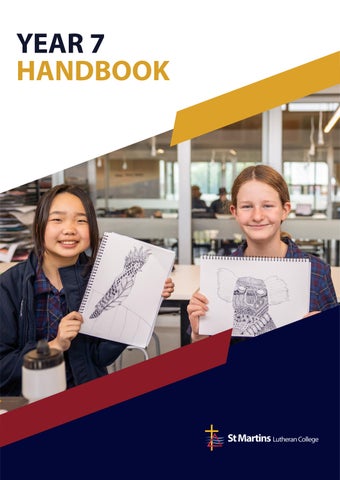
YEAR 7 HANDBOOK
College Mission
Grounded in Christian faith, we nurture students to flourish through high-quality teaching, innovative practice, compassionate relationships and a commitment to service.
come to WelYear Seven The transition to secondary school marks a significant milestone in your child’s educational journey. Moving from the familiarity of one primary classroom teacher to working with a smaller group of specialist teachers provides exciting opportunities for students to explore new subjects, develop critical skills, and grow both academically and socially. While they will have a core teacher guiding them through several subjects, this new structure encourages students to step outside their comfort zones and become more independent learners. This handbook is designed to support parents and guardians as we embark on this important transition together. We hope it provides you with the essential information you need to help your child navigate this developmental stage with confidence. We look forward to working alongside you as we support your child’s continued growth and success in Year 7 and beyond.
Contents Key Contacts ............................................................................................................................................................................................. 6 Homegroup/Pastoral Care Teachers .......................................................................................................................................... 6 Key Support Staff ................................................................................................................................................................................... 7 Key Locations ............................................................................................................................................................................................ 8 Pastoral Care and Wellbeing ..........................................................................................................................................................
9
Curriculum .................................................................................................................................................................................................
10
Teaching & Learning ............................................................................................................................................................................ 11 Camp Program ........................................................................................................................................................................................ 14 Daily Life at St Martins .......................................................................................................................................................................... 15 St Martins Way .......................................................................................................................................................................................... 18 Significant Dates and Events .......................................................................................................................................................... 20 Academic Calendar ............................................................................................................................................................................... 21 College Map ............................................................................................................................................................................................. 22
Key Contacts Adrian Wiles Xenia Kerr Jo Patterson Josh Hein
Interim Principal Director of Student Engagement 7-12 Head of Learning, Teaching and Innovation R-12 Head of Wellbeing R-12
principal@stmartins.sa.edu.au xkerr@stmartins.sa.edu.au jpatterson@stmartins.sa.edu.au jhein@stmartins.sa.edu.au
Year Level Leader Fanie Geyser
2025 Year Level Leader - Year 7
fgeyser@stmartins.sa.edu.au
Key Support Staff Alisha Whitehorn Karen Boylan Vanessa Roesler
College Counsellor Learning Leader for Inclusion and Diversity Indigenous Education Coordinator
awhitehorn@stmartins.sa.edu.au kboylan@stmartins.sa.edu.au vroesler@stmartins.sa.edu.au
Learning Leaders Catie Kennedy Jo Patterson Rebekah McDonald Jenny Geyser Brett Shepherdson Lucy Ballard Mary-Anne Sheppard Erin Jones
English & Languages Technology Arts Christian Studies Health & Physical Education Science Mathematics Humanities & Cross-Curricular Subjects
ckennedy@stmartins.sa.edu.au jpatterson@stmartins.sa.edu.au rmcdonald@stmartins.sa.edu.au jgeyser@stmartins.sa.edu.au bshepherdson@stmartins.sa.edu.au lballard@stmartins.sa.edu.au msheppard@stmartins.sa.edu.au ejones@stmartins.sa.edu.au
Whole School Coordinators Samuel Fletcher Stephen Walther Kelly Lynch Molly Auld
Director of Ministry Instrumental Music Teacher Librarian Learning Management System Coordinator
sfletcher@stmartins.sa.edu.au swalther@stmartins.sa.edu.au klynch@stmartins.sa.edu.au mauld@stmartins.sa.edu.au
Homegroup / Pastoral Care Teachers St Martins offers a balanced approach for our Year 7 students, designed to provide the best start to their secondary school journey. Our Year 7 home group and pastoral teachers will where possible lead students in multiple subjects, providing the familiarity, consistency, and support essential for a smooth transition into secondary school. The Year 7 classrooms are located at the northern end of the Ark, on both the ground and first floors.
6
Key Support Staff College Counsellor - Alisha Whitehorn The College is supported by Alisha Whitehorn, who offers guidance regarding social and emotional matters for students. Alisha works across the school and is available for students from Reception to Year 12. This enables continuity of care for students as they move through our school. Alisha works closely with our Head of Wellbeing, Directors of Student Engagement R-6 and 7–12, Student Engagement Coordinator R-6 and our Year Level Leaders to ensure a collaborative student-centred approach to wellbeing. Alisha can be contacted on 8725 1430, or alternatively by email awhitehorn@stmartins.sa.edu.au.
Indigenous Education Coordinator - Vanessa Roesler Vanessa Roesler’s role is to support students and families and liaise with community members. She also supports staff in the development and delivery of the Australian Curriculum’s priority of Aboriginal and Torres Strait Islander Histories and Cultures. Aboriginal and Torres Strait Islander students across Years 6-12 are invited to be part of a mentoring program that St Martins have been involved in since 2019. Students may also choose to take part in regular yarning opportunities with local Elders, both on site and on Country. Non-Aboriginal and Torres Strait Islander students are also invited and encouraged to be part of a range of opportunities both in the classroom and as part of their extra-curricular choices. Cooking sessions have been particularly popular! Vanessa Roesler encourages your suggestions and feedback in anything we do in the College to ensure we continue to share a culturally safe and respectful environment. Please chat with her in the yard or email: vroesler@stmartins.sa.edu.au at any time.
Learning Leader for Inclusion and Diversity - Mrs Karen Boylan The Inclusion and Diversity team caters for the varying learning needs of students, working in close collaboration with families, teachers, College Counsellor, Wellbeing Leaders and other professionals to ensure the best possible outcomes for all students. This support is largely delivered in class with students to support them with their learning. Additionally, support may be provided to small groups and individuals for assessment and other curriculum challenges. Students with identified learning needs may require the creation of a OnePlan. These are written by the Learning Leader for Inclusion and Diversity in conjunction with parents/carers and the student, and supported by the Head of Learning, Teaching and Innovation, Director of Student Wellbeing R-7, Year 7 Wellbeing Leader and College Counsellor as needed.
7
Key Locations 7-12 Student Services Office 7-12 Student Services is located on the ground floor of the Senior Hub. Students should present to 7-12 Student Services when: signing-in late or needing to leave school early; feeling unwell or with an injury; needing to take medication; needing to contact home/parent/carer; needing basic supplies such as poster paper; needing to collect the homegroup tray; or needing to contact a teacher.
Student Learning Centre The 7-12 Student Learning Centre is located on the ground floor of the Senior Student Hub. This dedicated space provides students across the College with a calm environment where they can self-regulate, access support, and prepare to reengage with their classroom learning as seamlessly as possible.
Student Toilets There are student toilets available on the ground floor in Ark and both the ground floor and first floor of the Senior Hub. There are also toilets located at the northern end of the Music Hub and on the western side of the Administration building.
Lockers Secondary students are allocated an individual locker in which to store their school bag and learning materials each day. The Year 7 lockers are located in the corridor immediately outside their homerooms. These lockers have a unique key which each Year 7 student is responsible for keeping throughout the year. We recommend that students keep their locker key on a lanyard or keychain. It is the responsibility of students to ensure their locker is kept locked during the school day and overnight, and all valuable belongings (for example, mobile phone, wallet/purse) are kept within the locker during the school day.
8
Pastoral Care and Wellbeing At St Martins Lutheran College, we are committed to supporting the holistic wellbeing of every student. Our pastoral care approach focuses on nurturing each young person’s social, emotional, physical, cognitive and spiritual development so they feel safe, connected, and ready to learn. We provide a range of programs, proactive initiatives, and everyday practices that help students build positive relationships, develop resilience, and engage confidently in school life. We know that when students feel valued and supported, their overall wellbeing grows, and this directly contributes to stronger engagement and academic success.
The Student Learning Centre (Year 7-12) The Student Learning Centre, located within the Senior Student Hub, is a supportive space designed to help students regulate, reset, and return to a ready-to-learn state. It provides a calm environment for students who need short-term support to manage emotions, seek guidance, or prepare to re-engage with their classroom learning. The Centre reflects our commitment to sustaining learning continuity and helping students develop resilience, self-awareness, and positive learning habits. Student’s can gain entry to the Centre by checking-in with the team at Student Services. Students may access support from our College Counsellor, Alisha Whitehorn, a member of the Inclusion & Diversity team, their Year Level Leader, or the Director of Student Engagement (7–12). Together, this team provides coordinated, holistic support that addresses both social–emotional needs and learning readiness. The Student Learning Centre is a shared resource for students, offering a safe, inclusive environment where each young person’s wellbeing and learning are prioritised. While the Centre offers valuable support, it is not a space for avoiding class or stepping out of learning by preference. Our aim is to guide students back to their learning with confidence, strengthened relationships, and the skills needed to thrive at school.
9
Curriculum St Martins Lutheran College delivers the Australian Curriculum from Reception to Year 10 and the South Australian Certificate of Education (SACE) in Years 11 and 12. Our curriculum is designed to provide students with a broad, balanced and engaging education that develops the knowledge, skills and capabilities they need to become confident, independent and lifelong learners. In addition to the knowledge and skills developed within individual learning areas, the Australian Curriculum incorporates seven General Capabilities and three Cross-Curriculum Priorities. These are embedded across learning experiences to develop students’ critical and creative thinking, literacy, numeracy, digital literacy, personal and social capabilities, ethical understanding and intercultural understanding. Students are encouraged to make connections between learning areas, consider different perspectives, solve problems and apply their learning in meaningful, realworld contexts. Year 7 marks an important transition into secondary schooling, providing students with opportunities to build greater independence, develop effective learning habits and explore a wider range of subjects and interests. The curriculum is carefully structured to provide continuity in the core learning areas while introducing students to specialist learning environments, subject-specific teachers and new learning experiences. Throughout Year 7, students undertake a year-long program of Christian Studies, English, Mathematics, Science, Humanities and Social Sciences, and Health and Physical Education. These core subjects provide a strong foundation for continued learning and support the development of essential academic, personal and social skills. Students also participate in a range of specialist subjects throughout the year, providing opportunities to explore their interests, discover new strengths and develop practical, creative and technical skills. These experiences expose students to a breadth of learning areas and help inform their subject choices as they progress through secondary schooling. Christian Studies is an important part of the College’s curriculum and Lutheran identity. Through Christian Studies and the broader life of the College, students are encouraged to explore questions of faith, identity, purpose, relationships and service, while developing respect for others and an understanding of their place in the wider community. Across all learning areas, teachers provide differentiated learning experiences that recognise students’ individual strengths, needs and stages of development. Through explicit teaching, inquiry, collaboration and opportunities for reflection, students are supported and challenged to achieve personal growth and academic success. Our Year 7 curriculum aims to develop capable, curious and compassionate young people who are increasingly confident in their learning, willing to embrace new challenges and equipped with the foundations to thrive throughout their secondary education and beyond.
Year 7 Core Subjects • • • • • • •
10
Christian Studies English Mathematics Science Humanities and Social Sciences Health and Physical Education German
Year 7 Trimester Subjects (Rotations) • • • • • •
Visual Arts Music Drama Digital Technology Design Technology Food Technology
Teaching and Learning Assessments & Reporting Assessment in Year 7 is ongoing and aligned with the Australian Curriculum Achievement Standards. Teachers use a range of assessment strategies to monitor student progress, identify learning needs and provide feedback that supports continued growth and achievement. Assessment may be formative or summative. Formative Assessment – Ongoing assessment that occurs throughout the learning process to monitor understanding and guide future teaching and learning. Examples include quizzes, classroom observations, discussions, draft feedback, progressive tests and practical activities. Summative Assessment – Assessment undertaken at particular points in the learning process to evaluate student achievement against the Australian Curriculum Achievement Standards. Examples include formal tests, assignments, projects, oral presentations and practical assessment tasks. During the school year, students may also undertake standardised assessments, including ACER Progressive Achievement Tests (PAT) and NAPLAN. Results from these assessments provide valuable information about student achievement and growth and are used alongside classroom assessment data to inform teaching, identify areas for improvement and support individual learning needs. Parents with questions about these assessments are encouraged to contact their child’s teacher.
Continuous Reporting and Feedback St Martins Lutheran College adopts a continuous approach to assessment and reporting, recognising that student learning develops over time. Throughout each subject, teachers gather evidence of achievement and provide regular feedback to help students understand their progress, recognise their strengths and identify their next steps for learning. Through LUMI (our learning management system), parents and caregivers can access assessment information and feedback as it becomes available, providing greater visibility of their child’s learning throughout the year rather than relying solely on formal reports.
Interim and Semester Reports Interim reports are provided during the school year and focus on student engagement, learning behaviours and approaches to learning. These reports do not include academic grades. Instead, they provide an early indication of how students are settling into their learning, participating in class, demonstrating organisational skills and taking responsibility for their progress. This information supports timely conversations between students, teachers and families where additional encouragement or support may be beneficial. Formal academic reports are issued at the end of Semester One and Semester Two. These reports communicate student achievement against the Australian Curriculum Achievement Standards for students in Years 7-10, providing an overview of progress and achievement across learning areas. Reports are released digitally through LUMI, with printed copies available on request.
11
Teaching and Learning Parent Teacher Interviews and Communication Parent Teacher Interviews will be held in Term 1 on 7 and 8 April 2027. These interviews provide an important opportunity for parents and teachers to discuss student progress, engagement, learning behaviours and achievement, as well as identify strategies to support continued growth. The College values strong partnerships between home and school and encourages open, ongoing communication. Parents and caregivers are welcome to contact teachers to discuss their child’s learning or arrange additional meetings outside the scheduled interview times whenever needed.
Timetabling The timetable is divided into seven lesson periods plus morning homegroup. We refer to these periods as “lessons” and each lesson consists of 45 minutes, for example, Lesson 1 immediately follows morning homegroup and runs from 9:00am - 9:45am. Year 7 students all begin the morning in their home classroom, during which the core teacher will take attendance rolls, share morning notices, and deliver a devotion. Daily Routine: 8:15am 8:45am - 9:00am 9:00am - 11:15am 11:15am - 11:35am 11:35am - 1:05pm 1:05pm - 1:45pm 1:45pm - 3:15pm 3:15pm
Staff Devotion Homegroup Lessons 1 - 3 Recess Lessons 4 & 5 Lunch Lessons 6 & 7 Dismissal
At the end of recess and lunch, there is a 5 minute warning bell, and students are expected to be ready for class on time.
Academic Assistance Academic Assistance is offered at lunch time each day, where students can attend to access assistance with current tasks and assessments. Students can self-refer or may be referred by their class teacher. Specialist maths and science help is available on Wednesday afternoons from 3:15pm - 4:30pm.
12
Teaching and Learning Extra Curricular Options & Processes A range of extra-curricular opportunities are offered to students throughout the year. These are promoted via LUMI (see page 16). Students are required to self-nominate and to contact the relevant staff member listed in the Notices. Some activities require practices or rehearsals during lunch breaks or occasionally outside of school hours. We encourage all students in Years 7 - 9 to explore the variety of options available. Some of these extra-curricular activities will incur an additional cost and families will be notified. Examples of established extra-curricular activities include: •
Performing Arts
•
Debating and Public Speaking
•
History and Geography Competitions
•
SESSSA Sports
•
Book Week
ChromeBook St Martins has a commitment to ensuring that students develop in their digital literacies and capabilities throughout their time with us. The College offers Year 7 students a 1:1 ChromeBook Program to best support learning. Students are responsible for their ChromeBook at all times. It must be kept in the provided shell case, and locked in their locker when not being used in class. Students and parents/carers are provided with a ChromeBook Guidebook and must sign a User Agreement as part of the induction process. Students who transfer in or out of the College during Years 7 to 9 will have the balance of the Chromebook cost applied or adjusted on the family fee account. From Year 10, the ownership of the Chromebook passes to the student, providing previous tuition fees have been paid in full. If the device is damaged, the cost of repair or replacement will be invoiced to the parents.
13
Camp Program The St Martins Camp Program is an essential part of our students’ journey of growth, connection, and discovery. Grounded in our College values of respect, compassion, growth, faith, hope, and encouragement, each camp experience is intentionally designed to support students in developing confidence, resilience, and character. Through outdoor adventures, collaborative challenges, and reflective experiences, students learn to navigate new situations, build meaningful relationships, and step beyond their comfort zones. Camps provide opportunities for students to better understand themselves and one another, fostering empathy, teamwork, and a stronger sense of community. These experiences help students cultivate independence, develop problem-solving skills, and grow in perseverance, qualities that support their learning and wellbeing back at school. Our camps also offer moments for spiritual reflection and exploration. Whether through structured devotion times or peaceful moments in nature, students are invited to consider their faith, discover their unique strengths, and deepen their sense of purpose. In this way, camps are more than just time away, they are a formative and inspiring part of developing the whole child. Attendance at camp is a valued and expected part of each student’s learning journey at St Martins. As we embark on our camp journeys, we draw strength from the words of Isaiah 40:31: “But those who hope in the Lord will renew their strength. They will soar on wings like eagles; they will run and not grow weary; they will walk and not be faint.” This reminder reflects the heart of our program—a place where hope is nurtured, strength is renewed, and students are empowered to grow, learn, and soar. St Martins Camps are a transformative experience where every challenge becomes an opportunity, every moment of connection builds character, and every student is empowered to thrive.
Year 7 Experience - UNITE! Adventure Camp Location: Capaspe Downs, Victoria Date: 22/3/27 - 24/3/27 We’re thrilled to introduce the UNITE! Adventure Camp in 2026, an incredible opportunity for your Year 7 student to grow, connect, and thrive through exciting outdoor challenges! Year 7 is such a pivotal time for your child’s social and emotional development. The authentic challenges of adventurebased learning create those special breakthrough moments that simply can’t happen in a traditional classroom. In today’s world, emotional intelligence and collaboration skills are more valuable than ever. UNITE! gives your child a genuine advantage; the confidence, teamwork, and communication abilities they develop will serve them throughout their secondary school journey and well into adulthood. When future challenges arise, they’ll draw on the strength and skills they discovered alongside their classmates during this transformative experience. Throughout the camp experience, your child will be building rafts with classmates, conquering new heights, and tackling team challenges, all while developing essential life skills like leadership, communication, resilience, and forming genuine friendships that last. You can feel confident knowing UNITE! is delivered by PGL Adventure Camps, who bring decades of youth development expertise to every activity. Their qualified instructors and dedicated support staff ensure every student feels safe, included, and supported throughout their adventure. The program is specifically designed for our school community, meeting each child where they are, and incorporating our school values of respect, compassion, growth, faith, encouragement and hope. We can’t wait to see your child flourish! 14
Daily Life at St Martins Uniform & Footwear Our aim is for all students to wear the appropriate uniform consistently throughout the year. It is helpful if families are on the same page in regards to uniform expectations. Of particular note: •
Students should wear black lace up leather shoes with the formal uniform.
•
Socks should be plain white or navy, with or without the College name. No other visible brand socks.
•
Sneakers and PE uniform should only be worn on days when your child has a practical PE lesson (typically the double lesson in their timetable). On these occasions, sneakers must be supportive sports shoes, not canvas street/ skate wear.
•
Jewellery is limited to; three piercings per ear, small plain studs or small sleepers only; one ring per hand; plain chain with or without a small cross.
•
No bracelets or anklets.
•
Hair should be tied back or shorter than the student’s collar.
•
All students are required to wear a College hat, as part of our Sun Safe policy.
•
No hoodie jumpers or visible long sleeve tops to be worn under uniform clothing.
If a student wears the incorrect uniform, contact will be made with their family requesting the correct uniform be dropped to the school. If this is not possible, the student will be required to sit out at recess and lunch times. We understand that on rare occasions the correct uniform may not be available. If this occurs, please ensure the College is informed.
15
Daily Life at St Martins Recess & Lunch Breaks All students in Years 7–12 eat their recess and lunch in outdoor areas during break times. Students are encouraged to use these breaks to eat, socialise, enjoy some physical activity and refill their water bottles as needed. A variety of lunchtime clubs and activities are available, including sport, debating, art and board games. These activities are supervised by staff and provide opportunities for students to explore their interests, develop friendships and connect with others across year levels. Information about available activities and any changes is communicated through News on the LUMI platform. Lunchtime may also be used for Student Ambassador meetings, rehearsals, accessing Academic Assistance and other College activities. The Art and Music rooms are generally available to students at least once a week during lunch breaks, providing additional opportunities for creative expression and engagement.
Worship and Devotions The whole school join together for a 30-minute Worship on Friday mornings. This Worship time is overseen by the Ministry Team, but assisted each week by an allocated class, and a student-led Worship band. In this way students are given the opportunity to be engaged and take responsibility for their own worship experience. Families are invited to join us in the Gym for Worship each Friday from 8:55am - 9:30am. Home classes start each day with a short devotion and staff participate in a morning devotion prior to the school day beginning. These devotions are a wonderful opportunity for staff and students to get together, to consider our Christian values and interactions with others, as well as give thanks to God for our blessings.
Canteen The canteen is available every day for lunch orders, submitted by 8:30am via the Qkr! App (available through the App Store or Google Play). Students in Years 7 - 12 collect their lunch orders directly from the canteen servery window inside the Gym at the beginning of lunch. This is different to the class lunchbox system that is used for Reception - Year 6 students. The canteen also has a small amount of food available for purchase during recess and lunch daily. Small change is appreciated by the canteen staff.
LUMI LUMI is the College’s learning platform, built on Schoolbox and used by students, families and staff. It brings timetables, class learning, tasks, feedback, reports and College news together in one place. Students use LUMI as the home of their learning. They use it to access class pages and resources, view task details, submit assessments and receive feedback. Parents and carers use LUMI to see their child’s timetable, upcoming events and assessment requirements, follow their learning and progress, and access term and semester reports. LUMI is also an easy way to stay in touch with the College. Login details and a quickstart guide are provided to families early in Term 1. A parent information session is also held to walk families through LUMI and answer questions.
16
Daily Life at St Martins Consent2Go Families use the Consent2Go app to give permission for their child to attend College excursions and to update their contact details. Please keep your email address current in Consent2Go so you receive all LUMI notifications and College communications.
Absences Please notify the College if your child is going to be absent from school. You can do this by phoning the College office (8725 1430), or emailing: absent@stmartins.sa.edu.au, or via the link on the LUMI platform. If the College has not received information regarding an absent child by 9:30am, we will endeavour to contact parents via text message to ascertain that the child is legitimately absent and safe. Absences of five days or more require a completed Exemption Form, which can be found on the College website, or a copy collected from the Student Services Office.
Announcements From time to time, the College is required to make loud speaker announcements. This may be to provide instruction, or for a safety reason. There are speakers throughout the school that your child is likely to hear. The announcement system is also used for evacuation and invacuation instructions and warning signals.
Adverse Weather & Hat Policies During Terms 1 and 4, hats are required to be worn by all students and staff to protect their face, neck and ears whenever they are outside. These dates may be adjusted depending on the UV Rating. Students who do not have an appropriate sun hat will be asked to stay in shaded areas only. School hats can be purchased from the Uniform Shop. We have an adverse weather policy that allows for either indoor or undercover scenarios depending on the weather that day.
The Parent Hub The Parent Hub on the St Martins Lutheran College website is your comprehensive resource for key information about your child’s education. The Hub provides important updates on absences, communication channels, school policies, uniform guidelines, SMOSHC (St Martins Outside School Hours Care), and LUMI (our learning management system). The Parent Hub can be found in the menu of the College website: https://stmartins.sa.edu.au/
17
St Martins Way At St Martins Lutheran College, The St Martins Spirit—our College values of Respect, Compassion, Growth, Faith, Encouragement, and Hope—forms the foundation of our Student Code of Conduct and guides how we respond to behaviour. These values shape the way we learn, interact, and build community, ensuring that every student feels safe, respected, and supported. We expect students to act in ways that reflect these values: showing respect for others, demonstrating compassion, taking responsibility for their actions, and contributing positively to the learning environment. As students grow, they are supported to develop increasing self-regulation, self-discipline, and an awareness of the needs and rights of those around them. These expectations reflect our Christian ethos and align with values of Lutheran Education. Our behaviour approach is strengthened by contemporary educational research, including the Berry Street Education Model and restorative teaching practices. Restorative practice is central to how we address behavioural concerns, as it helps students reflect on their choices, understand the impact of their actions, and take meaningful steps to repair harm. This approach prioritises relationships and supports students to learn from mistakes while remaining connected to the school community.
Student Code of Conduct Student Code of Conduct, informed by the St Martins Spirit, reflects our Christian ethos and Lutheran values. It is not just a set of rules, it is a shared commitment to living out our values, building positive relationships, and helping every student become compassionate, responsible, and capable. At St Martins, we want every student to feel safe, respected, supported, and able to learn. The Student code of conduct guides how we treat each other, make good choices, and contribute positively to our community. It can be accessed here.
Behaviour Management When a student’s behaviour falls outside the expectations of the Student Code of Conduct, or when relationships break down, we respond in line with the St Martins Way and our Student Behaviour Framework. We work with students to understand the impact of their actions, take responsibility and repair harm. • •
Early responses include classroom strategies, calm redirection and Mini Chats to help students reset and re-engage in learning. Further support may be needed when behaviour continues or the concern is more significant. This may include time on the Bench to reset and reflect, a Referral, or a restorative meeting with support from the relevant staff.
Through restorative follow-up, students agree on what needs to change and how they can move forward with the people affected.
Our Routines At St Martins, we know that clear and consistent routines help students feel safe, focused, and ready to learn. These shared expectations support respectful and positive learning spaces where everyone can thrive. This guide is designed to help students uphold the Student Code of Conduct and live out the St Martins Way.
18
St Martins Way The
OUR R OUTINES – READY TO LEARN, READY TO THRIVE At St Martins, we believe that clear and consistent routines help us feel safe, focused and ready to learn. These shared expectations support respectful learning spaces where everyone can flourish. This guide is here to remind us of The St Martins Way, what we do, how we move, and how we work together with heart, hands and minds.
ENTRY ROUTINE
CUE TO FOCUS
•
Our teachers use clear and consistent cues to bring our attention
Before entering the classroom, we wait quietly to one side of the hallway/outside the classroom with everything we need for the next learning block.
to the front. When we hear a cue, we:
•
We enter quietly when the teacher says and stand behind our chairs and await instruction.
•
Our Chromebooks stay closed until we are instructed to open them.
STAYING ON TRACK
STOP
LOOK
LISTEN
RESPOND
Examples of teacher cues: •
“5…4…3…2…1…”
•
Call and response (e.g. “Eyes on me” – “1, 2, 3”)
•
Use of names followed by a clear direction (e.g. “Celia, ready to learn”)
Our teacher will help us to stay on track by: •
THE LOOK: The teacher makes calm, silent eye contact as a non-verbal prompt.
•
PROXIMITY: The teacher calmly moves and stands near the student.
•
GENTLE DESK TOUCH: The teacher places a hand on the student’s desk to indicate a reminder to stop and reset.
•
Wait for the teacher’s permission before leaving your seat.
•
VERBAL REDIRECTION: The teacher quietly names the behaviour and gives a clear, kind direction. Example: “Eyes this way now. Thank you.”
•
Move around the room with care, walk, don’t run.
•
Keep pathways clear and avoid blocking others.
FOLLOW-UP: If behaviour continues, the teacher will follow up after class using a restorative approach. The Year Level Leader or Director of Student Engagement may be involved in this stage.
•
No spinning, tipping or wheeling on chairs.
•
Use furniture and resources respectfully.
•
Line up and transition between spaces quietly and sensibly.
•
Ask teacher for permission to leave and fill out ‘out of class’ form.
•
CLASSROOM MOVEMENT We move calmly and with purpose. This helps keep everyone safe and focused.
EXIT ROUTINE
BRAIN BREAK We regulate and re-focus by participating in a brain break, as instructed by our teacher.
•
We continue to work until our teacher instructs us to pack up.
•
We pack up our work and Chromebooks as instructed by the teacher.
•
We reset the classroom ready for the next class/lesson (clear desks, tuck in chairs, tidy resources).
•
We stand behind our chairs and wait for teacher instruction.
• Our teacher will dismiss us.
CLASSROOM VOICES - Knowing When and How to Use Our Voice SILENT VOICE
PARTNER VOICE
GROUP VOICE
CLASSROOM VOICE
When to use it: • During independent work • When reflecting, reading, or writing quietly
When to use it: • When talking one-on-one with a partner during pair work
When to use it: • In small group discussions or tasks
Why: • So only your partner can hear you – not the whole class.
Why: • So your group can work together without disturbing others.
When to use it: • When speaking to the whole class or responding to the teacher
Why: • To help focus and respect others’ concentration.
Why: • So everyone can hear clearly and learning can be shared.
Significant Dates and Events Sports Days: Athletics and Swimming Carnivals The Year 7 -12 Athletics Carnival is held in Term 1 2027. Students are divided into four House groups: Tremelling (red), Livingston (blue), Whitty (green) and Yeates (yellow). A program is prepared at the start of each year by Physical Education staff, and events are organised into age groups. Students are encouraged to participate in at least three events. Parents are invited to assist on the day and are also welcome as spectators. Students wear their House polo shirt with their school sports shorts. House shirts can be purchased from the Uniform Shop. Parents will find Year 7 - 12 Athletics quite different to Reception - Year 6 where children participate in all events. It may be more important to find out what events your child is participating in to avoid coming to watch them and missing the events they’re doing. The Year 7 - 12 Swimming Carnival is also held in Term 1 at Wulanda Recreation Centre, with both championship and novelty events. This is a fantastic opportunity for students to support their House group and be involved. Following these school carnivals, there are opportunities for representation at interschool Athletics and Swimming competitions.
20
2027 Academic Calendar
JANUARY
FEBRUARY
S
M
T
W
T 7 14 21 28
F 1 8 15 22 29
S 2 9 16 23 30
3 10 17 24 31
4 11 18 25
5 12 19 26
6 13 20 27
S
M
T
W
T
F
5 12 19 26
6 13 20 27
7 14 21 28
S 1 8 15 22 29
2 9 16 23 30
3 10 17 24 31
4 11 18 25
S
M
T
F 3 10 17 24
S 4 11 18 25
5 12 19 26
6 13 20 27
7 14 21 28
S
M 1 8 15 22
T 2 9 16 23
S
M
6 13 20 27
7 14 21 28
T 1 8 15 22 29
S
M
T
W
T
3 10 17 24 31
4 11 18 25
5 12 19 26
6 13 20 27
7 14 21 28
7 14 21 28
MAY
MARCH
T 4 11 18 25
F 5 12 19 26
S 6 13 20 27
T 3 10 17 24
F 4 11 18 25
S 5 12 19 26
F 1 8 15 22 29
S 2 9 16 23 30
S 7 14 21 28
M 1 8 15 22 29
T 2 9 16 23 30
S
M
T
W
4 11 18 25
5 12 19 26
6 13 20 27
7 14 21 28
S
M 1 8 15 22 29
T 2 9 16 23 30
JUNE
SEPTEMBER W 1 8 15 22 29
W 3 10 17 24
T 2 9 16 23 30
W 2 9 16 23 30
APRIL T 4 11 18 25
F 5 12 19 26
S 6 13 20 27
T 1 8 15 22 29
F 2 9 16 23 30
F 5 12 19 26
S
M
T
W
4 11 18 25
5 12 19 26
6 13 20 27
7 14 21 28
S 3 10 17 24 31
S 1 8 15 22 29
M 2 9 16 23 30
T 3 10 17 24 31
S 6 13 20 27
S
M
T
5 12 19 26
6 13 20 27
7 14 21 28
JULY
OCTOBER
School Holidays
W 3 10 17 24 31
Public Holidays
7 14 21 28
Student Free Days
F 2 9 16 23 30
S 3 10 17 24
T 5 12 19 26
F 6 13 20 27
S 7 14 21 28
F 3 10 17 24 31
S 4 11 18 25
AUGUST
NOVEMBER W 3 10 17 24
T 1 8 15 22 29
T 4 11 18 25
W 4 11 18 25
DECEMBER W 1 8 15 22 29
T 2 9 16 23 30
Staff Pre/Post Service Days
Term 1
Term 2
Term 3
Term 4
Tuesday 19 January New Staff Pre Service Day Wednesday 20 January to Friday 22 January All Staff Pre Service Days Tuesday 26 January Australia Day Holiday Wednesday 27 January Start of Term 1 Monday 8 March Adelaide Cup Holiday Friday 26 March Good Friday Monday 29 March Easter Monday Tuesday 6 April R-6 PTI’s (3:30pm - 6:30pm) Wednesday 7 April Early Dismissal R-12 PTI’s (1:30pm - 6:30pm) Thursday 8 April 7-12 PTI’s (3:30pm - 6:30pm) Friday 9 April End of Term 1 (Early Dismissal at 2:15pm) Sunday 25 April ANZAC Day
Monday 26 April Start of Term 2 Friday 11 June Student Free Day/Report Writing Day Monday 14 June King’s Birthday Holiday Friday 25 June Last Day of Term 2 (3:15pm Dismissal) Monday 28 June to Friday 2 July Staff Professional Learning Days
Monday 19 July Start of Term 3
Monday 11 October Start of Term 4 Thursday 21 October Last Day for Year 12 Students Friday 22 October Student Free Day/Staff Planning Day Friday 19 November Student Free Day/Assessment & Moderation Day Friday 26 November Last Day for Year 11 Students Friday 3 December Last Day for Year 7 to 10 Students Wednesday 8 December Last Day for Reception to Year 6 Students Thursday 9 December & Friday 10 December Staff Post Service Days
Wednesday 8 September R-12 PTI’s (3:30pm - 6:30pm) Friday 24 September Last Day of Term 3 (Early Dismissal 2:15pm) Monday 4 October Labour Day Holiday
Version 3 Updated: 20/08/2026 21
3 St Martins Drive Mount Gambier, SA 5290 (08) 8725 1430 www.stmartins.sa.edu.au office@stmartins.sa.edu.au