Spring 2026
Evergreen
BESPOKE NEW ZEALAND MADE FURNITURE
AUCKLAND - 80 Parnell Rd, 09 303 4151 CHRISTCHURCH - 121 Blenheim Rd, 03 343 0876 QUEENSTOWN - 313 Hawthorne Dr, 03 441 2363 www.trenzseater.com
UPGRADE TO QASHQAI CLASS
^Up to 10 years or 300,000km (whichever occurs first) when servicing at authorised Nissan dealers. Full terms at Nissan.co.nz/warranty
CHRISTCHURCH NISSAN
It’s Hybrid Reinvented
392 Moorhouse Avenue, Christchurch. Ph: 03 595 6820 www.christchurchnissan.co.nz
Contents
4
3 8 14
12 17
Sp rin
g 20 26
18 20
2
No two paths alike
3
110 years, and counting
3
Upcoming alumnae events
4
Exploring, experimenting, and expressing
5
Supporting every learner
6
Try everything
7
An education beyond a qualification
8
Come and give it a go
10
More than a game
12
Meet Stacey James
14
Out & about
16
Creating opportunities for SMC families to connect
17
Life as an international student
18
A community that rows together
19
The world is their classroom
20
Nurturing connections
22
Alumna profile: Rosemary Cann
23
Alumna profile: Felicity Champion
24
Alumna profile: Amy Lin Turner
25
Remembering
27
Our sad farewells
28
What’s in a Name?
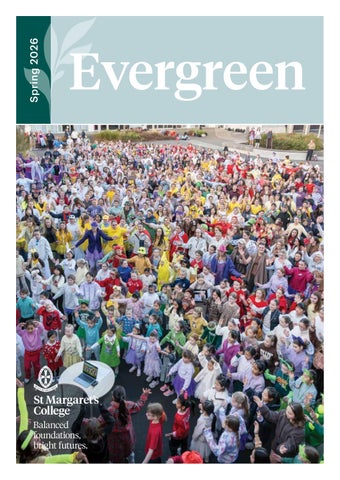
een Evergr On the cover: Whole school Jump Jam warm-up on House Day.
1
No two paths alike At St Margaret’s, we hold firmly to the belief that no two girls
of life. For many, it means encountering things for the first
find their place at our College by the same path. This edition
time that others take for granted, such as a night sky full
of Evergreen is a wonderful expression of that belief.
of stars they have never seen before. It is an experience as
Across the co-curricular arts, our girls are stepping into roles as varied as the programme itself. That could be performing
These opportunities reflect deliberate choices, by staff who
under the spotlight, running the lighting and sound desk,
take time to coach a team or coordinate an arts showcase,
contributing to the set design, or managing the prop room.
and by girls themselves, willing to pursue a genuinely
This diversity is what allows every girl to find her place.
independent line of inquiry, from a preschooler given the
The same principle is at work in sport, where a deliberately wide programme beginning in our Junior School means girls find the sports they love, and the confidence to keep playing them well after their school days. Diversity also underpins our academic programme, with our girls empowered to make the choice between the International Baccalaureate Diploma (IBDP) and the New Zealand national curriculum as they approach their senior years. This choice offers our girls the opportunity not simply
2
individual as the student living it.
freedom to explore paint, clay and dye in their art inquiry, right through to a senior girl shaping her IBDP Extended Essay question. This same breadth of pathway carries on well beyond school gates. None of the alumnae we meet in this edition has followed a predictable route, and serve as inspiration and reassurance to our girls that the paths they choose can lead almost anywhere.
to master content, but especially in the case of the IBDP,
What connects all of these experiences is our underlying
to examine it from more than one vantage point, and to
commitment that opportunity should take many shapes,
consider who is telling the story, and why. It is an education
because our girls do too. We are grateful for the partnership
built for a world that rarely offers a single right answer.
we share with our community in making this breadth
For our international students, that range of experience often begins the moment they arrive. Everything is new: the climate, the food, the daily rhythms of the New Zealand way
possible, and for helping each girl find the place that is hers. Diana Patchett, Executive Principal
110 years, and counting We are well past the halfway mark of the year now, and if spring feels like it has come around quickly, that’s because it has. Reunion Weekend is on the horizon, Year 13 will have their leavers’ rings before we know it, and the calendar between now and December is full. This year also happens to be a milestone year for SMCOGA. The Association was formally established in 1916, which makes 2026 our 110th year. Recently I pulled the 110 Empowered Women book off the shelf, created to mark the College’s 110th year. It’s well worth another read if it’s been a while since you opened it; what an amazing reminder of the incredible women who have passed the gates of St Margaret’s College. The Association itself began for a simple reason: to keep girls connected once they’d scattered after school. It’s why our mission remains simply to ‘Nurture Connections’, and why, all these years later, connection is still the starting point for everything we do, even as what develops from these connections keeps changing. This is what that growth looks like at 110. Somewhere to find each other on purpose, whatever stage of life you’re at, wherever you are and whatever your interests are. A Margarita evening, a tennis tournament, or a mentoring opportunity. We’re not aiming for one event that suits everyone, but a collection of events that are targeted at each group of our community. While we continue to adapt and grow the alumnae offering, my ask would be a simple one. Show up for one thing you
Reunion Weekend, the biggest event on the calendar, is coming around fast, and we can’t wait to welcome this group back for Reunion 2026. If your third form/Year 9 ended in a 6, this is the year for you. For those not in a reunion year, there is always a time for a catch-up. With our events still to come this year in Wānaka, Blenheim and Nelson, we would love to see you. Closer to home, keep an eye out for the Time Capsule event for the leaving class of 2016 and our Christchurch Margarita evening, both easy nights to catch up before the year gets away from us.
wouldn’t normally go to; you might find you’ve got more in
I look forward to seeing you at one of these events.
common with the woman two tables over than you’d expect.
Sophie Fitzsimons,
What might feel scary or out of your comfort zone could be the day you make a great connection, or a reconnection
Old Girls’ Association President
that you didn’t know you needed. Connection is the key to all of this, so if you know an Old Girl who isn’t hearing from us, tell her to get in touch and update her details; we can’t nurture a connection we can’t reach.
Upcoming alumnae events Friday 30 October – Sunday 1 November
Reunion Weekend
Wednesday 4 November
Nelson Community Event
Thursday 5 November
Blenheim Community Event
Tuesday 17 November
Wānaka Community Event
Thursday 26 November
Christchurch Margaritas
Friday 27 November
Time Capsule Opening
To stay up to date and register for our events, visit smcconnect.school.nz/events
3
Preschool creativity Little hands squish the clay, building muscles while we play. Scissors snip and fingers glue, helping small hands learn something new. Splash the paint and mix the shade, look at how a decision is made. Art helps our big ideas grow – we learn so much as colours flow.
Exploring, experimenting, and expressing Our Preschool art inquiry The Preschool children have been participating in an art inquiry over the past term. Curiosity has been leading the way and the process has been the key to the final product. Our young artists have been given the freedom to explore materials, experiment with textures, and discover how line, colour, and form can bring their ideas to life. From energetic brushstrokes to foil sculpting and tie-dyeing, every creation is a unique expression of how they see, feel, and make sense of the world around them. A range of activities were planned by the teachers, and students at St Margaret’s were invited to the Preschool to teach the children techniques using a variety of materials and media to create and be creative with. The children’s learning was celebrated with an art show at the end of the term, where whānau joined us to enjoy our
4
Preschoolers’ creations. Sarah Bradley, Director of Preschool
Supporting every learner Meet Lillian and Bindy In the Junior School, learning support teachers Lillian and
fractions and decimals, moving from concrete materials
Bindy spend their days working one-on-one and in small
to something more abstract on the whiteboard. “Suddenly
groups with girls who need a bit of extra help, or a bit of
you see the moment it makes sense. Their face lights
extra challenge. Between them, they have 26 years at St
up, and they say, I get it now, give me another one.” For
Margaret’s, and a shared belief that meeting a child where
Lillian, it’s often about confidence rather than content:
she is can change how she sees herself as a learner.
a girl who no longer wants help finishing a word, who
Lillian works mostly with girls in Years 0 to 3, focusing on structured literacy. Sessions run for 25 to 30 minutes and follow a familiar routine, so the girls know what to
says “no, I can do it myself.” When even the youngest girls reach that point, she says, you know something has shifted.
expect each week. “Everything is differentiated to suit the
What strikes them both is how little stigma the girls
individual learner,” Lillian says. “The work often connects
themselves attach to needing support. Other students
with what they’re doing in the classroom, but they get
often ask to come along when Lillian or Bindy collect a
more repetition and more chances to practise.”
girl from class. Many students talk openly about having
Bindy picks up from Years 4 to 6, where support increasingly happens in small groups. She uses PAT results and teacher observations to work out who needs support,
ADHD or dyslexia. It’s a marked change, Bindy says, from a time when learning differences weren’t always understood or even identified.
who needs monitoring, and who might benefit from
Neither teacher sees a diagnosis as defining. “It’s only one
extension instead. Progress is reviewed through the year,
part of who a student is,” Bindy says. “Many of the girls we
and sometimes a girl improves enough that she no longer
work with have incredible strengths, creatively, in sport,
needs regular sessions at all.
in the way they connect with people.” Their job, as they
Both teachers came to this work by a winding route. Lillian started in Reading Recovery years ago and became
see it, is to build the skills a girl needs while making sure everything else about her still gets noticed.
interested in dyslexia, dyscalculia and dysgraphia along
What keeps them going is simple enough. “It’s the
the way. Bindy left teaching to be a teacher aide while her
satisfaction of knowing you’ve made a difference for
own children were young and found she loved the work,
someone,” Lillian says. Bindy agrees, “It always comes
retrained as a specialist teacher, and never looked back.
back to this: helping someone learn, and watching
Ask either of them for a breakthrough moment, and they don’t hesitate. Bindy talks about a girl working with
it land.” Bridget Compton-Moen, Head of Junior School
5
Try everything At St Margaret’s, the Middle School experience offers a vibrant breadth of opportunity, designed to spark curiosity and build confidence across every discipline. We see this as the girls’ time to try everything and take every opportunity. Academically, students engage in a rich curriculum that includes immersive study across four languages—Spanish, Chinese, Te Reo Māori, and French— alongside cutting-edge creative technologies, visual arts, and dynamic performing arts programmes. Each subject opens up a door onto a different way of thinking and seeing the world. A middle schooler might spend her morning testing a wooden box joint in Hard Materials, and her afternoon composing music, all the while developing a strong foundation of literacy, numeracy and science. Diversity of options grows as girls move through the Middle School. What begins in Year 7 as a taste of everything across languages, technology, and the arts gives way to real choice. By Year 10, girls are selecting subjects that reflect their own strengths and interests, whether that’s business and entrepreneurship, photography, or an extension pathway in a language they have fallen in love with. Alongside this, girls can involve themselves in an extensive array of sports, dance, drama productions, and orchestra ensembles, with every avenue designed to help them discover where their energy and enthusiasm naturally lie. This exploration is held together by the steady, familiar presence of a tutor and layers of pastoral care that support each girl, giving her the confidence to try new things. The girls are encouraged to look outwards also, focusing some of their boundless energy on finding ways to contribute and give back to our school and the wider
6
community, which could be through Full Bellies, planting native trees, or contributing to Educating Girls Globally initiatives.
Middle School is ultimately a transformative time for girls to embrace new experiences, push their boundaries, and discover who they are, ensuring they step forward into Senior School and beyond with self-assurance, purpose, and a clear vision for their personal journey. Rachel Quigley, Deputy Head of Middle School
An education beyond a qualification “To develop inquiring, knowledgeable and caring young people who help create a better, more peaceful world through intercultural understanding and respect.”
It’s an ambitious mission. But according to St Margaret’s International Baccalaureate (IB) Coordinator Valerie Eves, it’s not something reserved for speeches or posters on classroom walls. “The IB mission is woven into every course,” she says. “The programme doesn’t leave it to chance.” That philosophy shapes the everyday learning experience
Valerie Eves – IB Coordinator
for St Margaret’s IB students. Whether they’re studying literature, science or history, girls are encouraged to look beyond a single perspective. English students read works in translation alongside traditional texts, scientists grapple with the ethics behind new discoveries, and historians ask not only what happened, but who is doing the telling, and why. “It’s about giving students robust knowledge,” says Valerie. “Then asking them to think deeply about what that knowledge means.” The core value of learning At the heart of the programme is the IB Core: Theory of Knowledge (TOK), the Extended Essay and Creativity, Activity, Service (CAS). Together, they transform learning
TOK encourages equally rich conversations. Students wrestle with questions such as ‘how do we know what we know?’ and ‘can history ever be truly objective?’ Last year, IB students from St Margaret’s met with their counterparts from Dunedin’s John McGlashan College to debate these ideas together, exposing them to new viewpoints and sharpening their own thinking. Developing deeper thinking In an age where information is everywhere and artificial intelligence can generate answers in seconds, Valerie believes these human skills matter more than ever.
from simply mastering content into understanding how
“The IB helps students develop their own voice,” she says.
knowledge is created, challenged and applied.
“It teaches them to question, to evaluate evidence and to
The Extended Essay, for example, gives every student the opportunity to pursue a year-long investigation into a
understand that every perspective is shaped by culture, history and experience.”
topic that genuinely interests them. Recent projects
‘Through IB, we see students grow steadily over two years
have explored everything from the relationship between
into curious, capable young women who are confident
fast-food outlets and diabetes rates in South Auckland
asking thoughtful questions, engaging respectfully with
to the changing role of fasting in modern religion.
different perspectives and contributing meaningfully to
“They develop their own research question and work
the world around them.”
one-on-one with a supervisor,” Valerie explains.
Perhaps, as the IB mission states, that’s exactly how a
“It’s not just about the final grade. It builds the skills
better, more peaceful world begins, through the daily habit
and confidence they’ll use across every subject.”
of learning to think with both curiosity and compassion.
7
Come and give it a go The breadth and heart of our co-curricular arts Drama, dance, music, visual arts, robotics, Shakespeare,
we wouldn’t have opportunities for students like that.
kapa haka, backstage crews, itinerant instrument
It allows every girl to find her place.”
lessons that feed straight back into co-curricular music or performance groups: St Margaret’s arts offering is, by design, sprawling. At least half the school is involved in some form of cocurricular arts, alongside a full class-based arts curriculum,
Emma had spent years building skills in props and costumes on junior productions at both SMC and Christ’s College. This year, on Les Misérables, she was made head of props, and stepped into the role, says Anna, “doing the
and Anna Turner, our outgoing Director of Co-curricular
job of an adult, in a calm, thoughtful, kind way.”
Arts, is adamant that the sheer range is the point.
St Margaret’s co-curricular arts programme offers an
Ask her why the breadth of co-curricular arts matters, and she doesn’t talk about star performers. She talks about the girl behind the curtain.
8
She means students like Emma Currie. A quiet student,
enormous range, built to catch different girls in different ways. There are dance groups running from beginner “all comers” sessions through to auditioned companies. There’s a 15-year history of Shakespeare success, with
“Being involved in the technical side of things, being
students routinely progressing from regional competitions
backstage, making props, part of stage management - it all
to nationals, and some going on to the Globe’s Young
trickles down,” Anna says. “If we didn’t have the breadth,
Shakespeare Company in London.
There’s Theatresports, orchestras, string ensembles, jazz band, choirs, debating, wearable arts, art club, robotics, and this year, for the first time, Polyfest, where girls learned a Samoan dance. “Those girls just had the best time,” Anna says. “Learning a new skill, working with tutors, learning cultural aspects, there was a real sense of joy.” Kapa haka runs the length of the school too, woven into the junior curriculum and continuing as a Year 7–13 co-curricular group giving voice to the bicultural nature of our country. Les Misérables produced another surprise this year. The school’s Year 13 drama leader, Ida Van Kan - already a strong performer - is also a gifted visual artist, and, along with Maddison Elstob, painted the show’s backdrops. They were photographed, projected, and later sold in a silent auction. “Ida came running up to me, saying ‘they’re all sold’,” Anna says. “She had tears in her eyes.” For a girl still deciding whether the arts are for her, Anna’s advice is to come and have a look, watch a showcase, ask a question, say hi. Often senior students choreograph and direct for their younger peers, taking away the pressure of a teacher-led room, and creating opportunities to get to know students out of your own year group. “Our arts co-curricular offerings are a part of the school that’s very joyous, where a lot of passion grows and develops,” says Anna. Anna Turner, outgoing Director of Co-curricular Arts
9
At least 95 percent of our Junior School girls take part in some form of organised sport.
More than a game The breadth of Junior School sport By the time a girl leaves the Junior School, she’s likely
a pathway through to Canterbury level, and netball’s
to have tried a wide range of sports. Hot shot tennis
popular weekend tournaments, the Jellybean and the
and cricket start in Year 1. By Year 3, mini ball joins the
Rainbow, the latter open to girls from Year 3 up. Other
summer line-up. And by Year 5 and 6, the options multiply
opportunities have arisen as interest has grown, among
further still: tennis, cricket, volleyball, flippa ball, and
them a ski racing day and an annual triathlon and duathlon.
swim club, alongside an opt-in football programme. And, in winter, netball, hockey and basketball. Two outside providers run parts of it, Pegasus Tennis under Andrew Falk and FC2011 for football, while the rest is carried by Junior School staff and a rotation of student coaches. The effort shows in participation. At least 95 percent of our Junior School girls take part in some form of organised sport, rising higher again over winter, when netball and hockey draw strong numbers and basketball isn’t far behind. Both the Year 3/4 and Year 5/6 age groups now field two basketball teams.
10
And when a girl’s interest sits outside the standard offering altogether, the school has generally found a way to make room for it. A few years ago, a small group of girls wanted to compete in the Canterbury primary schools’ rhythmic gymnastics event, a sport with no established programme at SMC. A student at the school who coached rhythmic gymnastics stepped in, training the girls at lunchtime until they turned in a spectacular performance on competition day. It’s a pattern that tends to repeat: interest surfaces, the sport department helps connect families with people who know what they’re doing, and a pathway gets built. Some
For girls in Year 5 and 6, there’s more sitting on top
girls pursue sport entirely outside school hours too, from
of the weekly programme: zone competitions with
football clubs to diving to artistic swimming.
None of it runs without the Junior School’s own teaching staff, many of whom manage a netball or hockey team on top of their regular teaching load, entirely on their own time. Not every girl who plays hockey or basketball at 8 years old is still playing at 18, and plenty are equally committed to dance, music or other pursuits as time allows. But for those who do carry a sport through, the groundwork laid in the Junior School often shows. Lexi Boon, who started in Year 5 and 6 cricket, was recently named GirlBoss Sport Award winner and now represents New Zealand in indoor cricket overseas. Others from the Junior School have gone on to play basketball or cricket for Canterbury, alongside the many girls for whom netball and hockey remain a constant through to the Senior School. Flippa ball, the Junior School’s own take on mini water polo, exists for exactly this reason: a taster that gives girls the basics of the sport, from catching one-handed to treading water, before it becomes a genuine option in Year 7 and 8. Volleyball is following a similar trajectory, with interest growing quickly enough in recent years that it’s fast becoming one of the Junior School’s most popular summer sports. It’s this early exposure, more than any single tournament win, that the programme is really built to deliver: girls who arrive in the Middle School already knowing which sports they love, and with a head start on the skills to keep playing them.
Bindy O’Callaghan, Junior School teacher
11
Meet Stacey James, Julius House Manager Stacey James spent her first weeks in Julius House
She pauses on this, clearly still a little delighted
learning names, faces and habits, the small groundwork
by it. “There are lots of hugs and ‘I love yous’, which
of getting to know a new house full of girls.
is quite different from working in a boys’ boarding
“My approach is generally encouraging rather than bossy,” she says. “I am more likely to say, ‘Come on, girls, let’s go,’
The timing suited her too. With her own children
rather than becoming overly strict.”
grown and gone, the split shifts and early mornings
Stacey arrives at St Margaret’s with four years of boarding
that once fitted around school pick-ups no longer
experience already behind her, split between Richards
made sense, and living onsite, something she’d
House and Flower’s House at Christ’s College. The move
wanted for years, finally became possible.
from a boys’ school to an all-girls one has been, in her
Before boarding, Stacey spent six years with the New
words, an adjustment worth making.
12
environment. It has been really lovely.”
Zealand Red Cross, teaching first aid in schools.
“The girls are definitely much chattier. The dining room
Her path even crossed with St Margaret’s once
can be very noisy because everyone is talking, and the girls
before, through Save a Mate, a programme that
often come into the office for a chat. You get to know some
taught senior students how to care for friends who’d
of them very quickly because they are always popping in.”
overindulged or fallen unwell.
Later she moved into the Red Cross refugee programme,
the afternoon throws up. Staff keep a shared duty report
training volunteers to support newly arrived families.
running, so a girl who seemed off after school, or quiet at
When that work changed shape, a job at Christ’s College
dinner, doesn’t go unnoticed. Evenings follow a familiar
caught her eye, and boarding became her career almost
pattern of activities, dinner, prep and free time, before
by accident.
devices are handed in and the common room fills with its
Julius House is home to girls in Years 7 to 10, an age Stacey
usual noise before bed.
approaches with equal parts warmth and watchfulness.
“It is certainly full-on,” Stacey says, “but it is very
“It is also important to listen, and to acknowledge when you may have misunderstood a situation,” she says. “I never want a girl to feel that I am against her. That could be really upsetting, particularly when she is living away from home.” A day in the house runs to a steady rhythm: a 2:00pm
rewarding.” Outside the house, she’s easing into life in a new city corner: pets, long-time friends, and summers spent camping at Kaiteriteri, a tradition she started with her own children years ago.
handover meeting, afternoon tea ready as the girls
Her hope for families is simple. “It isn’t really about what
return from school, then the business of accounting for
the girls know about me. It is about making sure they feel
everyone, sorting lost property, sport pickups, whatever
accepted, supported and loved.”
13
EGG lipsync battle
House Day
Out & about
14
Senior ball
Tactix game day
15
Creating opportunities for SMC families to connect The Parents and Friends Association’s purpose is to help families feel welcome and connected from the moment they join St Margaret’s. As parents ourselves, we know that coming into a new school, especially in a large cohort year, is a big transition, and it’s reassuring to have plenty of opportunities to meet other parents. Earlier this year, we invited SMC parents and caregivers to share their thoughts through a community survey. Thank you to everyone who responded. Your feedback has been valuable in helping us shape our approach going forward. In response to your feedback, we’ve been trialling different meeting times and types of events to provide more flexibility for parents, including casual coffee catch-ups at Maggie’s. We have some exciting new ideas for events, alongside updating and continuing the ones that work well. Through the Parent Education Series, PFA funding has supported two expert speakers this year. We were fortunate to welcome Dr Judith Locke, who shared practical strategies to help young people build confidence and resilience, and Professor Julia Rucklidge, who explored the connection between nutrition and mental wellness. All are welcome at PFA meetings, which are social and are also attended by members of the SMC Exec and Trust Board, so they’re a great opportunity to hear directly from the College, meet other parents, and share your ideas on future events and education topics. We’re grateful for your support, and we hope to see you at a PFA event soon. Anna Colthart, President
16
If you’d like to keep up to date and engage with the parent community, our parent WhatsApp chat and our guide to the many ways to get involved across the College, follow the QR code above.
“It’s amazing to see our former students thrive, knowing St Margaret’s helped lay the groundwork for that.” – Jo Fogarty
Life as an international student Staff profile: Jo Fogarty Ask Jo Fogarty, St Margaret’s International Student
activities. “They also learn the value of service to others
Manager, for the highlight of her role, and she won’t give
and character development through an education that
you just one.
goes far beyond pure classroom learning,” Jo says.
“I enjoy the variety, the relationships I build with
Despite these new experiences, the first few weeks are
international families and agents, and playing a part in the lives of our students, helping them to have the best educational and life experiences while in New Zealand.” Jo’s most memorable moments happen both on campus and out in nature. “I feel real pride watching our students achieve, whether that’s winning a prize at prizegiving, being part of a national title-winning sports team, or
challenging. “Everything’s new. The climate, food, meal times. Our students are hugely reliant on other people for cues on social norms in those initial weeks, even down to where to sit in a car.” Our community can help by connecting with international students early. “Opening your home for dinner, and being a little more prescriptive in your communications than
performing in our Senior Production. But I also love
you’d normally be, can make a world of difference.”
sharing our country with the girls, many of whom have
Long after they leave, students stay connected with the
never seen the stars before, or been this close to nature,
College. In April, Jo met up with alumna Amanda Jiang,
seeing sea lions and dolphins in the wild.”
now studying a Master’s in Physics at Imperial College
International students add a rich cultural diversity to St Margaret’s, bringing new perspectives, forming strong friendships, and supporting the College’s mission to create
London. “It’s amazing to see our former students thrive, knowing St Margaret’s helped lay the groundwork for that.”
empathetic, confident and connected global citizens.
For Jo, the international student programme is a
In return, they receive a world-class English-language
deliberate investment in the kind of community the
education, and access to new subjects and co-curricular
College aims to be.
A personal approach to wealth. Talk to us today for all your investment needs. ANNABEL SHAND P: 03 963 6872 E: annabel.shand@craigsip.com
CRAIGSIP.COM
Craigs Investment Partners Limited is a NZX Participant firm. Dwight’s Adviser Disclosure Statement is available on request and free of charge. The Craigs Investment Partners Limited Financial Advice Provider Disclosure Statement can be viewed at craigsip.com/terms-and-conditions. Please visit craigsip.com.
17
A community that rows together The 50 Families. One Shed. campaign is a powerful
The official opening of The Greer Family Rowing Centre
reminder of what can be achieved when a community
is a special occasion that will bring together our donor
comes together with a shared vision. It reflects our
community and those closely involved in the project,
collective commitment to the future of St Margaret’s
giving us the opportunity to celebrate what has been
College rowing and the generosity, connection and spirit
achieved and, most importantly, to personally thank
that define our College community.
the people whose generosity, expertise and belief have
At the heart of this achievement stands the extraordinary vision of our four founding families. Their leadership
What makes this campaign especially meaningful is
gave the campaign its momentum, their belief inspired
that it reflects the philanthropic culture that exists
confidence, and their philanthropy laid the foundations
throughout our community. Philanthropy is not
for what has become a remarkable community success.
measured solely by the size of a gift, but also by a
Their support was about far more than helping to fund a
shared commitment to leave something better for those
building. It was an investment in people: in the girls who will discover rowing for the first time, the crews who will
who follow. Throughout the 50 Families. One Shed. campaign, we saw that spirit come to life as families,
train and compete together, the coaches and volunteers
Old Girls and supporters united behind a common
who give so generously of their time, and the generations
purpose.
of St Margaret’s rowers who will finally have a place to
As Foundation Manager, I have the privilege of seeing
truly call home.
firsthand the generosity that defines our community.
The willingness of these four families to lead by example
Time and again, people choose to invest not only in
demonstrated something powerful: transformational
today’s rowers, but in the girls who will launch boats
giving is not simply about making a gift; it is about
from our new home many years from now. That is
inspiring others to join in creating something lasting.
generosity of spirit at its very best.
Their commitment encouraged many other families to become part of the journey, turning an ambitious vision into a shared achievement.
To our four founding families, thank you for your remarkable leadership, your confidence in our vision and your enduring commitment to the future of SMC
The new rowing shed is now a lasting symbol of what
rowing. Your generosity has helped create a legacy that
generosity and community can accomplish. It will
will be felt for generations.
protect our fleet, strengthen our rowing programme and, importantly, provide a home for SMC Rowing – a place where friendships are formed, resilience is built, teams come together, and lifelong memories are made.
18
made this new home for SMC Rowing possible.
Every rower who walks through its doors will benefit from the foresight and kindness of those who believed in this project from the very beginning.
And to every family who answered the call and became part of 50 Families. One Shed., thank you. You helped turn an idea into a building, and a building into a home. Together, you have shown that when a community rows in the same direction, extraordinary things are possible. Erin Reeve, Foundation Manager
Maddie Earle
Lancy Shang Guan
Sophia Amyes
The world is their classroom St Margaret’s girls set their sights on overseas study The path from St Margaret’s to a university on the other side
intellectual foundation to handle Harvard’s workload, she
of the world is one more of our girls are choosing to walk,
says, but it was the broader St Margaret’s culture, teachers
and this year we brought some of the expertise behind that
who invested in students beyond the syllabus, three years as
path directly to Christchurch.
a boarder, the push to compete at the highest level of school
Two events held in partnership with Crimson Education gave students, parents and caregivers a clear-eyed look at what it actually takes to prepare for, apply to and study at top universities in the UK and the US. Abbigail Cowan, Crimson Education’s Vice President of Service and an
sport and to chase opportunities like the National Science and Technology Forum, that taught her the independence and resilience she needed once she left home. “Everything I learned at St Margaret’s,” she reflects, “has been invaluable as I navigate my life overseas.”
Oxford graduate, walked attendees through the mechanics
Lancy Shang Guan, now studying in Canada, points to the
of a UK application. Her focus was squarely academic: the
same combination of academic rigour and encouragement
UK process rewards depth over breadth, and students need
to step outside the classroom. The IB taught her to manage
to show real command of the subject they intend to study
a demanding workload and to learn independently; the
before they ever set foot on campus.
College’s push to get involved in activities beyond her studies
Martin Walsh brought a different vantage point. The former
gave her the confidence to try new things. Together, she says,
Assistant Dean of Admissions at Stanford University and
they made the move to university overseas far smoother than
Director of Admission at Santa Clara University has spent
it might otherwise have been.
years on the other side of the admissions desk, and he
Sophia Amyes, now attending college in the United States,
was frank about what separates the students who get in from the ones who don’t. Grades matter, he said, but top US universities are reading essays and extracurriculars just as closely, looking for evidence of who a student is beyond their transcript. His advice was aimed squarely at New Zealand students hoping to compete for places at the country’s most selective institutions. For three St Margaret’s alumnae now living that reality, the preparation started well before they ever applied. Maddie Earle, who graduated a decade ago, is now settled
says St Margaret’s gave her the confidence to make that leap. The environment was always pushing her to make the most of every opportunity, and she found it set her up for a smooth transition into the academic demands of US college life. Boarding played its part too, giving her practice at living away from home before she had to do it on the other side of the world. “Attending college in the US has been an amazing lifetime experience,” she says, “and is taking my independence and life skills in a positive direction at a fast pace.”
in New York after stretches in Boston and London, and she
Their experiences echo the advice given to our students:
credits her time at SMC with far more than her academic
students who thrive overseas are the ones who arrive with
grounding. The International Baccalaureate gave her the
both academic depth and the character to back it up.
19
Time Capsule Opening
Nurturing connections
asked for: mature judgement, loyal support, and a bond between past and present that continues to hold. Those first meetings, four or five times a year, involved sewing for the annual missionary bazaar, and literary
110 years of the Old Girls’ Association
and musical afternoons. The inaugural event was a dance for Upper School girls on 10 June 1914, marking the opening of the new school.
In 1913, Sister Winifred, St Margaret’s first Headmistress, looked ahead to a future she would not see, writing to the small group of women who gathered that year:
the Association on a formal footing with a committee, a set of rules and a year’s programme of functions.
“When in about 20 years’ time our meetings leave the
The first official meeting followed on 1 November 1916.
happy family gatherings stage, we shall need your
True to the College’s founding value of dedication to a
mature judgement and loyal support in establishing an
higher purpose, the committee encouraged members
Old Girls’ Association capable of binding the past and the
to engage in Red Cross work and to support a child at
present in unity and strength.”
St Saviour’s Orphanage, alongside secular and religious readings.
More than a century on, Sister Winifred’s words read
20
By 1916, Sister Nancy had convened a meeting to put
less like a prediction than a blueprint. The Old Girls’
The first reunion, in 1922, brought together an Annual
Association she set in motion has long since grown past
General Meeting, a dance in the school hall, and an
those early gatherings, but it has never lost the spirit she
afternoon gathering hosted by the Sisters.
First annual reunion held
First annual debutante ball held
1922
1931
1916
1930
1939
Official Old Girls’ Association established
First SMCOGA President appointed
Light green Old Girls’ blazer first introduced
Presentation of the leavers’ rings
Reunion Weekend
By 1928, the AGM had moved to coincide with St
The Association’s generosity has shaped the campus itself.
Margaret’s Day.
The Library, its bookplates and furniture, and the Assembly
That same era brought Janet Storry back from England, energising the Association anew. In 1930 she became its first President. With the presidency came the Old Girls’ blazer: cream, with a silver badge, dark Saxe lettering,
Hall at the new Shrewsbury Street school in 1959; the gates at the Winchester Street entrance in 1967; and, in 2012, a Foundation-led appeal that raised over $300,000 toward what is now the Old Girls’ Atrium. In 2019, the campus gained St Mark’s Chapel, a 115-year-old church gifted to the school by
and cord. A new design followed in 1939: a light green
Old Girl Gina Satterthwaite.
colour, monogrammed pockets, nickel-plated buttons bearing the school badge; this is still worn today by
The Association’s mission today is to “nurture connections,
the previous year’s Head Prefect at the Founders’
past, present, and future”. Alumnae give back through
Day service.
mentorship and inspiration, gather at events near and far,
Supporting future students has been a constant thread. The Old Girls’ Scholarship Fund began in 1937, followed by the Endowment Fund in 1942, enabling substantial
and stay connected through news of former classmates and teachers. Over 150 current students are descendants of alumnae, some the fifth generation of their family to walk through St Margaret’s gates.
donations to the College every six years. The Old Girls’ Scholarship, established in 1947, supported the daughter
And since 1996, the leavers’ ring worn from a student’s final
of an Association member; the Nolene Vale Scholarship
term of Year 13 onward has quietly done what Sister Winifred
Fund followed in 1976. Today, a scholarship supports
hoped for all those years ago: making Old Girls recognisable
descendants of alumnae from Year 9.
to one another, wherever in the world they meet.
Leavers’ rings first presented
SMCOGA celebrates 110 years
Old Girls’ Atrium fundraising
1996
2026
2012
2003
2019
Time Capsule introduced
St Mark’s Chapel donated
21
From the back half of a cow – Rosemary Cann on the pull of the stage Alumna profile: Rosemary Cann Alumna and professional performer Rosemary Cann (Year 9, 2007) had her first stage role as the back half of a cow in a primary school nativity play. The following year she landed the lead in Pinocchio, and something clicked. “That really lit the fire in me,” she says. Writing came later, at university. Rosemary describes the years since then as less a straight line and more of a tug-ofwar. “Adulthood has been more of an exercise in trying to be sensible and settle into more stable work, and then the pull of play and creativity always calling me back to the stage and the page.” She’s made her peace with it. “I’m grateful that I seem to be spiritually compelled to pursue the Arts as my passion and my career.” For several years Rosemary worked at Theatre Royal Hobart; earlier this year she stepped away from that fulltime role to act with Terrapin Theatre. Her weeks look pretty different now. “At the moment I’m piling into a van with a bunch of other actors and travelling to schools all over Tasmania, performing a wonderful show called Space Neighbours by Nathan Maynard.” She still works for Future Stages part-time, mentoring emerging teenage artists and getting them into shows, workshops, and Q&As with working artists. “It’s benefitted
and examining our culture, and what they want for our
me hugely to be around the enthusiasm and charisma of
communal future.”
young artists, and is part of what led to my decision earlier
Ask her how St Margaret’s shaped where she’s ended up,
this year to pursue acting full time. It’s been a wild ride so
and she goes straight to Theatresports. She joined at 13
far, and I’m absolutely loving it.”
and still improvises professionally. “I’m eternally grateful
Rosemary is also passionate about championing queer and feminine narratives, both in the programmes she runs and in her own writing. With young people, that means staying
22
explore it in the way that’s most likely to get folks talking
for the teachers and tutors who taught me all those years ago, because their precision and passion still inform my practice today.”
on her toes. “Staying open, curious, teachable, and also
Two teachers stick with her: Ms Buckler and Ms Rayward.
putting the time into researching best practice around child
“They made me feel valuable for caring about words,
safety, gender diversity and neurodiverse empowerment
literature, theatre and storytelling. We read diverse and
practices.” She checks in with the cohorts she works with
empowering literature. We were challenged to be excellent,
regularly rather than assuming she’s got it right.
and to interrogate how we defined excellence.”
Her writing starts somewhere more personal. “Asking
“A great teacher can change lives,” she says, “and I’m so
myself what I’m passionate about, what I want to make
proud to still be pursuing writing and performing, because
people think about or examine, and then trying my best to
I reckon my teachers would be stoked that I am too.”
Building a village – neurodiversity, family, and finding a better way Alumna profile: Felicity Champion For Felicity Champion (third form 1987), the idea for her business PerVigeō didn’t start with a plan. It started in waiting rooms with a neurodiverse child. “Our daughter is very bright and creative, and also has quite a complex set of challenges,” Felicity says. It took about twelve years to get a clear picture of what she needed. At one stage the family was seeing three specialists across three different practices. “I was desperately trying to organise a time for them to all connect and put together a shared plan for our daughter, but it was literally impossible,” she says. “I remember crying in frustration because I knew I was putting more stress on a child who already wasn’t coping, by dragging her to all these different specialists. But I felt completely lost as to what to do next, because there were no other options.” It’s a familiar story for a lot of parents of neurodivergent children, a system where specialists work in isolation instead of around the whole child. Felicity had grown up seeing another way of doing things. Her mother, Dr Champion, spent more than 45 years pioneering a model built around teams, not individual specialists working alone. That’s the model behind PerVigeō, which Felicity founded in Christchurch after 25 years in executive roles in Wellington and Auckland, as an organisational change specialist. “It starts with our team being set up to work together to understand what each child’s unique developmental profile is,” she says. An assessment involves a developmental psychologist, a speech and language therapist, and an occupational therapist who specialises in sensory
Felicity’s own school years have stayed with her. “One of
integration, all looking at the same child from different
the best things about St Margaret’s was that you weren’t
angles. From there, a plan gets put together covering home,
just a face in the crowd; everyone knew you, and knew
school and clinical support, so everyone around the child is
you well. But in a lot of schools that isn’t the case, and
working from the same page.
it’s easy for kids who don’t meet the stringent criteria
Her background in organisational psychology still shapes how she works. “Communication is the backbone of managing change,” she says. “My background in stakeholder management means I am very end-user focused. For me, our key stakeholders are the parents and
for government support to get lost.” She hopes the next generation of students grows up with the language, tools and support to express what they need, and that teachers get more support to teach across different neurotypes in one room.
whānau of these children. If they are bending under the
PerVigeō means to continue to thrive, to flourish across
weight of their journey, then they can’t be their best for
time. For Felicity, the work feels like a continuation of
their kids. Parenting complex little ones is really tricky.
something her mother started decades ago. “We are not
You are not failing or doing it wrong. Traditional parenting
the only ones working in this way in New Zealand, but
advice often just isn’t the right thing for these kids. It also
we are very much in the minority. I would like to see
wasn’t right in our parents’ generation either, so well-
that change in the future, and am happy that PerVigeō is
meaning advice from grandparents can also miss the mark.”
helping lead the way.”
23
From Christchurch to the Cloud Alumna profile: Amy Lin Turner Amy Lin Turner left St Margaret’s at the end of 2011 with a
Austin came next. Amy joined Amazon’s security organisation as
love of maths, physics, and figuring out how things work.
its only frontend engineer among more than a hundred security
As a kid, she took apart old phones, CD players, clocks,
specialists, leading teams that built tools to protect the wider
anything her parents would let her break. That curiosity
company. Being the sole person with her particular skill set in a
led her to a Bachelor of Engineering in Electrical and
large, specialised group taught her something about the value
Electronics at the University of Canterbury, first-class
of different perspectives on a team. It also taught her something
honours, and eventually a career spanning five cities on
about herself: she liked helping people reach their own goals more
three continents.
than she expected. Management was the next step. First a team of
She chose engineering because it was versatile. She didn’t
eleven. Then, after a restructure, a new team built from scratch.
have a fixed idea of what she wanted to do long-term, and
These days, as a Software Engineering Manager, most of Amy’s
engineering could open doors into hardware, embedded
time goes to meetings, check-ins, one-on-ones, and planning.
systems, software, networks, and robotics. It’s turned
Her favourite part is simpler. She likes running alongside her
out to be a career built on moving toward new challenges
team to build something awesome.
rather than sticking to one path. After internships at Dynamic Controls and Tait Communications in Christchurch, Amy joined IBM’s graduate programme in Wellington. Rotations across roles and clients; this is where she discovered software engineering was her thing. Two years each at NZQA and BNZ followed. Then Lisbon. Her now-husband had a job offer there, and she started looking too. Many roles required fluent Portuguese, so it took several rounds of 4am interviews before OLX offered her a Senior Software Engineer role. From there, Amazon Web Services brought her to Dublin as a frontend engineer, work that suited her interest in the parts of software people actually see and use. Two years on, she moved to the retail side, developing mobile features for Alexa shopping out of Seattle. Her US visa took eight months to process, so for a while she worked
24
Two teachers shaped how she thinks: Mr Atkin, her IB physics teacher, who explained thermodynamics with patience and analogies. And Mrs Rouse, her International Baccalaureate maths teacher, who held the bar high and pushed students past their comfort zone. Amy still remembers learning to build absurdly long formulas on her calculator in Mrs Rouse’s class. Years later she used the same skill to graph a meme. Not quite what Mrs Rouse had in mind. Encouraging girls into tech matters to her. She’s a regular speaker at Amazon’s big software engineering conferences in Seattle, New York, Washington DC and London, calling her talks “educational standup comedy in software engineering.” She also sits on a conference leadership panel, helping with content and mentoring other presenters, mentors engineers of all levels internationally, and was invited to speak at a STEM panel for an all-girls high school in Seattle.
Seattle hours from Melbourne. Alexa was her first real
Her advice for students unsure whether tech is “for them”:
encounter with AI. She learned she liked the AI side more
it’s fast-paced, it’s versatile, and the skills transfer to almost
than the mobile development side, and moved to Amazon
anything. “If you like the problem-solving and building side
Fulfilment Technologies.
of maths and physics, I’d definitely recommend giving it a go.”
Remembering Susan Miller Thorpe Susan Miller Thorpe (Class of 1955) died on 1 July 2026, aged 83. Susan was born on 1 August 1942 at No. 6 Armagh Street, near what is now the Christ’s College offices, across the park from No. 1 Helmores Lane, home of her grandparents Pa and Ma Baxter. Pa and Ma Baxter later built College Courts; both their sons, Roland and Clifford, attended Christ’s College. Following her mother Nancy, Susan studied painting at the School of Fine Arts before leaving Christchurch for Mt Cook and later the West Coast. There she ran a B&B and a horse trekking business with her horse, Firefly. Her husband Alexander later owned and operated Mt Cook Ski Planes. Susan retired between Rangiora and Christchurch with Hugh Thorpe. She worked as an actress, receiving an Enfield Award, and was an active campaigner on political and social issues, including through Reality Check Radio (RCR). She was also an advocate for conservation, natural medicine, and natural foods.
Edith
She served for a number of years as patron of the Friends of the Commonwealth (F.O.C.) and was recently awarded the Keys to the City of Christchurch and
Edith Tripp
Rangiora.
Edith Tripp attended St Margaret’s from 1950 to 1954, an education that set her on the path to a BSc at Otago University and, from there, a 40-year career in cancer research spanning three countries. After training as a technologist at Christchurch Hospital and three years as a scientific officer in Wellington, Edith moved to London in 1967, aged 30, working for 11 years at St Mary’s Hospital and the Royal Free. She then spent 16 years in Sydney, at the Royal Alexandra Hospital for Children, the Ludwig Cancer Research Centre, and finally as Laboratory Manager for the Melanoma Research Centre at Sydney University. She was a co-author of dozens of scientific papers, including work published in the British Medical Journal, The Lancet, and the New England Journal of Medicine, a rare distinction for any researcher, as well as papers in the British Journal of Haematology and Nature. Carried out largely in an era when research was
Susan
dominated by men, Edith’s four decades in the laboratory stand as a considerable achievement. The advances we see today in cancer treatment owe much to the painstaking contributions of scientists like her.
25
Remembering Shona Dixon – 14 May 2026 Shona Dixon, a cleaner and colleague, was part of our community for 18 years. Shona was known above all for the deep love she had for her family, and for the warmth she brought to everyone she worked alongside. Over her many years at the school, she became a friend, confidant, and listening ear to hundreds of staff and students, always ready to stop for a good yarn or check in on how people were
Grant
Grant Belcher – 14 June 2026
really doing.
Grant Belcher, a teacher, colleague and friend,
Her dedication to her work was legendary. She would
served the school for 32 years.
come in on weekends and stay back late to make sure
Grant trained at Teachers College in Christchurch
every office was left gleaming, and took great pride and ownership in her work — staffroom messes, in particular, were not to be touched by anyone but her. She had firm views on how things should be done, and a sharp, playful sense of humour that she used to tease colleagues about their hobbies, always with a twinkle in her eye.
and began his teaching career in the North Island, before roles at Porirua College, Kaikōura High School, and Brisbane State High School, and an exchange to Vancouver, Canada. He joined St Margaret’s College in 1994 as a teacher of Geography, later serving as Head of Faculty, Principal’s Nominee, and Deputy Principal. Following his formal retirement in 2023, he remained
When asked whether she ever thought about retiring,
a familiar and much-loved presence at the school as a
Shona would simply reply, “That’s what old people do,”
regular reliever.
or point out there was only so much gardening a person
Standing six foot seven, Grant was hard to miss, and
could get through. Work, and the people in it, were where she wanted to be.
one student memorably described him as “a real-life Big Friendly Giant.” But it was his warmth, humour
Warm, vibrant, thoughtful and caring, Shona embodied
and quiet generosity that left the lasting impression.
the very qualities the school hopes to instil in its
Former students and colleagues alike remember him
students. She is remembered as someone who brought
as a kind, dedicated and often very funny teacher —
light and laughter into daily life at St Margaret’s, and
one who believed in his students, listened to them,
who leaves the community better for having known her.
and made them feel seen.
Rev. Stephanie Clay
Colleagues recall him as a “solution-offerer, never a problem-bringer,” someone who eased the daily pressures of school life with calm good humour, whether preparing duty rosters, chairing the timetable review, or organising the Festival of Badges. He was known for his sharp wit, his memorable assembly remarks, and his willingness to be, in his own words, unapologetically himself. Only a fortnight before his death, Grant volunteered to drive a school van to the West Coast so staff could attend their colleague Shona Dixon’s funeral, a final, characteristic act of quiet service. Grant Belcher is remembered by the St Margaret’s community as a devoted teacher, a generous
26
Shona
colleague, and a true servant leader, whose influence continues in the students he taught and the colleagues he supported. Diana Patchett
Our sad farewells 1545
Reima Tentori (Smith)
99
1601
Beatrice Hastings (Hamilton)
98
1607
Enid Hardie (Hurst)
99
1647
Marion Macbeth (Wood)
100
1950
Elizabeth Todd (Davie)
91
2088
Jocelyn Mitchell (Perry)
86
2399
Rosemary Allan (Spicer)
83
2411
Elizabeth Davies (Brown)
90
2425
Margaret (Anne) Aydon (Williams)
91
2557
Ailsa Sumpter (Brixton)
91
2769
Jillian Alcock (Ferguson)
87
2864
Penelope Hargreaves (Austin)
81
2869
Esme Pilkington (Giddens)
89
2954
Elaine Mackay (Robertson)
85
3077
Mary Francis (Irwin)
84
3523
Susan Miller Thorpe (Baxter)
83
4153
Beverley Gilbert (McLaughlin)
73
5133
Rosemary Beckett
65
6251
Katrina Thomas (Skellerup)
51
18069
Isabella Beirne
21
From the table to the wall, we print it
ALL!
ok, we can’t take credit for that : )
Phone 03 366 8516
www.caxton.co.nz
W H AT E V E R Y O U ’ R E P R I N T I N G N E X T, P R I N T W I T H C O N F I D E N C E , P R I N T W I T H C A X T O N .
27
What’s in a Name? “What’s in a name?” asks the Bard himself. And what’s in
I provide spiritual and pastoral support to anyone who
a title? Chaplain.
wants it. That might be a student who is struggling,
Well, I’m not entirely sure I smell like a rose, as Shakespeare might have hoped, but I have been asked to give some insight into what exactly a chaplain does. The dictionary gives a fairly straightforward definition: “a trained spiritual or religious leader who provides pastoral care and support inside secular organisations
member having a difficult day, or a family going through a significant life event. I mentor students involved in our Chapel Committee and encourage them to find their own voices and leadership within the spiritual life of the College. I also go where school life goes: camps, away days, choral tours and all sorts of occasions where being present,
rather than a traditional church or temple.”
listening and sometimes simply making a cup of tea can be
That’s a good place to start. But, like most job descriptions,
just as important as saying the right words.
it doesn’t quite capture the reality.
Another important part of my role is being a link between
Some chaplains are lay people; others are ordained clergy.
the College, the Anglican Diocese and the wider Church.
I happen to be both a chaplain and an ordained Anglican priest. And while my role sits within a school, it reaches
As an Anglican school, we are part of something much bigger than ourselves, and my role helps connect our
well beyond what you might traditionally imagine when
students and staff with that wider community.
you hear the word “chaplain”.
So, what does a chaplain actually do? The honest
I am the ceremonial and spiritual leader of the College,
answer is: a little bit of everything. But perhaps the most
and I oversee Religious Education, developing the
important part of my job isn’t any of the things listed
curriculum, teaching across the College and helping our
above. It is being present.
students explore questions of faith, belief, meaning, values
Being someone who can sit with a student when they
and what it means to live well alongside people who may
don’t know what to say. Someone who can celebrate with a
believe very differently from one another.
family when something wonderful happens. Someone who
I lead chapel throughout the week, including whole school
can hold space when life is difficult. Someone who can ask
chapel and Junior School chapel, as well as smaller chapel sessions. I am part of the Guidance and Leadership teams, and I work alongside our counselling team and Year 9 Dean to facilitate a programme exploring leadership and resilience. And then there are the things that definitely don’t appear in the standard dictionary definition. I bless boats, buildings and people. I baptise. I run confirmation classes and Youth Alpha. I lead memorials, funerals and weddings. I work with our Year 10 Rite Journey programme, helping students think about grief, loss and change. I pray, for our students, staff, families and
28
someone wrestling with questions about faith, a staff
Old Girls. Sometimes people ask me to pray with them;
the bigger questions, listen without judgement, pray when prayer is wanted, and remind people that they are not alone, that they are beautifully and wonderfully made, a unique work of creation and loved more than they can ever begin to comprehend. A chaplain’s role is not to have all the answers. In fact, sometimes it is to be comfortable sitting with the questions (and I get lots of them). And perhaps that is the beauty of the title. Chaplain may be just one word, but behind it is a role centred on people, walking alongside them through the ordinary, the extraordinary, the joyful, the difficult and everything in between.
sometimes they simply ask me to pray for a situation they
Aroha and blessings,
are carrying.
Rev. Stephanie Clay, Chaplain
FEEL THE EXHILARATION SAVE UP TO $8,700 OFF RRP ON ALL NEW NX LIMITED MODELS* The Lexus NX was created for those seeking a more carbon-conscious lifestyle, without compromising on performance. Introducing the Lexus NX Limited. Both the NX 350h Limited and NX 450h+ Limited showcase Lexus’ commitment to electrified performance, combining hybrid technology with a petrol engine to deliver a smooth, responsive and exhilarating driving experience. And for a limited time, save up to $8,700 off RRP on new Lexus NX Limited models at Lexus of Christchurch, until 30 September.
Book a test drive at Lexus of Christchurch 54 Tuam Street, Christchurch Phone: 03 363 8748 *Prices exclude On Road Costs (ORC). Speak to our team or visit our website for details. Terms and Conditions apply.