It is a pleasure to present the 2026 edition of Stylus, celebrating the rich and varied creative work of St Margaret’s students from Year 6 to Year 12. Building on the success of previous editions, this year’s collection continues to showcase the depth of talent, creativity and expression across our school community. Within these pages, readers will discover an engaging selection of short stories, poetry, musical compositions, visual art and photography. Each contribution reflects the individuality, imagination and dedication of our students, offering a snapshot of the many ways creativity is encouraged, explored, and expressed at St Margaret’s. I extend my sincere thanks to all students who shared their work for consideration, and to our student editorial team, whose commitment and discernment assisted in bringing this publication together. I invite the St Margaret’s community to take time to read, view, and appreciate the outstanding work featured in Stylus 2026, and to celebrate the creative voices that continue to flourish within our school. Rhea Barber
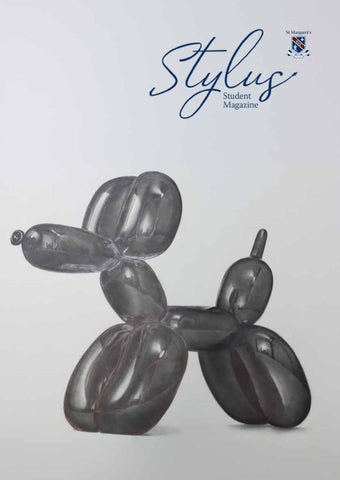
Stylus 2026 Principal: Ros Curtis AM Editors: Rhea Barber, Wendy Johnston and Pru Reed Student Editors: Matilda Baxby and Angie Li, Year 12 Cover Image: Inflation by Sofia Gearing, Year 12 Graphic Designer: Jacinta McCann
Contents
Rafaella Batstone, Year 12 Blooming – acrylic painting on canvas
6
Lola Boddington, Year 12 Perspective After Grief; the Double G – Monologue
7
Matilda Baxby, Year 12 A Mother’s Nature – short story
8
Evie Bridge, Year 12 Revolution – graffiti
10
Elspeth Dyce, Year 12 War Robin – poem
11
Hudson Crombie, Year 12 Incident Report: #85739 – short story
12
Cadee Ernest, Year 12 It’s Because She’s a Woman – short story
14
Sofia Gearing, Year 12 Inflation – pencil drawing
15
Katie Kingston, Year 12 Yellow Wattlebird – short story
16
Angie Li, Year 12 World Across the Ocean – poem
17
Annabelle Robson, Year 12 Borrowed Time – short story
18
Edie Barber, Year 11 The Weight of the Earth – short story
20
Bella Beasley, Year 11 The Story of Him – short story
22
Charlotte Fennessy, Year 11 Ancient Voyages – musical composition Waterways – musical composition How Annoyingly Colourful – musical composition
24 24 24
Gina Lee, Year 11 Her Moment of Peace – acrylic painting on canvas
25
Lucy Rawlings, Year 11 Disposable Bags – graphite drawings
26
Imogen Wren, Year 11 Lucy Woman of the Year – musical composition Bird on a Wire – musical composition
27 27
Clara Adom, Year 10 The Demon Lover – The Man in the Taxi – short story
28
Kathleen Fraser, Year 10 The Unification of Traditional Customs and Dreamtimes – acrylic painting on board
30
Ritz Fu, Year 10 Instinct – acrylic painting on canvas Outbound – acrylic painting on canvas Moonrise – textured acrylic painting on canvas Freedom – acrylic painting on canvas
31 31 31 31
Sophie Heffernan, Year 10 Priced Out of Living – persuasive piece Our Fall – poem Static – poem
32 33 34
Beth Hamilton, Year 10 The Sunken Saints – short story
35
Emma Harding, Year 10 AI – An Invasive Species in Our Education System – persuasive piece
36
3 I
Stylus
Contents
4 I
Stylus
Scarlett Jones, Year 10 Among the Lights – short story
38
Annabelle McDouall, Year 10 The High Cost of Easy Answers – persuasive piece
40
Stella Minotto, Year 10 On the Vine – oil pastel
41
Katharine Shiu, Year 10 A Taste of Autumn That Feels Like Spring – collection of photographs A Sunset and a Starry Night – collection of photographs Through the Lens of a Summer Afternoon – photograph Sunset on the Lazy Horizon – photograph A Partial View of the Past – photograph The Girl in the White Dress – collection of photographs Glimpses of London – collection of photographs
42 42 42 42 43 43 43
Jennifer Wang, Year 10 The Wild – a pair of acrylic paintings
44
Hannah Thomas, Year 10 Darwin Sunset – photograph
44
Meiyu Zhang, Year 10 Drifting – acrylic painting on canvas The End – acrylic painting on canvas Steps to the Pond – acrylic painting on canvas What's Above the Horizon? – photograph
45 45 45 45
Thamanna Akash, Year 9 Forever – collection of photographs
46
Gia Comino, Year 9 The Lost Boys – short story
47
Mackenzie Cox, Year 9 Sunlit Awakening – acrylic painting on canvas
48
Bella Davies, Year 9 Brisbane Summer Sunset – photograph
49
Zara Evans, Year 9 Fashion styling
50
Hanna Feng, Year 9 35mm Disposable Film Camera – collection of photographs
51
Mia Hixon, Year 9 Birds in Britain – collection of photographs
52
Livy Ho, Year 9 Rose with Rain – photograph
53
Madison Newland, Year 9 Silent Guard – photograph
54
Isabella Swarbrick, Year 9 The Weary Eye – acrylic painting on canvas
54
Zara Sinha, Year 9 The Inheritance – short story
55
Addy Winks, Year 9 Sunrise in Bollon – photography
56
Georgina Bell, Year 8 You Didn’t Notice, Did You? – persuasive piece
57
Charlotte Butler, Year 8 Serbian. Serbian. – short story
58
Bethany Cassady, Year 8 Golden Hour – photograph
59
Delilah Drake, Year 8 Meretites, the daughter of Ra – short story
60
Milla Goscomb, Year 8 The Survivor – short story
61
Sarah Long, Year 8 After the Gunpowder- short story
62
Mahaila Namok, Year 8 Some Kind of Love – poem
63
Zia Read, Year 8 Fighting for Education – short story
64
Annabelle Rice, Year 8 Escape – short story
65
Anika Comino, Year 7 A Blossoming Bouquet – acrylic painting on canvas The Pelican – acrylic painting on canvas Yellow Distortion – acrylic and pencil on paper Timid Teddy – watercolour painting That Summer in Kythera – short story
66 66 66 66 67
Clover Douglas, Year 7 Spring Blooming – watercolour pencil drawing
68
Isla Hartmann, Year 7 Kaya and The Secret – short story
69
Isabella Huang, Year 7 UFO – poem
70
Maddie James, Year 7 The Speech – short story
71
Ishika Jeraj, Year 7 The Secret Wizards’ Organisation – short story
72
Claire Li, Year 7 Evening in Brisbane – watercolour painting
73
Olivia Scherhag, Year 7 Fleeting – photograph
73
Lulu Turner, Year 7 Beyond the Locked Doors – monologue
74
Lilian Wild, Year 7 The Mountains – short story
75
Eva Hixon, Year 6 Urban Life – collection of photographs Beachside Bests – collection of photographs
76 76
Emerson Coote, Year 6 My Musical Journey – reflective piece
77
Ivy McMahon, Year 6 Aftermath – poem
77
Emily Newman, Year 6 The Cliffs – photograph
78
Mia Paris, Year 6 St Maggie's Modigliani – oil pastel
79
5 I
Stylus
Blooming Rafaella Batstone Year 12 Blooming 2026 Acrylic painting on canvas 40 x 50cm An oriental porcelain pot is ubiquitous at first glance but always unique. It is strong, yet fragile. It is utilitarian, yet precious. Its job is to contain, support and nurture, holding all the right ingredients for the plant inside to flourish. Our beautiful St Margaret’s is the hand painted porcelain pot, and the Phalaenopsis orchid symbolises us, the Maggies girls, growing within it. Like us, orchids look fragile but are remarkably resilient. They, like us, are at times temperamental, requiring the right time, care and environment to grow and eventually bloom. In Chinese tradition, the orchid is one of the Four Noble Plants and is a symbol of inner virtue and quiet integrity. It blooms in forgotten valleys, unseen, not because nobody is watching, but simply because in the right environment that is its nature. There has always been something deeply true in that for me: the act of becoming quietly, not for anyone else's benefit or desire, but simply because with the right care, support and environment – we can do anything. That is exactly what we were doing, all of us, all these years at St Margaret’s, growing and becoming our own beautifully unique selves. The orchid also carries the meaning of orchid friendship; a bond that is deep, pure, and everlasting. That is what I see when I look at the friendships formed these past years: something strong and pure, a bond shaped by our school which holds us all together, something that will last long after we leave our school walls. Like the orchid in the porcelain pot, we were kept safe inside our school. Held. Shaped. But an orchid was never meant to stay inside a pot, when it matures its roots reach out into the world beyond, and that is where it truly blooms. The pot didn't stop us. It supported us and held us long enough for us to mature and be ready to push and grow beyond it. And now as we step into the outside world, at last, we bloom.
6 I
Stylus
Perspective After Grief; the Double G Lola Boddington Year 12 It took me a week to see a different perspective on life, and that day something switched in my brain. I had to realise that, as cringe as it sounds, life wasn’t going to stop and wait for me to feel better. It made me realise two things in life: be Grateful, and don’t take things for Granted, as we often take for granted the very thing that deserves most of our gratitude. To be Grateful can mean a lot of things. To me, it means to cherish every little thing you have in life with so much love. From waking up every morning and sleeping under a roof with aircon and wearing your favourite pyjamas, to having friends who will listen to you, be grateful. Being grateful is a hard thing to ALWAYS do. We move through life on autopilot, barely noticing what we have. Some days you wake up and it flows naturally, but other days life gets heavy, and gratitude is the last thing on your mind. And that’s okay; you’re only human. It seems it takes loss to wake us up. After events like this, you seem to reflect on the things you took for Granted. The little moments you don’t think to hold on to. From listening to their laugh, to playing Minecraft and Fortnite up at the farm, when the whole family was finally together, and even when we got in a huge fight over ice cream. You start to try and find photos or voice recordings you have of that person, and it makes you reflect. Reflect on the times you could’ve been nicer to them or could’ve spent more time with them. It helps you realise nothing in life is granted; it helps you realise how much time you spend on useless things, like sitting on your phone, or doomscrolling.
Having this happen to me so early on in life has made me appreciate many, many things. So, if you are going to take anything from this passage, please try to take at least one of these three things: • SMILE. When you walk around school, in and out of hallways, just smile. Smile that you have education, smile that you have loving friends, smile that teachers are willing to help you. Just smile. • DO IT. Write a list for yourself of something that you so desperately want to do. Me? A few months ago, I realised I love all things entertainment. So, I tried to get an acting agent. Just do everything in life you’ve always wanted to do. There’s nothing to lose, and no time to waste. • TELL THEM. Tell the people in your life that you love them. Tell your mum her cooking is amazing. Tell your friend they made you laugh today. Tell your grandparent you’re glad they called. We assume the people we love know how we feel, but sometimes they don’t, and sometimes we run out of time to say it. Don’t wait for a reason. Just say it. There’s no point placing negative thoughts in your mind because all it will do is create negative actions. No matter what happens, please always look on the bright side. If you think good, you’ll do good. 'Don’t cry because it’s over, smile because it happened.'
From this point on, I made a decision. I used to be scared of doing things or throwing myself out there. But this event almost flicked a light within me. Live a life where you never regret a decision and appreciate how every decision becomes a lesson. Just do it. But weirdest of them all, you look to the people who they impacted in life. For me, it was his sister. When things used to get tough for her, he would take her mind off things. He would make her smile, and he would make her feel better – just being a good brother. Every day since, I have never seen the spark fully back in her. Sometimes when I’m around her, she feels like a void, empty. And I think that the thing which hurts me most of all is that she doesn’t often want to open up to me. And when she does, I feel grateful, and I don’t want to take it for granted. But when you make her laugh, or see her smile, it brings back memories when he used to make her do that. It almost makes everything feel right again. And it breaks me that I can’t always do that for her. I don’t want to replace him, and I know there’s nothing she wants more than just to laugh with her brother one last time.
7 I
Stylus
A Mother’s Nature
Jo paused, letting the soft, subtle hum of the quiet evening envelope her. It was ironic, really, how the very same quiet she’d desperately chased for 40 years was now her enemy. In truth, it bothered her more than the noise ever did. Swallowing down the sudden emotion rising in her chest, she continued on, reaching the living room. Her eyes instinctively latched onto the shelving surrounding the TV on the opposite wall. They lingered on a sharp-edged glass plaque, the fading sunlight glinting off the engraved words, which proudly read 'Corporate Leader of the Year'. Beside it, a cheery, colourful card exclaimed 'Goodbye and Good Luck!' in cursive letters. A familiar satisfaction bloomed in her stomach, only now blended with an overwhelmingly unfamiliar sense of desperate yearning.
'Hey, Mum.' The voice of her daughter Christine echoed through the spacious room. The smoothness of her tone embraced Jo tightly, only the tinny, mechanic edge of the phone’s speakerphone reminding her she wasn’t actually in the room. 'Hey darl, what’s going on?' Jo replied, wincing at the anxiety clearly wrapped around her voice. 'Nothing much. Just wondering, Em’s got a project for school about her parents when they were her age. Mitch has got his already, so if you could send me a few photos of me when I was around six, that’d be great. Maybe five or six photos?' Christine questioned, voice uncomfortably professional, as if they were merely coworkers. A small silence followed, mere seconds, but its weight sat heavily between the pair. 8 I
Stylus
'Thanks, Mum,' Christine replied, voice tight. 'I’ll have a look and send some over today.' 'Alright, that’s great. Thanks a lot.' 'No worries. How’s …' Three successive beeps interrupted her, their sharpness a stark contrast with the rhythmic softness of her daughter’s voice, each a stab to Jo’s heart. Just like that, she was gone. Still standing isolated in the centre of the living room, Jo quickly moved back into the hallway, attempting to brush away the stings of hurt, beelining for the storage cupboard. She knew her own phone, used almost entirely for work, wouldn’t hold any pictures from 30 years ago. In the cupboard, various files and loose notes occupied most of the space. Her old favourite pair of kitten heels caught her eye, their bottoms scuffed from endless 12-hour days running around the office. Aches of nostalgia accompanied it all – nostalgia for a different life, a different self.
§
Her attention was quickly redirected by the sudden blaring of her phone’s ringtone. She scrambled to locate the vibrating object in her jean pocket. The name displayed on the screen made her answer immediately.
Jo quickly filled it, breaking into a series of repeated 'yep’s' with just slightly more eagerness than was necessary.
The year was 1980 – the start of a new decade, and, serendipitously, the start of her real professional life, as Jo considered it, racing along the sidewalk with her briefcase. The rhythmic click-clack of her heels on the pavement even seemed different – she swore she could literally hear them say 'C-E-O, C-E-O, C-E-O' as she rushed along the city streets. When Jo received the call for the position, she’d almost fallen off her desk chair. All she’d ever dreamed, all she’d been working for, was finally her reality. There’d been a slight hiccup in the way, though, namely her four-year-old daughter. The next day, Jo had grabbed up the first flyer for a nanny she saw on the local community board, given her a ring and offered her the job on the spot. Only half sure the girl wasn’t a serial killer, Jo showed her around the house briskly that morning, before leaving her tiny blonde daughter in her care and catching the bus into the city.
§
The creak of the floorboards punctured through the silence of the late afternoon, their groans announcing each of her slow, shuffled steps along the hallway. Splinters of amber light peeked through the distant windows, illuminating the dust drifting lazily through the space.
Bringing herself back to the task at hand, Jo brushed past the items, seizing a box on the bottom shelf. Sharpie scrawled across it read ‘CHRISTINE’. A strange adrenaline rushed under her skin as she opened the worn cardboard flaps, revealing a collection of ballet slippers, schoolbooks, uniforms, posters of bands now long forgotten, birthday cards. All fragments of the mosaic that was her daughter’s childhood. Her fingers lightly brushed dust off the items. It occurred to her suddenly how unrecognisable they were. Holding these pieces of a young girl’s existence in her hands, she realised how entirely anonymous, almost exotic of an existence it was. Her pulse quickened, stomach sinking into the wooden floor beneath her knees. Through her clouded mind, a small blue book caught her attention. She reached for it, fingers tracing the cool, textured spirals spread across the cover. Impulsively, she flicked open the notebook, fingers flipping through the thin, yellowing pages. She reached the first page, covered in careful handwriting, and began to read. 14/06/98 Dear diary, Gigi told me I should write down all the worries I have, so they aren’t jumping around in my head. So, here goes. Today we had a mother-daughter thing at school. Me and Gigi made each other really cool matching bracelets, which was fun, but it still kinda makes me sad to see the others with their mums, even after so long. Plus they’re all so judgy, looking at Gigi funny as if it’s her fault Mum’s not there. What would they rather, me sitting there by myself all day? Sorry. I don’t mean to sit here and whine about Mum. She’s trying her best, I know. But there’s something I’ve been thinking about, that I’m only going to tell you because we’re friends. I feel bad even writing it down, so you can’t tell anyone else. But I never want to be like her. Working all day up in that big office, only seeing me for barely 10 minutes in the morning. I won’t ever do that to my kids. My kids will know me, and I’ll know them. We’ll
Matilda Baxby Year 12
Well, I’d better go now. Gigi’s made a roast and it smells AMAZ-ING!!! Bye!! Chrissy xx Forced back into reality, Jo reached a hand up to her face, suddenly aware of the dampness of her cheeks. Wiping her under eyes, she inhaled sharply, attempting to collect her composure. She couldn’t remember the last time she’d cried, not for at least a decade. But these simple words, a tiny glimpse into the mind of her 12-year-old daughter, had opened a tangled labyrinth of emotion. She’d always, though unconsciously, busied herself enough to ignore it, she realised. But now her escape was gone, and so the pain surfaced. And she surrendered to it. She thought of the little moments. The grazed knees, the sports pick-ups, the car karaoke, the bedtime stories. Everything she’d told herself she could live without, without ever knowing life with them. She thought of how Christine mothered just as her 12-year-old self said she would. Her Emma was her entire life. All she spoke of were her musical recitals, her teachers, her friends, funny things she said. She thought of the disappointment she’d felt when her daughter had thrown away her architecture dreams as soon as she’d fallen pregnant. How angry she’d gotten. She thought of how Christine had said to her matter-of-factly, 'No one can have it all.' She thought of Gigi, who she’d overheard Emma calling ‘Nana’ at a family event last month. Her envy consumed her, ugly and unrelenting, as it had for years, mixed with a piercing guilt, both of which had lingered beneath the surface for decades.
The sky outside was a radiating shade of blue, verging on blinding. Christine was happy about that, Jo could tell, her face lighting up animatedly as the makeup artist dusted powder onto her nose. Dressed in a white satin nightgown with her thick blonde hair pulled neatly into a spiralling updo, she was the picture of bridal beauty. Jo herself had also been done up, now perched on an armchair in the corner of the hotel room, smoothing her pink tweed jacket. Satisfied with her work, the makeup artist patted Christine on the shoulder, to which she thanked her profusely before bounding over to Gigi, who stood laughing amongst the other bridesmaids. Jo didn’t know many of them well, mostly school or college friends that she had a vague memory of meeting. They were all squealing excitedly now, compliments flying around the room rapidly. Gigi tugged Christine into a tight embrace, dark curls pressing gently against a bright blonde bun. They remained there for a moment, interlinked, before breaking apart to belt the pop song playing through the speaker. Jo hesitated for a second, before standing and walking towards her daughter, tapping her lightly on the shoulder. Still mid-song, she spun around to face her, quietening down instinctively. 'I just wanted to say… you look so beautiful, Chris.' Jo softly said, their identical forest green eyes meeting. 'Thanks, Mum. So do you! Natalie did a great job, didn’t she?' Christine replied kindly, smiling gently. Jo nodded her agreement, before reaching out and enveloping her daughter in a loose hug. 'Dress time!' The wedding planner exclaimed, to which Christine pulled away, warm gaze lingering on her mother, before turning and following the planner, Gigi, and a few other bridesmaids to the closet. Jo had never felt as overcome with emotion as in that moment, watching them walk away, Gigi’s hand brushing Christine’s shoulder in silent support. There she was, preparing to walk her only daughter down the aisle, knowing there’s someone else
that she’d rather walk with. Someone who probably deserved to do it. It hadn’t truly occurred to her until that moment that when she’d tugged down that flyer on the community board and brought Gigi into her home back in 1980, she’d never just been hiring a nanny. She’d been hiring a replacement mother.
§
That’s top secret though. I haven’t even told Gigi, mainly because she’d tell me off for piling on Mum. And I shouldn’t, I know.
§
talk about the biggest celebrities, and drama at school, and go out on shopping sprees. I’ll be at every sports game, every school thing, every birthday, every motherdaughter event. They’ll never need a Gigi to go with them to stuff because I’ll be there. I’ll be the judgy mum, I guess!
The tears were falling more rapidly now, silent trails rolling over the softly wrinkled skin of her cheeks. She didn’t wipe them, didn’t move from her position. She let them fall, splattering softly onto the open notebook. Through the stillness of the hallway, the quiet trembles of her breath escaped. For the first time in years, she allowed herself to feel. No more corporate pokerface, just unashamed, open feeling. Subconsciously, her fingers found her phone in her pocket again. She felt completely out of her body, watching herself slowly open her Phone app. Hands quivering, she pressed the most recent contact. The ringing tones felt like an eternity, their stretched-out sounds scraping through her mind. Three of them came in succession, each digging a deeper well in her stomach. As the fourth began, she hovered her finger above the red button, but was interrupted by a smooth voice uttering a simple 'Hello?' For once, Jo was rendered speechless, sputtering incoherently into the phone as she searched for her words. 'Mum, is there a problem with the photos? I could …' Christine continued, concern laced in her tone. 'I’m sorry.' In the silence, the echoes of Jo’s voice reverberated through the devices. She sounded so small, pained. Her chest constricted, waiting. The quiet continued, only some shuffling audible on Christine’s end. Then, all at once, it was broken by a single sob from the younger girl, completely identical to the toddler that Jo once knew. 'Chris … I’m coming over.'
9 I
Stylus
Revolution (detail) Evie Bridge Year 12
Revolution (detail) 2026 Spray paint on concrete wall – Legal graffiti wall at Ekibin Park In Revolution, the dynamic relationship between my body and the bold, playful use of colour in this work is reflected in this condition’s visual language, while inviting the audience into a new realm of understanding. I took partial inspiration for the mural from the graffiti workshop I experienced while in Berlin on the 2025 St Margaret's Europe trip, as it opened my eyes to the culture of graffiti. The work is a revolution, a way to promote change in how we see and perceive the world around us, positioning the audience to explore their playful side but still reflect on their own perception of reality.
10 I
Stylus
War Robin Elspeth Dyce Year 12
the scarlet robin makes its nest amongst weeds and the cadavers of boys and girls. it’s lungs, the size of a babe’s fist clasp and unclasp around a breath of ash. death billows to heaven in a final reach for sky, a man’s palm arising from the trench. there is eggshell dust in feathers fallen, for the children and fighter jets hunt through the soil and gunpowder to crush within their hungry fists the promise of life. upon grave dirt, the flag is hoisted above heads departed from their bodies. never again, the robins cry, burying their heads in the soil. never again will the boys be nurtured by the stiff caress of a gun. see how sweet and stinging has summer bloomed in sky above! listen now to the scarlet robin and you shall catch the last note of a hymn! see how plentiful it has been this spring! bring your palm to the dirt, army boy, and feel how deep and bitterly the poppies have sprung above the fields wherein the slaughtered lay.
11 I
Stylus
Incident Report: #85739
Without a clock, the only metronome was the leak. I must have counted each drop as it hammered against the rusted bucket, echoing through the room like a countdown. It was a blank space, devoid of character or comfort. Just a rectangular, steel table bolted to the floor and three chairs that looked like they belonged in a cafeteria. On the table sat a juice box. Its plastic straw was still taped to its side, glistening under the fluorescent lights that flickered slightly. The air was thick and stagnant, carrying the sharp, acidic tang of burnt coffee from the breakroom down the hall. A pair of heavy-duty boots squeaked outside. The door groaned indignantly on its hinges. McTavish, barrel-chested and bearded as usual, trudged into the room and sat down. He smoothed out his creased suit, nodding his head and grunting what I assumed must have been a greeting. In the wake of McTavish’s massive frame trailed a figure so slight it felt as though he occupied no space at all. He was smaller than I had imagined. He crossed the floor with a stiff, unsteady stride, his hands shoved deep into his pockets and his gaze fixed on the scuffed linoleum. His head was a landscape of jagged edges, the hair shorn into a raw, uneven crop that appeared to have been carved out in the dark with dull shears. This gave him the look of something unfinished, like a sketch of a person before the details had been filled in. As he hoisted himself into the chair, the kid seemed swallowed whole by the furniture. His narrow frame disappeared against the backrest, making his wrists look as thin as the legs of a fawn as they protruded from oversized sleeves. The boy stared down the juice box as if it were a challenge. McTavish clicked the recorder on with a mechanical snap. My notepad lay open in front of me. Sneakers dangling in the air, the boy’s feet swung back and forth like a pendulum. 'Alright, son,' McTavish said. 'Let’s start with the easy stuff. How’s school going, Riley?'
12 I
Stylus
Riley didn’t look up. 'I don’t go much.' 'Teachers say you’re a bright kid, but you’ve got a habit of disappearing. Why is that?' He shrugged, his hoodie shifting like a heavy curtain. Nothing. 'What about your mates?' I asked, watching closely. 'Don’t they wonder where you’ve got to?' The boy’s head snapped up, his jaw locking into a hard, jagged line. 'Don’t have any,' he spat. He leaned forward, his voice tight with a sudden, aggressive heat. 'Don’t want ‘em, neither. Just a bunch of idiots who vanish the second someone starts swinging. It’s less trouble being on my own.' I didn’t flinch, instead letting silence settle between us like dust. He was gripping the edge of the table so hard his knuckles were white. Something about his eyes, wide, dark, and glossy with a frustration he couldn’t quite swallow, stopped me from believing him. He didn’t sound like a kid who hated everyone. He sounded like a kid who was done letting people in just to watch them walk back out. The file we’d read earlier was a roadmap of neglect. It was a paper trail of adults who had eventually stopped trying, leaving behind nothing but a checklist of reasons why he was no longer their problem. McTavish sighed. He’d reached the end of his patience. 'Last month – a stolen bike from the park. Three weeks ago – vandalism at the library. Two weeks ago – a joyride in a neighbour’s car that ended in a smashed headlight. You were there for all of it, Riley. You were the one they sent through the windows, weren’t you? Because you’re the smallest.' 'And then there’s the newsagency,' McTavish said, his voice dropping to a low, dangerous rumble that vibrated the table. 'Mrs Gardener is seventyfour years old, Riley. She’s lived in this neighbourhood for almost forty years. And someone broke in, terrorised her, and left her like that.'
McTavish slid a photograph across the table. Magazines torn to shreds. Profane drawings scrawled across the cigarette display. Puddles of colourful, melted ice-cream. And in the centre of it all, a thick, viscous stain on the floor near the counter. It had settled into the cracks of the tiles. Surrounding shelves were peppered with a stark, crimson spray. Riley froze like a rabbit in the brush. His shoulders hiked up to his ears as he retreated further into the depths of his hoodie. He looked like a hatchling huddled against the storm, trembling under McTavish’s condemning stare. His breathing came in shallow hitches. 'I wasn’t … I didn’t … it wasn’t me! It was someone else! I was just … I was just there!' McTavish didn’t soften. He slammed his open palm onto the table. 'You were just there?' McTavish barked. 'While they did that to an elderly woman?' Riley let out a broken, high-pitched whimper. His face crumpled as he buried it in his arms. Looking at him lost in that chair, I felt a heavy, sinking knot in my stomach. I couldn’t see a suspect, only a discarded object chewed up and spat back out by the world. The sight of his tiny, shaking form made my blood boil. 'Stop it, McTavish!' I snapped. The words tumbled out of my mouth. 'Look at him! He’s a child! You’re badgering him into a confession for something he clearly couldn’t have done. He’s a witness, not a suspect.' McTavish’s jaw tightened. He stood slowly, his eyes boring into mine with a look of weary frustration. He jerked his thumb toward the hallway. 'Outside. Now.' He didn’t wait for a rebuttal. McTavish swung the door open and stepped into the corridor; I trailed behind him. The lock engaged with a metallic click that echoed through the empty hallway. 'What’s wrong with you?' I hissed, pacing the narrow corridor. 'He’s a scared little kid.'
Hudson Crombie Year 12 'You think you’re a great judge of character, don’t you?' McTavish leaned against the wall, crossing his arms.
'Riley ...' My voice sounded distant, a hollow scrape against my throat. 'Why is there blood on your sleeve?'
'I know an innocent kid when I see one,' I countered, my face flushing with heat.
The restless pendulum of his feet halted mid-swing. The trembling had stopped, not slowly but with the suddenness of a switch being flipped. His voice lost the jagged, breathless nature of a cornered animal. It became a low, melodic hum, each word polished and placed with eery precision.
McTavish reached into his pocket and pulled out the recorder, then handed me the file with a grunt. 'Fine. If you’re so sure, you run the interview, rookie. I’m going to get a real coffee. If he’s as innocent as you say, he’ll tell you exactly who did it.' I stood there for a moment, clutching the folder to my chest. I took a deep breath and adjusted my tie. When I stepped back into the room, Riley was still curled in a ball. 'I’m sorry about my partner, Riley,' I whispered. 'He doesn’t understand. I know those boys, the older ones on the estate. They use kids like you. It’s okay to be scared of them. But I can help you, if you tell me the truth. Did the boys force you to help them break in?' A single tear slipped down his cheek. 'Yeah,' he said, a little too quickly. 'They told me to keep watch. Then they started smashing things. They were the ones who hit her. I told them to stop, but they wouldn’t.' He was just a pawn, an innocent child swept up in the current of older, meaner boys. The tight coil in my chest finally unravelled, letting my shoulders drop as I capped my pen and snapped the notebook shut. I leaned over the table, wanting him to see the sincerity in my eyes when I told him the ordeal was over. 'It’s going to be okay, Riley,' I said, steady and soft. 'We’re going to get you out of –' The words died on my tongue. Looking down at his sleeve, the fluorescent lights exposed something previously swallowed by the shadows of the table. It wasn’t dirt. It wasn’t grease. Splattered across his cuff was a violent cluster of tiny, maroon flecks. I froze, suspended over the table.
'Mrs Gardener used to tell me off.' He finally picked up the juice box, turning it over in his hands with practiced ease. 'Every time I went in there to look at the comics, she’d say I was a ‘nuisance.’ Told me I’d end up just like the rest of the trash on this estate.'
satisfaction settling over his features. 'I liked the look on her face,' he whispered. 'It made me happy, for a while.' The spark in his eyes vanished as quickly as it had arrived, leaving behind a cold, restless boredom. He looked up at me, his gaze dead and indifferent to the horror on my face. 'You wouldn’t understand a word I’m saying, though.' INTERVIEW TERMINATED 2:48 AM.
His eyes met mine. They were dry. 'The older boys didn’t want to go in. They were scared of the cameras. I told them I’d already cut the wires. I wanted to see what it looked like when all that ice-cream melted. I wanted to see if the colours would mix together.' His eyes widened with a terrifying lucidity. He didn’t look like a child anymore. He looked like a predator that had finally stopped playing with its food. 'Then she came down the stairs. She saw me and started the lecture again.' Riley’s face twisted into a cruel, mocking caricature of the old woman’s scold. 'Riley, I’m so disappointed in you. I just got sick of the noise. I hit her with the bat I found in the back.' The air in the room suddenly felt freezing. My heart hammered against my ribs. With the calculated precision of a lion capturing an antelope out of the tall grass, Riley swiftly smashed the juice box onto the table. Liquid spurted out as the cardboard crumpled. My wide-eyed stare clearly pleased him, eliciting a slight grin. 'The other boys … they just stood there. One of them actually started crying.' Riley laughed to himself. 'Can you believe that? A sixteen-year-old crying over an old fart.' He leaned back, a look of profound
13 I
Stylus
It’s Because She’s a Woman Cadee Ernest Year 12 I sat in my seat, dreading the moment my name would be called. The chamber carried its history in the air. A quiet certainty settled into the wood, the leather, the practiced voices, passed down through generations of men who had stood and spoken without ever wondering if they belonged. I had never felt that certainty. Not once in four years. The Deputy Speaker’s voice carried across the room. 'I now call the Honourable Minister for Sport and Recreation to speak.' I looked up to see faces turned on me. My hand found the microphone and adjusted it, buying a second, maybe two. 'Thank you, Deputy Speaker.' I hold my notebook tightly. 'I rise today to acknowledge some recent concerns about my capacity … My capacity to serve as minister for Sport and Recreation.' For weeks headlines filled every space with questions about how I dressed, how often I mentioned my children, whether I was fit to lead. I had read them all. Before I could stop myself, I began to list the evidence that I was indeed fit to serve as Minister. Years in sport, degrees, accreditations, roles held and targets met. The proof I had gathered piece by piece over decades, as if it might one day be enough to outweigh doubt. I paused. 'But none of that matters. Does it?' I had been appointed during a time of crisis. The previous Minister had resigned in disgrace mid-negotiation, and someone needed to step into the wreckage. Me. I had held it together. The glass cliff, they called it, the phenomenon of handing women leadership precisely when it was most likely to fail, so that when it did, there was a woman standing at the edge. I had known the term. I had climbed anyway. 'My legitimacy as a politician, as a leader, is always tainted. I will always be asked to justify my presence here.' I was not reading anymore. I was looking at the chamber, really looking at it, at the green leather and the rows of men in their comfortable suits, something finally clicking into place. 'Not because of my record.' My voice dropped to almost nothing 'It’s because I’m a woman.' I closed my notebook and set it on the desk. 'I am not the first woman to face this. Fifteen years ago, Julia Gillard stood in this chamber and named the misogyny she faced daily. Fifteen years.' I let the number sit. 'And what has changed? They questioned her capacity to lead because she was childless. Now they question mine because I am a mother.' A dry smile crossed my face. 'Funny how that works.' I named them one by one. Senator Hanson-Young, assessed not on her arguments but on what she wore. Senator Penny Wong meowed by her male colleagues for the crime of having an opinion. Susan Ley, placed on the very same glass cliff I found myself standing on. Karen Andrews, Kate Ellis, Julia Banks, women who tried to speak about harassment inside these very walls and were shown the door for it.
14 I
Stylus
'All these women, different issues, same pattern … We are expected to be confident but not threatening. Assertive, but not aggressive. Attractive, but not distracting. Professional, but smile more. Ambitious, but not power-hungry. Passionate, but not emotional. Be a mother, but don’t let it affect your work. Prove ourselves again and again, but act like we belong. Be flawless, when our opponent can be lawless.' My eyes moved to a colleague whose suit was visibly crumpled, tie askew, hair suggesting he had arrived directly from sleep. I held the look a beat too long and let the chamber notice. 'And heaven forbid we ever look tired. But that’s endearing on them, isn’t it? Working hard for Australians …' I catch myself. 'We should not have to apologise for our voices. For being in the very rooms we have earned the right to occupy. You shoot us with your words. You push us to the edge of the glass cliff, hoping we’ll fall. But you forget … we’ve been climbing our whole lives. Deputy Speaker, we’ve come from women who survived impossible things. They couldn’t vote. They couldn’t own property. They couldn’t lead. They couldn’t speak up. And despite all that, they persisted.' I was someone else now. Or perhaps I was, for the first time, entirely myself. My voice filled the chamber without apology or effort, the way sound fills a space it was always meant to occupy. 'To the women in this chamber, and those who aren’t, you do not need permission to be extraordinary. Do not apologise for your opinions. Do not apologise for having the courage to speak up. Do not apologise for having a voice. You should not have to fight to be recognised. You have already proven enough. When you face sexism and misogyny, do not let it diminish you, do not let it define you. Leave it in the dirt and rise like the dust. We are more than our gender. We are leaders. Thinkers. Innovators. Creators. Dreamers. Changemakers. Barrier-breakers. Conquerors. Survivors. One word does not diminish us. One characteristic does not limit us.' The chamber was still and so quiet you could hear a pin drop. I stood in the middle of it, and I did not flinch. 'I am your Minister for Sport and Recreation, and yes, I am a woman. And like the moon, and like the sun, and with the certainty of tides, still I rise. Still, we rise.' I let my fingers brush the notebook I had placed back down on the desk, not as a lifeline but as a record. Evidence of everywhere I had been to get here. 'Thank you, Deputy Speaker.' I stepped back from the desk. Not retreating. Finished. My shoulders were back, my eyes clear, and the woman who had stood at this bench gripping her notes like a life raft was gone. I had left her somewhere between the apology and the realisation, and I did not intend to go back for her.
Inflation Sofia Gearing Year 12
Inflation 2026 Monochrome pencil on paper 59 x 84cm Everything you thought would last forever is already deflating. Jeff Koons’ Balloon Dog sits at the intersection of childhood memory and consumer fantasy as it transforms the cheap toy into a monument to desire, which is transformed again here into a personal symbol. Rendered in monochrome pencils, the surface holds a reflection, not of something absent, but of the room that surrounds it. The world that made it. The world that will outlast it. The grayscale palette strips away the seductive colour of consumerism and forces the eye inward, toward what the object holds and what it reveals. Like Jan van Eyck embedding himself in the Arnolfini mirror, this work hides its most honest moment in plain sight. Look into the reflection. Whose room do you see?
15 I
Stylus
Yellow Wattlebird
The slender gums stood tall around her, pale and watchful as the sun pulled itself over the mountain. Light split through the frosted leaves and fell across her skin, the worn brim of her grandfather’s Akubra shielded her eyes form the harsh morning sun. She pressed her hand to her cheek and held it there. As if warmth was something she could capture. She’d been hiking for hours, her black boots growing heavier with every step as thick mud clung stubbornly to their heels. The bush around her stood blackened and skeletal, the sharp scent of ash still lingering in the damp air. She waited for its call. The flash of yellow wings between the scorched trees. But nothing. A cold ache settled in her chest. She hadn’t been back since the diagnosis, unable to face him. Now, as she walked through the burnt-out bush, she wasn’t sure what she was hoping to find. The summer fires had destroyed this place. Collapsed trees remained stained by ash even in July, a reminder of what had damaged these once luscious hills. He’d hate to see it like this. Would the hut still be there? Or like Grandad had it been set aflame too? She looked ahead, past the remaining trees, and there it was. The hut stood proud amongst the ruin, its tin roof and walls were coated in silvery moss showing no sign of the fire which had ravaged through the land. It had been protected by the careful backburning her grandad had carried out for years, methods passed down from the Aboriginal custodians of the land long before him. It had saved the hut. If only it could’ve saved him too. But cancer is a stronger fire which cannot be prevented by simple back burning. The worn wooden door of the hut held itself shut, its iron handle darkened by years of rust. She couldn’t bring herself to touch it. What was she doing here? She had taken his patience for granted, mistaking his stillness for permanence, even when the fire inside him had started catching.
16 I
Stylus
He had never competed with her busy life, only waited without complaint with stories, checkers and hot chips from their favourite bakery in Hobart. In her mind there had always been a next time. But now it was too late. All his waiting had been for nothing.
flickering flames as they slowly built. As she watched the red and gold dance together amongst the wood, she thought about how it was that something so small and beautiful could turn into something so destructive, able to replace life with ash.
A white cloud appeared and disappeared in front of her as she slowly reached her hand forward and met the silver sting of the doorknob.
As she slumped into his chair, its familiar warmth carried her back to the first time they saw the yellow wattlebird together under the sweltering summer sun.
Useless hope bubbled inside her. Maybe he would be inside waiting for her.
***
The deep creak which sounded from the door’s hinges was the only greeting she received as she stepped into the room. Cold air washed over her, and instinctively, she drew her black coat tighter around herself, the wool stiff and dust-lined from years abandoned at the back of her cupboard, reserved only for days like today. Her brown eyes strained, blinking as though she could clear the darkness away, but it lingered stubbornly, like smoke after fire. The room lay empty. He didn’t greet her with excitement and an engulfing hug, ready to teach her about the bush and fuss over how big she was getting. For a moment, she stood completely still, caught between absence and memory. The room had remained suspended in time, exactly as he had left it. His boots rested beside the door, laces untied and ready for the next adventure into the bush that would never happen. His red thermos, worn by time, remained on the wooden bench by the window. His once black camp chair, which had faded to a light grey from days spent in the sun, waited empty in his favourite spot, right in front of the fireplace. He was really gone. The fireplace was hand crafted by grandad over harsh winter months. Each stone carried a piece of him, as did the rest of this hut. She moved closer to it and ran a hand along the cold stone. She struck a match against the stone and lowered it into the fireplace, watching the dry kindling catch. She admired the
The hum of insects filled her ears as the sun danced through the leaves of the gums and settled on her back. They’d spent the morning looking for it, the yellow wattlebird, but still, nothing. They’d walked a fair way from the hut and were about to begin their walk back up to it for a lunch of meat pies. As she followed him up the trail, she heard the occasional crunch of the dried eucalyptus leaves below her pink gum boots. A few more minutes had passed, and when she’d dramatically exclaimed, 'I can’t walk anymore granddad!', he’d simply turned towards her, silver strands of hair escaping beneath the worn brim of his hat, and lifted her up onto his shoulders with a grunt he swore he didn’t make. 'Now you’re on look out,' he said, his voice rough. 'It’s a big responsibility, think you can handle it?' She nodded quickly atop his shoulders, grabbing onto his Akubra and linking her fingers through its leather band for support. 'Okay then, keep an eye out for its yellow wings,' he said, walking through the bush. Towering sun-dappled trees lead them back along the dirt path. The silver beacon of the hut had just come into view when she saw bright yellow wings flying swiftly above the trees. 'Granddad, look!' she called, pointing excitedly, nearly tumbling off. 'Good eye!' he glowed, spinning in circles as little giggles erupted from her. ***
Katie Kingston Year 12 Suddenly, the call of a bird sounded, breaking her out of her haze. It was the yellow wattlebird. The fire in front of her had slowly began to die; however, the room remained warm. She sat up quickly and made her way to the door. She paused and looked over the room, the now risen sun coating the chair in light. Carefully, she lifted his hat from atop her head and inspected the pulling thread and dirtied leather band before gently setting it onto his chair where he could now sit in his favourite spot, forever. She looked upon the room one last time before slowly closing the door, no longer hollow with loss, but instead warm with memory as she realised that only sun, water and time would promise change. The call of the yellow wattlebird rattled the gums again, and she spotted it just beyond the blackened trees in a clearing where plants had begun to unfurl out of the ash. Steven Berrigan (b. 14 February 1936 d. 16 July 2019)
Worlds Across the Ocean In both worlds, pastel sunrise greets cloudless blue sky. As the neon billboards fall asleep, Jacarandas bloom purple.
Angie Li Year 12
When the train station clock chimes to signal morning, curlews scream. School buses rumble on tar. Polyester sneakers brush against concrete. Leather chaussures engrave brick floors. An afternoon commute using the rail through a jungle of glass and misty sky. A morning walk to the riverside down the twists and turns of hilly suburbs. The hum of industrial fridges stocked with food in supermarkets in both worlds. Storms clog drains as fathers carry their children across the road and an ‘X’ taped on windows during cyclones keeps families safe. Umbrellas fail beneath dripping aircons and traffic lights while schoolgirls huddle beneath their Panamas or small shop awnings. In both worlds, the gift of greenery and city presents in my hands. In both worlds, the gift of education awards wealth and culturally crafted infrastructure. In both worlds, I drift and wake to friendly chatter. I gladly call both places across the ocean home.
17 I
Stylus
Borrowed Time
26 June 2002, 5:18am. Outside the window of room 409, trees in the garden stood stiff and bare, their stumps veiled by a thin fog. Droplets trickled down the pane, their tracks merging like the cars on Coronation Drive. My head pulsed as the scent of antiseptic burnt my nose. The faint beeping of monitors had become white noise, interrupted only by the occasional clang of filing cabinet drawers.
‘Ahh, you know me, Arch,’ he grunted, ‘Nothing keeps me from our coffee dates.’ ‘You’re such a girl,’ I chuckled. ‘Nah, seriously though, there’s something I’ve been meaning to chat to you about.’ he said, his eyes fixed on the road behind me. ‘Alright bud, get on with it then …’ I insisted. ‘Y’know those appointments I was telling you about?’ He lowered his voice.
I’d shuffled on the torn, uncomfortable armchair enough times to know that sleep wasn’t coming for several hours, chased off by the shallow, uneven breaths of my best mate beside me. Nurses came in waves, scribbling down his heart rate on clipboards, each visit bringing a fleeting sense of relief, tempered by the knowledge that another would follow in a few hours.
I nodded.
Jack’s protruded ribcage was outlined beneath his hospital gown. He wore a woollen beanie on his shaved head and a plastic patient-ID around his wrist. His cheeks were hollowed out, and the bruise-like circles beneath his sunken eyes were stark against his pale skin.
He bumped my shoulder, and with a crooked grin, reassured me – or himself, or both of us, ‘She’ll be right, mate.’
It had started as a barely visible white blip on his left lung. Jack was told that it’d be fine; that he’d be fine. The doctors assured him the new treatment would ‘work wonders’. But I don’t think anyone could’ve anticipated just how quickly – how relentlessly – this disease would take hold of him. 5 December 2001. 7:43am. We met up for coffee at the Merlo van in the CBD, just as we had done every Friday before work. A bit of a laugh with Jacko was a good way to set the tone for another eight hours of answering emails and calls at a desk all day. Jacko arrived before me, which was unusual. He’d normally rock up late, clumsily tucking in his shirt and adjusting his tie. Not today. This morning, he looked somewhat put together for once. I secured our regular table, and as he made his way over, I was greeted with his typical beaming smile and rough slap on the back. ‘How’d you pull up after last night, bud?’ I asked, knowing he’d had a late one at the Caxton. 18 I
Stylus
‘Well, they sorta found something,’ he said, scratching the back of his neck. ‘Bloody cancer.’ I blinked at him. ‘Eh, it is what it is,’ he shrugged. ‘I’ll do anything for a couple of sickies, hey!’ I huffed out a laugh. ‘Bit extreme, don’t ya think?’
I wanted to tell him that it would be okay, that I was here for him, always. The words swirled in my chest, teetering on my tongue. This was my best mate, and in the twenty-two years we’d known each other, I can’t remember the last time I even hugged the bloke. Sure, we’d laugh, take the piss out of each other, sink beers side by side, but we didn’t do the whole emotional thing. We didn’t need to. We just showed up when it counted. He knows, I told myself, he knows you’ve got him. Always. 26 February 2002. 9:36pm. On Saturday nights, Jacko and I developed a solid routine of meeting up with the lads at the Brekkie Creek for a cold one. It had been nearly two months since the diagnosis, and honestly, Jack was still his same old self. We rocked up to the pub, and in no time, he had a Great Northern in one hand and a half-smoked Marlboro in the other. He cracked his usual jokes, his laugh always echoing louder than everyone else’s. I’d look away for a minute, and sure enough, he had some short, blonde chick slung beneath his shoulder, whispering cliché pick-up-lines in her ear while drunkenly swaying to Oasis tunes.
I was at the bar with a mate of ours, halflistening to him droning on about the company he was interning for. ‘Yeah,’ I nod, leaning back into a lazy stretch, angling myself just enough to keep Jacko in sight. ‘Sounds sick mate.’ It was the little things I’d began to notice – how his hand would tremor as he lifted a durry to his mouth, how he’d sit down to catch his breath for a bit longer after leaving the dance floor, how he’d subconsciously twist his grandfather’s signet ring. Jack had been doing the rounds in the beer garden when he gave me the nod of the head. Most of the time, I was the one who dragged him out at closing time. I checked my watch: 11:07pm. After saying our goodbyes, Jacko and I stood on the cracked footpath outside the pub, the streetlights humming overhead, both of us a few beers deep as we waited for the taxi. ‘Thought for sure you’d have another few hours left in you, mate,’ I said jokingly. ‘Gotta be on my best behaviour for tomorrow,’ he responded. ‘First chemo appointment in the morning.’ ‘Ahh, righto,’ I nodded. ‘Pshh, been waiting for an excuse to buzz it anyway,’ he chuckled. ‘It’ll save me a pretty penny on shampoo at least!’ ‘That it will, mate,’ I said, tucking my hands into my pockets. ‘That it will.’ We were enveloped by a thick silence, aside from the scuffs of Jacko’s boots on the gravel. As the taxi turned the corner, I nudged his shoulder. ‘I’d be happy to come along if you need me, mate,’ I said softly. The sentence sounded stiff as it left my mouth, but I meant it. ‘You know that, right?’ ‘Don’t get all sappy on me now, Arch,’ he chuckled, then inhaled a sharp breath. ‘Nah, seriously though, I was hoping you’d say that.’ With a reassuring smile, I ushered him into the taxi. ‘Oi,’ I said, shutting the door. ‘If you spew in here, you’re paying the cleaning fee.’ He laughed, shaking his head. ‘Mate, you couldn’t even afford it.’
Annabelle Robson Year 12 And just like that, the breath I was holding released, buried beneath our dumb jokes and the humming engine. 3 April 2002. 10:53am. On Sunday morning, I awoke with thick eyes and a pounding head after a late night with the boys watching the footy. The click of the front door was followed by Jack’s familiar voice. ‘Arch, you up, mate?’ ‘Kitchen, Jacko!’ I responded. It wasn’t uncommon for him to come around unannounced, but as he walked through the door with his electric razor tucked into his shorts, I knew something was up. In one hand, he clutched a handful of blonde ringlets. With the other, he lifted off his rugby cap, revealing patches of bare scalp. Wordlessly, he handed me the razor, stalked into the bathroom, and lowered himself onto the wooden stool facing the mirror. Swallowing the lump in my throat, I followed. I ran a hand over Jack’s thinning hair, guiding each pass as carefully as I could. The hum of the razor gave me a reprieve from my racing mind. Occasionally, I’d pause to brush loose strands from his shoulders as his curls fell away in soft, uneven tufts, gathering at our feet. As I set the razor down, our eyes found each other in the mirror. After a few seconds, his head fell to his hands, his shoulders shaking uncontrollably. I froze like an idiot, completely thrown off guard by his reaction. I was expecting him to make a joke of himself or take a dig at me for missing a spot. I wanted to say something, anything, but even if I did speak, I didn’t trust my voice not to break. Instead, I pulled him up by his collar, wrapping him in my arms. His shoulders tensed involuntarily at the rare form of contact we were sharing, then almost immediately relaxed as his arms came around mine. He let out shaky breaths, each one carrying away some of the weight he’d been holding onto for months. I kept my arms firmly wrapped around him, hoping he couldn’t feel my hot tears dripping onto his shirt.
26 June 2002. 4:39pm. Remnants of afternoon light filtered through the half-drawn blinds of the hospital room. Jack’s appointments were becoming more frequent. Every day, I sat beside him, watching his fingers tap in rhythm with the heart-rate monitor, and how his neck stiffened as needles went into his arm. He hated this place. The smell of antiseptic and paint and hand sanitiser. The metallic taste that lingered in his mouth after chemo. The day-old mini sandwiches stuffed with pungent egg salad that nurses brought to him on a cracked plastic tray. I hated those things too, to be fair. I tried my best to distract him from his pain. On good days, we talked about nothing and everything at once – the footy scores, the road trip we took to Kununurra, the girl we fought over asking to our Year 12 formal. Though seemingly pointless, it was at least enough to coax a grin from Jacko, until the brain-fog and chemo dulled his senses. Today was one of those days, the kind where he could only do what his pain allowed. He’d been asleep for nearly eight hours already when his nurse, Liz, ushered me into the hallway, pulling me from the halfsleep I’d become well-acquainted with. I looked back to Jacko, counting three irregular breaths before closing the door softly behind me. ‘Archie, darling,’ Liz said tentatively, ‘come for a little walk with me, bud.’ From the moment her glossy eyes met mine, I knew exactly what this ‘little walk’ meant. For months, through the crack under the door, I’d heard other nurses calling families into the hallway for the same conversation. Part of me always knew it was coming. I’d spent enough nights by Jack’s bedside to know he wasn’t getting any better.
‘Take as long as you need, honey,’ she said with glossy eyes. I nodded and squeezed her hand softly. It was all I could muster before staggering back to his room. For a moment, I just stood there, hands in my pockets and heart in my stomach. I waited for something – for him to say his usual ‘g’day mate’ or make a joke about my new haircut. I knew he wouldn’t, but the silence I was met with was like a punch to the gut. I sat at the edge of the bed, elbows resting on my knees. My hand hovered for a second, then found his. I let our fingers intertwine. As I brushed my thumb on the back of his bony, calloused hand, I felt a faint squeeze, reassuring me that he was still here. ‘You don’t have to rush off so soon, y’know,’ I choked. His eyelids flickered open, and a singular tear trickled down his cheek. ‘You can’t … get rid … of me that … easily …,’ he whispered hoarsely. ‘Mate.’ ‘I knew you were still with me, bud,’ managed. ‘I’m … with you …’ he breathed. ‘Always.’ ‘I’m with you, too,’ I whisper. The weight of his words settled into the stillness of the room as his eyes fluttered shut, leaving me alone with his shallow breaths and the beeping machinery. I bent over the side of the bed, wrapping my arms around him, holding him gently like I could keep him here a moment longer. ‘Always.’
‘It’s time, darling,’ Liz whispered, ‘it’s time.’ A wave of dread crashed over me, pushing me back as I gripped the rail in the hallway. My vision blurred as I gazed back to my best mate’s door.
Not you, Jacko, I thought, please not you, mate.
19 I
Stylus
The Weight of the Earth Patrick O’Rourke squatted ankle-deep in the muddy trickle of Dead House Gully, his boots soaked through with brown water. The creek had nearly dried to a clay ribbon now, a dying artery in a blistered landscape. Yet, hundreds of men still clawed at its banks every day, driven by the collective delusion that the earth might suddenly change its mind and surrender riches once more. Patrick worked the pan carefully in his hands, swirling mud and gravel in practiced circles. Most days, there was nothing. Only pyrite flashing falsely in the muddy water like cruel little stars. This was the gospel of the Victorian goldfields; wealth belongs to those who endure. It demanded a man hollow himself out for the chance of a glimmer. His fingers were cracked raw from labour, the red earth sitting beneath his nails. No matter how hard he scrubbed, slowly erasing the man he used to be, the red earth remained. 'Anything?' called Seamus from the bank above. Patrick tilted his gold pan slightly. Three tiny flakes clung stubbornly to the bottom, glinting pathetically. 'Enough for half a loaf if the fella at the store is feeling charitable.' Seamus snorted, climbing down beside him. His beard had grown wiry and pale from the sun. He looked older than thirty now. They hadn’t always been this desperate and tired. They had arrived years ago alongside a tidal wave of hopeful men, their hearts fuelled by promises of a fortune waiting in the dirt. 'We work like horses,' Seamus muttered, lowering himself onto a rock. 'And eat worse than dogs.' Patrick gave a tired smile. 'Still here though.' 'Aye,' Seamus replied quietly. 'Still here.' That was the curse of the goldfields. Every man remained because leaving meant admitting the dream was dead. Patrick couldn’t leave, not until he made enough for his Mam, to justify abandoning her in the first place. He stared down into the muddy water and thought of Ireland. The light was different in County Clare. There, the sun never truly burned. It drifted through soft curtains of rain and low grey clouds, silvering the wet fields and stone fences in muted greens. The earth there stayed soft beneath a man’s 20 I
Stylus
boots. Streams threaded through the countryside like vibrant, life-giving veins.
often think of you walking the fields after rain. I hope the crops have been decent.
But here, in the blistered interior of Victoria, the light was merciless. It fell hard and white upon the land, flattening every shadow beneath it. The sky seemed too large, stretching endlessly over scrub and dust and ghost gums with bark like old bone. The ground cracked beneath the sun. The wind carried no scent of rain, only dry eucalyptus and ash.
Your loving son,
He remembered green. Not simply the colour, but the richness of it. Hills layered in emerald after rain. Stone walls blackened with moss. Hawthorn trees trembling in the Atlantic wind. He remembered his mother standing in the doorway of their cottage, calling him inside before dark. He remembered the smell of soda bread baking over the fire and the sound of rain tapping softly against the windows. Then came the blight. At first, it was only whispers passing from farm to farm. Rot in the potatoes. Blackened crops. A bad season. Then another. Then hunger. Patrick still remembered lifting a potato from the ground and watching it collapse wetly in his hand. The smell of rot had lingered over the countryside for months. By the third winter, men were dying in ditches. Children wandered roadsides with swollen bellies and hollow eyes. Entire cottages stood abandoned, doors hanging open to the wind. Patrick’s father had died in February. His younger brother followed before spring. After that, Australia became less a promise than an escape. Gold. Fortune. Opportunity. The words had spread through Ireland like scripture. So, Patrick boarded a ship out of Cork alongside hundreds of others carrying hunger in their bones and desperation in their pockets. That had been four years ago. Now the gold was nearly gone, and Patrick’s truth had finally caught up to him. He had traded one famine for another. At night, beneath a sagging canvas tarp patched with flour sacks, Patrick wrote letters by candlelight to the mother he had left behind. Mam, I hope this finds you well. I have enclosed what money I can spare. It is not much, but I promise there will be more soon. I
Patrick He folded the letter carefully and sealed it as though tenderness alone might carry it safely across the world. Weeks passed in heat and dust. Water became scarce and tempers sharpened. Men fought over claims no richer than handfuls of dirt. One evening, as the sun bled red through the haze, Patrick sat outside his tent watching a group of new arrivals crossing the diggings. Young Irishmen. Thin men. Hopeful men. One could not have been older than eighteen. The boy laughed at something his companion said and pointed excitedly towards the hills. Patrick remembered arriving with that same certainty. Now there were abandoned tents, with sun bleached canvas hanging loose. Whoever had lived there was gone now and no one spoke of them anymore. Rusted pans and broken shovels lay half buried in the dirt. The diggings looked less like a town and more like the remains of some failed civilisation. Patrick watched as the boy, almost a mirror of his past self, disappeared into the crowd. He no longer felt sympathy, instead a cold, cynical detachment. The next morning, a notice appeared nailed to a ghost gum outside the supply tent: SHAFT WORKERS NEEDED – EXPERIENCED MEN PREFERRED – IMMEDIATE PAY The paper flapped weakly in the hot wind. Patrick stood staring at it for a long while. He had worked mines before, back in Clare near Kilrush, digging coal seams narrow as graves. Seamus appeared beside him, sweat cutting pale lines through the dirt on his face. 'You’re not thinking of it?' 'They pay proper money.' 'They pay proper money because half the men don’t come back up.' Patrick kept his eyes on the notice. 'I can’t keep sending Mam nothing.' Seamus shook his head slowly, 'That hole’s a grave pretending to be work.'
Edie Barber Year 11 But Patrick said nothing.
drifted softly from the ceiling.
That evening, he wrote again.
'We shouldn’t be here,' someone whispered.
Mam, There is work now beneath the ground. Dangerous work, but good pay. The ground here is so dry. I cannot remember the last proper rain. I still mean to come home one day. Your son, Patrick. The shaft gaped in the earth like an open wound. Patrick stood beside it with twelve other men, waiting in the hot noon sun. Most were Irish, a few Englishmen and one Scotsman. A foreman strode toward them chewing tobacco. 'You worked underground before?' he asked Patrick. 'In Clare. Coal mine.' The foreman spat into the dust. 'Good enough.' His eyes travelled briefly over Patrick’s narrow frame. 'You Irish are wiry bastards. Thin as fence posts. Easier on the supports.' A few men laughed weakly but Patrick didn’t. By the time he looked up, the foreman had already moved on. 'You worked underground?' he asked the next man. 'Coal.' 'Good enough.' Then the next. And the next. By the time the line was finished, Patrick suspected the man had forgotten every face he’d looked at. The climb into the shaft felt like sinking into the belly of some enormous beast. Above him, the circle of daylight shrank until it became a distant coin of white light. At the bottom, lamps flickered weakly against the tunnel walls. Veins of quartz shimmered faintly through the rock like trapped lightning. The labour was relentless. Pick. Shovel. Lift. Strike. Again and again until thought itself disappeared beneath routine. Days passed. Then, on the fifth day, Patrick felt the shift. A faint trembling beneath his boots. Then a low groan passing through the timbers overhead. Every man froze. Dust
The timbers groaned. When the foreman was told, he scoffed. 'She’s always shifting. Means she’s still got gold in her belly. Keep digging.' Patrick cast his eyes uneasily over the foreman, and his enormous girth, like some fattened bull. He was well fed, no doubt. With a dismissive wave of his sunbrowned hand, the men were sent back down. The work resumed, though slower now. Every creak of timber tightened something inside Patrick’s chest. That night he lay awake staring at unfamiliar stars. The southern sky still felt wrong to him. The constellations twisted into shapes he could not recognise. He unfolded one of his mother’s old letters. The paper had softened from being read often. The wind moved through the trees with a dry rustling. Nothing like Ireland. In Clare, the wind carried rain. For a long while he thought of the cottage. The worn table by the hearth. The kettle hanging over the fire. The lane disappearing between wet hedges. The sixth morning began hot. The tunnel branched towards a newly discovered quartz seam glimmering pale beneath the lantern glow. Here the walls looked wrong somehow. Too damp. Too soft. Patrick placed a hand against a timber support and felt it trembling faintly beneath his fingers. He looked behind him, down the tunnel, and noticed how the walls were scarred with old pick marks. Thousands of them. Men had stood here before him, swinging their tools in the same darkness, breathing the same dust. While most were gone now, their marks remained. Then came the sound, a long splintering crack overhead. Not loud. Not sudden. Just slow. Another crack echoed overhead. For a moment Patrick thought of his father’s grave in Clare. There had been neighbours standing in the rain. Quiet prayers. A stone bearing his name. The earth above him groaned. There would be none of that here. The crack came again, louder this time, the earth shuddering beneath his feet. Then the earth roared. Stone exploded outward through blinding dust. Timber supports snapped like matchsticks. Lamps vanished into darkness. For one suspended moment,
Patrick thought not of gold, nor Australia, nor fortune. He thought of rain. Cool Irish rain striking the roof of the cottage. He thought of green fields shining beneath a grey sky. And he thought of his mother waiting for letters that promised a future neither of them would ever see. If anything, Patrick hadn’t learnt how to find gold, let alone support his Mam. His dream, and those of countless others, had run dry. What he knew for certain was he was going to die at the hands of the very thing that lured him here. Each man, thin and hardened, with the same hopes, sheltered 100 feet underground as the walls collapsed around them. Then darkness rushed toward him. Above ground, Seamus staggered as the earth convulsed beneath him. Men shouted and stumbled from neighbouring shafts while dust erupted from the collapsed entrance in thick choking clouds. When the dust finally settled, the foreman shook his head. 'Too unstable. Can’t risk another dig. If they’re under there, they’re already gone.' Seamus stood at the edge of the shaft, fists clenched. Three months later, in a small cottage in County Clare, a letter finally arrived. The envelope was stained and softened by salt. Patrick’s mother opened it carefully beside the fire. Rain tapped softly against the windows. Outside, the fields rolled green beneath a grey Irish sky. She read the letter slowly. Mam, … I still mean to come home one day. Her eyes closed. For a long while she sat holding the paper against her chest. At last, she rose, placing the letter on the mantle and lit a candle beside it. Its small flame flickered gently in the dim cottage. Beyond the window, Ireland breathed with rain, and green, and memory. Half a world away, beneath the dry earth of Victoria, her son remained buried in darkness with countless others who had crossed the oceans chasing gold and found only silence instead.
21 I
Stylus
The Story of Him
The morning light curled its fingers through the weathered windows, dimly illuminating the room. The faint smell of stale linen, parchment, and a touch of Izzie’s fresh perfume hung in the air. The room radiated a melancholic stillness. In the centre of it all sat the exotic ebony couch, lined with velvet and slightly faded gold details. Sunken down into it was Izzie. A blank sheet of parchment – all the great writers used it – sat heavy on her lap. On the mahogany side table beside her sat the weekly paper, its pages slightly wrinkled from being left out in the morning rain. Izzie sighed, glancing at it before shifting her gaze back to her lap. Delphie Fox’s column was not going as well as she had hoped. The ‘modern women’ wanted to know how to be independent … as well as being the perfect housewife. It was like fire and ice. The adventures of a modern spinster were not exactly as she had envisioned. Her shiny red Napier was gone. Apparently being a female and a writer did not earn the kind of money to support a car, let alone themselves. At least her darling brother Hugh had saved her in time to keep her in an apartment – this new one was a little different. The floorboards groaned as she walked across them, and the hot water would come and go, not to mention the inescapable rattle of her window whenever a passing train came by. Her parchment lay there, barren of any new ideas. Perhaps Delphie needed a new angle? A twitch in her head. As quiet as a breath, a memory drifted across her mind. She had been down by the Regency café the other day, ‘waiting’ for her coffee, whilst perhaps also prying into the reading interests of the other ladies rendezvousing over their cups of tea.
22 I
Stylus
Over the buzz of voices, she had overheard a couple of women discussing her column. The words stood out as clear as a bell. 'Why can’t Ms Fox share a thought or two on being a modern mother,' one remarked. 'Oh yes, I fear my hair shall turn grey by the time Charles has been sent off to boarding school,' replied the other with a sigh. Children! Of all things. A topic she had avoided whether it was due to it being a burden on the independence of a woman, or rather a tender spot she preferred to elude, Izzie had never written about motherhood. The soft tip of her snowy goose feather quill brushed her chin as she shifted it back and forth in her hand. Her quill was yet another item that she’d romanticised with writing something magnificent. A swift movement, a soft scratching against the parchment. The nib helping the page to feel a little less bare. Children. Carved into the page in a deep green ink. The quill hung tentatively over the page. The parchment stared back at Izzie, almost waiting for her next move. What about them? The floor creaked under Izzie’s feet as she shifted. A light flickered. Was it her neighbours arriving home or a thought willing her to dive deeper. What about her brother’s son? Teddy? He was the golden boy after all. The quill once again brushed against the parchment. Emerald green ink danced across the page. Sun bleached hair, bright young eyes, and a winning smile. What else? Izzie bit at the tip of her quill. He was caring, with a heart of an angel. Sylvie had been lucky to get one like him; no wonder she had no issues in showing him off as her favourite.
Izzie glanced to the side, catching her reflection in the slightly yellowed windowpane. She looked at the strippeddown version of herself, no makeup or jewellery today. Her mirror image stared back at her, into her, examining every inch of her soul as if it knew her heavily guarded secret. What would he have been like? Based on the few minutes they had spent together, she was lost for words. Her heart swelled at the thought, surging through her body. Her lean frame shook a little. Her quill swept the paper, sharper scratches now filling the room. The only way to let it out. Like Teddy, he would have been kind, been loving. He would’ve radiated light and warmth. A bubbling fountain of happiness. The feelings now flowed through her. The emerald green ink leaving a swirling trail as it traversed the parchment. A swell of emotions as she let the quill glide across the page. Inside of her, an ocean of emotion. Defiance, but isolated, contentment, or was it complacency. Further down, a deep, dark, chasm of regret. But at the centre of it all, something else. Something different, a feeling different to what she felt from her car, her money, her fancy apartment. A feeling that money couldn’t buy. An odd one. A profound mix of deep peace and mental stillness. Izzie let out a deep exhale. A breath she didn’t know she had been holding. Resolution. Her quill stilled. She glanced back at the window again, as if looking for her own approval. It was a mirror moment.
Bella Beasley Year 11
Izzie needed him, she always had. This was it, her chance to get him back. The page on her lap felt lighter, despite now teeming with personality. It was the skeleton of him, who he had become. Soft creases appeared on her pale cheeks. But what would Adelaide say? Izzie bit her lip at the thought of the woman. Hugh would presumably be sent to smooth things out. Encourage her not to cause a scene, to quiet down. 'Find a respectable man,' he would tell her, then top it off with a smile. Her jaw tightened, teeth clenched. Her heart thawed slightly at the thought of her brother. But Hugh was just like another Adelaide. Izzie paused. She wrote a column every week. One that preached how one was modern. How one was independent. She was. So, what did it matter? She was the modern spinster after all, an independent woman, free of her mother’s grasp. The dense, twisting fog began to clear. Her commitment to her son hardened to stone. Whilst the rest of the world had refused to acknowledge her son was real, this novel would set him in place, it would make him real. The room felt a little lighter now. Perchance from the rising sun. It needed a title. 'The adventures of ...' her quill hovered tentatively over the parchment; her hand still shook a little ... 'Augustus.'
23 I
Stylus
Composing Charlotte Charlotte Fennessy Year 11
Romanticism, French Impressionism, and neo-Baroque ideas. She composes in MuseScore and newly in Sibelius, though she also on occasion goes old school, reaching for the pencil and manuscript paper. That practical mindset has served her well. Charlotte is currently a participant in the Queensland Symphony Orchestra’s Compose program, where selected students from across the state write original pieces inspired by the work of Australian Indigenous artists, with the finished compositions performed by professional QSO musicians. She was part of the program last year, too, and had the thrill of hearing her work brought to life by professional players. This year, she’s also crafting a piano quintet for a local ensemble – a piece she’s envisioning as a blend of Russian Romanticism, French Impressionism, and neo-Baroque style. At just six years old, Charlotte sat down and wrote her first piece – a simple piano melody she called Stars of the Galaxy, complete with adventurous augmented chords. It was an unassuming start, but it planted a seed that has since grown into a genuine passion for composition. Charlotte’s journey into music began almost by accident. As a child, she stumbled across music software her sister had downloaded onto the family computer for a homework assignment. Curious, she began experimenting, writing her own pieces for woodwind and strings. What started as play gradually became something much more serious. Charlotte was excited to premiere her first composition Viola Sonatina No 1 back in 2019 with her teacher Ms Rayner performing the work at a school recital. Now a young musician with much more experience behind her, Charlotte draws inspiration from a sweeping range of composers. Her influences span centuries: Mahler, Shostakovich, Rachmaninoff, Stravinsky and Tchaikovsky sit alongside Bach, Vivaldi, and more recently, Australian composers like Elena Kats-Chernin and John Rota. A concert of Australian works by the Australian Voices has since inspired her to explore choral writing – another new direction to pursue. These days, Charlotte writes with live performance in mind. 'Is this playable or not?' is a question she asks herself constantly. She writes extensively for viola – her own instrument – and is currently working on a piano quintet that blends Russian
24 I
Stylus
When asked about her favourite composition, Charlotte doesn’t hesitate for long before landing on an ambitious project she began back in Year 6: a symphony called the Elements Suite, where each movement represents a different element. 'I had a very, very fun time writing it,' she says, 'and I do like listening to it.' As for the future, Charlotte is keeping her options open. She’s considering studying music alongside physics at university – a combination that suits someone who sees the two disciplines not as opposites, but as parallel expressions of the same curiosity about the world. Whether or not composition becomes her career, one thing is clear: it will always be part of her life. To listen to a selection of Charlotte’s compositions, scan the QR code: Ancient Voyages Waterways How Annoyingly Colourful
Her Moment of Peace Gina Lee Year 11
Her Moment of Peace 2026 Acrylic painting on canvas 50 x 60cm This artwork is titled Her Moment of Peace. The medium is acrylic on canvas, depicting a woman looking down in thought, set in an interior inspired by Renaissance-era buildings. The use of acrylic allowed the subjects to be layered and textured, bringing depth to the fabrics. The vibrant colours in the dress contrast with the dulled colours of the background, providing harmony to the painting. The calm composition, in opposition to the grandeur of the dress, further emphasises the contrast in the artwork.
25 I
Stylus
Disposable Bags Lucy Rawlings Year 11
Disposable Bags 2026 Graphite on paper 2 × A2 drawings presented in A1 frames Disposable Bags comprises two hyper realistic graphite drawings – a pristine Birkin bag and a crumpled paper bag – rendered with identical precision and presented as equals. Executed using 2B, 4B, and 6B pencils, blending stumps, and white gel pen highlights, the work exploits graphite's tonal range to capture juxtaposing textures. By refusing to grant either object visual hierarchy, the work challenges the cultural systems that assign vastly different values to things that are, ultimately, equally disposable. If even a Birkin becomes waste, what does that say about what we were told to desire?
26 I
Stylus
Composing a Life Imogen Wren Year 11
The soundscapes she constructs around her lyrics are equally deliberate, shaped through a process of careful experimentation. Layers are added, adjusted, and sometimes removed entirely until the arrangement feels cohesive. Imogen works primarily in BandLab, using an audio interface connected to a microphone and MIDI keyboard, and takes considerable care with her recording settings to achieve a polished final mix. It is a selfcontained creative workflow that gives her full ownership of the music from first idea through to finished recording. When reflecting on the experience of songwriting itself, Imogen is candid about its challenges. She suggests that there are moments of genuine frustration along the way, and yet, she notes, it is something she returns to every day without fail – a practice that, at its best, produces the kind of deep focus and absorption that indicates a creative calling. For Imogen, songwriting was never a single defining moment of inspiration – it developed gradually, shaped by the creative environment she grew up in. Her older sister Audrey wrote songs throughout their childhood, and by the time Imogen was eleven, she had begun trying to do the same. What started as imitation quietly became a passion entirely her own. That early influence remains foundational, even as Imogen's musical identity has grown in its own direction. Her sound now sits within the world of EDM-influenced indie pop, and she counts Australian artist Nina Jirachi among her key inspirations – an artist whose atmospheric, emotionally layered music aligns closely with the aesthetic Imogen pursues in her own work.
Looking ahead, Imogen is taking a meaningful step forward in her musical development. Beginning in Semester 2, she will undertake an early entry music production course at QUT – a significant commitment that reflects both her dedication to the craft and her ambition to develop the technical skills to match it. While she is realistic about the challenges of building a career in songwriting, her daily practice and growing body of work suggest that music will remain central to her life for years to come. To listen to a selection of Imogen’s compositions, scan the QR code: Lucy Woman of the Year Bird on a Wire
Her compositional process is intuitive and melody-first. Rather than beginning with lyrics, Imogen starts with a musical fragment – a rhythmic idea or a small melodic phrase – and allows the words to emerge from that foundation. 'There are certain sounds that feel like they should go somewhere,' she explains, 'and I'll find a word that matches.' The result is a lyrical style that is thoughtful and poetic, favouring emotional honesty over abstraction.
27 I
Stylus
The Demon Lover - The Man in the Taxi
The taxi was at the kerb, the engine rumbling with an exhausted determination that seemed to date back further than war itself. He sat rigidly at the wheel, his gloved hands locked at the ten and two position, as if awaiting further instructions. The street wasn’t only empty; it was hollowed out. There were the ruins of houses, the sky was the colour of old tin, and the fog was floating along the pavement at its own relaxed pace.
belief in streets that were permanent, in a future that stretched forward without fear. And Eleanor, standing under the lamppost, no hat on her head, her hair pinned up hastily which did nothing to stop curls escaping down her neck. When he tripped over his feet and fell, she laughed – a bright, careless sound. 'You’re going to break your neck before you ever leave this street.'
He had been commanded to wait.
'I am not leaving.'
His reason was unknown to him. It was there, embedded and unremovable like shrapnel. He waited because leaving would be a betrayal. Because sometime between the explosion of the last shell and the quiet that followed, he had made a promise.
He vowed it then, boyishly and stubbornly, that he would come back. She rolled her eyes, but there was a glimmer of relief in it. It was a promise that was easily made and just as easily broken.
Tick. Tick. Tick. 'The cooling of the engine', he murmured to himself. But the rhythm was too familiar, the pauses seemed to stretch for eternity, like his breathing before the ground erupted into flames. He took a steadying breath and looked into the mirror. The mirror was deceiving. Tonight, it reflected the street behind him. Rubble, shadows, doorways that had once led to something but now only led to emptiness. A distant memory flickered: the street of the past. Undamaged, bathed in sunlight, filled with the sounds of bicycles and the laughter of people, a boy racing down the street past the back of a taxi, a hoop on a stick, his voice ringing off the walls. He blinked, and the memory was gone.
He had been that boy once. South London, 1914 summer. His mother, dusting with flour on her forearms, leaning out from an upstairs window, calling him in from the street before dinner. The sweet smell of bread baking,
28 I
Stylus
'You will. Everyone always does.'
But he was no longer looking in that mirror.
He looked at her in the mirror, trying to see if she would recognise him, but there was nothing. Only the careful calm of a stranger in a small space. 'Of course.' It was like a blow to him. The taxi moved forward.
They had stood on the railway platform in 1916, the air thick with bravado and cloy of sadness. Boys in uniforms too large for their thin frames had shouted promises they had no way of keeping. He had tried to memorise her face, the mole near her mouth, the way she pressed her lips into a flat line when she was trying not to cry. 'You’ll forget me,' she said lightly, her hand waving around as if she could physically speak it into being. 'Never,' he vowed.
The fog grew thicker. A figure emerged. A woman in a dark coat. She stood there, one gloved hand poised above the door handle hesitantly. She and the taxi did not move. He saw her reflection first, eyes gaunt and filled with tiredness, but even beneath all the weariness, something familiar lurked: same crinkle around the mouth when she smiled, same mole on the right of her mouth. She may have changed but she was still his Eleanor. 'Taxi?' It was a polite question with no hint of recognition. He reached across and opened the door. She slid in. She smelled like wet wool and something familiar – like entering a home that had not been inhabited in a while. 'Where to, miss?' She shifted her weight, making the springs groan. '90 Oxford Street, please.'
'You’ll come back different.' He laughed flippantly. 'I’ll come back the same.' But she had looked at him then with a troubled expression. Like she knew something he didn’t.
The taxi hit a pothole. The shock ran through the frame like the distant firing of artillery. He jerked. For a moment, the fog became gas floating over their heads, the ruins a series of trenches, the road a field of churned earth and barbed wire. He smelled mud. Blood. Tears. A boy crying for his mother until no sound ever came out of his mouth again. He opened his eyes. The street. 'You disappeared for a while,' she said. Her voice was neutral if not a little disapproving. 'I came back,' he said firmly. He caught a glimpse of her eyes in the
Clara Adom Year 10
mirror. For a second her expression changed – it became uncertain, searching – but then it settled back into polite curiosity.
familiar but foreign. Faces were older, windows were boarded, and Eleanor was not at the station.
eyes that reflected years of buried silence and a gaze that seemed to carry the weight of the world.
He went to her street.
The face in the mirror shifted, became the boy playing hoops, the naïve, young man on the platform, the wounded soldier who never had the courage to send that letter.
A stranger answered the door. Winter, 1918. A barn turned dressing room. Snowflakes fell through the numerous holes in the roof. He sat there, a bandage wrapped around his head, trying to write with shaking fingers. Dear Eleanor, I will be home soon. The words seemed a lie even as he wrote them. Soldiers did not speak of what they had seen. They joked, they smoked, they stared into space. If one began to tremble, another would clap his shoulder and say, 'You’re home soon. Forget all this.' As though it were that simple. As though memory responded to orders. As though he could forget.
'She left,' the woman said gently. 'War took too much from everyone. She waited … but people get tired of waiting. Best not to dwell.' Best not to dwell. The words haunted him through the years that followed, in the words of newspaper articles and neighbours who would not meet his gaze when he shouted through the night. The war might be over, but the nightmares weren’t. He became a taxi driver because the city did not need soldiers anymore. He became a taxi driver because moving let him pretend that he had a purpose. He became a taxi driver because stopping was remembering.
The taxi stopped. 'I thought you were dead.' Her voice was very close.
The taxi slowed. The buildings leaned inward as though they were conspiring. The fog lingered, bringing the city to a still pause.
He turned, and a glimmer of hope emerged in him, painfully.
'You shouldn’t have waited,' she said. He didn’t ask how she knew.
'Sorry,' she added, mistaking his face. 'You look like someone. Someone from before.'
'I gave my word.'
From before.
'To whom?'
Not 'You’re back.' Just a resemblance, faint and vague.
Her reflection watched him with a polite interest. He had given a promise to her, to the dead, to the boy who thought such vows could steady his world.
But there was no one for him to go back to. No girl, no family, no one left in this world that cared. He turned the taxi around. Back towards the street, the broken terraces, the relaxed movement of the fog. He pulled the taxi up to the kerb. The engine ticked over. Tick, tick, tick. The face in the mirror seemed to shift, to go back to the stranger he had once loved, to the past that would not release him from its clutches. He had been told to wait.
He folded the letter anyway. It was never sent.
'I said I would come back.'
But there was no recognition in her eyes, only distant sympathy.
And so, he waited, caught in a limbo between the boy who had promised, the man who was gone beyond recognition, caught between the past and the present, between the war that had embedded itself in him, the war that lived on in the remaining. The taxi kept ticking, the fog moved on, somewhere in the ruins, a woman who had once been his walked away. He would not leave. He would keep waiting forever.
'I was.' The back door opened. Cold air flooded the taxi. He turned, and the seat was vacant. The fog had swallowed her just like that fateful day. He looked in the mirror.
London, 1919. He stepped off the train and into a city that seemed in equal parts
And saw, for a moment, what he might have looked like to her. A skeletal man,
29 I
Stylus
The Unification of Traditional Customs and Dreamtimes Kathleen Fraser Year 10
The Unification of Traditional Customs and Dreamtimes 2026 Acrylic painting on board 40 x 30cm This painting depicts three yarning circles. The middle one is a children’s yarning circle. The yarning circle on the left depicts the elders sitting together and yarning about tradition. There are also ancestral footprints along the river. In the top left corner of the painting, I have depicted another two tribes coming together to talk knowledge. The painting also shows mountains and caves in the foreground. The colours are earthy tones and reminds me of when we reconnected with Uluru on our Yalari trip in 2025. The painting represents the importance of being reunited with the customs and showing respect.
30 I
Stylus
Ritz Fu Year 10 Instinct 2026 Acrylic painting on canvas 40 x 50cm This painting captures the intensity and mystery of a tiger hidden within dense grass. The vibrant green eye immediately draws the viewer's attention, creating a strong focal point against the tiger's orange and black markings. Overlapping blades of grass partially conceal the animal, adding a sense of depth and tension to the composition. Through detailed brushwork and strong colour contrasts, the artwork highlights both the beauty and power of one of nature's most recognisable predators.
Outbound 2026 Acrylic painting on canvas 30 x 40cm
Moonrise 2026 Textured acrylic painting on canvas 30 x 40cm
Freedom 2026 Acrylic painting on canvas 25 x 10cm
This landscape painting portrays a road stretching towards a brilliant sunset. The road acts as a leading line, guiding the viewer's eye through rolling hills and towards the horizon. Dramatic clouds painted in vivid blues, oranges, and purples add depth and energy to the sky, while the contrast between the warm sunset and cool landscape creates a striking visual balance.
This textured painting presents a glowing crescent moon suspended above a floating island against a dark night sky. The thick application of paint gives the moon a sculptural quality, creating depth and dimension within the composition. Warm yellow and orange tones contrast sharply with the black background, while the small flower and small figurine add delicate details that enhance the dreamlike atmosphere.
This minimalist painting depicts a tranquil body of water surrounded by rich green tones and a flock of white birds in flight. Soft blending and a limited colour palette create a calm atmosphere, while the birds introduce movement and contrast. The simplicity of the composition allows the colours and shapes to take centre stage, creating a quiet and balanced scene inspired by nature.
31 I
Stylus
Priced Out of Living In the 2015 Hollywood film The Big Short, a Wall Street financial journalist, upon being warned of the global economic collapse approaching America, declares 'What do you want me to do about it, write an article saying we’re all doomed?' In hindsight, that might be a more fitting title for this piece. In 1972, our grandparents could walk into a bank, purchase a home, and comfortably pay off their mortgage within 15 years. In 2026, the average Brisbane home carries a price tag of over $1,000,000. The ladder to homeownership hasn’t just gotten harder to climb – someone’s pulled up the first few rungs. Australia’s cost of living crisis has intensified post COVID, putting millions of Australians under immense financial hardship. The costs of simply getting by have outrun the size of the pay cheques required to cover it. The Australian Government and private health funds are failing to take sufficient action to ensure housing and healthcare remain accessible. At what point did getting by become out of reach? Australia is currently experiencing a housing crisis, characterised by soaring home prices and stagnant wages. Major cities such as Sydney and Melbourne are facing an average housing increase of 7% per annum, far surpassing growth in wages and pushing homeownership excessively out of reach. Australia’s housing crisis is fundamentally a supply and demand problem, where the nation’s rapidly growing demand for homes has exceeded the supply of available housing stock. Alongside this, the cost of renting has risen 2.5x more than wages over the past five years, posing rental affordability at a record low, and putting many Australians in housing stress. For young people entering the workforce on entry-level salaries, the gap is especially brutal – the dream of living independently is now consuming more than 30% of your income, leaving less income for savings, social events, and other expenses (Clarke, 2025). If owning a home is already a struggle today, what does this mean for the next generation? Imagine you’re in your home, sleeping in your bed, eating dinner with your Mum and Dad – now image that you’re 40! 1990s sitcom Seinfeld features beloved character George Costanza, a 40-year-old man still living at home with his parents into adulthood, once a punchline, yet now a potential reality for young Australians. This raises the question for the young generation today – Will we ever be able to afford the 'Great Australian Dream' 32 I
Stylus
– owning our own home? Many young Australians are turning to the so-called 'Bank of Mum and Dad' to provide intergenerational financial support to bridge the gap. This support could come as cash assistance for an initial home deposit, or parents purchasing investment properties with the long-term goal of helping their children enter the property market. This is further evidence that the Australian government has failed to ensure that housing remains accessible, sacrificing the ability for future generations to enter the property market (The Bank of Mum and Dad in Australia: A Guide for Property Investors | Futurerent, 2025). However, the cost-of-living crisis doesn’t stop at the front door. Sky rocketing private health insurance premiums and out of pocket prescription medication costs are pushing essential healthcare ‘out of reach’. When did the luxury of maintaining adequate health become something we have to think twice about affording? Over 55% of Australians have private health insurance, however rising premiums have consistently outpaced wages, resulting in people downgrading their health insurance or terminating their policies entirely. The Pharmaceutical Benefits Scheme, implemented in 1948, subsidises prescribed medications, however it excludes over the counter cold remedies and supplements (Guild, 2025). 3.75 million Australians struggle to afford prescription medication, with 1 in 5 delaying or skipping medication due to increased costs. Young people – who are increasingly seeking support for mental health conditions such as anxiety and depression – face a risk of going without the medications they need to function and thrive, as untreated conditions lead to worsened health and increased hospitalisation. The cost of visiting your GP continues to rise by 4.1% alone over the past year (Billing, 2025). Bulk – billing – where a GP accepts the Medicare rebate as full payment, leaving the patient with nothing to pay – was offered by 70% of clinics in the late 1990s, yet has now dropped to a significant low of 20.7%, leaving working Australians without concession to bear the out – of – pocket burden (National Seniors Australia, 2025). Both the Australian Government and private health funds have failed to uphold the commitment to equitable healthcare, abandoning Australians to a system that is increasingly inaccessible and unaffordable.
We call on the Australian Government to commit to fixing the supply and demand imbalance that has created the housing crisis. Examples may include subsidising the cost of modular home delivery and to further invest in technologies needed to produce modular homes quicker and cheaper. Modular homes offer a faster, cheaper, and more scalable alternative to traditional construction, significantly expanding the supply of affordable housing across Australia (ABC News, 2026). In addition to this, the First Home Buyers Guarantee Scheme is a current initiative implemented in which the Australian Government makes it possible for first home buyers to purchase a home with just a 5% deposit. This deposit could be extended or increased, such as the Australian Government matching the value of the deposit of first homeowners (Home, 2025). We also urge the Australian Government to expand the Pharmaceutical Benefits Scheme to include a broader range of medications – especially those relevant to the young generation. Also, the Australian Government’s investment in bulk-billing consists of a commitment to make GP visits free for all Australians, however, expanding bulk-billing eligibility could reach a target of 9 in 10 GP visits bulkbilled by 2030, providing better outreach and support to those who need it most, particularly for those aged 25 and under (Health, 2026). We cannot afford rent. We cannot afford to go to the doctors. We cannot afford to live in the country we were born in. The escalating cost of living crisis in Australia demands urgent government intervention. Unlike the doom-laden predictions of Wall Street Financial Journalists, perhaps before Australian journalists rush to publish their next dire article, there’s still another chapter to be written in Australia’s cost of living story. Reference List AMA Guide to Informed Financial Consent 2024. (2024, October 10). Australian Medical Association. https://www.ama.com.au/articles/AMA_Informed_ Financial_Consent_Guide_2024 Billing, B. (2025). Bulk billing rates across Australia — and where you’re most likely to find a fee-free GP. SBS News. https://www.sbs.com.au/news/article/bulkbilling-rates-across-australia-and-where-youre-mostlikely-to-find-a-fee-free-gp/mdunrqyoc Backyard pods won’t fix the housing crisis, but they signal a shift. (2026). https://www.abc.net.au/ news/2026-02-09/backyard-pods-wont-fix-thehousing-crisis/106314472 Clarke, S. (2025, December 10). Households now need six-figure income to comfortably rent in any capital city. ABC News. https://www.abc.net.au/ news/2025-12-11/qld-rental-prices-data-six-figureincome/106126784
First Home Buyers. (2025). https://firsthomebuyers. gov.au/australian-government-5-percent-depositscheme/first-home-buyers Guild, T. (2025, February 13). 1 in 5 Australians have delayed or forgone medicines due to cost. https://www. guild.org.au/news-events/news/forefront/v16n02/2amn Health,. (2026, January 27). Bulk Billing for all Australians. Australian Government Department of Health, Disability and Ageing. https://www.health. gov.au/bulk-billing?language=en Health insurance premiums are set to rise. Here’s how much it will cost you. (2025). SBS News. https://www. sbs.com.au/news/article/health-insurance-premiumsare-set-to-go-up-heres-how-much-it-will-cost-you/ tc70s45v6 Home. (2025). Firsthomebuyers.gov.au. https:// firsthomebuyers.gov.au/
Health insurance costs to jump by biggest rise in almost a decade. ABC News. https://www.abc.net. au/news/2026-02-17/private-health-premiumsincrease/106355550
Sophie Heffernan Year 10
Lim, J. (2025, February 26). Health funds keep premium rise under health inflation but rising costs remain a challenge - Private Healthcare Australia (PHA). https://privatehealthcareaustralia.org.au/ health-funds-keep-premium-rise-under-healthinflation-but-rising-costs-remain-a-challenge/ The Bank of Mum and Dad in Australia: A Guide for Property Investors | Futurerent. (2025). Futurerent. com.au. https://futurerent.com.au/blog/bank-ofmum-and-dad-in-australia Why GP visits just got more expensive. (2025, January 23). National Seniors Australia. https:// nationalseniors.com.au/news/latest-news/why-gpvisits-just-got-more-expensive
Our Fall I am fifteen, And have learned to read faces, Like my English teacher reads metaphors – Searching for what’s hidden beneath the surface. It is not something anyone taught me. It is something we know, the way we know which side of the school gets the least foot traffic at lunch if you need somewhere to cry without an audience. The way we know which friend to text, And which one’s phone will ring out. The way we know the difference between someone who is tired, And someone who is done. The way we know when a group chat goes silent for three days, It usually means something happened that nobody talks about. The way we keep the conversation going a little longer, When something feels off, even if we can’t explain it, Even if it is not enough. We know things we should not have to know at fifteen. Instagram says: Be pretty, be productive, Be the girl who wakes up at 5a.m. for the gym, And still gets straight As, And has the kind of friends who look like something from a magazine. TikTok says: Here is a girl thinner than you, Here is her morning routine, The comment section calling her fat – The algorithm deciding you should see this too. School says: your worth is a number. Sit down. Be quiet. You have four assessments due Friday, But remember to have a childhood. And somewhere in between all that noise, We are supposed to figure out who you are. A girl passed my class on Monday. I won’t say her name. But she looked like she’d been carrying something heavy for weeks. Shoulders in, head down, earphones always in. Like she was trying to get through the day without being seen.
I sat in Maths And could not tell you what x equalled. I was thinking about the last thing I said to her. Whether it was kind. Whether it mattered. They tell you: say something if you’re worried. They don’t tell you what to do with your hands, When you’re sitting in maths class, wondering if you did enough. I have a friend who has been disappearing slowly. Not all at once. In small ways. I noticed in January. I haven’t said anything yet. I keep rehearsing it. I keep finding reasons why today isn’t the right time, Why I might be wrong, why bringing it up might make it worse. This is what they don’t teach you: That caring about someone Can feel like standing at the edge of something Not knowing how to reach across. I am fifteen. I am not qualified for this. None of us are. And yet here we are: Scanning rooms, Checking eyes, Counting the days since someone seemed okay. Doing the invisible work of holding each other together, When everything important gets said or doesn’t. We are fifteen and already tired. We’re familiarised with the shape of grief. We already know which of us is struggling, And which is one bad week away from breaking. We’re watching out for each other, Because nobody taught us how, And somebody must. I check. When someone goes quiet for too long. When someone says ‘I’m fine’ in that way, that means the opposite. I check – And I don’t know if that makes me broken, Or just awake. Maybe both. Maybe that’s what fifteen looks like now.
33 I
Stylus
Static Sophie Heffernan Year 10
We scroll through curated lives at 2 a.m., Blue light baptising faces no one sees – The highlight reels, the filtered photos, the chaos of being sixteen, The desperation to please. There’s an emptiness the feed cannot fill, A space inside where real connection used to be. We chase those quick hits of happiness – The rush from little hearts and likes – But it’s never the same as real love. The mirror hangs in both directions: The camera faced forward, the glass. We edit our softest imperfections, Post the version that is built to last. In classrooms, we are taught to be resilient, The future, the hope, the bright generation. But no one asks why we are vigilant, Staying up late, awake and feeling fright. The fear does not come in an exaggerated way. It doesn’t announce itself through crying or any other visible signs; Rather it quietly comes into our mind, Telling us what we’re lacking; you’re falling behind, you’re not enough, you haven’t figured out who you should be. The world keeps asking us to be tough, to optimise, to hustle, to stay free From needing anything from anyone. We learned to swallow hard and carry on. Some of us encountered our own limits, In places we’re too frightened now to stay. Some lined our hurt up neatly on shelves, And smiled through every ordinary day. Silence is learned to be a shield – Don’t let them see the fracture or the fray. For some are still too afraid to bend, To let someone see the weight we weigh. Here’s something that wasn’t taught in class: Falling apart does not equal the end, That broken does not necessarily mean shattered, That reaching out for help isn’t weak. The bravest are those who stare down into darkness and say: I cannot do this. Help me, please.
34 I
Stylus
Those three words hold a kind of alibi, For every moment they have stayed alive, When staying felt like swimming against the tide. You are not weak for wanting to survive. You are not small for struggling inside. Some of us have found the pain has grown a blade – Not symbolic, but sharp and cold and thin, Its very own vocabulary conjured by the flesh, Once words failed and the surrender became the only option. For others, escape became imperative as the passage became cluttered, With gossip turned into lethal instruments hurled at them, By peers, internet forums, and viciousness of solitude. Enter, endure, survive, and never falter – Constricted lungs devoid of air, Forcing some to ask how much more they could endure. These are not statistics. These are names we knew. Lockers that stay empty. The school assembly. Everyone the same – stunned and quiet, But never take the blame. There is a version of you that gets through. Not permanent, not flawless – just somewhat better versed in the shape of the blue, Not as afraid of your unlocked door. Communication does remain possible outside the screens – not perfect, not filtered. But there will be those who will listen and mean what they say. We are the generation of the fracture, Who learned the world is fragile – And the rapture they promised was mythology. But also: we are stubborn beyond reason. We light candles in the digital darkness. We meet each other and always want to make our mark. So, if you’re reading this at 2a.m., Phone lit, chest tight, unsure of who you are – You are not damaged. You do not walk alone. You are not the comment nor the scar. You are the one still here. And that, for now, is everything.
The Sunken Saints Beth Hamilton Year 10
The abyss of darkness scathed through the murky black water, thickening like ink with every passing metre. Silence— heavy, suffocating—settled in the depths, a soundless whisper pressing against the metres. Shadows slithered along like ripples on the water’s edge, shifting, dissolving when met with a direct gaze, their presence lingering like a halfremembered nightmare. The ruins of the drowned village emerge in skeletal stillness, houses stripped naked, delicate frames drooping beneath the weight of forgotten time. Doorways gape open like silent screams, their emptiness beckoning. Yet, the chapel stands eerily untouched, a ghost of its former self. Stained-glass windows shimmer with an unnatural glow, once-sacred images distorted beneath the crushing embrace of the water. The entrance yawns wide, a dark and hungry raw. It does not simply wait—it calls, whispers slithers through the abyss. It knows. It remembers. And it is waiting for its long-awaited visitor. They say home is where the heart is, but for Corbin, the world was his beating heart, his restless soul. More precisely, the unknown called to him like a whispered prayer in a forgotten chapel. Chapels—ancient, crumbling, shrouded in dust and decay—were his obsession. Each journey was incomplete without stepping into their hollowed remains, where time itself seemed to stop. Towering poles clawing at the heavens, stained glass windows weeping colours onto cracked stone, vines wrapped around, ruins whispering secrets of the long-dead—these were the places that called him. Abandoned, skeletal, half-swallowed by the earth or drowning beneath the weight of the sea, he had to find them. He had to stand in their shadows, listen to their silence, breathe in the dust of their ghosts. If he didn’t, the emptiness within him might never be filled. Or worse— something else might take its place.
The black water thickened around Corbin, pressing against his skin like a second, suffocating layer. The deeper he sank, the colder it did, wrapping around him in a silent, unforgiving embrace. The ruins of the lost village loomed ahead, skeletal remains of houses stripped bare by time, their hollow doorways like open mouths, waiting. Shadows drifted in the gloom, shifting when he tried to focus, dissolving like mist yet always lingering at the edges of his vision. Then—the chapel. It rose from the depths, untouched by decay, its stone walls eerily whole while the rest of the village had crumbled. Stained-glass windows shimmered, their colours warped and restless, as if something inside still stirred. The grand wooden doors stood shut, but not with defiance. They waited. A low vibration passed through the water—not a sound, but a feeling. A presence. Watching. Expecting. Then, with a slow, agonizing creak, the door began to open. A golden light spilled out, not warm, but cold and beating, stretching into the water like snakes. It reached for him. Welcoming. Insisting. Something moved within. The organ’s first note rumbled through the abyss, a low, mournful sound that settled deep in Corbin’s chest. The current shifted. The chapel pulled him inside. The world twisted as Corbin was pulled through the chapel doors, the water suffocating him into a blur before everything fell still. The current faded, and a heavy silence settled over him. His chest rose in sharp, shallow breaths as he took in his surroundings. Shadows stretched unnaturally across the stone floor, flickering in the cold, the golden glow that seeped through the stainedglass windows.
Then he saw them. Kneeling figures, draped in rotting robes, their skeletal hands clasped in brittle devotion. Their heads hung low, faces gaunt, hollow-eyed, watching. The air pressed against him, thick and stifling, as if the chapel itself was breathing. The organ hummed through the water, a distant, trembling note that rattled through his skull. Then, they moved With a sickening creak of bones, the group rose as one, heads snapping toward him in unnatural unison. Mouths opened—jawbones cracking, dried lips peeling away—and a hymn poured forth, low, distorted, endless. The voices layered over one another, growing louder, swelling into a chorus that rattled the very walls. Corbin stepped back, but the hymn surged forward. The figures rushed toward him, arms outstretched, robes billowing in the unseen current. The sound crawled beneath his skin, vibrating in his bones, pulling at something deep within him. The chapel would not let him leave. The hymn coiled around Corbin, tightening like chains. Skeletal hands gripped his arms, his throat—cold hollowing him from within. He gasped, but no air came. They forced him to kneel. The altar loomed, the organ played, though no hands touched its keys. The hymn swelled through him. His hands folded. His lips parted. The prayer began. Above, the lake lay still. It waited. It always waited.
35 I
Stylus
AI – An Invasive Species in Our Education System
It’s late. You’re tired and you have an assignment that will not write itself. So, without hesitation, you turn to artificial intelligence for assistance, a universe of answers at your fingertips. At first this action seems harmless. But you soon spiral into a cycle of ‘copy and paste’. Using AI for every simple task. In a matter of days, it has become your lifeline just as it has for millions of others. In a single day, ChatGPT receives 2.4 billion prompts. In 2025 alone, Open AI made $20 billion in revenue. AI is an invasive species. A weed slowly wrapping itself around every corner of society – workplaces, homes, classrooms, and even our minds. There is absolutely no place for AI in the education system as it is undeniably detrimental to students’ learning capabilities and their development. It is paramount that schools across Australia implement adequate digital literacy education to empower current students to be independent thinkers and save generations to come. On the surface, AI appears to be a learning aid, but over time, it erodes students’ critical thinking and problemsolving skills. Millions of students worldwide have fallen into AI’s convenience trap. It can write whole essays in seconds, solve challenging maths problems, and answer endless questions. What is not to love? Well, everything – when you look closer. Instead of critically thinking and exercising analytic skills, students passively absorb the
36 I
Stylus
information, handing all the cognitive effort to an algorithm. A four-month study tracking students’ brain activity by MIT found that AI-assisted writing led to a 47% reduction in cognitive engagement, with 83% of ChatGPT users unable to recall key points or accurately quote from essays they had just produced. It is terrifying that in such a short amount of time AI has the ability strip away the skills an education is meant to build. The reality is AI is not a learning aid but a crutch that students lean on to replace the thinking process, except unlike a broken leg, the damage caused by repeated AI use never heals. These consequences fundamentally contradict the entire purpose of the education system: for young Australians to become successful and independent, lifelong learners. As children’s psychiatrist Dr Zishan Khan warns, 'From a psychiatric standpoint, I see that overreliance on these AI models can have unintended psychological and cognitive consequences, especially for young people whose brains are still developing'(Chow, 2025). Unlike adults, adolescents are in the critical window of brain development. Currently, the government’s ignorance is putting generations at risk – no age restrictions, no guidelines and no curriculum to teach responsible usage. As a society, it is our collective responsibility to take moral highroad against AI and protect the qualities that make us uniquely human. It is crucial students engage in the process of learning, not forgo it. In the age of AI, critical thinking skills need to be protected.
Not only does AI deteriorate students’ ability to think, but it fills that void with misinformation and bias. Yet, without digital literacy education in Australia, students are left vulnerable, unable to recognise this threat. Generative AI tools are trained on expansive data sets with vast amounts of internet data that contains inaccurate content and bias. AI isn’t born neutral. A study conducted by the European broadcasting union revealed that 31% of AI generated responses include misleading details and 20% contain major accuracy issues including hallucinated details and outdated information (Union, 2025). Students turn to AI to strengthen knowledge on subjects and seek answers, but really, they are being blindly misled. The constant stream of convincing responses creates a false sense of security, when the paradox is – the more you trust AI, the more vulnerable you are to being misled. AI fuels confirmation bias. But what makes these inaccuracies such a serious threat is that students are still in the crucial stages of forming their own opinions and views on the world. As stated in an article by Cornell University: 'Artificial intelligence-powered writing assistants that autocomplete sentences or offer 'smart replies' not only put words into people’s mouths, but they also put ideas into their heads' (Waldron, n.d.). When students use AI for writing, they aren’t just having the work done for them, their perspectives are being silently reshaped. The government has responsibility to protect school children, which extends into the digital
Emma Harding Year 10
world. It is irresponsible to place such unreliable technology into the hands of young people and believe the outcomes will be positive. The focus shouldn’t be pushing AI into the classrooms; it should be preparing students to navigate the complex digital world humans are creating. The current legislation and protection laws around AI are incredibly inadequate and outdated. Governments are creating policies that rely on vague e-safety standards – not clear laws and restrictions, not to mention, the thousands of legal loopholes created as AI companies develop faster than we can keep up. Holding giant technology companies accountable is no easy feat. Here in Australia, the focus needs to shift to AI education. If schools, educators and governments across Australia invest time and money into implementing digital literacy programs – students will feel protected, no matter how lacklustre the laws. Tonight, millions of students will open their laptops and allow AI to take control. The cycle continues unless we choose to break it. Clearly AI is an invasive species and by letting it survive, we are allowing it to dominate and transform our world in unpredictable ways. It is up to our generation to take back control, so let’s pull out this invasive weed from its roots before AI grows too large, too complex and too tangled to ever escape from.
References Chatterji, A., Cunningham, T., Deming, D., Hitzig, Z., Ong, C., Shan, C., & Wadman, K. (2025). How people use ChatGPT. SSRN Electronic Journal. https://doi.org/10.2139/ssrn.5487080 Chow, A. (2025, June 17). ChatGPT may be eroding critical thinking skills, according to a new MIT study. Time. https://time.com/7295195/ai-chatgptgoogle-learning-school/ Sewak, M. (2025, August 25). Synthesizing the data on how LLMs affect neural engagement and memory: The prevailing narrative surrounding generative AI is one of seamless augmentation. Tools like ChatGPT are positioned as 'cognitive co-pilots,' designed to enhance human intellect by removing the friction from complex tasks. LinkedIn. https:// www.linkedin.com/pulse/47-collapsebrainactivity-mohit-sewak-ph-d--qddmc Union, B. (2025, October 22). Largest study of its kind shows AI assistants misrepresent news content 45% of the time, regardless of language or territory. European Broadcasting Union. https:// www.ebu.ch/news/2025/10/ai-s-systemicdistortion-of-news-is-consistent-acrosslanguages-and-territories-internationalstudy-by-public-service-broadcaste Waldron, P. (2023, May 3). Writing with AI help can shift your opinions. Cornell Chronicle. https://news.cornell.edu/ stories/2023/05/writing-ai-help-canshift-your-opinions
37 I
Stylus
Among the Lights
(Springboard text off The Great Gatsby by F. Scott Fitzgerald)
The warmth clung to Daisy’s bare shoulders as she stepped from the gleaming chauffeured limousine that had pulled up to the stretch of lawn. Lanternwarmed air settled against her skin like silk as her lips widened at the sight of the mansion rising before her like a stage set against the dark; its restless light spilling from every open window. A smooth brush of fabric closed around Daisy’s exposed arm; Tom’s sleeve fell heavily, unsoftened by the heat of summer. For a moment she wondered whether the house had always been this large, or whether memory had once made everything seem smaller; afternoons reduced to laughter and sunlight, promises spoken lightly enough to believe. Tom’s broad hand settled at her arm as he guided her toward the entrance, steering her forward before she had thought to move, her gaze still caught by the mansion’s glow blazing against the dark. Music danced across the lawn under the wet light of the moon as the stars watched the couple. Tom’s eyes roamed over the shifting tides of guests as waves of laughter moved through the crowds, pursing his lips as the scent of expensive bubbling champagne, over-spritzed perfume and the heady heat of dancing that ricocheted across the courtyard. Dancers rushed past like pink champagne foam spilling over a glass rim, their shimmering flapper costumes catching and scattering light before vanishing again into motion. As laughter rose around her faster than she was used to, it dissolved quickly, a fraction too late before she understood its cause. Her smile lingered as she turned, her fingers smoothing the iridescence of her dress before her gaze returned slower this time, settling upon a figure that was already watching her. Her soft doe eyes followed him. There he was. Gatsby. For a moment the years between them folded quietly away, leaving only the faint memory of afternoons that had once seemed endless. Sun-warmed lawns, the
38 I
Stylus
slow hum of cicadas in the pale pink glow of the early evening, and a boy in a white uniform laughing as though nothing beyond that moment could touch them. He glided down the stairs, with the mansion surrendering him step by step into the light. Daisy’s smile lingered as she watched him descend, the restless glow trembling briefly along the balcony rail as her fingers tightened against the fabric of her dress. His gaze found hers easily, unchanged by the elaborate dancing surrounding them, as though the noise of the party failed to reach him at all. 'Mr Buchanan,' Gatsby said smoothly, extending his hand. 'I’m very glad you could come tonight.' 'Quite a place you’ve got,' Tom replied, his piercing eyes looking down over the courtyard, flicking briefly across the house before returning to Gatsby. 'Didn’t realise you entertained half of New York all at once.' 'Is that the senator over there?' Tom asked, as his gaze had already shifted across the lawn. Gatsby nodded. 'Well, you two seem well acquainted enough – if you’ll excuse me.' Tom turned towards the laughter. Gatsby shifted towards Daisy, his beaming smile already waiting for her, the lantern glow of the party catching briefly along his gleaming teeth. Suddenly, a servant appeared at his shoulder and murmured something quietly. Gatsby inclined his head, though his gaze returned once more to Daisy, still amongst the waves of crowd, before he vanished with the party reclaiming him. Alone. But not really. A burst of laughter struck close behind her shoulder, followed by the sharp spill of champagne across the grass where shoes danced through it without pause. Confetti drifted overhead like last sparks of fireworks reluctant to fade, turning
beneath the electric lights, flashing silver before disappearing again against the dark sky. Turning to the top of the stairs, a marble fountain overflowed continuously, foam sliding over its rim while guests leaned carelessly forward. Catching the falling drink, their bracelets chiming faintly against the speckled stone. Her attention drifted to the dancers turning across the lawn. The flappers turned endlessly, silk and opulent sequins flashing as they spun past one another, arms lifted, heads thrown back, their feathers fluttering as they swept past other revellers, laughter breaking loose above the orchestra. Daisy watched, as hands rose and glasses lifted and jewels caught and scattered the light, and silk leapt through the crowd and voices called across the lawn and music pressed brighter and brighter and champagne spilled freely into waiting hands. Daisy remained where she stood. Her gaze wandered toward the terrace, where a cluster of pale balloons hovered above the crowd, their silver ribbons slipping softly downward like strands of icing drawn carefully along the edge of a cake. They lifted gently each time the night breeze stirred them, straining for a moment toward the dark night sky before settling again among the luminescence, their ribbons drawn quietly tight. Suddenly, Gatsby returned. His fingers rested briefly on her arm, his hand on the smooth, pale curve of her wrist. Daisy turned after a moment, her brittle smile returning after it was lost to the storm around her. 'Are you enjoying yourself?' Gatsby asked, a little too quickly. 'It’s beautiful,' Daisy said after a moment, her attention lingering on the crowd below, watching the sea of dancers perform under the watching lights. Gatsby glanced toward her as they walked, waiting, his attention returning to her face each time the warm glare shifted across it. He guided her carefully through
Scarlett Jones Year 10 the crowd, guests parting before them as music and dancing closed again in their wake, urging them onward. Daisy smiled at something faintly beyond them, though nothing nor no one held her attention for too long. A man called Gatsby’s name from the terrace, raising a glass in greeting, but Gatsby failed to turn, continuing beside Daisy as though the sound had not reached him – blown past by the summer winds. Again. Another man stepped into Gatsby’s path with an eager greeting half-formed, but Gatsby altered course without hesitation, drawing Daisy toward the upper terrace where the air thinned above the revelry below. The lawn churned with vibrancy and colour, illuminated by the suspended lantern bulbs, while waiters threaded through raised arms and tilting glasses. Behind them, voices called in recognition to Gatsby. Still unanswered. Daisy rested her palms against the cool stone, watching the colours below reform their everchanging patterns like a kaleidoscope. Movement shifted at the edge of Daisy’s vision; Tom appeared at the terrace steps, slowing, almost imperceptible as his attention settled upon Gatsby and Daisy. He took a sip from his glass before joining them. His eyes lingering. Gatsby did not move aside. His attention remained fixed on Daisy, as though Tom was a mirage. Below them, a burst of applause dawned from the lawn, unanswered by its host. Tom’s jaw set, his stare narrowing as it moved slowly from Gatsby to his wife. As though measuring a distance that had not been there before. Gatsby unmoved. Silence. Tom gave a short laugh, the sound easy enough to pass for amusement as his attention moved between them. 'You seem mighty comfortable here, Gatsby.'
'She likes it,' Gatsby replied at once. The music surged upward from the lawn below, bright and insistent, for a moment no one spoke. Both men looked toward Daisy, the music rising beneath the silence between them. Waiting. Daisy laughed lightly, the sound already disappearing. Her gaze slipped past them towards the stairs. 'I think it’s getting late.' The orchestra swelled into another song below, applause rising without direction as dancers turned endlessly beneath the lights. Daisy moved first, descending the steps while the evening rushed back in around her, reclaiming what had briefly stood apart from it. Tom followed soon after, one hand settling easily at her back, directing her through the thinning crowd, toward the waiting cars. Behind them voices continued to call Gatsby’s name, laughter lifting into the summer night, reclaiming Gatsby as his guests surged back around him. Daisy cast one last glance toward the terrace, where the pale balloons hung quietly above the dazzling spectacle of revelry, their ribbons scarcely stirring while the music and cheers carried on below. Overhead, clouds gathered slowly across the sky, dulling the stars without fully concealing them, the air thickening with heat, with the promise of rain that never fell. Daisy did not look back. The warmth clung once more to her shoulders as she stepped into the limousine. Somewhere beyond the bay, thunder rolled faintly in the distance, unheard beneath the chaos spilling from the house behind them. Daisy’s smile returned instinctively. Untouched. The door closed and the mansion receded; blazing, restless, alive for someone else entirely.
39 I
Stylus
The High Cost of Easy Answers: We are the first generation who choose not to think Annabelle McDouall Year 10 How many of you have used AI to finish homework? Be honest, I have. Like many of you, I’ve felt the pressure of deadlines and the temptation of a shortcut. As a fellow student, I can relate to the mental fog of a Monday morning, or tiredness of Friday afternoons when the promise of AI can be all too tempting, but I’m here to tell you that we cannot keep doing this. By letting algorithms like ChatGPT or Copilot think for us, our curiosity fades, focus slips, and school becomes redundant. But the costs don’t stop there. By turning to AI for quick answers, we’re supporting the excessive use of our greatest resource: water. In pursuit of convenience, we’re draining not only our capacity to think, but the heart of our planet. Artificial intelligence, while seemingly supporting society, achieves the opposite by seriously harming our critical thinking skills and supporting environmental decline. This leaves us with an urgent responsibility to reverse growing AI reliance before both our minds and our planet face irreversible damage. Instead, we must tell the government to step in now, hold the tech corporations accountable, and protect humanity from becoming AI dependent. While AI promises to make us sharper, to make life easier, we must face the truth: letting AI write our essays or solve our problems may feel like progress, but in reality, we’re trading curiosity for convenience and effort for ease. Researchers at MIT recently conducted a ground-breaking study, monitoring people’s brain activity while drafting essays (MIT, 2025). The results illustrated participants who had used ChatGPT showed significantly less brain activity in regions associated with attention, memory, and higher-order reasoning, compared to those who wrote the essay without AI. What’s even more alarming, is that when the AI assisted writers were asked to recall their work, only 25% of people coherently could. This is completely unacceptable and extremely alarming. This is the result of using AI; these people had outsourced their thinking so entirely, that they had retained nothing. A 2025 article published by Psychology Today reported that students who relied heavily on artificial intelligence with writing tasks showed largely reduced cognitive effort
40 I
Stylus
in skills required for learning and understanding (Psychology Today, 2025). When later tested, researcher Michael Hogan observed the students who used AI to generate ideas or structure their work, had stopped learning, stopped questioning, and stopped evaluating information like a competent human should, truly showing the effect AI has had in schools. It’s simple: when an AI assistant can 'think' for you, you stop thinking altogether. Besides, in an already chaotic world, do we want a future generation who cannot think, and cannot create or question without a machine holding their hand? The choice is yours. Use AI and watch your mind collapse or reclaim your intelligence before it’s too late. A single prompt to ChatGPT may seem harmless to you. It’s just a few words typed and answered in a blink of eye. Yet behind those instant responses, lies an invisible cost – 3.5 millilitres of water, that’s how much one singular prompt is. Think of this number but multiplied by the average 2.5 billion prompts a day. That’s 3500 Olympicsized swimming pools. That’s what 27 million Australian households use in a day. This growing dependence on AI is quietly ruining our planet, draining the most vital and irreplaceable resource, water. MIT Technology review estimates that a single ChatGPT prompt uses five times more water than a Google search (MIT Technology Review, 2025). That’s not just data moving through wires, it’s our precious water being drained from the lakes, reservoirs, and rivers to cool down the machines that fuel our impatience. How can we sit and watch this happen without demanding government intervention? In Sydney, data centres are already consuming 3.5 billion litres of drinking water annually, and by 2035, authorities warn that AI’s increasing demand could devour a quarter of the city’s supply (ABC News, 2025). That’s not just a statistic, it’s a warning. More and more water drained from our lives to feed brain-deteriorating machines. So, before you ask AI to do a task that would take 20 seconds, I want you to think about the rivers you’re drying out, ecosystems you’re collapsing, and the planet suffocating thanks to your negligence.
So, let’s be honest. The tech giants who build these machines aren’t losing sleep over our fading critical thinking skills, or the rivers running dry, but we should. When our water is gone, and our minds have grown too dependent, there will be no new model, no update to restore what we’ve lost, no possible human intelligence to fix it. This ends with us, or it doesn’t end at all. Now is the moment we act. We must demand our government hold these tech corporations accountable for the water wasted, and reckless lack of care for human intelligence. How is it that humanity can survive wars, famine and millennia of challenges to willingly surrender our minds to chatbots? We have worked too hard for our freedom to hand over the very things that makes us human. Stop prompting. Start thinking. The future still needs you. References Crownhart, C. (2025, August 21). In a first, Google has released data on how much energy an AI prompt uses. MIT Technology Review. https://www.technologyreview. com/2025/08/21/1122288/google-gemini-aienergy/ Maes, P. (2025). Media Lab Brain Study on ChatGPT. MIT Media Lab. https://www. media.mit.edu/posts/your-brain-on-chatgptin-the-news/ Massachusetts Institute of Technology. (2024). The Massachusetts Institute of Technology (MIT). Massachusetts Institute of Technology. https://www.mit.edu/ Psychology Today. (2019). Psychology Today Australia: Health, Help, Happiness. Psychology Today. https://www.psychologytoday.com/au Shine, R., & Smith, E. J. (2025, August 27). Data centres are vital for the future and AI, but their environmental footprint can be a problem. ABC.net.au; ABC News. https:// www.abc.net.au/news/2025-08-27/ai-totake-up-one-quarter-of-sydney-water-in-adecade/105700928 Zewe, A. (2025, January 17). Explained: Generative AI’s environmental impact. MIT News; Massachusetts Institute of Technology. https://news.mit.edu/2025/explainedgenerative-ai-environmental-impact-0117
On the Vine Stella Minotto Year 10 On the Vine 2026 Oil Pastel on Paper 20 x 17cm My piece is of deep red tomatoes with a contrasting bright blue background behind them. The bright varying colours make up for the simplistic design and plain background, drawing attention to the main subject. This is one out of a series of six different pieces, that all feature vegetables or fruit on a bright, colourful background, making the subject stand out.
41 I
Stylus
Collection of Photographs A Taste of Autumn That Feels Like Spring 2026 Collection of photographs, shot on Sony A7 III Yellow flowers paint the fruit yard path as they sway gently with the wind, and the smell of summer fades away with a lingering of regret. The breeze carries with it a scent of frivolity, as the fragile petals listen to the last song, the best song, of carefreeness.
Through the Lens of a Summer Afternoon 2026 Photograph, shot on Sony A7 III
A Sunset and a Starry Night 2026 Collection of photographs, shot on Sony A7 III The day and the night are so similar yet so different; I do not quite remember the same wishful thinking that presented itself upon a star to me. How is it that color fades into this vast atmosphere with nothing, yet everything?
42 I
Stylus
A blur of pinks paints the afternoon dizziness and carry with them a scent of sweet summer loneliness.
Sunset on the Lazy Horizon 2026 Photograph, shot on Sony A7 III Say farewell to the only friend you will know as she crosses the horizon and departs from your fragile grasp. She will come again tomorrow, and she will be different then; a more irritating heat will stare you down and you will learn to despise her at midday. For now, cherish the warm glow she showers you with.
Katharine Shiu Year 10
A Partial View of the Past 2026 Photograph, shot on Sony A7 III The Glass House Mountains tell of the stories of years past, and from the side of the mountain range, a deep humming reaches the sky from the land.
The Girl in the White Dress 2026 Collection of photographs, shot on Sony A7 III To linger in the afternoon is to bathe in the golden light with a longing for something more. It is hard sometimes to choose between a time of nothing and a time of everything.
Glimpses of London 2026 Collection of photographs, shot on Sony A7 III
43 I
Stylus
The Wild Jennifer Wang Year 10
The Wild 2026 Pair of acrylic paintings 40 x 50cm The Wild is a pair of acrylic paintings on canvases that captures the sense of freedom in nature. The horse shows strength and calm but is still full of movement, while the lion is loud, bold, and full of energy. I also used bright, loose brushstrokes and splashes of colour to break away from realism and make the animals feel more alive and expressive.
Darwin Sunset Hannah Thomas Year 10
Darwin Sunset 2026 Photograph This picture captures how beauty appears even in life’s simplest moments, offering a sincere moment of reflection and hope. The sun settles over Darwin Harbour, where Bicentennial Park is wrapped in the gentle warmth of a tropical dusk, soft shades of gold, peach, and rose reflecting across the calm waters below. Framed by silhouetted trees, a warm breeze drifts through the park as a delicate light dances across the clouds, sharing a joyful message: 'There are wonderful things waiting for you, so keep going, you deserve to reach them.' As the final ray dissolves, it invites the viewer to recognise how optimism and gratitude are woven into ordinary moments. 44 I
Stylus
Artworks Meiyu Zhang Year 10
Drifting 2026 Acrylic painting on canvas 16 x 20cm
The End 2026 Acrylic painting on canvas 16 x 20cm
Steps to the Pond 2026 Acrylic painting on canvas 20 x 28cm
Drifting is an image of a cat lying on a windowsill, eyes closed, soaking in the warmth of the sunlight. With nothing to do, nowhere to be, just existing exactly where it wants – unaware of time, taking as long as it likes to enjoy whatever it pleases. It captures the comfort and peacefulness found in the everyday.
Though every story will come to an end, the story of this story does not end with it. It will be seen and passed down by a traveller who simply passed by. This painting illustrates the grand exit of a giant house, with its only audience – the traveller – looking so small before the scene. Sometimes, fate is something we cannot change.
A small wooden staircase descends into a still, reflective pond, surrounded by lush green reeds and grasses. The water mirrors the warm golden-green tones of the vegetation. Painted in a loose, impressionistic oil style with visible brushwork.
What's Above the Horizon? 2026 Photograph This photograph depicts a golden sun melting into the earth at the edge of a vast, open plain, painting the sky in tender shades of amber and peach that dissolve softly into the cool, dreamy blue above. A scattered flock of birds drifts silently across the heavens like freefloating thoughts. The viewer is taking a glimpse into the transition of the night and day.
45 I
Stylus
Forever Thamanna Akash Year 9
Forever 2026 Collection of photographs You have finally made it, not home, but somewhere new, a new country. You watch as the sparkly lights of the Eiffel tower illuminate the dark sky and create a beautiful harmony with the soft patter of falling snow. You watch as the majestic Big Ben reaches to the sky while being circled by the swirling clouds around it. You watch as the Tower Bridge looms over the bustling city, uniting the towns around it. When travelling you are immersed in a rich culture and life that is not present back home. In every country you visit, there is always a perfect feeling of being somewhere so unique and new. Yet, these moments don’t last forever, and your memories are often fleeting. Don’t take this time for granted because travelling is a beautiful thing. Soon, you’ll fly back home, and to the normality of daily life, and these memories feel more distant and lost. However, photography has a way of keeping the past alive, keeping your memories forever. So, these photos are a way of holding onto the memories I made in London and Paris where I captured: The Big Ben, The Eiffel Tower and The Tower Bridge. These photos were taken to show beautiful landmarks I visited and to hold onto the places I want to remember forever. I hope to share these photographs with the viewer to show the beauty of travelling, and to encourage them to be connected with their travels forever.
46 I
Stylus
The Lost Boys Gia Comino Year 9 Everyone shouted at the officials, proudly clutching their posters. Screams amplified, as ear-splitting gun shots ricocheted throughout the entire street. The region was covered by crumbling buildings, some of which had also been devoured by fires. The young boy glanced out at the hundreds of aggressive faces that vigorously waved around their posters. The five-year-old boy gripped his mother’s hand tightly as she hurried another 20 or so people down the side alleyway, towards the beach. Usually, the tighter his grip to his mother, the safer he felt. However, this time it was different. He could sense it. This time it did not provide a reassuring, safe feeling. As he glanced around the group, he observed people muttering in lowpitched voices, people kneeling on the sand staring into the distance, and others assisting their families onto the inflatable boat. Nestled in the forefront of the boat, glancing into the sea, perched his younger, three-year-old brother, Alan. He immediately followed him, carrying out his daily older brother duty. Alan seemed baffled, as he shifted positions to stare, wide-eyed, at the smoke that spiralled above the trees behind his brother in the far distance.
Their observations were interrupted by his father’s hurried cry. Everyone immediately climbed aboard the boat. After the last push, the boat was successfully sailing through the sea. The boy rested in the middle of the watercraft, enclosed by the adults who blocked his view of the water, which he had rarely swum in. He watched Alan intently next to him, waving goodbye to their home. The only home they had ever known. The home they would never again return to. Moments later, the boat began to rock turbulently. Many of the adults rose, attempting to adjust the mechanical speed, to ride through the large waves. No forward progress was made, as the waves grew even rougher. The brothers hugged each other, unaware of what would follow. They couldn’t stand for longer than a second, without sliding across the platform. The boat couldn’t maintain an even balance. It rocked harder and harder. The brothers tightened their hug, until the boat could no longer remain the right side up. Only a few heads managed to reach the surface.
47 I
Stylus
Sunlit Awakening Mackenzie Cox Year 9
Sunlit Awakening 2026 Acrylic painting on canvas 50 x 40cm In Sunlit Awakening, I am portraying the beauty of bright flowers, depicting the love of life. The highlights on the petals capture the viewer’s attention and the deep shadow adds a 3D dimension. Vibrant blue against a grey back drop adds a balance of contrast.
48 I
Stylus
Brisbane Summer Sunset Bella Davies Year 9
Brisbane Summer Sunset 2026 Photograph This photograph captures an ombre Brisbane summer sunset, with vast pink and orange tones fading into the evening sky. The Brisbane River reflects the light, creating a radiant and relaxing atmosphere. The dark silhouettes of trees and houses frame the scene, showing the natural iridescence of our familiar local landscape. The image represents the end of the day and the stillness that follows.
49 I
Stylus
Fashion Styling Zara Evans Year 9
The clothes and accessories in these outfits were all found at either an op shop or things I already had at home.
bold, fashion style emphasising vibrant colours, dramatic designs, and selfexpression.
I buy most of my clothes second hand because it’s very sustainable. When buying from an op shop, it extends the lifespan of existing items and keeps clothing away from landfill.
In simple terms, I prefer wearing patterns to solid colours!
I absolutely adore putting together colourful and creative outfits like these. My style is a mix of things, but I’d say it’s mostly Maximalism. Maximalism is a
50 I
Stylus
I take most of my inspiration from a range of designers such as Betsey Johnson, Vivienne Westwood, Gemma Shiel and Robert Wun. I hope in showing you my outfits, I can inspire and encourage people my age to try new styles too!
Moments Hanna Feng Year 9
Moments 2026 35mm Disposable Film Camera – Collection of Photographs Come now, you must be tired from the journey. Rest your head against the sand or stare blankly into the skyline. Look around, you have so much to appreciate, so much to look forward to. So don’t give up on yourself now. Follow the ray of the lighthouse, hold onto that light. Until day comes again. I took these photographs with a disposable camera, in the hope to capture the temporary moments of tranquillity and joy in our everyday lives. The locations vary across Brisbane and Byron Bay, as well as differing times throughout the day. The blur and textured look construct a sense of nostalgia, along with depicting the fleeting nature of time and how fragile these moments are. I hope to share these photographs with the reader and encourage them to grasp onto the momentary peace of their day.
51 I
Stylus
Birds in Britain Mia Hixon Year 9
Birds in Britain 2026 Collection of photographs My collection, Birds in Britain, was photographed across a variety of locations in England, including my grandparents’ garden, the banks of the River Thames, and Bushy Park. The photographs capture a range of birdlife, featuring species such as the mute swan, grey heron, mallard duck, and European robin. Through these images, I aimed to highlight the beauty and diversity of British wildlife, capturing peaceful moments in nature and the unique characteristics of each bird through lighting, composition, and perspective. It was honestly so fun to go on walks with my camera or sit down to capture these photos, and I love how they turned out!
52 I
Stylus
Rose with Rain Livy Ho Year 9
Rose with Rain 2026 Photograph I took this picture of this rose in my garden to capture the beauty of the petals after it had been raining. I have always loved flowers. Whether it is wildflowers in the bush or flowers planted in gardens, I always stop to take a close-up photo so I can admire the small details of the flower.
53 I
Stylus
Silent Guard Silent Guard 2026 Photograph
Madison Newland Year 9
A London guard stands outside an old building, wearing a bright red uniform and a tall black hat. The stone walls and large windows embrace the historic look and importance of the palace. The dark edges of the photograph focus attention on the guard, creating a calm and quiet feeling. The bright red uniform stands out against the dull background, showing tradition and discipline.
The Weary Eye Isabella Swarbrick Year 9
The Weary Eye 2026 Acrylic painting on canvas 59 x 40cm This is my first painting. It captures a women caught in a quiet, vulnerable moment of fear and defiance. Her face is covered in makeup from the performance she has just finished, acting as a façade hiding her features and emotion from the world. But despite this, her hard yet weary gaze reminds us that no matter how much we try to disguise ourselves we can’t hide our emotions or who we are.
54 I
Stylus
The Inheritance Zara Sinha Year 9 The castle crouched on the cliffside like a wounded animal, its towers hunched against the sky. Ivy strangled its stone ribs, and the windows glimmered faintly in the pale moonlight. Viola hesitated only once – just long enough to feel the wind tug at her coat before stepping through the rusted gate. Viola had grown up with stories about Thornmare Keep, whispered by villagers who crossed themselves whenever its silhouette appeared against the clouds. They said the castle 'kept what it was owed', that it remembered every slight, every broken promise, every debt left to rot. Children dared each other to run up the hill and touch the outer wall, but no one ever lingered; even the bravest sprinted back down the slope. But Viola had never believed in old debts. Not when she’d spent her whole life being told what she couldn’t have. So, when the deed to the abandoned castle passed to her after her estranged mother’s death, Viola came alone, determined to claim what was finally hers. She wanted to prove the village wrong – that the castle wasn’t haunted. She wanted the glory. The keep loomed above her like a great stone carcass. Wind scraped across the cliffside, sharp as a warning. Viola tightened her grip on her lantern. 'I’m not afraid of you,' she muttered, ignoring the tremble in her bottom lip. The iron gate groaned open, its rusted hinges bleeding orange tears. Inside, the entrance hall stretched long and narrow, like a throat swallowing her whole. Her lantern cast a trembling glow across the floor, revealing spirals carved into the stone. They reminded her of the patterns her mother used to trace absentmindedly, spirals tightening whenever Viola asked about her inheritance. A cold draft brushed her cheek. 'Mum?' she whispered. Silence.
Portraits lined the walls, their subjects half lost to dust yet angled toward her lantern as though watching what she’d take next. The spirals tightened behind her, guiding her deeper. She found the music room by accident – or so she thought. Moonlight drowned the chamber. A harpsichord sat in the centre, its wood warped, its keys yellowed like rotting teeth. Sheet music lay scattered across the floor, the ink smeared into dark, weeping stains. One page remained intact on the stand. A single title: What Is Owed. Viola’s breath caught. 'You always loved your riddles,' she said bitterly, imagining her mother’s thin smile. She reached out. The harpsichord shuddered. A single note rang out – sharp, accusing. Viola jerked back. 'I didn’t take anything,' she snapped. 'This place is mine.' The spirals on the floor glowed faintly, etched around the instrument like a snare. The castle wasn’t guiding her. It was leading her.
Every mirror showed the same image: Viola, spirals carved into her skin, curling up her arms like tightening vines. 'Mum,' she whispered. 'What did you owe it?' The mirrors answered with a sound like breath being drawn in. The spirals flared, pulling her toward the centre. Viola clawed at the door. 'I didn’t take anything!' she cried. But the castle had been waiting for her since the day she was born. Her mother escaped only by giving up the keep. Viola had come back to claim it. And Thornmare Keep always collected its debts. Weeks later, villagers whispered that the keep had grown quieter. Satisfied. And if anyone approached the gate, they swore they heard a voice – thin, strained, echoing from deep within. Until one day, when a small girl – ghostly skin and innocent pigtails – sauntered up. 'I’m not afraid of you,' she whispered. And so, the cycle continued.
And she followed. The spirals led her down a narrow stairwell into the belly of the keep. The air grew damp, tasting of stone and something older. At the bottom waited a wooden door, its spirals gouged as though by desperate hands. Viola lifted her lantern. The door opened before she touched it. The circular chamber beyond was lined with warped mirrors, their surfaces rippling like water, fracturing her lanternlight into broken promises. Viola stepped inside. Every mirror showed her. But not as she was. In one reflection, she snapped at the harpsichord. In another, she stood over her mother’s bedside, refusing to listen. In another still, she turned away as her mother whispered, 'The keep remembers.' The reflections flickered. Then they unified.
55 I
Stylus
Sunrise in Bollon, QLD Addy Winks Year 9
Sunrise in Bollon, QLD 2026 Collection of photographs A golden sunrise breaks over the dusty, dry red earth of Bollon, Queensland, capturing a moment of profound stillness before the day’s goat muster begins. Out here, in the beautiful middle of nowhere, the quiet morning air holds more than just dust; it holds history. For six generations, this rugged landscape has been a cornerstone of our family story, making this timeless outback dawn a powerful reflection of our deepest roots.
56 I
Stylus
You Didn’t Notice, Did You? Georgina Bell Year 8 You’re standing there, staring at the cake, listening to the room sing a song about a milestone you’re supposed to be proud of. They are celebrating getting older like it’s a victory but all you can think about is the fact you didn’t notice.
imaginary friend. One day you just stopped, stopped seeing the magic and started seeing the earth beside her. You should have held onto that vision for one more minute. But you didn’t, did you?
You didn’t notice the last time you drew with chalk on the driveway. You probably hurried inside because it started to rain, thinking you’d finish the drawing tomorrow. But tomorrow came, and you were too old, or too busy, too tired. You should have noticed that the pavement was about to stay grey forever. But you didn’t.
Do you even remember the last time you actually used the swings? You spent years trying to kick the sky, begging for someone to push you. You didn’t realize that the chains had stopped creaking and the world had stopped tilting back and forth. You should have felt the wind on your face and recognized it was the last time the air would ever feel that light, and you would feel so free and weightless. But you didn’t.
You didn’t notice the last time you asked your dad to carry you to bed because your legs were 'too tired.' You didn’t know that as he tucked you in, he was putting down the you that would never be picked up again. You should have noticed the gravity of his hand slipping off your back that last time. But you didn’t. You didn’t notice the last time you played hide and seek with your
Everyone is cheering for how far you’ve come; how much you have achieved. It makes you think that 'growing up' happens all at once when you blow out the candles. It doesn’t. It happens in the thousands of tiny, silent 'lasts' that you were too distracted to see. What matters isn’t the achievements or how far you have come. It’s the journey
of growing up, the slow, agonizing process of leaving yourself behind. You spent your childhood wishing you were older, sprinting toward the finish line you didn’t realise was a cliff. You should have looked back at the chalk on the driveway and appreciated how the array of colours contrasted in the sun’s light. You should have looked back at your imaginary friend and played one more game of hide and seek, or at least waved goodbye. You should have looked back at the swings and been proud of how high you swung, the fact you nearly kicked the sky. But you didn’t, did you? And now, the candles are all blown out. You can’t go back to the chalk or the swings, but you can finally stop running and just stand still in the light and admire how the sun’s final, amber glow stretches across the driveway, warming the very spots where the colours used to be, living in the moment, savouring the precious now.
57 I
Stylus
Serbian. Serbian. Charlotte Butler Year 8
June 28th, 1914. The last ordinary moment of Mila’s life ended exactly as long as it took for a trigger to be pulled. The horses heard it first. The motorcade was still moving when the sound arose, not the bang she might have imagined from a story, but something flatter, duller, like a door slamming in an empty building. For half a heartbeat the crowd didn’t react. Thousands of people on the banks of the Miljacka river stood perfectly still, as if the world itself had pressed pause, and in that stillness, she clutched her best friend Lena’s hand, enveloping it with her own. She had not wanted to come. That was the thing she would think about later, in the weeks that followed, when thinking became a way of punishing herself. She had grumbled the whole walk from home, about the heat, about her good dress itching at the collar, about the pointlessness of standing in a crowd to watch a man she didn’t know drive past in a car. It was Lena who had pulled her out the door. Lena who had said: 'Mila, kada će nam se ikada više nešto slično desiti?' (Mila, when will something like this ever happen to us again?) Lena, who was Serbian, could not have known how true that would turn out to be. The city had dressed itself up for the occasion. Flags hung from the windows along Appel Quay, Austrian black and yellow repeating down the street like a bruise. The air smelled of the river, slow and muddy and warm, and of the bread vendor near the bridge, and of several thousand people pressed together under a June sun that had offered no mercy. Somewhere ahead, a brass band had been playing, though it had quietened now as the motorcade approached. On the carriage sat a plump man and his charming wife. From hushed whispers, Mila learned his name. Archduke Franz Ferdinad. Lena had stolen two sugar cubes from her mother’s kitchen, pressing one into Mila’s palm without saying anything, which was its own kind of language between them. Mila put it on her tongue and let it dissolve slowly. Around them, the crowd pressed in on every side. The hefty odour of sweat and overly floral perfume worn for the occasion. She noticed the man before she understood why he unsettled her. He was standing three bodies to their left, close enough that she could see the line of his jaw, the flat and particular way he was not watching the motorcade. He was watching Lena. It wasn’t curiosity. It wasn’t even hostility. It was something quieter and more frightening than both, it was the look of a problem that he’d already solved. His gaze moved from Lena’s
58 I
Stylus
face to the passing cars and back again, slow and deliberate. Mila felt the cold move through her, despite the heat. She reached for Lena’s hand and held it without explanation, her fingers winding with Lena’s like lengthy tendrils on an ivy. Lena squeezed back, still grinning, still watching the road, still unknowing. Bang. The crowd moved like water when a stone is dropped into it, outward, urgent, unstoppable. Someone’s elbow split a cut above Mila’s cheekbone. The blood cascaded down her cheek, seeping into her mouth, the taste sharp and metallic. The press of bodies carried her sideways and she lost her footing and grabbed at a stranger’s sleeve. She found a doorway and pressed herself flat against the stone, heart hammering against her will. Across the parade, a man had a shopkeeper by the collar. She could hear the word above the noise, repeated, certain: 'Srbin. Srbin.' (Serbian. Serbian.) The shopkeeper’s face was very still. He had sold Mila’s family bread every week since before she could remember. The smell of gunpowder drifted across the bridge. It had no definition to be exact, but her body understood it intuitively. She found Lena in the alley beside the tanner’s shop, pressed into the shadow of the wall with her arms folded tight across her chest and her eyes on the ground. The sounds of the street, shouting, running boots, glass breaking, bounced off the stone around them. 'Lena.' Lena looked up anxiously. Her face was not the look of someone who had just been frightened. It was the face of someone who had just understood something they had always half-known. 'Trebao bi ići,' (You should go,) she said quietly. 'Oni dolaze.' (They’re coming.) Mila looked back at the mouth of the alley. The shouting man. The still-faced shopkeeper. The soldiers converging on the bridge like dark water finding its level. She looked at Lena, who was trying to make herself disappear. She could taste the trickle of sweetness left on her tongue, it felt bitter now.
Golden Hour Bethany Cassady Year 8
Golden Hour 2025 Photograph This photograph was taken at Hokkaido in Japan, in 2025. It was taken at the Hoshino resorts TOMAMU. It is a magical town made out of pure ice, and this particular image was taken around the ice stairs. I particularly liked how the sky was lit up by the lights reflecting off the clouds and the winter branches of the trees looking like they are reaching towards the sky. If you look closely, you can even see snow on top of a structure.
59 I
Stylus
Meretites, the Daughter of Ra Delilah Drake Year 8 It was everywhere. Sitting on her lips, hitting against her skin, grinding under her feet and collecting in every recess. Sand. Darkness encased Egypt, hugging it tightly like a longing mother. Three days since the sun was last seen. Three days of shaking her sistrum and listening to the priests sing useless hymns. Three days of withering faith. 'Rattle, rattle, rattle.' Meretites’ arms shook, her muscles ached, burning, stretching, working against their will. 'Rattle, rattle, ring.' Off beat Meretites. Try harder. 'God of sun, rise in your glory, defeat the serpent, return to your people.' The priests’ voices were low, raspy and desperate, their arms moved in sweeping motions, illuminated in the scarce light. Their eyes traced the statue of Ra; the rotted food and wilted flowers were all symbols of his defeat. Meretites remembered when Ra had answered to their offerings, he had always provided until Apophis took their light. The sky shredded over the kingdom, cascading into black. Harsh winds thrashed and sand swarmed, all light crumbling away. Meretites had frozen, head tilted upwards, she knew what was happening. The serpent had swallowed the sun, Apophis had won. The following days were filled with familiar, rehearsed ceremonies foreign to their exhausted bodies. The wives, princes and princesses synchronised, performing their instruments with practiced ease while Meretites faltered, surrounded but alone. Her father, the Pharaoh, stood before Ra, crook and flail crossed against his chest. Today, her father still facing Ra, stood slumped, shoulders rolled inwards, his
60 I
Stylus
hands trembled from the weight of the crook and flail and, if Meretites hadn’t been studying him that very moment, no one would’ve noticed the single tear roll down his face. The Pharaoh of Egypt was showing cracks. Meretites’ hand jerked out of rhythm, her sistrum shrieking in surprise, the sudden movement throwing her into direct eyeline of the priests. 'Sat-Ra!' one of her sisters hissed into her ear, 'Do not embarrass us.' Sat-Ra. Daughter of Ra. Her title. Meretites did not feel like Sat-Ra, she was not strong, she was not saving her kingdom or helping her god, she could not even support her father. Meretites’ heart weighed in her chest, heavier than her sistrum, heavier than her gold necklace that dug into her collar bones. Her feet ached, blistered and swollen from her sandals. Her kohl had faded, sprinkled with sand and smudged by sweat. The princesses’ eyes were glossy and red from both exhaustion and harsh winds, the music and chants around her seemed to grow louder with the storm but her mind instinctively blocked it out, only making room for her flood of thoughts. If Ra was failing, what would become of Egypt? If their pharaoh, a god, was suffering now, what if Apophis won? 'CLANG!' A sharp echo splintered the temple into silence. The crook and flail lay on the ground. The Pharaoh crumpled beside them. Ra had been defeated. The serpent had delivered darkness upon Egypt. Egypt needed a saviour, needed Sat-Ra. Meretites had to be Sat-Ra. Sat-Ra placed down her sistrum and did the one thing Apophis would not expect.
She walked out of the Hypostyle Hall, leaving the ritual. If Ra could no longer fight – his daughter would avenge him. The wind hit her face harshly, angrily pushing her away. One step forward. Sand scraped against her skin, tearing at it eagerly. One step forward. The dark swallowed her, keeping her captive. One step forward. The pylon was a never-ending walk; every movement took years. The sphinx lined path was her only guide, she continued because she had to be Sat-Ra, daughter of Ra, when he needed her most. Her legs shook, regretting every step but still she progressed. She had to face Apophis. Sat-Ra knew the end was near, the end of the pylon, the end of Egypt or the end of the storm. Her feet gently traced the ground, relying on her sense of touch. Sand. Not the cool brick path. She had made it. But her knees buckled beneath her, sending SatRa crashing into desert land. Her body had given up. The hot wind tore away her wig and snatched at her dress. The cool sand hugged her closely. She was at peace within a fighting storm. Meretites closed her eyes. 'The princess has brought back light!' Warm rays of sunlight fell over Meretites as she woke, sand drifting off her in the gentle breeze. A small crowd had gathered around her, peering down at her and whispering. A strong hand rested on her shoulder and a deep voice whispered in her ear, 'Thank you Meretites.' Meretites met her father’s eyes once again, now full of life. Her father tightly embraced her. Meretites felt truly beloved.
The Survivor Milla Goscomb Year 8 Charles was hurling heavy wooden deck chairs over the iron railings into the endless dark abyss below him. The blinding white flash of the distress rocket shot into the dark sky, as people began to become more frantic. The blare of whistles echoed around the deck; people were rushing towards the limited lifeboats, screaming in pure terror. Charles’ lungs burned, and his hands were raw from the wicker covered in sea spray. His throat scratched as he roared 'Clear off', while hurling another deck chair. His mind had reached its limit; he wanted a stiff tot to ease the rising nerves in his chest. He navigated the sloping companionway towards the First-Class lounge, his boots slipping on the saturated Axminster wool carpet, as a chandelier smashed on the floor, the Titanic listed towards the portside. The ship groaned a dreadful, ear curdling roar. Charles, the Chief Baker and a veteran of the high seas, knew this massive vessel was going to buckle under its own weight. Supposedly unsinkable, the Titanic had been struck by an iceberg on her maiden voyage. A steward lunged forward as the deck groaned again, his boots sliding on the polished floor. He threw a desperate hand out, gripping the carving in the mahogany pillar to keep him stable. 'Chief' he shouted, the fear on his face tight. His eyes fell upon the open bottle of whiskey and empty glass, 'I’ve checked the manifest sir! You’re marked for boat 10. Head to topside, urgently!' Charles gazed on the steward full of panic 'I’ve seen the manifest chap. Skedaddle now before you lose your footing. I will be at topside soon enough.' The steward instantly released his grip from the pillar. His body stumbling with the slanted deck, grabbing hold of a fixed pedestal. He vanished through the deeply carved oak doors. His frantic footsteps were swallowed by the ship’s deep groan, as Charles savoured the whiskey’s smoky warmth, spiralling down his chest. Calmly, he set the empty glass down on the table and guided himself through the chaos on the decks until he reached lifeboat 10 at the hull.
'Mr Charles! Where on earth have you been sir, lifeboat 10 is the last aboard, we are nearly out of time.' He looked around, families clutching each other not wanting to let go. It felt fundamentally wrong, separating women and children from their husbands and fathers. Their heart-wrenching cries almost swallowing the sound of the stern’s iron twisting. He hurried around to help reload the remaining passengers as quickly as possible, throwing any women and children into the descending lifeboat. 'Halt' roared from the dark forcing the boat to suspend in mid-air. A steward stepped out from the crowd, clutching a crumpled manifest to his chest. 'The manifest. Charles! You’re down to row for boat 10!' Charles yelled deeply 'I will not take a seat from a woman, just to save myself. I will stay on duty at the deck!' The boat started descending once again, the agonising cries fading, while the hymn of 'Nearer, My God, To Thee' raised. As lifeboat 10 finally hit the freezing Atlantic and rowed away, Charles did not look back, instead he pulled a silver flask full of spirit from his coat. He upturned his collar to protect his neck from the numbing winds and began his climb towards the rising stern. The stern rose even higher, nearly vertical. The massive propellers, useless now, dangled in the night sky. Charles climbed over the freezing iron railings, now on the tip of the ship. He clung onto the bars, letting go occasionally to take sips of whiskey. Stumbling around as the Titanic reached its vertical peak, the air was consumed by a deafening screech, iron twisting and rivets popping like gunfire, screams of thousands of people echoed through the night sky. The massive hull groaning one last time, with a heavy bellow the Titanic was slowly swallowed by the black water. An indescribable feeling ran through Charles’ body as his boots filled with icy blackness. He pushed off the stern, now fully submerged in the freezing Atlantic.
pale frozen faces, from those who didn’t make it. Through the darkness, there was a blurry round shadow, Charles swam towards it. His limbs heavy from the biting chill in the water. He reached out to a slippery canvas surface, a collapsible lifeboat, filled with desperate men huddled together. His desperate frozen joints fused onto the slimy becket line as minutes turned into what felt like an eternity. Through the dark, a rescue boat from Carpathia finally reached the huddled survivors, rough hands pulled Charles’ limp body from the black water, prying his frozen fingers from the sodden, tarred cordage, his only link to life. Minutes later, on the deck of the rescue ship, he was wrapped in heavy wool blankets and given cups of hot tea and Potage Crécy. As the Carpathia followed the horizon, Charles looked back at the very place the unsinkable ship was claimed by the Atlantic. GLOSSARY Companionway – Stairway leading to lounges or lower cabins Axminster wool – The material the carpet was made from on the Titanic Portside – The left side of the ship Mahogany – Luxury wood used in the wealthy areas of the ship Manifest – A manifest is an official, detailed list of everything and everyone on board Skedaddle – Depart quickly Topside – The outside decks Hull – Outer parts of the ship Pedestal – Decorative tables
The water was silent, and cold, taking air from his lungs. Charles remained eerily calm as he paddled through the wreckage. The water was dotted with hundreds of
61 I
Stylus
After the Gunpowder Sarah Long Year 8 The torchlight trembled against the cobblestone walls, the low flickering embers of the hearth cast lengthened shadows across the room. Elizabeth blinked through the haze of sleep, the November cold biting through her linen shift. A stream of moonlight shone through the frosted window, glinting off the wooden chess set perched on the dresser. Elizabeth had begun to fall in love with the game, though she only knew the parts of it the maids had taught her, she loved how she was able to choose what happened to all the different pieces. Sometimes, she even allowed herself to think that she was truly the queen, the most powerful piece on the board. Caught up in her thoughts, Elizabeth failed to notice the whispers that seeped underneath the chamber doors. Footsteps grew closer, urgent, hurried, a fist struck at the door before it was swiftly opened, welcoming a rush of cold air. A man stumbled in, maids in tow, his hair dishevelled, his doublet thrown askew and face etched with worry and concern. In his haste, Lord Harrington knocked the dresser, a loud clatter resounded through the room as countless polished pieces fell to the ground. The queen had fallen. Elizabeth, wide eyed, clutched the small doll that she slept with as the maids hurried to collect the fallen objects. She itched to place the pieces back in their correct places, but she saw the shaking of the women’s hand and knew that she could not make a fuss. Something bigger was happening. 'Your grace,' Harrington’s usual formal greeting was strained, 'There is danger, we must leave at once, make haste!' Elizabeth was swarmed by swirling bodices as she was helped off the featherbed, her lip trembling slightly. 'What is happening?' she whispered, but her words were enveloped by silence. A large cloak was draped over her shoulders, engulfing her small frame as she was helped into her slippers. The chamber, which had always felt so large, now seemed too small, like the castle was closing in around her. All Elizabeth wanted to do was stay under the safety of the warm covers but like her chess pieces she had no power. A maid grabbed her shaking hand and squeezed it reassuringly. Gently she pulled Elizabeth forward, Elizabeth stumbled over her slippers. The thick oak door swung open, its woeful squeal slicing through the silence like a knife. Cold air greeted Elizabeth tugging at her nightgown and biting at her cheeks. She shivered. A guard joined them, barely sparing the small girl a glance before speaking in hushed urgent tones to the adults. After he had finished he led the way. Elizabeth and the maid followed into the darkness waiting beyond.
62 I
Stylus
The shuffle of footsteps was the only thing that could be heard, the air growing colder with each step down the cobblestone corridor. Elizabeth gnawed at her lip, glancing behind with a longing stare at light stretching towards them. Her only comfort now was the doll clutched to her chest under her nightgown. She feared for what could be happening, this felt different to the escapes she had made before, bigger possibly. They twisted around the corridors. Left. Right. Up. Down. Left again. The violent flickering of the torchlight led their path, each turn increasing their pace. Shouts and the clanging of armour from outside grew louder as they continued. Suddenly, a loud bang echoed down the corridor, a wild beam of torchlight shining across the walls. The white rook made its move. He skidded around the corridor at a sprint, not stopping as he barrelled past them. 'THE PLOT IS REAL; they mean to take the princess!' He yelled breathlessly. Elizabeth’s chest tightened. The black knight was coming. 'We must get the princess to the carriage!' someone yelled. The shouting increased, becoming clear, urgent commands, they were close. The group pressed around Elizabeth, her coat flapping behind her wildly. Tthe heavy door to the courtyard loomed ahead. Metal groaned in protest as it was forced open. A breath of icicles hit Elizabeth like a slap to the face, colder than anything inside. A large carriage stood across the lit grass; men ran frantically in every direction all clad in armour. Suddenly, loud shouts echoed from the far west gate. Her kidnappers had arrived. Fear gripped Elizabeth, her breath coming in short gasps. Check. The remaining knights around her swarmed to protect the future queen. The cacophony of battle increased, and Elizabeth wished that she could do something to make it all stop. However, in this chess game she could not.
Some Kind of Love Mahaila Namok Year 8
The clouds covered the skies, trees blocked your eyesight, mountains stood high, no path was clear until you came and appeared. The clouds disappeared, trees cleared, and mountains bowed. When you came, I called. You didn’t answer, I frowned. You went down to the town where people waited for you, they gave you a crown and attention. When you ignored me, the relationship between us was like oceans turning into floods, clouds turning into storms, and winds turning into a tornado. The time’s ticking, each leaf that falls from my branches, each rain that pours, each river that flows is the time, I used to love you. My love for you was once like new young leaves growing, flowers blooming, but now my leaves are old and easy to break. My petals fall in disappointment. Once you stepped on me, I broke easily, I crumbled in pain while you stepped on me. Never able to fix myself.
63 I
Stylus
Fighting for Education Zia Read Year 8 Every man who passed through the waiting room stared at Matilda, as though she were an interruption in a room built only for men. She kept her head down, preparing her speech, knowing exactly why she deserved to be there. Brave and determined, she meant to make a change for girls and women so they could access the same university education as men, despite what the politicians and society thought. When she raised her eyes to the gentleman surrounding her, they stared as she whispered her speech to herself. It was 1898: the men wore woollen threepiece suits and silky ties, while she stood alone in a plain corseted cotton dress. She looked up and met their eyes. They looked at her as if she was there to serve and take notes, rather than to speak. As the men walked to their desks, taking out their fountain pens and parchment, she peered around the room, finding meaning in their stares. There were no other women. Seeing the men, she heard her brother’s words echoing in her head, 'Matilda, this is a dreadful waste of your time. You’ll never be capable of it.' As more men walked into the waiting room, a gentleman seated himself next to her. He leaned toward her, newspaper firmly in his hand, and said quietly but firmly, 'You should go home.' She fixed her posture; half smiled and held her script tightly. As she sat waiting, she thought of her mother, who was too sick to get out of bed, and her brother striding out of the door every morning to study law at university, and then her father disgraced and locked away, leaving them with nothing.
64 I
Stylus
The door opened abruptly. 'The minister will see you,' the secretary announced, already turning away before she had risen from her seat. In the hallway, she fixed her long tight dress, and took a few deep breaths in, calming herself before the door. Matilda pushed the heavy brown wooden door and sat down, looking around. The room was dark with heavy curtains that cut out the light, navy walls and paintings of men in wigs, silently judging her. Before she even opened her mouth the most senior man at the table moved around on his chair and opened his mouth saying, 'We have given you 15 minutes; don’t waste our time.' She then placed her pages onto the desk. The men shifted uncomfortably because she was far more prepared than expected. She took one more breath, before calmly beginning, 'Today, I want to talk about university education for women…' She talked about her family and of watching her brother leave each day to study law at university, a future denied to women. 'My brother’s future is accepted as normal,' she continued, 'but mine is treated as impossible.' 'I am not asking to be handed anything; I am asking for the right to earn it.' A few men exchanged looks, and she felt the room tighten around her, but she kept reading. Suddenly, a slam on the table echoed through the room. The elderly man, covered in silver stubble, raised his hand and posed a question. He asked, 'What’s your family name?' With her heartbeat rising, loud in her ears like a drum in a marching band, she nervously stuttered, 'Craw... Crawford...'
There was an uproar from the men in the stands. One yelled out, 'She’s the fraudster’s daughter!' Matilda looked him in the eye and although her hands trembled, she courageously decided to ignore them. Matilda took a breath and looked down at her papers and continued reading her speech, 'Women can bring a new view, and energy for education, to learn and to be considered equal in our thoughts and intelligence. Women had proved through the War that we can contribute through our strength and give value to our family, children and society.' Not all the men were listening; some were giggling like schoolgirls. As others whispered amongst themselves, she raised her voice, ignoring them. 'It is essential that the laws should be made by you in parliament, because you have a responsibility to represent women, children and families too. Women’s rights start from you in this room; our allies should start here and set the example for society.' As she continued, the room quietened, realising she would not be silenced. Matilda noticed one politician in the front row, wearing a brown suit, who nodded as he listened. When she finished her speech, the man in the brown suit came up to her. He explained that he had young daughters and wanted a better future for them. He offered to help her. She smiled knowing that it was the first step in the start of a new future.
Escape Annabelle Rice Year 8 Edith stood in her little hospital, heavy with sadness. Winter winds slipped through the building, rattling the windows. Outside, her edelweiss swayed in the cold. Each day it grew taller, brighter, stronger. Stronger than the soldiers, stronger than their weapons, stronger than Edith herself.
Edith rubbed his back gently. Her eyes drifted to the window, to her edelweiss in its pot. It swayed freely, untouched by war. She wished she could be a flower. Rooted, simple, spared from witnessing so much pain. With her father gone and her mother so far away, she felt unbearably alone.
Edith thought back to her early years nursing, thirty years had passed so quickly. She was needed now more than ever due to the war. After her father’s passing, she travelled to Europe to serve the war effort, believing she could help the sick and injured. But World War I was a horrendous time to be in hospitals.
She leaned close and whispered, 'If you are desperate young man, I have a way you could get home.'
The seeds from that flower were her last memory of her father, and they had now grown as beautiful as him. While her patient slept, her mind drifted back to that day at home. *** 'Edith! The carriage is here darling!' More forcefully than anticipated, she ripped the flower from the dirt, its seeds sticking to her sweaty fingers. She stuffed them into a paper bag and ran down the green valley slope of her home, Swardeston. On the porch, she managed a brief smile, but it quickly faded as her mother wrapped her in a warm embrace. 'I miss him,' Edith’s voice shook. Six months had passed, yet the house still felt lopsided without him. Her mother’s arms tightened, as if she could hold the grief for them both. But they knew it would never feel like one of her father’s hugs – no-one’s ever could. *** But now Edith was stuck in France, although she enjoyed helping soldiers, she still wanted something more; something to be remembered by. THWACK. Heavy boots struck the floorboards. Edith’s heart hammered as she gripped the bed frame. German soldiers stormed through wards, flipping mattresses, searching for casualties they considered enemies. Edith knew they’d soon reach her theatre where her patient lay helpless on the bed. She dragged him off, hiding him beneath the wire-netting mattress. When the Germans entered, she forced a smile, gesturing for them to see the empty ward behind her. She bit her lip, the metallic tang of blood coating her tongue.
Hope shimmered across his swollen eyes. She stitched his wound, dressed it, and helped him stand. His arm slung over her shoulder, they slipped down the corridor into the caretaker’s closet and descended the staircase. Edith lit a kerosene lantern; holding it high as they crept toward the door. Voices boomed outside, horses trotted away. Edith peeked out, only to see a razor fence glinting in the moonlight. The soldier reached for it instinctively. Immediately, blood streamed down his wrists and his scarred cheeks grimaced. Then Edith spotted the barrel; she used all her might and pushed it over, sending a gush of water onto the grass. The moon reflected off it, warning her of the trouble she would receive. But Edith didn’t care, she was doing this for all soldiers, wishing to go home but most importantly for her father. She dragged the barrel over to the fence and kissed her smooth hands, knowing they’d never look the same. Edith grabbed the fence, sending shivers down her spine, slicing her fingers, as if she was reaching into a bucket of knives. She kicked the base of the barrel out, then pulled and pushed and somehow, managed to squeeze it between the wires. She retrieved the soldier, guiding him to his escape. He assessed his surroundings, emotions taking over him. He cried for love, freedom but mostly, he cried for the kindness and generosity of his nurse, Edith Cavell. He asked, 'Why did you help me?' Edith wiped her tears and answered, 'I believe that every life deserves a second chance. Now quick or the Germans will see.' He crawled through the barrel, stood shakily, whispering, 'Thank you. I will never forget you.' He limped into the frosted forest of France. Edith simply smiled, as she opened the door, she noticed her edelweiss grinning back at her.
Edith mustered up the courage to declare, 'My theatre is empty, search if you must.' BANG! A loud noise from a ward further down the hall distracted the soldiers and they bolted into the corridor. She breathed a sigh of relief, but suddenly, Edith had an idea… The cellar. Before she could blink or appreciate her idea, the patient under the mattress sobbed 'I need to go home.'
65 I
Stylus
Artworks
A Blossoming Bouquet 2026 Acrylic painting on canvas
The Pelican 2026 Acrylic painting on canvas
Timid Teddy 2026 Watercolour
A Blossoming Bouquet is an abundant bouquet of flowers. It symbolises the happiness of a flower. Flowers are beautiful, and are a symbol of gratitude, admiration, and love, and I hope that the painting reflects that. The palette used displays these symbols. For example, the leaves are greens, and the flowers are a diverse group of colours: magenta, yellow, orange, baby pink, even some unique violet flora.
The Pelican is a painting that was created based on a picture of, as the title suggests, a pelican. It includes dark, faintly blurred surroundings, depicting trees and a lake. The medium I have used is acrylic paint, and this artwork focuses mostly on the cool palette. I love the pelican’s yellow-rimmed eyes, staring into the distance, and how the object of its glare is situated just out of the frame, bringing with it an air of mystery.
This artwork is a watercolour of a teddy bear. The colour palette is mostly browns, some muted yellows, and some rare flecks of black. This teddy’s lopsided grin captures the many playful and joyous memories it experienced, and the tilt of its head just adds to the human-like posture it is positioned in. When I painted it, I attempted to paint the loving memories of me with my teddy bear into the painting.
Yellow Distortion 2026 Acrylic and pencil on paper This painting is a vibrant yet melancholy artwork, because the muted greys portray a sad feeling, while the surrounding yellow almost pops out of the frame. The yellow background was chosen based on my jubilant mood at that time, and it catches the eye, with its warm colour making this artwork stand out. The distorted face is unique. It shows a face with another half on top, and the distorted concept is based on a broken mirror, the split second when the mirror faces join, captured forever. This artwork reminds me of two sides of a person; two personalities.
66 I
Stylus
That Summer in Kythera The perspiration from the sweltering summer day is about as much as a bucket of water. The heat is radiating off my olive-toned skin. The chair on which I am seated is sticking to my swimsuit. This is summer. But I also like the refreshing cool wave that a gulp of cold, icy water presents. It is like a reminder that there is balance with hot and cold. The reward of chilly air is never provided though, and soon, my angst swells. The sting of salt air fills my nostrils, and my urge to dive into the flat waves grows, like a seedling in need of water. Water. The cool, uncharted seas of water. I can move off the beach and go home; after all, it is only across the street. That’s the beauty of visiting your home village in Greece - everything is located on one street. However, there is an oddly therapeutic and mesmerising quality that the vast ocean presents. I succumb to the urge, and walk towards the shoreline, which beckons me. My body slowly descends into the water, and a rush of tranquillity overcomes me. I lazily stroke to the other side of the bay, and glide back. Never have I experienced such a calming moment. Soon, the sun sets and I find myself wishing to swim longer. But my resistance prevails, and I return to our house in the fishing village, situated on the small island just past the mainland of Greece: Kythera. 'Yiassou!' I say in Greek to a fellow villager, an old family friend of my parents. She, too, is struggling to keep cool in the scorching summer stuffiness. Summer in Greece reminds me of an oven, hot no matter where you go, getting to the point of boiling. However, it is only 30-40 degrees, not the extremes of oven temperatures. The following hours consist of walking to the supermarket to purchase groceries for dinner, flicking mindlessly and monotonously through the TV channels, and blowing up inflatables that my sisters received for Christmas.
Anika Comino Year 7
After dinner, I feign comprehension of the conversation looming around my family when, in reality, I mentally go through the scheduled events of tomorrow.
Oh no.
9:00am: A planned FaceTime with my friends in Australia
My hope diminishes as I see a lightning bolt just a few kilometres away.
10:30am: Morning tea at Alexandra’s
I start sprinting in that direction and see a silhouette in the distance surrounded by other small shapes.
1:00pm: Lunch with my grandparents
'RUUUUUUUUN! LOULOUUUU!!!' I yell as loudly as I can.
2:45pm: A swim with my cousins
A head turns.
The next day, everything occurs as planned however, a cool breeze starts picking up at around 4:00pm. My little sister is out playing with some village kids.
That silhouette starts running to me. I exhale a heave of relief as the figure approaches and appears to be Loulou.
The wind starts festering into a large monster of clouds. My heart leaps as the first crack of lightning strikes. The waves start growing stronger.
We rush into the house and watch the storm pass by.
Crack. Another one. My little sister is out there. CRACK. This one closer… I see a bolt just a few kilometres away, approaching rapidly. My little sister is playing in that direction. My heart lurches out of my chest. Beads of sweat drip down my back. She is out there. The remnants of saltwater cling to my skin and my eyes start stinging. My voice and body numb, paralysed. CRAAAAACK.
'Come on!' I exclaim, fighting back the tears brewing in my eyes.
The clouds part, the sun awakens, scaring off the monster clouds. We both sit on the soft-fabric couch and cling for dear life. We are soaking wet, and the couch is probably ruined now, but that doesn’t matter. We watch the cycle of condensation and evaporation restart, like a phoenix rising from the ashes. The 17-hour flight home the following week is about as tedious as watching a clock tick by for an hour. We play chess, sleep, play chess once again, and enjoy a lasagne for lunch. My mother and I debate various controversial topics, ending in a vast variety of insults, hugs, stares, tears, and apologies. But as Loulou and I gaze out the window, looking in awe at the endless valleys and hills as our trip concludes, we both will always remember that summer in Kythera.
The snap of the crack pulls me out from my stagnant perch, and I start sprinting towards the door and run out on the street. The wind nearly lifts me off my feet, inviting me to my doom, and the sky is turning an odd mixture of blue and charcoal grey. 'LOULOU!', I scream, clinging to the fact that she has some sense and wouldn’t be out here in these conditions. Surely. Hopefully. Maybe.
67 I
Stylus
Spring Blooming Spring Blooming 2025 Watercolour pencils This drawing is of a pink lily flower. It is a still life drawing, which was completed one and a half years ago. The lily drawing was made using light shades of colours which blended when water was added. I used six different colours: baby pink, fancy fuchsia, lavender, leaf green, yellow green, dark green and brown. I chose to draw a lily flower because it resembles peace and kindness with its soft coloured, still petals.
68 I
Stylus
Clover Douglas Year 7
Kaya and the Secret Isla Hartmann Year 7
Young girls, they often have secrets About life, and love and fun. But when shared with a friend, that becomes the secret’s end. Kaya sighed as the car arrived in the driveway 'Goodbye old life,' she thought, 'And hello new life.' Her parents chatted excitedly about how this move would be a good change for them. Kaya couldn’t help staring at her older brother Kai who was sitting next to her, drawing in his sketchbook. Kai was concentrating, his eyes were intense, a wrinkle between his eyebrows. What was he drawing? She had to find out. 'Hey kids! Can you bring the things in the car inside?' Mum yelled from inside the house while holding lots of boxes. The two kids grabbed their things from their seats and walked inside juggling their belongings. Suddenly something dark, rectangle and shiny slipped out of Kai’s bag, it was his SKETCHBOOK! After lunch and hours of unpacking they all retreated to their own rooms for a rest. Finally! Kaya thought, she has a chance to read her brother’s notebook. She turned it over in her hand…. Oh no, it had a lock. She would have to search his room for a code. That afternoon Kai had karate practice with his friend Sammy. Kaya watched as he walked down the stairs slowly, distracted and slightly angry. He stared at her and she froze. Kaya knew what was wrong, she looked away quickly. Did he know? After he left, she slipped into his room and looked through his cupboard, including his socks drawer where Kaya
had to hold her breath. She was about to give up, when she found the code. Written on a piece of paper beside his bed was the number 0013. Kaya raced back to her room, grabbed the sketchbook and entered the number. The latch clicked. She opened the cover and immediately froze. She snapped out of her daze when she heard her mum calling her name and walking up the stairs. She had no time, so slipped the diary under the pile of sheets on her bed. She will have to find a better hiding spot later. Kaya rushed to the door as her mum walked in. 'Oh, there you are Kaya,' her mum sounded hurried. 'We have to pick up Kai early. Sammy hurt his leg.' Kaya and her Mum jumped into the car and started driving towards the Dojo. Kaya started worrying that she hadn’t hidden the diary very well, and that she probably shouldn’t have snooped. Kai was definitely going to find out unless she put it back into the room before he realised. She started chewing her lip. Her Mum’s phone pinged, and after a quick glance at the screen her Mum sighed saying, 'Your older brother Reggie will be home shortly so can start making the beds, which will be one less thing I need to do before dinner'. Now Kaya was really stressing out. When they got back home, Kaya dashed up the stairs to her room and immediately looked at her perfectly made bed and her heart started racing. 'Where is it, where is it?' she mumbled while her eyes start to tear up and her heart began to pump faster and faster. She knew how much trouble she would be in if her brother finds out she had it.
After dinner Kaya went to bed but just couldn’t get to sleep. Her mind was racing, and was she hearing things? Another soft bump came from outside her room. She sat up and listened harder…. bump, bump. Slowly and quietly, she gets out of bed and walks towards the window. Scanning outside she sees nothing, just the ordinary sounds and movement of the trees at night, but then as she starts turning back towards the bed, she sees a light in the corner of her eye. She narrows her sight and can see someone climbing down the treehouse ladder. Without thinking, Kaya opens her window and climbs out, the butterflies in her stomach matching the ones on her PJ’s. Quietly she follows the light toward the treehouse, but when she arrives, she is alone. Looking around she notices a piece of paper flutter towards the ground; she picks it up and immediately recognised the code from Kai’s bedroom. Startled she starts climbing the tree house ladder and steps inside to find a secret panel in the wall open and inside was a spider man costume and Kai’s SKETCHBOOK! Could this mean, what she thought it meant? As she stood there, she noticed the light from the moon dim. Swinging around she realised it was because someone was standing in the doorway. Now she was scared. She knew she was in trouble.
69 I
Stylus
UFO Isabella Huang Year 7 The UFO flew down to the ground. This, everyone clearly found. Unidentified flying object, Had this come to collect, The rest of us on earth? Many wondered how much this was worth. Brr! Shing! The door flew open, The glass fell off and was then broken. In the faded fog, appeared a creature. Had it come to be our teacher, For the rest of us on the planet? Many thought this was our habit. The creature was green with bulging eyes. Everyone thought this was a lie. It creeped and crawled on the muddy floor. Had it come to show us more, To entertain the people on this land? Many people squeezed their hands. All of a sudden, the alien jumped. It pounced around and did a great bump. Into the saucer with the broken glass, Had it come to give us brass To the people staring at the plane? People agreed it was getting too much fame. It zoomed up and down and circles around. And at the end it did a nice bow. It then flew away into a tiny dot. Had it come to show us what it thought, To show that aliens were real? Many thought he just wanted a happy meal. Nowadays people know that aliens are real. And that they visit for their happy meal. But we truly don’t know why it came, Had it come to get more fame? From us, on this beautiful land. People inquire if this was all a plan.
70 I
Stylus
The Speech Maddie James Year 7
Adelie ate in silence. Her mother had always served her pear and apple for morning tea, but today her father had only given her pear. She wolfed it down in solemnity. Today was the day of the funeral. It was not Adelie’s first funeral. She had been to her great-aunt’s, but that was different. She hardly knew Great-Aunt Josie. She knew her mother well. That day, she wore her blackest dress and a white ribbon. Adelie had been told white meant peace. It was also the only ribbon she had. When they arrived, Adelie was greeted with hugs and silent blessings. People whispered, ‘How hard must it be to lose a mother?’ ‘And at this age, too!’ Adelie didn’t like the whispers. The funeral march began and Adelie followed instructions. Hold the bouquet. Follow the car. When you get to the grave, put the flowers down. Adelie showed no emotion. Her father gave a eulogy, his voice choked. He held back tears like his daughter. ‘Becca was a stubborn woman. She would’ve hated that we’re all mourning here. But she had emotion…’ Adelie tuned out the speakers. Sometimes she would catch a snippet and laugh or nod at the right time. But mostly she just stared out the window, her speech shaking in her hands. ‘And I now invite my granddaughter,
Adelie, to say a few words.’ The room clapped and Adelie made her way up to the altar. She adjusted the microphone and coughed. ‘Hi. My name is Adelie, and I’m 11 years old.’ She took a deep breath. ‘My mum was like any other. She laughed, and she cried, and she smiled, and she yelled. But standing here today, in front of the place that she’ll rest forever, is a bit surreal. We knew the cancer existed, but we didn’t think it’d take up so much of our life. Doctor appointments, medication, chemotherapy, long hospital sleepovers, surgeries. Sometimes I think my mum was sad that I was here to watch this. But I was scared. Every day, I thought about if I came home and there was no Mum. That’s what happened last month. I didn’t cry. I didn’t sob. I didn’t yell that this wasn’t fair. I just stood there. They say there are five stages of grief: denial, and for a few weeks that happened. I avoided any questions about why I was away from school, and I pretended like everything was normal. Then there’s anger. Sometimes I’d come home and yell into my pillow. Sometimes I’d kick the wall. Then bargaining. I prayed that Mum would come back, that there had been some mistake and someone else would suffer.
Then depression. I’ve been silent for a few days. Everything reminds me of her. I can’t go anywhere without wanting to cry. Then finally, there’s acceptance. I don’t think I’m fully there yet, but I hope you’ll see me grow into that. Thank you.’ The room clapped once more, and her father beckoned Adelie to join him on the pew. She slid next to him and rest her head on his shoulder. At the end of the service, they were invited to pray in front of the coffin. She did what she had been taught to do. You kneel. You bow your head. And you channel your truth. Adelie whispered a quick prayer, and as the words left her mouth, an instant weight was lifted off her shoulders. The coffin was laid into the ground. The tombstone was placed. Hugs were given, and the party slowly dispersed. When Adelie arrived home, it was straight to bed. She brushed her teeth, slid into her pyjamas, which felt too small for her now, and rolled into bed. Adelie stared at the ceiling, then at the photo of her and Mum on the bedside table. Maybe one day, Adelie would join her in the sky, and they’d be able to do all the things they missed out on down here. But that was a long time away. Adelie rolled over, and for the first time in weeks, she did something she had forbid herself to do. She smiled.
71 I
Stylus
The Secret Wizards’ Organisation Ishika Jeraj Year 7 Mordon sighed as he flipped through another page of the report. This report so far was tiresome, the same accidents, same celebrations, same humans. He wished he was a wish maker; they were able to travel all around the universe granting wishes. But he was just the supervisor, making sure the reports were accurate, supervising magical ancient artefacts transportation and collection, and all that boring stuff. As he flipped through another report, he wondered what life would be like if he wasn’t a wizard, being an ordinary human, being able to interact in the world instead of just sitting on the edge of the universe constantly monitoring everything. He just wished that his life was exciting. As if it was reading his thoughts, the alarm sounded. Everyone rushed to the meeting room to discuss yet another problem that had happened on Earth 1098. Mordon trudged to the meeting room and slumped down in his chair as the wizards read out the problem. 'It seems a human boy has picked up the mystic wristlet, and we need to send someone to take it back and return it back to headquarters so we can find out where it came from!' Mordon’s head snapped up when he heard that news, this could be his chance to get out of headquarters and explore this universe. Before anyone could volunteer, Mordon’s voice rang through the air, telling everyone he would do this assignment. A few minutes later, Mordon was ready to take the wristlet from this boy. He waved his wand and was transported to the boy’s room and found him asleep in his bed. He had fluffy brown hair; freckles dotting his cheeks and had a very athletic build. Mordon grabbed the wristlet and teleported back, surprised about how easy that was. As he walked into the meeting room, wizards were rapidly speaking into their wands asking for the transference team. Mordon set the wristlet down on the table, and sadness crept into him, he couldn’t believe his onetime to set foot in this universe had happened so quickly.
72 I
Stylus
As wizards around him kept on talking, and doing research, Mordon sighed, he was back to his normal routineflipping through reports, always the same thing every day, never ever able to explore the universes or do anything exciting. He trudged back to his study and was opening the door when he felt the alteration. Every few days, headquarters changed locations so they wouldn’t get found out by humans and enemies; the humans had no idea they existed and they liked to keep it that way. Sometimes they even moved to inside planets, to be inconspicuous. He gazed out the window and with a start realised they were in Earth 1098. A small sense of happiness filled Mordon. If he couldn’t explore the universes; he could at least stare at them from the window. Then another alarm sounded. Mordon groaned, 'another problem'. He walked to the meeting room for the second time today. But something was wrong. Everyone was gathered at the window. Outside, there was a boy. Mordon recognised his fluffy brown hair, and freckles, as well as his athletic build. He had big brown eyes too, Mordon hadn’t seen those the first time. Luckily the boy couldn’t see them thanks to a magic spell, but that didn’t change anything. A human had found headquarters.
Evening in Brisbane Claire Li Year 7
Evening in Brisbane 2026 Watercolour painting This artwork presents a bright and imaginative interpretation of the Brisbane skyline. The colourful buildings stretch across the page, with a unique mix of shapes and patterns that capture the essence of the city. In the foreground, a playful scene unfolds with a boat sailing along the river and a curious fox in the landscape. The use of soft watercolour tones and bold lines brings the city to life, offering a fun and creative view of Brisbane from a different perspective.
Fleeting Fleeting 2026 Photograph
Olivia Scherhag Year 7
Balloons are very important because they can be used to celebrate birthdays, a new baby being born, a graduation, a new year, and so much more. I wanted to show that balloons can represent different types of celebrations and milestones. This balloon is connected to a special milestone for my old primary school, Kedron State School, which is celebrating an important year. A number balloon can represent age, achievement, growth, and how far someone or something has come. Even though a balloon is something simple, it can mean something much bigger because it is connected to happy memories and important achievements. The balloon also represents how celebrations do not last forever, just like balloons eventually lose air. This is why I called my artwork Fleeting. It reminds us that special moments pass quickly, so we should enjoy important milestones while they are happening.
73 I
Stylus
Beyond the Locked Doors Lulu Turner Year 7 My dreams keep me awake at night. My mind fills with thoughts like rapidly rising floodwater, suffocating me with the voices in my head. But these voices feel true. These voices say that my dreams will die like the possum who stepped a second too early on the road.
Sam Kerr is the captain of the Matildas football team and advocates for social justice, diversity and inclusion. Anjali Sharma fought for a duty of care to protect future generations from climate harm at only 16! So many other young Australians have found their voices too!
Crushed, except mine not by a car, but by harsh reality.
If they can do it, why can’t I? I might not be great at sport, but I dream of something else. Of becoming an author and spreading joy with my words. Like painting warmth across a canvas — the world that’s right at my feet. Of making kids smile as they read my stories and imagine their futures one day. Their big dreams. The endless possibilities they have.
I can hear my dreams banging behind doors. Closed doors. Locked doors, with keys dangling just above my head. But no matter how high I jump, my fingers outstretched into the void above, I just can’t reach them. I hit the ground hard and just like glass, I shatter. What will my future look like when I am older? Will I even be happy? My thoughts crowd my mind as if they were ants that stumbled across a piece of sugar. I think of all the things I have done wrong, all the things I missed out on. All the times when a single word could have changed my story. A word that was never spoken. Every minute, the ants eat more of the sugar. I feel like I have entered a single ticket into a raffle with a billion other entries. Someone has to get picked, but many people never are. And because of that, they just give up. However, some people keep trying. I think of all the young Australian heroes who persevered. Pushed past that barrier of negativity. Jessica Watson followed her dream and sailed all around the world when many people said that she was too young, not strong enough and that she was just a girl.
74 I
Stylus
I want to follow my heart and not be tied back by the unfair rules of society. The rules that create an image, a mould. The rules that say if you want to be successful, you have to fit it. I might just be a kid, sitting on my bed and smiling to myself as I write. But my big dreams? They matter to me. So don’t be afraid to think, to imagine. Because one day, you just might jump high enough to grab those keys and unlock that door. And your big dreams might finally come true.
The Mountains Lilian Wild Year 7 Below her were rocks. Sharp, jagged, small, smooth, and large. Different types, but they were all the same when it came to falling. Shelly loved the mountains more than people love dogs. For as long as she could remember, or as Nanny Anne’s tattered old, moth-eaten quilt suggested, her family had lived on the mountains. But it was all about to change. Shelly, her mum, her dad, her brother, and Nanny Anne were all going to leave their beautiful wooden house. Their lovely lavenders. The tracks trails and treks that they had hiked through every Saturday morning. The Lookout point. They were moving to the beach. Busy, overcrowded, seagull ridden beach. Yup, that’s the one. Apparently, the beach was the only place where help for her brother, Jake, was close by. Shelly knew her parents hadn’t done a very thorough search. Conveniently, Mr and Mrs Hawley loved the beach, just as much as Shelly loved the mountains. Take her name for example. And all the paintings in the house. As soon as Shelly walked out of her room, she would be bombarded with pictures of waves, shells, and beach umbrellas. In fact, her parents had tried to put a couple in her room, but she had refused. Shelly loved Jake. All he needed was to see a respiratory physician. Then he’d be fine. After throwing a fit and some curses too, Shelly ran up to the Lookout point. The Lookout point was always her favourite place for thinking and calming down. Shelly wished she had calmed down before she ran up here.
§ She was dangling precariously over the Lookout cliff, her sandy brown hair obstructing her view and her fingers
clutching at the roots and holds she had found. Shelly realised as she hung there, as she skated on thin ice with death himself, that she had never rock climbed in her life. That would have been helpful. I can’t believe I might die because I never thought to climb some rocks, Shelly thought. 'Help!' she screamed. It wasn’t any use, she knew. As if her parents would come running after her once she said the things she did. It turned out that shouting help was the worst possible thing that Shelly could have done. It turned out that someone had come looking for her. Jake. 'Shelly?' he wheezed whilst he lay flat on the dead grass and shimmied over to the cliff face, until his head popped over. 'I’ll save you,' his paper-like face was full of determination. His eyebrows furrowed and you could nearly hear his mind ticking. Then he got up and ran. 'No! Jake!' But he was gone, racing back to the house. And he wasn’t going to get Mr or Mrs Hawley. He wouldn’t be caught dead doing that. No, he was going to prove that he was just as strong as all the other 9-year-olds in Woobalin. He was going to save Shelly. But Shelly knew he wasn’t strong enough. Shelly tried to find another place to put her hands and feet, but dirt just crumbled and got in her eyes. She was helpless. There was nothing she could do but wait. A rope cascaded down the edge of the cliff and hit Shelly fair on the head. She looked up and saw Jake peeking over the top.
'Just get Mum and Dad!' Shelly called up. But Jake was not taking no for an answer. 'I’ll come down and get you then.' He hadn’t tied a rope to a rock. It wasn’t secure. He was holding onto it with his bare hands, and Shelly knew this. If she climbed, they would both go tumbling down to their demise. If he came down to get her, he would fall, and most likely, they would both go tumbling down to their demise. Not great options. Not at all. 'Mum! Dad!' Shelly screamed, 'Help!' She tried to rock-climb again, but it was no use. Then she heard something. The thumping of footsteps echoed through the Lookout. Jake got up and ran to somewhere that Shelly couldn’t see. 'Shelly?' Mrs Hawley called, 'Where are you?' 'She’s down there! She fell! I tried to save her, but she was too stubborn,' Jake crossed his arms, coughed and walked away. The rope disappeared from view. It came down again and this time Shelly was sure that it was sturdy. She grabbed on and let her parents pull her up. 'I’m sorry. I love you,' she clung onto them and didn’t let go. 'Are we still moving?' 'Yeah sweetie,' Mr Hawley said, 'We have to, Jake can’t stay here any longer.' 'But we can do it together,' Mrs Hawley held Shelly out in front of her. 'And we can always come back for Christmas.'
'Climb,' He instructed.
75 I
Stylus
Collection of Photographs Eva Hixon Year 6 Urban Life 2026 Collection of photographs These photos were taken by me around Brisbane and Scotland. I like taking urban photos because there are lots of interesting things to look at, like buildings, powerlines, and different colours in the sky. One of my favourite things to photograph is powerlines because they can make cool patterns across a bright background. The varying colours really draw the eye to the details and imperfections of the powerlines. One of these photos was taken in Scotland while I was travelling overseas. I like the blurred, rushed look because it captures the feeling of moving quickly through a new place. I took it from a train as we passed rows of buildings and streets.
Beachside Bests 2026 Collection of photographs I took these photos at the beach in Coolum as I really like being near the ocean. I love the details of the bubbles from the waves coming in to shore and the feel of sand beneath bare feet. The colours feel so natural, and I love the feel of the wind in my hair as I look for different angles to take photos. When I take a photo with lots of interesting details and it turns out the way I hoped, I feel really proud, and the beach is one of the places where I find that feeling most often.
76 I
Stylus
My Musical Journey Emerson Coote Year 6
My pre-prep class and I first walked into the small music room on our third day at St Margaret’s. We were all very excited about our very first music lesson of the year. The St Margaret’s music program delivered us a fun time singing songs and playing games related to music. When I entered Year 1, music became one of my favorite times of the week.
This was about the time I decided I wanted to be a musician when I grew up. I can still remember performing Happiness at the P-2 Twilight Service.
up early most mornings, so it wasn’t a big deal for me. Mrs Langford was our Belle Voci coordinator and conductor, and Mrs Walker was our pianist.
Year 2 rolled around quickly, and everything changed as I found out all of Year 2 had the opportunity to join the Years 2-3 choir, Serenata. I decided to join, not expecting much, but I was completely wrong, it was a blast!! We started to learn new songs for Grandparents’ Day and for other school functions.
Year 5 was one of my big music years; Chorale was available for Year 5s, and so was Belle Voci, so I did both. I really tried hard to become a more entertaining and energetic performer. I’ve been a Soprano for my whole music career but still knew how to do the Alto part. My favorite part of the Years 5-6 music program was the Arts Spectacular, with the Year 6s with their amazing headpieces and the Year 5s performing a song. Last year in 2025, we did the song Unwritten by Natasha Bedingfield.
In Year 3, all of us had to do Serenata. Mrs. Brennan taught us so much music terminology and notes to help us in our school performance later that year. Year 4 came faster than it should have. Music now was my number one priority (besides homework of course). Serenata wasn’t an option now; however, Belle Voci was. It was my first ever morning activity I had ever done, on a Friday morning from 7:30am to 8:15am. I usually wake
Music is now my favorite subject, and I perform in two choirs, and I am also one of the Year 6 primary music leaders for 2026. If you think you can’t do something or achieve something, just remember, never give up. As you could end up like me one day.
Aftermath In the aftermath, a rising rainbow ribbon invites the sun into the sky. They will be there, laughing for hours, until the last of the puddles dry. Evaporation rips away molecules, lifting them up high. Birds will follow, calling their friends, frantically frolicking, fly, fly, fly.
Ivy McMahon Year 6
In the aftermath, across the smouldered skyline, black smoke will rise - a sickening reminder, sitting until the last of the flames die. Lumps in our throats appear; it’s far too difficult to say goodbye. We say only what we don’t think: It’ll be alright. She was ready. There are no directions anywhere, so we just lie, lie, lie. Flood or fire, April or September, it’s imperative that we remember: someone across the country isn’t so lucky - why, why, why?
77 I
Stylus
The Cliffs Emily Newman Year 6
The Cliffs 2026 Photograph The Cliffs is a photo I took during our holiday to Utah in America, and it has become one of my absolute favourite photos from the entire trip. The towering rock formations, the warm colours, and the sense of beauty are just phenomenal. It also has a special place in my heart, because it was one of the very first photos I took of the mid western American landscape. I personally love the sheer amazingness of how it was all created and all the history of it. It also shows just how powerful, unique, special and beautiful nature can truly be and become.
78 I
Stylus
St Maggie's Modigliani Mia Paris Year 6
St Maggie's Modigliani 2026 Oil Pastel 15 x 30cm I completed this artwork at school in the style of Modigliani. The face is long and distorted, and the pupils of the eyes are very apparent. It is protracted, and muted. The elongated features add a feeling of non-human. St Maggie’s Modigliani expresses the purple light (representing hope) shining in the green darkness (representing despair). It has the long neck, narrow face, and almond-shaped eyes which are classic hallmarks of Modigliani’s work. The use of muted, earthy tones contrasted against the bold teal background and the subtle purple 'aura' around the figure creates a moody, introspective atmosphere. The balance between the large straw hat and the delicate feature of the face shows a strong understanding of figurative composition. The use of muted, earthy skin tones against the vibrant teal background creates a high-contrast, moody atmosphere characteristic of early 20th-century Modernism.
79 I
Stylus
Stylus Student Magazine
St Margaret’s Anglican Girls School ABN: 93492310839 11 Petrie Street Ascot QLD 4007 Australia Telephone: +61 7 3862 0777 reception@stmargarets.qld.edu.au www.stmargarets.qld.edu.au St Margaret’s School Council Ltd ABN: 69069684019 CRICOS Code: 00511K A School of the Society of the Sacred Advent