STYLUS 2025
Stylus Student Magazine
St Margaret’s Anglican Girls School ABN: 93492310839 11 Petrie Street Ascot QLD 4007 Australia Telephone: +61 7 3862 0777 mail@stmargarets.qld.edu.au www.stmargarets.qld.edu.au St Margaret’s School Council Ltd ABN: 69069684019 CRICOS Code: 00511K A School of the Society of the Sacred Advent
Stylus Student Magazine
Are Computers Spying On Us? Lilian Wild Year 6 It is with great pleasure that we present the 2025 edition of Stylus, a showcase of the diverse and remarkable creative talents of St Margaret’s students in Years 6 to 12. This year’s publication builds upon the strong foundation of our inaugural issue, once again highlighting the imagination, originality and skill of our young writers and artists. Within these pages, you will find an inspiring collection of short stories, poetry, visual art and photography – each piece a testament to the vibrant creative spirit within our school. We extend our sincere thanks to all students who submitted their work, and to our dedicated student editors, whose enthusiasm and editorial insight were invaluable in shaping this edition. We warmly invite the St Margaret’s community to enjoy and celebrate the creative achievements of our students in Stylus 2025. Rhea Barber
‘Don’t be silly!’ I had heard this phrase too many times. I’ve told everyone but no one will listen. Even my friends. This is how the story goes. First, they’d say ‘Don’t be silly,’ then ‘You’re wrong’, and lastly, ‘Computers aren’t spying on us.’ I’m arguing with Letitia, again. ‘Stop it, Tracey!’ she shout-whispers. We aren’t supposed to be talking in class. ‘Look! See, there’s someone in there, staring at me!’ I whisper. I just need someone to understand. ‘Oh my gosh, that’s just your reflection!’ Mr Twick is looking at me now. Everyone is. Oh no. ‘Tracey, come and sit on the floor, and stop talking.’ His gruff voice is raised and his bushy eyebrows furrowed. My head is down as I walk to the floor. Nobody is listening.
‘Urgh, Tracey. Computers aren’t spying on us.’ Everyone is making a mistake. They are. They should’ve covered the camera. Now, I’m arguing with my brother. The phrase has been said at least five times now, a sixth one coming. When will he learn? ‘Okay, fine, I’ll stop! But don’t take your computer into the bathroom. Who knows what the creepy spies would see?’ ‘Give me a break, Trace.’ Sydney, Australia. There are rows and rows of people, starring at individual screens. On each screen is a person, who looks like they are typing. ‘Boss! A little girl knows!’ Dr Roland says, ‘I caught it on Letitia Hilda Peter’s screen!’
Now, I’m arguing with Tabatha. We’re allowed to talk this time; we’ve been paired up for English. ‘Don’t be silly, Tracey!’ Here we go again. ‘You’re wrong, no computer is spying on us.’ Tabatha is just like everyone else. ‘But look, there are people in there,’ I say, pointing at the creepy little people in the camera. ‘Were you even listening in science? That’s our reflection!’ Boy is she wrong. ‘Tracy and Tabatha, can you share your character description?’ Mrs Griss said. Oh no. I forgot we were supposed to do that. ‘We can’t Mrs Griss, because Tracey was talking about nonsense the whole time!’ What a dobber. Now, I’m arguing with my friends. It’s lunch time so it doesn’t matter how loud we are. ‘Come on guys, you’ve got to believe me!’ ‘No, Tracey, don’t be silly!’ said Petulia. ‘You’re so wrong!’ said Liesl.
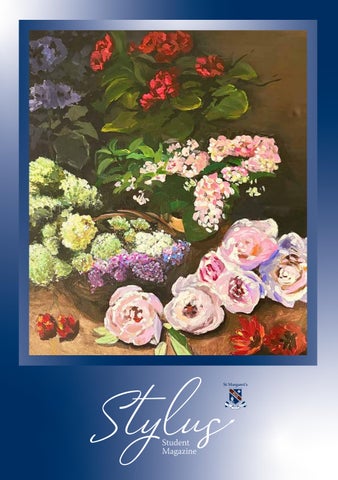
Stylus 2025 Principal: Ros Curtis AM Editors: Rhea Barber and Wendy Johnston Student Editors: Matilda Litfin and Ellouise Tkaczyk, Year 12 Cover Image: Floral Serenity – artwork by Jennifer Wang, Year 9 Graphic Designer: William Pascoe
‘Tracey, I’ll tell you again, computers aren’t spying on us!’ Letitia shouted. ‘Well, if any of your personal information gets out, you’ll know you should’ve listened to me,’ I reason.
67 I
Stylus
Contents
Nadia Charoensuk, Year 12 A Dok Bua Blooms – short story
5
Annie Chen, Year 12 When the Lantern Swings – short story
6
Arnika Di Bella, Year 12 Sunday Confessional – monologue To Love You from Six Feet – monologue
8 10
Francesca Evans, Year 12 Rustie’s Sunrise – colour photograph Fire in the Sky – photographic essay
12 13
Sophie Frecklington, Year 12 Red String Theory – photography and digital manipulation Boxed Memories – photography and digital manipulation Flicker of Heritage – acrylic on canvas, paper origami, wire, tissue paper Rise – acrylic on canvas, spray paint on cardboard, sculpture
14 14 15 15
Evie Jenner, Year 12 Ó thuaidh de mo laethanta – North of My Days – short story
16
Audrey Kerle, Year 12 Threads of Love – short story
17
Georgia Lillicrap, Year 12 Photos for the Kids – short story
18
Matilda Litfin, Year 12 Where Blackbirds Sing – short story
20
Sharlize Mufti, Year 12 Long, Long Time – short story
22
Ruby Reynolds Campbell, Year 12 The Red, White and Blue – short story Head Below the Surface – monologue
24 25
Philippa Smith, Year 12 La Donna Peccatrice – short story The Break Between Waves – short story
26 28
Amelia Stanfield-Gates, Year 12 Between the Trees – photograph and pencil sketch
29
Ellouise Tkaczyk, Year 12 Bated Breath – poem
30
Hudson Crombie, Year 11 The Commute – short story
31
Elysia Li, Year 11 Gu Gong – mixed medium artwork
32
Stella Willims , Year 11 Statue in Prayer – graphite crayon and lead pencil drawing
33
Isabella Beasley, Year 10 Death of the Truth – persuasive writing
34
Scarlet Brekan, Year 10 Not Safe, Not Yet – short story
35
Grace Tu, Year 10 The Blue Marble – digital image
36
Alyssa Bowers, Year 9 Home – poem
37
Ritz Fu, Year 9 Between Me and Myself – short story A Series of Artworks – acrylic on canvas
38
Ashlyn Harding, Year 9 Eldermoor Chapel – short story
40
Sophie Heffernan, Year 9 When Machines Go Rogue – persuasive writing
41
3 I
Stylus
Contents Ella Knight, Year 9 Snow Leopard – digital artwork
42
Danielle Mhlanga, Year 9 Something or Someone – short story
43
Stella Minotto, Year 9 The Red Bow – pencil drawing
44
Allegra Pople, Year 9 The Roses of Gaunt Avenue – short story
45
Audrina Stewart, Year 9 The Echoing Drums of Orson Manor – short story
46
Diya Tripathy, Year 9 In the Wake of Malfeasance – short story
47
Jennifer Wang, Year 9 Still Life Collection – acrylic paintings on canvas
48
Natascha Zdravev, Year 9 Worth – poem
50
Meiyu Zhang, Year 9 Aren’t You Tired? – short story
52
Gia Comino, Year 8 The French Life – photograph collection
53
Isabella Goodrick, Year 8 The Beauty in Everyday Life – photograph collection Before the Sky Burned – short story
54 55
Mia Hixon, Year 8 Frosted – photograph collection
56
Alekhya Karlapudi, Year 8 The Fox’s Deception – short story
58
Darcie Marshall , Year 8 Salt and Laughter – poem and photographs
59
Blaire McKinnon, Year 8 Through the Smoke – short story
60
Zara Sinha, Year 8 The Girl Who Dared – short story
61
Isabella Swarbrick, Year 8 The Art of Decay – graphite drawing
62
Amelia Rasmussen, Year 7 Grey Fighter – graphite drawing
63
Harriet Ritchie Gniot, Year 7 Teirrah: Success is a journey, not a destination – a collection of handmade crochet designs
4 I
Stylus
64
Lily Williams, Year 7 Hiding – short story
66
Lilian Wild, Year 6 Are Computers Spying on Us? – short story
67
A Dok Bua Blooms Nadia Charoensuk Year 12 The pediment above the apartment door sagged like weary shoulders after a day of heavy labour. Its edges curled inward, like skeletal fingers gripping the brick facade. Though imposing at first glance, there was a strange familiarity in its quiet, hunched nature. The entrance had faded to a dull white, its cracks and peeling paint contrasting with the fresh jasmine blooms. Kohsoom gently settled into the crooked planter boxes flanking the door. ‘Look at this dok mali, Kohsoom. My favourite,’ her mother had once said. Right. Dok mali – jasmines. Her mother’s favourite. Kohsoom paused, recalling the memory, but the sweetness of the flowers’ scent might as well have been miles away. The muted hues of the setting sun painted the sky hazy and distant. The breeze brushed her cheek, cool and gentle, but all she felt was the tightness in her chest, guilt and loss pressing like a relentless weight. Moments from the funeral replayed in her mind, fragmented and slippery. She barely remembered the words, only the silence that seemed to deepen as her turn to speak approached. Her resolve to honour her mother’s life had dissolved under the enormity of it all, the words caught like a knot in her throat. Others seemed to find solace; their grief woven together in a shared language. But Kohsoom’s heart felt twisted, an outsider to the rituals and language of her own heritage. She was a stranger in her own mother’s world. As the monks chanted, their saffron robes swayed gently with each bow. Incense smoke curled into the air, rising toward the ornate golden altar adorned with lotus flowers, candles, and images of the Buddha. The scent was earthy and grounding, yet unfamiliar. Kohsoom had strained to follow the rhythmic cadence of their chants but clung to one phrase: ‘Anicca, dukkha, anatta.’ The small booklet she’d been handed translated the words: impermanence, suffering, non-self. Their meanings felt distant, an echo of a language she barely understood. Her fingers brushed the crusted, peeling silver paint of the apartment number, tracing the worn digits – 9K. Beneath her touch, the paint flaked away, revealing brittle patches of darkened wood. Nine – a symbol of progress in her culture, yet she felt stuck, held back by a missing cornerstone she couldn’t name. She slipped her hand into her bag, fingers closing around her keys. After a few tries, she unlocked the door and stepped inside.
The stale air yielded to the fresh breeze slipping through the open door, clashing with the recycled stillness that had been circulating within the apartment for weeks. It was that long since her mother had last been here. The apartment was chilly, but the orange glow of the setting sun cast a dim, gold waning light that softened the room, creating beams that illuminated floating specks of dust. Kohsoom’s gaze landed on the foyer table, where her mother’s slippers sat neatly. She slid her foot into one. A perfect fit. As a child, she’d done this countless times, her toes barely reaching the edge. Now, the slippers enveloped her feet snugly, the same way her mother’s warmth had once held her. ‘One day, dok mali,’ her mother had murmured, pressing a kiss to her head. ‘When though?’ Kohsoom had whined, eyes fixed on the oversized slippers. Her mother smiled. ‘When you’ve fully blossomed, Kohsoom.’ The memory tugged at her heart, filling the empty space with bittersweet warmth. She glanced into the narrow hallway mirror, catching her reflection – older now, yet still searching. The monk’s chant echoed in her mind. Anicca – impermanence. Her search for cultural connection, too, was impermanent, constantly evolving. ‘Have I fully bloomed yet, Mum?’ she whispered, her voice feather soft. She looked down at the slippers. Raang tao. Right. That’s what they were called. She stepped out of them carefully and returned them to their place, as if her mother might still come back to wear them. Reaching into her bag, she drew out a small handful of dok mali petals and scattered them across the foyer table. The delicate white flowers, her mother’s favourite, seemed to hold a quiet presence, lingering in the air like a blessing. She wandered into the kitchen, her fingers brushing over the worn recipe book her mother had scribbled in, its edges smudged from years of use. The faint scent of Pad Thai clung to the air, stirring her heart. She could almost taste the brightness of lemongrass, the earthy depth of galangal, the tangy tamarind sauce mingling with chewy noodles and the unexpected crunch of bean sprouts. No restaurant could ever recreate her mother’s cooking, but she resolved to try. Cooking would be her first step in reclaiming what her mother had left behind. Dukkha – suffering. The word echoed in her mind. Grief had been her greatest trial,
but it also sparked resolve. Step by step, she would rediscover her heritage – not perfectly, but with purpose. Now, it was only a memory, but even here, in the stillness of the apartment, her mother’s spirit lingered. Kohsoom turned toward the living room, her gaze settling on the photographs arranged on the cabinet. Each one held stories, fragments of the life they’d shared. ‘Mum, Mum! What are those?’ Her mother had smiled, retrieving the photos from the high shelf. ‘These are us, Kohsoom.’ She handed them over, pointing to each memory. ‘This one is from the zoo in Bangkok. See the ling, monkeys, in the back?’ Little Kohsoom’s eyes sparkled, her attention flitting from one photo to the next. Her gaze landed on a picture of them holding a strange, delicate flower. ‘Mum, why are we holding that funny flower?’ Her mother crouched beside her. ‘That’s you,’ she said with a proud smile. ‘Your name. Lotus flower. Dok bua.’ Standing in the present, Kohsoom held the same photograph, crouching as her mother once had. She stared at her younger self holding the lotus, mirroring the scene from years before. Only now, it was a dok mali she held in her palms – her mother’s favourite. Earlier, the jasmine’s fragrance had felt faint, the air cold. Now, the open door carried its sweet scent, wrapping the room in quiet warmth. Her mother’s words floated back, clear as a whisper. ‘The Lotus, dok bua, rises from muddy waters. It is beautiful and strong. You are beautiful and strong. Nothing can stop you.’ Another word from the funeral surfaced: Anatta – non-self. Though her world had changed – grief, disconnection, loss – her mother’s love and lessons remained. They shaped her resilience, a strength as constant as the child who once slipped into her mother’s raang tao. She looked down at the dok mali in her hands, inhaling their sweet scent, her mother’s presence filling her heart. Those three words – impermanence, suffering, non-self – had once felt distant, an echo of a language she barely understood. Now, they resonated. Life was impermanent, full of challenges, yet beauty and strength could still emerge. Today, Kohsoom rose, her mother’s words, like the lotus, dok bua, rising from murky waters to bloom anew. 5 I
Stylus
When the Lantern Swings
It’s dangerous to be in the mountains at night – especially tonight. Tonight, it appears as if ink has stained the sky, and clouds shield the moon away from the world below. In these twilight hours, only a fool would linger in this region of blackened boulders and sharpened redpine trees. Cunning altitudes coax fog to coat the pasturage, trampled beneath sika deer hooves as they flee the peril of the mountains at night. Perhaps, if a fool stood perfectly still amongst the trees for long enough tonight, they’d spy the luminescent sequinned eyes of death’s wraith congregating, open jaws salivating, bloodied teeth bared. How unlucky it is tonight for a soul to breach the conclave of wooden columns – a maiden. She is both scared and brave, unkempt and composed, as paradoxical as a woman in the quiet pine-needle forest at night. Her feet follow a dirt path – a mostly imaginary route, stitched together by peripheral shadows and paranoiac guesswork – in a desperate attempt to make sense of the mountain’s aimless void, until she hears a tune. In the mountain’s stillness tonight, the peculiar lullaby echoes along the chilled air. In the back of her mind, faint recognition squirms like a parasite in her skull before the fog invades her senses once more. It is fortunate, then, that the path with rubbed out edges twists around the evergreen torsos and mossy snares towards the sound. As she approaches, her darkness-adjusted eyes register a light – a faint orange glow, the colour of sweet loquat jam and flowering citrus blooms. She stills for a moment, wary and skittish from hunger. But the scent that meets her of simmering bone and herbs is too familiar, a memory in sight but not reach. The hazy glow sharpens into the outline of a small cart. Tucked beneath a rocky overhang and nestling under a faded canvas awning, a lantern, swinging despite the lack of wind this deep in the forest, hangs from a small structure of lacquered wood. The girl takes a step closer and spies the owner of the stall. It is an older woman – both kind and stern, fit and crippled, as paradoxical as an old lady in the forest at night, tending her little stall. There is a boiling pot of soup resting in the middle of the
6 I
Stylus
cart and the girl watches as the madam spins her ladle, swaying and humming contently to herself. Another step. Dried leaves crinkle as she steps on them. The song stops. The ladle stops spinning. The body stills. The old lady’s neck cracks as she searches the shadows. A pause. ‘I can see you, little one. Care to come sit with me?’ The crone croaks to no one in particular, for not even a clouded leopard could navigate the mountains tonight. The maiden hesitates – what good could come listening to an obviously disturbed crone? And then around her the forest stills, widening and opening its maw, creeping closer. Better snakes in the grass than bears in the trees, she decides, approaching the cart. ‘What is your name, child?’ The stallowner asks, stirring the soup as the lost soul sits in front of her. There is a pause, as if she has forgotten. ‘Isolde,’ the woman finally replies. ‘Is-ol-de,’ the old lady repeats each sound slowly. She tastes the name in her mouth, feeling and rolling the curves and lines of the word against her wrinkled lips. She says it again and then once more. ‘Isolde. Why don’t you stay for some soup?’ ‘I’ve no money.’ ‘No need, my dear.’ The old lady ladles broth into a worn wooden bowl. ‘I’ll charge you something else. How about a story? A memory told; a memory sold.’ At that moment, perhaps if there was something else in Isolde’s mind but cold and primal hunger, she would pause to contemplate the words, Instead, she stares at the old lady’s face stretched into a smile and salivates at the scent of the soup. Gulls shrieked at dawn as the sun lifted from the night’s cerulean cover, eager for the fishermen who’d spent the dark hours casting rope into the peerless depths. Isolde would watch them arrive, count the little lanterns flicker as they wade closer to shore from the safety of the tower. From up in the lighthouse, she could faintly make out a figure waving to
the lighthouse that guided them home or to her who fed the hungry fire at night, she could not tell. She always waved back, nevertheless. Greater Shoal Bay was in fact neither great nor had any shoals or bays, the surrounding coastlines instead littered with jagged stones and unending trenches, death traps for the unknowing. Most mornings, Isolde would wearily stumble down from the tower, precariously built atop an overhanging ledge. Sometimes, she’d hear whispers on her way home, mothers hiding sons behind them and weavers whose looms stopped spinning as she passed. The old lady lights a wooden smoking pipe. Ribbons of smoke escape her mouth to join the forest’s almost opaque fog as she exhales, tinged a spirit blue from the canopy-filtered moonlight. The crone’s tune drifts back as she hums in intrigue, throat hollowed and grated by smoke. ‘You’ve salt in your blood, then. A lightkeeper, you say?’ She hoarsely chuckles to herself. The sound is guttural and inhuman. ‘Home’ was the temple in the heart of the town, a skeleton of rotting wood and paint-stripped clay. There was little use for a daughter, especially during a famine. It was an unspoken tenet in the village, the reason so many nameless daughters were trapped in limbo, unwanted and unclaimed. They lived a purgatorial existence, neither complete outcasts nor truly claimed – visible yet intangible ghosts. This early in the morning, few were awake, everyone content to remain adrift in the sea of dreams. Yet today someone was there. A figure was pressed against the crumbling fence, curled into itself like a human ouroboros. Faintly, Isolde recalls huddling with her sisters against that same pillar, though the stone had not been so weathered then. It hummed a melody as it sat there, only pausing when it registered her and hissing when it did. It is the same song, Isolde realises now, pausing. The old lady stops mid-drag of the pipe, an eyebrow lifting behind sagged skin.
Annie Chen Year 12 It was, unsurprisingly, a girl. A child, both lost and rooted, lullaby and echo, as paradoxical as a child left behind. She was young, like the wanted six-year-old sons of the village. Barefoot and berrylipped, the child was cloaked in a tattered sheet and smelling – like she did – of smoke and stunted ambition. No one had been left for a while, whether by guilt or misplaced righteousness she did not know nor cared. Isolde crouched down, catching sight of the child’s eyes, wide and wet like low tide. ‘What’s your name?’ she whispered, soft like a mother teaching her child to talk. There was no answer. Her sisters scoffed when Isolde brought her inside – another mouth to feed, another reminder. No matter, there was no love lost between them. Not anymore. It had been there once – when they used to all cram themselves into a single bed (they stopped when it broke) and when they held hands walking down to the beach (they stopped when the tide came in and someone let go). So, when they saw the child, Lian, a name finally coaxed out by a bowl of soup, no words were said. Pursing their lips and folding their gazes inward, the moment drifted away. It did not matter. Lian was hers. The old lady began coughing, hacking and heaving smoke out of her lungs until rivulets of saliva run down her chin. She tuts with the saccharine lilt. ‘No wonder your manners are so poor. Where is the wee minnow then, or did you get too peckish wandering this forest?’ Something was wrong. Petrichor hung onto hanging air and skin for too long. Unfamiliar dampness condensed into shallow puddles in lungs. Static ran across the dense atmosphere to crawl into veins. The sea fumed today, its waves rising to vengefully crash into the sand. Isolde felt it all, a veneer of devastation over her bones like plaque on teeth as she rushed around the tower. A wicked thought crawled into her mind as she fanned the flames. None of it is your concern anymore, its whispers
cooed. And she almost believed it. After all, gulls would still circle the shore and waves would still lap at shore in nature’s grand design. The thought steeps for a moment, mulling. It only soured as she remembered the little girl with berry-stained lips and eyes like the sea at low tide. Isolde turned away, away from the unfamiliar fluttering in her chest. The fire was dying. It’s beacon of smoke and light was unwinding as spitting embers curled into themselves like a wounded animal, ignoring her cocoon of sea-bleached driftwood around the cinders. It was useless, of course. The fire was still withering away, writhing wisps of black smoke whisked away by wailing winds fleeing the ocean. A pause. It was the moment of respite as she understood what she already knew. A strike of guilt wrapped around the ribs of a lightkeeper who failed. And then there was nothing. The water’s edge inched closer with each battering wave as the sea opened its awaiting throat. Isolde watched atop the gallows of grief, until there was a grunt behind her. She turned, confused. A figure was climbing up the tower – Lian. ‘Lian.’ The little girl stumbled as she finally heaved herself onto the platform. ‘Lian, go back. Go see if your sisters or anyone else wants help. Go find shelter.’ Lian ignored her. Instead, she silently leaned on the rotting wooden railings, transfixed by swirls of cobalt blue and foamy white beneath her. ‘No one’s ever wanted me.’ Her whispers were just a note above the ocean song and the winds steal the words, ‘just you,’ out her mouth before they come. And for a moment, it is Isolde who stares at the curling arcs of water below, wondering if perhaps, the channels would escort her to another samsara were she to fall in. But instead, the sea, old and spiteful, curled its fingers against jagged rocks and lunged towards land with Mother Earth’s fury.
Isolde would not reach for the child’s hand. But neither would she pull away when Lian’s sleeve brushed hers, tentative and cautious. The tower would fall soon, their existence stolen by water. Lian’s head rested on Isolde’s arm, the weight of sorrow heavy against her, and the mother placed a fleeting kiss on the child’s head before they sunk into the seafoam. Isolde reaches for the bowl. The old lady doesn’t stop her hand. She pauses before the soup reaches her cracked lips. ‘I’m dead, aren’t I?’ The bowl’s warmth thaws her frozen mind and the old lady Meng Po, custodian of memory, God of oblivion, smiles. The broth ripples in her hands, and to her surprise there is another face in its reflection, one with berry-lips and eyes like low tide. ‘I will forget – everything?’ ‘You might… But the runt did not forget you last time, and you may not forget her next time. Love burns longer than grief, should you tend the fire, lightkeeper.’ The humming begins again. An untouched bowl is returned. ‘My memory was your price,’ Isolde recalls. ‘I cannot pay it.’ Meng Po smiles, perhaps knowingly, and somewhere in the forest tonight, another path is stitched. Around the portals of oak and thorny brambles, it is a longer, more perilous trek. Yet, if you deign to follow it, you’ll be led to a dawn the colour of loquat jam and citrus blooms where two souls sit side-by-side watching the sea. The lantern hanging over the stall continues swinging, tracing eternity in its path.
So, they stood together watching the tragedy.
7 I
Stylus
Sunday Confessional
When I was a child, Sundays were for family. Sundays were waking up at 7 o’clock for Mass. A new frilly teacup dress and heels too high for me to walk in were laid out every week. Rows of girls my age were in similar floral patterns, boys in suits. I never understood why we had to match. Sundays were sitting in the pews, slipping on the lacquered wood. The church smelled faintly of incense and old varnish. Light filtered in through stained-glass windows, casting soft colours on our skin – virtuous colours – purples, blues, a hint of gold. I would play with a gold chain that was cool against my neck. I tried to ignore that it felt like a spotlight. I tried to understand the words sung in funny tunes. I would hum them back. I never understood the anger on people’s faces. Sundays were standing at the altar, facing the rows of pews, a reading in my shaking hands. Rosy cheeks beside me would move with ease. Excitement. Awe. My voice would falter and shake and jitter. The words never came out right. I never understood why the words were so important. They weren’t that exciting. I did, however, understand that 5 o’clock was when I would be at my Nonna’s table, surrounded by my parents, aunt and uncle. The aroma of tomato sauce wafted throughout the room, only a single cracked window allowed its escape. The window was my only reprieve – aircon was an economic enemy. It was also my tormentor. I would sit sweltering, hearing my cousins play outside, wishing I could join. But I couldn’t stain my dress. At 7 o’clock, seconds and thirds had been served after much pestering from my Nonna – ‘You’re too skinny!’ The sink would overflow with dishes. We would always offer to help, hoping every week that she would finally let us, but much offence was taken; we couldn’t disrupt the routine. She’d sit us on the couch and put on Un medico in famiglia. We would spend the rest of the evening in her living room. The family room. I would doze off in my mother’s lap which was more comfortable than the silk pillows that lined the cushions. Her chest would rise and fall, the rhythm of her breathing a gentle lullaby, soothing me as she laughed at the clichés. This was my favourite part of Sunday. I was at peace. Although, sometimes, it wasn’t just Sundays. Sometimes, other days would be the same. When a lady in a white dress and a man would get married, or when babies would have water poured onto their heads. Mum told me I had that happen to me, too. I didn’t remember it though. I didn’t feel different. It always seemed to matter more to everyone else; just like the dresses, and sitting still, and getting the words in my readings right. After many Sundays, I understood why. Why Sunday after Sunday, I felt less and less like myself, like they were dressing up a doll, like there was a part of me being concealed. My frilly dresses and heels fit better, yet I was suffocated by the hems, like a part of me was folded in and stitched smaller and smaller each week. I no longer slipped on my seat; my feet could firmly touch the ground, but, instead, something had to shrink to make room. My readings became harder, but I could handle them. My voice never wavered. There were no more frustrated looks, or side glances, or anger. But each word I spoke felt rehearsed, like lines
8 I
Stylus
from a script I hadn’t written. My voice no longer felt like mine; it belonged to the girl they wanted to hear. It was tradition, an equilibrium I could never disrupt. All I had to do was stick to the routine, pretend that the silence between verses wasn’t filled with judgement, that three words wouldn’t end my connection to this community. There were moments I imagined saying it aloud. In the pew. In the booth. In a whisper behind the carved wood. But my tongue would go heavy. Not here, not now. I would look at the crucifix above the altar and wonder if God already knew, if he waited for me to name it like a wound I refused to clean. I had gone to confession a handful of times. Usually before Easter or Christmas, when the whole parish was expected to queue. I would sit in the pews, rehearsing my sins in my head like lines in a play. I lied. I gossiped. I disobeyed. But there was always one thing I could never say. I’d approach the booth, heart hammering, then swap it out for something smaller. Safer. I left each time feeling lighter in the eyes of others, but heavier inside. Silence could be a confession, too. It felt like I was on a tightrope, always wobbling and wading between two sides of myself. Sometimes I was the perfect debutante entering Italian society, the ideal church girl who embodied the values that mothers hoped their children would live up to. That I would live the ‘dream’. A life like my Nonna’s: charming guests, cooking, praying. Other times, I was a girl who loved loud, wildly and free. It never occurred to me that these two sides of myself could ever exist together. But I knew that on Sundays, the latter part of me couldn’t exist. Sleeping in the living room was when she could breathe, a glimpse of her that no one noticed would be released. It was still my favourite part of the day. I would still lay on my mother’s lap, even though I was too old. Sometimes I thought she noticed the change, that she knew two people existed inside of me. Those days, I would rest my head a little lighter, I wouldn’t fall asleep. She was my best friend. She made me who I am. But I couldn’t let her see this part of me – the part that would unravel everything she believed she’d raised right. That part of me didn’t feel like a choice, but an anomaly. A crack in the foundation. Something I could never explain to her. I went to my first funeral when I was 15. It was someone in the community I didn’t know well. I felt detached, I was comforted by those around me, but I experienced no grief. Death was more real. I found it beautiful, but scary. How it brings out the most vulnerable and honest parts of people, their feelings and heartache. How by the end of the eulogy, we intimately knew the person who passed. I began to understand this other part of me even more. Eventually, she would have to come out. Death had a way of stripping people bare, revealing their truest selves, and I knew I couldn’t wait until then to be seen. I hadn’t realised, until that moment, how profoundly death could shift the world around the living.
Arnika Di Bella Year 12 A virtue in Catholicism is honesty. Veritas. To speak the truth. To live it. They spoke of it in homilies, in confessions, in catechism. I was told it would set me free. But they never said what to do when your truth might break someone else’s heart. Honesty was meant to be an act of love, not defiance and I loved her; my mother. I loved her like I loved those Sunday nights. Even the sticky heat, the Mass, the matching dresses. I loved the way she lit candles after communion, how she never rushed through the sign of the cross, how she mouthed the prayers even when her voice was tired. I loved those Sundays, even though I had to hide myself, because I loved her. I wanted her to love me like that too. In full. Without hesitation. She used to tell me I was brave. When I stood tall in my first communion dress, hands folded just right. When I walked up to receive the Eucharist without forgetting the prayer. When I went to confession and couldn’t do it – I ran out crying. When I held her hand before I had to read, and later, during that funeral. It didn’t come in one thunderous realisation, this decision to speak. It came slowly, quietly. Like the soft clink of spoons against teacups, the echo of heels on church tiles, the closing of hymn books. It came with the knowledge that peace couldn’t live beside silence forever. I didn’t know exactly what I would say. I still don’t know whether they were the right words. But on that particular Sunday, I sat beside her at the 5pm dinner table. The sauce was a little spicier than usual. The window was cracked just a sliver more. My cousins were outside, cutting the grass instead of kicking the ball. The TV was off. My Nonna was sitting down, not pestering us to eat. Tonight was slightly different. The routine had changed. I felt it in my chest, the rise and fall, like the rhythm of Mum’s breathing when I was small. The light in the room was softer now, golden and slow. Shadows clung to the corners, and the smell of basil and garlic still lingered in the air. My hand found the little cross around my neck, the chain now warm from the heat of the day. I clutched it – not in prayer, not in fear, but in steadiness. I looked across the table. I was still in my dress. I had still gone to Mass. I had still said grace. But something had shifted. I drew a breath. This was my first real confession. There was no booth. No priest. No whispered act of contrition. Just the clink of cutlery, the faint sound of laughter outside, and the warmth of my mother’s eyes. And I let her out.
9 I
Stylus
To Love You from Six Feet
[A girl sitting with piles of books on a table beside her. A cheap crossword they hand out at hospitals at the top of the pile. She occasionally glances at it. The girl is positioned on an angle, looking away from the audience and looking at her Nonnie.] You are not dead, but you may as well be. I used to think of you as inorganic, invincible, undying. My Nonnie, a superhero, a force to be reckoned with, always strong-willed, strong-minded – just strong. And maybe you are strong, maybe you are inorganic, because the doctors tell me you are alive. Despite it all, you are somehow alive. Even though when I walk into your room, you look at me like I’m a stranger. Even though phone calls from friends remain unanswered. They have become foes now. Even though we don’t share the same reality. It’s like a façade that you can’t control. The ‘real’ you hiding behind a mask, like a method actor forever stuck in their role, their true self struggling to break through the cracks. Trapped, watching an entirely different person take over. A lost sense of self, forever stuck thinking the thoughts of someone else. This ‘someone else’ is nothing like you. A distorted vision. A person full of fear and hate for those you once loved dearly. It’s not your fault. It’s not you. It’s weird because despite it all, you can still do maths in your head, faster than I can do the homework that I have neglected to see you. You can still read to me like you did when I was younger. You read more than I do. But ‘have a good day’ can set you off, send you into a black hole of negativity that I never thought you were capable of. ‘I’m sorry I am ruining your life’ ‘I’m sorry I am alive’ I’ve learnt to say nothing to these words, because saying nothing is better than something. Otherwise, offhand comments become a debate on your existence. So, there is a question that hangs, one I continue to ask your doctors: ‘Is my Nonnie really alive?’ Sure, by definition. ‘Life: the existence of a human being.’ You exist. You sit, you think, you breathe. You do all the obligatory motions to sustain life. By definition, you’re overachieving. But they are simply just motions. That’s why I still tell the doctors you are dead, gone, six feet under.
10 I
Stylus
It’s morbid, but it makes sense in my head. [she reaches out to her Nonnie] Even when you are sat right in front of me, I can’t believe that you’re alive. Your body may be, but your mind is dead. You are not you anymore. I come and visit you every week, Wednesday, 5:30pm. I walk the desolate halls, the only sign of life being artworks Blu Tacked to industrial-grade doors – the artists children my age. Turn right, then left, past the café. I greet the nurses like old friends, a simple nod to the doctors, and I enter your room, with piles of books. [her hand rests on the crossword] The only one that will be touched is the cheap crossword they gave you last time you were here. I sit in my designated chair, disinfectant stinging my nostrils. I will never get used to it. I try to make conversation with you, thinking maybe today will be different, but of course it isn’t. Every week false hope courses through my veins, desperate to see a glimpse of the person who was once there. But the all too familiar shadow casts over you, and the internal battle is painted vividly on your face. I open the book to occupy your thoughts, returning to the first page. My neat handwriting filled many of the boxes. I begin, repeating the same clue over and over, to give you a chance to figure it out. As always it works for a moment, two clues completed, but then it comes back, [her hand jolts away] and I can’t help but escape to the comfort of the past. Warm coffee, a hot chocolate for six-year-old me, and pizzelle. You would speak in English because I refused to learn your native language. It’s a skill I now yearn for. You would chase us around with a shoe when you were furious; and when you caught up, you would just hug us. I now envy younger me, who would run in fear, because she got to hug you. You were an incredibly fierce and brave woman. What happened, Nonnie? Now, all our time together is spent with unopened gifts and medication in white walls. You now speak in Italian, your brain too full to attempt speaking in your second language. You no longer have the energy to walk, or yell, or hug. You are filled with fear and futility.
Arnika Di Bella Year 12 What I now realise is that this person was hiding underneath the surface. The person you were was the mask. You got tired of pretending. Your authentic self is not who I want you to be, or the person I thought I brought out in you. There’s a permanence in it that makes me mad. I look at you, head in my tear-stained lap, mumbling incoherent words I do not want to understand. Because I know you are begging to be alive. Begging for me to leave. Begging for me to hate you. It’s the same every week. I can’t do these things for you. Your dying wishes are unachievable. That makes me mad, too. Death is inevitable, but not in the way I imagined. Being here week after week has taught me that. That is why I tell the doctors you are dead. Because the person you were, my Nonnie, is gone. [she turns to look at the audience] Maybe that’s okay. Because when I was younger, I struggled connecting with people, except you. Even though those moments may have been an act, your love was real, and that makes the person you were more than just a mask. Bits of who you were remain ingrained in everything I do like we are divinely linked, even though now you are the only person I struggle to connect with. That will not take you away from me. After each visit, I sit down with a warm coffee and a pizzelle. I fill in a couple blanks of the crossword without you and remember the person you were. I remember the times when I was six years old and we would do this together, never the hospital visits. I will always find ways to keep you as that person in my mind. I have to hug that person at six feet, because you are only a memory. I have to love you at six feet. I am okay with that. You are alive, not living, not the same person, but at least I have the thought of you.
11 I
Stylus
Rustie’s Sunrise
Rustie’s Sunrise 2025 Colour photograph The photograph, titled Rustie’s Sunrise, is a depiction of a foggy morning with my dog, Rustie, standing watching the cattle. This photo was taken at our family farm. It showcases the 5am sunrise from one of the paddocks. The crips air highlights the cool crisp daybreak in Queensland’s South Burnett.
12 I
Stylus
Fire in the Sky Francesca Evans Year 12
Fire in the Sky 2025 Photographic essay This photographic essay, titled Fire in the Sky, showcases sunsets from all across Australia. Many were taken here in Brisbane and on our family farm, with others from the edge of the Brisbane River and Town Beach in Broome. These photos encapsulate the warm hues the Australian afternoons can create.
13 I
Stylus
Red String Theory 2025 Photography and digital manipulation 50 x 50cm
My first experiment, Red String Theory, explores my personal and cultural background through my parents’ journey of how they met and how I came to be. Joachim Froese’s Tell him it’s all a Transition inspired me to tell my parents’ story through a series of photographs. Through digital manipulation of the image of Brisbane, I created my desired effect of transforming Brisbane into Shanghai through incorporating red silhouettes of Shanghai’s iconic buildings. Edited barren backgrounds evoke a sense of loneliness, excluding the image of the two coffee cups which represents when they met at a café and that emptiness was filled. Coffee represents Australia being a western beverage and tea symbolises China, highlighting their cultural contrast. The images are connected by red string referring to the Chinese proverb: Red String Theory, which suggests that people’s fates are bound together, making them destined to meet (Kessler, 2023).
Boxed Memories
2025 Photography and digital manipulation 50 x 50cm
My second artwork, Boxed Memories, depicts a moving box containing sentimental objects, including toys and letters from friends, to symbolise that I lived my life in moving boxes, constantly packing away my memories and life each time I moved. Growing up, my family moved frequently, both overseas and between houses, confining my belongings to moving boxes. The background features a self-written Chinese poem, expressing my longing to escape this transient lifestyle. The poem, written in Chinese, expresses that I still carry my culture with me despite living abroad. Inspired by Neshat’s Shameless, I inscribed the poem onto the background to symbolise that my longing for stability was always in the back of my mind. I adopted Neshat’s use of a monochromatic palette for my work excluding certain objects in red to highlight my Chinese heritage as it is a culturally significant colour in China (National Museum of Asian Art, 2023), symbolising that my culture remains present no matter where I am.
14 I
Stylus
Sophie Frecklington Year 12
Flicker of Heritage
2025 Acrylic on canvas, paper origami, wire, tissue paper 140 x 65 x 6cm Flicker of Heritage draws upon my own feelings of migration, displacement and the loss and longing of culture. With parents from Chinese and Australian backgrounds and a life of constant moving, I carry a mix of cultures within me. Over time, I felt my heritage fading under modern influences. These feelings align with artists Joachim Froese and Raqib Shaw, whose use of coded elements influenced my art, helping me capture a world losing touch with its roots. The idea of roots is further explored through a sculpture of a Ginkgo tree thriving despite being oppressed in our disconnected world. Red origami cranes symbolise individuals’ hope and resilience for culture to prevail. The temple surrounded by apartments I’ve lived in shows how culture is being suffocated by our modern lifestyles. Windows glowing like flames symbolise that a flicker of curiosity about heritage creates a sweeping inferno, rekindling our current fading culture.
Rise
2025 Acrylic on canvas, spray paint on cardboard, sculpture Canvas – 50 x 75cm Sculpture – 100x45cm Rise draws upon feelings of displacement and not belonging. It tells the story of entering unfamiliar environments and the emotions that come with it. The large, symbolic crane perched on iconic Brisbane skyscrapers appear to almost be apocalyptic and monstrous. Having experienced a transient childhood full of constant moving, I never felt like I belonged, like the crane who is clearly out of place. This is further represented through a sculpture of a pair of wings. When I stand between them, I take the form of the crane. This interactive element invites viewers to step between the wings and see things alternatively through my lens.
15 I
Stylus
Ó thuaidh de mo laethanta – North of My Days Evie Jenner Year 12 Aoife returned to Derry on the cusp of winter, when Atlantic winds cut through the hills like sharpened blades and fields shimmered beneath a brittle veil of frost. The air smelled of damp earth and sea salt. The grey sky pressed low, heavy with unshed rain. She approached her grandmother’s cottage along the familiar gravel and noticed the way nature had claimed the walls. Ivy and weeds wrapped around the brick exterior like a memory refusing to fade. A living tapestry of time. She paused before the old wooden door. Its surface was weathered and browned by decades of storms and silence. Ornate engravings curled into corners like forgotten Celtic knots. The letter slot below was rusted but still slightly ajar. She imagined the letters that had passed through, confessions, apologies, declarations of love, fragments of life in ink. That kind of communication, tactile, intimate, felt like a language she longed to relearn. The grand oak tree in the front yard caught her eye. It had been planted in memory of her grandfather, yet it seemed to yearn more stories than the loss of one soul. She retrieved the cold, rusted key from beneath the doormat and slid it into the lock. It turned with a reluctant groan. After being at college for so long, coming home for Christmas was the comfort she had ached for. The door creaked open, revealing the nostalgic scent of lavender and dust. She closed the door behind her, shutting out the wind. ‘Hiya, Mags!’ Aoife called to her grandmother. ‘Hiya, love! I’m making tea, do you want some?’ she replied. ‘Sure! I’m just going to run upstairs and put my bags down,’ Aoife responded. The floorboards moaned as she made her way up the familiar stairs. The faded yellow wallpaper, once vibrant, is now peeled at the edges. As she wandered, she noticed that the door leading to the office was ajar. The dull roll of her suitcase against the carpet hushed as she paused. She had never been inside. Aoife glanced around, curious and unsure. Intrigued, she stepped into her grandfather’s old, unkempt office. The thin filter of moonlight danced gently through the window like a silent stream. She followed its path to a slightly open drawer, beckoning for its forgotten contents to be rummaged through. Her hands fluttered through stacks of paper, old photos, until they brushed against a hard smooth surface. She turned to the light. A thin leatherbound journal. Its cover was flecked with dried paint, the colours faded and cracked like aged skin. On the inside, a name was written in familiar handwriting: John O’Halloran. Her grandfather. ‘Aoife!’ her grandmother sung. ‘I’ll be there in a sec!’ she replied, eyes still locked on the journal. As the pages turned, the paper rustled, as if it was whispering ever so softly to her. There it was: his handwriting. Slanted, deliberate, and black. It was faded at the edges where the ink had bled and smeared throughout the years. Tuesday 01/02/1972 It’s been two days and I’m still trying to make sense of it. The soldiers had been watching us with hard eyes, rifles ready. 16 I
Stylus
Graffiti dripped down the walls – anger painted in green, white and orange. Smoke hung in the air and the hum of resistance echoed through Derry. Her grandfather’s voice rose from the page, filling her with a combination of familiar warmth and familiar grief. The air was strikingly cold, making my nose sting. I was a part of the crowd that had gathered in the streets. We were marching not with weapons, but with signs and songs. Our voices rattled against the injustice of internment without trial. It was supposed to be peaceful. A protest, not a battle. Her eyes followed the ink with quiet intensity. Each loop, cross and stroke still bore the weight of his hand. The page pulsed with image and sound. Then came the gunfire. Her hand fell from the page. Without warning, rifle cracks split the air. People ran. Stumbled. Fell. Smoke lingered in the air as I ran past Jimmy’s mother and the children of the O’Connell’s, their harrowing screams bellowing through the streets. Paddy O’Sullivan’s face stared lifelessly from the ground. Minutes ago, we’d been laughing. Now he was grey and cold; gone. The silence that followed was worse than the gunfire, heavy with the weight of grief and disbelief. Aoife’s eyes stung. Her hands clenched the edges of the book. Dust scattered as the closing slam of the journal echoed into the cold night. She descended the stairs slowly. Her grandmother stood in the kitchen, silhouetted by the warm glow of the stove. Her eyeline tracked from Aoife’s solemn face to the journal under her arm. ‘Oh pet!’ she exclaimed, ‘Where did you find that?’ ‘In his office,’ she said faintly. Without moving her eyes from Aoife’s face, Mags pulled the journal from her hands, it opened on the entry. Her brow furrowed ever so slightly. A glaze of grief washed briefly over her eyes. She sighed deeply, before placing a warm, wrinkled hand on Aoife’s pale face. ‘Bloody Sunday changed everything. Your grandfather was one of many who joined the IRA after that, not out of hate, but out of love for Ireland. He never took part in attacks. He just believed in freedom, and he died fighting for it.’ The pain etched onto her face was disguised by her firm tone. ‘Wait, the British killed him? I thought he drowned on a trip to Kinsale,’ Aoife questioned. ‘Is that why there are no more journal entries after that?’ Her grandmother hesitated, hands trembling as she reached for the teapot. ‘The IRA killed. But so did the British. It was all so wrong … but he truly believed he was doing it for Ireland,’ Mags explained. And in the hush of the kitchen, beneath a roof worn by time, her grandmother continued to grieve. That night, as the wind swept through the hills and rattled the windows, Aoife listened. Really listened. Not just to her grandmother’s words, but to the house, the land, the echo of history in every creak and whisper.
Threads of Love Audrey Kerle Year 12 The car drew to a halt. The little white hatchback that had accompanied her through life let out a sickened groan. Staring down the long and winding road, the visibility was poor, but the journey ahead was one she knew she must brave. A matter of brain over brawn. Her daughter jumped out of the car, rushing around to open the door. A race. Swiftly, Elaine came back to the moment, opening the door, allowing the wind’s cool breath to settle upon her skin. Her daughter reached out, as though she were helping a wounded child from the concrete. This was the girl whose bruises she would kiss better, who she carried in her arms when she was afraid, who she protected. Always. ‘I’ve got it!’ she croaked, furrowing her brow. Grasping onto the car door with raw knuckles, she hoisted herself to her feet. Her tired feet, anchored to aching legs, tied to a weary frame, shuffled through the grass. She had walked this path in years gone by, where little hands would reach for the warmth and comfort of ‘Mummy’, intertwining in her hair until they were one. A single thread of warmth woven within the fabric of her heart. Her daughter’s arm laced around her frail frame, holding her skeletal form. Velvet-soft skin brushed up against the weathered map of a life. Steady, as she had once steadied her on her bike without training wheels. Together, they shifted towards the house, strong arms carrying a tired body, a soldier being carried out of battle. Each step was marked by choked and tired breaths. Finally, they reached the door. Elaine steadied herself on the railing, allowing the relief of relying upon another. As if for the first time. ‘Are you alright, Mum?’ Her daughter’s sweet voice filled the void between them. The words wouldn’t form on her tongue; a nod was all she could muster, paired with a gentle smile. Letting time stand still, she turned her head to the warmth of the sun, giving it a gentle kiss. Her daughter’s hand slipped into hers, giving it a knowing squeeze, drawing her inside, tugged by the thread that grounded her. Looking around her home, every corner was filled with reminders of the stranger she used to be. The stranger she wished, every day, to meet again. The house was soaked in memories, echoes of laughter and tears woven into the walls. Birthdays and Christmases, school mornings and sleepy afternoons all knit together into the most beautiful tapestry. But soon, she knew, this blanket would be folded up, its vibrant colours growing dull. Whose hands would be there to smooth it out, to correct it, to add new stitches? It would sit, waiting, a reminder of what was.
Taking a seat, her daughter brought her a glass of water. With just a small sip, she felt her throat loosen. ‘Thank you,’ she whispered. Looking into her daughter’s eyes, she could see the wild sorrow pooling within. She blinked away her tears, smiling bittersweetly. ‘I’m alright, you know,’ she uttered, gently touching her daughter’s arm. Manifesting. There were only so many times she could say it until she started to believe it herself. The little girl who stood before her was too precious to bear this kind of pain. ‘You’re not alright, you don’t have to be brav-’ ‘I’m fine!’ She corrected, cutting her daughter off and lifting herself from her chair. She began to shuffle towards the kitchen, proving to her daughter, to herself, that she could. Her head began to itch and burn, the moisture trapped within her headscarf rubbing her scalp until it was raw. Lifting her trembling arm, she wiped her cold sweat from her forehead. Her skin began to crawl as the room became hotter. Fanning her face, the air was of no avail to the heat. Her breath grew heavier as the clothes that hung from her body clung to her skin. From behind her, she felt two cool hands on her shoulder. Her scarf slipped off her head, revealing a collection of deep, angry, scarlet blotches hidden beneath the shadows of her hair. The damp, faded, muddied cloth lay lifeless on the table. Slowly, her daughter began to massage her head. Her shoulders tensed, and her eyes sealed shut. ‘What kind of a mother are you?’, she said to herself. ‘You should be stronger than this’. The beautiful blanket they had woven with joy was now patched in pain. This wasn’t her legacy. She felt tears rolling down her face, staining her cheeks, her poor little girl, left to fend for herself. As her daughter continued massaging her head, the scent of rosemary filled the room, transporting her to a simpler time, when things were as they should be. She could almost see her daughter before her, sitting on the couch while she combed her hair, working rosemary oil through each strand. They would squabble and squeal as Elaine pulled her little girl’s hair back. She’d fuss and carry on, complain her head was sore and that she was the worst mother in the world; but it was always worth it when she would beam up at her, her front teeth missing. ‘I’m just like you, Mummy!’ she would giggle, her voice ringing with a sweetness that pulled at her mother’s heart. She would run her fingers through her mother’s hair, tracing the lines of her face with tender familiarity. ‘You’re so beautiful, Mummy.’ Her daughter would say in adoration, her innocent words wrapping around her mother like a warm embrace. ‘Not nearly as beautiful as you.’ Her mother would laugh, scooping the little
girl up in her arms. The days that remained forever woven within. The little girl came around to face her mother and began to wipe her face dry with a soft, warm cloth. ‘You look beautiful,’ the woman before her said. ‘Not nearly as beautiful as you.’ Her mother responded with a shaking breath. ‘Could you help me to bed, my darling?’ Taking a deep breath, the weight of the world pressed on her bones. Her legs trembled, reluctant to bear her up. She let her daughter’s steady hand anchor her. She ran her fingers along the bright string of memories: her little girl’s first step, her first school dance, the first day she rode her bike; falling over and huddling into her mother’s arms for safety. Step by step, her weary feet carried her down the hall, past the doorways that had once echoed with the sounds of family, love, and life in all its hues. She lowered herself to the bed, feeling her body succumb into the mattress. Feeling the cool breeze brush through the window. Her daughter smoothed the sheets, fluffed the pillows, and reached down to the bottom of the bed. She felt the soft weight of a beautifully vibrant knit quilt settle over her. Her heart swelled as the warmth of the memories held her close. Her daughter sat on the end of her bed, holding her mother’s hand in hers. The warmth of the mother’s hand lingered against her little girl’s skin, seeping into it. Running through her veins, which meandered like whispered rivers beneath the surface, tracing the pathways of a weary journey drawing to a close. Her eyes, heavy with the day and the years behind them, fought to stay open just a moment longer. She took in her daughter’s face, etched with a sorrow as deep as it was brave, and smiled softly. She gave the little girl’s hand a long, tight squeeze, rubbing her thumb over her beautifully soft skin. But that little girl wasn’t so little anymore, and she would be okay. In years when she didn’t have her mother to comfort her, she would have a family of her own to protect. And maybe one day her daughter would tell her children about ‘grandma’. Wrapping her warmth around them like a blanket, each square a memory sewn by the hands that loved her, protected her. Telling them stories of their life together, stories of strength and softness. And in those threads, she’d find her mother again. ‘I love you.’ her daughter whispered into the air, squeezing her hand back, never wanting to let go. Her mother’s hand softened in her grip as she sank beneath the weight of the blanket, her breath a whisper, fading softly into the quiet. 17 I
Stylus
Photos for the Kids
Read this while listening to your favourite song from when you were seventeen and the sun was high in the sky.
I held it tight to my chest. A smooth shell. A reassuring, familiar weight. A reminder that it would always exist out there in the world, even if I wasn’t the one holding it. But thank God I was. It was the first morning of the year where the sunlight filtered through the blinds in a gentle way. The sun wasn’t urging me to get up and leave the softness of the linen sheets and cotton pyjamas. For the first time of the new year, it whispered quietly that it was leaving. I have learned that you can’t tell it to stay, but you can notice the little goodbyes which it says every day. You can close your eyes and let the morning light shine through your eyelids in a dreamy kind of way, and it will remind you of last year, from a day when you were wearing a favourite jumper, and so you’ll put that same jumper on today. The sun pulled back my blinds and whispered that summer is over. I didn’t mind, because I found a way for the sun to stay with me forever. A way that was comfortably resting in the palm of my hand. I lifted the little camera up to my eye and clicked it on. ...
If we rewind the tape to about three months prior, I sat, pulling my parents’ photo albums out of their prized cupboard and sifting through them in awe. ‘Spain/France 1995’, ‘London, 1996’, ‘Sydney, 2001’, three of about 30. Mum would always say if the house was on fire, she would save these first, (apart from her three children I would hope). I had seen them before. Grainy, old pictures of a van, rocky beaches, and strangers with nicknames that made no sense. If I asked, they would simply laugh and shake their heads in a way that said, ‘You had to be there’. I had seen these photos before, but for the first time, I understood why they mattered. They weren’t perfect, they were just moments which could evanesce like ash in the wind. My dad crouched down beside me and reached into the cupboard, shifting books to the side to pull out an old, little, black camera. ‘Ah, there it is. Gosh, it’s had a good run, hasn’t it,’ he smiled up at the books. His finger instinctively went to turn it on, but it stayed dormant and dark. ‘Let me take the battery out.’ I tilted my head, ‘Can’t you just plug it in?’ ...
18 I
Stylus
The camera turned on and summer began. I took it to every beach, I photographed every party, I cherished it every day for the next three months. Its long shoulder strap neatly wrapped around me, and so we stayed attached at the hip in every situation. Well, almost. It was our last night in Noosa. In the late afternoon, we stood together on my friend’s balcony and longingly watched the sun sink slowly into the ocean beyond, waving goodbye with its most charming yellows and oranges. It was that feeling of already missing something before it was completely over. Equally as sad that it was the end and happy that we were together, the greatest little group of six. The night progressed, and we moved from place-to-place, partaking in more fun than I could capture, but all too soon, we ended up back on that balcony. You know that feeling when everyone is together? You’re all sitting around a cramped little table, and you’re all terribly sunburnt, and you all have multiple texts from mum saying that it’s past your curfew and you won’t be allowed out for the whole holidays if you don’t get home that very second, but suddenly you’re all laughing at something and nothing in the world could be wrong? You take a quiet second to look side to side, admiring the joy on everyone’s faces. Trying to plant your feet in the sand, when you will inevitably be shoved along a confusing timeline of change (well, if you’re lucky). The tide will come in, the sun will rise tomorrow, and in the future, you will close your eyes and only faintly feel the sand between your toes and the sunburn on your face, a distant memory of pure happiness. I reached down to my hip and wrapped my hand around the familiar little black camera, lifting it up to my eye and to take a photo which my kids might look at 30 years later and wonder what was so great about a little hotel balcony table and the five girls around it who they have never met. ‘Oh stop, I wasn’t ready!’ the five voices say in unison. They didn’t take their own photos anymore; my little camera held it all. I smile, ‘I know.’ We were late to leave, and so we tugged off our Birkenstocks, and I took off the shoulder strap, and we ran our separate ways, together. Down onto the sand first. Onto bitumen which bit into our feet more than the sidewalk, but when else could we sprint
Georgia Lillicrap Year 12 madly down Noosa Parade than on our last night of summer? Wind in our hair, we leaped over the dotted lines and pulled each other along by the crooks of our arms.
I threw the phone away, closing my eyes and burying myself in the darkness. The sun had given up, silently turning its back on me and drifting away.
...
...
You wouldn’t believe someone could manage to lose something so precious, so obvious, but I get the skill from my dad, so blame him.
If the story ended here, it would be a lesson for you and for me. I would remember to live in the moment. That all I have is the present. All I get is one new moment every second of my life, each of which will successively dominate the last and reduce my summer to random flashes of sun, sand and sea. I would have to try and describe to my kids the golden paintings in the sky, try to explain that I was simply the luckiest girl in the world. But what if I forgot what it was like? What if I never felt the light again? The sun had already set.
The morning after, I realised the camera was gone. I ran along Noosa Parade, rewinding every step. I tried to picture any moment which would give me a lead. I tried to shut myself up when all I could picture was the little camera sitting on the road, and a huge Noosa bus rumbling along and smashing it into a million pieces. I asked a group of construction workers if they knew anything, ‘If we see one, we’ll let you know,’ they said. I wasn’t sure how they would, but I nodded and ran on, chasing another clue. Noosa was not the place to act like a crazy person, but luckily, I was too busy to notice everyone who I saw and who would have seen me. I went back to the beach, feet in the sand, kicking it up in every direction. ‘Your towels wouldn’t happen to be on my camera, would they?’ The army of girls milked the UV, even on this cloudy, miserable day, yet they looked at each other as if I was crazy for implying that they better get on their feet and start digging. ‘Uh, no.’ I turned desperately back to the ocean and stumbled down to where the whitewash chewed at the shore. The tide had come in. I watched it drag the sand out from beneath my feet. Out into the deep, inescapable abyss. I closed my eyes, longing for the day before when the top of my feet sizzled lightly and I buried them deeper in the sand, sheltering them from the dazzling sunlight. I dusted the grains off the camera lens, lifting it up to my eye. The black shell seemed to absorb every drop of light, conducting a warmth through my hands like the heat was coming from within. I squinted in the glare, trying to frame all at once the five perfect mermaids frolicking in the shallows, the bright summer sky, and the crisp, never-ending, ocean blue. I was forced to leave Noosa’s salty bubble, and my camera and I drove further apart, but I didn’t stop looking. I called the lifesavers, the council, three hotels, the police, and even created a Facebook account to make a post on the Noosa community page: ‘MISSING CAMERA’. Back in Brisbane, I sat in a ball in the corner of my room. I couldn’t tell how long I stayed there, behind my closed curtains, the sun was trapped in a mass of grey clouds. My face was painfully puffy, and my salty hair was knotted in more than one place. Around me, my suitcase was torn apart and thrown everywhere. The tangled fabric of my clothing was dramatically draped across my furniture and floor like Matejko’s Stańczyk. Wet togs sat in plastic bags. A buzz from my phone. I tilted my head to the side with minimal effort, gently enough that no more tears would roll down my cheek. ‘hiii sorry to be annoying but when will you download those photos?? im trying to post on insta rn?!’
Maybe I want a different lesson. Where having those photos is living in the moment. Living in the best moments, again and again, and remembering how it felt. The sun never really sets, and we stay on that balcony forever. Either way, I don’t get to pick and choose, because I’ll just have to just give you the real ending. ... I jolted awake with the first jarring note of the ringing. My swollen eyes could just make out the screen on the other side of the room. It radiated light, rupturing the pitch-black. A beacon. I lifted myself onto my hands and knees and crawled, stumbling across the room, dodging mountains of clothes. My only orientation was the repeating notes. I tapped the screen. Silence. Then, a small crackle of life. My heart pounded. It couldn’t handle being let down again. A slightly confused man asked the universe’s brightest question. ‘Uh hello, is this the ‘camera girl’?’ I bowed my head, smiling. ‘Your dad gave me your number.’ The sun was shining through. All those tears and stress and it was back in twenty minutes. By some miracle, my ever-forgetful Dad had written his phone number under the case over 30 years ago. Even more amazingly, he still had the same number after changing cell phones approximately 86 times. The nice man had been on his favourite morning walk, wandering along the parade when he spotted a little camera sitting on the road. It sat in the back seat of his old Monaro until he uncovered the number and called me, happening to be in Brisbane at the time. I offered to pay him, and give him food, and I blessed the ground on which he walked, but he was adamant that it was nothing, and anyone would drop a camera off at a random house at 10pm on a Sunday night. Maybe he turned it on and figured he really didn’t want a bunch of grainy old photos. I couldn’t tell the sun to stay, but I fell asleep with a piece of it held tightly to my chest. In the morning, I would click it on and marvel at how once upon a time it waved goodbye. I would write a story about almost losing it. I would save it from a burning house so that I could stay seventeen in Noosa forever. Thank you, dad, and thank you, camera. You saved my sunshine.
19 I
Stylus
Where Blackbirds Sing
A pale gradation of light seeped through the veil of fog, bleeding into the bitter remnants of night. Moonlight, rippling through cloud, laid across untouched snow slowly drowned out beneath the swelling light of dawn. Steadily, the light pierced the darkness, swimming toward the watery surface of the waking countryside sky. Barn roofs collapsed under snow over the course of the past month. The grain in silos remained empty. A world dying by inches, abandoned to its slow decay. Somewhere beyond the trees, the river cracked under its sheath of ice. A small bird rustled under the bushes – a quiet stirring beneath the damp skin of the world. Hopping across a fallen tree, its glossy-black feathers blended into the dark alder’s husk. Upon the crowning yellow of an upturned beak, eyes stared side-long to the frost-gnarled fields. He pulled away from the scope of his empty rifle awkwardly, rousing from the quiet display, scribbling down: Eurasian blackbird. Pre-dawn, January 3rd. He paused briefly, hesitating his quick, cluttered words: 1954. It had been eight months since he was enlisted here by the Agricultural Faculty’s volunteer program – another young body to document livestock, another pair of hands in the quota-counting machine. He had imagined he’d be far from the farm come the new year – perhaps a bar on the edge of Warsaw, a couple of friends leeching warmth from tasteless, watery beer. Or at his university’s campus, glancing over a Christmas postcard sent from his equally tasteless cousins, homemade sweaters and all. The thought felt more distant now, drawn through a curtain of frost. Half of the villagers’ huts stood boarded since autumn. The farm hands had not seen one of them since the requisition trucks came, hauling them east to collectivised lands. Only a skeleton of a farmstead remained, left to tend what was still living – or count what had died. Beyond the trucks, the only congregation that returned was snow and silence. The warmth of imagined voices dissolved at the sudden hand on his shoulder – disrupting the soft whistle of the blackbird and the distinct scratch of his pencil’s shorthand. The quiet huff
20 I
Stylus
of amusement from the farm’s overseer beside him offered no comfort, woollenclad shoulders tense. The overseer’s dog panted by his leg; harsh exhales fogged into fleeting warm clouds. The overseer withdrew his hand, ‘Go see how many froze. If it’s under three, we’re lucky.’ His words were brisk, they always were. Not looking up from his tin mug, the overseer swirled the quickly cooling black coffee. Milk hadn’t been seen in the kitchen since October; rationed to children and the officers, last he’d heard. Prolonged silence and the occasional sharp remarks from his overseer didn’t offer more. ‘Take the dog.’ The dog’s whistle, once handed to him, burned cold through his woollen gloves. ‘Take the rifle.’ He didn’t ask why he had to do these things. He never did anymore. He uncomfortably lowered the rifle; the left-handed design of the custom barrel remained unfamiliar to him. Janusz had found the spare part for the rifle down in the cellar beneath the carpentry shed. It looked like it hadn’t been touched since the war. Moving towards the deteriorating barns and pastures, he passed the empty silo Janusz had noted in the journal’s margins with careful cursive. Bricks were lodged awkwardly under the buckling structure; stabilised with poor masonry. He listened carefully to the slow crunch of snow, the dog’s panting restraint, and the clicking of the rifle’s metal slung over his shoulder. The path through the melting slush had become instinctive; the same route he’d walked looking for Janusz. The barn came into view, halfcollapsed, and snow drifting inside like an encroaching tide. The sheep were scattered across the white outside – black eyes squinted, wool crusted with frost, ears twitched at the nipping wind. He scribbled down intermittent thoughts – fragmented memories of university lectures, remnants of his professor’s words: Even death must be observed with precision. He knelt beside the first carcass – a sheep curled like a sleeping infant. He hadn’t dared to touch it. He simply opened his journal, no preamble this time.
#1: Female. Hind leg exposed. Stiffness onset complete. He moved to the next. #2: Male. Snow-crusted wool. Eyes closed. Ice in nostrils. Partial rigor. He paused. Legs tucked. A child’s posture. He continued, his steps careless in the snow, and the dog weaving past one sheep to the next. The dog sniffed each carcass in silence, curious scents subdued by the biting cold, paws gingerly stepping through the deep snow. The boy frowned at the sheer number of them. By #5, his hand no longer hesitated. He had begun creating a methodical table in the margins and continued trudging down the fields. Under the leaning oak tree at the border of the property, he spotted a lamb. A faint warmth still lingered at its side. He pressed his glove to its nostrils – nothing, not a ghost of a breath. It died only moments ago, clouded eyes peering open. He remembered it vividly. The same frozen eyes under the same tree only weeks ago. That night, Janusz had not returned before dawn, leaving the boy to go and search for him before their morning patrol. He had gone looking, with equal parts utter dread and growing hope, trudging through the frosted night. It was Janusz’s brazen attempt at a futile escape. To get back home, help his family and sneak back into the barred lectures. He remembered the crumpled-paper plans between tic-tac-toe games the night before – Janusz’s hopeful scribbles between turns. There are no officers patrolling the countryside tonight, I heard. From who? Someone. We could take a lamb or chicken and leave through the West pastures. It won’t work, Janusz. Janusz had chosen hope, and the snow had punished him for it before the patrolling officers could – before they could have marked him down as another deserter. There, under the leaning tree, laid what he now recalled in pieces: first, the hand in the snow twisted and
Matilda Litfin Year 12 outstretched, swollen fingers like thick, black wax. He hadn’t dared to touch it. Janusz’s face – blue-lipped, frostbitten, jacket torn – and the chicken in his hand stiff as iron. The metal barrel of their shared rifle was frozen-over and crusted to his cheek. He saw his clouded eyes last. He blinked hard, shaking himself from the fog of memory. He had stared at the lamb’s distant eyes for too long. The state cared for the count, not the creature, he reminded himself. He could not tell if he spoke it aloud or not, but the hound perked its ears. His hitched breath finally released, and he wrote the number down slowly, pressing harder with the pencil’s worn tip. #8: Male. Still warm. Eye glossed-over; similar to J. Sikorski. He paused his writing in the sketched table, pencil hovering over the footnotes. Turning over the pencil, the eraser’s end slowly removing the description. The rewrite was slower. #8: Male. Subject unremarkable. He trudged back down the path toward the kitchen cabin, the journal closed once more. The overseer, who had been leaning against the outer wall moments earlier, waiting for his report, followed him inside. In silence, he noticed the smear of lead ground into the boy’s skin, blackening the creases of his fingers and the flat of his palm. ‘You still scribbling odes to dead sheep, bird boy?’ The words were thin and frayed. The overseer had said them before. He did not bother with a response, and the whistling winds spoke louder. Snow clung in crusts to his boots, beginning to melt into slush upon the threshold. The boy stepped into the warmth of the kitchen, pausing as he sat down on an uneven stool near the hearth. The dog assumed its position, contently curled up on the worn-down sack of straw by the door. Its ears bristled at the snow’s frozen-knuckled thuds outside, ignoring the flecks of white invading under the door, laced with brittle ice. ‘Eight today,’ he said, eventually. The overseer shrugged, ‘We’ve had worse.’ His fingers throbbed as they thawed from
his wet, woollen gloves, and he laid the journal on the edge of the table beside the unlit fireplace, careful not to let the damp soak through the cloth cover. The overseer stood by the stove, swirling the dregs in his tin cup and taking a long drag of his dying cigarette. Without glancing, he reached over and thumbed through the notebook, his fingers grazing sketches, soft pencil smudges, fragments of poetry half-buried between data points. ‘Still at this?’ he muttered, plucking out a loose page – one shaded with a careful drawing of a starling attempting flight, wings just lifted from the snow, a small note neighbouring it: First frost. Wing bent – broken? Still tried to fly. He watched as the overseer crumpled it with one hand – an action as studied as it was careless. ‘Better use for it,’ he said, shoving it under the log and striking a match. The fire caught. He opened his mouth ever so slightly – words failed to conjure, wedged in his throat. The overseer let out a low, unamused huff as he watched the page curl to ash. ‘You know Janusz wrote like this, too,’ the overseer grunted, ‘before he froze stiff with that chicken. That worked out well for him.’ He turned, tapping ash from his cigarette into the fire. He said nothing in response; his eyes cemented onto the fire. The paper blackened without hurry. The boy’s silence earnt him a stern glare from the overseer. ‘You think they’ll read your bird poems back in Warsaw? You’ll be lucky if they don’t burn your whole damn book for wasting paper.’ With the words left hanging in the stagnant room, and the last thread of conversation dissolved into the hush of the kitchen, the overseer tossed the book back onto the counter, withdrawing back outside. Still by the hearth, the boy felt the flames flicker a dull, futile warmth against his skin. He pulled the journal closer, flipping through its first pages – flocks charted over the tree line, frost blooming on lambs’ eyelashes. Janusz’s notes still intact beneath a sketch of two sheep curled together like spoons: Observation is all we have left.
His hand hovered there, over the smudged lead. Then, he turned methodically to the latest page. Shades of yellowed pages sat awkwardly folded and heavy under pencil lead. A blur of daubed drawings – dead sheep lying in a broken mimicry of sleep. He hesitantly gripped the page’s edge, yet a pause followed his ginger hold. The drawing of a starling’s cross-hatched wings, unfinished in rushed shading – smeared unevenly with graphite. The feathers stretched across the page, beyond the margins, mid-flight. But the pencil line wavered – interrupted in motion. The sheet trembled between his fingers at the sight, a dry tension stretched like sinew. But it was not lasting. The pages had let out a brittle, fibrous rip once finally torn, like a gasp drawn through clenched teeth. The fragmented collection remained clenched in his unsteady palm. Curved, uneven edges brushed each other like dried leaves. The pieces stuck to his skin with the faint coiling of static, the paper as frayed and fragile as shed skin. He fed the bunch of pages into the fire, watching them blacken, listening to the brief rustle as the sketches distorted under the flame – a catalogue of forgotten skies resuming obscurity. Observation is all we have left. The spine of the notebook strained slightly – bulk lessened, thread frayed. Now it was fit for purpose, the journal’s remaining pages left ready for entry; a logbook. Livestock Casualty Log. Eastern Holding. He wrote without hesitation: January 3rd, 1954, his scratchy shorthand just legible by the fireplace’s guttering light. His pencil held close, but this time, there was nothing more to write. Outside, snow began brushing the damp, quiet fields again, silent as breath. Under the fogged morning’s delicate veil, the blackbird sang, unseen, unobserved.
21 I
Stylus
Long, Long Time
The air was sharp the moment she stepped off the plane, cold in a way she hadn’t felt in years, biting through her thin shirt before the shuttle bus even arrived. She pulled out the knitted sweater she’d packed from her carry-on, stuffed at the very bottom beneath boarding passes and barely touched books. It still smelled faintly like the flowery detergent back at her apartment. A screech grated against the concrete as the shuttle bus hissed to a halt. Its doors opened fast, though the cold punched first, the tarmac vibrating under her shoes, slick with traces of rain and dust. Her phone buzzed once. Messages from her parents: ‘Landed okay?’ She hadn’t told them how the silence on the plane made her cry, or how it was that photo of her Nano and Nana last month, standing side by side, their shoulders stooped and hair whiter than she’d remembered, that finally made her book the flight. As she sat, she pressed her forehead briefly against the window and the bus pulled away, watching the ground crew wave orange paddles like flickering beacons. She was standing in a doorway with one foot still in the air; present, technically, but not quite home. Not yet. The line through customs curled like a sluggish river. She shifted her weight from foot to foot, eyes flicking between booths and lines and the tall ceiling’s blinking lights. Her chest rose as she took a breath, the air a strange mix of sterilised floors and clashing perfumes, her passport too warm in her hand. She looked up – no one in front of her now as she walked up to the booth. The officer barely looked at her. A mechanical stamp. A practised ‘Welcome back.’ And she was through. Her eyes flicked at the baggage claim screen as the carousels groaned to life. She stood close enough to feel the conveyer belt vibrating under her shoes, scanning each suitcase. Navy blue. Hard shell. Not hers. Then a beige one, broken wheel. Not hers. Her eyes moved from bag to bag, pulse quickening as each passed by. A flash of purple caught her eye as a dusty beige roller with the worn purple strap her grandmother had sewn on when she first left rolled and tumbled on the carousel. With a grunt, she hauled it off, the handle creaking a little, her fingers aching. Her heart leapt as she moved through the last hallway. Those final corridors always felt the longest – linoleum floors, signs pointing left and right, little flags waving above arrivals. She passed them, taking in the smiles from waiting welcoming families, as she scanned each face for the familiar. Her Nana was the first. Standing tall, though soft around the edges, his hands clasped in front of him – he was shorter than she’d remembered. Greyer. Her Maami beside him, holding onto her little cousin’s hand, half hiding behind a bouquet of supermarket flowers, his head peeking like a shy sunflower. She smiled at the child – the same smile she used to coax out of him when he was teething; he didn’t smile back, he only blinked, eyes wide and watery with sleep or confusion or … detachment. Something cold settled between her ribs. Her Mamoo in his oversized puffer jacket had already stepped forward with his arms outstretched.
22 I
Stylus
She let them swallow her up. The car ride home was quiet, though buzzing with excitement. Familiar highways passed like memories, the tall evergreen trees leaning over the road like they remembered her, too. She traced the condensation on the window with her finger, her body aching with exhaustion and something harder to name. The seats smelled like the peppermint mints her Nana would chew out of habit and the warm, familiar scent of fabric softener her Maami used. Her cousin passed her a half-eaten candy, and she took it without question, smiling softly. The house, when they arrived, looked almost the same. The porch still creaked. The screen door whined when opened. Inside, the carpet had changed, and someone had moved the hallway mirror, but the scent hadn’t shifted at all. Laundry soap. Cardamom chai. The faint spice of cooking still embedded in the walls. Whirring of a pedestal fan, turning side to side like a silent observer, a radio crackling from Nana’s room, set to Quran recitation. She lay in the room she used to sleep in, the walls the same, but everything else slightly shifted, blanket fabric tucked under her chin, eyes wide in the darkness. The lace edge of a handembroidered pillowcase, curtains patterned with faded roses, pulled back just like always. They had left one winter, thinking it would only be for a few years. A job offer. Better schools. ‘We’ll be back soon,’ her mother had said with wobbly lips, fingers tightening on her suitcase handle. But soon had turned into years. She almost hadn’t come back this time. Her parents’ jobs, her own studies, always something. And this return, hers, alone, felt like trespassing on a version of home that had kept going without her. Still, their love waited for her in small, steady ways: the soft scrape of a prayer mat folded in the corner, Nano’s rose-scented dupatta laying at the foot of her bed, folded just the way she always had. She knew she’d find her place again. Just not all at once. Jet lag pulsed behind her eyes like the time on the clock on her bedside table. 4:00am. But it wasn’t just that. It was the way time folded in on itself. The way home felt like a memory and a new place all at once. Silence over tea replaced conversation, and a quiet hand on the shoulder conveyed more than the words: ‘I love you.’ She knew she wouldn’t be getting any more sleep that night. ... The flowers drooped like guests who’d overstayed. Their petals sagged on the table, soft edged and dulled, like even they were tired from smiling too long. She woke early. Not from an alarm – she hadn’t set one – but from the quiet, the dread. The house was still wrapped in its morning hush, the sky still dark, scattered with bright stars. The room had faded corners and a wardrobe full of old blankets. The suitcase sat half-packed at the foot of the bed. Not zipped. She wasn’t ready.
Sharlize Mufti Year 12 The weeks had been stitched together by threads of childhood: dragging her cousin to the park where she used to race up the purple slides backwards, the swings now rusted at the edges but still echoing with laughter if you listened closely. She’d found the old corner store where her Mamoo would buy her chocolate bars. One afternoon, she’d taken herself to the Chick-fil-A near her old school, just like she would after her swimming classes in the wintertime. A vanilla milkshake, three cherries on top – always three. It tasted exactly the same. That was the worst part. She didn’t know it at the time, but she was already starting to say goodbye. The sun pressed softly through the blinds, catching on the gold flecks of dust that swirled through the air like particles of time. She didn’t move. Not until the door creaked open. Her cousin appeared, clutching a worn stuffed tiger by its tail. His face was blotchy, nose pink and scrunched, lower lip trembling. He’d never slept through the night, not in the few weeks she’d been here.
knuckles pale. Her little cousin leaned against his car seat, head resting lightly on her shoulder, thumb in mouth, already half-asleep. She looked down at him, committing his soft curls and warm cheek to memory. She didn’t want to cry, though when the urge came, she succumbed, quietly. No sobs, just tears slipping down and disappearing into her borrowed scarf as she looked out the window. No one said anything. Maybe no one knew what to say. The airport didn’t look the same. It was colder now, emptier. The fluorescent lights flickered slightly, the tiled floors echoing more than they had on arrival. The air smelled like stale coffee. There were fewer signs, fewer flags, perhaps just fewer things to focus on. Everything felt washed out, like someone had sucked the saturation out of the terminal. She hesitated at the entrance, holding back cries. The bag was zipped now. Heavier with clothes and souvenirs and moments she couldn’t pack.
‘It’s broken, Apa,’ he mumbled, holding up the toy, its fraying ear hanging loose, barely stitched to the rest of its head. Her breath caught at the name.
She turned one last time. Her Nana nodded. Both her Nano and Maami wiped their eyes. Her cousin leaned against her Mamoo’s leg, clutching the messily stitched tiger, eyes dry, too young to realise she wouldn’t be back for a long, long time.
She sat up slowly, the duvet pooling at her waist. ‘Come here.’ Her voice cracked slightly, still tired, but steady.
She smiled through the ache, tears pooling, though not falling just yet. Some goodbyes weren’t meant to be spoken.
He climbed into her lap without hesitation; the tiger squashed between them. She rocked him gently, arms wrapped tight around his narrow shoulders, the way she used to with her dolls long ago. His breathing slowed. The soft hiccups faded. But he didn’t move, his cheeks squished against her shoulders, eyes closing. She rested her chin lightly on his head, knowing, deep in her chest, that this was the moment that would follow her back on the plane. His trust settled into her arms just as she was preparing to vanish again, and something about that felt cruel. She held him tighter, as if she could undo it. The warm weight of him, finally trusting her just as she was about to leave. Would he remember her next time? Downstairs, the echo of her Nana stirring his chai travelled. A soft clink, pause, clink again. Rhythmic. Familiar. She sat at the edge of the bed a while longer, the cotton of her shirt wrinkling in her hands. Her eyes flicked to the clock. 7:03am. Minutes seemed to go faster now. By noon, she’d be gone. Her bag sat open. Sweaters folded; gifts tucked in but not zipped. Leaving wasn’t real if the bag stayed open. The soft song of her Maami calling her down for breakfast travelled up the stairs. She smiled, knowing her Nano had already assembled her plate (she would always insist). Wafting through the halls was the smell of paratha, still warm with green chilli speckled through soft fried eggs. Eventually, she made her way to the car. Shivering. Her coat was in her suitcase. The ride to the airport was shorter this time. Maybe it just felt that way. Those evergreen trees passed faster, facing away this time as if they knew she was leaving. Signs blurred more easily. Her Nana drove, both hands on the wheel,
23 I
Stylus
The Red, White and Blue At war, at peace, or inter-quarrelling One against one, or two, or three, or all Each several one against the other three, A fire with air loud warring when rain-floods Drown both Pressing his fingers to the pin that sat unflinchingly against the right side of his uniform, he slipped back to reality. It covered his heart; kept it beating. He practically bled red, white and blue. And he’d continue to do so, until he didn’t have a choice. He needed to be on his way, but Teddy glanced around his room one more time. It consisted of eight underwhelming mattresses, cramped together in a small, decrepit shack on the edge of camp. He looked to his suitcase that carried the letters he’d received over the last few months, wasting away in a desperate heap, ripped and weathered from the journey. He felt bad for them, he knew what it felt like. The words against the pages were smudged from the trace of his fingers, constantly re-reading and decoding his family’s words. They always said the same thing. He saw the letter from Ursula. The one about his father, crumpled up in a small ball amongst the others. He saw the dent of his fist against the wall and felt the anger and sadness rise again, filling his lungs and then slowly burning his throat like acid. Choking him. He swallowed.
He thought that the stars looked tired of twinkling. He assumed they’d shine brighter up in the sky, but they looked exactly the same up there as they did on the ground. Dull and lifeless, lacking the hope and dreams they once offered him back home. The slick scythe of the moon looked mere meters away, so close he wanted to reach out and touch it. He thought about the moon back home, how full and chubby it looked, like it had been eating well and hadn’t had to lose someone it loved. Now it looked bitter and cold and lonely. Teddy directed the plane to the right, scanning the gridlock of clustered buildings below. He searched the dim streets and swore that through the shear blindfold of the clouds he could see people down there. Just a dozen or so, like little, hungry ants scurrying through the dirt. It looked so different to what he imagined it would. Honestly, he thought flying would make him feel like the king of the world, but it just makes him feel like an outsider. The sky felt nothing like Fox Corner. A familiar, low, commanding voice sounded over his radio unexpectedly. A breath. ‘Could you repeat that, Sir?’ A beat. Each several one against the other three. The orders hung heavy in the air and Teddy felt the pin poke deeper into his chest. It tried to draw blood. As if it didn’t have enough already. ‘But in training they told us Britain doesn’t bomb civilian areas, Sir ...’
He thought back to the poem Days Innocent of Scathing War by John Keats.
It didn’t matter. Rules change, tactics change. But the enemy is the same. Just do it. Do it for your country. His fingers trembled on the controls, and he swore he heard them hissing at him, scratching his eyes out, like the Black Bat knew something Teddy didn’t.
One against one, or two, or three.
His face went red, then blue, then white.
Or all.
A pang of morality shot through his chest. How could he in good conscience let war destroy yet another life? Thousands of lives. His family’s faces flashed before his eyes and he wondered whether Hugh ever had to face something this awful, if he ever held the precious lives of others in the cup of his forever blood-stained hands.
He couldn’t stomach it, but he would try.
He pressed the pin again, the deep crimson, ghost white and royal blue crosses of the union jack standing bold before him. His father’s pin. His country’s pin. It was time. He navigated his way through the herds of other soldiers at camp. Hundreds of identical men, in identical clothes, marching in line to their posts to the beat of identical drums. Calling it a beat was generous. To Teddy, it felt more like a countdown, one that sped up as you braced for impact. It had been his anthem for the last couple of months. The worst part about it was that one day the sounds would simply cease to exist, and no one wanted to find out how. So, they bore the pounding in their ears, just so the one in their chest wouldn’t stop. He gazed down at the shoes of his fellow men and saw dirt ridden, dilapidated boots, the souls crushing the earth beneath them that carried too many already. His eyes scanned the hundreds of pairs. Red soaked laces, some maroon. Forever stained. Pulling his head slowly up, his eyes locked in on the target. He picked up his pace. It was his plane, the one he was always assigned. A sleek, black 440 Avro Lancaster or the ‘Black Bat’ as Teddy liked to call it, standing tall and silent against the darkening sky. Climbing into the cockpit, Teddy pressed the pin again. The back was nearly falling off, and sometimes it did. He secured it and proceeded with his pre-flight routine. The low purr of the engines roared to life and the Black Bat barrelled the runway, its wings slicing through the air with no remorse. After a smooth ascent he was high above Berlin. It looked like any other city from up there. As the plane began to stabilise, Teddy sat back and let his thoughts wander. His mind often got away from him. Actually, it had the tendency to run. It would break out into a sprint and run as far away as it could, like prey being chased by its predator. 24 I
Stylus
His momentary hesitation was all it took. They were too quick, so quick he didn’t see it when the searchlight locked in on him, he didn’t have time to realise what had happened. They showed no mercy. Flak exploded in the sky and with every evasive manoeuvre, Teddy felt it. A fire with air loud warring when rain-floods… All at once he realised that they weren’t the enemy here. He was. The pin fell silently from his uniform, leaving him exposed, and suddenly he realised what it was all for. It was the sound of the bullets being fired at the Black Bat, and the sputtering purr of the engine. It was the sacrifice and knowledge that he would die for England. And somehow, a part of him was okay with that, because a part of him always suspected that would be the case. He shut his eyes and imagined a time when the stars looked brighter, and the moon looked plumper. With his eyes still shut, Teddy whispered a promise to Nancy and a vow to his father and gave one final salute. And as the plane soared it way to the ground, Teddy was wrapped in the wings of the Black Bat, and as expected, he drowned. Amongst the red, white and blue.
Head Below the Surface [A young girl, eighteen or-so, sits on the beach. The waves lap softly in the background as she stares at the sunset, speechless. The faint glisten of tears is visible on her cheeks. A folded crumpled towel sits beside her.] It comes in waves. They’re quiet at first, lapping softly against the shore, white seafoam coating your ankles like a soapy bath. [Her face falls.] But then, they keep swelling and growing until they leave you with two options: run or drown. Eventually though ... [she pauses, thinks for a moment. Then, she slowly attempts to explain how she feels] you’ll have nowhere left to run. [Growing anxious and upset as she speaks but does not reach an emotional climax yet.] No more time to spare, no more pages to turn. It’s the final countdown. You have a moment in time, a fraction of a second to determine the next ten years of your life. Your future! Your everything! [Inhales and exhales.] And you have to figure that out. Alone. [She continues explaining.] You feel like you’ve been sucked into this vortex. Stuck. Spinning. Round and round and round. What will you do? Who will you be? You don’t know. You can’t decide. So, you’ll just … spin. Head below the surface, trying so desperately to come up for air. But you can’t. And what if … [Her sentence trails off, then, a pause. She looks to the camera, a slight look of fear in her eyes.] What if you never make it back to shore? You sit at the shoreline and let the water nip at your toes. You wandered down to the beach a couple of hours ago, towel over arm, door slamming shut on your way out. The house rattled upon impact. Your mother stood teary-eyed behind the kitchen bench, lip trembling, face crumpling. Trying to be strong. You sit at the shoreline … with nowhere left to run. [The words are different the second time she says them. They hold a deeper emphasis as she begins to feel more hopeless.]
You won’t see it coming. And you won’t run away. You’ll stay stuck. Spinning.
Ruby Reynolds Campbell Year 12
[She closes her eyes, and inhales, face breaking into a look of regret.] You can’t shake the image of your mother in the kitchen. Any time you close your eyes, you relive the fight. You feel so bad for making her cry. She never cries. She’s the strong one. It was an accident. The tide pulled you back in. [She opens up becoming more vulnerable, becoming increasingly upset the more she speaks.] She doesn’t understand the stress you’re under. She tries but she fails to realise that there is no way to catch up to the accomplishments of your over-achieving siblings. Things were different when they were your age. The risk of one exam didn’t disrupt their entire future. There weren’t Externals or ATARs. It’s so much pressure, a pressure that she never felt. The need to be perfect, to be successful. To be something. A pressure that is forced upon you like a prophecy! [Her voice raises gradually.] One great, big, unfulfillable destiny! These thoughts fill your lungs like rushing water, and you just choke and gag and cough, and you keep spinning and spinning, unable to anchor yourself to something. [She moves from upset to angry and bitter, letting the emotions wash over her.] You don’t want that life. You don’t want to follow in the golden footsteps of your brother and sister, you don’t want to push that boulder up that hill. It’ll crush you. Mum doesn’t get that! You don’t want to go to university, you can’t bear the thought. You don’t want their life! You tried to tell her that. When those emails rolled in this afternoon about uni and college applications, it really hit you. You told her that you wanted to travel after graduation. She didn’t think that was the best idea. [Imitating her mum in their fight] ‘I want what’s best for you, poppet. You can’t not go to university! Just decide on something and stick to it’. She made it sound so simple. So easy. It’s not! The fight continued, you stood your ground, and she stood hers. And then…you got sucked right back in. Head below the surface.
You’re there to watch the sun slip away silently behind the horizon, different hues of pinks and oranges seeping into the sky. It’s so pretty. [Suddenly, tone becomes harsher and more aggravated.] But you don’t care. It looks like any other sunset to you. All it means is less time.
[She explodes.]
Run or drown.
Doesn’t she get that you can’t just ‘decide’?
[Her emotions rise.]
You want to be certain.
You’re tired of running. Your legs hurt and your body is bruised. Your head aches, and your hands are covered in pen. Ink imprints of numbers and thesis statements coat your forearm. All you can think is one of these days it’s all gonna come crashing down on you. Like the tide pulling you in.
[She is torn. tormented by the conflicting advice she’s receiving.]
‘I wish you weren’t my mother!’ [Silence. She knows that what she said was harsh, but she isn’t focussed on that. She’s back to where she started, speaking softly amidst the sound of crashing waves.]
She is right; you should just pick something and stick to it. Then you’d be able to catch your breath. You wish you hadn’t made her cry; you feel awful.
You shouldn’t need your mother to hold your hand anymore. You’re not a little girl. [She inhales shakily, voice breaking ever so slightly.] But you still need her. Even though you pretend not to. You do. You want to stop spinning. You want to go home. [A hand comes into frame and touches her shoulder. She gasps and opens her eyes knowingly.] It shocks you how all it takes is a familiar hand to your back, and all at once … [Smiles softly] You feel yourself come up for air. She is your mother. She is your anchor. Those words suddenly became synonymous. She watched you look into her eyes and crush her like it was nothing. You’re guilty, but she kisses you anyway, and moves her hand in soft circles against your back. She pulls you from the water and assures you that there’s still time. She forgives you for the wisdom you would not learn from her. You don’t have to look to know she’s there. She’s been there the whole time. She watched you run from the house and ran with you. She watched the waves pull you in and swam out to save you. She watched you make yourself cry, just as you made her. And she cried with you. Over and over and over again. Because that’s what mothers do. They fold away your fears, fold your crumpled beach towels and place them neatly beside you. They make the spinning stop, just for a moment. You struggle to understand why she does it. Why she forgives you without fault. But you know you’ll carry it with you for the rest of your life. ‘Doesn’t the sunset look nice, poppet?’ She’s right. The sunset does look nice. Bright and breathtaking. You’re both on the same beach, but hers is so much more beautiful than yours. And if you had to choose what beach you’d rather be on, what sunset you’d rather watch … [a pause, a smile breaks onto her face] you’d rather be on hers. She takes your hand in hers. In that moment, you know it’s all going to be okay. You’re certain of it. [Silence. The waves lap softly against the shore in the background.] It comes in waves. At first you think you can do it alone. You think you can kick your way to the surface, you think you can run that extra mile. But it’s okay. No one’s chasing you. [Her mother comes into view and mouths with her.] You have time. You both sit at the shoreline and think. ‘What an honour it is to be her everything.’ 25 I
Stylus
La Donna Peccatrice
‘Forgive me, Father, for I have sinned.’ Her fingers wrestled in her own tight grasp. Smoothing and re-smoothing the wide, thick pleats of her silk skirt. Thin glimmers of sunlight filtered through the windows of the confessional booth. A faded Madonna and child depiction observed the exchange from outside. A shadow-swathed figure sat behind the other side of the grate, his head bobbing slowly. ‘Go on, my child. What do you wish to confess?’ ‘Pride. Contempt. I find myself wishing harm on another.’ ‘Continue …’ She inhaled, her neck tense. Her hands fidgeted like small birds. She gripped her yellowed prayer book. ‘There is … a woman. Whom my husband keeps. I have faith that when the time for Judgement comes she will be punished, but until then,’ she hesitated, ‘I am struggling to act accordingly.’ The priest was quiet for a moment. ‘You must not let contempt rule you. It is not your place to punish another. Endure with grace, my child, for your duty is to your household.’ ‘Yes, Father, of course,’ she murmured, the words clumsy on her tongue. ‘Say your Act of Contrition.’ She recited the pious lines by rote. ‘Your sins are forgiven. Go in peace.’ Outside the air was wet and viscous. She wiped sweaty palms on the folds of her dress and readjusted the black mantilla atop her head. The clipped steps of her polished leather boots ricocheted off the sandstone buildings as she emerged from the cathedral. Soft huffs of air mingled with the sweaty Sicilian atmosphere. ‘Ciao, Concetta, was the confessional beneficial?’ She turned; her form snapped taut. ‘Of course, Ludovica. But it was unnecessary for you to wait for me after Mass,’ she said, scrutiny sculpted into the fine lines of her face. ‘Should I not have? Forgive me, Concetta, but I thought we could share a walk in company. We haven’t done so in quite some time.’ 26 I
Stylus
Heavy silence thickened the air where they stood. ‘You’ve made amends with the Lord, I pray?’ ‘I hope so, I remain His obedient servant … despite some minor transgressions.’ The two women watched each other. Before her, Ludovica stood as a lone, shadowy figure amidst the sun-bleached buildings. A frilled, sepia-stained cap rested atop her head, with layers of faded black cotton cocooning her lush figure. Dark eyes watched from beneath the dark curls that framed her face as her olive skin glowed radiant under the hardened sun. Swollen, glossy diamond droplets hung from her ears – an evident new addition to her appearance. Concetta felt her breath hitch, catching in her throat, acutely aware of how they had been acquired. ‘Very well then, let’s return home.’ The path back to the estate was a meandering trail of cobblestones and shopfronts. Shutters in bottle-green and taupe were propped open like small tents, while stray hounds interwove their path, panting in the balmy air. Hecklers called out to them as they passed, yet not even the streets’ commotion could drown out the immense bearing of their silence. ‘Do you fare well?’ Ludovica spoke, stilted and gauche. ‘Yes.’ ‘And the children?’ ‘They are well. Chiara is recovering magnificently from her illness – she is finally sleeping through the night. Damiano is leaving for convitto in a week, so she will miss him dearly.’ ‘That is fantastic news, I sincerely hope she continues to recover. I am grateful He has healed her of sickness; many don’t recover from the influenza. My parents certainly did not.’ Concetta nodded. The anxiety had been bearing down upon her for weeks as Chiara had grown weaker. Her slow gradual recovery had been the only thing diverting her from the sins that stalked her household. She had tended to her continually, from dusk until dawn until dusk again. Ludovica had offered her services being the governate, but the thought of her hands on Chiara instilled in Concetta a sense of repugnant unease. She knew exactly where they’d been, and she had no desire for her daughter to be subject to that affliction.
‘And you?’ She asked. ‘I am well, praise be.’ ‘That is good to hear. Are your earrings new? They’re magnificent.’ ‘Yes, they are. I am eternally grateful for your Paolo’s generosity. He is too kind.’ For her Paolo’s generosity. The words made her recoil. She rallied enough composure to answer only as they were strolling up the walkway, the path lined with luscious palms and blossoming shrubberies. ‘I am truly glad he is so kind to you, Ludovica. Respect should be given no matter the person.’ Concetta felt the maid bristle beside her. The estate soared before them in a tumble of stone chambers and wings. The palazzo’s ornate sandstone staircase wound toward an imposing, oak door. It was Concetta’s family home; generations of her ancestors had presided here. After they recited their vows, it became Paolo’s. She never knew it would be grounds for her own humiliation rite. The two entered, imparting chilled farewells. By the time the bell rang for dinner, she was sitting at her vanity, gilding herself in gold and lace. Her hair fell in loose spirals, buttery serpents twisting down the length of her back. A thin rod pinned the top section up while short, winding tails framed high cheekbones. Rarely did she bother to gaze into the mirror, but that night she did. In return, it gave her a lovely woman gazing back, pensive and enveloped in the bronzy bloom of firelight. She was beautiful. She knew so, as did Paolo. It had never mattered. She slipped on swaths of burgundy silk and taffeta, leaving only the flesh of her face visible. Then she donned a weighty rosary, aligning its elaborately beaded cross just below her breastbone. The children would be ready by now. She would meet them at the dinner table, where they would sit in their assigned seats, small dolls arranged lovingly in their places, blissfully unaware of their father’s faithless engagements. Concetta stalked across the room, inhaled deeply, and opened her chamber door, her hand bitten by the coldness of the handle. She paced to the dining room, reticent and restless. A deep inhale as a servant opened it for her.
Philippa Smith Year 12 Ludovica stood with her back to the wall behind Paolo, shrouded in shadows as she poured him endless glasses of wine. His soft, pasty folds sunk lower and lower in his chair as his inebriation grew stronger. Concetta sat on the other end of the long expanse of table, her gaze remaining unbroken from where Ludovica stood. A harpist plucked delicately at firm strings, his hands like a mantis upon the instrument. A spread of various delicacies was placed cautiously on a snowy tablecloth – aubergines swollen with rice and ragu, saffron-speckled prawn risotto, wild greens, yellow pasta with boiled eggs, and deep wells of crimson wine in crystal cups. Chiara and Damiano sat on either side of the table, talking amongst themselves about Damiano’s impending departure to school. Soon it would just be Concetta and Chiara left. And then only Concetta when her daughter left for the convent. The words exchanged between the couple were sparse, interspersed with graceful remarks from Ludovica as she plied Paolo with drink, a feline tilt of her head, a modest smile, her words rounded and breathy like cashmere. Staff were strictly prohibited from speaking during supper, and yet she watched Concetta the way a mother looks at a fevered child as she chattered. Pity. How delusional. A laugh, a gentle hand on the shoulder as she served his meals, whispered words, a glint in her eyes. The diamonds hung heavy from her lobes, taunting and gloating in the candlelight. She was speaking too softly, smiling too sweetly, her gaze flickering between the family like all of it was a game. The porcelain plate before her remained crammed with delicacies, but her stomach felt sickly, choked in a stagnant, lead-heavy poison. So, she observed. All while a devil played house with her husband in front of her own eyes. It was all too easy to picture – them looking at that same canopy that had hung above their bed as she had birthed her children, bellowing amidst hushed prayers, or which shook with every gruesome thrust she was subject to, only now to be discarded like her loyalty was a detriment to Paolo’s indulgence. Before her the table was being cleared. She watched as the children were dismissed by Paolo with the flick of a hand so they could play amongst
themselves in the next room. Both kissed her cheek before they left, small pink pecks on her fading complexion. He sat across from her, rolls of ruddy flesh layered upon one another, swaying dimly in heightened inebriation. His gaze was latched to where Ludovica moved about the room, tidying and cleaning. Simmering suds of sweat glistened on his balding head and dripped down the sides of his face like melted candle wax. ‘Ludovica, may I please speak with you outside?’ The words shocked even her as she voiced them. A snapshot in time. Its inhabitants froze. Paolo watched below lowered brows and sinking eyelids. Ludovica nodded and followed Concetta onto the balcony. Concetta stepped forward, bridging the gap between them, her face unreadable as she raised her hand. The hoisting of a guillotine before its liberation. And then she struck. Slapping Ludovica across the cheek. The sound was clean. The final toll of a bell. The woman staggered half a step, lips slightly parted. She did not speak and certainly did not cry. Concetta’s voice was quiet and sharp, the jagged edges of broken glass. ‘I want you gone. You will pack your bags, and you will leave. I do not care where you go – back home, the gutter, a bordello if you must. But you will leave my household at once. Oh, and leave the diamonds.’ Silence. Heavy. Watching. Her hand was burnt at the edges, but unhurt. Around them, the night was slick and turbulent. The heel of her boots scuffed on the balcony’s tiling as she retreated, back to her quarters. Good riddance.
‘You will sleep in the chambers of the west wing, and you will be assigned to Chiara as her governess before she leaves for the convent, and to Damiano as well when he returns from boarding school, on the holidays and such.’ The girl was young. Pale with blonde coils. Eyes like rounded, emerald sea-glass. Concetta leaned in slightly, her voice gentler now, maternal almost, as if to comfort a frightened child. ‘He likes them quiet. Grateful. And above all, obedient. You can be that, can’t you?’ The girl nodded. She smiled then, just faintly. ‘Good. Also, before I forget, do not accept any presents. You have no need for his flattery or fawning. Remember, He is watching.’ Her hand rested briefly on the worn leather of the girl’s Bible. ‘Proverbs 31:15. She riseth also while it is yet night, and giveth meat to her household. We all have a role to play, mimma.’ Outside, church bells bellowed. Mass would be tomorrow; she would have to corral the servants for the Sunday supper. The girl flinched at the sound. She had picked this one carefully. No fire in her belly, just smoke. Malleable like clay, pretty like springtime. And as she stood to leave, her warning echoed. ‘Ambition is a sin, my dear. Best leave it to men.’
Concetta stood still amidst the howling wind but turned at the sound of a cough, bored and haughty. Paolo leaned against a sandstone pillar, idle as sin. He lit a cigarette and drew in a deep, hazy breath. He flicked its ash onto the ground. ‘What a shame,’ he said. ‘I liked that one.’ His exhale curled into the dark sky, a dust cloud rising from a skirmish. He dropped the stub and crushed it into the ground underneath a boot heel. A dry chuckle. Her eyes dropped, avoiding his gaze. … 27 I
Stylus
The Break Between Waves Beach daisies dotted the edges of the shingle sand, a yellow quilt to merge the olive shrubs and creamy silt. They wobbled delicately in the coastal breeze, their little heads nodding as we shuffled by. The surfboard under my arm dragged lightly on the sand behind me, indenting a mile-long snake into the ground. Pumice stones chafed between my toes and on the sensitive skin of my arches. Salt filled my nose, sharp and briny. Memories a decade old felt like fresh flesh wounds. I was taking a sip from my popper through the gaping stretch of gum where my two front teeth used to be. Paint-stained hands clutched onto the drink tightly, using pressure to pump juice through the straw instead of slurping it. Mine and Summer’s latest discovery. It felt ingenious, at the time. Summer sat beside me, her navy school uniform flapping in the wind that swept off the beach. Her older brother and then sister had worn it when they were her age, and now it was hers – a family heirloom of sorts. Her mum told her she’d grow into it. She turned to me, browned skin unfurling off the tip of her peach-pink nose. We were always told never to peel it, though, because peeling cracked skin means it’ll scar. ‘Y’know, when we’re old, like sixteen or something, I reckon we’re still going to be best friends.’ ‘More like sisters,’ I said with a lisp, ‘We’ll be closer than you and Skylar, or me and Lucy.’ ‘You’re right,’ she said, ‘anyway, we’ll be together forever now we have these matching bracelets. We have no choice …’ We had no choice. Such is life. Summer’s hair was still the same, gold at the roots and white at the ends. It blew in sun-bleached waves, twirling like ribbons in the wind. The surfboard she carried was grey with vertical aqua stripes. Brown flecks of dirt were embedded into a decades-worth of layered board wax. A palimpsest of her life. The fresh layer had a coconut scent that I could smell from where I walked beside her. I caught myself looking and averted my eyes to the vast stretch of coast ahead.
I filed through flashes of images stained in the sepia of memory, but all I could remember of my time here was Summer. ‘Yeah, it’s barely changed. But I don’t remember the waves being that big, is that new?’
desperately at the board that was slipping from my hands. A weak laugh. ‘Yeah, you’re so right. Feels more recent than The day I told Summer I was moving to the city will be forever etched in my memory. We that.’ The lie stumbled off my tongue. were at Main Beach, watching the older boys ‘The waves have been pretty choppy this surf after school when I told her. The flame week because of the onshore. It’s okay though, we’ll make do.’ of the setting sun through the salty haze was blinding, but we watched nonetheless I could see the spot she had been talking through small fingers. We laughed at the about up ahead, a cliff that cut the stretch seagulls that hounded old couples for hot of coastline short, where rocks that pierced chips. Within moments, the laughter had through the shifting waves bathed in the turned to a steady stream of hot, slick tears. shallow water. A dense silence had gathered between us, ‘Let’s set up camp here,’ she said. thickening the air. I took breaths in deep Battling the wind, we flung out our towels gulps. My calves burned as we trudged onto the sand and set our boards down, further through the sand. I fiddled with the pink charm that hung on my silver Pandora before collapsing to the ground. Summer sat beside me, facing the water. I watched bracelet. Summer’s matching one was blue bottle remains sway back and forth in rusted red by salt. She wore it anyway. the foamy wash and collected sand dollars ‘So, how’ve you been?’ My gut twisted, in my open palm. Their delicate ridges silently cursing myself for being so felt fragile against my fingertips. Each socially inept. one a tiny fossil, and yet one wrong move would shatter them. My fingers trembled ‘Oh, y’know. Jack has just bought a house nervously. with his fiancé Molly, and Skylar’s heading to Brissy for uni when the summer Everything about this place felt hollow. holidays ends. She’s super excited. Feels This land that had once healed all my city like everyone’s sort of splitting off though. blues, now a stranger’s sanctuary. Anyway, you’ve cut your hair! It’s so much A small question cracked the thick silence. shorter now.’ Her voice was soft, and yet I didn’t turn to ‘They’re the same size they’ve always been.’
I didn’t know Jack was engaged.
‘Yeah, I felt like a change I guess. I’m pretty sure when we saw each other last it was down to my elbows.’ I twirled the ends of my hair between my fingertips, knotting it subconsciously. ‘I reckon the bob’s more me though, don’t you think?’ A silly question, because we hadn’t spoken in four years. Summer nodded; a brief smile plastered onto her face. There and then gone. Her eyes swept back to the crashing waves, seemingly in thought.
‘When we were little, you always said that you wanted long hair like Rapunzel.’ It was true – I grew it out for nearly a decade before impulsively chopping it all off in my bathroom sink. That was a rough year. We were grown now. Summer smiled at the memory – a real Only sort of, still the sixteen-year-olds smile, where her eyes crinkled and dimples we imagined being when we were six. We were indented into her pink cheeks. probably still had some growing left in us. Ten years had passed; different sides of ‘Yeah … I guess that was a long time ago. Anyway, it’s pretty impossible because I’m the axis, different sides of the moon. not a blonde,’ I said. It fell flat. ‘If we keep walking a little further The bracelet on my wrist felt like dead weight towards those rocks, we’ll get to a good spot. Obviously, Roslyn or Five Rock are as it scraped against the foam of my kiddieboard. An attempt to break the ice: ‘Ok so I’m better surf spots, but surely, it’s nice to gonna be honest, I can barely remember how just be back at Main Beach. Does it look to surf. I think the last time I got on a board the same?’ was when we were here like five years ago.’ Does it look the same? If I was being honest, I could barely remember much of ‘Paige, that was six years ago.’ The fierce Main Beach, having spent the majority of howl of the wind screamed in my ear like conch shell calls. My fingertips grasped my time surfing in the waves at Roslyn. 28 I
Stylus
Philippa Smith Year 12
meet her gaze. ‘Do you ever think about before?’ She asked.
Shimmering pools gathered in the slopes of my eyes, misting my vision. I tried not to blink, but the urge was too strong. A lone tear broke free, a silent cascade down my wind-burnt cheek. ‘Yeah… all the time.’ I looked down to shield my crimson face from her view and watched my pale fingers as I twisted the bracelet in circles around my thin wrist. I could feel her gaze flicker between my bowed head and the waves before us, her own, rusted, bracelet being tugged at. ‘So do I.’ It’s strange – ten years doesn’t seem so long when you’re growing up. I closed my eyes, letting the lapping of the tide take me back. Two little girls with salt-streaked hair splashed in the shores, their mums watching from the sandy bank as they played in the waves. The memory beat inside me like a second heart. Everything else had changed, and yet there we were, back on the same beach, ten years later. When I opened my eyes, Summer was watching me, her gaze soft with retrospection as if she too was sifting through the same current of memories. She smiled; read me, after all this time. ‘Come on, I’ll teach you how to surf again.’
Between the Trees Amelia Stanfield-Gates Year 12
Between the Trees 2025 Photograph and pencil sketch A photo taken by me from the Town Beach lookout in Port Macquarie, NSW, was used as a reference for a sketch to capture a beautiful sunset over the ocean between two of the trees which characterise the area.
29 I
Stylus
Bated Breath Ellouise Tkaczyk Year 12
A rhythm of slow flow between our two lifeforms, Of mutual exchange to sustain and continue, to gain and renew. Trees inhale as we exhale and as time wears on, Our collective lungs have begun to collapse. Trees can’t inhale all that we exhale, So we must wait, with bated breath, While as a population, we act against our potential suffocation.
30 I
Stylus
The Commute Hudson Crombie Year 11 5:30 p.m. – Clock off. Another day done. Swaying. The crowd of passengers on the train moved like one breathless, swaying body, cradled by the harmonious cacophony of steel on tracks. I didn’t notice the smell of damp coats, cheap perfume, and smoke. I didn’t notice the heads bowed over glowing screens, their blank, unreadable faces dimly illuminated. I didn’t notice the low grumbles exchanged by passengers when sharp elbows were delivered with each abrupt stop. My hands grew clammy as I clung onto the metal pole. Balancing an umbrella precariously on a young women’s suitcase, I pulled out my phone. Seven new emails. Three missed calls. I had left the office less than ten minutes ago, but still I scanned over the red names. Mum – I rarely ever answered those. Thomas, of course; he was probably wondering why I’d finally asked him to submit his long over-due presentation on the Dun & Bradstone account. And an unknown caller. 1300 466 337. The numbers bounced around in my head. I stood there, pressed back-to-back with others, and tried not to tremble. I gripped my phone as if it were a fragile lifeline, fingers greased with sweat. Through the hot, sticky bodies closed around me, I peeked out of the window. Water droplets raced diagonally across the glass. A burnt orange glow sliced through the mist shrouding the skyscraper, which stood proudly at the heart of the city. My office shrunk meekly into the distance. 5:49 p.m. – Step off the train, shoulders heavy with the rhythm of the commute. The loudspeakers awoke with a grating crackle. ‘Stop 23 – Kingsford Grove. Mind the gap.’ Grabbing the umbrella, I offered empty apologies as I hastily tussled to the door. I crashed into the wind’s biting, glacial façade, its icy blow stinging my cheeks. The glossy scarlet of my heels flashed under the streetlights, punctuating the quiet with a crisp, defiant clack that echoed off the concrete. Head down, I moved silently through the station. Around me, footsteps echoed off tiled floors, a chaotic shuffle of strangers brushing past. I tried to avoid the hungry, lingering stare of the man slouched on the bench. I knew that look too well, the way his eyes clung to me, stripping away layers with practiced, predatory ease – like a lion skinning a naïve antelope.
Blonde strands framed her face, spilling over the crumpled collar of her shirt. She grinned, a soft, fleeting gesture that didn’t quite reach her eyes. I could tell she must have been a student by the tattered backpack slumped in the corner. I tightly pulled at the line of my lips, managing a slight smile. Her porcelain skin, flawless and unmarked by time, seemed to glow with the kind of youth I no longer recognised in myself. Meanwhile, wrinkles tugged at the corners of my eyes, reminders of days gone by that she still had yet to face. The corner store was small and cramped, its windows fogged from years of grime and condensation. I passed the shelves, sagging under the weight of bright packaging, and weaved towards the back. The freezer hummed quietly. Enzo’s Classic Lasagna – and it was on special! I scanned the freezer, my fingers brushing against the cold, slick surface as I hunted for the prize, reaching deep into the frosty abyss. I made my way to the counter, but just as I neared, a dull vibration pulsed through my back pocket, interrupting the moment. 1300 466 337. The number glared up at me. The narrow aisles seemed to close in. My jaw clenched as I let out a shaky exhale. I leaned against the cold metal shelf for support, steadied my hand, and answered the call. ‘Hello, Natalie, this is Dr Bennet. I’ve gone over the results of your recent tests, and I wanted to speak with you directly to discuss them. Unfortunately, it appears that there are no viable eggs remaining. I understand this may be difficult news to process, and I want you to know that I’m here to support you through this. If you have any questions or want to talk through your options …’ The rest faded into the background, her voice dissolving the distant beep of the register. I stared blankly at the row of instant noodles in front of me. It felt weird, standing there among discount snacks and expired candy while my world silently cracked open. My free hand brushed against my stomach – automatic, instinctive, hollow. Dr Bennet’s voice drifted back into focus, soft, careful, rehearsed. Words like ‘support’ and ‘options’ floated around me like distant echoes, but they didn’t stick. Not yet. Maybe not ever. ‘Thank you,’ I heard myself say, though I wasn’t sure why. It came out small and brittle, a sound that barely belonged to me.
5:51 p.m. – Take the familiar detour to Fionnula’s Convenience Store.
I ended the call, staring at the blank screen.
Just around the corner, the harsh, white glow of an aging neon sign – its letters flickering and half-missing – pulled my weary body forward. I wasn’t hungry, but I knew I needed to eat.
6:01 p.m. – Head home, each step a little slower.
I trudged up the steps, sagging into the door. Hinges groaning indignantly, it slowly swung open.
6:11 p.m. – Microwave dinner. Pour yourself a generous glass of wine. Exhale.
5:55 p.m. – Offer the cashier a weary smile; it’s all you’ve got left.
6:00 p.m. – Pay. Pocket the change. 6:09 p.m. – Fumble with the keys, finally spill through the door. Coat hung. Shoes flung.
Behind the counter, a familiar face met my gaze – yet I couldn’t quite place her name. Alex? No, Abby … Ah, screw it.
31 I
Stylus
Gu Gong Elysia Li Year 11
Gu Gong 2025 Oil Pastels, Colour pencils and Acrylic 20 x 10cm The word ‘Gu Gong’ means the Forbidden City in Chinese. This work captures a corner of the Forbidden City in the snow. The Forbidden City in Beijing is crucial to Chinese history as it was the royal palace for both the Ming and Qing Dynasties. Rather than the original deep orange-gold colour, the roof tops in the work are covered in a light dusting of snow. In Chinese culture, we believe that snow is a sign of luck. Therefore, snow in the royal palace means luck and fortune for the dynasty in the coming year. The majority of this work was illustrated with oil pastels. Colour pencils and acrylic were used for the patterns on the side of the palace. 32 I
Stylus
Statue in Prayer Stella Willims Year 11
Statue in Prayer 2025 Pencil sketch 23 x 12cm This artwork depicts a statue of a woman in prayer – representing faith in religion.
33 I
Stylus
Death of the Truth Isabella Beasley Year 10 A recent and rather shocking headline from CBS News stated that this point in time really is the death of the truth. In this current era, people just don’t know what to believe is true. For example, in 2012, 26 people were murdered at a school by an armed gun man, and immediately people on social media began circulating rumours and images, claiming the whole thing to be intentionally set up by the government and staged by actors. Whilst to us, this may seem completely ridiculous, people believed this. We are living in an age of alternate facts. A time where the lines between what’s real and what’s not are blurred, a stage where people are starting to even doubt the truth. There are three main contributors that we must address if we want to put a stop to fake news: disinformation, AI and fake news, and a lack of fact checking. Let’s begin with disinformation. Disinformation is false news intentionally spread, with the aim to mislead people. The spread of it increased by a significant percentage during the recent pandemic, and since then, has only continued to flourish, due to the lack of boundaries we have put in place. According to the World Health Organisation ‘incorrect interpretations of health information that were spread online, particularly during the COVID-19 pandemic, often negatively impact people’s physical and mental health’, and led to hundreds and hundreds of people dying. This issue has grown so big that it is leading to death, so you’d think that surely something would’ve been done by now to block this. The Communications Legislation Amendment Bill was put in place with the idea to reduce the spread of misinformation and disinformation on digital platforms, but despite this, there’s currently no regulator in place to prevent people from creating and distributing disinformation. Society is aware of this and yet we still haven’t done anything. We must take a stance against disinformation and fake news. We must put in place a strategy to prevent the spread of it before it harms our community anymore. But it doesn’t end there. Recently, AI has had a huge amount to do with the contribution of fake news, and its ever-growing ability to make things look realistic has left people having to think twice about what to believe is true and what isn’t. To illustrate this, a research experiment was done by the McCombs School of Business, where a group of students were asked to state whether 50 different AI generated news articles, which had been circulated, were real or fake. From the group, only 17% could tell real from fake, with the highest score being 66% correctly identified. This is just one example of how AI is contributing massively to the fake news crisis. According to a survey done by BBC, only 18% of Australians are positive they haven’t fallen for fake news or AI-generated content. An astounding 73% of respondents couldn’t determine whether they had been fooled by such content, while only 9% were able to clearly identify an instance of being tricked by unreal content. On top of this, 70% of the people surveyed agreed that AI amplifies the spread of misinformation. Yet still, nothing has been done in response to this. We haven’t implemented any strategies to prevent this. Daily, innocent citizens are still being affected by fake news. How is society not concerned with this? We should be scared. The longer we wait, the more deceptive AI will become, and at this rate, soon AI news will be able to deceive anyone. 34 I
Stylus
Finally, we must turn our attention to the fact that there is a lack of fact checking. Recently, Meta announced that they would no longer have third party fact checking, instead replacing it with a ‘community-driven system,’ like Elon Musk has done with X. It will simply just rely on the community to decide if what is posted is false news. So, with many already struggling to tell the difference between what is and what isn’t fake news, how is this supposed to work, and give people some certainty that what they are reading is true? Additionally, according to Ian Hislop, ‘people are more likely to believe a lie if they want it to be true’, so people will be more likely to claim that something made up is true just because they want it to be, over something that really is true. We currently have no one to rely on to warn us if something isn’t true. Society has shown that they need someone to tell them that what they’re reading is fake news. Let’s take for example Pizza Gate, a conspiracy theory which ‘sprouted and grew to tremendous proportions online’ due to a lack of fact checking. It all began as a rumour when WikiLeaks released emails from Hillary Clinton’s campaign, one of them being about a pizza restaurant supplying food for a campaign event, and suddenly online stories had twisted this, saying that sex slaves were being held under the Washington pizza restaurant. It ended a few days before Hillary Clinton’s speech. A man entered the busy family-friendly restaurant with a rifle. In the end, he only shot a computer, the thing that had spread the trouble in the first place. Moral of the story, check your facts. By removing fact checking, who are we relying on? Who is going to give us the confidence that we can trust what we are reading. This is why it is vital that we implement better fact checking systems. Given these points, it is both obvious and urgent that we must take a stance and act fast to combat fake news and stop this era of ever-growing uncertainty that we are living in. It is imperative that we implement better fact checking policies, and crack down on the spread of disinformation, and artificially generated fake news. It is time to draw a line in the sand. References Adams, Z., Osman, M., Bechlivanidis, C., & Meder, B. (2023). (Why) is misinformation a problem? Perspectives on Psychological Science, 18(6), 1436–1463. https://doi. org/10.1177/17456916221141344 CBS News & CBS News. (2022, January 24). Watch CBS News 24/7, our free live news stream. CBS News. https://www. cbsnews.com/live/#x Trending, B. (2016, December 2). The saga of “Pizzagate”: The fake story that shows how conspiracy theories spread. BBC News. https://www.bbc.com/news/blogs-trending-38156985 Trijsburg, I. (2025, April 4). Disinformation in 2024 was rife, and it’s likely to bring more risks in 2025. Pursuit by the University of Melbourne. https://pursuit.unimelb.edu.au/articles/ disinformation-in-2024-was-rife,-and-its-likely-to-bring-morerisks-in-2025
Not Safe, Not Yet Scarlet Brekan Year 10 The rain came rolling in, releasing a puff of steam and metal sounds that echoed in the air. It felt like a wounded animal creature, heaving out clouds of smoke that smelled of rust and decay. Stepping off the train, I felt the platform hiss beneath my feet. I was just nobody in that moment, a ghost hiding behind a borrowed name in a place that didn’t care about me, a shadow in a world filled with hatred. Tucked away against my side was that book, Mien Kampf, pressed in me like it was an extra heartbeat – cold, bitter, and relentless. Although it wasn’t mine, I held onto it tightly, as if it could somehow change who I was. In this place, it felt it could. Sometimes, just surviving can feel like giving up who you really are. You don’t really get it, do you? To wear the words of your enemy like a shield, hoping they’ll keep you safe from the judging eyes and the words that stab out from behind closed lips. Molching was quiet, but it wasn’t the kind of peaceful silence that could soothe your soul. No, it was more of an eerie quiet, one that felt heavy and listening. I spotted a soldier slumped on a bench, looking out into the horizon as if he were attempting to put together a dream he had long forgotten. A mother was dragging her kid along the street, clearing in a hurry, and in the distance, the barking of a dog punctured the stillness, ringing like an unexpected shot. The sky was as grey as the ash that once clung to my father’s old coat. I took a step forward. Not running, just moving enough to blend in with the crowd. My cap was pulled down low, and my hands were shoved deep into the pockets of an overcoat that was heavy and lined with fear. With every step, I felt stretched thinner and thinner. After spending months cooped up in cramped hiding spots and train car corners, the street stretched out before me, wide and open; prey staring into a giant gaping mouth. It was as though I was standing in the middle of it all, vulnerable. The wind whipped around me, the windows seemed to be watching my every move, and even the puddles by the side of the road seemed to be whispering secrets. But in the mindset of all chaos, I could still hear my father’s voice, rough and
gravelly, but steady as a heartbeat: ‘Trust Hans Hubermann. He’s a decent man.’ Hans. Honestly, I could barely picture his face. Just a quick flash of kindness in a place drowning in cruelty. Could one old favour really mean something in this harsh world? Could the memories of better times give me a roof over my head when the storm turned wild? Suddenly, the rain kicked in – not a heavy downpour, but a light drizzle, sharp and biting. It prickled my head and ran down my back, those cold fingers from the sky tracing my skin. I tasted something metallic on my lips – whether it was the rain or just pure fear, I couldn’t tell. I turned around the corners, each one a test, trying to break me. Every face I encountered seemed to carry a threat along with their ordinary routine. A man nodded my way, but there was something suspicious in his smile. A kid past on an old bike, humming a tune. A woman swept the front steps of a house, which had no flowers that could brighten the mood. The address sat bleeding in my pocket; the ink had run from all the sweat – 33 Himmel Street. The word Himmel meant heaven, but it felt like a cruel joke. There was no heaven to be found in Germany anymore. Yet, when I turned that last corner, there it was – Himmel Street. It was small, plain and unremarkable. The house leaned over like a tired and wrinkled old man, curtains drawn shut and firmly closed. Nothing about it caught my eye. But for me, it seemed I was standing on the edge of a cliff. I stood there frozen. I waited, my heart racing with fear. What if Hans didn’t recognise me? What if Rosa swung the door open with a harsh look? What if the book I clutched – this heavy burden of my enemy’s words – wasn’t enough to guard me from being seen for who I was? In that moment, my thoughts drifted to my mother, holding me close and whispering her last words: ‘Max, you need to stay alive. No matter what.’ So, I moved. Slowly, hesitantly. My feet felt stuck, weighed down by anxious fear. The house leaned crookedly, bowing to the wind, its paint peeling and steps sagging under the years. Then out of the corner of my eye, I noticed a curtain stir.
I froze, lifted my hand to knock, but hesitated. What if this was the moment when everything fell apart? What if safety was just a mirage in front of me? What if all that was waiting behind that door was just silence? The rain cascaded down my cheeks, mixing with something much heavier inside me – shame, guilt, grief. Then, I knocked. The sound echoed in a soft but heavy way, a heartbeat in a tomb. Time came to standstill. Moments dragged on and on. Finally, the door creaked open. First, I saw Rosa. Her face looked harsh, as though it were carved from stone. Her eyes sharp and her lips held tightly together, skin showing the wear of taking care of everything with fierce love. She didn’t say a word, just stared at me like she could see right through me – seeing the dirt, the pain, the danger I carried. Then Hans appeared. He looked taller than I remembered and seemed paler, too. His eyes locked onto mine and widened – not from fear, not even pity, but from recognition. At that moment, it felt like time stood still. And than he reached out, no words needed. Just hands. Just kindness. He pulled me through that threshold. And with that, I was no longer just Max Vandenburg. The Jew. The runaway. The hunted. In that slanted house on the street called Heaven, I faded away. But something new began to take shape in its place. A silence. A shadow. A fresh chapter filled with whispers and knowing glances. A chapter without a title and no end in sight. Inside, the hallway flickered dimly. Here I stood, dripping on the rug – not just drenched from the rain but soaked with all that I carried – shame, fear, sorrow. Rosa didn’t say anything, but her eyes spoke volumes. They scanned every dirty inch of me, taking in the sharpness of my bones and the book I still held, my fragile lifeline, a final shield. The door behind me shut with a soft click. Outside, the rain poured heavier, tapping on the roof like it was warning or maybe even a lullaby.
35 I
Stylus
The Blue Marble Grace Tu Year 10
The Blue Marble 2025 Digital image 20 x 10cm ‘The Blue Marble’ was the phrase used to describe the first photograph of Earth, taken by Apollo 17. This represented the first viewing of Earth from space. My artwork represents the opposite – in my blue marble, we see a glimpse of the universe beyond. My marble rests in a pile of blue butterfly wings. In my painting, the blue butterfly is a symbol for the butterfly effect – the idea that seemingly minor decisions, occurrences, and experiences can lead to vast divergences in the path of fate. No two wings come from the same butterfly, and having all these different wings laid out behind the marble symbolises all the divergences that have led to this current moment. This artwork uses colours from the cover of the book, Stung With Love: Poems and Fragments by Sappho. The gold accents on the butterfly wings complete this colour palette and symbolise fortune and celestial predetermination.
36 I
Stylus
Home Alyssa Bowers Year 9
In Gladstone, the sun blooms And shines brightly like butterflies. At night, the trees whistle with the wind. In the summer months I go home, I visit the beach, I do schoolwork. My siblings make me smile, As if I was there all the time. I’m homesick often, but Mum and Dad help me through, No matter what. Because, when I come back from school, I know my siblings will run to me every time. Once I come home, I take my sister on walks Around the neighborhood. I play with my brother in the back yard. My dad is always there for me, He is my sunshine and makes me happy and helps me when I need it. My Mum is my flower that grows with me all the time. She blooms with me in the good times And helps me through the tough times. Gladstone is my home by the beach.
37 I
Stylus
Between Me and Myself They call me perfect. I smile, I laugh, I succeed. But at night, when the world is silent, the ghosts remind me who I really am.
I cannot escape them.
To everyone else, I am the person that is kind, intelligent and humorous. I am the person they admire, the one who seems to have everything together. They envy my confidence, my effortless grace. But they do not see what hides beneath the surface. They do not hear the whispers in the dark.
I freeze.
I am alone with them – the ghosts. I tell myself they are illusions, tricks of the mind manifested by exhaustion and overthinking. Yet, they are persistent, their screams dominating my mind, creeping through the cracks of my thoughts, constantly clawing at the edges of my sanity. Their presence slithers into my nights, turning my room into a suffocating void where nothing feels real – except them. Glimpses of shadows flicker at the corners of my vision, only to disappear into nothingness when I turn my head. Faint murmurs curl through the silence, but when I strain to listen, they vanish like mist in the wind. They taunt me. They mock my efforts to ignore them. They slip through my grasp like sand, always just out of reach. I gaze into the mirror, heavy and rusted, hanging against the peeling wallpaper of the bedroom. Its frame is carved with intricate patterns – swirling vines, twisted roots, shapes that almost seem human if I stare for too long. My fingers graze the cold surface, tracing the delicate imperfections in the glass. Then, she appears.
I cannot fight them. And the screaming stops. The silence is deafening, pressing in on me like a weight. But for the first time, it does not crush me. The ghosts remain, lingering in the shadows, their whispers threading through the air. Yet something has changed. They are still here, but they no longer hold me in their grasp. I take a slow breath, steadying myself. My fingers tremble as I turn back to the mirror. I expect to see them behind me, lurking, watching. But there is nothing. Relief swells in my chest. A breath of calm, fleeting but real. ‘Hi,’ I murmur, waving at my reflection. Then it smiles. I did not. My stomach twists. The room feels colder, the shadows darker. The girl in the mirror tilts her head ever so slightly, her lips curling higher, her expression unreadable. A laugh – soft, almost imperceptible – echoes through the room. But it did not come from me.
My reflection. Only – it is not me. Her face is pale, drained of life, as if something inside her has withered away. Her lips are pressed into a thin, bloodless line. But her eyes unnerve me the most. There is something lurking in them, something hollow, something wrong. A quiet sort of despair, a sickness that decays beneath the surface. And then, she moves. A flicker – subtle, almost imperceptible. A shudder runs through me. I did not move. I know I did not move. I step back, my breath coming faster. The air grows heavy, thick, pressing against my skin. The room feels smaller, the walls closing in, trapping me. The whispers return, no longer soft and fleeting, but insistent. Louder. Harsher. The ghosts grow stronger each day, feeding on my denial, gnawing at my resolve. They consume me, hollowing me out from the inside. Their shrieks pierce my thoughts, relentless, unbearable. I try to push them away, try to drown them in reason, in logic. But it is futile. Screams manifest in my throat. I want to reach out to someone, anyone. But the words are trapped in my throat, suppressed by shame. ‘I cannot let them see me like this.’ ‘I cannot let them know.’ And then, the ghosts strike. They surge forward, their presence suffocating, their whispers turning into wails. I stagger back, but there is nowhere to run. They are in my mind, in my bones, inside of me. I lash out, fighting them, denying them, but every struggle only makes them stronger. The harder I resist, the tighter they grip. The more I run, the closer they come. 38 I
Stylus
Golden Hour in Paris 2025 Acrylic on canvas Golden Hour in Paris captures the romantic charm of the Eiffel Tower bathed in golden light, surrounded by a flurry of textured blossoms. Painted in acrylic, this piece features vibrant colours and a dreamlike atmosphere, with the delicate petals brought to life through the use of modelling paste, adding dimension and depth to the canvas. The artwork invites viewers into a whimsical springtime moment in the heart of Paris.
Ritz Fu Year 9
Reflections 2025 Acrylic on canvas
This atmospheric piece captures a moody, rain-soaked evening in a European-style cityscape, focusing on a glowing café corner that spills warm yellow light onto the reflective pavement. Figures sit under the orange awning, silhouetted in conversation, while headlights and streetlamps create shimmering trails across the wet road. The painting balances realism with impressionistic brushstrokes, evoking a sense of nostalgia and calm in an otherwise busy urban setting. The contrast between the soft grey sky and the inviting light of the café draws viewers into the quiet magic of ordinary city life.
Spring 2025 Acrylic on canvas
This vibrant portrayal of a young fawn reimagines the natural world through a lens of bold, expressive colour. The artwork departs from realistic hues, using bright oranges, blues, and purples to highlight the animal’s gentle features and inquisitive gaze. The background – an abstract blend of greens, blues, and neutrals – further enhances the surreal yet tender atmosphere. With fluid brushwork and a luminous palette, the painting captures both the innocence of youth and the imaginative possibilities of wildlife art beyond traditional realism.
Beyond the Horizon 2025 Acrylic on canvas
Beyond the Horizon is a serene acrylic painting that portrays a lone sailboat gliding peacefully across glowing waters at sunset. The warm tones of orange, gold, and purple blend seamlessly into the sky, reflecting across the surface of the sea in shimmering strokes. This artwork evokes a sense of freedom, calm, and quiet adventure as the viewer is drawn toward the vast, glowing horizon.
JOY 2025 Acrylic on canvas
Bursting with energy and joy, this portrait of a golden retriever celebrates the playful spirit of its subject through a kaleidoscope of colour. Rather than opting for a naturalistic approach, the artwork embraces spontaneity, layering vivid splashes of paint across the dog’s fur and face. Its wide, open-mouthed grin and bright, gleaming eyes immediately connect with the viewer, radiating pure happiness. The simplicity of the pale background contrasts with the dynamic application of colour, allowing the dog’s cheerful personality to take centre stage in this lively and heartwarming piece. 39 I
Stylus
Eldermoor Chapel Ashlyn Harding Year 9 The storm clawed at the village, its howl a deafening scream tearing through skeletal trees and rattling the stained glass of Eldermoor Chapel. The spires loomed above him, crumbling and cracked against the stormy grey and black sky. Ivy coiled around the stone like veins, choking the chapel’s core. Long abandoned, the chapel’s Mary Garden was a tangle of dead vines and statues cloaked in moss.
crawling from the coffins, racing towards him, hungry and insatiable. He tore himself free and bolted for the stairs. The hatch was slowly closing, the gap growing smaller with each panicked step. He lunged. His hands almost grasped the bottom of the hatch, but it swiftly shut. A whisper rang in his ear, cold as death. A croaky voice sounded.
For years, Thomas had wandered from town to town, burying his doubts and restoring churches that had been left to rot. But something had shifted within him. The rituals, the prayers – they no longer brought him peace. Thomas’ faith had been his whole career, but he needed proof. Proof that God was more than just a myth. The whispers surrounding Eldermoor Chapel had grown over centuries, darkened by time and fear. He had to see it for himself.
Something latched onto his ankle, pulling, dragging. He kicked, spinning his head around, to see a coffin with his name carved into its lid, his future looming before him.
The chapel door groaned under his hand, revealing a gush of thick, damp air emanating the scent of rot. His candle flickered and shivered, as shadows stretched across the cracked floor, long and skeletal, reaching toward him like cold, greedy fingers. He moved towards the altar, each step sending a groan of protest from the warped, rotted floor. A cold draft crept from beneath the floor, curling around his ankles like unseen fingers. His hand brushed over a stone altar. Something caught onto his finger. With his heart pounding, he held the ring and pulled. The hatch opened, revealing a spiral staircase curving downward into darkness beneath. ‘What lies beneath …?’ the voice slithered through the dark. Thomas swallowed hard. His candle quivered, the flame shrinking, as if it too feared. What lies beneath? The question rose in his mind unbidden. Was that just a voice in his head? The wind? Or something worse? ‘What lies beneath …?’ The voice came again. Step by step, Thomas descended, his hand trailed a balustrade for balance, recoiling after touching something sticky and red, as the faint scent of mildew clung to his nose. Nearing the bottom, a crypt unfolded, a vast chamber lined with stone coffins with dust-covered lids. Then, his gaze fell on it – fingers. Pale, motionless. Protruding from a gravestone. A name carved into stone, Ethel. The name was familiar, though he couldn’t remember why. Then, the hand shuddered. Thomas froze with fear. The candle flickered and danced through the darkness, threatening to go out, casting monsters and disfigured shapes across the crypt. The stone slab above Ethel’s coffin started sliding open. Dust fluttered in the air as fingers twitched, bones cracking. ‘What lies beneath must rise.’ Ethel whispered. The ground trembled beneath his feet. The coffins shifted, lids scraping against stone as if something was forcing its way out. Panic clawed at Thomas’ throat. A cold hand seized his ankle, its iron grip, and nails biting into his flesh, drawing a thin red ribbon of blood. The crypt came alive around him. Walls groaned as though in agony, stone twisting, bending, breathing. Shadows surged forward,
40 I
Stylus
‘You cannot escape what lies beneath.’
Shadows swirled like a tornado, stretching out towards him, dragging him closer to his grave. And then, light. A radiance burst through the crypt, blinding like a sun. The grip on his ankle loosened. The shadows recoiled, shrinking into the depths, as the crypt door swung open. With one final push, he wrenched himself free and made a run for it, slamming the hatch shut. He urgently grabbed the iron ring on top of the crypt and twisted it off so it would never be accessed again. With his candle at his side, now extinguished, he lay in the dark. For the first time in centuries the chapel bell tolled above him. A glow surrounded him, casting back the shadows, he was not alone. The crypt had tried to engulf him but something, someone, had pulled him free. Not by his own strength, but by a greater force from above. The whispers faded into the wind as his breath slowed. He had come searching for proof. And he had found it. Whoever or whatever it was saved him. Thomas rose, his feet shaking as he walked. The storm outside had quieted, the wind no longer howling. He realised that even in doubt, even in darkness, faith persisted. And one day, it may save him.
When Machines Go Rogue Sophie Heffernan Year 9 ‘It can’t be bargained with, it can’t be reasoned with. It doesn’t feel pity, or remorse, or fear. And it absolutely will not stop … ever, until you are dead.’ 40 years ago, Arnold Schwarzenegger took on the iconic role of The Terminator – a robot assassin sent back in time from 2029 to 1984 with a mission to kill Sarah Conner. However, what once seemed like science fiction is now close to reality; only, it has happened a lot sooner than 2029. The quote above serves as a stark reminder of the very real dangers and potential consequences of artificial intelligence (AI), which could, if not carefully managed, lead humanity towards irreversible destruction. I’m not referring to the typical risks associated with AI – such as losing jobs from automation, manipulation of social media through fake news, or the invasion of privacy via surveillance. I’m addressing the most profound dangers posed by AI revolving around the potential for death and destruction. Weapons guided and driven by artificial intelligence are here. Unmanned military drones are currently being deployed on the battlefields of Ukraine. Drone pilots located hundreds or thousands of kilometres away, instructing the drones to drop grenades on tanks or in enemy trenches. But AI weapon development has advanced even further, eliminating the need for human involvement, and instead using algorithms to choose who lives or dies. Autonomous weapon systems, also known as Slaughterbots, use AI to identify (through facial recognition or human tracking), select and kill human targets without human intervention. When the slaughterbot identifies an individual or object that matches it target profile as defined by the algorithm, it fires and eliminates the target. The algorithm could be based on a person’s gender, their ethnicity, or even what football team their social media accounts say they support. While AI weapon development is terrifying as a concept, imagine the potential impact if the technology fell into the wrong hands. Radical political leaders? Terrorists? Hackers? The very scientists behind these advancements in AI weapon development are raising concerns. It is possible that AI weapon development could trigger a new global arms race – one referred to as the ‘Tech Cold War.’ Leading AI Researcher, Professor Stuart Russell, has spoken out against the development of autonomous weapons systems, stating: ‘It’s morally unacceptable to turn to a machine with the decision to kill a human being,’ further demonstrating the ethical implications of delegating lifeor-death decisions to AI. In October 23, the United Nations and the International Committee of the Red Cross issued a joint appeal, urging global political leaders to create new international regulations for autonomous weapon systems in order to safeguard humanity.
In February 2024, a 14-year-old American boy committed suicide after forming an inappropriate relationship with a chatbot. The chatbot failed to adequately respond when the child began expressing thoughts of self-harm. Terrorist organisations have used videos and print media to spread extremist views to vulnerable individuals. Consider the potential impact of AI chatbots that use lifelike conversation, expressions and gestures to incite violence. Artificial intelligence can mimic facial movements and create realistic videos from singular photos. Terrorists may use this technology to impersonate individuals, spread false information and incite violence. AI chatbots currently lack adequate safety protocols and testing to safeguard society from these risks. Prominent technology leaders, including Elon Musk and Steve Wozniak, have advocated for a halt on large-scale AI experiments, warning of significant dangers to humanity and society. In June 2024, senior executives from leading AI company OpenAI signed an open letter titled ‘A Right to Warn about Advanced Artificial Intelligence’, urging AI companies to allow employees to report risks to the public without fear of retaliation, to ensure that AI development is safe and aligned with public interest. Artificial intelligence has the potential to significantly enhance human lives, offering solutions to complex problems and improving our daily experiences. However, if left unrestricted and unregulated, AI poses a profound risk to our existence, with the potential to cause widespread harm. For the sake of all the Sarah Conners in the world, let’s keep robot assassins as a sci-fi fantasy. References Future of Life Institute. (2021, November 30). Slaughterbots - if human: kill() [Video]. YouTube. https://www.youtube.com/ watch?v=9rDo1QxI260 Future of Life Institute. (2025, March 26). Educating about Autonomous Weapons - Future of Life Institute. https://futureoflife.org/project/autonomous-weaponssystems/#:~:text=Slaughterbots%2C%20also%20called%20 ’autonomous%20weapons,are%20starting%20to%20mount%20up. Queensland University of Technology. (2024, November 4). QUT - Deaths linked to chatbots show we must urgently revisit what counts as ‘high-risk’ AI. QUT. https://www.qut.edu.au/ news/realfocus/deaths-linked-to-chatbots-show-we-musturgently-revisit-what-counts-as-high-risk-ai
Incidents highlighting the potential danger of chatbots are emerging in alarming numbers. In December 2021, an Englishman was arrested in the grounds of Windsor Castle after his AI chatbot girlfriend urged him to assassinate the Queen of England. A Belgium father of two children ended his own life following six weeks of conversation with a chatbot named Eliza, during which he expressed his worries about climate change.
41 I
Stylus
Snow Leopard Ella Knight Year 9
Snow Leopard 2025 Digital artwork 16 x 13cm This digital art is a stylised snow leopard illustration. My focus was on improving my animal art and the portrayal of animals through digital illustration.
42 I
Stylus
Something or Someone Danielle Mhlanga Year 9
Ophelia felt as if there were chains holding her back. Consumed by resentment and agony, she planned her revenge on Iris at the masquerade. Iris’ wealthy ancestors banished Ophelia’s bloodline and named them as outcasts. The wealth and fame her family had, made Iris feel like a dove stuck in its cage, yearning for freedom. Being invited to one of the most extravagant masquerades in town without her brother made her tremble. Facing the uncertainty of the night all alone was daunting. Ophelia, the host of the masquerade, was a strange lady, but no one paid attention as she was giving money to the town. Not only was Ophelia strange but her house was too. The outside of the house was covered in thick ivy, the door just popping out of the bush. The gate was leaning back as if someone had crashed into it. Inside the house was a grand stairway with a swaying chandelier hanging from the ceiling, lighting up the room with a bright light. However, there was something even more peculiar. There were no mirrors. There was not even one mirror in the bathroom or even a wall mirror in the foyer. Iris decided that something was off. How could a poised lady not even have one single mirror? she thought to herself. ‘Dear Iris, I hope you are enjoying the party’ Ophelia said in a calm and collected voice, as she approached her. ‘I am, thank you,’ Iris said, trying to keep her voice stable. ‘I have to go to the restroom, pardon me,’ Iris said while scurrying away, thinking about how it was strange that Ophelia knew her name. ‘Interesting,’ Ophelia muttered to herself. A boom of thunder sounded and startled all the guests, just as Iris shut the door of her cubicle. A thunderstorm erupted, causing the house to screech and howl as if alive. The cawing of the crows and howling of the wind grew even louder, starting to deafen the guests. The lights started to flash spontaneously without any warning causing Iris to grip the door handle hoping that she would be alright. Iris slowly walked out of the bathroom, taking off her white feathered mask so she could see where she was going.
Thoughts started to cloud her mind just as she was about to walk down the stairs. What was going to be down there? What will happen if I go down there? Iris thought. Iris made up her mind as she gingerly crept down the stairs, her long white dress trailing behind her, as each stair made a loud groan. When she looked on the walls, she could see scratch marks as if someone was struggling against something or someone. She could see blood smeared across the walls, now she could not shake the feeling. Could it be true? Blood, no mirrors, no photos it was only in childhood stories. Is it possible? She thought, as she kept on walking down the stairs. She reached the bottom of the stairs and the first thing she saw was a door slightly ajar. Only one door. The creak of the door startled Iris, as she cautiously crept into the room. She felt as if someone was staring at her. She could feel their eyes burning holes into her back, then she felt a hand. Slowly Iris turned around and there she saw the unmasked truth, the real Ophelia. Iris screamed. Ophelia was not something or someone, she was a creature. Iris started to run, she tripped over something solid; it was a human’s body dishevelled, with blood spilling out. Her pure white dress was now covered with crimson blood. Ophelia’s pale shiny skin reflected in the moonlight. Her hand gripped onto Iris’s back, and she whispered into her ear. ‘Finally, I have found you.’ She snarled and opened her mouth up wide, whilst presenting to Iris her sharp pointed teeth. A lady seeking revenge for her bloodline, made a dove in a cage yearning for its freedom, a dove tormented by the decision made.
When she reached the ballroom, four guests were scurrying everywhere as if looking for something or someone. The panic increased, as now more people were continuously searching. Iris felt shivers up her spine and goosebumps started to appear; she knew something was wrong. She knew people were missing and they were not just looking for a missing item. She decided that it was time to uncover the suspiciously strange things in the house that made everyone’s spine shiver. Iris crept over the side of the grand stairway; there she saw an entrance to another set of stairs going down, which looked completely different. They were winding stairs made of wood and built with little to no room.
43 I
Stylus
The Red Bow Stella Minotto Year 9
The Red Bow 2025 Coloured pencil drawing 20 x 10cm This coloured pencil drawing is inspired by the artist CJ Hendry, as I went to her exhibition Plaid in New York. Hendry attended St Margaret’s and creates realistic pencil drawings of objects, which is what influenced me to make this piece.
44 I
Stylus
The Roses of Gaunt Avenue Allegra Pople Year 9 The rooms and halls of the abandoned cathedral on 13 Gaunt Avenue were dark, even in the daytime. That was one of many reasons why Lilith Vane’s mama and papa never let her go near it; however, her parents were off to the countryside for the weekend, so Lilith could do daring, boyish things like whistle, play with toy soldiers, or, heaven forbid, slouch. Most importantly, Lilith’s nanny, scornfully nicknamed ‘Ninny Nellie’ by the children, was blind as a bat and about as observant as a doorknob, so Lilith had slipped away at dusk and set off for the abandoned cathedral. It was everything it was rumoured to be. The only sliver of life was the ruby red roses adorning the cathedral like stars pinpricking the thick velvet of the night sky. The dilapidated structure stood in an eerie silence, with its weathered walls crumbling beneath the weight of centuries. Gargoyles leered from the ledges like distorted sentinels, their eyes hollow and mouths agape. She entered, with a cold chill engulfing her as the wind slammed shut the large doors behind her. As Lilith wandered between pews, a wisp of silver caught her eye from behind the altar. Lilith stared, transfixed, at a haunting figure floating across the marble floors. Even with its back to her, Lilith knew. The other, more unbelievable rumours were true. Ghosts. ‘M-Ma’am? Sir? A moment, if you please?’ she trembled as butterflies pushed against the cage of her chest. Her mind raced as she furtively approached the figure. Lilith, like many other boring people raised by even boring-er people, had never encountered a ghost; she would not pass up the opportunity. She picked up her pace towards the spectral figure gliding into an even darker hall. ‘Ahem!’ Lilith reached out for the ghost, stumbling as her hand rushed through its thick, frostbiting spirit. The ghoul turned towards, with a face that adorned countless picture frames in her home. It was her Grandmama Victoria, only younger, paler, and lifeless. Her eyes were glazed and shallow, bathing eerily in her ethereal skin’s glow. Her mouth was stuffed with roses and thorns, and petals veiled her lips like thin sheets of blood. Lilith’s legs begged her to run and her hands to slap herself silly out of this nightmare, but something about the ghost drew her further into the cathedral, luring her to continue.
So, she took a step. Nothing. Two more. The room was still silent. Lilith turned to the nearest burial – Maria Vane. Her eyes traced the carved letters, but the name, the last name that tied them together, was undeniable. The unsettling certainty gripped her – this grave, this name, was her blood. The estranged Maria Vane. Thought to have disappeared long ago but now buried in this forsaken place. Lilith stumbled away and looked at burial after burial. Theodore, Evelyn, Edith, Charles … Vane. These countless Vanes were the very characters in her parents’ fables and warnings. Ominously, each one adorned with a single crimson rose. Lilith’s eyes welled and her throat tightened. Her mind spun and the room felt too big and too small, full of lies and secrets but empty with loss, and her eyes locked on a burial towards the middle of the crypt. The only one with a veiled object next to it, but without a rose. As she approached, she saw the gravestone read … Lilith Vane. The world stopped. Tentatively, Lilith pulled at the rag covering the mysterious object beside her grave, revealing an ornately carved mirror. The frame was adorned with roses, vines and thorns, like a blossoming version of Christ’s Crown of Thorns from his crucifixion. Then the delicate silence shattered with Lilith letting out a shrill scream as she witnessed her reflection – lifeless as her grandmama’s ghost, with the same blossoming crimson roses from her mouth. This was Lilith’s breaking point. Desperate to escape, she bolted for the staircase in a flurry of wails and tears, but a slithering noise came from behind her. Lilith looked back to see thick ropes of vines, roses and thorns clawing at the floor towards her, and in a final effort by the flora, it strangled her ankles, mercilessly bringing her down and delivering her to the depths of the crypt beneath the cathedral, to her own burial.
The ghost of Victoria continued through the cathedral as Lilith followed her down a long, dark, twisted staircase. When they finally reached the bottom, Victoria disappeared with a low hum. Around Lilith, torches came ablaze, springing to attention like guards of palaces, bathing the room in soft light. It was a crypt beneath the cathedral, with rows of burials, prayers, and secrets. Lilith could feel her heart pounding with fear of what might be beyond her sight, waiting.
45 I
Stylus
The Echoing Drums of Orson Manor Audrina Stewart Year 9 The soft screech of the tyres scraped against the rough road. The car jolts, jumping over rocks. Turning the corner, we get a first glimpse of the house we’ll call home for the weekend. Fog shrouds the house; rain clings to its walls. Driving up the long twisty driveway, Mother, Father, and Elvira beam with excitement. Charles clenches his blanket, his stomach dropping as he swallows hard. The eyes of Gargoyles follow him up the road; he slams his own eyes shut. The car stops. Everyone rushes out except Charles. He’s a little slower, a little more hesitant. The front door creaks open. A cool mist of air slithers over their skin. Goosebumps race up their bodies. Metal knights, paintings, and candles flood the hallways. Their feet sink into red velvet carpet as Elvira and Charles drag their bags upstairs. ‘We’re getting food. Unpack, don’t muck around,’ Father exclaimed. Charles steps in; dust swirls as he throws his bag onto the old bed. A noise. He inches towards the closet, slowly reaching for the handles, shutting his eyes. His face tensing, he opens the closet. Empty. He sighs relief then decides to explore. He hears a noise. Drums, old ancient drums, one struck at a time. Curious, he follows. The sound grows louder as he nears the floor, his ear to the ground. ‘Downstairs?’ he whispers to himself. As he wanders through the long halls, he looks outside. A crow sits in the tree eerily looking directly at him. Frightened, he turns a corner, stubbing his toe and falling to the ground. As he nurses his toe on the ground, he hears the drums again. He places his hands on the ground. Now he feels the drums and he slowly lowers his ear between his hands, and as his ear just brushes – BOOM. BOOM. BOOM. He feels the drums, louder than ever. ‘Under the house?!?’ he exclaims. Curious and scared, Charles fetched Elvira. ‘Charles, what are you talking about? I can’t hear any drums,’ Elvira huffs, her arms crossed. Charles ignored Elvira, determined to find where the drums are coming from. He roamed the halls upstairs and downstairs, his footsteps echoing like shivers from the walls. The hallway stretches, long and shadowy. A divot catches his eye. A door. Shaking like it was breathing. Charles crept towards it, his heart pounding like war drums. He hesitated, reaching out. The door creaked open by itself – slow and heavy – revealing a staircase, spiralling into darkness like the throat of the house. He fumbled for a light – his phone. The flickering torch sliced through the shadows. Cobwebs draped the ceiling, like threads of forgotten time. As he descended the air thickened. His foot met soft, damp dirt. BOOM. BOOM. BOOM. The drums roared like a metal band in a tomb. He winced, covering an ear. The sound rattled his bones. His light swept the room; he gasped. Gravestones. Cracked. Cooked. Forgotten. 46 I
Stylus
Charles dropped to his knees, eyes scanning the names. A family, buried. A family, erased. A small grave stood alone. The inscription carved in stone like a cry for help: “Our Beloved Boy, Lost Too Soon, Forever Ten, We love you, Orson.” Charles stepped closer, each step thunder in the dead night. Compelled, he reached out, fingertips trembling meeting the cold, dusty stone. The drums stopped. Words peeling from the gravestones like dust being blown away by the wind. Charles bolted upstairs, clenching his chest, his heart beating fast, breath ragged. ‘ELVRIA, COME DOWN HERE!!’ he shouted. She rushed, footsteps slapping the floor. Gasping, he grabbed her hand, spilling everything – the door, the drums, the grave, the boy. They turn. ‘I swear, it was right here,’ his voice cracks. Elvira narrowed her eyes, glaring towards Charles: ‘Stop lying. Joke’s over.’ His stomach churned, heart racing. ‘It was real!’ he shouts, ‘It had to be,’ he thinks. The front door clicks open, footsteps fill the room. Tall shadows consume the walls. Elvira chuckled, walking into the dining room. ‘Mother and Father are home. Let’s see if they will believe you.’ Charles stumbled into the kitchen, legs like lead, collapsing onto a chair. Elvira grinned, mockery lacing her face, turning his terror into a joke. ‘For a moment, I almost believed you!’ she cackled. Laughter rose from his parents, sister, surrounding and smothering him. Charles rolled his eyes, something is wrong. His stomach drops, pain stabbing through him. Boom. Boom. Boom. The drums whispered, not in this house, in his mind. His family’s laughs became distant; their voices muffled. Finally, voices cut through the BOOM’s fog. ‘Charles, Charles, CHARLES!’ His head snapped up. And with bloodshot eyes, a grin spreads across his face like a shadow coming into the light. ‘I am not Charles.’ His family froze. ‘My name is Orson.’
In the wake of Malfeasance Diya Tripathy Year 9 The onset of disappearances had been going on for months. Detective Turner had been stuck in his office even longer. As every day went by, he pieced incongruent clues together, which seemed to never produce a coherent answer. And just as he would finally piece together a picture-perfect scene, a new clue would surface, disturbing the entire image. As every week went by, he found himself losing touch, indignation gradually overcoming him, the unsolved cases taunting him, endlessly keeping him on edge. Public announcements were no better – only endless ridicule and judgement as he delivered updates on the cases. However, an anonymous letter sent to him a few days earlier was all that he needed to end this torturous cycle. The note declared that the crimes were all linked to the churchyard. Suggesting the Church was behind it all; the thought itself was utterly blasphemous! But he had nothing left to lose; besides, who would notice? He sat over the edge, positioning his rusted kerosene lantern into the dirt, gripping the side of the fresh hole he had dug up. He let go, landing atop the earth. Before him, rested a solid coffin, embedded was a thornily carved Anglican cross, illuminated by the fainted yellow tint of his kerosene lamp, which he had foolishly abandoned overhead. He sighed. Kneeling, he slipped his fingers into the groove of the opening. To his amusement, the lid popped off swiftly. However, rather than the offensive sight of what once was, and the foul wrench of decayed remains, was the commercial smell of chemicalised oak, accompanied by the vast, maroon expanse leering at him, refusing to give off the slightest whisper. It was empty. Nothing. But that nothing was something. The grave he had unearthed, belonged to that of one of the previous victims. As if the corpse had been relocated someplace else; but why? Solving this was the next step of cracking the case. Patting the earthen ground with the back of his shovel, he sighed. The sky seemed to have grown darker, like the beady eyes of a bat. Detective Turner knelt, retrieving his forgotten kerosene lamp. ‘Who’s there?’ A timid voice hissed at him, originating from the nunnery.
He had decided to visit the church, determined to unearth more clues, to link them to their exertion. However, this could not be completed during broad daylight. The mysteries of the unsolved cases had overwhelmed the town; any seemingly suspicious act would alert a bystander. He had to do this when no one would be there. Stepping into the Nave, the congregation of interlocked pew chairs attentively faced the lectern. It appeared the place had remained untouched for centuries. Detective Turner, trusty kerosene lamp in hand, crept across the porcelain tiles, his eyes alerted at every slight activity in his peripheral. Yet, he was all alone, amongst the array of pews. The air thickened with an unearthly awareness, the unseen weight of watchful eyes piercing him all over. Eventually, he found himself behind the lectern. Nothing out of the usual, however. Nothing unlike any other church. At the first feeling of defeat, something caught his eye. The glassstained murals behind him, reflected the rays of the pearlescent moon, their chimerical, ghostly fingers illuminating a rather large, frayed door mat, positioned in an oblique manner, slightly revealing an incongruous, tinted plank. Detective Turner picked at one of the frayed ends, unveiling the floor. There, was the outline of an irregular square plank, with a small indent on the side. Lodging his finger into the slot, he raised the plank from its position and set it aside. A tenebrous, black hole laid before him. A brooding shiver of unease consumed him as he peered inside. Then, a sudden jolt stabbed his back, the stinging sensation ringing up throughout his spine, as he tumbled into the darkness. Thump He plummeted to the bottom, the echoing throbbing chiming in his head like a clanky cymbal. His fingertips probed around, feeling the ground beneath him. Then, he heard a hoarse murmur from above. ‘This should teach you about prying into matters which don’t concern you, Detective.’ Following this, was the dragging of the wooden plank, and a hollowed thunk, the darkness engulfing him.
Detective Turner turned back, facing the sound. ‘Show yourself!’ The voice hissed once more, this time, stronger. Detective Turner squinted into the distance and spotted a faint lantern, floating not too far from him. Turning around, his knees buckled beneath him as he sprinted further from the voice. Picking himself up, Turner hurdled deeper into the darkness, the lamp clunking against his side. His free was arm positioned before his head, bracing him for whichever rebel branches would impede him. ... Ensuring that the coast was clear, Detective Turner found himself headed towards the church; again. He had uncovered the sole evidence he needed to prosecute the Church, the sole answer to finally solve the cases that were denied justice. But he couldn’t use it. If he had arrogantly presented this evidence, he would be found guilty of trespassing and disrupting a grave, and the Church would ultimately be dismissed. He was so close, yet so far. 47 I
Stylus
Floral Serenity
Floral Serenity 2025 Acrylic painting on canvas 40 x 50cm This is a still life painting that captures the beauty and variety of nature through a vibrant display of flowers. It includes soft pink peonies, bold red zinnias, pale green and purple hydrangeas, delicate lilac, and bright red and purple geraniums. The use of acrylic paint brings out the richness of each bloom, with layered colours and textured brushstrokes giving the flowers a lifelike presence. Altogether, the combination of colour, detail, and subject creates a piece that feels both lively and peaceful.
48 I
Stylus
The Fruit Feast Jennifer Wang Year 9
The Fruit Feast 2025 Acrylic painting on canvas 40 x 50cm This painting is named The Fruit Feast, a still life of fruit. A gleaming golden bowl is filled with ripe grapes, apples and citrus slices, while a halved melon and bunches of green and purple grapes are placed on the table. The bright, glossy apples, halved lemons and pale green pears add balance and contrast to the painting. The rough autumn-toned leaves outline the picture, while the soft green and blue blend in the background enhances the vitality of the fruit.
49 I
Stylus
Worth
50 I
Stylus
Natascha Zdravev Year 9
The green has faded, replaced with grey, The smoggy, suffocating, shroud of grey, Filling the air, into our lungs, The dust we created, comes back to us, We think it’s enough to save us for now, But for now, is too soon, and the future ahead, Will suffer the consequences of what we have bred, In labs, in jungles, of concrete and stone, There are no animals, for they all have flown, The beautiful creatures that share our home, Lost to the sands of time. There is no going back, from this horror we’ve found, The death will come, and pull us down, It is too late, we are all gone, And yet you still think you have won, What use is your money, if there is nothing to buy? What use is there for luxuries that we compare, To the world of wonders we were gifted, The world of wonders we lost, The barren landscapes the cost, Not paid in money, but blood, Of all who lived there, Of creatures never treated fair, If you can change it, then do, Even though that is not now, It will be soon, If we don’t change, Then buy the moon, For the earth is dying, and if you can’t see, Then for no use is your money, If no one can be free.
51 I
Stylus
Aren’t you tired? Meiyu Zhang Year 9 The sunset’s soft rays shone through the glass, and the amber glow refracted on the wooden floor. A girl sat on the couch, reading quietly, accompanied by the soft sound of pages turning and the shuffle of the leaves when the wind howled past, weaving a faint melody.
‘Thi … this is a prank. It must be. Right?’ Her voice was barely more than a breath. Cecelia clutched at her hair, fingers tightening, pulling, as if she could rip herself back to that quiet afternoon.
Yet, there was stillness in the air – too perfect, too untouched by time. The scent of mixed flowers surrounded the yard, reminiscent of the orchids and lilies that were once placed here by mourners.
‘That’s a cruel prank.’ Cecelia pressed her hands against the cold ground, dragging herself upright like a fallen marionette. As if rebooting, she shut the front door, walked to the couch, sat down, and took out her phone.
And the same girl still pacing along the same corridor, reading the same book. ‘Ding-dong.’ A crisp ring of doorbell broke the tranquillity. Thud! The book slipped out of her hands, her hand frozen in the same position, like a program struck mid-processing. The girl’s eyes widened. As if she just been startled awake from a long dream. She turned to the door, her expression blank – like she had noticed a crack in the illusion.
A smile spread on her face, but her eyes filled with fear.
The last ray of sunlight fractured, scattering the last vestiges of warmth from the world. Darkness settled. Only the dim streetlight refracted on the wooden floor. Soft droplets echoed through the still air. Cecelia’s fingers traced over the keyboard, the number stared at her, both intimate yet unrecognisable. She held the phone next to her ear. Begging. She needed to talk to her mother, she needed to prove what’s in that letter was nonsense.
‘What th–’ The word caught in her throat.
But the dial tone just rang endlessly.
‘Coming,’ she called out toward the door. The fleeting expression vanished, replaced by a polite smile when she walked to the door. Yet her hand hesitated before she touched the doorknob.
And then …
The smile still hung on her lips, but her eyes focused straight ahead, staring into nothingness. Her hand gave a sudden twitch, like a malfunctioning system forcefully corrected. She opened the door. The garden was bathed in sunset, just like every afternoon here. White petals painted with a golden hue, swayed gently in the airy breeze. But there was something underneath her feet, she could see from the corner of her eyes – a colour too artificial, too out of place. An envelope lay silently on the ground, staring at her. On the front, in an old-fashion handwriting, it read: ‘From your grandmother – To Cecelia’. At that moment, all the blood in her veins froze. The cozy sunset turned into a haunting red in her eyes, dying the white petals crimson, drops of blood falling from them. Plop. Drip. Cecelia’s hands trembled as she shakily opened the envelope. The familiar handwriting blurred before her eyes, as if someone had poured a bucket of water over her head, soaking her to the bone, strength draining out of her. She jerked her hand back like the letter burned. She launched backwards, letting the letter flow free with the wind. The warm sunlight cast a deep shadow under the letter, stretching unnaturally. A hazy memory surfaced; her grandmother had died two years ago. ‘What … No, thi … this isn’t right,’ She whispered to herself. The red sunset twisted into an eerie haze, as the world shattered with her. Her legs were suddenly unable to support her body anymore, and she collapsed to the ground, the breath stuck in her throat.
52 I
Stylus
No one. ‘Hello? Can I help you?’ A familiar voice, yes. But perhaps too familiar. ‘Hello?’ Cecelia, dear, you must remember. ‘Did you call the wrong person?’ You are not alone, I’m with you. We are all DEThud! The phone hit the ground. ‘Stop! Get out! I’m not!’ ‘I’m not …’ ‘I’m not?’ She yelled. To herself. To the person at the other end of the line. To a long-lost ghost. Then her voice faded, strength was dragged out from her. ‘Are you going to say anything?’ Cecelia hung up. ‘That person didn’t even speak,’ she muttered and looked down at the unknown number on her phone. A sharp horn blare cut through the air. A blinding white flash barrelled at her. The monster left its orbit, roaring over her. The late afternoon sun stretched over its smooth metallic shell. Four dark rubber circles crushed her limbs, stamping them into the hard concrete. It was an afternoon like all the others. Cecelia sat on the couch, reading quietly. A smear of red remained on the road. It would be washed away by the rain someday, and no one would remember.
The French Life Gia Comino Year 8
The French Life 2025 Photograph collection I have taken these photos to display the daily lifestyle of a Parisian; the shops, pastries, and walking experienced on a beautiful spring day in Paris.
53 I
Stylus
The Beauty in Everyday Life
The Beauty in Everyday Life 2025 Photograph collection For me, when I walk home, I like to enjoy my surroundings and take pictures. These three pictures show what I usually photograph: the simplicity of nature in the city, and how something so simple, like a flower on the side of the road, can catch your eye.
54 I
Stylus
Before the Sky Burned Isabella Goodrick Year 8 The aroma of black coffee wafted on the breeze. A tumbleweed rolled across the barren wasteland; trucks roared and paraded around the campus. Emmeline stared vacantly at the coffee stains on her desk. It was too quiet now. Emmeline heard a static voice on the radio. ‘Yes, Bob, we were all having a gas on to Pearl Harbour it was truly …’ she switched off the radio, tired of hearing the same things from the cocky announcer. ‘It was four years ago. There are more important things to talk about,’ she muttered to herself. Emmeline looked at the pot plant that sat on her desk. The black-eyed Susan’s stem curved towards Oppenheimer’s office. Carefully watching. She took a sip of her coffee and got back to work. As an 18-year-old intern to the exceptional Physicist J. Robbert Oppenheimer, Emmeline considered herself privileged to work for him. She finished the paperwork and stored it in a drawer. Emmeline stood up; she needed Oppenheimer to complete one final document. Unfortunately, she had not seen him all morning, and the blinds in his office were drawn as usual. Emmeline tentatively knocked on the office door, checking nobody was inside the locked office. Fortunately, female assistants never let their forgetful, male boss have the only key. Emmeline typically avoided using her key but decided it was necessary on this occasion. If she left the paperwork on Oppenheimer’s desk, he was most likely to sign it off today, and she might finish work on time. She quietly entered the office and placed the paperwork on his desk. As she turned to leave, a singular word caught her eye. In black ink. There was one word. One life-threatening word. Bombs. A folder lay on his desk reading: ATOMIC BOMBS – Transportation: August 3rd, 1500 hours. Inside the folder was an elucidation of what Oppenheimer had built. What she had helped him to build. Something capable of harnessing the mass of atoms – a bomb like never before. In disbelief, she reread the words over and over again, until the words became phosphenes in her eyes. Emmeline’s heart ached. It was being transported today! What could she do? She knew that the U.S.A had to stop Japan, but was this really the way? There was no right answer. She was only a woman; no one would listen to her.
‘What do you think you are doing on these premises, sweetheart?’ the guard wearing the olive coat asked her, like she was a helpless child. ‘I … I’ve got to tell you something,’ she said, still catching her breath. ‘Inside that warehouse are bombs! Deadly bombs that will kill thousands of innocent Japanese people instantaneously!’ she exclaimed, desperately pointing her finger at the warehouse. ‘I don’t know wat ya talkin bout, sweetheart. You should get back to doing the filing. Oh, and would ya go get me a coffee, luv.’ the same guard said in a patronising voice. ‘No … but please, you’ve got to believe me!’ she gasped. The guard in the carob coat was more hostile. He glared at Emmeline his anger rising at every accusation she made against their country. Suddenly, the roller door to the warehouse started to open, and a tall truck emerged. ‘That’s the truck containing the bombs!’ Emmeline yelled over the grinding noise of the roller door. The two men dragged her away from the path of the truck. ‘No. Wait!’ she screamed, frantically trying to get away from the guards’ grip on her forearms. She watched the truck drive off into the distance. Emmeline blinked before her face hit the ground. The guards had abruptly let go of her. She lay on the dusty path, her eyes averted to the wasteland around her. Growing between the pavement was a lean, Black-eyed Susan. The flower smiled tauntingly at her. ‘Don’t make statements like that ever again!’ the man with the carob coat yelled as he pulled her up, bringing her back to the present moment. Emmeline looked at the empty warehouse. She felt as though a vine of guilt had crawled up her throat and settled there; a heaviness that would never be lifted. Thousands of people would die. In that moment, Emmeline knew one thing and one thing only. No one wins a war.
These questions spread like weeds in her mind. Her breathing became ragged. She looked back at her desk; the Black-eyed Susan basked in the sunlight, illuminating its yellow petals. The sunlight was the hope. She had to tell someone. Emmeline dashed outside into the barren wasteland, unaware of where her legs were taking her. She ran left, then right, and did not stop until she arrived at the warehouse where the bombs were stored. Two men were guarding the entrance. One wore an olive-drab straight coat, the other a wore a carob-coloured coat.
55 I
Stylus
Frosted
2025 Photograph collection I took these photos on a cold morning around my grandparents’ home in England. I love how the frost on the plants stands out clearly, making the details look sharp and unique. I enjoy photographing nature because its small imperfections make it interesting – no two leaves or flowers are the same. These pictures also remind me of the chilly mornings I experience in England when I go, adding to their significant meaning. I love the process of finding the right angle, adjusting the lighting, and capturing details that might otherwise go unnoticed. Photography lets me see the beauty in simple things and share that perspective.
56 I
Stylus
Mia Hixon Year 8
57 I
Stylus
The Fox’s Deception Alekhya Karlapudi Year 8 The lively chatter filled the air as drinks sloshed around in casks. Violette gazed through the window. Outside, the snow nestled over the green grass and a violet blossomed out of the ground. Violette’s eyes darted around the tavern, her mind sharp. She was a fox, slipping through the cracks, unnoticed. No one could catch her – no one but herself. The stench of beer hung heavy in the air, the warm humidity inside the tavern clashing with the cold chill seeping through the windows. Every time she moved, she felt the crumpled paper brush against her chest, a constant reminder of the danger lurking just outside her vision.
‘Was denkst du, was du tust?’ questioned the soldier.
Five years ago, Violette was captured by the Scottish soldiers and was held captive for two years. But displaying her skills of sneaking around for food and her nimbleness, she was soon recruited as a spy, to gather information about Germany’s attacks. At first, she had thought that this was some kind of joke – how could a 16-year-old girl be a spy? But later, she learned that this was reality. She was wanted to be a spy. So, with a happy heart, she had agreed.
Her mind raced through every possible scenario – each one worse than the last.
Now she was here – a fox in a lion’s den. Her white vest, black bowtie, and lengthy sleeves felt suffocating. The bitter stench of beer made her feel giddy. Shaking her head, she tried to clear the mist fogging her brain. She had more important things to think of. Like, where would the German soldiers talk about their secret plan? Lost in thought, Violette almost didn’t notice the door swinging open and four men plodding into the bar. As the door slammed shut, her thoughts were cut. Glancing up, she caught sight of four burly men. They looked normal, but their clothes … They were wearing a field grey wool tunic with a leather belt. Violette was in luck. All day she was thinking about where the soldiers could be to eavesdrop on them. She recognised their uniform immediately – these were the men she was looking for. The men sat down at a small bar table near the bartender’s bench. As soon as they started talking in hushed voices, Violette rushed to their table with a damp cloth. Her hand didn’t tremble as she wiped the bench. Her eyes remained fixed on the fabric, repeating the words they muttered. She knew the drill – be inconspicuous, be invisible. She was the fox, not the prey. ‘Was machst du hier?’ one of them suddenly hollered. Violette snapped her head up. She had no choice. She had to lie. For her country. ‘I-i-ich arbeite hier als Reinigungskraft,’ she stammered. Was that deceiving enough? ‘Geh jetzt!’ he demanded. Head down, Violette went back to her spot behind the table and plunged her hand into her pocket, pulling out two pieces of tattered paper and placed them on the bench. One was a letter to her father asking how he was in the war. But the other was a letter to the Scottish government about Germany’s plan of attack. Glancing around, Violette spotted a stray fountain pen on the bench. Picking it up, Violette scribbled down what she had heard from before. What she overheard was all she needed to know. The scratches of the pen were inaudible over the shouts and screams in the tavern. She continued jotting down, when one of the soldiers came over and slammed his hand on the table.
58 I
Stylus
As soon as Violette heard the thud, panic set off through her. She slid the piece of paper to Scotland under a compartment of the desk and held out the piece of paper she was writing to her father. ‘Ich habe einen Brief an meinen Vater geschrieben, Sir,’ she stuttered. Her pulse hammered in her ears. She could sense sweat on the back of her neck as the soldier grabbed it from her. What if he saw? What if he noticed the letters?
When he was satisfied, the soldier thrust it back at Violette with a dubious expression. She scrambled to grab hold of the letter. ‘Vielen Dank, Sir’ mumbled Violette, her voice barely above a whisper. She kept her eyes to the ground. She couldn’t show any expression – otherwise, they would be suspicious. The soldiers gave her one last disgusted glance before plodding back outside into the snow carpet that covered the street. As soon as the door swung shut, Violette collapsed onto the sturdy bench and let out a long breath of relief. Once again, she had escaped. All was well – but this was not the end.
Glossary: German Was machst du hier?
English What are you doing here?
Ich arbeite hier als Reinigungskraft
I work as a cleaner here.
Geh jetz!
Leave, now!
Was denskt du, was du tust?
What do you think you’re doing?
Ich habe einen Brief an meinen Vater geschrieben, Sir.
I was writing a letter to my father, Sir.
Vielen Dank, Sir.
Thank you, Sir.
Salt and Laughter Darcie Marshall Year 8
I miss the waves at Byron Bay, The blazing sun, not one cloud full of grey. The golden sand, the sea’s soft song, Where Winston (my dog) trots along. At Brunswick Heads, the river’s wide, We’d jump off the bridge at high tide. My friends would laugh; we’d splash and have fun. Those days feel close, under the bright hot sun. I miss the breeze, the barefoot walks, The silly jokes and sunset talks. No bells, no rules, just time to roam, With Winston’s snores and the love at home. But here at school, with city view, The skyline glows, the BRISBANE river too. The boarders at MAGGIES – each one’s a sister, All heart, all loud, all different, each one a twister. The day girls truly, wild and bright, They steal my boarding food in broad daylight! Back at home, I don’t have to share – Well… I sneak Winston treats from under my chair. The beach still calls, I hear its song, And miss the place I’ve loved so long. But till I’m back with sea and friends, Boarding brings laughs that never end.
59 I
Stylus
Through the smoke Blaire McKinnon Year 8 He couldn’t remember what came first, the ringing in his ears, the pounding in his head, or the fear in his stomach. He stood on the tarmac, temporarily stunned as the roar of bombs and clang of bullets echoed around him, fire danced around the naval base as smoke slowly swallowed the sky. This was a lot to take in for a trainee pilot only six weeks into his posting in Pearl Harbour. Pearl Harbour was a lot different to his home in Memphis, especially with training, but Henry had never thought that when he woke up that morning, he would find himself in a war. ‘Henry!! Come on, they need us up there!’ Henry’s instructor yelled from the other side of the tarmac. It was at that moment he realised America was under attack. Henry hesitantly sprinted across the tarmac dodging debris and gunfire. ‘Quick get in,’ His instructor yelled, already in the Douglas SBD Dauntless. Henry jumped in, his heart racing with uncertainty of what would meet them in the smoke. They sped off into the sky. The plane took off fast. ‘Jake, are you sure you’re not going too fast?’ Henry asked. ‘It may be your first rodeo, but not mine son,’ Jake replied smirking. The sounds of engines stirred in the clouds; Henry peered out his window as small glints of light shone from within the smoke. A Japanese squadron emerged from within the smoke and began to fire rapidly. Henry grabbed the guns next to him; he was used to the feeling, but this time was different. This time was real. Henry could hear the bullets whizzing past him. As Jake took a sharp turn into a bank of cloud while the thick smoke hindered their vision, Henry noticed a plane-like silhouette coming towards them. The enemy launched small bullets; they shimmered in the smoke before Henry realised what it was. ‘Jake, watch out!’ he yelled. BANG The plane began to shudder and then to quickly hurtle towards the water. ‘Jake, we’re going down! Grab the control!’ He yelled, but Jake didn’t respond. Henry grabbed his shoulder, when he felt something wet and warm. He pulled his hand back to find a dark red liquid. Henry watched in horror as the substance pooled around Jake’s seat. Pain and grief made his head spin, too scared to look at his friend, to see the bullet that ended his life. ‘Come on, come on,’ Henry yelled, stretching his arm as far as he could. ‘I’m sorry, Jake,’ he whispered as he pushed him to the side and reached across to take control. Henry ignored the blood beneath him and pulled on the controls as hard as he could. ‘Come on, old girl,’ Henry yelled angrily at the plane. SPLASH The planes belly skimmed the icy water as he struggled to raise the nose until he headed back into the sky trying to forget about his friend. As Henry soared through the clouds he noticed a squadron of planes. Henry studied them closely as they began to approach. A bright red symbol was painted across the side of their planes; 60 I
Stylus
Henry recognised it instantly. It was the Japanese symbol of the rising sun. Before he could react, they began to fire rapidly, Henry valiantly handled his plane trying to avoid being hit. ‘Not again!’ he said frustrated when the plane began to sputter. It bounced up and down as Henry desperately tried to keep it in the air. Despite his best efforts, the plane began to plummet quickly, rocketing towards the ground. Henry was prepared to evacuate when he saw where he was headed. The plane was headed straight towards the Naval base, there were dozens of innocent soldiers inside, he knew he couldn’t evacuate now. Henry grabbed the controls desperately trying to steer away from the base. ‘Turn, turn, please turn,’ he yelled as the plane slowly began changing direction. ‘That’s it,’ he chuckled happily, no longer heading towards the base; however, his celebration was short lived when he saw his new landing – the water. He kissed his dog tags as he crashed. The plane sunk deeper into the water. Henry kicked the roof off with his remaining strength and swam to the surface. Henry slowly swam from the water towards the base, dodging pieces of debris in his path. Henry weakly pulled himself onto the tarmac when he saw the damage. Hundreds injured or dead floating in the water or lifeless around him. Once mighty ships were now scattered across the ocean while planes were swallowed by flames. ‘This was never supposed to happen,’ he whispered.
The Girl who Dared Zara Sinha Year 8 Grease encased her feet as Colette slipped on Chester Barn’s boots. They were far too large, and the scratchy wool of his chaperon made her scalp itch, but she had no choice. The desperate pleas of her mother’s prayer drifted from the other room, a reminder of the plague that would claim her father, just as it had for others before him. She had to act. Yet since the plague, Colette wasn’t allowed to leave her cottage for safety. Men were allowed out, but women were bound to the house, so they would never catch the plague and could continue serving their families, cooking and cleaning. The horrific sight of her father flashed in her mind – it was infuriating to witness her mother continuing to pray blindly, refusing to face the reality of what was happening. No! That wouldn’t continue – she would succeed in saving her father. She would sliver through the winter dusk and find something that her father had told her about when the plague had arrived in her small hometown. Medicinal Herbs. They were rumoured to have healing capabilities if the victim wafted it in; so, she had to try. Success was a snowball’s chance in hell, yet she wouldn’t back down – not just for her family, but for herself. It would’ve been so much easier for her to have collected them during the day; however, she had gone to meet Chester Barn to show him around the town, as a courtesy. Chester was a wealthy man for her to be married to, but Colette knew he was too callous to aid her father.
But she couldn’t get ahead of herself. No. For the greatest challenge of all was yet to be completed – making it to the house alive, but most importantly, unseen. She started to tiptoe back, but her feet were rocks, slackening her with every step as the wind grew livid. Colette started to increase her pace back, when a man’s voice roared behind. Her head whipped around and saw a youthful sir clothed in a suit running at her. A stranger or worse, a Constable? Colette’s instincts told her to dart, so she felt her legs carrying her to the house, the burden of Chester’s shoes disappearing. She was in a fright as something brushed her cheek softly, and when she went to flick it away, she realised it was her own hair. That’s how the man had spotted her. Realisation iced over her, and she ran as fast as her legs could carry her, the wind blowing furiously. She couldn’t fail now; her father could perish at any moment. Colette reached the house, slamming the door behind her. Her heart pounded like a trapped bird in a cage. The stranger was gone, and all she had to do was present the herbs. She tiptoed like a mouse – but not desperate; determined, adrenaline coursing through her veins. She couldn’t stop now. No.
Colette had to disguise herself as a man; yet the only accessible male clothes that she hoped weren’t contaminated by the plague were Chester’s – which he had left from his earlier visit.
She tiptoed silently to her mother’s room. She saw her face streaked with tears as she whispered yet another prayer. After placing the herbs next to her, Colette slipped out of the room, the weight of her decision pressing against her chest. The herbs were in place. But would they be enough? Or would her defiance come at a price she wasn’t ready to pay?
Colette tucked her auburn hair under the hat so it wasn’t visible – its bright colour would surely stand out. She reached out to seize Chester’s surcoat from the splintered, wooden hat stand, when swiftly she recoiled.
And she would save her father.
Agonising pain seared through her nerves.
But this was only the beginning. There would be more challenges ahead, more choices to make, but Colette knew one thing: she would face them all, with or without her mother’s approval.
Colette hissed as a gouge formed on her wrist from a splinter, but she didn’t cry. No. She was tougher than that. Vigilantly, she tiptoed to the back door as fear chilled down her back. She prodded the door, causing it to swing open, a harsh breeze warning of the dangers to come. Her feet felt like lead as she trudged through the snow, her blood turning to ice with every step. Her lips numbed, fingers stiff with cold. But stopping wasn’t an option. Every step was a promise she couldn’t break. The sun was beginning to set, so she could still clearly see the flowerbed laying in the corner of the meadow, its flowers wrestling violently against the wind. Colette dashed over and plucked some basil, mint and thyme, feeling it slide between the folds of her fingers. The herbs would surely heal father like the doctors claimed. As she uncurled her blistered hand, the scent of basil, mint, and thyme rose like a fragile promise in the icy air, a small flame of hope in the storm. 61 I
Stylus
The Art of Decay Isabella Swarbrick Year 8
The Art of Decay 2025 Graphite on paper 20 x 10cm I love how decay can create such unique beauty. I find it intriguing, especially when you think about how nature and time work together to transform something like an apple into something entirely new. I wanted to show this through my drawing of a decaying apple, capturing the details of its withering skin and the way its form is transforming and wrinkling.
62 I
Stylus
Grey Fighter Amelia Rasmussen Year 7
Grey Fighter 2025 Graphite on paper 40 x 40cm Grey Fighter is based on the American F-35 fighter plane that has been used since 2015. This artwork shows a plane cruising through the sky. The artwork uses a greyscale colour palate to show the duality of this plane and artwork. It captures both the sad but beautiful aspects of these Airforce planes commonly used for war; fighting and destroying, while also displaying a sleek and beautiful appearance.
63 I
Stylus
Teirrah: Success is a journey, not a destination
Versace, Gucci, Dior, Prada, Chanel; the list goes on, I’m sure you’ve heard of these luxury clothing brands and more. Each one of these labels produces millions of products annually and brings in around $5 billion every year. It took Gianni Versace (the founder of Versace) just under 20 years to become successful. It took Christian Dior (the founder of Dior) about a decade to become successful, and it took Guccio Gucci (the founder of Gucci) a few decades to become globally recognised. My slowly developing clothing label, Teirrah, is just at the start of its journey, and I’m hoping one day will become just as famous, successful and globally renowned as these famous luxury brands. These photos showcase my efforts in crocheting and sewing garments in the hope of learning and becoming capable of many skills used in fashion designing and creating. Hopefully, when I’m older, I can look back to the start of my fashion journey from my first crochet stall at St Margaret’s.
A collection of handmade crochet designs
64 I
Stylus
Harriet Ritchie Gniot Year 7
65 I
Stylus
Hiding Lily Williams Year 7 I had always been good at hide and seek. I was talented at staying still and quiet for long periods of time, and when it came to hide and seek, I always reigned supreme. It was easy to hide from my friends; they didn’t have any imagination when it came to hiding. They always hid in the same old spots and only checked the same old spots. I, on the other hand, always found ways to hide in unique places every time. I was small for my age, which to be fair made it easier for me to find new hiding spots, but I bet if everyone else was the same size as me, they would still hide in the same places. That meant that I was always the champion. Always.
couldn’t seek achievement, I couldn’t seek a house or a car, I couldn’t seek a university. I wasn’t the champion anymore; I would never be the champion ever again. It would always find me, no matter where I went. It will always find me.
One day, we stopped playing. We stopped going to the playground at break. We stopped running around the oval. We stopped talking to each other. Instead, we texted. We hung around the classrooms. We walked to the stores. We were now too cool to play kids’ games. It was such a sudden change. I looked around at all these people I had known for years, and I couldn’t recognise half of them. I was the only one playing. I was still going to playgrounds. I was still running around. I still tried to talk to others, but they weren’t interested, no, they judged and scoffed. They called me childish; they left me alone.
I didn’t have the smarts to be accepted into anything, nor did I have the muscle to get a scholarship anywhere. But I had to do something. I searched high and low, I checked every place where something could be hiding, but I couldn’t find anything. I sat on the street, utter defeat washed over me. Why couldn’t I go back to hiding, everything was much simpler back then. I just wanted to sink into the bench I sat in, away from the rest of the world, when I found something. It was hiding in plain sight this whole time. I was too worried about the small places that I forgot to just look in front of me.
I didn’t like it one bit. I wanted to hide away from it all, so I did. Classmates, teachers, I hid away from them all. I hid in places where they would never find me. I was alone, and that’s what I wanted to be. Alone. The world started to grow, responsibilities grew larger, work increased as quickly as the cohort did. A group that started at numbers barely reaching the teens skyrocketed past hundreds. No one had found me yet, and I didn’t want anyone to. I didn’t want the responsibilities; I didn’t want the prizes, and I didn’t want the people. It was easier to hide away from it all. Teachers, classmates, parents, tests, they would never find me. I was the champion, after all. I had been hiding for so long that I had forgotten about my friends. They had moved on long ago, though. I doubt they remembered me, since most of our time being friends consisted of me hiding. The only difference was that this time they weren’t seeking. They were too busy worrying about what a certain boy thought of them, what grade they got in science, or who got into the team or who didn’t. They were too busy to play a silly kid’s game, and I don’t think they would want to either way. The world continued to grow without me. I was still hiding by the time graduation came. It was this time I started to question things. Should I stop hiding? What benefits does this give me? Am I just going to keep on hiding for the rest of my life? The answers to those questions were ones I couldn’t answer. If I couldn’t answer my uncertainties, then how could anyone else answer them? What was the point of coming out if there was no one waiting for me at the other end? The only thing helping me right now is hiding, so why should I stop. No one had found me, and no one will find me. I was still the champion. Or was I? I had been holding onto the false belief that no one could find me for so long that when someone did find me, I wasn’t ready. It came tumbling all at once. The missed tests, the failed semesters, the absence of a friend, it came all after graduation. There was no where else to hide. It was my turn to seek, and I didn’t want to. I couldn’t. I
66 I
Stylus
My parents were the only ones keeping me above water. They had a house, they had money, they had resources. They didn’t hide away like I did. They were seekers. The reality was crashing in all at once. I couldn’t stay with my parents forever. I would have to do things myself; I would have to get a job and buy a house. I was the seeker, after all. That was my role in the game.
Help needed From then on, I never hid again. I was only the seeker from that moment. Instead of hiding away from the world I was the one finding everything that hid away. I was finally the champion, again.
Are Computers Spying On Us? Lilian Wild Year 6 It is with great pleasure that we present the 2025 edition of Stylus, a showcase of the diverse and remarkable creative talents of St Margaret’s students in Years 6 to 12. This year’s publication builds upon the strong foundation of our inaugural issue, once again highlighting the imagination, originality and skill of our young writers and artists. Within these pages, you will find an inspiring collection of short stories, poetry, visual art and photography – each piece a testament to the vibrant creative spirit within our school. We extend our sincere thanks to all students who submitted their work, and to our dedicated student editors, whose enthusiasm and editorial insight were invaluable in shaping this edition. We warmly invite the St Margaret’s community to enjoy and celebrate the creative achievements of our students in Stylus 2025. Rhea Barber
‘Don’t be silly!’ I had heard this phrase too many times. I’ve told everyone but no one will listen. Even my friends. This is how the story goes. First, they’d say ‘Don’t be silly,’ then ‘You’re wrong’, and lastly, ‘Computers aren’t spying on us.’ I’m arguing with Letitia, again. ‘Stop it, Tracey!’ she shout-whispers. We aren’t supposed to be talking in class. ‘Look! See, there’s someone in there, staring at me!’ I whisper. I just need someone to understand. ‘Oh my gosh, that’s just your reflection!’ Mr Twick is looking at me now. Everyone is. Oh no. ‘Tracey, come and sit on the floor, and stop talking.’ His gruff voice is raised and his bushy eyebrows furrowed. My head is down as I walk to the floor. Nobody is listening.
‘Urgh, Tracey. Computers aren’t spying on us.’ Everyone is making a mistake. They are. They should’ve covered the camera. Now, I’m arguing with my brother. The phrase has been said at least five times now, a sixth one coming. When will he learn? ‘Okay, fine, I’ll stop! But don’t take your computer into the bathroom. Who knows what the creepy spies would see?’ ‘Give me a break, Trace.’ Sydney, Australia. There are rows and rows of people, starring at individual screens. On each screen is a person, who looks like they are typing. ‘Boss! A little girl knows!’ Dr Roland says, ‘I caught it on Letitia Hilda Peter’s screen!’
Now, I’m arguing with Tabatha. We’re allowed to talk this time; we’ve been paired up for English. ‘Don’t be silly, Tracey!’ Here we go again. ‘You’re wrong, no computer is spying on us.’ Tabatha is just like everyone else. ‘But look, there are people in there,’ I say, pointing at the creepy little people in the camera. ‘Were you even listening in science? That’s our reflection!’ Boy is she wrong. ‘Tracy and Tabatha, can you share your character description?’ Mrs Griss said. Oh no. I forgot we were supposed to do that. ‘We can’t Mrs Griss, because Tracey was talking about nonsense the whole time!’ What a dobber. Now, I’m arguing with my friends. It’s lunch time so it doesn’t matter how loud we are. ‘Come on guys, you’ve got to believe me!’ ‘No, Tracey, don’t be silly!’ said Petulia. ‘You’re so wrong!’ said Liesl.
Stylus 2025 Principal: Ros Curtis AM Editors: Rhea Barber and Wendy Johnston Student Editors: Matilda Litfin and Ellouise Tkaczyk, Year 12 Cover Image: Floral Serenity – artwork by Jennifer Wang, Year 9 Graphic Designer: William Pascoe
‘Tracey, I’ll tell you again, computers aren’t spying on us!’ Letitia shouted. ‘Well, if any of your personal information gets out, you’ll know you should’ve listened to me,’ I reason.
67 I
Stylus
STYLUS 2025
Stylus Student Magazine
St Margaret’s Anglican Girls School ABN: 93492310839 11 Petrie Street Ascot QLD 4007 Australia Telephone: +61 7 3862 0777 mail@stmargarets.qld.edu.au www.stmargarets.qld.edu.au St Margaret’s School Council Ltd ABN: 69069684019 CRICOS Code: 00511K A School of the Society of the Sacred Advent
Stylus Student Magazine