Saint Louis Zoo Association • Fall 2026 • Vol. 42, No. 4
Commentary Michael Macek, Executive Director, Saint Louis Zoo; and Sabarras George, Executive Director, Saint Louis Zoo WildCare Park
COMMISSION OF THE ST. LOUIS ZOOLOGICAL PARK SUBDISTRICT Chairman Lawrence E. Thomas Vice Chair Winthrop B. Reed III Treasurer Will R. Ross, MD, MPH
Fall is in the air — it’s cool, it’s colorful, it’s fun! We love fall so much we kicked it off early this year with Zootoberfest in September, and now we’re on to Boo at the Zoo presented by SSM Health Cardinal Glennon. It’s bigger than ever before with more animals to see: primates, invertebrates, stingrays, snakes, lizards and more! Members get discounted tickets, so be sure to check it out! During cooler months toward the end of the year, do you ever feel like curling up with a good book and enjoying a moment of reflection? The Saint Louis Zoo is a nostalgic place … guests smile about what hasn’t changed and reminisce about what was. We’re so excited for the new chapters in our organization, but it’s also powerful to look back at the older chapters. In this issue’s cover story, we’re sharing photos from deep within our archives and looking back at the Zoo’s history in the first half of the 20th century. Aside from the Zoo’s rich history and the memories people make here, the animals tug on heartstrings, and the big cats are among the animals guests love the most. December is National Cat Lovers’ Month, so we thought we’d introduce you to four big cats in the Zoo’s care, with insider scoop from their Animal Care team. If we haven’t already made you feel warm and fuzzy with history and cats, how about a look at ways keepers build trust with the animals in their care? It’s one of the most important and foundational aspects of successful care. Once trust is established, keepers build upon the foundation to support animal health and well-being. Flip to page 18 to see examples of how our Animal Care team members build relationships with animals like prairie dogs, sheep and California sea lions. Animal care for our organization goes far beyond our fence. Kayla Garcia, Zoological Manager of Invertebrates, recently participated in an extraordinary rescue mission for 32 endangered snails. These humped tree snails are now settling in at Bayer Insectarium following an emergency rescue effort to protect one of the species’ last remaining populations. Ahead of Super Typhoon Bavi in July, several Zoo partners worked together to locate, collect and transport the endangered snails to the Saint Louis Zoo, where they’ll support breeding efforts to establish a healthy assurance population for the future of their species. Read the story about this big rescue for tiny animals on page 20. As always, thank you for your Zoo membership, and we hope to see you soon as you enjoy some autumn adventures this year!
stlzoo
Commissioners Vincent Bennett Karl A. Grice Alicia McDonnell Dr. Fred Pestello Neal F. Perryman Dana Tucker Redwing Michael W. Riney Dr. Joyce Roberts Chairs Emeritus Jerald L. Kent Steven F. Schankman Mark J. Schnuck SAINT LOUIS ZOO ASSOCIATION BOARD OF DIRECTORS President Michael J. Hickey Vice President Linda J. Hunter Treasurer Andrew T. Miedler Secretary Maria G. Taxman Immediate Past President Robert B. Smith III Executive Committee Kathleen W. Bilderback Frances G. Pestello Jason D. Sapp Robert B. Smith III Lisa K. Sullivan (continued in next column)
Board of Directors Andre Alexander Pamela Bachman, PhD Nicholas Barto Caroline Battles Natalea Simmons Beaudean Christine Boushka Kevin Buie, Sr. Debbie A. Caplin Brad M. Edwards Kathy S. Federico Logan W. Finerty G. Andrew Franz Lauren Thomas Fries Matthew W. Geekie Brett G. Gilliland Janis G. Goldstein Mark Graham Heather Grewe Jason Janisse Robert F. Johnston Annette L. Kelly Carol S. Klein Derek Larson, MD Rob Leitner James P. Leonard Dr. Dan W. Luedke Patrick J. Moore Kurt Negwer Ankit Patel Justin Powers Angela M. Rhone Nolan Ruiz Diane Saftic James G. Sansone Chris Schmidt Margaret Schneithorst Stephanie Valier Schwendinger Rachel Kent Shlien Torbjorn B. Sjogren Zachary A. Smith Rick Stevens Steven Stone Dianne Sutcliffe Zachary Ungerott Jon Vitiello Matthew A. Wagner Geoffrey Wilson Erin Wright Angela Zeng Emerita – Emeritus Members James G. Berges Marguerite Garrick Douglas E. Hill Joseph F. Imbs III John K. Wallace, Jr. Ex-Officio Emily Carter, President, Zoo Young Professionals Advisory Board
ZOO YOUNG PROFESSIONALS ADVISORY BOARD President Emily Wagner Secretary Katie Doherty Vice President, Education Joe Palumbo Vice President, Events Devyn Yates Vice President, Nominations Alex Stepanek Vice President, Volunteers Betsey Crites Treasurer Justin Diecker SAINT LOUIS ZOO EXECUTIVE LEADERSHIP TEAM Dana Brown President & CEO Dwight Scott Saint Louis Zoo Executive Director Michael Macek, MBA Saint Louis Zoo WildCare Park Executive Director Sabarras George, MS Chief Financial Officer Kathy Tisone Chief Philanthropy Officer Amy Dove Chief Experience Officer Kirby Meyer, MA Chief People & Culture Officer Dustin Deschamp, JD
All lists as of September 2026
in this issue 6
Did you know?
8
Silhouettes of the past
Our Zoo was recognized for its commitment to driving positive change in the palm oil sector. Learn about palm oil and what our Zoo is doing to promote wildlife-friendly choices.
Step back in time and get a glimpse of the Zoo in the first half of the 20th century.
14
This one’s for the cats December is National Cat Lovers’ Month. Let’s celebrate our feline friends by meeting four big cats at the Zoo.
18
Trust, choice and time: The foundation of exceptional animal care Relationships built on trust are the backbones of the most successful animal care. We highlight just some of the ways our keepers strive to earn the trust of the animals in their care.
rescue 20 Aforbigtiny animals The Zoo welcomed 32 endangered humped tree snails following an emergency rescue. Get the scoop on this big effort for these small (yet substantial) animals.
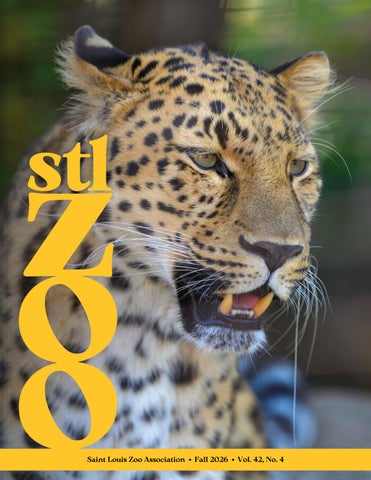
On the cover Amur leopard
Photo by Ray Meibaum stlzoo is published quarterly as a member benefit by the Saint Louis Zoo Association, One Government Drive, St. Louis, MO 63110. Managing Editor: Rebecca McMiller; Editorial and Email Assistance: Billy Brennan, Jill Gordon, Erin Heffernan, Erin Krippene, Kirby Meyer and Elaine Vydra; Graphic Design: McCord Design Group; Contributing Photographer: Ray Meibaum; Contributors: Members of the Zoo staff.
At the Saint Louis Zoo, we not only care about the conservation of animals, but also about the conservation of the environment. That is why stlzoo magazine is created using FSC- (Forest Stewardship Council) certified paper with recycled materials and eco-friendly inks.
Fall 2026
1
membership matters In this section, we’ll briefly highlight top Zoo happenings in October, November and December 2026, from event and attraction updates to member-specific reminders. If you have questions about your membership, please visit stlzoo.org/membership or contact us at (314) 646-4771, option 2.
Attractions and experiences Dinoroarus Included in member tickets; free for children 0-23 months Open seasonally through the end of 2027 Giraffe Feedings $2 discount per person
Remember to check out Boo at the Zoo and Wild Lights this season; Zoo members receive discounted tickets!
Open houses for Second Nature Zoo Preschool Preschool is more fun — and educational — by learning outdoors at the Saint Louis Zoo! Join us for our Second Nature Zoo Preschool open houses and learn about our Reggio-inspired program, where children’s interests guide their learning. The open houses are Sundays, Nov. 8, 2026, and Jan. 10, 2027, 9 a.m. to noon. RSVP at stlzoo.org/preschool.
Birthday adoption package available through the Zoo Parents Program Are you looking to give someone a unique birthday gift? Now when you purchase a Zoo Parents Program adoption at any level, you can turn it into a birthday package for $20 more. The add-on includes a 9" animal-themed balloon, a “Happy Birthday” button and a “Proud Zoo Parent” lanyard. We suggest pairing a plush toy adoption for $60 with this new birthday package. You’ll get all the items listed above, plus a 12" plush toy of your choice, personalized adoption certificate, color photo of the chosen animal with animal facts, and an invitation to the Zoo Parents Picnic. Shipping and handling are included within the contiguous United States. Best of all, your donation goes toward the care and feeding of our animals. Learn more at stlzoo.org/zooparents.
The Zoo is now cashless We’re glad to announce our transition to a fully cashless payment system on our Zoo campus. This change is designed to improve your experience, making transactions faster and more secure. Only have cash? Prepaid debit card kiosks are available inside Zoo entrances and at Lakeside Cafe — and will not require a fee — allowing you to transform cash into a pre-paid Mastercard that you can use anywhere Mastercard is accepted! Learn more at stlzoo.org/cashless.
2
stlzoo
The feeding schedule is 11:30 a.m. and 2:30 p.m. daily, weather and conditions permitting Emerson Zooline Railroad Included in member tickets; free for children 0-23 months Open year-round, weather permitting Mary Ann Lee Conservation Carousel Included in premium member tickets; free for children 0-23 months Open year-round, weather permitting Sea Lion Show presented by Together Credit Union Included in member tickets; free for children 0-23 months Aug. 28-Oct. 25 (Friday-Sunday only): 11 a.m., 1 and 3 p.m. Stingrays at Caribbean Cove presented by SSM Health Cardinal Glennon Children’s Hospital Included in premium member tickets; free for children 0-23 months Apr. 3-Oct. 31 Wild Explorer VR Experience $2 discount per person Showings daily
Zoo membership
Tickets to ZOOFARI
Behind-the-scenes tours
Give the Gift of the Zoo
Animal adoptions with plush toys
A Zoo gift is more than a perfect present; it creates lifelong memories for your loved ones, plus supports our conservation efforts. From tours and tickets to memberships and adoptions, there’s an adventure for anyone on your list. Plus, if you feel like a shopping outing, be sure to come to Holiday Zootique on Nov. 6 and use your member discount! Learn more at stlzoo.org.
Orders for holiday membership gifts will be accepted in late October. ZOOFARI tickets will go on sale by December.
wild We’re excited to bring you updates about Saint Louis Zoo WildCare Park, a safari park and conservation center set to open in 2027 on 425 acres near the confluence of the Mississippi and Missouri Rivers. In addition to stlzoo magazine, please follow us on social media for the latest updates about this one-of-a-kind wildlife experience.
4
stlzoo
Saint Louis Zoo WildCare Park brings new animals, new experiences and, for the Animal Health team, a new opportunity to expand their skilled care: herd-level medicine. At the 425-acre safari park, Animal Health staff provide veterinary care to individual animals with an emphasis on the wellness of animal herds residing in vast pastures. Herd-level medicine focuses on diagnosing, treating and preventing disease in a whole population and balancing that with an individual animal’s health. “With population medicine, you really want to dial in all of your preventative measures to optimize the health of the whole herd,” said Kari Musgrave, DVM, DACZM, Director of Animal Health. “When you have 20, 30 or 50 animals in a herd, if their health is off, it’s going to be more obvious than if you only have five animals.” As herds at WildCare Park grow with new arrivals and births, Animal Health staff work closely with keepers to determine what works best for the teams to conduct health checks, provide medications and facilitate medical procedures. “We’re really getting to optimize our vaccination protocols and nutrition to ensure that these animals have the best welfare and health possible,” said Dr. Musgrave. Over the summer, the Animal Health team began moving into the new Animal Health Center building at WildCare Park. Part veterinary clinic and part animal holding facility, the Animal Health Center features state-of-the-art facilities to provide the best veterinary care at the park. “We provide services to all Saint Louis Zoo campuses, and we really enjoy the variety of providing medicine in both a zoo and safari park application,” said Dr. Musgrave.
news... The newly completed Animal Health Center, where veterinary procedures and clinical work will be done at WildCare Park
With construction recently completed on the clinic area of the Animal Health Center, the team now runs blood and fecal samples on-site in the clinical pathology lab. Collecting and processing samples are crucial for the hands-off health monitoring approach for animals that live in expansive pastures. “The majority of veterinary care happens in the pastures to avoid separating animals from their herd,” said Dr. Musgrave, “so running these samples is the main way we can check in on not just that individual’s health, but the entire herd’s health.” Just like the Saint Louis Zoo’s veterinary hospital, the Animal Health Center at WildCare Park features state-of-the-art radiology and ultrasound equipment, treatment areas and its own pharmacy. The building also includes large double doors to move larger animals like banteng or roan antelope. Some equipment at the facility is specialized for safari park care, like an X-ray machine that is battery powered for easy transport and use anywhere on
campus. When Animal Health staff began their work at WildCare Park, one of their first purchases was binoculars, so they can observe and evaluate animals in their herd setting from a distance. Construction continues this fall on the animal holding portion of the Animal Health Center, where incoming animals will be quarantined and tested to make sure they are free from diseases and healthy before joining their herd. The animal holding area will feature convertible stall doors so animals can easily move between stalls and a padded induction stall to provide extra comfort during anesthesia inductions. “We are in constant talks with the design team, construction company and contractors for the animal holding space to make sure that it best fits the needs of the animals under our care,” said Dr. Musgrave. When WildCare Park opens in 2027, guests will see resident animals up-close, and Animal Health, Animal Care and Animal Nutrition teams will be behind the scenes ensuring the health of each herd.
Fall 2026
5
did you The Saint Louis Zoo is a member of the Roundtable on Sustainable Palm Oil (RSPO), an international non-profit organization set up to develop standards and drive demand for sustainable palm oil. This year, our Zoo was recognized as a “Top Scorer” on the RSPO Shared Responsibility Scorecard. This achievement reflects our commitment to driving positive change in the palm oil sector. Palm oil is a common ingredient in many household products and grocery items, including candy. As we approach Halloween, learn about palm oil and how your purchases have power.
6
stlzoo
1 What’s the problem with palm oil? Some entities harvest palm oil in a way that’s bad for animals — it ultimately destroys their rainforest homes. Just a few animals that can be affected are orangutans, Asian elephants and Congo peafowl. But others grow African oil palm trees, where palm oil comes from, in a way that’s safe for animals and the rainforest.
know? 3 How can I make wildlife-friendly choices when buying Halloween candy? Whether it’s Halloween or all year long, you can choose products that contain sustainable palm oil. The World Association of Zoos and Aquariums has a sustainable palm oil shopping app, which helps you find products that are friendly to animals.
2 How does the Zoo help advance and advocate for sustainable palm oil? Education is one of our most powerful tools. We have messaging on Zoo grounds, and we speak to guests at various events. We also ensure that the products we sell and create, like treats in our Candy Crossing shop, contain sustainable or no palm oil.
Want to learn more? Visit stlzoo.org/palmoil or rspo.org
Fall 2026
7
Silhouettes of the past By Rebecca McMiller,
Marketing Communications Manager Photos from Zoo Archives
W
hen walking up Historic Hill or passing through the 1904 Flight Cage, have you
ever wondered about people who, 100 years ago, walked the same paths or saw
the same sights? The Saint Louis Zoo is a nostalgic place. Guests smile at what hasn’t changed and reminisce about what was.
“Present time” can leave people scratching their heads while trying to navigate the new. It can be comforting to look back at a time that, in hindsight, is “figured out.” So, this
article offers a moment of reflection and brief transport into the past. The Zoo has many
chapters in its story — too many to include here — so here’s a glimpse of life at the Zoo in the first half of the 20th century.
8
stlzoo
Where it all began... “Clang, clang, clang went the trolley; ding, ding, ding went the bell...” Yes, the Zoo started its story with the 1904 World’s Fair.
The Smithsonian Institution commissioned the Flight Cage for the Louisiana Purchase Exposition at the 1904 World’s Fair. They intended to move it to the National Zoo in Washington, D.C. following the Fair.
But St. Louisans rallied to keep the Flight Cage intact, and the City of St. Louis soon purchased it for $3,500 (the structure had originally cost $17,500 to construct). Within a few short years, it served as the impetus for St. Louis to develop a full-fledged zoo — the first municipally supported zoo in the world. The Zoological Society of St. Louis was organized in 1910, and land was officially set aside for the Zoo in 1913.
1904-PRESENT Flight Cage
Fall 2026
9
A Growing zoo
By 1914, the Zoo had 193 animals, mainly birds, and welcomed 299,100 guests in 1917. Expanding and
maintaining the Zoo needed funding. The Missouri Legislature approved “the zoo act” in March 1915, which
provided for a public zoological park that would be “forever free to the usage of the inhabitants of the city wherein it shall be located.” In the decades to follow, several animal habitats were built, several of which remain today.
1917-present
1918-2012
Elephant House
Sea Lion Basin
This was the second structure ever built at the Zoo.
Before the 1.5-acre Judy and Jerry Kent Family
Its most popular resident was Miss Jim the elephant, who arrived in 1916. Miss Jim is famous for being
bought by children who contributed to penny drives, ultimately raising $2,384. The building was used
for animals until the 1950s, and since then, it’s been renamed as Peabody Hall and used as a gift shop, employee lunchroom, employee training center, temporary exhibits and (now) office spaces.
10
stlzoo
Sea Lion Sound exhibit was built in 2012, there was the Sea Lion Basin in the heart of the Zoo.
1921-2003
1925-present
1927-present
Bear Pits
The Monkey House
The Reptile House
The bear pits were among
The Monkey House (now called
Turtles, snakes and lizards
the first barless, moated exhibits in the nation, serving as an
example for other zoos in their animal care efforts. The goal
was to have a naturalistic-looking habitat for the bears. There were five barless bear pits total,
which gradually were removed
starting in 2003 to make way for
Penguin & Puffin Coast, and later, McDonnell Polar Bear Point and Centene Grizzly Ridge.
the Primate House) is one of the
decorated the rails around the
three Spanish-style buildings on
central atrium. It was Wallace’s
John Wallace. These buildings,
functionality. The Reptile House
red-tile roofs, charmed the public with
and it has remained a
Historic Hill designed by Zoo architect
vision to combine art with
with their stucco exteriors and
was a hit when it opened,
abundant terracotta ornamentation and
favorite of many guests
animal motifs throughout the friezes, rails and columns of the buildings.
(now called the Charles H. Hoessle Herpetarium).
Now connected to the Primate House is Michael and Quirsis Riney Primate Canopy Trails, a 35,000-square-foot
outdoor expansion with eight outdoor homes for monkeys and lemurs.
Fall 2026
11
1939-1983 1930-present Bird House
1929-2005 Small Mammal Pits These were constructed to
Spanish-style building to open
on Historic Hill. Adorned with
sculptures of birds inside and out, the building is another historic
look similar to the bear pits.
gem. Opening to an atrium filled
dogs, Malayan sun bears, and
is an oasis for guests and
Home to black-tailed prairie
with lush greenery, the building
from 1939 to 1952, pandas
home for many bird species.
the small mammal pits were
renovation, helping preserve
(Happy and Pao Pei). Most of demolished to make way for
Fragile Forest; however, part of
them remains in Schnuck Family Plaza (the former red panda and the black-tailed prairie dog habitats).
12
The Bird House was the third
stlzoo
The building is now under
the historical charm for years to come!
Ape House No semblance of the Ape House exists today — it stood on
what is now Jungle of the Apes — but it was home to Phil, a beloved western lowland gorilla who
lived at the Zoo from 1941 to 1958 (pictured on page 1).
He was estimated to weigh a whopping 550 pounds. The Ape House was an
open-air building with bars,
so guests stood outside to see him (sometimes receiving a
playful splash of water from Phil). A statue of Phil is now outside Jungle of the Apes and is
a popular Zoo landmark today.
Guest life 100 years ago
Life a century ago was just more formal. A Zoo visit today usually involves sunscreen and activewear, but in the Zoo’s early years, you likely would’ve seen men in suits and women in skirts or dresses. In fact, for the first half
of the 20th century, it was observed that guests wore their “Sunday Best” to the Zoo. And to get here, they had a lot of commuting to do! Motor vehicle ownership wasn’t as prevalent as today — about a 32-fold difference
from 1920 to 2026 — so many people got to the Zoo via bus from streetcar stops. It was also normal to casually walk or bike through the Zoo as part of a Forest Park visit; until the 1960s, the Zoo had no perimeter fence.
Below: A snapshot of a Zoo visit in the 1940s. The building in this photograph was one of the Zoo’s early concession stands, where guests would buy carnival-like treats like popcorn and ice cream cones.
Looking forward... A lot has changed across the Zoo’s landscape, and new chapters will begin soon with Henry A. Jubel
Foundation Destination Discovery and Saint Louis Zoo WildCare Park. But nostalgia is valued at this
historic organization, and the Zoo will always be a place where generations can come to remember the past, enjoy the present and be hopeful about the future.
Fall 2026
13
s e n o ’ this e h t for
s t ca y martin, m e r e j , i r o d t e keepers garr ray meibaum by carnivore jeff wilson | photos by g and t u wouldn’t wan maddie syber g cats. W hile yo cats call the Five species of ’re home, and they Saint Louis Zoo ests. t beloved by gu among the mos especially tug on The big cats can us use they remind heartstrings beca fact, nds at home. In of our feline frie iss W hiskers or your domestic M at home share Mr. Cottonsocks NA % of the same D approximately 95
14
stlzoo
with bi wild ith a big cat — to cross paths w ill love ts — you can st animals aren’t pe aps at the Zoo, perh them from afar eater. ur favorite cat sw while wearing yo s you can can discover way Even better, you the world, terparts around help their coun e some ngered. Here ar as many are enda oo visit! u can see on a Z of the big cats yo
samson
male amur leopard • big cat country
What are their special traits?
he will often bounce off the walls with
managed population of over 200
the Russian Far East and parts of
time, he’s a great learner and participates
breeding programs, cutting-edge
is uniquely adapted to survive harsh
allowing us to work on many behaviors
With a thick, pale coat and widely
What wild threats do they face?
Native to the temperate forests of
amazing grace and agility. At the same
northeastern China, this elusive cat
in his training sessions with ease,
winters, deep snow and extreme cold.
to help us attend to his health care.
spaced rosettes, the Amur leopard is
perfectly camouflaged in snowy forest landscapes. Samson has a dense coat that grows up to 7 centimeters long to insulate against the cold.
Tell us about his personality. Samson has strong opinions at times and loves to share them. When he’s
excited, especially around mealtimes,
The Amur leopard is one of the most
endangered large carnivores on Earth. Fewer than 100 individuals remain in
the wild. Threats include prey scarcity and illegal wildlife trade.
What is the Zoo doing to help? Zoos worldwide have become critical partners in Amur leopards’ fight
individuals. Through coordinated research, financial support for field conservation and powerful public
education, zoos play an indispensable role in preventing the Amur leopard from vanishing forever. In 1991,
the Saint Louis Zoo had the first recorded litter of Amur leopards in an Association of Zoos and
Aquariums (AZA) organization.
Since then, we have had six litters,
resulting in nine cubs, and we continue to participate in the Amur Leopard Species Survival Plan (SSP).
for survival, maintaining a carefully
Fall 2026
15
cora
female cheetah • river’s edge
What are their special traits? Cheetahs like Cora are highly
specialized, high-speed hunters,
reaching top speeds of nearly 70 miles per hour! Some physical traits that
help them attain and maintain those
high speeds include enlarged lungs and heart to increase oxygen intake and
the ability to pump oxygenated blood
throughout their body; semi-retractable claws that act as cleats to provide
traction to their long, powerful legs; and a long and strong tail that acts
as a rudder, which helps with balance
and turning at high speeds. The cheetah is one of the few diurnal, or daytime, hunters in Africa.
Tell us about her personality. Cora has a fiery spunk about her,
with a soft, tender side that comes
out especially around her cubs. As a
first-time mother, she has been vigilant and fiercely protective of her cubs.
Even though she takes her mothering duties very seriously, she can often be found joining in on playtime with her cubs.
What wild threats do they face? Wild cheetah populations have been declining, with only around 7,000
remaining in the wild. Habitat loss
and fragmentation leading to human-
animal conflict and the illegal pet trade are the two largest forces behind that decline. The Cheetah Conservation
Fund (CCF), based in Namibia and Somaliland, is on the ground in the
cheetah’s wild habitats curtailing both issues. In Namibia, CCF has many
programs that help the wild cheetah,
including education outreach with local schools and, importantly, farmers to
teach them that the cheetah is not what they fear. In Somaliland, CCF acts as
a wall, stopping much of the illegal pet trade at the borders smugglers use to
transport their illegally acquired cubs.
our work ensures that the assurance population living in human care continues to thrive. 16
stlzoo
CCF has rescued hundreds of cubs from that horrible fate.
What is the Zoo doing to help? The Saint Louis Zoo participates in the Cheetah Breeding Center Coalition
(one of 10 member zoos), AZA SAFE (Saving Animals From Extinction)
and the Cheetah SSP. The Saint Louis Zoo WildCare Institute, the field
conservation arm of the Saint Louis Zoo, also helps cheetahs through its Cheetah Conservation Program.
ussuri
male amur tiger • big cat country
and mountains in Russia and northern
China. An Amur tiger has a thick long coat with a fluffy ruff around their
neck to keep them warm, plus extra fur on their wide paws to create natural
snowshoes when walking through deep snow. Unlike most cats, tigers love to swim. You can see Ussuri cooling off
in his pool most days in the summer. Tell us about his personality. Ussuri has a very curious personality.
He loves watching guests walk by while he lounges on his platform. He is also our known toy tester.
If an enrichment item survives Ussuri’s claws, teeth and strength, they can What are their special traits? Amur tigers are the largest cat species
in the world. They are built for extreme cold in their native habitat of forests
zuko
male ocelot • big cat country
What are their special traits? Native to a variety of habitats from
Texas to Northern Argentina, ocelots
are incredibly agile in the forest trees.
In the wild, they primarily hunt rodents on the ground but will also ambush
birds and small primates in the trees. They can jump up to 8 feet high in one leap!
Tell us about his personality. Zuko is a joy to work with. He brings a lot of energy to new enrichment
and to training sessions. He also loves “catching” mice. These are already
survive any other carnivore. He is a
very chatty cat, like his dad, and can be heard around Big Cat Country
What wild threats do they face? The Amur tiger is endangered,
facing a high risk of extinction in the wild. There are an estimated 350 to
450 wild Amur tigers left in the world. Their number and range have been reduced due to many threats from
human activities. Tigers are poached for their coats and body parts in the illegal wildlife trade. Their habitat is under pressure from logging,
forcing them to hunt livestock and
increasing human-wildlife conflict. What is the Zoo doing to help? The Zoo participates in the Amur
Tiger SSP, which helps ensure the
survival of the species with multiple zoos working together.
talking to his mom, Reka, across the habitat or to his keepers.
deceased rats and mice that are sourced
knowing they are healthy individuals we can safely feed to our animals. We hide these in PVC pipes, in balls with holes or other toys.
What wild threats do they face? People may not know that ocelots
are native to the U.S.! Historically,
they were found from California to
Louisiana, but now the U.S. population
consists of fewer than 100 cats in Texas. They were hunted for their coats and seen as nuisance animals. Now, the
challenge is that their former range in
the U.S. has only fragments of suitable
What is the Zoo doing to help? With very few individuals in the
population over decades, another threat to the wild population is low genetic diversity. The Zoo participates in the
Ocelot SSP. One focus of this program is increasing the genetic diversity in our zoo ocelot population, done by
matching the right individuals together
and by researching ocelot reproduction. Then, with a new breeding facility
recently built in Texas, zoo ocelots will
be matched to breed with wild ocelots, and the kittens will be released into the wild.
habitat left, and these areas aren’t well
connected with corridors for ocelots to move through safely.
Fall 2026
17
Trust, choice and time: The foundation of exceptional animal care By Sabrina Heffern, Public Relations Specialist; Photos by Ray Meibaum
A prairie dog accepts food from a
keeper. A young sea lion learns that
that can affect the ‘trust bank,’”
steps onto a hand for the first time.
“Sudden loud noises or even a
mistakes are okay. A golden conure To Saint Louis Zoo guests,
these moments may seem small.
But for Animal Care staff, each one
is a milestone, earned through hours, months and sometimes years of
the Sea Lion Team explained.
okay to make mistakes and nothing bad will happen when they do,” the team explained.
The philosophy is used throughout
bug flying by at the wrong moment
the Zoo, including at Henry A. Jubel
That’s why choice and control are
where Keeper Sarah Gratton works
can startle an animal during training. so important.”
Keepers at Judy and Jerry Kent
Foundation Destination Discovery, with a wide variety of animals and
species. She knows that each one has
relationship building.
Family Sea Lion Sound use positive
tools in a keeper’s toolbox. It can’t be
with the Zoo’s resident pinnipeds.
are naturally wary of people and
and completely voluntary. When an
over being exposed above ground.
Trust is one of the most important
forced, purchased or rushed. Instead,
it’s built gradually through consistent positive interactions, one experience at a time.
Keepers say trust is like a bank
account. Every positive interaction
makes a deposit, building confidence
and comfort. Every negative experience makes a withdrawal.
Destination Discovery Keeper Sarah Gratton builds a relationship with a black-tailed prairie dog
18
“There are many external factors
stlzoo
reinforcement to train behaviors
The approach is consequence-free
animal responds correctly to a cue, they’re rewarded with a tasty fish
treat! When they get it wrong, keepers simply pause and try again.
“During those pauses, the animals
realize we didn’t get the response we were asking for. They learn that it’s
a unique history and natural instincts.
The Zoo’s prairie dogs, for example,
often prefer the safety of their tunnels By consistently pairing their presence with food and positive experiences,
Gratton and her team gradually taught the prairie dogs that keepers can be approached rather than avoided.
Now, the animals are confident
with their keepers, and several even
Zoological Manager Kyle Ulmer and Sea Lion Trainer Katie Stryker conduct a training session with a California sea lion
Destination Discovery Keepers Sarah Gratton and Tiffany Evans take the sheep for occasional walks; it helps them build trust with people (and is great exercise!)
participate in training behaviors.
That’s when trust becomes more than a bond. It becomes an essential part of animal care.
Once trust is established,
keepers build upon the foundation to
support animal health and well-being. Trust is the critical first step for animals participating in their own health care.
At Sea Lion Sound, California
sea lions and harbor seals voluntarily present flippers for examinations, participate in eye exams, accept
injections, open their mouths for dental care and even take part in blood draws.
The key word is voluntary. Animals
can choose whether to participate,
reducing stress and helping veterinary
teams monitor health concerns quickly and effectively.
The same principles guide care at
“We want them to understand
what’s happening, and be calm
throughout the process,” Gratton said. Through trust-building and
along the way.
Whether it’s a prairie dog
emerging from its burrow or a sea lion
and become comfortable with the
trust creates opportunities for care
stand calmly, accept hoof handling sound of buzzing shears. Those skills will help them prepare for their first shear and participate in husbandry
and health care throughout their lives.
presenting a flipper for a health check, that couldn’t happen otherwise.
For Gratton, those moments make all the work worthwhile.
“I’ll never forget when our male
Establishing the foundation early
golden conure, Harry, stepped into
an animal has, the more prepared
“It was his first time in any human’s
is key. The more positive experiences they are to participate confidently as they grow.
“Animals are as unique as people,”
said the Sea Lion Team. “When you
my hand for the first time,” she said. hand, and I remember feeling so
honored that he trusted me enough to do it.”
At the Zoo, exceptional care
learn an animal’s personality and
doesn’t begin with training cues or
the progress is a really special thing
earlier, with the trust that allows
discover what works for them, to experience.”
Young sea lions Nova, Porter and
Bristol arrived at the Zoo with little
comfortable with an important part
Gratton and the prairie dogs, the
of sheep care: shearing.
humility, patience and persistence
training, the lambs are learning to
Destination Discovery, where Gratton’s team is helping young lambs get
from the ground up, prioritizing
to no training experience. Like with Sea Lion Team had to build trust
veterinary procedures. It begins much animals to participate in their
own care, make choices and thrive. Every health check, husbandry
behavior and training milestone is built on that foundation.
Fall 2026
19
Humped tree snails (Partula gibba) with baby after arriving in Hawaii
Garcia; U.S. Fish and Wildlife Service Biologist Lauren Taylor; and members of the Snail Extinction Prevention Program staff
A big rescue for tiny animals Article and photos by Kayla Garcia, Zoological Manager of Invertebrates
If you had told me that I would find
rescue critically endangered and
(Partula gibba). Once widespread
weeks’ notice, I would have laughed
the Pacific. While most program
it’s now limited to a handful of
myself in Hawaii with less than two it off. Yet there I was, walking along Waikiki Beach after an eight-hour flight. Unlike many of the people
around me, it wasn’t the island’s sun
and surf that brought me there. I had
booked a trip from St. Louis just four
days earlier for one reason: To pick up 25 endangered snails that had been evacuated from Guam.
As Zoological Manager of
species are native to French Polynesia, several Partula species can be found in Guam and the Commonwealth of the Northern Mariana Islands (CNMI). We have spent the last
several years working to bring these
of a 40-year international effort to
stlzoo
Harvard researcher Henry Crampton recorded collecting 6,000 P. gibba from Guam for his studies.
Typhoons have further threatened
storms have battered Guam and the
Like many island ecosystems,
and introduced predators such as rats,
The Partula Snail Program is part
decline is striking: In the 1920s,
breeding programs.
aren’t currently represented in any zoo
and coordinate two conservation Partula Snail Program.
small populations. The scale of this
these fragile populations. In recent
Guam has experienced severe declines
programs, one of which is the
throughout the Marianas,
species into human care because they
Invertebrates, I oversee the day-to-day activities of the Bayer Insectarium
20
extinct-in-the-wild snails throughout
in native wildlife due to habitat loss brown tree snakes, predatory snails and flatworms.
One of the most vulnerable
species is the humped tree snail
decades, increasingly powerful
CNMI, damaging forests, disrupting infrastructure and reducing canopy cover that provides critical shelter
for sensitive species. After Typhoon Sinlaku caused significant damage earlier in the year, conservation
partners decided to evacuate 25 adult humped tree snails ahead
of Category 5 Super Typhoon Bavi,
Service biologist, escorted me through
on July 6.
delays. After just over 48 hours in
which was forecast to make landfall With only a few days’ notice,
partners at the University of Guam
the airport to ensure there were no Hawaii, I was headed home.
The snails and I arrived in
collected snails from their last-known
St. Louis at 8:30 a.m., just in time
before access was restricted. The snails
They now reside in a specialized
population on Marine Corps property were flown to Honolulu by U.S. Fish
and Wildlife Service staff evacuating the island. Hawaii’s Snail Extinction Prevention Program (SEPP), which manages conservation efforts for dozens of native Hawaiian snail
species, provided temporary housing. Staff worked late into the night to
for the morning keeper routine.
incubator in the Insectarium that replicates the temperature and
humidity of Guam. Our team is carefully monitoring them with
the hope of building a sustainable
population that can one day return to their island home.
This snail relay was only
settle the snails and discovered that
possible because of the dedication
Now it was time to bring them
Moments like these reinforce how
one baby had been born in transit. to St. Louis.
My journey began with a 3 a.m.
wakeup and flights through Chicago to
and cooperation of many partners. critical working together actually is for conservation action to be successful. While we were able to move the
Honolulu. I carried a cooler, transport
snails to safety, Super Typhoon Bavi
care for the snails on the return trip.
region. We still don’t know the status
containers, food and supplies to
Twenty-two hours and an unexpected
beach stroll later, I finally passed out to
get some rest before meeting the snails. The next day, we checked on the
snails, which were doing well! In fact,
six more babies had already been born. Partula, unlike many snail species, give live birth, producing one tiny
caused extensive damage across the
population on Guam. On neighboring Rota, where other rare snail species
are found, recovery may take months. The people, plants and animals of the
Marianas are resilient, but a long road lies ahead.
I hope this story helps raise
awareness of both this remarkable
conserving these remarkable animals
the Saint Louis Zoo has proudly
was a professional dream come true. On Thursday, we packed the
snails for the final leg of their journey. Lauren Taylor, a Fish and Wildlife
A view of Hawaii from the flight home
of the remaining humped tree snail
baby at a time. Visiting the SEPP lab and meeting the people dedicated to
Garcia and U.S. Fish and Wildlife Service staff see the snails for the first time
region and a conservation effort that supported for decades. You can learn
about our work for Partula snails and other threatened animals by visiting stlzoo.org/wildcare.
Garcia unpacks snails in St. Louis
Fall 2026
21
Marbled teal
the hap October, November and December Sea Lion Show presented by Together Credit Union
Want to go behind the scenes? Share an experience like no other when you book a behind-the-scenes tour at the Saint Louis Zoo! There are several tours offered during the colder months, including: • Chirping Cheetahs • Ears, Paws and Claws • Gentle Giants • Here, There and Grizzly Bear • Hip Hippo Hooray • Penguin Encounter • Planet Protectors • Reptile Rendezvous • Rhino Ramble Some tours have limited availability. Learn more and book at stlzoo.org/tours.
22
stlzoo
Dates and Showtimes: Aug. 28-Oct. 25, 2026 (FridaySunday only): 11 a.m., 1 and 3 p.m. Member Price: Included in member tickets; Free for children 0-23 months Sea lion superstars will thrill you with jumps and lots of splashing!
Boo at the Zoo presented by SSM Health Cardinal Glennon
Holiday Zootique Date: Friday, Nov. 6, 2026 Time: 9 a.m.-8 p.m. Price: Free Get a jump on holiday shopping and find unique, conservation-oriented gifts you can’t find anywhere else. Zoo members receive special discounts, and volunteers will be available to wrap your gifts for you. And NEW this year: Local vendors will be on-site selling merchandise from 4-8 p.m.!
Second Nature Zoo Preschool Open Houses
Dates: Select nights, Oct. 9-30, 2026; Sensory-Friendly Night is Oct. 12 Member Price: $13; Free for children 0-23 months
Dates: Nov. 8, 2026, and Jan. 10, 2027 Time: 9 a.m. to Noon Price: Free; RSVP at stlzoo.org/preschool
Join us for a non-scary, kid-friendly Halloween event across our EXPANDED event footprint, now creeping up Historic Hill with more decorations and animals to see! Sponsored by: SSM Health Cardinal Glennon, Mid America Chevy Dealers, Prairie Farms Dairy, Wells Fargo, The Goddard School and Dot Foods, Inc.
Preschool is more fun — and educational — by learning outdoors at the Saint Louis Zoo! Join us for our Second Nature Zoo Preschool open houses and learn about our Reggioinspired program, where children’s interests guide their learning. Students spend 50% of their day outdoors and draw inspiration from animals and nature. The academic year runs from September to May; registration for the 2027-28 school year opens in January. Financial aid is available.
appenings Wild Lights presented by Commerce Bank Dates: Select nights, Nov. 27Dec. 30, 2026; Sensory-Friendly Night is Dec. 7 Member Price: $16; Free for children ages 0-23 months Jingle all the way through the Zoo as you marvel at dazzling light displays; roast s’mores over fire pits; and meet the big man himself, Santa! NEW this year: Wild Lights has an expanded footprint across Historic Hill, with more animals to see than ever! Sponsored by Commerce Bank, Mid America Chevy Dealers, Coca-Cola, Prairie Farms Dairy, BJC Health, Spire, Caleres, Inc., and Dot Foods, Inc.
Santa’s Pancake Party Dates: Select Saturdays and Sundays, Dec. 5-20, 2026 Time: 8:30 and 10:30 a.m. seating times Member Price: $30 (2 years and up); free for children 0-23 months old Dash through the snow and enjoy a holiday-themed pancake breakfast at the Zoo. The guest of honor is the big man himself — Santa! While Kris Kringle shakes his belly like a bowl full of jelly, you can fill yours up at the buffet with pancakes and toppings galore. Mark the moment by taking your own photos with Santa, and enjoy the rest of your day exploring the Zoo! Tickets on sale in early November.
Mexican red-kneed tarantula
Hours Oct. 8 through Dec. 31, 2026 9 a.m.-4 p.m daily, except holidays Last entry is 15 minutes before listed closing time.
Holiday Hours: Nov. 26, 2026: Thanksgiving Day 9 a.m.-2 p.m. Dec. 24, 2026: Christmas Eve 9 a.m.-2 p.m. Dec. 25, 2026: Christmas Zoo closed Dec. 31, 2026: New Year’s Eve 9 a.m.-3 p.m. Jan. 1, 2027: New Year’s Day Zoo closed
Details are subject to change. See what’s new and get the latest at stlzoo.org.
Western lowland gorilla
Fall 2026
23
A time for adults to be kids again! By Lia Reilly, Zoo Educator
This past summer, we were excited
Sound. These two experiences really
Participants gathered at the Saint Louis
It was exciting to hear all our campers’
to debut our Adult Camp program! Zoo for a two-day experience and
dove into the topics of animal care and our conservation efforts through the
Saint Louis Zoo WildCare Institute. Over the two days, we had many
experiences for the campers. We started with Saint Louis Zoo trivia and then went on a train ride! After, we went
back to the classroom and learned about our animal care and conservation work. Next, campers played games and did
arts and crafts that centered on those
topics. (What would camp be without arts and crafts?) One of the crafts was
making a magnet out of paintings made
by sea lions. This tied into learning about enrichment as part of animal well-being. Camp also included some behind-
not known about before.
We decided to offer this camp
because we felt adults could really
enjoy reconnecting to the childlike
wonder experienced in camp. When we asked participants why they wanted to attend camp, there were answers such
as “Because I have always been jealous of the kid programs,” and “I’ve been
coming to the Zoo my whole life and
never heard of or been to a Zoo camp.” In our post-camp survey, we had 86%
of campers satisfied with the experience, noting they would like to come back in the future.
We can’t wait to build upon what we
and our life support systems underneath
themselves and to feel like a kid again!
Our first-ever group of Adult Camp participants
stlzoo
around the Zoo that they may have
did this summer so that even more adults
Judy and Jerry Kent Family Sea Lion
28
questions and take them to places
the-scenes experiences. Campers visited
our Orthwein Animal Nutrition Center
Campers enjoyed fun experiences throughout their two-day program, including (from top to bottom) train rides, a tour of the Orthwein Animal Nutrition Center and trivia games
highlighted animal care at the Zoo.
can experience the Zoo as campers
Above and right: Night at the Zoo guests enjoy STL Zoo Bier and other Urban Chestnut beers
Making every pint count: A toast to conservation By Hannah Stater Jensen, Partnership Marketing Coordinator
Since 2019, the Saint Louis Zoo has
species to call the Charles H. Hoessle
Brewing Company to create STL
12 years.
collaborated with Urban Chestnut
Zoo Bier in an effort to raise awareness
Herpetarium home in more than
STL Zoo Bier is a crisp, classic
about the importance of animal care
light lager with extra hops, and it
the proceeds from each case sold giving
campus and in gift shops. You can also
and conservation. With a portion of
back, Urban Chestnut has raised over $95,000 for the Zoo.
Throughout the years, the Zoo’s
official brew has spotlighted a variety of species, including the grizzly bear,
king penguin, Amur leopard, red panda
can be purchased at Zoo eateries on find it at Urban Chestnut locations,
dedication to the Zoo and broader St. Louis community and look
forward to many more years of STL Zoo Bier. Prost!
St. Charles County and the Metro East area.
Urban Chestnut also annually
the endangered Komodo dragon,
where guests age 21 and up can sip on
old Charlie, who is the first of his
We appreciate Urban Chestnut’s
in St. Louis City, St. Louis County,
supports Zoo events, including
celebrating the arrival of 6-year-
events, visit stlzoo.org/events.
as well as in grocery stores and retailers
and ring-tailed lemur.
This year, the featured animal is
For more information about our
Night at the Zoo and Zootoberfest,
their very own pint of STL Zoo Bier as they stroll through the Zoo.
Fall 2026
29
The power of a long view By Rachel Anders, Manager of Major Gifts & Grants
For nearly eight decades, the
David B. Lichtenstein Foundation has invested in opportunities that
Foundation Destination Discovery and
Saint Louis Zoo WildCare Park to life.
At the time, many of the details that
strengthen communities across
Zoo guests can now see taking shape
continues under the leadership of
renderings were still being refined,
Missouri. Today, that commitment Chairman Davida Lichtenstein, whose
legacy of philanthropy is helping shape the future of the Saint Louis Zoo.
The Foundation was established in
1947 by Davida’s grandfather, David B. Lichtenstein, a St. Louis banker
existed largely as concepts. Architectural
Foundation’s trustees felt confident investing early.
“We’d been working with the Zoo
to be fantastic,” Davida said. “No matter and wonderful. We trust the Zoo.” That trust was built over
Foundation to become an early
generations of connection to the Zoo.
Better Wild, Better World capital
long been more than a destination.
campaign. In February 2022, the
Foundation committed $2 million to help bring Henry A. Jubel
For Davida, the institution has
She describes it as a second home.
“My mom and dad started taking
us to the Zoo at a very young age,
Conceptual rendering of a WildCare Park glamping cabin
30
stlzoo
and enjoy.”
Although Davida lives in
on the Association Board from
what the Zoo does, it’s always exciting
supporter of the Saint Louis Zoo’s
you can feel safe and comfortable
the drawing board. Yet Davida and the
of the future experience remained on
citizens of Missouri, with a particular That commitment led the
and inviting place. It is a place where
Columbia, Missouri, she remained
for so many years, we knew it was going
focus in St. Louis and Columbia.
and years,” she said. “It is such a warm
plans continued to evolve and much
and financial leader. By charter, the
Foundation’s resources must benefit the
and it has just continued for years
deeply involved with the Zoo, serving 2020 through 2025. Her firsthand
understanding of the Zoo’s mission
helped inspire the Foundation’s early campaign investment.
“We wanted to open up
opportunities for other people,”
Davida said. “The safari and the
glamping experiences were new and exciting things the Zoo hadn’t been
able to do in the past. We wanted to
be a part of the expansion of the Zoo.” Today, as Destination Discovery
prepares to welcome guests and WildCare Park moves closer to
Conceptual rendering of the Chilean flamingo habitat at Destination Discovery
opening, the Foundation is
After months of expert care, the chicks
that early investment.
being raised behind the scenes until
beginning to see the impact of The David B. Lichtenstein
Foundation gift will be commemorated in two meaningful locations across the campaign. At Destination Discovery, the Foundation will be recognized at
successfully hatched and are currently
young birds will help inspire the next
up there,” she said.
Destination Discovery opens, these generation of conservationists.
to be able to sleep there and wake As the Zoo’s transformational
In many ways, their journey
projects become reality, the David B.
itself: Meaningful investments are
confidence in the vision is helping
below-water viewing opportunities,
often made long before results
observe the birds’ feeding behaviors
“There is nothing more relaxing and
exciting than being that close to nature,
reflects the nature of philanthropy
the habitat will allow guests to
and the natural world.
their new home is ready. When
the one-of-a-kind Chilean flamingo habitat. Featuring both above- and
powerful connections between people
become visible. With care, patience and time, those investments grow
Lichtenstein Foundation’s early
create new opportunities for discovery, conservation and connection. The Foundation’s gift is a
into something extraordinary.
continuation of a family legacy that
story of patience and growth. In 2025,
recognition will be located at one of
benefit the Zoo far into the future.
flamingo eggs from Zoo Atlanta.
the overnight experience will create
from new perspectives.
The flamingos themselves tell a
the Zoo welcomed a group of Chilean
At WildCare Park, the Foundation’s
the glamping cabins. Davida believes
began nearly 80 years ago and will
Fall 2026
31
Marlin Perkins Society The Saint Louis Zoo is extremely fortunate to have the support of more than 1,300 generous individuals, foundations and corporations through the Marlin Perkins Society. We welcome our newest members to the Society and thank them for joining this wonderful group of supporters. To our current members who have increased their financial support, we are pleased to recognize you as well. We are grateful for your commitment to our mission.
New Marlin Perkins Society Members
Joan Gettemeyer (10)
Dr. & Mrs. Alexander Rose
June 1 – July 31, 2026
Surendra & Karen Gupta
Beverly & Larry Ruser, Sr.
Carol K. Gravens
Scott & Judy Guerrero (10) ARC Foundation (10)
Jeff & Maria Lux
Allan & Deborah Hall (10)
Thomas & Lisa Spinner
Rick & Sharon Huemoeller
Robert & Dena Nelson Wildly Inc.
Current Marlin Perkins Society Members Who Have Increased Support June 1 – July 31, 2026 Beth Anderson
Ronald L. & Cheryl L. Bednar (10) Mary Ellen Campise (15)
Central Bank of St. Louis (20) Susan Colegrove
Marcia Hart & Gene Fluri
Ann Hogan (20)
Robyn & John Huhn
Will & Arlene Ross
David C. Smith & Mary Smith
Mr. & Mrs. Robert P. Tschudy (25) Jane & Chip Wiese (10) Terry Williams
Ali & Kyle Kochtanek
(10) denotes member for at least 10 years
Bruce & Diana Linders (15)
(20) denotes member for at least 20 years
Jeffrey & Louise Levine (20) Ms. Deborah K. Martens (10) John P. McGuire
(15) denotes member for at least 15 years (25) denotes member for at least 25 years
John & Susan Moore
Please contact the Development Office
Ron Noltemeyer (15)
• Would like information on how you
Stan J. Niemann
Mr. & Mrs. David R. Poth
at (314) 646-4859 if you:
can join or increase your support to the Marlin Perkins Society.
• Discover a discrepancy or have a
question (the Zoo makes every effort to acknowledge all gifts and to maintain accurate records).
Pichincha dart frog
32
stlzoo
Honor Roll The following list represents new major and planned gifts and pledges, excluding Marlin Perkins Society and other membership gifts, made to the Saint Louis Zoo Association from June 1 to July 31, 2026. Donors are listed in the category of their most recent giving to the Saint Louis Zoo. Leadership Gifts
$5,000,000 and Above Anonymous $4,999,999 – $1,000,000 Estate of William D. Kleyboecker
Major Gifts
$499,999 – $250,000 Estate of Sandra J. Knussman The Frederick Pitzman 1889-1951 Fund $249,999 – $100,000 Ms. Kathryn A. Aschenbrenner Lisa Mechele In loving memory of Yumiko Foust Virant: Mary Ann & John Virant John, Katie & Zoe Virant Janice Virant & Cody Huff Paul, Jennifer, Lincoln & Zane Virant Steve Virant Tom, Wilson & Andrew Virant
Special Gifts
$99,999 – $50,000 Robert & Christina Campbell Jordan Charitable Foundation Estate of Ann M. Parke $49,999 – $25,000 Anonymous The Biggs Family Charitable Foundation E. Reuben and Gladys F. Grant Charitable Trust JMS Foundation, Marie Jacob, Trustee Dr. & Mrs. James C. Speiser
$24,999 – $10,000 Larry, Judy & Louie Glazer Patricia & Timothy Goldsbury Robert & Ilene Jenkins Lenoir Charitable Trust Caroline Loughlin Fund Estate of Howard & Penny Miller Quentin & Cassandra Ray Beverly Ruser, in memory of Larry Ruser, Sr. Lois & Michael Stemmler $9,999 – $5,000 Dot Foods, Inc. Carol K. Gravens Hannah & Larry Langsam Alix Rogers & John Flynn Sue & Kliff Shinn James R. & Mary C. Walters $4,999 – $2,500 Rudy & Sandy Beck Blueprint4SummerSTL William W. Bryant Foundation Mr. & Mrs. Theodore P. Desloge, Jr. Carter & Cathy Dunkin Judith S. & John D. Kapeller Drs. Dan & Susan Luedke Mr. & Mrs. Scott Monette Dr. Stanely J. Niemann David & Cheryl Poth Pamela Taylor James & Jean Terry Hank Webber & Christine Jacobs
$2,499 – $1,000 Anonymous Dr. Holly Bernstein Thomas & Sandra Brownlow Deloitte, LLP Mr. & Mrs. Arnold W. Donald Suzanne & Dennis Fetter Marie Guariglia Mark & Patricia Gunby H. Smith & Janet McGehee Larry G. Mrazek Alan & Jeannette Nissenbaum Rick & Sarah Ryan Estate of Mildred M. Soos Edwin & Nancy Spiegel John & Joan Vatterott Mrs. Phyllis L. Weber Bonnie Barton Summers Wolfarth $999 – $250 Barbara & Stephen Archer Family Jon & Julie Baker Scott & Christine Berlinger Curtis Cook Marjorie & Dale Ehlers Ms. Joan L. Gettemeyer Michael & Maureen Hoock Carolyn E. Kelly Lauren & Dave Kingsten Roger Lehman Ann Lenssen Mitch Pulwer & Miki Sheridan SitusAMC & Apollo Family Roger & Peggy Steinbecker Kenneth & Sharon Stover James & Leatrice Virtel The Saint Louis Zoo Development Office regrets any errors or omission of any gift. If you would like to change your honor roll listing, contact Katie Meyers at meyers@stlzoo.org.
Fall 2026
33
Tribute Fund Donors providing the Saint Louis Zoo Tribute Fund with gifts of $25 or more from June 1 to July 31, 2026, to honor or memorialize events and loved ones include:
In Memory Of
In Honor Of
Mrs. Sally C. Johnston
Janet Gilbert
Carol C. Benoist
Susan Morse
John & Joan Vatterott
Ellen Shafer
Merah
Mr. John R. Drew
Ms. Eleanor Hecht
Mr. & Mrs. Rick Halpern
Lola Neudling
Katelyn Garcia
Ms. Judith L. Ciegel &
Employee Community Fund
Mr. Mike Crecelius
of Boeing St. Louis
Veda M. Travis
Sonya Helmkampf
Lieske Giese
Mr. & Mrs. Michael N. Newmark Lenora Hoch
Judy Kouchoukos James & Leatrice Virtel Todd Rogan Michael Caton Dr. Edward H. & Mrs. Deborah L. Schwarz Robert & Barbara Hoffman Alex & Annemarie Shaffer Teresa J. Lord
Jamie L. Baker
Lori A. Sullivan Mr. Jeffrey L. Huntington
Robin & Michael Kraujalis Peter D. & Andrea Van Cleve Bill Van Cleve
Red panda
34
stlzoo
The Future of
the
Zoo Grows with You.
Scan here to discover how your support can make a difference.
SSM HEALTH CARDINAL GLENNON
Select Nights, Oct. 9 - 30
Select Nights, Nov. 27 - Dec. 30
Save the dates for the best holiday events in St. Louis!
PRESENTED BY
Select Nights, Oct. 9-30, 2026; Sensory-Friendly Night is Oct. 12 $13: Zoo Members; 5-8:30 p.m. Free for children 0-23 months Join us for our non-scary, kid-friendly Halloween event across our EXPANDED event footprint, now creeping up Historic Hill with more festive decorations and animals to see!
PRESENTED BY
SSM HEALTH CARDINAL GLENNON
Animal Habitats Open: Bayer Insectarium, Charles H. Hoessle Herpetarium, Holekamp Aqua Tunnel, Primate House, Stingrays at Caribbean Cove presented by SSM Health Cardinal Glennon Children’s Hospital Attractions to Enjoy: Dinoroarus, Emerson Zooline Railroad (additional fee), Mary Ann Lee Conservation Carousel, 4D Theater, Wild Explorer VR Experience (additional fee)
Sponsored by SSM Health Cardinal Glennon, Mid America Chevy Dealers, Prairie Farms Daily, Wells Fargo, The Goddard School, and DOT Foods
Select Nights, Nov. 27 – Dec. 30, 2026; Sensory-Friendly Night is Dec. 7 5-8:30 p.m. $16 Zoo Members; Free for children 0-23 months Jingle all the way through the Zoo as you marvel at dazzling light displays; roast s’mores over fire pits; and meet the big man himself, Santa! NEW this year: Wild Lights has an expanded footprint across Historic Hill, with more animals to see than ever! Animal Habitats Open: Bayer Insectarium, Charles H. Hoessle Herpetarium, Holekamp Aqua Tunnel, Penguin & Puffin Coast, Primate House Attractions to Enjoy: Dinoroarus, Mary Ann Lee Conservation Carousel, 4D Theater, Wild Explorer VR Experience (additional fee)
Sponsored by Commerce Bank, Mid America Chevy Dealers, Coca-Cola, Prairie Farms Dairy, St. Louis Children's Hospital, Spire, Caleres, Inc., DOT Foods, Inc
! a h ha Why did the owl get invited to every Halloween party?
Why did the skeleton go to the Zoo?
Because “who” wouldn't want to invite them?
To see the boo-a constrictor.
The Best
What is a cheetah’s favorite food?
Hallowee
Fast food.
haha!
What’s as big as an elephant but weighs nothing?
Back again by popular demand, here are some of the funniest animal jokes around!
Its shadow.
haha! 36
stlzoo
! a h ha
What do you call a crying camel? A humpback wail.
hah a!
Why did the bat miss the bus? Because he hung around too long!
Animal
Why do you need at least a polar bear and grizzly bear to start a zoo? It’s the “bear” minimum.
! a h ha
Why did the giraffe get bad grades?
en Jokes The St. Louis tradition to exchange tricks for treats on Halloween is no joke. Bring these jokes with you trick-or-treating so you have a few tricks up your sleeve!
! a h ha
Because he had his head in the clouds!
What is the snake’s favorite subject?
haha!
Hiss-story.
Why are frogs so happy? Because they eat whatever bugs them!
! a h a h
Fall 2026
37
Non-Profit Org. U.S. Postage
P A I D
One Government Drive St. Louis, MO 63110
Saint Louis, MO Permit No. 2096
POSTMASTER: send address changes to stlzoo, Saint Louis Zoo, One Government Drive, St. Louis, MO 63110. CHECK IF APPROPRIATE: MY NAME IS MISSPELLED. MY ADDRESS IS INCORRECT. I RECEIVED MORE THAN ONE COPY. I NO LONGER WISH TO RECEIVE stlzoo. Please clip this address panel and mail it to us, noting your request.
Address Service Requested
stlzoo, Saint Louis Zoo, 2026
Photo by Ray Meibaum Grevy’s Zebra Baby Boom: What’s black and white and fuzzy on top? In a span of three months, two endangered Grevy’s zebra foals were born: female Magnolia (pictured above) and male Prince. You can see them in the Red Rocks area of the Zoo.