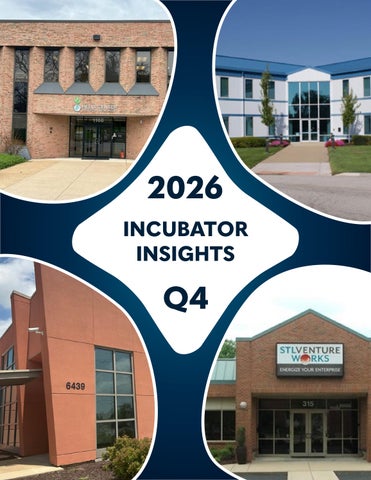
2026 INCUBATOR INSIGHTS
Q4
• EVENTS/PROGRAMMING • PARTNER SPOTLIGHT • COMMUNITY UPDATES • ARTICLE OF THE QUARTER • NOTES FROM YOUR SBDC COUNSELOR • RESOURCES
Welcome to the latest edition of Incubator Insights! This quarter, we’re zeroing in on two powerful drivers of early stage success: profitability and sustainable growth. Whether you’re tightening your pricing strategy or planning for expansion, we’ve packed this issue with tools to help you move forward confidently.
What’s Inside This Issue • Workshops & Events (Oct–Dec)
Practical sessions on pricing, profits, cash flow, and growth. Perfect opportunities to build skills, expand your network, and learn directly from industry experts.
• Expert Spotlight: Kathy Bernard
Discover insights from one of our community’s standout leaders.
• Innovate USA Summit 2026 Preview
On October 13, this summit replaces Startup Week—bringing together keynotes and panels from organizations shaping the future of their industries.
• SBDC Counselor Notes from Colleen
Smart, actionable tips on financial planning and preparing your business for longterm success.
• Thinking About Growing or Investing?
Connect with the STL Partnership Business Finance team to explore financing options tailored to your goals.
• We’re Here for You
Have news to share? We’re happy to amplify it. Need support with anything related to your incubator facilities? Reach out to your site administrators anytime.
Thank you for choosing our incubators as the place to build, grow, and thrive. We can’t wait to see what you accomplish this quarter!
Thank you, The STL Partnership Incubator Team
EVENTS/PROGRAMMING Pricing for Profit: Charge With Confidence Date: 10/13/2026 Time: 2:00 PM - 3:00 PM (CDT) Location: St. Louis, MO Boost your pricing confidence in this focused, one hour workshop designed to help small business owners set prices that truly support profit and growth. You’ll Learn:
• Pinpoint your real cost to deliver a product or service • Calculate a minimum profitable price using a simple formula • Compare cost based, value based, and market informed pricing • Choose one price or package to refine • Outline next steps to test or communicate your updated pricing
Register
Break Even to B Know Your Num
Date: 12/ Time: 2:00 PM Location: 6439 Plymouth A
Sales alone don’t guarantee profit. Th that matter so you can understand w hit your pr You’ll
• Identify fixed and variable costs • Calculate break even sales volume • See how each sale contributes to cov • Estimate the sales needed to reach a • Leave with one clear action to improv
Regi
EVENTS/PROGRAMMING Cash Flow Confidence for Small Business Owners Date: 11/10/2026 Time: 2:00 PM - 3:00 PM (CDT) Location: St. Louis, MO Cash flow can feel stressful — even when sales are strong. In this focused session, you’ll learn how to understand your cash position, anticipate upcoming needs, and use simple habits to make clearer financial decisions. You’ll Learn:
• Read your cash position with confidence • Identify upcoming cash needs before they hit • Build simple habits to improve visibility and stability • Create a basic cash flow forecast you can actually use • Leave with a short action plan for improving cash flow
Register
Breakthrough: mbers for Profit
/8/2026 - 3:15 PM (CDT) Ave, Saint Louis MO 63133
his session breaks down the numbers what it really takes to cover costs and rofit goals. Learn:
vering expenses a specific profit target ve profit potential
ister
PARTNER SPOTLIGHT
Bernard Provides LinkedIn Guidance for Small Companies, Job Seekers For the last 15 years, Kathy Bernard, CEO of WiserU, career coach and independent LinkedIn trainer, has been helping job seekers and the underemployed. In addition to her help with career advice, Bernard also teaches sales and marketing teams how to use LinkedIn to find and reach their prospects and how to impress potential customers with their profiles and company pages. She also trains recruiting teams on how to use LinkedIn to find and interact with top job candidates.
Bernard has used her expertise to help educate tenants of the St. Louis Economic Development Partnership’s business incubators. She has led various one-hour, online workshops to train small business owners on how to use LinkedIn to find and reach their prospects, how to improve their LinkedIn profiles to appeal to customers and how to create a free LinkedIn company page.
For more information on Bernard’s services and WiserU, CLICK HERE
COMMUNITY UPDATES The morning summit has a strong lineup of keynote and panels with leaders from Gateway X, Amazon Web Services (AWS), Google, NVIDIA, Overture Maps Foundation, WEKA, World Wide Technology (WWT), AMICSTL, 39 North (39N), Danforth Plant Science Center, BioSTL, Taylor Geospatial Institute, the Lindbergh Foundation, and the City of St. Louis.
Tickets and Info
ARTICLE OF THE QUARTER Refocus Your Business: 10 Steps to Scale Your Business in 2026 Business owners are tired.
That’s a mistake.
Tired of reacting. Tired of putting out fires. Tired of feeling like they are working harder than ever yet still not getting ahead.
“If you are not making steps to improve, you are sliding backwards,” one seasoned St. Louis business owner said after bringing in outside help to strengthen his company. That blunt reality has never been more true.
For the past several years, entrepreneurs have dealt with a whirlwind of challenges: rising costs, labor shortages, shifting customer expectations, tighter margins and nonstop uncertainty. Many have spent so much time surviving that they have lost sight of how to truly grow. That needs to change. The truth is, 2026 is not the year to simply grind harder. It is the year to get smarter. The companies that will win over the next several years won’t necessarily be the biggest or the busiest. They will be the ones that slow down long enough to refocus, tighten their fundamentals and make intentional decisions.
If you want 2026 to be a breakout year, here are 10 areas every owner should focus on now. 1. Create a Real Vision for Where You’re Going Not a vague goal. Not a wish. A real picture of what success looks like. One of the biggest reasons businesses stall is because the owner never clearly defines what they are building. They are busy, but they are not aligned.
A vision is a three- to five-year snapshot of what your business Too many business owners are stuck should look like: revenue, customers, in reaction mode — solving today’s team, culture, systems and impact. problems without building tomorrow’s It gives everyone in the company a company. target to work toward.
Without that vision, owners drift. They chase opportunities that don’t fit, hire reactively and make emotional decisions.
Review your financials monthly. Build a budget. Compare projections to actuals. Catch issues before they become emergencies.
How to do it: Your team needs to know where the company is headed. More importantly, • Schedule a monthly financial review. you need to know. • Build a rolling 90-day cash forecast. How to do it: • Track gross margin by service line. • Block off two uninterrupted hours away from the office.
• Pick a date three years out and write as if it is already true. • Describe revenue, customer mix, culture, team size and how the business feels. • Share the draft with key leaders. • Review it quarterly so it becomes a decision-making filter. 2. Know Your Numbers — Especially Cash Too many owners look at revenue and assume things are fine. They are wrong. Revenue can make you feel successful. Cash flow tells you whether you actually are. In 2026, every owner needs a tighter grip on gross margins, monthly overhead, cash reserves, receivables, debt and profitability by customer or job.
• Review receivables weekly. • Compare budget to actual monthly. 3. Stop Chasing Every Opportunity Not every customer is a good customer. Not every growth opportunity is worth pursuing. The best companies know who their ideal customer is — and they build their sales and marketing around that customer. The goal in 2026 is not more activity. It is better activity. How to do it: • Identify your most profitable customers. • List what they have in common. • Score new prospects based on margin and fit. • Eliminate low-value offerings. • Focus sales time on ideal clients.
4. Get the Right People in the Right Seats A great strategy with the wrong people will fail. Business growth almost always comes down to people. The best companies hire for attitude, character and cultural fit first. Skills can often be taught. Take a hard look at your team and make sure roles are clearly defined. How to do it: • Create clear role scorecards.
How to do it: • Map your customer journey. • Identify common breakdowns. • Document key processes. • Assign ownership for handoffs. • Hold weekly operations meetings. 6. Protect Your Culture Before It Slips Away Culture is how your company feels every day. When companies grow too quickly without clear expectations, problems follow.
• Hire for attitude and accountability.
Strong companies are intentional about core values, communication, expectations and trust.
• Improve onboarding.
A healthy culture is strategic.
• Define success at 30, 60 and 90 days.
• Address poor performance quickly. 5. Build Systems Before Growth Exposes Your Weaknesses
How to do it: • Define core values. • Build them into hiring and reviews. • Set communication expectations.
Growth exposes every crack in your business.
• Recognize wins.
As sales increase, weak systems break.
7. Spend More Time Working On the Business
• Meet regularly with managers.
Before pushing harder on sales in Many owners are great at doing. 2026, ask yourself: Is the business built Fewer are great at leading. to handle it? If your entire day is spent solving Document key processes. Improve immediate problems, you are communication. Clarify handoffs. probably the bottleneck.
Owners need time every week to review performance, think strategically and develop leaders.
An outside advisor, peer group, coach or mentor can help identify issues faster and improve accountability.
How to do it:
Fresh perspective can help you move faster and make better decisions.
• Schedule weekly strategy time. • Delegate lower-value tasks.
How to do it:
• Develop key leaders.
• Join a peer group.
• Review performance dashboards.
• Meet quarterly with an advisor.
• Protect time for planning. 8. Tighten Your Sales and Marketing Engine Hope is not a growth strategy. The companies that win in 2026 will have a repeatable process for generating leads, nurturing prospects and following up.
• Ask for honest feedback. • Benchmark against top performers. 10. Make 2026 the Year You Get Intentional Growth usually comes from doing the fundamentals better than everyone else.
Marketing should be tied to your ideal customer and business goals.
The businesses that thrive will be the ones that stepped back, got honest about what needed to change and took action.
How to do it:
2026 is here. It is time to refocus.
• Audit your lead sources. • Build a follow-up process. • Ask for referrals. • Stay visible with content and outreach. • Track conversions. 9. Get Outside Perspective Sometimes the biggest thing holding a business back is the owner’s blind spot.
NOTES FROM YOUR SBDC COUNSELOR Your business deserves more than “getting by.” It deserves a financial plan that supports the income, stability, and growth you want. Many business owners work hard to increase sales but still feel uncertain about their financial position. They may ask: Am I charging enough? Why is my bank balance tight when sales are up? How much do I need to sell before I actually make a profit? Those are the right questions—and they are connected. Your price determines whether each sale contributes enough to cover the true cost of delivering your product or service. Cash flow helps you manage the timing difference between earning revenue and having money available to pay bills. Profitability shows whether the business model is producing enough after all costs are covered to pay the owner, build reserves, and support future growth. This quarter, I encourage you to make time to work on your business, not only in it. Choose one product or service offer to review. Identify
your actual costs. Look ahead at the next 30 days of cash coming in and cash going out. Then calculate the sales level your business needs to cover expenses and reach a realistic profit goal. You do not have to become an accountant to become more financially confident. Start with a few essential numbers, review them consistently, and use what you learn to make stronger decisions. Join us for this three-part workshop series (Oct, Nov, Dec) and leave with practical tools you can use right away to: • Price your products and services with greater confidence. • Anticipate cash needs before they become an emergency. • Set sales goals that are tied to profitability—not just activity. • Build a business that is more sustainable, resilient, and rewarding.
Small, consistent attention to your numbers can lead to more confident decisions and a more profitable future.
Colleen Mulvihill
Small Business Development
Manager & SBDC Business Counselor 314-299-6662
Referral Program STL Partnership has started a referral program for our incubator clients. If you refer a business to our incubators and they sign an agreement and occupy one of our spaces, you are entitled to
1 month of free rent!
Contact your site administrator for more information. We look forward to increasing connections in the St. Louis small business community!
Suggestions Is there something you want to see in this quarterly incubator focused newsletter? Let us know at marketing@stlpartnership.com We appreciate your input!