Park Perspective October 2020
www.stlouispark.org
General election 2020 Tuesday, Nov. 3
Polls open 7 a.m. – 8 p.m.
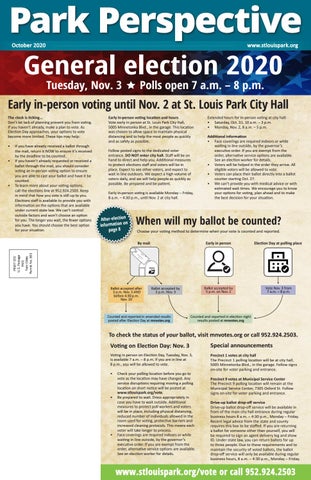
Early in-person voting until Nov. 2 at St. Louis Park City Hall The clock is ticking... Don’t let lack of planning prevent you from voting. If you haven’t already, make a plan to vote. As Election Day approaches, your options to vote become more limited. These tips may help: • If you have already received a ballot through the mail, return it NOW to ensure it’s received by the deadline to be counted. • If you haven’t already requested or received a ballot through the mail, you should consider voting an in-person voting option to ensure you are able to cast your ballot and have it be counted. • To learn more about your voting options, call the elections line at 952.924.2503. Keep in mind that how you vote is still up to you. Elections staff is available to provide you with information on the options that are available under current state law. We can’t control outside factors and won’t choose an option for you. The longer you wait, the fewer options you have. You should choose the best option for your situation.
Early in-person voting location and hours Vote early in person at St. Louis Park City Hall, 5005 Minnetonka Blvd., in the garage. This location was chosen to allow space to maintain physical distancing and to help the most people as quickly and as safely as possible. Follow posted signs to the dedicated voter entrance. DO NOT enter city hall. Staff will be on hand to direct and help you. Additional measures to protect elections staff and voters will be in place. Expect to see other voters, and expect to wait in line outdoors. We expect a high volume of voters daily, and we will help people as quickly as possible. Be prepared and be patient. Early in-person voting is available Monday – Friday, 8 a.m. – 4:30 p.m., until Nov. 2 at city hall.
n After-electio on information page 8
Extended hours for in-person voting at city hall: • Saturday, Oct. 31, 10 a.m. – 3 p.m. • Monday, Nov. 2, 8 a.m. – 5 p.m. Additional information • Face coverings are required indoors or while waiting in line outside, by the governor’s executive order. If you are exempt from the order, alternative service options are available. See an election worker for details. • Voters will be helped in the order they arrive. All eligible voters will be allowed to vote. • Voters can place their ballot directly into a ballot counter starting Oct. 27. • We can’t provide you with medical advice or with estimated wait times. We encourage you to know your options for voting, plan ahead and to make the best decision for your situation.
When will my ballot be counted? Choose your voting method to determine when your vote is counted and reported. Early in person
Election Day at polling place
Ballot accepted by 5 p.m. on Nov. 2
Vote Nov. 3 from 7 a.m. – 8 p.m.
PRSRT STD U.S. Postage PAID Twin Cities Permit No. 603
By mail
Ballot accepted after 3 p.m. Nov. 3 AND before 4:30 p.m. Nov. 10
Ballot accepted by 3 p.m. Nov. 3
Counted and reported in amended results posted after Election Day at mnvotes.org
Counted and reported in election night results posted at mnvotes.org
To check the status of your ballot, visit mnvotes.org or call 952.924.2503. Voting on Election Day: Nov. 3
Special announcements
Voting in person on Election Day, Tuesday, Nov. 3, is available 7 a.m. – 8 p.m. If you are in line at 8 p.m., you will be allowed to vote.
Precinct 1 votes at city hall The Precinct 1 polling location will be at city hall, 5005 Minnetonka Blvd., in the garage. Follow signs on-site for voter parking and entrance.
• Check your polling location before you go to vote as the location may have changed. Any service disruptions requiring moving a polling location on short notice will be posted at www.stlouispark.org/vote. • Be prepared to wait. Dress appropriately in case you have to wait outside. Additional measures to protect poll workers and voters will be in place, including physical distancing, reduced number of individuals allowed in the room used for voting, protective barriers and increased cleaning protocols. This means each voter will take longer to process. • Face coverings are required indoors or while waiting in line outside, by the governor’s executive order. If you are exempt from the order, alternative service options are available. See an election worker for details.
Precinct 9 votes at Municipal Service Center The Precinct 9 polling location will remain at the Municipal Service Center, 7305 Oxford St. Follow signs on-site for voter parking and entrance. Drive-up ballot drop-off service Drive-up ballot drop-off service will be available in front of the main city hall entrance during regular business hours 8 a.m. – 4:30 p.m., Monday – Friday. Recent legal advice from the state and county requires this box to be staffed. If you are returning a ballot for someone other than yourself, you will be required to sign an agent delivery log and show ID. Under state law, you can return ballots for up to three people. Due to these requirements and to maintain the security of voted ballots, the ballot drop-off service will only be available during regular business hours, 8 a.m. – 4:30 p.m., Monday – Friday.
www.stlouispark.org/vote or call 952.924.2503
Preliminary 2021 property tax levy set
In September, the 2021 preliminary property tax levy was set with a 6.11 percent increase over the 2020 property tax levy. It’s important to note that this is a preliminary tax levy only. By law, cities are required to set their preliminary levy in September, then finalize it in December. Once the preliminary levy is set, the final levy may be lower but can’t be higher. As has occurred in the past, it’s likely the final property tax levy increase will be lower than the 6.11 percent preliminary proposed tax levy increase. Below are remaining important dates for the 2021 budget process.
Understanding property taxes Why do we have property taxes? Property taxes are the primary funding source for local services provided by cities, counties, school districts and other special districts. Unlike sales or income taxes which can vary, the property tax is an exact levy to fund budgets – no more, no less. Property taxes work in three steps. Step 1 – Determining assessed value and classification The city’s assessing office determines the estimated market value (EMV) and classification (use) of your property on Jan. 2 each year. The EMV is determined after reviewing market activity (comparable sales, rents, costs). The EMV may be reduced by programs such as the homestead market value exclusion and disabled veteran exclusion which “exclude” part of the value from taxation. This reduced value is known as the taxable market value (TMV). The TMV is converted into tax capacity by the classification rates set by the Minnesota legislature. Note: If there are no exclusions, the EMV and TMV may be the same. How am I notified? The valuation and classification notices are mailed in March. When you receive the notice, read it carefully. If you believe your property valuation and classification are accurate, no further action is needed. If you have questions about either, contact the St. Louis Park Assessing Division at 952.924.2535. Most questions can be answered in an informal discussion. If you disagree with the valuation or classification, follow the appeal process steps listed on the notice. Don’t delay in calling – this is the time to appeal or question your valuation and classification. Valuations cannot be appealed after proposed property taxes are sent. Taxes may not be appealed. Step 2 – Establishing a budget Every year, local governments establish a budget for the following year after determining planned revenue and expenses. The property tax levy is set in September and is determined by subtracting all non-property tax revenue from the total proposed budget. The preliminary levy for each of the taxing jurisdictions (county, city, schools, Metropolitan Council, watershed, etc.) is totaled and spread among all taxable properties according to their individual tax capacity. How am I notified? The Truth-in-Taxation notice is the second notice you will receive. Sent in November, it shows the proposed tax amount for the following year for each taxing jurisdiction (county, city, schools, Metropolitan Council, watershed, etc.). The notice also includes the meeting dates where you can provide input on the budgets and proposed levies. Budgets are finalized in December after these meetings. Step 3 – Calculating property taxes Your property taxes are calculated using the prior year’s value and classification relative to the budgets levied. The property tax is your share of the costs to provide the services approved by elected officials. How am I notified? The final notice you receive is your property tax statement, which tells you how much property tax you owe for the year. It provides an itemized list of all local property taxes, including city, county, school district, etc. It also includes any special assessments on your property. Property tax statements are mailed by March 31 of each year. When are property taxes due? Most property taxes are due May 15 and Oct. 15 in equal installments. Potential property tax refunds Property owners and renters are urged to annually review their eligibility for property tax refunds. The Minnesota Department of Revenue’s website, www.revenue.state.mn.us, offers information about refunds and property taxes. For information about refunds, enter “property tax refunds” in the website’s search bar. For more information on property taxes in general, enter “property tax fact sheets” in the search bar. You may also contact the St. Louis Park Assessing Division at 952.924.2535 for more information. The COVID-19 pandemic and property taxes For the tax period payable in 2021, the estimated market values as of Jan. 2, 2020, are used. These valuations are set using market information from the time period just before the assessment date. The timeline is very important as market changes for all properties are equalized up to that point in time. The potential value influences arising from the COVID-19 pandemic will be reviewed from the perspective of the market in setting the 2021 assessment (reflected in the payable 2022 tax period).
2
October 2020
• • • •
Oct. 19: first reading of fees and 2021 utility rates Nov. 2: second reading of fees and adoption of 2021 utility rates Dec. 7: truth-in-taxation public hearing and budget presentation Dec. 21: council adopts 2020 revised budget, the 2021 budget, final tax levies for the city and Housing Redevelopment Authority (HRA), and 2021 – 2030 capital improvement program (CIP)
Visit www.stlouispark.org/finance for information about the city budget. Email budget@stlouispark.org if you have questions or would like more information.
Small Business Saturday is Nov. 28 Founded by American Express in 2010, Small Business Saturday is a day dedicated to supporting local small businesses and helping their communities thrive. This year supporting small businesses is more important than ever. Shopping small makes an impact. For every dollar spent at a small business in the United States, about 67 cents stays in the local community. So, on Nov. 28, celebrate St. Louis Park small businesses by shopping at a locally owned retailer!
Twin Cities Film Fest features film series on affordable living Each year, the Twin Cities Film Fest identifies a social justice cause and programs a special series of films on that topic. This year’s cause is affordable living, with a series of five to six films on the topics of affordable housing, child care, elder care and health care. Thanks to the generous support of Twin Cities Film Festival community partners, the City of St. Louis Park, AARP Minnesota and Dominium, all films in this series will be presented for free! Find more information and watch films for free Oct. 22 – 31 at www.twincitiesfilmfest.org.
Arts & Culture Grant Program applications due Nov. 1 The Arts & Culture Grant Program is accepting applications for 2021 grants. Application deadline is Nov. 1, 2020. Artists, art groups, students, community groups and neighborhood, cultural and religious organizations are encouraged to apply. Applicants do not need to live in St. Louis Park, but projects must take place within the city. Visit www.stlouispark.org/arts to apply. A collaborative program of the City of St. Louis Park, St. Louis Park Community and Youth Development Fund and St. Louis Park Friends of the Arts, the Arts & Culture Grant Program makes grant dollars available every year for music, visual arts, theater, film, multimedia, dance and other art projects.
Poetry added to sidewalks in Historic Walker Lake The City of St. Louis Park has started its own sidewalk poetry program as a way to build a sense of local identity and create unexpected moments of pause, contemplation and reflection for pedestrians. A call for submissions from residents and students went out earlier this summer, with final selections made in September. The first set of nine poems will be sandblasted into new sidewalk sections in the Historic Walker Lake area along the high school stadium and on Lake and Walker streets. A map of the poetry locations will be available on the city’s website when the poems are placed. Visit www.stlouispark.org/arts for information about this project and other city art initiatives.
St. Louis Park joins 15 cities to promote home energy efficiency
Federal funding awarded for Southwest Light Rail Transit
Reduce your home’s energy use and save money by participating in the Intercity Home Energy Squad Challenge! St. Louis Park recently joined 15 other cities in the challenge to promote home energy efficiency and to help residents lower their energy bills and increase home comfort. At the end of 2020, the city with the highest participation per capita wins and will receive a traveling trophy.
In September the Green Line Extension (also known as Southwest Light Rail Transit) was awarded its Full Funding Grant Agreement (FFGA) from the Federal Transit Administration, providing $928.9 million in federal funds to match more than billion dollars in local funding.
You have two ways to start saving energy and money, and help St. Louis Park win the trophy: • S ign up for a free virtual visit. By video chat, an energy consultant will guide you on a walk-through assessment of your home. You’ll receive tips for energy saving and recommendations for next steps. • P ay for an in-person visit. The visits costs $50 for St. Louis Park residents and includes the free installation of many energy saving products, such as LED lightbulbs. Free in-person visits are also available to income-qualifying households. To qualify for a visit, you must rent or own a single-family, duplex, triplex or fourplex home and be a customer of Xcel Energy or CenterPoint Energy. To learn more about the challenge and sign up for a visit, visit www.stlouispark.org/hes-challenge or call 651.328.6220. With many of us spending more time at home right now and using more energy, this is a great opportunity to better understand your energy use and find savings opportunities!
“I’m thrilled at the news that the FFGA has been approved,” said St. Louis Park Mayor Jake Spano, who also serves on the Southwest Light Rail Transit Corridor Management Committee. “This project is literally decades in the making. The extension of the Green Line to serve our community will ensure that St. Louis Park will continue to be an economic and cultural leader in our region. Neighbors will now have access to reliable transportation, our businesses will have greater access to the best workers in the region and our families will be able to reduce their carbon footprint by accessing public transportation.” The $2.003 billion Green Line Extension, a 14.5-mile line with 16 stations serving Minneapolis, St. Louis Park, Hopkins, Minnetonka and Eden Prairie, is the largest infrastructure project in the state’s history. Construction began in November 2018, with three stations taking shape in St. Louis Park at Beltline Boulevard, Louisiana Avenue and Wooddale Avenue. The planned light rail route has already spurred the construction of several hundred new apartment units around St. Louis Park station areas, with many more planned. These developments will create opportunities for additional market rate and affordable housing units, all of which will benefit from close access to light rail transit. Visit www.swlrt.org for more information and to sign up for construction notifications.
City of St. Louis Park
N A T U R E
C E N T E R
New interpretive center includes sustainable design features The new Westwood Hills Nature Center interpretive center is open to the public, offering programming for visitors of all ages and backgrounds to learn about and connect with the environment. The interpretive center was built to respect the environment through location site and building design and has the distinction of being the first commercial building in Minnesota designed to achieve net zero energy. “Net zero energy” means that the nature center is designed to produce, at a minimum, as much energy as it uses, working toward a zero-energy building certification. Many sustainable, energy-efficient and low-impact features were chosen during design to achieve this goal. At the new interpretive center, you’ll find 13 signs highlighting the environmental strategies used. Here’s a preview of what you’ll discover: • Active and passive solar: Solar panels cover about 7,400 square feet of roof area and will produce nearly 150,000 kilowatt-hours of electricity annually to offset the building’s electricity needs. The placement of the building and its large windows gather natural daylight, reducing the building’s overall electricity demand. On the south side of the building, a concrete massing wall soaks in heat during sunny days in the winter, then releases the warmth at night. • Efficient winter comfort: The new energy-efficient fireplace, powered by the rooftop solar panels, warms the building without the carbon emissions of wood or gas. • Geothermal piping system: The parking lot sits atop a geothermal well field of 32 wells, located about 200 feet deep. This system uses liquid-to-air heat pumps to extract heat in the winter and cool air in the summer, using less than half the energy of a conventional heating and cooling system. As part of this system, pipes embedded in the building’s concrete floor pump hot water to radiate warmth directly to gathering areas. • Natural ventilation: The building orientation and placement of the windows allows for natural ventilation during temperate weather days. Additional sustainable design features include permeable pavers, rain gardens and bird-friendly glass. Visit the interpretive center to see these features and the expanded exhibits, raptor enclosures and scenic hiking trails. The interpretive center is open Mondays – Fridays, 8 a.m. – 4:30 p.m. and Saturdays and Sundays, noon – 5 p.m. Face coverings are required indoors. Visit www.stlouispark.org/whnc for more information. Former interpretive center deconstructed, reused This summer, the city partnered with a local nonprofit to deconstruct the former interpretive center building. Many of the building materials were saved and sold for reuse at the nonprofit’s warehouse. A number of the ceiling beams were also saved to be rebuilt into outdoor benches to be used outside the new interpretive center.
www.stlouispark.org
3
Protect yourself when using transportation The Centers for Disease Control and Prevention (CDC) has guidance for protecting yourself during the ongoing COVID-19 pandemic. Visit www.cdc.gov/coronavirus for more information on these topics and more. For all types of transportation • Before you leave, wash your hands with soap and water for at least 20 seconds or use hand sanitizer with at least 60 percent alcohol. • Once you reach your destination, wash your hands again with soap and water for at least 20 seconds or use hand sanitizer with at least 60 percent alcohol as soon as possible upon arrival. • During travel, try to keep at least 6 feet from people who are not in your household. • Wear face coverings. Note that face coverings shouldn’t be placed on: o Babies and children younger than 2 years old o Anyone who has trouble breathing or is unconscious o Anyone who is incapacitated or otherwise unable to remove the mask without assistance • Even if you don’t expect to have close contact (within 6 feet) with other people during your trip, carry a face covering so you are prepared.
Register for winter activities The December 2020 – March 2021 Parks & Recreation brochure is being published online only, with no paper version or mailing. This online publication allowed for the most flexibility in planning programming and events in compliance with the latest health guidance for COVID-19. View the brochure at www.stlouispark.org/parks-rec www.stlouispark.org/parks-rec.. Those who are unable to access the brochure online may request a paper copy by calling 952.924.2540. Online registration starts Nov. 9 at stlouispark.maxgalaxy.net stlouispark.maxgalaxy.net.. Financial assistance available The city recognizes the importance of recreation and its health and wellness benefits to people of all ages. We want to be sure everyone can participate! The Access to Fun program provides financial assistance to people living or working in St. Louis Park so they can participate in recreation programs. Visit bit.ly/31BgXGN for an application and to enroll in the program. For more information or for a paper copy of the application, call 952.924.2540.
For bus passengers • Check with local transit authorities for the latest information on changes to services and procedures, especially if you might need additional assistance. • Avoid touching surfaces. • Use touchless payment and no-touch trash cans and doors when available. For rideshare or taxi passengers • Sit in the back seat in larger vehicles, such as vans and SUVs, so you can remain at least 6 feet away from the driver. • A sk the driver to improve the ventilation in the vehicle by setting the air ventilation or air conditioning on non-recirculation mode or opening windows. For shared bikes, scooters and other personal transportation devices • Clean and disinfect frequently touched surfaces on the device (handlebars, gears, braking handles, locks) or shared equipment before you use it. Use disinfecting wipes, if available. • Use touchless payment when available and if applicable. For paratransit passengers • Contact your local paratransit program for the latest information on changes to paratransit services and procedures. • When possible, consider traveling during non-peak hours when there are likely to be fewer passengers. • W hen possible, sit in the back of larger vehicles, such as vans, so you can remain at least 6 feet away from the driver and other passengers. • Ask the driver to improve the ventilation in the vehicle by setting the air ventilation or air conditioning on non-recirculation mode or opening windows. For bicyclists and pedestrians • Limit touching surfaces that are frequently touched by other people, such as pedestrian or cyclist call buttons, as much as possible. • Avoid crowded and/or narrow routes where it might be difficult to maintain 6 feet of distance between yourself and other cyclists or pedestrians. • Follow social distancing guidelines by staying at least 6 feet from other cyclists or pedestrians who are not from your household. • Avoid spitting or clearing of the nasal passages in public. • When passing others, leave as much space as possible.
2 44
October 2020
Water efficiency grant program offers rebates If you’re buying a toilet or installing lawn irrigation, choose a WaterSense product and you might be eligible for a rebate! In partnership with the Metropolitan Council Environmental Services and the Clean Water, Land and Legacy Amendment, the City of St. Louis Park is offering $30,670 in rebates to encourage residents to install toilets and irrigation components that reduce water use. Eligibility requirements • Only St. Louis Park residents who receive a water bill from the city are eligible for the program. • Qualifying purchases must be made between Feb. 15, 2020, and June 30, 2022. • New construction and new developments are not eligible for rebates. Rebates are up to $200 for purchasing a WaterSense toilet and up to $250 toward purchasing a WaterSense irrigation controller and/or irrigation spray sprinkler bodies. Rebates are for product purchase only; residents are responsible for installation and permit costs. Your receipt and the UPC showing the WaterSense product will be required to qualify for the rebate. Rebates will be issued as a bill credit on your city utility bill. Rebates will be provided on a first-come, first-serve basis until the grant money is gone. For more information, contact Jay Hall, utilities superintendent, at 952.924.2557 or jhall@stlouispark.org.
Be prepared for snow season! What does the city plow? The city plows city-owned roads, alleys and parking lots. A few county and state highways are located within the city, which are maintained by Hennepin County and the Minnesota Department of Transportation (MnDOT). Private association roads are plowed by those associations. When does plowing start? Snow removal start times are based on the latest forecast information on timing, intensity and duration of the snow event. In most cases, snowplowing operations begin between midnight and 4 a.m., but the exact time depends on weather conditions. Citywide snow removal starts when snow accumulation approaches 2 inches or more. Above, test boring underway related to the Highway 100 and County Road 3 Groundwater Plume. (Photo courtesy MPCA)
Above, the inside of Water Treatment Plant #4, upgraded to treat VOCs.
St. Louis Park’s industrial legacy: an update The City of St. Louis Park has a long and proud history of working with state and federal agencies to protect residents’ health and to manage contaminated sites resulting from the city’s industrial past. In September 2019, residents received a newsletter detailing St. Louis Park’s industrial legacy. Visit bit.ly/2EjxcjN to read it or visit St. Louis Park City Hall for a printed copy. Below are updates on two of the sites that were discussed in that newsletter. Groundwater plume site becomes city’s third Superfund site In September 2020, the U.S. Environmental Protection Agency (EPA) added the Highway 100 and County Road 3 Groundwater Plume Site to its Superfund National Priorities List (NPL), making it eligible to receive federal funding for long-term, permanent cleanup. The city is in full support of this step to ensure those who created the contamination are held responsible and to ensure the ongoing health and safety of residents. Any health concerns related to vapor intrusion or drinking water safety as a result of this site have already been addressed by the Minnesota Pollution Control Agency (MPCA), EPA and cities of St. Louis Park and Edina. Since the early 2000s, the City of St. Louis Park has been working successfully with the Minnesota Department of Health, MPCA and the EPA to ensure the safety of its drinking water in relation to this site, and to protect residents from any adverse effects of this contamination. The source of the contamination, first detected in April 2004 in Edina, was traced back to an area near Walker and Lake streets in St. Louis Park. While an exact source hasn’t been identified, it’s important to note that the businesses associated with the chemical release no longer operate in these areas. The groundwater contamination is from previous uses. Look for more information in the coming months about the EPA’s community involvement plan related to the site and how you can participate in the process. Visit bit.ly/2RVEuxX or www.stlouispark.org/groundwater-plume to learn more. Reilly Tar & Chemical Corp. site marks significant milestone In late September, an amended consent decree and remedial action plan (CD-RAP) for the Reilly Tar & Chemical Corp. Superfund site, approved by the U.S. District Court, became official. This marked the successful conclusion of a seven-year effort by the city to update the CD-RAP and to continue to ensure the health and safety of residents. Replacing the 1986 consent decree, the amended CD-RAP provides greater flexibility for the city and regulatory agencies to follow the most current drinking water quality standards and to make modifications as needed to groundwater pumping and treatment. This is a major step in the 30-year journey of addressing the contamination left behind by Reilly Tar & Chemical Corp. The site is located north of the intersection of Louisiana Avenue and Walker Street. The U.S. District Court Order concluded, “The Court has presided over this matter for nearly 40 years. The Court approved the original consent decree and continues to believe that the consent decree was a fair, reasonable, and more than adequate resolution of the environmental response and remediation requirements at the Reilly Tar site. The proposed amended consent decree continues the obligations and responsibilities of the original while updating the language and the science, both of which are imminently necessary after more than three decades. The Court therefore finds that the proposed amended consent decree is fair, reasonable, and adequate. In addition, it is consistent with the environmental laws and with the public interest. The Court therefore will grant the government’s request to enter the proposed amended consent decree.”
In what order is the city plowed? The city is divided into 11 plow areas, each with high-volume and residential streets. In a snow event, high-volume roads are plowed first; residential streets and cul-de-sacs are plowed next. How long does it take to plow the entire city? The city’s goal is to clear streets and cul-de-sacs within 10 hours during an average 3- to 6-inch snowfall. Each additional inch of snow increases the time required for snow removal. What slows down the plows? Traffic, vehicles parked on the street and snow type (wet or dry) all affect the amount of time it takes to plow. Snowfall before or during rush hour causes significant snowplowing delays, as does maneuvering around parked vehicles on city streets. If you are parking on the street, try not to park directly across from another vehicle. How will I know when it’s safe to clear my driveway without getting plowed in? Wait until your street is plowed to the curb before clearing your driveway. Depending on snowfall amounts, plows may come through multiple times. Unfortunately, plowing in driveways is unavoidable. If you choose to clear your driveway before the street is plowed, you will have to clear your driveway opening again after your street is plowed. lear an area of your property on both sides of your driveway, along the roadway. C This gives plows a place to push snow and may minimize the amount of snow that will end up across your driveway entrance. Remember, it’s against the law to plow, blow or shovel snow into or across any street or alley. How is salt used for snow and ice control? Due to environmental concerns about high salt (chloride) levels found in water bodies, including Minnehaha Creek, the city closely monitors the amount of salt applied by city vehicles. This concern is balanced with the responsibility to provide the traveling public with safer driving surfaces. Current practice limits ice control to streets and alleys when needed. It does not allow for salt on sidewalks or trails. Through automated vehicle location (AVL) on snow removal equipment, the city can monitor how much salt is being applied and where. Application rates can be adjusted based on current weather conditions, using real-time data to be most effective for both environmental and safety concerns. The city’s equipment is checked and calibrated each year to ensure accuracy. What should I do in a snow emergency? The city may declare snow emergencies for major snow events which will be determined based on the depth of snow, type of snow and existing conditions. During a snow emergency, vehicles must be parked off the street until the street is plowed to the curb. Vehicles that aren’t moved may be ticketed and towed.
How will I know if there’s a snow emergency? The city announces snow emergencies in several different ways. Use any of the following to find out if a snow emergency has been declared. • Visit the city’s website at www.stlouispark.org or www.slpsnow.org. • Sign up for ParkAlert, the city’s citizen notification system, at www.slpsnow.org. The system automatically calls all phone numbers listed in the white and yellow pages. However, signing up lets you add more contacts and choose how you want to be contacted. Choose text messages, emails, cell phone calls, landline calls or all of the above. Note: Your telephone caller ID will show 952.924.2646 when you are called by ParkAlert; you may wish to save this number in your contacts. How you if a sno • Download the mystlouispark app in the App Store will or Google Play know Store for free. The app will display an alert when a snowRegister emergency is in effect, if you enable push notifications for the app. Sign up for ParkAlert at slpSNOW.org. Choose how to be contacted: text • Follow the city on Facebook, Instagram and Twitter (@stlouispark). message, email, cell phone call, land line arkAlert • Sign up for and monitor Nextdoor at www.nextdoor.com. call or all of the above. • Sign up through GovDelivery for email and text notifications for snow emergencies and other events at www.stlouispark.org/sign-up. Download • Call the winter parking hotline at 952.924.2180. Download the MyStLouisPark app in the or Android store for4, free. • Watch ParkTV or the local television newsiTunes stations (Channels 5, 9 and 11).
P
Separately from the amended CD-RAP, the EPA is conducting its sixth five-year How will you knowRegister if a snow emergency is in effect? review of the Reilly Tar & Chemical Corp. site. The Superfund law requires regular at www.slpsnow.org for ParkAlert. Register checkups of sites that have been cleaned up – with waste managed on-site –Signto up for ParkAlert at slpSNOW.org. Choose how you want to be contacted: Choose how to be contacted: text message, email, cell phone call, land line text make sure the cleanup continues to protect people and the environment. More P message, email, cell phone call and/or call or all of the above. landline call. information is available at bit.ly/epa-reilly and at the St. Louis Park Public Library, Download Download the MyStLouisPark app in the 3240 Library Lane. Watch Download iTunes or Android store for free. arkAlert
Visit www.stlouispark.org/reilly to learn more about the history of the site. Follow Check the city’s social media sites @stlouispark
the mystlouispark app in the App Store or Google Play Store for free.
www.parktv.org
Follow
@stlouispark nextdoor.com theFollow city’s social @stlouispark @stlouispark media sites: Check the city’s social media sites @stlouispark
Sign up
for text or email www.stlouispark.org/sign-up notifications: Or call the winter parking hotline at 952.924.2180
Call the winter parking hotline: 952.924.2180
Or call the winter parking hotline at 952.924.2180
www.stlouispark.org
3 5
Recycling Champions training is Oct. 27 Are you interested in improving recycling and promoting waste reduction? Consider joining the Recycling Champions program! You’ll serve as an ambassador in the community by sharing information and volunteering at events. All St. Louis Park residents are welcome to participate. The next online training is Tuesday, Oct. 27, 6:30 – 8 p.m. To participate, RSVP to recycling@stlouispark.org or call 952.924.2187. Include your name, email, phone number and neighborhood.
Yard waste ends in late November
The last week for yard waste collection is the week of Nov. 23 – 28 (Thursday and Friday collection are delayed one day due to the Thanksgiving holiday). If there is a significant snowfall before Nov. 23, yard waste collection will end at that time and an update will be posted on the city’s website. Remember, yard waste must be in reusable containers, compostable bags or bundled separately from garbage. Visit www.stlouispark.org/yard-waste or call 952.924.2562 for guidelines on setting out yard waste for collection.
Fall is the time to remove buckthorn Buckthorn is a non-native, invasive plant that spreads quickly and chokes out native vegetation and ornamental landscaping. Fall is the best time to remove buckthorn from your yard because at this time of year it’s easier to distinguish buckthorn from native plants. Buckthorn leaves will still be green, while native plant leaves are turning color or have dropped to the ground. Other identifiers include thorny stems and a lot of small black berries.
Brush drop-off site available until Nov. 1 The city’s brush drop-off site is available during the hours below for St. Louis Park residents to drop off brush, branches and logs or pickup compost. The last day for the drop-off site is Sunday, Nov. 1, then the site is closed for the winter. For more information, visit www.stlouispark.org/brush-drop-off.
To remove buckthorn, cut the stems to the ground, then paint the stems, stump and exposed root flares with a non-selective herbicide or Tryclopyamine (Ortho Brush B-Gon). Chemicals applied in the fall or winter months are effective because the plant is dormant and the herbicide is transported to the root system. It’s important to monitor and continue treating the area if needed since buckthorn seeds can remain viable in the soil for up to five years. The city actively removes buckthorn from park and city properties. Visit bit.ly/2VUKWVv for more information about identifying and controlling buckthorn.
Brush drop-off site/compost pickup hours • Tuesdays: 8 a.m. – 4 p.m. • Saturdays: 7 a.m. – 3 p.m. • Sundays: noon – 4 p.m.
Location
Do your part: adopt a storm drain
Fees and ID
St. Louis Park residents are invited to adopt a storm drain by committing to keep it clear of leaves, trash and other debris. The simple act of sweeping and cleaning up around a storm drain protects creeks, wetlands and lakes by preventing pollution from entering our shared waterways. Visit www.adopt-a-drain.org/map to sign up!
Materials accepted
Flood risk: it’s not just a spring issue
Materials not accepted
Anywhere it can rain, it can flood! Rainfall events are and will continue to be more frequent and extreme. Here are some facts you should know:
2501 Edgewood Ave. S. Entrance at intersection of Cedar Lake Road and Colorado Avenue South. No charge for St. Louis Park residents. A Minnesota ID, driver’s license or utility bill is required as proof of residency. Branches, brush and logs Grass clippings, leaves, root balls, lumber, wood scraps, fencing, trash, sod and stump grindings
About compost pickup
Fall is a great time to apply compost to your garden or lawn! To help build healthy soils in our city, each year The Mulch Store provides finished compost for pickup at the brush site. • Limit five 5-gallon buckets (25 gallons total) of compost • Bring your own container, shovel and proof of residency • Compost is located past the check-in gate by the operations shed, during the hours listed above
62
October 2020
• Since 2001, widespread rains of more than 6 inches are four times more frequent than in the previous three decades in Minnesota. • Rainfall events of more than 3 inches have increased 65 percent since 2000 in Minnesota. • More than 30 percent of flood insurance claims in Minnesota are for damage outside of FEMA-mapped high-risk zones. • Close to 50 percent of flood damage is outside of FEMA-mapped high-risk zones. Visit www.stlouispark.org/floodplain for more information on flood hazards, risks and building responsibly.
Dakota-Edgewood bikeway, trail bridge approved; work underway
Recreational fire permits required Permits are required for recreational fires (in-ground fire pits, portable fire pits, fire bowls, chimineas, etc.). Natural gas and propane fire pits and fireplaces don’t require a recreational fire permit. Visit www.stlouispark.org/firepermit to view or print the permit application and to find complete information and regulations.
The St. Louis Park City Council has approved the Dakota-Edgewood bikeway and trail bridge project, which is part of the city’s Connect the Park plan and will provide a centrally located, north-to-south connection from Cedar Lake Road to Lake Street. The project includes two parts that are being built separately. Dakota Avenue bikeway (26th Street to Minnetonka Boulevard) This project includes installation of a bicycle facility along the Dakota Avenue corridor. Construction started in early September with completion scheduled for November. • 2 6th Street to Minnetonka Boulevard will include a share-the-road bikeway, curb bump-ins to help calm traffic and shorten pedestrian crossing distances. There will be no changes to parking. • Minnetonka Boulevard to Lake Street will include on-street buffered bike lanes, curb bump-ins at every intersection and parking restrictions. • In spring 2021, a demonstration project of white plastic bollards to define the bike lane will be installed between Minnetonka Boulevard and Lake Street, then removed in the fall.
Stay safe in the kitchen Cooking is the leading cause of home fires and home fire injuries in the United States. Almost half of reported home fires started in the kitchen, and two-thirds of home cooking fires start with the ignition of food or other cooking materials. The 2020 National Fire Protection Association (NFPA) campaign slogan “Serve Up Fire Safety in the Kitchen!™” is a catchy reminder of how everyone can play a role in helping to prevent home fires that start in the kitchen. Keep cooking areas clear of clutter, especially those materials which can ignite such as oven mitts, dish towels, wooden utensils and food packaging. Below are some quick tips to stay safe in the kitchen. Visit www.nfpa.org/Public-Education for more information. • Never leave cooking unattended. • Always keep a lid close by in case a grease fire starts when frying so that you can slide the lid over the pan and smother the flame. • Have and know how to use a fire extinguisher. • Don’t wear loose fitting clothing while cooking and don’t cook if you’re sleepy. • Test your smoke alarms regularly so that if a fire starts, everyone recognizes the sound and knows to get out and stay out!
Safe exchange spot for online sales Be smart and safe when meeting in person to complete online transactions. The parking lot between the St. Louis Park City Hall and St. Louis Park Police Department is a safe place to complete these exchanges during the daytime hours. If desired, St. Louis Park Police Department officers may be available to stand by for safety in some situations, but can't document, negotiate or otherwise monitor your transactions. When setting up a sale or meeting to do a sale, keep these tips in mind for improved safety and success: • H ave a friend or family member accompany you, and/or tell someone when and where you're doing the exchange. • Have your phone with you. • Always conduct exchanges in the daytime and where other people are present. • If you need any kind of assistance from police, call 952.924.2618, or 911 for emergencies.
Dakota Edgewood trail bridge (26th Street to Minnetonka Boulevard) Construction on the Dakota-Edgewood trail bridge segment will start in October 2020 and will include the following: • A multiuse trail along the east side of Edgewood Avenue between Cedar Lake Road and BNSF Railway right of way. • A pedestrian and bicycle bridge over the BNSF railroad connecting Edgewood Avenue and Dakota Park. • A multiuse trail will connect the bridge to the bikeway at the corner of 26th Street and Dakota Avenue. Costs and financing Both projects are included in the city’s capital improvement plan for 2020 and 2021. The total cost for the trail bridge project is $9.8 million, with $1.3 million already invested in planning for the project. The city is receiving $2.9 million in federal aid for the trail bridge project and will finance $6.4 million with 20-year general obligation bonds. Most of the $760,000 bikeway project will be funded with general obligation bonds. Utility funds will also be used to pay for the projects.
Resources to help stay connected As COVID-19 continues to impact our community, we want you to be aware of the following resources to support remote working and distance learning. St. Louis Park Library “Grab & Go” services Hennepin County Library’s St. Louis Park location at 3240 Library Lane reopened in mid-September with “Grab & Go” services. Limited services include computer use for printing, scanning and copying; brief collection browsing; hold pickups, returns and checkouts; and quick reference supports. Patrons must wear a face covering and practice physical distancing. Hours are Sundays, noon – 5 p.m.; Mondays, Tuesdays and Wednesdays, 9 a.m. – 5 p.m.; and Thursdays, noon – 8 p.m. Call 612.543.6125 or visit www.hclib.org for more information. Free Wi-Fi • The City of St. Louis Park offers free Wi-Fi at many locations, including city buildings and parks. Visit bit.ly/3hzMRtm for locations. • Xfinity is offering free access to 1.5 million public Xfinity Wi-Fi hot spots through the end of 2020, including for non-customers. Visit bit.ly/3iBlpN7 for a map. Xfinity (Comcast) services Xfinity (Comcast) is offering the following to help its customers stay connected. Comcast has a non-exclusive franchise with the City of St. Louis Park to provide its services to residents of the city. Visit www.parktv.org for more information. Visit www.xfinity.com for information about Comcast/Xfinity services. • I nternet Essentials offers qualifying households low-cost, broadband internet service. • Comcast customers can stay connected at www.xfinity.com/prepare with tips on enhancing home Wi-Fi, troubleshooting virtual meetings, staying protected online and checking for outages.
www.stlouispark.org
7 3
Follow the city’s strategic priorities In 2018, the St. Louis Park City Council adopted the following five strategic priorities. Icons are located throughout the Park Perspective to mark stories about how the city is working to meet these priorities. St. Louis Park is committed to: Being a leader in racial equity and inclusion in order to create a more just and inclusive community for all. Continuing to lead in environmental stewardship. Providing a broad range of housing and neighborhood-oriented development. Providing a variety of options for people to make their way around the city comfortably, safely and reliably. reating opportunities to build social capital through C community engagement.
For city events, activities and news, visit www.stlouispark.org.
nextdoor.com @stlouispark
@stlouispark
@stlouispark
www.youtube.com/slpcable
Sign up for email and text notifications: www.stlouispark.org/sign-up Make service requests or receive city information via the app
or visit www.mystlouispark.org.
After Election Day Election results As with every election, results will be posted to the Minnesota Secretary of State’s website at mnvotes.org as soon as they become available after the polls close on Election Day. Due to the recent law change which extends the period of time in which ballots returned through the mail can be counted, the results you see on election night will be supplemented as needed until seven days after Election Day. You may see news outlets or other organizations declaring a winner in each race soon after the polls close. This is not official information and is speculative based on their own estimates. As in any election, our state’s results are not official until they are canvassed, and any legal challenges are resolved. Canvassing is an official process that will happen at the county and state levels in the weeks following Election Day. The City of St. Louis Park is not responsible for canvassing results of statewide elections and cannot provide you with more information on results beyond what is posted on the Minnesota Secretary of State’s website. Election signs are not recyclable Keep in mind all political signs must be removed within 10 days after the general election has been held. Election signs can’t be recycled in St. Louis Park. These signs may be kept for future use, for an adapted use or discarded as waste. You may choose to check with the campaign that distributed the election sign to see if they are collecting these signs following the election.
The Park Perspective is printed on 30 percent post-consumer recycled paper in an effort to meet the city’s environmentally preferable purchasing policy.
Prevent water lines from freezing this winter Avoid frozen water lines this winter by taking these precautions:
Be a Hydrant Hero Volunteer to become a Hydrant Hero! The St. Louis Park Fire Department asks homeowners and businesses with fire hydrants on or near their property to shovel the snow around the fire hydrant after each snowfall. Visit www.hydranthero.org to adopt a hydrant. Choose a hydrant, click on the “Adopt me” link and fill out the registration form – you can even give your hydrant a name! Call 952.924.2171 for more information.
8
October 2020
• Don’t set your heat below 55 degrees Fahrenheit. • Leave cabinet doors open under your kitchen and bathroom sinks. This will allow heat from the rest of the house to circulate around the pipes. • Wrap foam insulation around pipes that are more likely to freeze. • Consider running cold water on the lowest level of your home. Run a steady quarter-inch stream of water all day to help prevent lines from freezing. Note: The city will not provide any credits or discounts to run water to prevent frozen water lines. • Shut off and drain any pipes that lead to outside faucets. • If you are gone, have someone check your home regularly. Note: If your water lines freeze once and must be thawed, they are more likely to freeze again if you do not run water continuously. Call public works at 952.924.2562 if you have questions.