Year in review
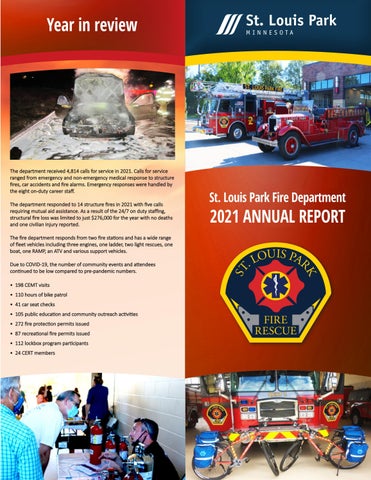
The department received 4,814 calls for service in 2021. Calls for service ranged from emergency and non-emergency medical response to structure fires, car accidents and fire alarms. Emergency responses were handled by the eight on-duty career staff. The department responded to 14 structure fires in 2021 with five calls requiring mutual aid assistance. As a result of the 24/7 on duty staffing, structural fire loss was limited to just $276,000 for the year with no deaths and one civilian injury reported. The fire department responds from two fire stations and has a wide range of fleet vehicles including three engines, one ladder, two light rescues, one boat, one RAMP, an ATV and various support vehicles. Due to COVID-19, the number of community events and attendees continued to be low compared to pre-pandemic numbers. • 198 CEMT visits • 110 hours of bike patrol • 41 car seat checks • 105 public education and community outreach activities • 272 fire protection permits issued • 87 recreational fire permits issued • 112 lockbox program participants • 24 CERT members
St. Louis Park Fire Department
2021 ANNUAL REPORT
Letter from Chief Koering
In full operation since 1915, the St. Louis Park Fire Department provides all-hazard emergency and non-emergency services to the City of St. Louis Park, serving more than 50,000 residents within 11 square miles. Throughout its history, the St. Louis Park Fire Department has constantly evolved to meet the growing needs of the community. History and traditions have always been a part of the fire department’s culture as is the understanding that innovation and adaptation are needed for the future. The demands placed on the city and the fire department’s infrastructure has never been tested more than the through the continued impacts of COVID-19 pandemic. The response to the pandemic has forced a better understanding of the areas of vulnerability and inequity that exist within the city’s population and the fire department’s responsibility to act. By reinforcing community risk reduction strategies, particularly those aligned with community health, significant outcome improvements were realized, especially in the senior congregate care population. The fire department continues to be recognized as a significant partner by county and state health and national organizations because of the trust the community places in the fire department to connect them to resources. The fire department includes a combination of sworn and non-sworn professionals who demand as much from themselves as they do each other. This commitment to excellence is a contributing factor to how the department addresses and ultimately meet the needs of the community now and in the future. This annual report shows accomplishments for 2021 and what the future might hold in the effort to work together to build a more resilient St. Louis Park.
Steve Koering, chief St. Louis Park Fire Department
Staffing and training
About the fire department The fire department is directed by a full-time fire chief who also serves as the city’s emergency management coordinator. The command staff also includes a deputy fire chief of operations, an assistant chief of training and emergency medical service (EMS) and an assistant chief of fire prevention, who also serves as the fire marshal. The fire prevention division is further staffed with two lieutenants and three fire prevention specialists who support fire inspections, plan review, community outreach, fire education and fire investigations. The department is divided into four divisions: prevention, suppression, EMS/community health management and emergency management.
Additionally, 24 firefighters are assigned to one of three shifts. Each shift is led by a captain and a lieutenant and is staffed with six firefighters for a total of eight responders. Shifts are 24 hours in length and provide the initial response to a variety of calls for service including medical emergencies, fires, car accidents, hazardous material spills, alarms and mutual aid to neighboring cities. Beyond emergency response, firefighters assist with community health initiatives such as patient referrals, vaccine clinics, car seat installations and inspections, fire prevention public education, hands-only CPR and Stop the Bleed training. Additionally, firefighters participate in a variety of community events and regularly conduct bike patrols on streets and trails. Training Effective training produces well-prepared and proficient firefighters. Nearly 10% of fire department resources are dedicated to maintaining readiness across operations. Staff development is partially self-directed through variety of mediums and mostly delivered through the department’s formal ongoing training program. Self-directed training is offered through online and in-person programs offered by local colleges and technical schools along with regional and state industry associations. Some firefighters attend national programs offered through the United States Fire Administration and the National Fire Academy. The in-house development program is focused on increasing competence and confidence. Most formal training occurs while on shift. In 2021, more than 3,200 hours of departmental training took place – more than 100 hours per firefighter. Highlights include:
• A “mini” fire academy in January to onboard three new firefighters. 44 training sessions offered throughout the year, 19 of which were hands on firefighting skills sessions. topics covered included hose lays, high-rise operations, utility emergencies, auto extrication, water and ice rescue, active shooter response, EMS skills, trench rescue and SCBA confidence. • A three-week leadership academy through Dr. Chad Weinstein of Ethical Leaders in Action.
Education
Prevention and education The fire department believes the best fire is the one that is prevented. The prevention division works to educate the community on fire safety, hands-only CPR, Stop the Bleed, the PulsePoint app and community risk reduction. The fire prevention bureau identifies and coordinates classroom fire prevention training and educates various groups on prevention and workplace/home safety. The September Fire Department Open House and Community Health Resource Fair featured 25 vendors providing demonstrations plus displays, education, vehicles to explore, food and fun. The kitchen grease fire trailer dramatically demonstrated the hazards of adding water to a grease fire. Two burn rooms showed one room with a sprinkler and one room without a sprinkler, giving a visual of how fast a fire can spread when there is no sprinkler. Visitors could also see demonstrations of hands-only CPR and fire extinguisher use. In conjunction with the open house, a community health resource fair showcased 23 vendors providing resources and information on senior services, senior living, home care, medical, emotional and mental health care, nutrition and children and family services.
Prevention
Community code enforcement Code enforcement plays an important role in the early identification of unsafe entry points, maintaining access for emergencies, identifying exterior hazards, reducing public health hazards and ensuring compliance with the fire code. The fire department is responsible for enforcing ordinance requirements throughout the city, working work closely with the city’s building and energy and community development departments to collaboratively define solutions that meet the needs of the customer and the overall safety of the community. St. Louis Park is currently classified as an ISO 2 city, which means a resident’s house is less likely to be severely damaged or destroyed by fire and may be less expensive to insure. Communities are scored on how well equipped the fire department is to put out fires in that community.
Fire protection permits issued
272
Permit fees
$46,406
Permit inspections performed
514
Commercial and multihousing inspections
103
Hands-only CPR Hands-only CPR maintains the safest way to assist someone during a cardiac event is by focusing on “over the clothes” compressions without the need to provide respirations (breathing) for the patient. Hands-only CPR is a simple skill, made easier with the PulsePoint app, to empower anyone to help save a life. Free hands-only CPR classes are held on the first Wednesday of every month at Fire Station 1. The hour-long training, accompanied with AED knowledge and the free download of the PulsePoint phone app, has been very successful with residents, educators, employers and workers. Multiple previous attendees said the training gave them the confidence to act and assist those involved in cardiac arrest.
Recreational fire permits Recreational fires in St. Louis Park require a recreational fire permit. Applications are available at www.stlouispark.org/firepermit or pick one up at Fire Station 1, 3750 Wooddale Ave. S. A one-time fee of $25 buys a lifetime permit for the current resident living at the property. In 2021, 87 recreational fire permits were issued.
Help save lives with PulsePoint Currently, 375 resident active users are registered through PulsePoint, a smart phone app that allows CPR-trained citizens to provide lifesaving assistance to nearby victims of sudden cardiac arrest. PulsePoint is a free app and can be downloaded from the Apple Store and Google Play.
The fire department offers a residential lockbox program for residents. This ensures first responders can enter the home in an emergency, should the occupant be unable to reach the door. A secure lockbox containing a key to the home is placed at the entrance door. The lockbox can only be opened by a special key carried by police and fire personnel. They can then open the door using the key, instead of forcing the door open. More than 110 residents are using this program.
PulsePoint users who are trained in CPR and willing to assist in an emergency are notified if someone nearby requires CPR. If the cardiac emergency is in a public place and 911 has been called, the app alerts trained people in the vicinity of the need for bystander CPR, along with the dispatch of police, fire and EMS crews. The app also directs citizen rescuers to the exact location of the closest publicly accessible automated external defibrillator (AED). Visit www.pulsepoint.org for more information.
Residential lockbox program offers peace of mind One component of community resiliency is the ability to provide resources for residents to stay in their homes safely and securely, for as long as they choose.
The lockboxes are offered to residents for a one-time fee of $50, which covers administration of the program for as long as the resident requires it. Should the resident move or no longer require the lockbox, it can be returned to the fire department. Call the fire department at 952.924.2595 to learn more about this program.
Preparedness
Community health
Emergency management and disaster preparedness The fire department has adopted an all-hazards approach to emergency management and crisis response, enabling the community to be prepared for any incident or disaster. While infrequent, such events require planning and preparation to provide an effective response when a community is often at its weakest. The fire department is committed to promoting a culture of resilience and to ensuring that everything possible has been done to prevent, mitigate and manage a catastrophic event.
Emergency medical response/Community Health Alliance The fire department recognizes the important role it plays in the overall health of the community. Firefighters serve as the primary first responders for all emergency medical incidents within the city. Calls for service continue to grow about 6% a year, driven largely by an aging population and increase in senior care facilities.
The declaration of a peacetime emergency during the pandemic triggered activation of the city’s emergency operations center (EOC). More than 35 incident action plans were prepared in 2021, which identified current conditions, actions and needs across all eight city departments. Throughout the pandemic, the fire department stayed connected to more than 57 unique stakeholders including congregate care, schools, faith communities and organizations serving the historically underserved in St. Louis Park. Understanding the continued financial impacts of the pandemic on the city is another component of community resilience. The costs associated with staff, technology, protective equipment and facility safety measures continue to be tracked. Alternative revenue streams like state and federal grants continue to be sought out. The city’s emergency operations plan is being revised to reflect lessons learned along with process and procedures specific to a pandemic response. We are planning exercises for 2022 that will evaluate readiness including elected officials and all city departments. Community emergency response team (CERT) Community engagement in the emergency management process reinforces resiliency and readiness. One effective method of reinforcing this engagement is by supporting the community emergency response team (CERT). CERT is a group of highly motivated volunteers to serve as advocates and resources at events and in emergency incidents. The fire department works closely with CERT to secure resources, help with training and to provide oversight. In preparation for a transition to more widespread community engagement as pandemic limits subsided, the fire department completed a recruitment process to attract additional members for the team. The fire department also developed collaborative partnerships with neighboring cities who also have a CERT group. The department is moving into 2022 with a reenergized team and established partnerships.
The department looks for ways to improve community health with the following goals: • Improve access to healthcare for all residents • Lower the cost of healthcare by using the appropriate care • Improve the reliability of the fire department for all responses In 2021, the fire department continued to lead in developing and implementing a strategy directed at supporting all senior living facilities in the city as recovery from the pandemic continued. The St. Louis Park Fire Department Community Health Alliance is led by Community Health Program Director and Care Coordinator Amy Lucht. It works with each senior living facility to build process controls, infection control, PPE supply chain solutions and a collaborative network to share with each other best practices and current challenges. In addition, community health outreach has extended to a broader base of the community. Work in vaccinations, mental health and prevention education is addressing many of the social determinants impacting the community’s ability to thrive. The fire department will continue to expand its partnerships, including finding new sources of revenue in 2022 and the scaling efforts to other communities. The future of emergency medical services in St. Louis Park will continue to be a combination of 911 advanced life support response, basic life support response, mobile integrated healthcare and innovative programs directed at improving overall community health and the high cost of healthcare. The fire department will continue in 2022 to help residents connect with available resources and to play an active role with care teams to integrate care plans that support independence, while lowering the cost of healthcare and the dependence on 911.