STLD_120 pp1-??:TL 85 Spring 2005 02/04/2017 20:58 Page 1
www.stld.org.uk
Issue 120: Spring 2017
Set & Light from the Society of Television Lighting and Design
INSIDE: LONDON PALLADIUM VISIT | ELP FOCUS | BVE REPORT | FOUNTAIN STUDIOS CLOSURE
STLD_120 pp1-??:TL 85 Spring 2005 02/04/2017 20:58 Page 2
Tungsten to Daylight CTB
Urban Effect Give tungsten a sodium look
Daylight to Tungsten CTO
LED Conversion
Fluorescent Correction
Zircon Filters
LEE Minus Green
Diffusion Media Diffusion Grid Cloth Tough Spun Flexi Frost
Neutral Density ND
Conversion • Correction • Diffusion
leefilters.com
STLD_120 pp1-??:TL 85 Spring 2005 02/04/2017 20:58 Page 3
Editorial comment
Our 43rd AGM was a great success this year, with a higher number of attendees than expected. Our thanks to White Light for hosting and to Alan Luxford from Philips, who brought along a few fixtures to demonstrate to us. Our new training scheme has got off to a brilliant start, thanks to member Iain Davidson. Turn to page 21 to find out what we have put together. The first course has been a success and we will give you a rundown in the next issue. We’ll also keep you informed about future courses. All visit invitations and membership notices go out electronically now, so if we don’t have your email address then you won’t receive invitations. Please contact Membership Secretary Chris Harris at members@stld.co.uk to ensure you don’t miss out. The next issue of the magazine will be out in July 2017. The deadlines for this next issue are 16 June for advertising and 23 June for editorial, which includes Sponsor news. Please contact editor@stld.org.uk for a full media pack.
Emma Thorpe Editor
Contents 5
Event: AGM
26
Event: Fountain Studios closure
6
STLD visit: London Palladium
28
Information: Showlight 2017
10
Sponsor focus: ELP
30
Lighting: Peter Pan Goes Wrong
13
STLD visit: Strictly Come Dancing
35
Information: KOI awards
16
Lighting: Lighting theatre for broadcast
36
Sponsor news
21
Information: Training
56
Society sponsors listing
22
Lighting: Winter Lights Festival
60
Education members listing
25
Event: BVE
60
Index of advertisers
Set & Light is the journal of the Society of Television Lighting and Design and is published three times a year. ISSN 2055-1185 Editor: Emma Thorpe E-mail: editor@stld.org.uk Web: www.stld.org.uk Production Editor: Joanne Horne Sponsor News: Emma Thorpe E-mail: sponsornews@stld.org.uk Advertising: Emma Thorpe E-mail: adverts@stld.org.uk
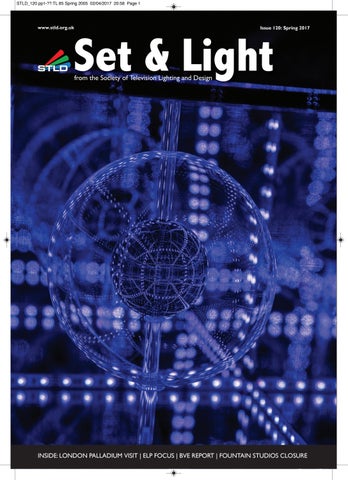
Cover photo: Winter Lights Festival by John O’Brien Printed by: Gemini Print Deadlines for the next issue: Editorial: 23 June 2017 Advertising: 16 June 2017 Advertising is accepted only from sponsor members of the Society © Society of Television Lighting and Design 2016
Set & Light | Spring 2017
3
STLD_120 pp1-??:TL 85 Spring 2005 02/04/2017 20:58 Page 4
MEET THE NEWEST STARS OF THE STAGE
ZOOMING WASH LUMINAIRES PLATINUM 1200 WASH™
PLATINUM SEVEN™
19x 65W RGBW LEDs On Par With 1500W Discharge Wash Fixtures
19x 25W Multi-Chip LEDs (RGBW+Amber+Cyan+UV)
RAYZOR 360Z™
3x 60W RGBW LEDs &RQWLQXRXV )XOO ʜ 5RWDWLRQ
Common Features
Advanced Cooling and Movement Control Smooth Color Mixing and Pixel Control • Selectable Linear Dimming Curves Flicker Free Operation for TV and FILM • Adjustable Refresh Rate Frequency and GAMMA 5pin DMX In/Out RJ45 Ethernet In/Out (Art-NET, sACN) • PowerCON TRUE1 Power In/Out
PUSH YOUR VISION WORLD HEADQUARTERS (USA) www.elationlighting.com info@elationlighting.com +1.323.582.3322
TO
THE
LEADING EDGE.
ELATION PROFESSIONAL EUROPE www.elationlighting.eu info@elationlighting.eu +31 45 546 85 66
GET SOCIAL
STLD_120 pp1-??:TL 85 Spring 2005 02/04/2017 20:58 Page 5
Event
It was a blustery evening in Wimbledon for the STLD Annual General Meeting at White Light Studio 15. More brave members turned up than we expected, but the excellent hospitality by Bryan Raven, Chinosa and staff coped admirably. Philips Lighting took the opportunity to demo its latest fixtures. Martin Palmer from Philips Entertainment was on hand to demo the latest LED moving head fixture from the Showline brand: the SL 300 LED spot, used on the Christmas edition of Top of the Pops lit by Roger Williams. This a compact LED moving head spot fixture featuring a 270W LED engine and includes framing shutters. Also on show from the Showline brand were the SL SUNLED batten and the SL300 WashFX. The SUNLED 10 is a true LED tungsten strip replacement fixture. It has a fixed 3,200K colour temperature, which mimics tungsten to provide a ‘redshift’ while dimming, about 1,900K. The SL300 Wash FX is a highperformance moving head luminaire that delivers a powerful output, with fast and quiet movement. It has 19 RGBW LEDs, which deliver exceptional output, and the versatile and effective precision optical design allows the SL BEAM 300FX to function both as beam luminaire, and as a wash luminaire. Martin also had on hand the very new VL6000 Beam fixture, which is a 1,500W mid-air effect fixture from Vari-Lite. This has to be seen to appreciate the light intensity and cleave optical design. Alan Luxford, also from Philips Entertainment, demonstrated the latest in the LED Studio fixtures badged Strand. The fixture demonstrated was the new 400F Fresnel (pictured), which is a high-performance 380W LED producing the light output of a 2,000W tungsten fixture. White Light timed its demonstration perfectly and we started at our scheduled time, Treasurer Mike Le Fevre just beating the traffic to arrive in the nick of time with the Society’s Financial Reports. The formal part of the evening over, the members retired to the Green Room for more refreshments. White Light was an excellent host and thanks to White Light and Philips for the displays.
Chairman’s report: I would like to welcome you all here tonight for the 43rd AGM of the STLD. In line with previous years, we were trying to organise a visit to Wimbledon Studios, but due to the tight security there, this became impossible. However, I would like to thank Bryan Raven and Chin from White Light for letting us hold the AGM here and providing the hospitality, and to Alan Luxford from Philips lighting for showing us some of its new fixtures and for liaising for the STLD to organise this evening. I am pleased to note from the accounts that we have managed to make a profit this year, which is good to see after the last few years of losses. This has been possible due to careful management by the Treasurer, the reorganising of the membership database by Chris Harris, and Emma Thorpe’s efforts to invoice sponsors for advertising and subscriptions. However, this profit does not reflect in the account as we are still owed over £25k. We were owed nearly double that, but through the work of the financial team, this has been reduced. Our problem is how do you recover this debt without upsetting people? There are still too many members who are paying the wrong amount for subs or not paying at all. We have stopped sending out magazines and diaries to those who are debtors and this has woken up a few members, but there are still too many who owe subs. For any members who wish to pay, Chris Harris is
43rd AGM of the STLD
always open for business and can now take credit card payments, so no excuses! We welcome any suggestions to try to recover these debts. Despite the lack of funds we have managed to hold some excellent and well-attended meetings. We had another visit to the Strictly Come Dancing set, primarily for students. This attracted about 60 members and guests and was greatly enjoyed by those who attended. Our thanks go to Mark Kenyon for hosting again. Another well-attended visit was organised to BT Sport. Our thanks goes to Dave Gibson, who was our host on the night and gave a tour of the studios. There was a visit to the London Palladium in January attended by 35 members, who were given a talk by Mark Fox from the Really Useful Company. Another theatre venue visit was to the Alexandra Theatre in Birmingham for a PRG XL Video open day. Studio visits continued with one to the set of The Royals at Three Mills Studios. This trip was set up by John King, and our thanks go to the TC Thomas, Max Gottlieb and Paul Parker for making this happen from the production end. With all these studio and theatre visits, the production teams have been very supportive. Other meetings have included a visit to Chelsea FC to see the new LED floodlighting installed by Philips and, again from Philips, a visit to its open day at RML Lighting in July. There was also an open day held at Sevenoaks School with a number of manufacturers present, with sessions given by ETC, Chauvert, Multi-Light and yours truly, concentrating on LED sources. This was organised by Lighting Logic, which unfortunately succumbed to financial problems and folded. It was a good supporter of the STLD and we were sorry to hear of its closure. We wish the staff all the best for the future and hope they find new employment quickly. My thanks go to Bernie Davis and Alan Luxford, who were responsible for organising most of these meetings. I can’t finish this section of my report without a mention of the trade shows we have attended, mainly PLASA and BVE. Our thanks go again to Chris Harris, who manages our exhibition stand at these events. We also had the KOI, which attracted a record number of attendance. This year will be the 10th, so hopefully this will be the start of the next decade. I have formed a separate sub-committee to run the KOI for the STLD and we have already instigated new ideas for this year. One of the last events of 2016 was the closure party at Fountain Studios. This was a happy and sad occasion given the long history of the site. Unfortunately, the site was sold to a property developer (along the lines of Teddington Studios) and we all know what happens next. I have heard that the BBC are due to hire Fountain as a ‘four waller’ for a while, presumably until the owners have worked out how many apartments they can cram onto the site! On a brighter note, Television Centre and Riverside are due to open for business soon, so watch this space for possible STLD visits. Although our efforts must be to attract new members, I am pleased to report that we have started an STLD training initiative. This is mainly due to Iain Davidson and Charles Osborne, who will be undertaking most of the organising and training. The first session is due to start later this year and we are grateful to Philips Lighting for its sponsorship of this first course and Wood Norton, which is providing its facilities free of charge. Without its support, this project would not have even started. I would like to thank the committee for all the work it has put in during the year and the membership for their continuing support and I hope we can further move the society forward during the coming year, particularly in the areas of membership and training. I would like to give a personal mention to our long-suffering Secretary. It is a thankless task and John does the job magnificently, despite having personal problems of his own. John and I both worked at Thames TV and met about 44 years ago when he was a cameraman and I a sound technician. It’s great having him to support me, both as Chairman and personally, so many thanks to you John. Ladies and Gentlemen, this is my report and I would move its adoption.
Stuart Gain, Chairman Set & Light | Spring 2017
5
STLD_120 pp1-??:TL 85 Spring 2005 02/04/2017 20:58 Page 6
STLD visit
Pouring rain and a tube strike failed to dampen the spirits of some 35 members and friends from attending a most enjoyable ‘Monday afternoon at the London Palladium’ in January. Our meeting place was the new Val Parnell bar, complete with its beautiful domed roof and spiral staircase. Over coffee we were able to see a display of recently discovered archive material relating to the theatre’s pantomimes of the 1950s and 1960s. Mark Fox was our highly entertaining guide for the day. Mark is the advertising manager of the Really Useful Group and has recently become chairman of the Frank Matcham Society. Members who came on the Charlie and the Chocolate Factory meeting will remember his highly informative and entertaining talk about the Theatre Royal. Our tour started with a history of the theatre and its owners and an amusing account of the ups and downs of this iconic theatre over the ages. During the talk we were joined by two glamorous ladies in top hat, sequins and tails – Rosalie and Rita: former Tiller Girls who performed regularly in Sunday Night at the London Palladium. Mark introduced the London Palladium as the most famous theatre in the world, which opened its doors on Boxing Day 1910 with a lavish variety production. The turn of the century saw a boom in the construction of theatres as this was the only mass entertainment available to Victorian audiences. Walter Gibbons, who had started his career as a music hall singer, bought the site of the former Hengler’s Circus in Argyll Street and contracted Frank Matcham to build the greatest variety theatre of the age. Matcham was the leading theatre architect of the period and in his time was responsible for the design of over 200 theatres, 26 of which still remain – eight of which are in London. The Shepherd’s Bush Empire, beloved of BBC staff of a certain age, is one of his many remaining creations. Gibbons’ vision was for a luxurious house with 5,000 seats but Matcham pointed out the impossibility of achieving an intimate atmosphere in an auditorium of such size. The Palladium is still one of the largest venues in the West End with its current capacity of 2,325. The London Coliseum, its sister theatre, also designed by Matcham, has just 29 more seats. No expense was spared in creating an atmosphere of opulent luxury – the final cost being an eye-watering £250,000. Matcham was a great innovator and took out a patent for the design of special steel cantilevers that enabled his vast balconies to be free of any supporting columns. The Palladium was the first London theatre to be fully carpeted and to have tip-up seats throughout. With two or three performances per day and the logistics of getting about 7,000 people in and out of the theatre in the shortest possible time, it was essential to have numerous entrances and exits. The difficulty was compounded by the need to separate the gentry from the working class, so it was necessary to fit a number of non-connecting staircases into the limited space available. Moving into the dress circle, Mark took us through 100 years of production at the Palladium. Over the years, variety finally gave way to a series of lavish musicals: the first, Rocket, in 1922, ran for over 500 performances. Others 6
Set & Light | Spring 2017
Monday afternoon at the Words: Richard Broadhurst Photos: John O’Brien
STLD_120 pp1-??:TL 85 Spring 2005 02/04/2017 20:58 Page 7
London Palladium
e London Palladium
Set & Light | Spring 2017
7
STLD_120 pp1-??:TL 85 Spring 2005 02/04/2017 20:58 Page 8
A removable steel stage replaced the revolvi
Centre shutter used in the past to ventilate cigarette smoke
followed but did not meet with the same commercial success. Gibbons, who had left the theatre in 1912, now returned, bringing with him the latest craze of ‘talking pictures’, but this was not popular with an audience who had come to regard the Palladium as the home of live performance. It was at this point that George Black, assisted by a young Val Parnell, took over the theatre and presented the ‘Grand Reopening Variety Programme’ in September 1928. Black gave the audiences exactly what they wanted to see, bringing over many rising stars from America to complement the British favourites. A chance meeting of six comedians on one bill resulted in the creation of The Crazy Gang, who became one of the best-loved acts ever in the Palladium’s history and filled the house at each of their performances in the 1930s and 1940s. The golden age of pantomime at the Palladium began in
The dress circle bar area
1948 when Parnell presented Cinderella starring Tommy Trinder. Every year, an even more spectacular production appeared until 1987, when Babes in the Wood with Cannon and Ball became the last pantomime for nearly 30 years. The revival of panto with this year’s Cinderella has proved to be a tremendous success, so much so that tickets have gone on sale already for Dick Whittington this December! In 1955 Parnell was not only in charge of the Palladium but was also managing director of the recently formed Associated Television. In a stroke of genius, he realised that, with television was taking over from traditional variety, why not combine the two? Thus, on 25 September 1955, the legendary Sunday Night at the London Palladium was born. The show ran for over 12 years and earned the Palladium its accepted title of The Ace Variety Theatre of the World. From 1979 the Palladium became firmly rooted in
Cinderella sparkles during panto season with HSL’s help Cinderella was lit by Ben Cracknell, with equipment supplied by STLD sponsor HSL Group. The rig (pictured right) was composed largely of Martin Professional equipment – Vipers, Auras, Quantum washes and profiles – as well as Clay Paky B-Eyes and Source 4 LED profiles. The rig delivered a beautiful and luscious range of colourful looks, as you would hope for at a pantomime. December and January is a busy time for HSL as it furnishes 30 pantos around the country, 23 of which are for Qdos Entertainment: one of the largest entertainment groups in Europe. During this time HSL had 14 lighting designers, with nine production electricians and six project managers, using over 700 generic fixtures and 1,600 moving lights connected by 82km of cable outworking. HSL’s John Slevin and Jordon Hansen came to the meeting and generously paid for the meal after. The STLD thanks HSL for its support, and Mark Fox and the Palladium staff for letting us in during a gap in performances, and, of course, Richard Broadhurst for 8
Set & Light | Spring 2017
organising the meeting. To find out more about HSL and its products and services go to www.hslgroup.com Bernie Davis
STLD_120 pp1-??:TL 85 Spring 2005 02/04/2017 20:58 Page 9
evolving one
Mark Fox explains the build of the auditorium
Posters in the VIP room
Candelabra
hosting spectacular musicals for the next three decades. Early shows such as The King and I, Barnum and Singing in the Rain broke all box office records and the musical was very much here to stay. Lord Lloyd Webber’s Really Useful Group acquired the Palladium when he purchased a number of West End theatres from the Stoll Moss group in 2000. He embarked on a programme of refurbishment, with many front-of-house and backstage areas were lovingly restored. Our tour continued around many interesting areas, including the lighting control room, and the rehearsal and archive rooms, both of which house a huge collection of programmes and posters, many of which have been saved from destruction. The dress circle Cinderella bar with its decor of white and gold was much admired. The highlight of the day came when we finally made our way onto the hallowed stage where so many of the world’s finest artists have performed. In common with many theatres of its age was the almost total lack of any wing space; it was fascinating to see how the production of Cinderella managed to fit all the sets and props into the tiny space available. A trip under the stage revealed an Aladdin’s cave of hundreds of the most exquisite costumes from the show. We also saw the site of the famous revolving stage, which was finally removed in 2002 for being outdated and dangerous. The Tillers recalled many terrifying moments waiting to be transported aloft by a mass of revolving metalwork long before the days of health and safety! Among the archive material recently discovered were many interesting items relating to the technical side of the theatre. In 1941, Moss Empires, the current owner, looked to the Strand Electric & Engineering Company to provide a more suitable lighting control than the cumbersome grand master board on stage. Fred Bentham’s legendary Light Console based on the Compton organ was installed and enabled the operator to perform much more elaborate lighting changes than previously. The Light Console, which was positioned in one of the front-ofhouse boxes, often bemused audience members. They thought that the man at the keyboard, who was actually the console operator, was a church organist! The control system lasted until the 1960s, when it was replaced by the Strand system C
utilising thyristor dimmers. As Fred Bentham writes in an article of the period: “We added a small drawer to the new desk containing a number of special keys that could be used to flash groups of lights rhythmically.” This new feature was becoming an essential part of some of the more elaborate Palladium shows. The 1960 production of Dick Whittington starring Norman Wisdom listed no less than 68 backstage staff, Mark Fox of which 19 worked in the electrics department. Jimmy Currie & Co, the well-known ‘Stage Water Scene Specialist’, provided the ship’s cabin with full water effects. In the archives there are a number of fascinating handwritten letters between Jimmy and the stage director concerning the various difficulties with this effect, each blaming the other for the problems encountered. The highly respected company Water Sculptures, the current leader in this field, is directly descended from the Jimmy Currie & Co. For the 1957 production of Robinson Crusoe featuring Tommy Cooper, the LX dept ordered 12 new Patt 23N 500W spots from Strand Electric to use as special side lighting on booms each side of the Pros Arch. The inventory for this show also included four UV floods, two Water Ripple effects, two Cloud effects and six miscellaneous effects projectors. This was one of the longest running pantomimes in the Palladium’s history, the curtain finally coming down at the end of March, the LX staff being paid £3 for a get-out lasting until 4am. Finally, we made our way back to the Val Parnell bar via the Royal Box, built more for being seen than seeing the stage. Joined by Mark and the Tillers, we moved across the street to the Argyll Arms and the aptly named Palladium bar. Here, in very convivial surroundings, we were treated to some excellent refreshments generously sponsored by HSL, the lighting equipment suppliers for the production. Set & Light | Spring 2017
9
STLD_120 pp1-??:TL 85 Spring 2005 02/04/2017 20:58 Page 10
This picture and right: Fred Claus © ELP The sheds were originally used to build airships
Truss storage
ELP’s storage area
STLD_120 pp1-??:TL 85 Spring 2005 02/04/2017 20:58 Page 11
Sponsor focus
ELP
From rock touring to restructuring Words & photos: Bernie Davis
s
e
You might well have heard that ELP recently had a massive car boot sale of its equipment, ranging from dimmers and cable to moving lights to staging – all part of its move to its latest premises at Cardington, near Bedford. Rumours started to go around that ELP was no longer in the lighting business, and we thought we should find out what was really happening. As you approach Cardington you can’t help but be impressed by the majestic sight of the twin green sheds, each the size of a cathedral. One of these sheds is now home to ELP. Elstree Light and Power has grown, changed and moved a great deal since rock band LD Ronan Willson set the company up in the mid 1970s. Ronan toured with bands such as Judas Priest, AC/DC and even Kool & the Gang back then, and after buying his own equipment started to trade as Meteorlites. His head for business led the company to become a major force in concert touring in Europe and the US for many years, and Ronan continued to invest in lighting and trussing. Come the 1980s TV started to find a need for truss and par cans on shows such as Top of the Pops, and Meteorlites was, of course, happy to help. TV productions started to become aware of the advantages of the rock touring ways of working, which had developed to make touring more efficient. In those days, TV location lighting was provided largely by the film lighting industry, with companies such as Lee Lighting and Samuelson’s providing the bulk of the equipment. Then, in the late 1980s, there was what I believe was a defining moment in the lighting game: the electricians went
on strike. BBC electricians and the regular lighting contractors all stopped working, and the BBC turned to the concert touring companies to get the shows out. I remember there was a darts programme that got rigged in a fraction of the time, for a fraction of the money, by a crew who wanted to work and wanted the job to go well. It triggered a change in the industry as LDs did not want to go back to the old ways after that. The other side of this experience was that Meteorlites was asked to work on more and more TV programmes, and its new customers were more friendly and more polite than some of the rock people it had had to deal with in the past. Everyone was a winner. Ronan then restructured the company, adopting the name Elstree Light and Power to make it sound a bit more TV and less rock ‘n’ roll. In a move that surprised many, it won the contract to supply Elstree Studio B with a complete lighting rig for Grange Hill, and I remember seeing a studio full of new ARRI equipment, with barn doors that stayed where you put them! Continued investment saw ELP become one of the main suppliers of the large entertainment lighting rigs as they bought more and more equipment and, to Ronan’s surprise, no one really tried to compete with ELP for quite a few years. The company quickly outgrew the storage capacity in Elstree and moved to Alconbury, near Huntingdon, leasing an aircraft hangar previously used by the USAF A-10 Tank Buster. Ronan’s vast truss collection, which had been stored in farmers’ barns around Elstree, could now all be stored in one place.
ELP’s reputation spread to the film world, where it provided dimmers for films such as Sleepy Hollow, making it much easier to turn lights off for meal breaks. It seems obvious to us, doesn’t it, but this was new to the film world. ELP started to get more work, including the award-winning Silent Witness. But fortunes would change again when, in another defining moment in 2006, the Bond stage at Pinewood suffered a serious fire. This left Warner Brothers looking for alternative locations. It knew of Cardington as a space but it had a big drawback: no lighting grid. Ronan stepped in and provided a complete truss grid, with walkways and cable management. Being on motor hoists, its height could be changed as needed. This was achieved by using a mother grid of Super Mega truss, supporting a grid of catwalks and lighting trusses, so the lighting could be rigged and maintained by non-climbing lighting crew and without the need of timeconsuming scaffolding. A succession of films were then made in Cardington by Warner Brothers and, after Batman Begins and The Dark Knight Rises, Director Christopher Nolan made his conceptual film Inception there – a film that took advantage of the massive scale of the studio space. More recently, Fantastic Beasts and Where to Find Them used the studio for some scenes. But why was this massive building built? The land was originally bought by Shorts Brothers in 1915 to build airships for the admiralty. And that is part of the secret of the building’s size and strength. Airships are, of course, massive things compared to planes and although they are lighter than air once Set & Light | Spring 2017
11
STLD_120 pp1-??:TL 85 Spring 2005 02/04/2017 20:59 Page 12
Sponsor focus
ELP
An eight-storey building in Shed 2 was used by the Building Research Establishment
completed, they need complete support for the building process, unlike planes, which simply sit on the ground. To cope with this the roof is a steel structure of load-bearing triangulated design; when they were built they needed so much steel they had to have an Act of Parliament passed to enable the steel to be diverted to the project. Shed 1, originally 700ft long, was extended to 812ft in 1926 to take the new R101 airship. Shed 2 was originally built at Pulham in Norfolk but was moved to Cardington in 1928. After the notorious R101 crash in 1930, all work on British airships stopped. A few years later, the site was used for the manufacture of barrage balloons and also became the home of the Meteorological department, which, of course, made use of weather balloons. The enormous scale of the buildings lent themselves to use by the Building Research Establishment, and inside Shed 2 there is still an eight-storey building used to carry out experiment on the effects of gas explosions and fire. I went up to the top of the eight-storey building and there was easily enough height to put my house above it and still be under the roof. Shed 1 still houses an airship, the 90m Airlander 10, which, unfortunately, made an undignified landing at a press launch in 2016. Luckily, no one was injured and no doubt work is continuing behind the massive closed door. 12
Set & Light | Spring 2017
Part of the equipment on sale as Ronan restructures the company
Shed 2 was leased by Warner Brothers for 10 years, with ELP providing much of the rigging hardware, but then Ronan stepped in to buy the building. The land surrounding the sheds had been bought up by building developers but the sheds themselves are two-star listed by English Heritage and an agreement was reached by which new housing is being built around the sheds but the sheds themselves are preserved. ELP has already made great improvements to the building, putting in offices, kitchens and toilets for the studio’s use, and it has moved out of Alconbury, moving it hire stock to Cardington last year. It still has its depots in Elstree and Manchester, of course. A building of this scale brings up challenges most of us don’t have to meet, and one such problem was when the gigantic door at the end of the building needed to open for one production. The structure is mounted on steel wheels on bogeys sitting on flat steel runners, and having not been maintained for many years, not only had the wheels rusted to the ground but the mechanism that drove the door had been broken the last time someone had tried to open it. After a bit of asking around, someone came up with a man who restored traction engines, who was able to make a replacement part for the broken mechanism, then jack up the door to free the wheels and restore the wheel mountings.
On one film, the set went in before the lighting design had been decided but Ronan came up with an ingenious way to rig the lighting over the set. The roof of the shed has six steel girders running the length of the building and these can take travelling bogeys, which can then slide along them. Once the lighting rig was known it was built at ground level at the end of the building, raised up over the set and dragged into place with crew using manual Tirfor winches. Each girder is rated at 24 tonnes, which should cope with most needs! And that is where we came in – with the equipment sale. Ronan admits he has been a bit of a hoarder in the past and has restructured the company to reflect the new profile of the industry. With manufacturers coming out with new products every year, it is surprising how quickly yesterday’s must-have fixture becomes today’s hardly requested hire. He recently invested heavily in new LED products and has decided to clear out much of the old stock. But business is certainly continuing. One thing Ronan loves is a project and, with the move to Cardington, it is clear that Ronan is once again in his element engaging with the film world and inventing new products to meet their 21st century needs. I think the scale of this project will keep him happy for quite a few years yet. For more information about ELP go to www.elp.tv
STLD_120 pp1-??:TL 85 Spring 2005 02/04/2017 20:59 Page 13
STLD visit The band’s point of view
Strictly Come Dancing
Students come dancing Words: Jacob Shooter Photos: John O’Brien
Vector desk
Middle: Teresa Vallis, Marketing Manager, Philips Entertainment Lighting, and friends Kara and Lynn
Digital dimmers
Georgy and Alan Luxford
TMB flex tube
Martin Christidis
In December 2016, the STLD organised a trip for students and other STLD members to visit the BBC Elstree Studios, which currently hosts one of its major Saturday night spectaculars, Strictly Come Dancing. As a new member and student representative for the STLD, it was a great opportunity to meet with other STLD members, students and industry professionals, as well as a fantastic opportunity to learn about lighting for multi-camera live TV from an award-winning Lighting Director, Mark Kenyon. Upon arriving at Elstree Studios, the STLD had provided drinks and refreshments, courtesy of Philips Lighting, while
Set & Light | Spring 2017
13
STLD_120 pp1-??:TL 85 Spring 2005 02/04/2017 20:59 Page 14
STLD visit
we were able to mingle with other like-minded students, as well as society members. I particularly enjoyed talking to STLD members, who were keen to chat about their experience in television, and to share their knowledge of the industry. This was a fantastic opportunity to network with industry professionals, and to build friendships with other students on similar courses. The event was so popular among students that it was a tight squeeze to get us all into the room. Being typical students, the food and drink disappeared quickly and soon it was time for the tour to begin. We were welcomed to the set Mark, who introduced us to his team – Generics Operator Darren Lovell and Moving Light Programmer David Bishop – before explaining in some depth the workflow of the production and the challenges of lighting for this format of multicamera television. I was particularly impressed to hear about their ongoing investment in fixtures, including a wide range of beam and moonflower effects, allowing Mark to keep the design fresh week after week. As well as discussing the large lighting rig, David also demonstrated how he programmes video on the show, highlighting the fact that a black mask is moved around live to prevent video content from being projected onto contestants and presenters when on the dance floor. In order to demonstrate to students what’s involved in lighting one of the BBC’s largest live family TV shows, Mark and his team offered to show us around the studio. Here we were able to see all the areas that lay behind the camera, such as the gallery and the camera rack suite. This is a very different style of lighting to what I have previously experienced. Like many of the students on the tour, I have mainly worked in theatre and on live events, where the operator and programmer sit in view of the stage rather than working from a monitor. At this point, David was able to explain how the video and lighting was controlled during the show and how he had developed specific programming techniques to deal with 14
Set & Light | Spring 2017
Two hazers for atmosphere
the challenges of lighting performers as the camera follows them through a 360-degree spin, without revealing the mechanics of the studio and camera setup. On such a fast-paced show, with multiple dancers swinging around the floor and a large automated lighting rig to keep track of, it was impressive to hear how the lighting team works together to ensure that the production lighting retains a high-quality feel, even when working on a very short timeframe. It was fascinating to learn about the different considerations the programmer and designer have to make when lighting for TV. During the tour, Mark and his team were able to answer our questions. This was a great opportunity to gain advice from well-seasoned experts in television lighting. Popular questions from the audience revolved around the colour balance of the cameras, and key lighting. Here Mark mentioned that he requested to balance the cameras to 3,200K to give the show its iconic, warm sparkly tungsten look. As well as this, the keylights for the
dancers were provided by follow spots from four angles, alongside a handful of Varilite VL1000, which allow Mark to model the dancers from any point on stage, meaning every look works perfectly for camera. For the design to keep up with the high expectations of a Saturday night audience, Mark mentioned how he chose a range of Chauvet Professional lighting fixtures to keep the design fresh and modern. A rig of Chauvet beam lights, as well as moonflower effects arranged in bunches around the main arches of the band, provide exciting dynamic beam looks around the studio. In this case, it was interesting to see that Kenyon had used beam lights to frame the camera shots, and to create an exciting background to the stage, without taking away from the dancers, who always need to grab the attention of the audience in the foreground. During the tour, we also learnt how a large number of beam fixtures could become problematic for multicamera lighting, as the beams and
STLD_120 pp1-??:TL 85 Spring 2005 02/04/2017 20:59 Page 15
Strictly Come Dancing
Diffuse beams
DMX changeover switch
gobos would potentially hit the back wall of the studio, fouling into camera shots facing the rear wall. David demonstrated how he promptly solves this issue, by cutting to the rear beam lights in front of the camera as it pans round, removing any gobos from
Flexible LED tubes
fixtures rigged around the arches and adding lighting interest from extra beam lights rigged for the new shot. This would then be swapped for the other set as soon as the camera moves away. David did a great job of
demonstrating the rig to us, running through a pre-prepared cue list showing how colours could be chosen to either contrast with or complement the video, as well as how he positions the automated fixtures to build up looks for TV and create exciting effects. Controlling such an extensive rig quickly enough to adapt looks on the fly during a live television broadcast meant that David specified a Compulite control system to programme the show. This demonstration also proved David’s choice of console, showing how quickly he was able to create complex colour bump effects. This was also mirrored by Darren, who also chose the Compulite system. The output of their lighting consoles are fed into a unique network rack backstage, where two completely redundant networks are created from FOH, and then automatically swapped by the network switch if it detects a fault. This was interesting as it demonstrated the high reliability and backup procedures introduced to ensure a live television show runs without hitch. Rose Bruford College student, Ruben Plaza Garcia said: “I really enjoyed the experience of looking around a live working TV studio. Both Mark Kenyon and David Bishop were extremely happy to show us around the studio, and show us how they work. It was really interesting to see how David configures his lighting console to programme live television.” Fellow student Robin Senoner added: “I now appreciate how important it is to be able to programme and update on the fly when working on live TV shows and to be able to adapt the lighting when the unexpected happens live on screen.” Although this is not the first time the STLD hasorganised an event at Strictly Come Dancing, the studentfocused event gave many of us an insight into the challenges and complexities of multi-camera live television, and hopefully inspired students to join the STLD as new members. Many thanks to the STLD, and to Mark Kenyon and the team at the BBC Elstree Studios, for such an interesting evening.
Set & Light | Spring 2017
15
STLD_120 pp1-??:TL 85 Spring 2005 02/04/2017 20:59 Page 16
Lighting
‘No need to be afraid’ Words: Rob Halliday Article first published in the ALD magazine Focus, and reproduced with their kind permission. It used to be that what happened in the theatre stayed in the theatre – particularly when it came to lighting, that most ephemeral of arts. Once a show closed, it lived on only in the memories of those who’d seen it and in some (hopefully great!) production photographs. Now it feels like it’s hard to keep shows in their theatres: between EPKs (electronic press kits), shows shot and released digitally or on DVD, and the live broadcasts pioneered here by the National’s NT Live programme and in the US by the Metropolitan Opera, they’re everywhere. The live broadcasts are particularly fascinating: shows shot by multiple cameras during an actual performance, transmitted in real time to cinemas around the country using the satellite technology installed for distributing movies, then later retransmitted, to suit local time zones, to cinemas around the world. An early fear was that it would reduce demand for tickets to the real show. It hasn’t – but now more people can see a show in a single night than can during its entire run. As a lighting designer, the joy of this is getting congratulations on your work from friends living so far away from your show that they couldn’t possibly have seen it, except when broadcast to their local cinema. On the other hand, the nightmare is what your work will look like when instead of making the jump from stage to human eye, the receptor it was designed for, it has to pass through a camera, a rack of electronics with a seemingly infinite range of control parameters, a satellite link and a video projector. It’s easy to be afraid, particularly when none of these are things that most theatre lighting designers have any experience with or understanding of. So, the first key to a successful broadcast of your lighting is to have someone there who does understand all of those things – a broadcast lighting director or director of photography. Particularly if other commitments mean you can’t be there, handing over your work in this way can be nerve-wracking, but remember: those on the other side are nervous, too. Mike Le Fevre, a veteran of many NT Live broadcasts and the filming of shows at the Royal Opera House, is absolutely clear that his first task on being appointed to a show is to contact the original LD to try to set time for a meeting (or dinner!) to talk about the show and its lighting, seeking to understand why it looks the way it does but also, most importantly, to gain the LD’s trust that their work will be in safe hands. (That there are some digital theatre producers who don’t want you or anyone else there, and will tell those paying the bills that they can capture the show without needing to spend any time or money adapting the lighting, is a whole other story. One that usually doesn’t end well.)º Both Mike and Bernie Davis, who has also done much 16
Set & Light | Spring 2017
STLD_120 pp1-??:TL 85 Spring 2005 02/04/2017 20:59 Page 17
Lighting theatre for broadcast
Pictured above: Director of Photography Brett Turnbull at work during the Branagh production of Romeo and Juliet, which had the added challenge of being broadcast in black and white! Below: The luminance waveform monitor; Lily James as Juliet translated into broadcast science.
work in this field, comment that an early talking point is often the need to adapt at all, how much and how to deal with the broadcast lighting being quite different to the usual show lighting for the live audience in the theatre on broadcast night. Bernie offers three pragmatic thoughts on this: that ‘cameras are low-contrast devices – they can resolve very dark images and very bright images, just not at the same time’, that ‘you will never hear a member of the audience leaving Covent Garden saying “fantastic show, great cast, but I thought the set was a little brighter in act three than it ought to be”‘, and, finally, that ‘you will never hear a member of the cinema audience walking out of a cinema relay saying, “I know it looked crap, but that was so it looked really good at Covent Garden...”‘. Perhaps important here is whether the management tells the live broadcast theatre audience they’re seeing something different – some do, some don’t. And perhaps also mention it to the cast... So, how to make those changes? Though every shoot throws up its own oddities, in general, the approach seems
to be to make a single-camera ‘scratch’ recording of the show so that all involved from the broadcast side (particularly the director, who will ultimately have to work out a shot-by-shot breakdown of the show, and the lighting director) have something to work from. Having talked through the show with the LD, the lighting director would then be given some time in the theatre, hopefully with a camera (ideally of the type to be used for the broadcast) and a good-quality (ideally OLED) properly set-up monitor clearly visible to all involved (be careful about looking at these monitors from a long way off-axis), to step through the show adapting the lighting. All agree that, particularly if the lighting designer is not available, having the original lighting programmer around is invaluable, both for understanding how (and why) cues are made the way they are, but also for making changes quickly. Having the DSM there is useful for translating moments from the video into cue numbers; if there’s projection in the show, that should be part of this process. Also invaluable: walkers to populate the stage, perhaps carrying greyscale cards to allow accurate exposure checking, but certainly with key items of costume and with people that approximate the skin tones of the actual performers. In the broadest sense, the changes will often be about reducing contrast, to allow the camera to correctly expose a performer without either being overwhelmed by the background, or having them seemingly play against black – for example, on Deep Blue Sea at the National, which had a translucent gauze back wall, Mike and Lighting Designer Guy Hoare boosted the level of the cyc lighting so the translucency was revealed to the camera. They might also be about adjusting overall level to let the camera get a good, clean, noise-free signal and with enough light to give sufficient depth of field and, at an extreme, to let the camera operator find focus at all. Followspots might need to run at a lower level (or with some ND added), and a little looser so an outreached hand doesn’t jump down in level. If a show has multiple types of light source it might be about careful balancing of colours between those sources – however, well you think you’ve matched the cool blue in your S4 LEDs to that in your Vipers, the camera will quickly tell you otherwise. Very deep colours that fall outside the range of the camera may need adjustment. The scratch tape and this session will also identify any surprises, hopefully with time available to solve them. A common one: LED set practicals run from certain drivers that cause them to flicker on camera. Drivers without this problem are available, but are often not specified because they’re more expensive and because the live broadcast only got confirmed after the set was built. Another: cycs that look evenly lit to the eye, look less evenly lit to the camera (and any wrinkles in the cyc will drive you even more crazy on screen!). Throughout this session, there are a number of learning experiences for those from the theatre side. One: you need to look at the monitor rather than the stage for most of the work. Two: many adjustments are possible to the image other than by adjusting the lights. Some – ‘f-stops’, for example – are familiar to anyone who’s taken a photo of their work. Others – gain, white balance, gamma, matrix – are not. When you say the image appears ‘flat’ or ‘dull’ on your monitor, that trust in Set & Light | Spring 2017
17
STLD_120 pp1-??:TL 85 Spring 2005 02/04/2017 20:59 Page 18
Lighting
your broadcast counterpart when they tell you the broadcast version will look fine becomes key. Three: the camera is relieving you of one of your duties as a theatre lighting designer: the indication or control of where an audience should look. The camera does that now. But that brings new problems: knowing that the director could switch to a different shot at any time (unlike TV or film shoots, where the wide, mid and close-up shots will be lit and filmed separately), and knowing where the camera is relative to the lights. A camera to the side of the proscenium may be in a similar place to some low front-of-house sidelight, which means the shot will be looking straight down the line of the light, and the person in shot will look very flat. Guy remembers this being a particular problem on Deep Blue Sea, ultimately resolved by having the cameras shoot more into their own side and less across the stage. Cameras shooting across the stage also often end up looking at people against black wing masking; worse, cameras positioned past the sightline of the extreme seating end up seeing into the wings. And cameras are sometimes put in places the show was never lit to be seen from, especially overhead cameras. Close-up shots both demand and offer a new chance for refinement in the composition of lighting; a host of tiny details just visible from the front row, invisible from the back, now jump out at you: toplights on noses, too-harsh sidelight, sharp shadows resulting from the multiple small light-sources theatre generally uses, rather than film’s big, often reflected, soft sources. Plus, you need to see into the performer’s eyes. On the Branagh Winter’s Tale broadcast, many of the conversations Director of Photography Brett Turnbull and I had were about the symmetrical head-high sidelight employed by LD Neil Austin. Live, this lifted a performer out of the surroundings. In close up, particularly for performers looking straight ahead, it left them feeling flat and with a strange ‘badger stripe’ shadow down their nose; unbalancing the levels, sometimes by just a few per cent, and adding a little front fill helped give a better picture. Equally, Brett would note that since cameras only operate in 2D we needed to add depth to shots, with a proper (ie, not getting onto the nose) backlight to performers – the resulting shadow out of shot – or by ensuring they weren’t playing against black. This ‘relighting’ day will often be long; it’ll also be simultaneously a bit dull to anyone used to the rapid pace of most theatre techs (adjust light, check camera, adjust, move people around, adjust, take note of camera settings, move on), and completely fascinating: a whole new way of ‘seeing’ a show you are quite familiar with. Depending on the production – the number of lighting cues, but also of different scenic setups – a day may not be enough. Probably however long you have will not be enough, so pace yourself rather than getting stuck at a particular point. After the relight day, another single camera recording may be made for review – probably the first performance the cast and a live audience will encounter with the adjusted lighting. From that, more notes prior to a ‘rehearsal’ performance with the full multi-camera and recording truck setup, the chance for the director, his assistant (analogous to 18
Set & Light | Spring 2017
Live, this was deliberately lit with a very strong backlight, filled by low crosslight. On camera, the backlight caught the noses, and the crosslight noticeably lit the back of necks as well as the faces. For broadcast, the position of the backlight was adjusted slightly to not be so strong on the faces, and some higher side front fill was added to the faces to let the crosslight be reduced here. The shadows from this extra light were partly lost in the backlight, partly lost out of shot.
The (real) flames are very bright; the camera has been adjusted down so these don’t completely dominate. Some more light has been added to the cyc so it retains the feel of a distant sky, rather than being revealed as a cloth by the light from the flames. The director has opted for a wide shot; we need to concentrate on the principals down-stage right, but the others on stage need to remain present.
the show’s DSM, following the script and calling the shot numbers to everyone), the camera operators, vision mixers, engineering staff and many more to practise before the broadcast. Recording this performance also gives a back up in the event of a satellite link failure or other major technical problem during the broadcast show. That recording will then be reviewed after the show, often in a cinema – a chance to see how the whole thing not only looks moment by moment on a big screen, but also hangs together overall. Which probably then just leaves the broadcast day to deal with any lighting notes that have resulted. Often this is when the overall dynamic of the piece
STLD_120 pp1-??:TL 85 Spring 2005 02/04/2017 20:59 Page 19
Lighting theatre for broadcast
This is an attempt to show how the lighting might be adjusted from the stage version to the broadcast version in this case of the Branagh Theatre Company’s The Winter’s Tale, lit by Neil Austin, Director of Photography Brett Turnbull. But, of course, it is a slightly flawed attempt because the ‘theatre lighting’ shots are production shots taken by a great photographer, Johan Persson, who captures beautiful moments so split-second they are almost impossible to find in the broadcast, even looking frame by frame. They were taken using a different kind of camera entirely and are generally close-ups. You’ll only know how it actually looked to the eye if you were there...
In close up, the crosslight headed for a character on the opposite side of the stage was judged to be quite harsh on the back of Dame Judi’s face, so the level was rebalanced a little. In this shot, the position of the camera is such that it can see the black of the wings – often unavoidable with cameras positioned out of the live audience’s way at the sides of the proscenium.
becomes clear: as well as guiding a live audience where to look, theatre lighting also sets the rhythm, and that may work differently on camera. The precisely timed backlight chase may not show up at all in close up or may appear odd if it only appears occasionally as the camera moves; the cuts between shots may actually do the same work. Fade times may need adjustment to correct for the way the camera perceives shifts in light, or the calling point may need to be fractionally adjusted. The beginning and end of shows are often a challenge, coming out of or going into blackouts, since many directors are afraid of leaving a cinema audience looking at a black screen for too long – holding some light
Gentle rebalancing to preserve the colour of light on the set; the lighting has to function correctly both for two characters in a wider cross shot and the close-up also used.
on the audience at the start of the show (perhaps light focused onto them rather than just the houselights) and bringing the same light up more quickly than you normally would at the end seem to be common solutions to this. Then the day itself, ‘live to the world’ – the same performance as ever but with a much, much bigger audience. A performance that has to start on time, the moment the pre-show video ends. The lighting director will probably be in the theatre at the lighting control, two headsets on (one to the broadcast truck, one to hear the cues) with a monitor and switcher to choose whether to see the broadcast shot or the shot from any of the other cameras, and usually with Set & Light | Spring 2017
19
STLD_120 pp1-??:TL 85 Spring 2005 02/04/2017 20:59 Page 20
Lighting
a lighting cue sheet marked up with shot numbers, exposures and notes of critical moments – to warn the racks engineers of an upcoming snap up to a full-up state, for example, preparing them to adjust the camera exposures, but then relying on each of them to bring their particular skills to the process. A good lighting operator can continue to contribute here, making adjustments (gently!) on the fly if an actor does something unexpected, an unexpected shot gets called for, or some part of the rig has a bad night – but being particularly aware of desks that capture the channel you’re working on, especially approaching a big transition cue. Just like the real show on any normal night, it’s live – you just have to keep going, no re-shoots possible. And then it’s done – at least for a live broadcast, since even any subsequent broadcasts will use this recording as live. The TV crew will pack up; the theatre lighting team should make sure they switch back to the actual show file (you probably want a different show file; even if you make a separate video cuelist in the main showfile, so you can compare and contrast the two versions, you may end up changing referenced position and colour palettes) and reset any other changes made to the rig. For other types of filming, you might want to keep the broadcast show file and notes of what you’ve done just in case: for the recent Miss Saigon ‘movie’ Lighting Designer Bruno Poet noted that there was sometimes a lack of lighting continuity between shots filmed as part of a performance and pick-up shots filmed later to be dropped into the final broadcast. And for EPK shooting on a long-running show, there might be a new press kit shot if a new cast arrives or the show goes on tour. Why reinvent the wheel? “How it looks through a camera will never match how it looks by eye,” sums up Bernie Davis. “But you can usually make changes that make both acceptable, so look at the monitor with a fresh opinion on how it could look. There are so many occasions when we have made changes for camera only to have at the least a debate whether to keep the changes for the stage in the future. Don’t just assume that a relighting process will make it worse...” However, he also adds that ‘probably half my work is with the cameras, getting them to work with the lighting rather than just pointing the cameras and making the lighting work for the cameras’. Mike Le Fevre adds a reminder to ‘keep the translation true to the original’ and also, practically, to ‘only change what you need to change’. But as the show’s lighting designer you know the show best: don’t be afraid to suggest a different camera angle might work better, or to highlight key moments in the show that need to work in a particular way. It’s a fascinating world: particularly so watching the dance of the luminance display on the output image; lighting art converted into broadcast science. It’s also fascinating from a performance and audience view: the close-up into the performers’ eyes against the communal experience of being in the room with the actors – critic Peter Bradshaw spent the first act of the Branagh Romeo and Juliet broadcast in the theatre, the second in the cinema, and his take on the differences is well worth a read. Whatever your take on the pros and cons of live broadcast in particular, it feels like we’re going to be getting 20
Set & Light | Spring 2017
Lighting theatre for broadcast
Pictured above: Camera locations for the Royal Opera House’s Rise and Fall of the City of Mahagonny
Pictured above: Mike Le Fevre’s lighting cue sheet for the Royal Opera House’s Rise and Fall of the City of Mahagonny, lit by Bruno Poet.
involved with this more and more. But as long as you have good allies, there is no need to be afraid. And as a bonus, your work, or at least a version of it, will live on long beyond the life of the live production – which is also why it’s worth making sure it’s done properly, even if that does cost more than just pointing a camera at the stage and hitting record. Thanks to Bernie Davis, Mike Le Fevre, Brett Turnbull, Guy Hoare and Bruno Poet for fascinating discussions about this world of translation; to Jon Bath at Fiery Angel and Charlotte Reed at Picturehouse for help with the live-to-broadcast comparison images, and to Johan Persson for his photographs, which always capture the light so remarkably well.
STLD_120 pp1-??:TL 85 Spring 2005 02/04/2017 20:59 Page 21
Information
Training
Demand is high for training A new lighting course for multi-camera productions has been introduced by the STLD. Recognising a need for more lighting training that bridges the gap between theory and practice, the society put together an initial course in March, supported by Philips Lighting and the BBC Academy, to establish if there was a demand for such an event. It was fully booked. The course, which was run in partnership with the BBC Academy, was held at the BBC Academy studios in Wood Norton, Evesham, Worcestershire, and was delivered by experienced trainers with extensive experience of lighting within the TV industry. The syllabus was designed to give delegates – both students and those already working in the industry – the confidence to approach the craft of lighting across a broad spectrum of programmes. To find out about future courses, email training@stld.org.uk or check the magazine, website, social media or email newsletters for details. The STLD is a not-for-profit organisation run by people working within the television industry for members, with the support of sponsor companies. Our aim is to promote the craft of lighting and design in all its forms via free exchange of ideas and information.
BLOW ‘EM A W A Y ! IP65 RATE D
R ASH / BLINDE STROBE / W ! M H ZOO & BEAM WIT
9 UT FROM HIGH OUTP RG 924X 40W BW LEDs S PIXEL EFFECT EYE-CANDY 9 D 9IP65 RATE PUSH YOUR VISION WORLD HEADQUARTERS (USA) www.elationlighting.com info@elationlighting.com +1.323.582.3322
TO
THE
More than a powerful fullcolor strobe, PALADIN™ also functions as a high-power wash light, blinder, beam RU H\H FDQG\ Hᦏ HFW LQ RQH brilliantly bright luminaire.
LEADING EDGE.
ELATION PROFESSIONAL EUROPE www.elationlighting.eu info@elationlighting.eu +31 45 546 85 66
GET SOCIAL
STLD_120 pp1-??:TL 85 Spring 2005 02/04/2017 20:59 Page 22
Lighting
Winter wonderland Words & photos: John O’Brien
Origin, by Philipp Mohr & Selektivton
This picture and below: Wavelength
The Winter Lights Festival took place in Canary Wharf
I visited the Winter Lights Festival, the Canary Wharf light installation, in January – too late to see the Luma Paint Light Graffitti and Nonotak performing live on 20 and 21 January only. The displays are on a wide area of the Canary Wharf complex and signposting the exhibits left a lot to be desired. On leaving the station I asked locals if they knew the display’s location, to be met with ‘I think it is somewhere down there’. Eventually I discovered the first of the exhibits: a water wall with projection on the 3m waterfall, and there was evidence of other lighting displays in the distance. At the third exhibit, in Montgomery Square, four artists had created OVO. Mostafa Hadi and Pol Marchandise (Odeaubois) designed the sculpture; Koert Vermeulen (ACT Lighting Design) conceived the lighting design and Marcos Viñals Bassols (the Art Director) shaped the global scenography. Here there was a man handing out a leaflets at last showing the displays. Crossrail Place Station, which was still in its pre-opening state,
STLD_120 pp1-??:TL 85 Spring 2005 02/04/2017 21:00 Page 23
Winter Lights Festival
LH Fresnel
The Huge reeds exhibit was disappointing
The OVO exhibit in Montgomery Square
had the largest number of displays. The star-shaped Origin by Philipp Mohr & Selektivton was apparently functioning through the participant’s body electricity. LED squares about 2.5m by 2.5m, stretching down a hall to about 30m, the display controlled via a laptop connected to a headset, reacted to the thought processes of a volunteer. The Huge reeds were disappointing in the stream near Cabot Square; perspective was the biggest problem. Cathedral of Mirrors in Addams plaza reacted to visitors’ movements by sending light patterns along their columns, the light intensity changing by having more people present. Ten illuminated benches in the Canada Square park – a permanent feature – give you a chance to rest your feet and enough light to read your book in the darkness, too. Perhaps if the Winter Lights display happens in 2017, the STLD will organise a society meeting, although a recce to see the best route and displays will be essential.
STLD_120 pp1-??:TL 85 Spring 2005 02/04/2017 21:00 Page 24
llight ight entertainme entertainment e ent Aurora are Aurora are tthe h lighting he lighting rental rental specialists specialistss for the the broadcast television, br roadcast and entertainment nt media media pr oduction industries industries production Fr om simple dryy hire hire to full full studio studio instal lations a and pr oject From installations project management, our o extensive range of modern n lighting, lighting, and proud with investment in technology t proud association association wit h UQOG QH VJG ƂPGUV ETGY CXCKNCDNG OGCPU VJCV YG JCXG [QW UQOG QH VJG ƂPG GUV ETGY CXCKNCDNG OGCPU VJCV YG G JCXG [QW covered cover ed tthroughout hrough hout every stage of the the production producttion cycle.
automated tungsten led control grip distribution crew logistics
From Fr om concept to o creation, creation, we’re we’re all all you need.
ad division ivision of VER
auroratv.co.uk aur orattv.co.uk
#WTQTC #WT QTC KU JQOG VQ V CP GZVGPUKXG TCPIG QH NNKIJVKPI KIJVKPI GSWKROGPV GSWKR ROGPV KPENWF KPENWFKPI KPI VVJG JG NCVGUV CWVQOCVGF CPF C .'& VGEJPQNQIKGU VWPIUVGP F FKUVTKDWVKQP KUVTKD DWVKQP CPF EQPVTQN 9G JCXG G ENQUG VKGU YKVJ C FKXGTUG CTTC[ QH HTKGPFN[[ RTQHGUUKQPCN ETGY Y OCP[ QH YJQO CTG GZRGTVU YKVJKP VJGKT ƂGNF 9G CNUQ JQNF F RTGHGTTGF EQPVTQN 9G JCXG ENQUG VKGU YKVJ C FKXGTUG CTTC[ QH HTKGPFN[ RTQHGUUKQPCN ETGY OCP[ QH YJQO CTG GZRGTVU YKVJKP VJGKT ƂGNF 9G CNUQ JQNF RTGHGTTGF UWRRNKGT UVCVWU YK KVJ VJG OCLQTKV[ QH 7- UVWFKQU 6 6Q Q ƂPF QW WV OQT G CDQWV CP[ CURGEV QH QWT UGTXKEG UKORN[ IGV KP VQWEJ info@auroratv v.co.uk .co.uk UWRRNKGT UVCVWU YKVJ VJG OCLQTKV[ QH 7- UVWFKQU 6Q ƂPF QWV OQTG CDQWV CP[ CURGEV QH QWT UGTXKEG UKORN[ IGV KP VQWEJ info@auroratv.co.uk
STLD_120 pp1-??:TL 85 Spring 2005 02/04/2017 21:00 Page 25
The STLD’s stand
Hawthorn’s stand and, right, ARRI’s LCA, which supported Simeon Quarrie’s workshops
STLD at BVE Photos: Andrew Dixon and John O’Brien BVE has been in existence in the UK for more than 20 years now. The exhibition specialises in entertainment and media technology dedicated to the broadcast, production and post-production sectors. The show has evolved and now also includes the connected media, AV systems integration, live production, VR and creative sectors. This year’s BVE event was held between 28 February and 2 March at ExCeL London and once again the STLD was in attendance as an exhibitor. The stand was put together by our membership, exhibitions and training committee member Chris Harris, who did a wonderful job, but as Chris had a lighting job to go to on the first day, it was left to Andrew Dixon to man the stand until Alan Luxford turned up after a late night at the TPI Awards, which were on the other side of London. This yearm our stand R01 was directly across floor from the lighting seminar lecture theatre, and so a good catchment area for potential new members. Committee
members John King and Ian Hillson also manned the stand at various times to ensure Chris had a chance to rest. Being such a busy exhibition it was hard to take time off from stand duty to have a look around the exhibition but Bernie Davis did have a walk around the show floor to chat to some of our sponsor members. Some of those in attendance were ARRI, Aurora, ChromaQ, Doughty, LCA and LSI. ARRI was out in full force this year as it celebrated its 100th birthday. Founded in 1917 in Munich, Germany, it is now a global enterprise, still family owned and a leading designer and manufacturer of camera and lighting systems for the film industry. ARRI also celebrated the second birthday of the ARRI Alexa Mini at the show. Aurora now boasts of having one of the country’s largest hire stocks, boosted by a large order of ChromaQ Space Force. Aurora is always looking for innovative products for production requests and was displaying these low-
ARRI’S 12–18K par HMI
energy products as an alternative to regular studio lighting. ChromaQ was also showcasing this award-winning light. LCA was pleased to support Simeon Quarrie, who held the Lighting for the Story workshops in the Lighting and Cinematography theatre. He used LCA’s LiteGear and Cineo lighting, along with its EFX dimmers, drawing a good crowd for his demonstrations. LCA brought its new Matrix 5 colour module, MapLite from LiteGear, K5600 Alpha 800 and its EFX dimmers. BVE is going from strength to strength and now attracts more than 15,000 visitors, who attend to discover and learn about the latest products, services and trends from more than 300 leading manufacturers and distributors. This is why the STLD has signed up to exhibit again in 2018. If you did not attend BVE this year, make sure you go next year to see what is new in the broadcast world. Emma Thorpe, Alan Luxford and Chris Harris Set & Light | Spring 2017
25
STLD_120 pp1-??:TL 85 Spring 2005 02/04/2017 21:01 Page 26
Event
Fountain Studios closure
Farewell to Fountain Words: Paul Middleton Photos: Archive + Paul Middleton & John O’Brien
The studio’s exterior sign
Inset: Managing Director, Thames Television, Richard Holloway. Below: the closing party in progress
26
Set & Light | Spring 2017
Wednesday 14 December 2016 saw the last event to be held at Fountain Studios, with a tribute to its staff and the programmes that have been hosted there by way of a party and the showing of a nearly hour-long celebratory video. Despite the prestigious history of the site – it was developed in 1928 from what had originally been the Lucullus Garden Club Restaurant at the 1924 British Empire Exhibition – and the rapidly dwindling availability of large-scale dedicated TV studios in London, its owner, Avesco Group, decided late in 2015 that the pre-tax loss of £300,000 recorded during the 12 months to 30 September 2014 on recorded sales of £5.3million was ‘an unacceptable return on the capital employed in the business compared to the market value of Fountain’s premises’. Avesco has also stated that ‘the physical constraints of the Wembley site have limited Fountain’s ability to grow’. This was primarily due to a large part of the site having been sold off to finance the refurbishment of Studios 5 and 6 when Limehouse located there in 1989. The sale of the studios to property developer Quintain would bring in a welcome cash boost to the groups’ finances. The Fountain Studios division was to be closed, with no apparent attempt made to find a new location for the studios. The last programme made there was the semi-final of 2016’s The X Factor on 4 December. The entire contents of the studio were put up for auction on 7 February, with the highest bid items being the two Calrec Sound desks, which sold for £81K and £90K each. Next were an EVS XT2 Plus for £25.5K and two SONY MVS8000 Vision mixers at £21.5K and £15.5K. The two ETC Congo desks went for £850 each. The vast majority of the lighting equipment, including the Giano,1K, 2K, 5K, 10K, softlights, groundrows and Iris 4 Cyc lights and even ETC Source 4s, remain unsold. (Prices exclude 15 per cent buyer’s premium and 20 per cent VAT). Full details can be found at https://www.bidspotter.co.uk/engb/auction-catalogues/charterfields/catalogue-id-charte10024/ The archives of Fountain TV have been donated to the BFI and we hope to publish a full history of the studios in the summer issue of Set & Light.
STLD_120 pp1-??:TL 85 Spring 2005 02/04/2017 21:01 Page 27 Frost on Sunday with the Two Ronnies, 1969–70
LWT Wembley Studio 3–4 1969
This picture and right: LWT Wembley Studio 1 with Marconi Mk IV 1968
Chroma-Q® Space Force™
THE NEXT FRONTIER š š š š š š š š š š š
KEY FEATURES: Comparable to a traditional 6kW fixture Up to 26,700 lumens Variable white – 2,800K to 6,500K Only 8kg / 17.6lbs Quiet, convection cooling, no fans Smooth, soft uniform beam Variable PWM flicker-free operation Multiple hanging options Wireless DMX / RDM Superior unit-to-unit consistency Chroma-Q’s proven LED performance
UK D UK Dealer: ealer: A.C. Entertainment Technologies Ltd., +44 (0)1494 446000, sales@ac-et.com, www.ac-et.com
www.chroma-q.com
STLD_120 pp1-??:TL 85 Spring 2005 02/04/2017 21:01 Page 28
Information
The Gio @5 console combines all the professional programming essentials in a package that fits tighter spaces – and tighter budgets.
Full programming layout with backlit keys?
Encoders with haptic feedback?
Short-throw motorized faders?
Built-in multi-touch display?
Keyboard tray?
etcconnect.com
Showlight is a unique opportunity for lighting designers from all aspects of the performing arts to meet once every four years, listen to speakers from many countries, network with their peers, students and manufacturers, and enjoy the many social opportunities that go with it. With Showlight 2017 in Florence less than two months away, it’s time to book your flights, hotels... and, of course, secure your place at this unique colloquium. Showlight tickets can be obtained via the Showlight website – www.showlight.org/registration – or from eventbrite.co.uk (search ‘Showlight 2017’), where you can choose from Full Delegate, Papers Session Only or Day Tickets. Exhibitor spaces are now sold out, the speaker programme is being finalised and the programme of visits to local attractions is complete. Full details can be found on the Showlight website, but here’s a taster of what’s on offer... The latest speakers to join the programme are Andreas Huber of Osram, who will seek to demystify the use of laser as a light source and unlock its potential, citing several projects already running using laser sources; Durham Marenghi, who will talk about lighting the Closing Ceremony for the Rio Olympics and the challenges presented by a limited budget, restricted rigging positions and no chance of a rehearsal; and Projection Artist Frieder Weiss, who will speak about pixel mapping effects and infrared tracking of performers on a show he directed on a cruise ship stage.
W 6SRU 79 , RI \ HV W &RXU L HU O +RO L V &KU E\ R 3KRW R (XU 8()$ , R XGL 6W W 6SRU 79 ,
Professional control – scaled just right
:+, 7( /, *+7 /L JKW L QJ $XGL R 9L GHR
:H GHO L Y HU W HFKQL FDO GHV L JQ FRQV XO W DQF\ DQG W KH O DW HV W W HFKQRO RJ\ I RU \ RXU V W XGL R &RQW DFW XV I RU PRU H L QI RU PDW L RQ ZZZ :KL W H/L JKW /W G XN , QI R#:KL W H/L JKW /W G XN
STLD_120 pp1-??:TL 85 Spring 2005 02/04/2017 21:01 Page 29
Showlight 2017
Time to book your Showlight tickets Isabel Nielen will tell of lighting a concert in a Dutch valley using lasers to outline objects on the far side; James Simpson will explain how he used virtual reality to aid his design process for his work at the Royal Opera House; and Karl Taylor will take us on a journey, from concept to engineering solution, in the creation of unusual items that create the magic of theatre, from hand lamps, wands and spinning tops to flying 5kW HMIs. Paul Russell will regale us with his use of candles at Shakespeare’s Globe and The Sam Wanamaker Playhouse, and for Farinelli in the West End; DoP, former President of BSC and recipient of the highest ASC Honour, Phil Meheux, will explore the differences between lighting for live shows, and lighting interior and exterior sets for cinematography to give the illusion of reality.
Explore Florence
Showlight has arranged a programme of 23 visits, some of which give unprecedented behind-the-scenes access to places not usually open to the public. These range from a new opera house to a Tuscan winery, and take in glorious surroundings like the Duomo, the Palazzo Vecchio, the Baptistry, the Ponte de Vecchio and the Pitti Palace on the way.
/showlighteventt /showlighteven
Book Now ow
Book your hotels
May is a busy time in Florence and flights and hotels are filling up quickly. Showlight delegates can benefit from preferential rates at a number of approved hotels listed on the Showlight website – www.showlight.org/why-visit/traveland-hotels. Don’t forget to use the code when making your booking to ensure your discount!
Sponsors
Showlight could not exist without the generous support of our sponsors, and this year our main sponsor is Claypaky. Claypaky is joined by Diamond sponsor Oasis, Gold sponsors Robe, Osram and Eyetidy, Silver sponsors White Light, DTS and MA Lighting, and Bronze sponsors ETC and d3 technologies, alongside that of LSI and PLASA Media. Website www.showlight.org Facebook @showlightevent Twitter @showlight2017 Additional weblinks: Speakers: http://www.showlight.org/speakers/ Exhibitors: http://www.showlight.org/exhibitor-list/ Visits: http://www.showlight.org/social-programme/
www.showlight.org www.show wlight.org
/showlight2017
>>> see
|
hear
|
enjoy
|
network
The Co Countdown ountdown to Showlight Showli ight 2017 has Begun B Don’tt misss out - book your ticket now! Don’ www.showlight.org REGISTER R online at www .showlight.org Full detailss of speakers, exhibitors, rs, hotels and d visits on the website . . . Main sponsor
Gold sponsors
Diamond sponsor
Silver sponsors
Supported by
STLD_120 pp1-??:TL 85 Spring 2005 02/04/2017 21:01 Page 30
Lighting
The Mischief Theatre Company was formed in 2008 by a few friends who had just completed their acting course at LAMDA. They began as an improvised comedy group, winning the best improv prize at the Edinburgh Fringe in 2010. Developing their comedy skills, they adapted their production of The Murder Before Christmas to become The Play That Goes Wrong, which toured the UK and, in 2015, established itself in the West End, where it won a number of prestigious awards. Later that year they created Peter Pan Goes Wrong – first performed at The Pleasance and transferring to the West End in the autumn. Not ones to dwell on their considerable success, they also created The Comedy About a Bank Robbery. In 2016, they had three productions running in the West End. Peter Pan Goes Wrong was seen by a senior BBC Comedy executive, who realised that it would be perfect entertainment for BBC One at Christmas. The deal was done and the decision taken to rework the original two-hour script into a 60-minute TV special, to be performed in front of a studio audience. Peter Pan Goes Wrong does what it says on the tin. The pretence of the show is that due to Ofcom rules the BBC is obliged to hand over its resources to a community theatre group once a year. The Cornley Polytechnic Drama Society has been given the opportunity to present their highly ambitious production of ‘Peter Pan’ to a TV audience. If you havent seen The Play That Goes Wrong then firstly, why not? It’s the funniest night you’ll ever spend in the theatre – guaranteed. Anyway, the style is similar, with props that go missing or break, and actors who mix up lines, have terrible stage fright or dreadful accidents on stage. Of course, being ‘Peter Pan’, there is the flying. Oh yes, lots of flying, which goes wrong with disastrous and hilarious consequences. We also had fire, electrocution and a stage revolve with a mind of its own. I have never been involved in any production before that had so many risk assessments. And I actually read all of them, every day! We had a movie stuntman supervising 30
Set & Light | Spring 2017
Peter Pan Goes Wrong – on purpose, hopefully Words: Martin Kempton all the activity. This included a sword fight above and around a revolving set speeding out of control, the scenery on fire, and culminating in a huge pirate ship breaking loose, shooting off across the studio and smashing through a wall, with four of the actors (not stuntmen) still on the ship, looking terrified while they disappeared through the enormous hole. So, where did I get involved? I received an email from Stephen McCrum (ace BBC Comedy executive producer) in June, offering me this unique experience, and I grabbed it with both hands. My background is the theatre – I was trained in stage lighting by my grandfather when I was a teenager and I’ve lit dozens of stage productions – mostly unpaid – over the years. I still love going to the theatre and really appreciate the
extraordinary work done by today’s top lighting designers. This was a golden opportunity for me to use my theatre experience and combine it with my TV lighting experience in a challenging way. Just how challenging, I had no idea when I took it on. I was given free rein to design the lighting as I saw fit, but of course some of the LX cues were built into the script. I was given access to a recording from the back of the stalls of a theatre performance, from which I gained an idea of what would be needed. The show itself was not currently running in the West End but was to return in October – too late for me to see it. One thing was stressed: they were not looking for ‘comedy lighting’. The script had the following note:
STLD_120 pp1-??:TL 85 Spring 2005 02/04/2017 21:01 Page 31
Peter Pan Goes Wrong
The Jolly Roger © Harry Banks
Set note:
The set should reflect a BBC budget and not appear too amateurish. It is important for the piece that we not only believe the storylines of the actors performing the piece but also the characters they play and, therefore, we need to believe the environments they exist in. A naturalistic, textured set within which we are able to pick and choose exactly what goes wrong and what doesn’t will, therefore, always help us more than a general wash of fauxamateur or pantomime-like set. The same is true for all aspects of the production: direction, blocking, choreography, etc. In essence, it is vital that we work to present ‘Peter Pan Goes Wrong’ not ‘Peter Pan Done Badly’. So that upped the ante somewhat. Set Designer was Harry Banks. Now I have worked with Harry on
dozens of shows, from Harry Hill’s TV Burp to sitcoms like Two Pints of Lager and Miranda. One thing about Harry: he never builds a small set. This was no exception. I won’t pretend that the set build went entirely smoothly – in fact, I have never seen an art department and scene crew look so utterly exhausted by the end of the run. However, give Harry his due – it really did look superb. He had to create the children’s nursery, the rooftops of London, an enchanted wood, a haunted lagoon and the pirate ship. These were partly set on a large revolve, with two smaller revolves each side, enabling the sets to spread downstage. We made the show in TV-two at Pinewood: a studio I happen to like very much. I love the grid, I like the control rooms (on the ground floor – please note, dock10 and BBC Glasgow) and it happens to be only 40 minutes
from where I live. This was a ‘regional’ production, so it had to be made outside the M25. By a fluke of geography, Pinewood sits next to the M25 but on the correct side. Its monopoles made it easy for me to adapt the rig to allow for the flying. This would certainly not have been the case in Salford or Glasgow, which are equipped with motorised lighting bars that, of course, cannot be moved. So to the schedule. On the face of it, this was pretty generous: a day to rig the flying tracks, a day to get the lighting top rig in, then four days to build and dress the set. My crew would join on the last set-build day to position all our lights above and around the ‘stage’, enabling rehearsals to take place the following week. Unfortunately, there was a serious problem with the flying, which delayed its rig by a couple of days. This knocked on, so the set was by no means complete by the time the actors were due to rehearse on it. There were five days’ rehearsal but the cast had to leave by 4pm each day to perform The Comedy About A Bank Robbery. How they did that after an exhausting day of rehearsal, I have no idea. Fortunately, I was not booked on any other shows that week, so I sat in on the rehearsals, made notes and filmed some sequences on my phone. That time was invaluable; there was no ‘tech run’ as you normally get with a sitcom. The next time we would see each scene would be with cameras about to record it. The thing I missed was that, unlike a normal theatre show, we had no technical rehearsal. Anyone who has done any theatre work will know that every production, no matter how big or small, always has a tech – where the actors or stand-ins go through all the moves and various LX, sound and scene cues are timed and rehearsed. This is when a theatre LD creates the lighting balance and records all the cues into the console. On a big West End show, this process can take days. We had none of this – I had to guess what it would look like when the actors were in position and build everything blind with my console op, hoping it would all work. I did ask for a day when I could go Set & Light | Spring 2017
31
STLD_120 pp1-??:TL 85 Spring 2005 02/04/2017 21:01 Page 32
Lighting
through each set in turn and build all our looks, but time ran out and we were able to work only on the first nursery scene (without actors or stand-ins) before we were on camera. I must mention my console op – his contribution was invaluable. I was lucky enough to secure the considerable talents of John Ford. Many of you will know that he often works with Dave Davey on his major productions, and I was extremely fortunate that he was free. John is not only a top-notch ‘generic’ operator, he is also very skilled and very fast in operating moving lights. On Dave’s shows he often uses movers to key the talent, and I knew his unique combination of skills was exactly what I needed. Because we had so many sets to light, with each one presenting considerable challenges in simply getting the light through the scenery to the actors, I opted to use a rig entirely of moving lights. I decided to light in tungsten, so my favourite wash lights – Martin TW-1s – were used as steerable keys that we could also warm or cool where necessary. They blend beautifully from one to the next, so I started by lighting the stage from side FOH positions covering left – centre – right areas; downstage – midstage and upstage, just as Richard Pilbrow describes in his book on stage lighting, which I was given as a school prize many decades ago! Each of these lights was moved from its home position and spotted or flooded accordingly depending on the set and the action, but it did mean that the whole stage was at least lit. Boringly lit – but lit. I was sure I would need to isolate some areas and have the ability to punch a bit of a highlight in places, so I sprinkled a few trusty VL-1000s around the stage. Many of these had specific jobs at various times, all were also useful to add gobo break-ups. Then above and upstage I rigged 40 MAC Auras. These versatile LED fixtures could be used as backlights, kickers or for colour washes on scenery, as well as keylights at various times. Finally, I added half a dozen MAC 2000 Performances for break-up and water ripple effects. All of the lights were also chosen as they are either silent or at least very quiet – this was, after all, 32
Set & Light | Spring 2017
Peter Pan Goes Wrong
a play, not a music show, although we did have a couple of music numbers in it. It seemed to me that side-lighting would be essential for that theatrical look and, of course, to cover the flying, so examining the proposed set design, I looked to see where I could squeeze some fixtures in. Hmm... Unfortunately, the only gap low down was just upstage of the proscenium arch – the rest was all solid flattage up to at least 15ft. I planned to rig a vertical truss tucked behind the pros arch each side, with some Auras and a VL-1000 on each. Guess what? They had to be cut as there simply wasn’t room. I intended to use as many lights as I could from the sides above the set, but this was not exactly straightforward. Over the stage there were planned to be two scenery tracks, from which leafy flattage would slide in, plus the main flying track that crossed the whole stage area. There were very few areas where I could rig anything useful. So, backlight then. However, once you take into account the height of the set, plus the height of the actors flying above it, you end up with the lights pretty tight to the grid and not exactly in the most useful positions. Anyway, I rigged as many as I could squeeze in and hoped for the best. Believe it or not, each one did originally have a planned specific task but, to be honest, most of this went out of the window on the day. We came to the week of rehearsals in houselights on set – except that the set didn’t really exist yet, or at least only in its most basic form. As the days went by and the various scenes were worked through, more and more flying points were requested and rigged. I was there with the redoubtable Pete Dale, who was essentially looking after the power to the revolve, but every day I had to send him to the grid to clear away more and more lights in order to make way for all the flying points. As the week went by, no less than eight extra points were rigged, along with the necessary lines to the wings, so I ended up with my top rig looking very sad and sparse. However, there was no point in digging my heels in – the comedy had to come first. So to the day when I was due to build most of the cues. Well, firstly we had to rebuild the lighting rig, which
had been scattered to the extremities to make way for the flying. We snuck as many lights as we could into positions that would possibly be useful and hoped for the best. I have mentioned the lights I used in the hanging rig but I must include some simply marvellous units that came from RML. These were battery operated LED uplighters, with built-in wireless DMX. They are made by GDS and are called Liteware-HOs, but nobody remembered that, so they were simply referred to as the battery uplighters. We managed to tuck about a dozen behind various bits of scenery and they absolutely transformed the look of the set. Most of the set was on revolves so any on-stage floor lights had to be self-standing with no cables.
Tinkerbell’s dress
This could have been the subject of a magazine article in its own right. Let me explain: the gag was that Tinkerbell had a dress with LED fairy lights sewn into it, which had to be very temperamental at various times during the show. It was apparently connected to power in the wings via a long cable and plugged to the dress with a 32A Ceeform plug. Except, of course, it wasn’t. That was all a prop. The dress was actually battery powered and would be controlled by John’s console via a radio DMX link. So far, so good. I was told that the box of tricks to make all this work was with the dress. However, I had a call from the wardrobe department a week before we recorded to inform me that the dress just had bare wires on it – no clever box of tricks – and was this OK? I had a mild panic and decided to contact the theatre LD to see if he knew how it worked. He was as helpful as possible but, like me, had left it to experts to sort out the technology! Anyway, he told me who to contact in the hire company that supplied the production. They told me that it was all okay and standing by in their warehouse. Brilliant. I asked them to deliver it to Pinewood ASAP. Confusion from the hire company: they had heard about the TV recording but assumed we would be televising the theatre show, which was due to return to the West End in October. The relevant bits and pieces were all out on another job. I asked if they could please
STLD_120 pp1-??:TL 85 Spring 2005 02/04/2017 21:01 Page 33
Main picture: The nursery © Harry Banks. Inset: Some of the overhead rig before rehearsals began. None are set yet. Many of these lamps would be rolled away from the stage by the end of rehearsal week to make way for flying tracks and lines
tell me what was involved and where we could hire it all from. I was starting to feel pretty out of my depth by now. I was sent links to various websites in China and the US ,with delivery times in weeks, and was helpfully informed that getting it all to work had been a bit trial and error and involved experimenting with soldering various resistors and batteries into the circuit so the LEDs didn’t burn out. Now I was completely out of my depth. To the rescue came Simon Roose, previously with Panalux but now looking after things for MBS – the company that supplies all the lighting gear for Pinewood. He said ‘leave it to me’, which I gratefully did and, lo and behold, with the assistance of a very clever engineer who works for MBS adapting some kit previously used on a Bond movie, they got it all to work. It did require the resources of our crew to connect it all up to the system, but thankfully we had Stephen Emmett on board who, as well as being a very able electrician (and one of the best board ops in the business), also fits up expensive AV systems in luxury yachts. This was right up his street. We asked the actress if it was similar to what she had before, expecting her to say it was much smaller and neater, so were somewhat disappointed when she told us it was much bigger and heavier. Oh well. It looked pretty neat to me and it did seem to work, which was all I cared about. It had to work reliably during the
recordings as it was crucial to some of the comedy moments. I can report that apart from one occasion when an unknown person backstage kicked a plug out of a socket, it did! Glory be – and grateful thanks to all those who got it to work. I hope this will be my first and last involvement in the wardrobe department. So to the pre-record days. To say the schedule was challenging would be an understatement. It was, on the face of it, impossible, considering all the stunts and FX involved. We had to wrap by 7pm each day in order to give the scene crew time to reset for the following day. Even so, they were there till very, very late and back in very early, as indeed we were in order to build our cues and work out how to light a set we had never seen before. The schedule did get a bit behind but the show itself was so good that everyone was prepared to go the extra 100 miles to make it all work. At the end of the week, there were supposed to be two full recordings in front of audiences. In fact, the first one didn’t see the whole show but they were very patient and the reaction of both audiences made it all worthwhile. I’ve been an LD for over 26 years and have worked on a few shows that have stretched me, but this one stood out as something of a milestone. However, when I went to the grade I began to wonder if the whole thing had worked – this odd combination of theatre and TV. Would most viewers go along with it
– and indeed, would they get the joke? However, I needn’t have worried. The Twitter feed for the show was the most positive I have ever seen for any TV production. In over 100 posts, I read two that hated it and one complaint about the canned laughter. I assume he thought the shots of the studio audience were taken from another show. The TV critics mostly thought it was great, too – even The Stage gave it four stars, and one might have expected them to be a bit sniffy about a TV adaptation. There was one comment I certainly agreed with. Somebody wondered why the BBC had scheduled it so poorly (6.20pm on New Year’s Eve) and with so little promotion. One can only assume that some nameless channel controller had had cold feet about it. Shame on them! There are some names to mention – all of whom rose to the challenge with great enthusiasm. Firstly, I must congratulate Dewi Humphries, who directed the whole thing for TV with such patience and good humour. In my team I relied totally on Console Op John Ford, Vision Controller Rachel Donaldson, Gaffer Roy Winfield and all the sparks who came and went as the week went by, including Stephen Emmett, Paul Thompson, Simon Willett, Pete Dale and Nick Dale. Special thanks to Simon Roose at MBS and to Steve Wells at RML, from whom most of the rig was sub-hired. Quite an experience for all involved. www.martinkempton.com Set & Light | Spring 2017
33
STLD_120 pp1-??:TL 85 Spring 2005 02/04/2017 21:01 Page 34
th 2008 2008 2017 2 017
Knight of Illumination Awards
www.knight-of-illumination.com
“...The only Awards exclusively dedicated to professional Lighting and Video Designers...”
Nominate a design here: www.knight-of-illumination.com
Organised by:
Find out about the excellent sponsorship opportunities here: awards@knight-of-illumination.com
Headline Sponsors:
STLD_120 pp1-??:TL 85 Spring 2005 02/04/2017 21:01 Page 35
Information
KOI awards
Nominations open for 10th KOI awards The Knight of Illumination (KOI) Awards is powering up in preparation for its luminous 10th anniversary event this September. Billed as the ultimate showcase of lighting and video design achievement in the UK, the awards are already receiving outstanding nominations as international creatives and industry supporters push to see their favourite works of 2016–17 take home a KOI sword this landmark year. The awards’ Television and Concert Touring & Events categories are now open for nominations of lighting and video design work performed or broadcast in the UK between 1 August 2016 and 31 June 2017. Anyone is eligible to submit a show they feel worthy of recognition, and lighting and video designers, including international designers who have worked on shows in the UK, are encouraged to self-nominate. Entries can be made via the official KOI website www.knight-of-illumination.com. As with previous years, nominations for the Theatre category can be submitted by the KOI judging panel only. The shortlists will be announced in August. Lighting Designer Tobias G Rylander, who won a 2016 award for his design for The 1975, says: “Winning a KOI award gave me a huge feeling of accomplishment and provided me with invaluable recognition across the industry. As well as recognising designers, the awards create a space where creatives can open conversations with manufacturers, production designers and developers of technical equipment and form professional connections across the sector.” With a decade of bringing together lighting and video designers from across the globe, the KOI Awards remain the most prestigious celebration of lighting and video talent in the UK. This year the awards dinner and ceremony will return to the Eventim Apollo, London, on 17 September. “Knowing how the KOI judging is put together makes winning a KOI award mean a great deal,” says triple swordwinner Nigel Catmur (Mercury Music Prize– 2008, The Royal Variety Performance – 2012, Young Dancer Competition – 2015). “As the KOI judges are all experts working within the entertainment technology and arts industries, they are able to meaningfully scrutinise work, making any accolade from them praise indeed.” In addition to the Television, Theatre, Concert Touring & Events categories, each year The Enrico Caironi Award for Lifetime Recognition is presented to an individual whose passion for the industry has gone above and beyond the call of duty, in turn benefiting their colleagues, the industry and the wider world. Last year’s winner, author and editor of Entertainment Technology and ET Now, John Offord says: “It is hugely important to me to have won a Lifetime Recognition Award at KOI. With the award I join the eight previous recipients and I treasure being part of their club.” The KOI Awards were conceived in 2007 by Italian entertainment lighting manufacturer Claypaky, now Headline Sponsor of the event in association with parent company OSRAM, and was represented at that time by Enrico
2016’s KOI award winners ©5e
Caironi, alongside renowned international lighting designer Durham Marenghi and his wife Jennie, who remain coordinators of the awards. Prestigious industry organisations the Association of Lighting Designers (ALD) and the Society of Television Lighting and Design (STLD) bring together the judging of the Theatre and Television categories respectively. The event’s production, management, marketing and communications are co-ordinated by entertainment technology PR and content production specialist, The Fifth Estate Ltd. Each year the awards are sponsored and supported by top names in entertainment technology. Pio Nahum, CEO of Claypaky, says, “KOI is a true pan-industry event that is proudly supported by almost all of the major businesses operating in entertainment lighting and video technology. The 2016 awards was supported by more than 40 sponsors and partners, who unified to celebrate the outstanding creative talent of lighting and video designers working in the UK.”
Entry submission for Television category:
Sub-categories are as follows: n Television set and Graphic Design n Drama n Entertainment and Events n Small Production
You can nominate any lighting or video content design for shows performed or broadcast in the UK between 1 August 2016 and 30 June 2017. Anyone working in the industry can nominate a show for an award, and more than one show can be nominated by or for the same lighting or video content designer. To submit your nomination, visit www.knight-ofillumination.com/categories and select Television. Please note, nomination forms received after 30 June 2017 will not be considered. To hear more about sponsorship opportunities, contact Sarah at The Fifth Estate at sarah@thefifthestate.co.uk or on 01273 660 784. Set & Light | Spring 2017
35
STLD_120 pp1-??:TL 85 Spring 2005 02/04/2017 21:01 Page 36
Sponsor news
Sponsors: don’t miss out on being featured here. Email your news to sponsornews@stld.org.uk for inclusion in the next issue of Set & Light.
AC-ET AC-ET adds Quasar Science to its growing film and TV brand portfolio
A.C. Entertainment Technologies Ltd (AC-ET) are delighted to announce that they have been appointed as an exclusive distributor for Quasar Science. Quasar Science’s innovative LED-based lamps offer direct replacement of conventional fluorescent fixtures, saving time and providing a cost-effective solution for upgrading existing lighting instruments to energy-efficient LED sources as an alternative to complete replacement of the fixtures themselves. Offering dimmer-compatible technologies, designed by studio electrical lighting technicians, their products are flickerfree, have a CRI of 95+ and a lamp life of up to 25,000 hours. The Quasar Science Q-Line range is available in both switchable bi-colour (from 3,000K to 5,600K) and cross-fade variable colour versions, and in a choice of lengths ranging from 1ft up to 8ft. Given the extremely high-colour quality requirements of film broadcast, Quasar Science have created a combination of advanced technology for a wide range of applications – including creating giant LED panels; using them through overhead diffusion, in soft boxes or retrofit fluorescent fixtures; to dimmer-compatible, colour-switchable LED lamps with over 40 per cent more output than a fluorescent. To arrange a personal demonstration call +44 (0)1494 446000 or email sales@ac-et.com. For more information, visit www.ac-et.com/film-tv.
DMG Lumiere appoint AC-ET as exclusive UK distributor
AC-ET are pleased to announce they have recently been appointed as the exclusive UK distributor for DMG Lumière, a French manufacturer specialising in producing fixtures for the world of motion capture. Founded in 2003, DMG Lumière has more than a decade of experience in this area. Their innovative SL1 range has been created by the collaboration of gaffers, cinematographers and LED lighting specialists. The aim has always been to utilise LEDs in the most efficient way in terms of size, weight, control and light output. After years of testing and prototyping, the SL1 has been created to satisfy the highest standards and needs of the motion capture industry. Functions include incredible colour quality, with a CRI of 94 and TLCI of 90–94, and with a very fine colour temperature tolerance. The fixtures have incredible size/ weight/power ratio and come with frosted diffusion, which is easily removable, as well as a 360-degree mount as standard. The range is available in single colour with the SL1-5,600K and SL1-3,200K, or in bi-colour with the SL1 SWITCH, which has the full colour palette from 3,000K to 5,600K. 36
Set & Light | Spring 2017
Mike Docksey joins AC-ET
AC-ET is delighted to announce that Mike Docksey has joined the team in a key external UK sales role. Mike is a well-known face in the industry and brings a wealth of experience to the company. Having spent many years touring with live events around the globe, he joined the HSL Group in 2005 as part of the projects team. Mike enjoyed almost 10 years at HSL before moving to Adlib, as head of their lighting and video departments. Mike is now ready to take on a new challenge in his career. He said: “I’ve been a customer and friend of AC-ET for many years now and it’s great to be joining the team. I have toured extensively and worked in the production and rental sides of the industry. With all this experience, I feel I am able to fully understand the needs of a buyer, and this experience is vital to the next stage of growth for AC-ET. Developing relationships and trust with your client base is key to success and this, I feel, is exactly where I am able to excel. There are plenty of opportunities to explore.” Jonathan Walters, AC-ET’s Sales and Purchasing Director, said: “Mike’s knowledge, enthusiasm and contacts will be a huge asset to us. His background means he’ll be able to understand exactly what AC-ET customers are looking for and explain the full range of products we supply, whether that’s lighting, rigging, audio, video or cabling and other consumables.” Mike will be based primarily in the north of England, although he will cover customers nationwide. He can be contacted on 07867 451 298 or at mike.docksey@ac-et.com
ARRI ARRI at 100: proud of the past and confident in the future
As its centenary year gets under way, ARRI looks back at its rich history, assesses the values and principles that have helped it reach this milestone anniversary and sets its sights firmly on the future. 2017 marks 100 years since August Arnold and Robert Richter rented a former shoemaker’s store in Munich and set up shop as a film technology firm. The two young friends started with just one product: a copying machine they built on a lathe Richter had received as a Christmas present from his parents. Taking the first two letters of their surnames, they christened their new enterprise ARRI. Today, the company is headquartered at the same address on Türkenstrasse, although the premises has expanded to the size of an entire city block and is just one of numerous facilities around the world. Truly a global player, and active in every international market, ARRI has major branches in Europe, the Americas and Asia. In many ways ARRI typifies the Mittelstand – mediumsized German companies that are leaders in their field and
STLD_120 pp1-??:TL 85 Spring 2005 02/04/2017 21:01 Page 37
Compiled by Emma Thorpe – sponsornews@stld.org.uk
that have achieved longevity through adherence to rocksolid values. Often, like ARRI, they are still family-owned enterprises, handed down through generations and overseen by custodians with an emotional investment in the brand. Despite its grand age, ARRI is a company that places great value in youthful exuberance and passionate dedication. Dr Jörg Pohlman, one of two executive board members at ARRI AG, says: “I still find it amazing that this company was founded by two teenagers; they were so young that their parents had to sign the incorporation documents. First and foremost they were film enthusiasts, driven by a love for visual storytelling and technology. If you walk around ARRI today you’ll see that same enthusiasm and passion – it defines who we are and what we do.” Arnold and Richter were camera operators, film producers and an equipment rental outfit before they ever manufactured an ARRI camera. From the very beginning they worked directly with filmmakers, and the insight they gained helped them to develop equipment that met real on-set needs. In today’s industry, with technology driven at breakneck speed by marketing hype, this philosophy of listening to what filmmakers want – rather than telling them – is more important than ever. Executive Board member Franz Kraus says: “ARRI prides itself on being a long-term professional partner to the global film industry. We have never walked away, instead facing difficult times by redoubling our efforts and increasing investment in R&D. The fact that we offer such varied products and services, covering all sides of the industry, gives us a unique perspective and allows each division to benefit from the expertise of all the others. For example, it was our work in digital post-production that helped us make such a successful transition from film to digital cameras.” At every level of the industry there still exists the need for durable tools that are fit for purpose and deliver longterm returns. These days that means more than just build quality and durability: it means flexible system architecture for cameras and lights that are essentially computers. It means software updates that respond to evolving needs and continually transform the functionality of the hardware. ARRI’s actual anniversary is September 2017, although the whole year will be marked by numerous celebrations, with all of the company’s 1,300 worldwide employees taking part and helping to make it special. The IBC show in Amsterdam, also in September, will form the focus of the celebrations, and it is there that the main party will take place. The long history of ARRI sits predominantly in the celluloid age and it is a wonderful legacy to look back on. But now, in the digital era, the company is bigger than it ever has been, with more employees, more products and more international market share than ever before. At 100 years old, the future has never looked so exciting.
AURORA Lighting Channel 4’s Stand Up To Cancer from the Central Hall to the Crystal Maze Aurora Lighting are proud to have supported Lighting Director Gurdip Mahal and Gaffer James Tinsley on a brace
of shows for Channel 4’s Stand Up To Cancer. Filmed in front of an audience at Central Hall, Westminster, the SU2C live event included appearances by Boy George, Noel Gallagher’s High Flying Birds and John Legend for an evening of entertainment, all focused on raising awareness of the fight against cancer. The LD, gaffer and crew made fantastic use of an array of fixtures, including almost 100 GLP X4 and SGM P-5 LED to add deep, vibrant colour washes throughout the grandiose interior of Central Hall. Using a mix of the ultra-versatile Clay Paky Mythos, Vari-lite 1000TS and Martin MAC Viper Profile automated heads, the look was given a modern edge that contrasted perfectly against the majestic setting. Shooting The Crystal Maze on location in London, the crew were challenged with recreating the look and feel of the Nineties original for the Stephen Merchant-hosted one-off SU2C special, while adding a few contemporary touches of their own. Working within the confines of the location, the team specified a selection of low-energy products to help keep the power requirement to a minimum and assist in lowering the levels of heat being generated. Aurora supplied Chroma-Q Space Force LED fixtures, perfect for the provision of consistent, controllable lighting levels, to mimic the softly lit feel of the original show, along with SGM P-5 LED panels to help create the clearly defined colour coding assigned to the puzzle zones. For additional colour and movement, a selection of Clay Paky Mythos and Novalight Super Novas were included in the installation to allow the LD full control over the various moods designed to accompany each stage of the maze. Working in non-conventional venues can raise both logistical and technical challenges. Aurora are extremely proud to be associated with the production teams, lighting crews and technicians whose diligent work helped make The Crystal Maze and SU2C live broadcast a success.
VER/Aurora broadens team with UK appointment
VER and Aurora are pleased to announce the appointment of Ian Charlampowicz to the position of Business Development Manager on their UK Lighting team. Armed with in-depth equipment understanding, plus an extensive knowledge of the television and live event markets, Ian joins the VER/Aurora lighting sales team to further enhance the support and service enjoyed by the company’s growing clientele. An accomplished industry professional with broad experience across all areas of the entertainment lighting business, Ian has a wealth of understanding of equipment, systems and the entire production process. Ian has a graduate degree in theatre design and has worked in the theatrical lighting field for many years supporting lighting
Set & Light | Spring 2017
37
STLD_120 pp1-??:TL 85 Spring 2005 02/04/2017 21:01 Page 38
Sponsor news
designers and production teams with project management services on a variety of large-scale productions. This new appointment continues to build on VER’s strong global commitment to invest in expertise, equipment and innovation, including broadcast specialists Aurora and their recently-expanded, full-support lighting department at VER’s UK operation. Head of Lighting Europe, VER and Aurora, David March says: “‘We are delighted to welcome Ian as an integral part of our growing team. Ian brings strong hands-on experience across all aspects of stage and TV lighting, coupled with his proven customer service skills, which will enable him to understand our clients’ requirements.” Speaking on his new role, Ian says: “To be asked to join Aurora and VER Lighting, with their outstanding standards and fantastic reputation, is an honour. I am looking forward to this exciting new position and to collaborating with, and providing the best solutions to, current and future clients”
CHAUVET CHAUVET Professional STRIKE 1 takes centre stage in Polish television concert
Standing out against a giant fireworks display isn’t easy, but Adam Tyszka and the Polish team from Aram and TVP accomplished this feat in stunning fashion recently with help from a collection of CHAUVET Professional STRIKE 1 Fixtures supplied by LTT. Tasked with lighting a massive televised celebration and concert in Warsaw’s Central Square, the designer and his team drew upon the powerful output of the warm-white LED fixtures to accent the centre of a large stage, which hosted musical performances set against a dazzling pyrotechnics display. Tyszka used 26 STRIKE 1 fixtures to create a brilliantly illuminated and visually-engaging line down the centre of the stage. The warm-white glow of this line provided a wellbalanced counterpoint to the colours of the fireworks display. “The single-source fixtures provided an interesting and unique lighting focal point to the entire stage scenography,” said Tyszka. “The fixtures are incredibly powerful and allowed me to create an ideal counterpoint to the grandeur of the scenography and fireworks.” Furthermore, the STRIKE 1’s unique tungsten feel and smooth dimming curve gave the Aram LD several interesting looks to incorporate into his design. “The incandescent emulating features of the fixture were particularly instrumental in evoking classic stadium looks, which in turn awarded the evening with the kind of dynamism and force you’d expect from a concert of this magnitude,” continued Tyszka. “The STRIKEs were perfect for creating atmosphere, thanks to the amber shift – a feature that is difficult to find in other LED fixtures.” As the six-hour-long show was to be broadcast live on 38
Set & Light | Spring 2017
Polish national television, it was absolutely essential that the STRIKE 1s performed both on and off camera. “We definitely needed the tungsten-like red shift – it looked just as good on camera as it did in real life,” said Tyszka. “Thankfully, the STRIKE performed flawlessly and we could count on its versatility in both settings.” The warm retro looks created by the STRIKE 1 made the concert more accessible to the tens of thousands in the live audience, as well as the millions more who tuned in on television. “We placed a great deal of value on the tungsten look,” said Tyszka. “The tungsten glow translates well to television. It’s warm, inviting and it draws people into the performance – everyone feels comfortable seeing that warm white look. Aram is one of the largest companies in Poland, offering design and technical production for all kinds of projects, such as corporate events, festivals, exhibitions, conferences and television programmes. Aram has been on the market for 15 years, with tens of thousands of successfully completed events.
CHROMA-Q Chroma-Q showcase event features awardwinning film and television guest speakers
Chroma-Q® was excited to host a showcase event on 14 March, which featured award-winning guest speakers from the fields of cinematography and television lighting design and the opportunity to try out the brand’s award-winning LED solutions. Taking place at Heatherden Hall, within the grounds of the iconic Pinewood Studios, about 20 miles west of central London, it was a unique opportunity to hear award-winning Cinematographer Phil Méheux BSC and award-winning Television Lighting Designer Gurdip Mahal provide fascinating technical insights into their impressive film and television production credits while being interviewed about their careers. Méheux is recognised worldwide for his outstanding collaborations and photographic skills on such iconic motion pictures as Scum, The Long Good Friday, The Fourth Protocol, GoldenEye, The Mask of Zorro, Entrapment, Casino Royale and Edge of Darkness, among many others. Mahal is one of the world’s leading talents in television and large-scale events lighting design. His impressive credits include the MTV Awards, BBC Sports Personality of the Year and The Voice UK. He has also collaborated on projects with high-profile music artists including U2, Beyonce, Rihanna, Lady Gaga and Muse. The event also provided the opportunity to get hands-on and explore Chroma-Q’s award-winning lighting solutions for film, TV and studio, live performance, architectural and corporate applications in a ‘black box’ environment. Products showcased included the new multi-awardwinning Color Force II™ battens range, the Space Force™ variable white soft source, the award-winning Inspire™ colour-changing LED house light and the new Color One 100X™ LED PAR. Chroma-Q Global Brand Manager John Fuller said:
STLD_120 pp1-??:TL 85 Spring 2005 02/04/2017 21:01 Page 39
Compiled by Emma Thorpe – sponsornews@stld.org.uk
“Chroma-Q was very excited to host this event showcasing the work of two of the world’s leading authorities on film and television lighting, all within the inspirational grounds of one of the world’s leading film studios. We share their passion for lighting and innovation, which is setting new standards for tomorrow’s productions.” A full report of the event will feature in the next issue of Set & Light. From the makers of the multi-award-winning Chroma-Q® Color Force II™ comes a new must-see LED PAR: Color One 100X™.
Key features:
n Nearly 60 per cent brighter than its predecessor n Homogenised RGBA colour-mixing n Extremely smooth uniform output n A pure white, all from a single source n Theatrical grade dimming n High CRI of 93 n Chroma-Q calibration provides exceptional fixture-tofixture consistency n Convection cooled for quiet operation Why not take your next performance to exciting new heights!
CLAYPAKY Claypaky Mythos and Sharpy fixtures light up Lady Gaga’s Super Bowl LI Halftime Show
Lighting Designer Bob Barnhart, who has lent his talents to 19 Super Bowl Halftime Shows, chose Claypaky Mythos and Sharpy fixtures to help illuminate Lady Gaga in her solo turn at Super Bowl LI at Houston’s NRG Stadium. Lady Gaga began the Halftime Show with a tribute to America, singing ‘God Bless America’ and ‘This Land is Your Land’ on the roof of the stadium. She performed some dizzying flying effects, crooned a medley of her hits, led highenergy dance routines and closed with a rendition of ‘Bad Romance’ in an action-packed 12-minute show. Barnhart first used Claypaky Mythos fixtures on a Super Bowl Halftime Show two years ago with Katy Perry. This year he employed 56 Mythos on field truss set against the upstage wall below the first row of seats. The lights were positioned on 2.5ft spacings from the centre of the field out to the 20 yard lines. The Mythos fixtures were clearly visible in broadcast coverage of the Halftime Show. They appeared in the background in close-ups of Lady Gaga and the dances routines. “The Mythos fixtures gave a good strong dynamic and were fast enough to keep up with the tempo of the music,” says Barnhart. He also used 126 Claypaky Sharpys, which were bolted to the fascia on two levels of the upstage side of the stadium from end zone to end zone. “They gave width and dimension to wide shots so you saw the entire stage and most of the stadium,”
says Barnhart. “They cut through atmosphere and gave the scale and dynamics we’ve come to expect from Sharpys.” In addition, the compact size of the Sharpys meant they could be bolted to the fascia without interfering with the view of people seated above and below the light levels. PRG provided all of the Claypaky fixtures. For the Super Bowl Halftime Show, Pete Radice and David Grill were the lighting directors, Tony Ward was the gaffer and Robb Minnotte was the lead tech. A.C.T Lighting is the exclusive North American distributor for Claypaky.
Claypaky helps light X Factor (Italy) 2016
Claypaky is part of the impressive lighting plot that characterises the 2016 edition of X Factor (Italy). The 10th edition of the popular talent show, which started in Britain, is richer and more dazzling than ever. Work on it started a good five months before the recordings – for a ‘normal’ television programme, 90 days is usually enough – since the lights and scenic effects are essential components for the success of the show. Lighting Director Massimo Pascucci explained that X Factor (Italy) is not just a television show but is also a ‘live event filmed with cameras, where the artists are free to roam the stage and even put on their shows in the corridors and theatre galleries’. Other components typical of live events include the large number of LED walls that accompany the performances and the use of purpose-built scenery. The lighting equipment and filming covers every corner of the theatre, including a dolly hanging in the air, which sweeps and ranges far and wide from one side of the studio to the other’. The lighting director and production designer work closely throughout the whole week to set up a completely different show for every artist that performs: a kind of show within the show that repeats from the first to the last episode, even when there are very few competitors. Although there are fewer new talents, the number of performances does not decrease and each one has different characteristics. Pascucci said: “The meticulous care taken over every single step, from the competitors’ performances to the various parts of the show, is unique to the Italian version. The day after the live Thursday episode, work starts immediately on the next one, and the set and lighting designs are created and tested for up to 20 hours a day on the days before the live broadcast: there is hardly a moment’s peace.” The Claypaky Scenius Profiles stand out in the large lighting rig. They were the first Scenius units used in Italy TVwise. “They are excellent lights,” said Pascucci. “Definitely the best beam shapers on the market, which also offer saturated colours and a light quality that is hard to find with other lights. I mainly use them to mark out sections of the scene. The Profiles allow me to change situations on the fly, in keeping with the flexibility and speed required by the show. “The Scenius Profile also allowed me to create original, interesting lighting effects, using the beam shaper at the minimum beam angle: a wide segment of bright light that moved along the cracks of the doors in the scene, opening and closing when needed thanks to the ‘total curtain effect’ Set & Light | Spring 2017
39
STLD_120 pp1-??:TL 85 Spring 2005 02/04/2017 21:01 Page 40
The Opening and Closing Ceremonies of the Rio Olympic Games were lit by Durham Marenghi using Clay Paky fixtures © Dave Cump CT
only this light has.” The Sharpys lay an important role during the play-off, which is one of the most exciting moments of the show: “I made them interact with the big moving triangles on the stage, creating a ‘break’ effect to introduce suspense,” said Pascucci. “In my opinion, the Sharpy is the tracer par excellence owing to its luminous efficiency and continuity of use.” X Factor (Italy) is a tribute to modernity in all respects, even as regards the lighting choices: “I removed all the conventional lights, from the manual beam shapers to the white lights,” said Pascucci. “I am convinced that smart moving lights have long reached the quality of light required specifically for use in television, besides offering countless advantages in terms of flexibility and range of effects. I even use moving lights to create face skin colours, which is one of the things that most distinguishes the way I work.” Luca Tommassini is the artistic director of ‘X Factor (Italy)’ and Marco de Nardi is the lighting operator and designer. Italian rental company AMG provided the Claypaky Scenius.
Clay Paky fixtures illuminate Opening and Closing Ceremonies of Rio Olympic Games
World-acclaimed Lighting Designer Durham Marenghi used over 850 automated fixtures from Clay Paky in his theatrical lighting design for this year’s Opening and Closing Ceremonies at the Rio Olympics, Brazil. His team included Programmers Andy Voller, Ross Williams and Paulinho Lebrão, Associate LD Joyce Drummond, Spot Captain Chris Henry, TV Lighting Director Nick Collier and Lighting Team Manager Jennie Marenghi. The equipment was supplied by Italian rental company Agora and was managed by Nicola Manuel-Tallino and Giulio Rovelli. Working to a very tight budget, with limited weight loading for the roof, Marenghi needed fixtures that were highly versatile and compact and that could produce a highoutput beam on minimal power consumption. Turning to Clay Paky, Marenghi chose 850 of the 40
Set & Light | Spring 2017
industry’s top performers, selecting 152 Clay Paky Mythos, 120 Sharpy Wash, 260 Sharpy, 194 Alpha Profile 1500s and 130 Alpha Beam 1500s for his Olympic design. “We needed workhorse fixtures with extremely good optics,” says Marenghi. “The fixtures needed to be extremely high output, with a lightweight build and a focus bright and tight enough to cut through the projection and be picked up by the show’s cameras. For this detailed work we selected the Clay Paky Sharpy, Alpha Beam and the Mythos. These fixtures produce a fantastic optical train that gives superbly bright pin spots of light.” “The Olympic torch this year gave us a unique opportunity,” he adds. “Normally the torch produces a huge amount of light, but this time it had a small low-energy flame bowl, which sat in front of a large mirrored sculpture. I decided to make every moving light into a pin spot of white and gold that reflected the mirror effects and amplified the firelight. The laser-like beams of the Clay Paky Mythos and Sharpy assisted us in lighting the whole stadium in this way – a cauldron effect that has never been seen before on the Olympic stage.” Not short of challenges, the renowned designer also had to compete with Brazil’s wintertime weather, which came to a peak in a rainy deluge during the Olympics Closing Ceremony. Luckily, there was another Clay Paky fixture on hand more than capable of competing with the elements. “We used the Alpha Profile 1500 as our main key light says Marenghi. “We had them in weather domes initially, but took the domes off whenever possible due to the shallow angle of projection, which meant shadows of the domes were falling onto our stage. All the key lighting had to be carefully controlled, and the Alpha’s ability to return accurately from focus to focus in terms of position and shuttering, saved a lot of focus time for our programmers.” Originally from Lancashire, England, Marenghi is a veteran when it comes to lighting and the Olympics. He designed the lighting for all the Turin Winter Olympics Ceremonies in 2006, the London 2012 handover at the
STLD_120 pp1-??:TL 85 Spring 2005 02/04/2017 21:01 Page 41
Sponsor news
Compiled by Emma Thorpe – sponsornews@stld.org.uk
Beijing Olympics Closing Ceremony in 2008 and the Sochi Winter Paralympic Games Opening and Closing Ceremonies in 2014. His describes his experience in Rio as ‘fantastic’, maintaining that what he and his team created ‘helped to prove that you don’t have to be a mega powerful, super-rich country to produce a theatrical and beautiful ceremony.”
free and is an excellent choice when warm-white light is required in television, film or theatre. Add in the other benefits of LED lighting, such as greater reliability, a long-life LED rating so technicians won’t have to change expensive bulbs and, overall, less maintenance, and the WW Profile HP will satisfy even the most discriminating professional.
ELATION
Frank Schotman joins Elation Professional’s European sales team
New version of popular WW Profile™ ellipsoidal spot features twice the output
Elation Professional is pleased to offer the WW Profile HP™ – a high-power version of the company’s popular warm-white ellipsoidal spot WW Profile™ fixture. It projects a superior quality of light and is an excellent choice for the wide variety of white-light illumination needs required in broadcast, worship or theatre environments, from highlighting performers or scenery on stage to illuminating speakers. Powered by a 250W warm-white LED engine, this prolevel product gives an output of 14,000 lumens – more than twice the power of its predecessor and the brighter level of illumination needed for both video and broadcast purposes. The WW Profile HP houses an advanced optical system and emits an exceptionally flat field of soft, warm-white light with a high CRI of over 91 for a more faithful reproduction of an object’s colour. Its soft, flicker-free output means the WW Profile HP can operate with video cameras for image magnification and for broadcast.
Flexible directional spot luminaire The WW Profile HP supports multiple interchangeable lens options – 19-degree, 26-degree, 36-degree and 50-degree (sold separately) – making it a highly effective and highly flexible directional spot luminaire. Manual focus and a fourblade framing system allow for full control of the beam shape for a highly controlled field of light with less light spill. The fixture supports B-size metal or HT transparency gobos for custom projections to complement a theme or overall design. Professional feature set Low-noise thermal fan cooling means the fixture can operate in noise-sensitive environments such as broadcast, worship or theatre; a thermal management system that keeps the LEDs cooler and outputting at their maximum brightness. The WW Profile HP can slowly and smoothly dim from off to full and back again without flicker or stepping. Fullrange dimming is either manual or DMX controllable and a selection of variable dimming curves is provided for faster programming. Strobe and strobe effects are also possible. A host of other features come as standard, such as multichannel DMX control, three and five-pin DMX In/Out, and PowerCON In/Out connections. Operation is simple via a four-button control panel, with easy-to-read LCD menu display that makes navigation through settings uncomplicated. An integrated rigging yoke allows for easy hanging, and an auto-sensing power supply means the fixture can operate anywhere in the world. The WW Profile HP operates flicker-
Elation Professional is pleased to announce that lighting industry veteran Frank Schotman (better known as ‘The Tank’) has joined the company’s European sales team as a technical sales representative and product specialist. The Tank is a well-known face in the lighting industry, with over 25 years of experience under his belt. He comes to Elation from a position as Senior Product Specialist at the AED Group, where he supported High End Systems Inc’s HOG4 family, including their full range of fixtures. Frank possesses extensive knowledge of the Hog range of consoles, having worked for High End Systems for a number of years as a Product Support Specialist. He also worked for Eclipse Staging Services in Dubai as Head of Lighting and is a specialist in a wide range of automated fixtures. Frank also brings with him a wealth of front-line experience from major tours and productions of all types. Highlights include support for the 2006 Winter Olympics in Turin, as well as support work on tours by Prodigy, Eric Clapton, Faithless, Iron Maiden and One Direction, as well as Coldplay’s A Head Full of Dreams tour. Elation plans to tap Frank’s vast product knowledge and industry experience to help identify opportunities and grow the company’s presence across Europe. “We are extremely pleased to have someone with his background join our European team and are confident his years of industry experience will be a great benefit to both Elation and our customers,” said Marc Librecht, Sales & Marketing Manager at Elation Europe. Frank started with Elation’s European sales team in December and is based at the Elation European headquarters office in Kerkrade, The Netherlands. Contact him on +31 45 546 85 14 or email Frank.Schotman@elationlighting.eu
Ron StageMaster™ from Eilon Engineering monitors large rig for 2016 Swedish Idol Final
With a history of pop music success, including multiple Eurovision Song Contest victories, no country embraces Set & Light | Spring 2017
41
STLD_120 pp1-??:TL 85 Spring 2005 02/04/2017 21:01 Page 42
Sponsor news
Compiled by Emma Thorpe – sponsornews@stld.org.uk
reality song competitions like Sweden. One good example is the well-known Idol franchise, which has been one of the most popular shows on Swedish television since debuting in 2004. The 12th Swedish Idol season started airing on TV4 in August 2016 with a finale show held on 8 December at the Ericsson Globe Arena in Stockholm. Scandinavian Rigging Service (SRS) has worked on each Swedish Idol Final for the last 10 years, and this year was responsible for the complete rigging, from drawings and weight calculations to top rigging supply and rigging personnel. New this year, however, was the use of Eilon Engineering’s Ron StageMaster load cells to monitor the rig’s weight and distribution. Greater awareness to use load cells “There are no requirements to use load cells with large rigs in Sweden,” says Sören Durango, who has owned Scandinavian Rigging Service since 2014, “not yet, anyway.” However, there has been more awareness of using load cells on larger shows in venues such as the Globe, an arena that seats 16,000 people. Sören continues: “I have a good relationship with the client as I’ve worked with them many times over the years, so I approached them about using Eilon Ron StageMaster load cells on this show, stressing the safety factor involved. They said yes and thought it was a good idea.” Larger shows, larger rigs With rigs becoming heavier as shows get bigger each year, venue load limits have become a greater concern. “Rigs are getting closer and closer to the limit of what venues can bare,” Sören says. “On the Idol Final, we had a large PA system with built-in amps, plus big video walls and a huge lighting system in the house rig. Altogether, it means a heavier system above people’s heads.” There were multiple layers to the Idol rig, which was concentrated above the stage rather than spread out in the venue. Consequently, that made it hard to always see what was happening. “I wanted to know 100 per cent what was going on with the rig,” says Sören. “I wanted to know that the rig was okay. It gave me peace of mind to use the Ron StageMaster load monitoring so that when I left the arena at night, I could sleep well. It was a real stress reliever.” Ron StageMaster 6000™ G4 wireless load cell As the ceiling in the Globe is quite high, about 35m, Sören wanted to place all load cells above the hoist in order to get everything controlled. “It was important that the system was live, direct and wireless, otherwise we could not have put the load cell above the hoist, which was at 24m,” he says. “Wired was not an option because it was 11m down to the hoist.” Sören explains that because all hoists used on the show were from another supplier, he didn’t know what type he would be getting and, therefore, didn’t know the exact spec beforehand. Sören was able to live monitor the setup’s six video walls in order not to overload the house grid where the main PA was also hanging. “Knowing that the calculation was right was absolutely necessary, and with load cells you know exactly what hangs there,” he says. “If I get a wrong number from somewhere, a wrong spec for example, it doesn’t 42
Set & Light | Spring 2017
matter. It eliminates the human error, makes my work much safer and is safer for everyone.” He adds that using load cells is also good for his relationship with the venue. Used to monitor the rig for any unexpected shifts in weight from setup to tear down, the Ron StageMaster 6000 G4 load cells provided a level of comfort for everyone involved in the show. By using the safety device, Sören both reduced exposure and minimised liability. Made of aerospace-quality, highstrength alloy steel, the Ron StageMaster 6000 G4, like all Eilon Engineering load cells, is fatigue rated to withstand unlimited load cycles without the risk of failure or damage. The Ron StageMaster system can continuously monitor a rig up to 5,000 hours and contains absolutely no standby or sleep modes, which are risky and unacceptable from a safety perspective. The Ron StageMaster system monitors the load 24/7 and has a transmission range of up to several kilometres (optional). Although Sören has used Eilon Ron StageMaster load cells on events before, the Swedish Idol Final was his first chance to use SRS’s own load cells, which were acquired just prior to the show. He concludes: “Another reason the load cells have been an excellent addition to our inventory is the chance to rent them out when not using them on our own projects.”
ETC ETC Paradigm control – now from your phone
Controlling your ETC Unison Paradigm® system just got easier. The Unison Paradigm Mobile Button Station App turns your handheld device into an eight-button station, giving you more control from more places. This app enables you to configure up to eight individual buttons to control everything your Paradigm system can. You can recall lighting presets, combine spaces, control zones and record, activate and deactivate presets all from your phone or tablet. All standard Paradigm touchscreen themes are available from within the app and it is available for both Android and iOS devices. Paradigm Mobile Button Station App is compatible with all Paradigm Control Systems running version 3.1.0 or newer software.
ETC’s Gio @5 offers professional lighting control, scaled just right
The Eos family of consoles just got bigger – by going smaller. After a successful preview at LDI, ETC has officially launched the Gio @5 console, which brings the acclaimed professionalgrade control of the Eos Ti® and Gio® consoles within reach of users with tighter spaces – and tighter budgets. This portable console packs all the control necessities into its narrow 25.5-inch (641mm) footprint, making external monitors and accessories optional. The desk includes an articulating 17-inch, multi-touch LCD display, four encoders with haptic feedback, five definable and pageable motorised faders, a master fader pair and a retractable
STLD_120 pp1-??:TL 85 Spring 2005 02/04/2017 21:01 Page 43
RTL’s It Takes Two used 60 impression X4 atoms from GLP
tray with backlit alpha-numeric keyboard. The Gio @5 derives its name from the Eos command that sets a level at 50 per cent, but don’t be fooled by its compact size: the desk offers a full programming experience. The console is the perfect step up for Ion® users who want expanded hands-on access to playbacks, award-winning colour control, touchscreen Magic Sheets and more. The programming surface matches the full, backlit keyboard layout of its larger sister desks, providing an easy transition for experienced Eos users looking to scale down for touring and smaller productions or venues. The Gio @5 is also a perfect educational desk; skills learned on the console will transfer to the highest end of the programming job market.
Same great Response in affordable ETC style
ETC’s new Response 4 Port Gateway is now shipping. This affordable product is available as a table-top, rack-mount, DINrail or pipe-mounted device. It uses bidirectional Ethernet communication with other network devices to send or receive up to 2,048 channels of DMX512-A data and RDM messages. Using ACN and streaming ACN protocols, the Response 4 Port supports up to four DMX universes and distributes up to 2,048 channels over Ethernet. The 4 Port uses the same integrated LCD screen as ETC’s other gateways for status display and configuration information. While this Response gateway does not offer interchangeable sleds, the gateway is substantially lighter than other gateway variants and is available in the following standard models: 4-DMX out XLR, 4-DMX in XLR, 3-DMX out and 1DMX in XLR, 4-in/out RJ45 ports and 4-in/out terminal ports.
Lighting, rigging, et cetera... ETC launches a blog
ETC now has a new way to connect with end users and lighting and rigging professionals around the globe, thanks to
the introduction of the company’s new blog, called et cetera… The blog came from a desire for a platform to share the interesting projects, ideas and accomplishments that ETC encounters every day. “We want to bring to light the stories and pictures that inspire and drive us, and to capture what is beyond ETC – the ‘et cetera’ of our world,” describes ETC Marketing Communications Manager Wendy Orfan. ETC’s blog will be a mix of posts written internally by ETC employees and externally by guest bloggers from inside and outside the industry. Initial et cetera… posts cover topics as varied as a breast cancer awareness event, the Easy-Bake Oven and a charity that uses low-tech methods to bring light to people with limited access to electricity. Recurring features on ETC’s blog will include stories about former ETC students and interns, programming tips and tricks, interviews with designers and programmers during tech, profiles on certified ETC product trainers and projects done by students using ETCnomad® systems. ETC is welcoming suggestions for blog-post topics and encourages readers to contribute their ideas, photos and videos for consideration. To read ETC’s et cetera… blog, visit blog.etcconnect.com.
GLP Of diamonds and atoms: Lighting Designer David Kreileman bases a new RTL show around X4 atom
On 15 January, German-speaking households discovered It Takes Two: the new show broadcasted by RTL. In the new five-part music show series, nine celebrities compete in this major singing contest. Supporting them are three professionals, who accompany the amateurs as mentors. The five-time jazz award-winner Tom Gaebel, the Austrian pop Set & Light | Spring 2017
43
STLD_120 pp1-??:TL 85 Spring 2005 02/04/2017 21:01 Page 44
Sponsor news
rock singer Christina Stürmer and musician, singer and actor Gil Ofarim are on hand to provide advice and action. Concept creators David Kreileman (dK Design) and Tim Franken are responsible for the lighting design of the new series and are also responsible for the lighting design for The Supertalent for RTL, where they recently used the new GT-1 from GLP. The backdrop of the television studio for It Takes Two is characterised by diamond-shaped design elements, between which a total of 60 impression X4 atom were installed. Among other fixtures, these have earned their place due to their compact design. Seemingly from out of nowhere, the X4 atom, with its extremely narrow beam of only 3.5 degrees and fast zoom up to 35 degrees, delivers a wide range of effects, while the 30W RGBW LED from Osram provides the necessary punch. As a result, the X4 atom integrates seamlessly into the existing GLP impression product range. The team of Kreileman and Franken made their first contact with GLP’s tiny lamp in autumn 2016 within the context of a product demo set up by Key Account Manager Oliver Schwendke. It immediately became clear at this first presentation that the X4 atom would be integrated into one of their future lighting concepts. In addition to the compact design of the lamps, Franken also praised the cabling concept of the X4 atom: “By combining a small lamp and the remote PSU, we were able to simply put the lamp in places that would only have been possible alongside other spotlights. The product was praised and admired on all sides. “On top of that there was the fast zoom and powerful colours of the X4 atom, which enabled us to realise the ‘beam look’, which up to that point we had seen only as a rendering. This even exceeded our expectations.” Kreileman adds: “Tim and I are convinced the X4 atom will become involved in our future shows.”
Zurich Openair sparkles to the design of Leo Herrmann: Lighting Designer reports positive creative response from GLP X4 Bars
The Zurich Openair Festival, which has existed since 2010, attracted more than 60,000 visitors this year to the festival grounds on the outskirts of Zurich. The musical spectrum included indie, electro and rock music, and included a mixture of internationally known musicians, bands and newcomers. This year, The Chemical Brothers, Massive Attack, Sigur Rós and Editors were among the most prominent. Leo Herrmann was responsible for the lighting design of the Dance Circus stage with his design company Lumenlabor. The lighting designer had 20 X4 Bars in use. In the Dance Circus, a six-masted tent, the festival presented famous acts from the EDM scene. This year included Boyznoise, Booka Shade, Digitalism and Lexy & K-Paul. “I did not change the basis of the design theme from 2015,” said Leo Herrmann, “and yet I wanted to go a step further and take the whole thing to the outside. The design itself is based on a ‘light tunnel’, which works from a frontto-rear perspective on the LED wall at the back of the stage. Here I was looking for a device that offered me the 44
Set & Light | Spring 2017
possibility to drive all the LEDs individually, in order to incorporate the set border into the existing pixel mapping. I found it within GLP’s X4 series. I had first seen the X4 Bar at a Milky Chance show and I knew right away that it was what I was looking for, so I specified 20 fixtures.” He continued: “Twelve of the X4 Bar 20s were vertically integrated into the suspended ladder brackets to the left and right of the stage. These formed the lateral end. The advantage here was that I had the tilt function to pull the entire picture across the width, making the stage look enormous in size. The remaining eight X4 Bars were placed on the front edge of the stage, forming the lower end or, more precisely, the bottom of the tunnel, so I had the possibility to fold the beam off the floor and side walls of the tunnel. In this way, I had the possibility to put a light curtain onto the stage, which, together with the individual pixels, made a wonderful effect. Thanks to the zoom and tilt functions, there were quite new possibilities for programming. Together with pixel mapping, this became the ultimate tool for EDM.” He added: “The X4 Bars will certainly have a permanent place in the design of the next edition of the Zurich Open Air.” Feedback Show Systems & Service GmbH from Stolberg served as the technical service provider.
HSL HSL saves the last dance...
HSL supplied lighting for the popular Bill Kenwright touring production of Save the Last Dance for Me: a rousing ‘jukebox musical’ by Laurence Marks & Maurice Gran, with some serious and deeper cultural undercurrents accompanying the infectiously catchy vintage bubblegum pop of Doc Pomus and Mort Shuman – one of the 1960s most successful hit-writing partnerships. Lighting was designed by Tim Oliver, who skilfully balanced the diverse requirements of candy pop, theatre and drama as the story of love juxtaposed with cultural values and differences plays out. A full live band brought a richness and resonance to the piece, which has just concluded a six-month UK tour. HSL’s Project Manager John Slevin said: “It’s a pleasure working with Tim and the BKL team on another great musical. We had a good efficient prep at HSL and the tour ran smoothly right from the beginning.” Tim is experienced in creating eye-catching and appropriate lighting for shows in formats that are also practical to tour, and the visual elements – lighting and set – were fundamental to the audience journeying back to a rainy seaside-town setting for two young girls to enjoy their first summer holiday without their parents present. The lighting rig was calculated and designed to utilise seven house LX bars in each venue, explained touring LX Gary Cooper, and the positioning of these seven bars was crucial in each venue. Moving lights were specified to deliver the versatility needed and also to maximise the tight technical time on the get-ins, which was the morning of the first show. Using moving lights, the focus could be completed and updated extremely quickly and efficiently.
STLD_120 pp1-??:TL 85 Spring 2005 02/04/2017 21:01 Page 45
Compiled by Emma Thorpe – sponsornews@stld.org.uk
sets of portals were loaded with 15W golf-ball bulbs, which looked highly effective when chased; the jukebox on stage left was internally lit with some compact generics running through the dimmers, together with some other scenic and wall lights. For control they toured an MA onPC/Command Wing system, which was operated by Gary each night. The production LX overseeing the get-ins was Chris Cunningham.
Oh yes they do: HSL does panto season in style
Tim also chose primarily LED sources as the basis of the rig as he feels the options are now excellent in terms of the breadth of the different ranges available and in the quality of the light, together with essential parameters such as brightness, whites and colours. At the core of this production were 14 Robe DL4X Spots and 25 DLF Washes, dotted all over the seven bars, proving an extremely robust and reliable choice, said Gary. The DL4Xs were used for most of the cast specials and all the gobo looks throughout the show – of which there were many onto the set and floor. The DLFs also provided some specials, as well as general stage coverage. Out of 12 Martin MAC Auras, four were rigged at FOH on the pros arch positions either side of stage for firing tight front cross light neatly onto the front of stage and forestage areas, with the remaining eight on two side booms each side. HSL devised some innovative side booms based on 3m lengths of GP trussing on end, fitted into custom HSL floor brackets, which are incredibly stable and also increase the width for clamping options. Using these also facilitated two Haze Base hazers being rigged on top of two of the trusses, which was the most effective way – given the challenges presented by the location of the set walls – to get fog exactly where needed to enhance the atmospherics. A tour like this would usually utilise pros and FOH fixtures provided by the venue, but as the rig was heavily LED based, the production decided to tour their own package of LED luminaires for these positions to maintain continuity, colour temperatures and the general quality of the light. Fifteen ProLights Eclipse LED profiles were rigged on the four stage booms for additional side specials, with another five positioned on the house’s balcony/bridge positions, as available in the venue, to provide a high wash. Another seven were rigged to the front of the circle balcony plus, another six on the house proscenium trusses. They also toured a selection of trussing pieces so FOH/ proscenium positions could be improvised, created or augmented as necessary! Ten Philips eSTRIP 10 LED battens on two LX bars either side of the stage were used to down-light the gauze that came in in front of the eight-piece band, who were lit – when revealed – by the overhead DL floods and spots. There were also some generics and set practicals. Two
Lighting, rigging and visuals rental specialist HSL had a hectic 2016–17 pantomime season, supplying lights, LED fixtures and rigging, including one Kinesys automation system, to 20 different productions being staged up and down the country for leading panto producer QDos. Some mind-boggling statistics include nearly 2,000 intelligent lighting fixtures and over 500 generics, more than 100km of cabling and over 2,000 custom gobos – all of which were shipped out of HSL’s HQ in Blackburn in an operation that has been overall project managed by Jordan Hanson working closely with Emma Nolan and John Slevin. Individual shows have been project managed by Andy Chatburn, who handled four productions; Mark Shakeshaft, who also co-ordinated four; Sean McGlone, who looked after a whopping seven, and John Slevin, who ensured that all ran smoothly for the largest single show, Aladdin starring Marti Pellow, at the SECC’s Clyde Auditorium in Glasgow. Jordan himself also PM’d four productions. One of this year’s new venues was the London Palladium, which featured Cinderella, lit by Ben Cracknel. In addition to getting the kit for these 20 pantos out the door and up and running within 10 days of one another, the process of communications was also complex and required great attention to detail. Each show involved an LD, a production LX, a company manager, plus all the different venue contacts and the various HSL projects – a process that starts being planned many months in advance, ramping up to a crescendo throughout November and December as the designs, budgets and specs are finalised. For this year’s featured panto, HSL headed south and visited Pete Watt’s lively and colourful scheme for Robin Hood at Southampton’s Mayflower. HSL supplied 48 moving lights and lots of LED PARs, which were used together with substantial numbers of generics from the house rig. ‘Bright, colourful and inclusive’ was the goal in lighting this show, explained Pete. The Mayflower is a large theatre with a 2,300-capacity auditorium, so one starting point was to get the audience pulled into all the action onstage via the lighting, and also to have as much of the rig available for as much of the show as possible. Using only four main LX bars, with an ‘A’ bar on each over stage, and having the rest of the rig dotted around the FOH positions – around the pros, in the slips and along the balcony fronts – meant no lighting fixtures were obscured when some of the many scenic cloths were in – a scenario that can occur when stage space is particularly tight. Ian Westbrook’s set design was bold and psychedelic in the tradition of panto: a peculiarly English performance phenomena blending slapstick humour and innuendo with Set & Light | Spring 2017
45
STLD_120 pp1-??:TL 85 Spring 2005 02/04/2017 21:01 Page 46
Sponsor news
the latest chartbusting hits and some jittery super-quick social and political comments thrown into a melting pot of fun for all the family. Pete enjoys lighting panto because there’s a chance to think ‘out of the box’, and he also finds himself pulling ideas from all the sectors in which he works: theatre, rock ’n’ roll and festivals. “There’s nothing quite like a panto to unite multiple styles and disciplines of lighting and visuals,” he says. Audience participation is high on the agenda with any panto. This also needs to be reflected in the lighting, so another of Pete’s goals in Southampton was to pull in everyone, even those right at the back, which is another reason why he made extensive use of all the available off-stage positions. The Robe ColorSpot 1200E ATs were the core of the overhead lighting rig, spread out on the over-stage bars and used for the basic illumination of actors, set and stage, as well as effects such as gobo work on the floor, set texturing, etc. Positioned front of house were Robe Pointes multipurpose beam/spot luminaires: four on the stage left and right pros booms and eight on the advanced truss, utilised for all the funky and whizzy bits – of which there was an abundance. Zoomed out with frost added, they also made great washes and brighteners for the downstage area. “Pointes are extremely versatile and great for panto,” said Pete. Robe 300E Spots on the advanced truss were used for random highlighting and key lighting, as well as for front fill and pointing into the audience. Four more in the slips boxes, two on the floor at the bottom of the pros booms and another two in the boxes for side-fills and audience work also contributed to the walk-in state, projecting gobos around the walls of the auditorium. More ColorSpot 1200E ATs rigged on the sides of the circle-bar augmented the audience/pre-set looks and were used to pick up a 40-inch mirror ball flown downstage, while another four deployed on the circle front primarily dressed the cloths and projected the ‘wanted’ posters for the walk-in. A single Martin MAC 3K in the middle of the dress circle was shuttered off to frame the cloths onstage and used as an overall layer of soft-focused texturing/colouring across the whole area – it’s one of Pete’s panto tricks for adding some subtle depth to the stage treatment. Philips SL 150 LED PARs from HSL were placed on the three side booms and used to dress the set, cross over onto the floor and provide shin-buster level light for the dance sequences, with the other two on the circle front. HSL also supplied over 100m of new Egg Strobe Festoons, which were integrated into various set pieces. Five Atomic strobes accompanied the thunder cracks every time the evil Sheriff of Nottingham appeared... and seven Philips eSTRIP 10 LED battens along the front of the stage in the footlight position were ideal for audience-blinding moments. In addition, Pete utilised 206 house generic fixtures – a mix of different lensed Source Four profiles and fresnels, some PARs and three-cell codas positioned around the rig. The show was programmed by George Russell, who also worked on the other two pantos lit by Pete this year in Aberdeen and Wolverhampton. Lighting was run on the Mayflower’s house ETC Gio console by their technician, Claire Baker. 46
Set & Light | Spring 2017
JANDS RAI Television’s Cavalli di Battaglia utilises lighting control by Jands Vista
The award-winning Jands Vista lighting and media control range has once again proved its flexibility and power by providing control for Italian national broadcaster RAI Television’s primetime Saturday-night entertainment show, Cavalli di Battaglia. The show retraces the 50-year career of famous Italian actor Gigi Proietti. Gigi hosted three primetime Saturday-night one-man shows reliving the most iconic moments from his repertoire. Friends and colleagues from the entertainment world joined Gigi on stage, recreating famous sketches, music and cinematic moments. The show’s lighting and video concept was a coproduction by RAI Television and Lighting Designer Umile Vainieri, who has followed the career of Gigi since his early days in the industry. The concept was developed accordingly, with conventional lighting used to recall the beginning of Gigi’s career as, at this time, it was the only technology available. It culminates in the present day with the very latest intelligent fixtures and a massive LED video wall providing fast changing of background scenery, in keeping with the high production values of modern entertainment shows. As a longtime Jands Vista user, Umile was keen to use his lighting control system of choice for the show. He said: “I chose Vista because I had used it on many previous projects and was totally confident it would deliver exactly what I needed for this show.” He specified the flagship Jands Vista L5 console on a rig featuring over 270 Robe fixtures, including Spikies, Pointes, LED Washes, BMFLs, Squares, DL4/7s and Robin 100s – amounting to over 23 universes of DMX. A separate Vista T2 console also provided control of the conventional fixtures, in addition to a Vista D1 providing full network-wide redundancy. Summarising his experience using Vista, Umile said: “I have been a Vista user for many years and I love the creative possibilities this revolutionary system offers me as a designer. For this production, the Vista’s speed of setup helped me a lot because I often had to remove and add fixtures from the patch. “Finally, Vista’s timeline feature allows me to fine-tune the most intricate details, which, on a show like this, enabled me to create and easily experiment with interesting cue transitions and ensure a variety of different looks as we progressed through Gigi’s career and the individual productions.” Jands Vista Italian dealer, RM Multimedia srl, provided all lighting equipment and technical support for the show production.
STLD_120 pp1-??:TL 85 Spring 2005 02/04/2017 21:01 Page 47
Compiled by Emma Thorpe – sponsornews@stld.org.uk
KEYLIGHT Key Light Hire Ltd are proud to announce the addition of Sunray Lighting Systems to their rental equipment inventory, featuring the newly designed F18kW Faceted Reflector HMI Par fixture and the 24kW HMI Fresnel fixtures, along with the new Power Gems High Speed 1000 Hertz Ballasts, as seen at the BSC show. Sunray is not a new name to the motion picture and television industry, manufacturing HMI Lighting Systems in Hollywood, California, for more than 30 years, and it continues to make large-format HMI fixtures, as well as inovative designs of LED lighting systems. Both HMI systems were designed by Ron Dahlquist, President of Dadco/Sunray Manufacturing, and Wally Mills, Founder of Cinemills Silver Bullet fame, with the lighting technician in mind. The F18kW Faceted HMI features a lightweight fixture designed with rear opening ‘Shot Gun’ lamp loading system. This allows easy installation by one person of the singleended HMI lamp in a Teflon-insulated socket-and-lampclamp feature that helps support the large lamp and promotes longer life with less breakage. The F18kW unit also features a front cowel removeable front end that allows easy lens cleaning and reflector replacement. The unique carriage design allows full-range spot and flood adjustment . This lightweight fixture requires no fans for cooling. The 24kW G4 Fresnel fixture was developed with the double-ended 24kW HMI lamp by Osram. It features a unique air flow system requiring no fans and a new front-end lamp mount that requires no tools to install. Both units are available at Keylight Equipment Rental. Contact Alex Hambi for more information and limited free trial and evaluation.
PHILIPS Philips Lighting announces cast (C.Adolph & RST Distribution GmbH) as first full German distribution partner
Philips Lighting, a global leader in lighting, announced entertainment technology supplier cast as the first full distribution partner of its entire entertainment lighting portfolio in Germany. As official distributor, cast has integrated Philips Vari-Lite moving head luminaires into its stock. The company will hold a wider range of Philips Selecon LED fixtures, Strand Lighting control consoles and Showline effects lights, facilitating faster delivery of units and spare parts within Germany. General Manager for Philips Lighting’s entertainment business Grant Bales-Smith said: “As part of our strategy of being a provider of connected lighting systems, we are establishing partnerships around the world that will offer a total entertainment lighting capability so our customers have a one-stop shop for all their lighting and project needs. We have decided to take this step with cast – one of our most longstanding and valued partners.” Well known for its close relationships with customers,
personal service and professional advice, cast will also now offer open days and training on all Philips Lighting entertainment products and systems. “We’re very excited to reach this next level of our partnership,” said cast’s Lighting Sales Manager Christian Pies. “Philips Lighting offers a wide portfolio of entertainment lighting products for different market sectors from a single source and we are proud to reflect this in our new role as a total solution partner. There has always been a high demand for Philips Lighting’s entertainment products in the German market, and we are confident this collaboration will only serve to increase it.” The company has facilitated the use of Philips Lighting’s entertainment lighting products for high-profile events in Germany, such as the annual Pop Meets Classic concerts. Based in Hagen, cast has been a distributor of Philips Lighting’s entertainment products for nearly 20 years, starting with Philips Selecon in 1998. The company began distributing Philips Strand Lighting and Philips Showline in 2014 and gained the exclusive rights to Philips Vari-Lite in October 2016.
Philips Lighting launches new VL6000 Beam luminaire
Philips Lighting has announced the latest addition to its Philips Vari-Lite range of intelligent, high-performance entertainment fixtures: the VL6000 Beam. After setting the trend for hybrid luminaires with the Philips Vari-Lite VL4000 BeamWash, Philips Entertainment Lighting is leading the way again with a new generation of beam light. Hailed as a ‘revolutionary essential’, the Philips VL6000 Beam is a feature-rich, mid-air effects light with a large 19-inch front aperture. It uses a new, exclusive Philips ellipsoid reflector array system, producing a retro-style searchlight effect from a highoutput column of light with a tight, 6.4-degree beam angle. Reminiscent of the much-loved and iconic Philips VariLite VL5, with its distinctive look, the Philips VL6000 Beam merges a plethora of new features with handpicked Philips Vari-Lite favorites to offer designers a fresh yet familiar approach to large-scale rock and roll and event lighting. Perfect for arena-size applications, the Philips VL6000 Beam offers a super-bright output that exceeds 55,000 lumens. A range of effects can be created through its aerial beam and image projection system, with seven gobos selected from much-loved Vari-Lite images, including a break-up effect from the VL4000 series and tri-cone from the original 500 series. The ability to adjust the sharpness of the beam edge and image appearance adds a new dimension to the traditional Vari-Lite gobos. The Philips VL6000 Beam’s dynamic static colour system allows the fixture to maintain its highest output at all times. It offers lighting designers 18 direct colours from three colour wheels, as well as colour mixing to achieve up to 55 vibrant combinations, including highly-sought-after coppery gold and pastel colours and endless split-colour effects. The system is also ahead of the curve thanks to its exclusive Cloak Transition Generator (CTG) system, which can be used to create auto-timed fades between colour combinations. This subtle, but crucial, characteristic allows programmers to painlessly and discretely change colours during slower moments. Set & Light | Spring 2017
47
STLD_120 pp1-??:TL 85 Spring 2005 02/04/2017 21:02 Page 48
Sponsor news
PHOTON BEARD Dunya TV adds Lahore News HD channel Switches to Photon Beard remote phosphor LED lights for studio production
Dunya News is the most popular Urdu language news and current affairs television channel from Pakistan and has been broadcasting since 2008 from its base in Lahore, but also from Karachi and Islamabad. It is home to numerous, newscentric television shows, including Dunya Kamran, Khan Kay Sath and On The Front, as well as satirical infotainment shows such as Hasb-e-Haal. They have a reputation for quality news and production values, so when they embarked on a project to move the news channel from SD to HD, Zubair Rasheed, Head of Technical Operations, decided to investigate the lighting market and choose the appropriate lighting for their needs. When Zubair looked for possible solutions there was no shortage of low-energy products, but just as they found in California, many had issues of light quality or consistency and most behaved like a flat sheet of light rather than a traditional professional video light source with a defined and predictable beam. Dunya TV chose Photon Beard Highlight remote phosphor LED soft lights for their new channel, Lahore News HD. Chosen for their similarity in operation to the fluorescent soft lights they already had, it meant the lighting department did not need to relearn how to light. Mainly using the HL90 head, which is the smallest in the family, these were supplemented by HL180s for longer throw and greater punch needed for the front lighting. The end result meant the main news set with up to four presenters is lit to around 1,000 lux (93fc) using just over 1,000W of power. Near-full spectrum light means the full rich colours so typical of the region are shown in all their glory.
City of Cupertino video department goes green – switches to Photon Beard remote phosphor LED lights for field production
Considered by many to be the heart of the Silicon Valley area, Cupertino has always been technologically advanced, and the city government is no exception. The City of Cupertino has had a dedicated internal video department for 35 years, starting at a time when government video was a relatively new concept in most areas. Starting with coverage of city council meetings, the department soon branched out into covering a wide variety of events throughout the local community and now has its own dedicated community channel. Generating new content is a continual process and much of it involves small location shoots. Like many such departments, this was lit with a small three-head tungsten kit for many years. Although the lights looked good on camera, and continued to work well, there was a desire to move to a greener, low-energy solution, but not if it meant visual or operational compromises. When the department looked for possible solutions there was no shortage of low-energy products, but many had issues of light quality or consistency and most behaved 48
Set & Light | Spring 2017
like a flat sheet of light rather than a traditional professional video light source with a defined and predictable beam. The city ended up going with Photon Beard PB80 remote phosphor LED Redheads, adding a three-head portable kit. The PB80 combines the form factor and behaviour of a traditional tungsten Redhead with the cool, low-power operation of an LED source. The remote phosphor technology used provides very high-quality stable colour and allows switching from tungsten to daylight balanced light in a matter of a few minutes.
PRG XL National Television Awards 2017 with video and lighting from PRG XL Video
Each year, the very best in television is recognised at the National Television Awards. Taking place in late January, the awards, which are voted for by the British public, honour television shows, actors and presenters in a range of categories. Producer Indigo TV brings together a variety of technical suppliers to support both the glamorous red-carpet arrival space and the awards, which are broadcast live on ITV from The O2 in London. Continuing a long-running relationship, PRG XL Video supplied both video and lighting technology for this year’s event. Video Account Manager Paul Wood has worked with Indigo TV’s Andy Bates for a number of years and this year supplied the production team with the main LED backdrop, made up of ROE Visual 7mm LED. The screen is used for all the main title logos, category information and video clips in the hall. Playback footage was driven by two of PRG XL’s Catalyst media servers, with a PPU forming the link between the live camera footage and the four large IMAG screens located around The O2. These screens used 30K and 14k Barco projectors and ensured the audience in the arena got a close-up view of the presenters’ and performers’ reactions as the awards were announced. Paul said: “It’s great to work on the NTAs once again. Andy and the whole Indigo TV team put together a fantasticlooking show each year, which runs very smoothly. It’s a pleasure to support them.” On the lighting side, TV Account Director Kelly Cornfield worked with Designer Dave Davey to provide a wide variety of fixtures for both the glamorous red-carpet arrivals area and the main lighting rig inside The O2. Sam Healey was the crew chief for the red-carpet area, while PRG XL’s Live Event Specialist Richard Gorrod oversaw the lighting inside the venue. The lighting rig used many of PRG’s proprietary fixtures, including 70 super-bright Icon Beams, plus an array of Best Boy spots and washes, alongside GLP X4 and SGM P5 LED lights. Alex Mildenhall and John Ford ran the desks for the show.
PRG XL Video moves to new London location
PRG XL Video, the UK operation of Production Resource Group (PRG), has moved to a new, larger London location. Continuing its strategy for growth, the company has relocated within Central London. The office, in the very
STLD_120 pp1-??:TL 85 Spring 2005 02/04/2017 21:02 Page 49
Compiled by Emma Thorpe – sponsornews@stld.org.uk
heart of London’s theatreland, houses sales and support teams from four major market sectors: concert touring, theatre, television and film, and corporate and events. The location, at 77 St Martin’s Lane, Covent Garden, includes space for PRG XL permanent staff, hot desking space for clients and creatives to visit, and multiple meeting rooms, which are used not only by PRG XL’s own teams but also by industry organisations for their regular board meetings. PRG XL Video’s Director of Human Resources, Alistair Todd, said: “The space has been designed not only to house our growing team, but also as a hub of creativity for clients and visitors. We aimed to create a modern, pleasant working environment. The location has lots of natural light, which creates a bright, open space that our team will enjoy working in.” PRG President and Chief Operating Officer, Stephan Paridaen continues: “As our UK business continues to grow, we have invested in a larger London location. This has given us the opportunity to locate sales, production, event services, crewing services and support teams all together, promoting an atmosphere of great collaboration and team work. “On top of that, we also believe that the central location will provide our clients with a vibrant, creative place to visit.” The official opening of the new London location will take place soon, where PRG’s latest investments in technical innovation will be showcased in a creative environment. PRG XL Video’s London office is located at: 1st Floor, 77 St Martin’s Lane, London WC2N 7AA
Teresa-Anne Dunleavy joins PRG XL Video as Managing Director
PRG XL Video, the UK operation of Production Resource Group (PRG), has announced a new management structure, which includes the addition of Teresa-Anne ‘TA’ Dunleavy as Managing Director, United Kingdom. TA took upher new position on 13 March. TA brings more than 10 years’ executive leadership experience to PRG XL, joining the company from Concerto Group, where she served as CEO from 2012–2016. Prior to Concerto she was CEO of Good Relations, part of the Bell Pottinger Communications Group, where she was responsible for winning major global brands that transformed the agency, such as Nintendo, TalkTalk and Subway. Before then, Dunleavy spent 10 years with Omnicom consultancy Porter Novelli, where she led winning pitches to British Airways and Toyota Motor Europe. Her focus will be on further growing the commercial aspects of PRG XL’s business, as she brings a wealth of experience from her work with a wide range of corporate clients and global brand names. She will report directly to Stephan Paridaen, PRG’s global President and Chief Operating Officer. Stephan said: “We are delighted to welcome TA as Managing Director of PRG XL Video. Her leadership experience and commercial success speak for themselves and she is the ideal candidate to build on our plans for growth, strengthen our commercial operations and to promote our wide range of innovative technology solutions.” TA said: “This is a great time to be joining PRG, who are
demonstrably committed to pushing the boundaries to exceed client and audience expectations at every turn. It’s clear there are great foundations to build from and I’m delighted to be joining the team.” TA will form PRG XL Video’s core senior management team, alongside Stephan; Executive Vice President and COO Gary Boyd; Chief Financial Officer Richard Williams; Director of Corporate Development Dan Mollicone and Director of Human Resources Alistair Todd. TA will split her time between the UK headquarters at Longbridge, near Birmingham, and the new flagship London office in Covent Garden.
PULSAR Richard Brown bids goodbye after 45 years
Pulsar congratulates Richard Brown, our longest serving Team Pulsar member, who joins the elite ranks of Pulsar Alumini. Richard has seen lots of changes at Pulsar during his 45 years with us, from the invention of the sound-to-light controller in the 70s to today’s cutting-edge Luxeos range. Richard said: “Little did I know that over the course of my career I would be introduced to such an amazing bunch of characters! I had no idea they existed.” Head of Sales Dave Cowan said: “There has never been a dull moment working with Richard; he’s a fun person to be around and has a mass of knowledge that will be sorely missed.” All of us at Pulsar wish Richard well for the future. We’ll also see him at our annual party and, from time to time, down the pub.
We’re Hiring
So with Richard leaving us, we have large boots to fill and we’re hiring. There are a few roles we are looking for: first on our list is a Customer Services Rep or Sales Administrator. The job description is pretty simple: customers first, nothing is impossible. If you are interested in working with us as part of our team, get in touch through careers@pulsarlight.com or call us on 01223 403500. Pulsar is also gearing up. Our new name is Luxeos Luminaires Ltd, which reflects the passion and drive we have for the new Luxeos range of products and services. You can still call us Pulsar. Just Pulsar. The same company you have known for years. Along with the change in name, we are also preparing our big move to a new streamlined factory. Watch this space.
RML Harry Hill’s Tea Time
Moving lighting specialist Richard Martin Lighting have been whipping up culinary absurdities in new spoof cookery chat show Harry Hill’s Tea Time, supporting Lighting Designer Set & Light | Spring 2017
49
STLD_120 pp1-??:TL 85 Spring 2005 02/04/2017 21:02 Page 50
Sponsor news
Martin Kempton. As with TV Burp, which ended in 2012, Tea Time is sprinkled with all the hallmarks you would expect from the mind of Harry Hill. In each episode, Harry is joined by a celebrity guest to assist him in the kitchen as he presents a masterclass in classics such as chicken à la Tom Jones and sponge finger prison. In between such gastronomic delights, there are TV clips from the celebrities’ pasts, tossed with the usual Harry Hill flair, as well as inane games and celebrity impersonations. The first episode was a smorgasbord of comedy and farce featuring Paul Hollywood, who joined Harry for Greek Night. In between BGT favourites Stavros Flately dancing in to music from Zorba the Greek, Quasimodo deep fat frying a mystery object, and a fist fight over Ferrero Rocher, Paul helped Harry make a doner kebab carved into the visage of George Michael. After all that, it was obvious that the only way to end the show was with a band made up of Delia Smith doppelgangers singing This Charming Man. Because, why not? Filmed at Sky Studios, Kempton uses a variety of kit, including VL1000TS’s, Alpha Spot 575s, MAC Auras, Chroma Flood TCs and Chroma Banks, which he used to great effect. He said: “Harry Hill’s humour is cartoon-like, so bold saturated colours seemed to be appropriate to light the set. There were also several occasions in the show where we needed to bump between colours on a sting or during a silly song. Using a combination of MAC Auras from above and Chromafloods below, I was able to cover the set with a textured wash and call up any combination of colours that occurred to my operator Ian Reith and me on the day.” Harry Hill’s Tea Time aired on Sky 1 on Sundays at 6pm.
New stock alert
Richard Martin Lighting are pleased to announce that we have invested in a new product: the SL LEDSPOT 300. A compact unit with high performance, the SL LEDSPOT 300 delivers powerful output, coupled with quick and quiet movements. Despite being a small fixture, the unit houses a unique feature in the precision framing system, thus making the SL LEDSPOT 300 the perfect answer to those wanting total beam control with limited space. With a powerful 270W Fixed White LED Engine, the unit delivers 11,500 lumens of output. On top of that, the unit allows the full flexibility of CMY colour mixing and fixed colour options to produce saturated and pastel colours without compromised performance. The colour system also allows for split colour mode and colour scroll effect. The unit has a 10–45-degree beam angle range, precision indexing, four framing shutters on separate planes and +/90-degree rotation, frost flag and iris with iris pulse macros to allow the beam to be shaped, sized and softened to amplify impact and enable full beam control. For eye-catching and vibrant visual effects, within the unit resides six rotating/indexable and nine fixed gobos from the Varilite image library, as well as a three-facet rotating and indexable circular prism. The SL LED SPOT 300 is now in stock at Richard Martin Lighting and is available for hire. Contact one of the office team for more information. 50
Set & Light | Spring 2017
This Time Next Year
They say that your life can change in an instant and that is certainly the case in new television show This Time Next Year. Filmed at The London Studios, with lighting designed by Roger Williams and supported by moving light specialists Richard Martin Lighting, This Time Next Year offers a glimpse at one year’s commitment instantaneously. The show sees Davina McCall interview people who want to change their lives – whether that be by losing weight, going on dates or, in one case, taking control over a debilitating speech impediment. After the interview, the person steps through the ‘This Time’ door, only to step out of the ‘Next Year’ door immediately having completed their journey. Despite appearances, they haven’t taken a trip through the time vortex but the show has simply filmed the pre-transformation interview one year ago to allow them time to meet their goals. It’s TV production magic at its finest. The set and lighting oozes style ,with the ‘This Time’ and ‘Next Year’ doors as the centrepieces. To create this sophisticated look, Roger has employed a mixture of units entailing MAC Auras, VL1000TS, Alpha Wash 300s and Robin LED 600 Washes. He said: “This is a new show, with some quite delicate and moving moments; the lighting is intended to reflect the warmth of the programme and Davina. Richard Martin have provided me once again with a wide selection of lamps perfect for my needs.” It is very east to get caught up in all the production magic, but at the core of This Time Next Year beats a very human heart, which will resonate with viewers. And just think, what could you be doing, this time next year? This Time Next Year aired on ITV on Wednesdays at 8pm.
ROBE Robe for TV Azteca
TV Azteca, the second largest mass media company in Mexico, has invested in Robe Pointe moving lights, which were specified by Head of Lighting Miguel Osorno and Lighting Manager Manolo Toledo. The fixtures reside at TV Azteca’s main broadcast complex in Ajusco in the south of Mexico City, which has seven studios. They are used there and in another 11 studios at their other main site across the city in Tlalpan. TV Azteca broadcasts two networks – Azteca 7 and Azteca Trece – and 10 cable channels, covering a wide mix of programmes, including news, soaps, quiz shows, music, reality, etc. Lighting for all the programmes utilising the studios is designed and co-ordinated by Manolo and Miguel. The department is working seven days a week, and there are outside broadcasts on top of that. TV Azteca owns a large quantity of lighting equipment. Manolo, who also LDs for outside shows and concerts, had
STLD_120 pp1-??:TL 85 Spring 2005 02/04/2017 21:02 Page 51
Compiled by Emma Thorpe – sponsornews@stld.org.uk
The 2017 Total Production International (TPi) Awards were lit using almost 300 Robe lighting fixtures
been using the Pointes increasingly – they are one of the most popular moving lights in Mexico – and thought they would be perfect for the range and diversity of productions they have to light at TV Azteca. “It’s a great all-round fixture: extremely bright and with excellent performance,” he says, adding that it’s extremely fast to programme, has great colours and is well priced for all the things it can do. “It ticked all our boxes,” he adds. If they need to boost their current stock of 13 Pointes for selected shows, cross rentals are usually straightforward in the CDMX area because of the proliferation of rental companies who have invested over the last 18 months. “We are extremely happy; it’s been a solid investment,” says Miguel, who thinks the prism is an excellent feature, as well as the frost, which effectively transforms it into a wash fixture. He also loves the gobo selection and the crisp, clean quality of the lightsource. The fixtures were delivered by Vari Internacional, Robe’s Mexican distributor. Pointes were chosen after various options were considered. Apart from being impressed with the lights themselves, Miguel and Manolo wanted the warranty and outstanding technical and after-sales support. The Pointes are in constant use. Lip Sync Mexico – a battle between celebrities to prove their lip syncing talents – the musical show MYST, InBox Boxing and Mexico’s Got Talent – are just a small sample of the shows on which they have impacted. They also have some older Robe fixtures – ColorWash 1200E ATs – which are still going strong and were used,
among other lights, on the Pope’s Mass Mexico earlier in the year. They also regularly use Robe’s LEDBeam 100s and LEDWash 1200s in their work.
Rocks TPi Awards 2017
Almost 300 Robe lighting fixtures were used to illuminate the 2017 Total Production International (TPi) Awards, produced by TPi Magazine, part of Mondiale Publishing, and staged at Evolution in Battersea, London, on 6 March. The event honours some of the best creative and technical achievement in the world of entertainment technology. For the third consecutive year, it was hosted by comedian, writer and actor Russell Kane, who opened with a side-splittingly funny stand-up routine, getting guests in the mood for another highly memorable TPi Awards. Robe used the opportunity of being in front of the entire industry to launch a new lighting fixture: the pixelPATT. It features seven 30W RGBW LED multi-chips – one in the centre surrounded by a ring of six, housed in a super-slim and lightweight brushed metal frame – which extends Robe’s PATT range of elegant retro-styled lightsources. Twenty pixelPATTs graced a spectacular lighting rig designed by Nathan Wan, together with other new fixtures including the Spiider LED wash beam and the Spikie, as well as favourites such as Pointe, ColorStrobe and DL7 range profiles and fresnels. The starting point for the lighting design was the shape of the screen/set created by FIX8Group. A large V-shaped truss was at the centre of his idea and Set & Light | Spring 2017
51
STLD_120 pp1-??:TL 85 Spring 2005 02/04/2017 21:02 Page 52
Sponsor news
this zig-zagged across the room, maximising the headroom and the lateral space, which was 40m wide, adding an architectural look and context that pulled the 1,450 guests into the action with the lighting. To get some height variation, 16 of the 20 PixelPATTs were hung on drop arms off these V trusses, with another four flanking the stage each side on floor stands. The distinctive flower-like shape was great eye and camera candy, and they became the signature look of this year’s show. The pixels are all individually controllable, so, as well as being a cool looking light source in its own right, there’s great potential for mapping effects. Another new piece of Robe technology was the Halo pixel ring – of which there were 42 ifitted onto the front of Robe PARFect 100s. Twelve on a front truss pointed into the audience, complemented by the other 28 hung on the two runs of the central V truss, also on drop arms. The Halo rings were run via inbuilt macros created by Robe, giving a mellow rippling kinetic effect greatly adding to the dining atmosphere. Nathan explains that the challenge with this format of events is always producing a comfortable environment for the dinner section of the evening. “Guests need to be able to see their food and each other, but you have to ensure it’s also intimate and cosy. It’s a lot more complex than it sounds.” While eye candy and visual interest is incredibly important for creating good vibes in the room, for this event in particular there’s also the consideration that the whole industry is looking at the production with a critical eye. The workhorse lights were 54 Spiiders – Robe’s hugely successful wash beam luminaire launched at the end of 2016. Dotted all over the trusses, during the dinner these helped the pleasant tungsten look and, when the awards started, they swept across the massive room with big bold colour looks. Forty-two Pointes were also deployed on the trusses, used for all the effects and sharp gobo work to complement the Spiiders. Plenty of effects lights joined the party. Sixty Spikies, a small, super-fast LED WashBeam, were deployed: 18 for the stage, nine on a truss above and nine in a line upstage on the floor, for dramatic aerial beam work. The balance were on the main V truss, where they were ideal for whizzy room effects. The 20 ColorStrobes were rigged on the over stage trusses and the side V truss spans, bringing high impact and razzmatazz to the visual picture, bright and powerful enough to hold their own against the big LED back screen. Last, but by no means least, was the all-important key lighting and for this, Robe’s DL7S and DL7F LED luminaires – positioned on the front truss – were chosen for their great colour temperature, highly accurate tuneable-white ranges and flesh tones. All this was controlled by an Avolites Arena console running the main moving and effects lights and a Tiger Touch II for all the keys and camera lighting. Time was – as ever – another challenge necessitating serious pre-visualisation. The physical get-in was on the Sunday and there was just one overnight programming session as the room was in use the next day for the TPi Awards’ first daytime event. 52
Set & Light | Spring 2017
Nathan and FOH team – comprising Assistant LD Kieran Hancox and Lighting Director Andy Webb – worked closely on site with Evolution’s house lighting suppliers Hawthorn and their project managers Tom Ring and Paul Bird, who were ‘fantastic’, says Nathan. Kieran, a Professions Production Skills student and finalist from Guildford School of Acting, operated the main console for the show, with Andy taking care of the keys and camera lights. Andy and Nathan frequently collaborate on shows, amalgamating their experience and imagination from the worlds of theatre and rock ’n’ roll respectively. For Kieran, it was the first time he’s had a chance to work on a major, prestigious large-scale project like this, and one with so much tech at his fingertips... for which he rose to the occasion with great style. “It was an awesome opportunity and a completely invaluable experience,” he said. In addition to supporting the show, Robe’s UK and International teams and their guests – occupying seven tables – enjoyed a fantastic evening, and Robe again sponsored the Favourite Lighting Rental Company Award, which was presented by CEO Josef Valchar and won for the fourth consecutive year by Neg Earth Lights. Other winners of the night included Fredrik Jönsson (Lighting Designer of the Year), Rob Sinclair (Set Designer of the Year), Ola Melzig (Production Manager of the Year) and Oli Metcalfe (Des Fallon Video Visionary Award), while the Favourite Venue category. Entec Director and Head of Lighting Noreen O’Riordan won a well-deserved Lifetime Achievement Award for services to the industry. The TPi Awards also remembered the too many ‘absent friends’ who departed in 2016 in a show-stopping evening that was a fitting celebration to their incredible characters, lives and contributions to the industry. Valchar said: “We were delighted to support another amazing TPi Awards and to catch up with so many friends and colleagues. The event continues to grow and develop, and we are very proud to be part of honouring the companies, individuals and innovators who have so much passion, commitment and imagination and who are driving our industry forward.”
Robe has the time of its life
Popular musical Dirty Dancing returned to London’s West End in December, playing the Phoenix Theatre. This followed a regional UK tour with a lively production that originally premiered in Italy in 2015, where it played Milan and Rome. This production has also toured in Spain and Mexico with additional troupes. Lighting has been created by leading Italian LD Valerio Tibeiri, who seized the opportunity in London to upgrade the original lighting rig and use nearly 70 Robe moving lights – a combination of BMFL Blades and LEDBeam 1000s – as the primary luminaires. Written by Eleanor Bergstein, the production is directed by Federico Bellone, with a set design by Roberto Comotti, both of whom Valerio has worked with on many previous projects. He was delighted to be involved again on this one, which is choreographed by Gillian Bruce. Costume design is
STLD_120 pp1-??:TL 85 Spring 2005 02/04/2017 21:02 Page 53
Compiled by Emma Thorpe – sponsornews@stld.org.uk
by Jennifer Irwin, the sound designer is Armando Vertullo and musical direction is by Michael John. Valerio explained that the UK touring version was slightly bigger – in terms of stage spaces – than the initial Italian show. However, it was influenced by the same successful creative language, but with an updated lighting plot that allowed BMFL Blades and LEDBeam 1000s to be specified and supplied by Surrey-based Storm Lighting. Valerio is highly impressed with both these fixture types and uses them and other Robe products frequently in his work. The BMFL Blades were rigged all over the house bars above stage at the Phoenix Theatre, on the FOH balcony and on side stage booms and used constantly throughout the performance. The LEDBeam 1000s were also dotted around and, in particular, used for back light effects and as fillers and specials from the front. The realistic set design also called for some similar chronological lighting treatments to make it work in context. After this, it was important to enhance the setting for the dance routines, which takes centre stage and dominate the action from start to end. They wanted to involve the entire audience in this, particularly at the end, so the whole presentation shifts from theatrical to more concert based. Working alongside Valerio on the UK Dirty Dancing production were Programmer Francesco Vignati and Associate LD Andrea Burgaretta, who crunched the buttons! He has also lit a new Italian production of another musical, The Bodyguard, with 30 DL7S Profiles on the rig. It opened at the Teatro Nazionale in Milan in January.
ROSCO Lighting cathedrals and World Heritage sites with Victoria Coeln
Victoria is an artist and lighting designer based in Vienna, with an art form in light and colour that she calls Chromotopia. She defines this as ‘large-scale immersive light interventions, with multilayered light surfaces that are experienced as three-dimensional phenomena in cathedrals and World Heritage sites across Europe’. It sounds complicated, but it’s worthwhile. She sheds new light on chosen areas with often deep, saturated vibrant hues and features to enrich the space and engage it with its past. The practical side of this is use of the light from stained glass windows and HMI projector fixtures. She uses Rosco dichroic glass Permacolor panels on the HMI fixtures, which she scratches and etches to reveal other layers of colour. Typical colours used have been 6100 Flame and E027 Medium Red. Victoria wanted to enhance some artists’ palettes of colour but found it hard to find light colour to realistically reproduce, so Rosco Texas’s gobo and dichroic plant created new dichroic colours, like Victorian Gold and 1050 Mauve. Both these colours are designed to represent and enhance painters’ pigments, ochre and carmine – both difficult or impossible to achieve with light sources and conventional filters.
Custom colours can be designed and made in smaller quantities than plastic filter and the colour is created by microscopic layers laid down on the high heat-resistant glass, so totally precise final colour transmitted can be created – exciting for Victoria and ourselves. Victoria Coeln’s work is challenging – as she says: “Chromotopia is an instrument of insight, resulting from merging of current scientific knowledge about the phenomenon of light with ancient knowledge of mysticism and spirituality.”
Image Spot
Image Spot is a new development combining gobo image and messaging, with a spot profile for museums, display and retail applications. It is compact and easy to conceal in recesses, but with 45W of cool white 5,500K LED array delivering 3,000 lumens and a choice of exit lensing, it can be placed or hidden up to 40ft away from the surface for imaging. Image Spot gives high resolution and crispness to the edge with metal or glass gobos. Image Spot gobos can be delivered from Rosco London or Texas within 24 hours. People are responding well to the fast change of messaging facility for events guidance. The Image Spot takes Rosco dichroic glass colours, too, and for the three beam width options of 19 degrees, 25 degrees or 30 degrees, and the Opti-Flecs range of semirigid filters include a selection of LED colour tinting, enhancement, and softening and beam shaping diffusion. There are two versions – for interior and exterior use – and it is lightweight, made from anodised aluminium in a choice of colours, weighing 5.5lbs (2.5kg) and compact shape at 7.8 inches by 4.8 inches by 3.2 inches (198mm by 121mm by 81mm), excluding yoke. Supply voltage is universal, from 110V 60Hz to European voltages and, with its passive fanless cooling, it is suitable for studio work. Flicker-free dimming 0–100 per cent is on-board control or with DMX control option. It’s a novel, useful workhorse for image projection and a versatile spot profile. It has been previewed successfully and will be in stock and released this spring.
VERSION 2 Leading TV lighting directors turn to Version 2
Three leading and highly influential LDs, Tim Routledge, Stuart Pring and Oli Richards, have all sourced their inventory from Version 2, deploying equipment and crew on a number of recent high-profile shows. Tim is faced with a growing amount of broadcast work. He sourced his inventory for a number of OBs from Nick Edwards’ new operation. “Version 2 have been faultless, attentive and highly enthusiastic in all aspects of those shows” he says. Gospel Christmas was recorded at the beautiful St John at Hackney in front of a live audience. “It was a tricky show to light as there were no hanging points and most of the key lighting had to be done from side balconies,” Tim explains. Set & Light | Spring 2017
53
STLD_120 pp1-??:TL 85 Spring 2005 02/04/2017 21:02 Page 54
Sponsor news
“I just wanted to create a warm and inviting feel, with enough possibilities to change the look throughout without the lighting taking over. We used a mixture of LED and tungsten sources and kept the venue the star.” With a 4m immovable and non-load bearing circular corona hanging low above the centre stage, careful planning was required to ensure that none of the key lights for the choirs on the raked bleachers were going to be shadowed by this. In addition, acoustic black drapes were hung behind the choir to deaden the sound. “Our set designer, Markus Blee, created a stunning printed drape of a palace, which was hung in front of the black drapes and lit like the rest of the room to make it feel like it was part of the church,” Tim explains. “This was all uplit with MAC Aura XB and RUSH Pars.” The historic BBC Maida Vale studio could not have presented a more contrasting setting – or set of challenges – for lighting Tom Odell Radio 2 In Concert. Says Tim: “I didn’t want to hide the venue but embrace it, so we built a cage of 180 tungsten birdie fixtures to create our scenery within the space. “Between all the gaps of the vertical runs we added MAC Auras to backlight the band and uplight the walls. We also added a solitary MAC Viper Performance as a floor backlight to Tom on the piano. We were thrilled with the look of the show and Version 2’s custom-built birdie tracks were stunning.” Also utilising Version 2 is Stuart: a veteran of TV lighting over the past 15 years, sourcing inventory from Nick’s various companies along the way “Nick’s support is second to none,” he says. “He understands the budgetary constraints we work to and is always helpful in offering rigging suggestions, plus his equipment is always immaculately prepped.” Stuart requested the Martin MH7 Hybrid – a new all-inone fixture – for the Robbie Williams Radio 2 In Concert at Maida Vale’s MV3 studio. “The small size of the studio was exacerbated by the large number of musicians,” he says. “Therefore, I needed compact fixtures that could create beams to fill the small stage from a short throw. Since the truss was only 4m high, the fact that these lights were small also meant they were easier to place among the many band members as floor lights.”
WHITE LIGHT We’re behind you! White Light supplies more than 40 pantomimes during the festive season
As the leading lighting supplier to West End and UK touring theatre, White Light has worked on an array of shows over the past 12 months. The company had an extremely busy festive season, in which it supplied the lights on over 40 pantomimes. Pantomimes remain some of the biggest shows for theatres across the country, and 2016–2017 proved to be no exception. One of the most popular titles was Cinderella, and WL supplied five different productions of this all-time classic. One of these included the Bracknell Wilde Theatre, where the lighting designer was Chris Withers. He said: “Pantomime is a very distinctive art form. The lighting is usually very bold, colourful and bright – which often matches 54
Set & Light | Spring 2017
the performances. For this show, I worked with a range of ETC Source Four Lustr 2s and Desire D60s, which allowd for an extremely flexible rig. I also used four Martin MAC 600s for backlight specials and two Martin MAC 700s for animation effects.” While Chris was beaming Cinderella to life in Bracknell, further north Peter Small was lighting another production at Loughborough Town Hall Theatre. He said: “This was actually my first panto but I had a great time and enjoyed working with the team – don’t just light the drama, light the dame! We passed 500 cues, so it was very busy and there was a great deal of scenery, gauzes and cloths to contend with (more so than your traditional show). We also utilised a great number of special effects to our advantage, from a humble Mini Mister to a full-blown automation piece. The show allowed me to experiment, and the team around me encouraged bold decision making: essentially, more is more! The show was rich with spectacular effects and had brief moments of ‘how did they do that?’, which made it a pleasure to work on.” Alongside Cinderella, WL also supplied other classic shows such as Dick Whittington, Jack and the Beanstalk, Peter Pan, Sleeping Beauty and Snow White. While the company was providing the lights for the West End production of Aladdin, it was also supplying the lights on a series of pantomime versions in Bath, Epsom, Manchester and Enfield. While the traditional family pantomimes are as popular as ever, so, too, are the adult-only versions. One venue renowned for its adult pantomime is Above the Stag Theatre in Vauxhall, with this year’s production being Beauty on the Piste. The show was lit by Jamie Platt, who said: “With panto, you can almost throw out the rulebook and have as much fun as you like. As Above the Stag is quite an intimate venue, we drew on the Martin MAC 101s due to their size, as well as their speed and tight beams, which created the perfect ‘eye candy’ look for certain moments in the show. We also used WL’s silent snow machines, which were great as they were rigged just 3m above the audience’s head, so we needed them to be as discrete as possible.” The fact that WL supplied so many pantomimes was a fitting end to a year thathas seen the company cement its position as the leading lighting supplier to UK theatre. WL’s Managing Director Bryan Raven said: “We have had a fantastic 2016, supplying shows such as Harry Potter and the Cursed Child, Aladdin, The Shakespeare Trilogy, the Kenneth Branagh Season at the Garrick and the Billy Elliot UK tour. After continued investment in the very latest equipment, we find ourselves being able to supply a diverse range of shows and offer lighting designers the widest range of options possible, something we did once again this festive season.”
An Inspector Calls on White Light for GLP’s X4 Bar 20s
Stephen Daldry’s multi-award-winning production of An Inspector Calls has returned to the West End at the Playhouse Theatre. This now-famous revival was first performed at the National Theatre in 1992 and has since won 19 major awards across the globe. Lighting Designer
STLD_120 pp1-??:TL 85 Spring 2005 02/04/2017 21:02 Page 55
Compiled by Emma Thorpe – sponsornews@stld.org.uk
Rick Fisher has lit the production since its infancy and returns once again for this latest run. He approached White Light to provide the lighting equipment, which included the GLP impression X4 Bar 20s that the company has recently invested in. An Inspector Calls is written by JB Priestley and tells the story of a family’s dinner party being interrupted by the mysterious Inspector Goole, who is investigating the death of a young woman. Rick says: “What’s great about An Inspector Calls is that it’s still a brilliant production that resonates with a lot of audiences. Generation after generation have seen the piece and it seems to be as popular as ever.” Since Rick first lit the show almost 25 years ago, there have been significant advancements in lighting technology – something he has incorporated into this production. He says: “A lot of the lamps we used on the original rig have now become obsolete – the show has outlived the technology! For previous productions, we have always relied heavily on tungsten. Now LED technology is able to produce similar effects to tungsten lights, yet do so using much less energy.” There were numerous upgrades with this particular production and a notable addition to the rig was the GLP impression X4 Bar 20. The X4 Bar 20 is a high-performance batten that incorporates 15W RGBW LEDs packed tightly to give a full line of light. Using 20 LEDs, the high-quality optics ensures a smooth, homogenised output across the batten through a broad pallet of pastel and saturated colours. DMX control also offers full pixel-mapping capabilities and can offer effects from a narrow-angle light curtain to a wide-angle washlight. The X4 Bar 20 has a very specific purpose on An Inspector Calls. Rick says: “The X4 Bar 20s are used to provide a particular rain effect on the show – something that is vital in capturing the mood of the play. The actual staging area at the Playhouse Theatre is fairly limited, taken up significantly by the set. This essentially means there is less room to manoeuvre. Thanks to the flexibility of the X4 Bar 20s, these can achieve the exact effects required within that space. We have rigged the units vertically at the side of the stage. This means that the first view of the rain comes through this sidelight, yet this won’t cause any spillage on the stage floor.” Rick is also using the bars on RENT, which is currently embarking on its 20th anniversary tour before arriving in the capital next year at the St James Theatre. He says: “The bars really are quite revolutionary, creating certain effects in both productions that simply wouldn’t have been feasible before. As a lighting designer, this allows you to be as creative as possible, which, in turn, hopefully provides the audience with an unforgettable experience.”
ZERO 88 Zero 88 In Control winner …
Johnny Strife, Head of Lighting and Lighting Designer at PNN TV in Cambodia, has been announced as the lucky winner of Zero 88’s popular ‘In Control’ competition... and he’s chosen a Zero 88 FLX console as his prize.
Johnny is delighted. He could hardly believe it when he opened his Facebook page and found Zero 88’s congratulations message. “I was so excited. I will use the new console to control many more performances,” he said. The competition was well received and open to anyone working with, using or owning a Zero 88 lighting control product – desks or dimmers – and even anyone even thinking about it! Entrants snapped a photo of their Zero 88 product ‘in control’ in a real lighting environment and submitted this, together with a short caption to the Zero 88 team via social media or email. The entries were examined closely by a panel of experts and then the winner announced. Johnny has been using a Zero 88 FLX console at PNN, where he heads the lighting team and lights a wide variety of shows, from sporting events, entertainment and news programmes to music shows of all genres, so he has an ultimate need for flexible lighting control. He captioned his photo: “Zero 88 in control... at PNN Sunday Super Concert Live, Khmer Battle Boxing Live, Chit Chat Show Pre-Record.” Apart from the caption itself being animated and lively, the judges liked the composition, showing a stage set in the background with equipment around the console. “The judges felt this was a perfect expression of an operator ‘in control’ in a modern lighting control scenario: surrounded by the tools of his trade, with the stage ready in the background, the operator looks cool and relaxed as he prepares his next show during the downtime,” said Eaton Zero 88’s General Manager David Catterall. Johnny has been a lighting professional for the last eight years in the Cambodian media sector – a dynamic and constantly moving environment currently attracting lots of private-sector investment. Technically, this gives rise to lots of multi-tasking, so a lighting designer needs to be highly adaptable and have a good understanding of how light works in many different scenarios. This kind of environment requires the most flexible control equipment, so Johnny was pleased to start using a FLX console about six months ago when he joined PNN, which was launched in 2015 with the largest studio in the country in Phnom Penh and nationwide broadcast coverage. Before then, Johnny worked in a similar role at the Cambodian Television Network (CTN) where he used Zero 88’s Solution control platform for about four years and was familiar with the brand’s intuitive programming architecture. A typical PNN studio show will utilise about 26 moving lights, 20 LED PARs, about 30 dimmed sources, four hazers... and maybe a few more fixtures if there’s enough programming time! He likes numerous features of the FLX, including the one-touch colouring function, which makes colour selection quick, easy and accurate. Working at PNN ensures there is a great variety of different shows to light, and every day he can learn something new. His work schedule is extremely busy, but when he does get any time off, he enjoys being with his young family and engaging in online geekery to find information on the latest and most interesting lighting technologies and trends. Set & Light | Spring 2017
55
STLD_120 SOCIETY SPONSORS:TL 85 Spring 2005 02/04/2017 21:37 Page 56
Society sponsors
A.C. Entertainment Technologies Ltd (Ian Muir) Centauri House, Hillbottom Road, Sands Industrial Estate, High Wycombe, Buckinghamshire HP12 4HQ Tel: 01494 446 000 ~ Fax: 01494 461 024 ~ Email: sales@ac-et.com ~ Web: www.ac-et.com/film-tv
Anna Valley (Part of Shooting Partners group) (Mark Holdway, Doug Hammond) Unit 13, Mount Road Industrial Estate, Feltham, Middlesex TW13 6AR Tel: 020 8941 4500 ~ Fax: +44(0)1932 761 591 ~ Web: www.annavalley.co.uk
ARRI CT Ltd (Andy Barnett, Siobhan Daly, Lee Romney) 2 Highbridge, Oxford Road, Uxbridge, Middlesex UB8 1LX Tel: 01895 457 000 ~ Fax: 01895 457 001 ~ Email: sales@arri-gb.com ~ Web: www.arri.com
ARRI Lighting Rental Ltd (John Colley, Mike O’Hara) 2 Highbridge, Oxford Road, Uxbridge, Middlesex UB8 1LX ~ Tel: 01895 457 200 ~ Fax: 01895 457 201 Manchester 0161 736 8034 (Jimmy Reeves) ~ Email: mohara@arrirental.com ~ Web: www.arri.com
Aurora Lighting Hire Ltd (David March) Aurora Lighting Hire Ltd, Unit 21, Ockham Drive, Greenford Park, London UB6 0FD Tel: 020 8813 2777 ~ Email: Dmarch@ver.com ~ Web: www.auroratv.co.uk
Barbizon Europe Ltd (Tom McGrath) Unit 5 Saracen Industrial Area, Mark Road, Hemel Hempsted, Hertfordshire HP2 7BJ ~ Tel: 01442 260 600 ~ Fax: 01442 261 611 Email: tmcgrath@barbizon.com ~ Web: www.barbizon.com
BBC Resources – Studios Ltd Room B001, The Hub, Television Centre, London W12 7RJ
BBC Academy (Tim Wallbank) Room A16, BBC Wood Norton, Evesham, Worcestershire WR11 4YB Tel: 0370 010 0264 ~ Fax: 0370 010 0265 ~ Email: bbcacademy@bbc.co.uk ~ Web: www.bbcacademy.com
CHAUVET® Europe Ltd (Michael Brooksbank) Unit 1C, Brookhill Road Industrial Estate, Pinxton, Notts NG16 6NT ~ Tel: 1773 511115 X.204 ~ Mobile: 07977 208435 Skype: michael.brooksbank.uk ~ Email: mbrooksbank@chauvetlighting.com ~ Web: www.chauvetlighting.co.uk
Chris James & Co. Ltd (Barry Frankling) 43 Colville Road, Acton, London W3 8BL Tel: 020 8896 1772 ~ Fax: 020 8896 1773 ~ Email: info@chrisjamesfilter.com ~ Web: www.chrisjamesfilter.com
Chroma-Q (Ian Muir) Centauri House, Hillbottom Road, Sands Industrial Estate, High Wycombe, Buckinghamshire HP12 4HQ Tel: 01494 446 000 ~ Fax: 01494 461 024 ~ Email: sales@ac-et.com ~ Web: www.chroma-q.com
Cirro Lite (Europe) Ltd (John Coppen, David Morphy, Frieder Hockheim) 3 Barrett’s Green Road, London NW10 7AE Tel: 020 8955 6700 ~ Fax: 020 8961 9343 ~ Email: j.coppen@cirrolite.com ~ Web: www.cirrolite.com
Claypaky S p A (Davide Barbetta) via Pastrengo 3/B, 24068 Seriate (BG), Italy Tel: +39 335 72.333.75 ~ Fax: +39 035.30.18.76 ~Email: davide.barbetta@claypaky.it ~ Web: www.claypaky.it
Dedo Weigert Film GmbH (John Coppen, David Morphy) 3 Barretts Green Road, London NW10 7AE Tel: 020 8955 6700 ~ Fax : 020 8961 9343 ~ Email: info@cirrolite.com ~ Web: www.dedolight.com
Doughty Engineering Ltd (Julian Chiverton, Mark Chorley) Crow Arch Lane, Ringwood, Hampshire BH24 1NZ Tel: 01425 478 961 ~ Fax: 01425 474 481 ~ Email: sales@doughty-engineering.co.uk ~ Web: www.doughty-engineering.co.uk
56
Set & Light | Spring 2017
STLD_120 SOCIETY SPONSORS:TL 85 Spring 2005 02/04/2017 21:37 Page 57
Please mention Set & Light when contacting sponsors
Eaton – Zero88 (David Catterall) Zero 88, Usk House, Lakeside, Llantarnam Park, Cwmbran NP44 3HD Tel: +44 (0)1633 838 088 ~ Mob: 07802 464484 ~ Email: enquiries@zero88.com ~ Web: www.zero88.com
ELP (Ronan Willson, Barry Denison-, John Singer, Darren Fletcher) 15 North Gate, Alconbury Airfield, Huntingdon, Cambridgeshire PE28 4WX Tel: 01480 443 800 ~ Fax: 01480 443 888 ~ Email: info@elp.tv ~ Web: www.elp.tv ~ Elstree Office: 020 8324 2100 ~ Manchester Office: 0161 300 2922
ETC (Mark White, Jeremy Roberts) Electronic Theatre Controls Ltd, Unit 26-28, Victoria Industrial Estate, Victoria Road, London W3 6UU Tel: +44 (0)20 8896 1000 ~ Email: uk@etcconnect.com ~ Web: www.etcconnect.com
Film & TV Services Ltd (Eddie Fegan) Unit 3, Matrix Park, Coronation Road, Park Royal, London NW10 7PH Tel: 020 8961 0090 ~ Fax: 020 8961 8635 ~ Email: mail@ftvs.co.uk ~ Web: www.ftvs.co.uk
Fountain Television Ltd (Mariana Spater) The Fountain studios, 128 Wembley Park Drive, Wembley HA9 8HP Tel: 020 8900 5800 ~ Email: Mariana.spater@ftv.co.uk ~ Web: www.ftv.co.uk
GLP (Noel Smith) 7, Heron Units, Heron Road, Sowton Industrial Estate, Exeter, Devon EX2 7LL Tel: 01392 690 140 ~ Email: N.Smith@glp.de ~ Web: germanlightproducts.com
Havells-Sylvania Ltd (David Hogan) Havells-Sylvania Ltd, Avis Way, Newhaven BN9 0ED Email: david.hogan@havells-sylvania.com ~ Web: www.havells-sylvania.com
Hawthorn Lighting (Dave Slater, May Lee) Head Office: 01664 821111 ~ London Office: 020 8955 6900 info@hawthorns.uk.com - www.hawthorns.uk.com
HSL Group Holdings LTD (Simon Stuart, Mike Oates) Unit E&F, Glenfield Park, Philips Road, Blackburn, Lancashire BB1 5PF Tel: 01254 698 808 ~ Fax: 01254 698 835 ~ Email: hire@hslgroup.com ~ Web: www.hslgroup.com
Jands (Jack Moorhouse) Centauri House, Hillbottom Road, High Wycombe, Bucks HP12 4HQ Tel: +44 (0)1494 838 323 ~Fax: +44 (0)1494 461 024 ~ Email: jack.moorhouse@ac-et.com ~ Web: www.jands.com/lighting
Key Light Hire Ltd (Alex Hambi) Unit 24, Sovereign Park, Coronation Road, Park Royal NW10 7QP Tel: 020 8963 9931 ~ Fax: 020 8961 236 ~ Mobile: 07949 686 802 ~ Email: alex@keylight.tv ~ Web: www.keylight.tv
Kino Flo Lighting Systems (John Coppen, David Morphy) 3 Barretts Green Road, London NW10 7AE Tel: 020 8955 6700 ~ Fax : 020 8961 9343 ~ Email: info@cirrolite.com ~ Web: www. kinoflo.com
LCC Lighting (Lee Rickard) P.O. Box 78, Guildford, Surrey GU3 2AG Tel: +44 (0)1483 813 814~ Email: sales@lcc-lighting.co.uk ~ Web: lcc-lighting.co.uk
Lee Filters Ltd (Eddie Ruffell, Paul Topliss, Ralph Young) Central Way, Walworth Industrial Estate, Andover, Hampshire SP10 5AN Tel: 01264 366 245 ~ Fax: 01264 355 058 ~ Email: ecruffell@leefilters.com ~ Web: www.leefilters.com
Lights Camera Action (Nick Shapley) Unit 14, Fairway Drive, Greenford, Middlesex UB6 8PW Tel: 020 8833 7600 ~ Fax: 020 8575 8219 ~ Web: www.lcauk.com
Set & Light | Spring 2017
57
STLD_120 SOCIETY SPONSORS:TL 85 Spring 2005 02/04/2017 21:37 Page 58
Society sponsors
Litepanels Studio Lighting EMEA (Spencer Newbury) 16152 Saticoy St, Van Nuys, CA 91406, USA Tel: +31 629 29 6575 ~ Email: Spencer@Litepanels.com ~ Web: www.litepanels.com
LSI Projects (Russell Dunsire, Nick Mobsby) 15, Woking Business Park, Albert Drive, Woking, Surrey GU21 5JY Tel: 01483 764 646 ~ Fax: 01483 769 955 ~ Email: nickM@lsiprojects.com ~ Web: www.lsiprojects.com
Lupo Lighting (Damien Lovegrove) Fir Tree Farm, 59 North Street, Nailsea, Bristol BS48 4BS Tel: 01275 853204 ~ Email: damien@lovegroveshop.com ~ Web: www.lupo.lighting
Martin by Harman (David Stewart) 6th Floor Salisbury House, London Wall, London EC2M 5QQ Mob: +44 7976 786 768 ~ Email: david.stewart@harman.com ~ Web: www.martin.com
Matthews Studio Equipment, Inc. (John Coppen, David Morphy) 3 Barretts Green Road, London NW10 7AE Tel: 020 8955 6700 ~ Fax: 020 8961 9343 ~ Email: info@cirrolite.com ~ Web: www. msegrip.com
MEMS Power Generation (Mark Diffey) Beechings Way, Gillingham, Kent ME8 6PS Tel: 08452 230 400 ~ Fax: 01634 263666 ~ Email: sales@mems.com~ Web: www.mems.com
OSRAM Ltd (Terri Pearson, Andy Gilks) 268 Bath Road, Slough, Berkshire SL1 4DX Tel: 01925 273 360 ~ Email: displayoptic@osram.co.uk ~ Web: www.osram.com/pia
Panalux Limited (David Baker) Panalux Broadcast & Event, Unit 30, Perivale Park, Perivale UB6 7RJ Tel: 020 8832 4800 ~ Fax: 020 8832 4811 ~ Email: info@panalux.biz ~ Web: www.panalux.biz
Philips Entertainment Group Europe (Amber Etra-) Rondweb Zuid 85, Winterswijk 7102 JD, Netherlands Tel: +31 611 030 083
Philips Lighting UK Ltd (Stuart Dell) Philips Centre, Guildford Business Park, Guildford, Surrey GU2 8XH Tel: 07774 122 735 ~ Fax: 01296 670 956 ~ Email: stuart.dell@philips.com ~ Web: www.lighting.philips.com
Photon Beard Ltd (Peter Daffarn, Mike Perry, Simon Larn) Unit K3, Cherry Court Way, Stanbridge Road, Leighton Buzzard, Bedfordshire LU7 8UH Tel: 01525 850 911 ~ Fax: 01525 850 922 ~ Email: info@photonbeard.com ~ Web: www.photonbeard.com
PLASA (Norah Phillips) Redoubt House, 1 Edward Street, Eastbourne, Sussex BN23 8AS Tel: 01323 524 120 ~ Fax: 01323 524 121 ~ Email: norah.phillips@plasa.org ~ Web: www.plasa.org
PRG XL Video (Kelly Cornfield, Mat Ilot) The Cofton Centre, Groveley Lane, Longbridge, Birmingham B31 4PT Tel: 0845 470 6400 ~ Email: kcornfield@prg.com / milott@prg.com ~ Web: www.prg.com/uk
Pulsar Light Of Cambridge Ltd (Andy Graves, Paul Mardon, Snowy Johnson) 3 Coldham’s Business Park, Norman Way, Cambridge CB1 3LH Tel: 01223 403 500 ~ Fax: 01223 403 501 ~ Email: andy@pulsarlight.com ~ Web: www.pulsarlight.com
Richard Martin Lighting Ltd (Steve Wells) Unit 24, Sovereign Park, Coronation Road, Park Royal NW10 7QP ~ RML Admin: Lantern House, Old Town, Moreton-in-Marsh, Gloucestershire GL56 0LW Tel: 020 8965 3209 ~ Fax: 020 8965 5562 ~ Email: info@richardmartinlighting.co.uk ~ Web: www.richardmartinlighting.co.uk
58
Set & Light | Spring 2017
STLD_120 SOCIETY SPONSORS:TL 85 Spring 2005 02/04/2017 21:37 Page 59
Please mention Set & Light when contacting sponsors
Robe UK Ltd (Ashley Lewis, Mick Hannaford, Steve Eastham) 3 Spinney View, Stone Circle Road, Round Spinney Industrial Estate, Northampton NN3 8RQ Tel: 01604 741 000 ~ Fax: 01604 741 041 ~ Email: info@robeuk.com ~ Web: www.robeuk.com
Rosco (Cristian Arroyo) Blanchard Works, Kangley Bridge Road, Sydenham SE26 5AQ Tel: 020 8659 2300 ~ Fax: 020 8659 3151 ~ Email: contact@rosco.com~ Web: www.rosco.com
Schnick-Schnack-Systems GmbH (Erhard Lehmann) Mathias-Bruggen-Strasse 79, 50829, Germany Tel: +49-221-992019-0 ~ Email: erhard.lehmann@schnickschnacksystems.com ~ Web: english.schnickschnacksystems.com
Sony UK Ltd (Daniel Robb) The Heights, Brooklands, Weybridge, Surrey KT13 0XW Tel: 01932 816 368 ~ Fax: 01932 817 014 ~ Neil: 07774 142 724 ~ Email: Jane.Green@eu.sony.com ~ Web: sonybiz.net/uk
Specialz Ltd (Dave Smith) Unit 2, Kingston Industrial Estate, 81-86 Glover Street, Birmingham B9 4EN Tel: 0121 766 7100 & 7110 ~ Fax: 0121 766 7113 ~ Email: info@specialz.co.uk ~ Web: www.specialz.co.uk
Stage Electrics Partnership Ltd Encore House, Unit 3, Britannia Road, Patchway Trading Estate, Patchway, Bristol BS34 5TA Tel: 03330 142100 ~ Fax: 0117 916 2828 Email: sales@stage-electrics.co.uk ~ Web: www.stage-electrics.co.uk
The Hospital Club Studios (Samantha Dunlop) 4 Endell Street, London WC2H 9HQ Tel: 020 7170 9112 ~ Fax: 020 7170 9102 ~ Email: samd@thehospitalclub.com ~ Web: www.thehospital.co.uk
The London Studios (Dave Stevens, Jerry Kelleher) Upper Ground, London SE1 9LT Tel: 020 7157 5555 ~ Fax: 020 7157 5757 Email: dave.stevens@londonstudios.co.uk ~ Web: www.londonstudios.co.uk
Tiffen International Ltd (Kevan Parker) East Side Complex, Pinewood Studios, Iver Heath, Bucks SL0 0NH Tel: +44 (0)870 100 1220 ~ Fax: +44 (0)1753 652776 ~ Mob: +44 (0)7545 440973 Email: kparker@tiffen.com ~ Web: www.tiffen.com
TMB (Paul Hartley, Bill Anderson) 21 Armstrong Way, Southall UB2 4SD Tel: 020 8574 9700 ~ Fax: 020 8574 9701 ~ E-Mail: tmb-info@tmb.com ~ Web: www.tmb.com
TSL Teknique Systems Ltd PO Box 3587, Glasgow G73 9DX Tel: 07860 290 637 ~ Web: www.tekniquesystems.com
Unusual Rigging (Mark Priestley) The Wharf, Bugbrooke, Northamptonshire NN7 3QB Tel: 01604 830 083 ~ Fax: 01604 831 144 ~ E-Mail: mark.priestley@unusual.co.uk ~ Web: www.unusual.co.uk
Version 2 Lights Ltd (Nick Edwards) Unit 4 Wessex Road, Bourne End, Buckinghamshire SL8 5DT Tel: 020 3598 6938 ~ E-Mail: info@v2lights.co.uk ~ Web: www.v2lights.co.uk
White Light Ltd (Bryan Raven, John Simpson, Jason Larcombe) 20 Merton Industrial Park, Jubilee Way, London SW19 3WL Tel: 020 8254 4800 ~ Fax: 020 8254 4801 ~ E-Mail: info@WhiteLight.Ltd.uk ~ Web: www.WhiteLight.Ltd.uk HireTel: 020 8254 4820 ~ Hire Fax: 020 8254 4821 ~ Sales Tel: 020 8254 4840 ~ Sales Fax: 020 8254 4841
Set & Light | Spring 2017
59
STLD_120 SOCIETY SPONSORS:TL 85 Spring 2005 02/04/2017 21:37 Page 60
Please mention Set & Light when contacting sponsors
XTBA (Chris Cook, Fiona Fehilly, Simon Peers) Unit 2, The Old Curatage, The Street, Caston, Norfolk NR17 1DD Tel: 020 8882 0100 ~ E-Mail: dmx@xtba.demon.co.uk ~ Web: www.xtba.demon.co.uk
Education members
Bucks New University (Catherine Williams, Acquisitions Librarian) Buckinghamshire New University, Queen Alexandra Road, High Wycombe, Buckinghamshire HP11 2JZ Tel: 01494 522141 (extension 4521) ~ Email: acq@bucks.ac.uk ~ Web: http://bucks.ac.uk
SPONSORS DIRECTORY
Exeter College (Atila Mustafa, Lecturer for Film & TV Production) Victoria House Learning Centre, 33–36 Queen Street, Exeter, Devon EX4 3SR Tel: 01392 400500 ~ Email: info@exe-coll.ac.uk ~ Web: www.exe-coll.ac.uk
The STLD interactive Sponsors Directory has been available for sponsors’ use for over a year now. It is proving a very useful tool for the STLD and, we hope, for those of our sponsors who now use it. Its main advantages are that it enables the STLD to display up-to-date and accurate information about your company on its website. In doing so, it also helps us update our records and ensure that we have accurate mailing and invoicing details. STLD sponsor companies can make use of this facility by contacting Bernie Davis at sponsors@stld.org.uk with the name and email address of the person who will become the company’s ‘sponsor user’. They will be registered on our secure database and will then be able to modify their company’s information within the sponsors directory. Please note that the directory can now enable companies to be searched for by category and area. Bernie Davis – STLD Sponsor Liaison
Index of advertisers Aurora Chroma-Q Claypaky Doughty 60
Set & Light | Spring 2017
24 27 32 21
Elation ELP ETC Lee Filters
4 & 21 BC 28 IFC
Showlight Unusual Rigging White Light
29 16 28
STLD_120 SOCIETY SPONSORS:TL 85 Spring 2005 02/04/2017 21:37 Page 61
Set & Light | Spring 2017
61
STLD_120 SOCIETY SPONSORS:TL 85 Spring 2005 02/04/2017 21:37 Page 62
MAPV18, 03-08-2016 PG2
Annual subscription fee for Membership is: £75 Full; £50 Affiliate, Retired and Overseas; £25 Students. When you join or renew your membership of the STLD, you will receive an invoice that details; your annual ŵĞŵďĞƌƐŚŝƉ ĨĞĞ͕ ƚŚĞ ^d> ͛Ɛ ďĂŶŬ ĂĐĐŽƵŶƚ ĚĞƚĂŝůƐ ĂŶĚ ƚŚĞ ƐƵďƐĐƌŝƉƚŝŽŶ ĨĞĞ ĚƵĞ ƉĂLJŵĞŶƚ ĚĂƚĞ͘ dŚĞ ďĞƐƚ ĂŶĚ ƚŚĞ ƉƌĞĨĞƌƌĞĚ ŵĞƚŚŽĚ ĨŽƌ ƉĂLJŝŶŐ ĨŽƌ LJŽƵƌ ŵĞŵďĞƌƐŚŝƉ ŝƐ ďLJ ĚŝƌĞĐƚ ďĂŶŬ ƚƌĂŶƐĨĞƌ ƚŽ ƚŚĞ ^d> ͛Ɛ account using the following format as the payment reference. YOUR SURNAME/INV*** (INV*** being thĞ ŶƵŵďĞƌ ŽĨ ƚŚĞ ^d> ͛Ɛ ŵĞŵďĞƌƐŚŝƉ ŝŶǀŽŝĐĞͿ STLD Bank Account and VAT details: Bank: HSBC Sort Code: 40-07-14 IBAN: GB45MIDL40071411171518
Account Name: The Society of Television Lighting Directors. Account Number: 11171518 VAT Registration: GB 551 463 648
Member benefits information available at: http://www.stld.org.uk/benefits.php Current membership rates are available at http://www.stld.org.uk/membership.php
Please return the completed form to: Chris Harris, STLD Membership, 4 Fenbourne Close, Shelfield, Walsall, WS4 1XD Any questions please email members@stld.org.uk
62
Set & Light | Spring 2017
STLD_120 SOCIETY SPONSORS:TL 85 Spring 2005 02/04/2017 21:38 Page 63
Society Committee
Chairman Stuart Gain 07774 161 996
chairman@stld.org.uk
Treasurer Mike Le Fevre
Secretary John O’Brien
07956 305 662
07717 170 288
secretary@stld.org.uk
treasurer@stld.org.uk
Sponsors Liaison + Administration Officer
Exhibitions + Membership
Chris Harris
Bernie Davis
07775 846 972
07860 662 736
Deputy Chair Andrew Dixon 07885 731 865
andrewdixon@stld.org.uk
Magazine Editor, Sponsor News Assistant Sponsor Liaison + Advertising Sales + Diary
Emma Thorpe 07850 709 210
sponsors@stld.org.uk
members@stld.org.uk
Publicity Andrew Harris
Website Ian Hillson
07973 745 583
editor@stld.org.uk
Student Representative
Jacob Shooter 07895 185 615
Picture courtesy of Chris Capstick
publicity@stld.org.uk
Robert Horne 07762 562 434
roberthorne@stld.org.uk
Alan Luxford 07867 536 522
ianhillson@stld.org.uk
Paul Middleton
07720 446 921
paulmiddleton@stld.org.uk
John King
07860 759 294
jacobshooter@stld.org.uk
Rick Dines
07780 707 169
rickdines@stld.org.uk
Jonathan Taylor
07774 698 847
alanluxford@stld.org.uk
johnking@stld.org.uk
jonathantaylor@stld.org.uk
STLD_120 SOCIETY SPONSORS:TL 85 Spring 2005 02/04/2017 21:38 Page 64
New Hire Stoc Stock ck A vail l able e Now w Available At ELP ELP At Source Four Four® r® LED Series 2 Lustr® available standard units, availab ble with all sta ndard SUR¿OH OHQVHV DQG QRZ ZLWK WKH SUR¿OH OHQVHV V DQG QRZ ZLWK K WKH Fresnel adaptors. NEW Fresne el and CYC ad aptors aptors. Also ETC Co olorSource PAR. PAR. ColorSource
• • • •
Inca 4 - T Tungsten ungstten LED Fresnel Sola 4 - Daylig ght LED Fresnel Daylight Brick Bi-Colorr Astra 1x1 Bi-C Color LED Panel Bi-Color
• • • • •
Contact Contact t us Cardington Cardingt ton 01234 74 744222 4222
Els Elstree stree London don 0208 0208 324 2100 0
575/1.2 DMX Ballast M18 1800w L7C LE2 LED D Fresnel L5C LED Fres Fresnel snel (Black) SkyPanel
Manchester Manchester 0161 3 300 00 292 2922
www.elp.tv www. ww elp.tv