STLD_119 pp1-??:TL 85 Spring 2005 27/11/2016 22:04 Page 1
www.stld.org.uk
Issue 119: Winter 2016
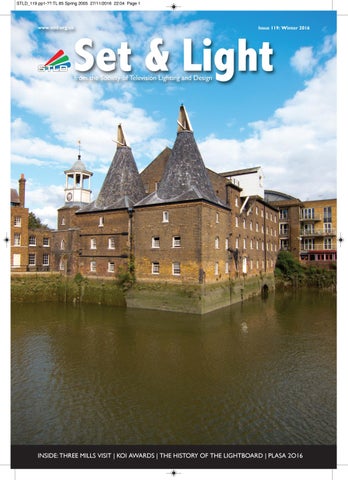
Set & Light from the Society of Television Lighting and Design
INSIDE: THREE MILLS VISIT | KOI AWARDS | THE HISTORY OF THE LIGHTBOARD | PLASA 2O16
STLD_119 pp1-??:TL 85 Spring 2005 27/11/2016 22:04 Page 2
LEE Filters Diffusion Comparator App Light the model using any LEE Diffusion
Instantly switch selections as she moves
Choose any diffusion from the LEE Filters range
The consistent setup enables direct comparisons
Get a closer look by switching to landscape
DOWNLOAD IT FOR FREE ON APPLE AND ANDROID
A great way to select the perfect diffusion for your next project.
leefilters.com
™
STLD_119 pp1-??:TL 85 Spring 2005 27/11/2016 22:04 Page 3
Editorial comment
Post-PLASA it’s been an exciting time for the STLD as we set up new initiatives for lighting students and explore engaging events to put on in 2017. Our visits to Three Mills (page 8) and the New Alexandra Theatre (page 28) feature in this issue, alongside articles in which lighting designers describe their work present and past, and more news of the great charity work that committee member Andrew Dixon is doing in Zambia (page 31). I’ve not had anyone come forward to fill Bill Klages’ boots but we would love to have someone who can give us their take on TV lighting – if you know someone or you are that someone, please contact me. All visit invitations and membership notices now go out by email, and we’ve had a few bounce back. Please remember to update your details, especially when changing your email address, by emailing members@stld.co.uk Our AGM will take place end of January/beginning of February. We have not yet finalised the date but we will advise you on our website and by email as soon as it has been determined. Do try to make it as it is normally a great event and useful if you wish to put new ideas forward to the membership. The next issue of the magazine will be out in spring 2017. The deadlines are 17 February for advertising and 22 February for editorial, which includes Sponsor news.
Emma Thorpe Editor
Contents 4
Awards:Knight of Illumination
29
Information: Lighting Measurement
8
STLD visit: Three Mills/The Royals
31
Members’ stories: Andrew Dixon
12
Recollection: The Lightboard
33
Lighting: Open Golf
16
Information: Showlight 2017
36
Recollection: Abbey Road Studios
18
Information: RTS awards/mentoring scheme
37
In memoriam: Johnny Halpin
19
Lighting: Eurovision
38
Sponsor news
24
Review: The History of Lighting and Colour
60
Society sponsors listing
25
Event: PLASA 2016
64
Education members listing
28
STLD visit: PRG XL Video
64
Index of advertisers
Set & Light is the journal of the Society of Television Lighting and Design and is published three times a year. ISSN 2055-1185 Editor: Emma Thorpe E-mail: editor@stld.org.uk Web: www.stld.org.uk Production Editor: Joanne Horne Sponsor News: Emma Thorpe E-mail: sponsornews@stld.org.uk Advertising: Emma Thorpe E-mail: adverts@stld.org.uk
Cover photo: Three Mills by Bernie Davis Printed by: Gemini Print Deadlines for the next issue: Editorial: 22 February 2017 Advertising: 17 February 2017 Advertising is accepted only from sponsor members of the Society © Society of Television Lighting and Design 2016
Set & Light | Winter 2016
3
STLD_119 pp1-??:TL 85 Spring 2005 27/11/2016 22:05 Page 4
MAKING IMPOSSIBLE POSSIBLE
ALL IN ONE
EXCLUSIVE DISTRIBUTOR FOR UK & IRELAND: AMBERSPHERE SOLUTIONS Ltd. Phone: +44 (0)20 8992 6369 Where quality products enjoy total support info@ambersphere.co.uk - www.ambersphere.co.uk
www.claypaky.it ww ww.claypaky y.it
STLD_119 pp1-??:TL 85 Spring 2005 27/11/2016 22:06 Page 5
Knight of Illumination
© The Fifth Estate Ltd
Awards
Winning smiles: 2016 Knights are revealed The venue for the prestigious Knights of Illumination Awards 2016 was the Eventim Apollo theatre in Hammersmith. Almost 500 professionals attended the event on 18 September. Ian Dow, past Chair of the STLD and holder of a KOI sword, presented the Television Lighting Awards. First was the Drama award, which was closely contested and won by the late Sue Gibson for ITV’s Death in Paradise, the sword being collected on behalf of her family by Roger Simonez, who directed the episode. The Light Entertainment prize was awarded to Mark Kenyon for the final of Strictly Come Dancing. Mark and his team continue to make this popular show look spectacular. Events had the most nominations this year and this was reflected in the quality of the short-listed three: Tom Jones & Bob Brydon’s One Big Night for Children in Need, The Sound of Music and the BBC Proms. Nigel Catmur’s name was read out and the announcement of the winner, Bernie Davis,
came before Roger Williams’ nomination was called. Many apologies to Roger and his crew. The TV Small Studio category was awarded to Dave Evans for The One Show, a live programme full of variety and challenges that have to be covered quickly and creatively. The Graphic Design section showed some innovative techniques, which is very exciting for the constantly changing technology in TV. The next Knights of Illumination Awards takes place on 17 September 2017. It will be the 10th anniversary and the STLD will be announcing changes to the categories soon to reflect the advances in television. In the meantime, if you see a programme that you think deserves nomination, make a note of the lighting director, and the title and date of transmission. Do remember that the awards are made on your behalf, to the people that you decide should be nominated. Ian Dow
An apology from the Chairman to The Sound of Music crew It was regrettable that, during the announcement of the finalists for the Events Category, The Sound of Music was not mentioned. Although this was not the eventual winner of the award, the fact it was not announced was a
real tragedy and a genuine mistake. I was particularly concerned, as I have always maintained that the accolade of the awards is to be nominated. The STLD would like to apologise to Roger, Zac, Greg, The Sparks Crew
and Panalux for this error and we wish to congratulate them on the excellent work done on this production. It was certainly a worthy finalist and came very close to winning. Stuart Gain
Set & Light | Winter 2016
5
STLD_119 pp1-??:TL 85 Spring 2005 27/11/2016 22:06 Page 6
Awards
Mark Kenyon
Ian Dow hosted the ceremony
Julian Rigal won The SGM Award for Video Graphic Display for The Voice
The winners: Theatre
The ETC Award for Dance – Michael Hulls for Conceal | Reveal, Russell Maliphant Company, Sadler’s Wells The Hawthorn Award for Musicals – Mark Henderson for Sunset Boulevard, English National Opera The Robert Juliat Award for Opera – Joachim Klein for Saul, Glyndebourne Festival The Elation Professional Award for Plays – Jan Versweyveld for Songs from Far Away, Young Vic The FIX8Group Award for Projection Design – Will Duke for The Encounter, Edinburgh International Festival/ The Barbican 6
Set & Light | Winter 2016
Concert touring and events
The Ambersphere Solutions Award for Arena – Patrick Woodroffe for Adele The HSL Award for Club – Francis Clegg for Public Service Broadcasting The MA Lighting Award for Events – Adam Bassett for The Rolling Stones Exhibitionism The Ayrton Award for Stage – Tobias G Rylander for The 1975 The d3 Technologies Award for Video Electronic Content – Ben Miles for Coldplay
Television
The Philips Vari-Lite Award for Drama – Sue Gibson for Death in Paradise (honoured posthumously) The Light Initiative Award for Events
Director Roger Simonez collected the award given to the late Sue Gibson
– Bernie Davis for BBC Proms Season 2015/2016 The PRG XL Video Award for Light Entertainment – Mark Kenyon for Strictly Come Dancing 2015 The VER Aurora Award for Small Studio – Dave Evans for The One Show The SGM Award for Video Graphic Display – Julien Rigal for The Voice UK Final 2016 The winner of the Enrico Caironi Award for Lifetime Recognition – named in recognition of former Claypaky Commercial Director Enrico Caironi (1947–2011) – was John Offord, presented by KOI co-ordinator and Lighting Designer Durham Marenghi. “John has been a great influence for the good on a lot of people in our industry,”
STLD_119 pp1-??:TL 85 Spring 2005 27/11/2016 22:07 Page 7
Knight of Illumination
Pio Nahum of Claypaky
Bernie Davis accepting the award for Events
says Marenghi. “He launched Lighting and Sound International in 1985, was fundamental to the success of PLASA and is now not only editor of ETNow but has also published over 80 books about our industry, from technical to artistic.” BackUp, the technical entertainment charity (formerly Behind The Scenes UK), which supports entertainment technology professionals in times of need, received a £5,000 donation from Claypaky. The company’s Chief Executive Officer Pio Nahum presented the cheque to John Simpson of White Light, who was standing in for Lighting Designer Rick Fisher. “We welcome this generous support for BackUp and urge all to join Claypaky in contributing to our charity and alerting us to those who may need help,” said Simpson.
The awards were conceived in 2007 by Italian entertainment lighting manufacture Claypaky, now Headline Sponsor in association with parent company OSRAM, and renowned international Lighting Designer Durham Marenghi and his partner Jennie, who now co-ordinate the the awards. The Association of Lighting Designers (ALD) and the Society of Television Lighting and Design (STLD) judge the Theatre and Television categories, respectively. Pio Nahum, CEO of Headline Sponsor Claypaky, says: “The Knight of Illumination Awards have evolved to become one of the most significant events in the lighting and video design world and provide the ideal platform for awarding the hard work and stunning creative talent of
professionals operating in it.” Headline Sponsors of this year’s event were Claypaky and OSRAM. The event was supported by Spotlight Sponsors Ambersphere Solutions, Ayrton, d3 Technologies, Elation Professional, ETC, FIX8Group, Hawthorn, HSL, Light Initiative, MA Lighting, Philips Vari-Lite, PLASA Media and Events, PRG XL Video, Robert Juliat, SGM and VER Aurora TV, plus Table Sponsors AC-ET, Avolites, Brompton, Carallon, Chauvet Professional, CT London, ELP, GLP, Martin Professional, Panalux, RC4 Wireless, Robe, Rosco, SLX, Stage Electrics, TMB and TSL. Media partners were LSi and Total Production International (TPi). The event was also supported by ABTT, ET Now, Focus, Lighting and Sound America and The Theatres Trust.
ad division ivision of VER
llight ight entertainmentt Aurora A Aur ora ar are e tthe he llighting ighting rental rental specialists specialists for the the television, n, b broadcast roadcast and entertainment med media ia pr production oduction industrie industriess aur oratv v.co.uk k auroratv.co.uk automated automat ted
tungsten tungst ten
led
control
grip
distribution
crew
logistics
Set & Light | Winter 2016
7
STLD_119 pp1-??:TL 85 Spring 2005 27/11/2016 22:07 Page 8
STLD visit
Royal visit Words: Bernie Davis Photos: Bernie Davis & John O’Brien
Three Mills Island sits in the tidal section of the River Lea as it approaches the River Thames, and a short distance from Stratford and the Olympic Park, giving its name to the industrial site that developed there over centuries. Even the Doomsday Book refers to a number of mills in the area, and the last of these only stopped working in 1952. In the 16th century, the flour milled there was recognised as being of high quality and was allowed under licence to supply many of the bakers of London. The mills were used for more than flour grinding, though, and during the Napoleonic Wars, gunpowder was milled, later to be relocated upstream to Enfield. But the most lucrative business was the milling of grain for the gin trade as the quality was less important and the returns very high. The Nicholson family built a distillery on the island for brewing gin, giving their name not only to one of the better-known gins but also to a chain of pubs across London, including ‘Doggett’s Coat and Badge’ on South Bank – the location for another STLD meeting a few years ago. We started the meeting with a guided tour of The House Mill, now a Grade I listed building, although, only a few years back, the site was almost derelict as some of the buildings suffered serious damage during the Second World War. The mill itself largely survived, probably thanks to the building practices used to prevent the building falling apart from the vibration of the machinery, and now the adjoining house has been restored thanks to charitable donations. The longer8
Set & Light | Winter 2016
Pictured: Mill House and, above, Three Mills
term hope is to make the water wheels functional again, and for them to produce electricity. Much of the original machinery has been saved, and the mechanisms that raised the grain sacks up to the attic storage, then delivered it to the millstones for grinding and bagging, are still there to be seen. This tidal mill, claimed to be the largest in the world, produced power for milling and cloth manufacture for about four hours on every ebb tide, with two tides in a 25-hour cycle. Our tour then took us into the studios to which we had
STLD_119 pp1-??:TL 85 Spring 2005 27/11/2016 22:07 Page 9
Three Mills/The Royals
been invited to see how The Royals – an English-based continuing drama for the US market – was being recorded. We started in the canteen area located in Nicholson’s old distillery building. We always knew that the meeting would have to have a flexible schedule as The Royals was still completing its third season, and we were visiting on the penultimate recording day of the block. Paul Parker, the Floor Best Boy, joined us and announced that, owing to a change of schedule, they had just vacated Stage 9 and it was our chance to look in there. The fine detail and complexity of the sets were immediately apparent, with no expense spared on props and fittings: one set of prop wall brackets had cost nearly £1k per fitting alone. The other thing that impressed me was the complexity of the scaffolding over and around the set, giving it support and providing lighting positions. The studios do not have any sort of grid so everything is installed this way. With this amount of work involved in fitting the sets into the studio, they had stayed built for all three of the first blocks, with just the lighting equipment being removed in between. But this was the last year Stage 9 could be used by The Royals as the space has been let to a different production next year year, and so everything was about to be removed and stacked against a wall on a different stage. We moved back to the canteen area and were greeted by Lighting Gaffer TC Thomas and Production Designer Max Gottlieb, who told us more about the background to The Royals. The programme was made for the US market, where it is currently the second-most popular cable show, and is now proving popular around Europe, recently becoming a major success in Italy. It can be seen in the UK on Amazon and Netflix, as well as on channel E! on Virgin, BT and Sky. It transmits as one-hour episodes in the US and so has a programme running time of 42 minutes per episode. The show stars Liz Hurley and Jake Maskall (who played Danny Moon in East Enders), among others. Joan Collins also featured in the first two seasons. The story involves an imagined royal family with all the intrigue and drama you might hope to get from a TV drama: a kind of Dynasty meets Buckingham Palace meets Footballers’ Wives. One critic described it as ‘ultimate guilty-pleasure viewing’ and complete escapism. Another referred to it as ‘Dallas at the Palace’. Each episode is recorded over eight days – the production company gets paid per episode on delivery – and there are a series of directors working on individual episodes. They work five day weeks up to 12 hours a day, which is actually better than some drama productions, which have moved to 11-day fortnights. The production team believes this is unproductive as crews arrive more refreshed after two days off. With 10 episodes in the series, that makes 16 weeks of recording time. Block three had been in the studio since the end of June, with setting time before that. The production values are high, recording on two ARRI Alexa cameras working at 2,048 x 1,152 for ProRes 2K 16:9. Despite having this excellent set in the studios, there is constant pressure from the parent company to go out on location to emphasise the ‘Britishness’ of the show, and they have regular location shoots at Blenheim Palace as well as London roads, usually near red telephone boxes and letter boxes.
Pictured: Dimmers and, above, the cast of The Royals
D.o.P. John Rhodes is an ex-BBC Ealing cameraman and TC was full of praise for John’s lighting methods. Unlike many, John is not afraid to use hard sources mixed with soft sources and uses what TC refers to as proper three-point lighting. The permanent lighting installation consists of a complete set of backlights around the walls of each room, with specials for the features. Outside windows were stands with ARRI T12 tungsten sources, together with space lights providing soft light and Flobanks lighting the beautiful exterior cycs. For closer work they had a full spectrum of high-quality soft lights on call, including Dedo Octadome kits and Kinoflo fixtures, Rifa lights and LED panels. All the lighting for this block was provided by Cinelease UK: a relatively new company, which is a branch of the larger parent company in the US. The change to electronic cameras from film cameras gives the production a greater certainty of technical success; gone are the days of finding out the next day what the labs had managed to develop. And to add more certainty, the production employs a DIT (Digital Imaging Technician), who quickly cuts the successful takes of the day together so that the DoP can review the day’s work in the car while he is driven home. They certainly get a full day out the crew! TC’s background is more based in the entertainment lighting industry, and he brought his experience into this film work with good results. All the lighting was routed back to lines of Avolite Art 2000 dimmer racks configured to provide the range of requirements from 20K to 2K dimming and hard power for the non-dim lights. Spare circuits were cleverly fed via 13A set sockets where possible, with the occasional cable dropped down chimneys. All the lighting is controlled centrally by a grandMA2 desk networked to a wireless pad running grandMA2 on PC. With wireless network points placed Set & Light | Winter 2016
9
STLD_119 pp1-??:TL 85 Spring 2005 27/11/2016 22:07 Page 10
STLD visit
Three Mills/The Royals
strategically around the studios, the pad can control levels and store scenes as required. The central control gives them more and quicker control, and, of course, easier power saving. TC explained the lighting crew hierarchy. John as DoP has various departments under him, including camera operators and grips, and, of course, lighting. Top of that family tree is TC as the gaffer, who then has a floor best boy looking after the day-to-day shooting,- and an office best boy who deals with the paperwork and hiring. There would also be a rigging gaffer, who gets the show in at the beginning of the season. The floor best boy would be in charge of usually three LX and a lighting board operator, but that number might well be topped up as needed when there was more to do. Max’s beautiful scenic backdrops were produced photographically, then after photo-manipulation were printed in Holland. We noted that the set had a lot of gilt, making the scenes look very lavish, and Max told us that this was a production requirement aimed to appeal to the US audience. He had based the sets not so much on actual palaces, more on plenty of research on Google and in books. Most of the scenery was built on site, even though the workshop had now given over much of its floor space to yet another setting. We asked how much Max had worked with John when designing the sets and whether they collaborated at all. Max felt that they had known each other long enough to work by instinct, especially as this was now the end of block three. They all had the benefit of building from one block to the next. We went on to look around the other stages not working at the time and continued to be impressed with the high design standard. They were lucky that most of it could stay standing until block four. We passed one of the main supplies: a 400A 3ø supply. Even this was not enough for the larger stateroom setting and some power had to be diverted from another studio to feed the T12 Fresnels through the windows. In one area, Eddie Dias, Features and Dramas Manager for Cinelease UK, had set up a few of their more recent products for us to see close up. Simon Evans, also of Cinelease, talked us through them, starting with a massive LED panel. Developed by Cinelease, it is called the Quantum and is a tuneable LED taking only 1.2kW, yet producing more light than a 6K Spacelight. The Quantum is IP-rated so it can work out doors, too. Many of these were already in evidence around the set of The Royals, where TC had been able to replace space lights and Brutes with these efficient fixtures. They then showed us some LED-powered tubes that can directly replace fluorescent tubes in existing fittings. These tubes are switchable from tungsten to daylight and are mains dimmable. They had even built a makeup mirror using these tubes, enabling the makeup artists to choose which colour temperature they wanted to check the makeup with. They had a new take on an in-car kit, using flexible panels of different sizes that could be stuck up with magnets or Velcro directly to the car. Again, being multi-LED sources, they use little power and have a range of powering options, including small battery packs. Also on show was a handy little LED soft light – probably a replacement for a Zap light but with a drop-in lens for change of optics. The last fixture they were to show us was the Kino Flo 10
Set & Light | Winter 2016
Pictured: Lighting Gaffer TC Thomas and, right, Production Designer Max Gottlieb Grand MA, Stage 7
John O’Brien photographs the Quantum LED panel
Select 20 – the only one in the country we were told! This impressive LED panel is completely tuneable for colour temperature, including full magenta/green shift. Colours can be stored as presets, too, for repeating scenes. The last location we visited was just below ground, where a storage area had been turned into tunnels supposedly below the palace where no-doubt-clandestine meetings and conspiracies were set. Again, it was only by tapping the walls that you could tell where the set stopped and the building started. It had the inevitable line of coolie lights; they always look good but I am not sure I have ever actually seen coolie lights used in a corridor! But as a great man once said: never let the facts get in the way of a good story! It is a real privilege when you are allowed to visit a working studio, and it is all too easy for production managers to say no to a tour rather than risk any disruption to their busy schedules. I have to say that everyone we met went out of their way to make us welcome, and the STLD would like to thank TC Thomas for first coming up with the idea of the meeting and then for making it happen, also to Max Gottlieb and Paul Parker for giving their time so generously, and to John Rhodes who, sadly, was too busy to talk to us for long on the day but without him the meeting could not have gone ahead.
STLD_119 pp1-??:TL 85 Spring 2005 27/11/2016 22:07 Page 11
The sky just got bigger.
SkyPanel goes long: the S120-C The highly acclaimed ARRI SkyPanel range of LED soft lights is growing, with the new SkyPanel S120-C joining the S60 and S30 family of products. The S120 is twice as long as the S60, but weighs nearly the same. Its larger light aperture makes a great soft light even better. Retaining the same features and color tuneability as its smaller counterparts, the S120 consumes less than 400 watts, yet it is slightly brighter than the S60-C and has an outstanding efficacy of 90 lumens per watt.
S30-C
Explore the new SkyPanel: www.arri.com/skypanel
S60-C
SOFT LIGHTING | REDEFINED
S120-C
STLD_119 pp1-??:TL 85 Spring 2005 27/11/2016 22:07 Page 12
Recollection
The Lightboard
Inventing the future: The National Theatre’s Lightboard Words: Rob Halliday It’s quite amusing to enter the PLASA Show, that showcase of the latest in hightech entertainment lighting technology, wheeling a 40-year-old lighting console; a 40-year-old lighting console that’s showing its age, wooden frame battered, monitors missing; a 40-year-old lighting console that doesn’t actually work and, if we’re honest, may never work again. And yet, despite all that, for it to be the thing that everyone stops to look at, to ask about, to want to touch. The object of that attention – and, I suspect, the oldest exhibit at PLASA 2016 – was Lightboard, the lighting control created for the opening of London’s National Theatre in 1976. The excuses for having it there, and organising a full-house talk about it, were the 40th anniversary of the opening of the National, the fact that the development team behind it and other milestone lighting-control products from Strand from the mid-1960s through to the early 1990s were nominated for this year’s Gottelier Award, and that we’d recently recovered a Lightboard after years of being hidden away in, of all places, a water tower in West London. The ‘we’ here is the Backstage Heritage Collection: the loosely formed organisation described in these pages before (Set & Light, issue 113, Winter 2014) with an aim of documenting and, where possible, preserving older lighting and other entertainment production technology. It began with an interest in the equipment, but what has become more fascinating is the stories of how the equipment came to be made, of the people who made the products and of the bigger social history that encompasses it all. We are lucky that for many of the products, the people behind them are still around. Give them a little nudge and fantastic stories fall out – which was the case with Lightboard; there was plenty to talk about. My fascination with it perhaps stems from its appearance on the cover of the 12
Set & Light | Winter 2016
lighting textbook with which I grew up: Richard Pilbrow’s Stage Lighting. Richard had parleyed his work as Olivier’s lighting designer for the National Theatre Company into a position on the building committee that was formed to advise architect Denys Lasdun on the kind of performance spaces the proposed National Theatre building he was designing should contain. From that, Richard and his company, Theatre Projects Consultants, had been appointed as the technical consultants to the whole project. Always inventive, always pioneering, never satisfied with existing technology and constantly striving to find better ways of doing things – descriptions that still apply as he continues to work despite supposedly retiring – Richard sensed a once-in-a-lifetime opportunity to advance the game, justified in part by the demands of the way that the National intended to work – three theatres each playing multiple shows in rep – and in part by the complications of the building, particularly the big Olivier Theatre. Every technical department would need clever systems to keep up. For lighting, Richard knew there wouldn’t be time to completely change lighting rigs or even focus between shows, so he designed a saturation rig, with enough lights to allow a big permanent cover from all the useful directions, plus some lights that could be set specifically for each show in the rep, and a handful that could be refocused from show to show. Innovations here included the use of CCT’s Silhouette zoom profile spot, first developed for the BBC but now adapted to theatre with a unique ‘rep shutter’ assembly, where shutters could be set and locked and the shutter cartridge then lifted out of the light and replaced with one for another show. For the Olivier, where the overhead rig was always likely to sit at a height unreachable by tallescope (even in the less-fussy 1970s H&S
environment!), TV studio-style short hoists were installed, equipped with moving lights – Pani automated yokes fitted with Strand 243 Fresnels. The key point was that there was to be no time wasted re-patching between shows: every light would have a dimmer, meaning over 400 dimmers in the prosarch Lyttelton, over 600 in the Olivier. The time all of this was first being specified, the late 1960s, marked a fascinating point in the evolution of lighting control. Directly-driven dimmers had been replaced by mechanical clutchdriven dimmers, these by electronic valve thyratrons, then these by the solidstate thyristor. The control end had gone from the mechanical Grandmaster to Fred Bentham’s remarkable Light Console Organ, through to systems that actually allowed precise dimmer levels to be preset, or even gave designers a stalls control they could operate while sitting with the rest of the creative team, as at Glyndebourne and the National’s first home, the Old Vic. Then the memory revolution: lighting controls that could remember and recall states rather than having to stop and plot with paper and pencil. Theatre wanted this, but the bigger chequebook of television – the new independent companies, the arrival of colour TV – drove it. Strand had early systems like IDM (Instant Dimmer Memory) but the real revolution came not from an incumbent (as the iPhone shows us, it rarely does; established companies fear dramatic change) but from an outsider prepared to take a completely fresh view. In memory lighting control, the revolutionary was Tony Isaacs, working for Thorn. His creation was the Q-File, which many acknowledge as the first memory control to work properly. Q-File’s revolution wasn’t just memory: it was also solving the problem of how to control lights in a memory system, where the traditional fader-perdimmer was a problem because the
STLD_119 pp1-??:TL 85 Spring 2005 27/11/2016 22:07 Page 13
Main picture: the Lightboard and, inset, with Ronnie Cox
faders couldn’t move as a cue was played back. But did you actually need a fader per dimmer? Isaacs’ brilliance was to bring the control to you, rather than you reaching for it: type the number of the dimmer to control it. Now just one motorised fader would suffice: select the light, the fader jumped to the current level, adjust. The crossing of the ages is that this modern motorised fader sat next to a keypad arranged like an old-fashioned cash register or tabulating machine, columns of buttons for hundreds, tens and units. Then one more revolution: computers. Though both IDM and QFile were memory systems, neither were computers as we now think of them – rather they were job-specific ‘memory lighting machines’, powered by stacks of custom transistor-based logic. But the coming mini-computers could do this work, turned into lighting controls largely through software that could be adapted if users weren’t quite satisfied with the way it worked. Strand made this move with DDM; in America, Gordon Pearlman took the same approach with LS8: the first computer to run the lighting of a show in Broadway, the original A Chorus Line. Both systems were based in mini-computers from Digital Equipment Corp. That a later Strand system, MMS, was not computer based and was again created using hardwired logic suggests that the minicomputer approach, while versatile, was
expensive. But MMS did bring one last key element still with us today: the channel control level wheel – an infinite control allowing familiar control (its shape follows Strand’s old quadrant faders), unaffected by cue playback but also able to cope with adjusting groups of lights at different levels. The problem for the National Theatre was that none of these consoles were capable of controlling the sheer number of dimmers involved. Plus, Richard Pilbrow didn’t just want a bigger version of any of them. As a lighting designer, he wanted a better tool for making lighting. His summary: he wanted a lighting control ‘which offers to the artist far greater opportunities for the subtle manipulation of light than has been possible hitherto, that will in time extend the boundaries and possibilities of stage lighting’. At the same time, it had to deal with the practical demands of the National’s rep schedule and rep rig, ideally offering integrated control of the moving lights, colour changers and slide changers that would be part of that rig. Since there was nothing that would do what he wanted, he and his partner at Theatre Projects Consultants, Dick Brett, wrote a specification for something that would. It came to be called TCS: Total Control System. Looking at the specification now, it’s clearly the work of two minds: Richard’s talk of the artistic demands of lighting balanced at every step by
formal, practical descriptions of how this might be achieved from Dick in a language one suspects learnt from his time in studio engineering at the BBC. The key points: ‘heads-up’ access for the operator using a calculator-style keyboard while keeping their eyes on the stage; VDUs giving information about the rig and cues; integrated control of moving lights, colour changers and the like using a ‘data highway’ around the theatre; and complex cue timing with up to six overlapping fades running to predefined times or under manual control. Plus, at its heart, not just one channel control wheel but a series of extra wheels, ‘group masters’, to allow multiple lighting components to be mixed and balanced together under fingertip control, rather than the select-adjust-select-adjust routine on earlier (and, ironically, current) lighting consoles. When you later brought back a cue for editing, the wheels would remember the building blocks you’d used to make it in the first place, letting you make adjustments easily without having to figure out all over again how the state was made. The perfectly fitting name for this part of the console: the light palette, a tool for the lighting artist. But ,of course, the console would be stuck in the control room while that artist would be sitting in the stalls, so, in addition, a second palette was specified to sit at the Set & Light | Winter 2016
13
STLD_119 pp1-??:TL 85 Spring 2005 27/11/2016 22:07 Page 14
Recollection
production desk; if it was easier for the designer just to reach out and balance a state, and they wanted to, they could. The specification was issued. Rank Strand, in part, one suspects, trying to reclaim the high ground stolen by Thorn, accepted it. And then their team of engineers started figuring out how to actually build it. It was quite a team. Their leader, Chief Engineer Martin Moore, had worked backstage at college and later in the West End, running the consoles to replay Pilbrow’s design for the musical Blitz!, among others, but had also spent time looking after the CDC6600 supercomputers secreted away on Polaris submarines. The people he hired were recent physics or engineering graduates and also lighting designers or console operators for amateur companies, sometimes moonlighting in the West End. They understood theatre, but had the engineering background to apply to solving the problems theatre presented. By the time of the National, that team included David Bertenshaw, Tony Brown, Rick Dines, Vic Gibbs, John Hall, Edwin Lockwood, Tony Payne and others. Their first problem: how to make a console that could cope with the sheer scale of the National. A PDP11/05 had run the DDM console built for the Royal Shakespeare Company. The newer, more powerful PDP11/35 was looking like a good bet for TCS (the same computer would go on to run the entire British Air Traffic Control System for many years). However, calculations suggested even that wouldn’t cope. For 1,000 channels, experiments suggested each channel needed to be refreshed in less than 30ms for fades to appear step-free; that was also a good timescale for scanning all of the buttons on the console so as to not miss any keypushes. Around that, the computer would also have to update the twin displays and the backlights on the keys used to indicate key status, and deal with the stalls control and its display. Plus, there was the potential for those six overlapping fades with their own times. The 11/35 couldn’t do the maths fast enough (just for comparison, it had a processor operating at about 1Mhz, and 64kb of memory; your iPhone has 14
Set & Light | Winter 2016
2Gb of Ram and a 2.2GHz processor. And the iPhone costs about $650; the PDP11 was about $30,000 in 1973, so perhaps $200,000 now). Strand’s solution: they designed their own co-processor just to handle the channel processing. A fast 16-bit hardware processor implemented in Schottky TTL logic, it was power hungry but fast – a heady 6MHz! Software development meant more investment for Strand, replacing the paper-tape systems used for DDM with a fanfold paper-tape reader and then, ultimately, with a Plessey disk cartridge, and purchasing DEC’s RT11 operating system. But they didn’t want to spend too much, so the development 11/35 was actually one of the two machines that would go to the National. The software was written in DEC assembler code for speed; eight man-years of coding, but the final software occupying just 90kb. By contrast, the operating system in your phone occupies about 1.3Gb. The system was developed to the original schedule, in and working by late 1975 – albeit that delays to the building meant no shows would appear there until 1976. Strand marketing feared the Total Control System moniker was too over the top, so it was replaced by a simpler name: Lightboard, although TCS persisted on much of the console’s documentation. It wasn’t without teething problems – what cutting-edge systems ever are? – and it is slightly ironic that one of the biggest enemies was the lighting rig itself, with harmonics from the thyristor dimmers, and the loadmanaging system installed with them, often causing the computer to crash until appropriate filtering was fitted. Lightboard also presented an enormous learning curve for the National Theatre crew, moving to the new building from the company’s first home, the Old Vic, and jumping straight to Lightboard from a multi-preset manual console. But they quickly came to embrace and then love their new controller, figuring out, as all good console operators do, not just how to work it but how to use it to achieve whatever crazy or outlandish requests a lighting designer or a show made. Their feedback was incorporated into ongoing
development of the consol, for the Royal Opera House and then as it evolved into Lightboard 2, which added colour displays and more group master wheels at the behest of the wealthy European opera houses. Eleven Lightboard systems were ultimately made and sold. It was probably too expensive to spread much further than that, but technology marches ever onwards and the coming of the micro-processor gave Strand’s ever-inventive engineers new tools with which to create lighting consoles – and at a lower cost. (They weren’t the only ones taking advantage of this, of course; the same year the National opened, a tiny new company called ETC got their first console up and running, based around Intel’s new 8080 microprocessor.) Lightboard’s clear descendant is the Galaxy, beloved by theatre and television operators alike. The resemblance in the general layout and, in particular, in those group master wheels is obvious, but the hardware behind it was quite different. Motorola’s 6809 processor provided a fast hardware multiply function, but the Galaxy complicated things by having faders – Highest Takes Precedence (HTP) control – as well as the group wheels, which were Latest Takes Precedence (LTP); HTP required more calculation. Each processor could deal with only 48 channels at a suitable rate. The solution: to add more channels, add more processors, up to a maximum of 16, so 768 channels. Supporting that was 16kb of memory for the biggest customers, 8kb for the more cash-strapped. Ironically, when Lightboard reached the end of its life at the National, a decade after its debut, the Galaxy chosen to replace it couldn’t match all of its functionality: it couldn’t then control moving lights. The ever-resourceful NT crew just engineered their own software-based solution running on a PC! At the NT, the Galaxy was later replaced by Strand 500-series consoles, and those in turn were replaced by ETC Eos; the theatres now run Eos Ti consoles, controlling numbers that make that original 1,000 channel spec seem puny – 2,000 dimmers plus 80odd moving lights in the Olivier, 1,100 dimmers plus 90 moving lights and scrollers in the Lyttelton, plus often
STLD_119 pp1-??:TL 85 Spring 2005 27/11/2016 22:07 Page 15
The Lightboard
LEDs and media servers and the like. With their versatile editing tools and powerful customisable displays, they are clearly a world on from Lightboard. And yet there is still only one interaction at a time, one channel control keypad going through one level wheel, unless you take the time to set up submasters and deal with all of the problems of using them. And, however you make a cue, using channels or groups or subs or magic sheets or whatever, when you press record it collapses into just hundreds of channels at levels, and when you come back to edit the cue it’s up to you to figure out all over again what’s on and what needs to be changed. This feels like a retrograde step... Lightboard is obsolete now, of course. We dream of making it work, but we doubt we can. The console on show at PLASA, it turns out, was not from the NT but from the Royal Opera House, and while we have the desk, we don’t have the corresponding PDP11. Even if we did, the software for it is probably long lost. So it’s just an object of fascination: fascinating to behold in person – even though it wasn’t theirs, the recovered console has been adopted by the National Theatre, which is buffing it up to go on display as part of the building’s 40th anniversary celebrations – but also fascinating because of how it evolved the way that we work. As David Hersey, who lit many of the NT’s shows of the time, notes: “Lightboard heralded the start of seriously lighting over rehearsals; with 600 dimmers, we could begin to use one lamp per channel.” On the stalls control, another
Pictured: The console found, top left and right, was not from the National Theatre but from the Royal Opera House; bottom left, the National Theatre/Old Vic’s Robert Ornbo at Strand’s lighting panel (© Richard Pilbrow); bottom right, ‘An outline of two lighting control systems for the National Theatre’
tool now lost to us, he comments that it was ‘an absolute joy to use – there were two board ops, so on many occasions all three of us would be banging on both desks trying to keep up with the rehearsal’. All of us who do lighting owe a debt to Lightboard, to Richard Pilbrow and Dick Brett for specifying it, to the National Theatre board for supporting it, and to that team of lighting-loving engineers at Rank Strand who, against the odds, at the edge of possible, actually made it work.
A video of the full PLASA talk can be found at www.theatrecrafts.com/pages/home/archive/ talks-seminars/talks-september-2016 More information about Lightboard can be found at www.theatrecrafts.com/pages/ home/archive/equipment/detail/?id=6027 A related talk about the history of computers in lighting control, held at the National Museum of Computing in Bletchley, is at www.theatrecrafts.com/pages/home/archive/ talks-seminars/talks-september-2016 To support the Backstage Heritage Collection and its Theatrecrafts website, visit www.gofundme.com/bhcupdates
the lighting professionals Cinelease brings you the full spectrum of lighting, grip, control and distribution; professionally maintained, personally delivered. Our genuine passion for service combines cutting edge creativity with technology driven solutions - making us the perfect partner for any production.
commercials Ó tv drama Ó motion picture Ó music video
+44 (0) 20 3137 6191
info@cinelease.com
cinelease.co.uk
Set & Light | Winter 2016
15
STLD_119 pp1-??:TL 85 Spring 2005 27/11/2016 22:07 Page 16
Information
Showlight announces first speakers for Florence 2017
Preparations for Showlight 2017 are hotting up as the first speakers for this unique quadrennial event are announced. The programme promises to be as fascinating as ever, with the following international lighting specialists the first to sign up:
W 6SRU 79 , RI \ HV W &RXU L HU O +RO L V &KU E\ R 3KRW R (XU 8()$ , R XGL 6W W 6SRU 79 ,
Aldo Visentin Aldo will share some of his experiences over many years of touring with, and lighting for, Maestro Andrea Bocelli. Colin Ball Colin will show how he uses theatre and film lighting techniques to light buildings including the Tower of London and the Palace of Westminster.
:+, 7( /, *+7 /L JKW L QJ $XGL R 9L GHR
:H GHO L Y HU W HFKQL FDO GHV L JQ FRQV XO W DQF\ DQG W KH O DW HV W W HFKQRO RJ\ I RU \ RXU V W XGL R &RQW DFW XV I RU PRU H L QI RU PDW L RQ ZZZ :KL W H/L JKW /W G XN , QI R#:KL W H/L JKW /W G XN
STLD_119 pp1-??:TL 85 Spring 2005 27/11/2016 22:07 Page 17
Showlight 2017
Showlight exhibited for the first time in four years at the newly relocated PLASA London show, with great success. Showlight is one of the few international events organised specifically for lighting professionals by lighting professionals across the theatre, television, film, performance, architectural and event worlds. A mix of conference, tradeshow and sociability, Showlight is a unique opportunity to mix with others in the lighting industry in an informal and informative atmosphere. “PLASA was the right forum to have a stand for Showlight,” says Lighting Designer and Showlight
Showlight at PLASA
Showlight Chairman John Allen and technical support and LD Rudi Benz at PLASA
technical support Rudi Benz. “It is a show that puts a lot of effort into networking and education, which is
Declan Randall Declan will tell of his experience of acting as Set and Projection Designer, in addition to Lighting Designer, for an original production of Sister Act in Johannesburg. Amy Mae Smith Amy made her West End debut as the Lighting Designer for Sweeney Todd on Shaftesbury Avenue, winning the 2016 Knights of Illumination Award in the Musicals category. Henk van den Geest Henk will explain the problems of using LED to light fragile works of art, such as Van Gogh paintings, in art galleries, while dealing with decision makers who are without technical experience and whose main focus is in energy savings and limiting investment budgets. Jeff Ravitz On lighting the current Bruce Springsteen/E Street Band tour and the challenge of designing a live show that works for TV. Mikki Kunttu Mikki will speak of lighting the Danish Royal Ballet. Philip Norfolk Philip will explain how the sun works, how heavy a dustbin of sun is and why the sky is blue, while also covering nuclear fusion and other photon facts... and will somehow manage to incorporate a picture of Albert Einstein! Simon Corder Simon has been summoned to Singapore to relight his original design in the world’s first Night Safari. Expect tales of tigers and elephants in a tropical forest – and how they react to LEDs! Luc Peumans Belgian Lighting Designer Luc specialises in lighting large-scale productions and will present the paper ‘Painting with Light’. Al Gurdon Al Gurdon also specialises in lighting large-scale spectaculars such as the MTV Awards and the Super Bowl half-time performances, and will give us an insight into his work. Rob Halliday Always entertaining, the papers committee is still wading through the variety of subjects Rob has been suggesting...
right in line with Showlight’s own philosophy. “We had a lot of interest from visitors as prospective exhibitors, speakers and delegates. “Being situated among the industry organisations and drama schools, we also met many students who had not heard of Showlight before. They were interested to hear that Showlight offers 40 places to students sponsored by the exhibitors, and uptake has increased since. “We were also happy to sign up more exhibitors for next May, to the extent that we have almost reached maximum capacity eight months before the event.”
Panel presentations
The first of Showlight 2017’s panel presentations has also been announced, with the subject of Programming as its focus: what is the relationship between the lighting designer and the programmer, what should it be and how will it develop? An experienced panel from all the lighting genres will disagree!
Italian translation
For the first time, Showlight 2017 will be offering a simultaneous translation of papers into Italian. Traditionally an all-English-speaking event, Showlight has decided to offer this service, generously sponsored by Osram, to encourage local attendance and promote the new papers-only one-day tickets. Day tickets for papers only can be bought online in advance or on the door. Showlight is a unique and enjoyable forum that takes place in a different location every four years. The format centres around three days of papers on an eclectic range of topics related to lighting in its many forms, a microtradeshow and a social programme with a strong emphasis on networking. Company dinners, visits to places of local interest and, of course, the Showlight Gala Dinner all give plenty of opportunity for members of the industry, from fresh-faced students to seasoned professionals, to network, learn and exchange ideas.
Exhibitor spaces
Exhibitor spaces are always in demand and are selling out fast. To secure your opportunity to be part of this unique event – only 40 places exist – contact Jane Cockburn or Derek Gilbert on exhibit@showlight.org without delay.
Sponsorship opportunities
Showlight is grateful to main sponsor Claypaky and also to diamond sponsor Oasis, gold sponsor Osram and to ETC for their generous support. More opportunities for sponsorship are available – email Jane or Derek at exhibit@showlight.org Set & Light | Winter 2016
17
STLD_119 pp1-??:TL 85 Spring 2005 27/11/2016 22:07 Page 18
Information
RTS awards/mentoring scheme
RTS announces awards nominations The Royal Television Society (RTS), Britain’s leading forum for television and related media, has announced the nominations for the RTS Craft & Design Awards 2016 In Partnership With Blackmagic Design. The awards, which are chaired by Cheryl Taylor, Controller of CBBC, celebrate excellence in broadcast TV and aim to recognise the variety of skills and processes involved in production. This year’s nominations include:
Lighting for Multicamera
Martin Kempton, Upstart Crow, BBC Comedy for BBC Two Gurdip Mahal, Ross Williams & Rob Bradley, The Voice 2016, Series 5, Wall to Wall for BBC One The Lighting Team, Coronation Street Live, ITV Studios for ITV
Production Design – Drama Luana Hanson, Flowers, Kudos for
Channel 4 in association with Seeso Stevie Herbert, The Durrells, Sid Gentle Films/Masterpiece for ITV Chris Roope, War and Peace, BBC Cymru Wales in association with TWC & Lookout Point for BBC One
Production Design – Entertainment & Non Drama
Antony Cartlidge, Murder In Successville, Tiger Aspect for BBC Three Patrick Doherty, Strictly Come Dancing, Series 13, BBC Studios for BBC One Peter Gordon, Time Crashers, A Wall to Wall Media and GroupM Entertainment Production for Channel 4 Shortly after Set & Light went to press, the winners of the awards were announced at a ceremony at the London Hilton, Park Lane, hosted by writer, presenter and producer Sandi Toksvig. For more information visit: http://www.rts.org.uk/craftdesign.
on voluti 17 sea E Batter TH FEB 20 4 3 RD -
Chroma-Q® Space Force™
THE NEXT FRONTIER š š š š š š š š š š š
KEY FEATURES: Comparable to a traditional 6kW fixture Up to 26,700 lumens Variable white – 2,800K to 6,500K Only 8kg / 17.6lbs Quiet, convection cooling, no fans Smooth, soft uniform beam Variable PWM flicker-free operation Multiple hanging options Wireless DMX / RDM Superior unit-to-unit consistency Chroma-Q’s proven LED performance
UK Dealer: Dealer: A.C. Entertainment Technologies Ltd., +44 (0)1494 446000, sales@ac-et.com, www.ac-et.com
www.chroma-q.com
Could you mentor an RTS bursary student? Each year, the RTS gives 20 bursaries to new undergraduates studying television production or broadcast journalism. As part of the bursary, students are matched with a mentor with experience relevant to the role to which they aspire. The RTS is now looking to expand its pool of volunteer mentors. The students value their mentors – as one says: “The mentor scheme is one of the best bits of the RTS Bursary and is one of the main reasons I applied in the first place.” Interested? Visit rts.org.uk/ education-training/become-mentor to register or for more information email Anne Dawson at bursaries@rts.org.uk.
STLD_119 pp1-??:TL 85 Spring 2005 27/11/2016 22:07 Page 19
Lighting
Eurovision
The golf ball full of dreams * Words & photos: Paul Middleton
* Ola Melzig 2016
The Eurovision Song Contest has become one of TV’s great institutions. This year, the 61st competition, under the theme ‘Come Together’, was again held at Stockholm’s Globe arena, where it was last hosted in 2000. The hosts were last year’s Swedish champion Måns (pronounced Mons) Zelmerlöf, alongside returning host Petra Mede. Lighting design was by Fredrik Jönsson, with Emma Landare as assistant LD looking after the interval acts and guest star Justin Timberlake. The show went out to over 200 million viewers around the world who watched the live grand final. This included the USA, where it was broadcast live for the first time in the show’s history. The United Kingdom has participated in the Eurovision Song Contest 59 times and despite the advent of more political rather than artistic voting we remain one of the most successful countries to compete in the contest. From humble beginnings, the show has grown year after year to become a huge visual lighting and video spectacular. Much has been written about the show in other Eurovision 1960 at the Royal Festival Hall ©BBC magazines such as LSI. If you want the full technical details then read Technical Director Ola Melzig’s online diary at www.m-m-pr.com/ index.php/eurovision-diary-2016 and livedesignonline.com/
eurovision-song-contest-2016/eurovision-backstage-tourtechnical-director-ola-melzig I was invited by Claypaky to see how the show was put together as well as two of the live shows and a technical rehearsal. I should point out that the opinions in this article are mine and I received no incentives for producing this article. My first impression upon arriving in Sweden at Arlanda Airport was that there could be no doubt that Eurovision was in town! The first poster was a welcome from all the sponsors and this was followed by a long wall detailing some of the most famous Swedish people. The trip to Stockholm centre took about 45 minutes and over lunch I met with some of the other technical journalists who had travelled from all over the world courtesy of Claypaky. These included familiar faces Sarah Rushton-Read and Richard Cadena from the USA. Davide Barbetta from Claypaky was our host. It was then on to the press centre to collect our passes. The passes included an embedded RFID chip that was scanned at security checkpoints to verify your photo ID and your access rights. My press pass got me into the press centre, but access into the Globe arena itself was only allowed when escorted by either an EBU guide or a sponsor guide, or with a ticket during the evening live transmissions. Some people had access-all-areas passes, but as can be expected, security was tight. When Italy-based American journalist Douglas Cole and I took a walk outside the arena to try to take a look at the OB and generator compound from the walkway over the motorway, we were approached within about 30 seconds by two Swedish police officers who wanted to know what our interest was. Luckily, when they saw our press passes, they Set & Light | Winter 2016
19
STLD_119 pp1-??:TL 85 Spring 2005 27/11/2016 22:07 Page 20
Lighting
Pio Nahum, CEO of Claypaky
allowed us to carry on. Only official EBU accredited photographers were allowed to take professional cameras into the arena during the actual live broadcasts. The press and fan centre had taken over the Hovet Hockey rink next door to the Globe. Here was held a press conference hosted by Claypaky and The City of Stockholm. Osram was the official lighting sponsor of Eurovision 2016, but as CEO of Claypaky Pio Nahum explained, this didn’t mean they supplied lots of lights free to the show in order to exclude other manufacturers. All the lights requested by Lighting Designer Fredrik Jönsson were supplied commercially to the show by Litecom Group, which had won the contract for the technical lighting installation. Frederik and Technical Director Ola Melzig went to LDI in 2015 to look for new lights and effects, and after testing out about 40 different fixtures at the headquarters of Litecom, Fredrik chose to use a large number of Claypaky fixtures, including 120 Mythos, 58 Scenius Spot, 308 Sharpy and 166 Sharpy Wash 330, along with 88 Robe BFML Blade, six Robe BFML Spot (as followspots), 67 LightSky AquaBeam for audience lighting effects, 173 Harman Martin Professional MAC Aura, 105 Harman Martin Professional Atomic 3000 LED with scrollers, 90 Ayrton MagicDot-R, 40 Philips VariLite VL3500 Wash, 200 SGM P-5 LED (interior dome lighting), eight Robert Juliat Lancelot follow-spots, five BBS Lighting pipeline, six ARRI 300W Fresnel and three Wireless LED camera bashers (handbuilt by Fredrik). In addition, there were extras in the form of 108 High End Systems UNO and five Claypaky Stormy for Jake and Joe’s Drum raiser kit, 30 ADJ Dotz Matrix for Belgium and finally 21 Chromlech Elidy-Big for Sweden. All these fixtures were also sourced by Litecom for security and practical reasons. To allow for any technical issues, the Litecom team had allowed for about one spare fixture to be available for every 12 fixtures in use in the rig. Talking about the choice of fixtures, Fredrik highlighted the new Scenius as being a near-perfect light for TV due to its new high CRI OSRAM lightsource, which gave a lovely pure white light with no tinges of red or green common with other moving lights when attempting to match with tungsten lights. The key facial lighting fixtures for nearly every song were the Robert Juliat Lancelot Follow Spots. These were colour balanced to about 4,400K at the start of rehearsals using one half CTO, although this had changed to just one quarter 20
Set & Light | Winter 2016
CTO in some of the spots by the end of the six weeks in the arena. New bulbs had been fitted at the start of the rig and only one had to be changed when it went too far out of range. Fredrik explained that this choice of colour temperature was a trade-off between trying to get the expanded range of purples and pinks that cameras can pick up when the colour temperature heads towards daylight. However, this has to be balanced against the loss of bright yellows and muddying of reds. Frederik himself checked the spots periodically, but relied very much on the NEP vision controllers to point out any changes of colour. The stability of the cameras is so good nowadays that daily line-up was not necessary. With 22 cameras in use, he couldn’t use a multi-viewer to watch them all and instead chose to have a TX and switchable preview monitor that allowed him to personally tweak the camera bashers and hazers on his own fader wing. He also pointed out that he had personally built the wireless camera bashers on the three Steadicams The exterior of the Globe was illuminated by 90 Mythos supplied by Claypaky as part of the Lightify Voting system, which saw six other city landmark venues lit up by Osram. The Lightify application is available for mobile phones and allows the control of certain Osram products via an app that can change the colour of the light. For Eurovision, the app had been expanded from a remote-control device to a remote voting app. Anyone in Stockholm, or in fact worldwide, could download the app. As each song was performed, they could register their appreciation of it and the quantity of likes for each song was highlighted by the colour of the nearby illuminated building changing to match the mood of the voting. After the press conference we were given VIP entry tickets for the second live semi-final show. This included entry to the EBU VIP lounge, where we were able to sample such Swedish delights as reindeer mousse with lingonberry sauce and a free bar. Under the watchful eye of our EBU guide we were then taken down to the stage level to see the various technical areas hidden underneath and around the arena. Walking out into the hall the number of lights and cameras was amazing. Without the benefit of having seen the arena in its normal guise, the size of the building was very hard to appreciate. Fredrik later explained that the Globe is the largest spherical building in the world, with an internal diameter of nearly 100 metres. The main catwalk crosses the centre line of the sphere, giving a void nearly 46 metres high; the drop down to the stage floor was only 36 metres in comparison. Having worked in the arena hundreds of times, Fredrik had always wanted to showcase the size of the dome above the audience and he finally got the chance to light it properly using 200 SGM P5 LED wash lights using a mixture of 21-degree and 43-degree lenses to evenly cover the large distance from each wash up into the roof. The only problem he encountered was the fact that the interior surface of the dome is quite reflective and hence it turned into an enormous softlight, which had to be carefully balanced to avoid reducing the contrast down on the stage. One of the first things I spotted was that the audience were being included as part of the lighting. The 2012 Olympics opening had used LED paddles around the audience seating, which were hardwired into the lighting control
STLD_119 pp1-??:TL 85 Spring 2005 27/11/2016 22:07 Page 21
Eurovision
system. But for Eurovision, another system was in use that allowed the audience to give dynamic motion to the lighting by virtue of LEDs built into wristbands and lanyards that changed colour as they moved their arms and walked around the arena. The standing audience on the floor of the arena had wristbands and the seated audience had the lanyards. The system was produced by Canadian firm Pixmob, www.pixmob.com, which had first developed it for Taylor Swift. Originally it allowed control of the colour of the wristbands for the whole audience at once. However, it has now been refined to allow the infra-red signal used to activate the LEDs to be targeted at specific areas using a custom-developed video projector, which can project a video solely using invisible infra-red light onto the audience. In the past, the cost of producing the Eurovision event often placed a huge financial strain on the host broadcaster. However, in recent years a more commercial attitude has permeated the event. Back in 1974, when Abba won in Brighton, there were a mere 600 tickets available for the grand final, which were all given away free to VIPs and a few lucky members of the public. This year, the audience was 10,500 strong for each of the two semi-finals and the final. Seated tickets were 1,295 SEK for the semi-finals and 2,595 SEK for the final (11 SEK = about £1). There was a separate party event in the nearby Tele 2 Arena, which housed another 15,000 fans for the grand final, with tickets costing between 225 and 1,055 SEK. There were five major sponsors: Official Mobile Operator – Tele2, Official Lighting Partner – Osram, Official Partner – Dailies contact lenses, Official Beauty Partner – Schwartzkopf and Official Partner – VISA. These all contributed to the costs, which we conservatively estimated must have run into tens of millions. The finessing of the lighting and everything connected to the performances was left as little as possible down to human error. This year, the show was run almost entirely on autopilot, with lighting, pyro effects and backing tracks all linked via timecode, as was the vision mixing of cameras using the Cuepilot system (www.cuepilot.com). The latter provided a live electronic cue-card system for the cameramen, as well as operating the vision mixer. This enabled absolute repeatability of each show, ensuring that the cuts and mixes happened exactly on cue as they had been rehearsed. The only variable was that the cameras were still manually operated, with the swingers on the two Technocranes being kept especially busy and, of course, the singers and dancers had to be in exactly the right positions. Remote-control cameras could pop up out of special traps built into the front of the main stage and the B-stage for big close-ups and then quickly disappear to avoid spoiling the wide shots. The general rule, despite the almost continual presence of three Steadicams on stage, was that cameras shouldn’t be seen in shot. A unique feature of this year’s stage was the HD (7mm) LED screen that covered most of the stage and the back wall, as well as the sides of the arches that flew in and out for different acts. To ensure a perfect shiny finish on the floor, there was no use of sticky tape to mark the starting positions of performers and props. Instead, the video floor itself turned into a giant floor plan with the name of the act and animated arrows showing the direction for performers
Pixmob Infra-Red Video Transmitter and, above the Pixmob lanyards and wrist bands clearly visible
The camera control for one of the Technocranes and some of the other remote-control cameras
to exit and enter stage during each of the 30-second introduction videos between each song. The follow spots also had aiming points marked on the floor. A big desire for Ola and Fredrik was to remove the pixel/moire effect visible on most LED walls when viewed on camera. They experimented with many dozens of different materials before settling on a custom combination of thin, black back projection material faced by a shiny acrylic front. This totally diffused the pixels without affecting the massive overall resolution of the video tiles. Lighting programmers were Timo Kauristo, Danne Persson, Fredrik Stormby and Calle Brattberg, with video programming by Neil Trenell and Fraser Walker of Fix-8, along with Pekka Martti under the leadership of Video Designer Mikki Kunttu. It was interesting to note that it was not a matter of ‘no expense spared’ due to the amount of time that the lighting programmers were going to be working and the number of desks required that grandMA2 lights would mainly be used, with each of the four lighting programmers having a main and backup desk. Follow spot caller Anders ‘Q-lan’ Wallertz – a long-time lighting designer for rock band Europe – also had a grandMA2 light and backup, as did the Pixmob team. Finally, Set & Light | Winter 2016
21
STLD_119 pp1-??:TL 85 Spring 2005 27/11/2016 22:07 Page 22
Lighting
Top: one of two ‘dimmer cities’ showing MA Nodes (close to camera) and power distribution units (PDU) at the rear. Hard power was fed from the PDUs to the individual fixtures via over 100 six-way Harting multicores from each side of the auditorium. They then splayed out along three cable trusses on each side to meet the main trusses hung from the mother grid. Second from top: A subtle piece of advertising by Fix8 Group during the 30-second changeover between acts to verify the correct gauze positioning and projector line-up for the next act. Second from bottom: Two of the Barco 20K projectors used to produce the myriad of projections on to holo-gauzes for many of the acts. Bottom: Some acts relied heavily on the LED floor and wall content. The depth of the LED walls was not apparent from the front.
22
Set & Light | Winter 2016
there were three full-size grandMA2 with just one backup to drive the 19 Green Hippo V4 Hippotiser Media servers and 12 Barco HDQ40 video projectors. The extra keys and features of the full-size grandMA2 were needed to provide easy control of the media servers and the 10 projectors, which were fitted with High End Systems MMS 200 moving mirrors. Signals from the desks were sent to 15 MA NPU (Network Processing Unit) and 28 MA 8Port Nodes, using about 26,000 control channels over 60 DMX universes. Power for the event came from a village of 10 generators supplied by Aggreko, running on carbon-neutral hydrotreated vegetable oil (HVO). The 4.6MVA capacity was fed through a system of load balancers so that in the event of generator failure, the load would be split among the remaining generators. Actual demand was continually monitored to ensure that unwanted power was not being unnecessarily generated. There were 1,296 PDU channels with separate residual current devices. There were also six dimmer channels to control the 300W Arri backlights on the Scrutineers in their auditorium control box. Neil and Fraser, from FIX8Group, explained that they were responsible for playback and curating all the content for the 43 competing acts, as well as Justin Timberlake’s special appearance. Luckily they didn’t have to produce all of it from scratch as a number of countries provided their own media files, but these still had to be mapped to the various surfaces. At the end of the contest there was about nine terabytes of content and seven-and-a-half thousand files. Each output required seven different media maps to get a single image on the screens, so the team wrote a series of macros in order to be able to grab any of the 200 media layers in use at any time and quickly put it into the correct bank and its associated surface-specific media within that bank. This was Neil’s second outing as video programmer, having been part of the team with Mikki in Malmö in 2013. Having three programers all working in a single session allowed them more flexibility fduring the fast-paced rehearsal weeks. For example, one would be working on a projector line-up, another tweaking colour in the multiple LED surfaces, with the third adding all this into the cue stack or timecode tracks to ensure everything was frame accurate during playback. The video content, which was a mix of loops, stills and locked timecode files, was displayed across the stage’s 900 square metres of LED screen, which included the super-highresolution floor of 71 million pixels. Mikki also worked closely with the show’s two multi-camera directors and the delegation representatives to ensure that the visuals looked perfect in every shot. After each rehearsal, there might be major changes or the smallest of tweaks, such as ‘adding four extra stars to the bottom-right LED wall in shot 24’. Each rehearsal was reviewed by the nation’s delegation after each act and included using a multiviewer system to examine if the best shots were being used. Feedback was then passed to the relevant designer, who workd until 2am each of the rehearsal days feeding the requested changes back to their team members. Revisions were made right up to the final broadcast but this was easily managed by the team, which utilised the MA2’s powerful timecode engine to quickly switch between versions of tracks or to mute any accents that were no
STLD_119 pp1-??:TL 85 Spring 2005 27/11/2016 22:08 Page 23
Eurovision
longer needed. The LEDs and projectors were supplied and installed by Mediatech and the servers themselves were supplied by Swedish company Pixel Flood. Each lighting console could switch between the main transmission timecode and their own local CuBase system, which contained all the backing tracks, guide vocals and timecode. This could result in up to five different acts’ lighting and video cues being on stage at once as each programmer updated their changes before the next day’s rehearsals. Green Hippo was always ready to add extra features to the servers to suit the designers’ needs, from being able to control the Visualiser’s views over DMX, to adding a colourbased time stamp to every single piece of encoded media. This allowed them to keep track of the adjustments and manage the media a lot more effectively, as they could see by a simple glance at the Zookeepers if new content had been uploaded or not. With so much content coming in at an hourly rate, that was an invaluable addition to the software. The programmers were supported by Head of Video Morgan Brown, Mediatech Project Manager Casey Bennett and his team, and the server techs from Pixel Flood, Anders Granström and Magnus Grönberg. DMX and data transmission around the Globe was a major exercise. In order to protect the various wireless systems within the building, ‘network police’ constantly monitored the wireless spectrum for unauthorised equipment. External camera crews were forbidden to use wireless camera microphones or transmitters anywhere on the site, and the use of personal hotspot transmitters was likewise banned. Any infringers were liable to removal from the building and to have their access passes revoked. The backbone for data transmission consisted of three fibre-optic loop networks running around the edges of the arena as main and backup for DMX and other show control data. The third network provided internet access for the operators and to receive and send video files, etc, around the system. This ensured that, even if a couple of breaks happened in the network, the signal would be uninterrupted for the transmission of critical data. Due to the fact that there were four consoles controlling different parts of the rig, there were often at least six DMX cables running to any particular length of truss to provide main and backup cables. Another long-held goal for Fredrik was to get the follow spots and operators into shot. The six rear follow spots were in fact Robe BMFL spots fitted with a manual handle to point them. Control of intensity and colour/effects was under the control of the follow spot caller. Fredrik finally achieved this goal during the Georgia number, where they started low in shot in the style of the Queen concerts of the 1980s and then were raised up out of shot during one of the frenetic ballyhoo moments during the song. As well as the follow spot truss, there were 12 other vertical pods that could be moved under cyberhoist control to add even more variety to the positions of the huge number of lights in use. Thanks to Claypaky for organising the trip. It will interesting to see what the Ukraine comes up with in Kiyv (Kiev) next year. A longer version of this article will be available on the STLD website shortly after this issue has been posted to members.
Top: Lights could be raised or lowered out of the line of the LED wall in order to vary the effects for some songs, while allowing the wall to appear to be almost a solid single screen at other times. Second from top: Testing the pyro fountain effect clearly shows the track for the centre Skycam. This required a clear path along almost the entire centre line, hence the decision to split the lighting rig in half. Second from bottom: In tribute to the recent atrocities in France, the nation’s entry finished with the 108 Sharpys showing the French Tricolor flag. This row marked the end stop for the Skycam that otherwise split the lighting rig into two halves. Bottom: The rear follow spots in view at the start of the Georgia song Set & Light | Winter 2016
23
STLD_119 pp1-??:TL 85 Spring 2005 27/11/2016 22:08 Page 24
Review
The History of Lighting and Colour
A personal take on our lighting past The History of Lighting and Colour by Michael Hall, published by Roscolab Ltd I started lighting school productions back in 1967, writes Bernie Davis, and, like many of you, had just a few Strand Patt 23s and 123s to work with. The first essential was always to illuminate, but I still remember that thrill when I added a piece of ‘gel’ to the front and the whole mood changed. Lighting instruments and colour filters have moved on so much since then, but colour remains one of the cornerstones of any design. Colour is there to create mood, shape, texture, to reveal and to hide, to embrace and to shock. It is our fascination with light and what it can do that drives us as lighting designers, and so it was a pleasure to receive a publication celebrating the history of how light has been harnessed to work for the entertainment of man. The writer, Michael Hall, is well known in the industry, not just for his long association with Rosco, but probably more so, to anyone who has had the pleasure of meeting him, for his interest and passion
for all things lighting. To help celebrate Unesco’s 2015 International Year of Light, Michael has produced a book that looks through the history of lighting for entertainment. More than a history book, though, this is a delightful compendium of information and illustrations that take you right through the history of our fascination with lighting in all its forms. For what is, after all, a visual medium, the book is appropriately packed throughout with a remarkable and probably unique collection of pictures and illustrations, joined together by concise facts and information. This was the first time I had seen a picture of a gas lighting console, for instance. This is not a heavyweight text book and didn’t set out to be; as Michael puts it, it is his personal take on our past. This limited edition book can be obtained by contacting Joanna Shapley at the London office of Roscolab: Roscolab Ltd Kangley Bridge Road Sydenham London SE26 5AQ
zero88.com
#zero88
/zero88
@zero88
/zero88
STLD_119 pp1-??:TL 85 Spring 2005 27/11/2016 22:08 Page 25
Event
PLASA 2016
An innovative and intimate show Words: Bernie Davis Photos: John O’Brien PLASA returned to West London this year, although to Olympia as Earls Court has now been demolished and is currently a building site. And with this move, PLASA is back to its old date slot in September. People I spoke to there were much happier with both changes – most felt out of their comfort zone travelling to East London! But the general feeling was that Olympia made the event more intimate than ExCeL, and all the better for that. It was good seeing so many members dropping in to the STLD stand, and we were delighted to sign up a few new members there, too. One feature of PLASA is its Awards for Innovation, which aim to recognise and reward outstanding new product ideas. The ceremony was presented by PLASA Chairman Ed Pagett. This year the eight winners were: n D3 Technologies for its D3 r14 software n Ten 47 for the Powerline QC n LSC Lighting for Mantra Lite & Wings n d&b audiotechnik for its NoizCalc n Hall Stage for LivePipe n Claypaky for the Scenius Profile n Artistic Licence for its Art-Net v4 n The Award for Sustainability went to GDS for its Fade to Warm ArcLamp Special mentions also went to the Robert Juliat Dalis 862 Footlight, which the judges felt was a neat progression of the company’s Dalis cyc light, and the Chroma-Q ColorForce2 (pictured
below), which they said was a notable evolution of the company’s original ColorForce product range. A little more detail about the lighting products recognised this year: The Mantra Lite takes an app-styled approach to lighting control, making it very accessible to non-lighting professionals and experienced users alike, all in an affordable package. Claypaky has expanded its Scenius range to include the Spot (pictured right), the Profile, and the Unico, where it has managed to pack so many features into one light it can claim to be a spot light, a wash light, a beam light, and a profile light. But the innovation award went to the Profile, which delivers a good flat field of light controlled by high-quality shutters and an eight-degree to 50-degree zoom. Tracking focus, two gobo wheels, a colour wheel and an interchangeable graphics wheel all go to make the Scenius Profile a high-quality workhorse lighting instrument. Art-net allows transfer of large amounts of DMX512 data over a wide area using standard networking technology, essential with today’s datahungry rigs. Now Artistic License has produced Art-net v4, which is wholly backwards compatible with equipment using all earlier versions. This latest revision of the protocol implements a number of new features and also simplifies the data transfer mechanism. The changes are all based on feedback from manufacturers using the protocol. In the past, gateways that supported more than four DMX ports would need multiple IP addresses, causing annoyance for users and developers. But now the new
version allows a gateway (or any ArtNet product) to support over 1,000 DMX ports. The Daris 862 LED footlight from Robert Juliat uses a tuneable white source in a low-profile housing, and rather cleverly, each unit includes independently controlled red and blue position lights to help mark the stage for the performers. The separate rows of LEDs even allow the option of longor short-throw use. The Chroma-Q Color Force 2 advances its LED batten range to offer better colour blending through the use of homogenised LED cells. Good for lighting architecture and scenery, these new units use a lens to blend the multiLED source into a more cosmetically appealing appearance – getting away from the ‘skittles’ appearance of the earlier lights. The awards presentation culminated with the announcement of the winner of the prestigious Gottelier Award, which was won by Anne Valentino, Senior Controls Product Manager at ETC. The awards ceremony finished with a donation of £1,000 from this year’s entry fees to PLASA’s chosen charity, Backup – The Technical Entertainment Charity, which supports entertainment professionals in need. My personal choice from PLASA – the one that caught my eye – was the Claypaky SharBar (pictured below left): a motorised six-light LED batten with RGB mixing and a zoom that can take each light down to just a two-degree beam. But added to that, each light has an ingenious two-mirror mechanism allowing each beam to move up to 30 degrees each way, allowing separate movement of each beam within a 60degree cone. A bank of these lights behind an act would quickly create some looks we haven’t seen before, and I hope I get the chance to try them in the future. Set & Light | Winter 2016
25
STLD_119 pp1-??:TL 85 Spring 2005 29/11/2016 20:48 Page 26
Events
PLASA 2016
Above left: Jessica Allan of Chroma-Q
‘Downsized’ PLASA better for networking From 18 to 20 September, Olympia London saw PLASA’s annual business show for the live entertainment industry in its new location in Kensington, writes Matt Maller. My first impression was that it made the show feel quite downsized from its previous location at ExCeL London. However, the quality of products on show did not disappoint. A common theme of conversation during the three days was ‘this reminds me of the old PLASA’ and the memories flooding back. Having only known PLASA at ExCeL myself, I felt Olympia gave the show a very different feel; it became more personal and, although downsized, a good mix of large industry dominators and up-and-coming businesse could be found there in a much more approachable manner: the layout and atmosphere felt geared towards a networking event. The ornate architecture of the space aided to make it a warmfeeling trade show, where sales reps, industry professionals and students could mix to unify the live entertainment industry. One of the many new and innovative productions on display was Robe’s Spiider – seemingly the biggest launch at PLASA 2016. An all-new LED wash luminaire with advanced optics, it features complete pixel control and flower effect, as well as a precise four- to 48-degree zoom – all in a lightweight 13kg package; a sturdy and punchy new fixture to set the trend for further developments in LED wash luminaires. The annual PLASA Innovation Awards saw an exciting collection of contenders come together. One of the winners was Artistic Licence for its Art-Net V4, with the judges commenting: “This well-deserved award is made for a technology that continually evolves to support the backbone of production technology, incorporating complementary protocols with full backwards compatibility”. Another 26
Set & Light | Winter 2016
worthy winner was Claypaky’s Scenius Profile, with its unique optical system ensuring the beam is even from lens to the focus target. Very high CRI is another benefit of this luminaire when used with OSRAM’s new 1,400W HLI lamp, with the extra bonus of being able to run it in low power mode (1,200W) or full power at 1,400W. PLASA 2016 saw an even more diverse range of seminars, from wireless DMX to ‘Pin the Mic on the Actor’ – a broad spectrum appealing to students and professionals alike. Ambersphere Solutions provided console training on MA Lighting’s dot2 throughout the Sunday of the three-day show, free to attend. Chamsys did the same on day two of the show – a great way to have a taster of the control platforms. Overall, PLASA 2016 felt like a success; the hustle and bustle was never lost, with friends meeting up after years apart and new contacts being made, and the show had a warm sociable atmosphere full of learning and development. Hopefully there will be many more successful PLASA shows to come and I look forward to PLASA Focus Glasgow in January 2017.
Jonas Prawer, student at Guildhall School of Music and Drama:
“PLASA at Olympia this year was much easier to navigate and it had a strong community feel, with more compact stands, a focus on seminars and the innovation gallery. It was also great to see that more and more companies are engaging university students and young people at the early stages of their careers, showing what opportunities they can provide and taking the time to offer mentorship and answering questions. We were able to reminisce about old technology and look towards a bright future of innovation. Rob Halliday’s seminar ‘Inventing
STLD_119 pp1-??:TL 85 Spring 2005 29/11/2016 20:48 Page 27
Left: Emma Thorpe and Chris Harris of the STLD
the Future: The Story of the National Theatre’s Lightboard’ attracted quite a few retired lighting directors/Strand employees, leading to a fabulous exchange of stories/ideas between generations of practitioners (see feature, page 12).”
James Orr, student at Rose Bruford College of Theatre and Performance
“PLASA never ceases to deliver a valuable platform for entertainment technologies to view firsthand the latest innovations from the biggest lighting manufacturers. This year was no different; we got to have a good goggle at Robe’s revolutionary Spiider and Spikie units, as well as the Hepikos from Claypaky, not to mention the ColorSource AV Console and ColorSource Linear strip fixture from ETC. So, what was different? Well, this year’s location was the biggest chang and I believe I’m not in the minority when I say that I feel that this
ETC ColorSource Family
change is for the better! London Olympia is a smaller and more intimate venue. It creates a heavier flow of traffic, which leads to a busier vibe and makes the trade show more atmospheric. All in all, I particularly enjoyed my time there and the experience was enhanced by the fact that I could so easily find my friends and bump into contacts I knew.”
Alex Edwards, student at Rose Bruford College of Theatre and Performance
“Plasa once again proved to be a brilliant opportunity to not only check out what’s new in the market, but to network and catch up with industry professionals; a chance that, especially for us students, may not crop up anywhere else or at any other trade show in the way that PLASA does so well. The movement to a smaller, more intimate venue boosted this even more.”
Good LED lighting doesn’t have to be a struggle.
+
Every venue is LED-ready with ColorSource ThruPower, which provides dimmed or switched power on a circuit-by-circuit basis. Learn more at www.etcconnect.com/ColorSource
Americas
Europe
Asia
www.etcconnect.com
STLD_119 pp1-??:TL 85 Spring 2005 27/11/2016 22:08 Page 28
STLD visit
PRG XL Video
Followspot is the word at Grease production Words & photos: Mark Smithers A small group of STLD members assembled for the PRG XL Video Open Day hosted by the New Alexandra Theatre in Birmingham on 19 August. The production in the theatre was Grease, which was the annual youth project, organised by the theatre’s owners, Ambassadors Theatre Group, (ATG) to attract students aged between nine and 24 to experience working on a large-scale production within a professional theatre environment. This year’s Stage Experience project attracted 128 students from across the Birmingham area; taking up roles in acting, stage management, costume design and technical theatre. Colin Wood contacted PRG XL Video Account Manager John Pauls with his vision for lighting the show and summarised his involvement with the production: “This is my fourth year lighting Stage Experience. We’ve always made a big effort to create a professional environment for the students to work in, similar to those on a West End or touring musical. This year I came up with a design that goes so much further than anything we’ve done before. Once I’d sold the idea to ATG, I needed to find suitable technology partners to work with to make it all happen. John Pauls was excited when I showed him visualisations of the design and agreed to come on board straightaway. The main attraction of working with PRG XL Video was the GroundControl followspot, which is a versatile tool for followspotting in theatre.” The ground control followspot was the main attraction for me as I had learnt my followspot skills on a hand-fed carbon arc premier followspot and, having lit shows at the New Alexandra Theatre, know how bad the followspot position is. The ground control system is based around the Bad Boy® Spot luminaire, which has been modified and optimised for followspot work. It has a highdefinition camera mounted on the fixture that outputs HD-SDI at 1,080p, enabling the spot operator on the 28
Set & Light | Winter 2016
This picture: PRG XL Video’s open day took place at the New Alexandra theatre. Below: A Ground Control demonstration
ground to see the stage as if he or she was sitting right next to the fixture. The onboard camera has an optical zoom, targeting reticle, and a night-vision mode that enables operators to pick up a performer on a virtually black stage. In addition to CMY colour mixing, the GC Spot has been further optimised for followspot work by having two dedicated colour correction wheels, a CTO and a CTB wheel. Both correction wheels are loaded up with a wide variety of colour correction options. The final part of the GroundControl system consists of the GC Followspot Controller (FC). It is an intuitive control station that mimics the typical form factor and familiarity of a traditional followspot. This enables both experienced and novice users to step up and use the GC FC with minimal instruction and total confidence. The GC FC has a monitor on a moving yoke
whose movements are sent to and mimicked by the GC Spot in the air. Whatever way the Controller is moved, the Remote Spot in the air will also move. There are also intuitive controls for Intensity, Iris, Zoom, Frost, and Edge, as well as buttons that can be used for colour and beam presets. The Followspot Controller also has an onboard touchscreen for easy addressing, configuring and diagnostics. The whole GC controller sits on a robust adjustable tripod and has Neutrik powerCON in and thru connectors for power, XLR five-pin in and thru, as well as a BNC connector that outputs HDSDI video. The video out is a direct feed from the camera on the GC Spot and gives designers the added flexibility to use the feed for a variety of things, such as routing to an LD Followspot Preview Monitor, or even using the feed for a broadcast feed since it is high definition. Other equipment on show was 400 metres of SGM LB-100 Bobble String LED balls – each ball can be individually mapped – and a selection of 43 High End demonstration fixtures from AED. With thanks to all the staff at PRG XL Video, LD Colin Wood and New Alexandra Theatre Technical Manager Ceri Wych.
STLD_119 pp1-??:TL 85 Spring 2005 27/11/2016 22:08 Page 29
Information
Lighting measurement
Lighting measurement: an update Words: Alan Roberts About a year ago, I was invited to join a group of specialists who were editing a document specifying a standard for lighting sport arenas for television. I jumped at the chance and found myself at a meeting of CEN (European Committee for Standardisation, Comité Européen de Normalisation or Europaisches Komitee für Normung) to advise on luminaire measurement as a representative of UK broadcasting. The original document (EN 12193:199) specified CRI Ra values, and someone had heard of the TLCI (the Television Lighting Consistency Index) and wanted to adopt it. But there was a problem because the TLCI was devised with high-end production in mind: programmes having shots from different cameras/locations/ times, which would have to be cut together with minimal disturbance. It works well for such programming, but that isn’t the situation for sport coverage. In covering a sporting event, all the shots usually come from the same location and time, and there’s little or no intercutting with material from other locations, so the TLCI interpretation might not tell the truth in this case. The solution was to find out what the TLCI Qa value means when the viewer hasn’t got a reference for comparison – in effect a judgement of what’s acceptable and what isn’t, rather than what matches. So I devised a set of subjective tests to find out. This took 14 luminaires, spread fairly evenly over the range of measured Qa values (one at 90, two at 80, two at 70, two at 60, two about 50, two about 30, the rest below 30), and presented their colour performance like a flip book, with the observer being encouraged to flip between the test and the reference at will and mark whether the colour performance is Very Good, Good, Mediocre, Bad, Very Bad. Figure 1 shows one such test pair. Figure 2 shows the same test file in a normal TLCI presentation, where the test is inset into the reference. You can
Above, Figure 1: Test TLCI 10.9 (left); reference (right). Below, Figure 2: Test TLCI 10.9 inset into reference
Above, Figures 3 and 4: Trend line result for computer display (left); 23 scores for computer display (right)
see how much easier it is to see the differences. The results are very interesting. As expected, we are much less critical when we can’t see the reference colours, but that raises another problem because it turns out that we’re far from consistent in this judgement, making it difficult to make
much sense of the results. Figure 3 shows the results for 23 people viewing on a computer display. Each test luminaire’s average score (5=Very Good to 1=Very Bad) is a circle; the smooth line is a trend line through them. The vertical lines are the standard deviations of the individual scores for each luminaire, Set & Light | Winter 2016
29
STLD_119 pp1-??:TL 85 Spring 2005 27/11/2016 22:08 Page 30
Information
and they’re huge. To see why these are so big, Figure 4 shows the same data but with the 23 individual scores marked as well. Confusing, isn’t it? For example, with the luminaires at TLCI 80, some voted Very Good, some voted Very Bad. Clearly, we are not all looking at the same thing. This is probably because the observer has some particular colour in mind, like a sponsor’s colour for a product, rather than a general view of all the colours. Predictably, Per Boehler and I (Per is Norwegian, retired Principle Scientist at NRK, and has been my collaborator throughout all this business) are the most consistent, but even we both make mistakes in these tests. Excluding the least consistent voters makes almost no difference to the trend, and even excluding the half who fall below the average for consistency makes almost no difference either. So, we have to conclude that, even though some individuals appear to be almost colour blind, the trend line is a good indication of what we see. Hmmm. Not only that, but a similar test using television displays rather than computer displays shows very much the same result (see Figure 5). Clearly the display doesn’t make much difference, which is a relief. So, we can now edit Figure 4 in EBU Tech.3355 to add conclusions from all this. And the advice to CEN
Above, Figure 7: Distribution of Qa values published (left); all values on record (right)
Above, Figures 8 and 9: TLCI Qa values, UHD vs HD (left); UHD result vs HD result (right)
group will be that a score of 85 or over is fine for all sport arenas, even at the highest international level, and that scores of less than 55 do not look at all good. To put this into context, we need to look at some statistics. I’ve been collecting measurements from real luminaires for six years now and have trawled through my archives from the 1990s when I was measuring lights at BBC Kingswood Warren. As a result, I now have 465 measurement results, of which 295 have been published on the GTC and EBU websites (the ones not published are from prototypes, duplicated measurements from different measurers, superseded models, experimental stuff and so on). There’s nothing much secret about the undisclosed results, but they wouldn’t be of much help to potential users of luminaires. Figure 7 shows the distribution of Qa values for the published results and
for all the archived results. They are almost identical. It’s now unusual for a luminaire test to score much less than 90, and rare for it to be less than 80, which means that almost anything will do for sport lighting. On the other hand, the worst-scoring luminaires tend to be high-efficiency discharge lamps, typical of existing sport lighting, so perhaps it’s opportune that the industry is waking up to this and moving to LEDs, where it’s quite difficult to install ‘bad’ ones. Actually, there are lots of bad LEDs out there, it’s just that the manufacturers seem not to want to have them measured. I can’t think why. And while we’re talking about statistics, I’ve had a few comments about whether the TLCI works for UHD as well as HD, so I’ve done some more calculations. I took 48 measurements, evenly spread over the TLCI range, and re-analysed each several times – for example, once with
Join in the test using your TV display
Top, Figure 5: Trend line result for TV display. Above, Figure 6: Revised Figure 4 for Tech.3355
30
Set & Light | Winter 2016
By the way, it’s not too late to join in this test. All the files, and the software (a Windows exe file) and instructions, are available online at https://www. dropbox.com/sh/pmkds12qlnfm34h/AAA-y3Y-T2GtmzGFgn6zpeFZa?dl=0 (sorry about that name; it’s a Dropbox folder and that’s what they decided to call it). The test is easy to do, but I don’t want any more results from computer displays; ideally, I want results from computers using real TV sets as displays, since I have only 13 such results so far. I think TV displays are more typical of TV viewing than are computer displays, but maybe I’m just old-fashioned.
STLD_119 pp1-??:TL 85 Spring 2005 27/11/2016 22:08 Page 31
Lighting measurement
standard settings, then using the display primaries of UHD (and recalculating the camera matrix, obviously). Figure 8 shows how the results are affected or unaffected. The black line is a ‘line of equivalence’, meaning that if a result is the same on both axes, it should lie on this line. So, the results for the existing algorithm, designed for HD, works equally well for UHD, no problem. The next comment is a bit more of a problem, coming from people who believe that three-sensor cameras are fundamentally different from onesensor cameras. Well, they are, but only in the way the colour filtering is done. Three-sensor cameras have dichroic colour filters, so it isn’t really possible to have a big overlap in the RGB sensitivity curves because the filters work as soft switches, whereas the organic dyes used in single-sensor cameras can share light over a wider range of wavelengths. I took the original data we had for three-sensor cameras, and separately for singlesensor cameras, then optimised matrices for each and repeated the analysis for the 48 measurements. Look at Figure 9: a plot of the results for one-sensor (blue) and three-sensor (red) cameras. They should all lie on the black line, but they don’t. One-sensor cameras do indeed perform differently, but not by much. When the results are in the 80s or 90s (ie, for 80 per cent of existing results) the differences are too small to be important, but when they are down at about 70 or lower (ie, about six per cent of the results), the differences are big enough to be significant. However, that’s the range where we already know that luminaires are not suitable for serious use anyway, so is this a problem? I don’t know. I’ve passed all this (and much more) on to the SMPTE group, which has been working for two years to create a SMPTE Recommended Practice from EBU Tech.3355. Bear in mind that all the work for the TLCI took under 18 months, involved arduous camera measurements in Oslo, a subjective test campaign across the world and produced four EBU documents and the software, and you could be forgiven for thinking that translating stuff from English to American must be difficult.
Members’ stories
Andrew Dixon
A snapshot of Zambia Words & photos: Andrew Dixon
bia St Francis Hospital, Katete, Zam here before – n bee I’ve t tha You may remember h, exciting twice – but there are many fres y. Due to lack enjo and ate icip experiences to ant s and a hostile of resources, lots of deadly bug ge. One thing is climate, life is always a challen warm and certain: the welcome is always the hospital. on rely ple peo heartfelt. 200,000 its care. Some Many walk many miles to receive l support too… of you have helped with financia ! VERY many thanks
This year’s request: “Is there a way of ensuring we can complete surgical operati ons without the lights going off?” Here’s my offe ring: a lamp from Cirro-Lite – lovely bright LEDs with a built-in battery backup supply. A square in a round hole but it fulfils the brief! The inte grity of the mains is a problem too big for me to solv e. I’m hoping that ‘Engineers Without Border s’ may come to the rescue.
Set & Light | Winter 2016
31
STLD_119 pp1-??:TL 85 Spring 2005 27/11/2016 22:08 Page 32
Members’ stories
www.justgiving.com/fundraising/Andrew-Dixon32
en it’s When is a light not a light? Wh rlie Cha nd an X-ray unit: Here’s our frie . unit ile mob Martin, above, inspecting the l pita hos le Poo He’s a medical physicist from His s. blem pro rld turning his hand to Third Wo ken machines, challenge: to remove the old bro hand machine ond get yet another ‘gift’ of a sec allation of inst to work and then advise on the on away iati rad lead-lined doors to keep the ert, left, Rob . from those in the queue outside heavy very e som has arrived from Lusaka with doors to fill the gap.
ses Christian These lovely people are the Nur d they make! Fellowship choir. What a great soun e that you can The point of the photo is to prov LED PAR 38 see them. The addition of only two chapel make it bulbs to the front of the hospital other LEDs light possible to see their faces! A few ls are very low the rest of the interior. Light leve from the light of everywhere. Most homes are lit might be an LED a charcoal fire. Sometimes there light. solar lamp or even a mobile phone
Ever seen one of these? No ordinary LED bulb... it stays on when the mains fails. Specially developed for use in countries where electricity is not reliable, it senses across the live and neutral and can tell the difference between the lamp being switched off or lack of mains. Clever eh? 32
Set & Light | Winter 2016
This is an oxygen concentrator and this is the baby who needs it to work. The challen ge here is to keep the machine working for hou rs on end, even when the mains fails. We took out spare parts to help with the former, but since our last visit, the backup power supplies have failed. I wish I could guarantee a solution, but it may not be in place before this little girl needs it. It’s tough in Africa.
We always give a credit for the crew. Here they all are: sparks, plumbers and mec hanics. Not one is a member of the ETU! All the y want is the contents of your toolbox when you go home!
STLD_119 pp1-??:TL 85 Spring 2005 27/11/2016 22:08 Page 33
Open views Words & photos: Iain Davidson Additional photography: Paul Tarling-Toley A lot of us lighting directors or electricians will have lit venues overlooking the pitch, course or arena and have had to deal with the problems of varying amounts of daylight and dusk. Normally we use ND on the windows to allow us to use more realistic light levels on the presenters and the guests. It’s not uncommon now to see the use of a polarising filter on the glass and the corresponding filter on the camera lens. I used such a filter on a 10m-long southfacing window on Sky’s coverage of the London 2012 Olympics. I found it works well, if not 100 per cent, across such a wide window but. of course. it contains only what is seen through the window and not the light that enters the studio. This year, Sky took over the coverage of the Open Golf event from the BBC, which has covered the event for decades. Sky, of course, wanted to do it bigger and better and push the coverage to offer the viewer a better experience, so it was never going to be a couple of presenters in front of a bog-standard window, with the option of using varying grades of ND. No, this year it would involve a studio with glass on three sides, with curved corners, touchscreens and a virtual reality element. Building on his success with a similar studio for the previous Ryder Cup, LD Paul TarlingToley was asked to design and install
the lighting for the Sky side of the event. This not only covered the main presentation studio but a mobile golf cart and the ‘open zone’ – basically a big gazebo open on three sides with a touchscreen and a golf simulator. I’m not sure if it was good or bad timing but I had decided to bring my corporate career to a close after 26 years with the BBC and eight years with Sky. The production day planned was over-long so we needed another body to help run the studio. Mike Allen, the Director, likes to use people he knows, so while Paul does most of his OBs, I did most of the studios. So it made sense that although Paul and I hadn’t worked together before, we should share the workload on this event. My assumption was that Paul would do all the hard graft designing and sourcing the lighting and I would come in as the tea boy and cover the times he couldn’t do. However, it turned out he would be in the Far East working on another round of shows during the rig and was going to need someone to be at the golf in his absence. Thank goodness that Paul’s regular gaffer Dave Hayward and his team would be around to make it work. Andrew Harris would also join us for a couple of days to help program the consoles and then leave us to it! This was going to make a great start
to my freelance career, and to top it all, the Open Golf was to be held in Troon, on the west coast of Scotland, just a few miles north of where I was brought up and where my mum still lives. I made arrangements to take my partner Scot and our two dogs to stay at my mum’s while I worked on the golf, joining them in Alloway after work each day. I arrived on site on the Monday to meet up with Dave and see how far the rig had progressed. They had been working since Saturday in some terrible weather, unloading all the kit from a trailer in the middle of the TV compound. I don’t think I have ever seen so many TV trucks, and all the support services needed, in one place. Unfortunately, the organisers wouldn’t allow the truck anywhere near the studio location, so each bit of kit had to be manhandled on to a smaller van and then, when the roadway finished, on to a golf buggy for the last leg to the studio. The studio was located overlooking the 18th green – a great position skilfully negotiated by the Sky production team – and above our American friends from the Golf Channel. The downside to this elevated position was having to carry the lights up two flights of stairs. There was quite a weight to the lighting as Paul had decided to use a moving light rig as keys, choosing the Robe BMFL unit, in Blade and Beam, as Set & Light | Winter 2016
33
STLD_119 pp1-??:TL 85 Spring 2005 27/11/2016 22:08 Page 34
Lighting
the main keys. These units have framing shutters and are a discharge source, hopefully with enough output to match the Scottish sunlight. A level of base softlight was provided by the HiLo LED unit built by Panalux. Backlights were Robe LEDWash 600 and set dressing and the floor were MAC Quantum Wash. Paul had emailed a couple of basic plots but I had arranged for Mike to come to the site and talk through where he wanted to place the chairs, touchscreen and VR. Hopefully this would save moving any lights we had rigged. Of course, in the end Mike did move things a bit once rehearsals started but our rig was flexible enough to cope. So maybe two LDs is a bit excessive? In fact, we had three! Sky uses a local LD in the USA to cover the PGA tour and he was employed directly by Sky as an extra pair of hands looking after the golf cart and open zone. The open zone used Robe MMX spots and Panalux HiLos, along with some additional ARRI M18s. It had its own set of challenges, which included the Scottish mist blowing in through the three open sides. Some 1.2 MSRs suspended in a scaffold tent covered the 1+1 chats in front of the golf cartmounted touchscreen. The touchscreens were the common factor to all three sites and gave us a cause for concern as they needed to be punchier and have more direct control of the output to match the changing lighting conditions. Back in the main studio there were a couple of unusual things: the first was that we were unable to use any ND on the windows; the sheer size of the window, which had just the one join, and the fact that it had curved corners meant there was no easy way to attach the ND. We looked at having a track to suspend some ND panels but it proved too tricky to incorporate within the set alongside the track that carried the touchscreen. Secondly, Paul had asked for skylights to be included within the studio roof with the intention that they would help to lift the overall light level. We had to add diffusion to soften the effect of direct sunlight – it would have been much easier if the construction team had left on the protective film that it came with. We were using the Panalux HiLos but I also had a pair of ChromaQ Spaceforce soft lights on loan from AC 34
Set & Light | Winter 2016
Open Golf
Lighting, which I wanted to try out in a real situation. I was impressed with their output and the sparks liked their weight; give them a go if you get the chance. In that first week the team rigged the open zone and then moved on to the main studio, dropping off some lights for another studio to be used by Sky Sports News HQ. This may seem quite a long rig time to have planned but taking into account the variable weather, the distance that the kit was transported and the obstacles placed in our way by the organisers, I think we did well to have it all ready for the looksee that weekend. Film and TV were providing all the onsite power for broadcasters, and they were suffering from the same logistic problems with the weather/organisers, as all the pathways had become too muddy for anything heavier than a golf buggy. It was great to see some old faces, such as Andy McCormack, who was working for FTV. He joined BBC Scotland as a gaffer about the same time that I arrived fresh faced in their studios in Queen Margaret Drive in the 1980s. I also met up with lots of camera guys with whom I had worked over the decades, not surprising since there must have been well over 100 onsite. Paul was due to arrive at the weekend, so I was keen to get the focus complete in the main studio. Eventually, when power reached us, Dave, Andrew and I went through a first set of the movers, keeping the beams as tight as possible to maintain level and using the shutters to individually light each guest and the presenters. It was especially important to get the heads in the right place as the purchase of drink was at stake if anything needed to be moved... Luckily, it all seemed to work, bar one moving head and a couple of HiLos, which were catching the beams, but since they had been placed by Dave before I arrived, they didn’t count towards my drinks bill. Paul’s return meant he could take over the reins ready for the final rehearsals before the first TX from the open zone on Monday and the main studio on Wednesday. Although the main presentation positions had been set, there was still work to do around the virtual reality rig, which would allow the jib movements to be translated to swoops across a CG fairway hanging
within the studio. Computer-enhanced figures of golfers could be made to appear and it was tricky to get their perspective to match with those of the real presenters. A lesson learnt: get the graphics guys to go easy on their ‘enhancements’ as they didn’t match the colourimetry of the real studio. We had some cracking views through our extended window: sunlight playing on the Firth of Clyde, kite-surfers swooping across frothy wavetops and glimpses of the Isle of Arran and even the Mull of Kintyre. We also had wind, rain and drizzle. The best pictures were in rehearsal and the off-air moments! However, the range of lighting levels were our main interest. Without any ND we had only our lights to match the light level outside. I took some light level readings at the presenters’ position and they ranged from 300 lux to 25,000 lux. I usually did the evening shift and even that varied; what worked on the first evening had to be dropped the following night in favour of just the softlights as a heavy squall darkened the skies, needing me to switch off all the movers. Unfortunately, the touchscreen – which I used as our reference – was then too bright as Mike wanted the outside to look as bright as it was before. (There are times I wish directors would take a look outside the scanner with their own eyes; the camera does lie!) However, we had to adjust as the reflections were looking too messy and the outside needed to dominate. I think the movers worked well as keylights; there were some issues with fan noise, which the sound team sorted out with a bit of tech, and we used a bit of the CTO paddle to add some warmth. The BMFLs were reliable, apart from a couple of glitches with the CTO filter. I certainly found the shutters very flexible when the chair positions were adjusted or a presenter leaned too far one way. To make a moving light rig work for an OB like the Open does take a bit of extra effort, but the end result managed to cover all of the situations we encountered and the production team left happy. How did I find working for another LD for the first time since being a console op? Pretty much the same as usual as I always enjoy working as part of a great team. I’ll get that drink I owe you at the next Open...
STLD_119 pp1-??:TL 85 Spring 2005 27/11/2016 22:09 Page 35
The rig in progress
Iain Davidson outside the Sky studio, above the American studio, with a drop window and ND
The golf cart
The view of the Firth of Clyde through the extended window
The open zone rig
This picture: The studio with touchscreen. Right: Presenter, guests and view
Set & Light | Winter 2016
35
STLD_119 pp1-??:TL 85 Spring 2005 27/11/2016 22:09 Page 36
Recollection
Crossing Abbey Road Words: Martin Kisner Driving down Abbey Road one sunny morning last June we came up to the famous zebra crossing outside of the Abbey Road recording studios. As ever, there were crowds of tourists crossing back and forth so they could have their pictures taken on the very crossing that The Beatles used to illustrate their Abbey Road album cover. What amazed me was they were shepherded across the road by Disney tour guides. To think that this humble black and white painted section of Abbey Road has become a destination for the mighty Disney Corporation! What many people don’t know is that this isn’t the original crossing point trodden by the feet of the immortal Beatles. Its position was moved by the council as a traffic management measure over 30 years ago and nothing of the original remains. Back in 1963, just before Beatlemainia took off, I arrived at 3 Abbey Road: a Georgian townhouse purchased by EMI in 1931 and the façade of what later became the largest and most famous recording studio in the world. I was completing a fiveyear apprenticeship with EMI Electronics when I was offered the opportunity to work at the studios, and so I arrived as a very, very junior engineer, not knowing quite what to expect. The first surprise was the Tardis effect of Abbey Road Studios. The interior was a far greater space than I expected, housing studios, control rooms, master cutting rooms and all the facilities used for recording in the pre-digital age. Recordings were originated on tape and then the master discs were produced in the cutting rooms at the studios, before being sent to EMI’s factories in Hayes, where the records were pressed. Back then, EMI was the largest recording organisation in the world, with labels including HMV, Columbia and Parlophone, along with Capitol and Mercury in the USA. The recording studios were then perhaps best known as the place where the greatest classical musicians of their era recorded, among whom were Sir Edward Elgar, Sir Thomas Beecham, Otto Klemperer, Yehudi Menuhin, Jaqueline Du Pres and Igor Stravinsky. I was part of a small team of engineers responsible for maintaining the recording studios and all the associated equipment and also working on location. My apprenticeship took me only as far as a theatre in the West End, whereas my more senior colleagues travelled to locations all over Europe. It was during a recording of the opera The Rake’s Progress, overseen by its composer Igor Stravinsky, that I had what was my greatest classical music moment. The recording took place in Studio 1, the largest of the recording studios. It is a huge space easily able to contain the Royal Philharmonic Orchestra and all of the opera chorus and performers. I was standing at the back of the control room feeling very conspicuous in the regulation white coat that EMI maintenance engineers had to wear at the time (the porters and cleaners had to wear brown coats – how times have changed). I’m not sure I should have been there, having completed my duties. Robert Kraft, Stravinsky’s assistant, beckoned me over and quietly asked me to show 36
Set & Light | Winter 2016
STLD_119 pp1-??:TL 85 Spring 2005 27/11/2016 22:09 Page 37
Abbey Road Studios
Mr Stravinsky to the toilet and to return with him to the control room, adding that he wasn’t very well. I noticed en route to the loo that the great man took one or two swigs from a hip flask. I learned later that it was his favourite Scotch whisky. A moment to savour, for both of us! Studio 2 was used for popular music and comedy act recording: Cliff Richard & The Shadows, Adam Faith, Helen Shapiro, The Goon Show and the like. Soon this studio was to be raised to iconic status by the arrival of The Beatles. The Beatles and their almost equally famous manager Brian Epstein had arrived in London in search of a recording contract, only to be famously turned down by Decca Records. They were then signed up by George Martin, who had recently taken the helm of the Parlophone label. I recall being present in Studio 2 for the recording of ‘I Want to Hold Your Hand’, which took place in October 1963 and ultimately reached No.1 in the hit parade. Similarly, I remember the recording of ‘She Loves You’ (‘yeah, yeah, yeah’, if you remember). This took place in July 1963 and reached No 1 in both the UK and US charts. It was in September 1963, during a recording session for the album ‘With The Beatles’, that the picture of The Beatles surrounding their sound balance engineer Norman Smith, with my young self resplendent in white coat looking on, was taken. These recording sessions were supervised by George Martin, usually with Brian Epstein a smartly-dressed, quietlyspoken presence. Also present on occasions was their music publisher Dick James. He achieved earlier fame singing the theme tune for the TV series Robin Hood. Jane Asher, then Paul McCartney’s girlfriend, also made an occasional appearance. I think it was while recording one of the tracks for the album ‘A Hard Day’s Night’ in February 1964 that my mum asked me to get a birthday card for my young cousin, a great
The Beatles with their sound balance engineer Norman Smith and, in the white coat, Martin Kisner
Beatles fan, signed (pictured right). My mum had bought a card, which had a cartoon illustration of The Beatles titled the ‘Mop Heads’ on the front. My cousin kept the card and recently we both went to Bonhams art auctioneers to get it valued. The valuation was £3,000. Not bad for a birthday card. EMI no longer exists as an independent giant in the world of electronics and music, but Abbey Road Studios are still there, recording music and being visited by tourists from all over the world. I left the studios in August 1964 to follow my ambition of joining the BBC, which, thanks to my experience and training with EMI, I was able to achieve.
In memoriam
Johnny Halpin
Johnny Halpin: Former Lighting Director for LWT It is with great sadness that we recently heard of the passing of Johnny Halpin. Johnny was an LD with LWT and a keen supporter of the STLD, having been on the committee and written articles for the magazine. I met Johnny a number of times at STLD meetings in his later years and found him interesting to talk to and a fun character. I remember one conversation we had when he had just left LWT. I asked him why he had volunteered for redundancy and his response was: “They gave me an offer I
couldn’t refuse.” He was 60 at the time and decided to go freelance until the age of 65, which would have been his original retirement age, working on a number of shows, including Friday Night Live with Ben Elton and Harry Enfield. Tony Nuttall, who was a console operator at LWT, recalls: “I first met
John in 1966 at Rediffusion TV when he was a gaffer. He became Head of the Lighting Electricians when LWT started and later an LD, mostly working in the outside broadcast department. He lit many studio shows that I worked on and was easy to work with. John had worked at the Theatre Royal, Drury Lane, as a console operator and during the war was with the Forces Entertainment Group as a disc jockey”. Our condolences go to his wife Joan and the family.
Set & Light | Winter 2016
37
STLD_119 pp1-??:TL 85 Spring 2005 27/11/2016 22:09 Page 38
Sponsor news
Sponsors: don’t miss out on being featured here. Email your news to sponsornews@stld.org.uk for inclusion in the next issue of Set & Light.
AC ET HDMI video integration from Just Add Power and HDanywhere added to AC-ET’s Video Portfolio
Simple, seamless integration and networking of video devices is an increasingly frequent requirement in the entertainment and corporate hospitality industries, as well as at home. Two exciting brands that do this have just been added to the exclusive portfolio of A.C. Video – part of A.C. Entertainment Technologies (AC-ET) Ltd, which is one of the largest distributors of professional lighting, audio, rigging, video and film & TV equipment. A.C. Video showed them to the entertainment industry for the first time at PLASA. Just Add Power, based in Florida, USA, provide scalable, Ethernet-based distribution systems, which allow you to easily connect and integrate multiple HDMI video devices to create a video matrix with up to 4,000 inputs x 65,000 outputs. Capable of handling 4K, UltraHD, Full HD 1,080p and lower resolution signals, Just Add Power’s HD over IP systems are widely used in stadiums, corporate venues, bars, restaurants and houses of worship. HDanywhere is a multi-room system allowing users to access the content of every HDMI entertainment device and settop box connected to it in any room. Watch the same device on every TV, a different device on each TV or any combination in between. The HDBaseT system is supplied with ‘everything in a box. It’s easy to set up and use; devices can be controlled either with existing remotes or through the HDanywhere App, suitable for both Android or iOS devices. Stuart Burdett, A.C. Video’s Sales Manager, said: “These are two very interesting and complementary product ranges; they provide a simple solution and great flexibility to professional video installations of all sizes and are a valuable addition to A.C. Video’s portfolio.”
AMBERSPHERE Celebrating success at Olympia
PLASA 2016 has been chalked up as a resounding success by Ambersphere Solutions. The combination of the demo areas, which showcased new products from Claypaky and Ayrton Lighting, and the enthusiastic hospitality of the whole Ambersphere team proved a real winner, attracting a constant stream of visitors: customers both old and new. MD Glyn O’Donoghue says: “PLASA London was a real success for Ambersphere. We were excited to feature a whole host of new products from our manufacturing partners. From Claypaky, we highlighted the Scenius Profile, which won a PLASA Award for Innovation and Hepikos, the new beam wash partner for Mythos and Sharbar, which is a new six-beam mirror-based LED batten from Claypaky. We put together a demo-show, which was very well received.” The opposite side of the demo area was dedicated to Ayrton, as O’Donoghue explains: “Ayrton introduced a range of new products and fixtures earlier in the year and we were excited to be showing some of the final shipping versions at PLASA. We put together a demo show highlighting the MagicBurstTM, an insanely bright 64 pixel/ 3,840 LED strobe on a yoke with unlimited pan and tilt; MagicPanelTM FX, a five by five LED panel that zooms; and the incredible AlienPixTM RS, which has six individually controllable heads.” From Robert Juliat, Ambersphere was proud to introduce the Dalis Footlight. It received a judges’ special mention in the PLASA Innovation Awards and was a real attraction for the visitors. Reprising the sessions that Ambersphere delivered at PLASA Focus in both Glasgow and Leeds, Sam Parsons and Thor André ran training seminars for the new and affordable MA Lighting dot2 range of consoles and explained the new advanced features on the grandMA2 console family, including bitmap effects, network switch management and RDM. O’Donoghue says: “Once again we were able to connect with our current customers as well as meet with prospective clients, who clearly enjoyed both the Claypaky and Ayrton demo shows. With the whole team on hand we were able to introduce visitors to the features of the MA range of consoles and the new range of fixtures from Robert Juliat. Everyone also enjoyed the PLASA show being back home in West London. A complete success all round.”
AURORA Lighting rental specialists Aurora have extended their stock of Chroma-Q Space Force fixtures to offer clients greater flexibility in low-energy alternatives. Having taken delivery of an initial consignment of the Chroma-Q Space Force earlier in the year (pictured right), client demand for these versatile, powerful LED soft lights has warranted further investment by Aurora Lighting in an additional batch of fixtures, making the company home to of 38
Set & Light | Winter 2016
STLD_119 pp1-??:TL 85 Spring 2005 27/11/2016 22:09 Page 39
Compiled by Emma Thorpe – sponsornews@stld.org.uk
one of the UK’s largest hire stocks. Aurora’s purchase of these fixtures is a direct response to a recent surge in demand for lowenergy products. Capable and reliable, the Space Force is proving to be an excellent example of how new technologies are being used to exceed the capabilities of more traditional solutions. As leading suppliers to the entertainment production industry, Aurora Lighting supports some of the UK’s leading LDs and crew and, as such, is continually investing in products and systems that keep the product range both competent and contemporary. Proven as a viable alternative to conventional soft sources, Aurora have provided lighting designers with the Space Force on a diverse selection of productions in studios throughout the UK. The ability of the Space Force to act as a low-energy replacement for regular space lights, or as an effective, controllable stand-mounted soft source, has made them hugely popular with productions where energyefficient alternatives to conventional fixtures are a requirement, but where the needs of the lighting designer cannot be compromised. On receipt of the latest intake of soft lights, Aurora were able to service a recent last-minute request at their West London base. Delivered at close of play, Aurora had the fixtures prepped and installed ready for use in Manchester by 9am the following morning – testament to both the commitment of the Aurora team and the speed at which the Space Force can be made ready for use. Cool running and energy efficient, the Space Force offers precise, variable control over colour temperature (2,800K to 6,500K) and intensity. With an output of up to 26,700 lumens, smooth uniform beam and superlative consistency between units, the Space Force is ideal for use as a low-energy space light or as a versatile, controllable soft source. On receiving the new fixtures Aurora Project Manager Ben Taylor says: “The new Space Force is a low-energy alternative to traditional 4.8kW heads, plus, the new yoke makes it an extremely useful soft source in any orientation, not just the traditional hanging format.” The low-profile, lightweight units weigh in at just 8kg and feature a variety of mounting options and accessories, including egg crate and skirts for added functionality. Taylor adds: “Having a fixture we can send True1 in and through instead of a full socapex is fantastic. Not only does it mean big savings on energy consumption, but also in the distribution and cabling requirement.” The Space Force offers functional flexibility to both designers and crew, which is key, and Aurora are delighted to see them being an instant hit.
Sailing back to Love Island with LD Gurdip Mahal
Aurora Lighting hire have once again been cast away to work with Lighting Designer Gurdip Mahal and Gaffer James Tinsley, adding some illumination to the latest season of Love Island for ITV2. Liaising closely with the LD, Aurora Project Manager Joe Marter dealt with lighting lists and logistics to create and despatch a full location package to the island set, including an extensive selection of automated and fixed light sources, along with location power and all relevant distribution and control equipment. The project also required the team to create a variety of bespoke electronic installations and LED set pieces that were integrated throughout the islanders’ home environment. Gurdip said: “I’d just like to thank Aurora for their support on Love Island. Being so far away from home it was great to have reliable equipment and the support. Hundreds of encapsulates, hundreds of miles of festoon and lots of hard work. Looking forward to next year working with Joe again!” Joe added: “There are obvious challenges when dealing with projects that need to ship internationally. However, this one landed perfectly – James and his team have done a superb job during their time on the island.”
LD Gurdip Mahal and Gaffer James Tinlsley rock the house as the battles commence
Filmed in front of a live studio audience at a purpose-built arena in Glasgow, the team at the all-new Robot Wars have brought a total rock and roll feel to the cult classic. Working alongside Lighting Designer Gurdip Mahal, in close conjunction with Gaffer James Tinsley, Aurora supplied the crew with an extensive lighting list, featuring over 200 automated heads, plus an assortment of low-energy LED fixtures, to provide maximum flexibility in helping bring the high-octane action to life. The hugely popular Claypaky Mythos fixtures were in abundance for their excellent beam qualities, with an array of Martin heads, including MAC Aura and Quantums, providing intense colour washes throughout the arena. A healthy selection of LED was added, including over 50 SGM P5s and 70 Martin Rush Pars, allowing Moving Light Op Ross Williams to maximise colour/movement using a variety of low-energy solutions. Stagebars, strobes, Chromastrips and Source Fours were also on board, allowing the team to create a host of vibrant, punchy effects to complement the on-stage action. Production Manager Ben Taylor says: “This has been a huge production, featuring enough automation to rival any rock show. Here at Aurora we’re big fans of the show, so it’s fantastic to have supported the incredible work of James, Gurdip and the entire crew in creating such an intense lighting environment for the dueling robots.” Set & Light | Winter 2016
39
STLD_119 pp1-??:TL 85 Spring 2005 27/11/2016 22:09 Page 40
Sponsor news
Pictured: More than 130 Chroma-Q® Inspire™ LED house lights have been installed at the Royal Scottish National Orchestra’s new home © Drew Farrell
CHROMA-Q Special commendation for Chroma-Q Color Force II at PLASA 2016 Awards for Innovation Chroma-Q® launched their game-changing new Color Force II™ range of professional LED luminaires at PLASA 2016, to much interest from visitors. The product received a special commendation at the show’s Awards for Innovation, with judges praising the fixtures’ notable evolution from the original Color Force™ range. After Color Force revolutionised the lighting market six years ago, the next generation Color Force II range utilises the very latest fully homogenised optics to deliver a superior
40
Set & Light | Winter 2016
single colour blend, with no unsightly colour mixing shadows, even higher quality saturates and pastels, a purer white and at least 50 per cent more output. Designed for shows and events requiring the highest level of technical and artistic performance, other benefits shared across the Chroma-Q lighting portfolio include exceptional colour consistency fixture-to-fixture and batch-to-batch, theatrical grade dimming and ultra-quiet operation.
Chroma-Q Inspire LEDs for Royal Scottish National Orchestra’s new home
More than 130 of the award-winning Chroma-Q® Inspire™ LED house light have been installed in the Royal Scottish National Orchestra’s (RSNO) new purpose-built facility in Glasgow, to provide exceptional light quality for both the orchestra and the audience. The new 600-seater home for Scotland’s symphony orchestra, constructed in the centre of Glasgow, is described as a world-class venue, which has been acoustically balanced to very strict standards. Opened in late 2015, it was built with funding from a number of public and private sector organisations. The RSNO approached professional technology equipment reseller A.C. Entertainment Technologies (ACET) Ltd to propose a lighting solution for the new venue, with quality of light being a key element of the requirements. “We were asked to deliver a solution that would be
STLD_119 pp1-??:TL 85 Spring 2005 27/11/2016 22:09 Page 41
Compiled by Emma Thorpe – sponsornews@stld.org.uk
suitable not only for the audience, but also the orchestra, with their need for clean and pure light with no shadows, ensuring their sheet music was easy to read,” says AC-ET’s Ian Ferguson, who led the design of the Chroma-Q Inspire house lights system at the venue. “The lighting also needed to be tuneable, allowing the colour to vary between cool and warm white. This reduced any reflection off the sheet music, taking away the risk of eye strain. In addition, the venue wanted to be able to add subtle coloured effects to the unused concert platform when small ensembles or soloists performed.” Other key requirements included selecting a fixture that produced little or no heat to ensure a comfortable physical environment for the musicians and was totally silent in operation, to meet the orchestra’s strict acoustic requirements. Taking all of these criteria into account, Ian was convinced that the Inspire house lighting system would meet the RSNO’s very discerning technical requirements. He then used the DIALux evo lighting design software to model the new auditorium and calculate the type and number of fixtures needed. A six-month trial was then undertaken with a number of fixtures, so all members of the orchestra could evaluate the quality and temperature of light, along with the reduction in heat, as well as to ensure that the original light calculations were correct. After the trial proved to be a success, AC-ET then supplied 134 Chroma-Q Inspire RGBW narrow lens (32-degree output) fixtures, along with Inspire custom snoot/top hat and ceiling installation kits, so they could be mounted in acoustic baffles. “With the Inspire, there is virtually no forward heat emanating from the fixture, which ensures the musicians’ comfort,” says Ian. “Following the installation of the units, the orchestra can now practise and perform for longer periods. The Inspires are also convection cooled (no fans), which is perfect for a space requiring the ensemble to be the only audible sound. They also have, as standard, additional protection against electrical and audible noise. When measured, the Inspires had no acoustic impact on the venue, even when dimming.” In addition to the tuneable white, the Inspires also have a rich colour palette, which can transform the venue when used for small groups or orchestras. “This Inspire lighting system offers the perfect balance of performance, flexibility and efficiency to meet the exacting requirements of a modern, professional orchestra,” says the Royal Scottish National Orchestra’s Director of Presentation and Operations, Nick Lander. The Inspires are being controlled by the venue’s building management system via a DMX512 interface. However, for events that require more complex effects, the fixtures are controlled by an external DMX512 lighting console. The Inspire is an energy-efficient fixture, and this is one of many measures designed into the new centre so that it can boast one of the best green ratings of any rehearsal/concert venue in the UK. The Chroma-Q range of premium performance solutions is designed and built to exacting standards in North America,
and has been adopted by many leading designers and specifiers for some of today’s most demanding and prestigious lighting applications. As a result of this, the brand has received awards from several industry associations.
CIRROLITE Kino Flo debuts 360-degree colour on LEDs
Kino Flo Lighting Systems unveiled its new colour swatch offerings for Select and Diva-Lite LEDs at Camera Image. A new firmware upgrade adds a vast palette of colors to its LED line of portable soft lights. Kino LED lightweight location systems can reproduce a rich menu of professional cine gel colors, blend with warm white fluorescents, mix to sodium vapor and balance to any lighting or camera colour sensitivity profile. The new firmware upgrade enables users to dial in nearly any color, from deeply saturated violet blue, to a visual effects 560nm supergreen, and upward into the warmer climes of light straw, flame and salmon red, with all hue, angle and saturation values of the colour wheel in between. Using the green/magenta settings, Kino LEDs can colour balance to any professional or practical light source on the set. Cinematographers are able to map the lights onto the spectral sensitivity curves of all makes and models of digital cameras, and save the profiles as presets.
Two display modes
The new Color Mode piles on creative value to Kino Flo’s award-winning True Match® white light, lauded for its >97 colour rendering and large soft spread. In the White Light Mode (default mode) the mired shift is 2,700K to 6,500K; the new Color Mode includes the seemingly endless colour choices, as well as an expanded Kelvin range from 2,500K to 9,900K. Combined with an advanced smoothing feature and selectable dimming curves, board operators can rely on stable, flicker-free control from high light output to the lowest light levels. Simply turn off the smoothing feature to achieve lighting special effects such as a dancing candle flame or the pulsing light of a television screen.
Cutting Loose
Kino Flo has partnered with LumenRadio® Wireless DMX for the most stable, reliable wireless control systems in the industry. Full control via on-board manual or DMX cable inputs are still available on every fixture as well. In the DC Mode, the portable Selects and Diva-Lite LEDs operate Set & Light | Winter 2016
41
STLD_119 pp1-??:TL 85 Spring 2005 27/11/2016 22:09 Page 42
Sponsor news
Pictured: Claypaky lights were used to light a 120-hour football match at the La Florida stadium in Santiago, Chile, which set a new Guiness World Record
completely free from an AC power cable. In Rio de Janeiro, the wireless Select LEDs became the go-to interview light source during the 2016 Olympics. Scores of portable Select 30 systems dominated the television sport news set lighting, on location and in the studio. Making movie magic as glamour lights and stage area lighting, the wireless Select LEDs are also continuing Kino Flo’s 30-year production soft lighting legacy, from Hollywood to Beijing, Toronto to London, and Dubai, Sydney and beyond.
CLAYPAKY OSRAM and Claypaky acquire ADB operations to expand leadership in entertainment lighting
OSRAM is expanding its leading market position in the entertainment sector, acquiring certain assets from ADB TTV SAS and continuing their business operations. The acquired business will become an integral part of OSRAM’s subsidiary Claypaky. ADB is a French company, with a factory in Saint Quentin, which specialises in lighting for theatres and TV studios. The transaction was completed in August. Originally founded in Belgium in 1920, ADB TTV SAS has held a leading position for decades as a top supplier of lighting solutions for theatre and television studios. The company’s product portfolio includes luminaires, dimmers and lighting control desks. The company’s products are sold worldwide through a network of qualified independent distributors. Applications have included various prestigious 42
Set & Light | Winter 2016
theatres such as the National Grand Theatre in Beijing, the Opera Garnier in Paris and the Teatro alla Scala in Milan. “ADB brings a wealth of experience in stage and studio lighting and a comprehensive range of products that are fully complementary to ours. By joining forces, we will be able to merge this unique application focus with our innovation drive and technology leadership. As a result, we will be able to design the next generation of products to drive the evolution of the demanding theatre market,” explains Pio Nahum, CEO of Claypaky. “I am proud for having found a new and safe roof for ADB’s activities,” says Christian Léonard, owner and CEO of ADB TTV SAS since 2002.
Claypaky in the Guinness World Records
A new Guinness World Record was set at the La Florida stadium in Santiago, Chile, on 22 May. A total of 2,357 players took part in a 120-hour football match and broke the previous record held by England, where a non-stop 105-hour game was played. The match, which was organised by Entel and Huaweii, deserved an equally great closing show, and Claypaky lights were used under the supervision of local producer Real Audio Sistemas. At 7pm the cup was raised to celebrate the new record and the show started, which lit up the sky over La Florida. Twenty-four Sharpy Wash 330s were more than enough to colour the entire stage. Despite this, the power of six Alpha Spot HPE 1500s was also added, each with their own unique visual effects, which harmonised with the colours of singer
STLD_119 pp1-??:TL 85 Spring 2005 27/11/2016 22:09 Page 43
Compiled by Emma Thorpe – sponsornews@stld.org.uk
Américo’s show. The lighting was handled by Chilean Lighting Designer Polilla. The Mythos and Scenius units played the leading role in a varied, dynamic show in the stadium, and their gobos covered the entire field with beams of light, which could be seen from Vicuña Mackenna, an avenue more than two-anda-half miles (4km) from the venue. The signal stability was excellent thanks to Wireless Solutions’s DMX wireless system. The signal got from the lighting desk to the lighting network about 110 yards (100 metres) away with no problem. The day ended at 8.30pm with a new Chilean and world record. The result was 504 goals to 505. Claypaky and Wireless Solutions are must-use products for this kind of event.
Claypaky’s successful venture at PLASA 2016
Claypaky presented its products at a large booth in the Ambersphere village with a demo show programmed by Lighting Designer Alex Mildenhall, operator on The X Factor. The Claypaky Scenius Profile won the PLASA Award for Innovation. The judges said: “This product’s innovation reaches from the lamp and reflector all the way through the optical path.” This is precisely the recognition Claypaky desired after the company’s technicians worked so enthusiastically to build a fixture with a higher quality light. OSRAM’s R&D also provided a decisive contribution to this success by creating the beautiful lamp used in the Scenius.
Claypaky debuts with ADB products on the international stage
One of the main talking points among visitors to PLASA was definitely the return of ADB, recently taken over by Claypaky. A specific booth was set up to exhibit some of the key products from ADB’s wide range, including the topquality Freedom consoles, the powerful Eurodim Twin tech dimmer system and the new ALS LED lights. The new ADB staff was present in its entirety: CEO Simone Capeleto, Brand Manager Fabiano Besio, Corporate Advisor Christian Léonard, Product Portfolio Manager Gilles Govaerts and Project Manager Henri Marechal.
Claypaky headline sponsor of Knight of Illumination
Claypaky and its parent company OSRAM were sponsors of the ninth edition of the Knight of Illumination Awards. Pio Nahum opened the evening by thanking everyone for helping the awards grow into the major industry event it is today. As the evening continued, Nahum gave a donation of £5,000 to BackUp, the technical entertainment charity, which supports entertainment professionals in difficulty. The Award for Lifetime Recognition, named after Enrico Caironi, was given to John Offord, a publisher of great renown who, among other things, contributed to the growth of the PLASA association and its show for the many years during which he was PLASA’s Executive Officer.
EATON LIGHTING SYSTEMS Alphapack 3
Shar-Bar: The innovative moving multi-effect bar
The Scenius Profile was not the only acclaimed product at the Claypaky booth. Both bisitors and the judges themselves showed great interest in the Shar-Bar: a moving LED bar with advanced features, which turns into a totally new multibeam effect. The Shar-Bar fits six powerful OSRAM Ostar RGBW 30W LEDs. The optical unit coupled to each LED consists of a motoriSed system with double mirror. This means each light beam can be operated independently of the others within a cone of 60 degrees (+/-30 degrees). Thanks to this ingenious original feature, the Shar-Bar can produce an effect similar to that of six separate beam lights working synchronously or asynchronously.
Alphapack 3 is the latest update to the Alphapack family of dimmers from Eaton’s Zero 88 series. The revised unit is now even easier to hang and use as a distributed dimmer in a hot power rig and features new M10 fixings for both hook clamp and half coupler use, revised DMX address selection and a new black colour scheme. An optional wall/stand bracket is also available. Alphapack 3 retains the popular and well-known Autoprotect overload feature that limits total current drawn to either 10A, 13A or 16A, ensuring that you never overload your local supply. There is a range of socket options, including UK15A, Schuko, French, Swiss and CEE22. Alphapack 3 finds uses in all areas of the lighting industry. Rental, display, education, event services and live music users have all found Alphapack to be an ideal solution. The local fader controls make the Alphapack 3 ideal for tabletop use or in simple ‘fit and forget’ situations, as well as allowing use as a powerful follow spot dimmer. The dimmer is compact and rugged with three faders for local control, or it can be controlled remotely as part of a larger DMX lighting system. For more information visit www.zero88.com/products/ dimmers/alphapack3
Chilli Pro 1210i Bypass
The new Chilli Pro 1210i Bypass is a professional 12 by 10A dimmer cabinet featuring 12 bypass switches for use when direct mains power is needed. Individual channels can be set for dimming or to deliver Set & Light | Winter 2016
43
STLD_119 pp1-??:TL 85 Spring 2005 27/11/2016 22:09 Page 44
Sponsor news
mains power for intelligent lights, colour change fittings and other stage specials allowing you to save wiring, simplify your setup and connect your lights exactly where you want them. Individual channels are protected by Miniature Circuit Breakers (MCBs) as standard. Twelve-channel units can be upgraded to Residual Current Breakers with Overload protection (RCBOs). Eaton RCBOs are a combination of an RCD and MCB, providing over-current protection and earth fault current protection for each individual circuit, ensuring faults only interrupt individual circuits. The complete Chilli Pro family comprises four-, six-, 12and 24-channel packages, featuring 10A, 16A and 25A load capacities, with optional RCD protection, relays, bypass, RCBO and HF dimming options, all contained in a slimline wall mounting convection-cooled enclosure. Quick to install and set up, easy to operate and maintain, Chilli dimmers are the workhorses of any hard-working professional venue. The backlit LCD user interface ensures simple convenient setup for DMX patching, preheat, topset and dimmer curves, and for peace of mind, there is a lockable hinged cover with viewing windows to check the user interface, Bypass and MCB status. A choice of responses to DMX failure, backup memories, built-in chases and an alarm input trigger complete the versatile Chilli Pro dimming package. For more information visit www.zero88.com/products/ dimmers/chillipro
ETC ETC announces global office expansion plans
Since its inception 40 years ago, ETC has come a long way. Now a global leader in the manufacturing of lighting and rigging technology, ETC employs over 1,000 people across 10 countries, in facilities totalling more than 10 football pitches in size. In recent years, the company’s growth has been particularly remarkable; to keep pace and to allow for future developments, a global office expansion programme is underway. ETC Ltd’s London base is the latest of the company’s premises to undergo a significant revamp. The recent construction work at the two-storey facility involved a complete overhaul of the upper level of the building, including the installation of a mezzanine housing multiple open-plan work areas, several individual offices and a meeting room. The lower floor has also been reconfigured to incorporate a dedicated R&D lab and new open-plan pods for the technical service, logistics and repair teams. The theatrically-themed common space that the premises is famous for – The Playhouse at Gypsy Corner – has been preserved. Meanwhile, the remainder of the building has been refurbished to provide a general feeling of light and space. Adorning the walls is a selection of statement prints featuring local landmarks, including the London Underground and Tower Bridge. The next phase of the programme will see the installation of a state-of-the-art container neighbourhood at the company’s headquarters in Middleton, Wisconsin. Embraced 44
Set & Light | Winter 2016
worldwide for its industrial feel and funky aesthetic, shipping container architecture offers an attractive mix of fun and functionality that’s a perfect fit for ETC. The development will involve a new addition to the factory building, where R&D will be consolidated into a new ‘container hall’ comprising three-high container stacks, crisscrossing walkways, meeting rooms, break spaces and workshop courtyards. This expansion project underlines ETC’s long-term commitment to its staff. Fred Foster, founder and CEO of ETC, says: “We have the best people. And when you have the best people, you can never stop growing. It’s also why it’s easy to make this kind of investment to keep them happy.”
Red Dwarf deploys ETC Cobalt for latest series
The Emmy-award-winning TV show Red Dwarf made a welcome return to UK screens last month for its 11th series. Delighting its dedicated fanbase, the latest run of the sci-fi comedy includes the addition of numerous guest sets and features a striking collection of lighting effects, thanks to some impressive programming by Ziggy Jacobs-Wyburn on an ETC Cobalt control desk. Red Dwarf’s Director of Photography, Ed Moore, encountered Jacobs-Wyburn at PLASA 2015, where she was demonstrating a Cobalt lighting desk. Moore was keen to maximise the potential of the recently upgraded lighting control systems at Pinewood Studios, which included ETC Cobalt and Congo Jr consoles. In turn, Jacobs-Wyburn was invited to join the team for the two new series that were about to begin filming. In line with broadcaster UKTV’s commitment to The BAFTA albert Consortium (a leading think-tank on sustainability for film and television), energy-efficient LED lighting played a key role in the production. It was soon apparent that Jacobs-Wyburn was able to do much more than anticipated, both with LED technology and the Cobalt desk, and the production team was blown away. She demonstrated how simple it was to generate a lot of dynamism and movement in the lighting, and assisted with the creation of a plethora of effects, including fire flickering, alerts, sirens and general ‘space-related stuff’. “With the Cobalt, the quick ability to put things directly onto faders is great when your patch changes all the time and when you’re constantly plugging new things in,” says Jacobs-Wyburn. “LED props were constantly being added
STLD_119 pp1-??:TL 85 Spring 2005 27/11/2016 22:09 Page 45
Compiled by Emma Thorpe – sponsornews@stld.org.uk
and relocated and you don’t necessarily have time to record into groups; sometimes you have individual channels that are just going to be used for one scene that is being set up very quickly. It’s useful to be able to grab those channels and set them up on four faders in order, use them for that one scene, then remove them from those faders and not have to think about them again. That is something that only a Cobalt is capable of.” Storing and recalling moving light information was also a breeze for Cobalt. “Consistency of looks is always a big deal on a series, and especially here where we were filming backto-back. With a load of spots spinning gobos and LED pixel fixtures, as well as DMX LED props, in addition to all of the normal generics, I had a lot of moving parts to keep track of on the desk. The device and effect organisation on Cobalt makes that possible, and I was able to store them for completely consistent playback. For example, once I’d recorded a fire flicker one way, I could easily replicate it for filming the same scene again the next day, or for a live audience filming at a later date, and be using it in a completely different way in the next moment.” For the studio audience recordings, where pre-recorded scenes were interspersed with live action, one particular feature was indispensable. “The Cobalt allows you to stack up presets in whatever order you want and reuse them anytime you want,” says Jacobs-Wyburn. “I had recorded all the scenes and states in banks of 100 presets [episode one was in the 100s, episode two in the 200s, and so on] as they were filmed. This meant I could quickly reassemble the presets in the required order and insert a playback cue to bring the lights down on the audience when needed. Every day, I had to stack things up out of order – something I wouldn’t be able to do on another console.” Moore adds: “No one realised that lighting could be that fast or effective. Throughout the entire course of filming, no one ever had to wait for lighting. Usually, it’s a big part of filming to have to wait for LX to get set up, and if they can’t do it quickly enough then you scrap the idea of the effect and move on. The Cobalt was constantly solving problems, and it was much more capable than I ever imagined it could be.”
Meet this year’s recipients of ETC’s LDI Student Sponsorship
In its continuing support of arts education, ETC is once again giving six students who have demonstrated outstanding achievement in the fields of lighting design and stage technology an exclusive opportunity for professional development. As recipients of ETC’s annual LDI Student Sponsorship, the students will enjoy an all-expenses-paid trip to the LDI tradeshow, a full conference pass to experience the newest technology and benefit from LDI seminars and training, and the chance to
network with professionals throughout the industry at special events. ETC will match the Student Sponsorship recipients with industry luminaries who will serve as mentors, giving advice, inspiration and support to the students as they embark on their careers. Introducing the 2016 ETC LDI Students: Ben Clark Currently a graduate student studying technical design and production at the Yale School of Drama, Ben Clark has worked professionally for 10 years. This summer, he held an equipment designer position at Theatre Projects. Prior to grad school, Ben served as associate technical director at ArtsEmerson for three years, overseeing show construction, supervising crews and carrying out rigging inspections and maintenance. He was a carpenter, electrician and rigger for the American Repertory Theater and for freelance projects, including Punchdrunk’s Sleep No More, WGBH Public Television, the Huntington Theater Company, The Ogunquit Playhouse, Williamstown Theater Festival, Pook Diemont & Ohl, and the Commonwealth Shakespeare Company. Wylder Cooper Finishing up his last year of undergraduate studies at Clemson University, Wylder Cooper is earning a bachelor of arts in production studies in performing arts, with a theatre concentration and lighting emphasis. He worked as an apprentice electrician at the Santa Fe Opera and as an overhire programmer at StageTech. Wylder served as the Bellamy Theatre lighting supervisor for Clemson University, and a house electrician on the production staff at the Brooks Center for the Performing Arts. He has designed the lighting for She Loves Me, LOOT, Almost, Maine, Urinetown, Ring of Fire, and more. Jessica Ann Drayton Jessica Ann Drayton is a senior at Wright State University in Dayton, Ohio, working toward a bachelor of fine arts in design and technology, with a concentration in lighting design. She has summer internship experience as an assistant lighting designer at the Cincinnati Opera, an apprentice electrician for the Santa Fe Opera and an electrician for the Connecticut Repertory Theatre. Since 2012, she has worked as a lighting designer and electrician for Wolfman Productions and Consulting Inc. In the past, she was a console programmer at the Atlanta Lyric Theatre and an electrician at the Six Flags over Georgia Fright Fest. Alyssa Glenn A master of arts candidate, Alyssa Glenn is studying theater arts at the University of California, Santa Cruz. She earned a bachelor of arts at UCSC in 2016, with a major in theater and a minor in education. Alyssa is currently serving as production manager for the student-run Barn Theater at her university. Her lighting designs have been seen on Ramayana: Of Monkeys and Men, Woyzeck, A Dream Play, The Tempest, Rent, and Little Shop of Horrors. She has been a technical event supervisor at Santa Clara University since 2013, and has technician experience at UCSC, Opera San Jose, and the Palo Alto Players. Set & Light | Winter 2016
45
STLD_119 pp1-??:TL 85 Spring 2005 27/11/2016 22:09 Page 46
Sponsor news
Alex Stevens Alex Stevens is pursuing a master of fine arts in lighting design at Carnegie Mellon University after completing a bachelor of fine arts in lighting design and production from Millikin University in Decatur, Illinois. He was an assistant lighting designer, lighting design fellow and lighting design intern at the Williamstown Theatre Festival, a lighting intern for the 2015 Grammy Awards and a lighting apprentice at the Santa Fe Opera. Alex’s lighting design credits include Pixels on the Royal Caribbean International’s Oasis of the Seas, Cock with Kinetic Theatre, White Rabbit Red Rabbit and Detroit with 12 Peers Theatre, and Master Builder with Quantum Theatre. Nils Voerste Originally from Germany, Nils Voerste is in his final year of the University of South Wales’ BSc Lighting Design and Technology course. He is taking courses on lighting for event, theatre and architecture. During his third year, he worked with consulting engineering company Arup in London, designing lighting concepts for architectural projects and working on installations for local design festivals. Nils previously worked as an assistant lighting designer for lighting designer Herbert Cybulska at Frankfurt-based Cybulska + Partners Lighting Solutions. At his university, he served as a lighting technician for the ‘Locos in a Different Light’ project in York. More information about the ETC LDI Student Sponsorship program can be found at www.etcconnect.com.
GLP Thomas Gerdon’s TV debut for X4 Atom on Mein Bestes Jahr
GLP’s mighty X4 Atom, the latest addition to its hugely popular X4 range, enjoyed its German television premiere in the best possible way – when Thomas Gerdon selected 116 of the compact fixtures, containing the same high output quad colour LED source common to the entire X4 range, for a new prime-time series. They were used to light up the Capitol Theatre in Offenbach in front of an audience of 400 for a Saturday night series on the RTL network called Mein Bestes Jahr – a retrospective in which Germany’s top comedians showcase the best and weirdest moments of their own favourite year. The versatile Gerdon has worked extensively with RTL, and with some of the country’s favourite comedians, such as Mario Barth, regularly sourcing GLP LED solutions from Felix Sandmann at PRG. It was Sandmann who accompanied Gerdon on the first site meeting to this old theatre with its circular ceiling when they undertook a survey of the venue, which is increasingly being chosen for television productions. The lighting designer says: “Whereas in a dedicated studio you have lighting bars, tracks and rigging points, and you can rig endless lights, you couldn’t hang 100 moving lights or 1K fresnels from the bars at the Capitol – it would have been too heavy.” It was at this point he had his ‘lightbulb moment’: “I just stood in the middle of the venue and said ‘we need these Atoms’. 46
Set & Light | Winter 2016
Having frequently used the original impression X4 and X4 Bars – which he describes as ‘a standard in TV studios’, he knew he could depend on the same engine, output and colour mix. “I wanted to produce a lot of little stars, ‘blinking’ lights, without having to run an enormous amount of cable. Since there was also a limitation on available power, I thought that if the Atom was as good as I had been told, then I definitely needed this fixture. In such a small venue it was important to have the right fixture in the right place.” The lights would feature from the stage to the back of the audience. “I used them inside the LED walls as a (*) Cam-Flare (Lens-Flare) effect, with a further 12 on the front truss and at ground level for audience backlight.” Another 30 were used on top of the circular balcony rail, shooting into the audience for Cam-Flare and audience backlight.
Monacor Iberia takes over the exclusive distribution for German Light Products in Spain
Spanish wholesaler Monacor Iberia, which supplies professionals in the field of security and event equipment, has taken on the exclusive distribution of GLP products in Spain, with immediate effect. GLP’s M anaging Director, Udo Künzler, said: “It was important to have a presence in the Spanish market, and to do so with a professional partner who understands the needs of the local market. After some discussion, it was clear that Monacor was the ideal partner for this development.” José C. de las Heras, Managing Director of Monacor Iberia, added: “After operating for 27 years in the Spanish market, Monacor Iberia is recognised as one of the important players in audio and lighting within the professional sector. Our customers are asking us for increasingly high standards in our product range, especially in the professional lighting section. Our aim is to satisfy our customer needs, which is why we looked into the market and discovered GLP.” Monacor Iberia is part of Monacor International, which employs more than 500 people, and they will now offer a complete product range from the impression X series.
Harry Potter and the Cursed Child recently opened at the Palace Theatre to rave reviews in what is being regarded as one of the biggest productions in West End history. The play is the eighth story set in the Harry Potter universe and takes place
STLD_119 pp1-??:TL 85 Spring 2005 27/11/2016 22:09 Page 47
Compiled by Emma Thorpe – sponsornews@stld.org.uk
Pictured: GLP’s X4 Adtom enjoyed it German television premiere on RTL’s Mein Bestes Jahr. © Ralph@Larmann.com
19 years after the events of Harry Potter and the Deathly Hallows. As the leading lighting supplier to West End and UK theatre, White Light (WL) was approached to provide the lighting for this hugely-anticipated production, and this included premium products from GLP. Based on an original new story by J.K. Rowling, Jack Thorne and John Tiffany, Harry Potter and the Cursed Child is a new play by Jack Thorne and follows Harry Potter, now a Ministry of Magic employee, and his younger son Albus Severus Potter. The lighting designer for the show is Tony and Olivier Award-winner Neil Austin. He says: “My main aim for the show was to create something magical. With Harry Potter and the Cursed Child, the primary desire from everyone involved was to use traditional theatre craft and techniques but push the boundaries as to what we thought was possible. We needed to produce something mesmerising and create the world of illusion that the audience would expect from Harry Potter.” With lighting playing an intricate role in the production, Neil had to ensure that he perfected his design. He says: “Prior to the show opening, we held a lot of workshops around the piece. Practically, these were extremely useful as it gave me a sense of what I was looking for in terms of my design and allowed me to try out a variety of ideas.” Neil also visited Studio15, WL’s state-of-the-art studio facility located at its London premises. Here he was able to experiment with equipment and test a variety of different
units. He then drew on WL’s unparalleled range of lighting technology to ensure that he chose the exact equipment required for his ideal rig. Neil says: “A lot of the preparation for this show was pushing the science to enhance the art. We were commissioning new software and hardware and redefining what was possible with technology to ultimately ensure that the play would achieve its potential.” Following its hugely successful opening, Harry Potter and the Cursed Child has extended booking until December 2017. Neil adds: “I am unbelievably proud to have been able to work on a show of this magnitude and am grateful to the teams with whom I collaborated. Many lighting designs are about what you don’t reveal on stage, but this is more true than ever on this show. Throughout, I endeavoured to maintain the sense of mystique and illusion, ensuring the audience were fully immersed into the magical world that is Harry Potter.” Neil was assisted by Associate LD Adam King and Programmer Dan Haggerty. Martin Chisnall was the production electrician and Gary Beestone the production manager.
HSL HSL supplies Chatsworth House event
HSL supplied lighting equipment, rigging and crew for a twoday summer concert spectacular staged in the gardens of Set & Light | Winter 2016
47
STLD_119 pp1-??:TL 85 Spring 2005 27/11/2016 22:09 Page 48
Sponsor news
Devonshire and home to the Cavendish family since 1549. The challenges included ensuring that these grounds were well protected from any potential damage that might be involved in staging a full-on outdoor concert for 8,000, and also adhering to sound restrictions – a delicate task that was handled by Adlib Audio.
HSL breezes the UK on George Benson tour
Chatsworth House, Derbyshire, for technical co-ordinators CSG Events, which was working for Producer Andrew Wyke of TBI Media and BBC 6 Music, which presented one of its most popular shows – Craig Charles and his ‘Funk & Soul Live’ experience – on the Friday. This featured the actor, host and broadcaster presenting special guest artists, all performing some of the greatest funk and soul songs, backed by the Fantasy Funk Band. This was followed on the Saturday by a Chatsworth Proms Spectacular – an evening of classical favourites, including popular arias sung by Tenor John Pierce and Soprano Janet Mooney and featuring the UK Philharmonic Orchestra (comprising leading players from Manchester’s Halle, the Royal Philharmonic Orchestra and others), conducted by Jae Alexander. HSL’s Project Manager John Slevin worked with CSG Events’ Production Manager Craig Greaves to deliver a dynamic production design to serve all artists involved across the two evenings of eclectic entertainment. The Craig Charles night was recorded for broadcast on BBC Radio 6 Live, and HSL was ‘delighted to be involved in the event for the first time’, said John. The lighting design was based on six overstage trusses, which were sub-hung from an orbit-style roof and staging system with a stage measuring 14m wide by 15m deep below. The main overhead moving lights were 18 Vari*Lite 2500 Spots, 34 Robe LEDBeam 100s, 22 Robe LEDWash 600s and six Claypaky Sharpies, together with a Robert Juliat Ivanhoe follow spot positioned at front of house. On the stage were another four Sharpies and six LED Beam 100s in weather domes for shooting beams out into the crowd – both shows invited a lot of audience interaction. Ten Philips Showline eSTRIP 10 LED battens were rigged on truss towers at the back of the stage for additional depth. An Avolites Sapphire touch was supplied for control, which was run by the HSL crew of Andy Whittaker, Harrison Cooke and Will Neild, who joined John at the stately home on the banks of the River Derwent, known for its priceless art collection, extensive and spectacular gardens and grounds, as well as for being the seat of the Duke of 48
Set & Light | Winter 2016
Leading UK lighting and visuals rental company HSL supplied lighting equipment and crew to the recent UK tour by iconic soul and jazz singer/songwriter and guitarist George Benson. Benson, who had his most popular hits in the 1970s, including the album ‘Breezin’’, still has a huge following, and tours worldwide from May to October every year. The tour included Benson’s 23rd show at London’s Royal Albert Hall, which was completely sold out. He first played there in 1977 and it’s one of the artist’s favourite venues. This is the first year that HSL has supplied the tour, working to a lighting design and spec created by UK-based LD Simon Tutchener, who has also lit the last four UK tours. This one was project managed on the road for HSL by Lester Cobrin, and prepped and overseen in HSL’s Blackburn HQ by Sean McGlone. The biggest challenge in lighting the show is that there is no predefined set list, so anything could come up next and the show is primarily improvised in terms of lighting cues. Basically, Simon has to be prepared for anything and everything! From past experience he also knows what is onstage and what the artist likes to see, which is the band softly lit continuously and the audience lit a lot as Benson likes to see them, so any rig needs to have this capability. Simon’s design utilised two trusses and was designed to fit into all the venues, which were mainly concert halls. At the Royal Albert Hall, he took advantage of the venue’s organ LED lighting package, so this was fired up and effectively became the backdrop for the show. The moving lights were Martin MAC Viper Performances, chosen for their power and flexibility and the fact you can get so much out of them. They worked hard throughout the show. They were joined by MAC 2KXB washes on the back and front trusses, and MAC Aura XB4s on the floor. 4liteMoles were deployed on the front truss for the audience lighting and ETC Source Four profiles with 19-degree lenses were used to pick out the band and take care of the key lighting. Another Source Four Zoom with a custom gobo of the George Benson logo was focused on the forestage for the walk-in. Simon’s console of choice – as always – was an MA grandMA2. The overall flow for lighting was to feel the music for a couple of bars as the song got started and then go with the flow: a modus operandi for which Simon called on his fund of experience in professional lighting. Michael Briggs also mixes the FOH sound and is in the same situation of not knowing exactly what might come next.“It certainly keeps you on your toes,” says Simon. Ian Stevens tech’d and looked after all the HSL kit, with Simon as a working LD.
STLD_119 pp1-??:TL 85 Spring 2005 27/11/2016 22:09 Page 49
Compiled by Emma Thorpe – sponsornews@stld.org.uk
LCA LCA presents exciting new LED products at European trade shows
Lights, Camera, Action are renowned for being a leading supplier of a wide range of film and TV lighting and grip, and work with some of the most innovative lighting manufacturers from around the world. This year, pioneering, new and improved LED lighting was exhibited at IBC and CINEC. Cineo Lighting presented the new colour-tunable Cineo HSX. The HSX is a colour-tunable soft source with the same powerful, accurate light output as the Cineo HS2 Remote Phosphor fixture. Cineo has leveraged its years of experience in solid-state lighting and material sciences to create a compact, 25,000 lumen fixture with the same beautiful colour rendering and extended deep-red spectrum as their Remote Phosphor line. HSX’s custom-designed CineoColorTM spectrum emits high-quality, colour-accurate light that is completely tunable from 2,700K to 6,500K, while Cineo’s ColorLockTM technology guarantees consistent output over the lifetime of the fixture with no colour shift or need for calibration. Cineo also recently announced the DoubleDownTM warranty programme, which allows customers to double their warranty protection by registering their products at www.cineolighting.com/warranty. Cineo will repair or replace registered Cineo fixtures at no charge for a total of four years from the original purchase date. LiteGear exhibited the new Series 2, or S2 LiteMats. Building on the success of the original LiteMat, with its thin ultra-lightweight housing, soft and colour-correct Hybrid (bicolour) output, and convenient mounting options, the S2 LiteMat takes things to the next level. LiteGear spent months working on the new Cinema emitters, or CineMitters™, specifically for improving the light output and colour quality of the LiteMat family. The end result was a Hybrid fixture with a lower CCT (correlated colour temperature) of 2,600K, allowing for candlelight or deep-tungsten, and 6,000K on the other side of the spectrum. By-products of this investment in colour science included a higher CRI, an increase in lumen output and improved overall efficiency. S2 LiteMat is nearly 40 percent brighter than the original LiteMat and draws absolutely no additional power. Not only does this make for an incredible lumen-to-weight ratio, but it also means S2 LiteMat remains compatible with all of the existing LiteDimmers, LitePower power supplies and cables already on the market. Often this kind of advancement in colour temperature, CRI and lumen output costs a small fortune, but the S2 LiteMat remains one of the most affordable, professional cinema lighting fixtures available. And while the new S2 includes many new features, it does not include an increase in price over previous LiteMats. LiteGear also showed the improved flexible LiteTile. The LiteTile product line is a blend of LiteMat LED engines in an engineered textile housing. This unique form factor allows a
user to install thin, soft, hybrid light into previously unavailable areas. The LiteTile uses the new CineMitter LED, which has 95+ CRI, and an extended CCT range from 2,600K to 6,000K. Each individual LiteTile (2ft by 4ft or 2ft by 8ft) is finished with hook-and-loop Velcro® and can attach or ‘tile’ together to form any number of shapes and sizes. LiteTile can easily rig into existing grip or butterfly frames or, as an alternative, they can be used separately to attach to anything like a drop-ceiling or directly to a set wall. The unique shape of LiteTile allows the fixture to fold like a paper map into the size of a LiteMat 1. This unique folding method makes storage and transportation a breeze. The S2 LiteTile 4 uses the existing LiteDimmer Hybrid Hicap controls and is compatible with all LiteRibbon-based connectors, extensions and DMX Dimmers. The LiteTile+ Plus 8 uses the new LiteDimmer Plus 400AC DMX all-in-one power supply and built-in dimmer. All the products mentioned are available to buy from LCA and are available to rent at selected rental houses in the UK and across Europe.
PANALUX Panalux provides LRX robotic lighting system used on Jason Bourne film
Available through Panalux, the LRX robotic lighting system is a remotely-controlled trolley and matching lighting heads, which allow for greater on-set lighting flexibility and convenience and are now a staple on large-scale sets Panalux, a leading provider of lighting rental equipment for film, television, and media production, are now the providers of the LRX robotic lighting system throughout Europe and Africa. The unique trolley system, paired with LRX light fixtures, allows for full remote control of light output and movement. Operated via handheld controller or DMX desk, these weatherproof LRX light heads – designed to withstand wind
Set & Light | Winter 2016
49
STLD_119 pp1-??:TL 85 Spring 2005 27/11/2016 22:09 Page 50
Sponsor news
Pictured: Philips Showline SL BEAM 300fx LED luminaires played a crucial role in the 10th anniversary show of Pop Meets Classic. © Kerstin Lautenbach-Hsu
and rain – can be pivoted in a range of angles. In addition to pan, tilt and rotating options, the LRX trolley system adds another dimension of tractability, seamlessly and smoothly moving heads along the length of an I-beam. Panalux recently supplied four 23.4K tungsten LRX Scorpion heads and seven 18K daylight/tungsten LRX Single Par heads to the Tenerife leg of Jason Bourne, the latest instalment in Universal Studios’ Bourne film series. The film’s Best Boy Martin Taylor and Rigging Gaffer Sam Kite both cited operator safety as one of the most significant advantages to the LRX robotic lighting system. According to Sam, the ease with which his team was able to rig and switch out the LRX Scorpion and Single heads was a game changer. “They are so easy to move, so user-friendly – you just unplug and move. We didn’t have a single problem with any of the bulbs. They are just good, easy lights with a really convenient motor system. They did exactly what we wanted them to do.”
PHILIPS New head of entertainment lighting appointed
Philips Lighting (Euronext Amsterdam: LIGHT), a global leader in lighting, has announced the appointment of Philips executive Colin Kavanagh as the company’s new head of its entertainment lighting business. Kavanagh will take on this new role as Head of Entertainment Lighting with immediate effect, relocating to Dallas, Texas, where he is tasked with growing Philips 50
Set & Light | Winter 2016
Lighting’s presence in the entertainment sector, specifically with lighting for theatres, festivals, experiential retail outlets, theme parks, arts venues, exhibition spaces, leisure venues, holiday destinations and the nightclub industry. Kavanagh has extensive commercial and technical experience pertinent to his new role. He has a strong background in Design for Excellence (DfX), Concurrent Product Development (CPD), lean manufacturing and Voice of the Customer (VoC) in fast time to market industries. Kavanagh is a dual US and Irish citizen and has held a series of senior positions – predominantly in Silicon Valley, California, where he oversaw innovation in product development, operations, procurement and supply chain. He joined Philips in 2013 as SVP of Procurement Engineering, based at Philips Lighting’s Amsterdam office in the Netherlands, where he managed a multi-billion annual spend and a global team of 300 procurement engineers. In this position he has been lauded for transforming team structures to deliver double-digit annual savings. Prior to joining Philips, Kavanagh worked in California as Senior Vice-President of Operations at Topcon Positioning Systems, Inc: a global leader in positioning, automation technology headquartered in Japan. He holds an Executive
STLD_119 pp1-??:TL 85 Spring 2005 27/11/2016 22:09 Page 51
Compiled by Emma Thorpe – sponsornews@stld.org.uk
MBA from the University of Colorado and a BS Mechanical Eng. from the University of Limerick.
Philips Showline SL BEAM 300fx illuminates 10th anniversary of Pop Meets Classic
The Braunschweig Symphony Orchestra has celebrated the 10th edition of its Pop Meets Classic concert, with Philips Showline SL BEAM 300fx LED luminaires playing a crucial role in the dazzling spectacle. Taking place at the Volkswagen Halle, the sell-out concert showcased the orchestra’s reworked versions of well-known pop songs, featuring local musicians and singers conducted by Helmut Imig. Renowned Lighting Designer Stephan Aue, who has been involved in Pop Meets Classic since the first edition of the concert, led the creative team of Lighting Operator Rico Muenzer and Media Technician Tim Hornung. Aue was introduced to the Philips Showline luminaire at Frankfurt’s ProLight + Sound 2016. Supplied by Kaufungen-based event production and supplier Ambion GmbH, the luminaires’ small size allowed Aue to realise his carefully-constructed set design, which required discrete yet vibrant stage lighting. He says: “The fixtures couldn’t be too large, otherwise they would have blocked the view, as the rig was lower than previous years. The Philips SL BEAM 300fx was extremely useful, allowing us to achieve the clean, uncluttered look we desired.” Despite its diminutive size, the Philips SL BEAM 300fx produces an impressive output of 4,500 lumens. Not only that, its precise optical design allows the luminaire to function as both a beam and wash light. Aue positioned the fixtures in a matrix construction under the back truss. From here, they flooded the stage – 26m wide by 18m deep – with bold colors and varying texture.
PHOTON BEARD Perfect forecast for both sides of the Atlantic
Our first US customer for our new Highlight LED is WLTX in South Carolina, who are using the HL90 for their weather set. Having seen the prototype at NAB in April, they were keen to try them out when they revamped the weather set. We supplied four on Sale or Return and we are pleased to confirm they are not coming back. Meanwhile, on this side of the pond, we have just refitted the Met Office green-screen studio with a new complement of Highlight Fluorescents, using four 110W units for the screen and another three for classic three-point lighting of the presenter. It is simple but effective. There is no DMX control: once the levels are set on the local fader there is just an on/off switch on the wall.
PRGXL PRG XL Video returns to Henley Festival
At PRG XL Video, we’re well seasoned at supplying lighting, video and rigging services to festivals. We’ve worked on
outdoor cultural gatherings of all sizes and styles for years – yet few as boutique and enchanting as the Henley Festival: a five-day cultural experience celebrating the best of international and UK music, art, comedy and food in a quintessentially British location. Production Manager John Harris described the unique cultural environment of Henley Festival: “To say that it’s one of a kind sounds like a bit of a cliché, but I really can’t think of another festival comparable to Henley. Holding a summer festival in such a beautiful environment and to attract artists of the highest calibre is nothing short of a privilege. Although the black-tie dress code and chic venues create an aura of sophistication, we keep the ticket prices down to ensure Henley Festival is accessible to all.” Having previously worked as lighting crew on the festival back in the Nineties, John returned to Henley in his current role in 2011, when he took over from the highly regarded Bob Caple, who production managed the festival since its inception in 1983. This year’s event took place over five days and featured acts such as Elton John, Bryn Terfel, Will Young, Shirley Bassey, The Welsh National Orchestra and Elvis Costello, as well as an impressive roster of cabaret and comedy acts featuring the likes of The Ronnie Scott’s All Stars Jazz Band, Reginald D Hunter, Al Murray and The Boy with Tape on His Face. PRG XL Video Account Director Peter Marshall works closely with John on a number of projects and was excited to be a part of the Henley Festival 2016: “It was really nice to be back after a 10-year absence, prior to which we worked very closely with Lighting Designers Michael Odam and Theo Cox to develop the Henley Festival to the size and stature it is today.” John explained his vision: “From the outset we had a very definite idea of what we wanted to achieve with the festival lighting. Gerry Mott took on the role of lighting designer for the main stage, while I created very basic looks for all the other performance spaces: the comedy stage, The Top/Pizza Express Live and Ronnie Scott’s Jazz Tent. Mark Steeds performed the role of crew chief and co-ordinated the team of technicians who installed and operated the lighting across the venues. In order to keep the focus on entertainment rather than the technology, I used a simple look, with an emphasis on not overcomplicating the setup for all venues except the main stage. The comedy stage was lit with just six Fresnel lights, which were either on or off; there was a similarly simple lighting rig in Ronnie Scott’s tent, which had either house-light or show-light states.” The main stage floats on the water just off the bank of the Thames and is visible from the seated area directly in front of the stage and the grandstand restaurant. John detailed how he and Gerry designed the space: “When it came to deciding which kit we used, we took a slightly unorthodox yet very sensible approach of sitting down with Pete and explaining what we wanted to achieve with the budget available and heeding his suggestions. Pete came up trumps and we had a very glamorous looking main stage, which featured 26 MAC Viper AIR FXs, 12 Claypaky Alpha Beam 700s, 35 GLP Volkslicht, 10 Vari*lite VL1000 T/S and 10 SGM P5 LED wash lights.” Set & Light | Winter 2016
51
STLD_119 pp1-??:TL 85 Spring 2005 27/11/2016 22:09 Page 52
Sponsor news
In addition to the comprehensive lighting package supplied by PRG XL Video, we also provided a small camera system and several screens around the festival site, relaying live footage from the main stage. “This year was the first time we’d used any video technology at Henley, and it proved to be a very positive experience The area around the floating stage has a capacity of 4,400, so to be able to show the main act to all 7,200 nightly ticket holders was wonderful,” said John. There are many factors that make Henley such an individual festival and John discussed some of the challenges faced by the team: “We have only three days to transform the site to the layout and specification of Henley Festival. We gain access to the site at around 8.30pm on Sunday as the previous event loads out. They complete handover at midnight on Monday and we open to the public at 6pm on Wednesday. I can’t overstate how much work has to be done and how hard everybody works. The Floating Stage and The Top are built from scratch, for which we bring in several trucks and cranes; we rearrange all the venues, bring in generators and reconfigure all the mains distribution. “The land on which the festival takes place is very precious ground – before we do anything onsite I take a detailed tour around the grounds and inspect every element, noting down any damage; we do another check after the festival and any damage is charged to us. We employ a team of professional groundsmen, who take care of the grass for the duration of the festival. They are used to working on golf courses and cricket grounds and constantly rolling, trimming and aerating the turf. This year, we had exceptional weather for the whole week, but if that hadn’t been the case, our groundsmen would work overtime to ensure the site stays functional and the turf remains in an acceptable condition; returning the site looking like a freshly ploughed field is not an option. The last really wet year we had was in 2012; it was quite entertaining to see so many people navigating the site in ball gowns and tuxedoes but wearing wellies – there were plenty of Hunter boots on show!” Peter Marshall added: “About 80 per cent of the work is done by John Harris and his team before arriving on site; there is an awful lot of planning and pre-production preparation that happens in advance, which enables John, Gerry, Mark and their lighting crew to work within the limited timescale of having just three days to transform the site, and only one day to install the kit on the floating stage once it’s built. We’re delighted to be supporting John and his technical team at Henley and look forward to a continued involvement in the years to come as the festival grows in size and technical complexity.” Photography by Satureyes Photography
PRG GroundControl™ Followspot System wins at AV Awards 2016
The AV Awards took place at London’s Grosvenor House Hotel on 30 September. The awards, which celebrate the best products, projects and people in the AV industry, was attended by a team from PRG XL Video, led by Executive VP & COO, EMEA, Gary Boyd. PRG’s GroundControl™ Followspot System was 52
Set & Light | Winter 2016
announced as winner of Production Product of the Year, sponsored by DB Systems, in a category that also included products from Barco, Elation Professional, Sennheiser, XRite Photo and Video, and NewTek Inc. The revolutionary product is already making waves across the production industry, particularly in the concert touring, theatre and television markets, and the judges commended the way the product is having a huge effect on the way lighting designers and producers design their shows and events. The GroundControl™ Followspot System consists of a specially customised PRG Bad Boy spotlight, which includes an in-built camera, and can be flown from rigging or mounted in locations around a venue that would not normally accomodate a followspot; a truss box that provides the link between the fixture and the controller; and the ground-based controller unit, which can be operated from up to 610m away from the fixture. GroundControl™ allows designers huge flexibility in where to locate their followspots and the operators can be safely located on the ground within the venue, without the need to climb rigging. In addition to the safety benefits, the GroundControl™ Followspot System also negates the need to remove seats to create traditional followspot positions – a revenue bonus for venues.
Tim Routledge designs lighting for Take That with support from PRG XL Video
As part of the Barclaycard presents British Summer Time Hyde Park series of live shows, Take That played a one-off outdoor show in the famous London park. With the main stage lighting and rigging setup supplied by PRG XL Video, Lighting Designer Tim Routledge was asked to provide a unique lighting design for the Take That show. He contacted PRG XL’s Director Music Group, Yvonne Donnelly Smith, to supply over 450 additional fixtures to supplement the main rig. He explains the brief behind his design: “The show aimed to be a full celebration of summer festivals in Britain: from classical picnics in the park to Glastonbury, and everything in between. The band are well known for embracing production elements to make a full cohesive show and this one-off show was to be no exception.” With budget in mind, and focusing on delivering the kind of show Take That are renowned for, Tim opted to utilise pre-visualisation for the design and rehearsal of the show. He says: “I opted for maximum bang-for-my-buck and
STLD_119 pp1-??:TL 85 Spring 2005 27/11/2016 22:09 Page 53
Compiled by Emma Thorpe – sponsornews@stld.org.uk
decided not to have the rig for rehearsals. This allowed us to spend the entire lighting budget on hire for the day itself, so a weird week was spent at LH2 rehearsal studios with the show being rehearsed to scale and Tom (Young, programmer) and I sat with a WYSIWYG screen programming offline.” With another show the night before, the challenges of changing to a new setup were not inconsiderable. Tim continues: “Logistically, this was always going to be epic; it felt like we were doing a closing ceremony as everything was installed overnight with no dark time and a large number of props, practicals and set dressing (plus a big hole in the field to install a hydraulic lift), and it all had to be installed ready for midday doors. “With Mumford & Sons the night before having removed the entire festival rig to install their touring rig, PRG had to work fast to reinstall both the overhead festival rig plus all of our extras.” The central fixture of the design was a giant lit Take That logo, which was flown centrally upstage in front of the main festival video screens supplied by Video Design. Rebuilding the main festival rig overnight, as well as supplementing the lighting with Take That’s additional requirements, was no mean feat and a challenge that PRG XL Video Crew Chief Luke Jackson and second-in-command Jason Dixon relished. The Take That logo, designed by Tim, was created using a custom rigging frame. Consisting of a large 10-metre diameter circular truss with the double T logo incorporated in the centre, PRG XL Video constructed the custom shape with additional pipe elements built by Steelmonkey. The shape was pre-rigged at PRG XL’s Longbridge warehouse before the show to ensure all the fixtures fit in place. “The TT logo itself had well over 250 fixtures on it,” says Tim. “PRG’s team, led by Luke, did a sterling job overnight, kept chipper and looked after us fantastically. This show was always going to be special as we really took over the stage and the site and transformed it for this one night. This included taking control of all of Hyde Park’s LED architectural lighting down the length of the field, to give those at the back a more immersive experience. Luke’s team could see that this was going to be worth all the work and that gave them the push to get us there overnight.” Part of the Take That show design included a huge catwalk leading to a B-stage further down the field. This presented Tim with an additional lighting challenge, which PRG XL Video was able to solve: “Our huge catwalk was so long that the Bstage was past the viewable area of the front followspot towers. Thanks to the marvellous invention that is PRG’s GroundControl™ Followspot System, and their compact size, we were able to rig three spots on to the delay towers further down the field. These took over the job of the front spots as Take That approached the middle of the catwalk.” With space at front of house at a premium, and the space around the catwalk occupied by the audience, the GroundControl Followspot System’s remote-control units had to be located elsewhere. The system allows for the control units and operators to be located up to 610m away from the spotlight fixtures, and for this show it enabled them to be operated from backstage.
PULSAR Luxeos – the latest technology from Pulsar
At the heart of the Luxeos Range is our quad-core LED system, which offers flexibility of colour and CCT, delivering stunning colours while benefitting from high-efficiency white LEDs to achieve, in essence, two fixtures in one. Not only have the RGB LEDs been chosen to offer a very wide gamut of colour, but also the custom nature of the array allows for different CCT white populations to enable preferred general illumination, with the addition of colour accent and theming for special events. This cannot be achieved in a fixture that uses a pre-packaged RGBW device. The Vibrant White, Variable version of the Luxeos family has a CCT range from 1,700K to 5,700K and allows smooth transition from the warmth of a Candle Flame to Natural Daylight. This is one of the widest variable CCT products in the industry today and allows mood and personality to be applied to all types of architecture, with classic white styling rather than colour. When combined with Holographic Beam Shaping (HBS) material, the ultra-narrow native beam of the family can be transformed to create anything from asymmetric narrow and wide to very wide wash effects, which means flexibility is in the hands of the designer but not limited by the product. The housing has been created with longevity in mind, especially in more challenging environments and extreme temperatures, and all Luxeos fixtures come with anticorrosion pre-treatment and architectural grade powder coating as standard. Customisation doesn’t stop with the light engine: the housing also can be tailored to application with custom-selected RAL colours, finish and company branding options. This is especially useful when sensitivity around the fitting being visible is paramount; we at Pulsar understand that it’s the light from the fixture that’s most important and want to minimise the fixture impact on the aesthetics of the design. Built with an architectural mindset, each fixture in the family is Ingress Protected to IP66 and Impact Protected to IK09, which makes them some of the most robust and durable all-weather floodlights in the world. Luxeos has been designed to last, with an intelligent thermal management system enabling maintenance-free, totally-silent convection cooled operation even in the scorching desert heat of 50°C. To enable easy, fast and safe install, Pulsar have created an install system that surrounds the Luxeos family, which is like nothing we have ever created before. Our innovative cabling topology enables initial wiring in advance before the fixtures arrive on site – minimising downtime and installation cost. A single tether cable allows for easy electrician-free connection when the fixtures are installed and the output angle aligned to the lighting design. RDM and DMX are the standard, which means each unit can be configured from the ground, post install and discovered automatically, which greatly reduces install times. As per our mantra at Pulsar, the Luxeos family stands for Longevity, Durability and Reliability, this is backed up with a five-year guarantee as standard. Set & Light | Winter 2016
53
STLD_119 pp1-??:TL 85 Spring 2005 27/11/2016 22:09 Page 54
Sponsor news
RML Staff announcement
Richard Martin Lighting are pleased to announce that Steve Finch will be joining the team as Operations Supervisor. A familiar face in the industry, Steve joins us from his position as Project Manager at Siyan, a well-established stage lighting hire company, and brings with him a wealth of knowledge and expertise. Steve will be helping RML to support its continuing development, as well as overseeing Studio 24 and assisting Operations Manager Steve Wells. Steve Finch can be contacted on finchy@richardmartinlighting.co.uk or via the main office number on 020 8965 3209.
New stock alert
Richard Martin Lighting are pleased to announce that the GLP Impression X4 has been added to their alreadyextensive range of products and is now available to hire. Featuring 19 high-power RGBW LEDs, each rated at 15W, with a seven- to 50-degree zoom range in a slimline body with no base unit and weighing just 8kg, the GLP Impression X4 packs a big punch with a small footprint. With a new optical system, it has a well-defined beam, complete with hard edges in the lower zoom range and soft edges at wider angles. Fill colour mixing, including CTC, and customisable pixel patterns across its front face completes the package on this impressive unit.
Let’s Go 8 Bit!
Richard Martin Lighting are going virtual with Lighting Designer Roger Williams for Go 8 Bit, the UK’s next video game TV show from Dave. Filmed at Fountain Studios and based on a live Edinburgh show, this new series hosted by Dara O’Briain sees team captains Steve McNeil and Sam Pamphilon compete in five rounds of hilarious gaming contests to be crowned the 8 Bit Champion. In each episode, they’ll be joined by a celebrity guest, with names such as Bob Mortimer, Russell Howard, Rachel Riley and Gina Yashere taking part throughout the run. They’ll be competing in video games, both retro and current, and it’ll be up to the live audience and resident gaming expert Ellie Gibson to decide who will come up trumps in the battle for gaming glory. For this vibrant set, Roger has employed VL1000TS, VL3000 Spots and Robin 600 LED Washs. A popular unit,
54
Set & Light | Winter 2016
the Robin 600 LED Wash features 37 10W RGBW multichip LEDs, with colour output ranging from gentle pastels to the richest saturation. Arranged in three concentric rings, these LEDs offer unique possibilities for creating stunning colour and pattern audience blinding effects, as well as for providing comprehensive and perfectly even wash coverage. This system sets the LEDWash 600 ahead of any other LED wash light products, making it a truly multi-purpose unit, equipped also with an extremely versatile 15- to 60-degree motorised zoom, powerful fast strobing and pre-programmed pulse strobe effects. Dara recently had this to say about the new show: “Put a video game controller in the hands of a nun and she’ll turn into a trash-talking bloodthirsty monster. Give a controller to a comedian and they’ll do that, too, but be funny. This show is a raucous, back-biting, properly competitive celebration of the world’s favourite pastime.”
ROBE BMFLs help relaunch Colosseum
The Colosseum in Rome – world-famous heritage site and one of Italy’s most popular tourist attractions – was originally constructed in 70-80 AD and is the largest amphitheatre ever built. This summer it was reopened after three years of extensive refurbishments – the first in its history. The momentous occasion involved a high-profile gala event. A special classical programme was played by the Accademia Teatro alla Scala, conducted by Zubin Mehta, and lit by Lighting Designer Giancarlo Toscani, who utilised 20 Robe BMFL WashBeams for this unique occasion. Giancarlo was asked to propose a lighting scheme by the Director Fulvio Michelazzi, working for event producer Studio Exhibita for end client Grupo Tod, one of the cosponsors of the restoration project, along with the Italian government, working in a PPP arrangement. The brief was to light the iconic structure tastefully, preserving its breath-taking architectural and historical integrity and also to emphasise a ‘Made in Italy’ concept, for which he used the logo and the colours of the Italian flag to highlight ‘simplicity and elegance’. This was the real challenge. He needed a fixture that was super-bright to throw light long distances across the venue, which has a variety of diameters of between 156m and 188m due to its elliptical shape, and a source with finesse and quality. He chose the BMFL WashBeam as the best option to provide the power to illuminate and colour the inner walls of the Colosseum for the performance. Even in the dark shades, the effect was bright and effervescent and he could shape the output precisely using the shutter blades, which was vital to get the desired results. Using structures or trussing had to be avoided in case of damaging the building, so the luminaires were diligently positioned using available spaces not accessible to the public, such as balconies and walls on each ring of the amphitheatre. In advance, Giancarlo created a 3D graphical presentation of the proposed lighting for the client, offering a virtual 360-degree view and illustrating how the original
STLD_119 pp1-??:TL 85 Spring 2005 27/11/2016 22:09 Page 55
Compiled by Emma Thorpe – sponsornews@stld.org.uk
stonework, standing for many centuries, might look with his carefully considered application of light. He needed the lighting treatment to add to an already magical and special feeling and to play with the shadows, texturing and other intricacies of the stone, enabling him to create subtle movements with sinuous cross fading, adding depth and allowing the environment to breathe and come alive. Producing a dynamic effect on the static stone was an exciting path to follow that required great imagination. With lights seemingly chasing shadows, and vice versa, it seemed like the walls of the Colosseum were re-living the history ‘in a tide of emotions’, Giancarlo said. Assistant LD and collaborator Danilo La Rosa helped programme the show. The event was produced by Studio Exhibita, who oversaw the realisation of the entire project, under the guidance of Supervisor Marco Ramon, Project Leader Elisa Brambati and Executive Producer Caterina Carlini. The BMFLs and other lighting equipment for the reopening event were provided by New Light ‘Milano’.
Litecom invests in Robe’s BMFLs and DL4s
Litecom is a top Danish lighting, video and automation rental and production specialist headquartered just outside of Copenhagen in a modern industrial building that has been designed to both be functional and look cool, providing an invigorating working environment. The company, headed by Rasmus Sorensen, has just
invested in Robe BMFL Blades, DL4S Profiles and DL4F Wash luminaires, which have joined the 80 Pointes already in their rental inventory as the general demand for Robe fixtures in Scandinavia is growing. Litecom was founded by Rasmus, his brother Morten and his father Erik in 2000 and now has 35 full-time employees, a pool of regular freelance talent and a large inventory of equipment, with state-of-the-art drawing and visualisation facilities, an expansive warehouse, a policy of continuous investment in current technologies and an operation brimming with ideas and exciting future plans. It currently also has bases in Sweden, Germany, Georgia and the Ukraine, and very much sees its future business in a pan-European context. Litecom, in conjunction with its Swedish office, supplied lighting for the 2016 Eurovision Song Contest in Stockholm, which included 94 BMFLs specified by Lighting Designer Fredrik Jonsson. Rasmus comments that the high CRI, the zoom and optics are all features they like on the BMFL and on the DL4 series. This latest purchase from Robe’s Danish distributor LightPartner includes 10 BMFL Blades, 20 DL4S Profiles and five DL4F fresnels, some of which are destined for a highprofile theatre project in Sweden – a project which has come via Flashlight in Holland. Over the years, Litecom has dealt with several leading moving light brands, and Robe came on to their radar in particular after the launch of the Pointe in 2013, then with the original DL series of LED luminaires specifically designed for theatre and, of course, the BMFL. They are also currently engaged in developing a proprietary follow stop-style remote control system, which is based around a BMFL Blade as the luminaire. They chose the fixture because of its very ‘organic’ movement, the realtime speed of its functions and the precision. With all the Lee colours listed on a macro, using it in a rock ’n’ roll show or in a TV special makes it very simple to change colours and match or contrast to the general lighting via the buttons on their remote system. Litecom’s roots were initially in television – Erik was a lighting designer for Danish National Broadcaster DR for many years – but that soon diversified once the initial rental company became established, and they are currently experiencing a massive increase in the amount of live concerts, music and special events sector projects on which they are asked to work in a number of capacities. Litecom offers several additional/related services as well as equipment rental, and these include production planning and production presentation and management, giving the ability to take on all aspects of an event if required and, with it, lots of added value over and above just being an equipment house. The company has always pitched itself at the top end of the market in terms of production values, technology and brands; when a decision is made to go with a brand, it’s a meaningful and considered move, as it was the case with Robe.
PARFect solution to light Sistine Chapel replica
A recent life-size replica of the Sistine Chapel was built in the heart of Mexico City adjacent to the Monumento a la Set & Light | Winter 2016
55
STLD_119 pp1-??:TL 85 Spring 2005 27/11/2016 22:09 Page 56
Sponsor news
Revolución (Monument to the Revolution). Housed in a temporary structure, this unique project was the brainchild of Creative Director Gabriel Berumen and his brother Antonio of event production company B-Productions, in collaboration with technical solutions provider Vatel Producciones, headed by Miriam Villalobos. The project was Vatican approved and over 2.8 million photos were involved in recreating one of the world’s greatest heritage sites, enabling up to 25,000 visitors a day to appreciate the magnificent renaissance artworks – frescos, decorations and sculptures – originally created by Michelangelo in 1512 in the real Sistine Chapel, that feature on the roof and walls of this 1:1 model. The initial monthlong expo in CDMX was so successful that it was extended by another four weeks, with plans now being discussed to tour the concept to other cities in Mexico and worldwide. Lighting the space was a delicate and intricate operation achieved using 40 Robe PARFect 100s and 20 LEDWash 300s in a scheme designed by Gaston Forti. All lighting, audio and video equipment for the Mexican replica was provided by Vatel. Lighting the replica was even more challenging due to the fact that the lighting in the real Sistine Chapel is completely different: very low key so as not to damage the priceless works and there is no audio. A different approach was required for this idea to work as an atmospheric visitor experience that also needed to inform people about the art and relevance of what they were about to see and feel once inside. An LED solution was proposed to be efficient on power, low on heat and need minimal maintenance, and Robe fixtures were chosen as the best options for their reliability and for the quality of the light output. The initial specification was evolved by the LD and product specialist Alberto Garcia, of Robe’s Mexican distributor Vari Internacional, and the luminaires were purchased by Vatel for the project. It was essential that the lighting was reverential and in keeping with the aura and drama of the real Sistine Chapel environment. The PARFects and LEDWash 300s – split equally in numbers – were positioned on a ledge 9m off the ground running down the two 40m-long sides of the 18m-high walls of the replica structure. This was recommended by the LD as the optimal position to mimic the lighting in the real Sistine Chapel, and from here they could light the entire space and the floor in zones that illuminated according to an audio narrative explaining the various components of the art. A team from the Vatican was in attendance for consultancy throughout the installation and everyone was delighted with the results. “This is a massive achievement for everyone involved and we are immensely proud to be able to share the end results with so many,” said Gabriel. B-Productions organise and produce all aspects of multiple genres of events and this year’s portfolio has included handling Pope Francis’s visit to Mexico in February. In addition to supplying the primary lighting installation, 56
Set & Light | Winter 2016
Vatel also delivered an L-Acoustics sound system for the main chamber and the video projections and lighting in the annex where guests entered and watched a video briefing on the basics and history of what they were about to see. This area was also installed by Vatel in collaboration with Vari Internacional, and Vatel Producciones assisted in producing the video content. Gabriel co-ordinated all the organisations and individuals needed to realise the project, including finding sponsors and getting government backing. It was constructed in Mexico – the metalwork, all the scenery and cloth work and props. Two universities were involved: the Instituto Politecnico Nacional, which designed the structure, and the Escuela Nacional de Artes Plasticas, which made the scenery. A separate event space at the back of the structure was available for sponsors use.
Robe expands Spiiders web at PLASA 2016
Robe’s high-impact London-themed stand – complete with genuine vintage London bus – was right at the core of the 2016 PLASA exhibition in London. The just-launched Spiider LED wash beam luminaire was the visual centerpiece of the stand, with 42 Spiiders arranged on a scenic ‘super-web’ at the heart of a spectacular lightshow that ran every hour. The super-web was neatly concealed behind drapes that transformed the stand into a theatrical space to show off Robe’s other highlighted products, which included the new Halo pixel ring, the all-LED DL series and BMFL WashBeams from Robe’s signature high-powered BMFL range. Robe’s CEO Josef Valchar said: “I was initially a little skeptical about how PLASA would pan out this year; I even prepared our staff for the fact that this could be the last PLASA, but any doubts were turned on their head by the end of the first day. “We have seen a diverse mix of visitors from the UK and Europe, and most of our key European distributors also attended and were busy with customers throughout. The move back to west London has been hugely popular and I think it’s given the expo the ‘bounce’ it needs to re-energise.” Mick Hannaford, MD of Robe UK, said the overall quality of the visitors was ‘extremely good’ and ‘high value’ and echoed Josef’s remarks about the advantages of the relocation to Olympia. “For this show, and with the sociability of the industry and the way business is done, west London is an ideal place.” Assisting the Robe UK sales team on the stand were four technical theatre and lighting students from the University of South Wales and Central School of Speech & Drama. This is an ongoing Robe work scheme now in its sixth year, designed to assist in broadening their industry experience, networking and communication skills. Upstairs on the mezzanine floor in the ‘Exploratorium’ – a curated experimental space dedicated to art, technical and scientific projects utilising sound and visual technology, techniques, elements and concepts – were three interactive experiments using Robe equipment. These were developed by student and artist Luke Rolls in conjunction with Robe’s NRG (Next Robe Generation) initiative.
STLD_119 pp1-??:TL 85 Spring 2005 27/11/2016 22:09 Page 57
Compiled by Emma Thorpe – sponsornews@stld.org.uk
SCHNICK SCHNACK With the launch of the price list for 2016/2017, SchnickSchnack-Systems launches a whole bunch of new products like the Router Family and the all-new Tile C12. Whether as a display or for backlighting, the LED-Tiles of products series C are small multimedia elements. They communicate and bring motion to walls, floors, counters, light boxes and other decorative elements. Due to a matrix arrangement of the LED-Tiles, largescale video effects can be realised. Due to their practical dimensions, the series C LED-Tiles can be adapted to almost any lighting situation. The 128 LEDs of the new Tile C12 are mounted in a pitch of 12.5mm and are individually colour-calibrated. Belonging to the Generation 3, the C12-Tile is able to read the Dynamic-Pixel-Bus Protocol (DPB), in addition to DMX. By using the DBP, more LED-Tiles per output of a system power supply are available (up to 3,072 channels). A variable transmission rate enables the best, customised balance of channel count, frame and error rate. When video signals are used, a system-wide synchronisation prevents any image distortion and the system speed can therefore easily reach the 60 fps update rate. For more information about the C12-Tile and the new price list, email marketing@schnickschnacksystems.com.
VERSION 2 Version 2 launches website
TV lighting rental specialists Version 2 have announced the launch of their new website. The site has gone live with immediate effect and features a powerful equipment database, which is intended to be a go-to resource for lighting directors, gaffers and trade hire customers alike. Production companies will be able to assess the reach of the company’s full-service capabilities via a regularly updated news section. Version 2’s new website can be found at www.v2lights.co.uk
Version 2 the new name in television lighting rental
Version 2 the new name in professional lighting for the broadcast and event industry. A new brand, with new state-of-the-art equipment, our clients will enjoy total support from a highly experienced team, who have worked across the globe with some of the world’s leading lighting directors and production teams. Whether its trade hire, studio-based and outside broadcast television or live events, we are your perfect partner. Lighting directors and production managers can repeatedly entrust their shows to our unrivalled Project Management service. We’re passionate and ambitious. As such, our aim is to be the most trusted independent provider of specialist equipment rental and support to our industry.
Soccer AM – Primal Scream
Primal Scream touched down at Sky’s Soccer AM, joining Fenners and Helen in the studio. Version 2 were on hand supplying Lighting Director Malcolm Reed with the all-new Martin MH7 Hybrid fixture. The units were duly put through their paces as the band rocked down the house with a special performance.
The Great British Bake Off: An Extra Slice
We were proud to support LD Oli Richards with The Great British Bake Off: An Extra Slice. Each week saw Jo Brand and her tasty panel of baking enthusiasts dissecting the efforts made by The Great British Bake Off contestants. And, as well as feasting on unseen moments from the show, Jo and the celebrity guests critiqued the culinary offerings brought in by the studio audience.
WHITELIGHT ITV Sport gets the ball rolling for Euro 2016 with White Light
Over the past 12 months, ITV Sport has commissioned White Light to provide the technical solutions on some of its most-watched sporting broadcasts. These have included the Rugby World Cup, Champions League, Europa League and Formula E. WL was recently recommissioned by Paul McNamara, ITV’s Executive Producer for Major Events, to provide the consultation for the technical design of the studio sets used on its coverage of Euro 2016. This entailed working on site in Paris to provide the lighting, video, power distribution and crew for both the interior and exterior studio sets. Chris Hollier and Andy Cottey were commissioned by ITV as lighting designers for the sets. Chris says: “The location decided on by the ITV Sport team for broadcast was the Arab World Institute in Paris. Once this was chosen, myself and Andy Hook, WL’s Technical Solutions Director, visited the site in order to conduct a more detailed appraisal of the location and determine the practicality of the studio build. “The set was designed by Paul Sudlow and Paul McNamara, who created something that conveyed the romance of Paris and gave the studio a vintage, art deco feel, complementing the architecture of the building. This theme was also evident in the ITV Sport title sequences and we wanted to replicate it within the lighting design.” The indoor studio used moving head lights, which were a mixture of Martin Professional MAC Auras and ROBE 800 LEDWashes. One of the key features was an 8K resolution video screen, created by mapping two Christie Boxer 30K projectors onto the curved studio set. This was all driven by a d3 4x4pro server. Andy adds: “The screen allowed us to create a dynamic Set & Light | Winter 2016
57
STLD_119 pp1-??:TL 85 Spring 2005 27/11/2016 22:09 Page 58
Sponsor news
Compiled by Emma Thorpe – sponsornews@stld.org.uk
background to © Chris Hollier the studio space. During the evening, it was extremely dark outside and very little could be seen, resulting in what was essentially a black backdrop. Using our own imagery, we created a background, through projection, that was referencing the location of the matches. The screen was also used to highlight key moments in the match, along with players and analysis; all the while retaining the romantic theme that we aspired towards.” The outdoor studio space was located on the building’s terrace. To light the area, WL drew on a mixture of SGM and CORE Lighting products, along with a series of LED uplighters and tungsten squirrel cage lamps. To light the set, the company used ARRI 4K HMI Fresnel fixtures with dimmer shutters for the daytime look, along with a series of Dedolight D-LED fixtures for the evening look – the first time these had been used by WL. Chris says: “It was essential that both sets had a consistent theme and could be enhanced by the city lights twinkling in the background. The equipment choice was essential to deliver this look throughout the tournament, day and night, whether it was the vintage tungsten bulbs festooned around the set, the MAC Auras that enabled us to match the colour temperature and levels as the weather changed or the waterproof SGM G-Spots that could be left outside for the duration and used to illuminate the tree.” WL also worked alongside Unusual Rigging, who created all of the grid and truss that formed the set’s infrastructure, and Esdales, who built the set that housed over 500m of scenic LED all installed by WL. They even had to create grilling for the camera platforms to cover a nine-floor drop around the perimeter of the set. Andy says: “When you are working on site trying to create an ambitious studio fit for broadcast, there are obviously going to be a few challenges. Thankfully, working with individuals such as Chris, Andy Cottey, Martin Strods, Gafin Riley, Lee Woodger and Alex Dinnin, alongside everyone from ITV Sport, we had a team who pulled out all the stops and managed to deliver something extremely impressive, all on schedule. 14.1 million viewers watched England vs Russia on ITV: the biggest television audience for any programme this year across all channels. This is incredible for us as a company as it meant all of our and ITV Sport’s hard work was showcased in homes up and down the country.” 58
Set & Light | Winter 2016
White Light walks the line for Million Dollar Quartet Tour
Following its success in the West End, Las Vegas, Canada and on Broadway, the smash-hit Million Dollar Quartet is returning to the UK for a new touring production. This energetic musical tells the story of the afternoon in which Elvis Presley, Johnny Cash, Jerry Lee Lewis and Carl Perkins recorded some of the most iconic rock ’n’ roll songs of all time. As the leading lighting supplier to West End and UK touring theatre, White Light has been approached to provide the lighting equipment . Million Dollar Quartet takes place on 4 December 1956 and is set in Memphis, Tennessee. It features more than 20 classic tracks, including ‘Hound Dog’, ‘Blue Suede Shoes’, ‘Great Balls of Fire’, ‘Long Tall Sally’ and ‘I Walk the Line’. Lighting Designer David Howe says: “The incredibly talented Director Ian Talbot and Set and Costume Designer David Farley have perfectly captured the space and atmosphere of the tiny Sun Records recording studio. My brief was to create a design that supported both the performances and action on stage, moving the audience through the story and these amazing songs.” Due to the nature of the show, David had to create a design that captured a strong sense of real time yet could also blend into the abstract, with many of the numbers being flashbacks in time and location. He adds: “The choices I made for the rig were both creative and practical. Creatively, the set is one unit. Therefore, I needed a whole palette of looks at my disposal to create both the real and abstract. Colour and texture are key to the design and I wanted to create strong shafts of light in the atmosphere while controlling the background. To achieve this, I drew on Claypaky Mythos, Claypaky Sharpys, MAC Viper Performances, MAC Aura Washlights and Colour Force battens. “I also drew on the SGM P5s for the first time, with the units acting as a low-angle footlight fill. These worked perfectly alongside the ETC Source Four Lustrs, which I used for face lighting”. With the tour playing for 30 weeks in multiple venues, the practicality of the rig was also a large factor. David says: “The equipment needed to be reliable and efficient so that it could be set up easily when moving from theatre to theatre. Therefore we worked hard in preproduction to make sure our lighting plans were suitable for each venue, knowing this would save an abundance of time on tour.” Million Dollar Quartet has embarke on a UK tour and will have a Christmas residency at the Royal Festival Hall, London, where a theatre space will be created within the Concert Hall. David adds: “This is the first time I’ve worked on this particular show and I’m excited for it to be seen by as wide an audience as possible. Thankfully, I’ve been surrounded by a great team that includes Production Electrician Sonic Harrison, Lighting Programmer Stuart Cross and Show Chief Cairn Stewart. I am also extremely grateful to WL for providing such a fantastic, reliable service and supplying me with the exact lights I required.”
STLD_119 pp1-??:TL 85 Spring 2005 27/11/2016 22:09 Page 59
Society Committee
Chairman Stuart Gain 07774 161 996
chairman@stld.org.uk
Treasurer Mike Le Fevre
Secretary John O’Brien
07956 305 662
07717 170 288
secretary@stld.org.uk
treasurer@stld.org.uk
Sponsors Liaison + Administration Officer
Exhibitions + Membership
Chris Harris
Bernie Davis
07775 846 972
07860 662 736
Deputy Chair Andrew Dixon 07885 731 865
andrewdixon@stld.org.uk
Magazine Editor, Sponsor News Assistant Sponsor Liaison + Advertising Sales + Diary
Emma Thorpe 07850 709 210
sponsors@stld.org.uk
members@stld.org.uk
Publicity Andrew Harris
Website Ian Hillson
07973 745 583
editor@stld.org.uk
Student Representative
Matt Maller 07901 724 487
Picture courtesy of Chris Capstick
publicity@stld.org.uk
Robert Horne 07762 562 434
roberthorne@stld.org.uk
Alan Luxford 07867 536 522
ianhillson@stld.org.uk
Paul Middleton
07720 446 921
paulmiddleton@stld.org.uk
John King
07860 759 294
mattmaller@stld.org.uk
Rick Dines
07780 707 169
rickdines@stld.org.uk
Jonathan Taylor
07774 698 847
alanluxford@stld.org.uk
johnking@stld.org.uk
jonathantaylor@stld.org.uk Set & Light | Winter 2016
59
STLD_119 SOCIETY SPONSORS:TL 85 Spring 2005 27/11/2016 22:33 Page 60
Society sponsors
A.C. Entertainment Technologies Ltd (Ian Muir) Centauri House, Hillbottom Road, Sands Industrial Estate, High Wycombe, Buckinghamshire HP12 4HQ Tel: 01494 446 000 ~ Fax: 01494 461 024 ~ Email: jono@ac-et.com ~ Web: www.aclighting.com
Ambersphere Solutions Ltd now incorporating MA Lighting (Glyn O’Donoghue) Unit 13 Alliance Court, Alliance Road, Park Royal, London W3 0RB Tel: 020 8992 6369 ~ Email: glyn@amberspere.co.uk ~ Web: www.ambersphere.co.uk
Anna Valley (Part of Shooting Partners group) (Mark Holdway, Doug Hammond) Unit 13, Mount Road Industrial Estate, Feltham, Middlesex TW13 6AR Tel: 020 8941 4500 ~ Fax: +44(0)1932 761 591 ~ Web: www.annavalley.co.uk
ARRI CT Ltd (Andy Barnett, Siobhan Daly, Lee Romney) 2 Highbridge, Oxford Road, Uxbridge, Middlesex UB8 1LX Tel: 01895 457 000 ~ Fax: 01895 457 001 ~ Email: sales@arri-gb.com ~ Web: www.arri.com
ARRI Lighting Rental Ltd (John Colley, Mike O’Hara) 2 Highbridge, Oxford Road, Uxbridge, Middlesex UB8 1LX ~ Tel: 01895 457 200 ~ Fax: 01895 457 201 Manchester 0161 736 8034 (Jimmy Reeves) ~ Email: mohara@arrirental.com ~ Web: www.arri.com
Aurora Lighting Hire Ltd (David March) Aurora Lighting Hire Ltd, Unit 21, Ockham Drive, Greenford Park, London UB6 0FD Tel: 020 8813 2777 ~ Email: Dmarch@ver.com ~ Web: www.auroratv.co.uk
Barbizon Europe Ltd (Tom McGrath) Unit 5 Saracen Industrial Area, Mark Road, Hemel Hempsted, Hertfordshire HP2 7BJ ~ Tel: 01442 260 600 ~ Fax: 01442 261 611 Email: tmcgrath@barbizon.com ~ Web: www.barbizon.com
BBC Resources – Studios Ltd Room B001, The Hub, Television Centre, London, W12 7RJ
BBC Academy (Tim Wallbank) Room A16, BBC Wood Norton, Evesham, Worcestershire WR11 4YB Tel: 0370 010 0264 ~ Fax: 0370 010 0265 ~ Email: bbcacademy@bbc.co.uk ~ Web: www.bbcacademy.com
CHAUVET® Europe Ltd (Michael Brooksbank) Unit 1C, Brookhill Road Industrial Estate, Pinxton, Notts NG16 6NT ~ Tel: 1773 511115 X.204 ~ Mobile: 07977 208435 Skype: michael.brooksbank.uk ~ Email: mbrooksbank@chauvetlighting.com ~ Web: www.chauvetlighting.co.uk
Chris James & Co. Ltd (Barry Frankling) 43 Colville Road, Acton, London W3 8BL Tel: 020 8896 1772 ~ Fax: 020 8896 1773 ~ Email: info@chrisjamesfilter.com ~ Web: www.chrisjamesfilter.com
Chroma-Q (Jessica Allan) Hawksworth Commercial Centre, Elder Road, Leeds, West Yorkshire LS13 4AT Tel: +44 (0)113 386 9118 ~ Fax: + 44 (0)113 255 7676 ~ Mobile: +44 (0)7825 084117 ~ Email: Jessica.Allan@chroma-q.com ~ Web: www.chroma-q.com
Cinelease (Simon Evans) Cinelease UK Ltd, Unit E, Field Way, Greenford, Middlesex UB6 8UN Tel: +44 (0)203 8263914 ~ Mobile: +44 (0)7557 608444 ~ Email: simon.evans@cinelease.com ~ Web: www.cinelease.co.uk
Cirro Lite (Europe) Ltd (John Coppen, David Morphy, Frieder Hockheim) 3 Barrett’s Green Road, London NW10 7AE Tel: 020 8955 6700 ~ Fax: 020 8961 9343 ~ Email: j.coppen@cirrolite.com ~ Web: www.cirrolite.com
Claypaky S p A (Davide Barbetta) via Pastrengo 3/B, 24068 Seriate (BG), Italy Tel: +39 335 72.333.75 ~ Fax: +39 035.30.18.76 ~Email: davide.barbetta@claypaky.it ~ Web: www.claypaky.it
60
Set & Light | Winter 2016
STLD_119 SOCIETY SPONSORS:TL 85 Spring 2005 27/11/2016 22:33 Page 61
Please mention Set & Light when contacting sponsors
Dedo Weigert Film GmbH (John Coppen, David Morphy) 3 Barretts Green Road, London NW10 7AE Tel: 020 8955 6700 ~ Fax : 020 8961 9343 ~ Email: info@cirrolite.com ~ Web: www.dedolight.com
Doughty Engineering Ltd (Julian Chiverton, Mark Chorley) Crow Arch Lane, Ringwood, Hampshire BH24 1NZ Tel: 01425 478 961 ~ Fax: 01425 474 481 ~ Email: sales@doughty-engineering.co.uk ~ Web: www.doughty-engineering.co.uk
Eaton – Zero88 (David Catterall) 20 Greenhill Crescent, Watford Business Park, Watford, Herts WD18 8JA ~ Tel: +44 (0)1923 495495 ~ Fax: +44 (0)1923 228796 Mob: +44 (0)7802 464484 ~ Email: DavidCatterall@eaton.com ~ Web: www.eaton.com
ELP (Ronan Willson, Barry Denison-, John Singer, Darren Fletcher) 15 North Gate, Alconbury Airfield, Huntingdon, Cambridgeshire PE28 4WX Tel: 01480 443 800 ~ Fax: 01480 443 888 ~ Email: info@elp.tv ~ Web: www.elp.tv ~ Elstree Office: 020 8324 2100 ~ Manchester Office: 0161 300 2922
ETC (Mark White, Jeremy Roberts) Electronic Theatre Controls Ltd, Unit 26-28, Victoria Industrial Estate, Victoria Road, London W3 6UU Tel: +44 (0)20 8896 1000 ~ Email: uk@etcconnect.com ~ Web: www.etcconnect.com
Film & TV Services Ltd (Eddie Fegan) Unit 3, Matrix Park, Coronation Road, Park Royal, London NW10 7PH Tel: 020 8961 0090 ~ Fax: 020 8961 8635 ~ Email: mail@ftvs.co.uk ~ Web: www.ftvs.co.uk
Fountain Television Ltd (Mariana Spater) The Fountain studios, 128 Wembley Park Drive, Wembley HA9 8HP Tel: 020 8900 5800 ~ Email: Mariana.spater@ftv.co.uk ~ Web: www.ftv.co.uk
GLP (Noel Smith) Unit 2, Otter Vale Industrial Units, Fenny Bridges, Honiton, Devon EX14 3BL Tel: 07974 444297 ~ Email: N.Smith@glp.de ~ Web: germanlightproducts.com
Havells-Sylvania Ltd (David Hogan) Havells-Sylvania Ltd, Avis Way, Newhaven BN9 0ED Email: david.hogan@havells-sylvania.com ~ Web: www.havells-sylvania.com
Hawthorn Lighting (Dave Slater, May Lee) Head Office: 01664 821111 ~ London Office: 020 8955 6900 info@hawthorns.uk.com - www.hawthorns.uk.com
HSL Group Holdings LTD (Simon Stuart, Mike Oates) Unit E&F, Glenfield Park, Philips Road, Blackburn, Lancashire BB1 5PF Tel: 01254 698 808 ~ Fax: 01254 698 835 ~ Email: hire@hslgroup.com ~ Web: www.hslgroup.com
Jands (Jack Moorhouse) Centauri House, Hillbottom Road, High Wycombe, Bucks HP12 4HQ Tel: +44 (0)1494 838 323 ~Fax: +44 (0)1494 461 024 ~ Email: jack.moorhouse@ac-et.com ~ Web: www.jands.com/lighting
Key Light Hire Ltd (Alex Hambi) Unit 24, Sovereign Park, Coronation Road, Park Royal NW10 7QP Tel: 020 8963 9931 ~ Fax: 020 8961 236 ~ Mobile: 07949 686 802 ~ Email: alex@keylight.tv ~ Web: www.keylight.tv
Kino Flo Lighting Systems (John Coppen, David Morphy) 3 Barretts Green Road, London NW10 7AE Tel: 020 8955 6700 ~ Fax : 020 8961 9343 ~ Email: info@cirrolite.com ~ Web: www. kinoflo.com
LCC Lighting (Lee Rickard) P.O. Box 78, Guildford, Surrey GU3 2AG Tel: +44 (0)1483 813 814~ Email: sales@lcc-lighting.co.uk ~ Web: lcc-lighting.co.uk
Set & Light | Winter 2016
61
STLD_119 SOCIETY SPONSORS:TL 85 Spring 2005 27/11/2016 22:33 Page 62
Society sponsors
Lee Filters Ltd (Eddie Ruffell, Paul Topliss, Ralph Young) Central Way, Walworth Industrial Estate, Andover, Hampshire SP10 5AN Tel: 01264 366 245 ~ Fax: 01264 355 058 ~ Email: ecruffell@leefilters.com ~ Web: www.leefilters.com
Lights Camera Action (Nick Shapley) Unit 14, Fairway Drive, Greenford, Middlesex UB6 8PW Tel: 020 8833 7600 ~ Fax: 020 8575 8219 ~ Web: www.lcauk.com
Litepanels Studio Lighting EMEA (Spencer Newbury) 16152 Saticoy St, Van Nuys, CA 91406, USA Tel: +31 629 29 6575 ~ Email: Spencer@Litepanels.com ~ Web: www.litepanels.com
LSI Projects (Russell Dunsire, Nick Mobsby) 15, Woking Business Park, Albert Drive, Woking, Surrey GU21 5JY Tel: 01483 764 646 ~ Fax: 01483 769 955 ~ Email: nickM@lsiprojects.com ~ Web: www.lsiprojects.com
Lupo Lighting (Damien Lovegrove) Fir Tree Farm, 59 North Street, Nailsea, Bristol BS48 4BS Tel: 01275 853204 ~ Email: damien@lovegroveshop.com ~ Web: www.lupo.lighting
Martin by Harman (David Stewart) 6th Floor, Salisbury House, London Wall, London EC2M 5QQ Mobile: +44 7976 786768 ~ Email: david.stewart@harman.com ~ Web: www.martin.com
Matthews Studio Equipment, Inc. (John Coppen, David Morphy) 3 Barretts Green Road, London NW10 7AE Tel: 020 8955 6700 ~ Fax: 020 8961 9343 ~ Email: info@cirrolite.com ~ Web: www. msegrip.com
MEMS Power Generation (Mark Diffey) Beechings Way, Gillingham, Kent ME8 6PS Tel: 08452 230 400 ~ Fax: 01634 263666 ~ Email: sales@mems.com~ Web: www.mems.com
OSRAM Ltd (Terri Pearson, Andy Gilks) OSRAM House, Waterside Drive, Langley, Berkshire SL3 6EZ Tel: 01753 484 175 ~ Fax: 01753 484 165 ~ Email: displayoptic@osram.co.uk ~ Web: www.osram.com
Panalux Limited (David Baker) Panalux Broadcast & Event, Unit 30, Perivale Park, Perivale UB6 7RJ Tel: 020 8832 4800 ~ Fax: 020 8832 4811 ~ Email: info@panalux.biz ~ Web: www.panalux.biz
Philips Entertainment Group Europe (Amber Etra-) Rondweb Zuid 85, Winterswijk 7102 JD, Netherlands Tel: +31 611 030 083
Philips Lighting UK Ltd (Stuart Dell) Philips Centre, Guildford Business Park, Guildford, Surrey GU2 8XH Tel: 07774 122 735 ~ Fax: 01296 670 956 ~ Email: stuart.dell@philips.com ~ Web: www.lighting.philips.com
Photon Beard Ltd (Peter Daffarn, Mike Perry, Simon Larn) Unit K3, Cherry Court Way, Stanbridge Road, Leighton Buzzard, Bedfordshire LU7 8UH Tel: 01525 850 911 ~ Fax: 01525 850 922 ~ Email: info@photonbeard.com ~ Web: www.photonbeard.com
PLASA (Norah Phillips) Redoubt House, 1 Edward Street, Eastbourne, Sussex BN23 8AS Tel: 01323 524 120 ~ Fax: 01323 524 121 ~ Email: norah.phillips@plasa.org ~ Web: www.plasa.org
PRG XL Video (Kelly Cornfield, Jeff Bailey) The Cofton Centre, Groveley Lane, Longbridge, Birmingham B31 4PT Tel: 0845 470 6400 / 01442 849400 ~ Email: kcornfield@prg.com / jbailey@prg.com ~ Web: www.prg.com/uk
62
Set & Light | Winter 2016
STLD_119 SOCIETY SPONSORS:TL 85 Spring 2005 27/11/2016 22:33 Page 63
Please mention Set & Light when contacting sponsors
Pulsar Light Of Cambridge Ltd (Andy Graves, Paul Mardon, Snowy Johnson) 3 Coldham’s Business Park, Norman Way, Cambridge CB1 3LH Tel: 01223 403 500 ~ Fax: 01223 403 501 ~ Email: andy@pulsarlight.com ~ Web: www.pulsarlight.com
Richard Martin Lighting Ltd (Steve Wells) Unit 24, Sovereign Park, Coronation Road, Park Royal NW10 7QP ~ RML Admin: Lantern House, Old Town, Moreton-in-Marsh, Gloucestershire GL56 0LW Tel: 020 8965 3209 ~ Fax: 020 8965 5562 Email: info@richardmartinlighting.co.uk ~ Web: www.richardmartinlighting.co.uk
Robe UK Ltd (Ashley Lewis, Mick Hannaford, Steve Eastham) 3 Spinney View, Stone Circle Road, Round Spinney Industrial Estate, Northampton NN3 8RQ Tel: 01604 741 000 ~ Fax: 01604 741 041 ~ Email: info@robeuk.com ~ Web: www.robeuk.com
Rosco (Cristian Arroyo, Tom Swartz) Blanchard Works, Kangley Bridge Road, Sydenham, London SE26 5AQ Tel: 020 8659 2300 ~ Fax: 020 8659 3153 ~ Email: marketing@rosco-europe.com~ Web: www.rosco.com
Schnick-Schnack-Systems GmbH (Erhard Lehmann) Mathias-Bruggen-Strasse 79, 50829, Germany Tel: +49-221-992019-0 ~ Email: erhard.lehmann@schnickschnacksystems.com ~ Web: english.schnickschnacksystems.com
Sony UK Ltd (Daniel Robb) The Heights, Brooklands, Weybridge, Surrey KT13 0XW Tel: 01932 816 368 ~ Fax: 01932 817 014 ~ Neil: 07774 142 724 ~ Email: Jane.Green@eu.sony.com ~ Web: sonybiz.net/uk
Specialz Ltd (Dave Smith) Unit 2, Kingston Industrial Estate, 81-86 Glover Street, Birmingham B9 4EN Tel: 0121 766 7100 & 7110 ~ Fax: 0121 766 7113 ~ Email: info@specialz.co.uk ~ Web: www.specialz.co.uk
Stage Electrics Partnership Ltd Encore House, Unit 3, Britannia Road, Patchway Trading Estate, Patchway, Bristol BS34 5TA Tel: 03330 142100 ~ Fax: 0117 916 2828 Email: sales@stage-electrics.co.uk ~ Web: www.stage-electrics.co.uk
The Hospital Club Studios (Samantha Dunlop) 4 Endell Street, London WC2H 9HQ Tel: 020 7170 9112 ~ Fax: 020 7170 9102 ~ Email: samd@thehospitalclub.com ~ Web: www.thehospital.co.uk
The London Studios (Dave Stevens, Jerry Kelleher) Upper Ground, London SE1 9LT Tel: 020 7157 5555 ~ Fax: 020 7157 5757 Email: dave.stevens@londonstudios.co.uk ~ Web: www.londonstudios.co.uk
Tiffen International Ltd (Kevan Parker) East Side Complex, Pinewood Studios, Iver Heath, Bucks SL0 0NH Tel: +44 (0)870 100 1220 ~ Fax: +44 (0)1753 652776 ~ Mob: +44 (0)7545 440973 Email: kparker@tiffen.com ~ Web: www.tiffen.com
TMB (Paul Hartley, Bill Anderson) 21 Armstrong Way, Southall UB2 4SD Tel: 020 8574 9700 ~ Fax: 020 8574 9701 ~ E-Mail: tmb-info@tmb.com ~ Web: www.tmb.com
TSL Teknique Systems Ltd PO Box 3587, Glasgow G73 9DX Tel: 07860 290 637 ~ Web: www.tekniquesystems.com
Unusual Rigging (Mark Priestley) The Wharf, Bugbrooke, Northamptonshire NN7 3QB Tel: 01604 830 083 ~ Fax: 01604 831 144 ~ E-Mail: mark.priestley@unusual.co.uk ~ Web: www.unusual.co.uk
Set & Light | Winter 2016
63
STLD_119 SOCIETY SPONSORS:TL 85 Spring 2005 27/11/2016 22:33 Page 64
Please mention Set & Light when contacting sponsors
Version 2 Lights Ltd (Nick Edwards) Unit 4 Wessex Road, Bourne End, Buckinghamshire SL8 5DT Tel: 020 3598 6938 ~ E-Mail: info@v2lights.co.uk ~ Web: www.v2lights.co.uk
White Light Ltd (Bryan Raven, John Simpson, Jason Larcombe) 20 Merton Industrial Park, Jubilee Way, London SW19 3WL Tel: 020 8254 4800 ~ Fax: 020 8254 4801 ~ E-Mail: info@WhiteLight.Ltd.uk ~ Web: www.WhiteLight.Ltd.uk HireTel: 020 8254 4820 ~ Hire Fax: 020 8254 4821 ~ Sales Tel: 020 8254 4840 ~ Sales Fax: 020 8254 4841
SPONSORS DIRECTORY
XTBA (Chris Cook, Fiona Fehilly, Simon Peers) Unit 2, The Old Curatage, The Street, Caston, Norfolk NR17 1DD Tel: 020 8882 0100 ~ E-Mail: dmx@xtba.demon.co.uk ~ Web: www.xtba.demon.co.uk
The STLD interactive Sponsors Directory has been available for sponsors’ use for over a year now. It is proving a very useful tool for the STLD and, we hope, for those of our sponsors who now use it. Its main advantages are that it enables the STLD to display up-to-date and accurate information about your company on its website. In doing so, it also helps us update our records and ensure that we have accurate mailing and invoicing details. STLD sponsor companies can make use of this facility by contacting Bernie Davis at sponsors@stld.org.uk with the name and email address of the person who will become the company’s ‘sponsor user’. They will be registered on our secure database and will then be able to modify their company’s information within the sponsors directory. Please note that the directory can now enable companies to be searched for by category and area. Bernie Davis – STLD Sponsor Liaison
Education members
Bucks New University (Catherine Williams, Acquisitions Librarian) Buckinghamshire New University, Queen Alexandra Road, High Wycombe, Buckinghamshire HP11 2JZ Tel: 01494 522141 (extension 4521) ~ Email: acq@bucks.ac.uk ~ Web: http://bucks.ac.uk
Exeter College (Atila Mustafa, Lecturer for Film & TV Production) Victoria House Learning Centre, 33–36 Queen Street, Exeter, Devon EX4 3SR Tel: 01392 400500 ~ Email: info@exe-coll.ac.uk ~ Web: www.exe-coll.ac.uk
Index of advertisers ARRI Aurora Chroma-Q Cinelease 64
Set & Light | Winter 2016
11 7 18 15
Claypaky Doughty Eaton – Zero88 ELP ETC
4 16 24 IBC 27
Lee Filters Unusual Rigging Version 2 White Light
IFC 36 BC 16
STLD_119 SOCIETY SPONSORS:TL 85 Spring 2005 27/11/2016 22:33 Page 65
Set & Light | Winter 2016
65
STLD_119 SOCIETY SPONSORS:TL 85 Spring 2005 27/11/2016 22:33 Page 66
MAPV18, 03-08-2016 PG2
Annual subscription fee for Membership is: £75 Full; £50 Affiliate, Retired and Overseas; £25 Students. When you join or renew your membership of the STLD, you will receive an invoice that details; your annual ŵĞŵďĞƌƐŚŝƉ ĨĞĞ͕ ƚŚĞ ^d> ͛Ɛ ďĂŶŬ ĂĐĐŽƵŶƚ ĚĞƚĂŝůƐ ĂŶĚ ƚŚĞ ƐƵďƐĐƌŝƉƚŝŽŶ ĨĞĞ ĚƵĞ ƉĂLJŵĞŶƚ ĚĂƚĞ͘ dŚĞ ďĞƐƚ ĂŶĚ ƚŚĞ ƉƌĞĨĞƌƌĞĚ ŵĞƚŚŽĚ ĨŽƌ ƉĂLJŝŶŐ ĨŽƌ LJŽƵƌ ŵĞŵďĞƌƐŚŝƉ ŝƐ ďLJ ĚŝƌĞĐƚ ďĂŶŬ ƚƌĂŶƐĨĞƌ ƚŽ ƚŚĞ ^d> ͛Ɛ account using the following format as the payment reference. YOUR SURNAME/INV*** (INV*** being thĞ ŶƵŵďĞƌ ŽĨ ƚŚĞ ^d> ͛Ɛ ŵĞŵďĞƌƐŚŝƉ ŝŶǀŽŝĐĞͿ STLD Bank Account and VAT details: Bank: HSBC Sort Code: 40-07-14 IBAN: GB45MIDL40071411171518
Account Name: The Society of Television Lighting Directors. Account Number: 11171518 VAT Registration: GB 551 463 648
Member benefits information available at: http://www.stld.org.uk/benefits.php Current membership rates are available at http://www.stld.org.uk/membership.php
Please return the completed form to: Chris Harris, STLD Membership, 4 Fenbourne Close, Shelfield, Walsall, WS4 1XD Any questions please email members@stld.org.uk
66
Set & Light | Winter 2016
STLD_119 SOCIETY SPONSORS:TL 85 Spring 2005 27/11/2016 22:33 Page 67
COMING TO MANCHESTER? TA L K T O E L P F I R S T
If your studio or location lighting production is heading for Manchester, Media City or the Sharp Project, then who better to supply your equipment than the crew with the best local experience. • • • • • •
Flexible dry hire and great value production packages Energy saving LED lighting systems State-of-the-art digital lighting and controls Own fleet of mobile power generators and trucks In-house structural design, rigging and staging expertise Local production office, local crew and local knowledge
Contact Darren, Sinbad or Matt on 0161 300 2922 or email darren@elp.tv
w w w. e l p. t v ELP Manchester Gold 60 The Sharp Project Thorp Road Manchester M40 5BJ •
•
•
•
•
STLD_119 SOCIETY SPONSORS:TL 85 Spring 2005 27/11/2016 22:33 Page 68