STLD_117 pp1-??:TL 85 Spring 2005 26/03/2016 22:52 Page 1
www.stld.org.uk
Issue 117: Spring 2016
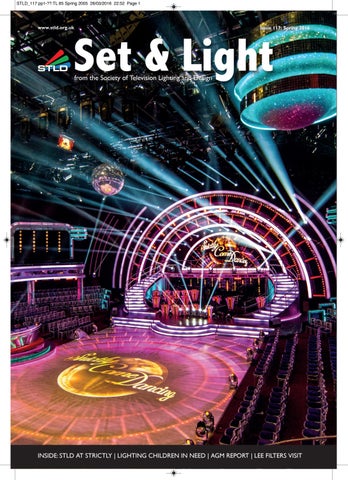
Set & Light from the Society of Television Lighting and Design
INSIDE: STLD AT STRICTLY | LIGHTING CHILDREN IN NEED | AGM REPORT | LEE FILTERS VISIT
STLD_117 pp1-??:TL 85 Spring 2005 26/03/2016 22:52 Page 2
STLD_117 pp1-??:TL 85 Spring 2005 26/03/2016 22:52 Page 3
Editorial comment
Happy New Year to you all and we are already a quarter of the way in! We have a bumper issue for you, with a great mix of articles about STLD visits, excellent programmes that our active members have been working on, trade shows, Showlight, KOI and recollections from retired members. We have some exciting visits planned for 2016. The invitations will go out electronically now, so if we don’t have your email address, you won’t get one. Contact our membership secretary Chris Harris on members@stld.org.uk so we can update your details. Showlight 2017 is an event not to be missed. They are looking for speakers for the conference programme, so get writing! You will need to book your flights and hotels now for the event in Florence, Italy, from 21–23 May 2017 as it is a popular destination. We have reserved some rooms for STLD members to book through us – please contact us for details. The Knight of Illumination Awards 2016 has launched and we are asking for submissions again. Please submit work that you feel justifies an award this year; we just don’t get enough of them and to make the awards as competitive as possible, we need more of you to send in work that you feel is excellent in television. The deadlines for the next issue are 20 June for advertising and 27 June for editorial, including Sponsor news.
Emma Thorpe Editor
Contents 4
Lighting: Children in Need
36
Awards: KOI
9
Report: AGM
38
Lighting: Airmageddon
13
STLD visit: Lee Filters
40
STLD visit: Strictly Come Dancing
18
STLD visit: ARRI
43
Recollection: Bob Monkhouse
20
Information: Showlight 2017
45
Lighting: A view from across the pond
22
Event: International Year of Light
46
In memoriam: John Burgess and Bert Wilkins
28
Event: Tupac Martir
48
Sponsor news
30
Lighting: The Sound of Music Live
76
Society sponsors
34
Event: BVE
80
Index of advertisers
Set & Light is the journal of the Society of Television Lighting and Design and is published three times a year. ISSN 2055-1185 Editor: Emma Thorpe and Bernie Davis E-mail: editor@stld.org.uk Web: www.stld.org.uk Production Editor: Joanne Horne Sponsor News: Emma Thorpe E-mail: sponsornews@stld.org.uk Advertising: Paul Middleton E-mail: adverts@stld.org.uk
Cover photo: Strictly Come Dancing by Bernie Davis Printed by: Gemini Print Deadlines for the next issue: Editorial: 27 June 2016 Advertising: 20 June 2016 Advertising is accepted only from sponsor members of the Society © Society of Television Lighting and Design 2016
Set & Light | Spring 2016
3
STLD_117 pp1-??:TL 85 Spring 2005 26/03/2016 22:53 Page 4
Lighting
Children in Need 2015 – Points West Words & photos: Paul Middleton For five years, since Gareth Malone first started the tradition of a children’s choir performing live from multiple venues around the country in sync with the main choir in London, I’ve been working for BBC Bristol on its regional inserts into the main BBC Children in Need (CiN) appeal programme. It wasn’t so long ago that BBC Children in Need had just two or three OB inserts. Now, each of the 15 BBC nations and regions produces its own opt-outs from the network programme in Elstree. With a limited budget compared to London, the goal is to try to obtain the best results on screen to match the production values in London. As an entirely live event, CiN keeps you on your toes dealing with last-minute changes, with little, if any, rehearsal. Venues for the ‘Points West’ inserts over the past five years have been the amusement arcade at the end of the Grand Pier in Weston-superMare, STEAM – Museum of the Great Western Railway in Swindon, the Roman Baths, Hocus Pocus Circus School at Wookey Hole Caves and, last year, Gloucester Cathedral. The cloisters, famous as the corridors of Hogwarts School in the Harry Potter films, were also used, alongside the main outer nave, for an intimate interview location for CiN 2015. The first recce to the cathedral was an eye-opener as to how big it is inside, especially when you start looking at where to put the lights. Looking for places to discreetly rig, the first thought was on the galleries that run either side of the nave. In order to reach the balcony walkway along the top of each side of the nave, we had to wind our way up the narrow stairs leading to the void above the vaulted ceiling, then crawl over the rough surface above the ceiling and climb some narrow steps towards the balcony. Expecting an easy access to the walkway, I was concerned to see a steel wire safety line running along the wall and a safety harness and I could see that to reach the actual 4
Set & Light | Spring 2016
balcony there was only a very narrow ledge. It became clear that medieval health and safety planners didn’t worry too much about the risks of working at height and any thoughts of rigging lights quickly and safely at that level were out of the question for this event. Back down at ground level, the director explained there would be the usual interviews in front of the choir and then other items, with a group of drummers by the doors at the end of the nave and a load of Pudsey Bears with parachutes dropping down from the roof where we had just been! Other major TV events have several days and a large team of riggers to assemble scaffolding and ladder truss around the cathedral. We had access only from 6pm to 1am the night before TX to do the main lighting rigging, so an alternative method of mounting lights had to be found. The main item for the evening was to be the choir of about 200 children singing on tiered seating in the centre of the nave. While the aim was to try to match the sort of lighting seen in the London studio, we also had to be sensitive to the fact that this was a cathedral. The new Bishop of Gloucester – the Rt Rev Rachel Treweek – was keen to make the cathedral more accessible to the public and had placed no restrictions on where we could place lights or cameras, but it still had to look like a cathedral, while also being different to the normal choral events held there. Conveniently, the organ loft bridges the gap between the main nave and the inner nave and there was plenty of room to rig backlights, effects lights and LED strips, along with lots of power sockets. The Verger then showed us the main power supply. A three-phase 63A supply on a Ceeform socket was conveniently placed in the crypt, with about 30m to run to the choir area and a further 50m to get to the far end of the nave. The stained glass window at Gloucester provides a large amount of light into the cathedral during the
daytime, and the director wanted to feature it. As BBC Children in Need is in November and it was going to be dark outside, how to light it became one more problem to solve. In the cloisters, the moonlight through the windows was a key feature of the Harry Potter experience and there was a desire to try to emulate that as well. As can be expected, the cathedral doesn’t have much in the way of overall lighting for TV. It was fitted with six large daylight floods a few years ago to provide extra lighting for the choirs that regularly perform there, but they are very high and angled straight down, so they weren’t going to provide flattering lighting for our purposes. The rest of the lighting in the aisles is provided by a number of low-pressure sodium lights, which, luckily, can be switched off in zones from a control panel in the Verger’s office under the organ loft. As the cathedral is mainly used in the daytime there is no emergency lighting and that needed to be added to the rig. After a general discussion, it was decided that as far as possible we wanted the lighting to be hidden and that wide shots should be free of obvious lighting equipment mountings. With a quite limited budget for everything to do with lighting and monitors (LD and crew costs, plus equipment hire), rigging ground support trussing was out of the question. It was looking like we would have to use wind-up stands or scaffold poles hidden behind the pillars. However, as we needed to be able to shoot in both directions up the nave, this would mean a lot of re-rigging or extra fixtures to cover all the areas. A chance comment by the Verger asking if he could use our cherry picker (if we were going to bring in one to adjust the lighting on scaffolding) to replace some blown lamps on the balcony level led to the idea that we could use a couple of cherry pickers in order to mount lights. They could be moved out of shot easily when shooting the wide shots of the choir and then moved into place when doing the
V
STLD_117 pp1-??:TL 85 Spring 2005 26/03/2016 22:53 Page 5
Children in Need
The balcony on the organ loft, showing choristers’ graffiti over the years
The nave in daylight
View of the nave in daylight from the organ loft
The cloisters in daylight Set & Light | Spring 2016
5
STLD_117 pp1-??:TL 85 Spring 2005 26/03/2016 22:53 Page 6
Lighting
reverse shots up the nave. A quick call to Nationwide Platforms (the BBC’s preferred supplier of cherry pickers and access towers) by the EM Denis Lomax elicited the offer of two free cherry pickers – as long as we supplied an operator! This led to the next decision as to what equipment to use. I have a large amount of my own kit in the form of LED floods, spots and battens, PAR cans and 1K and 2K Fresnels, as well as Profiles, so they were to form the majority of the kit list. However, in order to provide the beams and spot effects, plus lighting for the stained glass window, we needed more specialised kit. Last year, Chauvet Professional had been good enough to supply some of its latest fixtures, and after a quick chat with Michael Brooksbank and Sam Bowden at PLASA 2015, they happily agreed to do so again and even offered to deliver them to me in Newport. They offered 10 Rogue R1 Beams and 12 Legend 330SR Spots – of which more anon. That dealt with the interior lighting. The exterior lighting was going to prove a bit trickier. An 18K HMI for the nave window and a couple of 6K for the cloisters would have been great, but we didn’t have the power for it or the budget! However, a few calls later and the news that Panalux was going to be opening a branch in Cardiff led to a deal to supply two 4K and one 6K HMI, which would just about give a suitable illumination, and a couple of DFS-500 Hazers to cope with the very large volume of the cathedral. Luckily, the decision had been taken to hire a twinset from FTVS, and a quick check of the power needed for the scanner and uplink trucks showed there would be plenty of power spare to drive the HMIs. The only concern was that the 150m cable run from the generator round to the cloisters would be too much for the 4Ks. We took the shortest possible route and managed to save 15m by running through a little-used door in the corner of the cloisters out into the garden. The lamps struck OK at first but as the evening progressed, they shut down a couple of times and we had to have a spark standing by to reset them. The scanner was to be provided by Cardiff-based Enfys and for the first time, we were to uplink in HD for the 6
Set & Light | Spring 2016
Children in Need
inserts into London. This didn’t affect the lighting design but it did mean we had to be a bit tidier with cable runs, etc, as they show up in the background far more than they did in SD, where they would just blur into darkness. As I was rigging a theatre show the week before, my prep time was limited and so, to cope with anything that might arise, I packed nearly all my kit for the show – over 65 flightcases and boxes. The movers from Chauvet were due to arrive a couple of days before the getin but didn’t as the driver ran out of hours due to traffic on the motorway. The courier finally arrived at lunchtime the next day. Opening up the rear of the 18-ton lorry revealed the 12 small cardboard boxes of the new Rogue R1 beams, along with 12 very large double flightcases, each with two Legend spots – a total of 24 movers. Clearly, these were not going to fit into the back of my van and a quick call was made to the local van hire company to get an extra van. Using the tail lift on the lorry I was able to get the flight cases and boxes into the theatre and stash them out of the way in the unused chorus dressing rooms. The next day I had to detour four of the riggers to the theatre to load the cases and then we headed off to Gloucester. The two electricians, two console operators and myself arrived at the cathedral in three extra-long wheelbase vans at 5.30pm, with equipment from the different suppliers. The cherry pickers had been delivered earlier in the day – we were set to go! The last visitors cleared the cathedral at about 6.15pm and we were off. Luckily, the choir rostra had been built the previous day and the children had been in earlier in the day for a rehearsal. This revealed one issue that hadn’t arisen in the recce: the pictures we had used to estimate the number of children that could fit on the rostra had been of a different rostra staging that is brought in specially for the Three Choirs contest each year. The cathedral’s own rostra was a bit smaller and so there were two rows of children on the floor as well. This wasn’t going to prove too much of an issue as I had taken the decision that we would light the choir in a soft candlelike frontal light. Seven CP62 PAR cans on 4m-high scaffold poles each side of the choir would provide the keylighting
and just four 32W LED PAR cans on the organ loft would provide back light. It is amazing how much light the LEDs give out when viewed on camera. The choir were going to be wearing bright yellow sweatshirts and the PAR cans gave them a nice front glow, while a purple backlight gave a nice contrast. As we started to run cables it became obvious that power and DMX distribution was a major issue; the long cable runs up the sides of the nave just ate cable. We had wireless DMX transmitters to drive the LED strip and battens that we wrapped around the central pillars in the nave but needed lots of other cable. To cut down on cable runs we were using distributed four-way dimmer packs around the building, each with a 16A supply, but by the end of the night, we had only a few spare cables left. For control, we had two ChamSys systems. My MQ60 was connected to an external 24-inch touchscreen to drive the keylights and movers. There was also a 24-inch touchscreen PC running Magic Q PC software to deal with the various LED fixtures and LED strips in use. At the far end of the cathedral in the cloisters there was a third desk: an eightchannel Chauvet Obey 40 to deal with control of the interview setup there. At 9.30pm I ordered three extralarge pizzas for everyone. The delivery driver didn’t know where the cathedral was. The system would only accept delivery to a postcode and the cathedral didn’t have one. I gave them the office address outside and explained we were in the very big building that you could see from miles away and which was lit up in blue. Luckily he found us OK! By midnight we had most things powered up. The generator wasn’t due to arrive until the morning so we ran cables around with splits to allow doors to be closed for the night. We got the cherry pickers into place and then started to make things safe for the morning as the cathedral was going to be open to the public from 8am. You can never have enough rubber matting when the public is around! By 1.30am we had done enough and headed off to our hotels to get some sleep. The riggers were booked to return at 10pm on Friday and the rest of us were to start at 10am, when the scanner from Enfys TV and the
T
E
O
STLD_117 pp1-??:TL 85 Spring 2005 26/03/2016 22:53 Page 7
The two cherry pickers used as mobile lighting platforms
Enfys tender and scanner, FTVS twinset and BBC links van
The exterior lit by 6K HMI from Panalux
One of the two PAR can stands for lighting the choir; Chauvet Rogue Beams and Legend Spots lighting the pillars Set & Light | Spring 2016
7
STLD_117 pp1-??:TL 85 Spring 2005 26/03/2016 22:53 Page 8
Lighting
Children in Need
Top left: The choir as seen on TX for ‘The Climb’ by Miley Cyrus. Centre: The interview in the crypt featured two 4K HMI outside the windows, two Mizars as keylights clamped to the wall with magic arms as there was no space for stands and LED uplighters in the corridors. Right: Batman and Robin arrive The audience edge closer to the choir just prior to TX; Jimmy Jib centre of nave
This picture: Getting ready to drop the parachuting Pudseys. Below: The layout for the different lighting areas
FTVS generator were due to arrive. The next morning was sunny. This was great for visitors but meant we couldn’t expect to check focus or levels until much later in the afternoon. The hazers were tested and lots of visitors noticed the wonderful shafts of sunlight coming through, beautifully highlighted by the haze. The rest of Friday morning was spent completing the BS7909 safety testing of the incoming supply and our final distro and then rigging monitors (which I was looking after as well as lighting), finishing cable runs and preparing for the public to be clear of the cathedral at about 4pm. In the event, there was a lot of crowd management to be done and the sparks and I had to spend a lot of time trying to stop people wanting to stand in front of floor lights or lean against stands. Red and white safety barrier tape was seen as a challenge by the public and rather than standing back from it, they tried to get as close to the action as possible as the evening progressed, but we managed to keep guests in a safe position. In order to provide safe working conditions in the event of power failure, 8
Set & Light | Spring 2016
we had to provide emergency lighting fed from the generator. This was provided by 12 50W low-energy floodlights placed along each side of the nave. After lunch the choir arrived and we were able to get a better idea of how it was all going to look. As darkness fell outside, the interior of the cathedral began to come alive. As well as the inserts into the Points West news at 6.30pm, we were to do three four-minute opt-outs. The original plan was to use three areas for the different opt-outs, but in practice we used two or three areas for each section. The size of the audience grew such that getting around to adjust lights and move monitors and cables became a major exercise in diplomacy. Just like the audience on Top Gear, everyone wants to be in shot! After the 10pm opt-out it was all over and everything had to be taken down. With the full crew working nonstop, we finished loading the last van at 1.30am and headed off to bed. Thanks to EM Denis Lomax; Electricians Andrew J Swift and Jeremy Middleton;
Console Ops William Thornton and David Kennedy; Dave Baker and Ceiron Jenkins at Panalux, David John at Nationwide Platforms, Michael Brooksbank and Sam Bowden at Chauvet Professional, and Stage Lighting Services. All opinions in this article are the personal opinion of the author and no endorsement by ‘BBC Children in Need’ of companies and products mentioned is implied or should be inferred
STLD_117 pp1-??:TL 85 Spring 2005 26/03/2016 22:53 Page 9
STLD report
AGM
A challenging year but we’re making headway
Chairman’s report: 42nd AGM, 17 February 2016 Firstly, I would like to welcome you all here tonight for the 42nd AGM of the STLD. In line with previous years, we were trying to organise some sort of visit to go with the evening but due to the increasing problems of being able to get the officers of the society together in the same room at the same time, and with time running out, we had to opt for a date we could commit to rather than having a grand meeting, so apologies for that. However, I would like to thank The London Studios for letting us hold the AGM here and, particularly, Dave Stevens for arranging this for us. Many thanks, Dave. The year, yet again, has been a challenging one but I think we are starting to make headway, certainly in the financial situation. We haven’t seen much of Mike our Treasurer this year, which is a pity for us but does mean he is doing well in the freelance world. However, he has managed to introduce us into the world of Xero – a financial software package to the uninitiated – which, as you will hear, has proved to be rather successful and is certainly helping to keep things on track. We have, despite financial constraints, managed to hold a variety of meetings, all of which have made good articles for the magazine. Following a successful AGM last year, we were invited to the Philips-sponsored Year of Light lecture given by Peter Philipson on the work and life of Fresnel. Iain Davidson
organised an ever-popular trip to Sky to see the re-light of the new Sports Studio and, after a number of attempts, we finally managed to get a visit to LEE Filters, followed by a stop-off to visit ARRI’s on the way back. Another popular visit was to see the new LED lighting installation at the Savoy Theatre. Quite appropriate really as this was one of the first theatres in London to be lit by electricity. We have had our usual presence at exhibitions and last year we had a stand at BVE and PLASA. On 4 October, the 8th Knight of Illumination Awards Ceremony was held at Troxy, East London. The event attracted a large number of guests, with the STLD running the TV awards section again. While on the subject of the awards, we still require nominations for this year, so don’t be shy: if you see something you feel is worthy of an award, put in a nomination. You can nominate your own shows or someone else’s, although having an idea of where the footage can be viewed is a big plus. Talking of award-winning shows, we were treated to two excellent studio visits to see behind the scenes of both Strictly and The Voice. As always, both of these visits were very well attended and I must thank Mark Kenyon and Gurdip Mahal for giving everyone a good insight into how these shows Set & Light | Spring 2016
9
STLD_117 pp1-??:TL 85 Spring 2005 26/03/2016 22:53 Page 10
STLD report
work. Also, thanks to Bernie Davis for setting these up. As a way of a taster of what’s coming up later this year, we have planned, so far, a visit to Chelsea FC at Stamford Bridge to see the new LED floodlighting, a visit to the BT Sport Complex in Stratford, and one of our sponsors, Lighting Logic, is holding an event in Sevenoaks. Details of all these can be found on our website, and the usual email flyers will be coming your way in due course. One of the topics I do want to concentrate on this coming year is to have a full discussion on the future of the society. This is a subject that involves every one of the membership and I would welcome comments from members on your thoughts as to the direction we should be taking. Recruitment is obviously key to this and we’ll certainly be looking into ways of increasing our numbers, although this is easier said than done. I am particularly keen to encourage student members, as this is the future of our society. I intend to work closely with the committee and, particularly, Matt Maller, our student representative, to see what the best course of action might be. If you are reading this report in the magazine then please take the time to let me know your thoughts. In the words of that famous poster ‘Your Society Needs You!’. I would like to thank the whole committee for all the work they have put in during the year. I don’t usually single out individuals, but there is an exception this year and that’s Chris Harris who volunteered – yes, you heard right, volunteered – to take on the role of Membership Secretary! He has spent many hours getting the database sorted and up to date and has resorted to phoning members in order to obtain the correct information. This means we are now getting the database fully up to date, which has gone down very well with the members Chris has spoken to. In addition to this, Mike Le Fevre and Chris have done an excellent job in invoicing the members for subs, which has saved the society a good deal of money. We thank both of them for their efforts. I would also like to congratulate our two new officers: Deputy Chair Andrew Dixon and Administration Officer Bernie Davis. I can’t finish this report without mentioning some of the members who have passed away. This year we lost Warwick Fielding, Teddy Fader, Duncan Brown, John Burgess and Bert Wilkins, all of whom were very prominent members of the society, with Bert being a past Chairman and founder member. We managed to obtain an obituary for all of them, which appeared in the magazine (or appear later in this issue), with a fine piece on Duncan written by Ian Hillson. This was particularly apt as Duncan was probably the most prolific LD of them all. We will certainly miss them all and send our sincere condolences to their families. Just to finish on a lighter note, I thought I’d mention Bernie’s remarks about obituaries when he said: “I’m happy to read one and always relieved when I find my name’s not on it!” Finally, I thank you all for your continued support and hope we can further move the society forward during the coming year, particularly in the areas of membership and finances. Ladies and gentlemen, this is my report and I would move its adoption.
Stuart Gain Chairman 10
Set & Light | Spring 2016
The Society of Television Lighting and Design
RULES 1. NAME
The society is called the Society of Television Lighting and Design, and also commonly known as The STLD.
2. AIMS
n To provide a forum neither political nor union affiliated, to stimulate a free exchange of ideas in all aspects of our profession and to encourage discussion on the use and design of new equipment and techniques. n To organise a professional and social events calendar throughout the country. n To publish a periodical journal reporting the meetings. n To acquire affiliated membership to other societies and guilds so that our members may gain advantageous access to all art forms and activities both at home and abroad.
3. MEMBERSHIP
Any application for membership shall be ratified by the Committee. The membership shall consist of the following categories: Honorary Membership This will be awarded at the discretion of the committee Full Those who are, or have been, actively engaged in the direction and design of the creative craft of television, or anyone whose occupation is associated with our profession. Must be proposed by one member.
AFFILIATES Retired Any member who is no longer working in the industry. Overseas Open to those who come under the full category of membership, but who reside outside of the UK. Student Must be proposed by a member or by a recognised course leader. Student membership will be valid only for the student’s training period and until one year after finishing the course. College membership A college that teaches lighting or design may enrol a key tutor and bring six unnamed students to meetings for one year.
SPONSOR NOMINEE
The society will be supported by sponsor companies at the discretion of the committee. Sponsoring companies
STLD_117 pp1-??:TL 85 Spring 2005 26/03/2016 22:53 Page 11
AGM
will be allowed to nominate members of their staff as society members subject to payment of a subscription agreed by the committee. All applications for membership are subject to acceptance by the Committee. Members and affiliates (excluding students and overseas) only shall be entitled to vote at general meetings.
4. SUBSCRIPTIONS Annual Membership Members: £75 Affiliates: Retired & overseas £50 Students: £25 These sums may be altered from time to time, as shall be agreed at the annual general meeting, and take effect from the end of the following month after the AGM, the change becoming due on the member’s next renewal date. Subscriptions becoming due on the annual anniversary of the member joining: If a member has not paid within four months of the subscription becoming due, they are deemed to have lapsed. Acceptance of an application to rejoin shall be at the discretion of the committee. Members becoming eligible to change the category of membership to one with a higher annual subscription during the first six months of the society’s year shall pay an additional subscription pro rata. Members changing to a category with a lower subscription will not be entitled to a refund, but will pay the appropriate subscription when it falls due.
5. MANAGEMENT
The affairs of the society shall be managed by a committee of not exceeding 15 members, the majority being full members, who shall be elected at the annual general meeting and hold office for one year, and shall include the following nominated officers: Chairman, secretary, treasurer, deputy chair and administration officer. The committee may co-opt three members as they consider appropriate. The committee may co-opt any member to fill a vacancy on the committee that may occur during the year until the next annual general meeting. The committee may also appoint sub-committees for specific purposes. A quorum of the committee shall be five members, at least one of whom must be an officer of the STLD. Nominations for chairman, secretary, treasurer, deputy chair, administration officer and the remaining members of the committee must be received in writing by the secretary prior to the annual general meeting and must be proposed and seconded by two members. The proposer must ascertain that the nominee is willing to stand for election. All members of the management committee are deemed to have full voting rights. The secretary shall keep records in writing of the proceedings at all general meetings and
committee meetings of the society.
6. ACCOUNTS
The committee shall cause to be kept true accounts of the receipts and expenditure of the society. Cheques shall require the signature of any two of the following: chairman, secretary, treasurer. To reflect the modernisation of the banking system, the treasurer may use electronic transfer of funds for payments, prior notification of which must be sent to the other two nominated officers. The accounts shall be closed on 31 August annually and shall be prepared for auditing by an auditor who is not a member of the society. The auditor shall be appointed annually at the annual general meeting.
7. GENERAL MEETINGS
An annual general meeting shall be held once every calendar year. Notice of this meeting and agenda shall be given not less than 21 days prior to the meeting. At this meeting the chairman’s report and accounts for the preceding financial year ending 31 August shall be presented, having been duly audited. By resolution of the committee, or upon notice in writing by not less than 20 paid-up members, the secretary shall convene an extraordinary general meeting at not less than 21 days’ notice stating fully the reasons for which the meeting is called. At any general meeting, a majority of votes shall decide a resolution and if the committee deem it necessary, a postal vote may be taken and these votes included with those cast at the annual general meeting. The chairman will have the casting vote.
8. ALTERATION OF RULES
These rules may be altered from time to time, rescinded or new rules added, by a two-thirds majority of those voting by post and at the annual general meeting. Notice of any change of rules must be submitted in writing to the society secretary at least 60 days prior to the meeting.
9. DISSOLUTION
If at any general meeting a resolution for the dissolution of the society shall be passed by a majority of the members present, and such resolutions shall be confirmed by a majority at a special general meeting held not less than one calendar month thereafter, the committee shall thereupon, or at such future date as shall be specified in such resolution, proceed to realise the property of the society and, after discharge of all liabilities, shall divide equally the same among all paid-up members of the society and upon completion of such division, the society shall be dissolved.
10. GENERAL
Every member binds himself or herself by the rules of the society. In all cases of dispute or disagreement as to the interpretation of the rules of the society, the decision of the committee is final and binding. Revised February 2016
Set & Light | Spring 2016
11
STLD_117 pp1-??:TL 85 Spring 2005 26/03/2016 22:53 Page 12
STLD report
AGM
MEMBERSHIP AND ACCOUNTS Things are happening behind the scenes at the STLD. It doesn’t always look like it, but I can assure you they are – and faintly radical things too! There has always been a membership secretary on the committee: some kindly volunteer who took on the job of collecting subs from members, at the same time trying to keep up with where everyone lives. And, more recently, trying to harvest email addresses and keep up with how they regularly change. In recent times, we have found that those who have been prepared to volunteer to help with this essential role in the society have had less time than in the past, and you are probably aware that for a few years now, the STLD has employed the services of PLASA to help with our membership management. The PLASA route looked like a good solution, coupled with the fact that by joining PLASA as a society, we won some added benefits for members. The trouble is that it cost quite a lot of your money, and it seemed to us that very few members were finding the PLASA benefits of use, and so we have decided to sever our connections with PLASA. Two things have happened which made this a viable option: first of all, Chris Harris, who has been an active STLD member for many years, recently joined the committee and he has agreed to get the membership database back into shape. This coincided with
our Treasurer, Mike Le Fevre, moving our accounts onto a comprehensive accountancy package called Xero, which has helped Mike to improve our accountancy and invoicing process considerably. The two have put a lot of work into updating our records, and with this two-pronged attack we are heading towards getting things in better shape than they have been for a long time. But we do need you, the members, to help us! We had an administrative hiccup last year where the membership rate was publicised at a different level to what had been agreed. The easiest thing was to ignore that for last year and to get everyone back on track for this year. Chris is quietly working through the list of those members not up to date with subscriptions and hopefully will be improving our financial situation. But if you can check, please, that you have paid your subs at the correct level, we would really appreciate it. And please remember to keep the STLD informed about your address changes, both email and postal. The move away from PLASA will save the society a lot of money, but to keep subscriptions down we need your help, too. The current membership fees are: Full member – £75 per annum Affiliate/overseas/retired member – £50 per annum Student member – £25 per annum
ETC ColorSource Set up your system in no time
ColorSource Relay Transforming small system design
ColorSource PAR and Spot High quality factory-calibrated RGB-L luminaires for smaller budgets Wireless-DMX control for LED installations with minimal setup time, remote configuration and system error monitoring. Makes your students work like pros. Learn more at www.etcconnect.com.
Americas
Europe
Asia
www.etcconnect.com
a
STLD_117 pp1-??:TL 85 Spring 2005 26/03/2016 22:53 Page 13
STLD visit
LEE Filters
An original sponsor at the cutting edge Words: Paul Middleton Photos: John O’Brien On 30 November 2015, following an invite from Business Development Manager Richard McKitty, a group of stalwart STLD members headed down the M3 to Walworth Industrial Estate on the outskirts of Andover to visit long time STLD Sponsors – LEE Filters. If you were brought up using Strand Lighting Cinemoid filters, then the new kid on the block back in 1967 seemed to be focused on the film and TV lighting industry, which needed specialised colours. In fact, it was back in 1961 when two film lighting electricians, John and Benny Lee, incorporated Lee Electric (Lighting) Limited. At that time, all the major film studios had their own lighting departments and didn’t usually need to hire much outside equipment. Lee Electric was primarily involved in the rental of lighting equipment for commercial and documentary productions, but as the business flourished, they decided to expand their services and, in 1967, LEE Filters was formed to design and market lighting filters. Run by David Holmes and the Lee
brothers, the manufacturing division began life in London but moved to a purpose-designed high-technology manufacturing plant in Andover, Hampshire, in October 1973. It was a proud moment for the Lee brothers when, on 1 April 1974, the first of many reels of filter was manufactured. The 1,000m roll of ‘204 Full C.T. Orange’ was hand mixed by Eddie Ruffell and the colour is still produced at the factory today. Over the course of the next two decades, the Lee brothers went from strength to strength as they acquired and set up many other ancillary companies. Some of these included: 1967 – Importing Ianiro lanterns from Italy to enable them to compete against the main lighting equipment supplier at the time, Mole Richardson, which they ended up buying in 1975 – the same year that they formed Joe Dunton Cameras. 1968 – Buying Telefilm Lighting Services, which had been a competitor to Lee Lighting. 1969 – winning a five-year contract to supply BBC OBs, which needed a big
increase in equipment with the advent of colour. This was subsequently extended at various times right through to 1990. 1977 – Setting up Lee International Film Studios (now Fountain TV) in Wembley. 1984 – Buying Shepperton Film Studios. 1985 – Buying Colortan, which they then renamed Lee Colortran, which made dual source luminaires to a BBC design. The acquisition of Mitchell Camera Corp followed the same year. 1987 – And finally, buying Panavision. Black Monday (19 October 1987) saw a worldwide stock market crash and John and Benny resigned as Directors of Lee International, while still keeping their shareholding. The 1988 Writers Guild of America strike severely hit income and, by August that year, a new company – Lee Panavision International – was set up, which purchased all the Lee Group assets, including Lee filters. Now, 28 years later, Eddie Ruffell is still Managing Director of LEE Filters, with Ralph Young as Sales Director. There are just three other salesman in Set & Light | Spring 2016
13
STLD_117 pp1-??:TL 85 Spring 2005 26/03/2016 22:53 Page 14
STLD visit
LEE Filters
An ink jet machine for finishing
Neil explaining the exhaust purifcation system
Creating graduated camera filter
Neil in the gel test room
14
Set & Light | Spring 2016
the UK: Adam Young looking after architectural products, with Jon Cuff and Richard McKitty looking after general sales. Worldwide appreciation of LEE Filters continues and the current management has kept the name despite probable attempts to rename everything under the Panavision brand. Panalee Filters wouldn’t sound right, would it? There have been other visits to LEE Filters over the years and I would refer readers to TV Lighting (issue 52, autumn 1993 – soon to be available online at www.stld.org.uk) for the technical details of some the processes used at LEE Filters. The Andover headquarters is home to the research and development department, where the scientists and technicians have been responsible for much of the improvement in filter technology. Exacting quality control means that lighting designers can rely on filters that exhibit consistent colour performance. No need to replace all the colours on a row of cyc lights if one burns out, for example. As Richard explained: “Long-term improvements in filter design and technology come about because we have developed a deep understanding of the scientific and technical principles which impact on filter performance. Nothing stands still in the lighting and filter technology and our researchers, under Alison Chetwynd (Research and Development Manager), have to ensure they stand at the cutting edge of new developments in the material that are the basis of the filters. Recent new products from LEE Filters include: 700 Series – a special range of filters exclusive to Lee, which have been created by top stage, event, TV, cinema and architectural lighting designers Peter Barnes, Tanya Burns, Lucy Carter, Paule Constable, Chris Davey, Dave Davey, Chris Ellis, Rick Fisher, Peter Fisker, Henrik Hambro, Mark Henderson, David Hersey, Jakob Holst, Jesper Kongshaug, Andy Liddle, Durham Marenghi, Declan Randall, Mike Robertson, David Whitehead, Kate Wilkins and Patrick Woodroffe. Zircon Rang – Longer-life filters for LED with a lifespan of up to 200 times longer than standard lighting filter.
LED lighting has many benefits, but one of its stumbling blocks is that its intensity can contribute to the fade times of standard lighting filters. In order to overcome this, the R&D team developed a new method of production to ensure filters last longer when used in conjunction with LED lights. In fact, Zircon warm amber filters have been shown to retain at least 80 per cent of their effectiveness after as much as eight months of continuous use on LED downlighters. Zircon filters are designed to correct and control the light emitted by LED sources. They enable the user to produce suitable illumination for photographic/film use and for architectural installations. The colour temperature conversion filters and the colour correction filters are designed to alter and control the colour of light sources. The diffusion filters control the direction and intensity of light without altering the colour. Each filter is manufactured by surface coating a thin layer of coloured lacquer onto both sides of a polyester (PET) film substrate with a nominal thickness of 0.180mm (180 micron). The coating itself has a thickness of just 0.005mm approximately (a typical credit card is 0.750mm and the main LEE Filters use substrate in the 50–75 micron range. The tests on the filters before launch included continuous usage for eight months compared to standard filters. There are 12 filters in the Zircon range: the five Minus Green filters remove the green casts often associated with LED lighting when using a digital camera; the four Warm Amber filters correct a range of different colour temperature white LEDs so they appear like tungsten and the three Diffusion filters offer different strengths of diffusion specifically designed for LEDs. LEE Filters does point out that due to the inconsistency in LED characteristics, they strongly recommend filters are trialled first to ensure the desired result. To allow this, they produce a sample pack of 300mm-square examples of each filter in the range. An important point to note is that while Zircon filters have a recommended maximum working
STLD_117 pp1-??:TL 85 Spring 2005 26/03/2016 22:53 Page 15
The inkjet head prints the details on to the gel
This picture: just a few of the gels in stock. Pictured left: cutting samples for testing
temperature of 180ºC, they are designed for use on LED fittings only and are, therefore, not flame retardant. A key philosophy of LEE Filters is they don’t sell ‘seconds’. If a product isn’t right, it won’t leave the factory. Similarly, reference samples are kept of every batch of filters produced to enable any issues that may arise later to be traced and investigated. In keeping with the demands of modern designers, LEE now produces a couple of apps for Apple and Android phones. For just 69p there is the LEE Swatch App, which gives a good approximation of the appearance of a LEE Filter colour (given the limitations of mobile phone displays) and allows visual comparison with a competitor’s product, as well as the storage of a palette of colours for future use. It also allows search by colour, as well as
including a colour temperature calculator that will offer suggestions as to which filter will achieve a required colour temperature – for example, 3,200K to 6,500K ideally requires a Mired shift of -159; 202 Half CTB will give -156, while 201 Full CTB will give -172 shift. For the Diffusion user there is a separate app that links to a YouTube video by Don McVey showing the effect of using different Diffusers on lights: https://www.youtube.com/ watch?v=7l6FjphZXsk The members split into two groups for the tours, which were led by Alison Chetwynd and Neill Cullen. The wearing of lab coats was mandatory and the final warning before we set off was ‘if it bubbles, don’t put your hand in it!’. The coating machines are still the
original ones from the 1960s. There are just two main machines, which are used to produce all the main products. A couple of smaller machines are used for testing and development purposes. The lacquer is double sided and is applied by running each side separately. The lacquer is solvent based and is mixed on site in giant liquidisers. When mixed it is stored in 20 gallon drums – enough to produce many kilometres of filter. Each production run is usually about 3,000 metres, which is then cut up into rolls and sheets. The secret of applying the lacquer is in the use of stainless steel bars covered with different sizes of tightly wound coils, which spread the lacquer evenly across rollers as the clear substrate passes by. An interesting fact is that the substrate itself is not flame proof. It is the combination of magic ingredients used to coat it that gives it Set & Light | Spring 2016
15
STLD_117 pp1-??:TL 85 Spring 2005 26/03/2016 22:53 Page 16
STLD visit
The coating machine’s well-used controls
A clear base ready to be loaded
Coating taking place One side is coated at a time
The flame test chamber
16
Set & Light | Spring 2016
Neil sending roll for processing
STLD_117 pp1-??:TL 85 Spring 2005 26/03/2016 22:53 Page 17
LEE Filters
the fire retardant properties. Even LEE 130 Clear filter is coated! Even though it takes longer to produce, the practice of applying each side of the coating in separate runs is essential to get the consistent results required. Towards the end of each run, the solvent gets thicker and darker as it is used up from the drum. Tests are made at the end of each run to measure the differences and, if necessary, tweaks can be made to the mix to adjust colour and density before the second side is coated by running the reel back through the machine from the other end of the reel, thus evening out any density changes. LEE Filters produces all the material for both the UK and US operations in Andover. They share the same factory but have different storage warehouses. Looking at the racks, the layout of material seemed haphazard, but in fact the logic was that more commonly ordered filters were stored closer to the packing area in the centre of the warehouse, while lesser ordered products were stored further away, thus speeding up the packing process. It was revealed that several products, including dichroic filters and black wrap, are made by other companies to Lee Filters’ specifications. The top floor of the warehouse was dedicated to the production of the various LEE Filter swatch books. Most people will have seen the immediately recognisable yellowcovered swatches at trade shows around the world. LEE staff handproduce about 100,000 swatches a year at a cost of about £4.50 each. They are available in Numeric Edition and Designers Edition (colours grouped together) as well as a physically larger sample-sized Cinematographers Edition of filters aimed at DoPs. Each page of the swatch gives the colorimetry figures and, most importantly for many people, the transmission factor. Interestingly, they are also sold online by several companies for a couple of quid each! After a highly informative tour, we all retired to the local hostelry where an excellent buffet was provided. Thanks to Eddie Ruffell and all the LEE Filters staff for their hospitality.
Coming through the dryers
The same two purple gel filters: The lightbox, of which you can vary the source, has D65 (6,500K daylight), Source A (this is close to tungsten – 2,856K), TL84 (a fluorescenttype source – 4,000K) and a UV source. This box is mainly used by R&D to compare forumulations on different light sources to ensure there is no metamerism. When two different formulations that look similar on one source look entirely different on another, R&D will always aim to get any reformulations to look the same whatever source is being used. Set & Light | Spring 2016
17
STLD_117 pp1-??:TL 85 Spring 2005 26/03/2016 22:54 Page 18
STLD visit
New arrival Words: Paul Middleton Photos: John O’Brien
This picture: the ARRI 17-C; above: the S60 in blue mode
After our visit to LEE Filters on 30 November 2015, the STLD visited the headquarters of ARRI to take a look at the new LED version of the ARRI SkyPanel. We had hoped to include a look at the lights as part of a planned visit to Pinewood Studios to see the Lottery Studio (TV3) and the facilities of the new Pinewood MBS Lighting company, but pressures of work meant we have had to postpone that visit until later this year. Bob Williams, Siobhan Daly and Andy Barnett were on hand to show the features of the new LED based SkyPanel. The SkyPanel is available in two sizes and two types. Bob explained that the colour version was the one mostly chosen by the likes of Warner Brothers, Panalux and Pinewood MBS (which has already purchased more than 100 of the SkyPanels). The S60C and S30C colour versions have RGB and white LEDs. It has fully variable 2,800K to 10,000K colour temperature selection, along with minus green and magenta adjustment as well as full colour selection. The S60C fixture is driven with an array of over 500 quad pixel LEDs, with both local control (via a simple threeknob and four-button control and LCD display) and five-pin DMX control built in. Accessories include eggcrates, snoots, honeycombs, chimeras and intensifiers, which can boost the light output of the central region by up to 50 per cent. The other model is the RP version, which uses a selection of slide-in phosphor panels to give a variety of fixed colour temperatures, from 2,700K to 10,000K, as well as a chroma green panel. Light output is correspondingly higher than the colour version, but with the increasing sensitivity of cameras, absolute light output is not as important as it used to be. Power can be taken from mains (via a PSU box) as well as Anton Bauer and V-Mount batteries.
The SkyPanel – at a glance
This picture: Mandy Bullock-Williams and Paul Middleton being shown over the SkyPanel; above: new and old
18
Set & Light | Spring 2016
ARRI originally worked to produce the first SkyPanel using the Planon light source that Osram had invented in 1998. The Planon was a flat, mercury-free fluorescent panel just 0.4-inch thick. It used excimer discharge whereby light was generated by a pulsed dielectricallyinhibited discharge in a xenon atmosphere. An external voltage was applied to the electrode system of the lowprofile discharge lamp, which caused xenon molecules to be excited in the discharge space. As these ‘excimers’ decayed, short-wave UV radiation was produced (172 nm), which was converted into visible light with the aid of a specially adapted UV phosphor. Luminous efficiency was relatively poor compared to the emergence of higher powered LEDs in the 2000s and Osram ceased production of the Planon lamps in favour of its range of LED products.
STLD_117 pp1-??:TL 85 Spring 2005 26/03/2016 22:54 Page 19
ARRI
This picture: Chris Harris at the FLX Console; above: a close-up of the SkyPanel LEDs
This picture: a fabric egg crate for the SkyPanel; above: quick release for the power supply Set & Light | Spring 2016
19
STLD_117 pp1-??:TL 85 Spring 2005 26/03/2016 22:54 Page 20
Information
Showlight 2017
Join us in Florence We would like to remind members that the STLD will be sponsoring a small number of members to attend Showlight 2017 in Florence. As on previous occasions, we are inviting members to apply for free registration to this event, which only happens once every four years. Visit the Showlight website to get a flavour of what is being prepared for 2017, but we can assure you that you would not want to miss out. In return for free registration, all we ask is that you write up the event for the magazine in order to share the occasion with other members. You only have to pay for your travel and hotel, and with such a full programme, you won’t need to spend much more. Florence is a fantastic tourist attraction, and to help members stay together, we have already reserved some rooms in a reasonably-priced hotel, which will only be released if not taken up very near the event. If you think you might want to join us, do please let someone on the STLD committee know as soon as you decide. We will start to confirm places later this year.
STLD_117 pp1-??:TL 85 Spring 2005 26/03/2016 22:54 Page 21
advertorial
see
|
hear
|
enjoy
|
network
Call for Speakers Showlight is now inviting the submission of ideas for papers from lighting designers and directors, associates, programmers, scenographers, equipment manufacturers and others for the 2017 programme.
© Firenze Fiera S.p.a.
About Showlight The Showlight Quadrennial is one of the few international events organised specifically for lighting professionals by lighting professionals across the performance, television, film, architectural and event worlds. Its comprehensive papers programme, combined with a rather unusual trade show and an informative and entertaining social programme the highlight of which is a full Conference Dinner - ensures Showlight is a unique opportunity to mix with others in the international lighting community, as those with established careers and reputations mingle with those just starting out in the industry.
Florence 2017 – the 10th Showlight Quadrennial Showlight 2017 celebrates the 10th presentation of this eagerly-awaited lighting colloquium, which this year has Clay Paky as its main sponsor. The venue will be the historic Palazzo dei Congressi in the beautiful Renaissance city of Florence, which promises to provide another unique chapter in the history of the Quadrennial. Conference papers will be delivered in the Palazzo’s large seated conference hall, which is surrounded by an exhibition area where up to 40 exhibitors will be located. Delegates will have plenty of time to visit the stands between talks, and exhibitors to attend the presentation of papers. A full programme of visits to major and unusual cultural places is offered on the Monday afternoon.
Call for Papers The conference programme forms a major part of the event and Showlight takes pride in attracting a wide range of speakers on a broad range of subjects: from major international lighting events to
Now is your chance to be part of this prestigious event! innovative use of lighting in the village hall; from state of the art research to borrowing ideas from other lighting genres; from Broadway award winners to student practitioners. Showlight is now calling for ideas for conference papers for the 2017 programme and welcomes all applications. Sessions should be 20 minutes in length to leave time for discussion and to enable more topics to be covered. Seven main topics have been chosen for broad interpretation, although other categories may be explored! • Description of INNOVATIVE LIGHTING DESIGNS • UNUSUAL AND SPECIAL RIGS you have used • ‘I TRIED THIS AND IT DIDN’T WORK’ - this could prove the most useful paper presented! • IT’S MY DESIGN - and I’ll cry - or cheer - if I want to! • LIGHT SOURCES - new sources, unusual sources, sources of last resort • SPECIAL EFFECTS - how special, how effective • THE FUTURE AND THE PAST - techniques forgotten that could help us in the future Video clips showing the range of speakers and topics from Showlight ^ 2013 in Ceský Krumlov can be found at www.showlight.org Speakers at Showlight benefit from free registration which covers everything, including access to all the seminar presentations, the trade show, full participation in the visits programme, food and drink throughout the day and a place at the main Conference Dinner on Monday evening. Showlight is pleased to offer a contribution towards the Speakers’ travelling expenses.
Submit YOUR ideas for a Paper To be considered as a speaker for Showlight 2017, please email the following details to the Papers Committee at papers@showlight.org Your name, contact details, a very brief summary of your professional background and a short outline of your proposed Paper. (At this stage we just need the flavour of the topic, not the completed script!) Alternatively complete the online form at: www.showlight.org/papers
main sponsor
supported by
www.showlight.org
STLD_117 pp1-??:TL 85 Spring 2005 26/03/2016 22:54 Page 22
International Year of Light
2015 was the UNESCO International Year of Light (IYL), and thanks to an international team they managed to celebrate by holding an event every day. Later in this issue, STLD member Peter Phillipson tells us more about just some of the events that contributed to this widespread and diverse recognition of the world’s understanding and experience of light (see pp26-27). At the end of 2015, the STLD was invited to London’s Savoy theatre for the latest in the IYL’s calendar of events: a talk about how The Savoy was the first theatre to install electric lighting, and how it even changed theatre itself. The talk was given by Dorian Kelly, who might be remembered by those who attended Showlight 2009 in Glasgow when Dorian caught the conference’s imagination with a memorable paper on ‘The Poetics of Lighting’.
“
It’s an enormous privilege talking about my favourite subject to such a group of experts, especially on this hallowed ground, the stage of The Savoy Theatre in London’s Strand – the very first public theatre in Britain to be lit by means of the incandescent electric lamp. This was a real technological and artistic revolution, not only of theatre technology but also of the development of world theatre itself. “Let me take you back 134 years to 1881 to tell you about a technology that changed everything. Not just lighting techniques, but scene painting, makeup, costume, acting styles and playwriting itself. In October 1881, for Richard D’Oyly Carte, the idea of a new theatre was a dream. Carte’s real ambition was to develop an English form of light opera that would displace the bawdy burlesques and badly translated French operettas then dominating the London stage. He formed the Comedy Opera Company
22
Set & Light | Spring 2016
A coup de théâtre Words: Bernie Davis Photos: John O’Brien
The White Heat of Revolution: An examination of the effects of the coming of the incandescent lamp to the theatre, presented by Dorian Kelly and then commissioned Gilbert and Sullivan to write a comic opera that would serve as the centrepiece for an evening’s entertainment. In his capacity as Managing Director, he somehow held the company together for nearly five years. But he was fed up getting theatre performance slots wherever he could in whatever venues he could get hold of, so when his lease of the Opera Comique came to an end, and he was presented with an unaffordable rent rise, enough was enough. The result he took was independence and The Savoy Theatre. This would be the best theatre he could make it. Never again would he attempt to cram ‘20 love-sick maidens’
onto a stage ideally suited to ten. The orchestra pit was large enough for the extra musicians for which Sullivan was always agitating. And spurred by Gilbert, he intended to make the technical facilities second to none. It would have the best of taste in decoration, the finest ventilation systems and would be the first theatre in the world to be lit throughout with the incandescent filament lamp. The phenomenon of light produced by electricity had been known since about 1800, when Sir Humphrey Davey (he of safety lamp fame) discovered that the voltaic battery could be used to heat strips of platinum to incandescence. He also showed a
STLD_117 pp1-??:TL 85 Spring 2005 26/03/2016 22:54 Page 23
Dorian Kelly talk
brilliantly blinding light could be produced between the tips of two carbon rods if they were briefly touched together, and that this light could be maintained for as long as they, and the power, lasted. This led to many devices for floodlighting and public street lighting, but it was not until 45 years later that it was used in the theatre. At the Princess’s, Charles Kean used an arc lamp in a pantomime entitled Harlequin and the Enchanted Arrow as a wide-angle floodlight. Fundamentally, the arc was not really suitable for large-scale wide-angle lighting. It flickered and it wasn’t that bright when spread out over a stage. Another answer had to be found. The first patent incandescent lamp was in 1841. This consisted of a glass globe filled with powdered charcoal. These worked for a while, but envelope blackening and their tendency to catch fire at an alarming rate rendered them impractical, so experiments continued. Until, that is,
Thomas Edison in New Jersey and Joseph Swan in Newcastle upon Tyne, independently set about passing currents through filaments made from a variety of materials. While Edison wowed the crowds across the Atlantic with his original public demonstrations, by 1880 Swan had lit his workshop and indeed the whole of the street with electricity. Both men had succeeded in their principal aim: to produce an electric lamp that was within reach of all. Initially, the two companies were very successful, but later there were arguments and patent suits as to who was the true inventor. The truth was both men simultaneously responded to the needs of the time, taking what was the next logical step. They soon realised co-operation was better and eventually amalgamated into the Edison and Swan United Electric Company. It was to the Swan Company that Richard D’Oyly Carte turned when the concept of electrifying The Savoy was
mooted. Having seen ‘electric light in lamps’ exhibited outside the Paris Opera House some years previously, he had been convinced that ‘electric light in some form is the light of the future in theatres’. At The Savoy, electric power was produced in a shed erected on a piece of wasteland outside. A collection of steam engines were arranged to drive six large alternators of Siemens Manufacture. The field coil excitation voltage for these was simultaneously generated by six small dynamos. The theatre itself was wired in six main circuits, corresponding to the number of generators, various areas being protected by sub-fuses. Each area was initially provided with a switch. Main switches for each group were also provided and it is reported that when they were operated, the flash that resulted could be seen in the auditorium if the scene was dark. Altogether, there were 1,158 Swann lamps in the theatre, 114 in the auditorium, 221 in the dressing rooms and 824 on the stage, giving in total a stage light output equivalent to about 3,000 modern halogen Watts. Of those, 718 were above the actors’ heads, 50 were floats and portable units, and the remainder were fixed to the side wings in the traditional manner. The house lighting consisted of 114 lamps, mainly in three-branched brackets around the auditorium circle fronts. One of the more impressive features of the incandescent lamps was the fact that, as the applied power was decreased, the output light also decreased, more or less in proportion. Siemens Bros and Co manufactured a series of open spirals of iron wire in a frame and connected them between the generators and each group of stage lamps switched in and out of the circuit as required. They acted as the first ever resistance dimmers. There was something of a carnival air in the auditorium the night the theatre opened, especially when D’Oyly Carte stepped forward to address the audience. After a brief introduction, he announced that although the stage lighting was not ready, the auditorium would be lit by electricity. He went on to warn that the system might fail due to the experimental nature of the Set & Light | Spring 2016
23
STLD_117 pp1-??:TL 85 Spring 2005 26/03/2016 22:54 Page 24
Dorian Kelly talk
International Year of Light
This picture: Dorian Kelly takes his audience back to 1881 and the time of Richard D’Oyly Carte (pictured on screen); inset: the original interior of The Savoy Theatre
installation, in which event, the gas system – a small part of which would remain alight at all times – would instantly be brought into full use. Then, at his signal, the gas was turned down and as The Telegraph wrote ‘there was a hum of expectation and anxiety throughout the house. The effect was instantaneous. A start, a pause, a tremor, and suddenly the auditorium was literally brilliant with the novel light’. The system behaved itself admirably throughout the performance of Patience that evening, and at the end, the public expressed a verdict of success, not only of the lighting, but also of the production. It was another 11 weeks of hard work before it was considered ready to announce the lighting of the stage by electricity. The eventual solution of the problem was quite elegant in its simplicity. The iron resistors were removed and replaced by a much smaller six-way ‘regulator’. This consisted of half-a-dozen six-position switches connected to tappings on coils of German silver wire. These were mounted in a wooden frame positioned on the fly floor and were electrically 24
Set & Light | Spring 2016
connected, not to the output of the alternators, but between the dynamos and the field coils of the alternators. The operation of these resistances reduced the magnetic flux in the alternator and, therefore, the output voltage. It had the added bonus that it also reduced the magnetic ‘drag’ in the system, thereby effecting a saving in prime-mover power. By the afternoon of 28 December 1881, the installation was judged to be completed, and the public and press gathered to see the latest wonder of the age. While the introduction of electric light to the art of theatre was a blow to everything for which the Irvings, Terrys, Trees and Harkers of the era stood, others seized upon the new medium with ferocious delight. Already, by the time The Savoy had settled, The Alhambra Theatre had installed auditorium lighting to a limited extent, and elsewhere in Britain, all the new theatres nearing completion or in planning were converted to the electric power as a matter of course. For a while, the invention of the incandescent gasmantle threatened to slow down the
introduction of electricity but by the mid-1880s, the improvement to the accumulator allowed the electric light to be completely steady, flicker-free and more or less secure against loss of power. This eventually cleared the way for theatres to take the step of abolishing gas and oil as a primary source of light from their buildings altogether.” This is the (edited) text of a speech given as part of the UNESCO International Year of Light 2015 celebrations, organised jointly by the Association of Theatre Technicians, the Society for Light and Lighting and the Association of Lighting Designers. It was given by the author at The Savoy Theatre in London’s West End on 24 November 2015. Dorian Kelly is a professional stage lighting designer and a member of the UK planning group of the UNESCO International Year of Light. He is also a performed playwright, and an events, festival and theatre director, artist booker, exhibition designer, community projects leader, as well as designer of sound, scenic water and pyrotechnic effects and lecturer on theatre technology and performance art.
STLD_117 pp1-??:TL 85 Spring 2005 26/03/2016 22:54 Page 25
White Light’s Simon Needle with GDS Founders Richard Cuthbert and Matt Lloyd, and John Young, Head of Building Services for the Ambassador Theatre Group
Leading lights As Dorian explained in his presentation, The Savoy Theatre was built to be a home for Richard D’Oyly Carte’s theatre back in 1881, soon followed by the even more famous hotel that now dwarfs the theatre. But in 1929, D’Oyly Carte’s son Rupert decided to refurbish the theatre to bring it up to date, and this is when the more familiar art deco interior was created. New building methods such as RSJs allowed all the interior columns to be removed, and the balcony was instead supported by a cantilever structure, so offering unobstructed views from all seats. And this was the way the theatre looked until 1990, when a disgruntled employee took revenge by setting light to the building. The theatre was opened again in 1993 after a painstaking restoration project back to the 1929 design, during which the original plans for the plaster mouldings were found, much to everyone’s delight. The seating was restored to its original unique design, by which five different seat cover designs are used. Different reasons for this irregular pattern were offered. One was that ladies attending could match their dresses to particular seats. Another was that it became less obvious from the stage when there were blocks of seats empty. Part of this refurbishment involved the fitting of concealed house lighting, and cold cathode strips were placed behind the ceiling mouldings. In recent years, the cold cathode lighting was proving unreliable – indeed, the balcony ceiling section had failed completely – and that brings us up to 2015, when Bristolbased manufacturers Global Design Solutions (GDS) teamed up with White Light’s installation department to create and install a new house lighting system. With the theatre being a listed building, it was essential that the new system be harmonious with the existing building, and they soon realised that a retro-fit replacement would not be good enough. GDS developed a new 4Q LED candle bulb, both clear and frosted, enabling them to use
much of the existing wiring. The cold cathode lighting was replaced by GDS’s own LED strip lighting, which is only 19.2W per metre. By using wireless DMX and dimming data through the mains, they reduced the need for new wiring, reducing install time, and freed up the old house lights dimmer room, which instead became a distribution room. It was essential that the house light dimming had to be perfectly smooth and GDS redesigned the LED dimming to even out the bottom end of the control curve. They demonstrated this at the meeting by setting a house light dim time of 50 seconds, and I can assure you it was not possible to detect a single step. Other lighting manufacturers please take note: this is what we need with new LED fixtures! But reliability is only one of the benefits from the refurbishment. It was estimated that they used to spend about £16,000 per year on power and maintenance of the house lights. This was now reduced to just £1,500, meaning that the refit would pay for itself within three years.
Newly restored auditorium lighting
Set & Light | Spring 2016
25
STLD_117 pp1-??:TL 85 Spring 2005 26/03/2016 22:54 Page 26
International Year of Light
Giants Causeway © Don Kinghan
Tower of London © Rachel Ferriman
Jurassic coast © Mike Massaro
Blenheim © DPA Consultants
UNESCO is famous for proclaiming that a particular year should be the international year of something. These events create awareness of particular themes of life, and recent examples have included the years of the gorilla, biodiversity, forests, astronomy, sustainable energy, youth and water co-operation. But the 14 months or so from December 2014 to February 2016 was dedicated to the International Year of Light (IYL). We were told there would never be another one – well, certainly not in our lifetimes. So, what was it? Originally, it was a chance for a celebration of various episodes in the history of our understanding of light, including Al-Haytham’s legacy of Arabic optics a thousand years ago; the camera obscura before that; Galileo’s telescope; Newton’s theories of light; Maxwell’s equations (1850); Einstein’s Special 26
Set & Light | Spring 2016
Fountains Abbey © George Hodlin
Giants Causeway © Gareth O’Cathain Photography
A year of celebration Words: Peter Phillipson Relativity (1905); the Photo Electric Effect (1905), and the centenary of General Relativity (1915), to name but a few. It was also a celebration of the physics of what the photonics industry can offer us today – examples being medical imaging and what lasers can do in surgery; all very laudable. Then Philips Lighting and the International Association of Lighting Designers (IALD) sponsored the year and added impetus in the general lighting arena. Chiara Carlucci, a friend of mine in Italy, gathered together many interested parties from the lighting design industry and formed LRO (Light
Related Organisations), encouraging the lighting world generally to be involved. Many major countries had their own steering committee: in the UK, it was the Institute of Physics. There have been literally thousands of events involving light all over the world. The website link listed below will give you an idea of just how big this was. Later in the year, the IYL will be publishing a full round-up – look out for a corresponding article in Set & Light. Here in the UK, one of the main events, and the most high profile, was the Society of Light and Lighting’s (SLL)
STLD_117 pp1-??:TL 85 Spring 2005 26/03/2016 22:54 Page 27
UK focus
Iron Bridge © Jaxx Shepherd
Liverpool © Chris Lowe
y
Blaenavon © Kenton Stevens
Night of Heritage Light (NOHL), during which nine UNESCO World Heritage Sites in the British Isles were lit up just after dusk minutes apart from each other to accommodate the movement of the setting sun. A team in every location designed a lighting installation, each headed up by a lighting designer from a different lighting design practice from the UK. This for-one-night-only event had a plethora of suppliers sponsoring each site, providing power, equipment and, in some cases, electricians and so on. The NOHL was covered by The One Show and the national press and made lighting design more available to the public. A dedicated website explains fully who was involved and how it came about (see link, below). I organised quite a few events myself. Inessa Demidova and I designed the first world event for the IYL in
Edinburgh © Robert Galloway
December 2014, heralding the year itself, whereby a modified IYL symbol featured in the Downing Street Christmas tree ceremony. Later on, I was honoured to be asked to give the Fresnel Bicentenary Lecture to mark the 200th year of his Wave Theory of Light. This was sponsored by Philips, the IALD, the STLD and the SLL (see Set & Light, issue 115, Summer 2015) and took place at the Royal Institution, where many of Fresnel’s experiments were recreated. Earlier that month, we held a special evening to raise awareness of the dangers associated with kerosene lamps – still used in the developing world – and the organisations that are providing alternatives: Solar Aid and Gravity Light. It was opened by Yuomna Abdulah, who had earlier won the SLL’s Young Lighter of the Year
Award, showing a case study of light poverty in the Lebanon. There are many educational spinoffs this year. Schools are participating in STEM (Science Technology Engineering and Maths) events, which will help promote the £10.7bn extended UK lighting and photonics industry, which employs 70,000 people across 1,500 companies. I think the year was worthwhile and I was pleased to be a part of it. For more information on the UNESCO IYL, visit www.light2015.org To find out more about the Night of Heritage Light, go to www.nohl-sll.org And you can watch Peter’s Fresnel Bicentenary Lecure: ‘200 years of Fresnel: Why everything we light and look at today depends on what he said’ at https://www.youtube.com/ watch?v=Yk0xcILzr6g Set & Light | Spring 2016
27
STLD_117 pp1-??:TL 85 Spring 2005 26/03/2016 22:55 Page 28
Event
Tupac Martir at the V&A
Tupac Martir: Light magician Words: Andrew Dixon ‘Multimedia Renaissance Man’; this was the title of an evening hosted by the Victoria and Albert Museum on 5 January. Ian Dow and I represented the STLD. Later, Tupac himself got a plug-in for Showlight, quoting from his presentation at Cesky Krumlov, so Ian was particularly pleased. Tupac is one of the most extrovert people I have ever seen. He describes himself as a conceptual artist, production designer, lighting designer, creator and basket weaver! Examples of the work Tupac showed us have to be seen to be believed and YouTube is probably the easiest way to view his work. Search for ‘Satore Studio’, ‘Tupac Martir Red-Satore Studio’, Nierka Trail’ and ‘Black Trax at Nierka’ and you may be amazed at what you find. Tupac has lit up the courtyard in the centre of the V&A, including geese and dog sounds. He has created and lit innumerable fashion shows, notably for Alexander Lee McQueen. One show is complete with two enormous robotic cameras parading up and down the catwalk and backed by enormous LED screens. He described his ‘Nierka’ dance show as his biggest project. It included moving multi-screen tracking projections, shadows, impressive back lighting and silhouettes and 180 people. His ‘Dinners Salon’ was presented in Hong Kong – in the highest penthouse in town. A circular table lit by one spotlight per diner, it was repeated in Moscow (lit through windows), the then Commonwealth Institute in London and also in New York. A combination of food, video, and storytelling lasting for three hours. In Tupac’s talk there was much more for us to admire and wonder quite what he was up to! As to the future, he is heading for big architectural jobs – firstly at the new stadium arena in Bristol for a company called Populous. The Bristol Arena is a £90m, 12,000-capacity indoor-entertainment venue due to open in 2017 close to Temple Meads Station in the heart of the Bristol Temple Quarter Enterprise Zone. The project, funded by Bristol City Council and the West of England Local Enterprise Partnership, will bring the biggest acts and millions of pounds of economic growth to the region. In a nutshell, he is a light magician who ‘adores’ lighting. But unlike many of us, Tupac does it with arms flailing, making a lot of noise, and in a BIG way! 28
Set & Light | Spring 2016
STLD_117 pp1-??:TL 85 Spring 2005 26/03/2016 22:55 Page 29
Move the sky.
Go mobile with the S30 and battery adapter plate. SkyPanel is a versatile family of compact and fully tuneable LED soft lights, delivering light of unsurpassed power and quality. Combining the lightweight S30 with a battery adapter plate allows for an untethered configuration perfect for “run and gun” operation, while retaining the SkyPanel’s excellent color rendition and full color tuneability.
Explore the new SkyPanel accessories: www.arri.com/skypanel
SOFT LIGHTING | REDEFINED
STLD_117 pp1-??:TL 85 Spring 2005 26/03/2016 22:55 Page 30
Lighting
A unique production Words: Roger Williams, Zac Nicholson and Paul Middleton Photos: Zac Nicholson
The Von Trapp children rehearse under the gaze of Creative Director Coky Giedroyc
The night time backlit cyc outside the house
Rehearsals on the Abbey set; below, the Abbey lighting plan
Christmas 2015 was a bumper year for TV specials. This year, ITV decided to weigh in with The Sound of Music Live as an event that people would want to watch live rather than on catchup. News of the programme seemed to spread well, but many people tuning in to watch it were apparently disappointed that it wasn’t a live singalong to the original film, or that it wasn’t a recording of a live version of a theatre production. If you tuned in on 20 December without having seen any of the pre-show trailers or publicity and started watching after the opening titles, you could have been forgiven for thinking that the production had been shot on location in a real Austrian abbey and villa. What many people didn’t realise was that what was unique about the production was that it was being transmitted live. Live drama has been done on several soap operas in recent years, but this was the first time since the invention of the video tape recorder that a full-length live musical had been attempted. No miming – all live singing with discretely-hidden dual radio mics sewn into wigs and costumes. Apart from major changes that could happen during the ad breaks, everything else had to happen in real time, with costume changes and movements from stage to stage often having less than 90 seconds from scene to scene. Three sound stages at 3 Mills Studios just south of the Olympic Park in East London were the venue for the ITV take on the original stage version of The Sound of Music. It included several new songs and – to the consternation of Sound of Music purists – several songs in a different order and sung by different people than in the film version. American TV had first run with the format with its own live version back in 2013, which reportedly had a $9m budget and gained 18m viewers in the USA. The ITV version was reported by Radio Times as having a £750,000 budget for the set alone and garnered viewing figures of just under four million.
Lighting Director Roger Williams spoke to Paul Middleton about his involvement in the production: Can you explain how you got involved? I was recommended by Richard Valentine, the live multi-camera director. I had also worked with the PM and Tech PM last year. I’d heard about the NBC version and was told from the start that it was to be shot as a drama but made by ITV Light Entertainment. I watched the American version and quite liked the way some of it was done, but ITV were very specific about what they wanted. I hadn’t heard what the NBC budget was but I had an idea what ours was! My first thoughts were: “Oh my God, this will be amazing.” The idea was always to be 100 per cent live – with no delay to hide any mistakes – but we recorded the Saturday 30
Set & Light | Spring 2016
STLD_117 pp1-??:TL 85 Spring 2005 26/03/2016 22:55 Page 31
The Sound of Music Live
dress run in case of any major issue. Obviously, with the money ITV was putting up, they wanted a safety fallback. The set was well ahead when I came on board. The DoP had been involved and had a rough plan, I hadn’t seen it at that stage. ITV were very careful at the beginning with the ‘drama’ element from the Director and DoP. They didn’t want them being distracted by multi-camera issues too early on. The plans and drawings for the sets at this stage were incredibly detailed and some had almost complete ceilings! The outside rehearsals were just over a month before we hit the studio. This was for all the artist direction, music rehearsals with piano and as much staging as was possible in a church marked out with the various sets. Harry Guthrie, the Technical Production Manager, had been on board for nearly four months before I began going to rehearsals around four weeks before studio. By this time, the set was being built in 3 Mills. The original DoP had pulled out about 14 days before the rehearsals began, so there was a period with no DoP. The Creative Director Coky Giedroyc insisted on a DoP that she had worked with and knew. So during the interim period, I had to make the original plan fit the budget and actually be able to get it into the various studios. The rig couldn’t go in before the set was constructed as the budget could not afford an extra five weeks’ hire on the lights, but the motor and rigging points had to go in. This was quite a stressful time as I had to convert hand-drawn plans into WYSIWYG and decide on final truss positions well before I had seen any rehearsals, and get the lighting kit list into an affordable and manageable rig for a live multi-camera show. 3 Mills worked well apart from being a bit low, especially in the stage where the house was. It was great to be in sound stages rather than a TV studio as we had more flexibility. There was enough local power for everything and the lighting plan was designed with this in mind, but it was felt that generators would be more dependable for the dress runs and the TX. The lighting budget was fixed long before I began, loosely based on the project that was originally going to be shot at Easter 2015. It obviously increased a fair bit! With the new DoP (Zac Nicholson) on board as rehearsals began, we met up and discussed where things were with the lighting plans. What was the division of work between you and Zac? I assume that Coky was primarily interested in the performances and that the Live TV Director was primarily concerned with camera direction? Did Zac work more in the same role as a Film DoP, while you took on the job of lighting the shots he composed, in the way that some gaffers work with a DoP? Yes, it was exactly as you said regarding the directors: a performance director and a technical (live) director. Zac and I worked in the way you suggested, which worked very well. The preliminary rehearsals were a crucial opportunity to get an idea of how the lighting and camera angles could work together and see what would and would not work. In certain circumstances, such as in the garden, Zac was able to work with the directors and choreograph the camera plan to favour the lighting. In other situations, the shooting plan
Maria relaxes against a tree
The Abbey at night-time
Wide cam and digital matte painting as seen on air; below, the lighting plan for the Von Trapp villa
Set & Light | Spring 2016
31
STLD_117 pp1-??:TL 85 Spring 2005 26/03/2016 22:55 Page 32
Lighting
The Sound of Music Live
clearly had to follow the action and be lit correspondingly. Zac knew what feel the Creative Director wanted, and coming from a predominantly drama background, he wanted to achieve a look that felt not only dramatic but also natural and realistic. However, he had never worked multi camera live and had limited experience of moving lights and LED fixtures, so the collaboration worked incredibly well from both our points of view. It was always decided to use tungsten (not HMI) for all the stages – we corrected as necessary for daylight. The biggest lamps were 12K tungstens, reduced from the original 20Ks, which were so big they would actually have been impossible to get out of shot.
stages that were not being used at that time. The initial studio rehearsals were without cameras; this was invaluable to us to see exactly where the action and camera positions were, and the schedule was such that we would do all the scenes in one studio before moving to another studio. We had four days rehearsal without cameras, five days blocking with cameras and two days running the show stop-start from beginning to end, and then the two full dress runs the day before TX. For monitoring we had two OLED screens, fully switchable, and a 32-inch multiviewer configured to show each studio’s cameras or a composite as we required from our own little control room in a temporary building next to the huge Telegenic truck with double expanding sides.
I could see that use was made of a large number of Panalux HiLo’s as spacelight replacements, some with white skirts. How did that work? The Panalux HiLos were great – so much less power than conventional spacelights. We did need to minus green quite a few of the HiLos as on the three F55 Steadicam cameras (compared to the 2500s) they were predominantly green, and vision control couldn’t get them to match exactly. We used white skirts to soften the spill on lamps near surfaces.
You mentioned that some sets almost had roofs. Did the main house set, or was it just carefully-chosen camera angles? Maria’s room clearly had most of a roof. How did you cope with that? We cut away some roofs to allow us a fighting chance. Maria’s bedroom was almost totally enclosed. Zac had far more experience with things like that than I did so he just added two Octodomes looking either way in there and that did it all virtually. We added a couple of 650s to do the corridors outside and pick up key dark corners.
What light levels were you working with? I’m not sure exactly – I think about 500 lux. The gelled tungsten was mainly 202 for night scenes; daylight we played open at about a 4,300K lineup, beautifully vision engineered by Dave Griffiths. After being at rehearsals as often as possible, Zac and I amended the plan many times – only slight additions or repositioning of lights, but we did make changes most days leading up to the studio. Once in studio, we continued to refine, but had only seven clear days to rig three stages before the cast came in to rehearse. This was the worst bit really, as all the sets were built and decorated. Greg Fitzgerald and his team of sparks did the most amazing work in achieving this in an almost impossible timescale. Zac also brought his regular gaffer Andy Bailey on board, who, again with a predominantly drama background, enjoyed getting to grips with the unfamiliar discipline of live broadcast. It was great for us that the show was across three stages as we were able to make changes and re-rig as necessary in the
You achieved the naturalistic look very well. I can see there were a number of movers in the rig – were these primarily for sunlight highlights outdoors that could be easily adjusted rather than using static PAR cans? We had a number of VL 3500s, of which we used a few. The others we turned off for noise issues; the roof heights to the stages weren’t quite high enough, especially in the villa stage, so the lights ended up about 2m too low – very flattering, but it created its own problems, especially with the noise from the movers, hence the need to turn some off. The movers were to fill in where needed, really mostly at night, to kick trees or pull out dark bits. Were the night-time sky effects done with the movers, projections or was the cyc a Rosco Soft Drop day/night cyc? The Villa cyc was double sided for day/night. The Abbey cyc was single sided. Panalux were the lighting supplier and brilliant with all the changes, additions, uncertainty and, at some times, sheer madness of the project. There were two MA2 lite consoles (main and backup): one from Media Flare, the other from Fix8. All three studios were run off one MA2 lite and then in sync back up for the last week. Everything was controlled by Ethernet from the lighting gallery and was split to the three stages. Crew list: LD – Roger Williams DoP – Zac Nicholson Gaffers – Greg Fitzgerald, Justin Denchfield and Andy Bailey Sparks – Cassie Mitchell, Craig Broughton and Martin Cox Console Op – Nick Hansen Set Designer – Tom Burton Lighting Supplier – Panalux Broadcast & Events Truss and Rigging – Blackout Ltd OB Facilities – Telegenic
32
Set & Light | Spring 2016
R m
T
T
STLD_117 pp1-??:TL 85 Spring 2005 26/03/2016 22:55 Page 33
The exterior of the house as seen from the wide-cam position. It was enhanced by digital matte painting to create a full-sized house
Rigging in the Abbey. The PA speakers for the music track playback are visible on the black truss
Part of dimmer city
The Abbey under construction. Plaster work is still a key scenic skill
The mountains outside the Abbey used for the escape at the end of the show
Camouflaging the camera that was used to provide the wide-angle shot of the house. The house was enhanced by digital matte painting to mask out the studio roof and lights and add two extra floors, along with flocks of birds Set & Light | Spring 2016
33
STLD_117 pp1-??:TL 85 Spring 2005 26/03/2016 22:56 Page 34
Broadcast news Words: Bernie Davis Photos: Bernie Davis & Chris Davis The STLD’s Chris Harris
Broadcast Video Expo returned to ExCeL London in London Docklands in February, and it was refreshing to see that the organisers seem to have involved TV lighting across the industry in a bigger way than ever. Their seminar programme included several on lighting topics, with Gurdip Mahal, Bernie Davis and Ritchie Reed all making appearances. There was also a panel discussion with Durham Marenghi, Rick Fisher and Rob Sinclair – chaired by Bernie Davis – talking about their experiences of TV cameras getting involved with their work. The surprise that came out of that is that Rob, who lights some of the larger concerts for artists such as Kylie Minogue and Florence and the Machine, now has to light not just for broadcast: he has to make the shows look good on phone cameras. Apparently artists go back to their hotels after the performance and trawl YouTube for clips taken by the audience, and if it doesn’t look good on the artist’s phone, the LD gets a concerned phone call. Who would have thought? The STLD had a stand run by committee member Chris Harris, and quite a few sponsor companies were showing their latest products. Being a broadcast exhibition, BVE inevitably attracts companies with a more direct connection with the TV industry – so not so much moving light manufacturers but more studio and single camera equipment, with the continuing move to more LED lighting than ever. Representatives from new sponsor Multi-lite were showing some typical well-built fresnels from Quartzcolor, all available with LED sources. Multi-lite can even supply retro-fit LED sources for existing fixtures, and with increasing power costs, these must surely pay for themselves in no time. LSI Projects had a large stand, as you might expect from a company involved with some of the largest studio installations, including BBC Pacific Quay and Salford’s Media City. ARRI is, of course, a big player in TV and film lighting and cameras, and it had on its stand its new LED SkyPanels. Clearly showing the typical first-class construction expected with the ARRI brand, these units give a fully-tuneable light and can work on mains or battery. Cirro Lite was showing its excellent Kino Flo and Dedo Lite products so popular with TV cameramen and LDs. LCA’s Nick Shapley had more of its interesting products, 34
Set & Light | Spring 2016
from the neat little Joker Bug camera light kits to the surprisingly compact Alpha range with interchangeable lenses. A.C. Entertainment Technologies had the usual eclectic range of products, slightly steered to the TV audience at BVE, with a good display of Chroma Q products. The Space Force is a new LED fixture from Chroma Q, looking a bit like the business end of a space light with tuneable colour temperature, offering full RDM functionality and optional LumenRadio control. Photon Beard was showing its latest products – some still in prototype form, though no doubt in production by the time you read this. While it has in the past kept to tungsten and fluorescent sources, popular demand has now taken it along the LED route. Its PB80 LED Redhead is only 80W, yet if you take into account any required colour correction, it delivers similar light outputs to a conventional Redhead, and with high TLCI rating, too. It uses a small LED remote phosphor panel as the light source and so gives better barndoor control than the old linear tungsten source. Together with its HMI Platinum Blonde, Photon Beard continues to give new and high-quality twists to familiar products. In the past, BVE drifted away from the wider spectrum of broadcast technologies – at one point, almost becoming the post-production show, but the new look offered something for everyone and I would fully expect the STLD to attend again in 2017.
STLD_117 pp1-??:TL 85 Spring 2005 26/03/2016 22:56 Page 35
Event
BVE
ARRI
ARRI LED SkyPanel
LSI Projects
A. C. Entertainment Technologies with a selection of its products
New sponsor Multi-lite
Chroma-Q Space Force Litepanels demonstrating its IP rating
Rosco
Litepanels LCA in Action
This picture: Photon Beard’s Peter Daffern; right: Red Head PB80, with other Photon Beard products Set & Light | Spring 2016
35
STLD_117 pp1-??:TL 85 Spring 2005 26/03/2016 22:56 Page 36
Awards
KOI
New date and venue for awards’ ninth year The Knight of Illumination Awards (KOI) 2016 have launched and submissions are already coming in for the Television and Concert Touring & Events categories. This year marks the 9th KOI Awards, which celebrate the creative talents of international lighting and digital content designers working in the UK in the sectors of TV, Theatre and Concert Touring & Events. The 2016 awards will see the event moved from its usual date in early October to 18 September to coincide with the PLASA London 2016 exhibition. The venue for the sparkling awards ceremony and dinner has also moved to join the PLASA show at its new location of Kensington Olympia. Submissions are open for the Television and Concert Touring & Events categories, and shows performed or broadcast between 1 August 2015 and 31 July 2016 in the UK are eligible. As with previous years, the Theatre section can be nominated by the judging panel only. Crucially, KOI continues to run as a pan-industry event, generously sponsored by a broad spectrum of manufacturing and service companies connected to the lighting industry and kindly supported by important industry organisations and the press. Award-winning Lighting Designer and co-ordinator of the KOI Awards Durham Marenghi explains: “In nine years, KOI has established itself as a much-coveted lighting and video industry award, respected for truly celebrating the art and creativity of lighting, video and show design. This year we are looking forward to strengthening our partnership with PLASA. We are confident that PLASA London 2016 will be a crucial platform for bringing together lighting industry professionals from all sectors of the industry and all parts of the world.” The KOI Awards were conceived and are organised by lighting manufacturer Clay Paky, along with the STLD, the ALD, and Durham and Jennie Marenghi. The event itself is produced and managed by The Fifth Estate Ltd, which also handles KOI’s marketing and PR. Today, the KOI Awards continue to forge ever-closer ties between lighting and video designers – at all stages of their careers – and the lighting and digital content design, service and manufacturing industry as a whole. Submissions can be made for the Television and Concert Touring & Events categories by visiting the KOI website. A panel of industry experts from each sector assesses every entry. The shortlists will be announced in late August. In addition, the Enrico Caironi Lifetime Recognition Award will be presented to an individual whose passion for the industry has gone above and beyond the call of duty, in turn benefiting their colleagues, the industry and the wider world. Last year’s winners included Lucy Carter, Amy Mae, Alessandro Carletti, Tim Mitchell, Paul Barritt for Theatre; Andy Cottey, John Daly, Nigel Catmur, Gurdip Mahal, David Newton, Alberta Torres, Jessy Wang for Television; Le Roy Bennett, Will Potts, Tom Campbell, Terry Cook and Nina Dunn for Concert Touring & Events. The winner for the Lifetime Recognition award was Fred Foster, CEO of ETC. 36
Set & Light | Spring 2016
ENTRIES FOR THE TELEVISION SECTION RULES 1. Nominations must be for the lighting or graphic display design for a TV show first broadcast in the UK between 1 August 2015 and 31 July 2016. 2. The nominations can be made by anyone within the television industry. 3. You can submit a show by filling in the details requested in the submission form, and nominations can only be accepted if supported by a recording in any valid format, or a link to online content of the show that shows the lighting or graphic display at a reasonable resolution. You will receive an email confirmation of your submission. 4. More than one show can be nominated, even by the same lighting or graphic display designer. If you want to nominate another show, return to the submission area and fill in the data requested.
ACTIONS REQUIRED BY 31 JULY 2016 n SUBMISSION by filling in the submission form n SUBMISSION of a recording in any valid format, or a link to online content showing lighting or graphic display at a reasonable resolution. Details of where to send the DVD or viable web link will be supplied. Please note that the short-listing will not be possible until after 31 July 2016 and so the web link must be valid at that time. If the recording is longer than 10 minutes, please indicate which section should be judged. To submit a nomination visit www.knight-of-illumination.com/ categories/submission-television. To find out more visit www.knight-of-illumination.com
STLD_117 pp1-??:TL 85 Spring 2005 26/03/2016 22:56 Page 37
Recollection
Rewind and review Compiled by: Paul Middleton 10 years ago in Television Lighting magazine: Issue 88 – Spring 2006
The magazine reported extensively on the Showlight 2005 conference, which had been held in Munich. Other articles included the Eurovision Song Contest, which had been lit by Per Sundin and Ola Melzig, ‘Film Style Lighting for HD’ by Sue Gibson and ‘How I became a lighting director’ by Durham Marenghi. DoP Roger Simonsz (now Director on Murder in Paradise) reported on his thoughts of the colour experience and how coloured lighting affects our perception of the scene. A conference organised by ‘Lighting equipment news’ held at RIBA near BBC broadcasting house warned that users should be cautious about manufacturers’ optimism for the development of LEDs as a lighting source. As an addition to the existing Moores Law that stated that ‘component count on an IC doubles every two years’ and Haitz’s law that ‘performance increase by a factor of 20 and cost reduces by a factor of 10 every decade’, Lighting Designer Kevan Shaw proposed Shaw’s Law, which stated that ‘LED lighting products will be out of date by the time they are installed on a project’. Reallife research at Rensselaer polytechnic showed realistic operating life for LEDs as being closer to 30,000 rather than 50,000 hours typically claimed by manufacturers’ brochures. ELP announced it now had 18kW HMI and 24kW tungsten heads with motorised yokes from Light Technic in Germany.
20 years ago: Issue 59 – Spring 1996
The STLD had just celebrated its 21st birthday and Editor Ian Dow was asking potential contributors to ‘email’ him. As part of the celebrations, Johnny Halpin had arranged a display of photos from the STLD archives. Dan Cranefield reported on lighting the Embassy World Darts Championships at the Lakeside Country Club. He revealed that the lighting level on the dartboard had been reduced from the 6,000 lux that used to be needed to cope with ramping on the 30:1 zooms on the old LDK 5s, and also that the darts audience tended to smoke a lot, giving nice beam
The STLD magazine
effects on some of the lights. He pondered whether a drinks company would take over the sponsorship of the event should tobacco-sponsored televised events become politically restricted. This happened the following year when the new Labour Government announced it was to ban tobacco sponsorship of sport. In another article, Dan commented on Bernie Davis’s lighting of the Proms and noted that when he lit the Proms back in 1988, he couldn’t use truss for rigging the lights as Lee Lighting, which held the BBC OB’s lighting contract, didn’t have any, and in any case, the BBC electricians would never have walked around the trussing! The STLD subscription rate was £35 (inc VAT) for full members in London and £25 in the Regions.
30 years ago: Issue 31 – Spring 1986
The society, along with the Wales Section of the RTS, visited the new HTV studios at Culverhouse Cross, opened in August 1984 (and demolished in 2015). Pride of place studios was the Colortran Dimension Five lighting desk with floppy disk backup. Luigi Bottone and Andy Andrews won the 1985 British Academy Award for best video lighting for L’enfance du Christ. Ken MacGregor reported on the new Telescan MK II, which he suggested could ‘perhaps be used to great effect in television’. Its three-inch double-sided floppy could store 400 memories in about 10 seconds and load them back in about five seconds (DMX wasn’t invented until later that year). Finally, Sony invited members to see a demonstration of the new Betacam system, which they had initially launched in the autumn of 1983. Ex-STLD Chairman Bil Lee reported that he was an ‘unashamed enthusiast of Betacam as it produced pictures that change the electronic image to make it look very much like a film image... low-key pictures were virtually noise-free and super’. Set & Light | Spring 2016
37
STLD_117 pp1-??:TL 85 Spring 2005 26/03/2016 22:56 Page 38
Lighting
Battling with a budget Words & photos: Stuart Gain This all started back in September last year with a phone call from Joe Shaw (a producer I worked with on Miss World). He asked if I’d be interested in working on a new series for CBBC involving drones that was to be recorded at Cardington Studios, Bedford. “That sounds interesting,” I thought, until Joe said: “By the way, it’s a CBBC budget (ie, little money) and we may not be able to have you there all the time!” With this in mind, I started to think about how to go about the project. The main problem was going to be how to illuminate the area. Although we would be using only a fraction of the hanger, the arena area would still be about 60 square metres and a trim height of about 25 metres. For those unaware of the Cardington hangars, they were used to
S LEED
6 201 AY, 1M 10-1
house the R101 airships and still have the largest hangar doors in Europe. One of the hangars has been taken over by ELP (Elstree Light and Power) and has already played host to a number of film sets. ELP is in the process of moving its operation from Alconbury to Cardington. One of the main problems the production company had was to produce a 24-episode pilot, over two series, with the CBBC pilot budget. I worked out that 25 crew days would be required and, working on a modest number of crew, this equated to over £40k. Unfortunately, the budget for lighting was £50k all in! Next on the list: get a good crew who could think ‘outside the box’. Enter Chris (Peanut) Rand, Gareth Crockford and Morgan Evans, together with Barry
02) #N-E stand MAY 2016 T E C (A - 11TH 10TH
Chroma-Q® Space Force™
THE NEXT FRONTIER š š š š š š š š š š š
Only 8 kg / 17.6 lbs No fans, no noise Comparable to a traditional 6kW fixture Variable white – 2800K to 6300K Smooth, soft uniform beam Variable PWM flicker-free operation Multiple hanging options Wireless DMX / RDM Superior unit-to-unit consistency Up to 26,500 lumens Chroma-Q’s proven LED performance
U K Dealer: UK Dealer: A.C. Entertainment Technologies Ltd., +44 (0)1494 446000, sales@ac-et.com, www.ac-et.com
www.chroma-q.com
STLD_117 pp1-??:TL 85 Spring 2005 26/03/2016 22:56 Page 39
Airmageddon
Dennison and Tom Campbell from ELP. Now to see how we might be able to proceed without having to give the contestants miners’ helmets and torches! As if the budget wasn’t bad enough, getting decisions from production was also difficult as they, too, were on a budget and therefore multitasking, which meant communications were slow. With only two weeks before the rig was due to go in, I decided we had to come up with a plan that was modest, would light the required area and have some sort of eye candy to make the whole thing look a lot more expensive than it actually was. We met up at Cardington in the ELP offices and started to formulate a plan: the starting point my usual ‘back of a fag packet’ scribbles. I was proposing to use 10ks and 5ks to light the main area and use as many ACL par bars on the floor as possible to make it look big! During the discussions, some bright spark (think it was Crockers, actually) worked out that the cost of electricity was going to be substantial and maybe moving to LED would allow us to pay for more useful fixtures. A quick calculation by Barry revealed that for a small additional cost, we could have 22 MAC Quantums. Now I’ve used the Aura (smaller version, basically) but not the Quantum. “Are they bright?” I asked. Crockers replied in the affirmative, with an expletive for emphasis. I then drew out a more accurate plot and the job was done (albeit at a cost of £38k). It meant we were somewhat over the original budget but I felt we had done very well, particularly for a seven-week run. With one week to go, we finally had the OK and all was set. I should mention the addition of trussing to hang the lamps and scenic items from. Just a minor point, but this had not been budgeted for and was an essential piece of kit. From this point onwards, things started to go our way. The rig went smoothly and the first rehearsal day looked promising. Worthy of mention is Chris Reynolds (Set Designer) who managed to produce a control tower that not only looked liked the drawing but, if anything, was better. This was the only scenic piece, apart from an entrance doorway and a series of hoops and blocks. The show consisted of four teams
competing in three rounds. The first round was an assault course, with each team going round in turn and the slowest being eliminated. Round two was played all together and consisted of a variety of games. Again, the team that came last went out. The final round was a dogfight using infrared detectors, with a bit of CGI added to give the idea of laser beams causing the fatal shots. All in all, the shooting days were straightforward and the whole team was ably led by Will Clough (Director). I have to give a mention to Peanut and the crew, who worked hard keeping everything going, particularly the ACL bars. These were very effective in the end but if you read the spec of an ACL Lamp, you will find the lamp life is not great. Over the course of the 24 episodes the pile of blown bulbs grew, with a total in the end between 80 and 100. This couldn’t be helped as they were on constantly for 10 hours a day and they were still a lot cheaper than using anything else. Peanut was also great in performing the ‘blag’. Several bits of kit turned up on set during the run, which all helped to add to the illusion of money being spent on the show. I never quite found out how he did it but I think it was a combination of trading bits and bobs of kit we weren’t using and Barry at ELP being very kind. I’d like to say a huge thank you to the crew: Peanut, Crocker, Morgan, Paul Shep, Saul Harris, and not forgetting my programmer Phil White, who did a great job giving me a lift to the gig every day! Also, a big thank you to Barry and Tom at ELP. I’d like to think the show might go for another series or two, which would hopefully bring in a bigger budget. There’s always a chance of course that, like Robot Wars, it will go really big. If that happens, I imagine the budget will also get really big and then the ‘A team’ will be brought in! I’m sure there are plenty of LDs out there who know exactly what I mean! For me personally it was a huge challenge, great fun and very satisfying to see what we managed to produce on screen given the limited resources. For anyone who would like to take a look, it’s currently being transmitted on CBBC at 8.30am on Saturdays. Set & Light | Spring 2016
39
STLD_117 pp1-??:TL 85 Spring 2005 26/03/2016 22:56 Page 40
STLD visit
Strictly speaking Words & photos: Bernie Davis Why hold a meeting at a show which the STLD visited only two years ago? Well we now know the answer to that, having revisited Strictly Come Dancing at the end of last year. First of all, shows like this do not stand still – the design keeps improving bit by bit every year. But most of all, these meetings are very popular! 2015 produced series 13 of this flagship programme for BBC One. It runs on Saturday nights all through the autumn up to Christmas and New Year, with rigging starting in midAugust, leading into a two-week build, followed by the series launch show. Looking back over the years, you can see just how the programme has grown over time and how it has 40
Set & Light | Spring 2016
benefitted by letting Lighting Designer Mark Kenyon build on past experience year on year. Mark was more than pleased to invite students to look around the lighting rig. In fact, he had received many requests from students wishing to visit, and so it was that the STLD was able to set up one of the larger meetings of the year, with over half those attending being students. With the closing of BBC Television Centre, Strictly moved to Elstree Film Studios, using one of the massive George Lucas stages. This has actually worked in its favour, as instead of having to derig and rerig every week to accommodate Later... with Jools Holland, as they did at BBC
STLD_117 pp1-??:TL 85 Spring 2005 26/03/2016 22:56 Page 41
Strictly Come Dancing
David Bishop
TV Centre, the team now builds the set to stand for the entire season. And without the complete rebuild, the schedule is just slightly eased. Thursday, which used to be spent getting the rig working again, is now set aside for more pre-programming and preparation time. Friday is spent rehearsing everything – not with the orchestra but to playback. Each dance gets just 20 minutes, so there is a lot to get done that day. On Saturday there is a full rehearsal, including any performance pieces, followed by a live broadcast of the main show. After a short pause, the results show is then recorded for Sunday transmission. This is a full schedule with no slack, but isn’t that just the way these days? And so a Thursday was chosen as the best day for our visit, and we all turned up at the gate at Elstree Studios and were led up to the massive studio at the back of the lot. We found the very familiar set in working light, and before anything else, David Bishop – programmer for moving lights and graphics – ran through a prepared sequence demonstrating all the groups of lights (there are quite a
few!), finishing up with the familiar full Strictly look. Mark then fielded questions about how the show comes together. Anyone who has seen the show – I think that must be just about everyone – would not be surprised to hear the list of equipment now used. Mark has 80 punchy beam lights, a mix of Sharpys, Chauvet Legend 230 SR Beams and Chauvet Rogue R1 Beams. Then there are 12 Alpha Wash 300s, 20 Alpha Wash 575, 50 Vari*Lite VL2500 spots, Chauvet Legend 412z’s – a little, powerful LED wash light used for lighting under the arches and under the balconies – a Nova Flower in each corner of the dance floor and enough LED ribbon to add effect to every balcony and every stair tread. There is a good number of generic lights – mostly Source 4 profiles – for audience and fixed interview areas. And, of course, there’s smoke: a lot of haze provided by two MDG Atmospheres (one at a trickle and one on high to counteract the air-conditioning when it kicks in). The main equipment suppliers are Maxaluna and Finelight. Strictly is well known for its use of graphics, both on the large set piece at the head of the dance floor and also on the dance floor itself. In fact, Potion Pictures, which supplies the graphics, won a Knight of Illumination Award only last year for the amazing range of imaginative graphics it had created the previous year. Six overhead projectors supplied by Creative Technology cover the dance floor, together with six more backing them up. Someone asked about the concerns for strobing and photo-sensitive epilepsy – in particular with the show being live. Mark said there was a Harding Analyser in the lighting gallery, but results did not seem to be consistent even between different machines. For those less familiar with the problem of strobe lighting in TV: flashing images can trigger epileptic seizures in some viewers, and as reported in the STLD magazine several times, lighting alone is not the sole cause of the problem. Set design, camera shots and even how the shots are cut together can all influence the effect. Mark went on to talk through the design process. He gets a treatment sheet about two weeks before each show with details of costume, design and graphics. This leads the process in that the lighting design needs to follow these production decisions. There is an allocated 20 minutes per dance on the rehearsal day – all without the orchestra. Each dance runs a total of three times on the Friday, then on the Saturday a further three times, now with the orchestra, before the live transmission. David’s first task is to get the focus for key positions and he then builds from there. A listen to the music in advance tells him which cues are likely to be needed, but he usually prefers to work as a busk rather than a traditional cue-to-cue sequence. The Compulite Vector Green is still David’s lighting desk of choice, although with 31 universes running he finds the processing is reaching the limits of its ability, and large cue updates can take more time than he likes. And the data is only kept down to 31 universes by use of servers to drive much of the LED that lines the studio, so reducing the channel count. David explained that a problem they have with how the show is staged is that it is shot mostly with cameras playing Set & Light | Spring 2016
41
STLD_117 pp1-??:TL 85 Spring 2005 26/03/2016 22:56 Page 42
STLD visit
towards the set. To help with keeping faces looking good, even as the dancers get near to the downstage follow spots, Mark has a line of Chauvet LED Q Wash lights at the front edge of the dance floor acting as fill. However, every so often, the Steadicam does a 360-degree spin around the dancers, looking back into the crane, the camera rostrum and the front fill. But David programs such that he has a high-priority fader that at any time can add light to the downstage set and fade out the fill lights. The Chauvets all have diffuser and all have black-wrap to reduce the spill on the floor. The role conventionally thought of as the generics operator is filled by Darren Lovell, although the role is better thought of as ‘faces lighting’ as few generics are involved now. Darren has control of the level of the 12 tungsten follow spots (a mixture of Robert Juliat ‘Alex’ and ‘Ginger’ follow spots), helping him to keep the good face quality that Mark is famous for, putting each one on a fader and constantly riding them as the dancers move around the floor. There are also two VL3000 Performances overhead to act as back spots. Other positions, such as presenters’ chat positions, get lit by 15 VL1000s, with Darren balancing the levels and David steering the position. In fact, both Vectors have access to much of the rig to give flexibility. The cameras line up to 2,800K, and of course the tungsten follow spots give excellent flesh tones compared with other light sources. A question that has been asked before came up again about whether the desks use a tracking back-up arrangement. They don’t do this as, like many others, the concern is that a problem could corrupt even more using the tracking route. They prefer to have a hot spare already loaded with the correct show, and rely on a simple cross plug. While we were there, Crew Chief Mark Newell and his team were already preparing for their annual trip to Blackpool to the Tower Ballroom. This started out as a necessary move to help Children in Need fit into BBC TV Centre, but it has proved popular not only with viewers but also contestants, who see the trip to Blackpool as a target milestone on the route to the finals. It is not without its challenges, however. The Tower Ballroom roof is not as accommodating as the George Lucas studio roof, and the need for a mother-truss makes the use of projection difficult. They also want to have dancers flown in Blackpool, but the forces involved with flown contestants would make the truss move – and the lights with it – and so the projection is replaced for one week with some Robe BMFLs. This works very well in the different venue. And, of course, as they don’t have to clear the studio for Children in Need, the set stays standing till they return – to everyone’s delight! Having talked through the lighting, Mark then showed guests round the galleries while David and Darren fielded more questions. This really was an excellent meeting, and the STLD would like to thank Mark Kenyon for making it possible, and also David Bishop, Darren Lovell, Mark Newell, Nic Maag of Creative Technology and Mark Sanders of BBC Studios for their time and help in making the meeting go so well. 42
Set & Light | Spring 2016
Strictly Come Dancing
Chauvet LED wash lights with black-wrap flags attached to reduce floor spill
Darren Lovell
LD Mark Kenyon showing guests round the gallery
STLD_117 pp1-??:TL 85 Spring 2005 26/03/2016 22:56 Page 43
Recollection
Bob Monkhouse
Warming to the warm-up man Words & photos: Les McCallum Having just read the latest issue of Best of British magazine, and seen the mention of Bob Monkhouse, reminded me of working on Opportunity Knocks many years ago with Victor Meredith, a very talented BBC designer. Vic and I shared an office at BBC Television Centre for 10 years or more. We had worked on all sorts of programmes together, such as The Day of the Triffids, The Les Dawson Show, Miss Marple, The Tripods, various game shows, Sports Personality of the Year, etc, and I especially remember all of those wonderful sets he designed for The Morecombe & Wise Show. I particularly remember one day when Vic got a call from the design manager’s office to tell us that we would be working on the new series of Opportunity Knocks hosted by Bob Monkhouse. We looked at one another and knew we shared the same thoughts. Bob Monkhouse, oh dear! “Wasn’t he the orange-skinned, smarmy, smooth-as-baby-oil comedian who used to be part of a comedy duo and was an infamous game show host?” Well, we have worked with many entertainers and it is the scenery that is our concern, not the image or the personality of the compere. Vic came into the office a few days later with a model he had made of the proposed set. In the previous version of Opportunity Knocks, contestants had complained they lost because the winner had a better set than their own. Vic’s primary task was to have the same set, which could be lit in various conditions and look different for each contestant. The only thing that might change would be the configuration of the rostra blocks to suit the various performers. The model was completely white and Vic said to me: “I know I’m a boring designer; it’s not very modern.” Far from it: this set was completely versatile and could be lit in a 100 different ways and look great for every act. This, of course, relied heavily on the skills of the lighting director,
Dickie Higham. Vic and I had worked with Dickie many times and we knew he would have no trouble changing the appearance every time. Vic had given them a blank canvas with so many different surfaces for them to light. Some panels were white gauze, others white sheeting stretched tight so that it could be lit from the front or back, giving a totally different look. Hard panels, voids, strip lights and a white cyclorama that could be lit from the ground – the permutations seemed endless. When all the drawings had been completed, and the set ready for construction on the workshop floor, Vic and I took the final model up to the production office to show it to Stuart Morris, a former head of comedy, who was the director and executive producer. Now some directors would spend ages looking at the model, questioning this and that, but Stuart, who had worked with Vic on countless shows, knew Vic’s work well. He took a three-second look at it and said: “Great.” A day-and-a-half’s work to make a model and it was passed in three seconds! At least it would serve a purpose by being used by the scene crew as an aid to setting when it came into the studio. What a surprise when we met Bob Monkhouse at rehearsals. He was a great guy: warm, friendly, a real professional. Come the day of recording we were intrigued to see that there was no warm-up comedian. The latter is someone who keeps the audience entertained while the crew are changing the set or maybe dealing with a technical problem, and of course as the name suggests, they are there to warm the audience up before recording to make them feel part of the show and encourage laughter and other responses. Bob was to be the warm-up man himself and what a job he did! Now I must confess, TV crews have seen countless comedies, sitcoms, warm-up artists, variety shows and stand-up comedians and it is hard to get
them to chuckle, let alone laugh out loud. We were all up in the darkened gallery, minutes away from recording, as Bob took the microphone and chatted to the audience. This was the Bob I had never seen before: he had us in stitches within seconds as he got into his stride. The gallery became a den of laughter with vision mixers, lighting directors, design technicians and guests all in tears as Bob got more and more animated. I will always remember the story he told about his good friend Des O’Connor, who had recently married. As the story goes on, Des gets older and his new bride gets younger and younger until Bob is shrieking about this old guy who has married this beautiful young teenager. Bob did the warm-up for every show and it was the highlight of the week for us. He nearly always told the same jokes as the audience would have been different each time, but he changed the order and usually added some new ones. Without fail, the whole crew would be bursting with laughter. What a performer, and of course he would not have joked about Des had they not been the best of friends. We never tired of his warm-up routine, which was rather blue and risqué, I must admit. I can now see why he was such a hit in clubs – and to think we watched all this for free. A friend of mine, David Parker, who had worked with Bob in 1962 at the Prince of Wales Theatre in London on the show Come Blow Your Horn, featuring a young Michael Crawford, came along to see one of the shows. At the end of recording, I introduced David to Bob and asked Bob if he remembered that David had worked with him all those years ago at the theatre. “Hello David. How are you? Of course I remember you.” I joked that he didn’t really but Bob said “No, honest, I do.” Well, that was another of Bob’s great talents: he could remember almost everything and everyone. Quick-witted with a pleasant Set & Light | Spring 2016
43
STLD_117 pp1-??:TL 85 Spring 2005 26/03/2016 22:56 Page 44
Bob Monkhouse
Me and Bob
by David Parker
Les, pictured left, and Vic with Bob Monkhouse
personality, he made everyone feel at ease in his company. Once again, Vic had come up with a brilliant solution: a set that looked fabulous for each contestant and which, with the help of Dickie’s lighting; looked different each time. It was at the end of this series that Bob turned 60 and a party was held for him in the basement at Television Centre. The VT (videotape) engineers and editors came up with a unique present: they compiled all the best – ie, worst – clips from the 7,000 (yes, 7,000!) auditions that the production team had had to sit through as they toured the country looking for new talent. I do wish they had given everyone a copy afterwards. A screen and projector had been prepared for the party and the lights dimmed. The titles came up like a real Hollywood film and showed videos of some truly awful singers, really bad comedians, dreadful dancers and all sorts of strange, unbelievable acts. These were interspersed with hopeful entrants fainting on the spot at the mike as they began to sing. One person, who thought he was the bees knees as a comic, was wearing a very expensive gold lamé suit that looked ridiculous. He, too, was unbelievably bad, which prompted howls of laughter. Bob then gave one of his impromptu ad-lib speeches that he was famous for. Once again, the whole crew and production team was in 44
Set & Light | Spring 2016
stitches. What a great night, what a great entertainer. It is a great pity that evening was not videoed. Talking about comics, Bob was an amazing comic illustrator, selling his work at the age of 12. Try googling his work: you will be amazed. At the same time he was trying to make money by selling jokes and years later he was providing jokes for Max Miller and Bob Hope. I might add, while I think of it, that he presented both Vic and myself with ceramic bowls he had made. Mine was inscribed with ‘Les says Opportunity Knocks 1987’, and the following year, he gave me another with a cartoon drawn on it. Unfortunately, that got broken into tiny pieces some time later. It’s strange to think that he began his BBC career 40 years before Opportunity Knocks on a talent show called New to You. His career took many twists and turns and he was always in demand in clubs as his popularity grew as he got older. Vic and I still see each other regularly and are the best of friends after more than 35 years. Bob died in 2003 at the age of 75, but that was not his last performance. He appeared, with the blessing of his wife, four years later – with the aid of some technical wizardry, I might add – in a TV advert about prostate cancer. The title of the magazine is Best of British and I have to say Bob fits that description admirably.
In 1962, at the age of 19 years, I became the youngest stage-door man in London, eking out my meagre civil service pay by working evenings at the Prince of Wales Theatre on Leicester Square. Anthony Newley was starring in Stop the World I want to Get Off on Shaftesbury Avenue; Sammy Davis Jnr was packing them in at The Palladium; and Bob Monkhouse, Nyree Dawn Porter – later to become famous for her role in The Forsyte Saga – Michael Crawford and David Kossoff were starring in Neil Simon’s Come Blow Your Horn at the Prince of Wales. London in the Sixties was as it is today, and indeed always has been: an exciting place to be. The model Jean Shrimpton (the face of the 1960s) adorned the tabloids and Mary Quant fashion ruled OK! Meanwhile, one of my evening chores at the Prince of Wales was to leg it to the Nosh Bar on Gt Windmill Street, opposite the Windmill Theatre, for Bob and David’s favourite interval snack: hot salt beef with lashings of mustard (kosher, of course) on rye bread. Quite some years later, Les had invited my wife Margaret and myself to a live studio recording of Opportunity Knocks hosted by Bob Monkhouse Show at Television Centre. During a break in proceedings, Les took the opportunity to introduce me to Bob, reminding him, tongue in cheek, of our time together at the Prince of Wales many years previously and to which he would have had no recollection. However, forever a gentleman and performer, Bob greeted me like a long-lost friend, asking what I had been doing all those years since. He had a truly amazing gift to make people feel good about themselves, and many thanks to Les for reminding me of this remarkable man so many years after the event.
STLD_117 pp1-??:TL 85 Spring 2005 26/03/2016 22:56 Page 45
Lighting
You have seen this many times: a concert performance by a showstopping musical artist. The performance is enhanced with an array of video LED screens programmed to the upper limits of the memory of at least five contemporary media servers. There might be backing singers, dancers and a band of musicians – all contributing to the visual and aural experience. And don’t forget pyro, even scenery. It is so important it is being taped by 20 of the latest HD cameras in every conceivable location for later DVD distribution. We are in the last measure of a song and what happens? On the last beat of the last measure, programmed to be executed with the same degree of precision as the light show, is a blackout! The stage is in darkness and after what seems like an interminable time, the lighting is restored. The stage does not necessarily return to the previous look but maybe to a look that falls into the generic category kindly described as a ‘home base’ look. All of our 20 cameras have been running continuously in order to record every gem of the performance. But days later, we sit in the editing room viewing the end of the number and its blackout on 20 black screens accompanied by thunderous applause. In fairness, there may be some very confusing wide shots within the 20, with the audience lighted and a black hole where the performing stage would be. To me, this is a perfect example of an effect that not only doesn’t work for television but also isn’t so red hot in live performance either. In a forgiving moment, I excused this hated cue as it is easy to execute; there is always a prominent button on the lighting console labeled ‘blackout’. No imagination required. Here’s my major gripe: with all the production activity during the performance, the performer can be overwhelmed and submerged in a sea of a/v technology. In extreme circumstances, this embarrassment of riches becomes downright impolite to the talent. The solution is so simple I am embarrassed to suggest it: why not do a blackout of everything BUT the talent? In other words, reduce the talent to ‘cameo’. This would satisfy the simple goals that I mentioned to concentrate
A view from across the pond
Mis-cued cues! Words & photos: Bill Klages
attention on our talent. Take out the audience light (if it is on) to centre our attention on the star even more. After this moment, the lighting can be restored in a relaxed, logical and interesting multistepped manner – say: limited audience to limited stage to basic performance look to full audience to ‘home base’ stage look. And guess what? There is never a moment of no information for TV signal. I am a great believer that when lighting people are struggling to build their bag of tricks and establish a library of styles, there are no demerits for copying. Try to recreate what you observe your mentors and peers using. But be selective. Executing a ‘blackout’ because someone else used it is not enough reason to embrace it as a tool. It doesn’t accomplish anything and always comes complete with the original sin of a no-information TV signal (with plenty of audio). While I’m on a roll, let me introduce the second-worst common lighting cue. Most lighting people will probably have little opportunity to try this cue in its most basic form but, as I will show later on, it also represents an issue of bad practice. I am talking about the ‘whiteout’. At some moment in our lighting timeline of our concert, we take one or more of our carefully located upstage moving lights and aim them directly at one of our cameras, directly into the lens. Its effect is similar to the explosion of a large landmine or a pyro effect gone awry. Everything on screen is reduced to an ugly, saturated effect that has elevated all information to maximum system signal level, which
becomes a white signal as a result of being clipped by the electronics. It is as devoid of information as in a blackout, but at the opposite end of the brightness scale. Restoration of the picture occurs in a rather awkward manner as the lamps are panned off the lens. This effect is never very pleasing or effective. In a more subtle form, this effect can be brought into the realm of good practice if we apply it to the subject of background brightness. In the early, simpler times of TV production we would always adhere to the philosophy that no major area’s brightness would exceed the brightness of the face and that any area that was brighter than the face would be limited to one stop above. In more specific terms, this ‘rule’ assumes a perfectly diffuse Lambert surface of 30 per cent and 60 per cent reflectance, respectively. If you departed from this rule, the resulting artifacts as ‘redistribution’ that the pickup device created on its own were very disturbing. With the advent of the solid state camera, with its limited side effects and constant improvement of its dynamic range and improvements in display devices as well, the rule is not so rigorous and there is lots of leeway. However, we must still compose the placement of the picture elements and their brightness. I guess we could say that this is the creative process. For example, if we want a subject to ‘pop out’, there is no better background than black. If we say that the result is not happy enough and we wish a white background, let it be, but choose a brightness that is well within your system’s dynamic range that allows the subject’s face value to be normally exposed. One stop above face brightness is still a good starting point. In this ‘white’ situation we have to insure the costume designer is paying attention as lighting cannot do it all. What we want to avoid by not overlighting the background is even the hint of a silhouette or any video edge. Tread carefully, don’t push the system to the threshold or... ‘whiteout’! Set & Light | Spring 2016
45
STLD_117 pp1-??:TL 85 Spring 2005 26/03/2016 22:56 Page 46
In memoriam A few random thoughts by John Watts: I guess it goes with the territory for old fogeys like me to be asked to write a few words on the passing of an old chum. Truth to tell, I don’t know the half of it, especially with an enigmatic character like John, so I have a collaborator for these notes: Bridget Anderson, who has the distinction of being the first UK woman lighting director (probably non PC to even mention it) and who was encouraged by John in her early days at Bristol HTV. Like so many of the great and the good, John started his professional life at the BBC via Evesham – at that time, the only provider of formal TV training. In due course, he went to Cardiff as a cameraman. Later on he joined Granada in Manchester and, among other things, did his stint on Coronation Street. One can only imagine the meeting of minds between Elsie Tanner, Albert Tatlock and John (I made that bit up!). John’s real ambitions lay in lighting, and eventually, an independent facilities company, Intertel, gave him his first chance to light. They had a couple of OB trucks as I recall and a big shed just off the North Circular road, which acted as a drive-in studio. They operated throughout Europe, and John found himself working for ABC Sport doing such things as ice skating for the Olympics in Russia and Hungary, Cirque d’Hiver in Paris, an early football programme with Jimmy Hill, and even commercials for Pal dog food shot at Crufts. Bridget remembers his subsequent period at HTV Bristol. John joined HTV West during the 1970s, at which time the company had started to produce some excellent children’s dramas for the ITV network. He lit several of these, including Children of the Stones and Into the Labyrinth. In the early Eighties, HTV produced some major drama co-productions with HBO. Two of these stand out as some of John’s best work. Terence Rattigan’s Separate Tables, which he lit in 1982, starred Julie Christie, Alan Bates and Claire Bloom, and was directed by John Schlesinger. The following year, he also lit Mr Halpern and Mr Johnson, starring Sir Lawrence Olivier and Jackie 46
Set & Light | Spring 2016
John Burgess, 1944 – 2015
Gleason and directed by Alvin Rakoff. In the early Nineties, John went freelance, joining a few others in a largely untested freelance world. Much in demand, he flourished both at home and abroad, working regularly for ABC News with Diane Sawyer, covering the fall of the Berlin Wall, a special ‘Inside the Kremlin’, coverage of the fall of Ceausescu and a European news special of three one-hour interviews with Saddam Hussein. Probably John’s favourite but most challenging job was series of opera and ballet productions recorded for DVD by RM Arts at the Bolshoi in Moscow. One can only imagine the challenges of picture making with Eastern Bloc technology and attitudes, ancient lighting equipment and a long way from any backup. In 2000, John lit Car Men! – a ballet based on Bizet’s Carmen. It was an innovative production by Matthew Bourne and in 2003, he lit another Bourne production: Nutcracker. The list goes on. John covered the whole spectrum of lighting design, even more than most of us; he even subbed for me a few times! Rosie, his widow, reminded us of perhaps his proudest moment when
Mandela was released on 11 February 1990, a Sunday. John was called on the Friday night and told (asked?) to catch a flight booked for him the next day (10 February 1990). This was ABC News’s typical working practice. After the actual release scenes they made other footage, when John met De Klerk, Gordimer and Tutu. Gordimer won a Nobel Prize in Literature, the other three Peace prizes. The book they all signed (stories by Gordimer) was one of John’s prized possessions and he would proudly show it to visitors. All the world’s top broadcasters were present for the first sightings of freed Mandela; goodness knows how many got close to him, never mind conversed with him or had a book signed. Very few I suspect. Bridget says: “He was a hugely intelligent, talented and creative man. He offered constructive criticism and counsel to all who asked and he commanded respect from all who worked with him.” He took an unusually intellectual approach to lighting. He was curmudgeonly, argumentative and a loner but he was also a great creator of good pictures and a good friend. I liked him a lot.
STLD_117 pp1-??:TL 85 Spring 2005 26/03/2016 22:56 Page 47
Bert Wilkins, 1924 – 2016 One of the thoughts in my mind when I first met Bert back in the early 1960s was how smartly dressed he was, writes Stuart Gain. Looking back at some of the photos of that period, there he is in a smart suit or jacket, with tie of course and usually a beaming smile, too. In a way, that sums up his character and outlook on life: organised and punctilious, but friendly and caring with a very positive attitude to life in general. His strong discipline probably came from his early years in the Navy. He joined up during the Second World War and actually served on D-Day as a naval lieutenant in charge of a Tank Landing Craft ferrying armoured vehicles from ships to the beach. After the war he joined the Air Ministry as a photographer in the press unit. It was there he met Peggy, who was working in the darkroom at the Admiralty (where he took his film for processing). They very quickly fell for each other and married in 1950. Still at the Ministry in 1951, he met Ken Wensley (now 85) who was in the film unit. This friendship led to them both applying for trainee camera positions for the start-up of commercial television in 1955. They were successful and started in June 1955 on the training course at the old Viking Film Studios in Kensington on £6.10s per week – rising to £13 per week on completion of the course and the start of transmission in September 1955. ITV was born! Bert and Ken joined different camera crews in the Rediffusion Studios at Wembley, and in the mid-Sixties, Bert got a place as a lighting director. These were exciting times: until tape machines were able to edit, it was nearly all live shows. One-and-a-half-hour dramas and massive light entertainment such as Arabian Nights with elephants, camels and hundreds of extras. This last was in celebration of the new 5A/5B double studio just built at Wembley, which was the largest studio in the country. The range of work was enormous and much of it trend-setting, and I suspect it gave the BBC quite a fright! Then disaster: in 1968, Rediffusion lost its licence to broadcast. Redundancy! But thanks to the strong unions (ACTT and NATTKE), most of the staff had a choice of joining LWT or Thames TV. Bert wisely chose LWT, so LWT continued at Wembley and after a very rocky start (the opening night was ruined by a strike) and programmes that were not popular with the public, David Frost came to the rescue! The viewing figures shot up, and LWT had a list of successful shows, which kept us all very busy. Meanwhile, on the South Bank, LWT was building new studios close to the National Theatre. This was a chance to have a purpose-built studio complex with an expensive state-ofthe-art lighting grid system, designed largely by John Fyfe. Over the years, this has proved itself to be, not only reliable, but also very cost effective as it has enabled fast turnarounds between productions – and still does, as the ITV London Studios. Once in the new studios, Bert was appointed Head of
A Rediffusion reunion party at Lords Taverners in the 1970s. Bert, right, is pictured with Ken Wensley and his wife Barbara. Ken was one of his best friends and a cameraman with Bert
Lighting Directors. He expertly dealt with the scheduling and allocation of LDs to programmes, and he also had to deal with directors’ requests for the LD of their choice – not always possible, of course! Somehow he persuaded the director to use another LD and also smooth the feathers of the LD who was first choice! On his retirement in 1990, and his move to Chichester, Bert quickly developed new interests, particularly sailing (he shared a boat with his brother-in-law) and water colour painting, for which he had quite a talent – many of his Christmas cards were prints of his paintings. He also got involved with a local group making small films and plays; one of the group was Chris Hodson – an LWT director of many TV plays that Bert worked on – who sadly died at Christmas, just before Bert. Bert was an accomplished lighting director working largely on drama programmes. He showed his talents particularly on the likes of Upstairs, Downstairs; Thomas & Sarah; A Little Princess; Mapp and Lucia; Lillie; Agatha Christie’s Partners in Crime and Just William – too many to list. He developed a strong bond with designers and directors, which led to the detailed and high quality of these productions. He was a consummate professional and admired in the industry, not least by the STLD; he was part of the team that started the society and an early and efficient Chairman. We shall miss him. Colin Innes-Hopkins writes: I was, of course, part of the group that got the society going and I well remember those early meetings with ITV and BBC LDs – each trying to size up how to get going as the two worlds were very different at that stage. I went to the funeral in Chichester. Mainly just family there, with a few friends from his days in Croydon. Paul Stripp and myself were the only TV people there, but at least we were able to represent an LWT presence with two LDs. I went back to the family house in Fishbourne afterwards and met many of the family and of course his wife Peggy, who is 94. She was in a wheelchair but very bright and even recognised me and asked after my daughters! I was able to have quite a chat with her. The family all wanted to know about his time at LWT. I was so glad I managed to get down for the funeral and say my goodbyes. Set & Light | Spring 2016
47
STLD_117 pp1-??:TL 85 Spring 2005 26/03/2016 22:56 Page 48
Sponsor news
Sponsors: don’t miss out on being featured here. Email your news to sponsornews@stld.org.uk for inclusion in the next issue of Set & Light.
AC-ET AC-ET has appointed Karen Fairlie as Business Development Manager for Scotland Karen brings a wealth of local market knowledge and experience to the position, having forged strong relationships with customers and suppliers in Scotland over the past 20 years while working in sales management and various support roles. A well-known figure in the Scottish theatre market, Karen has overseen the supply of leading entertainment technology systems to designers, specifiers, venues, rental and production companies. She has also worked on high-profile projects in the film and TV and public services markets. Karen is based in the field, with support from AC-ET’s Leeds office, and will work alongside the company’s sales, marketing and purchasing departments to develop and implement the company’s business plan for the Scottish market. She will be responsible for helping to raise customer awareness of AC-ET’s extensive ‘one-stop shop’ of more than 200 technology brands, with particular emphasis on promoting and increasing the market share of the company’s many UK-exclusive marques. These include Chroma-Q®, Spotlight, Fiilex, Mole-Richardson, ProLights and GLP LED lighting for film & TV, entertainment and architectural applications; Jands Vista lighting and media control solutions; LumenRadio wireless lighting control and Luminex highperformance networking products; Columbus McKinnon Entertainment Lodestar chain hoists; BroadWeigh wireless load monitoring systems; Green Hippo Hippotizer realtime media control servers; and Dynamic Audio Device loudspeakers for various applications. Karen will also raise awareness of AC-ET’s complementary in-house Cable, Lamp and GelExpress services, which are primed for fast turnaround of custom specified and popular off-the-shelf consumables.
AC-ET showcases portfolio of leading technologies at Broadcast Video Expo (BVE) 2016
A.C. Entertainment Technologies (AC-ET) Ltd’s dedicated film & TV and other sales divisions recently showcased the latest broadcast lighting and associated technologies from leading brands in the reseller’s extensive portfolio – including Chroma-Q®, Jands, Fiilex, Mole-Richardson, Manfrotto, Avenger and Spotlight – at the Broadcast Video Expo (BVE) 2016 tradeshow at ExCeL London. The stand featured a selection of models from the award-winning Chroma-Q® range of LED lighting solutions (see Chroma-Q’s Sponsor news listing for details). Also on display – and controlling the Chroma-Q fixtures – was the award-winning Jands range of lighting solutions (see the Jands listing). 48
Set & Light | Spring 2016
For location work, Fiilex’s hard light source solutions feature a fuller spectrum, high-quality, colour-tunable light output, which delivers exceptional colour rendition on camera. All models can run on batteries, come with a versatile accessories kit and range in size to suit different applications. Mole-Richardson’s LED-based Fresnels produce comparable outputs to their traditional tungsten source equivalents, yet consume up to 80 per cent less power. On display were the BabyLED Tungsten 150W, TweenieLED Daylight 100W and the Studio JuniorLED 400W fixtures. A.C. Film & TV also offer an extensive catalogue of grip equipment, including Manfrotto’s vast choice of lighting support solutions, and Avenger range of equipment meeting the strictest quality standards and performance criteria demanded by the cine market. From Spotlight’s award-winning, energy-efficient ‘Green Line’, warm-white LED models showcased included the FresneLED 200 UD, 200W spotlight with universal dimming; the FresneLED TV 200W with DMX and pole-operated focus control; and the FresneLED Luminaire Compact 100W with DMX. Complementary AC-ET services include Cable Express for fast delivery on specialised and custom cable accessories such as Powerlock, BAC, Socapex and Head to Ballast extension cables; Lamp Express for replacement tungsten, discharge and other lamps at competitive prices; and Gel Express for speedy supply of colour effect and lighting correction filters.
AMBERSPHERE Ambersphere Solutions support students at New College Nottingham
Talk to anyone involved in delivering further and higher education for technical theatre or entertainment arts and they will all agree that one of the major challenges for colleges and universities is being able to offer students access to the latest, state-of-the-art equipment. In today’s rapidly evolving industry, new technology can become almost obsolete within a few years. Administrators at Nottingham New College decided to take a pro-active approach to overcome this. Technical Course Leader Lucy Greaves explains: “Our
STLD_117 pp1-??:TL 85 Spring 2005 26/03/2016 22:56 Page 49
Compiled by Emma Thorpe – sponsornews@stld.org.uk
FdA Theatre Arts (Acting) students were preparing a performance of Terrorism by the Presnyakov Brothers and the FdA Theatre Arts (Technical) students were providing the technical support required for the play. “The director of the performance, Phil Green, who is the course leader of the FdA Theatre Arts (Acting) course, requested a lighting effect that could focus on an actor’s face. The technical tutor, Andy Atkin, suggested that ideally we would require something like a Clay Paky Sharpy for its narrow beam – however, this would be way too bright for our needs and and too rich for our budget. “After doing a bit of research for possible solutions, I decided to contact Glyn O’Donoghue at Ambersphere Solutions. Although the website appeared very approachable, it was with some trepidation that I made what was literally a cold call. However, Glyn was very accommodating and interested in helping us; from there the collaboration began.” O’Donoghue put Thor Andre from the technical sales team in charge of the project and he liaised directly with Technical Tutor Andy Atkin. Thor suggested that the Ayrton MagicDot-R and the Ayrton NandoBeam-S3 would be most suited to the needs of our production and that he would drive up and demo the equipment. He also offered to bring a MA dot2 Core console to give the students the chance to get hands-on with a board that opens a whole range of programming techniques and technical advantages not available on our current control desk. “It was wonderful to give the students the opportunity to be working with newly-developed equipment and software, enabling them to be experiencing current industry technology. Thor was very generous with his time and advice; his enthusiasm towards the product and the production was exceptional – the students had a fantastic experience working with him.” Rosie Whitehead, the lighting designer and an FdA technical student in Year 2, says: “The workshop with Thor enabled me to be able to use the technology in a correct way for theatre and has given our production an extra professional edge. It was a great opportunity.” Andre himself clearly relished the experience. “I was delighted when Glyn asked me to look after this project. Working with the next generation of up-and-coming lighting designers and programmers is incredibly rewarding. After having spent the entire day training on the console, the final words from Rosie and Georgia made it all worth it. As I was packing up to leave, I heard them say to Andy that they wanted to stay for a further couple of hours to get to know the console even better. That kind of commitment speaks volumes and really makes me enjoy my job. The dot2 had enabled them to shave almost a day off the programing time compared to what they normally need. It speaks volumes for the dot2 and also meant none of the overnight programming sessions that we all love so much.” The play’s director, Course Leader Phil Green, fully appreciates the extra dimensions that the inclusion of the MagicDot-Rs and the NandoBeam-S3s afforded: “The provision of the technology from Ambersphere was an invaluable addition to the creative process. For student, designers it opened so many options that would otherwise
have not been available to them. As a director, it was a joy to have those possibilities presented that helped define the presentation of the piece. As a consequence of this, it was also a fantastic learning tool for the actors – and it looked amazing.” Andre concurs wholeheartedly: “I was lucky enough to go up and see the show and the design and execution of it was beautiful. Had I not known they were using moving lights, I would not have been able to tell. Moving lights used as repositionable specials instead of effects lights, is a very powerful tool for a lighting designer when it is done right – like it was here.” New College Nottingham’s production of Terrorism was performed on 9 and 10 December. Technical Tutor Atkin has the final word: “Myself and the students found great pleasure in working with the new and exciting technology supplied in kind by Ambersphere. The collaboration with Ambersphere has created a fabulous opportunity for learners to work and experiment with leading-edge technology from Ayrton and MA. The NandoBeam S3 moving head LED wash is capable of integrating into our generic rig seamlessly. The range of features built into the fixture were easily accessible by the learners on the MA dot2 Core console. When we are granted any new investment, we would certainly be looking to Ambersphere for advice and guidance.”
ANNA-VALLEY Anna Valley expands with new senior appointment as Nick Shaw joins the team
Following its successful MBO, Anna Valley is expanding its AV Integration division. Nick Shaw, who has more than 12 years’ experience in the professional audio visual industry and a strong pan-European track record, will join the team to head up the division. Nick has held senior roles with major organisations including NEC Display Solutions, Nanolumens, Prysm and Samsung. He has led many high-profile projects, such as London Underground’s cross-track projection project, the installation of Stansted Airport’s curved LED screens, and large video walls for luxury fashion house Burberry at its super flagship store in Regent Street.
Anna Valley secures highly-anticipated announcement of Sky Q
Sky appointed Anna Valley, the leading AV rental specialists for the events sector, to create a spectacular stage in the Southbank, where it announced its highly-anticipated new home entertainment system. Sky Q, which will be available
Set & Light | Spring 2016
49
STLD_117 pp1-??:TL 85 Spring 2005 26/03/2016 22:57 Page 50
Sponsor news
in the UK and Ireland in early 2016, was unveiled to media and industry insiders. The screen, which used more than 300 panels of 2.5mm, measured 14.4m by 5.7m and had a resolution of 5,760 by 2,304 pixels. It was driven by a Hippo Tiaga media server controlled by an MA Lite 2. Furthermore, the screen processing was handled by a Spyder X20. Other equipment supplied by Anna Valley included a three-camera PPU with Sony HXC 100s, Samsung 46-inch comfort monitors on the floor and Autocue monitors at the back of the room and a show relay. EVS and Xfile were used for editing and there was a Quadrus record system recording six channels at both pro-res and h.264, and four demo pods with Samsung ME55C and ME40C in each. The show was relayed around the venue across eight screens with a combination of 46-inch, 55-inch and 75-inch in total.
ARRI ALEXA 65: Collaboration with Pinewood Digital helps mark a successful first year
In the year since ARRI Rental’s first public preview of the ALEXA 65 at Camerimage 2014, the large-format system has notched up an impressive list of feature film credits. Two key elements of the ALEXA 65’s success are its ability to seamlessly mix with other ALEXA camera family members on set –such as the ALEXA XT and ALEXA Mini – and a robust and cost-effective workflow, with post-production facilities such as Pinewood Digital in the UK putting strategies in place to assist productions shooting with the system. During 2015, ARRI Rental has supported 18 major feature films worldwide with ALEXA 65 camera systems. Pioneering productions on which ALEXA 65 cameras, Prime 65 lenses and Vault Lab 65 workflow systems were used for selected sequences, often in harsh environments, included Mission: Impossible – Rogue Nation (DP: Robert Elswit ASC), The Revenant (DP: Emmanuel Lubezki ASC, AMC) and Snowden (DP: Anthony Dod Mantle ASC, BSC, DFF), while The Great Wall (DP: Stuart Dryburgh ASC, NZCS) was the first feature film to utilise the camera on main unit throughout production. Since then, the ALEXA 65 has seen action around the globe on a wide variety of prestigious productions, either as 50
Set & Light | Spring 2016
the A-camera on main unit or as an additional camera for sequences that require exceptionally high image quality. Feature films that have selected the ALEXA 65 as main unit camera throughout production include Rogue One: A Star Wars Story (DP: Greig Fraser ASC, ACS), Doctor Strange (DP: Ben Davis BSC) and Assassin’s Creed (DP: Adam Arkapaw) in the UK; Passengers (DP: Rodrigo Prieto ASC, AMC), Live By Night (DP: Robert Richardson ASC) and War for the Planet of the Apes (DP: Michael Seresin BSC) in the US/Canada; and Planetarium (DP: George Lechaptois) in France. London has been a hotspot for ALEXA 65 productions all year, with one of the most successful post-production companies to support rapid adoption of the camera being Pinewood Digital, based at Pinewood Studios in Buckinghamshire. Through its investment strategy and its previous experience with ALEXA XT and the ARRIRAW format, Pinewood Digital has been able to handle ALEXA 65 dailies and workflow for three major UK-based feature films running simultaneously. Group Head of Pinewood Digital James Corless says: “During 2012, Pinewood Digital invested in an ARRIRAW and bespoke dailies support infrastructure at its Shepperton and Pinewood post-production facilities. With the announcement of the open gate version of the ALEXA XT in 2014, additional investment was set in place to support productions such as Avengers: Age of Ultron. Following ARRI Rentals’ ALEXA 65 camera and workflow preview at Camerimage 2014, we knew that the game was set to change and that this camera was going to drive a new standard in high-end motion picture capture.”
AURORA Star spotting on Lip Sync Battle UK with Aurora
Television and entertainment lighting rental specialists Aurora hit the stage with Lighting Director Gurdip Mahal for Lip Sync Battle UK, the new celebrity mimefest from Channel 5. Following the success of its US counterpart, Production Company Whizz Kid kicked off Lip Sync Battle UK with a brace of exclusive performances from Alesha Dixon and David Walliams. Loading in to BBC Elstree Studios with Gaffer James Tinsley, Aurora kitted out the performance area with a host of Vari-Lite fixtures, including VL500, 2000 and 3000s, to add colour and movement across the stage. Clay Paky Mythos were added for their pin-sharp spots and powerful beam ability, along with Martin’s Viper Performance for its superior framing, perfect for key lighting the celebs in action. Martin Rush Pars, SGM P5 and Phillips E Strips were woven in and around the set, highlighting the set pieces and providing the LD with the flexibility to shift seamlessly between the show’s ‘live’ performances, introductory links
STLD_117 pp1-??:TL 85 Spring 2005 26/03/2016 22:57 Page 51
Compiled by Emma Thorpe – sponsornews@stld.org.uk
and subjective comment from Professor Green’s ‘DJ’ booth. ETC Source 4s and RJ Alex fixtures made sure the performers remained in the spotlight throughout. Aurora worked closely with Set Designer Matthew Weekes and TV Electrician Alan Doolan to create a look that remained faithful to that of the US show, incorporating an extensive selection of set practicals and festoon to accentuate the tungsten warmth of the show. The complex installation remained under the watchful eye of Board Operator Ross Williams, who put the High End Systems Hog 4 desk through its paces to stay on top of things. Aurora, the television and entertainment lighting rental specialists, are pleased to announce the appointment of Ben Taylor as Project Manager at their West London operation. Ben’s complete understanding of equipment and production is the result of many years working within the lighting industry in both hands-on and customer support roles. Having graduated from the Central School of Speech and Drama, Ben gained invaluable experience early in his career working as a freelance lighting tech on a wide variety of production types, from panto to film. Following three years with Trafalgar Lighting, Ben went on to join leading equipment supplier AC Entertainment Technologies Ltd, progressing to a senior technical sales position, where he was able to further expand his product knowledge and hone his customer support skills. Throughout his career, Ben has remained focused on entertainment production, maintaining a keen interest in the equipment and techniques employed within the television, broadcast, film and live event industries. As Project Manager at Aurora, Ben will be liaising with lighting designers, gaffers and production managers to offer support and advice on all aspects of the production process.
CHAUVET Ken Posner taps Intimidator Beam LED 350 for On Your Feet
It’s not surprising that Gloria Estefan and the Miami Sound Machine sold more than 100 million records worldwide in their storied career. There’s something about the group’s rich melodies and carefree rhythms that naturally draws people to its music. The Broadway hit On Your Feet captures the magic of the 1980s dance and concert scene that spawned this superstar band in a way that’s as smooth and graceful as one of its lead singer’s signature dance hits. Like all seemingly facile efforts, however, On Your Feet was the product of relentlessly hard work on the part of a lot of talented people, including Director Jerry Mitchell, Executive
Producer Susan Bristow and Lighting Designer Ken Posner. The Tony Award-winning LD faced the challenge of creating a concert-style lighting look on a smaller Broadway stage, with a theatrical budget to boot. Posner met this challenge in convincing fashion with the help of 59 CHAUVET DJ Intimidator Beam LED 350 moving fixtures. “Jerry Mitchell and Scenic Designer David Rockwell’s vision for On Your Feet was that it was always framed, literally and figuratively, in the rock and roll concert-touring world,” said Posner. “The design reflects this in terms of lighting trusses that can be reconfigured to transform the space and transport us from the intimate family scenes of the Estefans’ home to full-out concert sequences.” A major challenge in creating the lighting design for On Your Feet was replicating the concert world on a Broadway stage that didn’t have nearly the space of a touring venue. “I wanted a large lighting rig with major beam, colour and pattern configurations, as well as elaborate cuing sequences,” said Posner. “All of this needed to fit into a Broadway lighting rental budget that is significantly smaller than a concert touring budget. The price point was important, as the Intimidators were purchased outright as part of the scenic electric and not part of the lighting rental package. The look of the Intimidators was also a factor. They look very much like the traditional PAR64 that was the backbone of early concert lighting just prior to the introduction of moving lights.”
CHROMA-Q Chroma-Q Color One 100 LED PARs added to Almoe Group’s UAE rental stock
Leading Dubai-based AV and IT specialist, Almoe Group – which operates across the UAE, Qatar, Saudi Arabia and India – have invested in 100 Chroma-Q® Color One 100™ premium performance colour-changing LED PAR fixtures for their busy rental inventory. Founded in 1994, the Almoe Group of Companies has various divisions focusing on distribution, integration and equipment rentals. They state that one of their core values is ‘quality, and our passion for impeccable, stellar products and services’. The new Color One 100 LED PAR features an innovative fully-homogenised beam, virtually eliminating the colour separation and shadows synonymous with LED lighting, delivering above PAR performance from ONE source. The unit’s optical design provides a smooth, uniform and defined 20-degree beam. This makes it ideal for use as a front and backlight with clean shadows, and an uplighter with a smooth even beam. An extensive RGBA colour-mixing palette delivers outstanding colour blend across the spectrum, including deep-cold blues, red-hot lava looks and super-soft pastels, as well as a complete range of whites. In addition, the high CRI of 93 ensures extremely accurate colour matching. Theatrical grade dimming emulates the extremely smooth dimming curve of tungsten fixtures. With convection cooling for silent operation, a highly Set & Light | Spring 2016
51
STLD_117 pp1-??:TL 85 Spring 2005 26/03/2016 22:57 Page 52
Sponsor news
energy-efficient LED light source, a versatile mounting yoke enabling the fixture to be floor-, truss- or wall-mounted, and a choice of IP20/IP65 models, the Color One 100 is suitable for numerous entertainment lighting applications. Other innovative features include a simple-to-use infra-red remote control – enabling users to be up and running within minutes without the requirement of a lighting console – as well as compatibility with industry-standard 6.25-inch accessories such as egg crates, barn doors and top hats. The Color One fixtures were supplied to Almoe by Chroma-Q dealer A.C. Entertainment Technologies (AC-ET) Ltd. Martin King, Regional Account Manager for the Middle East, Africa and Asia in the company’s international sales department, oversaw the deal. The Chroma-Q range of premium performance solutions is designed and built to exacting standards in North America and has been adopted by many leading designers and specifiers for some of today’s most demanding and prestigious lighting applications. As a result of this, the brand has received awards from several industry associations. A diverse range of international customers have invested in the Color One 100 fixture, including the Connaught Theatre performance venue, ACK Productions rental company, and The Ballroom Hyndburn multi-purpose events venue in the UK, as well as Boston University in the USA. Complementing the Color One 100 line-up is the new Studio One 100™ white LED PAR range, which is available in a choice of daylight, tungsten and variable white colour temperatures.
Chroma-Q announces appointment of Jessica Allan in international business development role
Chroma-Q®, a world-renowned brand of premium performance LED lighting solutions manufactured in North America, are pleased to announce the appointment of wellknown industry figure Jessica Allan in a new international business development role. With immediate effect, Jessica is responsible for overseeing development of the Chroma-Q brand in the EMEA (Europe, Middle East & Africa) and APAC (AsiaPacific) international sales territories. This position is a result of Chroma-Q’s continued strong ongoing growth in the global entertainment and commercial lighting markets. In the role, Jessica will work closely with Chroma-Q’s Brand Manager John Fuller to promote their fast-growing portfolio of lighting solutions designed for entertainment, film & TV, architectural and other key market segments. She has more than 17 years of invaluable industry knowledge and experience, gained in various roles spanning sales, business development and event production. Jessica has worked with some of the world’s leading lighting and production designers, production managers, rental companies and manufacturers, giving her strong all-round commercial experience in many industry disciplines. Jessica established her career at Martin Professional, progressing during her 14 years from their UK subsidiary to the company’s 52
Set & Light | Spring 2016
Danish headquarters. She initially built her reputation managing a variety of market segments, from concert and theatre to TV and film in the UK. During her latter position at Martin HQ, Jessica oversaw the EMEA market in the role of Business Area Manager – Touring & Production, where she utilised her market knowledge and strategic skills. As well as honing her account management and strategy skills, these roles provided Jessica with experience working alongside marketing and product management teams to launch new models. She then moved into an events and production-focused business development role, working for 14 months at the London offices of internationally-renowned staging company TAIT as Sales Manager Concert Touring Europe. This involved building relationships with production managers, pioneering designers and other creative companies to fulfil their technically-demanding requirements for unusual and bespoke set and stage creations utilising the very latest in staging, automation, LED lighting, video and visual effects solutions. Jessica then invested time in developing her own business, Productionomics – a long-running personal passion to catalogue and record data on event productions in order to help identify trends in technology and also to keep a historical record of the industry. This was followed by a year’s sabbatical. Additionally, since 2009 Jessica has supported the industry through joining the voluntary committee for Showlight: the acclaimed international lighting conference by and for lighting professionals, which takes place every four years. She will continue her involvement in this. Jessica will be based in the UK – call +44 (0)7825 084117 or email Jessica.Allan@chroma-q.com.
Chroma-Q showcases latest technologies at Broadcast Video Expo (BVE) 2016 At the recent Broadcast Video Expo (BVE) 2016 show in London, Chroma-Q® showcased their latest premium performance broadcast, studio and film lighting solutions. Highlights included the
STLD_117 pp1-??:TL 85 Spring 2005 26/03/2016 22:57 Page 53
Compiled by Emma Thorpe – sponsornews@stld.org.uk
they performed amazingly and added the perfect fast-paced edge to my design.” Richard Martin Lighting (RML) supplied the entire lighting system, including the Golden Scan 3s and Mini Scans. RML stocks one of the most comprehensive selections of original Clay Paky-manufactured disco kit in the UK.
Light, design and show in Al Gurdon and Peter Canning’s Masterclass
innovative new Space Force™ LED space light fixture, which is highly efficient, lightweight, and CCT tuneable between 2,800K and 6,300K. Other white LED models demonstrated included the Studio One 100™ PAR, which features a fully-homogenised output for above PAR performance; the award-winning Studio Force Phosphor™ remote phosphor – a beautifully soft, even light source; and the Studio Force™ extreme output range. Colour-mixing LED solutions showcased included the Color One 100™, Color Force™ and awardwinning Inspire™ house light.
CLAY PAKY Clay Paky delivers disco magic on Sam and Mark’s Big Friday Wind-Up
BAFTA award-winning children’s presenters Sam and Mark are currently filming the fifth series of their hit end-of-theweek CBBC show Sam and Mark’s Big Friday Wind Up, with Lighting Designer Lee Allen employing classic Clay Paky Golden Scan 3s and Mini Scans to add a fast-paced discostyle edge to his design. Filmed at Dock 10 in Salford, Manchester, the raucous show is bursting with hidden-camera pranks, special guests and surprises. Allen’s lighting is bold and dynamic, applying the speedy effects of 48 Mini Scans and 24 Golden Scans to inject energy into his varying looks. “As the Mini Scans and Golden Scan 3s hadn’t been seen on TV for a while, I thought they’d add a surprise edge, plus I knew the fast-moving beam would allow me to create exciting looks,” says Allen. The critically-acclaimed Clay Paky Golden Scan 3 and Mini Scan are moving mirror projectors that were the go-to lighting effects at nightclubs and rock concerts in the late 1980s and the 1990s. Allen has positioned six Mini Scans in a two by three configuration at the top of eight truss towers rigged with four four-LED Nexus panels, where they project sharp fast-moving beams of light across the set. “I needed a small hard-edge beam lamp that could move and give me some fantastic effects but not shake the whole truss,” explains Allen. “The compact Mini Scans are ideal as only the internal mirror moves, so the truss keeps still.” The Golden Scans are mostly hung from hoists, with a few placed across the set’s floor. “The Golden Scan 3’s static body but fast-moving mirror meant the lighting hoists didn’t swing with the rapid movement,” says Allen. “Considering the age of the lamps,
Matadero de Madrid welcomed the first Masterclass in Spain on the lighting designers Al Gurdon and Peter Canning, who have illuminated shows such as Eurovision, the halftime of Superbowl and the opening and closing ceremonies of the Sochi Olympic Games. The event, Lighting on Air, was organised by Clay Paky and its Spanish distributor Stonex. More than 270 lighting professionals and event companies enjoyed a day discovering the secrets behind shows such as Eurovision. Javier Latorre, Stonex CEO, opened the conference commemorating the 35th anniversary of Stonex. “This Masterclass is the best scenario for sharing knowledge and experience in the lighting field.” Francesco Romagnoli, Area Manager from Clay Paky, presented their latest products, including Scenius, Spheriscan and Mythos, among others. Al opened his speech by highlighting the importance of a good light beyond being considered as a simple tool. He used the tours of Madonna, Kylie Minogue and Beyonce as examples and concluded with the halftime ceremony at the Superbowl: lights and making of in just eight minutes. Peter concluded the Masterclass, explaining all the details and design of the opening and closing ceremonies of the Sochi Olympic Games. Scenary, videomapping and lighting transformed the ceremonies into an incredible experience. The seminar ended with a special recognition to the founder of Stonex, Domingo Latorre, and Clay Paky, for their successful 20-year relationship.
Clay Paky lights up Australia’s Dancing with the Stars
After successfully supplying the Australian version of Dancing with the Stars (DWTS)with lighting and rigging for 14 seasons, Resolution X has again delivered for the 15th. “We are proud of our long association with DWTS, and each season we have seen the lighting evolve from the last,” said Tim
Set & Light | Spring 2016
53
STLD_117 pp1-??:TL 85 Spring 2005 26/03/2016 22:57 Page 54
Sponsor news
Hall, Managing Director of Resolution X. This year was no exception, with the addition of Clay Paky A.leda B-EYE and Mythos. The rig included both A.leda B-EYE K20 units flown and the A.leda B-EYE K10 on the floor. The smaller K10 were well suited to the space available but surprised, with flexibility and output keeping up with the bigger units above. With so many dance numbers and little programming time, they proved their worth with flexibility. The ability to provide wash, beam or effects allowed for great variety across the season. The Clay Paky Mythos was chosen because a beam and effects fixtures was required that was able to compete with both the bright studio environment and the LED screen located right behind them. They were more than capable of the task, with their large lens and fat beam proving great on camera. The Mythos teamed up with the Clay Paky Alpha Beam 700 and Sharpys that have been a mainstay of the DWTS rig.
ETC New regional manager for the Middle East named
To continue its dedication to supporting the lighting and stage technology markets in the Middle East, ETC is introducing Darren Beckley as its new Regional Manager for the area. He brings to ETC many years of experience working in the industry and across the Middle East. In his new position, Beckley will be responsible for the sales territory that includes the United Arab Emirates, Saudi Arabia, Qatar, Oman, Kuwait, Bahrain and Iraq. He will be based out of ETC’s London office, with much of his time spent in the Middle East, working in symphony with ETC’s distributors, dealers and integrators. The son of a theatre manager, Beckley spent much of his childhood in the theatre, which sparked a lifelong passion for the entertainment industry. After completing his studies, he 54
Set & Light | Spring 2016
did a vocational apprenticeship in mechanics and engineering, where he gained valuable fabrication and engineering skills. In 2002, he joined the rental team at UK-based Stage Electrics, where he worked on equipment and show preparation. Soon he became a customer service representative in the sales department, handling national accounts. Over the next seven years, he continued to progress through the ranks at Stage Electrics and was promoted to the position of sales manager for installation projects in 2010. In that position, he led a team responsible for designing and selling integrated lighting, audio, video and stage engineering systems in the UK, Europe, Africa and the Middle East. In 2012, he established the Dubai branch of Stage Electrics, adding the title of general manager for the Middle East to his sales management responsibilities. Some of the biggest projects he oversaw at Stage Electrics include the Guildhall School of Music and Drama in London; the soon-to-open Shukwait Theatre in Kuwait City; Bait Al Barakah Music Hall in Oman; Mid Kent College in Kent; and the upcoming Royal Guard of Oman Music Hall.
ETC announces new management roles in Italy
ETC Italy’s Daniele Peroni and Davide Gabbani have moved into new management positions, following the untimely passing of Fulvio Cotogni, ETC’s longtime regional manager for Southern Europe and the Middle East. Peroni will step into the role of Southwest Europe Regional Sales Manager, while Gabbani will take on the title of Southeast Europe Regional Sales Manager. In 2002, Peroni graduated from the film and television school, Institut des Arts de Diffusion (IAD), in Louvain-laNeuve, Belgium, where he studied lighting. Following his graduation, Peroni began working for television studios in Rome, then joined Link S.r.l., an entertainment-product manufacturer based out of Italy. There he served as a project manager for the American market. In 2011, he began a new job at Luxemburg’s Codex Events, serving as production manager for events. Then in 2013, Peroni joined ETC as a field project co-ordinator for the French market. Later, his service region was expanded to cover Spain and North Africa. Gabbani’s love for theatrical lighting started at a young age, when he helped his brother clean fixtures and load trucks at their uncle’s rental company. In 2000, he earned a
STLD_117 pp1-??:TL 85 Spring 2005 26/03/2016 22:57 Page 55
Compiled by Emma Thorpe – sponsornews@stld.org.uk
degree in telecommunication engineering from Pisa University. For a few years, he worked as an engineer at a software company, but realised that theatrical lighting was his true calling. He made the transition to touring, serving as a technician and lighting operator. Gabbani began assisting ETC with training and product demos and, in 2008, stepped in at an Italian tradeshow to demo SmartFade-family consoles for ETC. Less than a year later, he was invited to join ETC as a field project co-ordinator for Southern Europe and the Middle East.
Let the games begin
It sells out arenas in minutes and generates millions of dollars in merchandising and endorsements, reaching a devoted audience through worldwide telecasts, writes Marshall Bissett. The activity that many parents look on as a complete waste of time is a $22 billion (£15 billion) industry that outsells concerts and Bond films by a huge margin. It’s the live arm of the gaming business and it’s definitely not your father’s Atari. Next year’s Rio Games world championship will be played in a FIFA stadium holding 64,000 fans, and the winning team will walk away with over $1m (about £700,000) on top of lucrative sponsorship deals. The lighting industry should be happy: the Rio Games uses lots of fixtures, control desks and media servers. The morning called for lots of strong black coffee as I caught up with Lighting Designer and Programmer Mat Stovall in downtown Pasadena. Coming off back-to-back stints at the LA Auto Show and a call at Universal Studios that ended at 3am the previous day, he was no doubt reminded of his early days ‘gig hunting’ in Los Angeles. A native of northern California, in the late 1990s, Stovall found a mentor in John Cage, the Head of Theatre at the University of Cincinnati. “I went there to study music – low brass instruments like the tuba – but I soon got into technical theatre, especially lighting. The department had amazing equipment – lots of Source Four® luminaires and Sensor dimmers,” he explains. He also got a taste of professional theatre, working night calls at Cincinnati Ballet and Opera. Then followed a season of summer stock in Hayward, California, where he trained on ETC Expression 3 and Obsession II. After graduating, Stovall put in another summer stock season; this time, in Santa Maria at Pacific Conservatory for the Performing Arts. By 2005, he found himself in Los Angeles. “I had experience, but no network of West Coast contacts. I did enough gaffer gigs to realise that I didn’t want to spend my life working red carpets,” he jokes. A chance meeting with another mentor, Designer Tom Ruzika, led to graduate school and a Master’s in theatre from University of California, Irvine. That opened some doors, and after an internship with John Morgan and Lee Rose at Design Partners, Stovall made the contact that would change his career forever. Lighting Designer Arnold Serame needed help with auto shows and a new event for gamers called Blizzcon. “For that convention in 2005, we had catwalks loaded with Sensor packs and loads of Source Four PARs with Wybron colour changers, and my job was to keep those running,” jokes Stovall. “Now all of that has been replaced by LED.” Even with the economy of LED sources, this year Blizzcon used
18 semi-loads of lighting equipment, cleaning out vendors all over southern California. The design team’s principal client is Riot Games, and their job is to light the live broadcasts that are webcast to a worldwide audience from studios in Santa Monica and Berlin. Riot Games has also toured in South Korea, France, Spain and Sweden. Their business plan is to become the numberone player-focused game on earth. “Our studios feature a lot of ETC LED fixtures. We use [Desire] D40s as washes and [Source Four LED] Series 2 Lustrs as key lights, colour highlights and gobo washes,” says Stovall, “and we have about 40 ETC CYC adapters in the Santa Monica studio. This year, we will probably buy a couple of Eos Ti’s.” Lighting a live, giant videogame show presents its own challenges. “It’s similar to lighting a variety show. We have very few set looks, but lots of ballyhoos and sweeps, and we have to keep lights out of the players’ and audience’s eyes, so we use a lot of side and top light,” he adds. Future shows will emphasise their sport aspirations by playing in the round. There are 10 gamers on stage at any one time, playing for 30 minutes, and a female host who keeps the audience informed. On a personal level, Mat continues to look for design challenges: “I like doing weird one-offs and am also interested in getting into some concert design.” With the gaming industry showing no signs of tailing off, those plans may have to stay on hold.
HSL HSL starts the year announcing another £2 million investment in kit
Blackburn-based lighting and visual rental specialist HSL continues on the proactive investment path it followed throughout 2015, with another £2 million spent in the last two months of the year, spread between a number of premium lighting brands including Martin by Harman, Philips, Robe and SGM. HSL became the latest UK rental company to purchase Robe’s 1,700W BMFL Spot moving lights, with 50 units joining the rental stock and going out on a variety of projects. More Robe DL range luminaires – built specifically for theatre applications – include a mix of DL4X LED spots and DLF LED washes. These, together with CycFX 8s and LEDWash 1200s, were purchased to facilitate HSL’s constantlybusy theatre division, which included 30 festive-season pantos on top of all the regular touring theatre productions. Another 60 SGM G-Spots are added to the growing inventory of IP-rated fixtures! These are on top of the 40 purchased in September 2015 that formed part of the stunning lighting scheme on the roof of the O2 Arena in London for the duration of the Rugby World Cup, which was designed by Projection Artworks and lit by Tim Routledge. The 100 active HSL G-Spots are not alone when it comes to the SGM shopping list, with no less than 250 Q7 LED floods also purchased and directly sub-rented to a highprofile installation in central London. All these SGM units are becoming an integral part of Set & Light | Spring 2016
55
STLD_117 pp1-??:TL 85 Spring 2005 26/03/2016 22:57 Page 56
Sponsor news
HSL’s rapidly expanding temporary and permanent architectural lighting division, which features a full data and mains infrastructure with specialist mains distribution. “We’ve taken a lot of time to design and build what we believe are the right products for this environment, facilitating the supply and support of projects and large-scale events such as the above-mentioned O2 installation, to those relating to urban or building beautification and regeneration where the lighting of public art is central.” Philips’ Showline range was again included in the latest HSL shopping spree. Another 40 Showline SL BAR 640 and 80 E-Strip 10 LED battens were added to Simon’s trolley, all of which were deployed up and down the country on a multiplicity of pantos from Snow White to Cinderella. Fifty-two new Philips Showline SL BEAM 300 fx spot and wash moving lights came to the warehouse and went straight out on tour for a routine hammering – like all the other kit – on the Prodigy tour, with spectacular lighting by Lighting Designer Andy Hurst. From Martin, HSL purchased 48 new MAC Aura XB LED washes for general stock, together with 100 Atomic LED strobes, eight MAC Viper Performances and eight Viper Washes. Last but by no means least were over 100 fog and haze generators. Forty Base Hazer Pros, 20 Base Classic foggers, 20 Base high powered foggers and 12 Base touring smoke machines combined with fans were joined by another four JEM Glaciator X-Streams and 10 MDG Atmosphere Haze machines, all of which will ensure that the fantastic atmosphere for which HSL is renowned is maintained with enthusiasm and style.
HSL boards Chattanooga Choo Choo for Glenn Miller Story tour
HSL suppled lighting equipment for the popular Bill Kenwright production of The Glenn Miller Story, which toured the UK with veteran entertainer Tommy Steel in the lead role. The show featured another stunning lighting design by top theatre LD Nick Richings. The show was an instant success, playing to packed audiences and also earning great critical acclaim and rave reviews. HSL’s John Slevin project managed with Emma Nolan and says: “We’re really proud to have been involved in this 56
Set & Light | Spring 2016
production; it looked and sounded great and engaged audiences old and young”. So much so that the initial 12week run was extended into 2016. The action takes everyone back to the early days of Glenn Miller’s incredible career, his passion for music and the development of his distinctive and complex swing sound, which was completely unique. The lighting plot utilised seven over-stage LX bars and featured a wide variety of lighting fixtures, including more than 60 moving lights. Forty of these were from Robe’s DL LED series – luminaires especially built for theatre applications – which were newly purchased by HSL for the tour. The 20 DLF fresnels, 11 DLS Profiles and 10 DL4X Spots on the rig were the core fixtures on the rig. They were positioned across all the LX bars and described as ‘pokey, versatile and reliable’ by chief LX Christina Chapman, who toured the show, operating the grandMA onPC lighting console. With nearly 400 cues in the show, she was kept on her toes. The DLs were joined by four Martin MAC Viper Profiles, four MAC 700 Profiles and 10 MAC Auras, plus a single Robe LEDWash 1200 rigged in the middle of LX6 to cover the full 16-piece band when they were onstage, which also shined through the back projection (BP) screen when this was in. Seven Robe CycFX 8s were positioned on LX8 to light the back of the BP screen with a nice even wash and also to augment the band washes. The band was located on two stage trucks, which split into two sections and moved on and off stage. Six LED battens provided a static floor and wall wash upstage, and there was also a flown set wall, which came in downstage of the BP screen. Three magnificent sets of portals – part of Mark Bailey’s detailed design – were illuminated highly effectively with LED tape, bringing a flourish of dancehall funkiness, and a selection of other set pieces also had inbuilt lighting. Side stage ladders were loaded up with some of HSL’s Philips SL Nitro strobes and PARs for cross stage washes and a number of source fours fitted with cloud gobos recreated some of the sky effects. In addition to all the stage lighting, there were a number of set practicals, including on most of the flying scenery pieces. An industrial pendant dropped in for the aircraft hangar scenes and changes to a decorative chandelier for the apartment scenes, and heart-shaped Chinese lanterns and festoons also made an impact in certain scenes. At each venue, they tried to adapt some old pattern 743s, which were flown in on trapeze bars to create a vintage recording studio look. The MAC Vipers were positioned on the advanced bar and were used for multiple specials, and the MAC 700 Profiles on LX7 also helped to project buildings for the Manhattan apartment scenes. Christina and the core LX crew spent a week at HSL prepping the rig ahead of the tour. She says: “Everything has been going very smoothly so we have not had much cause to be in touch with HSL, but whenever we do need something, they are on it immediately. John and Emma take care of all
STLD_117 pp1-??:TL 85 Spring 2005 26/03/2016 22:57 Page 57
Compiled by Emma Thorpe – sponsornews@stld.org.uk
Pictured: A Jands Vista S3 lighting and media console was used to control a large rig on the latest series of Kazakhstan’s The X Factor TV show
the details, and the support is excellent.” The onstage action ends the day the iconic US composer and bandleader left RAF Twinwood Farm near Bedford in the UK on his way to entertain troops in Paris. His singleengine UC-64 Norseman light aircraft disappeared without trace over the English Channel on 15 December 1944. The mystery, the legend – and numerous conspiracies – have lived on, together with the lasting legacy of his music. The show ended with a 15-minute all-the-hits-and-more swing-out section of Glenn Miller classics that quite literally brought the house down.
JANDS Jands showcases latest technologies at Broadcast Video Expo (BVE) 2016
Jands showcased their latest studio lighting and control solutions at the BVE show in London. One of the industry’s leading and most experienced lighting control manufacturers, products showcased included the multi-award-winning Jands Stage CL console, which
provides extremely simple operation of LEDs and dimmers. In addition, the award-winning Vista v2 lighting and media control range is ideal for more sophisticated, multiple light source setups, and has been utilised on a wide range of applications. With a system to suit almost any scale of show or budget, Vista enables all users to enjoy the same powerful-yet-simple control as the world’s leading designers and productions.
Jands Vista S3 controls lighting and media for The X Factor Kazakhstan
The latest series of Kazakhstan’s popular The X Factor TV show shone with a large rig and inspired visuals, controlled by show Lighting Designer and Director of Photography Dimitry Karabetskiy using a Jands Vista S3 lighting and media console. Hugely successful and syndicated around the world, Kazakhstan’s version of The X Factor music talent show is broadcast on the Perviy Kanal Exraziya channel. “The brief was very simple: a modern, spectacular show,” says Dimitry, a long-time Vista user who works on some of Kazakhstan’s largest TV shows, and has used Vista for previous series of The X Factor. “My translation of this was even easier: to specify lighting fixtures that were not only for ‘moving and shining’ but to create ‘lighting art’. I wanted my design to underline the brightest moments in songs and create the right mood for the artist.” Dimitry chose the Jands Vista S3 combined with three Set & Light | Spring 2016
57
STLD_117 pp1-??:TL 85 Spring 2005 26/03/2016 22:57 Page 58
Sponsor news
M1 wings to control a large rig, which included Clay Paky Alpha Spot 800 QWOs, Alpha Profile 800 STs, A.leda K20s and K10s, Alpha Beam 700s and Sharpys, plus High End Studio Color 575s and Jarag 25 lamp blinders. Dimitry also used Vista to control a media server connecting various LED screens, which resulted in complete control of the show’s visual elements from a single console. Designed to cope with the ever-changing demands of modern shows, the powerful Vista system makes controlling a mix of lighting, LED and media server technology both fast and unbelievably simple. “The Vista enables me to be creative – I don’t want to spend ages pressing keys, I want to create,” Dimitry continues. “For me it offers lightning-fast programming, unlimited possibilities with effects, and most importantly, reliability for use in big live productions.” “Everything about Vista is realised simply and clearly. It’s effortless to program effects, and editing in the timeline is like a fairy tale. These features result in more time for rehearsals and programming, which is important as there are never enough hours in the day.” The Vista S3 console was supplied directly to Dimitry for his use on projects by A.C. Entertainment Technologies Ltd. The Vista range includes a choice of portable, flexible control surfaces and self-contained consoles. Equally at home on tour or as a venue’s house console, Jands’ awardwinning Vista lighting and media control system has been embraced by leading designers, companies and venues all over the world on a wide range of shows. Covering entertainment, education and drama, installations, corporate, events and worship, there’s a Vista system to suit all levels of user and almost any scale and budget of show. Recent high-profile international concert tours and venues utilising Vista include Fall Out Boy, Bring Me the Horizon, Florence and the Machine and Legoland Windsor Resort UK.
LEE FILTERS Liz West at Manchester Science Festival’
At this year’s Manchester Science Festival, Salford University’s Allerton Studios will be transformed by artist Liz West into a sensory, visceral experience through an overload of artificial chromatic light. Using the gallery as a laboratory, West tested the influence and perception of luminous colour in architectural space and on visitors experiencing it. By transforming Allerton Studios into a sensory, visceral experience by overloading it with artificial chromatic light within the yellow-green-blue part of the spectrum, West is interested in the psychological, physical, emotional and spiritual responses visitors experience during their encounter. West used LEE Filters Quick Rolls in colours Oklahoma Yellow, Yellow, Spring Yellow, JAS Green, Primary Green, Scuba Blue, Berry Blue and Deeper Blue to create this immersive installation. For more about Liz West visit www.liz-west.com. 58
Set & Light | Spring 2016
MARTIN BY HARMAN New software for M-Series
After extensive testing and implementation of additional user feedback, we are proud to release the new M-Series software version 3.50 The main attraction for this new software is the 2D Plan tool, which simplifies fixture selection by using a topographic representation of the fixtures in relation to the real world. The M-Series 2D Plan allows multiple fixture layouts to be stored and recalled at any time. Several instances of the 2D Plan can be used simultaneously. In addition to fixtures, fixture groups and various shapes can be positioned on a 2D layout. The content of each layout can subdivided into layers for better management, similar to many CAD tools. When placing fixtures and objects, a set of alignment tools are accessible to quickly plan and distribute, such as inline, circle, grid, mirror, equal spacing, straighten and rotation tools. Background colour and images can be set for each layout. But that’s not all as we’ve given the M-Series 2D Plan the ultimate fixture information feedback, displaying fixture selection, intensity, colour mixing, colour wheel, motion and a beam that represents the actual fixture’s pan/tilt movement. Our engineering team worked tirelessly to fine-tune this powerful engine. Even with all these features, the M-Series 2D Plan is extremely lightweight and demands little from the console or PC processor, leaving all necessary power to control the largest lightshows without worry.
Atomic 3000 LED
We are pleased to announce that the Atomic™ 3000 LED is now shipping. The Atomic 3000 LED is the perfect blend of a traditional strobe and cutting-edge LED technology. Capitalising on the original Atomic™ 3000 DMX’s 15 years of success, this new version features identical functionality and behaviour – with the added benefits of LED technology. It offers the same extreme brightness as its iconic predecessor, but with substantially lower peak power consumption. The Atomic 3000 LED is not only a strobe, but also a creative tool that incorporates backlight illumination with RGB-controlled LEDs pointing into the reflector. It delivers stunning eye-candy looks similar to the MAC Aura™ and the MAC Quantum™ Wash. Internal FX macros and simplified operation of the original colour scroller complete the full-feature package and empower the Atomic 3000 LED to become the ultimate creative lighting tool.
OSRAM Pioneering lighting technology from Osram installed in the headlights of another production vehicle
Following on from the BMW i8, the BMW 7 Series is another model range from the Munich car manufacturer that Osram is now equipping the headlights of with a laser module. “We have succeeded in developing this new technology to such an
STLD_117 pp1-??:TL 85 Spring 2005 26/03/2016 22:57 Page 59
Compiled by Emma Thorpe – sponsornews@stld.org.uk
extent that we have now taken it from a niche vehicle to a mass-produced car – an important step in terms of market penetration,” said Hans-Joachim Schwabe, CEO Specialty Lighting at Osram. “With laser light as the next stage in automotive lighting, we are once again demonstrating our competence in lighting systems and underlining our leading position in LED and laser technologies.” As the lighting supplier for the BMW i8, Osram was heavily involved in the development of laser light for the vehicle’s headlights, which have been available since June 2014. This marked the worldwide premiere for this pioneering technology in automotive lighting. The new flagship limousines in the BMW 7 Series are now equipped with the same Osram laser module featuring three high-power diodes from Osram’s subsidiary Opto Semiconductors. Laser lights are the next generation in automotive lighting. Thanks to its high luminance, which is significantly greater than that of any other light source available today, and the smaller space requirements of laser light, headlights can be made even smaller than they are already. This opens up new ways to differentiate vehicles even more strikingly through new headlight designs and increase the recognition value of the brand. The laser boost, which is added to the high beam, offers the greatest beam range currently available (up to 600m) and therefore better visibility for the driver and greater road safety. The combination of design and functionality means the laser has enormous potential alongside the LED.
The LED road luminaire range Streetlight 20 LED is one of the winners of the iF Design Award 2016
Streetlight 20 LED is based on efficient lens technology and provides an economic way of illuminating roads, paths, railway infrastructures, parking lots and pedestrian crossings in compliance with current standards. The LED road luminaire designed by the Kiska design agency was awarded the iF Design Award 2016, hosted by BMW World in Munich, Germany, on 26 February 2016. Thanks to four construction sizes, constant luminous flux of 1,500 lumens with the micro version and up to 24,000 lumens with the maxi version, as well as various light distribution characteristics, the luminaires are ideal for all technical road lighting applications, with 3m to 14m mounting heights. The simple, sustainable modular concept enables rapid installation and safe module replacements on the mast. The range of luminaires is available with various control options for optimum energy efficiency. These include simple switching and dimming functions, integration into intelligent, networked light management and monitoring systems via Powerline, and wireless radio communication in a self-sufficient network based on the future-capable IPV6 network standard. An interface for light sensors or RF (radio frequency) antennae means the luminaires are ‘smart city’ capable. The iF Design Award is a globally-renowned brand for outstanding design and is among the world’s most important design awards. In 2016, more than 5,000 applications from 53 countries in seven categories were submitted. The Streetlight 20 LED won an award in the product design category, sub-category lighting.
PHILIPS Philips Entertainment Lighting gears up to ‘create great experiences’ at Prolight + Sound 2016
Philips Entertainment Lighting will be unveiling a broad portfolio of new creative tools for lighting designers as part of the group’s immersive ‘be inspired by light and create great experiences’ stand concept at Prolight and Sound 2016. From Philips Showline comes the SL HYDRUS 350, which will be launching live at the show. The first Platinum lamp-based luminaire in the originally LED product line, the SL HYDRUS 350 is a super-bright hybrid moving light that is ideal for the live event and TV market because of its small size and speed. Feature-packed with a wide zoom range in each mode, the SL HYDRUS 350 offers a vibrant colour palette and is loaded with all the tools a designer needs to create mid-air effects, clear and precise projection, as well as seamless blended animated washes. Visitors will be able to see the SL HYDRUS 350 in action on the Philips Entertainment stand C60 in Hall 3.0. “We’re really looking forward to launching the SL HYDRUS 350 at Prolight,” says Martin Palmer, Philips Entertainment Lighting Product Segment Manager. “It’s taking the Showline product line in an exciting new direction, with a Platinum-based light that still offers the fantastic tourable qualities of the rest of the range: super versatility with high output, yet compact and lightweight.” The SL HYDRUS 350 will be joined by some of the latest Philips Showline products, including the SL PUNCHLITE 220, the SL STRIP 10IP, SL BAR 510 and the SL BEAM 300 FX. The IP65-rated, decidedly flexible, high-output SL PUNCHLITE 220 delivers a powerful blended beam and features an impressive motorised zoom range of eight to 47 degrees, enabling designers to pinpoint performers with a narrow shaft of light or flood a wide area with a powerful colour wash in any weather. The SL STRIP 10IP – also rated for indoor and outdoor entertainment applications – delivers strong, blended washes of colour. The SL BEAM 300FX work as a beam, wash or effects luminaire with full colour-mixing and pixel-mapping capabilities. Its dual rotating front lens and effects wheel offers designers a myriad of different looks. Also on the stand will be a new addition to the refreshed Philips Selecon PLprofile series: the PLprofile4 MK II. Much like the improved PLprofile1 series, the PLprofile4 MK II now offers boosted light output, superior colour consistency and brilliant beam quality. The Philips Entertainment team will also be showcasing the latest additions to the Philips Vari-Lite product line: the VL4000 Spot and VL4000 BeamWash. Having proved a huge hit since launching last year, the VL4000 BeamWash has joined such mammoth tours as AC/DC’s Rock or Bust, with Lighting and Show Designer Patrick Woodroffe commenting: “We were looking for powerful bright lights that would work particularly well with no colour. We also wanted some more delicate effects, some Set & Light | Spring 2016
59
STLD_117 pp1-??:TL 85 Spring 2005 26/03/2016 22:57 Page 60
Sponsor news
tight beams and some hard-edge source points. We chose a variety of fixtures, including the new Vari-Lite VL4000 BeamWash, which, in combination with the other lights, gave us most of what we needed, in various permutations.” On show from Philips Strand Lighting will be the complete NEO Lighting Control system, with its new wings and 19-inch rack-mounted playback unit. The stand will see a strong video element this year, with corresponding lighting show, to offer visitors a fully immersive experience. “This year our stand will be unlike any we’ve done before,” says Philips Entertainment Lighting Marketing Manager Teresa Vallis. “We want to demonstrate that we understand and are inspired by light, giving us the platform to inspire others to create great experiences through the total lighting solution offered by our brands and product line.” Prolight + Sound 2016 takes place at the Messe Frankfurt between the 5 and 8 April 2016.
More than 70 international delegates join Philips Entertainment in Amsterdam for inaugural partner conference
Philips Entertainment enjoyed a hugely successful inaugural partner conference, with more than 70 international distributors, dealers and rental operators flying into Amsterdam for the two-day networking and engagement event. With a title of ‘Enlighten today: Illuminate tomorrow’, the conference outlined the group’s long-term vision for the entertainment technology market. It also served as a platform to reconnect with and listen to its valued partners, introduce its online ‘entertainment hub’ and launch ‘Club Platinum’ – a new rewards programme. Guests were taken on a tour of the Philips Lighting Application Center (LAC) in Eindhoven, saw engaging presentations by key people from both Philips Lighting and Entertainment, and enjoyed a buzzing social event at stylish accomodation The Hoxton hotel on Herengracht. “We were absolutely delighted to see so many of our partners out to support us,” says Philips Entertainment Commercial Manager Grant Bales-Smith. “Through the tour of the LAC, we introduced our guests to the wider Philips Lighting community and highlighted some of the synergies that exist between Philips’ lighting business and our own entertainment industry.” Anna Western, Sales Director at Stage Electrics and Northern Light, says: “The trip was extremely worthwhile; visiting the Philips Lighting Application Center was inspiring and really brought into focus the depth of resource and skill base Philips Lighting has to offer dealers and customers.” Throughout the conference, the underlining message was of Philips Entertainment’s ongoing development and the importance of engagement with its partner network. “I found it hugely valuable that Philips Entertainment took the time to share in-depth their plans and sales strategies with us, their dealers,” continues Western. “I came away from the conference with a strong sense that Philips wanted to engage with us and, together, develop a strong commercial partnership.” Bales-Smith adds: “We’d like to thank everyone for 60
Set & Light | Spring 2016
taking the time out of their busy schedules to join us. We’ve received some fantastic feedback about the value of what we presented and shared over the two days.” Philips Entertainment is made up of its three acquired, industry-respected brands: Vari-Lite, Strand Lighting and Selecon and innovative product line Showline. The 2015 Partner Conference ran from 22–23 November.
PRG XL VIDEO PRG XL Video works with Lighting Designer Tim Deiling on American Idiot UK
“If you could power a production by the passion of the cast, musicians and crew, then this show should be unstoppable.” This was how Naomi Symeou described the enthusiasm of the creatives and technicians responsible for bringing Green Day’s musical American Idiot to the stage of the Arts Theatre in Leicester Square. Naomi is the General Manager of Sell a Door and supports owners and show producers David Hutchinson and Phillip Rowntree. “Everyone involved in the show lives and breathes the music and it created a real buzz of excitement in-house, simply at the privilege of being able to work on such a passionate project. I often think we should have a competition to discover who is the biggest fan – there would be a lot of contenders.” The original and inspiring lighting design is by established theatre Lighting Designer Tim Deiling, himself a massive Green Day enthusiast, who happily confessed to becoming quite emotional when Director Racky Plews approached him with the intention of bringing the show to a London stage. “I grew up listening to this band and these songs, I memorised the lyrics from the CD insert and knew that it would make the most amazing musical. I’d seen the show on Braodway, which was amazing. I doubt I could ever get bored of this music,” Tim said. Naomi added: “Racky and Tim are both avid Green Day fans. There is no story from their teenage years that doesn’t have a Green Day soundtrack attached. Their passion is contagious and we quickly realised we wanted to find a team full of superfans.” As well as proving a hit with fans of the band and theatre enthusiasts, American Idiot also met the approval of the critics. The Telegraph said: “From one hit to another, the audience is fed 90 minutes of uninterrupted chaos, as the show crashes through the barriers of the traditional musical set-up.” Rocksound noted: “Aesthetically, it’s on point – all the action takes place in one set with minimal props, pinned to a backdrop of graffiti and flickering television screens, neatly summing up the impatient, attention-deficit generation we’ve become.” While the London Theatre Guide commented on the venue being that ‘overheated hell-hole that is the Arts Theatre – a perfectly grungy environment for a grungy show’. Although telling the same story as the Broadway production, London’s American Idiot has no ties to its North American cousin, which means Tim has had complete creative control over how the show is lit. He explained: “It’s a whole new production, with entirely different staging and creative direction. Ours is a more gritty, rock and roll show than what they did on Broadway, but we couldn’t reproduce
STLD_117 pp1-??:TL 85 Spring 2005 26/03/2016 22:57 Page 61
Compiled by Emma Thorpe – sponsornews@stld.org.uk
what they did there even if we wanted to because our stage is three times smaller than the St James’. However, in defence of the Arts Theatre, the limited space and rough aesthetics do the show no harm, giving it the air of a typical dirty, rock and roll venue.” Due to the limited number of seats in the theatre, a restricted budget was another challenge for Tim to work around. He explained: “Because we didn’t have a neverending budget to spend, I learnt about some great products that PRG XL Video have that I never knew existed before; like the BB4s, which sit at the back of the set and work as light curtains but do so much more as well. They have a real retro look about them and are more Green Day than I could ever have imagined.” Speaking of his relationship with PRG XL Video, Tim said: “John Pauls is amazing; he completely warmed my heart when he could see how much this show means to me and I thank him so much for that because this show could never be what it is today without the flexibility and support of PRG.” Another restriction compromising the technical preparations of American Idiot was a limited period of time in the venue to set up before the show opened. Tim explained: “I did all the time-coding on an Ion in my bedroom between working on other shows. The music department were great and gave me all the click tracks weeks ahead of time and promised not to change the tempo. Without that, there’s no way I could have programmed almost 800 time-coded events during the short time we had in the theatre before opening. We had only six tech sessions before the opening night; we switched the rig on literally 45 minutes before the first tech rehearsal. I programmed everything myself because it was quicker than communicating what I wanted to a programmer.” Tim’s refusal to let any obstacle hinder his pursuit of perfection for the show is well illustrated by learning how he lit the bullet holes in the set: “I was inspired by an effect they used in the music video for 21 Guns, where lots of bullet holes appeared in the walls of the room they were in. I looked at so many lighting products that almost did the job but didn’t quite work. I was describing the kind of product I was looking for as similar to an LED torch when I thought, why don’t we just use LED torches? So, we bought 120 of them, chopped off the battery connections, wired them back to four 24-way driver boxes and pixel mapped them into the console. The effect looks amazing; I use them as an effect when the world feels like it’s shattering apart, like in 21 Guns, and when they rip the suburban landscape apart after 9/11. Whenever there’s a scene involving violence and rage, I use the bullet holes.” Another creative use of LED that Tim employs is through the use of 48 three-unit LED modules attached to various sections of the set, which are used as egg strobes during songs when the music goes pattery and wild. Tim added: “We also use them as city lights when the characters are walking through the city trying to work out what to do with their lives, and they look all pretty and twinkly.” Tim chose to use Gantom 1 LED pin spots and located 48 of them at various points around the set. “I use them to do lots of fun, rock and roll beam effects. The great thing about them is that they’re so small we’ve been able to hide
them on the floor or behind bits of set.” He stressed the importance of his close working relationship with Set Designer Sara Perks and during a walk around the set, you realise how many tiny lighting solutions are wired into the framework of the set, as well as six Martin Atomic strobes cleverly hidden behind mesh panels. With the absence of any followspots, Tim uses two Clay Paky Alpha 700s out front. He explained: “They do lots of things during the show – one of which is lots of spotty, spotty stuff.” Tim’s enthusiasm for the show is unfaltering; when asked to sum it up, he said: “It’s basically the American Idiot album with seven minutes of dialogue. Think musical theatre meets rock and roll. There are so many changes to the lighting that are purely related to the music – I mean, you can’t do Jesus of Suburbia without using 200 lighting cues. There’s lots of side-light and typical musical theatre lighting, with a ton of PAR cans, cues, moving lights and non-standard fixtures chosen because of the effect they produce. This production’s different from others because we all have such a strong affinity to the music that everybody involved with the show gives it their absolute all.” American Idiot ran until 22 November at Arts Theatre London and will tour the UK from March to June 2016.
PRG XL Video wins Favourite Video Rental Company for the 12th time
PRG XL Video, the UK operation of Production Resource Group (PRG), is celebrating winning Favourite Video Rental Company at the 2016 TPI Awards. The event, which took place on 22 February at Battersea Evolution in London, wa attended by a wide variety of companies from the entertainment and events industry, both from the UK and worldwide. The Favourite Video Rental Company award was presented to the PRG XL Video team by Sarah Cox from category sponsor d3 Technologies. This is the 12th time in the TPI Awards history that the UK video team have won this category, and brings the total number of TPI Award wins to 18 for Production Resource Group companies. “Winning this award yet again only goes to confirm that the coming together of PRG and XL Video is a winning combination,” said Lee Spencer, PRG XL Video Commercial Director. “I would also like to thank our teams at all the UK locations whose hard work won us this year’s award.” PRG XL Video UK CEO Lucas Covers added: “We are delighted with the recognition for our video services, and particularly honoured as this award is voted for by our colleagues and peers in the Set & Light | Spring 2016
61
STLD_117 pp1-??:TL 85 Spring 2005 26/03/2016 22:57 Page 62
Sponsor news
industry. We will continue to strive to supply the best possible video service in the market.” Other winners on the night included some important PRG XL Video clients. Oli Metcalfe won two awards for Best Set Designer and the Des Fallon Video Visionary category for his work with Muse. Best Lighting Designer was Ed Warren for his work with Mumford & Sons.
Only Boys Aloud @ 5 with support from PRG XL Video
To celebrate five years since the formation of The Aloud Charity (www.thealoudcharity.com), which comprises Only Men Aloud, Only Boys Aloud and Only Kids Aloud, a one-off concert – Aloud @ 5 – was staged at the Wales Millennium Centre in late 2015. The charity offers free choral tuition and membership for young people from deprived backgrounds, and the chance to perform in some of the world’s largest productions. These have included Britain’s Got Talent, The X Factor, and the Queen’s Jubilee Concert. With a total cast of about 350 singers, the sold-out show was recorded by Orchard Entertainment for broadcast on Welsh language channel S4C on Christmas Day. Founder of the Aloud choirs is Artistic and Musical Director Tim Rhys Evans, and together with Broadway and West End Creative Director Jonathan Butteral and Production Designer David Marson, he created the concept for the anniversary show. Lighting Designer Steffan Jones was brought in to fulfil the lighting portion of the production design. He explains: “We initially received a written treatment from Tim Rhys Evans, which was then followed by discussions in a number of production meetings. The brief for this particular production was simply to look and feel ‘warm and beautiful’. “The Wales Millennium Centre is a very large theatrical space with a large roof to fill. I knew this was going to be a very diverse show, with more than 30 big musical numbers, and I needed to find a way to achieve versatility and an array of different looks through lighting, with a minimal and static set. “The production design was quite simple due to the amount of artists who needed to fit on the stage at one time. It featured a half-circle rostrum in an array of heights, a large downstage circular gloss black floor and a large 22m by 9m rear projected screen.”
62
Set & Light | Spring 2016
To achieve the desired look for the show, Jones opted for tungsten wash lamps across the whole rig: “I chose the VL5 Tungsten lamp as the main fixture as I believe there is no other product on the marketplace that can deliver the diverse range of colours, warmth and that trademark VL5 lens look, which is always pretty to look at on camera. PRG XL Video provided 40 of their VL5 fixtures, 10 of which were chrome, for head height eye candy.” Jones continues: “All the fixtures in the air were rigged on the theatre’s own fly bars. For each number, I staggered and arranged the fly bars in various configurations and heights, which was a very quick and easy way to achieve different looks. For example, for some of the Only Men Aloud numbers, I flew in a couple of VL5 bars to just above head height to create some interest behind the eight men.” Key lighting was done using two Robert Juliat HMI follow-spots, six VL1000 Arcs placed at front of house and an array of Source Four fixtures, including 10 degrees, 19 degrees and zooms. The VL5 rig was supplemented by 15 High End 1500 LED Spots, which were used for both backlights and colour/gobo effects. An additional eight High End LED CMY spots were deployed on the floor to create interest and a textured background behind the rostra, and new High End Shapeshifters were flown and on the floor creating eye candy and colour effects. Finally, 10 MAC 101 fixtures also provided some additional colour from the roof, rigged in two fingers. Steffan’s console operator was Nick Hansen, who programmed both moving lights and generics on a GrandMA. As there was only one full day of rehearsals at the Wales Millennium Centre, Hansen used WYSIWYG visualisation offsite prior to the show for pre-programming. Lighting crew boss was Nick Sprud, who led a team of four during the rigging and de-rig process at the venue.
PULSAR Colour Your City with Light
For the fourth year running, Pulsar Light is proud to be a part of e-Luminate Festival Cambridge 2016. Last year’s event saw Pulsar illuminating the Fitzwilliam Museum with great effect. This year, Pulsar’s very own Snowy Johnson, in collaboration with Lighting Designer Susie Olczak, had the task of illuminating the Senate House and the adjacent Old Schools, with the installation being handled by Hawthorn. Susie’s brief was to create a light experience that the public could interact with while viewing the impressive Senate House. This was achieved by creating environment chases and linking them to a control panel, which allowed passers-by to engage in the spectacle and feel even more a part of the festival of light. Susie created a low-energy interactive light installation using Pulsar equipment to illuminate the façade of Senate House. This interactive installation used complementary colours while challenging the audience to make choices about which colours are used to highlight an iconic building within the city. Susie and Snowy from Pulsar have worked together
STLD_117 pp1-??:TL 85 Spring 2005 26/03/2016 22:57 Page 63
Compiled by Emma Thorpe – sponsornews@stld.org.uk
before on the e-Luminate Festival. She says: “It has been great to work with Pulsar again to create art installations to promote their low-energy lighting products. The relationship is collaborative and we work together to create the most dynamic and impacting installations possible on Cambridge’s most iconic buildings. I wanted the installation to teach about colour theory and so I came up with the idea that the installation would only ever use complementary colours at any given time. There are designs that go through different segments of the colour wheel and then a design that uses only primary colours and another that uses only secondary colours. Because the two buildings are positioned in such a way, I wanted the lights to be symmetrical on both buildings so they give the illusion that they are reflecting each other, even though they are very different buildings.” To capture Susie vision, Hawthorn installed the following Pulsar fixtures on the Senate House: nine ChromaFlood200s with vertical letterbox (90 x10 degrees), six ChromaBatten200s (10 × 50 degrees), two Luxeos36 (10 degrees), two ChromaBeam100s, eight ChromaFlood100R (eight degrees), four ChromaFlood200s (eight degrees) followed by five ChromaPowerLine (10 × 50 degrees) and six ChromaBatten200 (10 × 50 degrees) on the façade of The Old Schools Building adjacent to Senate House. Yet again, the professionalism and enthusiasm from Hawthorn made life a breeze when it come down to the installation itself; we have worked with Hawthorn on many occasions and know what to expect with regard to their knowledge and expertise.
RML Live from the BBC
There have been so many changes in the industry over recent years, and channels have been in constant competition with each other to get rating figures. More and more channels have been produced, meaning they can have a more targeted audience. In 2003, BBC Three was launched. The channel’s target audience includes those in the 16–34year-old age group and has the purpose of providing ‘innovative’ content to younger audiences, focusing on new talent and new technologies. With that in mind, comedy is perfect for the channel and that is why a new series of Live from the BBC was filmed at
the iconic and intimate Radio Theatre at Broadcasting House. The show is designed to showcase some of the industry’s latest talent – acts including James Acaster, Dane Baptiste, Sofie Hagen, Adam Hess, Tez Ilyas, Nish Kumar and Felicity Ward. Martin Kempton designed the show’s lighting, with equipment provided by RML (Richard Martin Lighting). He chose to use Pixel Pars, Stage Bar 54s, X1TC Battens and a Followspot on this occasion, explaining: “I needed a range of flicker-free LED fixtures that I could use alongside the lights that are built into this unique venue. The production brief was to create a warm, sophisticated look that was not ‘light entertainment’ but enhanced the beautiful art deco architecture of the room. We had very little time to rig so it was essential that the kit was reliable, and as ever with RML, I wasn’t disappointed.” The series was co-funded by BBC Worldwide and produced by Phil McIntyre Television.
Sportswoman of the Year
Now in its 28th year, The Sunday Times and Sky Sports Sportswoman of the Year Awards in Association with Vitality has led the way in recognising and celebrating the contribution to sport by elite performers, coaches, administrators, community volunteers and inspirational women. The awards took place on 6 November and were aired live on Sky Sports 1 and, for the first time, simultaneously on Sky 1 – a reflection of the importance of these occasions. After the top six nominated woman were announced at the end of October, voting was opened to the public, made accessible with campaigns on social media, including #SWOTY. Richard Martin Lighting (RML) was proud to support the night by providing lights for both the main auditorium and also outside of the main Sky building. The project is so vast that it has required two LDs. Richard Bowles and Iain Davidson selected an exciting array of different fixtures for what was a real spectacle. The impressive rig was made up of LED Beam 100, MAC Auras, SGM P5, Super Nova Flowers, Chroma Flood RGB, HO Uplighters, GLP Impressions and ROBIN 600 LEDWash. Richard said: “I used SGM P5s as they are simple and quick to rig, and very effective at lighting buildings. The extensive use of Wireless DMX meant there were no cables across busy walkways. Chroma Floods and IP Pixel Pars were used to highlight architectural areas and to provide glitz and glamour to the red carpet. Super Nova Flowers were used to give animation and life to the trees and buildings, as well as add to the excitement for visitors. Finally, large numbers of battery HO Uplighters were used in corridors and reception areas to continue the path of light for visitors from the moment they arrived into the studio.” Iain added: “In the studio we used the LEDBeam 100s to light each table, allowing concentrated pools of light, choice of colour and easy repositioning as the tables moved around the room. I also used MAC Auras to wash the stage area and in ‘aura mode’ to provide some interest in the back of shot.” Previous winners of the coveted Sportswoman of the Year accolade include Sally Gunnell, Denise Lewis, Dame Kelly Holmes, Zara Phillips, Victoria Pendleton, Jessica EnnisSet & Light | Spring 2016
63
STLD_117 pp1-??:TL 85 Spring 2005 26/03/2016 22:57 Page 64
Sponsor news
Hill, Christine Ohuruogu and Maggie Alphonsi. This year the prize went to Jessica Ennis-Hill. The 29year-old, who also won in 2012, claimed her second World Championship heptathlon title in August, only 13 months after giving birth to her son. The evening proved once again why it has established itself as one of the biggest nights in the sporting calendar.
For What It’s Worth
January saw the launch of a new antiques quiz show, For What It’s Worth. The series, produced by Tuesday’s Child for BBC One, is a strategic quiz with simple games, plus the thrilling play-along of guessing the value of interesting antiques. Fern Britton takes on the role as quiz master and is joined by a different antiques expert each week. Over three rounds, three pairs of contestants compete to collect as many of the antiques on offer, hoping to bag the most treasurable items and avoid the tat. For What It’s Worth is filmed at Dock 10, Salford, and lit by Roger Williams, supported by Richard Martin Lighting (RML). This type of show needs a modest lighting rig and the main unit used for this series is the MAC Aura – Roger’s favourite eye candy! The MAC Aura is an award-winning wash light, which lighting designers have turned to the world over due to its versatility as a powerful beam and wash luminaire of the highest calibre. The result of out-of-the-box creative thinking, it is the first LED moving head wash light to combine multicolour beam LEDs with a backlight LED array that takes the synthetic look out of LED wash lights. Fern recently said of her new venture: “My daughter and I love poking around in junk shops and going to local auctions. One of my most successful purchases has been a chair (about £60) with the Prince of Wales feathers on which was one of the many that the guests were seated on at the Prince of Wales Investiture in 1969. It was designed by Lord Snowden and I believe they were given to the guests afterwards. It sits in the kitchen with a Beatles cushion on it. It’s the cat’s favourite. “I love the idea of finding a priceless treasure and I love general knowledge quizzes, so I couldn’t resist the opportunity to get involved with For What It’s Worth. It’s just my cup of tea.”
Big Fat Quiz of the Year 2015
Big Fat Quiz of the Year has become a family favourite for many as it’s the perfect show to get everyone involved. Its style and questions are very similar to that of a pub quiz, with fantastic guests and brilliant banter. It’s the sort of show you can switch on and get everyone to join in. The Channel 4 show is hosted by comedian Jimmy Carr and filmed at London Studios. It’s a panel show made up of celebrities, who are put to the test to see who can remember the most about the year. Regular lighting designer Chris Kempton returned for another year, supported by Richard Martin Lighting (RML). The show has now been running for over a decade and the set and lighting rig have barely changed in recent years. As the age old saying goes: if it aint broke, don’t fix it. 64
Set & Light | Spring 2016
Chris uses VL1000TS, VL2000 Wash, Chroma Strips, Pixellines, Pixel Par 90s and LED Birdies to complete the bright and bold design. With such a stellar line-up, including regulars Jonatha-n Ross and Noel Fielding, the show is hilarious and – other than the questions asked – completely off the cuff. The colourful set is the perfect backdrop for such antics. As well as the annual Big Fat Quiz of the Year on 5 January there was another pre recorded show, The Big Fat Quiz of Everything – a perfect midweek pick-me-up after the first week back at work.
ROBE Robe for The Voice Angola
Three new African countries embraced the massively popular singing competition The Voice – South Africa, Angola & Nigeria – with all three series recorded at and broadcast from Stage One, Sasani Studios, Johannesburg, and all featuring more than 100 Robe moving lights prominently on their respective lighting rigs. Johannesburg-based production company Multi-Media is co-ordinating and supplying all technical elements – including lighting, sound, video, rigging and staging – for broadcaster AMPN (African Media & Productions Network) TV over an 11-month period, which ends in July 2016. Multi-Media’s Technical Project Manager Chris de Lancey put together the team who are making it rock, including Lighting Designer Joshua Cutts, asked on board for his experience and flair in lighting live music TV shows, as well as his reputation for innovation. Dewet Meyer won the set design after a four-way pitch. The set is based around the essential Voice guidelines, and within these, remodelled for each series, together with the lighting design, underlining a strong overall Voice identity and allowing each series to have a distinctive style. Robe caught up with the show during the run of live Voice Angola broadcasts and spoke to Chris and Josh. Once the set design was signed off, Josh – a regular Robe user and LD for Idols South Africa for the last six years – started on the lighting. While the pressure was on the whole production team to make a big impact with the three new Voices, the budget, while tight as always, was not unreasonable. The set needed lighting from all angles for the 16-camera shoot and live audience of 450, who are seated around 270 degrees of the space. The set contains a lot of 12.5mm LED panels, so in terms of lighting, beams were important right from the start to cut through the ambience of the scenic video as well as for the show format, which ideally lends itself to being beamy. Josh also wanted a lighting ‘backdrop’ at the stage end that could be pixel mapped, so a grid arrangement includes 12 Robe CycFX 8s and 24 LEDBeam 100s, together with LED panels and battens. To ensure the entire set can change colour and be dynamically outlined and highlighted in an instant, about 2km of LED tape was installed all over it by DWR (also Robe’s SA distributor). Forty-eight Robe LEDWash 600s form the
STLD_117 pp1-??:TL 85 Spring 2005 26/03/2016 22:57 Page 65
Compiled by Emma Thorpe – sponsornews@stld.org.uk
Pictured: The Voice Angola was lit by Lighting Designer Joshua Cutts – a regular Robe user and LD for Idols South Africa – and featured more than 100 Robe moving lights, supplied by Johannesburg-based production company Multi-Media for broadcaster AMPN
base wash lighting, covering the set and audience. This is a workhorse fixture that Josh uses frequently and loves for its uniformity and excellent colours. Twenty-four Pointes were dotted around the studio – all in the air – for all the beam technology and a host of cool and funky effects. Like many, Josh picked these for their flexibility. He is using 12 miniPointe for the first time, four stationed behind the coaches’ chairs and the other eight on the stage floor, prominently in the main shots where they created great ACL-style fans and camera effects as part of the general Angola show look. In addition to these, there are about 68 LED PARs and 24 LED battens, plus generics, all controlled via Josh’s own system, featuring a grandMA2 light console and a VPU running all the video content for set LED panels. The rotation of the coaches’ chairs is also controlled through the console. Josh is really enjoying using both the CycFX 8s and miniPointes for the first time. “These fixtures both do their jobs perfectly,” he said adding that the miniPointe’s double rotating prism is a great bonus, and he likes the zoom on the CycFX 8s and the fact that they make excellent footlights. He emphasises that the standard Pointe and the LEDWash 600 are also ‘fantastic, reliable lights’, which any LD can keep using continually on any project. Josh is enjoying the challenges of lighting The Voice Angola, which include giving each artist individual treatments and
introducing his own little creative touches, which ensure that everyone looks dynamic and exciting. He is working closely with Design Associate Andre Siebrits on the production. FOH sound is engineered by Auriot Booyes from Multi-Media. The Voice Angola, broadcast on Jango Magic, shot to the number-one ratings slot. Chris says: “It’s been very exciting working on something completely new, and I’m delighted with the results and the way the team has gelled and complemented one another. We are all very proud to be part of producing excellent television in and for Africa”.
Robe for Pro Plus TV, Slovenia
PRO PLUS is the leading media company in Slovenia, which constantly generates new trends through the two TV channels with the greatest audience shares in Slovenia – POP TV and Kanal A – as well as through its topical TV channels BRIO, KINO and OTO. Pro Plus has recently invested in 12 Robe LEDWash 800s and eight MMX Spots for its main facility in Ljubljana. A wide variety of talent, reality and talk shows are produced by Pro PLUS, together with their acclaimed 24hour news services. They own several studios, with the largest – Studio 4 – accommodating up to three separate productions simultaneously. This is where the Robes are Set & Light | Spring 2016
65
STLD_117 pp1-??:TL 85 Spring 2005 26/03/2016 22:57 Page 66
Sponsor news
currently installed. The lighting department is primarily responsible for the white light elements of the shows, which is the main reason the LEDWash 800s were purchased. The decision involved consultation with all in the lighting department, plus the recommendations of their various lighting rental partners, as well as others working on the production teams, about which moving lights would be the most useful, adaptable and ultimately versatile for the studio and its range of programmes. After fully considering all the options, they chose Robe. The fixtures were supplied via Slovenian distributor MK Light Sound and replace the older moving lights from a competitor brand. “The fixtures are stable and reliable – that topped the requirements,” explained Jure Lekše from Pro PLUS’s lighting department. They were all particularly impressed with the additional brightness of the LEDWash 800 and its beam-shaping capabilities, which help reduce the glare when back lighting by making the source more directional, flexible and easier to stop leaking into the camera. The 800 variation of the popular LEDWash series is more powerful than the standard 600 and lighter than the 1200, and it is ideal for quick rigging via rope-and-ladder, which is a frequent request. The LEDWash 800s and MMX Spots are on the current series of popular reality cooking programme Gostilna išče šefa (Restaurant is Looking For a Chef) placed in the restaurant and in a large studio set-up to record all the talk, comment and linking sessions. The MMX Spots are perfect for illuminating the elaborate set combining gobos and animation wheels to make fire and water effects washing the set pieces and gently undulating in the background. The LEDWash 800s do all the key lighting – the first time they have been used for this application and a practice that will now become much more common. “The colour temperature is excellent,” said Jure, adding that they mixed their own white, fine-tuned exactly to what was needed for the environment and to match and balance with the rest of the lighting. In addition to these new in-house moving lights, for the larger shows like Slovenia’s Got Talent and other music/singing productions, Pro PLUS will sub-hire lights as needed, which was another consideration when purchasing their own stock.
The Barbican invests in Robe
London’s iconic and respected arts centre, the Barbican, has invested in Robe DL4S LED profile and Pointe multi-functional moving lights, which are integral to a new moving-light rig installed in the 1,943-capacity Barbican Hall concert venue. The new rig has been designed by Jason Kew, Technical Supervisor in charge of lighting in the Barbican’s music department, and the fixtures were specified by Jason and Mark Bloxsidge, Technical Manager (Music Events), following an evaluation that involved the whole technical team at Barbican Hall. The order was delivered via leading UK sales and rental 66
Set & Light | Spring 2016
company White Light and Robe UK, co-ordinated by Jonathan Haynes for White Light following a tender process led by the Barbican’s Luke Freeborough, Technical Manager (Projects). Barbican Hall was originally built as an orchestral venue when the centre opened in 1982. In addition to being the home of the London Symphony Orchestra (LSO), it has gained a formidable reputation for production excellence and is now a truly multi-purpose space utilised daily for numerous performances encompassing all genres of music, plus conferences, special events, graduation ceremonies and more – a full array of one-off one-day shows. As a result of this intense schedule, a permanent orchestral lighting rig is installed overhead in open white, pointing straight down. A separate overhead rig is available – spread over five LX bars and two more in the auditorium – to cater for all the other show requirements, and optimised to avoid the de-rigging or re-rigging of any fixtures. This over-stage rig is now entirely comprised of moving lights, including the 13 Robe DL4S and 15 Pointes. This means they can swap between shows a lot quicker, more easily and efficiently, eliminating the need for any overhead and ladder access work to re-colour and refocus the rig, which previously would have taken up stage time. The new over-stage fixtures also facilitate the creation of more comprehensive and dynamic shows than those possible with the old moving light/generic combination system. Energy efficiency and low maintenance also played a part in the choice of LED fixture, and the 13 DL4Ss in particular have very effectively replaced 30 older moving lights and profiles. There are still plenty of generics in the assorted FOH positions, which are more easily accessed from the bridges and catwalks. Another reason for the moving light upgrade was to keep the rig competitive and in tune with the current technologies and expectations from a high-profile producing and receiving house. The requirement is increasing constantly for movinglight shows to complement contemporary dance pieces, modern music concerts and the proliferation of theatre and semi-staged format orchestral concerts popular right now. Jason has had previous experience with Robe’s DL4S and adds that the tungsten colour matching (of the lamps they have replaced) is spot on, the framing is great and ‘the general overall versatility of the light is amazing’. After an exhaustive testing and selection process – including two shoot outs set up by White Light during the evaluation period – Pointes were selected as the best lights for effects and aerial work. “Their power and speed is outstanding,” said Jason. “They are great for giving our amplified shows a contemporary look and feel through the beams and haze.” He was also impressed with the framing system, which enables the beam to remain sharp and tight at the ‘bottom’ end of the light and also the fact that the Pointe is effectively four different fixture types in one housing – properly multifunctional. Jason runs the lighting department in the concert hall and undertakes much of the lighting design work for incoming shows, as well as freelancing, so he brought his wide
STLD_117 pp1-??:TL 85 Spring 2005 26/03/2016 22:57 Page 67
Compiled by Emma Thorpe – sponsornews@stld.org.uk
experience of touring and lighting in many different venues and scenarios to bear when finalising the Barbican Hall spec. “My primary job as LD is to engage the audience and enhance the performance. We are a leading venue with exceptionally high production standards and I also wanted to have new technology that has a future and will be relevant for a few years to come. I think with this new rig we have really achieved all of this – it’s completely changed the way we can light a show.”
ROSCO Rosco opens new office in Middle East: Kees Frijters, President of EMEA, to head new office
Rosco Laboratories, a global leader in lighting and colour technologies for the film, television, entertainment and architecture industries, has announced the opening of its new Middle East office located in Dubai, United Arab Emirates. Kees Frijters, Rosco’s President of EMEA, will be responsible for leading this endeavour while continuing his present responsibilities in Europe, Asia and Africa. “Rosco’s product line is rapidly expanding in creative and exciting new directions, as is this part of the world,” said Frijters. “In line with Rosco’s strategic objectives to invest in international markets, we intend to more effectively support our local customer base and also capitalise on the growth opportunities in the region.” To maximize the potential of the office in Dubai, Rosco’s Chairman Stan Miller and CEO Mark Engel asked Kees to relocate. While Rosco has been operating in the Middle East for many years, it was apparent that in order to keep up with the rapid growth in that part of the world, and service its customers in a more efficient manner, a Rosco office in the UAE was the next step. “Our investment in this new office recognises the size and opportunity the Middle East holds,” said Mark. “Our existing client base in the region and the potential to expand Rosco globally make this the perfect time to make our mark in the UAE.” His father owned a company that represented Rosco in Holland and Kees began his Rosco career 21 years ago as European Development Manager, becoming VP of European Operations before being appointed President of EMEA. “Dubai has become a world centre for tourism, trade, retail, business and finance. The Rosco team and product line will be perfectly suited to support the large and innovative projects happening in the region, particularly in the burgeoning areas of film, television and architectural development,” said Mark. In addition to the new office in the UAE and its headquarters in the United States, Rosco maintains fully staffed businesses in Australia, Brazil, Canada, Spain and the United Kingdom.
Rosco PICA CUBES™
After the staggering success of Miro Cube™ and Braq Cube®, Rosco completes the Cube family, announcing the latest innovation generated from its joint venture with The Black Tank: Pica Cube.
Rosco’s new fixtures are sleek and versatile, with an amazing quality of light. They offer powerful output, housed in a fixture with a tiny footprint – perfect for a wide variety of applications such as retail stores, theme park rides, cruise ships, museums, theatrical stages and more. Five versions of the Pica Cube are now available: n Pica 4C renders a beautiful palette of powerful, fullyblended colours and gorgeous white light. Powered by the newest generation of four-channel chips, the fully-blended colour mix offers superior rendering and a single cohesive coloured shadow. n Pica UV is the world’s smallest, most affordable, highpowered UV light available. Drawing just 20W and occupying a mere 2.5-inch footprint, it outperforms conventional long-throw fixtures that use five times the power, weigh 10 times more and need an expensive lamp change every 1,000 hours. n Pica WNC produces more than 1,400 lumens using a mix of high CRI warm, neutral and cool LED emitters. The optional filament mode mimics the delayed blackout glow of incandescent lamp as does its bigger brothers. n Pica Cube 3N offers a fixed 4,000K colour temperature, featuring an array of all-neutral emitters for extra brightness. n Pica Cube 3W offers an array of all-warm emitters with a colour temperature of 2,800K. Pica Cube keeps the same unique patented heat management system that allows 20W of LEDs to be packed into a tiny 2.5 by 3.5-inch cube. The Pica Cube has been engineered to be durable, reliable and affordable, without sacrificing the qualities expected by demanding lighting professionals. The fixtures are designed to be plugged directly into a wall and controlled either by standard DMX or by its on-board controls. Ready for the most demanding professional environments, the Pica Cube can be powered by two means: a power adapter that converts AC Mains power to 12VDC, or Rosco’s new Pica Portal distribution box, which enables up to four Picas to be powered and controlled using a CAT5 cable. You can find more details of Rosco’s Cube Family at www.rosco.com/luminaires
STAGE ELECTRICS No challenge too large: Stage Electrics delivers the sun to London’s Royal Opera House In November, The Royal Opera House in London’s Covent Garden staged Morgen und Abend (‘Morning and Evening’): a
Set & Light | Spring 2016
67
STLD_117 pp1-??:TL 85 Spring 2005 26/03/2016 22:57 Page 68
Sponsor news
new commission from Georg Friedrich Haas. Lighting Director Giuseppe Di Iorio wanted a large, high-output Fresnel fixture to represent the sun, so he turned to Stage Electrics for help. Based on a novel by Jon Fosse, the opera tells the story of Johannes, a fisherman who finds himself in conversation with long-dead loved ones, eventually understanding that he is also dead. Co-produced with Deutsche Oper Berlin, the show’s design replicated the almost dreamlike images in Johannes’ mind, so bringing the harshness of bright sunlight to the opera’s monochrome set was key to Giuseppe’s lighting design. As the fixture was representing the sun, it would also have to move over and across the stage during the production. This required the building of a large tracking truss with a carriage for the unit to ride on – the chosen luminaire would have to turn as it moved along the track. Stage Electrics’ Business Development Manager Mark Burnett (pictured left with Nathan White) arranged a demonstration of four fixtures: HMIs ranging in output from 6kW to 18kW, plus a 24kW tungsten Fresnel. Giuseppe chose the 18kW HMI, thanks to its excellent light output and quality. When it came to the arm that the fixture could turn on, The Royal Opera already had stock of Licht-Technik arms for its smaller HMIs and investigation by the lighting team found that the company manufactures the much larger BigBee, which fitted the bill perfectly, as well as a suitable shutter. “As the requirement became more complex, we found that hiring such a bespoke fixture for the period we needed was going to be both difficult and cost-prohibitive, so we decided to purchase it,” says Nathan White, Lighting Systems Technician at the Royal Opera House. “After all the excellent help Mark gave us with the demo, we asked Stage Electrics to quote us for the fixture and all the added extras. They offered a very competitive price and, with their always-excellent customer service, were the ideal choice.” The products supplied were the ArriMAX 18kW HMI Head and Ballast, plus a Licht-Technik BigBee Moving Arm and DarkVader Dimming Shutter. The sheer size of the unit ensured that delivery and installation provided some interesting logistical challenges.
Stage Electrics ensures there’s no gamble as Guys and Dolls tours
Over 65 years after its first production, the popularity of musical Guys and Dolls is as great as ever. The success of the 2014/15 Chichester Festival Theatre production has seen it transfer to the West End, with a tour to follow. Stage Electrics has worked closely with Lighting Designer Tim Mitchell to help make the transition. 68
Set & Light | Spring 2016
Produced by Runaway Entertainment, the show has just completed an eight-week run at London’s Savoy Theatre and is now touring 18 UK and Irish cities through to the end of July. As an associate artist at Chichester Festival Theatre, Tim designed the lighting for the original run. Yet, unusually, you won’t hear him say the word ‘compromise’ regarding the tour. “Budget and time are obviously the two main creative constraints for a tour and we had to massively modify the rig. ut I think we’ve actually improved it; it looks a lot sharper,” he says. Tim has worked with Stage Electrics on a number of recent productions, including Anything Goes and Chitty Chitty Bang Bang. “I’m realistic; I know that in an ideal world you want everything, but there’s no point in going for the biggest rig on a tour if you can’t do the get-in and focus in time,” he says. Taking Guys and Dolls from the thrust stage of Chichester, via a residency in the West End, to anything from three days to a fortnight in venues on tour meant that Tim had to make wholesale changes to the original lighting design. Ever the pragmatist, he specified fixtures that could deliver the effects he needed, be rigged and focused quickly. These included 40 Martin Professional MAC Vipers, Auras and 700s, and 12 Clay Paky Alpha Washes. Stage Electrics also introduced Tim to the Martin Pro RUSH Par 2 – a fixture which, by his own confession, he has ‘sort of fallen in love with’. “They’re like a MAC Aura, but with no pan and tilt – small, really bright; you just need power and data for the zoom,” he says. “They are really useful for the short turnarounds on tour. I think it’s also important to make life on the road enjoyable for the crew, or else they’re not going to want to do it. So, while putting together a rig with as little dimming as possible is good from the logistics point of view, it has also helped in terms of reducing the crew’s workload.” The show’s backdrop is a huge light-up wall that forms part of the set, so Tim and Production Electrician Adam Povey worked together to assemble a rig that could be wheeled in and put up quickly and easily around it. “All the equipment I wanted was available at Stage Electrics, and it was ready and waiting at their Bristol premises when Adam needed to prep it. There was no waiting for anything, which can happen,” says Tim. “Frankly they’ve been brilliant on all the recent shows I’ve done with them. We all understand that sometimes things can go
STLD_117 pp1-??:TL 85 Spring 2005 26/03/2016 22:57 Page 69
Compiled by Emma Thorpe – sponsornews@stld.org.uk
wrong, and if they do, Stage Electrics reacts immediately. It is so important that the rental company is on the ball and sorts out any issues quickly, then we’re happy.
WHITELIGHT White Light launches ShopWL
Following a year that saw White Light expand both its expertise and resources, the company is now launching a new platform from which its extensive range of lighting, audio, rigging and video equipment will be available to purchase: ShopWL. ShopWL is now live and has more than 5,000 products available, with more than 1,000 of these ready for next-day delivery. The site will offer every type of entertainment technology, from state-of-the-art lighting and loudspeakers to essential consumables such as batteries and tape. Peter Threadgold, WL’s Customer Services Director, says: “As a company, WL is renowned for providing complete production solutions. We wanted this reputation to be evident with our online shop, hence the launch of ShopWL. As more customers than ever before are making their purchases online, it is important that we offer a service where they can find exactly what they require all in one place – which is what we’ve achieved with ShopWL.” The launch of ShopWL provides a whole host of features, such as free mainland delivery on orders over £150, and allows users to track orders, create wish lists and receive store-wide discounts. Customers can also create credit accounts online by emailing Sales@ShopWL.com with the account contact name, email address and WL account code. Similarly, existing credit account customers can use their current credit on ShopWL. As one of the leading suppliers of entertainment technology, WL continues to be the exclusive distributor of a wide range of lighting manufacturers. It is also the exclusive supplier of Interactive Technology, Look Solutions and Wireless Solution products. With all of these products being used on everything from theatre productions to conferences, and fashion shows to charity fundraisers, once purchased, they can be drawn upon time and time again, regardless of the occasion. ShopWL is one of the first websites to have such a vast range of technology readily available for online purchase. As WL continues to expand its range of services and expertise, the current product list will grow. Want to know more? Then visit www.ShopWL.com
Lumiere London illuminates the capital with WL
Last month, famous landmarks across London were completely transformed with extravagant and colourful lighting displays. These were part of Lumiere London: a free lighting festival that took place across some of the capital’s most iconic spaces. As the complete production solution specialist, White Light was called upon to provide the lighting support for several of the installations. Taking place from 14–17 January, Lumiere London was produced by Artichoke and supported by the Mayor of London. The range of spectacular displays included the lighting of Westminster Abbey, a purpose-built Garden of
Light in Leicester Square and even images of A-list actors projected onto BAFTA’s headquarters. With its strong reputation in lighting across various markets, WL was contracted by Unusual Services and White Productions on behalf of Artichoke to provide its support. Dominic Yates, WL’s Project Manager, says: “Transforming some of London’s most recognisable landmarks solely through lighting is obviously a very ambitious concept, so it was really exciting to be involved with something so unique.” WL was called upon to provide lighting equipment, project management and crew to eight of the installations. These were Les Voyageurs (St James Square), Plastic Islands (Trafalgar Square), Elephantastic (Air Street), 1.8 London (Oxford Circus), Sanctuary (Brown Hart Gardens), Spectra-3 (Kings Cross), Diver (Kings Cross) and the Grosvenor Square gardens. Dominic adds: “Each installation was designed by an international artist and had a very specific feel. We wanted to ensure that our support helped them achieve their exact vision. As a result, we deployed a team of 16 freelancers and drew on our extensive lighting range.” To create the various installations, WL used SGM G-Spots and P5s, CORE Lighting Point 30s, ETC Source Four Profiles and Thomas Par 64 Lanterns. To control the fixtures, WL used the MA Lighting grandMA2, the ETC Ion console and the Avolites Pearl. The company also provided IP68 LED strips, along with Look Solution Viper 2.6 smoke machines. With the festival being located in London, this saw WL having to create each installation on site in one of the busiest cities in the world. Dominic says: “This project was unique in the sense that we were working with some of London’s most recognisable landmarks, hence they were always busy and sometimes extremely crowded. It was also a very limited timeframe as we only had a week to set everything up. This meant we had to use all the time we had efficiently in order to deliver each installation on schedule.” Lumiere London was a huge success and attracted more than one million visitors. Dominic adds: “This was a brilliant project as it demonstrated how a large city such as London could be transformed through creative lighting. The feedback we received was fantastic, as was seeing all of our hard work showcased and embraced by so many different people.” Set & Light | Spring 2016
69
STLD_117 pp1-??:TL 85 Spring 2005 26/03/2016 22:57 Page 70
Sponsor news
Compiled by Emma Thorpe – sponsornews@stld.org.uk
Pictured: White Light provided production support for the HRP Showcase at the Tower of London © Will Hesse
WL transforms Tower of London for HRP Showcase
The Tower of London is cared for by the charity Historic Royal Palaces and regularly hosts a range of functions and events. On 4 February, it hosted the HRP Showcase, which gave guests the opportunity to view the incredible function and event spaces available within its historic grounds. As the approved supplier for Historic Royal Palaces, White Light was asked to provide the production support for the evening and transform one of the world’s most recognisable landmarks. At the start of the showcase, guests arrived at the Tower of London’s West Gate entrance. Once inside, they were greeted by the exterior of the New Armouries building lit in bright, luminous colours by CORE Lighting StripPoints. CORE Point30s were used to light the main stairs leading up to the 11th century White Tower, while CORE Flood30s were used to light the pathways within the grounds. CORE Lighting, for which WL is the exclusive distributor, was also used for the evening dinner. CORE ColourPoints were situated throughout the room and frequently changed colour as the evening progressed. Similarly, CORE PinPoints were used to highlight the floral decorations situated throughout, with their magnetic casing meaning that no rigging or cabling was required. Phil Ion, CORE Lighting’s Founder, who was on hand for the showcase, says: “With this particular event, we utilised all four main CORE products. Due to their versatility, this meant we could use them in both the indoor and outdoor spaces.” As part of the showcase, guests were taken on a guided 70
Set & Light | Spring 2016
tour of the Crown Jewels before making their way to the White Tower for a drinks reception. With the White Tower, WL projected a series of animated projections created by Graham Clarkin of GeeFX, which completely encapsulated the building’s exterior. This saw the company draw on its ever-growing video projection inventory, utilising an array of Christie Boxer Projectors to achieve this impressive effect. Andy Hook, WL’s Technical Solutions Director, says: “To project onto the White Tower was extremely ambitious, especially when you consider the fact that we had less than an hour to set up on the evening itself. It was fantastic to see a recognisable and distinguished building being used in such an interesting way and, for the majority of guests, they’d never seen anything like it before.” As the complete production solution specialist, WL also provided its audio services along with the lighting and projection. These were utilised predominantly in the New Armouries for speeches by Historic Royal Palaces’ representatives, along with a live band. Sam Glenister-Batey, Commercial Events Manager at the Tower of London, says: “The idea behind the showcase was to highlight how the historic setting of the tower can be combined with any contemporary theme to create a truly unforgettable event. We were delighted with the service that WL provided. It was wonderful to see the Tower of London transformed in such a way and the feedback we received from guests was outstanding.”
STLD_117 pp1-??:TL 85 Spring 2005 26/03/2016 22:57 Page 71
Society Committee
Chairman Stuart Gain 07774 161 996
chairman@stld.org.uk
Treasurer Mike Le Fevre
Secretary John O’Brien
07956 305 662
07717 170 288
secretary@stld.org.uk
treasurer@stld.org.uk
Sponsors Liaison + Administration Officer
Exhibitions + Membership
Chris Harris
Bernie Davis
07775 846 972
07860 662 736
Deputy Chair Andrew Dixon 07885 731 865
andrewdixon@stld.org.uk
Magazine Editor, Sponsor News + Assistant Sponsor Liaison
Emma Thorpe 07850 709 210
sponsors@stld.org.uk
members@stld.org.uk
Publicity Andrew Harris
Website Ian Hillson
07973 745 583
editor@stld.org.uk
Diary + Advertising Sales
Paul Middleton
07720 446 921
Picture courtesy of Chris Capstick
publicity@stld.org.uk
Robert Horne 07762 562 434
ianhillson@stld.org.uk
Student Representative
Matt Maller
paulmiddleton@stld.org.uk
Rick Dines
07780 707 169
07901 724 487
roberthorne@stld.org.uk
Alan Luxford 07867 536 522
mattmaller@stld.org.uk
John King
07860 759 294
rickdines@stld.org.uk
Jonathan Taylor
07774 698 847
alanluxford@stld.org.uk
johnking@stld.org.uk
jonathantaylor@stld.org.uk Set & Light | Spring 2016
71
STLD_117 SOCIETY SPONSORS:TL 85 Spring 2005 26/03/2016 23:45 Page 72
Society sponsors
A.C. Entertainment Technologies Ltd (Ian Muir) Centauri House, Hillbottom Road, Sands Industrial Estate, High Wycombe, Buckinghamshire HP12 4HQ Tel: 01494 446 000 ~ Fax: 01494 461 024 ~ Email: jono@ac-et.com ~ Web: www.aclighting.com
Ambersphere Solutions Ltd now incorporating MA Lighting (Glyn O’Donoghue) Unit 13 Alliance Court, Alliance Road, Park Royal, London W3 0RB Tel: 020 8992 6369 ~ Email: glyn@amberspere.co.uk ~ Web: www.ambersphere.co.uk
Anna Valley (Part of Shooting Partners group) (Mark Holdway, Doug Hammond) Unit 13, Mount Road Industrial Estate, Feltham, Middlesex TW13 6AR Tel: 020 8941 4500 ~ Fax: +44(0)1932 761 591 ~ Web: www.annavalley.co.uk
ARRI CT Ltd (Andy Barnett, Siobhan Daly, Lee Romney) 2 Highbridge, Oxford Road, Uxbridge, Middlesex UB8 1LX Tel: 01895 457 000 ~ Fax: 01895 457 001 ~ Email: sales@arri-gb.com ~ Web: www.arri.com
ARRI Lighting Rental Ltd (John Colley, Mike O’Hara) 2 Highbridge, Oxford Road, Uxbridge, Middlesex UB8 1LX ~ Tel: 01895 457 200 ~ Fax: 01895 457 201 Manchester 0161 736 8034 (Jimmy Reeves) ~ Email: mohara@arrirental.com ~ Web: www.arri.com
Aurora Lighting Hire Ltd (Nick Edwards) Aurora Lighting Hire Ltd, Unit 21, Ockham Drive, Greenford Park, London UB6 0FD Tel: 020 8813 2777 ~ Mobile: 07710 261 838 ~ Email: nick.edwards@auroratv.co.uk ~ Web: www.auroratv.co.uk
Barbizon Europe Ltd (Tom McGrath) Unit 5 Saracen Industrial Area, Mark Road, Hemel Hempsted, Hertfordshire HP2 7BJ ~ Tel: 01442 260 600 ~ Fax: 01442 261 611 Email: tmcgrath@barbizon.com ~ Web: www.barbizon.com
BBC Studios and Post Production Ltd (Danny Popkin) 77–79 Charlotte Street, London W1T 4PW Tel: 020 3327 6900 ~ Email: danny.popkin@bbc.co.uk ~ Web: www.bbcstudiosandpostproduction.com
BBC Academy (Tim Wallbank) Room A16, BBC Wood Norton, Evesham, Worcestershire WR11 4YB Tel: 0370 010 0264 ~ Fax: 0370 010 0265 ~ Email: bbcacademy@bbc.co.uk ~ Web: www.bbcacademy.com
CHAUVET® Europe Ltd (Michael Brooksbank) Unit 1C, Brookhill Road Industrial Estate, Pinxton, Notts NG16 6NT ~ Tel: 1773 511115 X.204 ~ Mobile: 07977 208435 Skype: michael.brooksbank.uk ~ Email: mbrooksbank@chauvetlighting.com ~ Web: www.chauvetlighting.co.uk
Chris James & Co. Ltd (Barry Frankling) 43 Colville Road, Acton, London W3 8BL Tel: 020 8896 1772 ~ Fax: 020 8896 1773 ~ Email: info@chrisjamesfilter.com ~ Web: www.chrisjamesfilter.com
Chroma-Q (Jessica Allan) Hawksworth Commercial Centre, Elder Road, Leeds, West Yorkshire LS13 4AT Tel: + 44 (0)113 386 9118 ~ Fax: + 44 (0)113 255 7676 ~ Mobile: +44 (0)7825 084117 ~ Email: Jessica.Allan@chroma-q.com ~ Web: www.chroma-q.com
Cirro Lite (Europe) Ltd (John Coppen, David Morphy, Frieder Hockheim) 3 Barrett’s Green Road, London NW10 7AE Tel: 020 8955 6700 ~ Fax: 020 8961 9343 ~ Email: j.coppen@cirrolite.com ~ Web: www.cirrolite.com
Clay Paky S p A (Davide Barbetta) via Pastrengo 3/B, 24068 Seriate (BG), Italy Tel: +39 335 72.333.75 ~ Fax: +39 035.30.18.76 ~Email: davide.barbetta@claypaky.it ~ Web: www.claypaky.it
Dedo Weigert Film GmbH (John Coppen, David Morphy) 3 Barretts Green Road, London NW10 7AE Tel: 020 8955 6700 ~ Fax : 020 8961 9343 ~ Email: info@cirrolite.com ~ Web: www.dedolight.com
72
Set & Light | Spring 2016
STLD_117 SOCIETY SPONSORS:TL 85 Spring 2005 26/03/2016 23:45 Page 73
Please mention Set & Light when contacting sponsors
Doughty Engineering Ltd (Julian Chiverton, Mark Chorley) Crow Arch Lane, Ringwood, Hampshire BH24 1NZ Tel: 01425 478 961 ~ Fax: 01425 474 481 ~ Email: sales@doughty-engineering.co.uk ~ Web: www.doughty-engineering.co.uk
Eaton – Zero88 (David Catterall) 20 Greenhill Crescent, Watford Business Park, Watford, Herts WD18 8JA ~ Tel: +44 (0)1923 495495 ~ Fax: +44 (0)1923 228796 Mob: +44 (0)7802 464484 ~ Email: DavidCatterall@eaton.com ~ Web: www.eaton.com
ELP (Ronan Willson, Barry Denison-, John Singer, Darren Fletcher) 15 North Gate, Alconbury Airfield, Huntingdon, Cambridgeshire PE28 4WX Tel: 01480 443 800 ~ Fax: 01480 443 888 ~ Email: info@elp.tv ~ Web: www.elp.tv ~ Elstree Office: 020 8324 2100 ~ Manchester Office: 0161 300 2922
Electronic Theatre Controls Ltd (Mark White, Jeremy Roberts) Unit 26-28, Victoria Industrial Estate, Victoria Road, London W3 6UU Tel: 020 8896 1000 ~ Fax: 020 8896 2000 ~ Email: mwhite@etceurope.com ~ Web: www.etcconnect.com
Film & TV Services Ltd (Eddie Fegan) Unit 3, Matrix Park, Coronation Road, Park Royal, London NW10 7PH Tel: 020 8961 0090 ~ Fax: 020 8961 8635 ~ Email: mail@ftvs.co.uk ~ Web: www.ftvs.co.uk
Fountain Television Ltd (Mariana Spater) The Fountain studios, 128 Wembley Park Drive, Wembley HA9 8HP Tel: 020 8900 5800 ~ Email: Mariana.spater@ftv.co.uk ~ Web: www.ftv.co.uk
Havells-Sylvania Ltd (David Hogan) Havells-Sylvania Ltd, Avis Way, Newhaven BN9 0ED Email: david.hogan@havells-sylvania.com ~ Web: www.havells-sylvania.com
Hawthorn Lighting (Dave Slater, May Lee) Head Office: 01664 821111 ~ London Office: 020 8955 6900 info@hawthorns.uk.com - www.hawthorns.uk.com
HSL Group Holdings LTD (Simon Stuart, Mike Oates) Unit E&F, Glenfield Park, Philips Road, Blackburn, Lancashire BB1 5PF Tel: 01254 698 808 ~ Fax: 01254 698 835 ~ Email: hire@hslgroup.com ~ Web: www.hslgroup.com
Jands (Jack Moorhouse) Centauri House, Hillbottom Road, High Wycombe, Bucks HP12 4HQ Tel: +44 (0)1494 838 323 ~Fax: +44 (0)1494 461 024 ~ Email: jack.moorhouse@ac-et.com ~ Web: www.jands.com/lighting
Key Light Hire Ltd (Alex Hambi) Unit 24, Sovereign Park, Coronation Road, Park Royal NW10 7QP Tel: 020 8963 9931 ~ Fax: 020 8961 236 ~ Mobile: 07949 686 802 ~ Email: alex@keylight.tv ~ Web: www.keylight.tv
Kino Flo Lighting Systems (John Coppen, David Morphy) 3 Barretts Green Road, London NW10 7AE Tel: 020 8955 6700 ~ Fax : 020 8961 9343 ~ Email: info@cirrolite.com ~ Web: www. kinoflo.com
LCC Lighting (Lee Rickard) P.O. Box 78, Guildford, Surrey GU3 2AG Tel: +44 (0)1483 813 814~ Email: sales@lcc-lighting.co.uk ~ Web: lcc-lighting.co.uk
Lee Filters Ltd (Eddie Ruffell, Paul Topliss, Ralph Young) Central Way, Walworth Industrial Estate, Andover, Hampshire SP10 5AN Tel: 01264 366 245 ~ Fax: 01264 355 058 ~ Email: ecruffell@leefilters.com ~ Web: www.leefilters.com
Lighting Logic Ltd (Mick Cocker, Matt Miles) The Hopkilns Building, Goblands Farm Business Centre, Cemetery Lane, Hadlow, Kent T11 0LT Tel: 0845 260 0540 ~ Fax: 0845 260 0541 ~ Email: mick@lightinglogic.co.uk ~ Web: www.lightinglogic.co.uk
Set & Light | Spring 2016
73
STLD_117 SOCIETY SPONSORS:TL 85 Spring 2005 26/03/2016 23:45 Page 74
Society sponsors
Lights Camera Action (Nick Shapley) Unit 14, Fairway Drive, Greenford, Middlesex UB6 8PW Tel: 020 8833 7600 ~ Fax: 020 8575 8219 ~ Web: www.lcauk.com
Litepanels Studio Lighting EMEA (Spencer Newbury) 16152 Saticoy St, Van Nuys, CA 91406, USA Tel: +31 629 29 6575 ~ Email: Spencer@Litepanels.com ~ Web: www.litepanels.com
LSI Projects (Russell Dunsire, Nick Mobsby) 15, Woking Business Park, Albert Drive, Woking, Surrey GU21 5JY Tel: 01483 764 646 ~ Fax: 01483 769 955 ~ Email: nickM@lsiprojects.com ~ Web: www.lsiprojects.com
Lupo Lighting (Damien Lovegrove) Fir Tree Farm, 59 North Street, Nailsea, Bristol BS48 4BS Tel: 01275 853204 ~ Email: damien@lovegroveshop.com ~ Web: www.lupolight.it
Martin by Harman (Mike Walker) Martin Professional PLC, Cranborne House, Cranborne Road, Potters Bar EN6 3JN Tel: 02030 021170 ~ Email: michael.walker@martin.dk ~ Web: www.martinpro.co.uk
Matthews Studio Equipment, Inc. (John Coppen, David Morphy) 3 Barretts Green Road, London NW10 7AE Tel: 020 8955 6700 ~ Fax: 020 8961 9343 ~ Email: info@cirrolite.com ~ Web: www. msegrip.com
MEMS Power Generation (Mark Diffey) Beechings Way, Gillingham, Kent ME8 6PS Tel: 08452 230 400 ~ Fax: 01634 263666 ~ Email: sales@mems.com~ Web: www.mems.com
OSRAM Ltd (Terri Pearson, Andy Gilks) OSRAM House, Waterside Drive, Langley, Berkshire SL3 6EZ Tel: 01753 484 175 ~ Fax: 01753 484 165 ~ Email: displayoptic@osram.co.uk ~ Web: www.osram.com
Panalux Limited (Ed Pagett, David Baker) Unit 21, The Metropolitan Centre, Derby Road, Greenford, London UB6 8UJ Tel: 020 8832 4800 ~ Fax: 020 8832 4811 ~ Email: info@panalux.biz ~ Web: www.panalux.biz
Philips Entertainment Group Europe (Amber Etra-) Rondweb Zuid 85, Winterswijk 7102 JD, Netherlands Tel: +31 611 030 083
Philips Lighting UK Ltd (Stuart Dell) Philips Centre, Guildford Business Park, Guildford, Surrey GU2 8XH Tel: 07774 122 735 ~ Fax: 01296 670 956 ~ Email: stuart.dell@philips.com ~ Web: www.lighting.philips.com
Photon Beard Ltd (Peter Daffarn, Mike Perry, Simon Larn) Unit K3, Cherry Court Way, Stanbridge Road, Leighton Buzzard, Bedfordshire LU7 8UH Tel: 01525 850 911 ~ Fax: 01525 850 922 Email: info@photonbeard.com ~ Web: www.photonbeard.com
Pinewood Group (Simon Honey – Head of Studio Ops, Peter Lawes – Production Lighting Manager, Paul Darbyshire – Operations Director) Pinewood Road, Iver Heath, Buckinghamshire SL0 0NH Tel: 01753 785 200 ~ Fax: 01753 656 103 Email: simon.honey@pinewoodshepperton.com ~ Web: www.pinewoodshepperton.com
PLASA (Norah Phillips) The Professional Lighting and Sound Association is a trade association representing companies and individuals who work in the TV, film, entertainment, installation and leisure industries. Its aim is to develop and promote all aspects of the industry on a worldwide basis, acting in the common interests of its membership. Redoubt House, 1 Edward Street, Eastbourne, Sussex BN23 8AS Tel: 01323 524 120 ~ Fax: 01323 524 121 ~ Email: norah.phillips@plasa.org ~ Web: www.plasa.org
74
Set & Light | Spring 2016
STLD_117 SOCIETY SPONSORS:TL 85 Spring 2005 26/03/2016 23:45 Page 75
Please mention Set & Light when contacting sponsors
PRG XL Video (Kelly Cornfield, Jeff Bailey) The Cofton Centre, Groveley Lane, Longbridge, Birmingham B31 4PT Tel: 0845 470 6400 / 01442 849400 ~ Email: kcornfield@prg.com / jbailey@prg.com ~ Web: www.prg.com/uk
Pulsar Light Of Cambridge Ltd (Andy Graves, Paul Mardon, Snowy Johnson) 3 Coldham’s Business Park, Norman Way, Cambridge CB1 3LH Tel: 01223 403 500 ~ Fax: 01223 403 501 ~ Email: andy@pulsarlight.com ~ Web: www.pulsarlight.com
Richard Martin Lighting Ltd (Steve Wells) Unit 24, Sovereign Park, Coronation Road, Park Royal NW10 7QP ~ RML Admin: Lantern House, Old Town, Moreton-in-Marsh, Gloucestershire GL56 0LW Tel: 020 8965 3209 ~ Fax: 020 8965 5562 Email: info@richardmartinlighting.co.uk ~ Web: www.richardmartinlighting.co.uk
Robe UK Ltd (Ashley Lewis, Mick Hannaford, Steve Eastham) 3 Spinney View, Stone Circle Road, Round Spinney Industrial Estate, Northampton NN3 8RQ Tel: 01604 741 000 ~ Fax: 01604 741 041 ~ Email: info@robeuk.com ~ Web: www.robeuk.com
Rosco (Cristian Arroyo, Tom Swartz) Blanchard Works, Kangley Bridge Road, Sydenham, London SE26 5AQ Tel: 020 8659 2300 ~ Fax: 020 8659 3153 ~ Email: marketing@rosco-europe.com~ Web: www.rosco.com
Schnick-Schnack-Systems GmbH (Erhard Lehmann) Mathias-Bruggen-Strasse 79, 50829, Germany Tel: +49-221-992019-0 ~ Email: erhard.lehmann@schnickschnacksystems.com ~ Web: english.schnickschnacksystems.com
Sony UK Ltd (Daniel Robb) The Heights, Brooklands, Weybridge, Surrey KT13 0XW Tel: 01932 816 368 ~ Fax: 01932 817 014 ~ Neil: 07774 142 724 ~ Email: Jane.Green@eu.sony.com ~ Web: sonybiz.net/uk
Specialz Ltd (Dave Smith) Unit 2, Kingston Industrial Estate, 81-86 Glover Street, Birmingham B9 4EN Tel: 0121 766 7100 & 7110 ~ Fax: 0121 766 7113 ~ Email: info@specialz.co.uk ~ Web: www.specialz.co.uk
Stage Electrics Partnership Ltd (Adam Blaxill, Russell Payne) Third Way, Avonmouth, Bristol BS11 9YL Tel: 03330 142100 ~ Tel Adam: 07799 862 652 ~ Tel Russell: 07887 824241 ~ Fax: 0117 916 2828 Email: event.services@stage-electrics.co.uk ~ Web: www.stage-electrics.co.uk
The Hospital Club Studios (Samantha Dunlop) 4 Endell Street, London WC2H 9HQ Tel: 020 7170 9112 ~ Fax: 020 7170 9102 ~ Email: samd@thehospitalclub.com ~ Web: www.thehospital.co.uk
The London Studios (Dave Stevens, Jerry Kelleher) Upper Ground, London SE1 9LT Tel: 020 7157 5555 ~ Fax: 020 7157 5757 Email: dave.stevens@londonstudios.co.uk ~ Web: www.londonstudios.co.uk
Tiffen International Ltd (Kevan Parker) East Side Complex, Pinewood Studios, Iver Heath, Bucks SL0 0NH Tel: +44 (0)870 100 1220 ~ Fax: +44 (0)1753 652776 ~ Mob: +44 (0)7545 440973 Email: kparker@tiffen.com ~ Web: www.tiffen.com
TMB (Paul Hartley, Bill Anderson) 21 Armstrong Way, Southall UB2 4SD Tel: 020 8574 9700 ~ Fax: 020 8574 9701 ~ E-Mail: tmb-info@tmb.com ~ Web: www.tmb.com
TSL Teknique Systems Ltd PO Box 3587, Glasgow G73 9DX Tel: 07860 290 637 ~ Web: www.tekniquesystems.com
Set & Light | Spring 2016
75
STLD_117 SOCIETY SPONSORS:TL 85 Spring 2005 26/03/2016 23:45 Page 76
Please mention Set & Light when contacting sponsors
Unusual Rigging (Mark Priestley) The Wharf, Bugbrooke, Northamptonshire NN7 3QB Tel: 01604 830 083 ~ Fax: 01604 831 144 ~ E-Mail: mark.priestley@unusual.co.uk ~ Web: www.unusual.co.uk
White Light Ltd (Bryan Raven, John Simpson, Jason Larcombe) 20 Merton Industrial Park, Jubilee Way, London SW19 3WL Tel: 020 8254 4800 ~ Fax: 020 8254 4801 ~ E-Mail: info@WhiteLight.Ltd.uk ~ Web: www.WhiteLight.Ltd.uk HireTel: 020 8254 4820 ~ Hire Fax: 020 8254 4821 ~ Sales Tel: 020 8254 4840 ~ Sales Fax: 020 8254 4841
SPONSORS DIRECTORY
XTBA (Chris Cook, Fiona Fehilly, Simon Peers) Unit 2, The Old Curatage, The Street, Caston, Norfolk NR17 1DD Tel: 020 8882 0100 ~ E-Mail: dmx@xtba.demon.co.uk ~ Web: www.xtba.demon.co.uk
The STLD interactive Sponsors Directory has been available for sponsors’ use for over a year now. It is proving a very useful tool for the STLD and, we hope, for those of our sponsors who now use it. Its main advantages are that it enables the STLD to display up-to-date and accurate information about your company on its website. In doing so, it also helps us update our records and ensure that we have accurate mailing and invoicing details. STLD sponsor companies can make use of this facility by contacting Bernie Davis at sponsors@stld.org.uk with the name and email address of the person who will become the company’s ‘sponsor user’. They will be registered on our secure database and will then be able to modify their company’s information within the sponsors directory. Please note that the directory can now enable companies to be searched for by category and area. Bernie Davis – STLD Sponsor Liaison
Index of advertisers ARRI Aurora Chroma-Q 76
Set & Light | Spring 2016
29 BC 38
Doughty ELP ETC
20 IBC 12
Lee Filters Unusual Rigging White Light
IFC 28 20
STLD_117 SOCIETY SPONSORS:TL 85 Spring 2005 26/03/2016 23:45 Page 77
Set & Light | Spring 2016
77
STLD_117 SOCIETY SPONSORS:TL 85 Spring 2005 26/03/2016 23:45 Page 78
MAPV17, 21-03-2016 PG2
Annual subscription fee for Membership is: £50Affiliate, Affiliate,Retired Retiredand andOverseas; Overseas; £25 £25 Students. £75 Full; £50 Students.
When you join or renew your membership of the STLD, you will receive an invoice that details; your annual membership fee, the STLD's Bank account details and the subscription fee due payment date. Current fees for STLD membership are Full member - £ 70-00; Affiliate/Overseas/Retired - £ 50-00;
Student Members - £ 35-00
The best and the preferred method for paying for your membership is by direct bank transfer to the STLD's account using the following format as the payment reference. YOUR SURNAME/INV**** (INV**** Being the number of the STLD's membership invoice) STLD Bank Account & VAT details: Bank: HSBC Sort Code: 40-07-14; IBAN: GB45MIDL40071411171518;
Account Name: The Society of Television Lighting Directors Account Number: 11171518 VAT Registration: GB 551 463 648
Please return the completed form to: Chris Harris, STLD Membership, 4 Fenbourne Close, Shelfield, Walsall, WS4 1XD Any questions please email members@stld.org.uk
78
Set & Light | Spring 2016
STLD_117 SOCIETY SPONSORS:TL 85 Spring 2005 26/03/2016 23:46 Page 79
COMING TO MANCHESTER? TA L K T O E L P F I R S T
If your studio or location lighting production is heading for Manchester, Media City or the Sharp Project, then who better to supply your equipment than the crew with the best local experience. • • • • • •
Flexible dry hire and great value production packages Energy saving LED lighting systems State-of-the-art digital lighting and controls Own fleet of mobile power generators and trucks In-house structural design, rigging and staging expertise Local production office, local crew and local knowledge
Contact Darren, Sinbad or Matt on 0161 300 2922 or email darren@elp.tv
w w w. e l p. t v ELP Manchester Gold 60 The Sharp Project Thorp Road Manchester M40 5BJ •
•
•
•
•
STLD_117 SOCIETY SPONSORS:TL 85 Spring 2005 26/03/2016 23:46 Page 80
llight ight entertainme e entertainment ent Aurora are Aurora are the the h lighting lighting rental rental specialists specialistss for the the television, br broadcast roadcast and entertainment nt media media production industries ustries production From simple dryy hir e to full full studio studio installations installations and project project From hire management, our o extensive range of modern rn lighting, lighting, investment in ttechnology and proud proud association association with with UQOG QH VJG ƂPGUV ETGY CXCKNCDNG OGCPU VJCV YG JCXG [QW UQOG QH VJG ƂPG GUV ETGY CXCKNCDNG OGCPU VJCV YG JCXG [QW covered production covered tthroughout hroughout every stage of tthe he pr oducttion cycle.
automated tungsten led control grip distribution crew logistics
From creation, From concept to to cr eation, we’re we’re all all you need.
ad division ivision of VER
auroratv.co.uk aur oratv.co.uk
#WTQTC #WT QTC KU JQOG VQ V CP GZVGPUKXG TCPIG QH NNKIJVKPI KIJVKPI GSWKR GSWKROGPV ROGPV KPENWF KPENWFKPI KPI VVJG JG NCVGUV CWVQOCVGF CPF C .'& VGEJPQNQIKGU VWPIUVGP FKUVTKDWVKQP FKUVTKD DWVKQP CPF EQPVTQN 9G JCXG G ENQUG VKGU YKVJ C FKXGTUG CTTC[ QH HTKGPFN[[ RTQHGUUKQPCN ETGY OCP[ QH YJQO CTG GZRGTVU YKVJKP VJGKT ƂGNF 9G CNUQ JQNF F RTGHGTTGF EQPVTQN 9G JCXG ENQUG VKGU YKVJ C FKXGTUG CTTC[ QH HTKGPFN[ RTQHGUUKQPCN ETGY OCP[ QH YJQO CTG GZRGTVU YKVJKP VJGKT ƂGNF 9G CNUQ JQNF RTGHGTTGF UWRRNKGT UVCVWU Y KVJ VJG OCLQTKV[ QH 7- UVWFKQU 6 6Q Q ƂPF QW WV OQT G CDQWV CP[ CURGEV QH QWT UGTXKEG UKORN[ IGV KP VQWEJ info@auroratv v.co. .co.uk .uk UWRRNKGT UVCVWU YKVJ VJG OCLQTKV[ QH 7- UVWFKQU 6Q ƂPF QWV OQTG CDQWV CP[ CURGEV QH QWT UGTXKEG UKORN[ IGV KP VQWEJ info@auroratv.co.uk