

St. LouiS AmericAn
Aldermen escalate police budget battle with subpoenas
By Sylvester Brown Jr.
St. Louis American
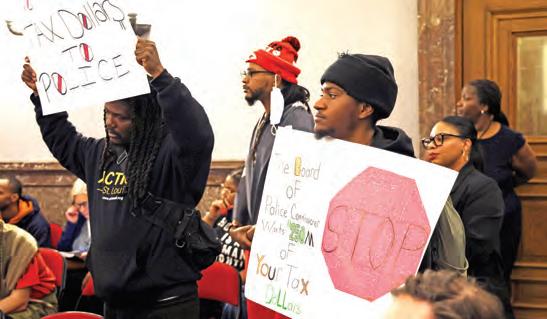
A growing fight over police spending escalated this week after St. Louis aldermen issued subpoenas to members of the state-controlled Board of Police Commissioners who failed to appear before the Board of Aldermen’s Budget Committee to explain the department’s proposed budget.
The dispute centers on a proposed fiscal year 2027 police budget estimated between $250 million and $270 million
— potentially tens of millions more than what Mayor Cara Spencer’s administration says the city can afford. Spencer has argued state law limits the allocation to about $219 million.
The Budget Committee approved the subpoenas Tuesday after no police commissioners attended a scheduled budget hearing. Aldermen said the subpoenas were intended to require commissioners to publicly answer questions about the department’s spending request.
See Police, A12

Sumner’s Class of 2026 graduates after months of adversity
By Kenya Vaughn St. Louis American
When the Class of 2026 arrived at historic Charles Sumner High School four years ago, they stepped into a building still recovering from virtual learning, pandemic disruptions and uncertainty. They finished their journey standing in the same place many were when a tornado tore through their school one year earlier — the Dr. Henry Givens Jr. Building at Harris-Stowe State University.
On May 16, 2025, a violent tornado struck St. Louis whipped through Sumner’s historic building in The Ville — damaging the home of the oldest continuously operating Black public high school west of the Mississippi.
“It really impacted me emotionally because that building was like my second home,” said salutatorian Romell Calhoun. “It was almost like losing your childhood house.” Calhoun and his classmates spent their final year away from
“It really impacted me emotionally because that building was like my second
–Salutatorian Romell Calhoun



Rebuilt libraries restore community lifeline while signaling recovery
By Ashley Winters St. Louis American
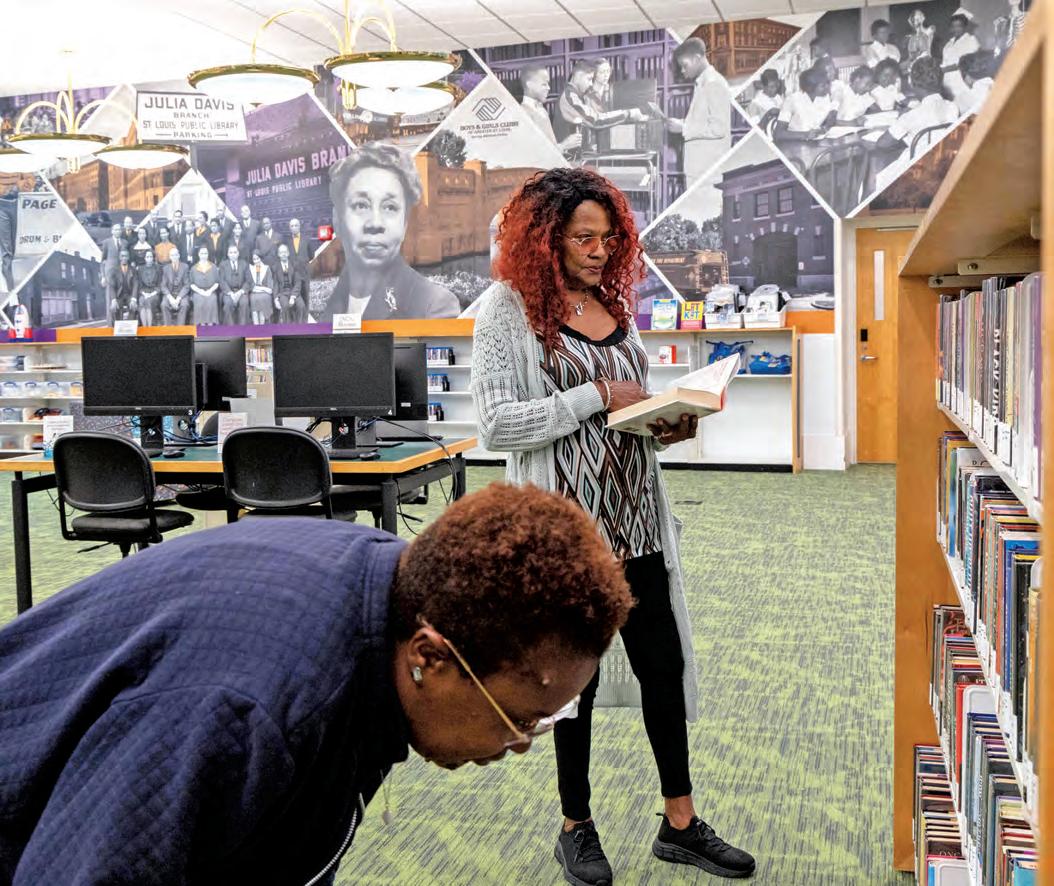
With tears in her eyes, 11th Ward Committee Woman Amber Cole stood inside the newly restored Julia Davis Library and reflected on what the building means to the neighborhood.
“When you take knowledge out of the community you take health and wealth — this is our community, this is our pillar,” Cole said, describing the library as a vital “community hub.” Looking around the branch near O’Fallon Park, she added softly, “I’m glad to be home.”
Nearly a year after a tornado tore through North St. Louis, damaging thousands of homes and buildings, two neighborhood library branches are reopening this week — a milestone residents say represents more than repaired buildings. Julia Davis Library reopened to the public Monday, May 18, and Cabanne Library will reopen May 21, nearly a year
2026 SaluTe To Young leaderS awardS
By Ashley Winters St. Louis American
A new generation of Black leaders helping shape
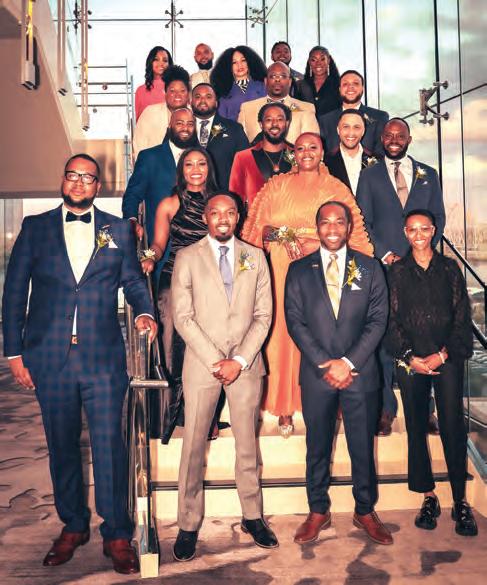
The annual event recognizes African American professionals under 40 whose work is impacting communities across the region. Michael Holmes, chairman of the
Braxton Clemonts of Action St. Louis joins fellow residents in a past protest inside City Hall.
Photo by Lawrence Bryant / St. Louis American
Sumner High School graduates celebrate during their commencement ceremony at Harris Stowe State University, marking a powerful moment of pride and resilience for the Class of 2026.
Photo by Lawrence Bryant / St. Louis American
“What
Guest Editorial
Supreme Court uses false facts in flawed ruling
By Marc Morial
What happens when the highest court in the land issues a decision based on faulty reasoning or inaccurate data?
The shameful Plessy v. Ferguson decision in 1896 obliterated 30 years of hardfought progress toward racial equality under the law and thrust the nation into the dark and violent era of Jim Crow.
Last month’s decision in Louisiana v.Callais, like 2013’s Shelby County v.Holder, is destined to live in infamy alongside Plessy. We cannot wait a single moment — let alone 70 years, as we did with Plessy — to rectify the court’s mistake.
The court and Congress must acknowledge the Callais decision was based on misleading data and restore the provisions of the Voting Rights Act that it overturned.
ures, particularly for Black voters.
The generally accepted standard for calculating voter turnout is the voting-eligible population. By that standard, Black voter turnout in Louisiana has consistently trailed white turnout in every election since at least 2012.
In fact, the racial turnout gap not only widened nationwide after Shelby, but it also grew twice as fast in counties previously covered by the preclearance requirement that Shelby overturned.
The deluge of racially motivated voter suppression laws that Shelby unleashed made a mockery of Chief Justice John Roberts’ claim that “current conditions” did not justify federal protection against discriminatory state voting laws. So, too, does the frenzy of states enacting racially gerrymandered congressional maps disprove the majority’s assumption that states would not exploit Callais to disguise discrimination as partisanship.
Even more egregiously, Justice Samuel Alito’s opinion relied on a false claim — “copied almost verbatim” from a Trump administration filing — that Black voter turnout had exceeded white voter turnout in two of the five most recent presidential elections.
As The Guardian’s investigation revealed, the administration’s false claim rested on a misleading voter turnout calculation. The administration calculated turnout using the entire adult population — including noncitizens, disenfranchised individuals and others ineligible to vote — which artificially inflated turnout fig-
Instead of acknowledging the truth of the late Justice Ruth Bader Ginsburg’s observation that “throwing out preclearance when it has worked … is like throwing away your umbrella in a rainstorm because you are not getting wet,” the majority blithely ignored the wreckage Shelby left in its wake and used its own willful delusion to justify even further destruction. Constitutional law cannot rest on false facts. Hard-won civil rights protections cannot be snatched away based on manipulative sleight of hand.
The Supreme Court itself has explicitly recognized that precedents resting on demonstrably false or fundamentally outdated factual assumptions warrant reconsideration or overruling.
In his concurrence in Ramos v. Louisiana, Justice Brett Kavanaugh wrote, “A precedent that is egregiously wrong … or based on a demonstrably false factual premise should not continue to bind the Court.”
The Supreme Court has the power to shape political power and voter representation for generations. Plessy, to the nation’s everlasting shame, grotesquely distorted that power. This generation has the opportunity — and the responsibility — to steer the nation back toward justice.
Marc Morial is National Urban League president and CEO.
Another View
City sidelined proven recovery programs
By Nahuel Fefer
Last week, St. Louis Public Radio published an investigation documenting how decisions at City Hall slowed tornado recovery. The mayor’s response included pointed criticisms of the city’s Community Development Administration, a department I led from September 2022 to November 2025. I feel compelled to set the record straight because the people of St. Louis deserve an accurate accounting of what happened.
Mayor Cara Spencer told STLPR that “the vast majority of funds we had awarded many years before to CDA were still unspent” when she took office, and that CDA was “clearly incapable of getting funds effectively out the door.” Both statements are false.
crisis before the tornado. Development agencies had spent years expanding home repair and housing production programs while creating rental assistance, downpayment assistance and stabilization programs.
After the tornado, I repeatedly urged the Mayor’s Office to scale existing programs to meet the extraordinary need. Instead, the administration spent months hiring consultants including McKinsey, Ernst & Young, Deployed Resources, Tetra Tech, SLS and Kea Point to build an Office of Recovery that duplicated existing city capacity.

CDA was charged with administering $189 million in ARPA funds. Before I left, I explained to the Board of Aldermen that less than 25% ($43 million) remained in city accounts. The rest had been spent ($94 million) or advanced to nonprofit partners ($52 million).
The suggestion that our team was “incapable” is especially offensive. Our analysts, planners, accountants, engineers, attorneys and program managers managed the largest allocation of federal funds.
CDA’s federal expenditures grew from $24 million in 2022 to $58 million in 2024.
Claims about home repair funds are similarly inaccurate.
CDA leveraged a $15 million ARPA appropriation — all committed and more than 80% spent when I left — to repair more than 1,000 homes and roughly triple our home repair program. In 2025 alone, according to figures released by the Spencer administration’s new CDA leadership, CDA’s Home Repair Programs completed work on 499 homes. The Office of Recovery, by the city’s own dashboard, has completed work on 23.
St. Louis was already in a housing
The approach largely failed because the Mayor’s Office was not structured to manage contracts and invoices at that scale.
As a result, efforts to appropriate tornado recovery funds remained stalled at the Board of Aldermen. Programs designed to rebuild North St. Louis existed, but the administration chose not to use them.
The Board of Aldermen should appropriate at least $150 million in Rams settlement funds to defined tornado recovery programs — not to a generic recovery account controlled by the Mayor’s Office, but line by line to departments capable of executing the work.
Two-thirds of the funds should go toward home repair, housing production and neighborhood transformation, with the rest split among rental assistance, downpayment assistance, shelter and other needs. The city also needs to consolidate its fragmented housing and development agencies under a single department.
None of these steps will bring back the year North St. Louis lost, but they can help chart a real path forward. The city has the tools, the funds and the capacity to rebuild. It just needs the will to use them.
Nahuel Fefer is the former director of the St. Louis Community Development Administration.
Commentary
— Kevin Morris, Brennan Center for Justice Denying and diluting the power of the Black vote in Missouri and in many states has taken on new life.
A renewed fight to weaken Black voting power
By Janice Ellis
Bolstered by a justice system that has unabashedly taken off its blindfold, national and state Republican leaders are moving full speed ahead to disenfranchise Black Americans, and their meaningful participation in the political process.
Donald M. Suggs Publisher ADMINISTRATION
Dina


Denying and diluting the power of the Black vote in Missouri and in many states has taken on new life.
The recent ruling by the U. S. Supreme Court has all but guaranteed its destructive longevity. States are free to carve up Congressional districts anyway they choose to render the Black vote impotent if not totally null and void.
vote in the political process is neither safe nor secure — still.
How can exercising the basic right to vote still be a major issue for citizens legally eligible to vote in supposedly the greatest democracy on earth, the United States of America?

Several states see the Court’s ruling as a new lease on life to suppress the Black vote and reduce Black representation in legislatures. Look at what is happening in Louisiana, Tennessee, Alabama, and South Carolina since the court rendered its decision.
Before the recent ruling, several Republican-led states had followed the Trump administration’s request to redraw congressional districts to reduce or eliminate districts with high Black populations that traditionally elect Democrats.
The goal is to increase the odds of electing Republicans to protect or expand the congressional majority in the upcoming midterm elections.
Look at the gerrymandered congressional map in Missouri that makes the 5th Congressional District, which once represented the core of Kansas City. The newly drawn district dilutes the voting power of Black citizens and thereby undermines their voice, negating their power to affect policies that impact their quality of life.
There seems to be no rest for the weary — for generations of Black Americans who fought and gave their lives to secure the right to vote for themselves and their progeny.
Those gains, decades, and centuries in the making, are at risk of being undone.
The right for Blacks to exercise their
One of the main reasons is because originally the United States Constitution did not define who was eligible to vote, leaving that decision to each state. At first, exercising the basic right to vote was extended only to white men who were property owners. Men and women who were not property owners could not vote in most states. Early in our history, women could vote in a few northern states and jurisdictions if they owned property. Freed slaves and other nonwhite people could vote in a few districts if they met the property requirements.
But even the property requirement was eliminated for white men, and they were eligible to vote in all states prior to the Civil War. Of course, that eligibility has continued.
Subsequent amendments to the Constitution prohibit any state from denying an American citizen the right to vote because of “race, color, or previous condition of servitude,” the 15th Amendment that passed in 1870; or on “account of sex,” the 19th Amendment, passed in 1920. And the 1965 Voting Rights Act
Many states have and continue to institute policies to make it hard for certain citizens to vote, most notably Black Americans, Native Americans, and other minorities. The measures being adopted in recent years, and even today, also target the elderly with unreasonable identification requirements and burdensome restrictions about how a vote can be cast.
In 2026, as we prepare to celebrate 250 years of our great, but imperfect nation, what a sad state of affairs we find ourselves in — the reputed greatest democracy on earth.
Janice Ellis is a columnist for the Missouri Independent.
Columnist Marc Morial
Columnist
Nahuel Fefer
Columnist
Janice Ellis
“This is an incredibly unfortunate decision by the Supreme Court that ... sets the stage for Alabama to go back to the 1950s and 60s in terms of Black political representation in the state.”
— Rep. Shomari C. Figures

Missouri congressional map dispute could disrupt primary
By Sylvester Brown Jr. St. Louis American
Missouri election officials still do not know which congressional map will govern the August primary, creating uncertainty that attorneys, election officials and referendum advocates warn could trigger lawsuits and confusion for candidates and voters. Due to recent unanimous rulings by the Missouri Supreme Court, a congressional map redrawn last year can currently be used in the Aug. 4 primary. But the court also noted it is impossible to know for certain which map is officially in effect until signatures submitted by the nonprofit People Not Politicians are fully verified by the Missouri secretary of state’s office.
currently represented by Democratic U.S. Rep. Emanuel Cleaver, one of two Black members of Missouri’s congressional delegation. The other is Democratic U.S. Rep. Wesley Bell of the St. Louis area.
Due to recent unanimous rulings by the Missouri Supreme Court, a congressional map redrawn last year can currently be used in the Aug. 4 primary.
Republicans now hold six of Missouri’s eight congressional seats. The map redraw came after President Donald Trump pressured Missouri Republicans to help preserve the party’s narrow majority in the U.S. House ahead of the 2026 midterm elections. Five Republicans have filed to challenge Cleaver, who said he plans to remain in the race regardless of which map is ultimately used.
The dispute centers on House Bill 1, the 2025 law that redrew Missouri’s eight U.S. congressional districts. The new map splits Kansas City into three congressional districts and stretches the 5th District roughly 200 miles east through 14 counties along the Missouri River, reshaping the district
People Not Politicians submitted more than 300,000 signatures seeking a referendum on the new map, exceeding the legal threshold required to suspend the law pending a public vote, according to referendum supporters. But Secretary of State Denny Hoskins said county clerks and local election authorities are still verifying signatures and have until July 27 to complete the process.
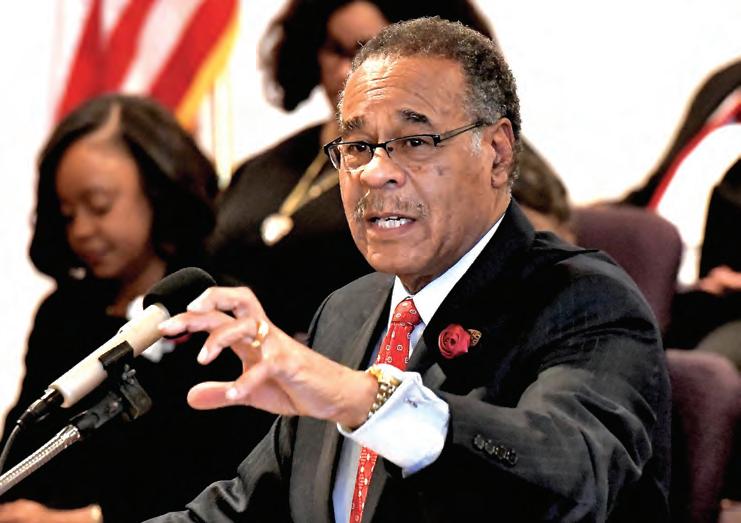
U.S. Rep. Emanuel Cleaver speaks during an event in 2024. A newly redrawn congressional map would significantly reshape the Kansas Cityarea district he represents as Missouri officials and courts continue battling over which map will govern the state’s Aug. 4 primary election.
The court also heard arguments over whether the map complied with constitutional requirements that districts remain compact and contiguous. During arguments before the court, Assistant Attorney General Kathleen Hunker defended the map and the state’s redistricting process.
“There is no such thing as a perfect map,” Hunker argued, adding that the plan met constitutional requirements.
Referendum advocates warn the delay could create election chaos if the

map is later determined to have been suspended before the primary election takes place.
“What happens next is chaos,” said Chuck Hatfield, an attorney representing People Not Politicians. “One could speculate that a candidate might file a lawsuit and say: ‘Well, the primaries were conducted using the wrong maps.’”
Last week, Hoskins told reporters he does not plan to immediately determine whether the referendum qualified for the ballot.
“There’s county
clerks and local election authorities that are still verifying those signatures, and they have until July 27,” Hoskins said. “I can start my certification procedures on July 28, and obviously they have to be completed by Aug. 4.”
Waiting until late July or August would likely create a chaotic legal situation in which the legitimacy of the Aug. 4 primary could be challenged, referendum supporters argue.
The Missouri Supreme Court’s ruling itself acknowledged the uncertainty.
In the opinion, Judge Ginger Gooch wrote that “it is impossible to say as of this opinion whether the … referendum petition filing was ‘legal, sufficient, and timely’ and, therefore, whether HB1 … can only go into effect when approved by a majority of the votes cast thereon.”
That language prompted Boone County Clerk Brianna Lennon, a Democrat, to inform Hoskins that she would not redraw districts until his office determines whether the referendum petition is sufficient.
“I am caught in the untenable position of trying to predict when and how you will issue a determination about the sufficiency of the petition,” Lennon wrote in a letter to Hoskins. “Until that time, I have no actionable legal information as to what congressional district map is in effect.”
Hoskins responded that Lennon was simply “not doing her job.” Lennon pushed back, saying her office has been preparing to run elections under the 2025 map.
“I’ve done my job,” Lennon said, “and I’m waiting for him to do his.”
Sylvester Brown Jr. is the Deaconess Foundation Community Advocacy Fellow.

Photo by Wiley Price / St. Louis American
Commentary

Third grade students at three East St. Louis schools received tennis racquets, coloring books and other supplies from the East St. Louis Community Tennis Association and the Missouri Valley section of the United States Tennis Association during events marking the launch of the city’s 2026 Summer Tennis Program.
Tennis partnership supports East St. Louis students
The East St. Louis Community Tennis Association and the Missouri Valley section of the United States Tennis Association distributed tennis racquets, coloring books and other supplies to third grade students at three East St. Louis schools as part of the launch of the city’s 2026 Summer Tennis Program.
Students at Wyvetter Young School
St. Louis population decline accelerates
St. Louis lost more than 23,000 residents between 2020 and July 2025, the steepest percentage population decline among major U.S. cities, according to new U.S. Census Bureau estimates.
The city’s population fell by 7.7% during the first half of the decade, surpassing declines in cities including San Francisco and New Orleans.
Demographer Ness Sandoval of Saint Louis University told the St. Louis PostDispatch that the figures likely do not yet reflect the full impact of the May 2025 tornado, which may lead to additional losses in future revisions.
Census data also showed St. Louis lost housing units from 2024 to 2025, while most U.S. cities added housing.
of Excellence, Katie Harper Wright Elementary School and Officer Elementary School also received beginner tennis balls, bookmarks and book bags during presentations held last week.
The coloring books highlight influential Black tennis figures, including late champion Arthur Ashe, who attended Sumner High School in St. Louis.
Missouri House rejects parental rights bill
The Missouri House voted down legislation that would have expanded parental rights in decisions involving children’s education and health care, halting the proposal for the current legislative session. The measure failed Thursday after drawing opposition from some lawmakers and advocacy groups.
The bill sought to give parents broader access to school curriculum materials, student records and medical information involving their children.
Supporters said the proposal would increase transparency and strengthen parental involvement, while critics argued parts of the legislation could create legal and privacy concerns.
Gerrymandering expands racial wealth gap
By Julianne Malveaux
Elections aren’t supposed to stop midstream, but in Louisiana, they did. Louisiana recently halted and rescheduled congressional primaries after the Supreme Court allowed the state to use a challenged congressional map while litigation continued. That is not a technical glitch. It is power being exercised — and protected.
This is not about lines on a map. It is about who holds power and how that power determines who gets resources. The Court has long treated partisan gerrymandering as a “political question,” something it prefers to avoid. Even when it intervenes on racial grounds, as in Allen v. Milligan, the result is rarely resolution. States redraw maps, courts revisit them, and uncertainty lingers. In Louisiana, litigation like Robinson v. Ardoin has created a cycle rather than a solution, leaving elections — and voters — caught in the middle.
And when officials do not have to deliver, resources follow power rather than need. That is where the economic consequences become unmistakable. Communities with diminished political influence are less able to secure investment. Schools go unrenovated. Infrastructure projects stall. Hospitals struggle or close. Broadband expansion stops just short of the neighborhoods that need it most. These are not isolated failures; they are the cumulative effects of political decisions shaped by distorted maps. Over time, those decisions constrain opportunity, limit mobility and reinforce inequality.
There is nothing new about this. After Reconstruction era, when Black political power briefly expanded, it was met not only with violence but with precision. District lines were drawn to contain that power, ensuring that even when Black people could vote, their votes would not translate into governing authority.
In 1868, Benjamin Franklin Randolph, a Black state senator in South Carolina, was assassinated in broad daylight at a train station in Abbeville. His killing was not random. It was part of a broader campaign to suppress Black political leadership — not just at the ballot box, but through terror. The methods have changed over time, but the objective of controlling Black political power has not.
Today’s gerrymandering uses more sophisticated tools, but it serves a familiar purpose. When districts are engineered to predetermine outcomes, accountability erodes. Elected officials do not have to persuade broad constituencies or compete for every vote. Too often, they do not have to deliver.
This is how gerrymandering feeds the racial wealth gap — not through a single dramatic act, but through accumulation. A project delayed, a program underfunded, a priority shifted. Each decision may seem small, even routine. Together, they produce disparities that are then treated as inevitable rather than engineered.
Black communities have experienced this pattern for generations. Whether through “packing,” which concentrates Black voters into a small number of districts, or “cracking,” which disperses them across many, the result is the same: diminished influence. Diminished influence translates directly into diminished economic capacity.
Alabama offers a parallel lesson. The Supreme Court’s decision in Allen v. Milligan acknowledged that Black voters were being shortchanged under the Voting Rights Act, but that recognition did not end the struggle. It simply opened another phase in a continuing contest over representation and investment. The fight over maps is, at its core, a fight over whether underinvestment will persist.
Gerrymandering is not the only driver of economic inequality, but it is one of the most durable and least visible. Distorted maps produce distorted outcomes and, over time, distorted economies. We debate maps as if they are abstractions. They are not. They are blueprints for who prospers — and who does not.
Julianne Malveaux is a Washington, D.C.-based economist and author.

Julianne Malveaux
Photo courtesy of ESaLCTA

WSIE amplifies its regional reach
Legacy of jazz, community and culture travels farther with stronger signal
By Kenya Vaughn St. Louis American
On a bright May morning inside Dunham Hall, the heartbeat of WSIE 88.7 — The Sound — pulsed a little stronger.
The heritage jazz station, which first hit the airwaves in 1970 as part of Southern Illinois University Edwardsville’s mass communications program, gathered donors, students, volunteers and longtime supporters for a ribbon cutting marking a new tower and HD transmitter.
“This feels like a gift to me personally.”
– Paula Bridges, executive director of university marketing and communications at SIUE
The station now operates largely through underwriting, listener support and community donations.
“This feels like a gift to me personally,” said Paula Bridges, executive director of university marketing and
communications at SIUE.
“Now they have access to it in farther reaches of the region. Whereas now it’s been extended, it’s been amplified and we can share in the love of the artist and the music that they’re play-
ing.”
For a station built on jazz — and the generations who have loved, lived and learned through it — reach matters.
“This has been a project over 20 years in the making,” said General Manager Jason Church. “My predecessors have tried time and time again to get a new transmitter and a new antenna.”
The station’s previous transmitter dated back to 1986 — well past its expected lifespan.
St. Louis-based KAI wins national construction honor
St. Louis American staff
KAI 360 Construction Services has been named
Construction Services is
of
a St. Louis-
firm that’s one of the nation’s largest Blackowned architecture, engineering and construction companies.
The North Texas chapter recognized the firm for its management work on two large Dallas-area public projects: a $260 million utility plant project at Dallas Fort Worth International

Affinia employees recognized at conference


Two Affinia Healthcare employees were recognized for their work in community health during the recent Community Health Workers Association of Missouri conference.
Candace Henderson, Affinia’s director of community health, received the organization’s Individual and Community Capacity Building Award after being nominated in eight categories. Henderson leads a team of health workers who connect residents with health screenings and other services.
Naila Hudson, a community health worker with Affinia, received the Individual and Community Assessment Award. Her duties include coordinating mobile mammography events and conducting health screenings.
Zillow engineer helps develop leadership e-book
Ralph McNeal, a senior principal software engineer at Zillow, helped develop an e-book designed to support technical leadership among the company’s principal engineers.

McNeal, a 2003 graduate of the University of Missouri-St. Louis, said the project was “shaped by realworld challenges and experiences.” At Zillow, McNeal helps guide the design and strategic direction of technology platforms and tools across several departments, including data analytics, artificial intelligence, infrastructure and developer experience.
Muny CEO receives honorary doctorate

Washington University in St. Louis awarded an honorary Doctor of Fine Arts degree to Kwofe Coleman during the university’s commencement ceremony May 15. Coleman is president and CEO of The Muny, the nation’s oldest and largest outdoor musical theater. He began his career there in 1998 as an usher before rising through administrative and leadership positions and becoming president and CEO in 2021.
Smith appointed to MO. Ethics Commission
Former state Rep. Clem Smith has been appointed to the Missouri Ethics Commission.

Smith, who represented Missouri’s 85th District, currently serves on the Hazelwood School District board. He previously worked as an aircraft assembly mechanic for Boeing and now works as a refinery operator for Phillips 66. Smith also has served as secretary of the Uplift Foundation of Greater St. Louis and as a unit committeeman with the International Union of Operating Engineers Local 399.
submit your People on the Move item (including photo) to areid@stlamerican.com.
Candace Henderson
Photo by Lawrence Bryant / St. Louis American
Paula Bridges, SIUE’s executive director of University Marketing and Communications, speaks alongside WSIE General Manager Jason Church during a ribbon cutting ceremony marking the launch of the station’s new tower and HD transmitter at Dunham Hall studios on the SIUE campus on Wednesday, May 13.
Smith
2025. The Longfellow academy project involved con-
Ralph McNeal
Kwofe Coleman
Leaders and project managers from KAI Enterprises and KAI 360 Construction Services are shown after KAI 360 CS was named the inaugural PMCM Firm of the Year by the North Texas chapter of the Construction Management Association of America during the group’s annual awards gala. From left are Jason W. Cox, David Castaneda, Herschel Acosta, Bruce L. Wood, Darren L. James, Derwin Broughton, Kristopher McGraw and Sean Creque.
Photo courtesy of KAI 360 Construction Services See KAI, A8
Naila Hudson


Metro East studio project targets 2027 opening
A $62 million film and television studio under construction in Wood River, Illinois, could begin hosting productions by summer 2027, according to developers involved in the project.
The planned Hollywood River Studios complex is expected to include six sound stages totaling about 140,000 square feet.
Developer Chris Breakwell said the project aims to attract television and movie productions to the St. Louis region by taking advantage of Illinois’ film tax credit program.
The first phase includes four television studios and an esports facility, while a larger movie studio is planned for a later phase. Officials estimate the com-
pleted development could employ between 300 and 500 people.
Missouri lawmakers approve historic tax credit expansion
Missouri lawmakers approved legislation expanding the state’s historic preservation tax credit program, a move supporters say could encourage redevelopment projects in St. Louis and other older communities across the state. The bill now heads to Gov. Mike Kehoe.
The measure modifies Missouri’s historic preservation tax credit program and includes incentives tied to rehabilitation of historic properties, including schools. Supporters said the legislation could
help revive stalled redevelopment efforts and preserve aging buildings. Historic tax credits have long been used in St. Louis to finance redevelopment of commercial and residential properties, particularly in downtown and North St. Louis neighborhoods.
St. Louis job growth slows in April
The St. Louis region added jobs in April compared with the previous month but continued to lag behind employment levels from a year earlier, the St. Louis Business Journal reported.
The metro area recorded month-to-month job gains tied in part to seasonal hiring trends, though total employment remained
lower than April 2025 levels. Manufacturing, professional services and transportation sectors posted mixed results, while education and health services remained among the region’s largest employment categories.
The report also noted that unemployment in the St. Louis metro area remained below the national rate despite the slower annual job growth.
Heartland Coca-Cola workers approve contract
More than 35 service equipment workers at Heartland Coca-Cola represented by Teamsters Local 688 have approved a new five-year labor agreement, union officials announced.
The contract was rat-
ified by a 90% vote and includes an 18% wage increase, lower health care costs and protections for retiree health benefits, according to the union.
The agreement also doubles shift differential pay for covered workers.
The employees perform equipment service work for the company in the St. Louis area. Union officials said negotiations were completed quickly and described the agreement as one of the strongest contracts reached for the bargaining unit in recent years.
First Mid Bank, Jennings partner on financial literacy
First Mid Bank & Trust partnered with Junior Achievement this spring to provide financial liter-
acy lessons for students in the Jennings School District during Financial Literacy Month in April. The initiative included workshops at Woodland Elementary School, where volunteers worked with students in prekindergarten through third grade on lessons involving budgeting, saving and financial decision-making.
Students participated in hands-on activities designed to teach the difference between needs and wants, using stickers to track spending choices involving groceries and other purchases. Karen Dickson, community development officer for First Mid, said the program is intended to introduce students to financial concepts early while also encouraging conversations at home.
Historic school buildings targeted for stabilization efforts
St. Louis American staff
Two long-vacant St. Louis school buildings could soon undergo stabilization work as city officials try to preserve the historic properties for future redevelopment rather than demolition.
Contractors recently submitted bids for repair work at the former Cleveland High School in Dutchtown and Marshall School in The Ville, The St. Louis Business Journal reported. The buildings have sat vacant for years
while suffering water damage, vandalism and break-ins.
The projects are being overseen by the St. Louis Development Corporation and the Land Clearance for Redevelopment Authority, which acquired the properties earlier this year from St. Louis Public Schools.
Officials have said the immediate goal is to stabilize the buildings and prevent further deterioration while the city explores long-term redevelopment possibilities.
Funding for the work is expected to come largely from federal American Rescue Plan Act dollars, which must be spent by late 2026.
The former Cleveland High School, at 4352 Louisiana Ave., has been vacant for nearly two decades after multiple redevelopment proposals stalled. The building has suffered years of water damage and vandalism. Marshall School, at 4322 Aldine Ave., has also remained empty for years, drawing concern from

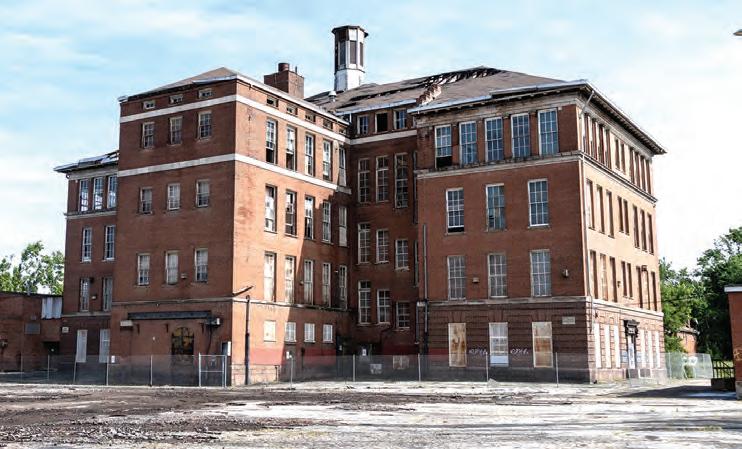
try to preserve the
residents and preservation advocates over worsening conditions and repeated trespassing.
City officials and preservation advocates have argued both schools remain historically significant neighborhood landmarks despite mounting rehabilitation costs and environmental concerns tied to aging buildings.
WSIE
Continued from A5
Church explained that listeners in Chesterfield, O’Fallon, Ballwin and other pockets of the St. Louis region are now picking up the signal with clarity.
“It gives us a new lease on life — literally,” he said.
And for one of the region’s few remaining full-time jazz stations, that reach is tied closely to audience growth and longterm sustainability.
WSIE’s story has long been about more than equipment. It’s about the students who learn to announce their first on-air breaks. The volunteers who keep specialty shows alive. The donors who believe jazz still deserves a home on the FM dial.
Bridges captured that spirit in her opening remarks.
“The volunteers and students who developed their accounts have kept us alive and its mission strong,” she said. “Today is more than a celebration — it’s a long-standing commitment to musical excellence across our campus, the St. Louis region and nationwide.”
Church echoed that gratitude, calling out former engineers, longtime
Stephen Westbrooks, the recently appointed president and CEO of SLDC, has said the agency intends to take a strategic approach to the future of the sites rather than predetermine whether they should be redeveloped or demolished.
“The intention is to do what’s best,” Westbrooks told St. Louis Magazine
sponsors and the students who keep the station’s sound fresh.
“I’ve been a huge fan of this radio station ever since I was a youngster,” he said. “It’s a project of passion for me. My goal is to make sure that this place outlasts my time here.”
Robyn Boyce — associate director for corporate support and one of the station’s most visible ambassadors — spoke about witnessing WSIE’s generational impact.
She remembers the students lighting up when Samara Joy won a Grammy. It sparked the memory of the first time she saw Joy perform at Jazz St. Louis a few years ago — and how it brought her parents back to her in a rush of sound and memory.
“I cried because I saw my mom and dad standing up there,” she said. “They passed on long ago, but they were right on that stage dancing. This music keeps you alive. It keeps you moving. It’s great music.”
Boyce also sees WSIE as a bridge — connecting young listeners to the roots of the music they hear sampled in hip-hop, R&B and pop.
“All that sampling came from somewhere,” she said. “If you have these conversations with
in March, adding that the agency wants to study “what the future opportunity is for that building.” Potential long-term uses publicly discussed for the properties have included housing, mixed-use redevelopment and community-oriented projects, although no final redevelopment plans have been announced.
young people today, you have to share with them that they started all of this way back in the day.” For Bridges, the new transmitter is as much a cultural amplifier as a technical upgrade.
“WSIE has been laboring in the love and legacy of music for decades,” she said. “But if your transmitter only goes so far, you can only reach so many people. Now … we can extend farther west, south, east and north.” She hopes listeners — especially young ones — understand that jazz is the foundation beneath nearly every genre they love.
“I hope they understand that great music is great music, no matter what the genre,” Bridges said. “And jazz is at the core of American music.”
Photo by Lawrence Bryant / St. Louis American Marshall School in The Ville could soon undergo stabilization work as city officials
historic properties for future redevelopment.
HealthMattersHealthMattersHealthMatters
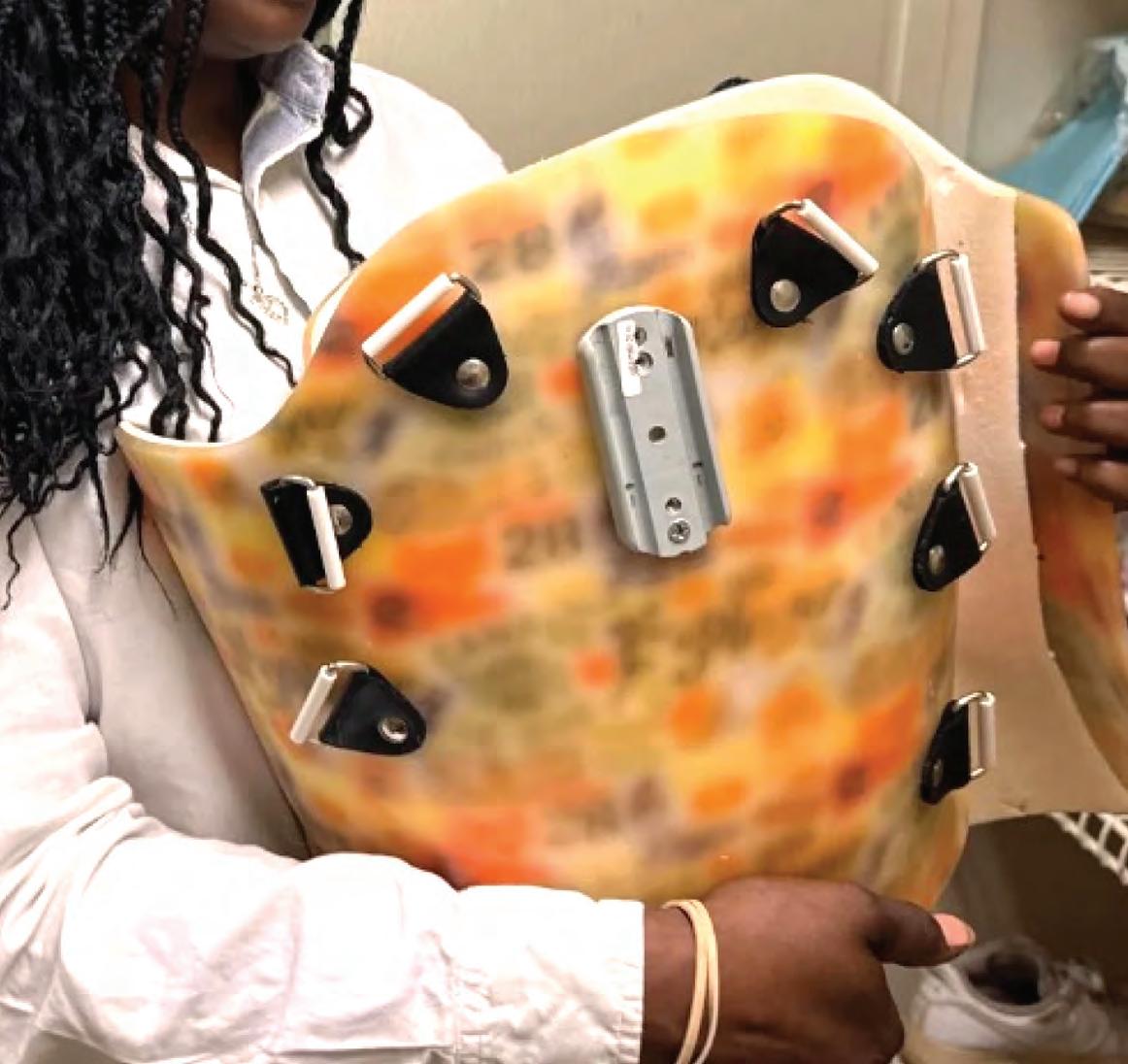
to protect her son’s safety.
Doula expansion bill heads to governor
St. Louis American staff
Missouri lawmakers have approved legislation that would expand Medicaid access to doula services, a move supporters say could strengthen maternal health care as more Black families seek culturally responsive support during pregnancy and childbirth.
Doulas are trained birth workers who provide nonmedical support before, during and after childbirth.
Hospitals are housing children who have no place to go
By Cara Anthony KFF Health News
Waiting rooms O
verwhelmed by the demands of caregiving, Quette dialed 911 when she found her teenage son downstairs in their kitchen struggling to breathe. In that moment, Quette knew that she and her son’s grandmother could no longer meet his medical needs in their Illinois home just outside St. Louis. He had become paralyzed when he was shot in 2023, and, despite their efforts, they struggled to take care of him.
Once his immediate medical needs were addressed, her son didn’t leave the hospital.
His grandmother, who was his legal guardian, had died and the teen ultimately became a ward of the state. He continued living inside a St. Louis children’s hospital for what’s commonly called a “social stay.”
Also referred to as hospital boarding or delayed discharge, the practice of keeping children in hospitals “beyond medical necessity” has become a persistent problem — flummoxing officials in Missouri, Illinois, Minnesota, Georgia and beyond — when there’s no safe place to care for the child.
Finding homes for foster kids is difficult across the country. They have spent nights in casino hotels in Nevada and offices in Georgia and Maryland. This problem even has a name: “hoteling.” But add medical
See Hospitals, A10
East St. Louis activist honored for food access advocacy
Grace Griffin named Jamala Rogers Young Visionary
St. Louis American staff
Grace Griffin, a fifth-generation resident of East St. Louis, has been named the 2026 Jamala Rogers Young Visionary for her work addressing food access and environmental inequities in the community. Griffin plans to use the $3,000 award to launch a public education and organizing campaign focused on food access, including community gardening, supporting local growers and preparing healthy meals. Supporters of the initiative said the effort also aims to build momentum for addressing longstanding environmental and food-related disparities in East St. Louis.
The issue has been a persistent chal-
Griffin plans to use the $3,000 award to launch a public education and organizing campaign focused on food access.
lenge in the city for years. According to the U.S. Department of Agriculture’s Food Access Research Atlas, many East St. Louis neighborhoods meet the definition of low-income, low-access areas, commonly known as food deserts.
See Rogers, A10
The measure, House Bill 2372, now awaits action from Gov. Mike Kehoe. Among its maternal health provisions, the bill would formally establish the “Missouri Doula Reimbursement Act” and expand pathways for doulas to receive reimbursement through Missouri’s Medicaid program, known as MO HealthNet. Doulas are trained birth workers who provide nonmedical support before, during and after childbirth. They do not deliver babies, but often help pregnant women navigate medical appointments, labor, postpartum recovery and breastfeeding support.
Under Missouri’s existing Medicaid framework, pregnant Medicaid recipients already can access doula services when recommended by a physician or other licensed provider. Covered services include prenatal visits, labor support and assistance during the postpartum period.
The legislation would place broader doula reimbursement provisions into state law and expand how doulas participate in Medicaid-managed care programs. The bill also adds childbirth education classes to covered maternal care services.
Missouri began reimbursing doulas through Medicaid under an emergency administrative rule issued in 2024 after state officials cited concerns about maternal health outcomes and access to care for pregnant women.
See Doula, A10
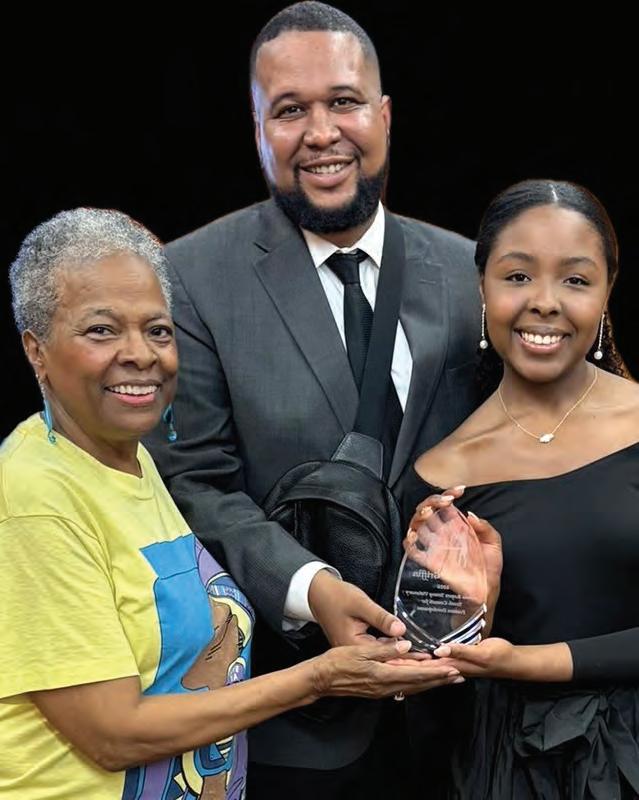
Photo by Cara Anthony / KFF Health News
Quette holds the brace her teenage son used after he was paralyzed in a 2023 shooting. After his medical needs became too difficult to manage at home, he remained in a St. Louis children’s hospital because there was nowhere else for him to go. KFF Health News agreed to use only her nickname
Photo courtesy of Jamala Rogers Young Visionary Award
Jonathan Pulphus and Jamala Rogers recognize Grace Griffin as the 2026 Jamala Rogers Young Visionary. Griffin’s work focuses on food access and environmental justice in East St. Louis, Illinois.
Hospitals
Continued from A9
while some have chronic physical conditions or disabilities for which they need technology, equipment or other assistance.
HealthMattersHealthMattersHealthMatters
‘Taking Care of You’
“I
had to give up. I just couldn’t take care of him anymore.”
than $148 million a year in a state that already plans to tap its reserves to fund its upcoming $50.7 billion budget.
“I had to give up. I just couldn’t take care of him anymore,” Quette said. “It was just a lot on me. It was something that I was not ready for.”
She said their family had been begging hospitals for a home health aide to help care for his wounds, only to be accused of neglect. “They were like, ‘Well, y’all almost killed him,’” she recalled officials telling her. KFF Health News agreed to use only her nickname to protect the safety of her son.
Many children stuck in this limbo have mental health or behavioral issues,
Doula
Continued from A9 needs to the mix, and hospitals become the holding station for some kids.
Since the program launched, more than 625 Missouri Medicaid participants have used doula services during pregnancy and postpartum recovery, according to the Missouri Department of Social Services.
The proposal comes as doulas have become increasingly visible in Black maternal health advocacy efforts in St. Louis and nationally.
Black women continue to face disproportionately high rates of pregnancy-related complications and maternal mortality compared with white women. Public health researchers have linked those disparities to unequal access to
“It’s definitely a national problem,” said Elaine Lin, a pediatrician at Boston Children’s Hospital and the chair of the American Academy of Pediatrics’ Section on Home Care. “Every state has different options in terms of where kids can go post-acute care. But in general, there are many of our kids with medical complexity who just don’t have access to the appropriate home nursing to bring them home safely.”
The issue comes with a price tag beyond the toll it takes on kids and families.
When a child no longer needs hospital-level care, insurers don’t have to pay for their stay. Some hos-
– Quette on her son who had become paralyzed when he was shot in 2023
pitals eat the cost. Others ask the state for reimbursement if the child who is waiting for placement is in state custody.
According to the Missouri Hospital Association, the state’s Department of Social Services reimbursed $16.3 million to 19 hospitals for 9,943 boarding days last year — more than $1,600 a night. But association spokesperson Dave Dillon said that’s a substantial undercount of the problem
and that hospitals often aren’t reimbursed for housing children. Missouri lawmakers have repeatedly introduced bills to try to significantly reduce the number of hospital boarding days each year and eventually end the practice altogether. But this year, the bill died in committee, just as it did last year and the year before. According to a fiscal note attached to the bill, paying for hospital boarding could cost more

care, chronic stress, underlying health conditions and racial bias within the medical system. State Rep. LaKeySha
a
has supported expanding doula access, said doulas can help address gaps many women

“You can’t just discharge a 9-year-old into the street,” Rasnick, with the Missouri Hospital Association, told lawmakers during a March hearing on the bill.
Lin, the Boston-based pediatrician, said a shortage of home health care workers forces some families to keep their children in the hospital, even though they’re well enough to go home.
State Medicaid programs face new pressure from federal cuts in congressional Republicans’ One Big Beautiful Bill Act. Medicaid, which provides health care coverage for those with low incomes or disabilities, is expected
In Black communities, doulas increasingly are viewed as part of rebuilding support systems around childbirth that many families say were weakened over generations.
selves,” Bosley told KBIA earlier this year.
Research cited by supporters of the legislation has linked doula-assisted births to lower rates of cesarean sections, fewer premature births and improved breastfeeding outcomes.
In Black communities, doulas increasingly are viewed as part of rebuilding support systems around childbirth that many families say were weakened over generations as birth care became more institutionalized and less community-centered.
of color experience in the health care system.
“It not only bridges the gap which we have not historically seen our-
Rogers
Continued from A9
A health assessment from the East Side Health District found that nearly half of the census tracts in its service area, including several in East St. Louis, qualified as food deserts.
The St. Louis region also continues to face broader food insecurity challenges. St. Louis Area Foodbank reports that 1 in 7 adults and 1 in 6 children in the bi-state region experience food insecurity.
The annual award recognizes young adults engaged in social justice and community advocacy.
Many Black doulas describe their work as extending beyond delivery rooms. In addition to labor support, they often help families locate transportation, food assistance, housing resources and postpartum support.
It is named for longtime St. Louis activist Jamala Rogers.
Survey examines food access and health
Griffin’s focus on food access and environmental inequities reflects broader concerns about how limited access to healthy food affects health and quality of life in communities such as East St. Louis.
to lose nearly $1 trillion in federal funding by 2034, so some states are already threatening to scale back optional home-care programs.
Quette’s son is still in state custody but no longer hospitalized. Illinois officials declined to let the teen share his story with KFF Health News.
His mother said she is still holding on to his brace, bandages, ointment and other medical supplies in her home. “That’s all I have,” Quette said. “That’s the stuff I will never give away.”
KFF Health News is a national newsroom that produces in-depth journalism about health issues and is one of the core operating programs at KFF — an independent source of health policy research and journalism.
Missouri is among more than 30 states that either reimburse doula services through Medicaid or are implementing policies to do so. The broader health care legislation also includes provisions related to telemedicine, contraception access and maternal care services. But the doula provisions have emerged as one of the bill’s most closely watched maternal health components.
“This will assist women who are going through one of the proudest moments, potentially, of their lives … make sure that they have an advocate with them as they’re going through their birthing plan and doula services,” Peters told the Missouri Independent.
news collaborative rooted in the legacy of the Black Press. The St. Louis American is among the organization’s member publications.

Residents are encouraged to participate in the “At the Table: Food & Health in Our Community Survey,” developed by Word In Black, a national
The survey examines how food costs, neighborhood conditions and access to healthy options affect daily life and longterm health. Organizers say the information gathered will help document community experiences and identify solutions residents believe could improve food access and health outcomes in underserved neighborhoods.


Bosley,
Democrat from St. Louis who
Envato photo
St. Louis native Sexyy Red is once again showing love to Drake. This time with a massive billboard and a message that immediately went viral. Late Friday night (May 15), she posted photos of herself standing in front of a towering ad featuring both artists and the bold caption: “GO GET MY BABY DADDY ALBUM WTF!”
She later shared the images on X with lipstick, ice cube and blooddrop emojis, fueling more chatter about the duo’s ongoing chemistry.
Sexyy Red and Drake first teamed up on “Rich Baby Daddy” from his 2023 album For All the Dogs. Drake has since continued to champion her career — bringing her on tour, appearing in skits and livestreams, and featuring her across multiple projects.
The billboard arrives during the release weekend for Drake’s threeproject drop: Iceman, Habibti and Maid of Honour — the latter two of which also include features from Sexyy Red.

Black celebs call out Kevin Hart roast

Pastor Jamal Bryant is one of several public figures weighing in on the backlash surrounding The Roast of Kevin Hart — and he isn’t backing down. In a Threads post shared Tuesday, May 12, Bryant reposted a screenshot from a discussion about the Netflix special and wrote, “The Kevin Hart roast wasn’t comedy, it was disrespect dressed as jokes.” He added, “In this climate for it to go unchecked is to give consent.”
The roast has drawn widespread criticism for jokes that many viewers say crossed the line, including references to slavery, sex crimes, George
Floyd and Hart’s personal life. One of the most-discussed moments involved comments aimed at Sheryl Underwood about her late husband’s suicide.
Comedians Michael Che and Lil Rel Howery have also spoken out. “It’s one thing to roast the people that’s there,” Howery said in a video he posted to social media. “But joking about someone who’s dead or not present…I just don’t understand. Tony Hinchcliffe’s joke about George Floyd didn’t make [expletive] sense to me. It was no reason to bring George Floyd into this. It was just disgusting.”
Jamie Foxx expecting third child with girlfriend
Jamie Foxx is expanding his family. The 58-year-old actor and comedian is expecting his first child with girlfriend Alyce Huckstepp, 31, according to reports confirmed by PEOPLE
The baby will be Foxx’s third. He is already dad to daughters Corinne, 32, and Anelise, 17, from previous
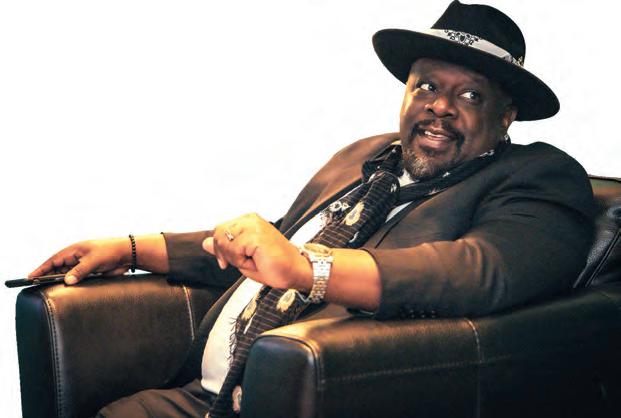
St. Louis’ own Cedric the Entertainer says there’s only one soundtrack that gets him performanceready: straight ’80s pop. Cedric is making his Broadway debut as Seth Holly in Joe Turner’s Come and Gone, starring opposite Taraji P. Henson in August Wilson’s classic set in a 1911 Pittsburgh boarding house during the
Great Migration.
“I get on the floor and stretch and then I listen to music and it’ll vary depending on my mood,” Cedric explains.
“I go back to the 80s pop. I’ve been listening to Tears for Fears and the Spandau Ballet, all that kind of stuff getting me vibed out.” Joe Turner’s Come and
Gone originally opened on Broadway in 1988. It is the second of ten installments in Wilson’s American Century Cycle about the African American experience during the 20th century. Debbie Allen directs the revival. The play officially opened on April 25 and continues through July 26.
relationships.
Foxx and Huckstepp were first linked in 2023 after being photographed together in Malibu. Though the pair reportedly split briefly earlier this year, they’ve since been spotted together again in Los Angeles and Miami.

Hot Sheet Sources:
Cedric the Entertainer
Sexyy Red
Libraries reopen one year after tornado
Libraries
Continued from A1
after a violent tornado tore through St. Louis, damaging or destroying more than 5,000 buildings and causing an estimated $1.6 billion in damage.
A July 2025 recovery assessment found that major tornado damage across parts of North St. Louis remained unresolved weeks after the storm, underscoring the uneven pace of rebuilding in many neighborhoods.
Located in North St. Louis neighborhoods heavily impacted by the tornado, both branches sustained major damage that forced them to close for repairs.
“Every aspect in that building had to be touched in some way,” said Justin Struttman, CEO of the St. Louis Public Library system. Julia Davis Library required a new roof, HVAC repairs and restoration work throughout the building.
“Driving down the road, the library is an outlier,” said Taylor Price, regional youth services supervisor. “There are other communities and businesses where you can still see the impact of the tornado.”
For Struttman, reopening the library is about more than repairing a structure.
“Being able to bring light back to the darkness for the community is really exciting,” he said.
Before the tornado, Struttman said Julia Davis Library was constantly filled with children, teens, families and seniors using the branch’s programs, technology and gathering
spaces. The closure also displaced staff members eager to return to what Struttman described as their “home.”
“I feel like I’m at a family reunion, to see all the familiar faces,” said John Newcomer, regional branch manager for the St. Louis Public Library. “We’re just thrilled to be open.”
He said one of the most rewarding parts of reopening has been seeing residents pick up where they left off before the tornado.
“We’re seeing teenagers come back who were here before the storm and seeing how much they’ve grown over the past year,” he said.
The libraries also are restoring programs residents relied on before the storm, including youth activities, meal distribution and family support services.
For residents like Staci Johnson, the reopening restores an important part of everyday life.
“I’m glad that the library is back open,”
Johnson said. Johnson, who lives nearby, said she had to travel downtown while the branch was closed. She missed seeing familiar faces at Julia Davis and attending movie nights, health and wellness discussions and community pantry events that provided diapers and food.
Community activist Bob Williams said the reopening also honors the legacy of Dr. Julia Davis, the educator and community leader for whom the branch is named.
Police
Continued from A1
“The goal is not to be confrontational at all,” said Alderman Rasheen Aldridge, a Democrat from St. Louis who represents the 14th Ward and chairs the Budget Committee. “The goal is for them to present their FY27 budget. I don’t think they get a pass to not come.”
Although the city funds the police department, the Board of Police Commissioners operates it under state control following a 2023 Missouri law that removed local authority from the mayor’s office and restored state oversight of the department.
Alderwoman Alisha Sonnier, a Democrat from
Williams recalled visiting Davis’ home near historic Sumner High School years ago.
“Her home was like a library,” Williams said.
Reflecting on the reopening, he added, “I was just overwhelmed with joy. The library is a resource for our community.”
Residents Ann King and Tameka Jones also described the library as a critical neighborhood resource for children and families.
“It’s an outlet for
St. Louis who represents the 7th Ward and serves on the committee, said police officials should be held to the same standards as other city departments.
“We think it’s necessary because the folk who want to make decisions on hundreds of millions of taxpayers’ dollars come before the taxpayers to speak and explain their request to them, as every other department the city funds does,” Sonnier said.
Ann King and Timekea Jones browse the shelves inside the reopened Julia Davis Library after tornado damage forced repairs to the community space.
them,” Jones said. King noted that many residents rely on the library’s computers and internet access because they do not have those resources at home.
As neighborhoods across St. Louis continue recovering from the tornado’s destruction, residents say the reopening of Julia Davis and Cabanne libraries marks an important step in restoring community resources in North St. Louis.

Acting Board President Shane Cohn, who approved the subpoenas while Board President Megan Green remains on maternity leave, called the decision straightforward.
“I think entities that are using local taxpayer dol-
lars should be obliged to come before the Board of Aldermen to explain their budget,” Cohn said. The standoff reflects broader tensions between city leaders and the police board over control of public safety spending and city finances. Spencer has warned that funding the higher police request could strain the city budget and affect other services.
Neither the mayor’s office nor Chris Graville, acting counsel and lead attorney for the St. Louis Board of Police Commissioners, returned calls seeking comment before publication.
Sylvester Brown Jr. is the Deaconess Foundation Community Advocacy Fellow.

Photo by Lawrence Bryant / St. Louis American
Rasheen Aldridge
East St. Louis faces accountability reckoning
By James T. Ingram For the St. Louis American
Well, the federal chickens have finally come home to roost for the former director of the East St. Louis Public Library, as well as for the City of East St. Louis, in their Housing Authority whistleblower retaliation lawsuit.
Kenyada T. Harris, the former East St. Louis Public Library director, has been sentenced to 15 months in prison after admitting to embezzling more than $91,000 from the library, as well as $10,000 from the Illinois Department of Human Services.
Harris, 42, pleaded guilty in March to eight counts of wire fraud, theft from federally funded programs, as well as bank fraud.
Court documents reveal that between March 2022 and March 2023, Harris
Salute
was employed as a Public Aid Eligibility Assistant at the St. Clair County Family Community Resource Center through the Illinois Department of Human Services (IDHS). Her job was to replace lost, stolen or damaged LINK cards. However, instead, she used 98 cards for the benefit of herself, family and friends, resulting in the loss of more than $10,000 to IDHS.
If that were not enough, Harris redoubled her thievery after being appointed to the position of library director in March 2023. Then, from July 3, 2023, to June 6, 2024, Harris knowingly used the library’s credit card to make personal purchases, including repairs to her personal vehicle, as well as to obtain cash advances totaling nearly $92,000, according to the U.S. Attorney’s Office for the Southern District of Illinois.
And had Harris been a librarian who actually reads, she would have known that one of the previous library directors, Marlon P. Bush, was sentenced to 12 months in federal prison back in 2018, also for embezzling funds with the library’s credit card.
faith” in the discovery process.
The library’s board should also be held accountable for being fiscally inept and asleep at the wheel after one previous conviction of a director, and for not scrutinizing purchases made on the library’s credit card.
That brings us to the East St. Louis Housing Authority and a recent federal sanctioning of the City of East St. Louis and City Manager Robert Betts after finding them culpable in obstructing discovery and their “flagrant bad
This comes after HUD threatened sanctions and/or federal oversight back in 2024 due to accusations of mismanagement of ESL public housing, including five changes in leadership between 2023 and 2024. One concern included East St. Louis City Manager Robert Betts applying for the position of ESLHA executive director, only to withdraw his application after scrutiny of the process and an April 29, 2024, warning letter from William O. Dawson, the director of the Chicago regional office of HUD, to ESL Mayor Charles Powell III.
However, the obstruction claims were, by and large, fueled by a whis-
tleblower and former ESLHA board member, Shonte Mueller, and her husband, Nicholas Mueller, a 31-year ESL police veteran, who claimed that they were forced out of their respective positions in retaliation for raising concerns that the interim director of the housing authority was not following federal regulations and guidelines.
As a result, Judge David W. Dugan recently entered a default judgment against the City of East St. Louis and City Manager Robert Betts on all claims against them, in addition to $10,871 in sanctions due to their “repeated and willful disregard of explicit court orders, deadlines …”
This is also not the ESLHA’s first rodeo with public housing malfeasance, after being under the longest federal receivership in history — 32 years — from October 1985 to September 2017.
In the meantime, East St. Louis residents continue to be the victims of the brazen criminality, thievery, ineptitude, malfeasance and moral decay of those in positions of authority.
U.S. Attorney Steven D. Weinhoeft got it right in his statement regarding the Kenyada T. Harris sentencing when he said, “Those who abuse a position of trust and steal taxpayer funds must be held accountable. Public resources belong to the community, not to those who believe they are above the law.” I only hope that, as the federal roundup continues, the paddy wagon is big enough to accommodate every “public serpent” who refuses to learn that lesson.
James T. Ingram, an East St. Louis native and writer, covers the Illinois political scene.
Annual Salute event honors young leaders
Continued from A1
board for The St. Louis American Foundation, said many of this year’s honorees reflect a broader shift in how younger professionals define success — balancing career advancement with advocacy, mentorship and service.
“They are giving back while simultaneously building their own careers,” Holmes said. “They care about others and want to help them succeed in life.”
Among this year’s honorees is Church Pinkston, owner of Church Productions, whose photography and visual storytelling have documented St. Louis through what he describes as a more positive lens.
“We get a lot of neg-
ative press, but there are so many people doing great things in this city,” Pinkston said. “I want to help spread that awareness through my cameras.”
Raven Whitener, director of the Foundation, said this year’s class includes leaders involved in tornado relief, violence prevention, economic development, financial literacy and arts advocacy.
“What stood out most this year was the depth of commitment each honoree has to the St. Louis community,” Whitener said. “Across the board, these individuals are not only excelling in their respective fields but are also actively pouring back into the region in meaningful ways.”
For Alonzo Townsend, the importance of giving back was shaped by mentors who guided him early in life and through-
out his career, including his father and St. Louis music legends Oliver Sain, Johnnie Johnson and Robert Jr. Lockwood. He also credited support from the Kranzberg Arts Foundation and Chris Hansen with helping sharpen his creative vision and leadership skills. His journey also included personal hardship. Townsend said losing his home during last year’s tornado became a turning point in his life and career.
“Losing so much through personal and professional adversity — including losing my home in last year’s tornado — made me surrender to God and begin the journey to redeem and rebuild,” he said. “It reminded me never to take the journey for granted again.”
As Mission Fund
Director for the St. Louis Blues Society, Townsend helped lead pandemic relief efforts that raised more than $100,000 in direct grants for musicians in need. He also serves with the Opera Theatre of Saint Louis New Works Collective.
Reflecting on his path as a young professional, Townsend said integrity and accountability remain central to his work.
“Respect is everything,” Townsend said. “The most valuable currency is time. The second is your name. Be accountable, walk with worth and maintain empathy. Never stop learning and never be afraid to apologize.”
The Salute to Young Leaders Awards Reception begins at 5:30 p.m. Thursday, May 21, at the Four Seasons Hotel St. Louis.
2026 Sumner grads overcome much adversity
Sumner
their educational home, attending classes in the nearby Stevens Middle School building.
“When you’re from the historic Sumner High School, you can get through anything,” Calhoun said. “That’s what our legacy is built off of — perseverance.”
A portion of Calhoun’s own home also was destroyed. He spent weeks without power and was homeless for nearly a month. Still, he graduated second in his class and will attend Whittier College in Los Angeles as a track and field student-athlete while pursuing his goal of becoming an aerospace engineer and astronaut.
“Sumner was our oasis,” he said. “But Class of 2026, the world is waiting for you.” Even while displaced, the Class of 2026 continued its mission of helping put Sumner back on the map. This was the class that revived Sumner’s student council and brought track and field back, finishing fifth in district competition. Students also earned regional awards in art, photography and film while competing nationally in robotics and museum studies.
The tornado was ruthless, disrupting more than classrooms across North St. Louis. Libraries closed,

youth programs were displaced, internet access points disappeared, and students across damaged neighborhoods lost many of the spaces they relied on outside school.
“We have a simple motto, which is ‘Excellence, as expected,’” museum studies teacher Mack Williams said.
“When we were faced with adversity, we just had to double down on our commitment.”
Williams said the class helped restore the culture and expectations that once defined Sumner’s legacy.
“This is the class of resilience,” Williams said. “They restored what it means to be a Bulldog.”
St. Louis Public Schools Superintendent
Dr. Myra M. Berry reminded graduates that Sumner’s history stretches back to 1875 and that they now carry forward a legacy shaped by generations
of Black achievement and perseverance.
“To belong to Sumner is not merely to attend school,” Berry said. “It is to inherit a tradition forged through generations of collective aspiration.”
She acknowledged the tornado directly.
“One year ago, your persistence was tested,” Berry said. “A devastating tornado displaced not only your school, but the rhythm of your everyday
Kim Garrett talks with Jayvon Johnson, Sumner High School photographer, during Sumner High School’s commencement ceremony at Harris Stowe State University after the Class of 2026 was displaced by tornado damage to the school.
wise,” she said.
Senior Elyse Rukundo and other classmates reflected on how quickly four years shaped them through pandemic disruptions, displacement and personal growth.
Posthumous diplomas were presented to the families of Kylie Johnson and Sincere Thomas.
Interim assistant principal Dr. Dianna Sumner delivered remarks on behalf of principal Dr. Ronda Wallace, who was absent attending her son’s graduation.
Wallace wrote that the class endured challenges “that could have broken lesser groups.”
For Calhoun’s father, Rory Calhoun, watching his son cross the stage was a culmination of survival.
“It was monumental,” he said. “We had to figure out how to make it work after the tornado. But we are a team.” He watched his son study by generator light and refuse to give up.
life.”
Berry said students continued moving forward “with dignity, composure and determination” despite the disruption.
Valedictorian Kelsey Lawson-Rainey spoke about entering high school feeling lost after not being accepted into a private school she hoped to attend.
“Looking back, Sumner gave me opportunities I may have missed other-
“I’m so glad my son had the opportunity to attend Sumner,” he said.
“The school just fit him. And from the moment he got there, he grew into the man he is now.”
“When you walk across that stage, you let them know,” Wallace wrote. “Let them know that you cannot be broken.” The Class of 2026 did exactly that.
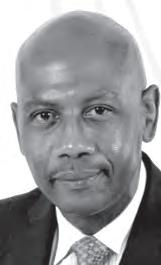
James T. Ingram
Photo by Lawrence Bryant / St. Louis American
Members of last year’s St. Louis American Foundation Young Leaders class gather for a group photo during the annual event.
Photo by Taylor Marie / St. Louis American
Rep. Crockett urges deeper political engagement
St. Louis American staff
U.S. Rep. Jasmine Crockett delivered a forceful call to political action Saturday during the sold-out 45th annual St. Louis County Democrats Gala, urging attendees to become more engaged beyond high-profile elections.
“Dig deep and do
more,” Crockett told the crowd of more than 500 during the May 16 event. She warned that political complacency has contributed to setbacks involving abortion rights, voting rights and congressional representation. Crockett, a St. Louis native who represents Texas’ 30th Congressional District, emphasized the
importance of local elections and down-ballot races, arguing they often have the greatest impact on daily life. She also discussed recent court rulings involving congressional maps in sev-

Rep. Jasmine Crockett
eral states and criticized what she described as efforts to weaken voting access. Speaking bluntly about federal oversight, public workers and political accountability, Crockett urged attendees not to
disengage from the political process even when frustrated by national politics. She said local organizing and participation remain critical to protecting communities and expanding opportunities.
The gala also honored several local leaders, including Thomas Eagleton Award recipient
Chantelle Jones, a former Missouri state representative and community advocate.
Crockett closed by encouraging attendees to volunteer, organize and remain politically active.
“You may not do politics, but politics will do you,” she said.
The prayers that held North City
By Lyah B. Leflore-Ituen Missouri Historical Society
There are storms that pass through a city. And then there are storms that expose it.
On May 16, 2025, an EF3 tornado carved a 20-mile path across St. Louis, leaving devastation across North City. Nearly 5,000 buildings were damaged. Roofs lifted into the air. Trees split streets. Entire blocks of brick homes— built and sustained by Black working-class families who remained through decades of disinvestment—were suddenly opened to the sky.
the long, slow violence of erasure.
And yet, something ancient held.

But the storm did more than damage buildings. It moved through memory, through legacy, through sacred ground. It passed through communities already shaped by redlining, population loss, and
In St. Louis, the Black church has never simply been a place of worship. It has been headquarters for survival, sanctuary for organizing, refuge during catastrophe. In this city, Black churches helped anchor communities birthed of the Great Migration, when thousands of African American families journeyed north from Mississippi, Arkansas, Tennessee, Alabama, and Louisiana, seeking opportunity, dignity, and safety in St. Louis. They built the Ville and surrounding North City neighborhoods into living ecosystems of faith, education, labor, and cultural life.
Even when segregation confined Black residents to narrow corridors of the city, institutions flour-
ished. Homer G. Phillips
Hospital stood as a national symbol of Black medical excellence. Sumner High School shaped and produced generations of Black brilliance and leadership.

Mill Creek Valley pulsed with black businesses, jazz, faith, and culture. Through every chapter— segregation, displacement, civil rights struggle, economic abandonment, Ferguson, and disaster— the Black church moved first.
Before official systems arrived.
Before recovery became a slogan.
Before the city found its footing. Sanctuaries became shelters. Fellowship halls became supply stations. Pastors became first responders. Prayer became infrastructure.
In the aftermath of the tornado, that same architecture of care activated
again. The Spirit of St. Louis Task Force, chaired by Pastor Linden Bowie of Zion Travelers Missionary Baptist Church, helped to mobilize alongside fellow clergy, neighborhood leaders, and partners including the St. Louis NAACP and the American Red Cross. What unfolded was not simply response—it was responsibility carried in real time.
They moved quickly, because North St. Louis is not simply geography. It is inheritance. It is testimony. It is a living archive of Black survival.
And it has survived disappearance before.
We remember Mill Creek Valley and what was lost when “progress,” or what they called “urban renewal,” meant removal. Mill Creek was once a dense and vibrant center of Black life and left behind both memory and warning. We remember families dis-
placed and culture erased.
And we remember that recovery cannot become removal.
In the days after the storm, resilience revealed itself in ordinary acts. Neighbors moved water from block to block.
Elders fed volunteers from damaged kitchens. Young people cleared streets before sunrise. Pastors stood in rubble and prayed without pause.
And this work was and still is carried in profound ways by Black women in leadership and ministry: Rev. Beverly Stith of St. James AME; Pastor Sheila Scott of Ward Chapel AME, who is also the vice chair of the Spirit of St. Louis Task Force; Associate Pastor Angela Tate of West Side Missionary Baptist Church; and LaKricia Cox of the American Red Cross. Their leadership reflects a deeper truth: Black women have always been central to how this city survives.
One year later, we must remember recovery must also mean more than rebuilding structures. It must mean protecting people, preserving culture, and investing in communities that have long carried the spiritual and historical weight of this city. The tornado damaged buildings, but it also uncovered something enduring: Even under rupture, Black St. Louis still knows how to gather, how to pray, how to feed, and how to stand in the gap. Five lives were lost in the storm. Their absence is part of the landscape now, a reminder that devastation is always human.
So perhaps the real story is not devastation. Perhaps it is endurance. A people bruised, but unbroken. A community battered by wind, but not emptied of spirit. A city within a city still refusing disappearance. And from the rubble, as our ancestors did before us, we rise again.

Lyah B. Leflore-Ituen

Living It
“There was a blooper reel and a lot of time recalling the laughs we’ve had on and off camera. By the end of the night, I wasn’t crying; I just had allergies.”
— Cedric the Entertainer, on the emotional send-off after last week’s series finale of the CBS sitcom “The Neighborhood,” in which he
Roots, resilience and renewal
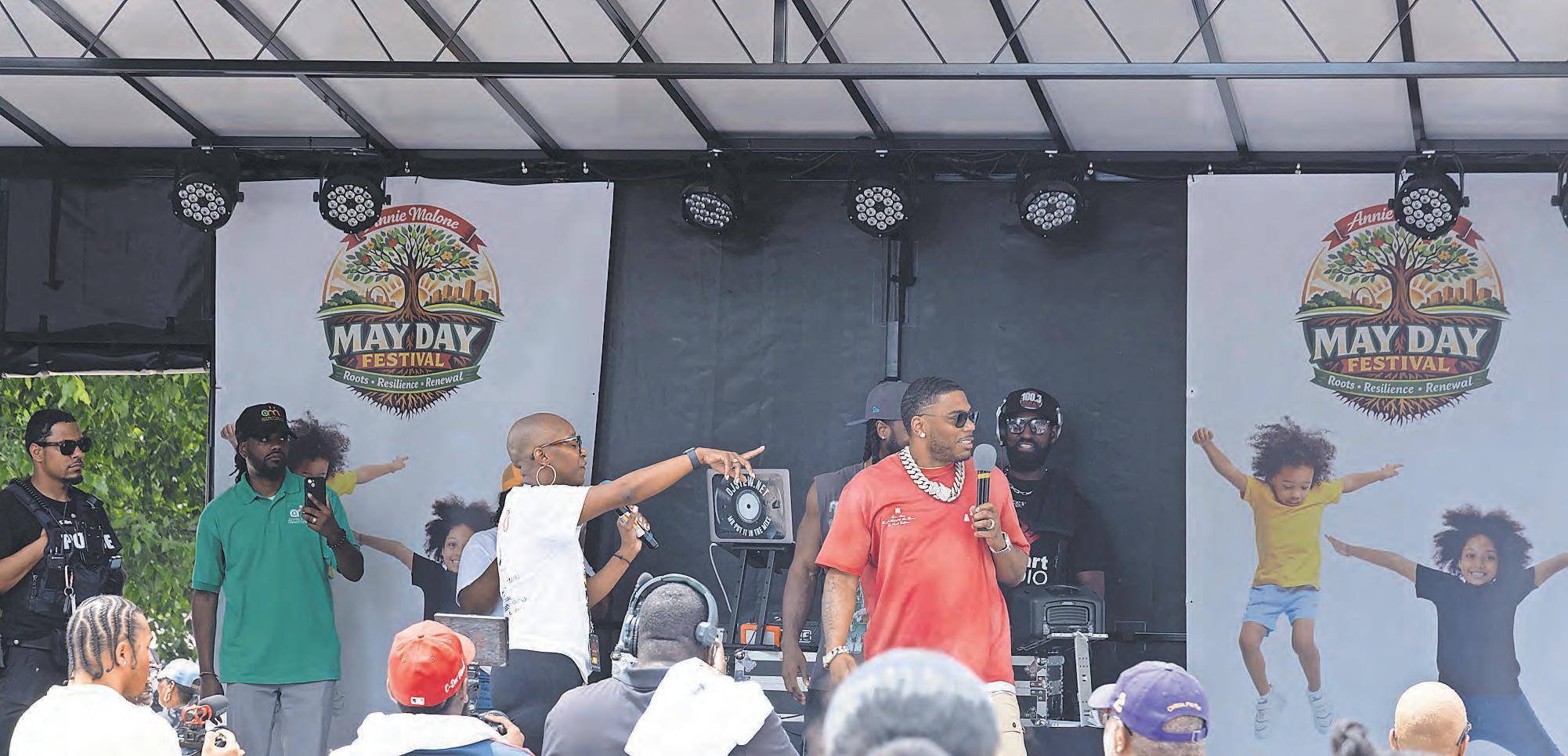
By
‘Roots, resilience and renewal’
Annie Malone’s May Day cel ebration returns with a reimag ined festival format
Instead of marching down Market Street for the parade on May 18, 2025, Annie Malone Children and Family Services Center shifted its focus. The organization spent the day giving back to those impacted by the devastating tornado. The storm had touched down in North St. Louis just two days earlier.
While the parade didn’t return in its original format in 2026, the organization kept one of St. Louis’ longest running and most
cherished spring traditions – and one of the longest running histor ically Black cultural events in the nation. On Sunday afternoon, it was reimagined as The May Day Festival. The all inclusive community celebration and talent showcase was situated at Poelker Park. The event brought residents from across the city for a day centered on unity, entertainment and healing. Families, children and commu nity leaders filled the downtown park for an afternoon of music, performances and fellowship. Music throughout the event was provided by DJSTEW.net with Jess Live serving as host, while local organizations and schools entertained guests from the main
stage in a format that offered attendees a deeper connec tion to the groups serving the community.
Among the highlights were perfor mances by the Alpha Phi Alpha step team and marching bands from prominent St. Louis area schools.
“The people that society has thrown away, these are the people that we love on and build relationships with them.”
— Show Me Peace spokesperson
Jennings Senior High School and Cardinal Ritter College Prep were among them. Their dramatic renditions of “Boot on the Ground” and

“Still Fly” energized the crowd, creating an atmosphere that captured the spirit of the parade many residents have come to love for more than a century. Unlike a tra ditional parade, where organi zations briefly pass by sharing only basic in formation, this year’s festival allowed com munity groups to directly engage with attendees from the stage. Organizations spoke about their missions, goals and impact throughout the St. Louis region.
One of those organizations was Show Me Peace, a vi olence prevention initiative powered by Mission: St. Louis. Representatives spoke about their efforts to create safer neigh borhoods and support vulnerable residents throughout the city.
“We go into these neighbor hoods and we establish safe spaces for children and the elder ly to be able to engage in their neighborhood without the threat of gun violence,” a spokesperson from the organization said. “The people that society has thrown away, these are the people that we love on and build relation ships with them.”
The glittery enchantment of ALTBALL
3rd annual runway experience highlights queer artistry and community care
By Zaria Mac St. Louis American
Anthony Wiggins and Kwanae Johnson performed during the latest installment in Jazz St. Louis’ Miles in May programming celebrating the upcoming centennial of Miles Davis’ birth. The ‘Anthony Wiggins: The Legacy Lives On’ concert took place Saturday, May 16 at the
inside the Harold and Dorothy Steward Center for Jazz.
From one East St. Louis son to another
Wiggins honors Miles Davis with centennial set that mirrors the master’s evolution
By Kenya Vaughn St. Louis American
May 26, 2026 will mark the 100th birthday of music icon Miles Dewey Davis. Across the region, tributes have poured in for the Alton‑born, East St. Louis–raised genius who expanded the very possibility of sound through the lens of jazz. Out of Miles’ horn came ideas that shifted the trajectory of American music. What has been most striking about the local celebrations is how clearly they reveal the breadth and depth of his influence.
On Saturday night, fellow East St. Louis native Anthony Wiggins demon strated the local influence of Davis when he added his voice to Jazz St. Louis’ Miles in May Centennial Celebration. Wiggins’ “The Legacy Lives On” set offered insight into the musical dexterity that defined Davis’s career and how it has shaped Wiggins’ approached as a trumpeter.
From straight‑ahead swing to bebop,
post‑bop, the blues and a stone‑cold groove, Wiggins and his “friends” — Adam Maness on keys, Kwanae Johnson on tenor sax, Zeb Briscovich on bass and Miles Vandiver on drums — used the Ferring Jazz Bistro stage to honor Davis not only as an innovator, but as a master of reinvention. Wiggins shared a few stories, in cluding how Davis first met his mentor Charlie Parker in St. Louis. Wiggins said Parker, then playing saxophone with Billy Eckstine’s band, needed a trumpet player for a gig. “Miles was asked if he had a union card, and he said yes,” Wiggins told the crowd. “That’s how that connection began — right here in St. Louis.” Davis and Parker would reconnect in New York, where Davis was enrolled at Juilliard. He left school to study Parker instead — a decision that gave him the tools to become a singular figure in music.
ALTBALL is not your average fashion show. Now in its third year, it has become the one night where fashion, performance and queer art forms collide — all in the name of community and giving. This year, every dollar raised supported DOORWAYS, the long time provider of HIV hous ing and supportive services founded in 1988.
The organization assists more than 3,500 people across Missouri and Illinois each year — work that will continue because of the outpouring of support at ALTBALL last Friday.
“One thing we have always been about is community,” said Tielere Cheatem, multidisciplinary visual artist and host of ALTBALL. “A community that uplifts one another, a community that knows how to show up for each other, especially when times are hard — that’s what ALTBALL is about, and that’s what you are a part of tonight.”
This year’s theme, ICON, transformed The Sovereign concert hall into an avant‑garde landscape of fashion. There were also celebrity homages to artists like Prince and Jennifer Lopez. Producers threaded glitter through nearly every detail — even the food. The

With its
Friday,
Purple Rain taco from Up Late arrived topped with edible glitter and paired with glitter salsa. Guests mingled easily, swapping the names of designers and boutiques behind their looks before Lady Stout took the stage. The jazz, rock and R&B per former delivered a polished set in a maroon gown with dramatic pleated dolman sleeves, adding extra skip and scat to classics like “It Don’t Mean a Thing (If It Ain’t Got That Swing).” She was joined by Foster and The Fellowship, who provided live background
“A community that uplifts one another, a community that knows how to show up for each other, especially when times are hard — that’s what ALTBALL is about, and that’s what you are a part of tonight.”
— Tielere Cheatem
music for the runway — a twist that energized the room. Their set moved
from Prince’s “1999” and Stevie Wonder’s
Photo by Taylor Marrie / St. Louis American
2026 theme of ICON, the 3rd Annual ALTBALL transformed The Sovereign into an avant‑garde landscape of fashion, performance and queer artistry on
May 15.
Photo by Taylor Marrie / St. Louis American
Ferring Jazz Bistro
Zaria Mac St. Louis American
starred as Calvin Butler
Photo by Taylor Marrie / St. Louis American
St. Louis rap star Nelly joined Annie Malone Children and Family Services Center CEO Keisha Lee on stage during the 2026 May Day Festival Sunday for a special presentation to several families impacted by the tornado that touched down in St. Louis on May 16, 2025.
CONCERTS
Sun., May 23, doors 7 p.m. Tech N9ne with special guest King Iso, The Factory, 17105 North Outer 40 Rd, Chesterfield, MO 63005. For more information, visit www. thefactorystl.com.
May 26- May 29, Happy Birthday Miles: Terell Stafford & Tim Warfield, as part of Jazz St. Louis’ Miles in May Centennial Celebration, Harold and Dorothy Steward Center for Jazz, 3536 Washington Ave, St. Louis, MO 63106. For more information visit jazzstl.org.
Sat., May 30 – Sun., May 31, Robert Glasper: OG Acoustic Piano Trio, City Winery, 3730 Foundry Way, St. Louis, MO. For more information, visit www. citywinery.com.
Sat., June 6, 7:30 p.m., SLSO welcomes Terence Blanchard and Ravi Coltrane for a special centennial celebration for John Coltrane and Miles Davis, Powell Hall. For more information, visit www.slso.org.
SPECIAL EVENTS
Thurs., May 21, 5:30 p.m.,
The St. Louis American’s 15th Annual Salute to Young Leaders Awards Reception, The Four Seasons Hotel St. Louis. For more information, visit www.stlamerican.com.
Fri., May 22 – Sat., May 23, 7:30 p.m. (pre-show programming begins at 6:15 p.m.) Dance St. Louis presents the 18th Annual Spring To Dance Festival, Touhill Performing Arts Center. For more information, visit www.dancestlouis.org.
Fri., May 22 - 25, Rollin’ on the River, a community skate event, Gateway Arch Riverfront.
Sounds & STL Sites

Visit archpark.org/rollin
Sun., May 31, 1 p.m. Missouri Bridal and Wedding Expo, The Dome at America’s Center, find more information at https://explorestlouis.com.
Sat., Jun 20, 1p.m. and 7:30 p.m. St. Louis SERA Rodeo, Chaifetz Arena, find more information at www.chaifetzarena.com.
COMEDY
Fri., May 22, 9 p.m. Missed Connections, The Improv Shop, 3960 Chouteau Ave, St. Louis, MO 63110. For more information, visit https:// theimprovshop.com.
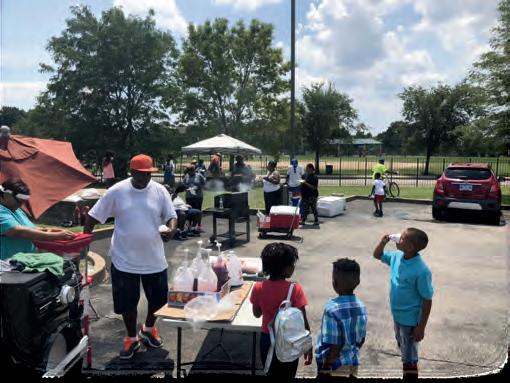
Sat., May 23 - 24, 5 & 8:30 p.m. George Lopez, City Winery, 3730 Foundry Way, St. Louis, MO. For more information, visit www.citywinery.com.
Thur., May 28, 7:30 p.m.
Special Event: My Cousin Tiera, Helium Comedy Club, 1151 St Louis Galleria St, St Louis MO 63117. For more information, visit https://st-louis.heliumcomedy. com.
LOUIS MUSIC SPOTLIGHT
Thurs., May 21, 7:30 p.m., Ode to Neo Soul Presented by Jai Brenai Productions, Starring Michaela Howard, City Winery, 3730 Foundry Way, St. Louis, MO.

For more information, visit www. citywinery.com.
Fri., May 22, 7:30 p.m. Murphy Lee and Kyjuan of the St. Lunatics Live Presented by TownsendX3.Live & Vivid, City Winery, 3730 Foundry Way, St. Louis, MO 63110. For more information, visit www.citywinery.com.
Sun., May 24, 5 p.m. Royce’s Room: A Piano Concert, The New Ambassador 9800 Halls Ferry Rd, St Louis, MO 63136. Purchase tickets on eventbrite. com.
Through May 28, 6 p.m. Twilight Thursday’s, Missouri History Museum. For more infor mation, visit
www.mohistory.org.
THEATRE
Through May 24, The Fabulous Fox welcomes MJ The Musical, The Fabulous Fox. For more information, visit www. fabulousfox.com.
May 27 – St. Louis Shakespeare Festival presents The Tempest, Shakespeare Glen in Forest Park. For more information, visit stlshakes.org
Through June 7, The Black Rep presents Fat Ham, Washington University’s Edison Theatre. For more information, visit www.theblackrep.org.
ART
May 23-25, The 35th Annual St. Louis African Arts Festival, World’s Fair Pavilion in Forest Park. For more information, visit stlafricanartsfest.com.
Through May 23, 10 a.m. Clearly Human VI, St. Louis Artist’ Guild, 12 N Jackson, Clayton, MO 63105. For more information, visit www.stlouisartistsguild.org/.
Through Jun. 28, Martine Syms: Soliloquy, St. Louis Art Museum, 1 Fine Arts Drive, Forest Park, St. Louis, MO 63110. For more information, visit www. slam.org.
Through June 2026, The Future Is Female, 21c Hotel and Museum Hotel St. Louis, 1528 Locust St, St. Louis, MO 63103. For more information, visit https://21cmuseumhotels.com.
Through Aug. 9, Teaser by Ayana Evans, Contemporary Art Museum, 3750 Washington Blvd, St. Louis, MO 63108. For more information, visit
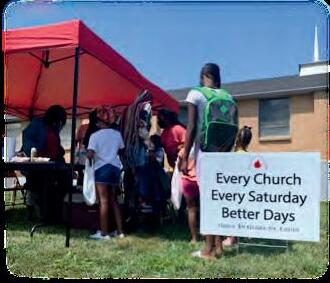



City Winery St. Louis will welcome Grammy Award-winner Robert Glasper and his OG Acoustic Piano Trio. See CONCERTS for more information.
Photo by Taylor Marrie / St. Louis American
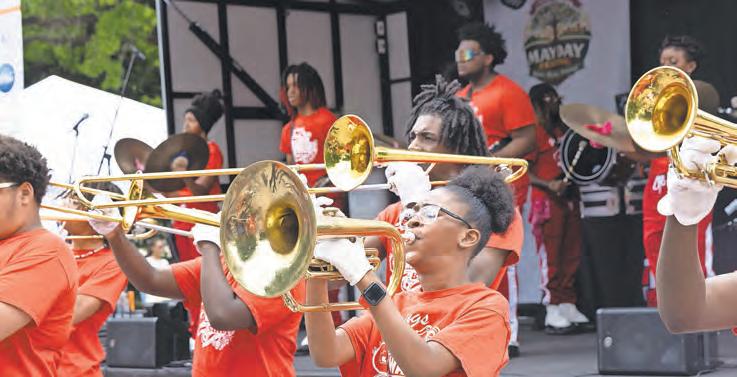
May Day
The festival’s theme, “Roots, Resilience and Renewal,” reflected a broader focus on rebuilding community and supporting families still recovering from hardships across the region. In that spirit, the Annie Malone foundation gifted 20 families with new home appliances and furniture sets as they continue recovering from the devastating tornado that impacted the area one year ago.
Keisha Lee joined St. Louis music legend Nelly on the main stage for the giveaway presentation. Together, they announced the names of each family before posing for a group photo with recipients.
After the presentation, Lee thanked Nelly
Continued from B1
“Superstition” to Beyoncé’s “CUFF IT” and Lizzo’s “Juice,” giving each designer’s submission a soundtrack that matched the moment.
Judges included community legends like Andre Mizrahi, founder of the House of Mizrahi; designer Manuel Garcia of Manolo Bouvier and 2025 Best Look winner; Katie May, founder of May’s Place and May’s Night Market; and audience guest judge Disaster.
Designer Olivia Radle presented two white chiffon gowns with red ribbon and appliqué details. One was worn by model and dancer Cookie, whose powerful strut and low, controlled crawl at the end of the runway earned her Best Vibe.
Shanna Britta showcased two wearable art pieces built from feathers and metal,
for his continued support of the city.
“I love everything you do for the Lou seen and unseen. Thank you to you and everybody else that goes outside this city and brings nothing but greatness back,” Lee said.
Throughout the day, the May Day Festival served as a gathering space where neighbors reconnected, children played freely and organizations shared the work they are doing to strengthen St. Louis communities. The festival offered a release from daily stress while renewing a sense of hope and togetherness. For many families, the festival was a reminder that community still matters and that being able to both support and be seen by one another remains one of St. Louis’ greatest strengths.
For more information about the Annie Malone Children and Family Services Center, visit www.anniemalone.org.
turning her models into moving sculptures. Alexis, one of her models, carried the look with such poise that she won Best Walk.
The final category winner was Tracy “Saint Patrik” Morris, who took home Best Look. His two designs — a floor‑length puffer coat and a cropped jacket set — featured bold silhouettes in red, white and black. The audience was locked in, and the judges were too. Then it was the audience’s turn.


Vanessa Frost announced categories like Best Dressed, Best Runway and Best Performance — the latter drawing the loudest reactions. Guests took to the runway to vogue, showing precision and attitude as they whacked, spun and landed with ease. What ALTBALL offered was beyond a night of fashion. It created space for community, creativity and self‑expression. It was a place where artists, performers, designers and attendees could honor queer artistry and connect through music, movement and style.
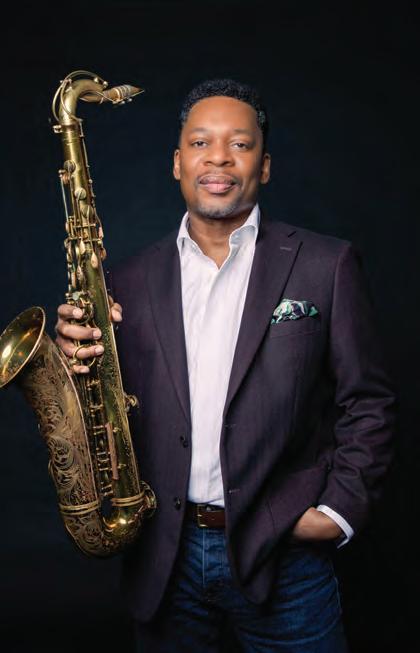
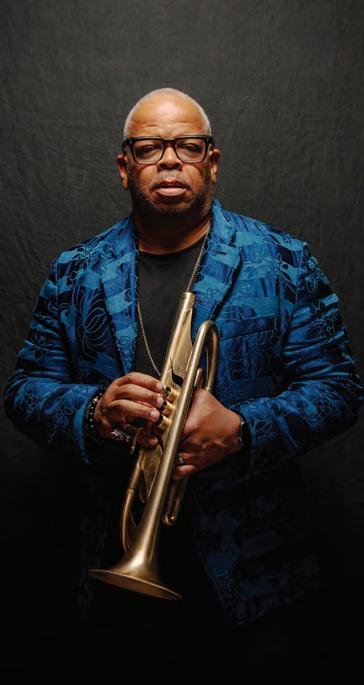
Miles Davis
patience with which he delivered each note. Davis’ compositions gave every instrument its own distinct presence — individually and as a collective. He organized his bands so that every voice mattered. And although trumpet was his chosen instrument, he never favored it over the ensemble.
Wiggins honored that sensibility through Johnson’s playing. The harmonies and melodic lines underscored the saxophone’s role as an anchor in the jazz tradition — from bop to post‑bop to Davis’ fusion period, where the horn often mimicked the shimmer of an electric organ with an almost autotuned edge.
The ebb and flow between Briscovich’s bass and Maness’ piano created a swing that framed the bop in Wiggins’ horn. He was sparing with the riffs, but when he laid them down, they landed — especially during their take on “Dig.”
Wiggins reminded the audience that “Dig” is a contrafact of the jazz standard “Sweet Georgia Brown.” “The way musicians made money during those days was they would take already established chord changes and put their own melody on it,” he explained.
From “Dig,” the group moved into “My Funny Valentine,” which Wiggins dedicated to his sister, who was undergoing a kidney transplant that night. They approached the tune like a vocal trio with three lead singers.
Wiggins went first — the Billie Holiday of the group. His muted, haunting melody set the intention for the nearly eight‑minute performance. Maness followed with intricate chord progressions that shifted the tune’s emotional center;

he was the Sarah Vaughan of the trio, making the piano scat, riff and run.
Briscovich closed with a tone reminiscent of Cassandra Wilson’s contralto — slow, heavy and full of weight.
“Are you feeling what we’re dealing?” Wiggins asked. He was met with a rousing applause.
They moved into “Freddie Freeloader,” the lone selection from Davis’ Kind of Blue, the best‑selling jazz album of all time. While the album is celebrated for its modal approach, “Freddie Freeloader” is Davis’ reminder that the blues is the foundation. Wiggins leaned into that truth, letting the rhythm section do the heavy lifting — and Briscovich and Vandiver delivered.
Before the next tune, Wiggins offered his only prepared remarks of the night. After sharing the recording and release date — and noting that it was written by Jimmy Heath — he explained the significance of the piece.
“This offering showcases how Miles’ deeper exploration of modal performance used looser forms, tempos and time meters,” Wiggins said. “Post‑bop — an approach that is abstract and intense. A space created for rhythmic and coloristic independence. An approach
that incorporated whole harmonies, flexible form, structured choruses, melodic variation and free improvisations.”
“Ladies and gentlemen, we present to you: ‘Gingerbread Boy.’”
The tune carried a New Orleans‑style rhythmic undercurrent, with Wiggins and Johnson playing in unison before the electric bass and piano took off. Then Wiggins dug into Davis’ funk bag with “Jean Pierre.” Recorded in 1982, it was the most modern track of the night. Echoes of Sly Stone and P‑Funk pulsed through the arrangement, along with the influence of Roger Troutman and Zapp in Johnson’s electrified horn and Maness’ synthesized keys.
“You always knew that the piano was a two‑handed instrument,” Wiggins said. “But today you found out that the piano was a two‑instrument instrument.”
They closed the show with “The Theme.”
In a night dedicated to honoring Miles Davis, Wiggins and his ensemble illuminated the evolutionary value of his music. They showed how Davis stretched the blues, reshaped harmony, reimagined rhythm and expanded the vocabulary of jazz in particular — and music in general.

CMYK-7-37-95-0
CMYK-36-80-93-51














Photo by Taylor Marrie | St. Louis American
The Jenning Senior High School Marching Band performed as part of the Annie Malone May Day Festival Sunday afternoon at Poelker Park presented by the Annie Malone Children and Family Services Center.
Photo by Taylor Marrie / St. Louis American
Trumpeter Anthony Wiggins describes jazz as “a space created for rhythmic and coloristic independence.”.

A second take of Twilight Thursdays. After the time I had with JAM, y’all already know that I was circling back this week for Twilight Thursdays at the Missouri History Museum. Based on the parking, I thought it was gonna be as crazy packed as it was last week. I decided to come from Skinker this week and thought I was out of luck until I was blessed to find a space by Lindell and Des Peres. You read that right; parking was so impossible that I’m counting that trek as a blessing. I didn’t know until after I got all my Fitbit steps in and made it closer to the front that a nice chunk of those cars belonged to Wash U. graduates and their families. Shout out to Dr. Kwofe Coleman while I’m on that subject. Okay back to Twilight Thursdays. It was packed, but not JAM packed. Either way The Coleman Hughes Project featuring Adrianne put their foot, ankle and pinkie toe into that Sade tribute! I was singing “Kiss of Life” all up in church on Sunday. And people think that because she only has a few little notes in her repertoire that Sade is an easy cover. Don’t get it twisted. You have to be a beast to do it right. And Adrianne did that! Now as much as I love my boy BJ The DJ, he shole (yes, shole) could have kept that little dad joke of his. In all fairness to me for pointing it out, we all said no when you offered it up. And telling it twice wasn’t going to make it any funnier. I still absolutely love you though! And, as usual, you did a great job as the host
with the most. And speaking of host, I saw the Missouri History Museum’s own Lyah Beth LeFlore cutting a rug to Sade and I was here for every bit of it!
The prom was promming.

I’m going call the class of 2026 Eat St. Louis instead of East St. Louis because of how they ate down to the marrow with their prom looks. I wish I knew your names, so I could give out some individual flowers. Oh well. I really thought I was doing something with my cousin’s teal bridesmaid gown, my bulletproof French roll and my white Payless pumps in the year of our Lord nineteennone-of-your-business. But those children over there on the East side had me ready to tuck my whole prom memory in – and the Applebee’s after set. Did y’all see that video that rightfully went viral? It looked like half the East St. Louis High School students were hosting a Nigerian wedding – and the other half walked up out of a Disney princess live action movie. But for real, can somebody get in touch with the beauty in the white bedazzled gown? I’m willing to make her an offer she can’t refuse for it so I can have that glorious ensemble on deck for when my second husband quits playing and finds me. I’ve already said yes to a dress, the man will surely follow…right? And when he does, I’m going to take a page from the Eastside children’s book and create my own Zamunda for my personal Prince Akeem. I’ll take a Semi at this point in the game!
May Day made it through! Okay, we’ve established the fact that this year was a pivot from the actual parade, but can we

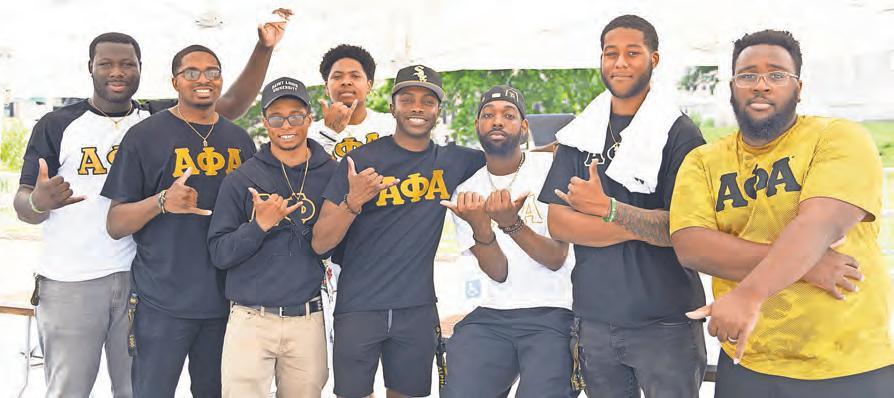
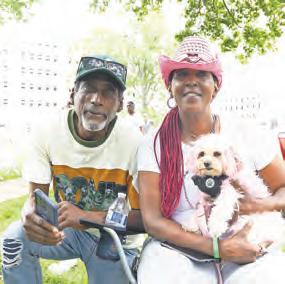
give a shout out to Annie Malone Children and Family Services Center for giving the community an event where we could come together, fellowship, eat and have fun? I want to be clear that I’m proud of Keisha Lee and her team for powering through with their Community Festival!
Y’all realize that the organization suffered extensive damage because of the tornado too, right?
“Roots, Resilience and Renewal” is exactly what was represented Sunday afternoon. I had a time and the people did too. Shout out to DJ STEW.net for holding it down on the tables and my girl Jess Live for keeping it hype on the mic. My boy BJ The DJ, who is clearly one of the hardest men in radio, was back outside showing love for May Day too. Shout out to all of the organizations, businesses and individuals who helped Annie Malone make it happen for yet another May Day including my boy Nelly. And to Kenrick’s Meats, what did y’all season those steaks with? I know you can’t tell me, but can




you at least bless me with a complimentary Memorial Day plate?
While I’m thinking about it, who was that lady in the bedazzled boots doing the Tamia Slide in sixth gear? Were my eyes fooling me when I thought I saw more smoke coming from her heels than Kenrick’s grill? Either way, I got my life from her, the meat and the whole afternoon.
Mingling in my Moo Moo
After I got home from kicking it and having a ki at Annie Malone’s May Day Festival, I changed into my moo moo and was ready to kick my heels up and dive deep into “On The Case with Paula Zahn,” when it hit me that I had someplace to be. The good thing is that I assumed that I wouldn’t have to change since I was heading to Nettie Kelley’s Muu Muu Party. She spells it the fancy way, but it’s the same thing. Leave it to Nettie Kelley and her crew of faithful shoppers/supporters to have me feeling underdressed at the auntie version of a pajama
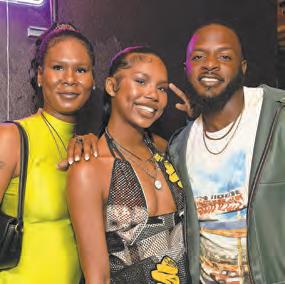
party. Y’all…they had matching headwraps, jewelry, fully beat faces and all types of accessories to match their fancy caftans. They had on muu muus, I had on a moo moo – the one your granny used to wear when she was hollering at the TV at Mrs. Chandler for what she did to Jill Abbott on “Young and The Restless.” But y’all better know I was mingling and sipping on mocktails like it was made out of 24K gold! Nettie, girl, you gave us a vibe with that day party experience! And 55 has hardly ever looked as good as it does on you! Please keep me posted on when you plan on having another muu muu set. I promise to be a bit more pulled together next time.















































































































































































































































1. Shaun D. and Eboni were among the stylish crowd at the 3rd Annual ALTBALL Thursday night at Sovereign.
2. Alpha Phi Alpha was well represented at the Annie Malone Children and Family Services Center’s May Day Festival Sunday near Soldier’s Memorial Museum.
3. Earl and Johnetta Caldwell and their lovely dog Sugar stopped by the Annie Malone Children and Family Services Center’s May Day Festival Sunday.
4. Brittany, Bryniah and Artrell caught life from ALTBALL Thursday night at Sovereign.
Tony Award nominee Kate Baldwin Margaret Johnson
Katrina Galka Clara Johnson Tony Award winner Paulo Szot Signor Naccarelli
Roy Hage Fabrizio Naccarelli
Photos by Taylor Marrie | St. Louis American

The track and field season concludes this weekend for small schools at the Missouri State High School Activities Association Class 1-3 championships at Jefferson City High School.
Many athletes from the St. Louis area will be on hand searching for state championships and all-state medals. The action will begin Friday at 9:30 a.m. for field events and 10:30 a.m. for running events. The meet resumes Saturday, with the championship races beginning at 10:30 a.m. St. Louis-area athletes competed in sectional competition at Dexter last Saturday. On the boys side, Lutheran North will have one of the top individuals in the meet in senior sprinter Michael Clark. He was a sectional champion in both the 200- and 400-meter dashes. Cameron Oliver finished second to Clark in the 200 and 400. The Crusaders will also take their 4x200and 4x400-meter relay teams to the state meet. Cardinal Ritter will take a strong group of sprinters to the state meet. Senior Manny Ellis qualified by winning a sectional title in the 100-meter dash. He also finished second in the 200. The Lions also won sectional titles in the 4x100 and 4x200 while their 4x400 team finished second to qualify.
was a sectional champion in the 800-meter run and runner-up in the 1,600-meter run. Evan Moll qualified for state in the 1,600 and 3,200. The 4x800-meter relay team also won a sectional championship. In the field events, Max McFarlane finished first in the long jump and second in the triple jump at the sectional meet. Moses Mungeny placed second in both the long jump and triple jump.
St. Mary’s will be led by its fieldevent standouts, Elijah Stueckel and Gary Johnson. Stueckel qualified in the shot put and discus while Johnson qualified in the high jump. Junior Xavier Clark qualified in the 300-meter intermediate hurdles, and the Dragons also qualified in the 4x100 and 4x200.
Gabrielle Campbell of Bayless, who qualified for the state meet in the 200, 400 and 800, is the top local individual performer from St. Louis in the girls Class 3 meet. As a team, Metro qualified athletes in seven events for the state meet. Lucy Luetkemeyer was a sectional champion in the 3,200-meter run and runner-up in the 1,600-meter run. Metro also qualified Lucy Divis and Tessa Link in the shot put, discus and javelin.
College of Medicine and Bioscience will take its talented distance runners and field-event jumpers to the state meet. Owen Garrett
MAY 21 – 27, 2026
Inside Sports
So far, so good for fun flock of Cardinals St. Louis talent fills state meet
It is a bit earlier than Memorial Day, the date I first judge the St. Louis Cardinals or any Major League Baseball team on outlook for the season, but let’s give it a shot.
The Cardinals are legitimate.
As of Monday, the team was eight games over .500 and trailed the first-place Chicago Cubs by a game and a half. Jordan Walker is more than a guaranteed National League All-Star, he is a candidate for Most Valuable Player. I do not think he will continue the season at the sensational pace he has set since Opening Day; however, I doubt he will sink to the depths he reached over the past two years.
Senior Demetrius Thompson of Brentwood qualified for the Class 2 state meet in four events. He was a sectional champion in the triple jump and the 300-meter intermediate hurdles. He also finished second in the 110-meter

high hurdles and long jump. Sprinter Genesis Garner of Lutheran North is headed to state in three individual events. She was a sectional champion in the 100 and 200 and a runner-up in the 400. The Crusaders also qualified in the 4x100 and 4x200.
Distance-running standout Kensington Curd of Brentwood was a threetime sectional champion in the 800, 1,600 and 3,200. Ellen Huniyen of Whitfield was a sectional champion in the 400. The Warriors also won sectional championships in the 4x200 and 4x400 relays. Whitfield also finished second in the 4x800 relay.
Individual district track standouts from last weekend
Bailey Hensgens (Incarnate Word): Finished first in the 200-meter dash, high jump, long jump and triple jump at the Class 4, District 2 meet at Windsor. Her performances in the jumps were phenomenal. She jumped 5 feet 11 inches in the high jump, 19-5 in the long jump and 39-11 1/2 in the triple jump.
Jamel Jennings (McCluer North): Finished first in the 200 and 400 and ran a leg on the Stars’ first-place 4x100-meter relay team at
Sports Eye
The pendulum could easily swing the other way on statistics such as those.
The Cardinals are also ranked 21st in team ERA in MLB. It’s not the worst, but being in the middle of the pack doesn’t often lead to postseason appearances. St. Louis relievers are also among the most-used in the National League and that wear-and-tear could come calling as the season progresses.
Shortstop Masyn Winn is just coming into form as May moves to June. He was hitting .255, which is decent, and while he hasn’t played Gold Glove-caliber defense as he did last year, he gives the Cardinals a dependable defender in most games.
Walker’s .301 batting average is the key to his success. When he hits the ball, it is with authority. The average has led to his 13 home runs, 34 RBIs and 34 runs scored. He also has seven stolen bases, which does not occur if you aren’t frequently on base.
A problem facing the Cardinals is run differential. With all that has happened this season, as of Monday, the Redbirds had a plus-three run differential. They were undefeated in extra-inning games and 10-3 in one-run games.
Winn has just one home run and 17 RBIs, though. It could tilt things favorably for the Cardinals if he adds some pop in the batter’s box.
Another concern I have with Winn is the propensity for injury. He left last Sunday’s game against the Kansas City Royals with an injured knee and reports have him listed as “day-today.” Nagging injuries are becoming the norm, and that is not good.
With JJ Wetherholt at second base, Victor Scott II in center field and a healthy Winn, St. Louis
the Class 4, District 3 meet at St. Dominic. Runiyah Pelly (McCluer): Finished first in the 100 and 200 at the Class 4, District 3 meet at St. Dominic. Naila Kerr (Cardinal Ritter): Finished first in the 100-meter high hurdles and 300-meter low hurdles at the Class 5, District 2 meet at Ladue. Adones Smith (St. Charles): Finished first in the 110-meter high hurdles and 300-meter intermediate hurdles at the Class 4, District 3 meet at St. Dominic.
Amelia Ward (Francis Howell): Finished first in the 100-meter high hurdles and 300-meter low hurdles at the Class 5, District 3 meet at St. Dominic. Catherine Williams (Francis Howell): Finished first in the long jump and triple jump at the Class 5, District 3 meet at St. Dominic. SLUH had an impressive showing in the distance events at the Class 5, District 1 meet at Hillsboro. The Jr. Bills had all four qualifiers in the 1,600 and 3,200. In the 1,600, Hendrix Fyvie, Benjamin Yoffie, Warnicke Beatty and Jackson Miller took the top four spots. In the 3,200, Miller, Michael Luna, Nicholas Alheim and Yoffie were the top four qualifiers.

has one of the game’s most solid up-the-middle defenses.
As for Scott, his days are numbered in the starting lineup if he does not collect more base hits and improve his on-base percentage.
While his two home runs top Winn’s total by one, a .189 batting average is not MLB-worthy. His move from the starting lineup might not end on the Cardinals’ bench — it might find him playing for Triple-A Memphis.
Lars Nootbaar, an injury waiting to happen who also plays outstanding defense, is on a rehabilitation assignment. When he returns, if Scott is still hitting below .200, it is obvious what the Cardinals might do.
Oddsmakers projected the Cardinals to win in the low to mid-70s. Exactly a quarter into the season, the Cardinals were on pace to win 92 games, and Walker was on a path to 48 home runs.
I doubt either will
happen, but the remainder of the season has promise — and that’s cool.
The Reid Roundup Manager Will Venable and the Chicago White Sox were just a game out of first place and two games over .500 as of Monday following a dramatic 9-8 win over the Chicago Cubs…While the Cardinals and MLB could use an injection of youthful energy, I’m not a
fan of the shirtless “tarps off” nonsense. It was good for a series, not a season… As much as I would like to see Donovan Mitchell and the Cleveland Cavaliers defeat the New York Knicks in the NBA Eastern Conference finals, Jalen Brunson and the Knicks should prevail…Two-time MVP Shai GilgeousAlexander and the Oklahoma
With Earl Austin Jr.
Photo by Lawrence Bryant / St. Louis American
Senior Chloe Tabb of Marquette finished first in the long jump at the Class 5, District 2 track and field meet Saturday at Ladue.
Alvin A. Reid
Earl Austin Jr.
With Alvin A. Reid
Photo courtesy of Sportsskeedia
While his home run pace may falter as the season rolls on, Jordan Walker’s fast start has helped jumpstart the St. Louis Cardinals.

REQUEST FOR BIDS
FOR GENERAL CONTRACTING SERVICES AT 4352 LOUISIANA AVE ST. LOUIS, MO 63111
ISSUED: MAY 19, 2026
RESPONSES DUE: JUNE 9, 2026
The Land Clearance of Redevelopment Authority of the City of St. Louis (“LCRA”) is seeking sealed proposals from General Contractors for stabilization work at 4352 Louisiana Ave., St. Louis, Missouri 63113. Work includes structural repair, roof repair, site weatherproofing, and vegetation/brush removal.
Responses will be received at 1520 Market Street, Suite 2000, St. Louis, Missouri 63103 (Attention: LCRA) and STL City Permits until 3:00 p.m. on June 9, 2026. The services to be provided through this RFB will be funded by The Coronavirus State and Local Fiscal Recovery Fund allocated to the City of St. Louis by the United States Department of the Treasury and passed through the City’s Community Development Administration to LCRA. The full invitation and all other documents may be downloaded at: STLPermits.com and https://www.stlouis-mo.gov/govern ment/procurement.
REQUEST FOR BIDS:
GENERAL CONSTRUCTION SERVICES AT 3940 DR. MARTIN LUTHER KING DRIVE
ISSUED: MAY 11, 2026
DUE: JUNE 2, 2026, 1:00 P.M.
The Land Clearance Redevelopment Authority of the City of St. Louis (LCRA) seeks sealed bids for general contracting services at 3940 Dr. Martin Luther King Drive, St. Louis, MO 63113.
Work includes selective demolition, renovation of a pre-engineered metal building, roofing and renovation of 130-year-old brick buildings. Submit bids to 1520 Market Street Suite 2000, St. Louis, MO 63103 (Attention: LCRA) and STL City Permits website. A public bid opening will follow the deadline.
Funding is provided by The Coronavirus State and Local Fiscal Recovery Fund, passed through the City’s Community Development Administration to LCRA. Formal invitation and full documents are available at STLPermits.com and https://www.stlouis-mo.gov/government/procurement.
CITY OF ST. LOUIS ST. LOUIS LAMBERT INTERNATIONAL AIRPORT
SOLICITATION FOR BIDS (SFB)
Service: AC Chiller Repair and Maintenance Services
Pre-Bid Meeting: June 2, 2026 10:00 A.M. Meeting will be held via Zoom. See SFB for details.
Question Due Date: June 5, 2026, close of business.
Bid Due Date: June 24, 2026 at 2:00 P.M., local time.
Point of Contact: Gin Nelson –gmnelson@flystl.com
Bid documents may be obtained at St. Louis Lambert International Airport, Airport Properties Division, Monday through Friday between 8:30 a.m. and 4:30 p.m., or by calling (314) 426-8174.
This SFB may also be obtained by visiting our website at https://www.flystl.com/ business/contract-opportunities/
Robert Salarano Airport Properties Division Manager
REQUEST FOR PROPOSALS
The St. Louis County Port Authority requests proposals from a firm or multiple firms to provide programmatic and administrative professional services, in support of its operations to promote economic development in St. Louis County. A copy of the RFP is available at https:// stlpartnership.com/rfprfq/. Proposals must be received no later than 3:00 PM on Tuesday, June 30, 2026. Equal Opportunity Employer
REQUEST FOR BIDS
Great Rivers Greenway is requesting bids for St. Vincent Greenway: Eskridge High School to St. Charles Rock Road. Go to https:// greatriversgreenway. org/bids/ for details and submit by June 18, 2026.
REQUEST FOR PROPOSALS
The Hazelwood School District is seeking bid proposals to remove asbestos tile from West Early Childhood Center.
Interested parties should submit their bid proposal through Bidnet via the district’s website at https://www. hazelwoodschools.org/ Page/2238 on or before Tuesday, June 2, 2026 not later than 11:00 a.m
REQUEST FOR SEALED BIDS
City of Pine Lawn Seeks Sealed Bids for LicensedBonded-Insured GRASS CUTTER CONTRACTORS to cut residential lots and overgrown vegetation. Sealed bids accepted until 4:30 pm Wednesday May 27 with same day bid opening at 6 pm. Addresses for lots to be cut are at Pine Lawn City Hall6250 Steve Marre Ave.-Pine Lawn, Mo. 63121



REQUEST FOR PROPOSALS
Peoples Health Centers is requesting proposals from qualified contractors to construct and renovate their 11642 West Florissant Ave health center. The project will include exterior and interior construction, painting and signage, cemented sidewalks, modification of the interior “WIC” area, entry awning, 3 offices/exam rooms, interior demolition of cabinets, with office/ waiting room/lobby/ multipurpose room furniture and new flooring. The center is a one-story steel framed structure. The center must continue to operate during construction.
A pre-bid meeting will be held at Betty Jean Kerr People’s Health Centers located at 11642 West Florissant Ave, St. Louis, MO, 63033 on Friday, May 29, 2026, at 12:30 pm
For a copy of construction documents please email Michael Prost, mprost@fsastl.com
Please present questions at least five (5) days prior to the scheduled bid opening to allow for any responses or addenda, if required, to be issued to all the bidders.
Additionally, bidders must comply with labor standards and prevailing wage requirements using the latest Contractor’s Wage Surveys of the State of Missouri. Each bid must be accompanied by a Cashier’s or Treasurer’s Check of a bank or trust company in St. Louis, payable to the order of People’s Health Centers, or a Surety Bond for 5% of the bid price. Bidders shall comply with all applicable city, state and federal laws.
Sealed Bids must be received no later than 2:00 PM June 26, 2026, and will be opened on the same day. Bids may be delivered or mailed to BJK People’s Health Centers, 11642 West Florissant, St. Louis, MO, 63033. Attn: Mark Sanford, Executive Vice President
The right of the owner to reject any or all bids is hereby expressly reserved
REQUEST
FOR BIDS FOR SELECTIVE DEMOLITION SERVICES AT 3451 BINGHAM & 4352 LOUISIANA AVE ST. LOUIS, MO 63111
ISSUED: MAY 19, 2026
RESPONSES DUE: JUNE 9, 2026
The Land Clearance of Redevelopment Authority of the City of St. Louis (“LCRA”) is seeking sealed proposals from licensed Demolition Contractors for selective demolition work at 3451 Bingham & 4352 Louisiana Ave., St. Louis, Missouri 63111. Work includes environmental remediation, demolition, and site restoration of ancillary buildings and sections of the structure.
Responses will be received at 1520 Market Street, Suite 2000, St. Louis, Missouri 63103 (Attention: LCRA) and STL City Permits until 1:00 p.m. on June 9, 2026.
The services to be provided through this RFB will be funded by The Coronavirus State and Local Fiscal Recovery Fund allocated to the City of St. Louis by the United States Department of the Treasury and passed through the City’s Community Development Administration to LCRA.
The full invitation and all other documents may be downloaded at: STLPermits.com and https://www.stlouis-mo.gov/government/ procurement.
PUBLIC NOTICE


REQUEST FOR BIDS FOR DEMOLITION CONTRACTING SERVICES AT 4322 ALDINE AVE. ST. LOUIS, MO 63113
ISSUED: MAY 14, 2026
RESPONSES DUE: JUNE 4, 2026
The Land Clearance of Redevelopment Authority of the City of St. Louis (“LCRA”) is seeking sealed proposals from licensed Demolition Contractors for demolition work at 4322 Aldine Ave., St. Louis, Missouri 63113. Work includes environmental remediation, demolition, and site restoration of a one-story ancillary building.
Responses will be received at 1520 Market Street, Suite 2000, St. Louis, Missouri 63103 (Attention: LCRA) and STL City Permits until 1:00 p.m. on June 4, 2026.
The services to be provided through this RFB will be funded by The Coronavirus State and Local Fiscal Recovery Fund allocated to the City of St. Louis by the United States Department of the Treasury and passed through the City’s Community Development Administration to LCRA.
The full invitation and all other documents may be downloaded at: STLPermits.com and https://www.stlouis-mo.gov/government/ procurement.
Notice is hereby given that the Metropolitan St. Louis Sewer District Requests for Quotes, Bids and Proposals are posted online for public download. Please navigate to www.msdprojectclear.org
> Doing Business With Us
> View Bid Opportunities
Metropolitan St. Louis Sewer District is an Equal Opportunity Employer.
INVITATION FOR EQUIPMENT BIDS
East-West Gateway Council of Governments is seeking bids for respiratory protection equipment, multi-gas detection units, and a portable x-ray system. Bids are due May 28, 2026. Funding is provided by the U.S. Dept. of Homeland Security. D/S/W/MBEs are encouraged to submit bids. Find details at www.ewgateway.org.
Harris-Stowe State University (HSSU) anticipates procuring On the Set Film Camp-Summer Film Camp services. On the Set provides a comprehensive and unique program that is designed to give youth a direct hands-on experience in all aspects of film production, guiding participants through the full film making process, including taking part in real life production roles. The anticipated dollar amount is $9,000.00. The Award is to take place on or about May 21, 2026.
The contact for the University is Corey Freeman, Senior University Buyer, email address: freemanc@hssu.edu or telephone #:(314) 340-3325.
PUBLISHER’S NOTICE:
Advertised herein is subject to the Federal Fair Housing Act, which makes it illegal to advertise any preference, imitation, or discrimination because of race, color, religion, sex, handicap, familial\status, or national origin, or intention to make any such preference, limitation, or discrimination.“We will not knowingly accept any advertising for real estate which is in violation of the law. All persons are hereby informed that all dwellings advertised are available on an equal opportunity basis.”


Black churches confronting hunger
By
The Black church has long understood that hunger is political.
Long before researchers coined phrases like “food insecurity” or “food apartheid,” Black congregations were feeding families abandoned by segregated systems, economic inequality and government neglect. But a new generation of faith leaders is asking a harder question: What if the church stopped merely responding to hunger and started confronting the system producing it?
required new solutions, including efforts to address not only whether people have food, but also the quality of the food available to them.

Across the country, Black churches are building gardens, supporting Black farmers and reframing food as an issue of justice, health and self-determination. At the center of that movement is the Black Church Food Security Network, which emerged from Baltimore’s 2015 uprising with a mission beyond emergency meals: helping Black communities reclaim power over what they eat, where it comes from and who profits from it.
That mission is unfolding against the backdrop of a worsening hunger crisis — driven by inflation, food deserts and nutritional inequity — that disproportionately affects Black Americans.
Worsening crisis
The Urban Institute reported in 2025 that more than one in three Black adults reported household food insecurity, nearly double the rate for white adults. Among Black working-age adults, the number climbed to 39%. As many as 23% of Black children live in poverty, up to three times higher than white children.
The modern issues surrounding hunger and food access in Black neighborhoods have
In Baltimore, seeds of that movement were planted following the 2015 police killing of Freddie Gray. The protests, curfews and service shutdowns left many Black residents struggling to access basic necessities and inspired Rev. Heber Brown III, founder of the Black Church Food Security Network, to create a solution.
In a 2019 essay, Brown wrote that during the crisis, “when public services provided by city government and nonprofit organizations withdrew from the African American community,” “a window of opportunity opened for the church to step forward.”
‘Alternative food system’
Churches quickly transformed from worship spaces into emergency response hubs, coordinating food distribution after residents reported neighborhood stores had shut down during the unrest. Drawing inspiration from
figures like Fannie Lou Hamer, the effort connected Black churches with Black farmers to create what Brown described as “an alternative food system.”
“Abandoned by government and nonprofits and forced to fend for ourselves, we in the African American community organized and created a system to meet our own basic needs,” Brown wrote.
That emergency response evolved into the Black Church Food Security Network, which now partners with congregations, seminaries and farmers across multiple states. The goal is to address what Brown calls “the systemic problem of food apartheid” in Black communities.
“Our current food system — which is characterized by greed, abuses of power, expediency at any cost, legacies of enslavement, and conscience-less consumption — does not resemble the truest virtues of the Christian faith,” Brown wrote. “This corporatized food system is not only inhibiting human flourishing, but it is literally killing humans.”
Elsewhere in Maryland, one ministry has become a striking example of what happens when faith and food justice meet in the soil.

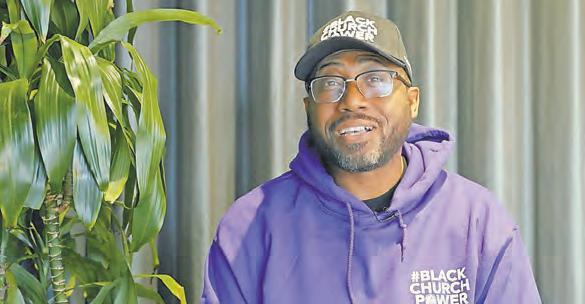
Obedience, not charity
First Fruits Farm was founded by Rick and Carol Bernstein with a mission rooted in scripture and service. The name refers to the Biblical principle of offering one’s “first fruits” to God — the best and first, not leftovers. All produce grown there is donated to feed hungry people.
Church volunteers and civic groups plant, harvest and package fresh vegetables. The food is distributed through food banks, shelters and community ministries.
After COVID, the farm distributed more than 1.1 million pounds of potatoes, 406,000 pounds of corn, 95,000 pounds of cabbage and other produce to food banks, homeless shelters, churches and households. First Fruits has delivered as far away as Texas.
“We believe God called us to grow food for people who need it most,” Bernstein said in previous interviews about the ministry’s mission. “This is not about charity — it’s about obedience and stewardship.”
That spirit of stewardship resonates strongly within the Black church, where congregations historically viewed hunger as a communal responsibility. If a member
struggled, the church responded by providing meals or groceries.
Theology of care
During the Civil Rights Movement, churches not only organized protests and voter drives; they also organized meals. Women’s auxiliaries prepared food for marchers. Congregations fed families displaced by economic retaliation.
Today, that same spirit continues through community refrigerators, mobile pantries and meal delivery programs as Black churches adapt to meet modern needs while practicing a theology of care.
In cities where grocery stores have disappeared, some congregations host weekly food giveaways serving hundreds of families. Others operate soup kitchens, school backpack programs and senior meal deliveries. Increasingly, churches are also teaching nutrition, gardening and sustainability as part of holistic ministry.
“It’s the church being the church outside the building,” Bernstein said. “The Black church has always understood the power of feeding people. Meals open doors for ministry, healing and relationships in ways few other things can.”
Voting has been extended to May 31, 2026


Why People Follow Leaders Who Truly See Them
People don’t follow titles. Titles might get someone to look your way, but they will never hold their loyalty.
People follow presence. They follow leaders who see them — not just their output, not just their performance metrics, not just what they produce under pressure… but their humanity.
When a person feels truly seen, something in them opens. Their creativity opens. Their courage opens. Their honesty opens. Their trust opens. And when trust opens, commitment follows. People don’t just work for you — they rise with you.
Leaders who cultivate this kind of presence create cultures where people don’t merely survive the work… they thrive inside it.
And here’s the truth: Seeing people isn’t complicated, but it is intentional. It won’t happen in autopilot leadership. It won’t happen when you’re rushing, reacting, or hiding behind your role.
Seeing people requires heart-work. It sounds like:
• Asking questions that move beneath the surface of the task.
• Listening without loading your rebuttal or rushing the moment.
• Noticing shifts in tone, posture, and energy — not just the words.
• Honoring their lived experience, even when it’s different from your own.
• Reading their emotional temperature and responding with care.
• Acknowledging the effort before speaking into the execution.
• Letting people know you remember something about them that matters. This kind of seeing is not just emotional work — it’s spiritual work.
It requires stillness. It requires humility. It requires discernment. It requires presence — the kind of grounded presence that says, “You matter, not because of what you do, but because of who you are.”
And let’s be honest: Many leaders don’t lead this way because they themselves have never felt seen. You cannot offer what you’ve never received. But here’s the gift for leaders who come from underestimated backgrounds or nontraditional pathways — the leaders like you, like me:
We know what it feels like to be unseen, unheard, misread, or mistaken. We know the ache of being overlooked. We know the sting of being underestimated. And those scars — those lived experiences — become our advantage. Because they sharpen our empathy. They make us pay attention. They sensitize us to the quiet pain in others that most leaders miss. When you’ve lived through seasons of invisibility, you learn to never make someone else feel that way. Your leadership becomes healing, not just functional. Transformational, not just transactional.
People don’t remember everything you say. But they always remember how they felt in your presence. Did they feel rushed? Did they feel dismissed? Did they feel like a seat-filler? Or did they feel seen?
Because when people feel seen… They go further. They stretch more. They stay longer. They give deeper. They grow faster. They believe bigger. And they follow — not out of fear, but out of trust.
This is the kind of leadership The Thriver’s Path™ teaches: leadership rooted in humanity, humility, and holy awareness. Leadership that turns workplaces into communities and teams into tribes.
When you see people deeply, you lead people differently. And when you lead people differently, they transform beyond what they ever imagined.
For more, visit OrvinKimbrough.com or MidwestBankCentre.com.
Rev. Dorothy S. Boulware Word in Black
Photo courtesy of the Black Church Food Security Network
Black churches have long helped feed struggling families. Now, a growing movement is pushing congregations beyond charity and into food justice by confronting food deserts, chronic illness and racial inequities in the nation’s food system.
Courtesy photo
Rev. Heber Brown III founded the Black Church Food Security Network after Baltimore’s 2015 unrest, helping connect Black churches and Black farmers in an effort to confront hunger, food deserts and racial inequities in the food system.
The Next MOVE