

St. LouiS AmericAn
One year later
Storm of inequity
Tornado recovery exposes preparedness gaps in North St. Louis
By Ashley Winters St. Louis American
“This memory stays with me every day.”
– DeMarco Davidson
A year after a devastating tornado tore through the St. Louis region and into parts of Southern Illinois, blue tarps still cling to rooftops across parts of North St. Louis. Vacant buildings remain partially collapsed. Families continue navigating insurance claims, housing instability and emotional trauma from a storm that exposed not only the region’s vulnerability to extreme weather, but also longstanding inequities that left some neighborhoods struggling to recover long after the winds stopped. For survivors like DeMarco Davidson and Sherrill Jackson, the memories remain immediate.
“This memory stays with me every day,” said Davidson, executive director of Metropolitan Congregations United.
Davidson and Jackson were inside Centennial Christian Church in the Fountain Park neighborhood on May 16, 2025, when the tornado struck with winds reaching 152 mph. Alongside them was Patricia Ann Penelton, a longtime church member who was killed when the storm caused the historic church to collapse.
Earlier that day, Davidson, Jackson and Penelton had remained at Centennial after serving the community. Davidson said the church’s stained-glass windows made it difficult to see the full severity of the
See Tornado, A10


It all happened here
By Sylvester Brown Jr. St. Louis American
An elderly man who identified himself only as “Mr. Lester” had no idea that an empty carton of milk might have saved his life.
Just before 2:40 p.m. on May 16, 2025, Lester decided to drive to a south side grocery store. Had he stayed home, he said, he likely would have been napping on the third floor of his Fountain Park residence when a violent tornado with winds reaching 152 mph ripped through North St. Louis.
Parts of Lester’s roof and upper floor were later scattered across his backyard. Two neighboring properties also suffered severe damage.
See Ward 12, A13

From the eye of the storm
A Fountain Park family survived the tornado — and the difficult year that followed
By Kenya Vaughn St. Louis American
When a tornado with winds reaching 152 mph tore through North St. Louis on May 16, 2025, Steven Simmons thought he was watching an ordinary spring storm gather over Fountain Park. Then he and his wife, Terran, felt their house shift beneath them.
“We just felt our house lean back and stand back up,” Simmons said.
Moments later, the next gust ripped away the roof. His wife watched it sway before disappearing entirely. The structure next door collapsed. The front door blew open. The couple crawled toward the bathroom. “We could feel the wind trying to suck us out of the house,” Simmons said. They reached the bathroom just before the entire right side of the home blew out.
“It still didn’t hit us that this was a tornado,” Simmons said. “I thought it was the rapture.”
“We just felt our house lean back and stand back up. We could feel the wind trying to suck us out of the house.”
– Steven Simmons
Grass, leaves and debris swirled around them as the storm produced what Simmons described as the sound of “a train on top of you.”
When the winds stopped, the couple stepped outside and saw straight through the side of their home into open air. Trees across
See Family, A12
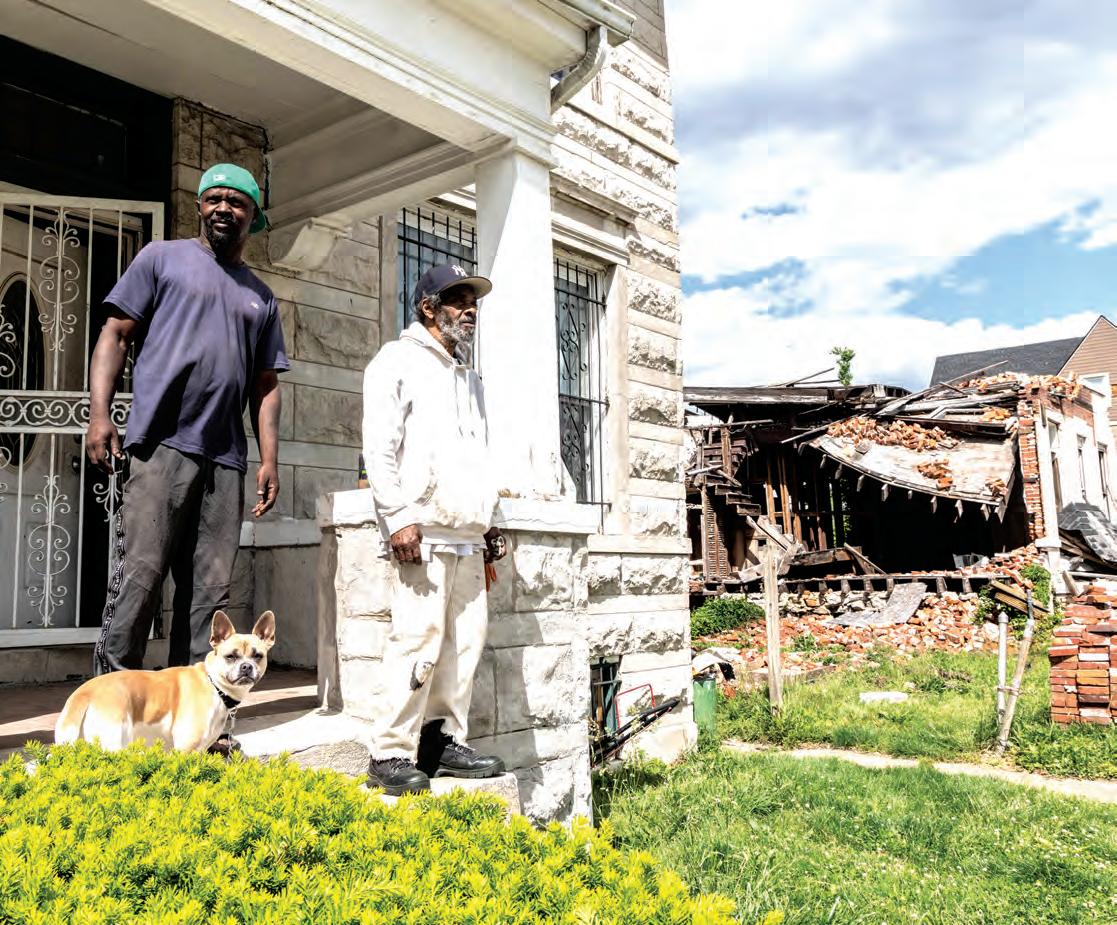
Cherrick Cramer and Larry LeSure stand outside a home off Academy Avenue as damage to a nearby structure remains visible in the neighborhood.
Photo by Lawrence Bryant / St. Louis American
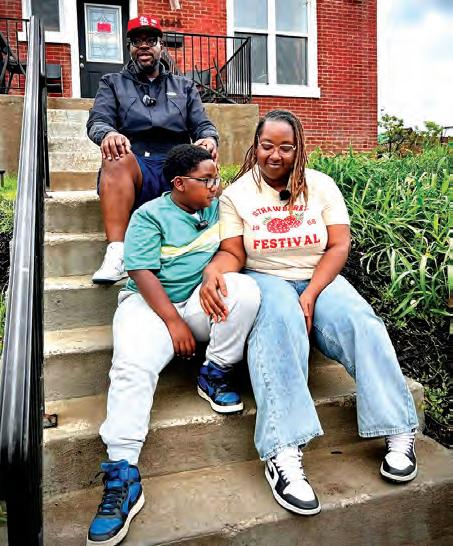
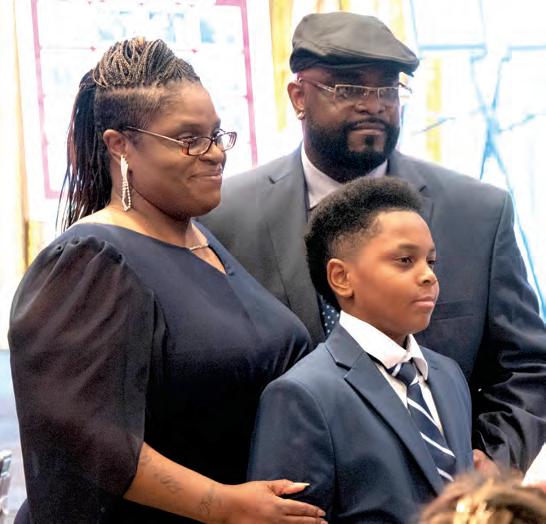
Photo courtesy of the Simmons family Steven, Terran and Terrance Simmons stand outside their Fountain Park home, which was heavily damaged in the May 16, 2025 tornado and later targeted by thieves during the family’s long rebuilding process.
A heavily damaged home near Labadie and Cora avenues in the 12th Ward sits unrepaired nearly one year after tornado damage.
Photo by Lawrence Bryant / St. Louis American
Guest Editorial
Wall Street Journal ignores reality of ‘Jim Crow’ politics
By Marc Morial
Instead of taking an objective look at the state of voting rights in this country that is rooted in its history of exploitation rather than equality, The Wall Street Journal’s editorial board came together to draft a piece titled, “Democrats Have a Jim Crow Fantasy.”
The piece suggests that the Supreme Court ruling in Louisiana v. Callais likely will have no meaningful impact on voting rights, basing its argument on the fact that Black voter turnout in midterms increased after Shelby v. Holder in 2013.
After cherry-picking statistics about midterm turnout in 2018 and 2022, the board had the audacity to state that “Many states in the South — including Florida, Georgia, North Carolina and Virginia — have no-excuse absentee voting” while completely ignoring the fact that the administration is aggressively trying to limit absentee voting ahead of this year’s midterms.
about 4-5 percentage points by 2022. Instead, it grew by roughly 9 points, nearly double what national trends alone would predict. That divergence reflects a causal effect of ending preclearance, not mere coincidence.
It doesn’t take a study to see how Louisiana v. Callais will impact Black voter representation in Congress; we can look at the arms race to redistrict the South that took place within days of the decision.

It also failed to mention that since 2020, an election with record voter turnout because of mail-in ballots, states responded by passing a record number of voter suppression laws with tactics that include enforcing strict voter ID laws, shown to disproportionately impact lower-income voters; purging voter rolls; and, in many majority-Black communities, literally removing ballot boxes. Regarding Shelby v. Holder, the piece also ignored how the decision reduced Black political participation.
Using nearly one billion individual voter-file records, researchers at the Brennan Center for Justice found that in the average county formerly subject to Section 5 preclearance, the relative participation of nonwhite voters worsened after federal oversight ended.
Critically, the study estimates that absent Shelby County, the white-Black turnout gap would have grown by only
The editorial closed by saying that “The Court’s Callais ruling may result in less racial polarization to the extent that both parties will have to compete more vigorously for minority voters rather than packing them into majority-minority districts for partisan gain.” As we see with states immediately rushing to eliminate any competition in their newly drawn maps, it’s clear that the real fantasy is both parties competing for minority voters.
Louisiana went as far as canceling its primary elections to redraw a map that could potentially eliminate all its Black districts, and Tennessee created a map that establishes a one-party system that eliminates the only sitting Black member of Congress the state has.
No one claims that today resembles 1965 Selma in form. But the data show that federal oversight mattered, and its removal disproportionately burdened minority voters.
Callais was yet another nail in the coffin of the Voting Rights Act. It co-signs the dilution of the votes of Black communities, which may result in the reduction of Black congressional representation to numbers worse than after Reconstruction.
Calling this reality a “fantasy” is not analysis; it is evasion and only underscores the urgency of restoring the protections that once enforced voting rights.
Marc Morial is president and CEO of the National Urban League.
Black voters in South could swing Senate
By Kevin Harris
Democrats have momentum as the midterms approachs. A string of recent victories has fueled optimism that Democrats could retake the House of Representatives and even reclaim the Senate. At a moment of rising global tensions and persistent economic strain on working families, Democratic control of Congress would offer a critical check on the Trump administration.
But Senate majorities are not built on national waves alone. They are won or lost in a handful of fiercely competitive states. And this cycle, the path to a Democratic majority runs directly through the South. Texas, North Carolina and Georgia could determine control of the Senate. If Democrats fail to fully invest in mobilizing Black voters, they risk repeating the mistakes that have cost them power in the past.
gins. But that progress slipped in 2022, when turnout declined. For Democrats, even modest gains in Black turnout alongside strong gains with Latino voters could transform Texas. A breakthrough victory for Democratic candidate James Talarico would flip a seat and reshape the national political map.
North Carolina presents a different kind of opportunity. The state has already been competitive for Democrats in recent years. With Black voters accounting for roughly 20% to 23% of the electorate, statewide races are often decided by razor-thin margins. A one- or two-point increase in Black turnout can determine the outcome.

That challenge has become more urgent in light of recent Supreme Court decisions that gutted the Voting Rights Act. Now, states are largely free to gerrymander and suppress Black political power.
In practical terms, that means Black voter participation is shaped not just by enthusiasm, but by the rules governing registration, district lines and access to the polls. In key Southern states, these structural barriers disproportionately affect Black voters, making sustained investment in turnout efforts even more critical.
Start with Texas. Long seen as a Republican stronghold, the state has been inching toward competitiveness as its major metro areas of Houston, Dallas, Austin and San Antonio grow more diverse. Black voters make up roughly 12% to 13% of the electorate, but Black voter turnout has been inconsistent, especially in midterm elections.
In 2020, engagement surged in urban counties, helping narrow statewide mar-
Yet, like Texas, North Carolina saw a drop in participation from presidential-year highs to the 2022 midterms. Democrats have a strong candidate in former Gov. Roy Cooper, who has consistently demonstrated the ability to win statewide.
Then there is Georgia, where the blueprint for success already exists. Black voters routinely make up nearly a third of the electorate in high-turnout elections and were instrumental in Democratic victories in the 2020 presidential election and the subsequent Senate runoffs.
What ties these states together is not just their competitiveness, but the fact that Black turnout is not guaranteed. Just because Black voters dislike Trump does not mean they are automatically ready to vote for Democrats.
If Democrats are serious about reclaiming the Senate in 2026, they must be equally serious about where they invest their time, resources and attention. That means looking South and committing, early and aggressively, to turning out Black voters in Texas, North Carolina and Georgia.
Kevin Harris is a Democratic strategist who has advised over 100 campaigns and ballot measures, including the past five presidential elections.
Testing Democracy’s collapse in Louisiana
By Julienne Louis-Anderson
Donald M. Suggs Publisher and Executive Editor ADMINISTRATION
Dina M. Suggs – Sr. Vice President
Julie Erickson – Chief Operating Officer Raven Whitener – Director, The St. Louis American


Decades ago, W. E. B. Du Bois warned, “As goes the South, so goes the nation.” That warning carries renewed weight after last week, when Louisiana experienced two significant challenges to its democratic systems.
Yet the state is also actively pushing back, positioning itself as a proving ground for both the erosion of power and the strategies to resist it.
On April 29, in a decision that eviscerated the Voting Rights Act, the Supreme Court struck down Louisiana’s congressional map. The decision effectively dismantled the largest Black voting district in the state, effectively suppressing the votes of thousands of Black Louisianans — including mine. The NAACP and the American Civil Liberties Union have already filed lawsuits challenging the ruling.
the Age” law, designed to reduce the number of underage people serving time in state penitentiaries. The governor lowered the age at which young people can be tried as adults to 17, exposing more children to the adult criminal legal system.
This is how erosion works — not through one sweeping decision, but through policy shifts that reshape outcomes over time.

Just days later, the Louisiana Legislature eliminated the position held by Calvin Duncan, a formerly incarcerated Black man who had been elected clerk of the local criminal district court. Framed as a matter of structural efficiency, the Legislature effectively fired an elected official whose job was to advance reform and accountability.
With the support of the ACLU, Duncan sued and won in federal court, restoring his power.
But what’s happening in Louisiana isn’t just policy — it’s a blueprint.
Southern states like Alabama, Tennessee, South Carolina, Georgia and Florida are advancing their own policies that similarly threaten Black voting power — moves straight out of Project 2025, the far-right road map to reshape and dismantle democratic institutions.
Since 2023, under Gov. Jeff Landry, the state has sought to restructure political systems and limit access to power, particularly for his own constituents.
One of Landry’s early actions was reversing a key component of the “Raise
But Louisiana residents have not been passive. In 2025, voters rejected all four proposed constitutional amendments that would have expanded legislative control over the courts, reshaped tax policy and altered aspects of the criminal legal system.
On May 16, Louisiana voters will face a slate of constitutional amendments that could reshape our schools, courts and communities, proposals that could directly affect how resources, justice and opportunity are distributed. Together, these bills represent a continued effort to shift power away from communities and toward politicians, another key component of Project 2025.
Georgia, Kentucky and Washington, D.C., passed more punitive crime bills. Coordinated strategies, like the “trigger laws” that activated abortion bans across 13 states, including Louisiana, show how what begins here does not stay here; the same strategies being used here to weaken voting power, reshape courts and limit rights are poised to spread nationally — and scale up.
That means the South is the critical battleground for the future of American democracy. And when power becomes more concentrated, everyday people and Black communities lose their ability to shape what happens next.
That is why this moment demands attention beyond state lines. We must listen to the warning Du Bois offered generations ago.
Columnist Marc Morial
Columnist
Kevin Harris
“The way district lines are drawn can determine which voices are heard and which communities are silenced.”
— Eric Holder
Being Men
St. Louis program helps fathers build housing stability
By Ashley Winters St. Louis American
A new partnership between Fathers & Families Support Center and Washington University in St. Louis is aiming to help Black fathers in St. Louis build long-term stability through housing support, life coaching and economic mobility services. The initiative, called “Be Men,” focuses on reducing recidivism and helping participants secure stable housing through homeownership or independent rental leases within two years.
data cited by the National Equity Atlas and local housing reports, Black renter households in St. Louis are significantly more likely than white households to face severe rent burdens, spending large portions of household income on housing costs.
The “Be Men” Initiative focuses on reducing recidivism and helping Black men secure stable housing through homeownership or independent rental leases within two years.
Organizers say the program is designed to address persistent disparities tied to income, housing access and justice system involvement.
Although statistics specifically tracking housing instability among Black fathers in St. Louis are limited because housing data is typically collected at the household level, broader housing data shows significant racial disparities across the region. According to housing
For Jared Skinner, the program arrived during a difficult period in his life.
Before joining “Be Men,” Skinner said he struggled with self-doubt and depression while trying to establish stability for himself and his son.
“I’ve always been one to handle things on my own or mask when I was on the edge of breaking,” Skinner said.
Now, he said, he is working toward a future that includes financial security, stronger support systems and independent housing.
“This program is focused on long-term stability,” said Oge Oge, a project manager and life coach with the program. “The idea is to remove barriers that prevent people from maintaining employment, supporting

their families and securing housing.”
Oge said participants often face overlapping challenges, including inconsistent income, debt and the lingering effects of trauma.
“The most common barriers that I’ve seen relate to establishing consistent, stable income, debt exceeding the income they generate, and generational cycles they have to overcome,” he said. Through the program, Skinner said his understanding of independence has changed.
“They taught that no man is an island,” he said. “You need people and their unique characteristics to help you in different

Jared Skinner sits inside the Fathers & Families Support Center, where he is participating in the “Be Men” life coaching program aimed at helping Black fathers build stability, strengthen family connections, and work toward independent housing.
aspects and stages of life.” Skinner said the experience challenged beliefs shaped by family, culture and societal expectations.
“I now know a man can ask for help,” he said. “A man can rest and not be judged based on his performance. We’re still human.”
For Skinner, stable housing represents more than simply having a roof overhead.
“Independent housing means cultivating a positive and solid environment,” he said. “Not just maintaining a home, but creating a place where peace is easily found — where it actually feels like home.”
Participant LaRon
McGhee said homeownership once felt unattainable as rising rent and limited job opportunities forced him to work multiple jobs while trying to support his children.
“My outlook began to shift,” McGhee said after joining the program.
He said the program helped him focus on longterm goals, including improving his credit, maintaining steady employment and building generational wealth.
The program combines weekly sessions, individualized coaching and access to community resources. Participants also receive support tied to legal services, transportation, financial education, health
resources and violence prevention.
“Each week builds on the other,” Oge said. “Over time, we’re helping them either access resources immediately or create a plan to reach them when they’re ready.”
Sean Joe, who leads the Race and Opportunity Lab at Washington University in St. Louis, said the initiative is grounded in research linking stable housing, employment and strong social ties to lower rates of reoffending.
“The strongest protective factors against re-offense are stable employment, secure housing and embedded social ties,” Joe said. “That’s exactly what this program is designed to produce.”
Joe said the partnership is intended to connect academic research with direct community support while tracking outcomes related to housing stability, employment, financial health and recidivism.
The cohort-based program is already underway, with participants meeting weekly and working toward graduation.
For Skinner, stable housing means more than paying rent or owning property. He said he wants to create “a positive and solid environment” where peace can be found and where his son can grow up with stability.

Photo by Lawrence Bryant / St. Louis American
Missouri Supreme Court upholds new congressional maps
The Missouri Supreme Court on Tuesday upheld newly redrawn congressional district maps backed by Republican lawmakers, clearing the way for the boundaries to be used in the November midterm elections.
In a series of rulings issued hours after oral arguments, the court rejected challenges claiming the maps violated constitutional standards for compactness and contiguity. The court also ruled that a referendum effort seeking to place the maps before voters did not automatically block the new districts from taking effect.
The revised map, approved during a special legislative session last year, is designed to strengthen Republican advantages in Missouri’s congressional
Study links environment, health disparities in St. Louis
A new report from Washington University in St. Louis examines environmental racism across the St. Louis region and outlines recommendations aimed at reducing disparities in health, housing and environmental conditions.
The updated study builds on a 2019 report and includes expanded data on issues such as asthma, air quality, illegal dumping and housing conditions. Researchers also added recommendations focused on policy changes and community response efforts.
Among the proposals are more frequent updates to Missouri’s environmental health tracking database, expanded air-quality monitoring in the city and additional testing for soil contamination in public spaces used by children.
The report also recommends improving data collection on mold complaints in rental housing and addressing vacant properties and illegal dumping.
Researchers said natural disasters, including the May 2025 tornado in St. Louis, can deepen existing inequalities in neighborhoods with older housing and fewer re
delegation.
The changes split Kansas City into three separate districts and expand the territory represented by Democratic U.S. Rep. Emanuel Cleaver — one of only two Black members of Congress representing Missouri — from his urban Kansas City base into rural central Missouri.
The state’s other Black congressman is Democratic U.S. Rep. Wesley Bell, whose 1st District includes all of St. Louis and much of North St. Louis County, including Clayton, Ferguson and Florissant.
Opponents argued the new districts weaken representation and could create voter confusion ahead of the election.
Spencer criticizes police board lawsuit
Cara Spencer criticized the St. Louis Board of Police Commissioners this week after it filed a lawsuit seeking about $67.6 million in additional police funding.
The lawsuit asks a judge to require the city to include Rams settlement funds and reserve balances in calculating police funding under Missouri law. Spencer said the demand could threaten city services, tornado recovery efforts and infrastructure spending.
The dispute follows Missouri’s 2025 takeover of the St. Louis Metropolitan Police Department and a state law requiring at least 25% of general revenue be allocated to policing.
WashU receives record $200 million gift
Washington University in St. Louis has received a $200 million donation for its School of Public Health, the largest gift in the university’s history.
The contribution from the Bursky Family Foundation will support faculty hiring, scholarships and research initiatives at the school, which launched in January 2025, the university said.
The school will be renamed the Andrew M. and Jane M. Bursky School of Public Health in recognition of the donation from alumni Andrew and Jane Bursky.

Commentary
Never too late to celebrate mothers
By Dr. E. Faye Williams
In 2022, I became seriously ill for the first time in my life. I could’ve stayed in bed feeling sorry for myself. I could’ve asked, “Why me, Lord?” There was still so much ahead of me I wanted to do, and giving up was not one of the choices Mother had taught me.
Like many Black women, she worked all her life to give her nine children the best she could — even during times when it was obvious she was ill. My father had the luxury of being able to walk away when times were hard, but Mother stayed the course and took care of us. She had nine children, with none of us old enough to go out and get a job to help her with the bills.
We never missed a meal. We never stayed out of school more than a day for something she needed us to do. We walked miles in the rain, sleet and snow until Mother figured out how to get a bus to pick up children in our area.
jobs, too. You probably won’t read my article before Mother’s Day, but that’s okay. Whenever you read what I am saying about mothers, they should be recognized every day. My mother went to heaven right at 100 years old. My friend Dick Gregory always said that once somebody reached 99 and a few months, you could say they made 100 because you have to count the nine months they spent in their mother’s womb.
I began this note to say that even if you didn’t get a chance to spend Mother’s Day with your mom, don’t forget to do something for her if she is still on this earth. Thank her. And if she has gone on to be with the Lord, then do something every day that would have made her proud of you. It’s never too late to show appreciation, and mothers always deserve it.

We lived so far back in the woods that I didn’t even know the real name of the place where we lived. All I knew then was that we lived on Little River. I later learned the place was called Melrose, Louisiana.
My mother worked every single day except Sunday. That was always church day. I never heard her complain. She never allowed us to say negative things about anybody — including my father, who walked out on us when I was only 11 years old. We always had to assist our neighbors, who often didn’t seem to have the same work ethic Mother required of us. So when our neighbors needed help, we helped them do whatever needed to be done.
We could never say “bad words” to anybody — including our sisters. Our two brothers were much younger by the time several of us girls were already leaving home for marriage, college or jobs, so we had to learn what some today would call boys’
Those lessons from my mother are why I continue to admire women who respond to difficult times not with despair, but with action.
My sisters — meaning Jotaka Eaddy, Donna Brazile, Sherrilyn Ifill, Stacey Abrams, Janaia Nelson, Latasha Brown and the women of Win With Black Women — were already preparing to guide us on what we should be doing to preserve our voting rights after the troubling Louisiana v. Callais case that threatened our right to be represented by people who have our best interests at heart.
Just like mothers, they didn’t sit around and moan and groan about how terrible the case was regarding our voting rights. They reminded us of our responsibility to register people to vote, teach them the issues and never forget our responsibility to vote ourselves.
Just like mothers, they went right to work to give us guidance by spelling out what we can do to make positive things happen for us despite the negatives.
E. Faye Williams is president of The Dick Gregory Society, which preserves the legacy of the late comedian, civil rights activist, health advocate and St. Louis native

E. Faye Williams

Inheriting a paid-off house can provide significant built-in equity, but heirs should first confirm
understand tax implications, and decide whether keeping,
Home sweet home
What to know when inheriting a paid-off house
BlackPressUSA
Inheriting a paid-off house can provide significant builtin equity, but heirs should first confirm ownership, understand tax implications, and decide whether keeping, renting, or selling the property best supports their financial goals. Taking time early to assess the property’s legal status, condition, and costs can help preserve its value and prevent costly mistakes.
For many heirs, a home tied to family memories can quickly become both an emotional responsibility and a major financial asset. Moving from grief to practical decision-making can be difficult, but careful planning can help turn the property into a stable long-term opportunity.
What happens legally when you inherit a paid-off house?
The legal process depends largely on how the property was structured before the owner’s death.
If the home was held in a trust, ownership may transfer directly to the named beneficiary with fewer delays. If it passes through a will, the estate typically goes through probate, where a court validates the will and oversees the transfer. During this period, the home may not be immediately available for sale or refinancing. The executor or personal representative is generally responsible for managing the property, including ongo-
Small-business owners urged to embrace AI strategically
By Mark S. Lee Michigan Chronicle
Artificial intelligence and smart technology are rapidly changing how businesses operate, market and grow. For many entrepreneurs and small-business owners, the question is no longer whether to use AI — but how to use it effectively and profitably. The good news is that AI is no longer reserved for large corporations or tech startups. Many of today’s tools are affordable, easy to use and designed to help businesses work more efficiently, connect with customers and create new revenue opportunities. Rather than replacing human interaction, AI can help support and strengthen day-to-day operations in a cost-effective way.

tine, time-consuming tasks. Tools that manage appointment scheduling, invoicing, payroll and customer reminders can free up time for business owners to focus on strategy, sales and customer relationships. AI-driven chat tools can answer common customer questions after hours, while bookkeeping software can identify cash-flow trends before problems arise.
Use technology to make better financial decisions
Access to capital and cash-flow management remain major concerns for many small businesses. Financial technology tools can analyze spending patterns, forecast revenue and flag potential risks before they become serious problems.
Dixson, Grant honored by Women of Achievement


Staycee Dixson and Ivy Grant have been named 2026 Women of Achievement honorees.
Dixson, a licensed foster parent, has provided care for more than 50 children, including youths with emotional needs and pregnant teens. Through the Rise of the Champions Foundation, she supports foster youths and families facing difficult circumstances.
Grant, founder of the I Am My Sister Foundation, focuses on financial education, credit counseling and homeownership training for women and families.
Amadou honored by museum alliance
Okunsola M. Amadou has received a Nancy Hanks Award for Rising Stars from the American Alliance of Museums.

Okunsola M. Amadou
Amadou is founder in residence of The Historic Jamaa Birth Village Cultural Heritage Center and founding chief curator of the African Indigenous Midwifery Museum and African Indigenous Midwifery Library & Research Institute.
She is Missouri’s first African American certified professional midwife and the state’s first Black registered CPM preceptor. Amadou also founded Missouri’s first Black midwifery clinic and school.
JCRC recognizes Jackson for civic leadership

The Jewish Community Relations Council of St. Louis will honor Clarence Jackson with its Norman A. Stack Community Relations Award during the organization’s annual Tzedek Awards on May 20 at the Clayton Plaza Hotel. Jackson is executive director of the Ecumenical Leadership Council of Missouri’s St. Louis chapter. He previously became the first African American executive at KMOX radio and later founded DDC Advertising & Public Relations.

Royal Lyon, a political science major at Lincoln University, has been named to the ALL IN Campus Democracy Challenge’s 2026 Student Voting Honor Roll. Lyon, a member of Omega Psi Phi Fraternity Inc., was recognized for efforts to encourage voter participation among students. He also has participated in discussions with Missouri lawmakers on public policy issues. The ALL
Staycee Dixson
Envato photo
Clarence Jackson
For many heirs, a home tied to family memories can quickly become both an emotional responsibility and a major financial asset.
Many of the tools available today are affordable, easyto-use, and designed to support teams. Not necessarily replacing human interactions, but enhancing in a cost-effective manner.
Photo by Surface/Unsplash
Ivy Grant
Business Briefs
Alaska Airlines adds non-stop to Portland, Oregon
Alaska Airlines launched nonstop this week service May 13 between St. Louis Lambert International Airport and Portland International Airport in Oregon, marking a second direct route from St. Louis to the Pacific Northwest.
The airline, which has operated at Lambert since 2013, already offers nonstop service to Seattle. It also provides seasonal service to Puerto Vallarta, Mexico, between January and April.
Alaska Airlines will operate one daily flight between St. Louis and Portland seven days a week. The service is scheduled to run through Oct. 2.
Home
Continued from A5
ing expenses and basic upkeep, until the legal transfer is complete. Once the deed is transferred, legal ownership becomes official.
Selling an inherited home
Selling a paid-off inherited home is often the simplest way to convert the asset into cash, especially if the property requires substantial repairs, does not fit your lifestyle, or is shared among multiple heirs. Co-heirs may need legal guidance if disagreements arise. Before listing, determine the home’s market
Metro
East attraction reopens
after renovations
The Lewis and Clark Confluence Tower in Hartford, Illinois, is set to reopen May 14 following a renovation project aimed at expanding the site’s appeal as a tourism and recreation destination, according to the St. Louis Business Journal.
The 180-foot tower near the confluence of the Mississippi and Missouri rivers underwent upgrades that include improvements to the observation tower, expanded visitor amenities, public art and a new children’s play area. Officials also updated exhibits highlighting the Lewis and Clark Expedition and the surrounding river region.
Local leaders hope the renovations will help draw additional visitors to the Metro East tourism corridor.
value through a professional appraisal or comparative market analysis. Accurate pricing can improve buyer interest and reduce the risk of prolonged time on the market. Property condition also matters. Some homes may benefit from modest improvements such as fresh paint, cleaning, minor repairs, or updated hardware, while others may be better sold as-is if renovation costs outweigh potential returns. Market timing, mortgage rates, and local demand can also influence sale price and speed. Evaluating these factors before selling may help maximize value.
Keeping an inherited home
Keeping a paid-off
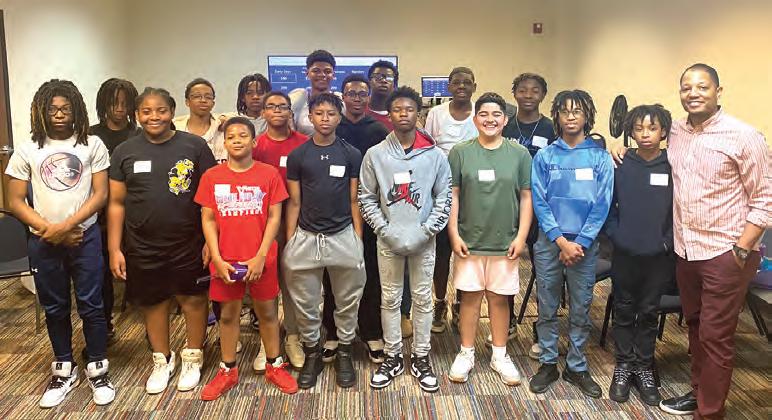
The SLATE Summer Youth Employment program helps young workers develop job readiness skills while building their resumes. Each participant is paired with a job coach to help explore career interests.
SLATE opens summer employment programs for city youth
St. Louis Agency on Training and Employment is accepting applications for several youth employment and job-training programs aimed at St. Louis residents ages 16 to 24.
The agency’s Summer Youth Employment Program provides paid work experience and job-readiness training for young people seeking employment skills and career exposure. Participants are paired with job coaches who assist with career planning, resume preparation and financial literacy training.
SLATE also offers programs for out-of-school youth ages 17 to 24, including educational support, job training and employment services through partnerships with regional organizations.
A separate Youth Empowerment Program targets residents ages 19 to 24 with work-based learning opportunities and career development support.
Additional information and application details are available through SLATE Missouri Job Center

inherited house can offer housing stability or rental potential, but ownership still comes with ongoing

responsibilities. Property taxes, insurance, maintenance, utilities, and upgrades should all factor into the decision. A home that appears valuable may still prove burdensome if it requires major repairs or carries high annual costs.
A full inspection can help identify aging systems or deferred maintenance. Prioritizing structural and safety repairs early can help prevent larger expenses later.
Maintenance priorities
A practical maintenance plan often includes:
• Roof, gutters, and
Rather than constantly reacting to financial pressure, business owners can make more informed decisions and plan ahead.
AI also can help businesses identify inefficiencies, reduce waste and improve profitability over time.
Monetize, don’t just modernize
The greatest value of AI may not simply be saving time — it may be generating additional revenue. Businesses can use AI to personalize marketing based on customer behavior, increasing repeat purchases and improving customer engagement.
Retailers can analyze sales trends to recommend complementary products automatically. Service providers can use automated follow-ups to encourage referrals or upsell premium services. Restaurants can analyze online ordering data to promote add-ons and increase average ticket size.
AI tools also can help refine pricing strategies by analyzing demand trends and competitor pricing. Even modest pricing improvements can significantly affect profitability.
Technology may also create entirely new rev-
drainage checks
• HVAC servicing
• Plumbing inspections
• Electrical system testing
• Window and door sealing for energy efficiency
Exterior upkeep, including landscaping and repairs, can also help preserve value.
Common mistakes
One of the biggest mistakes heirs make is rushing decisions without fully understanding legal, tax, or financial implications.
Selling too quickly, skipping valuation, or failing
enue streams, including digital products, online services and expanded e-commerce opportunities.
Level the playing field in marketing and outreach
Marketing budgets are often limited, especially for small businesses. AI tools can help close that gap by assisting with social media posts, email campaigns, website content and customer surveys.
Used correctly, AI can help businesses communicate more consistently and professionally without losing authenticity.
The goal is not to sound robotic. The goal is to be clear, visible and engaging while maintaining a genuine voice that connects with customers.
Protect your business
As businesses rely more heavily on digital tools, cybersecurity becomes increasingly important. A single data breach or scam can create major financial and reputational damage.
AI-enabled security systems can monitor unusual activity, identify potential fraud and help protect customer information.
Customers expect businesses to safeguard their personal information responsibly, making cybersecurity an important part of maintaining trust.
Keeping a paidoff inherited house can offer housing stability or rental potential, but ownership still comes with ongoing responsibilities. Property taxes, insurance, maintenance, utilities, and upgrades should all factor into the decision.
to coordinate with co-heirs can reduce overall value.
Deferred maintenance, liens, unpaid taxes, or structural issues can also turn an inherited asset into a financial burden.
Bottom line
Inheriting a paid-off home can create meaningful financial opportunity, but it also requires careful legal, financial, and practical planning. Understanding ownership, evaluating costs, and making informed decisions can help heirs protect and maximize the property’s value.
Invest in people, not just platforms
Technology works best when employees understand how to use it confidently.
Business owners should focus on training and skill-building so staff can adapt to new tools and workflows. This does not require advanced technical expertise. Online tutorials, workshops and peer learning can go a long way toward improving comfort and productivity. When employees view technology as a support system rather than a threat, adoption becomes easier and more effective.
Keep relationships at the center Technology should enhance relationships, not replace them. Businesses still succeed by building trust, providing good service and understanding customer needs.
AI can help companies operate smarter and remain competitive, but the human element remains essential. To be clear, AI is not a cure-all. It is a tool — a powerful one — that can help businesses improve operations, identify opportunities and adapt to changing economic conditions.
Used thoughtfully, AI can help businesses keep up and grow with change.
Envato photo
Photo courtesy of SLATE
HealthMattersHealthMattersHealthMatters

A Centers for Disease Control and Prevention Maternal Mortality Review Committee found that deaths tied to mental health conditions rose from 22.7% in 2021 to 27.7% in 2022.
Raise awareness, sound the alarm
Mental health issues now the top cause of maternal deaths
By Jennifer Porter Gore Word in Black
ompared to white women, Black women are still far more likely to suffer pregnancy-related complications or die than the overall population in the United States. Increasingly, experts say, the crisis is tied not only to physical care but also to mental health.
to 27.7% in 2022. Suicide now accounts for roughly one in five pregnancy-related deaths. For Black women, almost 17% of pregnancy-related deaths were due to mental health conditions — roughly double the rate from the year before.

A Centers for Disease Control and Prevention Maternal Mortality Review Committee found that deaths tied to mental health conditions rose from 22.7% in 2021
Studies show Black women report suicidal thoughts at roughly twice the rate in the months after childbirth while facing steeper barriers to diagnosis, treatment and consistent care.
Word In Black spoke with Dr. Joy Baker, an OB-GYN practicing in rural Georgia, about how mental health, systemic barriers and access to care shape outcomes for mothers, particularly Black women. The conver-
See Mental Health, A8
One in four Missourians report barriers to birth control
By Sarah Fentem St. Louis Public Radio
One in four Missourians say they’ve encountered obstacles obtaining birth control, according to a new survey of about 1,000 Missouri residents conducted for the Missouri Foundation for Health.
The survey of Missourians ages 18 to 35 found widespread support for birth control, with 85% of respondents favoring “access to all methods” of contraception. But about one-third said they were worried about future access to birth control.
The poll was commissioned through the Missouri Foundation for Health’s Right Time Initiative, which advocates for “quality reproductive health education and services” for Missouri residents.
Ways to boost your liver health
By Dr. Graham A. Colditz
Most of us don’t think too much about the liver. And that’s normal. Hearts and lungs seem to get far more health headlines and social media posts. But like all organs, the liver quietly does important work. Among other jobs, it clears toxins from the body, stores energy and helps with immunity.

So, there are a lot of great reasons for us to take steps to improve our liver health. And none is bigger than helping lower the risk of liver cancer.
“Liver cancer doesn’t get as much attention as some other cancers, but it’s serious,” said Yikyung Park, a cancer researcher and professor in the Division of Public Health Sciences at WashU Medicine.
Key causes of liver cancer include heavy alcohol drinking, infection with the viruses hepatitis B or hepatitis C, and scarring of the liver, called cirrhosis.
“Although it’s not one of the most common cancers, it is a leading cause of death from cancer — ranking fifth in men and seventh in women.”
Key causes of liver cancer include heavy alcohol drinking, infection with the viruses hepatitis B or hepatitis C, and scarring of the liver, called cirrhosis. Smoking, obesity, diabetes and a condition called fatty liver disease also increase the risk. And many of these factors can overlap with each other.
The good news?
“Liver cancer is preventable,” Park added. “Reducing risk factors and getting regular medical care are important, especially for people who know they already have some type of liver disease.”
See Colditz, A8
“The poll reflects what we already know to be true: that the majority of Missourians believe in access to birth control.” – Michelle Trupiano
“We know that birth control is utilized by the majority of people at some point in time in their life, and that, you know, the poll reflects what we already know to be true: that the majority of Missourians believe in access to birth control,” said Michelle Trupiano, executive director of the Beacon Reproductive Health Network, which leads the Right Time initiative.

She said the poll suggests Missourians “want their elected officials to do more
Photo Envato
Envato photo
A recent survey found that one-third of Missourians ages 18 to 35 were worried about future access to birth control such as contraceptive pills and condoms.
Dr. Graham A. Colditz
HealthMattersHealthMattersHealthMatters
Care of You’
Mental Health
Continued from A7
Word In Black: What do you think should be the headline of this story?
Dr. Joy Baker: “For me, the headline is always the same: we need to raise awareness and sound the alarm about the fact that mental health disorders and substance use are the number one cause of [maternal] death across the country.”
“If you think about preeclampsia — or folks who are having uncontrolled anxiety with abnormal heart rates and rhythms — we’re doing all of these million-dollar workups, and then we conclude that this may actually be due to untreated anxiety.”
WIB: You mentioned rural health as something we didn’t cover. How does geography play a role?
Baker: “Rural [communities] lend themselves to more isolation, less support, and more difficulty seeking the care patients need.
“Although in this particular study, folks in rural settings did not seem to suffer from the same health disparities in terms of readmission rates, I can tell you from having worked in several rural communities that we certainly did see higher rates of folks dealing with perinatal mood and anxiety disorders.”
WIB: What should we know about the significant increase in suicidality in Black women?
Baker: “Suicidality in Black women increased

by about 10 times, which is startling. Substance use disorder goes hand in hand with all of this, because people are just self-medicating.”
WIB: Beyond the mental health component, what is the intersection between mental health and physical health?
Baker: “Especially in pregnancy, you can see increased risk of preterm birth, low birth weight,
Continued from A7 sation has been edited for clarity.
Studies show Black women report suicidal thoughts at roughly twice the rate of other postpartum women while facing greater barriers to diagnosis, treatment and ongoing care.
hypertensive disorders of pregnancy, and diabetes in pregnancy.”
“Living in that

high-cortisol state when folks have really high anxiety is not healthy for the body. That’s one of the
Birth Control
Continued from A7 to support access and to make [birth control] more accessible.”
Beacon is the new name of the Missouri Family Health Council, an organization that for years has distributed millions of dollars in federal Title X funding for birth control and family planning services. The Title X program has provided family planning services through
Colditz
Work on boosting your liver health with these steps:
Get a screening test for hepatitis B and hepatitis C. Infection with these viruses can damage the liver and increase the risk for cancer. And most people who have them may feel normal and not know anything is wrong. Hepatitis C can be treated, and therapies can limit damage from hepatitis B, so it’s recommended that all adults get a simple blood test for both. It’s usually just a one-time appointment. Ask your doctor or clinic about it. Get vaccinated for hepatitis B. This is a very safe and effective way to prevent infection with hepatitis B. While most adults in the U.S. have been vaccinated, many have not. So, ask your doctor if you should get the vaccine, and encourage new and expectant parents in your life to follow guidelines and protect their children with the vaccine as well.
Limit alcohol — zero is best. Limiting how much we drink is an important way to lower
or Tylenol or Motrin, shortness of breath, or chest pain — those can all point to physical problems for newly delivered moms. But mental health is just as important.
“If someone is not sleeping or sleeping too much, not eating or eating too much, no longer taking pleasure in things they used to enjoy, having crying spells that last longer than the first two weeks, or not wanting to bond with their infant — those are all signs that they need to have some diagnostic testing done.
“If you’re able to get in front of these issues early, you can prevent some of the problems we’re seeing with substance use disorders and suicide.”
WIB: When you say ‘two weeks,’ are you referring to two weeks of symptoms, or two weeks after delivery?
Baker: “Most people may have some emotional lability during the first two weeks after delivery — they may be up and down. We think postpartum blues should be gone within the first two weeks, but honestly, I see patients who are already struggling before they deliver.
key factors in a condition known as ‘weathering,’ in which the body ages due to living in traumatic, stressful situations.”
WIB: What should family members, friends and loved ones do if someone who has recently delivered a baby is struggling?
Baker: “If they’re seeing physical signs of distress — heavy bleeding, swelling, headaches that don’t go away with rest
public and nonprofit agencies since 1970.
The organization’s $8 million annual budget supports birth control and family planning programs at dozens of clinics in Missouri and Oklahoma, Trupiano said.
About one-quarter of respondents to the Right Time survey said cost and insurance issues have made accessing their preferred birth control difficult.
“Definitely lack of a nearby clinic has been a barrier,” she said. “A lack
the risk of liver diseases and liver cancer. And with the many other risks from moderate — and even light — drinking, not drinking is the healthiest choice overall.
Maintain a healthier weight — focus on healthy eating and physical activity. Weight gain and obesity increase the risk of fatty liver disease, which is an increasingly common cause of liver cancer in the U.S. Being physically active and eating a healthy diet rich in fruits, vegetables and whole grains can help keep weight under control. Together, they can also help lower the risk of diabetes — another risk factor for liver cancer. If you’re looking for help with your weight, talk to your doctor or health clinic for advice.
Don’t smoke — get help quitting if you do. Liver cancer is one of the many cancers caused by smoking. If you don’t smoke, be sure to stay smoke-free. If you do smoke, try to quit. You can do it. Smokefree.gov and 1-800-QUIT-NOW have many free tools that can help.
If you have liver disease, see a doctor regularly. Keeping up with medical care for your liver
“I talk to my patients a lot about this. Everybody wants to come and visit the baby — tell them to pick up laundry detergent. Ask somebody to stop by and get dinner.
“We talk a lot about engaging your support network, and I think the message we have to start giving our community is: what can you do to hold this mama, hold these parents, and help with the baby?”
of transportation, the cost or insurance, wait times and lack of time to get to a clinic are all barriers that people experience throughout the state.” Trupiano said she supports legislation before the Missouri General Assembly that would allow patients to receive a year’s worth of birth control at one time.
The poll defined birth control as hormonal methods such as IUDs, pills and patches, as well as emergency contraception.
disease is very important. It can help lower the risk of developing cancer — and if cancer develops, it can help find it earlier when it’s more treatable. A recent international report in The Lancet highlighted the power that prevention can have, estimating that 60% of liver cancers across the globe could be avoided through steps most people can take.
Park concluded by saying that while some people think that only heavy drinkers get liver cancer, drinking is just one of many important behaviors that impact risk for the disease:
“Simple actions can have real benefits. Knowing hepatitis B and hepatitis C status and making lifestyle changes — like not smoking, eating a healthy diet and getting to a healthier weight — can lower the risk of liver disease — and the risk of liver cancer.”
Dr. Graham A. Colditz, an internationally recognized leader in cancer prevention, leads prevention research at Siteman Cancer Center at BarnesJewish Hospital and WashU Medicine in St. Louis.
Dr. Joy Baker said that in one particular study suicidality in Black women increased by about 10 times. Envato photo
Cardi B scored another legal win this week after a Florida judge ruled that blogger Tasha K violated the nondisparagement terms of their bankruptcyrestructured settlement — the latest flareup in a feud that has stretched across years and courtrooms.
The dispute stems from Cardi’s 2022 defamation victory, which originally carried a $3.9 million judgment. That amount was later reduced to a $1.2 million repayment plan after Tasha K filed for bankruptcy — with a strict clause barring her from publicly discussing Cardi B, Offset, or Stefon Diggs According to AllHipHop. com, Cardi’s attorney Lisa Moore argued that Tasha K crossed the line again by making new comments about Offset, including references to alleged gambling issues and a recent Florida casino shooting. On May 6, the judge agreed,

Pras reports to prison

Fugees member Pras Michel has begun serving his 14-year federal sentence, surrendering last Thursday to the Federal Correctional Institution in Safford, Arizona, according to Rolling Stone. His legal team continues to fight his 2023 conviction, which they argue was tainted by violations of his rights.

Pras Michel
Michel was convicted last year on multiple counts tied
to an international conspiracy involving illegal lobbying, campaign finance violations, and money laundering. Prosecutors said he helped funnel foreign money into U.S. politics without registering under the Foreign Agents Registration Act.
He was sentenced on November 20 and ordered to forfeit $64 million to the federal government.
NeYo says polyamorous lifestyle is costing him deals
Music star NeYo says his love life is hitting his bottom line. During an appearance on the Sorry We’re Cyrus podcast, the singer claimed he has lost business opportunities because he’s openly in a polyamorous relationship with three women.
“The world is mad at the fact that I’m in a polyamorous relationship,” the 46-year-old said, adding that some companies told him they “don’t know if they can get behind” his lifestyle.
“It’s almost like you can be a great person. You can show respect and appreciation [for your fans and colleagues], but the second you do something that they don’t agree with, canceled, you know what I mean? And that just doesn’t make any sense to me,” Ne-Yo said.
NeYo — who divorced Crystal Renay in 2022 — said he now lives with all three partners, Arielle Hill, Cristina and Moneii, along with their children.
Kevin Hart and Katt Williams surprised comedy fans when they put their longstanding beef to rest Sunday night at The Roast of Kevin Hart, held at Los Angeles’ Kia Forum as part of the Netflix Is a Joke Festival.
Williams was a surprise among the Alist roasters, who included Dwayne “The Rock” Johnson, Lizzo and Teyana Taylor, to name a few. Williams said he only took the gig for the money.
thing from me,” Williams said. “Before he saw my act, he was a 6-foot-3 white man.”
“I won an Emmy Award, but this is gonna be my best acting tonight as I pretend you are a GOAT,” Williams said. He also joked about the origins of their beef. “Privately, this [expletive] stole every-
Hart then jumped up and addressed Williams directly.
“Me and this man have been at odds for years and years. You coming out here is quite the [expletive] surprise,” Hart said. “But Katt, I can sit and watch and laugh because
I’m a [expletive] fan, OK? Katt, we have an opportunity in real time — this is live television — to put our [expletive] beef behind us. I am offering you an olive branch of peace. I want to be your brother; I want to be your friend. Katt, can we move on?”
The two then embraced as the crowd rose to their feet.


Tornado
Continued from A1
storm outside, though he noticed the sky darkening and the lights beginning to flicker.
“The lights went out and I started to hear the tink tink noise of the hail,” Davidson recalled.
Moments later, the church shook violently. The roof collapsed, trapping Davidson and Jackson beneath the rubble for roughly 90 minutes as Davidson repeatedly tried calling 911.
“I just kept saying, ‘Keep praying, keep praying,’” he said.
Nearly a year later, Centennial Christian Church, a more than 120-year-old Fountain Park landmark, has been demolished because of structural damage caused by the tornado. Despite losing their historic home, church leaders say they still plan to rebuild.
As St. Louis marks the first anniversary of the storm, residents, healthcare workers and community leaders say the tornado revealed how climate change, aging infrastructure and decades of disinvestment collided in North St. Louis neighborhoods already facing economic hardship and housing instability.
The nearly mile-wide tornado remained on the ground for roughly 27 minutes, carving a path of destruction through North St. Louis neighborhoods before continuing east into Illinois. Thousands of homes, churches and businesses were damaged or destroyed.
The tornado caused an estimated $1.6 billion in damage and was one of
Recovery and reckoning
23 billion-dollar weather disasters nationwide in 2025, according to Climate Central. Missouri recorded a preliminary 120 tornadoes that year, potentially the highest number in state history. Scientists say climate change is contributing to more extreme weather across the Midwest, raising new concerns about how prepared cities like St. Louis are for increasingly destructive storms.
Mayor Cara Spencer acknowledged that the city was not fully prepared for a disaster of the tornado’s magnitude, particularly in neighborhoods that had already endured decades of disinvestment and deteriorating infrastructure.
“We fell short in a lot of ways,” Spencer said. “Not the fault of any one mayor or elected official. This spans a long time.”
As government systems slowly mobilized, community organizations
including the Urban League of Metropolitan St. Louis, Metropolitan Congregations United, Action St. Louis, 4theVille, Invest STL and Dream Builders for Equity stepped in to distribute food, coordinate volunteers and help stabilize damaged homes.
Since the tornado, the city has reorganized portions of its emergency management operations and expanded severe-weather preparedness efforts following reviews of the storm response.
Spencer said recovery remains ongoing and heavily dependent on partnerships among nonprofits, residents and government agencies.
“We have many things to be proud of, but equally important, we have much work ahead,” Spencer said. “It is only through partnership that we are going to be able to continue to
put one foot in front of the other — to continue the work to make North St. Louis whole, to make North St. Louis healthy, to make North St. Louis thrive.”
She said the scale of the devastation continues to exceed available resources.
“We have a $2 billion hole that was carved through our community,” Spencer said, referring to the broader rebuilding challenge facing North St. Louis. “That doesn’t mean we are going to give up. The work is underway, and the work is ongoing.”
Recovery has been especially difficult in many North St. Louis neighborhoods because large numbers of residents lacked insurance coverage before the storm.
According to the Missouri Department of Commerce and Insurance, 73% of homeowners in some of the hardest-hit areas were uninsured, leaving many
families dependent on federal aid, nonprofits and personal savings to rebuild.
For many residents, the storm’s aftermath exposed major gaps in recovery systems.
Davidson said many survivors struggled almost immediately with online aid applications, limited internet access and confusion surrounding city, state and federal assistance programs.
“We saw a massive amount of the digital divide,” he said.
Some residents, he said, simply stopped applying for help.
“Some people just gave up hope, especially during the winter months,” Davidson said.
A July 2025 Crisis Cleanup Coalition report found that 64% of assessed storm damage remained unresolved weeks after the tornado, with more than 1,200 properties still showing open damage cases.
Cristina Garmendia, policy director to Board of Aldermen President Megan Green, said the report revealed how difficult long-term recovery would become.
“At that point in time we didn’t have the full picture of the damage that was done,” Garmendia said. “The takeaway from the report showed the city had much more work that needed to be done and that it was going to get worse with time.”
For residents like Rochel Starling, recovery has unfolded one room at a time.
When the tornado struck, Starling was out of town on a women’s retreat. By the time she returned, her home was severely damaged.
“My chimney had fall-
en, splitting my den in half,” she said. “My roof was gone, two trees were uprooted, every ceiling on the second floor except one had fallen in.”
Without insurance, Starling pieced together financial assistance from FEMA, Veterans Affairs, family support and withdrawals from her retirement savings to continue rebuilding.
“It’s going to be a longterm recovery,” she said.
Dr. LJ Punch, founder of 314 Oasis, said the tornado intensified challenges many residents were already facing before the storm.
“The storm itself made things like housing, transportation, communication and physical stability much worse for many people,” Punch said.
Punch said the storm created layers of trauma that continue affecting residents long after debris removal and emergency response efforts faded from public attention.
For Mohammed Abba-Aji, a postdoctoral research associate at the Washington University in St. Louis School of Public Health, the tornado reflects broader national patterns tied to climate disasters and inequity.
“Disasters do not create inequity,” Abba-Aji said. “They expose it and accelerate it.”
One year later, survivors are still rebuilding homes, routines and emotional stability. But community leaders say true recovery will require more than repairing damaged buildings. It will require addressing the inequities, infrastructure failures and preparedness gaps the tornado exposed long before the storm arrived.

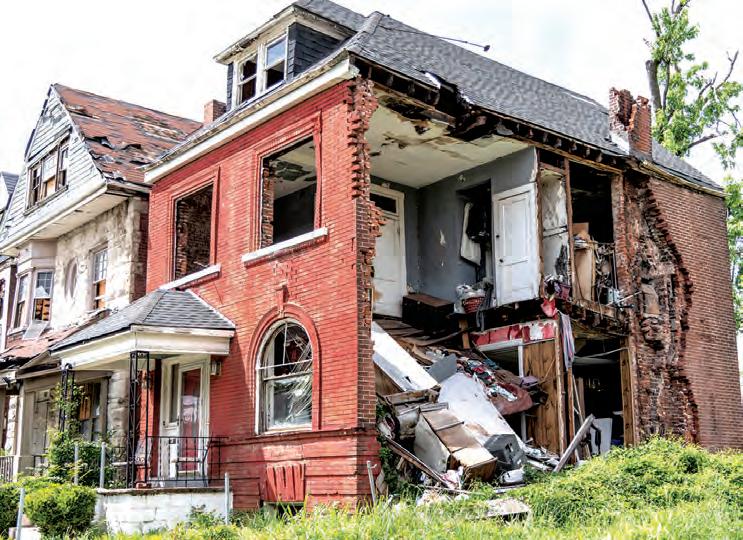
A damaged building on Kensington Avenue remains exposed nearly one year after tornado damage, with part of the structure still open and debris visible inside.
Photo by Lawrence Bryant / St. Louis American
Urban League plays central role in tornado recovery efforts
Even as it dealt with its own damage, the organization became a lifeline for survivors
By Zaria Mac St. Louis American
Despite suffering damage to its own headquarters, the Urban League of Metropolitan St. Louis became an early lifeline for displaced North St. Louis families after the May 16 tornado, placing hundreds in hotels, distributing food and helping residents navigate the storm’s aftermath.
Among those helped was Roosevelt Price, a Ward 12 resident who, along with his fiancée, Shakkia Miller, and 9-year-old son, lost his home.
“It wasn’t until we got back to the place where our home was that it started to sink in that we don’t have anywhere to live tonight,” Price said. “It was complete chaos and we ended up sleeping in our cars that night.”
Price said hotel stays cost the family nearly $2,000 in the days after the storm.
“I didn’t think the Urban League would be able to come through like they did because the headquarters was damaged,” he said. “They didn’t have power, so to see them out
helping a day or two after the tornado speaks volumes because they were affected just like us.”
The tornado caused roof and water damage at the Urban League’s headquarters, leaving parts of the building without power.
The Urban League said its tornado response over the last year included distributing more than 1 million pounds of food valued at $2.7 million, investing more than $3 million in direct assistance to more than 40,000 residents and placing 750 displaced families in hotels.
“For the last year, we have seen the utter devastation in North St. Louis even to our headquarters,” Urban League President and CEO Michael P. McMillan said. “As a result, we have worked constantly over the last year to assist the community.”
The organization helped the Price family get a three-month hotel stay, meals, Christmas gift cards and furniture for temporary housing. It is also helping them search for permanent housing.
Price said the Federal Emergency Management Agency (FEMA) and the
A Weekend of Service
and
$300,000.
“We should be a priority. This is our neighborhood,” Miller said. “We have been overlooked for so many years.”
A July report prepared for the St. Louis Board of Aldermen found that 1,260 properties still had unaddressed storm damage as of July 1.
The Urban League plans to continue its recovery efforts this week with debris cleanup Friday from 7 a.m. to 3 p.m. and a hiring and resource fair from 10 a.m. to 3 p.m. The organization also plans to distribute food, toiletries and household supplies Saturday from noon to 3 p.m., followed Sunday by deliveries of food and other resources to seniors and disabled residents.
The Urban League of Metropolitan St. Louis will host several events marking the one-year anniversary of the May 16, 2025 tornado.
• Friday, May 15, 7 a.m.-3 p.m. — Disaster cleanup. Meet at Urban League headquarters, 1408 N. Kingshighway Blvd. Information: 314615-3600.
• Friday, May 15, 10 a.m.-3 p.m. — Restoring Hope Hiring and Resource Fair at Urban League headquarters, 1408 N. Kingshighway Blvd. Information: 314-658-9303.
• Saturday, May 16, noon-3 p.m. — Distribution of food, toiletries and household essentials at Urban League headquarters, 1408 N. Kingshighway Blvd. Information: 314-615-3600.
• Sunday, May 17 — Home resource delivery for senior citizens and disabled residents. Information: 314-391-5688
Source: Urban League of Metropolitan St. Louis
Red Cross also provided assistance. He described the overall recovery process as slow and exhausting.

For residents like Pat Miller of Fountain Park, recovery has stretched on for months with little sense of closure. Miller said she
has been unable to live in her home since the tornado damaged the roof and a back wall. She estimated repairs could exceed
For Price, whose temporary housing assistance is nearing its end, recovery remains ongoing nearly a year after the tornado.
“I can’t speak for any other Urban League in any other city,” he said, “but what I’ve seen for myself and what the Urban League is doing for my family here in St. Louis, there’s no other organization that I think can stand side by side with the Urban League with all they have done to help us through the May 16 tornado.”
St. Louis American reporter Ashley Winters and Kenya Vaughn contributed to this report.

Roosevelt Price along with his fiancée, Shakkia Miller.
his 9-year-old son.
Photo courtesy of Simmons family
Family
Simmons family hit by tornado and thieves
Continued from A1
Fountain Park had been flattened. Neighbors emerged in shock, checking on one another. Simmons still had to reach his 10-year-old son, Terrance, at school in the Central West End. What normally took two minutes by car became a two-hour maze through blocked streets and destruction.
“He left that morning and his house was normal,” Simmons said. “And now it’s gone.”
The Simmons family’s Fountain Park neighborhood in Ward 12 was among the hardest-hit areas of the city, where thousands of properties were damaged and many residents faced prolonged delays involving roof repairs, debris removal and insurance claims.
The tornado destroyed the structure. The days that followed ruined nearly everything else. Because the roof was gone and no tarp arrived, rainwater poured into the home for days.
“We had maybe four to five days of nonstop rain pouring down inside the home,” Simmons said. Residents across North St. Louis described similar problems after the tornado, saying delays in roof tarping and stabilization allowed rainwater, mold and additional structural damage to spread through homes that initially appeared salvageable.
The Simmonses salvaged what they could carry — mostly clothes and small personal items. Beds, appliances, electronics and furniture remained behind as the house deteriorated.
Mold spread quickly. Ceilings collapsed.
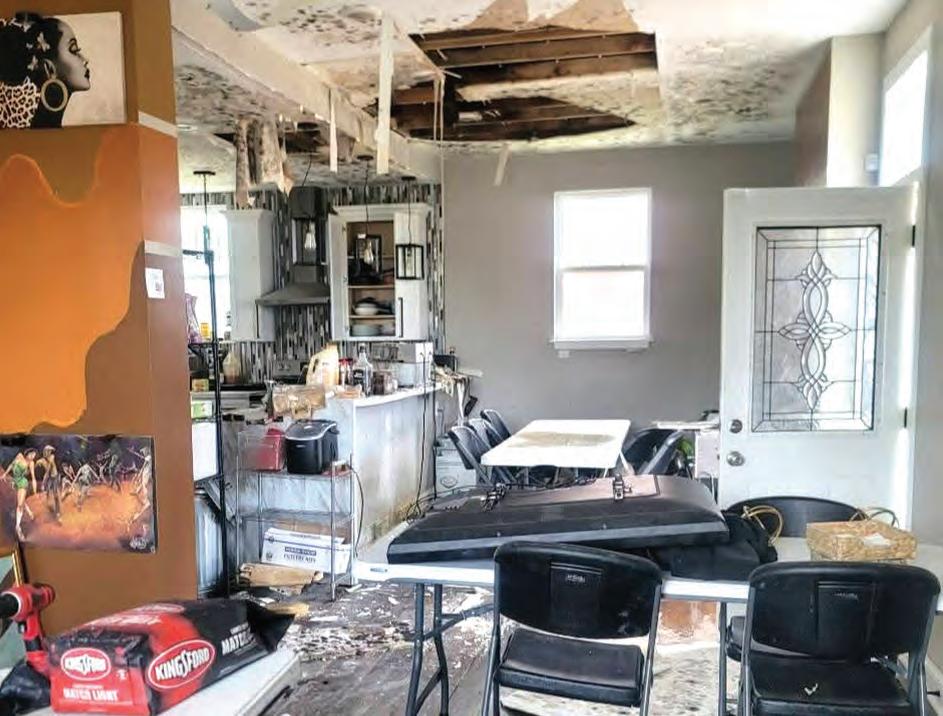
Rodents moved in. The smell of rotting food seeped through the home.
His son’s bedroom — the one room that stayed intact the longest — eventually gave way too. His wife stopped returning to the house. Their son struggled emotionally each time he saw it. And yet because they had insurance and family willing to take them in, the Simmonses consider themselves among the lucky ones. The temporary living arrangement stretched beyond 10 months. While the family stayed in North County, thieves repeatedly targeted the damaged home.
“They were able to drive up into my yard,
load up the AC units and leave,” Simmons said after two air-conditioning units were stolen.
Bricks disappeared from the property piece by piece. Someone tore off the front door trying to break inside. Even the electrical meter box was stripped for metal. To protect what remained, Simmons spent nights sleeping inside the gutted home without power, walls or flooring.
“I did that just to let anybody know there’s a presence at this house,” he said.
Simmons is a private chef whose business, The Urban Dining Room at Fountain Park, operated from the first floor of the
home. He hosted sold-out five-course brunches and dinners nearly every weekend.
The afternoon the tornado struck, he had been tasting oxtails for a Caribbean-themed dinner planned for the next evening.
He remained out of business for nearly a year.
“My bread-and-butter wasn’t running for 11 months,” Simmons said.
Customers refused refunds and instead bought donation tickets to help support the business.
Simmons said distributors donated supplies and GoDaddy waived service fees so he could receive the full proceeds.
The rebuild became
long, expensive and emotionally draining.
Insurance claims moved slowly.
Contractors were stretched across multiple tornado-damaged homes at once. Meanwhile, the family’s homeowner’s insurance payment jumped from less than $200 a month to nearly $900 after the claim was processed.
Simmons’ experience reflected broader frustrations across the tornado zone. The Missouri Department of Commerce and Insurance says roughly 19,500 insurance claims were filed after the storm, while many homeowners continued disputing payouts they believed fell short of actu-
al repair costs. The agency also reported that 73% of homeowners in some of the hardest-hit North St. Louis neighborhoods were uninsured.
People told the Simmons family they would come back “bigger and better.” Simmons never saw it that way.
“We liked our old home,” he said. “Who wanted to really go through this whole process?”
The family moved back home in April. Tornado warnings sounded again that same week.
“You see this person build your home, but you don’t trust it,” Simmons said.
His son moved carefully through the house, afraid to break anything. Every strong gust of wind still makes the family tense.
Slowly, though, parts of normal life are returning. A classmate’s family recently gave them Cardinals tickets to celebrate their first real weekend back home.
Still, reminders of the storm remain everywhere.
“I’m 46, and I’ve never had to deal with any of this in my life,” Simmons said. His son, now 10, reacts differently to tornado sirens now.
“It’s not a joke to him,” Simmons said.
As the one-year anniversary approaches, Simmons said he hopes people outside the tornado zone remember recovery does not end when television coverage fades.
“Don’t forget the people that were affected,” he said. “Come back and reach out to us this summer … this fall … this winter.”
“We’re through it,” Simmons said. “But we’re still not over it.”

A look inside the Simmons home at the destruction the tornado left.
Photo by Lawrence Bryant / St. Louis American
Ward 12 became ground zero for destruction
Ward 12
Continued from A1
“If I had stayed there, I probably wouldn’t be here,” Lester said quietly nearly a year later, standing outside the still-damaged home he is rebuilding largely on his own.
Freshly painted dark blue windowsills, doors and steps now stand out against lingering storm damage — visible signs of Lester’s determination to recover without local or state assistance.
“I’m gonna do what I gotta do,” he said with a shrug.
The tornado cut a destructive path through multiple North St. Louis neighborhoods, but few areas better show the unequal damage and uneven recovery that followed than Ward 12, which stretches from the Baden neighborhood near Hall Street through the Ville and parts of Fountain Park and Kingsway East.
Nearly 2,000 damaged properties were reported in the ward, according to city assessments.
A July 2025 Crisis Cleanup Coalition report found that 64% of reported storm damage in Wards 10, 11 and 12 remained unresolved weeks after the tornado.
Residents, researchers and elected officials say Ward 12 became a stark example of how aging housing, vacant buildings and years of neglect magnified the storm’s destruction. Damage surveys and storm mapping later showed the tornado intensified as it moved through parts of Fountain Park, Kingsway East and Greater Ville, where older brick homes, weakened structures and vacant
properties suffered some of the city’s most severe destruction.
The ward was also among the areas identified in the city’s 2018 Climate Vulnerability Assessment as especially vulnerable during major disasters because of concentrated poverty, deteriorating infrastructure and housing instability. The report warned that longstanding racial and economic disparities in North St. Louis neighborhoods would increase risks during severe weather events.
Ward 12 Alderman
Sharon Tyus said the scale of destruction residents experienced still shapes daily life across the ward nearly a year later.
“We got money, but it takes time,” Tyus said.
Across Ward 12, visible reminders of the storm remain.
On the afternoon of May 16, Karen Baker, director of the Wm. G. Gillespie Village apartments at Labadie and Marcus avenues, heard a distant rumble and noticed the sky darkening.
After quickly helping several senior residents inside, Baker and others sheltered in a lobby enclave as what she described as a freight train-like roar swept through the neighborhood.
“It only lasted a couple minutes,” Baker said.
When residents emerged, they discovered the tornado had largely spared the senior complex but heavily damaged nearby homes and businesses. Across the street, the roof had been ripped from Cote Brilliante Presbyterian Church and windows had been blown out. A nearby vehicle had been tossed onto an adjoining lot.
Residents rushed to help an elderly man and

his granddaughter crawl from the car.
About two blocks east, destruction intensified.
Blue tarps still flap from rooftops along Labadie Avenue where homes remain severely damaged or abandoned.
Standing near the site where her family home once stood, Venessa Brown-Livingston tearfully described the loss of her mother, Catherine Brown.
“This is the first year, on Mother’s Day, of me being here without my mom,” Brown-Livingston said. “It just don’t feel good.”
Brown’s 83-year-old mother had been receiving hospice care at the family’s home near Cora and Labadie when the tornado struck and tore away part of the roof, trapping her beneath debris.
Police officers pulled her from the rubble, but she died several days later at a hospital.
Helen Layne — known throughout the Ville
neighborhood as “Nurse Layne” — still remembers navigating downed power lines while trying to return home after the tornado.
Layne said blocked streets forced her to park near Martin Luther King Drive and walk nearly 10 blocks north along Marcus Avenue.
“I stepped and prayed,” she recalled.
Asked about the city’s recovery effort nearly a year later, Layne expressed frustration with the pace of rebuilding.
“I personally feel it hasn’t been productive,” she said. “It’s devastating what’s been going on in some of these neighborhoods with all this backand-forth and so on.”
That bureaucratic backand-forth became a defining frustration for many residents.
A review of correspondence obtained by St. Louis Public Radio documented months of communication among city officials, FEMA and
other agencies as residents waited for debris removal, demolition approvals and recovery assistance.
Even after President Donald Trump approved a major disaster declaration for Missouri in July, many Ward 12 residents said progress remained painfully slow as damaged properties sat uncleared and families struggled to navigate overlapping recovery systems.
Former 4th Ward Alderman Edward McFarland, now a Ward 12 resident whose home sustained major roof damage, said he was denied FEMA assistance despite applying for multiple programs.
“I’ve been in this stuff too long,” McFarland said. “I wasn’t surprised they turned me down.”
Recovery delays also fueled what some residents described as a second recovery disaster.
Residents and community advocates said delays in basic stabilization
efforts, especially roof tarping, allowed rainwater to pour into already damaged homes for weeks or months.
Repeated rainstorms festered a nasty spread of mold inside homes, worsened structural instability and increased interior damage — in some cases turning salvageable properties into demolitions.
Recovery was further complicated because many residents lacked insurance coverage before the tornado.
According to the Missouri Department of Commerce and Insurance, roughly 73% of homeowners in some of the hardest-hit North St. Louis neighborhoods were uninsured.
In March, city officials announced that full-scale repairs for tornado-damaged homes would likely not begin until mid-2027. Initial work planned for roughly 250 homes would focus primarily on stabilization rather than full restoration, according to Julian Nicks, director of the city’s Recovery Office. Tyus said residents frustrated by the pace of rebuilding must also recognize the magnitude of the disaster and the years-long process likely required to restore entire neighborhoods.
“You had to get people from under bricks; you had to find places for them to live; you had to get electricity back on; you had to feed people,” Tyus said. “An ugly fact that people must face is this: we’re going to have to build whole new neighborhoods and that’s going to take time.”
Sylvester Brown Jr. is the Deaconess Foundation Community Advocacy Fellow.

John Graves sits outside his north St. Louis home, where he is doing his own repair work as rebuilding continues after tornado damage.
Photo by Lawrence Bryant / St. Louis American

Living It
An evening
“Ease is a greater threat to progress than hardship, so keep moving, keep growing, keep learning. See you at work.”
— Denzel Washington, during his 2017 NAACP Image Awards acceptance speech for his role in the film “Fences.”

for Queens
By Zaria Mac St. Louis American
Mother’s Day ended on a high note Sunday night as “The Queens! 4
Legends, 1 Stage” tour transformed Enterprise Center into a celebration of love, legacy and timeless music.
The show was originally
scheduled for earlier this year. But the Mother’s Day makeup date felt serendipitous. Fans were given a fitting opportunity to honor the women in their lives while witnessing four iconic performers — Gladys Knight, Stephanie Mills, Patti LaBelle and Chaka Khan, all of whom are mothers — share one stage for an unforgettable evening.
The show drew
Singing through the storm
‘Our Songs’ traces the city’s year of loss and hope for renewal
By Kenya Vaughn St. Louis American
When Opera Theatre of St. Louis brings its annual Our Songs concert back to Third Baptist Church on Wednesday, May 27, the evening will carry a weight that wasn’t present in years past. For the first time, the program is being curated entirely by alumni of OTSL’s New Works Collective — Black Coffee creators Concert Black and Alicia Revé Like, and Madison Lodge creator Tre’von Griffith. The trio has shaped the night around the storm that changed St. Louis forever. They didn’t have to search for a theme. It was already sitting on their hearts, lingering in the air the way the tornado’s path still lingers across the city’s landscape. Even now, as the one-year anniversary approaches, the curators say the emotional and actual
residue of that day is impossible to ignore.
“The tornado — it’s been a year, and there are people displaced, homes still waiting to be repaired, and money sitting in places where it hasn’t moved,” said curator Alicia Revé Like. “You would have thought by now something would have been handled. So much has not changed.”
Like said the three of them sat in a room tossing around ideas, but the conversation kept circling back to the same truth.
“We’re grieving our city,” she said.
“The skyline is different. The beauty of St. Louis has shifted. We wanted to highlight that — because that’s what’s on our hearts.” The curators built the concert as a four-part emotional arc — The Storm, Lament, The Gathering, and Rebuild
generations of fans. There were daughters bonding with mothers over songs played throughout their childhoods. There were couples slow dancing to classics that once soundtracked their romances. Others simply came to reconnect with friends and relive the music of their youth. No matter the reason, the night delivered an emotional and electrifying experience.
From smooth R&B and soul to funk and gospel, each performer brought her own signature sound and commanding stage presence.
Seven-time Grammy winner Knight opened the evening in a velvet pantsuit with a gospel-inspired set that immediately set a heartfelt tone. She began with Donnie McClurkin’s “Stand,” backed by soaring harmonies from her singers, before transitioning into “Total Praise.” The performance felt equal parts testimony and warmup for the vocal marathon ahead. Knight closed her concise but powerful set with “Midnight Train to Georgia” as the stage glowed in bright orange light.
Art in the eye of the storm
Cami
Thomas helps 314Oasis document a year of the city’s grief and resilience
By Emmett Williams For The St. Louis American
When I approached Cami Thomas about discussing her arts production company My Friends And I and her work with 314Oasis — a collective formed to support residents impacted by last year’s tornado — she immediately shifted the focus to community.
“There’s a Bible verse I love,” Thomas says in her Fox Park studio, referencing Proverbs 18:24. “It’s about having many friends in the city and being safe because of that. That idea of friendship, safety, and community has always been strong for me.”
That grounding shaped her

To Park one‑year

Photo courtesy of Cami Thomas
Cami Thomas with My Friends And I collaborator Karis K. Gamble. Together with 314Oasis, My Friends And I has documented the past year in tornado‑impacted neighborhoods and will continue that work during the Park
anniversary commemorative event on May 16.
See MOTHER’S DAY, B3
Gladys Knight performs during “The Queens! 4 Legends, 1 Stage” tour at Enterprise Center on Mother’s Day. She joined fellow headliners Stephanie Mills, Patti LaBelle and Chaka Khan for a night celebrating generations of R&B, soul and funk music.
Photo by Barrett Delong
CONCERTS
Fri., May 15 - 16, 7:30
p.m. Anthony Wiggins: The Legacy Lives On, as part of Jazz St. Louis’ Miles in May Centennial Celebration, Harold and Dorothy Steward Center for Jazz, 3536 Washington Ave, St. Louis, MO 63106. For more information visit jazzstl.org.
Sun May 17, doors 6:30
p.m. Freddie Gibbs: The Last Rabbit, The Factory, 17105 North Outer 40 Rd, Chesterfield, MO. For more information, visit www.thefactorystl.com.
Sun., May 23, doors 7 p.m.
Tech N9ne with special guest King Iso, The Factory, 17105 North Outer 40 Rd, Chesterfield, MO 63005. For more information, visit www.thefactorystl.com.
May 26- May 29, Happy Birthday Miles: Terell Stafford & Tim Warfield, as part of Jazz St. Louis’ Miles in May Centennial Celebration, Harold and Dorothy Steward Center for Jazz, 3536 Washington Ave, St. Louis, MO 63106. For more information visit jazzstl.org.
Sat., May 30 – Sun., May 31, Robert Glasper: OG Acoustic Piano Trio, City Winery, 3730 Foundry Way, St. Louis, MO. For more information, visit www.citywinery.com.
SPECIAL EVENTS
Sun., May 17, 1 p.m., The Annie Malone May Day Festival & Talent Showcase, Market Street downtown near Soldier’s Memorial Military Museum. For more information and a map of the festival location, visit www.anniemalone.org.
Through May 17, 10 a.m. Pick-Your-Own Strawberries,
Sounds & STL Sites
Eckert’s Belleville Farm, 951 S Green Mount Rd, Belleville, IL 62220. Purchase tickets at Eckerts.com.
Sun., May 31, 1 p.m. Missouri Bridal and Wedding Expo, The Dome at America’s Center, find more information at https://explorestlouis.com.
Sat., Jun 20, 1p.m. and 7:30 p.m. St. Louis SERA Rodeo, Chaifetz Arena, find more information at www.chaifetzarena.com.
COMEDY
Sun., May 17, 7 p.m. Darius Bradford presented by Townsendx3.live, City Winery, 3730 Foundry Way, St. Louis MO 63110. For more information, visit www.citywinery.com
Fri., May 22, 9 p.m. Missed Connections, The Improv Shop, 3960 Chouteau Ave, St. Louis, MO 63110. For more information, visit https://theimprovshop.com.
Sat., May 23 - 24, 5 & 8:30 p.m. George Lopez, City Winery, 3730 Foundry Way, St. Louis, MO. For more information, visit www.citywinery.com.
LOUIS MUSIC SPOTLIGHT
Sat., May 16, 7:30 p.m., Infinite 80s presented by Pure Soul, City Winery, 3730 Foundry Way, St. Louis, MO. For more information, visit www.citywinery.com.
Sun., May 17, 12 noon, Soul Brunch: A Tributed to The Gap Band and Charlie Wilson presented by Pure Soul, City Winery, 3730 Foundry Way, St. Louis, MO. For more information, visit www.citywinery.com.
Thurs., May 21, 7:30 p.m., Ode to Neo Soul Presented by Jai Brenai Productions,

Starring Michaela Howard, City Winery, 3730 Foundry Way, St. Louis, MO. For more information, visit www.citywinery.com.
Through May 28, 6 p.m. Twilight Thursdays, Missouri History Museum. For more information, visit www.mohistory.org.
Fri., May 22, 7:30 p.m.
Murphy Lee and Kyjuan of the St. Lunatics Live
Presented by TownsendX3. Live & Vivid, City Winery, 3730 Foundry Way, St. Louis, MO 63110. For more information, visit wwww.citywinery.com.
THEATRE
Fri., May 15 – Sat. May 16, COCA presents Team M, a new musical by Dr. Phillip Woodmore , COCA, 6880 Washington Ave., St. Louis
MO 63130. For more information, visit www.cocastl.org.
Through May 17, The Fabulous Fox welcomes Monty Python’s Spamalot, The Fabulous Fox. For more information, visit www.fabulousfox.com.
May 19 – May 24, The Fabulous Fox welcomes MJ The Musical, The Fabulous Fox. For more information, visit www.fabulousfox.com.
May 20 – June 7, The Black Rep presents Fat Ham, Washington University’s Edison Theatre. For more information, visit www.theblackrep.org.
ART
May 23-25, The 35th Annual St. Louis African Arts Festival, World’s Fair Pavilion in Forest Park. For more information, visit stlafricanartsfest.com.
Through May 23, 10 a.m. Clearly Human VI, St. Louis Artist’ Guild, 12 N Jackson, Clayton, MO 63105. For more information, visit www.stlouisartistsguild.org/.
Through Jun. 28, Martine Syms: Soliloquy, St. Louis Art Museum, 1 Fine Arts Drive, Forest Park, St. Louis, MO 63110. For more information, visit www.slam.org.
Through June 2026, The Future Is Female, 21c Hotel and Museum Hotel St. Louis, 1528 Locust St, St. Louis, MO 63103. For more information, visit https://21cmuseumhotels.com.
Through Aug. 9, Teaser by Ayana Evans, Contemporary Art Museum, 3750 Washington Blvd, St. Louis, MO 63108. For more information, visit https://camstl.org.





Kimberly Mayden
Anthony Wiggins takes the stage for ‘The Legacy Lives On’ during Jazz St. Louis’ Miles in May Miles Davis Centennial Celebration. See CONCERTS for more information.
Mother’s Day
Continued from page B1
Mills followed in dazzling fashion. She took the stage in a red sequined halter dress while her background singers matched in sparkling red jackets. The set carried extra emotional weight as she included her son, Farad Mills, in the performance.
Midway through her set, Mills delivered a touching rendition of Boyz II Men’s “A Song for Mama.” It was one of the evening’s most fitting moments. As she tossed roses into the crowd, audience members sang to their mothers, wives and loved ones.
She shifted gears with energetic performances of “Something in the Way (You Make Me Feel)” and “Never Knew Love Like This Before.” Then she slowed things down with “I Have Learned to Respect the Power of Love,” which was written and originally performed by St. Louis’ own Angela Winbush. The crowd erupted as Mills effortlessly hit towering high notes.
Her background vocalists also had moments to shine, with standout vocalist Jason earning cheers from the audience during an impressive vocal run. Mills closed with “Home” from “The Wiz.” Her finale – which she performed on Broadway as the original Dorothy for the Tony Awardwinning original Broadway run – promoted emotional singalongs throughout the arena.
The emotional momentum continued with LaBelle, who opened with “Love, Need and Want You,” a song especially beloved by St. Louis audiences. Wearing an elegant satin wrap dress with dramatic structure,
— a structure Griffith first sketched out and the group refined together. Each movement reflects a phase of what St. Louisans have lived through since May 16, 2025. The music, poetry, and performances are meant to give people a place to feel what they may not have had time or space to process. The curators say they wanted to create a musical moment where people could breathe — and maybe even exhale for the first time in months.
“If you haven’t grieved yet, you can grieve,” Like said. “If you’re ready to rebuild, we’ve got music for that. Let’s come together as a city and highlight


LaBelle commanded attention from the moment she stepped into the spotlight. In true diva fashion, she kicked off her heels during “The Right Kinda Lover,” revealing multiple colorful replacement pairs waiting atop the piano. She glided across the stage through “On My Own” and “Somebody Loves You Baby (You Know Who It Is),” turning the latter into a stunning vocal showcase filled with dramatic melodic wails.
LaBelle briefly exited the stage to welcome special guest Jeff Bradshaw, whose trombone
that we do love our city. Two things can be true at the same time — this is terrible, and we’re still working toward something better.”
OTSL’s mainstage artists will perform alongside Chamber Project St. Louis, local poets, and other St. Louis creatives.

The curators intentionally reached beyond the opera world to reflect the full artistic ecosystem of the city — the same one that showed up for neighbors when institutions moved slowly.
rendition of Tevin Campbell’s “Can We Talk” energized the crowd. She later returned in a black ensemble paired with a sleek blunt-cut bob wig to perform an emotionally charged “If Only You Knew.” She ended on a high-energy note with “Lady Marmalade,” bringing fans to their feet for one last dance before exiting the stage. Closing the night was 11-time Grammy winner Chaka Khan, whose set immediately transformed the arena into a funkfilled party. Fans swayed from the opening notes of “We Can
movement.
Their intention is to be the musical equivalent to The People’s Response.
Work It Out” and “Do You Love What You Feel.” Khan leaned fully into funk classics including “You Got the Love” and “Tell Me Something Good,” her unmistakable vocals cutting through the booming instrumentation. She then slowed things down with a soulful performance of “Through the Fire” beneath deep red lighting.
Audience members sang along so passionately that Khan repeated the song’s bridge during an impromptu encore moment.
The pinnacle of her set came with “I’m Every Woman,” a fitting anthem for Mother’s Day.
Fans pumped their fists, danced in the aisles and shouted every lyric back to the stage. Khan closed with “Ain’t Nobody,” playfully dancing and tossing her long red hair while proving her decades-old hits still carry the same infectious energy.
The evening served as a celebration of the women who raised generations on these songs and the timeless music that continues to connect families decades later. For many fans inside Enterprise Center, there may not have been a better way to spend Mother’s Day.
Ferguson Uprising.

“Because St. Louis is so resilient, it’s like, ‘Well, they’ll be fine,’” Like said. “We don’t want to just be fine, right? We want to be better than fine.”
They wanted the program to feel like St. Louis in all its textures: classical, contemporary, spiritual, spoken and with
“Let’s come together and say, ‘How can we help each other,” Like said. “How can we encourage each other? And what do we feel? Because I think that’s where we shine. When we come together, we realize we are actually unstoppable — like we are as powerful as we think we are.”
OTSL’s mainstage artists will perform alongside Chamber Project St. Louis, local poets, and other St. Louis creatives.
Like hopes the concert reaches those who feel forgotten a year later — and those who never saw the devastation up close.
Storm
“In these situations, you very much feel forgotten about,” she said. “I hope people walk away feeling seen.” She also hopes it nudges others to understand the scale of what happened — and what still hasn’t been repaired. “For some the severity isn’t real because they can just scroll past it,” she said. “But if you go see it with your own eyes, you understand. This is your hometown.”
For Like, the concert is part of a long lineage of creative response — from the Harlem Renaissance to Nina Simone to the artistic fire that followed the
“I am a product of creative response,” she said. “When something hits you in the heart, that’s what drives you to make. There has to be some kind of artistic response — just like there has to be a people’s response.”
And for her, Black and Griffith, Our Songs is exactly that.
“This is our homegoing celebration for St. Louis,” Like said. “Let us show the world how we love her, how we knew her, but also how we will revive her.”
Our Songs will take place at 7:30 p.m. on Wednesday, May 27 at Third Baptist Church, 620 N. Grand. The show is free and open to the public, but reserving a space online is strongly encouraged. For more information, visit experienceopera.org.














Continued from page B1
creative response to the Ferguson Uprising, which she describes as the moment her artistic lens shifted. Her frustration with national narratives that misrepresented St. Louis led her to create the documentary series Smoke City. “People across the country had misconceptions, and it felt like you couldn’t have enough conversations to make a dent,” Thomas said. “Making a documentary series helped me realize art can be more than just art — it can be a tool.”
“I feel like I have an obligation to community. I want to center the collective in what I do, and since what I do is art, that means centering community in my art.”
Artists — and Black artists in particular — often navigate a complex inheritance. Is there an obligation to serve the community or honor those who came before? Maya Angelou called herself “the dream and the hope of the slave,” while Toni Morrison insisted that work not rooted in the village “is about nothing.” Thomas sees her role within that lineage.
— Cami Thomas
“I don’t think artists are obligated to be anything other than what they naturally are,” Thomas said. “But I feel like I have an obligation to community. I want to center the collective in what I do, and since what I do is art, that means centering community in my art.”
Thomas has no desire for personal recognition — or her work being known beyond her lifetime.
“That’s not what motivates me,” she said. “But if I can help move the needle — even a little — toward collective healing and liberation, that excites me. Someone might not remember my name or the film, but they might remember how it made them feel. That’s what matters.”
Her current work continues that commitment. Thomas is partnering with 314Oasis to document how people have been feeling since the May 16, 2025 tornado, a project she says mirrors the emotional urgency of her post-Ferguson work.
“When the tornado hit, I was gutted, completely heartbroken,” she says. “For
six weeks, My Friends And I ran a mutual aid effort collecting supplies, going street by street, helping people. I wasn’t thinking about filming at all.” It wasn’t until 314Oasis asked her to document the aftermath that she began capturing drone footage and disposable camera images. “Even now, camera work has been less than 25% of what I’ve done. I felt more called to help build a different future.” 314Oasis formed in the immediate wake of the tornado as a collective effort in community care. To mark the one-year anniversary, the partnership will culminate in Park To Park, a citywide activation at Fountain Park and O’Fallon Park. Throughout the day, the collaborative work of My Friends And I and 314Oasis will be shared across these green spaces, followed by an evening screening at The Luminary on Cherokee Street. The park activation programming will include food and drinks, a tree memorial, a grief circle, disaster resources and Oasis care. They will take place on Saturday, May 16 at O’Fallon Park (2001 E. Harris) from 9 a.m.–11 a.m. and at Fountain Park (4901 Fountain) from 1 p.m.–4 p.m. There will be a moment of silence at 2:39 to commemorate the moment the tornado touched down. The events are open to all, especially residents directly affected by the storm and anyone seeking to understand the city’s collective grief and recovery.
For Thomas, her work serves as both a communal gift and a personal lifeline.
“When things are heavy, when I feel overwhelmed or consumed by sadness or grief or worry, or I feel stuck and don’t know what’s next, art — and the people I make art with — are really helpful in me not totally collapsing,” Thomas says. “Art is fun and beautiful, but it’s also a method of survival for me. I don’t know how I’d be doing if not for art, so I’m really grateful for it.”
For more information on Park To Park, visit www.314oasis.com. Emmett Williams is
Photo by Barrett Delong
Patti LaBelle brought Enterprise Center fans to their feet during “The Queens! 4 Legends, 1 Stage” tour on Mother’s Day with performances of hits including “Love, Need and Want You” and “Lady Marmalade.”

‘We gon’ be alright.’ As much as I love a messy kii or a shady cackle, I would be out of order if I didn’t take a moment to reflect on the new normal for so many in St. Louis after the tornado changed life as we know it on May 16, 2025. I was devastated as I rode through streets and communities that were part of my old stomping grounds leveled to the concrete foundation. Before I had a chance to truly sit in my sadness, I was overwhelmed by what I witnessed happening around me. I saw us stepping up for us – in the trenches helping guide people through their next move after the unimaginable shock of having their entire lives being swept up in the storm. The storm pulled the Band-Aid off of systemic disparities and disinvestment and exposed the wounds that have been infected for decades. But when that bandage was ripped off, it also revealed the heart– and healing hands – of our community. I would need the whole entire paper to give proper credit to everyone who did, and are still doing, their part as people have spent the last 363 days trying to rebuild and restore. As we reflect on this past year, understand that we will be seeing the impact of the tornado for years to come. But I’m going to quote my boy K. Dot as I encourage everyone to keep the faith and keep pressing forward. Of course, I had to make it safe for Partyline, but it still hits:
Wouldn’t you know, we been hurt, been down before. When our pride was log, lookin’ at the world like, ‘Where do we go?”…”If God got us, then we gon’ be alright. Do you hear me? Do you feel me? We gon’ be alright!”
The YLs have arrived! I was gonna say, “back to your regularly scheduled ratchetry, but it’s not time just yet. First I have to tell y’all that we have revealed the 2026 cohort of Young Leaders. Of course you are excited! You will have the chance to meet them in real life next Thursday (May 21) for The St. Louis American Foundation’s 15th Annual Salute to Young Leaders Awards Reception. It goes down at 5:30 p.m. at The Four Seasons. Y’all already know it’s bout to be lit as can be considering the folks will be in full business attire. I’m not gonna give y’all too many details, but just know I walked out of “The Devil Wears Prada 2” full of inspo! Y’all already know how this set sells out. Don’t play around about purchasing your tickets or you might be on the outside looking in. Visit www.stlamerican.com to get more deets about this year’s honorees and to get your tickets!
be the first one to boo. And y’all would demand she be arrested. What? She knows singing is not her ministry. To truly describe her limited capacity for song, I have to steal a line from a TikTok comment and say she puts the harm in harmony. Now if you put her on stage and have her tell her little stories while whipping up a pot of greens… ten out of ten! But back to the saingin’ queens. Nobody can make me disappointed for spending my Mother’s Day with them. Was it the best showing I’ve ever seen from any of them? Absolutely not. But they have given us decades of timeless music and flawless live shows, so I will give them some Mother’s Day grace. I mean, do we really even need all the notes from them anymore? Exactly. I had a good time. The pauses and the technical hiccups had me a little irritated, but I’ve been through worse. And it was sufferable considering who was on the bill. Why does Patti changing wigs with her wardrobe always send me somewhere over the rainbow? Stephanie Mills was the vocal MVP of the night. I’m gonna go ahead and say that she is going to have the range for the rest of her life!
Jamming at Twilight Thursdays. Is it me, or did that “Michael” movie put us right back in the middle of 1983!



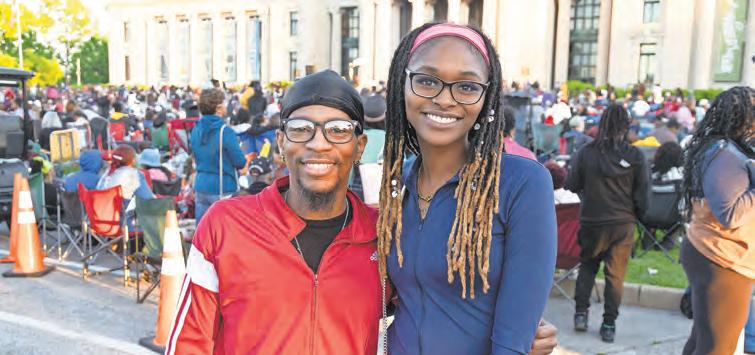
A curtsy for the queens. Because The Queens! Tour landed in St. Louis on Mother’s Day, I’m going to treat Godmama Gladys, Auntie Stephanie, TeeTee Patti and MiMi Chaka the same way I would want somebody to treat my mama if she got up on stage at Enterprise Center. Now to be fully transparent, if my actual mama – who I love more than life itself – was on that stage, I would probably
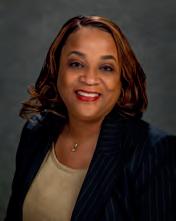

I mean its a peak “Thriller” Michael Jackson fandom season happening right now. The movie is breaking box office records, which put his music back at the top of the charts. And I know I’m about the fact that the “Michael” effect trickled down to Twilight Thursdays at the History Museum. They kicked off the latest installment of the series with a Michael Jackson and Bruno Mars tribute by JAM ( which is short for Jacson and Mars). It was jam packed. I don’t think I’m stretching it by saying last week’s Twilight Thursday was one of the most packed I’ve ever been to – and I’ve attended most of them. I knew what was up when traffic was heavy coming down Union past Page, but when I hit Lindell and Union I was nervous I wouldn’t find a parking space before the show was over – and it was 6 p.m. If I had known then what I know now, I probably would have parked behind the Esquire and just walked over. Yes, it was like that. Ask all the folks who were perched bumper to bumper on Lindell and missed “Dirty Diana” and “You Rock My World.” But I know y’all are aching to know how the show went. I was not the least bit mad at it – especially not “Dirty Diana” – and I’m sensitive about people messing with my Michael’s music. The Bruno numbers were cute too! I even had a ball in between the sets. I feel like Twilight Thursdays might have St. Louis’ record for the largest Tamia slide. They had to squeeze their elbows together, but they saw it through. Who’s uncle was that who walked past the show during his walk and attempted to moonwalk on the gravely path? Sir, you are lucky your ankles lived through that!






MAY 14 – 20, 2026
Inside Sports
Small-school powers flex strength at district meets
The road to the Missouri state track and field championships began last weekend for small-school teams in district competition.
Lutheran North hosted both the Class 3, District 2 and Class 2, District 2 meets, which featured many of the St. Louis area’s top smallschool programs. The meet featured four outstanding boys teams in Cardinal Ritter, Collegiate School of Medicine and Bioscience, St. Mary’s and host Lutheran North.
North’s other district champion was Jeremiah Jadallah, who won the javelin.
Collegiate School of Medicine and Bioscience dominated the middle-distance, distance and field events throughout the day.
All four qualified a large group of athletes for next weekend’s sectional meet.
Cardinal Ritter won three district championships and qualified athletes in 12 events for the sectionals. Senior sprinter Manny Ellis won the 100-meter dash in 10.61 seconds and also ran legs on the Lions’ first-place 4x100- and 4x200-meter relay teams. The Lions also finished second in the 4x400 and 4x800 relays.
Sprinter Ryan RichmondMcDavis finished third in the 100 and fourth in the 200. Rolandis Nash finished second in the 110-meter high hurdles. In the field events, Anthony Hudson finished third in the discus, Parker Lemon was fourth in the javelin, Andre Mayne was third in the high jump and Bruce Clayborn was fourth in the long jump.
Host Lutheran North was led by senior Michael Clark, who won the 200-meter dash in 21.46 seconds and the 400 in 48.92 seconds. Cameron Oliver finished second to Clark in both events. The Crusaders also won the 4x400-meter relay in 3 minutes 19.22 seconds.
Owen Garrett won district titles in the 800and 1,600-meter runs. His winning time in the 800 was 1:56.78. Evan Moll finished first in the 3,200-meter run. Clyde Jackson-Cameron finished third in the 800 and Moll was second in the 1,600. Collegiate also won the district title in the 4x800-meter relay.
St. Mary’s won four individual events and qualified athletes in eight events for sectionals. The Dragons did much of their damage in the field events.
Senior Gary Johnson won the high jump by clearing 6 feet 6 inches. Elijah Stueckel won both the shot put and discus while Elijah Knowles placed second in the shot put. Junior Xavier Clar was the other district champion for St. Mary’s, winning the 300-meter intermediate hurdles.
The Dragons also finished second in the 4x100 relay and third in the 4x400 relay. Also qualifying for the Dragons were Greg Hollis in the 100, Ric’Khy McCaw in the 110-meter high hurdles and Davonta Hays in the 300-meter intermediate hurdles.
On the girls side, Metro looked dominant, winning district championships in eight different events, including three athletes who won multiple district titles.
Jersey Douglas finished first in the long jump and triple jump. Lucy Divis finished first in the discus

and javelin while Lucy Luetkemeyer won the 1,600 and 3,200.
Tessa Link had a big day in the field events, winning the shot put and finishing second in the javelin and discus. Divis also placed second in the shot put. Kenly Bohler won the high jump, completing a sweep of the field events for Metro. Metro also finished first in the 4x800 and third in the 4x400. Mia Roy was second in the 800, Ella Berg was second in the 1,600 and Rowan Erhard was second in the 3,200. Lift for Life had a
big district meet in the sprint relays as it won the 4x100, 4x200 and 4x400 relays. The Hawks posted winning times of 49.76 in the 4x100, 1:46.17 in the 4x200 and 4:25.58 in the 4x400. Sprinter Kynnedi Billingsley also finished first in the 100 in 12.37 seconds. The Hawks also got second-place finishes from Jayden Walker in the 400 and Amani HollinsPhillips in the 300-meter low hurdles.
The top individual performer in the meet was Gabrielle Campbell of Bayless, who won
Sports Eye
district championships in the 200, 400 and 800, a rare triple in track and field. Teammate Lauryn Marshalls was a double winner in the 100-meter high hurdles and 300-meter low hurdles. The top four athletes in each event qualified for the sectional meet at Centralia on Saturday.
The Class 2, District 2 meet at Lutheran North featured several excellent individual performances. Genesis Gardner of Lutheran North was one of the top girls performers of the day. She finished
first in the 100-meter dash in 11.95 seconds and the 200-meter dash in 24.41 seconds. She also finished second in the 400-meter dash. The Crusaders also finished second in the 4x200 and 4x400 relays. Kensington Curd of Brentwood dominated the distance events, finishing first in the 800, 1,600 and 3,200. On the boys side, Demeterius Thompson of Brentwood finished first in the long jump, triple jump and 300-meter intermediate hurdles. He was also second in the 110-meter high hurdles.
Myles Rowe’s Indy run will have St. Louis connection
May means everything in the world of IndyCar racing, with the Indianapolis 500 capping a month of testing and preparation.
The month is critical for INDY NXT drivers as well, including 25-year-old Black driver Myles Rowe. Rowe had an up-anddown performance during the two Grand Prix of Indianapolis races last weekend at the historic track. He finished 26th in the first race but picked up the pace to finish sixth in race two.
Rowe entered the 2026 INDY NXT season as a favorite to win the title. Champions from the developmental series have advanced to IndyCar racing — where they get their shot at qualifying for the Indy 500.
testing last month, where he shared his thoughts on the season and a future run at the Indy 500.
“A lot of people are talking about the 500. I’m the most experienced of the guys (now racing in INDY NXT),” he said.
To move into the 2026 INDY NXT title mix and possibly earn a shot at the IndyCar circuit in 2027, Rowe said it would take “a couple of wins.”

“A championship would be nice,” he said with a smile. Rowe has posted his best performances on oval tracks. WWT Raceway is a unique oblong oval, which he mastered during the midweek testing. He posted the fastest cumulative time of the testing session.
Rowe hopes to join the short list of Black drivers who have competed in the Indy 500.
Currently ninth in the INDY NXT driver standings, Rowe’s drive toward the front of the pack could begin at the INDY NXT by Firestone race at World Wide Technology Raceway on Sunday, June 7. Rowe finished second in last year’s race, and he returned to WWT Raceway for INDY NXT group
“I really like this one,” said Rowe of the WWT Raceway configuration.
“It’s good for passing; better than some of the other (tracks).”
Rowe and his fellow racers had a monthlong break before the Indianapolis races. The testing sessions took place during that period, and Rowe admitted he was anxious.
“I hate breaks like this. I definitely want to race every week, or at least every

other week.”
Rowe said he takes advantage of time off to write and pursue “entrepreneurial efforts.”
“I try to balance my focus on other things, not just racing.”
While he has not reached the podium this season with a top-three finish, Rowe took two checkered flags in 2025. He became the first
Black driver to win an INDY NXT race on July 12 at Iowa Speedway and won the season finale on Aug. 31 at Nashville Superspeedway.
Rowe’s Force Indy team was founded by former advertising executive Rod Reid in 2020. The team was created as part of IndyCar’s Race for Equality & Change diversity initiative, which remains
active regardless of today’s political climate.
IndyCar CEO Roger Penske and Reid partnered to accelerate the development of young Black drivers, and Reid remains a mentor and strategist for Rowe.
The Reid Roundup Metro East perennial baseball power
Edwardsville topped East St. Louis in a pair of games last week, and coach Tim Funkhouser praised the Flyers and coach Maurice Scott “They’ve got a good tone. The kids, you can tell, are all enjoying the game,” he told Colin Feeney of The Riverbender…Scott said following the game that he wants baseball to become as popular as football, basketball and track at his school. “We’ve got a nice group of kids who really accept the coaching and are trying to learn the game of baseball.”…
Kelvin Sampson, Houston Cougars head coach and one of the few Black head coaches in Power 4 men’s basketball, supports the NCAA decision to expand its basketball tournaments to 76 teams. He said the tournament “will remain special,” then quoted Bob Dylan by saying “the times, they are a-changin.’”…The 26 members of the U.S. men’s national soccer team for the 2026 World Cup will be announced live on FOX during a nationally televised event on Tuesday, May 26. Black players projected to make the squad include midfielders Tyler Adams and Malik Tillman, and defenders Antonee Robinson and Miles Robinson, who are not related.
Photo by Alvin A. Reid / St. Louis American Myles Rowe wore his Indy NXT racing suit and a smile after an outstanding testing session at World Wide Technology Raceway last month. He will return June 6-7
With Earl Austin Jr.
Photo by Taylor Marre | The St. Louis American
Senior Manny Ellis of Cardinal Ritter won three first-place medals at Lutheran North. He won the 100-meter dash and anchored two sprint relay teams to district championships.
With Alvin A. Reid
Earl Austin Jr.
Alvin A. Reid





Home Guide
Home improvement trends for a stylish upgrade
Sophisticated outdoor kitchens, connected decks, and lounge zones are part of the next wave of modern home upgrades.
By April D. Lee BlackPressUSA
Cold, flat interiors are fading fast. The strongest home improvement trends for 2026 focus on comfort, personality and smart function. Homeowners want warmer rooms, richer materials, better storage and wellness features that make everyday life feel easier and more stylish.
A stylish home in 2026 will not be defined by flashy spending. Instead, the biggest trends lean toward thoughtful upgrades that make spaces feel warmer, work better and reflect the people living in them. Natural wood, layered lighting, artisan details and flexible layouts are all gaining traction.
Homes are getting warmer, more personal
The biggest shift is simple: Homes are becoming more personal, textured and practical. Designers are moving away from stark minimalism and leaning into warmth, crafted details and rooms that feel collected over time.
Natural wood kitchens, darker stains, curved shapes, fluted millwork and detailed trim are all growing in popularity. Closed cabinetry and better built-in storage are also making a comeback as homeowners look for calmer

spaces that hide everyday clutter. Vintage finds, handmade décor and curated collections now look more refined than empty surfaces. Linen, wool, wood, stone and handmade ceramics are helping spaces feel more grounded and welcoming. Personal items — from framed family photos to travel keepsakes and favorite books — are also being styled more intentionally.
The goal is not perfection. It is a home that feels lived in, comfortable and thoughtfully put together.
Small updates can refresh a room
A stylish update does not always require a major renovation. Paint, lighting, hardware, trim and storage changes can quickly shift the mood of a room.
In many cases, smaller upgrades create the biggest visual payoff when they solve an everyday problem.
Designers recommend replacing harsh overhead lighting with softer layered light, swapping open shelving for cleaner cabinet fronts and adding texture through fluting, paneling or trim details. Warmer paint colors and richer wood tones are also replacing
the cool grays that dominated interiors for years.
Many homeowners are also editing more carefully instead of buying more. The focus is shifting toward meaningful décor pieces rather than filling surfaces with clutter.
Kitchens and bathrooms still lead renovations
Kitchens remain one of the biggest priorities for homeowners planning upgrades in 2026. Wood cabinetry is gaining ground, especially in natural and darker finishes, while deep drawers, appliance garages and pantry storage are helping kitchens function more smoothly.
Mixed materials are also becoming more common. Warm wood, stone surfaces and aged metal finishes can give a kitchen more character without sacrificing practicality. Multi-use islands continue to grow in popularity as homeowners look for spaces that support cooking, work and gathering in one room.
Bathrooms are also evolving into more private recharge spaces. Curbless showers, softer lighting and layered textures reflect the growing emphasis on wellness and comfort. Even bathtub-and-shower combinations are being redesigned to feel more stylish while maximizing space.
Banks watch this every day. You should too.
By Orvin T. Kimbrough Midwest BankCentre
Most people don’t wake up thinking about interest rates, bond yields or the Federal Reserve. But what if I told you that those numbers you never think about are quietly shaping your financial future? They influence:
• Your mortgage payment — whether your dream home stays affordable or slips out of reach.
• Your business growth — whether you can expand or have to pause.
The three risks that affect us all In banking, I wake up every day thinking about three big risks.

1. Credit Risk — The risk that people or businesses won’t be able to pay back what they owe.
2. Liquidity Risk — The risk of not having enough cash available when needed.
3. Interest Rate Risk — The risk that changing interest rates will impact everything from savings to loans to investments.
• Your credit card balance — how much you actually end up paying for what you borrow.
• Your retirement savings — whether your investments are working for you or against you. Understanding how money moves isn’t just for Wall Street — it’s for everyone who wants to build wealth, security and opportunity for themselves and their families.

These aren’t just risks for banks. They affect you too.
4. Credit Risk — Can you borrow affordably? Are you paying more in interest than you should?
5. Liquidity Risk — Do you have enough cash saved if an emergency happens?
6. Interest Rate Risk — Do you know how rising or falling interest rates affect your credit
Summer is a popular time to buy a home. Inventory is up, and many families prefer to avoid school year disruptions. If the “For Sale” signs in your neighborhood have you thinking about buying, now is the time to start preparing financially. While the process can feel overwhelming — especially for first-time buyers — you don’t have to navigate it alone.
Here are a few key steps to help you get started: Start with a realistic budget. Think beyond what you can afford today. Consider how stable your income is and plan conservatively if it fluctuates. A sustainable budget will help you stay confident in your decision long after you’ve moved in.
Plan for the full cost of homeownership. Your mortgage is just one part of the equation. Utilities, insurance, property taxes, and ongoing maintenance all add up. It’s also important to leave room for your lifestyle and future
cards, investments, mortgage, or business loans?
When you understand these risks, you stop being at the mercy of the system and start making the system work for you.
The seesaw effect: What happens when interest rates move
Interest rates work like a seesaw. When new bonds offer higher interest rates, older bonds lose value. When new bonds offer lower interest rates, older bonds become more valuable.
Let’s say you bought a house and locked in a 6% mortgage rate. If rates go up to 8%, you got a great deal — because new buyers are stuck paying more. If rates drop to 4%, you might be able to refinance and save money.
The same concept applies to:
• Your credit card and business loan payments
• Your retirement savings and investments
• Your ability to borrow money affordably

This is why you should pay attention to what’s happening with interest rates.
How to take control of your money
If interest rates are rising…
goals — whether that’s growing your family, advancing your career, or saving for other priorities.
Explore mortgage options that fit your situation. Not all loans are the same. FHA (Federal Housing Administration) loans can help buyers with lower credit scores or smaller down payments. VA loans offer strong benefits for eligible service members and veterans. A knowledgeable lender can walk you through options and help you find the best fit. Look into down payment assistance. Saving for a down payment can be one of the biggest barriers, but it doesn’t have to be. Assistance programs exist through private lenders, municipal programs, and nonprofit organizations. Midwest BankCentre offers down payment assistance programs to help bridge the gap for qualified buyers. Not all lenders provide the same options, however, so it pays to explore what’s available.
Get pre-approved for a loan. Being a pre-approved buyer offers several advantages. First, it gives you a clear understanding of what you can afford, helping you focus your home search. It also shows sellers that you’re a serious, qualified buyer, giving you an advantage in competitive situations. And because your financial
• Lock in low rates before borrowing gets more expensive.
• Prioritize paying down high-interest debt (credit cards, variable-rate loans).
• Keep extra cash on hand.
information has already been reviewed, it helps streamline the process once you find the right home.
Why Homeownership Matters
Homeownership remains one of the most powerful ways to build equity and create generational wealth. Yet for many Black families, it can still feel out of reach. Recent census data shows that only about 43% of Black Americans own their homes, compared to 65% nationally — a gap that reflects long-standing barriers to access.
Closing that gap starts with information, preparation, and the right financial partner.
At Midwest BankCentre, we’re committed to expanding access to homeownership by meeting clients where they are and helping them move forward with confidence. With the right guidance and resources, the path to owning a home may be more achievable than you think.
If you’re ready to take the next step, visit MyHomeLoanSTL.com or call 314-631-5500 to explore your options. Your future — and your family’s future — are worth it.
It Matters Where You Bank™
Envato photo
Natural wood cabinetry and warmer finishes are among the home design trends gaining popularity as homeowners move toward more comfortable, functional living spaces.
Orvin Kimbrough
Summer homebuying: How to get mortgageready before competition heats up
For many St. Louis families, summer is a season of transition: the school year is wrapping up, job relocations happen, and neighborhoods come alive with “For Sale” signs. It’s also the busiest time of year for homebuying across the region, from North County and the City of St. Louis to St. Charles and St. Louis County.
More listings typically come on the market in late spring and summer, and so does increased competition. For first-time buyers especially, the pace can feel fast and the pressure real. The good news is that buyers who prepare early can put themselves in a much stronger position.
Why pre-approval matters in St. Louis’ summer market
In a competitive housing market, timing matters. Sellers want confidence that a buyer is ready and able to close, particularly when multiple offers come in quickly.
A mortgage pre-approval is one of the strongest signals a buyer can provide. Unlike a casual estimate, pre-approval means a lender has reviewed key financial details like income, credit, savings and debts, and has confirmed a price range that fits your situation.
In popular St. Louis neighborhoods, where well-priced homes can receive attention within days, a pre-approval may help a buyer move decisively when a home becomes available. It can also make conversations with real estate agents more productive, ensuring time is focused on homes that realistically fit a buyer’s budget.
Equally important, pre-approval creates clarity. By understanding monthly payments and overall costs ahead of time, buyers can shop with confidence instead of uncertainty.
Getting mortgage-ready: A practical checklist
Preparation doesn’t require perfection, but it does require planning. Buyers who begin
Details are doing more design work
Some of the strongest design trends for 2026 come from smaller details that soften a room without overwhelming it. Curved mirrors, rounded furniture, scalloped edges and arched openings are helping spaces feel calmer and less rigid.
Fluted vanities, kitchen islands and feature walls are also adding texture and dimension. Lighting, meanwhile, is taking on a larger role in overall design. Soft ambient lighting is replacing harsh brightness, and table

early often experience fewer delays and surprises during the summer rush.
Credit
• Review your credit report for errors or outdated accounts.
• Pay bills on time and avoid opening new credit cards.
• Keep balances manageable, especially on revolving accounts.
Savings
• Plan for a down payment, closing costs and a financial cushion.
• Keep funds in easily documented accounts.
• Don’t assume you need 20% down — many buyers qualify with less.
lamps and accent lighting are increasingly being used to make living rooms and bedrooms feel more intimate.
Outdoor living keeps expanding
Outdoor kitchens, connected decks and lounge-style patios continue to grow in popularity as homeowners treat exterior spaces like extensions of the home rather than leftover space.
Covered seating areas, improved lighting and weather-resistant materials are helping patios and porches feel more complete and usable year-round.
Flexible layouts inside the home are also becoming more important, especially for multigenerational living,

Documentation
• Recent pay stubs and W-2s or tax returns.
• Bank statements.
• Identification and employment verification.
Organizing these items in advance can help prevent last-minute scrambles, especially during peak months when lenders and appraisers are handling higher volumes.
Common summer mistakes that can delay closings
Homebuying during peak season moves quickly, and small missteps can cause meaningful delays. Some common issues include:
• Making large purchases
remote work and aging in place. Designers say adaptable spaces will continue to shape how homes are renovated in the coming years.
Richer colors are replacing cool grays
Warm neutrals are still popular, but the palette is getting richer in 2026. Deep browns, muted blues, olive green, taupe, burgundy and earthy clay tones are showing up more often in living spaces.
Many homeowners are also using darker accents to add depth.
The overall goal is not to create a showroom-perfect house. It is to create a home that feels personal, functional and easier to live in every day.
— such as a car or furniture — before closing.
• Changing jobs or income sources without communicating these changes to your lender.
• Missing document requests during underwriting.
• Assuming all mortgage options and lenders work the same way. Clear communication and early planning can prevent many of these issues and keep a closing on track.
Leveling the playing field for first-time buyers
Homeownership has long been a key way families in the St. Louis region build stability and long-term wealth. Yet
many potential buyers delay the process due to misconceptions, believing they need perfect credit, large cash reserves or insider knowledge to begin.
Early conversations with a knowledgeable lender can help clarify what’s required. There are loan programs designed to support first-time buyers and those with limited down payment funds, and preparation often makes these options easier to access.
Taking steps now before competition peaks can also help buyers feel more confident and less rushed. Preparation creates opportunity and allows buyers to focus on long-term financial well-being instead of short-term pressure.



Envato photo
Get your home ready for summer with this quick maintenance checklist
While it’s tempting to only focus on the fun parts of spring, like gardening, grilling and enjoying warmer weather, this is also one of the best times to take care of small maintenance projects around the house to ensure your space is in good condition before summer arrives. The good news is: You don’t need a big renovation budget to freshen things up. A few simple tasks can keep you comfy and prevent potential problems later in the season.
Here’s a maintenance checklist to help you get started:
Start with a safety check
Before tackling larger projects, take a few moments to focus on the essential safety items around your home. Carbon
monoxide and smoke detectors should be tested regularly. Late spring is also a good reminder to replace batteries if needed and make sure fire extinguishers are easy to access. With thunderstorm season in full swing, don’t forget to review your weather safety plan and ensure your supplies are stocked up to protect yourself and your loved ones.
Inspect your HVAC system
Your air conditioner works hard to keep you cool when it gets toasty outside – so it’s important to give it a little checkup as well. Replacing dirty air filters and scheduling routine maintenance with a trusted professional can help your system run more efficiently. It can also help you catch minor problems before they turn into costly repairs during the hottest weeks of the year.
Seal in cool air
Inside your home, don’t overlook the small things that quietly affect comfort and everyday energy usage. Make sure your windows and doors are properly sealed. If you notice any gaps or cracks, apply sealing caulk or install weather stripping where appropriate. Not only will this prevent cool air from escaping, but it can also reduce noise and keep out pests.
Tackle one deep-cleaning project
Spring cleaning feels much more manageable when you focus on one space at a time. Organize a cluttered closet, clean out the garage and freshen up carpets and rugs. While you’re cleaning, check for any leaks under sinks and around toilets. These small projects can make your home feel noticeably lighter and tidier heading into the summer.
What homebuyers should know
Buying a home is one of the largest purchases most people will make, and taking out a home loan is a common way to finance it. This primer on home loans explains mortgage basics, including what a mortgage is, common types of loans and the importance of shopping for a lender.
What is a mortgage?
A mortgage is a loan used to purchase a home or other real estate. The term also may refer to
If interest rates are falling…
• Look into refinancing your mortgage, car loan, or business debt.
the amount of money borrowed, plus interest, to buy a house.
The mortgage amount is usually the purchase price of the home minus the down payment.
Before taking out a mortgage, it’s important to understand the upfront and ongoing costs of homeownership, including closing costs, property taxes, insurance and maintenance. If you fall behind on mortgage payments and cannot resolve the delinquency, your lender may begin foreclosure proceedings, which could result in the loss of your home.
• Consider investing in opportunities that benefit from lower rates.
• Take advantage of cheaper borrowing costs to make strategic financial moves.
Keep an eye on the seesaw
Choosing a loan term
Consider the loan term, or the length of time it will take to repay the loan. Your loan term will affect your interest rate, monthly payment and the total amount of interest paid over the life of the loan.
Long-term mortgages, such as the common 30-year mortgage, typically have:
• Smaller monthly payments than short-term mortgages,
If bond yields go up, loan rates will likely increase — bad for borrowers, good for savers. If bond yields go down, loan rates will likely fall — good for borrowers, bad for savers. The goal isn’t just to survive these changes — it’s to use them to your advantage.
Your next move: Take one step today
Create
Our

Refresh outdoor spaces
To spruce up your outdoor space for summer gatherings, give your grill a good cleaning, wipe down patio furniture and test outdoor lightning. While you’re outside, take a walk around your property and look for cracks in the foundation, damaged siding or areas where mold or mildew may be developing. Also, inspect your gutters and clear away branches, leaves and other debris left behind from winter and early spring storms. And remember to contact 8-1-1 to have your underground utility lines marked before starting any landscaping project that involves digging. It’s a free service that keeps you and your neighbors safe.
Find more tips and learn more about ways to save energy at SpireEnergy.com.

1. Check the interest rates on your mortgage, credit card and savings account.
2. Ask yourself: Am I making the most of where rates are right now?
3. Share this with someone who needs a simple breakdown. Understanding money is the difference between struggling and thriving. And the people who pay attention to the seesaw effect aren’t caught off guard — they’re prepared.
The question is: Are you?
For more information, visit OrvinKimbrough.com or MidwestBankCentre.com.
Orvin T. Kimbrough is Chairman and CEO of Midwest BankCentre and author of Twice Over a Man, More Than a Conqueror and Ward and the State.
Find
Factory-built housing an option for homebuyers
Does homeownership feel out of reach? A manufactured home may be an affordable alternative that some buyers have not considered.
What is a manufactured home?
Rather than being built on-site, a manufactured home is constructed in a factory on a permanent steel frame and transported to a property, where it is attached to a permanent foundation.
A newer category of factory-built homes combines the affordability of manufactured housing with the appearance and financing advantages of sitebuilt homes. These homes are designed to resemble traditional houses and are constructed using similar building materials.
Manufactured homes also are built to meet standards set by the U.S. Department of Housing and Urban Development for durability, energy efficiency, electrical systems and fire resistance.
Offering affordability
Manufactured homes may help make homeownership possible for more families. The average price of a new, single-section

factory-built home is about $200,000, including land, compared with more than $500,000 for a new site-built home.
Housing experts say factory construction helps reduce costs because the process is quicker, more efficient and less expensive than traditional homebuilding methods.
According to the Federal
Housing Finance Agency House Price Index, manufactured homes also may appreciate in value similarly to site-built homes.
Titling considerations
Depending on land ownership, a manufactured home may be titled as either real property or personal property, also known as
chattel or home-only property. Real property includes land and permanently attached structures. Personal property refers to movable possessions, such as vehicles, furniture and tools.
If a buyer owns — or plans to purchase — the land where the home will be installed, the home generally can be titled as real property once attached to the
land. Buyers renting space in a manufactured housing community typically must title the home as personal property.
While titling a home as personal property may reduce real estate taxes and simplify the process, some lenders finance only homes titled as real property. Experts say real-property financing may provide borrowers with more loan options, lower interest rates and stronger consumer protections.
Financing options
Mortgage products specifically designed for manufactured homes are available, including some with low down payment requirements.
Freddie Mac offers CHOICEHome loans for certain factory-built homes titled as real property, with down payments as low as 3%.
Additional information about manufactured housing and homebuying resources is available through My Home by Freddie Mac.
Housing advocates say manufactured homes are often overlooked despite offering a combination of affordability, quality and long-term value for prospective homebuyers.
7 smart savings strategies to retire early
By Kyla Pollard, Group Manager, Retail Banking Commerce Bank
Early retirement is more attainable than many people realize. With steady habits and careful planning, it’s possible to build a nest egg that lasts for decades. These seven
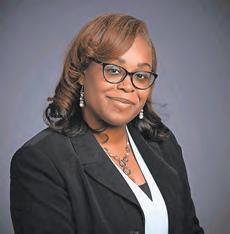
credit cards and loans make it harder to save for long-term goals. Listing debts by interest rate and paying off the highest one first helps reduce financial strain and frees up more money for retirement savings.
3. Increase the savings rate. Growing the percentage of each paycheck today.
4. Use retirement accounts. Accounts such as 401(k)s, IRAs and Roth IRAs offer tax advantages that promote long-term growth. A taxable investment account can also serve as a bridge for anyone who retires before being eligible to withdraw from retirement accounts
tolerance may shift over time, often beginning with more growth-focused investments and gradually moving toward more stable options as retirement nears.
6. Plan for healthcare costs. Healthcare is often one of the largest retirement expenses, especially for those who retire before Medicare begins at age help ensure progress stays on track. Life changes — such as raises, job transitions, family needs or health shifts — can all impact a retirement strategy. Updating spending assumptions and long-term goals each year helps keep the plan aligned. Early retirement becomes more attainable






Kyla Pollard
Warmer weather can mean more kitchen pests
With warmer weather here, spring cleaning and hosting season are in full swing. While preparing your home for guests, you also may notice an increase in insect activity.
Insects often gather in the same areas where people do — anywhere food is present. Experts say it is important to act quickly because insects reproduce rapidly. For example, two fruit flies can multiply into hundreds within a week.
These tips can help keep kitchens cleaner and reduce insect problems during spring gatherings:
Do a deep clean
In addition to regular kitchen upkeep, experts recommend a thorough cleaning each spring and before hosting guests. Pay special attention to corners, crevices and often-overlooked areas in refrigerators, ovens and pantries, where food residue and grease can accumulate and
attract pests.
Catch what you can’t clean
Indoor fly traps can help catch insects that linger around sinks, trash cans and countertops even after cleaning. Zevo recommends placing traps near high-traffic areas, fruit bowls, garbage containers and frequently opened doors.
The company says its flying insect traps use blue and ultraviolet light to attract fruit flies, gnats, house flies and other flying insects around the clock.
“Plugging in a Zevo insect trap is an easy way to achieve that level of cleanliness you’re looking for, so you have more time for what matters — enjoying the spring season with friends and family,” said Rob Reinerman, vice president of Procter & Gamble Ventures, parent company of Zevo.
Fix leaks
Leaks under kitchen

In
to
sinks can create attractive conditions for insects because bugs are drawn to water sources. Repairing leaks also can help prevent water damage and mold growth.
recommend
Seal food tightly
Experts recommend checking pantry storage containers and transferring items such as flour and sugar from paper packaging into tightly sealed
containers. Proper food storage can help reduce insect activity and keep ingredients fresher.
Additional information about household pest control is available at Zevo Insect.
Experts say maintaining a clean kitchen, addressing moisture issues and storing food properly can help keep homes cleaner and more comfortable during spring and summer months.
Carbon monoxide dangers persist at home and on vacation
Carbon monoxide, or CO, is a poisonous, flammable gas that is impossible to see, smell or taste — making it easy to assume you’re safe when danger may already be present. Whether you’re vacationing away from home or planning a staycation this summer, experts say it is important to take extra steps to protect yourself and your loved ones from CO.
According to UL Standards & Engagement, more than onethird of U.S. homes have no CO detection, and nearly 30% of Americans say they do not need — or are unsure whether they need — a CO alarm if a smoke alarm is present. Safety experts say both smoke and CO alarms are essential.
Carbon monoxide can begin causing symptoms such as headaches and nausea at concentrations around 200 parts per million. Kidde, a fire and CO safety company, recently introduced a new line of CO alarms with advanced detection technology. Some alarms are designed to alert users to low levels of CO before concentrations become dangerous.
making payments more affordable month to month.
• Higher mortgage rates, meaning you will pay more interest over the life of the loan.
Short-term mortgages, typically offered in 10-, 15- or 20-year terms, generally have:
• Lower interest rates than long-term mortgages, meaning less interest paid over the life of the loan.
• Higher monthly payments
Earlier detection can be especially important for vulnerable populations, including older adults, children and pets, who may experience symptoms at concentrations below 70 parts per million.
The new line also includes battery-powered CO alarms designed for travel use.
“While some travelers take routine measures to help protect their homes from carbon monoxide while they are away, many do not consider the same safety risks at their destination,” said Isis Wu, president of Global Residential Fire & Safety at Kidde.
During the summer travel season, Kidde is promoting its Destination Safety initiative, which encourages travelers to take additional precautions. The company recommends:
Early detection of carbon monoxide is especially important for older adults, children and pets, who may experience symptoms at lower concentrations.
• Packing an AA battery-operated CO alarm for travel use. Remove batteries before travel and reinstall them upon arrival. Test the device before use. These alarms are intended for conditioned indoor spaces only and are not approved for RV or boat use.
Wu said the lack of comprehensive regulations has created safety gaps for travelers.
Electrical Contractor Magazine reports that only 14 states require carbon monoxide detectors in hotels and motels, and there is no federal law requiring hotels to install CO detectors in every guest room.
than long-term mortgages.
Deciding on a loan type
There are two basic types of mortgages:
Fixed-rate mortgages lock in one interest rate for the life of the loan. This means the monthly mortgage payment remains the same for the entire loan term.
Adjustable-rate mortgages have interest rates that change over the life of the loan. Rates typically start lower than those for fixed-rate mortgages. After an initial fixed period, ranging from six months to 10 years, the interest rate changes
Buying a home is a dream come true. Carrying on traditions and making memories are the things you look forward to doing in your new home. That’s why it’s nice to know someone who can guide you through the mortgage process every step of the way. At Commerce Bank, we’re built for making your dream a reality.
• Testing home smoke and CO alarms before leaving and making sure heat-producing appliances are turned off. Smart alarms that provide real-time notifications can offer additional protection.
• Calling hotels or rental properties ahead of time to ask whether CO detection devices are installed.
• Checking upon arrival to ensure both hotel alarms and personal alarms are present and working.
based on market conditions.
Finding a lender
Once you determine which mortgage best fits your financial situation and goals, it’s time to shop for a lender. Your lender is an important part of the homebuying process and can help guide you through the rest of the mortgage process.
You can obtain estimates from many types of lenders, including loan officers at banks and credit unions, mortgage brokers and nonbank lenders. Different lenders offer different terms and

Safety advocates say travelers and homeowners alike should take carbon monoxide risks seriously rather than assuming existing precautions are enough.
interest rates and charge different fees, making it important to compare options.
Research by Freddie Mac shows that getting one additional rate quote could save homebuyers an average of $1,500 over the life of the loan, while obtaining five additional quotes could save about $3,000.
Because mortgage rates change frequently, experts recommend comparing loans on the same day to accurately evaluate loan estimates. It is also best to complete mortgage shopping quickly, as multiple credit inquiries outside a 45-day period could lower your
credit score.
Crunching the numbers
Freddie Mac offers tools and resources, including calculators that help borrowers compare short- and long-term mortgages, evaluate fixed- versus adjustable-rate loans and review multiple loan estimates.
A mortgage is a long-term commitment and a legally binding contract. Before borrowing, experts recommend understanding how home loans work and the financial responsibilities that come with them.



Envato photo
addition
regular kitchen upkeep, experts
a thorough cleaning each spring and before hosting guests.
Envato photo
More than one-third of U.S. homes lack carbon monoxide detectors, and nearly 30% of Americans either believe they do not need one or are unsure if a smoke alarm alone is enough.



Washington University in St. Louis offers rewarding opportunities in various fields at all levels, with positions in engineering, nursing and health care, research, administration, technology, security and more.
SEEKING DEDICATED MEDICAL ASSISTANTS & CLINICAL OFFICE STAFF AT WASHU MEDICINE
Medical Assistant II & III
The Medical Assistant (MA) prepares and maintains exam rooms, prepares charts, obtains reports and records; assists with patient flow and ensures the overall smooth running of the clinical office. The MA is an in-person position that provides an essential role in our clinics. Due to this, all MAs must be credentialed through NHA, AMT, or AAMA or can obtain credentials within the allotted timeframe.
Qualifications:
• Level II: Medical Assistant – 2 Years of Experience
• Level III: Medical Assistant – 3 Years of Experience, Supervisory
– 1 Year of Experience
Patient Billing/Services Representative II
The Patient Billing/Services Representative (PSR) is a patientfacing role that obtains insurance information and referral forms as well as counsels patients on financial assistance when seen in department for services.
The PSR provides excellent customer service while handling a fastpaced environment demonstrating their time management skills, ability to multi-task, and attention to detail.
Why a career at WashU is more than a job
• Work alongside nationally recognized physicians and researchers
• Support patients during their care journey
• Collaborative, respectful, people-first culture
• Multiple clinics, daytime schedules, meaningful work
• Real opportunities to grow your career through advancement, training & certification
Benefits include up to 22 days of vacation, 10 recognized holidays, and sick time. Competitive health insurance packages with priority appointments and lower copays/coinsurance. Take advantage of our free Metro transit U-Pass for eligible employees. WashU provides eligible employees with a defined contribution (403(b)) Retirement Savings Plan, which combines employee contributions and university contributions starting at 7%, and more.
For the full job description and to apply, visit jobs.washu.edu, Job ID: JR92919, JR94027, or JR92922.
We seek people from diverse backgrounds to join us in a supportive environment that encourages boldness, inclusion, and creativity.
EEO/AA/VET/Disability Employer
REQUEST FOR PROPOSALS
Peoples Health Centers is requesting proposals from qualified contractors to construct and renovate their 11642 West Florissant Ave health center. The project will include exterior and interior construction, painting and signage, cemented sidewalks, modification of the interior “WIC” area, entry awning, 3 offices/exam rooms, interior demolition of cabinets, with office/ waiting room/lobby/ multipurpose room furniture and new flooring. The center is a one-story steel framed structure. The center must continue to operate during construction.
A pre-bid meeting will be held at Betty Jean Kerr People’s Health Centers located at 11642 West Florissant Ave, St. Louis, MO, 63033 on Friday, May 29, 2026, at 12:30 pm
For a copy of construction documents please email Michael Prost, mprost@fsastl.com
Please present questions at least five (5) days prior to the scheduled bid opening to allow for any responses or addenda, if required, to be issued to all the bidders. Additionally, bidders must comply with labor standards and prevailing wage requirements using the latest Contractor’s Wage Surveys of the State of Missouri. Each bid must be accompanied by a Cashier’s or Treasurer’s Check of a bank or trust company in St. Louis, payable to the order of People’s Health Centers, or a Surety Bond for 5% of the bid price. Bidders shall comply with all applicable city, state and federal laws.
Sealed Bids must be received no later than 2:00 PM June 26, 2026, and will be opened on the same day. Bids may be delivered or mailed to BJK People’s Health Centers, 11642 West Florissant, St. Louis, MO, 63033. Attn: Mark Sanford, Executive Vice President
The
ENTREPRENEUR -IN-RESIDENCE
BioGenerator Ventures hiring an Entrepreneurin-residence: https://www. biostl.org/ job-openings
INVITATION FOR EQUIPMENT BIDS
East-West Gateway Council of Governments is seeking bids for respiratory protection equipment, multi-gas detection units, and a portable x-ray system. Bids are due May 28, 2026. Funding is provided by the U.S. Dept. of Homeland Security. D/S/W/MBEs are encouraged to submit bids. Find details at www.ewgateway.org.
SEALED BIDS
Bids for Replace Domestic & Heating Loop, Infrastructure, Charleston, MO. Project No. C2516-01 will be received by FMDC, State of MO, UNTIL 1:30 PM, June 4, 2026. Project information available at: http://oa.mo. gov/facilities
CITY OF ST. LOUIS ST. LOUIS LAMBERT INTERNATIONAL AIRPORT
SOLICITATION FOR BIDS (SFB)
Service: Carpet Cleaning Services
Pre-Bid Meeting Date: May 26, 2026 at 1:00 p.m. Local Time
Question Due Date: May 28, 2026
Bid Due Date: June 15, 2026 at 2:00 p.m.
Local Time
Point of Contact: Delia Cummings –dfcummings@flystl.com
Bid documents may be obtained at St. Louis Lambert International Airport, Airport Properties Division, Monday through Friday between 8:30 a.m. and 4:30 p.m., or by calling (314) 426-8174.
This SFB may also be obtained by visiting our website at https://www.flystl.com/ business/contract-opportunities/ Robert Salarano Airport Properties Division Manager
REQUEST FOR BIDS FOR GENERAL CONTRACTING SERVICES AT 4322 ALDINE AVE. ST. LOUIS, MO 63113
ISSUED: MAY 14, 2026
RESPONSES DUE: JUNE 4, 2026
REQUEST FOR BIDS
SEALED BIDS
Bids for Remodel Space for Print Shop Utilization at Scruggs Station Warehouse in Jefferson City, Project No. O2544-01, will be received by FMDC, State of MO, UNTIL 1:30 PM, June 9, 2026. Project information available at: http://oa.mo. gov/facilities
SEALED BIDS
OA-FMDC, State of MO will have a REBID project X241001 for New Sites/Cabins & Site Repairs/ Renovs, State Park, Lagrange, MO. Project No. X2410-01 that will be open for public bid in the month of May. When released, bid documents will be available at: http://oa.mo. gov/facilities
Hankins Construction Co. is requesting bids from MBE/WBE/SDVE/ DBE Subcontractors and Suppliers for our proposal on the Saint Louis Public Schools Clyde C Miller Academy Cosmetology Renovations. A diversity goal of 25% MBE and 5% WBE has been established for this project. To access the bid documents, or if you have any questions, please email/call Nicole at Office@HankinsMidwest. com /314-426-7030 Please submit bids to Bids@ HankinsMidwest.com by 3:00 PM on 5/28/2026 Hankins Construction Co. is an Equal Opportunity Employer.
The Land Clearance of Redevelopment Authority of the City of St. Louis (“LCRA”) is seeking sealed proposals from General Contractors for stabilization and selective demolition services at 4322 Aldine Ave., St. Louis, Missouri 63113. Work includes roof repair, site weatherproofing, selective demolition, and tree/ brush removal.
Responses will be received at 1520 Market Street, Suite 2000, St. Louis, Missouri 63103 (Attention: LCRA) and STL City Permits until 3:00 p.m. on June 4, 2026
The services to be provided through this RFB will be funded by The Coronavirus State and Local Fiscal Recovery Fund allocated to the City of St. Louis by the United States Department of the Treasury and passed through the City’s Community Development Administration to LCRA.
The full invitation and all other documents may be downloaded at: STLPermits.com and https://www.stlouis-mo.gov/government/ procurement.
NOTICE REGARDING TREATMENT COURT COMMISSIONER VACANCY TO ALL ATTORNEYS RESIDING IN ST. LOUIS COUNTY, MISSOURI
The Circuit Court of St. Louis County, Missouri, announces that it is soliciting candidates for the position of Treatment Court Commissioner of the Circuit Court of St. Louis County.
A majority of the Circuit and Associate Circuit Judges will make the appointment for a term of (4) years, at an annual salary of an associate circuit judge, payable by the State of Missouri, pursuant to RSMo §478.003.
Missouri law requires the Treatment Court Commissioner(s) to possess the same qualifications as an associate circuit judge, including those set forth in the Missouri Constitution, Article V, Section 21, to wit, they must be qualified voters of the state, residents of St. Louis County, Missouri, at least twenty-five years old, licensed to practice law in Missouri; and possess all other qualifications as required by law. (See RSMo Chapter 478).
Questionnaires and Candidate Instructions may be obtained by sending a resume and cover letter to St. Louis County Circuit Court, ATTN: Human Resources, 105 S. Central Avenue, Clayton, Missouri, 63105, or via email to SLCCourtJobs@courts.mo.gov.
Completed questionnaires must be submitted in writing to St. Louis County Circuit Court, ATTN: Human Resources, 105 S. Central Avenue, Clayton, Missouri 63105, or via email to SLCCourtJobs@courts.mo.gov on or before May 18, 2026
The appointment is scheduled to take place upon a vote of the majority of the Circuit and Associate Judges en banc on or about June 10, 2026. EOE. Please contact the Human Resources Department at 615-4471 (voice) or RelayMo 711 or 800-735-2966 if you need any accommodations in the application process, or if you would like this posting in an alternative form.
ITB #: 57826126 INVITATION TO BID
Harris-Stowe State University (HSSU) is requesting bids for Shingle Roof Replacement and installation of a roof hatch on the roof at Gillespie Residence Hall located at 3026 Laclede Avenue, St. Louis, Missouri.
Bids must be emailed no later than 2:00 pm on Thursday, May 28, 2026 to Corey Freeman at freemanc@ hssu.edu. Responses to the ITB will be opened and read at a virtual bid opening on Thursday, May 28, 2026, at 2:30 pm. The link to the virtual bid opening will be sent at the time of bid submission.
A Pre-Bid meeting is scheduled on Thursday, May 14, 2026 at 10:00 a.m. Interested parties are to meet in the Gillespie Residence Hall lobby. The Pre-Bid meeting is not mandatory, but highly encouraged. Bidders are at a minimum required to visit the site on their own prior to the bid date. A copy of the Invitation to Bid and Bidding Documents can be obtained by contacting Corey Freeman at email address: freemanc@hssu.edu or calling (314)-340-3325.
The University reserves the right to reject any and all bids and to waive all informalities in bids.
REQUEST FOR BIDS:
GENERAL CONSTRUCTION SERVICES AT 3940 DR. MARTIN LUTHER KING DRIVE
ISSUED: MAY 11, 2026
DUE: JUNE 2, 2026, 1:00 P.M.
The Land Clearance Redevelopment Authority of the City of St. Louis (LCRA) seeks sealed bids for general contracting services at 3940 Dr. Martin Luther King Drive, St. Louis, MO 63113.
Work includes selective demolition, renovation of a pre-engineered metal building, roofing and renovation of 130-year-old brick buildings.
Submit bids to 1520 Market Street Suite 2000, St. Louis, MO 63103 (Attention: LCRA) and STL City Permits website. A public bid opening will follow the deadline.
Funding is provided by The Coronavirus State and Local Fiscal Recovery Fund, passed through the City’s Community Development Administration to LCRA.
Formal invitation and full documents are available at STLPermits.com and https://www.stlouis-mo.gov/government/procurement.
REQUEST FOR BIDS
The Americas Center is seeking bids from qualified companies for the corrosion repair and repainting of exterior of Americas Center.
Interested bidders must attend a pre-bid walk through which will be held at the Americas Center on Thursday May 21, 2026 at 10:00am.
Please enter our building at our employee entrance 7th st and Washington.
The facility reserves the right to reject any or all bids. EOE.
REQUEST FOR PROPOSALS
The Hazelwood School District is seeking bid proposals to install galvanized chain link fencing with bottom wire at Jamestown Elementary, Twillman Elementary, Keeven Elementary, & Hazelwood East High School.
Interested parties should submit their bid proposal through Bidnet via the district’s website at https://www. hazelwoodschools.org/ Page/2238 on or before Tuesday, May 26, 2026 not later than 10:00 a.m
PUBLIC NOTICE
Notice is hereby given that the Metropolitan St. Louis Sewer District Requests for Quotes, Bids and Proposals are posted online for public download. Please navigate to www.msdprojectclear.org
> Doing Business With Us
> View Bid Opportunities
Metropolitan St. Louis Sewer District is an Equal Opportunity Employer.
REQUEST FOR PROPOSALS
The Hazelwood School District is seeking bid proposals to remove asbestos tile from West Early Childhood Center.


SINGLE FEASIBLE SOURCE PROCUREMENT
FOR PROCUREMENT OF ON THE SET SUMMER FILM CAMP SERVICES
Harris-Stowe State University (HSSU) anticipates procuring On the Set Film Camp-Summer Film Camp services. On the Set provides a comprehensive and unique program that is designed to give youth a direct hands-on experience in all aspects of film production, guiding participants through the full film making process, including taking part in real life production roles. The anticipated dollar amount is $9,000.00. The Award is to take place on or about May 21, 2026.
The contact for the University is Corey Freeman, Senior University Buyer, email address: freemanc@hssu.edu or telephone #:(314) 340-3325.
Interested parties should submit their bid proposal through Bidnet via the district’s website at https://www. hazelwoodschools.org/ Page/2238 on or before Tuesday, June 2, 2026 not later than 11:00 a.m




Religion
In the Black Church, women’s hats still testify
By Rev. Dorothy S. Boulware
The Apostle Paul’s teachings about women in church have often caused more fury than faith, but not the one about women covering their heads. In the Black Church, hats have, for generations, held a prominent place in Sunday worship — one that continues to block the view of even the tallest worshipers.
Before the first hymn is lifted or the opening prayer is spoken, a quiet procession tells its own story. Women enter the sanctuary with heads held high, adorned in hats that are as varied as they are meaningful — with or without brims, sculpted felt, delicate netting, bold colors.
They are not simply accessories. They are testimony.
Rooted in history
In Black Church tradition, women’s hat-wearing has long stood at the intersection of faith, culture, and dignity. What may appear to outsiders as fashion is, for many, an act of reverence — a visible expression of inward devotion shaped by scripture, history, and lived experience.
The most often cited biblical passage comes from 1 Corinthians 11, which addresses the covering of women’s heads in worship. While interpretations vary across denominations, many Black churches have embraced the practice as a sign of honor and respect in the presence of God. Over time, that theological framework merged with cultural expression, giving rise to what is now widely known in the Black community as the “church hat” tradition.

post-Emancipation era, when formerly enslaved Black men and women sought to redefine themselves in public and sacred spaces.
Clothing became a language of freedom. For Black women in particular, dressing for church was a way to assert dignity in a society that routinely denied it.

Back then, Sunday worship offered one of the few spaces where Black women could freely express themselves. Hats signaled care, creativity, and self-worth. In communities where resources were limited, a well-kept hat could transform an outfit and, more importantly, affirm identity.
Defiant self-expression
Black women’s church millinery also traces back to the
The larger ones were often greeted with the inquiry, “Trying to catch God’s eye?” according to artist Clara Nartey, who gave her
well-known 2020 creation that same title.
“I learned that wearing a hat is a form of creative expression. Enslaved Africans were not allowed to dress the way they wanted,” Nartey said. “The only times they got to express themselves in clothes was when they got the rare occasion to congregate at church.”
Sunday worship “was just as much a form of social gathering,” Nartey said. “To Black women, making and wearing elegant hats was a fusion of fashion and faith. Their tall hats have a striking resemblance to African headdresses.”
Fashion stylist Michael Andre Settles, owner of Michael Andre Clothier in the metro Baltimore area, is well aware of the importance of hats to a woman’s overall look. He says he can judge which woman is suited for a particular hat when he first sees it.
”When a woman is well dressed, she stands apart; the hat

is a crown, heads turn, and she is remembered,” Settles says. “When a woman feels extraordinary, everyone feels it.”
The right choice of hat is “the crown of glory, brings it all together,” says Settles, who recently styled a few women for the annual AFRO tea in Baltimore. “It needs to match their personality, their persona, and their silhouette. It’s the final touch.”
Declaration of self-worth
There is also an element of quiet resistance embedded in the tradition of Black women and Sunday hats. In a world that has frequently sought to diminish Black women’s presence, the act of dressing with care and distinction for worship asserts worth. It declares that entering the house of God is not casual, and neither is
Early in my career, I thought leadership was mostly about competence — knowing your craft, delivering results, hitting the number.
And while those things matter, they’re not what carries you forward. They’re not what elevates you into real influence.
What sustains your rise — and determines your impact — is relational capital.
Relational capital is the trust you build, the goodwill you earn, the credibility you cultivate, and the emotional equity people associate with your name.
It’s what people feel when you walk into the room. It’s the story they tell about you when you’re not there. And here’s the irony: the higher you go, the more this capital becomes the differentiator.
But nobody teaches this. Not in school. Not in business training. Not in your first five years of work.
We teach strategy. We teach performance. We teach technical fluency.
But we don’t teach the truth: People move opportunity. People open doors. People create pathways. People
the person entering.
As churches continue to navigate changing times, the future of the hat tradition will likely reflect the same adaptability that has sustained the Black Church itself. It may look different from one generation to the next, but its meaning — rooted in reverence, dignity, and community — endures.
And on Sunday mornings, before a word is preached, that meaning is already on display. It sits in the pews, tilts in greeting, nods in agreement with the sermon. It is lifted in praise and bowed in prayer. We have seen it and, more importantly, understand it.
In many churches, hats rule every Lord’s day with great prominence, particularly on Easter Sunday and Mother’s Day. Because in the Black Church, even what is worn can testify.
elevate your name in rooms you’ve never stepped foot in. And people do that when you’ve invested in them long before you needed something from them.
Relational capital is built through presence, through consistency, through humility and generosity.
It’s built through listening without agenda. It’s built by honoring people’s dignity — especially when you disagree. It’s built by being someone others can trust with truth. It’s built by showing up as the same person privately as you are publicly.
In The Thriver’s Path ™ relational capital is part of what we call Rising Together — because no leader rises alone. Anyone who tells you they built it by themselves is either lying or delusional.
The leaders who thrive know this: Your relationships are a strategic asset. Your character compounds. Your presence produces dividends. Build relational capital intentionally — because the future you’re praying for may flow through a relationship you haven’t nurtured yet.
Reflection Question: What relationship in your life or leadership needs intentional investment today? For more, visit OrvinKimbrough.com or MidwestBankCentre.com.
Word In Black
Mildred Harper Betty Clark
Regina Moody
Relational Capital: The Currency of Leadership No One Teaches You
The