
St. LouiS AmericAn
A reckoning in Florissant
Town Hall confronts North County youth violence
By Kenya Vaughn St. Louis American
There was something different about the Teen and Youth Violence Prevention and Safety Town Hall held Saturday morning April 4, 2026, at Calvary Bible Church in Florissant.
stepped away from the microphone, the gathering had moved from policy talk to collective soul-searching.
Parents, educators, clergy, and residents filled the sanctuary, many still carrying the emotional weight of a devastating week in North St. Louis County. The town hall was organized in direct response to a shooting at McCluer South-Berkeley STEAM High School — a tragedy that reignited long-standing fears about the safety of the
What began as a familiar format — elected officials and community leaders outlining strategies to curb youth gun violence — quickly shifted into something deeper. By the time the final speaker See Violence, A13
City earnings tax easily wins approval
By
St. Louis voters on Tuesday overwhelmingly supported renewal of the 1% earnings tax, a major source of city funding which currently accounts for almost 36% of St. Louis’ general revenue. Proposition E’s renewal garnered 22,772 votes (85%), with 4,903 residents (15%) voting no. Only 26,876 (13.7%) of the city’s 196,299 registered voters cast ballots. The tax applies to anyone who lives or works in the city and funds essential services including police, fire protection, street maintenance and day-to-day city operations. A “no” outcome would not have immediately eliminated


Justice
City jury awards $37M to Tyron Edwards
By Ashley Winters St. Louis American
A St. Louis jury has awarded $37 million to Tyron Edwards after it found that he was unjustly shot by police as a 14-year-old nearly a decade ago. The verdict, reached after several hours of deliberation, found former St. Louis Metropolitan Police Department officer Thomas Streckfuss and current officer Ryan Murphy liable for assault, malicious prosecution, and false imprisonment. Jurors determined Edwards was wrongfully shot during an Oct. 2, 2016 encounter and that the officers’ account of the incident led to his arrest and prosecution. Edwards declined an interview with
See Edwards, A13
By Sylvester Brown, Jr. St. Louis American
See Williams, A12 The earnings tax, currently accounts for almost 36% of St. Louis’ general revenue. 85% of voters stood in support
See Tax, A12

Nearly a year ago, Mayor Cara Spencer asked retired St. Louis Development Corp. (SLDC) Director Otis Williams to return as interim leader during a period of significant upheaval. At the time, the city faced a potential lawsuit from developer Paul McKee over its move to seize his land through eminent domain. During her campaign, Spencer, backed by developers, criticized SLDC’s operations under her predecessor, Tishaura Jones. Spencer targeted Jones’ Northside “economic justice” plan, which relied on federal American Rescue Plan Act funds. Tasked with restructuring or elimi-
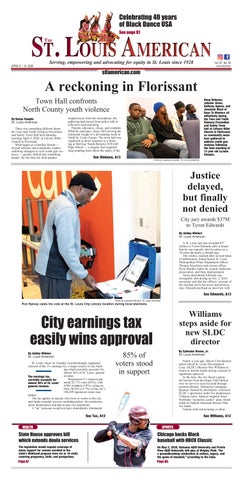
Doug Dobynes, Jakeem Jones, Anthony Agnew, and Jeremiah Ward of Boys To Mentors sit attentively during the Teen and Youth Violence Prevention and Safety Town Hall at Calvary Bible Church in Florissant, as community members gathered to address youth gun violence following the fatal shooting of 13 year old LaJuan Swopes.
Photo by Lawrence Bryant / St. Louis American
Ashley Winters St. Louis American
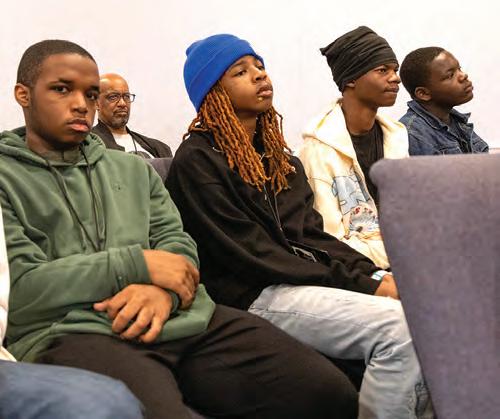
Ron Spivey casts his vote at the St. Louis City Library location during local elections.
Photo by Lawrence Bryant / St. Louis American
Guest Editorial SAVE Act a throwback to Jim Crow
By Marc Morial
“The SAVE Act is not an election security bill — it is a voter suppression bill, full stop. … The CBC will not sit back while extremists continue to strip away access to the ballot box for our communities, and we are calling on every Senator to reject this assault on our democracy and stand up for the integrity of our elections.”
— Congressional Black Caucus
Analysis after analysis shows that the Trump administration’s voter suppression legislation will keep millions of Americans from voting.
But pointing out that the bill will disenfranchise huge swaths of the electorate will not deter its proponents — because mass disenfranchisement is the goal.
The president has repeatedly acknowledged that broad participation in elections would disadvantage his party. Sen. Mike Lee of Utah even circulated polling showing his party poised to lose its Senate majority, arguing the bill could “turn this around.”
Earlier this month, the president privately assured allies the bill would “guarantee” victories not only this year, but for “every election for a long time.” He is so committed to restricting the electorate — especially Black Americans — that he scuttled a bipartisan deal to stabilize the nation’s airports, holding TSA funding hostage to force passage of the bill.
financial hurdles required to secure them. Many Black citizens born in segregated hospitals hold older or non-standardized documents that may not meet the bill’s strict criteria. Black women, who change their legal names at higher rates, face additional burdens because name-matching requirements often force them to track down decades-old marriage or divorce paperwork.
And even those already registered are at risk. The bill requires voter-roll purges every 30 days — reinstating a tactic that southern officials once used to erase Black voters with bureaucratic precision. Purged voters will not know they’ve been removed until they show up at their polling place. They will have no fallback: the bill bans universal mail voting, even in states that already conduct secure allmail elections. Black voters, who tend to face longer lines, fewer polling locations, inflexible work schedules and transportation barriers, will be disproportionately harmed.
False claims of voter fraud fueled the fake-elector plot and the Jan. 6 attack, but more than 60 post-election lawsuits yielded no evidence of widespread wrongdoing — let alone the kind alleged to justify this legislation.
If enacted, the bill now before the Senate would prevent more eligible citizens from registering to vote than any legislation in American history. Its impact would fall hardest, as always, on Black Americans. At the core of the bill is the myth of widespread voter fraud — a myth built on racist tropes that have endured since Reconstruction. After the Civil War, white supremacists claimed newly enfranchised Black citizens were inherently suspect voters: “unfit,” “illegitimate,” or easily bribed or manipulated. These lies justified poll taxes, literacy tests and arbitrary “character” assessments for generations. Today’s fearmongering about “illegal voting” is simply the modern version of those same racist narratives.
The SAVE America Act revives these tactics by requiring specific proof of citizenship — either a U.S. passport or a certified birth certificate and government-issued photo ID. More than 21 million Americans lack easy access to those documents, and Black Americans disproportionately face the bureaucratic and
The rhetoric promoting the SAVE America Act is steeped in the white-nationalist “Great Replacement” conspiracy theory — the idea that expanding multiracial participation threatens white political dominance. As Washington Post analyst Philip Bump observed, the bill effectively turns that racist conspiracy into law.
The bill’s financial burdens, documentation requirements and bureaucratic traps are nothing less than a 21st-century resurrection of the poll taxes and literacy tests that defined Jim Crow. Its design mirrors the logic of Plessy v. Ferguson: create barriers that disproportionately harm Black citizens, then insist the rules are “neutral.”
America has seen this strategy before. We know who it targets. We know what it’s meant to prevent. And we know that the myth of voter fraud — rooted in racist lies about Black political participation — has always been a tool to silence Black voters.
The SAVE America Act is simply the latest incarnation of that long, shameful tradition. And like every discriminatory scheme before it, it belongs on the scrap heap of history.
By Nosakhere Griffin-EL
President Obama, while on a podcast, discussed two competing narratives shaping American society. The narrative of hierarchy centers on exclusion — often by race and gender — while the narrative of equality emphasizes a shared creed and collective action.
Hierarchy, by design, is anti-democratic because it privileges solutions from the top, silencing those at the bottom. In contrast, equality is inherently democratic, empowering communities to develop solutions together.
Across the country, school closures are happening in an anti-democratic way. Many closures are justified by budget deficits, the high costs of maintaining old buildings, population declines, or the need to improve struggling schools. Cities including St. Louis, Pittsburgh, Austin, Texas, Houston, and Philadelphia all cite similar reasons for proposed closures.
Brown children can dream within their own communities.
First, a democratic educational reform process must uphold the principle of one voice, one vote. Communities facing school closures should have local referendums, empowering residents to decide the fate of their neighborhood schools.
Second, the city should dissolve the mayoral-appointed board in favor of a democratically elected board. This would create a direct link between the community and representation. Two students should also hold voting seats to help shape district policies from development to implementation.

Before she was fired last year, St. Louis Public Schools Superin tendent Millicent Borishade was entertaining the idea of closing over 30 scholls – mostly in Black neighborhoods.
In Philadelphia, where I attended the now closed University City Hogh School, Superintendent Tony B. Watlington Sr. has proposed closing 18 schools. The plan has sparked strong resistance from students, parents, and community members. Black and Brown students make up 75% of the district, and the closures would affect 5,000 students — disproportionately harming them.
The last time Philadelphia closed schools, the consequences for students, families, and communities were severe.
For educational reform to truly be democratic, it must be led by the people most affected: students, parents, and community members.
Philadelphia, the birthplace of American democracy, is now witnessing an anti-democratic process that diminishes educational spaces where Black and
Lastly, all school buildings should be transferred to community land trusts. If a school is closed and the property is sold, the proceeds should be returned to the community to reinvest in new educational spaces.
Some argue that old school buildings are too expensive to repair and should be closed. But when it is time to help poor Black children, cost becomes the focus.
Black children deserve places that inspire them to dream. Closing schools is not simply a financial decision; it is a moral one that demands democratic action.
The educational philosopher Paulo Freire argued that building a better world requires leaders to work with the oppressed, not for them. At the core of his philosophy is the belief that people have the power to develop and implement solutions—this is the essence of democracy. I affirm Freire’s idea. Black parents, students, and community members must have the power to determine the future of their schools because it is their democratic right.
Dr. Nosakhere Griffin-EL is an educator and Public Voices Fellow of The OpEd Project in partnership with the National Black Child Development Institute.
By Ben Jealous
This year, America marks 250 years since the Declaration of Independence. That should make us proud. It should also make us honest.
When my son was 11, we walked the Lexington battlefield in Massachusetts.

Dina
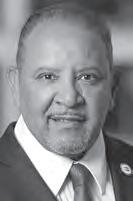
Marc Morial is president/CEO of the National Urban League. Donald M. Suggs
As we crossed that ground, I told him our family descends from the youngest person to carry a musket there that day.
Then I looked at my son and said: He was only two years older than you are now.
That moment has stayed with me.
So this year, as we mark 250 years since the Declaration, we should ask a simple question: Have we finished what those brave men, women and children started?
Not yet.
We elect our mayors by popular vote. We elect our governors by popular vote. But we still do not count every vote equally when we choose our president.
Try explaining that to a child. It is awkward.
Because democracy rests on a simple idea: the person with the most votes should win. One person, one vote.
Today, that is not how presidential politics works in practice.



Assembly. If Gov. Abigail Spanberger signs it, Virginia would become the 19th jurisdiction in the compact, joining states such as Vermont, Delaware, Maine and Illinois. Virginia is not some side note in this story. It is one of the places where the American idea of self-government first took root. If Virginia joins now, it will not be breaking with the founding. It will be honoring it.
That is not a radical idea. It is an American one. And it should not belong to one party. This is not about helping Republicans. It is not about helping Democrats. It is about trusting the people. That idea is not left-wing or rightwing. It is not urban or rural. It is not Black or white.
It is patriotic.
Of course, there are still obstacles. More states would need to join. Lawmakers would need to act. Courts may weigh in. None of this is certain.

A few swing states get most of the attention. The rest of the country is pushed aside. Millions of Americans in red states and blue states alike are told, in effect, that their votes matter less in the one race that belongs to all of us.
That is not fairness. That is neglect.
There is another way.
It is called the National Popular Vote Interstate Compact. It does not end the Electoral College. It uses it the way the Constitution allows. The Constitution gives state legislatures the power to decide how their electoral votes are awarded. Under this plan, states agree to give their electoral votes to the candidate who wins the most votes in all 50 states and the District of Columbia. No constitutional amendment is needed. Virginia is now close to joining. The bill has passed both houses of the General
But history does not move only when success is guaranteed. It moves when people decide that something is right.
And what better time than now?
What better way to honor America’s 250th birthday than by taking one more step toward becoming the democracy we have always said we are?
The people who stood at Lexington did not risk their lives so future generations could accept minority rule. They did not fight so Americans would shrug when the person with the most votes loses.
They fought for freedom. They fought for self-government. They fought for the right of the people to decide their own future.
It is time to finish what they started. Let the people decide. Let the majority rule.
Ben Jealous is a professor of practice at the University of Pennsylvania, former national president and CEO of the NAACP, and author of “Never Forget Our People Were Always Free.”
Guest Columnist
Nosakhere Griffin-EL
Guest Columnist Ben Jealous
Behind the lens of history
STL native
Latrelle Yancey captures one of the NBA’s defining
By Kenya Vaughn St. Louis American
performances
“I just had to make sure I didn’t miss it.” And he didn’t.
But Adebayo kept going. What started as a milestone became something electric. The whispers turned into disbelief.
“People started saying, ‘What about Kobe’s 81?’” Yancey said. “I’m like, ‘Hold on… we still got time.’”
As the personal content creator for NBA AllStar
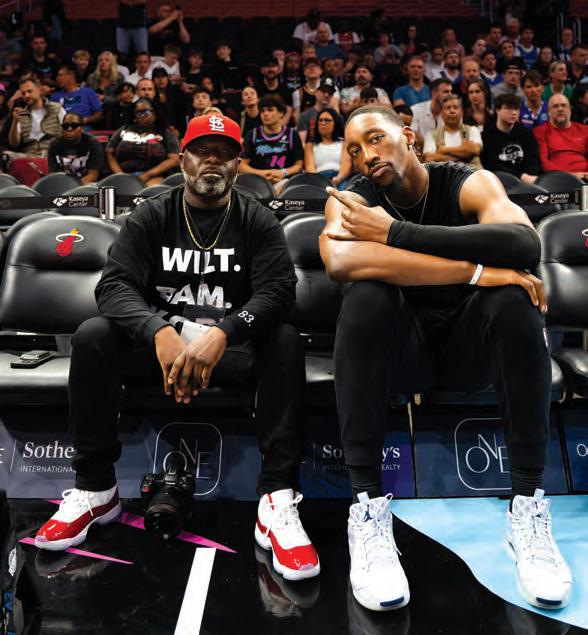
Adebayo, Yancey wasn’t watching history unfold from the stands on March 10. He was tracking it through a lens — equal parts instinct, preparation, and faith — while quietly reminding himself to be ready when the moment came.
“I looked up after the first quarter and he had 31,” Yancey said. “I’m thinking, ‘Man… this might be a career night.’”
By halftime, Adebayo was climbing into rare air. Somewhere between the third quarter and the swelling buzz inside the arena, word spread. If he kept going, he wouldn’t just be having a great night — he’d be rewriting history. Adebayo was closing in on a mark set by LeBron James.
Yancey heard it secondhand.
“I wasn’t about to say nothing to him,” he said. “I’m superstitious. I didn’t want to mess up his focus.”
So he locked in. “Be ready for the moment,” he told himself. “Make sure your batteries are charged.”
The play unfolded almost exactly how he imagined it — an open lane, a clean look.
“When he broke the record, I was already there,” Yancey said.
When Adebayo stepped to the line and delivered, the arena erupted. His 83 points was the secondhighest singlegame total in NBA history. A new franchise record. A night that passed Kobe Bryant’s 81 and trailed only Wilt Chamberlain’s 100.
“It looked surreal,” Yancey said. “Like — this really just happened.”
Then instinct took over again. “As much as I wanted to embrace it, I had to make sure I got the shots,” he said. “That’s what I’m there for.”
A St. Louis native, Yancey’s journey didn’t begin with courtside access. It started with an iPhone, a vision, and a daughter who needed a commitment video — a simple request that revealed a gift he didn’t know he had.
“I realized — I can bring what’s in my head to life,” he said.
From there, he built project by project, teaching himself lighting, angles, editing, and storytelling. He spent nights studying the work of creators he admired and mornings trying to recreate the techniques on his own. He eventually created his own aesthetic and made a name for himself as an in-demand visual storyteller. When opportu-


nity came calling, he was ready.
A connection and a conversation led him from St. Louis to Miami in early 2023.
“I packed up everything and drove,” he said. “Didn’t even hesitate.”
His place in basketball history came nearly a decade after the hardest year of his life. In 2016, he lost his mother to breast cancer. A month later, he was diagnosed with lymphoma. He went through chemotherapy while working, coaching, and showing up for his children — sometimes receiving treatment between responsibilities, then returning to




the gym or classroom.
“It gave me a different perspective,” he said. “You don’t know how much time you got.”
Before the camera, Yancey’s dream lived on the sidelines. A former athlete whose own aspirations didn’t materialize, he poured himself into coaching — determined to help young athletes avoid the uncertainty he once felt. That commitment led him back to HarrisStowe State University, where finishing his degree removed a barrier to collegiate coaching. His journey eventually shifted to storytelling, but the mission of guiding,
uplifting and preparing stayed the same.
“I never believed people when they said they loved what they do,” he said. “Not until I picked up that camera.”
Today, that camera has taken him places he once couldn’t imagine — NBA arenas, global stages, AllStar locker rooms, international travel. And every time he steps into a new space, he carries St. Louis with him — the lessons, the grit, the perspective.
Even now, Yancey admits there are moments when he has to pause and take it all in. The same young man who once wrestled with unmet athletic dreams now finds himself documenting the pinnacle of sports — from the Olympic Games to the NBA AllStar Game to the Naismith Memorial Basketball Hall of Fame.
“I still have to pinch myself sometimes,” he said. “I’ll be in these rooms, on these stages, and I’m like, ‘How did I get here?’” In between the big moments are the quieter ones — building trust with some of the game’s biggest stars.
“It’s bigger than just shooting content,” he said. “It’s the relationships.”
Even with access to icons like Stephen Curry, Kevin Durant, and Anthony Edwards, Yancey keeps the focus where it started — with purpose. And with the person at the center of it all.
“It couldn’t have happened to a better person,” he said of Adebayo. “He’s one of the most humble, hardestworking dudes I’ve ever been around.”
That alignment — between subject and storyteller — made all the difference.
And on the night Bam Adebayo made history, Yancey did exactly what he set out to do. He didn’t miss it.
















Photo courtesy of Stephan Flores
Latrelle Yancey and Miami Heat center Bam Adebayo courtside in Miami. Last month Adebayo made NBA history with his 83-point game in the Heat’s victory over the Washington Wizards.

Obama Presidential Center tickets available on May 6
Public tickets for the Barack Obama Presidential Center in Chicago, which opens on June 19, 2026, will be available May 6.
“When visitors look up at the Obama Presidential Center’s museum building, they’ll see three simple powerful words: You are America,” former President Barack Obama said in a video shared on X last month.
Spanning 19 acres, the $850 million center in Jackson Park will feature a main building and museum; a forum building that includes an auditorium, media suite, and other rooms; a Chicago Public Library branch; and farther south, a 45,000-squarefoot multipurpose athletic center.
Tickets will be available at Obama.org. This initial round of ticket sales includes dates between June 19 and Nov. 30. Tickets for future dates will be announced online at obama.org. All museum entries will be time ticketed.
Top Tutors partners with KIPP High School
Top Tutors for Us, a Black owned tutoring and test-prep company, has announced another partnership with an area school.
Top Tutors is working with KIPP St. Louis High School to provide free standardized test preparation to all 10th-grade students throughout the 2026 school year.
Top Tutors was founded by Washington University graduate Angelica Harris, who holds three degrees from the university.
In a November 2025 St. Louis American profile, Harris said participants improve their test scores at twice the rate of traditional prep, “opening doors to top universities and scholarship opportunities.”
Top Tutors also has partnerships with St. Louis Public Schools, Hazelwood, Maplewood Richmond Heights, and multiple charter networks.

Commentary
Inspiring our own personal growth
By Michelle Tucker
What if we took a big leap and started breaking down the self-imposed barriers blocking our paths? Imagine how much easier it would be for us to focus on tackling the external challenges we encounter!
In times like these, when the world sometimes feels like a rollercoaster ride, our personal and leadership growth is more important than ever. While we can’t control everything happening around us, we can absolutely work on shaping our internal mindset. By focusing on what’s within our influence, we can raise our personal bar and emerge as stronger leaders. Instead of measuring ourselves against others, let’s challenge ourselves to become the best versions of who we are. This journey kicks off by recognizing and overcoming those mental barriers we’ve unconsciously built.
Turbulent times require us to lean into creativity and innovation—both of which are essential for effective leadership. Breaking free from self-imposed barriers means consistently challenging ourselves. Take a moment to reflect on areas in your leadership journey where you feel stuck. What’s contributing to that feeling? Is it limited to external factors, or is it further complicated by those things we’ve let hold us back? Sometimes, the biggest hurdles are the ones we place in our own way.
Like many, I remember times when I thought I had reached my limit. You know that feeling when you convince yourself that your last promotion was your final one? I found myself thinking, “Well, this is it. I’ve done enough.” Sound familiar? Those thoughts can quickly turn into self-fulfilling prophecies, often shaped by past experiences or comments from others. Have you ever had someone tell you that a particular achievement was out of your reach? Those words tend to stick around.
Now is the time to challenge those limitations. Instead of letting outside voices dictate what you can achieve, shift your focus to self-competition. Ask yourself, “How can I make today better than yesterday?” This mindset shift can spark serious personal and professional growth. By setting our own bar and benchmarks, we create a unique path that’s free from the constraints imposed by others.
Another key aspect of this journey is the company we keep. Surrounding ourselves with uplifting and challenging individuals is vitally important for effective leadership. Seek out mentors and peers who inspire positivity and push you beyond your own perceived limits. Their support can be the spark you need for growth. Remember, it’s not just about competing against ourselves or others; it’s about fostering an environment where everyone can thrive.
So here’s a call to action for me and everyone reading this: write down a few areas in your leadership where you feel you’ve hit a ceiling. Reflect on the mental barriers that may have led to this. Then, set specific, achievable goals that push you beyond your current state. Whether it’s picking up a new skill, tackling a challenging project, or stepping into a more influential role, the key is to commit to yourself.
Competing against yourself isn’t just about doing more; it’s about evolving as a leader. Every little step forward is a victory. Embrace the challenges that come your way, and watch your potential unfold in ways you never imagined.
Let’s break down those barriers and lead stronger—together!
Michelle D. Tucker is president & chief executive officer of United Way of Greater St. Louis

Michelle Tucker
The Barack Obama Presidential Center will celebrate its grand opening on Juneteenth – June 19, 2026. Tickets for the public go on sale May 6.
Photo courtesy of Obama.org
APRIL 9 – 15, 2026
PEOPLE On The Move
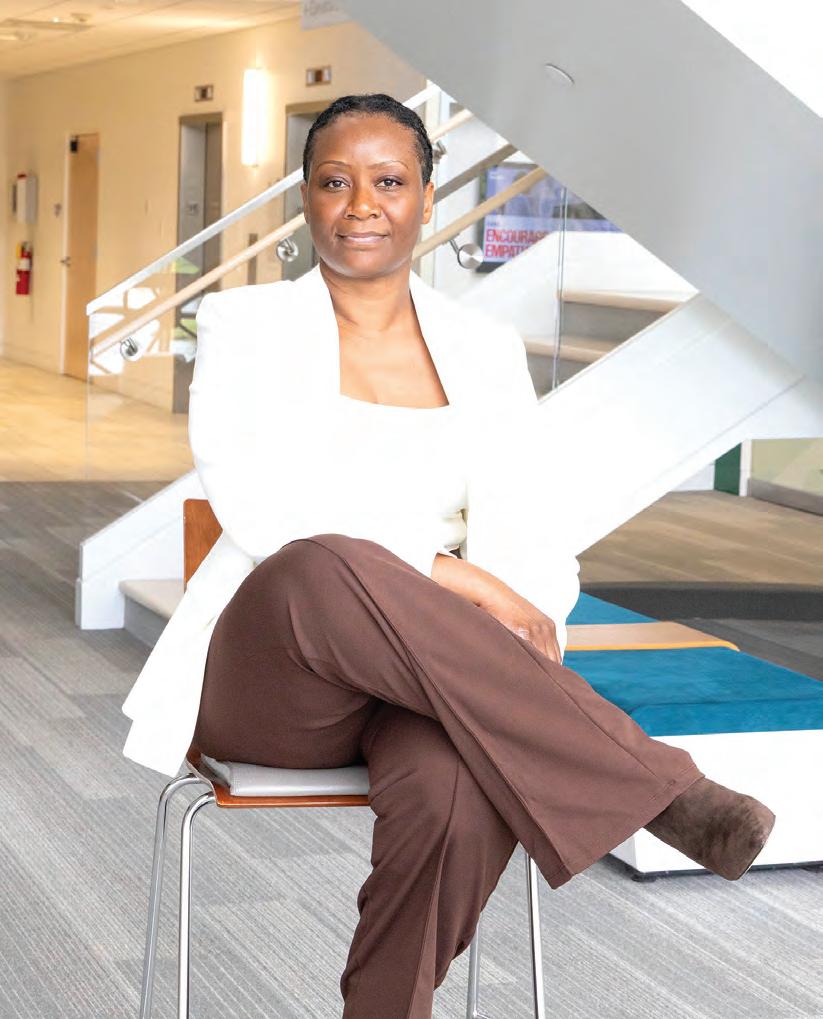
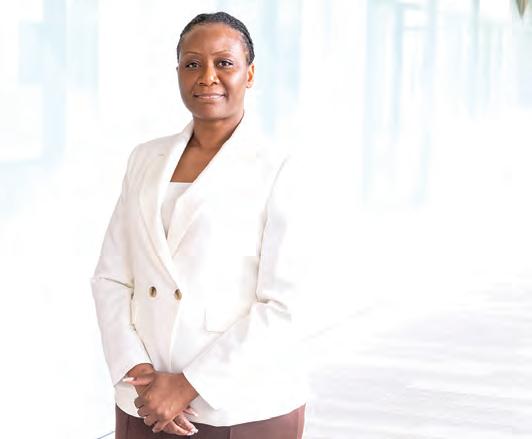
Miranda Steele, a chemist at Keenova, stands at the forefront of her field, combining scientific expertise with a commitment to advancing health equity and expanding opportunities in STEM.
Improving access to care
Miranda Steele forges new pathways to STEM, health equity
‘We’re all humans first’
By Nia Hightower For the St.
Louis American
For Miranda Steele, science has never been just about formulas and processes. It has always been about people. As a leading scientist at Keenova, Steele serves as a manager of process chemistry –– a role that places her at the critical intersection of
research, manufacturing, and patient impact.
“We’re all human first,” she said. “Understanding that we all have needs shapes how I approach the work. If I have the ability to help answer questions and provide solutions, then that’s what I’m going to do.”
The St. Louis native’s work at Keenova, a global pharmaceutical company with a facility in Hazelwood, involves the development work used to help support manufacturing, troubleshooting, streamlin-
ing processes, and optimizing that ultimately yields pharmaceuticals and therapeutics for patients. After more than 20 years with the company, Steele’s work continues to evolve — just like the questions she seeks to answer. No two days look the same. One moment she’s writing technical reports, the next she’s collaborating across teams or designing new chemical pathways to improve efficiency. But beneath the complexity of her work lies a simple, human-centered
goal –– improving access to care.
“Reducing timelines, raw material costs — these things ultimately allow for better outcomes for patients when it comes to accessibility and affordability,” she said. “Providing these things in a shorter timeline allows patients to have it sooner rather than later.”
Bobby Trawick, executive director of global technical operations and development at Keenova, has worked with
How to leverage and monetize AI
By Mark S. Lee Word In Black
Detroit has always been a city of builders, problem-solvers, and risk-takers. From manufacturing to mobility, retail to the creative economy, businesses here have learned to adapt through economic cycles, policy shifts, and market disruption.
Today, another shift is underway: the rise of artificial intelligence (AI) and smart technology. For many entrepreneurs, in particular, the question isn’t if to use AI—but how and monetize it.
The good news is that AI is no longer just for big business or tech startups, but for those looking to grow through innovation while connecting with consumers in a technology-enabled economy.
Many of the tools available today are affordable, easy-to-use, and designed to support teams. Not necessarily replacing human inter-

actions but enhancing in a cost-effective manner. Think efficiency first, not elimination Small businesses often operate lean, with owners
wearing multiple hats. AI can help lighten that load by handling routine, time-consuming tasks. Tools that automate appointment scheduling, invoicing, payroll, and customer reminders allow business owners to
spend more time on strategy, sales, and community relationships. To wit, AI-driven chat tools can answer basic customer questions after hours; while bookkeeping software can identify cash-flow trends before problems arise.
Use technology to make better financial decisions
Access to capital and cashflow management remain top concerns for local businesses. Financial tools can analyze spending patterns, forecast revenue, and flag potential risks. Rather than reacting to financial stress, business owners can plan. This kind of insight is especially valuable in a city where many entrepreneurs are growing businesses while rebuilding personal and generational wealth.
Lutheran Family and Children’s Services has hired Reva Faber as director of behavioral health.

Under her leadership, Faber will ensure clinical teams have the support they need to provide the highest quality care to Missouri families.
Before joining LFCS, Faber held key leadership roles at CenterPointe Hospital in St. Charles, including director of clinical services, outpatient programming, and residential services. Faber named LFCS behavioral health director
Mutamba attends nutrition conference
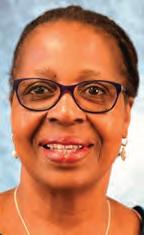
Judith Mutamba
Judith Mutamba, Lincoln University assistant professor and state extension specialist for human nutrition and health, hosted a breakout session during the 2026 National EFNEP Coordinators’ Conference in Kansas City March 2-5. Mutamba discussed how nutrition program associates can integrate underutilized, nutritious crops into family diets. The conference brought representatives from 1862 and 1890 land-grant universities together to receive training, share knowledge, and develop future initiatives.
Steven-Anthony Clark named Symetra VP

StevenAnthony Clark
Steven-Anthony Clark is serving as a regional vice president for Symetra’s Retirement Division, covering the Bank & Wire Channel in Arkansas, Southern Illinois, Kansas, Missouri, and Nebraska. He joined Symetra in 2025 and has over 10 years of experience in the industry. Clark earned a bachelor’s degree in political science and government. He earned his master’s degree in business administration and management from Webster University. He is based in St. Louis.
Richardson honored by Metro Theater
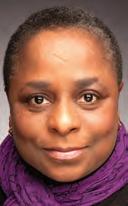
Mariah L. Richardson, assistant professor of mass communications at St. Louis Community College–Florissant Valley, will be honored during Metro Theater Company’s 2026 Jubilee Gala on May 19 at the theater. Richardson will receive the St. Louis Champion for Theater for Young Audiences honor in recognition of her decades-long contributions as a playwright, director, and educator. Her creative partnership with Metro Theater Company spans many years and reflects a shared commitment to high-quality theater for young audiences. Richardson has contributed two commissioned works: Delilah’s Wish (2009) and Bold, Brave, Curious! (2022).
Promotion, board appointment, new hire, award... please submit your People on the Move item (including photo) to areid@stlamerican.com.
Reva Faber
See Steele, A6
Photo by Lawrence Bryant / St. Louis American
The good news is that AI is no longer just for big business or tech startups, but for those looking to grow through innovation.
Envato photo
Mariah Richardson
Steele
Continued from A5
Steele in the life sciences space at Keenova for decades.
“Her steady leadership and her work to strengthen our manufacturing processes help us deliver therapies with greater consistency and care to the people who rely on them,” Trawick said. “She brings technical skill, genuine curiosity, and a spirit that lifts the people around her. Her contributions matter, and I am grateful for the chance to work alongside her.”
Originally intending to become a physician, Steele’s early ambitions were shaped by what she witnessed growing up in St. Louis.
“My desire to serve and seeing the needs and disparities within my own home and community, that’s what rooted that decision,” she said.
Though life redirected her path from medicine
Continued from A5
Monetize, don’t just modernize
The real opportunity with AI isn’t only saving time—it’s generating revenue. AI allows small businesses to personalize marketing based on customer behavior, increasing repeat purchases and average transaction value.
A neighborhood retailer can analyze sales data to identify buying patterns and automatically promote complementary products.
A service provider can use automated follow-ups
to chemistry, the mission never changed. “I’ve been able to still be fulfilled in serving — just in a different way,” she added.
That mindset defines how Steele approaches her work today. She sees her role not just as a chemist, but as a problem solver for people who may never know her name, and her commitment to health equity extends beyond the lab.
In her community, she
to encourage referrals or upsell premium offerings. Restaurants can leverage online ordering data to suggest add-ons that increase ticket size.
AI can also help businesses refine pricing strategies. By analyzing demand trends and competitor data, owners can adjust pricing strategically rather than guessing. Even small margin improvements can significantly impact profitability over time.
Technology opens doors to potentially new revenue streams, such as creating digital products or become e-commerce extensions of brick-andmortar stores. These scalable offerings generate income without dramati-
is a mentor, educator, and advocate — particularly for young people who may not see themselves reflected in careers in the sciences, technology, engineering, and mathematics.
She recalls a moment that continues to stay with her –– a young girl brought to tears simply by seeing Black scientists in person during one of her community service visits.
“She had never seen an African American scientist,” Steele said.
cally increasing overhead.
Bottom line (pun intended), improving cash flow and reducing revenue loss can be just as impactful and financially rewarding as attracting new customers.
Level the playing field in marketing and outreach
Marketing budgets for are often limited. AI tools can help close that gap and can assist with drafting social media posts, email campaigns, website content, and even customer surveys.
Used properly, AI can help businesses communicate more consistently and professionally, without losing their authentic voice.
Miranda Steele’s work at Keenova, a global pharmaceutical company with a facility in Hazelwood, involves the development work used to help support manufacturing, troubleshooting, streamlining processes, and optimizing that ultimately yields pharmaceuticals and therapeutics for patients.
“Sometimes we don’t understand the impact we can have. We don’t even have to say anything, we just need to show up in spaces.”
That belief fuels her involvement in youth programs, church outreach, and community education. Whether she’s helping run a food pantry, teaching proper medication disposal, or speaking with students, Steele is intentional about sharing knowledge.
“If the knowledge that I
The goal is to be clear, consistent, compelling, and visible while speaking in an authentic voice to audiences you want to connect and attract.
As businesses adopt more digital tools, cybersecurity becomes essential. A single data breach can derail a small operation. AI-enabled security systems can monitor for unusual activity, and help safeguard customer information. Protecting data isn’t just a technical issue—it’s about trust.
Customers expect businesses to handle their information responsibly.
Invest in people, not just platforms Technology works best
have is not shared, then we have a problem,” she said.
Rev. Keith Hackle Jr., senior pastor at Grace Community SeventhDay Adventist Church in Euclid, Ohio, has known Steele for eight years. Before moving to Ohio, he served as pastor of Agape SDA Church in University City, where Steele worships and spends time volunteering.
“In an era where leadership is often measured in metrics and milestones, Miranda Steele redefines what impact looks like — quietly, consistently, and with an unwavering commitment to people over prestige,” Hackle said.
“For years, Miranda has been a steady force in her community. Her approach to service is rooted not in grand gestures, but in reliability –– showing up, following through, and building trust over time. Whether organizing neighborhood initiatives like leaf removals, mentoring young people, or collaborating with other area churches for citywide events, she has cultivated a
when employees understand and trust it. Focus on basic training and skill-building so staff can use new tools confidently. This doesn’t require advanced technical expertise.
Short workshops, online tutorials, and peer learning can go a long way. When people see technology as a support system rather than a threat, adoption improves and productivity increases.
Keep Detroit values at the center
Detroit businesses are deeply rooted in relationships, community, and purpose. Enabling AI technology should enhance those values—not undermine them. Being
reputation for consistency that many aspire to, but few sustain.”
At Keenova, a company grounded in the belief that “no one should be alone in their pursuit of better health,” Steele sees her work as part of a broader mission to close gaps in care. For her, health equity is both a global and deeply personal responsibility.
“Everyone needs to be afforded the same access and the same opportunities,” she said. “What you do individually should have some impact on the global community.”
In laboratories, classrooms, churches, and communities, Steele is doing exactly that — quietly but powerfully shaping a future where science serves everyone, and where equity is not an aspiration, but a standard.
“If I see something,” she said, “and I have the ability to change it — as a chemist, as a mother, as an African American, as a woman — I want to change it.”
transparent about how technology is used, protecting customer privacy, and maintaining a human touch all matter. Small businesses have a unique advantage because know their customers by name, not just by data point.
To be clear, AI and technology are not silver bullets. They are tools— powerful ones—that can help businesses operate smarter, generate new revenue, and remain competitive in uncertain times. Used thoughtfully, they offer an opportunity not just to survive change, but to shape it.
In Detroit, resilience isn’t new. The tools may be different, but the mindset remains the same.

Photo by Lawrence Bryant / St. Louis American
HealthMattersHealthMattersHealthMatters
Care of You’
Helping moms
State House approves health care bill which expands doula services
By Anna Spoerre Missouri Independent
Awide-ranging health care bill that includes a provision expanding doula services for low-income families across the state passed out of the Missouri House on Thursday, Apr. 2, 2026.
The legislation, sponsored by state Rep. Tara Peters, a Rolla Republican, would expand coverage of doula support for women enrolled in the state’s Medicaid program from six to 16 visits covering pregnancy, birth, postpartum and lactation support.
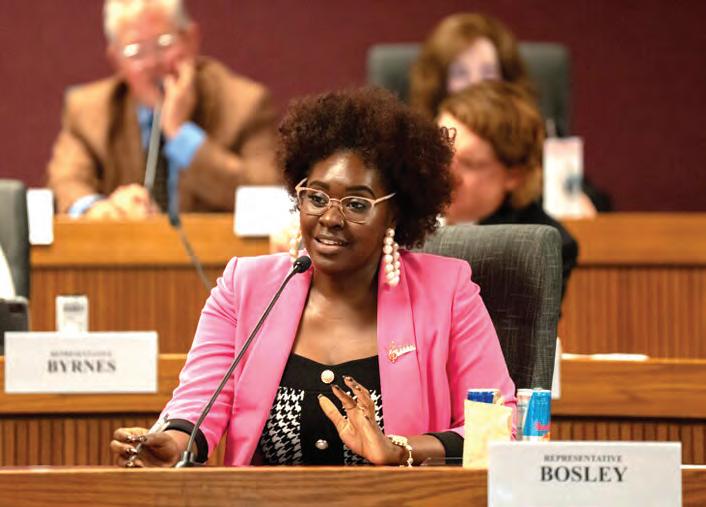
State Rep. LaKeySha Bosley of St. Louis, who urged her colleagues to support the bill, said she’s confident the doula provision will
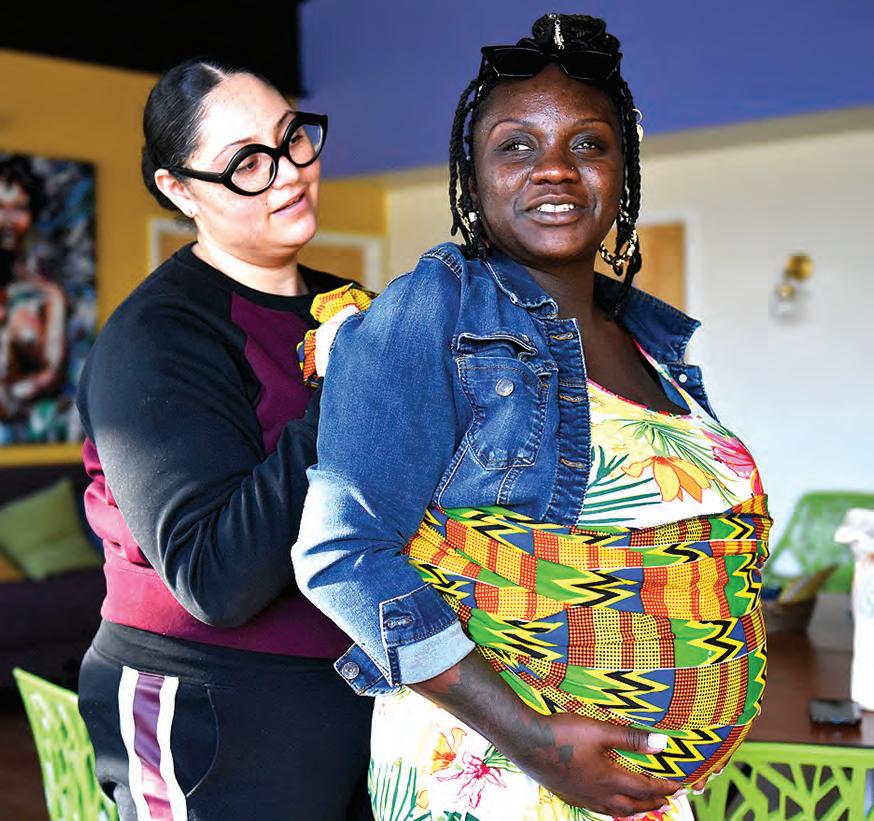
Doulas advocate for the physical and emotional wellbeing of mothers and families. They do not deliver babies.
save women’s lives. Doulas advocate for the physical and emotional wellbeing of mothers and families. They do not deliver babies.
“This will assist women who are going through one of the proudest moments, potentially, of their lives, is becoming moms, make sure that they have an advocate with
See Doula, A8
HBCU’s positive role on Black brain health
By Jennifer Porter Gore

Middle-aged and aging alumni of the nation’s Historically Black Colleges and Universities could very well be reaping health benefits decades later, according to a recent study. Researchers examined a sample of 1,978 Black American adults who attended college between 1940 and 1980, 35% of which had attended an HBCU. The study also examined college attendees who had attended also high school in a state that has an HBCU. The study, published on the JAMA Network Open website, found that “HBCU attendance was associated with better cognition compared with PWI attendance for aging Black adults.” The study also found the positive outcome held for those attending college before and after the landmark Brown v. Board of Education ruling ending racial segregation in schools.
56% of the Black participants lived in the nation’s Stroke Belt — the eight Southern states that have a higher than average number of stroke deaths.
Data for this recent study came from the Reasons for Geographic and Racial Differences in Stroke study, which had recruited Black and white adults aged 45 years and older, from 2003 to 2007. A total of 56% of the Black participants lived in the nation’s Stroke Belt — the eight Southern states that have a higher than average number of stroke deaths. The study finds HBCU alumni outperformed their peers from predominantly white institutions in memory, language, and overall cognition decades later.
See Brain, A8
Affinia announces Residency Program inaugural class
Will serve at Ferguson Health Center
By Alvin A. Reid
St. Louis American
In its ongoing mission to increase equitable healthcare access throughout the region, Affinia Healthcare established its Healthcare Family Medicine Residency Program in June 2025.
On March 20, 2026, Affinia announced its inaugural class for the residency program, with residents from across the country.
Coming to serve the St. Louis community at Affinia’s Ferguson Health Center are:
Hira Adil (Khyber Girls Medical College, Khyber Pakhtunkhwa).
Basudev Chaudhary (Kathmandu Medical College, Kathmandu, Nepal).
On March 20, 2026, Affinia announced its inaugural class for the residency program, with residents from across the country.
Sasha Dorestin (Des Moines University College of Osteopathic Medicine, West Des Moines, Iowa).
Ukasha Habib (Nishtar Medical University, Multan, Punjab, Pakistan).
The residents will receive training, professional development and “gain real world experience” before becoming licensed clinicians, according to Dr. Kenneth Hemba, Family Medicine
See Affinia, A8
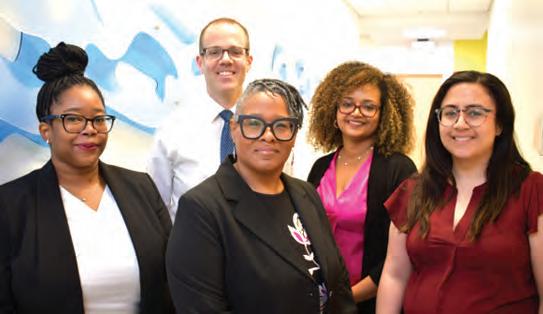
Photo by Anna Spoerre / Missouri Independent
Photo courtesy of Affinia
Christian King, a doula with Uzazi Village in Kansas City, wraps Mikia Marshall, 33, with a kanga cloth to help take pressure off her stomach on Feb. 27, 2024. The Missouri House has approved a bill that would expand doula services. It now awaits debate in the Senate.
Affinia Family Medicine Residency Program staff members who will welcome its first Residency Program residents this summer. From left are, Dr. Kristia Abernathy; Dr. Kenneth Hemba, Residency Program director; Laura Williams, project director; Dr. Mihiret Belihu; and Dr. Alexa Arastoo.
Jennifer Porter Gore
HealthMattersHealthMattersHealthMatters
Care of
Affinia
Continued from A7
Residency Program director.
“We are thrilled to conclude the search for this first class and look forward to welcoming them to Affinia Healthcare,” said Hemba, who noted that more than 1,000 applicants sought the residency positions.
“There were many qualified candidates to choose from, and we believe we’ve selected an outstanding group of future leaders.”
Hemba said the Ferguson Health Center is in “an area which has seen a decline in access to equitable health services.
“Affinia opened [in Ferguson] as a result of a community health assessment identifying North St. Louis County as an area where unmet primary care needs were prevalent,” he said.
“Starting this residency program is an extended result of this assessment. The program is also a means for increasing the number of new providers.”
Many of the applicants were drawn to the residency program to “serve patients in under-
Doula
Continued from A7 them as they’re going through their birthing plan and doula services,” she said Thursday.
In late 2024, the Missouri Department of Social Services issued an emergency rule authorizing Medicaid to reimburse doula services, citing “an immediate danger to the public health, safety or welfare of pregnant women in Missouri.”
Since the program’s inception, more than 625 participants insured through Medicaid accessed doulas during their pregnancy and postpartum, Baylee Watts, a spokeswoman for the Department of Social Services, said in March.
Doulas have increasingly been cited as part of the solution to Missouri’s poor maternal and infant birth outcomes.
On average, around 70 women die each year in Missouri during childbirth or in the first year postpartum. Of those deaths, 80% were deemed preventable by the state.
In 2024, a year after Missouri expanded Medicaid coverage through the first year postpartum, 38% of births were covered by Medicaid. Several years ago, the state’s PregnancyAssociated Mortality Review board assessed maternal deaths from 2017 to 2021 and found that
Brain
Continued from A7
The alumni were in school during the 1954 Supreme Court’s Brown v. Board of Education ruling, as well as during and after the passage of the 1964 Civil Rights Act, which effectively ended legal racial discrimination in the nation’s schools.

served communities so they could continue leveraging their knowledge.”
Affinia Healthcare was awarded a grant in 2023 for the residency program to help develop primary care physicians to serve in
community health centers. It earned full accreditation from the Accreditation Council for Graduate Medical Education (ACGME) in 2025.
According to ACGME, accreditation is received
through a voluntary process and review based on industry standards. The accreditation process ensures the program meets the standards for specialty practices to prepare graduates.
“By anchoring physician training in the community, Affinia’s residency program not only expands access to care but also builds a sustainable pipeline of highly competent providers committed
to health access and longterm impact,” Kendra Holmes, Affinia president and CEO said following the Residency Program accreditation.
According to Affinia’s website, the Resident Program’s curriculum “balances evidence-based medicine with the art of compassionate care.”
“The cornerstone of training is Primary Care and Community Medicine (PCCM), spanning all three years of residency and focusing on longitudinal outpatient care.”
As part of the threeyear experience, residents will have weekly protected wellness time, resident retreats, and social events. Sessions on self-care, stress reduction, mindfulness, and work-life balance are included with the residency. There will also be instruction on debt management, retirement planning, and employment contract review.
To learn more about the Family Medicine Residency Program, visit www.affiniahealthcare.org/family-medicine-residency/. To schedule an appointment with Affinia Healthcare, please call (314) 8148700.
women insured through Medicaid were seven times more likely to die within one year of pregnancy than their counterparts with private health insurance.
The board also found that Black women in Missouri were three times more likely to die within a year of pregnancy than white women. A recent March of Dimes report gave Missouri a D- for preterm births, and also pointed to doulas as
a solution.
The bill would also add coverage of childbirth education classes for families enrolled in the state’s Show Me Healthy Babies program.
The legislation, Peters said Thursday, “is about getting government out of the way and letting our health care providers do what they do best: taking care of patients across the state of Missouri.”
The legislation also aims to allow local hospi-
tals to expand investment opportunities;
• Expand delivery devices of epinephrine products;
• Expand some telehealth services;
• Target hospital workplace violence;
• Increase inspections of long-term care facilities;
• Address foodborne allergies in child care centers;
• Allow dentists to practice in correctional
facilities;
• Expand insurance coverage of some anesthesia services;
• Expand insurance options for small businesses;
• Track cases of alphagal syndrome;
• Allow for the overthe-counter sale of ivermectin.
It also establishes January as Blood Donor Awareness month; September as Brain Aneurysm
Awareness Month; the last full week of April as ‘Infertility 2 Awareness Week; and March 26 as “Pediatric Acute- 2 Onset Neuropsychiatric Syndrome (PANS)/ Pediatric Autoimmune Neuropsychiatric 3 Disorder Associated with Streptococcus (PANDAS) Awareness Day.” The bill passed with 129 in favor and 20 Republicans opposed. It now goes to the Senate.
There are indications that having college education may reduce the risk of developing Alzheimer’s disease and related dementias — also called ADRD. But there are still disparities in the rate of cognitive diseases between Black and white college-educated individuals. More than 7 million Americans are living with ADRD. More than 60% of them are women and Black
“HBCU attendees had better cognition across all three of those different time periods,” Dr. Marilyn Thomas, an assistant professor of medicine at the University of California, San Francisco, said in an interview with The Guardian. Black adults aged 62 who had attended an HBCU had better memory and cognitive function than those who attended a predominantly white institution.
Americans are at least twice as likely to develop Alzheimer’s specifically as whites. Alzheimer’s is currently the seventh leading cause of death for all Americans. Dr. Thomas and co-authors from Rutgers University, the University of AlabamaBirmingham, Columbia University, Boston University, and Harvard University conducted this study to see if there were different outcomes
Black adults aged 62 who had attended an HBCU had better memory and cognitive function than those who attended a predominantly white institution.
between HBCU graduates and graduates of predominantly white institutions. It appears that when or how participants were exposed to “state-sanctioned racialized education policies” affected the students later in life. This “exploratory” study is the first of its kind since this one specifically looked at the schools’ environments, while previous studies examined
how the number of years of schooling affect cognition. Thomas describes the study as a “first step,” so it’s likely further studies will be needed to see if other scenarios have affected the alumni. For example, someone who got a bachelor’s degree from a predominantly white institution for undergraduate school, but then attended an HBCU for graduate school may have a different outcome.
“There’s a growing body of evidence demonstrating that those years of schooling differently impact people by race,” Thomas said. Instead of measuring how many years the
participants attended college, this study examined whether attending an HBCU for any length of time was associated with a positive outcome. “What’s really important about this finding is that it suggests that, yes, culturally affirming spaces actually can help promote and protect cognitive health,” Thomas said. “It’s even more than that because it doesn’t just demonstrate that it’s protective against cognitive health, but the benefits to this exposure last well beyond graduation –these are people at mean age 62. These benefits are long lasting.”
State Rep. LaKeySha Bosley of St. Louis said the doula provision of a state health bill passed by the House last week will save women’s lives.
Photo by Brian Munoz / St. Louis Public Radio

Offset hospitalized after shooting outside Florida casino
Rapper Offset is in stable condition after being shot Monday night outside the Seminole Hard Rock Hotel & Casino in Hollywood, Florida, according to police and his spokesperson.
Seminole Police said one person suffered non‑life‑threatening injuries in the valet area and was taken to Memorial Regional Hospital. They did not identify the victim, but Offset’s team confirmed to USA Today that the 34‑year‑old artist — born Kiari Kendrell Cephus — was the one injured and is “being closely monitored” while receiving medical care.
Authorities detained two people at the scene.
The shooting comes a little more than three years after Offset’s cousin and fellow Migos member Takeoff was fatally shot at a Houston bowling alley.
TV actress Dee Freeman dies at 66
Dee Freeman, the television actress whose nearly three decade career included roles on The “Young and the Restless” and Tyler Perry’s “Sistas,” died Thursday after a stage 4 lung cancer diagnosis. She was 66.
Her publicist confirmed she died from complications related to lung cancer. In a family statement shared on Instagram, loved ones said Freeman “passed away peacefully… after a brave and fearless fight with cancer.”
the organization said he strayed from a pre approved set list and made inappropriate comments, prompting members to walk out.
Regional Director Tiffany Moore Russell said in a statement that the sorority had met with his team “several times” to outline expectations for attire, language and specific songs. “Unfortunately, our requirements were ignored,” she wrote, adding she ended the performance due to “disrespect for our organization and for our brand.”
Trick Daddy fired back in a viral Instagram video, accusing them of lying about giving him a playlist.
“I see a post with a director of a AKA…And don’t, no disrespect to the AKAs. Some of the most highly respected, some of my most beautiful attract and, and successful women that I know are AKAs,” Trick Daddy said in an IG video response. “This is to y’all regional director who got me totally [expletive] up. Don’t lie on my [expletive] name,” Trick said. “The AKAs had their regional conference in Orlando and they booked me. I want to know when it’s time for Trick Daddy to perform at your event, what the [expletive] do you think he gonna perform?”
Ninth arrest made in Gucci Mane kidnapping case

The Louisiana native made her TV debut in 1995 on ABC’s “Coach” and went on to appear in hit series including “Seinfeld,” “ER,” “The X Files,” “Dexter,” “Shameless” and “NCIS: Los Angeles.”
Before her acting career, Freeman served six years in the United States Marine Corps.
AKA’s cut Trick Daddy set short, rapper claps back on IG
A booked performance by Miami rapper Trick Daddy at Alpha Kappa Alpha Sorority, Inc.’s South Atlantic Regional Conference was shut down after
Federal authorities say another suspect has been taken into custody in the profile kidnapping and robbery case involving Atlanta rapper Gucci Mane. The FBI’s Atlanta office con firmed to CBS News that ninth Terrance Rodgers was arrested Thursday at an Atlanta residence by its violent crime squad. The case stems from a January ambush at a Dallas recording studio, where victims — including Gucci Mane, whose legal name is Radric Davis — were allegedly lured under the guise of a business meeting tied to a contract dis pute.
According to a federal complaint, the suspects stormed the studio, separated the victims and used firearms during the attack. Investigators say Gucci Mane was forced at gunpoint to sign paperwork, while others were robbed of cash, jewelry and valu ables. One victim was choked to the point of nearly losing consciousness.
Rodgers’ arrest marks the latest development in a case that already includes charges against nine peo ple, among them rappers Pooh Shiesty and Big30. All defendants face federal kidnapping and conspira cy charges that could carry life sentences if convict ed.


















Advertise in The St. Louis American Classified section!
Gucci Mane
The St. Louis American’s award winning NIE program provides newspapers and resources to more than 8,000 teachers and students each week throughout the school year, at no charge.
The St. Louis American’s award winning NIE program offers newspapers and resources to St. Louis area teachers and students each week throughout the school year, at no charge.
Questions or comments? Contact Cathy Sewell csewell@stlamerican.com or 618-910-9551

CLASSROOM SPOTLIGHT


Students Aariyah Thompson and Savannah Fisher, in Ms. Stovall’s firstgrade class at Gateway MST Elementary School, are learning how to construct a series circuit.
Students Summer Williams and Jarbari Watson, in Ms. Nikki Binion’s 2nd grade class at Jackson Park Elementary School, work together on a Novel Engineer build. The story was about the “Three Bears!” They had to find
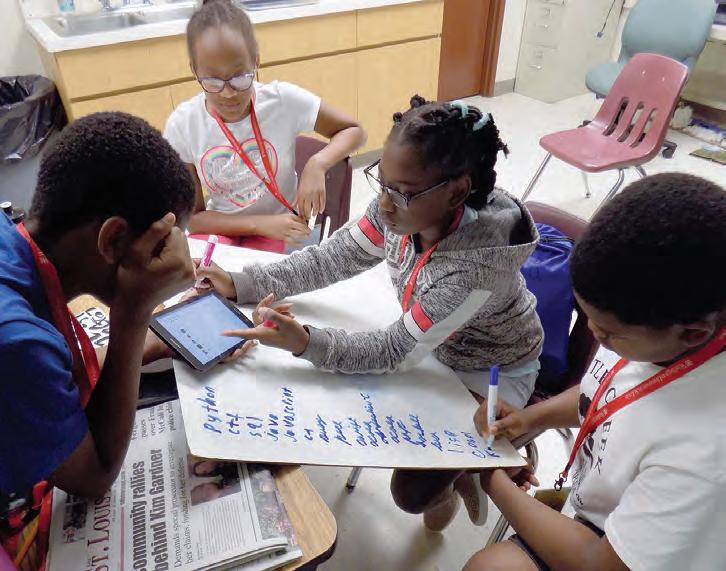
Students at The American’s Summer Science Academy work in teams to discover the many different




SCIENCE STARS
A hurricane forms over tropical and subtropical ocean water. Warm water and cool, moist air combine to create strong winds that can gust up to 200 miles per hour! These winds create waves that bring the storm on shore. Hurricanes are very destructive. They can flip cars, sink boats, uproot trees, and demolish houses.
SCIENCE CORNER
SCIENCE CORNER

What Is Gravity ?
Gravity, also known as gravitational forces (g-force), is the force of attraction. Gravity attracts all objects toward each other. It is the pull that keeps you walking on earth, instead of floating into space. Every person has a mass, or gravitational pull, which places a force on every other mass. The bigger an item is, and the closer you are to it, the stronger the gravitational pull.
In addition to powerful winds, hurricanes bring a lot of rain. (Taiwan received 114 inches of rain in three days during a hurricane.) These rains can cause landslides and flash floods.
Are Fungi ?
Hurricanes can last a few hours or several days. Most hurricanes occur during the fall months. How can you stay safe? Have an evacuation plan and an emergency kit prepared. Meteorologists can track these storms and keep you informed. For more hurricane facts, visit: http://www.sciencekids.co.nz/ sciencefacts/weather/hurricane.html.
is acceleration. Earth always produces the same acceleration on each item. This means that if you dropped an apple or a piano, then they would fall at the same rate due to gravity, and acceleration.
leaves, stems, or roots. Fungi use spores to reproduce. One common type of fungus is the mushrooms you find on your pizza. Mold, yeasts, and mildew are also types of fungus.
For More Information: https:// spaceplace.nasa.gov/what-is-gravity/en/
SCIENCE INVESTIGATION

Not only does gravity keep things grounded, it also affects the ways things fall. Another important factor in falling
Fungi are organisms made of filaments (called hyphe) that are stacked together. Unlike plants, fungi do not have chlorophyll, so they cannot make their own food. Some fungi are parasites, which mean they live off of other organisms. Some fungi feed off of dead and decaying matter. Fungi are everywhere in the environment, including the soil, lakes, river and seas, air, and on plants and animals. Fungi (plural of fungus) help organic matter to decay and release carbon and oxygen into the environment. Unlike plants, fungi do not have
In this experiment, you’ll create a replica of a hurricane and identify how the forces work together to create a hurricane.
SCIENCE INVESTIGATION
SCIENCE INVESTIGATION
Materials Needed:
Materials Needed:
• 2 Soda Bottles • 3 Paper Clips
Drinking Glass • Cardboard • Water
• 3 Peanuts • ¼ C. Sand • Funnel
Procedure:
• Water • Duct Tape
In this experiment, you will learn how mold grows best. Mold is an important fungus that has several uses, including breaking down dead organic material. Some purified molds are actually used as an antibiotic to treat illnesses.
Procedure:
q Fill the glass with water.
Materials Needed:
• 3 slices of bread • Water • 3 Ziploc bags
q Fill one bottle with the paperclips, peanuts and sand. These represent the debris and help make the movement of water easier to see.
w Put the cardboard over the mouth of the glass, making sure that no air bubbles enter the glass as you hold onto the cardboard.
• 10x10 square centimeter grid • Ruler Process:
w Place the funnel in the mouth of the bottle and pour water into the bottle until it is 3/4 full, then remove the funnel.
q Wet one slice of bread enough to make it moist and place it in a bag. Seal the bag very tightly.
e Turn the glass upside down (over a sink or outside until you have practiced a few times).
r Take away your hand holding the cardboard.
e Turn the second empty bottle upside down and hold it over the first bottle so that the mouths of the bottle are aligned. The bottles will look like an hourglass.
MATH CONNECTION

r Tape the seam, pressing the duct tape firmly to
w Place the two other slices of dry bread in two separate bags and Place the bag with the wet slice of bread and one of the bags with a dry slice of bread in a dark place, such as a closed cabinet or closet.
r Place the third bag with a dry slice
CONNECTION
“G” force is the amount of gravitational force your body feels. When you are on a roller coaster, your body will experience a strong g-force. Aircraft pilots and astronauts also experience high g-forces. If you experience 3 Gs, you experience three times your weight in gravitational pull. For example, if you weigh 150 pounds and experience 3 Gs, it is equivalent to 450 pounds.
z A hurricane has moved 456 miles in 6 hours. How many miles per hour is the hurricane traveling? ______ If it continues to travel at that speed, how far will it travel in 10 hours? ______
MATH CONNECTION
Calculate the following problems:
Learning Standards: I can read nonfiction text for main idea and supporting details.
For More Information, Go to: https://kids.kiddle.co/Fungus
Learning Standards: I can read nonfiction text to gain background information about fungi.
create a watertight seal. Continue taping 1 to 2 inches above and below the seam.
Growing Mold!
t Hold the bottles by the middle and lift the jugs.
Reflect: What happens? Does
Learning Standards: I can read nonfiction text for main idea and support details. calculate “g” forces!
y Quickly, turn the bottles over so that the water-filled bottle is on top. Set the bottles on the table again.


SCIENCE STARS
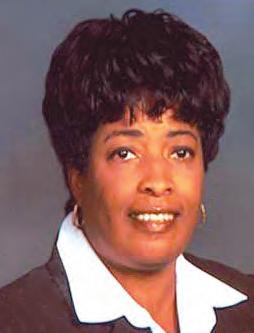
AFRICAN-AMERICAN MYCOLOGIST AND EDUCATOR:
African American Meterologist William “Bill” Parker
Jeanette Jones
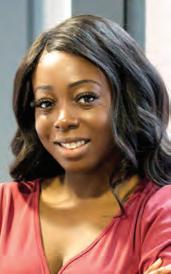
Rosie Mensah: Nutrition Expert and Public Health Researcher
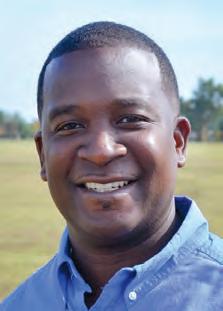
William (Bill) Parker grew up in New Orleans. He graduated from JFK High School, which focused on math, science, and engineering. Parker was interested in hurricanes at a young age, but he became interested in the weather after a high school statistics class. In this class, he learned how to predict the chance of rain. Parker wanted to attend a historically black college/ university (HBCU), so he chose Jackson State University to study meteorology. He graduated with his bachelor’s degree, in 1994.
Jeanette Jones was born on September 19, 1950, in Fort Valley, Georgia. Jones graduated from Fort Valley State University in 1972 with a bachelor’s degree in biology education. In 1973, Jones received her master’s degree in botany and mycology (a branch of biology that studies fungi) from The Ohio State University. In 1976, she received her doctorate (Ph.D.) degree.
She also studied at the University of Nevada, the University of California Medical School, the National Center for Disease Control-Atlanta, and the Massachusetts Institute of Technology. After graduation, Alabama A&M University hired Jones as an assistant biology professor. In 1986, she served as an adjunct professor in the College of Pharmacy and Pharmaceutical Services at Florida Agricultural and Mechanical University and worked on a project with NASA. In 1991, Jones served as the first female vice president of research and development at Alabama A&M University. She also served as President of Alabama A&M University’s Faculty Senate from 2001 to 2006. In 1992, she was appointed to the U.S. Army Science Board by the U.S. Secretary of the Army, Togo West. Since 2004 Jones has been the director of the Center for Biomedical, Behavioral, and Environment Research at Alabama A&M University. She also worked as a consultant with federal agencies to help them develop training programs to attract women and minorities to STEM education and careers.
In 1993, he began to gain experience in the field when he worked as a student meteorologist. One year later, he was a meteorologist intern at Shreveport. In 1998, Parker became a general forecaster, and ten years later, a lead forecaster.
t For five days, measure the square centimeters of mold on each piece of bread through the bag. Use a grid, if possible, or a ruler. If mold covers more than half a square centimeter, it is counted as one full centimeter. If it is less, it is counted as 0 centimeters. This will give you the area of mold on each slice of bread
q If you weigh 180 pounds and experience, 2.2 Gs, what weight do you feel in a gravitational pull? _______
x Hurricane Frederick is traveling at 86 miles per hour. If the hurricane is 129 miles from the coast, how many hours will it take until the hurricane reaches the coast? ______
u Observe the water as it drains into the bottle below. The water competes with the air from the empty bottle. Both substances push to pass through the neck.
from the glass? Does it stay in the glass? Considering what you know about gravity, why does this happen? Learning Standards: I can follow directions to complete an experiment. I can make observations.
y At the end of a week (5 days of measuring) or longer, use your final results to say what percentage of the bread was covered in mold. Make a table or graph to display the information.
i Turn the bottles over again. This time, shake the bottles in a circular motion. Be sure to keep the bottles vertical.
o The water will form a vortex as it drains into the next bottle. The water will flow along the outside of the neck, while air moves quickly up through the center of the vortex. The water will drain much faster.
Analyze: How did water and air create a hurricane?
Learning Standards: I can follow sequential directions to complete an experiment. I can make observations and draw conclusions.
Discussion Questions: How much mold was on the bread? Which location had the most mold? Which had the least? What conclusions can you draw about the conditions in which mold grows? How can food manufacturers and restaurant owners use this information to help them?
e If you weigh 120 pounds and feel the gravitational pull of 240 pounds, how many Gs are you experiencing?
Learning Standards: I can follow sequential directions to complete an experiment.
Math Storms!
I can display my results, make observations, and draw conclusions.
r If you weigh 115 pounds and you feel the gravitational pull of 253 pounds, how many Gs are you experiencing?
X has grown to have wind speeds of 48 miles per hour. How much faster will the winds have to become for Tropical Storm X to become Hurricane X? ______
Analyzing a Bar Graph
Scientists often use tables and graphs to display the results of their research. Looking at these displays, you can draw conclusions.
w If you weigh 100 pounds and experience 3.5 Gs, what weight do you feel as a gravitational pull?
As we approach spring weather (and increased rain), create a bar graph that displays the amount of rain that falls for several consecutive days or weeks. (Day 1: 1.5 inches, Day 2: 0 inches, Day 3: 1.5 inches, etc.)
v Upon landfall of a Category 4 hurricane, local officials ordered an evacuation. City A has a population of 9,613, City B has a population of 5,013 and City C has a population of 3,972. How many people were evacuated in all?

c A tropical storm takes on a hurricane status when the winds reach 74 miles per hour. After three days, Tropical Storm

This special Newspaper In Education initiative is made possible, and delivered to classrooms through the St. Louis American Foundation and its NIE Corporate Partners:
Rosie Mensah is a registered dietitian and public-health researcher who helps people learn about food, culture, and health. She grew up in Toronto, Canada, in a family and neighbourhood where good, healthy food wasn’t always easy to find. While she was young, she saw how some families had a harder time getting fresh food, and how food affects not just our bodies, but our feelings and communities. This experience inspired Rosie to become a nutrition expert—someone who studies how what we eat connects to the way we live. In school, Rosie decided to focus on nutrition and health equity meaning fairness in health care and food for everyone. She earned a Master of Public Health (MPH) and became a registered dietitian (RD). She also helped create a special course called CEDAR (Culture, Equity, Diversity, and Anti-Racism) for nutrition professionals to learn how to work fairly with people from many cultures. Today, Rosie’s work is about more than just telling people what to eat. She studies how food traditions, culture, history, and fairness come together. She shares recipes, helps people feel confident about food, and works to make sure everyone especially kids and families from communities that have been overlooked gets healthy, culturally meaningful food. She shows that food can be fun, tasty, and part of our culture, not just something we must “eat to be healthy.” Rosie also teaches other nutrition professionals how to include culture and fairness in their work. She believes that eating healthy means being proud of your food, knowing where it comes from, and having the chance to choose good food. Her story teaches us that being curious about food and culture, working hard, and caring about others can help make our communities healthier and stronger.
In 2012, he became a warning coordination meteorologist (WCM). There are only 122 people with this title in the United States, and Parker was the only African American. Parker is currently the meteorologist-in-charge (MIC) at the National Weather Service, leading a team of 26 weather professionals. Parker is also very active as a volunteer in his community. He is a member of the Shreveport-Bossier Mayors’ Prayer Breakfast Executive Committee, La Cima Bilingual Leadership Academy, Bossier Chamber of Commerce Education Committee, Volunteers for Youth Justice, and a coach for Bossier Parks and Recreation. Parker is also an associate minister at Elizabeth Baptist Church in Benton, where he has been serving the congregation since 1997.
ELA Questions


In 1975, Jones was listed in the World’s Women’s Who’s Who and she was named an Outstanding Young Woman of America in 1978. Beta Beta Beta National Biological Honor Society awarded her the distinguished service award. Jones also received the Significant Service Award from the NASA Space Life Sciences Training Program and the Extramural Associate Research Development Award from the National Institute of Health. In 1990 and 2006, she was named Woman of the Year at Alabama A&M University and was given the Outstanding Leadership Award by the Faculty Senate. The U.S. Army presented Jones the Commander’s Award for Outstanding Civilian Service as a member of the Army Science Board. Discussion Questions: Dr. Jones received many awards and honors. How would you describe her achievements and her contributions to science? Dr. Jones is studying how fungi might be used as agents of war. What purpose do you think fungi serve in modern warfare? Are fungi beneficial or harmful?
What inspired Rosie Mensah to become a nutrition expert, and why did she pick food, culture, and fairness as her focus?
Learning Standards: I can read a biography to learn about an African American who has made contributions in science, math, technology, or engineering.
How does Rosie help other people especially nutrition professionals learn to include culture and equity in their work with food and health?
Parker believes in serving as a role model to the youth and to recruiting African Americans in the STEM field. Personally, he has hired three African-American meteorologists. In addition, he has recruited minorities for summer intern positions. Parker has also mentored an Airline High School student for his senior project. Parker’s advice to students interested in meteorology is to take as many math and science classes as possible. Learn about summer opportunities in your community. If you are interested in meteorology, visit National Weather Service offices and serve as a volunteer or intern, and find leaders in your community to serve as your personal role models.

Use the newspaper to complete these activities:
a person who has made contributions to the fields of science, technology,
Use the newspaper to complete the following activities:

t If you experience 4 Gs at your current weight, what is the gravitational pull? ________
Learning Standards: I can add, subtract, multiply, and divide to solve a problem.
$115,264 in damage, City B reported $236,096 and City C reported $436,869 in damages. What was the total cost of damages rounded to the nearest thousand? ______ If the state and federal government promised $500,000 in aid, how much would the local people have to raise by themselves? ______
Discussion Questions: Which day had the most measured rainfall? Which day(s) had the least? Looking at the bar graph, what might you conclude about rain patterns in March/April? What other observations can you make?
Learning Standards: I can use a bar graph to display information. I can use the information to make deductions and inferences.
b After citizens returned to their houses after the evacuation, reports of damage were totaled. City A reported

Enjoy these activities that help you get to know your St. Louis American newspaper.


Learning Standards: I can add, subtract, multiply, and divide to solve a problem.
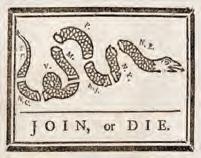
Activity One — Editorial Cartoons: Editorial cartoons are a powerful medium for expressing ideas. Find an editorial cartoon in an online newspaper. Who is the intended audience? What is the message? What is the theme or tone of the cartoon? What symbolism is being used? Has the author chosen an effective way to present the idea? What would you do differently?
Types of News: Use the front section of the newspaper to evaluate the types of news stories presented: local, national, and international. Sort the articles into the three categories and create a bar graph that displays the amount of coverage each type of news story received.



Activities — Who works where? a picture of a building in the newspaper and tell what kind of jobs people who work in that building could have.


Activity Two —

Newspaper Headlines: Locate and read several newspaper headlines. Discuss how the headlines sum up the article while catching the reader’s interest. Compare headlines to story titles. Next, write a headline for a familiar fairy tale. Share the headlines with a classmate, and have them guess the fairy tale.
Mystery Story: Cut out several pictures from the newspaper without reading the caption. Place the pictures in a bag, and without looking, pick your mystery picture from the bag. That’s your stimulus for writing. Construct a graphic organizer to identify the 5Ws (who, what, when, where, and why) of your story by looking at your picture. Then, continue the writing process.
Problem and Solution: Over a period of weeks, clip articles from newspapers that deal with problems and issues facing your local or county government. Discuss the reasons for these problems and how the government hopes to solve them.
Learning Standards: I can use the newspaper to locate information. I can write an effective headline. I can analyze a political cartoon.
Learning Standards: I can use the newspaper to locate information. I can categorize and summarize that information.
Learning Standards: I can use the newspaper to locate information. I can discuss problems and solutions. I can identify types of jobs. I can make text-to-world connections.




SCIENCE CORNER
Photo by Ms. Stovall
MAP CORNER
Teachers, if you are using the St. Louis American’s NIE program and would like to nominate your class for a Classroom Spotlight, please
Photo by Nikki Binion
Continued from A1
nating Jones-era initiatives, Williams oversaw changes to the Northside business grant program and economic mobility projects like Neighborhood Transformation and Monarch on MLK.
After 10 months, Williams is stepping aside for new SLDC Director and CEO Stephen Westbrooks. In a one-onone interview with The St. Louis American a week before he left the agency, Williams discussed his challenges and accomplishments.
St. Louis American: What have you accomplished during your time as interim director?
Williams: I think we’ve continued to operate and, right now, we’re trying to secure more deals and projects for the city. One of the key things, I’m hopeful, is that I’ve had an impact on changing the overall climate of how investors, developers and financiers see the city. We’re not there yet, but we’re having fruitful discussions about some of their objections and concerns and we’re trying to address those issues.
American: How would you describe that “climate” under former Mayor Jones?
Tax
Continued from A1
the tax but instead would have triggered a gradual phase-out over the next decade—potentially reshaping the city’s financial landscape. The earnings tax was last approved in 2021 with nearly 79% of the vote, reflecting broad support at the time. Since then, city leaders and stakeholders have continued to emphasize its role in maintaining
Williams: I can’t, because I wasn’t there, but what was reported was an uncertainty about what the deal was going to be throughout the process. You could possibly start with something and end up with another deal at the end … and I think there was a discussion — perceived or real — that we really needed to be more welcoming to development and not look at developers as deep-pocketed. They need to pay their fair share, but they also need to get a return on their investment.
American: Last year, SLDC initiated eminent domain on Paul McKee’s properties. How is that process going?
Williams: The eminent domain process has begun, and we actually have a court date coming up in April, so we’ll start that soon.
American: McKee’s attorneys say SLDC does not have standing to do that. Is that correct?
Williams: Yes, they don’t feel we have the standing to do it … If we’re fortunate to win the case or get permission to proceed, it will all come down to the value of the land, which will be determined by a panel chosen by the court.
American: You’ve said McKee’s valuation of the land was unrealistic. Why?
Williams: We were trying to basically just negotiate.
core services. Supporters of the measure have rallied in recent weeks, including a kickoff event that brought together elected officials, labor leaders, and representatives from police and fire departments. The issue has emerged as a rare point of alignment between Mayor Cara Spencer and the St. Louis Metropolitan Police Department, despite ongoing tensions over a $250 million budget proposal from the state-appointed board overseeing the department.

Both sides went through an appraisal process and we both provided that data. When we looked at their numbers, we were so far apart, there was no way … even if we compromised and met in the middle, it would be way higher than we thought the value would be. So, at this point, we just need to go to court and allow that system to determine it.
American: What’s your view of former Mayor Jones’ decision to use ARPA funds to invest in North St. Louis?
Williams: It always comes down to resources and money. So, anytime you can provide the resources and financial assistance, it works. I applaud the idea. Using it to foster redevelopment, or to seed it, was a good idea.
As voters cast their ballots, some residents said the measure directly affects the fabric of the city’s cultural and civic life.
De’Joneiro Jones, a local artist who has lived downtown for more than 20 years, supported Proposition E, citing its impact on not only St. Louis but the entire region.
“I know how critical that money is,” Jones said. “It helps our ecosystem.”
Jones also noted the importance of civic participation, particularly among

After 10 months, Otis Williams is stepping away from his interim position for new St. Louis Development Corp. Director and CEO Stephen Westbrooks.
American: When we last spoke, you said the economic justice part of that plan would still go forward. Has it?
Williams: It has and we continue to move ahead with it.
American: The Black business grant program was suspended earlier this year. How many grants were awarded, and how much funding remains?
Williams: We have fully allocated the entire thing. The candidates that had been identified previously were still candidates. We just vetted all of them and made sure we didn’t have any conflicts of interest along the way.
American: Has the city received approval to redirect ARPA funds to things like tornado relief and the water system?
younger voters.
“You can’t really say you’re an American if you don’t exercise your right to vote,” he said.
“My ancestors sacrificed their lives so that the next generation has the right to vote. We have to be a part of the process. We need to be at the table.”
Others expressed frustration and skepticism about how decisions are made at City Hall.
Willie Howard, a north St. Louis resident, said he believes economic interests often outweigh community concerns.
“Those in power are after the mighty dollar,” Howard said. “I want to be able to live a healthy and safe life.”
Howard added that he feels the concerns of Black residents in St. Louis are often overlooked and worries that younger generations are becoming disengaged from the political process.
“When I was growing up we had current events. Our teachers talked to us about what was going on in our city and asked us how we would make things better if given the chance,” he said. “These youngsters need to make their voices be heard.”
Williams: To be fair, what caused us to spend money in certain places was because the aldermen did ordinances that the mayor approved. So, we had to abide by that legislation. So, in addition to following the federal guidelines, that’s what we’re doing.
American: Was there a formal reallocation process?
Williams: I think the ARPA guidelines provide latitude to spend those dollars, so as long as you abide by those guidelines and also make sure you are in accordance with those ordinances as they were devised and approved … I think the attorneys are looking at that to make sure we spend the money accordingly. I can’t tell you we are 100% certain … But I would defer to the
Ferguson Florissant says yes to Prop S Ferguson Florissant voters approved Proposition S, raising the FergusonFlorissant School District’s operating levy by 48 cents for spending related to security and staffing. For a home valued at $100,000, taxes will increase by $91 annually.
The proposition needed a simple majority to pass and received 59.2% of the vote.
The tax increase will be used to hire additional staff to manage documentation requests related to the Radiation Exposure Compensation Act. The federal law compensates people who developed certain cancers and other diseases, or their survivors, if they were exposed to radiation from the U.S. nuclear weapons program.
St. Charles County voters keep property tax
St. Charles County, where voter turnout was the highest in the St. Louis region, saw voters say no to a proposed property tax freeze by a wide margin.
In the Francis Howell School District, voters resoundingly defeated a slate of conservative candidates for school board.
city attorney as to whether we are complying or not.
American: Has the Monarch at MLK workforce development project been completed? If not, how will the city recoup its investment?
Williams: We’ve looked at ways we can tackle that project with the funds we have. The original vision was a $30 to $40 million-dollar project, and we didn’t have money for that kind of vision. So, we have different usages for what’s going to go there, but we’re still focusing on it.
American: So it has not been completed?
Williams: No, but we’re working with a couple of users and moving forward. It’s just not going to be that grand piece that was originally envisioned. We’re going to do what we can with the money available. Also, after the tornado, we immediately began using it as a distribution point … now we’re trying to get a more permanent solution.
American: What’s next for you?
Williams: I’m going to spend more time with family, travel and do what I call the ‘honey-dos’ … garden and go to a few sporting events.
Sylvester Brown Jr. is the Deaconess Foundation Community Advocacy Fellow.
Proposition RT, a proposal to suspend personal property tax in the county, was rejected by a tally of 59% to 41%.
“The rejection of Prop RT places such a high value on our public investment in our services and our schools and our libraries, and it makes me so proud to be a St. Charles resident,” Kevin McGuire, a successful candidate for Francis Howell School Board, told Jason Rosenbaum of St. Louis Public Radio. The culture wars, book censoring, and attacks on Black culture and history could be coming to an end in the Francis Howell District.
McGuire, Sara Dillard, and Jason Adams won the open school board seats over incumbent conservative candidates Jane Puszkar, David Jaworski, and Lauren Greenwood.
“I’m just so excited that our community has decided to finally put the hate and the divisiveness that has existed on our board to rest so we can concentrate on the serious matters instead of the manufactured noise that’s taken place over the last few years,” Adams told STLPR on Tuesday night.

Photo by Lawrence Bryant / St. Louis American
Continued from A1
region’s children.
The shooting, which took place in the school’s parking lot after a track meet, claimed the life of 13-year-old LaJuan Swopes and left a 15-yearold injured. Another 13-year-old has been charged with second-degree murder, first-degree assault, unlawful use of a weapon, and two counts of armed criminal action.
The program transitioned from a structured panel to open dialogue. Residents stepped to the microphone not just with questions, but with grief, frustration, and a desire for answers.
Ferguson City Council member Jamil Franklin spoke bluntly.
“I listened to a lot of the ideas. And for me the answer is simple,” Franklin said. “We have to get back to our traditional families. Black men, we have to step up. We have to start committing to our women and raising our children in house.”
He pointed to the lack of structure many young people face.
“Our children are running wild. There is no real authority,” he said. “I came out of a single family household, but I did fear my mother. That’s why I’m alive today.”
Franklin’s message centered on accountability.
“We say we are willing to die for our children — but we’ve got to be willing to live for our children.”
Melba Walker raised concerns about students with neurodiverse needs — young people she said are especially vulnerable.
“What happens when we have students with neurodiverse needs and they are in a criminal environment?” Walker asked.
Edwards
Continued from A1
the St. Louis American following the judgement.
The incident began in north St. Louis, where officers were searching for a vehicle believed to be connected to a carjacking.
Police approached a group of teenagers outside a school in the Walnut Park East neighborhood and Edward fled on foot.
The pursuit moved from school grounds into a nearby vacant property. It was there that both officers opened fire, striking Edwards in the back.
Police maintained that Edwards was armed and fired at officers during the chase. While a gun was recovered near the scene, Edwards’ counsel argued that he was unarmed.
Attorneys said the weapon found was inoperable, and that no DNA or
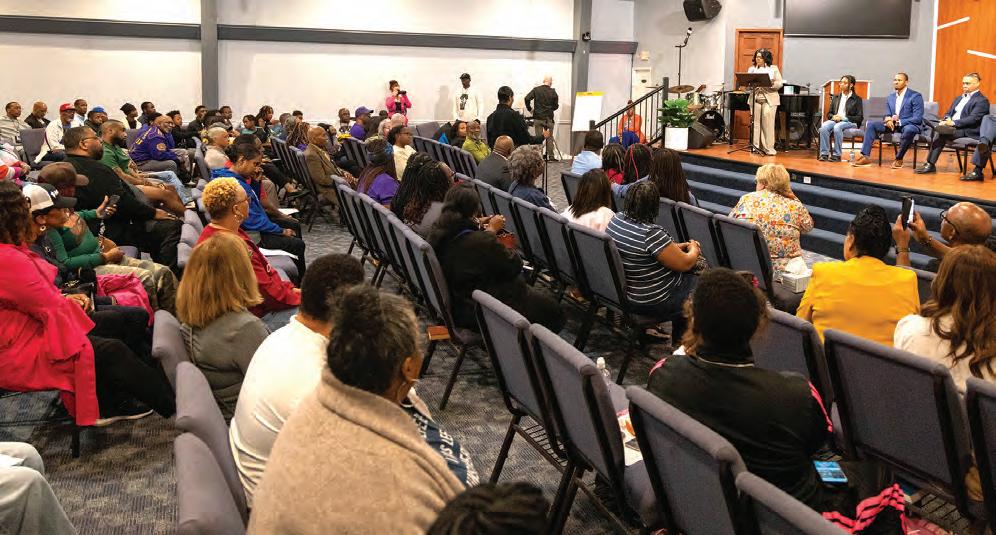
“How are we supporting them?”
She questioned the lack of long-term support.
“Yes, they had an IEP in the third and fourth grade, but what is being done to bring them in and give them the support that they need?” Walker asked. “To tell them, ‘Hey, you, more than others, don’t really understand what somebody is sending you out to do.’”
Then came a moment that shifted the entire atmosphere.
“I’m the state representative of where the shooting happened,” said State Rep. Raychel Proudie. “And what needs to take place for those who are elected is an apology.” What followed was raw and unfiltered.
“I apologize to everybody in here for the failure on behalf of elected people,” she said. Proudie spoke openly about political infighting and ego.
“There are people in this room who don’t like each other… and it has
fingerprint evidence tied it to Edwards.
Attorneys for the officers argued the shooting was justified because they perceived Edwards as an immediate threat.
Edwards’ attorneys contended the shooting was unprovoked and that officers later constructed a narrative that was not supported by the evidence.
Jurors ultimately sided with Edwards. In the aftermath of the shooting, Edwards was hospitalized and later charged with firing at police. He spent time in juvenile detention before being released under supervision. Roughly a year later, the charges were dropped and officers stopped cooperating with prosecutors.
The lawsuit, filed in 2021, alleged excessive force and misconduct.
It moved between state and federal courts before returning to circuit court
absolutely nothing to do with you,” she said. “We have dead children.”
Her voice cracked as she continued.
“We’ve even seen it here — in this church… throwing shade… rolling eyes while people are up here talking — and we have dead children.”
She acknowledged her own missteps.
“I’ve been trifling,” she said.
Turning to NAACP St. Louis County President John Bowman, she offered a direct apology.
“I’ve projected my daddy issues on you and I should not have,” Proudie said.
“We have some high-octane ‘coonery’ — and that’s why we have dead children,” she added, “We are not going to gala and step-show our way into the revolution. We have to get ourselves together.”
Host pastor Robert Lloyd affirmed the need for honesty.
“We can’t ask our kids to act right and give y’all
for trial. The Missouri Attorney General’s Office represented the officers after taking over legal representation for the St. Louis Metropolitan Police Department when it returned to state control.
During the trial, jurors were presented with testimony challenging key aspects of the officers’ account, including discrepancies about where and how Edwards was first spotted and pursued. Evidence also included social media posts made by Streckfuss in later years that Edwards’ attorneys argued reflected bias, an assertion he denied in court.
Both officers were also linked to a separate 2016 incident that resulted in the death of a 15-year-old, bringing further attention to their records.
Streckfuss resigned from the department in 2020 while under investigation in an unrelated
a pass,” Lloyd said. “Ms. Proudie shouldn’t be the only one acknowledging her role.”
He challenged elected officials directly.
“We want our kids to get it right, but we want y’all to get it right — or we won’t vote for you.”
Ferguson-Florissant Superintendent Dr. Howard E. Fields III brought the focus back to the young lives lost. Fields framed his remarks with his parallels to Swopes’ upbringing. “I am from North St. Louis County,” Fields said. “I attended North St. Louis County Schools. I attended college in North St. Louis County. I taught and coached in North St. Louis County. And Now I am superintendent of a North St. Louis County school.”
The difficult week was made heavier by the idea of the potential that was shot down.
“How do we know that LaJuan would not have been Dr. LaJuan?”
He also spoke of Norris Williams, another student
excessive force case. Murphy remains with the department and currently serves as a detective. Edwards’ case also unfolded against the backdrop of his later involvement in a separate federal case. In 2022, he was sentenced to prison after being convicted of possession with intent to distribute fentanyl, though that matter was not directly tied to the 2016 shooting.
The $37 million verdict, made up of punitive damages, is among the largest in Missouri tied to a police shooting. If upheld, the city of St. Louis would be responsible for paying the judgment.
In a statement following the verdict, Cara Spencer said, “We understand the Missouri Attorney General’s Office, which managed this litigation, is considering legal options, and the City currently awaits learning about these potential next steps.”
killed less than 24 hours earlier.
“How did we know that he was not going to be a doctor, attorney or State Rep. Williams?”
“I was in places I was not supposed to be in,” he said. “And this is what God has done for me.”
His story as a North County youth who rapped, played basketball, and ascended to lead a school district drove home the point of stolen potential.
“When we give them an opportunity — and allow the village to take care of them — the sky is truly the limit.”
He also issued a critique of adult behavior.
“We want the young people to have conflict resolution skills, but the adults don’t have conflict resolution skills.”
Congressman Wesley Bell underscored the urgency.
“The number one killer of young people — it’s not childhood cancer. It’s gun violence,” Bell said.
He called for investment in grassroots organi-
Edwards’ attorney Jack Waldron said the jury appeared to focus on Edwards’ age and vulnerability at the time of the shooting, as well as the broader conduct of the officers following the incident. He said the outcome sends a message about accountability, particularly in cases involving use of force against minors and the treatment of individuals after they are injured and taken into custody. He also indicated that an appeal is expected and that the legal team plans to defend the verdict.
Adolphus Pruitt, president of the St. Louis City NAACP, said the jury’s decision stood out in a system where officers are often given the benefit of the doubt.
He said jurors appeared to prioritize forensic evidence over police accounts in reaching their decision.
Pruitt said the Edwards’ case shines light on “the
zations that are putting in work from the frontlines to stop the violence before it starts.
“We have to stop thinking we can prosecute our way out of these issues.”
State Rep. Kem Smith pointed to the link between economic instability and violence.
“In order to keep that street job, you are going to have to do street stuff,” Smith said. “And our community is suffering from the street stuff.” She called for mentorship, workforce development, prayer walks, and a rally centered on teens.
“Just like we had a No Kings rally, can we have a rally for our teens,” Smith asked. “They need to know we care about them. And we didn’t have this conversation for it to evaporate on Monday morning.”
Youth pastor Farrakhan Shegog reminded the room that young people must be included in the work.
“Very rarely are those young people in the room when conversations are being held about them,” he said. “If we are really genuine about it, the first place to start is with them.”
But he warned that presence alone is not enough.
“If the room is already filled with hate… jealousy… ulterior motives, the space is already corrupt,” Shegog said.
Pastor Lloyd closed the event with a reflection that echoed the day’s central theme — accountability begins with adults.
“We blame our kids, but I think we are the problem,” Lloyd said. Then, invoking Dr. Martin Luther King Jr. on the anniversary of his assassination, he left the room with a choice that felt immediate.
“Either we live together as brothers,” he said, “or we perish together as fools.”
longstanding racial disparities in policing in St. Louis, including higher rates of stops, use of force and fatal encounters involving Black residents.” Whether large financial judgments against the city and police officers lead to “meaningful reform” is still questionable, according to Pruitt.
“Repeated payouts have not prevented future incidents,” he said. He and the NAACP are calling for stronger civilian oversight, updated use-offorce policies, and expanded investment in alternatives to policing such as mental health response and violence prevention programs.
Pruitt also suggests that individual officers should bear some personal responsibility through mechanisms such as liability insurance, rather than costs falling entirely on taxpayers.

Residents fill Calvary Bible Church in Florissant for a Teen and Youth Violence Prevention and Safety Town Hall, where community members and leaders gathered to address youth gun violence following the fatal shooting of 13 year old LaJuan Swopes.
Photo by Lawrence Bryant / St. Louis American
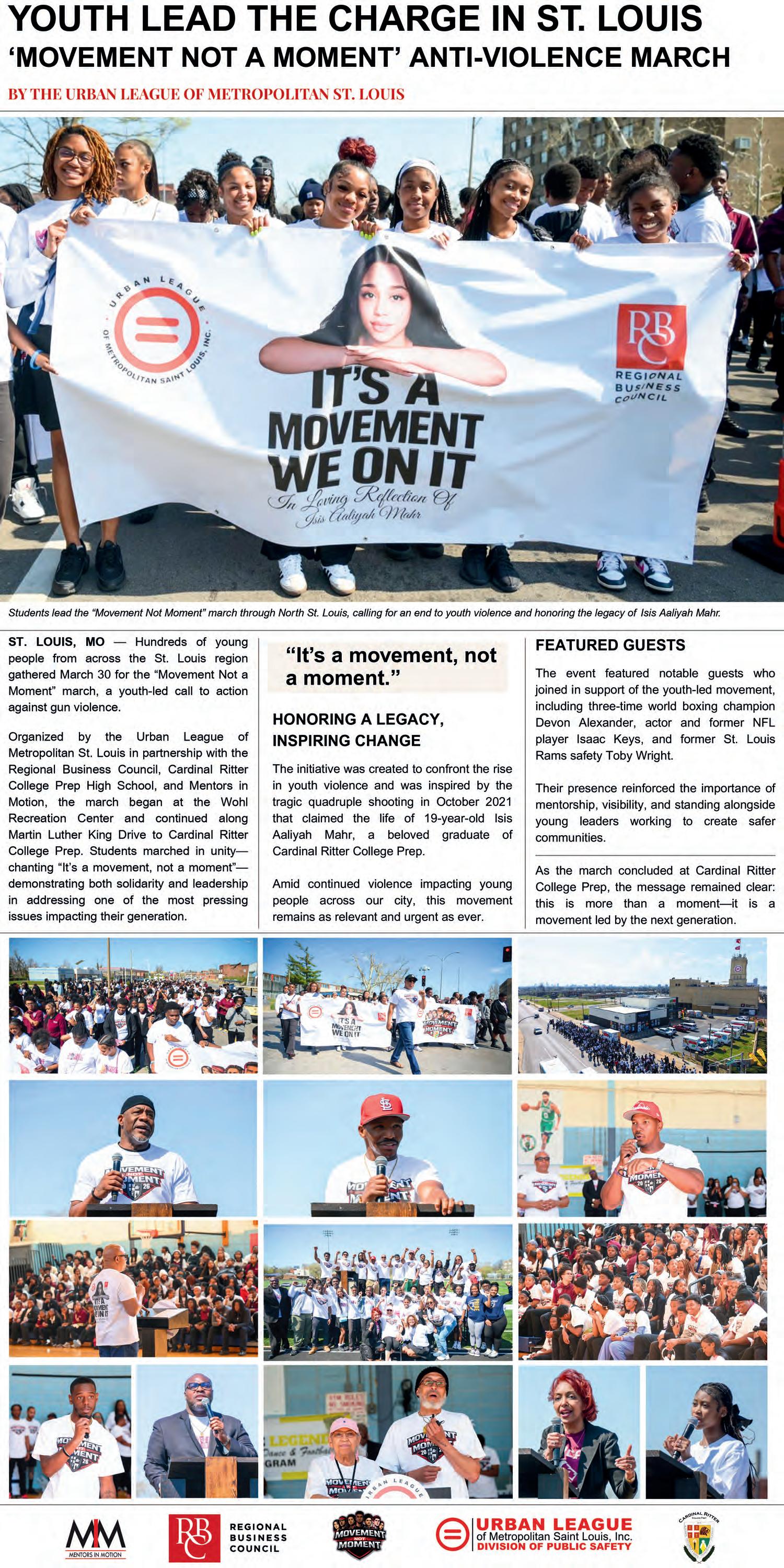

Living It
A good Friday full of love, courtesy of Sexyy Red

Forty years in motion
Black Dance USA continues to lift, teach and transform
By Zaria Mac St. Louis American
The Better Family Life Cultural, Educational and Business Center is celebrating 40 years of Black Dance USA: A Celebration in Movement — a dance conference and festival that brings dancers from across the nation to St. Louis. The multiday gathering unites participants through a shared appreciation of African and African diaspora art forms, creating a powerful space for connection, culture and transformation.
“Black Dance USA is a gathering of dancers who have a passion for African and African diaspora dance,” said Better Family Life Cofounder and Executive Director Emeritus Deborah Ahmed. “It is an opportunity to correct misconceptions and misinformation about different dance styles and genres of movement.”
From Thursday, April 9 through April 11, participants can take classes in Traditional West African dance, Afrofusion and modern styles like Chicago Steppin’. Open to all levels, the conference culminates in a rousing performance by Asase Yaa African American Dance Theatre of Brooklyn, New York.
Now in its 40th year, the cultural event began as a vision inspired by a New York festival called Dance Black America. “Dance Black America was a phenomenal experience and a gathering of people from

Better Family Life celebrates 40 years of Black Dance USA this weekend. The programming will culminate with a performance by Asase Yaa African American Dance Theatre of Brooklyn.
all across the country,” Ahmed said.
She attended the festival with a small group of students, immersing herself in concerts, classes and latenight performances. “When I came back home, I was talking to my husband and said, ‘We’ve got to do something like this in St. Louis.’” And so they did.
Four decades later, that vision continues to bring together dancers, teachers and cultural leaders from around the country — creating a space where community, artistry and identity intersect.
In recent years, the conference has been coproduced by Malena Amusa, founder and CEO of ArtsyPreneur and
a longtime student of Ahmed’s. “Black Dance USA has a specific mission to expose, teach and empower,” she said.
For many attendees, the experience has become deeply personal. “Reclaiming history is something that happens at the conference, but it has become a lot more personal,” Amusa said. “People come to the dance floor to recharge their souls — for their mental health, for social connection, or to rediscover themselves as creative people.”
Alongside producing the event,
Flipping futures

Circus Harmony’s Silver Soirée marks 25 years of giving youth a place to soar
By Zaria Mac St. Louis American
Before he was a WWE showstopper or a globetrotting acrobat with Cirque du Soleil and the Flying Wallendas, Sidney “Iking” Bateman was a St. Louis kid learning to defy gravity with the St. Louis Arches. This Saturday, he comes home for Circus Harmony’s Silver Circus Soirée — a full circle return to the place that launched his liftoff.
“While you’re learning to flip, fly and fling, you learn focus, persistence and teamwork,” said Jessica Hentoff, founder of Circus Harmony and the St. Louis Arches. “When we say social circus, yes, we teach circus arts — but we also teach life skills.”
“When we say social circus, yes, we teach circus arts — but we also teach life skills.”
- Jessica Hentoff, founder of Circus Harmony and the St. Louis Arches
This year’s Soirée carries a deeper meaning rooted in legacy and mentorship. “We have a big performance every year, but this is the first time we’ve done something special and invited an alum to be part of it,” Hentoff said. “The whole focus of this Soirée is passing it on.” For Iking, stepping back into the ring with the troupe feels both meaningful and natural. “I’d rather take people on my shoulders than get bodyslammed by a 300 pound man,” he said. “It’s ingrained in my body. Just as natural as walking — that’s how acrobatics and tumbling feel to me.”
Iking first encountered the circus at age 11, when a mentor took him to see Circus Flora, where the Arches were performing. The mentor even arranged for him to meet Hentoff afterward.
“But me being so closed minded, I said I wanted to leave,” Bateman recalled. “But as fate would have it, I made my way back to the City Museum six months later.” That return changed everything.
“It was no question that I was making circus my profession when I joined,” he said. “It kept this kid off the streets and away from gangs. It gave me an outlet — and Jessica always saw the endless possibilities.”
For nearly four decades, Circus Harmony has created similar pathways for young performers. Active for 38 years and gaining nonprofit status in 2001, the organization has produced jugglers, acrobats and contortionists who have gone on to perform with Ringling Bros. and Barnum & Bailey Circus and tour internationally in Germany, Berlin and France.
“When I joined the circus out of college, there were no pathways,” Hentoff said. “Now there are circus colleges more difficult to get into than Harvard or Yale,” including the National Circus
Photo courtesy of Circus Harmony
Circus Harmony’s Silver Soirée takes over City Museum on April 11..
Photos courtesy of Better Family Life
Photos by Lawrence Bryant/St. Louis American
Rap star Sexyy Red gifted hundreds of young people with a cherished Good Friday memory at Princess Beauty Supply in Pagedale on April 3. Along with an Easter egg hunt, candy and toy giveaways, a petting zoo, and more, the event also marked the launch of her Giving Is Sexyy Foundation.
CONCERTS
Sat., Apr. 11, 9:30 p.m., City Winery welcomes Jonathan Butler, City Winery St. Louis, 3730 Foundry Way, St. Louis, MO 63110. For more information, https:// tickets.citywinery.com.
Sat., Apr. 11, 8 p.m. Curren$y: The Winners Circle Tour w/ The 747 Band, Fendi P and Stoney Jackson, The Hawthorn, 2231 Washington Ave, St. Louis, MO 63103. For more information, visit www.thehawthornstl.com
Thur. Apr. 16, 7 p.m., Boys 4 Life Tour featuring B2K & Bow Wow, Chaifetz Arena, 1 South Compton Avenue St. Louis, MO 63103. For more information, visit www.chaifetzarena.com.
Thurs., Apr. 16, 8 p.m., Floetry presents the Say Yes Tour featuring Raheem DeVaughn, Stifel Theatre. For more info, visit www.stifeltheatre.com.
Fri., Apr. 24, 7 p.m. Bone Thugs-N-Harmony, Pop’s Nightclub & Concert Venue, 1403 Mississippi Ave, Sauget, IL 62201. For more information, visit www.ticketweb.com.
Fri., May 1, 7:30 p.m., The Love and Relationship Tour starring David and Tamela Mann, Stifel Theatre. For more information, visit www.stifeltheatre.com.
Sun., May 10, 7 p.m. The Queens: 4 Legends, 1 Stage with Chaka Khan, Pstti LaBelle, Gladys Knight & Stephanie Mills Enterprise Center, 1401 Clark Ave, St Louis, MO 63103.
STL Sites & Sounds
For more information, visit www.enterprisecenter.com.
SPECIAL EVENTS
Thur., Apr. 7- 8, 7:30
p.m., Live at The Pulitzer, Pulitzer Arts Foundation, 3716 Washington Blvd, St. Louis, MO 63108. For more information, visit https://slso.org.
Apr. 8 – Apr. 9, Webster University’s 10th Diversity, Equity and Inclusion Conference, the theme for 2026 is The Audacity to Persist: Reclaiming Space, Voice and Justice, Webster University. For more information, visit webster.edu/dei2026.
Fri., Apr. 10, 10 p.m. LOVER/ FRIEND Vol. 4, Atomic Garage, 4140 Manchester Ave, St. Louis, MO 63110. For more information, visit www.jamopresents.com.
April 10-11, Dance St. Louis presents Ailey II, The Touhill Performing Arts Center, One University Place, St. Louis MO 63121. For more information, visit www.dancestlouis.org.
Sat., Apr. 11, 7 p.m. Rock For Cori: A Fundraiser Show for Cori Bush w/ Mass Arrest, Spent Film, Feet Pics, NoPoint, and HotRails, The Heavy Anchor, 5226 Gravois Ave, St. Louis, MO 63116. For more information, https://www.theheavyanchor.com.
Sat, Apr. 11, Zeus & The Ghetto Cowboy: “Star Camp” Benefits Show, The Dark Room, 3610 Grandel Sq, St. Louis, MO 63103. For more information, visit https://kranzbergartsfoundation.org.

Sun., Apr. 12, An Evening with Sir Ervin Williams, author of Mr. Duplicity, Emerson Theatre, Harris-Stowe State University, 3026 Laclede. For tickets, visit www.sirervinwilliams.com.
COMEDY
Fri., Apr. 17 - 19, 7 p.m.
Special Event: Arnez J, Helium Comedy Club, 1151 St. Louis Galleria St, St. Louis, MO 63117. For more information, visit https://st-louis.heliumcomedy.com.
Wed., Apr. 22, 7:30 p.m., Brandon “Hotsauce” Glover presented by Townsendx3.live,

City Winery St. Louis, 3730 Foundry Way, St. Louis, MO 63110. For more information, https://tickets.citywinery.com.
Fri., Apr. 24, 8 p.m. We Them Ones Comedy Tour starring Mike Epps, Karlous Miller, DC Young Fly and many more, Chaifetz Arena, 1 S Compton Ave, St. Louis, MO 63103. For more information, visit https://www.chaifetzarena. com.
Sat., Apr. 25, doors 6:30 p.m.
The Surviving and Thriving Tour with Michelle Buteau, The Pageant, 6161 Delmar Blvd, St. Louis, MO 63112. For more information, visit www.thepageant.com.
THEATRE
Sun., Apr. 12, 5 p.m.
Je’Caryous Johnson Presents: Set It Off Live!, Stifel Theatre, 1400 Market St, St. Louis, MO 63103. For more information, visit www.stifeltheatre.com.
Sat., May 9, 3 p.m., JPEK Creative Works presents “Respect My Shoes: If These Shoes Could Talk,” a compelling and emotionally charged stage play starring acclaimed performer and storyteller Drea Kelly, .Zack, 3224 Locust St. For tickets or more information, visit www.metrotix.com.
ART
Thur., Apr. 7- 8, 7:30 p.m., Live at The Pulitzer, Pulitzer Arts Foundation, 3716 Washington Blvd, St. Louis, MO 63108. For more information, visit https://slso.org.
Jun. 28, Martine Syms: Soliloquy, St. Louis Art Museum, 1 Fine Arts Drive, Forest Park, St. Louis, MO 63110. For more information, visit www.slam.org.
Through June 2026, The Future Is Female, 21c Hotel and Museum Hotel St. Louis, 1528 Locust St, St. Louis, MO 63103. For more information, visit https://21 cmuseumhotels.com.
Through Aug. 9, Teaser by Ayana Evans, Contemporary Art Museum, 3750 Washington Blvd, St. Louis, MO 63108. For more information, visit https://camstl.org.



















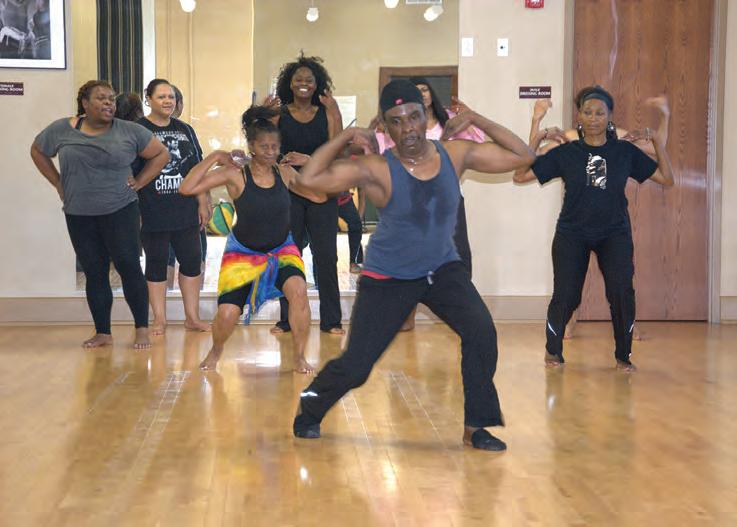
More than a festival, Black Dance USA serves as a dedicated cultural space — one where people from different backgrounds come together to learn, grow and reconnect with themselves and each other.
Dance
Amusa is also teaching a West African dance class. Still, she looks forward to learning as much as teaching, especially in an Afro Cuban/Orisha style class led by Andrea Peoples, whom she describes as a “super dance powerhouse.”
“That’s something Deborah and I are trying really hard to do,” she added. “We want to create an environment where people can stay and find superior training here. The teachers bring their best, so it’s a place where minds can exchange great ideas.”
“Black Dance USA is essentially a learning opportunity,” Ahmed said. “It is an opportunity to be
Continued from B1
School of Montreal, which accepts only 30 students a year from around the world.
Bateman’s training at Circus Harmony helped him earn a spot at that prestigious school, which shares a campus with Cirque du Soleil — the company he later toured with. In 2020, he transitioned to WWE, bringing the same flips and acrobatics from the circus ring into the wrestling ring.
“Circus Harmony has been such a huge part of my life. I wouldn’t have the incredible life I have now if it wasn’t for this program,” Bateman said. “I was an 11 year old boy going down a path that wasn’t so pleasant — the path you see many Black young boys go down. That was to the right. Then circus came, and I went to the left. My life has been incredible ever since.”
Now, having fulfilled his dreams, Bateman is focused on giving back. He hosts speaking events around the world, sharing his story and encouraging young people to find their own spark. “I tell kids all around the world there’s a circus in everyone,” Bateman said. “Don’t run from it — run to it.”
That message resonates with the next generation.
High school freshman Lyla Lawless, a contortionist who began performing seven years ago and now teaches others, is
exposed to African and African diaspora cultural art forms and to celebrate the strength and spirituality of African diaspora creativity.”
More than a festival, Black Dance USA serves as a dedicated cultural space — one where people from different backgrounds come together to learn, grow and reconnect with themselves and each other.
“There has to be a special space where we engage African arts,” Amusa said. “And Black Dance USA is that dedicated space. You will get what your soul needs — whether you’re training for an upcoming audition, being introduced to a new health modality or simply finding the opportunity to move again.”
For many, the weekend
becomes a transformative experience that builds community, celebrates heritage and inspires long after the music stops.
“It’s important that we do Black Dance, come together, practice and do it,” Amusa said. “People get so charged up for the rest of the year. Whether meeting a new friend, sharpening your skills or just hearing the drums — Black Dance USA is a space where we elevate African arts and take it to the next level.”
The 40th Anniversary of Black Dance USA will take place April 9–11 at Better Family Life, 5415 Page Blvd. For more information, visit www.betterfamilylife.org.

Circus Harmony alum Sidney “Iking” Bateman will be returning to celebrate the Silver Soirée at City Museum on April 11.
one of many carrying the legacy forward.
“The program has been such a big part of my life,” she said. “It’s surprising to think how many generations this has been big for.”
Lawless will perform a juggling act at the Silver Circus Soirée that she has been developing for nearly two years. The act has already been featured at the International Jugglers Association Festival and the St. Louis Juggling event. In the spirit of passing it on, Hentoff will perform alongside two of her students — young artists from different communities and backgrounds.
“We build character in individuals and we build
bridges between communities,” Hentoff said.
“We give them a common language — circus — and a common goal: to put together an act. It changes their perception of other people, and when the audience comes, it changes their perception of what young people are capable of.”
The Silver Circus Soirée is a celebration of mentorship, transformation and the power of passing it on.
“At the social circus, we teach that when you focus on what connects you instead of what divides you, you can create something amazing,” Hentoff said.


Poetry lives here
By Lyah B. LeFlore-Ituen, Missouri Historical Society
April arrives on a gray morning—rain tapping gently against the windows, clouds hanging low as if the sky itself is still waking. Yet beneath this quiet weight, something stirs. Spring does not ask for permission to arrive; it insists. Buds begin to push through branches, the earth softens, and the air carries the promise of renewal. It is in this space— between heaviness and hope—that we enter National Poetry Month.
If March called us to reflect during Women’s History Month, April asks something different of us. It asks us to speak. To write. To remember. To bloom out loud. For African American women, that reflection does not end—it transforms into voice, rhythm, and poetry. What we carry in our bloodline and spirit finds its way onto the page and into the air.
In St. Louis, that lineage runs deep.
This city has long been a center for poetry that lives beyond the page—passed from mic to mic, from room to room, from one generation to the next. It is rooted in the legacy of the Black Arts Movement, where art was inseparable from identity and poetry became both mirror and megaphone. Across the river in East St. Louis, voices like Eugene B. Redmond cultivated spaces where Black writers could gather, publish, and be heard—bridging this region to a powerful national lineage. From Joliet, Illinois, which helped shape the early life of Langston Hughes, to East St. Louis’s connection to Maya Angelou, the spirit of Black literary excellence flows through this region like the Mississippi itself.
Jackson, Tracy (T-Spirit) Stanton, Cheeraz Gorman, and Mari Carter. Cheryl D. S. Walker passing the mic to her son Kamau Walker, just like my mother did to me and my sister, Hope Price Lindsay.
It is also alive in the pioneering writers across the river who were part of the Eugene B. Redmond Writers Group: Roscoe Crenshaw, Darlene Roy, Jay Willis, Charlois Lumpkin, and the living legend Dr. Eugene B. Redmond, who passed the mic to his daughter Dr. Treasure Shields Redmond. And it lives in figures like Charles Wartts, K. Curtis Lyle, and St. Louis native Quincy Troupe.
St. Louis’s artistic legacy also embraces multidisciplinary creators like Oliver Lake, the renowned jazz saxophonist, composer, poet, and founding member of the Black Artists Group (BAG). His work reminds us that poetry, music, and visual expression have long intertwined here.
For women in particular, the torch has been passed and held with care. Local collectives of poets like Blue-Mashibini—a duo of Joyce and Deborah—helped pioneer female expression in poetry before there was Floetry and have carried the voice of women forward. These are just a few of the voices we celebrate this month.
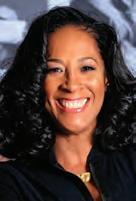
As public historian Cicely Hunter of the Missouri Historical Society’s African American History Initiative (AAHI) reminds us, “Two of the most dynamic Black creatives, Langston Hughes and Maya Angelou, have deep connections to the Midwest because of Black migration patterns. Today, they continue to inspire generations of Black artists across the region and beyond with words that heal, inspire, and shape life and experiences within the United States. By being unapologetically Black, their creativity pushed the needle forward in prolific ways.”
That legacy is alive here.
It is alive in contemporary voices shaping St. Louis’s literary rhythm today, continuing the tradition of bold, purposeful expression: Aja La’Star Owens, Maurice Minor, Jason Vasser-Elong, David A. N.
MHS, through the AAHI, has long supported this work— hosting poets, writers, and spoken-word gatherings that celebrate our shared history and creativity, like Sonia Sanchez; performances of monumental works by Dr. Eugene B. Redmond, winner of the coveted Writers for Writers award from Poets and Writers; Dr. Michael Castro; and the choreopoem “Rivers of Women” by Shirley Bradley Price LeFlore. Our upcoming Juneteenth celebration will feature Tracy (T-Spirit) Stanton. These gatherings reflect MHS’s commitment to honoring St. Louis’s history of poetry and the enduring power of words to connect, inspire, and heal.
Together, we have placed poetry on the map of this place in ways that are bold, beautiful, and brilliantly new. What we built is not momentary—it is movement. Tongues of fire and hearts anchored in purpose.
In St. Louis, where the river connects worlds, poetry does the same. Poetry bridges neighborhoods, histories, and identities. It reminds us that even on the grayest mornings, something is always moving beneath the surface.
As Shirley told us, “This is not a revolution—it is a revelation.”
And in this season of renewal, we are called to reveal.


Columnist Lyah B. LeFlore-Ituen
Circus
Photos courtesy of Better Family Life
Photos courtesy of Circus Harmony

Nettie Kelley’s new spot
If you know me, you know I’ve been rocking with Nettie Kelley since I had a flip phone and Facebook was a figment of Mark Zuckerberg’s imagination. I know I’m not the only one who was willing to book months in advance for her to beat this mug when she was working at MAC. So you already know when she started her own makeup line and opened her store on Lindbergh I was up in there every chance I got. Then she changed the game with her brow work. So you can imagine my delight at how the folks showed up and showed out for the grand opening of her relocation to 11977 St. Charles Rock Road. It was Easter weekend, but Nettie had the folks lined up waiting to get in like it was Black Friday! And unlike the folks coming to blows of PS5s, 600 thread count sheets and 43 in TVS, there was not a single sip of shopping hostility. It was peaceful and serene as we packed out her spot. And we were all in for a treat, because the establishment that sells home décor and fashion with a makeup bar on the other side is everything!
I saw y’all getting your Easter ensembles together – and I wasn’t the least bit mad about it.
emotions by seeing the way she gave back to the kids. They had a blast – and she did too! I’m talking pony rides, super slides and seemingly endless Easter baskets. And the best part of it all was that Sexyy was mixing and mingling – adding to the preciousness of the unforgettable moment she was providing. The event also launched her Giving is Sexyy Foundation. I can’t wait to see how she continues to pour into the community. Please keep us posted on what you have coming up. Oh, and indulge me for a moment as I give a special shoutout to my girl Vanessa Townsend-Vann for always showing us love with every event that she is involved with. You are appreciated, Miss Ma’am!

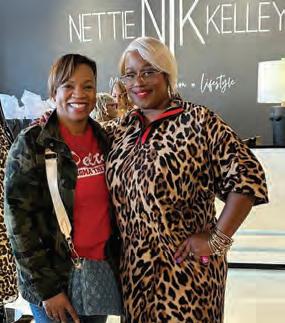

cue to call it. Otherwise I would have been perched in the newsroom on deadline day wearing a moo moo and some sunglasses.

Give it Sexyy. Speaking of Easter, my heart was full way before I heard any speeches or saw adorable little ones in fresh fits flooding my timeline thanks to my girl Sexyy Red. On Friday, she turned the parking lot and surrounding area of the Princess Beauty Supply in Pagedale into an Easter carnival that had me low key in my
Putting the ‘me’ in ‘You, Me and Tuscany.’ Tuesday evening I got a sneak peek of Will Packer and ‘nem’s new movie “You, Me and Tuscany” starring the wholesome Bailey sister and the handsome gentleman from “Bridgerton” that had your aunties in a chokehold for the tail end of 2020 – or as I call it “The Year of The Rona.” Can I confess that the Duke of Hastings did absolutely nothing for me when he was on the show? Now Aaron Pierre and Franklin Saint (because I know y’all don’t know his real name is Damson Idris) are another story as far as the sexy Black Brits. But I can kind of see what the fuss was about for Regé-Jean Page after seeing him in this movie. It was cute! Him and Halle had some adorable chemistry going on.
And the folks watching really enjoyed it too. And y’all know that it has a St. Louis connection, right? STL’s own Jordan Ward has a song featured in the film. I was into the little storyline and was like, “Wayment, is that Jordan Ward?” I stayed for the entire credits to make sure that I was right about it. And was!
Tuesday night turnup at 922. Who knew that a last-minute grocery store run after a movie screening would end with me having one of the most litty lit Tuesday night’s in a minute. I literally could have made my own movie, lbvs! I was making my way down Jennings Station Road and saw that 922 was poppin’. I never did make it to the store. In fact, my stomach is growling as type this, but the turn up was worth it. I didn’t

know what was going on up in there, all I know is that the last time I peeked my head in after saw the parking area across the street that packed Chrisette Michele was on the microphone. I know y’all probably thinking, “Auntie, so you just out here crashing folks’ parties?” You think I ain’t, when I am? And I did it again the other night. I would say that there wasn’t a celebrity in the building, but Tanika (or Tenika, Tinika however you spell it, girl) brought the folks out for her birthday like she was her own A-list guest host. I didn’t know a soul up in there, but you would have thought Tenika was my play cousin they way I kicked it at her b-day party. I had to pull myself away from turning up with those strangers. I was even like, “Girl, you just walk home if you get to lit.” That was my
Raven’s top level birthday bash. It seems like every time I went somewhere over the last several days it was in the middle of the doggone week. This was exactly the case when I stepped out to Second Story to kick it with our own Raven Whitener for her birthday bash on Wednesday night. It was baddie central up in that cute little spot! Raven was giving us a Black Jayne Mansfield with her hot red birthday dress. And my girl Diamond White’s olive green satin mini dress was everything. And since I’m talking about baddies, I might as well bring up that my favorite dancing machine Anthony “Redd” Williams was in the building too. I’m just convinced that that face card has unlimited credit and that shape of his is going to be a whole gallon of Lee’s tea from now until eternity. He wasn’t the only fave of mine whose face was in the place! Jess Live, Melanie Johnson, Bennie Gilliam-Williams just a few of who came through to celebrate with Raven – and a time was had by us all!

If you owe more than $10,000 in credit card or other unsecured debt, see how National Debt Relief can help resolve your debt for a fraction of what you owe.
We
with you to set up a monthly payment that fits within your budget.
You





1.Vanessa Townsend-Vann and STL rap star Sexyy Red at the Giving Is Sexyy Foundation Easter giveaway Friday at Princess Beauty Supply in Pagedale 2. Shaari and Mocha Latte had a wonderful time at the ‘You, Me and Tuscany’ screening Tuesday night at Alamo Drafthouse Cinema 3. Chalana showing love to Nettie Kelley during the grand opening of her upgraded boutique and makeup lounge in Bridgeton on Saturday
4. Diane and Katherine loved their experience at the Tuesday screening of ‘You, Me and Tuscany’ at Alamo Drafthouse Cinema
Photos by Lawrence Bryant and Taylor Marrie/St. Louis American
“To be here representing St Louis is a blessing.”
— Former Chaminade standout Tarris Reed, who led UConn to the Final Four of the NCAA Tournament in Indianapolis

InSIdE SportS
With Earl Austin Jr.
You look ‘Fabulous’
St. Louis American names its Girls ‘Fab Five’ All-Stars
The members of the 2026 St. Louis American Girls “Fab Five” All-Star Team represent a great combination of talented young players and veteran leadership. Nevaeh Lucious of Incarnate Word and Diamond Polk of Lift for Life were outstanding seniors on state championship teams. Dasia Scott of Principia, Jordyn Haywood of MICDS and Hailey Gray of Belleville East are outstanding young players with tremendous talent.
Here is a look at the 2026 St. Louis American Girls “Fab Five” First Team All-Stars
Hailey Gray (Belleville East):
25.7 points, 9.6 rebounds, 2.2 steals and 2.5 blocks while also making 49 3-pointers. She has already received scholarship offers from several top colleges nationwide.

The 5’8” sophomore guard led the Lancers on an historic run to a third-place finish in the Illinois Class 4A state tournament. She is a three-level scoring threat who can also create her own shot off the dribble.
As a sophomore, she averaged 14.9 points, 3.2 assists and 3.3 steals while shooting 48 percent from the field and making 48 3-pointers in leading East to a 30-2 record.
Jordyn Haywood (MICDS): The 6’1” sophomore guard lived up to her reputation as one of the top young prospects in the country, leading the Rams to a runner-up finish in the Class 5 state tournament. She had a remarkable performance in the state semifinals against Marshfield with 35 points, 16 rebounds, five steals and two blocks. As a sophomore, she averaged
Neveah Lucious (Incarnate Word): The 6’3” senior forward finished her career as the leading scorer for a Red Knights team that won another Class 6 state championship. She was the anchor in the middle for IWA for the past two state championship seasons with her ability to score, rebound and block shots. As a senior, she averaged 13.1 points and 6.8 rebounds while shooting 68 percent from the field. She is heading to Missouri State University next season.
Diamond Polk (Lift for Life): The 5’8” senior guard led the Hawks to their third consecutive state championship. Her senior leadership was more important than ever this season as she guided the Hawks through adversity, which included season-ending injuries to All-State guards Amaya and Cara Manuel and an injury to fellow guard Zha Harris.
Polk is a smooth shooting guard who can light it up from 3-point range. She made 60 3-pointers during the season. As a senior, she averaged 14 points, three rebounds and two steals per game.
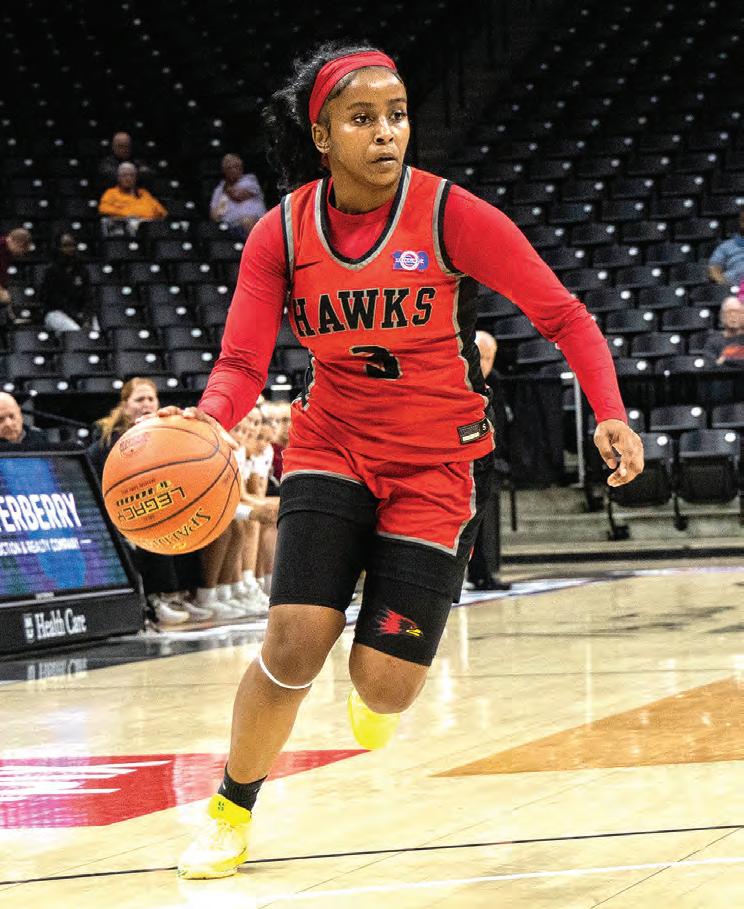
Senior guard Diamond Polk helped lead Lift for Life to their third consecutive state championship.
Dasia Scott (Principia): The 6’2” junior forward is the 2026 St. Louis American Player of the Year. She enjoyed a dominant season, leading the Panthers to the Class 3 state championship, the first in the school’s history in girls’ basketball. She anchored the Panthers
inside, but she also had the versatility to excel anywhere on the court. As a junior, she averaged 20.9 points, 8.5 rebounds, 2.4 steals while making 55 3-pointers and blocking 46 shots. Her most dominant performance came in the semifinals of the Visitation Christmas Tournament
SportS EyE
With Alvin A. Reid
Taking in a St. Louis Cardinals game at Wrigley Field against the Chicago Cubs should be on the “must list” for any baseball fan.
On a Father’s Day Weekend, with a windchill in the 30s, Missouri Hall of Fame photographer Wiley Price and I watched the Cubs tussle with the Montreal Expos in 1997. Wiley was freezing so he went to purchase a sweatshirt or jacket. He came back with a Sammy Sosa pullover. “They have all this stuff on sale. The guy said they are going to trade Sammy Sosa.” The Cubs didn’t trade Sosa and a year later he and Mark McGwire embarked on the epic (PHD driven) home run chase.
when she had 40 points and 18 rebounds in a victory over Belleville East.
St. Louis American Girls Fab Five All-Star Teams
Second Team Moriyah Douglass 6’2” John Burroughs (Sr)
Chicago backs Black baseball
the Cubs, Cardinals, or any MLB team.
On May 2, 2026, Alabama A&M University and Prairie View A&M University will play at Wrigley Field, “for a groundbreaking celebration of culture, legacy, and the game of baseball,” according to the Cubs.
The inaugural Chicago HBCU Baseball Classic will be the first time a pair of HBCU schools have played in Wrigley Field.
“Our mission is to elevate the next generation of talent and expand opportunity in Black baseball,” said Earnest Horton, CEO of Black Baseball Media and Classic organizer.
I saw the New York Yankees play at Wrigley on Sept. 7, 2024, the day after my birthday. It has been a while since I’ve seen the Cardinals play there. I need to get that done.
However, the next game I wish to see at Wrigley will not include
“Bringing this Classic to Wrigley Field allows us to build a baseball tradition that mirrors the decades-long impact of the Chicago Football Classic – ensuring HBCUs remain a vibrant part of Chicago’s sports DNA. I’d never heard of Black Baseball Media, so I looked it up online.
According to its website, “Black Baseball Media is dedicated to

fostering diversity and inclusion in the sport of baseball. We serve the African American baseball community by promoting emerging talent and increasing participation in the game.”
Based in Chicago, it reports to have assisted over 3,500 kids between 2021 and 12025.
The impact includes: MLK Baseball and Softball Camp: Over 250 youth participated in this
annual event, focusing on skill development, teamwork, and leadership.
Chicago High School
Baseball Classic: Celebrating high school talent with wide community participation, creating opportunities for 300+ players and spectators. Learn Fresh STEM Program: 20 youth participated in a STEM league in partnership with MLB Players trust. The program cultivates students’ math
skills in a fun engaging way.
Local 150 Partnership: 15 youth accepted into Local 150 trade union apprenticeship. A two-year program then job placement in the union trade fields.
All I can ask is “How and when can we do this in St. Louis?” Chicago Mayor Brandon Johnson notes the history that precedes the game.
“Wrigley Field is the only ballpark where Jackie Robinson played that still stands today, making it a powerful place to write the next chapter of Black baseball history,” said Jonshon.
This event honors the legacy of African Americans in the sport while inspiring young people across our city to see themselves in baseball, in higher education, and in leadership.”
Cardinals’ management should consider hosting a similar event – and not charge for attendance like the game in Chicago.
According to the Cubs website “all tickets have been claimed.” Those are beautiful words.
The Reid Roundup
South Carolina coach Dawn Staley is tough coach, fierce competitor, and credit to women’s college basketball. UConn coach Geno Auriemma disgraced himself, his school, and college athletics while verbally attacking Stanley after South Carolina prevailed in an NCAA national semifinal. His actions should lead to a reprimand and his apology, which does not mention Staley by name, was weak. I think his ire is based on a Black woman – not just a woman – kicking his tail…Is that really Jordan Walker belting the baseball? While the Cardinals lost the game, his grand slam last week against the Detroit Tigers was possibly the summit of his young career. Keep it up, Jordan. Shut up the doubters, me included… Richard Chaifetz, a SLU graduate and billionaire, has joined the ownership group of the NBA’s Portland Trail Blazers. He has said he wants an NBA team in STL.
Alvin A. Reid
Brycen Hammonds and Alabama A&M will take on Prairie View in the inaugural HBCU Baseball Classic in Wrigley Field on May 2, 2026.
Photo by Lawrence Bryant / St. Louis American
Earl Austin Jr.
Photo courtesy of Alabama A&M
Unlimited Miles, genius unbound
A centennial tribute that reshaped and reimagined the master’s legacy
By Kenya Vaughn St. Louis American
When the crowd refused to sit down after the encore, one thought rose above the applause: “Unlimited Miles is exactly right.”
Because what unfolded at The Sheldon Concert Hall was a masterclass in how Miles Davis continues to bend the arc of American music long after his horn fell silent. The sextet assembled for this 14 city international tour revealed just how deeply his innovations still pulse through hip hop, neosoul, jazz fusion, funk and every genre that has dared to chase the future.
As a son of East St. Louis, it was only fitting that St. Louis was among the select stops. On March 28, a packed house gathered as part of The Sheldon’s sixweek Milestones series leading up to Davis’ May 26 birthday. Unlimited Miles: Miles Davis at 100 is directed by Grammywinning piano architect John Beasley — himself a former member of Davis’ band — and features a rotating roster of heavyweights. For St. Louis, that meant Sean Jones on trumpet, Mark Turner on saxophone, Kurt Rosenwinkel on guitar, Ben Williams on bass, and fellow East St. Louis native Terrion Gully on drums.
Together, they expanded the audience’s understanding of just how thoroughly Davis’ creative DNA is woven into the fabric of contemporary sound.
The name Unlimited Miles might suggest a predictable run of “So What,” “Blue in Green,” “Bitches Brew,” “Seven Steps to Heaven,” “Round Midnight,” “Milestones,” “Concierto

de Aranjuez,” and maybe “Boplicity” for good measure.
But from the downbeat of the opening number, it was clear the band had no intention of playing it safe.
“Seven Steps to Heaven” arrived with a time signature shakeup and rhythmic liberties bold enough to make even seasoned jazz heads lean forward. Had it not been for Jones’ unmistakable staccato phrasing — crisp, centered, and technically pristine — the tune might have been unrecognizable.
It was a reminder that Davis never wanted musicians to replicate him. He wanted them to risk something. Their reimagining of “So What” pushed the modal classic into new harmonic terrain. And then came “Catémbe.” Before launching into the
tune, Jones shared a story that is a microcosm of Davis’ influence.
“This next tune I’m going to play for you is actually the first jazz song I ever heard,” Jones told the crowd. “I was in fifth grade. My band teacher noticed
Miles Davis’ influence on contemporary music is often referenced but rarely demonstrated with this level of intention.
that I was moving ahead faster than her other students. They were on ‘Hot Cross Buns.’ I was on the chromatic scales.”
She took him to lunch and slid

two CDS across the table.
“One of them was Miles Davis’ ‘Amandla.’ The other one was Miles Davis’ ‘Tutu,’” Jones said. “I put ‘Amandla’ on first because I couldn’t understand the cover.”
The white cover with an abstract image of Davis intrigued the pre-teen Jones. “Catémbe” transformed him.
“I put the record on, and this tune came on–and it changed my life,” Jones said. “Later on I would be in Marcus Miller’s band – the composer of this tune. And later I had a chance to play it for that teacher.”
Their interpretation of “Catémbe” was a kinetic blend of funk, Afrobeats, and rockinflected edge. Gully’s drum work locked in with Williams’ bass lines like a heartbeat, while
Jones soared into the upper register with a velocity and clarity that felt almost supernatural. Davis’ influence on contemporary music is often referenced but rarely demonstrated with this level of intention. His approach to space, phrasing, and harmonic risktaking laid the groundwork for everything from J Dilla’s swing to Erykah Badu’s phrasing to the atmospheric layering of modern jazz fusion. In 75 minutes, Miles Unlimited covered five decades of Davis’ evolution. They captured it all — from the acoustic to the electric, from the modal to the experimental, from the cool to the cosmic.
“Thank you, Miles,” Jones said before the band’s final bow, “for spreading joy throughout generations.”

Photos by Taylor Marrie/St. Louis American
A packed house filled The Sheldon on March 28 for its Milestones series, where Unlimited Miles: Miles Davis at 100 brought a powerhouse lineup — Sean Jones, Mark Turner, Kurt Rosenwinkel, Ben Williams and East St. Louis’ own Terrion Gully — under the direction of Grammywinner John Beasley.
This pastor is flipping Black church tradition with poetry
By Rev. Dorothy S. Boulware Word In Back
With graduate degrees from St. Mary’s Seminary in Baltimore and Wesley Theological Seminary in Washington, D.C., the Rev. Dr. Wanda Bynum Duckett has traditional faith leadership credentials. Her career path affirmed it: she rose from itinerant ministry to serve as superintendent of the United Methodist Church’s former Baltimore Metropolitan District for eight years.
Then, she retired and rewired.
After years of preaching in a more traditional mode, Duckett now spits the gospel with the power and energy of a hip-hop artist or slam poet. That’s with good reason: Bynam Duckett, 64, is melding art forms found in nightclubs and coffee houses with Scripture — a unique spiritual blend she calls “Sacred Slam:”
We are the ones… what are we waiting for?
We are the ones… open wide every door!
We are the ones
We can’t hear them from our shrines
Can’t see them through closed blinds
Can’t love them with closed minds.
Eternal life?
Let’s get this right.
The world is waiting and
We are the ones.
The combination is drawing them into the pews whenever Duckett preaches, and not just young people craving a spiritual
message in a language they can relate to. Sacred Slam, she says, attracts the young and the young at heart. Her style has been so successful that she facilitates workshops and coaches others to find themselves in the art of poetry under the banner of Spoken by Duckett.
This interview has been edited for length and clarity.
Word in Black: When did you first fall in love with hip-hop and poetry?
I grew up the youngest of five. I had a brother who was rock and roll, Led Zeppelin, Rare Earth guy. He was a hippie. I had another brother who ws Temptations, Four Tops. And my sister: she’s Pointer Sisters, and she’s listening to Malcolm X on wax, on album.
Wanda Bynum Duckett: Oh, my goodness. It was in the late 70s, and I heard [rap artists] the Sugarhill Gang; I was kind of in love then, but then when I heard, “Don’t Push Me, I’m Close to the Edge,” I was like, O.K. — I’m in.
My mother’s James Cleveland, Mahalia Jackson. So I think in song and rhyme anyway.
Of course, we’ve got poetic preachers and in the tradition of even someone reading the scripture and the preacher preaching a while and then he’s rhyming and he’s riffing and he’s unpacking it. It’s poetry to me. It’s, like, the way the images and the words and the attitude of it all come together. All this stuff is in my head.
WIB: When did you first experience rhythm in scripture and prayer responses?
Bynum Duckett: I really don’t know if I was aware until other people noticed it in my preaching. I think it was so much a part of the way I think, hear, and speak that I didn’t realize. I would preach at Mount Calvary AME Church, and when the young adult choir was singing,
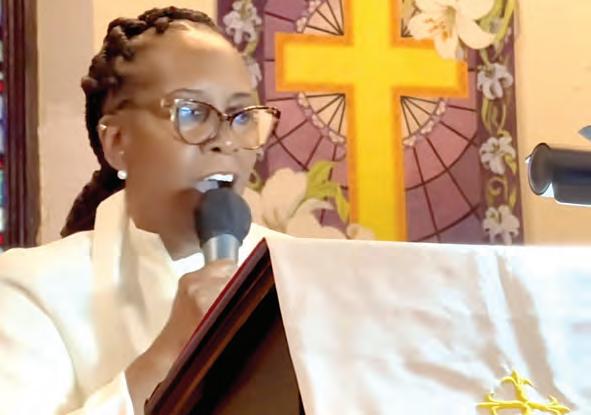
they would snap their fingers when I made a point. I said, ‘What are they doing?’ I said to myself, ‘I’m not doing poetry,’ but that’s the way they heard it.
WIB: Did you need to summon courage to be non-traditional?
Bynum Duckett: One of the first times I performed, I stood in

the background with my hair tied up, like I was Maya Angelou or somebody. I thought I had to be Afrocentric. While I read from the background, out of sight, Rev. Stephanie Graham Atkins, one of my colleagues, did liturgical dance to the rhythm of my words and I got to hide. It was another kind of gradual coming out.
WIB: Did you experience pushback? Did anyone say, ‘That’s not preaching. What’s she doing up there?’
Bynum Duckett: It was actually the opposite. I found my tribe in the young adults. And
people love when young people show up, right?
I give credit to a young lady named LaShonda. When I was in southwest Baltimore, my first church, I was doing a lot of real, gritty urban ministry. And then when I moved uptown to Ashburton, I sat in the office and saw people and visited.
She came into the office one day and said the young people had Googled me. They said, ‘Where is she? We haven’t seen her show up here.’ She called me out. She said they were excited for me to bring my “bop” as she called it.
Out of that conversation came the poem, “I Decided to Be Myself.”
WIB: What did “being yourself” look like, initially?
Bynum Duckett: We started the “Seven Last Words of Poetry ” nights on Good Friday. We didn’t start until 10 o’clock. People had been in church all day. We set the place up like a cafe. We had live music one year. We had a DJ the next year. And the seven last words were all offered poetically.
People came from all over: DC, Silver Spring, you know, elsewhere in Baltimore.
Rev. Dr. Wanda Bynum Duckett fuses hip-hop, spoken-word poetry and Christian texts to form “Sacred Slam,” a unique form of preaching that’s attracting notice and filling the pews.
It was beautiful. They were able to get a taste of what it was before they could argue against it. So then, when I did [my] dissertation work, I really pushed the envelope and took the United Methodist hymnal and wrote a poetic reaffirmation of baptism, a poetic communion service.
WIB: Can you say more about the baptism poem?
Bynum Duckett: It is dedicated to Trayvon Martin. He had a right to live. Remember that mantra? And it’s talking about how Jesus had the right to live, but he gave himself up for us. It’s a communion service.
In the dissertation, it was the first time I had a chance to experiment with that to see what people said. And then I took a survey as part of the dissertation work. And the survey was, like, it’s cool. They said they liked it but weren’t sure about it being part of worship.
Some said they certainly didn’t know how they felt about it being used in the sacraments. And some people said stuff like, ‘Well, it’s kind of like hip hop. I don’t understand it because they talk too fast.’ So writing it down is helpful so people can read it at their own pace in their own way. But this one woman, who had been kind of on the edge, cried as I did a reaffirmation of baptism. She said it took her back to when she was confirmed, and she wasn’t one of those weepy people.
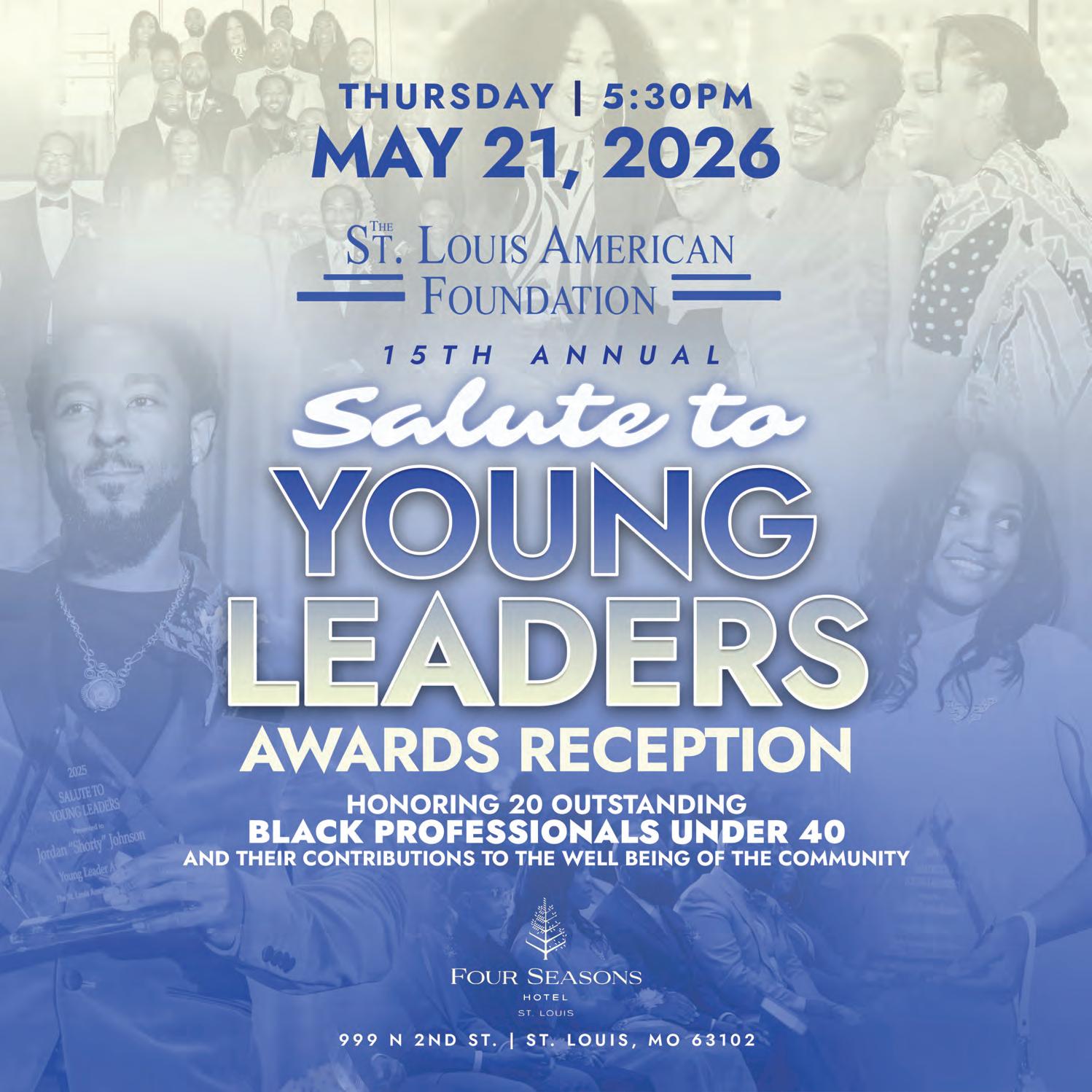
Photo courtesy of Facebook/Mount Zion United Methodist Church


LAVENDER LABORER
The College Hill Foundation is seeking a lavender laborer to assist with the maintenance and its’ lavender farm located in the College Hill Neighborhood in the City of St. Louis.
Key Responsibilities:
• Plant and cultivate lavender plants according to seasonal schedules.
• Perform regular maintenance tasks, including weeding, grass cutting, watering, fertilizing and pruning to ensure plant health.
• Harvest lavender flowers at peak bloom for optimal quality.
• Operate and maintain outdoor equipment and tools safely.
• Assist in the processing of lavender for essential oils and other products.
• Sale lavender at Farmers Markets.
• Follow safety protocols and maintain a clean work environment.
Qualifications:
• Previous experience in agriculture or horticulture preferred.
• Ability to perform physical labor in various weather conditions.
• Knowledge of lavender cultivation practices is a plus.
• Strong attention to detail and ability to follow instructions.
• Good communication skills and teamwork abilities. Please submit your resume to Fred Kimbrough at chffred@gmail.com

STINGRAYS AT CARIBBEAN COVE IMPROVEMENTS RFP 2026
The Saint Louis Zoo seeks bids from qualified firms to submit proposals.
Bid documents are available as of 4/8/26 on the Saint Louis Zoo website: stlzoo.org/vendor
SEALED BIDS
SEALED BIDS
Bids for Troop E HeadquartersRenovate Restrooms & Replace All Cast Iron Piping, Headquarters Building, Project No.R2520-01 will be received by FMDC, State of MO, UNTIL 1:30 PM, 4/30/26. Project information available at: http://oa.mo. gov/facilities
SEALED BIDS
DIGITAL WAYFINDING RFP 2026
The Saint Louis Zoo seeks bids from qualified firms to submit proposals. Bid documents are available as of 4/8/26 on the Saint Louis Zoo website: stlzoo.org/vendor
PUBLIC NOTICE
REQUEST FOR PROPOSALS
Washington University in St. Louis offers rewarding opportunities in various fields at all levels, with positions in engineering, nursing and health care, research, administration, technology, security and more.
Now Hiring: MFM OB/GYN Ultrasound Sonographers!
The WashU Department of OB/GYN is seeking friendly and reliable sonographers to join our Maternal–Fetal Medicine team.
What You’ll Love:
• Mon–Fri | 7:45am–4:15pm
• No nights, weekends, or call
• Scan high risk patients & work with MFM specialists
• Supportive, team oriented environment
Pay & Benefits:
• $35.99–$55.79/hr (based on OB/GYN/MFM experience)
• Up to 22 vacation days, 10 holidays, and sick time
• Comprehensive medical, wellness programs, mental health support
• 403(b) with 7%+ university contribution
• 4 weeks caregiver leave
• Tuition assistance for you & dependents
Whether you’re a dedicated sonographer or a new grad looking to grow in a supportive, high impact environment — we’d love to meet you!
For the full job description and to apply, visit jobs.washu.edu, JR92023.
We seek people from diverse backgrounds to join us in a supportive environment that encourages boldness, inclusion, and creativity.
EEO/AA/VET/Disability Employer
Bids for Renovate Interior & Exterior, Readiness Center Building, Project No. T2421-01 will be received by FMDC, State of MO, UNTIL 1:30 PM, 4/30/26. Project information available at: http:// oa.mo.gov/ facilities
Bids for Add Cabins & Renovate Lodge at Current River State Park, Project No. X2207-01, will be received by FMDC, State of MO, UNTIL 1:30 PM, May 12, 2026. Project information available at: http://oa.mo. gov/facilities
The City of St. Louis Department of Public Safety will hold a public hearing regarding the 2025 Edward Byrne Memorial Justice Assistance Grant application on: WEDNESDAY, April 15, 2026 AT 2:00 P.M. in Room 401, CITY HALL
The purpose of the Justice Assistance Grant is to assist the City in reducing crime and improving public safety through proven prevention efforts. Proposed programs will be presented. *******
If you would like more information about this grant, please call the Department of Public Safety at (314) 622-3391.
SEALED BIDS
Saving Our Children (SOC) is soliciting competitive sealed bids from qualified Food Service Management Companies (FSMC) to provide unitized meals for its Summer Food Service Program (SFSP) for summer 2026. The estimated annual meal volume is approximately 163,040 meals consisting of breakfast, lunch, snack, and supper.
Bid packets may be obtained by contacting: Saving Our Children 222 S Meramec Ave Ste 201 Clayton, MO 63105 314-529-7660 info@socmo.org
Sealed bids must be received no later than: Friday April 24, 2026
A public bid opening will be held at: Monday April 27, 2026 @ 1pm 222 South Meramec Ave. Ste 201, Clayton, Mo, 63105 All bids must comply with USDA, Missouri DHSS-CFNA, and federal procurement regulations.
Saving Our Children reserves the right to accept or reject any or all bids.

The World Trade Center – St. Louis requests proposals from qualified consultants with technical familiarity of the export-import process to promote awareness of Foreign Trade Zone #102 across St. Louis County, St. Charles County, and the City of St. Louis. A copy of the complete RFP is available at https:// stlpartnership.com/rfprfq/. To be considered, proposals must be received no later than 3PM CT on May 1, 2026.
St. Louis Economic Development Partnership Equal Opportunity Employer
PUBLIC NOTICE
Notice is hereby given that the Metropolitan St. Louis Sewer District Requests for Quotes, Bids and Proposals are posted online for public download. Please navigate to www.msdprojectclear.org > Doing Business With Us > View Bid Opportunities Metropolitan St. Louis Sewer District is an Equal Opportunity Employer.
SEALED BIDS
Bids for Generator Installation, Project No. R23MP13 will be received by FMDC, State of MO, UNTIL 1:30 PM, April 30, 2026. Project information available at: http://oa.mo. gov/facilities

moneywise


advice to make the decision easier
cost of your loan.

By StatePoint
Refinancing a home can be a smart move – if you time it well and understand the factors involved.
Refinancing means replacing your current mortgage with a new one, and doing so will result in a new rate, term and monthly payment. While refinancing does have some upfront costs, taking this step could improve your financial situation.
Reasons to refinance
Even small differences in mortgage rates can have a big impact on your monthly payment.
Some of the best times to consider refinancing include:
• When mortgage rates are lower than the rate of your current mortgage. Even small differences in mortgage rates can have a big impact on your monthly payment, and the total
• When your financial situation has improved and you can secure a loan with a shorter term to build equity in your home faster.
• When your adjustable-rate mortgage is adjusting upward and you want to convert to a fixed-rate mortgage for the security of consistent payments.
• When you’ve built up significant equity in your home and could use the money from a cash-out refinance for home improvements or to improve your financial situation. With a cash-out refinance, you’re refinancing your mortgage for more than you currently owe. In return, you’re getting a portion of your equity back in cash.

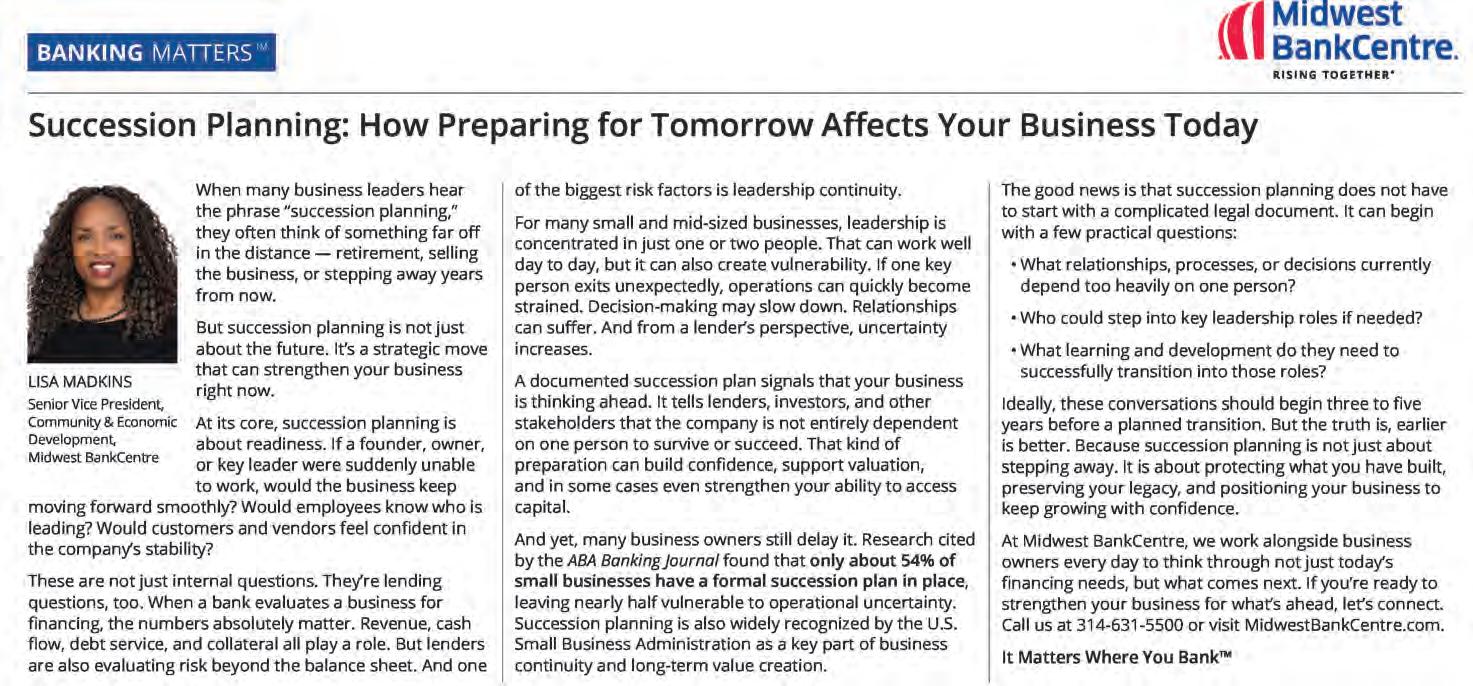
Envato photo
By StatePoint
Have you ever lamented how much of your earnings go to taxes? One way to ensure that more of your money benefits you and your future is by making strategic contributions to tax-advantaged savings accounts.
By opening and contributing to a Health Savings Account (HSA) and Individual Retirement Account (IRA), you can substantially reduce your taxable income. Not sure if these accounts are right for you? Consider these insights from Fidelity: HSAs
An HSA is an account that can be used to pay for qualified medical expenses, including copays, prescriptions, dental care, contacts and eyeglasses, bandages, X-rays, and a lot more. It’s “tax-advantaged” because your contributions reduce your taxable income; the money isn’t taxed while it’s in the account, even if it earns interest or investment returns; and as long as you use your HSA funds for qualified medical expenses, you won’t owe taxes when you take money out of the account. This triple-tax advantage is powerful, but it’s not the only reason why HSAs are so popular. Unlike a
Strategic ways to reduce your taxable income

By opening and contributing to a Health Savings Account (HSA) and Individual Retirement Account (IRA),
substantially reduce your taxable income.
flexible spending account, an HSA is not “use-it-orlose-it,” meaning it doesn’t need to be spent within a certain timeframe. If you don’t need the money in your HSA for current medical expenses, you can save and invest it until you do, and even take the account
with you when you leave an employer. Just keep in mind that to open and contribute to an HSA, you’ll need to be enrolled in an HSA-eligible health plan.
IRAs
An IRA refers to a


tax-advantaged account designed to help you save for retirement on your own, independent of an employer. There are several types of IRAs, but when people say “IRA” alone, they often mean a traditional IRA. That’s a type anyone
with earned income can open and contribute to.
Traditional IRAs allow you to save on income taxes now and pay them later in retirement, when you could be in a lower tax bracket and therefore owe less in taxes. Fidelity estimates that you may
need 55% to 80% of your pre-retirement income in retirement. Because an employer-sponsored savings plan might not be enough to accumulate the savings you need due to annual contribution limits, investing through an IRA could help you save more for the future. Before opening an IRA, check out a few different firms that offer them. Find out whether they offer helpful support and a user-friendly experience, plus whether they charge any fees or minimums. Then, once the account is open, decide how much you want to contribute and how often.
“Setting up automated contributions can make saving for retirement into a habit that requires very little effort,” said Rita Assaf, vice president, Retirement at Fidelity. “It’s also a good idea to regularly check your asset mix to see if it is still a good fit for your goals, risk tolerance and time horizon.” For additional financial resources and insights, visit https:// www.fidelity.com/learning-center.
With a smart strategy that involves directing your income into tax-advantaged accounts, you can build more wealth for future needs and wants.

you can
Envato photo
Sponsored
Smart savings strategies that can help you to retire early
By Kyla Pollard, Group Manager, Retail Banking Commerce Bank
Early retirement is more attainable than many people realize. With steady habits and careful planning, it’s possible to build a nest egg that lasts for decades. These seven strategies can help you get started:
1. Calculate your retirement number. Add up what you spend each month, multiply it by 12 to get your yearly spending, then multiply that number by 25 to esti-
Refinancing
Key factors to consider
Although refinancing your mortgage could save you money in the long and short term, it isn’t free. The total cost to refinance your mortgage will be determined by your lender, credit score and location. As a general rule, you can expect to spend 3-6% of your loan principal on a refinance.
A quick check to see if refinancing makes financial sense for you is to calculate how long it will take to recoup the costs of the refinance. To do this, take the total cost associated with the refinance and divide it
mate how much you may need for retirement. This number can be adjusted to account for a longer retirement, rising healthcare costs, inflation and taxes.
2. Pay off highinterest debt. Highinterest credit cards and loans make it harder to save for longterm goals. Listing debts by interest rate and paying off the highest one first helps reduce financial strain and frees up more money for retirement savings.
3. Increase the sav-
by your monthly savings.
Note that this model will not work for cash-out refinances or if you are refinancing to reduce the term of your loan. You’ll also want to consider when you plan to move, and whether you’re going to significantly extend your loan term. For example, if you have 20 years left on your 30-year fixed-rate mortgage and you refinance into a 30year fixed-rate mortgage, you’ve essentially extended the term of your loan and will pay more interest over the life of the loan.
You should work closely with a lender to discuss options that fit your goals. You can refinance through your existing lender or a new lender. What’s most important is that the lender
ings rate. Growing the percentage of each paycheck set aside for retirement can make a meaningful difference over time. Automating transfers and directing part of any bonus or tax refund toward savings can help accelerate progress, while still allowing room to enjoy life today.
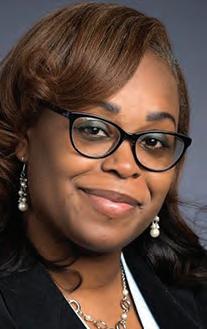
5. Invest for longterm growth. Choosing an investment mix that aligns with personal goals, timeline and comfort with risk is essential. Risk tolerance
4. Use retirement accounts. Accounts such as 401(k)s, IRAs and Roth IRAs offer tax advantages that promote longterm growth. A taxable investment account can also serve as a bridge for anyone who retires before being eligible to withdraw from retirement accounts penaltyfree.
you choose is trustworthy and offers competitive rates and terms.
Crunch the numbers
To determine how much it will cost you to refinance your mortgage, and how much money you can save by doing so, lean on free online resources. Freddie Mac’s tools and refinance calculators can help you estimate payments, compare options and ultimately evaluate whether refinancing aligns with your financial goals. Visit My Home by Freddie Mac at myhome.freddiemac.com to access these resources. When it comes to refinancing, timing is everything. Before taking this step, ensure it’s the right move for you now.
may shift over time, often beginning with more growth-focused investments and gradually moving toward more stable options as retirement nears.
6. Plan for healthcare costs. Healthcare is often one of the largest retirement expenses, especially for those who retire before Medicare begins at age 65. Researching insurance options early and factoring these costs into your overall plan can prevent surprises later.
7. Review the plan
yearly. Regular checkins help ensure progress stays on track. Life changes — such as raises, job transitions, family needs or health shifts — can all impact a retirement strategy. Updating spending assumptions and longterm goals each year helps keep the plan aligned. Early retirement becomes more attainable with flexibility, consistency and intentional planning. Commerce Bank can provide you support in developing a retirement strategy that supports a range of goals.


Kyla Pollard
To determine how much it will cost you to refinance your mortgage, and how much money you can save by doing so, lean on free online resources.
Envato photo
Study reveals consumers are redefining the American Dream
By StatePoint
A new study exploring the relationship between Americans and their mon‑ ey, reveals how emerging technologies and shifting attitudes are changing money habits.
The 2026 Wells Fargo Money Study, now in its third year, explores how Americans are thinking, feeling and taking action with their money. The findings reveal consumers are adopting new strat‑ egies, looking to have greater confidence when making financial decisions, and being more thoughtful about their spending. Here are some of the report’s top findings:
Defining the American Dream Americans, especial‑ ly younger generations, view entrepreneurship as a pathway to autonomy. The majority of adults polled, 61%, say owning a busi‑ ness is part of the Amer‑ ican Dream. Even more, 69% of Gen Z adults, share that belief.
Of those who don’t own a business, 74% of Gen Z adults and 58% of Millennials want to someday, with the majority saying that doing so would allow them to control their own destiny. That control though comes with some downside. A majority of business owners report using personal savings, personal credit or home eq‑ uity to fund their business.

An ongoing study, now in its third year, has revealed consumers are adopting new strategies, looking to have greater confidence when making financial decisions, and being more thoughtful about their spending.
“The desire to own a business reflects a grow ing belief that success is defined on one’s own terms. While entrepreneur ship can offer freedom and flexibility, it also comes with financial risk, which is why preparation, resilience, and informed decision‑making matter more than ever,” said Em‑ ily Irwin, head of Private Wealth Planning at Wealth & Investment Manage‑ ment.
Gen Z faces financial pressure
Forty six percent of Gen Z respondents de‑ scribe their financial lives as messy, and many say they are postponing plans such as relocating, getting married, education and ca‑ reer changes. This financial pressure extends beyond young adults themselves,

with 64% of parents of the 18 28 set saying their chil‑ dren rely on them finan cially, whether for money, housing or other support. At the same time, Gen Z is increasingly turning to nontraditional sources for financial information, such as YouTube, Instagram, TikTok and online commu‑ nities.
“As young adults
lean on both family and nontraditional sources for support, open communi‑ cation, clear expectations, and shared planning can help families navigate this stage together,” said Irwin.
Using AI for good, but with caution
A growing number of Americans are eager to
try out new technology, like Artificial Intelligence, when managing finances, however experts wonder if respondents know enough to use AI to their advan‑ tage.
Nineteen percent of U.S. adults say they have used artificial intelligence in the past year for ideas or education about their mon‑ ey. Among Gen Z adults, that percentage doubles.
Most consumers using AI say they turn to it to better understand potential financial moves, identify new ideas, and weigh risks and rewards. Two‑thirds have acted on suggestions generated by AI, and of that subset, 90% say those ideas were profitable or worthwhile.
“Technology can spark ideas and build awareness, but it works best when paired with a solid finan cial foundation, trusted guidance, and an under‑ standing of how those insights apply to real life goals,” said Irwin.
Other study findings include a reported increase in savings and invest‑ ments over the past year, increased intentionality about spending, continued employment concerns, and a widespread apprecia‑ tion for banking apps and rewards programs.
For more information, visit https://www.wellsfargo.com. Wealth & Investment Management offers financial products and services through bank and brokerage affiliates of Wells Fargo & Company.

Envato photo
Money talks: Why it’s time to break the silence
By Orvin T. Kimbrough Chairman & CEO, Midwest BankCentre
Author, Twice Over a Man, More Than a Conqueror, and Ward and the State
My 20-year-old son doesn’t shy away from asking about money. He’s been curious since he could talk — always the kid with a thousand questions. He wants to know about the mortgage, how much we owe, what I earn, and why I invest in angel deals, private companies, or public markets.
Recent-
ly, after haircuts and over breakfast at my favorite Waffle House in Lemay, MO, he even asked how much equity I hold in the bank I lead and what kind of investment it takes to sit on corporate boards.
At his age, I didn’t just not have those conversations — I didn’t have anyone to ask. Money felt abstract to me, like a concept that existed in other people’s worlds but didn’t fully connect to my own. The few times it came up were during life skills courses I took in foster care. Even then, it felt distant — like reading a manual for a tool I’d never held.
I recently came across a stat that floored me: over 60% of people avoid talking about money with family, friends, or their spouse. That hit home. I thought back to my fundraising days, theology school, and working with clergy early in
my career. It struck me that even clergy — people trained to guide others through life’s most personal and painful moments — often aren’t equipped to have honest conversations about money.
Why is that?
Money is as essential as air and water. It’s the infrastructure of our lives — the roads we drive on, the electricity that powers our homes, and the pipes that keep everything flowing. Yet, we treat it like a secret — something to avoid, even as it shapes nearly every part of life.
I’ve decided that won’t be the case in my house. I regularly talk to my kids about what I call the Treasures and Traps of Money.
The Treasures – The good side of money: saving, investing, giving, and using it as a tool to create opportunities.
The Traps – The habits and mindsets that quietly sabotage financial health:
Impulsive Spending –Letting emotions drive purchases instead of planning.
Debt without Strategy –Borrowing without a plan or understanding the long-term cost.
Comparison Culture – Measuring success by someone else’s life, leading to unnecessary spending.
Short-Term Thinking –Prioritizing instant gratification over long-term growth, missing out on compounding wealth.
I remind them: Money isn’t something to hoard — it’s something to manage,
grow, and share. It’s not about chasing more — it’s about making intentional choices that shape the life you want.
But none of that happens without conversation.
Why Don’t We Talk About It?
I believe we avoid money conversations because we often tie finances to self-worth. When things are good, we feel validated. When they’re not, we feel shame.
But here’s the truth: Money is not your identity. It’s a resource. The more we learn to manage it, the less power it holds over us.
Three simple ways to start talking about money (Without the awkwardness):
Be Open About Your Journey – You don’t need all the answers. Sharing your wins and lessons makes the topic relatable and real.
Start Small – Ask questions within your network like, “What’s one thing you wish you learned about money earlier?” or “What’s a financial habit you’re proud of?”
Frame Money as a Tool, Not a Taboo Money isn’t the goal; it’s a means to build security and create opportunities. Focus on what’s possible, not what’s limiting. So, when was the last time you had an honest conversation about money?
Maybe today’s the day to start. For more, visit OrvinKimbrough.com or MidwestBankCentre.com.

Paying for college with confidence
By StatePoint
If you’re the parent of a college-bound student, you’ll soon be receiving financial aid award letters. Making sense of these letters and planning your next steps can help you navigate the years ahead. Among the nearly 90% of parents in a College Ave survey who say they helped or planned to help their child pay for college, 68% were confident they had a good payment plan. To help ensure you can say the same for yourself, it’s really important to nail down the details. Once the financial aid award letters arrive, Angela Colatriano, chief operating officer at College Ave, says to take the following steps:
Compare the offers. Each letter might present information a bit differently. Getting an apples-to-apples look at the offers is critical. You can calculate the net direct cost of each school by subtracting offered scholarships and grants from the cost of attendance (tuition, room, board, textbooks and fees). If applicable, you can subtract work-study aid too. You should also factor in expected annual increases in tuition, room, board and other fees.
Understand how federal borrowing has changed. The One Big Beautiful Bill (OBBB), signed into law last year, brings important changes to federal financial aid. While some provisions expand flexibility, including Pell Grant use and student loan rehabilitation opportunities, it also places new federal loan limits on par-
ents and graduate students. Families who might be considering federal loans to cover remaining costs may need a new approach and funding plan. It’s important to be mindful of these new changes and annual borrowing limits so there are no surprises down the line.
Look for more scholarship opportunities. Beyond federal and institutional financial aid, outside scholarships can help you meet college costs. Ask your student’s high school counselor and visit online sites like bigfuture.collegboard.org and scholarships. com to find relevant opportunities. One easy and simple scholarship your student can apply to again and again in mere moments is the College Ave Scholarship Sweepstakes, which awards $1,000 to a lucky winner each month.

Orvin T. Kimbrough
Envato photo
By Dorothy Boulware Word In Black
Whenever I say I’ve been married 57 years, I always get this question:
“To the same person?”
Yes: Mr. Boulware and I tied the knot when I was 18, and he was 19. Four children, five grandchildren, and two great-grandchildren later, my husband and I still like each other. Most days.
Though it’s usually said in jest, the reaction to the length of our longterm marriage specifically — disbelief, surprise, even curiosity — is also indicative of society’s evolving attitudes towards marriage in general. That’s especially true in the Black community, where only around 3 in 10 people are married, and Black women are significantly less likely than white women to jump the broom.
In past decades, marriage used to be almost always a foregone conclusion or a rite of passage. Now, it’s more of an object for contemplation: a maybe. A possibility. Or not.
Now, Black clergy who preside over the matrimonial ceremony are working to overcome that hesitancy.
‘Marriage is Better’
More Black faith leaders
are talking to their congregants about marriage: why they should consider it, the personal and spiritual value Christians can gain from it, and what they should know before heading to the altar. The benefits, they say, range from personal happiness and better health to strengthened faith.
”If you take church out of it altogether, and you look financially, marriage is better,” says Rev. LatDoir Glasper, founding pastor of Kingdom Life Church in Olive Branch, Mississippi, ticking off a list of ways marriage improves lives. “Health? Marriage is better. Relationally, marriage is better. Companionship? Marriage is better.”
For the Black church, marriage has long been a tool for building stability socially and economically, in communities shaped by inequality. Many pastors see marriage as a pathway to stronger finances, shared caregiving, and the kind of resilience families need to weather crises.
One important touchstone in the ongoing movement promoting Black marriage is the May 2, 2021, sermon from the Rev. Dr. Charlie E. Dates, senior pastor of sister churches Salem and Progressive Baptist, in Chicago. He believes marriage

in Christianity is part of discipleship and covenant life rather than simply a social milestone.
But he had a specific message for Black men: honor your romantic partner with marriage.
“Don’t ask a woman to give you the privileges of a wife when you won’t give her the promise,” he said. “A Godly man is willing to stand before God and people and say, ‘This is my wife. If God has given you a woman to love, honor her with marriage.”
Setbacks and Challenges
Still, couples don’t always get marriage right on the first go-round. That was the case with Voncille and Melvin Greene, lay marriage counselors and members of First Baptist Church of Glenarden International in Upper Marlboro, Maryland.
The couple found one another after Voncille Greene’s first marriage had


failed, and after Greene had become a widower during his second marriage. The couple dispenses marital advice in their online show, “Living a Godly Marriage.”
Their approach is grounded in life experience; both were older singles who rebuilt their lives after devastating personal setbacks. A bacterial infection left Voncille Greene a double amputee, and Mel Greene became a single dad to two young children after his wife died of a terminal illness.
The foundation of marriage is simple, Melvin Greene says.
“God is the architect,” he says. “The Bible is his blueprint, and Jesus must be the cornerstone.” But emotions, Voncille Greene says, are just as important: couples must keep romance, connection, and friendship alive.
Before saying, “I do,” the couple took classes to learn what they consider
the blueprints for successful marriage. It included tutorials on handling hard times, overcoming challenges, and working through disagreements.
“God has been faithful to bless us,” Melvin Greene says. “Again, all marriages will have storms and winter seasons. But I think that’s when you find out” if a union was built on solid ground, or quicksand.
Commitment and Compromise
Glasper, the Mississippi pastor, says that when he got married, “I focused on being a spouse, not just having one.” That meant forming a durable, intentional partnership with his wife, something that people admire, even if they struggle to emulate.
“When I say I’ve been faithful to my wife for 31 years, people applaud,” he says, incredulous. “Why? That’s my reasonable service.”
Marriage has gotten a bad rap because too many couples set bad examples, looking “depressed, not joy-filled or excited,” Glasper says. “Young people look at them and say, ‘I don’t want that. I don’t want a ball and chain around my neck.’”
Bishop Michael Smith, senior pastor of New Bethel House of Prayer in Baltimore, says couples must see their union as a three-way relationship: between husband and wife, and the couple’s relationship with God. Almost as important, he says, is understanding that marriage requires commitment and compromise.
“If you go to get a driver’s license, you have to
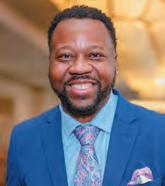
I’ve been thinking a lot about systems lately — not just as tools, but as a form of leadership. When you’re building something meaningful, systems aren’t just operations. They are protection. They are stewardship. They are the guardrails that keep the mission from collapsing when life happens, when people change directions, or when seasons shift.
And this week, I felt that deeply. Because behind every system conversation — HubSpot, Sales Navigator, CRMs, commission models — there’s an unspoken fear leaders rarely admit out loud: What happens to the vision if the person holding it suddenly walks away?
I’ve lived through that before. Someone leaves, and suddenly you’re chasing down passwords, files, contacts, threads, conversations — all the things you thought were in place, tucked safely away, but were actually living in one person’s head or personal account. And when that happens, it hits you: You didn’t just lose a team member. You lost momentum.
I carry the weight of that lesson with me. So now when I think about sales, I don’t think about “closing deals.” I think about continuity. I think about resilience. I think about building something that can stand when circumstances change — because circumstances always change.


It’s easy to pretend these things are just administrative details, but they’re not. They are the backbone of a business that intends to outlive the personalities inside it.
A CRM doesn’t just store contacts. It carries the history of your relationships. It holds your follow-ups. It protects your opportunities. It gives your mission a memory. Without that, your business becomes emotional — dependent on how someone feels, how someone shows up, how long someone stays. And emotional business is dangerous business.
learn the rules of the road,” he says. “But people jump up and get married with no type of training or information. While I won’t say it won’t work, it’s probably going to be difficult.”
‘Why Do You Wanna Be Married?’
For those who don’t ascribe to faith-based marriage instruction, Smith, who’s been married for 35 years, gives principles of marriage without scripture or verse.
“What’s your blueprint? What’s your plan?” he says. “When you get mad at her, what are you going to do? You know, if everybody is supposedly in love. But after you have sex and you calm down, now y’all gotta live with each other.” But a more fundamental question must be answered, he says: “Why do you wanna be married? What is it that you’re attempting to accomplish?”
Glasper, the Mississippi pastor, says he takes a “return-on-investment” approach when coaching secular couples.
“What is the return you want on your investment?” he says. “What happens when you get sick? What happens when you get old? What happens when you’re 45, and your body doesn’t function like it used to?”
For men, ”when we get to a certain age, it ain’t about chicks and sex,” says Glasper. “It’s about somebody who can lay their head on your shoulder and cry with [you] and watch a movie with and laugh with. I think we do a disservice to throw scriptures at people, instead of throwing ourselves at them.”
That’s why I’m building differently this time. I want a system that can breathe if someone steps away. A system that can scale without breaking me. A system that doesn’t confuse charisma with structure.
Because here’s the leadership truth we don’t say enough: You can’t build a future on hope alone. You build it on design.
That’s where compensation comes in. Paying people fairly is important. Rewarding impact makes sense. But buried inside every compensation conversation is this question: What motivates people in a way that still honors the mission?
Ten percent, five percent, flat fees — those are numbers. But alignment is spiritual. It’s about honoring value without compromising stewardship. Because people aren’t selling a product — they’re selling you. Your story. Your work. Your purpose. And that means you owe the mission more than charm. You owe it a structure that can carry the weight.
So now, I’m centralizing everything: every contact, every company, every deal stage, every follow-up, every communication. Not because I enjoy software — trust me, I don’t. But because I’m thinking 10 years out. And 10-year thinking requires discipline today.
When you stop building around people and start building around systems, something shifts in you. You stop reacting and start creating. You stop chasing and start choosing. You stop fearing transitions and start trusting what you built.
Because at the end of the day, here’s the lesson I keep returning to: If your mission depends on one person, it was never a mission — it was a personality. And I didn’t come this far to build something fragile. I came to build something that will last. Something aligned. Something transferable. Something resilient.
So yes — I’m investing in systems. Because systems create freedom. And freedom gives your story room to grow. What about you? Are you building something that can grow, scale, and last?
For more, visit OrvinKimbrough.com or MidwestBankCentre.com.
Photo by Unai82 / Envato Images