
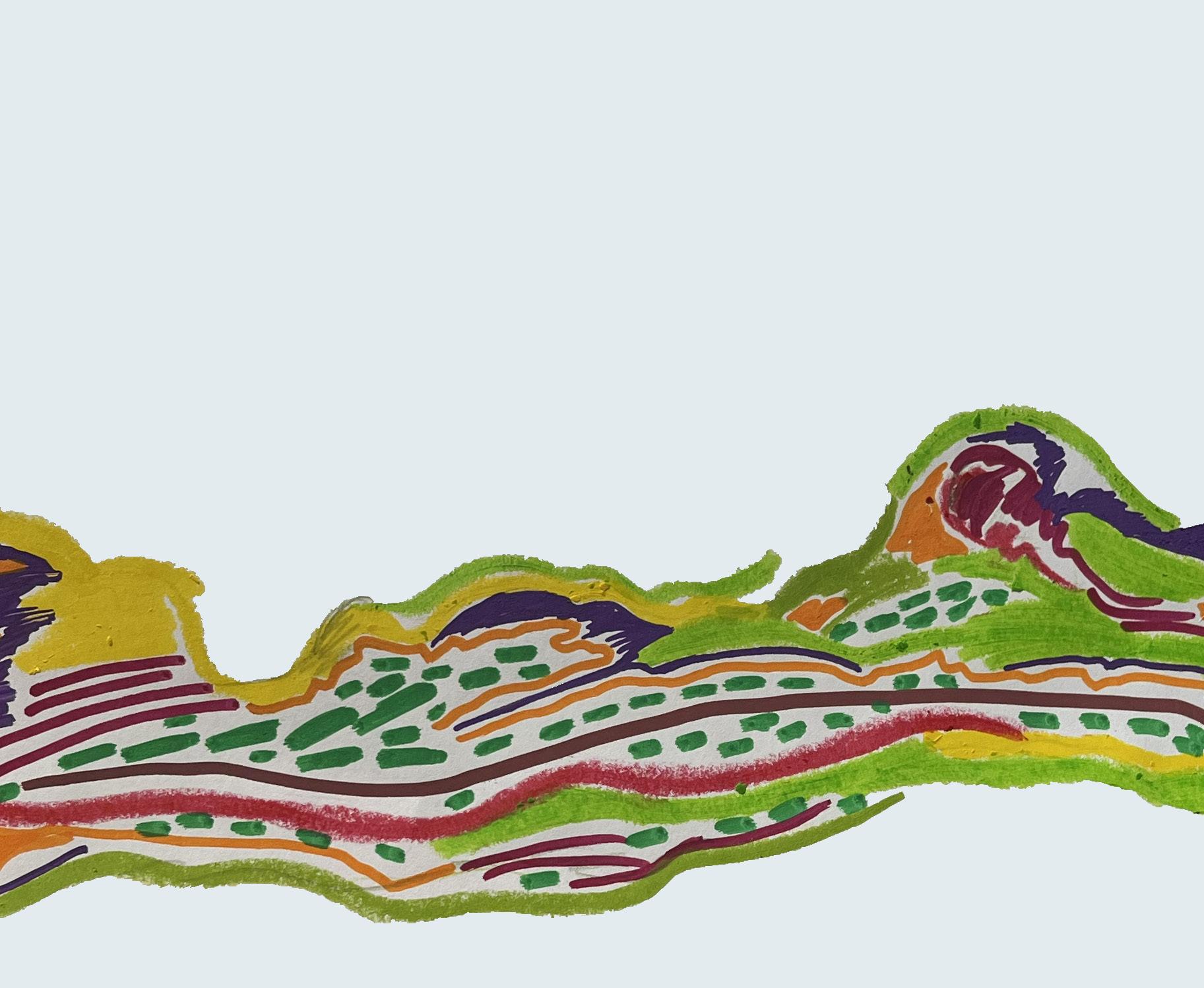
A Guide Through the Phases of Displacement
Reflections on Migration, Language, and Cultural Memory
Kimiya Jahanshahi
To all who dance in grief.
Special thanks to A, G, M, M, N, N*, R, S, S and my Maman & Baba.
Thesis supervisor: Erik Hagoort & Mariska van den Berg
Submitted to: Master Fine Art & Design, Avans University of Applied Sciences, Master of St. Joost school of Art & Design, s'-Hertogenbosch , The Netherlands In partial fulfilment of the requirements for the degree of Master of Art in Fine Art & Design May 2026
Abstract
This thesis explores migration as a lived, ongoing condition, unfolding through a series of phases that trace disorientation, performance, in-betweenness, community, distance, and non-belonging. It combines auto-ethnographic reflection, conversations with members of the Iranian diaspora, and my own artistic practice to understand how memory, language, and the body carry experiences of home, absence, and adaptation.
Key concepts such as phantom limb sensation, exophony, and homesickness for the future help describe the tension of living between places, times, and languages. The research moves alongside artists and writers including Mona Hatoum, Do Ho Suh, Tania Bruguera, W.G. Sebald, Yoko Tawada, Herta Muller, and Fabio Morabito, whose works make visible the instability of home and the labor of translation.
Through writing and making, the project pays attention to everyday gestures—cooking, speaking, walking, remembering—as small ways of holding on and continuing. Rather than framing migration only as rupture or loss, it stays with the fragments and routines through which life persists. Along the way, the thesis also becomes something like a guide: a collection of small strategies that emerge from conversations, personal experience, and what I have learned from films and books—ways of moving through these phases, even if only temporarily.
Introduction — Entering the research
• Positioning Myself
• Method as Experience (Auto-ethnography)
• Fragments, Voices, and Traces
Thinking with others — Artists, Writers and Directors
• Mona Hatoum, Do Ho Suh, Tania Bruguera
• W.G. Sebald, Yoko Tawada, Herta Muller, Fabio Morabito
• Abbas Kiarostami, Dariush Mehrjui, Jones Mekas
Seeing, Remembering, Imagining
• Living with War as Atmosphere
• Humor as Survival
• Sound, Space, and Orientation
Phases of Migration:
• In the fog — Disorientation, Language, Body
• Showing off — Representing the homeland
• Living in between — Routine and guilt
• Making home, home. — Finding the community
• Being afraid to go back — Distance, Memory,Return
• Not belonging — Shifts, Invisibility, Recognition
Quotes : Fragments of lived experience
Conclusion — What remains, What continues
References
Introduction
A Guide Through the Phases of Displacement unfolds in parallel with my artistic practice. The text and the artworks do not illustrate one another; instead, they emerge from a shared need to understand how experiences of migration are carried, processed, and transformed. Writing becomes a way of articulating what the works attempt to hold materially: fragility, rupture, repetition, and the persistence of life under pressure. This research is grounded in an auto-ethnographic approach, combining personal experience with informal conversations with members of the Iranian diaspora. These exchanges, often shaped like everyday conversations rather than structured interviews, trace lived experiences from the moment of departure to the ongoing process of adaptation. From these accounts, a series of recurring emotional and spatial conditions began to emerge. Rather than fixing them into rigid categories, I approach them as phases fluid, overlapping, and continuously shifting. Migration, in this context, is not understood as a single event, but as an ongoing condition that unfolds unevenly over time. It stretches, folds, and repeats itself. Moments of departure often become symbolic anchors, marking a division between a “before” and an “after,” while the lived experience resists such clarity. Emotional, cultural, and psychological layers surface gradually, sometimes returning in unexpected ways. Each phase may last for different durations depending on the individual and their circumstances, resisting any stable or universal timeline. The phases outlined in this thesis—disorientation, performance, in-betweenness, community, distance, and non-belonging— offer a way to trace these shifting conditions without resolving them. They function as a framework through which migration can be observed, experienced, and articulated, both in writing and in practice. At the same time, this project remains open-ended. It does not aim to define migration conclusively, but to create space for recognition, reflection, and continuation.
Thinking with others
Memory and imagination frame my reflections more than theoretical analysis. My primary intellectual influences are literary and cinematic: Fabio Morabito, Yoko Tawada, W.G. Sebald, Dariush Mehrjui, Abbas Kiarostami, Jonas Mekas, Herta Muller, and Mona Hatoum. Each of these writers, filmmakers, thinkers, and artists illuminates the complex interplay of memory, language, displacement, and the reconstruction of self in unfamiliar spaces. Alongside these works, this text is shaped by a set of informal, open-ended interviews I conducted with members of the Iranian diaspora from my own generation, many of whom migrated under similar social and political pressures. Their voices and experiences form the emotional and empirical backbone of this essay. All the quotations in the phases section that have no formal reference are drawn directly from these interviews, capturing the texture of lived experience as it was spoken to me, fragmented, intimate, and honest. Rather than treating their words as data, I approach them as shared reflections, resonances across a generation navigating parallel forms of displacement.
Sebald’s melancholic narratives, such as «The Emigrants», blend archival photographs, letters, and narrative to evoke the emotional landscapes of migration, showing how memory is layered and mediated through images and words. His attention to detail, the interweaving of personal and historical traces, mirrors the fragmented nature of migrant experience. Tawada’s exophonic writing—producing literature in a non-native language—captures estrangement, hybridity, and the challenge of inhabiting linguistic worlds that are partially alien yet partially familiar. By reading Tawada, I see the fluidity of identity and language, and the ways migrants must constantly translate themselves, not only linguistically but socially and culturally. Morabito’s intimate reflections on everyday life illuminate how ordinary objects carry memory and emotional resonance; a scent, a sound, or a routine can trigger recollections of home or amplify feelings of estrangement. Cinema has similarly shaped my understanding. Mehrjui’s «Mum’s Guest» (Mehman-e Maman) depicts a family living in poverty who unexpectedly receive a guest, prompting neighbors to collectively celebrate. The film illustrates how ritual, attention, and humor sustain community life even under scarcity.
Kiarostami’s «And Life Goes On» (Zendegi va digar hich) shows a village recovering after an earthquake, emphasizing continuity and resilience: ordinary life persists, and routine, humor, and ritual are ways people maintain emotional stability in trauma. Jonas Mekas’s diary film «Lost, Lost, Lost» documents his life as a Lithuanian immigrant in the United States, recording intimate daily experiences of estrangement, adaptation, and the passage of time. Mekas’s attention to minutiae—the way he films a street, a neighbor, a walk, demonstrates how migration can be documented in gestures, objects, and fleeting moments. When I think about how artists have tried to materialize the condition of not-belonging, Mona Hatoum immediately comes to mind. In Measures of Distance(1988), she writes on her mother’s body through letters and images layered across translucent video, creating an intimate archive of longing and separation. The work renders visible both emotional closeness and distance, showing how memory and absence are inscribed on the body itself.
Do Ho Suh, in works such as Home Within Home (2013) and Seoul Home / L.A. Home / New York Home (1999), invites viewers into homes that feel real yet illusory. Constructed from delicate, translucent fabric, these structures function as architectural memories, spaces you can see and enter, but never fully inhabit. They mirror the in-between zones of migration, where the body carries gestures and habits from a previous home while negotiating an environment that hasn’t fully absorbed you. Suh’s work embodies what I mean by the “phantom limb” of home: the structure may be absent, but its sensation remains in the body and spatial memory. Tania Bruguera approaches migration through political and social urgency, making the bureaucratic and the embodied inseparable. Her community-based project Immigrant Movement International (2010–ongoing) and performance Tatlin’s Whisper #6 explore how identity is continuously worked through borders, permissions, and public visibility. Bruguera reminds us that migration is not only an emotional or poetic narrative but also a political condition, shaped by systems that determine who can belong and under what terms. Her work captures the emotional labor of existing in spaces that may not yet—or may never—welcome you fully. Tania Bruguera, 2015, Immigrant Movement International. Together, Hatoum’s intimate distance, Suh’s portable architecture of memory, and Bruguera’s political embodiment, these artists trace different textures of displacement.
They illuminate the same layered processes I try to articulate in my phases: the fragility of belonging, the body as archive, the persistence of memory, and the slow, uneven work of becoming someone again in a new place. Herta Muller’s reflections on inhabitable language resonate deeply with my own experience; she links language, escape, and memory, suggesting that the inability to fully inhabit a language mirrors the liminal, suspended condition of migration. In «A fly can travel through half a forest», she writes: “Until now there was homesickness for the future, but after the arrival, the future clings to the skin… Future sounds like shelter, but it is deceiving. Beneath the soles of the feet, shelter is a real place. But the future is an unreal time, unknown to itself. The present never stops, and one drags around the past. Perhaps the future starts when the first calm sets in after the escape.” This tension between abstract hope and lived reality frames my reflections: the future may promise safety or belonging, but it always remains a little uncertain, while the present and the past linger obstinately in the body, caught in gestures, habits, memories, and language itself .
Seeing, Remembering, and Imagining
Meaning emerges from fragments: textures, archival images, media reports, language, and memory. These fragments invite interpretation, imagination, and collaboration between maker and viewer, akin to exophony, where language is both foreign and familiar. We reconstruct the world not only from what we see but from what we remember, anticipate, and carry with us. Much of what shapes my perception comes from growing up with the presence of war, not always as an immediate event, but as an atmosphere that seeps into daily life. Living through prolonged instability trains the eye and the body differently. You learn to register danger and beauty simultaneously, to notice small signs of life precisely because loss is always nearby. Survival is not heroic; it is repetitive, quiet, and material. It is the ability to continue—cooking, joking, working, arranging flowers—while knowing that destruction exists just outside the frame. This way of living informs both my writing and my artistic practice: attention shifts from spectacle to endurance, from catastrophe to the fragile forms of life that persist alongside it. Cultural habits shape perception as well. In Iran, humor often emerges in the shadow of tragedy, functioning as a survival tactic that transforms fear into creativity. As Muller observes: “Humor is a form of analyzing social relations , the most straightforward way to classify things.” Muller,2019,p. 16. This form of humor is not escapist; it reframes crisis through wit. I remember the way older men in a remote, impoverished village—surrounded by half-finished construction, dust, and scarcity—would shrug and laugh, “Crisis? What crisis?” as if naming the hardship too directly would give it more power.
During the war (2025-2026) , when B2- jets appeared in news reports, people joked that “B2” in Farsi sounds like Bi To وــت یــب—“without you”— turning a symbol of violence into a small linguistic rebellion. These jokes do not cancel fear; they metabolize it. They are micro-rituals of survival, tiny ways of reclaiming agency when circumstances feel otherwise unmanageable.
Mehrjui and Kiarostami depict similar resilience: ordinary life, ritual, and play persist even after loss. Humor, in this sense, is not trivial; it is a mechanism for maintaining continuity, hope, and social bonds.
Artist–researcher Rahma Shazam, whose work focuses on the social and political dimensions of listening, examines how sonic environments structure access, visibility, and safety.
In Rights of Way, he describes public space as something that is not only seen but also heard and felt through movement, where the body becomes attuned to shifting atmospheres and responds accordingly. Sound and public space also shape the migrant experience
Everyday sounds—traffic, voices, alarms, silences—are not neutral; they organise how space is experienced, marking inclusion or exclusion in subtle ways. In this sense, the body in public space is never passive, but constantly adjusting, sensing, and negotiating its position through.
Shazam’s approach highlights how migrants in particular navigate these auditory boundaries, moving through environments that can simultaneously signal welcome, indifference, or refusal. Migrants navigate these spaces daily, and auditory cues—from familiar instruments to street noises—can evoke memory, fear, or belonging.
In the Netherlands, I became newly aware of sounds that carried no meaning for me at first: the sharp beep of check-in and check-out machines, the rhythmic tik tik tik tik of traffic lights for pedestrians, the mechanical click that signals red and green transitions, and the sudden swell of church bells that appear out of nowhere and fill the whole street. These sounds were not part of my previous sensory map; they formed a new sonic architecture I had to learn to live inside. Some became comforting, others confusing, some still foreign. Sound, like language, becomes part of the migrant’s slow reconstruction of orientation, another layer of learning how to belong.
Migration also carries an embodied absence. Many migrants experience what can be understood as a phantom limb, a metaphor drawn from neurology, where amputees feel sensations in missing limbs. For migrants, the homeland becomes a “missing limb” of the body and memory. Even when physically absent, it exerts pressure through gestures, emotions, and sensory cues: the ache of a remembered street, the rhythm of familiar words, the smell of a favorite food. The body remembers what the mind cannot always hold, making presence and absence inseparable. Tawada’s exophony resonates with this sensation: writing and speaking in a language that is partially foreign, partially familiar mirrors the negotiation of presence and absence in daily life. Hatoum’s Measures of Distance similarly shows how layering images, text, and memory materializes what cannot be fully inhabited. Together, these works echo the migrant’s negotiation between memory, body, and space: the homeland is carried, felt, and partially reconstructed in fragments, gestures, and material encounters.
The Iranian Diaspora and Personal Experience
During the recent war in Iran, a friend sent me a photograph of an explosion. The smoke formed the outline map of Iran, resembling a cat. We recognized it instantly, but what were we really seeing? A memory? Longing? A fragment of home?
Cultural rituals, such as pouring water behind travelers as a blessing, preserve emotional connection across distance. Migrants condense life into small, portable fragments: books, spices, photographs. The homeland persists, signaling both presence and absence. Yoko Tawada writes: «The soul cannot move as fast as the airplane» Tawada.2018. p. 38 emphasizing the temporal lag between physical relocation and emotional adaptation. She observes:«Wrinkles in stones do not mean they are older; it means they changed their way of living.» Tawada, 2018 p. 84. Migration can also feel like phantom-limb syndrome: the homeland continues to ache, signaling itself in the body even after departure. Humor, memory, and ritual mediate absence, making life in exile bearable. While working in a flower market, explosions in the news reminded me of the flowers themselves: bombs and bouquets, destruction and creation, fear and beauty. These moments exemplify how objects, rituals, and perception coalesce in migrant life, where personal and cultural memory intersect with everyday reality. I recorded this experience in my diary: it was during the war, and it was the first day I was out of the house, the first day I wasn’t glued to news 24\7 or doing puzzles. I was stressed, overwhelmed by the constant barrage of sounds and news. I even knew the latest events before my parents did, and during a video call with a friend (with the help of a VPN), I heard a bomb in the background. All this unfolded while I was selling flowers, balancing the fragility of life and the ordinary tasks of daily work.
Phases of Migration
In Iranian cultural language, the word kharej (outside) carries a symbolic weight far beyond geography. It does not simply mean “abroad”; it refers to an imagined elsewhere that exists beyond the borders of familiarity, habit, and history. When we say someone is khareji, we are not only describing a foreigner, we are naming a place in the Iranian imagination. A khareji is someone who belongs to the outside, to a world that is perceived as both distant and idealized, strange yet desirable. Growing up, kharej was almost a mythic direction, a horizon. It was everything not-Iran. So when I write that “In Iran, we call wherever outside Asia, the outside (kharej, جراــخ)” it is not just a linguistic fact. It is the emotional architecture of migration.
From my interviews with members of the Iranian diaspora—mostly people in their twenties and early thirties—a recurring pattern emerged. Although each story was unique, certain emotional stages appeared again and again, forming what I describe here as the phases of migration. These interviews were casual, like old phone calls with friends: we spoke about our daily lives, shared memories, and traced the journey from the very first day they decided to leave Iran up to the present. I took notes during these conversations, and for the sake of privacy and comfort, all interviews were conducted in audio form rather than video calls, allowing participants to feel safe and speak freely.
Across these phases, I approach migration not as a fixed condition, but as something that requires continuous adjustment. For each phase, I identify and develop a set of strategies based on lived experience ways of navigating, responding to, and momentarily stabilizing the shifting conditions of displacement.
Phase 1: The Fog / Drunk Era
This phase is disorienting. Words begin to drift away from the mother tongue; rhythm often comes before meaning, and identity feels subtly reconfigured. One becomes a tourist abroad— present, yet never fully anchored. Embodiment becomes uncertain:
«I didn’t know how to behave physically in the environment,» one interviewee said while navigating a busy street, their eyes moving between unfamiliar surroundings and the cadence of their own steps.
«I didn’t know how my body should act in the new space,» another recalled while preparing clothes for university, each movement becoming a quiet tether to familiarity. Language turns into a subtle battleground for identity. Each spoken word becomes a translation not only of meaning, but of self. Even in absence from the homeland, the body continues to carry its traces. Phantom limbs of memory resurface through gestures, scent, and familiar rhythms. Herta Muller’s reflections on inhabiting language echo this tension: entering a new linguistic world mirrors the in-between condition of migration.
Resistance and curiosity coexist, resistance to learning the language alongside a growing awareness of the surrounding environment. «Does anyone see me?» one interviewee recalled thinking while standing in line.
Everyday acts—asking for directions, navigating public transport, ordering food—become small tests of what can remain and what must change.
This phase of disorientation is also reflected in artistic practice. Yoko Tawada’s concept of exophony captures linguistic estrangement and fluid identity, while Mona Hatoum’s Measures of Distance layers intimacy and absence, echoing how migrants move between memory and presence in everyday life.
Strategies for Grounding in a New Environment
In the fog phase, my first response was to move outward rather than inward: to walk, to taste, to look closely. Exploring the city became a way of learning how to inhabit it—not as a visitor passing through, but as someone slowly stitching themselves into its daily rhythms. Wandering through unfamiliar streets, choosing a different cafe each day, noticing the textures of markets and the smell of bakeries, I tried to let the city speak to me on its own terms. These small acts of attention softened the initial sense of estrangement.
At home, I introduced minor but meaningful adjustments: a candle, a familiar cup, a plant on the windowsill, objects that carried a quiet charge of recognition. They were not solutions, but companions, helping the space shift from temporary shelter into something that could hold me.
Kindness also became part of the practice, not only toward others but toward myself, resisting the impulse to perform competence or certainty too quickly. These gestures, repetitive and understated, formed a kind of orientation ritual. They did not erase the dislocation, but they created an early grammar for belonging, allowing the new city to become less opaque and more porous, one step at a time.
Phase 2: Showing Off \ Representing the Homeland
In this phase, migrants often seek to show the homeland to others, conveying history, beauty, and cultural meaning. Representation preserves absence while negotiating distance. Humor mediates social relations, as Muller observes: «Humor is a form of analyzing social relations the most straightforward way to classify things.» Muller. (2019). Everyday misery: About fear and humor in dark times ,p. 16 «I wasn’t aware of how I was being seen; everything had meanings I had never encountered in Iran; it made me feel exposed,». This stage often involves performance, both deliberate and unconscious: telling stories, cooking traditional dishes, teaching phrases in Farsi. I, myself, could not stop talking about the mountains we have in Iran, imagining them for friends who had never seen them.
Sebald’s archival approach illuminates this stage: memory is layered, mediated, and partly performative, like photographs that frame moments of home for others’ eyes. Morabito’s exophony—writing in a language partially foreign, partially familiar—parallels this negotiation. Morábito. (2020) .p1 The migrant must continually translate not only words but gestures, affect, and presence. Morabito’s reflections on objects also resonate here: showing someone a cup of tea, a rug, or a photograph is a miniature act of cultural transmission, embedding memory in tactile, sensory experience.
Strategies for Reclaiming Continuity Through Cultural Practice
In this phase, when the desire for continuity grew sharper, I turned to practices that allowed my cultural world to remain active rather than merely remembered. Inviting people into my home and cooking the dishes I grew up with became a way of sustaining a connection that distance could not sever. The smell of saffron, the rhythm of preparing rice, the quiet choreography of setting a table—all of these gestures carried the weight of familiarity. They created a shared space where hospitality could become a form of translation. I began to speak about the days that mattered in my own calendar: Nowruz, Yalda, anniversaries that carried collective or intimate meaning. Wearing small symbols of home—jewelry, colors, textiles—functioned not as nostalgia but as affirmation, a way of insisting that cultural identity is not something left at the border but something lived through the body.
Teaching friends a few words of my mother tongue, explaining expressions that carry untranslatable emotional textures, opened conversations that made difference feel less isolating and more relational. At the same time, learning fragments of their languages and customs created reciprocity. It acknowledged that integration is not a one-directional movement but a mutual, ongoing exchange.
These practices did not resolve the tension between here and there, but they transformed it into something generative: a dialogue between worlds, rather than a rupture.
Phase 3: Living In Between \
Routine, Acceptance, and Guilt
Home slowly emerges through ritual. Cooking, cleaning, reading poetry, and maintaining linguistic habits help build familiarity. Guilt accompanies adaptation: leaving loved ones, surviving when others cannot, and navigating emotional dissonance. For me, this in-between feeling became especially clear when catastrophe struck in Iran—when news of violence, danger, and loss repeatedly arrived from afar, heightening the tension between here and there. «I walked my heart out, crying from loneliness,» one interviewee shared through an Instagram story. The experience of carrying loneliness throughout the school day, striving to keep the flow of their routine. Another reflected, «For some, the goodbye is a real goodbye, not a ‘see you soon» recalling a Christmas break when everyone else went home, but they could not. This phase is lived in routines that both stabilize and unsettle. Do Ho Suh’s fabric homes delicate, translucent recreations of domestic spaces—capture a similar experience: inhabiting places that feel familiar yet not fully yours. Hatoum’s layering of words and images also resonates here, showing how belonging is rarely tangible, but emerges through repeated habits, gestures, and observation.
Strategies for Navigating the In-Between \ Practicing Honesty as Orientation
In the “living in between” phase, solutions do not arrive neatly. This stage resists closure by definition: it is a condition of suspension, of holding two or more temporalities, geographies, and emotional registers at once. Rather than attempting to resolve these tensions, I learned that the most sustainable practice was to be radically honest about what this in-between feels like. Naming the ambivalence—its fatigue, its tenderness, its unexpected ruptures—became a method of grounding.
Honesty operates less as confession and more as orientation. It acknowledges that dissonance is not a failure of adaptation but a structural condition of migration itself. Speaking openly with others—friends, partners, fellow migrants—creates a shared vocabulary for experiences that often remain internal: the sudden waves of longing, the temporal lag between crises “back home” and daily life “here,” the quiet grief of not fully belonging in either place.
Living in the moment becomes an ongoing process. One tries to inhabit the present with sincerity while simultaneously carrying fragments of what is happening elsewhere—news alerts, family messages, shifting political atmospheres that seep into the day like weather. This dual attention does not weaken the present; it complicates it, deepens it, teaches the body how to hold multiple realities without collapsing.
In this light, the aim is not to “fix” the in-between but to inhabit it with clarity: to let honesty become a navigational tool when neither past nor present feels stable, and to allow presence and distance to coexist without demanding that one cancel the other. Through this practice, the in-between becomes less isolating. Not a void, but a space of recognition, care, and ongoing becoming.
Phase 4: Finding the Community \ Making
Home, Home
Deep belonging arises when community transforms space into home. «The diaspora makes you feel at home» said an interviewee about arranging meetings in their new city, an act that was both practical and ritualistic. Others recounted moments of care while preparing tea for roommates during collective meals: «Everything was starting to resemble what I wanted.»
At this stage, identity stabilizes through interaction, ritual, and repetition. Tania Bruguera’s Immigrant Movement International highlights how political, social, and embodied engagement constructs belonging—through gatherings, conversations, and performances, one actively carves out a space of recognition. Objects, smells, routines, and shared practices accumulate meaning, reinforcing continuity. Humor remains central, mediating tension and establishing community norms. In this phase, small gestures—serving tea, helping a neighbor, exchanging words—become profound acts of belonging, quietly shaping the contours of a home in exile.
Strategy for Finding Community \ Reclaiming Language Through Connection
In this phase, one useful strategy is to resist the instinct to withdraw from people of your own country. Even if they are not “your people” in the familiar sense even if your personalities, lifestyles, or backgrounds differ reaching out can offer an unexpected sense of grounding. Connection does not need to become deep friendship to be meaningful.
Initiate small, low-pressure encounters: meet for tea, share a meal, attend a gathering, or simply exchange a few words in your mother tongue when you run into someone familiar. These moments of contact reintroduce forms of ease that often disappear in the early years of migration the untranslatable jokes, the shared cultural cues, the relief of speaking without rehearsing.
Let yourself enjoy the joy of your own language: its rhythm, its humor, its emotional shortcuts. Treat these interactions as moments of calibration rather than commitments. They help rebuild continuity, reminding you that identity can stretch across multiple geographies without splitting apart.
By embracing these small communal gestures—eating together, checking in, celebrating a holiday, or simply talking—you create a modest but steady infrastructure of belonging. This strategy does not idealize community; it treats it as a practical, sustaining resource, a way of keeping cultural memory alive while allowing your present life to expand.
Phase 5: Being Afraid to Go Back \
What If They’ve Changed?
In spite of finding home in a new country, a subtle fear lingers: the homeland may have changed. Returning becomes emotionally complex. I asked one interviewee, «-What do you do when you miss your homeland?» «+I could feel that the trees weren’t talking to me anymore.»
Phantom limb sensations resurface: the homeland feels at once present and absent, tangible yet just out of reach. Memory and imagination shape how we experience this. W.G. Sebald, in The Emigrants, captures this beautifully. He weaves together photographs, letters, and stories, showing how memory is never straightforward but layered and fragile Sebald, 1999, pp. 103–105 Each image or letter carries the weight of what was left behind, haunting the present with traces of absence. Reading Sebald, I understand how the past can persist in subtle ways, shaping how we move through new spaces while carrying what is gone.
Yoko Tawada, in Exophony, reminds us that living between languages and cultures is a constant act of translation—not just words, but gestures, emotions, and ways of being Tawada, 2018. Her work shows that language itself can be a home, or a reminder that home is always partially elsewhere. Fabio Morabito’s reflections on everyday life give life to the small, material side of memory: a cup of tea, a spice, a photograph can carry the weight of longing and connection, anchoring us when the distance feels too big Morabito, 2020 p.2 . Together, these authors show how migration is not only about moving through space, but also about inhabiting layered realities of time, memory, and presence, where absence and belonging exist side by side.
Strategy for Facing the Fear of Return \
Sustaining Connection Without Pressure
When the fear of going back surfaces, the worry that the homeland has changed, or that you have one sustaining strategy is to remain actively connected to the communities that anchor you. Keep a routine of communication with friends and family: short calls, voice notes, exchanged photos of daily life. These habits maintain a living bridge between places, reminding you that life continues in parallel rather than in separation. Make the idea of returning less monumental. Instead of treating a trip home as an emotionally loaded event, approach it through small gestures: send souvenirs with someone traveling back, mail a package when you can, ask loved ones to send something from home in return. These modest exchanges keep the relationship with place and people dynamic rather than distant. Allow yourself to believe—gently and consistently—that you remain welcome there. The landscape may shift, cities may transform, and people may evolve, but the relational thread does not disappear. By staying in conversation, sharing fragments of everyday life, and engaging in occasional exchanges, you soften the fear that returning means confronting loss. Instead, it becomes another way of belonging, stretched across distance but still intact.
Phase 6: Not Belonging
Even after moving through earlier phases, migration often leaves a lingering sense of dislocation and non-belonging. Previous professional status, networks, and forms of recognition rarely translate into the new context. Many peers in the Iranian diaspora describe this shift: roles once held with confidence and visibility become suspended or diminished abroad. Invitations to participate appear, yet continuity and meaningful engagement remain uncertain. This phase exposes a change in social and emotional positioning. Where one once offered guidance or made decisions, one now moves through provisional or undervalued roles — general jobs—practical and even comforting, but unable to replicate the sense of significance that shaped life before. It underscores that estrangement is not only spatial but social. The absence of recognition, integration, and sustained connection reveals how belonging remains a negotiation rather than an outcome.
Herta Muller’s reflections on homesickness offer a deeper lens here. In Homesickness for the Future, she describes homesickness not simply as longing for a place left behind, but as an emotional state that spans past, present, and future Muller, 2019. Even as migrants engage with new routines or communities, the memory of what was lost and the anticipation of what is uncertain continue to shape experience. Estrangement, then, is felt both in the present and projected into a future that remains unsettled, a tension between memory, hope, and anxiety. Across all phases, what persists is not only loss but a quiet return to life. Displacement sharpens attention toward what survives: routine, humor, care, community, work. These modest gestures—like plants emerging from damaged ground—shape the ethos of my practice. The text and artworks record not just rupture but endurance.
Strategy for Navigating Not-Belonging \
Claiming Experience and Agency
In the persistent sense of dislocation that Phase 6 brings, one important strategy is to acknowledge and take pride in your experiences. Every step you have taken, every challenge you have navigated, counts. These experiences are valuable, tangible, and meaningful they shape your perspective and give you insight that is unique and relevant.
Embrace the knowledge you bring from another country: understanding different work systems, cultural practices, and approaches is an asset. Share your experiences openly, whether in conversation, in your creative work, or in professional contexts. Talking about what you’ve lived through validates your journey and helps situate you within your new environment.
Do not let fear of the unfamiliar limit your agency. Apply for jobs, pursue opportunities, and experiment with new roles. Your previous expertise, combined with the resilience cultivated through migration, equips you to navigate spaces that may initially feel provisional or undervalued. By owning your experience and acting confidently, you begin to transform estrangement into a form of belonging, one built on competence, pride, and self-recognition.
Closing Reflections
This research does not arrive at a fixed conclusion; it remains in process. The phases I describe are not definitive categories, but tools that allow me to recognize and work through the layered experience of migration as it unfolds. Situating my practice within this framework has been necessary to understand how displacement operates not only as a personal condition, but as a shared, cultural, and temporal structure. It allows me to move beyond isolated experience and to articulate migration as something that can be observed, traced, and reworked through artistic means.
Within this framework, migration appears as projection, representation, and replacement. Memories are projected into new spaces; the homeland is represented in fragments; absence is replaced through ritual, imagination, and humor. These processes shape what I understand as an emotional architecture, one that is continuously built through sound, language, objects, and community, holding together what is lived and what is remembered.
My artistic practice engages this framework materially. Through fragile forms, repetition, and spatial gestures, the work tests the conditions of endurance: what can hold, what can bend, and what can continue to grow under pressure. These modest gestures—like plants emerging from damaged ground—shape the ethos of my practice. The text and artworks record not just rupture but endurance. In doing so, the practice contributes to a broader artistic discourse on migration by proposing a way to think through displacement not only as rupture, but as a continuous negotiation of presence, memory, and form. It offers a language that is both analytical and embodied, where knowledge is produced through making as much as through reflection.
What remains is not resolution, but continuity, a commitment to staying with these conditions and to understanding how life persists within them.
A Persian verse expresses this continuity:
O breeze, if you pass through my homeland Iran, cover its soil with wild roses.
Quotes Section
The following quotes are drawn from my informal interviews with members of the Iranian diaspora from my generation. Each quote captures an intimate fragment of lived experience, highlighting how memory, language, and cultural identity intersect with everyday life in migration. Some quotes come from different people, others are repeated reflections from the same person, emphasizing recurring themes across narratives. As you read, notice how these fragments connect to the phases described in this thesis: moments of disorientation, performing the homeland, living in-between, building community, fearing return, and negotiating non-belonging. You may see yourself in some of these experiences or recognize feelings you haven’t yet named.
In the fog phase, one interviewee shared:
“I wasn’t aware of how I was being seen, everything had meanings I had never encountered in Iran; it made me feel exposed.”
In the phase of representing the homeland, another noted:
“I bought the same household items we had in our home in Tehran.”
“By appreciating tea, we built a sense of home.”
In the living-in-between phase, reflections emerged such as:
“For some, the goodbye is a real goodbye, not a see you soon.”
“Life feels like a movie, because no one speaks your mother tongue, and a house doesn’t feel like home.”
In the phase of finding community, someone observed:
“Everything was starting to resemble what I wanted.”
“I realized the future isn’t that frightening.”
In the phase of fearing to go back, feelings included:
“I felt the trees weren’t talking to me.”
“I've Packed my life in 40 Kilos.”
In the not-belonging phase, interviewees expressed:
“I don’t need your petty.”
“I’m more sensitive about everything about my homeland.”
Where did you find yourself in these reflections? How do they resonate with your own experiences, gestures, or objects? You might respond through an artwork, a shared meeting, a cup of tea, or a flower that smells like your hometown. Perhaps a long conversation with a distant friend, or the careful arrangement of everyday objects. Use this space to notice, reflect, and create; letting memory, habit, and imagination guide your engagement.
“What do you do when u miss your homeland?”
References — APA
Books & Articles
Bruguera, T. (2015). Art 21: Immigrant Movement International.
Chahine, L. (2007). Phantom limb syndrome: A review. Middle East Journal of Anesthesiology.
Cuevas, E. (2006). The immigrant experience in Lost, Lost, Lost: A chronotopic analysis of Jonas Mekas’s diary films. University of Hawai'i Press.
Gombrich, E. H. (2000). Art and illusion: A study in the psychology of pictorial representation (2nd ed.). Princeton University Press.
Morábito, F. (2014). El idioma materno. Atraf publication.
Morábito, F. (2020). Writing in someone else’s house. Latin American Literature Today.
Müller, H. (2019). Homesickness for the future. European Literature Network.
Müller, H. (2023). A fly can travel through half a forest. Hanser.
Sebald, W. G. (1999). The emigrants. Vintage Books.
Shazam, R. (2021). Rights of way: Sound and the politics of public space. Onomatopee.
Tawada, Y. (2018). Exophony and essays on language. Atraf Publication.
Tawada, Y. (2018). Where Europe begins (A. Brock, Trans.). New Directions.
Films & Video Art
Hatoum, M. (1988). Measures of distance [Video].
Kiarostami, A. (1992). And life goes on [Film].
Mehrjui, D. (2004). Mum’s guest [Film].
Mekas, J. (1976). Lost, Lost, Lost [Film].
Acknowledgments
I used ChatGPT (OpenAI, 2025) as a tool during my writing process. It supported me in refining language, clarifying complex passages, and assisting in the articulation and translation of cultural phases within my research. All final decisions, interpretations, and content are my own.