CHAPTER 1 - A CONSTANTLY FAILING CLOCK
In 2022, I was a second-year industrial design student at Southern University of Science and Technology in Shenzhen, in the first cohort of a newly established design school. I enrolled in User Experience, a compulsory module for Object Design track which I was in. The course spanned four weeks, with two days each week running from 8 AM to 6 PM. The 64-hour curriculum was packed tightly into that month, making it essentially my only course to attend during that period. The course theme was straightforward: design an alarm clock centered around user experience. Due to compressed schedule, the course’s aim is to explore user-centered design, involving hands-on experience with prototyping, product modeling, and rendering. And students were required to present a complete product proposal by defining target users and usage scenarios. My inspiration was quite simple: I’m so tired of calculating how many minutes left when ever I see the timestamp like 21:42:05. It feels like incessant urging. So to be professional, my concept of this course project revolved around a middle-aged white male of middle-class who no longer needed to obsess over precise timekeeping—accurate time points held no significance for him. Consequently, I came up with a design of an alarm without a traditional digital display. Then by following a typical industrial design method, I tried to analyze their needs and speculate on novel interactions of product and then made several physical prototypes to prove the feasibility. Smoothly for me, I successfully completed the course and gained the expected outcomes.
Yet I deeply despised this project. I felt immense frustration, even absurdity: I disliked the alarm clock from the start. Such an intense schedule of this module messed up my routine, I hated waking up at 7:15 AM, frantically calculating how much time I had left to get ready and commute to class. I despised this non-existent, unwarranted white male persona—he became the valued client I wanted to be so bad, who doesn’t need to care about anyone’s timekeeping anymore. I only made all this up so I could become the designer I aspired to be. But I don’t feel authentic imaging myself being either of them. I am both a target user who wasn't included and a designer who couldn't account for himself. You can say it’s just a practice, but indeed it constantly annoys.
The reason this nausea kept returning was that I — the target user I knew best — couldn't translate my needs and thoughts into anything meaningful. Is it only because I'm just a design student that I tend to impersonate myself as target user(s) worthy of care? Or is there something in the practice itself that makes this kind of substitution feel necessary?
A year later, preparing to graduate, I returned to the same problem — this time with a full year, and what I told myself was a clearer head. I was convinced that if I could just find the right framework, the frustration would finally resolve into something meaningful. This time, with a full year to explore, I defined my research question as “How product design alters human interaction with time.” Applying all design methodologies learned in my undergraduate studies, I discovered through literature that the concept of time I sought to transform was more accurately described as the timekeeping technologies and synchronization systems created by human since the Industrial Revolution. So the frustration manifested in my daily interactions with alarm clocks belonged to the structural oppression brought by technological and social development—when a capitalistic society obsessed with efficiency demands punctuality down to the second, creating continuous, uniform, linear synchronization systems, it disrupts humanity's innate perception of time as discontinuous, non-uniform, and non-linear. No wonder I couldn't find my target users in a short time. No wonder I aspired to become the most privileged person to highlight this issue. I no longer wish to become someone else this time. So I began contemplating what I could do—for myself.
Still required to submit a product proposal as my graduation work, I turned to Speculative Design. I categorized human perceptions of time into a matrix and conceptualized fictional tools to disrupt
the synchronization technologies of capitalist timekeeping. Initially I enjoyed this anarchic geek project — it seemed to let me demonstrate my research while sidestepping industrial design's usual demands. Over several months I refined the presentation: aesthetics, prototypes, explanatory materials, all aimed at distilling my ideas into a self-evident artifact. The project won the Best Creative Award. Logically, I should have felt gratified. I still didn’t.
About a month before the exhibition, I was trying to build an interactive prototype. My mentor, with over a decade of industrial design education experience, advised me: "No one will or should touch your exhibited objects. You should spend more time on refining presentation." This advice was profoundly true, yet it felt like a fishbone stuck in my throat. Speculative Design had told me feasibility and profitability shouldn't be the only measures, so why was I still hesitating about details, still worrying about being superficial? Most speculative design projects in my case studies were conceptually straightforward — but their creators usually had academic or artistic foundations, and established reputations. Placing a speculative design project inside an industrial design evaluation framework felt utterly out of place. My project was neither practical enough as Product Design nor remarkable enough as Speculative Design.
Admittedly, this project remains the one I discuss most often, as I invested significant time and effort into it. Yet it still leaves me feeling unfulfilled. I believe this frustration isn't caused by the environment. On the contrary, as a graduate of the first class in the Design School, I have access to ample resources, time, and feedback. With so many professors possessing extensive industry experience and a really open and inclusive context, I feel I've been given every advantage. I've started to feel apprehensive, yet also curious: is it just being an industrial design student that's so disheartening, or is industrial design itself inherently filled with such disappointment? I didn't have a language for this feeling yet. But I kept returning to it.
CHAPTER 2 - AN UNMARKED DESIGNER I FAILED TO BE
The frustration I carried out of those two projects wasn't something I could resolve by working harder, or choosing better topics, or finding a more sympathetic supervisor. Marx's concept of alienation, developed in his Economic and Philosophic Manuscripts of 1844 (Marx, 1844/1959), offers a structure for what I was experiencing — one that locates the problem not in the practitioner's effort or intention, but in the conditions of the practice itself.
Marx identified several dimensions of alienation within capitalist labour: the worker's estrangement from the product of their labour, from the act of production itself, and from other people encountered through that production. All three were present in my design practice, though disguised in the vocabulary of creativity, empathy, and user-centered research. The alarm clock I designed was never mine: it belonged to a persona I had constructed, a middle-aged white man whose relationship to time I had imagined in order to justify the project's existence. The process itself brought me no satisfaction; it was experienced as a sequence of methods to execute rather than a practice to inhabit. And the "user" I was designing for was not a person but an abstraction: a stand-in for a market, a demographic, a set of needs I had no real relationship with. The more carefully I followed the process, the further I moved from anything I actually cared about.
This pattern of unmarked assumptions is not incidental — it is built into the canon of the discipline. Costanza-Chock (2020) points out that Donald Norman's The Design of Everyday Things, a canonical design text, "almost entirely ignores race, class, gender, disability, and other axes of inequality" (p. 36) and acknowledges capitalism only "in passing" (p. 36). I had read Norman as an undergraduate, and the book had felt self-evident. Looking back, what made it feel that way was precisely what it omitted.
Costanza-Chock (2020) also observes that designers in many contexts default to imagining users as "white, male, abled, English-speaking, middle-class" (p. 47) unless explicitly instructed otherwise, a pattern she identifies as one of several mechanisms through which unintentional bias enters design practice. My alarm clock project confirms this pattern, but with an uncomfortable addition: I knew the persona I was constructing didn't represent me, didn't represent anyone I actually knew, and didn't represent the problem I actually wanted to solve. I chose him anyway. Not out of unconscious bias, but out of a trained instinct to produce the kind of designer I thought I was supposed to become. This, I think, is what Marx means by alienation from one's own labour: not simply that the product doesn't belong to you, but that the process of making it requires you to act against your own knowledge and experience in order to satisfy an external standard.
What I kept calling my failure to master design methods was, I now think, something else entirely: a growing recognition that the methods themselves were never neutral. They were instructions for producing a particular kind of designer, serving a particular kind of client, within a particular kind of economy. There was no method underneath the method — only interests dressed in the language of process.
Van der Velden (2006) makes a related observation in Research & Destroy, his polemic on design as research. He argues that "many designers still use the term 'problem-solving' as a non-defined description of their task," but rarely interrogate what the problem actually is — "Is it scientific? Is it social? Is it aesthetic? Is the problem the list of prerequisites? Or is the problem the fact that there is no problem?" (p. 1). I recognize this circularity in my own training. The design problem was always given, and the designer's job was to solve it. The possibility that the problem itself was a
fiction — a frame imposed by the brief, the client, the discipline — was never made available as a question.
It was this recognition — that the problem was structural, not personal — that pushed me toward speculative design. This wasn't an ideological conversion; it was more desperate than that. I had spent months researching how product design shapes human interaction with time, only to find that the real source of the frustration wasn't a product problem at all.
Speculative Design, as Dunne and Raby (2013) conceived it, seemed to offer a different kind of permission. Rather than resolving problems within existing frameworks, it proposed using design to make those frameworks visible — to provoke reflection rather than deliver solutions. This was genuinely appealing to me. I thought: if I can't fix the clock, maybe I can make someone stop and think about why the clock feels so coercive in the first place.
What I didn't see then — and only understand now — is that I had simply exchanged one structural assumption for another. Industrial design assumes that a well-researched product can meet a user's needs. Speculative design assumes that a well-constructed artifact can shift an audience's thinking. Both locate agency in the object. Both require the practitioner to believe that the gap between making and impact can be crossed through good enough design. I couldn't cross it. My graduation project was seen, appreciated, and awarded. But it didn't provoke the reflection I had hoped for; it provoked admiration for the attempt. The fishbone was still there.
Revell's (2019) critique of speculative design helps name part of what went wrong. He argues that speculative design, in focusing on the artifact and its audience, mistakes the individual encounter for systemic engagement. It targets the interface between person and object rather than the conditions that produce both. My project addressed the symptom through a designed object, while the cause (the social and economic organization of time) remained untouched. He also notes that the legitimacy of speculative design relies on existing institutional and reputational capital; without an established position, the speculation reads as fantasy. My project was read, I think, as an interesting student exercise: not because the thinking was shallow, but because I didn't yet have the standing to make it land differently. But Revell's critique doesn't fully account for my case: my project wasn't consumed by an institution as he describes. It simply failed to produce the feedback loop I needed. In the end, speculative design offered me the same structure as industrial design: a practice organized around an imagined other, evaluated by their response, leaving the practitioner on the outside of their own work. The illusion was just dressed differently.
Looking back, I recognize that the discomfort I felt wasn't only about design methodology. It was also about where I stood in relation to it. Drawing on Patricia Hill Collins's (1990) concept of the matrix of domination, Costanza-Chock (2020) argues that under neoliberal multicultural capitalism, designers unintentionally reproduce interlocking systems of oppression — white supremacist hetero-patriarchy, capitalism, settler colonialism — not through malice, but through the unmarked assumptions baked into practice itself. I was not the unmarked designer this system imagined. And yet I had spent years trying to become one — constructing personas I didn't believe in, justifying research I didn't care about, measuring my work against standards that had never been built with me in mind. The frustration wasn't personal failure. It was the predictable friction of a body trying to fit into a shape that was never made for it.
Hito Steyerl (2011) describes a related but more radical condition. She argues that contemporary subjects exist in a state of free fall, but rarely recognize it as such, because falling is relational — without a stable horizon to fall toward, the experience registers as suspension rather than descent. The horizon line that organized linear perspective, and with it the modern paradigms of of 7 17
orientation, was never as stable as it claimed; it was a projection that gave observers the illusion of standing on solid ground. I read this and recognize the years I spent in design education. I had been orienting myself toward a horizon — the figure of the accomplished designer, the standard of professional rigor, the criteria of the well-evaluated project — that was never as stable as it appeared. It was a projection, sustained by the discipline's own claim to objectivity and method. What I called my failure to reach it was, more accurately, the slow recognition that there was no fixed point to reach. I had been falling without knowing it, mistaking the absence of arrival for the absence of motion.
Van der Velden (2006) ends his essay with a provocation that has stayed with me: "the designer must use this freedom, for once, not to design something else, but to redesign himself" (p. 4). I am wary of taking this too literally. Designers cannot redesign themselves out of the structural conditions I have just described. But what the line names, I think, is the recognition that staying inside the discipline and continuing to produce more design will not address the problem. The work that needed to happen was somewhere else.
This isn't a conclusion I reached quickly or cleanly. It came gradually, alongside a growing sense that the kind of agency I was looking for — something that felt grounded, reciprocal, mine — was unlikely to be found by redesigning my relationship to design. I needed to look somewhere else entirely.
CHAPTER 3 - JOKING AND COOKING
By the time I arrived in the Netherlands in late 2024, I had stopped trusting the frameworks that had once guided me. This wasn't a theoretical position I had argued my way into — it was closer to an exhaustion. The design work I had once admired, the standards I had once aspired to meet, no longer felt like something I could orient myself by. I had seen too clearly how they were made, and what they required of me, to believe in them the way I once had. Without them, I didn't know how to begin anything new. I had come looking for something to replace them — some other principle, some other practice, that could tell me what to make and why. I thought, at the time, that art might offer this. It seemed to promise a different kind of freedom: expression without the burden of utility, imagination without the obligation to justify itself to a user or a market. I arrived in a program called Situated Design, surrounded by ideas that were quietly reshaping how I thought about knowledge and practice. But I wasn't ready to receive them yet. I was still looking for something to hold onto.
Part I - Joke
What I did know was that the weapon I had been using was turning against me. Reflection — the habit of questioning my own work before anyone else could — had become a form of preemptive destruction. I would begin a project and immediately disqualify it: too derivative, too naive, too small, too grand. I had trained myself to see my own work from the critic's perspective so thoroughly that I could no longer see it from my own. I isolated myself in this wilderness, and only slowly realized that the weapon in my hand had left me scarred.
It was somewhere in this period that I noticed something I had always done but never named. I made jokes. Not as a coping mechanism exactly, and not as a form of critique — more as a reflex, a way of metabolizing the gap between what I had hoped to make and what I had actually made. When a project failed to live up to its ambitions, I didn't mourn it; I made it absurd. I turned it into a punchline. And in doing so, I found I could keep going.
The difference between reflection and joking, I began to understand, is structural. Reflection asks: what went wrong, and how do I fix it? It is oriented toward improvement, toward a future version of the work that will finally be good enough. Joking asks nothing. It simply takes the gap — between intention and outcome, between aspiration and reality — and holds it up to the light for a moment. It doesn't demand resolution. It offers, instead, a kind of release that reflection never could: the permission to find your own failure interesting rather than intolerable.
This is what I mean when I say joking became, for me, a form of "cynical" practice — and I use that word carefully, with some irony. There is something in the ancient cynics' refusal of prevailing values that resonates: a willingness to puncture the seriousness of a system you no longer believe in, to say — through laughter rather than argument — that the emperor has no clothes. But my cynicism was also quieter than that, more inward. It was less a political stance than a survival mechanism: a way of continuing to make things in a context that had stopped making sense, without pretending that the context had been resolved.
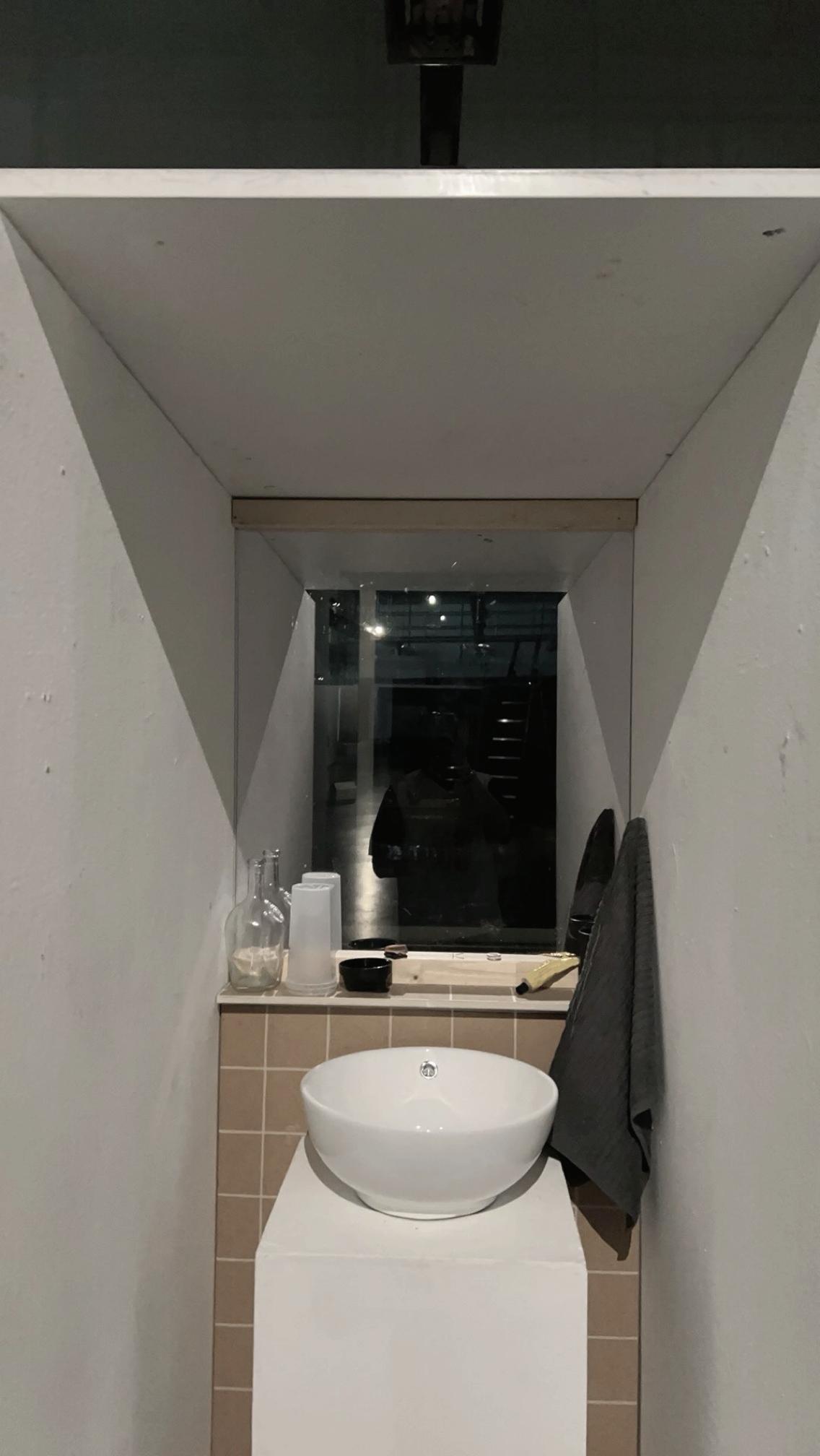
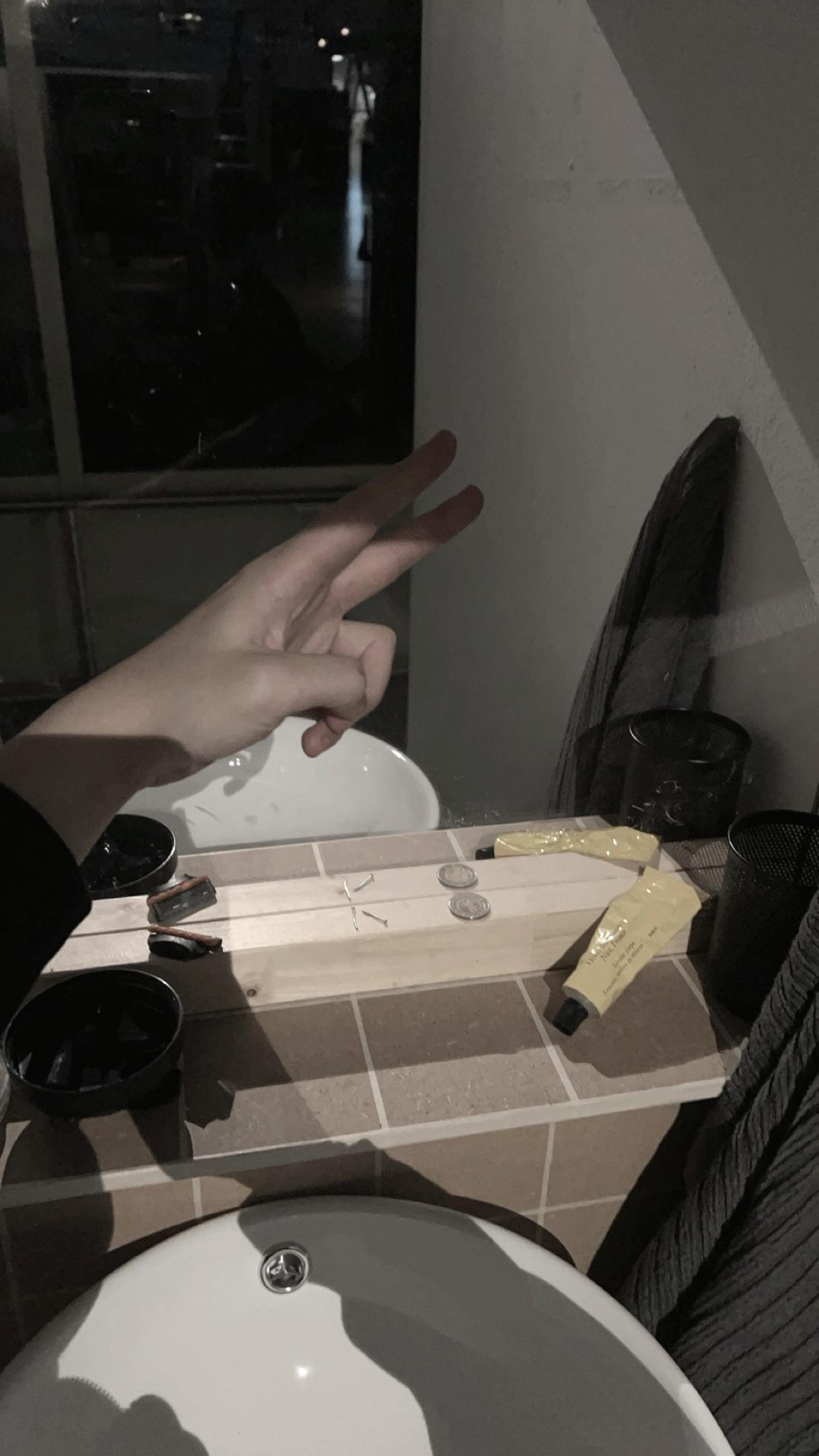
The installation I made at the end of my second semester grew from this understanding. No Reflection consisted of two narrow, symmetrical washstands separated by a transparent glass panel. On both sides, everyday objects were arranged as mirror images of each other — each thing had its double, its reflection, across the glass. Everything inside the installation was reflected. Except the viewer standing within it.
The material logic of the piece came from a private image: myself standing before the bathroom mirror, glasses removed for washing, looking at a face I barely recognized. That blurred stranger felt, suddenly, like the figure who had been making jokes about my work all along — the one who saw it clearly precisely because he couldn't quite see it. I wanted to present that moment to others. But in the process of making, I decided I didn't want to explain it. I wanted the installation to be the joke, not the setup for one.
At the presentation, I introduced the piece by describing my ISP 1 research — the questions I had been carrying, the dead ends, the gradual unravelling of my confidence in design as a meaningful practice. I told my peers and tutors where I had been. And then I said: "I've arrived somewhere. But let me tell a joke about it first." I didn't explain the connection between the installation and my research. I simply told them that a tutor's feedback — "there's no reflection in it" — had inspired me to make an installation without reflection. That was all. I let the gap between that explanation and the actual work sit there, unresolved, for the audience to inhabit.
It worked. Not in the sense that everyone understood it the same way — they didn't, and that was part of the point. It worked because, for the first time, I finished a presentation without wanting to change anything. There was no fishbone. The piece was complete not because it had answered all the questions, but because it had never promised to. It wasn't that the joke had lower stakes — it didn't. I had invested as much care and thought into No Reflection as into anything I had made before. The difference was in the structure of the exchange. Every design project I had made before operated on a promise: this object will do something for someone. It will solve a problem, provoke a thought, change a behavior. The evaluation of the work was always, in some sense, an audit of whether the promise had been kept. A joke makes no such promise. It offers itself — fully, at once — and asks only that you meet it in the moment. If you do, something happens. If you don't, the joke doesn't become a failure; it simply wasn't for you, or wasn't for now.
This is what I mean by reducing expectations to gain more in return — and I want to be clear that this is not a retreat into modesty or diminished ambition. It is, I think, a more honest structure of giving. The joke is a gift, not a contract. It doesn't demand a particular response; it trusts the encounter. In this sense, making No Reflection taught me something that all my design training had obscured: that the most rigorous thing a practitioner can do is sometimes to stop defending their work and simply present it — to let it be received, or not, on its own terms.
The program I had entered when I arrived in the Netherlands was called Situated Design — a name that carried Haraway's thinking in it from the beginning. Her argument, developed in her 1988 essay "Situated Knowledges," is that all knowledge is produced from somewhere (Haraway, 1988): from a specific body, a specific position, a specific set of conditions. There is no view from nowhere. The claim to objectivity — to knowledge that transcends its own location — is not neutrality but a kind of violence, a god trick that erases the particularity of the knower in order to appear universal.
I had spent years trying to become that view from nowhere. The unmarked designer, the one who could set aside his own experience and speak for an abstract user, produce work that answered to a universal standard. Haraway's critique was, in this sense, a critique of everything I had been trained to aspire to. But when I first encountered her ideas, I wasn't ready to receive them as relief. I was still searching for a replacement framework — something else to aspire to, some other standard to meet. The ideas were present, reshaping how I thought without my full awareness, but their meaning hadn't yet landed in my body.
What No Reflection gave me, I think, was the bodily experience of what Haraway describes. The joke worked precisely because it came from somewhere — from my specific exhaustion, my specific tutor's feedback, my specific bathroom mirror. It didn't pretend to speak for everyone or to mean the same thing to every viewer. It offered itself from a particular position, and trusted that this particularity was enough. In making it, I had stopped trying to be the view from nowhere. I had, for the first time, allowed myself to be located — to be a practitioner with limits, with a specific perspective, with a body that had been standing in the wrong shape for years. And rather than experiencing this as failure, I experienced it as the first honest thing I had made.
This is what Haraway's situated knowledge had been quietly preparing me for, even when I couldn't yet name it: not a new framework to replace the ones that had collapsed, but a permission to stop looking for one. To accept that knowledge produced from here — from this body, this confusion, this particular set of failed projects — was not lesser knowledge. It was the only kind I actually had.
Illustration and pictures of No Reflection
The joke had given me something back — a way of being honest with myself, of making things without the pretense of universality. But honesty directed only inward has its limits. I was still, in some sense, talking to myself. What I hadn't yet found was a practice that could extend that honesty outward — one that could put me in genuine contact with others, without the mediation of abstract users or evaluation frameworks. I didn't go looking for it. It arrived, as I said, as a circumstance.
Cooking entered my life the way most necessary things do — not as a decision, but as a circumstance. Living alone in a foreign country for the first time, I had no choice but to learn. I started from the beginning: new utensils, unfamiliar ingredients, a kitchen I had to make my own. It was, at first, purely practical. But I noticed early on that something in how I approached it was shaped by design thinking — and for once, this felt like an advantage rather than a burden. I found myself naturally mapping constraints: what was already in the fridge, what was within reach, what was too expensive or too ambitious for a weeknight. I understood intuitively how to prototype — to taste, adjust, try again. The feedback loop was immediate and honest in a way I had never experienced in a studio.
For a long time, though, I didn't take it seriously as a practice. It was a daily pleasure, something I was getting better at, but I filed it under life rather than work. I cooked for myself, occasionally for friends, with the relaxed curiosity of a beginner who has nothing to prove. It was only in the summer of 2025, when I spent a month in Tuscany as the sole cook for a rotating group of international volunteers, that I understood what cooking had actually been teaching me.
The situation was more demanding than I had anticipated. I was cooking five days a week for people from Austria, Belgium, Mexico, Argentina — different palates, different dietary restrictions, different relationships to food. I had committed to myself that I would avoid repeating dishes, which meant constant invention within the constraints of what Tuscan summer markets offered and what my own background in Chinese cooking could contribute. Writing this now, I can feel the pressure of it returning. But what I remember most clearly is that, in the moment, I rarely felt that pressure as distress. Each day had a shape: a problem with a scope I could hold in my hands, a process I could navigate in real time, an outcome I would know about within the hour. The dish that appeared on the table each evening existed not because I had studied what people generically wanted, but because I had paid close attention to what was available, what was lacking, and what combinations might work — and then committed to a solution within those constraints.
In Tuscany I also learned to make pasta by hand for the first time — stretching dough on a floured wooden board in the morning heat, cutting it into shapes that were never quite uniform but always seemed to disappear from the table fastest. And there was a dish of beef stir-fried with chillies, a recipe from home that I had adapted with local ingredients, which became something the other volunteers talked about long after I had moved on. Katrien, who didn't eat meat, had a version made separately for her. Ale — an Argentine who spoke almost no English but consistently had the fullest plate — ate two helpings every time I made it. Our host eventually asked me for the recipe.
I had never experienced anything like this in design. Not because design never receives feedback — it does — but because the feedback design receives is always structured by an evaluation framework that stands between the work and its reception. Someone fills out a survey. Someone gives a grade. Someone says "interesting concept" in a critique. The response arrives filtered,
formalized, translated into the language of assessment. In Tuscany, there was no such filter. The feedback was appetite. It was someone asking, please, can you make that again.
This is the difference I had been trying to name for years without finding the words. Cooking, as I practiced it there, was not culinary art in the sense of a discipline with its own aesthetic standards and critical discourse. It was cook for — a practice constituted entirely by its relationship to specific people in a specific moment. The dish succeeded or failed in direct contact with their bodies and their memories and their preferences. There was no abstraction interposed between the making and the receiving. No imagined user. No persona. Just Katrien, who didn't eat meat, and Ale, the Argentine who spoke almost no English but always came back for seconds, and the long table in the Tuscan evening where everyone sat down together.
Cooking, and particularly cooking for others, offered something joking could not: a grounded feedback system built on genuine relationship. By “grounded” I don't mean merely positive — I mean accountable to reality. The feedback doesn't pass through the machinery of evaluation; it arrives as appetite, as gratitude, as a specific request for more.
The Daoist text Zhuangzi (4th century BCE) tells of a cook named Ding who has butchered the same kind of ox for nineteen years. When asked about his skill, he says he no longer sees the ox with his eyes; he meets it with his spirit, following the natural openings of its body. Yi shen yu er bu yi mu shi — to encounter through spirit rather than to see with the eyes. The parable names a kind of practice I had been missing: one that operates through embodied attention, sustained by the response of what one is working with, rather than by verification against an external rule.
Sennett (2008) writes about the craftsman's relationship to their material as a form of dialogue — a slow, reciprocal conversation between hand and substance, in which the maker learns by attending carefully to what the material does in response to what they do to it. What I found in cooking was something adjacent to this, but with an important difference: my material was not inert. The people I cooked for responded, remembered, asked for more. The dialogue wasn't between me and an ingredient; it was between me and them, mediated by food. And unlike the dialogue design had always promised but never quite delivered, this one was real. It happened across a table I could touch, with people whose names I knew.
Before this chapter ends, I need to address something: I am not going to become a chef. I want to be honest about this, because the logic of this thesis might seem to be pulling toward that conclusion: design hurt me, cooking healed me, therefore I should cook. I have considered it. I have, at moments, wanted it. But when I sit with the thought seriously, what I notice is that I don't want cooking to become my work in the way design has been my work. I want it to remain something I do for specific people in specific rooms, with no obligation to scale, document, or justify it.
This is, in itself, a finding I had not expected. What cooking offered me was not an alternative career. It was a model — a working example of what a practice can feel like when it is not routed through institutions, abstract users, and evaluative frameworks. The point was never that cooking is better than design. The point is that cooking showed me something design had been missing, and continued to miss even when I tried to make it do otherwise.
I am also wary of romanticizing cooking, especially in the form I have just described. Tuscany was a particular set of conditions: a closed group, a generous host, time, a kitchen that wasn't mine to maintain. If I cooked five days a week as labour, for strangers, under economic pressure, the practice would almost certainly take on a different shape. The grounded feedback I am
celebrating depends on conditions I did not pay for. It is not a universal good waiting to be accessed; it is a particular configuration that worked for me in a particular summer.
So what does this mean for design? I am not sure it offers a prescription. It does, I think, sharpen a question. The qualities I found in cooking — direct address, embodied feedback, accountability to specific people rather than imagined ones — are not unique to cooking. They are simply harder to find in industrial design as I have known it, because the discipline is structured to keep them at a distance. The question is not whether design can become cooking. The question is whether design can be practiced in conditions where these qualities become possible at all. I do not yet have an answer. I have, instead, a sharper sense of what I am looking for.
DISCUSSION
For my graduation project, I am working with the tension between expectation and agency. My design training equipped me with the ability to manufacture expectations — to produce surfaces, narratives, and artifacts that promise something to a viewer. What it did not equip me with was the capacity to acknowledge my own work without that promise. People often say fake it till you make it, but relying too heavily on that pretending is, I think, what hurts designers most.
So I am trying it the other way around. Starting from something I am at least confident in — cooking, and the relationships it has built — and then dressing it in the maximum design fantasy. The final piece will hold these two registers side by side: a surreal, fully designed expectation, and the grounded practice underneath it. The comparison between what design skills are capable of showing, and what I am actually capable of making
This is not a resolution. I am not proposing that cooking can replace design, or that grounded practice can be scaled into a methodology. To do so would be to repeat exactly the move Haraway (1988) warns against — abstracting situated knowledge into a universal prescription, performing the god trick from a different angle. What this thesis offers, and what my graduation project will attempt to make visible, is something more modest: a record of one practitioner's negotiation with the limits of their discipline, and the practices that have allowed them to keep working within those limits without disappearing into them.
I am still a designer. I'm not sure this is sustainable. But I am still here, and I am still making things — some of them jokes, some of them meals, occasionally something that might be called design. That, for now, is enough.
I am writing this section two weeks before submission, and I need to record something that happened while this thesis was being written.
Earlier this year, as part of my third independent studio project, I made a T-shirt printed with the layout of a Chinese college entrance exam answer sheet, surrounded by phrases about choosing correctly. I posted it to Chinese social media. In the past two weeks, it found a response I had not anticipated. The first batch of one hundred sold out in five days. The second in two. The third batch of eight hundred sold half on the day it went live. I received messages from young people I had never met, telling me what the shirt had meant to them. I held to specific decisions that were difficult to defend commercially — only white, only one cut, a particular fabric weight, real exampaper envelopes for packaging. The audience came anyway, and stayed.
I want to be careful about what I claim from this. It is not that the market validated my work, or that scale equals meaning. What surprised me was that the kind of feedback I had been describing throughout this thesis — the unfiltered, embodied, grounded response I had found in cooking and largely failed to find in design — was, in this case, arriving through a designed object. Through choices about color, fabric weight, packaging, exactly the kind of design judgments my training had given me.
This complicates the contrast I have been building. The problem, I now think, was never design itself. It was design routed through institutions, frameworks, and abstract users — design as an evaluated performance rather than as a direct address. When the design could reach specific people through their bodies and their daily lives, the feedback returned to something I recognized.
I am leaving this section here, unintegrated, because the integration has not yet happened in me. The thesis I set out to write was about what design failed to give me. It is closing as something messier — a document that has had to make room, in its final pages, for the times design surprised me by giving it back.
SOURCES & BIBLIOGRAPHY
Collins, P. H. (1990). Black feminist thought: Knowledge, consciousness, and the politics of empowerment. Unwin Hyman.
Costanza-Chock, S. (2020). Design justice: Community-led practices to build the worlds we need. The MIT Press.
Dunne, A., & Raby, F. (2013). Speculative everything: Design, fiction, and social dreaming. The MIT Press.
Haraway, D. (1988). Situated knowledges: The science question in feminism and the privilege of partial perspective. Feminist Studies, 14(3), 575–599. https://doi.org/10.2307/3178066
Marx, K. (1959). Economic and philosophic manuscripts of 1844 (M. Milligan, Trans.). Progress Publishers. (Original work published 1844)
Revell, T. (2019, April 17). Five problems with speculative design. Occasional Blog of Tobias Revell. https://blog.tobiasrevell.com/2019/04/five-problems-with-speculative-design.html
Sennett, R. (2008). The craftsman. Yale University Press.
Steyerl, H. (2011). In free fall: A thought experiment on vertical perspective. e-flux Journal, 24. https://www.e-flux.com/journal/24/67860/in-free-fall-a-thought-experiment-on-vertical-perspective/
van der Velden, D. (2006). Research & destroy: A plea for design as research. Metropolis M, 2. https://www.metahaven.net/