
How do we give back to our environment by making art?
Fionn van der Noll
2026
Thesis supervisors: Mariska van den Berg, Erik Hagoort
Submitted to Master Fine Art & Design, St.Joost School of Art & Design, Avans University of Applied Sciences, s’Hertogenbosch The Netherlands
In partial fulfilment of the requirements for the degree of Master of Art in Fine Art & Design s’Hertogenbosch, The Netherlands.
Abstract
This thesis explores ways of reconnecting with our ecosystem through art making, storytelling, and more-than-human modes of thinking.
Gaining wisdom from Ursula K. Le Guin’s essay The Carrier Bag Theory of Fiction, the writing begins by delving into notions of new kinds of stories, the importance of choosing what stories we tell, and how we tell them.
Through descriptions of my artistic practice, various artists, thinkers, and postcartesian theories are discussed. In particular, the development of the character Mr. Presserfoot is examined, through which I attempt to put into practice theories and values of care, resistance, and kinship.
New Kinds of Stories
It’s said that long ago the sons of Míl and their people, the Mílesians, came to Ireland from the south. The Túatha Dé, the god-like people, lived in Ireland at the time, and some say there was a great battle between them. However, one telling of this story says that in place of acts of violence between the two peoples, one of the sons of Míl, Amergin, called up the ocean’s waves and the light of the sun through song and poetry to provide safe landing for his people’s boats. The Túatha Dé witnessed this and it was decided that space would be made on the land for the Mílesians. Manannán Mac Lir, a mysterious character who appears throughout Irish myth, came up from the sea and opened a supernatural border in the land. The Túatha Dé crossed the veil to more spiritual realms, under hills and mountains, while the Mílesians made their home in the material land.
In 1966 a Dutch artist and designer named Jan de Fouw (1929-2015), who had moved to Ireland after the Second World War, created an etching titled Amergin II , which 1 depicted this myth. There are many ways to interpret and re-tell such stories; the first saga of Irish myth, in which this story was first recorded in writing by Christian monks, is called Lebor Gabála Érenn or The Book of Invasions. This brings to mind images of conquest and displacement, yet I choose the version with non-violence and acceptance of change, when forces beyond our control affect our relationship with a land that has been here far longer than any people. So, when I worked at the gallery where Amergin II is situated, this is the version of the story I would tell to the visitors. De Fouw, J. (1966). Amergin II [Etching]. Crawford Art Gallery, Cork, Cork, Ireland. https:// 1 mpcrawfordartgalleryinternal.zetcom.app/v?mode=online#!m/Object/107/form/ ObjCatalogViewFrm
In a global society where bigotry, violence, and damage to our environment are on the rise, I believe it is crucial to be conscious of how we interpret, re-tell, and create our stories. From many sources and voices there is a call for different kinds of stories. What these stories might look like is an important question in my practice.
In 2019 Donna Haraway wrote an introduction to Ursula K. Le Guin’s 1988 essay The Carrier Bag Theory of Fiction in which she situates the essay within its feminist, de- 2 colonial context. Haraway writes that the essay “still undoes and redoes me in the knotting of life stories for going on together in times of immense danger”.
I feel similarly in my reading of the text. It captures and explains many aspects of what drives me to make things; and to learn about making things. During my Bachelor studies I did research into art making practices from Palaeolithic times, because I felt that learning about the origins of human creativity would allow me to garner understanding of contemporary art making. In a similar way to how science fiction can create a space for speculation around contemporary issues without being tied up in contemporary particularities, I think speculation about the world of early humans (properly informed by factual research mind you) can create a calm and clear space to explore big questions like ‘why do we make art?’.
So, when I found that one of my favourite science fiction authors, Le Guin, had written this essay about fiction theory, based on a theory of early human life, it felt like the perfect thing for my practice. Le Guin expresses fatigue from encountering narrative structures based around patriarchal hero figures, and a desire for different narratives; life stories rather than death stories. She takes inspiration from Elizabeth Fisher’s carrier bag theory of human evolution —put simply, the theory that human 3 evolution is tied to the development of ways to carry resources in vessels. A theory
Le Guin, U. K. (2019). The carrier bag theory of fiction. Ignota. 2 Fisher, E. (1975). Women’s Creation. McGraw-Hill. 3
that puts emphasis on community, craft, knowledge and care rather than things like the ability to hunt and eat more meat. Le Guin proposes that, in a time when stories are so often shaped like a spear, linear with a violent point, a story can take the form of a bag. A bag that carries knowledge and life; a bag shaped story is a life story. This is something I have been trying to achieve in my practice.
I recently had the privilege of watching the short film You Can’t Automate Me by Katarina Jazbec , reading her interview with Mariska van den Berg In Pursuit of a 4 Visceral Film Language (2021) , and discussing these in a group seminar with Mariska 5 and fellow students. In Jazbec’s work I found what I feel is an example of this new kind of story. The film depicts a group of lashers, manual labourers who do the dangerous work of tying down containers on ships. Among the many aspects of the film that I appreciate, one aspect is that instead of focusing on the potential drama, tragedy and heroics of the mens’ stories, Jazbec highlights the value of this kind of work as a sanctuary for often vulnerable people—particularly men in a society of toxic masculinity. It is a place where they can focus their energy and physicality. For me, stories like You Can’t Automate Me highlight a need for community and can even lead us to tangible solutions.
Our earliest examples of narrative works are in the form of cave art featuring human animal hybrids known as therianthropes . Throughout history, culture, and 6 mythologies human attributes have been assigned to animals and in turn people get assigned those attributes in the form of animal comparisons. A lionhearted person is brave, someone treacherous is called a rat, etc.; cultures then uphold certain animals
Jazbec, K (Director). (2021). You Can’t Automate Me [Film]. https://www.katarinajazbec.com/ 4 youcantautomateme/ Mariska van den Berg in conversation with Katarina Jazbec. (2021). In Pursuit of a Visceral Cinematic 5 Language. The Dialogue Room | TENT online
Ferreira, B. (2019). Mythical Beings May Be Earliest Imaginative Cave Art by Humans New York 6 Times. www.nytimes.com/2019/12/11/science/cave-art-indonesia.
8
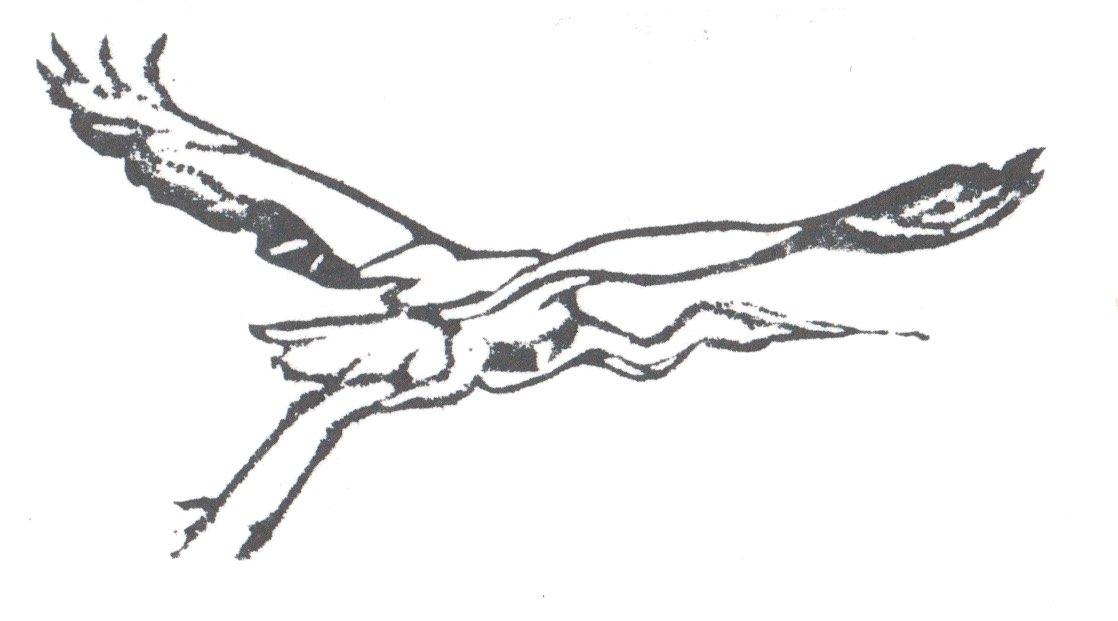
as symbols of attributes that they find valuable. In his book Corr Scéal: Crane Notions , 7 writer Lorcan Ó Tuathail gives the example of eagles being exalted by cultures that value individualism, and speculates on the possible values that Cranes may have represented for cultures with strong community values.
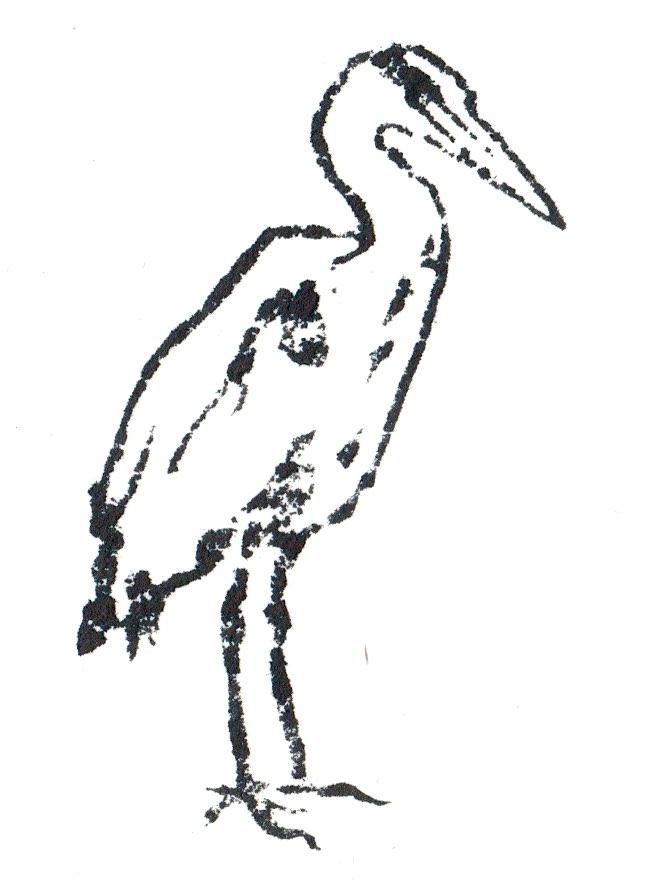
With these notions in mind I made a small speculative design project of the Crane Bag from Irish myth. It is a magical bag that was able to carry the most important things in Irish culture, the oral tradition of storytelling and folk knowledge and then the written word when literacy came to the island. Cranes were an important part of old Irish culture, likely from ancient times through to the Middle Ages. They were a popular domestic pet, their feathers denoted prestige, and they were associated with otherworldliness and vigilance.
Lorcán Ó Tuathail speculates on the possible values that Cranes may have represented for ancient peoples. Opposed to individualistic values that birds like Eagles are often used to represent in modern times, Ó Tuathail posits that the Crane may have, and may yet, represent social values of mutual care. This is because Cranes are very social creatures with strong communities. I was taken by this notion and wanted to explore the idea that a contemporary iteration of the Crane Bag would be one that carries these Crane-like values.
Because of their community oriented social structure, Cranes have plenty of time and energy to devote to more than just meeting their needs, and this allows for their iconic dancing behaviour. While dancing is part of the birds’ mating rituals, it is generally believed that they primarily dance for the purposes of joy and fun . With 8 this work I wanted to invite people to celebrate and connect with our ecosystem and therefore decided that emulating Crane dances would be the focus of this project; in order to combine the idea of wisdom found in the mythical bag, my desire for a society of mutual care, and a desire for joyful eco/nature art.
7 Dinets, V. (2013). Crane dances as play behaviour. Ibis, 155.
Ó Tuathail, L. (2016). Corr Scéal: Crane Notions. Careful Publications
Growing up I thought I was surrounded by an abundance of nature, but later learned that it was mostly plantations made for individual gain; monoculture forestry and so called “developed land” that turn biodiversity into green deserts. This shook me and motivated me to make a change. Through re-discovering my native Irish language and culture, I have found that indigenous communal knowledge and values, informed by ecology, can empower people to connect with their ecosystem.
At this point I felt I had to examine, in my practice, the chief antagonist to these ideals of community, and what stops us from enacting these ideals. I guess the short answer is late stage capitalism, but I try to understand it through the lens of myth making and storytelling.
In September 2024 I was fortunate enough to visit, with a group of peers, the work of artist Nazif Lopulissa during his residency at the Buro Stedelijk, at the Stedelijk Museum in Amsterdam . This is a program in which artists would bring their studio 9 practice to the museum to work in a public space so that visitors can interact with the practices in progress.
He writes, “Drawing on childhood memories, ancestral stories, and diasporic heritage, Lopulissa weaves personal and collective histories into an organic formal language” . In visiting him we saw this in action as he shared a collection of objects 10 and keepsakes from or representing his past, his family and his Indonesian heritage. He showed us a series of mono prints on fabric made with bleach and masked with, if I remember well, palm fronds resulting in impressions of the plants. These works were made during a visit to Indonesia and travelled with him to the Netherlands, thereby embodying a sense of diaspora or displacement, while the use of bleach represent the whitewashing of culture and history.
Buro Stedelijk. (2026). About. khttps://burostedelijk.nl/about 9 Lopulissa, N. (2026). About. https://www.naziflopulissa.com/about 10
A moment that stood out to me was when he opened a jar of clove infused water and invited us to smell the scent of it. It was immediately nostalgic for me as cloves are used often back home in festive roast dinners or to spice a hot whiskey. Lopulissa told us how it’s quite nostalgic for him too, and at the same time carries the extractivist colonial history of Europeans in Indonesia. This simple act of sharing could connect us both with our mothers and grandmothers, but by doing so in the context of a practice that tackles complex or difficult subjects, with conscious use of materials, one can engage more deeply with the layers, meanings, and connections of an object, symbol, or sensation.
In The Carrier Bag Theory of Fiction, Le Guin expresses that the spear shaped death stories alienated her from humanity but that the carrier bag theories helped her reconnect. She writes that carrying a bag of life stories does not make us meek or set life stories apart from the patriarchal heroic violence, it encompasses all of these things. She argues that it is the stories we tell that make the difference. In a bag structure, the narrative is that it is human to gather and bring home life and knowledge, and dealing with the violence and destruction is just an aspect, a step, in our gathering journey. In her 2019 introduction, Haraway speaks about literal bags, mochilas in this case, which she was gifted while working with Indigenous peoples in Colombia. She tells the stories of these bags and uses them to gather the stories of the people, land, struggles and futures there.
The stories these bags gather can mute the killing stories, the life-sucking weaponised sciences and technologies, the drug-and-money-soaked vampire markets, and all the other prick tales that labour to make history in their own image. None of these bags is a utopia outside the killing fields; quite the opposite. They each situate those who make and those who carry the mochila in worlds that are at stake now. (p. 9)
In order to personify the antagonistic elements of contemporary culture, I invented a character named Mr. Presserfoot. He represents my understanding of the young man in finance, the hero of the death stories. Developing this character came about organically in my practice. At the time I had been focusing on developing ideas in a more natural, less conscious, manner. I would typically start in my sketchbook, drawing without much of a plan and allowing patterns and motifs to surface and resurface. From this pool of imagery I picked out a motif of a figure with flames and smoke coming from their head and combined it with that of a typical businessman, then I continued drawing this figure, reiterating to let it develop naturally.
I understand this process in a way by thinking of muscle memory as an agency in itself. When drawing, my formal training and muscle memory do most of the work. My unconscious mind and my conscious decisions then interact with the muscle memory and this combination of agencies come together and bear creative fruit. In a similar dynamic, perhaps theoretical knowledge works like muscle memory, allowing for a lot of work to happen in an automatic or unconscious way, acting as an agency that guides the practice. Environment and materials also act as agencies. Finally I feel like my own conscious agency is very small in this whole process. This might sound like a lack of control, but the trained agencies come from my previous decisions, work, and studies. I feel a tremendous freedom because I don’t need to control everything. I feel that this allows me to learn through the work instead of pontificating through it.
Returning to Mr. Presserfoot, he is frustrated, lonely and feels futile in spite of being the idealised vision of a young successful man. Rather than making stories where he is vanquished by some honourable hero, I have been trying to approach the notions of new kind of stories; what happens when Mr. Presserfoot, in times of frustration and futility, interacts with the carrier bag?
Presserfoot the Cartesian and how to help him through Play
In my practice I have been creating a fiction of men trapped in and perpetuating harmful structures. I have been starting with an approach of making a witness testimony and then fantasising about strange occurrences disrupting or queering the narrative; by depicting the character of Mr. Presserfoot bursting into flame or sprouting a fish head in place of his own.
Earlier on in this study I made a short film testimony after witnessing a large scale dairy farm as part of Martón Kabai’s Designing Our Way out of Design module. In the short film, titled How do they play around here, I projected my own experiences of growing up around farmers onto the farm that we visited. In my witness testimony I fantasised about these farmers growing up on a farm and being de-sensitised to the violence inherent there. I imagined these children growing up to inherit the family farm and feeling the ever increasing financial pressure to expand, in the name of providing for the family, all environmental consequences be damned.
A recent development in my practice is that I have started an artist collective with some friends. Together we have produced some zines. One is titled MOO. It tells, or rather witnesses, the story of a cow named Rosa who escaped the animal product industry by virtue of being a freemartin cow. This is an intersex condition that occurs when a male cow embryo’s genetics are mixed with a twin female embryo in the womb and leads to the female cow developing male attributes and is therefore unsuitable for production. I wanted to tell the story in a way that highlighted how queering a system’s intentions for an individual can lead to the individual being able to escape harm and find sanctuary and community. Society has othered nature from itself, I think this is why queer people so often find kinship in nature, and it is part of
why I feel a strong connection to Rosa’s tale. I feel it is political in the aspects of consumer culture, climate change, queer and other-than-human visibility. It is challenging, informative and optimistic. This story aligns with my proposed research field, and the acts of witnessing and telling the story have informed the direction that my practice will take. I would like to find/collect more stories like this from first-hand experience, experiences of others, folklore, tall tales, mythology and more.
Just as the archetypal hunter must kill a great mammoth, the modern man who provides must own the biggest herd of cattle or reap the greatest profits from their investments. All the while, the slow and steady work of the gatherers is forgotten, undervalued and destroyed. In making art and telling stories, I find I can form resistance against this destruction of slow and steady work, through the simple act of working slowly and steadily. I loved hearing Aesop’s fables growing up, and have often felt alone in taking the story of the hare and the tortoise seriously.
In the spirit of slow considerate action, I have been experimenting with carving small wooden figures of Mr. Presserfoot. I have been using a piece of elm, a lovely hard wood, that was generously given to me after it was collected from a fallen tree some years ago.
It is a laborious and time consuming act. My hands get quite sore before long so I have to do it at the pace they allow. I can’t say whether my hands mediate the relationship between the elm and my ideas, if the wood mediates between my hands and my ideas, or if the ideas mediate between my hands and the wood. Perhaps it is just my hands and the wood working together, while my thoughts are simply along for the ride. I feel it may be all of these possibilities interchanging, which makes up the process as a whole. Whatever the case may be, I find this process allows me to empathise and care for the concept of Mr. Presserfoot and the culture of consumption that he represents; by queering and disrupting his image.
I have been creating similar small models of many forms of Mr. Presserfoot using 3D printing and found objects. I bought a few 3D models online to make my own prints in plastic. I then attached different objects to them to make a number of Mr. Presserfoots with different characteristics. These figures have a very different materiality to the wooden figures. For me they feel cheaper, convenient and more in line with consumer culture, they are toxic materials that won’t decompose. Therefore I feel they represent the negative aspects of Mr. Presserfoot. However, what I didn’t expect (naively perhaps) was how drawn people are to them when they visit the work. It makes sense in hindsight, they are recognisable materials and the forms are so realistic, they are approachable. People nowadays probably have more bodily experience handling plastic objects than they do with organic materials like wood or stone. Of course it is specific to the individual as to how materials are interpreted so I am learning to allow for my own internal logic of symbolic meanings to be subverted once the work is shared.
In a fascinating 2025 publication titled With a Bird, A Reader on Avian Kinship, one of many contributors is contemporary Indian artist Manjot Kaur, in this book she writes a text around her body of work Hybrid Beings 11
Hybrid Beings is a series of paintings rooted in fabulation and speculative postulation, depicting post-human species that extend an invitation to reimagine the connections between species, identity, and ecology. It challenges patriarchy and gender bias, and offers a vision where the boundaries between human and more-than-human dissolve. (p.222)
The paintings depict a number of bird women hybrids inspired by Ashta-Nayika, a term for a collection of heroine archetypes in various states of love. Kaur uses the Manjot. K. (2025). Hybrid Beings. With a Bird, A Reader on Avian Kinship, Onomatopee 262. 11
framework of existing cultural narratives to illustrate contemporary concerns. By playing with a familiar structure, in this case replacing the male heroes of the narrative with endangered bird species, complex notions like nature-culture duality and issues like biodiversity loss are are opened up and made more accessible. This is a method I try to incorporate in the stories and characters I’ve been making. By shifting, playing with, and disrupting archetypes, symbols, genres, and narrative structures I believe we can develop new narratives, rituals and ways of thinking.
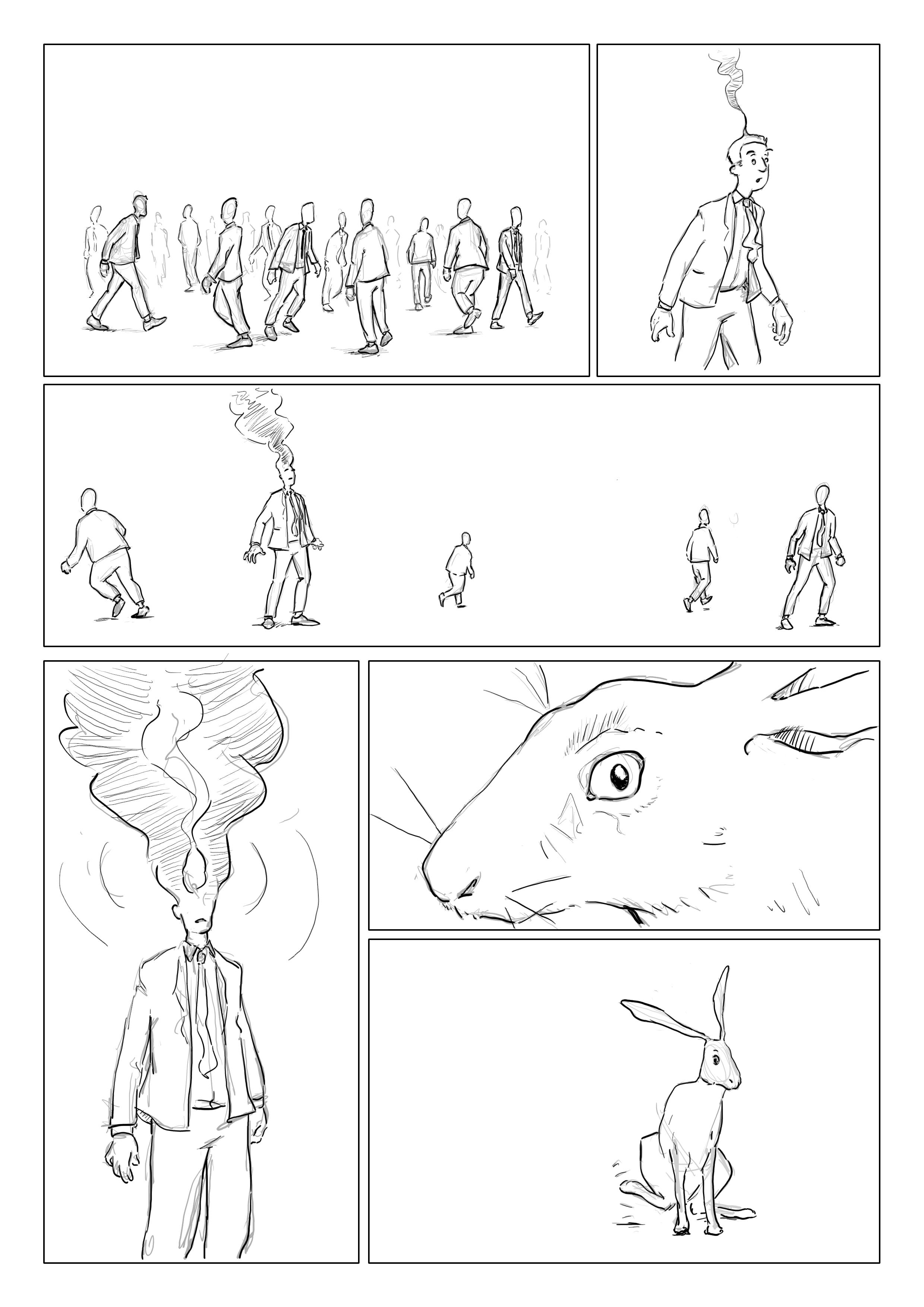
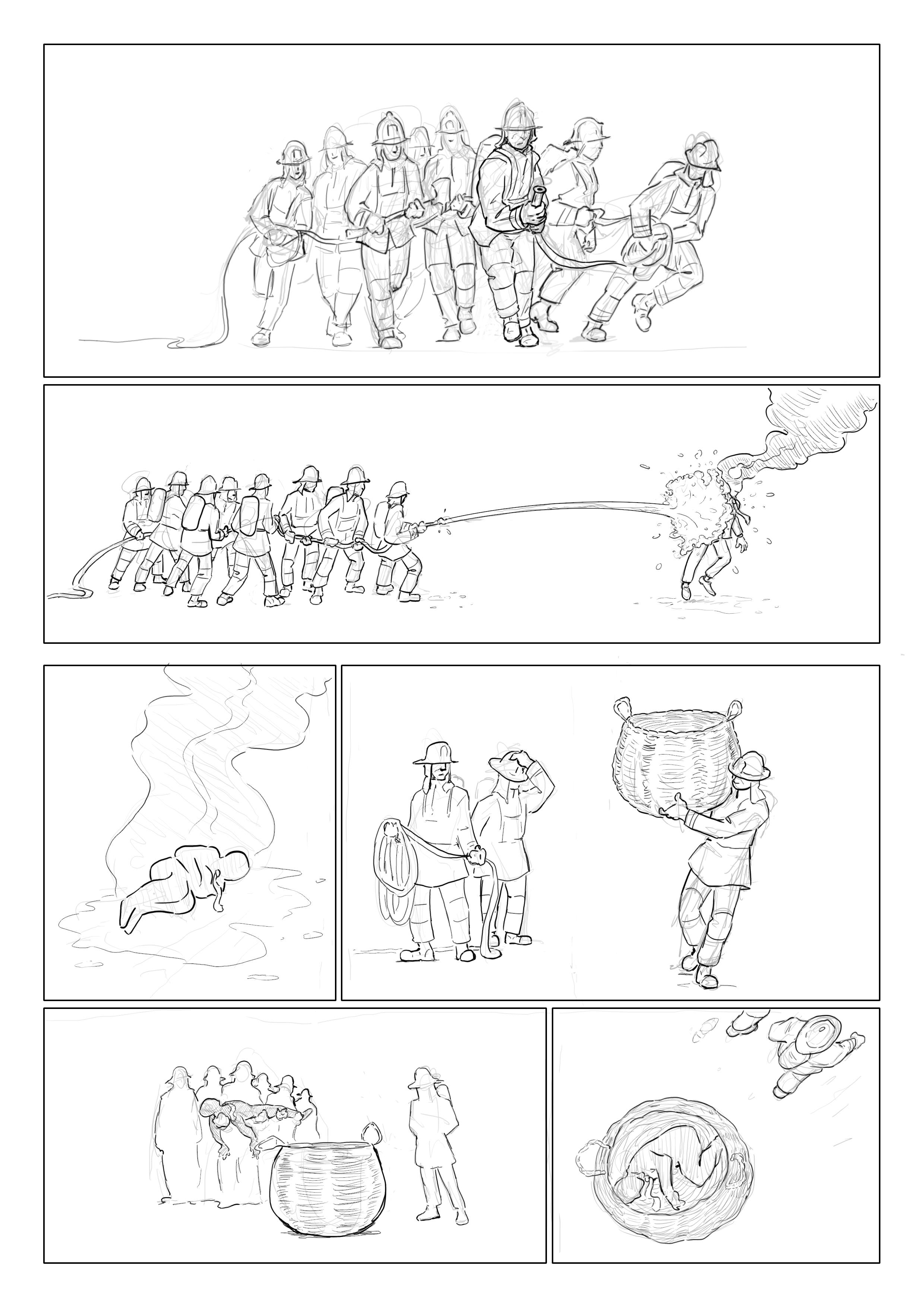
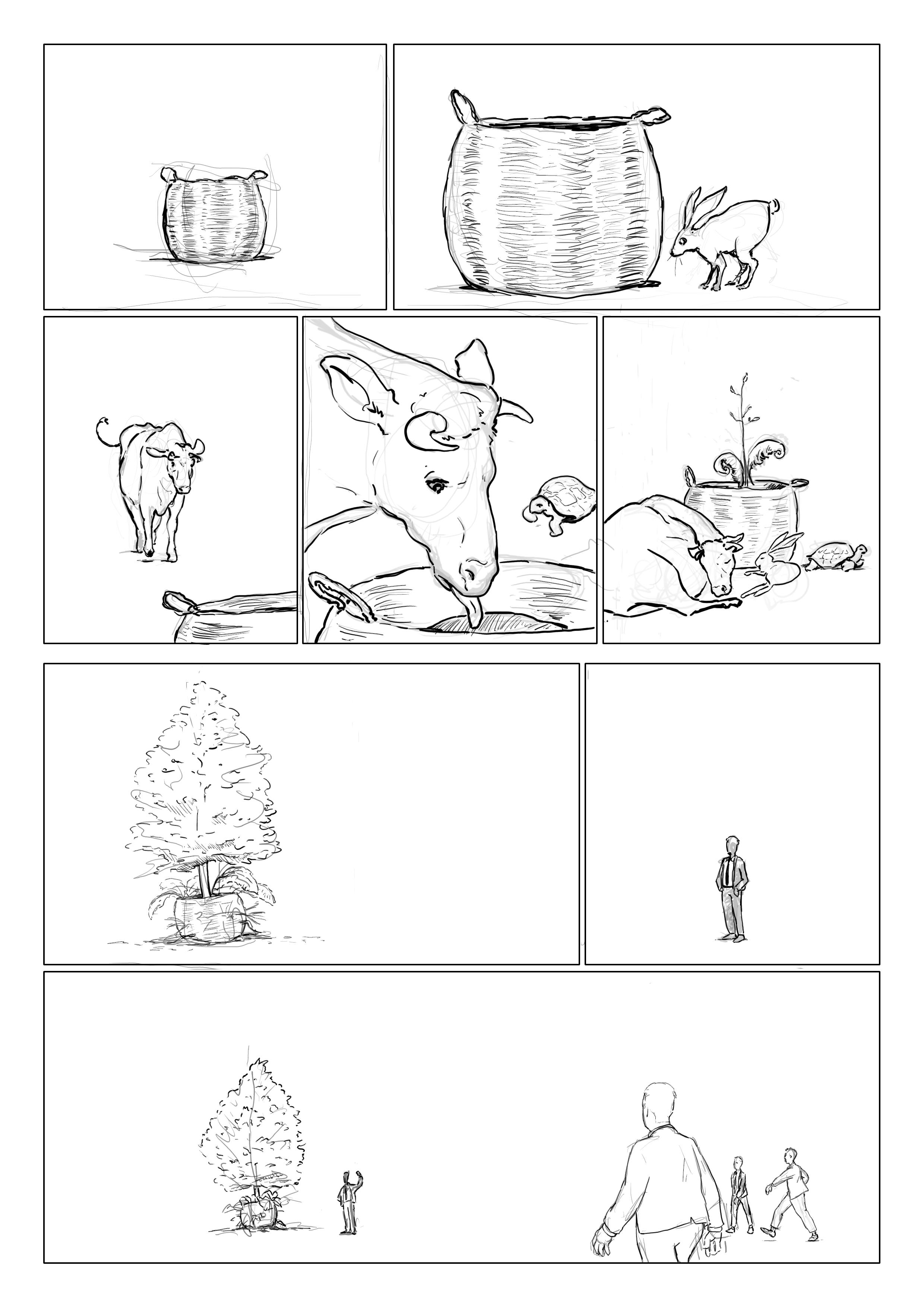
I made an interpretation of some Early Christian folklore about the relationship between goats and the devil, in order to highlight the influence the folkloric world of storytelling has in my practice. By including this in the presented body of work, I aim to prime visitors to engage with the work with a similar mindset as they might with folkloric stories. Thus I wrote a comic of my own involving Mr. Presserfoot himself. It is a story that I wrote instinctively with dreamlike thoughts and a strange unexpected logic inspired by mythic stories. In the story Mr. Presserfoot has moments of intervention from firemen, animals, and other versions of himself.
Much like with the different materials, I have an internal logic of what these various elements represent, however I have always been resistant to stating directly what my own interpretations are. When asked what the story means, I respond “thats’s up to you”. This is partially because I don’t think art ought to give answers, but I am still learning and accepting that this comes with having little control over the interpretations people will have of the work. So, I want to play into this fact. Because I work with symbols, and different cultures have their own interpretations of symbols, allowing for more play and interaction might allow the visitor more autonomy in interpreting the meaning of the work.
In his 2008 writing Exhaustion et Exuberance, Ways to Defy the Pressure to Perform , Jan 12 Verwoert, a critic and writer on contemporary art and cultural theory, discusses ways to make a good life and future through resistance and the intricate play between action and inaction; he writes:
In artistic practice this dedication to imagining other ways to perform and other ways to enjoy consumption means claiming the imagination and the aesthetic experience as a field of collective agency where workable forms of resistance can be devised.(p. 91)
I feel a great potential in this thinking for the Mr. Presserfoot project. Thematically, I want the character and visitors of the work to find ways to resist Mr. Presserfoot’s default businessman persona. Verwoert continues by speaking of existential exuberance, acting energetically in response to external demands in a way that meets the demand of action but not the demanded result, without necessarily having the energy to do so in the first place, “giving what you don’t have to others who may not want it”.
It is a kind of malicious compliance that I hope to invoke in my work. Society demands that we admire the entrepreneur, so I make little depictions of him and stick him on little pedestals with absurd names and point a spotlight on him. This all feels very playful to me so I would like to invite visitors of the work to really play and interact, I will experiment with kinetic sculptures and games that people can play with. So they can enact their own interpretations and ideas of the different versions of Mr. Presserfoot; by making it clear that visitors can hold and move the various pieces to create their own compositions and relations between the figures.
Verwoert, J. (2008). Exhaustion et Exuberance, Ways to Defy the Pressure to Perform. A pamphlet for the 12 exhibition Sheffield 08: Yes No and Other Options.
I have taken inspiration from the artist Peter Nash in how I envision these future 13 works, particularly his piece Doubt Ensemble . It is a kinetic sculptural work with a 14 row of small carved wooden heads with mechanical mouths that begin to chatter nonsensically when the visitor stands close enough to a motion sensor. It is a work tackling serious issues of information burnout and toxic media streams, yet the playful naivety of its execution allows gentle exploration of the topics. People are drawn close by the small scale of the heads and often get a fright when the motors start, then there is laughter, conversation and contemplation.
Verwoert goes on to speak about the seemingly endless energy that can be summoned up when we care for someone or something. Caring and self-care, through customising one’s own way of spending energy, are ways to avoid the exhaustion that contemporary society demands of us. Yet it only keeps us able to continue in the cycle of performing and then burning out. Care goes both ways, so if something doesn’t care back, the endless potentiality from caring is not possible. So, he asks, what happens when we go beyond exhaustion? Well he invokes his notion of convalescence, a state after total exhaustion of both energy and options where one becomes aware that they do indeed care; and in this state we can find agency by continuing to enact care and we can find energy in acts of mutual care.
In Braiding Sweetgrass , Robin Wall Kimmerer speaks of the way nature and its 15 ecosystems take care of us, of all beings. By caring mutually, rather than just for ourselves, we harness an exuberant energy while empowering the ecosystem that sustains us, rather than a system that burns us out. Therefore, Mr. Presserfoot, in his Nash. P. (n.d.). Peter Nash. https://peternash.org/ 13 Nash. P. (2017-2019). Doubt Ensemble [Multimedia Installation/Sculpture]. Crawford Art Gallery, 14 Cork, Cork, Ireland. https://circaartmagazine.net/peter-nash_doubt-ensemble/ Kimmerer. R. W. (2013). Braiding Sweetgrass. Milkweed Editions
15
state of burnout, must either burn out completely or begin to engage in acts of mutual care.
In his 2023 essay Cartesianism and More-Than-Human Undercurrents , cultural theorist 16
Rick Dolphijn discusses a movement away from Cartesian style binary modes of relating to the world around us, and towards a growing desire to cultivate bonds between all living beings, “every possible anima (meaning embodied spirit or soul)” (p. 144).
He discusses how Descarte’s thinking, along with colonisation in general, swept away and covered over pre-existing traditions with strong animistic ideals and how these modes of thinking are becoming more popular and sought after. He invokes Donna Haraway’s desire for us to make kin not babies as a method for 17 transitioning to new ways of being which are informed by traditional ontologies. It is in this place of transition that I like to depict the character of Mr. Presserfoot. My hope for him is to remove himself from the Cartesian model and engage with the carrier bag.
The capitalist, however, with a lack of theory of mind, believes that if a system benefits him then it must benefit everyone . This makes things tricky, he thinks he is 18 acting in the interest of society, like a babe he knows not better, this is why I think there needs to be an inciting event or interruption that knocks him from his misguided path.
In chapter 26 of Braiding Sweetgrass, Robin Wall Kimmerer speaks of how ceremonies hold us accountable to community. When values of mutual care are baked in to cultural practices, when we publicly and ritually declare that we will
Dolphijn, R. (2023). Cartesianism and More-Than-Human Undercurrents. Enfleshed, Ecologies of 16 Entities and Beings, Onomatopee 241 Haraway, D. (2016). Staying with the trouble. Duke University Press.
17
18 by Michael Parenti [Video]. YouTube. https://www.youtube.com/watch?v=zf_KSz1v6Vc (Original work published 1992)
The Michael Parenti Library [@themichaelparentilibrary]. (2023). Voodoo Economics and Class Warfare
uphold these values, we tend to keep the promise. I think this kind of ritual could be emulated in an exhibition of the Presserfoot project, in the form of interactive works I described above. Continuing his discussion of post-cartesian models, Dolphijn speaks about mumming practices throughout Europe. It’s a broad term for cultural practices that typically involve a parade of costumed characters that embody various forces and phenomena. They often ask for some kind of offering—food, drink, money—to avoid their wrath, or they simply try to scare the shit out of you, and then the whole thing devolves into revelry and music. These rituals serve to keep us wise to, and respectful of, the forces they represent. Dolphijn focuses on characters that represent the natural environment, such as the Scottish Grýla who embodies the simultaneously destructive and life giving power of the ocean. I’d like to point out my own local mumming practice, The Wran, which often has a soldier character who, with his big musket gun, embodies the violence of colonial oppression. I think the revelry and fun of these practices are so vital for breaking the tension of peoples fears. They return a feeling of agency in the face of these insurmountable powers that be. We make offerings to the characters but ultimately we are sharing gifts with our neighbours.
In her essay, In the Arms of the Sea: Claud Cahun and Marcel Moore at the Water’s Edge , 19 art historian Amelia Groom discusses the work of Claud Cahun and Marcel Moore during the period when they lived on Jersey Island, which included the period of Nazi occupation of the island. Groom highlights a through line in their practices of queering and blurring the boundaries between social constructs—like behaviours and identity—and the rest of our environment. We see how their work can be selfactualising on personal and societal levels, and as direct resistance to oppressive forces through their satyrical underground publications.
Groom. A. (2023). In the Arms of the Sea: Claud Cahun and Marcel Moore 19 at the Water’s Edge. publication for the 24th Biennale of Sydney Ten Thousand Suns.
Groom highlights a series of illustrations by Marcel Moore which depict more than human relationships in our natural environment. These illustrations imagine figures that blend with and into the ocean and its inhabitants. Similarly, a body of the couple’s photographic works are discussed which involve a variety of hybrid beings, a blend of human figures, ocean life and ocean landscape. Groom refers to these hybrid creatures as both companions and monstrous, and through these monstrous companions, Cahun and Moore imagine a world that exists “beyond the confines of compartmentalised subjectivity”(Groom 2023, p. 314).
I can’t help but consider Cahun and Moore’s practice as a form of mumming as well, a practice that reminds us of very real but easily obscured relationships of interdependence within our ecosystem.
Here, a question comes up for me: what do we humans give in this interdependent relationship with the rest of our ecosystem? The Ocean and the Earth provide, but we only only seem to take and destroy? An all too common answer that I hear is that we don’t have a place anymore, that we should let ourselves die out or launch ourselves into the vacuum of space with a maniacal billionaire. I think these are unlikely scenarios and as answers are devoid of justice and responsibility. Nonetheless, the question remains difficult to answer, especially when we are trained to value capital gain and perpetual growth as good and righteous.
In researching for this thesis I think I’ve found a good answer, for now, in the practice of giving thanks and acknowledging what we give thanks through sharing knowledge and telling stories. Robin Wall Kimmerer speaks many times about the practice of giving thanks throughout Braiding Sweetgrass as a special attribute of humans. Le Guin speaks about how we came into our own by developing the carrier bag, the literal one and the one that carries knowledge home, and Verwoert speaks of how giving thanks maintains energy and creates reciprocal cycles in relationships.
I appreciate Vervoert’s variety of references; poetry, anecdotes, and music. He also speaks of how by acknowledging those who inspire us we repay a debt to them and empower ourselves at the same time.
In that spirit I want to wrap up this paper by sharing two songs that have helped me during this research by poetically expressing concepts that I’m interested in and the ways in which they tell a story.
The first is the song Mangetout by the alt-rock band Wet Leg . The song is 20 addressed to the kind of men who take up too much space and tells them to get out of the way while also hoping they can get out of toxic male social structures. The title as a pun connecting the lyrics “man get out” and “I gave you magic beans”, referring to Jack and the Beanstalk. For me this song perfectly and creatively expresses legitimate anger about serious issues through humour, punk sensibilities, clever storytelling, and hope.
The second song is Gild the Lily by bluegrass musician Billy Strings . This song 21 expresses a desire for deeper communication and understanding of non-human beings. The song is earnest and vulnerable in expressing this desire, and in its appreciation for our existing connections with our environment.
The way these tunes clarify intuitions, and put them into words, encapsulates the broader experience of engaging with theoretical research within an artistic practice.
I find this engagement leads to a praxis of sharing and community. Any work I have made and developed during this research project has been thanks to the sharing of ideas with peers, tutors, friends, and family; with authors and artists through their work; by going on nature walks, identifying birds, getting chased by cows, and reading old stories.
Wet Leg. (2025). Mangetout [Song]. On Moisturiser. Domino Recording Company. 20
Billy Strings. (2024). Gild the Lily [Song]. On Highway Prayers. Reprise Records
Bibliography
Billy Strings. (2024). Gild the Lily [Song]. On Highway Prayers. Reprise Records
Buro Stedelijk. (2026). About. khttps://burostedelijk.nl/about
Dinets, V. (2013). Crane dances as play behaviour. Ibis, 155.
Dolphijn, R. (2023). Cartesianism and More-Than-Human Undercurrents. Enfleshed, Ecologies of Entities and Beings, Onomatopee 241
Ferreira, B. (2019). Mythical Beings May Be Earliest Imaginative Cave Art by Humans. New York Times. www.nytimes.com/2019/12/11/science/cave-art-indonesia.
Fisher, E. (1975). Women’s Creation. McGraw-Hill.
De Fouw, J. (1966). Amergin II [Etching]. Crawford Art Gallery, Cork, Cork, Ireland. https://mpcrawfordartgalleryinternal.zetcom.app/v?mode=online#!m/Object/107/form/ ObjCatalogViewFrm
Groom. A. (2023). In the Arms of the Sea: Claud Cahun and Marcel Moore at the Water’s Edge. publication for the 24th Biennale of Sydney Ten Thousand Suns
Le Guin, U. K. (2019). The carrier bag theory of fiction. Ignota.
Haraway, D. (2016). Staying with the trouble. Duke University Press.
Haraway, D. (1988). Situated Knowledges: The Science Question in Feminism and the Privilege of Partial Perspective. Feminist Studies, Inc.
Jazbec, K (Director). (2021). You Can’t Automate Me [Film]. https://www.katarinajazbec.com/ youcantautomateme/
Kaishian. P. O. (2025). Forest Euphoria: The Abounding Queerness of Nature. Spiegel & Grau
Kimmerer. R. W. (2013). Braiding Sweetgrass. Milkweed Editions
Kropotkin, P. (1902). Mutual aid: A factor of evolution.
Lopulissa, N. (2026). About. https://www.naziflopulissa.com/about
Manjot. K. (2025). Hybrid Beings. With a Bird, A Reader on Avian Kinship, Onomatopee 262.
Mariska van den Berg in conversation with Katarina Jazbec. (2021). In Pursuit of a Visceral Cinematic Language. The Dialogue Room | TENT online
The Michael Parenti Library [@themichaelparentilibrary]. (2023). Voodoo Economics and Class Warfare by Michael Parenti [Video]. YouTube. https://www.youtube.com/watch? v=zf_KSz1v6Vc (Original work published 1992)
Nash. P. (2017-2019). Doubt Ensemble [Multimedia Installation/Sculpture]. Crawford Art Gallery, Cork, Cork, Ireland. https://circaartmagazine.net/peter-nash_doubt-ensemble/
Nash. P. (n.d.). Peter Nash. https://peternash.org/
Oates. J. C. (1996). Art and Ethics?—The (F)utility of Art. Skidmore College
Ó Tuathail. L. (2016). Corr Scéal: Crane Notions. Careful Publications
Schlanger. Z. (2024). The Light Eaters: How the Unseen World of Plant Intelligence Offers a New Understanding of Life on Earth. Harper
Tronto. J. C. (1998). An Ethic of Care. American Society of Aging
Verwoert, J. (2008). Exhaustion et Exuberance, Ways to Defy the Pressure to Perform. A pamphlet for the exhibition Sheffield 08: Yes No and Other Options.
Wet Leg. (2025). Mangetout [Song]. On Moisturiser. Domino Recording Company.